
Fusion Welding Processes Parameter Optimization for Critical Piping Systems: A Comprehensive Review



Abstract
1. Introduction
1.1. Pipeline Applications in Oil and Gas Industry Experimental Procedure
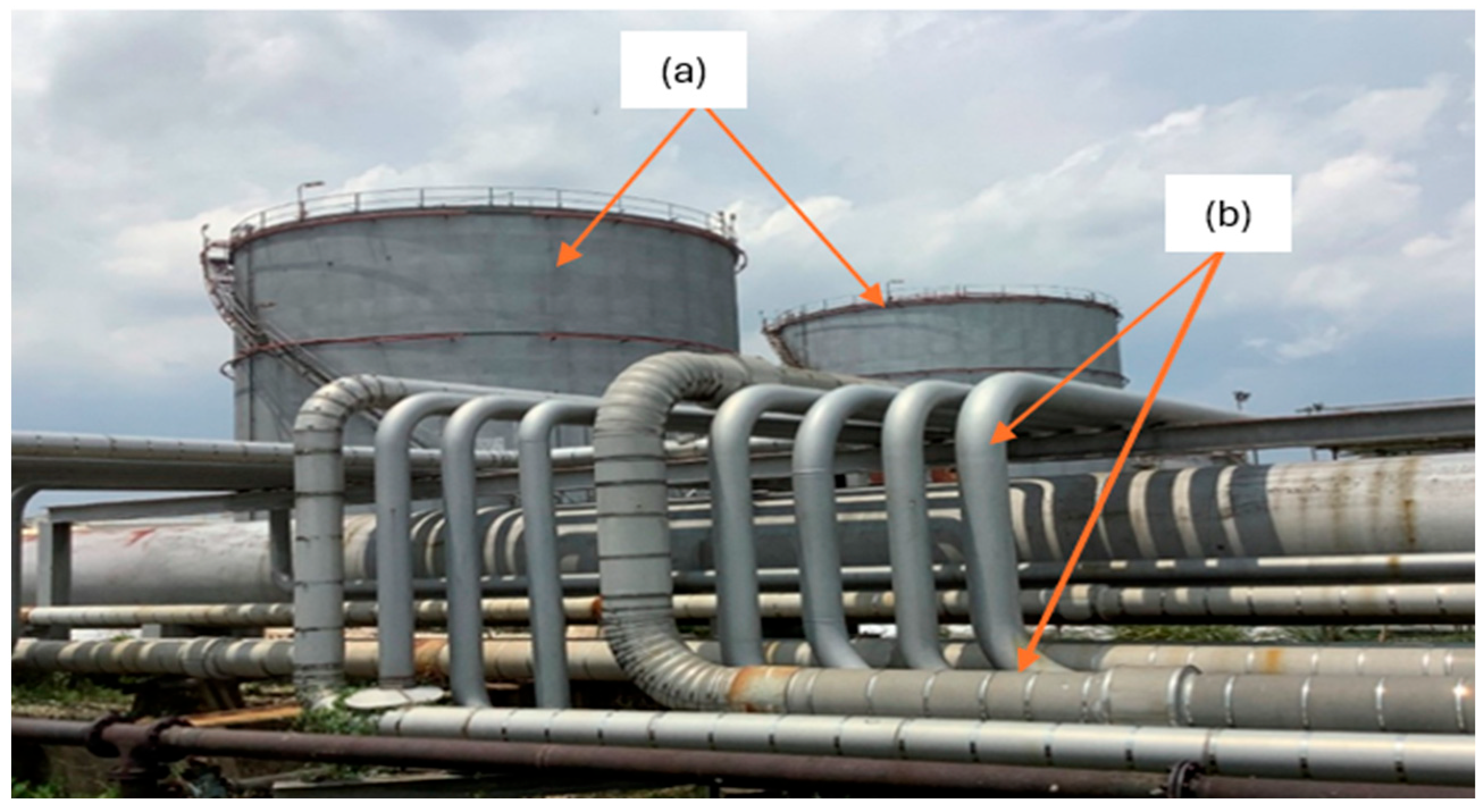
1.2. Critical Piping System
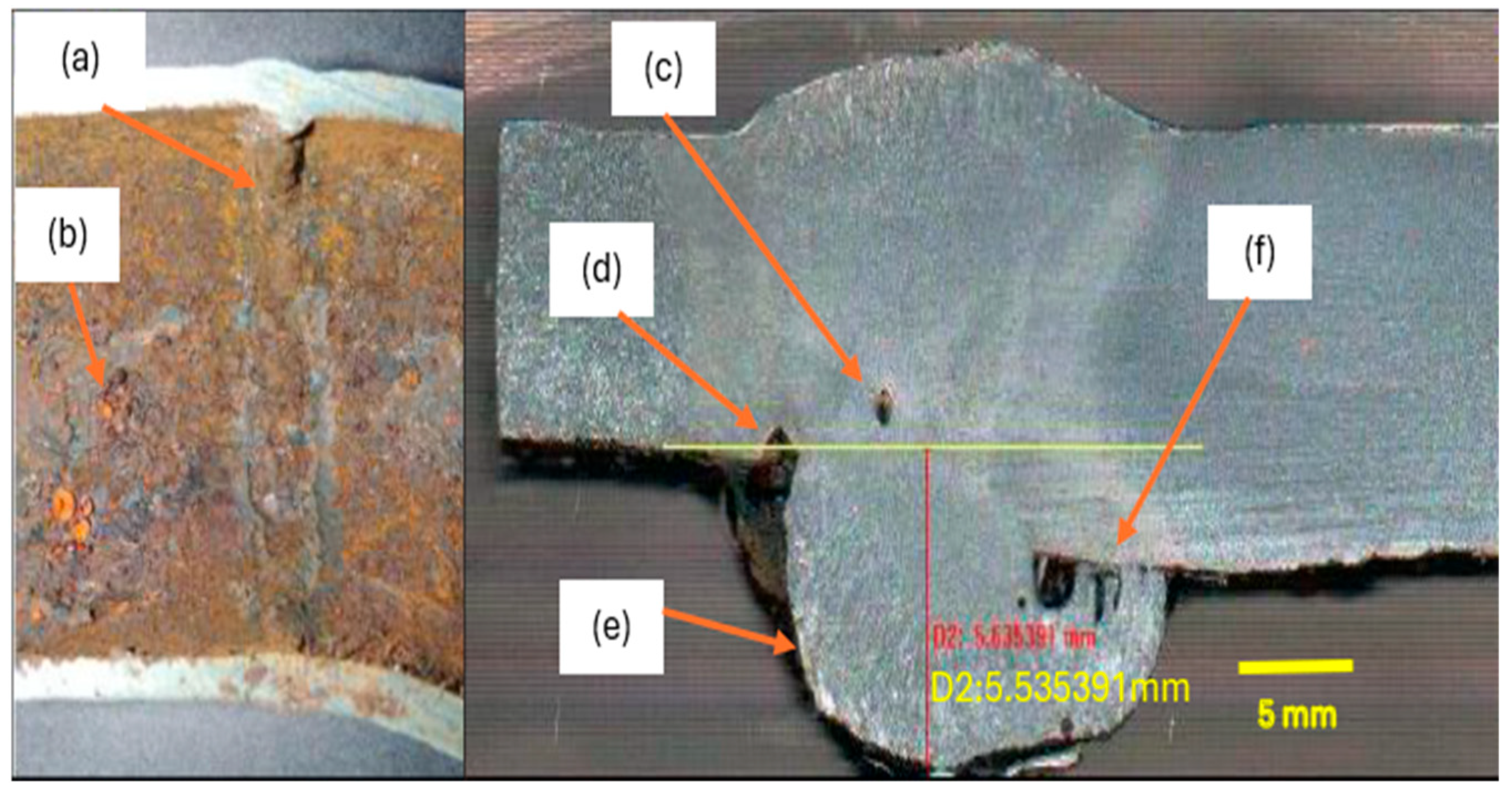
1.3. Welding Process in Pipeline Fabrication
1.4. Base Material and Weldability Considerations
1.5. Purpose of Review
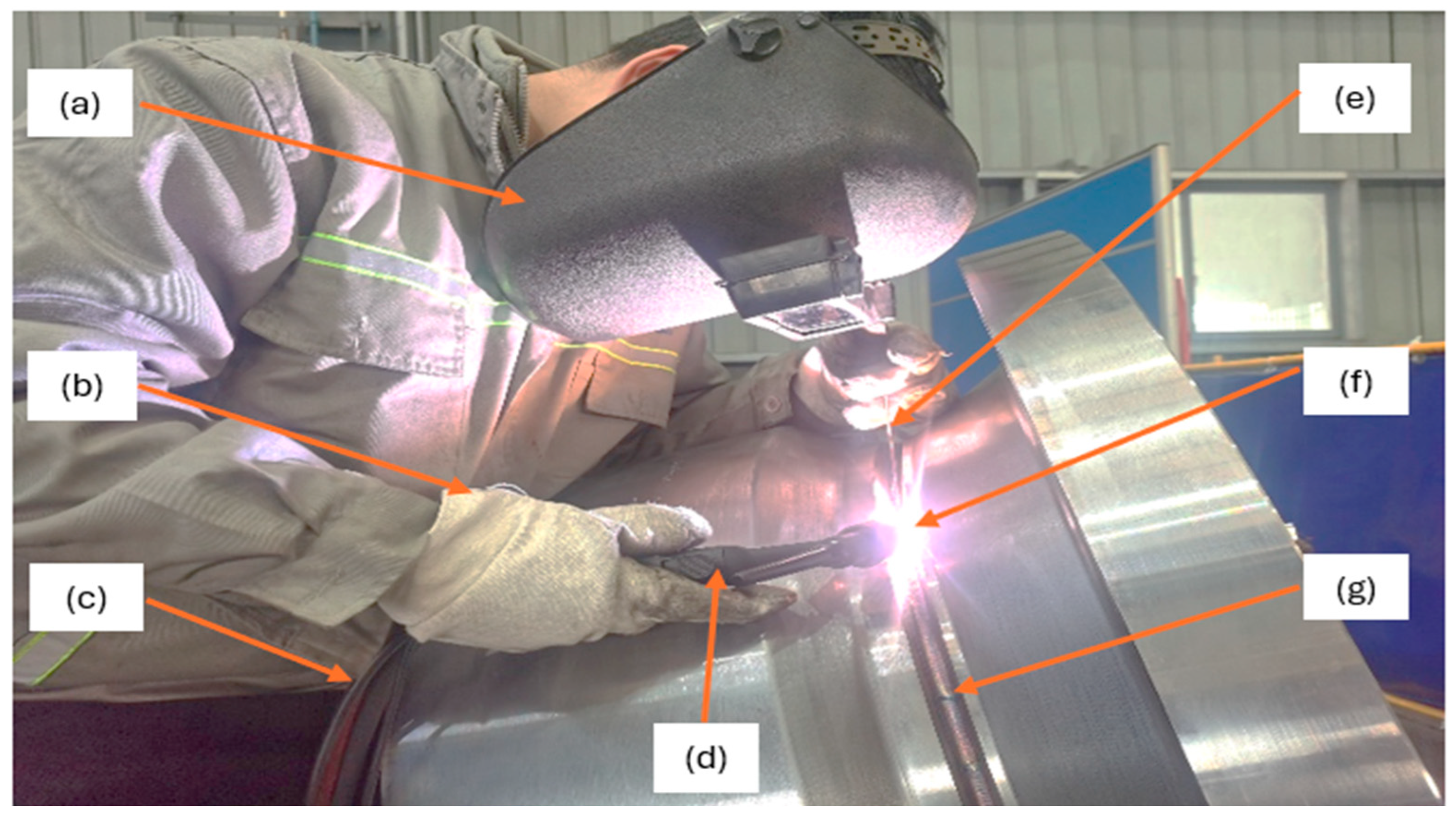
1.5.1. GTAW—Working Principle and Parameters
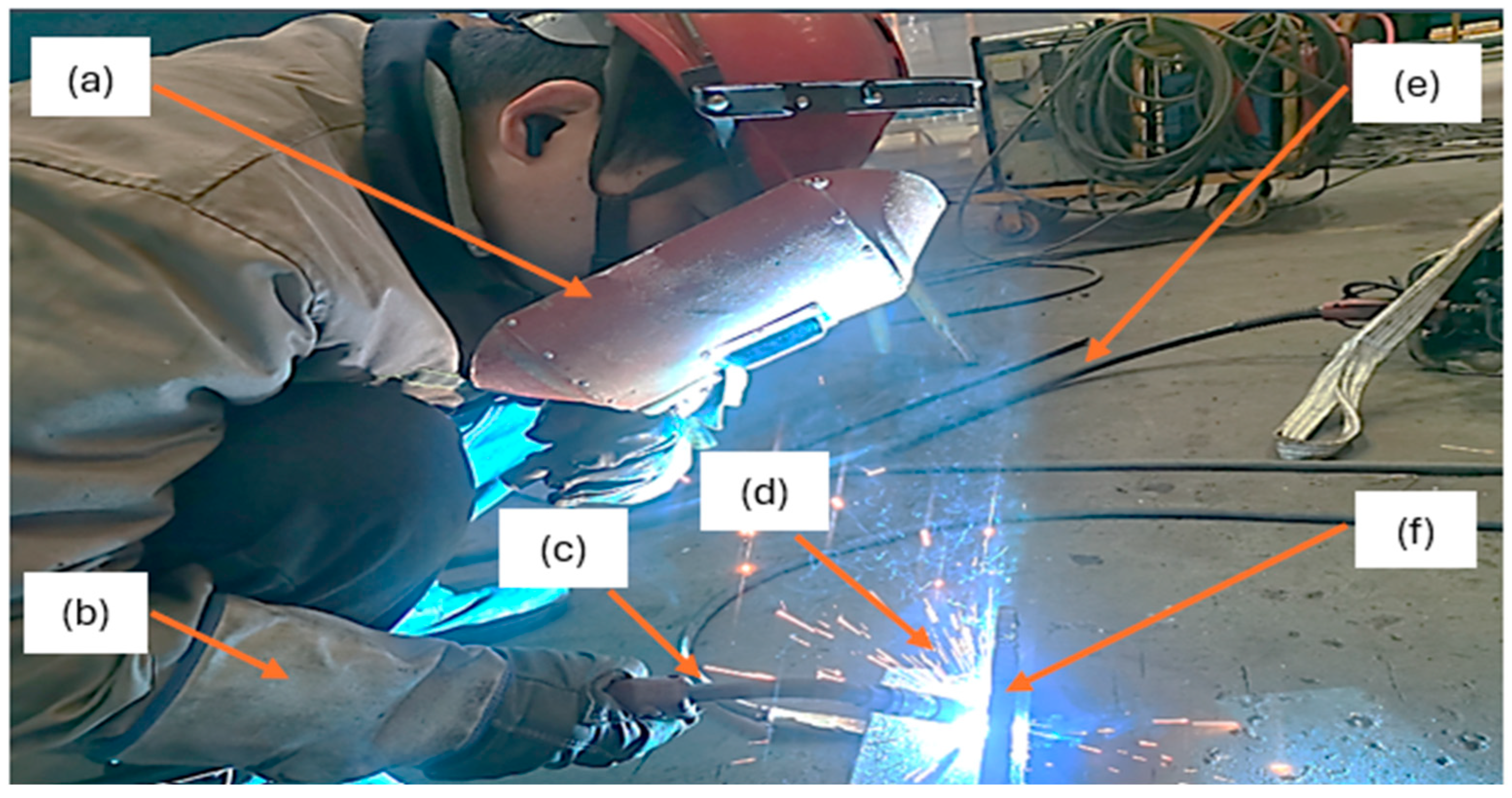
1.5.2. GMAW—Working Principle and Parameters
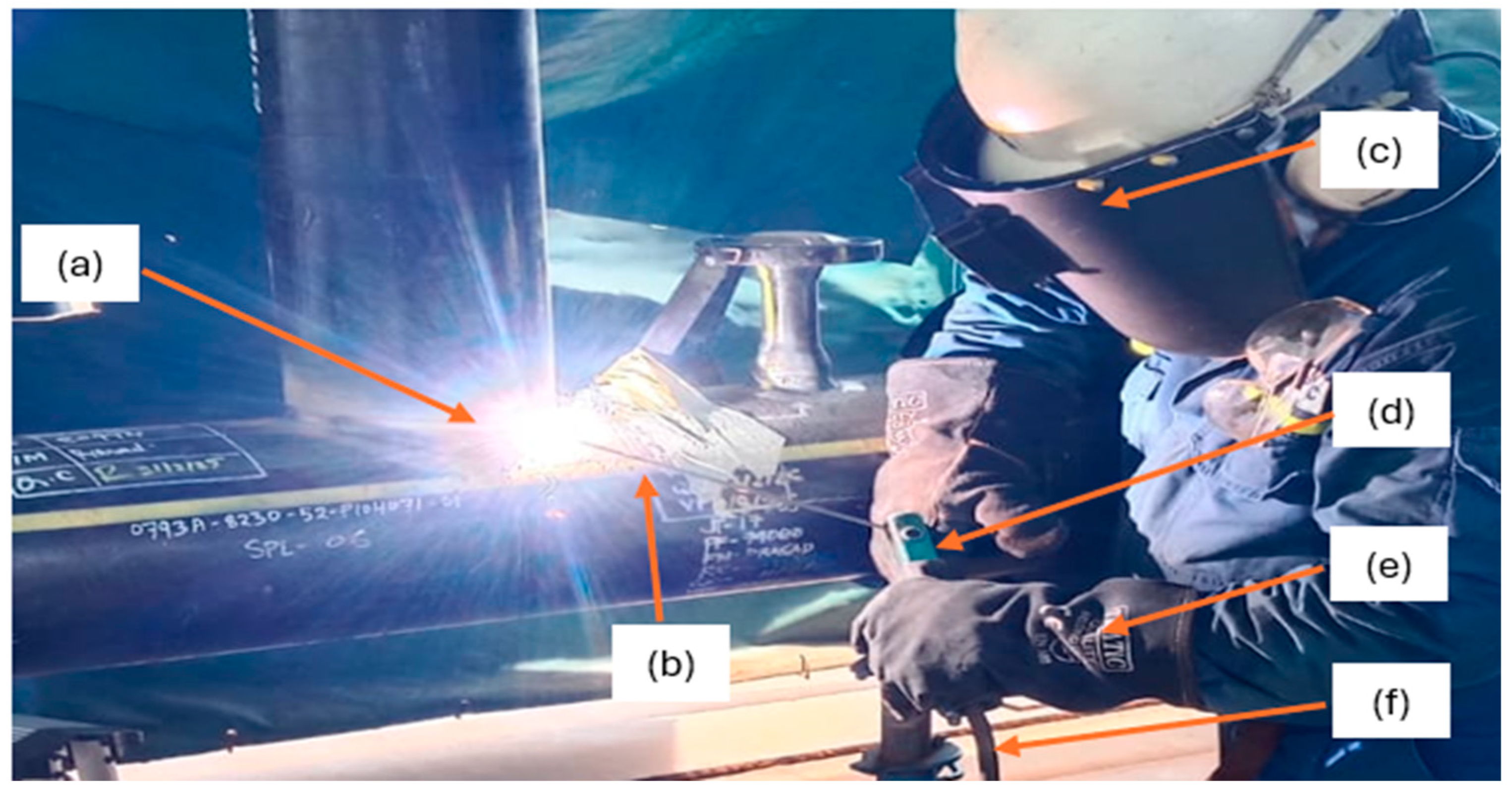
1.5.3. SMAW—Working Principle and Parameters
2. Literature Review of the Welding Process
2.1. GTAW—Effect of Weld Parameters on Weld Qualities
- Small sample sizes, limiting statistical reliability.
- Focus mainly on bead geometry, with little attention to metallurgical or corrosion behaviors.
- No evaluation of shielding gas turbulence, despite its influence on arc stability and oxidation.
- Limited filler and shielding gas variations, reducing applicability to real piping conditions.
- Minimal discussion of purging quality, despite root oxidation impacting corrosion resistance.
2.2. Influence of Arc Dynamics on Weld-Pool Behavior
2.3. GMAW—Effect of Weld Parameters on Weld Qualities
2.4. SMAW—Effect of Weld Parameters on Weld Qualities
2.5. Alternative Optimization Used in Welding (ANN, PSO, RSM, ML)

| Optimization Method | Representative References | Inputs Required | Accuracy | Advantages | Limitations |
|---|---|---|---|---|---|
| Taguchi Method | [28,31,34,40,45,47,62,66,67,75,76,86,89] | Factor levels, orthogonal arrays, S/N ratio | Moderate–High | Minimal experiments; effective screening; strong robustness evaluation | Limited for highly nonlinear interactions; not suitable for multi-output modeling |
| Response Surface Methodology (RSM) | [101,109,110,111,112,113] | Continuous variables, polynomial models, experimental matrix | High (quadratic systems) | Captures curvature; mathematical equations; sensitivity analysis | Less accurate for strongly nonlinear systems; requires more experiments than Taguchi |
| Artificial Neural Networks (ANN) | [97,98,99,100,102,103,104,105] | Large datasets; multi-input and multi-output structures | Very High | Learns nonlinear mapping; handles complex interactions; strong prediction capability | Requires large datasets; limited interpretability |
| Particle Swarm Optimization (PSO) | [106,107,108,109] | Objective function, swarm size, search boundaries | Very High | Excellent global search; effective optimization; reduces welding distortion | May converge prematurely; lacks physical interpretability |
| Machine Learning (ML, RSM, SVR, RF) | [114,115,116,117] | Labeled datasets; feature extraction; training/testing splits | Very High | Strong defect detection; accurate penetration prediction; Industry 4.0 ready | Requires high-quality data; sensitive to overfitting |
3. Literature Review Summary and Discussion
3.1. Comparative Analysis of GTAW, GMAW, and SMAW Across Critical Welding Metrics
3.2. Compliance Alignment with ASME B31.3 Through Parameter Optimization
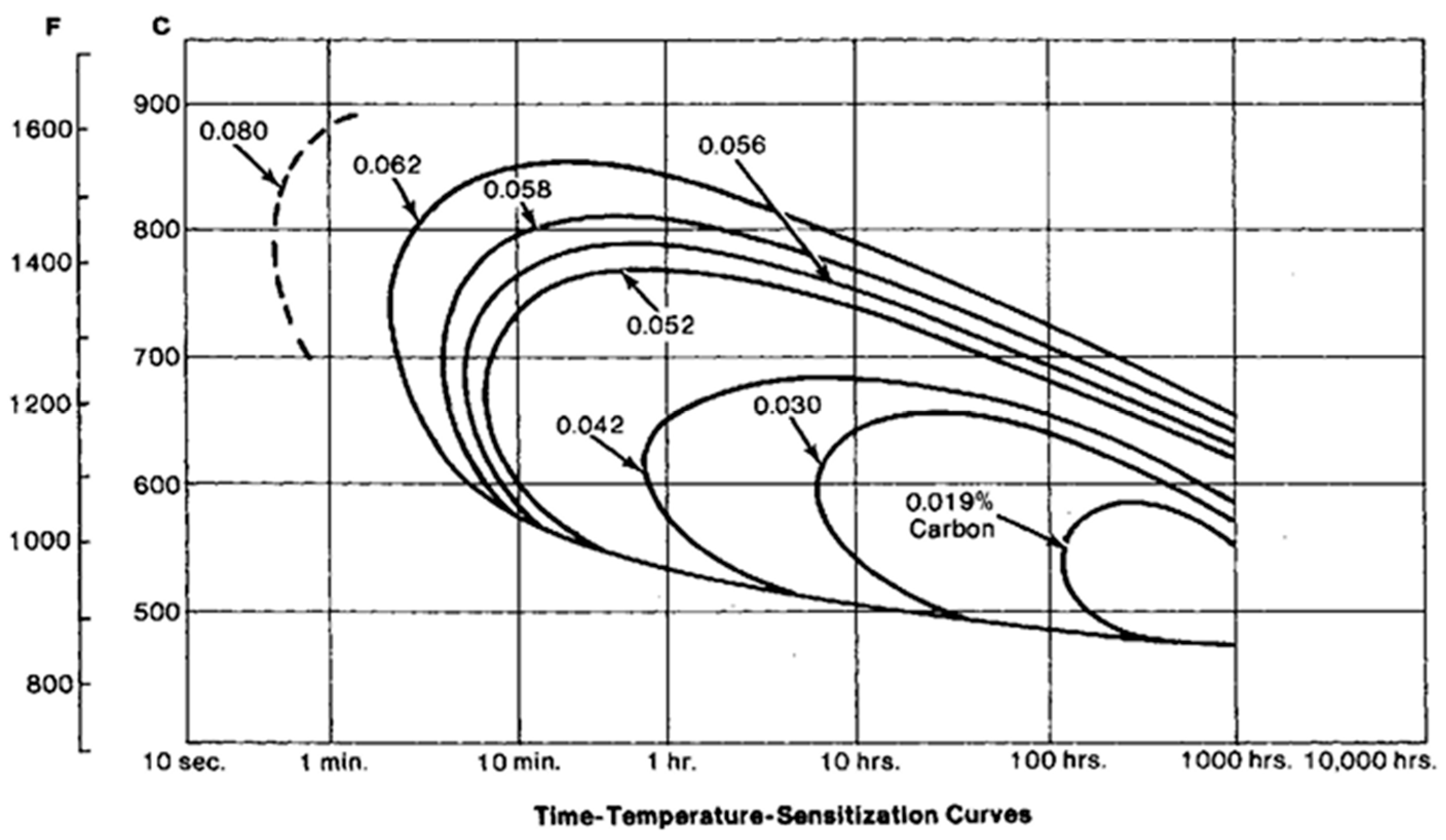
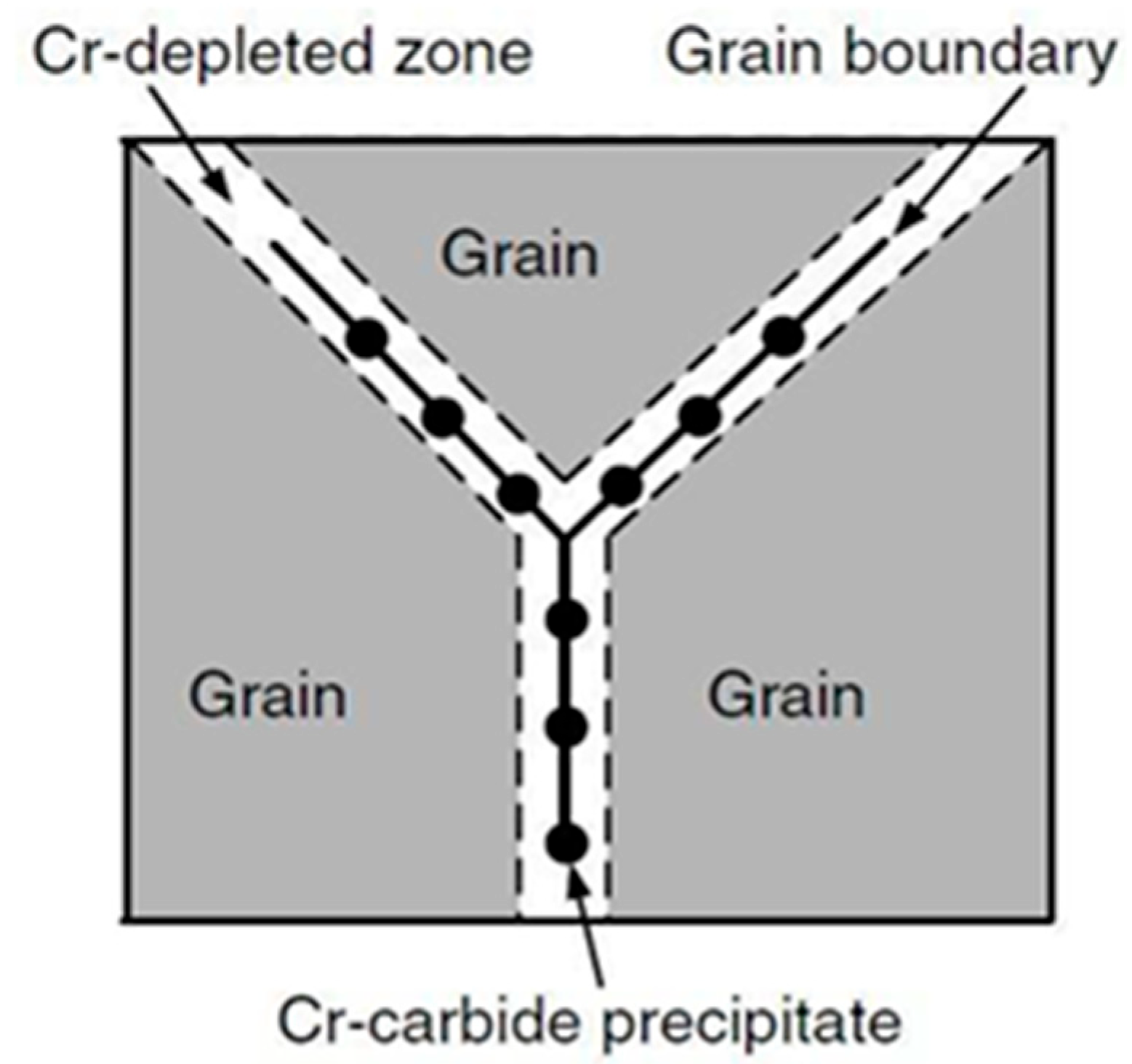
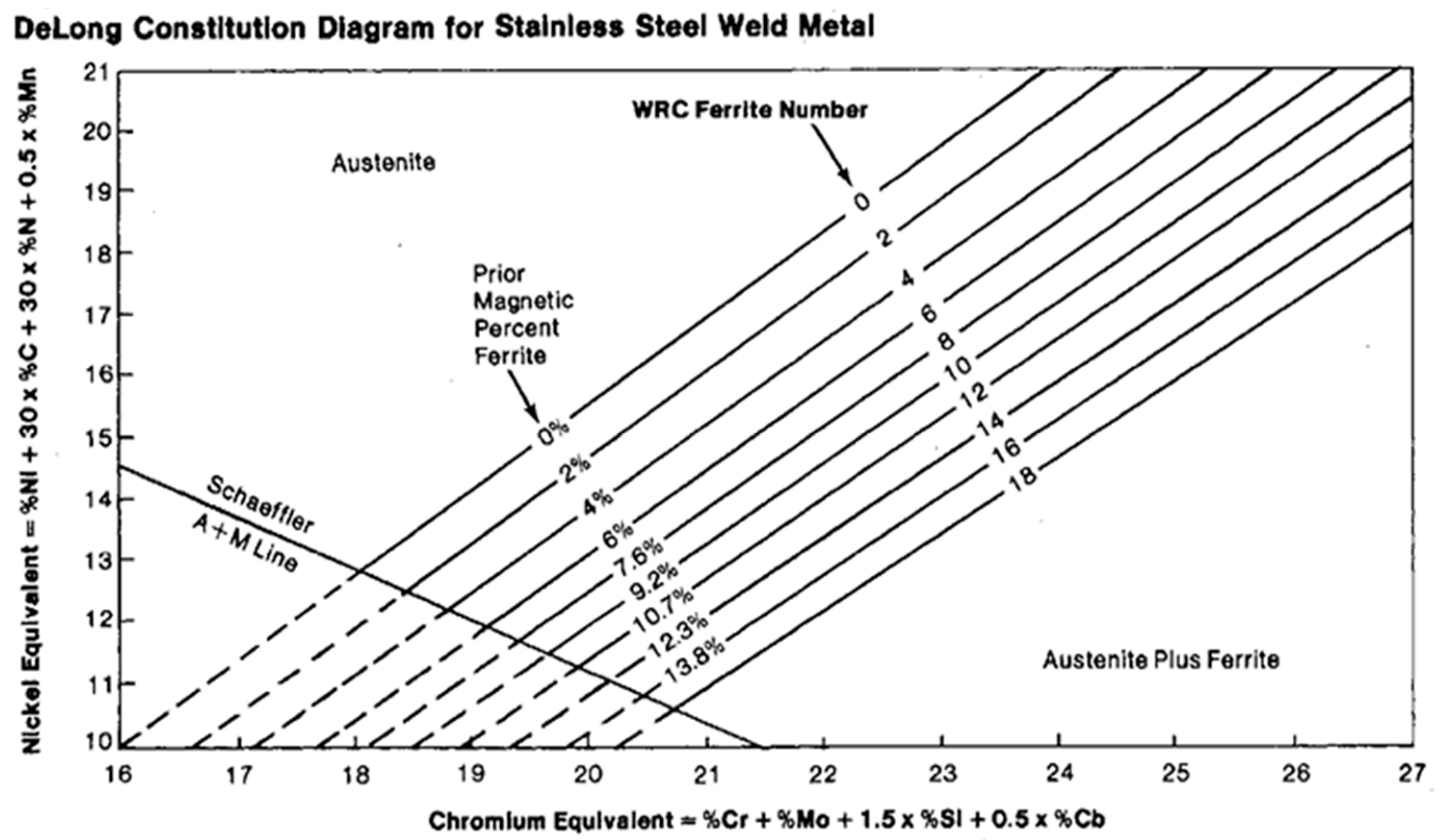
3.3. Microstructural Evolution and Metallurgical Effects of Heat Input
4. Recommendations for Future Work
Emerging Smart Welding Systems for Future Applications
5. Conclusions
- Process specific parameter sensitivities were systematically identified, showing that GTAW is dominated by shielding-gas composition and arc energy stability, GMAW by wire-feed dynamics and metal-transfer behaviors, and SMAW by electrode selection and groove geometry. These distinctions provide practical guidance for selecting a suitable welding process under different fabrication and field conditions.
- Quantitative trends reported in the literature indicate measurable improvement in weld performance, including tensile strength improvements of up to 10.5%, HAZ width reductions exceeding 30%, and improved bead uniformity and hardness when optimized parameter sets such as pulse-current control, Taguchi-based tuning, and data driven predictive approaches are applied.
- The review clarifies the mechanistic role of heat input, demonstrating how current, voltage, and travel speed jointly influence grain coarsening, phase balance, sensitization behavior, and residual-stress development. These effects are directly linked to long-term reliability under high-pressure and high-temperature service conditions.
- A comparative assessment across defect modes, environmental sensitivity, skill requirements, productivity, and cost provides a practical decision support perspective, linking reported research outcomes with real-world fabrication and field welding constraints.
- The analysis reinforces the connection between parameter control and ASME B31.3 compliance, particularly with respect to limits on root height, internal reinforcement, and non-destructive examination acceptance.
Author Contributions
Funding
Data Availability Statement
Acknowledgments
Conflicts of Interest
References
- Sinnott, R.; Towler, G. Chemical Engineering Design, 6th ed.; Butterworth-Heinemann: Oxford, UK, 2019; ISBN 978-0-08-102599-4. [Google Scholar]
- ASME B31.3-2016; Process Piping. American Society of Mechanical Engineers: New York City, NY, USA, 2016.
- Cosham, A.; Hopkins, P. The Critical Path Method for Assessment of Pipelines with Metal Loss Defects. In Proceedings of the 9th International Pipeline Conference (IPC2012), Calgary, AB, Canada, 24–28 September 2012; ASME: New York, NY, USA. [Google Scholar] [CrossRef]
- Podržaj, P. An Overview of Arc Welding Control Systems. Prog. Electr. Electron. Eng. 2019. [Google Scholar] [CrossRef]
- Thompson Martinez, R.; Crisóstomo Absi Alfaro, S. Data Analysis and Modeling Techniques of Welding Processes: The State of the Art. In Welding—Modern Topics; IntechOpen: London, UK, 2021. [Google Scholar] [CrossRef]
- Gurning, R.A.T.; Priadi, D.; Ferdian, D.; Suryadi. Root cause failure analysis of reducer weld-joint leakage for liquid outlet of slug catcher. IOP Conf. Ser. Mater. Sci. Eng. 2019, 536, 012018. [Google Scholar] [CrossRef]
- Nickel Institute. Welding of Stainless Steels and Other Joining Methods (NI AISI #9002); Nickel Institute: Toronto, ON, Canada, 2016; Available online: https://nickelinstitute.org/media/4655/ni_aisi_9002_weldingotherjoining.pdf (accessed on 27 January 2025).
- Kumar, V.; Arora, H.; Pandey, P.; Ratore, V. Analysis of sensitization of austenitic stainless steel by different welding processes: A review. Int. J. Appl. Eng. Res. 2015, 10, 17837–17848. Available online: https://www.ripublication.com/ijaer10/ijaerv10n7_140.pdf (accessed on 27 January 2025).
- American Petroleum Institute. API RP 582: Welding Guidelines for the Chemical, Oil, and Gas Industries; API Publishing Services: Washington, DC, USA, 2016. [Google Scholar]
- Quackatz, L.; Westin, E.M.; Griesche, A.; Kromm, A.; Kannengieser, T.; Treutler, K.; Wesling, V.; Wessman, S. Assessing ferrite content in duplex stainless weld metal: WRC’92 predictions vs. practical measurements. Weld. World 2024, 69, 31–45. [Google Scholar] [CrossRef]
- Kamel, A.N.; Waheed, A.F. Correlation between Corrosion and Ferrite Number of 316L Stainless Steels Deposited on Carbon Steel Aged at 550 °C. Eur. Acad. Res. 2019, 7, 2023–2035. [Google Scholar]
- Kiaee, N.; Aghaie-Khafri, M. Optimization of gas tungsten arc welding process by response surface methodology. Mater. Des. 2014, 54, 25–31. [Google Scholar] [CrossRef]
- Kutelu, B.J.; Seidu, S.O.; Eghabor, G.I.; Ibitoye, A.I. Review of GTAW Welding Parameters. J. Miner. Mater. Charact. Eng. 2018, 6, 5. [Google Scholar] [CrossRef]
- Shen, J.; Kim, R.E.; He, J.; Lopes, J.G.; Yang, J.; Zeng, Z.; Schell, N.; Kim, H.S.; Oliveira, J.P. Gas tungsten arc welding of CoCrFeMnNi high entropy alloy to 316 stainless steel. Mater. Sci. Eng. A 2025, 922, 147664. [Google Scholar] [CrossRef]
- Villa, G.; Barella, S.; Mombelli, D.; Gruttadauria, A.; Mapelli, C.; Ahmad, S. Investigation on high Mn austenitic lightweight steels weldability via GTAW overlay welding and butt-welding operations. J. Alloys Metall. Syst. 2025, 9, 100169. [Google Scholar] [CrossRef]
- Song, J.; Chen, Y.; Hao, X.; Wang, M.; Ma, Y.; Xie, J. Microstructure and mechanical properties of novel Ni–Cr–Co-based superalloy GTAW joints. J. Mater. Res. Technol. 2024, 29, 2758–2767. [Google Scholar] [CrossRef]
- Chacón-Fernández, S.; Portolés García, A.; Romaní Labanda, G. Influence of parameters on the microstructure of a duplex stainless steel joint welded by a GMAW welding process. Prog. Nat. Sci. Mater. Int. 2022, 32, 415–423. [Google Scholar] [CrossRef]
- Sabry, I.; Hewidy, A.M.; Naseri, M.; Mourad, A.H.I. Optimization of process parameters of metal inert gas welding process on aluminum alloy 6063 pipes using Taguchi-TOPSIS approach. J. Alloys Metall. Syst. 2024, 7, 100085. [Google Scholar] [CrossRef]
- Rezende, R.F.; Arias, A.R.; Lima, E.J.; Coelho, F.G.F. Pulsed GMAW-based WAAM–Influence of droplet detachment mode on the geometry and mechanical properties of 308 L stainless steel. J. Adv. Join. Process 2025, 11, 100286. [Google Scholar] [CrossRef]
- Khrais, S.; Al Hmoud, H.; Abdel Al, A.; Darabseh, T. Experimental investigation of the impact of GMAW welding parameters on the mechanical properties of AISI 316L/ER 316L using quaternary shielding gas. Mater. Res. Express 2024, 11, 46501. [Google Scholar] [CrossRef]
- Sato, Y.; Ogino, Y.; Sano, T. Process parameters and their effect on metal transfer in gas metal arc welding: A driving force perspective. Weld. World 2024, 68, 905–913. [Google Scholar] [CrossRef]
- Tukahirwa, G.; Wandera, C. Influence of Process Parameters in Gas-Metal Arc Welding (GMAW) of Carbon Steels. In Weldin—Materials, Fabrication Processes, and Industry 5.0; Kumar, S., Ed.; IntechOpen: London, UK, 2023; pp. 1–23. [Google Scholar] [CrossRef]
- Khrais, S.; Al Hmoud, H.; Abdel Al, A.; Darabseh, T. Impact of Gas Metal Arc Welding Parameters on Bead Geometry and Material Distortion of AISI 316L. J. Manuf. Mater. Process. 2023, 7, 123. [Google Scholar] [CrossRef]
- Polański, P.; Golański, D.; Kołodziejczak, P.; Pakuła, A. Effect of the Electrode Extension on the Geometry of Parts Made of 316LSi Steel by Wire Arc Additive Manufacturing Method. Adv. Sci. Technol. Res. J. 2024, 18, 343–359. [Google Scholar] [CrossRef] [PubMed]
- Zeng, M.; Li, Z.T.; Hu, Z.X.; Xue, J.X.; Zhang, W. The effects of welding parameters on metal transfer and bead properties in the variable-polarity GMAW of mild steel. Int. J. Adv. Manuf. Technol. 2023, 129, 4165–4183. [Google Scholar] [CrossRef]
- Netto, A.; Njock Bayock, F.M.; Kah, P. Optimization of GMAW Process Parameters in Ultra-High-Strength Steel Based on Prediction. Metals 2023, 13, 1447. [Google Scholar] [CrossRef]
- Chacón-Fernández, S.; Portolés García, A.; Romaní Labanda, G. Analysis of the Influence of GMAW Process Parameters on the Properties and Microstructure of S32001 Steel. Materials 2022, 15, 6498. [Google Scholar] [CrossRef] [PubMed]
- Dadi, A.; Goyal, B.; Patel, H. A review paper on optimization of shielded metal arc welding parameters for welding of (MS) SA-516 Gr.70 plate by using Taguchi approach. Int. J. Sci. Res. Sci. Technol. 2018, 4, 1536–1543. [Google Scholar]
- Hendronursito, Y.; Isnugroho, K.; Birawidha, D.C.; Amin, M. Analysis of Shielded Metal Arc Welding (SMAW) on high manganese steel Hammer-mill crusher. J. Mech. Eng. 2019, 16, 93–107. [Google Scholar] [CrossRef]
- Baghel, P.K. Effect of SMAW Process Parameters on Similar and Dissimilar Metal Welds: An Overview. Heliyon 2022, 8, e12161. [Google Scholar] [CrossRef]
- Afzal, M.S.; Wakeel, A.; Nasir, M.A.; Qazi, M.I.; Abas, M. Optimization of process parameters for shielded metal arc welding for ASTM A 572 grade 50. J. Eng. Res. 2024, 13, 1072–1088. [Google Scholar] [CrossRef]
- Ary, D.; Muhayat, N.; Triyono. Research Gap Finding in Shielded Metal Arc Welding of Steel. In Proceedings of the E3S Web of Conferences, 8th International Conference on Industrial, Mechanical, Electrical and Chemical Engineering (ICIMECE 2023), Surakarta, Indonesia, 18 December 2023; Volume 465, p. 01012. [Google Scholar] [CrossRef]
- Soy, U.; Iyibilgin, O.; Findik, F.; Oz, C.; Kiyan, Y. Determination of Welding Parameters for Shielded Metal Arc Welding. Sci. Res. Essays 2011, 6, 3153–3160. [Google Scholar]
- Yadav, R. Process Parameter Selection for Optimizing the Weld Pool Geometry of Stainless Steel (SS 202 & SS 316) of the TIG Welding using Taguchi Method. Int. J. Res. Appl. Sci. Eng. Technol. 2018, 6, 2684–2695. [Google Scholar] [CrossRef]
- Shrivastava, M.; Kumar, R. Optimization of GTA Welding Parameters for AISI 304 Stainless Steel using Taguchi Method. In Proceedings of the International Conference of Advance Research and Innovation (ICARI-2020), New Delhi, India, 19 January 2020. [Google Scholar] [CrossRef]
- Satheesh Kumar, K.V.; Gejendhiran, S.; Prasath, M. Comparative investigation of mechanical properties in GMAW/GTAW for various shielding gas compositions. Mater. Manuf. Process. 2014, 29, 996–1003. [Google Scholar] [CrossRef]
- Chuaiphan, W.; Srijaroenpramong, L. Effect of welding speed on microstructures, mechanical properties and corrosion behavior of GTA-welded AISI 201 stainless steel sheets. J. Mater. Process. Technol. 2014, 214, 402–408. [Google Scholar] [CrossRef]
- Dorta-Almenara, M.; Capace, M.C. Microstructure and mechanical properties of GTAW welded joints of AA6105 aluminum alloy. Rev. Fac. Ing. 2016, 25, 7–19. [Google Scholar] [CrossRef]
- Sattar, A.; Hussain, A.; Abbas, M.; Azam, M.N.; Mehmood, K.; Wakeel, A.; Ali, S. Optimization of TIG Welding Parameters for Ti-6Al-4V Titanium Alloy using the Taguchi Design of Experiment. NUST J. Eng. Sci. 2022, 15, 22–34. [Google Scholar] [CrossRef]
- Nandagopal, K.; Kailasanathan, C. Analysis of mechanical properties and optimization of gas tungsten Arc welding (GTAW) parameters on dissimilar metal titanium (6Al-4V) and aluminium 7075 by Taguchi and ANOVA techniques. J. Alloys Compd. 2016, 682, 503–516. [Google Scholar] [CrossRef]
- Manikandan, M.; Nageswara Rao, M.; Ramanujam, R.; Ramkumar, D.; Arivazhagan, N.; Reddy, G.M. Optimization of the Pulsed Current Gas Tungsten Arc welding process parameters for alloy C-276 using the Taguchi method. Procedia Eng. 2014, 97, 767–774. [Google Scholar] [CrossRef]
- Karpagaraj, A.; Parthiban, K.; Ponmani, S. Optimization techniques used in gas tungsten arc welding process-A review. Mater. Today Proc. 2019, 27, 2187–2190. [Google Scholar] [CrossRef]
- Chuaiphan, W.; Srijaroenpramong, L. Optimization of gas tungsten arc welding parameters for the dissimilar welding between AISI 304 and AISI 201 stainless steels. Def. Technol. 2019, 15, 170–178. [Google Scholar] [CrossRef]
- Davis, F.; Andoh, P.Y.; Fiagbe, Y.A.K.; Atsu, A.K. Optimization of gas tungsten arc welding parameters for welding of super duplex stainless steel using factorial design. Cogent Eng. 2023, 10, 2216870. [Google Scholar] [CrossRef]
- Baghel, P.K.; Gupta, T. Optimization of parameters of pulse current gas tungsten arc welding using non conventional techniques. J. Adv. Join. Process. 2022, 6, 100124. [Google Scholar] [CrossRef]
- Lin, M.C.; Cheng, C.C.; Huang, C.C. Study on the Application of the GTAW Process in Strengthening the Welding Quality of Short Duplex Stainless Pipe. Metals 2022, 12, 1691. [Google Scholar] [CrossRef]
- Thangavel, S.; Maheswari, C.; Priyanka, E.B.; Stonier, A.A.; Peter, G.; Ganji, V. Analysis and optimization of the automated TIG welding process parameters on SS304 incorporating Taguchi optimization technique. J. Eng. 2024, 2024, e12373. [Google Scholar] [CrossRef]
- Hassan, A.; El-Mahallawi, I.; El-Koussy, M.R. Effect of GTAW welding current on the quality of 304L Austenitic Stainless steel using ER316L. Int. J. Mater. Technol. Innov. 2023, 3, 10–18. [Google Scholar] [CrossRef]
- Pujari, K.S.; Patil, D.V. A review on GTAW technique for high strength aluminium alloys (AA 7xxx series). Int. J. Eng. Res. Technol. 2013, 2, 2477–2490. [Google Scholar]
- Meng, D.H.; Zhou, B.; Wu, D.; Ma, Y.Q.; Chen, R.S.; Li, P.J. Parameter Optimization of Gas Tungsten-Arc Repair Welding Technique in Mg–6Gd–3Y–0.5Zr Alloy. Int. J. Met. 2019, 13, 345–353. [Google Scholar] [CrossRef]
- Achebo, J.I.; Ozigagun, A.; Ofoeyeno, B. Development of mathematical models to optimize weld penetration area of mild steel in gas tungsten arc welding. Int. J. Innov. Sci. Res. Technol. 2020, 5, 1–8. [Google Scholar]
- Li, L.; Du, Z.; Sheng, X.; Zhao, M.; Song, L.; Han, B.; Li, X. Comparative analysis of GTAW+SMAW and GTAW welded joints of duplex stainless steel 2205 pipe. Int. J. Press. Vessel. Pip. 2022, 199, 104748. [Google Scholar] [CrossRef]
- Thakur, P.P.; Chapgaon, A.N. A review on effects of GTAW process parameters on weld. Int. J. Res. Appl. Sci. Eng. Technol. 2016, 4, 136–140. [Google Scholar]
- Sathishkumar, D.; Das, A.D. Investigations on effect of process parameters on GTAW of aluminium alloy welding using full factorial design technique. Mater. Today Proc. 2020, 37, 621–626. [Google Scholar] [CrossRef]
- Martins, A.A.; Friday, I.D. Parametric Optimisation of Gas Tungsten Arc Welding (GTAW) on the Tensile Strength of AISI 316L Austenitic Stainless Steel Using Taguchi Method. J. Mater. Eng. Struct. Comput. 2023, 1, 90–101. [Google Scholar] [CrossRef]
- Zerti, A.; Yallese, M.A.; Zerti, O.; Nouioua, M.; Khettabi, R. Prediction of machining performance using RSM and ANN models in hard turning of martensitic stainless steel AISI 420. Proc. Inst. Mech. Eng. Part C J. Mech. Eng. Sci. 2019, 233, 24–38. [Google Scholar] [CrossRef]
- Singh, R.; Verma, S.; Mahajan, P. Prediction of Weld Bead Geometry in TIG Welding Process of Zircaloy Fuel Pins Using Artificial Neural Network. Trans. Indian Inst. Met. 2025, 78, 149. [Google Scholar] [CrossRef]
- Stadler, M.; Freton, P.; Gonzalez, J.-J. Influence of Welding Parameters on the Weld Pool Dimensions and Shape in a TIG Configuration. Appl. Sci. 2017, 7, 373. [Google Scholar] [CrossRef]
- Parvez, S.; Siddiqui, M.I.H.; Ali, M.A.; Dobrotă, D. Modeling of Melt Flow and Heat Transfer in Stationary Gas Tungsten Arc Welding with Vertical and Tilted Torches. Materials 2021, 14, 6845. [Google Scholar] [CrossRef]
- Ramdani, S.D.; Subhan, A.; Febnesia, H.; Hidayat, M. Comparison of Penetration Depth Based on Effect of DCEP and DCEN Polarity on SMAW Process Using E6013 with ASTM A36. AIP Conf. Proc. 2023, 2671, 020008. [Google Scholar] [CrossRef]
- Ashidh, K.; Santha Kumari, A.; Sumesh, A.; Rajasekaran, N. Influence of Stick-Slip Effect on Gas Metal Arc Welding. Appl. Mech. Mater. 2015, 813, 438–445. [Google Scholar] [CrossRef]
- Kim, I.-S.; Park, M.-H. A Review on Optimizations of Welding Parameters in GMA Welding Process. J. Weld. Join. 2018, 36, 65–75. [Google Scholar] [CrossRef]
- Sivasakthivel, P.S.; Sudhakaran, R. Modelling and optimisation of welding parameters for multiple objectives in pre-heated gas metal arc welding process using nature instigated algorithms. Aust. J. Mech. Eng. 2020, 18, S76–S87. [Google Scholar] [CrossRef]
- Kim, J.Y.; Lee, D.Y.; Lee, J.; Lee, S.H. Parameter optimization of hybrid-tandem gas metal arc welding using analysis of variance-based gaussian process‘ regression. Metals 2021, 11, 1087. [Google Scholar] [CrossRef]
- Srivastava, S.; Garg, R.K. Process parameter optimization of gas metal arc welding on IS:2062 mild steel using response surface methodology. J. Manuf. Process. 2017, 25, 296–305. [Google Scholar] [CrossRef]
- Saravanan, S.; Pitchipoo, P. Optimization of GMAW Parameters to Improve the Mechanical Properties. Appl. Mech. Mater. 2015, 813–814, 456–461. [Google Scholar] [CrossRef]
- Narwadkar, A.; Bhosle, S. Optimization of MIG Welding Parameters to Control the Angular Distortion in Fe410WA Steel. Mater. Manuf. Process. 2016, 31, 2158–2164. [Google Scholar] [CrossRef]
- Baskoro, A.S.; Hidayat, R.; Widyianto, A.; Amat, M.A.; Putra, D.U. Optimization of gas metal arc welding (Gmaw) parameters for minimum distortion of t welded joints of a36 mild steel by taguchi method. Mater. Sci. Forum 2020, 1000, 356–363. [Google Scholar] [CrossRef]
- Tesfaye, F.K. Parameter optimizations of GMAW process for dissimilar steel welding. Int. J. Adv. Manuf. Technol. 2023, 126, 4513–4520. [Google Scholar] [CrossRef]
- Xue, L.; Wu, J.; Huang, J.; Huang, J.; Zou, Y.; Liu, J. Welding polarity effects on weld spatters and bead geometry of hyperbaric dry GMAW. Chin. J. Mech. Eng. Engl. Ed. 2016, 29, 351–356. [Google Scholar] [CrossRef]
- Wu, K.; Ding, N.; Yin, T.; Zeng, M.; Liang, Z. Effects of single and double pulses on microstructure and mechanical properties of weld joints during high-power double-wire GMAW. J. Manuf. Process. 2018, 35, 728–734. [Google Scholar] [CrossRef]
- Zhang, H.; Li, R.; Yang, S.; Zhan, L.; Xiong, M.; Wang, B.; Zhang, J. Experimental and Simulation Study on Welding Characteristics and Parameters of Gas Metal Arc Welding for Q345qD Thick-Plate Steel. Materials 2023, 16, 5944. [Google Scholar] [CrossRef] [PubMed]
- Kumar, A.; Khurana, M.K.; Yadav, P.K. Optimization of Gas Metal Arc Welding Process Parameters. IOP Conf. Ser. Mater. Sci. Eng. 2016, 149, 012002. [Google Scholar] [CrossRef]
- Lermen, R.T.; Dal Molin, A.; Berger, D.R.; Alves Vde, J.; Lisboa, C.P. Optimization of parameters on robotized gas metal arc welding of lne 700 high-strength steel. J. Manuf. Mater. Process. 2018, 2, 70. [Google Scholar] [CrossRef]
- Bin, K.; Yao, P.; Xu, M.; Lin, Q.; Gu, Y. Double pulse gas metal arc welding process parameter optimization and weld performance analysis based on response surface method. Mater. Res. Express 2023, 10, 10. [Google Scholar] [CrossRef]
- Meseguer-Valdenebro, J.L.; Martínez-Conesa, E.; Portoles, A. Influence of welding parameters on grain size, HAZ and degree of dilution of 6063-T5 alloy: Optimization through the Taguchi method of the GMAW process. Int. J. Adv. Manuf. Technol. 2022, 120, 6515–6529. [Google Scholar] [CrossRef]
- Torres, E.M.M.; Cruz, J.A.G.; Lopera, J.E.P.; Absi Alfaro, S.C. Parameter Optimization in GMAW Process with Solid and Metal-Cored Wires. In Proceedings of the 22nd International Congress of Mechanical Engineering (COBEM 2013); ABCM Symposium Series in Mechatronics; Ribeirão Preto, Brazil, 3–7 November 2013, ABCM: Tokyo, Japan; Volume 6, pp. 141–151.
- Koushki, A.R.; Goodarzi, M.; Paidar, M. Influence of shielding gas on the mechanical and metallurgical properties of DP-GMA-welded 5083-H321 aluminum alloy. Int. J. Miner. Metall. Mater. 2016, 23, 1416–1426. [Google Scholar] [CrossRef]
- Agrawal, B.P.; Ghosh, P.K.; Singh, S.K.; Satapathy, S.N. Investigation on Effects of Deposition Characteristics on Weld Quality during PC-GMAW. In Proceedings of the International Conference in Mechanical and Energy Technology; Smart Innovation, Systems and Technologies; Greater Noida, India, 7–8 November 2019, Springer: Singapore, 2020; pp. 273–283. [Google Scholar] [CrossRef]
- Jaju, S.B.; Charkha, P.G.; Kale, M. Gas metal arc welding process parameter optimization for AA7075 T6. J. Phys. Conf. Ser. 2021, 1913, 012122. [Google Scholar] [CrossRef]
- Olawale, J.O.; Ibitoye, S.A.; Oluwasegun, K.M.; Shittu, M.D.; Ofoezie, R.C. Correlation between Process Variables in Shielded Metal-Arc Welding (SMAW) Process and Post Weld Heat Treatment (PWHT) on Some Mechanical Properties of Low Carbon Steel Welds. J. Miner. Mater. Charact. Eng. 2012, 11, 891–895. [Google Scholar] [CrossRef]
- Syukran, S.; Syahri, A.; Ismy, A.S. The Effect of Heat Input on the Tensile Strength and Toughness of welded SS400 Materials by SMAW. J. Weld. Technol. 2023, 5, 1. [Google Scholar] [CrossRef]
- Singh, R.P.; Mishra, A.; Chauhan, A.; Verma, A.K. A Review of Effect of Welding Parameters on the Structure and Properties of the Weld in Shielded Metal Arc Welding Process. In Lecture Notes in Mechanical Engineering; Davim, J.P., Ed.; Springer: Singapore, 2021. [Google Scholar] [CrossRef]
- Knostman, S. Shielded Metal Arc Welding. In Welding Fundamentals and Processes; ASM Handbook; ASM International: Materials Park, OH, USA, 2011; Volume 6A. [Google Scholar] [CrossRef]
- Kumar, S.N.; Balasubramanian, V.; Malarvizhi, S.; Hafeezur Rahman, H.; Balaguru, V. Experimental and numerical investigation on optimization of welding parameters and prediction of temperature distribution during shielded metal arc welding of ultra high hard armor steel joints. J. Therm. Stress. 2024, 47, 766–784. [Google Scholar] [CrossRef]
- Saha, A.; Mondal, S.C. Multi-objective optimization of manual metal arc welding process parameters for nano-structured hardfacing material using hybrid approach. Meas. J. Int. Meas. Confed. 2017, 102, 80–89. [Google Scholar] [CrossRef]
- Singla, M.; Singh, D.; Deepak, D. Parametric optimization of gas metal arc welding processes by using factorial design approach. J. Miner. Mater. Charact. Eng. 2010, 9, 353–363. [Google Scholar] [CrossRef]
- Anil Parmar, A.D. Study of Heat Affected Zone for SMAW Process for Low Carbon Steel Specimen with controlled parameters. Int. J. Mod. Trends Eng. Res. 2017, 4, 23–28. [Google Scholar] [CrossRef]
- Bambhaniya, A.V.; Vachhani, A.B. Parametric optimization of shielded metal arc welding (SMAW) process for pressure vessel weld using SA 515 Gr. 60. Int. J. Adv. Res. Innov. Eng. 2017, 3, 729–738. [Google Scholar]
- Qazi, M.I.; Akhtar, R. Application of Taguchi method for optimization of tensile strength of shielded metal arc welding (SMAW) process for steel SA 516 Grade 70. Int. J. Prog. Sci. Technol. 2019, 17, 97–103. [Google Scholar]
- Yohanes, Y.; Harahap, M.A. Effects of Electrode Velocity Variations and Selection of Electric Current Against Quality Welding Results Mild Steel on SMAW Welding. J. Ocean Mech. Aerosp. Sci. Eng. 2018, 57, 12–16. [Google Scholar] [CrossRef]
- Hafni, H.; Rifqi, R. The Effect of Electrode Angle on the Backward Directional Longitudinal Against Penetration Percentage. J. Tek. Mesin. 2022, 12, 116–119. [Google Scholar] [CrossRef]
- Merchant Samir, Y. Investigation on Effect of Welding Current on Welding Speed and Hardness of Haz and Weld Metal of Mild Steel. Int. J. Res. Eng. Technol. 2015, 4, 44–48. [Google Scholar] [CrossRef]
- Haider, S.F.; Quazi, M.M.; Bhatti, J.; Nasir Bashir, M.; Ali, I. Effect of Shielded Metal Arc Welding (SMAW) parameters on mechanical properties of low-carbon, mild and stainless-steel welded joints: A review. J. Adv. Technol. Eng. Res. 2019, 5, 191–198. [Google Scholar] [CrossRef]
- Zoalfakar, S.H.; Hassan, A.A. Analysis and optimization of shielded metal arc welding parameters on mechanical properties of carbon steel joints by Taguchi method. Int. J. Adv. Eng. Glob. Technol. 2017, 5, 1431–1444. [Google Scholar]
- Manickam, S.; Pradeep, A.; Vijayakumar, S.; Mosisa, E. Optimization of arc welding process parameters for joining dissimilar metals. Mater. Today Proc. 2022, 69, 662–664. [Google Scholar] [CrossRef]
- Lancaster, J.F. The Physics of Welding; Pergamon Press: Oxford, UK, 1986. [Google Scholar]
- Kou, S. Welding Metallurgy, 2nd ed.; Wiley-Interscience: Hoboken, NJ, USA, 2003. [Google Scholar] [CrossRef]
- Górka, J.; Jamrozik, W.; Wygledacz, B.; Kiel-Jamrozik, M.; Batalha, G.F. Virtual Sensor for On-Line Hardness Assessment in TIG Welding of Inconel 600 Alloy Thin Plates. Sensors 2024, 24, 3569. [Google Scholar] [CrossRef] [PubMed]
- Zhang, X.; Zhao, S.; Wang, M. Deep Learning-Based Defects Detection in Keyhole TIG Welding with Enhanced Vision. Materials 2024, 17, 3871. [Google Scholar] [CrossRef] [PubMed]
- Jorge, V.L.; Boutaleb, Z.; Boutin, T.; Bendaoud, I.; Soulié, F.; Bordreuil, C. Deep Learning-Based YOLO Applied to Rear Weld Pool Thermal Monitoring of Metallic Materials in the GTAW Process. Metals 2025, 15, 836. [Google Scholar] [CrossRef]
- Li, R.; Dong, M.; Gao, H. Prediction of Bead Geometry with Changing Welding Speed Using Artificial Neural Network. Materials 2021, 14, 1494. [Google Scholar] [CrossRef]
- Nele, L.; Mattera, G.; Vozza, M. Deep Neural Networks for Defects Detection in Gas Metal Arc Welding. Appl. Sci. 2022, 12, 3615. [Google Scholar] [CrossRef]
- Eazhil, K.M.; Sudhakaran, R.; Venkatesan, E.P.; Aabid, A.; Baig, M. Prediction of Angular Distortion in Gas Metal Arc Welding of Structural Steel Plates Using Artificial Neural Networks. Metals 2023, 13, 436. [Google Scholar] [CrossRef]
- Kim, J.-H.; Jung, C.-J.; Park, Y.I.; Shin, Y.-T. Development of Closed-Form Equations for Estimating Mechanical Properties of Weld Metals according to Chemical Composition. Metals 2022, 12, 528. [Google Scholar] [CrossRef]
- Tran, N.-H.; Bui, V.-H.; Hoang, V.-T. Development of an Artificial Intelligence-Based System for Predicting Weld Bead Geometry. Appl. Sci. 2023, 13, 4232. [Google Scholar] [CrossRef]
- Yoon, T.; Park, Y.I.; Kim, J.; Kim, J.-H. Inverse Neural Network Approach for Optimizing Chemical Composition in Shielded Metal Arc Weld Metals. Materials 2025, 18, 2592. [Google Scholar] [CrossRef]
- Hedhibi, A.C.; Boumerzoug, Z.; Rajhi, W.; Haddar, N. Mechanical Properties and Microstructure of TIG and ATIG Welded 316L Austenitic Stainless Steel with Multi-Component Flux Optimization Using Mixing Design Method and Particle Swarm Optimization (PSO). Metals 2021, 11, 7139. [Google Scholar] [CrossRef] [PubMed]
- Touileb, K.; Djoudjou, R.; Ouis, A.; Hedhibi, A.C.; Boubaker, S.; Ahmed, M.M.Z. Particle Swarm Method for Optimization of ATIG Welding Process to Joint Mild Steel to 316L Stainless Steel. Crystals 2023, 13, 1377. [Google Scholar] [CrossRef]
- Li, Y.; Li, Y.; Ma, X.; Zhang, X.; Fu, D.; Yan, Q. Study on Welding Deformation and Optimization of Fixture Scheme for Thin-Walled Flame Cylinder. Materials 2022, 15, 6418. [Google Scholar] [CrossRef]
- Chen, L.; Lin, X.; Wu, C.; Zhang, Y. An Optimization Method for Multi-Robot Automatic Welding: Welding Path and Layout via PSO and GA. Machines 2024, 12, 763. [Google Scholar] [CrossRef]
- Ikponmwosa-Eweka, O.; Ozigagun, A. Application of response surface methodology (RSM) to predict penetration area during TIG welding at steady state condition. J. Sci. Technol. Res. 2023, 5, 94–100. [Google Scholar]
- Correia, D.S.; Gonçalves, C.V.; Junior, S.S.C.; Ferraresi, V.A. GMAW welding optimization using genetic algorithms. J. Braz. Soc. Mech. Sci. Eng. 2004, 26, 28–33. [Google Scholar] [CrossRef]
- Ghimire, R.; Selvam, R. Machine learning-based weld classification for quality monitoring. Eng. Proc. 2023, 59, 241. [Google Scholar] [CrossRef]
- Benlamnouar, M.F.; Saadi, T.; Bensaid, N. Modelling and optimization of dissimilar welding using response surface methodology. In Proceedings of the 1st International Symposium on Materials, Energy and Environment (MEE’2020), El Oued, Algeria, 20–21 January 2020; pp. 1–6. [Google Scholar]
- Gao, S.; Tang, X.; Ji, S.; Yang, Z. Prediction of Mechanical Properties of Welded Joints Based on Support Vector Regression. Procedia Eng. 2012, 29, 1471–1475. [Google Scholar] [CrossRef]
- Zhang, Z.; Yang, Z.; Ren, W.; Wen, G. Random forest-based real-time defect detection of Al alloy in robotic arc welding using optical spectrum. J. Manuf. Process. 2019, 42, 51–59. [Google Scholar] [CrossRef]
- Jayant, A.; Dhillon, M.S. Use of analytic hierarchy process (AHP) to select welding process in high pressure vessel manufacturing environment. Int. J. Appl. Eng. Res. 2015, 10, 5869–5884. [Google Scholar]
- Capraz, O.; Meran, C.; Wörner, W.; Güngör, A. Using AHP and TOPSIS to evaluate welding processes for manufacturing plain carbon stainless steel storage tank. Arch. Mater. Sci. Eng. 2015, 76, 157–162. [Google Scholar]
- Saha, S.; Haldar, B.; Joardar, H.; Das, S.; Mondal, S.; Tadepalli, S. Supervised machine learning models for predicting SS304H welding properties using TIG, autogenous TIG, and A-TIG. Crystals 2025, 15, 529. [Google Scholar] [CrossRef]
- Ren, J.; Zhang, H.; Yue, M. YOLOv8-WD: Deep learning-based detection of defects in automotive brake joint laser welds. Appl. Sci. 2025, 15, 1184. [Google Scholar] [CrossRef]
- Cárcel-Carrasco, J.; Pascual, M.; Pérez-Puig, M.; Segovia-López, F. Comparative study of TIG and SMAW root welding passes on ductile iron cast weldability. Metalurgija 2017, 56, 91–93. [Google Scholar]
- Uddin, E.; Iqbal, U.; Arif, N.; Shah, S.R. Analysis of metal transfer in gas metal arc welding. AIP Conf. Proc. 2019, 2116, 030019. [Google Scholar] [CrossRef]
- Kah, P.; Suoranta, R.; Martikainen, J.; Magnus, C. Usability of arc types in industrial welding. J. Mater. Sci. Eng. 2014, 9, 15. [Google Scholar] [CrossRef]
- ISO 5817:2023; Welding—Fusion-Welded Joints in Steel, Nickel, Titanium and Their Alloys (Beam Welding Excluded) Quality Levels for Imperfections. 4th ed. International Organization for Standardization: Geneva, Switzerland, 2023.
- Aldalur, E.; Suárez, A.; Curiel, D.; Veiga, F.; Villanueva, P. Intelligent and adaptive system for welding process automation in T-shaped joints. Metals 2023, 13, 1532. [Google Scholar] [CrossRef]
- Tripicchio, P.; D’Avella, S. Welding Defect Detection with Deep Learning Architectures. In Welding Principles and Application; IntechOpen: London, UK, 2022. [Google Scholar] [CrossRef]
- Ahmmed, M.S.; Isanaka, S.P.; Liou, F. Promoting synergies to improve manufacturing efficiency in industrial material processing: A systematic review of Industry 4.0 and AI. Machines 2024, 12, 681. [Google Scholar] [CrossRef]
- Wang, S.; Jiao, Y.; Wang, L.; Wang, W.; Ma, X.; Xu, Q.; Lu, Z. Research on the digital twin system of welding robots driven by data. Sensors 2025, 25, 3889. [Google Scholar] [CrossRef]
- Herzog, T.; Brandt, M.; Trinchi, A.; Sola, A.; Molotnikov, A. Process monitoring and machine learning for defect detection in laser-based metal additive manufacturing. J. Intell. Manuf. 2024, 35, 1407–1437. [Google Scholar] [CrossRef]
- Vasilev, M.; MacLeod, C.N.; Loukas, C.; Javadi, Y.; Vithanage, R.K.W.; Lines, D.; Mohseni, E.; Pierce, S.G.; Gachagan, A. Sensor-Enabled Multi-Robot System for Automated Welding and In-Process Ultrasonic NDE. Sensors 2021, 21, 5077. [Google Scholar] [CrossRef]
- Wang, X.; He, F.; Huang, X. A New Method for Deep Learning Detection of Defects in X-Ray Images of Pressure Vessel Welds. Sci. Rep. 2024, 14, 6312. [Google Scholar] [CrossRef]
- Qu, H.; Chen, J.; Cai, Y. Digital Twin-Driven Prediction of Melt Pool Morphology and Penetration in TIG Welding. J. Intell. Manuf. 2024, 36, 4083–4103. [Google Scholar] [CrossRef]
- Hamzeh, S.R.; Thomas, L.; Polzer, J.; Xu, X.; Heinzel, H. A sensor-based monitoring system for real-time quality control: Semi-automatic arc welding case study. Procedia Manuf. 2020, 51, 201–206. [Google Scholar] [CrossRef]
- Biber, A.; Sharma, R.; Reisgen, U. Robotic welding system for adaptive process control in gas metal arc welding. Weld. World 2024, 68, 2311–2320. [Google Scholar] [CrossRef]


| Author(s), Year | Objectives | Major Findings |
|---|---|---|
| Rekha et al. [34] | Explore welding parameters via the Tuguchi method | Bead width increases with groove angle current and shielding gas changes. |
| Mayank et al. [35] | Evaluate GTAW parameters on weld bead quality | Optimized parameters to minimize distortion; identified key influencing parameters |
| K, Satheesh et al. [36] | Investigate weld mechanical properties in GTAW and GMAW with different shielding gases | Shielding gas type and composition significantly impact weld mechanical properties, improving tensile strength and hardness. |
| Wichan et al. [37] | Analyze how welding speed affects mechanical properties, microstructures, and corrosion resistance. | Higher welding speeds refine grain structure, enhance tensile strength, and improve corrosion resistance. |
| Minerva et al. [38] | Examine GTAW weld microstructure variations. | Optimized GTAW welds exhibit fine, uniform microstructures, while improper parameters lead to coarse grains. |
| A. Sattar, A. Hussain, M. Abbas et al. [39] | Determine optimal TIG welding parameters for strength and defect minimization. | Key parameters affecting Ti-6 Al-4 V alloy properties were identified, with optimal settings improving strength and reducing defects. |
| K. Nandagopal et al. [40] | Assess welding parameters’ influence on tensile strength and hardness using the Taguchi method. | Welding speed has the highest impact on tensile strength, followed by welding current. |
| M. Manikandan et al. [41] | Identify key factors affecting weld penetration depth. | Pulse current is the primary factor for penetration depth, with timing also playing a role. |
| A. Karpagaraj et al. [42] | Enhance gas tungsten arc welding processes and applications. | Process optimization enhances GTAW efficiency by refining welding parameters and material properties. |
| Author(s), Year | Objectives | Major Findings |
|---|---|---|
| W. Chuaiphan et al. [43] | Optimize GTAW parameters to improve weld quality and performance. | Optimal welding parameters improve mechanical properties, minimize defects, and ensure corrosion resistance with a mixed austenitic-ferritic microstructure. |
| F. Davis et al. [44] | Optimize GTAW for super duplex stainless steel welding. | Optimized settings enhance tensile strength, hardness, and impact toughness while minimizing defects and refining microstructure. |
| P. Baghel et al. [45] | Study the effect of key welding parameters on mechanical properties using Genetic Algorithm and Particle Swarm Optimization. | Peak current, base current, pulse frequency, pulse-on time, and welding speed significantly affect mechanical properties, with PSO models yielding better results than GA models |
| M. Lin et al. [46] | Analyze the impact of backing gas, clamping angle, heat input, and interlayer temperature on weld quality using the Taguchi Method. | Backing gas has the highest influence on α-Fe content and hardness in UNS31803 duplex stainless steel |
| S. Thangavel et al. [47] | Examine how welding current, speed, gas flow rate, and arc length influence weld hardness and tensile strength using the Taguchi Method | Welding current is the dominant factor affecting weld hardness and tensile strength, while welding speed and gas flow rate have minimal impact. |
| Author(s), Year | Objectives | Major Findings |
|---|---|---|
| Ahmed et al. [48] | Analyze how welding current affects weld microstructure and mechanical properties. | Excessively high or low welding currents degrade weld properties, affecting heat input, dendrite structure, tensile strength, and hardness. |
| Pujari et al. [49] | Evaluate existing research on the GTAW process for AA 7xxx high-strength aluminum alloys. | Higher heat input leads to grain coarsening, strength loss, incomplete fusion risks, and increased hardness variations in the heat-affected zone. |
| M. Manikandan et al. [41] | Identify key factors influencing weld penetration depth | Pulse current is the most critical factor for penetration depth, followed by timing. |
| A. Karpagaraj et al. [42] | Improve the efficiency and applications of the gas tungsten arc welding process. | Process optimization enhances GTAW efficiency by refining parameters and material properties. |
| D. Meng et al. [50] | Optimize GTAW parameters for Mg–6Gd–3Y–0.5Zr alloy welding. | Filler material, welding groove type, preheating, and post-weld heat treatment significantly improve mechanical properties, with 4 mm plate thickness yielding optimal strength |
| Type of Parameters Studied | Optimization Methods Used | Effect of Each Parameter on Weld Quality | Material Used for Welding | Representative References | Recommended Optimization Study and Pros and Cons |
|---|---|---|---|---|---|
| Shielding gas flow rate | Full factorial design; Taguchi method; DOE | Influences arc stability, penetration depth, bead morphology, and oxidation behavior; inadequate flow leads to arc instability and surface defects | Austenitic stainless steels (SS 202, SS 304, SS 316/316L); aluminum alloys | [34,36,38,49] | Taguchi method Pros: systematic approach, reduced experiments. Cons: limited interaction analysis |
| Welding current | Taguchi method; ANOVA; RSM; DOE | Higher current increases penetration and fusion; excessive current degrades tensile strength and weld integrity due to excessive heat input | Austenitic stainless steels; duplex stainless steels; titanium alloys | [35,40,47,48] | Taguchi and RSM Pros: effective factor ranking and modeling. Cons: validation is often limited to laboratory scale |
| Travel speed | Taguchi method; Full factorial design | Controls bead width and heat input; lower speed increases penetration but may cause distortion; higher speed reduces fusion | Austenitic stainless steels; aluminum alloys | [35,37,54] | DOE/Full factorial Pros: captures parameter sensitivity. Cons: experimental effort increases rapidly |
| Root gap/joint geometry | DOE; Taguchi method | Govern arc access, melt flow, and root penetration; improper root gap causes a lack of fusion or excessive reinforcement | Stainless steel piping systems | [35,46] | Taguchi method Pros: practical for joint optimization. Cons: interaction effects are often simplified |
| Pulse frequency/peak current/pulse-on time | Taguchi method; RSM; PSO | Enhances penetration and mechanical properties primarily in stainless steel and duplex stainless steel systems under pulsed GTAW conditions; improves arc stability and weld pool control | Stainless steels (including duplex grades); Alloy C-276 (context-specific) | [41,45,47] | PSO/GA/RSM Pros: high optimization accuracy. Cons: computational complexity |
| Peak current/background current | DOE; ANN; GA | Controls weld pool dynamics, penetration consistency, and defect reduction in pulsed GTAW | Stainless steels; duplex stainless steels | [41,45,56,57] | AI-based methods Pros: strong nonlinear prediction. Cons: requires large datasets |
| Author(s) | Objectives | Major Findings |
|---|---|---|
| K. Ashidh et al. [61] | Optimize GMAW parameters with statistics, genetic algorithms, and neural networks. | Identified wire feeding issues, voltage effects, and friction reduction methods. |
| I.-S. Kim et al. [62] | Optimize P-GMAW parameters using Taguchi and Gray Relational Analysis. | Taguchi and Gray Relational Analysis optimize parameters, improving weld quality, reducing cycle times, and saving energy. |
| P. Sivasakthivel et al. [63] | Develop a backpropagation neural network model to predict bead geometry and optimize welding settings. | Neural network model predicts bead geometry and optimizes welding parameters. |
| J. Kim et al. [64] | Optimize hybrid-tandem GMAW parameters for quality welds at high speeds. | ANOVA-GPR method optimizes hybrid-tandem GMAW, achieving good weld quality at high travel speeds. |
| S. Srivastava et al. [65] | Optimize GMAW parameters for mild steel using Response Surface Methodology. | Response surface methodology optimizes GMAW parameters for mild steel. |
| S. Saravanan et al. [66] | Refine GMAW parameters to enhance mechanical strength through experimentation. | Refined parameters enhance mechanical strength of welded joints, with optimal parameter combination found using Gray Relational Analysis. |
| A. Narwadkar et al. [67] | Apply the Taguchi method to optimize MIG welding parameters for minimizing angular distortion. | Optimized MIG parameters control angular distortion, applying the Taguchi method for effective parameter selection. |
| A. Baskoro et al. [68] | Analyze welding current, speed, and optimal GMAW settings to minimize distortion. | Identified optimal parameters to control bending and angular distortion. |
| F. Tesfaye et al. [69] | Achieve quality welds in GMAW for joining dissimilar metals. | Optimized parameters enhanced steel joint tensile strength. |
| Author(s) | Objectives | Major Findings |
|---|---|---|
| L. Xue et al. [70] | Study mechanical properties and microstructure after high-power double-wire GMAW. | Pulsing affects grain size, dendrite formation, and mechanical properties at the weld junction. |
| K. Wu, N. Ding et al. [71] | Study the metallurgy and structural properties of Al-Mg alloy welded with GMAW at different plate thicknesses. | Plate thickness influences microstructure and mechanical properties; adjust parameters for optimal weld quality. |
| H. Zhang et al. [72] | Study the relationship between durability and welding parameters to optimize GMAW settings for thick-plate Q345qD steel welding. | Optimal welding parameters (230 A, 32 V, 0.003 m/s) improve robotic welding quality in steel-frame bridges. |
| A. Kumar et al. [73] | Refine bead geometry and optimize GMAW parameters for AISI 1020 steel. | Optimal parameters (27 V, 180 A, 52 cm/min) improve weld quality, with welding speed as the most influential factor. |
| R. Lermen et al. [74] | Determine optimal GMAW settings for automated LNE 700 steel welding and quality assessment. | Optimal parameters for LNE 700 steel improve joint quality, HAZ, and microhardness. |
| K. Bin et al. [75] | Create a model to optimize DP-GMAW parameters for weld profile and mechanical properties. | Optimal parameters (160 A, 39.93% duty cycle, 83.11 cm/min) improve weld profile and mechanical qualities. |
| J. Meseguer Valdenebro et al. [76] | Analyze welding parameters’ effect on grain size, HAZ, and dilution to identify key minimizing factors. | Welding parameters affect grain size, HAZ, and dilution; identified key parameters for minimizing effects. |
| Author(s) | Objectives | Major Findings |
|---|---|---|
| Torres et al. [77] | Study how welding polarity influences bead formation and spatter in hyperbaric dry GMAW. | Welding polarity affects spatter and bead shape; optimizing polarity improves quality and efficiency. |
| A. R. Koushki et al. [78] | Examine how deposition properties affect weld quality in PCGMAW. | Droplet size, frequency, and heat input influence penetration, bead shape, and weld quality. |
| B. P. Agrawal et al. [79] | Identify GMAW settings’ impact on bead properties in automated cladding. | Parameter changes in automatic cladding affect bead size, shape, and microstructure, improving process control. |
| S. Jaju et al. [80] | Investigate the effect of process parameters on bead properties and create mathematical models for their geometry. | Developed models for penetration, width, and bead height, showing process conditions affect mechanical properties. |
| Type of Parameters Studied | Optimization Methods Used | Effect of Each Parameter on Weld Quality | Material Used for Welding | Representative References | Recommended Optimization Study and Pros and Cons |
|---|---|---|---|---|---|
| Welding current | Taguchi method; RSM; Gray Relational Analysis; ANOVA-GPR | Higher current increases penetration and fusion; excessive current increases heat input, spatter, and distortion | AISI 316L stainless steel; mild steels; high-strength steels | [62,66,67,73,77] | Taguchi/RSM Pros: effective parameter ranking Cons: limited interaction modeling |
| Arc voltage | Taguchi method; RSM; Box–Behnken design | Stabilizes arc and improves penetration uniformity; excessive voltage increases spatter and bead width | Aluminum alloys; mild steels; stainless steels | [65,66,76,80] | RSM/Box–Behnken Design Pros: interaction modeling Cons: computational demand |
| Travel speed | Taguchi method; Full factorial design | Controls bead width and heat input; high speed reduces penetration, low speed increases distortion | Stainless steels; aluminum alloys; structural steels | [65,66,74,80] | DOE/Taguchi Pros: systematic sensitivity analysis Cons: scale-dependent |
| Wire feed rate | RSM; Nature-inspired algorithms | Influences deposition rate and bead geometry; instability may cause spatter and irregular fusion | High-strength steels; aluminum alloys | [63,71,74] | Metaheuristic methods Pros: multi-objective capability Cons: complex modeling |
| Shielding gas flow rate | Taguchi method; RSM | Affects arc stability, oxidation, and bead appearance; inadequate flow increases porosity | Stainless steels; aluminum alloys | [66,78] | Taguchi Pros: simple implementation. Cons: limited dynamic response |
| Electrode extension/nozzle distance | Taguchi method; RSM; MOORA | Influences are arc voltage, heat input distribution, and deposition area; improper settings reduce penetration consistency | Carbon steels; aluminum alloys | [69,76] | Multi-objective methods Pros: balanced optimization. Cons: material specific |
| Author(s), Year | Objectives | Major Findings |
|---|---|---|
| A. Dadi et al. [28] | Investigate SMAW parameters’ impact on microstructure and mechanical properties. | Welding parameters such as electrode angle, speed, and current significantly impact microstructure and mechanical properties, with optimal combinations improving tensile strength and impact toughness. |
| Y. Hendronursito et al. [29] | Assess SMAW parameters’ impact on weld properties. | Lower welding speeds increased tensile strength and hardness with higher current but reduced impact toughness. |
| Olawaleet al. [81] | Analyze SMAW parameters’ effect on low-carbon and stainless steel properties. | Welding current, speed, and electrode type impact mechanical properties and microstructure of both low-carbon and stainless steels, with optimal settings improving strength and toughness. |
| S. Syukran et al. [82] | Evaluate how SMAW parameters affect low-alloy steel properties and microstructure. | Welding parameters influence mechanical properties and microstructure in low-alloy steel, with optimal conditions improving strength and toughness. |
| Author(s), Year | Objectives | Major Findings |
|---|---|---|
| Singh et al. [83] | Investigate SMAW parameters’ influence on distortion in high-strength steel welds. | Welding current, speed, and electrode type significantly impact distortion, with proper parameters reducing distortion. |
| Knostman [84] | Study how SMAW parameters influence residual stress in high-strength steel welds. | SMAW parameters significantly affect residual stress in high-strength steel welds, with optimal selection reducing residual stress. |
| Kumar et al. [85] | Optimize SMAW for UHA steel by refining parameters and predicting heat distribution | Numerical simulations confirmed the effects of welding parameters on thermal and mechanical properties, revealing untempered martensite in the heat-affected zone. |
| Author(s), Year | Objectives | Major Findings |
|---|---|---|
| A. Saha et al. [86] | Develop nano-structured hard facing using a hybrid technique with optimized SMAW. | Optimized SMAW settings, combined with a hybrid method, successfully created nano-structured hard-facing materials, improving weld quality. |
| M. Afzal et al. [31] | Enhance SMAW parameters to boost mechanical properties, productivity, and reduce defects in ASTM A572 Grade 50 steel. | Optimal SMAW conditions controlled distortion while improving toughness, hardness, and strength; key factors included groove angle, electrode diameter, and welding current. |
| Singla et al. [87] | Refine SMAW parameters and create a predictive model for a stable weld deposit area. | Changes in power and amperage affected the weld deposit area, with a decrease in travel speed resulting in a larger deposit area. |
| Author(s), Year | Objectives | Major Findings |
|---|---|---|
| A. Dadi et al. [28] | Investigate SMAW parameters’ impact on microstructure and mechanical properties. | Welding parameters such as electrode angle, speed, and current significantly affect microstructure and mechanical properties, with optimal settings improving tensile strength and impact toughness. |
| P. Anil et al. [88] | Explore SMAW parameters’ effect on mechanical properties and microstructure of low-carbon steel. | Welding current, speed, and electrode type are crucial for improving mechanical properties and microstructure in low-carbon steel. |
| A. Bambhaniya et al. [89] | Optimize welding settings to improve weld joint quality and mechanical properties. | Optimal SMAW settings improved weld quality in pressure vessels, with adjustments in current, groove angle, and electrode diameter enhancing mechanical properties. |
| M. Qazi et al. [90] | Identify key factors influencing SA 516 Grade 70 tensile strength and enhance SMAW performance. | Welding speed had the greatest influence on tensile strength in SA 516 Grade 70, with welding current and root face also affecting tensile strength. |
| Yohenes, Y.; Harahaf, M.A. [91] | Assess electrode velocity variations and analyze current selection for welding quality. | Variations in electrode velocity and current selection influenced tensile strength, with the heat-affected zone showing a larger grain structure than the base metal. |
| H. Hafni, Rifqi [92] | Examine how welding direction affects penetration and how electrode angle impacts penetration rate. | Welding direction impacted penetration, with maximum penetration achieved at 9.85% for an 85° groove angle, with varying speeds for different angles |
| Merchant Samir Y [93] | Analyze welding current’s effect on hardness, speed, and heat-affected zone characteristics. | Higher welding current decreased hardness while increasing welding speed, affecting the heat-affected zone characteristics. |
| Type of Parameters Studied | Optimization Methods Used | Effect of Each Parameter on Weld Quality | Material Used for Welding | Representative References | Recommended Optimization Study and Pros and Cons |
|---|---|---|---|---|---|
| Welding current | Taguchi method; DOE; Gray Relational Analysis | Higher current increases penetration but enlarges HAZ; excessive heat input reduces toughness and hardness | ASTM A572 Gr.50 steel; SA-516 Gr.70 steel; SS400 | [33,90,93] | Taguchi Method Pros: Simple, effective for dominant parameter identification. Cons: Limited interaction analysis |
| Electrode diameter | Taguchi method; GRA | Larger electrode diameter increases deposition rate but may reduce bead hardness and penetration control | Mild steel; Low-carbon steel | [36,89] | Taguchi/GRA Pros: Reduced experimental effort. Cons: Limited metallurgical insight |
| Groove angle | Taguchi method | Wider groove angles improve penetration but increase heat input and distortion risk | Stainless steel; Carbon steel | [36,89] | Taguchi Method Pros: Cost-effective optimization. Cons: Not suitable for complex joint geometries |
| Travel speed | DOE; Factorial design | Lower travel speed improves tensile strength but widens HAZ; excessive speed reduces penetration | SA-516 Gr.70; Mild steel | [87,91] | Factorial Design Pros: Captures interaction effects. Cons: Higher experimental demand |
| Arc length/Voltage | DOE; Taguchi method | Increased arc length produces wider, shallower beads and higher spatter formation | Mild steel; Medium-carbon steel | [35,82,83] | DOE Pros: Systematic parameter evaluation. Cons: Sensitive to operator variability |
| Electrode type/angle | Taguchi; FEM-assisted optimization | Electrode type and angle influence penetration depth, HAZ width, and microstructure | Ultra-high hard Armor steel; Low-carbon steel | [85,92] | Taguchi + FEM Pros: Improved thermal control Cons: Requires modeling expertise |
| Ref. No. | Base Material/Welding Process | Optimization Method | Critical Parameters Applied | Reported Tensile Strength | Hardness Response (HV) | HAZ Width Observation | Additional Performance Insights |
|---|---|---|---|---|---|---|---|
| [36] | SA-516 Gr.70/SMAW | Taguchi DOE | 160 A, 60° groove angle, 3.25 mm electrode | Up 10.53% over baseline | Not reported | Down by 33.33% | Distortion significantly minimized |
| [39] | SS202 and SS316/GMAW | Taguchi DOE | 90 A, 10 L/min gas flow, 31.58 mm/min speed | Validated deviation < 2% | Moderate uniformity achieved | Measured: 2.4 mm | Enhanced bead integrity and quality |
| [46] | Alloy C-276/PC-GTAW | Pulse Current Taguchi DOE | 165 A peak, 60% duty cycle, 5 Hz frequency | Significant increase with pulse current | Not reported | Not reported | Deeper and cleaner fusion zone |
| [90] | Mild Steel/SMAW | Manual Parameter Variation | Electrode speed: 90–120 A range, fixed voltage | Not quantified; improved joint consistency | Increment observed with optimal current | Narrower HAZ with lower current | Lower spatter formation noted |
| [78] | DSS 2205 and CORTEN-A/GMAW | Response Surface Methodology (RSM) | 25 V, 5.7 m/min wire feed, 55 m/h travel speed | Up in tensile and bending strength | Up hardness near fusion zone | Not specified | Optimized for metallurgical soundness |
| [65] | Mild Steel/SMAW | Taguchi + RSM | 180 A, 20 V, 2 mm/s welding speed | Enhanced strength; minimal weld defects | Surface hardness improved | Reduction in HAZ extension | Bead uniformity and mechanical reliability improved |
| [83] | SS400/SMAW | Controlled Heat Input Strategy | Variable speed and arc voltage | Range: 253.75–543.48 MPa | Decreased at higher heat inputs | Widening trend with excessive heat | Cooling rate controlled through parameter balance |
| Relative Weighting Used in the Welding Process Evaluation | ||
|---|---|---|
| Selection Criteria | Weight | |
| Weighting | Normalized Weightings | |
| Cost effectiveness | 70 | 0.25 |
| Productivity | 60 | 0.21 |
| Precision control | 50 | 0.18 |
| Weld quality | 40 | 0.14 |
| Skill requirement | 30 | 0.11 |
| Environmental sensitivity | 20 | 0.07 |
| Typical application | 10 | 0.04 |
| Total AHP score | 280 | 1.00 |
| Definition | ||
| Cost | Cost effectiveness is ranked highest because welding process selection in industrial fabrication is primarily constrained by total lifecycle cost, including consumables, labor, energy, inspection, and rework. | |
| Productivity | Productivity follows due to its direct impact on throughput, project duration, and manpower efficiency. | |
| Precision control | Precision control is prioritized next, as stable heat input, penetration, and bead geometry are crucial for achieving dimensional accuracy and preventing defects in critical joints. | |
| Weld quality | Weld quality is closely related and reflects the ability to meet mechanical and inspection requirements consistently. | |
| Skill requirement | Skill requirement is ranked lower because training, procedures, and automation can mitigate operator dependency. | |
| Environmental sensitivity | Environmental sensitivity is context-dependent and mainly critical in field conditions rather than controlled shop environments. | |
| Typical application | Typical applications are ranked lowest, as they reflect common practice rather than objective technical or economic performance. | |
| Selection Criteria | Weight | SMAW | GMAW | GTAW | ||||
|---|---|---|---|---|---|---|---|---|
| Weighting | Normalized Weightings | Effectiveness | Weighted Effect. | Effectiveness | Weighted Effect. | Effectiveness | Weighted Effect. | |
| Cost | 70 | 0.25 | 30 | 7.50 | 80 | 20.00 | 99 | 24.75 |
| Productivity | 60 | 0.21 | 80 | 17.14 | 1 | 0.21 | 60 | 12.86 |
| Precision control | 50 | 0.18 | 99 | 17.68 | 80 | 14.29 | 60 | 10.71 |
| Weld quality | 40 | 0.14 | 1 | 0.14 | 80 | 11.43 | 99 | 14.14 |
| Skill requirement | 30 | 0.11 | 99 | 10.61 | 80 | 8.57 | 1 | 0.11 |
| Environmental sensitivity | 20 | 0.07 | 80 | 5.71 | 99 | 7.07 | 1 | 0.07 |
| Typical application | 10 | 0.04 | 30 | 1.07 | 80 | 2.86 | 99 | 3.54 |
| Total | 280 | 1.00 | 419.00 | 59.86 | 500.00 | 64.43 | 419.00 | 66.18 |
| Metric | GTAW | GMAW | SMAW |
|---|---|---|---|
| Common Defect Types | Tungsten inclusion, lack of fusion, suck-back [6,16] | Porosity, lack of penetration, spatter [19,25] | Slag inclusion, undercut, arc blow [82,84] |
| Parameter Sensitivity | Sensitive to current, gas flow rate, travel speed [39,47,50] | Sensitive to wire feed, voltage, arc length [25,26,61] | Sensitive to current, electrode angle, arc length [82,84] |
| Productivity | Low manual operation, slow speed [12,47] | High continuous feed, automated-friendly [26,61] | Moderate, limited by electrode length and slag removal [82,84] |
| Cost | High shielding gas, equipment, and training [12,46] | Moderate—wire and gas costs [63,65] | Low minimal equipment, no gas needed [86] |
| Skill Requirement | Very high operator dependent [12,13,14] | Moderate semi-skilled with automation [61,65] | Moderate to high manual dexterity required [82,84] |
| Environmental Sensitivity | High shielding gas disturbed by wind [47,50] | Moderate gas still sensitive [25,26] | Low flux provides natural shielding [82,84] |
Disclaimer/Publisher’s Note: The statements, opinions and data contained in all publications are solely those of the individual author(s) and contributor(s) and not of MDPI and/or the editor(s). MDPI and/or the editor(s) disclaim responsibility for any injury to people or property resulting from any ideas, methods, instructions or products referred to in the content. |
© 2026 by the authors. Licensee MDPI, Basel, Switzerland. This article is an open access article distributed under the terms and conditions of the Creative Commons Attribution (CC BY) license.
Share and Cite
Sohel, M.; Sharma, V.S.; Arumugam, A. Fusion Welding Processes Parameter Optimization for Critical Piping Systems: A Comprehensive Review. J. Manuf. Mater. Process. 2026, 10, 40. https://doi.org/10.3390/jmmp10010040
Sohel M, Sharma VS, Arumugam A. Fusion Welding Processes Parameter Optimization for Critical Piping Systems: A Comprehensive Review. Journal of Manufacturing and Materials Processing. 2026; 10(1):40. https://doi.org/10.3390/jmmp10010040
Chicago/Turabian StyleSohel, Mohammad, Vishal S. Sharma, and Aravinthan Arumugam. 2026. "Fusion Welding Processes Parameter Optimization for Critical Piping Systems: A Comprehensive Review" Journal of Manufacturing and Materials Processing 10, no. 1: 40. https://doi.org/10.3390/jmmp10010040
APA StyleSohel, M., Sharma, V. S., & Arumugam, A. (2026). Fusion Welding Processes Parameter Optimization for Critical Piping Systems: A Comprehensive Review. Journal of Manufacturing and Materials Processing, 10(1), 40. https://doi.org/10.3390/jmmp10010040