
Article

Ballistic Failure Analysis of Hybrid Natural Fiber/UHMWPE-Reinforced Composite Plates Using Experimental and Finite Element Methods

by
Eduardo Magdaluyo, Jr.
*,
Ariel Jorge Payot
,
Lorenzo Matilac
and
Denisse Jonel Pavia
*
Department of Mining, Metallurgical and Materials Engineering, University of the Philippines Diliman, Quezon City 1101, Philippines
*
Authors to whom correspondence should be addressed.
J. Manuf. Mater. Process. 2026, 10(1), 33; https://doi.org/10.3390/jmmp10010033
Submission received: 1 November 2025 / Revised: 12 December 2025 / Accepted: 15 December 2025 / Published: 13 January 2026

Abstract

This study evaluated the ballistic performance and failure mechanisms of epoxy-based hybrid laminates reinforced with abaca/UHMWPE and pineapple leaf fiber (PALF)/UHMWPE fabrics fabricated by using vacuum-assisted hand lay-up. Ballistic tests utilized 9 mm full metal jacket (FMJ) rounds (~426 m/s impact velocity) under NIJ Standard Level IIIA conditions (44 mm maximum allowable BFS). This experimental test was complemented by finite element analysis (FEA) incorporating an energy-based bilinear fracture criterion to simulate matrix cracking and fiber pull-out. The results showed that abaca/UHMWPE composites exhibited lower backface signature (BFS) and depth of penetration (DOP) values (~23 mm vs. ~42 mm BFS; ~7 mm vs. ~9 mm DOP) than PALF/UHMWPE counterparts, reflecting superior interfacial adhesion and more ductile failure modes. Accelerated weathering produced matrix microcracking and delamination in both systems, reducing overall ballistic resistance. Scanning electron microscopy confirmed improved fiber–matrix bonding in abaca composites and interfacial voids in PALF laminates. The FEA results reproduced major failure modes, such as delamination, fiber–matrix debonding, and petaling, and identified stress concentration zones that agreed with experimental observations, though the extent of delamination was slightly underpredicted. Overall, the study demonstrated that abaca/UHMWPE hybridcomposites offer enhanced ballistic performance and durability compared with PALF/UHMWPE laminates, supporting their potential as sustainable alternatives for lightweight protective applications.

1. Introduction

The fiber-reinforced composites (FRCs) are widely utilized in aerospace [1], automotive [2], marine [3], sporting goods [4], medical prosthetics [5], and defense [6] industries due to their exceptional mechanical properties, including high strength-to-weight ratio, stiffness, and resistance to corrosion, fire and heat [7,8,9]. In ballistic defense applications, traditional materials often rely on synthetic fibers such as aramid [10], ultra-high-molecular-weight polyethylene (UHMWPE) [11], and carbon fiber [12]. However, the integration of natural fibers presents an eco-friendly and cost-effectivealternative that can also enhance mechanical properties while reducing weight [13].
Natural fibers, such as jute [14], ramie [15], bagasse [16], coir [17], and curaua [18], have been widely explored as reinforcements in composite materials due to their low cost, lightweight nature, biodegradability, favorable specific strength and modulus, thermal and acoustic insulation properties, and abundant availability [13,19]. For example, Cruz et al. [20] reported that a bamboo fiber-reinforced epoxy composite in a multilayered armor system (MAS) outperformed aramid fabric by 22% in terms of reduced intrusion depth due to its ability to dissipate residual energy and act as a barrier against ceramic fragmentation. In addition, the composite was 4% lighter and 31% more cost-effective than its aramid counterpart. Similarly, Monteiro et al. [21] found that an MAS with 30 vol.% ramie-reinforced epoxy exhibited smaller clay witness indentations, superior energy dissipation, and a 95% reduction in cost compared to Kevlar™, despite ramie’s lower inherent strength and stiffness.
Abaca fiber, derived from the Musa textilis plant, is known for its high tensile strength, flexibility, and excellent resistance to seawater degradation, making it a promising reinforcement material for composites exposed to harsh environments [22,23]. Likewise, pineapple leaf fiber (PALF) is valued for its biodegradability, low density, and good mechanical performance, offering environmental benefits without significantly compromising strength [24,25]. However, both fibers exhibit inherent hydrophilicity, which can weaken fiber–matrix adhesion and adversely affect the mechanical integrity of the composite. Addressing this issue often requires surface treatments or hybridization with synthetic fibers to improve interfacial bonding and overall composite performance [26].
The performance of natural fiber–synthetic hybrid composites is also strongly influenced by the manufacturing route, which governs fiber wetting, void formation, and interlaminar consolidation. Among available methods, vacuum-assisted resin transfer molding (VARTM) and vacuum-assisted hand lay-up have gained prominence for their ability to achieve uniform resin impregnation and improved fiber–matrix adhesion while maintaining low processing cost and minimal equipment requirements. Process parameters such as vacuum pressure, resin viscosity, and curing conditions significantly affect the resulting microstructure, which in turn dictates the composite’s impact and ballistic response. Thus, establishing these process–structure–property relationships is essential for optimizing hybrid composites for protective applications.
To better understand the mechanical behavior of these systems, finite element analysis (FEA) has been widely employed as a predictive tool to assess impact behavior, stress distribution, and potential failure zones prior to experimentation [27]. In ballistic composites, such simulations help elucidate how microstructural damage mechanisms, such as matrix cracking, fiber–matrix debonding, delamination, and fiber rupture, evolve during impact and correlate with measured backface deformation. The accuracy of these models depends on the incorporation of realistic failure criteria and material definitions that can represent the progressive, energy-based failure mechanisms typical of hybrid laminates. Advanced composite structures have also been explored to improve ballistic energy absorption. For instance, three-dimensional braided fiber laminates exhibit superior impact damage tolerance compared to conventional laminates [28], and novel metamaterial designs like lattice-reinforced composites have demonstrated enhanced specific energy absorption under high-velocity impact [29].
Beyond personal armor, recent work on architected and hierarchical composites has demonstrated how tailoring structure across multiple scales can enhance impact and wave-management performance. Multi-scale simulation frameworks for three- dimensional braided composites have shown that resolving yarn-level mechanisms is essential for accurately predicting cutting and impact damage in complex woven materials [30]. Similarly, UHPC–honeycomb lattice structures developed for vessel collision fendering exploit cellular topologies to achieve staged energy absorption under severe impact loading [31]. Architected acoustic metastructures with switchablebidirectional sound absorption further illustrate how composite systems can be engineered for multifunctional control of mechanical and acoustic energy [32]. In this context, the present study focuses on hybrid natural fiber/UHMWPE laminates as a lightweight, sustainable armor concept that complements these broader developments in multi-scale and architected protective materials.
In this study, the ballistic performance of abaca/UHMWPE and PALF/UHMWPE hybrid composites fabricated through a vacuum-assisted hand lay-up process was investigated using both experimental testing and numerical simulation. The work focused on comparing the relative resistance of abaca- and PALF-based hybrids under consistent ballistic conditions, examining how accelerated weathering influences their structural integrity and impact response, and using simulations to interpret stress distribution and explain discrepancies between predicted and measured backface deformation. Scanning electron microscopy (SEM) was employed to qualitatively assess fiber–matrix adhesion and fracture morphologies, providing additional evidence for the observed macroscopic results. Through this combined experimental and computational approach, the research establishes insights into the process–structure–property relationships of vacuum-assisted hybrid natural fiber composites and evaluates their feasibility as sustainable alternatives for lightweight ballistic armor.

2. Materials and Methods

2.1. Materials

The materials used in the experimental work included both natural and synthetic fiber fabrics reinforced with an epoxy resin matrix. The natural fibers, abaca (Musa textilis) and pineapple leaf fiber (PALF), were selected due to their high tensile strength, stiffness, and renewability, which make them promising candidates for structural composite reinforcement. The ultra-high-molecular-weight polyethylene (UHMWPE) fabric was employed as the synthetic counterpart owing to its excellent energy absorption, low density, and superior impact resistance, characteristics that have made it a standard component in ballistic armor systems.
The abaca fabric was custom-woven at Medtecs International Corporation Limited (Bataan, Philippines), while the pineapple fabric was acquired from Ananas Anam Philippines, Inc. (Calamba, Philippines). Both natural fiber fabrics were polyester-blended weaves to enhance processability and reduce yarn breakage during weaving. All fabrics were cut to 250 × 300 mm dimensions prior to lamination. The epoxy resin system, serving as the polymer matrix, was a commercial laminating resin supplied by Polymer Products (Phil.) Inc. (Quezon City, Philippines), mixed with its hardener at a 2:1 mass ratio to achieve suitable viscosity for wet lay-up.
These materials were assembled into hybrid composite plates that were later subjected to numerical and experimental ballistic testing, as detailed in Section 2.2, Section 2.3 and Section 2.4.

2.2. Numerical Simulation

Finite element simulations were performed in ANSYS Workbench 2023 R2 -Explicit Dynamics to model the ballistic response of the hybrid composite laminates under 9 mm projectile impact. The computational model mirrored the experimental plate dimensions (250 × 300 mm) and stacking configurations. Each laminate was modeled as a multilayered assembly consisting of alternating plies of UHMWPE and either abaca- or PALF-reinforced epoxy.
The projectile was modeled as a structural steel sphere, serving as a 9 mm equivalent surrogate, with material properties from the ANSYS library. Under the impact conditions considered, projectile deformation was small and did not significantly influence the global plate response, so the projectile effectively behaved as a rigid body and the energy absorption behavior was governed mainly by the composite target. In contrast, the composite target was modeled as a multilayer laminate with distinct UHMWPE and natural fiber/epoxy plies. Each ply was represented as a homogenized orthotropic solid with density and directional moduli, and assigned a progressive damage law to account for intralaminar matrix cracking and fiber failure. Interfaces between plies were connected using cohesive contacts, allowing interlaminar damage and delamination to develop under impact.
Interlaminar damage was modeled via a cohesive-zone approach. Bilinear cohesive contacts were defined at each ply interface, allowing for separation and sliding under load. The cohesive laws were characterized by Mode I and Mode II fracture energies (critical energy release rates) as listed in Table 1. In this way, delamination could develop under impact, reflecting energy dissipation at the ply interfaces [33].
Four configurations were modeled: Sample A (UHMWPE + PALF), Sample B (UHMWPE + Abaca), Sample C (UHMWPE + PALF + UHMWPE), and Sample D (UHMWPE + Abaca + UHMWPE). Each ballistic plate consisted of 40 layers, with a nominal thickness of 0.19 mm per layer, designed to match the total weight of a commercially available UHMWPE-based armor plate. Selected UHMWPE layers were replaced with natural fiber layers while maintaining equivalent overall weight. The dimensions of each plate were based on the Small Arms Protective Insert (SAPI) flat armor plate standard, measuring 250 mm × 300 mm.
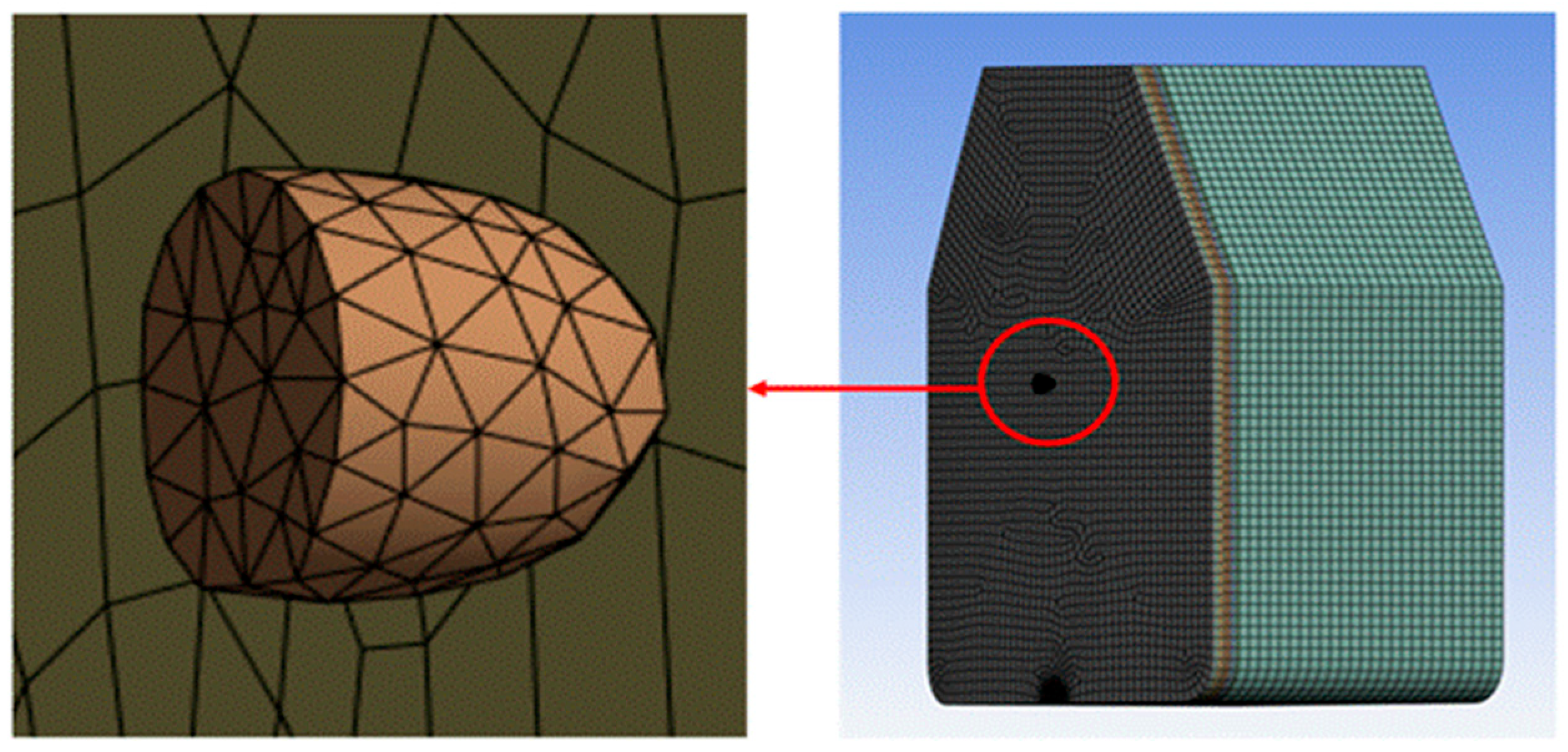
The geometries of both the ballistic plates and the 9 mm projectile were modeled using ANSYS Design Modeler (2022 R1). Meshing was performed in ANSYS Workbench, using the automatic method to ensure uniformity and minimize setup time. A mesh size of 5 mm was applied to the composite plates, while a finer mesh of 1.5 mm was used for the projectile to capture detailed deformation and stress distribution during impact. Figure 1 illustrates the meshed geometry of the bullet and composite plate.
Boundary conditions were defined by constraining the rear and side edges of the composite plates to simulate a fixed support, replicating conditions in experimental ballistic testing setups. Contact interactions between the projectile and the composite plate were modeled using standard surface-to-surface contact definitions. The 9 mm projectile in all simulations was represented as a single structural steel body using the structural steel material available in the ANSYS Explicit Dynamics library. The steel surrogate was chosen to represent the mechanical response of a typical pistol-type projectile in the model and was kept identical across all simulation cases to ensure consistent comparative results. Key material properties used in the model are listed in Table 2. The composite layers, abaca, PALF, and UHMWPE, were modeled as macroscopically homogeneous orthotropic materials, with the mechanical properties listed in Table 1. An initial velocity of 426 m/s was assigned to the bullet in the Y-direction to simulate the ballistic impact. The simulation was configured with a total analysis of 6 × 10⁻⁵ s and a maximum cycle count of 1 × 10⁶ for all sample configurations.
The simulation aimed to evaluate key performance parameters, including depth of penetration (DOP), depth of backface signature (BFS), kinetic energy absorption, and equivalent stress. DOP refers to the distance that the projectile penetrates the composite material [38,39], while BFS measures the maximum deformation on the rear surface of the plate after impact [40]. BFS is critical metric for assessing potential blunt force trauma, as it reflects the risk of injury to the wearer even when the projectile is effectively stopped by the armor. Higher BFS values typically indicate greater rear surface deformation and a higher likelihood of injury. The simulation results were analyzed to assess stress distribution, identify potential failure points, and evaluate the overall mechanical performance of the composites under ballistic conditions.

2.3. Composite Fabrication

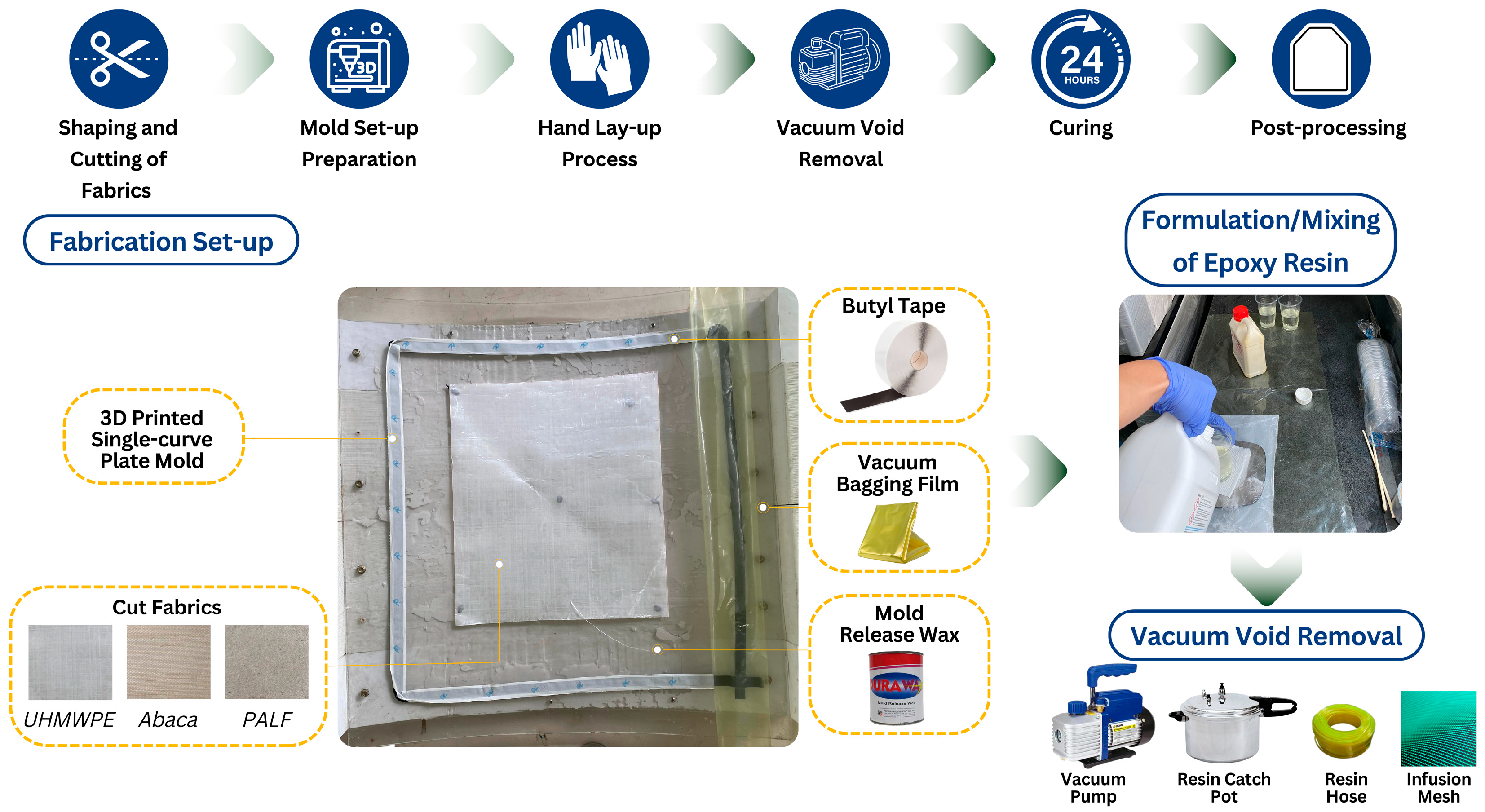
The composite laminates, corresponding to the simulated configurations, were fabricated through a vacuum-assisted hand lay-up process following the general principles of vacuum-assisted resin transfer molding (VARTM). Abaca and pineapple leaf fiber (PALF) fabrics were stacked in alternating layers with ultra-high-molecular-weight polyethylene (UHMWPE) sheets according to the designed lay-up sequence. Each fabric was first cut to the specified plate dimensions and arranged on a 3D-printed single-curved mold coated with mold release wax to prevent adhesion. The laminating epoxy clear resin was mixed with its hardener in a 2:1 mass ratio and uniformly applied onto each fabric layer to ensure full fiber wetting.
After the lay-up, the laminate stack was sealed using a vacuum bagging film. A vacuum was applied for 30 min to compact the laminate and extract residual resin. The vacuum compaction not only improved interlaminar layering but also minimized void formation. The composite plates were left to cure under ambient temperature for 24 h. After curing, the laminates were demolded, trimmed, and covered with fabric. The composite plates were then subjected to ballistic testing. Figure 2 presents the overall process flow, from fabric preparation to vacuum-assisted curing, for the abaca–UHMWPE and PALF-UHMWPE hybrid composite plates.

2.4. Ballistic Test

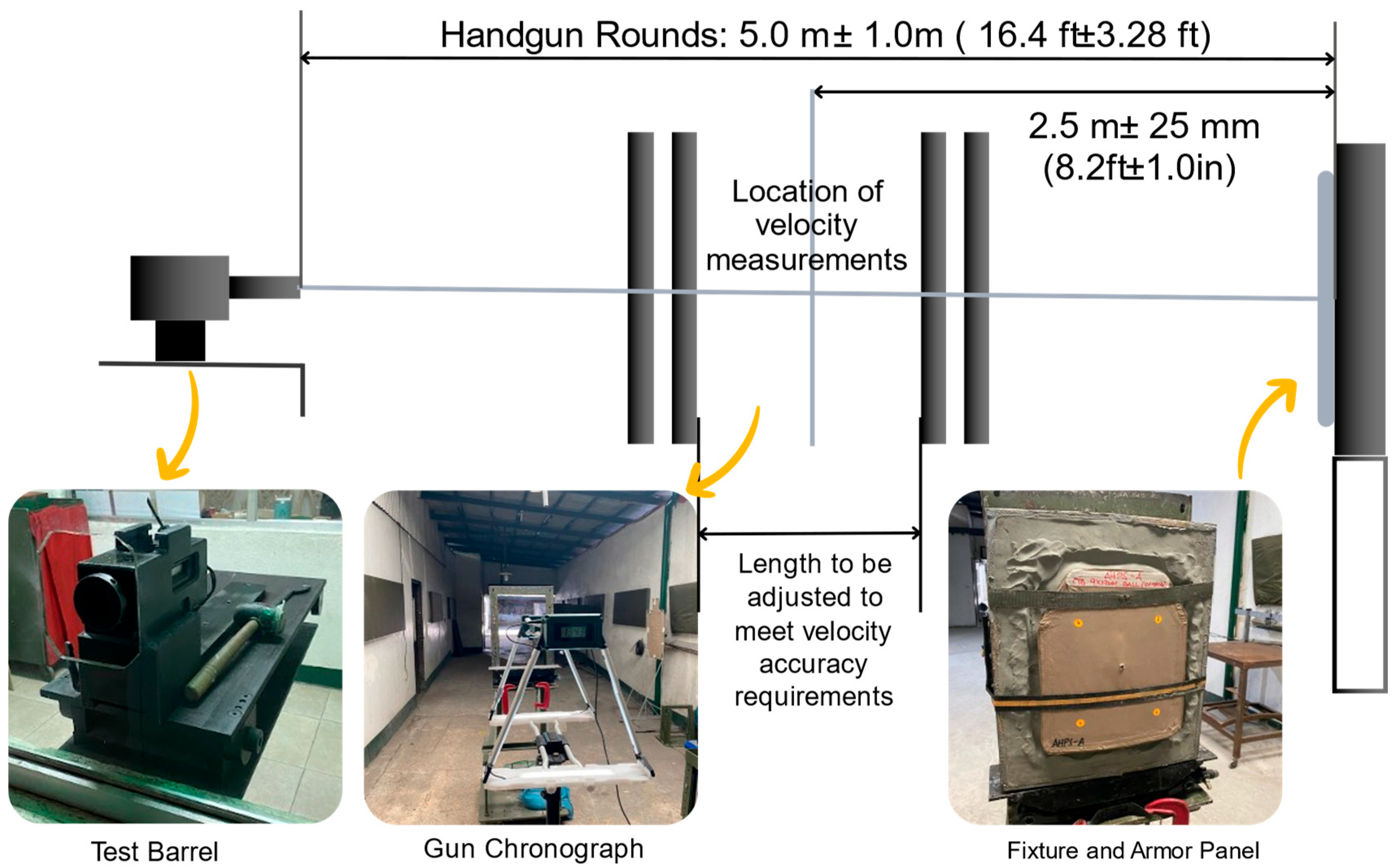
Ballistic tests were conducted in accordance with the National Institute of Justice (NIJ) Standard 0101.06 for Level IIIA hard armor plates. The objective was to evaluate the resistance of the composite plates against 9 mm full metal jacket (FMJ) ammunition, fired at an average velocity of 426 ± 9 m/s, from a distance of 5 m. Each plate was backed with calibrated Roma Plastilina No. 1® (Chavant, Inc., Macungie, PA, USA) clay to measure the depth of backface deformation, or backface signature (BFS), with a maximum allowable depth of 44 mm, as specified by the standard.
Three or more plates were fabricated for each selected configuration. Shot locations were marked two inches apart, and each plate received six shots fired in total to comply with NIJ 0101.06 test criteria: three shots were used to assess BFS, while the remaining three were evaluated for penetration resistance. Projectile velocity was measured using a calibrated chronograph. While the NIJ standard specifies 0.44 Magnum semi-jacketed hollow point (SJHP) ammunition, 9 mm full metal jacket (FMJ) rounds were substituted in this investigation to ensure more consistent velocity profiles and improved test repeatability. Figure 3 presents the complete ballistic test setup including the firing position, chronograph placement, and target fixture arrangement.

2.5. Weathering Test

Following the initial ballistic performance evaluation, an additional composite plate from the best-performing configuration was fabricated and subjected to accelerated weathering to assess its environmental durability. The test began with thermal cycling, where the sample was exposed to a low temperature of −40 °C for 8 h, followed by a high temperature of 70 °C for another 8 h. These extreme thermal conditions were intended to simulate environmental stress and assess the composite’s dimensional stability and potential for microcracking under fluctuating temperatures. Subsequently, the plate underwent ultraviolet (UV), and moisture exposure based on Cycle 7A of the ASTM G155 standard. This cycle spanned a continuous 180 min duration and involved alternating periods of light and moisture exposure. Specifically, the samples were first subjected to 40 min of Xenon arc light without water spray to simulate direct sunlight exposure. This was immediately followed by a 20 min interval of combined light and water spray, replicating the effects of sunlight during rainfall. The cycle then continued with 60 min of light-only exposure and concluded with 60 min of complete darkness. This weathering protocol aimed to replicate real-world environmental conditions, including UV degradation, thermal cycling, and moisture ingress. The goal was to evaluate potential changes in the structural integrity and ballistic performance of the composite material after exposure to harsh environmental conditions.

3. Results and Discussion

3.1. FEA Simulation and Actual Ballistic Testing

Table 3 presents a quantitative comparison between finite element analysis (FEA) predictions and experimental measurements of depth of penetration (DOP) and depth of backface signature (BFS) for all composite configurations tested under NIJ IIIA ballistic conditions. Sample A (UHMWPE + PALF) exhibits one of the poorest characteristics, with a simulated BFS of 39.51 mm and an experimental BFS of 42.36 mm. Although the simulated DOP was 17.64 mm, the actual DOP was significantly lower at 9.33 mm, resulting in a 47.11% percent difference. This suggests that while the simulation overpredicted penetration depth, it substantially underpredicted BFS, highlighting limitations in the model’s ability to capture rear-surface deformation in PALF-basedcomposites. The poor interfacial adhesion promotes fiber debonding and fracture under impact, rather than frictional pull-out, limiting the energy dissipation [41]. The excessive BFS value also explains why Sample A was not replicated further.
On the other hand, Sample B (UHMWPE + Abaca) demonstrated better ballistic resistance. The experimental BFS was 23.13 mm, well below the threshold of 44 mm, and the DOP was 7.33 mm compared to the simulated 14.58 mm. The simulation overpredicted both metrics, with percent differences of 49.72% for DOP and 39.37% for BFS. Despite these differences, the trend between simulation and experiment remained consistent, affirming the effectiveness of abaca as a reinforcement fiber. The relatively low BFS suggests stronger fiber–matrix interaction and better energy dissipation capability of the abaca-reinforced composite.
Sample C (UHMWPE + PALF + UHMWPE) shows an improved performance over Sample A, with an actual BFS of 36.05 mm and a DOP of 12.70 mm. The percent difference for DOP (7.77%) was the lowest among all configurations, indicating that the simulation closely predicted penetration behavior in this hybrid layup. The BFS percent difference remained moderate at 5.90%, suggesting a more accurate simulation for this configuration and a potential balancing effect of the sandwich architecture in mitigating both penetration and backface deformation. This improved agreement suggests that the symmetric layering helped balance the plate’s response, as the outer UHMWPE plies constrained the deformation of the PALF core. Experimentally, the PALF core in Sample C still contributed to some rear-face bulging, but the UHMWPE bore a significant portion of the load, preventing delamination. The sandwich architecture therefore mitigated both penetration and backface deformation, as also reflected by the closer match between simulated and measured values for this configuration. In essence, adding high- performance UHMWPE face sheets around the PALF layer improved energy distribution and reduced the influence of PALF’s weaker interface. This finding is consistent with the concept of hybridizing natural fibers with strong outer layers to achieve a more efficient energy absorption mechanism in armor designs.
Sample D (UHMWPE + Abaca + UHMWPE) was expected to perform similarly well; however, it showed a discrepancy between FEA and the experimental results. The FEA predicted a low BFS at 14.70 mm, whereas the experimental BFS reached 44.98 mm, slightly exceeding the NIJ IIIA limit. This discrepancy is reflected in a very high percent difference of 205.99%, indicating that the simulation significantly underpredicted backface deformation in this configuration. However, the actual DOP was 17.78 mm compared to a simulated 13.64 mm, resulting in a 30.35% percent difference. The large BFS in Sample D can be explained by localized delamination and interlayer decoupling in the stacking that were not fully captured in the model. In the actual test, the interface between the abaca core and UHMWPE likely delaminated extensively under impact, causing the front and back faces to bulge outward. Essentially, the stiff UHMWPE outer layers stopped the bullet (preventing full penetration), but the softer natural fiber core allowed excessive out-of-plane deformation. The idealized simulation, which assumed perfectly bonded layers and used a single set of cohesive parameters, did not reproduce this extreme interfacial failure. Thus, the sandwich configuration of Sample D introduced a failure mode that highlights the model’s limitations in capturing complex delamination behavior.
The inclusion of additional UHMWPE layers and the choice of natural fiber had a pronounced effect on ballistic outcomes. For example, adding outer UHMWPE plies in the sandwich configurations (Samples C and D) generally reduced BFS and DOP compared to their counterparts. Sample C’s BFS (~36 mm) was about 15% lower than that of Sample A (~42 mm), highlighting the benefit of sandwiching PALF layers between high-strength facings. Sample D’s sandwich structure yielded a 20% lower DOP than Sample B (about 17.8 mm vs. 7.3 mm), indicating improved energy absorption, though its experimental BFS was higher due to interfacial delamination. Overall, the abaca fibercomposites (Samples B and D) outperformed the PALF composites (A and C) in backface signature, Sample B’s BFS (~23 mm) was roughly 45% smaller than Sample A’s (~42 mm), demonstrating the impact of stronger fiber–matrix adhesion. These findings underscore how the laminate structure (fiber type and stacking sequence) influences energy dissipation. Robust interfaces and constraining outer layers promote fiber tensile rupture and shear plugging at the impact site, limiting penetration, whereas weaker interfaces lead to extensive fiber pull-out and delamination, increasing the backface deformation.
Although the homogenized ply properties used in the numerical model assign a higher effective in-plane modulus to PALF than to abaca, this does not contradict the superior ballistic performance of the abaca-reinforced laminates. Ballistic resistance is governed not only by stiffness, but also by toughness, failure strain, and fiber–matrix interfacial behavior. In the present composites, PALF layers exhibited weaker and more defect-prone interfaces, so their higher initial stiffness was offset by earlier delamination and loss of load-bearing capacity under impact. In contrast, the better-bonded abaca layers remained engaged for longer, promoting more stable energy dissipation and resulting in lower BFS and DOP, despite their lower effective modulus in the material model.
The comparative analysis demonstrated that abaca-reinforced composites consistently outperformed their PALF counterparts in terms of ballistic resistance, particularly with respect to backface signature (BFS) performance. However, the observed discrepancies between numerical predictions and experimental measurements highlight the limitations of current computational approaches in accurately capturing the complex failure mechanisms involved in ballistic impact scenarios. Specifically, the computational model’s inability to fully simulate progressive failure modes, such as fiber pullout, delamination, and matrix fragmentation, contributed to the systematic underestimation of backface deformation. These mechanisms are critical for energy dissipation and play a significant role in the development of backface signatures in composite armor systems.
In real-world ballistic events, failure mechanisms in laminated composites typically occur through progressive modes including shear plugging, delamination, fiber pullout, and eventual tensile rupture. Upon initial impact, a compressive shock wave propagates through the material, often inducing shear plugging at the bullet entry point. As the projectile advances, fiber–matrix debonding and interlaminar delamination follow, accompanied by localized bulging on the rear face of the plate. In cases of complete penetration, tensile failure becomes prominent on the exit face, indicating catastrophic structural breakdown [42].

3.2. Visualization of Deformations in the Ballistic Plates

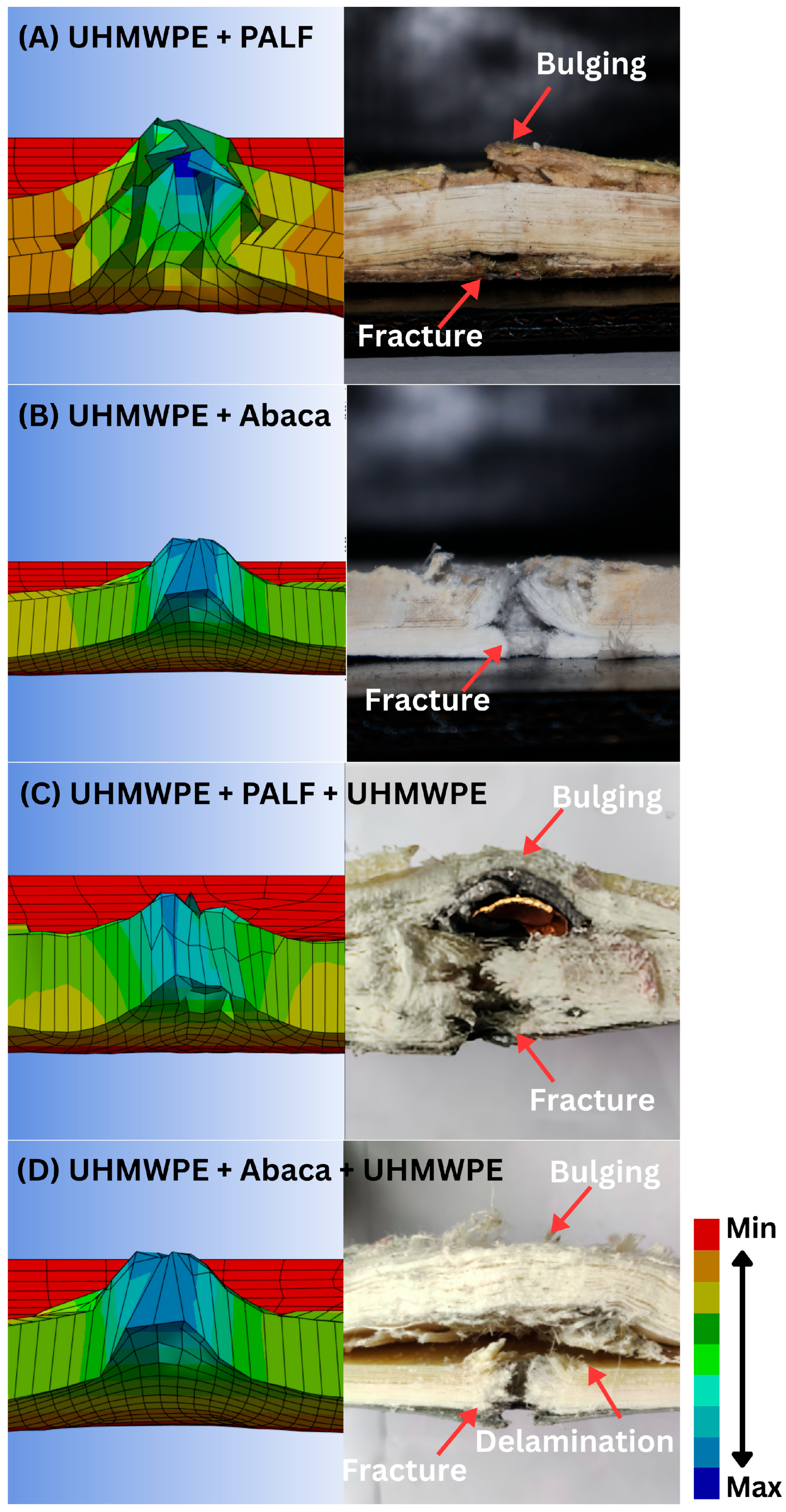
Figure 4 provides a comparative visualization of the simulated and actual cross-sections of the composite plates subjected to ballistic impact, highlighting the distinct damage and failure modes associated with each configuration. The comparison between numerical simulation outputs and physical damage observations enables deeper insight into the mechanisms of energy dissipation and structural failure in hybrid composite armor systems. Sample A (UHMWPE + PALF) displays a pronounced bulging behavior and localized fracture at the impact site. The simulation predicted significant out-of-plane deformation, which corresponded with the large backface bulge observed experimentally. The fracture appeared to initiate centrally, suggesting limited load distribution across the plate. The high bulging and fracture indicate poor fiber–matrix adhesion and inadequate energy dissipation, likely contributing in a BFS value close to the NIJ threshold limit. On the other hand, Sample B (UHMWPE + Abaca) showed less severe deformation compared to Sample A. The simulation predicted a more uniform stress distribution with less rear-face deflection, which aligned well with the relatively lower BFS value measured. The fracture zone appeared more localized, suggesting better load containment and improved fiber–matrix bonding. This configuration benefited from abaca’s higher tensile strength and superior interfacial adhesion, which enhanced its capacity to withstand and distribute impact energy.
Sample C (UHMWPE + PALF + UHMWPE) exhibits reduced bulging relative to Sample A, both in the simulation and physical test. The sandwich structure appeared to help constrain rear-face deformation and localize fracture, which was also predicted in the numerical model. The outer UHMWPE layers likely served to confine damage progression and improve impact absorption, although some internal damage, including fiber fracture and partial delamination, was visible. This configuration demonstrated improved performance over pure PALF-reinforced composites due to the hybrid layering approach. In contrast, Sample D (UHMWPE + Abaca + UHMWPE) demonstrates the most complex failure pattern, featuring moderate bulging, visible delamination, and distributed fracture zones. The simulation predicted deeper penetration compared to other samples, though rear deformation appeared minimal. Experimentally, while BFS exceeded the NIJ limit, the damage was distributed across multiple failure modes, including bulging, fracture, and extensive interlaminar delamination. The presence of delamination in this hybrid composite reflects progressive failure, where impact energy is dissipated through multiple damage pathways. Although the BFS value was high, this distributed failure mode may have reduced the risk of localized trauma, indicating the need for further refinement in layer architecture and interfacial toughness.
Collectively, the visual and simulated results confirm the presence of key failure mechanisms, namely bulging, fracture, and delamination, that critically influence the ballistic performance of laminated fiber composites. The cross-sectional analyses of Samples A, B, C, and D revealed deformation patterns that closely align with simulation predictions, offering valuable insights into material behavior under high-velocity impact. The consistent occurrence of fracturing at the bullet entry point in Samples A, B, and D indicates regions of high stress concentration, leading to brittle failure. Observed delamination at the layers where projectiles were arrested suggests the presence of significant interlaminar shear stresses, resulting in separation between composite plies and compromising structural integrity. Bulging beyond the projectile’s stopping point reflects plastic deformation and the composite’s energy absorption capacity, which are critical parameters for evaluating and enhancing the material’s ability to dissipate kinetic energy and mitigate backface trauma. Sample C exhibited discrepancies between the simulated and actual deformation profiles, where fracture occurred instead of the predicted bulging. This inconsistency highlights potential limitations in the simulation model or indicates unique material responses that require further investigation and refinement in future modeling efforts.

3.3. Accelerated Weathering Response of Ballistic Plates

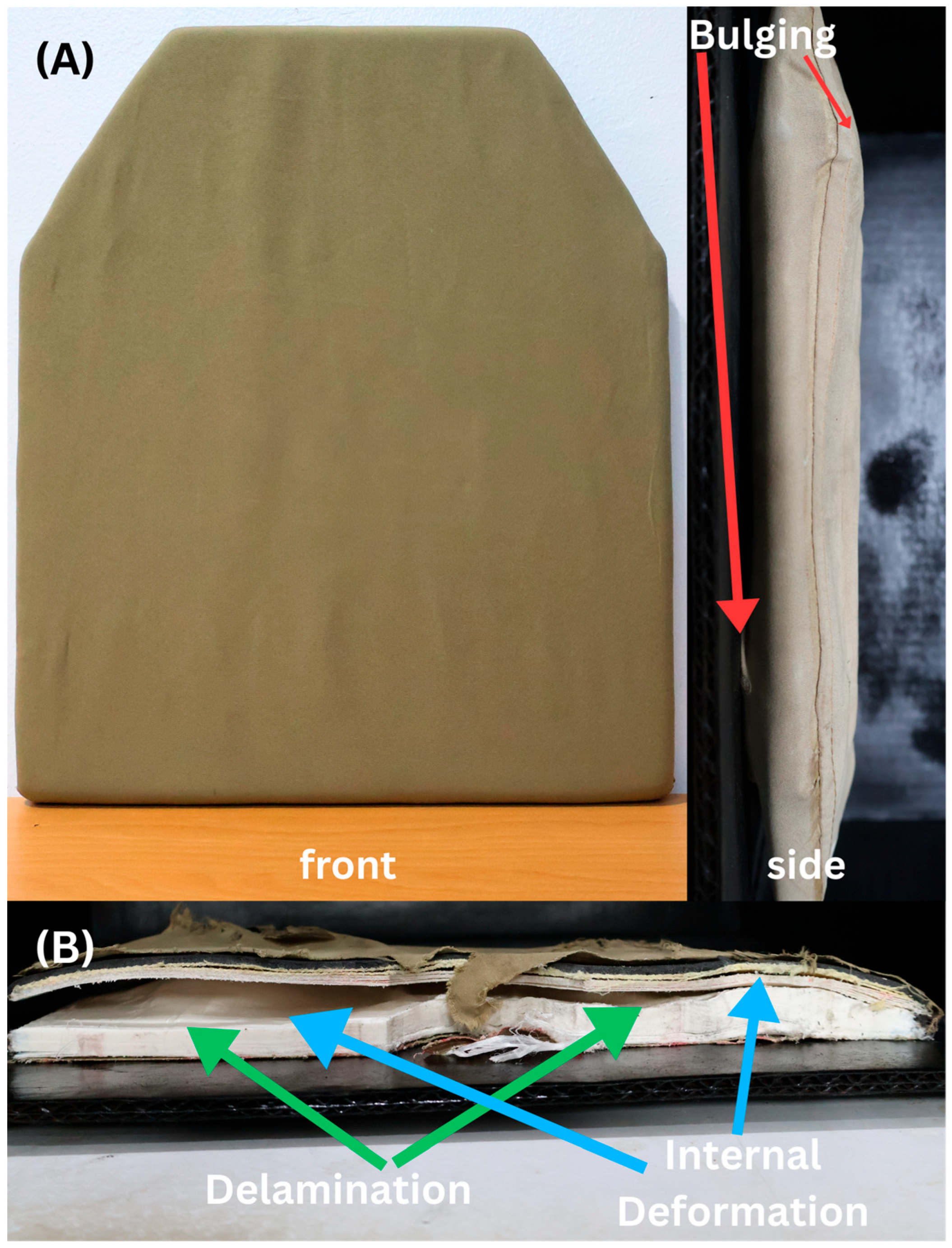
Figure 5 illustrates the physical effects of accelerated weathering on the composite plates. As shown in Figure 5A, the weathered plate displayed flat but discernible bulging along the surface, particularly visible from the side profile. This deformation suggests internal structural changes, most notably delamination. Tactile inspection of the weathered sample produced a hollow sound, further supporting the presence of internal air gaps, which is an indicator of interfacial separation between composite layers.
These observations are consistent with the expected effects of environmental conditioning. The weathering protocol included cycles of high and low temperatures and exposure to moisture and UV radiation. The thermal cycling likely induced differential expansion and contraction between constituent materials due to mismatched coefficients of thermal expansion. This mismatch results in cyclic internal stresses, which contribute to microcrack initiation, void formation, and progressive delamination. In addition, the natural fiber components in the composite, particularly abaca, are highly hygroscopic and absorb moisture readily. When exposed to humidity and water spray, these fibers swell and create further internal stresses within the matrix. Combined with thermal fatigue, this moisture-induced expansion likely increased the degree of delamination observed in the plate.
Table 4 provides a comparative analysis of the depth of backface signature (BFS) between weathered and non-weathered samples, specifically Sample B (UHMWPE + Abaca). The average BFS for the weathered sample was 16.60 ± 5.27 mm, significantly lower than the 23.13 ± 1.45 mm measured for its non-weathered counterpart, with a reduction of approximately 52.47%. This counterintuitive improvement in BFS is attributed to the presence of internal delamination and air gaps, which modified the impact response of the composite.
As shown in Figure 5B, ballistic impact on the weathered plate revealed internal deformation and layer separation. Delamination introduces low-density regions within the composite, forming air pockets that interrupt uniform energy transfer during impact. These voids act as localized buffers, absorbing and redistributing kinetic energy away from the backface, thereby reducing the BFS. The projectile’s interaction with multiple delaminated interfaces creates energy dissipation zones that delay or diffuse the propagation of stress waves. This phenomenon results in a cushioning effect, spreading the impact energy across a broader area and decreasing the severity of deformation on the rear surface. While this mechanism can temporarily enhance BFS performance, it simultaneously compromises the structural integrity of the armor system. Delamination weakens the load-bearing capacity of the plate and may result in erratic ballistic responses, particularly under repeated or high-energy impacts. Over time, the accumulation of microcracks and fatigue-related damage could undermine the reliability and long-term durability of the composite. Therefore, although the weathered sample exhibited improved BFS performance in a single-shot test, its overall ballistic resilience needs further investigation for extended use in operational settings.

3.4. Scanning Electron Microscopy Analysis

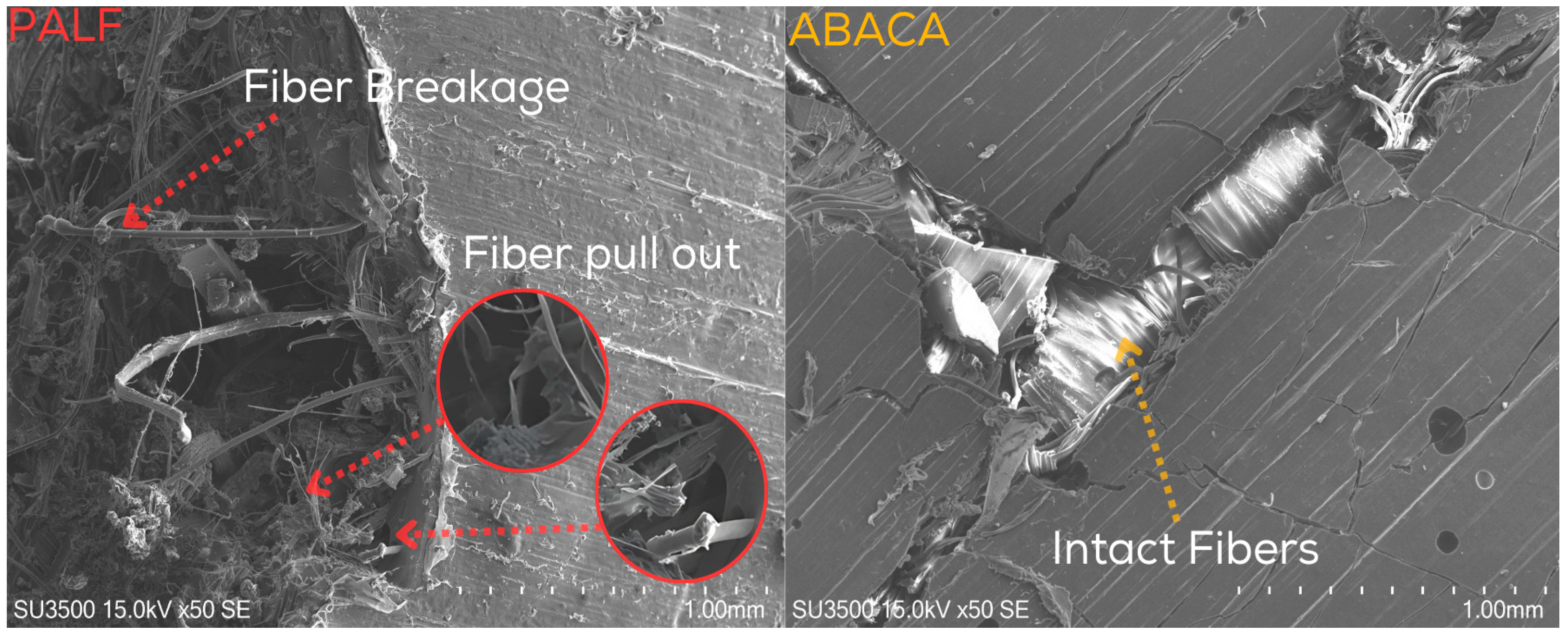
Scanning electron microscopy (SEM) analysis provided detailed insights into the microstructural failure mechanisms and interfacial behavior of the abaca–UHMWPE and PALF-UHMWPE-reinforced epoxy composites subjected to ballistic testing. As presented in Figure 6, the SEM images revealed a stark contrast between abaca and PALF composites in terms of interfacial bonding. The abaca-based samples exhibited relatively intact fibers well embedded in the epoxy matrix, suggesting strong fiber–matrix interfacial bonding [43]. This robust interface plays a critical role in maintaining structural integrity during high-velocity impact, as it facilitates effective stress transfer and delays crack propagation. In contrast, the PALF-based composites showed pronounced voids, fiber pull-out, and fractured surfaces. These features are indicative of poor interfacial adhesion, which compromises the material’s ability to absorb and redistribute impact energy [41,44,45]. Such weak bonding results in premature delamination and brittle failure under ballistic loading.
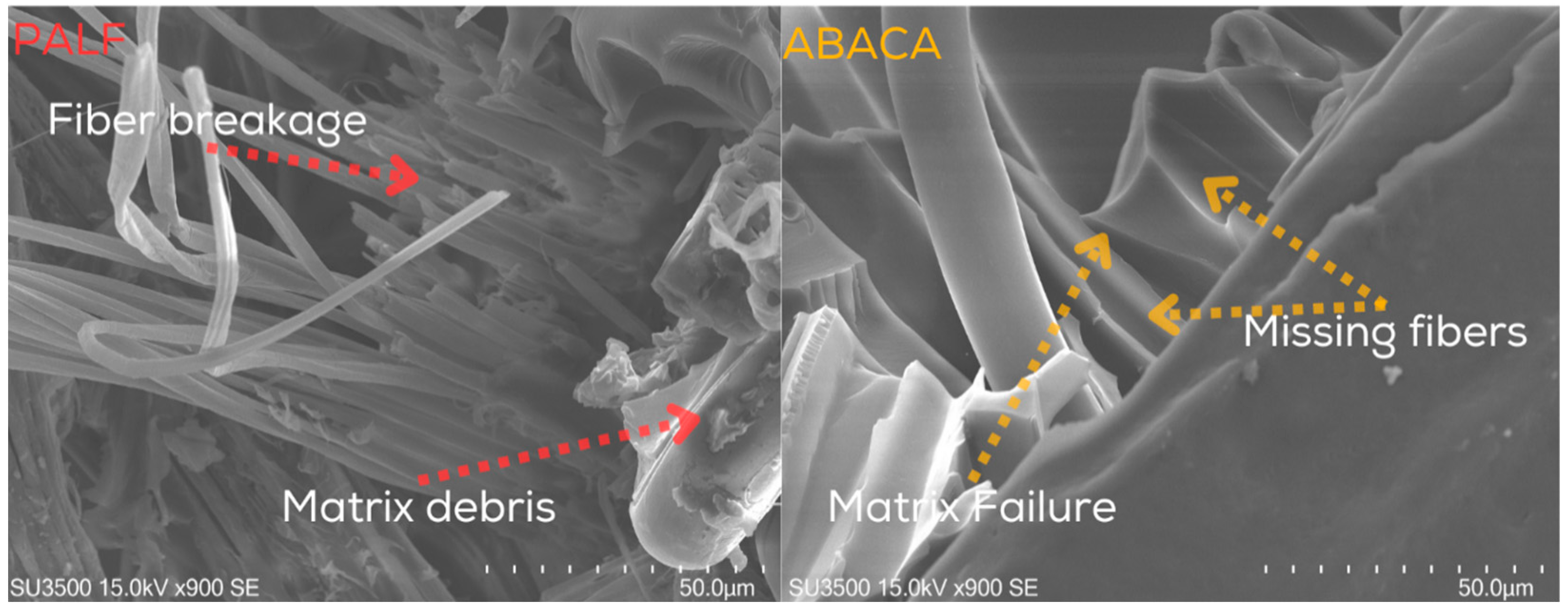
Figure 7 further emphasizes the difference in fracture behavior at higher magnification. PALF-UHMWPE composites exhibit extensive fiber breakage, matrix fragmentation, and fiber pull-out, which are indicative of brittle failure [44,46,47]. These microstructural signatures suggest that the PALF-UHMWPE fiber layers do not effectively dissipate the impact energy, instead fracturing abruptly with minimal plastic deformation [48,49]. Conversely, the abaca samples show limited fiber breakage and more evidence of fiber pull-out without fiber rupture, indicating a more ductile failure mode [49,50]. The presence of pulled-out fibers without breakage implies that energy is dissipated through fiber slippage and matrix shear, which enhances the composite’s capacity to resist ballistic impact. The strong fiber–matrix interface in abaca composites facilitates stress redistribution and plastic deformation, which are key mechanisms associated with improved ballistic performance [46,49].
The UHMWPE layers in both weathered composite systems were also examined post-delamination, as shown in Figure 8. These images confirm that the UHMWPE fibers underwent primarily plastic deformation with minimal evidence of breakage beyond the delamination point. This response is consistent with the high ductility and energy absorption capacity of UHMWPE, which contributed to the overall performance of the hybrid plates. The integrity of the UHMWPE layers post impact reinforces theimportance of maintaining strong interlayer bonding to fully leverage the energy- absorbing properties of the synthetic fiber.
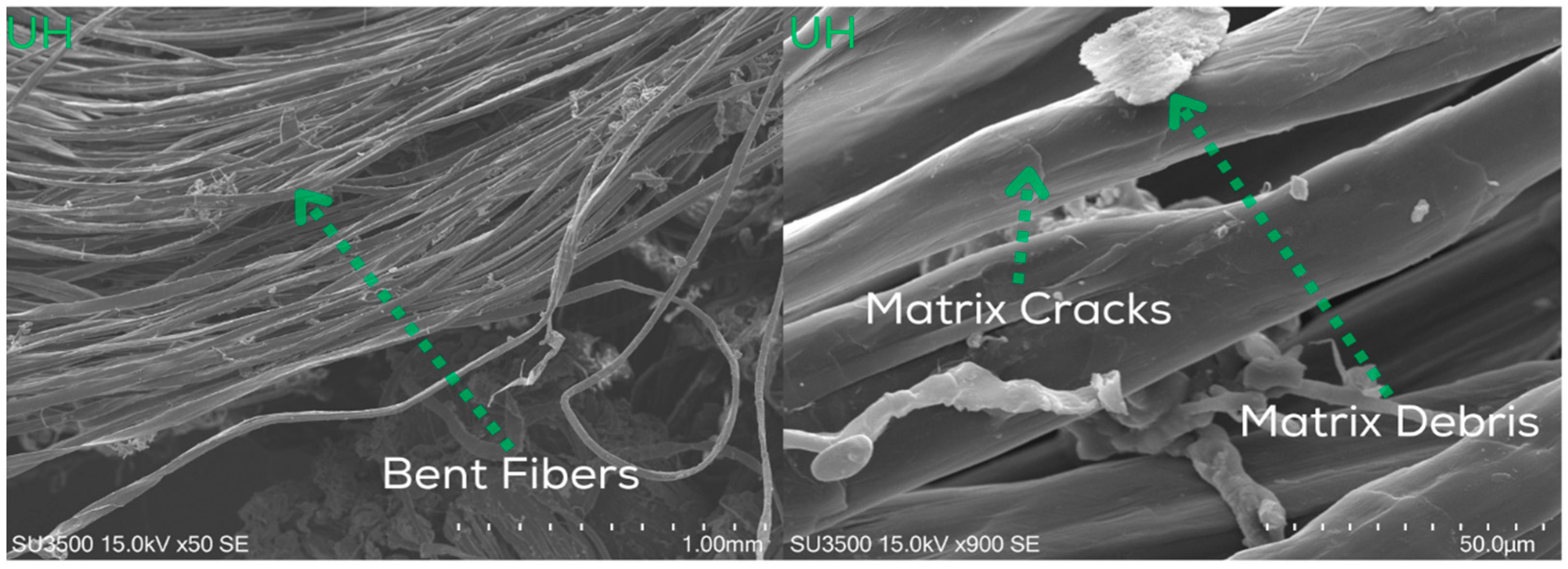
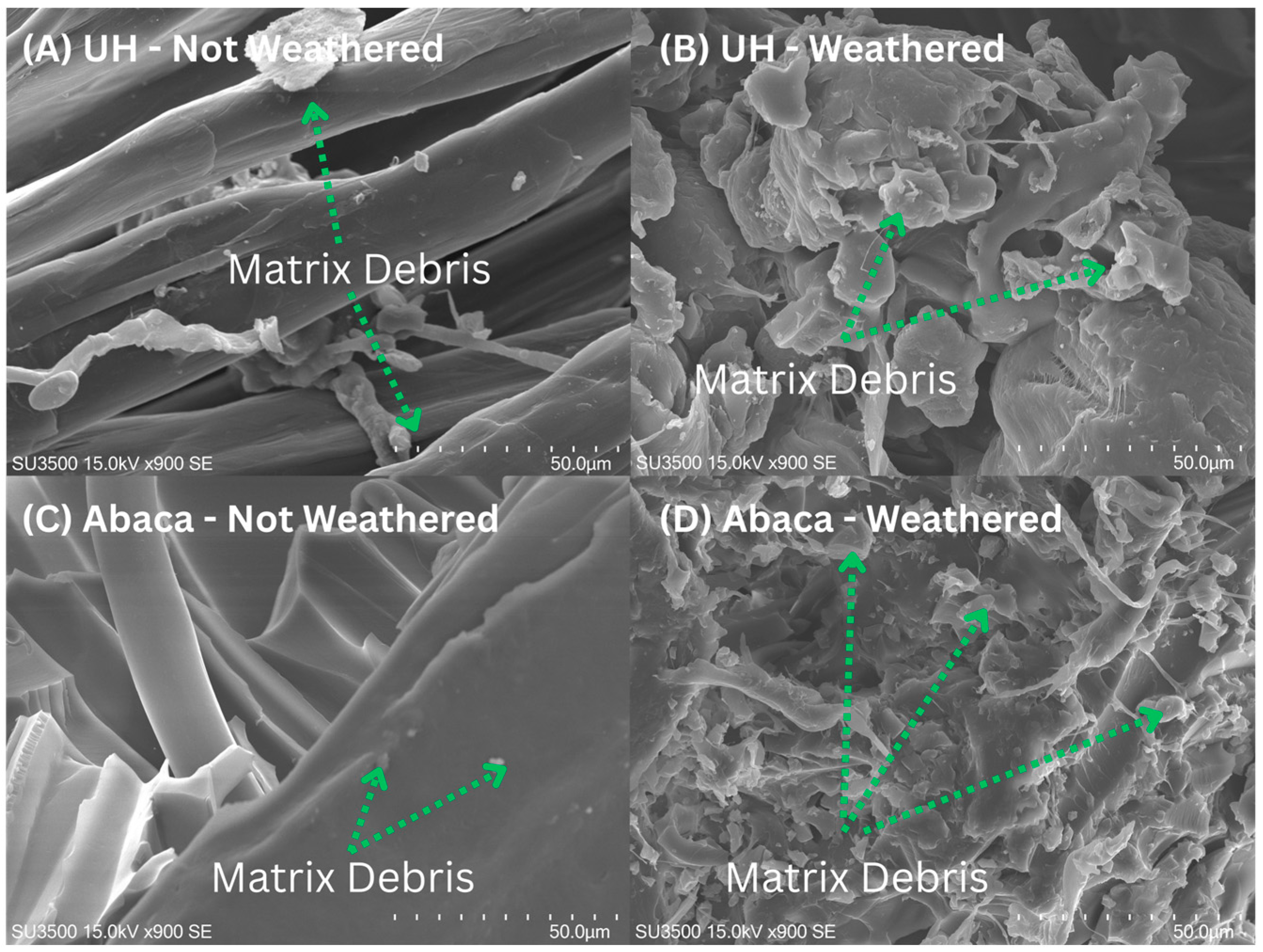
In Figure 9, SEM images compare the microstructure of UHMWPE and abaca layers in non-weathered and weathered samples. The weathered composites exhibited significantly more surface debris, matrix cracking, and roughness, indicating environmental degradation from thermal cycling and humidity exposure. These microstructural changes are consistent with the observed delamination and internal void formation discussed earlier. The matrix degradation in weathered samples weakens the interfacial bonding and contributes to the formation of microcracks, which compromise mechanical integrity and long-term durability [51]. While some delamination and void formation were shown to reduce backface signature (BFS) due to altered energy dissipation pathways, these features ultimately reduce the structural reliability of the armor over extended use.
In summary, the SEM analysis validated the macro-level ballistic test findings of the weathered natural fiber–UHMWPE ballistic composite plates. Abaca–UHMWPE reinforced composites demonstrated better microstructural integrity and ductile failure mechanisms compared to PALF-based counterparts. The enhanced interfacial adhesion in abaca–UHMWPE reinforced composites, as observed in SEM analysis, directly correlated with the actual ballistic results of the samples. These microstructural observations also clarify why abaca/UHMWPE laminates achieved lower BFS and DOP than PALF/UHMWPE laminates, even though the PALF plies were assigned a higher effective modulus in the homogenized material model discussed in Section 3.1.

4. Conclusions

This study investigated the ballistic performance and failure behavior of hybrid abaca/UHMWPE and PALF/UHMWPE composite laminates fabricated through a vacuum-assisted hand lay-up process. The integration of vacuum-assisted fabrication improved fiber impregnation, minimized voids, and enhanced interlaminar bonding, resulting in consistent and reproducible laminate quality. The experimental results demonstrate that abaca/UHMWPE composites exhibited superior ballistic resistance compared to PALF/UHMWPE counterparts, as indicated by lower backface signature (BFS) and depth of penetration (DOP) values. In particular, the abaca/UHMWPE configuration (Sample B) achieved a BFS of approximately 23 mm, about 45% lower than that of the PALF/UHMWPE plate and well below the NIJ 0101.06 Level IIIA limit of 44 mm, while maintaining a DOP below 10 mm. The improved performance of abaca-based laminates was attributed to their stronger fiber–matrix interfacial adhesion and ductile failure behavior, which promoted more effective stress transfer and energy dissipation during impact.
Finite element analysis incorporating an energy-based bilinear fracture criterion successfully captured dominant failure mechanisms, delamination, matrix cracking, and fiber–matrix debonding, and provided valuable insight into local stress evolution. Although the simulation slightly underpredicted backface deformation, the correlation trends validated its utility as a predictive design tool for hybrid natural fiber composites. At the same time, the comparison with experiments reinforced that numerical models must be anchored to experimental validation for the reliable development and certification of composite armor systems.
Accelerated weathering tests revealed that combined thermal and moisture exposure induced microcracking and delamination, which altered the impact response and highlighted the importance of environmental durability in field applications. Overall, the findings established a clear process–structure–property relationship linking vacuum- assisted fabrication to improved interfacial quality and ballistic performance in sustainable hybrid composites, with abaca/UHMWPE hybrids consistently delivering lower BFS and competitive DOP values compared with PALF/UHMWPE systems. The abaca/UHMWPE configuration, in particular, demonstrated strong potential as a lightweight and eco-efficient armor material.
Building on these results, future work should refine both modeling and experiments. On the computational side, more advanced models are needed, including calibrated cohesive-zone and progressive intralaminar damage formulations (e.g., Hashin-type), the incorporation of strain rate–dependent properties and element deletion/erosion, and the use of multi-shell or layered-shell laminate representations instead of the current solid-ply stack to better capture bending and damage. Experimentally, future studies should explore optimized interfacial treatments, rate-sensitive characterization, and multi-hit and fatigue performance to further enhance the reliability and scalability of natural fiber–synthetic hybrid armor systems.

Author Contributions

E.M.J.: Writing—review & editing, Visualization, Supervision, Resources, Project administration, Methodology, Funding acquisition, Formal analysis, Data curation, Conceptualization. A.J.P.: Writing—original draft, Visualization, Investigation, Formal analysis, Data curation. L.M.: Investigation, Formal analysis, Data curation. D.J.P.: Writing—review & editing, Visualization, Formal analysis, Data curation. All authors have read and agreed to the published version of the manuscript.

Funding

This research was funded by Department of Science and Technology—Philippine Council for Industry, Energy, and Emerging Technology Research and Development (DOST-PCIEERD).

Data Availability Statement

Data will be made available on request.

Acknowledgments

The authors gratefully acknowledge the support provided by the Philippine Council for Industry, Energy and Emerging Technology Research and Development—Department of Science and Technology (PCIEERD–DOST). Special recognition is also extended to the Air Force Research and Development Center (AFRDC) and the Naval Research and Technology Development Center (NRTDC) of the Armed Forces of the Philippines (AFP) for their invaluable contributions.

Conflicts of Interest

The authors declare that they have no known competing financial interests or personal relationships that could have appeared to influence the work reported in this paper.

Abbreviations

The following abbreviations are used in this manuscript:
BFSBackface Signature
DOPDepth of Penetration
FEAFinite Element Analysis
FRCFiber-Reinforced Composite
MASMultilayered Armor System
PALFPineapple Leaf Fiber
SEMScanning Electron Microscopy
UHMWPEUltra-High-Molecular-Weight Polyethylene
VARTMVacuum-Assisted Resin Transfer Molding

References

  1. Balakrishnan, P.; John, M.J.; Pothen, L.; Sreekala, M.S.; Thomas, S. Natural Fibre and Polymer Matrix Composites and Their Applications in Aerospace Engineering. In Advanced Composite Materials for Aerospace Engineering; Elsevier: Amsterdam, The Netherlands, 2016; pp. 365–383. ISBN 978-0-08-100939-0. [Google Scholar]
  2. Naik, V.; Kumar, M.; Kaup, V. A Review on Natural Fiber Composite Material in Automotive Applications. Eng. Sci. 2021, 18, 1–10. [Google Scholar] [CrossRef]
  3. Lin, C.; Wang, S.; Chen, M.; Lu, Y. Experimental Study on the Mechanical Properties of Different Fiber-Reinforced Seawater Sea-Sand Engineered Cementitious Composites. Constr. Build. Mater. 2021, 304, 124562. [Google Scholar] [CrossRef]
  4. Valorosi, F.; De Meo, E.; Blanco-Varela, T.; Martorana, B.; Veca, A.; Pugno, N.; Kinloch, I.A.; Anagnostopoulos, G.; Galiotis, C.; Bertocchi, F.; et al. Graphene and Related Materials in Hierarchical Fiber Composites: Production Techniques and Key Industrial Benefits. Compos. Sci. Technol. 2020, 185, 107848. [Google Scholar] [CrossRef]
  5. Nayar, S.; Ganesh, R.; Santhosh, S. Fiber Reinforced Composites in Prosthodontics—A Systematic Review. J. Pharm. Bioallied Sci. 2015, 7, 220. [Google Scholar] [CrossRef]
  6. Nurazzi, N.M.; Asyraf, M.R.M.; Khalina, A.; Abdullah, N.; Aisyah, H.A.; Rafiqah, S.A.; Sabaruddin, F.A.; Kamarudin, S.H.; Norrrahim, M.N.F.; Ilyas, R.A.; et al. A Review on Natural Fiber Reinforced Polymer Composite for Bullet Proof and Ballistic Applications. Polymers 2021, 13, 646. [Google Scholar] [CrossRef] [PubMed]
  7. Rajak, D.K.; Pagar, D.D.; Menezes, P.L.; Linul, E. Fiber-Reinforced Polymer Composites: Manufacturing, Properties, and Applications. Polymers 2019, 11, 1667. [Google Scholar] [CrossRef] [PubMed]
  8. Yang, G.; Park, M.; Park, S.-J. Recent Progresses of Fabrication and Characterization of Fibers-Reinforced Composites: A Review. Compos. Commun. 2019, 14, 34–42. [Google Scholar] [CrossRef]
  9. Tran, P.; Nguyen, Q.T.; Lau, K.T. Fire Performance of Polymer-Based Composites for Maritime Infrastructure. Compos. Part B Eng. 2018, 155, 31–48. [Google Scholar] [CrossRef]
  10. Titire, L.; Muntenita, C. Ballistic Impact Study of an Aramid Fabric by Changing the Projectile Trajectory. Fibers 2025, 13, 8. [Google Scholar] [CrossRef]
  11. Chen, L.; Cao, M.; Fang, Q. Ballistic Performance of Ultra-High Molecular Weight Polyethylene Laminate with DifferentThickness. Int. J. Impact Eng. 2021, 156, 103931. [Google Scholar] [CrossRef]
  12. Chocron, S.; Carpenter, A.J.; Scott, N.L.; Bigger, R.P.; Warren, K. Impact on Carbon Fiber Composite: Ballistic Tests, Material Tests, and Computer Simulations. Int. J. Impact Eng. 2019, 131, 39–56. [Google Scholar] [CrossRef]
  13. Nayak, S.Y.; Sultan, M.T.H.; Shenoy, S.B.; Kini, C.R.; Samant, R.; Shah, A.U.M.; Amuthakkannan, P. Potential of Natural Fibers in Composites for Ballistic Applications—A Review. J. Nat. Fibers 2022, 19, 1648–1658. [Google Scholar] [CrossRef]
  14. Rajole, S.; Ravishankar, K.S.; Kulkarni, S.M. Performance Study of Jute-Epoxy Composites/Sandwiches under Normal Ballistic Impact. Def. Technol. 2020, 16, 947–955. [Google Scholar] [CrossRef]
  15. Braga, F.D.O.; Milanezi, T.L.; Monteiro, S.N.; Louro, L.H.L.; Gomes, A.V.; Lima, É.P. Ballistic Comparison between Epoxy-Ramie and Epoxy-Aramid Composites in Multilayered Armor Systems. J. Mater. Res. Technol. 2018, 7, 541–549. [Google Scholar] [CrossRef]
  16. Monteiro, S.N.; Candido, V.S.; Braga, F.O.; Bolzan, L.T.; Weber, R.P.; Drelich, J.W. Sugarcane Bagasse Waste in Composites for Multilayered Armor. Eur. Polym. J. 2016, 78, 173–185. [Google Scholar] [CrossRef]
  17. Luz, F.S.D.; Monteiro, S.N.; Lima, E.S.; Lima Júnior, É.P. Ballistic Application of Coir Fiber Reinforced Epoxy Composite in Multilayered Armor. Mater. Res. 2017, 20, 23–28. [Google Scholar] [CrossRef]
  18. Monteiro, S.N.; Louro, L.H.L.; Trindade, W.; Elias, C.N.; Ferreira, C.L.; De Sousa Lima, E.; Weber, R.P.; Miguez Suarez, J.C.; Da Silva Figueiredo, A.B.-H.; Pinheiro, W.A.; et al. Natural Curaua Fiber-Reinforced Composites in Multilayered Ballistic Armor. Metall. Mater. Trans. A 2015, 46, 4567–4577. [Google Scholar] [CrossRef]
  19. Doddamani, S.; Kulkarni, S.; Joladarashi, S.; Kumar, M.; Gurjar, A.K. Analysis of Light Weight Natural Fiber Composites Against Ballistic Impact: A Review. Int. J. Lightweight Mater. Manuf. 2023, 6, 450–468. [Google Scholar] [CrossRef]
  20. Cruz, R.B.D.; Lima Junior, E.P.; Monteiro, S.N.; Louro, L.H.L. Giant Bamboo Fiber Reinforced Epoxy Composite in Multilayered Ballistic Armor. Mater. Res. 2015, 18, 70–75. [Google Scholar] [CrossRef]
  21. Monteiro, S.N.; Milanezi, T.L.; Louro, L.H.L.; Lima, É.P.; Braga, F.O.; Gomes, A.V.; Drelich, J.W. Novel Ballistic Ramie Fabric Composite Competing with KevlarTM Fabric in Multilayered Armor. Mater. Des. 2016, 96, 263–269. [Google Scholar] [CrossRef]
  22. Armecin, R.B.; Sinon, F.G.; Moreno, L.O. Abaca Fiber: A Renewable Bio-Resource for Industrial Uses and Other Applications. In Biomass and Bioenergy; Hakeem, K.R., Jawaid, M., Rashid, U., Eds.; Springer International Publishing: Cham, Switzerland, 2014; pp. 107–118. ISBN 978-3-319-07577-8. [Google Scholar]
  23. Araya Gutierrez, D.; Garro Monge, G.; Jiménez Quesada, K.; Arias Aguilar, D.; Quesada Cordero, R. Abaca: A General Review on Its Characteristics, Productivity, and Market in the World. Rev. Fac. Nac. Agron. Medellín 2023, 76, 10263–10273. [Google Scholar] [CrossRef]
  24. Ravindran, L.; Sreekala, M.S.; Thomas, S. Novel Processing Parameters for the Extraction of Cellulose Nanofibres (CNF) from Environmentally Benign Pineapple Leaf Fibres (PALF): Structure-Property Relationships. Int. J. Biol. Macromol. 2019, 131, 858–870. [Google Scholar] [CrossRef] [PubMed]
  25. Sarah, S.; Rahman, W.A.W.A.; Majid, R.A.; Yahya, W.J.; Adrus, N.; Hasannuddin, A.K.; Low, J.H. Optimization of Pineapple Leaf Fibre Extraction Methods and Their Biodegradabilities for Soil Cover Application. J. Polym. Environ. 2018, 26, 319–329. [Google Scholar] [CrossRef]
  26. Closse, A.; Onesippe Potiron, C.; Arsene, M.-A.; Bilba, K. Assessment of Vegetable Fiber-Matrix Adhesion and Durability, in Cement-Based and Polymer-Based Composite: Principles from Literature Review. J. Compos. Mater. 2024, 58, 953–992. [Google Scholar] [CrossRef]
  27. Amiebenomo, S.O.; Ozigi, B.O.; Edeawe, V.O. Finite Element Analysis and Mechanical Properties of Carbon Fiber Reinforced Polymer. Eur. J. Mech. Eng. Res. 2023, 10, 82–118. [Google Scholar] [CrossRef]
  28. Zhang, C.; Curiel-Sosa, J.L.; Duodu, E.A. Finite Element Analysis of the Damage Mechanism of 3D Braided Composites under High-Velocity Impact. J. Mater. Sci. 2017, 52, 4658–4674. [Google Scholar] [CrossRef]
  29. Jiang, L.H.; Yu, Q.Q.; Liu, Z. Selected Laser Melting Forming Inlaid Lattice Structure and Mechanical Properties. 3D Print. Addit. Manuf. 2025, 23297662251380380. [Google Scholar] [CrossRef]
  30. Wang, Z.; Ye, J.; Lei, Z.; Gao, T.; Qu, H.; Liu, K.; Chen, Z.; Yuan, K. A Multi-Scale Simulation Strategy for Cutting Three-Dimensional Braided Composite Materials. Compos. Part Appl. Sci. Manuf. 2025, 199, 109216. [Google Scholar] [CrossRef]
  31. Lei, Z.; Liu, J.; Guo, Z.; Gao, F.; Di, H.; Chen, Z.; Wang, Z. UHPC-Honeycomb-Lattice Composite Structure for Vessel Collision Fendering: Impact Characterization and Design Framework. Eng. Struct. 2026, 347, 121697. [Google Scholar] [CrossRef]
  32. Guo, Z.; Du, L.; Yang, Z.; Zeng, K.; Lei, Z.; Wang, Z.; Li, Z.; Fan, Z. Switchable Bidirectional Sound Absorption Via Exceptional Point Modulation in Acoustic Metastructures with Interleaved Resonator Coupling. Adv. Sci. 2025, 12, e08951. [Google Scholar] [CrossRef]
  33. Taherzadeh-Fard, A.; Cornejo, A.; Jiménez, S.; Barbu, L.G. Numerical Analysis of Damage in Composites: From Intra-Layer to Delamination and Data-Assisted Methods. Mathematics 2025, 13, 1578. [Google Scholar] [CrossRef]
  34. Punongbayan, A.J.; Bonete, R.; Oyales, M.-I.K.; Magdaluyo, E.; Sirot, R.; Matilac, L. Fracture Mechanism Comparison of Fiber-Reinforced Ballistic Composites with Different Reinforcement Stacking Configuration Using Finite Element and Experimental Analysis. In Proceedings of the 9th International Conference on Fracture of Polymers, Composites & Adhesives, Les Diablerets, Switzerland, 24–27 March 2024; p. 28. [Google Scholar]
  35. Oyales, M.-I.K.; Sirot, R.; Matilac, L.; Punongbayan, A.J.; Bonete, R.; Magdaluyo, E. Numerical and Experimental Fractographic Analysis of Fiber-Reinforced Ballistic Composites with and Without Additional Absorber Layer. In Proceedings of the 9th International Conference on Fracture of Polymers, Composites & Adhesives, Les Diablerets, Switzerland, 24–27 March 2024; p. 29. [Google Scholar]
  36. Ahmad, F.; Choi, H.S.; Park, M.K. A Review: Natural Fiber Composites Selection in View of Mechanical, Light Weight, and Economic Properties. Macromol. Mater. Eng. 2015, 300, 10–24. [Google Scholar] [CrossRef]
  37. Sirot, R.; Punongbayan, A.J.; Magdaluyo, E. Ballistic Performance Simulation of Abaca Fiber-Reinforced Epoxy Matrix Composite Using Finite Element Analysis. AIP Conf. Proc. 2023, 2901, 100014. [Google Scholar] [CrossRef]
  38. Sutikno, S.; Rizal, R.F.; Safaat, A. Numerical Study of Epoxy-Ramie Fiber Composite as a Type IV Ballistic Resistant Material. Int. J. Mech. Eng. Sci. 2021, 5, 30. [Google Scholar] [CrossRef]
  39. Liu, J.; Wu, C.; Chen, X. Numerical Study of Ultra-High Performance Concrete under Non-Deformable Projectile Penetration. Constr. Build. Mater. 2017, 135, 447–458. [Google Scholar] [CrossRef]
  40. Wilhelm, M.; Bir, C. Injuries to Law Enforcement Officers: The Backface Signature Injury. Forensic Sci. Int. 2008, 174, 6–11. [Google Scholar] [CrossRef]
  41. Lee, C.H.; Khalina, A.; Lee, S.H. Importance of Interfacial Adhesion Condition on Characterization of Plant-Fiber-Reinforced Polymer Composites: A Review. Polymers 2021, 13, 438. [Google Scholar] [CrossRef] [PubMed]
  42. Bilisik, K. Two-Dimensional (2D) Fabrics and Three-Dimensional (3D) Preforms for Ballistic and Stabbing Protection: A Review. Text. Res. J. 2016, 87, 2275–2304. [Google Scholar] [CrossRef]
  43. Paglicawan, M.A.; Emolaga, C.S.; Sudayon, J.M.B.; Tria, K.B. Mechanical Properties of Abaca–Glass Fiber Composites Fabricated by Vacuum-Assisted Resin Transfer Method. Polymers 2021, 13, 2719. [Google Scholar] [CrossRef]
  44. Bakhori, S.N.M.; Hassan, M.Z.; Bakhori, N.M.; Rashedi, A.; Mohammad, R.; Daud, M.Y.M.; Aziz, S.A.; Ramlie, F.; Kumar, A.; Naveen, J. Mechanical Properties of PALF/Kevlar-Reinforced Unsaturated Polyester Hybrid Composite Laminates. Polymers 2022, 14, 2468. [Google Scholar] [CrossRef]
  45. Kurien, R.A.; Selvaraj, D.P.; Sekar, M.; Koshy, C.P.; Paul, C.; Palanisamy, S.; Santulli, C.; Kumar, P. A Comprehensive Review on the Mechanical, Physical, and Thermal Properties of Abaca Fibre for Their Introduction into Structural Polymer Composites. Cellulose 2023, 30, 8643–8664. [Google Scholar] [CrossRef]
  46. Hadi, A.E.; Siregar, J.P.; Cionita, T.; Norlaila, M.B.; Badari, M.A.M.; Irawan, A.P.; Jaafar, J.; Rihayat, T.; Junid, R.; Fitriyana, D.F. Potentiality of Utilizing Woven Pineapple Leaf Fibre for Polymer Composites. Polymers 2022, 14, 2744. [Google Scholar] [CrossRef]
  47. Hashim, M.K.R.; Abdul Majid, M.S.; Jamir, M.R.M.; Kasim, F.H.; Sultan, M.T.H. The Effect of Stacking Sequence and PlyOrientation on the Mechanical Properties of Pineapple Leaf Fibre (PALF)/Carbon Hybrid Laminate Composites. Polymers 2021, 13, 455. [Google Scholar] [CrossRef]
  48. Zhuang, L.; Talreja, R. Analysis of Formation of the Critical State in Tensile Failure of Unidirectional Composites. In Proceedings of the Volume 9: Mechanics of Solids, Structures and Fluids, Pittsburgh, PA, USA, 13 November 2015; American Society of Mechanical Engineers: Houston, TX, USA, 2015; p. V009T12A031. [Google Scholar]
  49. Peng, X.; He, H.; Liu, Y.; Ma, M.; Shi, Y.; Zhu, Y.; Chen, S.; Wang, X. Ballistic Performance Analysis of PBO Fiber-reinforced Epoxy Composites through Resin Matrix Rigidity and Toughness Modulation. Polym. Compos. 2025, 46, 9540–9552. [Google Scholar] [CrossRef]
  50. Yang, K.; Wu, Z.; Zhou, C.; Cai, S.; Wu, Z.; Tian, W.; Wu, S.; Ritchie, R.O.; Guan, J. Comparison of Toughening Mechanisms in Natural Silk-Reinforced Composites with Three Epoxy Resin Matrices. Compos. Part Appl. Sci. Manuf. 2022, 154, 106760. [Google Scholar] [CrossRef]
  51. Das, S.C.; La Rosa, A.D.; Goutianos, S.; Grammatikos, S. Effect of Accelerated Weathering on the Performance of Natural Fibre Reinforced Recyclable Polymer Composites and Comparison with Conventional Composites. Compos. Part C Open Access 2023, 12, 100378. [Google Scholar] [CrossRef]
Figure 1. Meshed section of bullet and ballistic composite plate.
Jmmp 10 00033 g001
Figure 2. Hand lay-up fabrication process for abaca–UHMWPE and PALF-UHMWPE reinforced composite plates.
Jmmp 10 00033 g002
Figure 3. Ballistic test range setup for abaca–UHMWPE and PALF-UHMWPE reinforced composite plate evaluation.
Jmmp 10 00033 g003
Figure 4. Comparison of simulated (deformation) and experimental cross-sections of ballistic composite plates showing failure modes across different layer configurations.
Jmmp 10 00033 g004
Figure 5. (A) Weathered composite plate showing flat, imperceivable bulging from side view; (B) cross-sectional view of weathered plate after ballistic testing, highlighting internal damage and deformation.
Jmmp 10 00033 g005
Figure 6. SEM images comparing fiber–matrix interfaces in weathered PALF- and abaca–UHMWPE reinforced composite samples after ballistic impact.
Jmmp 10 00033 g006
Figure 7. High-magnification SEM images of fracture surfaces in PALF-UHMWPE and abaca–UHMWPE composites.
Jmmp 10 00033 g007
Figure 8. SEM images of UHMWPE layers from PALF-UHMWPE and abaca–UHMWPE reinforced composites beyond the delamination zone.
Jmmp 10 00033 g008
Figure 9. SEM comparison of non-weathered and weathered abaca and UHMWPE fabric layers.
Jmmp 10 00033 g009
Table 1. The material properties used in the numerical simulations.
Material PropertyUHMWPE [34,35] PALF [33]Abaca [36,37]
Density, Kg·m−39307301500
Young’s Modulus X Direction, GPa2.690.3090.0935
Young’s Modulus Y Direction, GPa2.690.2910.0961
Young’s Modulus Z Direction, GPa3.620.3190.0911
Poisson’s Ratio XY00.20.2
Poisson’s Ratio YZ0.10.150.3
Poisson’s Ratio XZ0.50.20.2
Shear Modulus XY, GPa0.004230.03970.0164
Shear Modulus YZ, GPa0.003070.03770.0177
Shear Modulus XZ, GPa0.003070.04030.0167
Critical Mode I Energy Release Rate, J·m−2100300400
Critical Mode II Energy Release Rate, J·m−23009001000
Material Constant ξ111
Material Constant ζ111
Table 2. The material properties of the bullet used in the ballistic simulation.
Material PropertyValue
Density, kg·m−37850.00
Young’s Modulus, GPa 200
Poisson’s Ratio0.3
Bulk Modulus, GPa167
Shear Modulus, GPa76.9
Tensile Yield Strength, MPa250
Compressive Yield Strength, MPa250
Tensile Ultimate Strength, MPa460
Isotropic Thermal Conductivity, W·m−1C−160.5
Specific Heat Constant Pressure, J·kg−1C−1434
Isotropic Relative Permeability10,000
Isotropic Resistivity, Ω·m1.70 × 107
Table 3. Ballistic simulations vs. actual ballistic testing: depth of penetration and backface signature.
CompositionSimulationActual Ballistic TestPercent Difference
DOP (mm)BFS (mm)DOP (mm)BFS (mm)DOP (mm)BFS (mm)
AUHMWPE + PALF17.6439.519.3342.3647.11 7.21
BUHMWPE + ABACA14.5838.157.33 ± 0.2523.13 ± 1.4549.7239.37
CUHMWPE + PALF + UHMWPE13.7738.3112.7036.057.775.90
DUHMWPE + ABACA + UHMWPE13.6414.7017.78 ± 1.1344.98 ± 6.3130.35205.99
Note: Samples A and C were not replicated due to BFS values exceeding the NIJ IIIA threshold (44 mm) during testing. Reported values are from a single plate only. Samples B and D were based on three or more plates and include mean ± standard deviation.
Table 4. Comparison of weathered and non-weathered composite plate samples.
Weathered Sample Average
BFS
Non-Weathered Sample Average BFS% Difference
16.60 ± 5.27 mm23.13 ± 1.45 mm52.47%
Disclaimer/Publisher’s Note: The statements, opinions and data contained in all publications are solely those of the individual author(s) and contributor(s) and not of MDPI and/or the editor(s). MDPI and/or the editor(s) disclaim responsibility for any injury to people or property resulting from any ideas, methods, instructions or products referred to in the content.