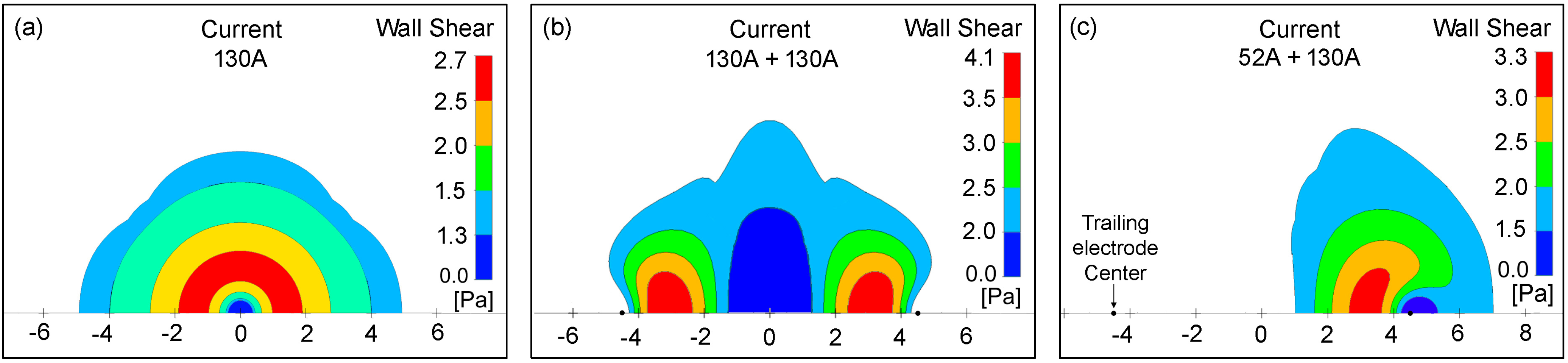

A Comparative Analysis of the Weld Pools Created with DC Single-, DC Double-, and PC Double-Electrode Configurations in Autogenous GTAW


Abstract
 -shaped pool with the stationary single-electrode setup, whereas the double-electrode setup produced a
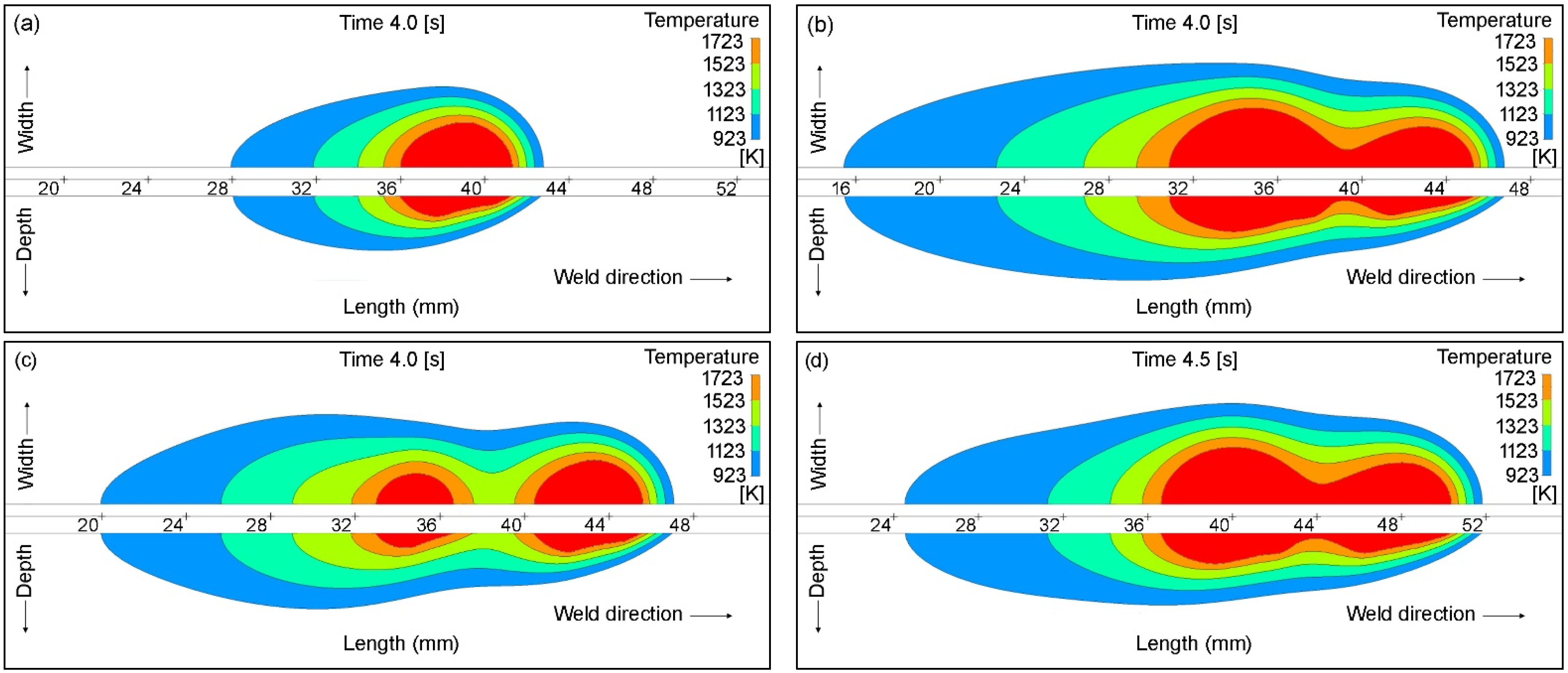
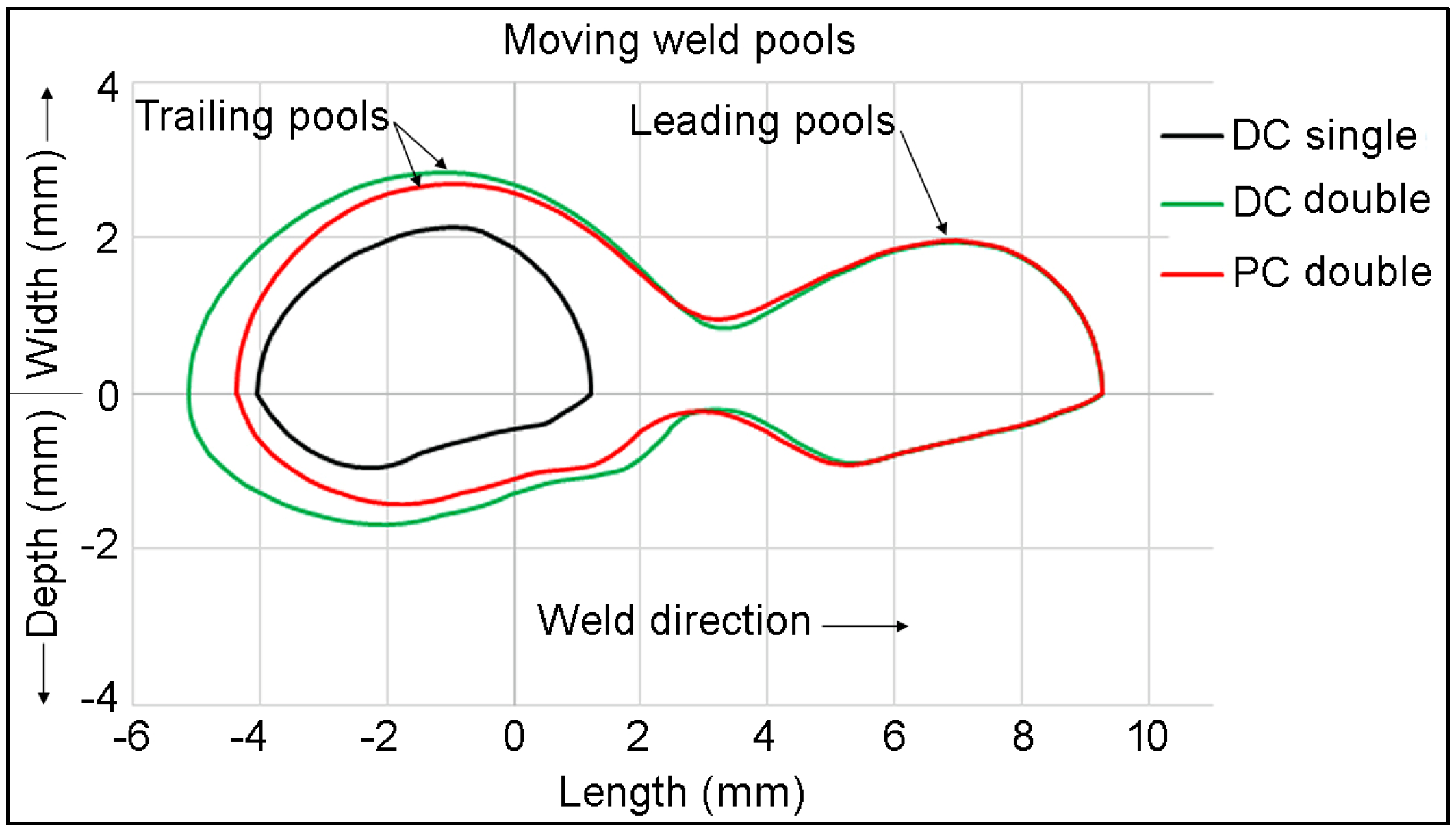
  -shaped pool after 2 s. In the moving weld pool configurations, the sizes of the pools were maximum at the trailing electrodes. The pool was 1.7 mm deep and 5.6 mm wide in DC double- and 1.4 mm deep and 5.4 mm wide in PC double-electrode configurations. The pool depth and width were only 1.0 mm and 4.2 mm when a DC single-electrode setup was used. Comparing the three methods, the DC double-electrode setup produced the largest pool size. The findings of this research offer guidance for enhancing different arc settings and electrode arrangements to attain the intended welding quality and performance.
1. Introduction
2. Simulation Methodology
2.1. Modeling of the Arc Plasma
2.2. Modeling of the Stationary Weld Pools
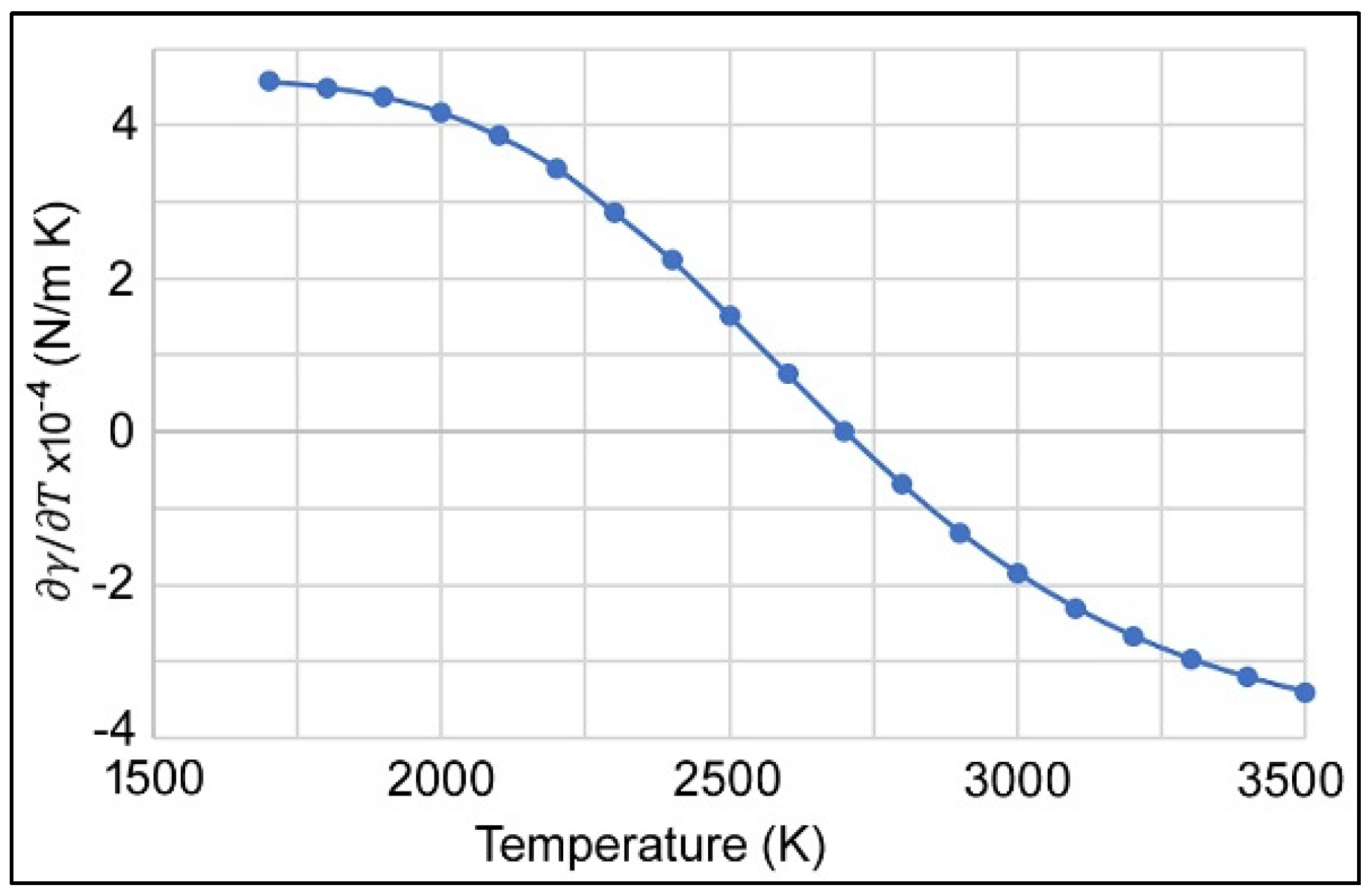
-shaped” experimental weld pool observed in this research. This critical temperature was chosen following several numerical experimentations that involved testing the temperature range from 2000 K to 3000 K with an increment of 100 K. The shape of the pool depth was considerably different when other critical temperatures were employed.2.3. Modeling of the Moving Weld Pools
3. Boundary Conditions
4. Model Validation
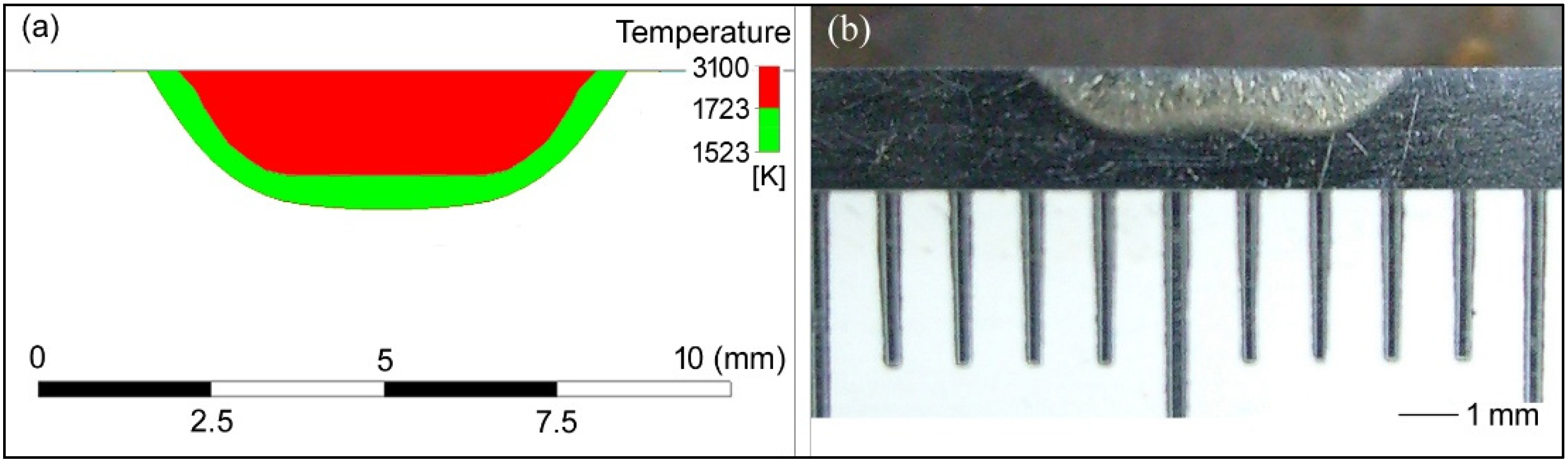
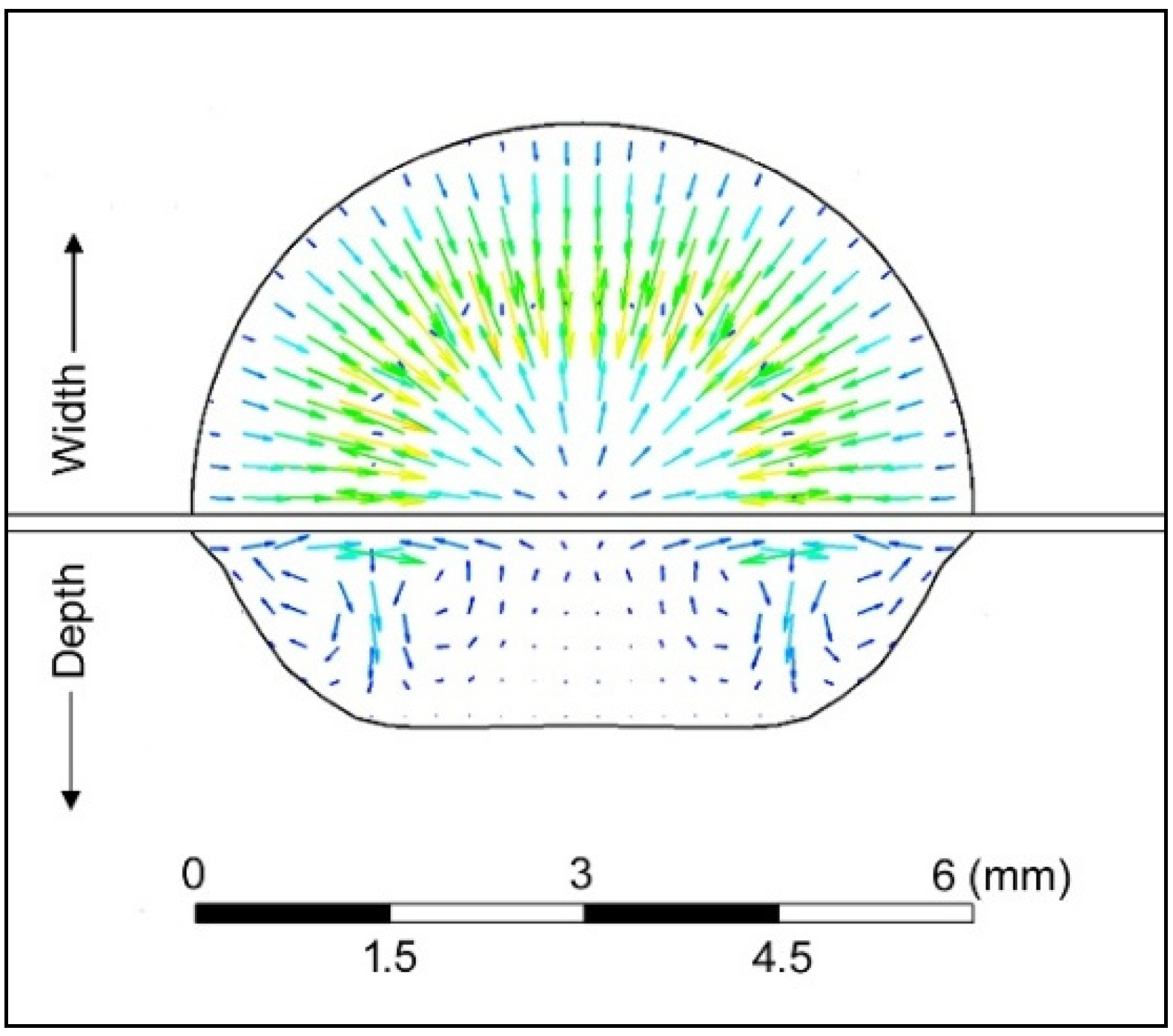
-shaped weld pool appeared after etching. A representative weld pool is depicted in Figure 4b.
-shaped weld pool indicates the presence of a critical temperature at which the surface tension gradient changes from positive to negative. In this analysis, we therefore used the surface tension gradient, which changes from positive to negative, as illustrated in Figure 2. This enabled us to achieve a more realistic weld pool shape, as shown in Figure 4a compared to the one in Figure 4b.
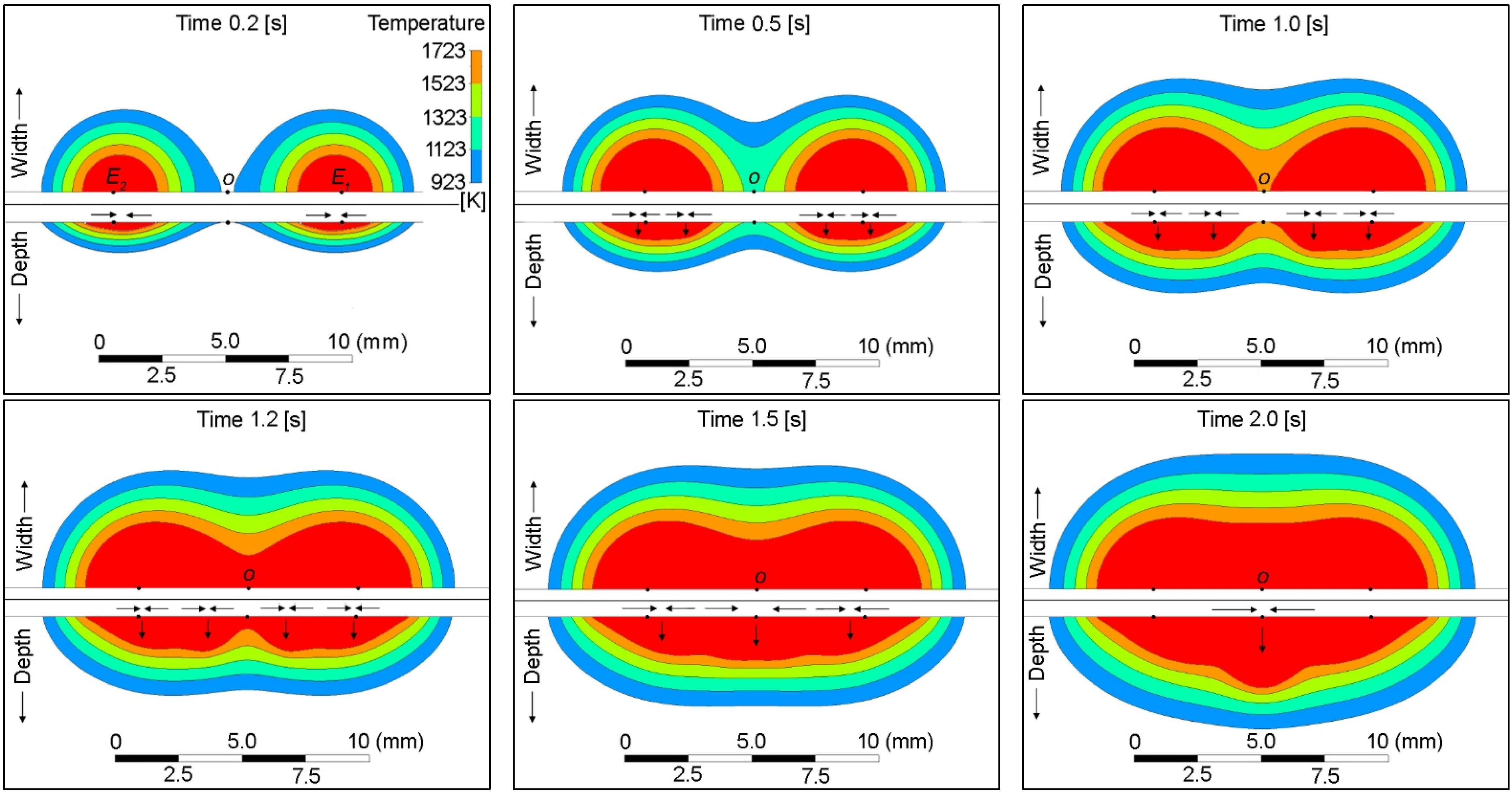
-shaped weld pool was created where the opposing vectors converged and pushed down to deepen the pool at that location. This trend resembles the results investigated by Xu et al. [46], thereby confirming the numerical model. This same model was then modified, and various investigations were performed in this research.5. Results and Discussion
5.1. The Arc Plasma
5.2. The Stationary Weld Pools
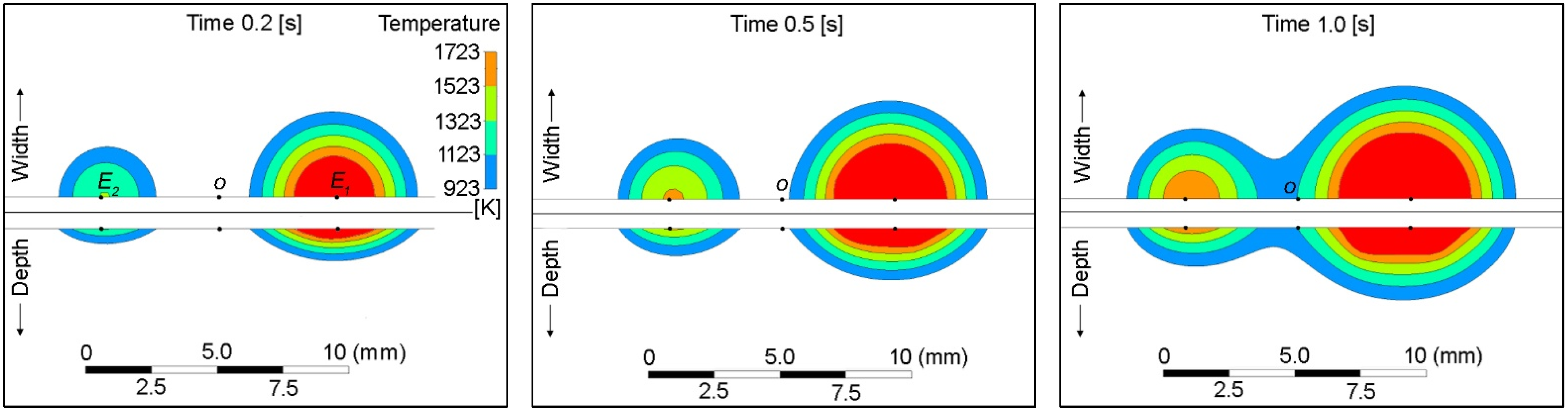
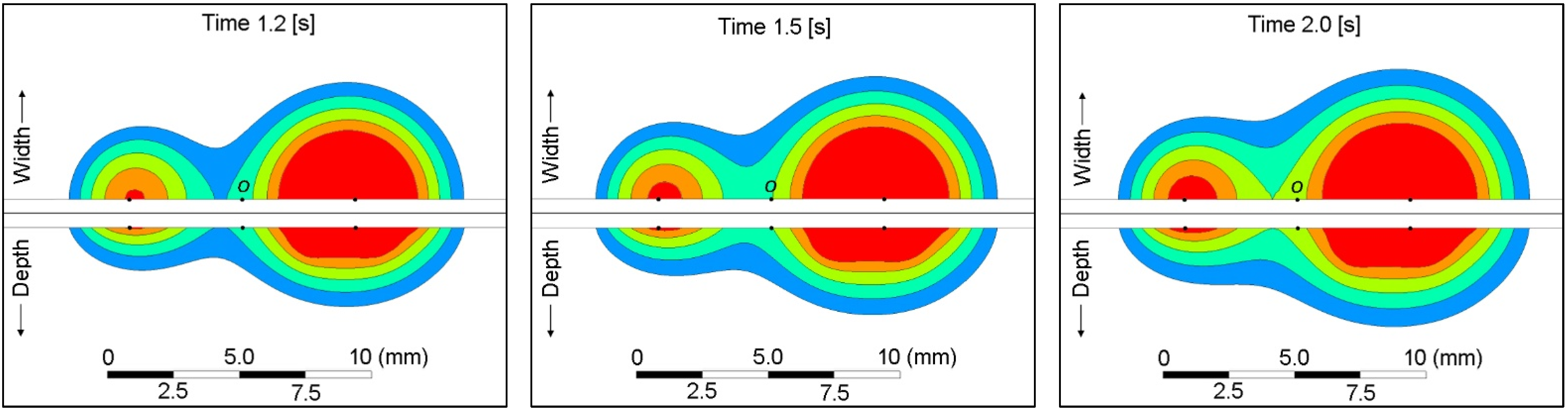
-shaped pool was observed. Because of the Marangoni convection, the velocity vectors were directed inward on the surfaces of both molten pools. The pools started to merge after 1.0 s. As they began to reach the critical temperature, the velocity vectors changed direction, and the opposing vectors converged at o. The direction shifted downward, resulting in a deeper pool, as illustrated in the figure at time 2.0 s. The small arrows in each figure clarify this phenomenon. The maximum pool depth and width were 2.9 mm and 13.6 mm, respectively.5.3. The Moving Weld Pools
6. Conclusions
shape with a maximum depth of 1.5 mm and width of 6.0 mm. In the stationary double-electrode configuration, the weld pools were affected by Marangoni convection and the thermal interaction between the leading and trailing pools, resulting in a shape. The maximum pool depth and width were found to be 2.9 mm and 13.6 mm, respectively. The pool size is nearly twice as large in the double-electrode configuration because of the heat generated by two arcs.Funding
Data Availability Statement
Acknowledgments
Conflicts of Interest
References
- Fan, H.G.; Shi, Y.W. Numerical Simulation of the Arc Pressure in Gas Tungsten Arc Welding. J. Mater. Process. Technol. 1996, 61, 302–308. [Google Scholar] [CrossRef]
- Freton, P.; Gonzalez, J.J.; Gleizes, A. Comparison between a Two- and a Three-Dimensional Arc Plasma Configuration. J. Phys. D: Appl. Phys. 2000, 33, 2442–2452. [Google Scholar] [CrossRef]
- Wu, C.S.; Gao, J.Q. Analysis of the Heat Flux Distribution at the Anode of a TIG Welding Arc. Comput. Mater. Sci. 2002, 24, 323–327. [Google Scholar] [CrossRef]
- Du, H.; Wei, Y.; Wang, W.; Lin, W.; Fan, D. Numerical Simulation of Temperature and Fluid in GTAW-Arc under Changing Process Conditions. J. Mater. Process. Technol. 2009, 209, 3752–3765. [Google Scholar] [CrossRef]
- Velázquez-Sánchez, A.; Delgado-Álvarez, A.; Méndez, P.F.; Murphy, A.B.; Ramírez-Argáez, M.A. Dominant Heat Transfer Mechanisms in the GTAW Plasma Arc Column. Plasma Chem. Plasma Process. 2021, 41, 1497–1515. [Google Scholar] [CrossRef]
- Sun, J.-H.; Sun, S.-R.; Niu, C.; Wang, H.-X. Non-Equilibrium Modeling on the Plasma–Electrode Interaction in an Argon DC Plasma Torch. J. Phys. D: Appl. Phys. 2021, 54, 465202. [Google Scholar] [CrossRef]
- Uhrlandt, D.; Baeva, M.; Pipa, A.V.; Kozakov, R.; Gött, G. Cathode Fall Voltage of TIG Arcs from a Non-Equilibrium Arc Model. Weld World 2015, 59, 127–135. [Google Scholar] [CrossRef]
- Pang, S.; Cao, B.; Wang, Y. Numerical Analysis of Low-Current Arc Characteristics in Micro-TIG Welding. J. Manuf. Process. 2023, 105, 246–259. [Google Scholar] [CrossRef]
- Ilić, A.; Miletić, I.; Nikolić, R.R.; Marjanović, V.; Ulewicz, R.; Stojanović, B.; Ivanović, L. Analysis of Influence of the Welding Procedure on Impact Toughness of Welded Joints of the High-Strength Low-Alloyed Steels. Appl. Sci. 2020, 10, 2205. [Google Scholar] [CrossRef]
- Goodarzi, M.; Choo, R.; Takasu, T.; Toguri, J.M. The Effect of the Cathode Tip Angle on the Gas Tungsten Arc Welding Arc and Weld Pool: II. The Mathematical Model for the Weld Pool. J. Phys. D: Appl. Phys. 1998, 31, 569–583. [Google Scholar] [CrossRef]
- Abid, M.; Parvez, S.; Nash, D.H. Effect of Different Electrode Tip Angles with Tilted Torch in Stationary Gas Tungsten Arc Welding: A 3D Simulation. Int. J. Press. Vessel. Pip. 2013, 108–109, 51–60. [Google Scholar] [CrossRef]
- Parvez, S.; Abid, M.; Nash, D.H.; Fawad, H.; Galloway, A. Effect of Torch Angle on Arc Properties and Weld Pool Shape in Stationary GTAW. J. Eng. Mech. 2013, 139, 1268–1277. [Google Scholar] [CrossRef]
- Huang, H.-Y.; Yang, C.-W. Influence of Activating Flux and Helium Shielding Gas on an Austenitic Stainless Steel Weldment. Metall. Mater. Trans. B 2013, 44, 730–737. [Google Scholar] [CrossRef]
- Huang, H.-Y. Argon-Hydrogen Shielding Gas Mixtures for Activating Flux-Assisted Gas Tungsten Arc Welding. Metall. Mater. Trans. A 2010, 41, 2829–2835. [Google Scholar] [CrossRef]
- Huang, H.-Y. Effects of Shielding Gas Composition and Activating Flux on GTAW Weldments. Mater. Des. 2009, 30, 2404–2409. [Google Scholar] [CrossRef]
- Jou, M. Experimental Study and Modeling of GTA Welding Process. J. Manuf. Sci. Eng. 2003, 125, 801–808. [Google Scholar] [CrossRef]
- Chen, D.; Cai, Y.; Luo, Y.; Wang, X.; Chi, L.; Tang, F. Measurement and Analysis on the Thermal and Mechanical Transfer Characteristics of GTA Arc Affected by Arc Length. Measurement 2020, 153, 107431. [Google Scholar] [CrossRef]
- Zhang, G.; Shi, Y.; Zhu, M.; Fan, D. Effect of Electric Parameters on Weld Pool Dynamic Behavior in GTAW. J. Manuf. Process. 2022, 77, 369–379. [Google Scholar] [CrossRef]
- Coniglio, N.; Cross, C.E. Effect of Weld Travel Speed on Solidification Cracking Behavior. Part 1: Weld Metal Characteristics. Int. J. Adv. Manuf. Technol. 2020, 107, 5011–5023. [Google Scholar] [CrossRef]
- Parvez, S.; El Rayes, M.; Al-Bahkali, E.; Alqosaibi, K. Numerical Investigation of the Influence of Pulse Frequency on the Weld Pool Size in Pulsed Current TIG Welding. AIP Adv. 2025, 15, 015115. [Google Scholar] [CrossRef]
- Traidia, A.; Roger, F.; Guyot, E. Optimal Parameters for Pulsed Gas Tungsten Arc Welding in Partially and Fully Penetrated Weld Pools. Int. J. Therm. Sci. 2010, 49, 1197–1208. [Google Scholar] [CrossRef]
- Dutra, J.C.; Riffel, K.C.; Silva, R.H.G.E.; Ramirez, A.J. A Contribution to the Analysis of the Effects of Pulsed Current in GTAW Welding of 1-Mm-Thick AISI 304 Sheets. Metals 2023, 13, 1387. [Google Scholar] [CrossRef]
- Zhang, G.; Xu, Z.; Wang, K.; Zhu, M.; Shi, Y. Analysis of Arc and Weld Pool Characteristics in Direct Current Added-Pulsed TIG Welding Process. Trans. China Weld. Inst. 2022, 43, 75–81. [Google Scholar] [CrossRef]
- Wang, Y.; Chen, M.; Wu, C. High-Frequency Pulse-Modulated Square Wave AC TIG Welding of AA6061-T6 Aluminum Alloy. Weld World 2020, 64, 1749–1762. [Google Scholar] [CrossRef]
- Yelamasetti, B.; Karuna, B.N.R.; Vishnu Vardhan, T.; Dasore, A.; Saxena, K.K.; Faroque, F.A.; Revathi, V.; Abduvalieva, D. Mechanical and Micro-Structural Studies of Pulsed and Constant Current TIG Weldments of Super Duplex Stainless Steels and Austenitic Stainless Steels. High Temp. Mater. Process. 2024, 43, 20240003. [Google Scholar] [CrossRef]
- Wang, Q.; Tong, X.; Wu, G.; Zhan, J.; Qi, F.; Zhang, L.; Liu, W. Microstructure and Strengthening Mechanism of TIG Welded Joints of a Mg-Nd-Gd Alloy: Effects of Heat Input and Pulse Current. Mater. Sci. Eng. A 2023, 869, 144816. [Google Scholar] [CrossRef]
- Sabzi, M.; Mousavi Anijdan, S.H.; Eivani, A.R.; Park, N.; Jafarian, H.R. The Effect of Pulse Current Changes in PCGTAW on Microstructural Evolution, Drastic Improvement in Mechanical Properties, and Fracture Mode of Dissimilar Welded Joint of AISI 316L-AISI 310S Stainless Steels. Mater. Sci. Eng. A 2021, 823, 141700. [Google Scholar] [CrossRef]
- Yelamasetti, B.; Devi, B.T.L.; Saxena, K.K.; Sonia, P.; Vardhan, T.V.; Sree, N.S.; Khubnani, R.; Abdo, H.S.; Alnaser, I. Mechanical Characterization and Microstructural Evolution of Inconel 718 and SS316L TIG Weldments at High Temperatures. J. Mater. Res. Technol. 2024, 32, 196–207. [Google Scholar] [CrossRef]
- Wang, H.; Hu, S.; Shen, J.; Li, D.; Lu, J. Effect of Duty Cycle on Microstructure and Mechanical Properties of Pulsed GTAW Lap Joint of Invar. J. Mater. Process. Technol. 2017, 243, 481–488. [Google Scholar] [CrossRef]
- Jiang, Y.; Wu, J.; Zhou, C.; Han, Q.; Hua, C. Study on Pulsed Gas Tungsten Arc Lap Welding Techniques for 304L Austenitic Stainless Steel. Crystals 2024, 14, 715. [Google Scholar] [CrossRef]
- Ogino, Y.; Hirata, Y.; Kawata, J.; Nomura, K. Numerical Analysis of Arc Plasma and Weld Pool Formation by a Tandem TIG Arc. Weld World 2013. [Google Scholar] [CrossRef]
- Wu, D.; Huang, J.; Kong, L.; Hua, X.; Wang, M. Coupled Mechanisms of Arc, Weld Pool and Weld Microstructures in High Speed Tandem TIG Welding. Int. J. Heat Mass Transf. 2020, 154, 119641. [Google Scholar] [CrossRef]
- Kim, J.; Lee, J.; Lee, S.H. Effect of Reverse-Polarity Hot Wire on the Tandem Arc Welding Process. Eng. Sci. Technol. Int. J. 2022, 36, 101168. [Google Scholar] [CrossRef]
- Ding, X.; Li, H.; Yang, L.; Gao, Y.; Wei, H. Numerical Analysis of Arc Characteristics in Two-Electrode GTAW. Int. J. Adv. Manuf. Technol. 2014, 70, 1867–1874. [Google Scholar] [CrossRef]
- Wang, X.; Fan, D.; Huang, J.; Huang, Y. A Unified Model of Coupled Arc Plasma and Weld Pool for Double Electrodes TIG Welding. J. Phys. D Appl. Phys. 2014, 47, 275202. [Google Scholar] [CrossRef]
- Qin, G.; Feng, C.; Ma, H. Suppression Mechanism of Weld Appearance Defects in Tandem TIG Welding by Numerical Modeling. J. Mater. Res. Technol. 2021, 14, 160–173. [Google Scholar] [CrossRef]
- Schilling, P.; Synnatzschke, P.; Ungethüm, T.; Schmale, H.C. TIG Double-Electrode Welding: Insights into Electrical and Geometric Parameter Effects on Process Stability and Seam Quality. Weld World 2025. [Google Scholar] [CrossRef]
- Wu, D.; Huang, J.; Kong, L.; Hua, X.; Wang, M.; Li, H.; Liu, S. Numerical Analysis of Arc and Molten Pool Behaviors in High Speed Tandem TIG Welding of Titanium Tubes. Trans. Nonferrous Met. Soc. China 2023, 33, 1768–1778. [Google Scholar] [CrossRef]
- Leng, X.-S.; Zhang, G.-J.; Wu, L. Experimental Study on Improving Welding Efficiency of Twin Electrode TIG Welding Method. Sci. Technol. Weld. Join. 2006, 11, 550–554. [Google Scholar] [CrossRef]
- Kobayashi, K.; Nishimura, Y.; Iijima, T.; Ushio, M.; Tanaka, M.; Shimamura, J.; Ueno, Y.; Yamashita, M. Practical Application of High Efficiency Twin-Arc TIG Welding Method (Sedar-TIG) for Pclng Storage Tank. Weld World 2004, 48, 35–39. [Google Scholar] [CrossRef]
- Jiang, H.; Qin, G.; Feng, C.; Meng, X. High-Speed Tandem Pulsed GTAW of Thin Stainless Steel Plate. Weld J. 2019, 98, 215–226. [Google Scholar] [CrossRef]
- Parvez, S.; El Rayes, M.M.; Alqosaibi, K.; Al-Bahkali, E. Transient Development of Weld Pool in Pulsed Current GTAW of Lap Joint: The Effect of the Duty Cycle. Phys. Scr. 2025, 100, 095609. [Google Scholar] [CrossRef]
- Murphy, A.B.; Tam, E. Thermodynamic Properties and Transport Coefficients of Arc Lamp Plasmas: Argon, Krypton and Xenon. J. Phys. D: Appl. Phys. 2014, 47, 295202. [Google Scholar] [CrossRef]
- Leibowitz, L. Properties for LMFBR Safety Analysis; Argonne National Lab.: Lemont, IL, USA, 1976; p. 116. [Google Scholar]
- Sahoo, P.; Debroy, T.; McNallan, M.J. Surface Tension of Binary Metal—Surface Active Solute Systems under Conditions Relevant to Welding Metallurgy. Metall. Trans. B 1988, 19, 483–491. [Google Scholar] [CrossRef]
- Xu, Y.L.; Dong, Z.B.; Wei, Y.H.; Yang, C.L. Marangoni Convection and Weld Shape Variation in A-TIG Welding Process. Theor. Appl. Fract. Mech. 2007, 48, 178–186. [Google Scholar] [CrossRef]
- Chen, D.; Chen, M.; Wu, C. Effects of Phase Difference on the Behavior of Arc and Weld Pool in Tandem P-GMAW. J. Mater. Process. Technol. 2015, 225, 45–55. [Google Scholar] [CrossRef]
- Nemchinsky, V.A. The Distribution of the Electromagnetic Force in a Welding Pool. J. Phys. D: Appl. Phys. 1996, 29, 2659–2663. [Google Scholar] [CrossRef]
- Tanaka, M.; Lowke, J.J. Predictions of Weld Pool Profiles Using Plasma Physics. J. Phys. D: Appl. Phys. 2007, 40, R1–R23. [Google Scholar] [CrossRef]
- Wang, X.; Fan, D.; Huang, J.; Huang, Y. Numerical Simulation of Arc Plasma and Weld Pool in Double Electrodes Tungsten Inert Gas Welding. Int. J. Heat Mass Transf. 2015, 85, 924–934. [Google Scholar] [CrossRef]
- Stadler, M.; Freton, P.; Gonzalez, J.-J. Influence of Welding Parameters on the Weld Pool Dimensions and Shape in a TIG Configuration. Appl. Sci. 2017, 7, 373. [Google Scholar] [CrossRef]



| Parameter | Value |
|---|---|
| Peak current | 130 A |
| Background current | 52 A |
| Pulse frequency | 1 Hz. |
| Argon flow rate | 14 L/min |
| Tungsten electrode dia. | 3.2 mm |
| Arc gap | 2 mm |
| Electrode tip angle | 60° |
| Electrode spacing | 9 mm |
| Welding velocity | 10 mm/s |
| S. No | Simulation | Weld Length | Analysis Type |
|---|---|---|---|
| 1 | Arc with single electrode | - | Steady state |
| 2 | Arc with double electrode | - | Steady state |
| 3 | Weld pool with single electrode | Spot | Transient, 2 s |
| 4 | Weld pool with double-electrode DC | Spot | Transient, 2 s |
| 5 | Weld pool with double-electrode PC | Spot | Transient, 2 s |
| 6 | Weld pool with single electrode | 50 mm | Transient, 5 s |
| 7 | Weld pool with double-electrode DC | 50 mm | Transient, 5 s |
| 8 | Weld pool with double-electrode PC | 50 mm | Transient, 5 s |
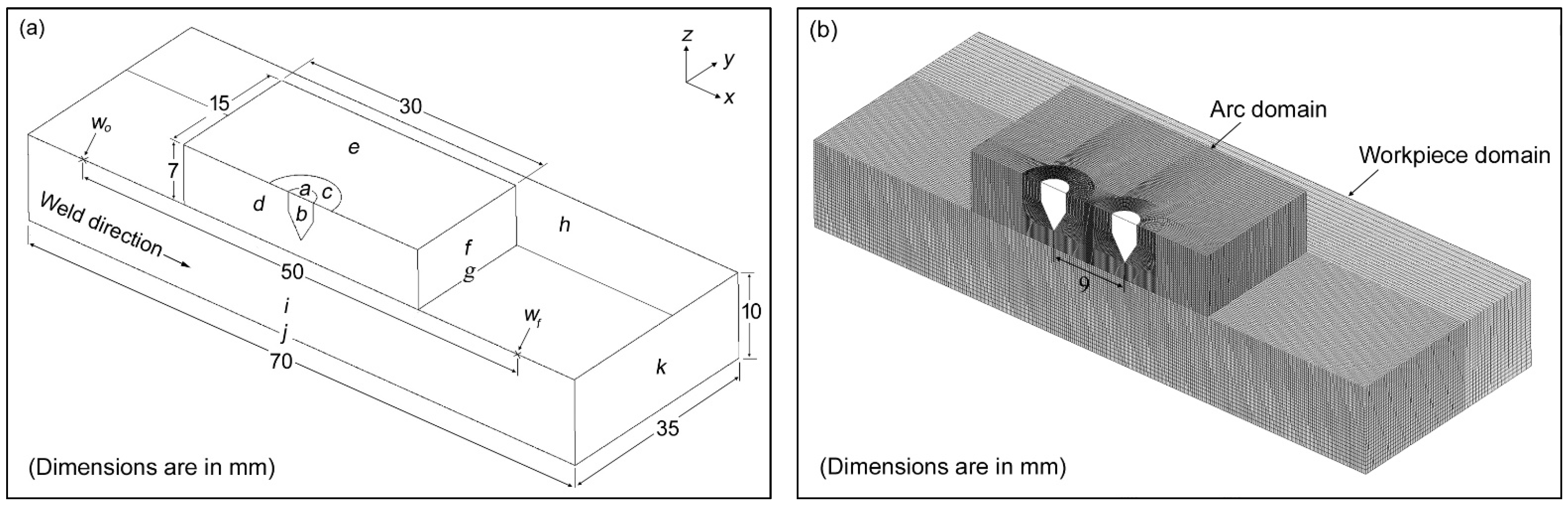
| Boundary (Figure 1a) | Type | Description | Value |
|---|---|---|---|
| a | Wall | Tungsten electrode cross-section | 130 A, 52 A |
| b | Symmetry | Tungsten electrode planar symmetry | - |
| c | Inlet | Argon flow | 14 L/min |
| d | Symmetry | Arc planar symmetry | - |
| e, f | Opening | Open to the atmosphere | 303 K, 1 atm. |
| h | Wall | Top surface of the workpiece with a heat transfer coefficient | 25 W/m2 K |
| i | Symmetry | Workpiece planar symmetry | - |
| j | Wall | Sides of the workpiece with a heat transfer coefficient and magnetic potential | 25 W/m2 K 0 T m |
| k | Wall | Bottom surface of the workpiece with a heat transfer coefficient and electric potential | 25 W/m2 K 0 V |
Disclaimer/Publisher’s Note: The statements, opinions and data contained in all publications are solely those of the individual author(s) and contributor(s) and not of MDPI and/or the editor(s). MDPI and/or the editor(s) disclaim responsibility for any injury to people or property resulting from any ideas, methods, instructions or products referred to in the content. |
© 2026 by the author. Licensee MDPI, Basel, Switzerland. This article is an open access article distributed under the terms and conditions of the Creative Commons Attribution (CC BY) license.
Share and Cite
Parvez, S. A Comparative Analysis of the Weld Pools Created with DC Single-, DC Double-, and PC Double-Electrode Configurations in Autogenous GTAW. J. Manuf. Mater. Process. 2026, 10, 32. https://doi.org/10.3390/jmmp10010032
Parvez S. A Comparative Analysis of the Weld Pools Created with DC Single-, DC Double-, and PC Double-Electrode Configurations in Autogenous GTAW. Journal of Manufacturing and Materials Processing. 2026; 10(1):32. https://doi.org/10.3390/jmmp10010032
Chicago/Turabian StyleParvez, Shahid. 2026. "A Comparative Analysis of the Weld Pools Created with DC Single-, DC Double-, and PC Double-Electrode Configurations in Autogenous GTAW" Journal of Manufacturing and Materials Processing 10, no. 1: 32. https://doi.org/10.3390/jmmp10010032
APA StyleParvez, S. (2026). A Comparative Analysis of the Weld Pools Created with DC Single-, DC Double-, and PC Double-Electrode Configurations in Autogenous GTAW. Journal of Manufacturing and Materials Processing, 10(1), 32. https://doi.org/10.3390/jmmp10010032