Article

Effect of Bonding Pressure and Joint Thickness on the Microstructure and Mechanical Reliability of Sintered Nano-Silver Joints


1
Faculty of Mechanical Engineering, The University of Danang-University of Science and Technology, Danang 550000, Vietnam
2
Laboratoire d'Ingénierie des Systèmes de Versailles (LISV), Université Paris-Saclay, 78140 Vélizy-Villacoublay, France
3
Faculty of Information Technology, The University of Danang-University of Science and Education, Danang 550000, Vietnam
*
Author to whom correspondence should be addressed.
J. Manuf. Mater. Process. 2026, 10(1), 22; https://doi.org/10.3390/jmmp10010022
Submission received: 12 November 2025 / Revised: 12 December 2025 / Accepted: 13 December 2025 / Published: 8 January 2026
(This article belongs to the Special Issue Innovative Approaches in Metal Forming and Joining Technologies)

Abstract

Sintered nano-silver is widely investigated as a die-attach material for next-generation power electronic modules due to its high thermal conductivity, favorable electrical performance, and stability at elevated temperatures. However, how bonding pressure and joint thickness jointly affect densification, interfacial diffusion, and mechanical reliability has not been systematically clarified, especially under the low-pressure conditions required for large-area SiC and GaN devices. In this work, nano-silver lap-shear joints with three bond-line thicknesses (50, 70, and 100 μm) were fabricated under two applied pressures (1.0 and 1.5 MPa) using a controlled sintering fixture. Shear testing and cross-sectional SEM were employed to evaluate the relationships between microstructural evolution and joint integrity. When the bonding pressure was increased from 1.0 to 1.5 MPa, more effective particle rearrangement and reduced pore connectivity were observed, together with improved metallurgical bonding at the Ag–Au interface, leading to a strength increase from 15.3 to 28.2 MPa. Although thicker joints exhibited slightly higher bulk relative density due to greater heat retention and accelerated local sintering, this densification advantage did not lead to improved mechanical performance. Instead, the lower strength of thicker joints is attributed to a narrower Ag–Au interdiffusion region, which limited the formation of continuous load-bearing paths at the interface. Fractographic analyses confirmed that failure occurred predominantly by interfacial delamination rather than cohesive fracture, indicating that the reliability of the joints under low-pressure sintering is governed by the quality of interfacial bonding rather than by overall densification. The experimental results show that, under low-pressure sintering conditions (1.0–1.5 MPa), variations in bonding pressure and bond-line thickness lead to distinct effects on joint performance, with the extent of Ag–Au interfacial interaction playing a key role in determining the mechanical robustness of the joints.

1. Introduction

In power electronic modules, system performance and lifetime reliability are governed by the physical and thermo-mechanical properties of constituent materials, together with the external stresses imposed during service. Among these components, the die-attach layer is particularly critical, as it provides electrical conduction and thermal dissipation while also serving as the primary mechanical load path between the semiconductor chip and the substrate. Accordingly, the reliability of the die-attach layer is a decisive factor for long-term device stability under harsh conditions, including high temperature, high current density, and severe thermal cycling [1,2].
With the rapid emergence of wide-bandgap (WBG) semiconductor devices, most notably silicon carbide (SiC) and gallium nitride (GaN), these requirements have become increasingly stringent. WBG devices can operate at junction temperatures exceeding 250 °C and at voltage and current densities significantly higher than those of conventional Si devices [3]. Their exceptional electrical and switching performance, however, places tremendous stress on the packaging system, particularly the die-attach joint, which must withstand large temperature gradients and repeated thermo-mechanical fatigue without degradation [4]. Historically, tin-based solders (both Pb-containing and Pb-free) have been extensively employed [5,6]. Nevertheless, their intrinsic drawbacks, low melting points, high creep rates, and limited high-temperature strength, significantly constrain their use when operating temperatures exceed ~200 °C [7]. Consequently, the thermal capability and reliability of traditional solder alloys have become the bottleneck for realizing the full potential of next-generation WBG modules.
These limitations have motivated a global search for alternative die-attach materials capable of maintaining both mechanical and functional integrity at elevated temperatures. Among the approaches explored (including TLP bonding and metallic-composite pastes [8]), silver (Ag) sintering has emerged as one of the most promising technologies because it offers an exceptional combination of moderate processing temperature and outstanding high-temperature stability [9,10,11]. By exploiting the high surface area and enhanced diffusivity of micro- and nano-sized Ag particles, densification can be achieved at temperatures below ≈300 °C, while the resulting joints exhibit melting behavior close to bulk silver (961 °C). The sintered Ag layer also provides extremely high thermal conductivity (~240 W·m−1·K−1), excellent electrical conductivity, and superior chemical inertness, making it attractive for mission-critical applications [12,13].
Despite these advantages, the mechanical behavior and reliability of sintered nano-Ag joints show strong sensitivity to key processing parameters, including sintering temperature, bonding pressure, and joint thickness [14]. Over the past decade, numerous studies have examined the effects of individual processing parameters on joint performance [15,16,17,18,19,20]. However, most prior works varied a single parameter while keeping others constant, limiting the ability to understand the coupled effects that arise in practical manufacturing environments. Under low-pressure conditions, thinner layers tend to densify more effectively, as applied stress is transmitted through a shorter porous network. Thicker layers may exhibit enhanced bulk densification due to increased heat retention; however, this advantage diminishes with increasing pressure and does not necessarily translate into improved interfacial bonding, which remains critical to joint integrity.
While several previous studies have investigated the effects of sintering pressure under high-pressure conditions (>3 MPa) [15,18], the present work focuses specifically on the low-pressure regime (1.0–1.5 MPa) commonly adopted for large-area SiC/GaN die-attach, where excessive pressure poses risks of die cracking and substrate deformation. The mechanisms governing microstructural evolution and interfacial bonding under such low-pressure constraints remain insufficiently understood, particularly with respect to Ag–Au interfacial diffusion and thickness-dependent fracture behavior.
Further complicating process optimization, recent research has shown that fracture in sintered-Ag joints frequently initiates at dissimilar interfaces such as Ag/Au or Ag/Cu [21,22,23,24]. The reliability challenge arises from the mismatch in crystal structure, diffusion kinetics, thermal expansion, and interfacial chemistry between Ag and substrate metallizations. Even when bulk densification is high, insufficient interfacial diffusion or poor metallurgical bonding can lead to interfacial delamination under mechanical or thermo-mechanical loading [25,26]. Therefore, a comprehensive understanding of how joint thickness and bonding pressure simultaneously influence both bulk microstructure and interfacial diffusion behavior is essential for reliable process design.
Accordingly, this work examines how joint thickness and bonding pressure affect the mechanical response and microstructural evolution of sintered nano-Ag joints under low-pressure conditions relevant to WBG power modules. Three bond-line thicknesses (50, 70, and 100 µm) and two bonding pressures (1.0 and 1.5 MPa) were examined. Mechanical performance was evaluated through precision shear testing, while detailed SEM analysis of as-sintered and fractured specimens was used to characterize pore morphology, neck formation, and interfacial diffusion. Particular attention was given to the Ag–Au interdiffusion zone and its role in governing fracture behavior, allowing for deeper insight into the mechanisms that control joint reliability.

2. Materials and Methods

2.1. Materials

In this study, sintered joints were fabricated using a nano-silver paste supplied by NBE Tech, LLC [27]. The paste consists of spherical nanoscale silver particles with diameters of 30–60 nm, together with microscale silver flakes measuring 1–3 µm in diameter and 100–300 nm in thickness. These particles are dispersed in a proprietary binder system containing organic solvents and rheological modifiers to maintain stable suspension and homogeneous distribution during processing.

2.2. Preparation of Sintered-Silver Joints

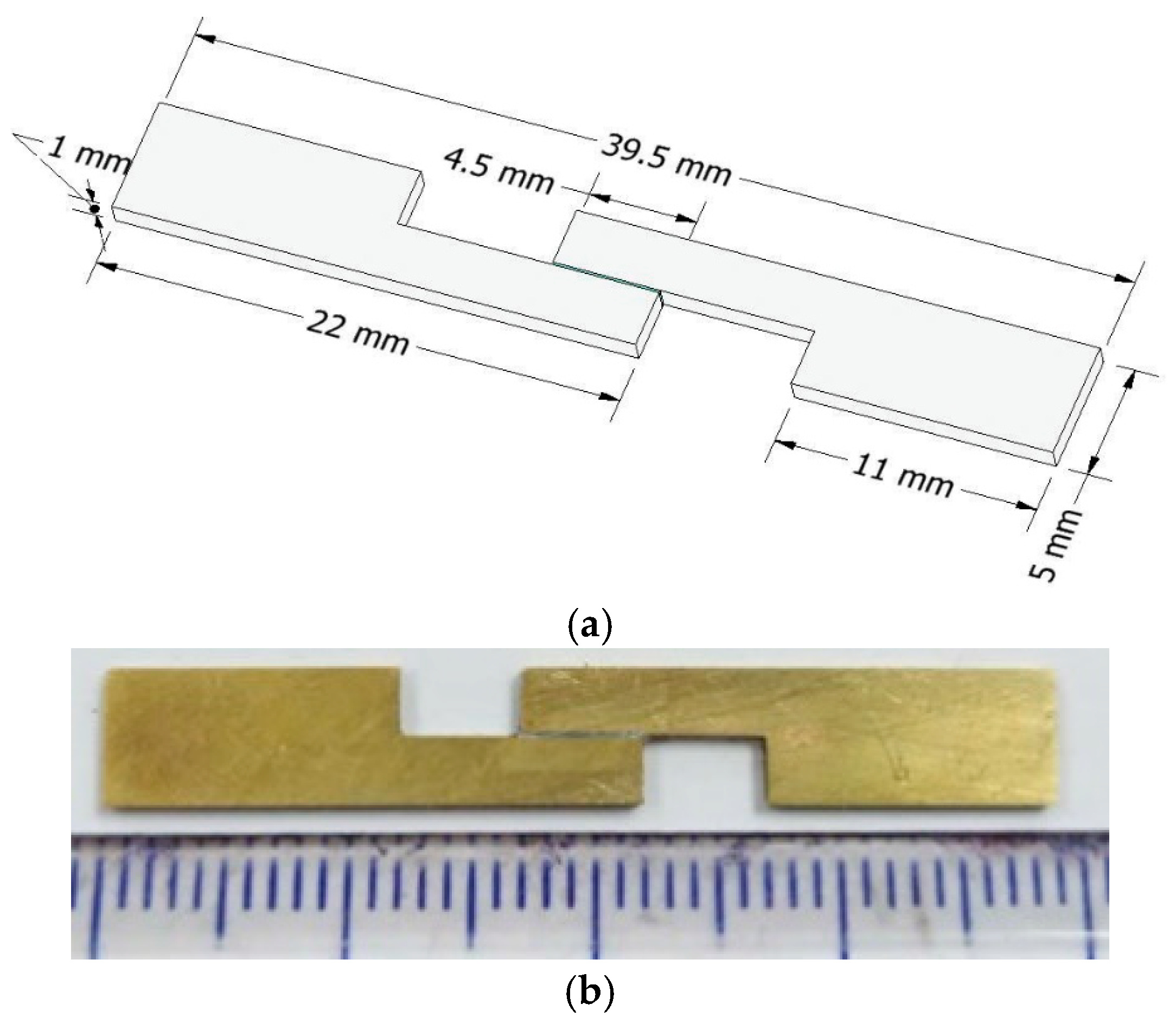
The lap-shear configuration is commonly used to evaluate the shear strength, creep resistance, and thermal fatigue behavior of sintered nano-silver joints [21,28,29,30,31]. In this study, a procedure was developed to fabricate miniature single lap-shear specimens that closely replicate the geometric and functional characteristics of joints typically found in microelectronic packaging. The fabrication procedure is outlined as follows:
(i)
Lap-shear test specimens were produced by sintering two copper (Cu) substrates using nano-silver paste at different bonding layer thicknesses and sintering pressures. The substrates were precisely cut by electrical discharge machining (EDM) into a geometry with a joining area of 4.5 mm × 1.0 mm. High-purity copper (99.9 wt%) was chosen for its superior thermal and electrical conductivity and its prevalent use in power module packaging. The bonding surfaces were ground and polished with SiC abrasive papers, followed by refinement using a 1 µm diamond suspension to remove native oxides and residual impurities. To further eliminate contaminants, the Cu substrates were dipped into 50% nitric acid for 20 s and rinsed in acetone. Two Cu substrates were then electroplated with a 20 µm Au layer.
(ii)
The nano-silver paste was stencil-printed onto direct-bonded copper (DBC) substrates and pre-dried in a nitrogen-purged oven. A custom-designed aluminum clamping fixture was used to ensure accurate substrate alignment, uniform pressure distribution, and precise control of the final bond-line thickness during sintering.
(iii)
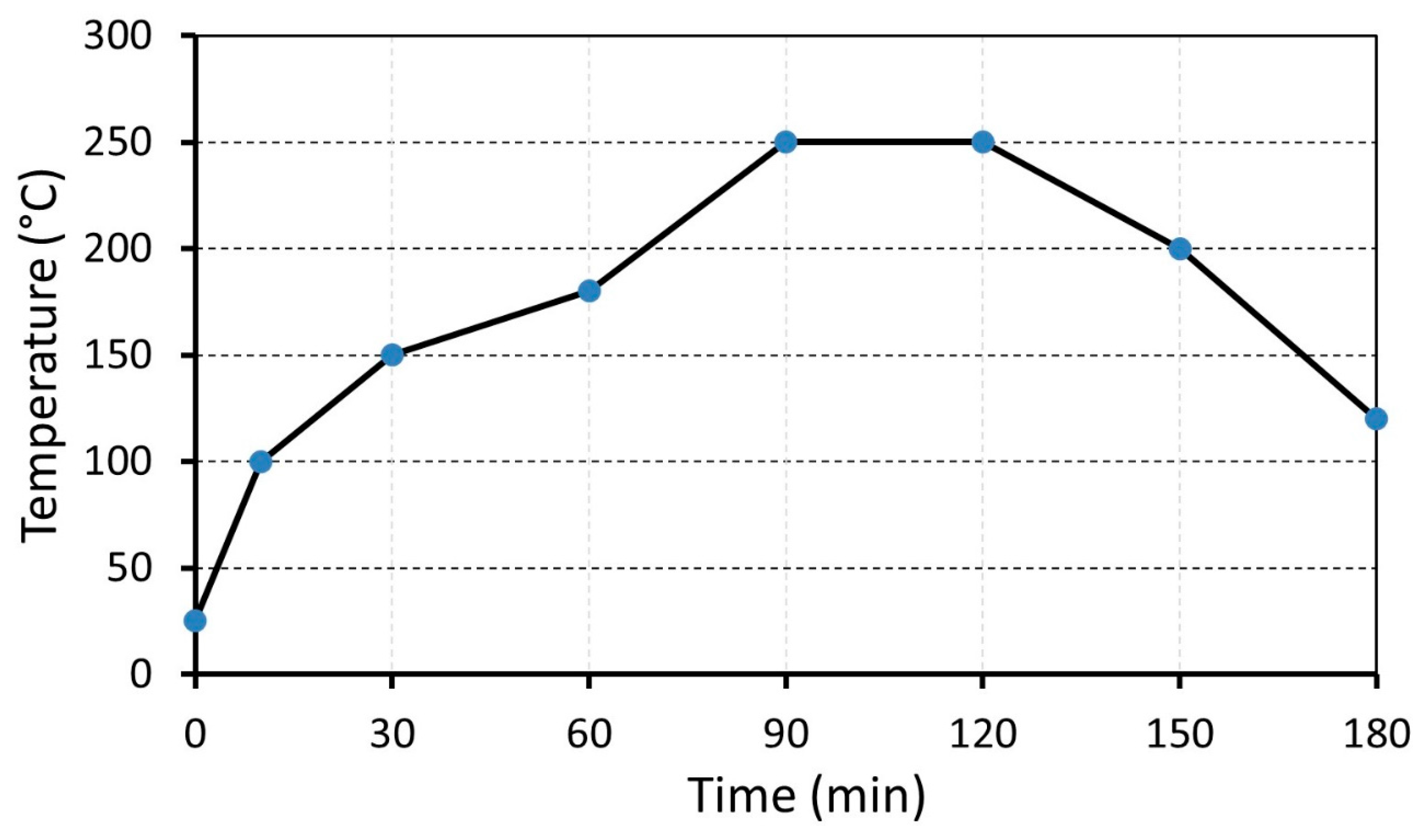
The sintering process was conducted in a sintering system following a thermal profile optimized for nano-silver densification in electronic packaging. The sintering fixture was equipped with a calibrated load cell (±1% accuracy), which was verified prior to each sintering cycle to ensure accurate and reproducible pressure application. As recommended by the manufacturer and shown in Figure 1, the process included:
(1)
A ramp from room temperature to 120 °C with a short dwell for solvent evaporation;
(2)
Heating to 180 °C, where an external pressure of 1.0 or 1.5 MPa was applied;
(3)
A main hold at 250 °C for 30 min under constant pressure to promote neck growth and densification; and
(4)
Controlled cooling to ~120 °C under load before releasing the pressure, followed by furnace cooling to room temperature. To suppress Cu oxidation and ensure clean interfacial bonding, the furnace chamber was continuously purged with forming gas (4% H2 in N2). After sintering, specimens were gradually cooled to room temperature inside the furnace to minimize thermal shock and residual stress.
(iv)
Finally, the sintered joints were lightly polished with fine-grade SiC papers to remove any surface residues. The specimens were examined under an optical microscope to assess bond-line uniformity and to confirm the absence of macroscopic defects such as voids, delamination, or substrate misalignment. The fabrication steps and specimen geometry are shown in Figure 2. The resulting joint thickness ranged from 50 µm to 100 µm.

2.3. Methodology for Shear Tests

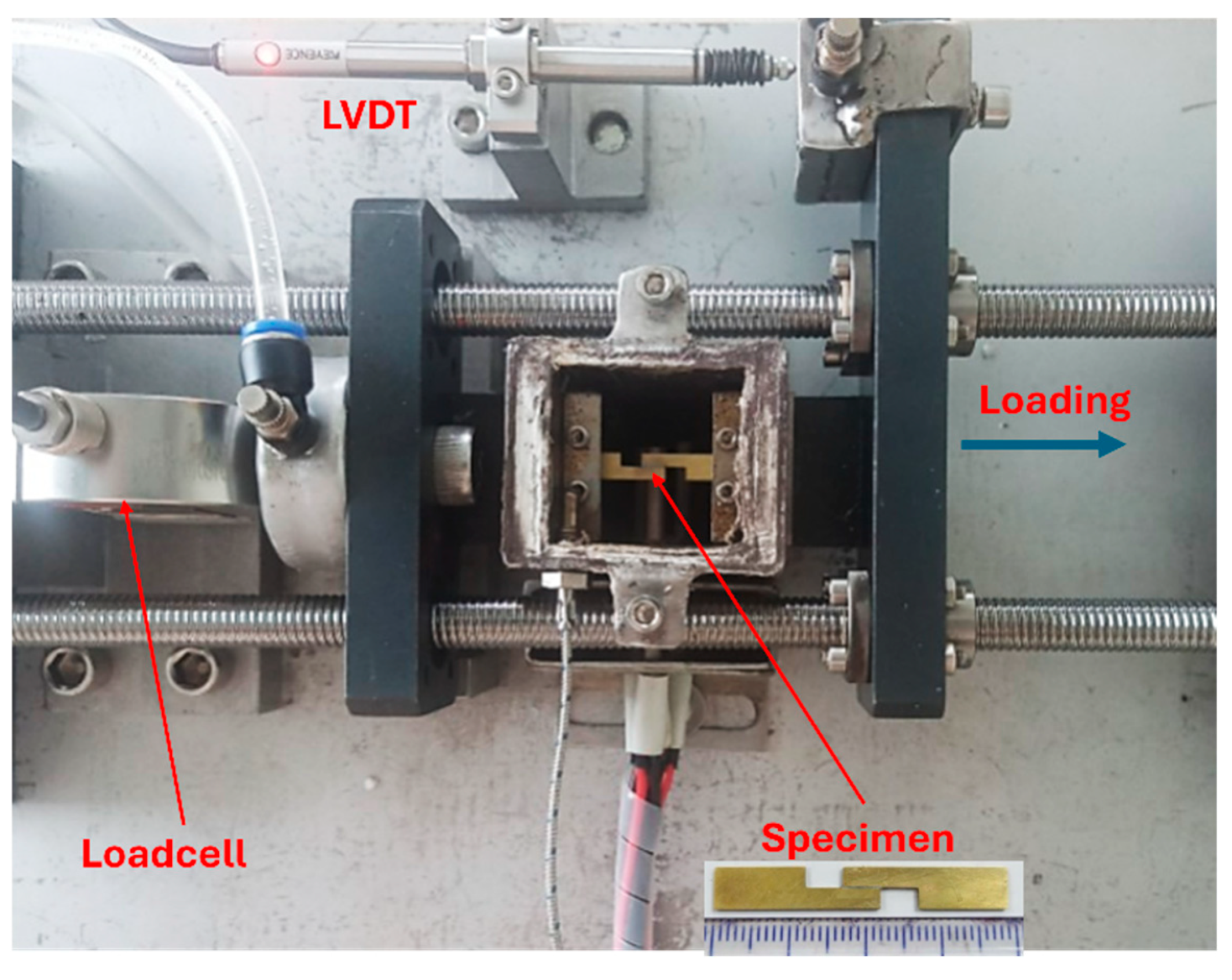
To characterize the mechanical behavior of sintered nano-silver joints, the shear strengths of joint specimens were obtained by conducting shear tests on a micro-tension tester, with high precision and resolution for load and displacement. Details related to the operating principle of a micro-tension tester can be found in [32]. Indeed, the apparatus is equipped with a stepper motor that enables precise regulation of crosshead displacement, ensuring controlled strain rates and minimizing dynamic artifacts during loading. Specimen elongation was recorded via a linear variable differential transformer (LVDT) with a ±6 mm measurement range, providing high-accuracy displacement data. Axial load was monitored using a ±500 N high-sensitivity load cell (Honeywell, Morris Plains, New Jersey), with both sensors connected to conditioner devices for amplification and noise reduction. All measurement components were rigorously calibrated prior to testing to ensure data accuracy and repeatability. The data was collected with a Data Acquisition device from National Instruments and treated with the LabVIEW program.
In this study, the shear tests were conducted at ambient temperature (~25 °C) under quasi-static loading conditions. A constant crosshead displacement rate was applied, corresponding to a nominal shear strain rate of 1.0 × 10⁻⁴ 1/s. This rate was selected based on material sensitivity, specimen geometry, and alignment with standardized testing guidelines. Shear strain rates were calculated by dividing the imposed displacement rate by the actual lapped joint thickness of each specimen. During the lap-shear tests, both shear stress and shear strain were derived from the recorded load and displacement data. The average shear stress (τ) was calculated as follows:
τ = F A
where F is the applied axial load and A is the bonded area between the nano-silver joint and copper substrates.
Correspondingly, the shear strain (γ) was computed as follows:
γ = δ t
where δ is the relative displacement between the substrates, and t is the thickness of the joint layer.
Each test condition was evaluated using a minimum of three replicate specimens to ensure result reliability and allow basic statistical assessment. This practice is consistent with recent literature, which highlights the necessity of replication in capturing the inherent variability and ensuring the reproducibility of mechanical properties in sintered nano-silver joints. The experimental setup for the lap-shear testing employed in this study is illustrated in Figure 3.

3. Results and Discussion

3.1. Shear Testing Results

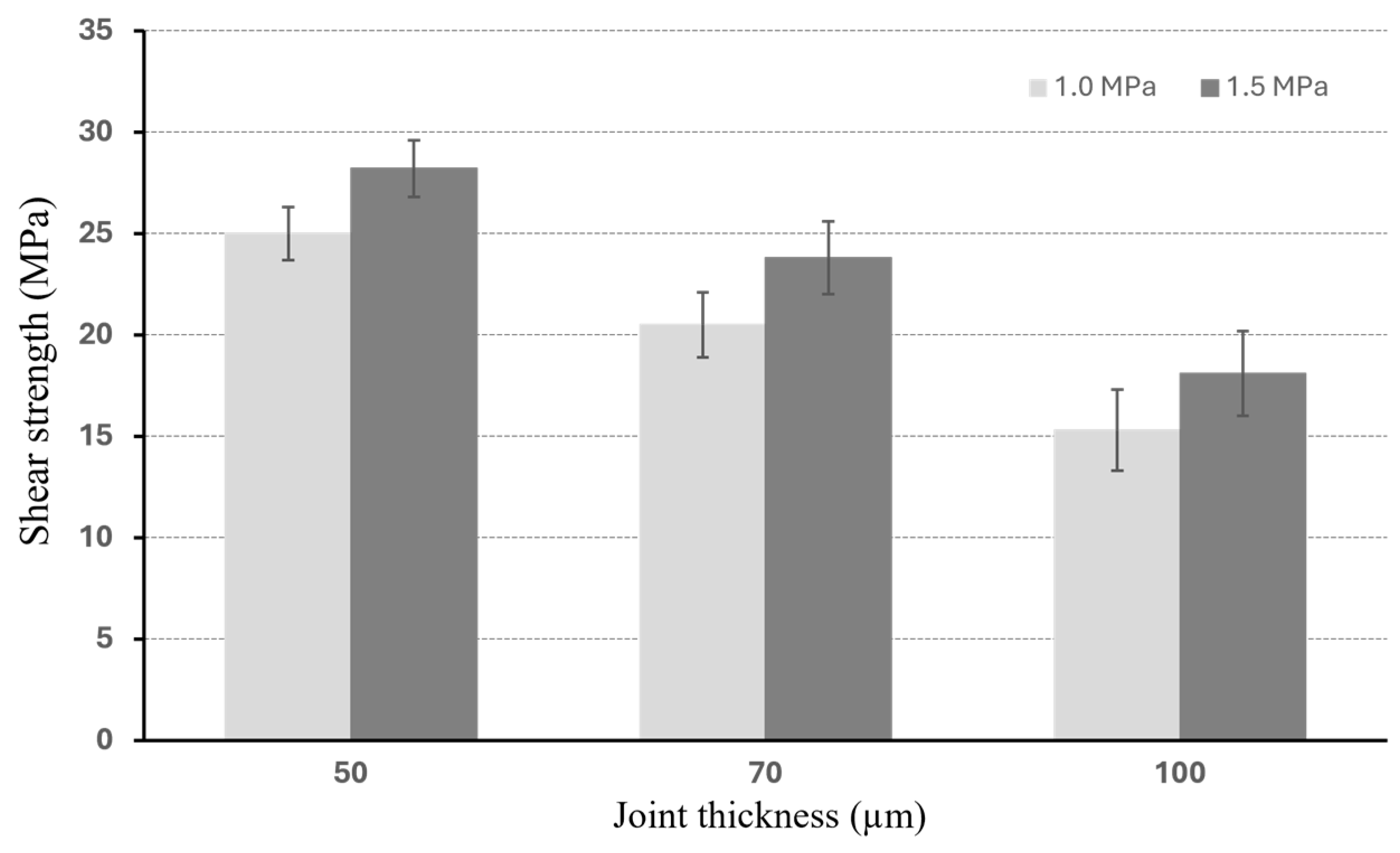
Figure 4 shows that both sintering pressure and bond-line thickness have a clear influence on the shear strength of nano-silver lap-shear joints. At a fixed joint thickness, increasing the applied pressure from 1.0 to 1.5 MPa resulted in higher shear strength, consistent with enhanced particle rearrangement, densification, and the formation of stronger metallurgical bonds.
In contrast, increasing the joint thickness was associated with a systematic reduction in strength: specimens with 50 µm bond-lines showed the highest values, followed by 70 µm, whereas 100 µm joints exhibited the lowest strength. This reduction in strength is not attributed to bulk porosity, since thicker joints exhibited higher bulk density, but instead to weaker interfacial bonding associated with reduced interfacial temperature gradients and a narrower Ag–Au diffusion layer.
The optimum condition was obtained at 50 µm under 1.5 MPa, yielding a maximum shear strength of 28.2 MPa, while the weakest joints (15.3 MPa) occurred at 100 µm under 1.0 MPa. These findings highlight that reliable mechanical integrity is best achieved by combining thin joints (≤70 µm) with moderate bonding pressure (1.5 MPa). The observed trends align well with prior reports on pressure-assisted nano-silver sintering. For example, Liu et al. [30] reported that increasing sintering pressure led to a clear enhancement in shear strength, while the rate of improvement gradually decreased at higher pressure levels, suggesting a saturation-type strengthening behavior. Similarly, Zhang et al. [31] demonstrated that the application of external pressure during silver sintering significantly improves joint densification and mechanical integrity, highlighting the critical role of pressure in strengthening sintered joints. Although the present work employed substantially lower pressures (1.0–1.5 MPa), comparable strength values were achieved by limiting the bond-line thickness to 50–70 µm. Statistical analysis using a t-test and one-way ANOVA indicated that the strength difference between 1.0 and 1.5 MPa was statistically significant (p < 0.05).
From a practical standpoint, this approach is particularly advantageous for large-area die-attach in SiC/GaN power modules, where excessive bonding pressure may damage fragile semiconductor chips. The mechanical behaviors observed here clearly indicate that the microstructural integrity and bonding quality are strongly dependent on both the applied pressure and joint thickness, which are further examined in the following microstructural analysis.

3.2. Microstructural Characterization

To examine the influence of sintering pressure and silver-layer thickness on fracture behavior, the microstructural evolution of the joints was analyzed using scanning electron microscopy (SEM, Hitachi SU1510, Hitachi, Japan). Cross-sections of the lap-shear joints were obtained by epoxy mounting and subsequent sectioning. The cross-sectional surfaces were subsequently polished using standard metallographic techniques. Polishing was carried out on a cloth-covered, motorized wheel with abrasives suspended in a liquid medium to achieve a smooth, defect-free finish suitable for microscopic observation. After each polishing step, the specimens were thoroughly rinsed with water and dried. Mechanical grinding was performed sequentially with silicon carbide abrasive papers up to #4000 grit under flowing water at ambient temperature. This was followed by polishing with 3 µm diamond suspension on dedicated cloths using lubricant, and finally by a colloidal silica suspension to obtain a high-quality finish. The prepared cross-sections were then examined under a Hitachi SU1510 scanning electron microscope at high magnification. Quantitative image analysis was carried out using ImageJ 1.54g software [33] to evaluate pore size distribution, pore morphology, and overall porosity of the sintered silver joint. To ensure reliable quantification, all porosity measurements were carried out on polished cross-sectional SEM images prepared using a final 0.05 µm colloidal silica suspension to minimize topographical shadowing. Images were acquired at 5–10 kV in secondary-electron mode with a working distance of 8–10 mm to improve pore–matrix contrast. Prior to segmentation, contrast-limited adaptive histogram equalization was applied to enhance separation between voids and metallic regions. A local thresholding method (Phansalkar algorithm in ImageJ) was then used to account for brightness variations caused by surface curvature within the porous Ag structure. After binarization, morphological opening (radius = 2 pixels) was performed to remove isolated noise and small deep-shadow features not associated with actual pores. Regions exhibiting steep gray-level gradients, characteristic of topographic recesses rather than true voids, were excluded using gradient-based filtering. Only features with a minimum projected area greater than 0.2 µm2 and located fully within the sintered Ag bondline were counted as pores. This procedure ensured consistent discrimination between true porosity and topography-induced artifacts across all samples. The relationship between these microstructural parameters and the observed fracture behavior was assessed by correlating shear test results with the corresponding microstructural observations.

3.2.1. As-Sintered Joint Microstructure

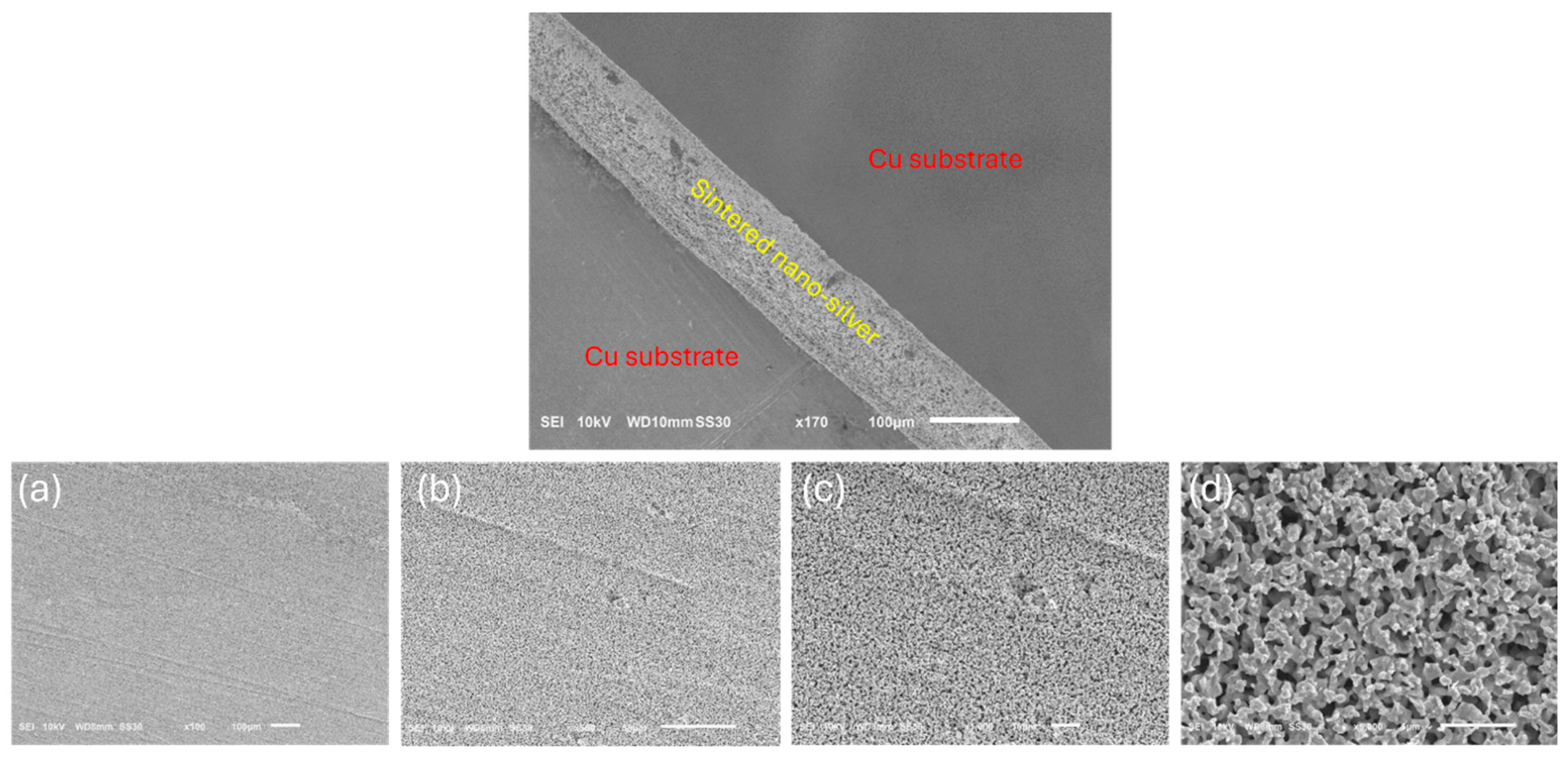
SEM observations were used to characterize the microstructure of the as-fabricated joints. Figure 5 shows a continuous and uniformly sintered nano-silver layer formed between the Au-plated Cu substrates. The microstructure consists of coalesced Ag particles forming an interconnected porous network. Image-based quantitative analysis indicates an overall porosity of approximately 14%, in line with reported values for low-pressure, pressure-assisted Ag sintering. Higher-magnification SEM images show clear particle–particle neck formation and a homogeneous pore distribution, confirming that the applied pressure (1.0–1.5 MPa) was sufficient to promote effective particle rearrangement and early-stage densification. The porosity observed here corresponds well with the densification trends reported in the literature for similar temperature profiles.
The bonding interface clearly exhibits a gradual grayscale transition characteristic of an Ag–Au interdiffusion region, rather than an abrupt boundary. Although the present work does not include EDS or compositional mapping, the smooth contrast gradient and morphological continuity at the interface qualitatively indicate atomic intermixing and metallurgical bonding between Ag and the electroplated Au layer. This interfacial diffusion region is consistent with the mechanical behavior discussed later: joints exhibiting a more gradual and extended contrast transition at the Ag–Au boundary show stronger interface adhesion and higher shear strength, whereas joints with a sharper contrast change are more susceptible to interfacial delamination under shear loading.

3.2.2. Microstructural Evolution of Fractured Joints Under Different Bonding Pressures

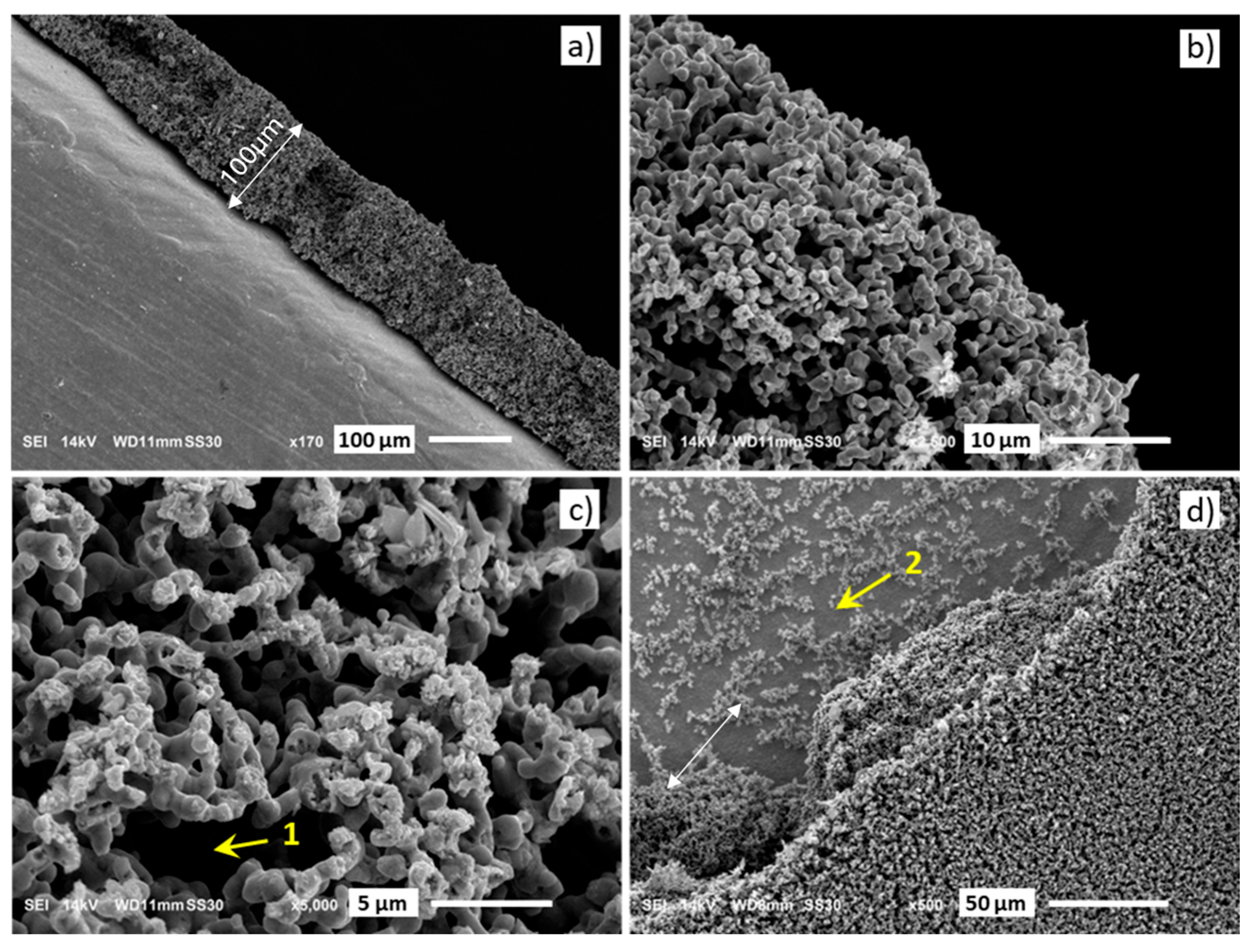
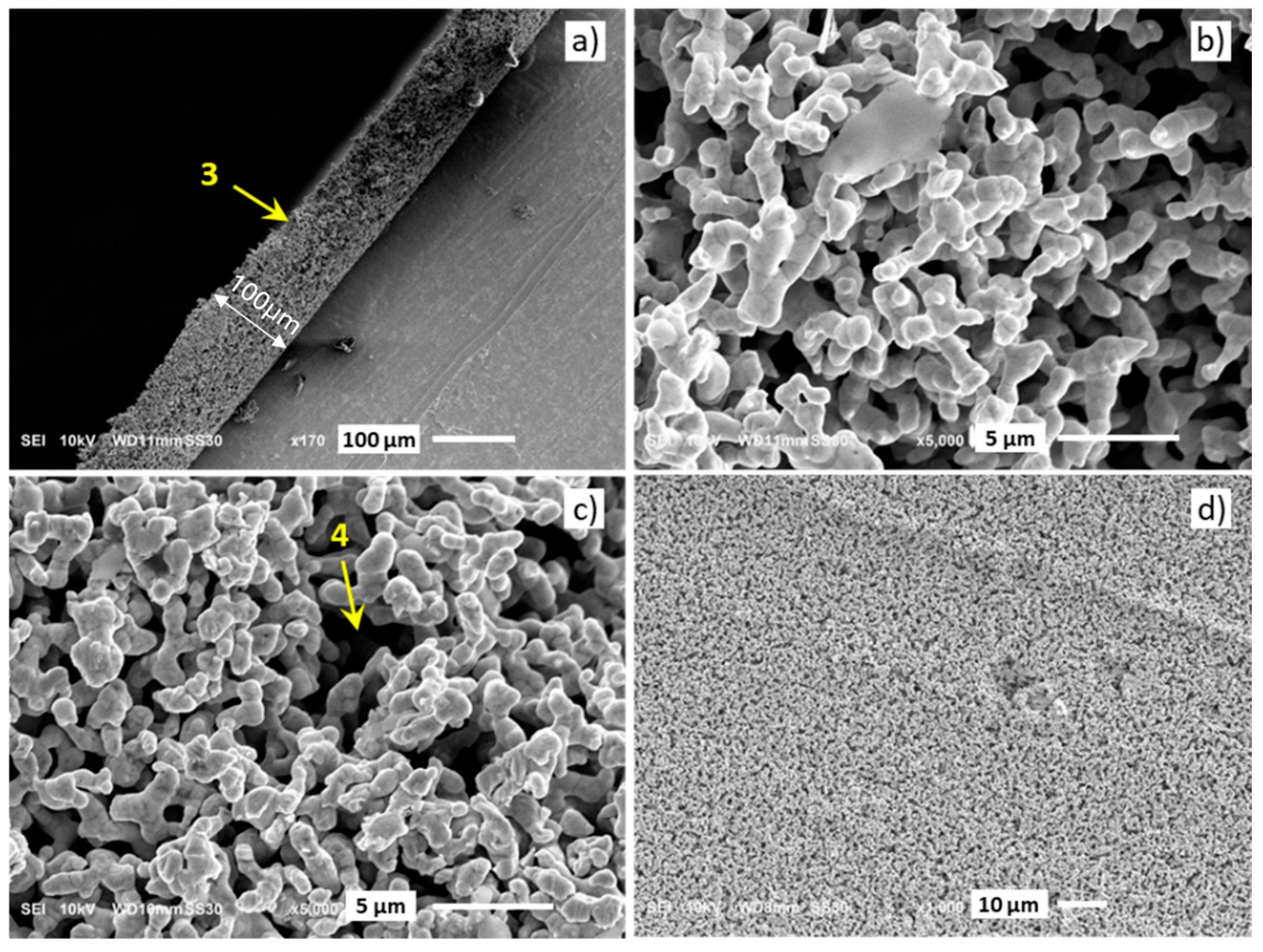
To examine the failure behavior in more detail, selected fractured joints were analyzed by SEM. Figure 6 and Figure 7 present the fracture morphologies of joints with a 100 µm bond-line thickness sintered under 1.0 MPa and 1.5 MPa, respectively. In both cases, SEM images show that only limited regions of sintered Ag remained attached to the substrate after shear loading, suggesting that fracture occurred predominantly at the Ag–Au interface. This observation is consistent with the shear-strength results and supports the conclusion that interfacial adhesion, not bulk cohesive strength, governs failure in low-pressure sintering.
Although minor patches of Ag adhered to localized areas on the substrate, these were limited and did not represent true cohesive failure. Instead, the overall fracture surface morphology confirms that interfacial delamination was the dominant mode for both pressure levels. This behavior indicates that the internal cohesion of the porous Ag network is sufficient, whereas inadequate Ag–Au metallurgical bonding, particularly under lower interfacial temperature gradients, leads to preferential debonding at the interface.
Top-view SEM images (Figure 6b and Figure 7b) show the characteristic porous ligament structure of sintered Ag, while higher-magnification images (Figure 6c and Figure 7c) show fine interconnected Ag ligaments with uniformly distributed sub-micron pores. These features are consistent with early-stage densification and corroborate the porosity level (~14%) previously quantified. Importantly, the fractured joints do not provide reliable bond-line thickness information. Therefore, no thickness values are inferred from the fracture cross-sections. Instead, all thickness measurements cited in this work originate from intact cross-sectional samples.
Comparison between the 1.0 MPa and 1.5 MPa conditions shows that higher pressure results in fracture surfaces with fewer unbonded regions, consistent with improved Ag–Au interfacial bonding. This trend aligns with the higher shear strength and more developed diffusion-layer formation observed under 1.5 MPa.
As expected, the joint sintered at 1.5 MPa exhibits a more consolidated microstructure, characterized by tighter particle packing, more uniform ligament formation, and reduced pore connectivity, indicating a higher degree of densification under the increased pressure. In contrast, the sample processed at 1.0 MPa displays a more open porous network with a greater number of larger pores. These macropores are typical of insufficient particle rearrangement during low-pressure sintering and are known to diminish load-transfer efficiency and mechanical integrity.
The improvement observed at 1.5 MPa is consistent with the established role of pressure in assisting particle rearrangement, enhancing contact area, and promoting pore collapse during early-stage sintering. Even within the relatively low-pressure regime examined in this study (1.0–1.5 MPa), the increase in applied pressure leads to visibly enhanced microstructural uniformity and reduced defect size distribution.
It is important to emphasize that the dominant microstructural difference between the two pressure levels lies not only in bulk densification but also in interfacial uniformity, as reflected in the more continuous and better-bonded Ag–Au interfacial region at 1.5 MPa. This trend aligns with the shear strength results and supports the conclusion that moderate increases in pressure improve both the bulk microstructure and the interfacial bonding quality, two factors that together contribute to the enhanced mechanical performance observed at higher pressure.

3.2.3. Microstructural Evolution of Fractured Joints Under Different Joint Thickness

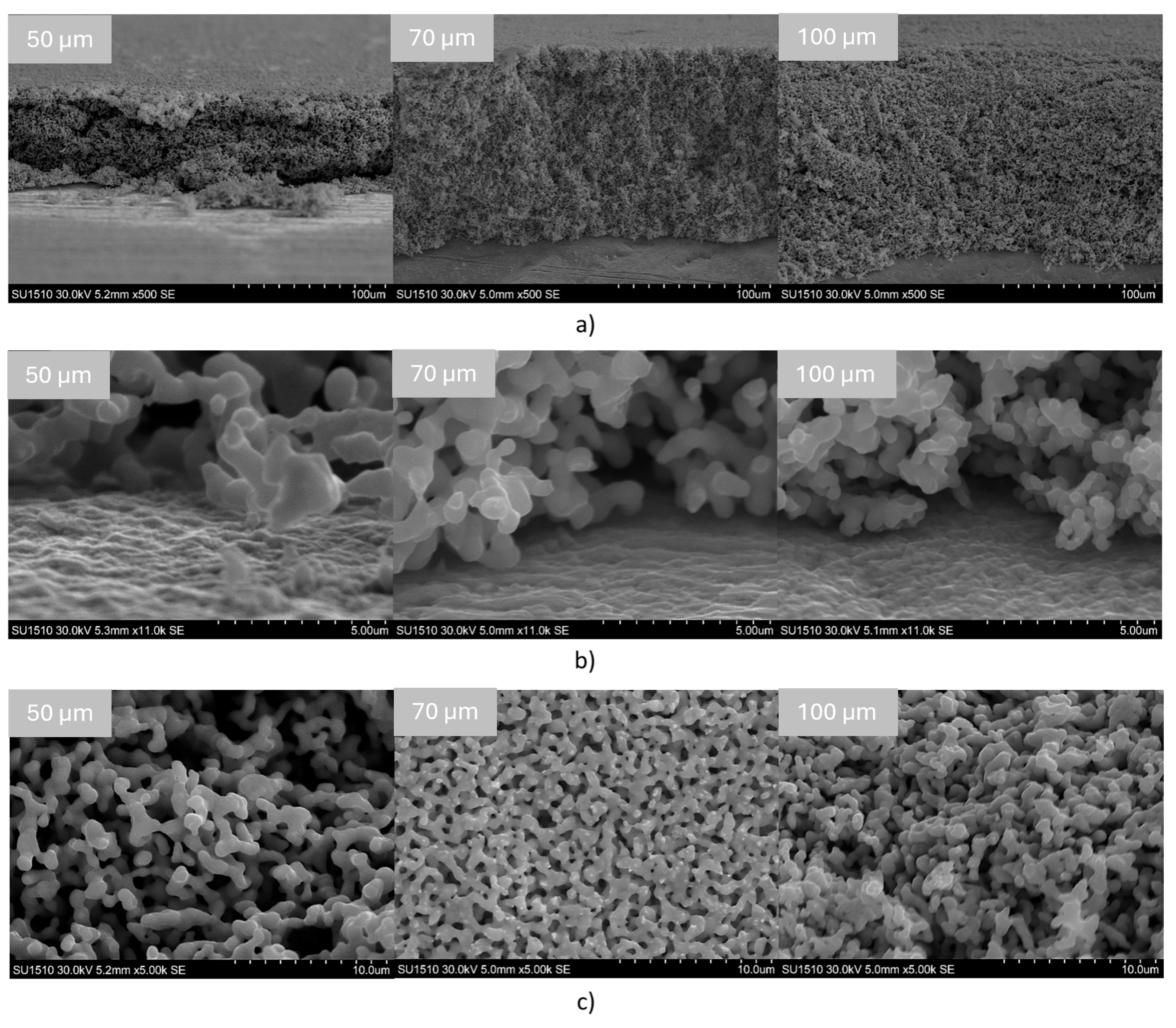
To examine the effect of bond-line thickness on microstructure and interfacial characteristics, joints with thicknesses of 50 µm, 70 µm, and 100 µm were analyzed under the same bonding pressure of 1.5 MPa. The corresponding SEM images are shown in Figure 8, including cross-sectional overviews (Figure 8a), enlarged views of the Ag–Au interfacial region (Figure 8b), and top-surface morphologies of the fractured Ag layer (Figure 8c).
Figure 8a presents cross-sectional views illustrating the overall morphology of the sintered Ag layers. All three joints show a continuous nanoporous silver network, while the pore distribution becomes more compact in the 70 µm and 100 µm specimens. Bond-line thickness values reported here were measured from intact cross-sectional samples rather than fractured surfaces.
The interfacial regions in Figure 8b show a smooth grayscale transition at the Ag–Au interface for all thicknesses, suggesting qualitative Ag–Au interdiffusion. The interfacial transition is more developed in thinner joints, consistent with the effect of interfacial temperature gradients on diffusion. In contrast, thicker joints exhibit a narrower interfacial transition zone, suggesting less effective interfacial diffusion and helping to explain their lower shear strength despite higher bulk density.
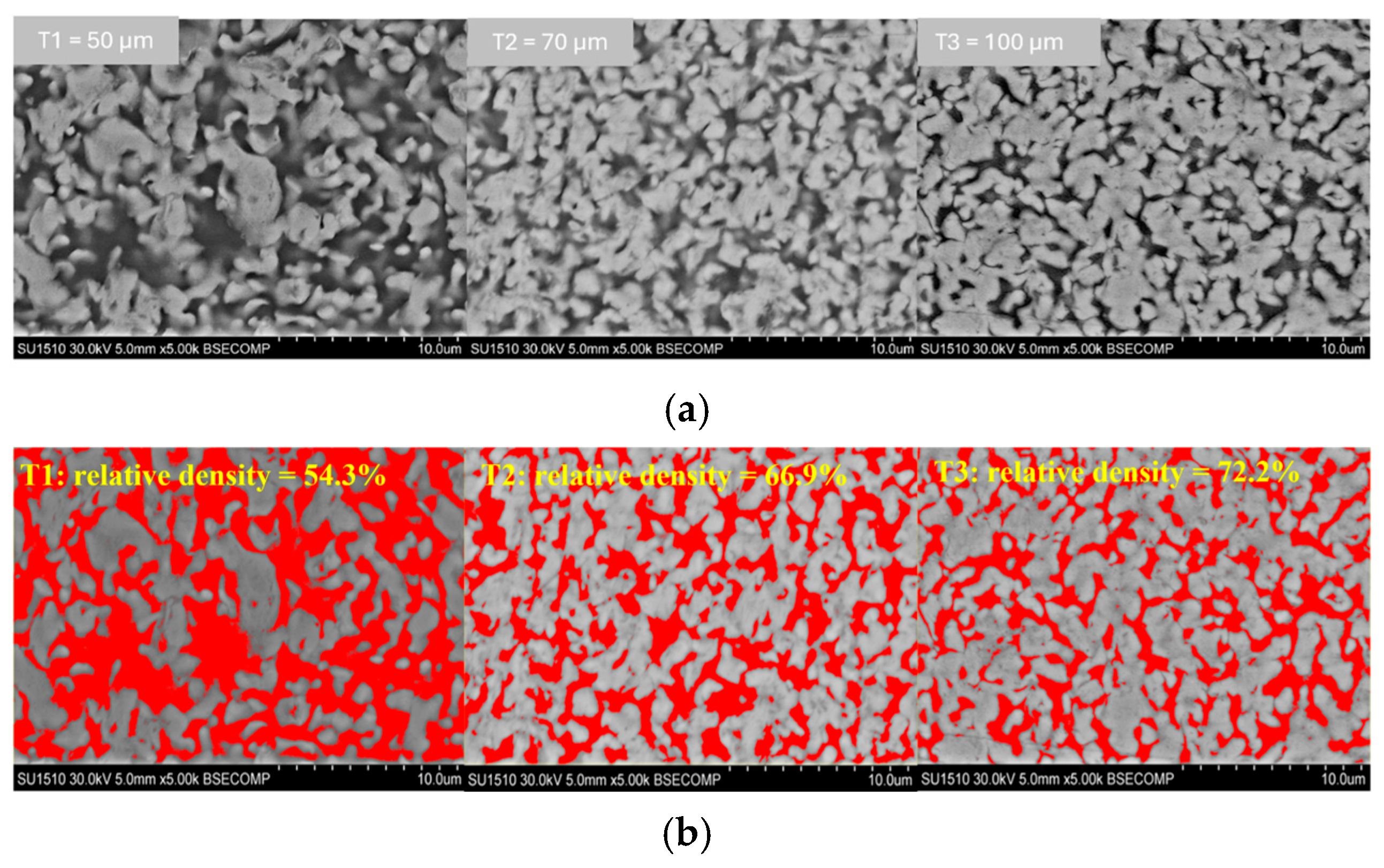
The top-surface morphologies in Figure 8c reveal that thicker joints possess a more compact porous network, with reduced pore size and connectivity. This observation aligns with the quantitative density measurements: ImageJ analysis determined relative densities of 0.54, 0.67, and 0.72 for the 50 µm, 70 µm, and 100 µm joints, respectively as shown in Figure 9. The increasing density with thickness is attributed to greater heat retention in thicker layers, which enhances local sintering kinetics and promotes bulk particle coalescence.
However, bulk densification does not correlate directly with mechanical strength. Although the 100 µm joint shows the highest bulk density, its interfacial bonding is weaker due to limited Ag–Au diffusion, resulting in lower shear strength compared with thinner joints. This distinction between bulk densification and interfacial adhesion is a key finding of this study.
From a microstructural perspective, the thicker joints exhibited more extensive particle coalescence and reduced pore connectivity, consistent with the higher relative densities quantified from the SEM images. This enhanced densification is attributed to improved heat retention in thicker layers, which promotes local sintering kinetics during the thermal cycle. However, these bulk densification trends do not directly translate into higher mechanical strength. Although thicker joints appear denser, their interfacial bonding is weaker due to reduced Ag–Au interdiffusion, which ultimately governs the fracture behavior. Accordingly, no quantitative kinetic model or empirical strength–density correlation is proposed here, as the available data do not support statistically robust fitting. Instead, the results highlight a qualitative but consistent relationship that greater bulk densification occurs in thicker joints, whereas stronger mechanical performance arises in thinner joints with superior interfacial bonding.

3.2.4. Interfacial Diffusion and Failure Behavior

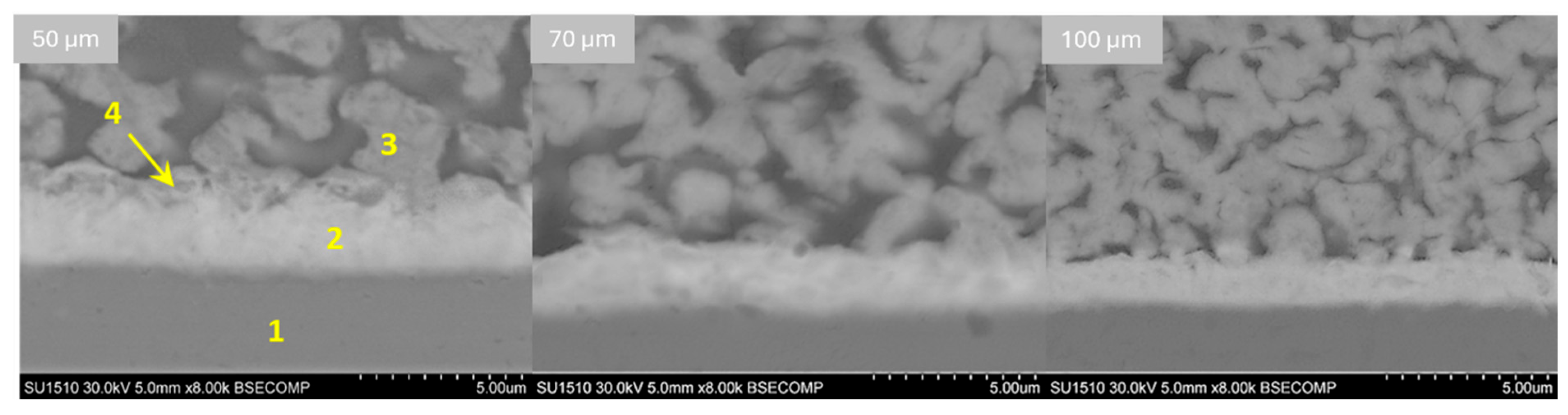
Detailed SEM imaging of the Ag–Au interfacial region was used to examine bonding features at the joint interface, as shown in Figure 10. The cross-sectional micrographs show a gradual grayscale transition between the electroplated Au layer and the sintered Ag region, suggesting the presence of a qualitative Ag–Au interdiffusion zone. As elemental analysis (EDS or EPMA) was not performed, identification of this region is based on morphological continuity and contrast variation, consistent with early-stage diffusion reported in prior studies. No specific diffusion-layer thickness is assigned.
Comparison among the three joint-thickness conditions shows that thinner joints exhibit a more uniform and continuous interfacial transition, consistent with more efficient heat transfer from the Au-coated substrate. Differences in interfacial morphology among the thickness conditions are associated with thickness-dependent stress distribution, constraint effects, and local thermal conditions. While temperature gradients may contribute, the observed differences are more consistently explained by the reduced stress transmission and interfacial constraint in thicker joints, which limit the formation of a continuous Ag–Au transition region. Accordingly, joint thickness emerges as a key factor influencing the fracture behavior observed in this study.
Fracture-surface observations are consistent with the trends observed in the mechanical results. Across all thicknesses, failure occurred predominantly by interfacial delamination along the Ag–Au boundary, indicating that interfacial adhesion was the limiting factor under shear loading. Thinner joints displayed more irregular and textured fracture surfaces, consistent with a partially mixed fracture mode, whereas thicker joints exhibited smoother regions characteristic of more complete interfacial separation. However, no conclusive evidence of plastic deformation or true cohesive fracture within the Ag layer was observed, and therefore the fracture behavior is described qualitatively without categorizing it as ductile or brittle.
These observations highlight that the integrity of sintered Ag joints under low-pressure processing is governed primarily by the quality of interfacial bonding rather than by bulk densification. Improved morphological continuity at the Ag–Au interface corresponds to higher shear strength, particularly in thinner joints where interfacial diffusion is more developed. Taken together, the observations indicate that interfacial metallurgical bonding, rather than global density, governs the mechanical reliability of nano-silver die-attach joints.

4. Conclusions

This work examined the mechanical performance and microstructural evolution of sintered nano-silver joints fabricated under different bonding pressures and joint thicknesses. The specimen preparation procedure, shear-testing methodology, and fracture-surface analyses were conducted in a controlled and reproducible manner, enabling a clear assessment of the coupled effects of pressure and thickness. The major findings are summarized as follows:
(1)
The mechanical response of the joints depended on both bonding pressure and bond-line thickness. Increasing the pressure from 1.0 to 1.5 MPa enhanced densification and improved interfacial bonding, resulting in higher shear strength. In contrast, increasing the joint thickness from 50 µm to 100 µm reduced the strength, reflecting weaker interfacial adhesion despite higher bulk density. The highest shear strength (28.2 MPa) was measured for the 50 µm joint processed at 1.5 MPa.
(2)
SEM observations and image-based density measurements indicated that thicker joints exhibited higher bulk relative density, increasing from 0.54 at 50 µm to 0.72 at 100 µm as a result of greater heat retention during sintering. However, this increase in bulk densification did not correspond to higher mechanical performance, indicating that bulk density is not the dominant factor governing joint reliability.
(3)
Thinner joints demonstrated a more continuous and well-developed interfacial transition between the sintered Ag and the electroplated Au layer. This qualitative evidence of enhanced interfacial interaction is attributed to the more efficient heat transfer at smaller thicknesses, which promotes improved metallurgical bonding at the interface.
(4)
Fractographic examinations revealed that joint failure occurred predominantly by interfacial delamination along the Ag–Au boundary, confirming that interfacial adhesion is the critical weakness under shear loading. Thinner joints exhibited more irregular fracture features consistent with partially mixed failure, whereas thicker joints showed smoother fracture surfaces indicative of more complete interfacial separation. Based on the combined mechanical and microstructural analyses, joint reliability under low-pressure nano-silver sintering is found to be more strongly associated with the quality of Ag–Au interfacial bonding than with the overall densification level, while joint thickness influences reliability mainly by affecting interfacial interaction and stress distribution.

Author Contributions

Conceptualization, Q.-B.T. and P.-T.T. methodology, Q.-B.T., L.B. and P.-T.T.; software, N.-A.N.-T.; validation, Q.-B.T. and P.-T.T.; formal analysis, Q.-B.T. and L.B.; investigation, P.-T.T.; resources, L.B.; data curation, N.-A.N.-T.; writing—original draft preparation, Q.-B.T. and P.-T.T.; writing—review and editing, Q.-B.T. and L.B.; supervision, Q.-B.T.; project administration, Q.-B.T.; funding acquisition, N.-A.N.-T. and Q.-B.T. All authors have read and agreed to the published version of the manuscript.

Funding

This research is funded by the Ministry of Training and Education, Vietnam, under Project Number B2023.DNA.10.

Data Availability Statement

Dataset available on request from the authors.

Conflicts of Interest

The authors declare no conflicts of interest.

References

  1. Manikam, V.; Cheong, K.Y. Die attach materials for high temperature applications: A review. IEEE Trans. Compon. Packag. Manuf. Technol. 2011, 1, 457–478. [Google Scholar] [CrossRef]
  2. Navarro Melchor, L.A.; Jordà Sanuy, X.; Perpiñà, X.; Godignon, P.; Rebollo, J. Thermomechanical assessment of die-attach materials for wide bandgap semiconductor devices and harsh environment applications. IEEE Trans. Power Electron. 2014, 29, 2261–2271. [Google Scholar] [CrossRef]
  3. Guo, X.; Xun, Q.; Li, Z.; Du, S. Silicon Carbide Converters and MEMS Devices for High-Temperature Power Electronics: A Critical Review. Micromachines 2019, 10, 406. [Google Scholar] [CrossRef]
  4. Han, G.; Kim, J.; Park, S.; Bae, W. Thermal Management of Wide-Bandgap Power Semiconductors: Strategies and Challenges in SiC and GaN Power Devices. Electronics 2025, 14, 4193. [Google Scholar] [CrossRef]
  5. Ismail, N.; Yusoff, W.Y.W.; Amat, A.; Manaf, N.A.A.; Ahmad, N. A Review of Extreme Condition Effects on Solder Joint Reliability: Understanding Failure Mechanisms. Def. Technol. 2024, 41, 134–158. [Google Scholar] [CrossRef]
  6. Hunt, C.; Crocker, L.; Thomas, O.; Wickham, M.; Clayton, K.; Zou, L.; Ashayer-Soltani, R.; Longford, A. High Temperature Solder Replacement to Meet RoHS. In NPL Report 2014; MAT 64; National Physical Laboratory: Teddington, UK, 2014; Available online: https://eprintspublications.npl.co.uk/6200/1/MAT64.pdf (accessed on 12 December 2025).
  7. Liu, V.; Zou, Y.-S.; Chang, W.-L.; Foo, X.Q.; Chen, Y.-J.; Chen, C.-M.; Chung, M.-H.; Gan, C.L. Solder Joint Reliability Performance Study and Shear Characterization of Low-Ag SAC Lead-Free Solders for Handheld Applications. Mater. Sci. Semicond. Process. 2024, 179, 108489. [Google Scholar] [CrossRef]
  8. Paknejad, S.A.; Mannan, S.H. Review of silver nanoparticle based die attach materials for high power/temperature applications. Microelectron. Reliab. 2017, 70, 1–11. [Google Scholar] [CrossRef]
  9. Li, X.; Chen, G.; Chen, X.; Lu, G.-Q.; Wang, L.; Mei, Y.-H. Mechanical property evaluation of nano-silver paste sintered joint using lap-shear test. Solder. Surf. Mt. Technol. 2012, 24, 120–126. [Google Scholar] [CrossRef]
  10. Wakamoto, K.; Namazu, T. Mechanical characterization of sintered silver materials for power device packaging: A review. Energies 2024, 17, 4105. [Google Scholar] [CrossRef]
  11. Ze, C.; Qiang, J.; Yishu, W.; Limin, M.; Guisheng, Z.; Fu, G. Review on shear strength and reliability of nanoparticle sintered joints for power electronics packaging. J. Electron. Mater. 2024, 53, 2703–2726. [Google Scholar] [CrossRef]
  12. Khtatba, K.; Paknejad, S.A.; Mansourian, A.; Mannan, S.H. Sintered silver die attach with extreme thermal stability for extreme and dynamic environments. In Device Packaging, HiTEC, HiTEN, & CICMT; International Microelectronics Assembly and Packaging Society: Cambridge, UK, 2017. [Google Scholar]
  13. Martin, H.; Cao, X.; Wijgaerts, J.; Smits, E.; Xia, B.; de Wit, R. Improving semiconductor reliability of silver sintering die-attach adhesives for large die on copper lead frames. In Proceedings of the 24th European Microelectronics and Packaging Conference & Exhibition (EMPC), Cambridge, UK, 11–14 September 2023. [Google Scholar] [CrossRef]
  14. Mei, Y.; Wang, Z.; Siow, K.S. Reliability and Failure Mechanisms of Sintered Silver as Die Attach Joint: Materials, Processes, Equipment, and Reliability. In Die-Attach Materials for High Temperature Applications in Microelectronics Packaging; 2019; pp. 125–150. [Google Scholar] [CrossRef]
  15. Zhang, Z.; Lu, G.-Q. Pressure-assisted low-temperature sintering of silver paste as an alternative die-attach solution to solder reflow. IEEE Trans. Electron. Packag. Manuf. 2002, 25, 279–283. [Google Scholar] [CrossRef]
  16. Hsu, S.L.-C.; Chen, Y.-T.; Chen, M.-L.; Chen, I.-G. Low sintering temperature nano-silver pastes with high bonding strength by adding silver 2-ethylhexanoate. Materials 2021, 14, 5941. [Google Scholar] [CrossRef]
  17. Wang, M.; Mei, Y.; Burgos, R.; Boroyevich, D.; Lu, G.Q. Effect of substrate surface finish on bonding strength of pressure-less sintered silver die-attach. In Proceedings of the 2018 International Conference on Electronics Packaging and iMAPS All Asia Conference (ICEP-IAAC), Mie, Japan, 17–21 April 2018. [Google Scholar] [CrossRef]
  18. Xue, J.; Li, X. High-pressure-assisted large-area (>2400 mm2) sintered-silver substrate bonding for SiC power module packaging. Materials 2024, 17, 1911. [Google Scholar] [CrossRef]
  19. Kim, Y.J.; Park, B.H.; Hyun, S.K.; Nishikawa, H. The influence of porosity and pore shape on the thermal conductivity of silver sintered joint for die attach. Mater. Today Commun. 2021, 29, 102772. [Google Scholar] [CrossRef]
  20. Hu, D.; Du, L.; Alfreider, M.; Fan, J.; Kiener, D.; Zhang, G. Microscopic fracture toughness of notched porous sintered Cu micro-cantilevers for power electronics packaging. Mater. Sci. Eng. A 2024, 897, 146316. [Google Scholar] [CrossRef]
  21. Siow, K.S. Are Sintered Silver Joints Ready for Use as Interconnect Material in Microelectronic Packaging. J. Electron. Mater. 2014, 43, 947–961. [Google Scholar] [CrossRef]
  22. Yao, Y.; Gong, H.; He, G. Damage and viscoplastic behavior of sintered nano-silver joints under shear loading. Eng. Fract. Mech. 2019, 222, 106741. [Google Scholar] [CrossRef]
  23. Qin, F.; Zhao, S.; Liu, L.; Dai, Y.; An, T.; Chen, P.; Gong, Y. Thickness and metallization layer effect on interfacial and vertical cracking of sintered silver layer: A numerical investigation. Microelectron. Reliab. 2021, 124, 114290. [Google Scholar] [CrossRef]
  24. He, G.; Yao, Y.; Yang, Y. Size Effect on the Fracture of Sintered Porous Nano-Silver Joints: Experiments and Weibull Analysis. J. Alloys Compd. 2021, 863, 158611. [Google Scholar] [CrossRef]
  25. Zhao, S.; Dai, Y.; Li, Y.; Zhou, Z.; Gong, Y. Effect of surface finish metallization layer on shearing fracture toughness of sintered silver bonded joints. Eng. Fract. Mech. 2022, 264, 108355. [Google Scholar] [CrossRef]
  26. Zhao, S.; Dai, Y.; Qin, F.; Li, Y.; Liu, L.; Zhi, Z.; An, T.; Chen, P.; Gong, Y.; Wang, Y. On mode II fracture toughness of sintered silver based on end-notch flexure (ENF) test considering various sintering parameters. Mater. Sci. Eng. A 2021, 823, 141729. [Google Scholar] [CrossRef]
  27. NBE Technologies, LLC. NanoTach® Nano-Silver Paste—Lead-Free Solder Alternative; NBE Technologies, LLC: Blacksburg, VA, USA, 2024. [Google Scholar]
  28. Li, X.; Chen, G.; Wang, L.; Mei, Y.-H.; Chen, X.; Lu, G.-Q. Creep Properties of Low-Temperature Sintered Nano-Silver Lap Shear Joints. Mater. Sci. Eng. A 2013, 579, 108–113. [Google Scholar] [CrossRef]
  29. Yan, J. A review of sintering-bonding technology using Ag nanoparticles for electronic packaging. Nanomaterials 2021, 11, 927. [Google Scholar] [CrossRef]
  30. Liu, Y.; Zhang, H.; Wang, L.; Fan, X.; Zhang, G.; Sun, F. Effect of sintering pressure on the porosity and the shear strength of the pressure-assisted silver sintering bonding. IEEE Trans. Device Mater. Reliab. 2018, 18, 240–246. [Google Scholar] [CrossRef]
  31. Zhang, H.; Zhao, Z.; Zou, G.; Wang, W.; Liu, L.; Zhang, G.; Zhou, Y. Failure analysis and reliability evaluation of silver-sintered die attachment for high-temperature applications. Microelectron. Reliab. 2019, 94, 46–55. [Google Scholar] [CrossRef]
  32. Tao, Q.-B.; Benabou, L.; Vivet, L.; Tan, K.-L.; Morelle, J.-M.; Le, V.-N.; Ben Ouezdou, F. A design of a new miniature device for solder joints’ mechanical properties evaluation. Proc. Inst. Mech. Eng. Part C J. Mech. Eng. Sci. 2017, 231, 3818–3830. [Google Scholar] [CrossRef]
  33. Schneider, C.A.; Rasband, W.S.; Eliceiri, K.W. NIH Image to ImageJ: 25 Years of Image Analysis. Nat. Methods 2012, 9, 671–675. [Google Scholar] [CrossRef]
Figure 1. Sintering profile.
Jmmp 10 00022 g001
Figure 2. Structure of the joint (a) and the actual sintered joint (b).
Jmmp 10 00022 g002
Figure 3. The testing apparatus.
Jmmp 10 00022 g003
Figure 4. The shear strength of sintered nano-silver joints with different bond-line thicknesses under bonding pressures of 1.0 MPa and 1.5 MPa. Error bars represent the standard deviation (n = 3). Welch’s t-test indicates a statistically significant difference only for the 50 µm joints (p < 0.05).
Jmmp 10 00022 g004
Figure 5. Cross-sectional and surface SEM images of the sintered nano-silver lap-shear joint: (a) low-magnification cross-section showing a continuous bonding layer between Cu substrates; (b) medium magnification highlighting layer morphology; (c) enlarged view of pore distribution; and (d) high-resolution image revealing the porous nano-silver network with pronounced neck formation.
Jmmp 10 00022 g005
Figure 6. Sintered nano-silver joint processed at a bonding pressure of 1.0 MPa: (a) cross-sectional side view of the intact Ag–Au–Cu joint, where the sintered Ag layer is bonded to the Cu substrate through an electroplated Au interlayer; (b) magnified side view of the porous silver particle network; (c) high-magnification top view of the porous silver network showing different pore morphologies; and (d) fracture surface of the joint after shear testing, showing partial delamination at the Ag–Au interfacial region. Arrow 1 indicates a representative macropore within the sintered Ag layer, and arrow 2 highlights interfacial delamination associated with the Ag–Au–Cu joint structure.
Jmmp 10 00022 g006
Figure 7. Sintered nano-silver joint processed at a bonding pressure of 1.5 MPa: (a) cross-sectional side view of the intact Ag–Au–Cu joint, where the sintered Ag layer is bonded to the Cu substrate through an electroplated Au interlayer; (b) magnified side view showing the porous silver particle network; (c) high-magnification top view of the porous silver network illustrating different pore morphologies; and (d) fracture surface of the joint after shear testing, showing partial delamination associated with the Ag–Au interfacial region. Arrow 3 indicates a representative macropore within the sintered Ag layer, while arrow 4 highlights interfacial delamination related to the Ag–Au–Cu joint structure.
Jmmp 10 00022 g007
Figure 8. SEM images of sintered nano-silver joints with different joint thicknesses (50, 70, and 100 µm) processed under the same bonding pressure of 1.5 MPa: (a) cross-sectional (global) views, (b) enlarged views of the Ag–Au interfacial region, and (c) top-surface morphologies.
Jmmp 10 00022 g008
Figure 9. Quantitative image analysis of the sintered nano-silver joints processed at 1.5 MPa with different thicknesses: (a) original SEM micrographs (T1 = 50 µm, T2 = 70 µm, T3 = 100 µm); (b) corresponding thresholded images obtained by ImageJ segmentation (red = pores, gray = solid silver).
Jmmp 10 00022 g009
Figure 10. High-magnification SEM images of the interfacial region in sintered nano-silver joints bonded to Au-plated Cu substrates for three samples with different bond-line thicknesses, processed under the same bonding pressure. The multilayer Ag–Au–Cu joint architecture is clearly observed, where (1) denotes the Cu substrate, (2) the electroplated Au metallization layer, (3) the sintered Ag layer, and (4) the Ag–Au interdiffusion region.
Jmmp 10 00022 g010
Disclaimer/Publisher’s Note: The statements, opinions and data contained in all publications are solely those of the individual author(s) and contributor(s) and not of MDPI and/or the editor(s). MDPI and/or the editor(s) disclaim responsibility for any injury to people or property resulting from any ideas, methods, instructions or products referred to in the content.