1. Introduction
Green hydrogen is emerging as a central pillar of global decarbonization strategies [
1]. Its deployment is expected to support renewable-based electricity systems, industrial electrification, heavy-duty transport, and long-duration energy storage [
2]. Water electrolysis is also increasingly recognized as a key enabler for grid balancing and sector coupling via power-to-gas and power-to-liquids pathways [
3]. While early deployments focused on large, centralized plants operating at steady load, the current phase of adoption targets both continued GW-scale industrial hubs and decentralized energy systems (DESs), including community microgrids, industrial clusters, agri-energy platforms, and off-grid renewable installations. Electrolyzers must be manufacturable at scales suitable for plants operating in the GW–TW power range while still being configurable as modular units that can operate dynamically, tolerate frequent start–stop cycling, integrate with intermittent solar and wind power, and remain cost-effective from sub-MW to multi-MW power capacities.
Achieving this vision depends critically on advances in materials science and manufacturing engineering. The performance and cost of proton exchange membrane (PEM), alkaline, and solid oxide electrolysis (SOEC) technologies are governed by the stability of catalyst layers, membranes or diaphragms, porous transport layers, flow fields, sealing interfaces, and balance-of-plant components [
4].
At the same time, the scalability and affordability of hydrogen systems depend on high-yield fabrication pathways, such as roll-to-roll (R2R) coatings, spatial atomic layer deposition (ALD), precision forming, inline metrology, automated assembly, and digital quality control [
5], which are required for future power plants at the multi-GW and ultimately TW scales [
6].
These dimensions are deeply interconnected. Material innovations that reduce critical-metal loading, enhance thermo-mechanical resilience, or improve interfacial stability directly benefit decentralized systems operating under high intermittency. Likewise, scalable manufacturing lowers cost and enables widespread distribution of small hydrogen units, which cannot rely on economies of scale alone. Conversely, decentralized operational stresses generate new requirements for membranes, electrodes, porous media, and sealing, which feed back into manufacturing design rules.
The review is scoped to PEM, alkaline, and SOEC because recent authoritative assessments identify these technologies as the most commercially advanced and promising pathways for water electrolysis. The U.S. Department of Energy (DOE) classifies liquid alkaline and PEM as commercial and SOEC as early-commercial, whereas anion-exchange membrane (AEM) electrolyzers remain at the pilot stage [
7].
Accordingly, AEM is acknowledged but not treated as a full parallel track in this review. This scope choice well-aligns with the global scale-up outlook of the International Energy Agency (IEA), which likewise highlights the above-mentioned three technologies most likely to enter industrial supply chains [
8]. Given the central role that the DOE and IEA play in shaping policy, investment signals, and manufacturing roadmaps, their technology assessments provide a defensible reference frame for prioritizing electrolyzer families in a deployment- and scale-up–oriented review.
Reversible configurations also exist, notably unitized regenerative PEM devices (often called reversible PEMs or unitized regenerative fuel cells) and reversible SOECs, which alternate between electrolysis and fuel-cell modes [
9,
10]. These unitized systems are primarily developed for power-to-power storage rather than dedicated hydrogen production and therefore fall outside the scope of this review [
11].
Recent reviews have largely advanced water electrolysis knowledge within technology- or discipline-specific aspects, which makes cross-translation to scalable manufacturing under decentralized duty cycles difficult [
6]. For PEM water electrolysis, comprehensive assessments emphasize cell-level design choices and pathways toward GW power deployment, with limited linkage to factory integration under highly dynamic, decentralized duty cycles [
6].
For alkaline water electrolysis (AWE), the literature often concentrates on separators/diaphragms and membrane-related transport or degradation phenomena rather than end-to-end manufacturability and inline quality assurance at scale [
12].
For SOEC, comprehensive reviews primarily emphasize high-temperature cell/stack materials, degradation, and system configurations, with comparatively less attention to factory-level yield engineering and quality assurance (QA) strategies [
13]. Complementary SOEC surveys discuss fabrication choices (such as co-sintering, thin-film routes, infiltration, and additive manufacturing) primarily from a performance-optimization perspective rather than in terms of ramp-up or yield engineering [
14]. Separately, dynamic operation is frequently reviewed from an operational/control and market-integration perspective without systematically translating cycling stressors into component design rules, manufacturing process windows, and acceptance criteria [
15]. Broader system integration reviews likewise treat electrolyzers as flexible assets for grid services while often abstracting away materials/process implications [
16]. Factory scale-up is increasingly addressed as a planning and production-system challenge, yet it is rarely coupled explicitly to the materials and degradation constraints that dominate decentralized cycling operation [
17].
In contrast, this critical review bridges these strands by mapping decentralized dynamic operation requirements onto materials choices, manufacturing routes, and QA/benchmarking practices across PEM, AWE, and SOEC, thereby addressing the co-design gap that governs real learning curves during scale-up by providing a systematic materials–manufacturing framework anchored to decentralized, dynamically operated conditions and compatible with multi-GW to TW power scale manufacturing constraints, including QA and circularity.
The paper begins with the fundamentals of the three electrolyzer technologies considered, followed by a comparative assessment of their performance (
Section 2). It then examines material challenges and mitigation strategies (
Section 3) and recent progress in manufacturing across components, processes, and QA (
Section 4). System integration for decentralized hydrogen applications is addressed in the following chapter, while the next part of the paper synthesizes cross-cutting insights and future pathways. The paper concludes with overarching perspectives, outlining a convergent approach that links materials, manufacturing, and system design to scalable, sustainable hydrogen production.
By integrating materials, manufacturing, and system-level considerations, the review aims to support researchers, engineers, and industry stakeholders in developing robust, scalable, and sustainable hydrogen technologies for both distributed and industrial scenarios.
2. Available Electrolysis Technologies
Water electrolysis technologies convert electrical energy into hydrogen (H2) and oxygen (O2) through electrochemical water splitting, and they form the technological foundation for all subsequent material and manufacturing considerations discussed in this paper. This chapter provides a neutral, technology-focused overview of the three main electrolyzer types, PEM, alkaline, and solid oxide electrolysis, summarizing their operating principles, key components, and system characteristics.
This high-level comparison establishes the context for the next two chapters, which subsequently examine the associated material challenges and manufacturing barriers.
2.1. Proton Exchange Membrane Electrolysis
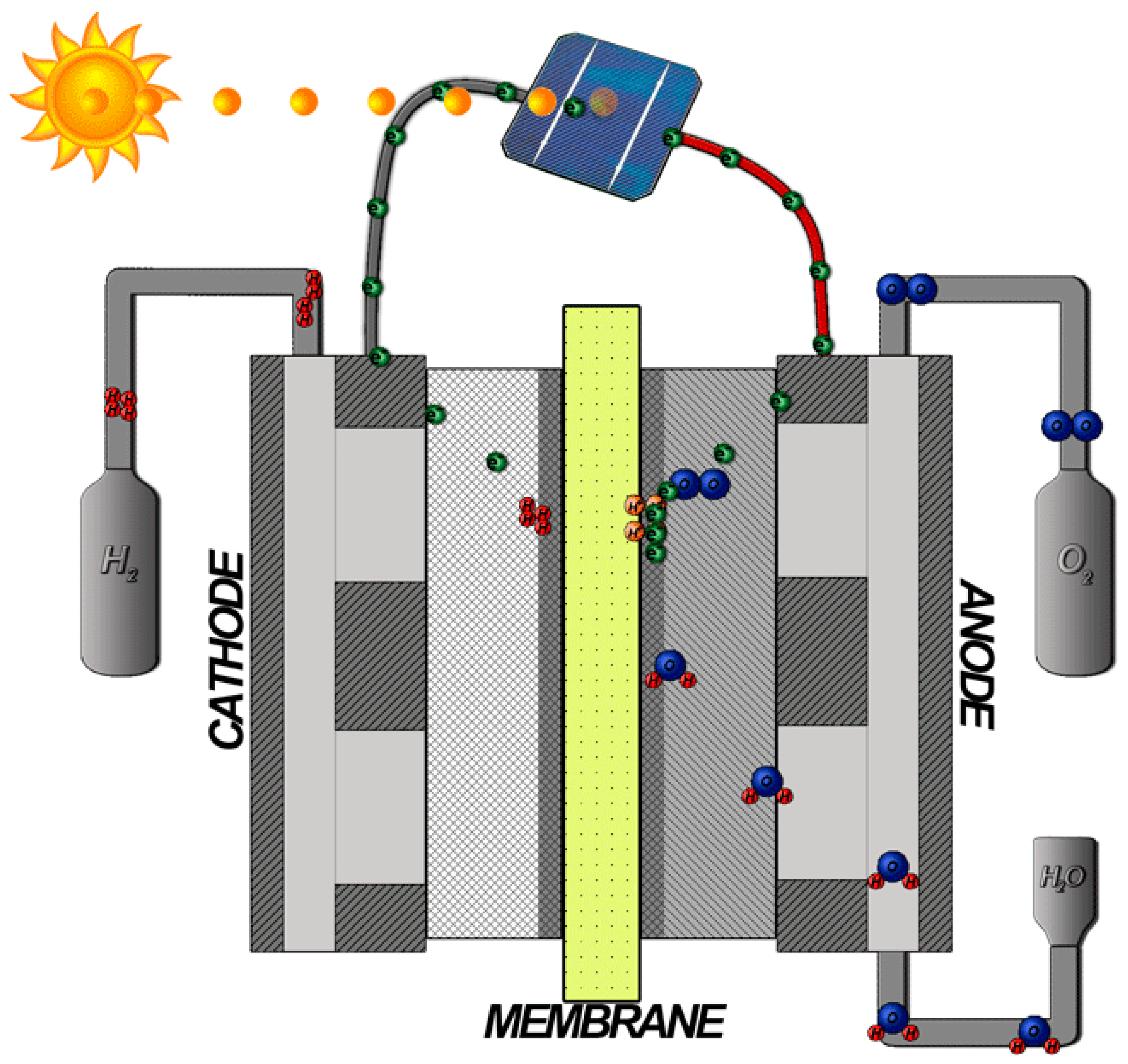
In PEM electrolysis, due to the applied electric current, water (H
2O) is transformed into H
2 and O
2. At the anode, O
2 production is the main process, while the protons migrate through the proton-conductive membrane to the cathode, where they are reduced to H
2, as can be seen in
Figure 1 [
18].
PEM electrolysis operates with a solid polymer electrolyte (typically a perfluorosulfonic acid membrane such as Nafion or a hydrocarbon-based membrane), which conducts protons while preventing gas crossover. The anode is coated with an oxygen evolution reaction (OER) catalyst, usually based on iridium oxide (IrO2), while the cathode uses a H2 evolution reaction (HER) catalyst, typically Pt.
Porous transport layers (PTLs) made of Ti provide pathways for gas diffusion and electrical conduction, and coated bipolar plates distribute current and separate individual cells. The system operates at low temperatures, generally between 60–80 °C, and can produce H
2 at elevated pressures up to 20 MPa directly from the stack. The electrochemical reactions result in high-purity H
2 (≥99.99%) suitable for industrial and energy applications [
20].
The electrical efficiency of PEM systems has been reported to reach up to 77% lower heating value (LHV) at a stack energy consumption of 43 kWh/kg H
2 [
21]. Advanced membrane electrode assemblies (MEAs) can operate at current densities of 2–3 A/cm
2 and cell voltages below 1.8 V, with degradation rates below 2 µV/h over 80,000 h of operation [
6]. The main stack components include the polymer electrolyte membrane, catalyst layers, gas diffusion layers, PTLs, and current collectors, all assembled into modular stacks that can be scaled for various power capacities [
22]. In addition, manufacturing concepts such as R2R processing of catalyst layers are being explored to reduce cost and support high-volume production [
23].
2.2. Alkaline Water Electrolysis
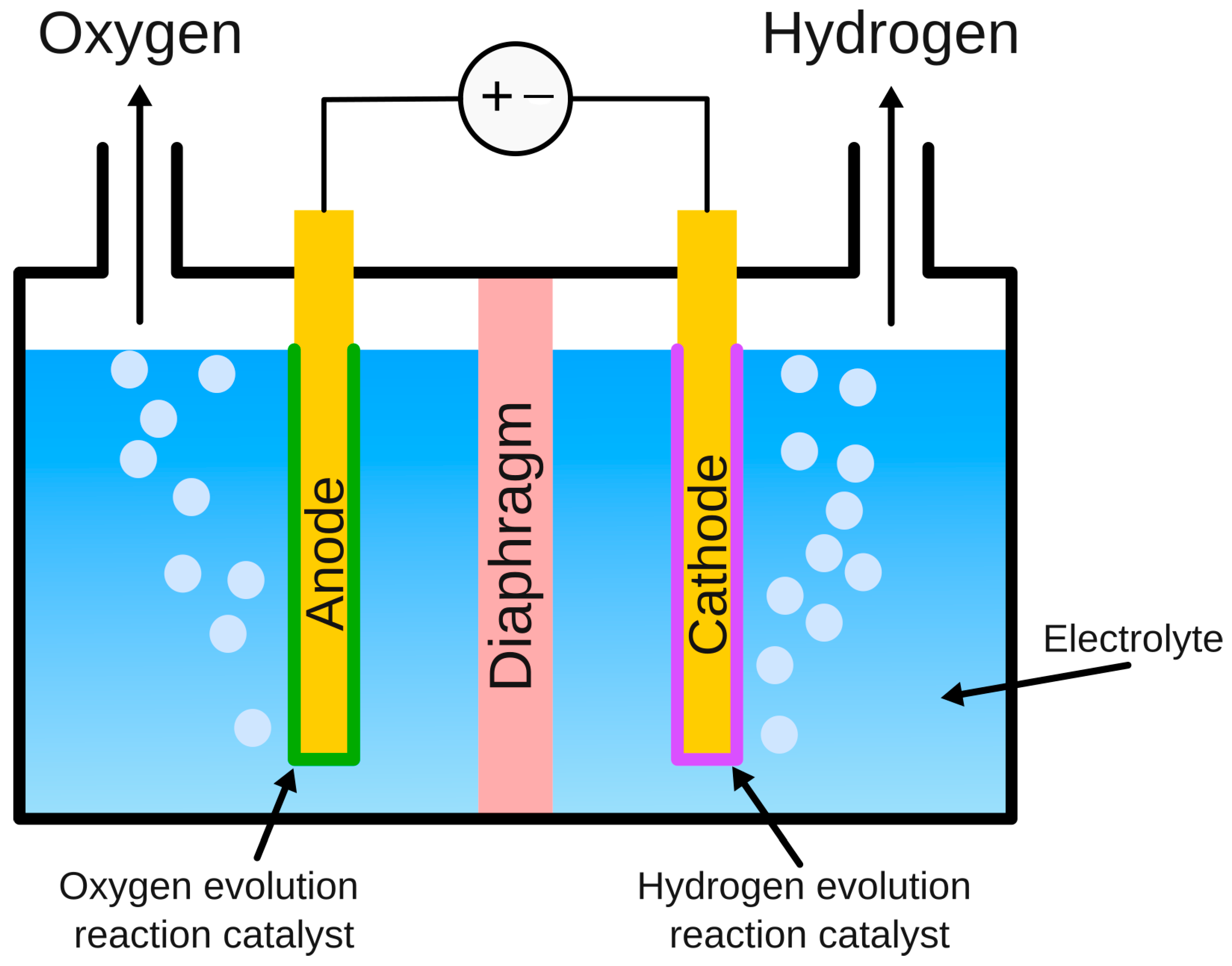
AWE produces green H
2 using a concentrated aqueous alkaline electrolyte (typically KOH or NaOH). The cell comprises two electrodes separated by a porous diaphragm that permits ionic transport while preventing gas mixing. Under applied current due to the species present in the alkaline water, at the cathode H
2 is generated, and at the anode, OH
− is oxidized (see
Figure 2) [
18].
Ni or Ni-coated steel is commonly used for the electrodes because of its catalytic activity in alkaline media and relatively low cost. The diaphragm, which is made from zirconia (ZrO
2)-doped or polymeric materials, maintains gas separation while allowing ion transport. Typical operating conditions are 60–90 °C and pressures from atmospheric up to ~3 MPa, with cell voltages of about 1.8–2.4 V at current densities of 0.2–0.6 A/cm
2 for large systems. Multi-cell stacks are used to scale production to the desired H
2 output [
25].
Key components are electrode plates, current collectors, stack frames, diaphragms, and an electrolyte circulation system. Electrolyte composition, operating pressure, and electrode surface properties critically affect performance and durability, and modular stack design enables scaling by increasing electrode area or adding cells in series [
25].
2.3. Solid Oxide Electrolysis
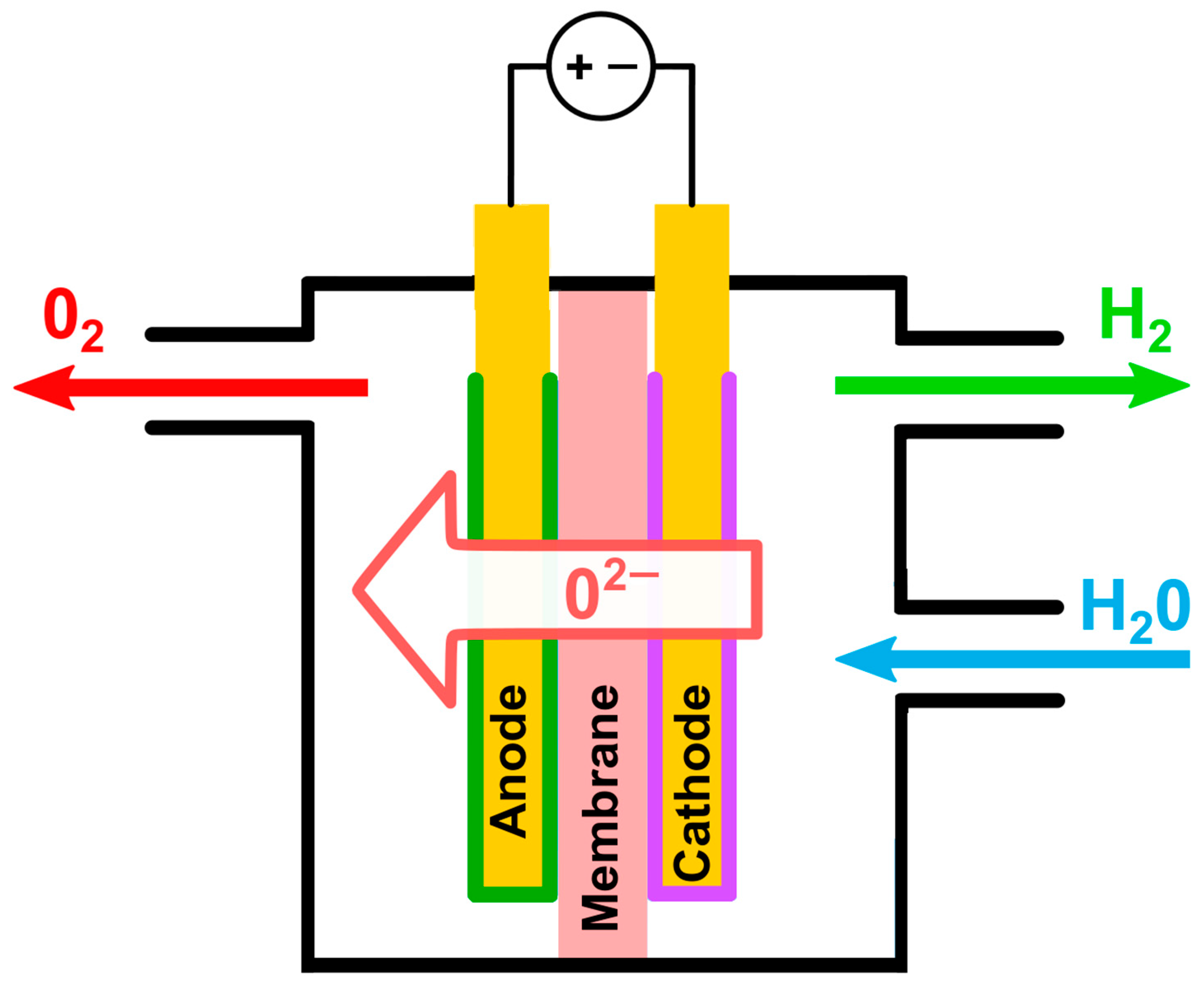
Solid oxide electrolysis cells (SOECs), shown in
Figure 3, employ a solid ceramic electrolyte to conduct oxygen ions at elevated temperatures. In these systems, steam is introduced to the cathode side, where it is electrochemically converted into H
2 and oxygen ions (O
2−). The oxide ions migrate through the dense ceramic electrolyte to the anode, where they release electrons and form molecular oxygen. Electrochemical reactions occur at the so-called triple-phase boundaries where electronic, ionic, and gaseous phases meet [
18].
The electrolyte is typically composed of Y-stabilized zirconia (YSZ), while the cathode commonly consists of a Ni–YSZ cermet that provides both electronic and ionic conductivity. The anode materials are typically perovskite-type oxides, ceramic mixtures of La, Sr, Co, and Fe (LSCF) or of La, Sr, and Mn (LSM), which are stable under oxidizing conditions. The interconnects and sealing components are made from high-temperature metallic alloys or ceramics capable of maintaining gas-tightness and structural integrity under cyclic thermal loads.
SOECs operate at high temperatures between 600 and 1000 °C, enabling favorable thermodynamics and rapid reaction kinetics. The high-temperature operation allows partial substitution of electrical energy with thermal energy, improving the overall efficiency of water splitting. Reported system efficiencies can exceed 90% LHV when integrated with waste heat or renewable heat sources [
26]. Leading developers have demonstrated specific electricity consumptions as low as 30–35 kWh/kg H
2 under optimized conditions [
27].
The high-temperature SOEC systems are constrained by thermal inertia: cold starts typically require several hours, and frequent thermal cycling accelerates degradation, so operation commonly relies on hot-standby strategies rather than repeated cold start/stop [
28]. Demonstration data indicate that, once maintained at operating temperature, SOECs can provide load-following (ramps from hot standby to full load on the order of ~1 h have been reported), supporting dynamic operation when hot but not fast cold-start flexibility [
29].
2.4. Comparative Assessment of Electrolysis Technologies
The three above-mentioned major electrolysis technologies differ significantly in terms of electrolyte composition, operating temperature, material requirements, and manufacturing complexity. These differences directly influence their efficiency, scalability, and overall sustainability. A comparative summary of the main characteristics of each technology is presented in
Table 1.
As can be seen, all three electrolysis technologies exhibit complementary strengths and limitations stemming from their distinct electrochemical principles and material requirements.
PEM electrolysis operates at low temperatures and delivers high current densities and gas purity, making it particularly suited for flexible and modular operation. However, its dependence on scarce noble metals such as Pt and Ir, combined with the high cost and limited recyclability of fluorinated polymer membranes, presents a substantial scalability challenge.
AWE remains the most mature and commercially established technology, utilizing abundant materials such as Ni and stainless steel. Its liquid electrolyte system and relatively simple cell architecture allow for cost-effective, large-scale H2 production. Nevertheless, the use of corrosive alkaline media and the difficulty of maintaining high efficiency under dynamic operation introduce durability and maintenance constraints.
In contrast, SOEC operates at high temperatures, where favorable thermodynamics enable very high electrical efficiency, but achieving and maintaining these high temperatures requires substantial thermal input and introduces thermal inertia that can limit rapid load-following and operational flexibility. The ceramic-based cells can leverage renewable or waste heat, thereby reducing overall energy input. Yet, the mechanical fragility of ceramic components, the sensitivity of electrodes to redox cycles, and the challenges of high-temperature sealing and thermal management make manufacturing and long-term stability particularly complex.
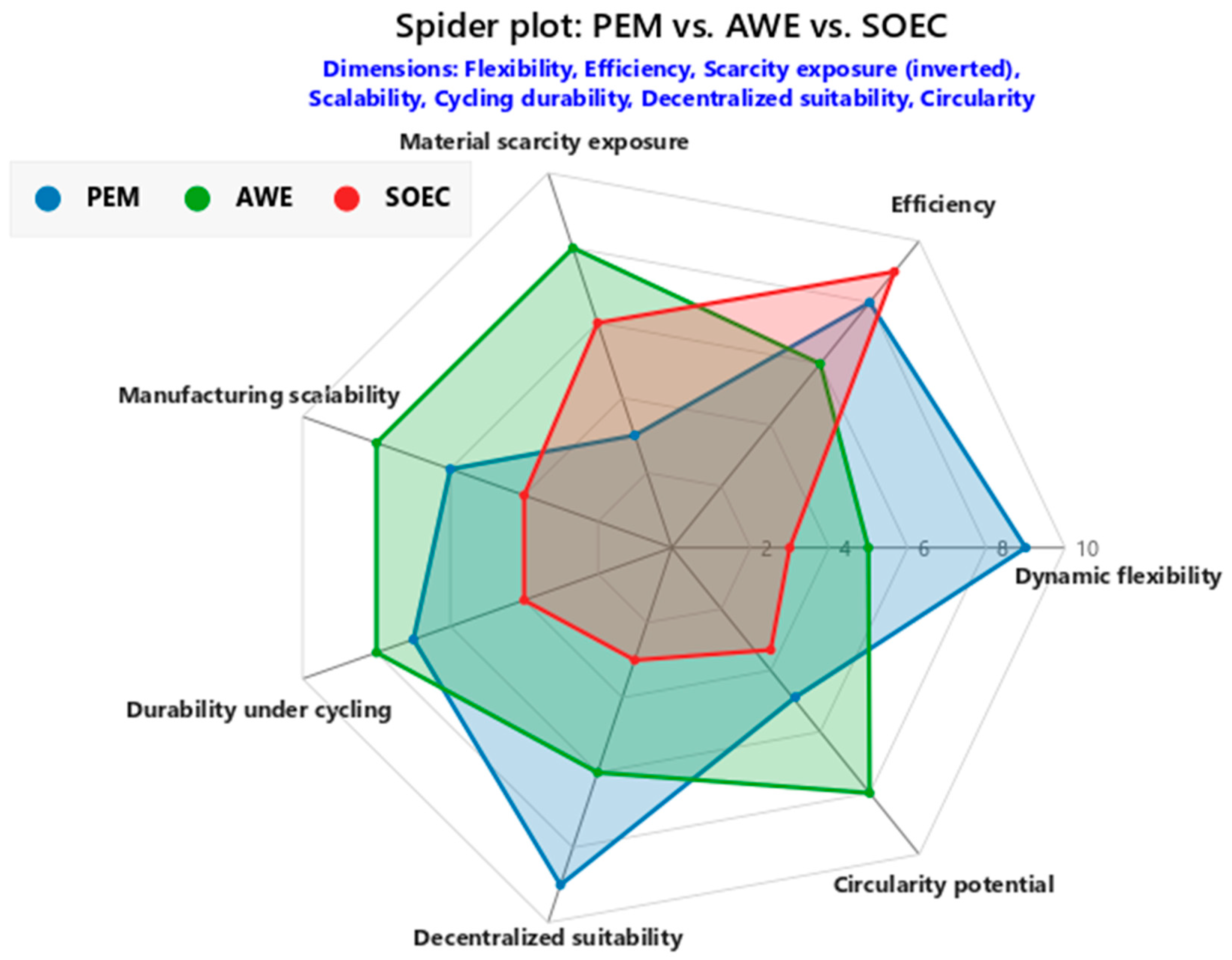
Overall, PEM and SOEC systems offer higher efficiency and greater operational flexibility, while alkaline electrolysis presently underpins most large-scale deployments because of its cost advantages, operational maturity, and established manufacturing base. For near-term multi-GW rollout, alkaline systems are the most practical choice. PEM electrolysis is particularly well-suited to decentralized, renewable-integrated applications and could become competitive at GW power scale pending reductions in catalyst and membrane costs. SOECs provide the highest theoretical efficiency and attractive pathways for industrial heat integration, but will require further development before reliable GW-scale implementation is achieved.
These comparisons demonstrate that there is no single “best” electrolysis technology suitable for all contexts. Instead, the optimal choice depends on the intended scale, integration environment, material availability, and manufacturing infrastructure. The interplay between performance, cost, material criticality, and production scalability underscores the need for continued innovation in material design, component durability, and sustainable manufacturing approaches.
The next sections build on this analysis by examining the key material and technological challenges that currently limit electrolysis deployment, such as catalyst scarcity, membrane degradation, and structural instability, and by reviewing the most recent advances aimed at overcoming these limitations through cross-disciplinary progress in materials science and manufacturing technologies.
3. Material Challenges and Mitigation Strategies: Recent Advances
The large-scale deployment of green H2 remains fundamentally constrained by material-centric limits that cut across all electrolysis technologies. Despite steady improvements in system efficiency, cost, and integration, the availability, performance, and durability of critical materials, spanning catalysts, membranes, electrodes, and structural elements, still set the upper bound on scalability.
These constraints are cross-cutting, affecting PEM, alkaline, and SOEC systems in distinct but interconnected ways. At the same time, the material choices that enable high electrochemical performance introduce two intertwined classes of constraints. Economic constraints arise from supply concentration, price volatility, and high embodied energy, together with regulatory exposure for certain chemistries [
30]. Technical constraints arise from durability limits, including catalyst dissolution, membrane and electrolyte degradation, and structural corrosion or thermo-mechanical fatigue [
31]. These classes interact with manufacturing scale-up, recycling feasibility, and policy trends, shaping both near-term deployment and long-term sustainability.
The analysis that follows first details the economic constraints associated with critical materials and then examines the technical degradation pathways that govern lifetime and reliability. It concludes by synthesizing cross-cutting mitigation levers (thrifting, substitution, closed-loop recovery, and design-for-manufacturing principles and circularity) that address both cost and durability at scale.
3.1. Economic Constraints and Sustainability of Critical Materials
The economic viability and long-term sustainability of large-scale electrolysis are tightly coupled to the availability, cost, and environmental footprint of critical materials, making supply security and material intensity central constraints on deployment trajectories.
3.1.1. Supply Chain Shortages
One of the most severe constraints for scaling up PEM electrolysis is the dependence on scarce and costly noble metals, particularly Ir at the anode for the OER and Pt at the cathode for the HER [
32,
33].
Ir, a Pt-group metal (PGM), is indispensable due to its corrosion resistance and catalytic stability in strongly acidic environments. However, its global annual production remains extremely limited (only 6.9 t in 2024 and an estimated 7.5 t for 2025) while annual demand reaches approximately 7.4 t [
34]. Consequently, in 2024, the supply could not meet global needs. This scarcity is further exacerbated by the fact that the metal is produced primarily as a by-product of Pt and Ni mining, largely concentrated in South Africa and Russia, which together account for over 95% of the global supply [
35].
At current catalyst loadings (corresponding to approximately 530 kg Ir per GW under the NREL 1 MW baseline assumptions [
36]), the maximum theoretical global PEM electrolyzer deployment is constrained by present Ir supply limitations. Under these constraints, and assuming no recycling or thrifting strategies, the maximum deployable PEM capacity is limited to roughly 14 GW. This figure falls dramatically short of announced projects, which suggest that global capacity could grow to nearly 520 GW by 2030, although only about 4% has reached a final investment decision or is currently under construction [
8]. Even considering increased recycling and substitution efforts, the World Platinum Investment Council (WPIC) projects that Ir demand will continue to outstrip supply if PEM maintains a market share above 30% of total installations [
37].
This situation represents a significant scalability bottleneck for PEM electrolysis. Even aggressive recovery and utilization improvements will not fully offset the underlying supply constraint, reinforcing the need for low-Ir or Ir-free catalysts and alternative manufacturing strategies [
38]. The IEA [
39] and the US DOE [
40] have also identified Ir reduction as a strategic R&D priority, targeting 10–100 times reductions in noble metal loadings to enable deployment of TW power.
Pt exhibits similar exposure to geographic concentration and price volatility, and its mining and refining are energy-intensive and capital-heavy, transmitting cost and schedule risk directly into project bankability [
35,
37]. Beyond PGMs, structural and functional materials also carry heavy embodied energy and regulatory burdens. In PEM stacks, Ti is used for bipolar plates, and PTLs impose a primary carbon burden of about 30 CO
2/kg of produced Ti due to widely applied chlorination Kroll processing [
41,
42].
In SOECs, electrolytes based on YSZ depend on Y supply of ~8 kt·y
−1, more than 90% of which is sourced from a single region, creating geopolitical dependency and elevating environmental burdens associated with mining and refining [
43,
44,
45].
Zirconia sintering contributes substantial embodied energy at scale [
46], while rare-earth-containing perovskites further sensitize stacks to supply risks [
47]. Meanwhile, membranes in PEM made of perfluorinated polymers, such as perfluorosulfonic acid (PFSA) or per- and polyfluoroalkyl substances (PFAS), face increasing regulatory scrutiny due to persistence and bioaccumulation concerns (they are called “forever chemicals”), which introduces substitution risk and potential compliance costs that intersect with technology roadmaps and procurement strategies [
48].
3.1.2. Lifecycle Perspective
The lifecycle perspective of electrolysis technologies is important because it captures the full environmental and economic impacts, from raw material extraction to manufacturing, operation, and end of life (EoL), ensuring that performance improvements do not come at the cost of hidden sustainability burdens [
49].
From this perspective, PEM MEAs frequently emerge as greenhouse-gas hotspots [
50]. They are contributing up to roughly 45% of the stack level cradle-to-gate impact once PGM use, membrane manufacturing, and Ti processing are accounted for [
51].
In alkaline systems, the criticality of the base metals is lower, yet recurring burdens arise from KOH handling, carbonate formation, and diaphragm turnover, together with corrosion management that affects both environmental performance and operating expenditures [
52].
For SOECs, the high-temperature sintering of ceramic layers and the use of rare-earth perovskites dominate embodied energy while constraining EoL options [
53].
3.1.3. Critical Materials Landscape
Dependence on PGMs, Y, Ti, zirconia, and PFAS poses coupled supply and environmental challenges, as summarized in
Table 2.
Having established the economic boundary conditions imposed by scarce or high-impact materials, the analysis now turns to the technical degradation pathways that ultimately determine lifetime, reliability, and replacement cycles across PEM, alkaline, and SOEC systems.
3.2. Technical Degradation Pathways Across Electrolysis Technologies
While economics defines the boundary conditions, technical durability governs realized lifetimes, replacement cycles, and safety envelopes.
3.2.1. Catalyst Layer Degradation
Catalyst-layer degradation is a primary concern across electrolysis technologies because it directly governs performance, efficiency, and lifetime. The catalyst layer is where the electrochemical reactions occur, so any loss of active surface area, particle dissolution, agglomeration, or detachment from the support leads to higher overpotentials, reduced reaction rates, and accelerated energy losses [
54].
In PEM electrolysis, the oxygen-evolving anode is highly stressed under elevated potentials. Degradation manifests through catalyst dissolution, particle detachment, and migration, which reduce active surface area and contaminate other cell regions [
55,
56]. Transient load conditions and the formation of ROSs further accelerate these processes.
In AWE, Ni-based catalysts are more chemically stable but face different aging pathways. Repeated phase transitions between Ni(OH)
2 and NiOOH during cycling induce mechanical strain and cracking, while H
2 bubble formation and detachment can delaminate catalyst coatings [
57].
In SOECs, high-temperature stresses dominate as electrodes operate at 600–1000 °C. At such temperatures, the Ni–YSZ cathode undergoes coarsening and delamination under repeated redox cycling, while perovskite-based anodes suffer from surface segregation and passivation, reducing catalytic activity [
58].
These catalyst-layer instabilities collectively limit durability and are consistently identified as primary barriers to further deployment.
3.2.2. Membrane and Electrolyte Degradation
Membrane and electrolyte instability constitutes a second cross-technology failure family. The integrity of membranes and electrolytes is fundamental to the efficiency, durability, and safety of all electrolysis technologies. Their primary functions (ion conduction and gas separation) directly influence overall stack performance and lifetime. However, each system faces unique chemical and mechanical degradation pathways arising from its operational environment and material composition. Understanding these degradation mechanisms is critical not only for improving component lifetimes but also for enabling large-scale, sustainable manufacturing and recycling of electrolysis systems [
59].
Despite their excellent proton conductivity and mechanical stability, PFSA membranes are susceptible to chemical degradation from the oxidative potentials and reactive oxygen species generated during PEM electrolysis [
60]. Radical-induced chain scission and “unzipping” of the polymer backbone lead to loss of mechanical integrity, fluoride ion release, and decreased proton conductivity over time [
61]. In addition to technical limitations, PFSA materials are perfluorinated polymers and therefore fall within the PFAS chemical family. Their extreme persistence and the potential release of low-molecular-weight PFAS degradation products raise increasing environmental and regulatory concerns [
62]. With global regulations tightening against PFAS-containing materials, the development of sustainable membrane alternatives has become an urgent research priority [
63].
In AWE, the liquid electrolyte poses different challenges. The highly corrosive environment promotes electrode and separator degradation, especially at elevated temperatures [
64,
65]. Furthermore, dissolved CO
2 reacts with KOH to form KHCO
3 and K
2CO
3, which lowers the effective [OH
−] and thereby reduces electrolyte conductivity, increasing area-specific resistance over time. While electrolyte attack also accelerates separator aging (see next section), the focus here is on the electrolyte itself as a degradation driver. This process not only reduces efficiency but also accelerates material wear and maintenance requirements, limiting long-term operational stability.
In SOECs, the YSZ exhibits excellent oxygen-ion conductivity and chemical stability at high temperatures; it is mechanically brittle and sensitive to thermal gradients [
66]. Repeated redox and thermal cycling can induce cracking, delamination, and gas crossover between electrodes, leading to severe performance losses and catastrophic failure [
67,
68]. The need for chemically robust yet mechanically resilient electrolytes remains one of the most pressing challenges for scaling electrolysis technologies [
69].
3.2.3. Structural and Support Material Degradation
Beyond the catalyst layer and electrolyte, electrolysis cells rely on auxiliary structural components that ensure electronic conductivity, gas transport, and mechanical stability. Their degradation often dominates overall system lifetime, as these materials provide the framework that hosts the catalyst layers and maintains stack integrity. Failures in these supports directly impact efficiency, durability, and maintenance requirements.
In PEM electrolysis, Ti PTLs and bipolar plates can form insulating oxide films, increasing contact resistance and reducing current distribution uniformity [
70,
71]. Recent studies confirm that such degradation contributes to measurable voltage increases during long-term operation, even under controlled accelerated stress tests [
56].
In AWE, corrosion of current collectors and steel frames in concentrated alkaline environments further reduces stack longevity. Recent studies highlight that structural degradation mechanisms, such as coating loss, corrosion, and fatigue, remain critical to long-term performance [
72].
In SOECs, ceramic supports are prone to cracking and loss of connectivity under thermal cycling.
These mechanisms collectively limit durability and are consistently identified as primary barriers to large-scale deployment [
58].
3.3. Cross-Cutting Mitigation Methods
Mitigation strategies that are effective at scale must address economic and technical constraints simultaneously, ensuring that performance improvements are not achieved at the expense of cost, availability, or manufacturability. Approaches such as catalyst thrifting, material substitution, EoL recovery and recycling, and design-for-scale represent cross-cutting levers that can be applied across electrolyzer technologies. Together, these strategies form the foundation for reducing dependence on critical raw materials while enabling the rapid and sustainable expansion of electrolysis capacity [
73].
3.3.1. Catalyst Thrifting
A basic approach in PEM electrolyzers is to reduce noble metal loadings via advanced thin-film deposition routes such as ALD [
74] and electrodeposition [
75], which can form ultra-thin, highly dispersed Ir- and Pt-based catalyst layers. Reported MEA studies show that lowering anode catalyst loading and optimizing ionomer/catalyst utilization can maintain performance at reduced precious-metal content [
76]. In addition, catalyst-coated membranes prepared by ALD have been demonstrated as a viable pathway toward low-loading PEM electrolysis electrodes [
77]. These approaches have enabled total catalyst loadings below 0.5 mg/cm
2 in representative configurations, substantially reducing Ir demand while maintaining electrochemical performance [
60].
In parallel, nanostructured catalyst architectures further increase surface utilization and apparent activity. Reviews summarize advances in nanostructured iridium oxides, including nanosheets, nanowires, and porous oxide frameworks, and their relevance for PEM electrolysis [
78]. For example, partially hydroxylated ultrathin iridium nanosheets have been reported as efficient electrocatalysts for water splitting [
79]. More broadly, three-dimensional porous catalyst structures have been investigated to enhance mass transport and active-site accessibility in water splitting electrocatalysis [
80].
3.3.2. Material Substitution
Substitution is the preferred mitigation route whenever the underlying chemistry permits, offering a direct pathway to reduce reliance on scarce or high-impact materials.
A first line of research targets the development of PFAS-free proton-conducting membranes, where fluorine-free or low-fluorine polymers such as sulfonated poly(ether ether ketone) (SPEEK), polybenzimidazole (PBI), and sulfonated poly(phenylene) (SPP) are engineered to deliver proton conductivities in the range of 0.08–0.12 S/cm under humidified conditions, comparable to Nafion under similar operating windows, while avoiding the persistence, bioaccumulation, and EoL issues associated with perfluorosulfonic acid (PFSA) materials [
81].
Current research focuses on increasing oxidative stability through antioxidant additives or crosslinking, improving water retention, and reinforcing the membranes to withstand differential pressure without excessive swelling so that they can be drop-in options for PEM stacks designed around PFSA chemistry.
SPEEK has emerged as one of the most promising candidates to replace conventional PFSA membranes, largely due to its outstanding thermal resilience, good mechanical strength, and the ability to tailor its proton conductivity. By modifying the degree of sulfonation, it is possible to fine-tune the hydrophilic character and ionic conductivity of the membrane, while simultaneously maintaining a balance among its mechanical integrity, thermal endurance, and chemical stability [
82].
A complementary route is the rapid progress in AEMs, which aim to combine solid-state handling and low gas crossover, characteristic of PEM devices, with the benign alkaline chemistry of conventional AWE, thereby enabling the use of non-noble metal catalysts and reducing overall stack cost [
83]. In addition, recent work on anion-exchange ionomers highlights how ionomer chemistry and electrode/ionomer interactions can further influence performance and durability in AEM-based electrolysis systems [
84].
For AWE, much of the lifetime improvement in the last decade has been attributed to advances in diaphragm and separator materials, including the development of more chemically robust and lower-permeability separator concepts [
12]. Composite separators such as Zirfon (a polyethersulfone matrix filled with finely dispersed zirconia) have largely replaced asbestos and other legacy materials due to their chemical resistance in concentrated KOH, low hydrogen permeability, and good dimensional stability at typical operating temperatures, enabling higher current densities with reduced gas crossover [
85]. These improvements contribute to enhanced efficiency and safety while remaining compatible with scalable polymer-processing routes, as emphasized in recent critical reviews of electrolysis technology development and deployment [
86].
In SOECs, mitigation efforts concentrate on the electrolyte-electrode interface, where thermal-mechanical mismatch and redox cycling initiate cracks and delaminations [
87]. Two measures have proven particularly effective: thinning the dense O
2− conducting layer, typically YSZ, to less than 10 µm to reduce ohmic losses and limit stress buildup [
88]. A second measure is introducing compositionally graded or dual-phase interlayers such as YSZ/Gd-doped ceria that smooth the thermal expansion transition between electrode and electrolyte and thereby suppress interfacial cracking during thermal cycling [
89].
For PEM electrolyzers, advanced catalyst designs are dramatically reducing the reliance on expensive Ir while extending system lifetime. By alloying Ir with cheaper metals like Ru or Sn, and structuring catalysts as core–shell nanoparticles on highly conductive supports such as Ti
4O
7, Ir loadings can be reduced to below 0.3 mg/cm
2. These innovative structures maintain high OER activity for over 10,000 h [
90]. Another approach is applying conductive coatings such as TiN, TiC, or NbTiO
X to Ti PTLs, which prevents insulating oxide formation and preserves interfacial conductivity over the long term [
91].
In AWEs, the use of porous three-dimensional Ni foam electrodes significantly improves durability by mitigating the harmful effects of gas bubble accumulation. The intricate, interconnected structure of the foam provides abundant escape pathways for hydrogen and oxygen bubbles, preventing them from coalescing into large surface films that block active sites and induce mechanical stress. By facilitating more efficient bubble detachment, nickel foams reduce local stress fluctuations and mechanical fatigue, thereby extending electrode lifetime [
92].
Beyond foam-based designs, additional strategies can further enhance electrode robustness. Protective (including self-healing) oxide or sol–gel-derived coatings have been investigated to mitigate corrosion while maintaining electrical conductivity [
93]. In parallel, functional coating concepts for electrolyzers have been reviewed more broadly, highlighting coating roles in corrosion protection, interfacial stabilization, and long-term performance retention [
94]. Geometry optimization of electrodes (including pore size, thickness, and surface roughness) can additionally promote bubble release and improve current distribution, thereby reducing structural degradation and contributing to longer stack lifetimes in industrial alkaline systems.
For SOECs, material innovations are simultaneously enhancing the durability and efficiency of their core components. At the fuel electrode, the use of infiltration-derived Ni–YSZ cermets and ceria (CeO
2)-doped composites improves redox tolerance and preserves the vital triple-phase boundaries. At the air electrode, replacing conventional LSCF with double perovskites featuring checkerboard ordering provides superior O
2− conductivity while resisting detrimental surface segregation. Furthermore, the application of dense and protective spinel coatings to Fe–Cr interconnects is critical, as it suppresses Cr evaporation, thereby preventing electrode poisoning and the associated electrical degradation over the entire lifetime [
95].
Collectively, these advances highlight a shift toward low-criticality electrode assemblies produced through scalable coating and additive processes. The convergence of materials science, surface engineering, and manufacturing design is driving longer lifetimes, lower costs, and improved recyclability, laying the foundations for the sustainable industrialization of green-hydrogen technologies.
3.3.3. Recovery and Recycling
Closing material loops is also essential for aligning technological scale-up with long-term sustainability.
A significant mitigation route lies in the recycling and recovery of critical catalysts from spent MEAs [
96]. Hydrometallurgical and electrochemical recovery processes have recently achieved optimum Ir recovery efficiencies exceeding 90%, enabling the creation of closed-loop recycling systems that substantially reduce primary metal demand [
97]. Several pilot plants have already demonstrated the technical feasibility of such circular supply chains, where recovered iridium is directly reused in new MEAs without significant performance loss [
98].
In AWE systems, electrode regeneration by re-deposition or oxidation-reduction cycling can restore roughly 80–90% of catalytic activity, materially lowering cumulative demand over multi-year operation [
99]. Transitioning from PFSA to PFAS-free proton conductors enables thermal or chemical upcycling and design-for-disassembly at EoL [
100].
Recent life-cycle assessment (LCA) studies report that green hydrogen systems can achieve meaningful reductions in energy use and CO
2 emissions compared with primary extraction–based supply chains when recycling is implemented at scale [
101]. Consistent trends are also reported in our broader sustainability assessment of recycling-enabled value chains [
49].
3.3.4. Design-for-Scale
Ultimately, mitigation only scales when it maps onto manufacturable routes such as coatings, lamination, infiltration, and additive or roll-to-roll (R2R) processing and when product evolution is guided by LCA and life-cycle costing. Embedding design-for-disassembly, material passporting, and supply-risk screening into development links materials R&D to bankable, circular electrolysis plants and sets the stage for the manufacturing strategies discussed in the next section [
102].
3.4. Synthesis and Outlook
The preceding analysis demonstrates that the scalability of electrolysis technologies is bounded by two interdependent dimensions: the economic and environmental constraints imposed by critical materials and the technical durability limits arising from degradation of catalysts, membranes, electrolytes, and structural supports. Scarcity of Ir, Pt, Y, and fluoropolymers amplifies the urgency of extending component lifetimes, while degradation accelerates the consumption of these already constrained resources.
Mitigation strategies provide a pathway to reconcile these challenges. Catalyst thrifting and substitution directly reduce reliance on scarce or environmentally problematic inputs, while recovery and recycling embed circularity into electrolyzer lifecycles. Design-for-scale ensures that these advances are manufacturable and cost-effective, linking laboratory innovation to industrial deployment.
Taken together, these approaches form a strategy roadmap for sustainable development. They highlight that no single lever is sufficient; only a coordinated portfolio of measures can unlock also TW power scale hydrogen production.
Table 3 synthesizes how economic constraints, degradation pathways, and mitigation strategies intersect across PEM, AWE, and SOEC systems.
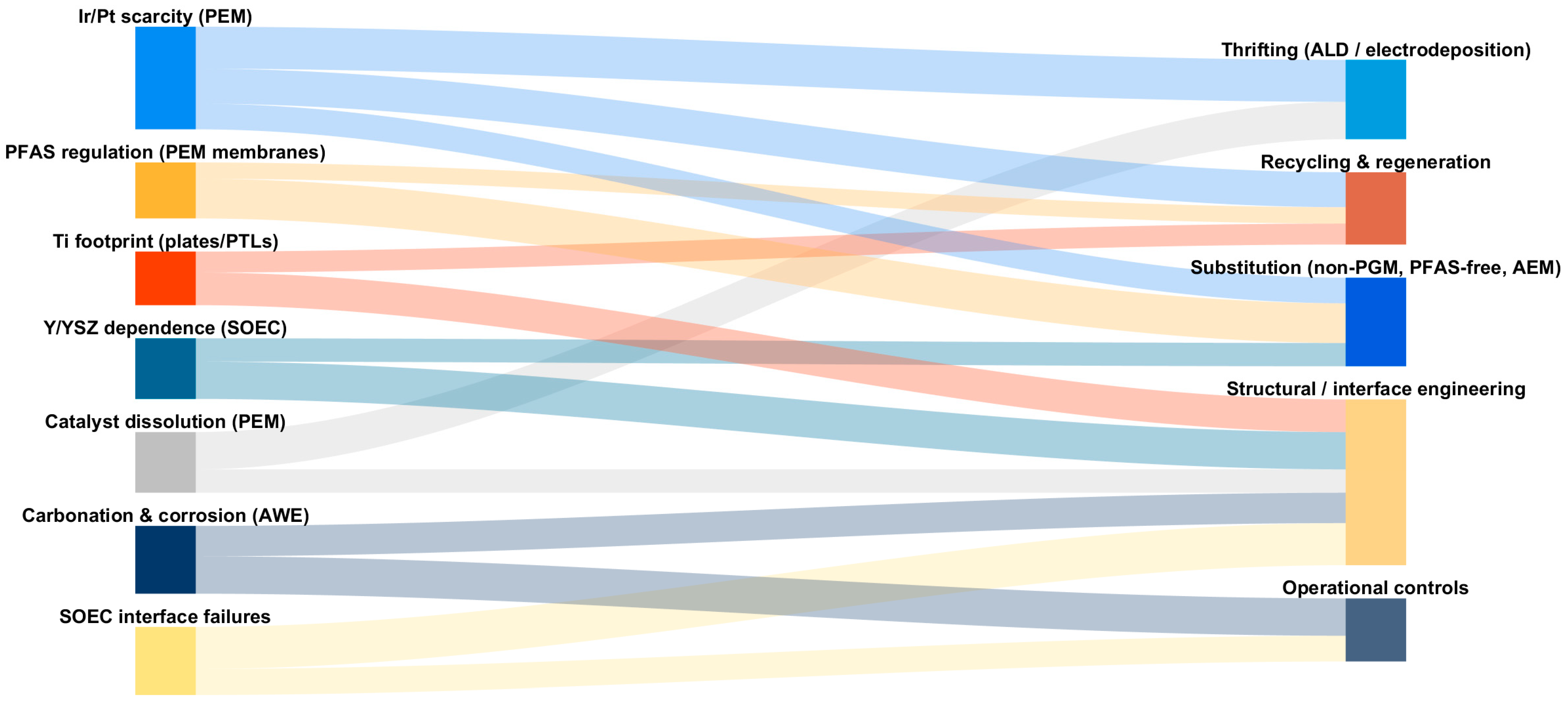
To connect the identified constraints with practical responses,
Figure 4 maps principal challenges (left) to mitigation families (right). Link thickness encodes a normalized relative leverage derived from the synthesis detailed in
Section 3.1,
Section 3.2 and
Section 3.3, highlighting where interventions are likely to yield the greatest system-level benefit.
The following chapter builds on this foundation by examining how these mitigation strategies can be embedded into manufacturing and deployment pathways, ensuring that material efficiency and technical durability translate into scalable, bankable, and sustainable hydrogen production systems.
4. Manufacturing Challenges and Technological Solutions: Recent Progress
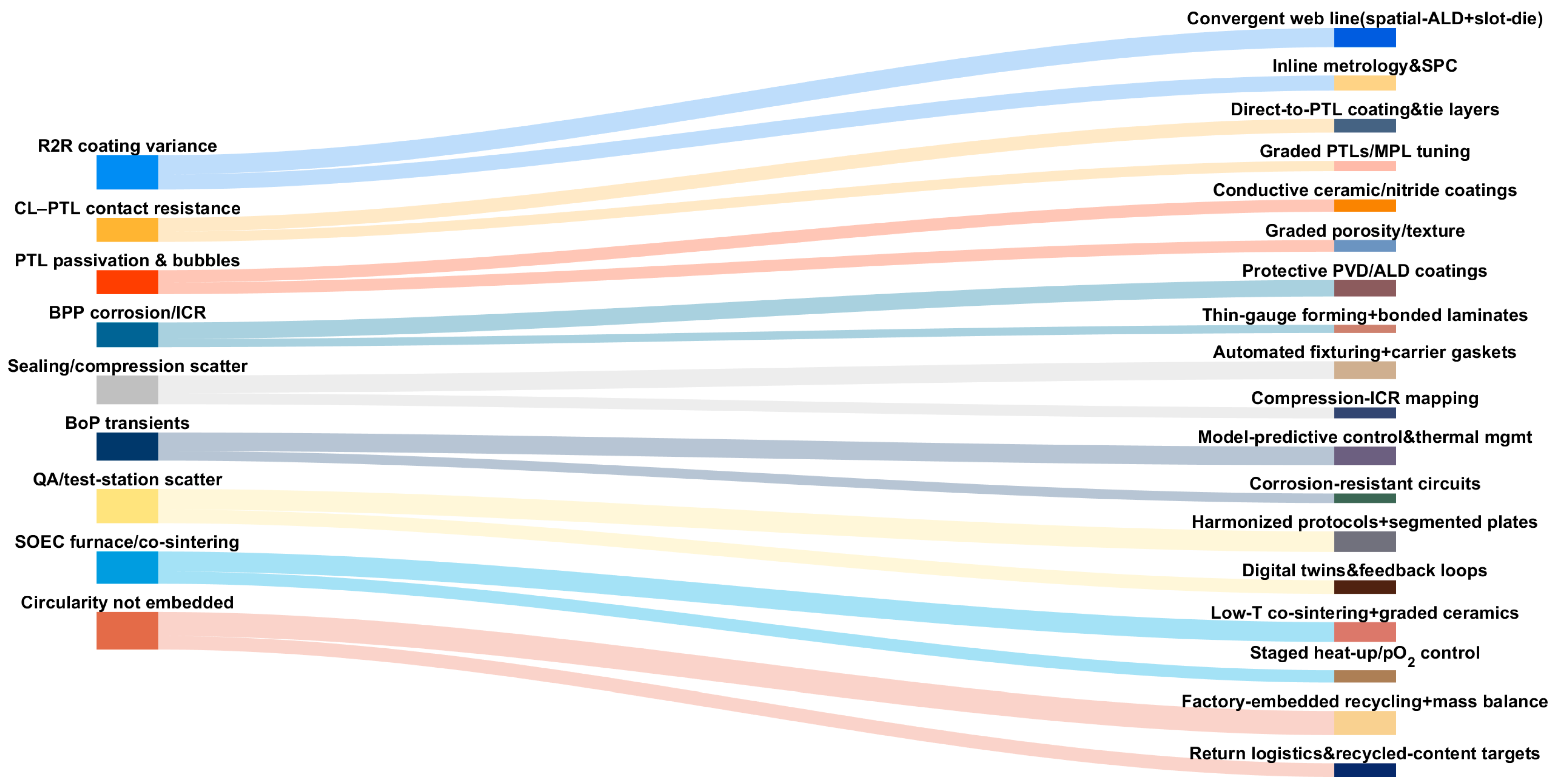
Manufacturing now lies on the critical path for scaling both low- and high-power electrolysis systems. Even when materials selection is sound, device cost, yield, and lifetime are ultimately determined by how reliably thin functional layers are deposited, how cleanly stacks are assembled and sealed, and how effectively inline metrology and end-of-line screening control variance.
Across PEM, AWE, and SOEC platforms, common challenges converge around high-throughput coating with nanometer-scale precision, joining of dissimilar materials with very different thermal/chemical stability, and quality control that can predict field durability from short factory tests.
Recent progress includes R2R processing, advanced printing, and ALD, additive manufacturing of porous metals and ceramics, and data-centric manufacturing, such as digital twins (DTs), inline impedance spectroscopy, and computer vision, to compress cost while improving lifetime and recyclability.
4.1. Catalyst Layer and MEA Manufacturing
4.1.1. Process Bottlenecks
Catalyst-layer and MEA manufacturing are among the most intricate and cost-limiting aspects of electrolysis system production. The core technical demands focus on achieving uniform, high-performance catalyst layer morphology and durable interfaces between ionic (ionomer) and electronic (conductive) phases, particularly under the stresses of industrial operation. However, the principal bottlenecks arise not from the intrinsic properties of the catalysts or supports themselves, but from the practical difficulties of scaling laboratory methods into industrial production.
In PEMs, three categories are particularly significant. First, coating uniformity and ink behavior at R2R speeds, where rheology and drying dynamics can cause thickness drift [
103], agglomeration [
104], and current maldistribution [
105]. Second, adhesion and lamination issues, since hot-pressing may collapse porosity [
104], while direct coating onto PTLs risks poor interfacial contact and high resistance [
106]. Finally, scale-up variability, because inks optimized in small batches often become shear-thinning or thixotropic in industrial mixers, shifting particle packing and drying fronts [
107].
Beyond these process bottlenecks, degradation and performance limitations in catalyst layers and MEA interfaces must be mentioned. Pt and Ir catalysts degrade via dissolution, agglomeration, or detachment from either the support or the ionomer, particularly under high current density or dynamic cycling [
108]. Corrosion and passivation of Ti-based PTLs or bipolar plates (BPPs) further contribute to resistive losses, especially where protective coatings are absent or degraded. The PTL-catalyst layer interface is especially critical: uneven contact can cause high local overpotentials, catalyst underutilization, and uneven aging [
109].
Moreover, optimizing the architecture and composition of the catalyst layer is also complicated by competing requirements: the need for high protonic/electronic conductivity, robust mechanical stability, adequate porosity for gas transport, and resistance to flooding or drying, all within ultrathin (<10–20 µm) layers. Excessive ionomer content can block electronic pathways and promote water accumulation [
108], while too little leads to proton starvation [
106] and catalyst islanding [
110].
Comparable challenges are observed in AWE systems, where Ni-based coatings must adhere robustly to porous foams without blocking the macro-pores required for efficient gas removal [
111]. In addition, large-scale AWE manufacturing is often constrained by diaphragm reproducibility, because composite separators must balance low gas crossover with low ohmic loss, and small shifts in pore architecture or thickness translate directly into yield losses or tighter operating margins [
12]. At multi-GW power throughput, maintaining this balance requires robust control of slurry/dispersion state and forming conditions (to avoid pinholes, edge defects, or non-uniform porosity), together with screening practices that prevent off-spec diaphragm lots from propagating into stack-level scrap during ramp [
12].
In SOECs, scale-up bottlenecks are frequently defined by cell fabrication routes (tape casting/printing followed by co-firing/co-sintering), where debinding and shrinkage-matching constraints can narrow process windows and elevate scrap through warpage, delamination, or microcracking as active area increases [
14]. Powder processing and calcination can broaden particle-size distributions and reduce effective triple-phase boundary density [
112]. Ni–YSZ electrodes also undergo microstructural changes under redox cycling; modeling studies highlight mechanisms such as nickel migration/coarsening that degrade performance [
113]. Thermal expansion mismatch can induce microcracking, and reoxidation events accelerate mechanical damage and loss of percolation pathways [
114]. Nanoscale interfacial degradation at high temperature further contributes to durability loss [
115]. Finally, ceria-based infiltration can partially restore active microstructure, although reproducibility and scalability remain challenges [
116]. From a manufacturing perspective, this makes co-sintering recipe control and furnace utilization “yield-critical” parameters, because throughput gains that push thermal schedules or layer compatibility can otherwise translate into hidden durability penalties and rework during ramp [
13].
These issues complicate the transition from laboratory-scale button cells to large-area stacks, where a uniform microstructure and mechanical stability are essential for long-term durability under dynamic operating conditions.
4.1.2. High-Throughput Deposition and Thrifting Pathways
High-throughput deposition methods such as slot-die, curtain, gravure, spray, and ultrasonic spray coating have been optimized to improve thickness control and suppress agglomeration during R2R processing [
117]. Inline monitoring tools (e.g., optical profilometry and infrared drying maps) can provide feedback loops that correlate with polarization performance and reduce current maldistribution and scrap rates [
118]. Robust ink formulation, such as balancing viscosity, dispersant chemistry, and particle-size distribution, helps mitigate scale-up issues such as shear-thinning and thixotropy [
119]. The influence of ink composition and processing on catalyst layer microstructure has also been reported in related PEM electrode studies [
107].
Direct-to-PTL coating with porous primers or ALD “tie layers” improves adhesion and reduces interfacial resistance, avoiding the porosity collapse associated with hot-pressing [
117]. Lamination strategies employing sequential deposition of hydrophobic and hydrophilic binders create mechanically stable interfaces that maintain ionic/electronic connectivity while suppressing delamination [
120].
Programmable robotics and digital control of ink flow, line speed, and substrate temperature minimize variability between laboratory and industrial mixers. By embedding inline diagnostics (four-point resistance arrays, impedance signatures), manufacturers can predictively adjust recipes when feedstocks change, ensuring reproducibility across scales [
118].
Thrifting strategies reduce reliance on high Ir loadings, mitigating dissolution and agglomeration risks. Supported IrOx nanoparticles on conductive ceramics (e.g., Sb-doped SnO
2, Ti suboxides) and extended-surface NSTF-type catalysts expose more active sites while lowering total Ir content [
121]. Core–shell structures (Ir shell, Ru/Mo core) and perovskite-type supports improve stability under dynamic cycling. ALD and pulsed electrodeposition produce conformal ultrathin films that maintain continuous electronic pathways, reducing detachment from supports [
119].
Microstructure engineering with templated porogens, phase-separating binders, and ultrathin (<10 µm) architectures maximizes accessible surface area while maintaining protonic/electronic conductivity. Stacked or multilayer catalyst layers (CLs) with differentiated wettability (hydrophobic at gas diffusion layers (GDL)/CL, hydrophilic at CL/membrane) suppress ionomer islanding and flooding/drying instabilities [
122].
In AWEs, electrophoretic deposition and pulse plating generate crack-resistant Ni/NiFe oxyhydroxide skins on 3D foams without blocking macropores, directly addressing adhesion and pore-blocking bottlenecks [
111].
In SOECs, infiltration and exsolution strategies can restore triple-phase boundaries and improve electrode stability under redox cycling [
120]. For example, in situ exsolution of ceria nanoparticles in perovskite electrodes has been reported to enhance SOEC performance, supporting the potential of such approaches to mitigate degradation mechanisms [
123].
4.2. Membranes and Separators Manufacturing
4.2.1. Polymer Stability, Permeation, and Compliance Risks
Membrane and separator production introduces several critical risks across PEM, AWE, and SOEC technologies.
For PFSA membranes, precise control of polymer equivalent weight, crystallinity, and solvent removal is required. Incomplete densification or residual solvent can cause pinholes, thickness streaks, and non-uniform water uptake, elevating gas crossover and accelerating chemical attack in oxygen-rich environments. Tightening PFAS regulations poses supply chain and EoL liabilities [
124]. Recent studies highlight PFAS-free nano-plug membranes as potential alternatives, but their industrial reproducibility remains uncertain. Fluoride emission rates in PEM cells further underscore compliance risks [
125]. Short-side-chain PFSA variants reduce swelling but still face hydrogen permeation challenges [
126].
PFAS-free membranes such as SPEEK, SPP, and PBI-phosphoric acid face distinct degradation modes, including oxidative embrittlement under O
2/ROS at the anode, plasticizer loss (where applicable), and swelling-induced creep under differential pressure. Even with reinforcement, oxidative instability remains the dominant failure pathway [
82,
127]. Composite strategies and filler-modified PFSA show promise, but durability under industrial cycling is still limited [
128]. Critical reviews confirm that oxidative stability and mechanical creep remain unresolved bottlenecks [
127].
Reinforced composite membranes are standard in PEM technologies, but challenges remain in ensuring uniform filler dispersion and avoiding radical-induced degradation. Inorganic nanofillers (SiO
2, ZrO
2, TiO
2, MXenes) can improve strength and reduce crossover, yet poor integration may cause conductivity losses. Web/fabric reinforcements (PEEK, PPS) must balance swelling suppression with ionic transport [
129,
130]. Researchers highlight tensile strength and conductivity benchmarks, but reproducibility across batches is a challenge.
In AWEs, polymer–ceramic diaphragms must balance ionic conductivity with hydrogen permeability. Filler dispersion and pore architecture are highly sensitive to mixing history, often producing batch-to-batch variation [
124]. High-performance composite separators with bicontinuous structures and nanoporous polytetrafluoroethylen membranes show reduced variability, but industrial adoption is constrained by cost and scale [
131].
SOECs face cracking and warping risks during co-sintering and tape casting. Mismatched thermal expansion between oxygen-ion conductors and barrier layers can induce microcracks, while thin YSZ foils are prone to deformation during burnout [
66]. Multi-layer coatings such as Gd
2Zr
2O
7/YSZ exhibit complex cracking behavior under thermal cycling, limiting long-term reliability [
88,
132].
4.2.2. Reinforced Chemistries and Precision Casting/Extrusion
The industrial membrane and separator production has increasingly relied on reinforced chemistries and precision processing to address the above-detailed durability and reproducibility challenges. Solution casting and extrusion have shifted toward narrowly distributed resins and mixed-solvent systems, which promote rapid yet uniform phase separation. Inline diagnostics such as birefringence mapping and helium-leak testing now enable early detection of pinholes before lamination, reducing scrap rates and ensuring quality control [
133].
Reinforced composite membranes have become standard across both PEM and AWE technologies. Porous polytetrafluoroethylene (PTFE) or woven glass supports impregnated with perfluorosulfonic acid (PFSA) ionomers, such as Nafion or Aquivion, combine low thickness with high ionic conductivity and mechanical durability, while hydrophilic surface treatments improve wetting and interfacial compatibility [
134,
135]. Short-side chain PFSA ionomers such as Aquivion exhibit higher crystallinity and lower swelling compared to Nafion, improving mechanical stability but at the expense of reduced hydrophilic network formation [
136].
Inorganic nanofillers (e.g., SiO
2, ZrO
2, TiO
2, MXenes, and carbon quantum dots) have been investigated to enhance mechanical strength, introduce radical-scavenging functionality, and reduce gas crossover in polymer electrolyte membranes [
137]. For instance, carbon quantum dot–filled perfluorosulfonic acid membranes have been reported to reduce hydrogen permeation [
128]. However, inadequate filler dispersion can compromise conductivity and mechanical integrity [
81]. Web-based reinforcements using PEEK, PPS, or polypropylene fabrics can further suppress creep and swelling without sacrificing conductivity [
129].
PFAS-free alternatives are also under development. For PEM systems, higher glass transition temperature blocks, mild crosslinking, and antioxidant scavengers have been shown to suppress radical attack at the anode [
138].
Precision casting and extrusion methods are critical for scaling these reinforced chemistries. Doctor blade, slot-die, and bar coating techniques are now widely applied to achieve uniform thickness and porosity control, with optimized ink formulations and drying profiles ensuring reproducibility [
106]. Solvent exchange and annealing sequences, typically performed between 120–210 °C, are designed to promote phase separation and remove leachable components, thereby improving the mechanical integration of reinforcement structures.
In AWE separators, nonsolvent-induced phase separation enables bicontinuous pore architectures that combine high porosity with adequate mechanical strength, but batch-to-batch reproducibility can be problematic [
131,
139]. For industrial scale-up, the central challenge is not the phase-inversion mechanism per se but preserving a narrow distribution of bubble-point pressure and permeability as web width and line speed increase. Consequently, wet-film thickness stability, particle dispersion state, and solvent-exchange kinetics become yield-critical process parameters, since small shifts in pore structure can simultaneously increase gas crossover and raise area-specific resistance [
85]. Routine quality control, therefore, targets thickness mapping, bubble-point testing, and differential-pressure crossover screening on representative lots before stack integration to ensure consistent membrane performance and manufacturability [
12].
4.3. PTLs and Gas Diffusion Media
4.3.1. Transport Limits and Interface Resistance in Porous Media
PTLs, also referred to as GDLs, are critical in PEM water electrolyzers because they mediate mass and charge transport between CLs and flow fields. A persistent challenge is balancing high porosity for oxygen and water transport with sufficient interfacial contact and mechanical strength. Native TiO
2 films form on Ti PTLs under anodic potentials, raising contact resistance and local heating [
140].
To suppress anodic passivation and stabilize interfacial conductivity, Ti PTLs can be coated with conductive nitrides/carbides (e.g., TiN, TiC) or sub-stoichiometric oxides (e.g., Magnéli-phase TiO
x) using physical vapor deposition (PVD)/ALD or slurry-type routes compatible with scalable processing. Surface-modified Ti-based PTLs with deposited CLs have been reported to reduce interfacial losses and improve durability under OER-relevant conditions [
90]. Separately, TiN-coated titanium has been shown to lower interfacial contact resistance, supporting the value of conductive nitride coatings for improved interfacial performance [
91].
Powder-sintered PTLs often show pore-size gradients and binder residues that trap bubbles, while fiber-sintered sheets can suffer coil-to-coil thickness variability [
141]. In cathode GDLs, hydrophobicity must be balanced with protonic pathways into the catalyst layer, which is sensitive to ionomer intrusion [
142].
In practice, the microporous layer (MPL) hydrophobicity is moderated for electrolyzer cathodes by adapting fuel-cell MPL concepts to promote bubble release without starving proton pathways; graded-pore MPLs limit ionomer intrusion and maintain through-plane conduction [
143].
In AWEs, Ni foams require macropore continuity to prevent bubble blankets, but mechanical forming for large formats can introduce densification and dead zones [
144].
For SOECs, porous supports must withstand 700–850 °C without creep or sintering that closes gas pathways. Even when porosity is increased to improve oxygen transport, excessive porosity can reduce mechanical stability and yield diminishing returns in current density. Graded-porosity PTLs explicitly decouple transport and load-bearing functions (for controlling ligament thickness and pore size distributions) so oxygen diffusivity rises while compressive strength is preserved [
144].
Numerical and experimental studies suggest device-specific porosity optima balance oxygen/water transport against mechanical integrity and interfacial resistance; recent PTL designs achieve high open porosity while maintaining robustness [
145].
4.3.2. Conductive Coatings, Graded-Porosity, and Phase-Management Design
Recent advances address these bottlenecks through graded, multilayer PTL architectures. A notable breakthrough is that the graded/multilayer Ti PTLs (combining a high porosity backing, an intermediate layer, and an MPL) have been shown to enhance mass transport and catalyst utilization without sacrificing conductivity [
140].
Conductive ceramic or nitride coatings such as TiN, TiC, or Nb-doped oxides suppress resistive oxide growth on Ti PTLs, applied via PVD, ALD, or slurry coatings [
146]. On the cathode side, engineered MPLs with tuned polytetrafluoroethylen content and hierarchical pore architectures improve water/gas management and mitigate bubble-induced passivation [
142].
In AWEs, reticulated Ni foams are engineered with hierarchical pores; pulse plating and annealing create robust oxyhydroxide skins while preserving macrostructure [
144]. Where forming introduces local densification, mild surface texturing and patterned wettability accelerate bubble departure from affected regions, restoring uniform interfacial transport without occluding macropores [
147].
For SOECs, co-sintered scaffolds with tailored pore formers and post-sinter infiltration strategies rebuild connectivity after thermal cycling [
145]. Complementary measures, such as graded support density and minor dopants acting as sintering inhibitors, limit high-temperature pore coarsening and creep, stabilizing gas pathways at 700–850 °C [
58].
DT pipelines combining 3D X-ray microscopy with electrochemical modeling can quantify key microstructural features in porous components and guide pore-architecture targets [
146]. Related 3D characterization studies show how these metrics can be linked to electrochemical behavior [
148]. Benchmarking work further emphasizes inline diagnostics to detect variance before stack assembly [
149].
4.4. Bipolar Plates, Interconnects, and Flow Fields
4.4.1. Corrosion and Contact Resistance Under Aggressive Media
BPPs, interconnects, and flow-field designs form the structural backbone of PEM water electrolyzers, ensuring even reactant distribution, uniform heat transfer, and minimized electrical losses across stack arrays. Ti remains the dominant BPP material due to its corrosion resistance in acidic environments, but its high cost and machining complexity hinder scalability [
150].
Metallic BPPs based on stainless steel or copper substrates face challenges of corrosion and passivation film growth, which increase interfacial contact resistance (ICR) and reduce efficiency. Stainless steel, while inexpensive, suffers from ion leaching under high potentials, while copper corrodes rapidly unless protected [
151].
In SOECs, Fe–Cr interconnects risk chromium volatilization and poisoning of air electrodes, while ceramic interconnects add brittleness and cost [
152].
Flow-field architectures also present trade-offs. Serpentine and wavy channels enhance forced convection and reduce gas accumulation, but increase pressure drop and pumping energy. Interdigitated and baffle-integrated designs improve reactant coverage but risk uneven flow distribution and mechanical stress [
6].
4.4.2. Protective Coatings, Thin-Gauge Forming, and Flow-Field Optimization
To address corrosion and ICR challenges, protective coatings such as TiN, NbN, carbides, and conductive spinels are applied via plasma spraying, magnetron sputtering, or ALD. NbN coatings on Ti BPPs have achieved corrosion current densities as low as 1.1 × 10
−8 A/cm
2 and ICR values of ~15 mΩ·cm
2 [
151], in line with electrolyzer-specific coatings surveys [
91,
94]. Composite BPPs incorporating nanofillers and polymer hybrids further enhance conductivity and durability [
94].
Thin-gauge forming techniques such as hydroforming can produce high-fidelity flow-field channels in thin metal BPPs [
153]. Recent studies on ultra-thin titanium sheet forming further demonstrate multi-stage micro-channel fabrication with good dimensional control [
154]. Diffusion-bonded laminates can additionally integrate manifolds and improve planarity.
Flow-field optimization increasingly leverages biomimetic designs, inspired by leaf veins or spider webs, which improve fluid distribution and reduce dead zones [
154]. Laser surface texturing at the micro- and nanoscale enhances water management and gas evolution, supporting higher current densities and durability [
155].
Finally, modular BPP/flow-field architectures support automation and circularity, easing refurbishability and recycling at EoL [
5].
4.5. Stack Assembly, Sealing, Compression, and Manifolding
4.5.1. Tolerance Stack-Up, Leakage, and Flow Maldistribution
Misalignment or non-uniform compression propagates as a tolerance stack-up, generating local gaps or over-compression that manifest as leakage, flow maldistribution, and hot spots. All of these elevate local current density, accelerate aging, and erode efficiency [
156].
Sealing is a persistent bottleneck: large PEM stacks require hundreds to thousands of seal interfaces, each a potential H
2/O
2 leakage path. Conventional elastomeric seals (silicone rubber, EPDM, fluoroelastomers) resist temperature and harsh media but remain susceptible to long-term chemical aging, creep, and fatigue; higher compression improves tightness but risks gasket deformation and damage [
157].
In SOECs, ceramic-to-metal joints (e.g., glass-ceramic seals, active brazes) are further stressed by thermal cycling and chemical incompatibilities; coefficient of thermal expansion mismatch can induce microcracking and loss of hermeticity under industrial duty [
158]. At the stack level, manifolding must distribute reactants and remove products uniformly; poorly balanced headers or channel architectures can create channel-to-channel maldistribution, raising pressure drop and aggravating thermal gradients [
6].
4.5.2. Precision Compression, Compliant Seals, and Modular Manifolding
Automated stack assembly, by adapting best practices from adjacent sectors, is maturing rapidly. Industrial lines now integrate precision fixturing with load-cells and distributed displacement sensors to control compression during torquing or press-clamping, and they maintain buffer inventories of pre-qualified parts to decouple inspection from mainline assembly.
DT simulations show such buffer strategies can raise effective output by ~7–9% under realistic supply variability [
156]. Sector-wide roadmaps and factory case studies emphasize traceability and takt-aligned logistics for automated PEM stack assembly [
5,
6]; DOE component targets and QA guidance further support manufacturability at scale [
40].
On sealing, two complementary routes are emerging. Seal-less or seal-minimal architectures (e.g., thermoplastic-welded carbon-composite bipolar foil stacks) sharply reduce gasket count and failure points, while remaining compatible with automated assembly. Reported very low degradation rates demonstrate competitive stability for this class [
157].
For conventional elastomer-based stacks, laser-cut or molded gaskets with carrier frames simplify placement, improve positional tolerance, and reduce creep; plasma activation and clean-room protocols lower particle-induced pinhole risk at interfaces [
156].
Manifolding and flow-field strategies trend toward modular, integrable flow paths that scale across product variants and facilitate fast assembly/disassembly for service. Diffusion-bonded laminates facilitate manifold integration while enhancing planarity and eliminating machining debris, as supported by manufacturing data [
6] and process automation sources [
5]. During stack build, compression–ICR measurements verify uniform load transfer and low interface resistance; here, advanced PTLs (e.g., graded triple-layer Ti PTLs with ultra-high porosity backings) demonstrate lower ICR and higher mechanical robustness, aiding both performance and manufacturability [
140].
Finally, DT and in situ inspection protocols (inline impedance, leak-down, optical/SEM sampling) maintain serial-number traceability and catch deviations from material variability or tolerance drift before final tie-rod clamping, minimizing rework [
149,
156]. Harmonized quality procedures and adherence to emerging pressure-boundary standards reinforce safety-by-design in high-rate production [
158].
4.6. Balance-of-Plant Integration for Dynamic Operation
4.6.1. Transient-Induced Aging, Cost Sensitivity, and Reliability
Rapid load ramps and idling conditions induce dynamic shifts in membrane water content and temperature distribution across electrolysis systems. These transient fluctuations can trigger localized stress responses, including spikes in ROS generation at the anode side of PEM electrolyzers, which accelerate chemical degradation and compromise membrane integrity. In alkaline circuits, such variations promote carbonate formation due to CO2 absorption and hydroxide interaction, leading to conductivity loss and potential precipitation within the cell. Meanwhile, in SOECs, abrupt start/stop cycles, needed in DES applications, can cause redox shocks in the electrode materials, destabilizing phase equilibria and contributing to mechanical and electrochemical fatigue. Together, these phenomena underscore the importance of thermal and hydration management strategies during dynamic operation.
Compressors, deoxidizers, and valves must track flow without pressure pulsations that fatigue seals; repeated pressure/temperature swings accelerate gasket creep and connector leakage.
Material compatibility in the balance of plant (BoP) is non-trivial: iron leached from tanks or piping can catalyze Fenton-type reactions, generating ROS that accelerate degradation of membranes and catalysts. System-level modeling shows that while stack efficiency can remain high at part load, total energy per kilogram H
2 often rises as pumps, chillers, dryers, and controls become a larger fraction of demand [
159].
In SOEC plants, large thermal masses hinder fast stabilization, making thermal gradients and oxygen partial-pressure excursions key aging drivers [
58]. Direct imaging has also revealed nanoscale interfacial degradation mechanisms that intensify under high-temperature stress, reinforcing the need for controlled transients [
115].
Cost pressure persists for sensing, gas-polishing, and drying trains, and oxygen-saturated water increases BoP corrosion rates and maintenance frequency [
6,
160].
4.6.2. Model-Predictive Control, Electrolyte/Thermal Management, Corrosion-Resistant Designs, and Smart Monitoring
Mitigation increasingly relies on advanced control architectures and design-for-dynamics. Model-predictive control (MPC), pre-wetting, and warm-standby operation are widely discussed strategies to reduce transient stress in PEM electrolyzers [
15]. In SOEC systems, staged heat-up and controlled oxygen partial pressure during transients are recommended to avoid redox shock [
58]. Imaging studies further show that nanoscale interfacial degradation can be exacerbated under harsh thermal conditions, underscoring the need for careful transient management [
115].
On electrolytes, alkaline systems benefit from CO
2-scrubbed feedwater plus periodic electrolyte refresh/regeneration to counter carbonate buildup; on the gas side, deoxygenation, dew-point control, and back-pressure regulation stabilize product purity and downstream interfaces. Coupling stacks to thermal storage or industrial waste heat sources reduces cycling severity, particularly valuable for SOEC assets [
58,
69].
BoP hardware is trending toward corrosion-resistant circuits (polymeric piping, lined/coated tanks, metal-free loops where feasible) and modular subsystems that scale across products and enable fast replacement [
161].
Drying/purification trains (e.g., temperature-swing adsorption units, compact dryers) are being optimized for lower CAPEX/OPEX at higher throughput [
159].
Smart monitoring, such as inline sensors for flow/pressure/conductivity/ORP, IoT-enabled diagnostics, and DTs, can detect drift early and predict failures, improving uptime and shortening service intervals by reducing process drift and inter-station variability [
149] and by enabling operating strategies that mitigate dynamic-stress excursions under variable duty cycles [
15].
Complementarily, advanced power electronics interfaces increasingly act as a dynamic firewall” between volatile renewable inputs and electrochemical stacks, enabling fast set-point changes while limiting ripple and constraint violations at the cell level [
162]. Power-hardware-in-the-loop experiments with a real PEM electrolyzer further demonstrate provision of primary frequency services when current slew rate and voltage limits are enforced by the supervisory controller [
163].
Data-driven degradation prediction under start–stop duty has also been demonstrated for PEM electrolyzers using a hybrid deep learning architecture that combines convolutional neural networks with long short-term memory networks, indicating a practical route toward embedded health-monitoring indicators for distributed operation [
164]. Fleet-oriented digital-twin architectures have been proposed to connect field health monitoring and predictive maintenance back to operating envelopes and maintenance scheduling, strengthening the learning loop between deployment and BoP/stacks [
165].
4.7. Quality Assurance, Inline Metrology, and Accelerated Screening
4.7.1. Hidden Defects, Process Drift, and Durability Validation
QA in electrolyzer manufacturing has become increasingly data-driven and integrative, spanning from inline metrology during component fabrication to accelerated lifespan testing at the system level. At GW power scale production, traditional end-of-line inspection is insufficient: latent defects such as pinhole growth, interfacial resistance creep, or catalyst detachment often originate from subtle process drift invisible to periodic sampling [
166].
Another challenge is accelerated stress testing. International round-robin efforts have proposed harmonized PEM water electrolyzer benchmarking protocols to compress durability assessment into short test windows [
166]. However, reproducing intermittent, high-current, or sharply cycled operation within such frameworks remains difficult [
70]. Benchmarking studies also show that test-station hardware and MEA-fabrication variability can obscure true degradation trends if not tightly controlled [
149]. X-ray tomography-based approaches are increasingly used to localize transport limitations and evolving damage in operating electrochemical devices [
167]. Complementary X-ray and neutron imaging further supports the diagnosis of water/gas distributions and degradation evolution [
168]. Segmented BPPs enable in situ current-distribution measurements to isolate local non-uniformities that drive performance scatter and aging [
169].
Finally, inline QA is hindered by variability in R2R coating, which can propagate thickness drift and defects [
117]. Manufacturing studies note that limited inline monitoring increases scrap and slows scale-up [
118]. Process sensitivity to ink formulation and coating parameters further amplifies run-to-run variation [
119]. Real-time defect mapping methods, such as optical coherence tomography, could support non-destructive inline inspection and reduce waste [
170].
4.7.2. Multimodal Metrology, Digital Twins, and Accelerated Screening
Mitigation increasingly relies on 3D metrology and DTs. X-ray tomography/microscopy enables non-destructive microstructural inspection, and links features such as porosity and cracks to performance [
167], while complementary X-ray/neutron imaging extends this to operating electrolyzers [
168]. In R2R manufacturing, inline inspection and automated image analysis are being explored to feed DT traceability workflows [
117], and benchmarking studies stress tight control of variability in acceptance testing [
149].
Electrochemical diagnostics such as impedance/frequency-response methods separate kinetic, ohmic, and mass-transfer losses [
171], and segmented BPPs enable in situ current mapping to localize non-uniformities [
169]. Additional diagnostic modalities, including magnetic-field-based measurements, have also been proposed for electrolyzer assessment [
172].
Accelerated screening protocols can be shortened to hours by using voltage-step, humidity-step, and ripple profiles that correlate with field degradation signatures. Non-destructive micro-CT and hyperspectral imaging identify subsurface voids and ionomer agglomeration, while buffer-driven inspection in stack assembly lines eliminates subpar parts earlier, enables rapid ramp-up of new designs to mass manufacturing, guarantees stack reliability in dynamic grid-linked systems, and ensures compliance with international standards such as ISO 22734 and emerging U.S./EU regulatory frameworks [
173].
4.8. Cost-Down, Scale-Up, and Circular Manufacturing
4.8.1. Scale, Yield, and Circularity Gaps
Electrolyzer manufacturing is scaling rapidly, but several structural barriers still inflate cost and slow deployment. First, capital-intensive precision equipment (high-speed web handling, vacuum/coating assets, and high-temperature furnaces) interacts with early yield-learning, so scrap and rework remain non-trivial at line ramp-up [
160].
Cost structure is technology-specific: precious metals (Ir, Pt) dominate PEM bill-of-materials, Ti and diaphragm materials weigh on AWE, while SOEC stacks carry high sintering loads, interconnect coatings, and sealing demands [
6,
160]. Second, material criticality and supply security risks, especially for Ir and other PGMs, persist across TEA/LCA studies and industrial assessments, keeping input-price volatility high and motivating reduction/substitution and recycling R&D [
50]. Third, process variability at scale (ink rheology, coat-weight control, and drying/sintering windows) still limits throughput and uniformity [
171]. Round-robin benchmarking highlights that unstable R2R coating and insufficient inline QA can allow defects to escape and erode cost and reliability targets [
166]. Segmented-plate measurements further show how such variability can translate into current maldistribution in practice [
169]. Fourth, EoL pathways are still maturing; reviews summarize industrial routes for recovering and purifying iridium from secondary resources [
96]. Recent work also demonstrates aqua regia-free recovery and reprecipitation of Ir from IrOₓ catalysts, supporting lower-impact recycling options [
97]. Finally, stack and BoP standardization for high-volume assembly remains incomplete, and test-station/hardware variability continues to drive benchmarking scatter [
149]. Design differences in BPPs still affect corrosion, mass transfer, and thermal behavior, complicating harmonization [
150]. Seal durability is another persistent source of long-term variation across stacks and operating profiles [
157].
4.8.2. Throughput, Automation, and Embedded Circularity
The cost-down playbook couples material-intensity reduction with factory throughput gains and embedded circularity [
36]. On materials innovation, thin, high-utilization anode layers and engineered CL microstructures (e.g., optimized ionomer/catalyst architectures, multilayer PTLs, graded MPLs) are lowering effective Ir requirements without sacrificing durability [
122]. Recent reviews of Ir-based anode catalysts likewise highlight pathways to reduce Ir loading while maintaining activity and stability [
104]. Graded roll-to-roll slot-die coating demonstrates scalable fabrication routes for low-loading, high-activity films in high-throughput CL studies [
117]. Catalyst layer resistance and utilization analyses show that controlling losses and utilization enables robust performance even at very high current densities [
106]. Manufacturing automation and line design are reducing labor content, variation, and scrap in MEA, stack, and module assembly [
36]. DOE/industry roadmaps document the transition to automated web-coating and high-throughput stack assembly [
39,
40].
At the system level, modular stacks with shared BoP increase asset utilization and simplify scale-out, while targeted BoP optimization (controls and thermal/fluid design) supports stable operation under variable loads and reduces specific system cost [
159]. Inline metrology and harmonized benchmarking/diagnostics reduce process drift and test-station scatter, improving yield and accelerating learning [
149].
Here, the manufacturing focus is on factory-embedded Ir/Pt recovery and Ti/PTL reclamation, with lot-level mass-balance tracking tied to serial-numbered components and return logistics. As summarized in
Section 3.3.3, recycling can deliver significant energy and CO
2 reductions relative to primary extraction [
49]. Ir recovery routes that enable such circularity are increasingly documented, including secondary-resource purification and catalyst-oriented chemical recovery approaches [
96,
97]. Together with supportive policy that narrows the green vs. fossil hydrogen cost gap during scale-up, advanced component design, automated high-yield production, and embedded circularity form a coherent path to affordable manufacturing [
39,
40].
4.9. From Pilot Lines to TW Manufacturing
4.9.1. Integration Gap to TW Power Scale
Reaching TW power output requires more than larger tools: factories must operate as closed-loop systems in which coating, forming, assembly, test, and recycling are synchronized by shared data and harmonized acceptance criteria.
The most persistent bottlenecks sit at process handoffs, where web-coated substrates must transfer to plate forming and stack assembly while maintaining controlled compressibility and low contact resistance [
166]. In parallel, test stations must apply comparable, standards-based protocols and feed field-relevant results back upstream for continuous improvement [
149]. Early yield-learning becomes costly when coat-weight control, drying/curing windows, and ink rheology are not locked across shifts and suppliers, increasing scrap and rework during ramp-up [
117]. Variations in coating practice can directly impact MEA performance, as shown for doctor-blade-prepared anode CLs [
103], while resistance and utilization effects further condition high-load operation [
106].
Interoperability is still immature. Spatial-ALD tie layers can suppress interfacial degradation pathways, but they add extra control points for manufacturing consistency [
54]. Thin, high-utilization anode designs can lower Ir intensity without sacrificing durability [
104]. Multiscale CL engineering introduces additional interfaces that must remain defect-free [
122]. Synchronizing these layers with high-throughput coating, calendaring, and downstream thermal steps is therefore critical at GW power scale ramp-up [
117]. Variability in bipolar-plate design and tolerances still drives torque/compression scatter during assembly [
150]. Benchmarking work shows that such hardware spread can propagate into test-station variability and obscure learning-curve progress [
149]. On sustainability, Ir recovery routes are established but are rarely factory-embedded with lot-traceable mass balance, limiting Scope-3 reductions and material-risk mitigation at scale [
96]. LCA evidence indicates that reuse and recycling can substantially cut energy use and CO
2 impacts versus primary extraction [
49].
For high-temperature lines, SOEC throughput is constrained by furnace utilization, co-sintering windows, and interconnect/coating stability; without careful recipe integration, lifting productivity risks durability losses [
53]. In short, very high power roadmaps depend on closing these integration gaps across equipment, recipes, metrology, and EoL flows.
4.9.2. Convergent Lines and a Data Backbone (Mitigation)
The mitigation pathway is converging across technologies. First, co-locating spatial-ALD and high-speed slot-die on unified web platforms can enable in-sequence deposition of tie layers and ultrathin, high-utilization anodes with minimal handling, stabilizing interfaces at line speed, and reducing Ir intensity without sacrificing lifetime [
117]. Materials work on Ir-based anodes and multiscale CL engineering supports the feasibility of lower Ir, high-utilization designs [
104,
122]. Second, improved PTL microstructure control via tomography-informed characterization and modeling can support more uniform contact and compression at assembly [
141,
142]. Finally, bipolar-plate design and surface engineering remain key levers for reducing contact losses and transport limitations at the stack level [
150].
A robust metrology and benchmarking layer should be treated as routine QA, including tomography-informed feedback to link structure to performance [
149], segmented-plate current mapping to localize non-uniformities and degradation drivers [
169], and frequency-response diagnostics to detect emerging failure modes early [
171]. Standardized protocols and round-robin hardware further reduce inter-station scatter and align factory acceptance with field-relevant stressors, enabling true learning rather than test variability [
166]. At the system level, modular stacks with shared BoP improve asset utilization and simplify scale-out, while controls and thermal/fluid design tuned for cycling maintain stable operation and extend maintenance intervals [
159].
Circularity must be factory-embedded rather than downstream: Ir/Pt recovery routes can be implemented via hydrometallurgical flows documented for secondary resources [
96] or via catalyst-oriented chemical recovery approaches [
97]. LCA evidence indicates that reuse and recycling can substantially reduce energy use and CO
2 impacts relative to primary extraction, as summarized in
Section 3.3.3 [
49]. For SOEC, industrial reviews highlight that throughput is bounded by integrated co-sintering and materials recipes that preserve durability while improving furnace utilization and coating productivity [
53]. Low-temperature co-sintering strategies support tighter processing windows for multilayer ceramics [
174], while advances in stable electrolytes and related fabrication routes address conductivity and long-term stability constraints needed for high-throughput lines [
145].
Unified web lines that combine spatial-ALD with high-speed slot-die coating, supported by automated forming tied to inline inspection, are emerging as the practical manufacturing backbone for scale-up [
5]. Embedded diagnostics with harmonized acceptance and modular/shared BoP architectures help keep durability and operability aligned with large-scale deployment needs [
39,
40]. With factory-embedded recycling added to the production logic, these measures support credible cost-down trajectories consistent with bottom-up cost forecasts for low-temperature electrolysis [
160].
4.10. Synthesis and Outlook
The manufacturing routes that underpin PEM, alkaline, and SOEC electrolysis are now the dominant determinants of cost, yield, and lifetime. It was shown that the core limitations arise not only from materials themselves, as discussed in
Section 3, but from how coatings, assemblies, thermal treatments, and factory-scale QA are executed. These manufacturing constraints shape commercial feasibility as much as catalyst scarcity or membrane durability.
Table 4 provides an integrated overview of these factory-level challenges, summarizing how each impacts system performance and identifying the mitigation levers most relevant at GW power scale production. This table also makes explicit that many bottlenecks, such as coat-weight drift, PTL/bipolar-plate contact resistance, sealing tolerance accumulation, and co-sintering windows in SOECs, are tightly coupled to reproducibility, inline metrology capability, and process control maturity.
High-impact interventions concentrate on coating uniformity, interfacial stability, and assembly tolerances, with small deviations driving large losses. The table identifies how these issues propagate and which mitigation options provide the greatest leverage
To show how manufacturing shortcomings map to mitigation families,
Figure 5 presents a Sankey diagram. Left-hand nodes denote factory-level challenges, right-hand nodes the mitigation families, and flow thickness reflects the normalized leverage score.
As evident in the figure, the strongest connections arise between specific production risks and their corresponding mitigation strategies. R2R coating variance is best addressed through convergent web-line engineering and inline statistical process control, while bipolar-plate corrosion and ICR creep call for protective ALD or PVD coatings. Sealing and compression scatter can be reduced through automated fixturing combined with compression mapping, and SOEC co-sintering constraints are mitigated by employing graded ceramics and carefully controlled thermal profiles. At the factory-level, circularity gaps can be closed by embedding recycling practices and implementing lot-level mass-balance tracking. Taken together, these relationships indicate where manufacturers should focus capital investment and process optimization to achieve the greatest improvements in yield, durability, and cost reduction.
The analysis reinforces a central conclusion: manufacturability has become the critical pathway through which material innovation must advance. Even the most sophisticated catalysts, membranes, and ceramics cannot yield system-level benefits unless they are supported by production processes that are scalable, robust, and fully instrumented.
5. Cross-Technological Integration Toward Decentralized Hydrogen Systems
The transition from centralized, MW power scale hydrogen plants to DESs fundamentally reshapes how electrolysis technologies must be designed, manufactured, and operated. In DESs, electrolyzers must tolerate rapid fluctuations in power input, frequent start–stop cycles, and variable environmental conditions, while remaining compact, affordable, and easy to maintain. Unlike centralized plants, where steady-state operation and scale-driven cost reductions dominate, decentralized systems rely heavily on material durability, manufacturing quality, and predictive system control to ensure reliability and efficiency at smaller unit scales.
Demonstrator projects make these integration requirements concrete under highly variable renewables. The PosHYdon pilot targets offshore wind-to-hydrogen operation on an active North Sea platform [
175], including seawater-to-demineralized-water conditioning and evaluation of salt-exposed offshore effects on electrolyzer operation and maintenance [
176]. Orkney’s Surf ‘n’ Turf project coupled curtailed wind and tidal generation to a 500 kW electrolyzer with local hydrogen logistics [
177], illustrating that storage/handling and safety systems become first-order constraints in community-scale deployments. The REFHYNE demonstrator installed and operated a 10 MW PEM electrolyzer at Shell’s Rheinland refinery (located in Wesseling, Germany), capable of producing approximately 1300 t of hydrogen per year [
178]. It also evaluated highly responsive operation, including the provision of Primary Control Reserve services (fast, automatic frequency-stabilization support activated within seconds), thereby offering a concrete template for modular BoP design and grid-service control integration. Building on this project, the follow-on REFHYNE 2 scales up the concept toward a 100 MW PEM electrolyzer at the same site [
179].
Across PEM, alkaline, and SOEC electrolysis, the materials and manufacturing challenges described in
Section 3 and
Section 4 manifest differently under decentralized operation. For PEM electrolysis, advances such as R2R coated membranes, spatial-ALD anode stabilization layers, low-Ir ultrathin catalyst structures, and graded titanium-based PTLs directly support DES requirements. These manufacturing innovations yield compact stacks with high current density capability and fast dynamic response, crucial for systems driven by rooftop photovoltaics, behind-the-meter wind, or on-farm energy assets. Furthermore, robust catalyst-support interactions, reinforced membranes, and improved interfacial stability mitigate hydration swings, peroxide exposure, and local hot spots typical under intermittent operation.
AWEs benefit from improvements in corrosion-resistant diaphragms, Ni-based catalyst coatings, and lightweight modular stack frames, allowing them to operate with lower maintenance effort under fluctuating loads. The shift to diaphragm structures with controlled pore architectures and stable long-term wettability reduces mixing losses and chemical degradation, extending lifetime in variable duty cycles. These developments enable low-cost systems to participate in decentralized settings, particularly in agricultural, rural, and municipal applications where robustness and affordability dominate.
SOEC technology, with its unparalleled high-temperature efficiency, offers attractive prospects for decentralized industrial clusters, district heating networks, and agri-industrial facilities enriched with waste heat. Yet, as highlighted in earlier chapters, materials such as YSZ electrolytes, Ni–YSZ cermet electrodes, and perovskite-based oxygen electrodes remain sensitive to thermal shocks and redox cycling. New high-temperature manufacturing approaches, including co-sintered electrode–electrolyte assemblies, graded interfacial barrier layers, and thermally compatible sealing architectures, aim to improve resilience under decentralized operation, where heat availability varies and start–stop cycles are more frequent.
At the system level, decentralized installations demand sensor-rich BoP configurations: precision flow sensors, dew-point monitors, back-pressure regulation, and inline diagnostics that enable real-time control. When coupled with advanced digital tools, such as MPC, predictive maintenance, and diagnostic DTs, these systems maintain hydration balance, thermal stability, and gas purity under dynamic input, protecting stack components from premature failure.
Equally important is the manufacturing scalability behind these systems. The same innovations that enable plants of multi-GW power, unified coating/curing lines, high-throughput plate forming, automated stack assembly, and factory-embedded circularity, also reduce cost and improve reliability for decentralized hydrogen units. Decentralized systems do not rely on economies of scale alone; they depend on manufacturability, reproducibility, and the maturity of digital QA processes that minimize variance in small-batch production.
Overall, the convergence of advanced materials, scalable high-precision manufacturing, and intelligent system control forms the technological backbone enabling decentralized hydrogen systems. This cross-technological integration ensures that innovations described in
Section 3 and
Section 4 directly translate into robust, modular, and economically viable hydrogen solutions for distributed energy environments.
6. Synthesis: Linking Materials, Manufacturing, and System Performance
The preceding chapters reveal that electrolysis technologies share a common foundation in which materials, manufacturing, and system operation form an interconnected triad, and progress in one domain achieves impact only when harmonized with the others.
From
Section 2, the comparative assessment of PEM, alkaline, and SOEC technologies highlighted distinct operating regimes and efficiency tradeoffs, setting the stage for the material and manufacturing requirements explored later. The next chapter showed how advances such as low-Ir catalysts, reinforced membranes, corrosion-resistant diaphragms, and redox-stable ceramics reduce reliance on scarce elements and improve durability, yet their performance depends on integration into complete stacks with stable interfaces, compression tolerances, and wettability control.
Section 4 demonstrated that innovations in R2R coating, spatial-ALD, precision forming, and inline metrology provide the reproducibility and throughput needed to translate laboratory breakthroughs into commercial products, while circular flows such as Ir/Pt recovery and Ti/PTL reclamation further reduce cost and environmental impact, ensuring supply resilience. The previous chapter emphasized that DESs impose dynamic stresses, such as start–stop cycling, intermittent loads, and variable environments, that feed back into both material design and manufacturing recipes, requiring membranes that withstand hydration swings, seals that remain compliant under cycling, and PTLs that manage two-phase flow, all of which dictate curing windows, coating uniformity, and assembly tolerances at the factory-level.
Taken together, these insights demonstrate that material durability, manufacturing precision, and system controllability are not separate challenges but a single design space in which improvements in catalysts or membranes are meaningful only if they can be manufactured reproducibly and withstand real-world operating conditions, and scalable manufacturing processes achieve impact only when aligned with the stresses of decentralized and centralized deployment. Therefore, the successful deployment depends on optimizing this integrated triad rather than improving isolated components, positioning materials science, process engineering, and system intelligence as mutually reinforcing pillars of scalable, durable, and sustainable hydrogen technologies.
To crystallize the synthesis,
Figure 6 compares PEM, alkaline, and solid oxide electrolysis technologies across seven key dimensions using a radar plot (scale 1–10). The scores highlight clear tradeoffs: PEM leads in dynamic flexibility and decentralized suitability but remains constrained by scarce materials; alkaline offers strong scalability and circularity with moderate efficiency; SOEC achieves the highest efficiency while being limited by poor cycling durability and low flexibility.
While
Figure 6 offers a quantitative snapshot of technology performance, the broader interdependence among materials, manufacturing, and system-level outcomes is more effectively conveyed through a value-chain perspective.
Figure 7, the hydrogen technology value-chain map, illustrates this integrated view.
Figure 7 shows how material constraints (Ir, Pt, PFSA, Ti, Ni, YSZ, rare-earth perovskites) feed into manufacturing innovations (ALD, slot-die, co-sintering, hydroforming, inline metrology, DTs), which in turn drive system-level outcomes (durability, dynamic operability, cost reduction, recyclability) and ultimately enable deployment across scales from decentralized 50–500 kW to MW plants and TW power scale global manufacturing.
Together, these advances underscore how coordinated progress in materials, manufacturing, and system integration can transform hydrogen technologies from current prototypes into resilient infrastructures, providing the basis for the following reflections.
7. Discussion
The synthesis presented in the previous chapter makes clear that materials, manufacturing, and system operation form an inseparable triad, and the discussion here evaluates how current developments address the challenges identified earlier and how they shape both large-scale and decentralized hydrogen deployment.
The convergence of materials and manufacturing is evident throughout the review: the low-Ir catalysts and reinforced membranes, detailly described in
Section 3, achieve their intended durability only when paired with the precision processes outlined in
Section 4, while the ceramic electrodes and electrolytes of SOEC systems depend on controlled microstructures that can be reliably obtained only through advanced co-sintering or infiltration methods.
Each material innovation, therefore, presupposes a compatible manufacturing infrastructure, and conversely, manufacturing approaches must be tailored to the specific requirements of advanced materials.
Circularity emerges here as a mandate rather than an option. Factory-level recovery and reclamation of Ir, Pt, and Ti not only reduces cost and environmental impact but also stabilizes supply chains, which is particularly critical for decentralized systems that cannot absorb fluctuations in material prices. By embedding circularity into production lines, both gigafactories and small-scale units gain resilience, underscoring their role as a foundational principle of scalable hydrogen manufacturing.
The dual scales of deployment (centralized GW power level plants and DESs) are reconciled by the same technological backbone. Large-scale facilities require high-throughput, low-variance coating and forming, supported by automation and digital QA, while decentralized systems depend on compactness, rapid dynamic response, and modular BoP. Rather than conflicting, these scales reinforce one another: precision manufacturing lowers costs globally and enhances reliability locally, circularity infrastructure stabilizes both industrial supply chains and community-level deployments, and digital QA ensures reproducibility across contexts. The dual focus of this manuscript is therefore coherent and mutually beneficial, linking industrial decarbonization with resilient distributed energy architectures.
Looking forward, the most impactful research pathways lie across the triad. On the materials side, the development of fluoropolymer-free PEMs, Ir-free oxygen evolution catalysts, and redox-stable SOEC electrodes with compliant seals represents critical advances. In manufacturing, integrated process lines that couple ALD with slot-die coating, inline multiscale metrology, and scalable forming of ultrathin BPPs are essential to achieve reproducibility and cost reduction.
At the system level, predictive control strategies for hydration and thermal management, modular BoP blocks tailored for decentralized units, and DTs that connect field diagnostics to factory parameters stand out as transformative directions. Collectively, these priorities accelerate the transition from demonstration units to robust, long-lived hydrogen assets, enabling deployment across both centralized industrial facilities and DESs.
Building on these research priorities, the trajectory of hydrogen technologies can be framed as a staged roadmap that links materials innovation, manufacturing scalability, and system integration.
Figure 8 presents a timeline from 2025 to 2040, highlighting milestones in process engineering, circularity, and system architectures. Between 2025 and 2030, integrated ALD–slot-die lines, PFAS-free membranes, co-sintered SOEC assemblies, and DT QA will define the first wave of industrialization. From 2030 to 2035, factory-level circularity, reduced Ir loadings, and automated multi-line stack assembly will consolidate reproducibility and cost reduction. By 2035 to 2040, TW power scale integration and hybrid decentralized industrial hydrogen architectures will emerge, marking the convergence of global manufacturing scale with local deployment.
This staged vision reinforces the central argument of the review: durable materials, scalable manufacturing, and intelligent system control must evolve together to enable robust hydrogen ecosystems.
8. Conclusions
This review has shown that the future of green hydrogen production depends on uniting advances in materials, manufacturing, and systems engineering.
Across PEM, alkaline, and SOEC technologies, the major challenges, such as critical-metal scarcity, membrane degradation, PTL instability, ceramic fragility, and interfacial losses, are now being addressed by breakthroughs in thin-film deposition, reinforced membranes, ceramic processing, and microstructural engineering. Yet their true impact emerges only when paired with high-precision, scalable manufacturing and circular resource flows.
The transition toward GW power-scale and eventually TW power-scale electrolyzer production will rely on integrated coating/curing lines, automated forming, and digital QA pipelines, which are supported by in-plant hydrometallurgical Ir/Pt recovery and titanium/PTL reclamation. These factory-level solutions reduce the environmental impact, strengthen supply resilience, and accelerate learning rates.
At the same time, DESs demand electrolysis units capable of flexible operation, rapid responses, and long lifetimes under variable renewable input. Innovations in dynamic control, modular BoP, reinforced membranes, and catalyst stability make decentralized hydrogen production increasingly viable.
Ultimately, green hydrogen ecosystems will be both global and local: global in their manufacturing scale and local in their deployment and integration with renewables.
By linking materials science, process engineering, and circularity, this review outlines a coherent, multidimensional roadmap toward hydrogen technologies that are scalable, durable, and sustainable, well supporting both industrial decarbonization and decentralized renewable energy systems.