1. Introduction
In recent years, unmanned aerial vehicles (UAVs) have demonstrated a strong potentiality in several applications like logistics delivery, infrastructure inspection, and disaster response [
1,
2,
3]. These systems increasingly rely on Deep Neural Networks (DNNs) [
4] for performing time-series regression tasks, such as state prediction and trajectory planning [
5]. However, a UAV operating in a complex and dynamic environment is affected by several sources of perturbation: sensor noise, communication disruptions, and adversarial interference [
6]. Because of the high sensitivity of DNNs to input variations, even a small perturbation can lead to critical failures [
7,
8]. In detail, adversarial attacks such as Fast Gradient Sign Method (FGSM) [
9], Projected Gradient Descent (PGD) [
10], or Carlini & Wagner (CW) attack [
11] can manipulate the UAV monitoring systems, causing a misdiagnosis of defects, incorrect adjustments of the UAV’s trajectory, or an inappropriate fault response. For instance, in a power line inspection scenario, tampered vibration signals may mask structural damage or lead to false alarms, forcing the system to enact emergency landing with a consequent impact on mission reliability [
12]. Moreover, as UAVs are increasingly interconnected in Internet-of-Drones (IoD) networks, where multiple drones collaborate and share sensor data in real time, the security and robustness of each individual UAV model directly impact the reliability of the overall network [
13]. In such IoD scenarios, adversarial attacks on even a single UAV can propagate errors through cooperative control or shared decision-making, amplifying mission-critical risks. The above challenges raise the need for improving the robustness of UAV state estimation models for safe and dependable operation under real-world conditions [
14].
Different strategies are proposed for enhancing model robustness, such as adversarial training, input denoising, structural modification, and certifiable defense [
15,
16,
17]. Among them, adversarial training has gradually stood out to become one of the most effective approaches, as it provides aggressive examples during model training and allows the model to learn more robust representations resistant to known attack patterns [
18]. However, several challenges still frustrate adversarial training, the foremost being the fundamental trade-off between accuracy and robustness. Others are the heavy computation overhead and the limited generalization regarding unseen or adaptive attacks [
7,
19]. In order to defeat the above limitations, Ensemble Adversarial Training (EAT) explicitly combines multiple adversarial generators or sub-models during the model’s training for the purpose of expanding its defense coverage [
20]. Although ensemble-based methods have achieved further robustness in classification models [
21,
22,
23], their performance in time-series regression models under hybrid perturbations remains less explored.
Adversarial attacks in time-series regression bear characteristics such as temporal dependencies, visible anomalous patterns over time [
24], and different levels of destructive effects according to various perturbation strengths and attack types, including FGSM [
9], CW [
11], Basic Iterative Method (BIM) [
25], PGD [
10], and Auto Projected Gradient Descent (APGD) [
26]. Various defense methods, including The TRadeoff-inspired Adversarial DEfense via Surrogate-loss minimization (TRADES) method [
27] and simple adversarial training, often suffer from limitations inherent in the accuracy–robustness trade-off [
22,
28], poor generalization for unseen attacks, and performance degradation due to hybrid attack conditions where multiple kinds of attack types and magnitudes coexist. Such challenges present more significantly in time-series regression tasks and provide the necessity for systematic solutions that would enable handling multiple and hybrid adversarial situations.
In this context, we propose a Distribution-driven Perturbation-Adaptive Defense (DPAD), a new framework to address the issues of multi-type and multi-strength hybrid adversarial attacks in UAV time-series regression tasks. The proposed framework of DPAD mainly includes two stages: (1) a front-end perturbation strength predictor to estimate the perturbation strength of a given sample (e.g.,
), and (2) a back-end dynamic defense mechanism to choose or adjust appropriate sub-models based on the predicted perturbation strength. To improve the prediction stability and interpretability, the front-end leverages Gaussian Mixture Models (GMMs) [
29] to model the input and output distributions, where the log-likelihood and responsibility values from GMM are provided as feature expansion inputs for the perturbation predictor and the back-end decision module. This distribution-driven design enables the model to distinguish “normal distribution patterns” from “anomalous perturbation patterns” and hence enhance its ability to handle various adversarial perturbations in complex environments. The main contributions of this paper are as follows:
- (1)
We design a Distribution-driven Perturbation-Adaptive Defense (DPAD) framework tailored for UAV time-series regression tasks. The framework efficiently responds to multi-type and multi-strength hybrid adversarial attacks via front-end perturbation prediction and dynamic scheduling of back-end layered defense sub-models.
- (2)
We systematically integrate GMM-based log-likelihood and responsibility values into the perturbation discrimination and defense decision process. This, combined with the perturbation strength predictor, significantly enhances the stability of perturbation strength prediction and the interpretability of defense strategies.
- (3)
We construct a multi-method, multi-strength hybrid attack benchmark on the UAV_Delivery [
30] dataset and compare DPAD with the original model, EAT, and ETR (EAT combined with TRADES [
27]) models. The results demonstrate that DPAD reduces the average MSE by approximately 80% under hybrid adversarial samples while maintaining accuracy on clean samples, with an inference time of about 2.744 ms per sample, balancing robustness and near-real-time performance.
Compared with representative methods such as EAT and ETR, which rely on a single robust model trained on a fixed combination of clean and adversarial data or with divergence regularization and often lose accuracy on clean samples as adversarial strength increases, DPAD adopts a fundamentally different, distribution-driven, sample-wise adaptive design. By leveraging GMM-based input–output features to enhance perturbation discriminability, DPAD can accurately predict perturbation strength and dynamically select an appropriate defense sub-model, maintaining clean sample accuracy while significantly improving robustness against hybrid adversarial attacks.
The key notations used throughout this article are listed in
Table 1.
3. Proposed Method
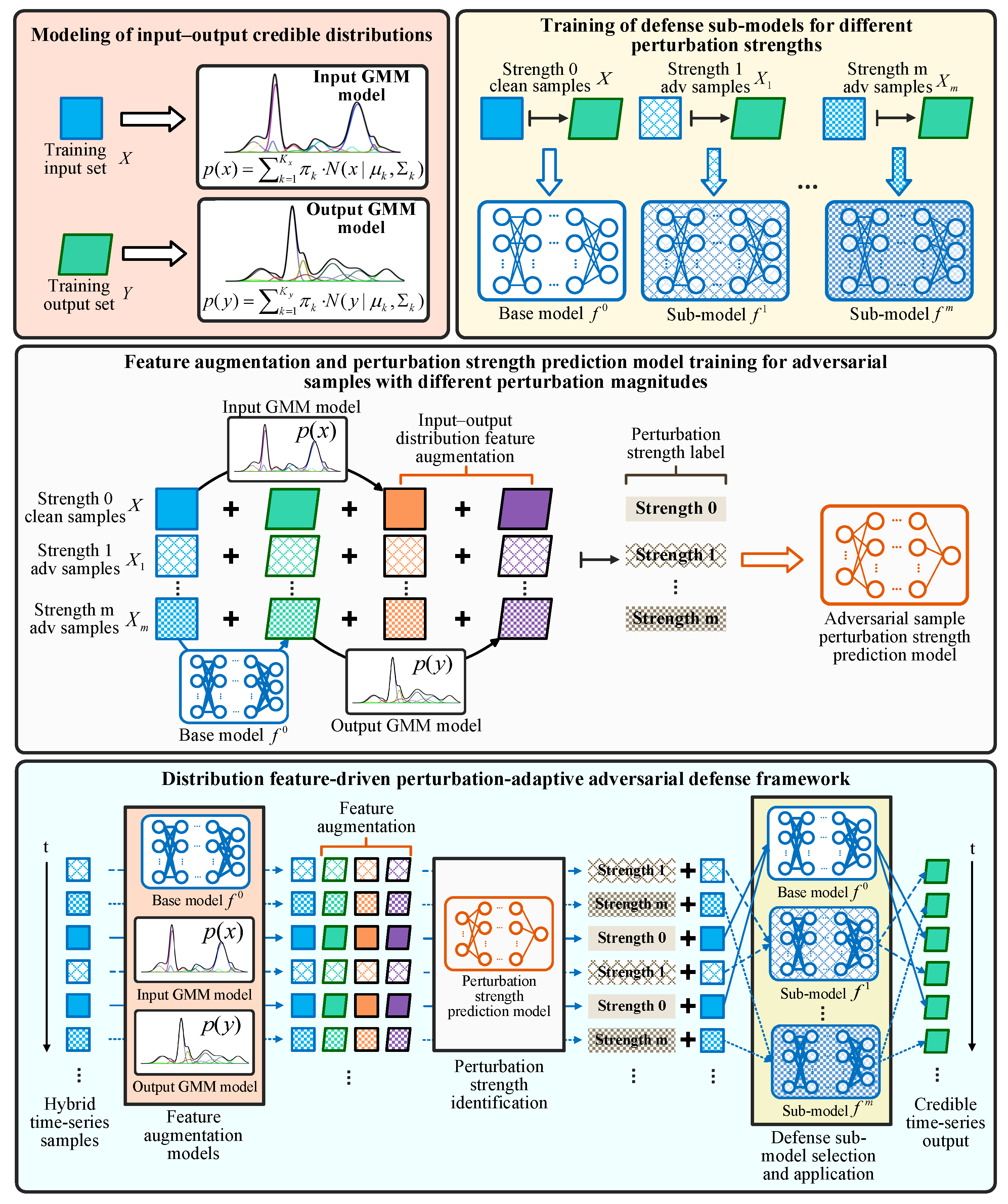
In this work, we introduce the Distribution-driven Perturbation-Adaptive Defense (DPAD) framework, designed to improve the robustness of UAV time-series regression models under multi-type and multi-strength hybrid adversarial attacks. As shown in
Figure 1, the DPAD framework unifies probabilistic distribution modeling, feature augmentation, perturbation strength prediction, and hierarchical sub-model defense into an end-to-end adaptive pipeline.
The overall architecture consists of four primary components, each addressing a distinct stage of the defense process:
- (1)
Modeling credible input–output distributions: Input and output spaces are modeled using Gaussian Mixture Models (GMMs) to represent the statistical characteristics of clean data and provide distributional references for later modules.
- (2)
Training defense sub-models for varying perturbation strengths: A base model is trained on clean samples, and multiple sub-models are trained on adversarial data generated under different perturbation strengths.
- (3)
Feature augmentation and perturbation strength prediction: Log-likelihood and responsibility features derived from the GMMs are combined with the base model outputs to train a predictor that estimates the perturbation strength of each input sample.
- (4)
Perturbation-adaptive defense: During inference, the framework selects an appropriate sub-model according to the predicted perturbation level to generate corrected outputs.
In summary, DPAD integrates distribution modeling, multi-strength sub-model training, feature-based perturbation prediction, and adaptive defense selection into a unified framework that achieves robustness and adaptability in UAV time-series regression tasks.
3.1. Modeling of Input–Output Credible Distribution
Adversarial perturbations are often imperceptible in raw input space, making it difficult to distinguish clean from adversarial samples or to quantify perturbation strength. To address this, we introduce probabilistic input–output distribution modeling using GMMs.
Input distribution modeling:
Output distribution modeling:
where
denotes the probability density function of the
k-th Gaussian distribution, where
and
are the mean vector and covariance matrix, respectively. The coefficient
represents the mixture weight of the
k-th Gaussian component, subject to
.
3.2. Training Defense Sub-Models for Different Perturbation Strengths
To explicitly defend against attacks of varying perturbation magnitudes, we train a set of defense sub-models , each tailored to perturbation level , on top of the base model .
Base model training (clean samples only):
where
denotes clean samples from the training set.
Defense sub-models (adversarial data):
where
denotes adversarial samples generated under perturbation strength
using multiple attack methods (e.g., FGSM, BIM, PGD, CW, APGD).
This strategy ensures that each sub-model is optimized for a specific perturbation level, thereby enhancing robustness under hybrid attack scenarios.
3.3. Training of the Perturbation Strength Prediction Model
We therefore design a prediction model to estimate perturbation strength from augmented features.
The extended feature vector is constructed as
where
denotes the output of the base model, and
represents the responsibility values obtained from the corresponding GMMs.
The prediction network then maps
Z to an estimated perturbation level according to
and is trained by Mean Squared Error (MSE) loss:
Through this design, the model learns to approximate perturbation severity in a continuous manner, providing a quantitative basis for adaptive sub-model selection during inference.
3.4. Inference and Application of the DPAD Framework
During inference, the input sequence may contain both clean and adversarial samples with varying perturbation strengths.
For each sample
, the base model produces
. Input–output log-likelihoods and responsibilities are then extracted via GMMs, forming the augmented feature vector:
The augmented feature
is then passed to the perturbation prediction network
to predict perturbation strength:
The predicted strength is then discretized to select the appropriate defense sub-model
:
Here, we map the predicted perturbation strength to discrete bins (0, 0.01, 0.05, 0.1). Since all features in the dataset are normalized to the range [−1, 1], these perturbation levels roughly correspond to 1%, 5%, and 10% changes in the original data. These thresholds align with the sub-models trained in the subsequent experiments and are chosen as a rough guideline based on perturbation magnitude. They can be adjusted in practical applications to optimize the performance of DPAD.
Finally, the selected sub-model receives the augmented feature vector and outputs the defended result.
5. Discussion
The proposed DPAD framework can effectively defend against multi-type and multi-strength hybrid adversarial attacks in UAV time-series regression tasks by integrating the front-end perturbation strength prediction with the back-end hierarchical sub-model defense. The experimental results show that the DPAD reduces the average MSE about 80% compared to the original model under the hybrid adversarial samples, with nearly the same prediction accuracy on the clean samples. The key factor behind this performance is the feature augmentation based on the GMM. The incorporation of log-likelihood and responsibility values of input–output distributions brings about significantly enhanced feature representation of the model for perturbation strength prediction: the MSE of perturbation strength prediction decreases from to , while increases from 0.6847 to 0.9434. The superiority indicates that the GMM-based feature extraction not only strengthens the discriminative power of perturbation strength classification but also improves the precision of sub-model selection, enabling dynamic adaptation and fine-grained defense in complex adversarial environments.
Yet, despite its effectiveness, DPAD still has its limitations. Its inference time is relatively high at about 2.744 ms per data point, maybe leading to latency bottlenecks in batch inference or multi-sensor fusion scenarios, though within real-time control requirements of typical UAVs. Moreover, it depends on several sub-model trainings and GMM distributional assumptions that should be further validated on generalization for unknown attack types and robustness under high-dimensional, non-Gaussian data distributions. To alleviate the computational overhead, future work could explore lightweight surrogate models to approximate GMM log-likelihood and responsibility computations, as well as batch-wise parallel processing of feature augmentation on modern GPUs, which can significantly reduce per-sample inference time without affecting defense performance. Additionally, the current evaluation uses a publicly available simulated UAV delivery dataset, which, while reflecting realistic flight trajectories under varying speeds, altitudes, and wind conditions, is still limited compared to real-world UAV operations. Future studies aim to collect real UAV delivery trajectories to further validate DPAD’s performance under authentic operational conditions, enhancing the applicability of the framework to practical deployment scenarios.
The future directions include jointly optimizing perturbation prediction and hierarchical defense modules for low latency with high scalability. The GMM may be replaced by more expressive distribution modeling techniques, such as variational Bayesian methods [
31] or deep energy-based models [
32], in order to represent richer input–output feature relationships in the framework with a possibly better perturbation discrimination. Considering online/continual learning paradigms [
33] is another promising direction of extending DPAD for evolution with adversarial pattern variations in order to maintain high performance in dynamic operational environments. Moreover, although the current design primarily focuses on adversarial robustness, future extensions of DPAD may incorporate privacy-preserving mechanisms. For example, perturbation prediction and distributional feature extraction can be performed directly on-board UAVs to avoid transmitting raw sensor data, while techniques such as federated learning [
34], differential privacy [
35], or encrypted model inference [
36] could be introduced to protect sensitive flight or environment information. Integrating these privacy-preserving strategies would improve the applicability of DPAD in large-scale UAV and IoD systems where data confidentiality and mission security are critical.
6. Conclusions
This paper has proposed the Distribution-driven Perturbation-Adaptive Defense (DPAD) framework for UAV time-series regression under multi-type, multi-strength hybrid adversarial attacks. By combining perturbation strength prediction, hierarchical sub-model defense, and GMM-based input–output feature augmentation, DPAD has achieved dynamic adaptation to complex attacks while maintaining high prediction accuracy on clean data.
Experimental evaluations demonstrate that GMM-based feature augmentation significantly enhances predictive performance. In perturbation strength estimation, the MSE decreased from to , and improved from 0.685 to 0.943. Under hybrid adversarial samples, DPAD reduced the average MSE by approximately 80% compared with the base model, achieving in MSE and , while maintaining almost identical accuracy on clean data (MSE: ; ). In contrast, existing adversarial training approaches including EAT and ETR exhibited noticeably higher prediction errors.
We attribute the superior performance of DPAD to the use of GMM-based distributional features, which enhance perturbation strength estimation and improve sub-model selection for hierarchical defense. Although additional processing is introduced by feature extraction and model selection, the framework achieves an average inference time of 2.744 ms per data point, which is sufficient for near-real-time UAV control.
In summary, DPAD provides a robust and scalable defense framework for security-critical time-series applications. It achieves a practical balance among robustness, accuracy, and computational efficiency in complex and adversarial operational environments.




 ,
,