
Article

A Novel Method Based on Eulerian Streamlines for Droplet Impingement Characteristic Computation Under Icing Conditions

1
School of Aeronautic Science and Engineering, Beihang University, Beijing 100191, China
2
International Innovation Institute, Beihang University, Hangzhou 311115, China
*
Author to whom correspondence should be addressed.
Drones 2025, 9(11), 772; https://doi.org/10.3390/drones9110772
Submission received: 29 September 2025 / Revised: 2 November 2025 / Accepted: 5 November 2025 / Published: 7 November 2025
(This article belongs to the Special Issue Recent Development in Drones Icing)

Highlights

What are the main findings?
  • A novel method based on Eulerian streamlines is developed for droplet impingement characteristics under atmospheric icing conditions.
  • The method is validated with different cases and is suitable for drone icing.
What are the implications of the main findings?
  • This work is helpful for ice accretion analysis and anti/de-icing system design for UAVs.

Abstract

Ice accretion alters the airfoil profile of the unmanned aerial vehicle (UAV), degrading the aerodynamic performance and potentially triggering safety incidents. The computation of droplet impingement characteristics is the primary task for ice accretion analysis and the design of anti-icing/de-icing systems for UAVs. To address the disadvantages of the conventional Eulerian method and the Lagrangian method, a streamline-based Eulerian method is established to obtain the droplet impingement characteristics. It only solves the momentum equation to derive the velocity field, eliminating the computational load of the droplet continuity equation. Droplet streamlines are generated via backward integration in the droplet velocity field, allowing impingement characteristics to be calculated. In this scheme, the droplet collection efficiency is computed without the predetermination of droplet release locations or tracking a large number of droplet trajectories. The proposed method is applied to obtain the droplet collection efficiencies in the cases of an NACA0012 airfoil, a two-dimensional (2D) cylinder, an MS (1)-0317 airfoil, and an RG-15 airfoil. The results show good agreement with the data in the literature; therefore, the feasibility and effectiveness of this streamline-based Eulerian method are confirmed. This work can provide a reference for ice accretion analysis and anti-icing/de-icing system design for UAVs.

1. Introduction

Supercooled droplets suspended in clouds impinge on the windward surface of an aircraft, which leads to aircraft icing. Aircraft icing has negative effects on the lift and drag performance of the airfoil, as well as degrading the control response, posing a severe hazard to flight safety. Compared with manned aircraft, the flight missions of unmanned aerial vehicles (UAVs) are more complex [1]. The design of icing detection and anti-/de-icing systems is more difficult in unmanned aerial vehicles (UAVs), which have strict cost and weight constraints in flight missions. In addition, due to its dimensions and rotational speed, a UAV is more sensitive to icing than a manned aircraft, which leads to faster ice accretion [2]. The prediction and detection of aircraft icing are important for UAVs [3,4]. The accurate calculation of the droplet impingement characteristics is one of the most important processes in ice accretion prediction and anti-/de-icing system design [5].
Droplet impingement is defined as an impingement process between the air–droplet particle-laden flow and the aircraft surface, and it is typically modeled using either the Lagrangian or the Eulerian method [6,7]. The Lagrangian method tracks the droplet’s motion separately. In the Lagrangian method, the droplet’s trajectory and termination location are determined by solving the motion equation constructed in Newton’s second law [8]. By releasing droplet particles from numerous spatial locations, droplets’ impingement characteristics, including the impingement limit and local collection efficiency, can be obtained [9]. In the Eulerian method, droplets are treated as a continuous phase, and the droplet volume fraction (the volume fraction of droplets within a given control volume) is applied to construct conservation equations of continuity and momentum. The spatial distribution of the droplet volume fraction and velocity field is derived by solving the conservation equations. According to the droplet volume fraction and droplet velocity at the wall, the impingement characteristics, including the droplet impingement region and the local droplet collection efficiency, can be determined [10].
Investigations of droplet impingement characteristics employing the Eulerian and the Lagrangian methods are well established, and the attributes of each method have been described. The Lagrangian method tracks droplets’ impact behaviors through an iterative process, which is appropriate for computation on a 2D surface or other simple surfaces. In the Lagrangian method, the evolution of particles’ dynamic characteristics is conveniently described, such as through the deformation and breakup phenomena of supercooled large droplets (SLD) or ice crystals. However, its application on three-dimensional (3D) surfaces requires the tracking of a substantial number of trajectories, resulting in low computational efficiency. Moreover, the determination of particles’ seeding locations on complex geometries remains challenging. Considering the computational cost, the Eulerian method is more likely to be employed over the Lagrangian method for droplet collection efficiency calculations on 3D surfaces [11,12]. By introducing the concept of the droplet volume fraction, the momentum and continuity equations constructed in the Eulerian method can be solved in the same manner as the gas phase equations, which contributes to superior computational efficiency on 3D surfaces. However, the Eulerian method requires boundary condition treatments for droplets’ velocity in shadow zones. In addition, the governing equation of motion is highly non-linear, which results in the anomalous accumulation of the droplet volume fraction and the divergence of the numerical results [13].
Investigations of droplet impingement characteristics focus on the optimization of both the Lagrangian and the Eulerian method, as well as extending to applications for specific particles, such as SLD or ice crystals. For the Lagrangian method, Widhalm et al. [14] developed a particle tracking model for an unstructured grid. The key improvements in this scheme include support for the selection of appropriate particle starting positions, initial grid automatic refinement, and cut planes for the determination of particle concentrations at any position. Wang and Loth [15] developed a globally Eulerian/locally Lagrangian approach to predicting the droplet impingement efficiency. In this approach, the droplet concentration is computed along a Lagrangian path, in which the particle velocity divergence is computed in the Eulerian method. Xie et al. [16] optimized the conventional Lagrangian approach by applying an interpolation algorithm based on radial basis functions to estimate droplet properties at given locations. It incorporates an adaptive mesh refinement (AMR) algorithm to compute droplet impingement limits and adopts the streamtube method to calculate the local collection efficiency, ultimately extending this approach to 3D surfaces. Liu et al. [17] incorporated the Monte Carlo method into the Lagrangian solver to obtain the collection efficiency on a complex 3D surface, which exhibited robustness in numerical simulations. Bellosta et al. [18] employed an automatic cloud-front adaptation in droplet seeding algorithm to address the initial seeding and resolution shortcomings of the Lagrangian method. It was also applied to SLD conditions for the computation of the collection efficiency, enabling robustness in droplet tracking algorithms. Lu et al. [19] advanced a Lagrangian method to compute the impingement characteristics of non-spherical ice crystal particles, in which a bisection algorithm was used to determine the release positions corresponding to the impingement limits. Zayni et al. [20] proposed a face-to-face droplet tracking algorithm in 3D ice accretion applications, which mitigates the potential instabilities in the integration of droplet motion equations, as well as accelerating droplet trajectory computations in the Lagrangian method. In this approach, a first-order Eulerian method is used to calculate the droplet velocity field, and the droplet streamlines obtained by this velocity field are employed to estimate the seeding positions.
The Eulerian method is more likely to be applied to compute the droplet impingement characteristics of UAVs due to its high computational efficiency in 3D complex surfaces. The UAV Icing Lab at the Norwegian University of Science and Technology (NTNU) has conducted extensive investigations on UAV icing and anti-/de-icing systems employing DROP3D, which is a Eulerian droplet module implemented in FENSAP-ICE [1,21,22,23]. In the droplet solution of FENSAP-ICE, a streamline upwind Petrov–Galerkin (SUPG) stabilization term is added to remove possible oscillations [13,24]. In the refinement of the Eulerian method, Tong and Luke [25] conducted a detailed analysis of the existence of singularities in droplet-field analytic solutions and developed an automatic, physics-based adaptive numerical diffusion model that stabilizes the solution, as well as eliminating these singularities. Jung and Myong [26] developed a second-order positivity-preserving finite-volume upwind scheme to compute the Eulerian droplet velocity field, which is based on the approximate Riemann solver. The original system is decomposed into the well-posed hyperbolic part and the source term to avoid the non-strictly hyperbolic nature of the conventional Eulerian droplet equations. This new scheme was verified in the testing of 2D numerical results. Blanchet et al. [27] applied an artificial term to refine the droplet equation from a weakly to a strictly hyperbolic one; then, a modified Harten–Lax–van Leer–Contact convective scheme was used to solve the modified hyperbolic equations. This scheme was confirmed to be effective in 2D and 2.5D applications. Chen and Zhao [28] proposed a shadow zone dispersion model in order to circumvent the problem of density impulse in the wake area. In this model, a shadow variable is applied to generate or disperse the shadow cells in computation. The numerical stability and convergence of this model were validated in 3D droplet impingement property calculations. Sotomayor-Zakharov and Bansmer [29] decoupled the droplet continuity and momentum equations in the Eulerian framework, which were solved independently at two different stages. The resultant momentum equation was modified into a conservative form in order to allow the computation of conservative schemes. Two cases were used to verify its convergence stability and second-order accuracy.
In general, the Lagrangian method and the Eulerian method for the computation of droplet impingement characteristics still have limitations. Despite numerous optimization efforts reported in the literature, their shortcomings have not yet been completely resolved. In this manuscript, a novel method based on Eulerian streamlines for droplet impingement characteristic computation under icing conditions is introduced. It modifies the momentum equation of the conventional Eulerian method into a non-conservative form, as well as decoupling the droplet continuity equation and momentum equation. The droplet velocity distribution is obtained through the computation of the momentum equation, and there is no need to calculate the droplet continuity equation, so as to avoid the numerical problems of the conventional Eulerian method. For the calculation of the droplet collection efficiency distribution, droplet streamlines are derived through backward integration in the droplet velocity field, starting from the mesh vertices on the aircraft surface. The distribution of the droplet collection efficiency is determined based on these streamlines. Thus, it avoids the determination of seeding locations and the large computational loads that always appear in the Lagrangian computation of a 3D surface. In Section 2, the mathematical model and implementation details of our proposed method are illustrated. In Section 3, the numerical results of 2D tests are presented for verification and validation, including cases of an NACA0012 airfoil, a 2D cylinder, an MS (1)-0317 airfoil, and an RG-15 airfoil.

2. Materials and Methods

2.1. Governing Equations

The Eulerian method is used to derive the droplet velocity field and droplet concentration at each cell after solving the conservative equations, which is suitable for impingement characteristic computation for a 3D complex surface [29]. In this paper, the following assumptions are adopted when establishing the governing equations for ordinary-sized supercooled water droplets in the Eulerian method: (1) droplets remain spherical, with neither deformation nor breakup occurring; (2) the mutual influence of droplets is not considered, including collision, coalescence, rebound, and splashing; (3) the droplet momentum equation neglects viscous and pressure terms; (4) no mass or heat transfer occurs between the droplets and the surrounding air during droplet motion; (5) turbulent effects on the droplets are neglected; (6) the only force acting on a droplet is the steady aerodynamic drag, while gravity and all other forces are disregarded. Consequently, the Eulerian governing equations for the droplet phase are established, and the continuity and momentum equations are given below [29]:
α t + α u = 0
α u t + α u u = α K u a u
where  α  is the droplet volume fraction,  t    is the time,    u  is the droplet velocity vector, and  u a  is the air velocity vector.  K  is the air–droplet exchange coefficient, defined as
K = 18 μ a f ρ d p 2
where  μ a  is the air viscosity,  ρ  is the droplet density,    d p  is the droplet diameter, and  f  is the drag function. In the Schiller and Naumann model,  f  is defined as below:
f = C D R e 24
where the droplet drag coefficient  C D  is computed as
C D = 24 ( 1 + 0.15 R e 0.687 ) / R e   R e 1000 0.44 R e > 1000
and the relative Reynolds number  R e  is given as
Re = ρ a u a u d p μ a
where  ρ a  is the air density.
In previous research, various numerical instabilities easily occurred due to the non-strictly hyperbolic nature of the conventional Eulerian droplet equations [28]. Considering impingement characteristic calculations using the Lagrangian method, it obtains the droplet impingement characteristics from the droplet trajectories, without calculating the distribution of the droplet volume fraction. Moreover, such droplet trajectories can be described by the droplet velocity field, which is derived from the computation of the momentum equation. Therefore, we solve the droplet momentum equation without the continuity equation to obtain the droplet velocity field and collection efficiency distribution, neglecting the influence of the droplet volume fraction. In this manuscript, the continuity equation and momentum equation are decoupled. Droplet motion is only described with the momentum equation, which is in a non-conservative form and is free of droplet volume fraction terms [24,29]:
u t + u u = K u a u
Since Equation (7) is in a non-conservative form, its convective terms cannot be discretized and solved using conservative difference schemes. A mathematical reformulation of the Hamiltonian operator is introduced, where  ψ  is a vector and  ϕ  is a scalar:
ψ ϕ = ϕ ψ ϕ ψ
By modifying the convective term of Equation (7), the non-conservative droplet momentum equation is thus transformed into a conservative form:
u t + u u = u u + K u a u
Applying the scalar  u  and  v  to stand for each cartesian component of the vector  u  in 2D computation, respectively, we obtain
u t + u u = u u + K u a u
v t + v u = v u + K v a v
For such a modified form of the droplet momentum equation presented above, the entire right-hand side (RHS) is treated as a source term; then, it can be solved employing conservative schemes in CFD. Additionally, the boundary condition for the impingement surface requires special treatment, as in the conventional Eulerian method. In this manuscript, the boundary condition is defined as follows.
The values of droplet velocity components at the impingement surface are defined to be the same as adjacent cell values. The dot product value of the droplet velocity and the surface normal vector is checked by iterating. When the droplet velocity vector points toward the surface, it indicates that this cell is located in the droplet impingement zone, and its velocity can be obtained by interpolating flow field data. Conversely, when the velocity vector points away from the surface, it represents a non-impingement zone. In this case, a slip boundary condition is applied (where the normal component of the velocity relative to the surface is set to zero), preventing the aircraft wall from transmitting information into the computational domain.

2.2. Streamline and Impingement Characteristics

In conventional Eulerian methods, the droplet continuity and momentum equations are solved to obtain the droplet volume fraction distribution and velocity field, which are used to calculate the local collection efficiency. In this work, we only solve the momentum equation to derive the velocity distribution. Based on this foundation, droplet streamlines are generated via backward integration starting from the vertices of the 2D surface mesh, and then the droplet impingement characteristics are obtained.
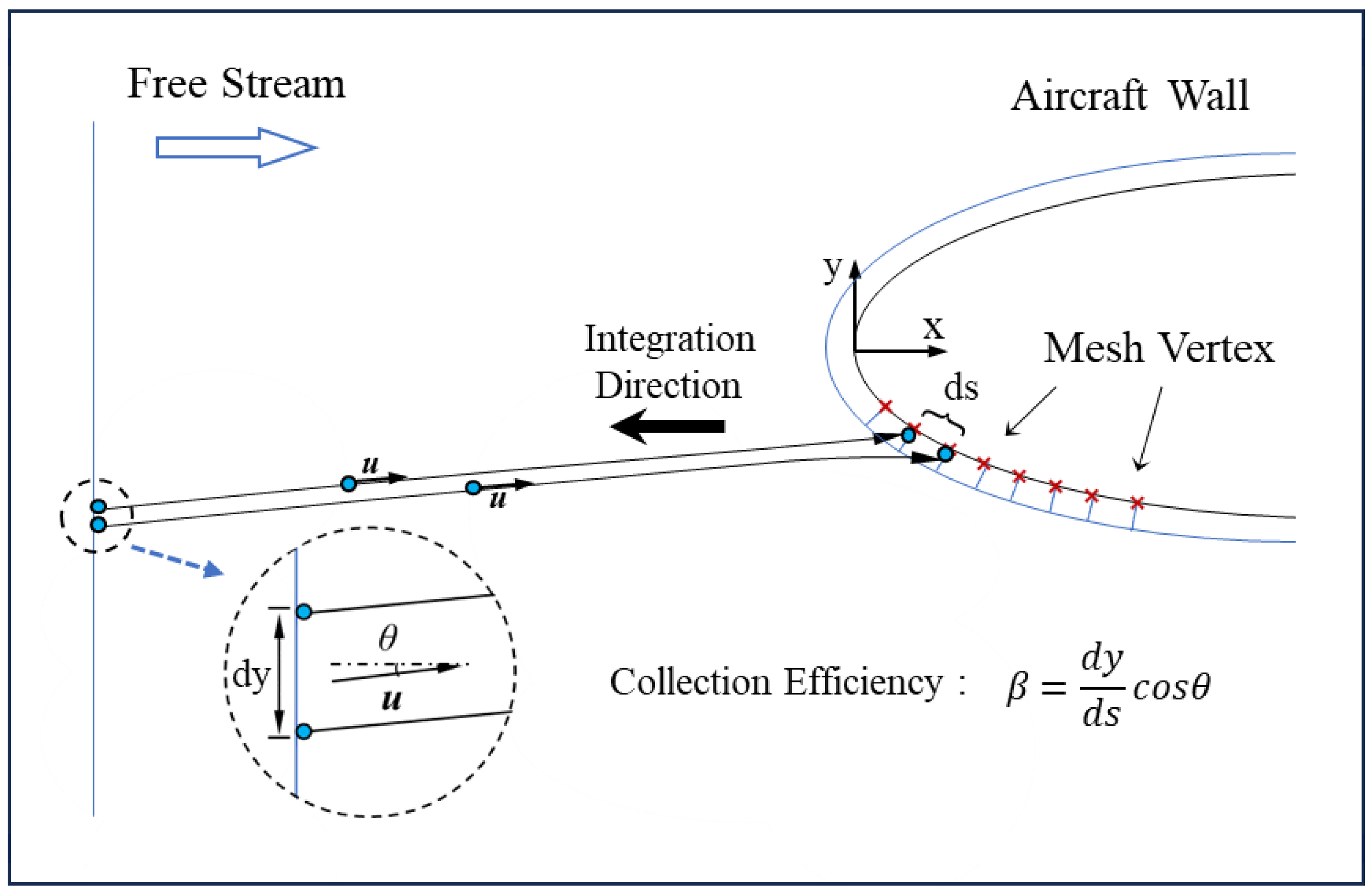
The motion of fluids can typically be described using either the Lagrangian or the Eulerian method, and its governing equations can be established. These two approaches describe the same physical process from different perspectives. Therefore, the droplet trajectories in the Lagrangian description and the droplet streamlines in the Eulerian description should coincide when the flow is in a steady state. Thus, this study considers the water droplet motion and impingement processes during aircraft icing as steady-state phenomena. After obtaining the steady-state velocity field by solving the momentum equation, droplet streamlines can be acquired through integration. The computational procedure for the two-dimensional case is illustrated in Figure 1.
Since the Eulerian method provides the entire droplet velocity field after computation, the streamlines of corresponding impinging droplets can be obtained through backward integration from the locations of surface mesh vertices. This scheme avoids the problem of the predetermination of the droplet release positions, which has been widely investigated in conventional Lagrangian methods. The streamline tracing procedure includes two main steps, as illustrated in Figure 1. The first step is mesh vertex traversal. The algorithm identifies all surface mesh nodes on the aircraft wall and obtains the local droplet velocity of the node. When the local droplet velocity points toward the wall, the coordinates are recorded as the starting point of integration. The second step is droplet streamline integration. According to the location of the starting point, the velocity at this position is determined through interpolation. Using this velocity vector, the droplet position at the previous time step is obtained through backward integration along the velocity direction. The integration is performed as follows:
χ i + 1 = χ i u Δ s
where the subscript  i  denotes the integration step,  χ i  denotes the current location of step  i , and  Δ s  is the length of the time step. Given that the droplet velocity is oriented toward the wall, a “ ” sign is used for the integration instead of a “ + ”.
By iterating this procedure, the streamline and the corresponding ending point in the far-field region of the droplet can be obtained. After the iteration of the first and second steps, all droplet streamlines that start at wall mesh vertices in the droplet impingement zone are obtained. Finally, all cells in the droplet impingement zone are traversed, and the corresponding droplet streamlines are used to calculate the droplet collection efficiency  β :
β = d y d s c o s θ
where  d s  denotes the arc length spacing of surface mesh elements,  d y  represents the difference in corresponding streamlines in the far-field region, and  θ  indicates the angle of attack.
In this scheme, we compute the Eulerian non-conservative momentum equation to obtain the droplet velocity field; then, the distribution of the droplet collection efficiency is derived from the streamlines, which are integrated from the velocity field. The modified momentum equation is compatible with the transport equation (which is introduced in Section 2.3), so it has inherent computational efficiency, as in the conventional Eulerian method. Compared with the Lagrangian method, this scheme is more suitable for droplet collection efficiency computation on a 3D surface, since it eliminates the need to predetermine seeding points and reduces the computational burden. Moreover, the droplet continuity equation is not computed in this scheme, so the problems of singularities and errors introduced by the corresponding optimal approach, which are common in the conventional Eulerian method, are avoided.

2.3. Numerical Implementation

In this manuscript, the implementation of our modified Eulerian method and the computation of the droplet impingement characteristics are conducted entirely within the computational fluid dynamics (CFD) software FLUENT 19.1. The air–droplet two-phase flow under icing conditions is considered as one-way coupled [11,13], meaning that the air influences droplet motion through drag forces, while the droplets exhibit negligible effects on the airflow. The steady airflow field is obtained by solving the Reynolds-averaged Navier–Stokes (RANS) equations with the finite volume solver of FLUENT. Based on the airflow field, the droplet momentum equation is solved by FLUENT’s user-defined scalar (UDS) transport equation. The general form of a user-defined scalar (UDS) transport equation is as follows [30]:
ϕ k t + x i F i ϕ k Γ k ϕ k x i = S ϕ k   k = 1 , , N s c a l a r s
where  ϕ k  denotes a user-defined scalar;  F i Γ k , and  S ϕ k  represent the convective term, diffusive term, and source term of the transport equation, respectively. By specifying the four coefficients through the user-defined function (UDF), the UDS equation is fully defined and can be solved. Herein, for the computation of the momentum equations (Equations (10) and (11)), the velocity components u and v are individually defined as user-defined scalars; then, the momentum equations are discretized. The left-hand side (LHS) denotes a temporal and a convective term, while the whole RHS represents a source term. Then, the finite volume solver in FLUENT is utilized for iterative solution to obtain the distribution of the droplet velocity field. Based on the velocity field, the streamline of the corresponding impinging droplet can be obtained through backward integration. Finally, the distribution of the droplet collection efficiency is obtained.

3. Results and Discussion

In this section, the cases of an NACA0012 airfoil, a 2D cylinder, an MS (1)-0317 airfoil, and an RG-15 airfoil are used to validate the streamline-based Eulerian method proposed in this paper.

3.1. NACA0012 Airfoil

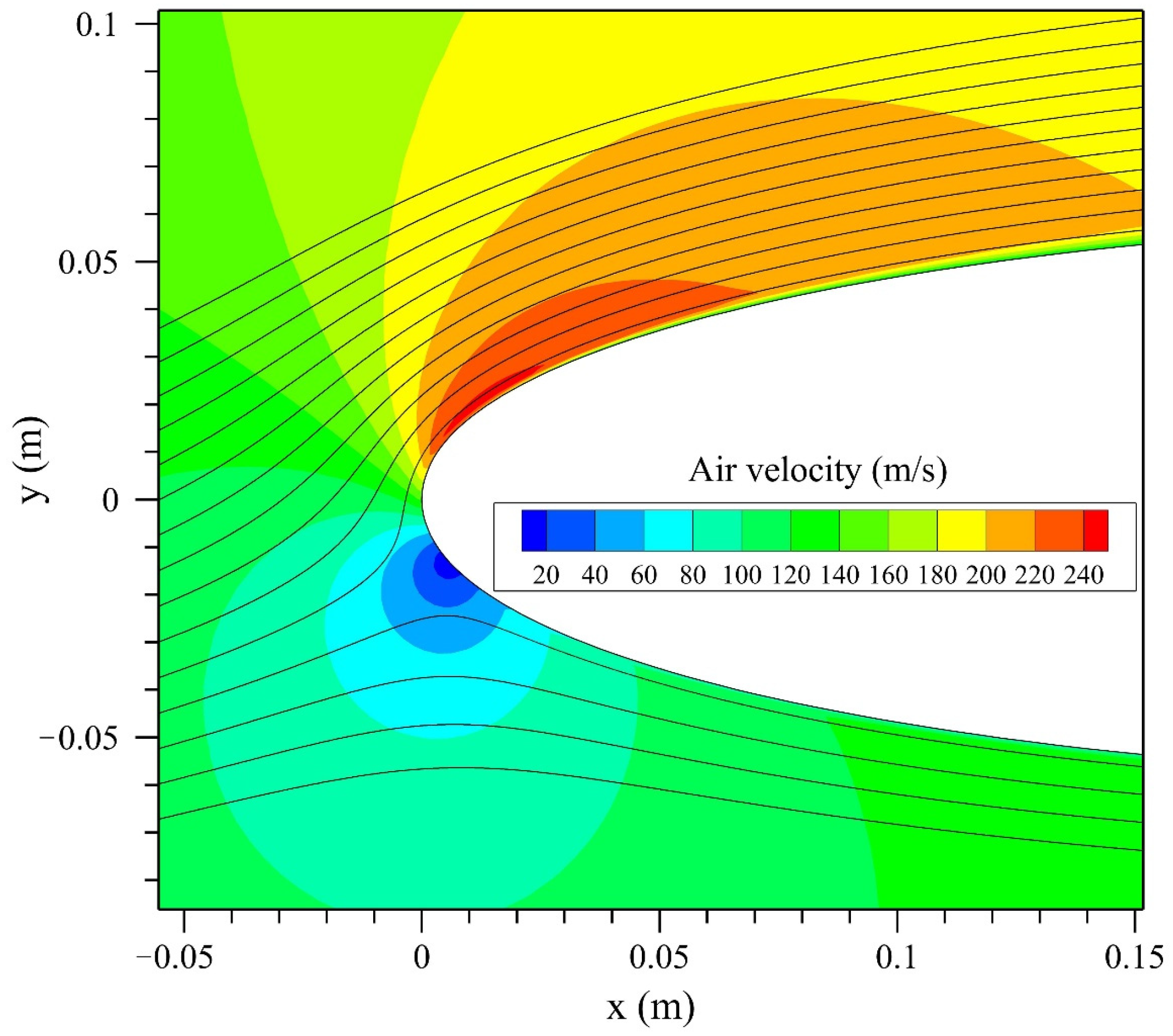
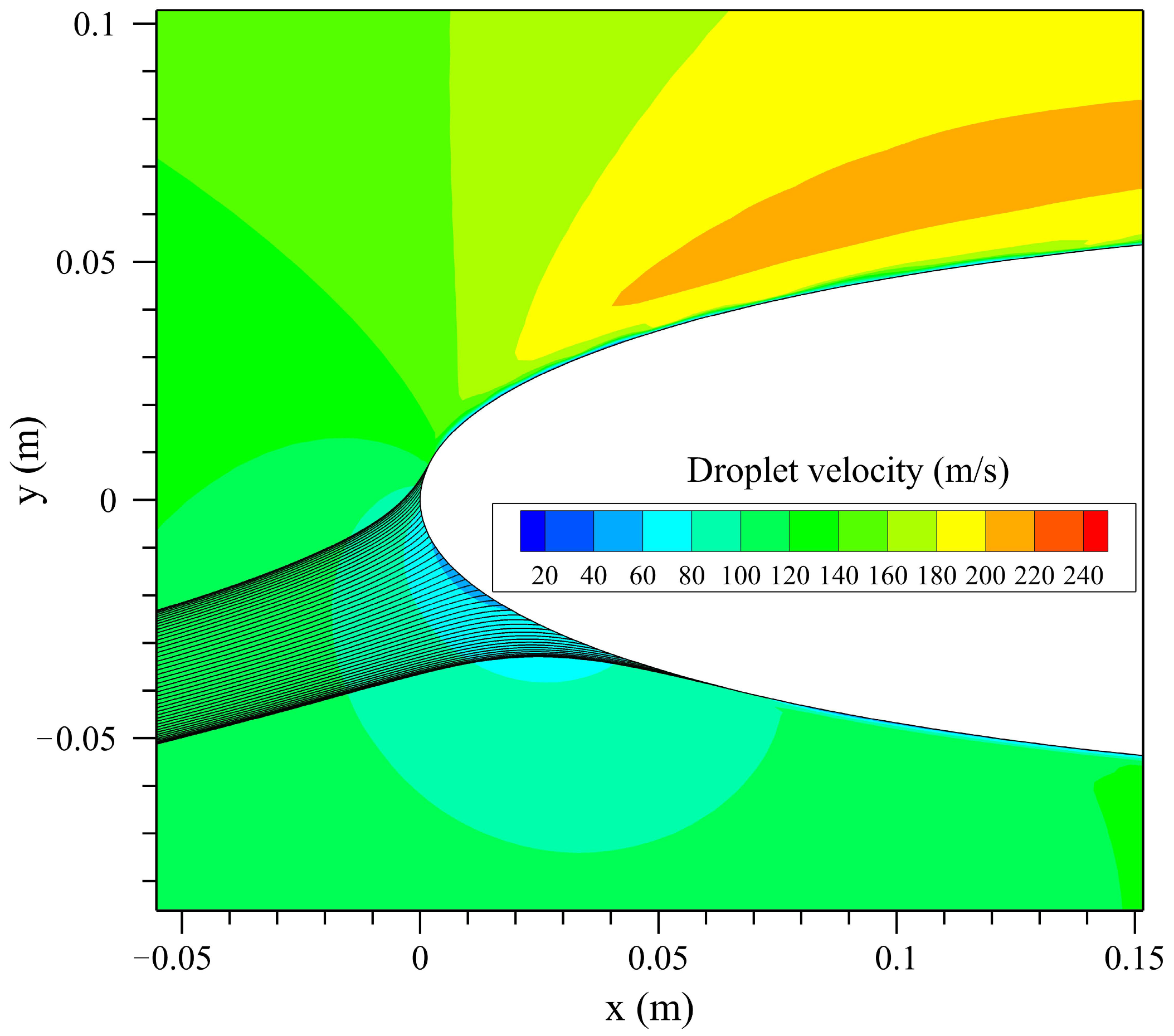
An NACA 0012 airfoil with a unit chord length at a  5 o  angle of attack is applied as a test [10]. The freestream Mach number is 0.4. The inlet gas temperature is 300  K    and the ambient pressure is 1  atm . The diameter of impinging droplets is  16   μ m . In this work, the Spalart–Allmaras model is used to compute the airflow field, and a pressure-based solver is selected. The droplet momentum equation is solved using a second-order upwind scheme; then, both the droplet velocity field and corresponding streamlines can be obtained. Figure 2 and Figure 3 illustrate the distributions of the air velocity field and the droplet velocity field, respectively, where the black solid lines represent the streamlines. As observed, due to the positive angle of attack, a low-velocity region exists near the stagnation point on the lower surface of the leading edge. Below the airfoil, the air velocity remains relatively low, whereas, above the airfoil, the airflow accelerates, reaching a maximum velocity exceeding 240 m/s. The air velocity near the aircraft wall is parallel to the airfoil surface due to the no-slip boundary condition, while a portion of the droplets impinges on the wall, and the droplet velocity at the impingement limit is tangent to the airfoil surface.
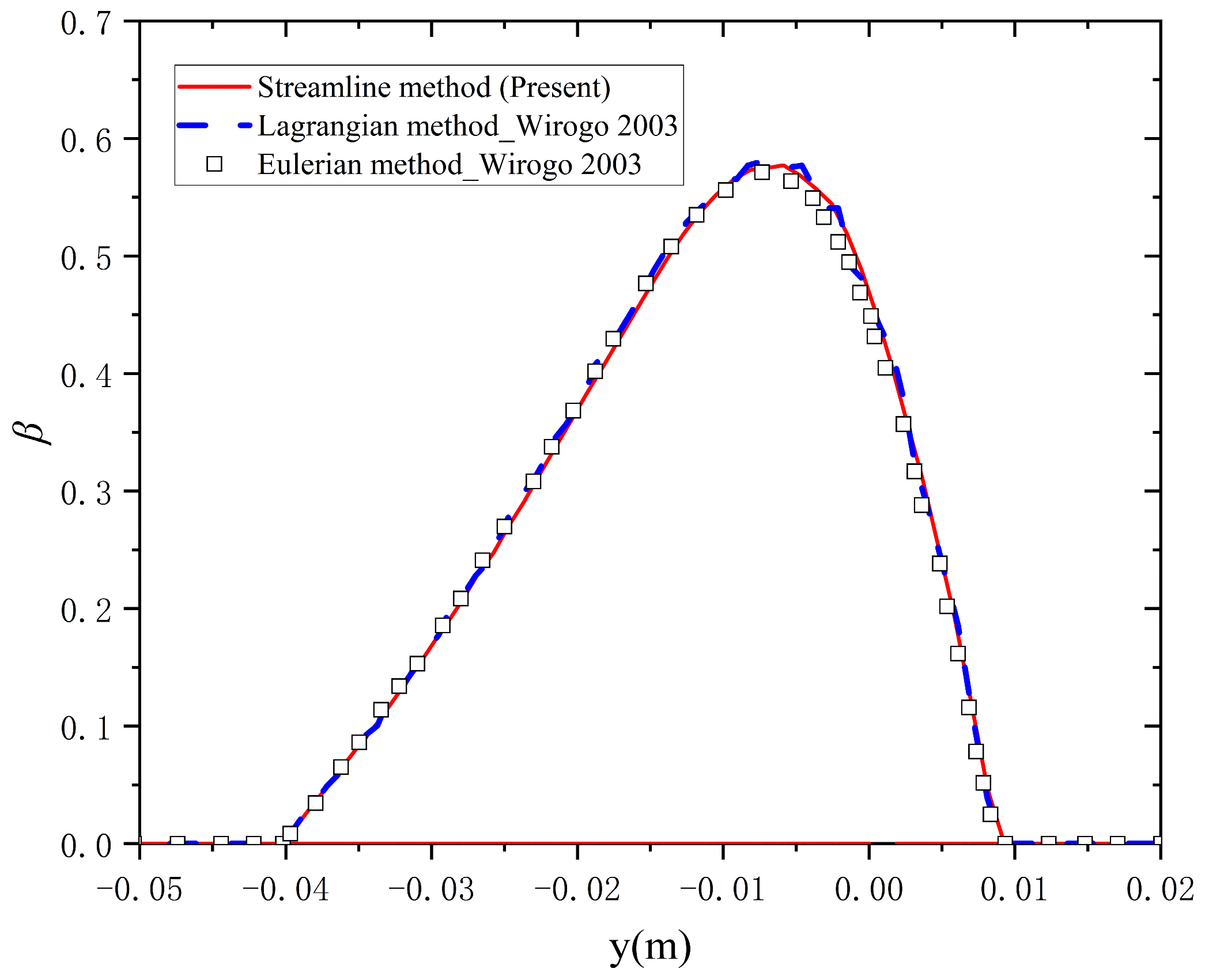
Figure 4 compares our collection efficiency distribution with those obtained from the conventional Eulerian method and the Lagrangian method [10]. As shown in the figure, the results of the present method show excellent agreement with the references, indicating the feasibility and effectiveness of our streamline-based method.

3.2. 2D Cylinder

The second validation case is the 2D flow around a cylinder [25]. The diameter of the cylinder is 10.16  cm . The freestream air velocity is 80 m/s, and the air density is 1.097  kg / m 3  at the inlet. The ambient pressure is 489,867  Pa . In this case, seven droplet diameters, following the Langmuir-D distribution, are used in the simulation, and the median volumetric diameter (MVD) is 16.0  μ m . The individual results are weighted to obtain the final outcome, as shown below:
β = j = 1 M w j β j
where  M  denotes the total number of droplet sizes,  w j  represents the weight coefficient of the  j th group of droplets, and  β j  is the corresponding collection efficiency. The Langmuir-D distribution is listed in Table 1.
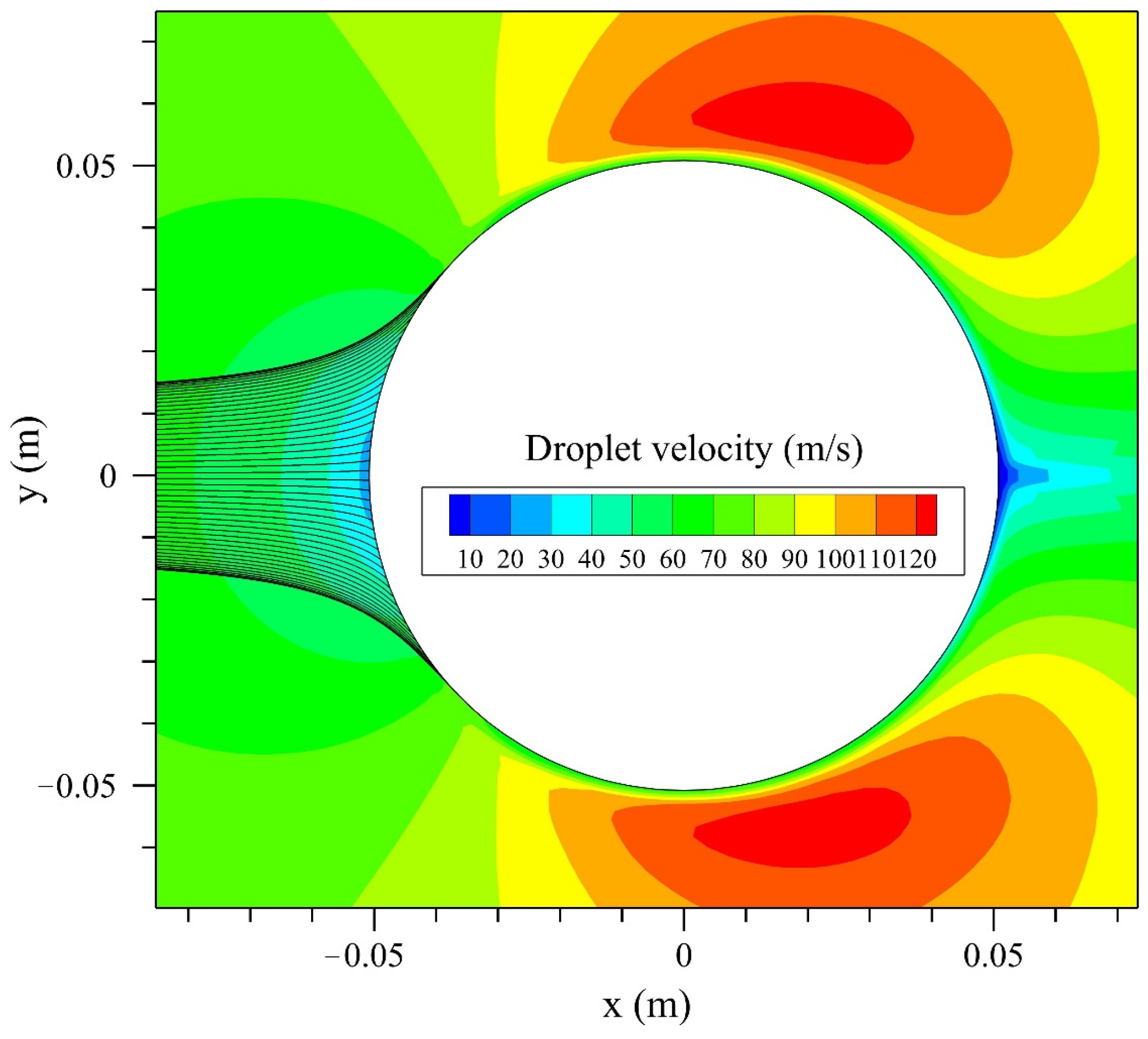
Given that the freestream Mach number is less than 0.3 and the geometry is relatively simple, the incompressible and inviscid flow model is adopted for the computation of the airflow field. Second-order schemes are employed for the computation of both the airflow field and the droplet velocity field. Figure 5 illustrates the droplet velocity distribution around the 2D cylinder for a droplet diameter of 16  μ m  (the same value as the mean volume diameter). The black solid lines represent the droplet streamlines in the impingement region.
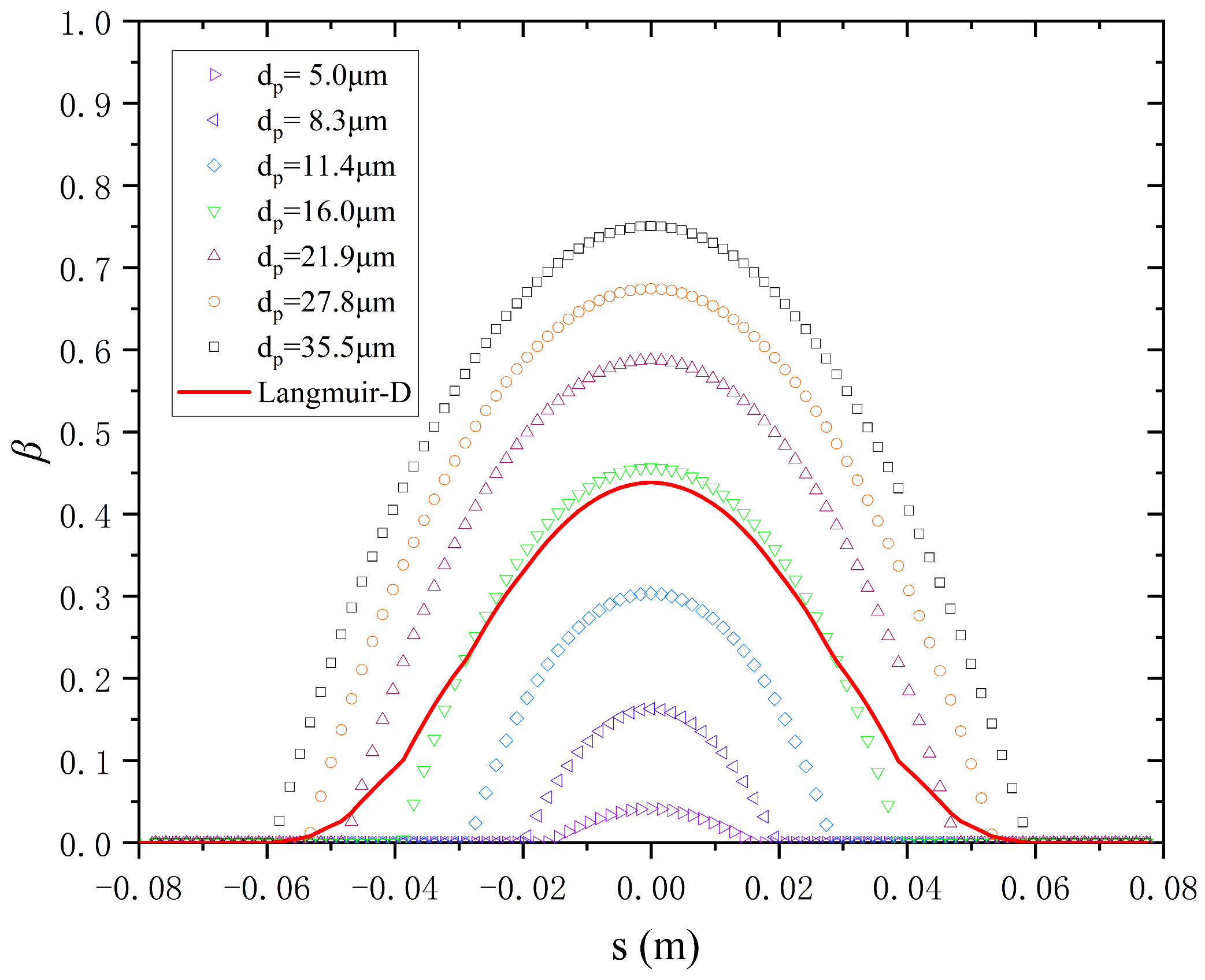
All groups of droplets are computed to obtain the corresponding droplet streamlines and the distribution of the droplet collection efficiency. The collection efficiency distributions for all diameters, along with the final weighted results, are presented in Figure 6. The local droplet collection efficiency exhibits a symmetric distribution over the surface of the cylinder. The peak value occurs at the stagnation point and gradually decreases along the curvilinear coordinates toward both sides before diminishing to zero at the impingement limit. For larger-diameter droplets, their greater mass makes their motion less affected by airflow variations, resulting in a higher peak value and a larger impingement range.
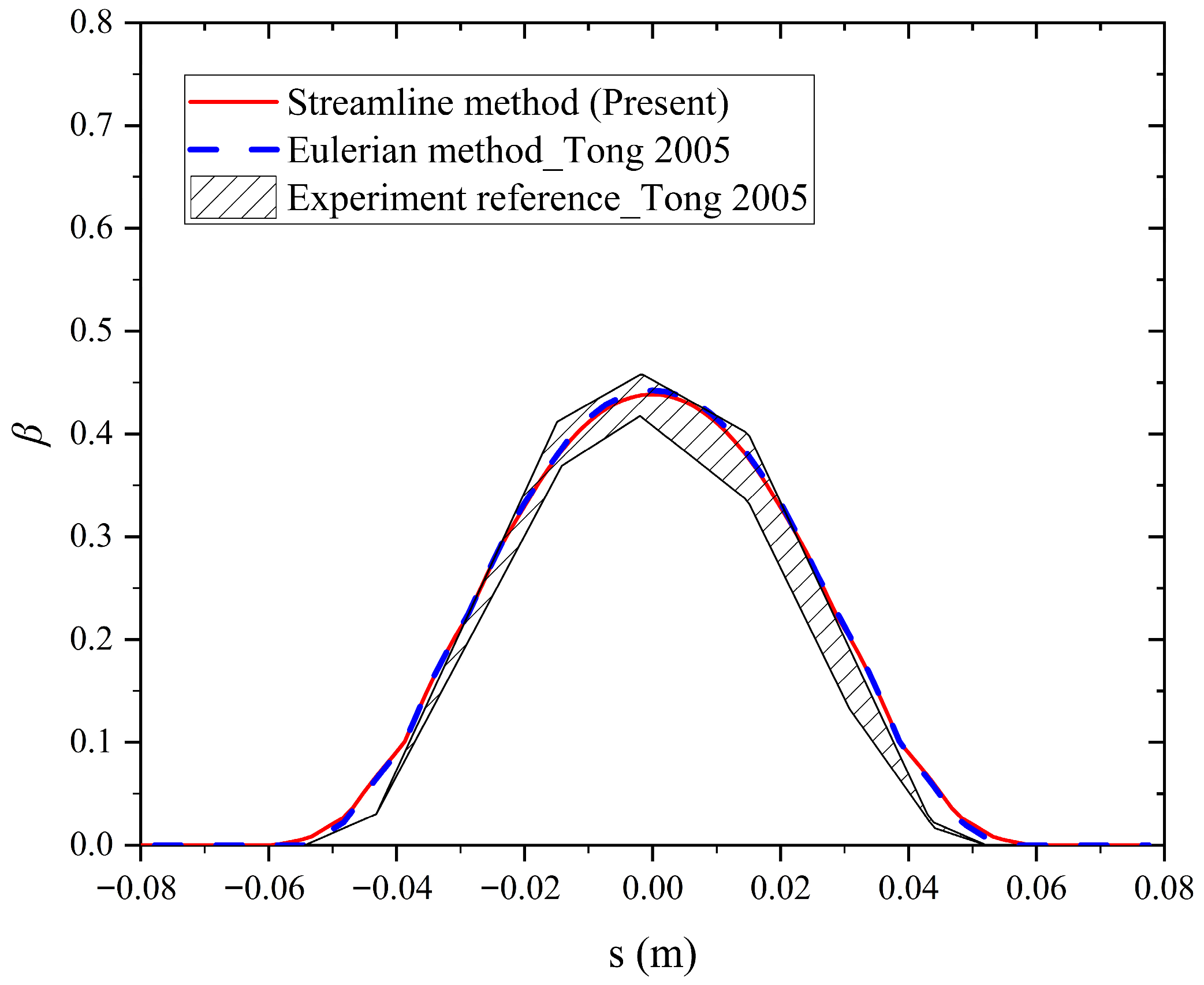
A comparison of the droplet collection efficiencies computed by the present method with those reported in the literature is presented in Figure 7. The blue dashed line represents the computational results from the conventional Eulerian method, and the shaded area indicates the range of the experimental data. It can be observed that the results of our present method show good agreement with the numerical results obtained by the conventional Eulerian method. The results of the present method mainly fall within the range of the experimental data, with only minor deviations observed near the impingement limits. This indicates excellent consistency between the present method and experimental data, thereby validating the effectiveness and accuracy of the proposed approach.

3.3. MS (1)-0317

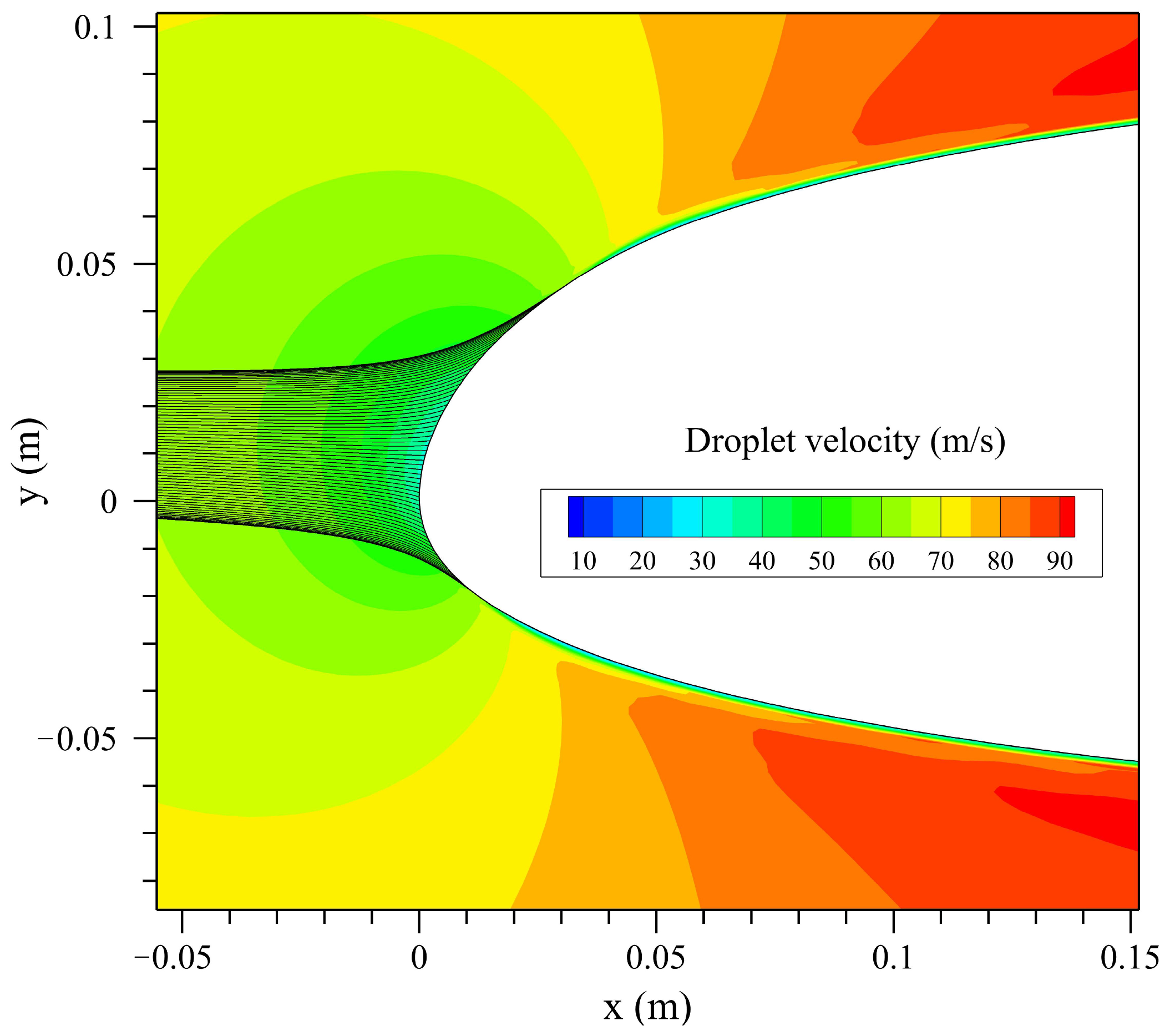
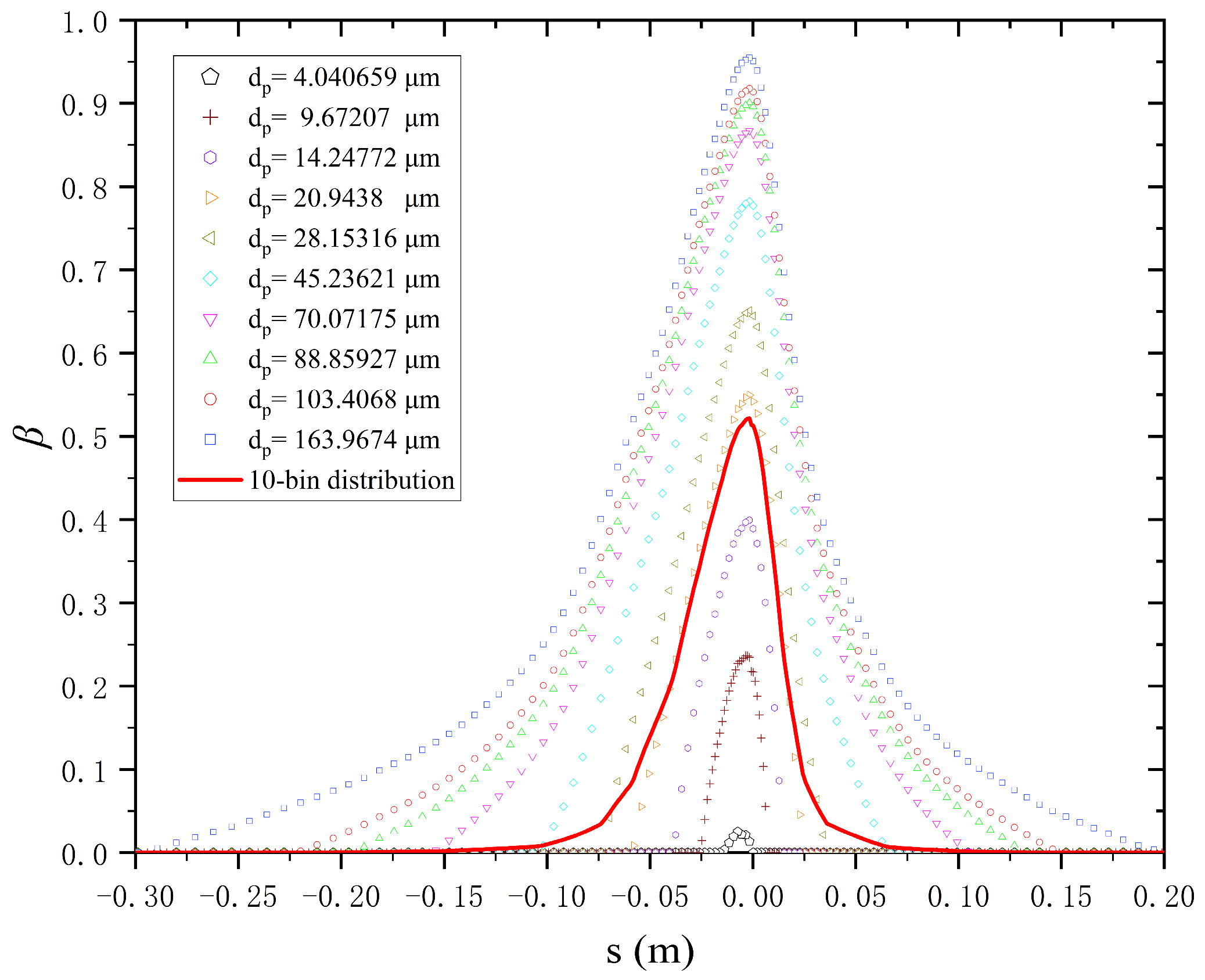
To verify the performance of the scheme, a case similar to the one tested by Papadakis is used [31]. In this case, an MS (1)-0317 airfoil is applied, with a chord length of 0.9144  m . The freestream velocity is 78.232  m / s , the ambient pressure is 95,292  Pa , and the air density is 1.213  kg / m 3 . The angle of attack of the airfoil in the icing wind tunnel is 0°, while, in the simulation, the angle of attack needs to be set to −1.85° to match the actual pressure distribution [30]. The actual droplet diameter distribution is detected and a 10-bin droplet size distribution is provided for simulation, as listed in Table 2. Ten different droplet sizes with a median volumetric diameter (MVD) of 21   μ m    are computed separately. Figure 8 illustrates the droplet velocity distribution and streamline patterns for a droplet diameter of 20.94  μ m  (approximately equal to the MVD of droplets, which is 21  μ m ). The velocity contour and droplet streamlines demonstrate a similar distribution to the 2D cylinder case.
Figure 9 illustrates the local collection efficiency distribution for each droplet size, as well as the final weighted result with the MVD of 21  μ m . The leading edge of the airfoil is represented by the curvilinear coordinate s = 0, and the top surface of the airfoil is defined as the positive value. It can be observed that the droplet collection efficiency reaches its maximum value at the stagnation point for all droplet sizes. Furthermore, larger droplet diameters correspond to wider impingement ranges. As the droplet diameter increases, the peak value of the collection efficiency gradually rises. This phenomenon is consistent with the prediction results from the 2D cylinder case.
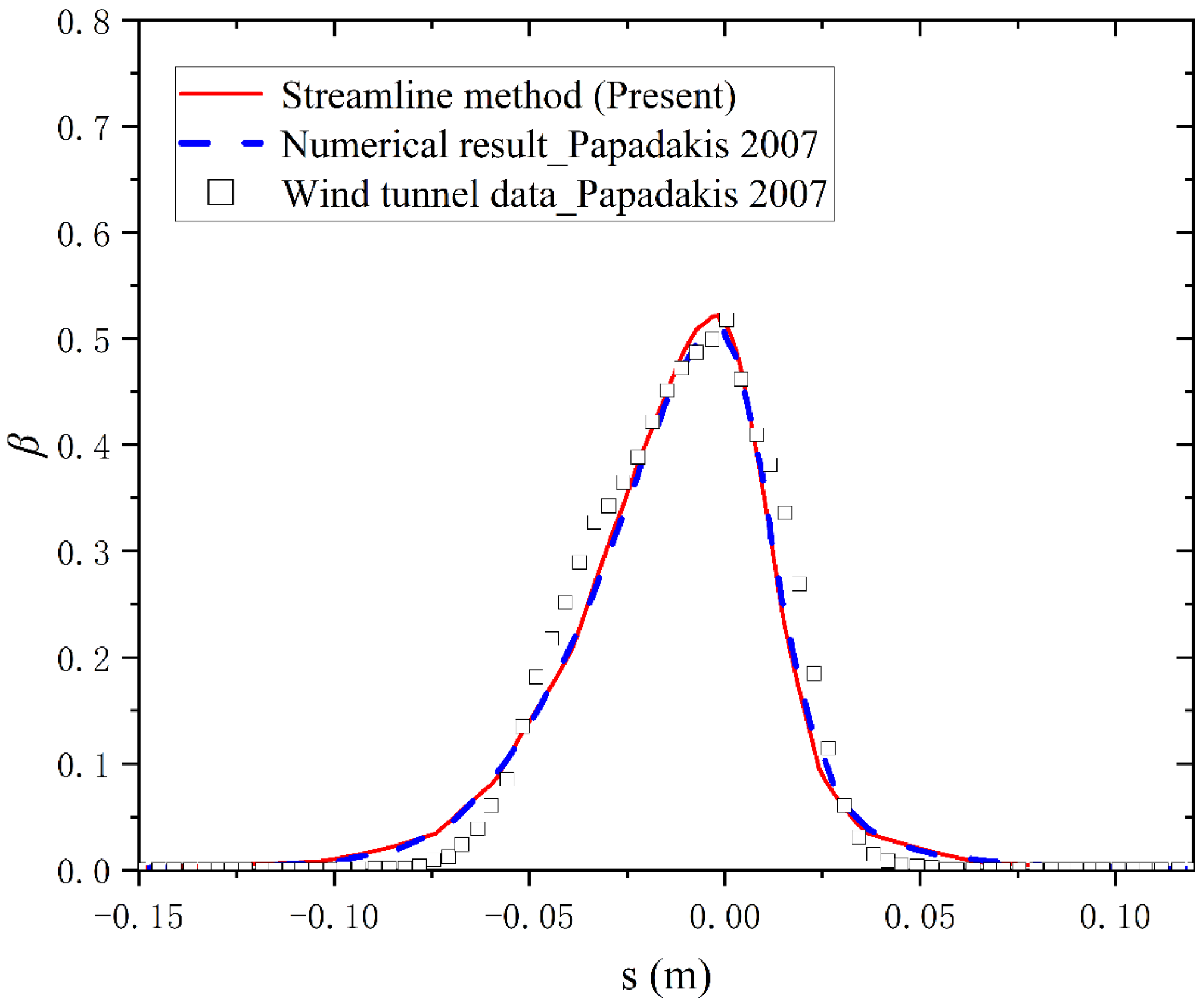
In Figure 10, the computational results of the streamline-based method are compared with both numerical results from the literature and experimental data. It illustrates that the droplet collection efficiency computed by our present method is in excellent agreement with the numerical results from the literature, demonstrating the reliability of our streamline-based calculation approach. The wind tunnel data are not exactly the same as the numerical results, which is primarily because the real droplet distribution in the icing wind tunnel does not strictly agree with the 10-bin distribution used in the simulation. Moreover, considering the operational constraints, slight airflow non-uniformities may have occurred during the early stage of droplet release in the wind tunnel experiment. This may promote the coalescence of smaller droplets into larger ones, consequently leading to a reduction in the impingement limits. In addition, the large droplets’ effects are not considered in this research, as indicated in the assumptions. To summarize, it is suggested that the present results correlate well with both the numerical and experimental data, providing further validation of the method’s effectiveness.

3.4. RG-15 Airfoil

An RG-15 airfoil is selected to validate the calculation effectiveness of this method for UAVs, since this airfoil is typical for small fixed-wing UAVs with low Reynolds numbers [21]. The selected RG-15 wing was tested in the icing wind tunnel of the VTT Technical Research Centre of Finland in Helsinki and selected as an icing validation case by the IPW2 (2nd AIAA Ice Prediction Workshop) organizer [32]. The chord length of the RG-15 airfoil is 0.3  m , and the droplet MVD is 27  μ m . Numerical simulation is carried out at a freestream Mach number of 0.076 with an AOA of 4°. A compressible and viscous model, as well as the Spalart–Allmaras turbulence model, is selected to compute the airflow field.
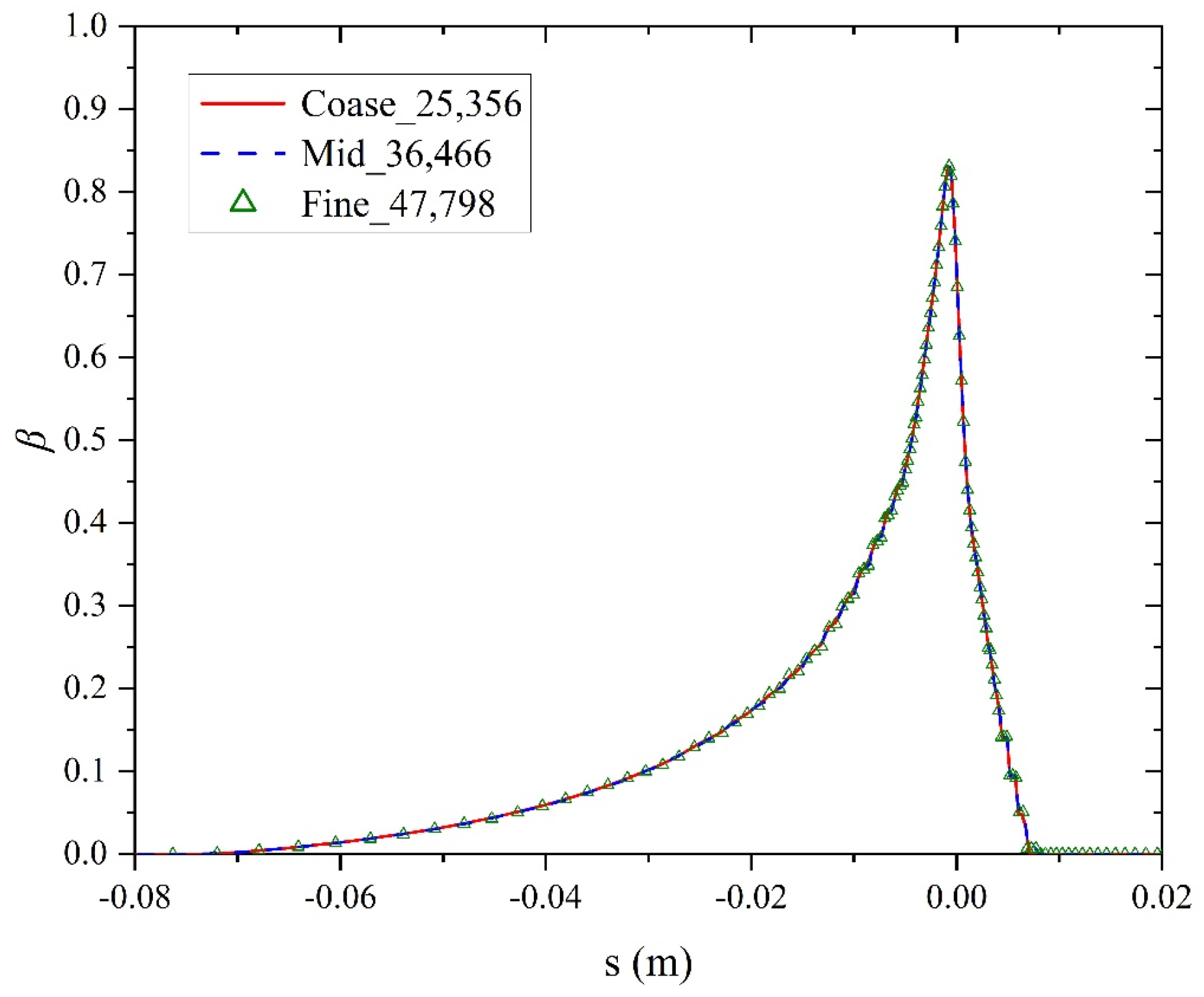
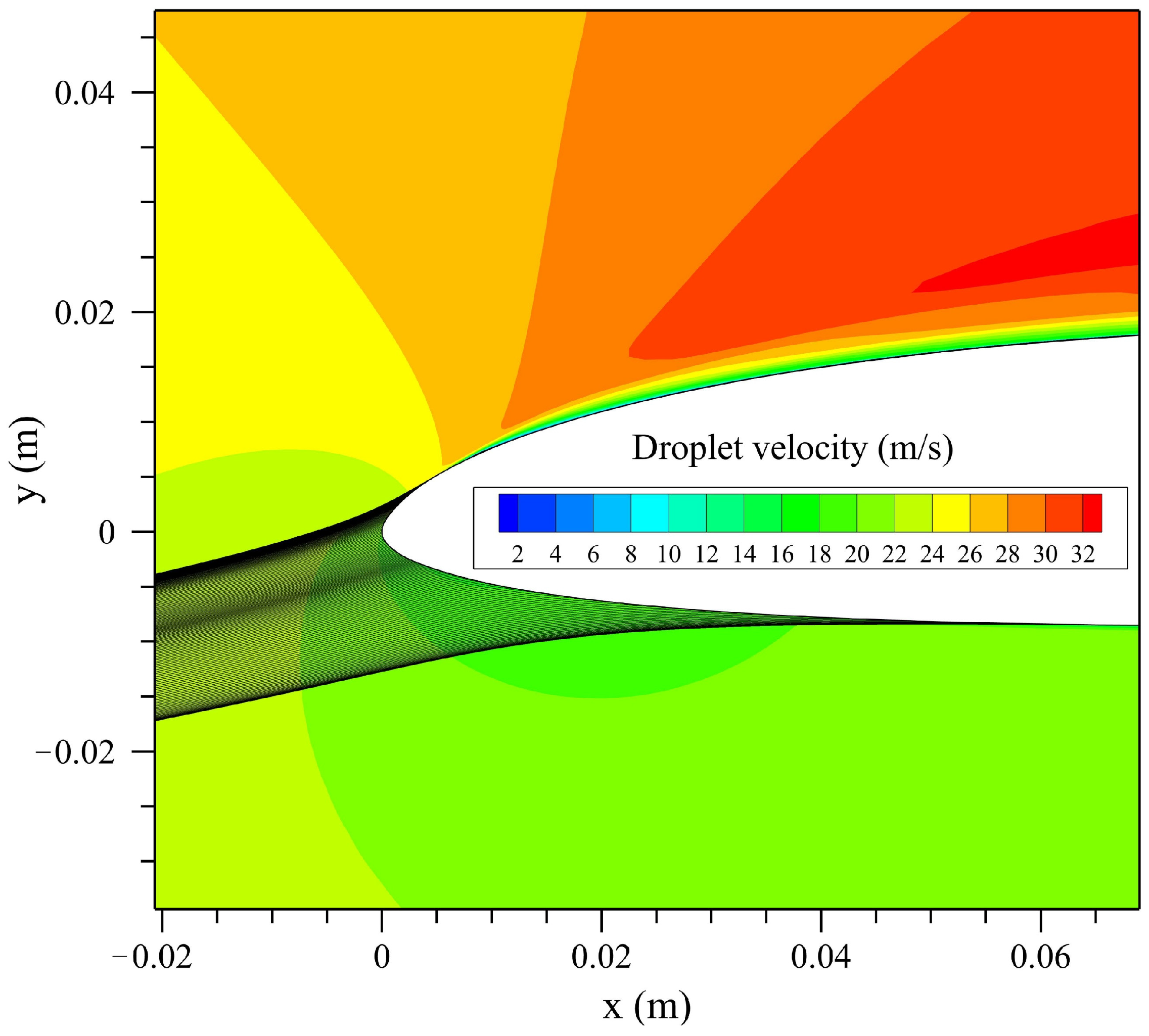
Three mesh sizes are selected for mesh independence verification. The computational results, as well as the corresponding total grid numbers, are presented in Figure 11. It can be observed that the numerical results (droplet collection efficiency) remain independent of the mesh density. The computational mesh used in this study consists of 94,592 elements in total. Figure 12 illustrates the droplet velocity field and corresponding streamline distribution around the airfoil. It can be seen that droplet impingement primarily occurs on the lower surface of the airfoil. As the airflow on the upper surface of the airfoil is accelerated, the droplet velocity consequently reaches the maximum value of about 32.63 m/s. It can be observed that the entire surface of the airfoil does not experience droplet impingement. Beyond the impingement limit, droplet impingement is effectively prevented by the near-wall airflow along the surface.
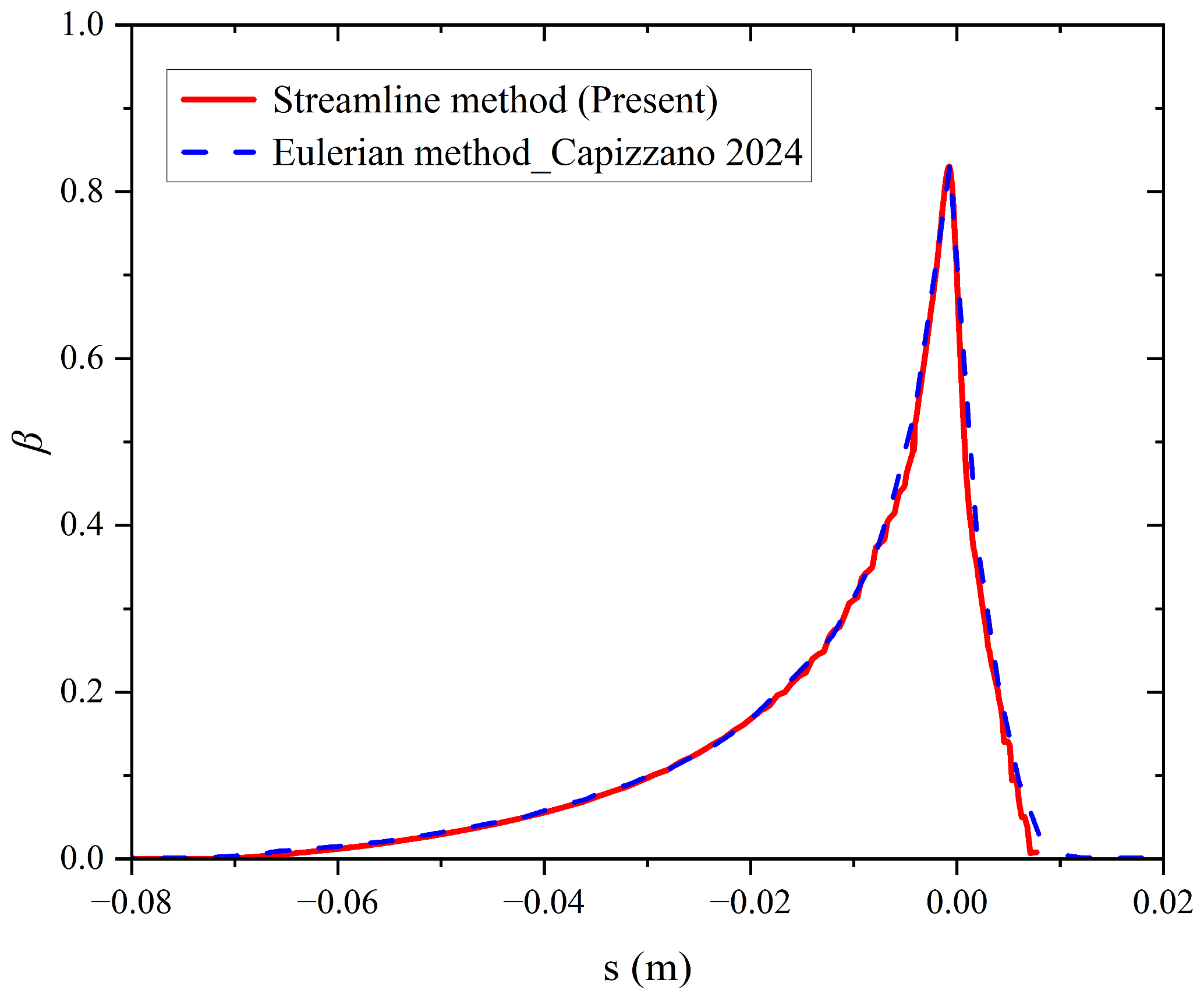
The droplet collection efficiency computed by the streamline-based method and the Eulerian method [32] is shown in Figure 13. In this case, we investigated the droplet collection efficiency distribution on the airfoil’s leading edge. The results computed by our method correlate well with the reference data, with the exception of a slight deviation at s = 0.01  m . It is speculated that the deviation may be attributed to the inaccuracies of the droplet volume fraction distribution. Given that our method does not solve the continuity equation, the presented results are not affected by the accuracy of the droplet volume fraction distribution. In summary, the proposed streamline-based method demonstrates both accuracy and effectiveness in calculating the droplet collection efficiency of airfoils commonly used in UAVs.

3.5. Discussion

Based on the above results, the streamline-based Eulerian method is validated for droplet impingement characteristic computation under icing conditions. To analyze the computational efficiency of this method, the calculation time is compared with that of the conventional Eulerian method as described in Ref. [6]. Since the droplet continuity equation is not solved in the streamline-based Eulerian method, the average time for each iteration of the droplet field is less than 80% of that required by the conventional Eulerian method, which applies all continuity and momentum equations. Moreover, the number of iterations required for convergence is less than 50% of the original count, due to the simplification effect of the model caused by the elimination of the continuity equation. As for the droplet streamlines and droplet collection efficiency, there is no need to predetermine the droplet release locations with the backward integration algorithm. The number of droplet trajectories that require tracking is only in the order of a few hundred for 2D surfaces in this work, and the computational time is less than 1 min. To summarize, the total computational time in this method is much smaller than that of the conventional Eulerian method, indicating the efficiency of the streamline-based Eulerian method.

4. Conclusions

A streamline-based Eulerian method is established to obtain droplet impingement characteristics. Numerical calculations of 2D surfaces are performed to validate the method. The main conclusions are as follows:
(1)
The obtained droplet collection efficiencies of the NACA0012 airfoil, the 2D cylinder, the MS (1)-0317 airfoil, and the RG-15 airfoil are all in consistent agreement with the simulative and experimental results in the published literature, validating the feasibility and effectiveness of the streamline-based Eulerian method.
(2)
Without solving the droplet continuity equation in the Eulerian framework, the calculation time of the droplet velocity fields is less than half of the conventional Eulerian method. By using backward integration in the velocity field to obtain the droplet streamlines and collection efficiency, less than a few hundred droplet trajectories need to be calculated. The entire streamline-based Eulerian method is efficient.
(3)
In the future, this scheme will be extended to complex 3D airfoils in UAV icing investigations. Alternatively, relevant research will focus on the motion and impact characteristics of ice crystals and SLD, involving the deformation, breaking, splashing, and rebound of droplets. Moreover, a complete ice prediction framework will be established, and this methodology will be integrated into the framework as the droplet velocity field computation module. The research in this paper can provide a reference for ice accretion analysis and anti-icing/de-icing system design for UAVs.

Author Contributions

Conceptualization, X.S. and G.L.; methodology, Z.Y. and X.S.; software, Z.Y. and J.Z.; validation, Z.Y. and J.Z.; formal analysis, J.G.; investigation, X.S.; resources, G.L.; data curation, Z.Y., X.S., J.Z. and J.G.; writing—original draft preparation, Z.Y., J.Z. and J.G.; writing—review and editing, X.S. and G.L.; visualization, Z.Y.; supervision, X.S. and G.L.; project administration, X.S. and G.L. All authors have read and agreed to the published version of the manuscript.

Funding

This research received no external funding.

Data Availability Statement

The original contributions presented in this study are included in the article. Further inquiries can be directed to the corresponding author.

Acknowledgments

The authors would like to give their sincere thanks to the editors and anonymous reviewers.

Conflicts of Interest

The authors declare no conflicts of interest.

References

  1. Yue, T.; Wang, X.; Wang, B.; Tai, S.; Liu, H.; Wang, L.; Jiang, F. Design of Ice Tolerance Flight Envelope Protection Control System for UAV Based on LSTM Neural Network for Detecting Icing Severity. Drones 2025, 9, 63. [Google Scholar] [CrossRef]
  2. Hann, R.; Johansen, T. UAV icing: The influence of airspeed and chord length on performance degradation. Aircr. Eng. Aerosp. Technol. 2020, 93, 832–841. [Google Scholar] [CrossRef]
  3. Muhammed, M.; Virk, M. Ice Accretion on Fixed-Wing Unmanned Aerial Vehicle—A Review Study. Drones 2022, 6, 86. [Google Scholar] [CrossRef]
  4. Zhou, L.; Yi, X.; Liu, Q. A Review of Icing Research and Development of Icing Mitigation Techniques for Fixed-Wing UAVs. Drones 2023, 7, 709. [Google Scholar] [CrossRef]
  5. Habashi, W. Handbook of Numerical Simulation of In-Flight Icing; Springer Nature: Cham, Switzerland, 2023. [Google Scholar]
  6. Shen, X.; Zhao, W.; Qi, Z.; Lin, G.; Wang, L. Analysis of numerical methods for droplet impingement characteristics under aircraft icing conditions. Aerospace 2022, 9, 416. [Google Scholar] [CrossRef]
  7. Iuliano, E.; Brandi, V.; Mingione, G. Water impingement prediction on multi-element airfoils by means of Eulerian and Lagrangian approach with viscous and inviscid air flow. In Proceedings of the 44th AIAA Aerospace Sciences Meeting and Exhibit, Reno, NV, USA, 9–12 January 2006. [Google Scholar]
  8. Wang, C.; Chang, S.; Wu, H. Lagrangian approach for simulating supercooled large droplets’ impingement effect. J. Aircr. 2015, 52, 524–537. [Google Scholar] [CrossRef]
  9. Shen, X.; Xiao, C.; Ning, Y.; Wang, H.; Lin, G.; Wang, L. Research on the Methods for Obtaining Droplet Impingement Characteristics in the Lagrangian Framework. Aerospace 2024, 11, 172. [Google Scholar] [CrossRef]
  10. Wirogo, S.; Srirambhatla, S. An Eulerian Method to Calculate the Collection Efficiency on Two and Three Dimensional Bodies. In Proceedings of the 41st Aerospace Sciences Meeting and Exhibit, Reno, NV, USA, 6–9 January 2003. [Google Scholar]
  11. Wright, W. User Manual for the NASA Glenn Ice Accretion Code LEWICE, Version 2.2.2; NASA-CR-2002-211793; Glenn Research Center: Cleveland, OH, USA, 2002. [Google Scholar]
  12. Sengupta, B.; Esmaeilifar, E.; Araghizadeh, M.; Kang, S.; Lee, H.; Myong, R.; Raj, L. Rotor-Fuselage-Intake Aerodynamics and Icing Using Vortex and Eulerian–Lagrangian Computational Fluid Dynamics Methods. AIAA J. 2025, 63, 909–930. [Google Scholar] [CrossRef]
  13. Bourgault, Y.; Boutanios, Z.; Habashi, W.G. Three-dimensional Eulerian approach to droplet impingement simulation using FENSAP-ICE, part 1: Model, algorithm, and validation. J. Aircr. 2000, 37, 95–103. [Google Scholar] [CrossRef]
  14. Widhalm, M.; Ronzheimer, A.; Meyer, J. Lagrangian Particle Tracking on Large Unstructured Three-Dimensional Meshes. In Proceedings of the 46th AIAA Aerospace Sciences Meeting and Exhibit, Reno, NV, USA, 7–10 January 2008. [Google Scholar]
  15. Wang, S.; Loth, E. Droplet Impact Efficiency on Aerodynamic Surfaces with a Globally Eulerian/Locally Lagrangian Method. J. Aircr. 2017, 54, 104–113. [Google Scholar] [CrossRef]
  16. Xie, L.; Li, P.; Chen, H.; Liu, H. Robust and efficient prediction of the collection efficiency in icing accretion simulation for 3D complex geometries using the Lagrangian approach I: An adaptive interpolation method based on the restricted radial basis functions. Int. J. Heat Mass Transf. 2020, 150, 119290. [Google Scholar] [CrossRef]
  17. Liu, Y.; Qu, J.; Yi, X.; Wang, Q. A Monte Carlo Lagrangian droplet solver with backpropagation neural network for aircraft icing simulation. Trans. Nanjing Univ. Aeronaut. Astronaut. 2023, 40, 566–577. [Google Scholar]
  18. Bellosta, T.; Baldan, G.; Sirianni, G.; Guardone, A. Lagrangian and Eulerian algorithms for water droplets in in-flight ice accretion. J. Comput. Appl. Math. 2023, 429, 115230. [Google Scholar] [CrossRef]
  19. Lu, S.; Chen, W.; Zhang, D.; Zhang, Z.; Zhu, G. Investigation on Phase Transition and Collection Characteristics of Non-Spherical Ice Crystals with Eulerian and Lagrangian Methods. Aerospace 2024, 11, 299. [Google Scholar] [CrossRef]
  20. Zayni, M.; Blanchet, M.; Laurendeau, E. Lagrangian Particle Tracking for Ice Accretion Applications. In Proceedings of the AIAA Aviation Forum and Ascend 2024, Las Vegas, NV, USA, 29 July–2 August 2024. [Google Scholar] [CrossRef]
  21. Wallisch, J.; Lindner, M.; Petersen, O.W.; Neunaber, I.; Bracchi, T.; Hearst, R.J.; Hann, R. UAV Icing: Aerodynamic Degradation Caused by Intercycle and Runback Ice Shapes on an RG-15 Airfoil. Drones 2024, 8, 775. [Google Scholar] [CrossRef]
  22. Lindner, M.; Hann, R. UAV Icing: Comparison of Simulated 3D and 2D Ice Accretion on Wings. In Proceedings of the AIAA Aviation Forum and Ascend 2024, Las Vegas, NV, USA, 29 July–2 August 2024. [Google Scholar] [CrossRef]
  23. Frey, M.; Müller, N.; Wallisch, J.; Hann, R. UAV Icing: Experimental Investigation and Numerical CHT Simulations of a Propeller Ice Protection System. In Proceedings of the AIAA SCITECH 2024 Forum, Orlando, FL, USA, 8–12 January 2024. [Google Scholar] [CrossRef]
  24. Bourgault, Y.; Habashi, W.; Dompierre, J.; Baruzzi, G. A finite element method study of Eulerian droplets impingement models. Int. J. Numer. Methods Fluids 1999, 29, 429–449. [Google Scholar] [CrossRef]
  25. Tong, X.; Luke, E. Eulerian simulations of icing collection efficiency using a singularity diffusion model. In Proceedings of the 43rd AIAA Aerospace Sciences Meeting and Exhibit, Reno, NV, USA, 10–13 January 2005. [Google Scholar]
  26. Jung, S.; Myong, R. A second-order positivity-preserving finite volume upwind scheme for air-mixed droplet flow in atmospheric icing. Comput. Fluids 2013, 86, 459–469. [Google Scholar] [CrossRef]
  27. Blanchet, M.; Bourgault-Cote, S.; Laurendeau, E. Conservative hyperbolic droplet solver for aircraft icing. In Proceedings of the AIAA Aviation 2022 Forum, Chicago, IL, USA, 27 June–1 July 2022. [Google Scholar] [CrossRef]
  28. Chen, X.; Zhao, Q. New method for predicting 3-d water droplet impingement on rotor considering influence of shadow zone. Acta Aeronaut. Et Astronaut. Sin. 2017, 38, 120745. [Google Scholar]
  29. Sotomayor-Zakharov, D.; Bansmer, S. Finite-volume Eulerian solver for simulation of particle-laden flows for icing applications. Comput. Fluids 2021, 228, 105009. [Google Scholar] [CrossRef]
  30. Zheng, Z.; Li, F.; Yang, J. Modeling Asymmetric Flow of Viscoelastic Fluid in Symmetric Planar Sudden Expansion Geometry Based on User-Defined Function in FLUENT CFD Package. Adv. Mech. Eng. 2013, 5, 795937. [Google Scholar] [CrossRef]
  31. Papadakis, M.; Wong, S.; Rachman, A.; Hung, K.; Vu, G.; Bidwell, C. Large and Small Droplet Impingement Data on Airfoils and Two Simulated Ice Shapes; NASA/TM—2007-213959; Glenn Research Center: Cleveland, OH, USA, 2007. [Google Scholar]
  32. Capizzano, F. Results from the Second Ice Prediction Workshop by Using the CIRA Cartesian Method. In Proceedings of the AIAA Aviation Forum and Ascend 2024, Las Vegas, NV, USA, 29 July–2 August 2024. [Google Scholar] [CrossRef]
Figure 1. Droplet streamline and impingement characteristic calculation.
Drones 09 00772 g001
Figure 2. Contour of the airflow field and streamline distributions for the NACA0012 airfoil case.
Drones 09 00772 g002
Figure 3. Contour of the droplet velocity distribution and the extracted streamlines for the NACA0012 airfoil case.
Drones 09 00772 g003
Figure 4. Comparison of the droplet collection efficiency with predicted values [10] using the Eulerian and Lagrangian methods for the case of an NACA0012 airfoil.
Drones 09 00772 g004
Figure 5. Contour of the droplet velocity distribution and the extracted streamlines for the 2D cylinder case ( d p = 16   μ m ) .
Drones 09 00772 g005
Figure 6. The droplet collection efficiencies of specific droplet sizes in the Langmuir-D distribution for the case of a 2D cylinder (  M V D = 16   μ m ) .
Drones 09 00772 g006
Figure 7. Comparison of the droplet collection efficiency with experimental data and Eulerian results [25] for the case of a 2D cylinder (MVD = 16  μ m ) .
Drones 09 00772 g007
Figure 8. Contour of the droplet velocity distribution and the extracted droplet streamlines for the case of an MS (1)-0317 airfoil (  d p = 20.94   μ m ) .
Drones 09 00772 g008
Figure 9. The droplet collection efficiency for discrete droplet sizes in the 10-bin distribution for the case of an MS (1)-0317 airfoil.
Drones 09 00772 g009
Figure 10. Comparison of the droplet collection efficiency with numerical results and experimental data [31] for the MS (1)-0317 airfoil case.
Drones 09 00772 g010
Figure 11. Comparison of droplet collection efficiencies among three types of mesh for the case of an RG-15 airfoil.
Drones 09 00772 g011
Figure 12. Contour of the droplet velocity distribution and the extracted droplet streamlines for the case of an RG-15 airfoil.
Drones 09 00772 g012
Figure 13. Comparison of the droplet collection efficiency with the Eulerian results [32] for the case of an RG-15 airfoil.
Drones 09 00772 g013
Table 1. The Langmuir-D distribution of droplet sizes.
Group Number1234567
Weight in % of LWC510203020105
Droplet   Diameter   d p   ( μ m )58.311.41621.927.835.5
Table 2. The 10-bin droplet diameter distribution.
Bin Number12345678910
Weight in % of LWC51020302010310.50.5
Droplet   Diameter   d p   ( μ m )4.0406599.6720714.2477220.943828.153645.236170.0717588.85927103.4068163.9674
Disclaimer/Publisher’s Note: The statements, opinions and data contained in all publications are solely those of the individual author(s) and contributor(s) and not of MDPI and/or the editor(s). MDPI and/or the editor(s) disclaim responsibility for any injury to people or property resulting from any ideas, methods, instructions or products referred to in the content.