SORA 2.5-Guided BVLOS UAS for Wildlife Conservation in Kenya: Reducing Friction Between Safety and Field Operations

 , , , , , , , , , , , , , , , , , , , add
Show full author list
, , , , , , , , , , , , , , , , , , , add
Show full author list
Highlights
- In conservation environments, ground risk is largely driven by transient populations (e.g., tourism and ranger activity), which are not reliably captured by standard population raster datasets.
- Formal safety requirements and field realities are often misaligned in wildlife operations, creating operational friction between prescribed procedures and practical execution.
- Ground-risk assessments in conservancies should prioritise bottom-up, activity-based population estimates, using raster products primarily for triangulation and sensitivity analysis.
- Reducing friction between safety requirements and field needs, through iterative crew optimisation and mission-specific procedure design, can improve both operational efficiency and procedural compliance.
Abstract
1. Introduction
1.1. Kenyan Regulatory Context
1.2. Study Aim
1.3. Research Questions
- RQ 1—How can SORA 2.5 guide the planning of BVLOS operations in conservation areas?
- RQ 1.1: How can SORA 2.5 ground-risk approaches be used in conservation settings, and how do they compare in that context?
- RQ 1.2: Which safety constraints affect conservation fieldwork, and how can they be addressed?
- RQ 2—How should safety procedures be designed to meet the needs of conservation fieldwork?
- RQ 2.1: How much efficiency can be gained by tailoring procedures to specific missions?
- RQ 2.2: Which procedural elements can be automated, and how does automation affect crew workload and reliability?
- RQ 3—How can BVLOS operations be scaled to multiple teams while preserving safety in the field?
- RQ 3.1: How can crew configurations be optimised to improve scalability while maintaining safety, and what trade-offs arise?
- RQ 4—What needs to happen for field-supported BVLOS operations to become fully remote?
1.4. Reading Guide
2. SORA 2.5-Based Risk Assessment in a Conservation Environment
2.1. Step 1: Documentation of the Proposed Operation
2.2. Step 2: iGRC
2.2.1. SORA Semantic Map and Top-Down Volume Definition
2.2.2. Qualitative Estimation Using Field Knowledge
2.2.3. Tourism-Based Local Estimation (Bottom-Up Approach)
2.2.4. Population Raster Analysis (Top-Down Approach)
2.2.5. Ground-Truth Validation of Population Estimates
2.2.6. Determination of iGRC Based on the SORA Table
2.2.7. Refined iGRC Estimation Using Annex F
2.3. Step 3: Final Ground Risk Class (GRC)
2.4. Step 4: Initial Air Risk Class (iARC)
2.5. Step 5: Strategic Air-Risk Mitigations
2.6. Step 6: Tactical Mitigation Performance Requirements
2.7. Step 7: Specific Assurance and Integrity Level (SAIL)
2.8. Step 8: Containment Requirements
2.9. Step 9: Operational Safety Objectives (OSOs)
2.10. Step 10: Comprehensive Safety Portfolio (CSP)
3. Procedures Setup and Development
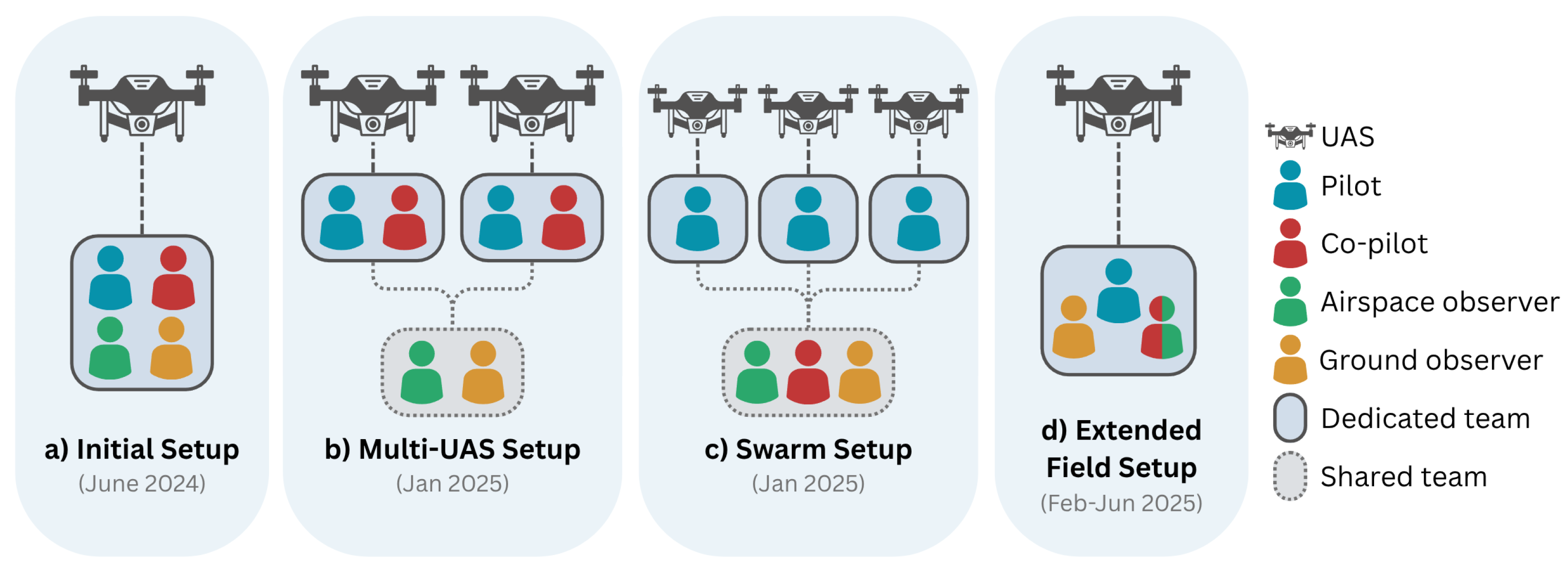
3.1. Crew Configurations and Roles Refinement
3.2. Operations Planning and Coordination
3.2.1. Third-Party Coordination
3.2.2. Digital Coordination with WildOps
3.3. Operational Procedures, Iterations and Refinements
3.3.1. Adaptation Across Operation Types
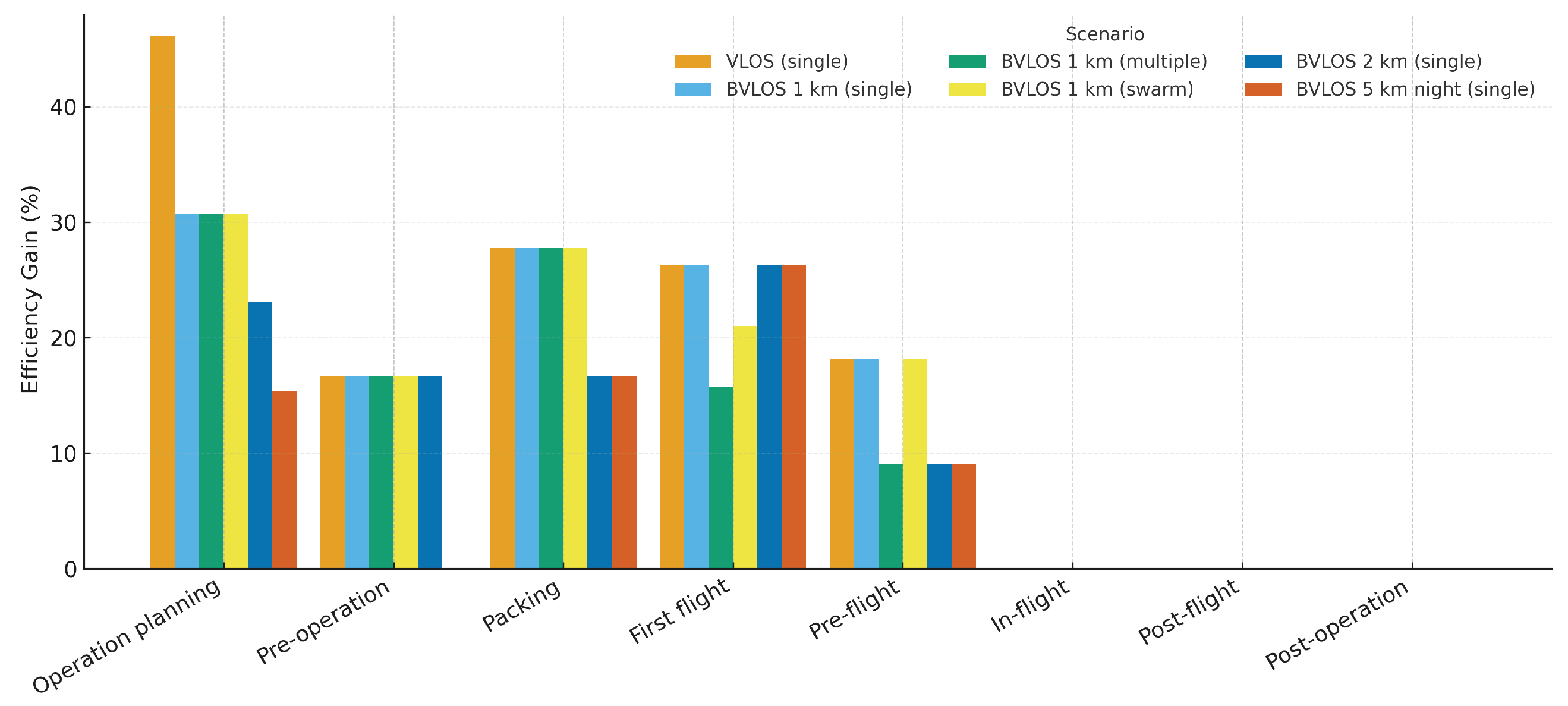
3.3.2. Measured Efficiency Gains from Customisation
3.3.3. Evolution of Procedures over Time
4. Field Trials & Observations
- (A)
- Large teams limit scalability but can be reduced safely through gradual optimisation;
- (B)
- Repeated missions improve efficiency but require training to sustain vigilance;
- (C)
- Range limits create time pressure but expansion depends on safe airspace integration;
- (D)
- Environmental factors elevate operational risk and require crew-safety measures;
- (E)
- Co-development ensures procedures remain practical and field-ready.
Summary of Field Trial Cards
5. Discussion
- RQ1. How Can SORA 2.5 Guide the Planning of BVLOS Operations in Conservation Areas?
- RQ1.1. How Can SORA 2.5 Ground-Risk Approaches Be Used in Conservation Settings, and How Do They Compare in That Context?
- A—Population estimation relies more on local knowledge than modelling
- B—Raster-based population estimates have limitations
- C—Annex F analytical estimation provides a more representative assessment
- RQ1.2. Which Safety Constraints Affect Conservation Fieldwork, and How Can They Be Addressed?
- A—Large teams limit scalability but can be reduced safely through gradual optimisation
- B—Repeated missions improve efficiency but require training to sustain vigilance
- C—Range limits create time pressure but expansion depends on safe airspace integration
- D—Environmental factors elevate operational risk and require crew-safety measures
- E—Co-development ensures procedures remain practical and field-ready
- RQ2. How Should Safety Procedures Be Designed to Meet the Needs of Conservation Fieldwork?
- 1.
- 2.
- 3.
- Apply clear placement rules and initiation anchors: Shift tasks that can be completed off-site to pre-operation; avoid repeated power cycles within a phase; use full checks only for the first flight and a reduced set for subsequent flights. Define initiation anchors for each checklist (e.g., pre-operation at the vehicle, first flight on arrival, subsequent flights before take-off, post-flight at landing) [46].
- 4.
- 5.
- 6.
- Minimise the “subsequent flight” checklist: After configuration and calibration are confirmed [9,46], retain only essential recurring steps: logging, power-up, battery and SD-card changes, error checks, GNSS and link confirmation, brief weather scan, team brief, go/no-go decision, take-off call, and immediate post-lift performance check.
- 7.
- 8.
- Separate emergency, contingency, and Emergency Response Plan (ERP): Define emergency procedures for immediate abnormal events, contingency procedures for predictable degradations, and the ERP for post-accident actions (e.g., crash, fire, injury, airspace incident), including relevant contact details [9,44,45].
- 9.
- 10.
- RQ2.1. How Much Efficiency Can Be Gained by Tailoring Procedures to Specific Missions?
- RQ2.2. Which Procedural Elements Can Be Automated, and How Does Automation Affect Crew Workload and Reliability?
- RQ3. How Can BVLOS Operations Be Scaled to Multiple Teams While Preserving Safety in the Field?
- RQ3.1. How Can Crew Configurations Be Optimised to Improve Scalability While Maintaining Safety, and What Trade-Offs Arise?
- 1.
- Begin with conservative crew configurations and iterate toward efficiency: Early missions should use larger teams to keep workload low while procedures mature. As processes stabilise, compatible roles can be merged through iterative review without loss of situational awareness [57].
- 2.
- Balance operational needs with safety trade-offs: Smaller teams may be necessary under field constraints but increase workload and reduce redundancy. When reductions are unavoidable, compensatory measures such as limiting altitude, range, or mission complexity should be applied, and reductions implemented only once their effects are understood.
- 3.
- Leverage shared roles in multi-UAS and swarm operations: In multi-UAS missions, observers can be shared if coverage areas are clearly defined. Swarm operations allow further role sharing (e.g., co-pilots) when UAS follow the same checklist and timing, provided responsibilities remain explicit.
- 4.
- Merge roles that share a single operational focus: Role consolidation is most effective when tasks contribute to a single operational focus. For example, co-pilot and airspace-observer roles may be combined due to their shared aviation-safety objective, whereas wildlife-observer roles require independence. Clear responsibility boundaries reduce cognitive switching and simplify qualification.
- 5.
- Maintain vigilance through cross-checks: Routine operations can reduce alertness; short challenge–response calls help maintain focus and prevent complacency during low-workload phases.
- RQ4. What Needs to Happen for Field-Supported BVLOS Operations to Become Fully Remote?
- A.
- Airspace integration as the primary enabler
- B.
- Evolution of air-risk methodology
- C.
- Connectivity and command resilience
- D.
- Incremental pathway toward remote operations
6. Conclusions
Limitations and Future Work
Author Contributions
Funding
Data Availability Statement
Acknowledgments
Conflicts of Interest
Appendix A. Kenyan UAS Regulations and Permit Process
Appendix A.1. Civil Aviation UAS Regulatory Framework
- Category A (Low Risk): Restricted to Visual Line Of Sight (VLOS) operations at or below 400 ft AGL with a Max Take-Off Weight (MTOW) ≤ 25 kg. A lateral separation of at least 50 m must be maintained from uninvolved persons, buildings, and objects. Operations must occur in segregated airspace unless expressly authorised by the KCAA.
- Category B (Medium Risk): Also limited to VLOS (including extended VLOS), but permits operations exceeding certain Category A constraints. These may occur in non-segregated airspace, provided they remain clear of controlled or restricted zones unless authorised.
- Category C (High Risk): Covers high-complexity operations, including BVLOS flights and missions in controlled airspace, requiring integration with ATC, compliance with the Civil Aviation (Rules of the Air) Regulations, and a valid Certificate of Airworthiness.
Appendix A.2. Permit Application Requirements

| Document Type | Details |
|---|---|
| UAS Details | Make, model, serial number, MTOW |
| Arrival and Departure | Operating airline, flight number, dates and times of entry and exit |
| Pilot Passport | Passport copy of the drone operator |
| Pilot Certificate | Remote pilot competency certificate |
| UAS Insurance | Proof of third-party liability insurance |
| UAS Photographs | Photos of each UAS and visible serial numbers |
| Requirement | Details |
|---|---|
| Proposed Operation | Operation map, flight geography, platform specifications, ground/air risk identification and mitigations, team structure, and SORA-based risk assessment |
| Temporary Import Permit | Proof of import approval for all platforms |
| ROC Lease | Lease agreement under the ROC of KFL |
| Letter from Conservancy | Formal letter of support from Ol Pejeta Conservancy |
| KWS Approval | Letter of no objection from the Laikipia regional office of the KWS |
| Wildlife Research Permit | Permit issued by the WRTI |
| Research Licence | National Science and Technology Research License from NACOSTI |
Appendix B. Detailed Application of the Ten-Step SORA Methodology
Appendix B.1. SORA Semantic Map and Volume Definitions
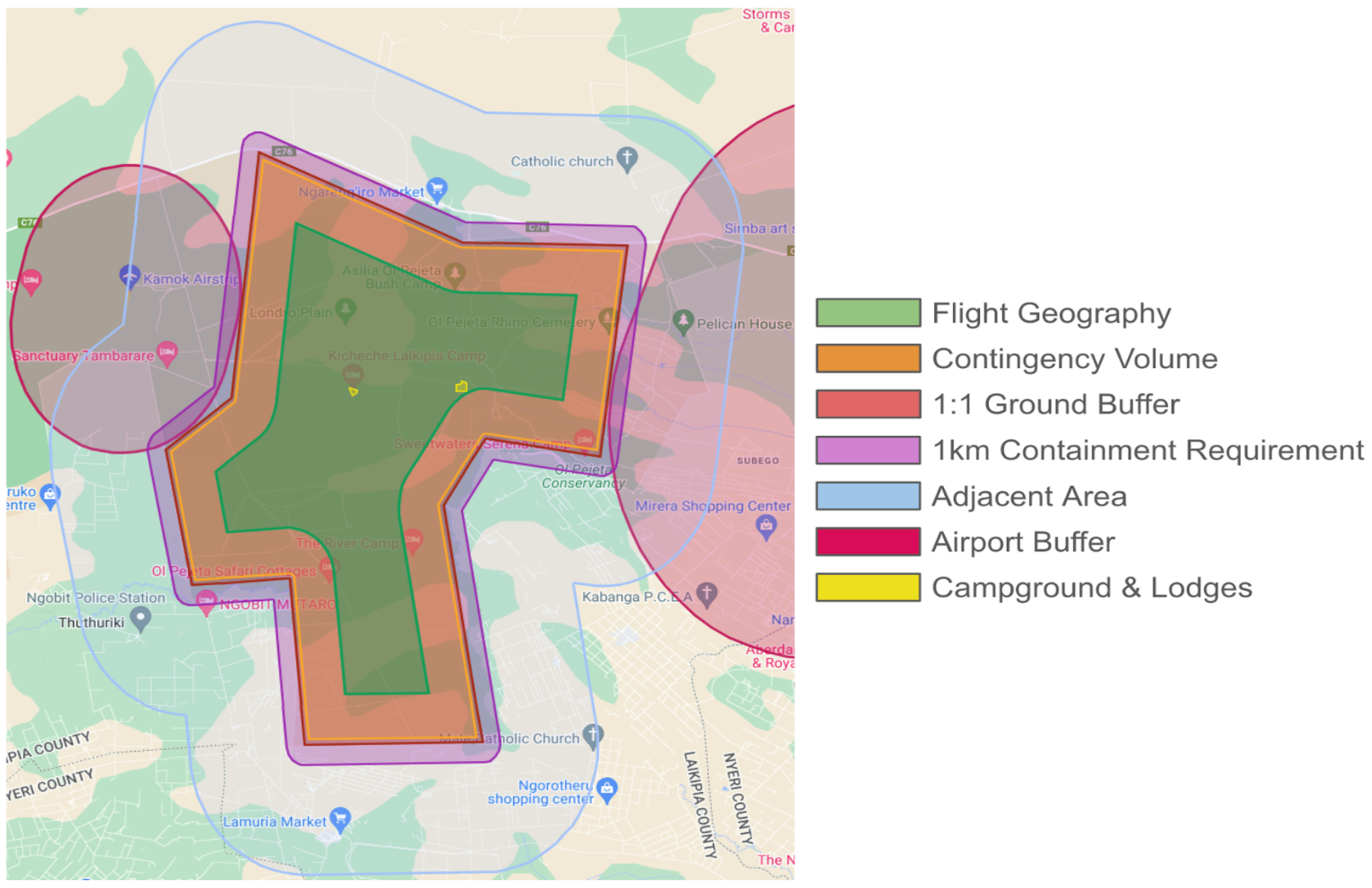
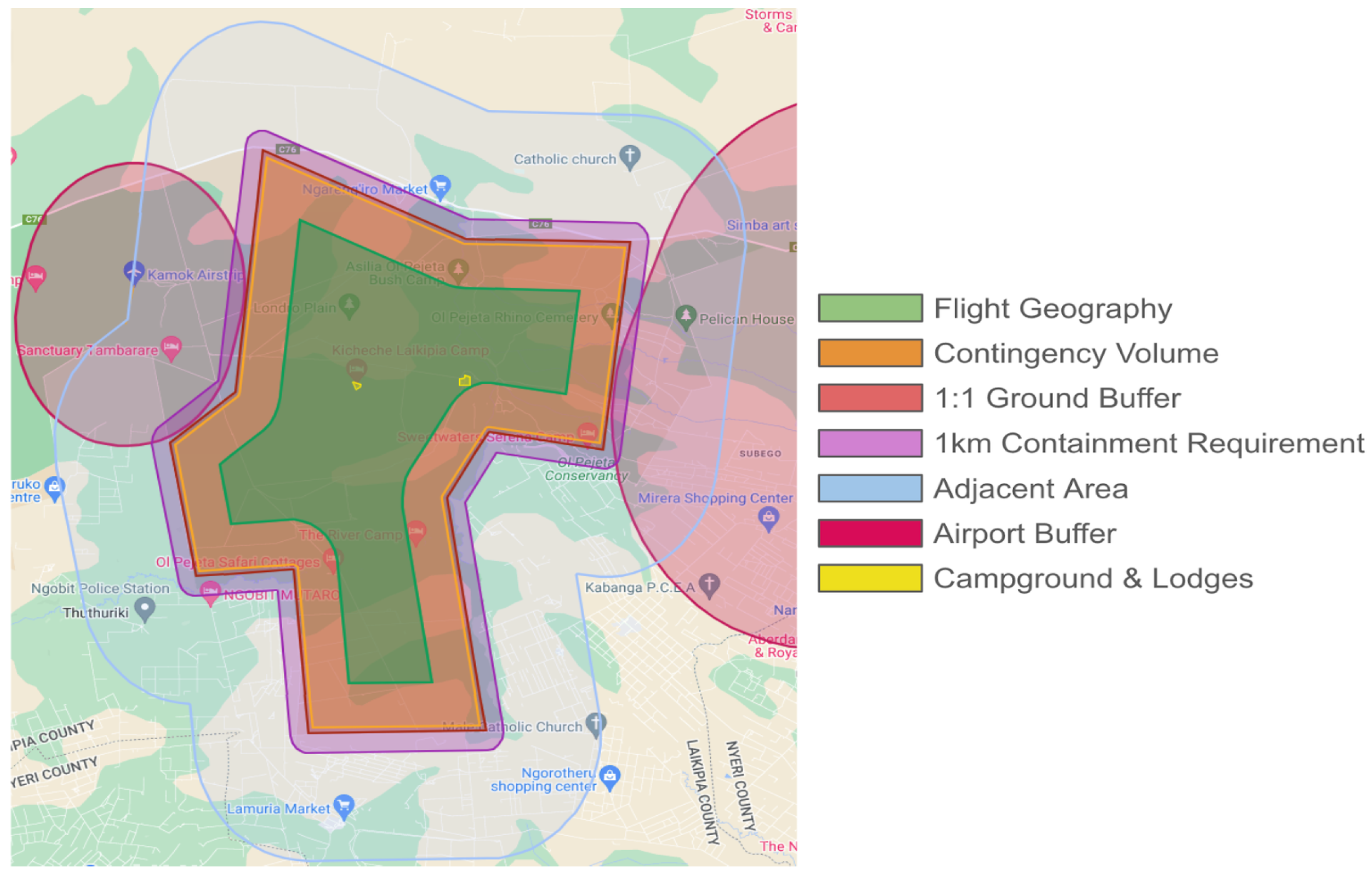
- Flight geography: The volume in which the UAS is intended to operate under normal conditions, defined horizontally and vertically by planned mission paths and operational constraints.
- Contingency volume: A buffer surrounding the flight geography that accounts for off-nominal behaviour (e.g., navigation or link loss) in which the UAS remains controllable but deviates from the planned trajectory.
- Ground-risk buffer: A horizontal buffer extending from the contingency volume, defined using a 1:1 rule relative to maximum altitude. It represents the area potentially affected by a ballistic descent and forms part of the intrinsic Ground Risk Class (iGRC) footprint.
- Adjacent area: The region beyond the ground-risk buffer used to assess exposure to uninvolved people and determine the containment requirement.
- Containment area: The first 1 km band of the adjacent area, used in Step 8 of the SORA to identify outdoor assemblies and verify containment performance.
Appendix B.2. Additional Notes on Buffer Selection and Design Choices
Appendix B.3. Qualitative Descriptors for Population Density
| (ppl/km2) | Qualitative Descriptor | Area Description |
|---|---|---|
| Controlled Ground Area | Controlled Ground/Extremely Remote | Controlled access areas, or remote regions such as mountains, deserts, or large water bodies away from expected traffic. |
| <5 | Remote | Forests, deserts, or sparsely settled land with approx. one small building per km2. |
| <50 | Lightly populated | Small farms or residential areas with large lots (approx. 4 acres or 16,000 m2). |
| <500 | Suburban/Residential lightly populated | Homes and small businesses with large lots (approx. 1 acre or 4000 m2). |
| <5000 | Low density metropolitan | Apartments, commercial buildings, or small lots; buildings generally under 4 stories. |
| <50,000 | High density metropolitan | Dense urban centers with multistorey buildings and high population density. |
| ≥50,000 | Assemblies of people | Major cities, large gatherings such as concerts or sporting events. |
Appendix B.4. Tourism-Based Estimation of Population Density
- 1.
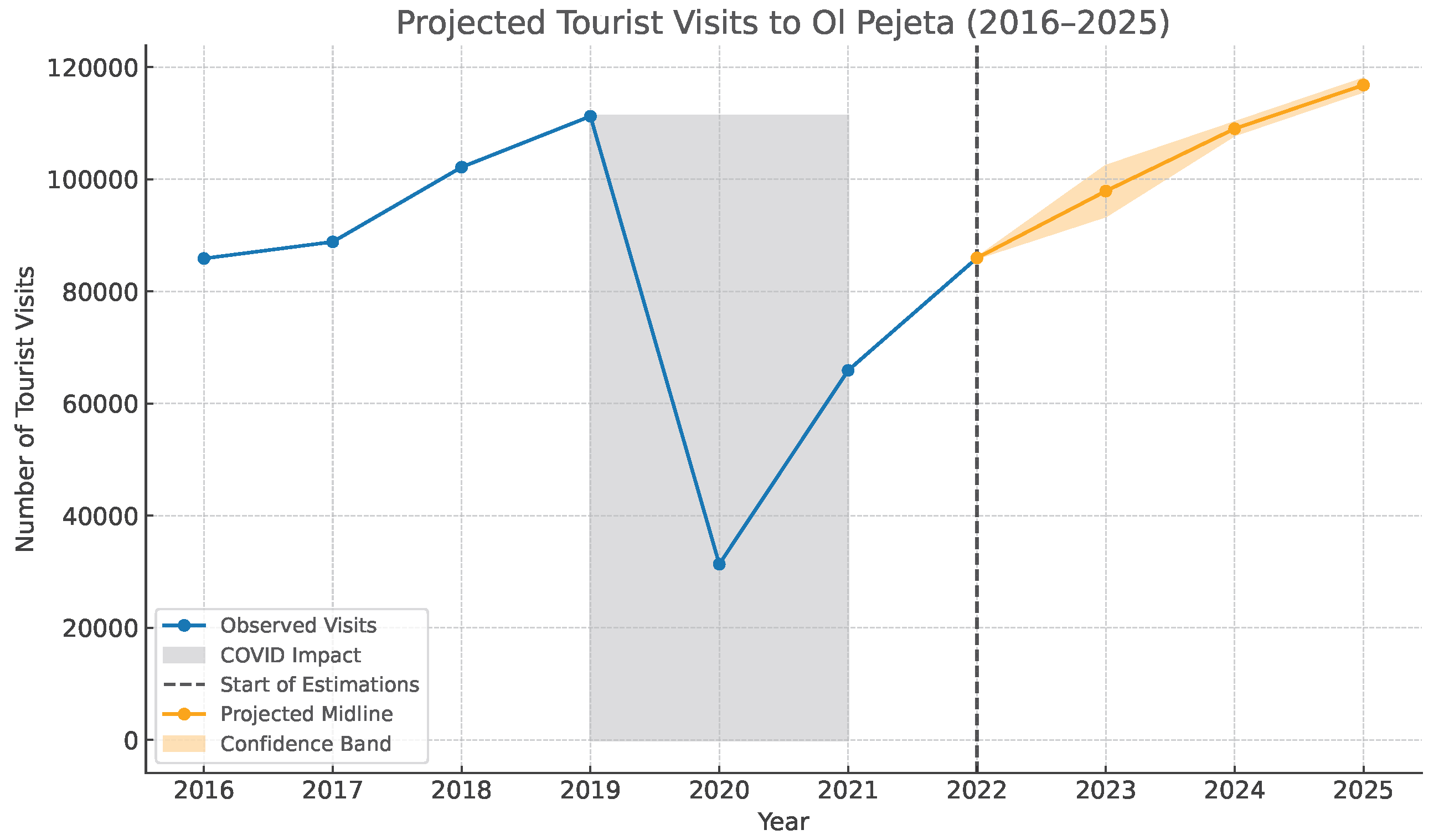
- Local Growth and COVID Impact.
- 2.
- Adjustment Using Global Post-COVID Recovery Benchmarks.
- 2023: 84–92% of 2019 levels
- 2024: 97–99% of 2019 levels
- 2025: projected at 104–106%, obtained by applying the 7% AAGR to 2024 values
- 3.
- Projected Annual Totals.
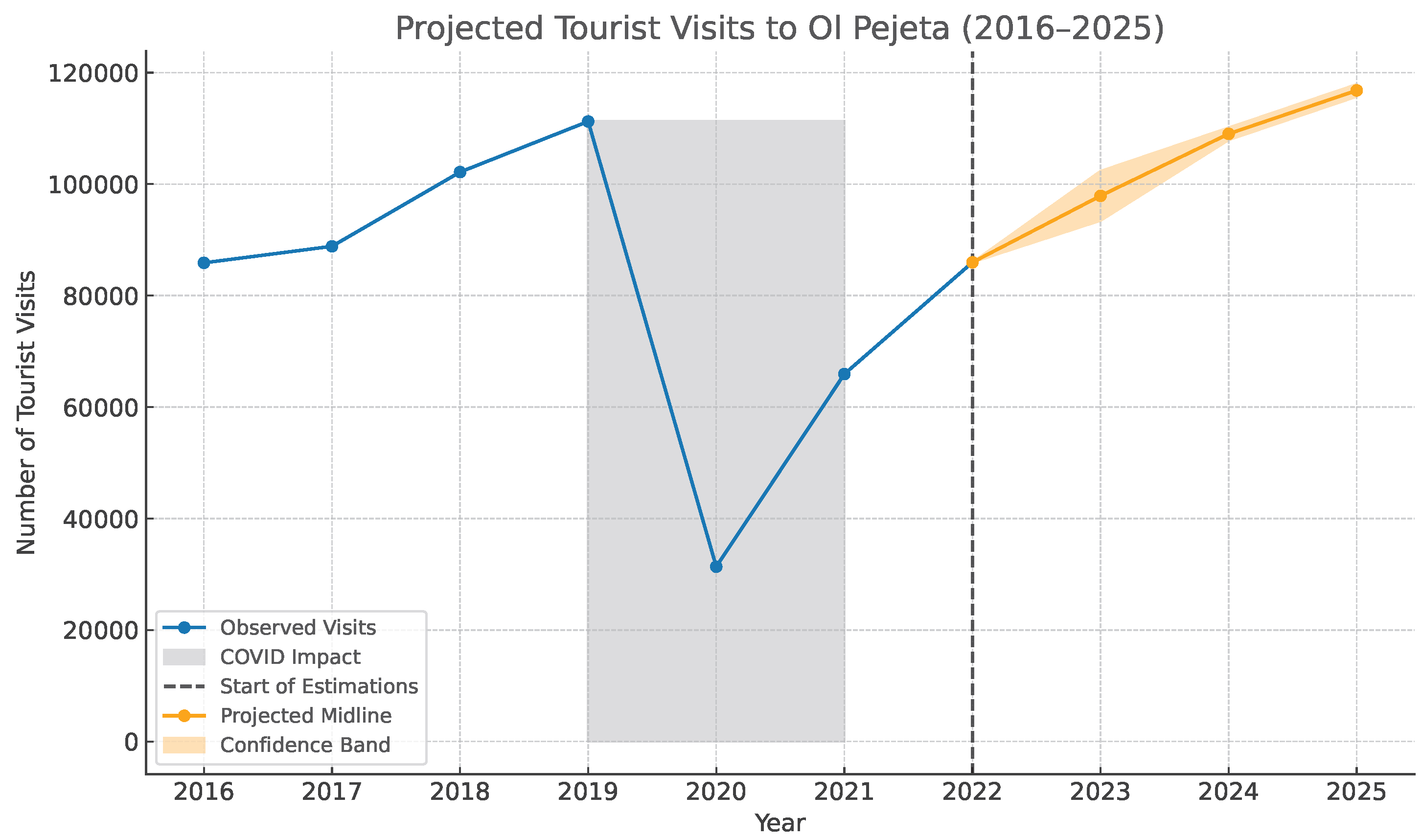
| Metric | 2016 | 2017 | 2018 | 2019 | 2020 | 2021 | 2022 | 2023 | 2024 | 2025 |
|---|---|---|---|---|---|---|---|---|---|---|
| Observed | 85,874 | 88,842 | 102,160 | 111,242 | 31,359 | 65,916 | 85,965 | — | — | — |
| Lower Bound | — | — | — | — | — | — | — | 93,442 | 107,905 | 115,692 |
| Upper Bound | — | — | — | — | — | — | — | 102,343 | 110,129 | 117,917 |
| Midline | — | — | — | — | — | — | — | 97,893 | 109,017 | 116,805 |
- 4.
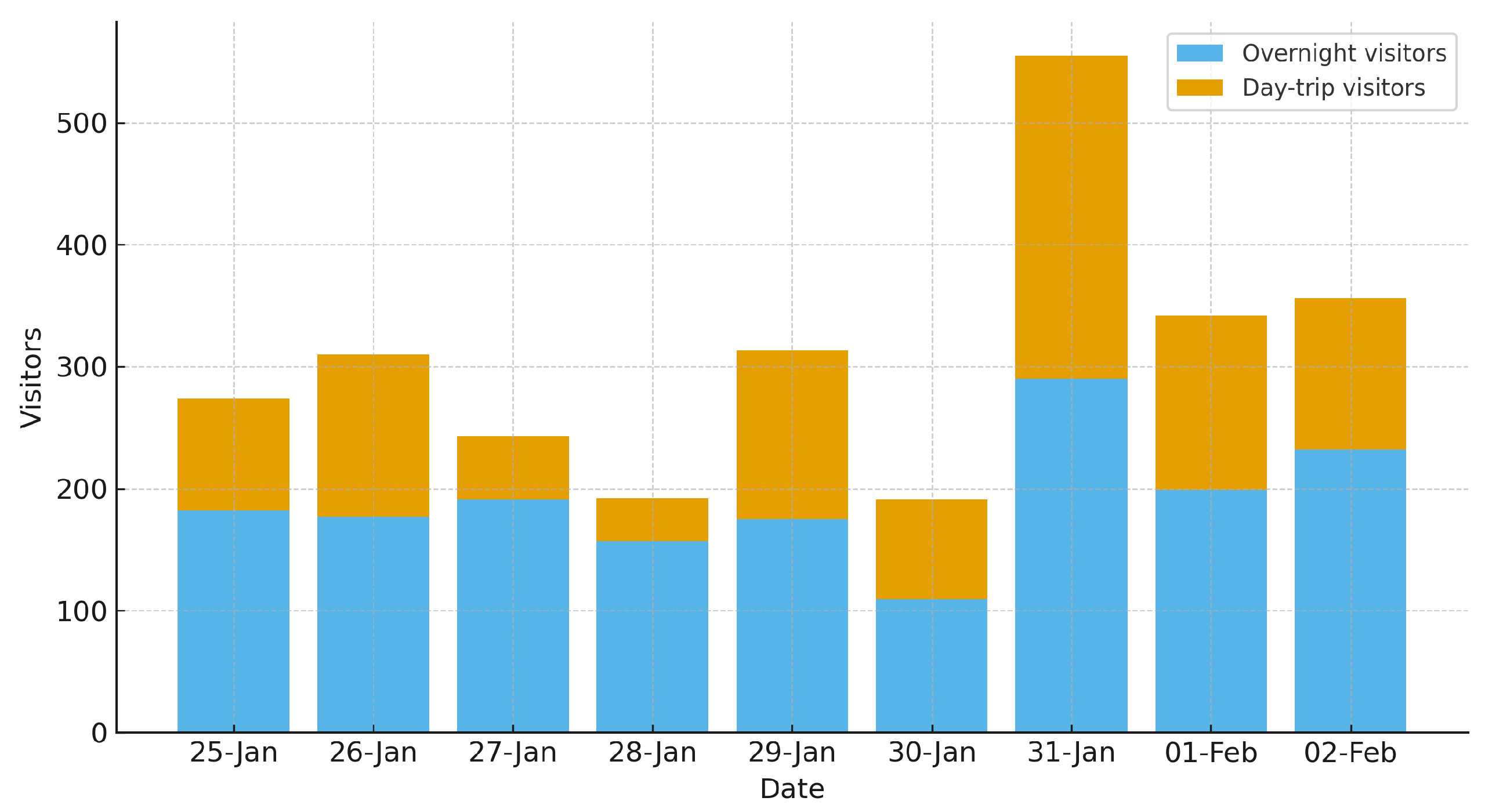
- Seasonal Adjustment for January.
- 5.
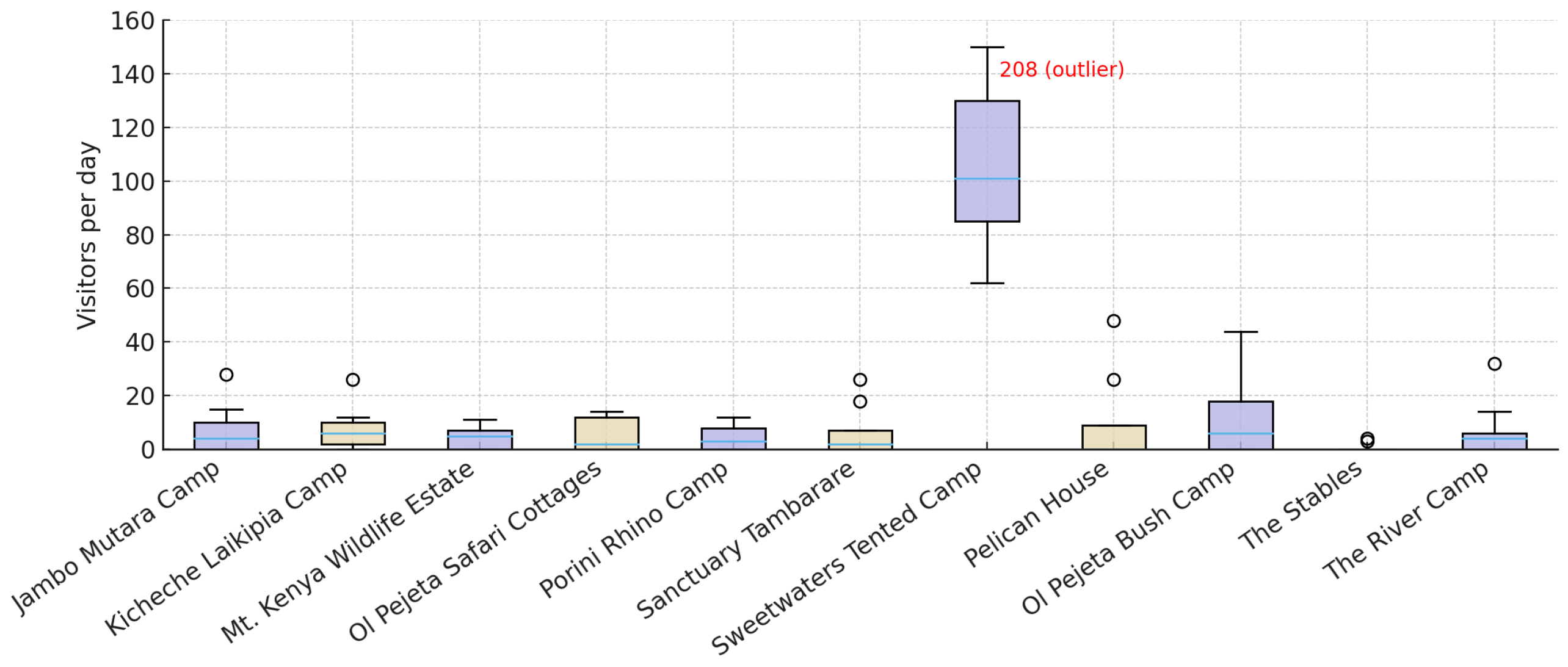
- Estimating Localised Tourist Density at Camps.
- a.
- Number of camps:Based on Ol Pejeta’s official accommodation listings, we identified ten active tourism facilities: Sweetwaters Serena Camp, Porini Rhino Camp, Ol Pejeta Bush Camp, Ol Pejeta Safari Cottages, Kicheche Laikipia Camp, Mutara Camp, Pelican House, Sanctuary Tambarare, River Camp, and The Stables [72].
- b.
- Tourist distribution:Even distribution of 352 tourists across ten camps gives:
- c.
- Camp staff:Drawing on operational experience at The Stables, we conservatively assume 10 staff per camp, giving:
- d.
- Area of influence:We bound each camp to a 1 km2 inhabited area, yielding a population density of:This value remains below the SORA threshold of 50 people/km2 for a lightly populated area and supports our intrinsic ground-risk classification.
Appendix B.5. Raster-Based Estimation of Population Density
- a.
- Source Dataset:We used the 2020 WorldPop raster for Kenya [20], which provides resident-population estimates at a ∼100 m (3 arc-second) resolution. Values are produced using a random forest-based dasymetric disaggregation method [39] that redistributes census counts using high-resolution covariates (night-time lights, building footprints, roads, land cover). The resulting raster gives the estimated number of residents per cell.
- b.
- Raster Processing:A lightweight Python script extracted and analysed a local subset of the raster using:
- ken_ppp_2020.tif: Unconstrained 2020 WorldPop raster for Kenya (https://hub.worldpop.org/geodata/summary?id=6530 accessed on 8 January 2026)
- olpejeta_boundary.kml: Boundary polygon for Ol Pejeta Conservancy
Processing steps:- Clip raster to the conservancy boundary.
- Convert native units (people per 0.01 km2) to people/km2.
- Compute summary statistics at 100 m resolution.
- Aggregate to 200 m and 500 m to assess grid-size effects, following Annex F of the SORA.
- Visualise raster layers for inspection.
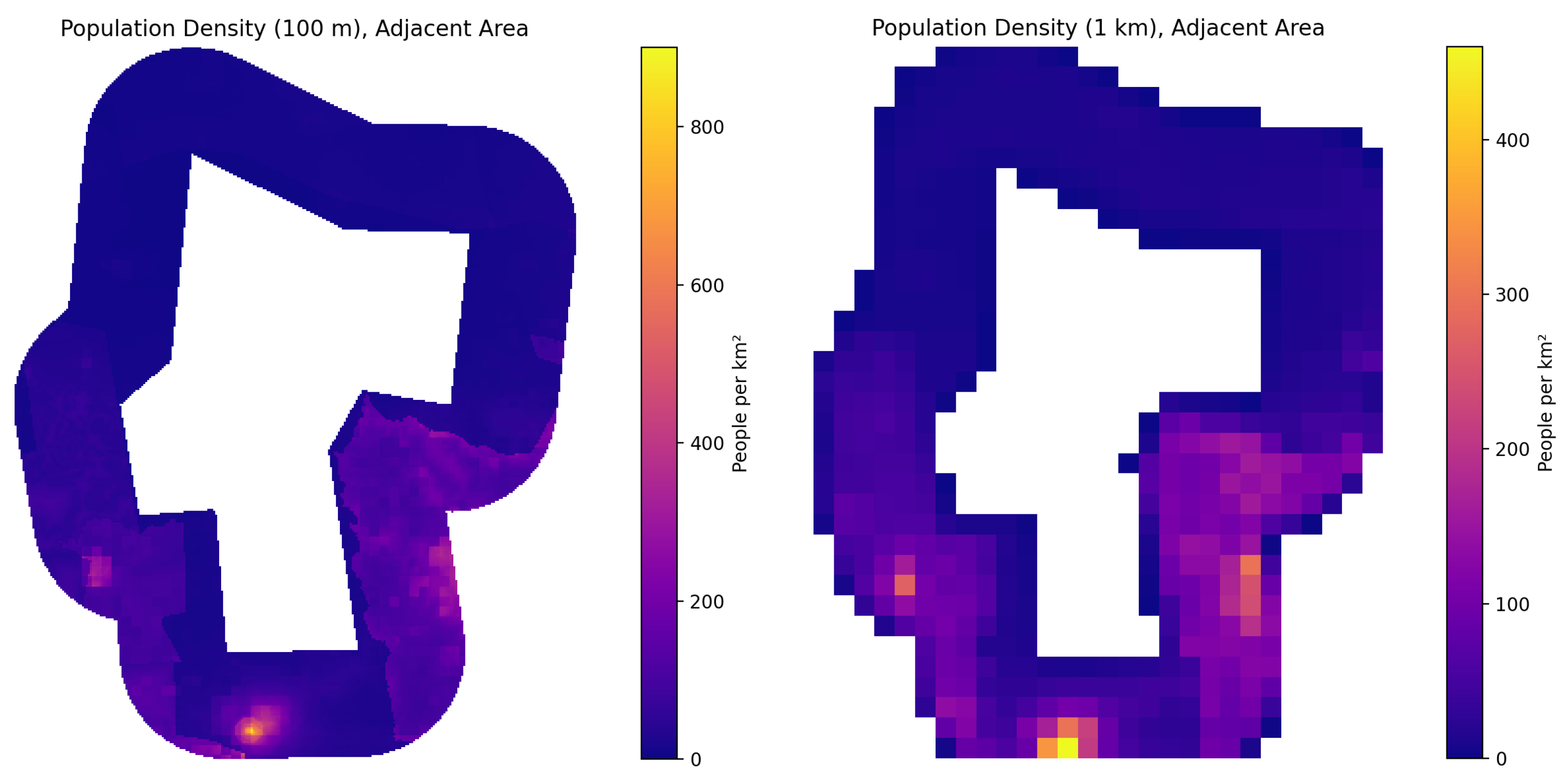
At 100 m resolution, the average density was 12.19 people/km2 and the maximum 104.84. Aggregation to 200 m and 500 m reduced maxima to 58.07 and 53.35 people/km2, respectively. This is consistent with Annex F: finer grids inflate local peaks, whereas coarser grids smooth them. The 200 m grid was therefore selected as the representative scale for intrinsic ground-risk assessment for flights below 500 ft AGL.The full code, setup instructions, and example outputs are publicly available (https://github.com/GuyMaalouf/opc-worldpop-analysis accessed on 8 January 2026). - c.
- Notes on Interpretation:WorldPop is effective for broad-scale assessments but omits non-resident and transient populations (tourists, mobile staff, temporary workers). In Ol Pejeta, this omission is important near camps or ranger posts that are not reflected in census data. Furthermore, raster values represent averages over grid cells, which can mask strong local clustering.These limitations, together with grid-size sensitivity, underline the need to combine raster-based estimates with local knowledge and ground observations when deriving exposure values for iGRC analysis.
Appendix B.6. Tabulated Determination of Intrinsic Ground Risk Class (iGRC)
| Max UAS Characteristic Dimension | 1 m | 3 m | 8 m | 20 m | 40 m | |
|---|---|---|---|---|---|---|
| Maximum Speed | 25 m/s | 35 m/s | 75 m/s | 120 m/s | 200 m/s | |
| Max population density [ppl/km2] | Controlled | 1 | 2 | 3 | 4 | 5 |
| <5 | 2 | 3 | 4 | 5 | 6 | |
| <50 | 3 | 4 | 5 | 6 | 7 | |
| <500 | 4 | 5 | 6 | 7 | 8 | |
| <5000 | 5 | 6 | 7 | 8 | 9 | |
| <50,000 | 6 | 7 | 8 | 9 | 10 | |
| ≥50,000 | 7 | 8 | Not part of SORA | |||
Appendix B.7. Fine-Grained Estimation of iGRC Using SORA Annex F
- : population density in people/m2.

- : critical area in m2, representing the ground footprint where an individual might be lethally impacted.
| Variable | Description | Value |
|---|---|---|
| Radius of a person | 0.3 m | |
| Height of a person | 1.8 m | |
| e | Coefficient of restitution | 0.657 |
| Impact angle | ||
| Ground friction coefficient | 0.75 | |
| g | Gravitational acceleration | 9.8 m/s2 |
| Non-lethal kinetic energy threshold | 290 J |
- : Effective impact radius combines the radius of a person and half the aircraft’s wingspan. This accounts for a lethal area that extends both from the person struck and the size of the aircraft:
- : Glide distance estimates how far the aircraft can travel horizontally during descent, using the person height as a proxy for impact height:
- : Horizontal impact velocity, the component of aircraft speed along the ground:
- : Non-lethal velocity, the speed below which impact energy is less than (290 J):
- : Deceleration time, to decelerate from impact to non-lethal speed:Since the result is negative, the aircraft is already below the non-lethal threshold upon impact. Thus:
- : Reduced slide distance, representing the distance over which the aircraft continues to slide after initial impact, until it decelerates to a non-lethal velocity:Because , there is no additional contribution from sliding.
Appendix B.8. Ground Risk Mitigation Measures (SORA Step 3)
| Mitigation | Definition, Conditions, and Notes |
|---|---|
| (M1a) Strategic Mitigation by Sheltering | Applies when uninvolved people are physically sheltered (e.g., inside vehicles or buildings). • Integrity: depends on proportion of people sheltered. • Assurance: depends on confidence in shelter presence and usage. • Constraint: if claimed at medium robustness, cannot be combined with M1b to avoid double counting. |
| (M1b) Operational Restrictions | Implements time- or space-based limits to reduce likelihood of overflying people (e.g., avoiding roads, camps, or public areas; restricting times of operation). • Medium integrity: may be claimed if the at-risk population is reduced by ≥90%. |
| (M1c) Ground Observation/Awareness | Reduces risk by detecting uninvolved people using visual observers, onboard cameras or sensors, or reports from ground staff. Typically limited to low robustness for BVLOS flights unless supported by automation. |
| (M2) UAS Impact Energy Reduction | Applies when technologies limit impact energy below lethal thresholds, such as parachute systems, frangible structures, or low-energy components. • Requirement: ground impact energy must be demonstrably non-lethal, typically <290 J. |
Appendix B.9. Tactical Mitigation Performance Requirements (Step 6)
| Detect Low (ARC-b) | The expectation is for the applicant’s Detect And Avoid (DAA) plan to enable the operator to detect approximately 50% of all aircraft in the detection volume. This is the performance requirement in absence of failures and defaults.
It is required that the applicant has awareness of most of the traffic operating in the area in which the operator intends to fly, by relying on one or more of the following:
|
| Decide Low (ARC-b) | The operator must have a documented de-confliction scheme, in which the operator explains which tools or methods will be used for detection and what the criteria are that will be applied for the decision to avoid incoming traffic. In case the remote pilot relies on detection by someone else, the use of phraseology will have to be described as well.
Examples:
|
| Command Low (ARC-b) | The latency of the whole command (C2) link, i.e., the time between the moment that the remote pilot gives the command and the airplane executes the command must not exceed 5 s. |
| Execute Low (ARC-b) | UAS descending to an altitude not higher than the nearest trees, buildings or infrastructure or ≤ 60 feet AGL is considered sufficient. The aircraft should be able to descend from its operating altitude to the ‘safe altitude’ in less than a minute. |
| Feedback loop Low (ARC-b) | Where electronic means assist the remote pilot in detecting traffic, the information is provided with a latency and update rate for intruder data (e.g., position, speed, altitude, track) that support the decision criteria. For an assumed 3 NM threshold, a 5 s update rate and a latency of 10 s is considered adequate. |
Appendix B.10. Platform-Specific Command and Execute Performance (TMPR Analysis)
| Platform | Command C2 Link | Command Latency (ms) | Execute Descent (120 m → 18 m) |
|---|---|---|---|
| DJI Mavic 3 (E/T [73], P [74]) | DJI O3/O3+ | ~130 ms [74] | 6 m/s [73]⇒ ≈17 s |
| DJI Mavic 2 [75] | DJI OcuSync 2.0 | ~130 ms [75] | 3 m/s [75] ⇒ ≈34 s |
| DJI Mini 3 Pro [76] | DJI OcuSync 2.0 | ~130 ms [76] | 5 m/s [76] ⇒ ≈20 s |
| Parrot Anafi [77] | Skycontroller 3 (Wi-Fi) [77] | ≤250 ms [78] | 4 m/s [77] ⇒ ≈26 s |
| Codrone Aluco [79] | CubePilot Herelink [80] | ~110 ms [80] | 3 * m/s ⇒ ≈34 s |
| Codrone Noctu [79] | CubePilot Herelink [80] | ~110 ms [80] | 3 * m/s ⇒ ≈34 s |
| “Papa Smurf” (UoB multirotor) | FrSky R-XSR (ACCESS, 2.4 GHz) [81] | ≤150 ms [82] | 3 * m/s ⇒ ≈34 s |
| eBee X | Proprietary 2.4 GHz ground modem | ≤150 ms [82] | 3 * m/s ⇒ ≈34 s |
| UoB Fixed-Wing Glider (NAN Xplorer [83]) | FrSky R-XSR (ACCESS, 2.4 GHz) [81] | ≤150 ms [82] | 3 * m/s ⇒ ≈34 s |
Appendix B.11. Determination of the SAIL
| SAIL Determination | ||||
|---|---|---|---|---|
| Final GRC | ARC-a | ARC-b | ARC-c | ARC-d |
| ≤2 | I | II | IV | VI |
| 3 | II | II | IV | VI |
| 4 | III | III | IV | VI |
| 5 | IV | IV | IV | VI |
| 6 | V | V | V | VI |
| 7 | VI | VI | VI | VI |
| >7 | Certified operation | |||
Appendix B.12. Population-Raster Analysis of the Adjacent Area

Appendix B.13. Containment Requirements for 8 m UA (Excerpt from SORA 2.5 Main Body)
| 8 m UA (<75 m/s) | |||||
|---|---|---|---|---|---|
| Sheltering Assumed not Applicable for the UA in the Adjacent Area | |||||
| Average Population Density Allowed | No Upper Limit | <50,000 ppl/km2 | <5000 ppl/km2 | <500 ppl/km2 | <50 ppl/km2 |
| Outdoor Assemblies Allowed within 1 km of the OPS Volume | >400k | Assemblies of 40k to 400k | Assemblies < 40k | ||
| SAIL I & II | Out of scope | Out of scope | High | Medium | Low |
| SAIL III | Out of scope | Out of scope | Medium | Low | Low |
| SAIL IV | Out of scope | Medium | Low | Low | Low |
| SAIL V | Medium | Low | Low | Low | Low |
| SAIL VI | Low | Low | Low | Low | Low |
Appendix B.14. Fine-Grained Calculation of the Adjacent-Area iGRC
Appendix B.15. Applicability of Ground-Risk Mitigations in the Adjacent Area
- M1(a)—Sheltering of people, if it can be generalised across the adjacent area;
- M1(b)—Time-of-day restrictions (e.g., night operations) that reduce outdoor population exposure; and
- M2—Passive or frangible design features that limit kinetic energy upon impact.
- M1(b)—Route- or exposure-based arguments, which apply only to controlled flight paths inside the operational volume;
- M1(c)—Tactical ground observation, as observers cannot provide coverage for an uncontrolled fly-away; and
- M2—Active mitigation systems (e.g., parachutes or specific descent manoeuvres), which are assumed to fail in a containment breach.
- Sheltering cannot be assumed, as the surrounding farmlands are primarily worked outdoors during the day;
- Time-of-day restrictions are inapplicable, since operations occur both by day and by night; and
- The employed UAS platforms do not feature sufficient frangible or passive design elements to claim M2 credit.
Appendix B.16. SORA Containment Requirements (Copy of SORA 2.5 Annex F, Table 27 [9])
- N: No containment requirement
- L: Low containment requirement
- M: Medium containment requirement
- H: High containment requirement
- Oos: Out of scope
| SAIL in the Operational Volume | ||||||
|---|---|---|---|---|---|---|
| Adjacent Area GRC | I | II | III | IV | V | VI |
| ≤3 | N | |||||
| 4 | L | N | ||||
| 5 | L | L | N | |||
| 6 | M | M | L | N | ||
| 7 | H | H | M | L | N | |
| 8 | Oos | Oos | Oos | M | L | N |
| 9 | Oos | M | L | |||
| 10 | Oos | M | ||||
| 11 | Oos | |||||
Appendix B.17. Operational Safety Objectives (SAIL II Summary)
- Integrity: The strength of the safety gain achieved through compliance with the OSO.
- Assurance: The confidence level in the operator’s evidence or demonstration of that compliance.
| OSO Title | Requirement (Integrity & Assurance) | Compliance Evaluation |
|---|---|---|
| OSO #01 Operator is competent and/or proven | Integrity: The applicant is knowledgeable of the UAS being used and as a minimum has the following relevant operational procedures: checklists, maintenance, training, responsibilities, and associated duties. Assurance: The elements delineated in the level of integrity are available. | Status: Partially met The team demonstrated operational knowledge of all UAS and used documented checklists during the campaign. Training, maintenance, and role assignments were implemented but not formally recorded; future iterations will include written procedures and role documentation. |
| OSO #03 UAS maintained by competent/proven entity | Integrity: The maintenance instructions and requirements are defined, cover applicable designer instructions, and are adhered to. The maintenance staff is competent and authorized to perform maintenance. Assurance: Criterion #1 (Procedure)—Maintenance instructions are documented, recorded in a maintenance log; and a list of authorized maintenance staff is maintained. Criterion #2 (Training)—A record of qualifications, experience, and training of the maintenance staff is maintained. | Status: Not met No formal maintenance structure exists. There are no documented maintenance instructions, no dedicated maintenance personnel, and no maintenance log or record-keeping system. Maintenance procedures, staff responsibilities, and training records will be established before future operations. |
| OSO #06 C3 link characteristics (e.g., performance, spectrum use) are appropriate for the operation | Integrity: The applicant determines that performance, RF spectrum usage, and environmental conditions for C3 links (Command and Control (C2), and communication link required for the safety) are adequate to safely conduct the intended operation. The remote pilot has the means to continuously monitor C3 performance and ensure it continues to meet operational requirements. Assurance: The applicant declares that the required level of integrity has been achieved. | Status: Met All UAS operated on 2.4 GHz with some equipped for dual-band (2.4/5.8 GHz) operation, within authorized ISM bands. C2 link performance was continuously monitored through RSSI values during pre-flight and in-flight phases. Custom-built platforms (relying on 2.4 GHz FrSky ACCESS protocol) provided equivalent monitoring capability. Additional VHF and local radio communications were used for situational awareness and coordination with Ol Pejeta radio control, but their reliability was not quantitatively verified. Overall, the C3 systems provided sufficient robustness for the operational context. |
| OSO #07 Conformity check of the UAS configuration | Integrity: The Operator has UAS conformity check procedures ensuring that the aircraft used is in a safe condition and that its configuration conforms to the design data and operational limitations considered under the approved concept of operations. Assurance: Documented conformity check procedures exist and reflect the designer’s recommendations. The remote crew is trained to perform conformity checks. | Status: Partially met No modifications were made to any UAS, and all platforms matched the configurations described in the application, ensuring conformance in practice. However, no formal conformity check procedure or training was implemented. Future operations will include a documented conformity verification and corresponding crew training. |
| OSO #08 Operational procedures defined, validated, adhered to | Integrity: Appropriate operational procedures are defined and cover flight planning; pre-/post-flight inspections; evaluation of environmental conditions; normal, contingency, and emergency procedures; pre-flight briefing of involved persons; occurrence reporting; and ERP. Assurance: Procedures are developed to standards acceptable to the competent authority; adequacy of contingency/emergency procedures is proven via dedicated flight tests or validated simulation (FTB alternative not used). | Status: Partially met Procedures covered flight planning, pre-/post-flight inspections, environmental evaluation, and normal, contingency, and emergency procedures, with radio coordination and human-error mitigation. Occurrence reporting was limited to a post-flight note, and no dedicated Emergency Response Plan (ERP) addressing secondary effects existed. Contingency and emergency simulations were conducted during training, but procedures were not aligned with a recognised standard, and total flight hours insufficient for a functional test-based assurance claim. |
| OSO Title | Requirement (Integrity & Assurance) | Compliance Evaluation |
|---|---|---|
| OSO #09 Remote crew trained and current | Integrity: Theoretical and practical training ensures knowledge of UAS regulation, airspace principles, airmanship and aviation safety, human performance limitations, meteorology, navigation, UAS knowledge, operational procedures and ERP, and use of external services.
Training must enable the remote crew to manage normal, abnormal, and emergency situations resulting from technical issues, human errors, or environmental conditions, and must define proficiency and training recurrence. Assurance: Training is self-declared, with supporting evidence available on request. | Status: Partially met The remote crew underwent theoretical and practical training focused on operational procedures and safety, including pre-flight, contingency, and emergency actions. However, several areas were only partially addressed or omitted: UAS regulations, airspace principles, airmanship, human performance, navigation, and use of external services. No formal proficiency or recurrence requirements were defined. Future training cycles will expand coverage to all competency areas and include defined refresh intervals. |
| OSO #13 External servicessupporting UASoperations areadequate to the operation | Integrity: The applicant ensures that the level of performance for any externally provided service critical to the safety of flight is adequate for the intended operation. Where communication with a Service Provider is required, effective coordination and defined responsibilities must be in place. Assurance: The applicant declares that the requested level of performance for any externally provided service necessary for flight safety is achieved, with supporting evidence available upon request. | Status: Met The operation relied solely on Global Navigation Satellite System (GNSS) positioning as an external service. GNSS performance was adequate, with the number of satellites monitored before and during each flight, and failsafes in place to manage GPS loss. No other external service providers (e.g., CSP, UTM, power) were used, and all critical functions were managed internally with built-in failsafes. |
| OSO #16 Multi-crew coordination | Integrity: Procedure(s) ensure coordination between crew members with robust, effective communications covering: task assignment and step-by-step communications with proper phraseology. Assurance: Procedures do not need to be validated to a formal standard; adequacy is declared. Remote-crew training on multi-crew coordination is self-declared. | Status: Met Operations with multiple UASs used co-located pilots with direct voice comms, takeoff/landing coordination, and vertical separation. Extended BVLOS remote observers employed internet audio, defined call-signs and read-backs (“Pilot/Observer… over”), brevity codes (e.g., Intruder, Kill Kill Kill, Down down down) and message types (Information/Warning/Alert). Communications were tested pre-flight. |
| OSO #17 Remote crew is fit to operate | Integrity: The applicant defines how crew declare fitness before duty and report unfitness during operations, considering fatigue, stress, substance use, and environmental factors. Assurance: The policy and declaration process are documented. | Status: Met The pre-flight procedure verified Remote crew fitness through the IMSAFE checklist(Illness, Medication, Stress, Alcohol, Fatigue, Emotion). Packing checklist included PPE appropriate to conditions (e.g., hats, mosquito repellent, headlamps, jackets). A written policy on duty and rest periods will be formalized. |
| OSO #20 A Human Factors evaluation has been performed and the Human-Machine Interface (HMI) found appropriate for the mission | Integrity: UAS information and controls are clearly presented and do not confuse, cause unreasonable fatigue, or contribute to crew error. If an electronic aid is used to maintain UA awareness, its HMI allows position determination and does not degrade visual scanning or crew communications. Assurance: A human factors evaluation is conducted (by inspection/analysis) to determine suitability for the mission; adequacy of the result is declared or validated through simulation (FTB alternative not used). | Status: Partially met Operations employed COTS HMIs (with map/telemetry on handheld displays) and QGroundControl & ArduPilot for custom platforms; these provided clear UA state/position without impeding visual scanning or radio comms. However, no formal human factors evaluation (documented inspection/analysis with declared adequacy) was performed; informal usability checks occurred but were not recorded to a recognised method. |
| OSO #23 Environmental conditions for safe operations defined, measurable, and adhered to | Integrity: Environmental conditions for safe operations are defined and reflected in the flight manual or equivalent document. Assurance: The applicant declares that the required level of integrity has been achieved. | Status: Met Operational procedures defined limits for temperature (−10 °C to 40 °C), wind speed (<10 m/s), precipitation (up to light drizzle), visibility (>5 km), and Kp-index (≤5). These limits were verified during planning and pre-flight using forecasts and on-site assessment. |
Appendix C. Field Trial Cards—Operational Insights from Real-World Operations
| Objective & Mission Context | The mission aimed to track a lion pride (Panthera leo) during peak nocturnal activity to study movement patterns and hunting strategies in relation to prey distribution. Prides of up to 20 individuals were first located using VHF-GPS collars on dominant females and then monitored across different habitats, from open grasslands to dense bushland. |
| Operational Summary | Night tracking was conducted over 58 nights (during an extended fieldwork period following the WildDrone hackathon), with up to 10 flights per night between 7 pm and 3 am using a DJI Mavic 3 Enterprise Thermal. Two safety incidents occurred: (i) an emergency rooftop recovery due to the proximity of lions, and (ii) a mission aborted following the unexpected landing of an unlit aircraft near the operational area, within airspace previously confirmed as inactive for nighttime activity. |
| Operational Procedures | Night operations during the extended conservation fieldwork period were conducted by a three-person crew, with the copilot also serving as airspace observer and a ranger equipped with a firearm ensuring ground safety. All flights were operated from within the vehicle to mitigate wildlife risk. Missions remained below 400 ft AGL west and 250 ft AGL east of the Ewaso River, and within 1 km (BVLOS) from the pilot. Following a safety assessment and coordination with Ol Pejeta Conservancy management and KAF ATC, the nighttime restriction around Kamok Airstrip was lifted to permit controlled operations in that sector, enabling continued tracking of a key lion pride while maintaining verified airspace safety. |
| Operational Challenges & Lessons | Predator activity increases ground risk: Night operations required a modified crew setup, with all missions flown from within the vehicle and a ranger equipped with a firearm ensuring ground safety. This configuration was required as predators are more active and less visible at night. Vehicle-based flying requires adaptations: Conducting flights from a vehicle roof reduced exposure to wildlife but limited upward visibility for air risk assessment. Using open-roof field vehicles provided an effective balance between crew protection and situational awareness. Night conditions require audio logging: Mounting a head-mounted GoPro for safety documentation, as per our procedures, proved impractical at night, as it conflicted with the use of a head torch and captured no usable footage in darkness. Continuous audio logging was therefore adopted as a practical alternative for post-flight safety review. Fatigue management at night becomes essential: IMSAFE crew assessments were repeated before, after, and between missions, with special focus on fatigue due to the physically demanding nature of night operations. Fixed home point limits efficiency: In accordance with our procedures, the Return to Home (RTH) position remained static while tracking moving lions, preventing vehicle repositioning during flight. This constraint led to longer transit times and battery use, whereas a dynamic RTH would have improved efficiency and mission continuity. |
| Objective & Mission Context | To evaluate a drone swarm framework for coordinated, autonomous, multi-perspective monitoring of Plains zebras (Equus quagga). The mission validated a centralised particle swarm optimisation controller that autonomously assigned waypoints to multiple drones to achieve optimal visual coverage while minimising disturbance to the animals. Field experiments targeted herds of 20–50 individuals in open grasslands with scattered bushes. The ground station and crew had to remain at least 200 m from the animals to avoid disturbance and behavioural interference. Full details are available in the following studies [22,23,24]. |
| Operational Summary | Across 6 days, 12 successful missions were flown under variable wind conditions using 3 Commercial Off The Shelf (COTS) drones (2x DJI Mini 3 and 1x DJI Mavic 3E). No safety incidents or loss of link were recorded during any operation. |
| Operational Procedures | Flights were conducted under VLOS rules, with one pilot per drone. A minimum vertical separation of 15 m was maintained to prevent mid-air collisions. |
| Operational Challenges & Lessons | Large teams reduce scalability: The one-pilot-per-drone requirement demanded
a large team, limiting scalability and increasing logistical complexity. Allowing a
single qualified pilot to manage multiple drones would make such operations more
scalable for real-world deployment. Short range limits observation time: The VLOS range constrained the observable area and imposed time pressure as herds moved beyond the effective control radius. Extending this range would ease the limitation and allow longer data-collection windows. Vertical spacing limits fleet size: A 15 m vertical separation ensured safe spacing for the 3-drone configuration but limits the operation to a maximum of 8 drones that can safely operate within the 120 m altitude ceiling. Reducing this spacing could enable more drones to operate within the same airspace while maintaining safety margins. Procedural refinement boosts efficiency: Setup time decreased from roughly 30 min to 10 min as the crew became familiar with their roles and implemented parallel pre-flight tasks, highlighting how procedural refinement and targeted training enhance efficiency. |
| Objective & Mission Context | The mission investigated the behavioural responses of wildlife to drone approaches under varying conditions, with the goal of assessing tolerance and vigilance across environmental contexts. Field trials targeted herds of plains zebras (Equus quagga) in open grasslands, with the crew required to remain at least 200 m from the animals to avoid disturbance. |
| Operational Summary | Data was collected using horizontal approaches at controlled speed and a constant altitude of 165 ft (50 m) AGL. A total of 32 successful missions were conducted over 8 days (during an extended conservation fieldwork period following the WildDrone hackathon) using a DJI Mavic 3T for short flights of 5–10 min. All missions took place during daytime under variable wind conditions. No safety incidents or technical malfunctions occurred, and all operations complied with local regulations. |
| Operational Procedures | During the extended fieldwork phase, the copilot and airspace observer roles were combined to enable a three-person crew configuration. Flights were conducted below 250 ft AGL and within VLOS from the pilot, aligning operational procedures with the needs of long-duration biological missions. |
| Operational Challenges & Lessons | Pre-flight setup minimises disturbance: Pre-flight tasks were executed carefully to reduce animal disturbance, with the crew remaining inside vehicles whenever possible. Limited visibility from closed roofs constrained air risk assessment and was mitigated by using open-roof field vehicles. Procedures training improves efficiency: Training team members and performing setup tasks in parallel reduced preparation time from 20 to 10 min, decreasing animal disturbance and the likelihood of herds moving beyond VLOS limits, which would disrupt operations. Fixed home point limits flexibility: A static home point complicated operations when animals moved after initial approaches, occasionally pushing them beyond VLOS range and requiring in-field adjustments. |
| Objective & Mission Context | The mission aimed to collect aerial footage of Black and White rhinos (Diceros bicornis and Ceratotherium simum) for photogrammetric assessment and to train a computer vision algorithm for individual recognition. These data support conservation authorities in monitoring age, sex, health, and reproductive status across the population. Ultimately, the work seeks to provide ranger teams with practical drone-based tools that automate daily monitoring and reduce the need for dangerous foot patrols in the bush. Flights targeted small groups during daytime across habitats ranging from open grassland to dense bush, with the crew maintaining a 200 m distance to minimise disturbance and ensure safety. |
| Operational Summary | Across 24 days (during an extended conservation fieldwork period following the WildDrone hackathon), the team conducted 93 flights totalling 21 h using a DJI Mavic 3 Pro equipped with a downward-facing laser rangefinder (https://www.o3st.com/index.php/o3st-products/, accessed on 29 January 2026) to refine altitude measurements for photogrammetry. Apart from one mission interrupted due to the pilot feeling unwell, no safety incidents or loss of link occurred throughout the campaign. |
| Operational Procedures | During the extended fieldwork phase, the copilot and airspace observer roles were combined to enable a three-person crew configuration. This adjustment was balanced by reducing the maximum flight envelope to 250 ft AGL and 1 km (BVLOS), better matching staffing constraints and reducing operational overhead during extended fieldwork. |
| Operational Challenges & Lessons | Compact crew enhances flexibility: The three-person configuration functioned effectively in practice. The operator managing both copilot and airspace observation tasks did not report excessive workload or stress, and the smaller crew structure improved flexibility and reduced logistical demands, benefits that are valuable for extended conservation fieldwork. Low-altitude disturbs wildlife: The 250 ft ceiling was restrictive, as rhinos were sensitive to drone noise at lower altitudes. Operating higher would allow monitoring with less disturbance and reduced risk of aggression. Range limits operational potential: The 1 km BVLOS range was sufficient for the data-collection phase supporting algorithm development, but future autonomous census and identification missions will require longer-range capability to fully unlock this potential. Exclusion zones hinder monitoring: Restrictions around designated areas significantly limited coverage, excluding several rhino territories and thus creating major data gaps, requiring riskier, more labour-intensive, and less comprehensive ground surveys. Co-developed procedures improve efficiency: The initial checklist, developed by the safety team, was not fully optimised for the rapid, repeated flights typical of fieldwork. Refining its structure based on biologist feedback improved usability and maintained compliance, highlighting the importance of co-developing procedures that balance rigour with practicality. Crew training ensures readiness: When a pilot became unwell mid-flight, clear task allocation and adherence to established contingency procedures enabled a safe and coordinated mission termination, highlighting the effectiveness of crew training and readiness to manage in-flight contingencies. |
| Objective & Mission Context | The mission aimed to generate high-resolution 3D reconstructions of savanna landscapes featuring trees, shrubs, waterholes, and grassland mosaics for semantic segmentation and habitat modelling. These sites represented biodiversity hotspots where vegetation complexity and wildlife presence required ethical operation planning to minimise disturbance and preserve ecological integrity. |
| Operational Summary | Mapping operations were conducted over 4 days using DJI Mavic 3 Pro and DJI Mavic 3 Thermal platforms. Missions required optimal environmental conditions with stable light, moderate temperature, and low wind to ensure photogrammetric accuracy. No safety incidents, communication losses, or equipment malfunctions occurred throughout the campaign. |
| Operational Procedures | Flights were conducted under BVLOS procedures within 1 km of the pilot, although most operations remained within visual range. The crew consisted of four members—pilot, copilot, air observer, and ground observer. Altitude and lateral distance from vegetation were continuously adjusted to maintain safe clearance and capture complete terrain coverage. |
| Operational Challenges & Lessons | Dense vegetation increases collision risk:
Flying near trees and shrubs occasionally triggered onboard obstacle sensors and interrupted flight paths. Operating in complex habitats therefore requires refined obstacle-avoidance settings and pre-planned safety corridors. Bushland proximity heightens wildlife risk: In dense vegetation, wildlife detection was more difficult, requiring careful pre-flight observation from within vehicles before deployment to ensure safe crew positioning and minimise disturbance. Experience improves operational workflow: Setup and checklist times decreased significantly as the crew refined task allocation and coordination, demonstrating how repetition and field experience enhance procedural efficiency. |
| Objective & Mission Context | The mission aimed to extend collaborative multi-UAS mapping research in savanna environments [25] by collecting datasets under realistic wildlife survey conditions. The objective was to evaluate the robustness of collaborative SLAM frameworks when faced with dynamic outdoor scenes and natural variability in illumination, texture, and animal presence. Waypoint missions were used to ensure consistent coverage and sufficient viewpoint overlap between drones for 3D reconstruction and map fusion. Field operations targeted open grasslands with scattered vegetation and active wildlife, conducted during daytime under typical survey conditions. |
| Operational Summary | The mission took place over 4 days and consisted of 6 flights using a DJI Mavic 3E and a DJI Mavic 3T operated simultaneously. 4 missions followed waypoint trajectories, while 2 were manually piloted to test flexibility in data acquisition. No safety incidents or equipment malfunctions occurred throughout the campaign. |
| Operational Procedures | Flights were conducted under VLOS conditions. Each aircraft was operated by a pilot–copilot pair, supported by a shared airspace observer and ground observer. A minimum vertical separation of 10 m was maintained between drones, and take-off and landing were coordinated verbally between pilots positioned side by side to prevent collisions and maintain visual awareness. |
| Operational Challenges & Lessons | Safety protocols limit crew scalability:
Current safety requirements demand large teams, typically six for dual-drone missions, placing significant resource constraints on extended deployments. Developing procedures that maintain safety while reducing crew size would improve scalability and long-term feasibility of collaborative mapping operations. Crew continuity improves procedural learning: Varying team composition between missions prevented the development of procedural familiarity. Consistent crew assignment would enhance coordination, reduce setup time, and improve efficiency during collaborative flight operations. |
| Objective & Mission Context | The mission aimed to field-test two edge-AI-enabled drone systems, WildWing [26] and WildLive [27], developed to advance autonomous wildlife monitoring through onboard perception and tracking. WildWing autonomously tracked animal groups using computer vision models optimised for edge devices, while WildLive performed near real-time detection and tracking of multiple species through onboard inference. Both systems targeted plains zebras, elephants, and giraffes in semi-open savanna habitats. Flights followed ethical distance constraints (≥200 m from animals) and altitudes of 100–265 ft AGL. Field experience from these deployments later informed the development of the MMLA dataset [28], used to improve model generalisation across species and environments. |
| Operational Summary | The field campaign spanned 5 days, comprising 10 missions: 4 WildWing flights and 6 WildLive flights. The WildWing system used a Parrot Anafi controlled from a GPU-equipped ground station running custom autonomous tracking software. The WildLive system employed the Papa Smurf quadcopter, a custom-built platform equipped with an onboard NVIDIA Jetson Nano for real-time detection and manual piloting. All operations were conducted in daylight with clear skies, moderate temperatures, and little wind, and completed without safety incidents or equipment malfunctions. |
| Operational Procedures | Flights were conducted under VLOS conditions. Each aircraft was operated by a pilot–copilot pair, supported by an airspace observer and ground observer. The crew maintained a minimum 200 m distance from animals and adapted flight altitudes (100–265 ft AGL) to reduce disturbance while maintaining tracking performance. |
| Operational Challenges & Lessons | Custom platforms require adaptation:
Integrating bespoke hardware and software in the field introduced reliability and setup challenges, particularly when systems behaved differently from laboratory tests.
Early on-site validation and modular designs are key to streamlining field readiness for complex AI-driven platforms. Standardised procedures enable quick adaptation: Using the standardised checklists and communication protocols prepared for the WildDrone hackathon helped bring team members up to speed quickly, ensuring consistent performance among mixed-experience operators and maintaining high operational safety throughout the deployment. |
| Objective & Mission Context | The mission aimed to evaluate the WildLive multi-object tracking framework [27] designed to identify and track multiple animal species in real-world field conditions. Tests focused on zebras, giraffes, and elephants, both as individuals and in herds of 5–20 animals across open grasslands with scattered bushes. The trials validated the system’s performance in live scenarios and contributed to a growing dataset supporting automated wildlife detection [28]. Flights were carried out using a custom quadcopter platform equipped with a Jetson AGX Orin computer for onboard processing. |
| Operational Summary | Across 2 days, a total of 6 missions were conducted, each lasting approximately 15 min. Flights were performed at altitudes between 165 ft (50 m) and 400 ft (120 m) AGL, with a minimum altitude of 50 m maintained to reduce noise disturbance from the custom platform. All missions were flown during daytime under sunny, stable conditions, and completed without safety incidents or technical malfunctions. |
| Operational Procedures | Operations were conducted under BVLOS procedures within a 1 km radius. The crew consisted of four members: a pilot, copilot, airspace observer, and ground observer. Each flight followed the approved checklists and communication protocols established for the WildDrone field campaign, ensuring consistent compliance and coordinated mission execution. |
| Operational Challenges & Lessons | Higher altitude reduces tracking accuracy: A 50 m minimum flight altitude was maintained to limit animal disturbance from drone noise. This constraint led to reduced detection and tracking precision, highlighting the trade-off between animal welfare and algorithmic performance in field deployments. |
| Objective & Mission Context | The mission aimed to quantify how drone-generated noise affects the behaviour of large African herbivores under realistic field conditions. Trials focused on plains zebras (Equus quagga) and reticulated giraffes (Giraffa reticulata) at Ol Pejeta Conservancy, integrating in-situ acoustic measurements with standardised behavioural scoring. The broader goal was to determine species-specific disturbance thresholds and support the development of ethical, evidence-based guidelines for wildlife monitoring using drones [29,30]. |
| Operational Summary | Across 4 days, a total of 13 flight trials were conducted using DJI Mavic 3 Pro and DJI Mavic 3 Thermal platforms. Flights were performed at altitudes between 65 ft (20 m) and 250 ft (75 m) AGL, following a standardised profile: a vertical ascent, a horizontal approach at 3–5 m/s, a 60 s hover, and a return along the same trajectory. Dual-drone missions were carried to assess additive acoustic effects. A calibrated ground microphone array, spaced at 5 m intervals parallel to the flight path, recorded broadband noise, while trained observers logged animal behaviour in real time using an ethogram. Flights were launched at least 500 m away from the animals to minimise pre-exposure disturbance. All operations were completed safely with no incidents or equipment malfunctions. |
| Operational Procedures | Flights were conducted under BVLOS procedures within a 1 km operational radius. Crew composition included a pilot and copilot per drone, as well as a shared airspace observer and ground observer, and behavioural monitors coordinating via radio to ensure animal welfare. For dual-drone operations, pilots coordinated take-off and landing verbally while maintaining 10 m vertical separation to prevent mid-air conflicts. Real-time communication between flight and behavioural teams ensured rapid response if distress behaviours occurred. |
| Operational Challenges & Lessons | Large crews reduce scalability:
Dual-drone operations under BVLOS procedures required up to six team members (2 pilots, 2 copilots, and 2 shared safety observers), making such missions resource-intensive and less scalable for repeated deployments.
Managing multiple personnel increases coordination demands and planning complexity. Dual-UAS coordination increases workload: Maintaining vertical separation, synchronising timing, and communicating between both aircraft and ground teams added significant procedural overhead. Balancing the experiment’s data-collection needs with safety monitoring made real-time coordination challenging and occasionally reduced operational flexibility. Safety procedures slow mission turnover: Pre-flight documentation and stepwise approvals ensured safety and compliance but limited the ability to conduct quick successive missions. The thoroughness of these processes improved safety assurance but reduced overall efficiency and data throughput. Range limits operational coverage: The 1 km BVLOS range, combined with the required 500 m launch distance from animals, left a narrow 500 m operational window. As herds moved beyond this area, flights had to be terminated and the crew repositioned, reducing observation time and increasing setup requirements. Crew training improves efficiency: Crew training and the use of standardised procedures helped offset delays by improving setup speed, data consistency, and overall workflow efficiency across repeated missions. |
| Objective & Mission Context | The mission quantified the geolocation accuracy achievable with COTS drones for animal localisation and size estimation using a monoplotting algorithm. Field experiments examined how positional and size-estimation errors vary with drone altitude and distance. Trials targeted herds of 3–20 plains zebras (Equus quagga) in open savanna with low terrain relief, maintaining at least 100 m separation and altitudes below 280 ft (85 m) to minimise disturbance. Data were collected using one autonomous drone executing waypoint missions and a second manually piloted drone acquiring nadir reference imagery for ground-truth validation [31,32]. |
| Operational Summary | Across 5 days, 12 missions were flown with 2 COTS platforms (DJI Mavic 3 Thermal and DJI Mini 3). Weather remained clear and dry with variable winds. No safety incidents or loss of link occurred. |
| Operational Procedures | Flights followed VLOS procedures with one pilot and co-pilot per drone, supported by a shared airspace observer and ground-risk observer. During dual-drone missions, a minimum 15 m vertical separation was maintained for safe coordination. |
| Operational Challenges & Lessons | Crew optimisation improves efficiency: Refining procedures to match the low
workload allowed a single copilot to support multiple pilots, reducing the ground
crew to five without affecting safety and improving coordination. Routine operations risk complacency: Although no incidents occurred, the repetitive nature of autonomous missions occasionally reduced vigilance. Consistent cross-checks and situational awareness remain essential during routine or lowworkload flights. Emergency training strengthens confidence: Additional rehearsal of contingency and emergency procedures would improve crew confidence during unexpected events. Regular scenario-based training is recommended to maintain preparedness. |
| Objective & Mission Context | Stereo-vision mission using a drone-mounted dual-camera prototype designed to enable non-invasive, metric assessment of animal body condition. Field experiments targeted both herds and solitary animals across plains and sparsely vegetated grasslands. |
| Operational Summary | 17 missions were flown with the CoDrone Aluco carrying a custom stereo-vision payload to evaluate its suitability for wildlife monitoring. Three safety incidents occurred: • Unannounced aircraft approach: The airspace observer spotted an approaching aircraft. The contingency procedure was followed: the drone was lowered and returned home for a low-altitude landing. • Geo-fence breach: On reaching the 500 m geo-fence, the drone drifted slightly beyond the boundary. The automatic return behaviour was not fully anticipated, requiring brief manual correction. The total excursion was ∼60 m before control was restored and the mission continued safely. • Battery cover detachment: During take-off, the magnetic battery cover detached due to adhesive failure. The drone was landed immediately, the cover retrieved, and an additional attachment method implemented before further flights. |
| Operational Procedures | Flights were conducted under VLOS with a single drone operating inside the designated airspace. The crew consisted of four members (pilot, copilot, airspace observer, ground observer), and all WildDrone campaign procedures were followed. |
| Operational Challenges & Lessons | Limited qualified pilots reduce flexibility:
Few team members were qualified to fly this platform, reducing crew interchangeability and slowing mission turnover. Heavy platform reduces agility: The combined drone–payload mass reduced manoeuvrability, slowing evasive and emergency actions. This constraint should be considered when planning operations with heavier systems. Short range limits observation capacity: Restricted VLOS range and additional setup time for the custom payload increased time pressure and raised the likelihood that animals moved outside the observation area. Extending range would improve coverage. Procedural refinement improves efficiency: Setup time decreased as the crew gained familiarity with assembly and pre-flight routines, reaching an efficient workflow by the end of the missions. |
References
- Anderson, K.; Gaston, K.J. Lightweight unmanned aerial vehicles will revolutionize spatial ecology. Front. Ecol. Environ. 2013, 11, 138–146. [Google Scholar] [CrossRef]
- Anderson, K.; Gonzalez, F.; Gaston, K.J. Drones in ecology: Ten years back and forth. BioScience 2025, 75, 664–680. [Google Scholar] [CrossRef] [PubMed]
- Linchant, J.; Lisein, J.; Semeki, J.; Lejeune, P.; Lejeune, P.; Vermeulen, C. Are unmanned aircraft systems the future of wildlife monitoring? A review. Mammal Rev. 2015, 45, 239–252. [Google Scholar] [CrossRef]
- Aliane, N. Drones and AI-Driven Solutions for Wildlife Monitoring. Drones 2025, 9, 455. [Google Scholar] [CrossRef]
- Hodgson, J.C.; Mott, R.; Baylis, S.M.; Pham, T.T.; Wotherspoon, S.; Kilpatrick, A.D.; Raja Segaran, R.; Reid, I.; Terauds, A.; Koh, L.P. Drones count wildlife more accurately and precisely than humans. Methods Ecol. Evol. 2018, 9, 1160–1167. [Google Scholar] [CrossRef]
- Cabral, T.; Duarte, M.D.; Place, S.; Mccarthy, P.; Caetano, J.V. Unmanned aircraft systems risk assessment: Review of existing tools and new results. In Proceedings of the STO Specialists’ Meeting IST-166, Lisbon, Portugal, 16–17 October 2018; NATO Science and Technology Organization (STO): Neuilly-sur-Seine, France, 2018. STO-MP-IST-166. Available online: https://publications.sto.nato.int/publications/STO%20Meeting%20Proceedings/STO-MP-IST-166/MP-IST-166-05.pdf (accessed on 1 December 2025).
- Capitán, C.; Capitán, J.; Castano, A.R.; Ollero, A. Risk assessment based on SORA methodology for a UAS media production application. In Proceedings of the ICUAS, Atlanta, GA, USA, 11–14 June 2019; IEEE: New York, NY, USA, 2019. [Google Scholar] [CrossRef]
- Janik, P.; Zawistowski, M.; Fellner, R.; Zawistowski, G. Unmanned aircraft systems risk assessment based on SORA for first responders and disaster management. Appl. Sci. 2021, 11, 5364. [Google Scholar] [CrossRef]
- JARUS. Guidelines on Specific Operations Risk Assessment (SORA) v2.5 Package. Joint Authorities for Rulemaking on Unmanned Systems. 2024. Available online: http://jarus-rpas.org/wp-content/uploads/2024/06/SORA-v2.5-Main-Body-Release-JAR_doc_25.pdf (accessed on 1 December 2025).
- EASA. Specific Operations Risk Assessment (SORA). European Union Aviation Safety Agency. 2024. Available online: https://www.easa.europa.eu/en/domains/drones-air-mobility/operating-drone/specific-category-civil-drones/specific-operations-risk-assessment-sora (accessed on 7 January 2026).
- Zheng, B.; Zhou, W.; Ma, X. Quantitative Study on UAV Operational Risk Based on Specific Operation Risk Assessment Model. Qual. Reliab. Eng. Int. 2025, 41, 1689–1713. [Google Scholar] [CrossRef]
- Habibi, H.; Rao, D.M.K.K.V.; Sanchez-Lopez, J.L.; Voos, H. On SORA for High-Risk UAV Operations under New EU Regulations: Perspectives for Automated Approach. arXiv 2023, arXiv:2303.02053. [Google Scholar] [CrossRef]
- Maalouf, G.; Meier, K.; Richardson, T.; Guerin, D.; Watson, M.; Lundquist, U.P.S.; Afridi, S.; Rolland, E.G.; Jepsen, J.H.; Njoroge, W. Insights Into Safe and Scalable BVLOS UAS Operations from Kenya’s Ol Pejeta Conservancy. In Proceedings of the ICUAS, Charlotte, NC, USA, 14–17 May 2025; IEEE: New York, NY, USA, 2025. [Google Scholar] [CrossRef]
- Lundquist, U.P.S.; Afridi, S.; Berthelot, C.; Dat, N.N.; Hlebowicz, K.; Iannino, E.; Laporte-Devylder, L.; Maalouf, G.; May, G.; Meier, K.; et al. WildDrone: Autonomous Drone Technology for Monitoring Wildlife Populations. Front. Robot. AI 2025, 12, 1695319. [Google Scholar] [CrossRef]
- Kenya Civil Aviation Authority. Civil Aviation (Unmanned Aircraft Systems) Regulations, 2020; Kenya Civil Aviation Authority: Nairobi, Kenya, 2020; Available online: https://www.kcaa.or.ke/sites/default/files/regulation/Civil%20Aviation%20%28Unmanned%20Aircraft%20Systems%29%20Regulations%202020.pdf (accessed on 7 January 2026).
- Kenya Civil Aviation Authority. Unmanned Aircraft Systems: Manual of Implementing Standards; Number CAA-M-UAS001; Kenya Civil Aviation Authority: Nairobi, Kenya, 2020; Available online: https://www.kcaa.or.ke/sites/default/files/docs/uas/Manual%20of%20Implementing%20Standards%20%28MIS%29.pdf (accessed on 8 January 2026).
- UN Tourism. International Tourism Recovers Pre-Pandemic Levels in 2024; UN Tourism: Madrid, Spain, 2025; Available online: https://www.untourism.int/news/international-tourism-recovers-pre-pandemic-levels-in-2024 (accessed on 25 October 2025).
- UN Tourism. World Tourism Barometer; UN Tourism: Madrid, Spain, 2025; Available online: https://webunwto.s3.eu-west-1.amazonaws.com/s3fs-public/2024-01/UNWTO_Barom24_01_January_Excerpt.pdf?VersionId=IWu1BaPwtlJt66kRIw9WxM9L.y7h5.d1 (accessed on 8 January 2026).
- Ol Pejeta Conservancy. Annual Reports. 2024. Available online: https://www.olpejetaconservancy.org/annualreports/ (accessed on 25 October 2025).
- WorldPop. Global 100m Population. 2018. Available online: https://hub.worldpop.org/geodata/summary?id=6530 (accessed on 24 October 2025).
- Petchenik, I. Supercharging Flightradar24’s Data Display. 2025. Available online: https://www.flightradar24.com/blog/inside-flightradar24/supercharging-flightradar24s-data-display/ (accessed on 8 October 2025).
- Rolland, E.; Meier, K.; Grøntved, K.A.R.; Laporte-Devylder, L.; Maalouf, G.; Lundquist, U.P.S.; Christensen, A. Drone Swarms for Multi-Perspective Monitoring of Large Mammals in their Natural Habitats: Deployment and Field Trials. In The PAAMS Collection; Springer: Berlin/Heidelberg, Germany, 2025; Available online: https://link.springer.com/chapter/10.1007/978-3-032-07638-0_22 (accessed on 1 December 2025).
- Rolland, E.; Grøntved, K.; Laporte-Devylder, L.; Kline, J.; Lundquist, U.; Christensen, A. Drone Swarms for Animal Monitoring: A Method for Collecting High-Quality Multi-Perspective Data. In Proceedings of the 15th Annual IMAV Conference, Bristol, UK, 16–20 September 2024; Richardson, T., Ed.; 2024. Available online: http://www.imavs.org/papers/2024/38.pdf (accessed on 1 December 2025).
- Rolland, E.G.A.; Meier, K.; Bronz, M.; Shrikhande, A.M.; Richardson, T.; Lundquist, U.P.S.; Christensen, A.L. WildBridge: Ground Station Interface for Lightweight Multi-Drone Control and Telemetry on DJI Platforms. In Proceedings of the 13th International Conference on Robot Intelligence Technology and Applications (RITA 2025), London, UK, 17–19 December 2025; Available online: https://portal.findresearcher.sdu.dk/en/publications/wildbridge-ground-station-interface-for-lightweight-multi-drone-c/ (accessed on 1 December 2025).
- Shukla, V.; Morelli, L.; Trybala, P.; Remondino, F.; Gan, W.; Yu, Y.; Wang, X. Exploring the potential of UAV collaborative 3D mapping in Kenyan savanna for wildlife research. In Proceedings of the 15th Annual IMAV Conference, Bristol, UK, 16–20 September 2024; pp. 301–308. Available online: https://www.imavs.org/papers/2024/36.pdf (accessed on 1 December 2025).
- Kline, J.; Zhong, A.; Irizarry, K.; Stewart, C.V.; Stewart, C.; Rubenstein, D.I.; Berger-Wolf, T. WildWing: An open-source, autonomous and affordable UAS for animal behaviour video monitoring. Methods Ecol. Evol. 2025. [Google Scholar] [CrossRef]
- Ngoc Dat, N.; Richardson, T.; Watson, M.; Meier, K.; Kline, J.; Reid, S.; Maalouf, G.; Hine, D.; Mirmehdi, M.; Burghardt, T. WildLive: Near Real-time Visual Wildlife Tracking onboard UAVs. arXiv 2025, arXiv:2504.10165. [Google Scholar]
- Kline, J.; Stevens, S.; Maalouf, G.; Saint-Jean, C.R.; Ngoc, D.N.; Mirmehdi, M.; Guerin, D.; Burghardt, T.; Pastucha, E.; Costelloe, B.; et al. MMLA: Multi-Environment, Multi-Species, Low-Altitude Aerial Footage Dataset. arXiv 2025, arXiv:2504.07744. [Google Scholar]
- Afridi, S.; Laporte-Devylder, L.; Maalouf, G.; Kline, J.M.; Penny, S.G.; Hlebowicz, K.; Cawthorne, D.; Lundquist, U.P.S. Impact of Drone Disturbances on Wildlife: A Review. Drones 2025, 9, 311. [Google Scholar] [CrossRef]
- Afridi, S.; Hlebowicz, K.; Cawthorne, D.; Lundquist, U.P.S. Unveiling the Impact of Drone Noise on Wildlife: A Crucial Research Imperative. In Proceedings of the 2024 International Conference on Unmanned Aircraft Systems (ICUAS), Chania, Greece, 4–7 June 2024; pp. 1409–1416. [Google Scholar] [CrossRef]
- Meier, K.; Richards, A.; Watson, M.; Maalouf, G.; Johnson, C.; Hine, D.; Richardson, T. WildBridge: Conservation Software for Animal Localisation using Commercial Drones. In Proceedings of the 15th Annual IMAV Conference, Bristol, UK, 16–20 September 2024; Available online: https://www.imavs.org/papers/2024/39.pdf (accessed on 1 December 2025).
- Meier, K.; Rolland, E.G.A.; Iannino, E.; Simpson, M.; Maalouf, G.; Njoroge, W.; Mutisya, S.; Watson, M.; Costelloe, B.R.; Richards, A.; et al. Simulated and Field-Based Error Characterisation of Animal Geolocalisation and Relative Positioning via Commercial Drones. Available online: https://figshare.com/articles/poster/Simulated_and_Field-Based_Error_Characterisation_of_Animal_Geolocalisation_and_Relative_Positioning_via_Commercial_Drones/30206908/1?file=58246171 (accessed on 1 December 2025).
- Khan, S.; Gupta, S.; Gupta, S.K. Emerging UAV technology for disaster detection, mitigation, response, and recovery. J. Field Robot. 2022, 39, 552–570. [Google Scholar] [CrossRef]
- Beard, R.W.; McLain, T.W.; Goodrich, M.A.; Anderson, C.; Rasmussen, S.J. Informing New Concepts for UAS and Autonomous System Safety Management Using Disaster Management and First Responder Scenarios. NASA Technical Memorandum. 2021. Available online: https://ntrs.nasa.gov/citations/20210011534 (accessed on 1 December 2025).
- Manfreda, S.; McCabe, M.F.; Miller, P.E.; Lucas, R.; Madrigal, V.P.; Mallinis, G.; Ben Dor, E.; Helman, D.; Estes, E.; Ciraolo, G.; et al. On the use of unmanned aerial systems for environmental monitoring. Remote Sens. 2018, 10, 641. [Google Scholar] [CrossRef]
- Duffy, J.P.; Cunliffe, A.M.; DeBell, L.; Sandbrook, C.; Wich, S.A.; Shutler, J.D.; Myers-Smith, I.H.; Varela, M.R.; Anderson, K. Location, location, location: Considerations when using lightweight drones in challenging environments. Remote Sens. Ecol. Conserv. 2017, 3, 146–157. [Google Scholar] [CrossRef]
- Williams, K.W.; Gildea, K.M. A Review of Research Related to Unmanned Aircraft System Visual Observers; Technical Report DOT/FAA/AM-14/9; Federal Aviation Administration, Office of Aviation, Civil Aerospace Medical Institute: Washington, DC, USA, 2014. Available online: https://rosap.ntl.bts.gov/view/dot/57171/dot_57171_DS1.pdf (accessed on 1 December 2025).
- Shah, H.; Haritos, T.; Silas, K.; Cathey, H.M.; Gomez, L.M. Estimating Visual Observers’ Performance for Detecting Intruder Aircraft During Small UAS Flight Operations. In Proceedings of the AIAA AVIATION Forum and ASCEND 2024, Las Vegas, NV, USA, 29 July–2 August 2024. [Google Scholar] [CrossRef]
- Stevens, F.R.; Gaughan, A.E.; Linard, C.; Tatem, A.J. Disaggregating Census Data for Population Mapping Using Random Forests with Remotely-Sensed and Ancillary Data. PLoS ONE 2015, 10, e0107042. [Google Scholar] [CrossRef]
- Openshaw, S. The Modifiable Areal Unit Problem; Geo Books: Norwich, UK, 1984. [Google Scholar]
- Clothier, R.A.; Greer, D.A.; Greer, D.G.; Mehta, A.M. Risk Perception and the Public Acceptance of Drones. Risk Anal. 2015, 35, 1167–1183. [Google Scholar] [CrossRef] [PubMed]
- Caldwell, J.A.; Mallis, M.M.; Caldwell, J.L.; Paul, M.A.; Miller, J.C.; Neri, D.F. Fatigue Countermeasures in Aviation. Aviat. Space Environ. Med. 2009, 80, 29–59. [Google Scholar] [CrossRef]
- Hodgson, J.C.; Baylis, S.M.; Mott, R.; Herrod, A.; Clarke, R.H. Precision wildlife monitoring using unmanned aerial vehicles. Sci. Rep. 2016, 6, 22574. [Google Scholar] [CrossRef] [PubMed]
- ISO 21384-3:2023; Unmanned Aircraft Systems—Part 3: Operational Procedures. Technical Report; International Organization for Standardization: Geneva, Switzerland, 2023. Available online: https://www.iso.org/standard/80124.html (accessed on 1 December 2025).
- ICAO Doc 10019; Manual on Remotely Piloted Aircraft Systems (RPAS). Technical Report; International Civil Aviation Organization: Montreal, QC, Canada, 2015. Available online: https://store.icao.int/en/manual-on-remotely-piloted-aircraft-systems-rpas-doc-10019 (accessed on 1 December 2025).
- FAA Advisory Circular 120-71B; Standard Operating Procedures and Pilot Monitoring Duties for Flightdeck Crewmembers; Technical Report; Federal Aviation Administration: Washington, DC, USA, 2017. Available online: https://www.faa.gov/documentLibrary/media/Advisory_Circular/AC_120-71B.pdf (accessed on 1 December 2025).
- Degani, A.; Wiener, E.L. Human Factors of Flight-Deck Checklists: The Normal Checklist; Technical Report; NASA Ames Research Center: Moffett Field, CA, USA, 1991. Available online: https://ntrs.nasa.gov/citations/19910017830 (accessed on 1 December 2025).
- MIL-STD-1472G; Department of Defense Design Criteria Standard: Human Engineering. Technical Report; U.S. Department of Defense: Washington, DC, USA, 2012. Available online: https://quicksearch.dla.mil/qsDocDetails.aspx?ident_number=36903 (accessed on 1 December 2025).
- ASTM F3178-24; Standard Practice for Operational Risk Assessment of Unmanned Aircraft Systems (UAS). Technical Report; ASTM International: West Conshohocken, PA, USA, 2024. [CrossRef]
- Bainbridge, L. Ironies of Automation. Automatica 1983, 19, 775–779. [Google Scholar] [CrossRef]
- Parasuraman, R.; Riley, V. Humans and Automation: Use, Misuse, Disuse, Abuse. Hum. Factors 1997, 39, 230–253. [Google Scholar] [CrossRef]
- Skitka, L.J.; Mosier, K.L.; Burdick, M. Does Automation Bias Decision-Making? Int. J. Hum. Comput. Stud. 1999, 51, 991–1006. [Google Scholar] [CrossRef]
- Endsley, M.R.; Kiris, E.O. The Out-of-the-Loop Performance Problem and Level of Control in Automation. Hum. Factors 1995, 37, 381–394. [Google Scholar] [CrossRef]
- Xue, M.; Kuo, V.H.; De Alvear Cardenas, J.I.D.; Pradeep, P. Safety Benefit Analysis of Conformance Monitoring for Situation Awareness in UTM. In Proceedings of the AIAA SCITECH 2025 Forum, Orlando, FL, USA, 6–10 January 2025. [Google Scholar] [CrossRef]
- Barrado, C.; Boyero, M.; Brucculeri, L.; Ferrara, G.; Hately, A.; Hullah, P.; Martin-Marrero, D.; Pastor, E.; Rushton, A.P.; Volkert, A. U-Space Concept of Operations: A Key Enabler for Opening Airspace to Emerging Low-Altitude Operations. Aerospace 2020, 7, 24. [Google Scholar] [CrossRef]
- Hobbs, A.; Lyall, B. Human factors guidelines for unmanned aircraft systems. Ergonomics in Design 2016, 24, 23–28. [Google Scholar] [CrossRef]
- Hu, P.T.; Nelson, B.; Nesmith, B.L.; Williams, K.W. Annotated Bibliography (1997–2021): Crew and Staffing Requirements of Unmanned Aircraft Systems in Air Carrier Operations; Technical Report DOT/FAA/AM-22/06; Federal Aviation Administration, Office of Aerospace Medicine: Washington, DC, USA, 2022. Available online: https://www.faa.gov/sites/faa.gov/files/2022-07/Annotated%20Bibliography%20%281997-2021%29-%20Crew%20and%20Staffing%20Requirements%20of%20Unmanned%20Aircrafts%20Systems%20in%20Air%20Carrier%20Operations.pdf (accessed on 1 December 2025).
- Kopardekar, P. Enabling Large-scale Beyond Visual Line of Sight Small Drone Operations. In Helander’s Compendium of Human Factors and Ergonomics; NASA Technical Reports Server (NTRS): Washington, DC, USA, 2025. Available online: https://ntrs.nasa.gov/citations/20250002682 (accessed on 1 December 2025).
- Mohsan, S.A.H.; Othman, N.Q.H.; Li, Y.; Alsharif, M.H.; Khan, M.A. Unmanned aerial vehicles (UAVs): Practical aspects, applications, open challenges, security issues, and future trends. Intell. Serv. Robot. 2023, 16, 109–137. [Google Scholar] [CrossRef] [PubMed]
- Federal Aviation Administration. Normalising Unmanned Aircraft Systems Beyond Visual Line of Sight (BVLOS) Operations; Notice of Proposed Rulemaking (NPRM) website version; Federal Aviation Administration: Washington, DC, USA, 2025. Available online: https://www.faa.gov/newsroom/BVLOS_NPRM_website_version.pdf (accessed on 1 December 2025).
- Jepsen, J.H.; Laursen, K.H.; Jensen, K. A Survey of State-of-the-Art U-space Research. In Proceedings of the 2024 10th International Conference on Automation, Robotics and Applications (ICARA), Athens, Greece, 22–24 February 2024; IEEE: New York, NY, USA, 2024. [Google Scholar] [CrossRef]
- European Union Aviation Safety Agency (EASA). Technical Specification for ADS-L Transmissions Using SRD-860 Frequency Band (ADS-L 4 SRD-860); ED Decision 2022/024/R, Issue 1; EASA: Cologne, Germany, 2022; Available online: https://www.easa.europa.eu/sites/default/files/dfu/ads-l_4_srd860_issue_1.pdf (accessed on 1 December 2025).
- EASA. Automatic Dependent Surveillance–Light (ADS-L) Frequently Asked Questions. 2025. Available online: https://www.easa.europa.eu/en/the-agency/faqs/automatic-dependent-surveillance-light-ads-l (accessed on 30 October 2025).
- EASA. Preventing Mid-Air Collisions—Conspicuity and ADS-L. 2025. Available online: https://www.easa.europa.eu/en/domains/general-aviation/%21conspicuity (accessed on 30 October 2025).
- Foltin, V. EASA—CASIA Meeting: iConspicuity & ADS-L; EASA: Cologne, Germany, 2023. Available online: https://www.easa.europa.eu/sites/default/files/dfu/4._iconspicuity_ads-l.pdf (accessed on 1 January 2026).
- UK Civil Aviation Authority. CAP3139: Electronic Conspicuity (EC) Consolidated Study Report; UK Civil Aviation Authority: Crawley, UK, 2025; Available online: https://www.caa.co.uk/our-work/publications/documents/content/cap3139/ (accessed on 1 December 2025).
- Maalouf, G.; Jensen, K.; Jepsen, J.H. Airspace Situational Awareness: Proposed Airspace Safety Concepts & State-of-the-art Review of UAS Aircraft Detection Technologies. In Proceedings of the ICUAS, Chania, Greece, 4–7 June 2024. [Google Scholar] [CrossRef]
- Singh, R.; Jepsen, J.H.; Ballal, K.D.; Nwabuona, S.; Berger, M.; Dittmann, L. An Investigation of 5G, LTE, LTE-M and NB-IoT Coverage for Drone Communication Above 450 Feet. In Proceedings of the 2023 IEEE 24th International Symposium on a World of Wireless, Mobile and Multimedia Networks (WoWMoM), Boston, MA, USA, 12–15 June 2023; IEEE: New York, NY, USA, 2023; pp. 370–375. [Google Scholar] [CrossRef]
- TrueAfrica. When to Visit: The Best Time for an East African Safari? Available online: https://trueafrica.com/when-to-visit-the-best-time-for-an-east-african-safari/ (accessed on 1 December 2025).
- Holidify. Best Time to Visit Ol Pejeta Conservancy: Weather and Festivals. Available online: https://www.holidify.com/places/ol-pejeta-conservancy/best-time-to-visit.html (accessed on 1 December 2025).
- SafariBookings. Best Time to Visit Ol Pejeta Conservancy (Month by Month). Available online: https://www.safaribookings.com/ol-pejeta/best-time (accessed on 1 December 2025).
- Ol Pejeta Conservancy. Hotels and Lodges (Tourism Partners). Available online: https://www.olpejetaconservancy.org/hotels-lodges-tourism-partners/ (accessed on 1 December 2025).
- DJI. Specs: DJI Mavic 3 Enterprise. Available online: https://enterprise.dji.com/mavic-3-enterprise (accessed on 7 October 2025).
- DJI. DJI Mavic 3 Pro: Specifications. Available online: https://www.dji.com/dk/mavic-3-pro/specs (accessed on 7 October 2025).
- DJI. Mavic 2: Product Information. Available online: https://www.dji.com/dk/mavic-2/info (accessed on 7 October 2025).
- DJI. Support for DJI Mini 3 Pro. Available online: https://www.dji.com/global/support/product/mini-3-pro (accessed on 7 October 2025).
- Parrot. ANAFI Professional Drones: Technical Specifications. Available online: https://www.parrot.com/en/drones/anafi/technical-specifications (accessed on 7 October 2025).
- Sui, K.; Zhou, M.; Liu, D.; Ma, M.; Pei, D.; Zhao, Y.; Li, Z.; Moscibroda, T. Characterizing and Improving WiFi Latency in Large-Scale Operational Networks. In Proceedings of the 14th Annual International Conference on Mobile Systems, Applications, and Services, Singapore, 20 June 2016; ACM: New York, NY, USA, 2016; pp. 347–360. [Google Scholar] [CrossRef]
- CODRONE. CODRONE. Available online: https://codrone.dk/ (accessed on 7 October 2025).
- CubePilot. Herelink Overview. Available online: https://docs.cubepilot.org/user-guides/herelink/herelink-overview (accessed on 7 October 2025).
- FrSky. FrSky R-XSR Receiver. Available online: https://www.frsky-rc.com/r-xsr/ (accessed on 7 October 2025).
- Volkert, A.; Hackbarth, H.; Lieb, T.J.; Kern, S. Flight Tests of Ranges and Latencies of a Threefold Redundant C2 Multi-Link Solution for Small Drones in VLL Airspace. In Proceedings of the 2019 Integrated Communications, Navigation and Surveillance Conference (ICNS), Herndon, VA, USA, 9–11 April 2019. [Google Scholar] [CrossRef]
- NAN Models. XPLORER 3. Available online: https://nanmodels.com/models/xplorer-3/ (accessed on 7 October 2025).


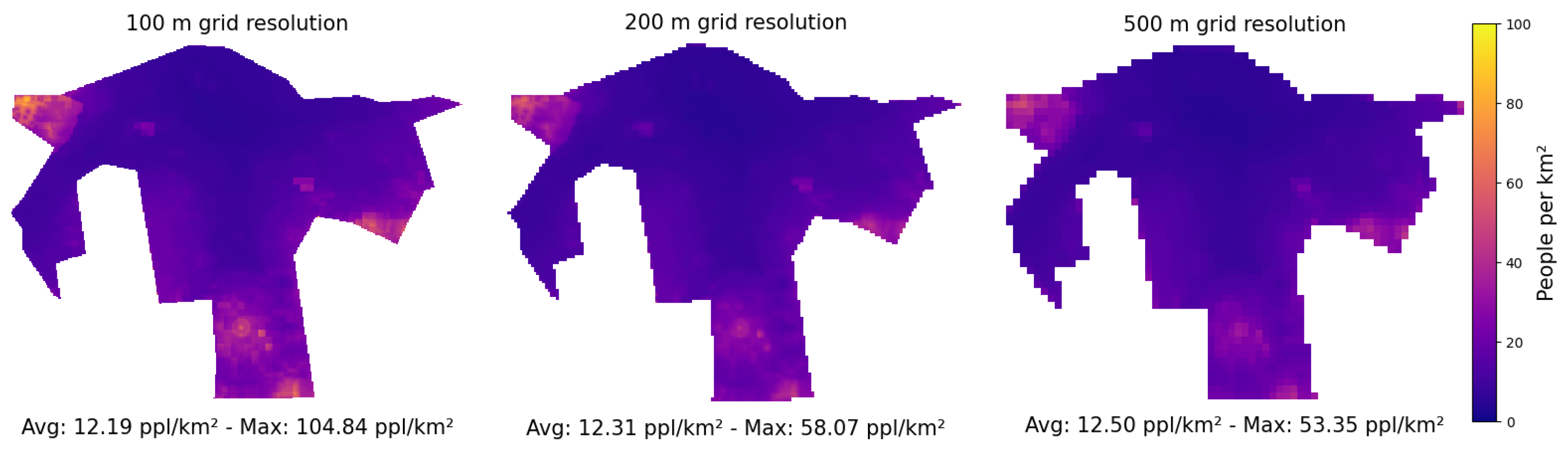
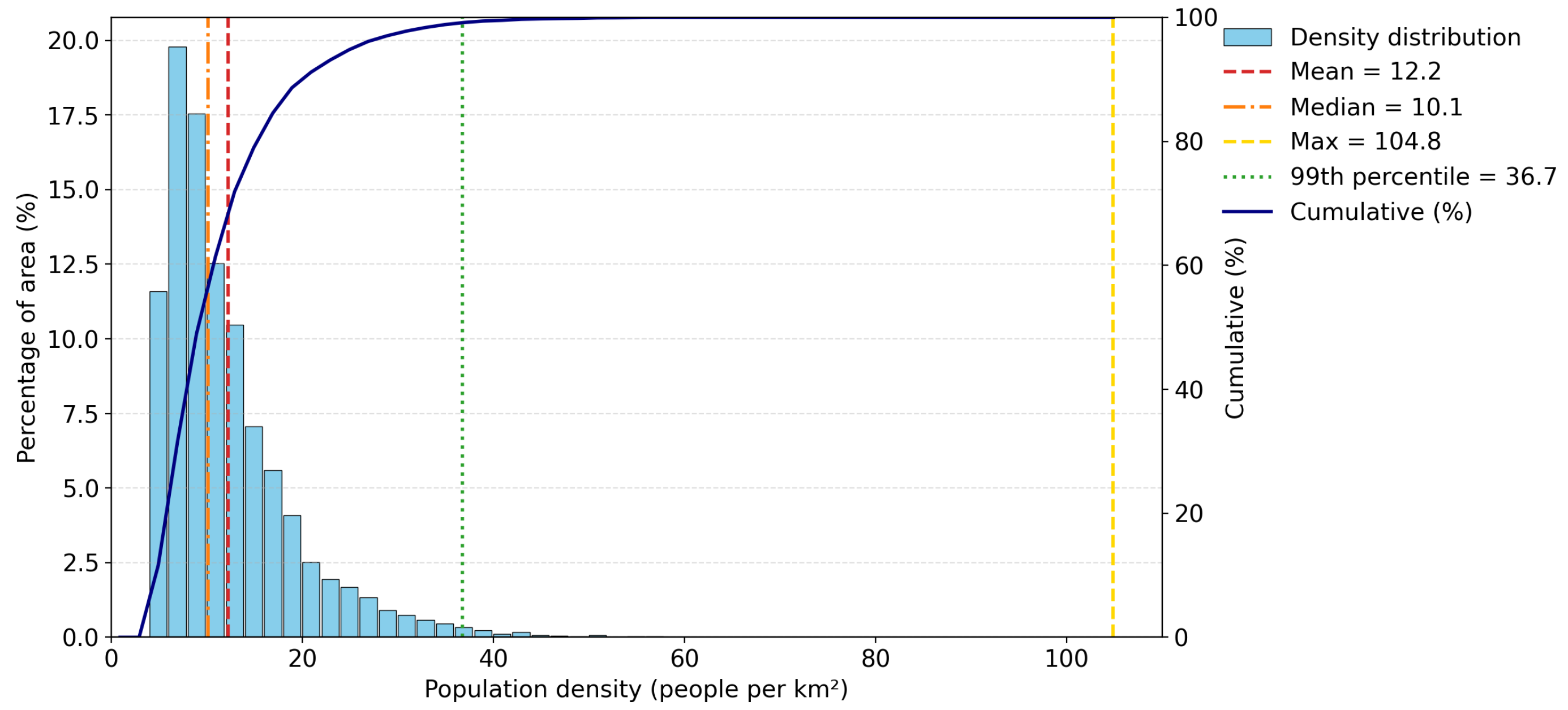


| Parameter | Estimate |
|---|---|
| Projected annual visitors | ≈116,800 |
| Daily visitors in January (seasonally adjusted) | 320 ± 10% → 352/day |
| Visitors per camp (10 sites) | 36 tourists/camp |
| Added staff per camp | 10 staff/camp |
| Total per camp | 46 people/camp |
| Area considered | 1 km2 |
| Resulting population density | 46 people/km2 |
| M1a Sheltering | Low robustness. Most tourists remained inside safari vehicles or buildings when outdoors. Rangers operated mainly along roads and bush tracks, where vegetation, trees, and terrain features provided partial shielding. |
| M1b Operational restrictions | Medium robustness. Operations avoided overflying people and roads wherever possible. When road crossings were necessary, they were performed perpendicularly to minimise time above potential traffic. A 400 ft (120 m) horizontal buffer was applied around all campgrounds. Together, these restrictions reduced the proportion of the risk footprint where people may be present by more than 90%. |
| M1c Observation | Low robustness. Remote crews conducted pre-flight and in-flight visual checks of the area and maintained continuous radio contact with the Ol Pejeta control room to identify gatherings or transient activity and adjust operations accordingly. |
| Altitude & geography | Operations were capped at 400 ft (120 m) AGL west of the Ewaso River and 250 ft AGL east of it, the latter imposed by KAF due to proximity to Nanyuki Air Base. For BVLOS missions without observers, an internal ceiling of 250 ft (75 m)AGL was used to further reduce the risk of low-level encounters. |
| Chronology | Daytime flights were limited to a 2 km radius to ensure that visual observers could detect any approaching crewed aircraft with sufficient time to trigger contingency procedures. At night, when crewed aircraft are not permitted in this airspace, operations extended to 5 km. |
| Vertical separation | A minimum 500 ft (150 m) separation was maintained between the operational ceiling and the published floor of crewed aviation. |
| Aerodrome buffers | Exclusion zones of 9 km around Laikipia Airport and 5 km around Kamok Airstrip were removed from the operational volume (Figure 1). |
| External coordination | For each flight period, the safety manager obtained KAF ATC approval for morning, afternoon, and evening slots to ensure coordinated use of the restricted airspace. |
| Detect | Detection relied on three layers: (1) web-based traffic feeds (Flightradar24); (2) local 1090 MHz ADS-B reception via software-defined radio; (3) continuous aeronautical VHF monitoring. Each pilot was supported by an airspace observer equipped with binoculars, and extended-range BVLOS missions [2 km (day)/5 km (night)] included additional remote observers positioned at the far end of the flight path. These measures satisfy the Annex D requirement for low-robustness detection for ARC–b operations, although the true detection probability cannot be empirically verified due to the absence of ground-truth traffic data over the conservancy. |
| Decide | When an intruder was detected, pilots executed predefined procedures: a rapid descent to below 100 ft (30 m), or if required, flight termination via the kill switch. Annex D specifies 60 ft (18 m) as the safe altitude; future campaigns will align with this value. |
| Command | Command-and-control links used DJI OcuSync (O2/O3) or 2.4 GHz RC systems (WiFi, FrSky, Herelink). Measured latencies across all platforms, presented in Appendix B.10, remained ≤150 ms, well within the Annex D requirement of ≤5 s. |
| Execute | The slowest platform descended at 3 m/s, yielding a descent from 400 ft (120 m) to 60 ft (18 m) in 34 s, meeting the Annex D limit of ≤60 s (see Appendix B.10 for calculations). |
| Feedback | Feedback updates were required within 5 s and end-to-end latency below 10 s. Local ADS-B tracks refreshed every 1 s, and Flightradar24 updated at 2–3 s intervals [21]. |
| OSO | Title | Status | Primary Limitation |
|---|---|---|---|
| #01 | Operator is competent and/or proven | Partially met | No training and role records |
| #02 | UAS manufactured by competent and/or proven entity | N/A (SAIL III+) | – |
| #03 | UAS maintained by competent/proven entity | Not met | No formal maintenance system |
| #04 | UAS components essential to safe operations designed to ADS | N/A (SAIL IV+) | – |
| #05 | UAS is designed considering system safety and reliability | N/A (SAIL III+) | – |
| #06 | C3 link characteristics are appropriate for the operation | Met | – |
| #07 | Conformity check of the UAS configuration | Partially met | No conformity check procedure |
| #08 | Operational procedures defined, validated, adhered to | Partially met | No ERP; limited assurance records |
| #09 | Remote crew trained and current | Partially met | Incomplete training coverage |
| #13 | External services supporting operations are adequate | Met | – |
| #16 | Multi-crew coordination | Met | – |
| #17 | Remote crew is fit to operate | Met | – |
| #18 | Automatic protection of the flight envelope from human errors | N/A (SAIL III+) | – |
| #19 | Safe recovery from human error | N/A (SAIL III+) | – |
| #20 | Human Factors evaluation/HMI appropriate for mission | Partially met | No formal HF evaluation |
| #23 | Environmental conditions defined, measurable, adhered to | Met | – |
| #24 | UAS designed/qualified for adverse environmental conditions | N/A (SAIL III+) | – |
| Operation Type | UAS | Crew (Before) | Crew (After) | Reduction |
|---|---|---|---|---|
| Initial setup | 1 | 4 | – | 0% |
| Multi-UAS operations | 2 | 8 | 6 | 25% |
| Swarm operations | 3 | 12 | 6 | 50% |
| Extended field campaign | 4 | 16 | 12 | 25% |
| Type | Key Procedural Adaptations | Underlying Rationale/Risk Context |
|---|---|---|
| Day/Night | - Day: high-visibility vests, sun protection. - Night: portable lights, warm clothing, strobe activation, and a mandatory daylight terrain survey. | Day missions focused on crew visibility; night missions required enhanced lighting and pre-survey of obstacles. |
| VLOS/BVLOS | - VLOS: relied on line-of-sight communication. - BVLOS: added communication checks and, for longer ranges, VHF radios. | BVLOS requires additional communication and surveillance measures to maintain situational awareness. |
| BVLOS Sub-types | - No remote observer: limited to 1 km from pilot. - With remote observer: up to 2 km with VHF and RLOS. - Night BVLOS: up to 5 km with strobes and lighting. | Remote observer presence and time-of-day govern achievable range; longer distances require stronger mitigations. |
| Crew & Platform Variations | - Single-UAS: baseline procedures. - Multiple-UAS: required pre-flight coordination, inter-pilot notification, and vertical separation. - Swarm: applied the same deconfliction principles with synchronised control under one operator. | Multi-UAS activities introduce shared airspace management needs. Vertical deconfliction prevents mid-air conflicts, and standardised templates support consistent application across platforms. |
| Common Elements | Airspace and weather checks, IMSAFE assessment, failsafe configuration, and post-flight logging were consistent. | These steps ensured consistency and traceability across all operations. |
| VLOS | BVLOS 1 km | BVLOS 1 km | BVLOS 1 km | BVLOS 2 km | Night BVLOS | Average |
| (single UAS) | (single UAS) | (multi-UAS) | (swarm) | (single UAS) | 5 km (single UAS) | |
| 22.6% | 20.2% | 16.7% | 19.0% | 15.5% | 13.1% | 17.9% |
| Evolution | Key Improvements and Outcomes |
|---|---|
| Procedures re-organisation | Checklist structure was redesigned to separate one-time first-flight tasks from a shorter recurring checklist for subsequent flights, reducing repetition and cognitive workload while retaining essential safety steps. |
| Communication and role definition | Emergency and contingency procedures were made more explicit, with standard callouts, clear responsibilities, and contact numbers placed on the first page to support rapid response. |
| Containment standardisation | Criteria for triggering Return-to-Home, land-on-site, or kill-switch actions were harmonised across operation types to improve crew familiarity and ensure consistent containment logic. |
| Threshold quantification | Ambiguous steps were replaced with measurable thresholds to increase repeatability, such as specifying landing-pad clearance distances and marking the site orientation. |
| Equipment requirements | Portable VHF/ADS-B units, originally carried universally, were later used only when required for higher-risk operations, with fixed equipment used otherwise. |
| Digital traceability | Daily checklists were generated through WildProcedures with embedded time stamps and version identifiers, ensuring teams used consistent and traceable procedure sets. |
| Mission Objective | Operational Challenges & Lessons | |
|---|---|---|
| #1 | Night tracking of lions (Panthera leo) to study movement and hunting behaviour. | • Predator activity increases ground risk. • Vehicle-based flying requires adaptations. • Night conditions require audio logging. • Fatigue management at night is essential. • Fixed home point limits efficiency. |
| #2 | Evaluating a UAS swarm framework for coordinated, multi-perspective zebra monitoring [22,23,24]. | • Large teams reduce scalability. • Short-range limits observation time. • Vertical spacing limits fleet size. • Procedural refinement boosts efficiency. |
| #3 | Assessing wildlife responses to controlled UAS approaches to study vigilance of Plains zebras. | • Pre-flight setup minimises disturbance. • Procedures training improves efficiency. • Fixed home point limits flexibility. |
| #4 | Aerial photogrammetry of rhinos (Diceros bicornis, Ceratotherium simum) for individual recognition and monitoring. | • Compact crew enhances flexibility. • Low altitude disturbs wildlife. • Range limits operational potential. • Exclusion zones hinder monitoring. • Co-development improves efficiency.• Crew training ensures readiness. |
| #5 | 3D reconstruction and semantic segmentation of savanna habitats for ecological modelling. | • Dense vegetation increases collision risk. • Bushland heightens wildlife risk. • Field experience improves workflow. |
| #6 | Testing collaborative multi-UAS mapping methods for dynamic savanna environments [25]. | • Safety protocols limit crew scalability. • Crew continuity improves familiarity. |
| #7 | Field-testing edge-AI systems (WildWing, WildLive) for autonomous wildlife tracking [26,27,28]. | • Custom platforms require adaptation. • Standardisation enables fast onboarding. |
| #8 | Evaluating WildLive for real-time multi-species detection and tracking [27,28]. | • Higher altitude reduces tracking accuracy. |
| #9 | Assessing behavioural responses of large herbivores to UAS noise for ethical-flight guidance. | • Large crews reduce scalability [29,30]. • Dual-UAS coordination increases workload. • Safety procedures slow mission turnover. • Range limits operational coverage. • Crew training improves efficiency. |
| #10 | Evaluating geolocation and size-estimation accuracy using COTS UAS and monoplotting algorithms [31,32]. | • Crew optimisation improves efficiency. • Routine operations risk complacency. • Emergency training enhances readiness. |
| #11 | Testing a stereo-vision payload for non-invasive measurement of animal body condition. | • Few pilots limit flexibility. • Large platforms reduce agility. • Short-range limits observation capacity. • Procedural refinement improves efficiency. |
Disclaimer/Publisher’s Note: The statements, opinions and data contained in all publications are solely those of the individual author(s) and contributor(s) and not of MDPI and/or the editor(s). MDPI and/or the editor(s) disclaim responsibility for any injury to people or property resulting from any ideas, methods, instructions or products referred to in the content. |
© 2026 by the authors. Licensee MDPI, Basel, Switzerland. This article is an open access article distributed under the terms and conditions of the Creative Commons Attribution (CC BY) license.
Share and Cite
Maalouf, G.; Richardson, T.S.; Guerin, D.R.; Watson, M.; Lundquist, U.P.S.; Costelloe, B.R.; Pastucha, E.; Afridi, S.; Rolland, E.G.A.; Meier, K.; et al. SORA 2.5-Guided BVLOS UAS for Wildlife Conservation in Kenya: Reducing Friction Between Safety and Field Operations. Drones 2026, 10, 178. https://doi.org/10.3390/drones10030178
Maalouf G, Richardson TS, Guerin DR, Watson M, Lundquist UPS, Costelloe BR, Pastucha E, Afridi S, Rolland EGA, Meier K, et al. SORA 2.5-Guided BVLOS UAS for Wildlife Conservation in Kenya: Reducing Friction Between Safety and Field Operations. Drones. 2026; 10(3):178. https://doi.org/10.3390/drones10030178
Chicago/Turabian StyleMaalouf, Guy, Thomas Stuart Richardson, David Roy Guerin, Matthew Watson, Ulrik Pagh Schultz Lundquist, Blair R. Costelloe, Elzbieta Pastucha, Saadia Afridi, Edouard George Alain Rolland, Kilian Meier, and et al. 2026. "SORA 2.5-Guided BVLOS UAS for Wildlife Conservation in Kenya: Reducing Friction Between Safety and Field Operations" Drones 10, no. 3: 178. https://doi.org/10.3390/drones10030178
APA StyleMaalouf, G., Richardson, T. S., Guerin, D. R., Watson, M., Lundquist, U. P. S., Costelloe, B. R., Pastucha, E., Afridi, S., Rolland, E. G. A., Meier, K., Jepsen, J. H., Sterren, T. v. d., Laporte-Devylder, L., Saint-Jean, C. R., Catricheo, C. A. M., Shukla, V., Iannino, E., Kline, J., Ngoc, D. N., ... Jensen, K. (2026). SORA 2.5-Guided BVLOS UAS for Wildlife Conservation in Kenya: Reducing Friction Between Safety and Field Operations. Drones, 10(3), 178. https://doi.org/10.3390/drones10030178