1. Introduction
Connected Unmanned Aerial Vehicles (UAVs), also known as drones, are emerging as a critical technology, providing diverse services across various environments, but their mobility demands stable and seamless connectivity. A primary challenge lies in effective handover (HO) management, especially as cellular networks evolve towards 6G, which targets ultra-high data rates, ultra-low latency, and ubiquitous coverage [
1]. Traditional HO approaches often prove inadequate for the dynamic and heterogeneous conditions faced by UAVs due to their inherent complexity and limited accuracy [
2,
3].
This paper surveys the crucial role of Machine Learning (ML) techniques in making and optimizing UAV HO decisions for UAVs in 6G networks. ML offers intelligent and adaptive solutions to mitigate frequent HOs and ensure robust Quality of Service (QoS) for highly mobile UAVs [
1,
4,
5]. By examining existing challenges and solutions, this review identifies key opportunities and future research directions for seamless UAV integration into advanced wireless ecosystems.
1.1. Motivation: The Transformative Potential of Cellular-Connected UAVs
UAVs are expected to profoundly transform future wireless networks and revolutionize various industries. The UAV industry itself is projected to experience substantial growth, with an expected increase from 19.3 billion USD in 2019 to 45.8 billion USD by 2025 [
6,
7]. This significant economic expansion is driven by the UAVs’ inherent flexibility, low-altitude capabilities, and potential cost-efficiency, making them attractive for both academia and industry.
Cellular-connected UAVs offer versatile roles within these networks, capable of acting as flying base stations (BSs), relays, or user equipment (UEs). When deployed as airborne BSs, UAVs can intelligently adjust their position, enabling reliable and cost-effective wireless communication, enhancing network scalability, and providing ubiquitous coverage [
8,
9,
10]. Their ability to adapt to altitude and navigate obstacles improves the likelihood of establishing line-of-sight (LoS) communication with ground users. This makes them invaluable for diverse applications, including telecommunications, surveillance, monitoring, environmental sensing, border security, cargo delivery, visual shows, disaster management, search and rescue, and emergency response [
8,
11,
12,
13]. UAVs can also significantly enhance intelligent transportation systems and even offer telepresence solutions.
However, realizing the full potential of cellular-connected UAVs depends on ensuring seamless and reliable wireless connectivity, particularly during HO events. Unlike terrestrial devices, UAVs exhibit high mobility in a three-dimensional (3D) environment, leading to frequent and often unpredictable changes in signal conditions. These characteristics can result in frequent HOs, affecting connectivity and QoS [
14,
15]. The critical and sensitive nature of many UAV applications, such as rescue missions and medical supply delivery, further emphasizes the importance of addressing these mobility challenges to ensure robust command and control signaling and continuous data transmission [
16]. Therefore, making and optimizing HO decisions is dominant for maximizing operational efficiency and unlocking the transformative capabilities of UAVs in future networks.
1.1.1. Emerging Applications of Cellular-Connected UAVs
Cellular-connected UAVs are transforming industries and are recognized as a highly promising technology for future wireless networks, with significant market growth anticipated. Their inherent autonomy, high mobility, and flexible deployment enable diverse and emerging applications [
6,
12].
These UAVs serve critical functions, acting as flying BSs or relays to extend network coverage and capacity, particularly in challenging environments, remote areas, or for rapid deployment during disaster management, search and rescue, and emergency response operations [
8,
17]. As user equipment (UEs) within cellular networks, they facilitate applications such as package delivery, including vital medical supplies, remote sensing, and various forms of surveillance and monitoring, encompassing industrial IoT (IIoT) platforms [
18,
19].
Beyond these, UAVs are integral to evolving concepts like the Internet of Things (IoT) in the sky and the broader Internet of Everything (IoE), providing real-time data for environmental sensing and civil infrastructure monitoring. Their capabilities further extend to traffic management, asset inspection, aerial imaging, and visual shows. The integration with 6G networks is expected to enable advanced services such as ultra-smart cities and Extended Reality (XR) [
11]. This wide range of applications emphasizes the critical need for seamless and reliable wireless connectivity provided by cellular networks.
1.1.2. The Crucial Need for Seamless and Reliable Wireless Connectivity
Wireless communication networks are witnessing an unprecedented demand for continuous, reliable, and stable connectivity, driven by the rapid growth of smart devices and the expansion of the IoE. This need is particularly critical for UAVs in diverse applications, where safe operation and real-time data exchange are paramount [
11,
20,
21,
22,
23]. The evolution towards Sixth Generation (6G) networks, with their emphasis on the next technological improvement of the Ultra-Reliable Low-Latency Communications (URLLC), further stresses the necessity for uninterrupted and high-quality links, especially for mission-critical services [
24,
25].
However, achieving such seamless connectivity in dynamic environments presents significant challenges. Traditional cellular networks are primarily optimized for ground UEs, making connectivity for flying UAVs difficult [
26,
27]. UAVs experience volatile radio environments, higher interference, and significantly more frequent HOs than ground users due to their high mobility and operating altitudes [
28]. These factors lead to issues such as Radio Link Failures (RLF), HO failures (HOF), and ping-pong HOs, which degrade service quality, increase signaling overhead, and can result in packet loss [
15,
22,
29]. Moreover, the dense deployment of small cells and the use of Millimeter Wave (mmWave) and Terahertz (THz) bands amplify the challenge by increasing HO frequency and susceptibility to signal blockages [
30]. Efficient HO management for UAVs is thus crucial to minimize service interruption to ensure consistent data rates and reliability.
1.2. Scope and Contributions: Bridging the Gap in UAV HO Research
UAV HO management presents significant challenges due to their inherent 3D mobility, which complicates traditional terrestrial network mobility issues. Unlike ground users, UAVs operate in a unique radio environment where altitude changes profoundly impact communication and interference, often leading to increased HO rates and failures [
18]. Limited onboard battery capacity and frequent HOs also pose critical limitations, potentially causing communication disruptions and reduced mission endurance. Existing cellular systems were not optimally designed for aerial users, necessitating tailored solutions for efficient mobility management [
14,
19,
31]. Furthermore, the narrow beamwidths of millimeter-wave (mmWave) and THz communications can result in disconnections due to antenna misalignment, further deteriorating performance [
32].
To bridge these identified gaps, various ML-based approaches have been proposed to enhance UAV HO decisions. Reinforcement Learning (RL) frameworks, such as Q-learning, offer flexible HO decision, allowing for adaptable trade-offs between HO frequency and received signal strength (RSS)/Signal-to-Interference-plus-Noise Ratio (SINR) [
27]. More advanced DRL algorithms, including Proximal Policy Optimization (PPO) and Deep Q-Networks (DQN), have demonstrated substantial reductions in unnecessary HOs and improved communication reliability by dynamically optimizing parameters based on current conditions. For instance, the REQIBA solution leverages regression neural networks and Dueling Double DQN (D3QN) for intelligent BS association, maximizing throughput while managing HO rates effectively, particularly in interference-limited channels [
15,
18]. Recent contributions also address joint trajectory planning and HO management for multi-UAV systems, aiming to minimize key performance indicators (KPIs) like delay, interference, and HO numbers by considering their inter-dependencies [
33]. These advancements are crucial for enabling seamless and reliable UAV integration into future 6G networks, addressing the complex challenges posed by their unique operational characteristics.
1.2.1. Focus on AI/ML-Based HO Decision for Cellular-Connected UAVs in 6G Networks
The integration of UAVs into 6G networks introduces significant mobility management challenges. Their high speeds and 3D mobility, coupled with narrow beamwidths in mmWave and THz bands, cause frequent HO and degraded QoS [
34,
35].
Artificial Intelligence (AI) and ML are crucial for these complexities. They enable systems to learn network behaviors, predict future conditions, and make proactive HO decisions, overcoming traditional reactive limitations [
15,
36,
37].
RL, including Deep RL (DRL), is highly promising for UAV HO optimization, effectively minimizing HO frequency and maintaining signal quality [
15,
38]. In parallel, Recurrent Neural Network (RNN), a deep learning (DL) model that employs the concept of supervised learning, predicts UAV trajectories and signal strength for precise HO timing [
39,
40].
These AI/ML-driven approaches collectively reduce unnecessary HOs, improve communication reliability, and enhance overall network performance for UAVs in the challenging 6G environment.
1.2.2. Comprehensive Review Scope and Key Contributions
This review paper makes several key contributions to the field of UAV HO management in future wireless communication networks, including 6G.
This paper contributes to the academic discourse by providing:
A unified and comprehensive overview of the growing research efforts in UAV HO management, consolidating existing knowledge and outlining essential directions for future investigations.
A specific focus on ML applications for UAV HO management, differentiating it from broader mobility management surveys.
Detailed discussions on communication requirements and design challenges for the seamless integration of cellular-connected UAVs into future wireless systems, including 6G.
An identification of existing limitations in current research, such as the scarcity of reliable datasets, insufficient detail on ML tools, and overlooked hardware impacts, which hinder reproducibility and practical deployment.
1.3. Research Aims, Objectives, and Research Questions
This review aims to systematically analyze and critically evaluate HO decision and optimization techniques for UAV-enabled 6G networks, with a particular focus on AI- and ML-driven approaches.
- (i)
identify and categorize existing HO techniques for non-UAV, UAV-BS, and UAV-UE scenarios;
- (ii)
compare traditional and AI/ML-based HO mechanisms over different performance metrics;
- (iii)
critically analyze the strengths, limitations, and trade-offs of existing approaches; and
- (iv)
highlight open challenges and future research directions toward AI-native 6G HO management.
RQ1: What HO decision techniques have been proposed for UAV-enabled cellular networks across different deployment scenarios?
RQ2: How do AI/ML-based HO approaches compare with traditional schemes across different UAV scenarios?
RQ3: What limitations and research gaps hinder the practical deployment of intelligent UAV HO in 6G networks?
1.4. Paper Organization
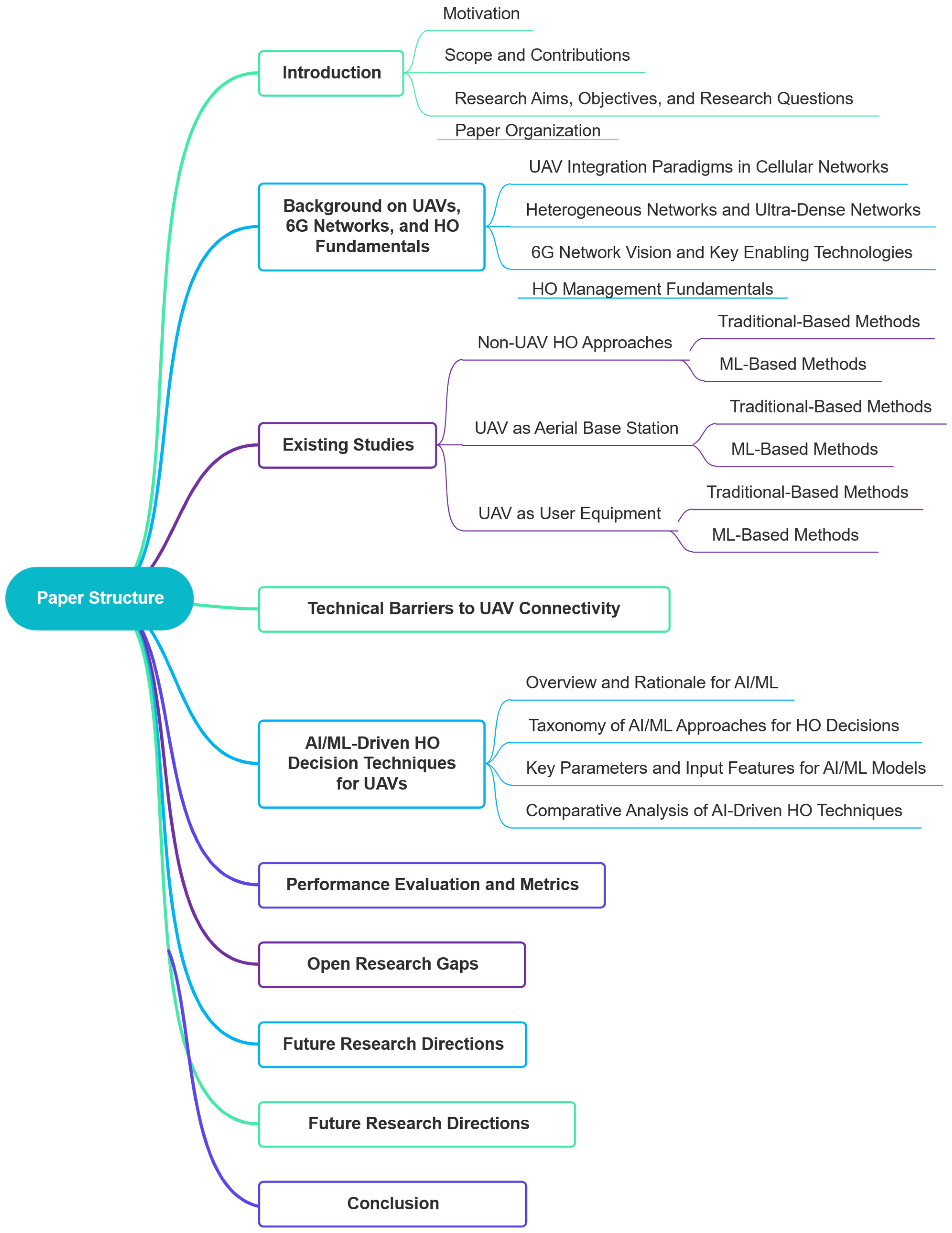
This paper is structured into ten main sections, as illustrated in
Figure 1.
Section 1 introduces the motivation, objectives, and contributions of the study, emphasizing the need for intelligent HO mechanisms in UAV-assisted 6G networks.
Section 2 provides the necessary background on UAV communications, 6G architectures, and HO fundamentals, establishing the conceptual basis for subsequent discussions.
Section 3 reviews existing studies on HO optimization, categorized into non-UAV, UAVs acting as BSs (UAV-BS), and UAVs acting as UE (UAV-UE) scenarios, covering both traditional and AI/ML-based methods.
Section 4 discusses key HO technical barriers for cellular-connected UAVs, including mobility, interference, and dynamic topology issues.
Section 5 examines AI/ML-driven HO decision techniques, outlining learning paradigms and their application in UAV networks.
Section 6 presents performance evaluation parameters and key metrics used across the reviewed literature.
Section 7 identifies major open research challenges that limit efficient UAV HO design.
Section 8 highlights future research directions toward hybrid, distributed, and context-aware learning frameworks.
Section 9 provides a critical discussion and synthesis of the reviewed HO techniques. Finally,
Section 10 concludes the paper with summarized findings and recommendations for advancing intelligent UAV handover management in 6G systems.
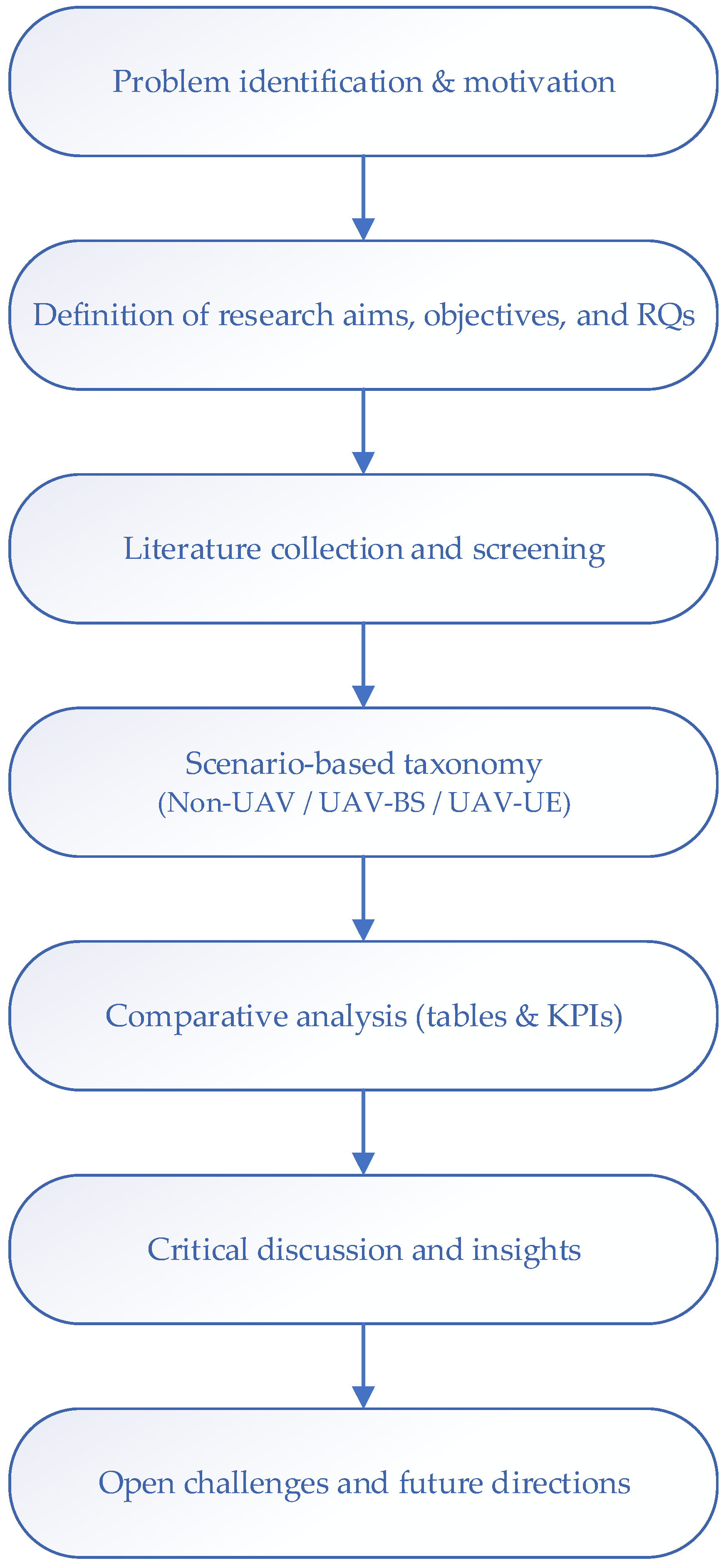
Figure 1 illustrates the organizational structure of the manuscript, while
Figure 2 presents the methodological flow of the review and the progression of the research.
2. Background on UAVs, 6G Networks, and HO Fundamentals
The integration of UAVs into cellular networks introduces new opportunities and challenges across different deployment paradigms. UAVs may operate as UEs, facing interference and mobility issues, or serve as aerial base stations (ABSs) and relays to extend coverage. In addition, the emergence of Heterogeneous Networks (HetNets) and Ultra-Dense Networks (UDNs) further transforms the network environment. As the evolution toward 6G promises ultra-reliable, low-latency, AI-driven connectivity, HO management becomes critical to ensure seamless communication, optimize resources, and maintain service quality in increasingly complex and dynamic wireless environments [
41].
2.1. UAV Integration Paradigms in Cellular Networks
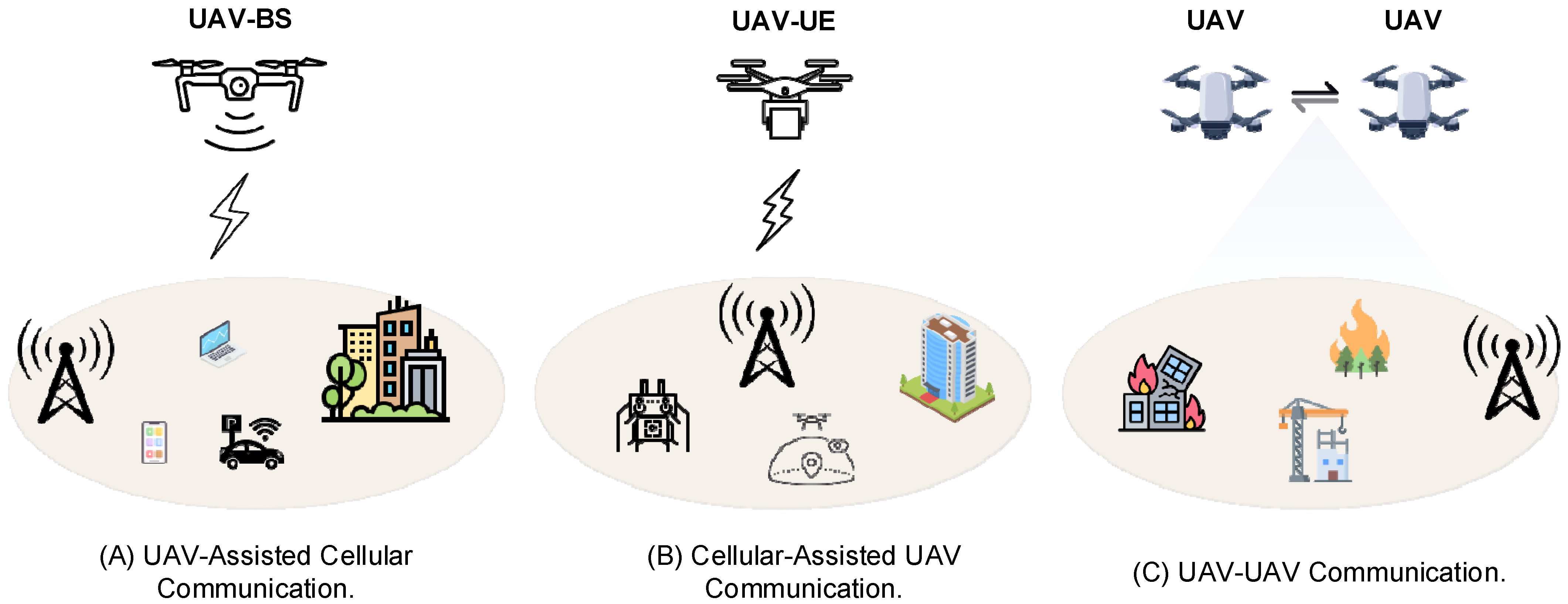
UAVs are integrated into cellular networks in two primary paradigms: as UEs and as ABSs or relays as illustrated in
Figure 3 [
17]. When functioning as UEs, UAVs perform tasks as aerial users that connect to the existing terrestrial cellular network for command-and-control (C&C) and payload data exchange. However, as UEs, UAVs face significant challenges, including strong interference, frequent HOs, and throughput degradation at higher altitudes [
18,
42]. Conversely, when deployed as ABSs or relays, UAVs function as mobile infrastructure, extending terrestrial network coverage and providing services to terrestrial UEs [
43]. Additionally, UAV-UAV communication facilitates data and control signal exchange between UAVs, often relying on intra-UAV links [
12].
UAVs operating as UEs are crucial for next-generation cellular networks, supporting applications like surveillance and package delivery, leveraging their flexible deployment. This role, however, presents challenges including limited battery capacity and frequent HOs in dynamic 3D environments, poorly handled by traditional algorithms [
26]. High UAV mobility increases HO rates with speed and altitude, impacting QoS [
6]. ML solutions are vital for optimizing HO decisions, trajectory, and resource allocation, aiming to improve connectivity, energy efficiency, and signal quality for UAV UEs [
15,
23,
33].
UAVs are increasingly deployed as ABSs or relay nodes, complementing ground networks in cellular systems. This offers enhanced coverage, capacity, reliability, and energy efficiency. Furthermore, their mobility and adaptive altitude enable rapid deployment in disaster areas or for high-traffic hotspots where terrestrial infrastructure is insufficient. Moreover, UAV ABSs improve LoS communication due to elevated positions, reducing signal blockage [
8,
44].
2.2. Heterogeneous Networks and Ultra-Dense Networks
HetNets integrate diverse wireless communication technologies, deploying various BSs such as macrocells, microcells, picocells, and femtocells to enhance network capacity and QoS [
45,
46]. Similarly, UDNs involve a high density of small cells to significantly improve capacity, spectral efficiency, and user experience. Both HetNets and UDNs are crucial for 5G and 6G networks. However, their reliance on small cells often leads to an increased number of HOs, potentially causing HO ping-pong, HO failures, and heightened interference and signaling overhead [
47,
48]. Effective HO management is therefore essential for maintaining seamless connectivity.
2.3. Sixth-Generation Network Vision and Key Enabling Technologies
The 6G network vision centers on ubiquitous, ultra-low latency, and highly reliable connectivity, natively leveraging AI. Key performance indicators include ultra-high data rates, extremely low latency, ultra-high reliability, and very high mobility [
49,
50,
51].
Key enabling technologies for 6G include mmWave and THz communications to address spectrum resource scarcity, non-terrestrial network (NTN) (e.g., satellites, UAV-mounted BSs) for global seamless coverage, and Mobile Edge Computing (MEC) for reduced latency. AI and ML are expected to play a crucial role in these networks [
46,
52,
53].
The vision for 6G networks transcends 5G capabilities, aiming for seamless, high-performance connectivity across environments. These networks are designed to integrate space, air, ground, and underwater communications, connecting everything with intelligence [
53,
54]. Key requirements of 6G include ultra-high data rates of up to 1 Tbps and end-to-end latency below 0.1 ms. Achieving 99.99999% reliability and supporting connection densities of up to 10 million devices per square kilometer are critical. Furthermore, 6G is projected to handle high mobility, up to 1000 km/h, utilizing THz frequency bands and so it is expected to deliver up to 100 times greater energy efficiency compared to 5G. Moreover, AI is fundamental to 6G, enabling autonomous network management, real-time decision-making, and self-optimization. This AI-nativeness enables emerging services with stringent performance demands, such as holographic communications, tactile internet, and autonomous vehicles [
49,
53,
55,
56,
57,
58].
Table 1 provides a comparison of 5G and 6G in terms of mobility and HO characteristics [
50,
53,
59,
60].
In next-generation wireless networks, various technologies play complementary roles in enabling high-performance connectivity. For instance, mmWave and THz bands offer high data rates but experience significant path loss and limited coverage, which leads to frequent HOs. Moreover, NTN, integrating satellites and UAVs, provides global coverage but faces complex HO due to high mobility. In addition, MEC reduces latency and enhances processing by moving computing closer to users for real-time applications; however, HO authentication remains a challenge [
48,
53]. Furthermore, Software-Defined Networking (SDN) and Network Function Virtualization (NFV) boost flexibility and scalability, while reducing latency, which are essential for managing complex networks and HO [
46,
61].
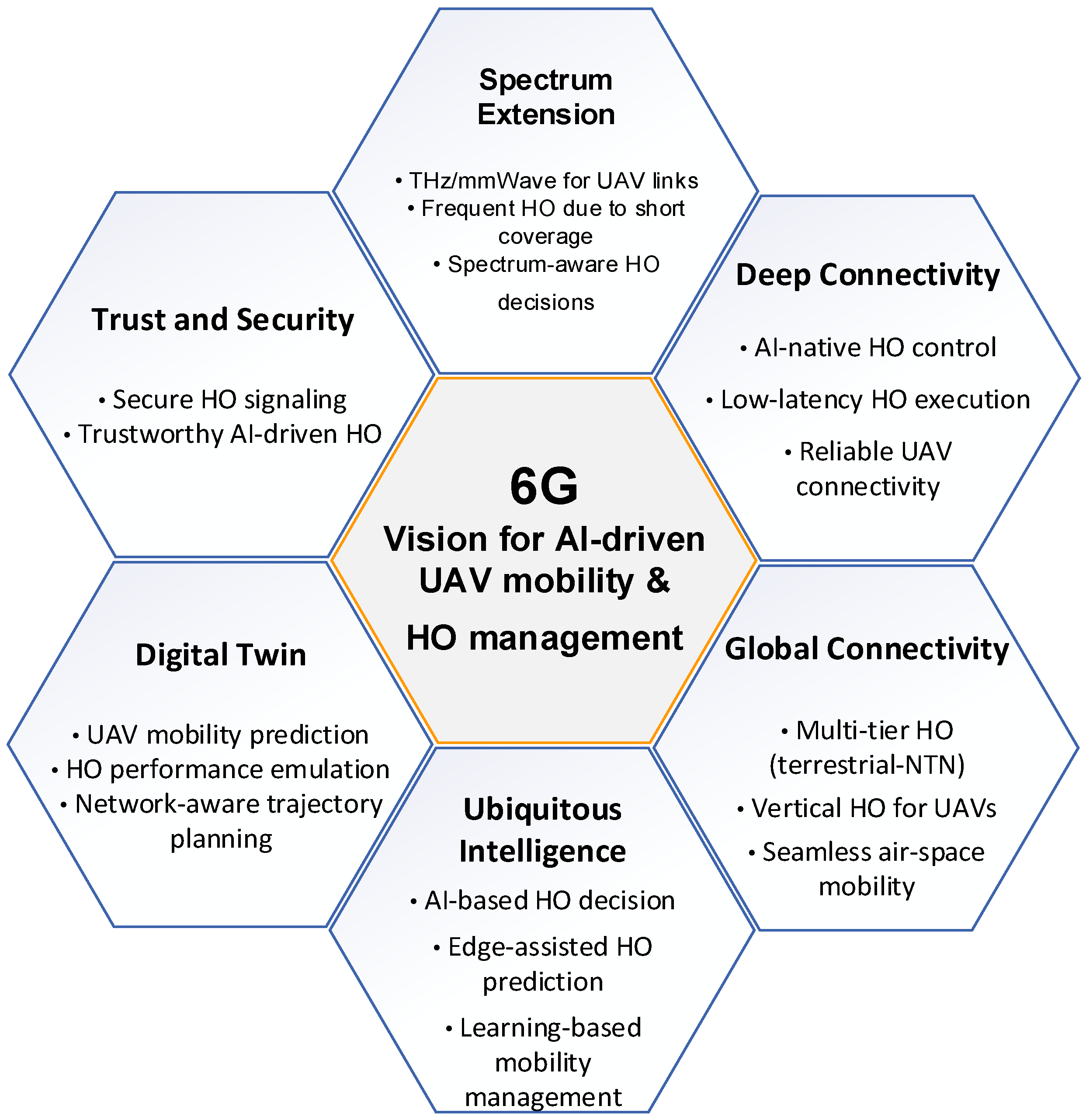
Figure 4 highlights the 6G vision, emphasizing key enabling technologies.
2.4. HO Management Fundamentals
HO management is fundamental for maintaining seamless communication as UEs move between different cell coverage areas. Its objectives include preserving signal continuity, optimizing resource allocation, balancing network load, and conserving energy [
41]. In addition, HO Control Parameters (HCPs) such as Time-To-Trigger (TTT), HO Margin (HOM), and Cell Individual Offset (CIO) are dynamically adjusted to minimize unnecessary HOs and failures The HO process typically begins with the UE monitoring signal quality and sending measurement reports to the serving base station, which then evaluates this data to select the optimal target BS for the HO [
61,
62,
63].
HO plays a crucial role in mobility management in cellular networks, enabling the transfer of an active communication session from a serving BS to a target BS without service interruption. This process is essential for maintaining signal quality, ensuring service continuity, balancing network load, and optimizing resource allocation [
1]. In addition, the HO procedure generally comprises three distinct stages: preparation, execution, and completion [
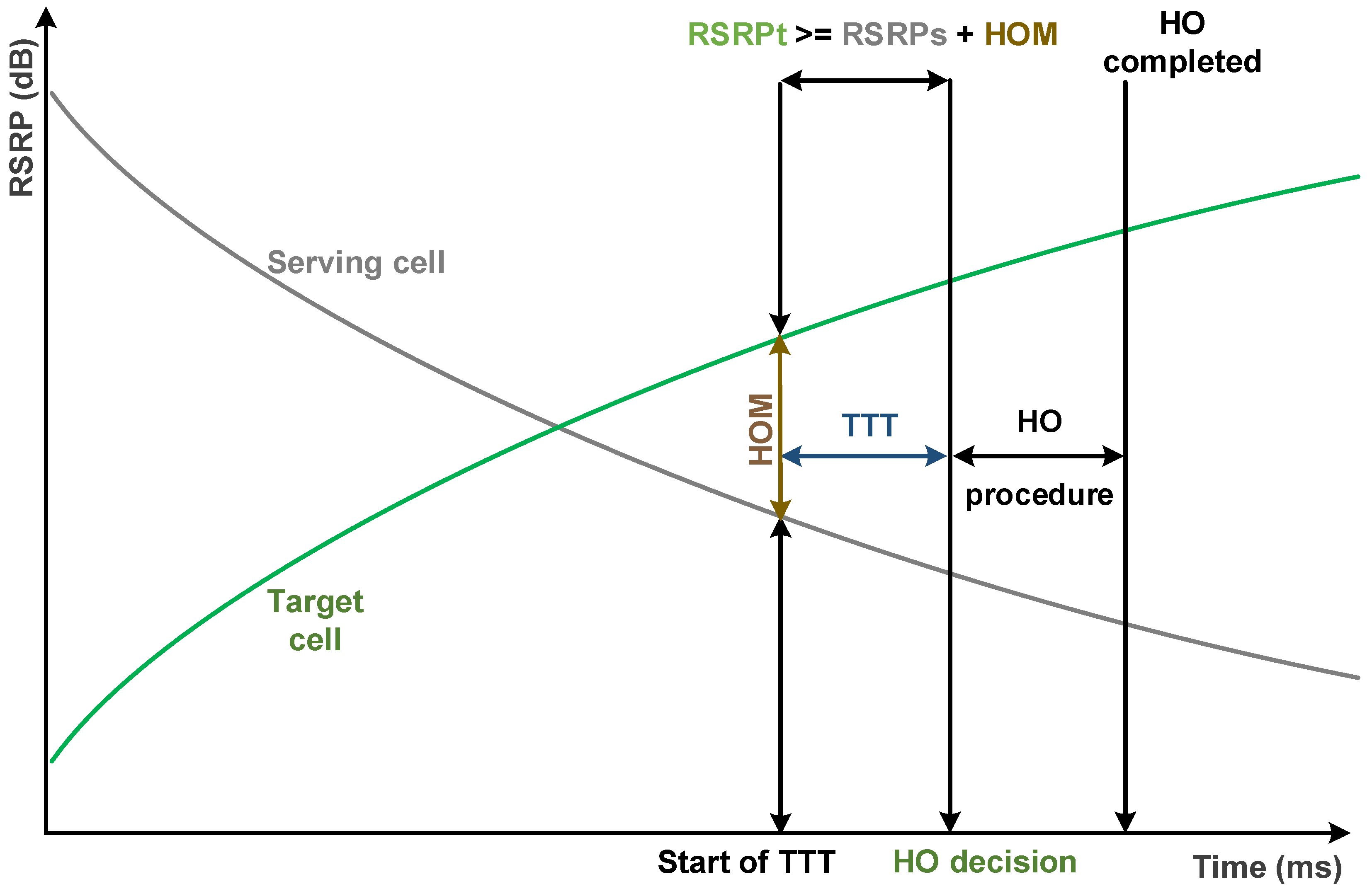
42]. Initiation typically involves UE sending measurement reports (MRs) to the serving BS, detailing signal quality metrics such as Reference Signal Received Power (RSRP). A common triggering condition, like the 3rd Generation Partnership Project (3GPP) A3 event, is met when the target BS’s RSRP exceeds that of the serving BS by a defined HOM for a specified TTT duration [
1,
61,
64]. The HO procedure is depicted in
Figure 5, where the HO decision is initiated once the received signal strength from the target cell exceeds that of the serving cell by a predefined offset threshold [
48].
HCPs are essential for managing HO processes, ensuring stable and quality connections for UEs. The primary HCPs include HO Margin and Time-To-Trigger. These parameters determine the optimal timing for initiating an HO. In addition, incorrect HCP settings can lead to issues such as too-early or too-late HOs, increasing HO Ping-Pong (HOPP) or RLF probabilities, respectively. Moreover, adaptive adjustment of HCPs based on factors like UE speed and signal quality is crucial for network performance [
30,
65,
66].
Table 2 presents the relationship between HO parameter configuration and corresponding HO failures [
30,
48].
UAV HO decisions heavily rely on measurement events, which involve reporting signal quality parameters to the serving BS. Key metrics include RSRP, RSRQ, and Received Signal Strength Indicator (RSSI). Moreover, standardized 3GPP HO events, such as A2 and A3, determine when a UAV initiates measurement reports [
1,
67,
68]. For instance, Event A3 is triggered when a neighboring BS’s signal exceeds the serving BS’s signal by a predefined offset, an essential aspect for maintaining connection quality. Furthermore, parameters like TTT and hysteresis margins are crucial for managing these events, preventing excessive and unnecessary HOs [
68,
69].
To bridge the gap between standardized 3GPP mechanisms and AI/ML-based HO decision, a structured mapping of HO parameters to learning-based variables is provided. As summarized below,
Table 3 illustrates how measurement events and HCPs can be interpreted within an RL paradigm.
3. Existing Studies
The evolution of HO optimization mirrors the transition from rule-based mobility management to intelligent, learning-driven decision frameworks. This section synthesizes representative studies across three categories—non-UAV terrestrial systems, UAVs acting as BSs, and UAVs as user equipment—each further divided into traditional and ML-based techniques.
3.1. Non-UAV HO Approaches
Early HO optimization relied on analytical and multi-criteria methods. In [
70], mathematical analysis improved vertical HO reliability by tuning latency and block distance. A hybrid Fuzzy Logic Controller (FLC) with Weighted Function in [
65] dynamically adjusted HOM and TTT, minimizing RLF to 0.006. The Weighted Function model in [
71] integrated RSRP, velocity, and traffic load to significantly cut HO interruption time. Similarly, ref. [
72] applied Fuzzy-Multi-Attribute Decision Making (MADM) methods to achieve highly reduced unnecessary HOs at low speeds. Collectively, these classical models emphasize heuristic parameter control but lack predictive or autonomous capabilities.
With 5G and beyond, HO management shifted toward predictive and data-driven control. Double Deep RL (DDRL) in [
34] optimized network QoS by minimizing the occurrence of frequent HOs. DQN and Multi-Agent DRL in [
73] improved proactive HO success rate under fast user movement, while Random Forest clustering in [
74] demonstrated significance of the distance between a user and its cell center for decision-making, tackling mobility management complexity inherent in next-generation networks. The Long Short-Term Memory (LSTM) model in [
40] efficiently predicted RSRP sequences, cutting RLF rates significantly, while Double Deep Q-Learning in [
68] reduced packet loss by 25.72% per HO, significantly outperforming the A3 RSRP baseline. These works established ML as a cornerstone for adaptive, context-aware HO, yet they still face issues of training cost and scalability. A comparative analysis of traditional versus ML-based HO approaches in non-UAV scenarios is synthesized in
Table 4.
3.2. UAV as Aerial Base Station
Traditional UAV-BS studies extended terrestrial heuristics to aerial contexts. A Fuzzy System Strategy in [
6] combined parameters like user speed, RSSI, and UAV’s battery level, improving QoS and QoE and ensuring more stable connectivity in dynamic aerial networks. Stochastic geometry was utilized in [
75,
76] to analyze how parameters like altitude, density, and velocity impact HO rates and signaling overhead, establishing that HO rate is proportional to BS density. In addition, cache-based strategies introduced in [
77] have been shown to reduce HO delay and unnecessary HOs while enhancing energy efficiency. While these mathematical and heuristic frameworks provide foundational stability, they often rely on analytical or simulation-based modeling that can face scalability challenges in highly autonomous environments.
Recent works leverage DL for UAV-BS intelligence. A DRL-based distributed DQN framework in [
78] optimized long-term throughput while reducing HO frequency. In [
42], user trajectory prediction via DL minimized misjudged HOs, improving the HO success rate. The Convolutional Neural Networks (CNN)–LSTM prediction in [
79] reduced ping-pong and outage rates while increasing energy efficiency and load balance. Meanwhile, ref. [
80] utilized RNN/Gated Recurrent Unit (GRU)/LSTM for trajectory-aware HO control, boosting SINR and RSSI by 165% and 118%, respectively, indicating superiority of GRU model in carrying out HO management. Advanced DRL variants such as Noisy Network (NoisyNet)-DDQN-based Sequential HO [
81] minimized unnecessary HOs improving overall performance, while Multi Agent DQN (MADQN) [
82] improved HO management, by trading-off between deployment cost and UAV dropouts. Collectively, these ML-based schemes exhibit strong performance under 3D dynamic conditions, though their computational cost remains a constraint for onboard deployment. A comparative analysis of traditional versus ML-based HO approaches in UAV-BS scenarios is synthesized in
Table 5.
3.3. UAV as User Equipment
For UAV-UEs, traditional models incorporated graph and optimization logic. The generalized inter-section method with HO (GIM-HO) model in [
83] used graph-based optimization, which improved UAV trajectories and HO strategies, while the Weighted Summation Model in [
58] optimized terrestrial–satellite transitions, improving reliability and seamless communication in remote and challenging environments. Hybrid approaches like model-based Service Availability Mobility Robustness Optimization (SA-MRO) with DQN [
84] reduced HO numbers by over 50% and improved service availability by 40%. Though effective, these designs lacked real-time learning for unpredictable UAV trajectories.
Learning-driven schemes dominate UAV-UE optimization. Q-learning [
22] reduced HO frequency and ensured cost-efficient mobility by balancing RSS and signaling overhead. DRL-PPO in [
15] cut unnecessary HOs by up to 76% versus greedy baselines, while lowering signaling cost. Hybrid Generative Adversarial Network (GAN)–RL in [
63] autonomously tuned hysteresis and TTT, ensuring smooth soft HOs, while Dueling Double Deep Q-Network (D3QN) in [
85] improved HO frequency across diverse flight scenarios. Recent edge-intelligent models, such as Semantic MobileBERT in [
86], achieved near-perfect HO prediction accuracy using multi-label contextual reasoning. These ML-based UAV-UE frameworks exhibit strong adaptability and self-learning behavior, underscoring a decisive evolution toward autonomous, context-aware HO in 6G aerial networks.
Overall, across all scenarios, the literature reveals a clear paradigm shift, from static, rule-based thresholds toward ML-based dynamic optimization. Traditional methods provided interpretability and simplicity, while ML-based frameworks now enable proactive, multi-objective decision-making critical for ultra-reliable, low-latency, and energy-efficient HOs in next-generation UAV-integrated networks. A comparative analysis of traditional versus ML-based HO approaches in UAV-UE scenarios is synthesized in
Table 6.
Overall, the comparisons of the three scenarios (i.e., non-UAV, UAV-BS, and UAV-UE) reveal a clear shift from static, signal-threshold–based HO schemes toward learning-driven, context-aware approaches as network scenarios evolve from terrestrial to UAV-enabled 6G systems. Traditional methods remain lightweight and effective for optimizing basic HO metrics but struggle under high mobility and 3D dynamics. In contrast, ML-based solutions consistently achieve superior reductions in HO frequency, failures, and ping-pong effects while improving QoS, energy efficiency, and service continuity, especially for UAV-BS and UAV-UE scenarios at the cost of higher computational complexity and training overhead.
4. Technical Barriers to UAV Connectivity
Cellular-connected UAVs face significant HO challenges due to their unique 3D mobility and high speeds, leading to frequent HOs and the HO ping-pong effect [
4,
89]. The complex radio environment, characterized by unpredictable signal fluctuations, exposure to antenna sidelobes, and increased interference from multiple BSs in line-of-sight conditions, further complicates HO management. These issues culminate in performance degradation, including RLF, HO failures, increased latency, packet loss, and degraded QoS [
2,
44,
45,
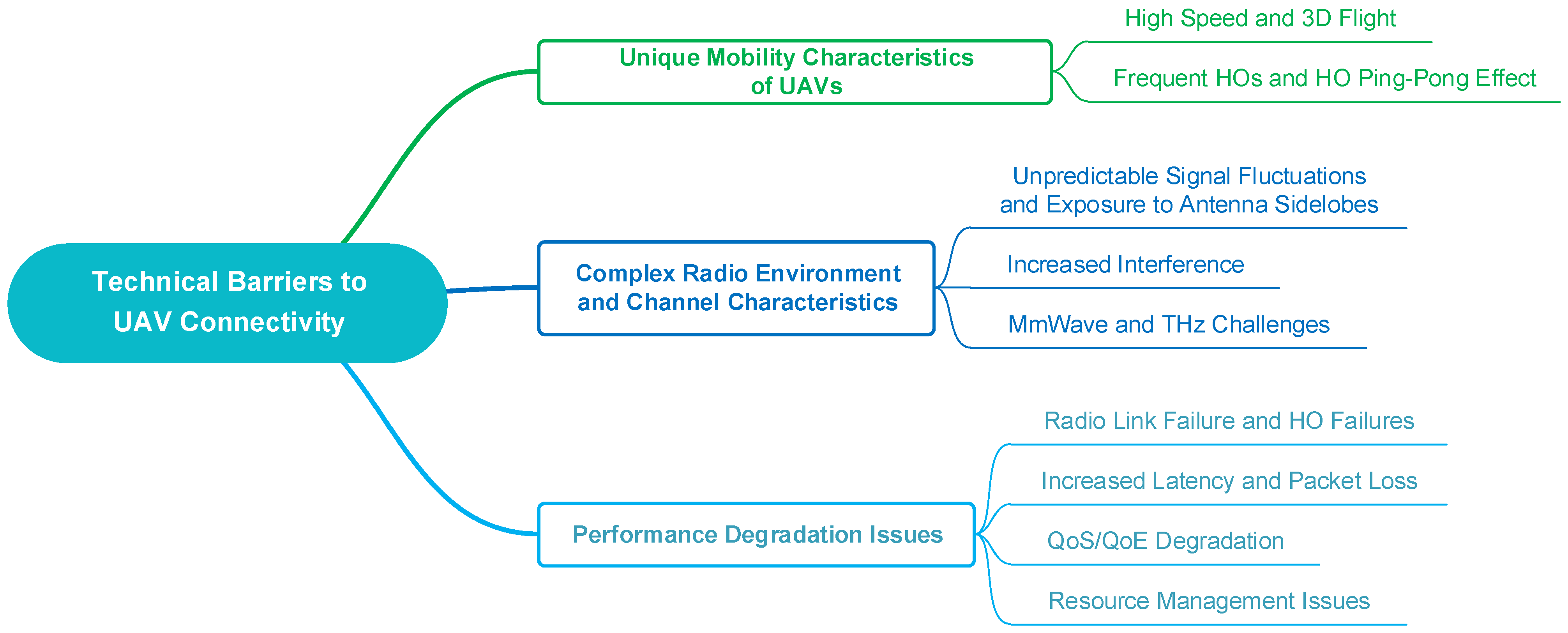
89]. A summary of the technical barriers to UAV connectivity is presented in
Figure 6.
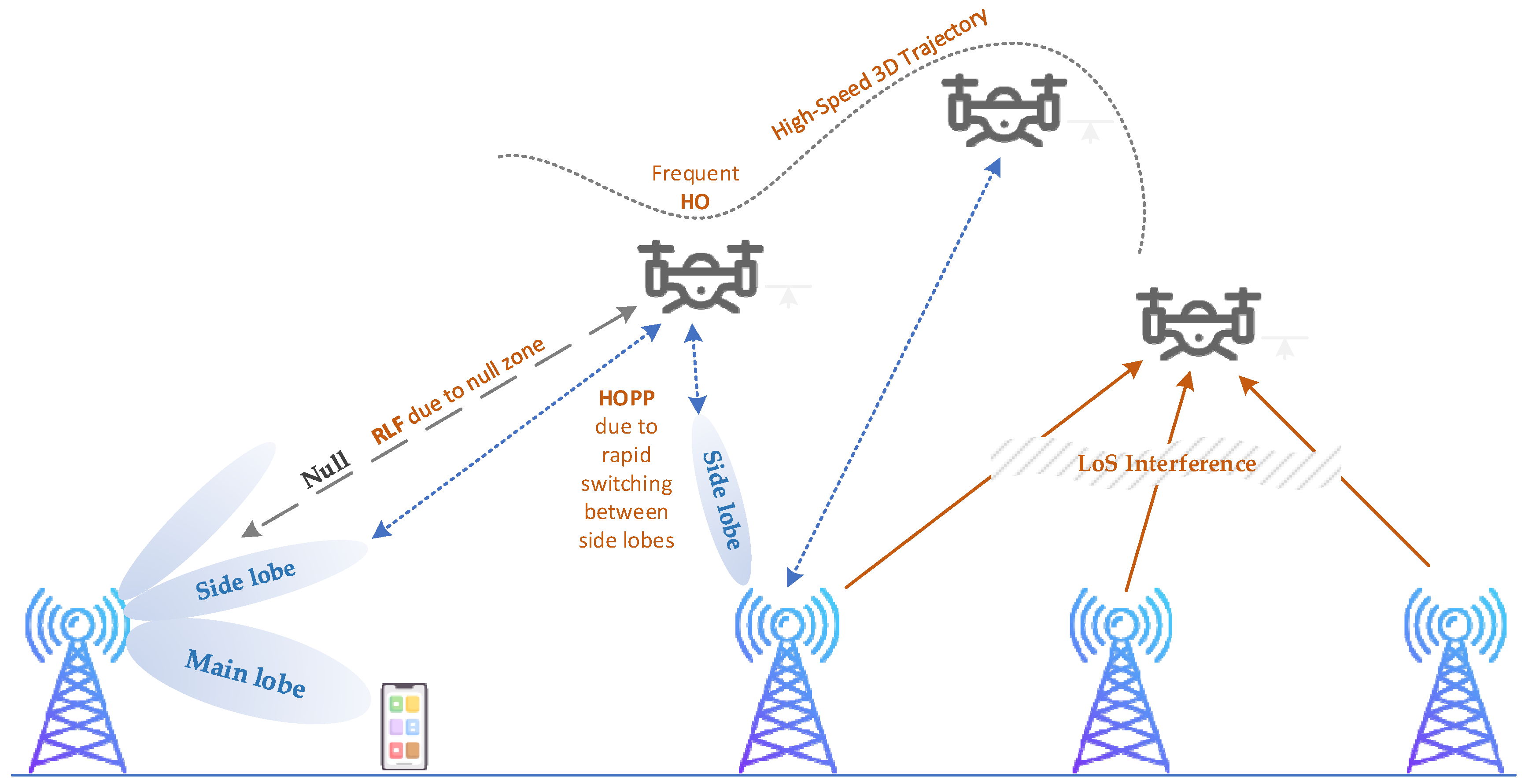
While
Figure 6 provides a hierarchical taxonomy of the various mobility and network issues,
Figure 7 illustrates these dominant challenges within a practical 3D scenario. This visualization highlights the physical phenomena, such as signal nulls in antenna sidelobes and high-velocity 3D trajectories, in addition to LoS interference, which together serve as common triggers for HO instability. Identifying these dominant physical phenomena provides a comprehensive understanding of the operational hurdles that govern the reliability and performance of cellular-connected UAVs.
4.1. Unique Mobility Characteristics of UAVs
UAVs exhibit unique mobility characteristics distinct from terrestrial UEs, primarily operating in 3D space at varying altitudes and speeds. Their unpredictable and often high-velocity trajectories can cause rapid changes in channel quality, leading to fragmented coverage and frequent HO with ground-based BSs. Unlike terrestrial scenarios, where radio conditions and HO thresholds are typically optimized for ground users, UAVs encounter unique environmental challenges. Furthermore, 3GPP models emphasize specific UAV parameters, including speeds up to 160 km/h and altitudes of 300 m, highlighting the complexities in maintaining stable connectivity [
16,
90,
91].
UAVs operate at high speeds and in 3D space, profoundly affecting HO management. This inherent mobility and 3D flight lead to rapid channel quality changes and increased HO rates [
92]. Traditional HO methods are often insufficient under these dynamic conditions [
20]. Consequently, ML and DRL techniques are crucial for intelligent HO decisions. DRL-driven schemes, for instance, optimize HOs in 3D environments, reducing unnecessary HOs and stabilizing communication links. Moreover, these systems manage complex trajectories and varying radio environments inherent to UAV operations [
50,
91].
Frequent HOs and the HOPP effect significantly degrade network performance and user experience [
93]. HOPP occurs when a mobile device frequently switches back and forth between two or more neighboring BSs, often triggered by signal fluctuations or inappropriate HO parameter settings. High UAV mobility can further worsen these frequent HOs. These unnecessary HOs lead to increased signaling overhead, latency, and energy consumption, ultimately resulting in reduced throughput and potential call drops [
6,
10,
93,
94]. Consequently, mitigating frequent HOs and the HOPP effect is crucial for maintaining seamless connectivity and QoS.
4.2. Complex Radio Environment and Channel Characteristics
UAV communication faces a complex radio environment, distinct from terrestrial settings due to varying altitudes and 3D mobility. Higher altitudes often yield LoS links, which, though reliable, also intensify interference for terrestrial users [
17]. In addition, dynamic and unpredictable channel conditions, driven by UAV trajectories and velocities, cause rapid signal quality fluctuations, complicating HO management [
91]. Additionally, mmWave and THz communications are highly susceptible to LoS blockage, high path loss, and antenna misalignment, resulting in frequent signal degradation and outages [
18,
95].
Unpredictable signal fluctuations significantly challenge UAV HO decisions, especially due to high mobility and dynamic mmWave/THz channels with narrow beamwidths [
96]. These fluctuations are often a consequence of rapid changes in the received signal power and link quality, stemming from the UAV’s high mobility, transitions between LoS and Non-Line-of-Sight (NLoS) conditions, and potential misalignment of narrow beamwidth antennas. Furthermore, UAVs often connect to BSs via antenna sidelobes, which are primarily downtilted for terrestrial users. These sidelobes offer fragmented coverage with sharp signal drops at their edges and deep nulls, frequently causing HO events and potential radio link failures [
22,
97,
98].
Increased interference poses a significant challenge in 6G networks, especially with UAV integration. In addition, elevated UAV operation and LoS propagation lead to broader signal coverage and reduced blockage, causing substantial uplink interference to terrestrial users and ground BSs [
18,
89]. Network densification with numerous small cells further intensifies inter-cell interference, degrading SINR and overall performance [
99]. Therefore, effective interference management is crucial for robust communication and stability.
Despite spectrum benefits, mmWave and THz bands present significant challenges. In particular, high path loss, molecular absorption (mainly caused by water vapor), and susceptibility to blockages limit communication range and quality. Moreover, narrow beamwidths lead to disconnections from antenna misalignment. Consequently, these factors necessitate smaller coverage, resulting in frequent HO, increased signaling overhead, and complex HO management, often causing poor user experience [
39,
46].
4.3. Performance Degradation Issues
UAV HO decision faces significant performance degradation. In this regard, frequent and unnecessary HOs, including ping-pong effects, reduce reliability, throughput, QoS, and increase signaling overhead and energy consumption. Additionally, HO failures and RLF further cause service interruptions and diminish network performance. Moreover, challenges such as high altitude, signal drops, and interference intensify poor signal quality [
30,
100].
RLF signifies a lost wireless connection due to poor quality or interference, interrupting communication [
14,
93]. In addition, HOF occurs when a UAV cannot complete the HO process. Both result from issues like too early/late HOs, wrong cell selection, or resource scarcity. Consequently, both significantly degrade network performance and user experience. Moreover, mitigation of these challenges involves optimizing HCPs, utilizing ML, and employing Conditional HO strategies [
101,
102,
103,
104].
Frequent UAV HOs significantly increase network latency and packet loss, disrupting communication and degrading QoS. This is primarily due to increased signaling overhead and HO interruption times required for re-establishing communication links. Furthermore, high user mobility and suboptimal HO parameter settings intensify these issues, potentially leading to service disruptions and data transmission errors [
2,
47,
105]. Therefore, mitigating unnecessary HOs is crucial to reducing these delays, ensuring stable connections, and improving overall network efficiency.
QoS and QoE are significantly degraded by frequent HO events and the resultant ping-pong effect, reducing communication quality, increasing HO delays, and raising dropping probabilities [
46,
93]. This degradation is getting further worse in dense network deployments and with high UAV mobility, which generate more HOs and signaling overhead [
47]. Thus, optimizing HO is crucial to sustain reliable connectivity.
Resource management presents significant challenges in 6G networks, particularly for UAV-assisted systems. Critical issues include the scarcity of radio, computing, storage, and energy resources. Furthermore, high UAV mobility and dynamic network conditions overwhelm conventional resource management methods, which struggle with rapid responses and generate substantial control signaling overhead. Moreover, dense deployments, coupled with diverse QoS requirements, intensify interference and resource shortages, making efficient joint optimization complex. In addition, limited onboard energy and processing capabilities further constrain UAV operations [
80,
106,
107].
The technical-level challenges detailed in this section ranging from 3D mobility-induced signal fluctuations to the performance degradation of traditional rule-based HO demonstrate that traditional reactive mobility management is insufficient for the 6G UAV ecosystem. To move beyond these physical and performance-level hurdles, there is a critical need to transition toward proactive, intelligent decision-making frameworks. This shift necessitates addressing several high-level research imperatives such as the development of predictive models for high-velocity 3D flight paths, the design of interference-aware HO algorithms capable of navigating antenna sidelobe nulls, and the creation of resource-efficient frameworks that balance low-latency execution with the limited onboard energy of UAV platforms. These research needs form the conceptual basis for the AI/ML methodologies explored in
Section 5 and the open research gaps identified in
Section 7.
5. AI/ML-Driven HO Decision Techniques for UAVs
AI/ML techniques are essential for optimizing HO decisions in UAV networks, particularly in dynamic and complex 6G environments. These approaches overcome the limitations of traditional methods by learning hidden patterns, predicting network parameters, and enabling proactive HO optimization. In addition, AI/ML algorithms offer self-learning capabilities, improving performance through experience without explicit programming and adaptively modeling network behavior. Furthermore, this intelligence is crucial for managing the unique challenges of UAV mobility, dynamic channel conditions, and interference. In addition, AI/ML techniques span supervised, unsupervised, and RL, including DRL which integrates DL with RL for adaptive online HO decisions [
22,
49].
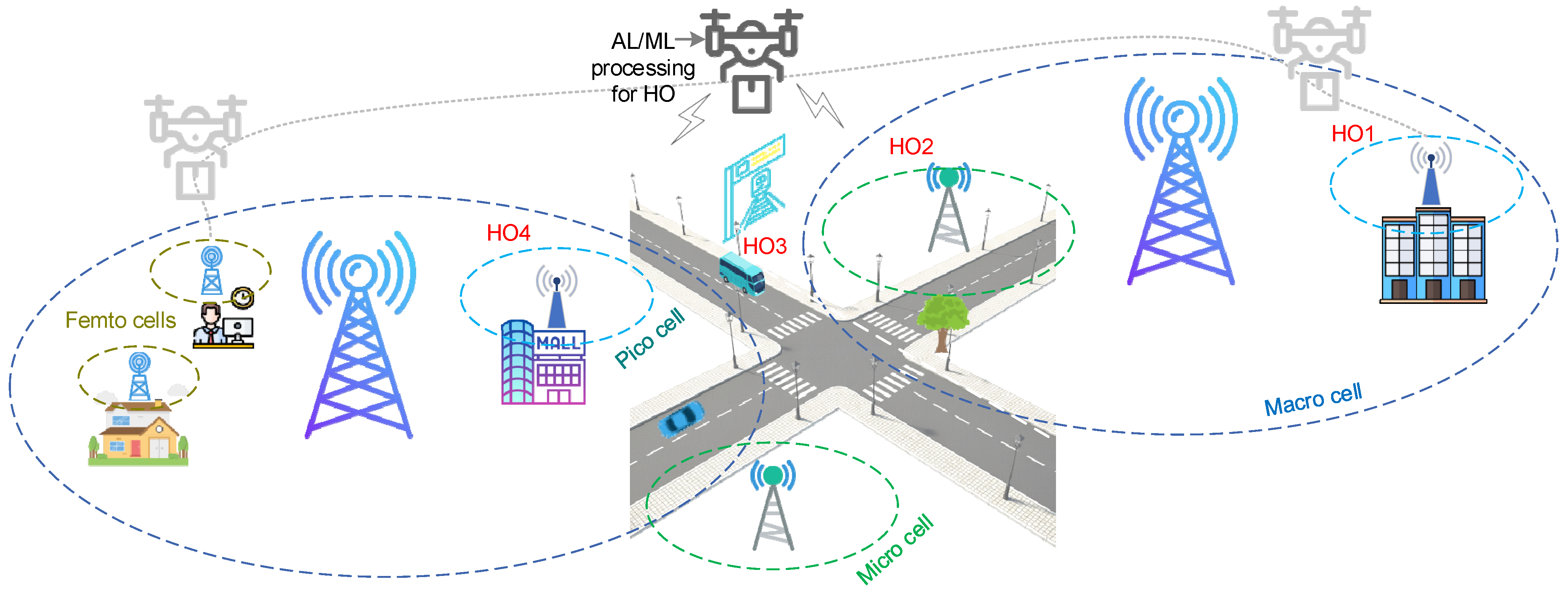
In the AI-driven UAV HO scenario shown in
Figure 8, the UAV is deployed as a flying user, performing tasks such as deliveries while initially connecting to the nearest available cell, including macro, micro, pico, or femto cells. The UAV continuously monitors its signal quality, interference levels, speed, and location relative to neighboring cells. As 6G networks, characterized by ultra-high data rates, ultra-low latency, and dense multi-layered HetNets, these measurements are critical for real-time HO decision. This data is then processed by AI/ML algorithms, which analyze the UAV’s current link status and predict whether a HO is needed and to which target cell. Based on these predictions, the UAV executes HOs (HO1–HO4) seamlessly, ensuring optimal connectivity and QoS. This AI-driven approach leverages predictive HO mechanisms, accounting for fast mobility, THz/mmWave signal variations, and dynamic network load. This process repeats dynamically as UAVs move through the network, enabling robust and uninterrupted communication in dense, multi-layered heterogeneous network deployments.
5.1. Overview and Rationale for AI/ML
AI and ML are crucial for 5G and beyond networks, enabling autonomous intelligence, dynamic optimization, and real-time HO decision [
108]. Moreover, HO optimization is a decision-making problem where intelligence is essential for optimal decisions. In addition, ML algorithms learn from data or experience, enabling systems to discover patterns and proactively optimize network parameters, thus solving complex challenges. This ensures seamless connectivity and maximizes throughput [
4,
46].
Dynamic environments, with high UAV mobility and rapid channel changes, pose HO management challenges like frequent unnecessary HOs and interference. To address these issues, ML approaches provide adaptive solutions, dynamically optimizing HO parameters [
109]. Furthermore, RL frameworks, like Q-learning, offer flexible HO decisions, balancing HO frequency and signal quality. Moreover, DRL algorithms enhance reliability by learning optimal policies from real-time interactions in complex scenarios [
15,
22].
ML-based HO strategies offer advanced capabilities for network management. They can learn hidden patterns and relationships from dynamic network data, such as user movement interactions and intricate data correlations. Moreover, these strategies effectively predict critical network parameters, including future trajectories, channel quality, and HO events. This predictive power enables proactive optimization, leading to reductions in HO failures, ping-pong effects, and unnecessary HO, significantly improving system stability and performance [
36].
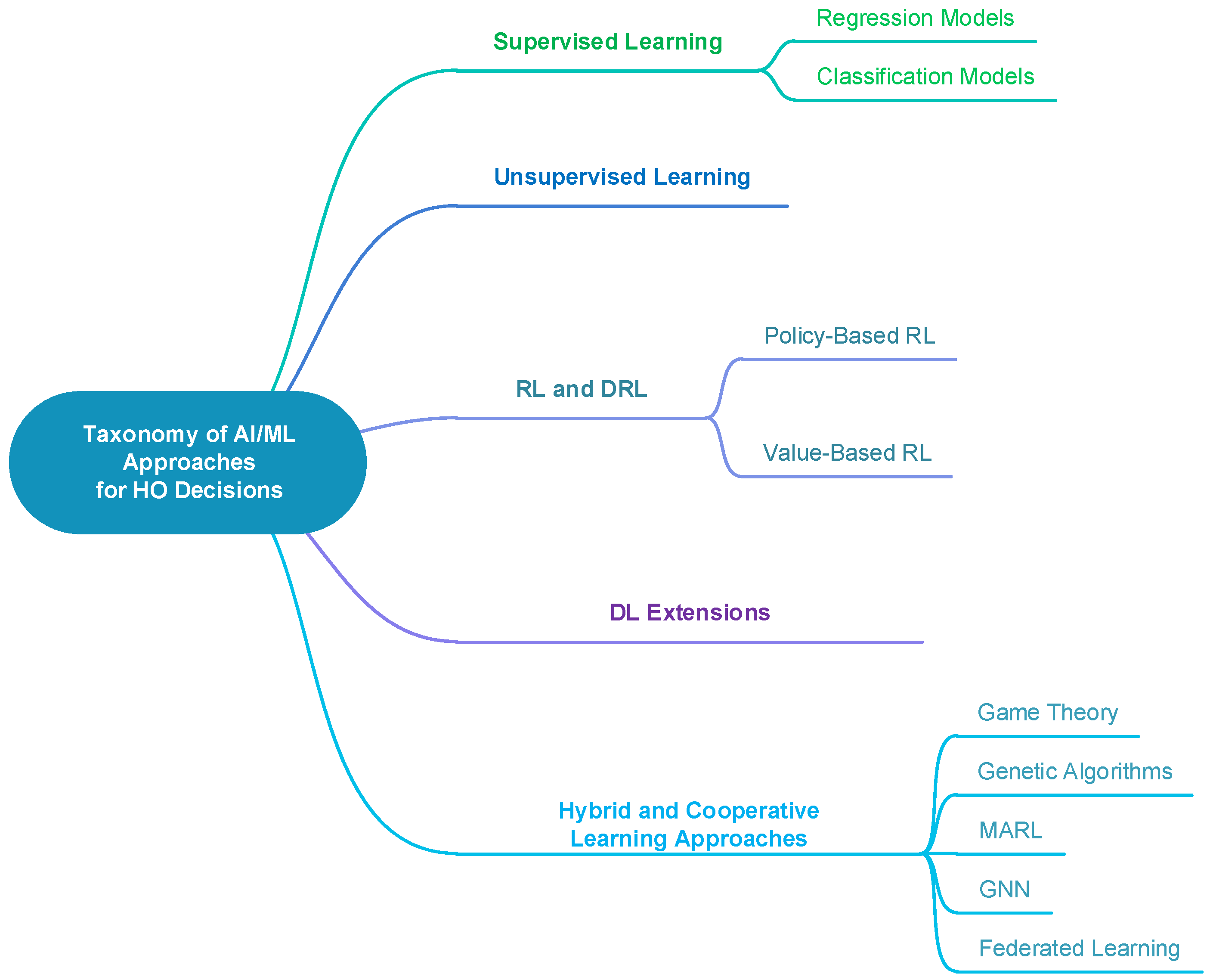
5.2. Taxonomy of AI/ML Approaches for HO Decisions
AI/ML approaches for HO decisions are mainly categorized into Supervised Learning (SL), Unsupervised Learning (USL), and RL, with DL and DRL representing their neural-network-based extensions. Furthermore, hybrid approaches integrate these paradigms, often with other methods, to address complex HO challenges.
5.2.1. Supervised Learning
Supervised Learning is an ML technique that relies on labeled training datasets, comprising input features and corresponding desired outputs, to learn a mapping function. This method is categorized into regression for continuous outcomes and classification for discrete outputs [
46]. In the context of UAV HO management, SL algorithms can predict future UAV locations, trajectories, or serving cells to enable proactive HO optimization, thereby enhancing QoS [
17,
110].
As a component of SL, they are specifically designed to predict continuous numeric values, such as user coordinates or channel quality. Key regression algorithms include Linear Regression, Support Vector Regression (SVR), and Gaussian Process Regression (GPR) [
49,
111]. Furthermore, Bayesian regression, Random Forest, and XGBoost regressors are widely utilized for diverse applications such as HO decision and throughput estimation. These models are typically evaluated using metrics such as Mean Absolute Error and Root Mean Square Error [
112,
113,
114,
115].
Classification models, a subset of SL, are crucial for UAV HO decisions in future networks. They predict discrete outputs, aiding optimal target cell identification. Moreover, these models enhance HO performance and reduce failures. Common algorithms like Support Vector Machines (SVM) and Random Forests achieve high accuracy in relevant tasks [
46,
64].
5.2.2. Unsupervised Learning
USL is distinguished by its ability to identify hidden structures, patterns, and correlations within unlabeled datasets [
46]. This methodology is typically employed for tasks such as clustering, anomaly detection, pattern recognition, and a reduction in dataset dimensions. Common USL algorithms include K-means clustering, Principal Component Analysis (PCA), and Expectation-Maximization (EM) [
49,
93]. Furthermore, in the context of network management, USL algorithms offer valuable solutions for scalability and decentralization. For example, clustering techniques, such as K-means, are instrumental in grouping devices with similar mobility patterns, which can then be leveraged for efficient HO optimization, especially in ultra-dense cellular networks [
46,
110].
5.2.3. RL and DRL
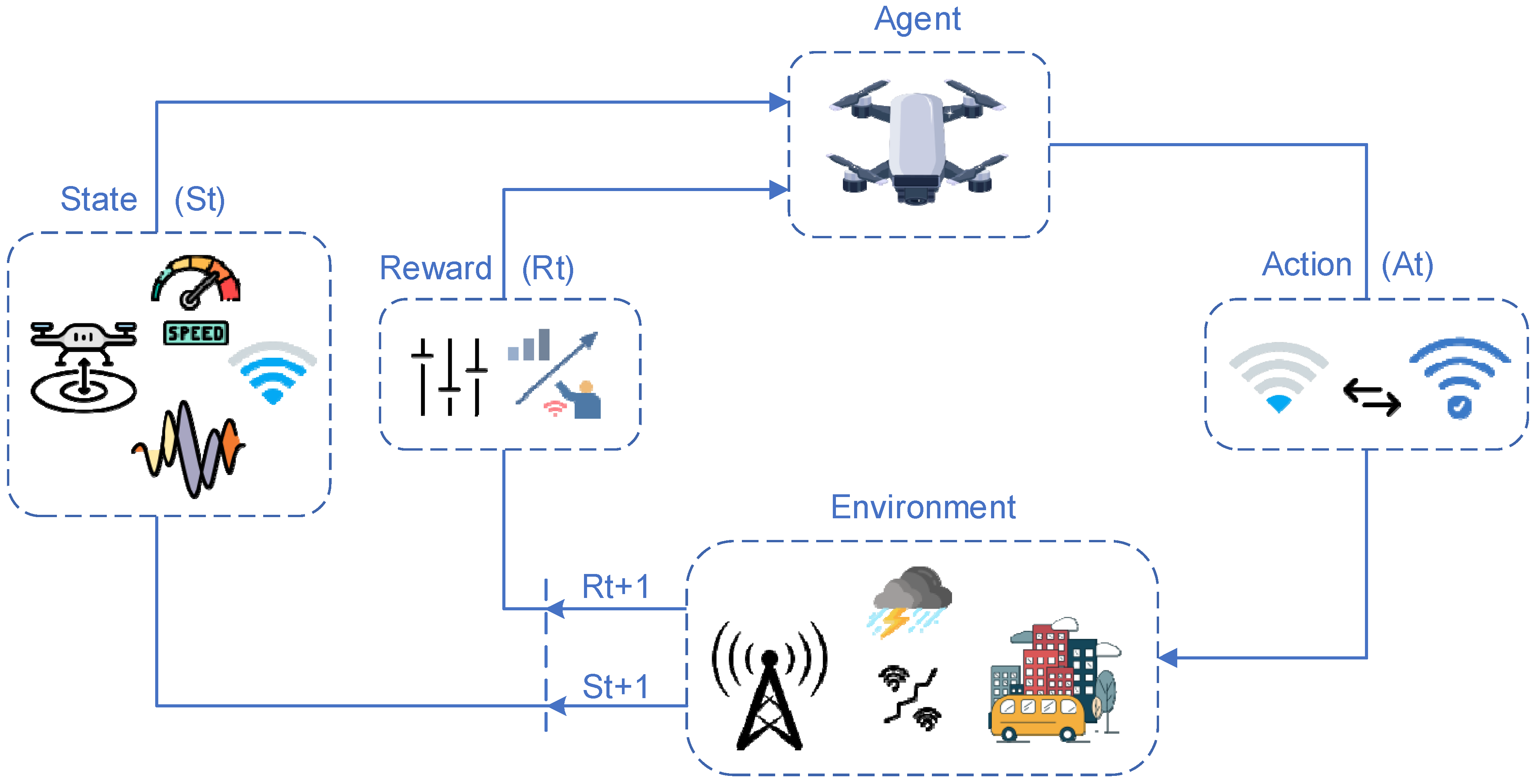
Another critical subfield of ML is RL (
Figure 9) along with its advanced extension known as DRL. RL involves an agent learning an optimal policy via trial-and-error interaction with an environment to maximize cumulative rewards. Its problems are frequently modeled using Markov Decision Processes (MDPs) [
27]. In addition, DRL leverages Deep Neural Networks (DNNs) to approximate value functions or policies. This combination enables DRL to address high-dimensional, complex sequential decision problems impractical for traditional RL algorithms [
54,
110].
Value-Based RL algorithms, including Q-learning and SARSA, maximize the expected long-term reward by estimating the value function for states or state-action pairs. Among them, Q-learning is an off-policy method foundational to many HO optimization schemes [
46,
116,
117]. In addition, for complex environments, DQNs approximate the Q-function using neural networks, thereby addressing the state-space explosion. In addition, the Dueling Deep Q-Network (DDQN) architecture is also frequently employed for refined HO decision [
18,
84].
Policy-based RL methods explicitly search for and optimize the policy (π), which defines the agent’s action given a state. Unlike value-based algorithms, they directly optimize policy parameters using gradient ascent [
47,
50]. Popular examples include Policy Gradient, PPO, and Actor-Critic (AC) methods. These techniques are generally stable and well-suited for high-dimensional or continuous action spaces [
46,
54].
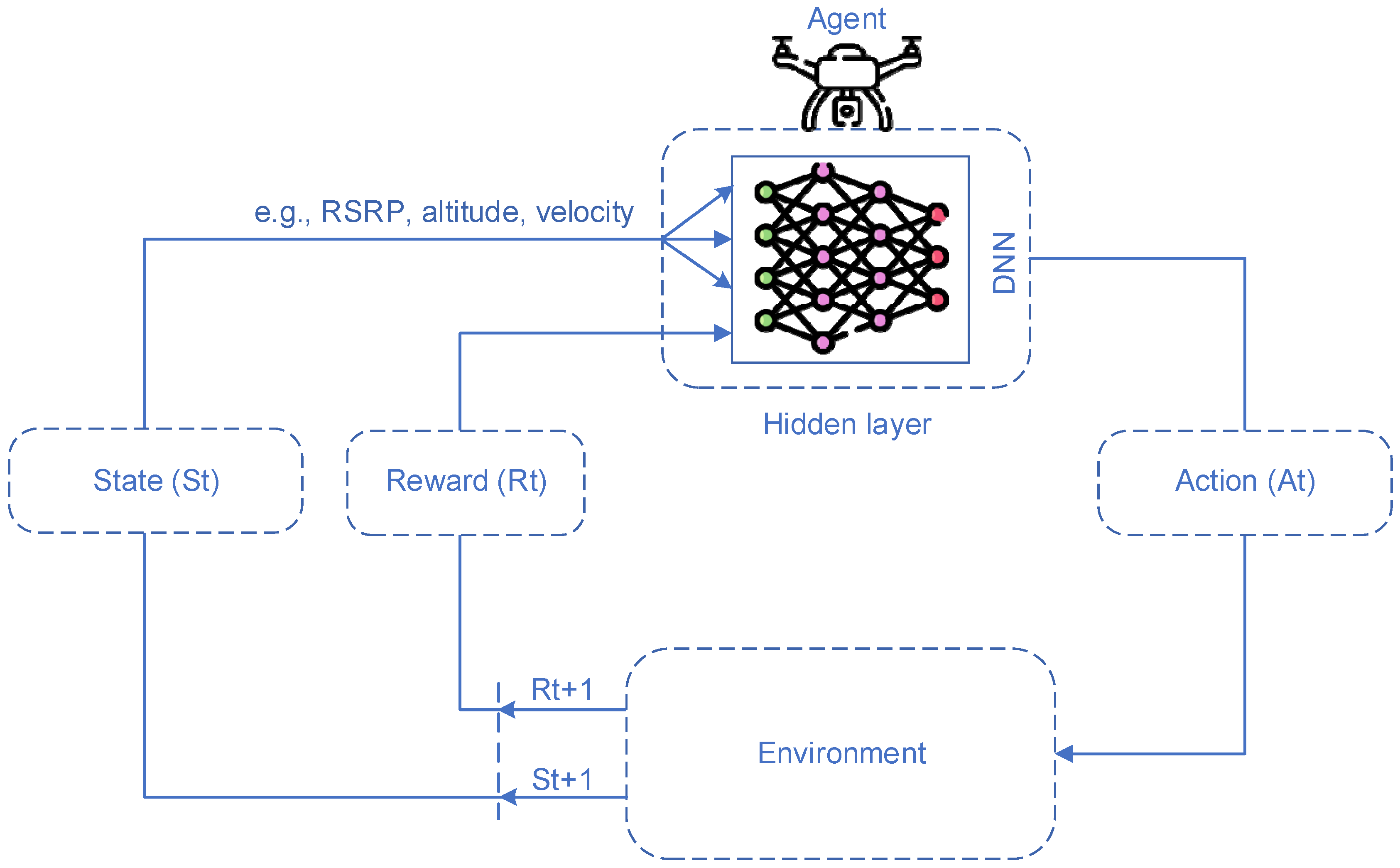
In the context of DRL,
Figure 10 illustrates the end-to-end framework in which a DNN-based agent interacts with the UAV network environment to optimize HO decisions.
5.2.4. DL Extensions
DL represents a powerful branch of ML that employs multi-layered neural networks for automated feature extraction and complex pattern recognition [
118]. Within this paradigm, RNNs serve as specialized architectures designed for handling sequential data, using feedback connections to model temporal dependencies. Standard RNNs often struggle with learning long-range dependencies due to the vanishing gradient problem [
80,
119]. Therefore, specialized variants, such as Long Short-Term Memory (LSTM) networks and Gated Recurrent Units (GRU), overcome this limitation by employing sophisticated gating mechanisms to control information flow. Moreover, RNN-based models are instrumental in mobility and trajectory prediction, effectively supporting proactive HO decisions in next-generation networks [
80,
112,
120].
5.2.5. Hybrid and Cooperative Learning Approaches
Hybrid AI/ML approaches combine techniques like Fuzzy Logic with Q-learning or ANN to enhance decision accuracy and interpretability. For instance, models integrating TOPSIS and Q-learning reduce unnecessary HOs and improve scalability [
44,
103]. Moreover, multi-UAV coordination relies on advanced cooperative paradigms such as Multi-Agent RL (MARL). In addition, Genetic Algorithms (GA) optimize HCPs, and FL supports distributed resource optimization [
18,
117,
120].
Game theory serves as a crucial analytical framework for distributed decision-making and resource management in UAV networks. It is applied to optimize HO management, coverage, and trajectory planning [
8,
13]. Moreover, game theory models performance where users or UAVs influence each other. Cooperative game theory, for example, is used to select the optimal UAV during HO, minimizing delay and signaling overhead [
1,
6,
97].
Genetic Algorithms are meta-heuristic optimization methods that simulate biological evolution to find optimal solutions. It is highly effective for solving NP-hard problems, such as optimizing antenna up-tilt angles to maximize the minimum Signal-to-Interference Ratio (SIR) for UAVs. Furthermore, Genetic Algorithm is employed in hybrid methods for HO parameter tuning and trajectory optimization [
30,
117,
121].
MARL extends RL and DRL to environments involving multiple agents, making it crucial for complex distributed systems [
82,
122]. Agents, such as UEs or UAVs, learn individual policies within a shared environment, often formalized as a Markov Game [
13]. In addition, MARL is effective for distributed HO management, resource allocation, and joint optimization tasks. In addition, implementations commonly rely on centralized training with decentralized execution [
122,
123].
Graph Neural Networks are DL models specifically designed to process graph-structured data, such as network topologies and vehicular connections. They leverage a message-passing mechanism to transfer information between interconnected nodes, thereby learning complex node representations and global graph structures [
51]. Furthermore, Graph Neural Networks improve adaptability to changes in satellite HO directed graph topology, making them valuable for intelligent HO decision algorithms in integrated networks [
58,
105].
FL is a distributed ML approach where devices jointly train a shared model, sending only trained parameters to a central entity. This strategy preserves data privacy, reduces latency, and lowers communication overhead. Consequently, FL can be used to optimize HO procedures and predict user mobility [
46,
124].
A summary of the taxonomy of AI/ML approaches for HO decisions is presented in
Figure 11. This visual classification highlights the shift from traditional heuristic methods toward intelligent, data-driven frameworks capable of managing complex HO scenarios in high-density UAV networks.
Beyond core learning paradigms, several studies explore hybrid and advanced AI/ML approaches to enhance UAV HO decision. Hybrid frameworks combining rule-based Fuzzy Logic with learning or optimization techniques such as Q-learning and ANN have been shown to reduce unnecessary HOs and improve scalability [
44,
103]. Distributed and cooperative paradigms, including multi-agent reinforcement learning and game-theoretic models, enable coordinated HO management, resource allocation, and trajectory optimization in multi-UAV environments [
1,
6,
13,
80,
94,
125]. In addition, meta-heuristic methods such as genetic algorithms are commonly employed for HO parameter tuning and antenna optimization [
31,
114,
124], while emerging deep learning techniques, including graph neural networks and federated learning, improve adaptability, topology awareness, and privacy-preserving HO optimization in large-scale and integrated networks [
46,
51,
58,
101].
5.3. Key Parameters and Input Features for AI/ML Models
AI/ML models for HO decisions tend to rely on diverse input features, including signal quality metrics such as RSRP, RSRQ, and SINR [
114,
125]. Crucially, UAV mobility characteristics, like altitude, speed, and location, are also incorporated. Moreover, inputs may include network state information, such as cell load or available radio resources, to potentially optimize the decision-making process [
30,
38].
Signal Quality Metrics are conventionally recognized as essential inputs for AI/ML HO strategies, typically including RSRP, RSRQ, SINR, RSSI, and RSS [
1]. In addition, RSRP primarily reflects signal strength to guide HO initiation [
126]. Conversely, metrics like RSRQ and SINR can offer a more comprehensive measure of channel quality, generally accounting for interference and noise [
110,
127].
UAV mobility significantly differs from conventional networks, primarily operating in a 3D pattern rather than 2D. UAVs possess high mobility speed, which often makes control challenging. Consequently, this rapid movement may cause fast channel fluctuations, resulting in frequent HOs and ping-pong effects. Moreover, UAV flight paths are typically predictable based on missions [
14,
98].
Accurate HO decisions rely on comprehensive Network State Information, which typically comprises diverse metrics. Essential parameters often include signal quality indicators such as RSRP, SINR, and RSRQ. Furthermore, network resource status, like cell load, is routinely monitored. Moreover, mobility factors, including UE velocity or dwell time, may also be incorporated to enable proactive optimization [
47,
128].
Other context-aware parameters augment HO decision capability by incorporating operational and user-centric metrics. These parameters may include the UAV’s buffer queue state information to facilitate adaptive decision-making [
38]. Moreover, factors such as remaining flight range or energy consumption are often considered inputs to optimize operational longevity and avoid premature HOs. Furthermore, user requirements, including QoE preferences, influence target BS selection [
1,
6].
5.4. Comparative Analysis of AI-Driven HO Techniques
AI-driven HO techniques present critical trade-offs. FLCs are notably lightweight and offer interpretability, effectively handling imprecise data, but they sometimes lack scalability for highly dynamic or complex inputs. In contrast, DRL methods deliver superior performance and adaptability in complex scenarios; however, they generally incur significant computational overhead, require vast training data, and face the black-box challenge regarding decision transparency [
38,
129].
Traditional HO mechanisms, such as those relying primarily on RSS, typically represent the least complex systems, although they tend to be the least accurate. Consequently, advanced strategies often demonstrate significantly enhanced performance across critical metrics [
104]. For instance, employing multiple criteria methods, specifically network priority, has been shown to potentially reduce the number of HOs by up to 60% compared to conventional RSS-based HO schemes [
130]. Furthermore, sophisticated DRL algorithms have been observed to reduce the HOPP rate and yield substantial increases in throughput compared to traditional approaches [
131]. Moreover, advanced multi-level fuzzy systems demonstrate superior Packet Delivery Ratio (up to 93.11%) and throughput (up to 95.3450%) compared to conventional fuzzy methods. Generally, improved techniques aim to maintain high QoS while mitigating unnecessary HO events that frequently affect conventional, fixed-threshold approaches [
2,
125].
FLCs offer key advantages, including interpretability, transparency, and the potential to handle uncertainty well due to their rule-based reasoning. However, FLCs implementation is seemingly complex, sometimes requiring human expertise to define optimal rules and membership functions. Furthermore, its scalability is limited, as increasing the number of input criteria appears to reduce reliability and potentially introduce delays. Conversely, RL, particularly DRL, is prized for its adaptability and ability to make real-time decisions in dynamic environments, such as 5G and B5G networks [
1,
30,
125]. Nevertheless, RL algorithms may face challenges such as long convergence times, the inherent problem of dimensionality in large state spaces, and potential overestimation of action values, particularly in conventional DQN [
47,
132].
Moreover, DL models appear effective in handling complex network scenarios and can continuously improve performance. Their major limitation, however, lies in the need for large training datasets, coupled with significant computational complexity, and the challenge of model interpretability associated with the black-box nature of deep architectures [
133].
6. Performance Evaluation and Metrics
Performance metrics are essential for establishing the reliability and efficiency of HO management in UAV networks. This section explores the KPIs utilized for HO evaluation, in addition to the necessary simulation environments and real-world validation methods. Furthermore, the discussion covers relevant datasets and benchmarks necessary for comprehensive assessment.
6.1. Key Performance Indicators for HO in UAV Networks
KPIs are crucial for measuring connectivity and managing UAV mobility, which necessitates robust solutions to maintain seamless service. In addition, comprehensive evaluation typically encompasses metrics for Mobility Robustness Optimization, QoS and QoE, energy efficiency, and resource management [
134]. These metrics are integral to designing optimized HO decision algorithms, particularly those leveraging advanced techniques like ML, to ensure reliable, high-quality, and energy-efficient connectivity for UAVs in complex 3D environments.
MRO algorithms are designed to automatically optimize the HCPs, such as HOM and TTT, that are critical for determining the initiation and execution criteria of the HO decision. Its performance is typically assessed using key KPIs that usually include HOF, RLF, HOPP, and unnecessary HO. Moreover, metrics such as HO Rate and Call Drop Ratio are widely used for comprehensive evaluation [
30,
127].
QoS defines service performance, whereas QoE measures the user’s quality perception. Maintaining high QoS and QoE is crucial for effective HO management. Key metrics typically comprise Throughput or Spectral Efficiency, Latency (including HO Interruption Time), Packet Loss Rate, and Service Availability. Furthermore, technical parameters like SINR and RSRQ significantly influence the perceived quality [
16,
134,
135,
136,
137].
UAV operations can be heavily constrained by limited onboard energy, making energy efficiency vital for mission longevity. Typically, propulsion consumes the primary share of this budget. Additionally, frequent HO events generate signaling overhead and increase device power utilization. Therefore, jointly managing trajectory and HO decisions is essential for maximizing energy efficiency [
8,
19,
23].
Load balancing appears crucial in dense HetNets, stemming primarily from erratic traffic that may cause unequal cell loads and resource congestion [
29,
131]. The core objective generally involves the fair distribution of mobile devices and traffic, commonly quantified using metrics such as Jain’s fairness index. Consequently, optimal HO decisions should certainly integrate cell load data to enhance resource fairness and mitigate potential QoS degradation [
46,
79,
130].
6.2. Simulation Environments and Real-World Testbeds
Evaluating UAV mobility solutions generally relies on extensive software simulations or dedicated real-world testbeds. Simulations, leveraging platforms such as NS-3 or MATLAB, are widely used to model network behavior and generate data for training ML algorithms. In addition, experimental testbeds offer crucial validation of practical operational constraints [
9,
17,
89].
To rigorously evaluate HO mechanisms, researchers generally rely on detailed simulation platforms. Key software tools typically involve MATLAB, which is commonly employed for algorithmic modeling, Monte Carlo simulations, and FLC implementations [
2]. In addition, sophisticated network simulators such as NS-3 and OMNeT++ are often utilized to model complex network behaviors. Moreover, many studies leverage Python libraries (e.g., Keras and TensorFlow—version 2.9.1) for implementing DRL models [
47,
73,
80].
Field trials and measurement campaigns can provide crucial practical insights into integrating UAVs into cellular networks, offering more realistic validation environments than simulation alone. Consequently, although real-world datasets are often scarce, they are highly valuable for validating AI/ML models and deriving predictive HO decisions [
17,
120]. Subsequently, DQN-based mobility management schemes have been successfully validated using real-world LTE data collected from UAV flight trials, sometimes achieving over 80% HO reduction compared to conventional methods [
38].
Performance analysis often relies on simulating diverse mobility models, including the Random Waypoint and Flight Plan (FP) mobility models. These models, furthermore, are crucial for designing heterogeneous network environments. In addition, common scenario types such as vehicular connectivity, urban communications, and high-speed mobility are extensively investigated [
138,
139].
Simulation configurations encompass environmental factors such as area size, network topology (e.g., BS locations), and radio specifications (e.g., carrier frequency and transmit power). Furthermore, parameters related to UE or UAV mobility, including speed and altitude, are routinely considered. For HO optimization, critical control parameters, such as TTT, HOM, learning rate, and discount factor, are frequently utilized [
19,
140].
Large-scale benchmarks and real-world datasets appear highly influential for evaluating AI/ML algorithms in UAV HO management [
17]. However, acquiring sufficient and effective real-world data seems challenging, possibly due to data protection regulations. Consequently, synthetic or simulated datasets tend to dominate existing research. Moreover, this reliance on artificial data may potentially limit the generalizability of findings [
120].
There is a notable scarcity of publicly available, real-world datasets specifically tailored for UAV HO decision in 6G networks. While numerous studies employ AI for UAV HO optimization, the vast majority rely on simulators (e.g., NS-3, MATLAB, Mininet-WiFi) or synthetic data generation (e.g., ray tracing) due to the logistical complexity, cost, and regulatory constraints associated with large-scale UAV flight trials, particularly for emerging 6G scenarios.
7. Open Research Gaps
While
Section 4 outlined the fundamental engineering phenomena and connectivity challenges inherent to UAV operations, this section shifts the focus toward the systemic gaps in the current literature that hinder the practical deployment of intelligent HO solutions. We analyze the research-level barriers such as computational complexity, data scarcity, and the simulation-to-reality gap that must be overcome to realize the AI-native vision of 6G mobility management.
Table 7 maps
Section 4 engineering issues discussed previously to their specific
Section 7 research gaps and potential AI-driven solutions.
7.1. UAV-Specific Mobility and Channel Modeling
UAV-specific mobility and channel characteristics present profound challenges that must be addressed for reliable 6G integration, necessitating dedicated research into accurate modeling of complex 3D movement patterns and high speeds, the dominant LoS Air-to-Ground channel properties, and the specific propagation issues arising from mmWave and THz frequencies [
46,
98].
UAV mobility is inherently complex as it typically operates in a 3D pattern, diverging from traditional 2D movement. Furthermore, high speeds, sometimes exceeding 500 km/h in 5G and B5G systems, may significantly amplify HO challenges. Consequently, this high mobility and 3D flight often lead to rapid channel fluctuations, prompting the occurrence of frequent HOs and ping-pong effects [
93].
The A2G channel properties fundamentally differ from terrestrial channels because of the UAV’s altitude and 3D movement. Consequently, propagation often exhibits dominant LoS conditions, particularly as altitude increases. However, this favorable LoS link may increase the vulnerability to interference from numerous neighboring BSs in the downlink direction. Furthermore, precise path loss modeling typically necessitates accounting for elevation angle, 3D distance, and the surrounding environment [
8,
17,
89].
mmWave and THz spectrum utilization, though offering high bandwidth, suffers from high propagation loss and molecular absorption, severely restricting the transmission range. In addition, narrow beamwidths are typically necessary for achieving high Signal-to-Noise Ratio (SNR). Consequently, UAV mobility, including small-scale uncertainties, may cause antenna misalignment, potentially leading to communication disconnections and performance deterioration up to 50%. Therefore, advanced error control mechanisms and beamwidth adaptation protocols should be investigated [
39,
46,
144].
7.2. Computational Complexity and Scalability
Computational challenges are undeniably crucial in complex networks, particularly concerning scalability and efficiency in heterogeneous and ultra-dense scenarios. In addition, high-dimensional environments tend to lead to the curse of dimensionality, which therefore necessitates efficient models for real-time decision making. Moreover, constraints on computational resources may impose significant limitations on on-device AI deployment [
37,
47,
124].
The curse of dimensionality fundamentally limits tabular Q-learning in complex UAV HO problems, causing computational requirements and storage to increase exponentially with the state space. Consequently, DRL methods, such as DQN, are employed, leveraging neural networks to approximate the Q-value function and mitigate this constraint [
11,
47,
145].
Real-time HO decision-making is paramount, particularly for highly mobile UAVs operating in dynamic environments [
97,
133]. Moreover, ML and DRL models are essential as they facilitate low-latency decision processes, which are critical for service continuity in latency-sensitive applications [
21,
46,
124].
On-device AI, achieved via local processing, may significantly reduce latency for HO decisions. Nevertheless, computational resource constraints inherent to UAVs restrict the permissible complexity of models and can strain battery life and overall performance [
112]. Consequently, efficient deployment often necessitates developing lightweight AI models, utilizing specialized techniques such as TinyML or quantization, to meet real-time operational demands [
54,
142].
7.3. Data Management and Training Challenges
Implementing ML solutions for UAV HO optimization invariably encounters practical barriers related to data logistics and model training. These challenges often stem from difficulties in obtaining adequate, high-quality datasets and managing subsequent data sparsity. In addition, substantial issues arise concerning model generalization across diverse operational environments and effectively mitigating the inevitable simulation-to-reality gap when deploying learned policies in the real world [
13,
36,
46].
Data acquisition is critical for training ML-based HO algorithms. In addition, input data typically encompasses wireless network metrics, such as RSRP and cell load, and sometimes visual data for blockage detection [
46,
146]. Owing to the scarcity of real-world measurements, however, many approaches often leverage synthetic or simulation-based datasets for training and validation.
Data sparsity presents a major constraint for ML approaches, which require extensive, reliable, and representative datasets for robust training. In addition, limited or skewed data may cause ML models to exhibit overfitting or suboptimal performance. Moreover, a core challenge remains the lack of real-world UAV operational data, necessitating reliance on synthetic or simulated sources, which could potentially compromise generalization [
80,
99,
120].
Generalization remains a persistent challenge, as ML solutions often struggle to maintain performance across diverse operating environments. Consequently, policies trained effectively in one scenario may lead to notably compromised HO performance when transferred to varied settings (e.g., urban versus rural deployment) [
46,
135,
146].
Despite the widespread reliance on simulations for training AI models, deploying effective HO solutions often faces the simulation-to-reality gap. Furthermore, this challenge arises because complex real-world dynamics and channel behavior may be imperfectly captured in simulated environments, frequently relying on simplified models [
13].
7.4. Multi-UAV Coordination and Resource Management
To ensure seamless connectivity in multi-UAV systems, addressing intense aerial interference through robust interference management seems vital. Moreover, achieving optimal performance often relies on joint optimization of functions like HO, power allocation, trajectory, or task offloading [
122].
UAV integration arguably introduces severe interference challenges, primarily due to their elevated position and LoS propagation, which tend to amplify interference compared to terrestrial networks. In addition, UAVs are susceptible to strong downlink interference. Conversely, they might also generate substantial uplink interference for terrestrial users and ground BSs [
89]. Therefore, effective interference management is crucial for network stability.
To address inherent complexity, sophisticated methods often involve the joint optimization of HO with other network functions. For instance, ML frameworks are frequently leveraged to coordinate HO with Power Allocation, Trajectory Optimization, or Task Offloading decisions. These joint approaches typically seek to maximize system capacity, while concurrently minimizing negative outcomes such as latency, energy consumption, and HO frequency [
18,
93,
96,
111].
7.5. Security and Privacy
Security and privacy are crucial for highly connected 5G and B5G/6G networks due to sensitive data concerns. Ensuring continuous, reliable operation demands robust Secure HO Authentication mechanisms. In addition, ML integration introduces challenges concerning Data Privacy During ML Model Training and Deployment, often mitigated using techniques such as FL [
1,
25,
46].
The high frequency of HOs in 5G and future UAV networks demands robust security and authentication mechanisms. Consequently, novel protocols often incorporate blockchain technology, potentially enhancing authentication procedures and mitigating security threats like spoofing [
1,
25,
63].
Data privacy presents a crucial challenge for ML-based HO management, arguably because obtaining adequate user mobility datasets is difficult due to regulations, where providers must protect personal user identity. Consequently, privacy-preserving methods, such as FL, are highly promoted. Additionally, FL maintains confidentiality by transferring only trained model parameters [
25,
46,
112].
7.6. Regulatory and Ethical Considerations
Integrating cellular-connected UAVs necessitates navigating complex legal regulations and addressing critical societal concerns inherent to widespread deployment [
17,
147]. These include harmonizing airspace operations, especially Beyond Visual Line of Sight (BVLoS) activities and Air Traffic Control integration, and ensuring the trustworthiness and interpretability of autonomous AI decisions governing UAV HO [
38,
148].
The coexistence of UAVs with piloted vehicles in the National Airspace System (NAS) necessitates integration with Air Traffic Control operations. This integration is paramount as UAV operations increase, requiring coordination and adherence to communication standards for safe BVLoS operations. Moreover, careful consideration must be given to ensuring seamless HO between communication standards during flight [
148,
149].
Autonomous AI systems for HO introduce ethical concerns due to their opaque nature, which limits interpretability and trust, especially for safety-critical operations. In addition, achieving explainability and algorithm robustness is crucial for regulatory compliance and addressing potential legal liability arising from autonomous AI decisions [
38,
54,
107].
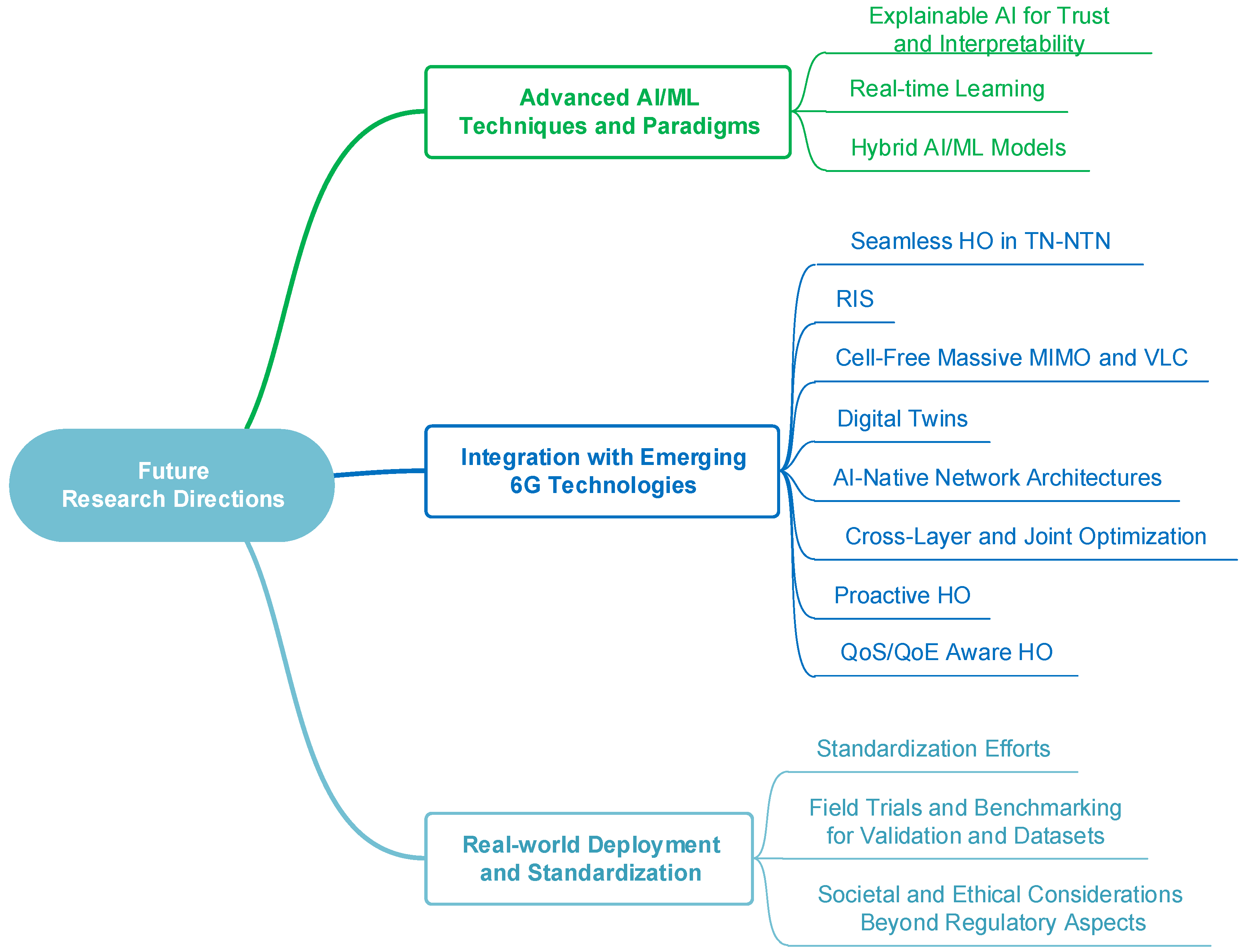
8. Future Research Directions
The full commercialization and integration of cellular-connected UAVs into future communication networks is still pending, requiring substantial time and effort. Consequently, despite promising solutions already proposed, a number of major research directions should be efficiently addressed to enable widespread employment.
8.1. Advanced AI/ML Techniques and Paradigms
Advanced AI/ML approaches, including DRL and DL, appear central to the 6G vision for managing complex UAV mobility challenges. Furthermore, future development focuses on advancing these paradigms through improved real-time adaptation, hybrid models, and introducing XAI for trustworthiness [
46,
73].
XAI is widely regarded as crucial for mitigating the inherent black-box nature associated with DL-based HO solutions. It generally provides transparency and insight into AI decision-making, thereby helping to validate model reasoning and foster necessary trust among network stakeholders. For instance, techniques like Shapley Additive Explanations can facilitate generating comprehensible, natural language explanations for complex HO policies [
16,
38,
122].
Real-time learning, often utilizing DRL, permits AI-based HO models to adapt continuously to dynamic network conditions and user mobility. Moreover, this continuous interaction typically facilitates online exploitation, driving decisions aimed at maximizing long-term rewards [
78,
150].
Hybrid AI/ML models are necessary to overcome single-paradigm limitations, typically balancing learning capability with interpretability. Therefore, future studies often explore coordinating DNN prediction with DRL optimization to mitigate accumulated errors and enhance HO accuracy. In addition, hybrid approaches should address increased complexity and integration overhead [
96,
151].
8.2. Integration with Emerging 6G Technologies
The evolution toward 6G networks generally mandates the seamless integration of various enabling technologies, such as NTN and THz communication, which are key to supporting pervasive UAV operations. Furthermore, these emerging features typically introduce unique complexities that necessitate advanced solutions for maintaining reliable connectivity and achieving efficient HO management [
96,
98].
The integration of Terrestrial Networks (TN) and NTN is essential for realizing global connectivity, yet it poses challenges to seamless mobility due to high propagation delays and frequent HO events. In addition, novel AI/ML mechanisms can strengthen TN-NTN mobility by dynamically optimizing HO triggering, minimizing unnecessary HOs, and enhancing service continuity for UAVs in these complex domains [
52,
152].
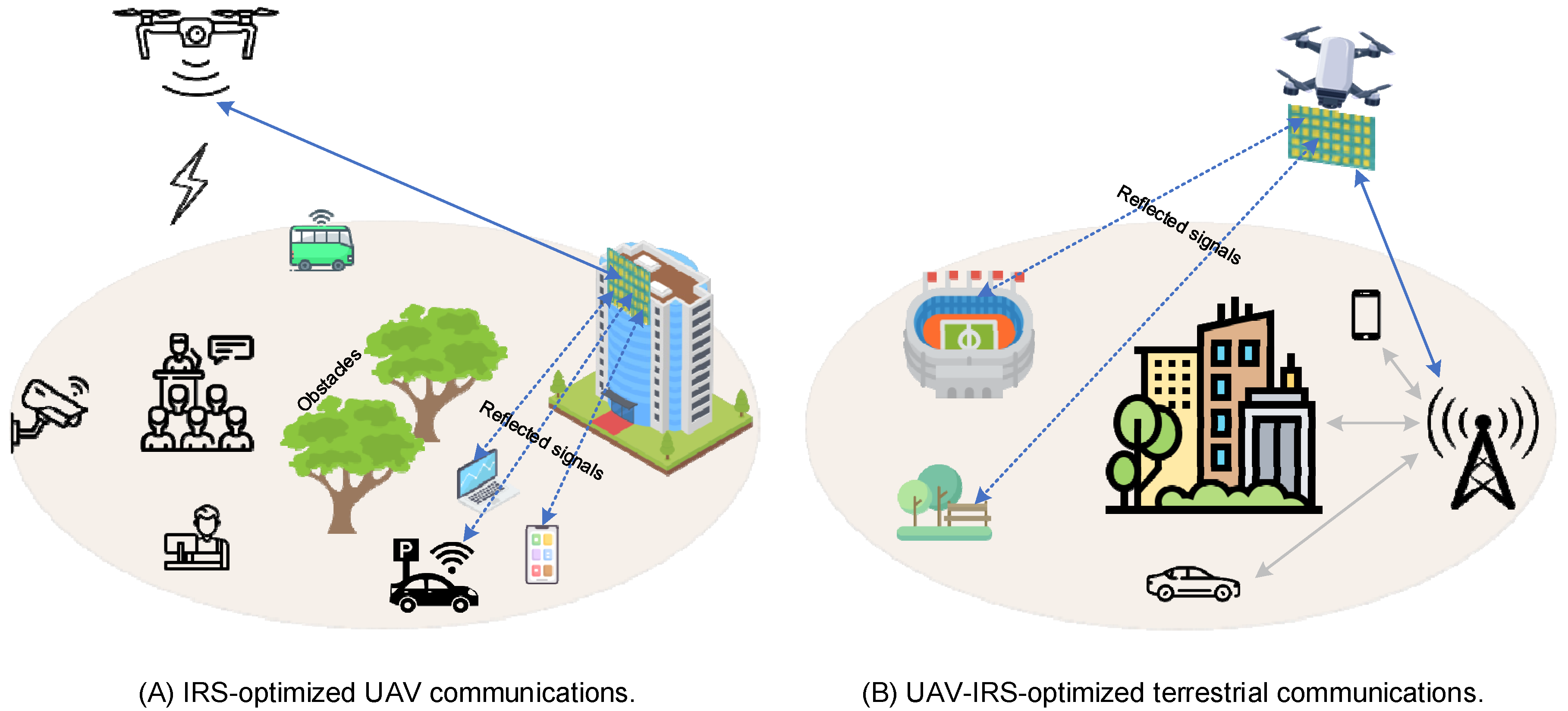
As illustrated in
Figure 12, Reconfigurable Intelligent Surfaces (RISs) are appealing for 6G networks, enabling optimized reflection of signals to enhance cellular-connected UAV coverage and link quality [
48,
53,
98]. Furthermore, RIS integration can mitigate downlink interference and is promising for proactive HO management, especially in THz networks. These surfaces may also help prevent RLFs by enabling a new path during HO when mmWave signals are blocked [
1,
39,
48].
Cell-Free Massive Multiple Input Multiple Output (CF-mMIMO), employing distributed antennas, is anticipated to offer reliable, wide-scale UAV support and can mitigate HO due to its inherent low interference. Nonetheless, challenges include complex 3D beam tracking and managing signaling overhead. Moreover, Visible Light Communication (VLC) provides high data rates (400–800 THz), but its blockage susceptibility requires hybrid RF integration to ensure consistent connectivity in 6G [
3,
50,
98].
Digital Twins function as virtual replicas of physical networks and are potentially essential for 6G and beyond systems. They can employ real-time data, simulations, and ML to monitor performance and anticipate network conditions. This approach helps optimize HO procedures and parameters, accelerating DRL model training for UAV mobility management [
30,
141].
AI-native network architectures, perceived as a central future research direction, are fundamental to the 6G vision, transforming networks from static, conventional systems into intelligent, self-managing ecosystems. This approach typically embeds AI/ML as core architectural components, enabling capabilities such as self-optimization, self-learning, and real-time adaptation. Consequently, this architectural shift is essential for managing complexity and achieving truly autonomous HO functionality [
25,
49,
55,
153,
154].
Cross-Layer and Joint Optimization
The inherent complexity of UAV HO demands sophisticated solutions beyond reactive triggering. Consequently, research has focused on proactive prediction, jointly optimizing conflicting objectives, and explicitly integrating QoS/QoE demands [
37,
46,
90].
Proactive HO schemes certainly constitute a paradigm shift, utilizing intelligence, often via AI/ML, to predict mobility and anticipate HO events well before the current link terminates [
37,
155]. This advanced preparation, which can include pre-connection strategies, aims to significantly reduce disruption and optimize timing [
73,
110,
114].
Joint optimization in HO decisions typically seeks to maximize communication metrics, while concurrently mitigating the undesirable cost of frequent HO events [
97,
156]. This balancing act often relies on weighted reward functions within DRL frameworks, allowing for the precise tuning of the trade-off between signal quality and connection stability. Moreover, adjusting these weights usually helps curb redundant HO activity [
22,
27,
109,
157].
QoS and QoE are highly susceptible to degradation stemming from the frequent UAV HO events [
47,
133]. Accordingly, ML strategies can incorporate QoS-related metrics, such as data rate, delay, or buffer status, into HO decision to achieve robust connectivity and minimize undesirable transitions [
89,
96].
8.3. Real-World Deployment and Standardization
Successful real-world deployment of cellular-connected UAVs seems to mandate strict adherence to ongoing standardization and regulatory frameworks. Moreover, rigorous validation through testbeds is essential for practical solutions [
13,
17].
Standardization efforts by the 3GPP are crucial for integrating cellular-connected UAVs into future mobile networks, providing a unified platform for design innovations. Studies began with enhanced LTE support in Release 15, progressing through 5G enhancements in Releases 16 and 17 [
11,
12,
17]. These activities will continue into the 6G era, focusing intently on mobility management, NTN integration, and defining enhanced requirements for UAV applications [
54].
Field trials, though complex and potentially costly, are paramount for practical validation and closing the gap between simulation and deployment [
17]. Furthermore, benchmarking against established or competitive algorithms is required for comprehensive performance evaluation. Consequently, because real-world mobility data is often restricted, researchers frequently rely on synthetic or simulation-based datasets for ML training [
120,
124,
145,
146].
Societal acceptance of UAV technology is often challenged by privacy concerns related to aerial surveillance and potential job security impacts. In addition, ensuring the safety and reliable control of UAV operations, especially against malicious intrusion, appears critical. Moreover, environmental and economic sustainability considerations, such as minimizing energy consumption, are important for wide-scale deployment [
17,
122,
158].
A summary of the Future Research Directions is presented in
Figure 13, illustrating a strategic roadmap for the next generation of UAV networks. The figure outlines how the evolution of HO decisions will depend on hybrid AI models, AI-native architectures, and ethical considerations that go beyond traditional regulatory aspects.
9. Critical Discussion and Insights
The comparative analysis of HO techniques highlights a clear evolution from static, rule-based mechanisms toward intelligent, learning-driven frameworks for UAV-enabled 6G networks. While traditional methods remain attractive due to their low complexity, transparency, and ease of implementation, their reliance on fixed thresholds and heuristic tuning fundamentally limits their robustness under high mobility, dense deployments, and 3D aerial dynamics. As evidenced across the comparison tables, such approaches are increasingly unable to jointly manage conflicting objectives such as HO frequency, reliability, latency, and energy efficiency in UAV scenarios.
Furthermore, AI/ML-based HO decision techniques demonstrate substantial performance gains, particularly in reducing unnecessary HOs, HO failures, and ping-pong effects while improving QoS and service continuity. However, these gains come at the cost of increased computational complexity, training overhead, and dependence on high-quality datasets. In addition, many DRL solutions assume idealized simulation environments, perfect state observability, or centralized training, which raises concerns regarding scalability, real-time deployment, and energy feasibility on resource-constrained UAV platforms.
In addition, a key observation from the reviewed literature is the lack of standardized evaluation frameworks. Performance metrics, mobility models, channel assumptions, and network configurations vary significantly across studies, making fair comparison difficult despite the comprehensive tabulation provided. Moreover, most works optimize a limited subset of HO KPIs, often neglecting cross-layer interactions, signaling overhead, or long-term energy sustainability, which are critical for mission-critical UAV applications.
Another notable gap is the limited attention to explainability, robustness, and adaptability of AI-driven HO models. While accuracy and performance improvements are well reported, fewer studies address model interpretability, online learning stability, or resilience to non-stationary network conditions, factors that are essential for trustworthy deployment in 6G AI-native architectures. Furthermore, collaborative paradigms such as federated learning, edge-assisted intelligence, and hybrid lightweight-deep models remain underexplored in practical UAV HO implementations.
Overall, the discussion reveals that although AI-driven HO decision techniques are indispensable for future UAV-integrated 6G networks, their practical realization requires a careful balance between performance gains and implementation constraints. This emphasizes the need for lightweight, explainable, energy-aware, and distributed learning frameworks, supported by realistic testbeds and standardized benchmarks, to bridge the gap between theoretical advances and real-world deployment.
10. Conclusions
AI-driven HO decision techniques are critical for cellular-connected UAVs in 6G networks, enabling reliable, low-latency, and energy-efficient aerial connectivity. Compared with traditional threshold methods, ML and especially DRL approaches (e.g., DQN, DDQN, PPO) improve adaptability to 3D UAV mobility and reduce unnecessary HOs, RLFs, and ping-pong effects. Furthermore, hybrid and distributed learning paradigms further enhance scalability and proactive decision-making.
Despite these advantages, practical deployment faces challenges including computational complexity, limited UAV energy, sparse real-world datasets, and generalization across diverse environments. Moreover, key system gaps remain in accurate 3D mobility modeling, dense-network interference management, and secure, interpretable autonomous decisions. Future work should focus on lightweight, explainable AI, hybrid cross-layer optimization, and AI-native architectures, integrating emerging 6G technologies such as NTN, RIS, cell-free massive MIMO, and digital twins to enable real-time, context-aware UAV HO management.
Author Contributions
Conceptualization, M.Z., R.N. and I.S.; Methodology, M.Z., R.N. and I.S.; Software, M.Z.; Validation, M.Z., R.N. and I.S.; Resources, R.N.; Data curation, M.Z.; Writing—original draft preparation, M.Z.; Writing—review and editing, R.N. and I.S.; Visualization, M.Z.; Supervision, M.Z. and R.N.; Project administration, R.N.; Funding acquisition, R.N. All authors have read and agreed to the published version of the manuscript.
Funding
The article processing charge (APC) was waived by MDPI for one of the authors in their capacity as an Editorial Board Member. This research was funded by Sunway University (Malaysia) through a PhD studentship awarded to the first author and an internal research grant (Grant Ref. GRTIN-RAG(02)-DEN-03-2024).
Data Availability Statement
No new data were created or analyzed in this study. Data sharing is not applicable to this article.
Acknowledgments
During the preparation of this manuscript, the authors used Google NotebookLM Pro (2025 Edition) to facilitate literature synthesis and conceptual organization. The tool was employed to assist in structuring and synthesizing insights solely from a curated collection of 266 uploaded scholarly works that have undergone validation screening to ensure relevance to the study’s scope. The authors have thoroughly reviewed, verified, and edited all outputs generated by the tool and take full responsibility for the content of this publication.
Conflicts of Interest
The authors declare no conflicts of interest.
Abbreviations
The following abbreviations are used in this manuscript:
| 3D | Three-Dimensional |
| 3GPP | 3rd Generation Partnership Project |
| 5G | Fifth Generation |
| 6G | Sixth Generation |
| ABS | Aerial Base Station |
| AC | Actor-Critic |
| AI | Artificial Intelligence |
| ANN | Artificial Neural Network |
| A2G | Air-to-Ground |
| BVLOS | Beyond Visual Line of Sight |
| BS | Base Station |
| CF-MMIMO | Cell-Free Massive Multiple Input Multiple Output |
| CIO | Cell Individual Offset |
| CNN | Convolutional Neural Network |
| D3QN | Dueling Double Deep Q-Network |
| DDQN | Double Deep Q-Network |
| DL | Deep Learning |
| DNN | Deep Neural Network |
| DRL | Deep Reinforcement Learning |
| DQN | Deep Q-Network |
| FLC | Fuzzy Logic Controller |
| FL | Federated Learning |
| GA | Genetic Algorithm |
| GAN | Generative Adversarial Network |
| GNN | Graph Neural Network |
| GRU | Gated Recurrent Unit |
| HETNET | Heterogeneous Network |
| HCP | Handover Control Parameter |
| HO | Handover |
| HOF | Handover Failure |
| HOL | Handover per length |
| HOPP | Handover Ping-Pong |
| KPI | Key Performance Indicator |
| LOS | Line of Sight |
| LSTM | Long Short-Term Memory |
| MADM | Multi-Attribute Decision Making |
| MARL | Multi-Agent Reinforcement Learning |
| MAB | Multi-Armed Bandit |
| MEC | Mobile Edge Computing |
| ML | Machine Learning |
| mmWAVE | Millimeter Wave |
| MRO | Mobility Robustness Optimization |
| MDP | Markov Decision Process |
| NLOS | Non-Line of Sight |
| NTN | Non-Terrestrial Network |
| PPO | Proximal Policy Optimization |
| QOE | Quality of Experience |
| QOS | Quality of Service |
| Q-LEARNING | Quality Learning |
| RLF | Radio Link Failure |
| RL | Reinforcement Learning |
| RNN | Recurrent Neural Network |
| RIS | Reconfigurable Intelligent Surface |
| RSRP | Reference Signal Received Power |
| RSRQ | Reference Signal Received Quality |
| RSS | Received Signal Strength |
| RSSI | Received Signal Strength Indicator |
| SA-MRO | Service Availability Mobility Robustness Optimization |
| SDN | Software-Defined Networking |
| SINR | Signal-to-Interference-plus-Noise Ratio |
| SL | Supervised Learning |
| SNR | Signal-to-Noise Ratio |
| SVM | Support Vector Machine |
| THZ | Terahertz |
| TOPSIS | Technique for Order Preference by Similarity to Ideal Solution |
| TTT | Time-To-Trigger |
| UAV | Unmanned Aerial Vehicle |
| UAV-BS | UAV acting as Base Station |
| UAV-UE | UAV acting as User Equipment |
| UE | User Equipment |
| UDN | Ultra-Dense Network |
| URLLC | Ultra-Reliable Low-Latency Communication |
| USL | Unsupervised Learning |
| VLC | Visible Light Communication |
| XAI | Explainable Artificial Intelligence |
References
- Haghrah, A.; Abdollahi, M.P.; Azarhava, H.; Niya, J.M. A Survey on the Handover Management in 5G-NR Cellular Networks: Aspects, Approaches and Challenges. EURASIP J. Wirel. Commun. Netw. 2023, 2023, 52. [Google Scholar] [CrossRef] [Scilit]
- Singh, S.; Sandhu, M.K. Multi-Level Fuzzy Inference System Based Handover Decision Model for Unmanned Vehicles. Int. J. Electr. Electron. Eng. Telecommun. 2022, 12, 35–45. [Google Scholar] [CrossRef] [Scilit]
- Sun, L. Mobility and Energy Management in 5G Ultra-Dense Networks. Doctoral Dissertation, Auburn University, Auburn, AL, USA, 2022. [Google Scholar]
- da Fonseca, E.G.; Dusparic, I.; Dasilva, L.A. Integrating Connected UAVs into Future Mobile Networks. Ph.D. Thesis, The University of Dubin, Dublin, Ireland, 2022. [Google Scholar]
- Murshed, M. Reinforcement Learning-Based User-Centric Handover Decision-Making in 5G Vehicular Networks. Master’s Thesis, Brock University, St. Catharines, ON, Canada, 2023. [Google Scholar]
- Ayass, T.; Coqueiro, T.; Carvalho, T.; Jailton, J.; Araújo, J.; Francês, R. Unmanned Aerial Vehicle with Handover Management Fuzzy System for 5G Networks: Challenges and Perspectives. Intell. Robot. 2022, 2, 20–36. [Google Scholar] [CrossRef] [Scilit]
- Ibrahim, A.J.; Hassan, A.; Disina, A.H.; Pindar, Z.A. The Technologies of 5G: Opportunities, Applications and Challenges. Int. J. Syst. Eng. 2021, 5, 59–68. [Google Scholar] [CrossRef] [Scilit]
- Mozaffari, M.; Saad, W.; Bennis, M.; Nam, Y.-H.; Debbah, M. A Tutorial on UAVs for Wireless Networks: Applications, Challenges, and Open Problems. IEEE Commun. Surv. Tutor. 2019, 21, 2334–2360. [Google Scholar] [CrossRef] [Scilit]
- Fakhreddine, A.; Bettstetter, C.; Hayat, S.; Muzaffar, R.; Emini, D. Handover Challenges for Cellular-Connected Drones. In Proceedings of the DroNet 2019—Proceedings of the 5th Workshop on Micro Aerial Vehicle Networks, Systems, and Applications, Co-Located with MobiSys 2019, Seoul, Republic of Korea, 17–21 June 2019; pp. 9–14. [Google Scholar]
- Azari, M.M.; Solanki, S.; Chatzinotas, S.; Kodheli, O.; Sallouha, H.; Colpaert, A.; Montoya, J.F.M.; Pollin, S.; Haqiqatnejad, A.; Mostaani, A.; et al. Evolution of Non-Terrestrial Networks from 5G to 6G: A Survey. IEEE Commun. Surv. Tutor. 2021, 24, 2633–2672. [Google Scholar] [CrossRef] [Scilit]
- Chen, Y.; Lin, X.; Khan, T.; Mozaffari, M. A Deep Learning Approach to Efficient Drone Mobility Support. In Proceedings of the 2nd ACM MobiCom Workshop on Drone Assisted Wireless Communications for 5G and Beyond, London, UK, 21–25 September 2020; pp. 67–72. [Google Scholar] [CrossRef] [Scilit]
- Qazzaz, M.M.H.; Zaidi, S.A.R.; McLernon, D.C.; Hayajneh, A.M.; Salama, A.; Aldalahmeh, S.A. Non-Terrestrial UAV Clients for Beyond 5G Networks: A Comprehensive Survey. Ad Hoc Netw. 2024, 157, 103440. [Google Scholar] [CrossRef] [Scilit]
- Cattai, T.; Frattolillo, F.; Lacava, A.; Raut, P.; Simonjan, J.; D’Oro, S.; Melodia, T.; Vinogradov, E.; Natalizio, E.; Colonnese, S.; et al. Multi-UAV Reinforcement Learning with Realistic Communication Models: Recent Advances and Challenges. IEEE Open J. Veh. Technol. 2025, 6, 2067–2081. [Google Scholar] [CrossRef] [Scilit]
- Bai, J.; Yeh, S.P.; Xue, F.; Talwar, S. Route-Aware Handover Enhancement for Drones in Cellular Networks. In Proceedings of the 2019 IEEE Global Communications Conference, GLOBECOM 2019—Proceedings, Waikoloa, HI, USA, 9–13 December 2019; IEEE: Piscataway, NJ, USA, 2019. [Google Scholar]
- Jang, Y.; Raza, S.M.; Kim, M.; Choo, H. Proactive Handover Decision for UAVs with Deep Reinforcement Learning. Sensors 2022, 22, 1200. [Google Scholar] [CrossRef] [Scilit]
- Meer, I.A. Mobility Management and Localizability for Cellular Connected UAVs Mobility Management and Localizability for Cellular Connected UAVs. Ph.D. Thesis, KTH Royal Institute of Technology, Stockholm, Sweden, 2024. [Google Scholar]
- Mishra, D.; Natalizio, E. A Survey on Cellular-Connected UAVs: Design Challenges, Enabling 5G/B5G Innovations, and Experimental Advancements. Comput. Netw. 2020, 182, 107451. [Google Scholar] [CrossRef] [Scilit]
- Galkin, B.; Fonseca, E.; Amer, R.; DaSilva, L.A.; Dusparic, I. REQIBA: Regression and Deep Q-Learning for Intelligent UAV Cellular User to Base Station Association. IEEE Trans. Veh. Technol. 2022, 71, 5–20. [Google Scholar] [CrossRef] [Scilit]
- Azari, M.M.; Arani, A.H.; Rosas, F. Mobile Cellular-Connected UAVs: Reinforcement Learning for Sky Limits. In Proceedings of the 2020 IEEE Globecom Workshops, GC Wkshps 2020—Proceedings, Taipei, Taiwan, 7–11 December 2020; pp. 1–6. [Google Scholar]
- Lee, E.; Choi, C.; Kim, P. Intelligent Handover Scheme for Drone Using Fuzzy Inference Systems. IEEE Access 2017, 5, 13712–13719. [Google Scholar] [CrossRef] [Scilit]
- Singh, I.; Munjal, M. Intelligent Network Selection Mechanisms in the Internet of Everything System. IEEE Access 2025, 13, 9666–9678. [Google Scholar] [CrossRef] [Scilit]
- Tanveer, J.; Haider, A.; Ali, R.; Kim, A. Reinforcement Learning-Based Optimization for Drone Mobility in 5G and Beyond Ultra-Dense Networks. Comput. Mater. Contin. 2021, 68, 3807–3823. [Google Scholar] [CrossRef] [Scilit]
- Cherif, N.; Jaafar, W.; Yanikomeroglu, H.; Yongacoglu, A. RL-Based Cargo-UAV Trajectory Planning and Cell Association for Minimum Handoffs, Disconnectivity, and Energy Consumption. IEEE Trans. Veh. Technol. 2024, 73, 7304–7309. [Google Scholar] [CrossRef] [Scilit]
- Pramod Kumar, P.; Sagar, K. A Relative Survey on Handover Techniques in Mobility Management. IOP Conf. Ser. Mater. Sci. Eng. 2019, 594, 012027. [Google Scholar] [CrossRef] [Scilit]
- Krishma, S.; Shashank, S.S.; Shashwati, B.U. Leveraging Artificial Intelligence and Machine Learning for Optimization in Wireless Communication and Networks. In Proceedings of the 2025 Global Conference in Emerging Technology (GINOTECH), Pune, India, 9–11 May 2025; IEEE: Piscataway, NJ, USA, 2025. [Google Scholar]
- Chowdhury, M.M.U.; Saad, W.; Guvenc, I. Mobility Management for Cellular-Connected UAVs: A Learning-Based Approach. In Proceedings of the 2020 IEEE International Conference on Communications Workshops (ICC Workshops), Virtual, 7–11 June 2020; IEEE: Piscataway, NJ, USA, 2020; pp. 1–6. [Google Scholar]
- Chen, Y.; Lin, X.; Khan, T.; Mozaffari, M. Efficient Drone Mobility Support Using Reinforcement Learning. In Proceedings of the IEEE Wireless Communications and Networking Conference, WCNC, Seoul, Republic of Korea, 25–28 May 2020; Volume 2020, pp. 2–7. [Google Scholar]
- Mozaffari, M.; Lin, X.; Hayes, S. Toward 6G with connected sky: UAVs and beyond. IEEE Communications Magazine, 1 December 2021; pp. 74–80.
- Shayea, I.; Dushi, P.; Banafaa, M.; Rashid, R.A.; Ali, S.; Sarijari, M.A.; Daradkeh, Y.I.; Mohamad, H. Handover Management for Drones in Future Mobile Networks—A Survey. Sensors 2022, 22, 6424. [Google Scholar] [CrossRef] [Scilit]
- Kefalas, D. Design and Implementation of Mechanisms and Policies for Handover Control in 5G Wireless Networks, Using Machine Learning. Diploma Thesis, University of Thessaly, Volos, Greece, 2022. [Google Scholar]
- Rehman, A.U.; Bin Roslee, M.; Jun Jiat, T. A Survey of Handover Management in Mobile HetNets: Current Challenges and Future Directions. Appl. Sci. 2023, 13, 3367. [Google Scholar] [CrossRef] [Scilit]
- Ullah, Y.; Roslee, M.; Mitani, S.M.; Sheraz, M.; Ali, F.; Osman, A.F.; Jusoh, M.H.; Sudhamani, C. Reinforcement Learning-Based Unmanned Aerial Vehicle Trajectory Planning for Ground Users’ Mobility Management in Heterogeneous Networks. J. King Saud Univ.-Comput. Inf. Sci. 2024, 36, 102052. [Google Scholar] [CrossRef] [Scilit]
- Deng, Y.; Meer, I.A.; Zhang, S.; Ozger, M.; Cavdar, C. D3QN-Based Trajectory and Handover Management for UAVs Co-Existing with Terrestrial Users. In Proceedings of the 21st International Symposium on Modeling and Optimization in Mobile, Singapore, 24–27 August 2023. [Google Scholar]
- Mollel, M.S.; Abubakar, A.I.; Ozturk, M.; Kaijage, S.; Kisangiri, M.; Zoha, A.; Imran, M.A.; Abbasi, Q.H. Intelligent Handover Decision Scheme Using Double Deep Reinforcement Learning. Phys. Commun. 2020, 42, 101133. [Google Scholar] [CrossRef] [Scilit]
- Almasri, M.; Marjou, X.; Parzysz, F. Reinforcement-Learning Based Handover Optimization for Cellular UAVs Connectivity. WSEAS Trans. Comput. Res. 2022, 10, 93–98. [Google Scholar] [CrossRef] [Scilit]
- Nyalapelli, A.; Sharma, S.; Phadnis, P.; Patil, M.; Tandle, A. Recent Advancements in Applications of Artificial Intelligence and Machine Learning for 5G Technology: A Review. In Proceedings of the 2023 2nd International Conference on Paradigm Shifts in Communications Embedded Systems, Machine Learning and Signal Processing (PCEMS), Nagpur, India, 5–6 April 2023; IEEE: Piscataway, NJ, USA, 2023; pp. 1–8. [Google Scholar]
- Park, H.-S.; Kim, H.; Lee, C.; Lee, H. Mobility Management Paradigm Shift: From Reactive to Proactive Handover Using AI/ML. IEEE Netw. 2024, 38, 18–25. [Google Scholar] [CrossRef] [Scilit]
- Meer, I.A.; Hörmann, B.; Ozger, M.; Geyer, F.; Viseras, A.; Schupke, D.; Cavdar, C. Explainable AI for UAV Mobility Management: A Deep Q-Network Approach for Handover Minimization. In Proceedings of the 2025 IEEE 36th International Symposium on Personal, Indoor and Mobile Radio Communications (PIMRC), Istanbul, Turkey, 1–4 September 2025. [Google Scholar]
- Abuzainab, N.; Alrabeiah, M.; Alkhateeb, A.; Sagduyu, Y.E. Deep Learning for THz Drones with Flying Intelligent Surfaces: Beam and Handoff Prediction. In Proceedings of the 2021 IEEE International Conference on Communications Workshops (ICC Workshops), Montreal, QC, Canada, 14–18 June 2021. [Google Scholar] [CrossRef] [Scilit]
- Sonmez, S.; Kaptan, K.F.; Tunç, M.A.; Shayea, I.; El-Saleh, A.A.; Saoud, B. Handover Management Procedures for Future Generations Mobile Heterogeneous Networks. Alex. Eng. J. 2024, 96, 344–354. [Google Scholar] [CrossRef] [Scilit]
- Wang, W.; Yang, H.; Li, S.; Liu, X.; Wan, Z. Adaptive UE Handover Management with MAR-Aided Multivariate DQN in Ultra-Dense Networks. J. Netw. Syst. Manag. 2025, 33, 17. [Google Scholar] [CrossRef] [Scilit]
- Hu, B.; Yang, H.; Wang, L.; Chen, S. A Trajectory Prediction Based Intelligent Handover Control Method in UAV Cellular Networks. China Commun. 2019, 16, 1–14. [Google Scholar]
- Simran, S. Wireless Communications for Reliable UAV Operations. Doctoral Dissertation, North Carolina State University, Raleigh, NC, USA, 2022. [Google Scholar]
- Zhong, J.; Zhang, L.; Alhabo, M.; Serugunda, J.; Mugala, S.N. A Hybrid Scheme Using TOPSIS and Q-Learning for Handover Decision Making in UAV Assisted Heterogeneous Network. IEEE Access 2024, 12, 31422–31430. [Google Scholar] [CrossRef] [Scilit]
- Namukwaya, T. Design of Handover Management Scheme for Unmanned Aerial Vehicle (UAV)—Assisted Network. Bachelor’s Thesis, Makerere University, Kampala, Uganda, 2023. [Google Scholar]
- Mollel, M.S.; Abubakar, A.I.; Ozturk, M.; Kaijage, S.F.; Kisangiri, M.; Hussain, S.; Imran, M.A.; Abbasi, Q.H. A Survey of Machine Learning Applications to Handover Management in 5G and Beyond. IEEE Access 2021, 9, 45770–45802. [Google Scholar] [CrossRef] [Scilit]
- Mollel, M.S.; Kaijage, S.; Kisangiri, M. Deep Reinforcement Learning Based Handover Management for Millimeter Wave Communication. Int. J. Adv. Comput. Sci. Appl. 2021, 12, 784–791. [Google Scholar] [CrossRef] [Scilit]
- Ullah, Y.; Roslee, M.; Mitani, S.M.; Sheraz, M.; Ali, F.; Aurangzeb, K.; Osman, A.F.; Ali, F.Z. A Survey on AI-Enabled Mobility and Handover Management in Future Wireless Networks: Key Technologies, Use Cases, and Challenges. J. King Saud Univ. Comput. Inf. Sci. 2025, 37, 47. [Google Scholar] [CrossRef] [Scilit]
- Yang, H.; Alphones, A.; Xiong, Z.; Niyato, D.; Zhao, J.; Wu, K. Artificial-Intelligence-Enabled Intelligent 6G Networks. IEEE Netw. 2020, 34, 272–280. [Google Scholar] [CrossRef] [Scilit]
- Amaira, A.; Koubaa, H.; Zarai, F. DRL for Handover in 6G-Vehicular Networks: A Survey. Neurocomputing 2025, 617, 128971. [Google Scholar] [CrossRef] [Scilit]
- Abir, M.A.B.S.; Chowdhury, M.Z.; Jang, Y.M. Software-Defined UAV Networks for 6G Systems: Requirements, Opportunities, Emerging Techniques, Challenges, and Research Directions. IEEE Open J. Commun. Soc. 2023, 4, 2487–2547. [Google Scholar] [CrossRef] [Scilit]
- Wang, F.; Zhang, S.; Shi, J.; Li, Z.; Quek, T.Q.S. Sustainable UAV Mobility Support in Integrated Terrestrial and Non-Terrestrial Networks. IEEE Trans. Wirel. Commun. 2024, 23, 17115–17128. [Google Scholar] [CrossRef] [Scilit]
- Sharma, S.; Popli, R.; Singh, S.; Chhabra, G.; Saini, G.S.; Singh, M.; Sandhu, A.; Sharma, A.; Kumar, R. The Role of 6G Technologies in Advancing Smart City Applications: Opportunities and Challenges. Sustainability 2024, 16, 7039. [Google Scholar] [CrossRef] [Scilit]
- Hashima, S.; Gendia, A.; Hatano, K.; Muta, O.; Nada, M.S.; Mohamed, E.M. Next-Gen UAV-Satellite Communications: AI Innovations and Future Prospects. IEEE Open J. Veh. Technol. 2025, 6, 1990–2021. [Google Scholar] [CrossRef] [Scilit]
- Gupta, N.K. The Evolution and Impact of 6G Technology in the Present Decade. Indian J. Mod. Res. Rev. 2025, 3, 10–26. [Google Scholar] [CrossRef]
- Noman, H.M.F.; Hanafi, E.; Noordin, K.A.; Dimyati, K.; Hindia, M.N.; Abdrabou, A.; Qamar, F. Machine Learning Empowered Emerging Wireless Networks in 6G: Recent Advancements, Challenges and Future Trends. IEEE Access 2023, 11, 83017–83051. [Google Scholar] [CrossRef] [Scilit]
- Khan, M.J.; Chauhan, R.C.S.; Singh, I.; Fatima, Z.; Singh, G. Mobility Management in Heterogeneous Network of Vehicular Communication with 5G: Current Status and Future Perspectives. IEEE Access 2024, 12, 86271–86292. [Google Scholar] [CrossRef] [Scilit]
- Warrier, A.; Aljaburi, L.; Whitworth, H.; Al-Rubaye, S.; Tsourdos, A. Future 6G Communications Powering Vertical Handover in Non-Terrestrial Networks. IEEE Access 2024, 12, 33016–33034. [Google Scholar] [CrossRef] [Scilit]
- Du, J.; Jiang, C.; Wang, J.; Ren, Y.; Debbah, M. Machine learning for 6G wireless networks: Carrying forward enhanced bandwidth, massive access, and ultrareliable/low-latency service. IEEE Vehicular Technology Magazine, 25 September 2020; pp. 122–134.
- Abdel Hakeem, S.A.; Hussein, H.H.; Kim, H. Vision and Research Directions of 6G Technologies and Applications. J. King Saud Univ.-Comput. Inf. Sci. 2022, 34, 2419–2442. [Google Scholar] [CrossRef] [Scilit]
- Panitsas, I.; Mudvari, A.; Maatouk, A.; Tassiulas, L. Predictive Handover Strategy in 6G and Beyond: A Deep and Transfer Learning Approach. arXiv 2024, arXiv:2404.08113. [Google Scholar] [CrossRef] [Scilit]
- Riaz, H.; Öztürk, S.; Çalhan, A. A Robust Handover Optimization Based on Velocity-Aware Fuzzy Logic in 5G Ultra-Dense Small Cell HetNets. Electronics 2024, 13, 3349. [Google Scholar] [CrossRef] [Scilit]
- Karmakar, R.; Kaddoum, G.; Akhrif, O. IntSHU: A Security-Enabled Intelligent Soft Handover Approach for UAV-Aided 5G and Beyond. IEEE Trans. Cogn. Commun. Netw. 2025, 11, 4196–4209. [Google Scholar] [CrossRef] [Scilit]
- Huang, Z.-H.; Hsu, Y.-L.; Chang, P.-K.; Tsai, M.-J. Efficient Handover Algorithm in 5G Networks Using Deep Learning. In Proceedings of the GLOBECOM 2020—2020 IEEE Global Communications Conference, Taipei, Taiwan, 7–11 December 2020; IEEE: Piscataway, NJ, USA, 2020; pp. 1–6. [Google Scholar]
- Tashan, W.; Shayea, I.; Aldirmaz-Colak, S.; El-Saleh, A.A.; Arslan, H. Optimal Handover Optimization in Future Mobile Heterogeneous Network Using Integrated Weighted and Fuzzy Logic Models. IEEE Access 2024, 12, 57082–57102. [Google Scholar] [CrossRef] [Scilit]
- Hwang, W.-S.; Cheng, T.-Y.; Wu, Y.-J.; Cheng, M.-H. Adaptive Handover Decision Using Fuzzy Logic for 5G Ultra-Dense Networks. Electronics 2022, 11, 3278. [Google Scholar] [CrossRef] [Scilit]
- Wei, Y.; Cabrera, R.P.; Lung, C.-H.; Ajila, S. Pre-Connect Handover Management for 5G Networks. In Proceedings of the 2022 IEEE Future Networks World Forum (FNWF), Montreal, Canada, 12–14 October 2022; IEEE: Piscataway, NJ, USA, 2022; pp. 556–561. [Google Scholar]
- Tan, K.; Bremner, D.; Le Kernec, J.; Sambo, Y.; Zhang, L.; Imran, M.A. Intelligent Handover Algorithm for Vehicle-to-Network Communications with Double-Deep Q-Learning. IEEE Trans. Veh. Technol. 2022, 71, 7848–7862. [Google Scholar] [CrossRef] [Scilit]
- Voigt, J.; Gu, P.J.; Rost, P.M. A Deep Reinforcement Learning-Based Approach for Adaptive Handover Protocols. In Proceedings of the 2025 14th International ITG Conference on Systems, Communications and Coding (SCC), Karlsruhe, Germany, 10–13 March 2025; IEEE: Piscataway, NJ, USA, 2025; pp. 1–6. [Google Scholar]
- Malik, A.A.; Jamshed, M.A.; Nauman, A.; Iqbal, A.; Shakeel, A.; Hussain, R. Performance Evaluation of Handover Triggering Condition Estimation Using Mobility Models in Heterogeneous Mobile Networks. IET Netw. 2024, 13, 291–300. [Google Scholar] [CrossRef] [Scilit]
- Tashan, W.; Shayea, I.; Sheikh, M.; Arslan, H.; El-Saleh, A.A.; Ali Saad, S. Adaptive Handover Control Parameters over Voronoi-Based 5G Networks. Eng. Sci. Technol. Int. J. 2024, 54, 101722. [Google Scholar] [CrossRef] [Scilit]
- Ndegwa, S.; Nyachionjeka, K.; Mharakurwa, E.T. User Preference-Based Heterogeneous Network Management System for Vertical Handover. J. Electr. Comput. Eng. 2023, 2023, 5551773. [Google Scholar] [CrossRef] [Scilit]
- Wei, Y.; Lung, C.-H.; Ajila, S.; Paredes Cabrera, R. Deep Q-Networks Assisted Pre-Connect Handover Management for 5G Networks. In Proceedings of the 2023 IEEE 97th Vehicular Technology Conference (VTC2023-Spring), Florence, Italy, 20–23 June 2023; pp. 1–6. [Google Scholar] [CrossRef] [Scilit]
- Dahouda, M.K.; Jin, S.; Joe, I. Machine Learning-Based Solutions for Handover Decisions in Non-Terrestrial Networks. Electronics 2023, 12, 1759. [Google Scholar] [CrossRef] [Scilit]
- Salehi, M.; Hossain, E. Handover Rate and Sojourn Time Analysis in Mobile Drone-Assisted Cellular Networks. IEEE Wirel. Commun. Lett. 2021, 10, 392–395. [Google Scholar] [CrossRef] [Scilit]
- Fujieda, K.; Kimura, T.; Takine, T. Handover Analysis in Aerial Base Station Networks With Different Altitudes. IEEE Commun. Lett. 2024, 28, 138–142. [Google Scholar] [CrossRef] [Scilit]
- Neetu, R.R.; Ghatak, G.; Bohara, V.A. Handover Management in UAV Networks with Blockages. IEEE Open J. Commun. Soc. 2025, 6, 8209–8224. [Google Scholar] [CrossRef] [Scilit]
- Cao, Y.; Lien, S.-Y.; Liang, Y.-C. Deep Reinforcement Learning for Multi-User Access Control in Non-Terrestrial Networks. IEEE Trans. Commun. 2019, 69, 1605–1619. [Google Scholar] [CrossRef] [Scilit]
- Dastranj, P.; Solouk, V.; Kalbkhani, H. Energy-Efficient Deep-Predictive Airborne Base Station Selection and Power Allocation for UAV-Assisted Wireless Networks. Comput. Commun. 2022, 191, 274–284. [Google Scholar] [CrossRef] [Scilit]
- Queiroz, A.A.L.; Barbosa, M.K.S.; Dias, K.L. Aero5GBS—Deep Learning-Empowered Ground Users Handover in Aerial 5G and Beyond Systems. IEEE Access 2023, 11, 120449–120462. [Google Scholar] [CrossRef] [Scilit]
- Yang, F.; Li, M.; Ohtsuki, T.; Wu, W.; Si, P.; Sun, T. NoisyNet-DDQN-Based Sequential Handoff Algorithm for UAV Networks with End-to-End Network Slicing. IEEE Trans. Veh. Technol. 2025, 74, 19496–19512. [Google Scholar] [CrossRef] [Scilit]
- Abdmeziem, M.R.; Nacer, A.A.; Demil, S. Proactive Handover for Task Offloading in UAVs. Comput. Commun. 2025, 242, 108282. [Google Scholar] [CrossRef] [Scilit]
- Im, H.-S.; Kim, K.-Y.; Chung, J.; Lee, S.-H. Joint Optimization of Trajectory and Handover Strategy for Cellular-Enabled UAV. IEEE Access 2025, 13, 136970–136984. [Google Scholar] [CrossRef] [Scilit]
- Meer, I.A.; Ozger, M.; Schupke, D.A.; Cavdar, C. Mobility Management for Cellular-Connected UAVs: Model-Based Versus Learning-Based Approaches for Service Availability. IEEE Trans. Netw. Serv. Manag. 2024, 21, 2125–2139. [Google Scholar] [CrossRef] [Scilit]
- Yang, W.; Li, B. Connectivity-Aware UAV Mobility in Cellular Networks: DRL Path Planning and Predictive Handover. Ad Hoc Netw. 2025, 179, 103999. [Google Scholar] [CrossRef] [Scilit]
- Al-Hameed, A.A.; Qazzaz, M.M.H.; Hafeez, M.; Zaidi, S.A. Semantic-Aware Edge Intelligence for UAV Handover in 6G Networks. arXiv 2025, arXiv:2509.22668. [Google Scholar]
- Warrier, A.; Al-Rubaye, S.; Tsourdos, A. Towards 6G UAV Networks: Experimental Performance Analysis. In Proceedings of the 2024 AIAA DATC/IEEE 43rd Digital Avionics Systems Conference (DASC), San Diego, CA, USA, 29 September–3 October 2024; IEEE: Piscataway, NJ, USA, 2024; pp. 1–9. [Google Scholar]
- Afzal, M.A.; Alonso, L. A Predictive-Reactive Learning Framework for Cellular-Connected UAV Handover in Urban Heterogeneous Networks. Electronics 2025, 15, 109. [Google Scholar] [CrossRef] [Scilit]
- Azari, A.; Ghavimi, F.; Ozger, M.; Jantti, R.; Cavdar, C. Machine Learning Assisted Handover and Resource Management for Cellular Connected Drones. In Proceedings of the IEEE Vehicular Technology Conference, Antwerp, Belgium, 25–28 May 2020; Volume 2020. [Google Scholar]
- Tanveer, J.; Haider, A.; Ali, R.; Kim, A. An Overview of Reinforcement Learning Algorithms for Handover Management in 5G Ultra-Dense Small Cell Networks. Appl. Sci. 2022, 12, 426. [Google Scholar] [CrossRef] [Scilit]
- Madelkhanova, A.; Becvar, Z. Optimization of Cell Individual Offset for Handover of Flying Base Station. In Proceedings of the 2021 IEEE 93rd Vehicular Technology Conference (VTC2021-Spring), Helsinki, Finland, 25–28 April 2021; IEEE: Piscataway, NJ, USA, 2021; pp. 1–7. [Google Scholar]
- Angjo, J.; Shayea, I.; Ergen, M.; Mohamad, H.; Alhammadi, A.; Daradkeh, Y.I. Handover Management of Drones in Future Mobile Networks: 6G Networks. IEEE Access 2021, 9, 12803–12823. [Google Scholar] [CrossRef] [Scilit]
- Alshaibani, W.T.; Shayea, I.; Caglar, R.; Din, J.; Daradkeh, Y.I. Mobility Management of Unmanned Aerial Vehicles in Ultra–Dense Heterogeneous Networks. Sensors 2022, 22, 6013. [Google Scholar] [CrossRef] [Scilit]
- Mollel, M.S. Improved Handover Decision Scheme for 5G Mm-Wave Communication: Optimum Base Station Selection Using Machine Learning Approach. Doctoral Dissertation, NM-AIST, Arusha, Tanzania, 2022. [Google Scholar]
- Kota, S.; Giambene, G. 6G Integrated Non-Terrestrial Networks: Emerging Technologies and Challenges. In Proceedings of the 2021 IEEE International Conference on Communications Workshops (ICC Workshops), Virtual, 14–23 June 2021; IEEE: Piscataway, NJ, USA, 2021; pp. 1–6. [Google Scholar]
- Yang, J. Reinforcement Learning-Based Handover in Millimeter-Wave Networks. Master’s Thesis, KTH Royal Institute of Technology, Stockholm, Sweden, 2021. [Google Scholar]
- Narmeen, R.; Becvar, Z.; Mach, P.; Guvenc, I. Coordinated Learning for Handover Management in 6G Networks with Transparent UAV Relays. IEEE Trans. Commun. 2025, 73, 9553–9568. [Google Scholar] [CrossRef] [Scilit]
- Wang, W.; Wang, B.; Sun, Y. Stable Matching with Evolving Preference for Adaptive Handover in Cellular-Connected UAV Networks. Veh. Commun. 2024, 47, 100748. [Google Scholar] [CrossRef] [Scilit]
- Mbulwa, A.I.; Yew, H.T.; Chekima, A.; Dargham, J.A. Mitigation of Frequent-Handover in 5G and beyond Using Handover Candidate Cells List Optimization. Ad Hoc Netw. 2025, 178, 103929. [Google Scholar] [CrossRef] [Scilit]
- Mahadevan, P.; Alabdeli, H.M.; Sapaev, I.B.; Berejnov, I.; Madrakhimova, D.; Udayakumar, R. Dual Connectivity Management in 5G Mobile Internet Infrastructures. J. Internet Serv. Inf. Secur. 2025, 15, 256–270. [Google Scholar] [CrossRef] [Scilit]
- da Silva Brilhante, D.; de Rezende, J.F.; Marchetti, N. Handover Optimisation for High-Capacity Low-Latency 5G NR MmWave Communication. Ad Hoc Netw. 2024, 153, 103328. [Google Scholar] [CrossRef] [Scilit]
- Kabir, H.; Tham, M.-L.; Chang, Y.C.; Chow, C.-O. Deep Reinforcement Learning Based Mobility Management in a MEC-Enabled Cellular IoT Network. Pervasive Mob. Comput. 2024, 105, 101987. [Google Scholar] [CrossRef] [Scilit]
- Riaz, H.; Öztürk, S.; Aldirmaz-Colak, S.; Çalhan, A. A Handover Decision Optimization Method Based on Data-Driven MLP in 5G Ultra-Dense Small Cell HetNets. J. Netw. Syst. Manag. 2025, 33, 31. [Google Scholar] [CrossRef] [Scilit]
- Priyanka, A.; Gauthamarayathirumal, P.; Chandrasekar, C. Machine Learning Algorithms in Proactive Decision Making for Handover Management from 5G & beyond 5G. Egypt. Inform. J. 2023, 24, 100389. [Google Scholar] [CrossRef] [Scilit]
- Yu, H.; Gao, W.; Zhang, K. A Graph Reinforcement Learning-Based Handover Strategy for Low Earth Orbit Satellites Under Power Grid Scenarios. Aerospace 2024, 11, 511. [Google Scholar] [CrossRef] [Scilit]
- Lee, Y.; Syahran, R.M.; Spangenberger, M.; Yang, H.; Oh, J.; Choo, H. Optimizing 3D Flight Paths for Multiple UAVs with Connectivity Management in Urban Delivery Systems. In Proceedings of the 2025 19th International Conference on Ubiquitous Information Management and Communication (IMCOM), Bangkok, Thailand, 3–5 January 2025; IEEE: Piscataway, NJ, USA, 2025; pp. 1–4. [Google Scholar]
- Tan, K.; Bremner, D.; Le Kernec, J.; Zhang, L.; Imran, M. Machine Learning in Vehicular Networking: An Overview. Digit. Commun. Netw. 2022, 8, 18–24. [Google Scholar] [CrossRef] [Scilit]
- Rajesh, P.; Lakshmi, A.V.; Abishek, B.E. An Artificial Intelligence-Based Handover Triggering and Management Mechanism for 5G Ultra-Dense Networks to Improve Handover Authentication. J. Telecommun. Inf. Technol. 2025, 100, 2. [Google Scholar] [CrossRef] [Scilit]
- Narmeen, R.; Becvar, Z.; Mach, P. Deep Deterministic Policy Gradient for Handovers in Mobile Networks with Transparent UAV Relays. In Proceedings of the IEEE Wireless Communications and Networking Conference, WCNC, Dubai, United Arab Emirates, 24–27 March 2025. [Google Scholar]
- Wei, Y. Multi-Agent Deep Reinforcement Learning Assisted Pre-Connect Handover Management. Doctoral Dissertation, Carleton University, Ottawa, ON, Canada, 2022. [Google Scholar]
- Rizwan, A. Development and Utilisation of Predictive Modelling Tools for Optimising the Operations of Future Cellular Networks. Master’s Thesis, University of Glasgow, Glasgow, UK, 2024. [Google Scholar]
- Edassery, A.V. Predictive QoS for Cellular Connected UAV Payload Communication. Master’s Thesis, Aalto University, Espoo, Finland, 2023. [Google Scholar]
- Bang, J.H.; Oh, S.; Kang, K.; Cho, Y.J. A Bayesian Regression Based LTE-R Handover Decision Algorithm for High-Speed Railway Systems. IEEE Trans. Veh. Technol. 2019, 68, 10160–10173. [Google Scholar] [CrossRef] [Scilit]
- Khan, M.A.; Hamila, R.; Gastli, A.; Kiranyaz, S.; Al-Emadi, N.A. ML-Based Handover Prediction and AP Selection in Cognitive Wi-Fi Networks. J. Netw. Syst. Manag. 2021, 30, 72. [Google Scholar] [CrossRef] [Scilit]
- Lima, J.; Medeiros, A.; Aguiar, E.; De Sousa, V.A., Jr.; Guerra, T. User-Level Handover Decision Making Based on Machine Learning Approaches. J. Commun. Inf. Syst. 2022, 37, 104–108. [Google Scholar] [CrossRef] [Scilit]
- Benzaghta, M.; Ammar, S.; López-Pérez, D.; Shihada, B.; Geraci, G. Data-Driven Cellular Mobility Management via Bayesian Optimization and Reinforcement Learning. arXiv 2025, arXiv:2505.21249. [Google Scholar] [CrossRef] [Scilit]
- Chowdhury, M.M.U. UAV Trajectory Design and Mobility Management Based on RF Signal Observations. Doctoral Dissertation, North Carolina State University, Raleigh, NC, USA, 2022. [Google Scholar]
- Alhammad, S.M.; Khafaga, D.S.; Elsayed, M.M.; Khashaba, M.M.; Hosny, K.M. Handover for V2V Communication in 5G Using Convolutional Neural Networks. Heliyon 2024, 10, e35269. [Google Scholar] [CrossRef] [Scilit] [PubMed]
- Pargfrieder, C. Applying Mobility Detection and Prediction to Vehicular 5G Networks. Master’s Thesis, Johannes Kepler University Linz, Linz, Austria, 2025. [Google Scholar]
- AlZailaa, A.; Corona, J.; Teixeira, R.; Chi, H.R.; Antunes, M.; Radwan, A.; Aguiar, R.L. A Review of the Current Usage of AI/ML for Radio Access Network (RAN). IEEE Access 2025, 13, 119457–119499. [Google Scholar] [CrossRef] [Scilit]
- Eydian, S.; Hosseini, M.; Kurt, G.K. Handover Strategy for LEO Satellite Networks Using Bipartite Graph and Hysteresis Margin. IEEE Open J. Commun. Soc. 2025, 6, 1470–1484. [Google Scholar] [CrossRef] [Scilit]
- Meer, I.A. AI Assisted Mobility Management for Cellular Connected UAVs, KTH Royal Institute of Technology. Doctoral Dissertation, KTH Royal Institute of Technology, Stockholm, Sweden, 2025. [Google Scholar]
- Chiputa, M.; Zhang, M.; Ali, G.G.M.N.; Chong, P.H.J.; Sabit, H.; Kumar, A.; Li, H. Enhancing Handover for 5G MmWave Mobile Networks Using Jump Markov Linear System and Deep Reinforcement Learning. Sensors 2022, 22, 746. [Google Scholar] [CrossRef] [Scilit] [PubMed]
- Sulaiman, T.H.; Al-Raweshidy, H.S. Predictive Handover Mechanism for Seamless Mobility in 5G and beyond Networks. IET Commun. 2025, 19, e12878. [Google Scholar] [CrossRef] [Scilit]
- Liu, Q.; Kwong, C.F.; Wei, S.; Li, L.; Zhang, S. Intelligent Handover Triggering Mechanism in 5G Ultra-Dense Networks Via Clustering-Based Reinforcement Learning. Mob. Netw. Appl. 2021, 26, 27–39. [Google Scholar] [CrossRef] [Scilit]
- Alraih, S.; Nordin, R.; Abu-Samah, A.; Shayea, I.; Abdullah, N.F. ML-Based Self-Optimization Handover Technique for Beyond 5G Mobile Network. IEEE Access 2025, 13, 8568–8584. [Google Scholar] [CrossRef] [Scilit]
- Iseri, E.T.; Shayea, I. A Dynamic TOPSIS-Based Handover Decision Algorithm in Ultra-Dense Mobile Heterogeneous Networks. In Proceedings of the 2025 9th International Symposium on Innovative Approaches in Smart Technologies (ISAS), Gaziantep, Turkey, 27–28 June 2025; IEEE: Piscataway, NJ, USA, 2025; pp. 1–8. [Google Scholar]
- Wu, D.; Huang, C.; Yin, Y.; Huang, S.; Guo, Q.; Zhang, L. State Aware-Based Prioritized Experience Replay for Handover Decision in 5G Ultradense Networks. Wirel. Commun. Mob. Comput. 2022, 2022, 5006770. [Google Scholar] [CrossRef] [Scilit]
- Mbulwa, A.I.; Yew, H.T.; Chekima, A.; Dargham, J.A. Handover Performance Analysis in 5G Ultra-Dense Networks Using Self-Optimizing Hysteresis and Time-To-Trigger. In Proceedings of the 2024 IEEE International Conference on Automatic Control and Intelligent Systems (I2CACIS), Guangzhou, China, 25–27 October 2024; IEEE: Piscataway, NJ, USA, 2024; pp. 352–357. [Google Scholar]
- Abdullah, R.M.; Zukarnain, Z.A. Enhanced Handover Decision Algorithm in Heterogeneous Wireless Network. Sensors 2017, 17, 1626. [Google Scholar] [CrossRef] [Scilit]
- Kumar, T.S.; Roslee, M.; Jayapradha, J.; Ullah, Y.; Sudhamani, C.; Mitani, S.M.I.; Osman, A.F.; Ali, F.Z. Advanced Handover Optimization (AHO) Using Deep Reinforcement Learning in 5G Networks. J. King Saud Univ. Comput. Inf. Sci. 2025, 37, 115. [Google Scholar] [CrossRef] [Scilit]
- Ahmed, F.; Lee, M.; Subramaniam, S.; Matsuura, M.; Hasegawa, H.; Lin, S. Optimizing Handover Decisions in Multi-Connectivity Enabled Terrestrial-Satellite Integrated Networks: A Deep Reinforcement Learning Approach. In Proceedings of the 2025 IEEE Wireless Communications and Networking Conference (WCNC), Milan, Italy, 24–27 March 2025; IEEE: Piscataway, NJ, USA, 2025; pp. 1–7. [Google Scholar]
- Topazal, S.M.; Islam, S.; Kolandaisamy, R.A.L.; Hasan, M.K.; Ismail, A.F.; Sabrina Suhaimi, N.H.; Abbas, H.S.; Khan, M.A.; Alezabi, K.A. Intelligent Device to Device Handover Management Techniques for 5G/6G and Beyond. J. Supercomput. 2025, 81, 737. [Google Scholar] [CrossRef] [Scilit]
- Ullah, Y.; Bin Roslee, M.; Mitani, S.M.; Khan, S.A.; Jusoh, M.H. A Survey on Handover and Mobility Management in 5G HetNets: Current State, Challenges, and Future Directions. Sensors 2023, 23, 5081. [Google Scholar] [CrossRef] [Scilit]
- Kaddour, H. Optimizing Performance and Security in 5G Networks Using Deep Reinforcement Learning: From QoS–Security Trade-Off to Smart Handover. Master’s Thesis, Idaho State University, Pocatello, ID, USA, 2025. [Google Scholar]
- Mbulwa, A.I.; Tung Yew, H.; Chekima, A.; Dargham, J.A. Handover Optimization Framework for Next-Generation Wireless Networks: 5G, 5G−Advanced and 6G. In Proceedings of the 2024 IEEE International Conference on Automatic Control and Intelligent Systems (I2CACIS), Guangzhou, China, 25–27 October 2024; IEEE: Piscataway, NJ, USA, 2024; pp. 409–414. [Google Scholar]
- Tan, X.; Chen, G.; Sun, H. Vertical Handover Algorithm Based on Multi-Attribute and Neural Network in Heterogeneous Integrated Network. Eurasip J. Wirel. Commun. Netw. 2020, 2020, 202. [Google Scholar] [CrossRef] [Scilit]
- Junejo, Y.S.; Shaikh, F.K.; Chowdhry, B.S.; Ejaz, W. Adaptive Handover Management in High-Mobility Networks for Smart Cities. Computers 2025, 14, 23. [Google Scholar] [CrossRef] [Scilit]
- Wheeb, A.H.; Nordin, R.; Samah, A.A.; Alsharif, M.H.; Khan, M.A. Topology-Based Routing Protocols and Mobility Models for Flying Ad Hoc Networks: A Contemporary Review and Future Research Directions. Drones 2022, 6, 9. [Google Scholar] [CrossRef] [Scilit]
- Madelkhanova, A.; Becvar, Z.; Spyropoulos, T. Optimization of Cell Individual Offset for Handover of Flying Base Stations and Users. IEEE Trans. Wirel. Commun. 2022, 22, 3180–3193. [Google Scholar] [CrossRef] [Scilit]
- He, H.; Yuan, W.; Chen, S.; Jiang, X.; Yang, F.; Yang, J. Deep Reinforcement Learning-Based Distributed 3D UAV Trajectory Design. IEEE Trans. Commun. 2024, 72, 3736–3751. [Google Scholar] [CrossRef] [Scilit]
- Yusof, A.L.; Aiman Abdul Rashid, A.Z.; Ali, D.M. Handover Management for UAV Communication in 5G Networks: A Systematic Literature Review. Eng. Sci. Technol. Int. J. 2025, 71, 102198. [Google Scholar] [CrossRef] [Scilit]
- Mahamod, U.; Mohamad, H.; Shayea, I.; Othman, M.; Asuhaimi, F.A. Handover Parameter for Self-Optimisation in 6G Mobile Networks: A Survey. Alex. Eng. J. 2023, 78, 104–119. [Google Scholar] [CrossRef] [Scilit]
- Zhang, H.; Zhang, Y.; Liu, X.; Sun, K.; Zhang, Y. Resource Allocation and Mobility Management for Perceptive Mobile Networks in 6G. IEEE Wirel. Commun. 2024, 31, 223–229. [Google Scholar] [CrossRef] [Scilit]
- Song, Y.; Lim, S.H.; Jeon, S.-W. Handover Decision Making for Dense HetNets: A Reinforcement Learning Approach. IEEE Access 2023, 11, 24737–24751. [Google Scholar] [CrossRef] [Scilit]
- Thillaigovindhan, S.K.; Roslee, M.; Mitani, S.M.I.; Osman, A.F.; Ali, F.Z. A Comprehensive Survey on Machine Learning Methods for Handover Optimization in 5G Networks. Electronics 2024, 13, 3223. [Google Scholar] [CrossRef] [Scilit]
- Library, P.Y.; Hom, H.; Kong, H. Trajectory Optimization for Cellular-Connected UAV in Future Wireless Networks. Master’s Thesis, The Hong Kong Polytechnic University, Hung Hom, Kowloon, Hong Kong, 2024. [Google Scholar]
- Qualcomm Technologies, Inc. LTE Unmanned Aircraft Systems; Qualcomm Technologies, Inc.: San Diego, CA, USA, 2017. [Google Scholar]
- Aydin, T.; Rodosek, G.D. Machine Learning Based Predictive Handover in Unmanned Aerial Systems Communication. In Proceedings of the 2023 IEEE/AIAA 42nd Digital Avionics Systems Conference (DASC), Barcelona, Spain, 1–5 October 2023; IEEE: Piscataway, NJ, USA, 2023; pp. 1–5. [Google Scholar]
- Yajnanarayana, V.; Ryden, H.; Hevizi, L. 5G Handover Using Reinforcement Learning. In Proceedings of the 2020 IEEE 3rd 5G World Forum (5GWF), Bangalore, India, 10–12 September 2020; IEEE: Piscataway, NJ, USA, 2020; pp. 349–354. [Google Scholar]
- Skaba, P.; Becvar, Z.; Mach, P.; Carolina, N. Coordinated Machine Learning for Handover in Mobile Networks with Transparent Relaying UAVs. In Proceedings of the IEEE ICC 2024, Denver, Colorado, 9–13 June 2024. [Google Scholar]
- Kayalar, A.; Tuna, E.; Arslan, H. A Novel Handover Management Method and Apparatus for TN-NTN Service Continuity. In Proceedings of the 2025 33rd Signal Processing and Communications Applications Conference (SIU), Istanbul, Turkey, 25–28 June 2025; IEEE: Piscataway, NJ, USA, 2025; pp. 1–4. [Google Scholar]
- Paropkari, R.A.; Thantharate, A.; Beard, C. Deep-Mobility: A Deep Learning Approach for an Efficient and Reliable 5G Handover. In Proceedings of the 2022 International Conference on Wireless Communications Signal Processing and Networking (WiSPNET), Virtual, 24–26 March 2022; IEEE: Piscataway, NJ, USA, 2022; pp. 244–250. [Google Scholar]
- Worku, Y.M. Network Intelligence for Next-Generation Wireless Networks: Advancing Distribution and Coordination. Doctoral Dissertation, The University of New Mexico, Albuquerque, Mexico, 2025. [Google Scholar]
- Hoeft, M.; Gierlowski, K.; Wozniak, J. Wireless Link Selection Methods for Maritime Communication Access Networks—A Deep Learning Approach. Sensors 2022, 23, 400. [Google Scholar] [CrossRef] [Scilit]
- Madelkhanova, A.; Becvar, Z.; Spyropoulos, T. Q-Learning-Based Setting of Cell Individual Offset for Handover of Flying Base Stations. In Proceedings of the 2022 IEEE 95th Vehicular Technology Conference: (VTC2022-Spring), Helsinki, Finland, 19–22 June 2022; IEEE: Piscataway, NJ, USA, 2022; pp. 1–7. [Google Scholar]
- Su, Y.; Chen, Y.; Yi, S.; Feng, H.; Xu, Y.; Xiang, W.; Hu, B. A Modular and Scalable Simulator for Connected-UAVs Communication in 5G Networks. arXiv 2025, arXiv:2509.00868. [Google Scholar] [CrossRef] [Scilit]
- Cherif, N. Cellular-Connected UAV in Next-Generation Wireless Networks. Doctoral Dissertation, University of Ottawa, Ottawa, ON, Canada, 2022. [Google Scholar]
Figure 1.
Organizational structure of the survey paper.
Figure 1.
Organizational structure of the survey paper.
Figure 2.
Research methodology and review workflow.
Figure 2.
Research methodology and review workflow.
Figure 3.
Integration paradigms of UAVs in future mobile networks.
Figure 3.
Integration paradigms of UAVs in future mobile networks.
Figure 4.
Sixth-generation vision for AI-driven UAV mobility and HO management.
Figure 4.
Sixth-generation vision for AI-driven UAV mobility and HO management.
Figure 5.
Description of HO Procedure.
Figure 5.
Description of HO Procedure.
Figure 6.
Summary of Technical Barriers to UAV Connectivity.
Figure 6.
Summary of Technical Barriers to UAV Connectivity.
Figure 7.
Dominant challenges for cellular-connected UAVs.
Figure 7.
Dominant challenges for cellular-connected UAVs.
Figure 8.
AI-Driven HO Decision in UAV-Integrated HetNets over 6G.
Figure 8.
AI-Driven HO Decision in UAV-Integrated HetNets over 6G.
Figure 9.
RL Framework for HO optimization in UAV Networks.
Figure 9.
RL Framework for HO optimization in UAV Networks.
Figure 10.
DRL Framework for HO optimization in UAV Networks.
Figure 10.
DRL Framework for HO optimization in UAV Networks.
Figure 11.
Taxonomy of AIML Approaches for HO Decisions.
Figure 11.
Taxonomy of AIML Approaches for HO Decisions.
Figure 12.
RIS-assisted UAV communication for enhanced terrestrial coverage.
Figure 12.
RIS-assisted UAV communication for enhanced terrestrial coverage.
Figure 13.
Summary of Future Research Directions.
Figure 13.
Summary of Future Research Directions.
Table 1.
Key differences between 5G and 6G networks and their implications for mobility and HO performance.
Table 1.
Key differences between 5G and 6G networks and their implications for mobility and HO performance.
| Parameter | 5G | 6G | Impact on Mobility and HO |
|---|
| Operating Frequency | Sub-6 GHz +
mmWave bands | mmWave and THz
spectrum > 10 GHz | Higher HO frequency; blockage sensitivity; more HOs. |
| Available Bandwidth | Up to ~400 MHz | >1 GHz (very wide channels) | Higher data rates; less stable links at high
mobility. |
| Antenna Technology | Massive MIMO | Spatial Multiplexing
(SM)—MIMO | Advanced antenna technology; higher directional links; reduced ping-pong HOs. |
| Node Density | ~106 devices/km2 | ~107 devices/km2 | Dense environment; more interference and HO. |
| Network Architecture | Dense small cell deployments | Ultra-dense cell networks with UAV/NTN integration | - Dense deployment; higher HO rate
- UAV cells; 3D mobility HO. |
| Mobility Support | Up to ~500 km/h | >1000 km/h (target) | High mobility; predictive AI-assisted HO needed. |
| Latency | ~1 ms | <1 ms (target) | Ultra-low latency; fast, optimized HO required. |
| Reliability | 99.9% | >99.9999% | Higher reliability; reduced HO failures. |
| Energy efficiency | 10 years of battery life | 50 times improvements
compared to 5G | More energy-efficient networks; reduced HO signaling. |
| AI-native architecture | Partial | Full | AI-native HO decisions; predictive mobility; trajectory-aware HO. |
Table 2.
Impact of suboptimal HO parameter settings on HO performance.
Table 2.
Impact of suboptimal HO parameter settings on HO performance.
| HO Issue | TTT
Setting | HOM
Setting | Resulting Performance |
|---|
Delayed HO (HO
occurs later than needed) | Too long | Too long | Increased RLF; decreased HOF and HOPP at low UAV speed |
Premature HO (HO
occurs too early) | Too short | Too short | Decreased HOF and HOPP at high UAV speed, and vice versa. |
HO to Suboptimal/
Incorrect Target Cell | Improperly adjusted | Improperly adjusted | May cause RLF or HOPP, depending on whether the link breaks or cells keep switching. |
Delayed HO
Triggering | Too long | Too short | Increased HOF; decreased HOPP. |
| Inconsistent High-Speed HO | Too short | Too long | Increased HOF and decreased HOPP when UAV speed increases. |
| Inconsistent Low-Speed HO | Too short | Too long | Decreased HOF and increased HOPP when UAV speed decreases. |
Table 3.
Mapping of 3GPP HO measurement events and control parameters to RL variables for AI/ML-based HO decision.
Table 3.
Mapping of 3GPP HO measurement events and control parameters to RL variables for AI/ML-based HO decision.
| Standardized (3GPP) Component | Learning Variable (RL Paradigm) | Rationale |
|---|
| Measurement Reports (RSRP, RSRQ, SINR, UAV velocity) | State (s) | Provides the agent with the current network and UAV context, representing the environment’s observable status. |
| HCP Adjustments (TTT, HOM, CIO values) | Action (a) | Defines the set of decisions the AI agent can take, e.g., dynamically tuning HO timing and thresholds. |
| KPIs (HOF, RLF, HOPP) | Reward (r) | Feedback to guide learning: positive reward for successful, stable HOs; penalty for failures or excessive HO events. |
| CIO | Target Cell Selection | Supports multi-attribute decision to rank and select the optimal target BS for HO. |
Table 4.
Comparative analysis of non-UAV HO optimization studies, contrasting traditional-based methods with ML-based paradigms. Arrows indicate performance trends (↑ improvement/increase, ↓ reduction/decrease).
Table 4.
Comparative analysis of non-UAV HO optimization studies, contrasting traditional-based methods with ML-based paradigms. Arrows indicate performance trends (↑ improvement/increase, ↓ reduction/decrease).
| Ref. | Year | Approach/Paradigm | Input Features | Optimization Targets | Evaluation Environment | Reported Gains |
|---|
| non-UAV (Traditional–based methods) |
| [72] | 2023 | Fuzzy logic | RSS, mobile device velocity, QoS parameters | ↓ Unnecessary HOs ↓ HOF rate ↓ Ping-pong rate
| Simulation | Unnecessary HOs −15.02% HOF rate −2.39% Ping-pong rate −23.38%
|
| [70] | 2024 | Mobility-aware triggering | Speed samples, average speed, final speed, block distance | | Simulation | |
| [65] | 2024 | Fuzzy logic controller-weighted function | RSRP, RSSI, mobile speed scenarios, traffic load | ↓ RLF/HOPP ↓ HO probability ↑ RSRP
| Simulation | RLF −0.006 HOPP−0.0002 RSRP + (−57 dBm–49 dBm)
|
| [71] | 2024 | Weighted function | RSRP, velocity, mobile movement speed, network traffic load | ↓ RLF/HOPP/HOP ↓ HO interruption time
| Simulation | |
| non-UAV (ML–based methods) |
| [34] | 2020 | DDRL | SNR, BS index, user trajectory, network topology | ↓ HO frequency ↑ System throughput ↑ Connection duration
| Simulation | |
| [68] | 2022 | DRL (DDQN) | RSRP index values for the serving BS and all neighboring BSs | ↓ HO packet loss ↓ HO time delay ↑ QoS
| Simulation | |
| [74] | 2023 | USL (K-Means)/SL (random forest/ANN) | Distance, latitude, longitude, cell type, range | ↓ intra-cell HOs ↓ Signaling overhead
| Simulation | |
| [40] | 2024 | DRL (LSTM) | RSRP, user speed, distance | ↓ RLF rate ↑ Seamless connectivity ↑ QoS
| Simulation | ↓ RLF rate ↑ Connection continuity Robustness to speed
|
| [73] | 2025 | DRL (DQN/MADRL) | RSRQ, signal quality rate of change, velocity, previous data rate | ↑ HO success rates ↓ HO latency
| Simulation | HO success rates +100% ↑ HO reliability
|
Table 5.
Comparative analysis of UAV-BS HO optimization studies, contrasting traditional-based methods with ML-based paradigms.
Table 5.
Comparative analysis of UAV-BS HO optimization studies, contrasting traditional-based methods with ML-based paradigms.
| Ref. | Year | Approach/Paradigm | Input Features | Optimization Targets | Evaluation Environment | Reported Gains |
|---|
| UAV-BS (Traditional-based methods) |
| [75] | 2021 | Stochastic geometry | Velocity, height, density, direction | ↓ HO rate ↑ Mean sojourn time
| Simulation/Numerical Analysis | ↓ HO at constant speed HO ∝ density
|
| [6] | 2022 | Fuzzy system | RSSI, UE speed, battery level | ↑ QoS/QoE ↑ Connection continuity
| Simulation | ↑ QoE (video) ↑ Connection continuity ↑ Throughput gains
|
| [76] | 2024 | Stochastic geometry | 3D distance, altitude range, aerial BS intensity | ↓ HO rate per length ↓ Signaling overhead
| Analytical | |
| [77] | 2025 | Cache-based | RSSI, UE velocity, cache size, service rate requirement | ↓ Unnecessary HOs ↓ HO delay ↑ QoS ↑ Energy efficiency
| Simulation | ↓ Unnecessary HOs ↓ Latency ↑ Throughput
|
| UAV-BS (ML–based methods) |
| [78] | 2019 | DRL (DQN/LSTM) | RSS, number of connected UEs, received rate of UE | ↓ Number of HOs ↑ Long-term throughput
| Simulation | |
| [42] | 2019 | DL (GRU) | RSRP, location, velocity | | Simulation | Ho success rate +84.8% ↓ Frequent HOs ↓ Signaling overhead
|
| [79] | 2022 | DL (CNN/LSTM) | RSRP, SINR, estimated
sojourn time | ↑ Energy efficiency ↑ Load balancing ↓ Ping-pong rate
| Simulation | ↑ Energy efficiency ↓ Outage probability ↓ Ping-pong rate
|
| [80] | 2023 | DL (RNN/GRU/LSTM) | RSSI, latitude, longitude,
3D distance | ↓ Ping-pong effect ↓ Packet loss and delay
| Simulation | Packet Loss −78.95% Packet delay −4.91% ↑ QoS
|
| [81] | 2025 | DRL (DDQN/NoisyNet) | Network slice resources, user’s QoS requirements, user queue information | ↓ HO overhead ↑ QoS satisfaction
| Simulation | ↓ HO overhead ↓ Outage probability ↑ QoS
|
Table 6.
Comparative analysis of UAV-UE HO optimization studies, contrasting traditional-based methods with ML-based paradigms.
Table 6.
Comparative analysis of UAV-UE HO optimization studies, contrasting traditional-based methods with ML-based paradigms.
| Ref. | Year | Approach/Paradigm | Input Features | Optimization Targets | Evaluation Environment | Reported Gains |
|---|
| UAV-UE (Traditional-Based Methods) |
| [58] | 2024 | Graph theory | RSS, SNR, elevation angle | ↑ HO decision ↓ Latency ↓ Service disruption
| Simulation | ↓ Ping-pong HO Throughput +16.74%
|
| [84] | 2024 | MRO | HOM, TTT, buffer queue state information | ↓ Number of HOs ↓ Ping-pong rate ↑ Service availability
| Simulation | |
| [87] | 2024 | Entropy-weighted method | RSRP, SINR, RSRQ | ↓ Number of HOs ↑ Throughput
| Field Trial | HO success rate +100% ↑ Robust connectivity
|
| [52] | 2024 | (Sequential UAV HO/global UAV HO) Optimization | SINR, position, shadow
fading, density | ↓ Number of HOs ↓ HO overhead ↑ Service continuity ↑ Service rate
| Simulation | Number of HOs −25% Service continuity +50% Service rate +5.8 Mbps Throughput +107%
|
| [83] | 2025 | Graph theory | Fixed speed, constant altitude, location | | Simulation | |
| UAV-UE (ML–based methods) |
| [22] | 2021 | RL (Q-learning) | RSSI, RSRP, RSRQ,
fixed 2D | ↓ HO ratio ↓ Ping-pong rate
| Simulation | |
| [15] | 2022 | DRL (PPO) | RSSI, Speed, random
destination, direction | ↓ Number of HOs ↓ HO signaling cost
| Simulation | Unnecessary HOs −76% ↓ signaling cost
|
| [84] | 2024 | DRL (DQN) | RSSI, RSRP, altitude, velocity, position, buffer queue | ↓ Number of HOs ↓ Ping-Pong rate ↑ Service availability
| Simulation | |
| [63] | 2025 | DL (GAN) | RSRP, altitude, speed, direction, hysteresis margin, TTT | ↓ HO failure rate ↓ HO latency ↓ Packet loss rate
| Simulation | HO failures −32% HO latency −(19–61)% Packet loss rate −(7–8)%
|
| [63] | 2025 | DRL (D3QN)/
DL (PRAHO) | RSRP, SINR, altitude, speed | ↓ Number of HOs ↓ Outage probability
| Simulation | ↓ Unnecessary HOs ↓ Outage probability
|
| [88] | 2025 | RL (Q-learning)/
SL (XGBoost) | RSRP, SINR, velocity, position, neighbor cell signal strength | ↓ Number of HOs ↑ Throughput
| Simulation | Number of HOs −(83–84)% ↑ Throughput
|
Table 7.
Mapping of engineering issues to research gaps and AI/ML solutions.
Table 7.
Mapping of engineering issues to research gaps and AI/ML solutions.
| Engineering Issue | Research Gap | Potential AI/ML Direction | Ref. |
|---|
| 3D Mobility and High Speed | Modeling complex 3D movement and high speeds | RNNs, LSTMs for trajectory prediction | [39,40,80,112,120] |
| Antenna Sidelobes and Signal Drops | Simulation-to-Reality Gap | Digital Twins and Federated Learning | [30,46,124,141] |
| Increased Interference | Multi-UAV Coordination and Joint Optimization | MARL | [82,122] |
| Latency and Resource Constraints | Computational Complexity and On-device AI | TinyML, Lightweight DRL, and Quantization | [54,142] |
| Frequent HOs/Ping-Pong | Generalization across diverse environments | Transfer Learning and Explainable AI (XAI) | [16,38,122,143] |
| Disclaimer/Publisher’s Note: The statements, opinions and data contained in all publications are solely those of the individual author(s) and contributor(s) and not of MDPI and/or the editor(s). MDPI and/or the editor(s) disclaim responsibility for any injury to people or property resulting from any ideas, methods, instructions or products referred to in the content. |