Next Article in Journal
Trajectory and Power Control for Sustainable UAV-Assisted NOMA-Enabled Backscattering IoT
Previous Article in Journal
Fiber-Tethered UAV-Enabled Adaptive Aerial Optical Access Networks and Ground-to-Air-to-Ground Optical Bridging
Previous Article in Special Issue
The Role of Artificial Intelligence in Next-Generation Handover Decision Techniques for UAVs over 6G Networks
 
 
Due to scheduled maintenance work on our servers, there may be short service disruptions on this website between 11:00 and 12:00 CEST on March 28th.
Article

Exploring the Formation Pathways of UAV Industry Agglomeration Using Panel Data QCA

1
School of Cultural Industries Management, Communication University of China, Beijing 100024, China
2
School of Public Policy and Administration, Xi’an Jiaotong University, Xi’an 710049, China
*
Author to whom correspondence should be addressed.
These authors contributed equally to this work.
Drones 2026, 10(4), 237; https://doi.org/10.3390/drones10040237
Submission received: 4 February 2026 / Revised: 19 March 2026 / Accepted: 23 March 2026 / Published: 26 March 2026

Highlights

What are the main findings?
  • Six equifinal pathways identified by panel data QCA explain high UAV industrial agglomeration, grouped into institution–knowledge-driven, institution–market-driven, and multidimensional synergistic archetypes.
  • Over time, pathways shift from broad synergy to more targeted institution–knowledge/market combinations, and they differ by city size, with larger cities aligning more with knowledge and markets and smaller cities relying more on scenario-driven demand and multi-factor alignment.
What are the implications of the main findings?
  • Using an integrated institutional–market–knowledge framework, we provide a dynamic, multi-path explanation of UAV industrial agglomeration in strategic emerging industries.
  • The results support place-based policy design tailored to the development stage and city size, helping cities cultivate UAV clusters under different local conditions in the low-altitude economy.

Abstract

The agglomeration of the Unmanned Aerial Vehicle (UAV) industry is a key driver of the low-altitude economy. To understand how UAV industrial agglomeration emerges across cities with different socioeconomic foundations, this study investigates its dynamic configurational pathways. It develops an analytical framework that integrates the institutional environment, market conditions, and knowledge-based capabilities. Using panel data for 280 Chinese cities from 2017 to 2023, we apply panel data qualitative comparative analysis (QCA) to identify configurational pathways toward UAV industrial agglomeration. Seven socioeconomic conditions are considered: science and technology expenditure, policy support, infrastructure, social consumption level, financial development, urban innovation capacity, and human capital. The results show that UAV industrial agglomeration arises from the joint effects of multiple conditions, not from any single factor. We identify six pathways that are grouped into three archetypes: institution–knowledge-driven, institution–market-driven, and multidimensional synergistic configurations. The dominant pathways shift over time and differ across city sizes. These findings provide macro-level evidence on the mechanisms underpinning UAV industrial agglomeration. They also offer implications for strengthening the UAV industrial ecosystem.

1. Introduction

Unmanned Aerial Vehicle (UAV) applications are diverse, spanning military operations, agriculture, surveying, mining, logistics, and consumer entertainment [1,2,3,4,5]. The UAV industry has become an important component of the emerging low-altitude economy and strategic emerging industries. As the industry expands, UAV-related activities are increasingly concentrated in specific locations, shaping local industrial ecosystems and regional development opportunities [6]. Yet this agglomeration is highly uneven across cities: a small number of cities have developed strong UAV industrial agglomerations, whereas most remain only weakly concentrated. In China, for example, the UAV industry exhibits pronounced spatial unevenness [7,8]. As more cities seek to cultivate UAV-related activities and industrial ecosystems to support urban industrial transformation and coordinated development [9], it becomes increasingly important to understand how UAV industrial agglomeration takes shape across different urban contexts. Because cities differ substantially in industrial base, innovation resources, market conditions, and policy support, UAV industrial agglomeration is unlikely to follow a single pathway. This raises an important question: at the city level, which urban attributes foster UAV industrial agglomeration, and which combinations of attributes account for divergent agglomeration outcomes across cities?
Evolutionary economic geography offers a useful lens for explaining the spatial concentration of emerging industries, particularly through its emphasis on path creation and institutional environments [10,11,12]. However, as a high-tech industry, the UAV industrial agglomeration is jointly shaped by multiple dimensions, including institutions, knowledge, and markets. This suggests that UAV industrial agglomeration may develop through multiple pathways instead of a single linear trajectory. It also implies that the dominant pathway may shift as urban conditions evolve over time. Existing studies approach UAV industrial agglomeration from the perspective of individual determinants or linear net effects. They have not yet provided a systematic explanation of the formation logic of UAV industrial agglomeration in terms of multi-condition combinations, multiple pathways, and dynamic evolution. To address this gap, this study identifies alternative city-level pathways to UAV industrial agglomeration and discusses their configurational logic.
Existing research has examined the UAV industry from multiple perspectives, including technological evolution [13,14,15], the diffusion of application scenarios [16,17,18], and strategies for military–civilian integration [19,20]. However, direct research on UAV industrial agglomeration remains limited, and the existing evidence has been concentrated primarily in the Chinese context. Chen et al. (2025) showed that the UAV industry exhibits distinct spatial agglomeration characteristics, with significant agglomeration observed among firms in the upstream segment of the UAV industry chain, particularly those engaged in raw material supply, component manufacturing, and core system design [8]. Han et al. (2025) found that the UAV industrial agglomeration is most pronounced within major urban agglomerations [7]. They also identified innovation as a key factor shaping the spatial distribution of the UAV industry, acting in combination with urban economic foundations, market demand, and institutional support [7]. Together, these studies provide a useful foundation for describing the spatial pattern of UAV industrial agglomeration and identifying its potential determinants. However, existing research has not yet provided a systematic city-level account of how multiple conditions jointly shape UAV industrial agglomeration, nor has it captured the dynamic mechanisms through which agglomeration emerges and evolves.
Research on aerospace manufacturing agglomeration provides a valuable reference for understanding the drivers of UAV industrial agglomeration. Niosi and Zhegu (2005) challenge the view that local knowledge spillovers are the primary driver of industrial agglomeration [21]. Comparing major aerospace hubs in Montreal, Seattle, and Toulouse, they argue that knowledge spillovers often operate through global networks rather than purely local interactions [21]. Using evidence from Mexico, Romero (2011) similarly finds that centripetal forces mainly arise from manufacturing advantages and factor costs, including industrial infrastructure, skilled labor, and low operating expenses, whereas the contribution of local knowledge spillovers appears limited [22]. Evidence from China further underscores the role of institutional contexts and market dynamics. Wei and Wu (2014) show that, at the national level, aerospace manufacturing agglomeration is shaped by self-organizing capacity rooted in the planned economy and strengthened by state-led industrial regulation [23]. At the provincial level, however, markets appear to play a more prominent role [23]. Zhao and Liao (2017) further argue that foreign direct investment and technological intensity promote agglomeration, whereas marketization and entry barriers produce heterogeneous effects across different spatial scales [24]. From a dynamic perspective, Huang et al. (2022) identify stage-dependent configurations in the Beijing–Tianjin–Hebei region [25]. The formation stage is shaped more by foundational resources and external inputs, while the development stage is shaped more by intra- and inter-industry linkages and policy factors [25]. Taken together, this literature indicates that industrial agglomeration is unlikely to be explained by any single determinant. Instead, it emerges from evolving configurations of multiple forces.
In summary, existing studies suggest that the emergence of high-tech manufacturing agglomeration, including in the UAV industry, is characterized by complex causal relationships. However, the literature has not sufficiently clarified how such agglomerations emerge through alternative pathways over time. Two limitations are particularly salient. First, most studies do not fully capture configurational effects, like the concurrent and synergistic roles of multiple conditions in shaping UAV agglomeration. As a technology-intensive, policy-sensitive, and market-driven sector, the UAV industrial agglomeration is likely shaped by nonlinear interactions among policy support, market demand, innovation capacity, and foundational urban conditions. Different combinations of these conditions may lead to the same outcome, and multiple pathways may coexist across cities. Second, existing evidence is largely static or comparative static, limiting its ability to explain how agglomeration evolves over time and how the underlying logic varies across urban scales. In China, the UAV industry has moved from an early catch-up phase toward localized leadership in some segments [26]. The drivers of agglomeration may therefore shift with changes in technology cycles, market structures, and policy priorities. Without an explicit temporal perspective and attention to city heterogeneity, it remains difficult to systematically identify the formation pathways of UAV industrial agglomeration.
Therefore, we employ panel data qualitative comparative analysis (QCA) to investigate the formation pathways and evolutionary mechanisms of UAV industrial agglomeration in China. The emergence of agglomeration in strategic emerging industries is a complex and evolving process. Variation across time periods and local urban contexts can produce divergent pathways to the same outcome, and multiple pathways may coexist across cities. By incorporating temporal variation and case heterogeneity, panel data QCA is well-suited to uncover configurational mechanisms and to trace how dominant configurations change over time [27]. Accordingly, this study addresses three research questions:
(1)
Which configurations of conditions are associated with high UAV industrial agglomeration?
(2)
How do these configurations evolve across development stages?
(3)
Do these configurations differ across city size categories?
By answering these questions, we aim to develop a configurational explanation of industrial agglomeration in strategic emerging industries and derive policy-relevant implications for industrial cultivation and policy design tailored to cities with different resource endowments and development stages. To interpret the identified pathways, we leverage key concepts from evolutionary economic geography to understand the underlying mechanisms.
This study aims to contribute to the literature in two main ways. On the one hand, it introduces panel data QCA into research on UAV industrial agglomeration and applies a configurational perspective to examine how institutional, market, and knowledge-related conditions may jointly shape agglomeration outcomes. By moving beyond single-factor explanations, the study seeks to clarify how multiple conditions interact in the formation of UAV industrial agglomeration and how recurring core conditions may characterize successful pathways. On the other hand, leveraging panel data for 280 Chinese cities from 2017 to 2023, this study brings temporal dynamics and urban heterogeneity into the analysis of UAV industrial agglomeration. It investigates how configurational pathways may shift across development stages and vary across city size categories, thereby extending evolutionary economic geography through a dynamic and multi-path perspective on strategic emerging industries. The study also seeks to generate policy-relevant insights for cities aiming to cultivate UAV industrial agglomeration under different resource endowments and development contexts.
The remainder of the paper is organized as follows. Section 2 develops the theoretical analysis and proposes an analytical framework grounded in industrial agglomeration theory and configurational theory. Section 3 describes the panel data QCA research design, including the variables and the data sources. Section 4 presents the empirical results, followed by an in-depth discussion in Section 5. The final section concludes in Section 6.

2. Theoretical Analysis

Research on industrial agglomeration has devolved into a well-established body of scholarship. Early work on external economies, notably Marshall, argues that the spatial concentration of firms generates external economies of scale [28]. These external economies arise through mechanisms such as the division of labor, pooled labor markets, intermediate input sharing, and knowledge spillovers. Together, these mechanisms promote industrial agglomeration. Building on this foundation, Krugman’s new economic geography integrates increasing returns to scale, transport costs, and market-size effects into a unified framework [29]. It further highlights that historical events and idiosyncratic shocks can shape long-run industrial location patterns by triggering cumulative causation and path dependence. From a competitive-advantage perspective, Porter (1998) explains agglomeration through interactions of factor conditions, demand conditions, related and supporting industries, and firm strategy and rivalry [30]. More recently, evolutionary economic geography has introduced explicit temporal and evolutionary perspectives, providing a process-based explanation of how industrial agglomeration emerges, stabilizes, and changes over time [31].
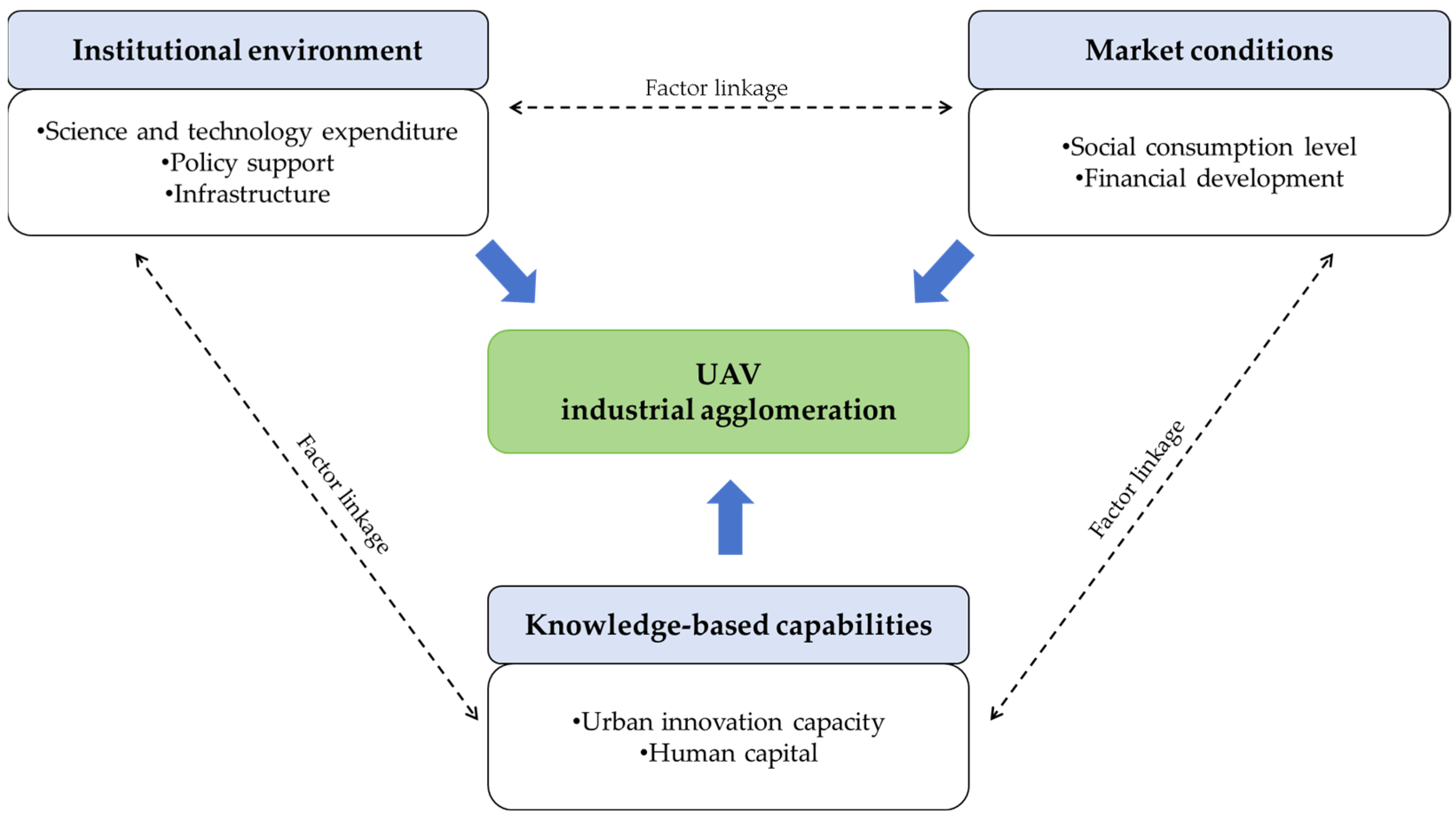
The classic frameworks reviewed above were primarily formulated with traditional manufacturing-like industries in mind. They tend to emphasize production costs, scale economies, and relatively static sources of comparative advantage. In contrast, the UAV industry is a high-end equipment manufacturing sector that integrates multiple frontier technologies, including aerospace engineering, artificial intelligence, communication and navigation, and advanced materials. Consequently, the drivers of UAV industrial agglomeration differ in several important respects. First, the UAV industry is highly technology-intensive. Its competitiveness depends on sustained R&D, rapid technology integration, and continuous product upgrading. Compared with cost-based industries, it relies more on innovation capacity, specialized expertise, and the circulation of tacit and codified knowledge. Second, policy and regulation strongly shape the industry. Airspace governance, entry standards, and flight-safety regulations tightly constrain industrial expansion. At the same time, public R&D funding, government procurement, and pilot or demonstration programs can stimulate demand and accelerate commercialization. Third, UAVs face diverse and rapidly evolving application scenarios. Demand extends across applications such as aerial photography, logistics, precision agriculture, infrastructure inspection, and emergency response. Such diversity requires rapid product iteration and business-model innovation. This, in turn, reinforces the value of market access, proximity to users, and ecosystem partnerships. Accordingly, we organize our analysis around three primary dimensions of UAV industrial agglomeration:
First, the institutional environment comprises three main elements: government R&D expenditure, policy support, and infrastructure development. Government R&D spending directly shapes the UAV industry. It can address R&D market failures through direct funding and development grants. It also signals public commitment to the sector, helping to crowd in follow-on private investment. In doing so, it lowers upfront R&D costs and reduces uncertainty, particularly for small and medium-sized technology firms [32]. Policy support helps define the institutional conditions under which the industry operates. This includes both national and local industrial planning. It also covers policy instruments such as low-altitude airspace governance reforms, targeted subsidies, tax incentives, and measures facilitating access to application scenarios [33]. A clear and stable policy framework can lower institutional transaction costs, stabilize expectations, and facilitate coordinated resource mobilization toward priority areas [34]. For example, in 2020, the Civil Aviation Administration of China approved 13 civil unmanned aviation test bases. These bases covered five application areas, including urban scenarios, island environments, regional logistics, high-altitude operations, and comprehensive application expansion. The pilot network later expanded to 26 zones, providing a broad platform for large-scale testing, validation, and policy experimentation. Infrastructure provides the physical and digital foundations for industrial operations. For the UAV sector, digital infrastructure is critical alongside conventional facilities such as transport and logistics. High-speed, low-latency communication networks and platforms such as the Internet of Things and cloud computing enable beyond-visual-line-of-sight control, real-time data transmission, and coordinated operations. These capabilities allow UAVs to operate not merely as flight hardware, but as data-intensive aerial platforms embedded in broader urban systems [35].
Second, market conditions comprise two main components: social consumption levels and financial development. A strong consumer market can provide early demand, support initial scale economies, and generate cash flow that sustains firm growth. In the UAV sector, a vibrant consumer market can cultivate supply chains and user communities while generating revenue and usage feedback that facilitate subsequent expansion into industrial applications [36]. For instance, DJI Innovation (Shenzhen) leveraged consumer-grade aerial-photography UAVs to capture the mass market, realize economies of scale, and build a comprehensive industrial chain. It then reinvested accumulated capital, technological capabilities, and data resources into industrial-grade applications such as agriculture and surveying, enabling a transition from consumer-oriented products to industrial deployment. At the same time, UAV firms often face substantial financing constraints, especially in early-stage R&D and market entry. A well-developed local financial system can ease these constraints by providing diversified financing channels, including venture capital, private equity, angel investment, and technology-oriented financial products. Such support can improve firms’ access to risk capital, accelerate the commercialization of innovation, and shorten the transition from research to market deployment. In this sense, cities with stronger financial ecosystems may be better positioned to identify high-potential UAV projects and support their scaling and diffusion. A case in point is Chengdu, where a local industrial investment institution took an equity stake in a UAV manufacturer and provided sustained support over time. This support coincided with the subsequent expansion of local UAV industrial agglomeration.
Third, knowledge-based capabilities comprise two main components: innovation capacity and human capital. Innovation capacity is a central driver of sustained industrial development. It can be reflected in the presence of universities and research institutes, the intensity of R&D investment, patenting activity, and the strength of industry–academia–research collaboration. Being close to innovation hubs can improve access to frontier knowledge, shared facilities, and collaborative problem-solving. These advantages strengthen firms’ technological capabilities and enable continuous upgrading [37]. Human capital is the primary carrier of innovation activities. The UAV industry relies on interdisciplinary talent such as engineers, algorithm and software specialists, control engineers, and industrial designers [38]. A deep and high-quality talent pool supports staffing while fostering learning via mobility, interaction, and knowledge recombination. These processes are central to the formation of knowledge externalities and the diffusion of innovation within local ecosystems. China also provides illustrative cases of university-led and mission-oriented innovation. The development of the Changying UAV at Beihang University illustrates how large-scale, nationally oriented R&D programs can mobilize cross-organizational teams and build sustained industry–academia–research platforms. These arrangements can simultaneously advance technological objectives, cultivate talent, and strengthen linkages between research and industrial application [39].
It is important to emphasize that UAV industrial agglomeration is unlikely to be driven by isolated factors operating through simple linear effects. Instead, it reflects interacting conditions and potential feedback loops among institutions, markets, and knowledge-based capabilities. For example, policy support can shape the direction and intensity of financial flows. Human capital accumulation, in turn, depends not only on job opportunities and wages but also on local innovation capacity and broader urban amenities that affect talent attraction and retention. Such interdependence implies causal complexity, in which different combinations of conditions may produce the same outcome. Conventional regression approaches, which focus on average net effects under linear assumptions, are not well-suited to capturing this causal structure. In contrast, panel data QCA is designed to identify outcome-generating configurations and accommodate equifinality and asymmetric causation. Accordingly, we develop the analytical framework presented in Figure 1. The framework includes seven antecedent conditions grouped into three dimensions, along with one outcome variable. It is intended to move beyond linear explanations and reveal the configurational mechanisms and multiple pathways through which UAV industrial agglomeration emerges.

3. Materials and Methods

3.1. Method

Compared with quantitative approaches such as linear regression, panel data QCA provides a configurational and case-oriented framework for examining how multiple conditions jointly produce an outcome. It has been widely applied in management and related fields, including strategic management [40,41], entrepreneurship [42], innovation ecosystems [43], and public administration [44]. The configurational perspective holds that outcomes result from specific combinations of antecedent conditions rather than isolated net effects. Moreover, equifinality means that different combinations can lead to the same outcome [45]. Extending this logic, panel data QCA introduces a temporal dimension that allows researchers to trace how configurations and their outcome associations change over time [46].
We adopt panel data QCA for three reasons. First, UAV industrial agglomeration is shaped by interacting institutional, market conditions, and knowledge-based capabilities. Conventional regression models can estimate average marginal effects, but they are less well suited to uncovering outcome-generating combinations and asymmetric causal patterns. In contrast, panel data QCA identifies distinct configurational pathways to high UAV industrial agglomeration. Second, industrial agglomeration is inherently evolutionary. Cross-sectional fuzzy-set QCA captures configurations at a single time point, whereas panel data QCA tracks changes in core conditions and configuration membership across periods, enabling an explicit examination of temporal dynamics in pathway formation. Third, our dataset includes 7 years of observations across 280 cities, fitting the “multiple cases over multiple time points” structure required for panel data QCA. All data processing and analyses were conducted in R (v4.3.1).
The panel data QCA procedure in our study includes four main steps. (1) The outcome and condition variables are defined on the basis of the theoretical framework and available panel data. (2) All variables are calibrated into fuzzy-set membership scores. This step is detailed in Section 3.4. (3) Necessity and sufficiency analyses are conducted to identify outcome-generating configurations. (4) An analysis of configuration heterogeneity across different city sizes and time periods.

3.2. Variables

3.2.1. Outcome Variable

Industrial agglomeration can be measured using various methods, with common metrics including the location quotient [47], the Herfindahl–Hirschman Index (HHI) [48], and the Ellison–Glaeser (EG) index [49]. As a strategic emerging industry in China, the UAV sector currently lacks official statistics on its agglomeration intensity or output value. However, publicly available data on UAV firms can be used. Therefore, drawing on the research of Ciccone and Hall (1996) [50] and Zhao and Wang (2021) [51], we employ the agglomeration density of UAV enterprises to measure the agglomeration level of the UAV industry. The outcome variable is measured as the number of UAV enterprises normalized by built-up area, which serves as a proxy for effective urban economic space. The calculation formula is shown in Equation (1), where U A V _ a g g i t denotes the UAV industrial agglomeration level in city i during year t , U A V _ e i t represents the number of UAV enterprises in city i during year t , and a r e a i t indicates the built-up area of city i during year t .
U A V _ a g g i t = U A V _ e i t a r e a i t

3.2.2. Condition Variables

The condition variables are grouped into three dimensions: the institutional environment, market conditions, and knowledge-based capabilities.
The institutional environment comprises science and technology expenditure, policy support, and infrastructure. Science and technology expenditure is measured as government science and technology expenditure as a share of total public budget expenditure [52]. Policy support is proxied by the number of city-level policy documents related to UAVs and the low-altitude economy. Infrastructure is captured using a weighted composite index based on the number of general aviation airports [53] and the volume of postal and telecommunications services. All components are standardized prior to aggregation.
Market conditions comprise social consumption level and financial development. Social consumption level is measured by total retail sales of consumer goods in urban areas [54]. Financial development is measured by the ratio of total bank deposits and loans to regional GDP [55].
Knowledge-based capabilities comprise urban innovation capacity and human capital. Urban innovation capacity is proxied by patent counts, and human capital is measured by the number of enrolled college students [7].
Table 1 and Table 2 report detailed definitions and descriptive statistics for the outcome and all conditions.

3.3. Study Area and Data Sources

This study examines 280 Chinese cities over the period 2017–2023. China provides a relevant empirical setting for studying UAV industrial agglomeration because the UAV sector has expanded rapidly and plays an increasingly important role in the global UAV market. Meanwhile, Chinese cities differ markedly in industrial base, innovation resources, market conditions, and policy support, which may lead to heterogeneous agglomeration patterns and formation pathways. Such variation provides a rich empirical basis for examining how different combinations of urban conditions shape UAV industrial agglomeration. Taking into account the availability of official urban statistical data and the need to capture regional diversity, we selected 280 cities as the study area.
We chose 2017 as the starting year because the Ministry of Industry and Information Technology issued a policy that year [56], signaling strengthened policy attention to the civilian UAV sector. In addition, industry reports indicate a sharp increase (67%) in China’s civilian UAV production in 2017 [57], suggesting the market entered an accelerated expansion phase. This period also coincides with the early stage of low-altitude economic development in China [58]. We set 2023 as the endpoint due to data availability constraints for city-level indicators.
UAV firm data were obtained from the Tianyancha website, a corporate information database in China. We used “UAV” as the keyword to search company names, business descriptions, and related fields and restricted the results to firms with an operating status of “active.” The retrieved records were then geocoded and matched to the 280 sample cities. After data cleaning and matching, the final dataset includes 31,815 UAV-related firms.
Policy documents related to the UAV industry were collected from the PKU Law Database, a legal and policy repository in China. We conducted keyword searches in Chinese using “UAV” and “low-altitude economy,” and extracted city-level policy records accordingly. Data on the number of general aviation airports were obtained from the list of licensed and registered airports released by the China General Aviation Airport Information Platform. Other city-level socioeconomic indicators were drawn from the China City Statistical Yearbook (2017–2023). For variables with missing observations, we applied linear interpolation to complete the panel dataset.

3.4. Calibration

All variables were calibrated using the direct method proposed by Fiss (2011) [40]. Specifically, the 95th percentile was used for full membership, the 50th percentile for the crossover point, and the 5th percentile for full non-membership for each variable. This procedure transforms raw data into fuzzy-set membership scores ranging from 0 to 1. To avoid ambiguity at the crossover point and retain cases with a membership score of 0.5, we followed Zhang and Du (2019) and recoded 0.5 as 0.501 [59]. Table 3 reports the calibration anchors for each variable.

4. Results

4.1. UAV Industry in Spatial Analysis

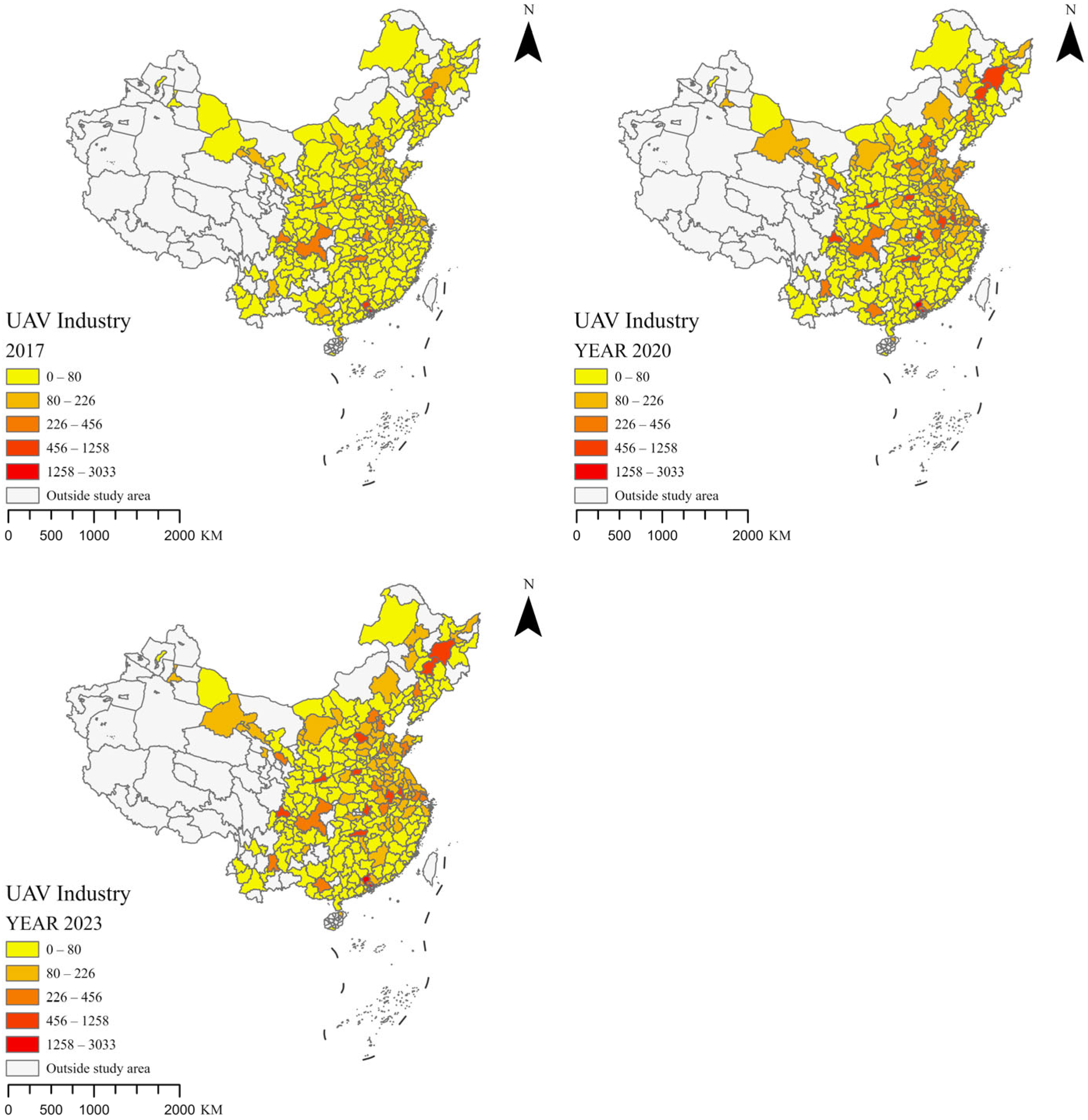
Figure 2 maps the spatial distribution of UAV firms across the 280 sample cities for 2017, 2020, and 2023. The maps show a steady increase in the number of UAV firms over time and reveal clear spatial agglomeration, concentrated primarily in eastern China. Guangzhou and Shenzhen consistently rank among the leading cities in UAV firm concentration throughout the study period. Global Moran’s I and the associated p-values indicate significant positive spatial autocorrelation in UAV firm distribution from 2017 to 2023, confirming a non-random spatial pattern. Moreover, Moran’s I exhibits only modest year-to-year variation while showing a mild upward trend over the period (Table 4).

4.2. Necessity Analysis of Single Conditions

Necessity analysis is a prerequisite for configurational analysis and assesses whether any single condition is necessary for the outcome. A condition is typically considered necessary when consistency exceeds 0.90 and coverage exceeds 0.50. In panel data QCA [60], necessity should also be examined with attention to temporal and spatial effects. Following the adjusted consistency distance criterion, we flag conditions with an adjusted distance greater than 0.20 for further scrutiny and treat them as candidates for necessity in subsequent analyses [61].
As shown in Table 5, all POCONS values are below 0.90, indicating that none of the individual conditions qualifies as a necessary condition for the outcome. Meanwhile, several conditions have an adjusted consistency distance greater than 0.20, suggesting that their necessity relationships may vary across time and cases.
We further examined the candidate necessity relations for those combinations with BECONS-adjusted distance greater than 0.20 (Table 6). In most cases, the BECONS-adjusted distance remains below 0.90, indicating that no necessary causal relations are identified. Cases 3 and 9 show BECONS-adjusted distance above 0.90, but BECOV below 0.50, implying that these relations hold only for a subset of cities rather than across the whole sample. One plausible interpretation is that, around 2017, policy support (X2) in some cities preceded observable UAV industrial agglomeration during the industry’s early stage. In such cases, policy attention may have been in place while agglomeration had not yet fully emerged. In addition, as a technology- and capital-intensive sector, the UAV industry may be less likely to reach high levels of agglomeration when financial development (X5) is weak. Weak financial development can constrain firms’ entry and expansion, thereby hindering agglomeration.
The results show the feasibility of using configuration analysis to study UAV industrial agglomeration.

4.3. Sufficiency Analysis of Conditional Grouping

4.3.1. Aggregated Results

Following Schneider and Wagemann (2012) [62], we set three thresholds prior to the configurational analysis: a case frequency threshold of 5, a raw consistency threshold of 0.80, and a PRI consistency threshold of 0.65. Based on these criteria, 1644 cases were retained in the truth table, representing approximately 83.9% of the full sample. This suggests that a substantial share of observations can be captured by a limited set of condition combinations under the specified thresholds.
Following Du et al. (2020) [63], we compared the intermediate and parsimonious solutions to identify configurational pathways and distinguish core from peripheral conditions. The results are reported in Table 7. We identify six configurations associated with high levels of UAV industrial agglomeration. All six configurations have consistency values above 0.80, and the pooled solution consistency is 0.866, indicating that these configurations provide sufficient pathways to the outcome under the adopted thresholds. In addition, the adjusted distances for both BECONS and WICONS are below 0.20, indicating that the results are stable across time periods and across cases. The pooled solution coverage is 0.519, indicating that the six configurations jointly account for 51.9% of high-agglomeration cases. Overall, these statistics satisfy recommended criteria for panel data QCA.
The six configurations can be grouped into three archetypes based on their core conditions. Specifically, H1 and H2 share the same core causal conditions, all of which belong to the dimensions of institutional environment and knowledge-based capabilities and therefore correspond to “institution–knowledge-driven” pathways. H3 and H4 have core causal conditions drawn from the dimensions of institutional environment and market conditions and are classified as “institution–market-driven” pathways. In H5 and H6, the core causal conditions are drawn from all three dimensions, so these configurations are labeled as “multidimensional synergistic” pathways.
(1)
Institution–knowledge-driven pathways. Both H1 and H2 indicate that high technology expenditure, strong policy support, low infrastructure, high innovation levels, and high human capital can generate high levels of UAV industrial agglomeration. H1 and H2 have coverage of 33.3% and 27.9%, with unique coverage of 2.7% and 0.6%, respectively. They differ mainly in market conditions: H1 features higher social consumption, whereas H2 features stronger financial development. The institution–knowledge-driven pathways suggest that strong institutional support and knowledge-based capabilities can sustain high UAV industrial agglomeration even without high infrastructure, with market conditions (social consumption or financial development) providing additional reinforcement.
(2)
Institution–market-driven pathways. H3 indicates that high science and technology expenditure, strong policy support, high social consumption, strong financial development, and the absence of high human capital are associated with high UAV industrial agglomeration. In this configuration, innovation capacity is peripheral rather than core. H3 has a coverage of 0.266 and a unique coverage of 0.013, indicating that this configuration accounts for 26.6% of the high-agglomeration cases in the sample. H3 characterizes cities where strong institutional support and market conditions can compensate for limited local human capital and still support high UAV industrial agglomeration. This pattern may reflect these cities’ ability to access core technical teams through inter-city mobility and external linkages, rather than relying solely on locally embedded human capital. Moreover, the peripheral presence of innovation capacity suggests that these cities possess some baseline innovative capacity. This likely reflects reliance on technology adoption and upgrading, rather than comprehensive in-house R&D from scratch.
H4 indicates that strong policy support, the absence of high infrastructure, high social consumption, and strong financial development are associated with high UAV industrial agglomeration. Innovation capacity and human capital appear as peripheral conditions in this configuration. H4 has a coverage of 0.294 and a unique coverage of 0.011, indicating that it accounts for 29.4% of the high-agglomeration cases in the sample. H4 suggests that under strong policy support, market demand and financial capital jointly stimulate firm entry and expansion in UAV-related activities, thereby reinforcing UAV industrial agglomeration. Although infrastructure has not yet reached a high level in this pathway, policy incentives and market potential may still attract firms and support UAV industrial agglomeration.
(3)
Multidimensional synergistic pathways. H5 indicates that low science and technology expenditure, strong policy support, high infrastructure, weak financial development, and high human capital constitute the core conditions for high UAV industrial agglomeration. H5 has a coverage of 0.237 and a unique coverage of 0.019, indicating that it accounts for 23.7% of the high-agglomeration cases in the sample. H5 demonstrates that when science and technology expenditure and financial development are relatively low, strong policy support, infrastructure provision, and human capital advantages can jointly create conditions conducive to UAV industrial agglomeration. The low levels of science and technology expenditure and financial development may reflect two conditions. On one hand, local governments may rely on policy tools (e.g., tax and fee reductions) to lower firms’ costs and ease financing constraints. On the other hand, park-based institutional arrangements may facilitate UAV industrial agglomeration. Additionally, strong policy support suggests that local governments treat the UAV sector as a strategic priority within broader agendas for industrial upgrading and new growth drivers.
H6 indicates that high-tech expenditure, low policy support, high infrastructure, high social consumption levels, high financial development, high innovation capacity, and high human capital are the core conditions for high concentration in the UAV industry. The coverage of H6 is 0.337, with unique coverage of 0.098, indicating that this configuration accounts for 33.7% of the high-agglomeration cases in our sample. H6 reveals that UAV industrial agglomeration relies more on the synergistic advantages from multiple factor endowments than on targeted policy interventions. Relatively mature innovation systems may generate endogenous conditions conducive to UAV industrial agglomeration in these cities. Sector-specific policies may be less visible or delayed relative to industrial development, which may explain the low policy support. Such cities may be medium-sized or small cities in the influence zone of megacities or super-large cities, potentially benefiting from spillovers.

4.3.2. Inter-Group Results

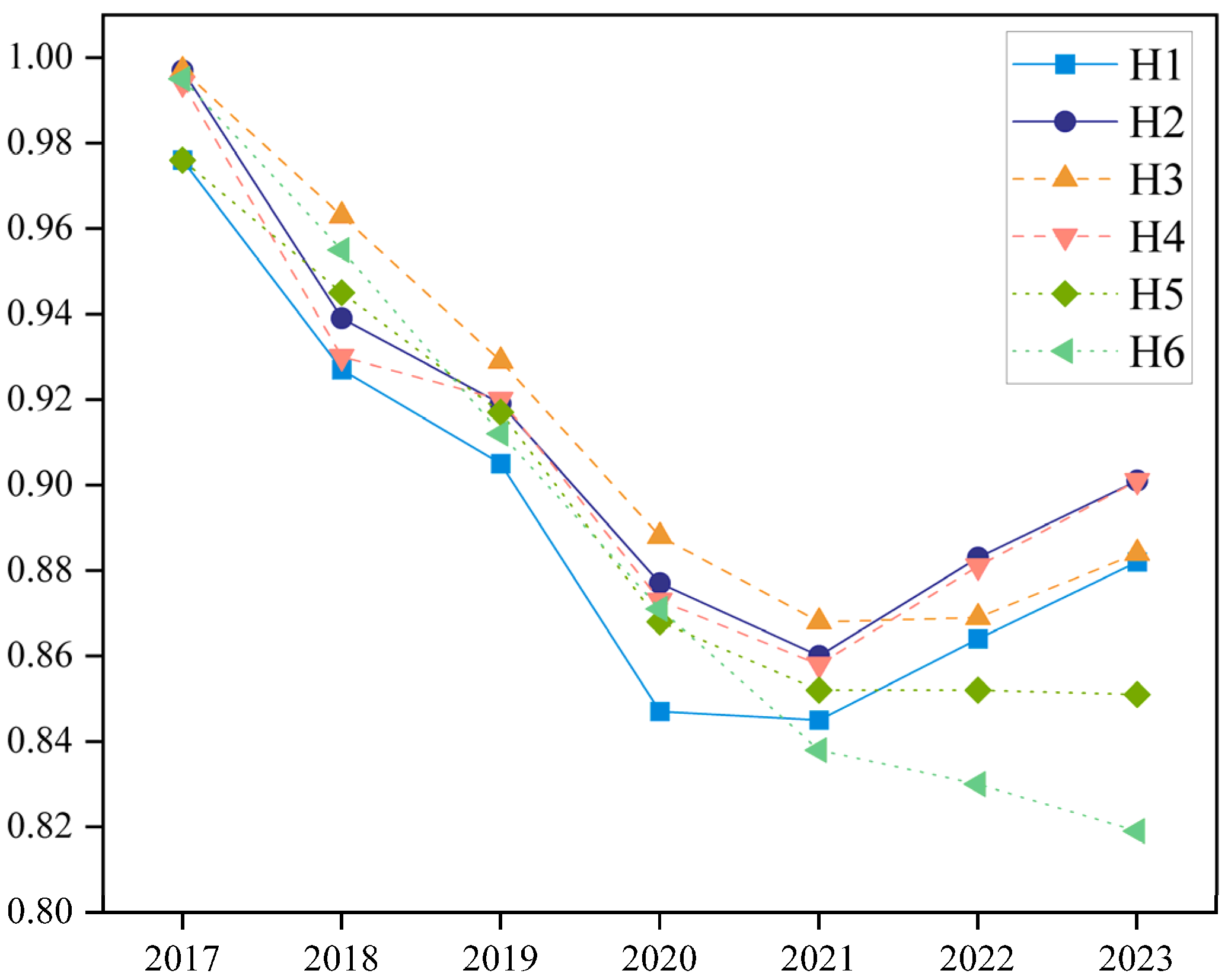
Figure 3 plots the trend of BECONS values for the six configurations over time and is used to assess their temporal stability. Between 2017 and 2023, BECONS values exceeded 0.80 for all six configurations, suggesting that the configuration–outcome associations are broadly stable over time. In 2017, BECONS values were close to 1 for all configurations, indicating a strong alignment between the identified condition combinations and high UAV industrial agglomeration in the early stage. This pattern also suggests a strong fit between the six configurations and the high-agglomeration outcome in 2017. BECONS declined for all configurations from 2017 to 2020, and several pathways partially rebounded after 2021. Comparing 2017 and 2023 shows a reordering of BECONS across configurations, indicating temporal heterogeneity in the relative strength of different configurational pathways to UAV industrial agglomeration. Overall, the evidence is consistent with early exploration, subsequent differentiation, and relative stabilization in later years.
At the configuration level, H1–H4 exhibit a year-by-year decline in BECONS during 2017–2020, followed by varying degrees of recovery in 2021–2023. By contrast, H5 and H6 show an overall downward trend: the decline in H5 slows and stabilizes after 2021, whereas H6 continues to decrease gradually. These patterns suggest that the institution–knowledge-driven and institution–market-driven pathways maintain relatively higher and more resilient inter-group consistency in the later stage, whereas the multidimensional synergistic pathways weaken. The evidence is consistent with a shift in the mechanisms of UAV industrial agglomeration from broad-based factor synergy toward more selective and targeted factor combinations over time.
In 2017, BECONS is slightly higher for H2, H3, H4, and H6 than for H1 and H5. By 2023, BECONS diverges more clearly across configurations. BECONS is highest for H2 and H4, moderate for H1 and H3, and lower for H5 and H6. Among the higher-consistency pathways, H2 indicates that strong financial development, together with institutional support and knowledge-based capabilities, is linked to high UAV industrial agglomeration and gains strength in the later stage. H4 suggests that even when high infrastructure is not observed, the joint presence of strong policy support, high social consumption, and strong financial development can still be associated with high UAV industrial agglomeration. This pathway shows a modest strengthening in inter-group consistency after 2020.
In the moderate-consistency pathways, BECONS for H1 fluctuates markedly, particularly in the early stage. However, H3 remains relatively stable in inter-group consistency throughout the period. This indicates that the dual-engine approach of “institutional + market” constitutes a relatively robust pathway for the emergence of UAV industrial agglomeration.
In the lower explanatory pathways, H5 and H6 follow multidimensional synergistic patterns, yet their BECONS weakens. H5 indicates that policy–knowledge synergies can partially compensate for limited science and technology expenditure and financial development, but this configuration becomes less salient in the later stage of UAV industrial agglomeration. H6 suggests that policy-absent, broad-endowment configurations become less stable in later years, pointing to limited persistence of this pathway.
Finally, Figure 3 suggests that 2020 and 2021 are inflection points in BECONS across the six configurations. As the UAV industry diffuses across cities, configurational pathways to UAV industrial agglomeration become more differentiated over time. The COVID-19 shock may have affected key conditions unevenly across cities, reshaping the relative strength of different configurations. Meanwhile, the pandemic period may have prompted more local governments to elevate the UAV sector within their development agendas. Local governments introduced policy documents aimed at promoting UAV innovation, expanding application scenarios, and supporting ecosystem development. These changes may have reshaped the institutional context for UAV industrial agglomeration.

4.3.3. Intra-Group Results

To examine how configurational patterns vary across city types, we first classified cities into different categories. City size categories follow the classification standards set out in the 2014 State Council of China document [64]. The classification is based on the permanent resident population in urban districts. Population size often correlates with development levels and resource endowments across city types [65]. For analytical clarity, we merge Type I and Type II small cities in the 2014 document into a single “small city” category. Table 8 reports the detailed classification criteria in our sample.
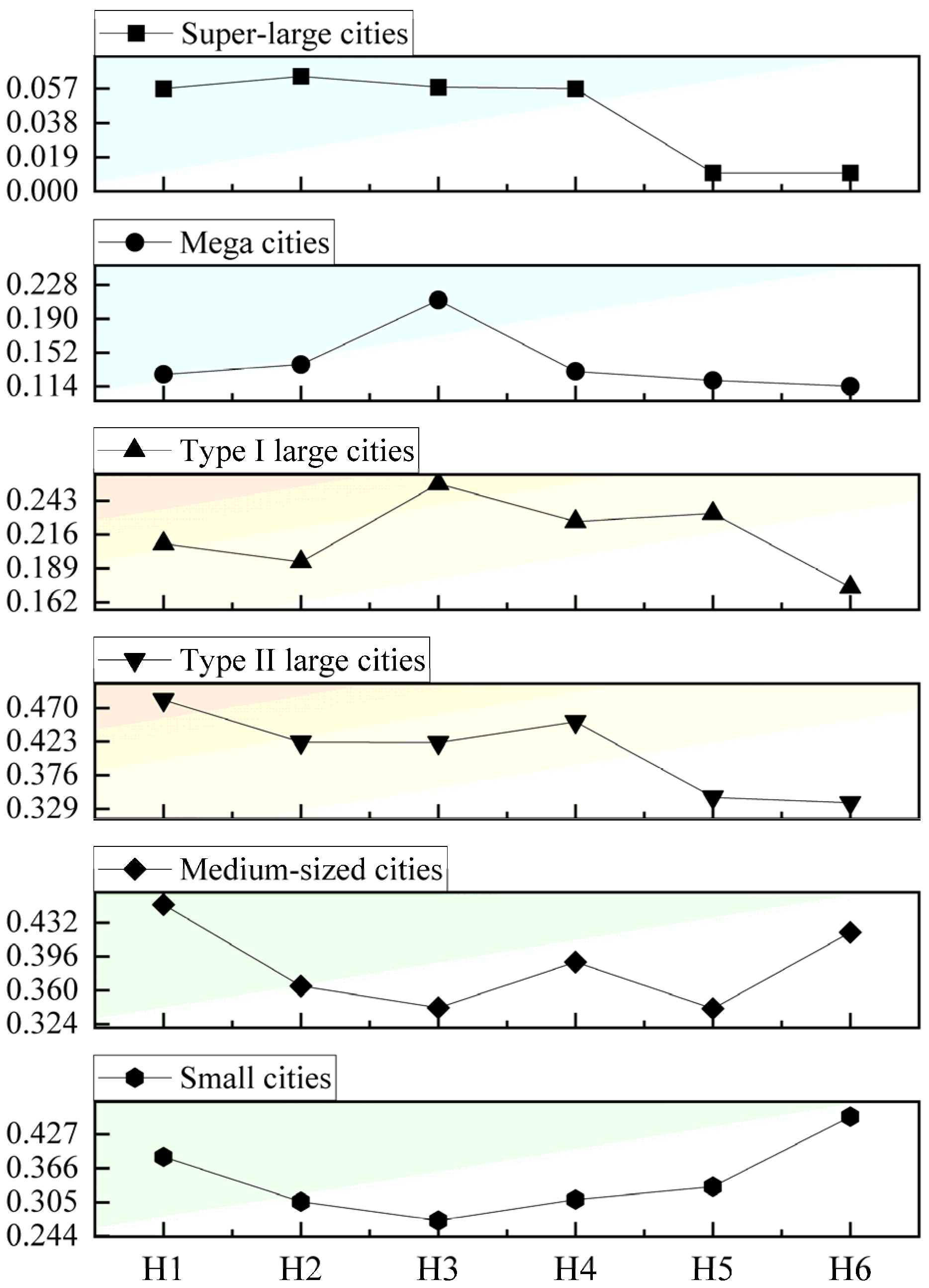
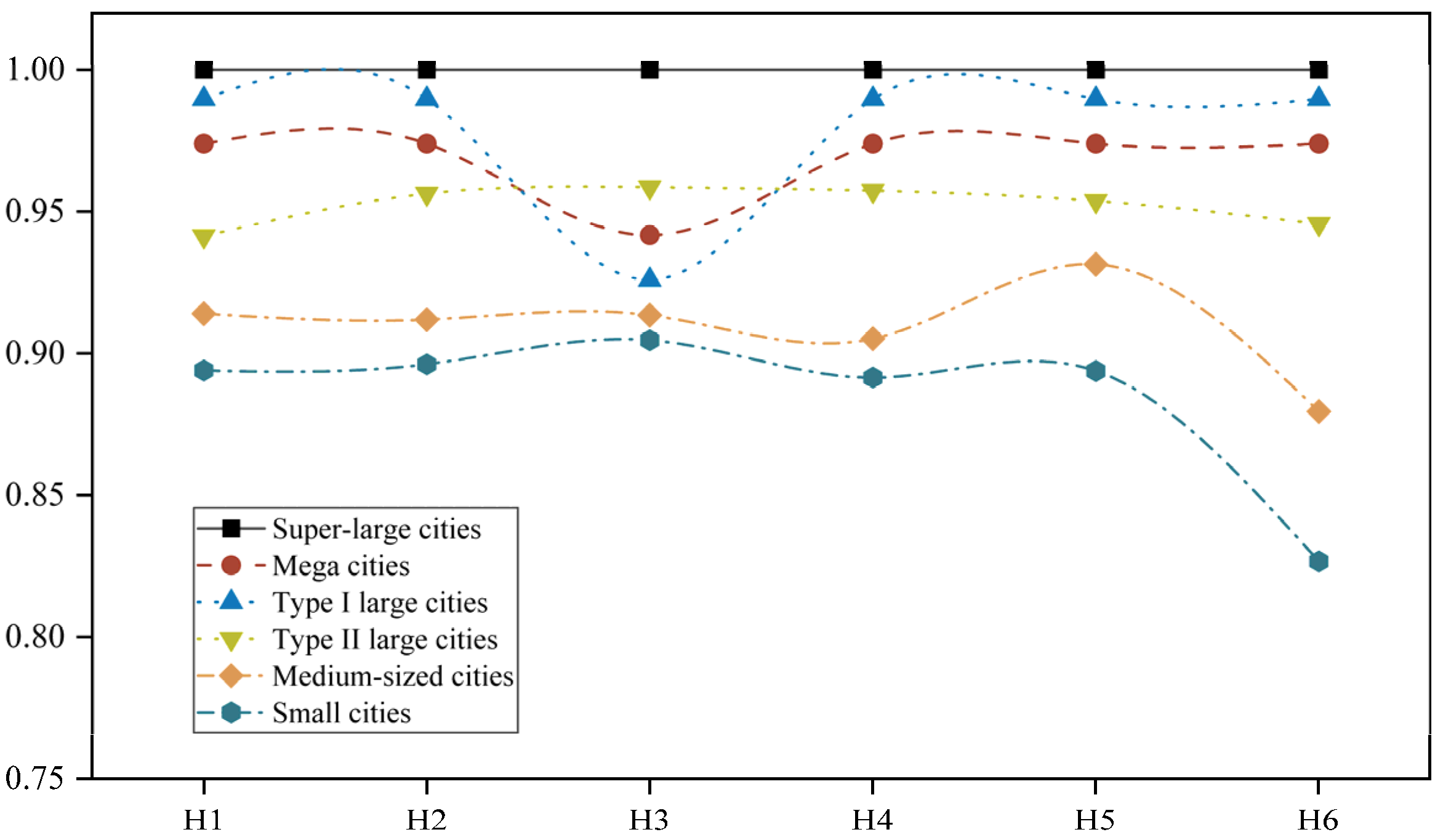
Figure 4 presents the WICONS results for six configurational paths across different city types. All results exceed 0.8, indicating that all configurational paths retain sufficient explanatory power across diverse urban contexts. H3 demonstrates lower explanatory power in megacities and Type I large cities. Explanatory power remains relatively balanced across all configurational paths in super-large cities and Type II large cities. H6 exhibits lower explanatory power in medium-sized cities and small cities.
Figure 5 reports coverage for the six configurational pathways across city size categories. In super-large cities, pathways H1–H4 dominate, and H2 has the highest average coverage. This pattern suggests that super-large cities achieve high UAV industrial agglomeration primarily through institution–knowledge-driven and institution–market-driven pathways. Illustrative cases include Shenzhen, Guangzhou, and Chengdu. Shenzhen hosts leading UAV firms (e.g., DJI) and has developed a specialized cluster spanning manufacturing, systems integration, and downstream application services. According to relevant data, by the first half of 2025, Shenzhen’s consumer-grade UAVs accounted for 70% of the global market, with the annual output value of its low-altitude economy exceeding 90 billion yuan in 2024 [66]. Guangzhou, geographically proximate to Shenzhen, has attracted numerous low-altitude economy enterprises and shows strengths in application-oriented development, including healthcare, meteorology, and agriculture [67]. Together, the two cities play complementary roles in manufacturing, systems integration, and service-oriented segments. Chengdu, a key hub in western China, is supported by aviation research institutions and aircraft design units, which underpin the emergence of a UAV ecosystem spanning R&D, manufacturing, operations, and services.
For mega cities and Type I large cities, configuration H3 exhibits the highest average coverage, indicating that the institution–market-driven pathway is particularly relevant to these categories. Illustrative megacities include Changsha and Harbin. In Changsha, aviation industrial parks and UAV testing facilities, alongside rising R&D intensity, may support the concentration and upgrading of UAV-related activities [68]. Harbin benefits from an established aerospace manufacturing base, although large-scale UAV production capacity is still developing [69]. For Type I large cities, Shijiazhuang and Hefei provide additional examples. Shijiazhuang has promoted UAV-related industrial agglomeration through an aviation industrial park approach [70]. Meanwhile, in 2021, Anhui Province launched a province-wide pilot program for comprehensive low-altitude airspace management reform. The pilot program aims to position Hefei as a regional general aviation service hub [71]. Within this reform framework, UAV industrial agglomeration in Hefei has taken shape rapidly.
Type II large cities and medium-sized cities exhibit the highest average coverage under Path H1. Compared with other city types, the higher average coverage of Type II large cities suggests that they serve as important spatial carriers of UAV industrial agglomeration in our sample. Medium-sized cities also stand out under Path H6, suggesting that their UAV industrial agglomeration can be associated with both institution–market-driven and multidimensional synergistic pathways. An illustrative Type II large city is Haikou. Haikou is located in Hainan. Hainan began developing a demonstration zone for low-altitude air traffic management services in 2017. In 2023, it released what was described as a UAV-friendly airspace map, providing clear guidance for provincial UAV operations and offering useful experience for other cities [72]. Ongoing efforts to develop the low-altitude economy ecosystem in Hainan appear to strengthen institutional and innovation support for UAV industrial agglomeration and scenario development in Haikou. Langfang provides an illustrative example of a medium-sized city. From an infrastructure perspective, Langfang is adjacent to Beijing Daxing International Airport and forms part of the Daxing Airport Economic Zone, with connections to regional logistics networks [73]. Furthermore, under the Beijing–Tianjin–Hebei region coordinated development strategy, Langfang may benefit from spillovers in innovation capacity and human capital from Beijing, creating favorable conditions for the emergence of local UAV industrial agglomeration.
In small cities, H6 has the highest average coverage, followed by H1. This indicates that fostering UAV industrial agglomeration in small cities may require not only support from institutional and knowledge-based dimensions but also the alignment of diverse factors that generate cross-factor complementarities. Zhangjiajie provides an illustrative case. Zhangjiajie’s UAV industrial agglomeration is closely linked to its application scenarios. Zhangjiajie has rich natural and cultural heritage tourism resources and is a nationally and internationally recognized destination. Low-altitude tourism scenarios (e.g., aerial sightseeing services) appear to have stimulated UAV-related demand and contributed to a distinctive local pattern of UAV industrial agglomeration.
Finally, the city-type analysis shows that some cities display relatively balanced intra-group coverage across multiple pathways, suggesting diversity and flexibility in the configurational pathways associated with UAV industrial agglomeration. For example, Shenzhen shows only modest variation in average intra-group coverage across H1–H4.

4.4. Robust Analysis

Following Zhao et al. (2020) [74] and Ingrams (2023) [75], we performed two robustness checks to assess the stability of the six configurational solutions. (1) We increased the raw consistency threshold from 0.80 to 0.85 while holding all other parameters constant. (2) We use 90th, 50th, and 10th percentile bounds for full membership, crossover point, and full non-membership. The robustness analysis results are presented in Appendix A. The results remained stable.

5. Discussion

This study advances understanding of industrial agglomeration in strategic emerging industries by documenting multiple configurational pathways, stage-dependent dynamics, and urban-scale heterogeneity in the UAV sector. Using a dynamic perspective, we identify equifinal pathways to high UAV industrial agglomeration. We further show that the relevance of these pathways varies over time and across city size categories. These findings provide new empirical evidence on how industrial agglomeration in emerging industries forms and evolves under varying institutional, market, and knowledge conditions.
Relative to the limited UAV-specific literature, the spatial distribution pattern of UAV firms identified in this study is broadly consistent with the findings of Chen et al. (2025) [8]. Our results also provide additional empirical support for the key factors discussed by Fan et al. (2025) in relation to UAV industry development [76], and further complement Han et al. (2025) by revealing the configurational synergy among these influencing factors [7]. Building on this comparison, the following discussion situates our findings within the broader theoretical framework of evolutionary economic geography in order to clarify the contribution of this study to the field.
Our findings indicate that UAV industrial agglomeration in China can be characterized by six configurational pathways that fall into three archetypes. These pathways indicate that UAV industrial agglomeration results from the joint action and interaction of conditions across institutional, market, and knowledge-based dimensions. These six pathways are equifinal and dynamic, and the conditions within them reflect urban endowments accumulated through long-term development [12]. Across the six pathways, policy support frequently appears as a core condition within the institutional dimension. This finding is consistent with previous research emphasizing the importance of policy support in shaping the development of UAV-related industries and other emerging technology sectors [10,77,78,79]. When policy support is absent, other combinations of conditions may compensate and still support high UAV industrial agglomeration in some cities. These policy-absent pathways tend to be short-lived and, as the industry develops, are more likely to converge toward trajectories characterized by policy-led support. This dynamic evidence suggests that institutions in industrial development are not merely “backdrops” or “initiators” but also “stabilizers” that maintain resilience and reduce the risk of path lock-in. This complements one-dimensional accounts and suggests that the influence of institutions and markets shifts across stages of industrial evolution.
We also find that configurational pathways to UAV industrial agglomeration in China exhibit temporal heterogeneity and vary across city size categories. Inter-group consistency results indicate that the configurational causality underlying UAV industrial agglomeration is reflected not only in the static coexistence of multiple feasible pathways but also in the dynamic process of pathway selection over time [31]. Under macro-environmental shifts such as the COVID-19 shock and the intensive rollout of low-altitude economy policies, broad-based, multifaceted coordination based on factor integration appears more suitable for early exploratory development. When governments position the UAV industry as a catalyst for urban industrial path creation, configurations that sustainably generate knowledge externalities, scenario-driven demand, and capital support are more likely to be retained and progressively strengthened through competition.
Urban-scale heterogeneity suggests that cities of different sizes tend to follow distinct pathways to foster UAV industrial agglomeration. Although defined by the permanent resident population of urban districts, city categories also proxy broader differences in economic scale, technological capacity, and institutional arrangements. First, super-large cities tend to achieve UAV industrial agglomeration through institution–knowledge-driven and institution–market-driven pathways. Super-large cities typically have stronger institutional environments, deeper markets, and richer knowledge-based capabilities than smaller cities. These accumulated advantages can facilitate the emergence, scaling, and upgrading of strategic emerging industries, including the UAV sector [80]. Second, large cities and some medium-sized cities exhibit more diverse pathway patterns. Many of these cities are located within the spillover zone of super-large cities or megacities and may benefit from inter-city diffusion of technology, capital, and talent [81]. At the same time, distinct local conditions can support differentiated positioning, including complementary specializations in manufacturing, integration, or application-oriented services. As a result, their agglomeration pathways are more varied, consistent with the notion of new path creation in evolutionary economic geography [11]. Third, UAV industrial agglomeration in small and some medium-sized cities appears more application-oriented [76,82] and demand-oriented [83,84,85]. In these contexts, specific use cases and scenario-driven demand may facilitate local UAV industrial agglomeration, consistent with von Hippel’s user-driven innovation perspective [86]. This suggests that demand-side forces can matter for UAV industrial agglomeration formation even where initial endowments are relatively limited.
These patterns also shed light on the broader role of policy support. Across the six pathways, policy support frequently appears, but its function may vary by city size. For larger cities, policy may primarily accelerate diversification and scaling. For smaller cities, policy may function as an enabling condition that lowers entry barriers and reduces early-stage risks. More generally, industrial policy effectiveness likely depends on alignment with local market structure, the knowledge base, and the stage of industrial development. Finally, our results on urban heterogeneity not only support the tailored industrial policy principle advocated by Philippe Aghion et al. (2015) [87] but also provide a more geographically sensitive theoretical basis for designing industrial policies for emerging industries.
Overall, our findings suggest that the mechanisms of UAV industrial agglomeration can be interpreted within an evolutionary economic geography framework while also exhibiting features that distinguish this sector from traditional industries, particularly its scenario-driven dynamics and the prominent role of policy support. In addition, the results offer context-specific empirical insights into how small and medium-sized cities in China may foster UAV-related industrial development through multiple configurational pathways.

6. Conclusions

This study applies panel data QCA to examine configurational drivers of UAV industrial agglomeration in 280 Chinese cities from 2017 to 2023, offering a dynamic configurational perspective on UAV industrial agglomeration at the city level. The main findings are as follows. (1) We identify six equifinal configurations associated with high UAV industrial agglomeration, which can be grouped into three archetypes: institution–knowledge-driven, institution–market-driven, and multidimensional synergistic pathways. (2) Broad-based synergistic configurations are more salient in the early stage, while institution–knowledge-driven and institution–market-driven pathways are more persistent and relatively more stable in the later stage. (3) Configurational patterns vary by city size. In super-large cities, high UAV industrial agglomeration is mainly associated with institution–knowledge-driven and institution–market-driven pathways. In megacities and Type I large cities, the institution–market-driven pathway appears particularly prominent. Type II large cities show relatively broad coverage across multiple pathways and emerge as important spatial carriers of UAV industrial agglomeration in our sample. In medium-sized cities, both institution–knowledge-driven and multidimensional synergistic pathways are relevant, whereas in small cities, UAV industrial agglomeration is more closely linked to multidimensional combinations of local conditions.
Admittedly, this study still has several limitations. The six configurational pathways we identify exhibit substantial variation in inter-group coverage across cities. We interpret this variation as reflecting complex and heterogeneous formation pathways of UAV industrial agglomeration associated with differences in city size. However, data availability constraints prevent us from constructing more fine-grained panel measures of the UAV industry, which limits our ability to capture pathway dynamics in greater detail.
Future research could expand data sources and incorporate firm-level evidence to better unpack micro-level mechanisms. It could also explore product-level heterogeneity in drone type. Combining macro-, meso-, and micro-level analyses may enable a more precise identification of the drivers of UAV industrial agglomeration and a clearer understanding of pathway evolution across urban contexts.


Author Contributions

Conceptualization, H.L., Y.C. and H.Z.; Methodology, H.L. and Y.C.; Formal analysis, H.L. and D.X.; Software, H.L. and Y.C.; Resources, H.L. and D.X.; Writing—original draft preparation, H.L. and Y.C.; Writing—review and editing, H.Z.; Visualization, H.L. and D.X. All authors have read and agreed to the published version of the manuscript.

Funding

This research received no external funding.

Data Availability Statement

Restrictions apply to the availability of these data. Data were obtained from Tianyancha and are available at https://www.tianyancha.com/ (accessed on 19 November 2025) with the permission of Tianyancha (subject to its terms of use). Data were obtained from PKULaw (Peking University Law Database) and are available at https://www.pkulaw.com/ with the permission of PKULaw (subject to its access conditions).

Conflicts of Interest

The authors declare no conflicts of interest.

Abbreviations

The following abbreviations are used in this manuscript:
UAVUnmanned Aerial Vehicle
QCAQualitative Comparative Analysis
POCONSPooled Consistency
POCOVPooled Coverage
BECONSBetween Consistency
WICONSWithin Consistency
BECOVBetween Coverage
PRIProportional Reduction in Inconsistency

Appendix A

Appendix A.1. Robustness Analysis Results Under an Adjusted Raw Consistency Threshold

Table A1. Robustness check results under an adjusted raw consistency threshold.
Condition VariablesHigh-Level UAV Industrial Agglomeration
H1H2H3H4H5H6
X1Drones 10 00237 i001Drones 10 00237 i001Drones 10 00237 i001 Drones 10 00237 i001
X2Drones 10 00237 i001Drones 10 00237 i001Drones 10 00237 i001Drones 10 00237 i001Drones 10 00237 i001
X3 Drones 10 00237 i001Drones 10 00237 i001
X4 Drones 10 00237 i001Drones 10 00237 i001Drones 10 00237 i001
X5 Drones 10 00237 i001Drones 10 00237 i001Drones 10 00237 i001
X6Drones 10 00237 i001Drones 10 00237 i001Drones 10 00237 i001
X7Drones 10 00237 i001Drones 10 00237 i001Drones 10 00237 i001Drones 10 00237 i001
Consistency0.9030.9120.9110.9090.9010.873
PRI0.7280.7180.6580.7130.6560.651
Coverage0.3230.2790.2660.2940.2370.337
Unique coverage0.0270.0060.0130.0110.0190.098
BECONS adjusted distance0.0610.0610.0580.0580.0640.087
WICONS adjusted distance0.0310.0220.0340.0230.0330.028
Pooled Consistency0.866
Pooled PRI0.688
Pooled Coverage0.519
Note: Drones 10 00237 i001 = core causal condition (present); • = peripheral condition (present); ⊗ = core causal condition (absent).

Appendix A.2. Robustness Analysis Results Under Alternative Calibration Anchors

Table A2. Robustness check results under alternative calibration anchors.
Condition VariablesHigh-Level UAV Industrial Agglomeration
H1H2H3H4H5H6
X1Drones 10 00237 i001Drones 10 00237 i001Drones 10 00237 i001 Drones 10 00237 i001
X2Drones 10 00237 i001Drones 10 00237 i001Drones 10 00237 i001Drones 10 00237 i001Drones 10 00237 i001
X3 Drones 10 00237 i001Drones 10 00237 i001
X4 Drones 10 00237 i001Drones 10 00237 i001Drones 10 00237 i001
X5 Drones 10 00237 i001Drones 10 00237 i001Drones 10 00237 i001
X6Drones 10 00237 i001Drones 10 00237 i001Drones 10 00237 i001
X7Drones 10 00237 i001Drones 10 00237 i001Drones 10 00237 i001Drones 10 00237 i001
Consistency0.8680.8740.8740.8690.8590.827
PRI0.6980.6730.6030.6630.6050.609
Coverage0.2370.1920.180.2040.1620.265
Unique coverage0.030.0070.0130.0110.0190.103
BECONS adjusted distance0.080 0.083 0.087 0.080 0.093 0.119
WICONS adjusted distance0.039 0.030 0.045 0.031 0.042 0.033
Pooled Consistency0.825
Pooled PRI0.653
Pooled Coverage0.427
Note: Drones 10 00237 i001 = core causal condition (present); • = peripheral condition (present); ⊗ = core causal condition (absent).

References

  1. Rahman, M.F.F.; Fan, S.; Zhang, Y.; Chen, L. A comparative study on application of unmanned aerial vehicle systems in agriculture. Agriculture 2021, 11, 22. [Google Scholar] [CrossRef]
  2. Pothuganti, K.; Jariso, M.; Kale, P. A review on geo mapping with unmanned aerial vehicles. Int. J. Innov. Res. Comput. Commun. Eng. 2017, 5, 1170–1177. [Google Scholar] [CrossRef]
  3. Liu, Z.; Wang, Q. Construction of Task Allocation Model of UAV in Emergency Logistics Distribution. Sci. Technol. Manag. Res. 2020, 40, 229–236. [Google Scholar] [CrossRef]
  4. Lee, S.; Choi, Y. Reviews of unmanned aerial vehicle (drone) technology trends and its applications in the mining industry. Geosystem Eng. 2016, 19, 197–204. [Google Scholar] [CrossRef]
  5. Song, B.D.; Ko, Y.D. Quantitative approaches for economic use of emerging technology in the tourism industry: Unmanned aerial vehicle systems. Asia Pac. J. Tour. Res. 2017, 22, 1207–1220. [Google Scholar] [CrossRef]
  6. Fan, B.; Li, Y.; Zhang, R.; Fu, Q. Review on the technological development and application of UAV systems. Chin. J. Electron. 2020, 29, 199–207. [Google Scholar] [CrossRef]
  7. Han, L.; Zhao, J.; Yan, M.; Wang, Y. Evolution characteristics and influencing factors of spatial pattern of China’s unmanned aerial vehicle industry. Resour. Sci. 2025, 47, 1745–1757. [Google Scholar] [CrossRef]
  8. Chen, J.; Du, D.; Wang, J. Spatial distribution and coordinated relationship of China’s UAV enterprises from an industry chain perspective. Resour. Sci. 2025, 47, 1732–1744. [Google Scholar] [CrossRef]
  9. Zhang, X.; Guo, J.; Liu, S. Structural robustness of China’s UAV enterprise network: A national and provincial analysis based on business homogeneity. Front. Phys. 2025, 13, 1651460. [Google Scholar] [CrossRef]
  10. O’gorman, C.; Kautonen, M. Policies to promote new knowledge-intensive industrial agglomerations. Entrep. Reg. Dev. 2004, 16, 459–479. [Google Scholar] [CrossRef]
  11. Hassink, R.; Isaksen, A.; Trippl, M. Towards a comprehensive understanding of new regional industrial path development. Reg. Stud. 2019, 53, 1636–1645. [Google Scholar] [CrossRef]
  12. Martin, R.; Sunley, P. Making history matter more in evolutionary economic geography. ZFW–Adv. Econ. Geogr. 2022, 66, 65–80. [Google Scholar] [CrossRef]
  13. Xu, C.; Liao, X.; Tan, J.; Ye, H.; Lu, H. Recent research progress of unmanned aerial vehicle regulation policies and technologies in urban low altitude. IEEE Access 2020, 8, 74175–74194. [Google Scholar] [CrossRef]
  14. Mohsan, S.A.H.; Khan, M.A.; Noor, F.; Ullah, I.; Alsharif, M.H. Towards the unmanned aerial vehicles (UAVs): A comprehensive review. Drones 2022, 6, 147. [Google Scholar] [CrossRef]
  15. Hawashin, D.; Nemer, M.; Gebreab, S.A.; Salah, K.; Jayaraman, R.; Khan, M.K.; Damiani, E. Blockchain applications in UAV industry: Review, opportunities, and challenges. J. Netw. Comput. Appl. 2024, 230, 103932. [Google Scholar] [CrossRef]
  16. Fan, B.; Li, Y.; Zhang, R. Initial analysis of low-altitude internet of intelligences (IOI) and the applications of unmanned aerial vehicle industry. Prog. Geogr. 2021, 40, 1441–1450. [Google Scholar] [CrossRef]
  17. Dastgheibifard, S.; Asnafi, M. A review on potential applications of unmanned aerial vehicle for construction industry. Sustain. Struct. Mater. 2018, 1, 44–53. [Google Scholar] [CrossRef]
  18. Asadzadeh, S.; de Oliveira, W.J.; de Souza Filho, C.R. UAV-based remote sensing for the petroleum industry and environmental monitoring: State-of-the-art and perspectives. J. Pet. Sci. Eng. 2022, 208, 109633. [Google Scholar] [CrossRef]
  19. Jiang, L.; Zhang, Q. An evaluation of civil—Military integration level of UAV industry from the microcosmic perspective. Sci. Res. Manag. 2018, 39, 110–119. [Google Scholar] [CrossRef]
  20. Sun, Z.; Wang, Q.; Chen, L.; Hu, C. Unmanned technology-based civil-military intelligent logistics system: From construction to integration. J. Beijing Inst. Technol. 2022, 31, 140–151. [Google Scholar] [CrossRef]
  21. Niosi, J.; Zhegu, M. Aerospace clusters: Local or global knowledge spillovers? Ind. Innov. 2005, 12, 5–29. [Google Scholar] [CrossRef]
  22. Romero, J.M. Centripetal forces in aerospace clusters in Mexico. Innov. Dev. 2011, 1, 303–318. [Google Scholar] [CrossRef]
  23. Wei, M.; Wu, W. Study on the regional industry spatial agglomeration and the driving forces: The case of Chinese aerospace and aviation industry. Stat. Inf. Forum 2014, 29, 51–57. [Google Scholar]
  24. Zhao, Y.; Liao, M. Agglomeration Effect and its Influence Factors of China’s Aerospace Equipment Manufacturing Industry. Sci. Technol. Manag. Res. 2017, 37, 115–122. [Google Scholar] [CrossRef]
  25. Huang, Y.; Sheng, K.; Sun, W. Influencing factors of manufacturing agglomeration in the Beijing-Tianjin-Hebei region based on enterprise big data. J. Geogr. Sci. 2022, 32, 2105–2128. [Google Scholar] [CrossRef]
  26. Wang, J.; Du, D.; Chen, Z.; Tan, W. Development index assessment and future prospects of China’s low-altitude economy. Bull. Chin. Acad. Sci. 2025, 40, 1867–1877. [Google Scholar] [CrossRef]
  27. Castro, R.G.; Ariño, M.A. A general approach to panel data set-theoretic research. J. Adv. Manag. Sci. Inf. Syst. 2016, 2, 63–76. [Google Scholar] [CrossRef]
  28. Marshall, A. Principles of Economics, 8th ed.; Macmillan: London, UK, 1920. [Google Scholar]
  29. Krugman, P. Increasing returns and economic geography. J. Political Econ. 1991, 99, 483–499. [Google Scholar] [CrossRef]
  30. Porter, M.E. Clusters and the New Economics of Competition. Harv. Bus. Rev. 1998, 76, 77–90. [Google Scholar]
  31. Kogler, D.F.; Evenhuis, E.; Giuliani, E.; Martin, R.; Uyarra, E.; Boschma, R. Re-imagining evolutionary economic geography. Camb. J. Reg. Econ. Soc. 2023, 16, 373–390. [Google Scholar] [CrossRef]
  32. Yi, S.; Zhou, H.; Zhou, L.; Huang, J. Exploring Multiple Paths of the Advanced Manufacturing Clusters Development—A dynamic QCA analysis based on panel data. J. Ind. Technol. Econ. 2025, 44, 97–106. [Google Scholar] [CrossRef]
  33. Zhang, T.; Zhang, Y. Local experience and system perfection of civil unmanned aerial vehicle supervision legislation in China—Analysis taking eight government regulations in Shenzhen and other place as an example. J. Shandong Univ. (Philos. Soc. Sci.) 2019, 3, 124–132. [Google Scholar]
  34. Rodrik, D.; Subramanian, A.; Trebbi, F. Institutions rule: The primacy of institutions over geography and integration in economic development. J. Econ. Growth 2004, 9, 131–165. [Google Scholar] [CrossRef]
  35. Zhu, K.; Wang, W.; Yang, L. Teaching and Learning of “5G+ Drone” Technology: Scene, Path and Future Application Prospect. J. Distance Educ. 2019, 37, 33–41. [Google Scholar] [CrossRef]
  36. Chen, Z.; Chu, Y. Firm Entry and Industrial Chain Upgrading: Evidence from China’s Drone Industry. J. World Econ. 2023, 46, 85–107. [Google Scholar] [CrossRef]
  37. Wachenheim, C.; Fan, L.; Zheng, S. Adoption of unmanned aerial vehicles for pesticide application: Role of social network, resource endowment, and perceptions. Technol. Soc. 2021, 64, 101470. [Google Scholar] [CrossRef]
  38. Zhang, F.; Ma, Y.; Zhang, F. A Study on the Postgraduate Training Mode in the Context of Major National Sci-Tech Programs—With the Changying UAV as an Example. J. Grad. Educ. 2024, 6, 43–52+117. [Google Scholar] [CrossRef]
  39. Zheng, S.; Ouyang, T.; Zhang, F. Scientific Research Organization Pattern of National Science and Technology Programs Led by University Based on Grounded Theory: A Case Study of Beihang Changying UAV. Sci. Technol. Prog. Policy 2022, 39, 11–20. [Google Scholar] [CrossRef]
  40. Fiss, P.C. Building better causal theories: A fuzzy set approach to typologies in organization research. Acad. Manag. J. 2011, 54, 393–420. [Google Scholar] [CrossRef]
  41. Du, Y.; Kim, P.H. One size does not fit all: Strategy configurations, complex environments, and new venture performance in emerging economies. J. Bus. Res. 2021, 124, 272–285. [Google Scholar] [CrossRef]
  42. Douglas, E.J.; Shepherd, D.A.; Prentice, C. Using fuzzy-set qualitative comparative analysis for a finer-grained understanding of entrepreneurship. J. Bus. Ventur. 2020, 35, 105970. [Google Scholar] [CrossRef]
  43. Bacon, E.; Williams, M.D.; Davies, G. Coopetition in innovation ecosystems: A comparative analysis of knowledge transfer configurations. J. Bus. Res. 2020, 115, 307–316. [Google Scholar] [CrossRef]
  44. Tan, H.; Fan, Z.; Du, Y. Technical Management Capability, Attention Allocation and Local Government Website Construction: A Configuration Analysis Based on TOE Framework. J. Manag. World 2019, 35, 81–94. [Google Scholar] [CrossRef]
  45. Du, Y.; Li, J.; Liu, Q.; Zhao, S.; Chen, K. Configurational Theory and QCA Method from a Complex Dynamic Perspective: Research Progress and Future Directions. J. Manag. World 2021, 37, 180–197+112–113. [Google Scholar] [CrossRef]
  46. Furnari, S.; Crilly, D.; Misangyi, V.F.; Greckhamer, T.; Fiss, P.C.; Aguilera, R.V. Capturing causal complexity: Heuristics for configurational theorizing. Acad. Manag. Rev. 2021, 46, 778–799. [Google Scholar] [CrossRef]
  47. O’Donoghue, D.; Gleave, B. A note on methods for measuring industrial agglomeration. Reg. Stud. 2004, 38, 419–427. [Google Scholar] [CrossRef]
  48. Rhoades, S.A. The herfindahl-hirschman index. Fed. Reserve Bull. 1993, 79, 188. [Google Scholar]
  49. Ellison, G.; Glaeser, E.L. Geographic concentration in US manufacturing industries: A dartboard approach. J. Political Econ. 1997, 105, 889–927. [Google Scholar] [CrossRef]
  50. Ciccone, A.; Hall, R.E. Productivity and the Density of Economic Activity. 1993. Available online: https://web.stanford.edu/~rehall/Productivity-AER-March-1996.pdf (accessed on 12 December 2025).
  51. Zhao, C.; Wang, S. The impact of economic agglomeration on urban economic resilience. J. Zhongnan Univ. Econ. Law 2021, 1, 102–114. [Google Scholar] [CrossRef]
  52. Yang, X.; Wang, Z. Artificial Intelligence, Financial Function, and the Quality of China’s Economic Development. J. Macro-Qual. Res. 2023, 11, 49–66. [Google Scholar] [CrossRef]
  53. Sun, J.; Zhang, C.; Ye, T. “Empowering” or “Disempowering”: Corporate ESG Performance and the Incubation of Low-altitude Economy Enterprises. Contemp. Econ. Manag. 2025, 47, 27–37. [Google Scholar] [CrossRef]
  54. Han, M.; Peng, G.; Yuan, H. Theoretical Mechanism, Empirical Test and Realization Path of AI-driven Coordinated Development of Modern Industrial System. Inq. Into Econ. Issues 2024, 3, 112–132. [Google Scholar]
  55. Zhao, T.; Zhang, Z.; Liang, S. Digital Economy, Entrepreneurship, and High-Quality Economic Development: Empirical Evidence from Urban China. J. Manag. World 2020, 36, 65–76. [Google Scholar] [CrossRef]
  56. The Ministry of Industry and Information Technology Issued the “Guiding Opinions on Promoting and Regulating the Development of the Civil UAV Manufacturing Industry”. Available online: https://www.miit.gov.cn/jgsj/zbys/gzdt/art/2020/art_73aee6b161b54841a7480b3da01f6234.html (accessed on 12 December 2025).
  57. Civilian Drones Take Off. Available online: https://www.gov.cn/zhengce/2018-04/18/content_5283517.htm (accessed on 12 December 2025).
  58. Du, D.; Tan, W.; Wang, J.; Chen, Z. Evolution and regional differences of low-altitude economy policies in China. Resour. Sci. 2025, 47, 1651–1662. [Google Scholar] [CrossRef]
  59. Zhang, M.; Du, Y. Qualitative comparative analysis (QCA) in management and organization research: Position, tactics, and directions. Chin. J. Manag. 2019, 16, 1312–1323. [Google Scholar] [CrossRef]
  60. Fang, F.; Zhang, L.; Zhao, J. Multiple Paths of Agricultural Green Total Factor Productivity Improvement from the Perspective of Institutional Grouping: A Panel Data Analysis Based on Dynamic QCA. Chin. Rural. Econ. 2024, 2, 44–66. [Google Scholar] [CrossRef]
  61. Jing, L.; Huang, H. The Stimulation and Impact of Digital Innovation Ecosystem on Regional Innovation Capability in Two Dimensions of Time and Space: A Dynamic QCA Analysis Based on Provincial Panel Data. Sci. Technol. Prog. Policy 2024, 41, 13–23. [Google Scholar] [CrossRef]
  62. Schneider, C.Q.; Wagemann, C. Set-Theoretic Methods for the Social Sciences: A Guide to Qualitative Comparative Analysis; Cambridge University Press: New York, NY, USA, 2012. [Google Scholar]
  63. Du, Y.; Liu, Q.; Cheng, J. What Kind of Ecosystem For doing Business Will Contribute to City-level High Entrepreneurial Activity? A Research Based on Institutional Configurations. J. Manag. World 2020, 36, 141–155. [Google Scholar] [CrossRef]
  64. Notice of the State Council on Adjusting the Standards for Dividing City Scale. Available online: https://www.gov.cn/zhengce/content/2014-11/20/content_9225.htm (accessed on 12 December 2025).
  65. Becker, G.S.; Glaeser, E.L.; Murphy, K.M. Population and economic growth. Am. Econ. Rev. 1999, 89, 145–149. [Google Scholar] [CrossRef]
  66. Shenzhen is Flying at Full Speed as the “First City of Low-Altitude Economy”. Available online: http://fgw.sz.gov.cn/ztzl/qtztzl/szscjmyjjfzzhfwpt/xwdt/cyfz/content/post_12329523.html (accessed on 12 December 2025).
  67. Shenzhen Ranks First in the Country in Terms of the Number of Low-Altitude Economy Enterprises, and the Annual Output Value of the UAV Industry is Nearly 100 Billion Yuan. Available online: http://hmo.sz.gov.cn/yw/content/post_1135769.html (accessed on 12 December 2025).
  68. The Low-Altitude Economy Enters the Government Work Report for the First Time, Changsha Aims to Take Off. Available online: https://www.thepaper.cn/newsDetail_forward_26605227 (accessed on 12 December 2025).
  69. Harbin, Heilongjiang: Anchoring the “100 Billion-Level” Goal and Poised to Build a “City in the Sky”. Available online: https://tradeinservices.mofcom.gov.cn/article/fazhansd/gongzjz/202502/172537.html (accessed on 12 December 2025).
  70. Shijiazhuang General Aviation Industrial Park: Expand the General Aviation Industry and Achieve Win-Win Cooperation. Available online: http://yun.ce.cn/yq/201909/30/t20190930_33258056.shtml (accessed on 12 December 2025).
  71. Finding the Key to Success of High-Quality Development of Hefei Navigation Industry in Anhui Province. Available online: http://www.caacnews.com.cn/1/tbtj_/202302/t20230208_1362912.html (accessed on 12 December 2025).
  72. Hainan Released the Country’s First Provincial Unmanned Aerial Vehicle Airspace Map. Available online: http://caacnews.com.cn/1/2/202311/t20231130_1372616.html (accessed on 12 December 2025).
  73. Countermeasures and Suggestions on Promoting the High-Quality Development of Langfang City’s Low-Altitude Economy. Available online: https://www.hbast.org.cn/detail.thtml?id=194074 (accessed on 12 December 2025).
  74. Zhao, Y.; Tao, K.; Li, Y.; Li, X. Location Choice of Chinese Enterprises for Outward Foreign Direct Investment—Research on Linkage Effect Based on the QCA Method. China Ind. Econ. 2020, 11, 118–136. [Google Scholar] [CrossRef]
  75. Ingrams, A. Do public comments make a difference in open rulemaking? Insights from information management using machine learning and QCA analysis. Gov. Inf. Q. 2023, 40, 101778. [Google Scholar] [CrossRef]
  76. Fan, B.; Li, Y.; Wu, C.; Fu, Q. High-Quality Development of the Unmanned Aerial Vehicle Industry. Strateg. Study CAE 2025, 27, 261–272. [Google Scholar] [CrossRef]
  77. Zhao, R.; Hu, H.; Li, B.; Hao, G. The configuration mechanisms of low-altitude technology innovation in Chinese enterprises. Resour. Sci. 2025, 47, 1809–1820. [Google Scholar] [CrossRef]
  78. Porter, M.E. Competitive advantage, agglomeration economies, and regional policy. Int. Reg. Sci. Rev. 1996, 19, 85–90. [Google Scholar] [CrossRef]
  79. Shao, J.; Mišić, M. Why does electric vehicle deployment vary so much within a nation? Comparing Chinese provinces by policy, economics, and socio-demographics. Energy Res. Soc. Sci. 2023, 102, 103196. [Google Scholar] [CrossRef]
  80. Duranton, G.; Puga, D. Nursery cities: Urban diversity, process innovation, and the life cycle of products. Am. Econ. Rev. 2001, 91, 1454–1477. [Google Scholar] [CrossRef]
  81. Ke, S. Agglomeration, productivity, and spatial spillovers across Chinese cities. Ann. Reg. Sci. 2010, 45, 157–179. [Google Scholar] [CrossRef]
  82. Ouyang, T. Technological Innovation and Scenario Innovation of Low-Altitude Economy. People’s Trib. Acad. Front. 2024, 15, 57–68. [Google Scholar] [CrossRef]
  83. Guo, J.; He, C.; Guo, Q. A demand-side perspective of evolutionary economic geography. World Reg. Stud. 2024, 33, 83–95. [Google Scholar] [CrossRef]
  84. MacKinnon, D.; Dawley, S.; Pike, A.; Cumbers, A. Rethinking path creation: A geographical political economy approach. Econ. Geogr. 2019, 95, 113–135. [Google Scholar] [CrossRef]
  85. Martin, H.; Martin, R.; Zukauskaite, E. The multiple roles of demand in new regional industrial path development: A conceptual analysis. Environ. Plan. A Econ. Space 2019, 51, 1741–1757. [Google Scholar] [CrossRef]
  86. Von Hippel, E. The dominant role of users in the scientific instrument innovation process. Res. Policy 1976, 5, 212–239. [Google Scholar] [CrossRef]
  87. Aghion, P.; Akcigit, U.; Howitt, P. The Schumpeterian growth paradigm. Annu. Rev. Econ. 2015, 7, 557–575. [Google Scholar] [CrossRef]
Figure 1. Analytical framework.
Drones 10 00237 g001
Figure 2. Spatial Distribution of the UAV Industry in China (2017, 2020, 2023).
Drones 10 00237 g002
Figure 3. BECONS Trend Analysis.
Drones 10 00237 g003
Figure 4. WICONS in Different Types of Cities.
Drones 10 00237 g004
Figure 5. Within coverage for different types of cities.
Drones 10 00237 g005
Table 1. Variable measurement and description.
Variables and DimensionsSymbolDescriptionMeasurement
Outcome variableUAV industrial agglomerationY U A V _ a g g i t number of UAV enterprises/area of the urban built-up area
Condition
Variables
institutional environmentX1science and technology expendituregovernment science and technology expenditure/general public budget expenditure
X2policy supportnumber of low-altitude economy/UAV related policy documents
X3infrastructurenumber of general aviation airports and volume of postal and telecommunications services
market conditionsX4social consumption leveltotal retail sales of consumer goods
X5financial developmentratio of total bank deposits and loans to regional GDP
knowledge-based capabilitiesX6urban innovation capacitynumber of granted patents
X7human capitalnumber of university students enrolled
Table 2. Descriptive statistics.
VariablesNMeansdMinMax
Y19600.4330.46004.417
X119600.01990.02050.0005170.178
X219605.3916.312057
X319600.03060.067100.752
X419601.427 × 1071.997 × 107409,9171.852 × 108
X519603.5192.2541.20137.53
X6196011,10324,9746279,177
X71960117,524199,23412141.489 × 106
Table 3. Calibration values.
VariablesCalibration
Full MembershipCrossoverFull Non-Membership
Outcome variableY1.2580.2940.045
Condition variablesX10.0600.0130.002
X218.0003.0000.000
X30.1240.0100.002
X450,243,549.9508,026,062.0001,466,549.100
X57.2902.8231.641
X653,857.6502954.500326.000
X7583,558.90048,089.0006815.850
Table 4. Global Moran’s I value and test results of the development of the UAV industry.
YearMoran’ IZ-Corep-Value
20170.0383402.2460880.024698
20180.0411782.3479730.018876
20190.0390372.2200440.026416
20200.0437792.4588470.013938
20210.0444042.4667640.013634
20220.0441162.4448990.014489
20230.0432322.3951420.016614
Table 5. Necessary conditions analysis.
Condition VariablesHigh-Level UAV Industrial AgglomerationLow-Level UAV Industrial Agglomeration
POCONSPOCOVBECONS Adjusted DistanceWICONS Adjusted DistancePOCONSPOCOVBECONS Adjusted DistanceWICONS Adjusted Distance
X10.7160.7030.0190.3870.6880.5640.0990.370
~X10.5560.6810.0800.5380.6380.6520.0450.454
X20.6950.7060.2410.3530.6830.5790.2660.353
~X20.5850.6890.3820.4040.6530.6410.2280.387
X30.7360.7010.1380.3030.7380.5860.0640.320
~X30.5660.7210.1350.4710.6240.6630.2370.421
X40.7460.7210.0350.3530.7110.5730.0770.370
~X40.5590.6980.0930.5220.6550.6820.0640.437
X50.6860.7020.2980.2860.6950.5930.2530.320
~X50.6020.7030.2690.4040.6500.6330.2410.404
X60.7780.7190.0510.3360.7270.5600.1220.336
~X60.5230.6970.2240.5380.6350.7050.0550.437
X70.7870.7330.0260.3200.7290.5670.0740.336
~X70.5350.7030.1510.5380.6570.7200.0260.437
Note: POCONS: pooled consistency; POCOV: pooled coverage; BECONS: between consistency; WICONS: within consistency.
Table 6. Assessment of candidate necessity relations where adjusted BECONS and WICONS distance exceeds 0.20.
CasesCandidate Necessity RelationsMetrics2017201820192020202120222023
Cases 1X2/YBECONS0.8330.8040.7750.7340.5820.5360.466
BECOV0.8010.7430.6930.6510.6470.6580.663
Cases 2~X2/YBECONS0.3120.4130.5240.6340.7670.8070.863
BECOV0.9060.8580.7730.7050.6480.6110.579
Cases 3X2/~YBECONS0.9160.8790.8070.7410.6160.5470.474
BECOV0.3390.4580.5740.6750.7410.7630.805
Cases 4~X2/~YBECONS0.4610.5060.5690.6170.7060.7550.801
BECOV0.5140.5930.6680.7040.6470.6490.641
Cases 5~X3/~YBECONS0.8350.8310.6220.6540.5410.5330.518
BECOV0.4510.5710.7170.6980.7750.7670.774
Cases 6X5/YBECONS0.2850.8210.8010.7740.7870.7550.72
BECOV0.9760.7840.7070.6610.6370.6370.665
Cases 7~X5/YBECONS0.8420.4050.4830.5770.560.6150.698
BECOV0.770.7830.730.6740.6610.6480.63
Cases 8X5/~YBECONS0.3470.8010.7750.7280.7350.7060.656
BECOV0.4570.4320.5450.6380.6440.6760.721
Cases 9~X5/~YBECONS0.9820.5990.5820.6140.5860.6210.695
BECOV0.3460.6530.70.7350.7490.7420.748
Cases 10~X6/YBECONS0.3680.4490.4830.5870.6490.640.603
BECOV0.8870.8030.7290.6590.6370.6330.627
Note: BECONS: between consistency; BECOV: between coverage.
Table 7. Configuration of high-level UAV industrial agglomeration.
Condition VariablesHigh-Level UAV Industrial Agglomeration
H1H2H3H4H5H6
X1Drones 10 00237 i001Drones 10 00237 i001Drones 10 00237 i001 Drones 10 00237 i001
X2Drones 10 00237 i001Drones 10 00237 i001Drones 10 00237 i001Drones 10 00237 i001Drones 10 00237 i001
X3 Drones 10 00237 i001Drones 10 00237 i001
X4 Drones 10 00237 i001Drones 10 00237 i001Drones 10 00237 i001
X5 Drones 10 00237 i001Drones 10 00237 i001Drones 10 00237 i001
X6Drones 10 00237 i001Drones 10 00237 i001Drones 10 00237 i001
X7Drones 10 00237 i001Drones 10 00237 i001Drones 10 00237 i001Drones 10 00237 i001
Consistency0.9030.9120.9110.9090.9010.873
PRI0.7280.7180.6580.7130.6560.651
Coverage0.3230.2790.2660.2940.2370.337
Unique coverage0.0270.0060.0130.0110.0190.098
BECONS adjusted distance0.0610.0610.0580.0580.0640.087
WICONS adjusted distance0.0310.0220.0340.0230.0330.028
Pooled Consistency0.866
Pooled PRI0.688
Pooled Coverage0.519
Note: Drones 10 00237 i001 = core causal condition (present); • = peripheral condition (present); ⊗ = core causal condition (absent).
Table 8. Classification of Urban Types.
TypeResident Population (RP)Examples
Super-large cities R P 10   m i l l i o n Beijing, Shanghai, Chengdu, Guangzhou, Shenzhen, etc.
Mega cities 5   m i l l i o n R P < 10   m i l l i o n Hangzhou, Xi’an, Wuhan, Nanjing, etc.
Type I large cities 3   m i l l i o n R P < 5   m i l l i o n Suzhou, Xiamen, Wuxi, Ningbo, etc.
Type II large cities 1   m i l l i o n R P < 3   m i l l i o n Haikou, Guilin, Lanzhou, Quanzhou, etc.
Medium-sized cities 0.5   m i l l i o n R P < 1   m i l l i o n Baoji, Jinhua, Jingdezhen, Sanya, etc.
Small cities R P 0.5   m i l l i o n Jiuquan, Ningde, Yan’an, Lijiang, etc.
Disclaimer/Publisher’s Note: The statements, opinions and data contained in all publications are solely those of the individual author(s) and contributor(s) and not of MDPI and/or the editor(s). MDPI and/or the editor(s) disclaim responsibility for any injury to people or property resulting from any ideas, methods, instructions or products referred to in the content.