Article

A Monitoring Method for Steep Slopes in Mountainous Canyon Regions Using Multi-Temporal UAV POT Technology Assisted by TLS


1
Sichuan Dadu River Shuangjiangkou Hydropower Development Co., Ltd., Barkam 624000, China
2
College of Water Resources and Hydropower, Sichuan University, Chengdu 610065, China
3
State Key Laboratory of Hydraulics and Mountain River Engineering, Sichuan University, Chengdu 610065, China
4
Institute for Disaster Management and Reconstruction, Sichuan University-The Hong Kong Polytechnic University, Chengdu 610200, China
*
Author to whom correspondence should be addressed.
Drones 2026, 10(1), 50; https://doi.org/10.3390/drones10010050
Submission received: 3 December 2025 / Revised: 7 January 2026 / Accepted: 8 January 2026 / Published: 10 January 2026

Highlights

What are the main findings?
  • Proposed a novel TLS-assisted UAV monitoring method that overcomes the challenge of placing RTK-GCPs on inaccessible high-steep slopes for accurate SfM modeling.
  • Demonstrated that integrating TLS-GCPs significantly improves UAV model geometric accuracy, enabling reliable detection of centimeter-to-meter-scale slope deformations on multi-temporal imagery, even in areas lacking traditional RTK control.
What are the implications of the main findings?
  • Provides a practical and robust solution for high-precision deformation monitoring of steep slopes in complex, inaccessible alpine canyon terrains, where conventional methods are limited.
  • Enhances construction safety and risk management for large-scale infrastructure projects by enabling early detection of slope instability through reliable remote sensing techniques.

Abstract

Monitoring steep slopes in mountainous canyon areas has always been a challenging problem, especially during the construction of large hydropower projects. Effective monitoring is crucial for construction safety and operational security. However, under complex terrain conditions, existing monitoring methods have significant limitations and cannot comprehensively and accurately cover steep slopes. To address the above challenges, this study proposes a multi-temporal UAV-based photogrammetric offset tracking (POT) monitoring method assisted by terrestrial laser scanning (TLS), which is primarily applicable to rocky and texture-rich steep slopes. This method utilizes TLS point cloud data to provide supplementary ground control points (TLS-GCPs) for UAV image modeling, effectively overcoming the difficulty of deploying conventional RTK ground control points (RTK-GCPs) on high and steep slopes, thereby significantly improving the accuracy of UAV-based Structure-from-Motion (SfM) models. In a case study at a hydropower station, we employed TLS-assisted UAV modeling to produce high-precision UAV images. Using POT technology, we successfully identified signs of slope deformation between January 2024 and December 2024. Comparative experiments with traditional algorithms demonstrated that in areas where RTK-GCPs cannot be deployed, this method greatly enhances UAV modeling accuracy, fully meeting the monitoring requirements for steep slopes in complex terrains.

1. Introduction

In southwest China, the terrain is mostly complex with steep mountains and canyons. This area has rich water resources but also provides conditions for the occurrence of landslides [1,2]. The region is affected by the movement of the Tibetan Plateau, making the geological conditions relatively weak. External factors like earthquakes, heavy rainfall, and human activities often lead to disasters such as landslides, rockfalls, and landslide dams. For example, in 2017, a high elevation landslide in Xinmo Village, Mao County, buried the entire village overnight, resulting in over 100 deaths [3,4]. In 2018, the Baige landslide caused a blockage in Jinsha River, creating a landslide dam that damaged several bridges and roads downstream [5,6]. In 2019, a landslide in Shuicheng, Guizhou, buried 21 houses and led to over 40 fatalities [7,8]. In 2020, an ancient landslide in Aniangzhai Village, Danba, reactivated, damaging houses and roads and threatening the lives of hundreds in the village [9,10]. These landslides are often hidden and occur at high elevations, making them difficult to detect and monitor.
During hydropower construction in mountainous canyon areas, efforts are made to avoid disaster-prone areas. However, excavation can increase slope instability, putting hydropower facilities at risk from landslides [11,12]. Therefore, it is crucial to implement effective monitoring measures for unstable steep slopes in the southwest mountainous region during hydropower construction.
Accurately and effectively monitoring steep slopes has been a challenging issue [13,14]. Traditional point-based monitoring techniques, such as total stations, GNSS, and leveling, can provide millimeter-level precision but have limited coverage [15]. Additionally, installing instruments on steep slopes is very difficult. Using various non-contact remote sensing technologies for slope monitoring has become a trend [16,17]. Techniques like satellite InSAR [18,19,20,21], UAV technology [22,23,24,25], airborne LiDAR [26,27,28,29], Terrestrial Laser Scanning (TLS) [30,31], and ground-based synthetic aperture radar [32,33] can all provide area-wide coverage for monitoring.
InSAR technology can detect millimeter-level deformations over a wide area, but the current resolution of SAR images is relatively poor [34], making it difficult to monitor small targets such as dangerous rocks and local collapses. UAV photogrammetry can easily capture centimeter-level, ultra-high-resolution images of target areas and reconstruct three-dimensional scenes using the SfM algorithm [35,36]. With multiple high-precision UAV images, centimeter-level deformation monitoring can be achieved. However, a key prerequisite for this technology is the deployment of sufficient ground control points in the measurement area [37,38] to ensure the accuracy of the SfM construction. In mountainous canyon regions, it is often very difficult to place control points at high elevations, making it hard to guarantee precision. TLS can obtain point cloud data of target areas, with individual point accuracy reaching millimeter levels. Based on multiple periods of TLS point cloud data, millimeter-level deformation monitoring can be conducted [39,40]. Although terrestrial laser scanning (TLS) can provide high-precision three-dimensional point cloud data and enable millimeter-level deformation analysis, its applicability in high-mountain canyon areas is inherently constrained by terrain conditions. TLS relies on station-based observations, and its effective monitoring coverage is strongly dependent on line-of-sight geometry. In steep mountainous canyon environments, complex terrain, large elevation differences, and deep incisions frequently lead to severe occlusions, resulting in extensive monitoring blind zones that cannot be fully eliminated even with dense scan station deployment. Under such conditions, direct three-dimensional point cloud–based deformation analysis often struggles to achieve spatially continuous and complete coverage of the entire slope surface, particularly in high-elevation or overhanging areas that are critical for hazard assessment. Therefore, a monitoring strategy that can ensure spatial completeness while maintaining relatively high accuracy is required.
To address the monitoring challenges of existing technologies in mountainous can-yon areas, this paper proposes a multi-temporal UAV POT-based monitoring method for steep slopes, assisted by TLS. The core idea of this method is to use TLS to obtain high-precision feature point coordinates in the target area. These feature points serve as ground control points for UAV photogrammetry, enhancing the accuracy of SfM, thereby enabling sub-pixel offset tracking of multi-temporal UAV images to monitor steep slopes.
This paper uses the slope of quarry at a hydropower station, currently under construction, as a case study. It demonstrates how this method can be applied in practice and provides a reference for future slope monitoring in mountainous canyon areas.

2. Materials and Methods

2.1. Study Area

The hydropower station is located in Jinchuan County, Sichuan Province, China. It serves as an upstream control reservoir for the cascade hydropower development of the Dajinchuan River Basin and is situated approximately 46 km upstream of Barkam and 45 km downstream of Jinchuan.
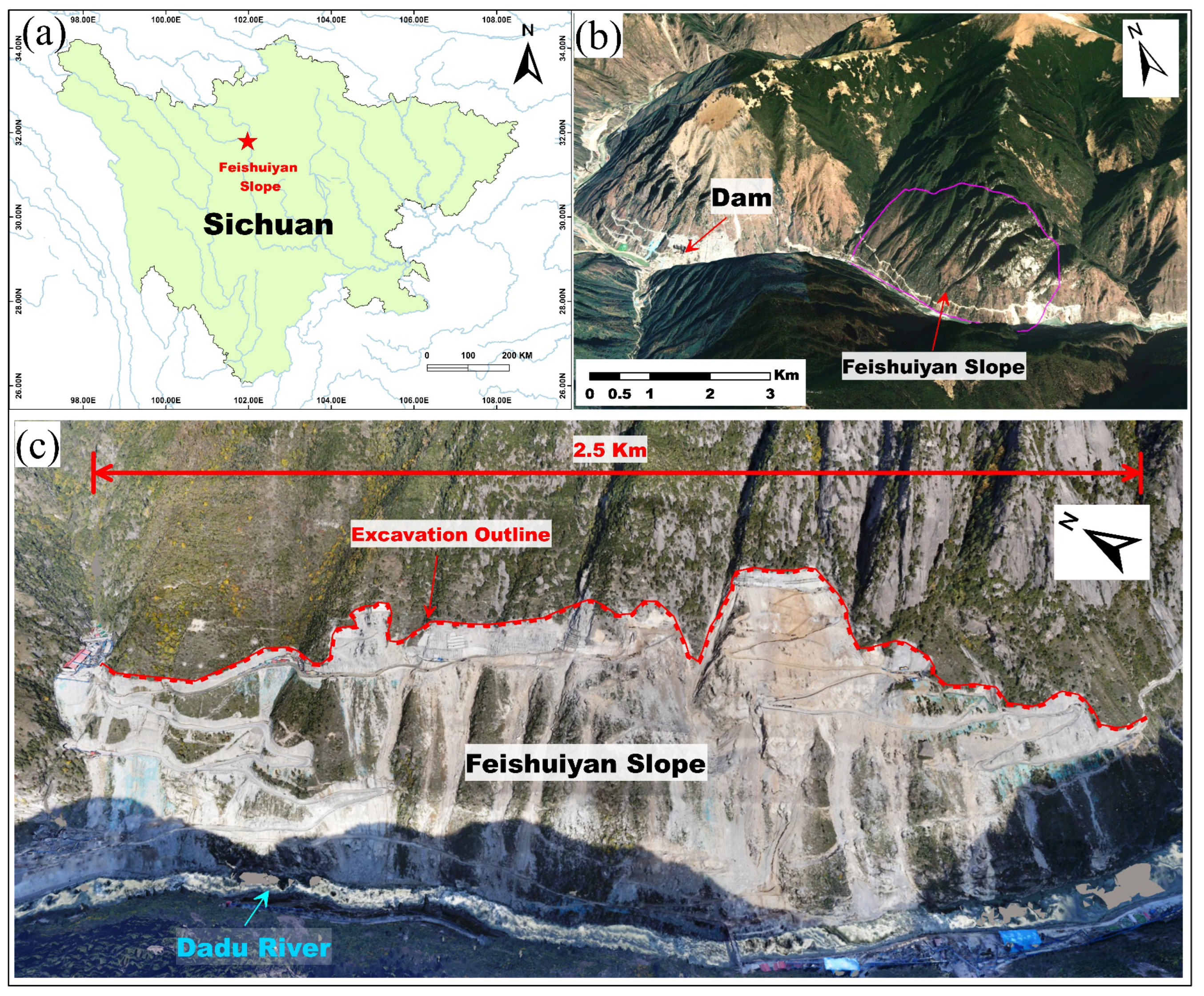
As shown in Figure 1b, the quarry is located on the left bank of the Dajinchuan River, downstream of the dam site. It is one of the two major quarries serving the hydropower station. As illustrated in Figure 1c, the main slope of the quarry extends approximately 2.5 km, with a maximum height of about 400 m, classifying it as an ultra-high engineering slope. The excavation and construction period of the quarry is expected to last around five years, which poses considerable safety risks; therefore, slope stability and the management of hazardous rock masses are of critical importance.
The quarry is situated in a deeply incised valley characterized by steep slopes. During excavation, the rock masses on both sides experience significant unloading toward the valley, resulting in the development of extensive fissures and occasional rockfall collapses. The overall slope gradient ranges between 35° and 45°, while the rear edge of the spoil yard exhibits a much steeper inclination of approximately 65°–80°. Due to complex terrain conditions, limited road access, and safety constraints, field surveys cannot be conducted outside the excavation boundary. Consequently, there is an urgent need for a non-contact monitoring approach to effectively detect and analyze deformation on the high slopes above the excavation area.

2.2. Method Data

2.2.1. TLS-Assisted UAV Orthomosaic Construction

UAV can capture high-resolution photos of the target area, and using the SfM algorithm, UAV orthomosaic can be constructed. By analyzing multiple UAV orthomosaic, we can monitor deformation in the study area. The accuracy of this monitoring depends on the quality of the images. In the SfM algorithm, ground control points (GCPs) are very important for accuracy [41]. When GCPs are well placed, the overall accuracy of UAV images is better. If there are not enough GCPs, areas farther from them may become distorted, affecting the results. Therefore, to ensure the accuracy needed for deformation monitoring, it is crucial to have enough GCPs that are evenly distributed in the target area.
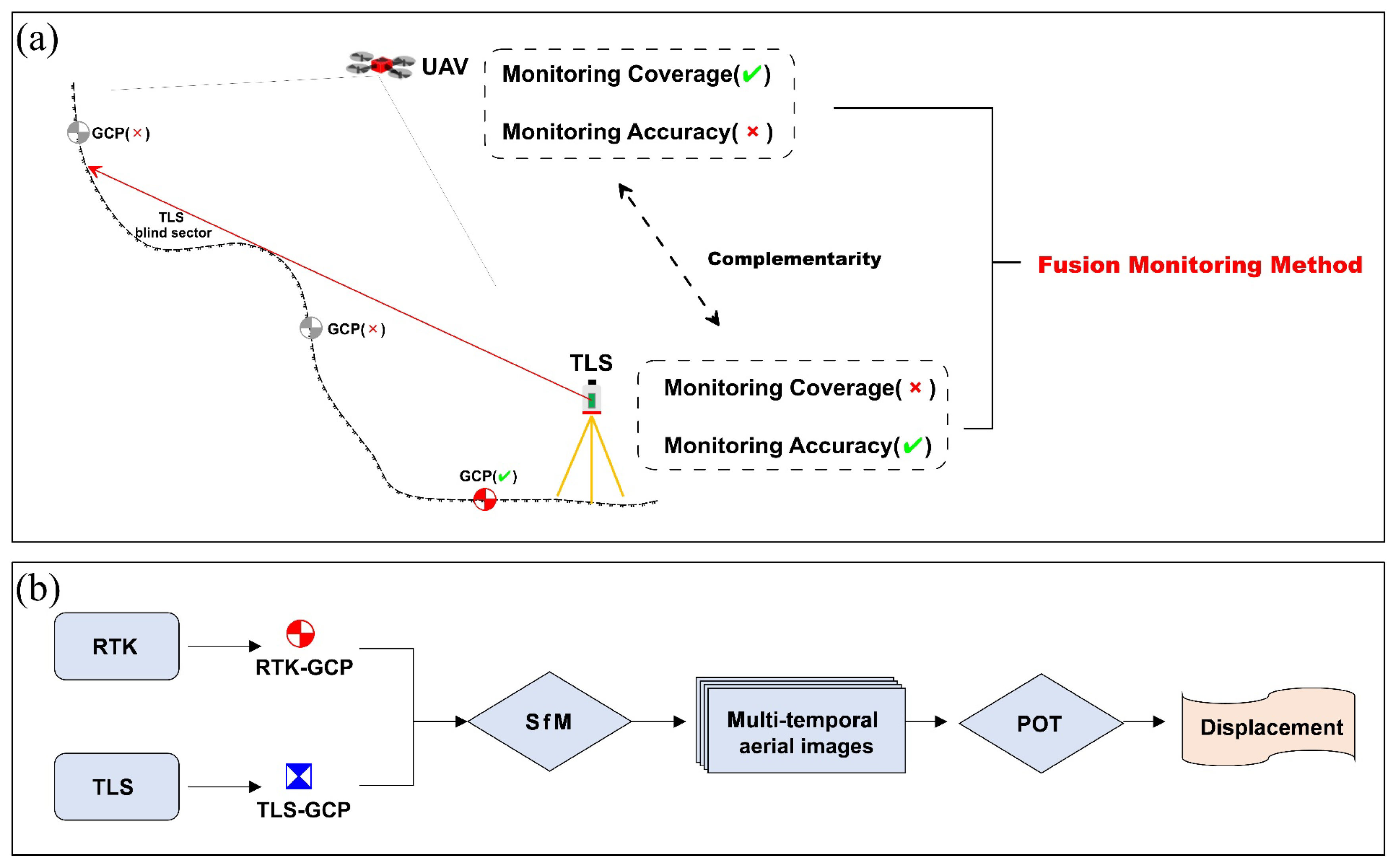
However, in mountainous canyon areas, as shown in Figure 2a, especially when monitoring steep slopes with large height differences, it is often difficult to reach high points on the slope. This makes it hard to place enough GCPs. TLS can obtain point cloud data from several kilometers away, but it is also limited by the complex terrain. Some are-as of the slope may be blocked, preventing TLS from capturing complete point cloud data, resulting in gaps in the data.
It is important to note that the limitations of these two technologies in mountainous canyon areas can, in fact, be effectively complemented through data fusion. Terrestrial laser scanning (TLS) offers high measurement accuracy, whereas UAV photogrammetry provides extensive spatial coverage. By integrating these two techniques, it becomes possible to achieve both high precision and large-scale terrain data acquisition, even in areas with restricted accessibility.
To address the aforementioned challenges, this study proposes a ground–air integrated slope deformation monitoring approach that combines terrestrial laser scanning (TLS) with UAV photogrammetry. The core concept is to utilize the high precision of TLS data to constrain and enhance the accuracy of large-scale UAV-derived models. The detailed technical workflow is illustrated in Figure 2b.
First, traditional ground control points (GCPs) are established at accessible locations, and their geographic coordinates are measured using real-time kinematic (RTK) surveying; these are referred to as RTK-GCPs. For steep or inaccessible slope areas, additional GCPs are extracted from terrestrial laser scanning (TLS) data acquired concurrently with the UAV imagery. Distinct surface features on the slope—such as power tower tops or large boulders—are used as reference points, termed TLS-GCPs. SfM processing was conducted using Pix4Dmapper software (version 4.4.12) on a workstation equipped with an Intel Core i7-11700KF CPU, 128 GB RAM, and an NVIDIA GeForce RTX 3060 GPU (12 GB VRAM). Image alignment and bundle adjustment were performed using the default aerial processing settings with self-calibration enabled, ensuring sufficient image overlap, multi-view observations, and robust tie point filtering based on reprojection error minimization. RTK-GCPs and TLS-derived GCPs were introduced to optimize the bundle adjustment, while independent check points were excluded from the adjustment and used solely for accuracy evaluation. Dense point clouds and orthomosaics were subsequently generated using the standard Pix4D processing workflow. In total, 994 UAV images were processed, and the entire processing pipeline required approximately 40 min.

2.2.2. Deformation Monitoring of Multi-Temporal Orthomosaic Based on POT

The deformation interpretation in the combined monitoring method is mainly based on pixel offset tracking (POT), used to interpret deformation in UAV First, traditional ground control points (GCPs) are established at accessible locations, and their geographic coordinates are measured using real-time kinematic (RTK) surveying; these are referred to as RTK-GCPs. For steep or inaccessible slope areas, additional GCPs are extracted from terrestrial laser scanning (TLS) data acquired concurrently with the UAV imagery. Distinct surface features on the slope—such as power tower tops or large boulders—are used as reference points, termed TLS-GCPs. Finally, both RTK-GCPs and TLS-GCPs are incorporated into the Structure-from-Motion (SfM) workflow for accuracy optimization, resulting in high-precision UAV orthomosaic after data fusion. Currently, many open-source software options support sub-pixel offset tracking algorithms. Among them, the Co-registration of Optically Sensed Images and Correlation (COSI-Corr) software is easy to operate [42], compatible with optical images from various sources, and employs an adaptive search approach from large to small scales, making it widely used. In this study, POT displacement measurements were performed using the COSI-Corr software (version 2017) with the Statistic correlator for sub-pixel matching. The main parameter settings were as follows: a window size of 10 × 10 pixels, a step size of 150 pixels, and a search range of 20 × 20 pixels.
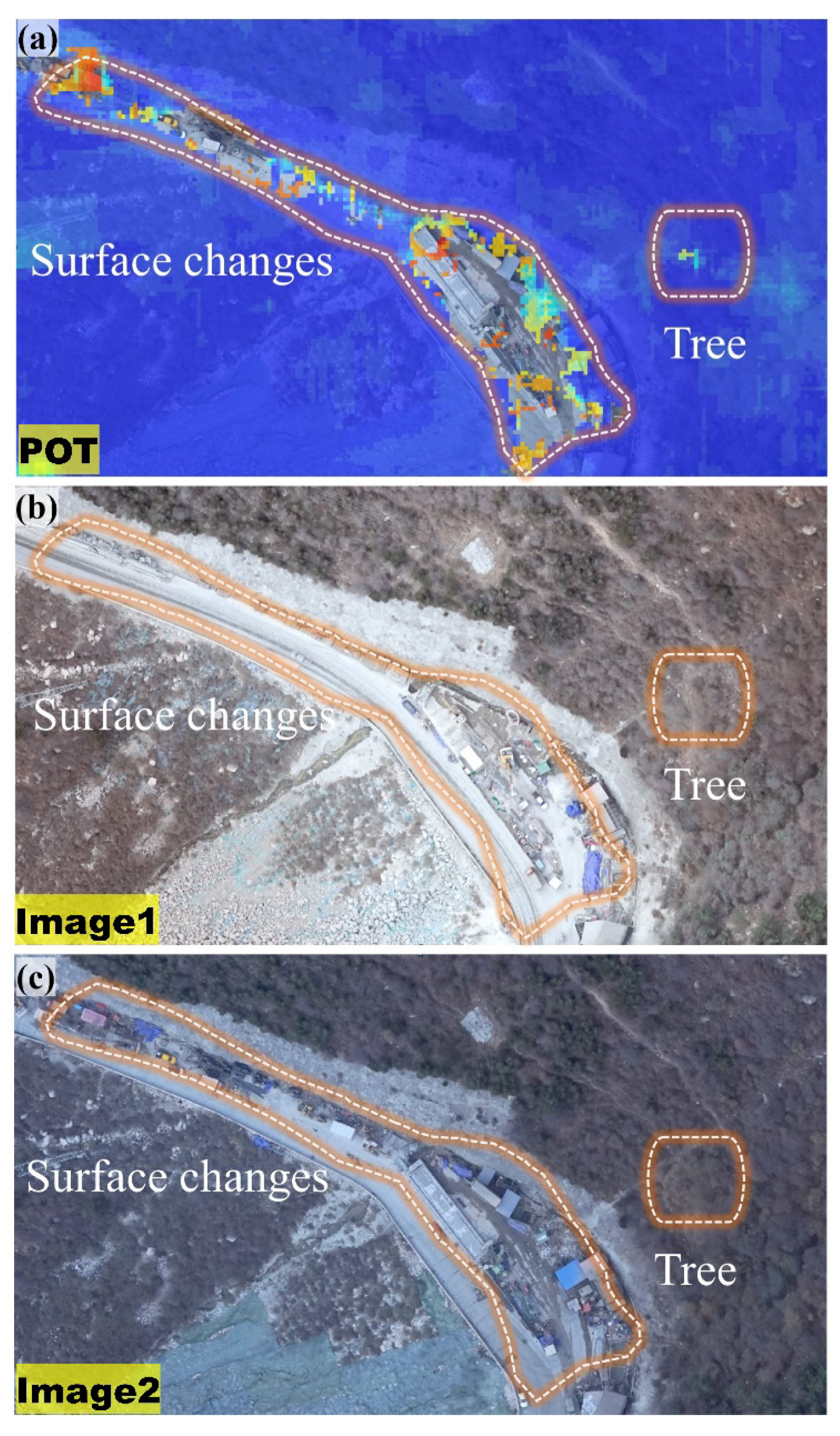
It is worth noting that some outliers, commonly referred to as salt-and-pepper noise, may appear in POT-based deformation results. As illustrated in Figure 3, such noise mainly arises from significant surface changes, including vegetation variations and shadow effects, which result in non-corresponding features between pre- and post-event images and thus hinder accurate pixel offset estimation. While salt-and-pepper noise does not effectively represent continuous surface displacement, geological hazards involving abrupt surface changes, such as localized landslides, may also manifest as salt-and-pepper-like patterns in POT results. To suppress these spurious mismatches while preserving meaningful deformation signals, a correlation coefficient threshold was applied in the COSI-Corr processing, and pixels with low correlation values were excluded from the final displacement fields.

2.3. Data Acquisition

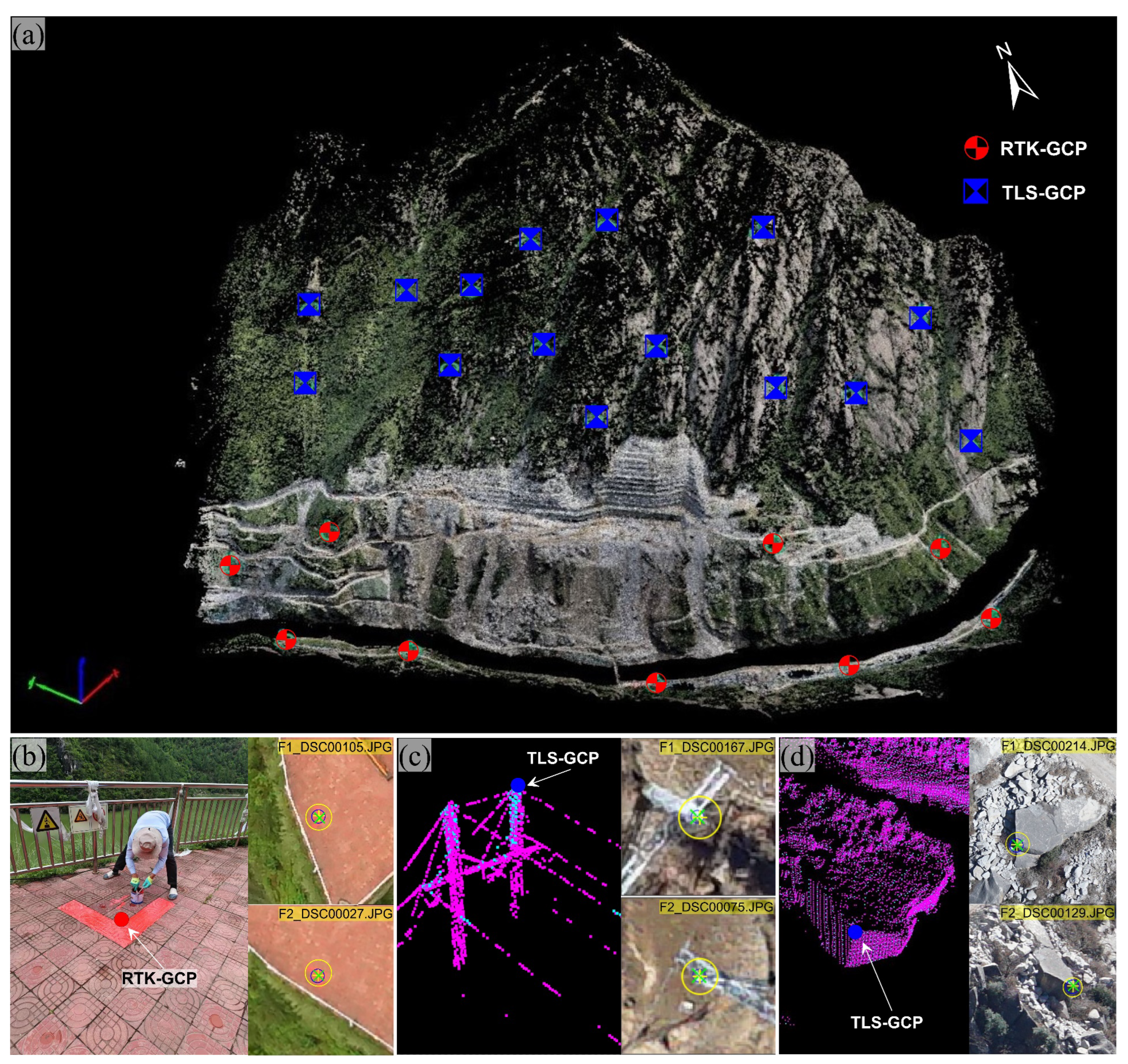
Initially, the RIEGL VZ-2000i terrestrial laser scanner (Klagenfurt, Austria) was employed to scan the quarry slope, providing TLS-derived ground control points (TLS-GCPs) for subsequent UAV-based Structure-from-Motion (SfM) modeling. The coordinates of each TLS measurement station were simultaneously recorded using real-time kinematic (RTK) surveying to transform the TLS point cloud into the geographic coordinate system, ensuring consistency with the UAV reference frame. Prior to UAV flight operations, traditional RTK-GCPs were established along accessible areas such as roads and building vicinities (Figure 4b), while additional TLS-GCPs were extracted from the TLS point cloud by identifying distinctive surface features—such as power tower tops and prominent rocks—located on higher sections of the slope (Figure 4c,d). As illustrated in Figure 4a, a total of nine RTK-GCPs were evenly distributed across the study area, complemented by fifteen TLS-GCPs. Aerial imagery was acquired using an FM-D2000 UAV (Shenzhen, China) equipped with a D-CAM2000 camera (Shenzhen, China) featuring an APS-C sensor (23.5 mm × 15.6 mm), 24.3 megapixels, and a 25 mm fixed-focus lens. Flights were conducted in variable-altitude mode at a relative height of approximately 300 m, resulting in a ground sampling distance (GSD) of about 5 cm.
Following the above workflow and operation mode, imagery and point cloud data of the quarry slope were obtained on 24 January 2024, and 5 December 2024. The detailed data are shown in Table 1.

3. Results

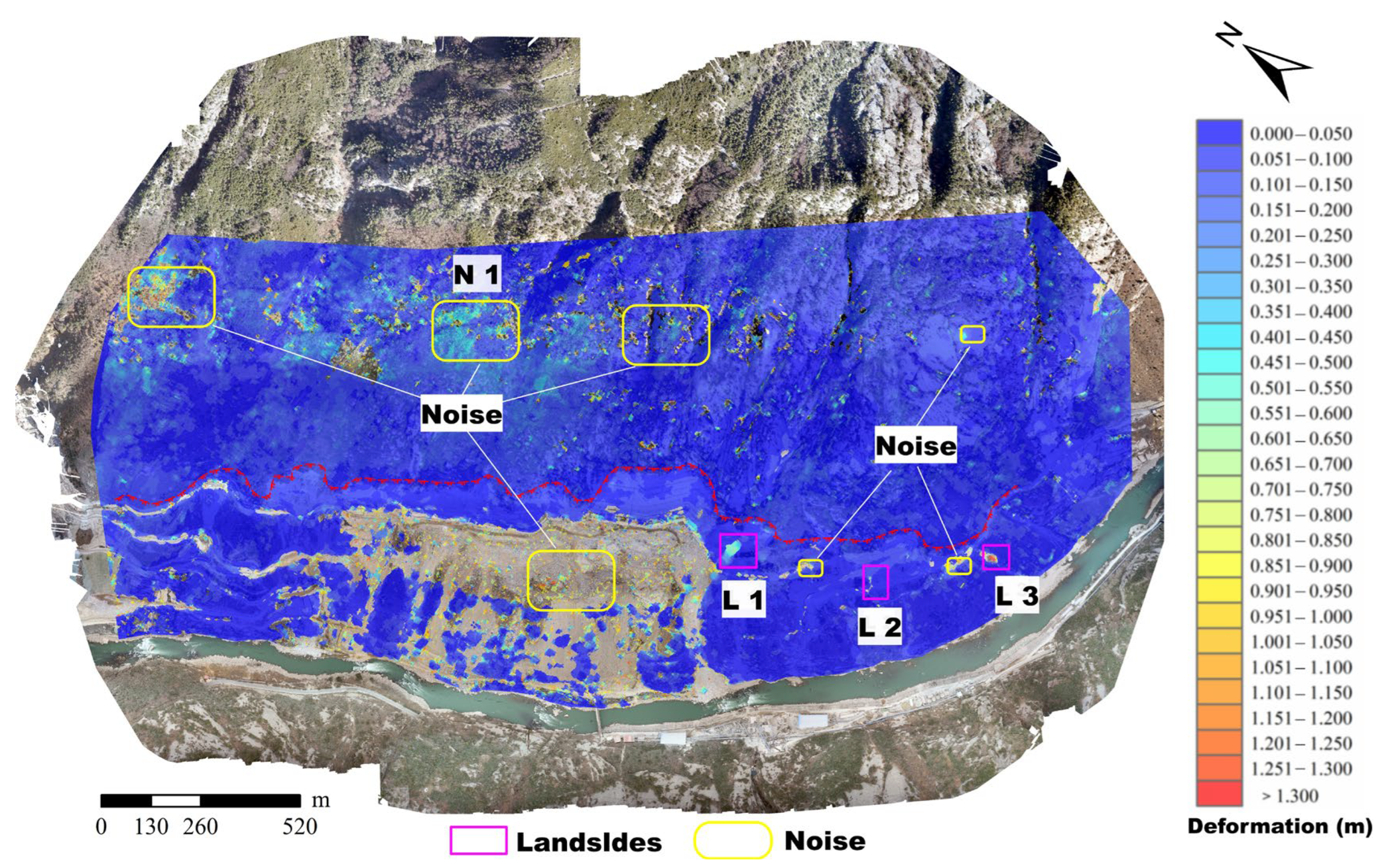
Using the TLS-assisted multi-temporal monitoring method described above, deformation extraction was performed on two UAV datasets acquired on 24 January 2024, and 5 December 2024, from the quarry slope. After applying the phase offset tracking (POT) technique, deformation components in the east–west and north–south directions were derived. The total deformation magnitude was then obtained by vector summation, as illustrated in Figure 5.
As shown in Figure 5, the POT results reveal three zones of genuine slope deformation (L1, L2, and L3), while the remaining anomalous areas are attributed to changes in shadow or land cover, resulting in salt-and-pepper noise. Most of this noise is concentrated below the excavation line, as this region serves as the material extraction site for the hydropower station construction, where ongoing excavation and earthwork activities have caused significant surface alterations. These large-scale surface variations hinder the POT algorithm from accurately matching feature points between the two image sets, thereby producing numerous anomalies manifested as salt-and-pepper noise.
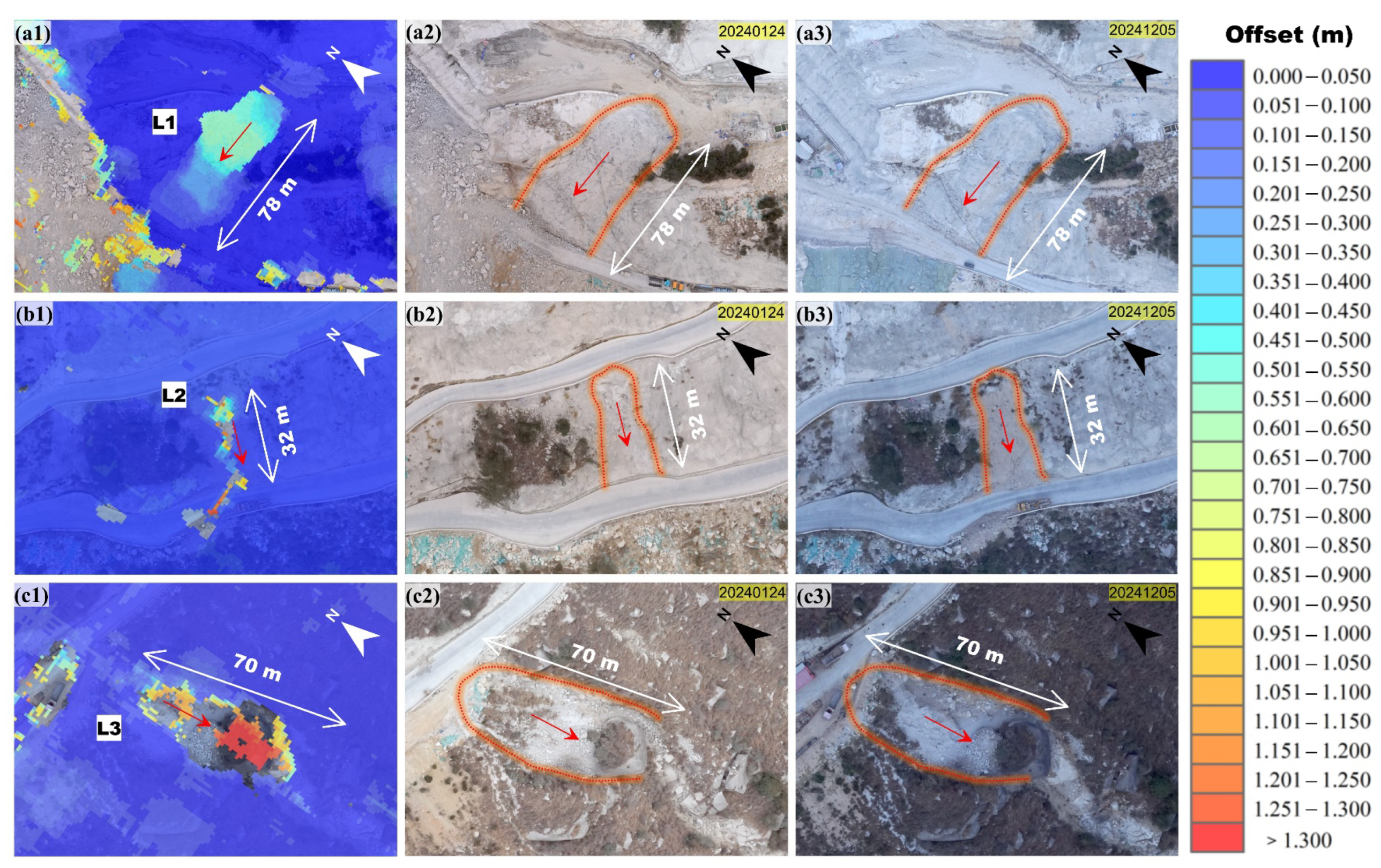
From Figure 6(a1–a3), it can be observed that the L1 slope experienced nearly 0.5 m of deformation between the two data acquisition periods, with the deformation at the rear edge of the slope exceeding that at the toe. The deformation extent identified by the POT results closely corresponds to the deformation area interpreted manually from the pre- and post-event UAV orthomosaic.
In the case of L2, there is localized deformation on the slope surface. The signals identified by the POT results resemble salt-and-pepper noise (Figure 6(b1–b3)). However, manual interpretation confirmed that localized deformation did occur on this slope, indicating that in POT analysis, genuine deformation information may sometimes be embedded within what appears to be salt-and-pepper noise. L3 represents a natural slope deformation, with POT results showing a maximum displacement of nearly 5 m. Manual comparison verified this result.
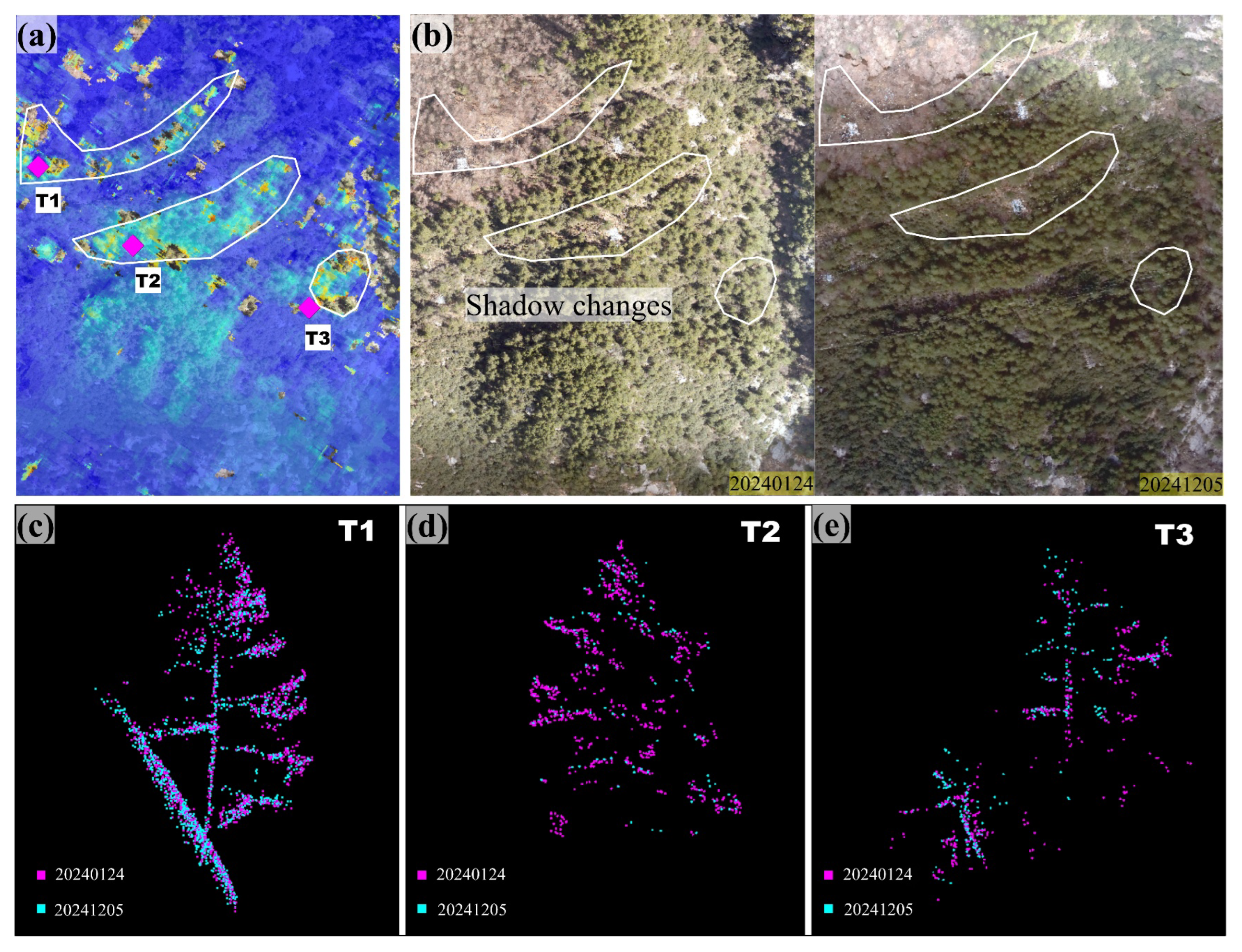
It is noteworthy that in the N1 area (Figure 5), a large region exhibiting suspected deformation signals was identified. To further verify whether actual ground displacement occurred in this area, pre- and post-event UAV orthomosaic and TLS point cloud data were compared. As shown in Figure 7a, the distribution of the suspected deformation signals in the POT results for the N1 area strongly correlates with vegetation height. The UAV orthomosaic before and after the event (Figure 7b) indicates that this region is densely vegetated. To assess whether any real displacement existed, pre- and post-event TLS point clouds were compared using distinctive trees as reference objects. As illustrated in Figure 7c–e, trees labeled T1, T2, and T3 were selected as representative reference points, and the two sets of point clouds were visualized in different colors. The comparison reveals a high degree of overlap between the two datasets, with no discernible displacement observed. Therefore, the suspected deformation signals detected by POT are likely attributed to shadow variations between the two acquisition times. Since the images were captured at different times of day, variations in sunlight incidence angles resulted in pronounced shadow differences over vegetated surfaces.

4. Discussion

4.1. Influence of TLS-GCP Configuration on UAV Modeling and POT Accuracy

The above discussion demonstrates that the TLS-assisted UAV monitoring method can effectively identify slope deformation and surface feature changes. The core principle of this approach is to utilize feature points extracted from TLS point cloud data as ground control points (GCPs) to enhance the accuracy of UAV-based Structure-from-Motion (SfM) modeling.
To further investigate the impact of GCPs on UAV modeling accuracy and the role of RTK-GCPs in UAV modeling in alpine canyon areas, the modeling results obtained using only RTK-GCPs were compared with those obtained using both RTK-GCPs and TLS-GCPs.
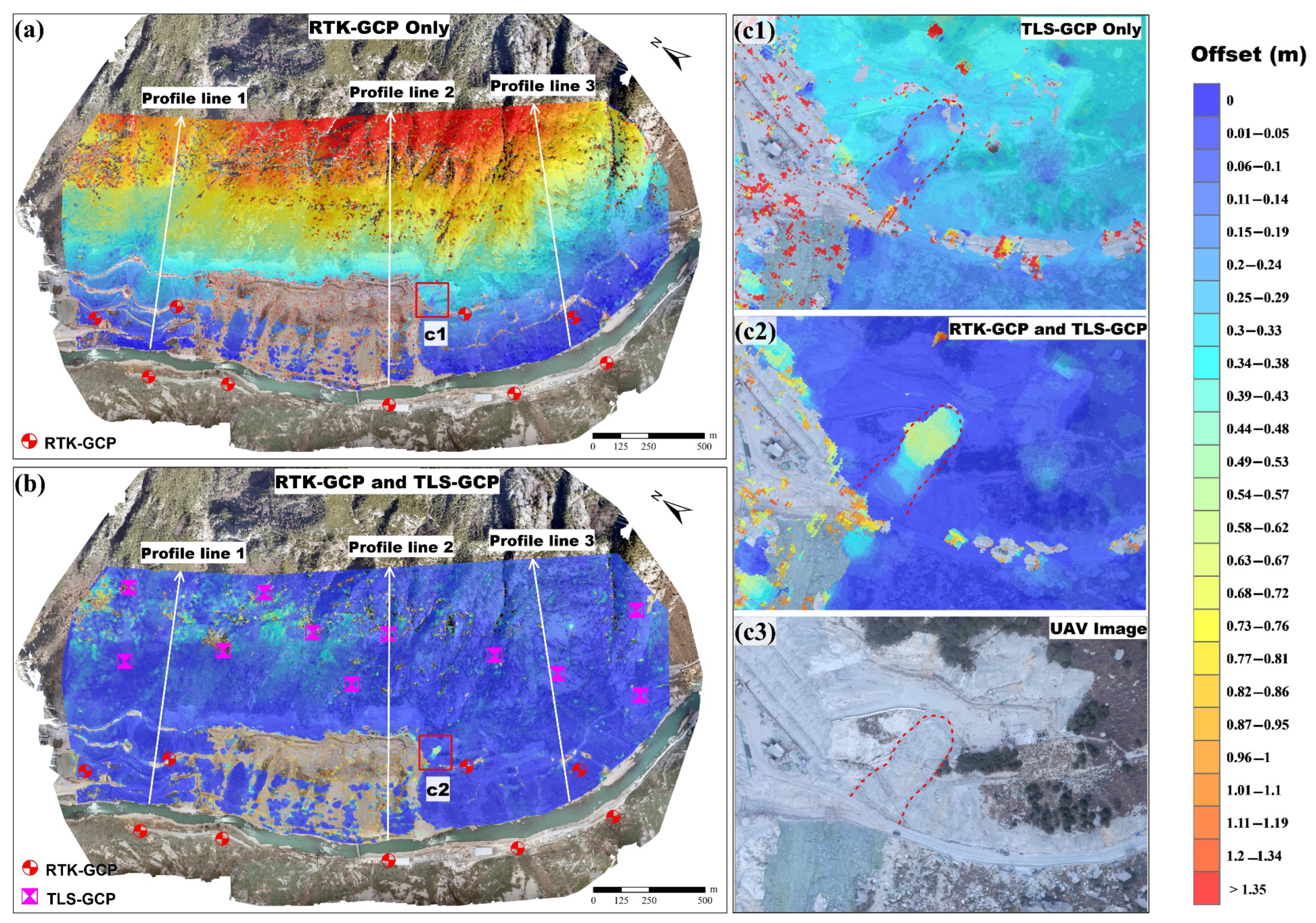
Figure 8a illustrates the POT results of orthomosaic generated using only RTK-GCPs, while Figure 8b presents the results obtained by integrating both RTK-GCPs and TLS-GCPs. Both approaches successfully identify areas exhibiting noticeable surface changes, which appear as salt-and-pepper noise patterns. However, when relying solely on RTK-GCPs, extensive systematic offsets are observed, particularly in the upper slope regions, making it challenging to distinguish true deformation signals from modeling artifacts. In contrast, the TLS-assisted method proposed in this study effectively alleviates this issue by enhancing overall geometric consistency.
As shown in Figure 8(c1–c3), a direct comparison of the monitoring results highlights these differences. In areas located farther from the control points, the accuracy of the RTK-only approach decreases significantly, leading to blurred deformation boundaries. Conversely, the inclusion of TLS-GCPs substantially improves spatial accuracy in such regions, yielding clearer and more distinct deformation zones.
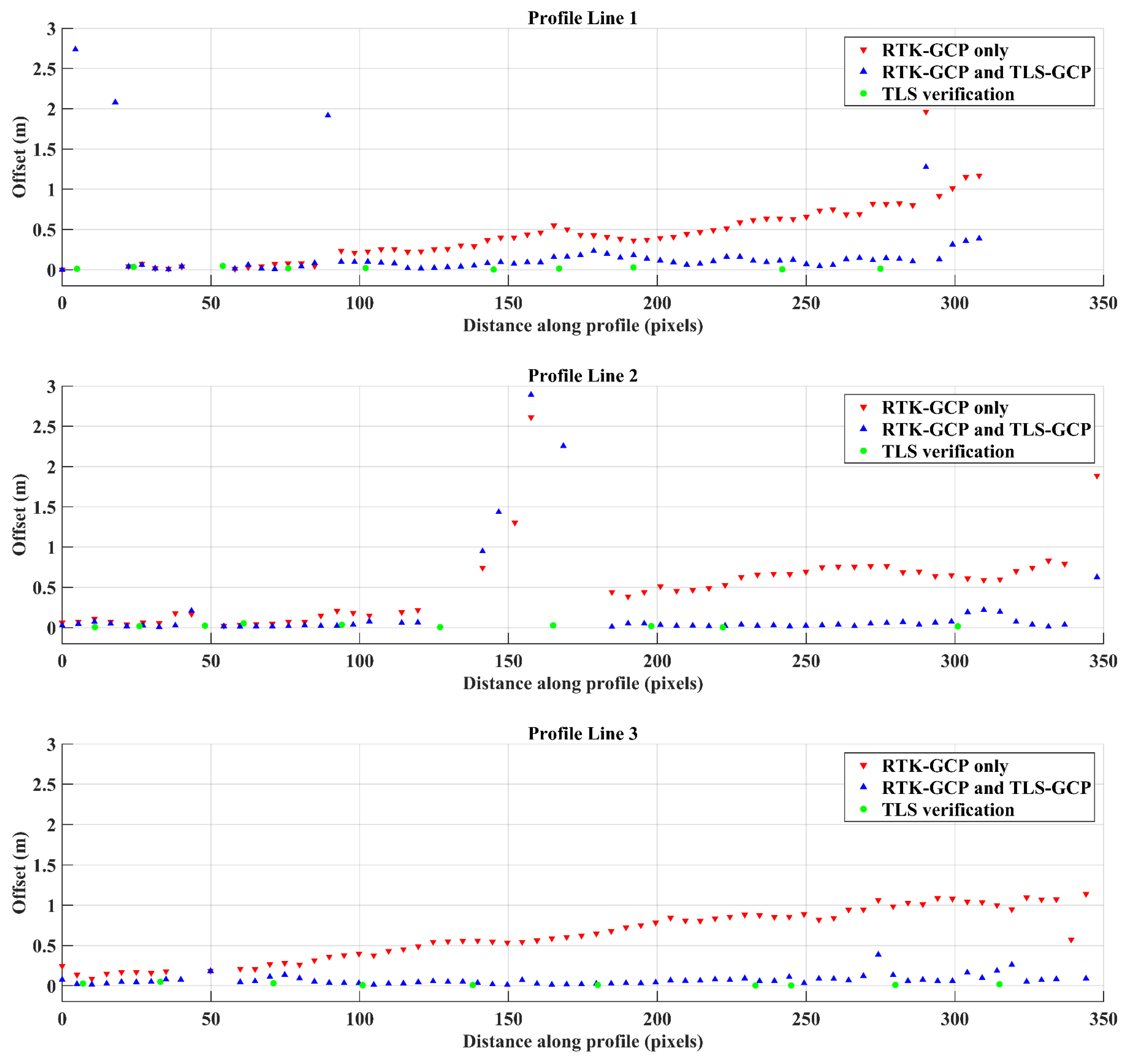
To validate the accuracy improvement of this method, three profile lines were evenly selected along the slope. The displacement results were plotted for each line, using only RTK-GCPs (red points) and simultaneously using both TLS-GCPs and RTK-GCPs (blue points) (Figure 9). Additionally, manual displacement measurements (green points) were obtained at specific feature points along the profile lines using the TLS point cloud data from both periods. Since the TLS-acquired point clouds have an absolute accuracy at the millimeter level, these manually measured displacements can be regarded as the most accurate approximation of the true values. The distances between the displacements measured by the two methods (red and blue points) and the manually measured dis-placements (green points) can be regarded as errors.
As shown in Figure 9, along the three profile lines, the results obtained from all three methods are nearly identical within the range of 0–80 m along the x-axis. However, beyond 80 m, the discrepancies of the RTK-only approach (red points) increase noticeably, while those of the combined TLS- and RTK-GCP approach (blue points) remain relatively stable. This difference arises because, at higher elevations, deploying RTK-GCPs is nearly infeasible due to accessibility constraints, whereas TLS-GCPs can still effectively provide high-precision control in these areas.
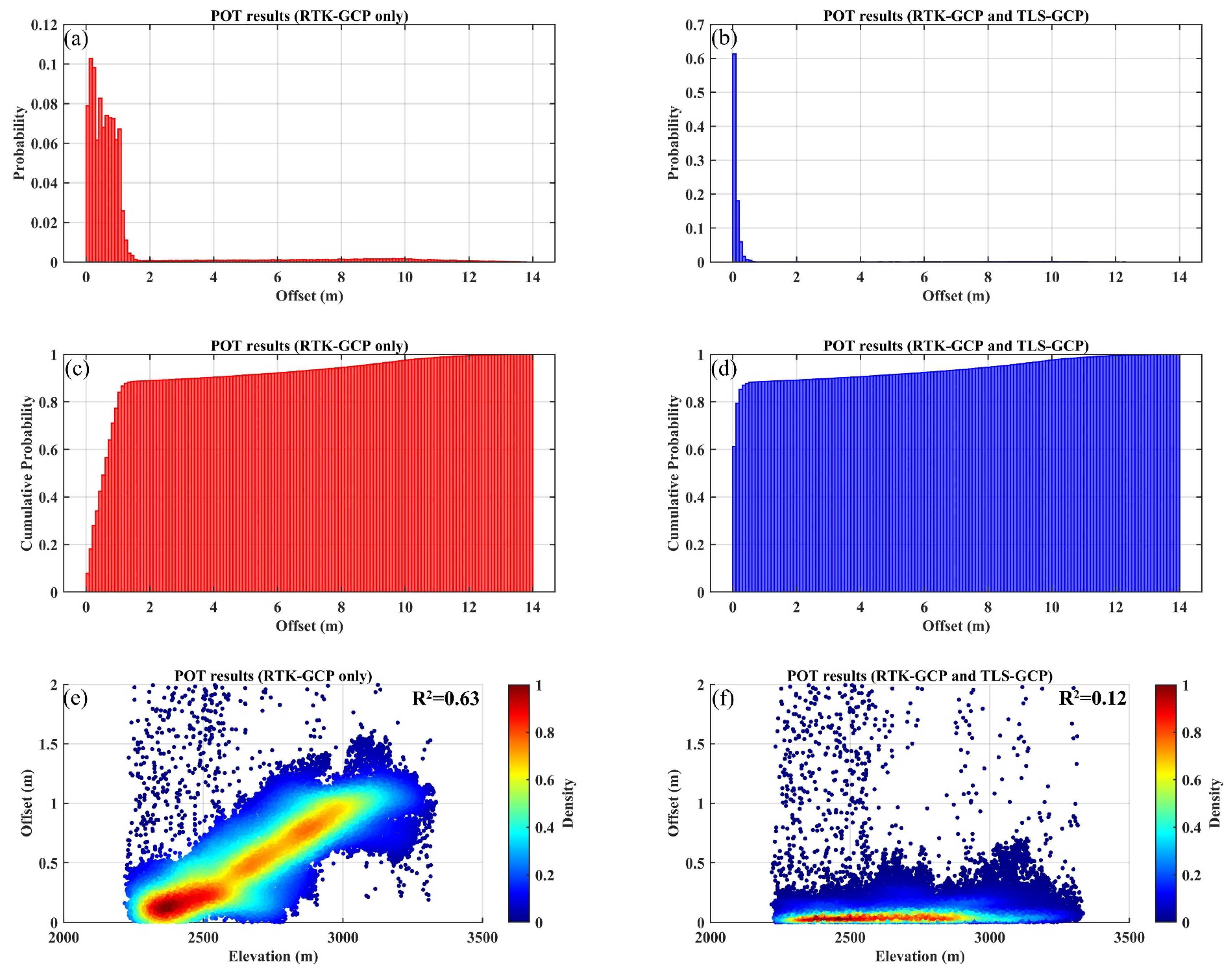
Furthermore, a quantitative statistical analysis was conducted to compare the accuracy of the two approaches by plotting histograms, cumulative histograms, and scatter plots of the POT results. Figure 10a,b present the histograms corresponding to the two methods. The histogram of the proposed TLS-assisted approach (Figure 10b) shows a more concentrated distribution, whereas that of the RTK-only method (Figure 10a) is more dispersed, exhibiting larger deviations and fluctuations. Figure 10c,d display the cumulative histograms, further confirming that the POT results obtained using the proposed method are more tightly clustered around zero, indicating better consistency with the actual deformation conditions.
Figure 10e displays the scatter plot of the POT results using only RTK-GCPs, while Figure 10f shows the scatter plot of the POT results using both RTK-GCPs and TLS-GCPs. The vertical axis represents the displacement for each pixel, while the horizontal axis represents the corresponding elevation. The color of the points corresponds to the probability density of their distribution, with closer proximity to red indicating higher density and proximity to blue indicating lower density. It is evident that the vertical distribution in Figure 10b is significantly more concentrated than in Figure 10a, with the majority of points’ displacements below 0.2 m and no apparent correlation with elevation, nor any discernible trend. In contrast, Figure 10e displays a more scattered distribution, with most points’ displacements ranging from 0 to 1.4 m. However, Figure 10a exhibits a trend correlated with elevation, increasing with height, and demonstrating two distinct phases. From elevations of 2200 to 2500 m, this growth trend is relatively slow due to the limited placement of RTK-GCPs effectively controlling UAV modeling. Beyond 2500 m, this increasing trend becomes more pronounced because all elevations above 2500 m are in higher slope areas where RTK-GCP placement is impossible, resulting in a lack of GCP control and a significant decline in UAV image accuracy.
In comparison, the proposed TLS-GCP-assisted UAV modeling approach significantly improves modeling accuracy and fully meets the monitoring requirements for steep-slope areas in the study region.
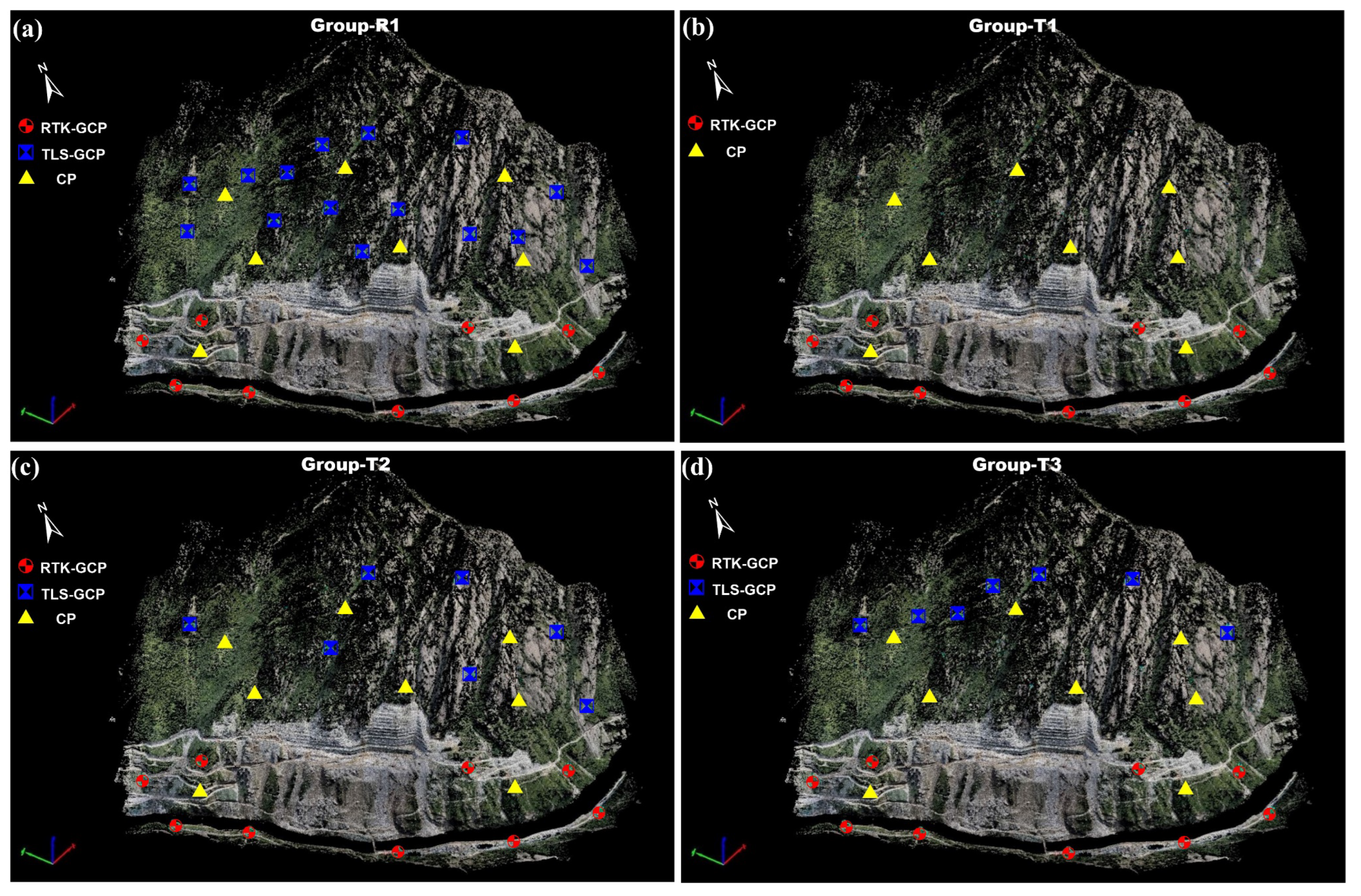
Figure 11 illustrates the spatial distribution of RTK-GCPs, TLS-GCPs, and independent check points (CPs) under the four experimental configurations used in the sensitivity analysis. In configuration R1 (Figure 11a), RTK-GCPs are deployed in accessible areas, while TLS-GCPs provide additional control in steep and inaccessible slope regions, resulting in a dense and well-distributed control network. In contrast, configuration T1 (Figure 11b) relies solely on RTK-GCPs, leading to a lack of control points in high-elevation and inaccessible areas. Configurations T2 and T3 (Figure 11c,d) represent reduced TLS-GCP scenarios, where approximately 50% of TLS-GCPs are retained; T2 maintains a relatively uniform spatial distribution, whereas T3 exhibits a biased distribution with clustering in limited regions.
The quantitative accuracy assessment corresponding to these configurations is summarized in Table 2. The BA accuracy evaluated using GCP RMSE shows comparable performance among all configurations, indicating that the bundle adjustment can achieve similar fitting accuracy at control points regardless of the GCP configuration. It is worth noting that the RTK-only configuration (T1) exhibits slightly smaller GCP RMSE values than the TLS-assisted configuration (R1). This difference does not indicate superior overall model accuracy, but is mainly attributed to the different nature of the control points. RTK-GCPs are measured directly in the field with high point-wise precision, whereas TLS-GCPs are extracted from point cloud data, where the finite point spacing and surface discretization may introduce small picking uncertainties, particularly when identifying exact point locations. As a result, a marginally larger GCP RMSE for TLS-assisted configurations is expected and does not compromise the global geometric quality of the model.
However, significant differences are observed in the CP-based accuracy metrics. In the RTK-only configuration (T1), the CP RMSE increases markedly, particularly in the vertical (Z) direction, resulting in large three-dimensional positioning errors. This highlights the limited capability of RTK-GCPs alone to constrain the model in areas lacking sufficient vertical and spatial coverage.
By contrast, configurations incorporating TLS-GCPs (R1, T2, and T3) exhibit substantially improved CP accuracy. Configuration R1 achieves the best overall performance, reflecting the benefit of a dense and well-distributed TLS-assisted control network. When the number of TLS-GCPs is reduced, the CP accuracy degrades but remains significantly better than that of the RTK-only case. Moreover, the comparison between T2 and T3 demonstrates that the spatial distribution of TLS-GCPs plays a critical role, with the uniformly distributed TLS-GCPs in T2 yielding lower CP errors than the biased distribution in T3.
Similar trends are observed in the POT-derived displacement accuracy. The RTK-only configuration yields the largest POT RMSE (0.45 m), indicating pronounced displacement uncertainty. In contrast, the inclusion of TLS-GCPs leads to a substantial reduction in POT errors. Configuration R1 shows the most stable POT results, with a low RMSE of 0.06 m. Based on these POT error statistics, displacements with magnitudes exceeding the corresponding POT RMSE can be regarded as significant ground movements, whereas smaller values are considered within the range of observation noise. Although reducing the number of TLS-GCPs increases the POT error, the uniformly distributed configuration T2 still outperforms the biased configuration T3, further emphasizing the importance of TLS-GCP spatial distribution for reliable deformation interpretation.
Overall, Figure 11 and Table 2 jointly demonstrate that while bundle adjustment may achieve comparable GCP fitting accuracy across different configurations, both CP-based BA accuracy and POT displacement reliability are highly sensitive to the availability and spatial distribution of TLS-GCPs. These results confirm that integrating TLS-GCPs, particularly with a uniform spatial distribution, is essential for improving model robustness and ensuring accurate UAV-based deformation monitoring.

4.2. Scope of Application

The proposed method is mainly applicable to steep slopes in mountainous canyon regions, where traditional station-based monitoring approaches often fail to achieve spatially continuous coverage due to severe terrain-induced occlusions. The effective application of the method relies on the presence of stable and identifiable surface features (e.g., exposed rock outcrops, large boulders, or engineering structures) within the monitoring area. These features can be reliably extracted from TLS point clouds and consistently identified in UAV imagery, thereby serving as ground control information to constrain and enhance the geometric accuracy of UAV photogrammetric reconstruction. In addition, the selected feature points should remain stable throughout the monitoring period and be reasonably distributed across the slope surface to ensure robust bundle adjustment.
It should be noted that the applicability of the proposed method may be constrained in areas lacking distinct and stable surface features, or in environments characterized by dense vegetation cover, seasonal snow or ice, limited ground visibility, or severe shadowing and occlusions, where reliable feature correspondence between TLS data and UAV imagery becomes difficult. In such conditions, image correlation performance and control point extraction may degrade, potentially reducing the reliability of both photogrammetric reconstruction and POT-based displacement interpretation.
From a practical perspective, the incorporation of TLS data is mandatory or strongly recommended in steep, inaccessible, or highly occluded terrain where the deployment of RTK-GCPs is infeasible and UAV-only photogrammetry cannot provide sufficient geometric constraints. Therefore, the implementation of the proposed method should be carefully evaluated based on site-specific surface characteristics, visibility conditions, and expected deformation patterns to ensure reliable and meaningful deformation monitoring results.

5. Conclusions

This study proposes a slope monitoring method based on TLS-assisted UAV photogrammetry to address the challenges of monitoring high and steep slopes in alpine canyon environments. By integrating TLS-derived point cloud data to provide sufficient ground control points (GCPs) for UAV Structure-from-Motion (SfM) modeling, the proposed approach substantially enhances monitoring accuracy. This enables the use of multi-temporal UAV orthomosaic with the Phase Offset Tracking (POT) technique for precise extraction of deformation and surface change information.
Using the spoil slope of a hydropower station as a case study, the proposed method was applied to monitor slope deformation. The results show that when terrain constraints prevent the deployment of RTK-GCPs in upper slope areas, TLS can effectively supply substitute GCPs (TLS-GCPs) to support accurate UAV modeling. Through POT analysis of UAV orthomosaic acquired at two time periods, distinct deformation features and well-defined deformation boundaries were successfully identified.
Error analysis further demonstrates that even under conditions with limited RTK-GCP placement, the proposed method maintains reliable capability for detecting overall displacement and deformation (e.g., landslides). These findings provide a practical and robust reference for future monitoring of high and steep slopes in complex alpine canyon regions.

Author Contributions

All authors contributed to the manuscript and discussed the results. Q.-W.W. and Z.-Y.L. drafted the manuscript and was responsible for the data processing, analysis and interpretation of the results. J.-W.Z. and Y.-X.H. proposed the ideas for the thesis, designed the structure and contributed to the final revision of the thesis. Z.-H.J. and H.W. collected the on-site UAV and TLS data. H.-B.L. contributed to the UAV modeling and the POT analysis. N.J. revised the manuscript and contributed to the final revision of the thesis. All authors have read and agreed to the published version of the manuscript.

Funding

This study has been supported by the support of the National Natural Science Foundation of China (52379105), the China Postdoctoral Science Foundation (2025M773145) and the Sichuan Province Innovative Talent Funding Project for Postdoctoral Fellows (BX202408).

Data Availability Statement

The data presented in this study are available on request from the corresponding author due to Local government regulations.

Acknowledgments

The authors would like to thank the developers of COSI-Corr and anonymous reviewers for their time and constructive comments on our article.

Conflicts of Interest

Authors Qing-Wen Wen, Zhong-Hua Jiang and Hao Wu were employed by the company Sichuan Dadu River Shuangjiangkou Hydropower Development Co., Ltd. The remaining authors declare that the research was conducted in the absence of any commercial or financial relationships that could be construed as a potential conflict of interest.

Abbreviations

The following abbreviations are used in this manuscript:
TLSTerrestrial laser scanning
RTKReal-Time Kinematic
GCPsGround control points
TLS-GCPsTLS-derived GCPs
RTK-GCPsRTK-derived GCPs
CPsCheck points
SfMStructure-from-Motion

References

  1. Lin, Q.; Wang, Y. Spatial and temporal analysis of a fatal landslide inventory in China from 1950 to 2016. Landslides 2018, 15, 2357–2372. [Google Scholar] [CrossRef]
  2. Xu, Q.; Zhao, B.; Dai, K.; Dong, X.; Li, W.; Zhu, X.; Yang, Y.; Xiao, X.; Wang, X.; Huang, J.; et al. Remote sensing for landslide investigations: A progress report from China. Eng. Geol. 2023, 321, 107156. [Google Scholar] [CrossRef]
  3. Fan, X.; Xu, Q.; Scaringi, G.; Dai, L.; Li, W.; Dong, X.; Zhu, X.; Pei, X.; Dai, K.; Havenith, H.-B. Failure mechanism and kinematics of the deadly June 24th 2017 Xinmo landslide, Maoxian, Sichuan, China. Landslides 2017, 14, 2129–2146. [Google Scholar] [CrossRef]
  4. Scaringi, G.; Fan, X.; Xu, Q.; Liu, C.; Ouyang, C.; Domènech, G.; Yang, F.; Dai, L. Some considerations on the use of numerical methods to simulate past landslides and possible new failures: The case of the recent Xinmo landslide (Sichuan, China). Landslides 2018, 15, 1359–1375. [Google Scholar] [CrossRef]
  5. Zhang, Z.; He, S.; Liu, W.; Liang, H.; Yan, S.; Deng, Y.; Bai, X.; Chen, Z. Source characteristics and dynamics of the October 2018 Baige landslide revealed by broadband seismograms. Landslides 2019, 16, 777–785. [Google Scholar] [CrossRef]
  6. Zhang, L.; Xiao, T.; He, J.; Chen, C. Erosion-based analysis of breaching of Baige landslide dams on the Jinsha River, China, in 2018. Landslides 2019, 16, 1965–1979. [Google Scholar] [CrossRef]
  7. Fan, X.; Tang, J.; Tian, S.; Jiang, Y. Rainfall-induced rapid and long-runout catastrophic landslide on July 23, 2019 in Shuicheng, Guizhou, China. Landslides 2020, 17, 2161–2171. [Google Scholar] [CrossRef]
  8. Ma, S.; Xu, C.; Xu, X.; He, X.; Qian, H.; Jiao, Q.; Gao, W.; Yang, H.; Cui, Y.; Zhang, P.; et al. Characteristics and causes of the landslide on July 23, 2019 in Shuicheng, Guizhou Province, China. Landslides 2020, 17, 1441–1452. [Google Scholar] [CrossRef]
  9. Xia, Z.; Motagh, M.; Li, T.; Roessner, S. The June 2020 Aniangzhai landslide in Sichuan Province, Southwest China: Slope instability analysis from radar and optical satellite remote sensing data. Landslides 2022, 19, 313–329. [Google Scholar] [CrossRef]
  10. Dai, K.; Li, Z.; Xu, Q.; Tomas, R.; Li, T.; Jiang, L.; Zhang, J.; Yin, T.; Wang, H. Identification and evaluation of the high mountain upper slope potential landslide based on multi-source remote sensing: The Aniangzhai landslide case study. Landslides 2023, 20, 1405–1417. [Google Scholar] [CrossRef]
  11. Zhou, J.; Lu, P.; Yang, Y. Reservoir Landslides and Its Hazard Effects for the Hydropower Station: A Case Study. In Advancing Culture of Living with Landslides; Mikos, M., Tiwari, B., Yin, Y., Sassa, K., Eds.; Springer International Publishing: Cham, Swaziland, 2017; pp. 699–706. [Google Scholar] [CrossRef]
  12. Zhang, Y.; Shao, J.F.; Xu, W.Y.; Sun, H.K. Stability analysis of a large landslide in hydropower engineering. Nat. Hazards 2014, 70, 527–548. [Google Scholar] [CrossRef]
  13. Lacroix, P.; Handwerger, A.L.; Bièvre, G. Life and death of slow-moving landslides. Nat. Rev. Earth Environ. 2020, 1, 404–419. [Google Scholar] [CrossRef]
  14. Casagli, N.; Intrieri, E.; Tofani, V.; Gigli, G.; Raspini, F. Landslide detection, monitoring and prediction with remote-sensing techniques. Nat. Rev. Earth Environ. 2023, 4, 51–64. [Google Scholar] [CrossRef]
  15. Notti, D.; Cina, A.; Manzino, A.; Colombo, A.; Bendea, I.H.; Mollo, P.; Giordan, D. Low-cost GNSS solution for continuous monitoring of slope instabilities applied to Madonna Del Sasso Sanctuary (NW Italy). Sensors 2020, 20, 289. [Google Scholar] [CrossRef]
  16. Scaioni, M.; Longoni, L.; Melillo, V.; Papini, M. Remote sensing for landslide investigations: An overview of recent achievements and perspectives. Remote Sens. 2014, 6, 9600–9652. [Google Scholar] [CrossRef]
  17. Zhao, C.; Lu, Z. Remote sensing of landslides—A review. Remote Sens. 2018, 10, 279. [Google Scholar] [CrossRef]
  18. Dai, K.; Li, Z.; Xu, Q.; Burgmann, R.; Milledge, D.G.; Tomas, R.; Fan, X.; Zhao, C.; Liu, X.; Peng, J.; et al. Entering the Era of Earth Observation-Based Landslide Warning Systems: A Novel and Exciting Framework. IEEE Geosci. Remote Sens. Mag. 2020, 8, 136–153. [Google Scholar] [CrossRef]
  19. Sun, Q.; Zhang, L.; Ding, X.L.; Hu, J.; Li, Z.W.; Zhu, J.J. Slope deformation prior to Zhouqu, China landslide from InSAR time series analysis. Remote Sens. Environ. 2015, 156, 45–57. [Google Scholar] [CrossRef]
  20. Wu, X.; Qi, X.; Peng, B.; Wang, J. Optimized Landslide Susceptibility Mapping and Modelling Using the SBAS-InSAR Coupling Model. Remote Sens. 2024, 16, 2873. [Google Scholar] [CrossRef]
  21. Lv, J.; Zhang, R.; Bao, X.; Wu, R.; Hong, R.; He, X.; Liu, G. Time-series InSAR landslide three-dimensional deformation prediction method considering meteorological time-delay effects. Eng. Geol. 2025, 350, 107986. [Google Scholar] [CrossRef]
  22. Giordan, D.; Adams, M.S.; Aicardi, I.; Alicandro, M.; Allasia, P.; Baldo, M.; De Berardinis, P.; Dominici, D.; Godone, D.; Hobbs, P.; et al. The use of unmanned aerial vehicles (UAVs) for engineering geology applications. Bull. Eng. Geol. Environ. 2020, 79, 3437–3481. [Google Scholar] [CrossRef]
  23. Rossi, G.; Tanteri, L.; Tofani, V.; Vannocci, P.; Moretti, S.; Casagli, N. Multitemporal UAV surveys for landslide mapping and characterization. Landslides 2018, 15, 1045–1052. [Google Scholar] [CrossRef]
  24. Sun, J.; Yuan, G.; Song, L.; Zhang, H. Unmanned Aerial Vehicles (UAVs) in Landslide Investigation and Monitoring: A Review. Drones 2024, 8, 30. [Google Scholar] [CrossRef]
  25. Chen, Y.; Liu, X.; Zhu, B.; Zhu, D.; Zuo, X.; Li, Q. UAV Image-Based 3D Reconstruction Technology in Landslide Disasters: A Review. Remote Sens. 2025, 17, 3117. [Google Scholar] [CrossRef]
  26. Jaboyedoff, M.; Oppikofer, T.; Abellán, A.; Derron, M.-H.; Loye, A.; Metzger, R.; Pedrazzini, A. Use of LIDAR in landslide investigations: A review. Nat. Hazards 2012, 61, 5–28. [Google Scholar] [CrossRef]
  27. Ventura, G.; Vilardo, G.; Terranova, C.; Sessa, E.B. Tracking and evolution of complex active landslides by multi-temporal airborne LiDAR data: The Montaguto landslide (Southern Italy). Remote Sens. Environ. 2011, 115, 3237–3248. [Google Scholar] [CrossRef]
  28. Liao, Z.; Dong, X.; He, Q. Calculating the Optimal Point Cloud Density for Airborne LiDAR Landslide Investigation: An Adaptive Approach. Remote Sens. 2024, 16, 4563. [Google Scholar] [CrossRef]
  29. Tunnicliffe, J.; Howarth, J.; Massey, C. Controls on fluvial sediment evacuation following an earthquake-triggered landslide: Observations from LiDAR time series. Sci. Adv. 2024, 10, eadi5560. [Google Scholar] [CrossRef]
  30. Teza, G.; Galgaro, A.; Zaltron, N.; Genevois, R. Terrestrial laser scanner to detect landslide displacement fields: A new approach. Int. J. Remote Sens. 2007, 28, 3425–3446. [Google Scholar] [CrossRef]
  31. Zhou, J.; Jiang, N.; Li, C.; Li, H. A landslide monitoring method using data from unmanned aerial vehicle and terrestrial laser scanning with insufficient and inaccurate ground control points. J. Rock Mech. Geotech. Eng. 2024, 16, 4125–4140. [Google Scholar] [CrossRef]
  32. Bardi, F.; Raspini, F.; Frodella, W.; Lombardi, L.; Nocentini, M.; Gigli, G.; Morelli, S.; Corsini, A.; Casagli, N. Monitoring the Rapid-Moving Reactivation of Earth Flows by Means of GB-InSAR: The April 2013 Capriglio Landslide (Northern Appennines, Italy). Remote Sens. 2017, 9, 165. [Google Scholar] [CrossRef]
  33. Lombardi, L.; Nocentini, M.; Frodella, W.; Nolesini, T.; Bardi, F.; Intrieri, E.; Carlà, T.; Solari, L.; Dotta, G.; Ferrigno, F.; et al. The Calatabiano landslide (southern Italy): Preliminary GB-InSAR monitoring data and remote 3D mapping. Landslides 2017, 14, 685–696. [Google Scholar] [CrossRef]
  34. Dong, J.; Zhang, L.; Li, M.; Yu, Y.; Liao, M.; Gong, J.; Luo, H. Measuring precursory movements of the recent Xinmo landslide in Mao County, China with Sentinel-1 and ALOS-2 PALSAR-2 datasets. Landslides 2018, 15, 135–144. [Google Scholar] [CrossRef]
  35. Turner, D.; Lucieer, A.; Watson, C. An Automated Technique for Generating Georectified Mosaics from Ultra-High Resolution Unmanned Aerial Vehicle (UAV) Imagery, Based on Structure from Motion (SfM) Point Clouds. Remote Sens. 2012, 4, 1392–1410. [Google Scholar] [CrossRef]
  36. Westoby, M.J.; Brasington, J.; Glasser, N.F.; Hambrey, M.J.; Reynolds, J.M. ‘Structure-from-Motion’ photogrammetry: A low-cost, effective tool for geoscience applications. Geomorphology 2012, 179, 300–314. [Google Scholar] [CrossRef]
  37. Sanz-Ablanedo, E.; Chandler, J.H.; Rodríguez-Pérez, J.R.; Ordóñez, C. Accuracy of Unmanned Aerial Vehicle (UAV) and SfM Photogrammetry Survey as a Function of the Number and Location of Ground Control Points Used. Remote Sens. 2018, 10, 1606. [Google Scholar] [CrossRef]
  38. Wang, Z.; Shi, L.; Li, J.; Dai, W.; Lu, W.; Li, M. The Synergistic Effects of GCPs and Camera Calibration Models on UAV-SfM Photogrammetry. Drones 2025, 9, 343. [Google Scholar] [CrossRef]
  39. Jiang, N.; Li, H.; Hu, Y.; Zhang, J.; Dai, W.; Li, C.; Zhou, J.-W. A Monitoring Method Integrating Terrestrial Laser Scanning and Unmanned Aerial Vehicles for Different Landslide Deformation Patterns. IEEE J. Sel. Top. Appl. Earth Obs. Remote Sens. 2021, 14, 10242–10255. [Google Scholar] [CrossRef]
  40. Zhao, L.; Ma, X.; Xiang, Z.; Zhang, S.; Hu, C.; Zhou, Y.; Chen, G. Landslide Deformation Extraction from Terrestrial Laser Scanning Data with Weighted Least Squares Regularization Iteration Solution. Remote Sens. 2022, 14, 2897. [Google Scholar] [CrossRef]
  41. Jiang, N.; Li, H.-B.; Li, C.-J.; Xiao, H.-X.; Zhou, J.-W. A Fusion Method Using Terrestrial Laser Scanning and Unmanned Aerial Vehicle Photogrammetry for Landslide Deformation Monitoring Under Complex Terrain Conditions. IEEE Trans. Geosci. Remote Sens. 2022, 60, 1–14. [Google Scholar] [CrossRef]
  42. Leprince, S.; Ayoub, F.; Klinger, Y.; Avouac, J.-P. Co-registration of optically sensed images and correlation (COSI-Corr): An operational methodology for ground deformation measurements. In Proceedings of the 2007 IEEE International Geoscience and Remote Sensing Symposium, Barcelona, Spain, 23–28 July 2007; IEEE: Piscataway, NJ, USA, 2007; pp. 1943–1946. [Google Scholar]
Figure 1. Overview of the quarry slope. (a) Geographical location of the quarry slope; (b) The relative position of the quarry slope and the dam; (c) Image of the quarry slope.
Drones 10 00050 g001
Figure 2. TLS The TLS-assisted UAV deformation monitoring method; (a) Advantages and disadvantages of UAV and TLS in high mountain areas; (b) Flowchart of the fusion method concept.
Drones 10 00050 g002
Figure 3. Salt and Pepper Noise generation process. (a) The area circled by the red dashed line is Salt and Pepper Noise; (b) 24 January 2024 UAV image; (c) 5 December 2024 UAV image.
Drones 10 00050 g003
Figure 4. Layout diagram of RTK-GCP and TLS-GCP on quarry slope. (a) GCP layout locations; (b) RTK-GCP layout; (c,d) TLS-GCP layout.
Drones 10 00050 g004
Figure 5. Deformation extraction results from 24 January 2024, to 5 December 2024.
Drones 10 00050 g005
Figure 6. Slope deformation identified by the POT method. (a1) POT result of L1. (a2) UAV orthomosaic of L1 on 24 January 2024. (a3) UAV orthomosaic of L1 on 5 December 2024. (b1) POT result of L2. (b2) UAV orthomosaic of L2 on 24 January 2024. (b3) UAV orthomosaic of L2 on 5 December 2024. (c1) POT result of L3. (c2) UAV orthomosaic of L3 on 24 January 2024. (c3) UAV orthomosaic of L3 on 5 December 2024.
Drones 10 00050 g006
Figure 7. Abnormal areas in the POT results for non-deformed regions. (a) Abnormal signals in the POT results. (b) Comparison of pre- and post-event UAV orthomosaic. (ce) Comparison of pre- and post-event point clouds.
Drones 10 00050 g007
Figure 8. Comparison of slope monitoring results. (a) Only RTK-GCP; (b) both RTK-GCP and TLS-GCP. (c1c3) Comparison of POT results for the L1 landslide.
Drones 10 00050 g008
Figure 9. Displacement comparison along selected profile lines.
Drones 10 00050 g009
Figure 10. Quantitative statistical analysis of accuracy. (a,b) Histogram of POT results; (c,d) Cumulative Histogram of POT results; (e,f) Scatter of POT results.
Drones 10 00050 g010
Figure 11. Spatial distribution of GCPs, TLS-GCPs, and check points (CPs) for different experimental configurations used in the sensitivity analysis: (a) R1: RTK-GCPs combined with all TLS-GCPs; (b) T1: RTK-only configuration; (c) T2: reduced TLS-GCP configuration with uniform distribution; (d) T3: reduced TLS-GCP configuration with biased distribution.
Drones 10 00050 g011
Table 1. Data set details.
UAV ImageryTLS Point Cloud
EquipmentRiegl VZ-2000iFM-D2000
Acquisition date24 January 2024
5 December 2024
24 January 2024
5 December 2024
Resolution5 cmPoint spacing: ~10 cm (range ~300 m)
Table 2. Accuracy assessment of SfM Bundle Adjustment and POT-derived displacement under different GCP configurations.
Test IDGCP ConfigurationBA Accuracy: GCP RMSE (X/Y/Z) (m)BA Accuracy: CP RMSE (X/Y/Z) (m)POT
RMSE (m)
R1RTK-GCP + all TLS-GCPs0.034/0.033/0.0750.038/0.041/0.0920.06
T1RTK-GCP only (no TLS-GCP)0.029/0.030/0.0720.271/0.302/0.8640.45
T2RTK-GCP + ~50% TLS-GCPs (Uniform distribution)0.038/0.034/0.0770.071/0.075/0.1800.11
T3RTK-GCP + ~50% TLS-GCPs (Biased distribution)0.051/0.055/0.1380.108/0.119/0.3480.18
Note: RMSE (X/Y/Z) denotes the root mean square error of the residuals in the X, Y, and Z directions, respectively. CP RMSE (X/Y/Z) represents the root mean square error between the reconstructed and reference coordinates of independent check points (CPs) in the X, Y, and Z directions, and is used to evaluate the geometric accuracy of the SfM bundle adjustment in stable areas. POT RMSE represents the root mean square error between UAV-derived POT displacements and independently measured TLS-based point-to-point displacement differences obtained from two-epoch TLS point clouds, and provides an estimate of the overall displacement uncertainty.
Disclaimer/Publisher’s Note: The statements, opinions and data contained in all publications are solely those of the individual author(s) and contributor(s) and not of MDPI and/or the editor(s). MDPI and/or the editor(s) disclaim responsibility for any injury to people or property resulting from any ideas, methods, instructions or products referred to in the content.