
Airport Ground-Based Aerial Object Surveillance Technologies for Enhanced Safety: A Systematic Review



Highlights
- Layered multi-sensor fusion architectures provide the most reliable detection of Low Slow Small targets in airport environments, since single-sensor systems show persistent gaps in coverage, classification, and situational awareness.
- Differentiating drones from birds remains difficult because their radar signatures and motion patterns are similar, leading to frequent false alarms and reduced confidence in surveillance systems, especially when studies lack strong validation procedures.
- Airport detection systems should integrate with Air Traffic Management and UAS Traffic Management through standardized data exchange approaches that improve situational awareness and support timely operational decisions during emerging aerial hazards.
- Airports should adopt a risk-based deployment strategy, using simple Remote ID reception for low-risk rural environments and more comprehensive multi-sensor fusion systems for high-density hubs, major airports, and advanced air mobility vertiports.
Abstract
1. Introduction
1.1. Surveillance Technologies
1.2. Research Gap and Study Contribution
1.3. Research Purpose and Questions
- RQ1: What is the current state of ground-based aerial object detection technologies at airports?
- RQ2: What are the technical interoperability barriers and regulatory gaps limiting deployment?
2. Methodology
2.1. Eligibility Criteria
2.2. Identification of Information Sources and Search Strategy
2.3. Study Selection and Data Collection Process
2.4. Study Risk of Bias Assessment
2.5. Synthesis Methods
3. Results
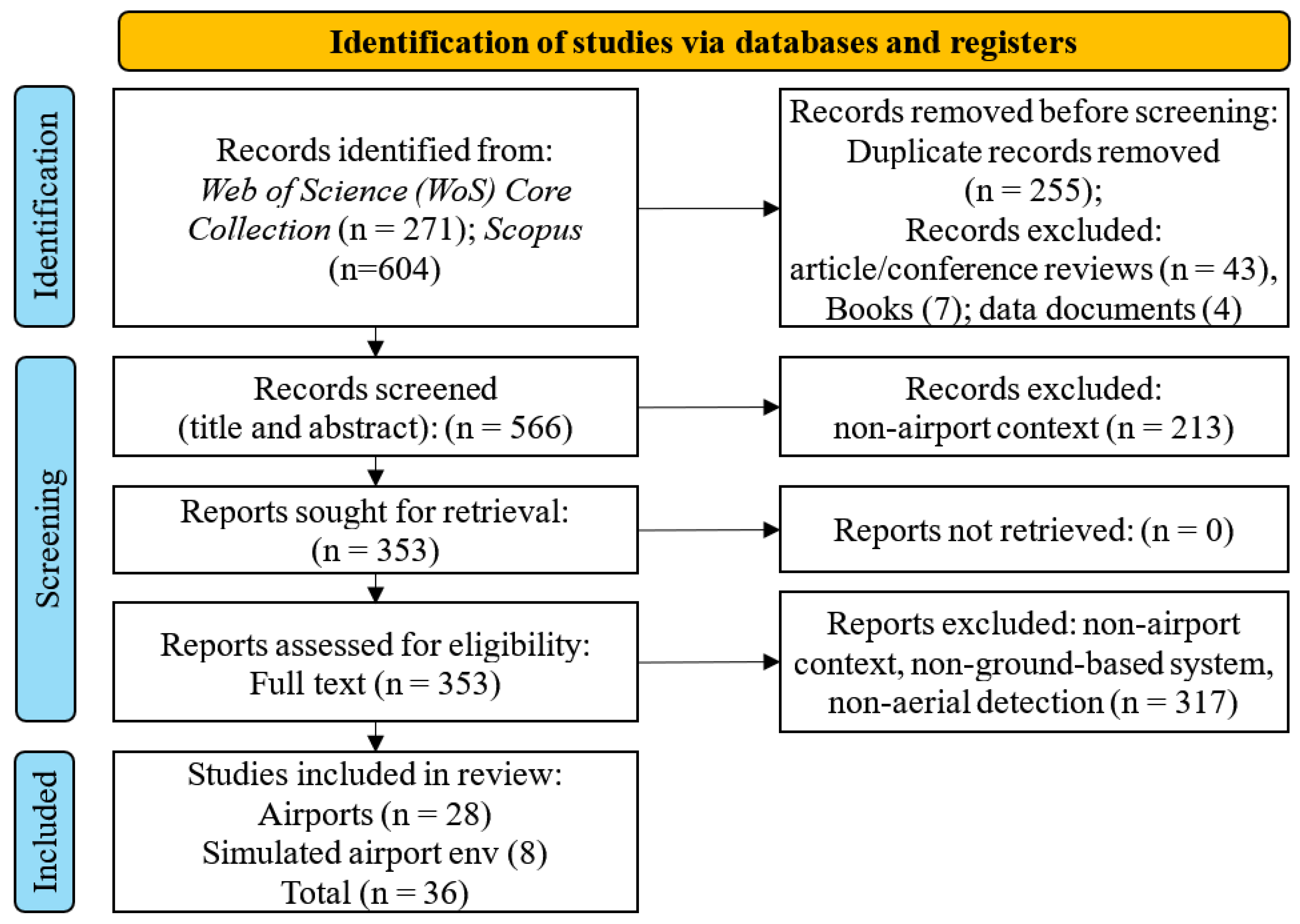
3.1. Study Selection
3.2. Characteristics of the Included Studies
3.3. Risk of Bias in Studies
3.4. Synthesis of Findings
3.4.1. Current State of Detection Technologies
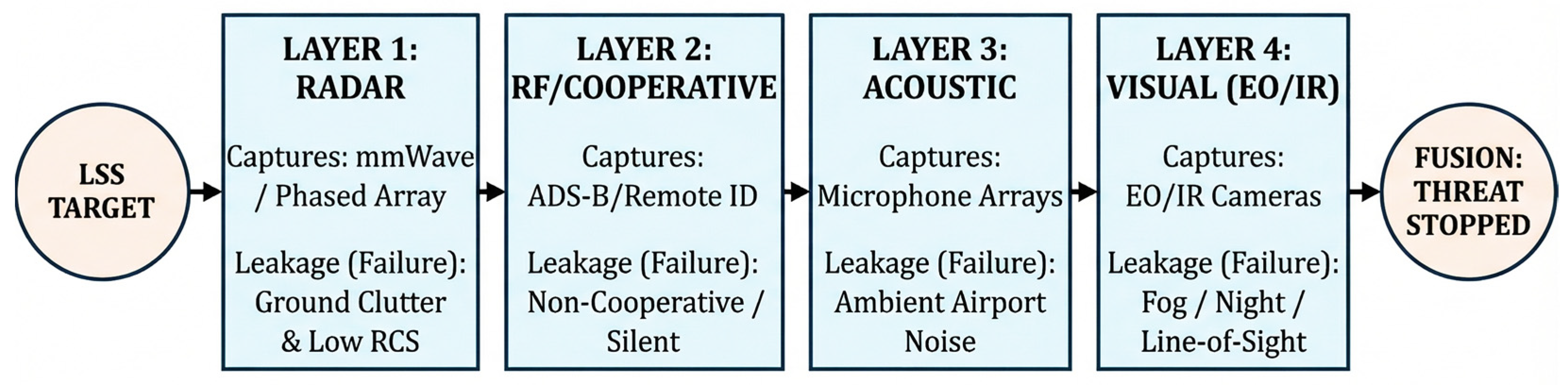
Operationalizing the Swiss Cheese Model for C-UAS
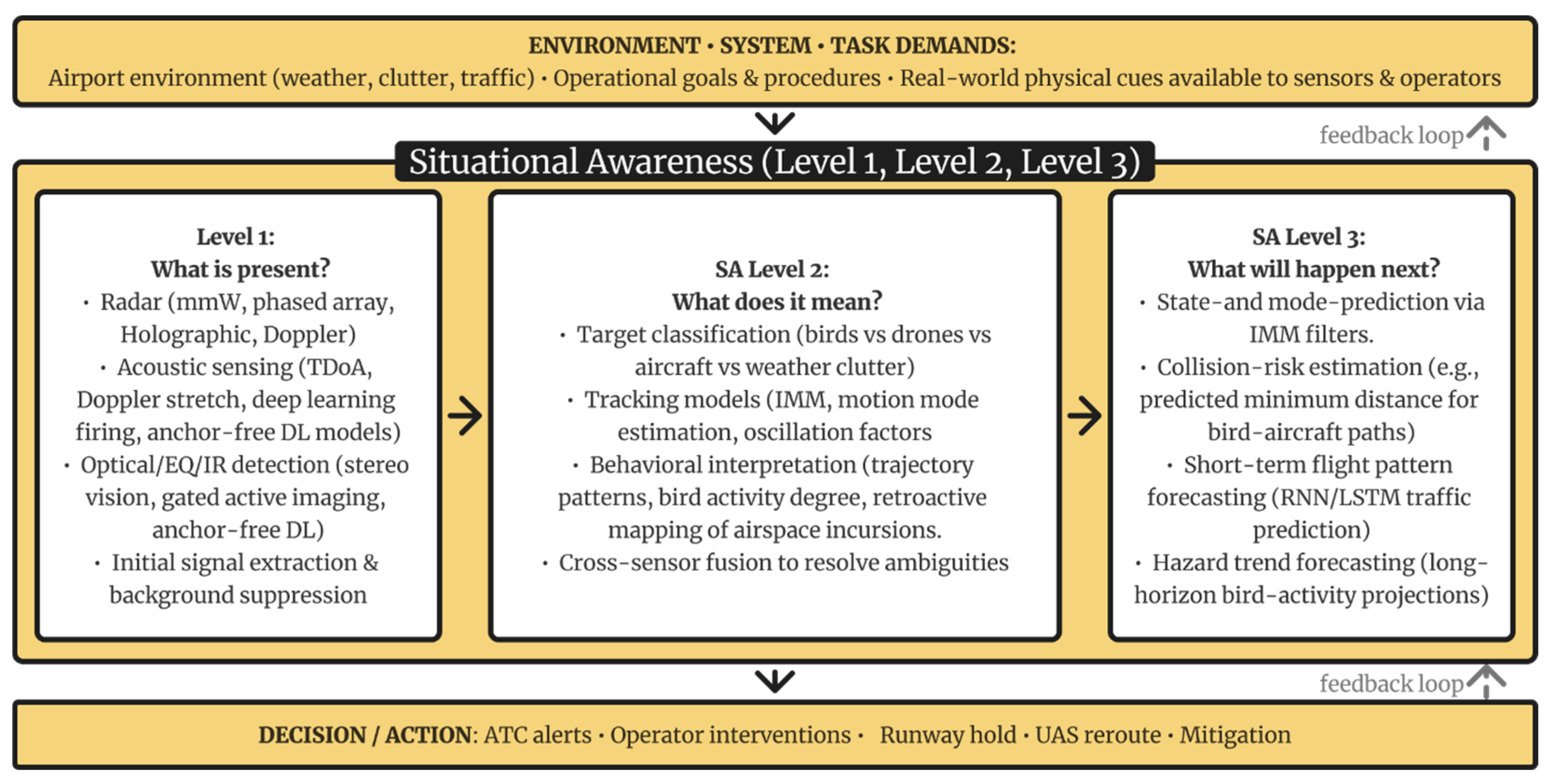
Mapping Sensor Workflows to Situational Awareness
Sensor-Specific Observations
3.4.2. Aerial Hazards and Detection Challenges
3.4.3. Air Traffic and UAS Management (ATM/UTM)
3.4.4. Human Factors and Operator Workload
3.4.5. Key Performance Metrics and Evaluation
4. Discussion and Implications
4.1. Principal Findings
4.2. Limitations: Evidence and Review Processes
4.3. Theoretical and Practical Implications
4.4. Future Research Directions and Outlook
Advanced Air Mobility (AAM) and Vertiport Surveillance Challenges
5. Conclusions
Author Contributions
Funding
Data Availability Statement
Conflicts of Interest
Abbreviations
| ACI | Airports Council International |
| ADSP | Aeronautical Data Service Provider |
| AAM | Advanced Air Mobility |
| ATC | Air Traffic Control |
| ATM | Air Traffic Management |
| BVLOS | Beyond Visual Line of Sight |
| DL | Deep Learning |
| EASA | European Union Aviation Safety Agency |
| GA | General Aviation |
| HOOTL | Human Out of the Loop |
| JC&S | Joint Communications & Sensing |
| NPRM | Notice of Proposed Rulemaking |
| OLS | Obstacle Limitation Surfaces |
| PRISMA | Preferred Reporting Items for Systematic Reviews and Meta-Analyses |
| PD | Probability of Detection |
| RF | Radio Frequency |
| RNN-LSTM | Recurrent Neural Networks—Long Short-Term Memory |
| SA | Situational Awareness |
| UAS | Unmanned Aerial System |
| UTM | Unmanned Traffic Management |
Appendix A

| # | Study Context | Q1 | Q2 | Q3 | Q4 | Q5 | Q6 | Q7 | Q8 | # | Study Context | Q1 | Q2 | Q3 | Q4 | Q5 | Q6 | Q7 | Q8 | |
|---|---|---|---|---|---|---|---|---|---|---|---|---|---|---|---|---|---|---|---|---|
| 1 | Ali & Nathwani, 2024 | Y | N | U | Y | Y | U | U | Y | 20 | Martelli et al., 2019 | Y | Y | Y | Y | Y | N | Y | Y | |
| 2 | Ananenkov et al., 2018 | U | N | Y | U | N | N | U | U | 21 | Martelli et al., 2020a | Y | Y | Y | Y | Y | N | Y | Y | |
| 3 | Case & Hupy, 2025 | Y | Y | U | Y | Y | Y | Y | Y | 22 | Martelli et al., 2020b | Y | Y | NA | Y | N | N | Y | Y | |
| 4 | Chervoniak et al., 2020 | Y | Y | U | Y | N | N | U | Y | 23 | Mott et al., 2020 | Y | Y | N | Y | NA | Y | Y | Y | |
| 5 | Coombes et al., 2016 | Y | Y | Y | Y | N | N | Y | Y | 24 | Phillips et al., 2018 | Y | Y | Y | Y | Y | Y | Y | Y | |
| 6 | De Luca et al., 2025 | Y | Y | U | N | Y | N | N | Y | 25 | Pothana et al., 2025 | Y | Y | Y | Y | Y | N | Y | Y | |
| 7 | Gauthreaux Jr et al., 2019 | Y | Y | Y | Y | Y | Y | Y | Y | 26 | Rollo et al., 2020 | Y | Y | NA | Y | NA | NA | Y | Y | |
| 8 | Gerringer et al., 2016 | Y | Y | Y | Y | N | Y | Y | Y | 27 | S. Liu et al., 2022 | Y | Y | Y | N | Y | N | Y | Y | |
| 9 | Gong et al., 2024 | N | Y | N | N | N | NA | N | N | 28 | Stamm et al., 2018 | Y | Y | NA | Y | NA | Y | Y | Y | |
| 10 | Gradolewski et al., 2021 | Y | Y | Y | Y | N | Y | Y | Y | 29 | Thai et al., 2019 | Y | Y | Y | Y | Y | Y | Y | Y | |
| 11 | Hale & Stanley, 2017 | Y | Y | Y | Y | Y | Y | Y | Y | 30 | W. S. Chen et al., 2018 | Y | Y | Y | Y | Y | Y | Y | Y | |
| 12 | Heidger et al., 2021 | Y | Y | Y | Y | N | Y | Y | Y | 31 | W. S. Chen et al., 2019 | Y | Y | NA | Y | NA | Y | Y | Y | |
| 13 | Holt et al., 2024 | N | Y | N | U | N | NA | N | Y | 32 | W. S. Chen et al., 2021 | Y | Y | NA | Y | Y | Y | Y | Y | |
| 14 | J. Liu et al., 2021 | Y | Y | N | Y | Y | Y | Y | Y | 33 | Wang et al., 2023 | Y | Y | NA | N | Y | N | NA | Y | |
| 15 | J. Liu et al., 2024 | Y | Y | Y | Y | Y | Y | Y | Y | 34 | Washburn et al., 2022 | Y | Y | Y | Y | Y | Y | Y | Y | |
| 16 | Juranyi et al., 2020 | Y | Y | Y | Y | NA | N | Y | Y | 35 | Xu et al., 2023 | Y | Y | Y | N | Y | N | Y | Y | |
| 17 | Krasnenko et al., 2023 | Y | Y | N | N | N | N | N | Y | 36 | Xu et al., 2024 | Y | Y | Y | Y | N | N | Y | Y | |
| 18 | L. Chen et al., 2025 | Y | Y | Y | Y | Y | Y | Y | Y | |||||||||||
| 19 | Lopez-Lago et al., 2017 | Y | Y | NA | N | Y | N | Y | Y |
References
- Federal Aviation Administration. FAA Wildlife Strike Database; Federal Aviation Administration: Washington, DC, USA, 2025. Available online: https://wildlife.faa.gov/search (accessed on 1 November 2025).
- Wood, J. Wildlife Strikes up 14% in Last Year. General Aviation News, 22 August 2025. Available online: https://generalaviationnews.com/2025/08/22/wildlife-strikes-up-14-in-last-year/ (accessed on 2 November 2025).
- Searing, G. How the FAA Is Looking to Counteract Increasing Bird Strikes in U.S. Aviation. Bird Strike Association Canada. 23 March 2023. Available online: https://canadianbirdstrike.ca/how-the-faa-is-looking-to-counteract-increasing-bird-strikes-in-us-aviation/ (accessed on 5 November 2025).
- Federal Aviation Administration. FAA Drone Detection Testing; Federal Aviation Administration: Washington, DC, USA, 2025. Available online: https://www.faa.gov/newsroom/faa-drone-detection-testing-0 (accessed on 1 October 2025).
- Kies, A. Systematic Detection of Drones at Airports. Transportation Review. Available online: https://airport-management-europe.transportationreview.com/cxoinsight/systematic-detection-of-drones-at-airports--nwid-313.html (accessed on 15 October 2025).
- Airports Council International (ACI) Asia-Pacific & Middle East. Challenges for Airports in Addressing Existing and Emerging Threats. In Proceedings of the ICAO MID GASeP Forum, Middle East, Cairo, Egypt, 15–19 June 2025; PowerPoint Presentation. Available online: https://www2023.icao.int/MID/Documents/2025/GASeP-CZ%20Seminars/ICAO%20MID%20GASeP%20forum%20-%20ACI%20presentation%20-%20threat%20and%20risk.pdf (accessed on 25 October 2025).
- Barduson, L.; Carrasco, E.; Khan, Z.; Krstulic, K. Cooperative and Non-Cooperative UAS Detection, 2025. Available online: https://www.researchgate.net/publication/2242544_A_Survey_on_UAV_Detection_and_Classification_Techniques (accessed on 30 October 2025).
- Khawaja, W.; Ezuma, M.; Semkin, V.; Erden, F.; Ozdemir, O.; Guvenc, I. A Survey on Detection, Classification, and Tracking of UAVs Using Radar and Communications Systems. arXiv 2025, arXiv:2402.05909v2. Available online: https://arxiv.org/html/2402.05909v2 (accessed on 15 November 2025).
- Semenyuk, V.; Kurmashev, I.; Lupidi, A.; Alyoshin, D.; Krivoshein, E.; Gasanov, M. Advances in UAV Detection: Integrating Multi-Sensor Systems and AI for Enhanced Accuracy and Efficiency. Int. J. Crit. Infrastruct. Prot. 2025, 49, 100744. [Google Scholar] [CrossRef] [Scilit]
- Dong, Y.; Wu, F.; Zhang, S.; Chen, G.; Hu, Y.; Yano, M.; Sun, J.; Huang, S.; Liu, F.; Dai, Q.; et al. Securing the Skies: A Comprehensive Survey on Anti-UAV Methods, Benchmarking, and Future Directions. arXiv 2025, arXiv:2504.11967. Available online: https://arxiv.org/abs/2504.11967 (accessed on 22 November 2025).
- Molchanov, P.; Harmanny, R.I.A.; de Wit, J.J.M.; Egiazarian, K.; Astola, J. Classification of small UAVs and birds by micro-Doppler signatures. Int. J. Microw. Wirel. Technol. 2014, 6, 435–444. [Google Scholar] [CrossRef] [Scilit]
- Luo, W.; Xing, J.; Milan, A.; Zhang, X.; Liu, W.; Kim, T.-K. Multiple object tracking: A literature review. Artif. Intell. 2021, 293, 103448. [Google Scholar] [CrossRef] [Scilit]
- Al-Qubaydhi, N.; Alenezi, A.; Alanazi, T.; Senyor, A.; Alanezi, N.; Alotaibi, B.; Alotaibi, M.; Razaque, A.; Hariri, S. Deep learning for unmanned aerial vehicles detection: A review. Comput. Sci. Rev. 2024, 51, 100614. [Google Scholar] [CrossRef] [Scilit]
- Bisio, I.; Garibotto, C.; Haleem, H.; Lavagetto, F.; Sciarrone, A. RF/WiFi-based UAV surveillance systems: A systematic literature review. Internet Things 2024, 26, 101201. [Google Scholar] [CrossRef] [Scilit]
- Coluccia, A.; Parisi, G.; Fascista, A. Detection and classification of multirotor drones in radar sensor networks: A review. Sensors 2020, 20, 4172. [Google Scholar] [CrossRef] [Scilit]
- de Macedo, S.O.; Caetano, M.; da Costa, R.M. Drone detection in airport environments: A literature review. Array 2025, 28, 100511. [Google Scholar] [CrossRef] [Scilit]
- Rahman, M.H.; Sejan, M.A.S.; Aziz, M.A.; Tabassum, R.; Baik, J.-I.; Song, H.-K. A comprehensive survey of unmanned aerial vehicles detection and classification using machine learning approach: Challenges, solutions, and future directions. Remote Sens. 2024, 16, 879. [Google Scholar] [CrossRef] [Scilit]
- Samaras, S.; Diamantidou, E.; Ataloglou, D.; Sakellariou, N.; Vafeiadis, A.; Magoulianitis, V.; Lalas, A.; Dimou, A.; Zarpalas, D.; Votis, K.; et al. Deep learning on multi-sensor data for counter-UAV applications: A systematic review. Sensors 2019, 19, 4837. [Google Scholar] [CrossRef] [Scilit]
- Seidaliyeva, U.; Ilipbayeva, L.; Taissariyeva, K.; Smailov, N.; Matson, E.T. Advances and challenges in drone detection and classification techniques: A state-of-the-art review. Sensors 2024, 24, 125. [Google Scholar] [CrossRef] [Scilit]
- Seidaliyeva, U.; Ilipbayeva, L.; Utebayeva, D.; Smailov, N.; Matson, E.T.; Tashtay, Y.; Turumbetov, M.; Sabibolda, A. LiDAR technology for UAV detection: From fundamentals and operational principles to advanced detection and classification techniques. Sensors 2025, 25, 2757. [Google Scholar] [CrossRef] [Scilit] [PubMed]
- Chen, W.; Huang, Y.; Lu, X.; Zhang, J. Review on critical technology development of avian radar system. Aircr. Eng. Aerosp. Technol. 2022, 94, 445–457. [Google Scholar] [CrossRef] [Scilit]
- Yang, C.; Huang, C.; Zhao, Y. The intellectual structure and the future of counter-uncrewed aerial systems (UAS) research: A bibliometric and a scoping review. Int. J. Aviat. Aeronaut. Aerosp. 2024, 11, 3. [Google Scholar] [CrossRef] [Scilit]
- Liu, Z.; An, P.; Yang, Y.; Qiu, S.; Liu, Q.; Xu, X. Vision-based drone detection in complex environments: A survey. Drones 2024, 8, 643. [Google Scholar] [CrossRef] [Scilit]
- Page, M.J.; McKenzie, J.E.; Bossuyt, P.M.; Boutron, I.; Hoffmann, T.C.; Mulrow, C.D.; Moher, D. The PRISMA 2020 statement: An updated guideline for reporting systematic reviews. BMJ 2021, 372, n71. [Google Scholar] [CrossRef] [Scilit]
- Joanna Briggs Institute. The Joanna Briggs Institute Critical Appraisal Tools for Use in JBI Systematic Reviews: Critical Appraisal Checklist for Analytical Cross Sectional Studies; Joanna Briggs Institute: Adelaide, Australia, 2017; pp. 1–7. Available online: https://jbi.global/sites/default/files/2019-05/JBI_Critical_Appraisal-Checklist_for_Analytical_Cross_Sectional_Studies2017_0.pdf (accessed on 10 December 2025).
- Ali, M.; Nathwani, K. Exploiting wavelet scattering transform and 1D-CNN for unmanned aerial vehicle detection. IEEE Signal Process. Lett. 2024, 31, 1790–1794. [Google Scholar] [CrossRef] [Scilit]
- Ananenkov, A.E.; Marin, D.V.; Nuzhdin, V.M.; Rastorguev, V.V.; Sokolov, P.V. Possibilities to observe small-size UAVs in the prospective airfield radar. In Proceedings of the 2018 20th Anniversary International Conference on Transparent Optical Networks (ICTON), Bucharest, Romania, 1–5 July 2018; IEEE: Piscataway, NJ, USA, 2018. [Google Scholar] [CrossRef] [Scilit]
- Case, R.P.; Hupy, J.P. Airport Cooperative Research Program Graduate Research Award 11-04: Geographic information system application to unmanned traffic management within the national airspace system. Transp. Res. Rec. 2025, 2679, 1064–1078. [Google Scholar] [CrossRef] [Scilit]
- Chervoniak, Y.; Sinitsyn, R.; Yanovsky, F. Passive acoustic radar system for flying vehicle localization. In Proceedings of the 23rd International Microwave and Radar Conference (MIKON 2020), Warsaw, Poland, 5–7 October 2020; IEEE: Piscataway, NJ, USA, 2020; pp. 278–281. [Google Scholar] [CrossRef] [Scilit]
- Coombes, M.; Liu, C.; Chen, W.-H. Situation awareness for UAV operating in terminal areas using bearing-only observations and circuit flight rules. In Proceedings of the 2016 American Control Conference (ACC), Boston, MA, USA, 6–8 July 2016; IEEE: Boston, MA, USA, 2016; pp. 479–485. [Google Scholar] [CrossRef] [Scilit]
- De Luca, V.; Pascarelli, C.; Colucci, M.; Afrune, P.; Corallo, A.; Avanzini, G. A platform for safe operations of unmanned aircraft systems in critical areas. Engineering 2025, 49, 314–331. [Google Scholar] [CrossRef] [Scilit]
- Gauthreaux, S.A., Jr.; Shapiro, A.-M.; Mayer, D.; Clarke, B.L.; Herricks, E.E. Detecting bird movements with L-band avian radar and S-band dual-polarization Doppler weather radar. Remote Sens. Ecol. Conserv. 2019, 5, 237–246. [Google Scholar] [CrossRef] [Scilit]
- Gerringer, M.B.; Lima, S.L.; DeVault, T.L. Evaluation of an avian radar system in a midwestern landscape. Wildl. Soc. Bull. 2016, 40, 150–159. [Google Scholar] [CrossRef] [Scilit]
- Gong, J.; Yan, J.; Kong, D.; Li, D. Enhancing airport airspace safety: A small radar system for mitigating bird, drone, and wake vortex hazards. In Proceedings of the 2024 AIAA DATC/IEEE 43rd Digital Avionics Systems Conference (DASC), San Diego, CA, USA, 29 September–3 October 2024; IEEE: Piscataway, NJ, USA, 2024; pp. 1–10. [Google Scholar] [CrossRef] [Scilit]
- Gradolewski, D.; Dziak, D.; Kaniecki, D.; Jaworski, A.; Skakuj, M.; Kulesza, W.J. A runway safety system based on vertically oriented stereovision. Sensors 2021, 21, 1464. [Google Scholar] [CrossRef] [Scilit] [PubMed]
- Hale, M.R.; Stanley, R.M. Evaluating the design and suitability of the wildlife surveillance concept. In Proceedings of the 2017 Integrated Communications, Navigation and Surveillance Conference (ICNS), Herndon, VA, USA, 18–20 April 2017; IEEE: Piscataway, NJ, USA, 2017. [Google Scholar] [CrossRef] [Scilit]
- Heidger, R.; Lambercy, V.; Lambers, D. Tracking analysis of drone detection systems at airports: Methodology and results. In Proceedings of the 21st International Radar Symposium (IRS 2021), Berlin, Germany, 21–22 June 2021; IEEE: Piscataway, NJ, USA, 2021. [Google Scholar] [CrossRef] [Scilit]
- Holt, D.; Guo, W.; Sun, M.; Panagiotakopoulos, D.; Warston, H. Deep learning for radar classification. In Proceedings of the 2024 International Conference on Unmanned Aircraft Systems (ICUAS), Chania, Greece, 4–7 June 2024; IEEE: Piscataway, NJ, USA, 2024; pp. 1208–1215. [Google Scholar] [CrossRef] [Scilit]
- Liu, J.; Xu, Q.; Chen, W.S. Classification of bird and drone targets based on motion characteristics and random forest model using surveillance radar data. IEEE Access 2021, 9, 160135–160144. [Google Scholar] [CrossRef] [Scilit]
- Liu, J.; Xu, Q.; Su, M.; Chen, W.S. Activity modeling and characterization for airport bird situation awareness using avian radar datasets. Aerospace 2024, 11, 442. [Google Scholar] [CrossRef] [Scilit]
- Juranyi, Z.; Schmidt, J.; Peters, E.; Lehmann, F. Characterization of an affordable and compact gated-viewing system for maritime search and rescue applications. In Electro-Optical Remote Sensing XIV; Kamerman, G.W., Steinvall, O., Eds.; SPIE: Washington, DC, USA, 2020; Volume 11538, p. 1153808. [Google Scholar] [CrossRef] [Scilit]
- Krasnenko, N.P.; Vlasov, E.V.; Rakov, A.S. Radio physical methods of ensuring ornithological safety of objects and territories. Russ. Phys. J. 2023, 66, 479–484. [Google Scholar] [CrossRef] [Scilit]
- Chen, L.; Zhu, N.; Chen, H.; Dong, Y.; Zhang, Y.; Cai, N. A causality-inspired single-source domain generalized method for low-slow-small threat target recognition through holographic Doppler radar. Expert Syst. Appl. 2025, 287, 128104. [Google Scholar] [CrossRef] [Scilit]
- Lopez-Lago, M.; Casado, R.; Bermudez, A.; Serna, J. A predictive model for risk assessment on imminent bird strikes on airport areas. Aerosp. Sci. Technol. 2017, 62, 19–30. [Google Scholar] [CrossRef] [Scilit]
- Martelli, T.; Colone, F.; Cardinali, R. Simultaneous short- and long-range surveillance of drones and aircraft with DVB-T-based passive radar. In Proceedings of the 2019 International Radar Conference (RADAR 2019), Toulon, France, 23–27 September 2019; IEEE: Piscataway, NJ, USA, 2019; pp. 561–566. [Google Scholar] [CrossRef] [Scilit]
- Martelli, T.; Colone, F.; Cardinali, R. DVB-T-based passive radar for simultaneous counter-drone operations and civil air traffic surveillance. IET Radar Sonar Navig. 2020, 14, 505–515. [Google Scholar] [CrossRef] [Scilit]
- Martelli, T.; Filippini, F.; Colone, F. Tackling the different target dynamics issues in counter-drone operations using passive radar. In Proceedings of the 2020 IEEE International Radar Conference (RADAR), Washington DC, USA, 27 April–27 May 2020; IEEE: Piscataway, NJ, USA, 2020; pp. 512–517. [Google Scholar] [CrossRef] [Scilit]
- Mott, J.H.; Marshall, Z.A.; Vandehey, M.A.; May, M.; Bullock, D.M. Detection of conflicts between ADS-B-equipped aircraft and unmanned aerial systems. Transp. Res. Rec. 2020, 2674, 197–204. [Google Scholar] [CrossRef] [Scilit]
- Phillips, A.C.; Majumdar, S.; Washburn, B.E.; Mayer, D.; Swearingin, R.M.; Herricks, E.E.; Guerrant, T.L.; Beckerman, S.F.; Pullins, C.K. Efficacy of avian radar systems for tracking birds on the airfield of a large international airport. Wildl. Soc. Bull. 2018, 42, 467–477. [Google Scholar] [CrossRef] [Scilit]
- Pothana, P.; Snyder, P.; Vidhyadharan, S.; Ullrich, M.; Thornby, J. Air traffic trends and UAV safety: Leveraging automatic dependent surveillance–broadcast data for predictive risk mitigation. Aerospace 2025, 12, 284. [Google Scholar] [CrossRef] [Scilit]
- Rollo, M.; Kaiser, V.; Volf, P. Modeling and simulation of sensor placement strategies to detect malicious UAS operations. In Proceedings of the 2020 Integrated Communications Navigation and Surveillance Conference (ICNS), Herndon, VA, USA, 8–10 September 2020; IEEE: Piscataway, NJ, USA, 2020; pp. 2G2-1–2G2-12. [Google Scholar] [CrossRef] [Scilit]
- Liu, S.; Qu, J.; Wu, R. HollowBox: An anchor-free UAV detection method. IET Image Process. 2022, 16, 2922–2936. [Google Scholar] [CrossRef] [Scilit]
- Stamm, R.J.; Glaneuski, J.; Kennett, P.R.; Belanger, J.M. Advances in the use of NAS infrastructure and GBDAA for UAS operations. In Proceedings of the 2018 IEEE/AIAA 37th Digital Avionics Systems Conference (DASC), London, UK, 23–27 September 2018; IEEE: Piscataway, NJ, USA, 2018; pp. 1507–1515. [Google Scholar] [CrossRef] [Scilit]
- Thai, V.-P.; Zhong, W.; Pham, T.; Alam, S.; Duong, V. Detection, tracking, and classification of aircraft and drones in digital towers using machine learning on motion patterns. In Proceedings of the 2019 Integrated Communications, Navigation and Surveillance Conference (ICNS), Washington, DC, USA, 9–11 April 2019; IEEE: Piscataway, NJ, USA, 2019. [Google Scholar] [CrossRef] [Scilit]
- Chen, W.S.; Zhang, J.; Li, J. Intelligent decision-making with bird-strike risk assessment for airport bird repellent. Aeronaut. J. 2018, 122, 988–1002. [Google Scholar] [CrossRef] [Scilit]
- Chen, W.S.; Liu, J.; Li, J. Classification of UAV and bird target in low-altitude airspace with surveillance radar data. Aeronaut. J. 2019, 123, 191–211. [Google Scholar] [CrossRef] [Scilit]
- Chen, W.S.; Huang, Y.F.; Lu, X.F.; Zhang, J. Analysis of bird situation around airports using avian radar. Aeronaut. J. 2021, 125, 2149–2168. [Google Scholar] [CrossRef] [Scilit]
- Wang, Z.; Williams, D.; Wong, K.C. Probability map based aerial target detection and localisation using networked cameras. In Proceedings of the AIAA SCITECH 2023 Forum, National Harbor, MD, USA, 23–27 January 2023; American Institute of Aeronautics and Astronautics: Reston, VA, USA, 2023. [Google Scholar] [CrossRef] [Scilit]
- Washburn, B.E.; Maher, D.; Beckerman, S.F.; Majumdar, S.; Pullins, C.K.; Guerrant, T.L. Monitoring raptor movements with satellite telemetry and avian radar systems: An evaluation for synchronicity. Remote Sens. 2022, 14, 2658. [Google Scholar] [CrossRef] [Scilit]
- Xu, Q.; Liu, J.; Su, M.; Chen, W.S. Multi-scale temporal characters mining for bird activities based on historical avian radar system datasets. Aeronaut. J. 2023, 127, 1452–1472. [Google Scholar] [CrossRef] [Scilit]
- Xu, Q.; Liu, J.; Su, M.; Chen, W.S. Bird behaviour characterisation and environment dependence modelling in airport airspace based on radar datasets. Aeronaut. J. 2024, 128, 2815–2831. [Google Scholar] [CrossRef] [Scilit]
- Reason, J. Managing the Risks of Organizational Accidents, 1st ed.; Ashgate: Aldershot, UK, 1997. [Google Scholar]
- Endsley, M.R. Toward a theory of situation awareness in dynamic systems. Hum. Factors 1995, 37, 32–64. [Google Scholar] [CrossRef] [Scilit]
- Wang, W.; Guo, X.; Liu, Y.; Tang, A.; Yang, Q. Factors affecting unmanned aerial vehicles’ unsafe behaviors and influence mechanism based on social network theory. Transp. Res. Rec. 2023, 2677, 1030–1045. [Google Scholar] [CrossRef] [Scilit]
- Lykou, G.; Moustakas, D.; Gritzalis, D. Defending airports from UAS: A survey on cyber-attacks and counter-drone sensing technologies. Sensors 2020, 20, 3537. [Google Scholar] [CrossRef] [Scilit]
- Swinney, C.J.; Woods, J.C. The effect of real-world interference on CNN feature extraction and machine learning classification of unmanned aerial systems. Aerospace 2021, 8, 179. [Google Scholar] [CrossRef] [Scilit]
- Federal Aviation Administration. Engineering Brief No. 105A: Vertiport Design; Supplemental Guidance to Advisory Circular 150/5390-2D, Heliport Design; U.S. Department of Transportation: Washington, DC, USA, 2024. Available online: https://www.faa.gov/airports/engineering/engineering_briefs/eb_105a_vertiports (accessed on 11 December 2025).
- U.S. Government Accountability Office. Advanced Air Mobility: Legal Authorities and Issues to Consider for Operations (GAO-24-106451); U.S. Government Accountability Office: Washington, DC, USA, 2024. Available online: https://www.gao.gov/assets/d24106451.pdf (accessed on 16 December 2025).
- Federal Aviation Administration. BEYOND 2025. Available online: https://www.faa.gov/uas/programs_partnerships/beyond (accessed on 15 December 2025).
- Federal Aviation Administration. Normalizing unmanned aircraft systems beyond visual line of sight operations. Fed. Regist. 2025, 90, 38212–38391. [Google Scholar]
- Zahn, D.; Ginn, S.; Eggum, S.; Harris, R.J. NASA Advanced Air Mobility (AAM) Project National Campaign: Development of Airspace Operations, Infrastructure and Data; Report No. AAM-NC-069-001; NASA Armstrong Flight Research Center: Edwards, CA, USA, 2023. Available online: https://ntrs.nasa.gov/citations/20230011793 (accessed on 15 December 2025).
- Federal Aviation Administration. UTM Field Test (UFT) Final Report, 1st ed.; Federal Aviation Administration: Washington, DC, USA, 2023. Available online: https://www.faa.gov/uas/advanced_operations/traffic_management/UFT-Final-Report.pdf (accessed on 28 November 2025).
- Kopyt, A.; Dylicki, S. Urban air mobility vertiport capacity simulation and analysis. Aerospace 2025, 12, 560. [Google Scholar] [CrossRef] [Scilit]
- Vitiello, F.; Causa, F.; Opromolla, R.; Fasano, G.; Dolph, C.; Ferrante, T.; Ippolito, C. Demonstration of data processing and fusion from distributed radars for advanced air mobility surveillance. J. Aerosp. Inf. Syst. 2025, 22, 510–522. [Google Scholar] [CrossRef] [Scilit]
- Veneruso, P.; Manica, L.; Miccio, E.; Opromolla, R.; Tiana, C.; Gentile, G.; Fasano, G. FMCW radar-aided navigation for unmanned aircraft approach and landing in AAM scenarios: System requirements and processing pipeline. Sensors 2025, 25, 2429. [Google Scholar] [CrossRef] [Scilit]
- Dulia, E.; Shihab, S. Designing a surveillance sensor network with information clearinghouse for advanced air mobility. Sensors 2024, 24, 803. [Google Scholar] [CrossRef] [Scilit]
- Ruseno, N.; Lin, C.-Y. Development of UTM monitoring system based on network remote ID with inverted teardrop detection algorithm. Unmanned Syst. 2025, 13, 105–120. [Google Scholar] [CrossRef] [Scilit]




| Systematic Review, Year | PRISMA * | Airport Focus | Radar | RF/ADS-B | EO/IR | Acoustic | Multi-Sensor Fusion | Safety Theory Alignment | Fixed-Based System Focus |
|---|---|---|---|---|---|---|---|---|---|
| Al-Qubaydhi et al., 2024 [13] | • | • | • | • | |||||
| Bisio et al., 2024 [14] | • | • | |||||||
| Coluccia et al., 2020 [15] | • | • | • | • | • | ||||
| de Macedo et al., 2025 [16] | • | • | • | • | • | • | • | ||
| Rahman et al., 2024 [17] | • | • | • | • | • | ||||
| Samaras et al., 2019 [18] | • | • | • | • | • | ||||
| Seidaliyeva et al., 2024 [19] | • | • | • | • | • | ||||
| Seidaliyeva et al., 2025 [20] | • | • | |||||||
| W. S. Chen et al., 2022 [21] | • | • | • | • | |||||
| Yang et al., 2024 [22] | • | • | • | • | • | • | |||
| Z. Liu et al., 2024 [23] | • | ||||||||
| Current Review (2025) | • | • | • | • | • | • | • | • | • |
| Category | Items Extracted |
|---|---|
| Technology Type (RQ1) | Radar Systems, RF-based Detection, Acoustic Monitoring, Visual/Electro-optical Systems, Sensor Fusion/Multimodal |
| Performance Metrics (RQ2) | Detection Range, Accuracy, Precision, Recall, F1, Inference Time, Detection Time, Localization Certainty, IoU |
| Advantages & Limitations (RQ1) | Strengths and Weaknesses |
| Challenges (RQ2) | Differentiating UAS from birds, environmental conditions/clutter/noise, sensor limitations, real-time processing demands, data availability/quality |
| Opportunities (RQ2) | AI/ML/DL Integration, Multi-sensor Fusion, Improved Data Processing/Feature Extraction, Enhanced Datasets, Real-time/Cost-effective Solutions |
| # | Authors, Year | Airport/ Simulation | Target Combination | Acoustic | Optical | ADSB | Passive RF | Passive Radar | WX/Doppler | Avian Radar | Airfield Radar | Sensor Fusion |
|---|---|---|---|---|---|---|---|---|---|---|---|---|
| 1 | Ali & Nathwani, 2024 | Airport (simulation) | UAS + Birds + Aircraft | • | ||||||||
| 2 | Ananenkov et al., 2018 | Voskresensk airfield | UAS only | • | • | |||||||
| 3 | Case & Hupy, 2025 | LAF, IND, SAV | UAS + Aircraft | • | • | • | ||||||
| 4 | Chervoniak et al., 2020 | Airport (general) | UAS + Aircraft | • | ||||||||
| 5 | Coombes et al., 2016 | EGBW (simulation) | UAS + Aircraft | |||||||||
| 6 | De Luca et al., 2025 | LIBG: ICAO | UAS + Aircraft | • | • | • | ||||||
| 7 | Gauthreaux Jr et al., 2019 | KDFW | Birds only | • | • | |||||||
| 8 | Gerringer et al., 2016 | KHUF | Birds only | • | ||||||||
| 9 | Gong et al., 2024 | ZHHH: ICAO | Birds + UAS + Wake | • | ||||||||
| 10 | Gradolewski et al., 2021 | EPLL: ICAO | Birds (+UAS surrogates) | • | ||||||||
| 11 | Hale & Stanley, 2017 | KPHL (simulation) | Birds only | |||||||||
| 12 | Heidger et al., 2021 | EDDF, EDDM: ICAO | UAS (+Birds interference) | * | • | • | • | • | ||||
| 13 | Holt et al., 2024 | EGTC: ICAO | UAS + Aircraft | • | • | • | ||||||
| 14 | J. Liu et al., 2021 | ZGBH: ICAO | UAS + Birds + Weather | • | ||||||||
| 15 | J. Liu et al., 2024 | ZGBH: ICAO | Birds only | • | ||||||||
| 16 | Jurányi et al., 2020 | Closed Airstrip | UAS + Surface/Maritime | • | ||||||||
| 17 | Krasnenko et al., 2023 | UNTT: ICAO | Birds only | • | ||||||||
| 18 | L. Chen et al., 2025 | ZSPD: ICAO | UAS + Birds | • | ||||||||
| 19 | Lopez-Lago et al., 2017 | Airport (simulation) | Birds + Aircraft | • | ||||||||
| 20 | Martelli et al., 2019 | LIRE: ICAO | UAS + Aircraft | • | • | • | • | |||||
| 21 | Martelli et al., 2020a | LIRE: ICAO | UAS + Aircraft | • | ||||||||
| 22 | Martelli et al., 2020b | LIRE: ICAO | Small Aircraft + Birds | • | ||||||||
| 23 | Mott et al., 2020 | KMLB | UAS + Aircraft | • | • | • | ||||||
| 24 | Phillips et al., 2018 | KORD | Birds only | • | ||||||||
| 25 | Pothana et al., 2025 | LAX, SMF, SMX | Aircraft only | • | ||||||||
| 26 | Rollo et al., 2020 | LKPR (simulation) | UAS only | |||||||||
| 27 | S. Liu et al., 2022 | Airport in Tianjin | UAS only | • | ||||||||
| 28 | Stamm et al., 2018 | KSGH (simulation) | UAS + Aircraft | • | • | • | ||||||
| 29 | Thai et al., 2019 | KJYO (simulation) | UAS + Aircraft | • | ||||||||
| 30 | W. S. Chen et al., 2018 | ZGBH: ICAO | Birds only | * | • | • | ||||||
| 31 | W. S. Chen et al., 2019 | Airport (simulation) | UAS + Birds | • | ||||||||
| 32 | W. S. Chen et al., 2021 | Airport SW, NE China | Birds only | • | ||||||||
| 33 | Wang et al., 2023 | YSSY: ICAO | Aircraft only | • | • | • | ||||||
| 34 | Washburn et al., 2022 | KORD | Birds only | • | • | |||||||
| 35 | Xu et al., 2023 | Airport (NE China) | Birds + Bats | • | ||||||||
| 36 | Xu et al., 2024 | Airport (general) | Birds only | • | ||||||||
| 2 | 10 | 8 | 5 | 3 | 2 | 11 | 7 | 9 | ||||
| Criteria for Risk of Bias Assessment | Yes n/N | Yes % |
|---|---|---|
| (1) Inclusion Criteria Defined | 33/36 | 91.7 |
| (2) Subjects and Setting Described | 34/36 | 94.4 |
| (3) Exposure Measured Validly | 20/29 | 69.0 |
| (4) Outcome Measured by Standard Criteria | 27/36 | 75.0 |
| (5) Confounders Identified | 21/32 | 65.6 |
| (6) Strategies to Address Confounding | 17/33 | 51.5 |
| (7) Outcomes Measured Validly and Reliably | 28/35 | 80.0 |
| (8) Appropriate Statistical Analysis | 34/36 | 94.4 |
| Sensor/ Technology | SA Level | Role (Swizz Cheese) | Strengths | Limitations | Operational Implication | Refs. |
|---|---|---|---|---|---|---|
| Radar: Millimeter-Wave (mmW) Radar, Phased-Array Radar (L/S/X-band), Holographic Doppler | Primarily level 1; supports level 2 via tracking and signatures | Outer barrier; detects LSS objects | Long-range, all-weather, 24/7 autonomous detection/tracking; micro-Doppler for classification | Small RCS LSS target detection, low-altitude clutter interference, difficulty differentiating birds/drones, and long-range micro-Doppler issues. | Saturates operators with false positives, erodes trust, and increases cognitive workload. | [26,27,32,34,35,39,43,45,49,56,58,59] |
| Visual: Electro-Optical/Infrared (EO/IR) | Level 1 (Perception); Level 2 (Comprehension via classification) | Visual confirmation barrier | Visual confirmation, precise localization, object identification using high-resolution cameras/deep learning. | Weather-dependent (fog, rain, night), non-line-of-sight, limited range for small targets, high computational demand. | Research is needed for robust computer vision algorithms. | [26,31,35,41,52,54,58] |
| RF/Cooperative: RF monitoring, ADS-B, RemoteID, AeroScope, Passive Coherent Location radar | Level 1 (Perception); Level 2 (Comprehension via ID) | Identity barrier | Real-time identification, position for cooperative aircraft/UAS (ADS-B, AeroScope); critical for ATM/UTM | Ineffective for non-cooperative/autonomous UAS, manufacturer-specific, low-altitude coverage gaps, susceptible to interference. | Necessitates universal Remote ID compliance for effectiveness | [26,27,28,50,53] |
| Acoustic: Acoustic sensors/arrays | Level 1 (Perception); Level 2 (Comprehension via signature analysis) | Noise Signature confirmation barrier | Passive, cost-effective, lightweight, weather-resistant UAS detection using sound signatures/ML | Very short range, severely constrained by high ambient airport noise, and high computational demand for deep networks. | Need robust acoustic algorithms to function reliably in all conditions | [26,29,37,51] |
| Sensor Fusion: MSDF (Radar + RF + EO/IR fusion | Level 2 (Comprehension); enables Level 3 when coupled with predictive models | Integrating barriers | Overcomes single sensor limitations, enhances detection reliability, accuracy, situational awareness, reduces false alarms | Integration complexity, data-quality disparities, lack of unified standards, storage and compute burdens. | Moves from disjointed alerts to cohesive safety shield. | [31,34,37,38,46,51,53] |
| System | Features | Key Components | Benefits for Airport Operations | Ref |
|---|---|---|---|---|
| AcrOSS Platform | Holistic UTM Integration | Three-layered architecture (ATM, USS, UAS), Drone Boxes, N&A service, simulation tools. | Manages UAS operations in critical areas, clear communication protocols, and handles contingencies. | [31] |
| Drone Detection System (DDS) | Multi-sensor system for rogue targets. | Central Multi-Sensor Data Fusion (MSDF), radar, RF detection, and EO/IR sensors | Detects, tracks, displays, and alerts for UAS. Multiple sensors are needed for full coverage. | [37] |
| Ground-Based Detect and Avoid (GBDAA) | Multi-Sensor Data Fusion | Primary/secondary radars, ADS-B, multilateration, datalink from Ground Control Stations (GCS). | Provides an integrated air picture, enhances SA, and offers proximity alerts. | [53] |
| Remote ID | FAA standard for UAS | Sensors and receivers (expected to be similar infrastructure to ADS-B | Provides an additional data source for UAS tracking; the future challenge is integrating it with existing systems | [28] |
| Geographic Information Systems (GIS) | Spatial Data Contextualization | Multi-layered mapping, quantitative spatial analysis, and comprehensive data aggregation. | Improves risk management, identifies spatial patterns of incidents, and visualizes complex interactions. | [28] |
| AI Integration | Predictive Analytics & Simulation | Trained AI models (e.g., RNNs), digital twin of airspace, ADS-B, and historical radar data. | Forecasts flight patterns, identifies non-standard tracks, enables dynamic scheduling, and refines ATC focus. | [50] |
| Practitioners (Airports, Integrators, UAS Operators) | Regulators (Authorities, Standards Bodies) | Academic Researchers (Safety, Tech, Data) |
|---|---|---|
Multi-sensor deployment:
| Cross-sensor confirmation rules:
| Open multimodal datasets:
|
Procedures & protocols:
| Regulatory frameworks & standards:
| Methods & benchmarks:
|
Human factors & training:
| Oversight, audits, & learning:
| Human–automation studies:
|
Risk-based deployment & cost:
| Governance, privacy, Remote ID:
| System-of-systems testbeds:
|
AAM & vertiport readiness:
| AAM readiness:
| Future communications & sensing:
|
| Category | Tier 1 | Tier 2 | Tier 3 |
|---|---|---|---|
| Risk Level/Site Type | Low-risk sites (rural & uncontrolled) | Moderate-risk facilities (suburban/regional airports) | High-risk/high-density nodes (major hubs & urban vertiports) |
| FAA Category | 1–2 (Remote/Sparsely Populated) | Rural 3–4 (suburban, light urban) | 5 (dense urban, major hubs) |
| Airspace | Class G, E | D, E, under a Class B shelf | Class B, C |
| Surveillance | Basic cooperative tracking, Remote ID, see-and-avoid | Mixed sensor strategy, strategic deconfliction via UTM, ADSP required | Comprehensive, layered, multi-sensor surveillance, mandatory RID, and onboard DAA required |
| Sensor Mix | Minimal: Remote ID (RID) receiver(s), onboard GPS, lightweight detect-and-avoid (DAA), visual observers, or onboard EO/IR DAA | Cooperative (ADS-B receivers, electronic conspicuity devices), selective non-cooperative (medium-range radar, optical detection), RID receivers | High-end primary/4D radars, ADS-B/transponder receivers, wide-area RID capture, acoustic/visual systems, multilateration, LiDAR, IR cameras |
| UTM/ATC Integration | Full UTM integration is optional, simple flight rules, and traditional ATC is uninvolved | Moderate integration, drones file strategic flight plans, data may feed ATC tower or coordination center. | Highest priority, certified UTM/ADSP platforms, real-time conformance monitoring, ATC–UTM interoperability |
| Example | Small GA airports in rural regions, isolated vertiport sites | Busy regional airports, municipal airports near smaller cities, vertiports in suburban areas, Project ATLAS in NC | Large international airports, urban vertiports, Memphis Airport, North Dakota Vantis network |
Disclaimer/Publisher’s Note: The statements, opinions and data contained in all publications are solely those of the individual author(s) and contributor(s) and not of MDPI and/or the editor(s). MDPI and/or the editor(s) disclaim responsibility for any injury to people or property resulting from any ideas, methods, instructions or products referred to in the content. |
© 2025 by the authors. Licensee MDPI, Basel, Switzerland. This article is an open access article distributed under the terms and conditions of the Creative Commons Attribution (CC BY) license.
Share and Cite
Samu, J.; Yang, C. Airport Ground-Based Aerial Object Surveillance Technologies for Enhanced Safety: A Systematic Review. Drones 2026, 10, 22. https://doi.org/10.3390/drones10010022
Samu J, Yang C. Airport Ground-Based Aerial Object Surveillance Technologies for Enhanced Safety: A Systematic Review. Drones. 2026; 10(1):22. https://doi.org/10.3390/drones10010022
Chicago/Turabian StyleSamu, Joel, and Chuyang Yang. 2026. "Airport Ground-Based Aerial Object Surveillance Technologies for Enhanced Safety: A Systematic Review" Drones 10, no. 1: 22. https://doi.org/10.3390/drones10010022
APA StyleSamu, J., & Yang, C. (2026). Airport Ground-Based Aerial Object Surveillance Technologies for Enhanced Safety: A Systematic Review. Drones, 10(1), 22. https://doi.org/10.3390/drones10010022