1. Introduction
The transition to a forest-based bioeconomy is essential for addressing climate change and promoting sustainability, as forests serve both as carbon sinks and as sources of renewable materials [
1,
2]. Achieving this requires innovative business models that balance economic performance with environmental protection and social well-being [
3,
4]. Contemporary forest business models are increasingly characterized by servitization, where firms complement traditional wood products with services such as carbon offsetting, ecotourism, and sustainability certification [
5]. They also integrate precision technologies—including remote sensing, IoT, and artificial intelligence—to optimize resource use and monitor forest health [
6,
7]. In addition, participatory governance approaches that involve local communities, NGOs, and landowners in co-management are gaining prominence [
8,
9]. Many models further incorporate Payments for Ecosystem Services (PES), providing compensation for biodiversity conservation and ecosystem functions, increasingly linked to carbon markets and green finance [
10,
11]. Together, these innovations illustrate the multifunctional role of forests in a sustainable bioeconomy.
The objective of this study is to examine the evolution of research on the forest bioeconomy and business models through a bibliometric analysis of over 100 peer-reviewed studies. Previous studies have analyzed aspects of the forest bioeconomy—such as sustainability pathways, governance and stakeholder engagement and business model innovation [
1,
2,
3,
4,
5,
6,
7,
8]—but few have systematically mapped the intellectual and collaborative structures of the field [
12,
13]. Building on earlier bibliometric efforts in related domains such as the circular economy [
14,
15], this study identifies the dominant themes and concepts shaping the forest bioeconomy, the geographic distribution of research with particular attention to leading countries, and the collaborative structures that emerge through co-authorship and institutional linkages. It further explores how the knowledge base has developed over time, highlighting trends toward interdisciplinarity, systemic innovation, and policy relevance. By addressing these questions, the study provides insights into how the forest bioeconomy has become an increasingly collaborative and sustainability-oriented research domain, and underscores the practical need for inclusive, circular business models that align ecological stewardship with economic opportunity. The significance of this manuscript lies in extending the existing literature by offering the first comprehensive bibliometric overview of forest bioeconomy research, mapping its evolution and collaborative networks, and providing an evidence-based foundation to guide future scholarships and inform policy and business strategies for sustainable bioeconomic transitions.
2. Methods
This bibliometric analysis adopted a mixed-method approach, integrating qualitative content review with quantitative network analysis to capture both the thematic depth and structural patterns of academic research on the forest bioeconomy and business models in forest management. The corpus consisted of more than 100 peer-reviewed publications, primarily indexed in Scopus, and selected for their relevance to core themes of sustainability, circularity, and innovation.
The research process began with a systematic thematic categorization of publications based on titles, abstracts, and keywords. This step enabled the identification of recurring domains such as life cycle assessment, stakeholder governance, circular economy strategies, and bioenergy system design. Through this qualitative lens, the analysis traced the conceptual breadth of the field and highlighted cross-cutting themes that anchor forest bioeconomy research.
Complementing this, a quantitative keyword and subject-term analysis was conducted to examine term frequency and co-occurrence patterns. These were used to construct conceptual maps that illustrate how key ideas interconnect, evolve, and cluster across the literature. Particular emphasis was placed on identifying bridging terms that connect otherwise distinct research areas, thereby revealing integrative trends within the field.
To assess the collaborative dynamics underpinning knowledge production, co-authorship networks were constructed using Python’s (v.3.x) NetworkX library [M2.1]. These visualizations provided insights into author centrality, institutional alliances, and the emergence of research clusters. Strong linkages were observed among institutions tied to major EU-funded initiatives, indicating the influence of policy-driven research programs on shaping academic collaboration.
A geographic analysis was also performed, drawing on author affiliations to map regional patterns of research output. This allowed for the identification of geographic concentrations and highlighted the pivotal role of Northern and Central Europe in advancing forest bioeconomy research, in line with regional policy frameworks and industrial strategies.
The combination of qualitative and quantitative methods yielded rich visual and thematic data that illuminate both the structure and evolution of this rapidly growing, multidisciplinary domain. In particular, keyword clustering around “forest bioeconomy,” “sustainability,” and “ecosystem services” underscored the integrative nature of the research landscape, while geographic concentration revealed the importance of regional governance frameworks in shaping scholarly activity. Taken together, this methodology enabled a comprehensive and scalable assessment of the field, showing not only what is being studied, but also how research communities are formed, interconnected, and mobilized by shared sustainability and policy goals.
3. Results and Discussion
This bibliometric analysis provides a comprehensive overview of the scholarly landscape on forest bioeconomy and forest management business models, generating evidence-based insights into research directions, institutional involvement, and thematic priorities. Drawing on more than 100 academic references—predominantly peer-reviewed journal articles indexed in Scopus and Web of Science—the study applied a dual methodological approach, combining manual thematic coding with automated network analysis. This enabled the detection of patterns in authorship, geographic origin, thematic clustering, and conceptual convergence. Visualizations of co-authorship and keyword co-occurrence networks further clarified the intellectual structure of the field, corroborating emerging priorities and collaborative dynamics.
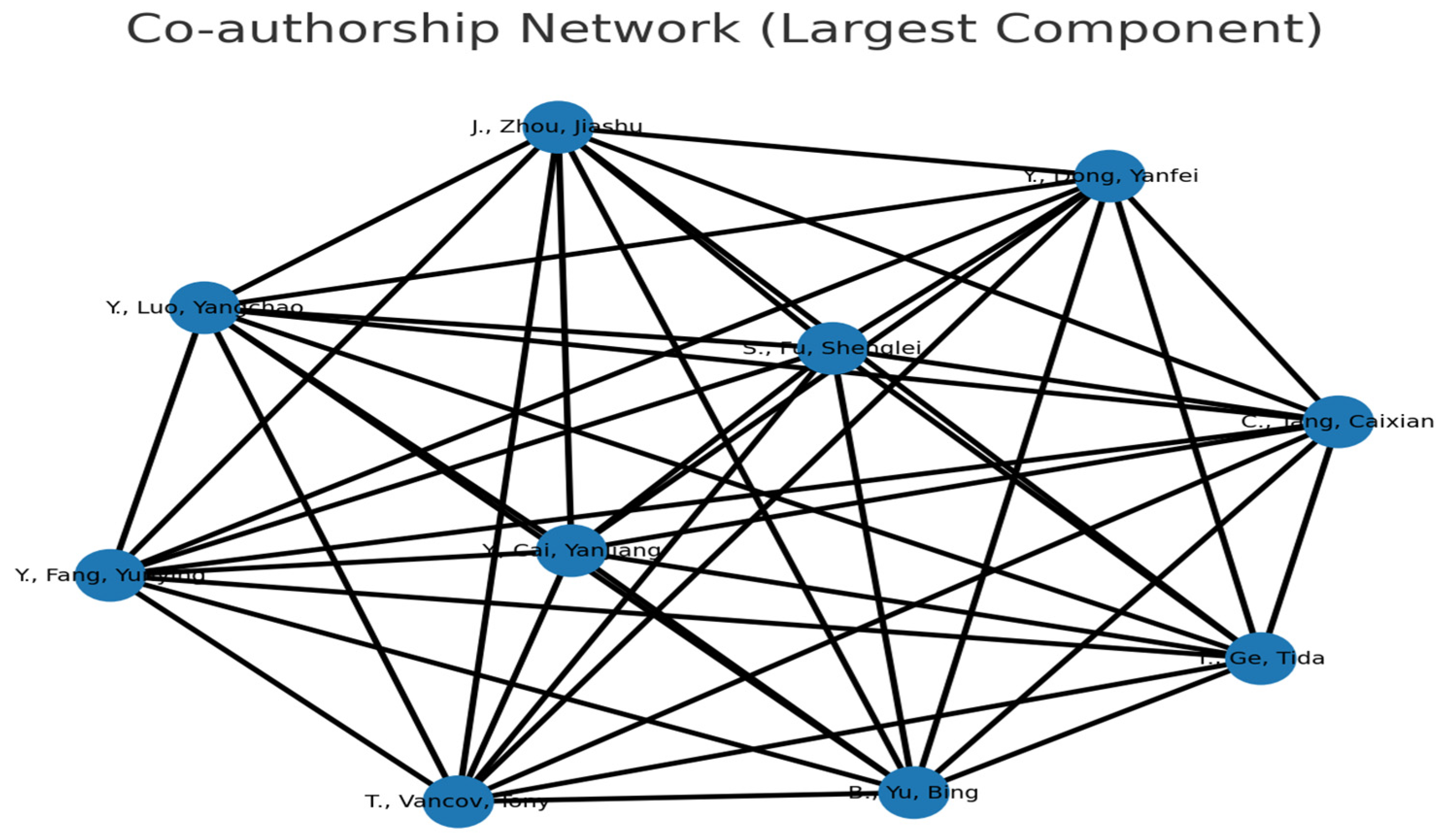
This co-authorship network as illustrated in
Figure 1 illustrates a tightly connected collaborative cluster. The largest component shows that nearly all authors are directly linked with multiple co-authors, forming a dense web of interactions rather than isolated sub-groups. Such a structure suggests a strong research community where knowledge circulates efficiently across individuals, enhancing interdisciplinarity and the exchange of ideas. A few nodes (e.g., authors with higher connectivity at the center) appear to act as hubs, facilitating collaboration and potentially shaping research agendas. This centrality often reflects leadership roles in multi-institutional projects or frequent participation in co-authored publications. Overall, the network indicates a mature and cohesive research domain where collaboration is a key driver of scientific output.
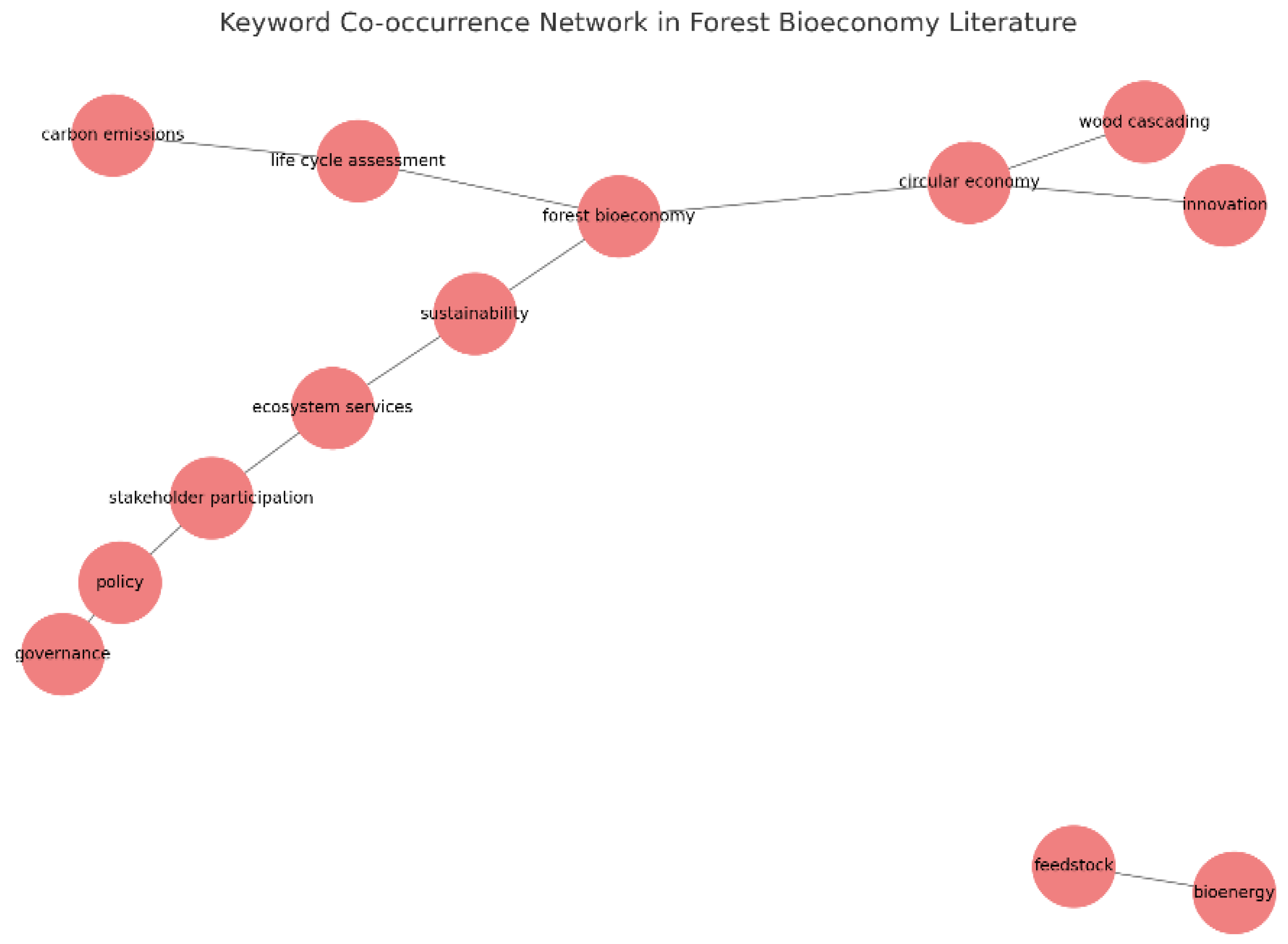
The keyword co-occurrence network reveals as illustrated in
Figure 2 strong thematic ties between central concepts such as forest bioeconomy, sustainability, and circular economy. Additional clusters connect life cycle assessment with carbon emissions, and policy with stakeholder participation, signaling the field’s integrative orientation across environmental, technological, and governance dimensions. These patterns reflect not only the multidisciplinary character of the research but also its responsiveness to global policy agendas around climate neutrality and sustainable resource use.
The results of the thematic classification highlight a strong emphasis on life cycle assessment, sustainable feedstock utilization, and circular economy strategies, closely followed by research on governance, participatory policy frameworks, and socioeconomic impact assessment. This thematic distribution is further supported by the keyword co-occurrence network, where central nodes such as forest bioeconomy, sustainability, and circular economy are interlinked with concepts including ecosystem services, carbon emissions, and stakeholder participation. These clusters point to the growing integration of environmental, technological, and social dimensions within forest bioeconomy research and reflect the sector’s ongoing transition from traditional timber production toward multifunctional and service-based forest value chains.
The collaborative patterns observed in the co-authorship network also suggest that research communities—particularly within the Nordic countries—are well connected and often linked through EU-level initiatives. Geographic analysis confirms that Finland, Germany, and Sweden contribute disproportionately to high-impact publications, consistent with their national strategies and investments in bioeconomy research and innovation.
While terms such as policy, public perception, and stakeholder governance do appear in both keyword and co-authorship analyses, their relative frequency indicates that these topics are emerging areas of focus rather than dominant themes. This suggests a growing but still developing recognition of the importance of legitimacy, trust, and public engagement in shaping the forest bioeconomy. Such signals should be interpreted as opportunities for further exploration rather than conclusive evidence of widespread scholarly consensus.
4. Conclusions—Future Research
The bibliometric evidence clearly demonstrates that the forest bioeconomy is not merely a technological or industrial shift, but a deeply integrative domain linking ecological resilience, economic competitiveness, and social inclusion [
1,
2,
3]. References to terms such as policy, public perception, and stakeholder governance in keyword co-occurrence maps and co-authorship networks indicate that these topics are beginning to gain visibility in the field, although they remain emerging rather than dominant themes [
8,
9]. This observation resonates with empirical studies that stress the importance of citizen engagement, cross-sectoral dialogue, and regional innovation ecosystems as enabling conditions for a successful forest-based transition [
4,
10,
11]. The results confirm that new business models in forest management are increasingly shaped by the convergence of sustainability metrics, stakeholder-oriented governance, and transdisciplinary collaboration [
5,
6,
7,
12,
13,
14]. The field is consolidating into a coherent academic domain, strongly tied to policy processes and geographically concentrated in leading EU countries such as Finland, Germany, and Sweden, supported by collaboration among a core of interdisciplinary scholars [
1,
3,
10,
15]. Nevertheless, certain limitations must be acknowledged: reliance on bibliometric databases such as Scopus and Web of Science inevitably privileges English-language and Global North outputs, potentially underrepresenting scholarship from the Global South and non-English outlets; keyword analysis, while effective in revealing thematic patterns, reduces conceptual complexity; and bibliometric methods cannot fully capture the practical impact of research on forest management or policy implementation. Future studies should therefore extend geographical coverage to underrepresented regions, pursue longitudinal analyses to track how discourse and collaborations evolve, integrate social justice frameworks addressing land tenure, indigenous rights, and distributional equity, and complement bibliometric approaches with qualitative and participatory methods to bridge the gap between academic production and practical implementation. By addressing these challenges, forest bioeconomy research can move toward producing knowledge that not only informs sustainable business models but also secures ecological stewardship, social legitimacy, and inclusive economic opportunity at a global scale.




 ,
,