Skip to Content
ProceedingsProceedings
  • Proceeding Paper
  • Open Access

11 August 2017

Monitoring the Etching Process in LPFGs towards Development of Highly Sensitive Sensors †

,
,

,
,
,
and
1
Sensors Research Laboratory, Public University of Navarra, 31006 Pamplona, Spain
2
Institute of Smart Cities, Jeronimo de Ayanz Center, Campus Arrosadia, 31006 Pamplona, Spain
3
Department of Applied Physics and Electromagnetism, University of Valencia, 46100 Burjassot, Spain
*
Author to whom correspondence should be addressed.

Abstract

In this work, the monitoring of the etching process up to a diameter of 30 µm of two LPFG structures has been compared, one of them had initially 125 µm, whereas the second one had 80 µm. By tracking the wavelength shift of the resonance bands during the etching process it is possible to check the quality of etching process (the 80 µm fibre performs better than de 125 µm fibre), and to stop for a specific cladding mode coupling, which permits to obtain an improved sensitivity compared to the initial structure.

1. Introduction

Long period fiber gratings (LPFG) can be used as highly sensitive detectors by application of three different phenomena: the mode transition [1,2], the dispersion turning point (DTP) [3], and the reduction of the cladding diameter [4,5]. It has been theoretically analyzed that a sensitivity in the water region of up to 143,000 nm/refractive index unit (nm/RIU) can be attained by considering the wavelength shift of both attenuation bands in DTP mode [6]. However the practical implementation is difficult and requires a high degree of accuracy. Nonetheless a sensitivity of 40,000 nm/RIU in a single band has been obtained by Smietana et al. [4].
Here focus is centered in the combination of the DTP and the cladding diameter reduction, which is simpler to control and permits to obtain sensitivities of 8000 nm/RIU by considering the wavelength shift of both attenuation bands [5]. The attenuation bands in LPFGs are created by coupling the core mode to a specific cladding mode. Coupling to lower order modes occurs by decreasing the cladding diameter for a given grating period. The highest sensitivity is obtained for the lowest order mode. Consequently, it is interesting to track the coupling to each cladding mode during the cladding diameter reduction, in order to stop the process at the highest sensitivity.

2. Materials and Methods

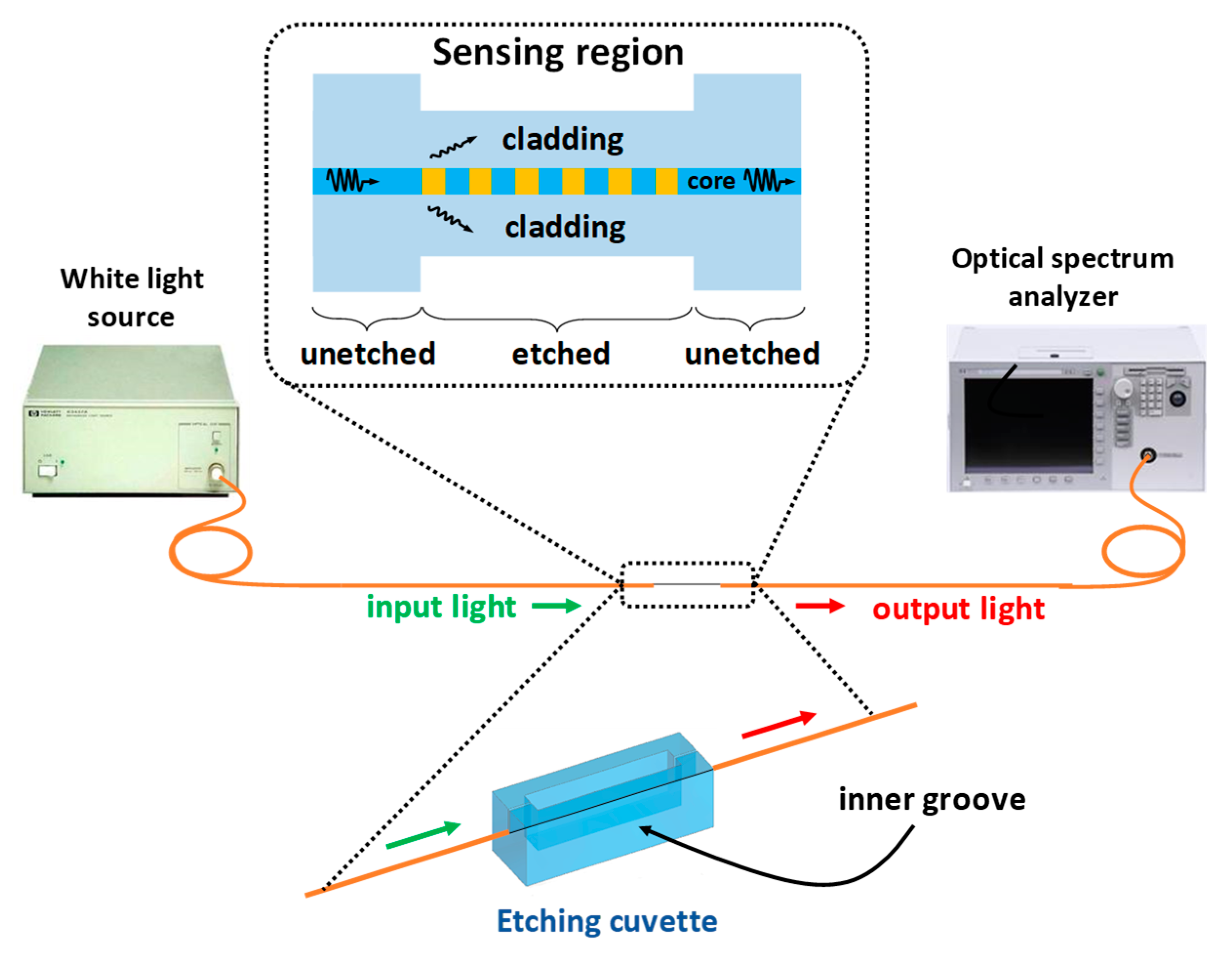
In Figure 1 the experimental setup is depicted. Light from a broadband source (Agilent 83437A) is launched into one end of the fiber where the grating is written. The second end is connected to an Agilent 86140B optical spectrum analyzer, which monitors the transmission spectrum.
Figure 1. Experimental setup.
Two devices were explored. For the first one a grating of period 192 µm was written in the core of PS1250/1500 photosensitive fiber of diameter 125 µm from Fibercore, whereas for the second one a grating of period 210 µm was written in the core of a SM125(9/80) fiber of diameter 80 µm from Fibercore. The length of device 1 was 19 mm, whereas the length of device 2 was 7.5 mm. The purpose of comparing two fibers of different diameter was to observe if a better performance is observed for the device with diameter 80 μm, because less imperfections during the etching process should be induced than in a standard fiber with 125 μm diameter. The fiber is introduced in a cuvette with two narrow grooves that permit the hydrofluoric acid introduced in it to attack the fiber and not to escape from the cuvette. The fiber must be maintained straight during the etching process.

3. Results

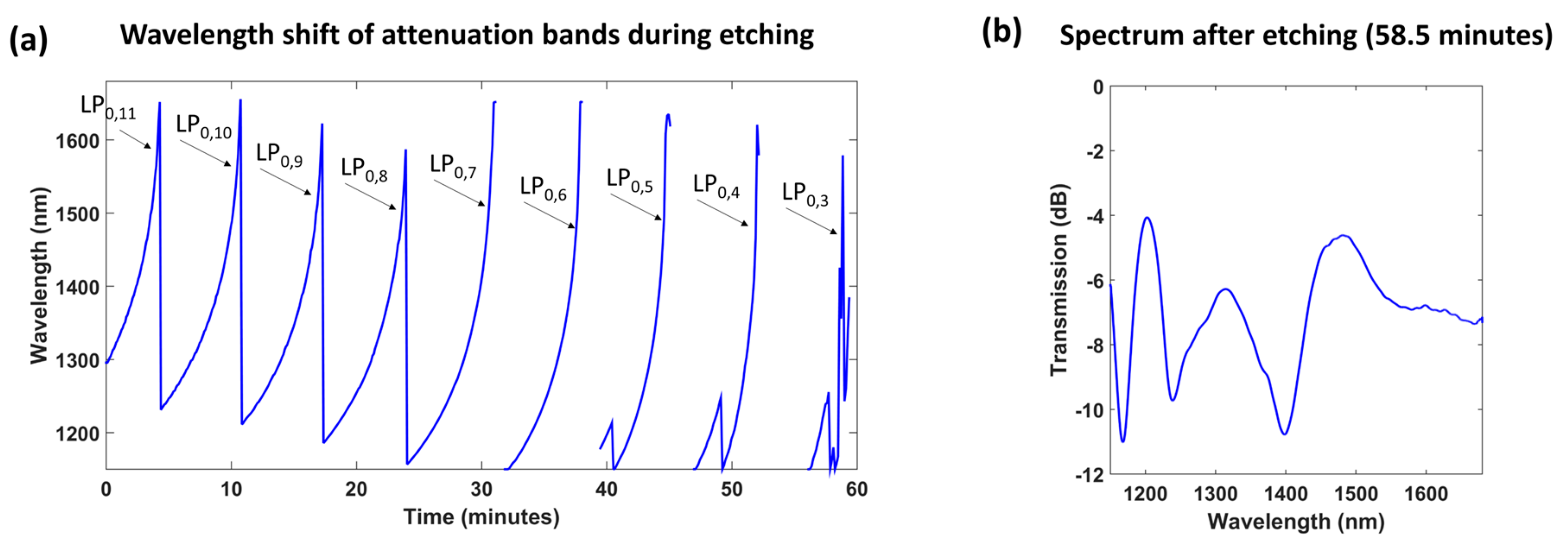
In Figure 2a, the resonance wavelength (minimum transmission) is tracked with a Matlab based algorithm during the etching process of an LPFG of period 192 µm and diameter 125 µm. The spectrum nearly at the end of the etching process (minute 58.5) is shown in Figure 2b. Several attenuation bands are present at the final spectrum (coupling to LP0,3 mode). This agrees with the zig-zag shift corresponding to LP0,3 attenuation band in Figure 2a. However, in view that the dispersion turning point of this LPFG is centered around 1600–1700 nm, only the left band should be visible. This problem can be avoided with an etching process that departs from an LPFG in a fiber of 80 µm diameter.
Figure 2. (a) Tracking of the attenuation bands in an LPFG with initial diameter 125 µm during etching process; (b) Spectrum at minute 58.5 corresponding with coupling to LP0,3 cladding mode (the left band of the DTP is spread into three bands).
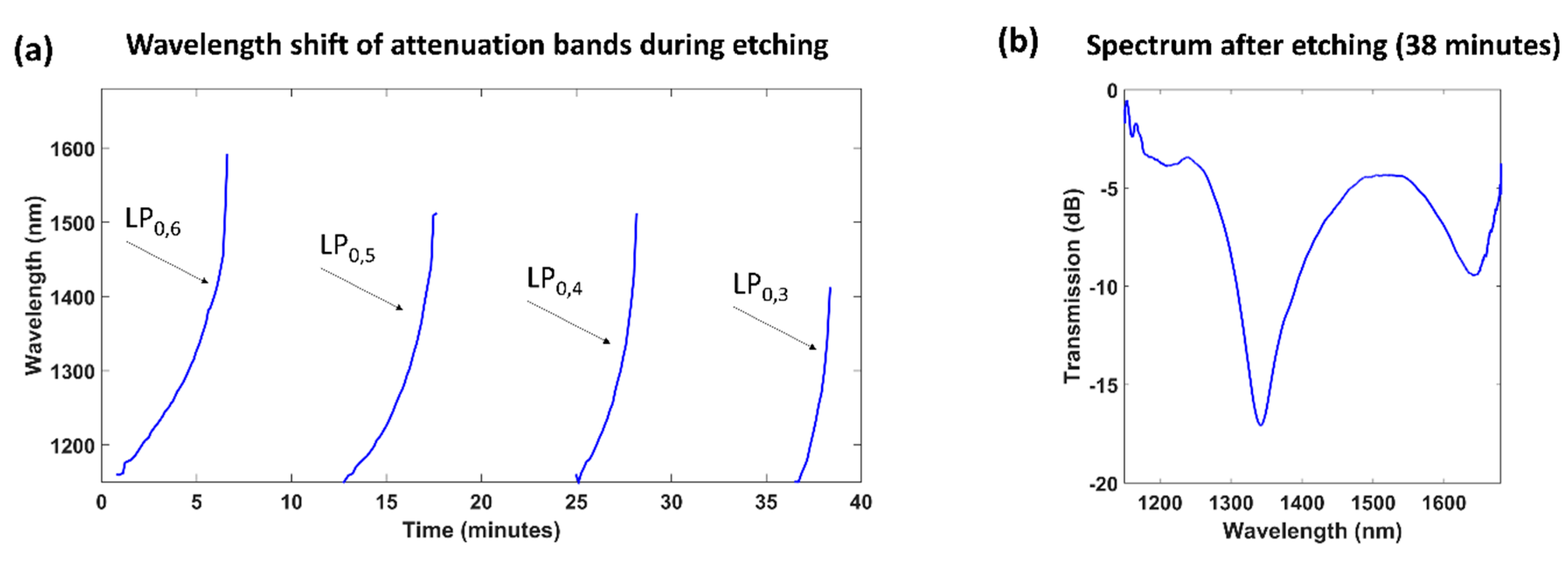
The period used for this LPFG was 210 µm, (DTP is centered around 1500–1600 nm). No zig-zag shift is observed during the etching process in Figure 3a. Moreover, the spectrum at the end of the etching process is shown in Figure 3b, where no additional bands apart from the left and right band of the DTP are created. This indicates that the etching process is more uniform.
Figure 3. (a) Tracking of the attenuation bands in an LPFG with initial diameter 80 µm during etching process; (b) Spectrum corresponding with coupling to LP0,3 (no spreading of the left and right attenuation band of the DTP is observed).
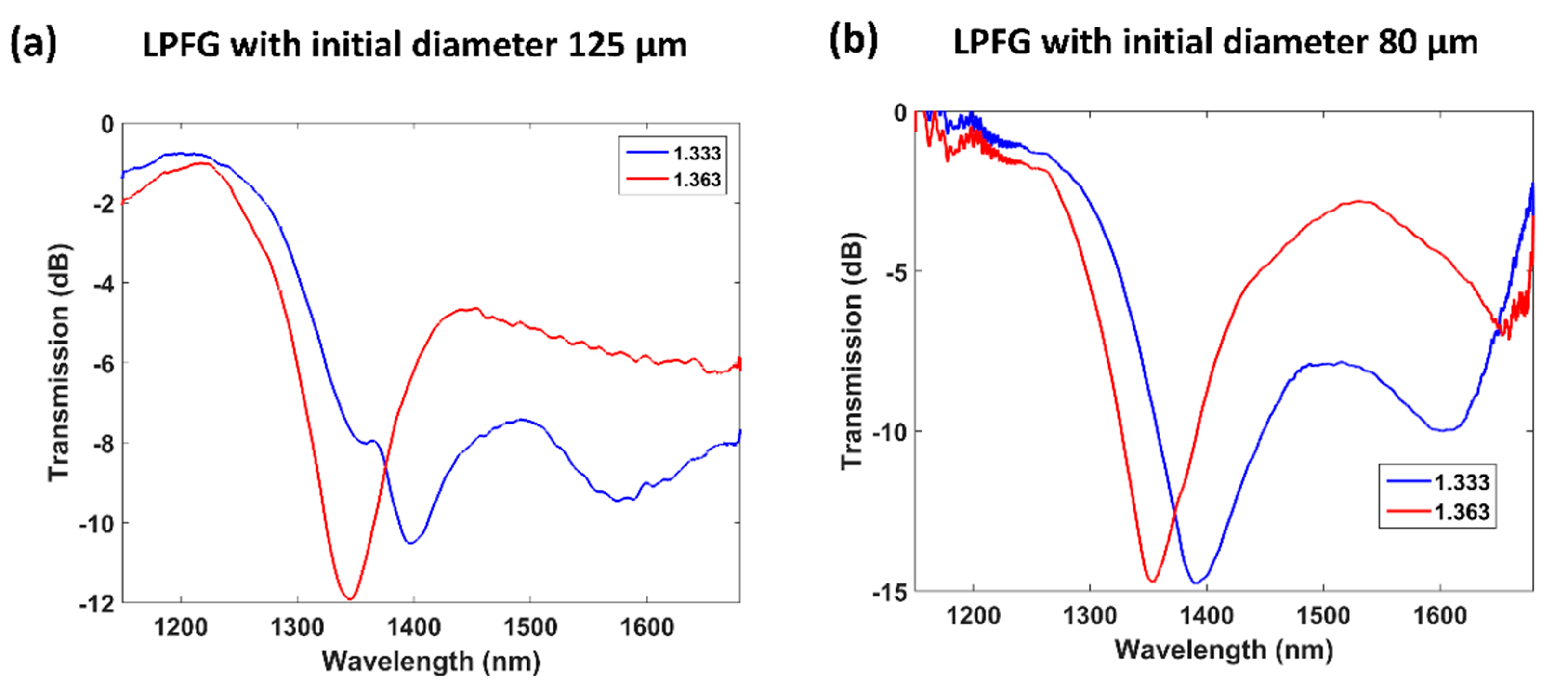
In Figure 4 we compare the sensitivity of the LPFG with initial diameter 80 µm with the sensitivity of the LPFG with initial diameter 125 µm. To this purpose, the LPFG was etched up to a diameter that is close to the DTP. In Figure 4a there is still one band at 1400 nm and a lateral band at 1575 nm due to the not perfect etching with this structure. Nonetheless, the wavelength shift that can be observed from water (refractive index 1.321) to 20% glycerol solution (1.351), is 53 nm (1767 nm/RIU) in the 125 µm fiber and 36.5 nm (1217 nm/RIU) in the 80 µm fiber, which indicates the ability of both structures to be used as refractive index sensor with high sensitivity; more than two times higher than that obtained with soft etched optimized LPFGs working at DTP [7].
Figure 4. Wavelength shift as a function of refractive index for both 125 and 80 µm LPFGs.

4. Discussion and Conclusions

The results presented here prove that it is possible to etch LPFGs with hydrofluoric acid up to the moment when the attenuation band corresponding to LP0,3 is visible in the optical spectrum. According to [5,6] this band is present for a cladding diameter of 30 µm. LP0,2, the last band that can be monitored, could be observed with a higher etching. However, the fiber is so thin that this may compromise the stability of the measurements. That is why it was decided to stop at LP0,3, where a high sensitivity is obtained without a compromise in the stability of the measurements.
Two fibers of diameter 125 and 80 µm where compared and the etching process in the 125 µm device lead to the generation of several bands for each expected band. This effect is attributed to the fiber cross section, which is not completely round in a fiber reduced from 125 to 30 µm, as it has been proved in [8], whereas the etching from 80 to 30 µm is softer and, consequently, the double band in DTP mode (see Figure 4b) is visible without the interference of additional bands.
In any case the sensitivity of the bands obtained with both fibers of cladding diameter 125 and 80 µm is similar, which indicates that both devices can be used for sensing purposes, especially in the domain of chemical and biological sensors, where a high sensitivity is required.

Acknowledgments

This work was supported by the Spanish Agencia Estatal de Investigación (AEI) and Fondo Europeo de Desarrollo Regional (FEDER) TEC2016-78047-R and by the Government of Navarre through its projects with references: 2016/PI008, 2016/PC025 and 2016/PC026.

Conflicts of Interest

The founding sponsors had no role in the design of the study; in the collection, analyses, or interpretation of data; in the writing of the manuscript, and in the decision to publish the results.

References

  1. Del Villar, I.; Achaerandio, M.; Matías, I.R.; Arregui, F.J. Deposition of overlays by electrostatic self-assembly in long-period fiber gratings. Opt. Lett. 2005, 30, 720–722. [Google Scholar] [CrossRef] [PubMed]
  2. Cusano, A.; Ladicicco, A.; Pilla, P.; Contessa, L.; Campopiano, S.; Cutolo, A.; Ciordano, M. Mode transition in high refractive index coated long period gratings. Opt. Express 2006, 14, 19–34. [Google Scholar] [CrossRef] [PubMed]
  3. Shu, X.; Zhang, L.; Bennion, I. Fabrication and characterisation of ultra-long-period fibre gratings. Opt. Commun. 2002, 203, 277–281. [Google Scholar] [CrossRef]
  4. Śmietana, M.; Koba, M.; Mikulic, P.; Bock, W.J. Towards refractive index sensitivity of long-period gratings at level of tens of µm per refractive index unit: Fiber cladding etching and nano-coating deposition. Opt. Express 2016, 24, 11897. [Google Scholar] [CrossRef] [PubMed]
  5. Del Villar, I.; Cruz, J.L.; Socorro, A.B.; Corres, J.M.; Arregui, F.J.; Matias, I.R. Sensitivity optimization with cladding-etched long period fiber gratings at the dispersion turning point. Opt. Express 2016, 24, 1240–1245. [Google Scholar] [CrossRef] [PubMed]
  6. Del Villar, I. Ultrahigh-sensitivity sensors based on thin-film coated long period gratings with reduced diameter, in transition mode and near the dispersion turning point. Opt. Express 2015, 23, 2808–2813. [Google Scholar] [CrossRef] [PubMed]
  7. Chiavaioli, F.; Biswas, P.; Trono, C.; Bandyopadhyay, S.; Giannetti, A.; Tombelli, S. Biosensors and Bioelectronics Towards sensitive label-free immunosensing by means of turn-around point long period fi ber gratings. Biosens. Bioelectron. 2014, 60, 305–310. [Google Scholar] [CrossRef] [PubMed]
  8. Cardona, Y.; Del Villar, I.; Socorro, A.B.; Corres, J.M.; Matias, I.R.; Botero-Calavid, J.F. Wavelength and phase detection based SMS fiber sensors optimized with etching and nanodeposition. J. Light. Technol. 2017, in press. [Google Scholar] [CrossRef]
Publisher’s Note: MDPI stays neutral with regard to jurisdictional claims in published maps and institutional affiliations.

Article Metrics

Citations

Article Access Statistics

Multiple requests from the same IP address are counted as one view.