1. Introduction
Flowing waters are characterized by a continuous downstream transfer of energy and nutrients, with the dominant sources of organic matter shifting along the stream course. In headwater reaches, allochthonous organic matter, such as leaf litter from riparian vegetation, plays a central role. This coarse particulate organic matter is fragmented by invertebrate shredders and microbially conditioned, forming fine detritus that is transported downstream. In middle reaches, increased light availability enhances autochthonous primary production (e.g., algae and periphyton), which becomes the primary energy source for benthic food webs [
1,
2].
While benthic functional groups typically shift along the longitudinal gradient, certain headwater specialists, such as the freshwater pearl mussel, rely on specific energy pathways. As a suspension feeder in oligotrophic upper reaches, it is primarily dependent on the limited supply of fine particulate organic matter (FPOM) and microbially conditioned detritus exported from the surrounding watershed and riparian zones [
3,
4]. Detritus, a particulate material primarily composed of dead organic matter, is typically colonized by bacteria and fungi that decompose complex polymers into more accessible compounds, thereby increasing its nutritional value for consumers [
5,
6,
7]. In addition to heterotrophic microorganisms, algae contribute substantially to detrital food resources by providing essential compounds such as vitamins, phytosterols, and long-chain polyunsaturated fatty acids, which have been detected in the gut contents of freshwater mollusks [
8]. These primary producers often occur in particularly high densities on FPOM (<1 mm), where the large surface-to-volume ratio promotes microbial colonization and nutrient retention. Consequently, FPOM functions as a reservoir of essential nutrients for detritivores, and the nutritional quality of detritus largely determines the performance and success of suspension and deposit feeders [
9].
Nutritional constraints associated with detritus quality are not uniform across life stages. While adult detritivores are often less sensitive to short-term variation in food quality, early developmental stages, such as mayfly nymphs [
10], juvenile mussels [
3,
11,
12], and midge larvae [
13,
14], are particularly vulnerable to nutrient-poor detritus. These stages have elevated metabolic demands driven by rapid growth and development. While a high C:N ratio is a common indicator of low nutritional quality, it often fails to reflect the actual availability of digestible nitrogen. A deficiency in specific nitrogenous compounds, such as proteins and free amino acids, limits the resources required for protein synthesis and slows biomass accumulation [
15,
16,
17]. This results in delayed development and prolongs the “window of vulnerability,” during which juveniles remain exposed to predation [
18]. Poor nutritional conditions during early life stages can also lead to smaller and structurally weaker adults [
19]. When detritus is nutritionally poor, detritivores often compensate by increasing gut passage rates, processing large volumes of sediment to meet their nutritional requirements. This strategy is energetically inefficient and effectively results in starvation despite a full digestive tract [
20,
21]. Moreover, increased ingestion of sediment enhances exposure to detritus-bound contaminants such as heavy metals or pesticides, even during short-term pollution events [
22,
23,
24].
As key components of the detrital food web, detritivores provide key ecosystem services by driving nutrient cycling, maintaining benthic food-web structure, and preventing the accumulation of organic waste [
25,
26]. Nutrients concentrated in FPOM are transformed into less mobile forms through the production of feces and pseudofeces, making them readily available to other benthic organisms in the immediate vicinity, including microorganisms and higher trophic levels such as predatory invertebrates and fish [
27]. Furthermore, by incorporating nutrients into their biomass and shells, they act as temporary nutrient sinks that gradually release elements after death, providing a form of long-term fertilization [
28,
29]. Owing to their sensitivity to environmental conditions and resource quality, detritivore communities are widely regarded as indicators of water quality and overall ecosystem health [
25,
30].
Approaches for assessing the ecotoxicological effects of pollutants, including nutrient-related contamination from agriculture and other anthropogenic activities [
31,
32], can broadly be divided into traditional methods, such as laboratory bioassays and biotic indices, and modern techniques, such as molecular biomarkers and environmental DNA. While eDNA and biotic indices are effective for tracking long-term community shifts [
33,
34,
35], they are less sensitive to the rapid, short-term fluctuations in resource chemistry. In particular, these methods fail to capture the high temporal variability of detritus nutritional quality, which is shaped by factors such as vegetation phenology, temperature, hydrological regime, rainfall events, and drought periods.
Although detrital quality is also influenced by lipids, phosphorus, and mineral availability [
20,
21,
22,
23,
24,
25,
26,
27,
28], the present study focuses specifically on primary amines-related indicators because they provide a sensitive measure of bioavailable nitrogen relevant to detritivore nutrition. Unlike bulk nitrogen, which aggregates recalcitrant and mineral-bound fractions, free and extractable amino acids represent the directly assimilable nitrogen pool that governs heterotrophic production, microbial conditioning, and consumer growth [
36,
37]. However, their quantification in environmental matrices remains challenging: hydrolysis-based protocols are time-consuming and destroy labile species; HPLC methods with pre-column derivatization require extensive sample cleanup; and commercial kits are often cost-prohibitive for long-term, high-frequency monitoring [
38,
39]. Furthermore, co-extracted humic substances and matrix ions commonly interfere with fluorimetric and electrophoretic detection, limiting throughput and reliability [
40,
41]. The methods optimized here, OPA-based fluorimetry for rapid bulk quantification and CE-C4D for label-free speciation, are specifically designed to overcome these limitations, providing an affordable, scalable framework suitable for routine ecological monitoring.
In this study, we report on the optimization of two complementary approaches targeting amino acid-related indicators of detrital nutritional quality, namely total extractable primary amines quantified by OPA-based fluorimetry and free amino acids resolved by CE-C4D. By refining these methodologies, we propose a robust and affordable analytical framework for characterizing detrital nutritional quality. These methods are specifically designed for high-frequency sampling and long-term monitoring, thereby addressing a critical gap in current aquatic ecosystem assessment frameworks.
2. Materials and Methods
2.1. The Detritus Sampling and Processing
Benthic detritus was collected from three distinct sites: B1 (Blanice River headwaters, 840 m a.s.l.), B6 (Zbytinský Stream, 770 m a.s.l.), and V20 (upper Vltava River, 730 m a.s.l.). Site B6 is located near the confluence of the Zbytinský Stream and the Blanice River, approximately 6.5 km downstream from B1, while V20 is situated in the upper reaches of the Vltava River catchment. Exact coordinates are available upon reasonable request because the sites are located within protected areas. A comprehensive description of the study region is provided by ref. [
42]. Samples were extracted from the riverbed using a 100 mL syringe, decanted into a plastic bucket, and filtered through a 1 mm mesh sieve to isolate the fine detrital fraction. Following transport to the laboratory at 4 °C, samples were frozen and subsequently freeze-dried overnight using a Lyovac GT 2 lyophilizer (Finn-Aqua, Tuusula, Finland). The resulting lyophilized material was stored at 4 °C until analysis. Detritus samples represent composite material collected from a broader area within each site, where detritus occurs as a thin and spatially heterogeneous layer. Each sample therefore reflects an integrated snapshot of local conditions rather than independent biological replicates. Due to this sampling design and the limited number of sampling events (
n = 9), formal statistical comparisons among sites or seasons were not performed; results are instead reported as concentrations normalized to detrital dry weight.
2.2. Meteorological and Hydrological Records
Hydrological and meteorological data were obtained from repository of Czech Hydrometeorological Institute available at
https://opendata.chmi.cz (accessed on 11 March 2026). IDs of rain and water gauge stations in the vicinity of sampling sites: C1VOLR01 (rg1), C1JELE01 (rg2), C1KTIS01 (rg3), 107,000 (wg1), 108,000 (wg2), 145,000 (wg3).
2.3. Primary Amine Determination
OPA-based fluorimetry relies on the rapid reaction of o-phthalaldehyde with primary amines in the presence of a thiol under alkaline conditions to form a highly fluorescent 1-alkylthio-2-alkylisoindole derivative, enabling sensitive bulk quantification without chromatographic separation [
39].
Unless stated otherwise, 1 mL of 2 M KCl was added to 50 mg of lyophilized detritus. The mixture was incubated for 1 h at 30 °C under continuous agitation at 1200 rpm. Detritus particles were subsequently pelleted by centrifugation for 2 min at 13,400 rpm (MiniSpin benchtop centrifuge, Eppendorf, Hamburg, Germany), and the supernatant was collected and stored at 4 °C until further analysis.
The o-phthalaldehyde (OPA) reagent (OPA 0.25 g L
−1, 2-mercaptoethanol 0.5 mL L
−1, Na
2B
4O
7·10H
2O 7.62 g L
−1, pH 9.5) was prepared at least 12 h prior to use and stored in the dark at 4 °C. Derivatization of primary amines was performed in a white flat-bottom 96-well microplate based on [
39,
43]. Each well received 10 µL of sample or 2 M KCl (reagent blank), followed by 10 µL of alanine standard at concentrations of 0, 10, or 100 µM in 2 M KCl. Subsequently, 200 µL of OPA reagent was added and fluorescence was measured after 3 min (excitation/emission: 340/455 nm; excitation/emission bandwidth: 9/20 nm; gain: 60%) using an Infinite M200 Pro plate reader (Tecan, Zürich, Switzerland).
A linear calibration curve was constructed by plotting fluorescence intensity against alanine concentration, and the primary amine concentration in the original sample was calculated as:
To prevent erroneous quantification arising from fluorescence quenching due to matrix effects, samples whose calibration slope deviated significantly from that of the reagent blank were excluded from quantification, diluted, and re-analyzed. All fluorescence measurements were performed in quadruplicate. Reproducibility was verified by comparing technical replicates from a single extract with replicates from independently prepared extracts of the same detritus sample, which yielded statistically indistinguishable results. Occasional outliers excluded by Grubbs’ test (α = 0.05) [
44] were attributed to pipetting variability or partial sample retention on the microplate well walls rather than to intrinsic method variability, as they did not reappear upon re-measurement.
To accommodate the time-dependent kinetics of the OPA derivatization reaction, each analytical run was restricted to a maximum of 24 wells, typically comprising two independent standard series (three alanine concentrations each) alongside six sample series spiked with standards at the same three concentrations. Each of the four replicates was processed as a separate batch, with the derivatization reaction initiated independently. Internal consistency was verified by confirming that (i) the two standard curves within a single run did not deviate significantly and (ii) the quantification results obtained from independent replicates were reproducible.
2.4. Determination of Free Amino Acids
Free amino acids were determined by capillary electrophoresis with contactless conductivity detection (CE-C4D), which separates protonated amino acids in an acidic background electrolyte and detects them via changes in solution conductivity, eliminating the need for derivatization or optical labeling [
45].
1 mL of 0.8 M (NH4)2CO3 was added to 50 mg of lyophilized detritus. The mixture was incubated for 1 h at 30 °C under continuous agitation at 1200 rpm. Detritus particles were subsequently pelleted by centrifugation for 2 min at 13,400 rpm (MiniSpin benchtop centrifuge, Eppendorf, Hamburg, Germany). 600 µL of the supernatant was collected, evaporated to dryness under vacuum (CentriVap concentrator, Labconco, Kansas, MO, USA), and stored at −20 °C until further analysis.
The experiments were conducted in a fused-silica capillary of 50 µm i.d., 375 µm o.d., 80.0 cm total and 71.5 cm effective length (Polymicro Technologies, Phoenix, AZ, USA) using a G7100A Capillary Electrophoresis System (Agilent Technologies, Waldbronn, Germany) with the TraceDec contactless conductivity detector (Innovative Sensor Technologies, Strasshof, Austria). The background electrolyte consisted of 1.6 M acetic acid and 0.1% hydroxyethylcellulose. The separation voltage was 30 kV with a current of approx. 11 µA; the temperature was set to 25 °C, and the samples were injected using a pressure of 5 kPa for 30 s, unless otherwise stated. Between individual runs, the capillary was flushed with the background electrolyte for 4 min, and a voltage of 30 kV was applied for 2 min before the sample injection.
Prior to analysis, dried amino acid extracts were reconstituted in 100 µL of deionized water, sonicated for 10 min, and then centrifuged at 13,400 rpm for 10 min (MiniSpin benchtop centrifuge, Eppendorf, Hamburg, Germany). 50 µL of supernatant was pipetted into an electrophoretic sample vial, and 5 µL of 0.5 mM Bis-Tris hydrochloride (internal standard) was added. To identify the peaks, the samples were supplemented with a mixture of proteinogenic amino acid standards at 26 µmol L−1 each.
2.5. Limits of Detection and Quantification
For OPA-based fluorimetry, the LOD and LOQ were calculated from the uncertainty of the intercept difference between the sample and reagent blank calibration lines, which directly determines the estimated concentration:
where b is the common calibration slope, s
B,0 and s
S,0 are the standard deviations of fluorescence intensities at zero alanine addition for the reagent blank and sample series, respectively, and n
B, n
S are the corresponding numbers of replicates.
For CE-C4D, the LOD and LOQ were determined from the signal-to-noise ratios of individual amino acid peaks in spiked detritus extracts, defined as the concentrations yielding S/N = 3 and S/N = 10, respectively. Values are reported both as molar concentrations in the injected sample and as equivalent amounts per gram of lyophilized detritus, accounting for the extraction and concentration factors.
2.6. Elemental Analysis
Total carbon (C), nitrogen (N), and sulfur (S) contents were determined by high-temperature combustion using an elemental analyzer at the Institute of Rock Structure and Mechanics of the Czech Academy of Sciences, Prague. Total phosphorus (P), calcium (Ca), and iron (Fe) concentrations were quantified via Inductively Coupled Plasma Optical Emission Spectrometry (ICP-OES) following microwave-assisted acid digestion at T.G. Masaryk Water Research Institute, Prague. The results are expressed as mg g−1 dry weight.
3. Results and Discussion
3.1. Detrital Primary Amine and Free Amino Acid Quantitation
Stream detritus represents a critical nutritional resource for detritivores, with its free amino acid pool serving as a highly bioavailable N source that directly influences consumer fitness and nutrient cycling [
46]. To our knowledge, the specific pool of extractable free amino acids in sedimented stream detritus has not been previously studied; however, based on reports of hydrolysable amino acids in riverine particulate matter [
47], it may be suggested that free amino acid levels in these matrices are closer to nutrient-poor environments such as soil—frequently containing only nmol g
−1 dry weight levels of extractable free amino acids [
48,
49]. This stands in contrast to richer biological matrices, such as plant tissues containing units of μmol g
−1 dry weight [
50,
51] or plasma with tens of μmol g
−1 dry weight [
52].
The choice of OPA-based fluorimetry was driven by the need for extreme sensitivity. Most proteinogenic amino acids lack native chromophores or fluorophores, making direct optical detection at trace levels unfeasible. OPA reacts rapidly with primary amines in the presence of 2-mercaptoethanol to form highly fluorescent isoindole derivatives, providing the signal amplification necessary for nanomolar-scale quantitation [
53], or even femtomolar levels in matrix-free standards [
54]. While both the quantification of individual amino acids via precolumn derivatization and HPLC separation with fluorescence detection [
38,
55] and rapid bulk assays for total amino acids are possible, including simple mix-and-read formats well-suited for high-throughput measurements in microplates [
39], bulk determination represents the more robust approach when the quantification of individual species is not required, as it avoids the significant propagation of uncertainty that occurs when reconstructing a total pool from multiple separate measurements [
56].
OPA reacts not only with free amino acids but also with other primary amines, including peptides, amino sugars, biogenic amines, and ammonium, although these compounds are typically less abundant or exhibit different reaction kinetics [
57,
58]. To confirm that the determined amino acid quantities were not significantly influenced by the presence of these interfering species, we employed an alternative analytical approach based on a distinct physical principle.
Complementing the fluorimetric assay, CE-C4D was utilized as a label-free, “universal” detection method for ionic species. C4D responds to the intrinsic conductivity of migrating ions, enabling the speciation of small, polar amino acids without the need for chemical modification [
59]. A key advantage of the contactless configuration for detrital samples is that the electrodes do not come into direct contact with the sample, preventing electrode polarization and electrochemical degradation, common issues when analyzing complex environmental extracts with high loads of co-extracted organic matter or salts [
60]. Furthermore, this approach is not subject to matrix-induced variability in derivatization efficiency and does not exhibit the amino-acid-dependent response differences inherent to OPA-based methods [
61]. OPA-based fluorimetric determination and CE-C4D differ fundamentally in their susceptibility to analytical interferences. The OPA assay is additionally sensitive to optical matrix effects caused by co-extracted chromophoric organic matter, which can lead to fluorescence quenching or non-linear responses if not carefully controlled [
39,
40,
41,
53,
61]. Possible interferences in CE-C4D arise primarily from electrophoretic co-migration of analytes with matrix ions of similar mobility, which may complicate resolution of individual amino acids in complex extracts [
60,
62,
63]. The fundamentally different interference mechanisms of the two techniques, together with their good quantitative agreement in this study, indicate that amino acids constitute the dominant fraction of the extractable primary amine pool, while highlighting the complementarity of OPA fluorimetry for rapid bulk assessment and CE-C4D for interference-resilient, compound-resolved analysis.
Our approach differs fundamentally from established techniques. Hydrolysable amino acid analysis captures total protein-bound amino acids after acid hydrolysis but destroys information on the labile, extractable fraction most relevant to short-term bioavailability [
64,
65]. Colorimetric protein assays (e.g., Bradford, Lowry) quantify bulk protein but are strongly biased by humic interference and matrix-dependent response factors [
66]. DOM characterization techniques (fluorescence EEM, FT-ICR-MS) provide valuable compositional fingerprinting but lack quantitative resolution for specific nutrient classes [
67,
68]. By targeting the extractable free amino acid and primary amine pool, our methods occupy a complementary analytical niche: quantitative, sensitive to short-term dynamics, and directly linked to bioavailable nitrogen.
3.2. Optimization of Extraction for the OPA Method
Initially, we evaluated whether extraction reagents commonly used for soil protein characterization [
69] could also be utilized for the OPA-based determination of primary amines. The goal was to determine if a single extract could be split and used for multiple biochemical assays, thereby streamlining the characterization of different aspects of the detrital samples.
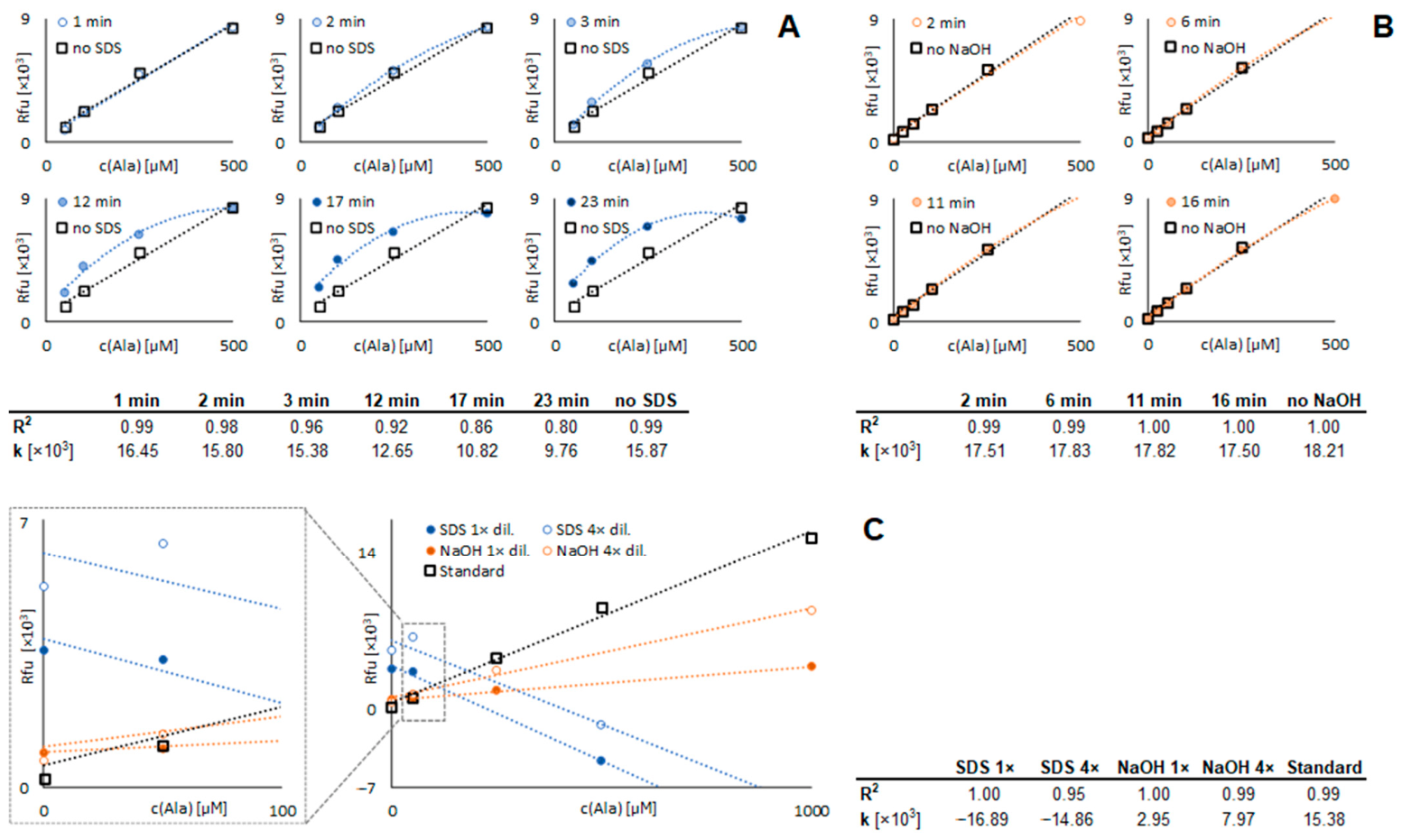
The first reagent tested, an SDS-containing buffer (100 mM Tris-HCl, 2% (
w/
v) SDS, pH 6.8), caused significant time-dependent fluctuations in the fluorescence of the alanine standard (
Figure 1A), rendering reliable quantification unfeasible. This instability likely reflects interference of the surfactant with the OPA derivatization reaction. SDS is known to form micelles that create a micro-heterogeneous environment with altered local polarity and dynamics relative to bulk water, which can modify fluorescence intensity/decay properties of solutes and probes and thereby impact fluorescence-based measurements [
70,
71]. Accordingly, surfactant-driven micellization can perturb fluorescence readouts in biochemical systems by changing probe partitioning and microenvironment, potentially leading to time-dependent or non-linear responses [
72].
The second reagent, 0.1 M NaOH, performed considerably better in terms of signal stability; basic conditions are known to accelerate the formation and stabilization of the fluorescent OPA-amine derivative [
73]. Indeed, the fluorescence signal of the pure standard remained stable throughout the 16 min observation window (
Figure 1B). However, when applied to detrital samples (
Figure 1C), this alkaline environment simultaneously promotes the solubilization of humic and fulvic substances. These molecules contain acidic functional groups (primarily carboxylic and phenolic groups) that facilitate their association with the detritus matrix at lower pH. Under alkaline conditions, deprotonation of these groups increases their solubility, releasing a high concentration of chromophoric dissolved organic matter into the extract and significantly increasing its absorbance. These species interfere with fluorescence measurements through inner filter effects and dynamic quenching [
40,
41]. While humic substances are the likely primary drivers, the contribution of other co-extracted components cannot be excluded as a potential cause, and the observed interference may reflect a combination of overlapping quenching and spectral processes.
Together, these results demonstrate two distinct modes of analytical interference: direct disruption of derivatization chemistry by SDS and indirect optical interference through co-extraction of chromophoric organic matter under alkaline conditions. In both cases, the fundamental requirement of a stable and linear fluorescence response is violated, rendering these extraction approaches unsuitable for detrital samples.
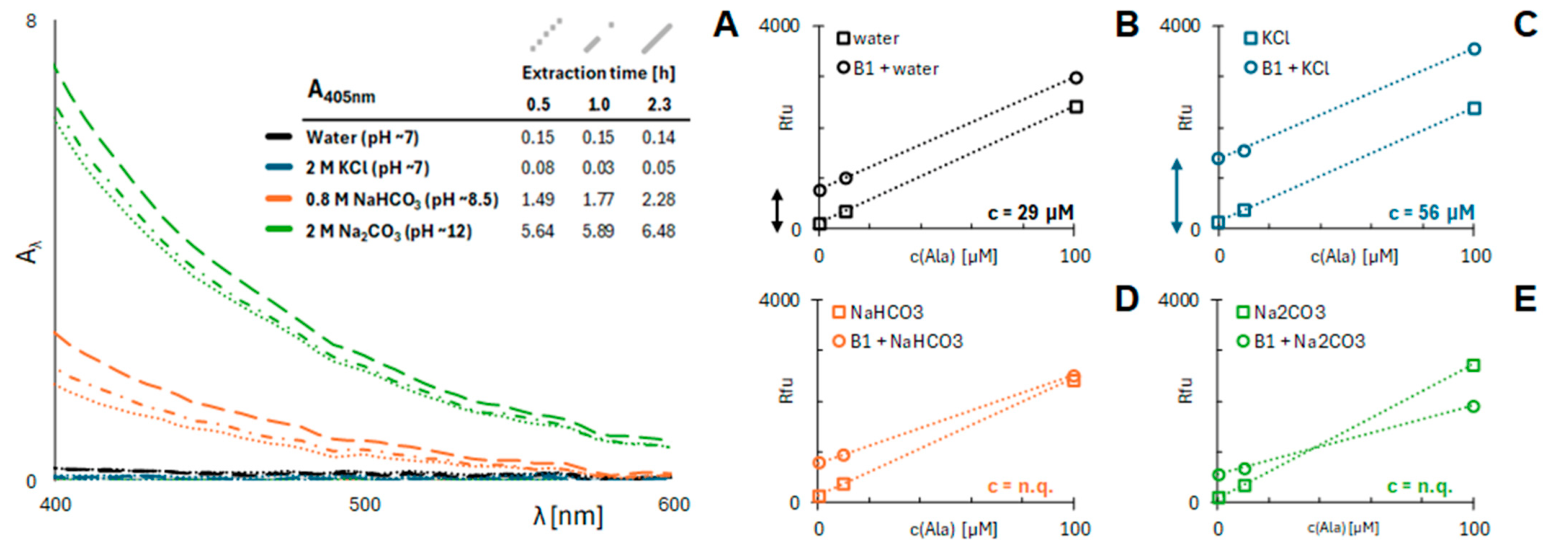
Given these limitations, we evaluated alternative extraction media spanning a range of ionic strengths and pH values, including water (pH ~7), 2 M KCl (pH ~7), 0.8 M NaHCO3 (pH ~8.5), and 2 M Na2CO3 (pH ~12). As observed for NaOH, alkaline solutions rapidly mobilized colored matrix components within the first 30 min, with only minor additional release thereafter. Notably, even the moderately alkaline NaHCO3 solution extracted substantial amounts of interfering chromophores despite its lower ionic strength. This indicates that pH, rather than ionic strength, is the dominant factor controlling the release of optically active compounds from detritus. This finding highlights a key trade-off in extraction design for environmental samples: conditions that maximize analyte solubilization may simultaneously increase co-extraction of interfering substances. In this case, increasing alkalinity enhances the dissolution of humic material, thereby compromising fluorescence-based detection despite potentially improving analyte recovery.
In contrast, the neutral, high-ionic-strength KCl solution extracted the lowest amount of chromophoric material (
Figure 2A), resulting in the highest and most stable fluorescence signals (
Figure 2B–E). Standard addition experiments further confirmed that calibration slopes for KCl and water extracts closely matched those of pure standards, indicating minimal matrix interference. By comparison, alkaline extracts showed pronounced deviations in slope, reflecting substantial signal distortion. While water extraction provided similarly low interference, its lower extraction efficiency suggests incomplete recovery of primary amines. Notably, this ionic-strength dependence is qualitatively consistent with river–estuary gradients, where dissolved free amino acids are often lower upstream at low salinity and higher near the saline river mouth [
74].
The superior performance of KCl can be attributed to its ability to promote the ion-exchange displacement of weakly bound solutes while maintaining neutral pH conditions that limit the dissolution of humic substances. This behavior is consistent with the long-standing use of KCl to operationally extract labile nitrogen pools (NH
4+, NO
3−) from soils and sediments, a practice established decades ago and still widely applied because it balances extraction strength with relative chemical selectivity [
75].
Because no analyte-free detritus matrix is available and pre-extraction spiking cannot reproduce the binding behavior of endogenous analytes [
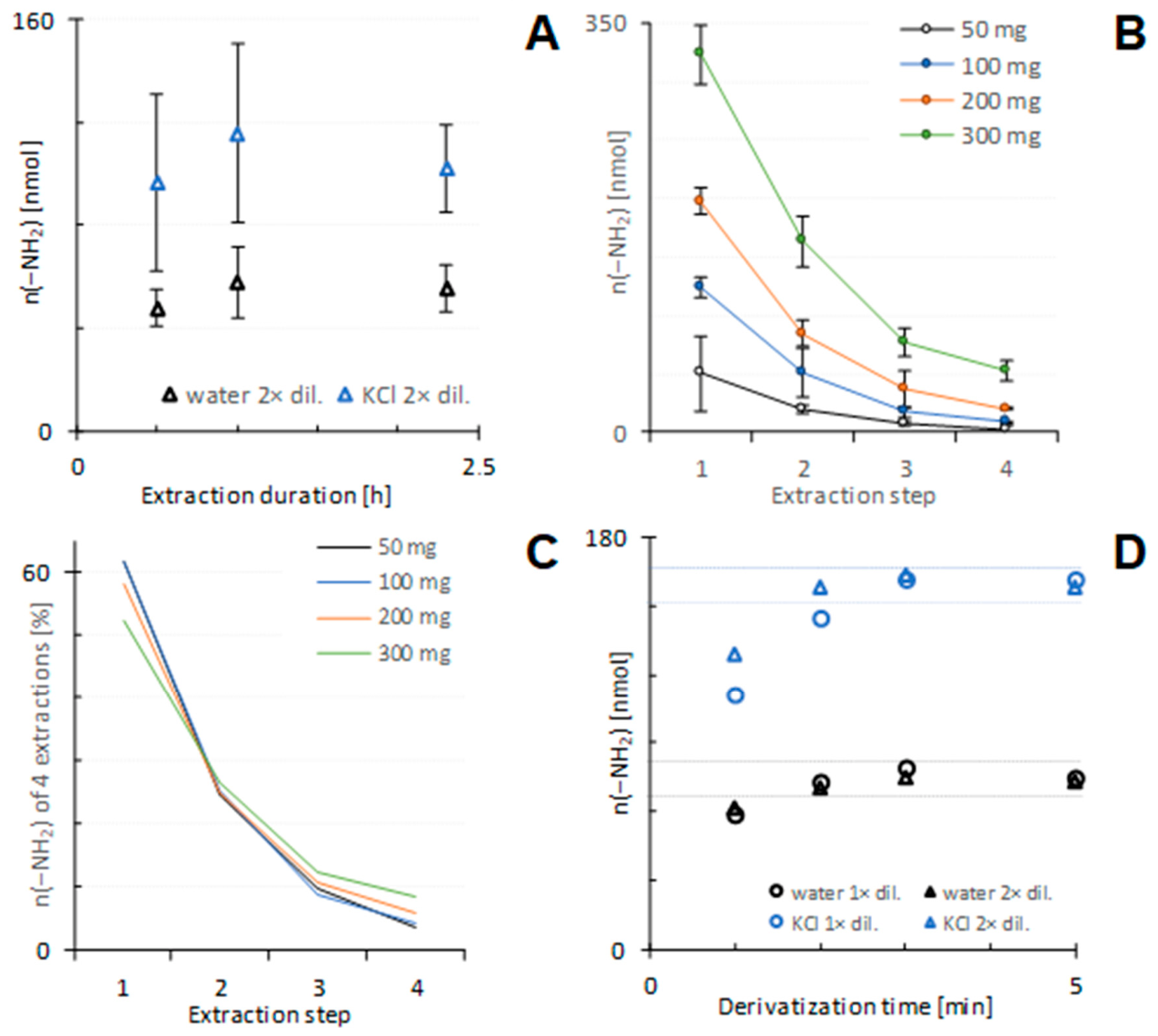
56], the cumulative yield of four sequential extraction steps was operationally defined as 100% of the extractable primary amine pool. On this basis, kinetic studies using 2 M KCl demonstrated that approximately 60% of this pool is released within the first hour (
Figure 3A,C), with the final (fourth) step contributing less than 10%. Residual amines could only be recovered through repeated extraction with fresh aliquots, and the yields remained proportional to the mass of detritus used (
Figure 3B). This extraction efficiency remained proportional to the mass of detritus used (
Figure 3B,C). Building on these extraction results, the derivatization reaction reached completion within 2–3 min, at which point concentrations from diluted and undiluted samples were statistically indistinguishable, confirming a linear analytical response. Shorter reaction times resulted in systematic underestimation and concentration-dependent bias (
Figure 3D). This timing aligns with the peak fluorescence observed for leucine standards in soil matrices [
39] and avoids the rapid signal flux characteristic of the 60 s protocols used for cleaner samples [
76,
77]. Although in ref. [
39] observed a slow post-peak decline, the fluorescence in our assay was stable for several minutes, ensuring reproducible measurements during microplate processing. Across 27 independent determinations, the median LOD and LOQ for OPA-based fluorimetry were 2.5 µM and 7.7 µM alanine equivalents in the extract, respectively. The LOQ exceeded 10 µM in only ~30% of cases, which corresponded to samples whose calibration slope deviated more noticeably from that of the reagent blank; in such cases, re-measurement at a more suitable dilution typically restored LOQ values below this threshold. These limits confirm that the method is sufficiently sensitive to detect primary amine concentrations in the range observed across all sampled detritus extracts.
3.3. Optimization of Extraction for CE-C4D Analysis
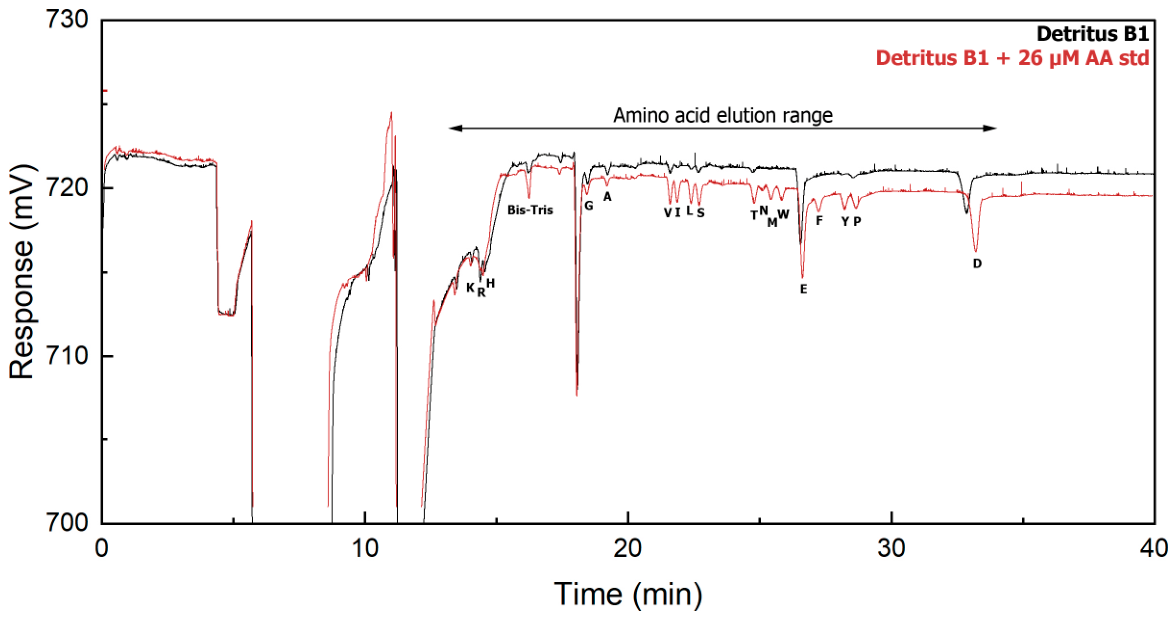
We evaluated extraction media commonly used as sample buffers in various electrophoretic techniques, including an SDS-free buffer from Red Native Electrophoresis, an SDS buffer typical for SDS-PAGE, and a multi-detergent RIPA-like buffer. The suitability of these reagents was screened based on two practical criteria: (i) baseline stability in CE-C4D and (ii) the number of amino acid peaks confirmed by standard addition (
Figure 4).
The SDS-free buffer yielded small peaks in the absence of standard addition, suggesting poor extraction efficiency compared to solutions containing detergents or salts, although it maintained a stable baseline. In contrast, the SDS buffer allowed for peak identification, but the baseline was significantly deformed, precluding reliable quantification. The multi-detergent buffer exhibited the poorest performance, characterized by an unstable baseline and a reduction in detectable peaks following standard addition (
Figure S1).
As shown in
Table 1, prolonged extraction with detergent-based buffers led to a decrease in the number of identified amino acids, particularly those with low peak areas near the limit of detection. This is likely due to the progressive leaching of matrix interferents during prolonged extraction, which accumulate over time and destabilize the baseline—an observation consistent with the time-dependent leaching of chromophoric components observed during NaOH extraction in the OPA method. The baseline instability induced by detergents may reflect their capacity to solubilize humic and fulvic acids, which are abundant in detrital matrices and possess acidic functional groups (carboxylic and phenolic) that become increasingly soluble under alkaline or surfactant-mediated conditions [
40]. While the SDS-free buffer avoided these baseline issues, its overall extraction yield was lower than that of the SDS-containing buffer, mirroring the findings from the OPA methodology where low-ionic-strength media were less effective at recovering amino acids than high-ionic-strength solutions.
This is consistent with our findings from the OPA methodology, where low-ionic-strength media were less effective at recovering amino acids than high-ionic-strength solutions. Consequently, all tested sample buffers were deemed unsuitable for detritus extraction, also mirroring our OPA results. We therefore expanded our screening to include acidic, basic, and high-ionic-strength media (
Table 2), notably including ammonium carbonate, (NH
4)
2CO
3, which is incompatible with the OPA method because ammonium ions react with the OPA reagent to form interfering fluorescent products.
While high-ionic-strength KCl would be ideal for direct comparison with the OPA method, it proved unsuitable for CE-C4D because the extract introduced a large excess of highly mobile ions, resulting in sample conductivity that far exceeded that of the background electrolyte. This severe conductivity mismatch caused pervasive baseline instability throughout the separation and produced a prominent baseline ‘step’ in the specific region where the analytes of interest migrate, effectively obscuring the target peaks (
Figure S2). Similarly, both organic formic acid and inorganic hydrochloric acid resulted in a low number of detectable amino acid peaks and were excluded from further use.
Interestingly, while basic extracts were incompatible with the OPA method due to the leaching of chromophore interferents, their impact was significantly less pronounced in the CE-C4D results. Under the optimized electrophoretic conditions, these matrix constituents possess different electrophoretic mobilities than the target amino acids, effectively resolving them from most peaks, except for a partial overlap with alanine.
Ultimately, (NH4)2CO3 emerged as the most suitable extraction medium, allowing for the reliable quantification of 17 proteinogenic amino acids. While glycine and alanine peaks occasionally overlapped with co-migrating matrix analytes, only cysteine remained undetected. Across these analytes, LOD ranged from 1.1 to 9.6 nmol/g, and LOQ was between 3.5 and 31.9 nmol/g of lyophilized detritus. When expressed as the molar concentration in the sample injected into the CE capillary, LOD and LOQ ranged from 0.5 to 4.3 µmol/L and from 1.6 to 14.5 µmol/L, respectively. The favorable performance of this extractant is likely attributed to its volatile nature; both ammonium and carbonate are removed during vacuum drying, thereby substantially reducing the residual ionic load of the final extract. This reduction in background conductivity presumably contributes to more stable current profiles during CE-C4D analysis. Although the basic extraction conditions promote the leaching of components that interfere with the OPA method, they do not compromise CE-C4D analysis because their electrophoretic mobilities fall outside the migration window of the target amino acids.
Optimization of the analytical conditions (
Figure S3) revealed that 0.4 M (NH
4)
2CO
3 provided the most effective extraction medium, as both higher and lower concentrations yielded a lower number of quantified amino acids. This contrasts with the OPA method, where extraction efficiency increased progressively with KCl concentration, reaching optimal performance at 2 M. In further contrast to the OPA method, it was necessary to concentrate the (NH
4)
2CO
3 extracts six-fold prior to CE-C4D analysis. When testing lower concentration factors (orange bars in
Figure S3), a significant underestimation of total amino acid content was observed across all tested molarities. Specifically, while these concentration levels should theoretically differ by a factor of three, the lower concentration yielded values 5–7.5 times lower than the more concentrated samples. Consistent with the OPA results, the amino acid content in the second extraction step (E2) was approximately 11–15% of that obtained in the primary extraction (E1). However, as with the less concentrated extracts, many amino acids in the E2 step approached the limit of detection, rendering these values semi-quantitative.
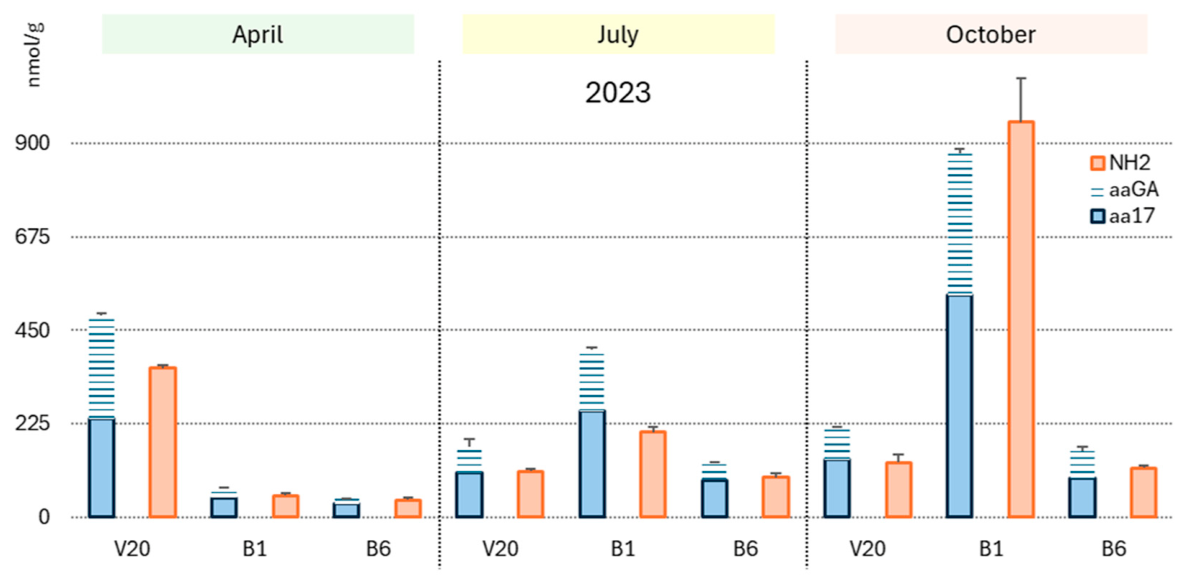
To evaluate whether the simpler OPA-based fluorimetric assay could serve as a reliable proxy for total amino acid content, we applied both optimized methods to detritus samples from three sampling seasons in 2023 and compared the results. Although the two analyte groups do not perfectly overlap, primary amines include non-proteinogenic species, biogenic amines, and polyamines, while the amino acid pool includes proline (a secondary amine not contributing to OPA fluorescence) and lysine (containing two amino groups, causing a twofold molar response), the results showed good agreement (
Figure 5), particularly when accounting for the quantification uncertainty of glycine and alanine.
These findings indicate that amino acids constitute the dominant fraction of primary amines in detritus, supporting the use of total primary amine determination as a simpler and more straightforward alternative to the more instrumentally demanding and analytically complex CE-based total amino acid quantification.
3.4. Detritus Sampling and Hydrological Context
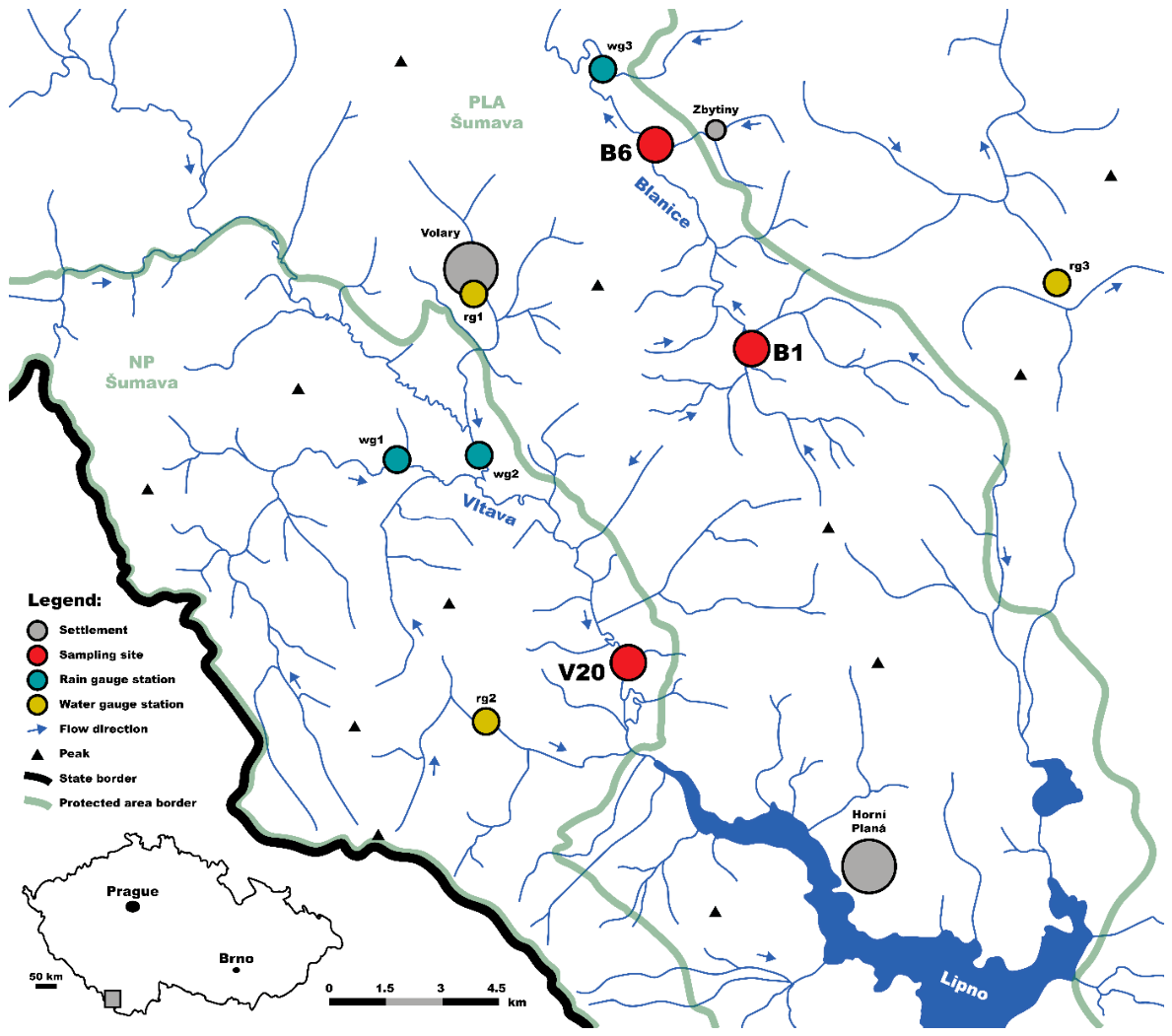
Benthic detritus was collected from three distinct localities within an 8 km radius in the protected areas of the Šumava Mountains. Sampling was conducted across different phenological phases (spring, summer, and autumn) over three consecutive years. To facilitate comparison, two sites were selected within the Blanice River catchment (B1 on the Blanice River and B6 on the Zbytinský Stream), while a third site on the Vltava River (V20) served as a reference located at a similar distance from B6 as B1 (
Figure 6). Characterizing the nutritional quality of detritus over long-term periods is challenging due to significant inter-annual shifts in vegetation phases driven by weather patterns. Furthermore, qualities of detritus samples can be influenced by stochastic events such as heavy rainfall or drought, which alter river discharge. To account for these variables, we monitored discharge at nearby gauging stations (wg1–wg3) during the 15-day interval preceding each sampling event and compared these data to 30-year historical minima and monthly means (
Figure 7). To complete this hydrological profile, we also tracked cumulative precipitation 15 days prior to sampling dates at nearby rain gauge stations (
Figure S4), confirming that rainfall events typically manifested as increased river discharge within a 1–2-day lag period.
This hydrological data provides a proxy for conditions at the sampling sites rather than an absolute measurement of local discharge. The relationship between gauging stations and sampling locations differs between the two catchments. In the Vltava catchment, site V20 is located downstream of two gauging stations (wg1 and wg2) situated on separate branches above their confluence. Consequently, discharge at V20 is expected to exceed the values recorded at either station due to the combined flow of both branches and additional tributary contributions between the gauges and the sampling point. In the Blanice catchment, both sampling sites (B1 on the Blanice River and B6 on a tributary) are located upstream of a single gauging station (wg3); therefore, local discharge at these sites is expected to be lower than the volumes recorded downstream at wg3. Furthermore, the longitudinal transport of detritus is influenced by channel morphology—including complexity, depth, and width—which may introduce temporal offsets between recorded discharge and in situ conditions at the sampling sites.
Discharge records indicate that during the spring of 2023 and 2025, summer 2024, and autumn 2025, flows remained near historical minimum with negligible fluctuations. In the smaller Blanice River, these stable, low-flow conditions likely resulted in reduced detrital input and export. In contrast, increased longitudinal movement of detritus was expected during high-flow events, such as in autumn 2024 or at wg2 in autumn 2025. Elevated discharge 5–10 days prior to sampling (summer 2023 and spring 2024) suggests a potential influx of detritus to site V20, whereas the same event likely triggered increased export from sites B1 and B6. Finally, the high-flow event occurring only 2–3 days before the summer 2024 sampling at V20 likely exerted a distinct, more immediate effect on detrital composition.
For benthic detritivores, resource availability of coarse or fine detritus—depending on their feeding specialization—at a given location is a key determinant of growth and survival. This availability depends first on local inputs, which include both relatively continuous contributions from the stream-bed and lateral inputs from the surrounding riparian zone, as well as more episodic, seasonally driven inputs such as leaf litter. These sources differ not only in magnitude but also in biochemical composition and to the extent to which they have been processed (e.g., by microorganisms), thereby influencing the baseline nutritional quality of detritus.
However, the accumulation and persistence of this material at a specific site are strongly regulated by hydrology. Discharge controls the transport, retention, and removal of detritus, linking local resource availability to both seasonal flow regimes and short-term hydrometeorological events. High-flow conditions can mobilize and redistribute organic matter, introducing new material but also removing previously accumulated detritus, whereas periods of lower discharge promote retention and longer residence times.
The degree of prior processing is particularly important, as it reflects both the selective removal of labile components and the concurrent enrichment of detritus through microbial activity (“trophic upgrading”), processes that may occur asynchronously with material inputs [
78,
79,
80].
Taken together, these interacting controls demonstrate that detrital quality at any given time point reflects not only its intrinsic characteristics but also the recent hydrological history of the system. Consequently, a comprehensive interpretation of detritus composition requires the inclusion of preceding discharge and precipitation dynamics—ideally measured directly at the sampling site. As we show in this study, where local gauging is unavailable, these dynamics can be inferred from nearby stations, even though the interpretation of such proxy data is not straightforward and requires comparison against long-term historical baselines and an understanding of catchment-specific hydrological responses.
3.5. Comparative Analysis of Elemental Composition and Primary Amines: Decoupling Bulk Pools from Labile Quality
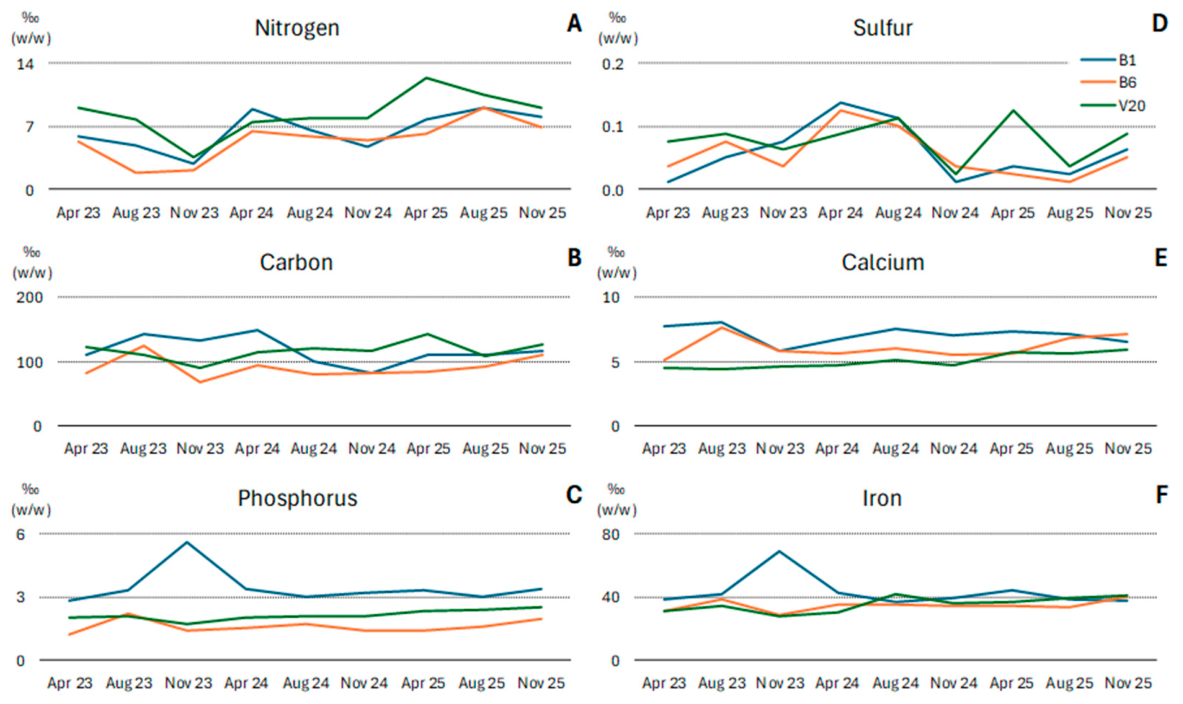
The elemental composition of detritus across the three-year study period remained relatively stable, with macronutrient and micronutrient concentrations (C, N, S, P, Ca, and Fe) showing modest variability. At individual sites, maximum values generally did not exceed twice the minimum, and no consistent seasonal or catchment-specific patterns emerged (
Table 3,
Figure 8). A notable exception to this stability was the elevated concentration of P and Fe observed in detritus from site B1 in November 2023, a deviation that will be discussed in further detail below. While total nitrogen exhibited slightly higher fluctuations (up to fivefold), these bulk measurements failed to reflect the dynamic changes in detrital quality suggested by site-specific hydrological events.
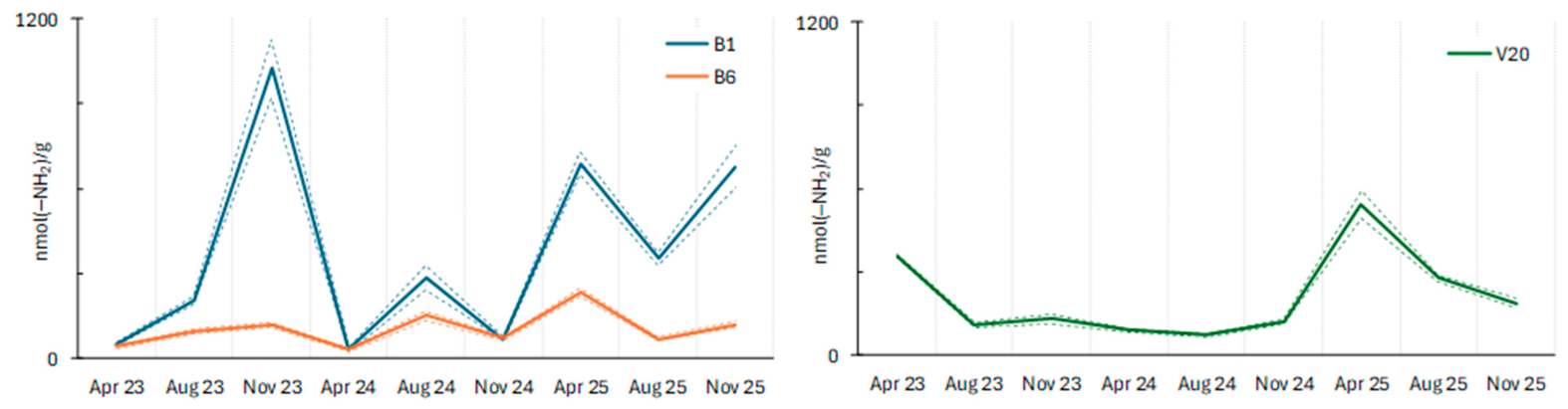
In stark contrast, the concentration of primary amines, dominated by proteinogenic amino acids, varied over a substantially wider range than total N. At site B1, for example, the variability in the primary amine pool was an order of magnitude greater than that of the bulk nitrogen pool (
Table 4). This decoupling suggests that total N is a poor proxy for the most bioavailable nitrogen fractions in stream detritus. While total N includes recalcitrant organic nitrogen and mineral-associated forms, the primary amine pool represents a functionally distinct, high-quality resource that directly influences heterotrophic productivity [
46]. Our findings align with observations in soil and marine systems where the “labile” nitrogen fraction responds more dynamically to environmental forcing than the total organic nitrogen reservoir [
81,
82].
3.6. The Role of Hydrological Flushing
The observed variability in primary amine concentrations could be interpreted as being consistent with hydrological “flushing” or leaching during periods of elevated discharge. In the Vltava catchment, increased discharge preceded all sampling events in 2024, during which detritus tended to exhibit consistently lower primary amine concentrations (
Figure 7 and
Figure 9). Conversely, in the Blanice catchment, higher amine concentrations were only observed during the summer, which was the only sampling interval not preceded by a significant discharge event. Taken together, these patterns may suggest that recent flow history plays an important role in regulating the availability of labile nitrogen pools within benthic detritus.
Mechanistically, high-flow events likely could act as a selective filter on detrital quality through two non-exclusive pathways: the aqueous leaching of interstitial free amino acids and the physical scouring of amino-acid-rich microbial biofilms. Such ‘pulse–shunt’ dynamics, well-documented for dissolved organic matter [
83], appear to extend to the benthic compartment. In this context, elevated discharge would not merely redistribute organic matter but could preferentially reduce its nutritional quality by removing its most bioavailable fractions. Under this interpretation, the observed decoupling between bulk elemental composition and biochemical quality would be expected. While total nitrogen content would be likely to remain comparatively stable due to its integration over both labile and recalcitrant pools, the primary amine fraction—representing a rapidly exchangeable and hydrologically sensitive component—would be more responsive to short-term environmental forcing. This framework could therefore explain why primary amine concentrations varied by up to an order of magnitude, whereas bulk elemental indicators showed far lower variability.
Conversely, periods of hydrological stability might facilitate the accumulation and in situ production of labile organic matter. The pronounced co-enrichment of primary amines, P, and Fe observed at site B1 in November 2023 could be interpreted as consistent with such scenario. This pattern may reflect localized ‘bio-mineral hotspot’ formation, microbial or algal biofilms would be expected to increase the pool of labile nitrogen while simultaneously binding phosphorus and iron through extracellular polymeric substances. Extracellular polymeric substances (EPS) within these biofilms are rich in primary amines and can effectively bind both dissolved nutrients and fine mineral particles, creating reactive interfaces for nutrient retention [
84].
Regardless of the specific causal pathway, the available data would indicate that detrital content of primary amines responds sensitively to recent hydrological conditions in ways that are not captured by bulk elemental measurements alone. By resolving these rapid, hydrologically driven shifts, our OPA-based approach may enable the detection of episodic changes in detrital quality—such as flushing losses or localized microbial enrichment—that would otherwise remain obscured using conventional bulk monitoring methods. Nevertheless, confirmation of this interpretation would require targeted, higher-frequency measurements that directly couple detrital biochemical composition with site-specific hydrological dynamics, ideally across replicated flow events.
4. Conclusions
This study demonstrates that amino acid-targeted methods provide a more sensitive and ecologically relevant assessment of detrital nutritional quality than conventional bulk nitrogen analysis. We optimized extraction procedures for detrital samples to enable downstream application of an OPA-based fluorimetric assay and CE-C4D. Both approaches exhibited high sensitivity and low matrix interference. The strong agreement between methods validates the OPA assay as a practical tool for routine monitoring of detrital nutritional quality, while CE-C4D remains valuable for detailed compositional profiling where amino acid speciation is required. We identified 2 M KCl as the optimal extraction medium for the OPA assay and 0.4 M ammonium carbonate for CE-C4D, and further refined OPA measurement conditions for detrital matrices.
Application of these methods to detritus collected across multiple river sites and seasons revealed that primary amines and amino acids vary by an order of magnitude more than total nitrogen, capturing variability not detectable through elemental analysis alone. Notably, detritus sampled following prolonged stable conditions may represent a fundamentally different resource from material collected after hydrological disturbances, even when bulk C:N ratios are similar.
Taken together, these findings indicate that detrital quality at any given time reflects both intrinsic properties and recent hydrological history. Consequently, robust interpretation of detritus composition requires consideration of antecedent discharge and precipitation dynamics, ideally measured directly at the sampling site.