
Review

Landscape Determinants of Nitrogen Leaching Risk: Mechanisms, Impacts, and Mitigation Strategies

by
Bonface O. Manono
1,*,
Jacinta M. Kimiti
2 and
Damaris K. Musyoka
2
1
Colorado State University Extension, Fort Collins, CO 80523, USA
2
Department of Environmental Science and Land Resources Management, School of Agriculture, Environment, Water & Natural Resources, South Eastern Kenya University, Kitui P.O. Box 170-90200, Kenya
*
Author to whom correspondence should be addressed.
Nitrogen 2026, 7(1), 20; https://doi.org/10.3390/nitrogen7010020

Submission received: 26 December 2025 / Revised: 30 January 2026 / Accepted: 3 February 2026 / Published: 5 February 2026
(This article belongs to the Special Issue Nitrogen Uptake and Loss in Agroecosystems)

Abstract

Nitrogen leaching from land and farms is a major global issue that pollutes water, damages ecosystems, and accelerates climate change. This review synthesizes evidence from the literature on how interactions among landscape characteristics, sources of nitrogen input, and temporal dynamics shape leaching vulnerability. It identifies conditions under which nitrogen is most likely to be transported through soil systems into aquatic environments. This review reveals that leaching vulnerability is strongly conditioned by soil hydraulic properties and topographic position. Coarse-textured upland soils exhibit substantially greater nitrate mobilization than finer-textured, hydrologically buffered lowland soils. Fertilizer formulation and application timing further modulate loss potential, with late-season mineral nitrogen inputs disproportionately contributing to subsurface export relative to demand-synchronized applications. Most of the nitrogen leaching occurs outside the active growing period, when vegetative uptake is suppressed and drainage intensity is highest. Farmers can lower nitrate runoff by using targeted fertilization, cover crops, and nitrification inhibitors, while landscape-scale features like controlled drainage and vegetative buffers provide additional downstream filtration. The effectiveness of regulatory approaches is amplified when aligned with economic incentives and regionally calibrated nutrient thresholds. Advances in high-resolution observation platforms and process-based predictive tools offer new capacity for anticipatory management, although widespread deployment is limited by financial and institutional constraints. Collectively, these insights support the development of more targeted and sustainable nitrogen management strategies.

1. Introduction

Nitrogen (N) is essential for plant growth and agricultural productivity, making it crucial for global food security [1,2]. Intensive nitrogen application has significantly increased crop production; however, a large portion of this nitrogen is not used by plants and is inefficiently lost to the environment. Nitrogen leaching is the downward transport of dissolved nitrogen nitrate through the soil profile with percolating water [3,4]. Once displaced from biologically active soil layers, nitrogen becomes largely decoupled from crop uptake, transforming an agronomic input into a diffuse pollutant. This process carries far-reaching consequences, including contamination of drinking water resources, eutrophication of surface waters, and indirect contributions to atmospheric forcing through enhanced nitrous oxide (N2O) emissions [2,5,6].
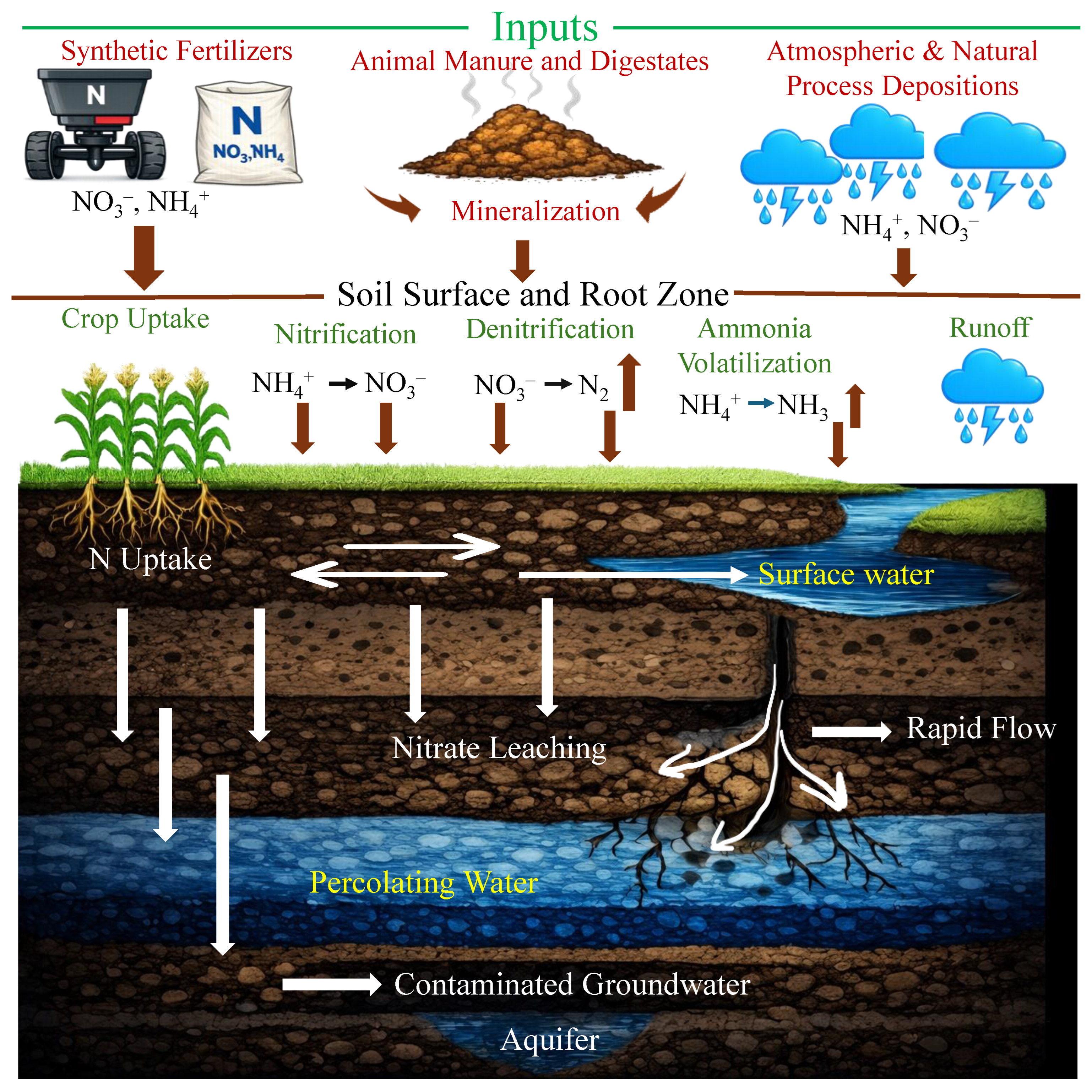
The susceptibility of nitrogen to leaching is rooted in its biogeochemical behavior within soils (Figure 1). Organic nitrogen inputs from crop residues, manure, and soil organic matter are first mineralized to ammonium through microbial ammonification, followed by nitrification to nitrate under aerobic conditions [5,7]. Because nitrate is highly soluble and weakly retained by negatively charged soil particles, it is readily mobilized by downward water fluxes when nitrogen supply exceeds plant uptake and microbial immobilization [3]. Although ammonium (NH4+) can also leach under specific conditions, particularly in coarse-textured soils or during rapid water movement, nitrate remains the dominant leached form in most agricultural systems [5,8] (Figure 1). Crucially, nitrogen leaching is not governed by biogeochemical processes alone. Physical transport mechanisms, especially water percolation and preferential flow through macropores, cracks, or root channels, can accelerate nitrogen movement and bypass zones of biological retention [9,10]. Such hydrological shortcuts are particularly influential during intense rainfall events or excessive irrigation, when short-term connectivity enables disproportionate nitrogen losses [11,12].
In Figure 1, synthetic fertilizers are represented by the bag, and the spreading equipment depicts direct application of inorganic N (NO3, NH4+) to the soil surface. Animal manure and digestates depict organic matter being incorporated into the soil. Atmospheric and natural process depositions represent rain clouds, falling particles, and biological nitrogen depositions entering the system. In the soil surface and root zone, plants’ roots absorb various forms of Nitrogen for growth. Under anaerobic conditions, soil bacteria convert nitrogen into gases, specifically nitrous oxide (N2O) and dinitrogen (N2), resulting in nitrogen loss through a process known as denitrification. Nitrogen moves laterally across the soil surface, resulting in runoff into surface water bodies. Dissolved nitrogen leaches into the groundwater aquifer as water percolates through the soil profile.
At broader spatial and temporal scales, nitrogen leaching emerges as the outcome of a complex interplay between natural landscape controls and human decision making. Soil properties, topography, hydrological pathways, and climatic variability interact with land use, fertilization strategies, and irrigation practices to shape both the magnitude and timing of nitrogen losses [13]. These interactions generate pronounced spatial heterogeneity and episodic loss dynamics, complicating prediction and undermining the effectiveness of uniform management solutions. Nitrogen leaching is now widely understood to be a common landscape process, rather than an unusual event specific to a single field. This is a direct result of human activities reshaping the global nitrogen cycle [14].
Human activities have overloaded terrestrial environments with reactive nitrogen, exceeding the land’s natural retention capacity and causing nitrogen leaching to surge far beyond normal levels [14]. A key challenge for sustainable agriculture is how to balance the need for nitrogen with the environment’s ability to safely process it. This review aims to provide a process-based synthesis of nitrogen leaching in agricultural landscapes. Specifically, it aims to (i) elucidate the fundamental biogeochemical and physical mechanisms governing nitrogen leaching; (ii) examine how landscape-scale factors interact to regulate leaching vulnerability; and (iii) provide mitigation strategies. By examining nitrogen leaching within the integrated context of soil, water movement, and landscape features, this study deepens our understanding of nitrogen loss pathways. It thus supports the development of more effective, site-specific strategies for sustainable nitrogen management.

2. Literature Search Methodology

This review was guided by a set of pre-specified questions addressing three key areas: (i) identifying which landscape characteristics affect the risk of nitrogen leaching, (ii) understanding the mechanisms and pathways of N leaching, and (iii) evaluating the strategies for reducing N leaching losses. Eligibility criteria were defined before the formal search to ensure consistent and transparent study selection. These criteria specified the landscape settings and land uses considered, the nitrogen sources addressed, the outcomes required for inclusion (measured or modelled indicators of nitrate/nitrogen leaching in soil water, drainage, groundwater, or receiving surface waters), and the admissible study designs (including field monitoring, plot- to catchment-scale experiments, and modelling studies with clearly described parameterization and validation). Exclusion criteria included studies that solely analyzed atmospheric nitrogen deposition without addressing leaching, focused on nitrogen cycling without landscape context, or examined non-agricultural/non-natural industrial contamination.
Preliminary scoping searches were carried out to identify key terminology, indexing practices, and relevant subject headings across databases, and the final search strings were refined accordingly. The main literature search was conducted in major multidisciplinary and subject-focused databases widely used in environmental and agricultural sciences. They included Web of Science and Scopus and were complemented by Google Scholar to identify additional articles and selected grey literature not consistently indexed in other databases. Additional searches were performed on publisher platforms (ScienceDirect and SpringerLink) and in agricultural and environmental management databases (including CAB Abstracts and AGRICOLA), as relevant to the review. To strengthen coverage of hydrogeological controls on leaching and groundwater vulnerability, GeoRef was also consulted, and evidence-synthesis resources in environmental management (including Environmental Evidence) were searched to support both methodological reporting and study identification. All searches were documented to support reproducibility, including the database or platform searched, complete query strings, filters applied (e.g., year limits, document type, or subject categories), search dates, and the number of records retrieved per search.
Search terms were constructed to capture four concept groups (landscape determinants, nitrogen leaching, mechanisms/pathways, and mitigation) and were adapted to the syntax of each database. Terms for landscape determinants included variations of land use and land cover, watershed or catchment characteristics, soil and subsoil properties (e.g., texture and drainage class), topographic attributes, and hydrogeological and climatic drivers such as geology, aquifer vulnerability, rainfall regime, and irrigation. The leaching concept was captured using terms such as nitrogen leaching, nitrate leaching, leaching risk, groundwater pollution, and water-quality degradation, alongside descriptors of diffuse or non-point source pollution. Mechanistic terms included nitrification, denitrification, percolation, runoff, transport modelling, and hydrological pathways, while impact-related terms included eutrophication and broader ecosystem and health-relevant endpoints when explicitly linked to leaching-derived nitrogen. Mitigation terms included best management practices and specific interventions such as fertilizer timing and rate optimization, precision agriculture, cover crops, buffer strips/riparian zones, drainage and water-table management, and other field- and landscape-scale measures intended to reduce nitrate losses. Boolean operators were used to combine synonyms within concept groups and to link concept groups across the search strings; truncation and wildcards were applied to capture common term variants, and field restrictions (title/abstract/keywords) were used where appropriate to balance sensitivity and precision.
All search records were exported to a reference management system and deduplicated before screening began. Study selection involved a two-stage process: initial screening of titles and abstracts, followed by full-text assessment for eligibility. Reasons for exclusion were documented to ensure transparency in reporting. Backward and forward citation searching was conducted to ensure a thorough search. This process involved scanning reference lists of relevant reviews and using database tools to identify studies that cited key articles. The final studies were synthesized qualitatively to identify patterns in leaching outcomes based on landscape characteristics and to evaluate mitigation performance across different contexts, where reporting was sufficiently comparable.

3. Nitrogen Input Sources

In agricultural landscapes, nitrogen leaching risk varies by source. This risk is influenced by the type of fertilizer used, the intensity of management, and how nitrogen moves through the environment. Research consistently indicates that these source-specific risks increase significantly when nitrogen levels exceed what the ecosystem can naturally absorb [7,15].

3.1. Synthetic Fertilizers

Studies show that synthetic nitrogen fertilizers are the primary cause of nitrate leaching in intensive farming. This is not just due to their high usage, but because their high solubility often results in nitrogen being released faster than crops can absorb, especially when applied in excess or at the wrong time [1,5,7,16]. While fertilizer has boosted crop yields, research comparing treated and untreated soils shows that nitrate leaching increases sharply once application rates exceed what plants can absorb [17,18]. Thus, once the plants have absorbed all the nitrogen they need, the risk of excess nitrogen being washed out of the soil increases disproportionately with further fertilizer application. However, contradictions emerge when fertilizer type is considered. Liquid formulations like urea ammonium nitrate result in slightly higher nitrate losses than solid ammonium nitrate or compound fertilizers [18,19]. This suggests that while fertilizer chemistry and form influence leaching, they do not override the primary impact of total nitrogen application levels

3.2. Animal Manure

Evidence from agroecosystems indicates that nitrogen from animal manure leaches differently over time compared to synthetic fertilizers. Manure’s organic nitrogen pool creates a delayed but prolonged release of nitrate into the environment after it mineralizes [5,7,16]. Although well-managed manure applications can enhance nitrogen use efficiently, studies consistently find that applying manure without cover crops in the autumn leads to major nitrate losses [7,20]. These findings emphasize that application timing and method are the key factors in preventing nitrogen pollution [21]. In pastoral systems, research identifies animal urine patches as nitrogen leaching “hotspots” [9]. These patches contribute disproportionately to regional nitrogen loss because their localized nitrogen levels far exceed what plants and soil can absorb [9,22].

3.3. Atmospheric Deposition

In intensive agriculture, atmospheric nitrogen deposition is a smaller input than direct fertilizer, yet research shows it contributes significantly to nitrate leaching, especially in nitrogen-saturated systems [23], where it can contribute up to 30% of nitrate leaching [23,24]. In contrast, forested or semi-natural ecosystems, deposition can become a primary driver of leaching as nitrogen accumulates over time and eventually exceeds biological demand [25]. This highlights how diffuse sources can significantly impact nitrogen balances, emphasizing the importance of evaluating all nitrogen inputs cumulatively rather than individually.

3.4. Digestate as a Nitrogen Source

Digestate, a byproduct of anaerobic digestion that converts organic waste into biogas, is a nutrient-rich biofertilizer containing organic matter and essential nutrients like nitrogen, phosphorus, and potassium [26]. In raw digestate, total nitrogen content can range from 1.63 g·kg−1 to 13.22 g·kg−1 of fresh matter, while ammonia nitrogen (N-NH4) levels typically fall between 0.75 and 4.75 g·kg−1 farmyard manure [27]. Because it contains a high concentration of readily available nitrogen, digestate acts as a fast-acting fertilizer that can produce crop yields comparable or superior to mineral alternatives. Specifically, liquid digestates provide nutrient values that fall between those of livestock manure and inorganic fertilizers [28]. Furthermore, digestates derived from green manures under four-cut strategies can achieve a nitrogen fertilizer replacement value above 60% when total nitrogen concentrations in silage exceed 3.5 g per 100 g of dry matter [29]. In addition to providing nutrients, digestate strengthens the soil ecosystem by increasing organic matter, balancing pH, and boosting exchangeable bases [26].
While digestate offers agricultural benefits, its use necessitates careful management to mitigate environmental risks, such as its higher potential for ammonia (NH3) emissions compared to undigested animal manures [28]. The rapid release of nutrients in digestate increases the likelihood of ammonia volatilization and nitrate leaching, and under specific conditions, it can produce higher nitrous oxide (N2O) emissions than synthetic fertilizers [30]. Research indicates that applying digestate can increase the leaching of nitrogen and phosphorus into deeper soil layers. This risk is particularly high when application rates exceed either the crop’s nutritional requirements or the soil’s natural nutrient-holding capacity [31]. Consequently, optimal management practices are essential to maximize crop-available nitrogen while minimizing harmful environmental emissions.

3.5. Biological Nitrogen Fixation by Microbes and Legumes

Biological nitrogen fixation (BNF) is a natural process where specialized microorganisms such as certain bacteria, algae, and fungi convert atmospheric nitrogen into ammonia [32]. This conversion, facilitated by the enzyme nitrogenase, provides the main natural source of bioreactive nitrogen for both terrestrial and aquatic environments [33]. Between 150 and 200 million tons of nitrogen are biologically fixed on Earth’s surface annually, accounting for 65% of nitrogen used in global agriculture [33]. Although most microorganisms cannot reduce nitrogen, free-living fixers such as Azotobacter and Clostridium and aquatic blue-green algae add essential ammonia to natural ecosystems [34]. In non-leguminous plants, associative symbiotic bacteria such as Azospirillum demonstrate superior nitrogen-fixing capabilities by inducing the formation of paranodules [35].
In agriculture, the most important source of biological nitrogen fixation is the symbiotic relationship between leguminous plants and rhizobia bacteria [36]. This process occurs in specialized root structures called nodules. Inside them, bacteria known as rhizobia convert atmospheric nitrogen into ammonia, which the plant can absorb [33]. In return, the plant provides the bacteria with dicarboxylic acids as a carbon source for energy [33]. Legumes are vital to agroecosystems because they can fix 200 to 300 kg of nitrogen per hectare annually [37]. They lower greenhouse gas emissions and diversify rotations by producing high yields on poor soils with few synthetic additives [38]. Leguminous cover crops can even fix sufficient nitrogen to entirely offset the need for synthetic fertilizers [39]. Research indicates that grain legumes like peanut and soybean contribute 20 to 63 kg N ha−1 through rhizodeposition, with subsequent crops utilizing up to 85% of this nitrogen [40]. Furthermore, winter varieties such as winter peas and faba beans demonstrate even higher nitrogen yields and fixation capabilities than spring counterparts [41].
Nitrogen (N) is indispensable for sustaining agricultural yields, yet it is also among the most loss-prone nutrients in managed landscapes, with nitrate (NO3) leaching representing a dominant pathway of off-site transport [1,2]. Contemporary agroecosystems receive N from multiple anthropogenic and natural sources, most prominently synthetic fertilizers, animal manures, atmospheric deposition, and biological N fixation (Table 1). When inputs exceed crop uptake and the soil’s capacity to retain or transform reactive N, mobile NO3 can be displaced below the root zone by drainage, elevating risks of groundwater contamination and downstream eutrophication. Importantly, the propensity for leaching is context dependent, arising from interactions among N source characteristics, soil and hydrologic properties, and management practices that regulate N availability relative to water fluxes. Table 1 synthesizes the principal N input sources across agroecosystems and summarizes their typical leaching vulnerability and governing controls.

4. Landscape Determinants of Nitrogen Leaching Risk

Nitrogen leaching is a persistent, localized environmental threat in managed landscapes that frequently spreads beyond fields, contaminating groundwater, surface waters, and downstream ecosystems [46,47,48]. Evidence shows that nitrogen losses are not determined just by single factors, but primarily by how the landscape links water flow with nitrogen movement [48]. This emphasizes that sustainable agriculture requires considering the unique environmental context of each area to achieve optimal results. Rather than acting as passive backdrops, landscapes impose structural controls that frequently override management intent, reframing nitrogen leaching as an emergent property of interacting with static (e.g., soil and geology) and dynamic (e.g., climate and management) determinants. This recognition shifts mitigation away from universal prescriptions toward spatially targeted strategies aligned with underlying process domains.

4.1. Soil Characteristics

Soils influence nitrogen leaching through the integration of physical structure, chemical retention, and microbial activity within landscape hydrology, acting as both biogeochemical reactors and hydraulic conduits [5,48,49]. Predicting nitrogen leaching based solely on isolated soil properties is often inaccurate. Because leaching is driven by the interaction of climate, land management, and landscape positioning, soil characteristics function more as a set of boundary conditions than as a direct predictor of nitrogen loss [48,50].
In agricultural ecosystems, soil texture is a primary driver of nitrate leaching because it controls how quickly water moves through the ground [5,49,51]. However, this relationship is complex and inconsistent; the risk is not a fixed value but varies depending on specific environmental conditions. Coarse-textured soils exhibit elevated nitrate losses, not because of inherently poor fertility control, but because rapid percolation decouples nitrogen availability from biological demand during precipitation or irrigation events [49,51]. In contrast, fine-textured soils slow down water movement and hold onto ammonium better, which helps prevent nutrient leaching. However, these benefits are often lost when the soil becomes saturated leading to structural damage or redox shifts that drive nitrogen loss through denitrification [50]. Collectively, these findings contradict texture-based generalizations and instead position texture as a first-order constraint that amplifies or dampens nitrogen loss depending on hydrological forcing and biological demand.
While soil organic matter (SOM) stabilizes the nitrogen cycle, its impact is driven by the dynamic balance between mineralization and immobilization rather than simply the total amount of SOM present [48,52]. High SOM soil minimizes nitrate leaching by improving water retention and increasing both microbial demand and organic nitrogen storage. However, these protective effects diminish when warming temperatures, heavy rainfall, or intensive management accelerate the breakdown of organic matter into mobile nitrates [52,53]. Although amendments like biochar or cover crops enhance SOM-mediated nitrogen retention, their impact is highly dependent on environmental variables [43,54,55]. Consequently, SOM should be viewed as a conditional moderator of nitrogen transport rather than a universal reservoir.
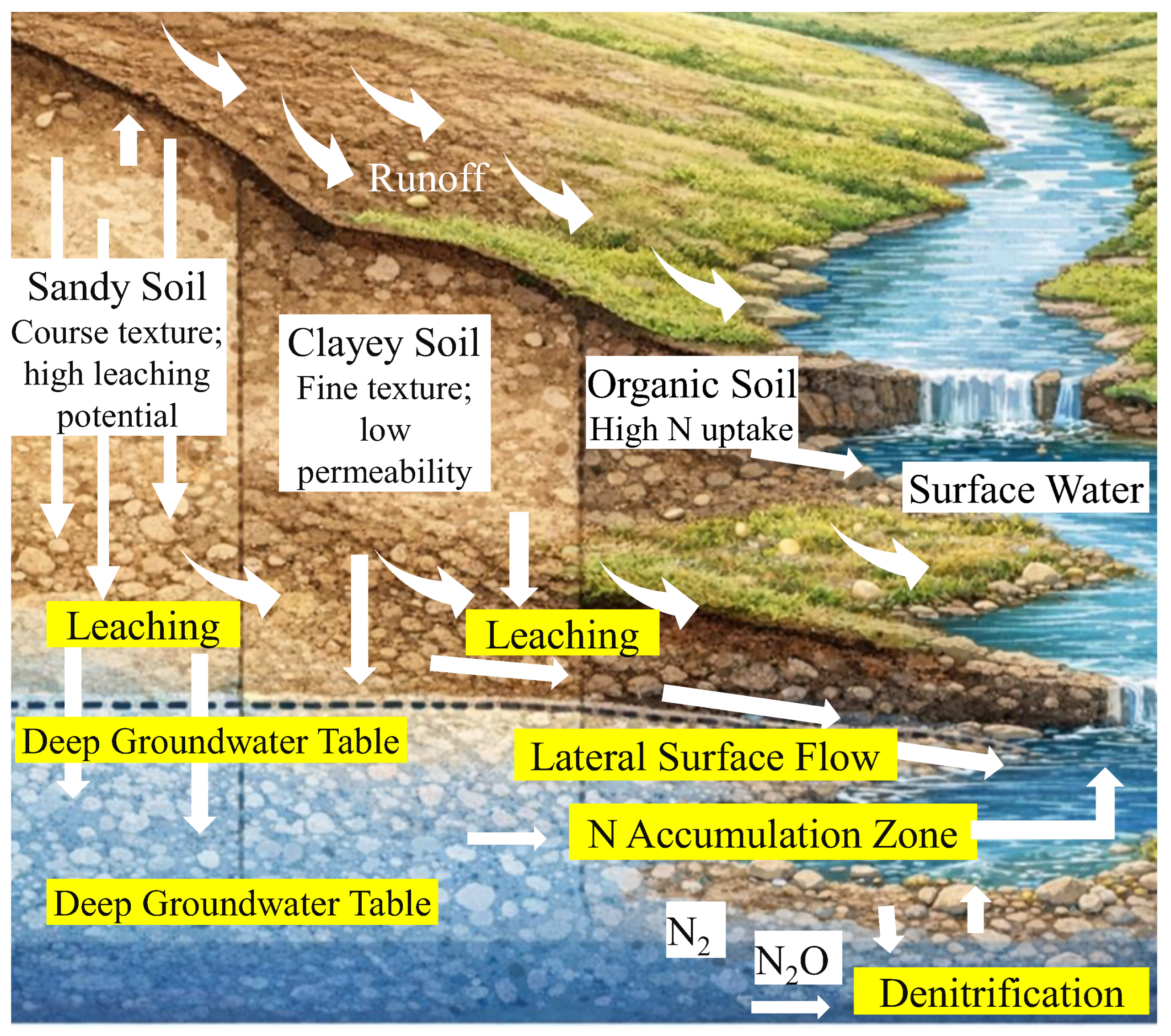
Figure 2 visually represents how various landscape characteristics modify the movement and fate of nitrogen within an ecosystem. The figure depicts a cross-sectional view of undulating terrain, showcasing varying slope gradients, soil depths, and water body at the lowest elevation. The sandy soil area demonstrates rapid downward movement with high leaching potential. The clayey area has finer particles, depicting slower percolation and some lateral sub-surface flow of nitrogen. On the other hand, the organic soil area indicates higher organic matter, nitrogen retention, and some slow release. Topographically, the surface runoff on the steeper slope carries nitrogen towards lower elevation. The nitrogen settles at the bottom of the slopes leading to accumulation of water and nitrogen from upslope runoff and percolation. There is a potential of nitrogen to reach surface water or denitrification to occur at the water soil interface. Similarly, there is horizontal sub-surface flow of nitrogen towards underground water bodies influenced by topography. A strip of vegetation bordering the river can intercept N runoff and subsurface flow.

4.2. Land Use and Vegetation Cover

While land use governs the interaction between nitrogen supply, biological uptake, and water movement, its impact on leaching is primarily indirect. Rather than stemming from a simple “natural vs. managed” distinction, leaching rates are driven by specific ecological mechanisms, including vegetation traits, rooting depth, and the quality of organic residues [56,57]. For example, forests and grasslands usually have less nitrate pollution leaching into the water table than agricultural fields. However, this protective effect disappears when the plants’ nitrogen absorption cycles do not align with water flow patterns [48]. This demonstrates that merely having vegetation present does not automatically guarantee nitrogen will be retained in the soil.
Research shows that plant types significantly impact nitrogen leaching. By influencing soil carbon-to-nitrogen ratios, root structures, and the timing of nutrient absorption, different vegetation can increase or decrease leaching rates by a factor of ten or more [58,59]. Systems characterized by low C/N litter and shallow rooting consistently initiate nitrate leaching earlier than those dominated by high C/N inputs, even under comparable nitrogen loads [59]. This reveals a contradiction between biomass productivity and nitrogen retention capacity. These patterns suggest that plant communities regulate nitrogen loss not through uptake magnitude alone, but through their ability to align nitrogen demand with periods of hydrological vulnerability [52,60].
Nitrogen leaching is driven by the interaction of fertilization, irrigation, and crop rotation with specific soil and landscape conditions, rather than nitrogen input levels alone. While management practices significantly influence leaching, their effectiveness depends entirely on these environmental contexts [57]. Flooded rice systems show that managing water to suppress nitrification can separate high fertilizer use from the risk of nitrogen leaching [57]. This suggests that in some environments, hydrological control can mitigate nitrogen loss even with intense fertilization. Similarly, split fertilization, slow-release fertilizers, and cover crops are effective at reducing nutrient loss on average; however, results differ significantly with terrain and soil texture, proving they are not universally applicable [61,62,63].

4.3. Topography and Landscape Position

Topography dictates nitrogen leaching patterns by directing water flow, influencing soil depth, and shifting chemical (redox) conditions [48,61,64]. These physical factors create predictable risks of nitrogen loss that can outweigh the impact of land management practices. Upper slopes tend to export nitrate rapidly due to limited storage, while lower slopes oscillate between acting as nitrogen sinks and delayed sources depending on saturation thresholds and hydrological connectivity. Slope gradient further partitions nitrogen loss pathways. Steeper slopes favoring runoff-driven export and gentler slopes promoting vertical leaching, generating trade-offs where erosion control may inadvertently increase subsurface nitrate losses [65].

4.4. Climatic Factors

Climate, specifically through extreme weather events like intense rainfall and sudden warming, has a major impact on nitrogen leaching. These extremes disrupt the natural balance between plants and microbes, leading to a disproportionate amount of nitrogen being washed out of the soil [48,66]. Winter warming events trigger post-event leaching pulses that challenge traditional growing season focused mitigation strategies. Hydrological connectivity determines if retained nitrogen is exported. Artificial drainage shortens residence times bypassing active soil layers, whereas wetlands and riparian buffers increase residence times and reduce nitrogen loss via denitrification [48,67,68].

4.5. Parent Material and Underlying Geology

Geology establishes baseline nitrogen vulnerability by defining essential soil properties like texture and permeability and dictating how groundwater flows [69,70,71]. These foundational geological factors constrain the overall effectiveness of nitrogen management efforts, even when implementing surface-level interventions. Coarse-textured parent materials consistently promote nitrate transport to groundwater, while finer substrates redistribute rather than eliminate nitrogen losses through lateral flow and perched saturation. These geological factors create a fundamental problem in managing nitrogen: standard practices cannot stop leaching in areas naturally prone to it [71]. This highlights that site characteristics (“vulnerability”) are more important than the specific actions taken (“practices”).

4.6. Influence of Hydromorphism and Waterlogging on Soil Nitrogen Dynamics

Hydromorphism, characterized by periodic or permanent soil saturation and subsequent chemical reduction, results in the development of distinctive features such as mottles and gley horizons [72]. These conditions are most prevalent in poorly drained, compacted, or clay-rich soils where structural constraints inhibit the essential movement of water and gases [72]. This transition is driven by factors including high water tables, impermeable soil layers, excessive rainfall, or inadequate irrigation [72,73]. The transition from well-aerated to waterlogged conditions fundamentally alters soil aeration, as water replaces air in the soil pores. This leads to a rapid depletion of dissolved oxygen consumed by microorganisms during aerobic respiration [74]. As oxygen becomes scarce, the soil environment turns anaerobic, forcing microorganisms to use alternative electron acceptors for metabolism [75]. This process lowers the soil’s redox potential, creating a reducing environment [76]. Furthermore, the presence of organic matter accelerates oxygen depletion and creates reducing conditions by acting as a carbon source for microbial respiration [77].

4.6.1. Alterations to Nitrogen Transformation Processes

Nitrification is a two-step, aerobic microbial process that converts ammoniumNH4+ into nitrite (NO2) and then into nitrate (NO), requiring high levels of oxygen [78]. Under waterlogged conditions, the severe reduction in oxygen availability suppresses the activity of ammonia-oxidizing bacteria and archaea, consequently inhibiting nitrification [72]. Studies have consistently shown a decrease in the abundance of nitrifying microorganisms under increased soil moisture and waterlogging stress [72]. This inhibition leads to a reduced conversion of ammonium to nitrate, altering the forms of nitrogen available in the soil and potentially leading to ammonium accumulation if mineralization continues [79]. In contrast to nitrification, denitrification is an anaerobic process significantly promoted by waterlogged, hydromorphic, and warm conditions, serving as a major pathway for nitrogen loss from soil to the atmosphere [72,80]. This process, accelerated by increased activity of denitrifying bacteria and associated genes under saturated conditions, requires the presence of nitrate, an absence of oxygen, and sufficient organic carbon [72,80]. Specifically, waterlogging directly causes the anaerobic conditions needed for this conversion of nitrate to nitrogen gas [81].
Waterlogging further influences nitrogen mineralization, the biological process that converts organic nitrogen into plant-available ammonium. While gross nitrogen mineralization rates may persist, the net production of inorganic nitrogen can differ significantly between waterlogged and aerobic conditions, depending on the soil type [79]. Ammonification, the initial step of mineralization, proceeds rapidly in many soils [82]. However, the subsequent fate of ammonium is heavily dictated by oxygen availability; under anaerobic conditions, it is less likely to be nitrified and more prone to immobilization or loss via alternative pathways if not taken up by plants [72].

4.6.2. Nitrogen Loss Through Hydromorphism in Temperate Humid Zones

In temperate humid zones, nitrogen losses are exacerbated by hydromorphism and waterlogging resulting from frequent heavy rainfall and poorly drained soils. These losses primarily occur through nitrate leaching and denitrification, the latter of which serves as a potent mechanism for releasing nitrogen back into the atmosphere [83]. Denitrification rates in these environments can be significant. For example, surface horizons in waterlogged minerotrophic fens have recorded rates between 359 and 599 mmol N m−2 d−1, though these levels typically decline with depth and fluctuate according to local soil carbon concentrations [84]. A critical consequence of this process is the emission of nitrous oxide, a powerful greenhouse gas produced as a denitrification intermediate [72,83].
In temperate humid regions, nitrate leaching is a major cause of nitrogen loss in hydromorphic soils. This process is driven by heavy rainfall and the high mobility of negatively charged nitrate ions (NO3), which do not bind to the soil’s cation exchange sites and are instead washed away [83]. When soil saturation leads to downward percolation, nitrate is transported below the root zone. This process is most severe in coarse-textured, sandy soils characterized by high hydraulic conductivity, whereas fine-textured soils more frequently experience loss through denitrification during prolonged saturation [85]. Total loss deconcentration influences all intensity and the existing soil nitrate concentration; notably, urea is highly vulnerable if heavy rain occurs before its conversion to ammonium. To mitigate these losses, split application of nitrogen fertilizer is a recommended management practice [86].
Denitrification, the gaseous loss of nitrogen, is most common in anaerobic, wet, fine- or medium-textured soils and is further accelerated by high levels of organic carbon that fuel the responsible bacteria [84]. Conversely, nitrate leaching is the primary concern in coarse-textured, sandy soils where rapid water movement and limited anaerobic persistence allow nitrate to be flushed through the profile before denitrification can occur. This dynamic can vary within the soil profile, as some environments experience denitrification in shallow, organic-rich layers while leaching dominates deeper, well-drained subsoils or through rapid transport in macropores [87].

4.7. Temporal Dynamics of Nitrogen Leaching

Nitrogen leaching is not a constant process; instead, it occurs in brief, intense bursts triggered by the interplay of weather patterns, water movement, and farming practices [11,60,88,89]. This evidence suggests that most nitrogen is lost during these short-lived windows rather than through steady, continuous leakage. Across landscapes, these temporal dynamics interact with soil and topographic controls, producing substantial spatial contrasts in leaching risk that challenge uniform mitigation approaches [13,90].
Nitrogen leaching in agroecosystems peaks when downward water flow is high, but crop nitrogen uptake is low, though the specific timing of these risks depends on the regional climate [91]. In temperate regions, the risk is highest when the weather is cold and wet, while in monsoon regions, it is highest during the warm, rainy season [20,92]. This seasonal nitrogen loss risk is reversed due to the difference in climate patterns. Forest and semi-natural environments make this more complex. In these settings, biological processes driven by temperature and moisture create fluctuating concentrations of nitrate and ammonium that often fall outside the typical agricultural growing season [93]. Nitrogen loss varies by crops and timing: leaching typically peaks after harvest, whereas active plant growth suppresses these losses by maximizing nitrogen uptake [94]. This confirms that the soil’s ability to retain nitrogen is highly effective but temporary, depending on the stage of the cropping cycle.
While seasonal patterns offer a general overview, significant nitrogen leaching often occurs due to specific rain events. A significant portion of annual nitrogen loss frequently occurs during brief, intense periods of rainfall [89]. Contradicting this assumption, other studies indicate that moderate but well-timed rainfall events can generate higher nitrogen fluxes than intense storms, particularly when they coincide with recent fertilization [43,95]. Soil texture mediates how nitrate reacts to water: sandy soils allow for immediate mobilization with little protection against leaching, while fine-textured soils cause a delayed but more prolonged release [88,92]. These findings collectively emphasize that event timing relative to nitrogen availability often outweighs rainfall magnitude in determining leaching outcomes.
Irrigation is a primary human driver of nitrogen leaching, often impacting nitrate transport below the root zone rivalling fertilizer application rates [11,96]. Research consistently shows that while excessive or poorly timed irrigation increases nitrogen leaching, optimized scheduling can maintain high crop yields while reducing environmental damage [11,21,97]. This suggests that productivity and environmental protection are not mutually exclusive. The effectiveness of precision approaches such as drip irrigation further illustrates that water management, rather than nitrogen input alone, represents a critical leverage point for mitigating groundwater contamination [92,96].
Nitrogen leaching from ecosystems is driven by a complex interplay of environmental factors that dictate water movement and biological uptake. Table 2 summarizes key landscape determinants including soil properties, topography, and hydrology. The table outlines their specific influence on the risk of nitrogen leaching. Understanding these drivers is critical for identifying vulnerable areas and developing effective, site-specific mitigation strategies for nitrogen loss.

5. Mechanistic Pathways and Impacts of Landscape Nitrogen Leaching

5.1. Pathways of Nitrogen Leaching in Landscapes

Nitrogen leaching in agroecosystems occurs through multiple, often interacting transport mechanisms that operate across soil, hillslope, and watershed scales [2]. These mechanisms reflect the integration of hydrological flow paths with nitrogen availability and transformation processes, producing distinct yet interconnected pathways for nitrogen loss [2,12]. It should be noted that no single mechanism dominates universally; instead, their relative importance shifts with soil properties, topography, climate, and management [2,99].

5.1.1. Macropore Flow

Macropore flow is one of the most efficient and least predictable pathways for nitrogen leaching because it involves the rapid movement of water and dissolved solutes through large, continuous soil pores [100,101]. These macropores, formed by roots, earthworms, and soil cracking enable nitrates to bypass the soil matrix, sharply reducing opportunities for adsorption, uptake, or microbial transformation [102,103]. The contribution of macropore flow to nitrate leaching is closely tied to rainfall intensity and irrigation practices [100,104]. Heavy precipitation events can activate macropore networks, transporting nitrate rapidly to deeper soil layers or groundwater. In the North China Plain, for example, heavy rainfall increased nitrate leaching through macropores by more than 119% [100]. These findings illustrate that macropore-driven losses are often episodic but can dominate annual nitrogen budgets. Soil structure and management significantly impact macropore development. Reduced-tillage and no-tillage systems enhance pore continuity, potentially increasing preferential flow in certain situations [105]. However, optimized fertilization and irrigation practices can mitigate these risks by reducing nitrate availability during periods of high hydrological connectivity [100].

5.1.2. Matrix Flow

Matrix flow is the process where water moves slowly and evenly through the small pores of the soil. This slow movement allows nitrogen compounds more time to interact thoroughly with the soil matrix [106]. This pathway promotes nitrogen retention through adsorption, microbial immobilization, and plant uptake, resulting in lower leaching losses compared to macropore flow [2,50]. Soil texture exerts strong control on matrix flow dynamics. Fine-textured soils with abundant micropores slow water movement and enhance nitrogen retention, whereas coarse-textured soils facilitate faster percolation even under matrix-dominated conditions [107]. Organic matter further modifies matrix flow by improving aggregation and water retention, thereby reducing nitrate mobility [50,107,108]. Landscape position also influences matrix flow effectiveness. Upland areas with coarser soil often experience faster percolation and higher leaching risk, while downslope positions accumulate finer materials and organic matter, enhancing nitrogen retention [109]. These patterns underscore the fact that matrix-driven nitrogen losses exhibit different rates in different locations across the landscape.

5.1.3. Lateral Subsurface Flow

Lateral subsurface flow transports nitrogen horizontally through soil layers, often along permeability contrasts or sloping interfaces [110,111]. This mechanism is particularly important in hilly or stratified landscapes, where it redistributes nitrogen from upslope source areas to downslope sinks or directly to streams [109,110]. Hillslope gradient and bedrock topography are key determinants of both the speed and path of lateral water flow [112]. Storm events can trigger rapid subsurface flow responses, producing highly variable nitrogen export across space and time [113]. In agricultural catchments, lateral subsurface flow has been shown to contribute substantially to nitrate loading in streams during rainfall events [111].

5.1.4. Surface Runoff

Surface runoff mobilizes nitrogen when precipitation exceeds infiltration capacity, transporting both dissolved and particulate forms across the soil surface [12,91]. Steep slopes, intense rainfall, and minimal vegetation accelerate nitrogen loss through runoff, while dense plant cover and effective conservation practices minimize these losses by boosting infiltration and capturing sediment [55,65]. Nitrate poses an immediate risk to water quality due to its high mobility, whereas particulate nitrogen presents a major risk primarily during erosion events [114]. Hydrological connectivity (the physical link between an upslope area and a receiving water body) determines if nitrogen in runoff reaches water bodies or remains trapped in the landscape [114].

5.1.5. Groundwater Percolation

Groundwater percolation is the downward movement of nitrogen past the root zone and into aquifers, serving as a major pathway of long-term groundwater contamination [96,115]. Permeable soils, deep water tables, and excessive irrigation enhance percolation-driven leaching [96,105]. Water table dynamics and landscape position further regulate this process. Low-lying landscape areas often experience increased water percolation due to convergent flow, whereas upslope forests typically show reduced nitrate leaching [109]. Excessive deep percolation, which often occurs when crops are not taking up nutrients, remains a major driver of nitrogen loss in agricultural ecosystems [96].
Groundwater percolation and rising water tables significantly mobilize nitrogen from deep soil layers into aquifers, posing a substantial risk to drinking water quality [87,116]. Nitrate, the primary mobile form of nitrogen, is the leading concern for such contamination [117]. In temperate humid regions, heavy precipitation causes excess water to saturate the soil and percolate downward, carrying dissolved nitrate from the root zone through the subsoil and into groundwater aquifers [96,116]. This transport is often intensified by high hydraulic conductivity and nitrogen-heavy agricultural practices [118]. Furthermore, rising groundwater levels can inundate previously unsaturated zones, dissolve accumulated nitrate and transport it through advection and dispersion [87,119]. Although subsoil denitrification helps mitigate nitrogen pollution, it is frequently insufficient in irrigated, sandy loam soils, where high rates of leaching continue to cause contamination [87,120].

5.2. Impacts of Nitrogen Leaching on Ecosystems and Human Well-Being

Nitrogen leakage is a multi-domain stressor that flows through water, land, air, and the economy. Its cumulative damage is often felt far from the original source and appears long after the initial cause [121,122]. While human-made nitrogen fertilizer is essential for feeding the world, we are now using more than the environment can absorb. This excess nitrogen leaks into nature, creating a major pollution problem that damages ecosystems, harms human health, and creates significant economic cost [122]. Aquatic ecosystems respond non-linearly to nitrogen enrichment. Modest increases in nitrogen availability often trigger disproportionate ecological shifts once stoichiometric thresholds are exceeded [121]. Chronic nitrogen loading causes harmful algal blooms and oxygen depletion (hypoxia). These issues lead to lost biodiversity, collapsed fisheries, and weakened ecosystems that often fail to recover even after nitrogen levels are reduced [123,124].
Continuous nitrogen enrichment degrades terrestrial ecosystems by acidifying soil, disrupting microbial activity, and allowing nitrophilous plants to crowd out native species. These combined effects lower overall biodiversity and deplete long-term soil fertility [125,126,127]. These modifications illustrate the interactions between biogeochemical processes and biological communities, ultimately reducing nitrogen retention capacity and increasing its loss [128]. Reactive nitrogen emissions degrade air quality by forming tropospheric ozone, fine particulate matter, and nitrous oxide [129]. This pollution links nitrogen leakage directly to human health risks and climate forcing [122,130]. Projected climate warming is expected to amplify nitrogen-related climate feedback mechanisms by increasing the rate of photochemical reactions and microbial nitrogen processes [131,132].
Nitrogen pollution reaches humans through linked water, air, and food systems, with increasing evidence showing health risks even at levels once deemed safe [122,133]. Indirect effects from factors like ecosystem degradation, toxin production, and interactions with climate intensify health risks, extending beyond existing regulatory systems [134]. This highlights how complex environmental issues contribute to public health challenges not fully addressed by traditional frameworks. Nitrogen leakage often costs more than the benefits of using fertilizer, primarily due to rising expenses for water treatment, healthcare, and the loss of vital ecosystem services [135,136]. These externalities show that private farming goals often conflict with public well-being. Consequently, “optimal” nitrogen levels are consistently set too high because the costs of environmental damage are ignored [137].
Nitrous oxide emissions from agricultural and industrial systems enriched with nitrogen are a major concern for environmental policy. These emissions are problematic for two key reasons: they contribute to radiative forcing (the greenhouse effect), thereby warming the climate, and they cause stratospheric ozone depletion [138]. This dual impact highlights a critical link between how we manage nitrogen and the policies needed to combat climate change and protect our atmosphere. As climate change accelerates the nitrogen cycle, the resulting emissions further intensify global warming. To break this feedback loop, policy must treat nitrogen management and climate action as a single, integrated challenge rather than separate issues [131,132].
As nitrogen leaching risks continue to rise, the consequences of excess nitrate-nitrogen moving beyond the rooting zone extend far beyond the immediate ecosystem. Nitrogen leaching, often driven by agricultural runoff and excessive fertilizer application, results in severe ecological, economic, and human health consequences. Table 3 provides an overview of these multifaceted impacts, outlining the key environmental disruptions and potential risks to public health associated with increased nitrate levels in water sources.

6. Landscape-Specific Approaches for Mitigating Nitrogen Leaching Risk

Nitrogen leaching mitigation depends more on local conditions than on specific farming practices. Its effectiveness varies by location. It must align with a landscape’s water flow, soil drainage, and nitrogen retention time. Thus, it will require trade-offs based on the specific environment [147,148]. Evidence shows that targeting nitrogen at key water-flow points is more effective than reducing fertilizer use across all fields [147,149]. This is especially true in areas where natural water pathways bypass standard field management.

6.1. Agronomic Strategies

Agronomic practices are the initial and most crucial strategy for preventing nitrogen leaching. It involves concentrating on maximizing the efficiency with which crops use nitrogen while minimizing excess nitrogen within the soil [150,151].

6.1.1. Optimized Nitrogen Fertilizer Management

This involves applying fertilizer at specific rates and times and using targeted methods based on real-field conditions and crop requirements to maximize efficiency and minimize waste [11,17,96,150]. Implementing improved N fertilizer management (INFM) strategies and enforcing comprehensive regulation of N fertilizer and water management (CFWM) are effective ways to significantly reduce nitrate leaching [152]. CFWM has been shown to reduce nitrate leaching by 41% on average, while INFM reduced it by 22% [152]. Controlled-release fertilizers improve efficiency and reduce nitrogen leaching by extending the release period, though performance depends on specific soil conditions and product formulations [19,153]. Dimethylolurea (DMU), a novel slow-release fertilizer, has demonstrated potential to significantly reduce NH4+–N, NO3–N, and total N leaching while promoting crop yield [19]. Split application of nitrogen in multiple smaller doses ensures consistent nutrient availability for plants when they need it most, simultaneously reducing the potential for leaching losses [154].

6.1.2. Use of Nitrification Inhibitors

Nitrification inhibitors (NIs) delay the transformation of soil ammonium into nitrate, preserving nitrogen in its stable ammonium state to reduce leaching and runoff [5,46]. Dicyandiamide (DCD) is a well-known NI that can reduce nitrogen leaching by 25–45% in grazed pastures [155]. Next-generation nitrification inhibitors effectively delay soil ammonium oxidation, which significantly reduces nitrate leaching [156]. Just like slow-release fertilizers, NIs do not always prevent leaching effectively. Their performance depends on soil temperature, moisture, and microbes, which can make them unpredictable and poorly timed with a crop’s actual nutrient needs [157,158]. Their effectiveness is limited by rapid degradation in warm or wet environments and by the tendency of microbes to adapt to them [159]. Thus, they can be most effective when targeted at high-risk landscape positions rather than using them uniformly across all areas.

6.1.3. Catch Crops and Cover Crops

Planting non-cash crops (catch crops or cover crops) during fallow periods or between main crops effectively scavenges residual nitrogen from the soil profile, preventing its leaching during non-growing seasons [20,150,152]. According to Nouri et al. [160], cover crops can decrease nitrogen leaching by 77% in Ultisols, 78% in Histosols, and 77% in Inceptisols. They are particularly effective in soils that are both acidic and sandy or gravelly [152]. Undersowing grain with Italian ryegrass or using grass leys can also significantly reduce nitrate leaching compared to continuous cropping or bare fallow. Cover crops reduce nitrogen leaching most effectively when biomass production is high. However, their mitigation potential drops if low soil fertility or harsh climates restrict growth, rendering the practice less effective even when adopted [148,161]. Mixed-species systems consistently improve nitrogen retention and soil carbon sequestration through functional diversity. However, these benefits are frequently countered by management challenges and potential yield losses. These outcomes vary based on crop rotation and termination timing, leading to inconsistent results across different regions [148,162].

6.1.4. Pastoral Management and Organic Amendments

In grazing systems, a strategy to manage nitrogen in the pasture involves making dietary adjustments, such as supplementing cattle with salt. This practice encourages animals to drink more water, which in turn increases their urination frequency and helps dilute the concentration of nitrogen in their urine [22,155]. Salt supplementation can reduce N leaching by 10–22% [22]. Other measures to further mitigate environmental impact include cultivating specific forage types, such as high-sugar ryegrass, or switching the type of livestock being raised [155]. Off-paddock infrastructure, such as loafing pads, provides an alternative method for removing animals from pastures to minimize environmental risks during periods when nutrient leaching is a concern [163,164].
To minimize the loss of nitrogen, animal manure must be applied at the correct time and incorporated properly into the soil [20]. When applied correctly, organic fertilizers can minimize nitrogen leaching [165]. Studies indicate that applying a combination of organic and inorganic fertilizers is an effective strategy for mitigating nutrient pollution. Specifically, this combined approach can reduce total nitrogen leaching by 33.9–42.1%, depending on soil depth, and decrease nitrate leaching by 23.9–46.4% [166]. Straw returning, especially combined with organic and chemical fertilizers, can also alleviate nitrogen leaching and improve soil fertility [95].

6.1.5. Irrigation Management

To reduce nitrate leaching, use efficient irrigation methods like drip systems or demand-based scheduling to prevent excess water from carrying nutrients past the root zone. Implementing efficient irrigation techniques, such as drip irrigation or scheduling water applications based on the actual water needs of crops, minimizes the volume of water moving past the root zone. This effectively reduces the leaching of nitrates [11,134]. Improper irrigation greatly increases nitrogen leaching, especially in areas with sandy soils [92].

6.1.6. Reduced Tillage or No-Till Practices

Reduced tillage and no-till systems affect nitrogen leaching through conflicting processes. While these methods improve surface soil structure, they also create large channels (macropores) that allow water to bypass the soil matrix. Because of these opposing mechanisms, the actual impact on nitrogen loss varies significantly depending on local climate and water conditions [167]. Because of these competing mechanisms, whether these systems increase or decrease nitrogen leaching depends heavily on the specific environmental conditions of the location. Meta-analytical evidence demonstrates that these practices should not be universally assumed to reduce leaching [168]. Instead, their effectiveness depends critically on specific environmental factors such as rainfall intensity, soil texture, and drainage conditions [168].

6.1.7. Use of Sorbents (Sawdust, Biochar and Zeolites)

Nitrogen is a vital nutrient for crop production, but inefficient agricultural use causes significant N losses, contributing to environmental pollution and reduced sustainability [169]. Sorbents like sawdust, biochar, and zeolites are being explored as amendments to retain nitrogen in the soil [170]. Sawdust, a timber industry byproduct, acts as a carbon-rich sorbent, reducing ammonia volatilization and enhancing nitrogen retention in agroecosystems and composting [170]. It absorbs ammonia and provides a substrate for microbial nitrogen immobilization; adding 30% sawdust can reduce total nitrogen loss by 17%, and a mix of 15% sawdust and 0.06% KH2PO4 can reduce losses by 23% [171].
The effectiveness of sawdust in mitigating nitrogen losses is largely determined by its specific composition and application technique [172]. For instance, sawdust derived from urea formaldehyde-glued particleboard contains a high nitrogen concentration (32.1 g·kg−1) and a low C:N ratio (15:1), which allows it to function effectively as a direct organic nitrogen fertilizer [172]. Using a 5.6 kg soil-amended cover during poultry manure composting significantly reduces nitrogen losses by 57% in broiler piles and 83.85% in layer piles (p = 0.05) [173]. Increased soil volume further improves nitrogen enrichment and retention. Additionally, sawdust additions can influence leachate production and overall nitrogen retention, with research indicating that increased carbon levels from sawdust can reduce nitrogen losses by approximately 21% [174].
Biochar is a carbon-rich material derived from biomass pyrolysis that enhances soil nitrogen retention through its porous structure, high surface area, and unique chemical properties [54,175]. It primarily functions by adsorbing ammonium (NH4+) via cation exchange and nitrate (NO3) ions, especially when produced at temperatures exceeding 600 °C, effectively reducing leaching and ammonia volatilization [176]. Furthermore, biochar stimulates microbial activity, which promotes the immobilization of inorganic nitrogen into organic forms within microbial biomass, thereby securing it against environmental loss [177,178]. This retention capacity is evidenced by studies showing decreases in total dissolved nitrogen in soil leachate by 25.2% to 44.0% [178]. Additionally, biochar modulates nitrification rates based on its specific properties and soil conditions; high-temperature variants can inhibit net nitrification while promoting net ammonification, resulting in soils with higher ammonium and lower nitrate concentrations [177].
Biochar’s effectiveness in mitigating nitrogen losses is highly context-dependent, influenced by its type, application rate, soil properties, and environmental conditions [175]. Wood, straw, and manure-derived biochars all show potential, with suitable application capable of decreasing global cropland (N2O) emissions by 6–30% and (N) leaching by 12–29% [175]. Notably, oxidized biochar is highly effective at reducing nitrate in soil solutions and mitigating ammonia emissions by 64–75%, particularly in low-carbon, acidic soils (pH < 5) [179]. Furthermore, combining biochar with nitrogen fertilizers significantly boosts soil nitrogen retention, enhances nitrogen uptake, and increases yields [180,181].
As natural, porous, and high-CEC crystalline aluminosilicates, zeolites act as effective nitrogen sorbents that boost nutrient use efficiency and reduce environmental pollution [182,183]. They primarily retain nitrogen through cation exchange, utilizing a negatively charged framework to absorb ammonium ions (NH4+), thereby reducing both leaching and ammonia volatilization [184]. Furthermore, zeolites can act as slow-release fertilizers by incorporating nitrogenous substances into their structure, which facilitates a controlled release of nutrients that synchronizes with plant uptake to minimize losses [185]. Beyond ammonium retention, certain zeolites particularly those that have been surface-modified can also adsorb nitrate (NO3) ions to further mitigate leaching in agricultural soils [183].
Zeo-urea and nanozeolite formulations enhance nitrogen management, reducing ammonia volatilization by up to 47% and nitrous oxide emissions by nearly 49% [184,186]. When applied directly as soil amendments, natural zeolites like clinoptilolite improve sorption capacity and nutrient uptake, leading to higher yields and reduced dispersion [183,187]. Beyond direct field application, these minerals are utilized in wastewater treatment to recover nitrogen, creating N-enriched zeolites that can be recycled back into the soil as sustainable conditioners [188]. Zeolite effectiveness varies significantly based on soil type, the application rate, and the specific variety used, such as clinoptilolite or chabazite [189]. While zeolites provide significant benefits, excessive application can lead to nitrogen leaching if nutrient release is not synchronized with plant uptake [182].

6.2. Landscape-Level Interventions

These strategies leverage the spatial heterogeneity of landscapes to reduce nitrogen transport and enhance natural nitrogen removal processes [98].

6.2.1. Spatial Targeting and Zoning

Utilizing GIS and modeling tools to identify nitrogen loss hotspots allows for target implementation of best management practices where they will be most effective [90,98]. This approach maximizes environmental benefits by ensuring resources are allocated more efficiently [90]. For example, the Arc-NLEAP tool maps regional nitrogen leaching risks by processing spatial data layers into a localized grid [42].

6.2.2. Vegetative Buffer Strips

Vegetation strips along water bodies and fields intercept runoffs to facilitate denitrification, which converts nitrates into harmless nitrogen gas before they reach aquatic ecosystems [150]. While vegetative buffer strips successfully capture nitrogen from surface runoff, they often fail in areas where nitrogen moves primarily through groundwater [190,191]. This highlights a gap between their ability to manage surface flow and their inability to prevent nitrate loss beneath the soil. Wider buffers and denser vegetation effectively trap particulate nitrogen but fail to stop dissolved nitrates from passing through. To address this, vegetative filter strips (VFS) should be combined with subsurface drainage management [192].

6.2.3. Land Use Adjustments

By shifting high risk agricultural land to non-intensive uses (e.g., forests, permanent pasture) and employing strategic crop rotations, farmers can decrease total nitrogen use and prevent nutrient leakage from the soil [150]. Converting cropland to grassland or forest reduces nitrogen leaching by altering soil carbon and nutrient cycles. However, effectiveness varies by terrain and soil type; sandy soils and downslope areas often continue to leach nitrogen at higher rates even after fertilizer inputs are removed [149,193]. These patterns indicate that land use change functions as a structural mitigation strategy only where edaphic and landscape conditions support long-term nitrogen retention rather than rapid subsurface transport.

6.2.4. Controlled Drainage Systems

Controlled drainage effectively reduces nitrate leaching in poorly drained soils by extending water residence time. Nevertheless, in regions with coarse soil texture or complex topography, its effectiveness diminishes due to quick water movement and inconsistent management of the water table, which reduce nitrate retention [194]. Optimized water table management can significantly reduce seasonal nitrate loss. However, these benefits depend on uniform land conditions; because natural landscapes vary so much, it is difficult to apply these controls effectively across large, diverse areas [148]. For example, research indicates that controlled drainage implemented on soils with poor drainage can decrease nitrate leaching by up to 50% [150].

6.2.5. Riparian Zone Management

Riparian zones act as nitrogen sinks mainly through subsurface water flow that ensures long-term contact with the soil, rather than through just their width or plant types [195]. Although wide, diverse riparian buffers typically remove nitrogen effectively, their performance is often undermined by preferential flow and shallow groundwater that bypasses the root zone. This creates a paradox where nitrate pollution continues to enter waterways despite the presence of healthy-looking bankside vegetation [196]. Establishing riparian buffers is therefore essential for filtering and removing excess nitrates from groundwater [149].

6.2.6. Denitrifying Bioreactors

Denitrifying bioreactors are best management practice (BMP) designed to remove excess nitrate-nitrogen from drainage water in agroecosystems [197]. Denitrifying bioreactors reduce nitrate levels in subsurface drainage by routing water through a buried, woodchip-filled trench. This setup facilitates heterotrophic denitrification by providing a carbon source, a nitrate source, and an anoxic environment for denitrifying bacteria [197]. Bioreactor effectiveness varies widely across different climate zones. However, removal rates are influenced by factors beyond just temperature and rainfall. The key is how bioreactors are integrated into the overall drainage system. Factors such as drainage density, flow convergence, and hydraulic retention time dictate whether nitrate remains in the system long enough for the denitrification process to complete [147,198]. This highlights that bioreactors are most reliable when engineered as integrated parts of a drainage network instead of isolated structures [199,200]. Without impermeable barriers or strategic placement, system performance remains unpredictable due to complex interactions between retention time, groundwater exchange, and nitrogen cycling with the surrounding soil [147,149].

6.2.7. Contour Farming and Terracing

Contour farming and terracing effectively reduce nitrogen loss from erosion by altering water flow and shortening slope lengths. However, these surface improvements often fail to decrease nitrate leaching, illustrating a trade-off between preventing erosion and managing subsurface nitrogen transport [201]. By reducing runoff, terraces let more water soak in, and if the soil is permeable, this extra water can carry nitrates down, leading to increased leaching compared to non-terraced fields with poor infiltration [202,203]. Terraces are great for soil, but good for nitrates if landscape conditions and management (like fertilizer use) are managed carefully to prevent leaching.

6.3. Policy and Regulatory Measures

Policy interventions are crucial for establishing the necessary framework to encourage and require the implementation of effective mitigation strategies [14,15,46]. Legislation like the EU Nitrates Directive aims to protect water from agricultural pollution by setting limits on nitrate runoff, mandating nitrogen balance assessments, and requiring member states to monitor water quality [5,15,204]. These regulations compel farmers to adopt practices that reduce nitrogen losses [5]. To alleviate financial burdens, governments can provide subsidies or grants that help farmers adopt sustainable practices like planting cover crops or using nitrification inhibitors [151,205].
To guarantee regulatory compliance and measure the success of mitigation strategies, robust tracking frameworks are indispensable [206]. Models like NIRAMS and those integrated with GIS are designed to help policymakers develop strategies and evaluate potential mitigation options [13]. Effective management of nitrogen loss and the prevention of pollution displacement depend on an integrated approach, linking policies across farm, regional, and national scales [207]. Integrated models are used to evaluate how cost-effective various measures are when applied across different regions and nations. These models provide a comprehensive view, helping decision-makers understand the economic benefits and costs of specific initiatives on a large scale [207].
To minimize the environmental and health risks associated with nitrogen pollution, various management practices have been developed to reduce nitrate leaching while maintaining agricultural productivity. While many of these measures can reduce total nitrogen losses as indicated in Table 4, their effectiveness often varies significantly based on local hydroclimatic and soil conditions. Table 4 summarizes the primary mitigation strategies identified in recent studies, detailing their mechanisms and reported effectiveness in reducing nitrogen leaching across diverse ecosystems.

7. Emerging Technologies and Stakeholder Perspectives

The growing complexity of nitrogen leaching dynamics has driven the development of integrated modeling and spatial assessment tools capable of capturing interactions across scales, from field management to watershed processes [13,211]. These approaches reflect a broader shift from descriptive assessments toward predictive and scenario-based analyses that can inform targeted interventions and policy design [90].

7.1. Emerging Technologies

Process-based models offer a mechanical framework for understanding how nitrogen moves and transforms; however, their effectiveness varies based on the available data and the spatial scale of the application [212]. While the Crop Environment Resource Synthesis (CERES) and Denitrification-Decomposition (DNDC) models effectively simulate crop–soil–climate interactions and various management scenarios, their accuracy depends heavily on precise parameterization and the specific assumptions used to model soil water movement [213]. Integrated frameworks that couple agronomic and hydrogeological models, such as STICS–MODCOU, offer improved representation of nitrate propagation at watershed scales, though they introduce additional uncertainty through model coupling and data demands [214]. Indicator-based tools, such as the CANB v4.0, prioritize usability across different regions over complex, detailed scientific explanations, illustrating the ongoing difficulty in balancing intricate modeling with practical, real-world application [211].
Remote sensing and GIS-based approaches address key spatial limitations of field-scale models by enabling the integration of heterogeneous landscape attributes into nitrogen risk assessments [42,98]. Satellite-based vegetation indices offer a scalable way to estimate crop nitrogen levels. However, their accuracy depends on the specific crop and its growth stage, which can lead to errors in fertilizer recommendations and yield forecasts [42]. While GIS-enabled tools like Arc-NLEAP can pinpoint nitrate leaching hotspots, their precision is limited by the quality and resolution of soil and climate data [215]. Therefore, rigorous spatial validation is essential to ensure reliable results. Data-driven methods like machine learning and metamodeling can integrate vast amounts of research and data, helping to address the shortcomings of traditional process-based models [216]. Although these methods improve efficiency, they may fail under unprecedented climate or management conditions because of their reliance on historical data. Consequently, a hybrid approach that integrates mechanistic modeling with data analytics may provide the most reliable results [207,211].
Precision agriculture (PA) and site-specific nutrient management (SSNM) mitigate nitrogen leaching by tailoring fertilizer application to field-scale variability [217]. Nitrogen’s high mobility coupled with its spatial and temporal fluctuations in soil and weather makes it difficult to manage and highly susceptible to environmental loss [218]. Inefficient applications, particularly when soil N concentrations are high and water moves through the profile, often result in losses ranging from 10% to 30% of total N input [150]. PA boosts efficiency and productivity by using advanced sensors and data analytics to apply fertilizers, seeds, and chemicals with high precision [217]. Ultimately, this technology-driven approach enhances long-term sustainability and reduces environmental impact by applying nutrients only where and when they are needed [219].
Variable Rate Fertilization (VRF) is a precision agriculture technique that reduces nitrate runoff by adjusting fertilizer application across a field in response to spatial data or real-time sensor readings [220]. VRF can reduce nitrate leaching by lowering application rates in low-yield or high-drainage zones and avoiding nitrogen surplus in areas that are already nutrient-sufficient [221]. However, these benefits vary depending on crops, soil, seasons, rainfall, and baseline nitrogen strategies [222]. VRF primarily optimizes nutrient use by reducing over-application where plants cannot effectively use nitrogen. To maximize the environmental benefits of reducing nutrient surplus, VRF should be paired with practices like cover crops, strategic timing, or drainage management to address dominant nitrogen loss pathways [223].
Effective implementation of PA and VRF relies on the integration of several advanced technologies, beginning with sophisticated sensors and data analysis tools. Real-time data regarding soil moisture, weather conditions, and crop health are collected via specialized sensors and weather stations, which are then processed through machine learning algorithms to determine precise nutrient and water requirements [217]. GPS-guided tractors and applicators operationalize precision agriculture by enabling variable-rate fertilizer applications tailored to specific field zones [224]. Furthermore, satellite and sensor-based remote sensing technologies utilize vegetation indices to assess field conditions, pinpoint low-yield areas, and calculate site-specific nitrate leaching risks at high spatial resolutions [99]. Finally, crop simulation models assist in managing these variables by integrating nitrogen and water dynamics throughout the growing season, providing a strategic framework for designing agricultural practices that effectively mitigate nitrogen leaching [150].
These targeted applications help mitigate nitrogen runoff, leaching, nitrous oxide emissions, and ammonia volatilization, thereby protecting water quality and broader ecosystem health [225]. For instance, integrating site specific nutrient management (SSNM) with alternate wetting and drying irrigation in rice fields has been shown to reduce total N loss via surface runoff by 39.4% to 47.6% compared to conventional practices [226]. SSNM implementation is driven by spatial variations in soil physical and chemical properties, which significantly influence nitrogen dynamics and loss mechanisms [218]. To address these variations, SSNM utilizes site-specific management zones mapped according to soil color, topography, and past cultivation experiences [218].

7.2. Perspectives of Key Stakeholders

Although farmers increasingly prioritize sustainable nitrogen management, many struggle to implement best practices due to a lack of technical knowledge regarding nutrient flows [227,228,229]. Regulatory mandates, like groundwater nitrate limits, encourage compliance, but complex management requirements and financial risks still prevent most farmers from changing their practices [230,231]. Policymakers must balance environmental goals with political viability when designing nitrogen reduction strategies. Research indicates that the most economically efficient policies often create trade-offs by threatening the stability of farm incomes [232]. Regulatory and incentive-based tools work together, but their success depends heavily on the political environment and whether stakeholders trust the process [233].
The agricultural industry broadly acknowledges the environmental consequences of nitrogen loss, yet implementation of mitigation technologies is often constrained by cost, uncertainty, and uneven distribution of benefits [234,235]. Large-scale operations may achieve higher nitrogen use efficiency, but these gains do not automatically translate into reduced landscape-level pollution [236]. Environmental non-governmental organizations promote comprehensive approaches to addressing nitrogen pollution, with an emphasis on primary contributors such as livestock waste. While they promote integrated mitigation strategies, their impact on various stakeholders is often hindered by internal organizational issues and poor communication [22]. Consumer perspectives are rarely the focus of nitrogen leaching research, but the rising demand for health-conscious and sustainable diets is indirectly reshaping farming practices and nutrient management goals [237].
Across stakeholder groups, adoption barriers converge around uncertainty, economic risk, information asymmetry, and institutional constraints, though their relative importance varies by context [238]. Resistance to change among farmers is strengthened by significant, long-term financial commitments and unclear future regulations. This situation makes it difficult for policymakers and industry leaders to balance necessary flexibility with strong enforceability, and to foster innovation while ensuring economic feasibility [205,235]. These intersecting barriers underscore that technical solutions alone are insufficient without coordinated governance and knowledge transfer mechanisms.
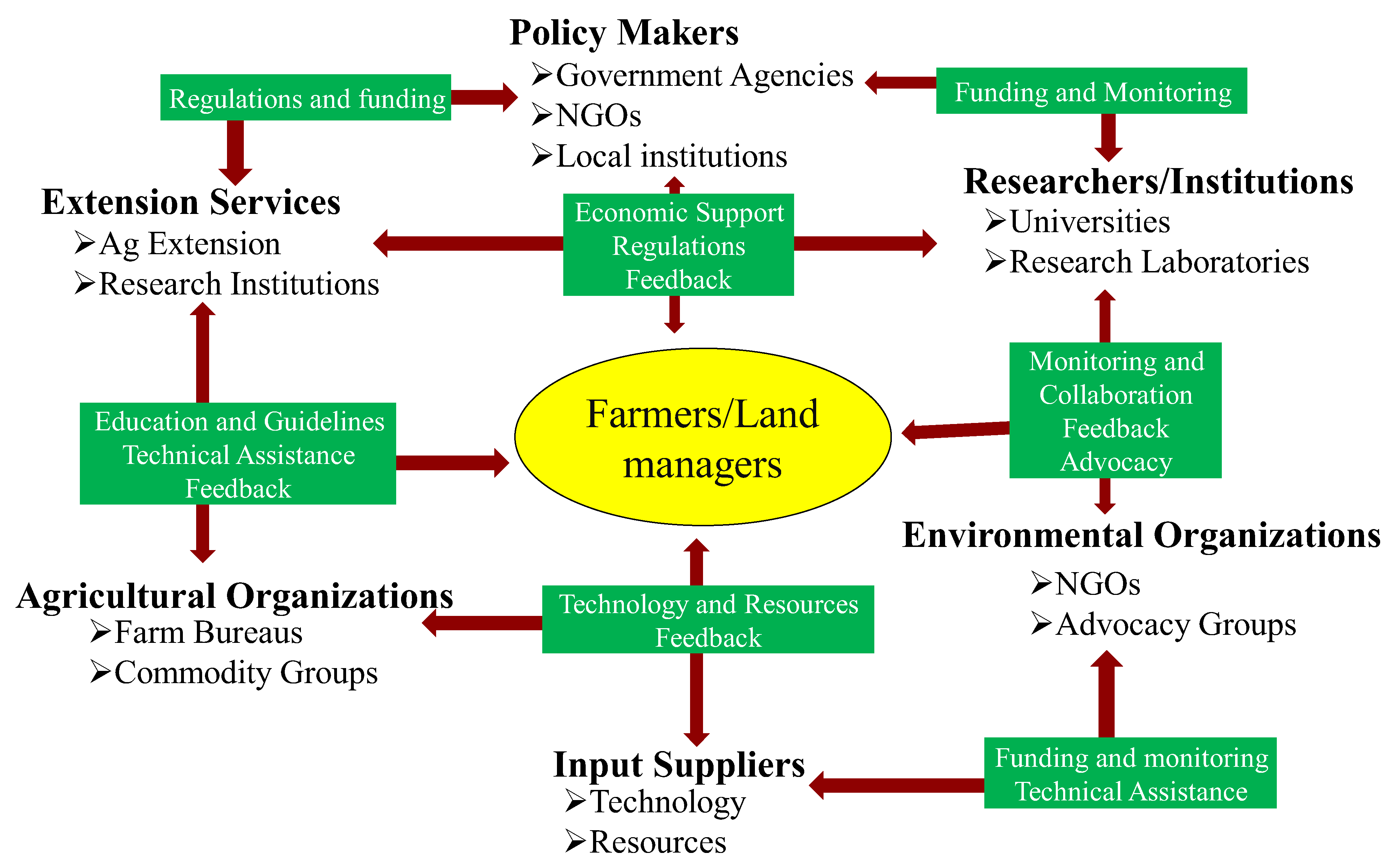
Figure 3 illustrates the interconnected web of actors and policies involved in managing nitrogen leaching. They include farmers, land managers, policymakers, and environmental organizations. It depicts regulations from policymakers to farmers, technical advice from extension services, feedback from farmers to policymakers, and advocacy from environmental groups. Different types of policies (e.g., regulations, economic incentives, voluntary programs) would influence behavior and contribute to overall nitrogen management goals.

8. Conclusions

Nitrogen loss from managed land is an inherently spatial process driven by the interaction of climate, landforms, soil types, and water flow patterns. This spatial dependence illustrates a broader governance challenge: environmentally damaging outcomes often arise from site-specific human actions yet propagate across regional and global scales. Addressing these cascading consequences requires policy frameworks that transcend sectoral boundaries and explicitly link agricultural practices with atmospheric, aquatic, and climate governance. These review findings indicate that uniform mitigation approaches are ill-suited to the heterogeneous conditions under which nitrogen leaching occurs. Instead, mitigation efforts should be guided by high-resolution data and tailored to local biophysical contexts. In the absence of integrated and targeted management, continued nitrogen leaching is likely to undermine ecosystem functioning, exacerbate risks to human health, and impose long-term economic costs. By aligning intervention strategies with dominant nitrogen transfer pathways and landscape-level vulnerability, it is possible to simultaneously limit nutrient losses and sustain agricultural productivity, even under increasing environmental uncertainty.

Author Contributions

Conceptualization, writing original manuscript, B.O.M.; Writing, review, and editing, B.O.M. and J.M.K.; article improvement, B.O.M., J.M.K. and D.K.M.; All authors revised the manuscript for its improvement. All authors have read and agreed to the published version of the manuscript.

Funding

This research received no external funding.

Data Availability Statement

All data and materials used in this study are available within this article.

Conflicts of Interest

The authors declare no conflicts of interest.

Abbreviations

The following abbreviations are used in this manuscript:
CERESCrop Environment Resource Synthesis
CFWMComprehensive Regulation Nitrogen Fertilizer and Water Management
DCDDicyandiamide
DMUDimethylourea
DNDCDenitrification-Decomposition
INFMImproved Nitrogen Fertilizer Management
NNitrogen
NINitrogen Inhibitor
PMParticulate Matter
SOMSoil Organic Matter
TNTotal Nitrogen
VFSVegetative Filter Strip

References

  1. Bibi, S.; Saifullah; Naeem, A.; Dahlawi, S. Environmental impacts of nitrogen use in agriculture, nitrate leaching and mitigation strategies. In Soil Science: Agricultural and Environmental Prospectives; Springer International Publishing: Cham, Switzerland, 2016; pp. 131–157. [Google Scholar] [CrossRef]
  2. Mahmud, K.; Panday, D.; Mergoum, A.; Missaoui, A. Nitrogen losses and potential mitigation strategies for a sustainable agroecosystem. Sustainability 2021, 13, 2400. [Google Scholar] [CrossRef]
  3. Lehmann, J.; Schroth, G. Nutrient leaching. In Trees, Crops and Soil Fertility: Concepts and Research Methods; CABI Publishing: Wallingford, UK, 2002; pp. 151–166. [Google Scholar] [CrossRef]
  4. Padilla, F.M.; Gallardo, M.; Manzano-Agugliaro, F. Global trends in nitrate leaching research in the 1960–2017 period. Sci. Total Environ. 2018, 643, 400–413. [Google Scholar] [CrossRef]
  5. Cameron, K.C.; Di, H.J.; Moir, J.L. Nitrogen losses from the soil/plant system: A review. Ann. Appl. Biol. 2013, 162, 145–173. [Google Scholar] [CrossRef]
  6. Manono, B.O. Carbon dioxide, nitrous oxide and methane emissions from the Waimate District (New Zealand) pasture soils as influenced by irrigation, effluent dispersal and earthworms. Cogent Environ. Sci. 2016, 2, 1256564. [Google Scholar] [CrossRef]
  7. Spiertz, J.H. Nitrogen, sustainable agriculture and food security: A review. In Sustainable Agriculture; Springer: Dordrecht, The Netherlands, 2009; pp. 635–651. [Google Scholar] [CrossRef]
  8. Leimer, S.; Oelmann, Y.; Eisenhauer, N.; Milcu, A.; Roscher, C.; Scheux, S.; Weigelt, A.; Wirth, C.; Wilcke, W. Mechanisms behind plant diversity effects on inorganic and organic N leaching from temperate grassland. Biogeochemistry 2016, 131, 339–353. [Google Scholar] [CrossRef]
  9. Monaghan, R.M.; Cameron, K.C.; McLay, C.D. Leaching losses of nitrogen from sheep urine patches. New Zealand J. Agric. Res. 1989, 32, 237–244. [Google Scholar] [CrossRef]
  10. Delgado, J.A. Quantifying the loss mechanisms of nitrogen. J. Soil Water Conserv. 2002, 57, 389–398. [Google Scholar] [CrossRef]
  11. Alva, A.K.; Paramasivam, S.; Fares, A.; Delgado, J.A.; Mattos, D., Jr.; Sajwan, K. Nitrogen and irrigation management practices to improve nitrogen uptake efficiency and minimize leaching losses. J. Crop Improv. 2006, 15, 369–420. [Google Scholar] [CrossRef]
  12. Liu, X.; Zhang, Y.; Xiao, T.; Li, P.; Zhang, L.; Liu, Y.; Deng, W. Runoff velocity controls soil nitrogen leaching in subtropical restored forest in southern China. For. Ecol. Manag. 2023, 548, 121412. [Google Scholar] [CrossRef]
  13. Dunn, S.M.; Vinten, A.J.; Lilly, A.; DeGroote, J.; Sutton, M.A.; McGechan, M. Nitrogen risk assessment model for Scotland: I. Nitrogen leaching. Hydrol. Earth Syst. Sci. 2004, 8, 191–204. [Google Scholar] [CrossRef]
  14. Goulding, K.W. Strategies for farmers and policy makers to control nitrogen losses whilst maintaining crop production. Sci. China Ser. C Life Sci. 2005, 48, 710–719. [Google Scholar] [CrossRef]
  15. Van Grinsven, H.J.; Ten Berge, H.F.; Dalgaard, T.; Fraters, B.; Durand, P.; Hart, A.; Hofman, G.; Jacobsen, B.H.; Lalor, S.T.; Lesschen, J.P.; et al. Management, regulation and environmental impacts of nitrogen fertilization in northwestern Europe under the Nitrates Directive; a benchmark study. Biogeosciences 2012, 9, 5143–5160. [Google Scholar] [CrossRef]
  16. Manono, B.O. Effects of Irrigation, Effluent Dispersal and Organic Farming on Earthworms and Soil Microbes in New Zealand Dairy Farms. Ph.D. Thesis, University of Otago, Dunedin, New Zealand, 2014. Available online: https://hdl.handle.net/10523/5097 (accessed on 20 December 2025).
  17. Vogeler, I.; Lucci, G.; Shepherd, M. An assessment of the effects of fertilizer nitrogen management on nitrate leaching risk from grazed dairy pasture. J. Agric. Sci. 2016, 154, 407–424. [Google Scholar] [CrossRef]
  18. Tripolskaja, L.; Verbylienė, I. The effect of different forms of nitrogen fertilizers on nitrogen leaching. Zemdirb.-Agric. 2014, 101, 243–248. [Google Scholar] [CrossRef][Green Version]
  19. Yang, J.; Liu, T.; Liu, H.; Zhai, L.; Wang, M.; Du, Y.; Chen, Y.; Yang, C.; Xiao, H.; Wang, H. Dimethylolurea as a novel slow-release nitrogen source for nitrogen leaching mitigation and crop production. J. Agric. Food Chem. 2019, 67, 7616–7625. [Google Scholar] [CrossRef]
  20. Bertilsson, G. Lysimeter Studies of Nitrogen Leaching and Nitrogen Balances as Affected by Agricultural Practices: Results of lysimeter experiments, Bulstofta Experiment Station, Supra AB. Acta Agric. Scand. 1988, 38, 3–11. [Google Scholar] [CrossRef]
  21. Manono, B.O.; Moller, H.; Morgan, R. Effects of irrigation, dairy effluent dispersal and stocking on soil properties of the Waimate District, New Zealand. Geoderma Reg. 2016, 7, 59–66. [Google Scholar] [CrossRef]
  22. Ledgard, S.F.; Welten, B.; Betteridge, K. Salt as a mitigation option for decreasing nitrogen leaching losses from grazed pastures. J. Sci. Food Agric. 2015, 95, 3033–3040. [Google Scholar] [CrossRef]
  23. Xie, Y.X.; Zhang, S.L.; Feng, W.; Zhao, X.; Guo, T.C. Review of atmospheric nitrogen deposition research. Chin. J. Eco-Agric. 2010, 18, 897–904. [Google Scholar] [CrossRef]
  24. Goulding, K.W.; Bailey, N.J.; Bradbury, N.J. A modelling study of nitrogen deposited to arable land from the atmosphere and its contribution to nitrate leaching. Soil Use Manag. 1998, 14, 70–77. [Google Scholar] [CrossRef]
  25. Yang, R.; Fukuzawa, K.; Nakayama, M.; Tateno, R.; Hishi, T.; Shibata, H.; Chiwa, M. Nitrate leaching and its susceptibility in response to elevated nitrogen deposition in Japanese forests. J. For. Res. 2024, 29, 81–88. [Google Scholar] [CrossRef]
  26. Kovačić, Đ.; Lončarić, Z.; Jović, J.; Samac, D.; Popović, B.; Tišma, M. Digestate management and processing practices: A review. Appl. Sci. 2022, 12, 9216. [Google Scholar] [CrossRef]
  27. Czekała, W. Digestate as a source of nutrients: Nitrogen and its fractions. Water 2022, 14, 4067. [Google Scholar] [CrossRef]
  28. Nkoa, R. Agricultural benefits and environmental risks of soil fertilization with anaerobic digestates: A review. Agron. Sustain. Dev. 2014, 34, 473–492. [Google Scholar] [CrossRef]
  29. De Notaris, C.; Sørensen, P.; Møller, H.B.; Wahid, R.; Eriksen, J. Nitrogen fertilizer replacement value of digestates from three green manures. Nutr. Cycl. Agroecosyst 2018, 112, 355–368. [Google Scholar] [CrossRef]
  30. Li, H.; Song, X.; Wu, D.; Wei, D.; Ju, X. Digestate induces significantly higher N2O emission compared to urea under different soil properties and moisture. Environ. Res. 2024, 241, 117617. [Google Scholar] [CrossRef] [PubMed]
  31. Pranckietienė, I.; Navickas, K.; Venslauskas, K.; Jodaugienė, D.; Buivydas, E.; Žalys, B.; Vagusevičienė, I. The effect of digestate from liquid cow manure on spring wheat chlorophyll content, soil properties, and risk of leaching. Agronomy 2023, 13, 626. [Google Scholar] [CrossRef]
  32. Wu, W.; Hu, H.; Wang, W.; Xu, P.; Tang, H. Harnessing biological nitrogen fixation: Multi-scale engineering for self-sustaining agroecosystems. Biotechnol. Adv. 2025, 84, 108687. [Google Scholar] [CrossRef]
  33. Dupont, L.; Alloing, G.; Pierre, O.; El Msehli, S.; Hopkins, J.; Hérouart, D.; Frendo, P. The legume root nodule: From symbiotic nitrogen fixation to senescence. Senescence 2012, 8, 137–168. [Google Scholar] [CrossRef]
  34. Smercina, D.N.; Evans, S.E.; Friesen, M.L.; Tiemann, L.K. To fix or not to fix: Controls on free-living nitrogen fixation in the rhizosphere. Appl. Environ. Microbiol. 2019, 85, e02546-18. [Google Scholar] [CrossRef]
  35. Saikia, S.P.; Bora, D.; Goswami, A.; Mudoi, K.D.; Gogoi, A. A review on the role of Azospirillum in the yield improvement of non leguminous crops. Afr. J. Microbiol. Res. 2012, 6, 1085–1102. [Google Scholar] [CrossRef]
  36. Kebede, E. Contribution, utilization, and improvement of legumes-driven biological nitrogen fixation in agricultural systems. Front. Sustain. Food Syst. 2021, 5, 767998. [Google Scholar] [CrossRef]
  37. Wang, T.; Balla, B.; Kovács, S.; Kereszt, A. Varietas delectat: Exploring natural variations in nitrogen-fixing symbiosis research. Front. Plant Sci. 2022, 13, 856187. [Google Scholar] [CrossRef]
  38. Zhang, L.; Liu, C.; Yao, W.; Shao, J.; Peixoto, L.; Yang, Y.; Zeng, Z.; Olesen, J.E.; Zang, H. Legume-based rotation benefits crop productivity and agricultural sustainability in the North China Plain. Soil Tillage Res. 2025, 250, 106502. [Google Scholar] [CrossRef]
  39. Badgley, C.; Moghtader, J.; Quintero, E.; Zakem, E.; Chappell, M.J.; Aviles-Vazquez, K.; Samulon, A.; Perfecto, I. Organic agriculture and the global food supply. Renew. Agric. Food Syst. 2007, 22, 86–108. [Google Scholar] [CrossRef]
  40. Wang, X.; Yang, Y.; Pei, K.; Zhou, J.; Peixoto, L.; Gunina, A.; Zeng, Z.; Zang, H.; Rasmussen, J.; Kuzyakov, Y. Nitrogen rhizodeposition by legumes and its fate in agroecosystems: A field study and literature review. Land Degrad. Dev. 2021, 32, 410–419. [Google Scholar] [CrossRef]
  41. Neugschwandtner, R.W.; Bernhuber, A.; Kammlander, S.; Wagentristl, H.; Klimek-Kopyra, A.; Lošák, T.; Zholamanov, K.K.; Kaul, H.P. Nitrogen yields and biological nitrogen fixation of winter grain legumes. Agronomy 2021, 11, 681. [Google Scholar] [CrossRef]
  42. Lei, Y.; Wang, Z.; Li, H.; Zheng, L.; Zhang, S. Assessment of nitrate leaching on agriculture region using remote sensing and model. In Proceedings of the Remote Sensing for Agriculture, Ecosystems, and Hydrology XI, Berlin, Germany, 31 August–3 September 2009; Volume 7472, pp. 465–474. [Google Scholar] [CrossRef]
  43. Wang, X.Z.; Gao, R.; Zhu, J.G.; Bao, C.J.; Feng, K. Nitrogen loss via runoff and leaching from soil as a function of types of urea applied in wheat season. J. Ecol. Rural Environ. 2005, 21, 24–29. [Google Scholar]
  44. Dise, N.B.; Wright, R.F. Nitrogen leaching from European forests in relation to nitrogen deposition. For. Ecol. Manag. 1995, 71, 153–161. [Google Scholar] [CrossRef]
  45. Li, X.; Li, F.Y.; Rong, X.M. Risk and leaching characteristics of nitrogen and phosphorus in sandy soil amended with sewage sludge. J. Soil Water Conserv. 2013, 27, 93–97. [Google Scholar]
  46. Viancelli, A.; Michelon, W. Climate change and nitrogen dynamics: Challenges and strategies for a sustainable future. Nitrogen 2024, 5, 688–701. [Google Scholar] [CrossRef]
  47. Wen, S.; Cui, N.; Wang, Y.; Gong, D.; Xing, L.; Wu, Z.; Zhang, Y.; Wang, Z. Determining effect of fertilization on reactive nitrogen losses through nitrate leaching and key influencing factors in Chinese agricultural systems. Agric. Water Manag. 2024, 303, 109055. [Google Scholar] [CrossRef]
  48. Liu, G.; Sun, J.; Liu, C.; Shi, H.; Fei, Y.; Wang, C.; Zhang, G.; Wang, H. Progress and trends in research on soil nitrogen leaching: A bibliometric analysis from 2003 to 2023. Sustainability 2025, 17, 339. [Google Scholar] [CrossRef]
  49. Iqbal, H.; Garcia-Perez, M.; Flury, M. Effect of biochar on leaching of organic carbon, nitrogen, and phosphorus from compost in bioretention systems. Sci. Total Environ. 2015, 521, 37–45. [Google Scholar] [CrossRef] [PubMed]
  50. Castellano, M.J.; Lewis, D.B.; Kaye, J.P. Response of soil nitrogen retention to the interactive effects of soil texture, hydrology, and organic matter. J. Geophys. Res. Biogeosci. 2013, 118, 280–290. [Google Scholar] [CrossRef]
  51. Wang, L.; He, Z.; Zhao, W.; Wang, C.; Ma, D. Fine soil texture is conducive to crop productivity and nitrogen retention in irrigated cropland in a desert-oasis ecotone, Northwest China. Agronomy 2022, 12, 1509. [Google Scholar] [CrossRef]
  52. Wang, W.; Zhu, W. Soil retention of 15N in a simulated N deposition study: Effects of live plant and soil organic matter content. Plant Soil 2012, 351, 61–72. [Google Scholar] [CrossRef]
  53. Prommer, J.; Wanek, W.; Hofhansl, F.; Trojan, D.; Offre, P.; Urich, T.; Schleper, C.; Sassmann, S.; Kitzler, B.; Soja, G.; et al. Biochar decelerates soil organic nitrogen cycling but stimulates soil nitrification in a temperate arable field trial. PLoS ONE 2014, 9, e86388. [Google Scholar] [CrossRef]
  54. Anyebe, O.; Sadiq, F.K.; Manono, B.O.; Matsika, T.A. Biochar characteristics and application: Effects on soil ecosystem services and nutrient dynamics for enhanced crop yields. Nitrogen 2025, 6, 31. [Google Scholar] [CrossRef]
  55. Sadiq, F.K.; Anyebe, O.; Tanko, F.; Abdulkadir, A.; Manono, B.O.; Matsika, T.A.; Abubakar, F.; Bello, S.K. Conservation agriculture for sustainable soil health management: A review of impacts, benefits and future directions. Soil Syst. 2025, 9, 103. [Google Scholar] [CrossRef]
  56. Kopacek, J.; Hejzlar, J.; Posch, M. Factors controlling the export of nitrogen from agricultural land in a large central European catchment during 1900–2010. Environ. Sci. Technol. 2013, 47, 6400–6407. [Google Scholar] [CrossRef]
  57. Liang, H.; Gao, S.; Qi, Z.; Hu, K.; Xu, J. Leaching loss of dissolved organic nitrogen from cropland ecosystems. Environ. Rev. 2021, 29, 23–30. [Google Scholar] [CrossRef]
  58. Kreyling, J.; Schuerings, J.; Malyshev, A.V.; Vogt, L.; Werner, C.; Jentsch, A. Nitrogen leaching is enhanced after a winter warm spell but mainly controlled by vegetation composition in temperate zone mesocosms. Plant Soil 2015, 396, 85–96. [Google Scholar] [CrossRef]
  59. Rowe, E.C.; Evans, C.D.; Emmett, B.A.; Reynolds, B.; Helliwell, R.C.; Coull, M.C.; Curtis, C.J. Vegetation type affects the relationship between soil carbon to nitrogen ratio and nitrogen leaching. Water Air Soil Pollut. 2006, 177, 335–347. [Google Scholar] [CrossRef]
  60. Børgesen, C.D.; Olesen, J.E. A probabilistic assessment of climate change impacts on yield and nitrogen leaching from winter wheat in Denmark. Nat. Hazards Earth Syst. Sci. 2011, 11, 2541–2553. [Google Scholar] [CrossRef]
  61. Singh, G.; Williard, K.; Schoonover, J.; Nelson, K.A.; Kaur, G. Cover crops and landscape position effects on nitrogen dynamics in plant-soil-water pools. Water 2019, 11, 513. [Google Scholar] [CrossRef]
  62. Van Es, H.M.; Sogbedji, J.M.; Schindelbeck, R.R. Effect of manure application timing, crop, and soil type on nitrate leaching. J. Environ. Qual. 2006, 35, 670–679. [Google Scholar] [CrossRef]
  63. Hisbani, W.A.; Manono, B.O.; Nawaz, M.; Mehmood, K.; Hasnain, Z.; Rais, A.; Irshad, S.; Ibrar, D.; Siddiqui, M.H.; Alamri, S.; et al. Assessing the influence of potassium fertilizer variations on growth, yield, and crop quality of sugarcane (Saccharum officinarum L.) genotypes. Int. J. Plant Prod. 2025, 19, 155–166. [Google Scholar] [CrossRef]
  64. Anderson, D.W. The effect of parent material and soil development on nutrient cycling in temperate ecosystems. Biogeochemistry 1988, 5, 71–97. [Google Scholar] [CrossRef]
  65. Simelane, M.P.; Soundy, P.; Maboko, M.M. Effects of rainfall intensity and slope on infiltration rate, soil losses, runoff and nitrogen leaching from different nitrogen sources with a rainfall simulator. Sustainability 2024, 16, 4477. [Google Scholar] [CrossRef]
  66. Arvola, L.; Einola, E.; Järvinen, M. Landscape properties and precipitation as determinants for high summer nitrogen load from boreal catchments. Landsc. Ecol. 2015, 30, 429–442. [Google Scholar] [CrossRef]
  67. Barkle, G.; Stenger, R.; Moorhead, B.; Clague, J. The importance of the hydrological pathways in exporting nitrogen from grazed artificially drained land. J. Hydrol. 2021, 597, 126218. [Google Scholar] [CrossRef]
  68. Zhang, Y.; Huang, C.; Zhang, W.; Chen, J.; Wang, L. The concept, approach, and future research of hydrological connectivity and its assessment at multiscales. Environ. Sci. Pollut. Res. 2021, 28, 52724–52743. [Google Scholar] [CrossRef]
  69. Augusto, L.; Achat, D.L.; Jonard, M.; Vidal, D.; Ringeval, B. Soil parent material—A major driver of plant nutrient limitations in terrestrial ecosystems. Glob. Change Biol. 2017, 23, 3808–3824. [Google Scholar] [CrossRef]
  70. Tan, K.; Wang, S.; Zheng, W.; Zhang, Z.; Liu, B. Geomorphologic and sedimentary features dominate the nitrogen accumulation and leaching in the deep vadose zone from a catchment viewpoint. J. Hydrol. 2025, 652, 132682. [Google Scholar] [CrossRef]
  71. Zuo, R.; Zheng, S.; Liu, X.; Wu, G.; Wang, S.; Wang, J.; Liu, J.; Huang, C.; Zhai, Y. Groundwater table fluctuation: A driving force affecting nitrogen transformation in nitrate-contaminated groundwater. J. Hydrol. 2023, 621, 129606. [Google Scholar] [CrossRef]
  72. Lian, T.; Cheng, L.; Liu, Q.; Yu, T.; Cai, Z.; Nian, H.; Hartmann, M. Potential relevance between soybean nitrogen uptake and rhizosphere prokaryotic communities under waterlogging stress. ISME Commun. 2023, 3, 71. [Google Scholar] [CrossRef]
  73. Długosz, J.; Piotrowska-Długosz, A.; Breza-Boruta, B. The effect of differences in soil water content on microbial and enzymatic properties across the soil profiles. Ecohydrol. Hydrobiol. 2024, 24, 547–556. [Google Scholar] [CrossRef]
  74. Xiao, Z.; Lei, H.; Lian, Y.; Zhang, Z.; Pan, H.; Yin, C.; Dong, Y. Impact of aerated drip irrigation and nitrogen application on soil properties, soil bacterial communities and agronomic traits of cucumber in a greenhouse system. Plants 2023, 12, 3834. [Google Scholar] [CrossRef] [PubMed]
  75. Vartapetian, B.B.; Jackson, M.B. Plant adaptations to anaerobic stress. Ann. Bot. 1997, 79, 3–20. [Google Scholar] [CrossRef]
  76. Nawaz, M.F.; Bourrie, G.; Gul, S. Factors affecting redox reactions in hydromorphic soils. A review. Pak. J. Agric. Sci. 2014, 51, 515–521. [Google Scholar]
  77. Fiedler, S.; Vepraskas, M.J.; Richardson, J.L. Soil redox potential: Importance, field measurements, and observations. Adv. Agron. 2007, 94, 1–54. [Google Scholar] [CrossRef]
  78. Yang, R.; Sun, K.; Chen, S.; Zhao, W.; Song, S.; Li, X. Nitrification-driven nitrogen mineralization in drylands: Regulation by human activity intensity and soil microclimate. J. Soils Sediments 2026, 26, 2. [Google Scholar] [CrossRef]
  79. Wang, W.J.; Chalk, P.M.; Chen, D.; Smith, C.J. Nitrogen mineralisation, immobilisation and loss, and their role in determining differences in net nitrogen production during waterlogged and aerobic incubation of soils. Soil Biol. Biochem. 2001, 33, 1305–1315. [Google Scholar] [CrossRef]
  80. Zhang, Y.; Chen, X.; Geng, S.; Zhang, X. A review of soil waterlogging impacts, mechanisms, and adaptive strategies. Front. Plant Sci. 2025, 16, 1545912. [Google Scholar] [CrossRef]
  81. Zhu, X.; Zhang, W.; Chen, H.; Mo, J. Impacts of nitrogen deposition on soil nitrogen cycle in forest ecosystems: A review. Acta Ecol. Sin. 2015, 35, 35–43. [Google Scholar] [CrossRef]
  82. Richards, B.N.; Smith, J.E.; White, G.J.; Charley, J.L. Mineralization of soil nitrogen in three forest communities from the New England region of New South Wales. Aust. J. Ecol. 1985, 10, 429–441. [Google Scholar] [CrossRef]
  83. Kaur, G.; Singh, G.; Motavalli, P.P.; Nelson, K.A.; Orlowski, J.M.; Golden, B.R. Management practices to reduce crop production and nitrogen losses from waterlogging. Crops Soils 2020, 53, 33–45. [Google Scholar] [CrossRef]
  84. Hoffmann, C.C.; Rysgaard, S.; Berg, P. Denitrification Rates Predicted by Nitrogen-15 Labeled Nitrate Microcosm Studies, In Situ Measurements, and Modeling; American Society of Agronomy, Crop Science Society of America, and Soil Science Society of America: Madison, WI, USA, 2000. [Google Scholar] [CrossRef]
  85. Simmelsgaard, S.E. The effect of crop, N-level, soil type and drainage on nitrate leaching from Danish soil. Soil Use Manag. 1998, 14, 30–36. [Google Scholar] [CrossRef]
  86. Kumar, D.; Patel, R.A.; Ramani, V.P.; Rathod, S.V. Evaluating precision nitrogen management practices in terms of yield, nitrogen use efficiency and nitrogen loss reduction in maize crop under Indian conditions. Int. J. Plant Prod. 2021, 15, 243–260. [Google Scholar] [CrossRef]
  87. Fronczyk, J.; Sieczka, A.; Lech, M.; Radziemska, M.; Lechowicz, Z. nTransport of Nitrogen Compounds through Subsoils in Agricultural Areas: Column Tests. Pol. J. Environ. Stud. 2016, 25, 1505–1514. [Google Scholar] [CrossRef]
  88. Hagedorn, F.; Steiner, K.G.; Sekayange, L.; Zech, W. Effect of rainfall pattern on nitrogen mineralization and leaching in a green manure experiment in South Rwanda. Plant Soil 1997, 195, 365–375. [Google Scholar] [CrossRef]
  89. Bauwe, A.; Tiemeyer, B.; Kahle, P.; Lennartz, B. Classifying hydrological events to quantify their impact on nitrate leaching across three spatial scales. J. Hydrol. 2015, 531, 589–601. [Google Scholar] [CrossRef]
  90. Bakhsh, A.; Kanwar, R. GIS and cluster analysis of NO3-N leaching losses to subsurface drainage water. In Proceedings of the 2006 International Conference on Advances in Space Technologies, Islamabad, Pakistan, 2–3 September 2006; pp. 121–125. [Google Scholar] [CrossRef]
  91. Wang, Z.H.; Li, S.X. Nitrate N loss by leaching and surface runoff in agricultural land: A global issue (a review). Adv. Agron. 2019, 156, 159–217. [Google Scholar] [CrossRef]
  92. Li, X.P.; Zhang, J.B.; Liu, J.T.; Zhu, A.N. Simulating soil water drainage and nitrogen leaching in Tianranwenyanqu Basin. Huan Jing Ke Xue= Huanjing Kexue 2009, 30, 864–869. [Google Scholar]
  93. Laverman, A.M.; Zoomer, H.R.; Van Verseveld, H.W.; Verhoef, H.A. Temporal and spatial variation of nitrogen transformations in a coniferous forest soil. Soil Biol. Biochem. 2000, 32, 1661–1670. [Google Scholar] [CrossRef]
  94. Yin, J.; Fei, L.J.; Mian, S.P. Experiment on the nitrogen leaching in the drainage conditionof rice field in Ningxia Yinnan irrigation region. J. Northwest Sci-Tech Univ. Agri. For. (Nat. Sci. Ed.) 2006, 34, 108–112. [Google Scholar]
  95. Chen, W.L.; Gao, Y.; Lin, Y.M.; Zhu, B.; Xu, Y.J.; Yu, G.R.; Wu, C.Z. Nitrogen leaching and associated environmental health effect in sloping cropland of purple soil. Huan Jing Ke Xue=Huanjing Kexue 2014, 35, 2129–2138. Available online: https://europepmc.org/article/med/25158487 (accessed on 26 November 2025). [PubMed]
  96. Letey, J.; Vaughan, P. Soil type, crop and irrigation technique affect nitrogen leaching to groundwater. Calif. Agric. 2013, 67, 231–241. [Google Scholar] [CrossRef]
  97. Zhao, Y.; Li, G.; Li, S.; Luo, Y.; Bai, Y. A review on the optimization of irrigation schedules for farmlands based on a simulation–optimization model. Water 2024, 16, 2545. [Google Scholar] [CrossRef]
  98. Mitsova, D.; Wang, X. A GIS-based technique for linking landscape characteristics to non-point source nitrogen export potential: Implications for contributing areas management. J. Environ. Plan. Manag. 2010, 53, 863–882. [Google Scholar] [CrossRef]
  99. Schuster, J.; Mittermayer, M.; Maidl, F.X.; Nätscher, L.; Hülsbergen, K.J. Spatial variability of soil properties, nitrogen balance and nitrate leaching using digital methods on heterogeneous arable fields in southern Germany. Precis. Agric. 2023, 24, 647–676. [Google Scholar] [CrossRef]
  100. Zeng, H.; Wen, N.; ZHANG, J.; Zhang, J.; HU, K.; Liu, G. Effect of macropore preferential flow on nitrogen leaching in a North China Plain farmland. Chin. J. Eco-Agric. 2021, 29, 66–75. [Google Scholar] [CrossRef]
  101. Larsson, M. Quantifying Macropore Flow Effects on Nitrate and Pesticide Leaching in a Structured Clay Soil. Field Experiments and Modelling with the MACRO and SOILN Models. Doctoral Thesis, Swedish University of Agricultural Science, Uppsala, Sweden, 1999. Available online: https://www.cabidigitallibrary.org/doi/full/10.5555/19991907713 (accessed on 26 November 2025).
  102. Manono, B. Agro-ecological role of earthworms (Oligochaetes) in sustainable agriculture and nutrient use efficiency: A review. J. Agric. Ecol. Res. Int. 2016, 8, 1–8. [Google Scholar] [CrossRef]
  103. Ruan, R.; Zhang, Z.; Lan, T.; Wang, Y.; Li, W.; Chen, H.; Peng, X. The role of soil pore structure on nitrate release from soil organic matter and applied fertilizer under three fertilization regimes. Soil Tillage Res. 2025, 248, 106396. [Google Scholar] [CrossRef]
  104. Bergström, L.; Jarvis, N.; Larsson, M.; Djodjic, F.; Shirmohammadi, A. Factors affecting the significance of macropore flow for leaching of agrochemicals. In Preferential Flow: Water Movement and Chemical Transport in the Environment; American Society of Agricultural and Biological Engineers: St. Joseph, MI, USA, 2001; p. 25. [Google Scholar] [CrossRef]
  105. Miranda-Vélez, J.F.; Diamantopoulos, E.; Vogeler, I. Does macropore flow in no-till systems bypass mobile soil nitrogen after harvest? Soil Tillage Res. 2022, 221, 105408. [Google Scholar] [CrossRef]
  106. Huang, Y.; Huang, Y.; Yang, M.; Yang, G.; Cao, J.; Wang, H.; Song, X.; Zhao, M.; Yu, X. Soil nitrogen leaching driven by different soil infiltration pathways: A simulated study in eucalyptus urophylla× E. Grandis plantation. J. Hydrol. 2025, 660, 133325. [Google Scholar] [CrossRef]
  107. Kuśmierz, S.; Skowrońska, M.; Tkaczyk, P.; Lipiński, W.; Mielniczuk, J. Soil organic carbon and mineral nitrogen contents in soils as affected by their pH, texture and fertilization. Agronomy 2023, 13, 267. [Google Scholar] [CrossRef]
  108. Manono, B.O.; Moller, H.; Benge, J.; Carey, P.; Lucock, D.; Manhire, J. Assessment of soil properties and earthworms in organic and conventional farming systems after seven years of dairy farm conversions in New Zealand. Agroecol. Sustain. Food Syst. 2019, 43, 678–704. [Google Scholar] [CrossRef]
  109. Weintraub, S.R.; Brooks, P.D.; Bowen, G.J. Interactive effects of vegetation type and topographic position on nitrogen availability and loss in a temperate montane ecosystem. Ecosystems 2017, 20, 1073–1088. [Google Scholar] [CrossRef]
  110. Xie, M.; Šimůnek, J.; Zhang, Z.; Zhang, P.; Xu, J.; Lin, Q. Nitrate subsurface transport and losses in response to its initial distributions in sloped soils: An experimental and modelling study. Hydrol. Process. 2019, 33, 3282–3296. [Google Scholar] [CrossRef]
  111. Zhang, B.; Tang, J.L.; Gao, C.; Zepp, H. Subsurface lateral flow from hillslope and its contribution to nitrate loading in streams through an agricultural catchment during subtropical rainstorm events. Hydrol. Earth Syst. Sci. 2011, 15, 3153–3170. [Google Scholar] [CrossRef]
  112. Bachmair, S.; Weiler, M. Hillslope characteristics as controls of subsurface flow variability. Hydrol. Earth Syst. Sci. 2012, 16, 3699–3715. [Google Scholar] [CrossRef]
  113. Woods, R.; Rowe, L. The changing spatial variability of subsurface flow across a hillside. J. Hydrol. 1996, 35, 51–86. [Google Scholar]
  114. Hou, Y.; Wang, S.; Ma, Y.; Shen, Z.; Goonetilleke, A. Influence of landscape patterns on nitrate and particulate organic nitrogen inputs to urban stormwater runoff. J. Environ. Manag. 2023, 348, 119190. [Google Scholar] [CrossRef]
  115. Refsgaard, J.C.; Thorsen, M.; Jensen, J.B.; Kleeschulte, S.; Hansen, S. Large scale modelling of groundwater contamination from nitrate leaching. J. Hydrol. 1999, 221, 117–140. [Google Scholar] [CrossRef]
  116. Wang, H.; Gao, J.E.; Li, X.H.; Zhang, S.L.; Wang, H.J. Nitrate accumulation and leaching in surface and ground water based on simulated rainfall experiments. PLoS ONE 2015, 10, e0136274. [Google Scholar] [CrossRef]
  117. Wick, K.; Heumesser, C.; Schmid, E. Groundwater nitrate contamination: Factors and indicators. J. Environ. Manag. 2012, 111, 178–186. [Google Scholar] [CrossRef] [PubMed]
  118. Hamlin, Q.F.; Martin, S.L.; Kendall, A.D.; Hyndman, D.W. Examining relationships between groundwater nitrate concentrations in drinking water and landscape characteristics to understand health risks. GeoHealth 2022, 6, e2021GH000524. [Google Scholar] [CrossRef] [PubMed]
  119. Li, J.; Liu, Y.; Dai, W.; Li, J.; Yang, P.; Tian, L.; Yu, S.; Zuo, R.; Zhai, Y.; Song, W.; et al. Nitrate attenuation with rising groundwater levels: An integrated assessment using isotope tracers and microbial signatures. J. Hydrol. 2023, 624, 129911. [Google Scholar] [CrossRef]
  120. Rivett, M.O.; Smith, J.W.; Buss, S.R.; Morgan, P. Nitrate occurrence and attenuation in the major aquifers of England and Wales. Q. J. Eng. Geol. Hydrogeol. 2007, 40, 335–352. [Google Scholar] [CrossRef]
  121. Rabalais, N.N. Nitrogen in aquatic ecosystems. AMBIO J. Hum. Environ. 2002, 31, 102–112. [Google Scholar] [CrossRef]
  122. Nieder, R.; Benbi, D.K. Reactive nitrogen compounds and their influence on human health: An overview. Rev. Environ. Health 2022, 37, 229–246. [Google Scholar] [CrossRef] [PubMed]
  123. Breitburg, D.L.; Hondorp, D.W.; Davias, L.A.; Diaz, R.J. Hypoxia, nitrogen, and fisheries: Integrating effects across local and global landscapes. Annu. Rev. Mar. Sci. 2009, 1, 329–349. [Google Scholar] [CrossRef]
  124. Glibert, P.M.; Burkholder, J.M. The complex relationships between increases in fertilization of the earth, coastal eutrophication and proliferation of harmful algal blooms. In Ecology of Harmful Algae; Springer: Berlin/Heidelberg, Germany, 2006; pp. 341–354. [Google Scholar]
  125. LÁ, C.Q.; Tian, H.Q.; Huang, Y. Ecological effects of increased nitrogen deposition in terrestrial ecosystems. Chin. J. Plant Ecol. 2007, 31, 205–218. [Google Scholar] [CrossRef][Green Version]
  126. Bolan, N.S.; Hedley, M.J.; White, R.E. Processes of soil acidification during nitrogen cycling with emphasis on legume based pastures. Plant Soil 1991, 134, 53–63. [Google Scholar] [CrossRef]
  127. Manono, B.O.; Moller, H. Effects of stock type, irrigation and effluent dispersal on earthworm species composition, densities and biomasses in New Zealand pastures. Pedobiologia 2015, 58, 187–193. [Google Scholar] [CrossRef]
  128. Butterbach-Bahl, K.; Gundersen, P.; Ambus, P.; Augustin, J.; Beier, C.; Boeckx, P. Nitrogen processes in terrestrial ecosystems. In The European Nitrogen Assessment: Sources, Effects and Policy Perspectives; Sutton, M.A., Howard, C.M., Erisman, J.W., Billen, G., Bleeker, A., Grennfelt, P., Van Grinsven, H., Grizzetti, B., Eds.; Cambridge University Press: Cambridge, UK, 2011; pp. 99–125. [Google Scholar] [CrossRef]
  129. Manono, B.O.; Sadiq, F.K.; Sadiq, A.A.; Matsika, T.A.; Tanko, F. Impacts of air quality on global crop yields and food security: An integrative review and future outlook. Air 2025, 3, 24. [Google Scholar] [CrossRef]
  130. Peel, J.L.; Haeuber, R.; Garcia, V.; Russell, A.G.; Neas, L. Impact of nitrogen and climate change interactions on ambient air pollution and human health. Biogeochemistry 2013, 114, 121–134. [Google Scholar] [CrossRef]
  131. Hui, D.; Ray, A.; Kasrija, L.; Christian, J. Impacts of climate change and agricultural practices on nitrogen processes, genes, and soil nitrous oxide emissions: A quantitative review of meta-analyses. Agriculture 2024, 14, 240. [Google Scholar] [CrossRef]
  132. Suddick, E.C.; Whitney, P.; Townsend, A.R.; Davidson, E.A. The role of nitrogen in climate change and the impacts of nitrogen–climate interactions in the United States: Foreword to thematic issue. Biogeochemistry 2013, 114, 1–10. [Google Scholar] [CrossRef]
  133. Ward, M.H.; Jones, R.R.; Brender, J.D.; De Kok, T.M.; Weyer, P.J.; Nolan, B.T.; Villanueva, C.M.; Van Breda, S.G. Drinking water nitrate and human health: An updated review. Int. J. Environ. Res. Public Health 2018, 15, 1557. [Google Scholar] [CrossRef]
  134. Townsend, A.R.; Howarth, R.W.; Bazzaz, F.A.; Booth, M.S.; Cleveland, C.C.; Collinge, S.K.; Dobson, A.P.; Epstein, P.R.; Holland, E.A.; Keeney, D.R.; et al. Human health effects of a changing global nitrogen cycle. Front. Ecol. Environ. 2003, 1, 240–246. [Google Scholar] [CrossRef][Green Version]
  135. Van Grinsven, H.J.; Holland, M.; Jacobsen, B.H.; Klimont, Z.; Sutton, M.A.; Jaap Willems, W. Costs and benefits of nitrogen for Europe and implications for mitigation. Environ. Sci. Technol. 2013, 47, 3571–3579. [Google Scholar] [CrossRef]
  136. Keeler, B.L.; Gourevitch, J.D.; Polasky, S.; Isbell, F.; Tessum, C.W.; Hill, J.D.; Marshall, J.D. The social costs of nitrogen. Sci. Adv. 2016, 2, e1600219. [Google Scholar] [CrossRef]
  137. Mathewson, P.D.; Evans, S.; Byrnes, T.; Joos, A.; Naidenko, O.V. Health and economic impact of nitrate pollution in drinking water: A Wisconsin case study. Environ. Monit. Assess. 2020, 192, 724. [Google Scholar] [CrossRef] [PubMed]
  138. Reay, D.S.; Davidson, E.A.; Smith, K.A.; Smith, P.; Melillo, J.M.; Dentener, F.; Crutzen, P.J. Global agriculture and nitrous oxide emissions. Nat. Clim. Change 2012, 2, 410–416. [Google Scholar] [CrossRef]
  139. Ogidi, O.I.; Akpan, U.M. Aquatic biodiversity loss: Impacts of pollution and anthropogenic activities and strategies for conservation. In Biodiversity in Africa: Potentials, Threats and Conservation; Springer Nature Singapore: Singapore, 2022; pp. 421–448. [Google Scholar]
  140. de Vries, F.T.; Bardgett, R.D. Plant community controls on short-term ecosystem nitrogen retention. New Phytol. 2016, 210, 861–874. [Google Scholar] [CrossRef]
  141. De Vries, W. Impacts of nitrogen emissions on ecosystems and human health: A mini review. Curr. Opin. Environ. Sci. Health 2021, 21, 100249. [Google Scholar] [CrossRef]
  142. Griffis, T.J.; Chen, Z.; Baker, J.M.; Wood, J.D.; Millet, D.B.; Lee, X.; Venterea, R.T.; Turner, P.A. Nitrous oxide emissions are enhanced in a warmer and wetter world. Proc. Natl. Acad. Sci. USA 2017, 114, 12081–12085. [Google Scholar] [CrossRef]
  143. Mosheim, R.; Ribaudo, M. Costs of nitrogen runoff for rural water utilities: A shadow cost approach. Land Econ. 2017, 93, 12–39. [Google Scholar] [CrossRef]
  144. Yadav, M.R.; Kumar, S.; Lal, M.K.; Kumar, D.; Kumar, R.; Yadav, R.K.; Kumar, S.; Nanda, G.; Singh, J.; Udawat, P.; et al. Mechanistic understanding of leakage and consequences and recent technological advances in improving nitrogen use efficiency in cereals. Agronomy 2023, 13, 527. [Google Scholar] [CrossRef]
  145. Sobota, D.J.; Compton, J.E.; McCrackin, M.L.; Singh, S. Cost of reactive nitrogen release from human activities to the environment in the United States. Environ. Res. Lett. 2015, 10, 025006. [Google Scholar] [CrossRef]
  146. Zhu, G.; Shi, H.; Zhong, L.; He, G.; Wang, B.; Shan, J.; Han, P.; Liu, T.; Wang, S.; Liu, C.; et al. Nitrous oxide sources, mechanisms and mitigation. Nat. Rev. Earth Environ. 2025, 6, 574–592. [Google Scholar] [CrossRef]
  147. Seitzinger, S.; Harrison, J.A.; Böhlke, J.K.; Bouwman, A.F.; Lowrance, R.; Peterson, B.; Tobias, C.; Drecht, G.V. Denitrification across landscapes and waterscapes: A synthesis. Ecol. Appl. 2006, 16, 2064–2090. [Google Scholar] [CrossRef] [PubMed]
  148. Abdalla, M.; Hastings, A.; Cheng, K.; Yue, Q.; Chadwick, D.; Espenberg, M.; Truu, J.; Rees, R.M.; Smith, P. A critical review of the impacts of cover crops on nitrogen leaching, net greenhouse gas balance and crop productivity. Glob. Change Biol. 2019, 25, 2530–2543. [Google Scholar] [CrossRef] [PubMed]
  149. Young, E.O.; Briggs, R.D. Nitrogen dynamics among cropland and riparian buffers: Soil-landscape influences. J. Environ. Qual. 2007, 36, 801–814. [Google Scholar] [CrossRef] [PubMed]
  150. Meisinger, J.J.; Delgado, J.A. Principles for managing nitrogen leaching. J. Soil Water Conserv. 2002, 57, 485–498. [Google Scholar] [CrossRef]
  151. Cassman, K.G.; Dobermann, A.; Walters, D.T. Agroecosystems, nitrogen-use efficiency, and nitrogen management. AMBIO J. Hum. Environ. 2002, 31, 132–140. [Google Scholar] [CrossRef]
  152. Bai, X.; Zhang, Z.; Cui, J.; Liu, Z.; Chen, Z.; Zhou, J. Strategies to mitigate nitrate leaching in vegetable production in China: A meta-analysis. Environ. Sci. Pollut. Res. 2020, 27, 18382–18391. [Google Scholar] [CrossRef]
  153. Jalpa, L.; Mylavarapu, R.S.; Hochmuth, G.J.; Wright, A.L.; van Santen, E. Apparent recovery and efficiency of nitrogen fertilization in tomato grown on sandy soils. HortTechnology 2020, 30, 204–211. [Google Scholar] [CrossRef]
  154. Kabir, T.; De Laporte, A.; Nasielski, J.; Weersink, A. Adjusting nitrogen rates with split applications: Modelled effects on N losses and profits across weather scenarios. Eur. J. Agron. 2021, 129, 126328. [Google Scholar] [CrossRef]
  155. Bryant, J.R.; Hoogendoorn, C.J.; Snow, V.O. Simulation of mitigation strategies to reduce nitrogen leaching from grazed pasture. Proc. New Zealand Grassl. Assoc. 2007, 69, 145–151. [Google Scholar] [CrossRef]
  156. Chikazhe, T.L.; Beukes, P.; Bryant, R.; Kok, J.; Ledgard, S.; Edwards, J.P.; Phyn, C. Stacking nitrogen leaching mitigations in a Canterbury dairy system whilst minimising profitability losses. J. New Zealand Grassl. 2023, 85, 303–309. [Google Scholar] [CrossRef]
  157. Junejo, N.; Khanif, M.Y.; Hanfi, M.M.; Yunus, W.W.; Dharejo, K.A. Role of inhibitors and biodegradable material in mitigation of nitrogen losses from fertilized lands. Afr. J. Biotechnol. 2011, 10, 3504–3514. [Google Scholar]
  158. Siman, F.C.; Andrade, F.V.; Passos, R.R. Nitrogen fertilizers and NH3 volatilization: Effect of temperature and soil moisture. Commun. Soil Sci. Plant Anal. 2020, 51, 1283–1292. [Google Scholar] [CrossRef]
  159. Morgan, K.T.; Cushman, K.E.; Sato, S. Release mechanisms for slow-and controlled-release fertilizers and strategies for their use in vegetable production. HortTechnology 2009, 19, 10–12. [Google Scholar] [CrossRef]
  160. Nouri, A.; Lukas, S.; Singh, S.; Singh, S.; Machado, S. When do cover crops reduce nitrate leaching? A global meta-analysis. Glob. Change Biol. 2022, 28, 4736–4749. [Google Scholar] [CrossRef]
  161. Teixeira, E.I.; Johnstone, P.; Chakwizira, E.; de Ruiter, J.; Malcolm, B.; Shaw, N.; Zyskowski, R.; Khaembah, E.; Sharp, J.; Meenken, E.; et al. Sources of variability in the effectiveness of winter cover crops for mitigating N leaching. Agric. Ecosyst. Environ. 2016, 220, 226–235. [Google Scholar] [CrossRef]
  162. Lacey, C.; Nevins, C.; Camberato, J.; Kladivko, E.; Sadeghpour, A.; Armstrong, S. Carbon and nitrogen release from cover crop residues and implications for cropping systems management. J. Soil Water Conserv. 2020, 75, 505–514. [Google Scholar] [CrossRef]
  163. Beukes, P.C.; Depree, C.; Macintosh, K.A.; Silva-Villacorta, D. Stacking nitrogen mitigation strategies for future pasture-based dairy farms: Impacts on leaching and profit. Front. Anim. Sci. 2024, 5, 1277131. [Google Scholar] [CrossRef]
  164. Doole, G.J. Efficient mitigation of nitrogen leaching in pasture-based dairy systems. Nutr. Cycl. Agroecosyst. 2015, 101, 193–209. [Google Scholar] [CrossRef]
  165. Wei, Z.; Hoffland, E.; Zhuang, M.; Hellegers, P.; Cui, Z. Organic inputs to reduce nitrogen export via leaching and runoff: A global meta-analysis. Environ. Pollut. 2021, 291, 118176. [Google Scholar] [CrossRef]
  166. Jiang, H.B.; Zhang, K.Q.; Zou, H.T.; Ma, Y.J.; Qu, Q.B.; Gu, Y.R.; Shen, S.Z. Effects of different fertilization patterns on nitrogen leaching loss from paddy fields under reduced nitrogen. Huan Jing Ke Xue= Huanjing Kexue 2021, 42, 5405–5413. [Google Scholar] [CrossRef] [PubMed]
  167. Skaalsveen, K.; Ingram, J.; Clarke, L.E. The effect of no-till farming on the soil functions of water purification and retention in north-western Europe: A literature review. Soil Tillage Res. 2019, 189, 98–109. [Google Scholar] [CrossRef]
  168. Bruno, I.P.; Furlan, L.A.; Araújo, A.G. Nitrate leaching and soil tillage practices: Global vs. Brazilian research trends for 2001-2011 and 2012-20221. Pesqui. Agropecuária Trop. 2023, 53, e76778. [Google Scholar] [CrossRef]
  169. Yin, J.; Tanaka, T.S.; Andersen, M.N.; Cammarano, D. Agroecosystem modeling and precision agriculture for sustainable nitrogen management. Ital. J. Agron. 2025, 20, 100053. [Google Scholar] [CrossRef]
  170. Khan, M.R.; Tarafder, M.A.; Priti, M.S. Potential use of zeolites in agriculture: A review. SAARC J. Agric. 2024, 22, 17–30. [Google Scholar] [CrossRef]
  171. Hu, T.J.; Zeng, G.M.; Huang, G.H.; Liu, H.L.; Huang, D.L.; Yu, H.Y.; Dai, F. Influence of different sorbents on adsorption effect of ammonia and compost property in aerobic composting. Huan Jing Ke Xue= Huanjing Kexue 2005, 26, 190–195. [Google Scholar] [PubMed]
  172. Brass, T.J.; Foshee, W.G., III; Sibley, J.L. Use of fresh sawdust as a nitrogen source in sweet corn production. J. Veg. Crop Prod. 2004, 10, 89–98. [Google Scholar] [CrossRef]
  173. Tuffour, H.O. Nitrogen Losses and Enrichment of Soil and Sawdust Coverings During Composting of Poultry Manure. Asian J. Soil Sci. Plant Nutr. 2022, 8, 13–22. [Google Scholar] [CrossRef]
  174. Lory, J.; Adams, J.; Eghball, B.; Klopfenstein, T.J.; Powers, J.F. Effect of sawdust or acid application to pen surfaces on nitrogen losses from open-dirt feedlots. In Nebraska Beef Cattle Report; DigitalCommons@University of Nebraska-Lincoln: Lincoln, NE, USA, 2022; Volume 282, Available online: https://digitalcommons.unl.edu/animalscinbcr/282 (accessed on 26 November 2025).
  175. Liu, Q.; Liu, B.; Zhang, Y.; Hu, T.; Lin, Z.; Liu, G.; Wang, X.; Ma, J.; Wang, H.; Jin, H.; et al. Biochar application as a tool to decrease soil nitrogen losses (NH3 volatilization, N2O emissions, and N leaching) from croplands: Options and mitigation strength in a global perspective. Glob. Change Biol. 2019, 25, 2077–2093. [Google Scholar] [CrossRef]
  176. Ding, Y.; Liu, Y.X.; Wu, W.X.; Shi, D.Z.; Yang, M.; Zhong, Z.K. Evaluation of biochar effects on nitrogen retention and leaching in multi-layered soil columns. Water Air Soil Pollut. 2010, 213, 47–55. [Google Scholar] [CrossRef]
  177. Bu, X.; Xue, J.; Zhao, C.; Wu, Y.; Han, F. Nutrient leaching and retention in riparian soils as influenced by rice husk biochar addition. Soil Sci. 2017, 182, 241–247. [Google Scholar] [CrossRef]
  178. Schofield, H.K.; Pettitt, T.R.; Tappin, A.D.; Rollinson, G.K.; Fitzsimons, M.F. Biochar incorporation increased nitrogen and carbon retention in a waste-derived soil. Sci. Total Environ. 2019, 690, 1228–1236. [Google Scholar] [CrossRef]
  179. Cao, X.; Reichel, R.; Wissel, H.; Brüggemann, N. Improving nitrogen retention of cattle slurry with oxidized biochar: An incubation study with three different soils. J. Environ. Qual. 2023, 52, 1–12. [Google Scholar] [CrossRef] [PubMed]
  180. Yu, L.; Yu, M.; Lu, X.; Tang, C.; Liu, X.; Brookes, P.C.; Xu, J. Combined application of biochar and nitrogen fertilizer benefits nitrogen retention in the rhizosphere of soybean by increasing microbial biomass but not altering microbial community structure. Sci. Total Environ. 2018, 640, 1221–1230. [Google Scholar] [CrossRef]
  181. Li, C.; Zhao, C.; Zhao, X.; Wang, Y.; Lv, X.; Zhu, X.; Song, X. Beneficial effects of biochar application with nitrogen fertilizer on soil nitrogen retention, absorption and utilization in maize production. Agronomy 2022, 13, 113. [Google Scholar] [CrossRef]
  182. Cataldo, E.; Salvi, L.; Paoli, F.; Fucile, M.; Masciandaro, G.; Manzi, D.; Masini, C.M.; Mattii, G.B. Application of zeolites in agriculture and other potential uses: A review. Agronomy 2021, 11, 1547. [Google Scholar] [CrossRef]
  183. Nakhli, S.A.; Delkash, M.; Bakhshayesh, B.E.; Kazemian, H. Application of zeolites for sustainable agriculture: A review on water and nutrient retention. Water Air Soil Pollut. 2017, 228, 464. [Google Scholar] [CrossRef]
  184. Ahmad, A.; Ijaz, S.S.; He, Z. Effects of zeolitic urea on nitrogen leaching (NH4-N and NO3-N) and volatilization (NH3) in spodosols and alfisols. Water 2021, 13, 1921. [Google Scholar] [CrossRef]
  185. Tsintskaladze, G.; Eprikashvili, L.; Mumladze, N.; Gabunia, V.; Sharashenidze, T.; Zautashvili, M.; Kordzakhia, T.; Shatakishvili, T. Nitrogenous zeolite nanomaterial and the possibility of its application in agriculture. Ann. Agrar. Sci. 2017, 15, 365–369. [Google Scholar] [CrossRef]
  186. Ramalingappa, P.L.; Singh, R.; Shrivastava, M. Synergistic Impacts of Synthesized Nanozeolite-Based Nitrogen Fertilizers on Soil Nitrogen Mineralization, Nitrogen Loss Mitigation, Enzymatic Pathways, Photosynthetic Efficiency, and Crop Yield in Agricultural Systems. Water Air Soil Pollut. 2025, 236, 833. [Google Scholar] [CrossRef]
  187. Sun, Y.; Xia, G.; He, Z.; Wu, Q.; Zheng, J.; Li, Y.; Wang, Y.; Chen, T.; Chi, D. Zeolite amendment coupled with alternate wetting and drying to reduce nitrogen loss and enhance rice production. Field Crops Res. 2019, 235, 95–103. [Google Scholar] [CrossRef]
  188. Lim, J.J.; Sethupathi, S.; Mohd Ismail, N.I.; Munusamy, Y. Recovery of Nitrogen and Phosphorus as Nutrients From Wastewater Using Sorbents and Its Potential Reutilization as a Soil Conditioner: A Review. Water Environ. Res. 2025, 97, e70104. [Google Scholar] [CrossRef]
  189. Khajeh, A.; Salimi, M.; MolaAbasi, H.; Seif, M.E.; Payan, M.; Keawsawasvong, S. Zeolite-based soil stabilization: A review. J. Rock Mech. Geotech. Eng. 2025. [Google Scholar] [CrossRef]
  190. Passeport, E.; Vidon, P.; Forshay, K.J.; Harris, L.; Kaushal, S.S.; Kellogg, D.Q.; Lazar, J.; Mayer, P.; Stander, E.K. Ecological engineering practices for the reduction of excess nitrogen in human-influenced landscapes: A guide for watershed managers. Environ. Manag. 2013, 51, 392–413. [Google Scholar] [CrossRef] [PubMed]
  191. Fajardo, J.J.; Bauder, J.W.; Cash, S.D. Managing nitrate and bacteria in runoff from livestock confinement areas with vegetative filter strips. J. Soil Water Conserv. 2001, 56, 185–191. [Google Scholar] [CrossRef]
  192. Khanna, P.K. Leaching of nitrogen from terrestrial ecosystems–patterns, mechanisms and ecosystem responses. Ecol. Bull. 1981, 33, 343–352. [Google Scholar]
  193. Shepherd, M.; Wyatt, J.; Welten, B.; Ledgard, S. Form of nitrogen leaching from dairy cow urine and effectiveness of dicyandiamide: Not all soils are equal. In Proceedings of the 19th World Congress of Soil Science, Soil Solutions for a Changing World, Brisbane, Australia, 1–6 August 2010; pp. 32–35. [Google Scholar]
  194. Skaggs, R.W.; Youssef, M.A.; Gilliam, J.W.; Evans, R.O. Effect of controlled drainage on water and nitrogen balances in drained lands. Trans. ASABE 2010, 53, 1843–1850. [Google Scholar] [CrossRef]
  195. Wang, Q.C.; Yu, H.L.; Yao, Q.; Han, Z.X.; Qiao, S.L. Retaining and transformation of incoming soil N from highland to adjacent terrestrial water body in riparian buffer zone. Ying Yong Sheng Tai Xue Bao= J. Appl. Ecol. 2007, 18, 2611–2617. [Google Scholar]
  196. Mayer, P.M.; Reynolds, S.K., Jr.; McCutchen, M.D.; Canfield, T.J. Meta-analysis of nitrogen removal in riparian buffers. J. Environ. Qual. 2007, 36, 1172–1180. [Google Scholar] [CrossRef]
  197. Rosen, T.; Christianson, L. Performance of denitrifying bioreactors at reducing agricultural nitrogen pollution in a humid subtropical coastal plain climate. Water 2017, 9, 112. [Google Scholar] [CrossRef]
  198. Dougherty, H.; Cooke, R.A.; Bhattarai, R.; Christianson, L. Design flow and nitrate removal evaluation of a wide denitrifying bioreactor with baffles. Ecol. Eng. 2020, 158, 106068. [Google Scholar] [CrossRef]
  199. Hsueh, M.L.; Yang, L.; Hsieh, L.Y.; Lin, H.J. Nitrogen removal along the treatment cells of a free-water surface constructed wetland in subtropical Taiwan. Ecol. Eng. 2014, 73, 579–587. [Google Scholar] [CrossRef]
  200. Vymazal, J. The use of hybrid constructed wetlands for wastewater treatment with special attention to nitrogen removal: A review of a recent development. Water Res. 2013, 47, 4795–4811. [Google Scholar] [CrossRef]
  201. Martinez-Feria, R.; Nichols, V.; Basso, B.; Archontoulis, S. Can multi-strategy management stabilize nitrate leaching under increasing rainfall? Environ. Res. Lett. 2019, 14, 124079. [Google Scholar] [CrossRef]
  202. Stevens, C.J.; Quinton, J.N.; Bailey, A.P.; Deasy, C.; Silgram, M.; Jackson, D.R. The effects of minimal tillage, contour cultivation and in-field vegetative barriers on soil erosion and phosphorus loss. Soil Tillage Res. 2009, 106, 145–151. [Google Scholar] [CrossRef]
  203. Garrity, D.P. Contour farming based on natural vegetative strips: Expanding the scope for increased food crop production on sloping lands in Asia. Environ. Dev. Sustain. 1999, 1, 323–336. [Google Scholar] [CrossRef]
  204. Bouraoui, F.; Panagos, P.; Malagó, A.; Pistocchi, A.; Didion, C. Regulations on nitrate use and management. In Nitrate Handbook; CRC Press: Boca Raton, FL, USA, 2022; pp. 405–423. [Google Scholar] [CrossRef]
  205. Manono, B.O. Small-Scale Farming in the United States: Challenges and Pathways to Enhanced Productivity and Profitability. Sustainability 2025, 17, 6752. [Google Scholar] [CrossRef]
  206. Joelsson, A.; Kyllmar, K. Implementation of best management practices in agriculture: Modelling and monitoring of impacts on nitrogen leaching. Water Sci. Technol. 2002, 45, 43–50. [Google Scholar] [CrossRef]
  207. Kros, H.; de Vries, W.; Oudendag, D.; van Leeuwen, T.; Alterra, W.U. Plausibility of an integrated national model for the evaluation of mitigation options on agricultural nitrogen losses. In Proceedings of the 3rd International Nitrogen Conference, Nanjing, China, 12–16 October 2004; pp. 12–16. Available online: https://edepot.wur.nl/52355 (accessed on 26 November 2025).
  208. Wen, Y.; Zhang, H.L.; Xie, J.W.; Cao, L.K. Studies on the nitrogen loss from rice field with different fertilizer treatments. Bull. Sci. Technol. 2011, 27, 549–553. [Google Scholar]
  209. Bradley, A.; Larson, R.A.; Runge, T. Impact of biochar additions to nitrogen leaching in sand columns. In 2015 ASABE Annual International Meeting; American Society of Agricultural and Biological Engineers: St. Joseph, MI, USA, 2015; p. 1. [Google Scholar] [CrossRef]
  210. Zhou, Z.H.; Li, X.; Xing, Y.; Fang, B.; Zhang, L.; Peng, Y. Effect of biochar amendment on nitrogen leaching in soil. Earth Environ. 2011, 39, 278–284. [Google Scholar]
  211. Yang, J.Y.; Drury, C.F.; Jiang, R.; Yang, X.M.; Worth, D.E.; Bittman, S.; Grant, B.B.; Smith, W.N.; Reid, K. Simulating nitrogen balance in Canadian agricultural soils from 1981 to 2016. J. Environ. Manag. 2023, 341, 118015. [Google Scholar] [CrossRef] [PubMed]
  212. Gerakis, A.; Rasse, D.P.; Kavdir, Y.; Smucker, A.J.; Katsalirou, I.; Ritchie, J.T. Simulation of leaching losses in the nitrogen cycle. Commun. Soil Sci. Plant Anal. 2006, 37, 1973–1997. [Google Scholar] [CrossRef]
  213. Uhan, S. Assessment of the influences of climate variability on nitrogen leaching rate into groundwater. RMZ–M&G 2018, 65, 123–130. [Google Scholar] [CrossRef]
  214. Beaudoin, N.; Gallois, N.; Viennot, P.; Le Bas, C.; Puech, T.; Schott, C.; Buis, S.; Mary, B. Evaluation of a spatialized agronomic model in predicting yield and N leaching at the scale of the Seine-Normandie basin. Environ. Sci. Pollut. Res. 2018, 25, 23529–23558. [Google Scholar] [CrossRef]
  215. De Paz, J.M.; Ramos, C. Simulation of nitrate leaching for different nitrogen fertilization rates in a region of Valencia (Spain) using a GIS–GLEAMS system. Agric. Ecosyst. Environ. 2004, 103, 59–73. [Google Scholar] [CrossRef]
  216. Haberlandt, U.; Van Der Heijden, S. Modelling of nitrogen leaching based on collective intelligence. In IAHS-AISH Publication; IAHS Press: Wallingford, UK, 2007; pp. 102–106. Available online: http://pascal-francis.inist.fr/vibad/index.php?action=getRecordDetail&idt=20127999 (accessed on 26 November 2025).
  217. Manono, B.O.; Mwami, B.; Mutavi, S.; Nzilu, F. Precision Farming with Smart Sensors: Current State, Challenges and Future Outlook. Sensors 2026, 26, 882. [Google Scholar] [CrossRef]
  218. Delgado, J.A.; Khosla, R.; Bausch, W.C.; Westfall, D.G.; Inman, D.J. Nitrogen fertilizer management based on site-specific management zones reduces potential for nitrate leaching. J. Soil Water Conserv. 2005, 60, 402–410. [Google Scholar] [CrossRef]
  219. Getahun, S.; Kefale, H.; Gelaye, Y. Application of precision agriculture technologies for sustainable crop production and environmental sustainability: A systematic review. Sci. World J. 2024, 2024, 2126734. [Google Scholar] [CrossRef]
  220. Guerrero, A.; De Neve, S.; Mouazen, A.M. Data fusion approach for map-based variable-rate nitrogen fertilization in barley and wheat. Soil Tillage Res. 2021, 205, 104789. [Google Scholar] [CrossRef]
  221. Vopravil, J.; Formánek, P.; Holubík, O.; Svoboda, P.; Khel, T. Effects of variable rate fertiliser application on selected macronutrients leaching from the ploughed layer. Soil Water Res. 2025, 20, 206–217. [Google Scholar] [CrossRef]
  222. Tsitouras, A.; Noulas, C.; Liakos, V.; Stamatiadis, S.; Tziouvalekas, M.; Qin, R.; Evangelou, E. Variable-Rate Nitrogen Application in Wheat Based on UAV-Derived Fertilizer Maps and Precision Agriculture Technologies. Agronomy 2025, 15, 1714. [Google Scholar] [CrossRef]
  223. Liang, H.; Zhao, C.; Huang, W.; Liu, L.; Wang, J.; Ma, Y. Variable-rate nitrogen application algorithm based on canopy reflected spectrum and its influence on wheat. In Multispectral and Hyperspectral Remote Sensing Instruments and Applications II; SPIE: Bellingham, WA, USA, 2005; Volume 5655, pp. 522–530. [Google Scholar] [CrossRef]
  224. Balafoutis, A.T.; Evert, F.K.; Fountas, S. Smart farming technology trends: Economic and environmental effects, labor impact, and adoption readiness. Agronomy 2020, 10, 743. [Google Scholar] [CrossRef]
  225. Ali, A.M.; Salem, H.M. Site-specific nitrogen fertilizer management using canopy reflectance sensors, chlorophyll meters and leaf color charts: A review. Nitrogen 2024, 5, 828–856. [Google Scholar] [CrossRef]
  226. Liang, X.Q.; Chen, Y.X.; Nie, Z.Y.; Ye, Y.S.; Liu, J.; Tian, G.M.; Wang, G.H.; Tuong, T.P. Mitigation of nutrient losses via surface runoff from rice cropping systems with alternate wetting and drying irrigation and site-specific nutrient management practices. Environ. Sci. Pollut. Res. 2013, 20, 6980–6991. [Google Scholar] [CrossRef] [PubMed]
  227. Kiełbasa, B.; Pietrzak, S.; Ulén, B.; Drangert, J.O.; Tonderski, K. Sustainable agriculture: The study on farmers’ perception and practices regarding nutrient management and limiting losses. J. Water Land Dev. 2018, 36, 67–75. [Google Scholar] [CrossRef]
  228. Rudnick, J.; Khalsa, S.D.; Lubell, M.; Leinfelder-Miles, M.; Gould, K.; Brown, P.H. Understanding barriers to adoption of sustainable nitrogen management practices in California. J. Soil Water Conserv. 2023, 78, 347–363. [Google Scholar] [CrossRef]
  229. Manono, B.O. New Zealand dairy farm effluent, irrigation and soil biota management for sustainability: Farmer priorities and monitoring. Cogent Food Agric. 2016, 2, 1221636. [Google Scholar] [CrossRef]
  230. Cabrera, V.E.; Jagtap, S.S.; Hildebrand, P.E. Strategies to limit (minimize) nitrogen leaching on dairy farms driven by seasonal climate forecasts. Agric. Ecosyst. Environ. 2007, 122, 479–489. [Google Scholar] [CrossRef]
  231. Shepherd, M.; Chambers, B. Managing nitrogen on the farm: The devil is in the detail. J. Sci. Food Agric. 2007, 87, 558–568. [Google Scholar] [CrossRef]
  232. Mandrini, G.; Pittelkow, C.M.; Archontoulis, S.; Kanter, D.; Martin, N.F. Corrigendum: Exploring trade-offs between profit, yield, and the environmental footprint of potential nitrogen fertilizer regulations in the US Midwest. Front. Plant Sci. 2023, 13, 1100580. [Google Scholar] [CrossRef] [PubMed]
  233. Kabir, K.; de Vries Robbe, S.; Godinho, C. Climate change mitigation policies in agriculture: An overview of sociopolitical barriers. Wiley Interdiscip. Rev. Clim. Change 2024, 15, e916. [Google Scholar] [CrossRef]
  234. Liu, L.; Zhang, X.; Xu, W.; Liu, X.; Li, Y.; Wei, J.; Gao, M.; Bi, J.; Lu, X.; Wang, Z.; et al. Challenges for global sustainable nitrogen management in agricultural systems. J. Agric. Food Chem. 2020, 68, 3354–3361. [Google Scholar] [CrossRef]
  235. Gu, B.; Zhang, X.; Lam, S.K.; Yu, Y.; Van Grinsven, H.J.; Zhang, S.; Wang, X.; Bodirsky, B.L.; Wang, S.; Duan, J.; et al. Cost-effective mitigation of nitrogen pollution from global croplands. Nature 2023, 613, 77–84. [Google Scholar] [CrossRef] [PubMed]
  236. Ren, C.; Zhang, X.; Reis, S.; Gu, B. Socioeconomic barriers of nitrogen management for agricultural and environmental sustainability. Agric. Ecosyst. Environ. 2022, 333, 107950. [Google Scholar] [CrossRef]
  237. Wichern, F.; García-González, M.C.; Moral, R.; Papangelou, A.; Spiller, M. Editorial on special issues: “regional nutrient management in the circular economy” & “nitrogen and carbon recycling: Benefits from the stakeholders’ perspective”. Nutr. Cycl. Agroecosystems 2024, 129, 277–286. [Google Scholar] [CrossRef]
  238. Kanter, D.R.; Bartolini, F.; Kugelberg, S.; Leip, A.; Oenema, O.; Uwizeye, A. Nitrogen pollution policy beyond the farm. Nat. Food 2020, 1, 27–32. [Google Scholar] [CrossRef]
Figure 1. Nitrogen behavior in agricultural systems, showcasing nitrogen conversion, plant uptake, and leaching losses. Arrows indicate the movement of nitrogen in the soil profile.
Nitrogen 07 00020 g001
Figure 2. Influence of landscape features on nitrogen transport. Arrows depict the movement of nitrogen.
Nitrogen 07 00020 g002
Figure 3. Policy and stakeholder interaction network for nitrogen leaching management.
Nitrogen 07 00020 g003
Table 1. Nitrogen input sources and leaching risk in agroecosystems.
Nitrogen SourceKey Forms of Nitrogen InputInfluence on Leaching RiskExamples/ContextsReferences
Synthetic FertilizersNitrate (NO3)
Ammonium (NH4+)
Urea (hydrolyzes to NH4+)
High bioavailability
Excessive application or poor timing leads to significant NO3 leaching, exceeding crop uptake
Overuse in North China Plain increases groundwater pollution risk
Applying 150 kg N/ha in wheat can increase leaching if N demand is exceeded.
UAN 32 showed higher N leaching than ammonium nitrate.
[1,5,18,19,42,43]
Animal ManureOrganic nitrogen,
Ammonium (NH4+)
Mineralization of organic N and direct NH4+/NO3 from manure increase leachable N, with improper timing/high application rates
Animal urine patches create high localized N deposition
Application of animal slurry increased NO3 loss.
Sheep urine patches leached >10% of applied N after minimal drainage
[7,9,20,22]
Atmospheric DepositionAmmonium (NH4+) and Nitrate (NO3) via wet and dry depositionContribution to overall N load
Significant in N-saturated ecosystems influencing N leaching dynamics
Can contribute up to 30% of N leaching from arable land
High N deposition in Japanese forests increased NO3 leaching
European forests receive 1 to 75 kg N ha−1 yr−1
[24,25,44]
Sewage SludgeOrganic N
Ammonium (NH4+)
Nitrate (NO3)
Potential for groundwater contamination
Significantly increasing TN and NO3 concentrations in leachate
Application of 60 t/ha and 90 t/ha sewage sludge significantly increased N leaching risk, exceeding surface water quality standards
Low rates (30 t/ha) might not cause risk
[45]
Table 2. Landscape determinants and their influence on nitrogen leaching.
Landscape DeterminantMechanism of Influence on Nitrogen LeachingEmpirical Evidence/ImpactReferences
Soil typeInfluences water infiltration, hydraulic conductivity, nutrient retention, and microbial activity.
Determines mobility and availability of N forms.
Sandy soils lead to higher NO3leaching due to rapid drainage and low retention; clayey soils retain N better.
Acid purple soils showed highest NO3 leaching.
[90,96]
TopographyIt affects surface runoff, infiltration rates, soil moisture distribution, and nutrient accumulation patterns. Landscape position (e.g., slopes, depressions) concentrates water and N.Steeper slopes increase runoff, reducing vertical leaching but increasing lateral transport. Elevation, slope, aspect, and curvature are significant discriminators of NO–leaching clusters[90,98]
HydrologyGoverns water movement through the soil profile (percolation, runoff, subsurface flow).
Influences residence time of N and contact with microbial zones.
High precipitation and irrigation events increase percolation, exacerbating leaching.
Preferential flow through macropores leads to rapid leaching.
Runoff controls soil N leaching
[9,11,12,89,92]
Table 3. Nitrogen leaching impacts on ecosystems, the economy, and human health.
Impact DomainMechanismSeverityDocumented ExamplesReferences
Aquatic EcosystemsNutrient enrichment (eutrophication) from excess N leads to algal blooms and decomposition-driven hypoxia.Moderate to severe water quality degradation.
Habitat destruction
Ecosystem collapse.
Harmful algal blooms causing fish kills
Development of hypoxic “dead zones” in estuaries and coastal areas
Impairing fisheries
Loss of submerged aquatic vegetation and overall aquatic biodiversity.
[121,123,124,139]
Terrestrial EcosystemsNitrification releases protons (H+)
Nitrate leaching removes base cations
Alters soil pH
N enrichment favors nitrophilous species and alters microbial activity.
Moderate to severe soil degradation
Reduced biodiversity
Impaired nutrient cycling.
Soil acidification leading to reduced agricultural productivity and mobilization of toxic metals
Shifts in plant community composition
Reduced species richness that favors invasive species
Altered soil microbial diversity and processes
Impact carbon and nitrogen cycling.
[125,126,128,140]
Air PollutionNOx reacts with VOCs to form ground-level ozone
NH3 reacts with acids to form secondary particulate matter (PM2.5)
N2O is emitted from microbial soil processes.
Moderate to severe impact on regional air quality and atmospheric composition.Increased incidence of ground-level ozone
Exacerbates respiratory issues and damage to crops
Elevated PM2.5 concentrations contribute to chronic lung diseases and cardiovascular problems
Rising atmospheric N2O levels, a potent greenhouse gas.
[122,129,130,141,142]
Human HealthNitrate contamination of drinking water
Inhalation of NO2, PM, and O3 from air pollution
Indirect effects from ecosystem disruption.
High acute and chronic health risks for vulnerable populations and the public.Infant methemoglobinemia (“blue baby syndrome”)
Increased risk of colorectal, thyroid, and other cancers
Adverse reproductive outcomes (preterm birth, neural tube defects)
Exacerbation of asthma and other respiratory diseases
Exposure to algal toxins
Increased incidence of skin cancer and cataracts from ozone depletion.
[122,130,133,134,137]
Economic ConsequencesIncreased costs for water treatment
Loss of fisheries revenue
Reduced agricultural productivity from N inefficiency and soil degradation
Increased healthcare expenditures.
Significant multi-sector financial burdens
Impacts livelihoods and public budgets.
Higher consumer water rates and public investment in water purification infrastructure
Declines in commercial and recreational fisheries yields
Financial losses for farmers from inefficient fertilizer use and long-term soil degradation
Medical costs from treating nitrate-related diseases and air pollution-induced illnesses.
[121,136,143,144,145]
Climate ChangeEmission of nitrous oxide (N2O), a powerful greenhouse gas
N2O contributes to stratospheric ozone depletion.
Contributes to global warming
Increased risks from UV radiation exposure.
Rising atmospheric N2O concentrations globally due to human activities
Contributes to radiative forcing and global temperature increases
Thinning of the stratospheric ozone layer
Leads to greater intensity of UVB rays on Earth’s surface
Warming can create positive feedback loops
Wetter conditions enhance N2O emissions.
[122,131,142,146]
Table 4. Nitrogen leaching mitigation strategies and effectiveness.
Mitigation StrategyMechanism of ActionTypical N Leaching Reduction (%)Specific Context/NotesReferences
Optimized N fertilizer managementMatches N supply to crop demand via precise rate, timing, and split applications.Up to 45%Comprehensive N fertilizer and water management reduced nitrate leaching by 41%; improved N fertilizer management by 22%.
Reduced N fertilization rates in leatherleaf fern lowered NO3 leaching.
[11,150,152]
Nitrification inhibitors (NI)Slows conversion of NH4+ to NO3, retaining N in less mobile form.25–45%DCD reduced N leaching by 25–45% in grazed pastures.
New NIs significantly reduce nitrate leaching from deep soil.
Part of a stacked system can achieve 33% reduction
[5,155,163]
Catch crops/cover cropsScavenges residual N after main crop harvest
Prevents leaching during fallow periods
Up to >85%Annual ryegrass catch crops reduced leaching losses by >85% in maize systems.
Effective in soils with low pH and coarse texture.
Including catch crops eliminated leaching differences in continuous cropping.
[150,152]
Manure managementAligns N release from organic sources with crop uptake through proper timing and incorporation.12–50%Organic fertilizer reduced total N leaching by 39.70% and 62.07% in runoff and seeping water, respectively.
Combined organic and chemical fertilizers reduced total N leaching by 33.9–42.1%.
[20,166,208]
Efficient irrigationMinimize water percolation beyond the root zone.20–30%Water management is crucial for reducing N loading to groundwater.
Drip irrigation is a prescribed strategy to reduce N leaching.
[11,96]
Pastoral managementDilutes urine N concentration via salt supplementation. Removes animals from pasture during high-risk periods.10–45%Salt supplementation increased cattle water intake and urination frequency, reducing N leaching by 10–22%.
Off-paddock infrastructure can reduce N leaching.
[22,155,163,164]
Biochar amendmentEnhances N retention and reduces N mobility in soil.21–78%Decreased cumulative total N and nitrate leaching by 21–59% in sand columns.
Reduced total N loss in Chernozem and Purplish soils by 29–78% at high application rates.
[209,210]
Integrated stacking of strategiesCombination of multiple agronomic and landscape measures.50% (up to 57%)Fully stacked systems in New Zealand dairy achieved 33% N leaching reduction (largest profit reduction 27%)
A cost-effective stock reduced N leaching by 57% with 8% profit reduction.
[156,163]
Disclaimer/Publisher’s Note: The statements, opinions and data contained in all publications are solely those of the individual author(s) and contributor(s) and not of MDPI and/or the editor(s). MDPI and/or the editor(s) disclaim responsibility for any injury to people or property resulting from any ideas, methods, instructions or products referred to in the content.