


Abstract
Estimating indigenous rhizobial populations is crucial for understanding soil rhizobia abundance, determining the potential need for inoculation, and evaluating the performance of introduced inoculant strains. However, in southern Ethiopia, information on the population abundance of soybean-nodulating rhizobia is limited. To address this gap, the present study was conducted to evaluate the population abundance of indigenous soybean-nodulating rhizobia and to assess the influence of cropping history and soil properties on rhizobial abundance. The study was conducted across five sites suitable for soybean cultivation in southern Ethiopia: Arsi-Negelle, Boricha, Dore, Hawassa, and Wondo Genet. The study sites represented a range of cropping systems, including sole maize, sole tobacco, sole haricot bean, maize–potato intercropping, and crop rotation. Composite soil samples were collected from a depth of 0–20 cm, and rhizobial abundance was determined using the most probable number (MPN) technique. Indigenous rhizobial populations ranged from 0 to 1.7 × 101 cells g−1 of dry soil. Overall, the population levels were low, suggesting that inoculation with effective rhizobial strains would likely improve nodulation and biological nitrogen fixation. Relatively higher rhizobial population densities were observed at Arsi-Negelle under haricot bean cropping history. Statistically significant positive correlations were found between rhizobial abundance and cation exchange capacity, organic carbon, and organic matter. In general, native rhizobial populations across all study locations were below levels considered sufficient to support effective soybean nodulation and nitrogen fixation, indicating the need for inoculation to enhance soybean productivity in the study areas.
1. Introduction
Declining soil fertility, particularly nutrient depletion resulting from nutrient removal exceeding replenishment, has been identified as a major constraint to agricultural productivity in sub-Saharan Africa [1]. Among essential nutrients, low soil nitrogen (N) availability is the principal yield-limiting factor in sub-Saharan Africa, including Ethiopia [2]. Biological nitrogen fixation (BNF) is a vital source of N in agricultural systems, contributing to productivity, economic efficiency, and long-term sustainability [3,4]. The significance of BNF lies in its ability to convert atmospheric nitrogen into plant-available forms [5], thereby offering a sustainable alternative for agricultural production [6]. Additionally, the effectiveness of Rhizobia in enhancing nitrogen fixation and crop yields largely depends on the population size and efficiency of indigenous rhizobial strains present in the soil [7].
Soybean (Glycine max L.) plays a crucial role in restoring soil fertility, especially in areas dominated by cereal mono-cropping [8], and is widely used in rotation or intercropping with maize [2]. The crop requires approximately 80 kg of N per metric ton of grain yield [9]. On average, BNF supplies 50–60% of soybean’s total N requirements [10], through a symbiotic association with Bradyrhizobium species that fix atmospheric nitrogen [6]. Consequently, soybean-nodulating rhizobia are of considerable importance for enhancing nitrogen fixation, plant growth, and grain yield [11,12,13].
In soils with low or incompatible native rhizobial populations, artificial inoculation is necessary as it can influence rhizosphere microbial activity and promote the establishment of effective rhizobial strains in the root zone [14]. For inoculation to be successful, introduced rhizobia must effectively compete with native strains for nodule occupancy [15] and should be pre-screened for symbiotic effectiveness [16]. However, introduced strains are often outcompeted by native rhizobia. When native populations exceed the threshold of 102 cells g−1 of soil and consist of effective strains, artificial inoculation is unlikely to enhance BNF [17]. Therefore, enumerating the abundance, distribution, and viability of native rhizobial populations is critical for making informed decisions regarding inoculant application [18].
The most probable number (MPN) technique is widely used to estimate rhizobial abundance and assess the need for inoculation [19]. The population size of native rhizobia is a key determinant of BNF efficiency and associated crop yield improvement [7]. Consequently, understanding native rhizobial populations is essential for making informed decisions about inoculant application [20]. Moreover, determining native rhizobial populations is vital for understanding soil biodiversity [21], optimizing the contribution of BNF to crop productivity [22], and maintaining ecosystem functioning through nutrient cycling and plant–microbe interactions [23].
Several studies in Ethiopia have evaluated the effects of inoculants on soybean yield, soil fertility, and plant performance [24,25,26]. Moreover, Beruk, et al. [16] recently evaluated the symbiotic effectiveness of eight soybean infecting Bradyrhizobium strains across five varieties, and found the best mutualism among the strains and soybean varieties currently under commercial production in Ethiopia. Despite evidence confirming the role of soybean–rhizobium symbiosis in enhancing soil fertility and productivity across diverse cropping systems and environments, detailed information on the abundance and dynamics of native soybean-nodulating rhizobia—particularly in relation to cropping history and soil physicochemical properties—in southern Ethiopia remains limited.
Therefore, the present study aimed to quantify the population abundance of indigenous soybean-nodulating rhizobia and to examine their relationships with soil properties and cropping patterns across sites suitable for soybean production.
2. Materials and Methods
2.1. Description of Soil Collection Area and Soil Sampling Pocedures
Soil samples were collected in 2023 from five districts in southern Ethiopia: Arsi Negelle, Boricha, Dore, Hawassa, and Wondo Genet. To ensure that measured rhizobial populations reflected indigenous communities, only fields with no prior history of rhizobial inoculation or recent soybean cultivation were selected. Sampling included fields under both Fabaceae (haricot bean) and non-Fabaceae (maize, teff, potato, sorghum) cropping systems. Although soybean had not been previously cultivated in these fields, including non-Fabaceae systems allowed assessment of the background abundance of native soybean-nodulating rhizobia that may persist in soils regardless of host presence. This approach helps determine whether inoculation would be necessary before introducing soybean to these sites.
Within each selected field, soil samples were collected using a zig-zag sampling pattern at a depth of 0–20 cm. All collected soil samples were placed in labeled plastic bags and transported to the Soil Microbiology Laboratory at Hawassa University for further processing. Information on cropping history was obtained through personal communication with farmers in Boricha and Dore districts, and from farm managers at research and experimental stations in Arsi Negelle, Hawassa, and Wondo Genet.
The soil samples from each site were thoroughly mixed to form composite samples, which were then divided into two subsamples. One subsample was used to determine indigenous rhizobial population abundance, while the other was used for the analysis of soil physicochemical properties. From each composite sample, a representative portion was taken and subjected to the respective analyses.
Key geographic characteristics and cropping histories of the five study locations are summarized in Table 1, and the physical characteristics of the soils collected from these sites are presented in Table 2.
Table 1.
Geographic characteristics and cropping history of the five test locations.
Table 2.
Physical characteristics of the soils sampled across the five test sites.
2.2. Description of Soybean Varieties Used as a Test Crop
The soybean varieties Gishama and Awassa-95 used as a test crop for this experiment were sourced from Pawe agricultural research center (Table 3). Gishama and Awassa-95 varieties are medium and early maturing characteristics, respectively, and selected for this experiment based on the best symbiotic performance demonstrated in the former study by the same researchers [16].
Table 3.
Description of varieties that were used for the experiment.
2.3. Soil Physicochemical Analysis
Soil physicochemical analyses were conducted at the soil chemistry laboratory, Hawassa University, using standard procedures for each soil parameters. Particle size distribution was determined using the Bouyoucos hydrometer method [27], and soil pH was measured with a pH meter (potentiometric method; van Reeuwijk [28]). Total nitrogen (N) and available phosphorus (P) were determined using the Kjeldahl method [29] and Olsen method [30], respectively. Electrical conductivity, Cation Exchange Capacity, and Soil organic carbon were determined using an Electrical conductivity meter [28], Ammonium acetate method [31], and Wet oxidation method [32], respectively. Percent soil organic matter was obtained by multiplying percent soil organic carbon by a factor of 1.724 following the assumption that organic matter is composed of 58% organic carbon [33,34].
2.4. Soybean Nodulating Rhizobial Population Abundance Enumeration
The most probable number (MPN) plant infection technique [35] was used to estimate the populations of native rhizobia capable of nodulating soybean. Since the size of native populations of rhizobia may vary from field to field within short distances [36], representative soil samples from the field were collected using a zigzag pattern to ensure the consistency of the process. For each site, the subsamples were thoroughly mixed to obtain a composite sample representing a field. Then, the MPN assay was performed to assess the populations of native rhizobia present in each location’s soil.
To establish the experiment on sand culture for rhizobial abundance assessment, modified Leonard jars were constructed from two plastic cups. The upper cups were filled with pre-treated river sand, which had been washed in a quarter-strength solution of 98% H2SO4 to sterilize the medium and support seedling growth. The pH of the sand was raised to nearly 7.0 by washing with tap water, the second cup was connected to the upper cups by cotton. Then the seeds of soybean varieties (Awassa-95 and Gishama) were surface sterilized with 95% ethanol and in a 3% (v/v) solution of sodium hypochlorite and successively rinsed with sterilized distilled water and allowed to air dry. Then the seeds were germinated on Petri dish and pre-germinated one soybean seed for each variety was transferred to acid-treated and sterilized sand in the Modified Leonard jars using forceps and grown in Hawassa University lath house.
Serial tenfold dilution was prepared for the 5 soil samples by diluting 10 g of soil in 90 mL of sterilized distilled water; then, 1 mL of diluents was added in 9 mL of sterile water to obtain the second diluents and the same procedure followed up to the sixth dilution step (10−6). A 1 mL of each dilution (10−1–10−6) was subsequently used to inoculate the soybean seedlings grown in acid-treated and sterilized sand in the modified Leonard Jars and one control pot for each variety of inoculated pots was grown with two replications. Inoculation was undertaken using sterilized a micropipette. The uninoculated controls were used to check for sterile conditions. The experiment was arranged in a factorial design using a completely randomized design (CRD). Then the plants were optimally inspected and watered with an N-free nutrient solution. The N-free nutrient solution was prepared using 0.2 g KH2PO4, 0.2 g MgSO4·7H2O, 1 g CaHPO4, 0.2 g NaCl, 0.1 g FeCl3, and 1 mL of other less-needed elements (2.86 g H3BO3, 2.03 g MnSO4·4H2O, 0.22 g ZnSO4·7H2O, 0.08 g CuSO4·5H2O, 0.14 g Na2MoO4·2H2O) to make up a stock solution in 1 L of distilled water.
After six weeks of planting, the plant was uprooted and separated into shoots and roots; then, the roots of the seedlings were gently washed with tap water and assessed for nodule presence. Nodulation was recorded as “+” (present) or “−” (absent) for each dilution. The total number of nodulated units was then summed for each dilution series.
The number of rhizobia in each soil was estimated using the formula
where m is the most likely number from the MPN table for the lower dilution of the series [37], d is the lowest dilution (the first unit used in the tabulation), and v is the inoculated aliquot volume.
3. Results
3.1. Physicochemical Properties of the Test Sites
The soils across the five sites were categorized as loams based on laboratory study for physicochemical characteristics (Table 2). Soil pH ranged from 6.40 at Boricha to 7.66 at Hawassa (Table 4). Based on the classification of Tadesse, et al. [38], soils at Boricha and Dore (pH 6.6) were slightly acidic, Arsi-Negelle (pH 6.92) and Wondo Genet (pH 7.21) were neutral, while Hawassa soil (pH 7.66) was alkaline.
Table 4.
Selected chemical characteristics of the soil sampled across the five sites.
Available phosphorus (P) ranged from 12.50 mg kg−1 at Dore to 37.34 mg kg−1 at Hawassa (Table 4). According to Cottenie [39], available P levels at Dore, Boricha, and Arsi-Negelle were in the medium range, whereas Hawassa and Wondo Genet exhibited very high available P levels.
Soil organic carbon content varied from 1.37% at Dore to 3.61% at Arsi-Negelle, while organic matter content ranged from 2.36% to 6.22% (Table 4). Based on the rating of Tadesse, et al. [38], Dore soil had low organic matter content, Boricha and Hawassa soils had medium levels, and Wondo Genet and Arsi-Negelle soils had high levels. Overall, 20%, 40%, and 40% of the samples fell into low, medium, and high organic matter categories, respectively.
Cation exchange capacity (CEC) values ranged from 36 cmol(+)/kg at Boricha and Wondo Genet to 47 cmol(+)/kg at Arsi-Negelle, with intermediate values of 38 and 39 cmol(+)/kg at Dore and Hawassa, respectively (Table 4). According to the classification of Hazelton and Murphy [40], all soils exhibited high to very high CEC.
3.2. Abundance of Native Rhizobia Nodulating Soybean
Enumeration of native rhizobia capable of nodulating soybean revealed consistently low population sizes across all test sites. Most Probable Number (MPN) estimates ranged from 0 to 17 cells g−1 of soil (Table 5), with the highest densities observed at Arsi-Negelle for both soybean varieties.
Table 5.
Number of soybean infecting native rhizobia population abundance for the soils across the study sites.
For the soybean variety Awassa-95, no detectable rhizobia were recorded at the Dore and Hawassa sites, whereas the variety Gishama showed detectable rhizobial populations in the same soils. Across all sites, native rhizobial densities remained below the commonly cited threshold of approximately 102 cells g−1 soil required for effective nodulation in the absence of inoculation.
3.3. Relationship of Rhizobial Abundance and Soil Properties
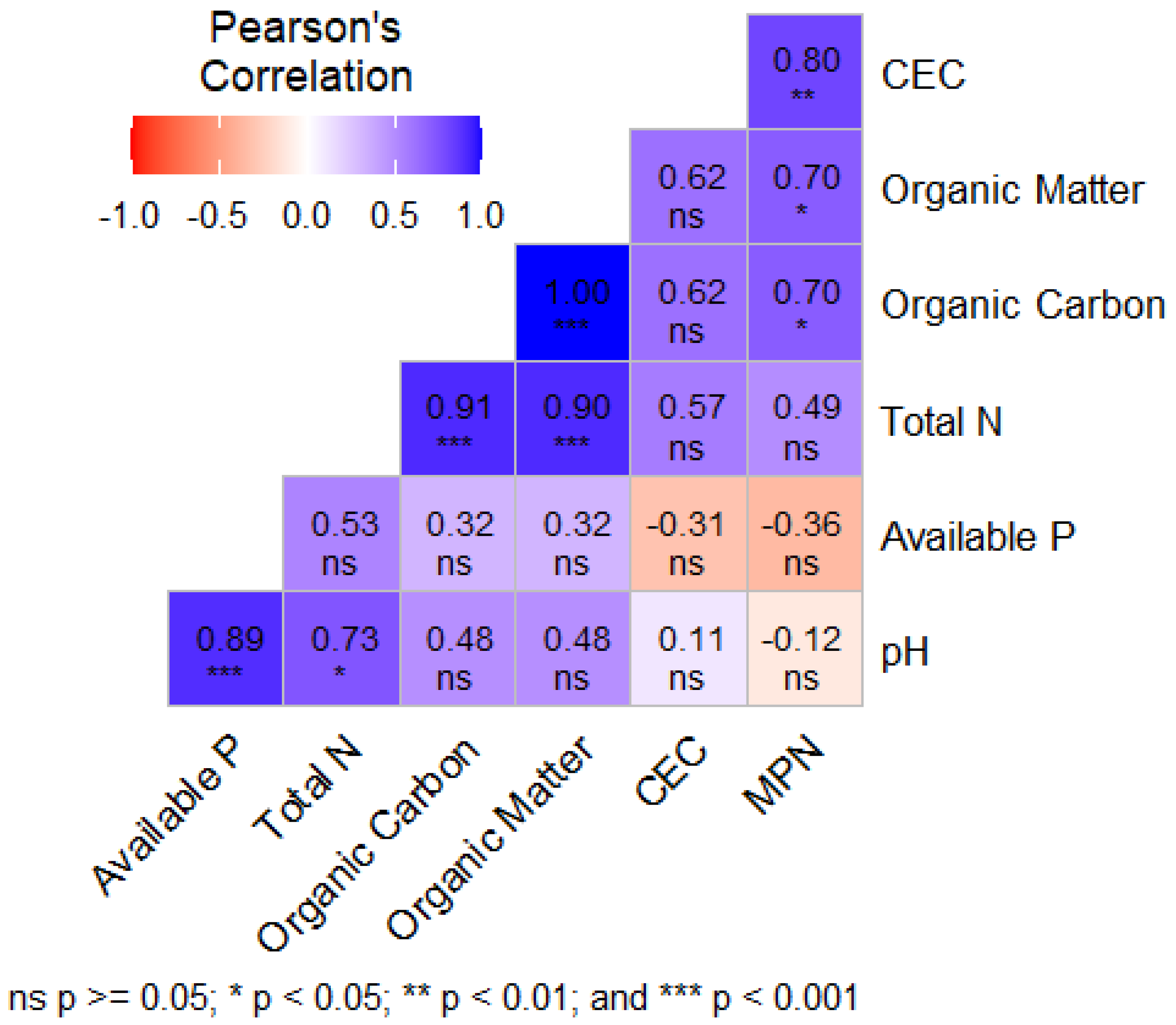
Pearson correlation analysis (Figure 1) revealed significant relationships between selected soil chemical properties and the abundance of native soybean-nodulating rhizobia. Rhizobial population size showed significant positive correlations with soil organic carbon (OC; r = 0.70), organic matter (OM; r = 0.70), and cation exchange capacity (CEC; r = 0.80).
Figure 1.
Correlation between soil physicochemical properties and population of rhizobia.
In addition, total soil nitrogen (TN) exhibited strong and significant positive correlations with both organic carbon (r = 0.91) and organic matter (r = 0.90), indicating a close association between soil nitrogen status and soil organic matter pools.
Soil pH, available phosphorus, and total nitrogen showed weak and non-significant correlations with rhizobial abundance (Figure 1). Positive relationships were also observed between CEC and both OM and OC (r = 0.62), although these correlations were not statistically significant (p > 0.05).
3.4. Rhizobial Abundance Association with Cropping History of the Soil Sampling Fields
Native rhizobial abundance varied markedly among sites and was closely associated with the cropping history of the sampled fields (Table 1 and Table 5). Soils from Arsi-Negelle, where haricot bean had been cultivated prior to cereal crops, exhibited relatively higher populations of soybean-nodulating rhizobia for both soybean varieties.
In contrast, soils from Wondo Genet, Boricha, Dore, and Hawassa—where non-legume crops dominated the recent cropping history—showed consistently low rhizobial population densities. In Hawassa, despite the inclusion of haricot bean in the 2021 cropping season, the overall rhizobial population remained low (0.6 × 101 cells g−1 soil for Gishama and undetectable for Awassa-95), likely due to the predominance of non-legume crops such as enset and teff before and after the legume phase (Table 1).
Furthermore, although detectable rhizobial populations were observed for the variety Gishama in Hawassa, Awassa-95 showed no detectable rhizobia, indicating varietal differences in nodulation ability under similar soil and cropping conditions. This suggests that a single legume phase may be insufficient to sustain rhizobial populations capable of nodulating less promiscuous soybean varieties, particularly in systems dominated by non-legume crops.
4. Discussion
4.1. Physicochemical Properties of the Test Sites
The observed soil pH values across all sites fall within ranges generally considered favorable for nutrient availability and biological activity, as soil pH strongly influences nutrient solubility and microbial function [41,42]. Soil pH near neutral enhances microbial processes, including symbiotic nitrogen fixation, while strongly acidic conditions restrict nutrient availability and microbial function. Previous studies have shown that nodulation and nitrogen fixation decline sharply when soil pH drops below 5.5 due to reduced microbial activity and nutrient imbalances [43]. Recent studies further confirm that near-neutral soil pH supports diverse rhizosphere microbial communities essential for nutrient cycling and crop productivity [44].
The variation in available phosphorus among the sites likely reflects differences in soil management practices and fertilizer history. Higher available P levels at Hawassa and Wondo Genet may indicate residual effects of repeated fertilizer applications. Similar spatial variability in available P has been reported in agricultural soils of southern Ethiopia, where land use intensity, fertilizer type, and soil conservation practices strongly influence phosphorus availability [45,46]. In addition, parent material, soil pH, and slope position are known to influence phosphorus fixation and distribution within cultivated landscapes, as these factors affect phosphorus retention, mobility, and spatial heterogeneity in soil profiles [47,48].
Differences in soil organic carbon and organic matter content among the sites may be attributed to climatic conditions and land management practices. Low organic matter levels observed at Dore are consistent with continuous cultivation, high temperatures that accelerate decomposition, complete removal of crop residues, and limited use of organic amendments. Similar findings have been reported in other Ethiopian farming systems, where soils under cultivated fields consistently exhibit lower organic matter and soil organic carbon compared to less-disturbed land uses such as forest and bushland [49,50,51]. Moreover, Negassa and Gebrekidan [52] reported that cultivated fields generally have lower organic matter than other land uses due to continuous cultivation and enhanced organic matter oxidation. Higher organic matter contents at Wondo Genet and Arsi-Negelle may enhance soil structure, nutrient retention, and biological activity, as increased soil organic matter promotes aggregation, water-holding capacity, and provides energy substrates that support greater microbial biomass and nutrient cycling [53,54].
The generally high CEC values observed across the study sites indicate a strong capacity for these soils to retain and supply essential cations. Variations in CEC among sites are likely linked to differences in organic matter content, clay quantity and mineralogy, and cultivation intensity. Studies have shown that intensive cultivation and organic matter depletion reduce soil CEC over time, thereby diminishing the soil’s nutrient buffering capacity [55,56]. Recent research further emphasizes the close relationship between soil organic carbon and CEC in tropical agricultural soils, with higher SOC linked to improved CEC and overall soil fertility under sustainable management practices such as agroforestry and conservation tillage [57,58].
4.2. Abundance of Native Rhizobia Nodulating Soybean
The very low abundance of soybean-nodulating rhizobia observed across the study sites suggests that native rhizobial populations are insufficient to support effective nodulation and biological nitrogen fixation without inoculation. Earlier work established that when native rhizobial populations fall below ~102 cells g−1 soil, inoculation is typically required to ensure adequate nodulation and yield response [59]. More recent studies continue to confirm that low background rhizobial populations severely limit soybean symbiosis, particularly in regions where soybean has not been widely cultivated historically, as evidenced by poor native population counts and strong responses to inoculation in smallholder farming systems [26,60].
The site-specific variability observed in rhizobial abundance aligns with findings from other Ethiopian soils. Temesgen and Assefa [26] reported MPN values ranging from 2.2 × 101 to 6.3 × 10³ cells g−1 soil across different locations, highlighting strong spatial heterogeneity in native rhizobial populations. Similarly, Argaw [61] documented the complete absence of soybean-nodulating rhizobia in certain agro-ecological zones, indicating that some soils may inherently lack compatible Bradyrhizobium strains due to historical land use and host absence.
The contrasting nodulation response between soybean varieties further indicates varietal differences in promiscuity. The ability of Gishama to nodulate in soils where Awassa-95 failed suggests that Gishama is more promiscuous, capable of forming symbioses with a broader range of indigenous Bradyrhizobium strains, even at low population densities. Similar varietal differences in soybean promiscuity have been widely reported, where certain genotypes exhibit broader compatibility with indigenous rhizobia, while others require specific symbionts for effective nodulation [62].
The overall scarcity of compatible native rhizobia across the study sites underscores the need for inoculation with effective Bradyrhizobium strains. Field studies in sub-Saharan Africa have consistently demonstrated significant improvements in nodulation, nitrogen fixation, and grain yield following inoculation under conditions of low native rhizobial abundance [13]. However, the effectiveness of inoculation can be influenced by competition between introduced strains and indigenous rhizobia that are well adapted to local soil conditions, even when native strains are less effective symbionts [63]. This highlights the importance of selecting competitive and locally adapted inoculant strains for sustainable soybean production.
4.3. Relationship of Rhizobial Abundance and Soil Properties
The strong positive relationships observed between rhizobial abundance and soil organic carbon, organic matter, and CEC indicate that carbon-related soil fertility attributes play a central role in sustaining native soybean-nodulating rhizobia. Soil organic matter provides essential carbon substrates and microsites for microbial growth, while higher CEC enhances nutrient retention and chemical buffering, thereby improving rhizosphere conditions for rhizobial survival. Similar linkages between soil organic matter, CEC, and microbial abundance have been widely reported in agricultural soils [64,65]. Recent research in Ethiopia also reported similar relationships between soil fertility parameters and native rhizobial populations [22].
The strong and significant correlations between total nitrogen and both organic carbon (r = 0.91) and organic matter (r = 0.90) further emphasize the tight coupling between soil organic matter and nitrogen pools. In most agricultural soils, the majority of total nitrogen is organically bound, and thus closely follows the distribution of soil organic carbon. Recent studies in tropical and subtropical agroecosystems confirm a strong coupling between soil organic carbon and total nitrogen, with carbon-rich soils consistently exhibiting higher total nitrogen contents due to enhanced nitrogen storage and cycling capacity [57,66]. This relationship highlights the importance of organic matter management for maintaining soil nitrogen reserves that indirectly support rhizobial persistence and symbiotic functioning.
Although positive correlations were observed between CEC and both OC and OM, these relationships were not statistically significant (p > 0.05). Nevertheless, the observed trends are consistent with well-established soil science principles whereby organic matter contributes negatively charged functional groups that enhance CEC, particularly in surface soils. Empirical evidence from tropical agricultural systems demonstrates that increases in soil organic carbon can lead to substantial improvements in CEC, even where clay mineral contributions are limited [67,68].
Soil pH and available phosphorus exhibited weak and non-significant relationships with rhizobial abundance, likely because all study soils fell within a pH range (6.4–7.66) generally considered favorable for rhizobial survival and infection. Previous research has shown that rhizobial populations are strongly constrained only under highly acidic conditions (pH < 4.5), whereas near-neutral soils support rhizobial persistence [43,69]. When such threshold conditions are met, organic carbon availability and nutrient retention capacity appear to exert greater control over rhizobial population dynamics.
Overall, the findings indicate that while the soils were broadly suitable for rhizobial survival, management practices that maintain or enhance soil organic matter and associated nitrogen pools are critical for sustaining native soybean-nodulating rhizobia.
4.4. Influence of Cropping History on Native Rhizobial Abundance
The variation in native soybean-nodulating rhizobial abundance observed across the study sites highlights the strong influence of cropping history on the persistence and enrichment of indigenous rhizobia. Soils from Arsi-Negelle, where haricot bean had been cultivated prior to cereal crops, supported relatively higher rhizobial populations for both soybean varieties. This finding is consistent with the well-established role of grain legumes as compatible hosts that maintain and multiply rhizobia through symbiotic nitrogen fixation, thereby enhancing rhizobial carryover effects for subsequent legume crops [60,65].
The observed variation in native rhizobial abundance across sites highlights the strong influence of cropping history on the persistence and enrichment of indigenous rhizobia. Fields with recent legume cultivation, such as those in Arsi-Negelle, supported higher rhizobial populations, consistent with evidence that legumes act as compatible hosts that maintain and multiply rhizobia through symbiotic nitrogen fixation. This enrichment effect can persist for several years after legume cultivation and enhance nodulation potential for subsequent legume crops [65,70].
In contrast, soils from Wondo Genet, Boricha, Dore, and Hawassa—where cropping systems were dominated by non-legume crops—exhibited consistently low rhizobial population densities. In Hawassa, although haricot bean was grown during the 2021 cropping season, the overall rhizobial abundance remained low, with detectable populations only for the more promiscuous soybean variety Gishama. The predominance of non-legume crops such as enset and teff before and after the legume phase likely limited the persistence and multiplication of rhizobia, suggesting that a single or short-term legume phase may be insufficient to sustain rhizobial populations at levels required for effective nodulation of all soybean genotypes. Similar observations have been reported in smallholder systems, where rhizobial populations decline rapidly in the absence of continuous or repeated host presence [70,71].
The contrasting nodulation responses of the two soybean varieties further underscore the importance of host genotype–rhizobia interactions. While Gishama was able to nodulate in soils with very low rhizobial populations, Awassa-95 failed to do so in Dore and Hawassa, indicating a higher degree of specificity in its symbiotic requirements. Genotype-dependent differences in promiscuity have been widely reported in soybean, with some varieties capable of forming symbioses with a broader range of indigenous Bradyrhizobium strains than others [60,61]. These findings suggest that cropping history and host genotype interact to determine nodulation success, particularly in systems characterized by low native rhizobial abundance.
5. Conclusions
The abundance of native rhizobia is a critical determinant of successful soybean nodulation and biological nitrogen fixation, and its assessment provides essential insight into the likely response to rhizobial inoculation. In this study, enumeration of indigenous soybean-nodulating rhizobia revealed consistently low population densities across all investigated locations, indicating limited inherent nodulation potential in the absence of inoculation.
Significant positive relationships between native rhizobial abundance and cation exchange capacity, soil organic carbon, and organic matter content highlight the importance of soil fertility attributes related to carbon availability and nutrient retention in sustaining rhizobial populations. In contrast, soil pH and available phosphorus were not major limiting factors, as all sites fell within ranges generally favorable for rhizobial survival.
The findings further demonstrate that cropping history and soybean variety compatibility strongly influence native rhizobial abundance. Fields with recent legume cultivation, particularly haricot bean, supported relatively higher rhizobial populations, underscoring the role of legumes in maintaining indigenous rhizobia within cereal-based systems. Moreover, varietal differences in nodulation response suggest that host genotype interacts with background rhizobial populations to shape symbiotic outcomes.
Overall, the low abundance of compatible native rhizobia across the study sites indicates that soybean production without inoculation is unlikely to achieve effective nodulation or optimal biological nitrogen fixation. These results emphasize the need for inoculation with effective and competitive Bradyrhizobium strains, to improve soybean productivity and promote sustainable nitrogen management in the study areas.
Author Contributions
H.B. conceptualized and finalized the research methodology, conducted and managed the experiment, collected and analyzed the data, wrote the original manuscript, and revised the manuscript. T.A. initiated the concept, funding acquisition, project administration, and reviewed and edited the manuscript. All authors have read and agreed to the published version of the manuscript.
Funding
The research work is supported by Hawassa University (HU) via the thematic research grant ‘Soybean Popularization, Agronomic and Nutritional Evaluation, and Product Development for Agro-processing Industry Linkage in the Sidama Regional State, Ethiopia’. The APC is covered by “Climate Change Effects on Food Security (CLIFOOD)”, a project supported by the DAAD with funds from the Federal Ministry for Economic Cooperation and Development (BMZ) with project ID 57562534.
Data Availability Statement
All data gathered for this study are analyzed and included in this published article. For further information, please contact the corresponding author.
Acknowledgments
We are grateful to HU for supporting this research through its thematic project grand scheme towards TA, as well as to CLIFOOD, a project supported by the DAAD with funds from the Federal Ministry for Economic Cooperation and Development (BMZ), for covering the APC for this paper, along with later providing a competitive Doctoral Bursary to HB.
Conflicts of Interest
The authors declare no conflicts of interest.
References
- Tully, K.L.; Sullivan, C.; Weil, R.; Sánchez, P.A. The State of Soil Degradation in Sub-Saharan Africa: Baselines, Trajectories, and Solutions. Sustainability 2015, 7, 6523–6552. [Google Scholar] [CrossRef] [Scilit]
- Beyan, S.M.; Wolde-Meskel, E.; Dakora, F.D. An assessment of plant growth and N2 fixation in soybean genotypes grown in uninoculated soils collected from different locations in Ethiopia. Symbiosis 2018, 75, 189–203. [Google Scholar] [CrossRef] [Scilit]
- Islam, M.S.; Muhyidiyn, I.; Islam, M.R.; Hasan, M.K.; Hafeez, A.G.; Hosen, M.M.; Saneoka, H.; Ueda, A.; Liu, L.; Naz, M. Soybean and sustainable agriculture for food security. In Soybean-Recent Advances in Research and Applications; IntechOpen: London, UK, 2022. [Google Scholar]
- Hirel, B.; Tétu, T.; Lea, P.J.; Dubois, F. Improving nitrogen use efficiency in crops for sustainable agriculture. Sustainability 2011, 3, 1452–1485. [Google Scholar] [CrossRef] [Scilit]
- Fataah, J. Evaluation of Nitrogen Fixation Potential of Cowpea Varieties and Effect of Residue Nitrogen for Maize Production. Master’s Thesis, Kwame Nkrumah University of Science and Technology, Kumasi, Ghana, 2016. [Google Scholar]
- Peoples, M.; Ladha, J.; Herridge, D. Enhancing legume N 2 fixation through plant and soil management. In Management of Biological Nitrogen Fixation for the Development of More Productive and Sustainable Agricultural Systems; Springer: Berlin/Heidelberg, Germany, 1995; pp. 83–101. [Google Scholar]
- Lindström, K.; Murwira, M.; Willems, A.; Altier, N. The biodiversity of beneficial microbe-host mutualism: The case of rhizobia. Res. Microbiol. 2010, 161, 453–463. [Google Scholar] [CrossRef] [Scilit]
- Tesfaye, A. Genetic Analysis of Quantitative Traits in Soybean (Glycine max L. Merril) Under Low and High Phosphorus Conditions; University of KwaZulu-Natal Republic of South Africa: Durban, South Africa, 2012. [Google Scholar]
- Agoyi, E.; Afutu, E.; Tumuhairwe, J.; Odong, T.; Tukamuhabwa, P. Screening soybean genotypes for promiscuous symbiotic association with Bradyrhizobium strains. Afr. Crop Sci. J. 2016, 24, 49–59. [Google Scholar] [CrossRef] [Scilit]
- Salvagiotti, F.; Cassman, K.G.; Specht, J.E.; Walters, D.T.; Weiss, A.; Dobermann, A. Nitrogen uptake, fixation and response to fertilizer N in soybeans: A review. Field Crops Res. 2008, 108, 1–13. [Google Scholar] [CrossRef] [Scilit]
- Solomon, T.; Pant, L.M.; Angaw, T. Effects of inoculation by Bradyrhizobium japonicum strains on nodulation, nitrogen fixation, and yield of soybean (Glycine max L. Merill) varieties on nitisols of Bako, Western Ethiopia. Int. Sch. Res. Not. 2012, 2012, 261475. [Google Scholar] [CrossRef] [Scilit]
- Rechiatu, A.; Nana, E.-M.; Clement, A.R. Response of Soybean (Glycine max L.) to rhizobia inoculation and molybdenum application in the northern savannah zones of ghana. J. Plant Sci. 2015, 3, 64–70. [Google Scholar] [CrossRef] [Scilit]
- Ulzen, J.; Abaidoo, R.C.; Mensah, N.E.; Masso, C.; AbdelGadir, A.H. Bradyrhizobium inoculants enhance grain yields of soybean and cowpea in Northern Ghana. Front. Plant Sci. 2016, 7, 1770. [Google Scholar] [CrossRef] [Scilit]
- Siczek, A.; Lipiec, J. Impact of faba bean-seed rhizobial inoculation on microbial activity in the rhizosphere soil during growing season. Int. J. Mol. Sci. 2016, 17, 784. [Google Scholar] [CrossRef] [Scilit] [PubMed]
- Mwenda, G.M.; Hill, Y.J.; O’Hara, G.W.; Reeve, W.G.; Howieson, J.G.; Terpolilli, J.J. Competition in the Phaseolus vulgaris-Rhizobium symbiosis and the role of resident soil rhizobia in determining the outcomes of inoculation. Plant Soil 2023, 487, 61–77. [Google Scholar] [CrossRef] [Scilit]
- Beruk, H.; Yoseph, T.; Ayalew, T. Unlocking the Potential of Inoculation with Bradyrhizobium for Enhanced Growth and Symbiotic Responses in Soybean Varieties under Controlled Conditions. Agronomy 2024, 14, 1280. [Google Scholar] [CrossRef] [Scilit]
- Ereso, T. Symbiotic effectiveness of rhizobia from chickpea (Cicer arietinum L.) and, phenotypic and symbiotic characterization of rhizobia nodulating faba bean (Vicia faba L.) from Southern Ethiopia. Res. J. Microbiol. 2017, 7, 280–296. [Google Scholar]
- Howieson, J.; Dilworth, M. Working with Rhizobia; Australian Centre for International Agricultural Research Canberra: Forrest, Australia, 2016. [Google Scholar]
- Denton, M.; Coventry, D.; Bellotti, W.; Howieson, J. Distribution, abundance and symbiotic effectiveness of Rhizobium leguminosarum bv. trifolii from alkaline pasture soils in South Australia. Aust. J. Exp. Agric. 2000, 40, 25–35. [Google Scholar] [CrossRef] [Scilit]
- Fening, J.; Danso, S. Variation in symbiotic effectiveness of cowpea bradyrhizobia indigenous to Ghanaian soils. Appl. Soil Ecol. 2002, 21, 23–29. [Google Scholar] [CrossRef] [Scilit]
- Blažinkov, M.; Sikora, S.; Uher, D.; Mačešić, D.; Redžepović, S. Genotypic characterisation of indigenous Rhizobium leguminosarum bv. viciae field population in Croatia. Agric. Conspec. Sci. 2007, 72, 153–158. [Google Scholar]
- Geremu, T.; Abera, G.; Lemma, B.; Rasche, F. Abundance and symbiotic efficiency of indigenous rhizobia nodulating faba bean and common bean in southern Ethiopia. Front. Soil Sci. 2025, 5, 1568292. [Google Scholar] [CrossRef] [Scilit]
- Van Der Heijden, M.G.; Bardgett, R.D.; Van Straalen, N.M. The unseen majority: Soil microbes as drivers of plant diversity and productivity in terrestrial ecosystems. Ecol. Lett. 2008, 11, 296–310. [Google Scholar] [CrossRef]
- Gebrehana, Z.G.; Mathewos, M.; Anbessa, B. Symbiotic Response of Field Grown Soybean Varieties to Rhizobia Inoculant in Western Ethiopia. Adv. Image Video Process. 2024, 12, 309–321. [Google Scholar] [CrossRef] [Scilit]
- Getinet, H.; Hailu, G.K.; Birhanu, H. Effect of Sulfur and Bradyrhizobium Inoculation on Nodulation and Yield of Soybean (Glycine max L.) on Nitisols of Southwestern Ethiopia. Agric. For. Fish. 2021, 10, 280–287. [Google Scholar] [CrossRef] [Scilit]
- Temesgen, D.; Assefa, F. Inoculation of native symbiotic effective Sinorhizobium spp. enhanced soybean [Glycine max (L.) Merr.] grain yield in Ethiopia. Environ. Syst. Res. 2020, 9, 38. [Google Scholar] [CrossRef] [Scilit]
- Bouyoucos, G.J. Hydrometer method improved for making particle size analyses of soils 1. Agron. J. 1962, 54, 464–465. [Google Scholar] [CrossRef] [Scilit]
- van Reeuwijk, L.P. Procedures for Soil Analysis; International Soil Reference and Information Centre: Wageningen, The Netherlands, 1995. [Google Scholar]
- Bremner, J.M.; Mulvaney, C. Nitrogen—Total. In Methods of Soil Analysis: Part 2 Chemical and Microbiological Properties; Wiley: Hoboken, NJ, USA, 1982; Volume 9, pp. 595–624. [Google Scholar]
- Olsen, S.R. Estimation of Available Phosphorus in Soils by Extraction with Sodium Bicarbonate; US Department of Agriculture: Washington, DC, USA, 1954. [Google Scholar]
- Rhoades, J. Cation exchange capacity. In Methods of Soil Analysis: Part 2 Chemical and Microbiological Properties; Wiley: Hoboken, NJ, USA, 1983; Volume 9, pp. 149–157. [Google Scholar]
- Walkley, A.; Black, I.A. An examination of the Degtjareff method for determining soil organic matter, and a proposed modification of the chromic acid titration method. Soil Sci. 1934, 37, 29–38. [Google Scholar] [CrossRef] [Scilit]
- Nelson, D.W.; Sommers, L.E. Total carbon, organic carbon, and organic matter. In Methods of Soil Analysis: Part 2 Chemical and Microbiological Properties; Wiley: Hoboken, NJ, USA, 1982; Volume 9, pp. 539–579. [Google Scholar]
- Pribyl, D.W. A critical review of the conventional SOC to SOM conversion factor. Geoderma 2010, 156, 75–83. [Google Scholar] [CrossRef] [Scilit]
- Somasegaran, P.; Hoben, H. Handbook for Rhizobia: Methods in Legume-Rhizobium Technology; Springer: New York, NY, USA, 1994. [Google Scholar]
- Maingi, J.M.; Gitonga, N.M.; Shisanya, C.A.; Hornetz, B.; Muluvi, G.M. Population levels of indigenous bradyrhizobia nodulating promiscuous soybean in two Kenyan soils of the semi-arid and semi-humid agroecological zones. J. Agric. Rural. Dev. Trop. Subtrop. 2006, 107, 149–159. [Google Scholar]
- Somasegaran, P.; Hoben, H. Methods in Legume-Rhizobium Technology: University of Hawaii NifTAL Project and MIRCEN. Department of Agronomy and Soil Science, Hawaii Institute of Tropical Agriculture and Human Resources, College of Tropical Agriculture and Human Resources. 1985. Available online: https://www.researchgate.net/profile/Heinz-Hoben/publication/202000928_Handbook_for_Rhizobia_Methods_in_legume-Rhizobium_technology/links/5728c1c708ae2efbfdb7e47d/Handbook-for-Rhizobia-Methods-in-legume-Rhizobium-technology.pdf (accessed on 24 January 2026).
- Tadesse, T.; Haque, I.; Aduayi, E. Soil, Plant, Water, Fertilizer, Animal Manure and Compost Analysis Manual; International Livestock Center for Africa: Addis Ababa, Ethiopia, 1991. [Google Scholar]
- Cottenie, A. Soil and Plant Testing As a Basis of Fertilizer Recommendations; Food and Agriculture Organization of the United Nations: Rome, Italy, 1980. [Google Scholar]
- Hazelton, P.; Murphy, B. Interpreting Soil Test Results: What do All the Numbers Mean? CSIRO Publishing: Clayton, Australia, 2016. [Google Scholar]
- Zhang, H.; Jiang, N.; Zhang, S.; Zhu, X.; Wang, H.; Xiu, W.; Zhao, J.; Liu, H.; Zhang, H.; Yang, D. Soil bacterial community composition is altered more by soil nutrient availability than pH following long-term nutrient addition in a temperate steppe. Front. Microbiol. 2024, 15, 1455891. [Google Scholar] [CrossRef] [Scilit] [PubMed]
- Barrow, N.; Hartemink, A.E. The effects of pH on nutrient availability depend on both soils and plants. Plant Soil 2023, 487, 21–37. [Google Scholar] [CrossRef] [Scilit]
- Martyniuk, S.; Oroń, J. Populations of rhizobia in some Polish soils not planted with legumes. Ekologija 2008, 54, 165–168. [Google Scholar] [CrossRef] [Scilit]
- Li, C.; Shi, L.; Wang, K.; Liu, B.; Liao, J.; An, Z.; Chang, S.X. Crop rotation differentially increases soil bacterial and fungal diversities in global croplands: A meta-analysis. Nat. Commun. 2025, 16, 11686. [Google Scholar] [CrossRef] [Scilit]
- Lulu, M. Phosphorus Fractionation and Soil Properties across Smallholder Land Uses in the South Ethiopia Regional State. Anal. Sci. Adv. 2025, 6, e70053. [Google Scholar] [CrossRef] [Scilit]
- Teshale, A.B.; Wogi, L.; Chimdi, A.; Taye, G. Effects of Soil Fertility Management Practices on Phosphorus Adsorption–Desorption Dynamics of Acidic Soil, the Case of Gimbo District, Southwest Ethiopia. Ethiop. J. Sci. Sustain. Dev. 2025, 12, 1–13. [Google Scholar]
- Jiang, Y.; Huang, J.; Guo, X.; Ye, Y.; Liu, J.; Jiang, Y. Factors Influencing the Spatial Distribution of Soil Total Phosphorus Based on Structural Equation Modeling. Agriculture 2025, 15, 1013. [Google Scholar] [CrossRef] [Scilit]
- Alvarez, L.; Noellemeyer, E. Landscape and topography effects on phosphorus fractions in Mollisols of the Argentinean Pampas. Geoderma Reg. 2022, 30, e00542. [Google Scholar] [CrossRef] [Scilit]
- Wachu, C.M.; Ibrahim, A.J. Assessment of land use and slope influence on soil organic carbon stocks and soil properties in Southern Ethiopia. Front. Agron. 2025, 7, 1536935. [Google Scholar] [CrossRef] [Scilit]
- Buraka, T.; Elias, E.; Lelago, A. Soil organic carbon and its’ stock potential in different land-use types along slope position in Coka watershed, Southern Ethiopia. Heliyon 2022, 8, e10261. [Google Scholar] [CrossRef] [Scilit]
- Amanuel, W.; Yimer, F.; Karltun, E. Soil organic carbon variation in relation to land use changes: The case of Birr watershed, upper Blue Nile River Basin, Ethiopia. J. Ecol. Environ. 2018, 42, 16. [Google Scholar] [CrossRef] [Scilit]
- Negassa, W.; Gebrekidan, H. Forms of phosphorus and status of available micronutrients under different land-use systems of Alfisols in Bako area of Ethiopia. Ethiop. J. Nat. Resour. 2003, 5, 17–37. [Google Scholar]
- Gil-Martínez, M.; Madejón, P.; Madejón, E.; de Sosa, L.L. Compost and vegetation cover drive soil fertility, microbial activity, and community in organic farming soils. Plant Soil 2025, 516, 299–321. [Google Scholar] [CrossRef] [Scilit]
- Liu, W.; Yang, Z.; Ye, Q.; Peng, Z.; Zhu, S.; Chen, H.; Liu, D.; Li, Y.; Deng, L.; Shu, X. Positive effects of organic amendments on soil microbes and their functionality in agro-ecosystems. Plants 2023, 12, 3790. [Google Scholar] [CrossRef] [Scilit]
- Abile, H.; Fituma, K.; Mammo, S. Impact of land use types on selected soil physicochemical parameters in the case of Liben Jawi district, Ethiopia. Sci. Rep. 2025, 15, 27944. [Google Scholar] [CrossRef] [Scilit] [PubMed]
- Miju, C.; Kiflu, A.; Gizachew, S. Effects of land use/land cover change on soil physicochemical properties and soil carbon stock in Kochore district, southern Ethiopia. Arab. J. Geosci. 2025, 18, 41. [Google Scholar] [CrossRef] [Scilit]
- Kimaro, O.D.; Desie, E.; Verbist, B.; Kimaro, D.N.; Vancampenhout, K.; Feger, K.-H. Soil organic carbon stocks and fertility in smallholder indigenous agroforestry systems of the north-eastern mountains, Tanzania. Geoderma Reg. 2024, 36, e00759. [Google Scholar] [CrossRef] [Scilit]
- Adekiya, A.O.; Alori, E.T.; Ogunbode, T.O.; Sangoyomi, T.; Oriade, O.A. Enhancing organic carbon content in tropical soils: Strategies for sustainable agriculture and climate change mitigation. Open Agric. J. 2023, 17, e18743315282476. [Google Scholar] [CrossRef] [Scilit]
- Thies, J.E.; Singleton, P.W.; Bohlool, B.B. Influence of the Size of Indigenous Rhizobial Populations on Establishment and Symbiotic Performance of Introduced Rhizobia on Field-Grown Legumes. Appl. Environ. Microbiol. 1991, 57, 19–28. [Google Scholar] [CrossRef] [Scilit] [PubMed]
- van Heerwaarden, J.; Baijukya, F.; Kyei-Boahen, S.; Adjei-Nsiah, S.; Ebanyat, P.; Kamai, N.; Wolde-Meskel, E.; Kanampiu, F.; Vanlauwe, B.; Giller, K. Soyabean response to rhizobium inoculation across sub-Saharan Africa: Patterns of variation and the role of promiscuity. Agric. Ecosyst. Environ. 2018, 261, 211–218. [Google Scholar] [CrossRef] [Scilit]
- Argaw, A. Symbiotic effectiveness of inoculation with Bradyrhizobium isolates on soybean [Glycine max (L.) Merrill] genotypes with different maturities. SpringerPlus 2014, 3, 753. [Google Scholar] [CrossRef] [Scilit]
- Agoyi, E.E.; Odong, T.L.; Tumuhairwe, J.B.; Chigeza, G.; Diers, B.W.; Tukamuhabwa, P. Genotype by environment effects on promiscuous nodulation in soybean (Glycine max L. Merrill). Agric. Food Secur. 2017, 6, 29. [Google Scholar] [CrossRef] [Scilit]
- Chibeba, A.M.; Kyei-Boahen, S.; Guimarães, M.d.F.; Nogueira, M.A.; Hungria, M. Isolation, characterization and selection of indigenous Bradyrhizobium strains with outstanding symbiotic performance to increase soybean yields in Mozambique. Agric. Ecosyst. Environ. 2017, 246, 291–305. [Google Scholar] [CrossRef] [Scilit]
- Neumann, D.; Heuer, A.; Hemkemeyer, M.; Martens, R.; Tebbe, C.C. Importance of soil organic matter for the diversity of microorganisms involved in the degradation of organic pollutants. ISME J. 2014, 8, 1289–1300. [Google Scholar] [CrossRef] [Scilit]
- Giller, K.E. Nitrogen Fixation in Tropical Cropping Systems; Cabi: Long Beach, CA, USA, 2001. [Google Scholar]
- Okolo, C.C.; Gebresamuel, G.; Zenebe, A.; Haile, M.; Orji, J.E.; Okebalama, C.B.; Eze, C.E.; Eze, E.; Eze, P.N. Soil organic carbon, total nitrogen stocks and CO2 emissions in top-and subsoils with contrasting management regimes in semi-arid environments. Sci. Rep. 2023, 13, 1117. [Google Scholar]
- Ramos, F.T.; Dores, E.F.G.D.C.; Weber, O.L.d.S.; Beber, D.C.; Campelo, J.H.; Maia, J.C.d.S. Soil organic matter doubles the cation exchange capacity of tropical soil under no-till farming in Brazil. J. Sci. Food Agric. 2018, 98, 3595–3602. [Google Scholar] [CrossRef] [Scilit]
- Bi, X.; Chu, H.; Fu, M.-m.; Xu, D.; Zhao, W.; Zhong, Y.; Wang, M.-H.; Li, K.; Zhang, Y.-N. Distribution characteristics of organic carbon (nitrogen) content, cation exchange capacity, and specific surface area in different soil particle sizes. Sci. Rep. 2023, 13, 12242. [Google Scholar] [CrossRef] [Scilit]
- Brockwell, J.; Pilka, A.; Holliday, R.A. Soil pH is a major determinant of the numbers of naturally occurring Rhizobium meliloti in non-cultivated soils in central New South Wales. Aust. J. Exp. Agric. 1991, 31, 211–219. [Google Scholar] [CrossRef] [Scilit]
- Kebede, E.; Amsalu, B.; Argaw, A.; Tamiru, S. Abundance of native rhizobia nodulating cowpea in major production areas of Ethiopia as influenced by cropping history and soil properties. Sustain. Environ. 2021, 7, 1889084. [Google Scholar] [CrossRef] [Scilit]
- Musiyiwa, K.; Mpepereki, S.; Giller, K. Symbiotic effectiveness and host ranges of indigenous rhizobia nodulating promiscuous soyabean varieties in Zimbabwean soils. Soil Biol. Biochem. 2005, 37, 1169–1176. [Google Scholar] [CrossRef] [Scilit]

Disclaimer/Publisher’s Note: The statements, opinions and data contained in all publications are solely those of the individual author(s) and contributor(s) and not of MDPI and/or the editor(s). MDPI and/or the editor(s) disclaim responsibility for any injury to people or property resulting from any ideas, methods, instructions or products referred to in the content. |
© 2026 by the authors. Licensee MDPI, Basel, Switzerland. This article is an open access article distributed under the terms and conditions of the Creative Commons Attribution (CC BY) license.