Article

Morphology-Controlled Single Rock Particle Breakage: A Finite-Discrete Element Method Study with Fractal Dimension Analysis

1
Department of Civil and Environmental Engineering, The Hong Kong Polytechnic University, Hong Kong SAR, China
2
Civil Engineering Design Division, Kajima Corporation, Tokyo 107-8477, Japan
3
School of Transportation Science and Engineering, Harbin Institute of Technology, Harbin 150090, China
*
Author to whom correspondence should be addressed.
Fractal Fract. 2025, 9(9), 562; https://doi.org/10.3390/fractalfract9090562
Submission received: 31 July 2025 / Revised: 18 August 2025 / Accepted: 20 August 2025 / Published: 26 August 2025
(This article belongs to the Special Issue Fractal and Fractional in Geotechnical Engineering, Second Edition)

Abstract

This study investigates the influence of particle morphology on two-dimensional (2D) single rock particle breakage using the combined finite-discrete element method (FDEM) coupled with fractal dimension analysis. Three key shape descriptors (elongation index EI, roundness index Rd, and roughness index Rg) were systematically varied to generate realistic particle geometries using the Fourier transform and inverse Monte Carlo. Numerical uniaxial compression tests revealed distinct morphological influences: EI showed negligible impact on crushing strength or fragmentation, and Rd significantly increased crushing strength and fragmentation due to improved energy absorption and stress distribution. While Rg reduced strength through stress concentration at asperities, suppressing fragmentation and elastic energy storage. Fractal dimension analysis demonstrated an inverse linear correlation with crushing strength, confirming its predictive value for mechanical performance. The validated FDEM framework provides critical insights for optimizing granular materials in engineering applications requiring morphology-controlled fracture behavior.

1. Introduction

Particle breakage fundamentally governs the mechanical behavior of granular assemblies across critical engineering domains, including geotechnical infrastructure, mineral processing, and natural resource exploitation [1,2,3,4]. The breakage characteristics of individual particles directly influence macroscale responses such as shear strength evolution, compaction behavior, and permeability reduction in granular media [5,6,7]. Traditional experimental approaches, exemplified by single-particle compression tests and drop-weight impact studies, have established empirical correlations between crushing strength, particle size, and mineral composition [8,9]. However, these methods face inherent limitations in isolating the explicit contribution of morphological complexity, such as the interplay of particle elongation, angularity, and surface texture, to fracture initiation and propagation dynamics under quasi-static loading [10,11].
Computational modelling offers a viable pathway to address mechanical problems, such as the finite element method (FEM) [12,13], material point method (MPM) [14,15,16,17], and particle-finite element method (PFEM) [18]. Compared to these numerical methods, the discrete element method (DEM) and bonded particle model (BPM) frameworks offer deeper insights into granular fracture mechanics. However, their reliance on spherical or polyhedral particle idealizations introduces significant simplifications [19,20]. Such geometric approximations fail to capture stress concentrations arising from natural surface irregularities and angular features, resulting in systematic underestimation of fracture energy dissipation and inaccuracies in fragment size distribution predictions [21,22]. Prior studies to enhance shape fidelity in DEM, such as clumped spheres, convex polyhedra and level-set particles, still model fracture via contact or cohesive bond breakage between rigid particles and do not resolve crack initiation and propagation within grains [23,24,25].
The combined finite-discrete element method (FDEM) resolves this limitation by coupling continuum finite elements with discrete fracture networks [26]. Through the embedding of cohesive elements within a deformable solid matrix, FDEM enables explicit simulation of tensile and shear crack propagation governed by traction-separation constitutive laws. This technique integrates the benefits of both the FEM and DEM into a whole framework [27]. The FEM is responsible for calculating the elastic deformation of the solid continuum, while the DEM determines the interaction and fracture of discrete bodies [28,29]. Compared with the conventional FEM, zero-thickness cohesive elements that follow specific fracture criteria are embedded between solid elements to mimic the crack propagation in FDEM. Despite its theoretical rigor, broader implementation of FDEM for morphology-dependent studies remains constrained by two factors: (i) inadequate computational protocols for generating high-fidelity particle libraries with controlled morphological variance, and (ii) insufficient quantification of correlations between multidimensional shape descriptors and fracture metrics.
Furthermore, fractal geometry has become a ubiquitous analytical tool across diverse disciplines such as medicine, materials science, and geography. While prior work has established that the breakage patterns of granular materials exhibit fractal characteristics quantifiable by a fractal dimension [30], investigations into the geometric attributes of particles via fractal analysis have primarily been confined to two dimensions, as exemplified by the study of Arasan et al. [31]. However, its adoption within geotechnical engineering, particularly concerning single-particle fragmentation, remains comparatively limited.
This study establishes an integrated computational framework combining Fourier-based shape reconstruction, fractal dimension analysis, and two-dimensional (2D) FDEM simulation. Leveraging Fourier descriptor theory, particle morphology is parameterized through harmonic coefficients that map directly to standardized shape indices—elongation index, roundness index, and roughness index. An inverse Monte Carlo sampling algorithm enforces statistical consistency between synthesized particles and target morphological distributions. This integration enables systematic interrogation of how particle morphologies and fractal dimensions govern crushing strength and fragment-size distributions. The influence of particle morphologies and fractal dimensions on particle crushing strength is systematically investigated.

2. Methods

2.1. Principle of FDEM

In 2D FDEM, the solid continuum is discretized into triangular finite elements interconnected by zero-thickness cohesive elements [32]. The kinematic behavior of each element is governed by nodal forces, which are resolved through an explicit second-order central difference time integration scheme at each computational step. These nodal forces comprise three components: internal resisting forces, externally applied loads, and damping forces. Following force computation, nodal accelerations are determined at the beginning of the time increment, enabling subsequent updates to nodal velocities and displacements. Typically, the governing equation of the FDEM system is expressed as:
M 2 x t 2 + C x t + F int ( x ) F ext ( x ) F c ( x ) = 0
where M is the lumped mass matrix of the system; C denotes the diagonal damping matrix of the system; x represents the nodal displacement; F int , F ext , and F c denote the internal resisting forces, the applied external loads, and the contact forces, respectively.
To simulate the fracture progression in FDEM, the cohesive elements adhere to a prescribed linear traction-separation (T-S) model, as shown in Figure 1. The linear T-S model typically comprises two distinct stages: the linear elastic stage and the linear damage stage. In the linear elastic stage, the material properties of cohesive elements remain constant and is defined as follows:
t = t n t s = E n n E n s E n s E s s ε n ε s = E ε = 1 T 0 K δ
where t denotes the nominal traction stress; ε represents the nominal strain; E denotes the elastic modulus; T 0 is the initial thickness of the cohesive elements; δ represents the displacement of the cohesive elements; and K is the stiffness matrix. Notably, the subscript n denotes ‘normal direction’ and s represents ‘shear direction’. For example, t n and t s represent the traction in the normal (mode I) and shear (mode II) direction, respectively [27,32]. The constitutive thickness of cohesive elements is typically set to 1, while the geometric thickness defaults to 0, ensuring that the nodal separation displacement equals the nominal strain. To determine the initiation of damage evolution or the linear damage stage, the quadratic nominal stress criterion (QUADS) is used:
t n t n 0 2 + t s t s 0 2 = 1
where denotes the Macaulay bracket; t n 0 and t s 0 represent pure traction at damage initiation in the normal and shear directions, respectively. Once damage initiates, the T-S model follows a linear softening law (see Figure 1). A damage variable D is introduced to quantify the progression of damage, evolving from 0 (undamaged) to 1 (fully damaged). When D = 1 , the cohesive element reaches its ultimate load-bearing capacity, leading to its removal and the formation of free surfaces, thereby marking the onset of crack propagation. The damage variable D is computed as:
D = D n 2 + D s 2
D n = δ n f δ n m a x δ n 0 δ n m a x δ n f δ n 0 , δ n m a x 0
D s = δ s f δ s m a x δ s 0 δ s m a x δ s f δ s 0
where D n and D s denote the damage variables in the normal and shear direction, respectively; δ n 0 and δ n m a x represent the effective separation at damage initiation and the maximum effective separation attained during the loading history in the normal direction; δ s 0 and δ s m a x are the effective separation at damage initiation and the maximum effective separation attained during the loading history in the shear direction; δ n f and δ s f denote the effective separation at complete failure in normal and shear direction, respectively, and expressed as follows:
δ n f = 2 G I C / t n 0
δ s f = 2 G II C / t s 0
where G I C , and G II C represent the critical fracture energy in the normal and shear direction, respectively. Once the D is obtained, the degradation of the normal and shear stiffness as well as normal and shear traction of the cohesive elements is also determined until final failure as follows:
t n = ( 1 D ) k n δ n , δ n 0   ( tension ) k n δ n , δ n < 0   ( compression )
t s = ( 1 D ) k s δ s
The final failure of cohesive elements is usually described from the view of displacement or fracture energy. This implies that when the displacement or fracture energy dissipated by the cohesive element exceeds a certain threshold, the cohesive element is broken and deleted. The power-law criterion is the most extensively utilized fracture energy criterion for predicting damage progression under mixed-mode loads, which is described as follows:
G I G I C 2 + G I I G I I C 2 = 1
where G I C and G I I C denote fracture energies in pure mode I and mode I I , respectively. G I and G I I represent energies dissipated in pure mode I and mode I I , respectively. Once the above criterion is met, the cohesive element will be deleted to describe local failure in the simulation.

2.2. Shape Indexes and Fractal Dimensions

Particle morphology is generally evaluated by shape indexes. In this study, three common shape indexes are used: elongation index ( E I ), roundness index ( R d ), and roughness index ( R g ), defined as follows [33,34]:
E I = L minor   L major  
R d = i = 1 N C   R i / N C   R m a x
R g = r θ r θ 2 N R   r θ ¯
where L minor   and L major   represent the minor and major dimensions of the particle; N C   denotes the number of corners; R i is the radius of curvature of the i th corner; R m a x represents the radius of the maximum inscribed circle; N R denotes the total number of the discretized points of the particle contour; r θ is the radial distance of the discretized point at a polar angle θ along the original contour of the particle; r θ ¯ denotes the average value of r θ ; and r θ represents the radial distance of the discretized point at a polar angle θ along the smoothed particle outline. Note that all curvatures in this study are calculated based on the discrete corner approximation [35].
To quantify the 2D fractal dimension F D   of the particle, a voxelized 2D projection of the particle is first generated. Then, the box-counting method [36] is adopted as follows:
F D   =   lim r 0 log N r log ( 1 / r )
where r denotes the cube size, varying from the smallest unit in the voxel scale to half of the total volume dimension, and Nr represents the number of cubes containing the particle in the r scale. The minimum box size is set to one voxel, and the maximum box size is set to half the maximum dimension of the particle, respectively. More details about the computation of 2D fractal dimensions of particles can be found in [37].

2.3. Fourier Description of Particle Shape

Consider a 2D star-like particle with the center point at O x 0 , y 0 , the particle contour can be represented by N p points P i at a specified angle θ p around O in the Cartesian coordinate system. The coordinates of each point P i ( x i , y i ) in the Cartesian coordinate system can be described by an angle θ i and distance r i in the polar coordinate system, expressed as follows:
x i = x 0 + r i cos θ i y i = y 0 + r i sin θ i
Based on the discrete Fourier transform (DFT), the relationship between θ i and r i can be modified as follows:
r i θ i r 0 = A F × { 1 + n = 1 N D n sin n θ i + φ n }  
where A F represents the amplification factor that determines the size of the particle; N denotes the total number of harmonics; r 0 denotes the average radius of the particle; Then, the Fourier descriptors F n is calculated as follows:
F n = A n 2 + B n 2 r 0
where A n and B n are the amplitude of the sinusoidal signal f n in the frequency domain. Therefore, the first Fourier descriptor F 0 is equal to 1 due to the normalization, since A n 2 + B n 2 = r 0 . F 1 represents a positional shift of the shape contour relative to point O , typically set to 0 due to its ignorable influence on particle shapes. In contrast, F 2 is a crucial parameter as it quantifies EI. Previous studies have demonstrated that descriptors F 3 to F 16 primarily define contour roundness, while higher-order modes ( F n for n > 16 ) effectively characterize surface roughness. Accordingly, Fourier descriptors can be categorized into five distinct groups: F 0 , F 1 , F 2 , F 3 F 16 and F 16 F n , where F 3 F 16 and F 16 F n satisfies the following equations:
F n = 2 2 · l o g 2 n 3 + l o g 2 F 3 ,   3 < n < 16
F n = 2 2 · l o g 2 n 8 + l o g 2 F 16 ,   16 n < N
In this study, a value of N = 64 was selected to ensure computational efficiency. Following the methodology established by [38], the parameters were set as F 0 = 1 , φ 0 = π / 2 , and F 1 = 0 to normalize the average particle radius r 0 = 1 and center the particle at the coordinate origin O before amplification. Under these conditions, Formula (17) simplifies to:
r ( θ ) = AF × f 0 + f 1 + n = 2 N F n sin n θ + φ n
where f 0 = F 0 sin 0 × θ + φ 0 = 1 and f 1 = F 1 sin 1 × θ + φ 1 = 0 . Importantly, Previous studies have demonstrated strong correlations between key Fourier descriptors ( F 2 , F 3 and F 16 ) and conventional particle shape indicators ( E I , R d , and R g ) [38,39]. For example, [40] created a comprehensive database of over 1.5 million particles and performed regression analysis to establish empirical relationships between key shape descriptors ( E I , R d , and R g ) and Fourier descriptors ( F 2 , F 3 and F 16 ). The resulting statistical correlations are expressed as:
F 2 = 0.48 E I t 2 + 0.17 E I t + 0.33
F 3 = 0.14 R d t 2 0.40 R d t + 0.26
F 16 = = 90.8634 R g t + 0.0002
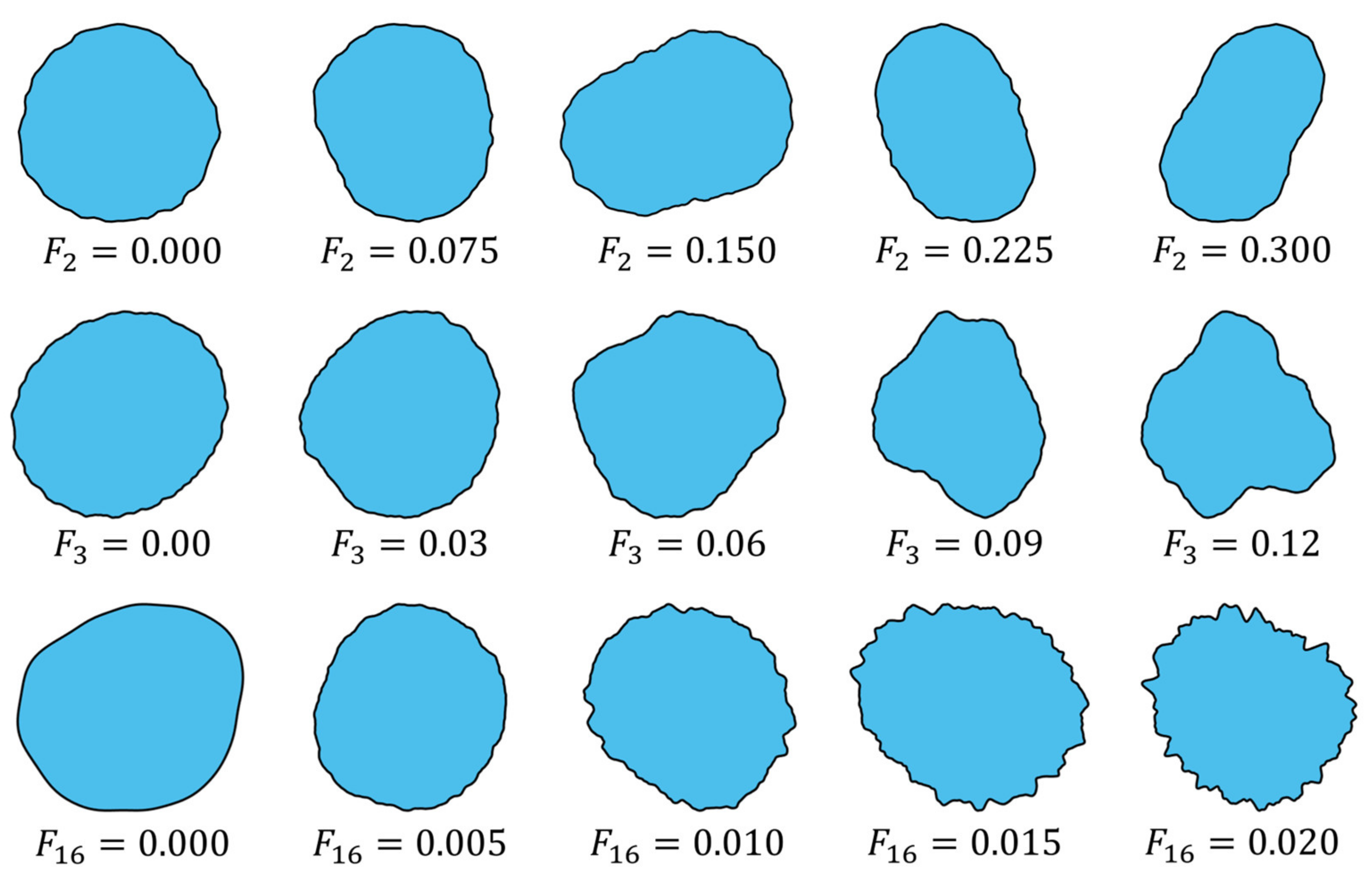
where E I t , R d t , and R g t represent the target E I , R d and R g , respectively. These validated equations provide a robust quantitative link between geometric descriptors and Fourier coefficients and will serve as the foundation for particle generation in this study. By implementing these relationships within an efficient algorithmic framework, particles can be systematically produced to match specified shape characteristics (see Figure 2), enabling the creation of diverse particle populations with controlled morphological properties.

2.4. Particle Shape Acquisition

Although X-ray tomography provides a method for acquiring realistic particle shapes, it is cost-prohibitive and challenging to acquire abundant shapes [41,42]. Therefore, the inverse Monte Carlo approach [43] is employed to generate abundant particle shapes with desirable characteristics. This method employs a relative error metric e r to quantify the similarity between reconstructed and target particle shapes, defined as:
e r i S D = S D i S D i t S D i × 100 %
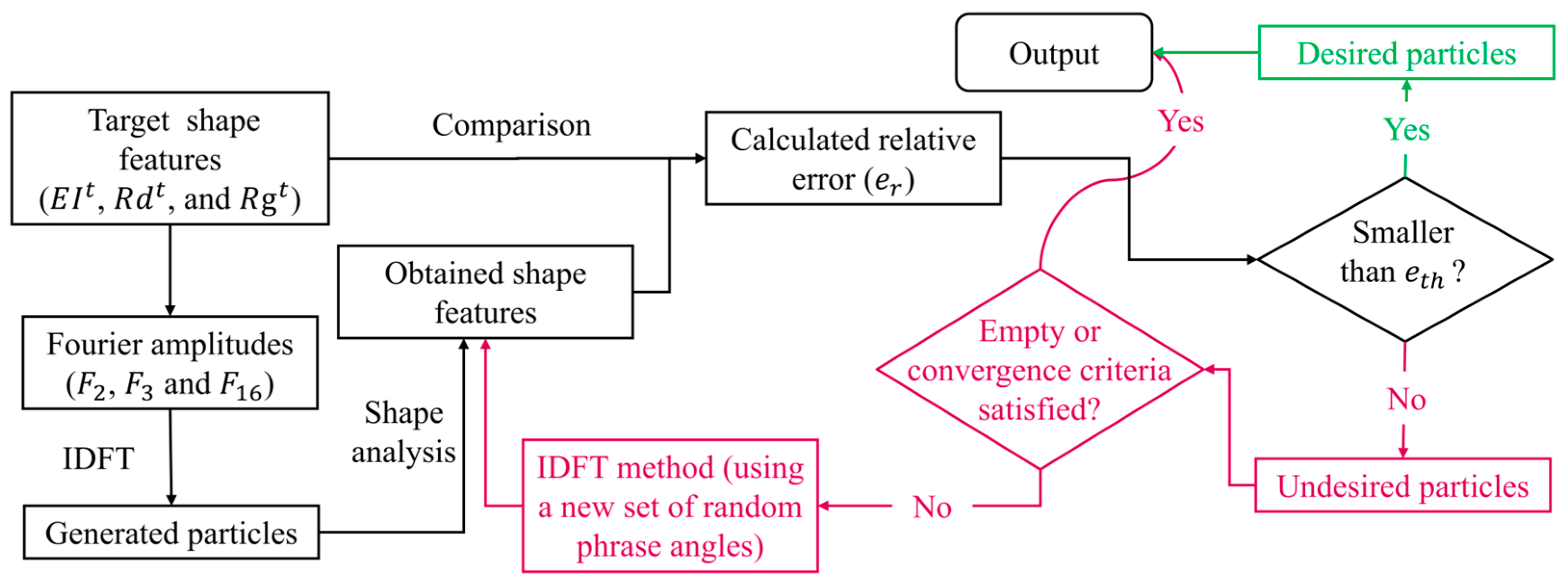
where S D i represents the computed shape descriptors ( E I , R d and R g ) of the generated i th particle; and S D i t is denotes the corresponding target descriptor values. The particle generation algorithm proceeds through the following steps (see Figure 3):
(a) Assign the target shape indicators ( E I t , R d t and R g t ) and the threshold of relative error e t h .
(b) Substitute the target values into formulas (22)–(24) to obtain the Fourier amplitude coefficients ( F 2 , F 3 and F 16 ) for particle reconstruction.
(c) Use the inverse discrete Fourier transform (IDFT) and random phase angles in Section 2.3 to reconstruct the particles based on the obtained Fourier amplitude coefficients ( F 2 , F 3 and F 16 ) in step (b). Other Fourier amplitude coefficients are determined by formulas (19) and (20). The phase angle ranges from π to π .
(d) Evaluate the reconstructed particles by shape indexes and obtain the value of reconstructed shape indicators ( E I i , R d i and R g i ). Based on Formula (25), calculate the relative error ( e r i E I , e r i R d and e r i R g ) between reconstructed shape indicators ( E I i , R d i and R g i ) with the target shape indicators ( E I t , R d t and R g t ). If the calculated relative error ( e r i E I , e r i R d and e r i R g ) is larger than the threshold of relative error e t h , the generated particle will be deleted and back to step (b).
(e) Repeat step (c) until the target number of particles is reconstructed successfully.

2.5. Particle Crushing Strength

For a single particle, the particle crushing strength σ f is quantified by the formula proposed by Hiramatsu and Oka (1966):
σ f = 0.9 F d 2
where F denotes the first major peak of the force–displacement curve; and d is the equivalent diameter of the particle, which refers to the circle-equivalent diameter based on cross-section. Based on the Weibull distribution function [44,45], the cumulative survival probability function for a given single particle is expressed as follows:
P s ( σ f ) = exp σ f σ 0 m
where σ f is the particle crushing strength; and m denotes the Weibull modulus that represents the variability in the crushing strength of different particles; and σ 0 denotes the particle crushing strength with a survival probability of 36.8%. Both the two parameters, i.e., m and σ 0 , are estimated by experimentally rewriting Formula (27) as:
ln ln 1 / P s σ f = m ln σ f m ln σ 0
In this study, for a finite number of examined particles, first, the data is sorted in ascending order of particle crushing strength σ f i , and then cumulative survival probability P s i can be determined by the rank position:
P s i = 1 i N + 1
where i represents the rank of the particle sorted in ascending order, and N denotes the total number of particles tested. By fitting the data with the best straight line, the relationship between ln [ ln ( 1 / P s ( σ f ) ) ] and ln σ f can be obtained. The Weibull modulus m and value of σ 0 can be obtained from the slope and the intercept of Formula (28). The Weibull modulus, m , gives information on the spread of the distribution of strength and, therefore, on the number of defects present in the sample. The higher the value of m , the more homogeneous the sample.

3. Numerical Simulation

3.1. Model Calibration

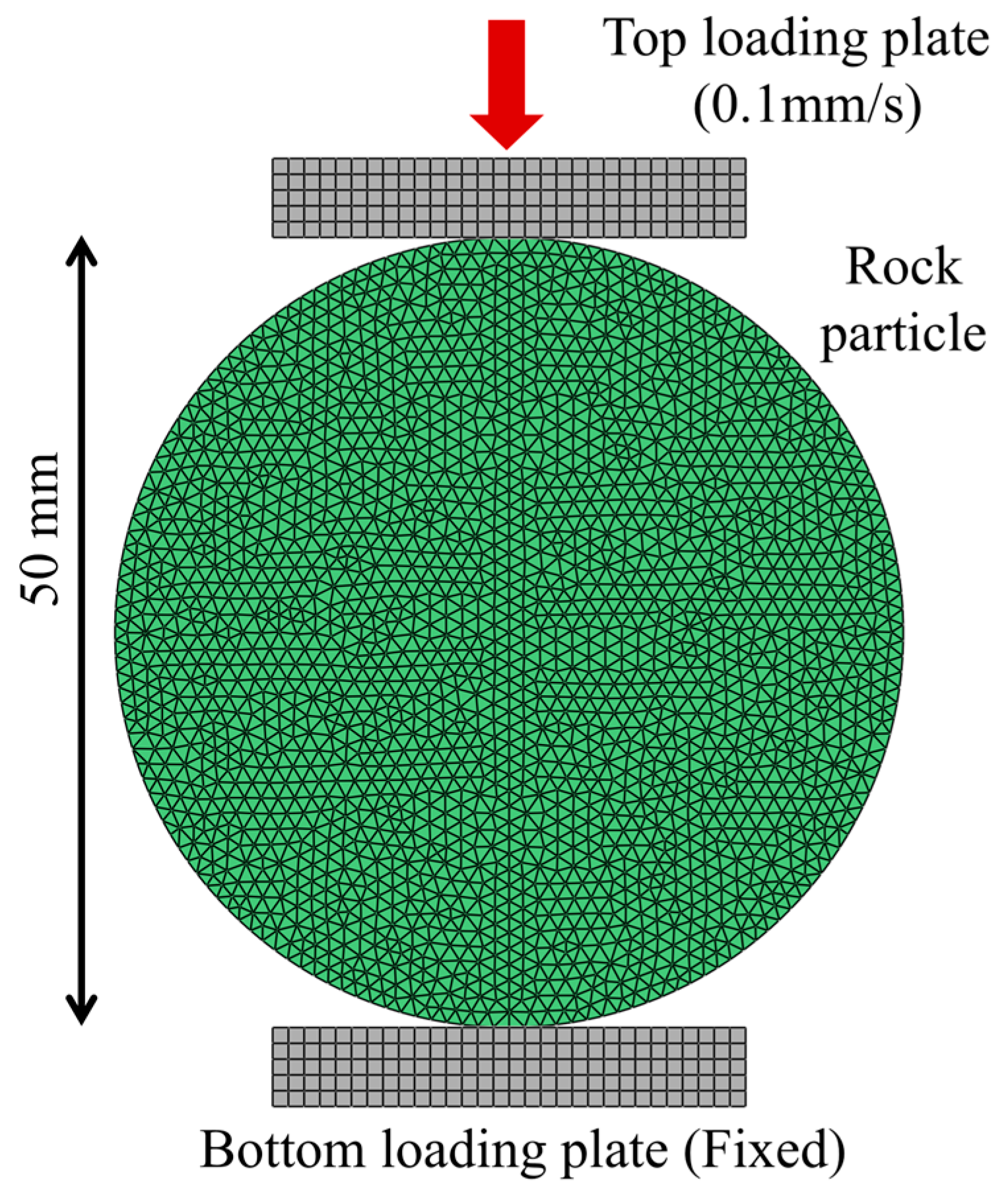
To validate the efficacy of the FDEM in simulating single-particle rock fragmentation, a numerical uniaxial compression test was conducted using the commercial finite element analysis software ABAQUS 2021 [46]. Figure 4 illustrates the numerical model configuration, which comprises a rock specimen positioned between two steel loading platens in perfect contact (zero-gap condition). While maintaining consistency between numerical and experimental loading rates would be theoretically ideal, computational constraints necessitated a compromise between solution accuracy and computational efficiency. The boundary conditions for the elements in the bottom loading plate are fixed, while other elements are unfixed. Therefore, a modified loading rate of 0.1 mm/s, previously validated by [47], was implemented. In the simulation, the upper loading platen was displaced at this constant velocity while the lower platen remained fully constrained. The rock particle specimen had a nominal diameter of 50 mm.
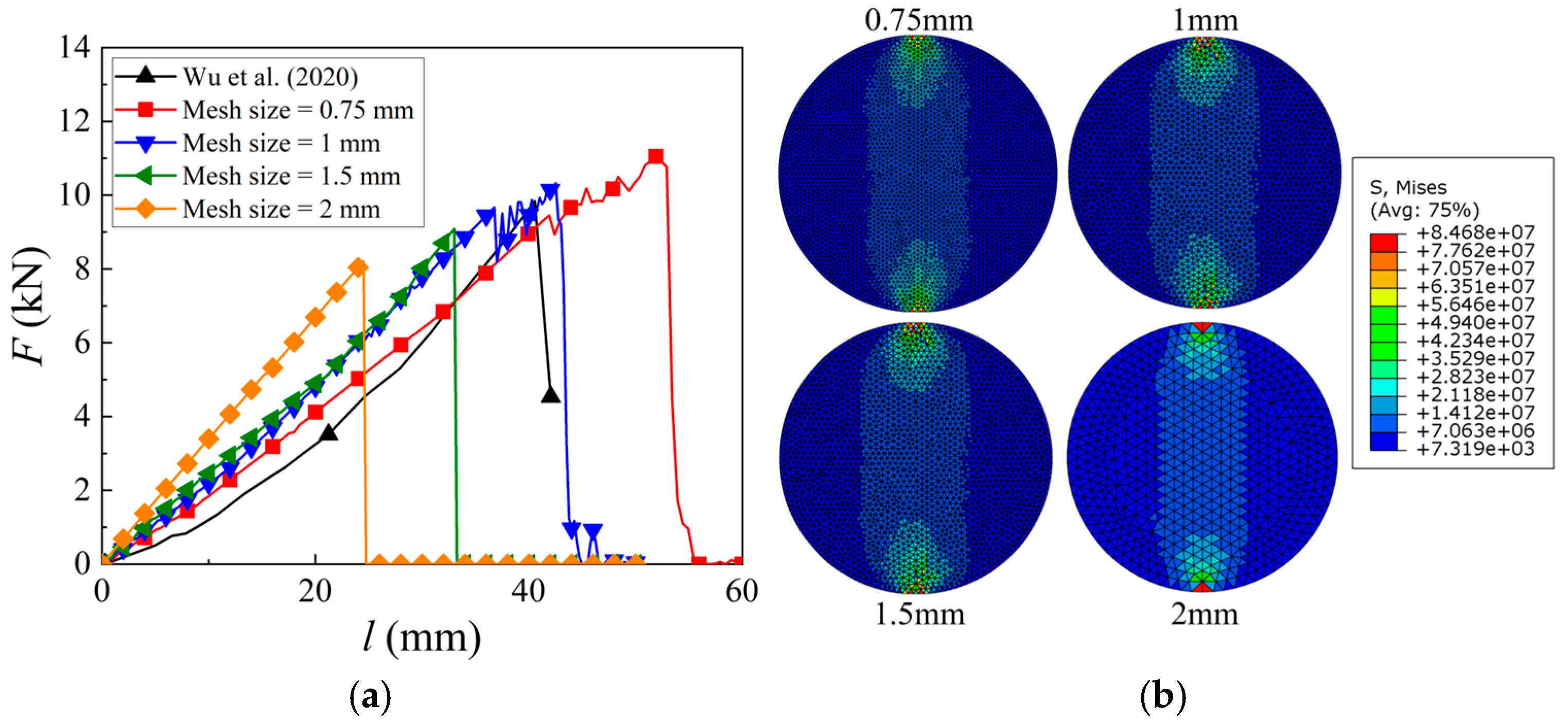
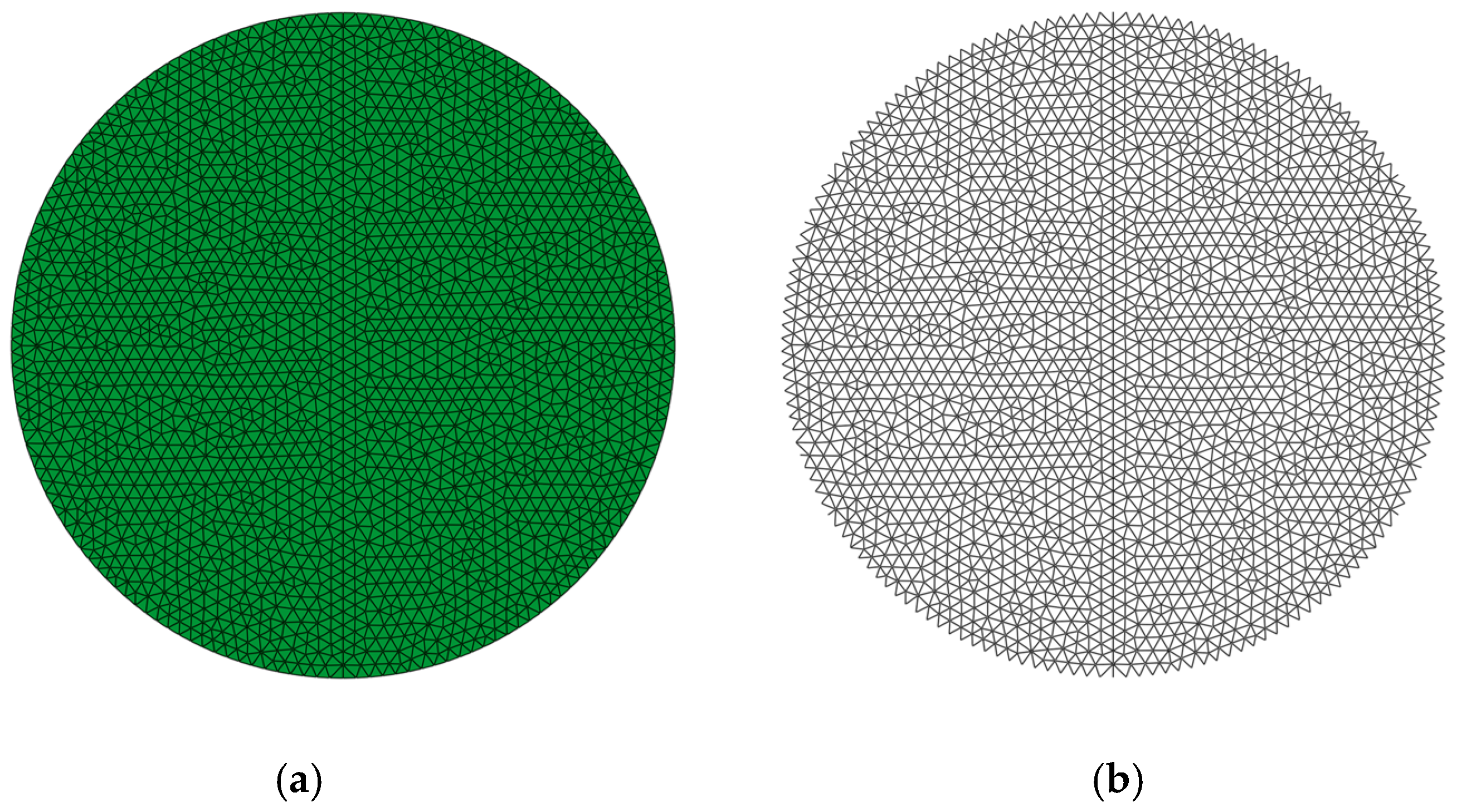
To account for the stochastic nature of fracture propagation, a comprehensive network of four-node cohesive elements was systematically embedded between all adjacent triangular solid element vertices during model preparation. This was achieved through an automated process utilizing a custom-developed Python (v3.12) script to ensure computational efficiency. The discretized model consisted of three-node plane strain triangular elements (CPE3) and two-dimensional four-node cohesive elements (COH2D4), as shown in Figure 5. Figure 6 presents the mesh size sensitivity analysis through load–displacement curves and von Mises stress distributions. The results indicate that a larger mesh size leads to an earlier and higher peak load compared to experimental data. This premature elevation may arise because a smaller mesh size increases the local contact area with the platens, thereby raising the failure stress. To balance computational efficiency with accuracy, a mesh size of 1 mm was adopted for all simulations in this study.
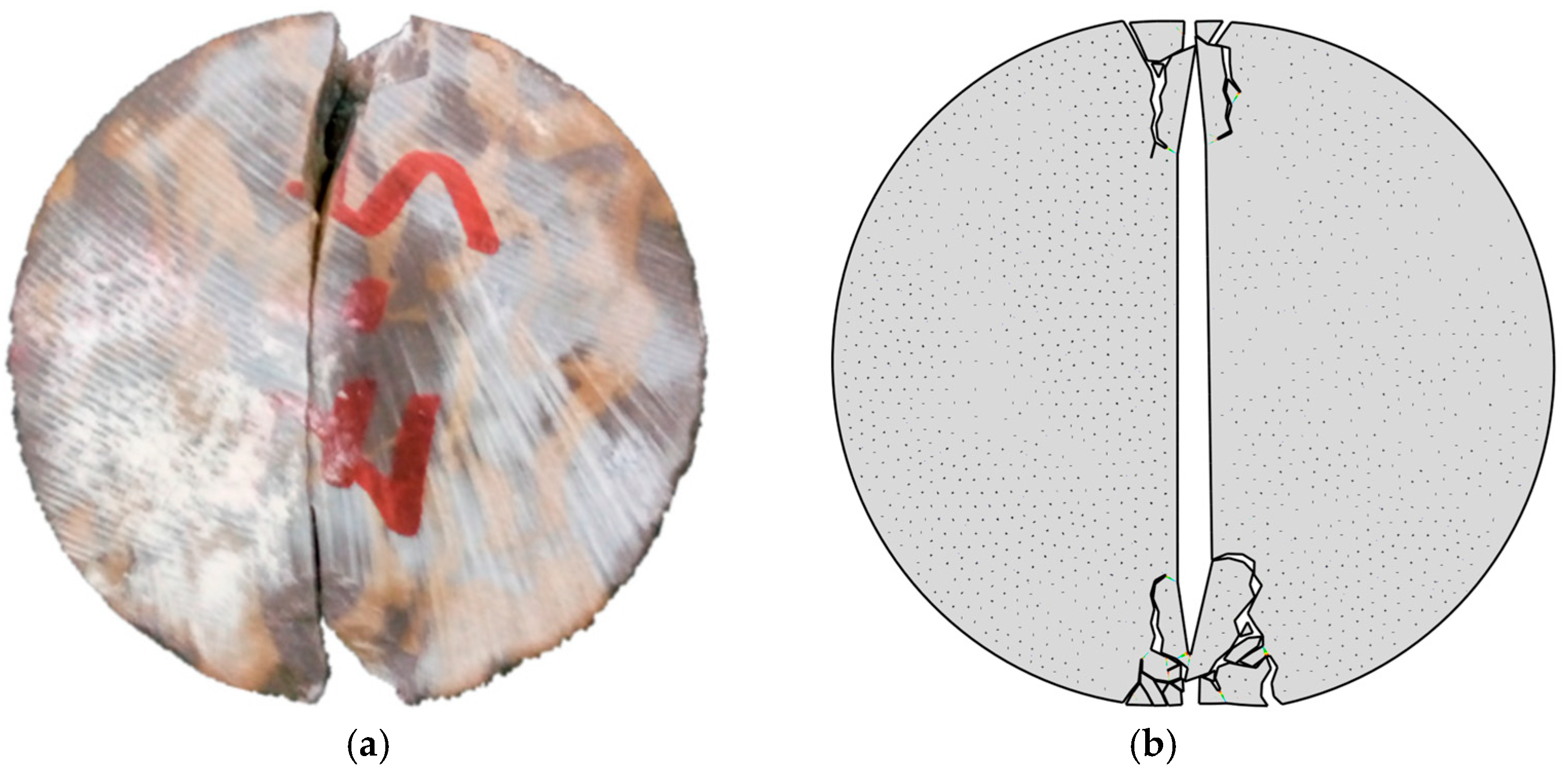
Accurate mechanical parameter calibration is essential for reliable FDEM simulations, as fracture behavior is highly sensitive to material properties. This study calibrated parameters using experimental data from [47] on sandstone particle crushing. The calibrated load–displacement curve, obtained through systematic parameter optimization, shows excellent agreement with experimental data (Figure 6). More specifically, the dominant crack propagates parallel to the loading direction. The experimental results yield a peak compressive strength of 9.5 MPa at an axial strain of 0.43%, while the numerical simulation demonstrates a closely matched peak strength of 10.0 MPa at a corresponding axial strain of 0.44%. This close agreement in both peak strength and critical strain underscores the validity of the simulation. Furthermore, the failure modes in the experiment and simulation are virtually identical (Figure 7). In both cases, a primary crack penetrates the particle, accompanied by secondary fractures initiating at the contact interfaces between the particle and the loading platens. These observations confirm the appropriateness of the calibrated parameters. The finalized material parameters adopted in the numerical simulations are summarized in Table 1.

3.2. Model Setup

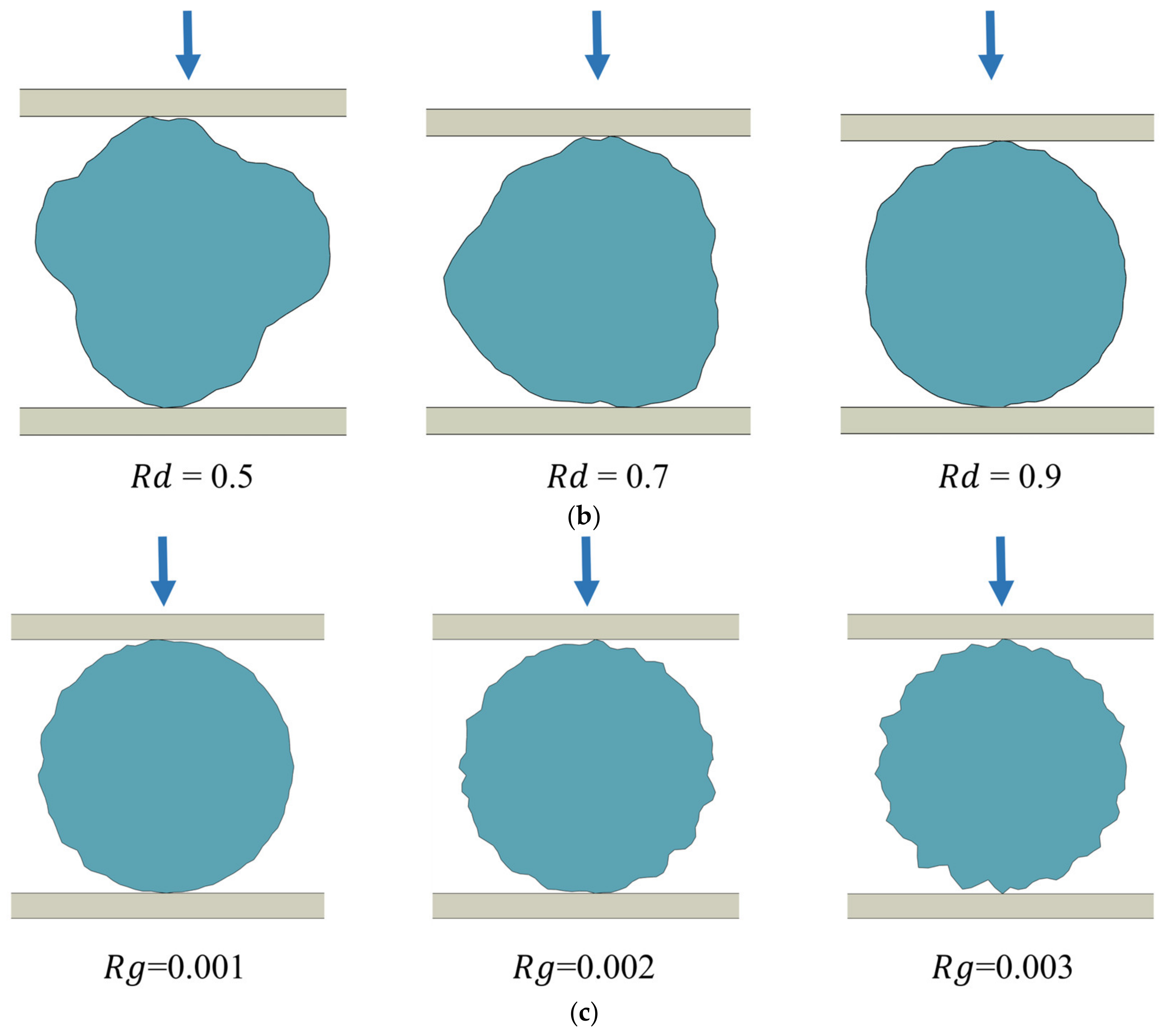
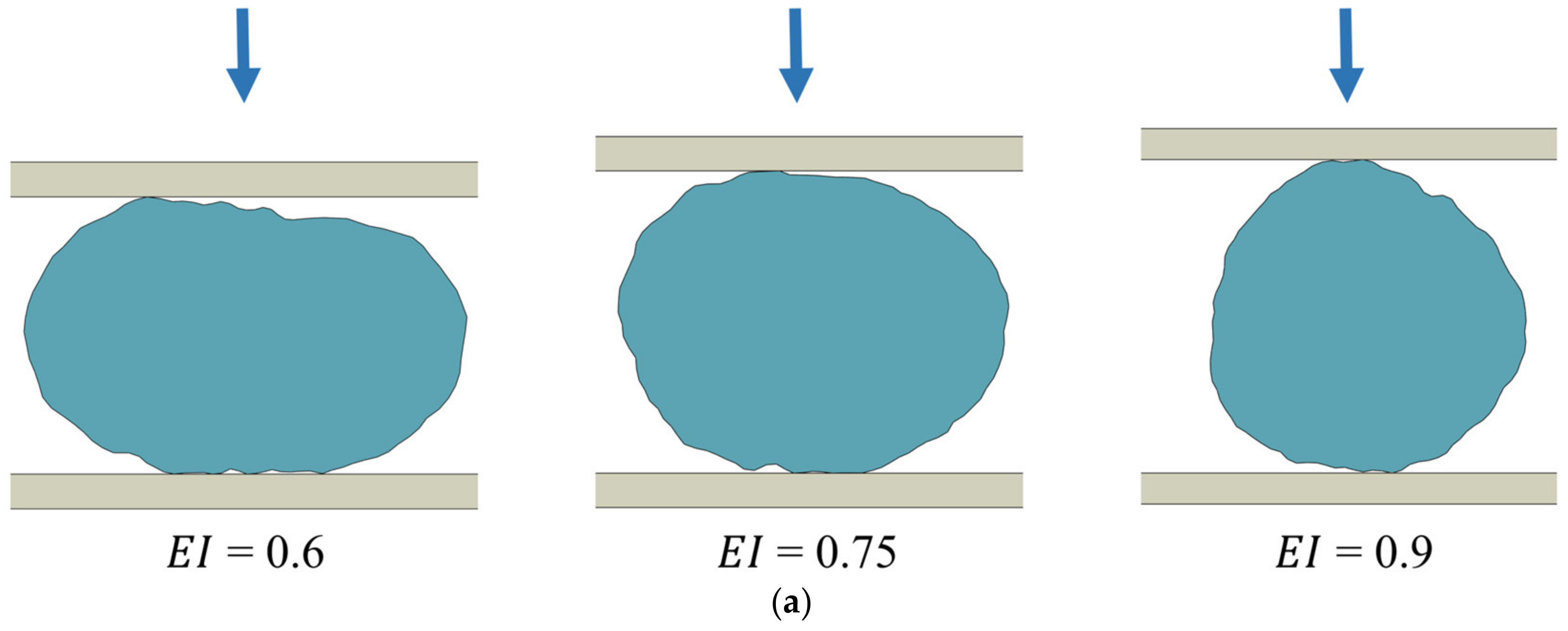
To account for irregular particle shapes in FDEM simulations, the aforementioned shape descriptors ( E I , R d , and R g ) were employed with varying target values to generate representative rock particles (Figure 8), as summarized in Table 2.
To minimize the influence of particle size on simulation results, all particles were generated with a constant cross-sectional area. Prior to loading, each particle was rotated to an initial state corresponding to its minimum potential energy via moment of inertia alignment, ensuring maximum stability against rotational movement during compression. The particles were then positioned between two rigid loading plates: a fixed lower plate and an upper plate that moved downward at a constant displacement rate of 0.1 mm/s (Figure 4). All models were discretized using triangular finite elements with a uniform mesh size of 1 mm, and cohesive elements were inserted throughout the domain to simulate fracture behavior. The material properties applied in these simulations were consistent with those listed in Table 1.

4. Results

4.1. Effects of Elongation Index on Particle Breakage

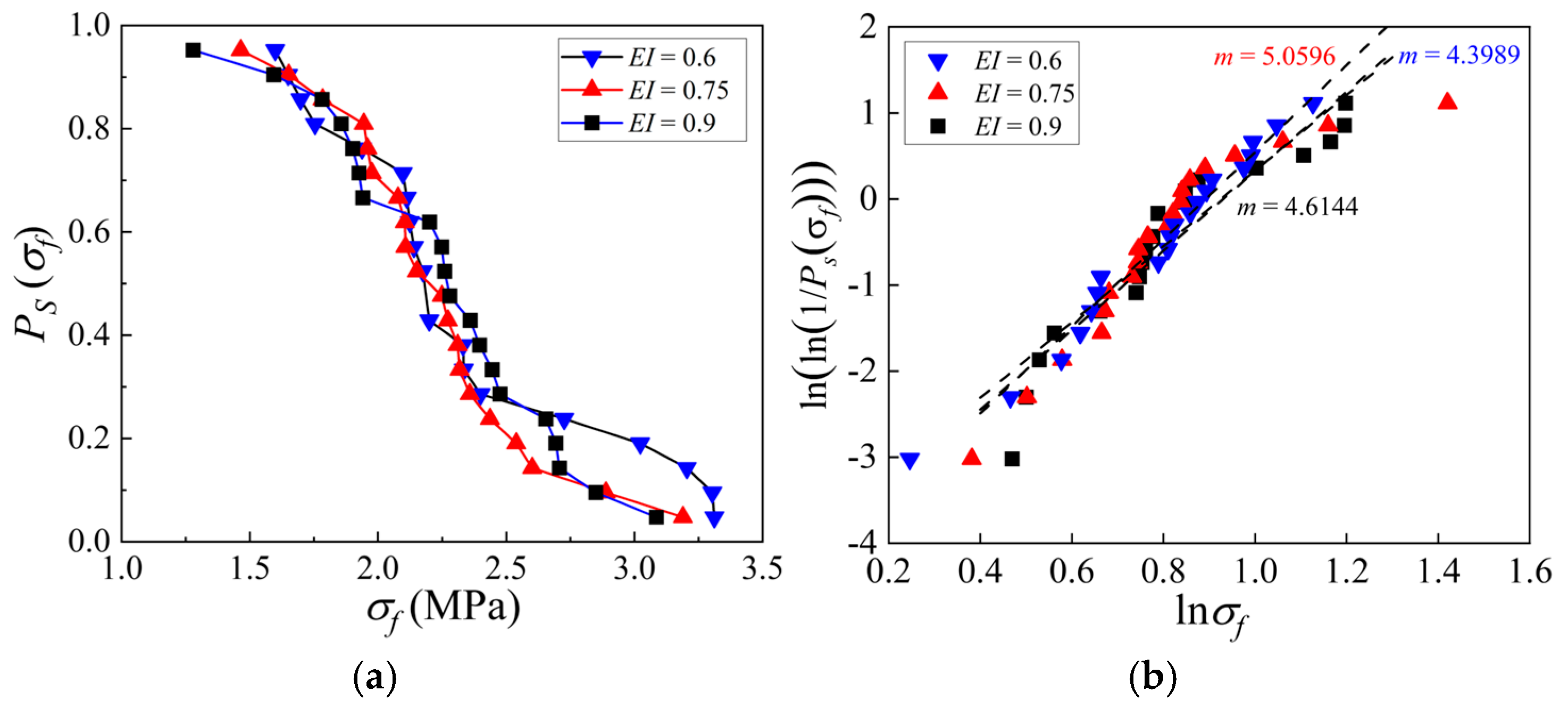
Figure 9a illustrates the cumulative survival probability of particles with varying elongation indices E I . The cumulative distribution of the fracture strength σ f exhibits a consistent trend across different E I values, spanning a range of 1.2 MPa to 3.3 MPa. For reference, the dashed line represents the crushing strength of a disc-shaped particle with equivalent cross-sectional area. Notably, the mean crushing strength of particles with different E I values closely aligns with this reference value, suggesting that the influence of E I is not statistically significant. Figure 9b presents the simulated data points alongside their corresponding fitting curves derived from Formula (28) for different EI values. The data are well described by the Weibull distribution; however, the variations in the Weibull modulus m are negligible. Specifically, the Weibull moduli for E I = 0.6 , 0.75, and 0.9 are 4.40, 5.06, and 4.61, respectively, indicating no substantial dependence on E I .
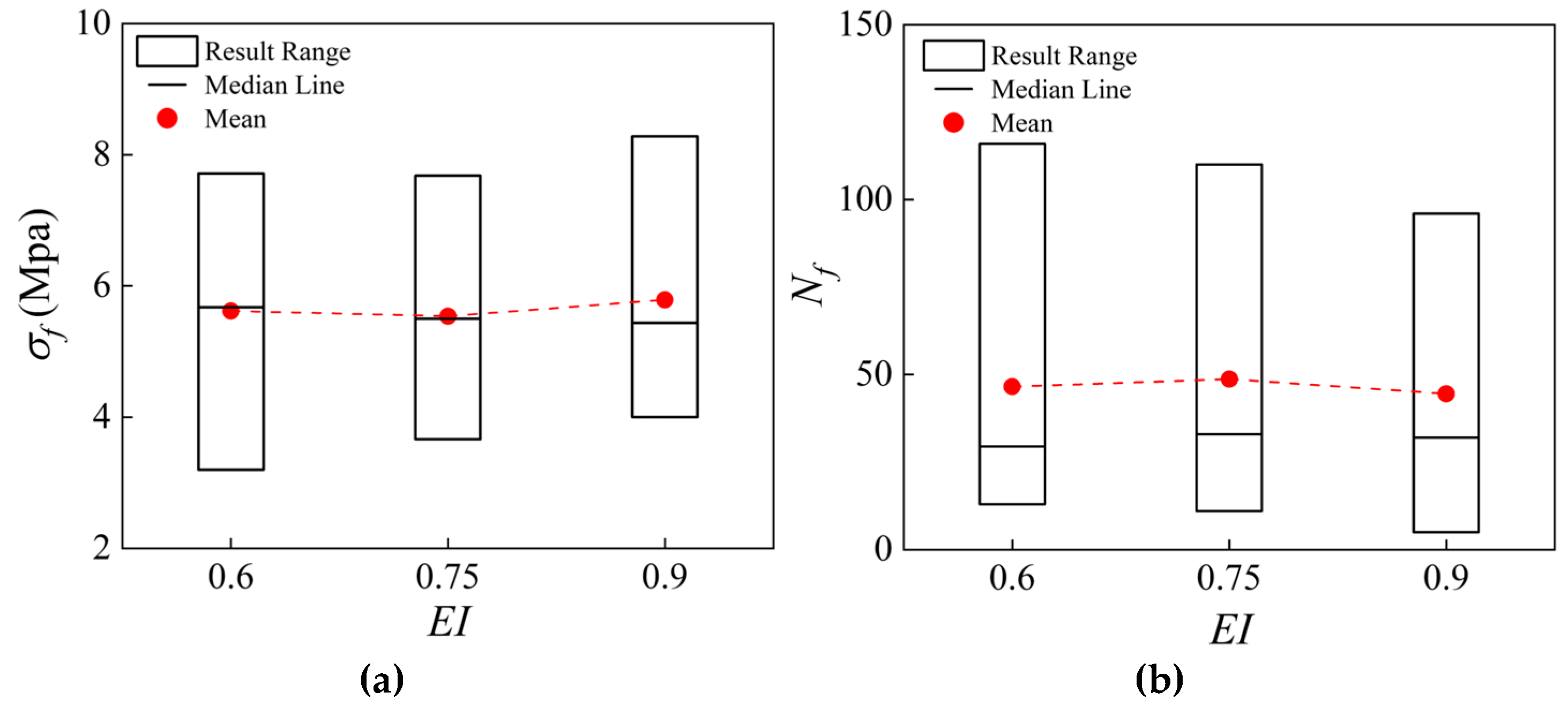
Further analysis of the relationship between mean fracture strength σ f and E I (Figure 10a) confirms that the variation in particle crushing strength with E I is statistically insignificant, reinforcing the observations from Figure 9a. This suggests that macroscopic shape characteristics have a limited effect on σ f , likely because particle breakage is predominantly governed by microscopic-scale features at the particle-loading plate interface. This hypothesis is further supported by the similar number of fragments N f generated post-crushing across all E I groups (Figure 10b). In summary, the elongation index E I exhibits negligible influence on single-particle breakage behavior.

4.2. Effects of Roundness Index on Particle Breakage

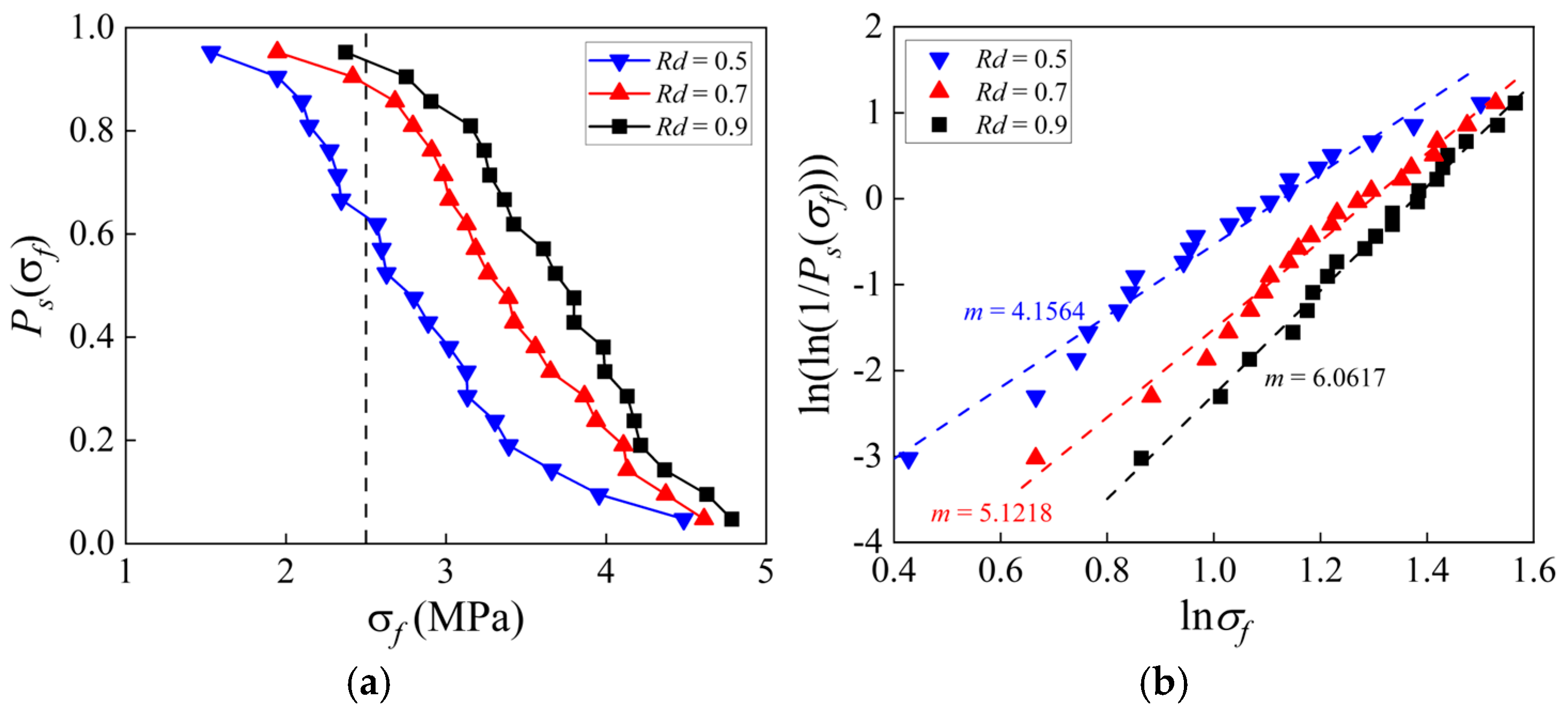
Figure 11a presents the cumulative distributions of particle crushing strength σ f for varying degrees of roundness R d . The results demonstrate that σ f increases with R d , suggesting that irregular particle edges may induce stress concentration, thereby reducing crushing resistance. Furthermore, the mean crushing strengths for R d = 0.5 , 0.7, and 0.9 are 2.81 MPa, 3.36 MPa, and 3.69 MPa, respectively. These values consistently exceed those of disk-shaped particles, confirming that enhanced roundness improves particle crushing strength. Figure 11b illustrates the Weibull distribution of σ f across different R d values. Notably, particles with higher R d exhibit a lower Weibull modulus, implying that increased roundness correlates with greater variability in crushing strength.
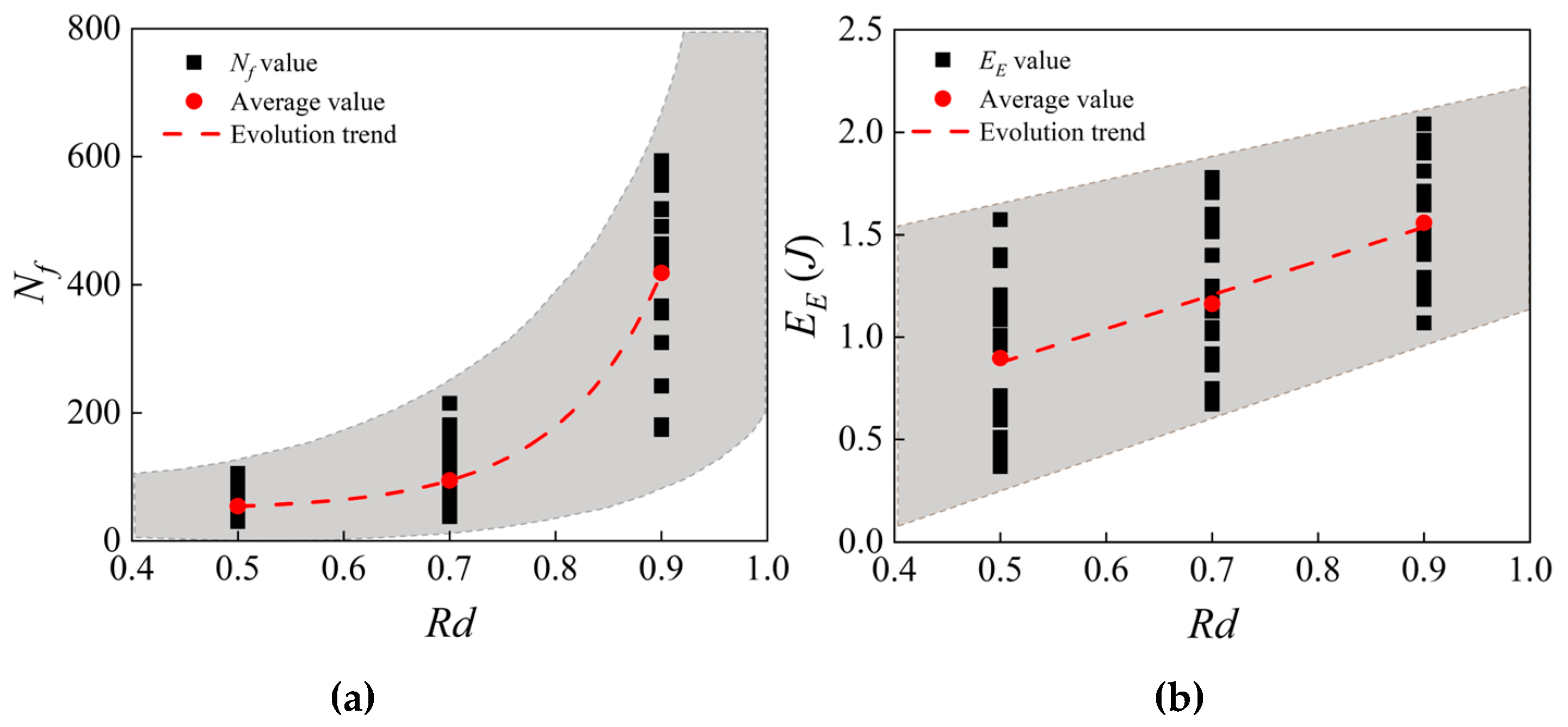
Figure 12a depicts the relationship between fragment number N f and R d . As roundness increases, particles fracture into more numerous fragments, with a pronounced acceleration in fragmentation rate beyond R d = 0.7 . This behavior is attributed to the elastic strain energy E E , stored within the particle prior to breakage. As shown in Figure 12b, higher roundness corresponds to greater E E and reduced stress localization, promoting more extensive fragmentation along interfacial cohesive elements. Additionally, the variability in E E increases with R d , mirroring the trend observed for σ f in Figure 11a, which suggests that E E likewise follows a Weibull distribution. In conclusion, increasing R d within the range of 0.5 to 0.9 enhances a particle’s ability to withstand external loads, primarily due to improved energy absorption and more uniform stress distribution.

4.3. Effects of Roughness Index on Particle Breakage

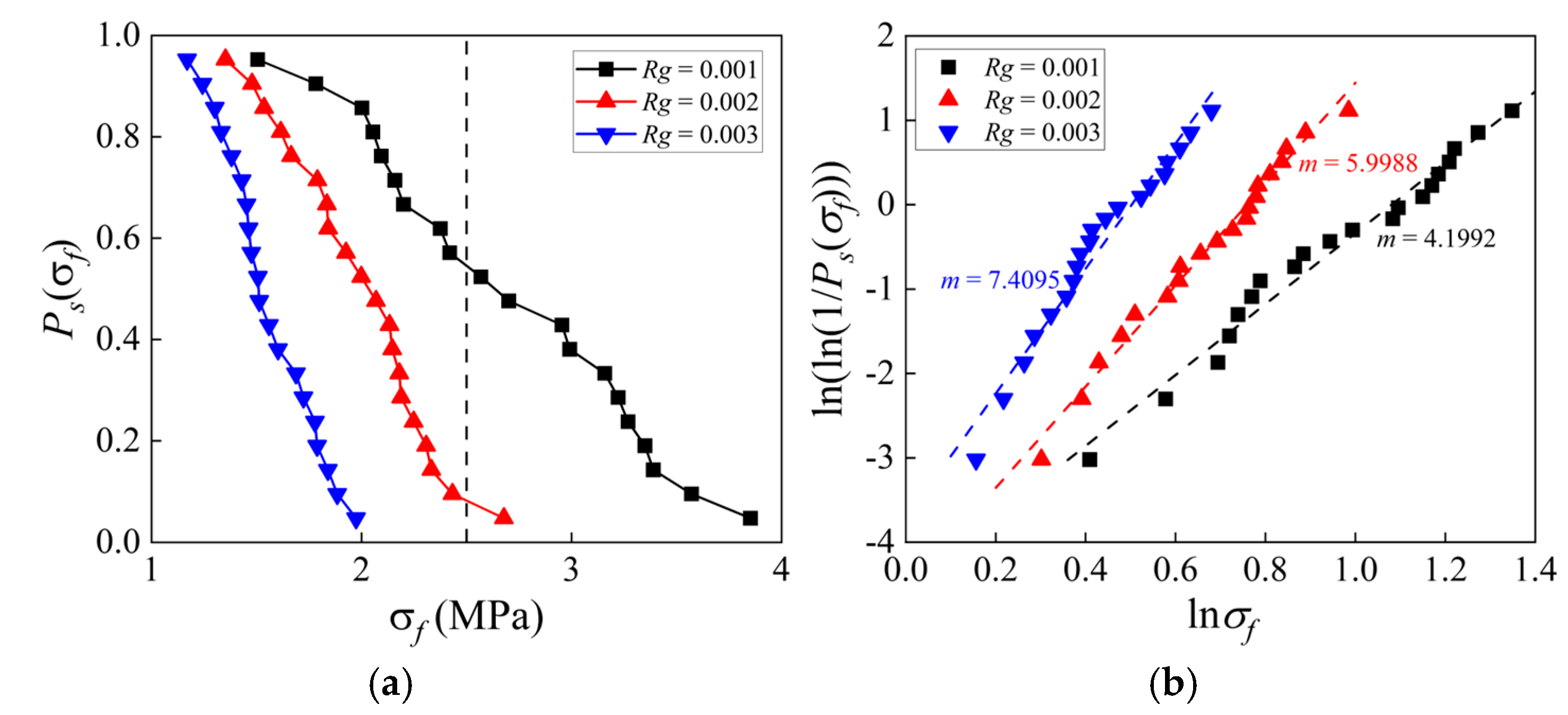
Figure 13a presents the cumulative probability distributions of particle crushing strength σ f for specimens with varying surface roughness R g . The mean crushing strengths for all roughness conditions were observed to be significantly lower than the reference smooth-surface value, demonstrating that surface roughness substantially degrades particle crushing resistance. This phenomenon can be attributed to stress concentration effects at surface asperities, which facilitate crack initiation and propagation under loading conditions. These findings are consistent with previous work by [48], who reported an inverse relationship between morphological complexity and characteristic crushing strength. The crushing strength distributions were found to follow the Weibull distribution with excellent goodness-of-fit, as shown in Figure 13b. Quantitative analysis revealed Weibull moduli of 4.1992 ± 0.12, 5.9988 ± 0.15, and 7.4095 ± 0.18 for R g = 0.001, 0.002, and 0.003, respectively. The increasing Weibull modulus with greater R g indicates reduced strength variability, suggesting that rougher surfaces produce more uniform stress concentration patterns. Microstructural analysis suggests these results from the proliferation of micro-asperities at higher R g values, while smoother specimens (lower R g ) exhibit mixed stress concentration sites comprising both sharp corners and curved surfaces.
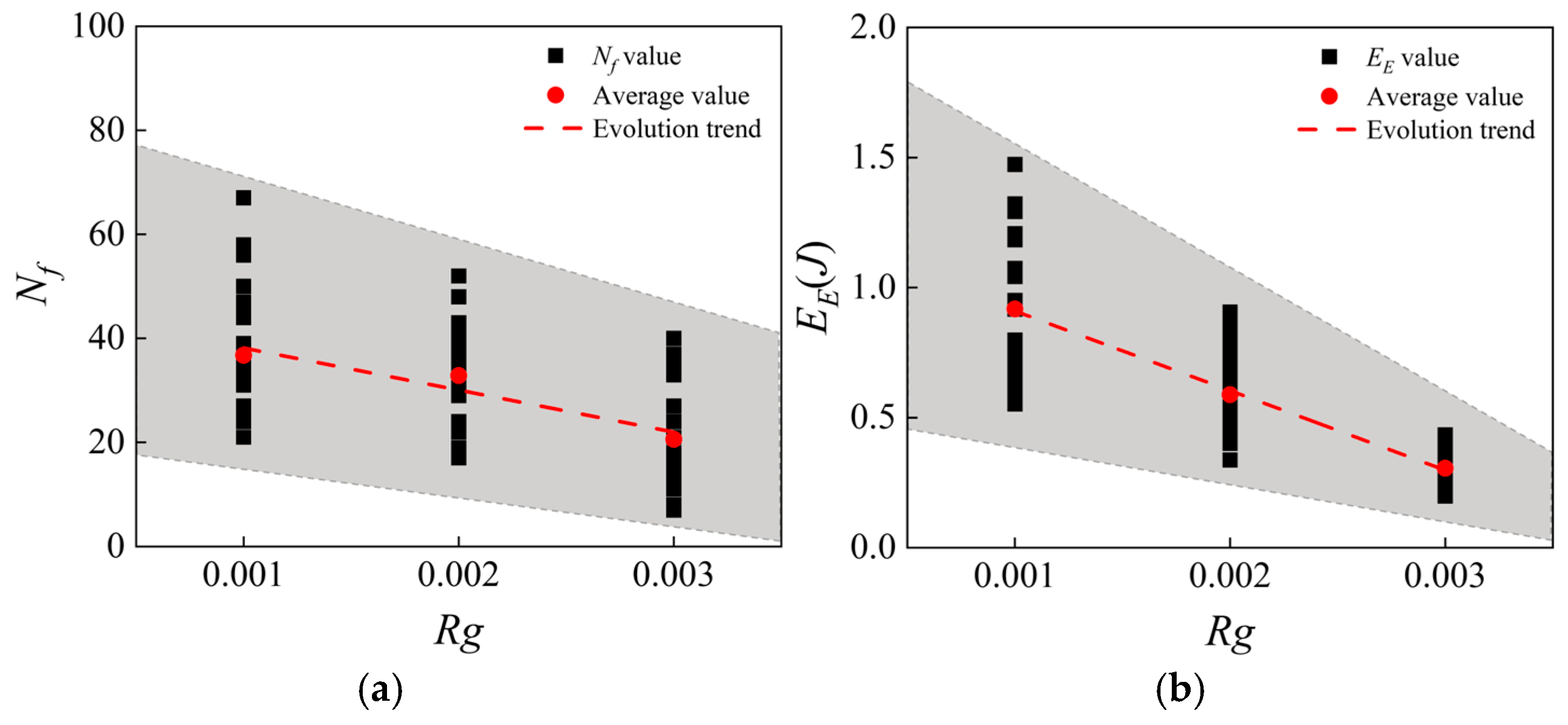
Fragmentation analysis (Figure 14a) demonstrated a significant negative correlation between surface roughness and fragment count, with mean fragment numbers decreasing from 37 ± 2.1 to 20 ± 1.8 as R g increased from 0.001 to 0.003. This trend was strongly correlated with the measured elastic strain energy E E shown in Figure 14b, where E E decreased from 0.92 ± 0.05 J to 0.30 ± 0.03 J over the same R g range. These observations support the proposed fracture mechanism whereby surface roughness concentrates applied stresses at discrete asperities, leading to localized fracture initiation with reduced energy dissipation.
These results collectively demonstrate that increased surface roughness significantly compromises particle strength properties through two primary mechanisms: (1) introduction of stress concentration sites that reduce the critical load for fracture initiation, and (2) modification of fracture propagation patterns that limit energy absorption capacity. The quantitative relationships established here provide important insights for materials design in applications where particle strength is a critical performance parameter.

4.4. Relationship Between Particle Crushing Strength and Fractal Dimension

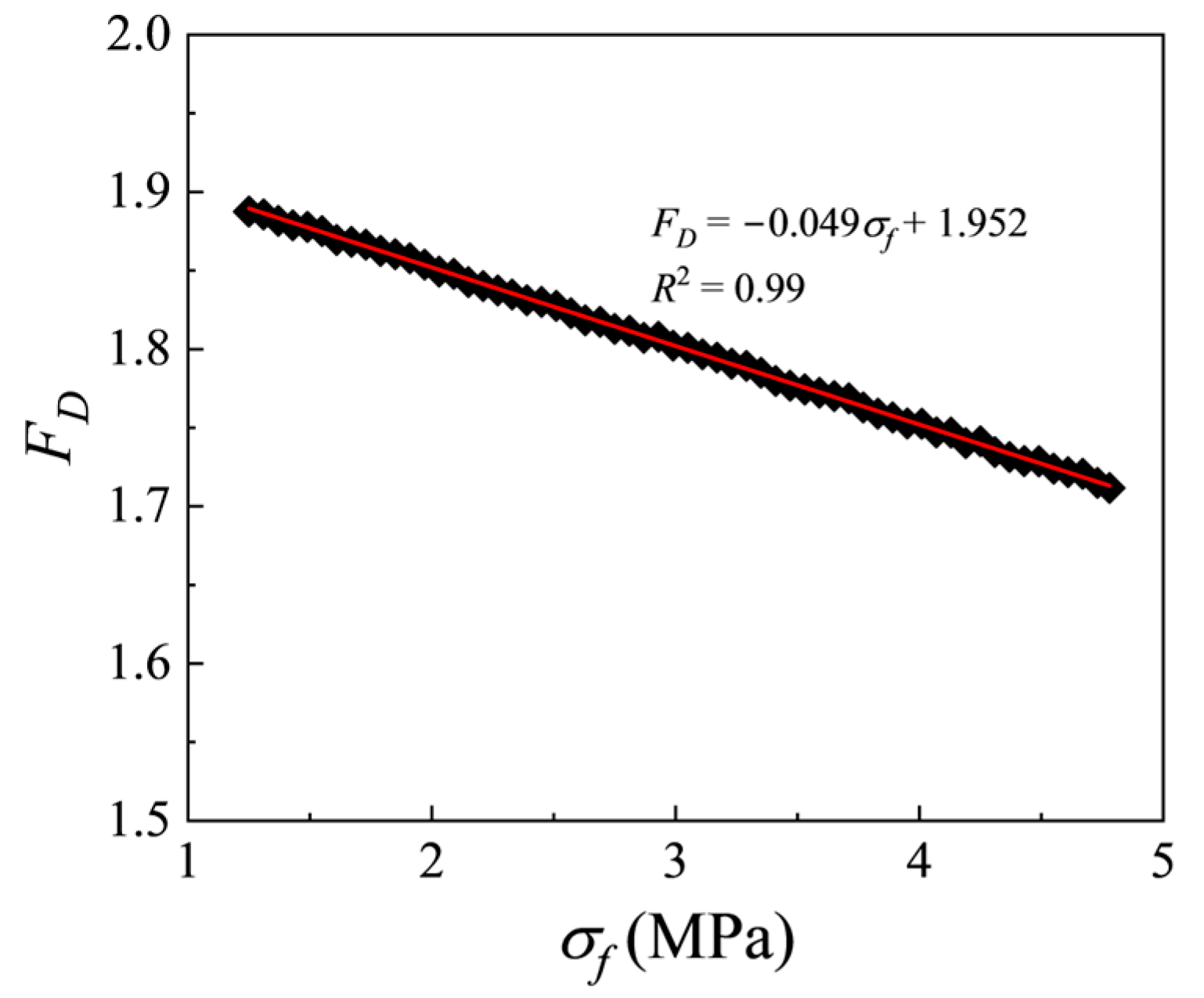
Figure 15 illustrates the relationship between fractal dimension and particle crushing strength. As shown in the figure, the particle crushing strength decreases with increasing fractal dimension. This observation is consistent with the findings reported by Meng et al. [36], who noted that higher fractal dimensions indicate more pronounced particle defects, consequently leading to lower crushing strength. Generally, the fractal dimension exhibits an exponential negative correlation with crushing strength. However, in this study, a linear relationship was observed, which can be primarily attributed to the relatively narrow range of fractal dimensions examined. Within this limited span, the classical exponential decay approximates a linear relationship due to first-order Taylor expansion dominance, a phenomenon validated in granular materials with constrained morphological variance. This scale-dependent behavior contrasts with broader fractal dimension ranges, where full exponential decay manifests.

5. Conclusions

This study establishes an integrated computational framework combining Fourier-based shape reconstruction, fractal dimension analysis, and combined finite-discrete element method (FDEM) simulation. Using Fourier descriptor theory, particle morphology is efficiently parameterized based on harmonic coefficients, which directly correspond to standardized shape descriptors—namely, the elongation index ( E I ), roundness index ( R d ), and roughness index ( R g ). Statistical consistency between synthesized particles and target morphological distributions is enforced via an inverse Monte Carlo sampling algorithm. This framework enables a systematic and quantitative investigation into the influence of particle morphology and fractal dimension on crushing strength and associated mechanical responses.
Variations in the E I within the range of 0.6 to 0.9 exert negligible influence on single-particle breakage characteristics. The mean crushing strength values for specimens with I = 0.6 , E I = 0.75 , and E I = 0.9 closely align with the reference value established for disc-shaped particles of equivalent area. Furthermore, the variation in fragment count remains statistically indistinct. Conversely, an increase in the R d from 0.5 to 0.9 enhances particle resistance to external loading. This is evidenced by a concomitant increase in the Weibull modulus with R d , signifying reduced variability in crushing strength for particles exhibiting higher R d values. Notably, the mean crushing strength across all Rd groups exceeds the reference value. Additionally, both fragment count and stored elastic strain energy exhibit positive correlations with increasing R d . In contrast, elevating the R g within the range of 0.001 to 0.003 leads to diminished particle strength. The mean crushing strength for particles across R g groups falls below the reference benchmark. Moreover, particle crushing strength demonstrates greater variability at elevated R g levels. Concurrently, fragment count and stored elastic strain energy decrease as R g increases. Notably, a negative correlation is observed between fractal dimension and particle crushing strength, suggesting that particles possessing a more complex fracture surface morphology tend to exhibit lower mechanical strength.

Author Contributions

Conceptualization, R.L. and S.H.; methodology, S.H.; software, R.L.; formal analysis, H.J.; data curation, N.Y.; writing—original draft preparation, R.L. and S.H.; writing—review and editing, S.H. and C.X.; supervision, S.H.; project administration, S.H. All authors have read and agreed to the published version of the manuscript.

Funding

This research received no funding.

Data Availability Statement

Data will be available upon reasonable request.

Conflicts of Interest

The authors declare no conflicts of interest.

References

  1. Zhao, S.; Zhang, G.; Zhang, D.; Tan, D.; Huang, H. A hybrid attention deep learning network for refined segmentation of cracks from shield tunnel lining images. J. Rock Mech. Geotech. Eng. 2023, 15, 3105–3117. Available online: https://www.sciencedirect.com/science/article/pii/S1674775523001117 (accessed on 21 January 2024). [CrossRef]
  2. Lin, W.; Sheil, B.; Zhang, P.; Zhou, B.; Wang, C.; Xie, X. Seg2Tunnel: A hierarchical point cloud dataset and benchmarks for segmentation of segmental tunnel linings. Tunn. Undergr. Space Technol. 2024, 147, 105735. [Google Scholar] [CrossRef]
  3. Zeng, K.; Liu, H. Experimental Study on the Time-Dependent Oedometric Compression Behavior of Calcareous Sand. J. Geotech. Geoenvironmental Eng. 2023, 149, 04023025. [Google Scholar] [CrossRef]
  4. Zeng, K.; Liu, H. Effect of Inherent Anisotropy on the Triaxial Compression Behavior of Coral Sand. Int. J. Geomech. 2023, 23, 04023033. [Google Scholar] [CrossRef]
  5. Zeng, K.; Liu, H. Effect of particle size distributions on the mechanical behavior and particle breakage of coral sands. Granul. Matter 2023, 25, 44. [Google Scholar] [CrossRef]
  6. Zeng, K.; Liu, H. Time-Dependent Characteristics of Coral Sand under Triaxial Stress States. J. Geotech. Geoenvironmental Eng. 2025, 151, 04024168. [Google Scholar] [CrossRef]
  7. He, S.-H.; Yin, Z.-Y.; Ibraim, E.; Ding, Z. Face mask chips-reinforced sands under monotonic and cyclic torsional shearing. Géotechnique 2025, 1–46. [Google Scholar] [CrossRef]
  8. Liu, H.; Zeng, K.; Zou, Y. Particle Breakage of Calcareous Sand and Its Correlation with Input Energy. Int. J. Geomech. 2020, 20, 04019151. [Google Scholar] [CrossRef]
  9. Zeng, K.; Yin, Z.-Y.; Li, R.; Jin, Y.-F. Role of particle morphology in monotonic and cyclic behavior of granular materials: Insights from cereals. Powder Technol. 2025, 466, 121452. [Google Scholar] [CrossRef]
  10. He, S.-H.; Yin, Z.-Y.; Ding, Z.; Li, R.-D. Particle morphology and principal stress direction dependent strength anisotropy through torsional shear testing. Can. Geotech. J. 2024, 62, 1–23. [Google Scholar] [CrossRef]
  11. He, S.-H.; Yin, Z.-Y.; Ding, Z.; Li, R.-D. Novel observations for the impact of particle morphology on shear modulus of granular materials. Acta Geotech. 2025, 20, 4631–4650. [Google Scholar] [CrossRef]
  12. Zhou, X.-W.; Jin, Y.-F.; He, K.-Y.; Yin, Z.-Y. An improved explicit MPM formulation and its coupling scheme with FEM. Comput. Methods Appl. Mech. Eng. 2025, 436, 117734. [Google Scholar] [CrossRef]
  13. Zhou, X.-W.; Jin, Y.-F.; He, K.-Y.; Yin, Z.-Y.; Liu, F.-T. A novel implicit FEM-MPM coupling framework using convex cone programming for elastoplastic problems. Comput. Methods Appl. Mech. Eng. 2024, 429, 117153. [Google Scholar] [CrossRef]
  14. He, K.-Y.; Jin, Y.-F.; Zhou, X.-W.; Yin, Z.-Y. A high-performance semi-implicit two-phase two-layer MPM framework for modeling granular mass-water interaction problems. Comput. Methods Appl. Mech. Eng. 2024, 427, 117064. [Google Scholar] [CrossRef]
  15. He, K.-Y.; Liang, W.; Yin, Z.-Y.; Jin, Y.-F. An efficient material point method framework based on the affine matrix. Comput. Geotech. 2023, 163, 105712. [Google Scholar] [CrossRef]
  16. Liang, W.; He, K.-Y.; Jin, Y.-F.; Yin, Z.-Y. A gradient-smoothed material point method for reducing cell crossing noise in large deformation problems. Comput. Geotech. 2024, 169, 106169. [Google Scholar] [CrossRef]
  17. He, K.-Y.; Jin, Y.-F.; Zhou, X.-W.; Yin, Z.-Y.; Chen, X. A generalized projection algorithm for overcoming volumetric locking in explicit material point method. Comput. Geotech. 2025, 186, 107391. [Google Scholar] [CrossRef]
  18. Zhou, X.-W.; Jin, Y.-F.; Yin, Z.-Y.; Liu, F.-T.; Chen, X. A novel improved edge-based smoothed particle finite element method for elastoplastic contact analysis using second order cone programming. Comput. Methods Appl. Mech. Eng. 2025, 441, 118016. [Google Scholar] [CrossRef]
  19. Liu, X.; Zeng, K.; Xiang, F.; Wang, C.; Hou, X.; Li, Y. Study on the interaction between particle shape and particle breakage of coral sand by discrete element method. Front. Earth Sci. 2024, 12, 1343307. [Google Scholar] [CrossRef]
  20. Jiang, H.; Debanath, O.C.; Li, Y.; Li, R. A level-set method-based framework for modeling abrasion of railway ballast. Transp. Geotech. 2025, 54, 101628. [Google Scholar] [CrossRef]
  21. Xu, C.; Wang, P.; Yin, Z.-Y.; Wen, Y.; Xu, C. Effect of particle shape on the mechanical behavior of methane hydrate-bearing sediments: A DEM study. Comput. Geotech. 2025, 182, 107141. [Google Scholar] [CrossRef]
  22. Wang, P.; Xu, C.; Yin, Z.-Y.; Song, S.; Xu, C.; Dai, S. A DEM-based generic modeling framework for hydrate-bearing sediments. Comput. Geotech. 2024, 171, 106287. [Google Scholar] [CrossRef]
  23. Kuang, D.-M.; Long, Z.-L.; Ogwu, I.; Chen, Z. A discrete element method (DEM)-based approach to simulating particle breakage. Acta Geotech. 2022, 17, 2751–2764. [Google Scholar] [CrossRef]
  24. Brzeziński, K.; Gladky, A. Clump breakage algorithm for DEM simulation of crushable aggregates. Tribol. Int. 2022, 173, 107661. [Google Scholar] [CrossRef]
  25. Harmon, J.M.; Arthur, D.; Andrade, J.E. Level set splitting in DEM for modeling breakage mechanics. Comput. Methods Appl. Mech. Eng. 2020, 365, 112961. [Google Scholar] [CrossRef]
  26. Tang, Z.-Q.; Jin, Y.-F.; Yang, J.; Yin, Z.-Y.; Chen, X. Multi-physics two-layer SNS-PFEM for granular mass–water large deformation problems. Int. J. Mech. Sci. 2025, 301, 110492. [Google Scholar] [CrossRef]
  27. Tang, Z.-Q.; Zhou, X.-W.; Jin, Y.-F.; Yin, Z.-Y.; Zhang, Q. A novel coupled bES-FEM formulation with SUPG stabilization for thermo-hydro-mechanical analysis in saturated porous media. Comput. Geotech. 2024, 173, 106454. [Google Scholar] [CrossRef]
  28. Xi-Wen, Z.; Yin-Fu, J.I.N.; Kai-Yuan, H.E.; Zhen-Yu, Y.I.N. A convex cone programming based implicit material point method. Comput. Methods Appl. Mech. Eng. 2024, 427, 117007. [Google Scholar] [CrossRef]
  29. Jiang, H.; Kawamoto, R.; Matsushima, T. Coupled effects of particle shape and inter-particle friction on quasi-static shear behavior of dry granular materials studied by 2D LS-DEM. J. Struct. Eng. A 2024, 70, 141–154. [Google Scholar]
  30. Brown, G.J.; Miles, N.J.; Jones, T.F. A fractal description of the progeny of single impact single particle breakage. Miner. Eng. 1996, 9, 715–726. [Google Scholar] [CrossRef]
  31. Arasan, S.; Akbulut, S.; Hasiloglu, A.S. The relationship between the fractal dimension and shape properties of particles. KSCE J. Civ. Eng. 2011, 15, 1219–1225. [Google Scholar] [CrossRef]
  32. Tang, Z.-Q.; Yin, Z.-Y.; Jin, Y.-F.; Zhou, X.-W. A novel mesoscale modelling method for steel fibre-reinforced concrete with the combined finite-discrete element method. Cem. Concr. Compos. 2024, 149, 105479. [Google Scholar] [CrossRef]
  33. Wadell, H. Volume, Shape, and Roundness of Rock Particles. J. Geol. 1932, 40, 443–451. [Google Scholar] [CrossRef]
  34. Gadelmawla, E.S.; Koura, M.M.; Maksoud, T.M.A.; Elewa, I.M.; Soliman, H.H. Roughness parameters. J. Mater. Process. Technol. 2002, 123, 133–145. [Google Scholar] [CrossRef]
  35. Zhang, W.; Sun, C.; Breckon, T.; Alshammari, N. Discrete Curvature Representations for Noise Robust Image Corner Detection. IEEE Trans. Image Process. 2019, 28, 4444–4459. [Google Scholar] [CrossRef]
  36. Crownover, R.M. Introduction to Fractals and Chaos; Jones and Bartlett: Boston, MA, USA, 1995; ISBN 978-0-86720-464-3. [Google Scholar]
  37. Li, J.; Du, Q.; Sun, C. An improved box-counting method for image fractal dimension estimation. Pattern Recognit. 2009, 42, 2460–2469. [Google Scholar] [CrossRef]
  38. Mollon, G.; Zhao, J. 3D generation of realistic granular samples based on random fields theory and Fourier shape descriptors. Comput. Methods Appl. Mech. Eng. 2014, 279, 46–65. [Google Scholar] [CrossRef]
  39. Su, D.; Yan, W.M. Quantification of angularity of general-shape particles by using Fourier series and a gradient-based approach. Constr. Build. Mater. 2018, 161, 547–554. [Google Scholar] [CrossRef]
  40. Wang, X.; Liang, Z.; Nie, Z.; Gong, J. Stochastic numerical model of stone-based materials with realistic stone-inclusion features. Constr. Build. Mater. 2019, 197, 830–848. [Google Scholar] [CrossRef]
  41. Li, R.; Yin, Z.-Y.; He, S.-H. 3D reconstruction of arbitrary granular media utilizing vision foundation model. Appl. Soft Comput. 2025, 169, 112599. [Google Scholar] [CrossRef]
  42. Li, R.; Yin, Z.-Y.; He, S.-H.; Sheil, B. Enhancement and Assessment of Large Vision Models for 3D Particle Reconstruction from X-ray Tomography. Can. Geotech. J. 2025, 62, 1–28. Available online: https://cdnsciencepub.com/doi/abs/10.1139/cgj-2024-0736 (accessed on 8 April 2025). [CrossRef]
  43. Metropolis, N.; Ulam, S. The Monte Carlo Method. J. Am. Stat. Assoc. 1949, 44, 335–341. [Google Scholar] [CrossRef]
  44. Hiramatsu, Y.; Oka, Y. Determination of the tensile strength of rock by a compression test of an irregular test piece. Int. J. Rock Mech. Min. Sci. Geomech. Abstr. 1966, 3, 89–90. [Google Scholar] [CrossRef]
  45. Weibull, W. A Statistical Distribution Function of Wide Applicability. J. Appl. Mech. 1951, 18, 293–297. [Google Scholar] [CrossRef]
  46. Weibull, W. A Statistical Theory of the Strength of Materials; Generalstabens Litografiska Anstalts Förlag: Stockholm, Sweden, 1939; Available online: https://books.google.com.hk/books?id=otVRAQAAIAAJ (accessed on 8 April 2025).
  47. Abaqus User Manual; Abacus: Sydney, Australia, 2020.
  48. Wu, X.; Wang, G.; Li, G.; Han, W.; Sun, S.; Zhang, S.; Bi, W. Research on Shear Behavior and Crack Evolution of Symmetrical Discontinuous Rock Joints Based on FEM-CZM. Symmetry 2020, 12, 1314. [Google Scholar] [CrossRef]
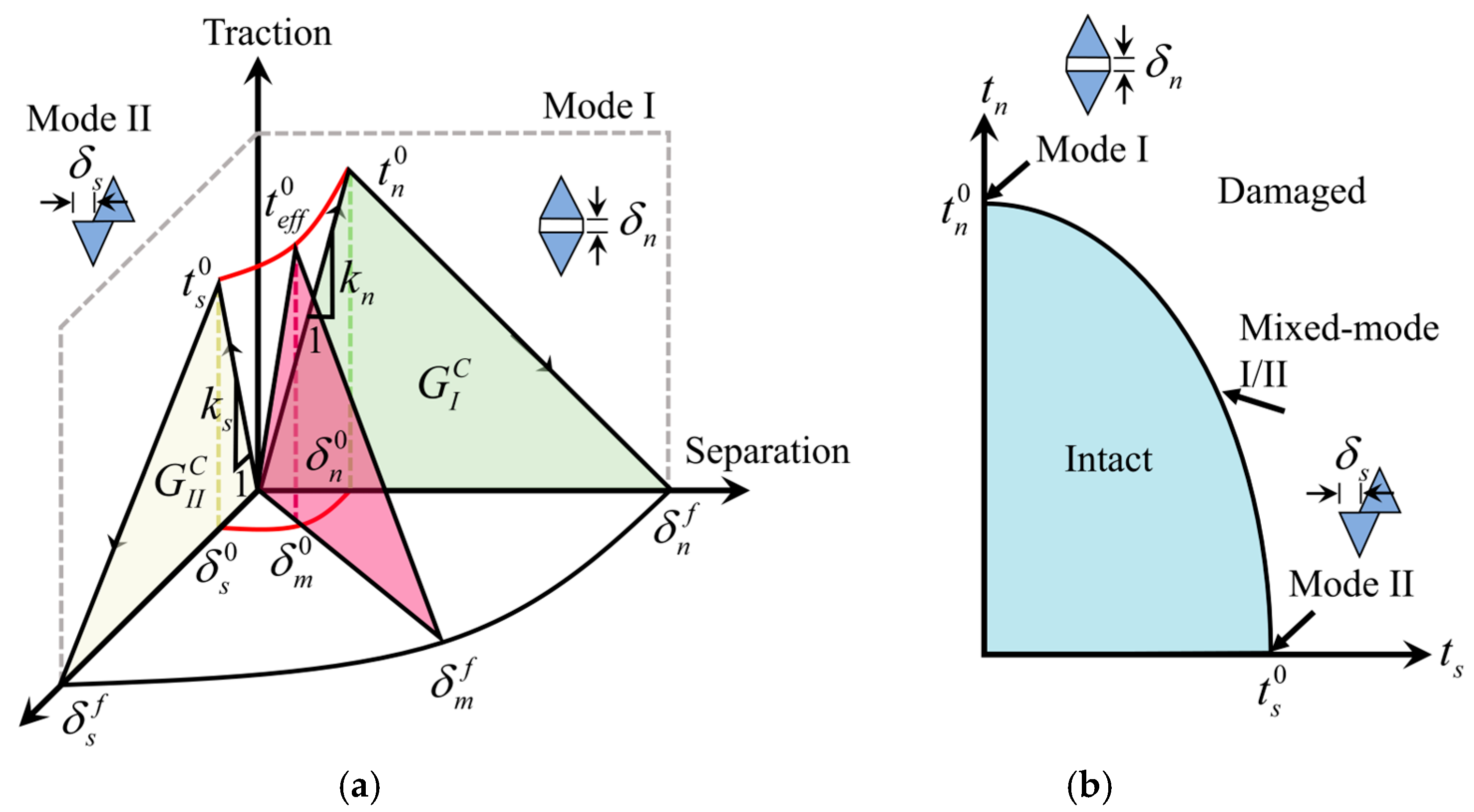
Figure 1. Constitutive model of cohesive elements: (a) mixed-mode linear traction-separation behavior and (b) mixed-mode damage initiation criterion.
Fractalfract 09 00562 g001
Figure 2. Reconstruction of 2D particle contours based on different Fourier descriptors.
Fractalfract 09 00562 g002
Figure 3. Flowchart of the acquisition of desired particles.
Fractalfract 09 00562 g003
Figure 4. Schematic diagram of the single particle uniaxial compression test.
Fractalfract 09 00562 g004
Figure 5. Illustrations of: (a) solid elements; and (b) cohesive elements.
Fractalfract 09 00562 g005
Figure 6. Sensitivity analysis on: (a) mesh sizes through force–displacement curves [48]; and (b) von Mises stress distributions.
Fractalfract 09 00562 g006
Figure 7. Comparison of crushing patterns: (a) crushing pattern in the experiment and (b) crushing pattern in the calibration result.
Fractalfract 09 00562 g007
Figure 8. Particle profile reconstructed with different shape descriptors: (a) E I , (b) R d , and (c) R g .
Fractalfract 09 00562 g008aFractalfract 09 00562 g008b
Figure 9. Single particle breakage with different E I (0.6, 0.75, and 0.9): (a) Particle survival probability and (b) Weibull distributions.
Fractalfract 09 00562 g009
Figure 10. Single particle breakage with different E I (0.6, 0.75, and 0.9): (a) Variation of mean σ f with E I and (b) Number of fragments N f .
Fractalfract 09 00562 g010
Figure 11. Single particle breakage with different R d (0.6, 0.75, and 0.9): (a) Particle survival probability and (b) Weibull distributions.
Fractalfract 09 00562 g011
Figure 12. Single particle breakage with different R d (0.6, 0.75, and 0.9): (a) Number of fragments N f , and (b) Variation of elastic strain energy E E .
Fractalfract 09 00562 g012
Figure 13. Single particle breakage with different R g (0.6, 0.75, and 0.9): (a) Particle survival probability and (b)Weibull distributions.
Fractalfract 09 00562 g013
Figure 14. Single particle breakage with different R g (0.6, 0.75, and 0.9): (a) Number of fragments N f , and (b) Variation of elastic strain energy E E .
Fractalfract 09 00562 g014
Figure 15. Variation of fractal dimension with particle crushing strength ( R 2   =   0.99 ,   F D   =   - 0.049 σ f   +   1.952 ).
Fractalfract 09 00562 g015
Table 1. Micro-parameters used in DEM simulation.
MaterialsParametersValues
Loading platesDensity7.8 × 103
Young’s modulus (GPa)2.1 × 10²
Poisson’s ratio0.3
Solid elementsDensity2.5 × 103
Young’s modulus (GPa)15
Poisson’s ratio0.3
Cohesive elementsInitial tensile stiffness (GPa·m−1)9.5
Initial shear stiffness (GPa·m−1)17.6
Normal traction force (MPa)5
Tangential traction force (MPa)18
Model-I fracture energy (N·mm−1)60
Model-II fracture energy (N·mm−1)165
Table 2. Scenarios for rock particles considering irregular shapes.
Shape DescriptorsValueNumber of CasesTotal
E I 0.6, 0.75, 0.920, 20, 2060
R d 0.5, 0.7, 0.920, 20, 2060
R g 0.001, 0.002, 0.00320, 20, 2060
Disclaimer/Publisher’s Note: The statements, opinions and data contained in all publications are solely those of the individual author(s) and contributor(s) and not of MDPI and/or the editor(s). MDPI and/or the editor(s) disclaim responsibility for any injury to people or property resulting from any ideas, methods, instructions or products referred to in the content.