
Article

Fractional-Order Stress Relaxation Model for Unsaturated Reticulated Red Clay Slope Instability
1
School of Transportation, Changsha University of Science & Technology, Changsha 410114, China
2
School of Geosciences and Info-Physics, Central South University, Changsha 410083, China
*
Author to whom correspondence should be addressed.
Fractal Fract. 2025, 9(12), 786; https://doi.org/10.3390/fractalfract9120786 (registering DOI)
Submission received: 5 November 2025 / Revised: 26 November 2025 / Accepted: 28 November 2025 / Published: 1 December 2025
(This article belongs to the Special Issue Fractal and Fractional in Geotechnical Engineering, Second Edition)

Abstract

Triaxial suction-controlled relaxation tests were performed on unsaturated reticulated red clay from a highway cut slope to quantify the coupled influence of matric suction (50–200 kPa), net confining pressure (100–300 kPa), and axial strain (2–8%) on time-dependent stress decay. The results reveal that 60–80% of deviatoric stress dissipates instantaneously, with the remaining loss evolving nonlinearly toward a stable residual; higher suction or confinement raises residual capacity but enlarges absolute relaxation, whereas increasing strain accelerates damage and intensifies stress drop. A parsimonious three-element fractional Poynting–Thomson (FPTh) model that embeds Caputo-derived Koeller dashpot and the exponential damage variable of the viscous coefficient was formulated. The proposed model demonstrates a superior performance compared with the Merchant, Burgers, and Nishihara models (R2 > 0.99 and RMSE < 3.5). The FPTh model faithfully reproduces the rapid and attenuating relaxation phases, offering a robust predictive tool for the long-term stability assessment of unsaturated clay slopes.

1. Introduction

Under long-term load, the internal stress of soil continues to decay, which weakens the structural strength of the soil, and may eventually induce the local or overall slip instability of the slope. Especially in hot and humid areas, rainfall and evaporation cycles aggravate this process and become one of the key factors restricting the long-term service performance of the subgrade [1,2,3,4]. Long-term stress relaxation will cause the continuous deformation of the soil. If this deformation accumulates to a certain extent, it will lead to the local or even overall instability of the slope [5,6,7]. Stress relaxation can create potential sliding surfaces in the soil body, especially if there are weak layers or structural surfaces in the soil body, and stress relaxation in these areas may promote the development of sliding surfaces [8,9]. Under the load of rainfall or earthquakes, the stress relaxation phenomenon will be more significant, leading to stress redistribution in the soil body of highway slopes and increasing the risk of landslides and collapses [10,11,12]. Fast construction speed or improper construction methods can lead to the early appearance of soil stress relaxation, which can lead to slope instability during construction. Once the slope is destabilized due to stress relaxation, later maintenance and repair work will become more difficult and costly. Slope instability not only damages highway infrastructure but also poses a serious threat to traffic safety and may lead to traffic accidents [13].
With the advancement of test instruments and technology, stress relaxation in soils has attracted widespread scholarly attention. Wang et al. [14] studied the stress relaxation characteristics of frozen soil in the Qinghai–Tibet Plateau by applying triaxial relaxation tests to frozen soil samples. Bray and Matthew [15] introduced a concise empirical technique derived from stress relaxation experiments that allows the rapid estimation of secondary stress relaxation parameters, markedly reducing testing duration. Employing dense sand from Virginia Beach, Lade and Karimpour [16] executed triaxial consolidation experiments across varied strain rates and confining stresses, revealing an upward trend in stress relaxation magnitude as the loading rate increases. Wang et al. [17] explored how strain amplitude and loading method affect the relaxation behavior of lime-stabilized unsaturated expansive clay, delineated the governing relaxation mechanisms, and offered insights for formulating a robust time-dependent constitutive law. Leveraging the discrete element framework, Xu et al. [18] investigated the coupled creep and stress relaxation characteristics of rockfill, highlighting the distinct deformation mechanisms exhibited under sustained versus decreasing load conditions. Atkinson et al. [19] studied the infiltration and relaxation behavior of the weathered layer of dry lunar soil, and the obtained infiltration and relaxation data can provide a scientific basis for field experiments. Wang and Xia [20] studied idealized granular soil through triaxial creep and stress relaxation tests and summarized the influence of deviatoric stress on the creep and relaxation of granular soil and the microscopic mechanism.
Extensive studies have refined our understanding of stress relaxation in saturated soils and yielded numerous constitutive models [21,22,23]. However, these cited works were obtained under fully saturated conditions (matric suction = 0) where Terzaghi’s effective stress principle applies without modification; meniscus effects, suction-dependent fabric change, and hydraulic–mechanical coupling are absent. Consequently, their quantitative trends (e.g., relaxation magnitude, rate parameters) cannot be directly transferred to unsaturated materials where suction generates additional cohesion and continuously modifies the pore size distribution [24,25,26,27]. Investigations explicitly addressing unsaturated stress relaxation remain scarce: only Wang et al. [17] and Bagheri et al. [28] reported suction-controlled data, but for lime-treated or reconstituted clays without network structure. The gap is therefore twofold: (i) suction-controlled relaxation data for natural, structured unsaturated clays are still missing; (ii) no fractional-order model has yet incorporated matric suction as an independent variable alongside stress and strain. The present study closes this gap by coupling high-resolution suction-controlled triaxial relaxation experiments with a parsimonious fractional visco-elastic framework specifically tailored to unsaturated reticulated red clay. The objectives are three-fold: (1) quantify the isolated and combined effects of matric suction, net confining pressure, and strain level on relaxation characteristics; (2) develop a physically rigorous FPTh model that embeds suction-dependent damage variable; (3) validate the model across the full experimental matric and benchmark it against classical models under identical unsaturated conditions.

2. Theory of Fractional Calculus

At present, the three most widely used definitions in the field of fractional calculus are as follows: the Riemann–Liouville definition, Caputo definition, and Grünwald–Letnikov definition [29,30,31,32].
(1)
Riemann–Liouville definition
Let β be a positive real number, and n − l < β < n and n be positive integers. The function f(t) is defined on the interval [a, b], and the left fractional integral of Riemann–Liouville is defined as
I a + β f ( t ) = 1 Γ ( β ) a t f ( τ ) d τ ( t τ ) 1 β ( t > a , β > 0 )
Γ (*) is a gamma function as follows:
Γ ( β ) = 0 e 1 t β 1 d t ( R ( β ) > 0 )
Similarly, the right fractional integral of Riemann–Liouville is defined as
I b β f ( t ) = 1 Γ ( β ) t b f ( τ ) d τ ( t τ ) 1 β ( t < b , β > 0 )
In summary, the final R-L fractional differential can be defined as
D t β a R L f ( t ) = ( d d t ) n I a + n β f ( t ) = 1 Γ ( n β ) ( d d t ) n a t f ( τ ) d τ ( t τ ) β n + 1 ( n = β + 1 , n 1 β < n , t > β ) = k = 0 n 1 f ( k ) ( 0 ) t β + k Γ ( k + 1 β ) + 1 Γ ( n β ) 0 t ( t τ ) n β 1 f ( n ) ( τ ) d τ
When 0 < β < 1, the R-L type fractional differential can be defined as
D t β a R L f ( t ) = 1 Γ ( 1 β ) d d t a t f ( τ ) d τ ( t τ ) β t > a = f ( 0 ) t β Γ ( 1 β ) + 1 Γ ( 1 β ) 0 t ( t τ ) β f ( τ ) d τ
The Riemann–Liouville fractional derivative mathematical theory is more mature and suitable for solving problems with initial conditions. However, when applied to practical problems, it may lead to computational difficulties due to improper integrals. In addition, for systems with non-zero initial conditions, it may lead to difficulties in the description of differential equations.
(2)
Caputo definition
The Riemann–Liouville fractional derivatives have supersingularity, which has certain limitations in actual engineering practice and mathematical physics modeling. The Caputo-type fractional order is proposed accordingly, and this method effectively solves the fractional-order initial value problem in the solution process of Riemann–Liouville-type fractional-order calculus. Caputo-type fractional calculus is defined as follows [33,34]
D t β a C f ( t ) = I a + n β f ( n ) ( t ) = 1 Γ ( n β ) a t f ( n ) ( τ ) d τ ( t τ ) β n 1 ( n = β + 1 , n 1 < β n , t > a ) = f ( n ) ( a ) ( t a ) ( n a ) Γ ( n a + 1 ) + 1 Γ ( n β + 1 ) a t ( t τ ) n β f ( n + 1 ) ( τ ) d τ
where n is the smallest positive integer greater than β; f n ( τ ) is the n-order derivative of f(τ).
When 0 < β < 1, n = 1, the above definition can be simplified as
D t β a C f ( t ) = I a + 1 β f ( t ) = 1 Γ ( 1 β ) a t f ( τ ) d τ ( t τ ) β
The Caputo fractional derivative is suitable for a system with non-zero initial conditions, which is convenient when dealing with the initial value problem in practical engineering problems. The Caputo fractional derivative of the constant function is zero, which is consistent with the properties of the integer derivative. However, it has higher requirements for the smoothness of the function.
(3)
Grünwald–Letnikov definition
For the continuous function y = f(t), according to the definition of the integer order derivative, its first derivative is defined as
f ( t ) = d f d t = lim h 0 f ( t ) f ( t h ) h
According to the same definition, the definition of the second derivative can be derived as follows:
f ( t ) = lim h 0 f ( t ) f ( t h ) h = lim h 0 f ( t ) 2 f ( t h ) + f ( t 2 h ) h 2
A more general definition of n-order derivative can be written as
f ( n ) ( t ) = d n f d t n = lim h 0 1 h n r = 0 n ( 1 ) r n r f ( t r h )
where n r = n ( n 1 ) ( n 2 ) ( n r + 1 ) r ! is the second-order coefficient.
Extending the integer in Formula (10) to the real number β, the expression of the fractional derivative can be obtained as
f h ( β ) ( t ) = lim h 0 1 h β r = 0 + t a h ( 1 ) r β r f ( t r h )
For a function in a finite domain [a, b], the left and right G-L fractional derivatives are defined as
D t β a G f ( t ) = lim h 0 + 1 h β r = 0 t a h ( 1 ) r β r f ( t r h ) D b β t G f ( t ) = lim h 0 + 1 h β r = 0 b t h ( 1 ) r β r f ( t + r h )
The G-L fractional-order integral is defined as
I t β a G f ( t ) = 1 Γ ( β ) a t ( t τ ) β 1 f ( τ ) d τ
The Grünwald–Letnikov fractional derivative is intuitive and easy to implement in numerical calculations and does not require too high requirements for the smoothness of the function. However, there are problems in its convergence, and it may not converge for some functions. Moreover, it is not as extensive as the Caputo fractional derivative and Riemann–Liouville fractional derivative in practical applications.
In the context of this study, where stress relaxation data are obtained under suction-controlled conditions with a finite, non-zero initial deviatoric stress σ0, the selection of the fractional derivative definition becomes a critical modeling decision rather than a purely theoretical consideration. Riemann–Liouville requires the repeated fractional integration of σ(t) from t = 0+, implying that the initial condition is expressed in terms of fractional integrals—quantities that cannot be measured directly by the on-board load cell and that amplify measurement noise when the derivative order is high. Grünwald–Letnikov is discretization-friendly, but its β-order derivative at t → 0+ converges only if σ(t) is β-times differentiable in the closed interval [0, t]; the instantaneous stress jump produced by the strain-controlled triaxial driver violates this smoothness prerequisite. Caputo, in contrast, keeps the initial condition in the classical form σ(0+) = σ0, which is exactly the raw reading of the differential pressure transducer used in our tests. Moreover, its kernel is non-singular, so the numerical differentiation of noisy laboratory data is stable, and the constitutive equation collapses to a linear spring (β → 0) or a Newtonian dashpot (β → 1) without re-entering the initial conditions [35,36,37]. Therefore, only the Caputo operator satisfies the dual requirement of physical interpretability and numerical stability when the relaxation model is calibrated against suction-controlled triaxial data with finite initial stress.

3. Materials and Methods

3.1. Materials

The soil tested in this study is the typical Changsha subgrade reticulated red clay that underlies more than 50% of the highway slopes in Hunan Province [38]. Its genesis, mineralogy (dominant kaolinite and minor illite), and physical properties are summarized in Table 1. The particle size distribution of this reticulated red clay is shown in Figure 1.
As shown in Figure 1, the typical Changsha subgrade reticulated red clay is dominated by silt-sized particles (0.005–0.075 mm), which account for about 75% of the total; sand-sized particles (>0.075 mm) make up roughly 15%, while clay-sized particles (<0.005 mm) are the least abundant, comprising approximately 10%.

3.2. Specimen Preparation

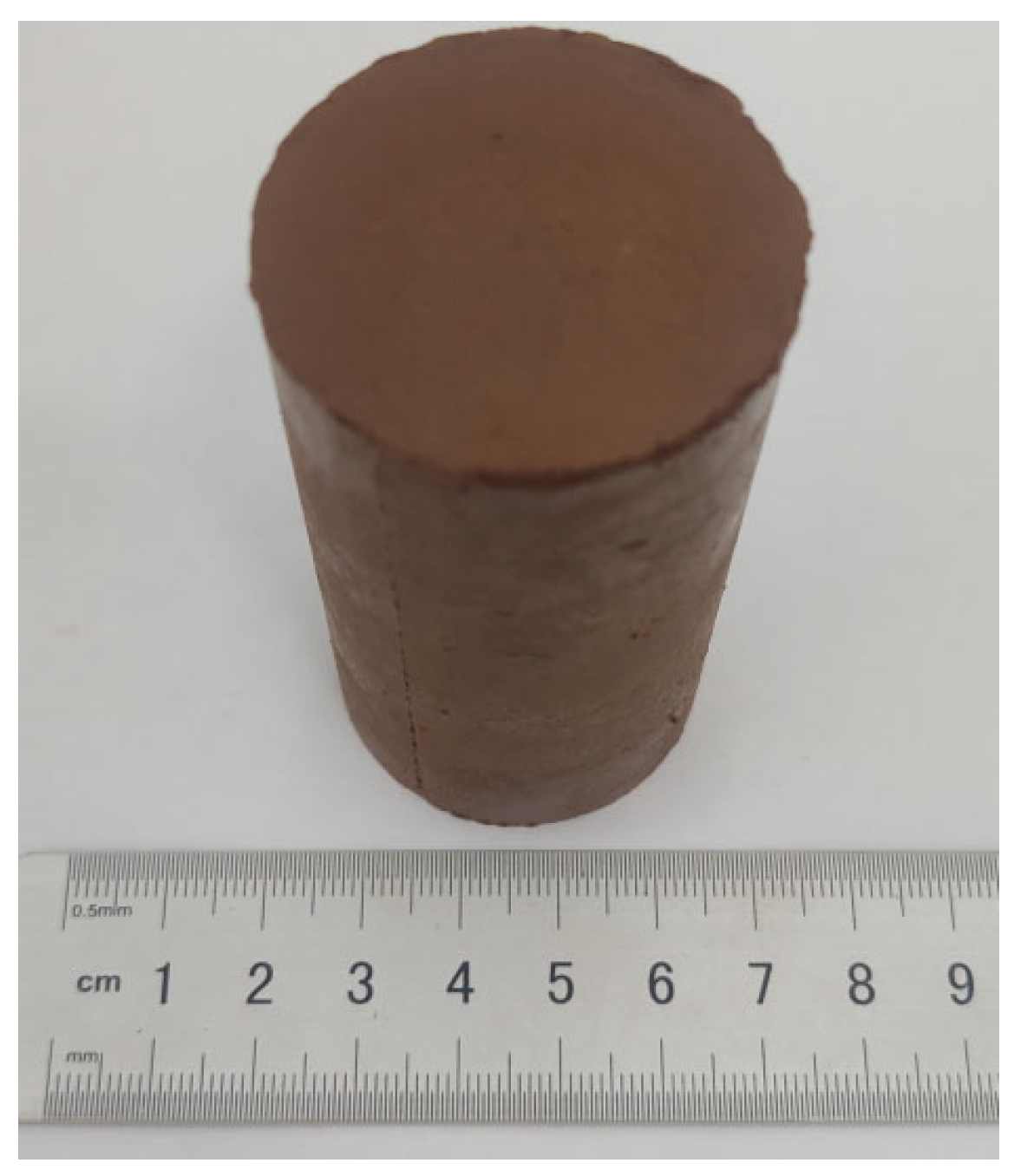
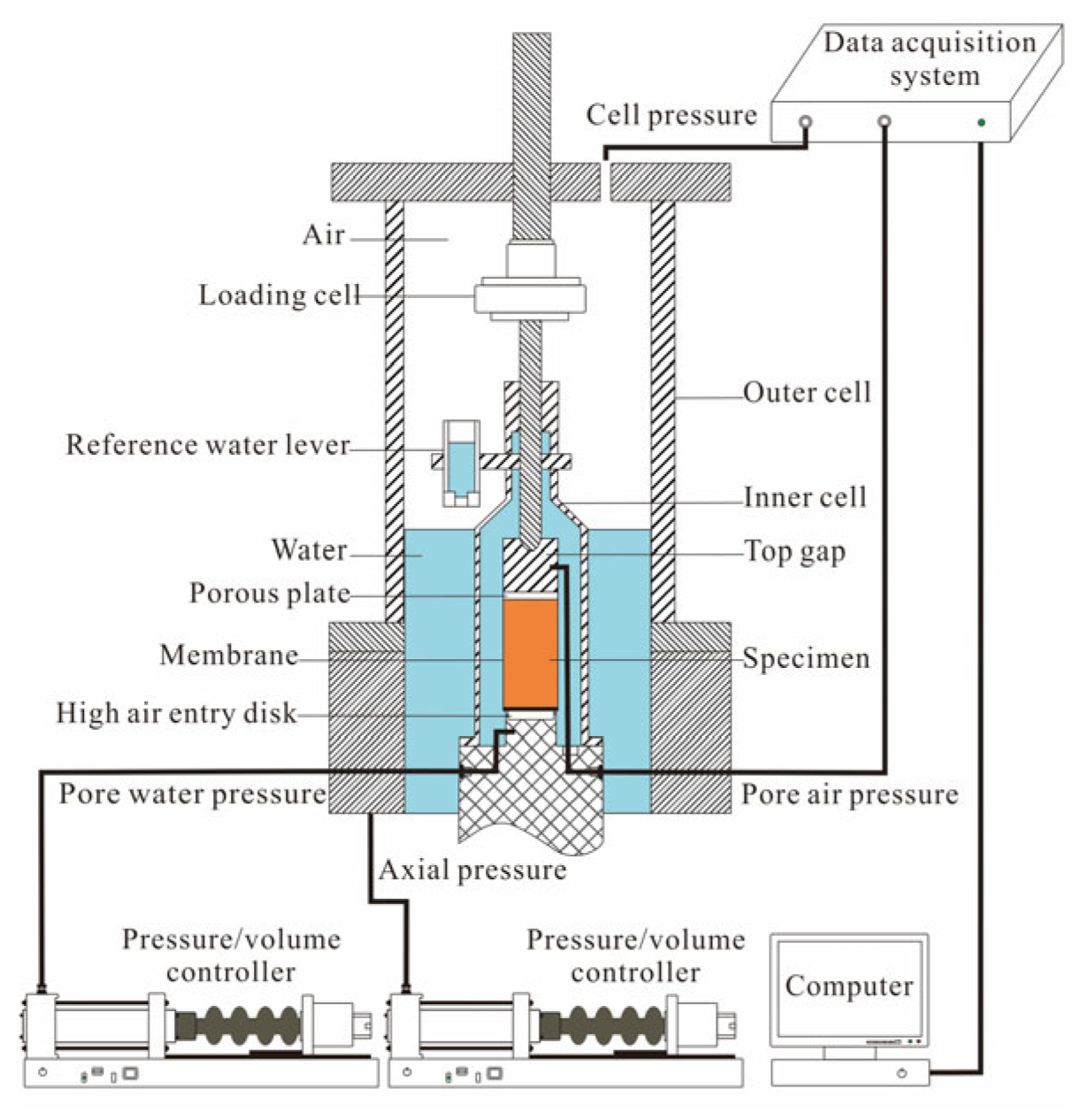
Air-dried clods were gently disaggregated and passed through a 2 mm sieve. Distilled water was mist-sprayed to achieve a 24% gravimetric moisture content of the soil. After 24 h of sealed homogenization, the soil was statically compacted into a 39.1 mm diameter, 80 mm high specimen (dry density 1.60 g cm3) (Figure 2). The specimen is placed in a vacuum saturation chamber, evacuated at −85 kPa for 2 h, and then slowly inundated with deionized water until fully submerged and kept for 24 h. A built-in GDS unsaturated triaxial (Figure 3) differential pressure transducer apparatus is used to measure the B-value; saturation is accepted only if B ≥ 0.95, otherwise the saturation period is extended or the specimen is remade [39].

3.3. Experiment Procedures

The relaxation test was performed using the following steps with the GDS unsaturated triaxial apparatus. First, the specimen was isotropically consolidated at the required net confining pressure, until the back-pressure volume changed less than 0.05% of the specimen’s volume in 24 h. After that, the specimen experienced the desired matric suction value. The matric suction equilibration was reached till the volume of water within 24 h drained from the ceramic disk less than 0.05% of the specimen’s volume. The matric suction was offered and dominated through the axis translation technique. The pore water pressure applied to the specimen was 0 kPa. Finally, the specimen was sheared to the set strain level at a rate of 0.005%/min under constant matric suction and net confining pressure. When the stress was lower than 0.1 kPa in 24 h, stabilization of the stress relaxation at current strain level was reached [40,41]. The relaxation test scheme is shown in Table 2. Net confining pressure is the confining pressure minus the matric suction.
It should be noted that the selected ranges of matric suction (50–200 kPa) and net confining pressure (100–300 kPa) primarily represent the prevailing stress–suction states in shallow highway cut slopes of subtropical regions, where the groundwater table is relatively high and rainfall infiltration frequently occurs. While these ranges do not encompass the full spectrum of natural slope environments (e.g., deep-seated or arid slopes), they are representative of the critical zone where stress relaxation-induced failure is most likely to initiate. Future work will extend the suction and stress envelopes to validate the model under more extreme conditions. The selected strain range (2–8%) in this study focuses on the long-term stress relaxation behavior of unsaturated reticulated red clay on highway slopes, rather than short-term strength failure. In service, this type of slope is usually at a medium to low strain level (<8%), where stress relaxation plays a more critical role in the stability evolution rather than the failure process after peak strength.

4. Results and Discussion

4.1. Stress Relaxation Curve and Rate Curve Characteristics

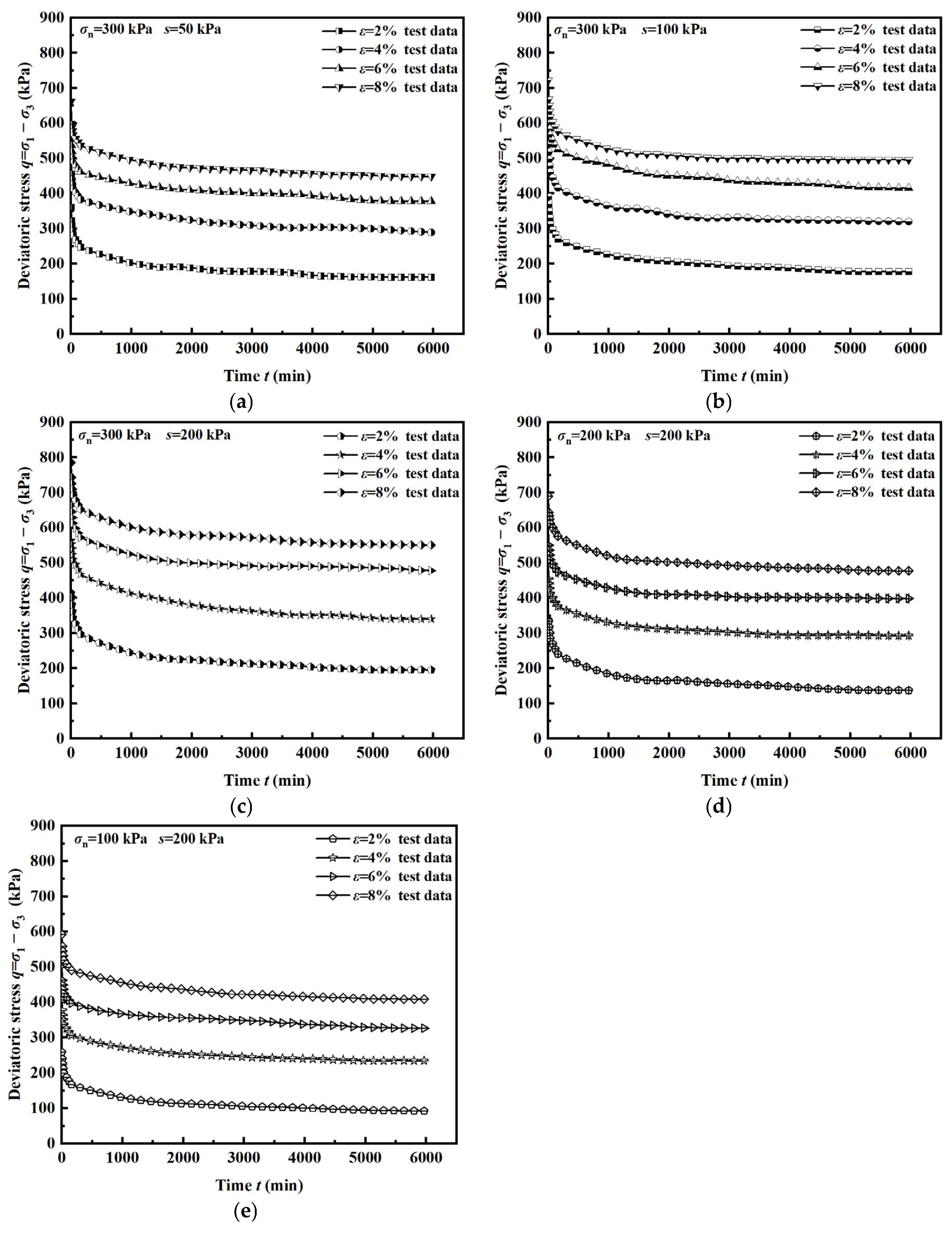
The stress relaxation–time curves of the test specimens under different matric suctions and net confining pressures are shown in Figure 4. σ1 is the axial stress.
The results reveal that 60–80% of the deviatoric stress dissipates within the instantaneous phase (<1 min, Figure 4); the remaining loss enters the attenuation phase (1–100 min) and finally levels off during the stable phase (>100 min, identified as the time window where the relaxation rate in Figure 5 drops to zero). This three-stage signature is consistently adopted hereafter. Affected by different net confining pressures and matric suctions, the variation in deviatoric stress is also different. The reason lies in the fact that variations in matric suction and net confining pressure alter both the inter-particle friction and the cementation forces within unsaturated reticulated red clay, ultimately leading to differences in its overall strength. In addition, when the specimen is sheared to different strain levels, the degree of crack damage inside the soil and the energy released are different, so that the deviatoric stress that is reduced instantaneously is also different. During the attenuation–relaxation stage, the deviatoric stress decreases gradually because the accumulated deformation energy is gradually consumed over time. In the stable relaxation stage, the deviatoric stress tends to a stable value because the particles with broken connections inside the soil are reattached to reach equilibrium by continuous adjustment. The change in deviatoric stress during relaxation is positively related to the strain level. When the strain level of the specimen is low, the changes in each stage of stress relaxation are still obvious with the increase in time, which shows that the unsaturated reticulated red clay has significant stress relaxation characteristics. The stress relaxation–time curve trends are similar under different conditions of net peritectic pressure, matric suction, and strain level, so the stress relaxation–time curve relationship can be modeled by a function of the same form. In the range of strain levels from 2% to 8%, the specimen did not fail, so no failure occurred during the stress relaxation stage. Failure criterion during relaxation were as follows: Axial load and displacement were continuously logged; a test was terminated and the specimen discarded if the axial stress dropped suddenly by >5% of its current value or if the actuator displacement exceeded the 50 µm travel limit while maintaining constant strain. No specimen met either condition, so no bulk failure was recorded. Visual inspection after dismantling confirmed the absence of visible shear planes or barreling; however, microscopic localization below the naked-eye threshold cannot be excluded and is implicitly included in the exponential damage variable of the model.
The preceding analysis indicates that, over time, stress relaxation in unsaturated reticulated red clay is driven by the progressive development of internal cracks, which dissipate stored deformation energy—a conclusion that aligns with the observations reported by Zhu et al. [42].
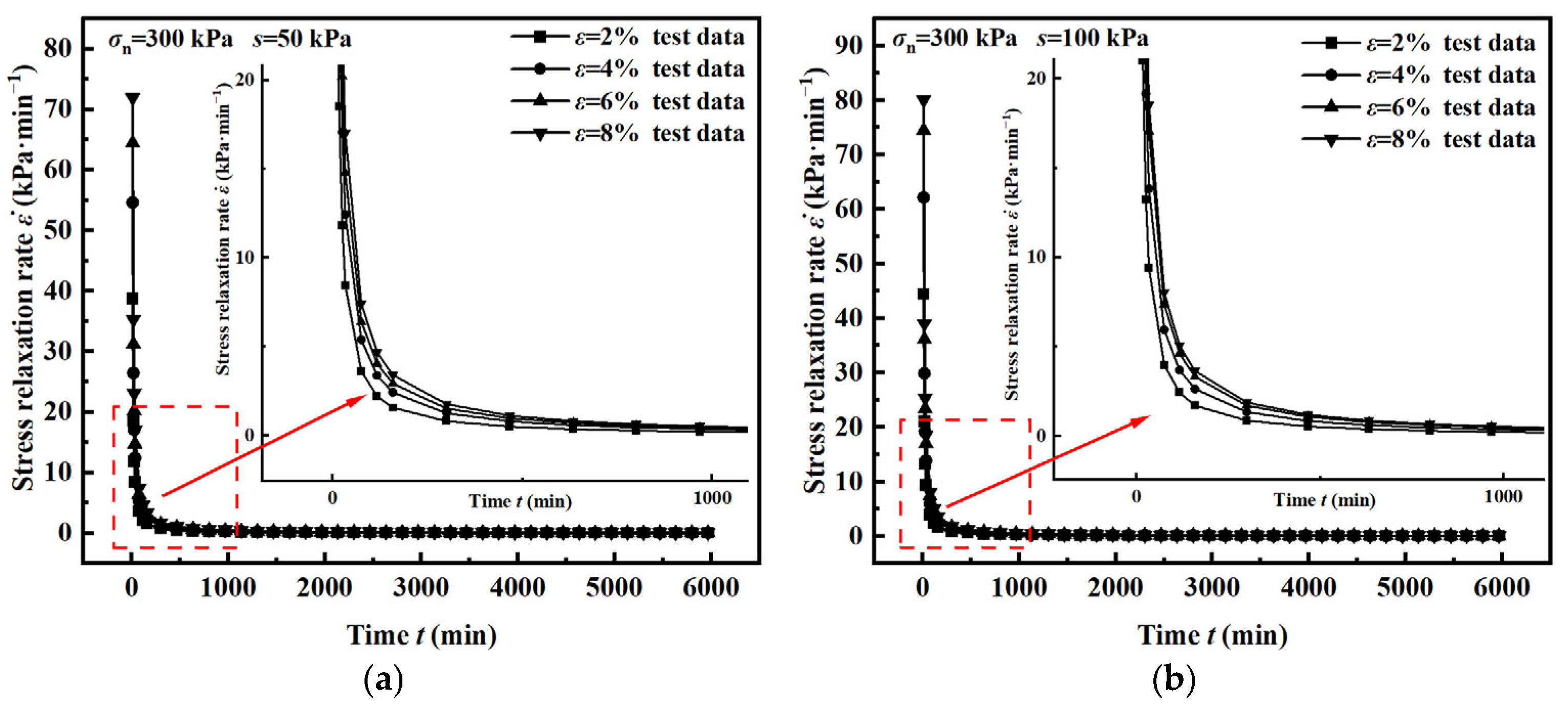
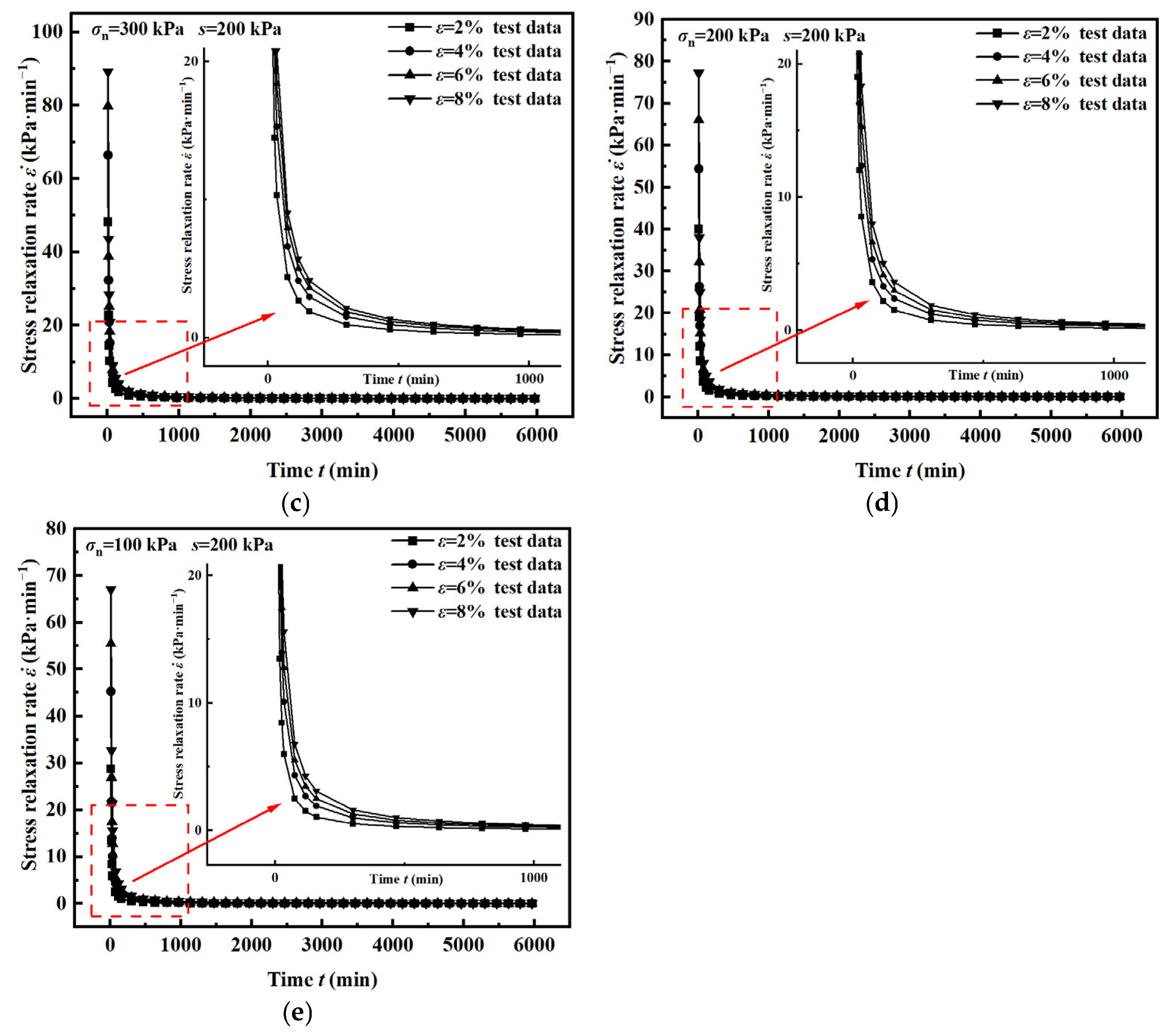
The stress rate–time curves of the test specimens under different matric suctions and net confining pressures are shown in Figure 5.
Figure 5 shows that, irrespective of the strain level, the stress relaxation rate declines in a nonlinear, decaying fashion over time, following an identical trend. The stress–relaxation rate drops sharply during the instantaneous phase (<1 min), then decreases continuously in the attenuation phase (1–100 min), and finally approaches zero when entering the stable phase (>100 min). At the onset of relaxation, the rate peaks sharply, plunging by roughly 80–90% from its initial high value within a brief interval. This abrupt drop occurs because relaxation proceeds under fixed strain while the stress is allowed to evolve over time. When the specimen undergoes stress relaxation, it cannot release the energy generated by deviatoric stress extrusion through deformation. Therefore, there will be many cracks inside the specimen, which will destroy the connection between soil particles, reduce the strength of the specimen, and release the energy generated by the deviatoric stress extrusion. As the stored energy is progressively dissipated, the stress–relaxation rate diminishes steadily and ultimately approaches zero. The magnified inset in Figure 5 shows that higher strain levels yield larger initial relaxation rates and prolong the transition to the stable relaxation phase. This shows that the greater the strain level, the more obvious the stress relaxation phenomenon. In addition, the greater the strain level, the more energy is gained when shearing to the set strain level under the action of deviatoric stress, so the more energy is released when stress relaxation occurs. In the case of constant strain, the energy can only be released through the weakening of the internal structure, so the stress relaxation characteristics are greatly affected by the strain level. The pronounced curvature of the stress–relaxation rate versus time graph underscores the inherently nonlinear nature of stress relaxation in test specimens, corroborating the trends observed in the stress–time curves. The phenomenon was also found in the study of Wang et al. [43].

4.2. Influence of Matric Suction and Net Confining Pressure

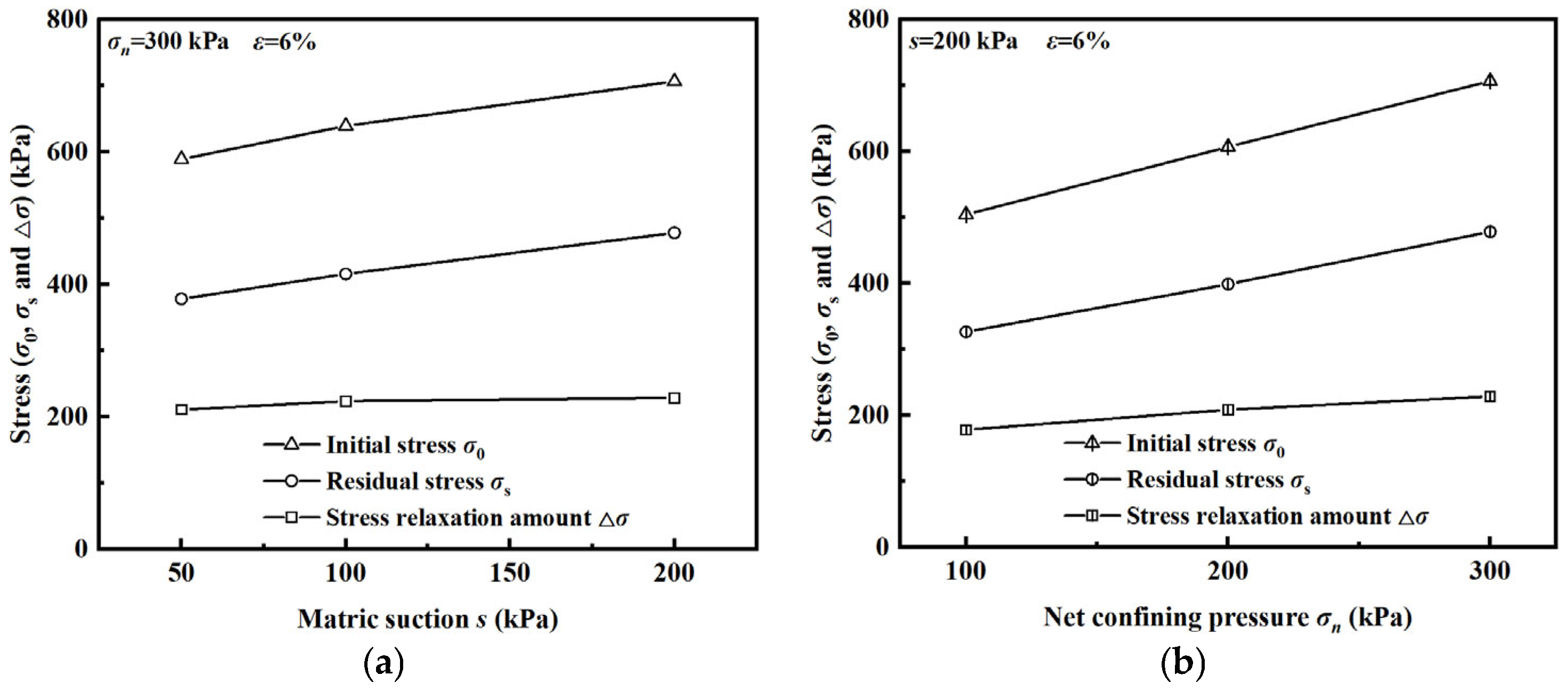
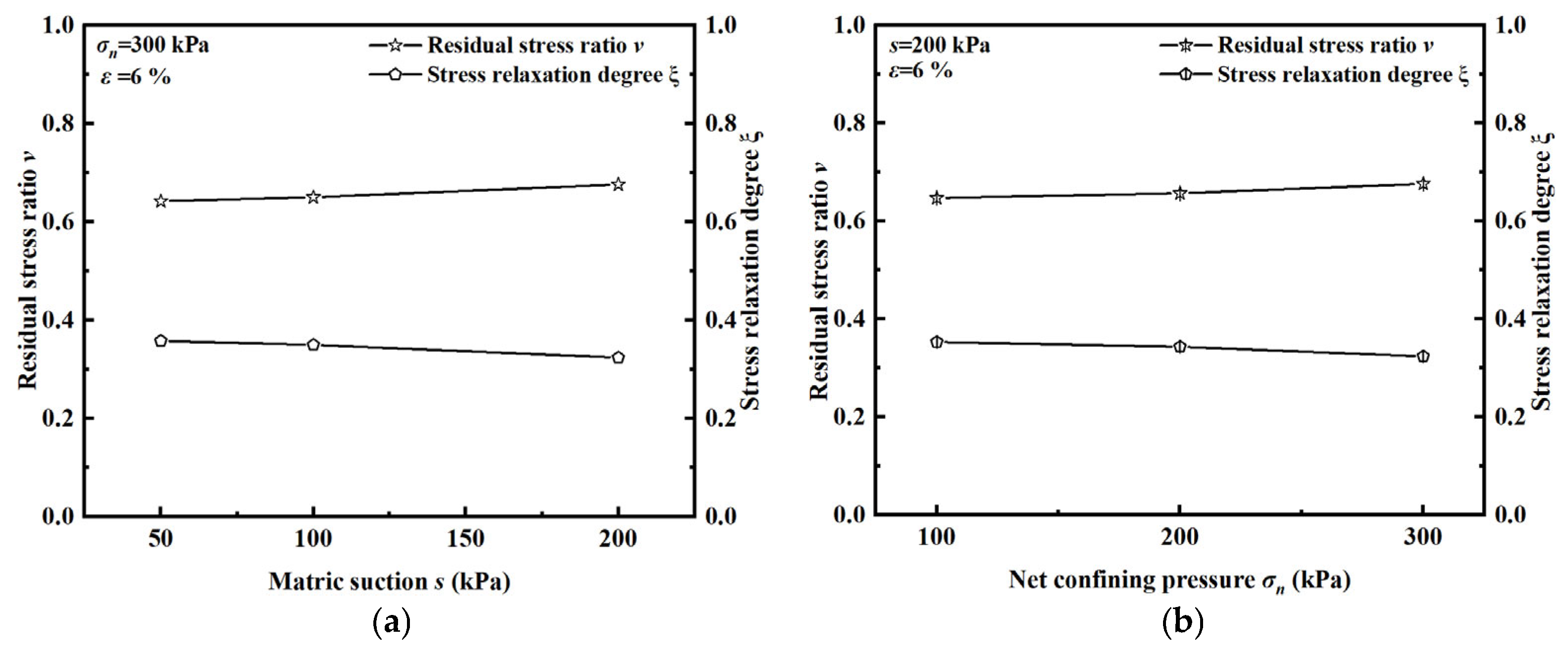
According to the experimental results in Figure 4, the relationship between initial stress σ0 (onset of the instantaneous phase), residual stress σs (end of the stable phase, >100 min), stress relaxation amount △σ, residual stress ratio ν, stress relaxation degree ξ, and matric suction and net confining pressure are plotted in Figure 6 and Figure 7. The residual stress ratio ν is the ratio of the residual stress to the initial stress. The stress relaxation degree ξ is the ratio of the stress relaxation amount to the initial stress.
Figure 6a shows that both the initial stress σ0 and the residual stress σs climb steadily with higher matric suction. The higher matric suction stiffens the soil skeleton, so a larger σ0 is needed to reach any given initial strain; likewise, the higher matric suction allows the material to carry greater post-yield loads, reflected in the elevated residual stress σs. When the stress relaxation reaches equilibrium, the energy consumed by the weakening of cracks inside the soil is small, so the residual stress σs is larger. Figure 6a illustrates that the stress relaxation magnitude △σ rises with increasing matric suction, because the initial stress σ0 grows more rapidly with suction than it does the residual stress σs. Figure 6b shows that σ0 increases linearly with net confining pressure; as the pressure rises, the specimen becomes denser, particle mobility is restrained, and the soil’s shear strength consequently improves. Therefore, a larger deviatoric stress is required to reach the set strain level, and the initial stress σ0 of relaxation stress increases. Under higher net confining pressures, the soil gains strength, driving a corresponding rise in residual stress σs. When the stress relaxation reaches equilibrium, the degree of crack damage inside the soil and the energy released are less, so the residual stress σs is greater. Figure 6b reveals that the relaxation magnitude △σ widens with increasing net confining pressure, owing to △σ outpacing σs in their respective growth rates. Turning to Figure 7a, the residual stress ratio ν ascends while the relaxation degree ξ descends as matric suction rises—an inverse pairing that demonstrates the soil’s heightened ability to preserve stress. Figure 7b duplicates this pattern under varying net confining pressures, underscoring that both matric suction and net confining pressures act in concert. In short, elevating either matric suction or net confining pressure diminishes the overall relaxation degree of unsaturated reticulated red clay, reflecting a pronounced gain in its stress retention capacity.

4.3. Influence of Strain Level on Stress Relaxation

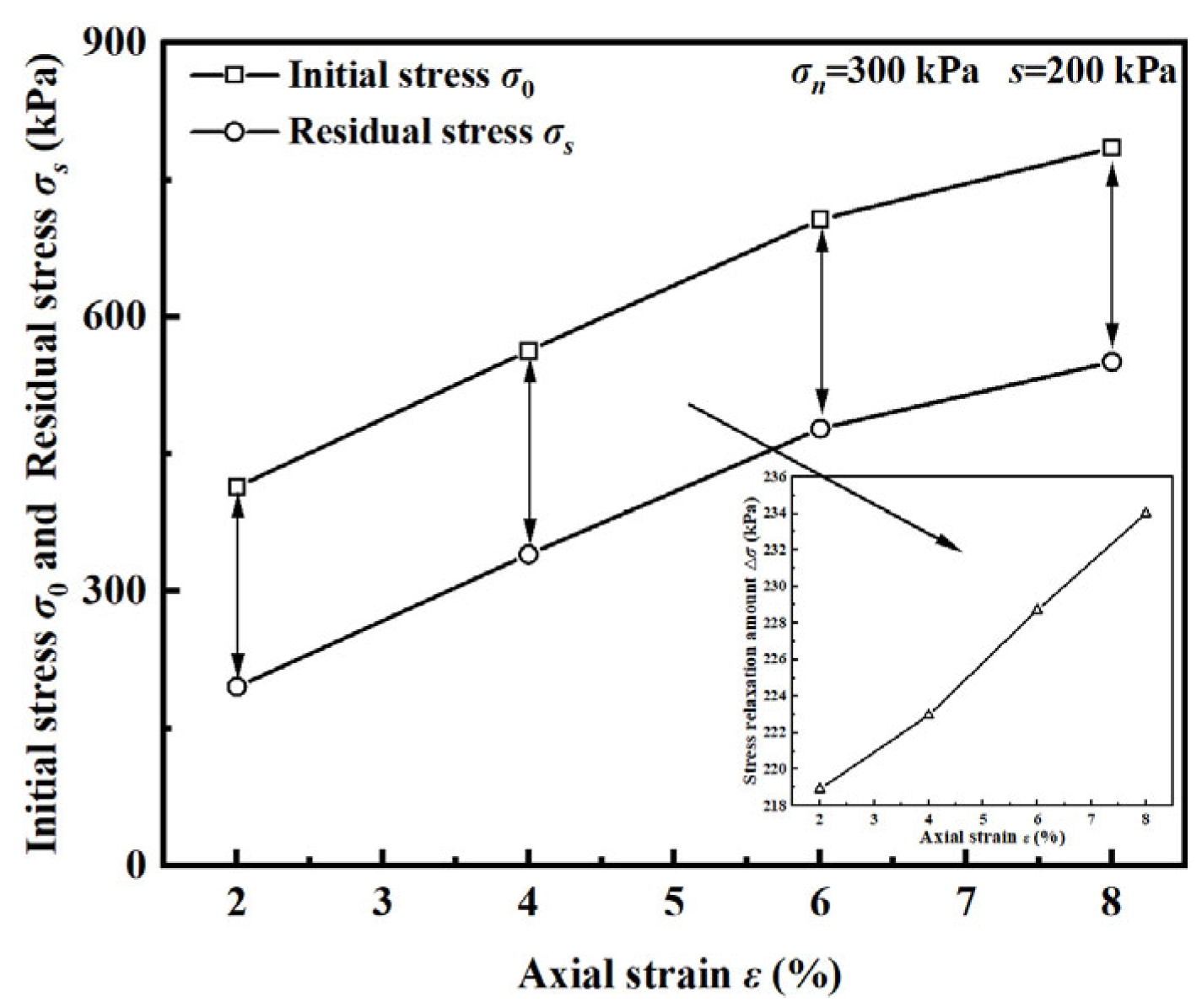
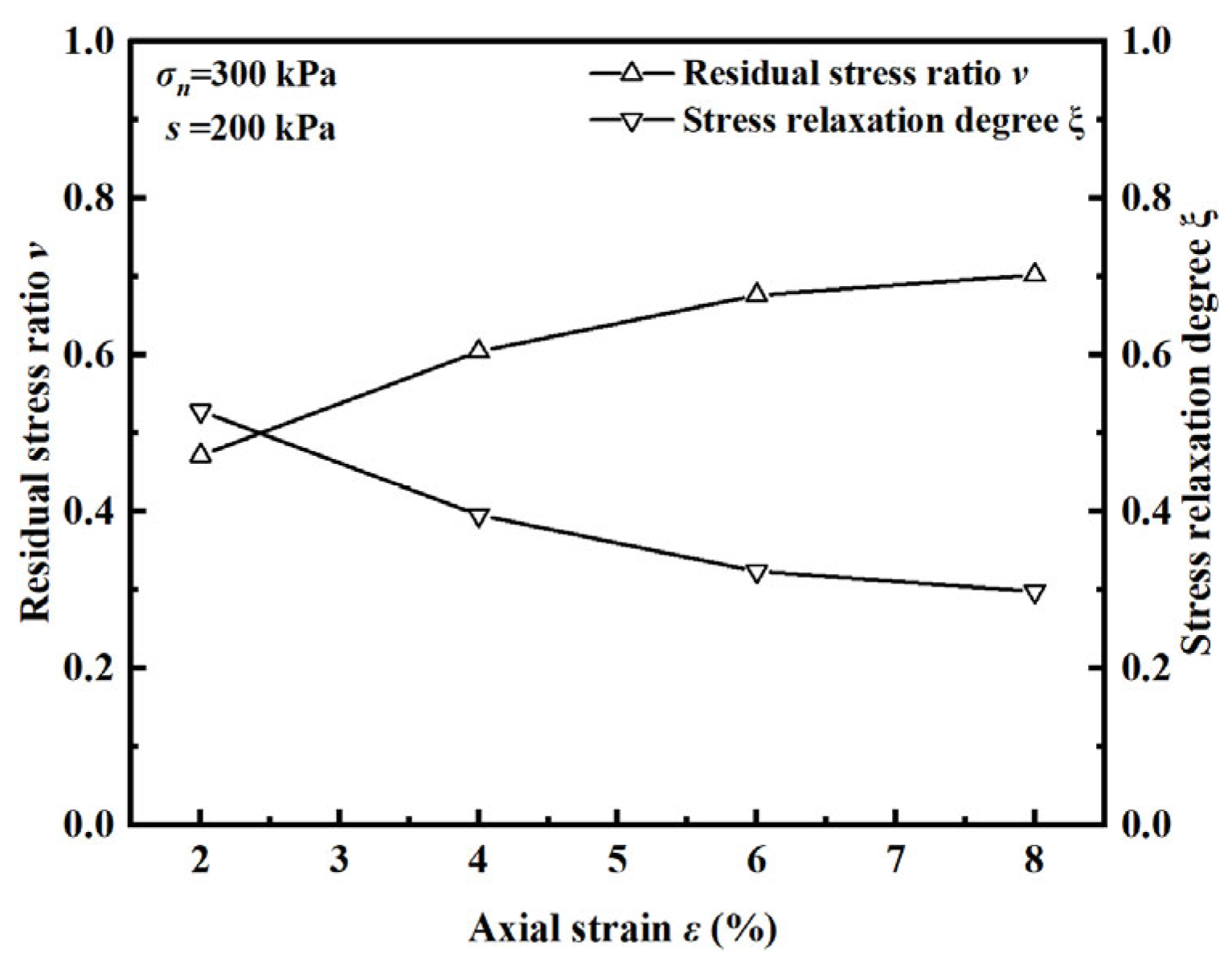
The relationship between initial stress σ0, residual stress σs, stress relaxation amount △σ, residual stress ratio ν, stress relaxation degree ξ, and axial strain are shown in Figure 8 and Figure 9.
Figure 8 shows that, under identical matric suction and net confining pressure, both σ0 and σs grow with imposed strain, and so the relaxation also drops △σ. The reason is straightforward that a larger target strain demands a higher shear resistance, so the soil is initially loaded to a greater σ0. However, when the strain level is greater, the deformation of the specimen is also greater, so that the movement between the particles inside the specimen becomes larger, and more cracks will be generated. The degree of damage to the connection between soil particles is increased, so the greater the amount of stress relaxation △σ produced. From the previous analysis, it can be seen that the specimen did not fail within the strain range of 2% to 8%. Over time, a larger deviatoric stress mobilizes more extensive particle re-orientation and the formation of fresh inter-particle bonds, so the soil can sustain a higher residual stress σs. Figure 9 further confirms that the residual stress ratio ν and the stress relaxation degree ξ move in opposite directions, while a high ν implies superior resistance to stress dissipation, which translates directly into a low ξ. The strain level thus emerges as a primary regulator of relaxation behavior, a finding that aligns with the rate-dependent relaxation study of unsaturated clays reported by Bagheri et al. [28].

5. Stress Relaxation Model Establishment

Unsaturated reticulated clay has complex physical and mechanical properties, and the stress relaxation curves show obvious nonlinear characteristics. The existing theoretical models can no longer accurately explain many phenomena in geotechnical engineering practice [44,45]. This work adopts a stress relaxation model formulated with Caputo fractional calculus and a fractional Koeller dashpot. Unlike the Riemann–Liouville definition, whose hypersingular kernel can complicate engineering and physics applications [46,47], the Caputo derivative treats initial conditions in the same manner as integer-order problems, making it the preferred choice for real-world analyses [48].

5.1. Koeller Dashpot

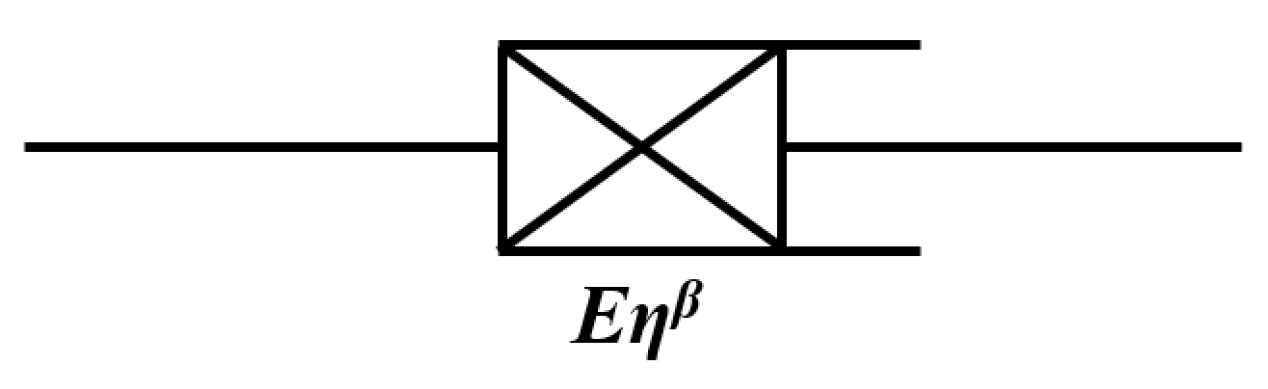
By refining the conventional Newtonian dashpot, Koeller introduced the fractional Koeller dashpot [49], illustrated in Figure 10.
The fractional Koeller dashpot obeys the constitutive law expressed as
σ ( t ) = E η β d β ε ( t ) d t β
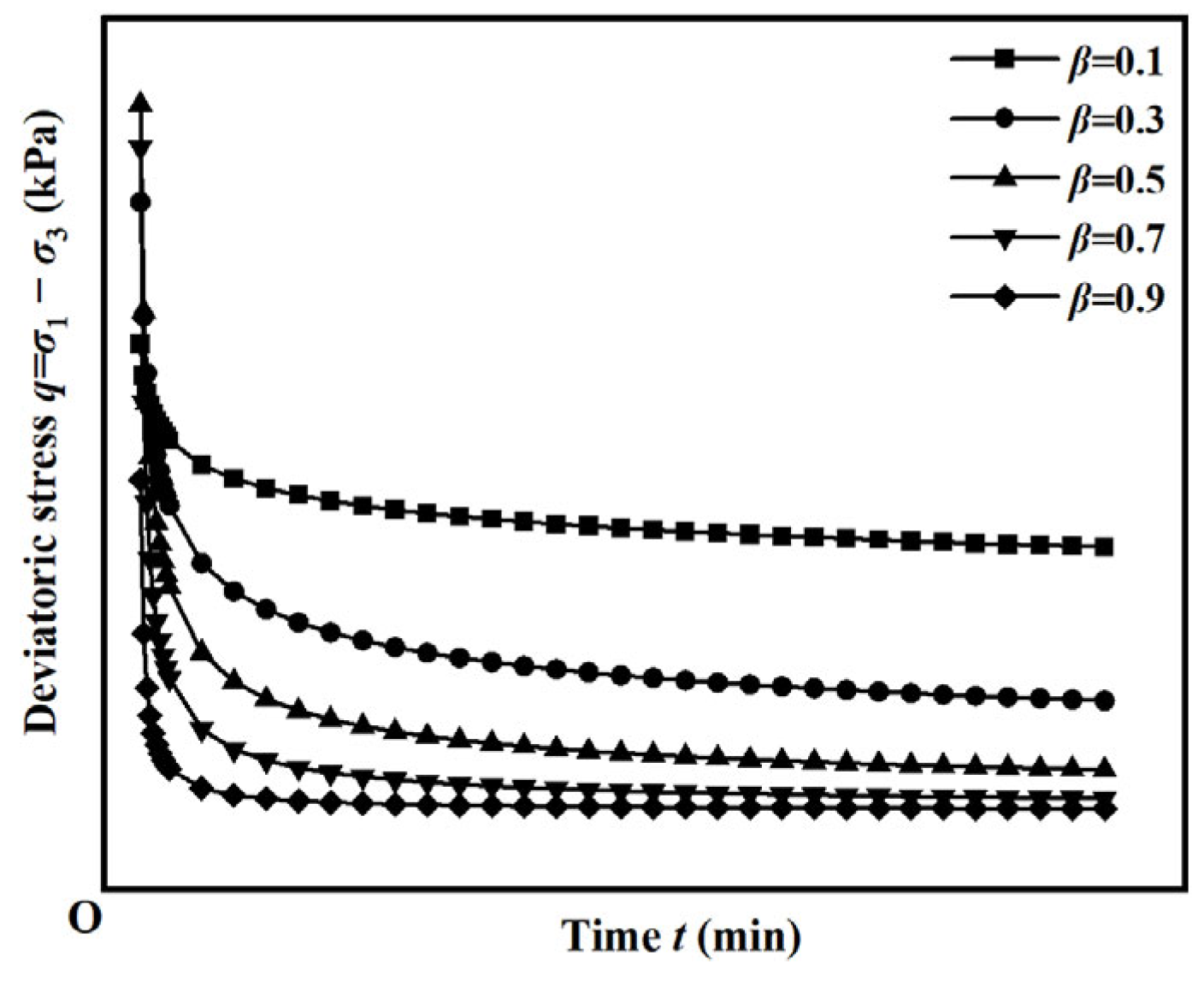
where E denotes the elastic modulus, η the viscosity coefficient, and β the fractional order. Setting β = 1 recovers a Newtonian dashpot, whereas β = 0 yields a Hookean spring. If the strain is held constant—ε = εcH(t), with H(t) the Heaviside step function—this element captures the soil’s stress–relaxation response.
H ( t ) = 0 , t < 0 1 , t > 0
Applying the Caputo fractional integral to both sides of Equation (14) yields the stress–relaxation expression given in Equation (16).
σ ( t ) = E η β ε c t β Γ ( 1 β )
By assigning a set of distinct initial β values in Equation (16), a family of stress–relaxation curves is generated and displayed in Figure 11, capturing the corresponding relaxation behaviors.

5.2. Fractional Stress Relaxation Model

Stress relaxation–time curves (Figure 4) exhibit a three-stage signature, an instantaneous drop (<1 min), a decaying relaxation (1–100 min), and a stable plateau (>100 min).
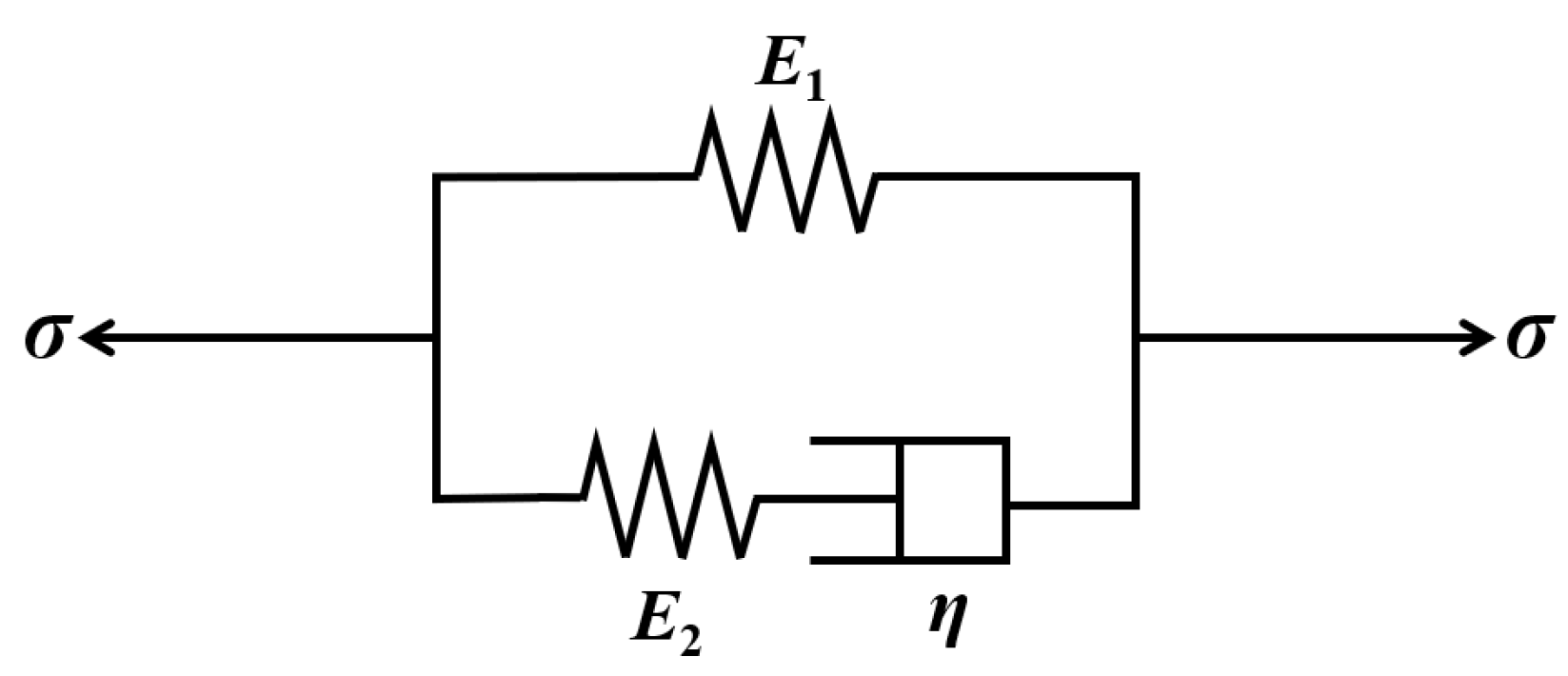
Two-element models (Maxwell, Kelvin–Voigt) cannot simultaneously deliver an instantaneous elastic response and a long-term residual stress; one of the two ends of the curve must be sacrificed. The three-element Poynting–Thomson model (a spring E1 in parallel with a fractional dashpot, all in series with a second spring E) has the Laplace domain relaxation modulus which naturally maps to an instantaneous modulus E1 and an equilibrium modulus E, perfectly matching the two-plateau shape seen in the tests. The three-element Burgers model, however, is a serial connection of Maxwell and Voigt elements; its asymptotic stress is zero, contradicting the observed residual plateau. Four-element and higher models (generalized Maxwell, Nishihara, etc.), although they can be fitted, introduce ≥7 parameters, suffer from multicollinearity, and exhibit overlapping physical meaning, making identification unstable.
The three-element PTh network is the simplest arrangement that remains analytically tractable, needs the fewest parameters, and preserves an unambiguous physical meaning; increasing the number of elements quickly expands the parameter set and degrades both the accuracy and uniqueness of the solution, so the concise yet effective three-element PTh configuration (Figure 12) was adopted to reproduce the stress–relaxation response of the unsaturated reticulated clay.
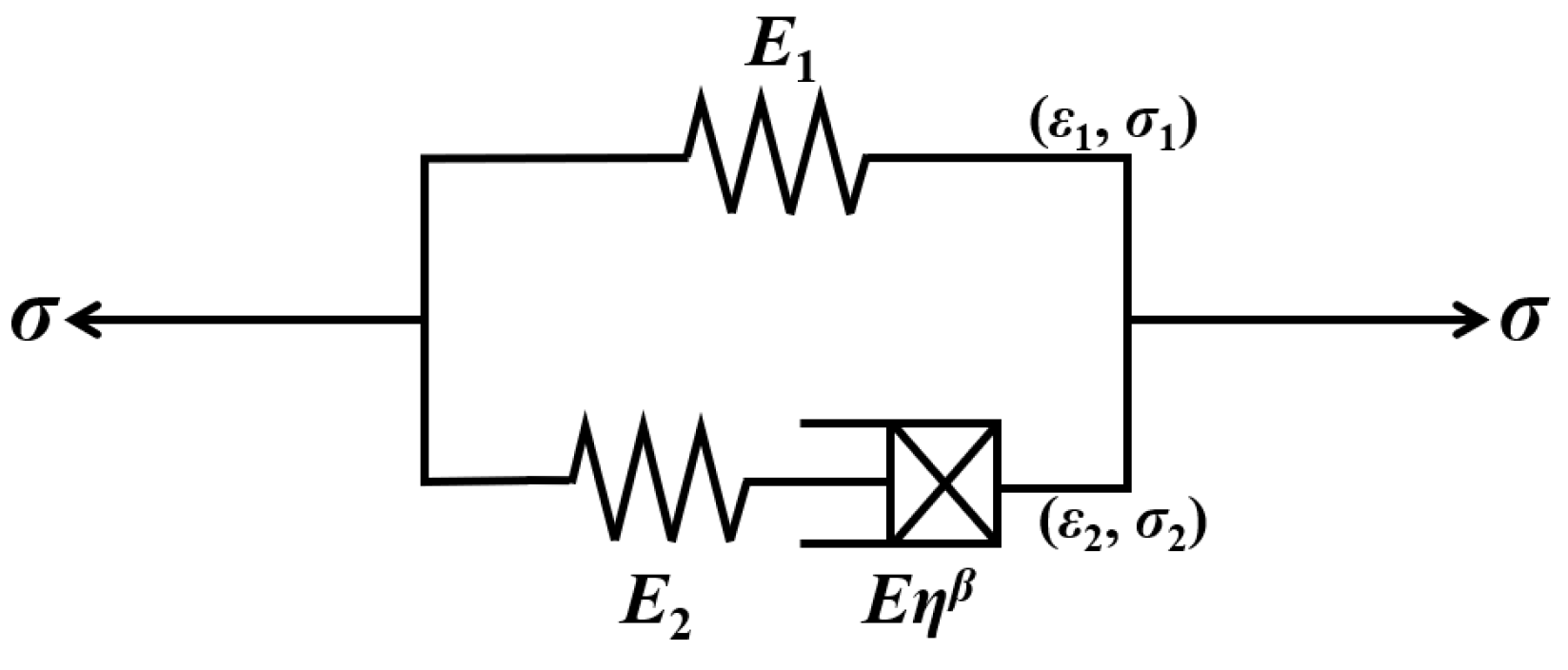
By substituting the Newtonian dashpot in the classical Poynting–Thomson model with a fractional Koeller dashpot, the FPTh stress relaxation model is obtained, as depicted in Figure 13.
On the basis of the series–parallel layout illustrated in Figure 13, the fundamental stress–strain equations for the FPTh relaxation model are derived as follows.
σ ( t ) = σ 1 + σ 2 ε = ε 1 = ε 2 σ 1 = E 1 ε 1 σ 2 = E 2 ε 2 + E η β D β ε 2
where σ and ε are the total stress and strain of the model; E1 and E2 are instantaneous elastic modulus and long-term elastic modulus; β is fractional viscosity coefficients; β is the order of fractional order; and Dβ is the Caputo fractional operators.
The FPTh stress relaxation model can be obtained as follows:
σ = E 1 ε 1 + E 2 ε 2 + E η β D β ε 2
When the strain is constant εc, that is ε = εc H(t), taking the Laplace transform to Equation (18) can be obtained as follows:
σ ¯ ( s ) = ( E 1 + E 2 + E η β s β ) ε c s
Finally, by applying an inverse Laplace transform to Equation (19) term-wise and invoking the two-parameter Mittag–Leffler function, the FPTh stress relaxation equation is obtained.
σ ( t ) = [ E 1 + E 2 + E η β Γ ( 1 β ) t β ) ] ε c
Because the geotechnical material is not an ideal Newtonian fluid, it will produce damage deterioration under long-term strain, and its viscosity coefficient will change with the change in strain level. Shen et al. [50] have proposed that the damage variable of rock and soil is an exponential function. Inspired by this, it is assumed that the change in class viscosity coefficient with strain level due to damage deterioration also conforms to the form of exponential function. The damage variable is introduced to describe this characteristic. The damage variable is expressed as follows [51,52]:
ζ = 1 e k ε
where ζ is the damage variable and k is a material-related characterization parameter.
The damage variable is embedded into the viscous component so that the progressive loss of stiffness due to stress relaxation in soil is captured, while the viscosity coefficient itself decays exponentially with increasing strain. The FPTh stress relaxation model as follows can be obtained by considering the deterioration damage:
σ ( t ) = [ E 1 + E 2 + E η β ( 1 ζ ) Γ ( 1 β ) t β ) ] ε c = [ E 1 + E 2 + E η β e k ε c Γ ( 1 β ) t β ) ] ε c

5.3. Parameter Identification and Model Verification

The parameter calibration of the FPTh stress–relaxation model, accounting for progressive damage, was performed in MATLAB using a hybrid intelligent algorithm that couples Levenberg–Marquardt minimization with global generic optimization. Parameter identification was executed in MATLAB R2023a using a two-stage hybrid strategy:
(1)
Global scatter search (GSS)—a population-based “global generic” optimizer—generated 600 starting points within the physically admissible box E1, E2 ∈ [10, 1000] kPa; ∈ [500, 30,000] kPa·min; β ∈ [0.05, 0.3]; k ∈ [0.05, 0.3]. Population size = 80, mesh size = 15, stall iterations = 100.
(2)
The best 5% of GSS individuals were refined with Levenberg–Marquardt (initial μ = 0.01, scale factor = 10, max iterations = 300, function tolerance = 10−8).
Over-fitting was controlled by keeping the parameter-to-data ratio < 0.07, using leave-one-suction-out cross-validation (average R2 drop 0.008).
The resulting parameter estimates for each combination of net confining pressure and matric suction are reported in Table 3. E1 and E2: instantaneous elastic modulus and long-term elastic modulus (kPa); : fractional viscosity (kPa·min); β: fractional order; k: exponential damage parameter; R2: coefficient of determination.
The fitting parameters E1 and E2 of the fractional FPTh model gradually decrease with the increase in strain level. The parameter β fluctuates back and forth within a certain range, and the fluctuation range is not large. The parameter β is distributed between 0.11 and 0.12. The parameter k increases with the increase in strain, indicating that the damage of soil samples increases with the increase in strain. The fitting correlation coefficients R2 are all above 0.99.
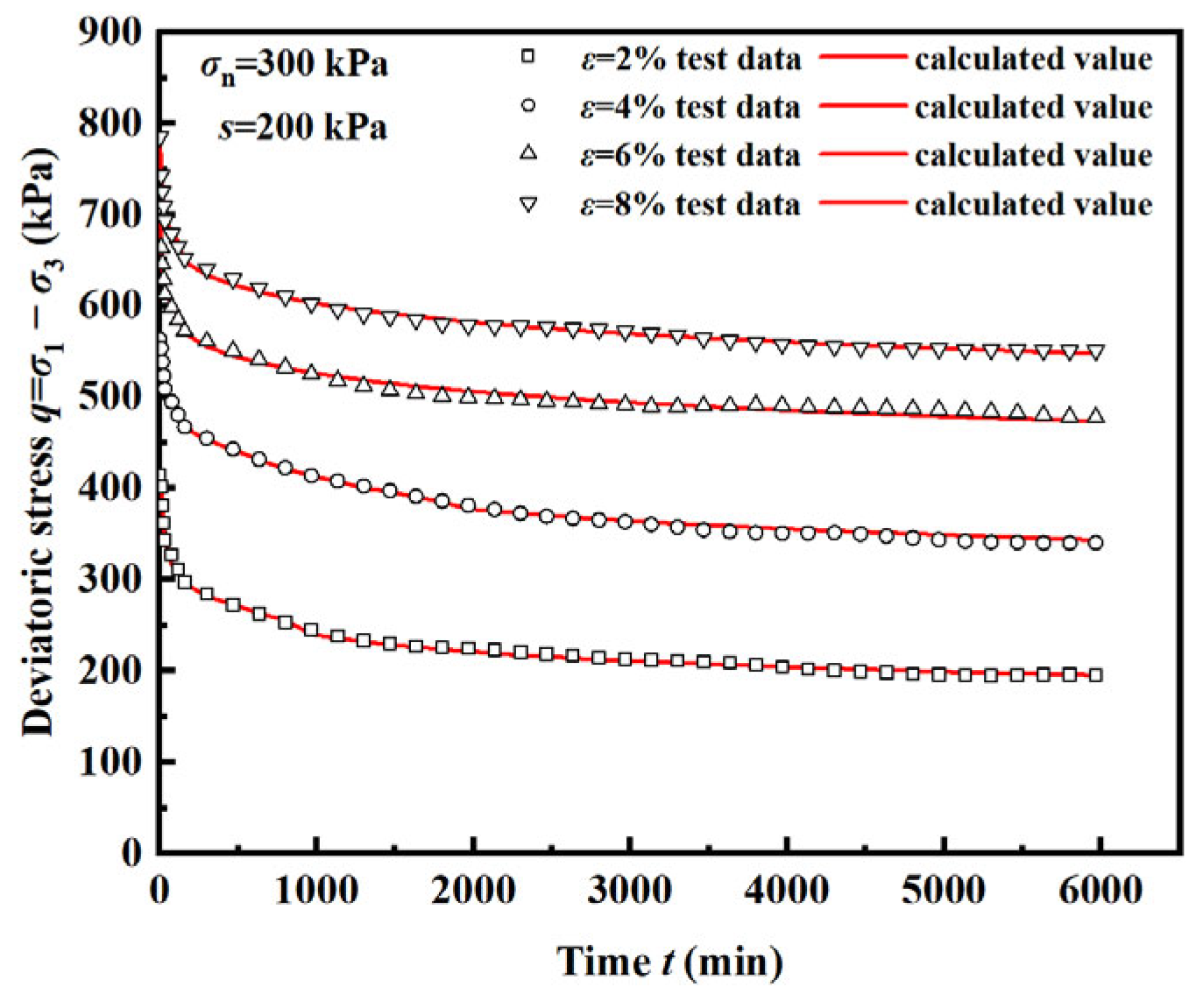
According to the results of model fitting, the comparison diagram between the calculated stress relaxation curve of the FPTh model and the measured stress relaxation curve can be seen in Figure 14.
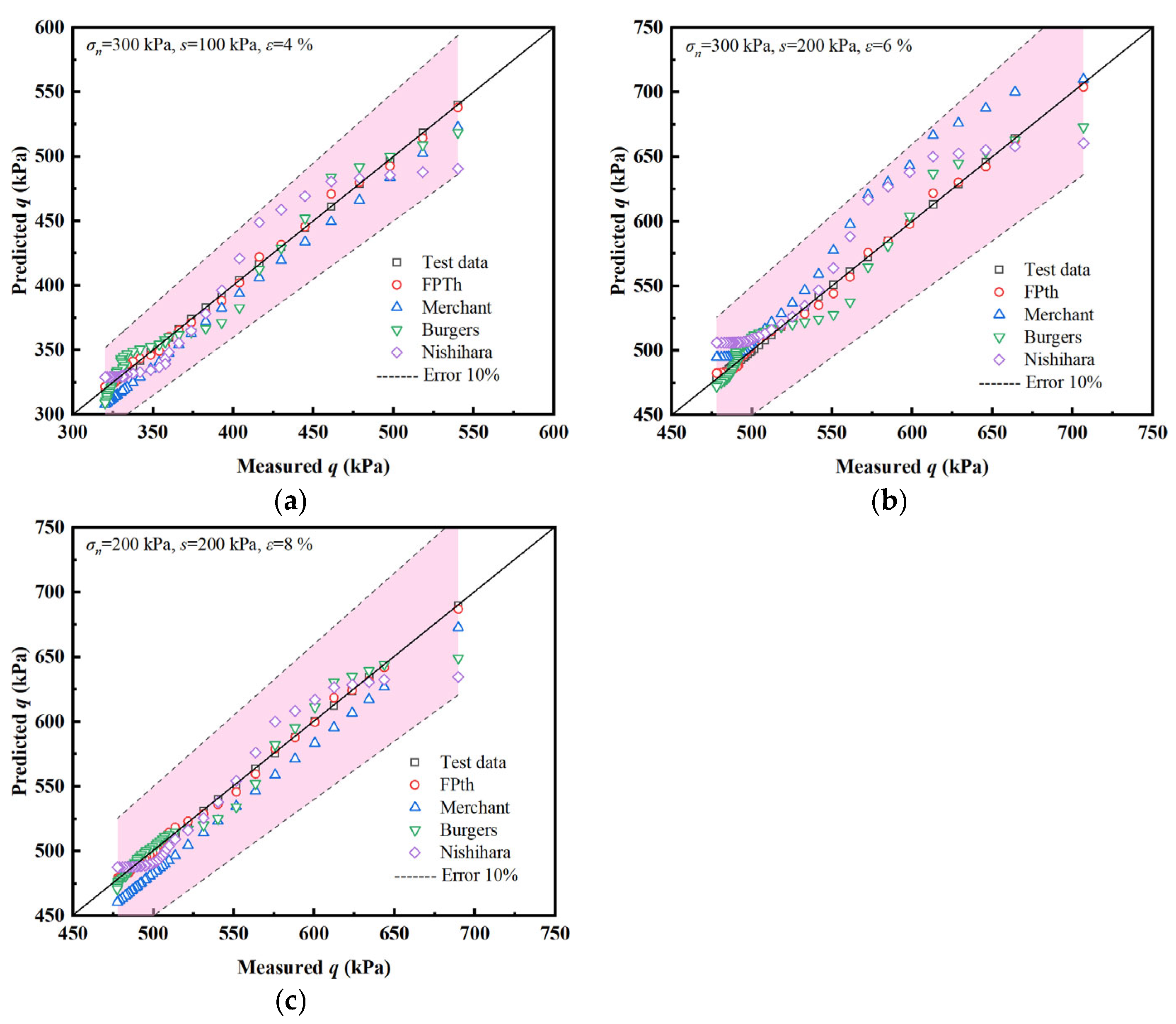
Figure 14 shows that the stress–relaxation curves computed by the FPTh model closely match the measured data, confirming its reliability. The FPTh simulations satisfactorily reproduce the full three-stage response of reticulated red clay—during the instantaneous phase, attenuation phase, and stable phase. To quantify this advantage, relaxation records obtained under three independent stress–suction combinations (300 kPa net confining pressure and 200 kPa matric suction, 300 kPa net confining pressure and 100 kPa matric suction, and 300 kPa net confining pressure and 200 kPa matric suction) were used to calibrate the Merchant, Burgers, Nishihara, and the proposed FPTh models, as shown in Figure 15. The average variance (RMSE), residual sum of squares (SSE), and correlation coefficient (R2), as quantitative metrics, and the results are shown in Table 4.
Figure 15 demonstrates that the FPTh model outperforms the Merchant, Burgers, and Nishihara models across the instantaneous, attenuation, and stable phases of stress relaxation. Its fitted curves adhere more closely to the measured values, reflecting a marked improvement in accuracy. The poor performance of the Merchant, Burgers, and Nishihara models stems from their integer-order exponential kernels and time-invariant viscosity. The absence of a parallel spring in Merchant over-softens the instantaneous response, whereas the serial dashpot in Burgers forces the long-term stress to zero, contradicting the measured residual plateau. Nishihara, although capable of a non-zero equilibrium, still relies on a single exponential and fails to reproduce the power law curvature observed in reticulated red clay. All three models treat the viscosity as a constant, ignoring the strain-induced damage that progressively reduces the microstructural resistance. In contrast, the FPTh model embeds a Caputo fractional derivative of order β inside a three-element Poynting–Thomson network; the resulting Mittag–Leffler relaxation function naturally possesses an instantaneous modulus and a long-term modulus, while its power law tail matches the nonlinear decay phase. An exponential damage variable further reduces the fractional viscosity as cracks develop, enabling the model to capture the acceleration of relaxation at higher strain levels. Consequently, FPTh achieves a superior accuracy (R2 > 0.99, RMSE < 3.5 kPa) with only five physically interpretable parameters, providing a robust and parsimonious tool for long-term slope stability analysis.
Compared with the Burgers, Nishihara, and Maxwell models, the FPTh configuration achieves a more favorable balance between parameter economy and fitting accuracy. While multi-element fractional models can capture relaxation behavior, they often introduce over-parameterization, leading to non-uniqueness and poor generalization. In contrast, the FPTh model integrates only one fractional derivative parameter and one damage variable parameter, yet it achieves a superior statistical performance across all test conditions. Table 4 shows that the FPTh model achieves the highest R2 and the lowest RMSE and SSE among all tested models. These metrics confirm that the FPTh formulation most accurately reproduces the stress relaxation response of the test clay and exhibits superior global validity. The fractional-order framework further endows the model with memory, allowing it to retain and integrate the clay’s deformation history—an attribute that is essential for reliable long-term predictions of soil behavior. Fractional-order models typically require fewer parameters than traditional multi-parameter models, simplifying the process of model identification and application and providing higher fitting accuracy, and are particularly important when dealing with complex stress relaxation data. The FPTh relaxation model serves as a robust instrument for elucidating and forecasting the long-term stress relaxation response of soils subjected to sustained loading. Moreover, the FPTh model embeds a physically motivated damage variable law within the fractional viscous element, allowing it to reproduce the experimentally observed strain-dependent acceleration of stress relaxation. This coupling between microstructural degradation and macroscopic relaxation is absent in other fractional models, which treat viscosity as constant or strain-independent. Finally, long-term extrapolation tests (>24 h) reveal that the FPTh model maintains lower divergence from observed trends compared with the fractional Burgers and Nishihara models, reinforcing its suitability for long-term slope stability forecasting.

6. Conclusions

In this work, the stress relaxation behavior of typical Changsha subgrade reticulated red clay was examined through a series of unsaturated triaxial tests, systematically exploring the influence of strain level, matric suction, and net confining pressure. Guided by the experimental findings, a fractional-order constitutive model tailored to this clay was formulated. Its validity was confirmed against the test data and further benchmarked against alternative models. The principal conclusions are summarized below:
(1)
In the decay relaxation phase, the deviatoric stress decreases as the accumulated deformation energy is consumed over time. During the stabilizing relaxation phase, the deviatoric stress tends to stabilize at a steady value because the particles with broken connections within the soil body are reconnected by constant adjustment and reach equilibrium. The change in deviatoric stress during relaxation is positively correlated with the strain level. The stress relaxation process in unsaturated reticulated red clay is a process in which cracks within the soil body increase and consume deformation energy with time.
(2)
The sharpest relaxation occurs immediately after load application, during which 80–90% of the initial stress dissipates within a brief interval. Once relaxation initiates, the specimen cannot fully discharge the energy introduced by deviatoric loading through further deformation. As a result, many cracks appear inside the specimen, breaking the connection between soil particles, reducing the strength of the specimen, and releasing the energy generated by the deviatoric stress compression. As energy is progressively dissipated, the rate of stress relaxation diminishes and eventually approaches zero. Both matric suction and net confining pressure exert a pronounced influence on the relaxation index.
(3)
The FPTh model based on the Caputo fractional derivative can accurately predict the instantaneous elasticity, attenuation relaxation, and long-term residual three-stage response of networked red soil under the suction–stress coupling path. Its fractional memory core is naturally embedded in the deformation history, allowing strength attenuation prediction without the need for additional cyclic parameters. The model can be written into user subroutines and embedded into finite elements to output the residual stress ratio of the unit in real time during any rainfall infiltration suction redistribution steps, driving the dynamic update of the sliding surface strength field. This provides a dynamic threshold that can be adjusted over time for the slope safety factor and provides a direct and quantitative theoretical basis for the standardized time-varying strength reduction factor.
(4)
The FPTh model reliably predicts stress relaxation under monotonic loading and constant suction; its constant-order Caputo kernel, however, cannot remember cyclic mechanical or hydraulic paths. Future studies, variable-order fractional operators, hydro-mechanical coupling, and hybrid integer–fractional frameworks will be explored to quantify path-dependent hysteresis.

Author Contributions

C.Z.: Writing—original draft, Methodology, Investigation, Funding acquisition, Formal analysis. J.L.: Writing-review and editing. All authors have read and agreed to the published version of the manuscript.

Funding

This work was supported by the National Natural Science Foundation of China Young Scientists Fund Project (Grant No. 52408463), the China Postdoctoral Science Foundation (Grant No. 2024M762782), and the Open Fund of Key Laboratory of Special Environment Road Engineering of Hunan Province (Changsha University of Science & Technology) (Grant No. kfj230606).

Data Availability Statement

Some or all data, models, or code that support the findings of this study are available from the corresponding author upon reasonable request.

Conflicts of Interest

The authors declare that they have no known competing financial interest or personal relationships that could have appeared to influence the work reported in this paper.

References

  1. Khan, M.S.; Nobahar, M.; Stroud, M.; Amini, F.; Ivoke, J. Evaluation of Rainfall Induced Moisture Variation Depth in Highway Embankment Made of Yazoo Clay. Transp. Geotech. 2021, 30, 100602. [Google Scholar] [CrossRef]
  2. Sun, M.; Huang, Z.; Liu, Z.; Liu, G.; Hu, C.; Liu, J. Experimental and Microscopic Analysis for Impact of Compaction Coefficient on Plastic Strain Characteristic of Soft Clay in Seasonally Frozen Soil Regions. Fractal Fract. 2025, 9, 214. [Google Scholar] [CrossRef]
  3. Huang, H.; Li, R.; Chen, F.; Cao, K.; Guo, L.; Qiu, Q. Mechanical Properties and Microscopic Fractal Characteristics of Lime-Treated Sandy Soil. Fractal Fract. 2025, 9, 64. [Google Scholar] [CrossRef]
  4. Li, J.; Jia, S.; Wang, X.; Zhang, Y.; Liu, D. Research Status and the Prospect of Fractal Characteristics of Soil Microstructures. Fractal Fract. 2025, 9, 223. [Google Scholar] [CrossRef]
  5. Pirizadeh, S.; Sarikhani, R.; Jamshidi, A.; Dehnavi, A.G. Physico-Mechanical Properties of the Sandstones and Effect of Salt Crystallization on Them: A Comparative Study between Stable and Unstable Slopes. Case Stud. Constr. Mater. 2022, 17, e01375. [Google Scholar] [CrossRef]
  6. Abbas, F.; Zhang, F.; Hussain, M.A.; Abbas, H.; Alrefaei, A.F.; Albeshr, M.F.; Iqbal, J.; Ghani, J. Landslide Susceptibility Assessment along the Karakoram Highway, Gilgit Baltistan, Pakistan. Sci. Remote Sens. 2021, 9, 100132. [Google Scholar] [CrossRef]
  7. Li, X.; Li, Q.; Wang, Y.; Liu, W.; Hou, D.; Zheng, W.; Zhang, X. Experimental Study on Instability Mechanism and Critical Intensity of Rainfall of High-Steep Rock Slopes under Unsaturated Conditions. Int. J. Min. Sci. Technol. 2023, 33, 1243–1260. [Google Scholar] [CrossRef]
  8. Luo, X.; Yu, Q.; Ma, Q.; Guo, L. Study on the Heat and Deformation Characteristics of an Expressway Embankment with Shady and Sunny Slopes in Warm and Ice-Rich Permafrost Regions. Transp. Geotech. 2020, 24, 100390. [Google Scholar] [CrossRef]
  9. Xu, F.; Chen, Y.; Zhang, Q.; Dong, J.; Leng, W.; Yang, Q. Characterization of Resilient Behavior of a Fine-Grained Subgrade Filler under Graded Variable Confining Pressure. Case Stud. Constr. Mater. 2025, 23, e04960. [Google Scholar] [CrossRef]
  10. Showkat, R.; Babu, G.S. Deterministic and Probabilistic Analysis of the Response of Shallow Footings on Unsaturated Soils Due to Rainfall. Transp. Geotech. 2023, 43, 101150. [Google Scholar] [CrossRef]
  11. Ren, D.; Ishikawa, T.; Si, J.; Tokoro, T. Effect of Complex Climatic and Wheel Load Conditions on Resilient Modulus of Unsaturated Subgrade Soil. Transp. Geotech. 2024, 45, 101186. [Google Scholar] [CrossRef]
  12. Ji, J.; Zhang, T.; Cui, H.; Yin, X.; Zhang, W. Numerical Investigation of Post-Earthquake Rainfall-Induced Slope Instability Considering Strain-Softening Effect of Soils. Soil Dyn. Earthq. Eng. 2023, 171, 107938. [Google Scholar] [CrossRef]
  13. Qin, C.; Hazarika, H.; Liu, G.; Kochi, Y.; Furuichi, H.; Matsumoto, D. Seismic Behavior of Highway Embankment Reinforced with Remedial Countermeasures on Saturated Loose Sandy Layer. Transp. Geotech. 2024, 45, 101183. [Google Scholar] [CrossRef]
  14. Wang, S.; Qi, J.; Yao, X. Stress Relaxation Characteristics of Warm Frozen Clay under Triaxial Conditions. Cold Reg. Sci. Technol. 2011, 69, 112–117. [Google Scholar] [CrossRef]
  15. Bray, M.T. Secondary Creep Approximations of Ice-Rich Soils and Ice Using Transient Relaxation Tests. Cold Reg. Sci. Technol. 2013, 88, 17–36. [Google Scholar] [CrossRef]
  16. Lade, P.V.; Karimpour, H. Stress Relaxation Behavior in Virginia Beach Sand. Can. Geotech. J. 2015, 52, 813–835. [Google Scholar] [CrossRef]
  17. Wang, M.; Xu, X.; Li, J.; Shen, F.; Li, Y. An Experiment Study on Stress Relaxation of Unsaturated Lime-Treated Expansive Clay. Environ. Earth Sci. 2017, 76, 241. [Google Scholar] [CrossRef]
  18. Xu, M.; Hong, J.; Song, E. DEM Study on the Macro- and Micro-Responses of Granular Materials Subjected to Creep and Stress Relaxation. Comput. Geotech. 2018, 102, 111–124. [Google Scholar] [CrossRef]
  19. Atkinson, J.; Prasad, M.; Abbud-Madrid, A.; Dreyer, C.B. Penetration and Relaxation Behavior of Dry Lunar Regolith Simulants. Icarus 2019, 328, 82–92. [Google Scholar] [CrossRef]
  20. Wang, J.; Xia, Z. DEM Study of Creep and Stress Relaxation Behaviors of Dense Sand. Comput. Geotech. 2021, 134, 104142. [Google Scholar] [CrossRef]
  21. Yang, D.; Chu, X. Influence of Particle Shape on Creep and Stress Relaxation Behaviors of Granular Materials Based on DEM. Comput. Geotech. 2024, 166, 105941. [Google Scholar] [CrossRef]
  22. Jariyatatsakorn, K.; Kongkitkul, W.; Tatsuoka, F. Prediction of Creep Strain from Stress Relaxation of Sand in Shear. Soils Found. 2024, 64, 101472. [Google Scholar] [CrossRef]
  23. Li, Y.L.; Lu, J.; Yao, A.; Li, H.; Gong, Y.F. Nonlinear Elastic Deformation Model of Belled Uplift Piles under the Coupling Effects of Groundwater and Shear Strain Relaxation. Comput. Geotech. 2024, 171, 106411. [Google Scholar] [CrossRef]
  24. Zhang, L.; Jiang, X.; Sun, R.; Gu, H.; Fu, Y.; Qiu, Y. Stability Analysis of Unsaturated Soil Slopes with Cracks under Rainfall Infiltration Conditions. Comput. Geotech. 2024, 165, 105907. [Google Scholar] [CrossRef]
  25. Azizi, A.; Kumar, A.; Toll, D.G. The Bounding Effect of the Water Retention Curve on the Cyclic Response of an Unsaturated Soil. Acta Geotech. 2023, 18, 1901–1917. [Google Scholar] [CrossRef]
  26. Delcourt, R.T.; de Campos, T.M.P.; dos Santos Antunes, F. Interrelationship among Weathering Degree, Pore Distribution and Water Retention in an Unsaturated Gneissic Residual Soil. Eng. Geol. 2022, 299, 106570. [Google Scholar] [CrossRef]
  27. Fathipour, H.; Tajani, S.B.; Payan, M.; Chenari, R.J.; Senetakis, K. Influence of Transient Flow during Infiltration and Isotropic/Anisotropic Matric Suction on the Passive/Active Lateral Earth Pressures of Partially Saturated Soils. Eng. Geol. 2022, 310, 106883. [Google Scholar] [CrossRef]
  28. Bagheri, M.; Rezania, M.; Mousavi Nezhad, M. Rate Dependency and Stress Relaxation of Unsaturated Clays. Int. J. Geomech. 2019, 19, 04019128. [Google Scholar] [CrossRef]
  29. Lu, D.; Liang, J.; Du, X.; Ma, C.; Gao, Z. Fractional Elastoplastic Constitutive Model for Soils Based on a Novel 3D Fractional Plastic Flow Rule. Comput. Geotech. 2019, 105, 277–290. [Google Scholar] [CrossRef]
  30. Yang, S.; Song, H.; Zhou, H.; Xie, S.; Zhang, L.; Zhou, W. A Fractional Derivative Insight into Full-Stage Creep Behavior in Deep Coal. Fractal Fract. 2025, 9, 473. [Google Scholar] [CrossRef]
  31. Fahad, H.M.; Fernandez, A. Operational Calculus for Caputo Fractional Calculus with Respect to Functions and the Associated Fractional Differential Equations. Appl. Math. Comput. 2021, 409, 126400. [Google Scholar] [CrossRef]
  32. Liu, Q.; Wang, M. Numerical Investigation of Water Migration in a Closed Unsaturated Expansive Clay System. Bull. Eng. Geol. Environ. 2023, 82, 202. [Google Scholar] [CrossRef]
  33. Sun, Y.; Sumelka, W.; Gao, Y. Fractional Plasticity for Over-Consolidated Soft Soil. Meccanica 2022, 57, 845–859. [Google Scholar] [CrossRef]
  34. Liu, X.; Li, D.; Han, C.; Shao, Y. A Caputo Variable-Order Fractional Damage Creep Model for Sandstone Considering Effect of Relaxation Time. Acta Geotech. 2022, 17, 153–167. [Google Scholar] [CrossRef]
  35. Almeida, R. A Caputo Fractional Derivative of a Function with Respect to Another Function. Commun. Nonlinear Sci. Numer. Simul. 2017, 44, 460–481. [Google Scholar] [CrossRef]
  36. Yang, J.; Sun, Y. Stress-Fractional Modelling of the Compressive and Extensive Behaviour of Granular Soils. Comput. Geotech. 2020, 120, 103407. [Google Scholar] [CrossRef]
  37. Mainardi, F. Fractional Calculus and Waves in Linear Viscoelasticity: An Introduction to Mathematical Models; World Scientific: Singapore, 2022. [Google Scholar]
  38. Li, J.; Yang, Y. Matric Suction Creep Characteristics of Reticulated Red Clay. KSCE J. Civ. Eng. 2018, 22, 3837–3842. [Google Scholar] [CrossRef]
  39. Zhang, C.; Li, J.; Zhang, Y.; Hu, T. Experimental and Discrete Element Modeling Study on Suction Stress Characteristic Curve and Soil–Water Characteristic Curve of Unsaturated Reticulated Red Clay. Bull. Eng. Geol. Environ. 2022, 81, 363. [Google Scholar] [CrossRef]
  40. Lu, N.; Likos, W.J. Suction Stress Characteristic Curve for Unsaturated Soil. J. Geotech. Geoenviron. Eng. 2006, 132, 131–142. [Google Scholar] [CrossRef]
  41. Zhang, C.; Li, J.Z.; He, Y. Impact of the Loading Rate on the Unsaturated Mechanical Behavior of Compacted Red Clay Used as an Engineered Barrier. Environ. Earth Sci. 2021, 80, 135. [Google Scholar] [CrossRef]
  42. Zhu, S.; Chen, C.; Du, C. Interface Stress Relaxation Behavior of Grouted Anchors in Red Clay: Experimental Study and a Disturbed State Concept-Based Theoretical Model. Acta Geotech. 2023, 18, 3287–3306. [Google Scholar] [CrossRef]
  43. Wang, M.; Xu, X.; Liu, Q.; Ding, Y.; Shen, F. A Nonlinear Fractional-Order Damage Model of Stress Relaxation of Net-Like Red Soil. Sci. Rep. 2021, 11, 22917. [Google Scholar] [CrossRef] [PubMed]
  44. Cong, S.; Nie, Z.; Hu, Q. A Disturbed State Concept-Based Stress-Relaxation Model for Expansive Soil Exposed to Freeze–Thaw Cycling. KSCE J. Civ. Eng. 2020, 24, 2621–2630. [Google Scholar] [CrossRef]
  45. Fattah, M.Y.; Al-Omari, R.R.; Hameedi, M.K. Tracing of Stresses and Pore Water Pressure Changes during a Multistage Modified Relaxation Test Model on Organic Soil. Arab. J. Geosci. 2021, 14, 1–9. [Google Scholar] [CrossRef]
  46. Zhang, J.; Lv, J.; Huang, J.; Tang, Y. A Fast Euler–Maruyama Method for Riemann–Liouville Stochastic Fractional Nonlinear Differential Equations. Physica D 2023, 446, 133685. [Google Scholar] [CrossRef]
  47. Chen, X.W.; Chen, W.B.; Yue, Z.Q. Consolidation of Multilayered Soil with Fractional Derivative Viscoelasticity due to Surface Loading and Internal Pumping. Transp. Geotech. 2023, 42, 101083. [Google Scholar] [CrossRef]
  48. Caputo, M. Linear Models of Dissipation whose Q is almost Frequency Independent—Part II. Geophys. J. Int. 1967, 13, 529–539. [Google Scholar] [CrossRef]
  49. Koeller, R.C. Applications of Fractional Calculus to the Theory of Viscoelasticity. J. Appl. Mech. 1984, 51, 299–307. [Google Scholar] [CrossRef]
  50. Shen, Z.J. A Nonlinear Damage Model for Structural Clay. J. Hydrosci. Eng. 1993, 3, 247–255. [Google Scholar]
  51. Ling, X.; Tian, S.; Tang, L.; Li, S. A Damage-Softening and Dilatancy Prediction Model of Coarse-Grained Materials Considering Freeze–Thaw Effects. Transp. Geotech. 2020, 22, 100307. [Google Scholar] [CrossRef]
  52. Yin, W.; Wang, X.; Zheng, S.; Zhang, K.; Zhang, F. Triaxial Creep Test and Damage Model Study of Layered Red Sandstone under Freeze–Thaw Cycles. Case Stud. Constr. Mater. 2024, 21, e03785. [Google Scholar] [CrossRef]
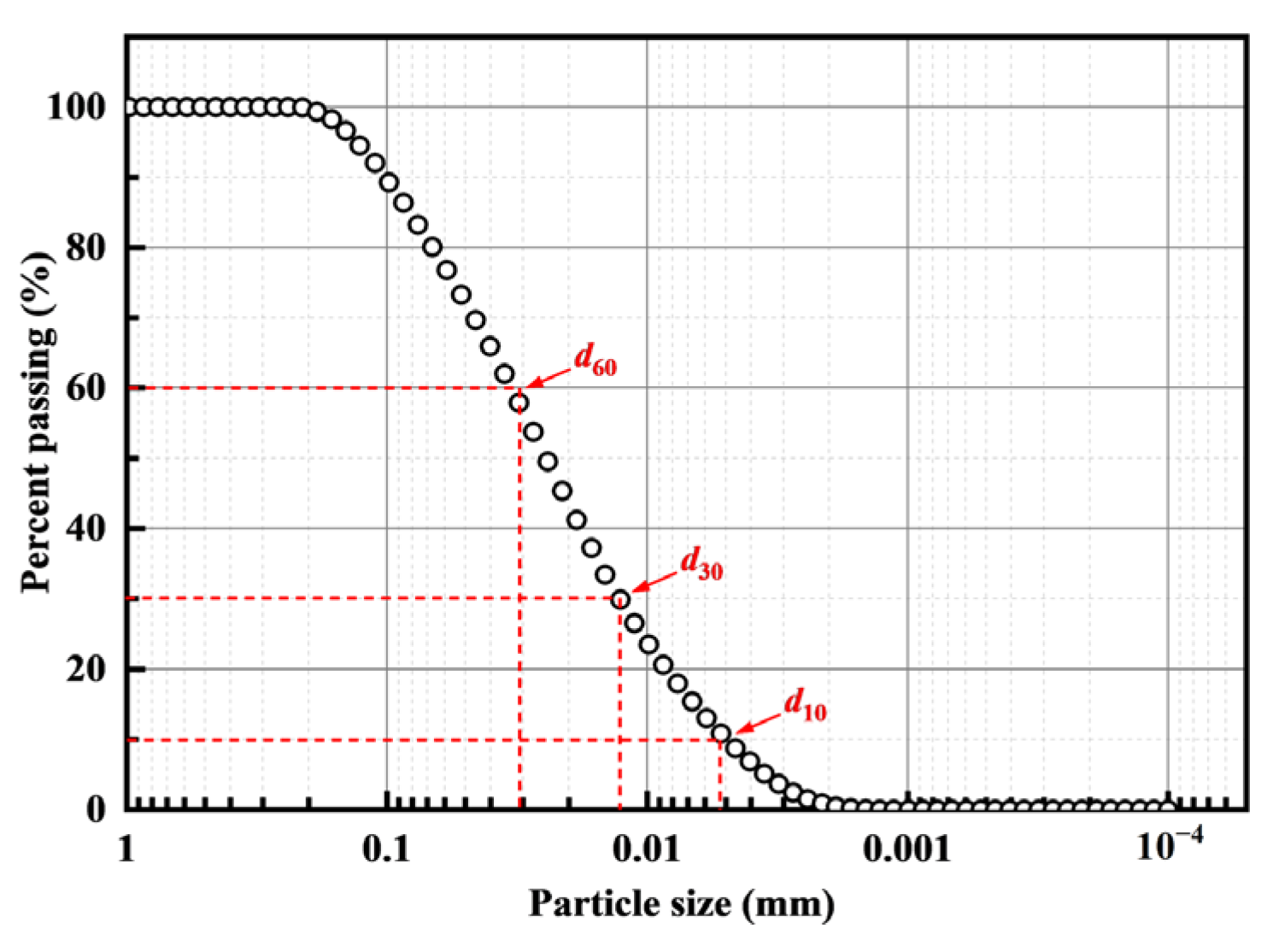
Figure 1. Particle size distribution of reticulated red clay.
Fractalfract 09 00786 g001
Figure 2. Saturated specimen.
Fractalfract 09 00786 g002
Figure 3. GDS unsaturated triaxial apparatus.
Fractalfract 09 00786 g003
Figure 4. Stress relaxation–time curves of test specimens under different matric suctions and net confining pressures. (a) σn = 300 kPa, s = 50 kPa; (b) σn = 300 kPa, s = 100 kPa; (c) σn = 300 kPa, s = 200 kPa; (d) σn = 200 kPa, s = 200 kPa; (e) σn = 100 kPa, s = 200 kPa.
Fractalfract 09 00786 g004
Figure 5. Stress relaxation rate–time curves of test specimens under different matric suctions and net confining pressures. (a) σn = 300 kPa, s = 50 kPa; (b) σn = 300 kPa, s = 100 kPa; (c) σn = 300 kPa, s = 200 kPa; (d) σn = 200 kPa, s = 200 kPa; (e) σn = 100 kPa, s = 200 kPa.
Fractalfract 09 00786 g005aFractalfract 09 00786 g005b
Figure 6. Relationship between initial stress σ0, residual stress σs, stress relaxation amount △σ, and matric suction s and net confining pressure σn. (a) Relationship with matric suction s (b) Relationship with net confining pressure σn.
Fractalfract 09 00786 g006
Figure 7. Relationship between residual stress ratio ν, stress relaxation degree ξ, and matric suction s and net confining pressure σn. (a) Relationship with matric suction s (b) Relationship with net confining pressure σn.
Fractalfract 09 00786 g007
Figure 8. Relationship between initial stress σ0, residual stress σs, stress relaxation amount △σ, and axial strain ε.
Fractalfract 09 00786 g008
Figure 9. Relationship between residual stress ratio ν, stress relaxation degree ξ, and axial strain ε.
Fractalfract 09 00786 g009
Figure 10. Fractional Koeller dashpot.
Fractalfract 09 00786 g010
Figure 11. Stress relaxation curves of fractional Koeller dashpot.
Fractalfract 09 00786 g011
Figure 12. PTh stress relaxation model.
Fractalfract 09 00786 g012
Figure 13. FPTh stress relaxation model.
Fractalfract 09 00786 g013
Figure 14. Experimental stress–relaxation data versus FPTh model predictions. (σn = 300 kPa, s = 200 kPa, ε = 2–8%).
Fractalfract 09 00786 g014
Figure 15. Comparison between measured and predicted values. (a) σn = 300 kPa, s = 100 kPa, ε = 4%; (b) σn = 300 kPa, s = 200 kPa, ε = 6%; (c) σn = 200 kPa, s = 200 kPa, ε = 8%.
Fractalfract 09 00786 g015
Table 1. Physical properties of reticulated red clay.
PropertiesValue
Water content (%)24.3
Density (g/cm3)1.9
Specific gravity2.71
Liquid limit (%)40.8
Plastic limit (%)22
Air-entry value (kPa)55
Cohesion (kPa)59
Friction angle (°)20.3
Effective size (mm)0.047
Control size (mm)0.694
Table 2. Scheme of triaxial creep test.
NO.Net Confining Pressure
σn (kPa)
Matric Suction
s (kPa)
Confining Pressure σ3 (kPa)Strain Level
(ε%)
R1300503502, 4, 6, 8
R2300100400
R3300200500
R4200200400
R5100200300
Table 3. Parameters of FPTh stress relaxation model (σn = 300 Pa, s = 200 kPa, ε = 2–8%).
σn
(kPa)
s (kPa)ε
(%)
E1
(kPa)
E2
(kPa)

(kPa·min)
βkR2
3002002221.09736.2614,786.970.12070.12850.9975
4157.16416.1610,966.620.12030.14370.9969
6120.55168.824283.980.11690.16360.9955
899.9172.081343.460.12340.18190.9973
Table 4. Evaluation of stress relaxation models.
Net Confining Pressure and Matric SuctionStress Relaxation ModelsR2RMSESSE
σn = 300 kPa, s = 100 kPa, ε = 4%Merchant0.930517.212,721.12
Burgers0.97139.904214.43
Nishihara0.940214.298780.78
FPTh0.99643.16429.38
σn = 300 kPa, s = 200 kPa, ε = 6%Merchant0.932516.8012,136.32
Burgers0.97019.623979.41
Nishihara0.949812.476686.54
FPTh0.99553.24451.40
σn = 200 kPa, s = 200 kPa, ε = 8%Merchant0.933216.9612,368.59
Burgers0.97159.023498.50
Nishihara0.948612.116306.04
FPTh0.99772.29225.50
Disclaimer/Publisher’s Note: The statements, opinions and data contained in all publications are solely those of the individual author(s) and contributor(s) and not of MDPI and/or the editor(s). MDPI and/or the editor(s) disclaim responsibility for any injury to people or property resulting from any ideas, methods, instructions or products referred to in the content.