


Abstract
The primary aim of this study is to establish new Wirtinger-type inequalities involving fractional derivatives, which are essential tools in analysis and applied mathematics. We derive generalized Wirtinger-type inequalities incorporating the -Caputo fractional derivatives using Taylor’s expansion. The inequalities are derived in spaces through Hölder’s inequality. A detailed analytical discussion is provided to further examine the derived inequalities. The theoretical findings are validated through numerical examples and graphical representations. Furthermore, the novelty and applicability of the proposed technique are demonstrated through the applications of the resulting inequalities to derive new results related to the arithmetic–geometric mean inequality.
Keywords:
Taylor’s formula; (k,ψ)-Caputo fractional derivative; Wirtinger-type inequalities; Hölder’s inequality MSC:
41A58; 26A33; 26D10; 26D15
1. Introduction
Fractional calculus is a crucial branch of mathematics that extends the concept of integrals and derivatives to non-integer orders. The study of fractional derivatives and integrals gained significance in the 20th century, as researchers explored their applications in diverse fields, including bioengineering [1], electrical and mechanical engineering [2], atmospheric and statistical physics [3], optimization, viscoelasticity [4], machine learning [5], robotics [6], and control theory [7]. In the literature, several definitions of fractional integrals and derivatives have been proposed. Among these are the Riemann–Liouville and Caputo [8], the Hadamard [9], the Caputo–Hadamard [10], and the Hilfer [11] fractional operators are widely used in both theoretical studies and real-world applications. Fractional derivatives such as the -Riemann–Liouville operator in [8] and the -Caputo operator in [12], introduced by Almeida, have been developed to offer further analytical flexibility beyond classical operators.
In several domains, particularly optimization, special means and integral estimates frequently rely on the analysis of mathematical inequalities. This field of inequalities employing fractional integrals has advanced significantly in the last few decades. Applications of these fractional inequalities can be found in numerous areas such as probability theory, image and signal processing, quantitative quadrature, and optimization problems. In recent decades, many researchers have extended classical inequalities into the framework of fractional calculus. The most well-known inequality in the literature is the Wirtinger inequality, named after Wilhelm Wirtinger. The Wirtinger inequality was an essential tool in the proof of the isoperimetric inequality when it appeared in 1904. Its importance is due to its ability to relate the integral of the square of a function with the integral of the square of its derivative.
According to [13], if satisfies the condition , then the following is obtained:
Beesack extended (1) in [14]. In particular, if the function satisfies the conditions , then the following holds:
In [15], Beesack examined the relationship between a function and its derivative in the context of inequalities. Several important problems rely on Beesack’s conclusions and on related contributions by other researchers, including integral estimation, series convergence, and the determination of the least eigenvalues of the differential operators. For example, the Poincare inequality, which is a generalization of the Wirtinger inequality, attains its best constant as the first eigenvalue of the Laplace operator, as shown in [16]. Furthermore, C.A. Swanson extended the Wirtinger inequality to n-dimensional context in [17]. Alzer investigated modifications of the Wirtinger inequality in both discrete and continuous settings in [18]. Additionally, Böttcher and Widom in [19] evaluated sequences of constants that emerged in specific situations. They highlighted the identification of the best constant in the Wirtinger–Sobolev inequality, which characterizes the relationship between the integral of the square of a function and the square of its higher-order derivatives. Alomari in [20] established Beesack-Wirtinger-type inequalities for absolutely continuous functions having derivatives in spaces where . Moreover, Erden in [21] presented Wirtinger-type inequalities concerning higher-order differential functions. In [22], Sarikaya proposed several modified versions of Wirtinger-type inequalities.
Theorem 1.
Suppose is a function satisfying , and let . Then, we have the following inequality
We begin by presenting a few definitions and basic results that are essential for our main findings.
In [23], Diaz et al. introduced the k–gamma function, which is defined as follows:
Definition 1.
Let such that and . Then, the k-gamma function is defined as follows:
By placing in Definition 1, the k-gamma function reduces to the classical gamma function.
Studying a fractional operator with a kernel that depends on another function, the definitions of -Riemann–Liouville fractional integrals and derivatives are given below, as introduced in [8].
Definition 2.
Let Ω be an integrable function defined over . If is increasing with for all . Then the ψ-Riemann–Liouville fractional integrals of order are expressed as follows:
Definition 3.
The ψ-Riemann–Liouville fractional derivatives of order are formulated as follows:
For specific choices of , the definition simplifies to well-known fractional derivatives. Particularly, placing yields the classical Riemann–Liouville fractional derivative introduced in [8], while choosing leads to the Hadamard fractional derivative given in [9].
According to [12], the definitions of -Caputo fractional derivatives are defined as follows:
Definition 4.
Let and . Consider the interval , and let be two functions where ψ is increasing and for all . Then, the left- and right-sided ψ–Caputo fractional derivatives of order γ are given as follows:
For simplicity, we use the following abbreviation:
For specific choices of , the definition coincides with the Caputo fractional derivative presented in [8], when , while choosing leads to the Caputo–Hadamard fractional derivative defined in [10].
The -Riemann–Liouville fractional integrals defined in [24] is given by the following definition:
Definition 5.
Let and . Then, the left- and right-sided -Riemann–Liouville fractional integrals of order of the function Ω are defined as follows:
By setting in Definition 5, the expression reduces to the -Riemann–Liouville integral.
As in [24], the left-sided and right-sided -Riemann–Liouville fractional derivatives are defined as follows:
Definition 6.
Let . Consider the functions with and such that for all . Then the -Riemann–Liouville fractional derivatives of order are given by the following:
By placing in Definition 6, the definition reduces to -Riemann– Liouville derivative.
The definitions of -Caputo fractional derivatives presented in [24], are given below.
Definition 7.
Let , and with . Assume that for all . Then the -Caputo fractional derivatives of order are expressed as follows:
For simplicity, we use the following abbreviation:
By setting in Definition 7, the expression reduces to the -Caputo fractional derivative.
In the analysis of the existence and uniqueness of solutions to fractional differential equations, several types of fractional derivatives have been introduced. Among them, the -Caputo fractional derivative has emerged as a powerful and highly adaptable tool. By incorporating a real parameter k and a monotonic function , this operator generalizes the classical Caputo derivative, offering greater flexibility in capturing memory effects and nonlocal behavior. In this paper, we employ this operator to establish new Wirtinger-type inequalities. These inequalities have found diverse applications across various areas of mathematical analysis. For instance, Samir H. Saker in [25] utilized Wirtinger-type inequalities to identify large gaps between the zeros of the Riemann zeta function. In [26], Seuret et al. applied these inequalities in the study of time-delay systems. Furthermore, Bo Du employed the Wirtinger inequality to examine the existence of antiperiodic solutions for an inertial competitive neutral-type network in [27].
Many scholars have investigated Wirtinger-type inequalities in the contexts of both fractional calculus and classical calculus. Erden presented results for classical derivatives in [21], and Erden et al. further extended these results to the Caputo and Riemann–Liouville fractional derivatives in [28]. Moreover, Samraiz et al. broadened these results for Caputo–Hadamard and Hadamard fractional derivatives in [29], while Wu et al. modified the theory by considering tempered -fractional derivatives in [30].
Inspired by these prior findings and their diverse applications, the main objective of this research is to develop a new class of inequalities incorporating the -Caputo and -Riemann–Liouville fractional derivatives with a particular focus on the Wirtinger inequality. We derive significant results by applying Hölder’s inequality, which are relevant to different fields such as statistical modeling, mathematical analysis, engineering, and computational sciences. Additionally, the results of this study may stimulate further research into inequalities related to the -Caputo operator.
Although Wirtinger-type inequalities have been established by several researchers for various fractional derivatives, such as the Caputo, Riemann–Liouville, Caputo–Hadamard, and Hadamard fractional derivatives, these results remain limited to specific operator forms and lack a unified generalized structure. Moreover, there has been little investigation into a comprehensive framework that involves both the kernel function and another parameter k, which could extend the existing findings to a broader class of fractional derivatives. To address this gap, the present research introduces new Wirtinger-type inequalities involving the -Caputo fractional derivatives. These inequalities enhance the analytical significance of various prior findings while generalizing and extending them.
In this work, we introduce Wirtinger-type inequalities for the -Caputo and -Riemann–Liouville fractional derivatives, contributing to the growing field of fractional calculus. These modified operators generalize classical fractional operators by incorporating a kernel function and an additional parameter k, offering greater flexibility in memory-dependent and nonlocal phenomena. The main objective of this paper is to establish novel inequalities within the -Caputo framework, owing to its analytical capabilities and effectiveness for initial value problems. Moreover, we extend our results to the -Riemann–Liouville case to enhance the applicability of the proposed inequalities.
The key objective of this work is to construct new generalized Wirtinger-type inequalities involving the -Caputo fractional derivatives, which are useful tools in mathematical analysis. The work aims to expand the classical Wirtinger framework to fractional settings in both and in general spaces. The presented inequalities provide a more unified and flexible analytical method by generalizing a number of well-known results as special cases. Numerical examples, graphical illustrations, and an application to the arithmetic–geometric mean inequality are also provided to demonstrate the effectiveness and significance of the obtained results.
The organization of the paper is as follows: Section 1 provides an introduction, highlighting the background, purpose, and significance of the study. Section 2 derives Wirtinger-type inequalities for the -Caputo and -Riemann–Liouville fractional operators. Section 3 explores applications of these results in relation to the arithmetic–geometric mean. Finally, Section 4 concludes the paper by summarizing the key findings.
2. Inequalities Involving -Caputo and -Riemann–Liouville Fractional Derivatives
In this section, we present Wirtinger-type inequalities involving the -Caputo and the -Riemann–Liouville fractional derivatives. By examining the relationships among fractional operators, specifically between the -Riemann–Liouville and -Caputo, we derive several special cases. Here, we analyze the connection between two types of fractional derivatives.
Lemma 1.
Suppose that , with , and . Then, the following results hold:
The following can be obtained from the above relation:
All findings in this section are obtained by utilizing the fundamental identities given in (7) and (8).
Lemma 2.
Let or with , . Then the following identities hold:
Proof.
Theorem 2.
Consider the functions where and . Assume that , . Under the conditions that and , the following inequality holds:
Proof.
Supposing , we take the absolute values of (7) and (8). Then, by applying Cauchy–Schwarz inequality to the resulting terms, we obtain the following:
and
By integrating (10) over the interval with respect to , where , and using Dirichlet’s integral formula, we arrive at the following result:
Integrating (11) over the interval , and employing Dirichlet’s integral formula, we obtain the following result:
To further refine the expressions, we apply the substitution to (12) and (13). We obtain the following:
and
By adding the two inequalities above and integrating over the interval [0, 1], with respect to , results in the following expression:
By rearranging the order of integration, we obtain the following:
Moreover, we obtain the following:
where
and
Applying the change of variables to (15), and observing that both functions and attain their maximum value for , we deduce (9). □
Example 1.
Consider the functions and defined over and fulfilling the requirements of the theorem . Let , , and . Then, we obtain the following result:
To evaluate the right-hand side of (9), we proceed as follows:
and
Applying the Theorem 2 leads to the following result:
We also calculate the coefficients using the assumed parameters.
for , and . Substituting these values into the right-hand side of (9) yields the following:
Our numerical calculations for (9) yields the following result:
confirming the validity of the inequality.
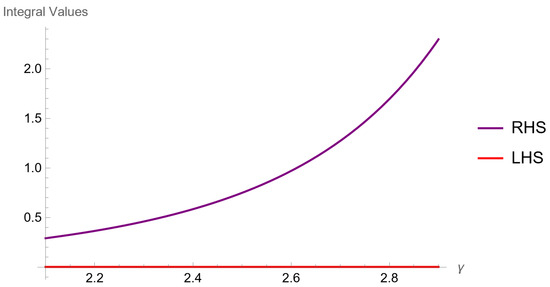
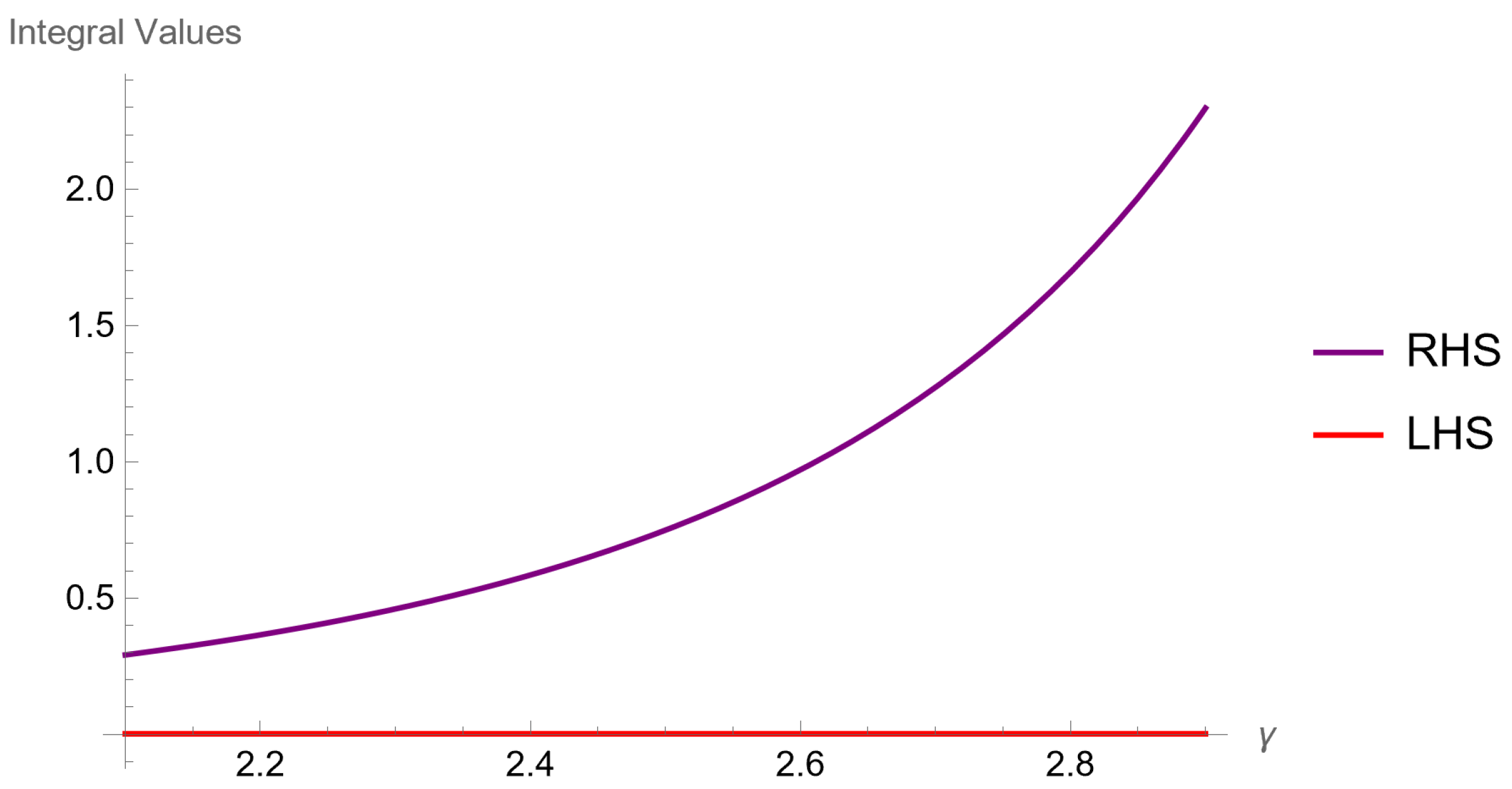
Table 1 and Table 2 show the numerical values, while Figure 1 illustrates the corresponding graphs of (9) for the function over the interval , with varying from to .
Table 1.
The following table presents the left-hand and right-hand side values of (9) for .
Table 2.
Comparison of the left-hand and right-hand side values of (9) for .
Figure 1.
The graph illustrates the behavior of the inequality (9) over the range .
Discussion The above example confirms the validity of (9) by employing a function that satisfies the essential conditions of the theorem. The numerical results and the corresponding graphical representations were obtained using Wolfram Mathematica 13.2. As increases, the right-hand side values increase correspondingly.
The following remarks clearly show that the proposed inequalities provide a unified and generalized framework encompassing several well-known fractional operators, including -Caputo, Caputo–Hadamard, and Caputo cases as particular instances. In contrast to previous formulations, the inclusion of the parameter k and the kernel function enhances the adaptability and flexibility of the inequalities. This extension enables them to cover a wider class of fractional derivatives within a single framework.
Remark 2.
Setting in Theorem 2 leads to the corresponding result for ψ-Caputo fractional derivatives.
Remark 3.
By substituting and into Theorem 2, we derive the corresponding result for Caputo fractional derivatives established by Erden et al. in [28].
Remark 4.
Setting and in Theorem 2 yields the corresponding result for Caputo–Hadamard fractional derivatives as presented by Samraiz et al. in [29].
We further derive Wirtinger-type inequalities within the framework of -Riemann–Liouville fractional derivatives.
Theorem 3.
Let with . Assume that and belong to , with the conditions , where and . Thus, we have the following inequality:
Theorem 4.
Assume that , where and . Suppose that , for . If and , then the following inequality holds:
Proof.
Assuming , taking the absolute values (7) and (8) and employing Hölder’s inequality with the exponents p and to the resulting expressions yield the following inequalities:
and
Integrating (18) and (19) over the intervals and , respectively, with respect to for and applying Dirichlet’s integral formula to the resulting expressions, we obtain the following:
Similarly, we obtain the following:
After substituting into (20) and (21), we obtain the following results:
and
Aligning the resulting inequalities and taking the integral with respect to over [0, 1], we obtain the following:
Changing the order of integration yields the following:
Furthermore, we obtain the following:
where
Observing that and making the substitution in the above inequality, we obtain (17). □
Example 2.
Let and be a functions defined on , fulfilling the conditions . For the choice of parameters , , , and , we obtain the following:
To evaluate the right-hand side of (17), we proceed as follows:
and
Applying Theorem 4, we obtain the following:
For the assumed parameters, we compute the following:
Hence, the right-hand side of (17) becomes the following:
Thus, the numerical evaluation of (17) yields the following:
which confirms the validity of the inequality.
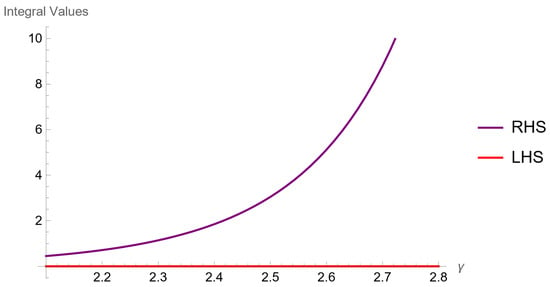
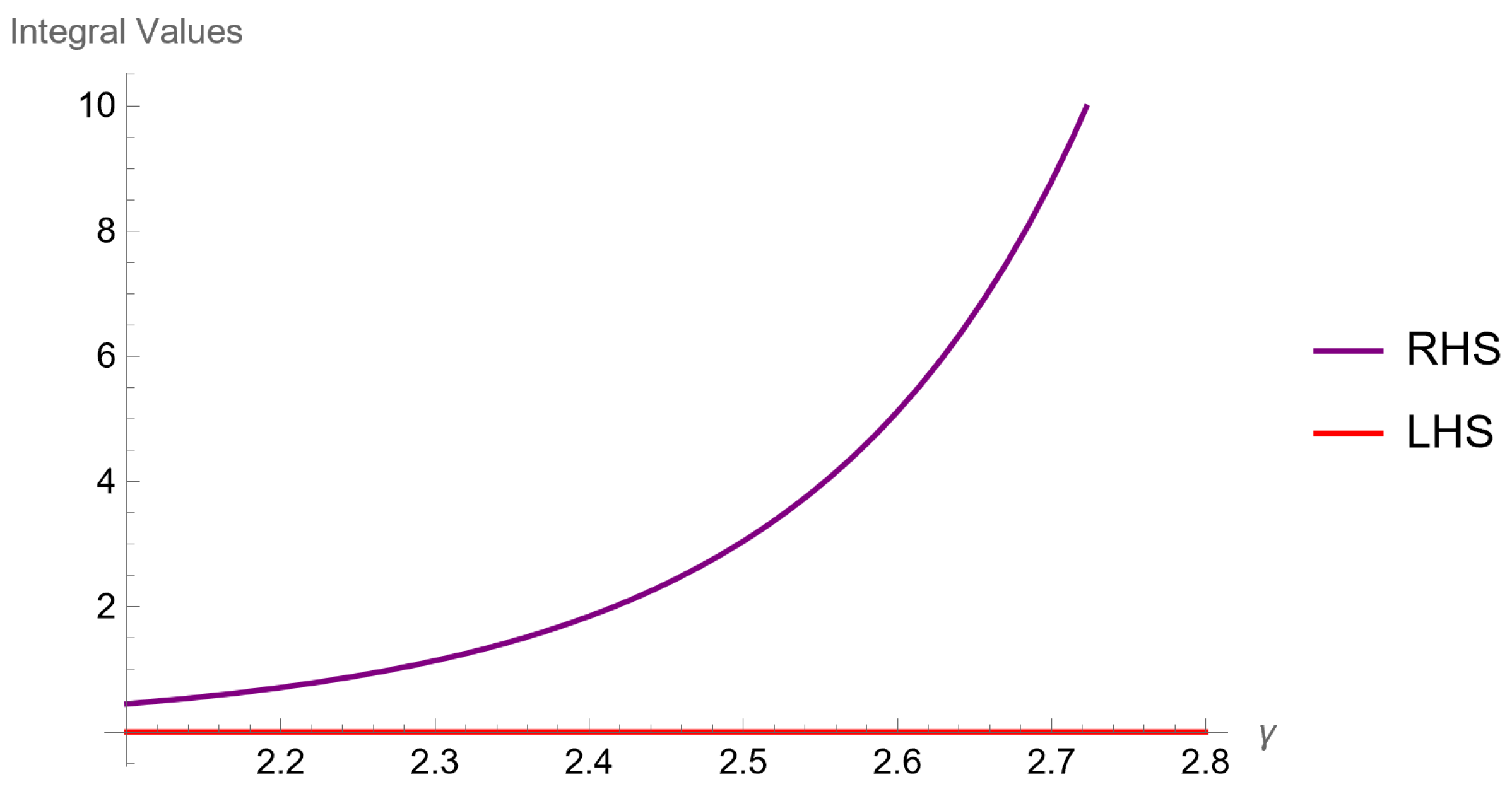
Table 3 and Table 4 provide the values of (17), while Figure 2 illustrates the corresponding graphical representations for over the interval , with ranging from to .
Table 3.
Comparison of the numerical values of the left-hand and right-hand sides of (17) for .
Table 4.
Numerical values of the left-hand and right-hand sides of (17) over the interval .
Figure 2.
Graphical representation of the inequality (17) for .
Remark 5.
By setting in Theorem 4, we obtain the corresponding result for ψ-Caputo fractional derivatives:
Remark 6.
Taking and in Theorem 4 leads to the corresponding results for Caputo fractional derivatives established by Erden et al. in [28] (Theorem 8).
Remark 7.
By setting and in Theorem 4, we recover the result for Caputo–Hadamard fractional derivatives given by Samraiz et al. in [29].
Remark 8.
Substituting , and into Theorem 4, we obtain Remark 2.2 in [29].
Remark 9.
By setting in Theorem 4, we obtain (9).
Furthermore, we establish a result related to -Riemann–Liouville fractional derivatives.
Theorem 5.
Let where . Assume that , for . If and , then the following inequality holds:
3. Applications of Wirtinger-Type Inequalities Involving -Caputo Fractional Operator in Arithmetic–Geometric Means
In this section, we analyze Wirtinger-type inequalities associated with -Caputo fractional derivatives. After suitable simplification, these inequalities reveal an explicit link to the well-known arithmetic mean–geometric mean-type inequalities. Such inequalities play a fundamental role in various mathematical domains, such as optimization, functional analysis, and number theory, as they connect arithmetic and geometric quantities and provide sharp bounds. We begin by reviewing several key inequalities stated in [31], which will be used in establishing the results of this portion. For real numbers , the following inequalities are valid:
where are real. In the theorems below, left-hand side involves geometric-type expressions, while right-hand side contains arithmetic-type terms.
Theorem 6.
Let be a continuous, non-negative and real-valued function defined on the interval . Assume that the function satisfies and for , the functions and are absolutely continuous on I. If the condition is satisfied, then the following inequality holds:
Proof.
It can be easily confirmed that the following identities hold:
for and . From (26)–(29), we obtain the following:
and
Taking (30) into account and utilizing the Cauchy–Schwarz inequality along with (23) and (24), we arrive at the following result:
Applying the same approach to (31), we obtain the following:
By combining (32) and (33), we acquire the following:
Multiplying both sides of (34) by , integrating over the interval and using Theorem 2, we obtain the desired result. □
Remark 10.
By placing into (25), we obtain the following Wirtinger-type inequality:
Theorem 7.
The following inequality is derived under the conditions of Theorem 6:
Proof.
We start the proof by considering the following identities:
for and . By adding (36) and (37), we obtain following inequality:
Similarly, by adding (38) and (39), we obtain the following:
Using the Cauchy–Schwarz inequality together with inequalities (23) and (24) to (40), we obtain the following:
Applying the same steps to (41), we obtain the following:
By combining (42) and (43), we obtain the following:
By multiplying both sides of (44) by , integrating over and using Theorem 2 yields (35). □
Remark 11.
Substituting into (35) yields the following Wirtinger-type inequality.
4. Conclusions
Fractional derivatives provide powerful tools for describing systems with hereditary effects and nonlocal interactions, enabling accurate representations of intricate real-world phenomena compared to classical integer-order derivatives. In the study of fractional differential equations, inequalities play a key role, offering valuable methods for establishing convergence properties, stability criteria, and solution bounds. Fractional inequalities present a systematic analytical framework to examine the existence, uniqueness, and consistency of solutions while exploring the fundamental properties of fractional differential systems. This study formulated Wirtinger-type inequalities for -Caputo fractional derivatives in spaces and extended them to the -Riemann–Liouville fractional derivatives. The proposed results also generalize several existing Wirtinger-type inequalities associated with other fractional operators as special cases, highlighting their broader applicability. The validity and applicability of the theoretical results are verified through numerical examples accompanied by graphical and tabular representations. The findings provide a framework for exploring applications in classical inequalities, such as the arithmetic–geometric mean. The strategies and observations presented in this study aim to encourage novel ideas and inspire further research.
Author Contributions
M.S.: Investigation, methodology, writing original draft, and writing—review and editing; H.J.: conceptualization, data curation, formal analysis, writing—original draft; I.A.: supervision, data curation, funding acquisition, and writing—review and editing. All authors have read and agreed to the published version of the manuscript.
Funding
This work was supported by the Deanship of Scientific Research, Vice Presidency for Graduate Studies and Scientific Research, King Faisal University, Saudi Arabia [Grant No. KFU253748].
Data Availability Statement
No new data were created or analyzed in this study. Data sharing is not applicable to this article.
Conflicts of Interest
The authors declare no conflicts of interest.
References
- Magin, R.L. Fractional calculus in bioengineering: A tool to model complex dynamics. In Proceedings of the 13th International Carpathian Control Conference (ICCC), High Tatras, Slovakia, 28–31 May 2012; pp. 464–469. [Google Scholar]
- Chen, W.; Sun, H.; Li, X. Fractional Derivative Modeling in Mechanics and Engineering; Springer Nature: New York, NY, USA, 2022. [Google Scholar]
- Uchaikin, V.V. Fractional Derivatives for Physicists and Engineers; Springer: Berlin/Heidelberg, Germany, 2013. [Google Scholar]
- Fang, C.Q.; Sun, H.Y.; Gu, J.P. Application of fractional calculus methods to viscoelastic response of amorphous shape memory polymers. J. Mech. 2015, 31, 427–432. [Google Scholar] [CrossRef] [Scilit]
- Joshi, M.; Bhosale, S.; Vyawahare, V.A. A survey of fractional calculus applications in artificial neural networks. Artif. Intell. Rev. 2023, 56, 13897–13950. [Google Scholar] [CrossRef] [Scilit]
- Ataşlar-Ayyıldız, B. Robust trajectory tracking control for serial robotic manipulators using fractional order-based PTID controller. Fractal Fract. 2023, 7, 250. [Google Scholar] [CrossRef] [Scilit]
- Vinagre, B.M.; Podlubny, I.; Hernandez, A.; Feliu, V. Some approximations of fractional order operators used in control theory and applications. Fract. Calc. Appl. Anal. 2000, 3, 231–248. [Google Scholar]
- Kilbas, A.A.; Srivastava, H.M.; Trujillo, J.J. Theory and Applications of Fractional Differential Equations; Elsevier: London, UK, 2006. [Google Scholar]
- Kilbas, A.A. Hadamard-type fractional calculus. J. Korean Math. Soc. 2001, 38, 1191–1204. [Google Scholar]
- Jarad, F.; Abdeljawad, T.; Baleanu, D. Caputo-type modification of the Hadamard fractional derivatives. Adv. Differ. Equ. 2012, 2012, 142. [Google Scholar] [CrossRef] [Scilit]
- Hilfer, R. Applications of Fractional Calculus in Physics; World Scientific: Singapore, 2000. [Google Scholar]
- Almeida, R. A Caputo fractional derivative of a function with respect to another function. Commun. Nonlinear Sci. Numer. Simul. 2017, 44, 460–481. [Google Scholar] [CrossRef] [Scilit]
- Hardy, G.; Littlewood, J.E.; Polya, G. Inequalities; Cambridge University Press: Cambridge, UK, 1988. [Google Scholar]
- Beesack, P.R. Hardy’s inequality and its extensions. Pac. J. Math. 1961, 11, 39–61. [Google Scholar] [CrossRef] [Scilit]
- Beesack, P.R. Integral inequalities involving a function and its derivative. Am. Math. Mon. 1971, 78, 705–741. [Google Scholar] [CrossRef] [Scilit]
- Li, P.; Treibergs, A. Applications of eigenvalue techniques to geometry. In Contemporary Geometry: J.-Q. Zhong Memorial Volume; Springer US: Boston, MA, USA, 1991. [Google Scholar]
- Swanson, C.A. Wirtinger’s inequality. SIAM J. Math. Anal. 1978, 9, 484–491. [Google Scholar] [CrossRef] [Scilit]
- Alzer, H. A continuous and a discrete variant of Wirtinger’s inequality. Math. Pannonica 1992, 3, 83–89. [Google Scholar]
- Böttcher, A.; Widom, H. From Toeplitz eigenvalues through Green’s kernels to higher-order Wirtinger-Sobolev inequalities. Ext. Field Oper. Theory 2007, 171, 73–87. [Google Scholar]
- Alomari, M.W. On Beesack–Wirtinger inequality. Results Math. 2017, 72, 1213–1225. [Google Scholar] [CrossRef] [Scilit]
- Erden, S. Wirtinger-type inequalities for higher order differentiable functions. Turk. J. Math. 2020, 44, 656–661. [Google Scholar] [CrossRef] [Scilit]
- Sarıkaya, M.Z. On the new Wirtinger-type inequalities. Konurlap J. Math. 2019, 7, 112–116. [Google Scholar]
- Díaz, R.; Pariguan, E. On hypergeometric functions and Pochhammer k-symbol. Divulg. Mat. 2007, 15, 179–192. [Google Scholar]
- Kucche, K.D.; Mali, A.D. On the nonlinear (k,ψ)-Hilfer fractional differential equations. Chaos Solitons Fractals 2021, 152, 111335. [Google Scholar] [CrossRef] [Scilit]
- Saker, S.H. Applications of Wirtinger inequalities on the distribution of zeros of the Riemann Zeta-function. J. Inequal. Appl. 2010, 2010, 215416. [Google Scholar] [CrossRef] [Scilit]
- Seuret, A.; Gouaisbaut, F. On the use of the Wirtinger inequalities for time-delay systems. IFAC Proc. Vol. 2012, 45, 260–265. [Google Scholar] [CrossRef] [Scilit]
- Du, B. Anti-periodic solutions problem for inertial competitive neutral-type neural networks via Wirtinger inequality. J. Inequal. Appl. 2019, 2019, 187. [Google Scholar] [CrossRef] [Scilit]
- Erden, S.; Sarıkaya, M.Z.; Ozdemir, B.G.; Uyanık, N. Wirtinger-type inequalities for Caputo fractional derivatives via Taylor’s formula. J. Inequal. Appl. 2024, 2024, 115. [Google Scholar] [CrossRef] [Scilit]
- Samraiz, M.; Javaid, H.; Awadalla, M.; Zaway, H. Caputo-Hadamard fractional Wirtinger-type inequalities via Taylor expansion with applications to classical means. AIMS Math. 2025, 10, 16334–16354. [Google Scholar] [CrossRef] [Scilit]
- Wu, Q.; Zhang, M.; Shao, J.; Samraiz, M.; Javaid, H.; Naheed, S. Wirtinger-Type Inequalities Involving Tempered ψ-Fractional Derivatives with Applications. Fractal Fract. 2025, 9, 519. [Google Scholar] [CrossRef] [Scilit]
- Steele, J.M. The Cauchy-Schwarz Master Class: An Introduction to the Art of Mathematical Inequalities; Cambridge University Press: Cambridge, UK, 2004. [Google Scholar]

Disclaimer/Publisher’s Note: The statements, opinions and data contained in all publications are solely those of the individual author(s) and contributor(s) and not of MDPI and/or the editor(s). MDPI and/or the editor(s) disclaim responsibility for any injury to people or property resulting from any ideas, methods, instructions or products referred to in the content. |
© 2025 by the authors. Licensee MDPI, Basel, Switzerland. This article is an open access article distributed under the terms and conditions of the Creative Commons Attribution (CC BY) license (https://creativecommons.org/licenses/by/4.0/).