1. Introduction
Fractional calculus is a mathematical structure used to study the application of integrals and derivatives of arbitrary order, which first originated in some of Leibniz and Euler’s conjectures [
1,
2,
3,
4]. Fractional calculus has a broad physical background and becomes an essential tool for simulating many physical processes in multiscale media and physical systems with power-law behavior. For instance, in anomalous diffusion, the square of the displacement is proportional to
with
[
5,
6,
7,
8], and this transport phenomenon is prevalent in biology [
9,
10,
11,
12], amorphous materials [
13,
14,
15], porous media [
16,
17,
18], and climate science [
19]. During the research process, several anomalous physical phenomena do not satisfy the requirements of classical mechanics of integer-order differentiability. For example, the turbulent velocity field of the atmosphere changes its vibration and direction randomly and violently. As a result, the integer-order differentiability classical mechanics cannot accurately describe the changing law of the velocity of the turbulent velocity field [
20]. The proposal of fractional order differential theory is more favorable to explore similar strange physical phenomena, which challenges the development of integer-order differential theory. In particular, when considering problems with initial-boundary value conditions, the solution of nonlinear fractional differential equations becomes particularly important.
Currently, according to different definitions of fractional derivative, fractional differential equations are classified into multiple categories. There are various fractional forms for the nonlinear Schrödinger (NLS) equation [
21,
22], the Korteweg-de Vries (KdV) equation [
23,
24] and the modified Korteweg-de Vries (mKdV) equation [
25,
26]. Integrable evolution equations are important for the study of nonlinear dynamics because they are exactly solvable models. In addition, they are essential elements of the Kolmogorov–Arnold–Moser (KAM) theory, which facilitates a deep understanding of the concept of chaos. It is noteworthy that solitons are the fundamental solutions of such equations and of stable local nonlinear waves that propagate without divergence and interact elastically with other solitons [
27].
In 2022, Ablowitz, Been, and Carr defined the fractional operator based on the Riesz fractional derivative
,
[
28]. The introduction of the Riesz fractional derivative established a connection between fractional calculus and Fourier transforms [
29]. It is a fractional generalization of the negative second derivative. For any sufficiently regular function
,
, where
is the Fourier transform,
is the inverse Fourier transform, and
for
represents the spectrum of the operator. Then, from the Lax pairs and fractional recursive operators, the new forms of the fractional NLS equation, the fractional KdV equation, the fractional mKdV equation, and the fractional Sine-Gordon equation were obtained [
28,
30]. These fractional soliton equations are integrable in the sense of inverse scattering transform (IST). Afterwards, forms of the discrete fractional equations and higher order fractional equations are received. In [
27], the fractional integrable discrete NLS equation was given, and the peak velocity of its soliton solution showed a more complex behavior than previously obtained. In [
31], the anomalous dispersion relation and fractional
N-soliton solutions of the fractional integrable higher order NLS equation were investigated through using the IST. In terms of the Riesz fractional derivative, the explicit expression of the fractional coupled Hirota equation was given from the
spectral equation, and its fractional
N-soliton solutions were obtained by the IST in the absence of reflectionlessness [
20].
Compared to one-component systems, multi-component systems exhibit richer dynamic behaviors and can describe more complex physical phenomena, such as Bose–Einstein condensates [
32], nonlinear optical fibers [
33], and so on. The three-component nonlinear Schrödinger (TNLS) equation typically takes the following form:
where
is a complex function dependent on space variable
x and time variable
t. Based on the signs of the nonlinear coefficients
, the TNLS equation can be classified into three distinct types: (i) the focusing TNLS equation, where
supports bright–bright soliton solutions [
34] and rogue wave solutions [
35,
36]; (ii) the defocusing TNLS equation for
, which possesses either dark soliton solutions in all the components [
37] or bright–dark soliton solutions [
38,
39]; and (iii) when
,
and
,
, the TNLS equation for a mixture of focusing and defocusing admits both bright–dark soliton solutions [
40,
41] and dark–dark soliton solutions [
37]. This paper focuses on the fractional form of the focusing TNLS equation (
), namely the TFNLS equation. We extend the Riesz fractional derivative to the
matrix spectral problem and construct an explicit form of the TFNLS equation by employing the completeness relation of squared eigenfunctions. Subsequently, by applying the RH method, we derive the fractional
N-soliton solutions in the reflectionless case. The core theoretical value of this work lies in the introduction of the fractional order
, which provides a key tunable dimension for soliton dynamics, enabling precise control over properties such as propagation velocity, collision behavior, and wave width. This characteristic makes the TFNLS equation particularly suitable for describing nonlinear wave propagation in complex media with anomalous dispersion or memory effects [
42,
43], thereby granting it direct application potential in fields such as fractional nonlinear optics [
44] and fractional Bose–Einstein condensates [
45].
The organization of this work is as follows: In
Section 2, the TFNLS equation is obtained in terms of fractional recursion operator
.
Section 3 constructs the RH problem. When scattering data
and
, the integral expression of the solution of a regular RH problem is provided through using the Plemelj formula. In addition, for the nonregular RH problem with scattering data
, the solution can be obtained using Theorem 1. Then, based on the completeness relation of the squared eigenfunctions, the explicit form of the TFNLS equation is provided in
Section 4. In
Section 5, the fractional
N-soliton solutions of the TFNLS equation are explored.
Section 6 is our conclusions.
2. Three-Component Fractional Nonlinear Schrödinger Equation
In this section, based on the Ablowitz–Kaup–Newell–Segur (AKNS) equation and zero curvature equation, we derive the recursion operator for the focusing TNLS equation. Subsequently, we make appropriate change to this recursive operator and find the fractional recursion operator function of the TFNLS equation [
20,
27].
The
AKNS spectral problem is as follows
where
where
is a spectral parameter,
and
are potential functions,
are the wave functions,
is a scalar,
and
are three-dimensional column vectors, and
is a
matrix. In the following, to simplify the computation, we take
and
. Then, by calculating the zero curvature equation
where the commutator is defined by
, so we get
and
where
represents an antiderivative with respect to
x, defined as
, and
are constants. Inserting Equations (
6) and (
7) into Equation (
5), we get
where the recursion operator
is
where
is the unit matrix of rank three. The adjoint operator of
is defined as
where
We assume that
Then, substituting these equations into Equation (
8) and matching the coefficients of the same powers of
k, we can obtain
and the integrable hierarchy associated with a
spectral problem
where
,
. When
, the function with respect to the recursive operator
is
, and the TNLS integrable hierarchy is given by
In the following, we will derive the TFNLS equation that includes the Riesz fractional derivative
,
. The Riesz fractional derivative is characterized by its Fourier multiplier
and can be understood as the fractional power of
[
30]. To introduce the Riesz fractional derivative into the function
, we define the fractional function
with respect to the recursive operator
, where
includes
. Inserting
into Equation (
11), the TFNLS equation is obtained
Next, by defining the fundamental solution
and substituting it into the linearized equation of TFNLS equation
we derive the anomalous dispersion relation
3. Riemann–Hilbert Problem of the TFNLS Equation
In this section, we construct the reconstruction formula for the potential function via the Riemann–Hilbert method.
3.1. Jost Solutions and Scattering Matrix
First, we assume that the potential function
is sufficiently smooth and rapidly tends to zero as
. As the matrix
usually cannot be precisely expressed in the fractional integrable equations, we need to impose constraints on it [
20].
Then, under the constraint of Equation (
16), we obtain the common solutions of the Lax pair Equations (
2) and (
3), known as the Jost solutions
where subscripts ± indicates the cases
. Thus, the modified Jost solutions
can be denoted as
and the boundary conditions are
Inserting Equation (
18) into spectral problem Equation (
2), we find that the modified Jost solutions
satisfy
According to a generalized Liouville’s formula [
46], we get
due to
.
To simplify the calculation process, we replace the Jost solutions
and
with
and
, respectively
which are regarded as both fundamental solutions of Equations (
2) and (
3) and are linearly related by a scattering matrix
where
due to
. Then, combining Equation (
20), the following relation is obtained
Subsequently, applying the method of variation in parameters and the boundary conditions of Equation (
18), we present the Volterra integral equation [
47] for
where
. Thus
can be analytically continued off the real axis
, provided that the integrals on the right-hand sides of the above Volterra equations converge. The integral in
converges since it only contains the exponential factor
which is bounded when
and the potential function
is sufficiently smooth and rapidly tends to zero as
. Carrying out similar analysis on other quantities in
, we can easily find that
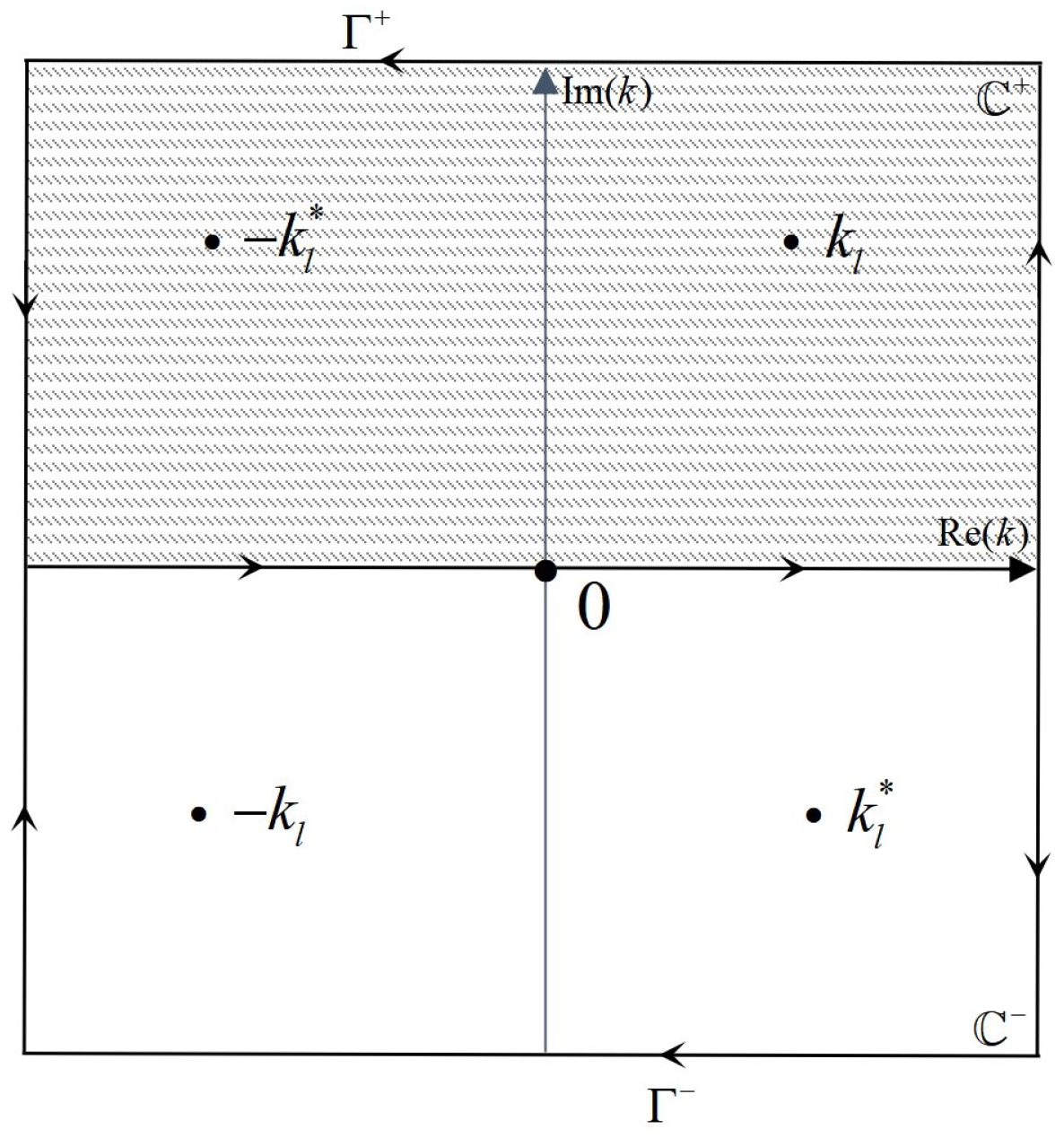
are analytical for the lower half-plane
. Meanwhile,
are analytical for the upper half-plane
, with
depicted in
Figure 1.
In the following, based on the analytic properties of , we introduce two new matrix functions , which are analytic for , respectively.
Firstly, if we take
,
to be a collection of columns
then the matrix Jost solution [
47]
is analytic in
and
, where
,
are defined by
Similarly, the matrix Jost solution
is analytic in
.
Furthermore, based on the Volterra integral equation in Equations (
22) and (
23), we obtain the asymptotic properties
and
Secondly, in order to obtain the analytic counterpart of
on
, the adjoint scattering equation of Equation (
19) is considered
where
By an analogous analytical approach to Jost solution
, taking
,
to be a collection of rows,
we find that the adjoint Jost solution
is analytic in
as well as
, where
. In addition,
is analytic in
. Similarly, we can obtain
and
Consequently, the analytic properties of the Jost solutions can be summarized as follows
where the superscripts ± indicate that the Jost solutions are analytic in the half-plane
.
Based on the scattering relation
and
, we have
where
denotes the determinant. Thus, by combining the analytical properties of the Jost solutions, we can derive the analytical properties of the scattering matrixes
and
, which are denoted as
where the superscript “±” indicates that the scattering data are analytic in the half-plane
, while
, and
generally do not allow analytical extensions to
in general. Moreover, according to the constraints of
Equation (
16), the time evolution of the scattering data can be determined
3.2. Riemann–Hilbert Problem
In what follows, we will construct the RH problem using the matrix functions and , which are analytic for k in and k in , respectively.
First of all, we discuss the regular RH problem, i.e.,
and
, in their domain of analyticity. We introduce the following jump conditions
where the jump matrix
is
In order to obtain the solution of the regular RH problem by the Plemelj formula [
47], we rewrite Equation (
36) as
then the formal solution of this problem can be given in terms of the Fredholm integral equation [
47]
where
.
Assuming that
and
are two sets of solutions to the RH problem, i.e.,
Then, using its canonical normalization condition
and Liouville’s theorem in complex analysis, we can obtain
which suggests that the solution for the regular RH problem is unique.
Afterwards, we consider the nonregular RH problem, i.e., and in their plane of analyticity, respectively. The solution of the RH problem is unique if and only if the zeros of and in are specified along with the kernel structures of at these zeros.
According to the symmetry relation
and the scattering relation Equation (
21), the symmetry relation of
can be gained by
which implies
,
. We can suppose that
has
N simple zeros
, and
has
N simple zeros
. Therefore,
,
are also the discrete spectra of the spectral problem. Based on this assumption, the kernel of
contains a single column vector
and the kernel of
contains a single row vector
, i.e.,
As a result of the above analysis, the following theorem can be presented to obtain the solution of a nonregular RH problem by transforming it into a regular one.
Theorem 1. The solution to the nonregular RH problem from Equation (36) with simple zeros under the canonical normalized condition of Equation (40) isIt should be pointed out thatwhere the -th element of matrix is defined asThus, represents the unique solution to the following regular RH problem:where are analytic in , respectively. The solution for the regular RH problem in Equation (
42) can be provided through using the Plemelj formula,
Let
,
Similarly,
admits the following asymptotic behaviour as
,
Therefore, by combining the two asymptotic behavior Equations (
44) and (
45) as
, we obtain
Subsequently, we propose the expansion of
as
,
Inserting Equation (
47) into Equation (
19) and matching the highest power of
k, we get
and the potential functions can be reformulated as
where
4. The Explicit Form of the TFNLS Equation
To derive the explicit form of the TFNLS equation, it is essential to address two fundamental aspects:
Regarding the first question, it is worth noting that squared eigenfunctions are eigenfunctions of the recursion operator for integrable equations. Therefore, the recursion operator
can act on squared eigenfunctions and be extended to the fractional recursion operator function
. For the second question, we know that this can be achieved through the completeness of the squared eigenfunctions of the TFNLS equation. The completeness of squared eigenfunctions is closely related to perturbation theory (or variational relations) [
47,
48,
49].
Thus, we first consider a perturbation to the spectral problem (
2)
From the asymptotic of
at large distances, the asymptotic behaviour of the Jost solution
is
, as
; thus
, as
. With this boundary condition, the solution of the inhomogeneous Equation (
51) can be found by the method of varying the parameters as follows
where
is a variation in the potential.
Then, considering the asymptotics of
as
and the scattering relation Equation (
21), we can derive
i.e.,
In a similar way, using the spectral problem (
2) for Jost solution
, we can find
i.e.,
Nevertheless,
, and
are also not analytic in
. In order to avoid this undesirable non-analytical behaviour, we define the reflection coefficients as
and thereby, from the variation relation Equations (
54) and (
56), we can obtain
where
represent the adjoint squared eigenfunctions
with
At the same time, the variation in the potential by means of variations in the scattering data is as follows
where
denote the squared eigenfunctions
In addition,
and
are also eigenfunctions with eigenvalues of
for the recursion operator
and its adjoint operator
, respectively, which are able to be generalized to the fractional operator
and its adjoint operator
Inserting the variation relation Equation (
58) into Equation (
59), we obtain
where
and
are shown in
Figure 1. Furthermore, by exchanging the order of integration in Equation (
61) and utilizing the properties of the Dirac delta function
[
47], the completeness relation is obtained
On the basis of Equation (
63), we assume a sufficiently smooth and decaying vector function
which can be extended with respect to eigenfunctions as
Subsequently, letting
act on it, we can access
where
Thus, by combining Equations (
11) and (
64), we obtain
Then, under the assumption
with
the explicit expression of the TFNLS equation can be presented as
Notably, when
, Equation (
69) reduces to the classical TNLS Equation (
1).
5. Fractional N-Soliton Solutions
This section focuses on the fractional
N-soliton solutions of the TFNLS equation. It is widely recognized that the integral term in Equation (
50) represents the radiation part of the solution, while the summation term corresponds to its nonradiative part. The nonradiative solution (i.e., reflectionless potential) of the TFNLS equation corresponds to the case
in its RH problem and is of great significance.
Now, we need to produce the spatial and temporal evolutions for vectors
and
. Taking the
x-derivative of both sides of the equation
, we can derive
Analogously, considering the temporal evolutions for vectors
, we have
Combining these results, the following expressions can be given
in addition, the concrete representation of
can be obtained through similar methods
where
,
,
represents the conjugate of
,
, which are scalar functions, and
and
which are complex constants. Without losing the generality, let us take
, then
where
,
.
When
, i.e., the scattering data
, Equation (
49) is reduced to
Consequently, the fractional
N-soliton solutions in Equation (
76) of the TFNLS equation can be rewritten in the form of a ratio of determinants
where
In what follows, we will examine the fractional one-soliton and two-soliton solutions of the TFNLS equation in terms of the Equation (
77) with
.
5.1. Fractional One-Soliton Solutions
By setting
, the fractional one-soliton solutions of the TFNLS equation can be derived
For brevity, we introduce the following notations. Letting
where
and
are the real and imaginary parts of
, and defining
the above solution to Equation (
78) can be rewritten as
Moreover, it is known that the fractional one-soliton solutions
,
, and
have the same wave velocity
, phase velocity
, and group velocity
, which can be expressed as follows:
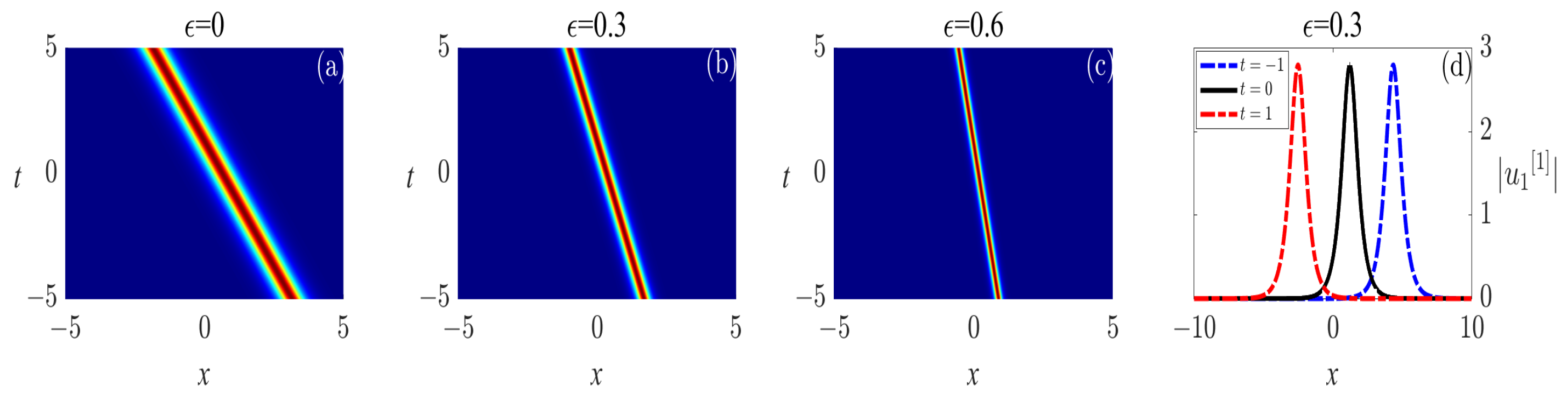
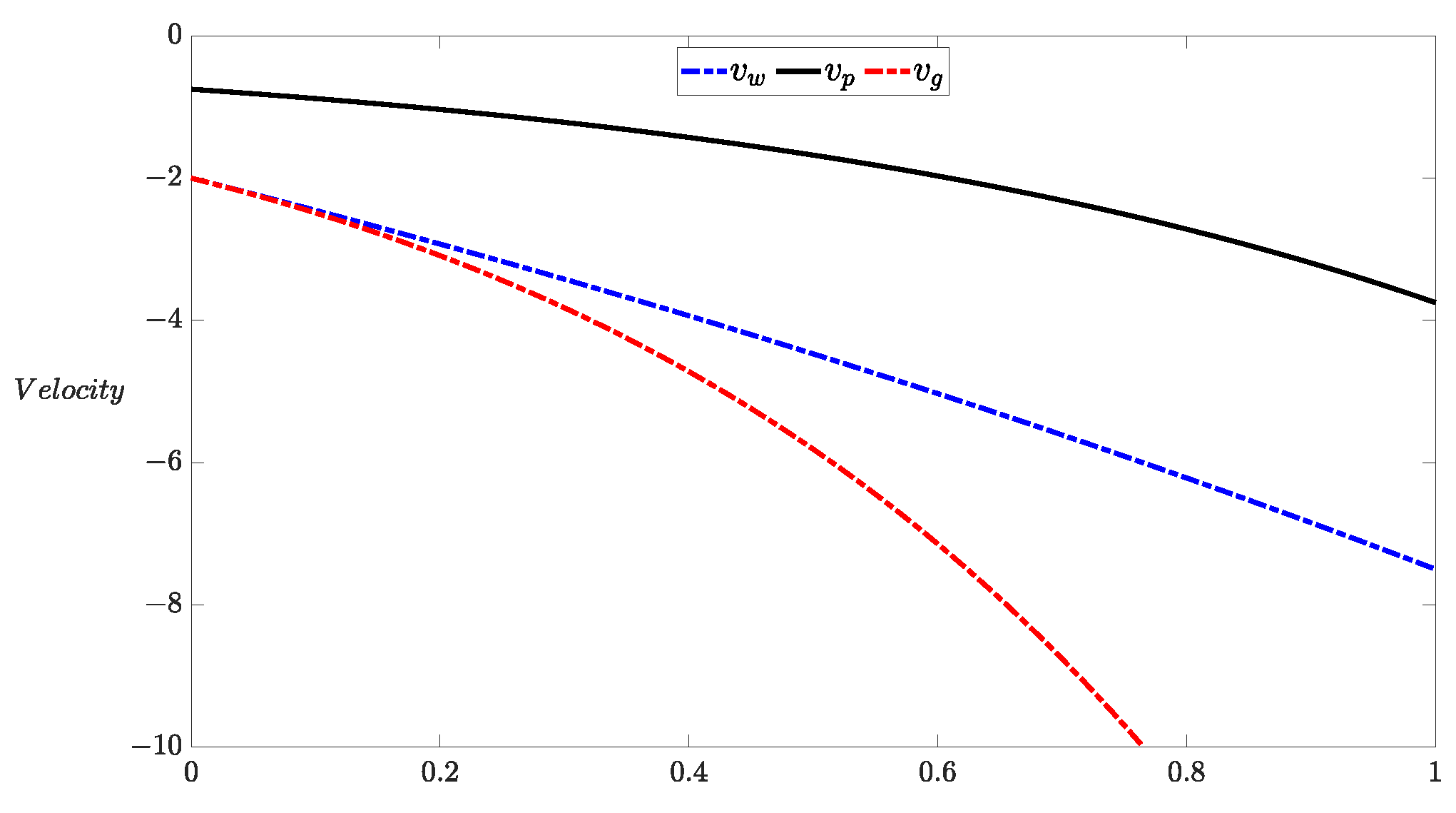
Their images are shown in
Figure 2 and
Figure 3.
From Equation (
79), it is clear that
,
, and
are essentially identical, differing only in their amplitudes due to the different values of
,
, and
. Therefore, we will exclusively discuss the dynamic behavior of
in
Figure 2 and
Figure 3. When
, i.e.,
,
is a left-going travelling-wave soliton at
,
,
. Additionally, the width of the wave becomes smaller while its absolute value of wave velocity
, phase velocity
, and group velocity
become larger as
increases.
5.2. Fractional Two-Soliton Solutions
Taking
and the spectral parameters
,
and
, the fractional two-soliton solution of the TFNLS equation can be expressed as
where
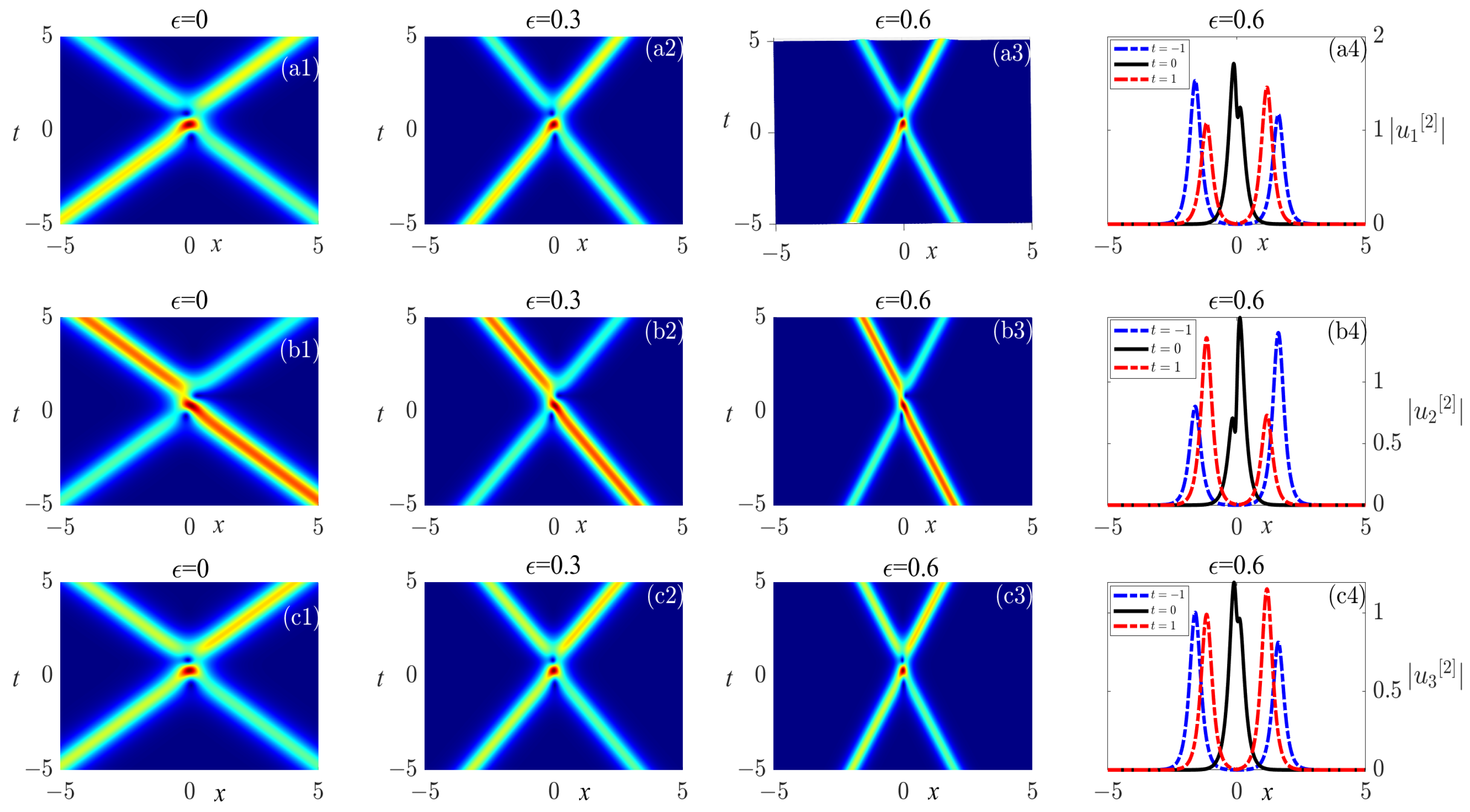
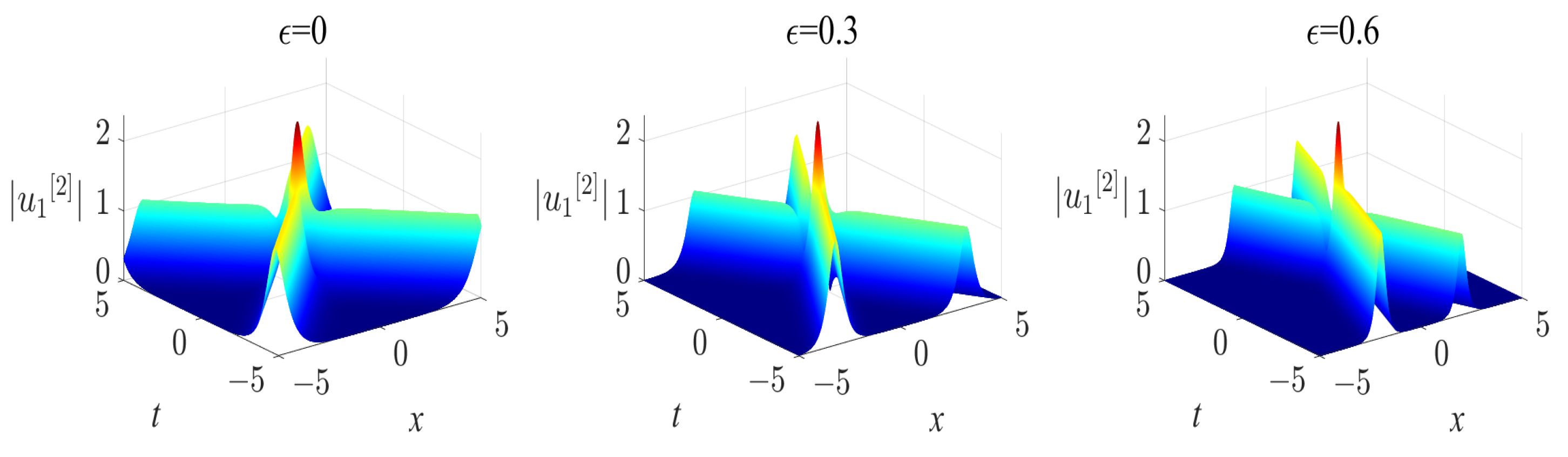
The fractional two-soliton solutions
,
, and
for
and
are displayed in
Figure 4 and
Figure 5. Similar to one-soliton solutions, the three fractional two-soliton solutions
,
, and
are almost indistinguishable, and as
increases, the width of soliton waves decreases. By observation, we find that
Figure 5 shows the soliton transmission. From
Figure 5(a1–a4,c1–c4), we notice that after the collision between the right-going wave with a large amplitude (left branch) and the left-going wave with a small amplitude (right branch) of
and
, the amplitudes of both remain nearly constant at
,
,
. Similarly, after the collision between the right-going wave with a small amplitude (left branch) and the left-going wave with a large amplitude (right branch) of
, the amplitudes of two solitons of
remain nearly unchanged at
,
,
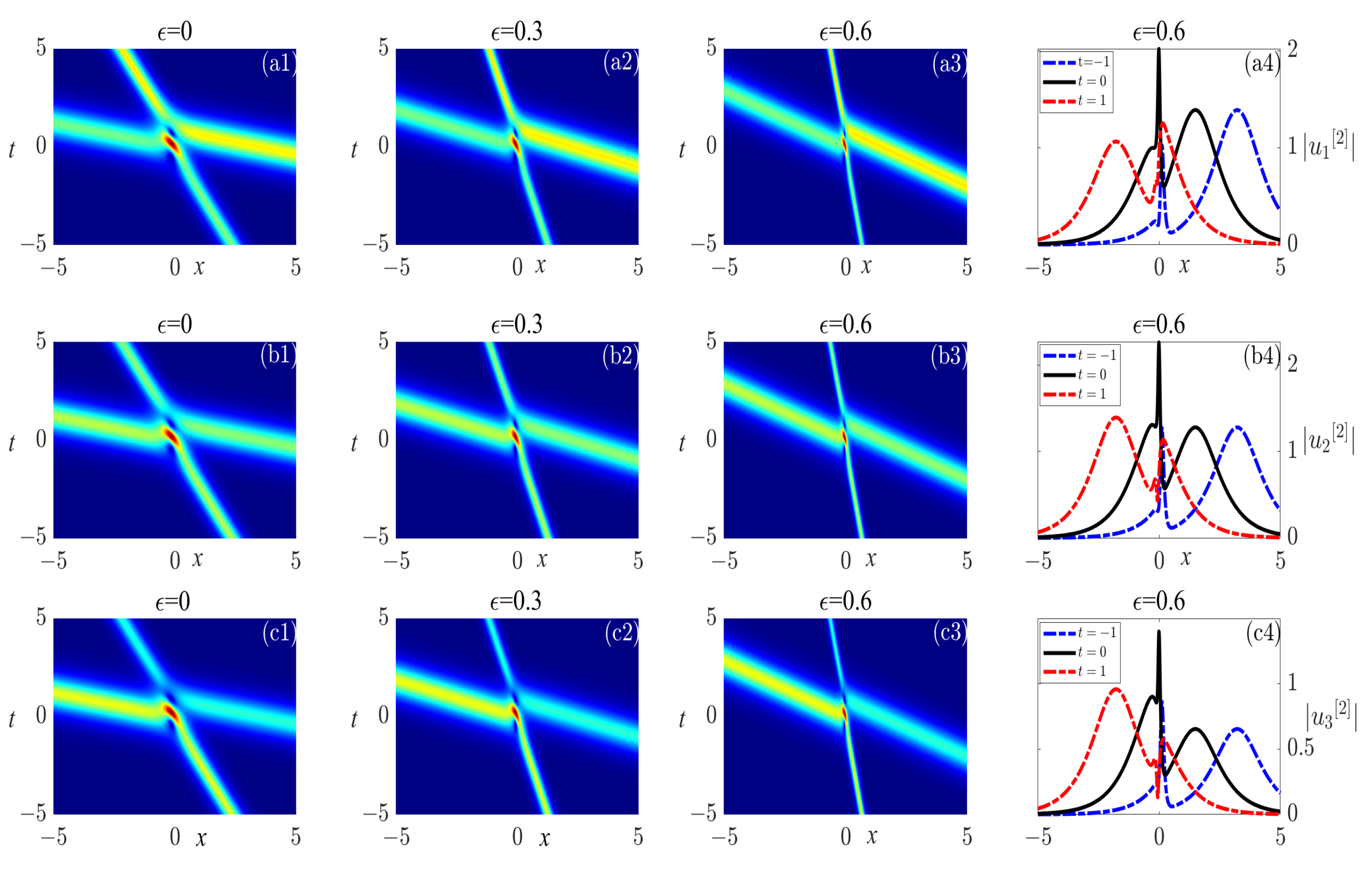
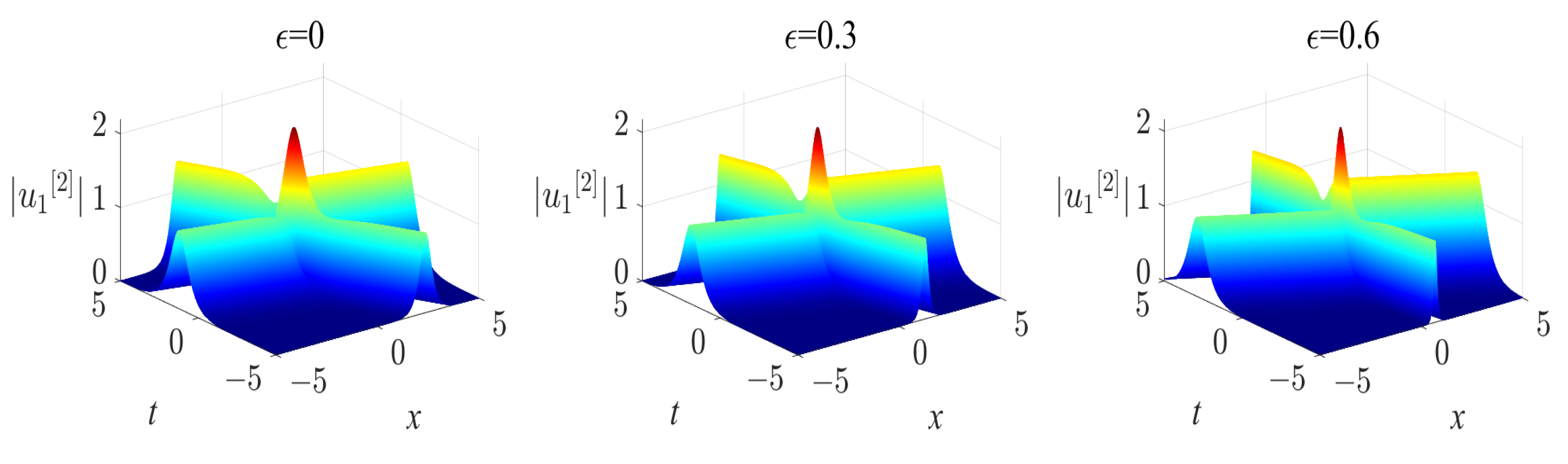
. However, when
and
,
Figure 6 and
Figure 7 display the soliton’s reflection. During the collision between two solitons of
and
in
Figure 7(a1–b4), the left-going wave with a small width and small amplitude (left branch) experiences an increase in both width and amplitude. Meanwhile, the left-going wave with a large width and large amplitude (right branch) undergoes a decrease in amplitude and width after the collision. This indicates that the energy of the two solitons remains constant during the collision. This kind of collision is not common in integrable systems and can be degenerated into a collision of two solitons in a single NLS equation.
From the analysis of the fractional one- and two-soliton solutions, it is evident that the solitons of the TFNLS equation exhibit significant differences from those of the classical TNLS equation and other fractional models. Compared with the classical TNLS equation, the TFNLS equation incorporates the Riesz fractional operator, allowing the soliton velocity, wave width, and post-collision shifts to be continuously tuned by the fractional order
, thus providing additional dynamic flexibility. It is noteworthy that the wave velocity, phase velocity, and group velocity of the fractional one-soliton solution exhibit a power-law relationship with the amplitude. This power-law behavior is a typical mathematical characteristic of the system’s nonlocality, manifesting as anomalous diffusion in diffusion contexts. This unique property is key to why the TFNLS equation can describe complex media with memory effects or anomalous dispersion, thereby surpassing the classical TNLS equation, which is primarily applicable only to ideal dispersive media. Moreover, in contrast to the fNLS equation and the fKdV equation [
28,
30], the coupled structure of the TFNLS equation enables the description of multi-component soliton interactions, thereby enriching the dynamics of fractional solitons.
6. Conclusions
In this paper, we started with the
AKNS spectral problem and constructed the integrable hierarchy of the TNLS equation using the recursive operator
. To determine the TFNLS equation, the fractional recursive operator
was obtained by adding a fractional power of the operator
to
. In
Section 4, we presented the squared eigenfunctions by making a perturbation to the spectral problem in Equation (
2) and the scattering relation in Equation (
21). By applying the completeness relation of the squared eigenfunctions, the explicit form of the TFNLS equation was derived. Furthermore, we presented the IST with the RH problem for the TFNLS equation. By utilizing the Plemelj formula, we obtained the solution
of the regular RH problem Equation (
36). When
, we obtained the reflectionless potentials
,
, and
as given in Equation (
76). The
N-soliton solutions under zero background were subsequently derived from the spatial and temporal evolution of
and
, with specific one- and two-soliton solutions presented for
and
, respectively. Finally, we observed that the soliton widths of
,
, and
decreased as
increased. The wave velocity, phase velocity, and group velocity exhibited a power-law dependence on amplitude, with their absolute values increasing as
increased. This behavior constitutes a fundamental departure from the linear relationships characterizing the classical TNLS equation, representing a novel dynamic feature introduced by fractional nonlocality. The two-soliton solutions exhibited both soliton transmission and soliton reflection, which are unique and infrequent in integrable systems. It is hoped that our new results will enrich the dynamic properties of integrable nonlinear equations.