Abstract
This study provides an innovative and attractive analytical strategy to examine the numerical solution for the time-fractional Schrödinger equation (SE) in the sense of Caputo fractional operator. In this research, we present the Elzaki transform residual power series method (ET-RPSM), which combines the Elzaki transform (ET) with the residual power series method (RPSM). This strategy has the advantage of requiring only the premise of limiting at zero for determining the coefficients of the series, and it uses symbolic computation software to perform the least number of calculations. The results obtained through the considered method are in the form of a series solution and converge rapidly. These outcomes closely match the precise results and are discussed through graphical structures to express the physical representation of the considered equation. The results showed that the suggested strategy is a straightforward, suitable, and practical tool for solving and comprehending a wide range of nonlinear physical models.
1. Introduction
Fractional calculus (FC) is a subdivision of traditional calculus that is related to ordinary differentiation and integration of any order. Therefore, FC concentrates on behaviors that cannot be represented by classical theory [1,2]. Furthermore, mathematical models containing a fractional order derivative contribute to an adequate representation of nonlinear structures in numerous fields of engineering and technology [3]. Many significant developments in the study and application of fractional partial differential equations (PDEs) have been established in previous decades. These differential equations are more efficiently used to investigate and explain multiple behaviors in diverse domains, such as mechanical objects, fluid dynamics, systems theory, condensation flows, thermal transfer, diffusion unification, processing of images, and the propagation of wave phenomena [4,5,6,7,8]. The main advantage of FC compared to classical calculus is that we can find the arbitrary derivative of a function, which is restricted to the integer-order in classical calculus. Using the theory of FC, one can examine the behavior of a vast variety of physical systems in the real world, including the solution of problems related to natural phenomena with complex systems. In recent times, attaining the precise results of nonlinear partial differential problems in multiple disciplines has become more interesting work for researchers. On the other hand, fractional differential problems possess the uncertainty property and capture the non-locality nature of complex systems, so it has started to gain the attention of several researchers in different fields.
Fractional quantum mechanics is a fascinating field that focuses across the time fractional SE and extends the principles of quantum mechanics to systems exhibiting non-local or memory-dependent behavior. In several physical structures, memory effects play a significant role in influencing their behavior. The time-fractional SE can capture memory-dependent behavior by including fractional derivatives, which account for system history, including the study of complex materials, biological systems, and other systems where memory effects are significant. This framework enables the examination of field theories in non-local or fractal spacetimes, offering valuable insights into the dynamics of quantum fields in complex surroundings. The fractional SE involves the time derivative of fractional order such that , whereas the traditional SE possesses the first-order time derivative. The scientific theory beyond the mechanism of derived results for time-fractional SE is noteworthy and remarkable in a wide area of quantum study, mathematics, and technology domains [9,10,11]. The most common and generalized form of a one-dimensional time-fractional SE model is [12]
with initial condition
in which , expresses time-fractional derivative of Caputo order , whereas are known as constants and be modulus. The is the wave function, is an analytical function, and represents the displacement function.
The time-fractional SE is an important differential problem in fractional quantum mechanics disciplines. In most of the scenarios, it is challenging to find analytical results of time-fractional SE, and their outcomes cannot be expressed in closed form, despite that the solutions to such a problem remain necessary for physical considerations. As a result, effective and consistent computer stimulation needs to be carried out. Many scientists have tackled the computational results of this model by utilizing some techniques to handle it in a more feasible context. Sadighi and Ganji [13] employed the homotopy perturbation scheme and Adomian decomposition approach to compute the approximate results for traditional SE. In [14], the authors obtained the results for space–time fractional SE by applying the strategy of RPSM and provided the series solution close to the exact solution. The authors in [15] presented an idea based on the Laplace transform method and the homotopy analysis scheme to derive the analytical results of the Caputo fractional order SE model. Liaqat and Akgül [16] adopted the natural homotopy perturbation method to demonstrate the analytical and numerical solutions of SE involving conformable fractional derivatives. Khan et al. [17] applied the homotopy analysis scheme for the solution of SE and coupled SE models. Okposo et al. [18] proposed q-homotopy analysis transform strategy to obtain analytical solutions for a system of nonlinear coupled SE models involving time-fractional derivative in Caputo sense.
Numerous researchers have offered several powerful computational and analytical strategies for determining results for fractional-order differential problems, such as: differential transform scheme [19], new iterative strategy [20], Trial equation strategy [21], Adomian decomposition technique [22], generalized Taylor matrix method [23], Hermite collocation method [24], and many others [25,26,27]. The power series technique [28] is a common and straightforward scheme to find computational results for solving linear differential problems. But in fact, finding a closed-form solution for nonlinear problems is extremely hard and requires heavy computational work. As a result, the residual power series approach is introduced to address the difficulty of the power series method. The residual power series approach has been used to identify computational solutions for various linear and nonlinear frameworks in a variety of science and technology disciplines [29,30]. Tarig M [31] introduced the Elzaki transform to improve the entire process of handling ordinary and partial differential problems in the temporal domain. Several scholars showed that the composition of Elzaki transform with other analytical schemes provides excellent results for linear and nonlinear fractional problems [32,33,34,35].
In this work, we combine ET and RPSM to develop the idea of ET-RPSM and generate the approximate results for a one-dimensional time-fractional nonlinear SE model using the initial conditions. The main purpose of this scheme is to handle the fractional order of a fractional problem and then obtain the series solution by using the RPSM. The ET is a very effective and efficient tool to convert the fractional order into Elzaki space. This approach is independent of various aspects of constraint and theory of assumption in the development of ET-RPSM. The RPSM has the advantage of collecting the results in an order of series form that can easily be turned into the exact solution when the limit approaches infinity. This approach is considered for nonlinear models of fractional problems in the Caputo sense. We perform the computational work and graphical analysis by introducing the Mathematica program, although this causes time efficiency to be reduced. The physical behavior of fractional problems at different fractional orders is shown. This paper is organized in the following manner: Section 2 presents a brief overview of fractional calculus and the Elzaki transform. The ET-RPSM algorithm is described in Section 3. We provide three numerical implementations of the Schrödinger equation in Section 4 to demonstrate the effectiveness of our methodology. We summarise our results and the corresponding implications in Section 5.
2. Overview of Fractional Calculus and Elzaki Transform
This section consists of some preliminary concepts of fractional calculus, Elzaki transform, and the residual power series method. These fundamental definitions are helpful for the development of ET-RPSM.
Definition 1.
The fractional integral operator of Riemann–Liouville of order is defined as follows [35]
Definition 2.
Let be a function, then the fractional derivative in Caputo sense is expressed as [35]
Definition 3.
Let a series such as [36]
is said to be a fractional power series about , in which ξ shows variable and are constants of coefficients in the series solution.
Theorem 1
([36]). Let Q be a fractional power series at in terms of
with . If are continuous on , then parameters of are given as
where .
Proof.
Let be a function of two variables, and , that represents a multiple fractional power series of Equation (3). Now, if we consider in Equation (4), only the first term will left, whereas all other terms can be neglected, and thus we can obtain
Using an operator of once in Equation (4), the following expansion takes place:
On substituting to Equation (7), we determine the value of as
Now, using an operator of one more time in Equation (7), the following expansion takes place:
On substituting to Equation (9), we determine the value of as
On continuing this process of using an operator of m-times and then substituting , we can easily observe the sequence of as follows
which shows similar results for Equation (9). Hence, the theorem is proved. □
Remark 1.
This is the generalized Taylor’s series algorithm. Moreover, when ,
which shows the classical Taylor’s series formula. Hence, a new generalization is derived using Equation (12) which helps to obtain the results in the form series for the time-fractional SE model.
Definition 4.
The Elzaki transform is defined as an exponential-order function, and we examine functions in the set A described as [37]
The constant M must be a finite number for any function in the set A whereas may be finite or infinite. Moreover, The Elzaki transform in the form of an integral equation is defined as
in which θ represents a transform function of ξ and shows ET of . Moreover, the following properties are helpful for the computations of Elzaki space.
- 1.
- ,
- 2.
- ,
- 3.
- ,
- 4.
- ,
- 5.
- .
Definition 5.
The ET for a fractional order in Caput sense is expressed as
Theorem 2.
If is ET of , then Riemann–Liouville derivatives of ET can be considered as [38]
Proof.
□The Laplace transformation of the following function can be explained as
Now, we substitute for θ, and the fractional-order ET of becomes
3. Strategy of ET-RPSM
This section explores the concept of ET-RPSM for numerical results of the time fractional SE model. Elzaki transform has the advantage of converting the fractional order to Elzaki space and thus we can derive an algebraic structure of the proposed model. The structure of this model is now easy to handle with the help of RPSM and the resulting solution is obtained in terms of a successive series. We can observe that this continuous series leads to precise results very rapidly after a minimum number of iterations. To construct this strategy, we consider and to be the complex functions in terms of real and imaginary segments such as
here and are multivariable real-valued analytic functions specified over , , and and are real-valued analytic functions specified on . Using Equation (16), we obtain the system of Equation (1) into the following PDEs system such as
with the following conditions:
The solution of system (17) with conditions (18) is the solution of Equation (1) with conditions (2) completely. Therefore, we are required to establish the strategy of ET-RPSM for the system of (17). This strategy is based on the following steps.
- Step 3. We construct the residual functions namely, and for an algebraic system of (19) as followsthus, the k-th truncated series of Equation (22) yields asThe RPSM contains a few important outcomes:
- , and , .
- , and , for .
- , and , for , and
- Step 5. The components of and and are obtained by applying the fact , and where . The calculated results of and are collected in terms of a series, which can be utilized for fractional expansion series (21).
- Step 6. Using the inverse ET on both sides of Elzaki series, one can obtain the components and for the main Equation (17).
4. Numerical Applications
Here, we provide three numerical applications that demonstrate the effectiveness, efficiency, and legitimacy of ET-RPSM. The Mathematica software is used to carry out all symbolic and mathematical computations.
4.1. Problem 1
Consider an example of a one-dimensional linear time-fractional SE model as follows:
along the condition
The Equation (24) may turn to an identical structure of fractional problem such as
with the subsequent conditions
By using ET in Equation (26) and dealing with condition (27), we obtain
Let the solution of Equation (26) be in the th transform function as
Furthermore, k-th ET-RPSM of the algebraic Equation (28) is constructed as
To find the first unknown parameter in Equation (29), we change the first truncated sequence by
We obtain the 1st ET-RPSM using Equation (31) into system (30) for ,
Employing RPSM facts and taking the limit as into the system (32), the values of the following coefficients are obtained as
Similarly, to find the second unknown parameter in Equation (29), we change the second truncated sequence by
We obtain the 2nd ET-RPSM using Equation (34) into system (30) for ,
Employing RPSM facts and taking the limit as into the system (35), the values of the following coefficients are obtained as
We can find the values of the following parameters by using the same process for and :
Thus, we can express the fourth approximation of Equation (29) with the help of Equations (33), (36) and (37) as follows
By using inverse ET in Equation (38), we can obtain the 4th approximate ET-RPSM results of Equation (26) with (27) such as
subsequently, the coefficients of ET-RPSM solutions can be derived by continuing these iterations. By examining the structure of the parameters, we can express the precise results for and as the following series
where
When , the system of Equation (24) with (25) express the following result.
which is compatible with the results produced by the decomposition approach [13], homotopy analysis scheme [39], and the variational scheme [40]. Thus, we can show that ET-RPSM is a straightforward, basic, and successful approach to fractional problems.
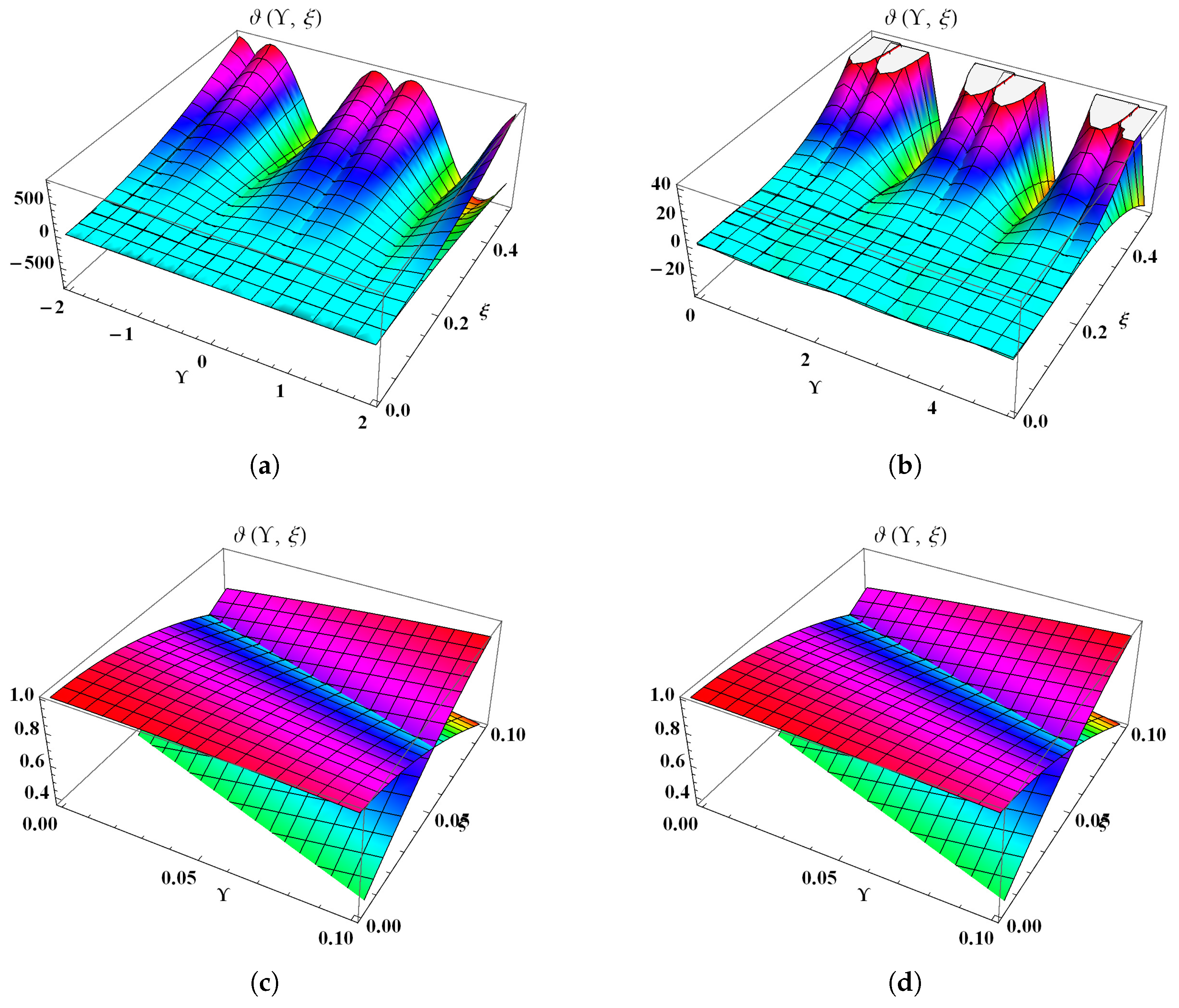
Figure 1a depicts the behavior of the obtained results in 3D plot with fractional order of and . Figure 1b depicts the behavior of the obtained results in 3D plot with fractional order of and . Figure 1c demonstrates the behavior of ET-RPSM results of the time-fractional SE model in 3D plot with fractional order of and . Figure 1d depicts the behavior of the exact solution of the time-fractional SE model in 3D plot with . It is observed that the derived results for various levels of fractional order confirm the authenticity, accuracy, and compatibility of our proposed scheme.
Figure 1.
Graphical structure of ET-RPSM results for and . (a) ET-RPSM results of and at . (b) ET-RPSM results of and at . (c) ET-RPSM results of and at . (d) The exact results of and at .
4.2. Problem 2
Consider an example of a one-dimensional nonlinear time-fractional SE model as follows:
along the condition
The Equation (42) may turn to an identical structure of fractional problem such as
with the subsequent conditions
By using ET in Equation (44) and dealing with condition (45), we obtain
Let the solution of Equation (44) be in the th transform function as
Furthermore, k-th ET-RPSM of the algebraic Equation (46) is constructed as
We can find the values of the following parameters by using the same process for such as
So, the 4th approximate solution of system (47) with the help of system of Equation (49) can be expressed as
Applying the inverse Elzaki transform in Equation (50) to obtain the 4th approximate ET-RPSM solution of system (44) with (45) in the following series forms
subsequently, the coefficients of ET-RPSM solutions can be derived by continuing these iterations. By examining the structure of the parameters, we can express the precise results for and as the following series.
where
When , the system of Equation (42) with (43) express the following result.
which is compatible with the results produced by the decomposition approach [13], homotopy analysis scheme [39], and the variational scheme [40]. Thus, we can show that ET-RPSM is a straightforward, basic, and successful approach to fractional problems.
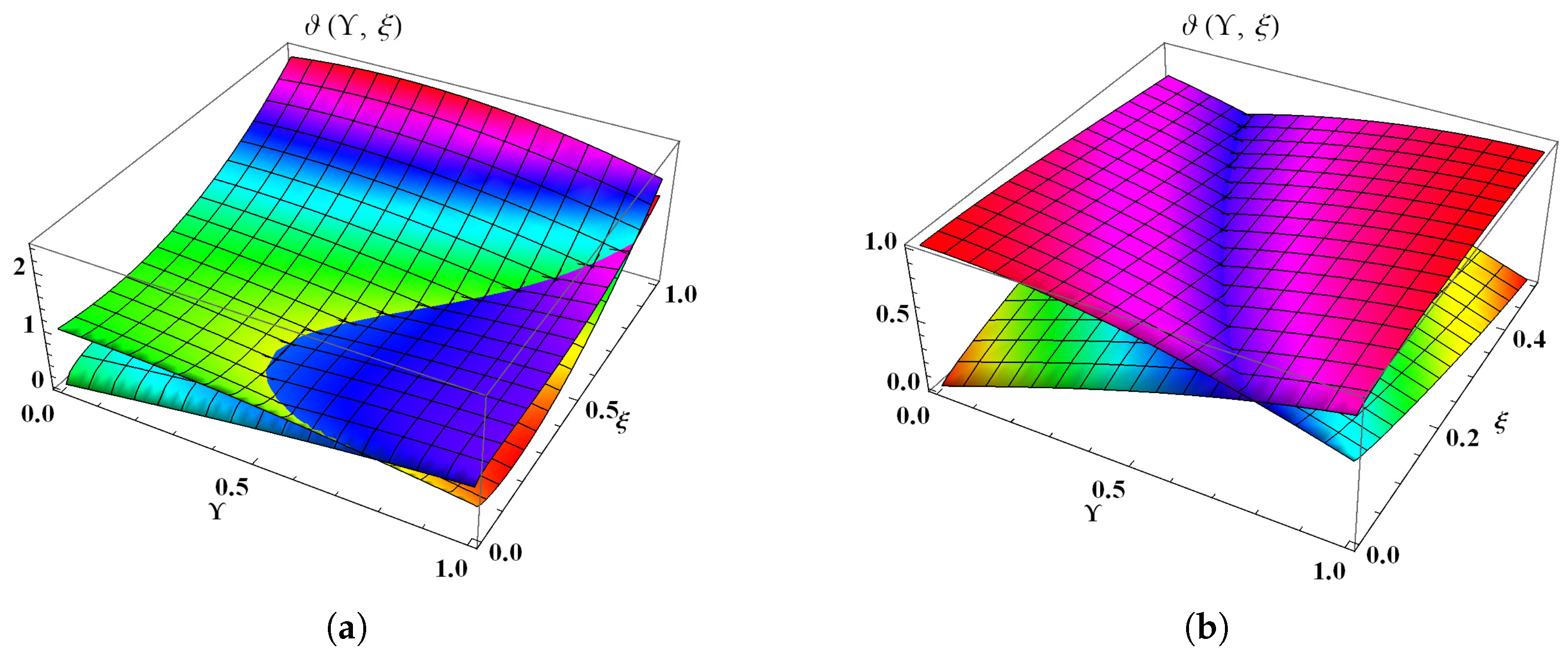
Figure 2a depicts the behavior of the obtained results in 3D plot with fractional order of and . Figure 2b depicts the behavior of the obtained results in 3D plot with fractional order of and . Figure 2c demonstrates the behavior of ET-RPSM results of time-fractional SE model in 3D plot with fractional order of and . Figure 2d depicts the behavior of the exact solution of the time-fractional SE model in 3D plot with . It is observed that the derived results for various levels of fractional order confirm the authenticity, accuracy, and compatibility of our proposed scheme.

Figure 2.
Graphical structure of ET-RPSM results for and . (a) ET-RPSM results of and at . (b) ET-RPSM results of and at . (c) ET-RPSM results of and at . (d) The exact solution of and at .
4.3. Problem 3
Consider another example of a one-dimensional nonlinear time-fractional SE model as follows:
along the following initial condition
The Equation (54) may turn to an identical structure of fractional problem such as
with the subsequent conditions
By using ET in Equation (56) and dealing with condition (57), we obtain
Let the solution of Equation (56) be in the th transform function as
Furthermore, k-th ET-RPSM of the algebraic Equation (58) is constructed as
We can find the values of the following parameters by using the same process for such as
So, the 4th approximate solution of system (59) with the help of system of Equation (61) can be expressed as
Applying the inverse Elzaki transform to Equation (62) to obtain the 4th approximate ET-RPSM solution of system (56) with (57) in the following series forms
subsequently, the coefficients of ET-RPSM solutions can be derived by continuing these iterations. By examining the structure of the parameters, we can express the precise results for and as the following series
When , the system of Equation (54) with (55) express the following result.
which is compatible with the results produced by the decomposition approach [13], homotopy analysis scheme [39], and the variational scheme [40]. Thus, we can show that ET-RPSM is a straightforward, basic, and successful approach to fractional problems.
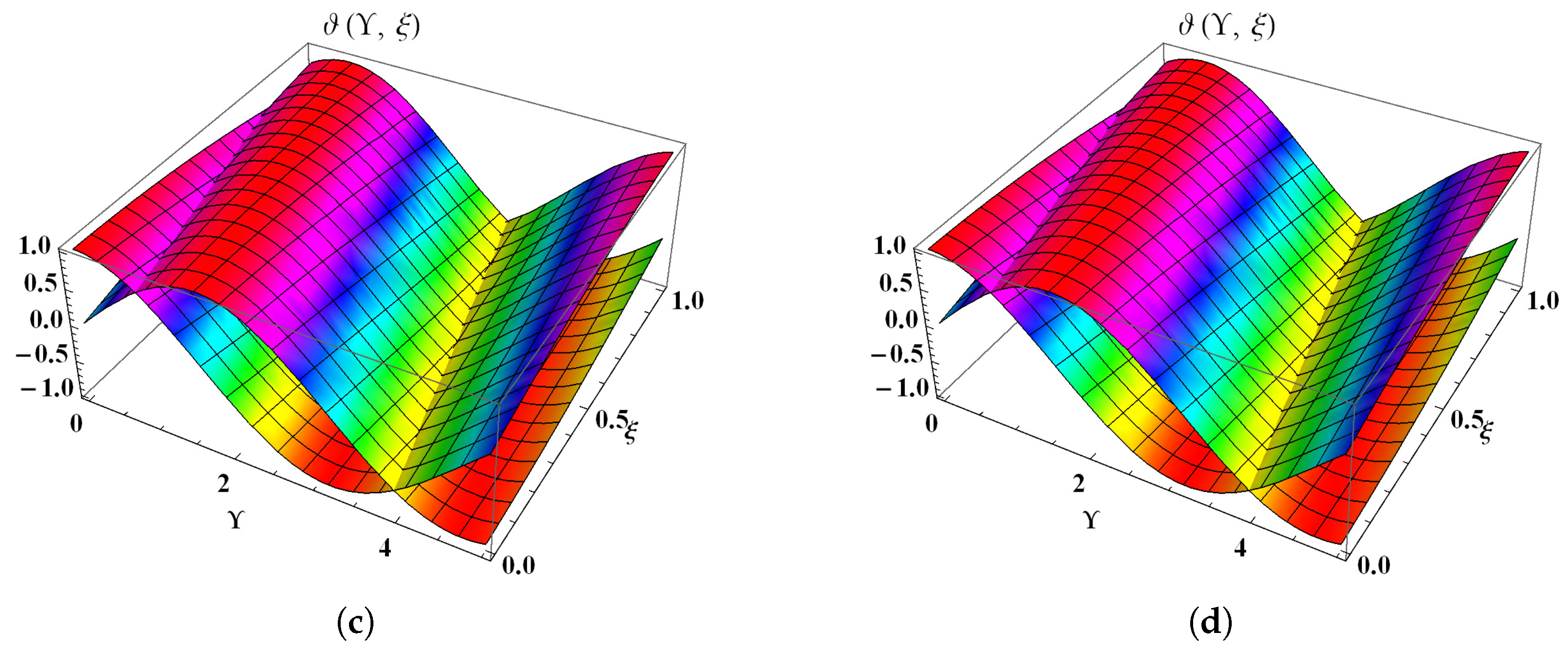
Figure 3a depicts the behavior of the obtained results in 3D plot with fractional order of and . Figure 3b depicts the behavior of the obtained results in 3D plot with fractional order of and . Figure 3c demonstrates the behavior of ET-RPSM results of time- fractional SE model in 3D plot with fractional order of and . Figure 3d depicts the behavior of the exact solution of the time-fractional SE model in 3D plot with . It is observed that the derived results for various levels of fractional order confirm the authenticity, accuracy, and compatibility of our proposed scheme.
Figure 3.
Graphical structure of ET-RPSM results for and . (a) ET-RPSM results of and at . (b) ET-RPSM results of and at . (c) ET-RPSM results of and at . (d) The exact solution of and at .
5. Conclusions
In this research, we have examined the numerical results of the one-dimensional time-fractional Schrödinger problem. The current approach combines the fractional RPSM with the Elzaki transform operator. The advantage of using the ET-RPSM is that it produces a more accurate convergence series and requires an appropriate amount of computing without dispersion, variation, or any other physical restrictions. We illustrate three numerical applications to ensure that the proposed method is effective and reliable in finding the numerical results of fractional-ordered models. The efficiency of this strategy was confirmed through rigorous analysis and sketches. We discussed the results through numerical simulation and graphics in various fractional orders. The solutions offered are innovative and have not been reported in any existing literature. As a result, this method offers potential applications for addressing and resolving various highly nonlinear fractional-order equations. The resulting solutions might be useful in some real-life scenarios or particular disciplines, including nonlinear optics and quantum mechanics. This approach might be considered in future research to find exact and approximate results for systems of nonlinear fractional issues that arise in a variety of physical and dynamical models.
Author Contributions
Investigation, methodology, software, and writing—original draft, M.N.; funding acquisition and supervision, L.F.I. All authors have read and agreed to the published version of the manuscript.
Funding
This research was funded by the University of Oradea.
Institutional Review Board Statement
Not applicable.
Informed Consent Statement
Not applicable.
Data Availability Statement
This study contains the data within the manuscript.
Conflicts of Interest
The authors declare that they have no competing interests.
References
- He, J. Some applications of nonlinear fractional differential equations and their approximations. Bull. Sci. Technol. 1999, 15, 86–90. [Google Scholar]
- Alabedalhadi, M.; Al-Smadi, M.; Al-Omari, S.; Baleanu, D.; Momani, S. Structure of optical soliton solution for nonliear resonant space-time Schrödinger equation in conformable sense with full nonlinearity term. Phys. Scr. 2020, 95, 105215. [Google Scholar] [CrossRef]
- Baskonus, H.M.; Sánchez Ruiz, L.M.; Ciancio, A. New challenges arising in engineering problems with fractional and integer order. Fractal Fract. 2021, 5, 35. [Google Scholar] [CrossRef]
- Hasan, S.; Al-Smadi, M.; Dutta, H.; Momani, S.; Hadid, S. Multi-step reproducing kernel algorithm for solving Caputo–Fabrizio fractional stiff models arising in electric circuits. Soft Comput. 2022, 26, 3713–3727. [Google Scholar] [CrossRef]
- Sun, H.; Zhang, Y.; Baleanu, D.; Chen, W.; Chen, Y. A new collection of real world applications of fractional calculus in science and engineering. Commun. Nonlinear Sci. Numer. Simul. 2018, 64, 213–231. [Google Scholar] [CrossRef]
- Baleanu, D.; Jajarmi, A.; Sajjadi, S.S.; Mozyrska, D. A new fractional model and optimal control of a tumor-immune surveillance with non-singular derivative operator. Chaos Interdiscip. J. Nonlinear Sci. 2019, 29, 083127. [Google Scholar] [CrossRef] [PubMed]
- Akinyemi, L.; Şenol, M.; Iyiola, O.S. Exact solutions of the generalized multidimensional mathematical physics models via sub-equation method. Math. Comput. Simul. 2021, 182, 211–233. [Google Scholar] [CrossRef]
- Pandir, Y.; Yasmin, H. Optical soliton solutions of the generalized sine-gordon equation. Electron. J. Appl. Math. 2023, 1, 71–86. [Google Scholar] [CrossRef]
- Achar, B.N.; Yale, B.T.; Hanneken, J.W. Time fractional Schrodinger equation revisited. Adv. Math. Phys. 2013, 2013, 290216. [Google Scholar] [CrossRef]
- Saxena, R.; Saxena, R.; Kalla, S. Solution of space-time fractional Schrödinger equation occurring in quantum mechanics. Fract. Calc. Appl. Anal. 2010, 13, 177–190. [Google Scholar]
- Wang, S.; Xu, M. Generalized fractional Schrödinger equation with space-time fractional derivatives. J. Math. Phys. 2007, 48, 043502. [Google Scholar] [CrossRef]
- Abu Arqub, O. Application of residual power series method for the solution of time-fractional Schrödinger equations in one-dimensional space. Fundam. Inform. 2019, 166, 87–110. [Google Scholar] [CrossRef]
- Sadighi, A.; Ganji, D. Analytic treatment of linear and nonlinear Schrödinger equations: A study with homotopy-perturbation and Adomian decomposition methods. Phys. Lett. A 2008, 372, 465–469. [Google Scholar] [CrossRef]
- Demir, A.; Bayrak, M.A.; Ozbilge, E. New approaches for the solution of space-time fractional Schrödinger equation. Adv. Differ. Equ. 2020, 2020, 133. [Google Scholar] [CrossRef]
- Ramswroop; Singh, J.; Kumar, D. Numerical study for time-fractional Schrödinger equations arising in quantum mechanics. Nonlinear Eng. 2014, 3, 169–177. [Google Scholar] [CrossRef]
- Liaqat, M.I.; Akgül, A. A novel approach for solving linear and nonlinear time-fractional Schrödinger equations. Chaos Solitons Fractals 2022, 162, 112487. [Google Scholar] [CrossRef]
- Khan, N.A.; Jamil, M.; Ara, A. Approximate solutions to time-fractional Schrödinger equation via homotopy analysis method. Int. Sch. Res. Not. 2012, 2012, 197068. [Google Scholar] [CrossRef]
- Okposo, N.I.; Veeresha, P.; Okposo, E.N. Solutions for time-fractional coupled nonlinear Schrödinger equations arising in optical solitons. Chin. J. Phys. 2022, 77, 965–984. [Google Scholar] [CrossRef]
- Arikoglu, A.; Ozkol, I. Solution of fractional integro-differential equations by using fractional differential transform method. Chaos Solitons Fractals 2009, 40, 521–529. [Google Scholar] [CrossRef]
- Erfanifar, R.; Hajarian, M.; Sayevand, K. A family of iterative methods to solve nonlinear problems with applications in fractional differential equations. Math. Methods Appl. Sci. 2024, 47, 2099–2119. [Google Scholar] [CrossRef]
- Pandir, Y.; Ekin, A. New solitary wave solutions of the korteweg-de vries (kdv) equation by new version of the trial equation method, Electron. Electron. J. Appl. Math. 2023, 1, 101–113. [Google Scholar] [CrossRef]
- Afreen, A.; Raheem, A. Study of a nonlinear system of fractional differential equations with deviated arguments via Adomian decomposition method. Int. J. Appl. Comput. Math. 2022, 8, 269. [Google Scholar] [CrossRef] [PubMed]
- Ahmed, S.; Salh, S.A.H. Generalized Taylor matrix method for solving linear integro-fractional differential equations of Volterra type. Appl. Math. Sci. 2011, 5, 1765–1780. [Google Scholar]
- Pirim, N.A.; Ayaz, F. Hermite collocation method for fractional order differential equations. Int. J. Optim. Control. Theor. Appl. IJOCTA 2018, 8, 228–236. [Google Scholar] [CrossRef]
- Tadjeran, C.; Meerschaert, M.M.; Scheffler, H.P. A second-order accurate numerical approximation for the fractional diffusion equation. J. Comput. Phys. 2006, 213, 205–213. [Google Scholar] [CrossRef]
- Meerschaert, M.M.; Scheffler, H.P.; Tadjeran, C. Finite difference methods for two-dimensional fractional dispersion equation. J. Comput. Phys. 2006, 211, 249–261. [Google Scholar] [CrossRef]
- Nadeem, M.; Iambor, L.F. The traveling wave solutions to a variant of the boussinesq equation. Electron. J. Appl. Math. 2023, 1, 26–37. [Google Scholar]
- Berz, M. The method of power series tracking for the mathematical description of beam dynamics. Nucl. Instruments Methods Phys. Res. Sect. A Accel. Spectrometers Detect. Assoc. Equip. 1987, 258, 431–436. [Google Scholar] [CrossRef]
- Az-Zo’bi, E.A.; Yıldırım, A.; AlZoubi, W.A. The residual power series method for the one-dimensional unsteady flow of a van der Waals gas. Phys. A Stat. Mech. Its Appl. 2019, 517, 188–196. [Google Scholar] [CrossRef]
- Prakasha, D.; Veeresha, P.; Baskonus, H.M. Residual power series method for fractional Swift—Hohenberg equation. Fractal Fract. 2019, 3, 9. [Google Scholar] [CrossRef]
- Elzaki, T.M. The new integral transform Elzaki transform. Glob. J. Pure Appl. Math. 2011, 7, 57–64. [Google Scholar]
- Naeem, M.; Azhar, O.F.; Zidan, A.M.; Nonlaopon, K.; Shah, R. Numerical analysis of fractional-order parabolic equations via Elzaki transform. J. Funct. Spaces 2021, 2021, 3484482. [Google Scholar] [CrossRef]
- Lu, D.; Suleman, M.; He, J.H.; Farooq, U.; Noeiaghdam, S.; Chandio, F.A. Elzaki projected differential transform method for fractional order system of linear and nonlinear fractional partial differential equation. Fractals 2018, 26, 1850041. [Google Scholar] [CrossRef]
- Neamaty, A.; Agheli, B.; Darzi, R. Applications of homotopy perturbation method and Elzaki transform for solving nonlinear partial differential equations of fractional order. J. Nonlin. Evolut. Equat. Appl. 2016, 2015, 91–104. [Google Scholar]
- Jena, R.M.; Chakraverty, S. Solving time-fractional Navier–Stokes equations using homotopy perturbation Elzaki transform. SN Appl. Sci. 2019, 1, 16. [Google Scholar] [CrossRef]
- Arqub, O.A.; El-Ajou, A.; Zhour, Z.A.; Momani, S. Multiple solutions of nonlinear boundary value problems of fractional order: A new analytic iterative technique. Entropy 2014, 16, 471–493. [Google Scholar] [CrossRef]
- Elzaki, T.M.; Ezaki, S.M. On the Elzaki transform and ordinary differential equation with variable coefficients. Adv. Theor. Appl. Math. 2011, 6, 41–46. [Google Scholar]
- Sunthrayuth, P.; Ali, F.; Alderremy, A.A.; Shah, R.; Aly, S.; Hamed, Y.S.; Katle, J. The numerical investigation of fractional-order Zakharov–Kuznetsov equations. Complexity 2021, 2021, 4570605. [Google Scholar] [CrossRef]
- Alomari, A.; Noorani, M.; Nazar, R. Explicit series solutions of some linear and nonlinear Schrodinger equations via the homotopy analysis method. Commun. Nonlinear Sci. Numer. Simul. 2009, 14, 1196–1207. [Google Scholar] [CrossRef]
- Wazwaz, A.M. A study on linear and nonlinear Schrodinger equations by the variational iteration method. Chaos Solitons Fractals 2008, 37, 1136–1142. [Google Scholar] [CrossRef]
Disclaimer/Publisher’s Note: The statements, opinions and data contained in all publications are solely those of the individual author(s) and contributor(s) and not of MDPI and/or the editor(s). MDPI and/or the editor(s) disclaim responsibility for any injury to people or property resulting from any ideas, methods, instructions or products referred to in the content. |
© 2024 by the authors. Licensee MDPI, Basel, Switzerland. This article is an open access article distributed under the terms and conditions of the Creative Commons Attribution (CC BY) license (https://creativecommons.org/licenses/by/4.0/).