Abstract
In this article, we compute the irregularity measures of generalized Sierpiński graphs and obtain some bounds on these irregularities. Moreover, we discuss some bounds on connectivity indices for generalized Sierpiński graphs of any arbitrary graph H along with classification of the extremal graphs used to attain them.
1. Introduction
For many years, the topic of polymer networks has been of great importance in research. The properties of polymer networks rely on the structure of polymer chains and how these chains are cemented to form a network. The primary study of polymer modelling began with linear polymeric structures, but nowadays, researchers are focusing their attention on the complex underlying geometries as well as fractal generalized networks.
In theoretical chemistry, a numerical quantity is used to gain information about the chemical, physical or biological properties of organic substances. This numerical quantity is obtained by applying mathematical definitions to the molecular structures of the substance, and it is called a topological index.
We consider simple, finite, connected and undirected graphs in our present study. Graph theoretic terminologies that are not defined here can be found in [1]. Let be a graph, with V as its node set and E its edge set. The cardinalities of V and E are of order n and size m of H, respectively. The total number of nodes adjacent to a node is the degree of x in H, denoted by or simply . and are path and star graphs, respectively, with n nodes.
In 1998, Bollobás et al. [2] introduced the following definition of the generalized Randić index:
where is any non-zero real number. For , we obtain the famous Randić index, while for gives the reduced Randić and second Zagreb indices.
The historical and mathematical concepts of the above-discussed topological indices can be found in [3,4,5,6,7,8].
By replacing product with sum in the above expression, we obtain the general sum-connectivity index. The concept of general sum-connectivity index was put forward by Zhou et al. in [9] and is defined as
From the above, the sum-connectivity index can be obtained by replacing with . When , the expression is known as the first Zagreb index, while for , we obtain the hyper Zagreb index.
Studies on the general sum-connectivity, sum-connectivity, first Zagreb and hyper Zagreb indices have been conducted by many researchers [5,10,11,12,13].
A graph G is regular if the degree of each of its nodes is same; otherwise, it is irregular. In most problems and applications, it is of great interest to know the irregularity of H. The topological characterization of the irregularity of H is useful for investigating the structural properties of random and deterministic networks, as well as systems appearing in social and chemical structures and biology [14].
In 1991, Albertson [15] defined the irregularity of graph H as
The above quantity is also named the Albertson index or third Zagreb index.
In [16], the authors proposed a similar kind of quantity (a forgotten topological index):
Detailed studies on the above irregularities can be found in [17,18,19,20,21,22].
For a graph H of order , let be a set of words with a length of l letters from V, where l is a positive integer. The letters of a word are indexed by . Klavžar [23] introduced the concept of Sierpiński graphs . Later, Gravier [24] generalized this concept for any graph G and named it the generalized Sierpiński graph . Motived by the study of Gravier [24] and topological index work by Javed et al. [25], we consider the problem of irregularities and connectivity indices for generalized Sierpiński graphs and classify the extremal graphs for said invariants. In QSAR/QSPR studies, a TI (topological index) is a numeric entity associated with a chemical graph which can tell the specific physical and chemical properties of the corresponding molecule. In many problems and applications, it is interesting to know how irregular a graph can be. The generalized Sierpiński graph of H with dimension l is a graph of such that two words, and , form an edge iff (if and only if) there exists , satisfying the following:
- , if .
- but .
- and , whenever .
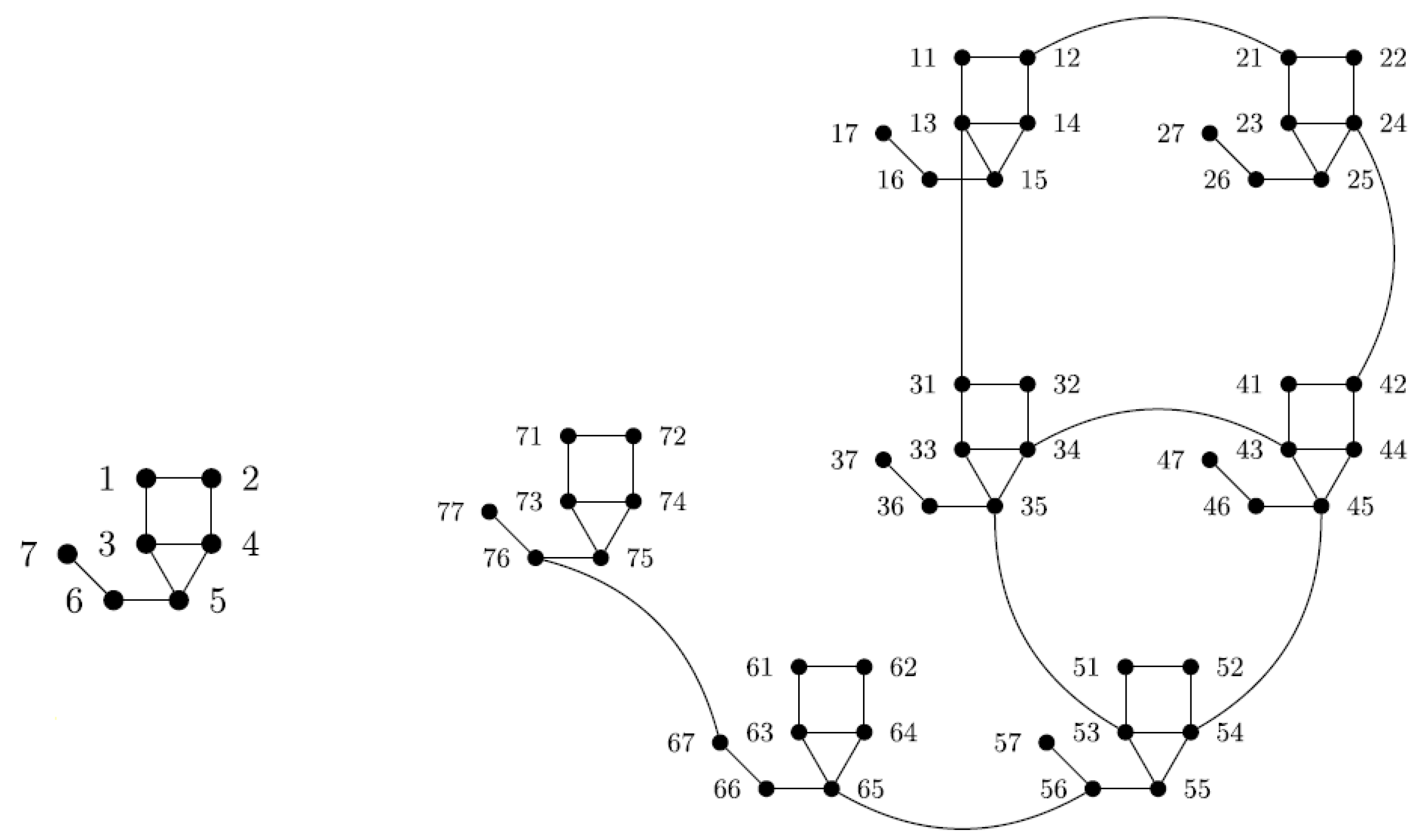
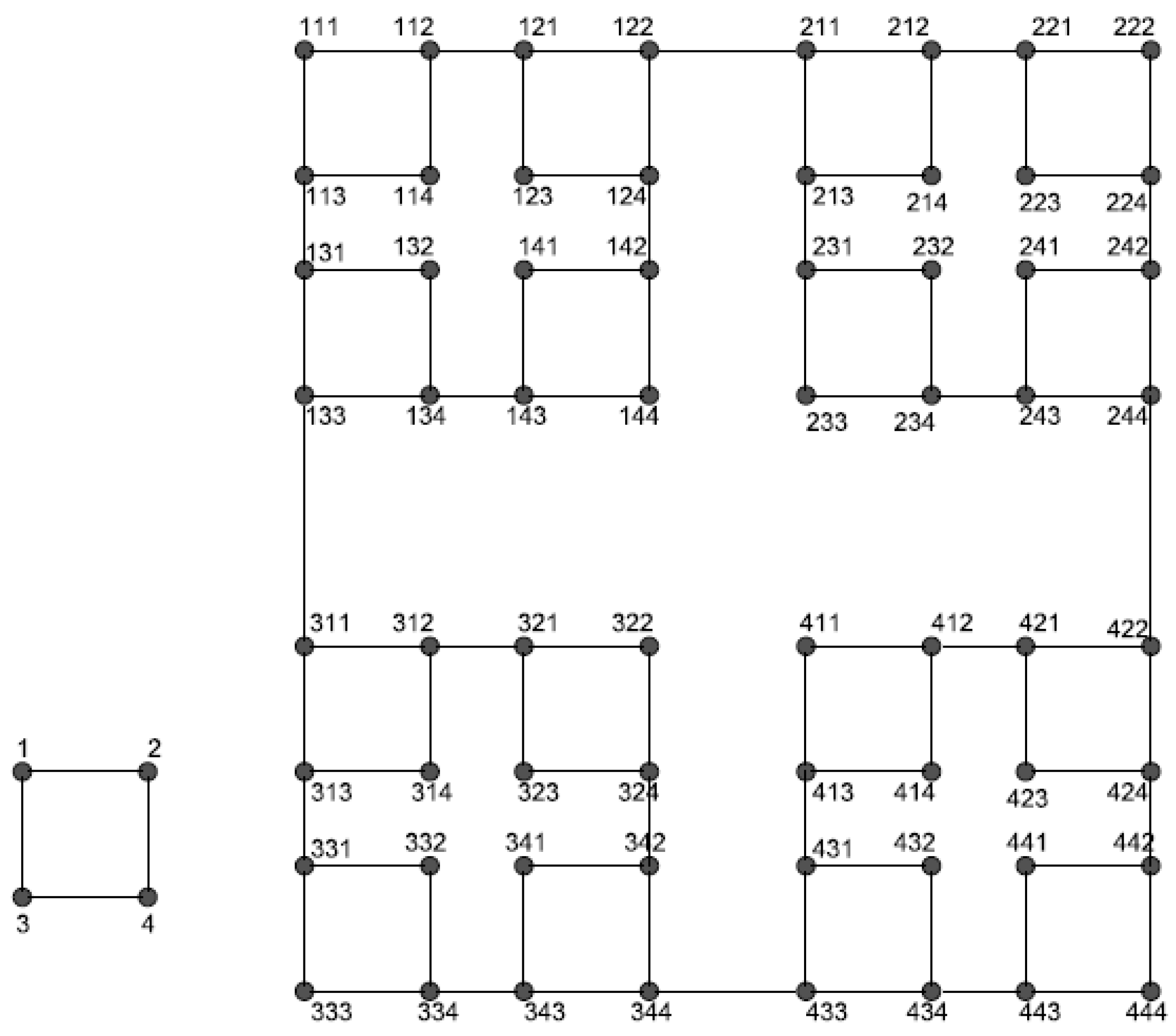
From the above, we note that if , then there is and a word satisfying and . A node of the representation is said to be an extreme node. For H and an integer , has n extreme nodes. Further, we have , and . Figure 1 and Figure 2 give and , respectively.
Figure 1.
Generalized Sierpiński Graphs and .
Figure 2.
Generalized Sierpiński Graphs and .
From the construction, we have and , where represents the degree of x in H. We follow the notations and terminologies of [26]. Let be the number of copies of the edge whose endpoints have degrees and in . For , the number of s in H with nodes x and y is denoted by , and is the number of s in H. For an arbitrary , we see that , and . For H, we use the identity and denote it as .
In [27], the authors used the concept of topological indices to describe the structure of polymers with optimal levels of macroscopic properties. Javed et al. [25] gave bounds on topological indices for generalized Sierpiński and extended Sierpiński graphs. In this article, we find the irregularity measures of a model of polymer networks based on . Moreover, we present upper/lower bounds on the general sum-connectivity and general Randić indices for of any graph H. Our results are very general, and the bounds are sharp for large class of graphs. This study answers several questions and fills the gaps in previously published articles.
2. Discussion and Main Results
In this section, we calculate the irregularity of the generalized Sierpiński graph for any arbitrary graph G. Some sharp bounds are also presented as corollaries of the main result. Moreover, we present the bounds on general connectivity indices, such as the general sum-connectivity and general Randić indices, for the generalized Sierpiński graphs.
First, we mention an important lemma which we use to prove the main results.
Lemma 1
([26]). For a graph H of order n and an integer , the following holds for an arbitrary edge of H.
- 1.
- .
- 2.
- .
- 3.
- .
- 4.
- .
The first result is about the Albertson irregularity of the generalized Sierpiński graph of any graph and presents an explicit formula for it.
Theorem 1.
Let H be a graph. Then, the Albertson irregularity of the generalized Sierpiński graph with dimension is
where
Proof.
Let H be a graph with n nodes. The Albertson irregularity for the generalized Sierpiński graph of H, is given as
From Lemma 1, we have
Now, for each edge of H, for , where . For , is either 0 or 1. So we have the following:
which is the required result. □
The importance of the above results lies in the closed formulae for the Albertson irregularity of the generalized Sierpiński graph of an arbitrary graph. The following are its consequences.
Corollary 1.
For a tree T, the generalized Sierpiński graph satisfies
The lower equality is achieved iff and the upper is achieved iff .
The following result tells us that the Albertson irregularity-2 of the generalized Sierpiński graph of H depends on the Alberston irregularity-2 and the first Zagreb index of H.
Theorem 2.
Let H be a graph and with be the generalized Sierpiński graph of H. Then, the Albertson-2 irregularity of is given as follows:
Proof.
Let H be a graph with n nodes. The Albertson irregularity-2 for the generalized Sierpiński graph of H, can be given as follows:
From Lemma 1, we have
□
Corollary 2.
Let T be any tree. Then, for a given generalized Sierpiński graph , we have
The lower bound achieves equality iff , and the upper inequality achieves equality iff .
Now, we will present some results related to the general connectivity indices.
Theorem 3.
Let H be a graph and be the generalized Sierpiński graph of H with . Then, for , we have
where is a graph obtained from H by adding one extra weight on each node of H, i.e., for every , we have .
Proof.
Let be a generalized Sierpiński graph of a graph H with order n. The general sum-connectivity index for is given as
From Lemma 1, we have
Now, for the lower bound, we have
which is the required result. □
For , the inequalities in the above result become reverse. For , we have the following corollaries.
Corollary 3.
Let H be a graph and be the generalized Sierpiński graph of H with . Then, for the first Zagreb index, we have
With the bound for the first Zagreb index for the trees, unicyclic graphs and bicyclic graphs for Zagreb indices of [6], we have the following consequence from Theorem 3.
Corollary 4.
Let T, U and B be a tree, a unicyclic and a bicyclic graph. Then, for , we have
Corollary 5.
Let H be a graph and be the generalized Sierpiński graph of H with . Then, for the first hyper Zagreb index, we have
With the help of the results from [11] (see Theorems 6, 7 and 8), and Theorem 3, we have the following result.
Corollary 6.
Let and B be a tree, a unicyclic and a bicyclic graph, respectively, with n and . Then,
For , we have the following results.
Corollary 7.
Let H be a graph and be the generalized Sierpiński graph of H with . Then, for the sum-connectivity index, we have
Using the extremal values for the general sum-connectivity and harmonic indices of the unicylic graph and bicyclic graphs from [10,28], the following result follows from the above corollary.
Corollary 8.
Let T be a tree, U be a unicyclic and B be a bicyclic graph of order n. Then,
In the following result, we present the lower/upper bounds on the general Randić index for .
Theorem 4.
Let H be a graph and be the generalized Sierpiński graph of H for . Then, for , the general Randić index has the following bounds:
where is a graph which is obtained from H by adding one extra weight on each node of H, i.e., for every , we have .
Proof.
Let be the generalized Sierpiński graph of a graph H with order n. The general Randić index of can be written as
From Lemma 1, we have
Now, for the lower bound,
From Lemma 1, we have
which is the required result. □
The inequalities in the above result flip for .
The following results hold for .
Corollary 9.
Let be the generalized Sierpiński graph of H with . Then, the bounds of the reciprocal Randić index are as follows:
Corollary 10.
Let be the generalized Sierpiński graph of H with . Then, the second Zagreb index has the following bounds:
For , we have the following:
Corollary 11.
Let be the generalized Sierpiński graph of H with . Then, the Randić index has the following bounds:
With values for the smallest general Randić index for trees from [29], the above corollary implies the following consequence.
Corollary 12.
Let be the generalized Sierpiński graph of T with . The Randić index has the bounds
Finally for the general Randić index and from [30], we have the following immediate consequence of the above result.
Corollary 13.
Let U be a unicyclic graph and be the generalized Sierpiński graph of U for . Then, we have
Author Contributions
Conceptualization, A.A. and M.I.; methodology, A.A. and M.I.; software, M.I.; validation, A.A. and M.I.; formal analysis, A.A. and M.I.; investigation, A.A. and M.I.; resources, A.A. and M.I.; data curation, A.A. and M.I.; writing—original draft preparation, A.A. and M.I.; writing—review and editing, A.A. and M.I.; visualization, M.I.; supervision, M.I.; project administration, A.A. and M.I. All authors have read and agreed to the published version of the manuscript.
Funding
This research received no external funding.
Data Availability Statement
The original contributions presented in the study are included in the article, further inquiries can be directed to the corresponding author.
Conflicts of Interest
The authors declare no conflicts of interest.
References
- Bondy, A.; Murty, U.S.R. Graph Theory; Springer: Berlin/Heidelberg, Germany, 2011. [Google Scholar]
- Bollobàs, B.; Erdös, P. Graphs of extremal weights. Ars Comb. 1998, 50, 225–233. [Google Scholar] [CrossRef]
- Altassan, A.; Imran, M.; Rather, B.A. On ABC energy and its application to anticancer drugs. Aims Math. 2023, 8, 21668–21682. [Google Scholar] [CrossRef]
- Altassan, A.; Rather, B.A.; Imran, M. Inverse sum indeg index (energy) with application as anticancer drugs. Mathematics 2022, 10, 4749. [Google Scholar] [CrossRef]
- Borovićanin, B.; Das, K.C.; Furtula, B.; Gutman, I. Bounds for Zagreb indices. MATCH Commun. Math. Comput. Chem. 2017, 78, 17–100. [Google Scholar]
- Deng, H. A unified approach to the extremal Zagreb indices for trees unicyclic graphs and bicyclic graphs. MATCH Commun. Math. Comput. Chem. 2007, 57, 597–616. [Google Scholar]
- Li, X.; Shi, Y. A survey on the Randić index. MATCH Commun. Math. Comput. Chem. 2008, 59, 127–156. [Google Scholar]
- Gutman, I.; Furtula, B.; Elphick, C. Three new/old node-degree-based topological indices. MATCH Commun. Math. Comput. Chem. 2014, 72, 617–632. [Google Scholar]
- Zhou, B.; Trinajstić, N. On a novel connectivity index. J. Math. Chem. 2009, 46, 1252–1270. [Google Scholar] [CrossRef]
- Du, Z.; Zhou, B.; Trinajstić, N. Minimum general sum-connectivity index of unicyclic graphs. J. Math. Chem. 2010, 48, 697–703. [Google Scholar] [CrossRef]
- Gao, W.; Jamil, M.K.; Javed, A.; Farahani, M.R.; Wang, S.; Liu, J.B. Sharp bounds of the hyper-Zagreb index on acyclic, unicyclic and bicyclic graphs. Discret. Dyn. Nat. Soc. 2017, 2017, 6079450. [Google Scholar] [CrossRef]
- Jamil, M.K.; Tomescu, I. General sum-connectivity index of trees and unicyclic graphs with fixed maximum degree. Proc. Rom. Acad. Ser. A Rom. Acad. 2019, 20, 11–17. [Google Scholar]
- Wang, S.; Gao, W.; Jamil, M.K.; Farahani, M.R.; Liu, J.B. Bounds of Zagreb indices and hyper Zagreb indices. Math. Rep. 2019, 21, 93–102. [Google Scholar]
- Criado, R.; Flores, J.; del Amo, A.G.; Romance, M. Centralities of a network and its line graph: An analytical comparison by means of their irregularity. Int. J. Comput. Math. 2014, 91, 304–314. [Google Scholar] [CrossRef]
- Albertson, M.; Berman, D. Ramsey graphs without repeated degrees. Congr. Numer. 1991, 83, 91–96. [Google Scholar]
- Furtula, B.; Gutman, I. A forgotten topological index. J. Math. Chem. 2015, 53, 1184–1190. [Google Scholar] [CrossRef]
- Fath–Tabar, G.H.; Gutman, I.; Nasiri, R. Extremely irregular trees. Bull. Acad. Serbe Sci. Arts Cl. Sci. Math. Natur. 2013, 145, 1–8. [Google Scholar]
- Fath–Tabar, G. Old and new Zagreb indices of graphs. MATCH Commun. Math. Comput. Chem. 2011, 65, 79–84. [Google Scholar]
- Furtula, B.; Gutman, I.; Dehmer, M. On structure–sensitivity of degree–based topological indices. Appl. Math. Comput. 2013, 219, 8973–8978. [Google Scholar] [CrossRef]
- Réti, T.; Sharafdini, R.; Kiss, A.D.; Haghbin, H. Graph irregularity indices used as molecular descriptor in QSPR studies. MATCH Commun. Math. Comput. Chem. 2018, 79, 509–524. [Google Scholar]
- Pirzada, S.; Rather, B.A.; Aouchiche, M. On eigenvalues and energy of geometric-arithmetic matrix of graphs. Mediterr. J. Math. 2022, 19, 115. [Google Scholar] [CrossRef]
- Gutman, I. Irregularity of molecular graphs. Kragujev. J. Sci. 2016, 18, 71–81. [Google Scholar] [CrossRef]
- Klavžar, S.; Milutinović, U. Graphs S(n,l) and a variant of the Tower of Hanoi problem. Czechoslov. Math. J. 1997, 47, 95–104. [Google Scholar] [CrossRef]
- Gravier, S.; Kovše, M.; Parreau, A. Generalized Sierpiński graphs. In EuroComb 2011 (Poster); Rényi Institute: Budapest, Hungary, 2011. [Google Scholar]
- Javaid, I.; Benish, H.; Imran, M.; Khan, A.; Ullah, Z. On some bounds of the topological indices of generalized Sierpiński and extended Sierpiński graphs. J. Inequalities Appl. 2019, 37. [Google Scholar] [CrossRef]
- Estrada-Moreno, A.; Rodríguez-Velázques, J.A. On the general Randić index of polymeric networks modelled by generalized Sierpiński graphs. Discret. Appl. Math. 2018, 263, 140–151. [Google Scholar] [CrossRef]
- Camarda, K.V.; Maranas, C.D. Optimization in polymer design using connectivity indices. Ind. Eng. Chem. Res. 1999, 38, 1884–1892. [Google Scholar] [CrossRef]
- Zhu, Y.; Chang, R.; Wei, X. The harmonic index of bicyclic graphs. Ars Combin. 2013, 110, 97–104. [Google Scholar]
- Bingjun, L.; Weijun, L. The smallest Randić index for trees. Proc. Indian Acad. Sci. Math. Sci. 2013, 123, 167–175. [Google Scholar] [CrossRef]
- Li, X.; Shi, Y.; Xu, T. Unicyclic graphs with maximum general Randić index for γ > 0. MATCH Commun. Math. Comput. Chem. 2006, 56, 557–570. [Google Scholar]
Disclaimer/Publisher’s Note: The statements, opinions and data contained in all publications are solely those of the individual author(s) and contributor(s) and not of MDPI and/or the editor(s). MDPI and/or the editor(s) disclaim responsibility for any injury to people or property resulting from any ideas, methods, instructions or products referred to in the content. |
© 2024 by the authors. Licensee MDPI, Basel, Switzerland. This article is an open access article distributed under the terms and conditions of the Creative Commons Attribution (CC BY) license (https://creativecommons.org/licenses/by/4.0/).