
On Implicit Coupled Hadamard Fractional Differential Equations with Generalized Hadamard Fractional Integro-Differential Boundary Conditions


Abstract
1. Introduction
2. Background Materials
3. Existence of Solutions
4. Stability
- (A1)
- ;
- (A2)
4.1. First Method
- [] Let functions be nondecreasing. Then, there are such that for every the following inequalities hold:
4.2. Second Method
- 1
- The and results for s of third-order nonlinear with conditions can be obtained if we set , and in Equation (1).
- 2
- The and results for s of third-order nonlinear with the initial conditions will be obtained if we set , and in Equation (1).
- 3
- The and results for s of third-order nonlinear with integro-differential BCs will be obtained if we set and in Equation (1).
5. Example
- (i)
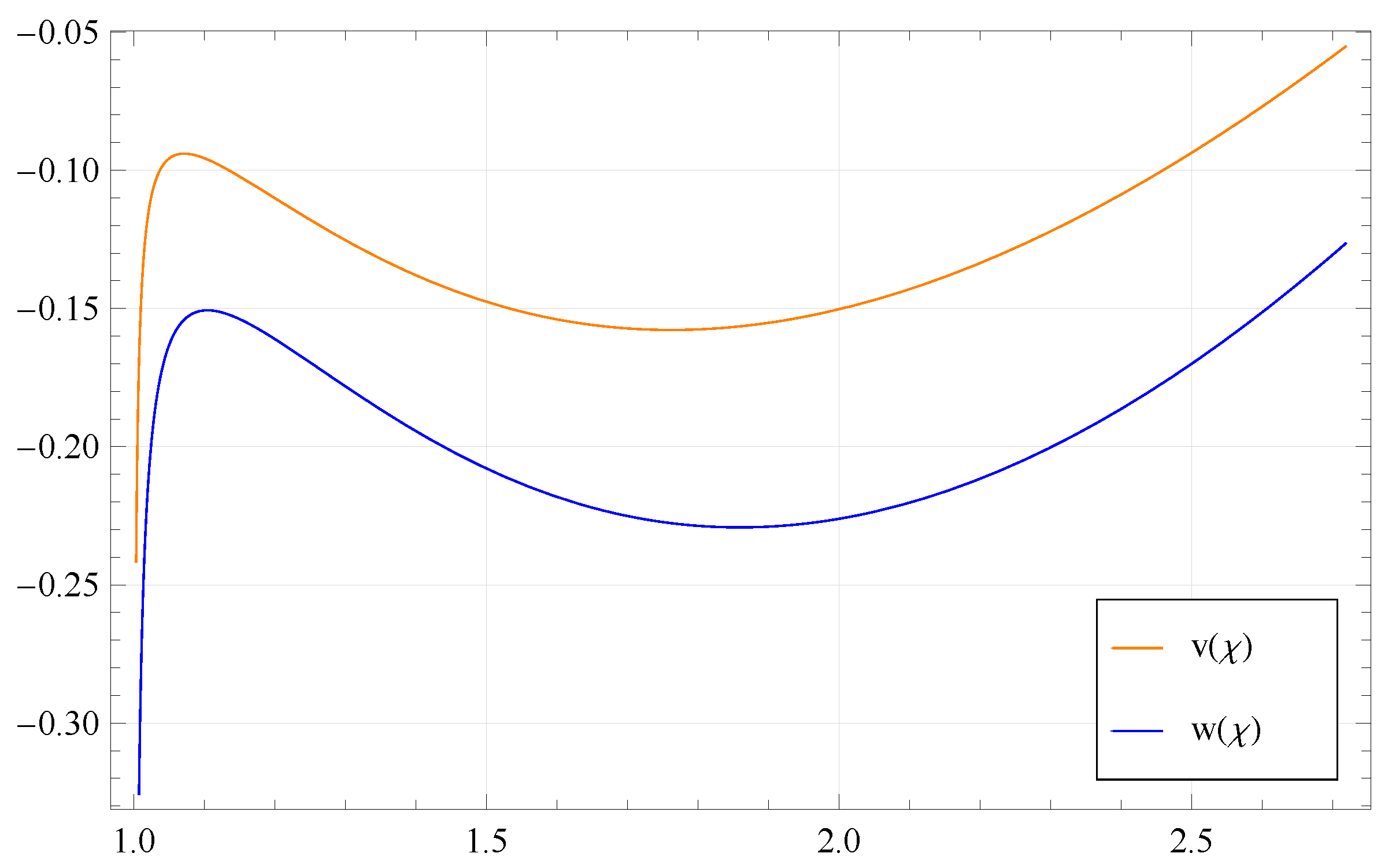
- If we take and , then with the values , and , the graph of the solution is shown in Figure 1.
- (ii)
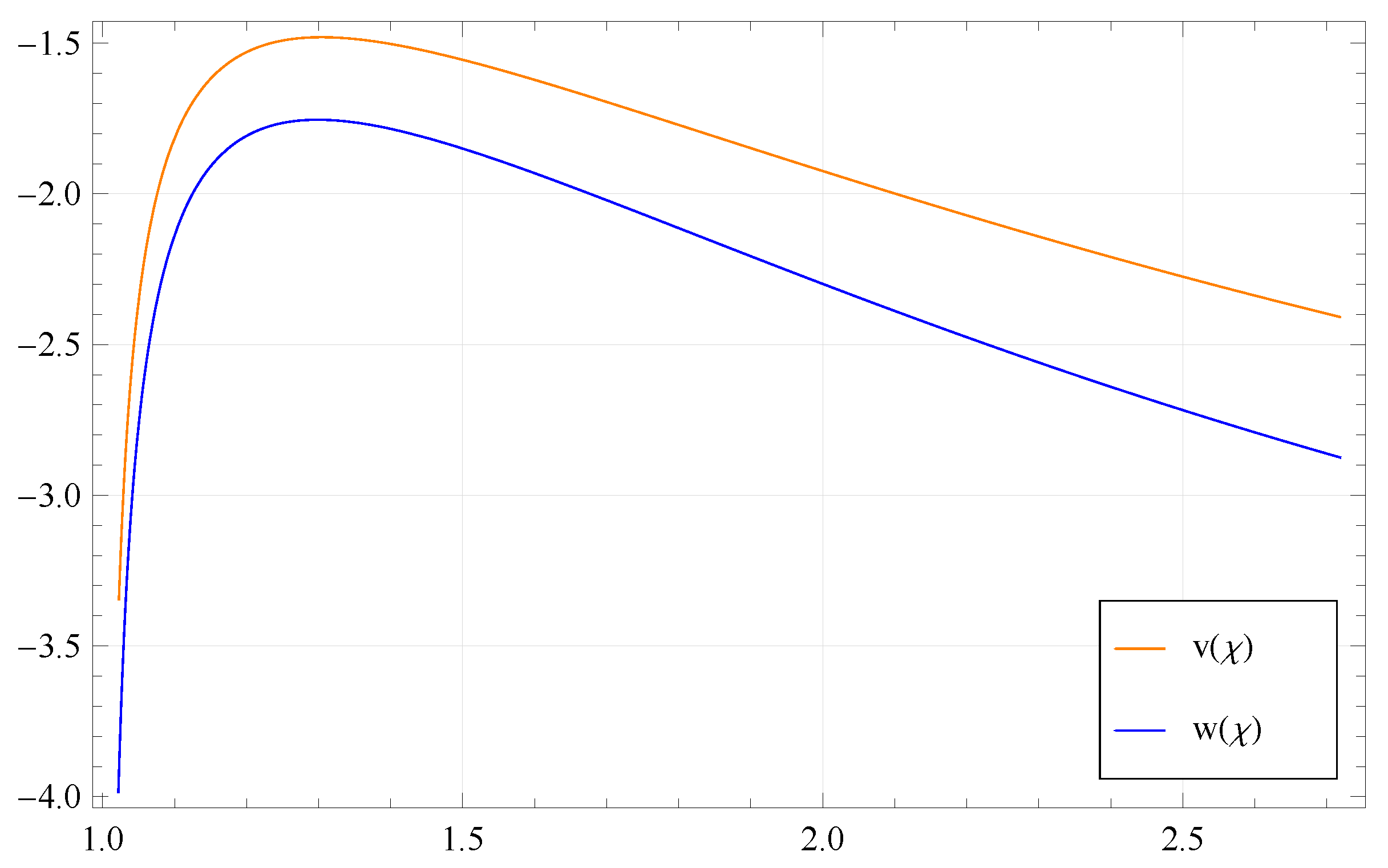
- If we take and , then with the values , and , the graph of the solution is shown in Figure 2.
- (iii)
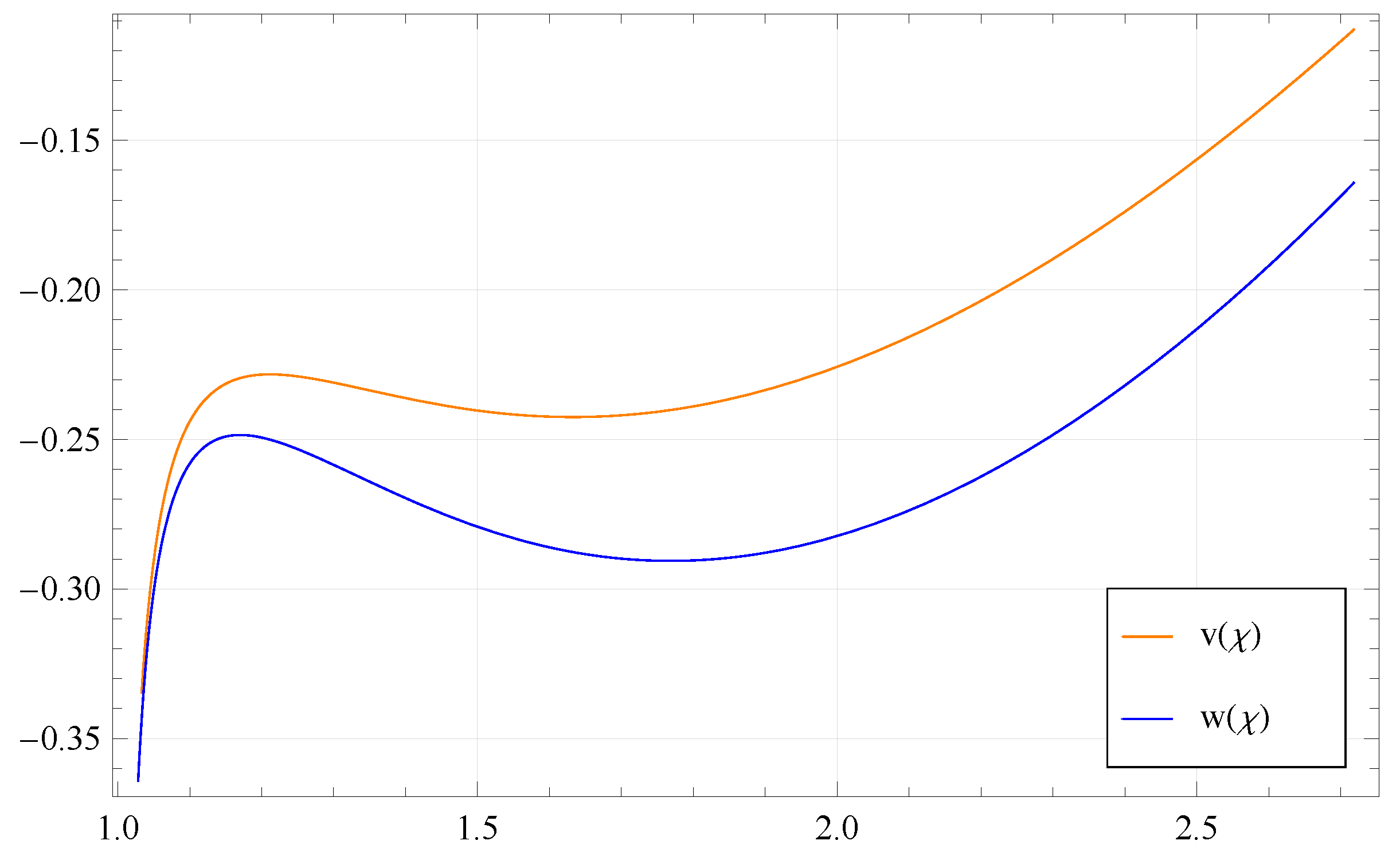
- If we take and , then with the values , and , the graph of the solution is shown in Figure 3.
- (iv)
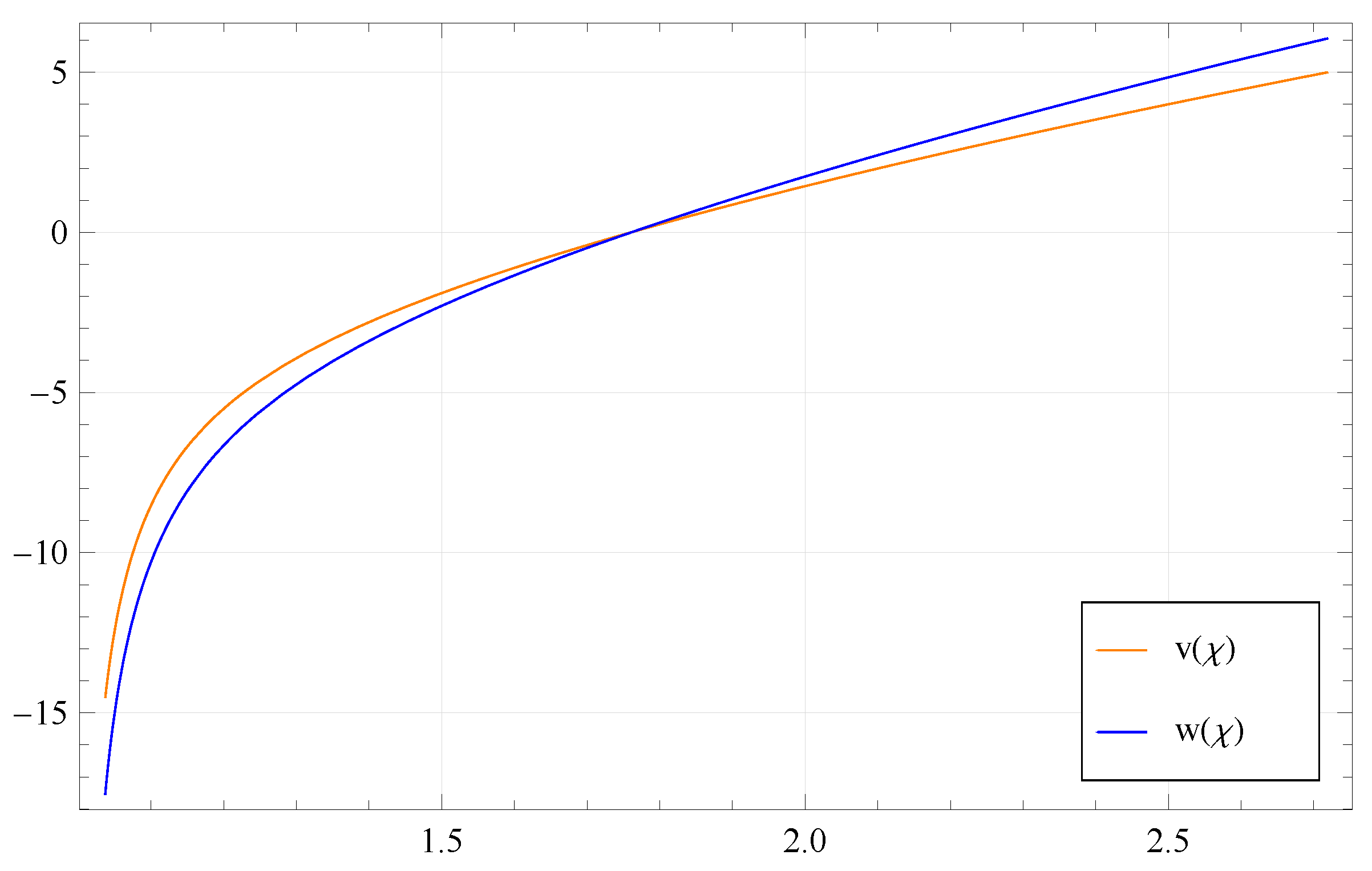
- If we take and , then with the values , and , the graph of the solution is shown in Figure 4.
6. Conclusions
- 1
- and , and then we gain third-order coupled with the initial conditions.
- 2
- and , and then we gain third-order coupled with BCs in the form of .
- 3
- , and then we gain third-order coupled with integro-differential BCs. Using MATLAB, we draw graphs for the particular variables and particular functions.
Author Contributions
Funding
Data Availability Statement
Conflicts of Interest
References
- Kilbas, A.A.; Srivastava, H.M.; Trujillo, J.J. Theory and Application of Fractional Differential Equation. In North-Holl and Mathematics Studies; Elsevier Science B.V.: Amsterdam, The Netherlands, 2006; Volume 204. [Google Scholar]
- Rihan, F.A. Numerical Modeling of Fractional Order Biological Systems. Abstr. Appl. Anal. 2013, 2013, 816803. [Google Scholar] [CrossRef]
- Sabatier, J.; Agrawal, O.P.; Machado, J.A.T. Advances in Fractional Calculus; Springer: Dordrecht, The Netherlands, 2007. [Google Scholar]
- Oldham, K.B. Fractional differential equations in electrochemistry. Adv. Eng. Softw. 2010, 41, 9–12. [Google Scholar] [CrossRef]
- Vintagre, B.M.; Podlybni, I.; Hernandez, A.; Feliu, V. Some approximations of fractional order operators used in control theory and applications. Fract. Calc. Appl. Anal. 2000, 3, 231–248. [Google Scholar]
- Tarasov, V.E. Fractional Dynamics: Application of Fractional Calculus to Dynamics of Particles, Fields and Media; Springer: Heidelberg, Germany; Higher Education Press: Beijing, China, 2010. [Google Scholar]
- Ahmad, B.; Nieto, J.J. Existence results for a coupled system of nonlinear fractional differential equations with three-point boundary conditions. Comput. Math. Appl. 2009, 58, 1838–1843. [Google Scholar] [CrossRef]
- Chen, Y.; An, H. Numerical solutions of coupled Burgers equations with time and space fractional derivatives. Appl. Math. Comput. 2008, 200, 87–95. [Google Scholar] [CrossRef]
- Deimling, K. Nonlinear Functional Analysis; Springer: New York, NY, USA, 1985. [Google Scholar]
- Riaz, U.; Zada, A.; Ali, Z.; Cui, Y.; Xu, J. Analysis of coupled systems of implicit impulsive fractional differential equations involving Hadamard derivatives. Adv. Differ. Equ. 2019, 2019, 226. [Google Scholar] [CrossRef]
- Agarwal, R.P.; Ahmad, B.; Alsaedi, A. Fractional-order differential equations with anti-periodic boundary conditions: A survey. Bound. Value Probl. 2017, 2017, 173. [Google Scholar] [CrossRef]
- Ahmad, B.; Ntouyas, S.K. Fractional differential inclusions with fractional separated boundary conditions. Fract. Calc. Appl. Anal. 2012, 15, 362–382. [Google Scholar] [CrossRef]
- Goodrich, C. Existence and uniqueness of solutions to a fractional difference equation with nonlocal conditions. Comput. Math. Appl. 2011, 61, 191–202. [Google Scholar] [CrossRef]
- Ulam, S.M. A Collection of the Mathematical Problems; Interscience: New York, NY, USA, 1960. [Google Scholar]
- Alam, M.; Shah, D. Hyers–Ulam stability of coupled implicit fractional integro-differential equations with Riemann–Liouville derivatives. Chaos Solitons Fract. 2021, 150, 111122. [Google Scholar] [CrossRef]
- Ali, A.H.; Páles, Z. Taylor-type expansions in terms of exponential polynomial. Math. Inequal. Appl. 2022, 25, 1123–1141. [Google Scholar] [CrossRef]
- Hyers, D.H. On the stability of the linear functional equation. Proc. Natl. Acad. Sci. USA 1941, 27, 222–224. [Google Scholar] [CrossRef]
- Alqifiary, Q.; Jung, S. Laplace transform and generalized Hyers–Ulam stability of linear differential equations. Electron. J. Differ. Equ. 2014, 2014, 1–11. [Google Scholar]
- Rezaei, H.; Jung, S.; Rassias, T. Laplace transform and Hyers-Ulam stability of linear differential equations. J. Math. Anal. Appl. 2013, 403, 244–251. [Google Scholar] [CrossRef]
- Wang, C.; Xu, T. Hyers–Ulam stability of fractional linear differential equations involving Caputo fractional derivatives. Appl. Math. 2015, 60, 383–393. [Google Scholar] [CrossRef]
- Liu, K.; Feçkan, M.; O’Regan, D.; Wang, J. Hyers–Ulam stability and existence of solutions for differential equations with Caputo–Fabrizio fractional derivative. Mathematics 2019, 7, 333. [Google Scholar] [CrossRef]
- Liu, K.; Wang, J.; Zhou, Y.; O’Regan, D. Hyers–Ulam stability and existence of solutions for fractional differential equations with Mittag–Leffler kernel. Chaos Soliton Fract. 2020, 132, 109534. [Google Scholar] [CrossRef]
- Luo, D.; Alam, M.; Zada, A.; Riaz, U.; Luo, Z. Existence and stability of implicit fractional differential equations with Stieltjes boundary conditions having Hadamard derivatives. Complexity 2021, 2021, 8824935. [Google Scholar] [CrossRef]
- Aftabizadeh, A.R.; Huang, Y.K.; Pavel, N.H. Nonlinear 3rd-order differential equations with anti-periodic boundary conditions some optimal control problems. J. Math. Anal. Appl. 1995, 192, 266–293. [Google Scholar] [CrossRef][Green Version]
- Gregus, M. Third Order Linear Differential Equations; Reidel: Dordrecht, The Netherlands, 1987. [Google Scholar]
- Gupta, C.P. On a 3rd-order three-point boundary value problem at resonance. Differ. Integral Equ. 1989, 2, 1–12. [Google Scholar]
- Silva, T.C.; Tenenblat, K. Third order differential equations describing pseudospherical surfaces. J. Differ. Equ. 2015, 259, 4897–4923. [Google Scholar] [CrossRef]
- Ezeilo, J.O.C. A property of the phase space trajectories of a third order nonlinear ordinary differential equation. J. Lond. Math. Soc. 1962, 37, 33–41. [Google Scholar] [CrossRef]
- Rauch, L.L. Oscillation of a third order nonlinear autonomous system. In Contributions to the Theory of Nonlinear Oscillations; Lefschetz, S., Ed.; Princeton University Press: Princeton, NJ, USA, 1950; Volume 1, pp. 39–88. [Google Scholar]
- Sherman, S. A third-order nonlinear system arising from a nuclear spin generator. Contrib. Diff. Equ. 1963, 2, 197–227. [Google Scholar]
- Agarwal, R.P.; Cabada, A.; Otero-Espinar, V.; Dontha, S. Existence and uniqueness of solutions for anti-periodic difference equations. Arch. Inequal. Appl. 2004, 2, 397–411. [Google Scholar]
- Ahmad, B.; Nieto, J.J. Existence and approximation of solutions for a class of nonlinear impulsive functional differential equations with anti-periodic boundary conditions. Nonlinear Anal. 2008, 69, 3291–3298. [Google Scholar] [CrossRef]
- Chen, H.L. Antiperiodic wavelets. J. Comput. Math. 1996, 14, 32–39. [Google Scholar]
- Shao, J. Anti-periodic solutions for shunting inhibitory cellular neural networks with timevarying delays. Phys. Lett. A 2008, 372, 5011–5016. [Google Scholar] [CrossRef]
- Shah, K.; Tunç, C. Existence theory and stability analysis to a system of boundary value problem. J. Taibah Univ. Sci. 2017, 11, 1330–1342. [Google Scholar] [CrossRef]
- Granas, A.; Dugundji, J. Fixed Point Theory; Springer: New York, NY, USA, 2005. [Google Scholar]
- Rus, I.A. Ulam stabilities of ordinary differential equations in a Banach space. Carpathian J. Math. 2010, 26, 103–107. [Google Scholar]

Disclaimer/Publisher’s Note: The statements, opinions and data contained in all publications are solely those of the individual author(s) and contributor(s) and not of MDPI and/or the editor(s). MDPI and/or the editor(s) disclaim responsibility for any injury to people or property resulting from any ideas, methods, instructions or products referred to in the content. |
© 2022 by the authors. Licensee MDPI, Basel, Switzerland. This article is an open access article distributed under the terms and conditions of the Creative Commons Attribution (CC BY) license (https://creativecommons.org/licenses/by/4.0/).
Share and Cite
Guo, L.; Riaz, U.; Zada, A.; Alam, M. On Implicit Coupled Hadamard Fractional Differential Equations with Generalized Hadamard Fractional Integro-Differential Boundary Conditions. Fractal Fract. 2023, 7, 13. https://doi.org/10.3390/fractalfract7010013
Guo L, Riaz U, Zada A, Alam M. On Implicit Coupled Hadamard Fractional Differential Equations with Generalized Hadamard Fractional Integro-Differential Boundary Conditions. Fractal and Fractional. 2023; 7(1):13. https://doi.org/10.3390/fractalfract7010013
Chicago/Turabian StyleGuo, Limin, Usman Riaz, Akbar Zada, and Mehboob Alam. 2023. "On Implicit Coupled Hadamard Fractional Differential Equations with Generalized Hadamard Fractional Integro-Differential Boundary Conditions" Fractal and Fractional 7, no. 1: 13. https://doi.org/10.3390/fractalfract7010013
APA StyleGuo, L., Riaz, U., Zada, A., & Alam, M. (2023). On Implicit Coupled Hadamard Fractional Differential Equations with Generalized Hadamard Fractional Integro-Differential Boundary Conditions. Fractal and Fractional, 7(1), 13. https://doi.org/10.3390/fractalfract7010013