


Abstract
This manuscript mainly focuses on the exact controllability of Sobolev-type Hilfer fractional neutral delay Volterra-Fredholm integro-differential systems. The principal findings of this discussion are established by using the theories on fractional calculus, the measure of noncompactness and Mönch fixed point technique. Initially, the exact controllability of the system is presented and then we improve the discussion to the system with nonlocal conditions. Finally, abstract and filter systems are provided for the illustration.
1. Introduction
In many physical processes, fractional differential equations incorporating not only one fractional derivative but also several fractional derivatives are heavily concentrated. The meaning of fractional systems has recently attracted a lot of attention due to its astonishing applications in showcasing the wonders of science and engineering. The use of fractional order differential equations allows for the management of a wide range of issues in a variety of fields, including fluid flow, electrical systems, visco-elasticity, electro-chemistry, and so on. The monographs [1,2,3,4,5,6,7,8,9] and the research articles [8,9,10,11,12,13] show the interlinking in the same way that the separation between classical and fractional differential representations seems to. Applications of the differential systems can be found in [14,15,16]. Neutral structures with delays or without delays, in particular, serve as a summary association of a large number of partial neutral structures that appear in problems involving heat flow in substances, visco-elasticity, and a variety of natural processes. Neutral systems appear in many areas of applied mathematics; as a result, the most successful neutral structures have gotten a lot of attention in the current generation; readers can look at [12,13,17,18,19,20,21].
Recently, in [22,23], the author initiated another kind of derivative of fractional order, that including Riemann-Liouville and Caputo fractional derivative. In [24], the authors proved the existence of mild solution for evolution equation with Hilfer fractional derivative which generalized the famous Riemann-Liouville fractional derivative by using the semigroup theory, measure of noncompactness and fixed point approach. In [25], the authors proved the approximate controllability of Hilfer fractional neutral stochastic integro-differential systems by using fractional calculus and Bohenblust-Karlin’s theorem. In [18,26,27], the authors proved the existence and controallbility of various extensions related with Hilfer fractional derivative by using semigroup theory, measure of noncompactness and various fixed point theorems.
In [28], the authors discussed the approximate controllability of non-densely defined Sobolev-type Hilfer fractional neutral delay differential system by using Bohenblust-Karlin’s fixed point theorem. In [29], the authors proved the existence of nonlocal functional integro-differential equations via Hilfer fractional derivative by using Mönch fixed point theorem. In [13], the authors discusssed the existence of Sobolev-type Hilfer fractional neutral integro-differential equations with infinite delay by uisng Mönch fixed point theorem. In [30], the authors proved the approximate controllability of Hilfer fractional differential inclusions with nonlocal conditions by using Bohenblust-Karlin’s fixed point theorem. The existence and exact controllability described in our paper have still to be investigated, and it is the motivation of this article.
Motivated by the monograph, nowadays, several authors focus on this Hilfer fractional derivative, and we refer to [13,18,22,24,25,26,27,29,30,31,32]. The potential of controllability is an important part of engineering and mathematical control theory. Finding a suitable control function to the point where one may guide the considered dynamic system to a final state is the controllability problem. As a result, many researchers have investigated the controllability of a variety of nonlinear systems in recent years, and the articles are available for viewing. For instance, refs. [12,13,18,19,30,32,33,34,35,36,37,38,39,40,41,42,43,44,45] and references therein.
Assume that the Hilfer fractional neutral delay Volterra-Fredholm integro-differential system of Sobolev-type has the following form
where stands for the Hilfer fractional derivative, and takes value in Banach Space X with . The histories , , with phase space . , , and are appropriate functions. is a control function and B is a bounded linear operator from →X.
The rest of the paper is organized as follows:
2. Preliminaries
We now provide some fundamental theories, lemmas, and facts to discuss our main results. - the spaces of all continuous functions. Let us take , then . Assume with by . Clearly, is a Banach space. Define H with if for any with . , , a closed linear operator on with inverse , see [46].
Definition 1
([46]).
- (i)
- , a Banach space with for
- (ii)
- , for
- (iii)
- , for and
- (iv)
- is bounded on X and there exists such that
Definition 2
([47]). The operators define and satisfy the following:
- (J1)
- A and J are closed linear operators.
- (J2)
- and J is bijective.
- (J3)
- is continuous.
Additionally, because of and is closed, by and by referring closed graph theorem, we obtain the boundedness of . Define and .
Definition 3
([4]). The left sided Riemann-Liouville fractional integral of order ζ having lower limit c for is presented as
if the right side is pointwise determined on , where denotes gamma function.
Definition 4
([4]). The left-sided Riemann-Liouville fractional derivative of order , for is given by
Definition 5
([4]). The left-sided Hilfer fractional derivative of order and function of is given by
Remark 1
([23]).
- (i)
- Given , also , the Hilfer fractional derivative identical with standard Riemann-Liouville fractional derivative:
- (ii)
- Given , also , the Hilfer fractional derivative identical with standard Caputo derivative:
We define the abstract phase space by referring [33]. Consider is continuous along with . Now for every ,we define
and
Now, we define
and
therefore is a Banach space.
Consider
Set be a seminorm in which is defined by
Lemma 1
([48]). If , then for . Furthermore,
where .
Lemma 2.
Remark 2.
Definition 6
Lemma 4
([20]). The operators and satisfies the following:
- (i)
- For , and are linear and bounded, that is, for every ,where ,
- (ii)
- The operators and are strongly continuous.
- (iii)
- For every , , we have
Lemma 5.
The operators and are strongly continuous, that is, ,
Definition 7
([49,50]). The Measure of noncompactness of Hausdorff determined on every bounded subset ϱ of X by can be covered by a finite number of balls of radii lesser than ϵ}.
Definition 8
([35]). Let be the positive cone of an order Banach space . The value E of is said to be measure of noncompactness on X of determined on the set of all bounded subsets of X if and only if for all bounded subsets , where is a closed convex hull of ϱ.
Definition 9
([49,51]). For every bounded subsets of X.
- (i)
- Monotone if and only if for all bounded subsets ϱ, , of X we get: ;
- (ii)
- Non singular if and only if for each , ;
- (iii)
- Regular if and only if if and only if ϱ is relatively compact in X;
- (iv)
- , where ;
- (v)
- ;
- (vi)
- , for all ;
- (vii)
- If is a Lipschitz continuous function with , then , for and Y is a Banach space.
Lemma 6
([49]). Assume that is bounded and equicontinuous, then is continuous for any
Theorem 1
([45,52]). Assume is a sequence of Bochner integrable functions from with , for all and every , where , then and satisfies .
Lemma 7
([53]). Assume F be closed convex subset of X and , is continuous and that satisfies Mönch’s condition, that is, is countable, is compact). Then K has a fixed point in F.
3. Existence
- (H0)
- If and , thenfor each fixed .
- (H1)
- The function is continuous and there exists such that , for every , , is strongly measurable, there exists , such that , satisfies the following
- (H2)
- The function satisfies the following:
- The function is measurable for all and is continuous for a.e. , , is strongly measurable.
- There exists and and the integrable function such that , for all , where satisfies .
- There exists and such that for any bounded subset and ,for a.e. , and is the Hausdorff MNC.
- (H3)
- The function satisfies the following:
- is measurable for all , is continuous for a.e. .
- There exists , for all , , .
- There exists and such that for any bounded subset ,with .
- (H4)
- The function satisfies the following:
- is measurable for all , is continuous for a.e. .
- There exists such that , for all , , .
- There exists and such that for any bounded subset ,with .
- (H5)
- The operator is bounded and is defined bywhich satisfies the following:
- (i)
- W have an inverse acquires the value in , there exists such that and .
- (ii)
- For and for every bounded subset , there exists such that . Here .
- (iii)
- For and such that for any , .
We present the following for our convenience:
Theorem 2.
Proof.
We now define the operator by
For , we present as follows:
then . Let . Clearly u satisfies (3), if and only if p satisfies and
where
Take . For every ,
Hence is a Banach space. For , fix , thus is uniformly bounded, and for , by referring Lemma 1, we have
Introduce by
Clearly, having a fixed point and which is similar to . To prove having a fixed point, we subdivide the whole proof as follows:
- Step 1:
- We state that there exists such that .
If it is not correct, then there exists and such that i.e., .
Fix , and assume Clearly, is a closed, bounded and convex set of C.
Now, we need to check there exists such that . If it fails, then . However, . Hence,
Using assumptions and and Lemma 4, we have
where
By referring the Hölder’s inequality and Lemma 4, we have
By referring the Hypotheses –, we get
and
Combining all the above results – we get
- Step 2:
- is continuous on .
For maps into itself. For any , with , we have and
Assume , then with in when . Define
where
By referring and Lebesgue’s dominated convergence theorem, we have
In view of ,
where
Therefore is continuous on .
- Step 3:
- For , assume , sends bounded sets into equicontinuous sets of C, for all , there exists such that when .
Assume and . Then is equicontinuous on I.
where
The right-hand side of to tends to ’0’ as . On implementing the absolute continuity of the Lebesgue integral dominance convergence theorem for inequality, we conclude that to gives ’0’ when Therefore, is equicontinuous on
- Step 4:
- Now, we need to prove that the Mönch’s condition holds.
Consider , for all and and is relatively compact.
Consider is countable and . We need to verify that , where is the Hausdorff measure of noncompactness. Consider . Presently we have to verify that is relatively compact in X, for all . By referring Theorem 1,
and
Now,
Now
By referring Lemma 5,
4. Nonlocal Conditions
Physical problems prompted the development of evolution equations with nonlocal conditions. In [54,55], the authors explored nonlocal issues for the first time in 1990, obtaining the existence and uniqueness of mild solutions for nonlocal differential equations of integer order. For more details on the systems with integer of fractional orders, one can refer [29,30,32,35,45,54,55]. Assume that nonlocal Hilfer fractional delay Volterra-Fredholm integro-differential system has the following form
where , and satisfies the following:
- (H6)
- is continuous, there exists such thatfor all and consider .
5. Examples
5.1. Abstract System
Assume that the Hilfer fractional differential system with control of the following form
where denotes the Hilfer fractional derivative of order and type , is continuous.
To transform the fractional system (11)–(14) to abstract form, assume and , be defined by , and where and is given by are absolutely continuous, . Then, A and J are presented as , , , where , are the orthonormal of vectors of A. Then, for , we have
and
A is defined by for , is not compact on X with , is the Hausdorff measure of noncompactness.
Here A is an infinitesimal generator of a semigroup in X and which is presented as , for , is not compact on X with . Furthermore, is equicontinuous ([45]), where and We assume and by
and
Let be given by For , W is given by
where
and for
where is determined on , i.e.,
5.2. Filter System
An advanced filter is a framework that performs mathematical operations on an inspected, digitized sign to decrease or upgrade certain highlights of the prepared signal. Propelled by the plans examined in [13,19,29,56,57], we presented a filter design for our framework which is shown in Figure 1. Figure 1 portrays the rough pattern of block diagram which helps to improve the viability of arrangement with least measure of sources of input and which is presented as follows.
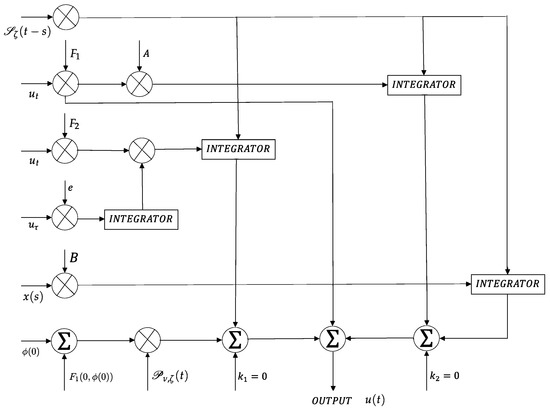
Figure 1.
Filter System.
Product modulator (PM)-1 receives inputs and generates the output as . PM-2 receives A and generates . PM-4 receives and f generates . PM-4 receives and produces . PM-5 receives and e generates . PM-6 receives , and generates
PM-7 receives and B generates . PM-8 receives and at time , generates . The integrators execute the integral of
over t.
Additionally, Inputs , are joined and multiplying with the output on the interval . , are joined and multiplying with the output on the interval . , are joined and multiplying with the output on the interval .
Finally, if we shift all the outputs from the integrators to summer network, then, the output of is achieved, which is bounded and controllable.
6. Conclusions
The exact controllability of Sobolev-type Hilfer fractional neutral integro-differential systems via measure of noncompactness is the topic of our article. The main conclusions of our paper are based on theoretical ideas such as fractional calculus, the measure of noncompactness, and the fixed-point approach. First, we looked at the exact controllability of mild solutions for fractional evolution systems. Then we expanded on our findings to consider the system in nonlocal conditions. Finally, we presented theoretical and practical applications to aid in the efficacy of the discussion.
Author Contributions
Conceptualization, V.V., K.S.N.; methodology, V.V., K.S.N.; software, V.V., S.F.A. and K.S.N.; formal analysis, V.V., S.F.A. and K.S.N.; investigation, V.V., S.F.A. and K.S.N.; resources, V.V., S.F.A. and K.S.N.; writing—original draft preparation, V.V., S.F.A. and K.S.N.; writing—review and editing, V.V., S.F.A. and K.S.N.; visualization, V.V., S.F.A. and K.S.N.; supervision, V.V., S.F.A. and K.S.N.; project administration, V.V., S.F.A. and K.S.N.; funding acquisition, V.V., S.F.A. and K.S.N. All authors have read and agreed to the published version of the manuscript.
Funding
This research received no external funding.
Institutional Review Board Statement
Not applicable.
Informed Consent Statement
Not applicable.
Data Availability Statement
Not applicable.
Conflicts of Interest
The authors declare no conflict of interest.
References
- Baleanu, D.; Diethelm, K.; Scalas, E.; Trujillo, J.J. Fractional Calculus Models and Numerical Methods; Series on Complexity, Nonlinearity and Chaos; World Scientific Publishing: Boston, MA, USA, 2012. [Google Scholar]
- Baleanu, D.; Machado, J.A.T.; Luo, A.C.J. Fractional Dynamics and Control; Springer: New York, NY, USA, 2012. [Google Scholar] [CrossRef]
- Baleanu, D.; Gunvenc, Z.B.; Tenreiro Machado, J.A. New Trends in Nanotechnology and Fractional Calculus Applications; Springer: Dordrecht, The Netherlands, 2010. [Google Scholar] [CrossRef]
- Kilbas, A.; Srivastava, H.; Trujillo, J.J. Theory and Applications of Fractional Differential Equations; Elsevier: Amesterdam, The Netherlands, 2006. [Google Scholar]
- Lakshmikantham, V.; Vatsala, A.S. Basic theory of fractional differential equations. Nonlinear Anal. 2008, 69, 2677–2682. [Google Scholar] [CrossRef]
- Lakshmikantham, V.; Leela, S.; Devi, J.V. Theory of Fractional Dynamic Systems; Cambridge Scientific Publishers: Cambridge, UK, 2009. [Google Scholar]
- Podlubny, I. Fractional Differential Equations, An Introduction to Fractional Derivatives, Fractional Differential Equations, to Method of Their Solution and Some of Their Applications; Academic Press: San Diego, CA, USA, 1999. [Google Scholar]
- Zhou, Y. Fractional Evolution Equations and Inclusions: Analysis and Control; Elsevier: New York, NY, USA, 2015. [Google Scholar]
- Zhou, Y. Basic Theory of Fractional Differential Equations; World Scientific: Singapore, 2014. [Google Scholar]
- Demir, D.D.; Bildik, N.; Sinir, B.G. Application of fractional calculus in the dynamics of beams. Bound. Value Probl. 2012, 135, 1687–2770. [Google Scholar]
- El-sayed, A.M.A. Fractional order diffusion wave equation. Int. J. Theor. Phys. 1966, 35, 311–322. [Google Scholar] [CrossRef]
- Vijayakumar, V. Approximate controllability results for abstract neutral integro-differential inclusions with infinite delay in Hilbert spaces. IMA J. Math. Control. Inf. 2018, 35, 297–314. [Google Scholar] [CrossRef]
- Vijayakumar, V.; Udhayakumar, R. A new exploration on existence of Sobolev-type Hilfer fractional neutral integro-differential equations with infinite delay. Numer. Methods Partial. Differ. Equ. 2021, 37, 750–766. [Google Scholar] [CrossRef]
- Craciun, E.M.; Sadowski, T.; Rabaea, A. Stress concentration in an anisotropic body with three equal collinear cracks in Mode II of fracture. I. Analytical study. Zamm-Z. Fur Angew. Math. Und Mech. 2014, 94, 721–729. [Google Scholar] [CrossRef]
- Othman, I.A.M.; Said, S.; Marin, M. A novel model of plane waves of two-temperature fiber-reinforced thermoelastic medium under the effect of gravity with three-phase-lag model. Int. J. Numer. Methods Heat Fluid Flow 2019, 29, 4788–4806. [Google Scholar] [CrossRef]
- Vlase, S.; Teodorescu, P.P.; Itu, C.; Scutaru, M.L. Elasto-dynamics of a solid with a general “rigid” motion using FEM model Part I, Theoretical approach. Rom. J. Phys. 2013, 58, 872–881. [Google Scholar]
- Agarwal, S.; Bahuguna, D. Existence of solutions to Sobolev-type partial neutral differential equations. J. Appl. Math. Stoch. Anal. 2006, 2006, 16308. [Google Scholar] [CrossRef]
- Kavitha, K.; Vijayakumar, V.; Udhayakumar, R.; Sakthivel, N.; Nisar, K.S. A note on approximate controllability of the Hilfer fractional neutral differential inclusions with infinite delay. Math. Methods Appl. Sci. 2021, 44, 4428–4447. [Google Scholar] [CrossRef]
- Ravichandran, C.; Valliammal, N.; Nieto, J.J. New results on exact controllability of a class of fractional neutral integro-differential systems with state-dependent delay in Banach spaces. J. Frankl. Inst. 2019, 356, 1535–1565. [Google Scholar] [CrossRef]
- Zhou, Y.; Jiao, F. Existence of mild solutions for fractional neutral evolution equations. Comput. Math. Appl. 2010, 59, 1063–1077. [Google Scholar] [CrossRef]
- Zhou, Y.; Jiao, F.; Li, J. Existence and uniqueness for fractional neutral differential equations with infinite delay. Nonlinear Anal. 2009, 71, 3249–3256. [Google Scholar] [CrossRef]
- Hilfer, R. Application of Fractional Calculus in Physics; World Scientific: Singapore, 2000. [Google Scholar]
- Hilfer, R. Experimental evidence for fractional time evolution in glass materials. Chem. Phys. 2002, 284, 399–408. [Google Scholar] [CrossRef]
- Gu, H.; Trujillo, J. Existence of mild solution for evolution equation with Hilfer fractional derivative. Appl. Math. Comput. 2015, 257, 344–354. [Google Scholar] [CrossRef]
- Dineshkumar, C.; Udhayakumar, R.; Vijayakumar, V.; Nisar, K.S. A discussion on the approximate controllability of Hilfer fractional neutral stochastic integro-differential systems. Chaos Solitons Fractals 2020. [Google Scholar] [CrossRef]
- Kavitha, K.; Vijayakumar, V.; Udhayakumar, R.; Nisar, K.S. Results on the existence of Hilfer fractional neutral evolution equations with infinite delay via measures of noncompactness. Math. Methods Appl. Sci. 2021, 44, 1438–1455. [Google Scholar] [CrossRef]
- Kavitha, K.; Vijayakumar, V.; Udhayakumar, R.; Ravichandran, C. Results on controllability of Hilfer fractional differential equations with infinite delay via measures of noncompactness. Asian J. Control 2021. [Google Scholar] [CrossRef]
- Nisar, K.S.; Vijayakumar, V. Results concerning to approximate controllability of non-densely defined Sobolev-type Hilfer fractional neutral delay differential system. Math. Methods Appl. Sci. 2021, 44, 13615–13632. [Google Scholar] [CrossRef]
- Subashini, R.; Jothimani, K.; Nisar, K.S.; Ravichandran, C. New results on nonlocal functional integro-differential equations via Hilfer fractional derivative. Alex. Eng. J. 2020, 59, 2891–2899. [Google Scholar] [CrossRef]
- Yang, M.; Wang, Q. Approximate controllability of Hilfer fractional differential inclusions with nonlocal conditions. Math. Methods Appl. Sci. 2017, 40, 1126–1138. [Google Scholar] [CrossRef]
- Dineshkumar, C.; Udhayakumar, R.; Vijayakumar, V.; Nisar, K.S.; Shukla, A. A note on the approximate controllability of Sobolev type fractional stochastic integro-differential delay inclusions with order 1 < r < 2. Math. Comput. Simul. 2021, 190, 1003–1026. [Google Scholar]
- Wang, J.R.; Zhang, Y.R. Nonlocal initial value problems for differential equation with Hilfer fractional derivative. Appl. Math. Comput. 2015, 266, 850–859. [Google Scholar] [CrossRef]
- Chang, Y.K.; Li, W.T. Controllability of Sobolev type semilinear functional differential and integrodifferential inclusions with an unbounded delay. Georgian Math. J. 2006, 13, 11–24. [Google Scholar] [CrossRef]
- Feckan, M.; Wang, J.; Zhou, Y. Controllability of fractional functional evolution equations of Sobolev type via characteristic solution operators. J. Optim. Theory Appl. 2013, 156, 79–95. [Google Scholar] [CrossRef]
- Ji, S.; Li, G.; Wang, M. Controllability of impulsive differential systems with nonlocal conditions. Appl. Math. Comput. 2011, 217, 6981–6989. [Google Scholar] [CrossRef]
- Raja, M.M.; Vijayakumar, V.; Udhayakumar, R.; Zhou, Y. A new approach on the approximate controllability of fractional differential evolution equations of order 1 < r < 2 in Hilbert spaces. Chaos Solitons Fractals 2020, 141, 110310. [Google Scholar]
- Mohan Raja, M.; Vijayakumar, V.; Udhayakumar, R. A new approach on approximate controllability of fractional evolution inclusions of order 1 < r < 2 with infinite delay. Chaos Solitons Fractals 2020, 141, 110343. [Google Scholar]
- Ravichandran, C.; Baleanu, D. Existence results for fractional neutral functional integro-differential evolution equations with infinite delay in Banach spaces. Adv. Differ. Equ. 2013, 2013, 215. [Google Scholar] [CrossRef][Green Version]
- Shukla, A.; Sukavanam, N.; Pandey, D.N. Approximate controllability of fractional semilinear control system of order α∈(1,2] in Hilbert spaces. Nonlinear Stud. 2015, 22, 131–138. [Google Scholar]
- Shukla, A.; Sukavanam, N.; Pandey, D.N. Approximate Controllability of semilinear fractional control systems of order α∈(1,2] with infinite delay. Mediterr. J. Math. 2016, 13, 2539–2550. [Google Scholar] [CrossRef]
- Shukla, A.; Sukavanam, N.; Pandey, D.N. Approximate controllability of fractional semilinear stochastic system of order α∈(1,2]. J. Dyn. Control. Syst. 2017, 23, 679–691. [Google Scholar] [CrossRef]
- Shukla, A.; Sukavanam, N.; Pandey, D.N. Approximate controllability of semilinear fractional stochastic control system. Asian-Eur. J. Math. 2018, 11, 1850088. [Google Scholar] [CrossRef]
- Vijayakumar, V.; Ravichandran, C.; Murugesu, R. Nonlocal controllability of mixed Volterra-Fredholm type fractional semilinear integro-differential inclusions in Banach spaces. Dyn. Contin. Discret. Impuls. Syst. Ser. Appl. Algorithms 2013, 20, 485–502. [Google Scholar]
- Wang, J.R.; Feckan, M.; Zhou, Y. Controllability of Sobolev type fractional evolution systems. Dyn. Partial. Differ. Equ. 2014, 11, 71–87. [Google Scholar] [CrossRef]
- Wang, J.R.; Fan, Z.; Zhou, Y. Nonlocal controllability of semilinear dynamic systems with fractional derivative in Banach spaces. J. Optim. Theory Appl. 2012, 154, 292–302. [Google Scholar] [CrossRef]
- Pazy, A. Semilgroups of Linear Operators and Applications to Partial Differential Equations; Springer: New York, NY, USA, 1983. [Google Scholar]
- Lightbourne, J.H.; Rankin, S. A partial functional differential equation of Sobolev type. J. Math. Anal. Appl. 1983, 93, 328–337. [Google Scholar] [CrossRef]
- Yan, B. Boundary value problems on the half-line with impulses and infinite delay. J. Math. Anal. Appl. 2001, 259, 94–114. [Google Scholar] [CrossRef]
- Banas, J.; Goebel, K. Measure of Noncompactness in Banach Spaces. In Lecture Notes in Pure and Applied Matyenath; Marcel Dekker: New York, NY, USA, 1980. [Google Scholar]
- Deimling, K. Multivalued Differential Equations; De Gruyter: Berlin, Germany, 1992. [Google Scholar]
- Kamenskii, M.; Obukhovskii, V.; Zecca, P. Condensing Multivalued Maps and Semilinear Differential Inclusions in Banach Spaces; De Gruyter: Berlin, Germany, 2001. [Google Scholar] [CrossRef]
- O’Regan, D.; Precup, R. Existence criteria for integral equations in Banach spaces. J. Inequalities Appl. 2001, 6, 77–97. [Google Scholar] [CrossRef]
- Monch, H. Boundary value problems for nonlinear ordinary differential equations of second order in Banach spaces. Nonlinear Anal. 1980, 4, 985–999. [Google Scholar] [CrossRef]
- Byszewski, L. Theorems about the existence and uniqueness of solutions of a semilinear evolution nonlocal Cauchy problem. J. Math. Anal. Appl. 1991, 162, 494–505. [Google Scholar] [CrossRef]
- Byszewski, L.; Akca, H. On a mild solution of a semilinear functional-differential evolution nonlocal problem. J. Appl. Math. Stoch. Anal. 1997, 10, 265–271. [Google Scholar] [CrossRef]
- Chandra, A.; Chattopadhyay, S. Design of hardware efficient FIR filter: A review of the state of the art approaches. Eng. Sci. Technol. Int. J. 2016, 19, 212–226. [Google Scholar] [CrossRef]
- Zahoor, S.; Naseem, S. Design and implementation of an efficient FIR digital filter. Cogent Eng. 2017, 4, 1323373. [Google Scholar] [CrossRef]
Publisher’s Note: MDPI stays neutral with regard to jurisdictional claims in published maps and institutional affiliations. |
© 2022 by the authors. Licensee MDPI, Basel, Switzerland. This article is an open access article distributed under the terms and conditions of the Creative Commons Attribution (CC BY) license (https://creativecommons.org/licenses/by/4.0/).