Article

A Fast Adaptive Method with a Sum-of-Exponentials Approximation for Fractional Derivative Diffusion Equation


1
The State Key Laboratory of Water Disaster Prevention, Hohai University, Nanjing 211100, China
2
College of Mechanics and Engineering Science, Hohai University, Nanjing 210098, China
3
Faculty of Mechanical Engineering and Mechanics, Ningbo University, Ningbo 315211, China
*
Authors to whom correspondence should be addressed.
Fractal Fract. 2026, 10(6), 419; https://doi.org/10.3390/fractalfract10060419 (registering DOI)
Submission received: 21 May 2026 / Revised: 14 June 2026 / Accepted: 15 June 2026 / Published: 18 June 2026

Abstract

The high numerical computing cost of time-fractional diffusion equation (tFDE) models over long time periods is a major obstacle to their real-world applications. Therefore, this study presents a rapid adaptive finite difference method, which uses the sum-of-exponentials (SOE) technique to quickly evaluate the kernel function and adopts the trial-and-error (T&E) method to select optimal time steps. For a uniform number of time steps NT with T >> 1, the cumulative computational cost of the approximate fractional derivative can be reduced from O( N T 2 ) for the T&E method to O(NT log NT). To evaluate the accuracy and computational efficiency of the proposed method, a comprehensive comparison is conducted based on three numerical examples. Numerical results show that the SOE-T&E technique provides more accurate results with fewer grid points, compared with uniform mesh method. Moreover, the SOE-T&E technique reduces the computation time by 88.98% compared to the T&E method for the same error level in our numerical examples.

1. Introduction

Anomalous diffusion in complex media often exhibits non-Fickian features, and the classical diffusion equation is insufficient for accurate modeling [1,2,3]. To address the limitation of classical Fickian diffusion equations, numerous researchers have turned to fractional partial differential equations. Zhou et al. applied fractional operators to characterize fluid transport in fracture-matrix structures [4]. Zhang et al. focused on finite difference methods for FDEs under non-uniform meshes [5]. Kumari et al. designed high-order discretization strategies for singular Caputo derivatives [6]. Anh and Yen explored parameter inversion problems of anomalous diffusion models with complex boundary conditions [7]. However, practical implementation of FDEs faces two fundamental challenges: (1) numerical instability arising from the weak singularity in fractional derivative operators at initial time [8], and (2) high numerical computing cost originating from non-locality of fractional derivatives under conventional approaches [9].
Adaptive algorithms can flexibly optimize grid distribution to balance numerical accuracy and computational cost. A variety of adaptive strategies, including adaptive finite element [10], adaptive time stepping [11], high-order adaptive difference methods [12], graded adaptive meshes [13] and space-time adaptive multigrid algorithms [14], have been developed for different types of fractional diffusion models. Finite difference methods are the most widely used solvers for time-fractional diffusion equations. Researchers have developed weighted average schemes [15], compact difference formats [16], scale-dependent FDM [17], ADI difference methods [18,19] to improve discretization accuracy, stability and computational efficiency. As the most common method, L1 formula has been widely used in fPDE [20]. Graded temporal meshes effectively improve the stability of fractional equation solvers. The scale-dependent finite difference method [17], discrete Grönwall inequality theory [21], two-level linearized algorithms [22] and scale-dependent hybrid schemes have been successively proposed to optimize the performance of non-uniform mesh-based numerical methods [23]. The step-doubling method is a commonly employed technique within the realm of adaptive methods [24,25]. Yuste [9] evaluated the Trial and Error (T&E) method—which requires fewer parameters and does not need additional predictive parameters—against predictive step-doubling algorithms, while Jannelli has demonstrated effective step selection for high-precision fPDE solutions [26,27]. However, these adaptive methods continue to face the challenge of rising computational costs with an increase in the number of iterations.
Some alternative methods which use the sum-of-exponentials (SOE) approximation technique to approximate the kernel function have also been applied to increase computational efficiency. Jiang [28] developed a fast algorithm using exponential approximation of the convolution kernel, and meanwhile Liao proposed a two-level linearization scheme with non-uniform time steps [22]. Nevertheless, these techniques are still limited by fixed-grid constraints and the resulting discrepancies in accuracy.
In this paper, we develop a SOE-T&E method by integrating adaptive methods with exponential approximation approaches to discretize the fractional order derivative in FDEs. The proposed method combines the advantages of the SOE method and the T&E method to quickly solve tFDEs with non-uniform time steps. This method avoids repeatedly using the solutions from previous time steps through a recursive approach.
The structure of the rest of the paper is organized as follows. The numerical scheme of the proposed method is introduced in Section 2. Then numerical results on different schemes are presented to show the advantages of SOE-T&E method in Section 3. Then, further comparison and discussion on presented method are provided to verify our statement in Section 4. At last, several conclusions are presented in Section 5.

2. Model and Algorithm

2.1. The Time Fractional Diffusion Equations

Time fractional order derivative diffusion equations (tFDEs) provide an effective mathematical framework for modeling sub-diffusion, where contaminant transport occurs significantly more slowly than predicted by classical Fick’s law. In this study, we focus on the tFDE which takes the following form
D α t 0 C u ( X , t ) = K ( u , X , t ) Δ u + f ( X , t )
where X = ( x , y , z ) R 3 , t > 0 , Δ is the Laplace operator and K denotes the diffusion coefficient, f(X, t) corresponds to the source term. D t α 0 C u ( t ) represents the Caputo fractional derivative
D t α 0 C u ( t ) = 1 Γ ( 1 - α ) 0 t u ( ξ ) ( t - ξ ) - α d ξ 0 < α < 1
The initial conditions and boundary conditions are
u ( X , 0 ) = g ( X ) X Ω u ( X , t ) = h ( X , t ) X Ω  

2.2. The Difference Scheme for the SOE-T&E Method

This study adopts the sum-of-exponentials (SOE) approximation to discretize the Caputo fractional derivative with a nonuniform mesh [28]. Here we provide its framework. Given two positive integers NT and NS, the temporal domain [0, T] is discretized into { t n } n = 0 N T , and τ n = t n t n 1 . We construct a uniform grid { x j } j = 0 N s with mesh points xj = jh, where h = L/NS is the spatial step size. The coordinates of node (j, n) in the mesh of the solution region are denoted as (xj, tn). We adopt uji to denote the numerical approximation to the exact solution u(xj, tn) at (xj, tn), while f jn = f (xj, tn) represents the discrete value of the source term.
This study uses the SOE approximation, to discretize the Caputo fractional derivative in the situation of nonuniform meshes [22] Given a prescribed absolute error tolerance and the total timel T, the approximation is performed over the interval [∆t, T]
1 t β l = 1 N E ω l e s l t ε   , t [ Δ t , T ] ,
where ωi and si are the weights and nodes of the Gauss-Legendre quadrature, and NE denotes
N E = O [ log 1 ε ( log log 1 ε + log T τ min ) + log 1 τ min ( log log 1 ε + log T τ min ) ] .
When T 1 , N E = O ( log N T ) ; when T 1 , N E = O ( log 2 N T ) , the exponential summation algorithm accelerates the computation of convolution integrals through standard recurrence relations. The required storage cost of this algorithm is O N E N S [23]. The computational complexity and storage cost of the L1 scheme are O ( N T 2 N S ) and O ( N T N S ) .
In this paper we divide the Caputo fractional derivative D t α 0 C u ( x j , t ) into history part and local component
1 Γ ( 1 α ) 0 t n u ( x j , ξ ) ( t n ξ ) α d ξ = 1 Γ ( 1 α ) ( 0 t n 1 u ( x j , ξ ) ( t n ξ ) α d ξ + t n 1 t n u ( x j , ξ ) ( t n ξ ) α d ξ )
For the history part (the first term on the right-hand side), we employ the sum-of-exponentials approximation [28].
0 t n 1 u ( x j , ξ ) ( t n ξ ) α d ξ = τ n α u ( x j , t n 1 ) u n α f ( 0 ) α 0 t n 1 u ( x j , ξ ) ( t n ξ ) 1 α d ξ = τ n α u ( x j , t n 1 ) t n α u ( x j , 0 ) α k = 1 n 1 t k 1 t k u ( t k 1 ) ( t k ξ ) + u ( t k ) ( ξ t k 1 ) τ k ( t n ξ ) 1 α d ξ + R 1 = τ n α u ( x j , t n 1 ) t n α u ( x j , 0 ) α k = 1 n 1 t k 1 t k u ( x j , t k 1 ) ( t k ξ ) + u ( x j , t k ) ( ξ t k 1 ) τ k i = 1 N E ω i e s i ( t n ξ ) d ξ + R 2 + R 1 = τ n α u ( x j , t n 1 ) t n α u ( x j , 0 ) α k = 1 n 1 i = 1 N E ω i e s i ( t n t k ) u ( x j , t k 1 ) [ 1 s i τ k e s i τ k e s i τ k ] + u ( x j , t k ) [ s i τ k 1 + e s i τ k ] s i 2 τ k + R 2 + R 1
Let u ( x j , ξ k ) = τ k 1 ( t k ξ k ) u j k 1 + ( ξ t k 1 ) u j k ,   t k 1 ξ k t k and
R 1 = α 2 k = 1 n 1 t k t k 1 u ( x j , ξ k ) ( t k ξ ) ( ξ t k 1 ) ( t n ξ ) 1 α d ξ ξ k ( t k 1 , t k ) ( a ) R 2 α k = 1 n 1 t k 1 t k u ( x j , ξ k ) ε   d ξ ξ k ( t k 1 , t k ) ( b )
And ε denotes the error bound of the sum-of-exponentials approximation in interval [ τ min , T ] [28]
ε t α 1 l = 1 N ϵ ω l e s l ,
The discretization error satisfies
R 1 α 2 max ( 0 t t n u ( x j , ξ ) ) k = 1 n 1 t k t k 1 ( t k ξ ) ( ξ t k 1 ) ( t n ξ ) 1 α d ξ ξ k ( t k 1 , t k )             max ( 0 t t n u ( x j , ξ ) ) τ max 2 α 8
R 2 α ε max 0 t t n 1 u ( t ) t n 1 ξ k ( t k 1 , t k )
For the local part (the second term on the right-hand side of (6)), using Taylor expansion, the error in the interval [tn−1, tn] can be estimated as
t n 1 t n u ( x j , ξ ) ( t n ξ ) α d ξ = t n 1 t n u ( x j , t n ) u ( x j , t n 1 ) τ n ( t n ξ ) α d ξ + R 3
where
  R 3 τ max 2 α 2 1 α max t n 1 t t n u ( x j , t )
Let ε τ max 2 α , then the convergence order of the proposed method is O( τ max 2 α ). Thus, the fractional derivative term can be approximated by
D t n + 1 α 0 C u n + 1 u i n + 1 u i n Γ ( 2 α ) τ n α + 1 Γ ( 1 α ) [ u i n τ n α u i 0 t n α α l = 1 N E ω l H l n + 1 ]
Here H l n + 1 is written as
H l n + 1 = 0 , n = 0 e s l τ n + 1 H i n + e s l τ n + 1 s l 2 τ n [ ( s l τ n + e s l τ n 1 ) H l n + ( 1 s l τ n e s l τ n e s l τ n ) H l n 1 ] , n 1
The second-order diffusion term in (1) can be approximated by the central difference scheme
2 u ( x i , t j + 1 ) x 2 δ x 2 u i j + 1 = u i + 1 j + 1 2 u i j + 1 + u i 1 j + 1 h 2 + O ( h 2 )
Substituting the SOE approximation (11) into the left-hand side of (1), and using the central difference scheme (13) for the spatial derivative, we obtain the following semi-discrete form at node ( x i , t n )
u i n + 1 u i n Γ ( 2 α ) τ n α + 1 Γ ( 1 α ) [ u i n τ n α u i 0 t n α α j = 1 N E ω j H j n + 1 ] = K h 2 ( u i + 1 n + 1 2 u i n + 1 + u i 1 n + 1 )
Rearranging terms yields the algebraic equation. The full difference scheme for (1) is obtained as
S n u i n + 1 Γ ( 2 α ) h 2 δ x 2 u i n + 1 = α S n u i n + Γ ( 2 α ) S n f i n + 1 + ( 1 α ) S n [ u i 0 t n + 1 α + H i n + 1 ]
where
S n = h 2 K τ n + 1 α ,         H h i s t n + 1 = α j = 1 N E ω j U h i s t , j ( t n + 1 ) .

2.3. The Step Chosen for the SOE-T&E Method

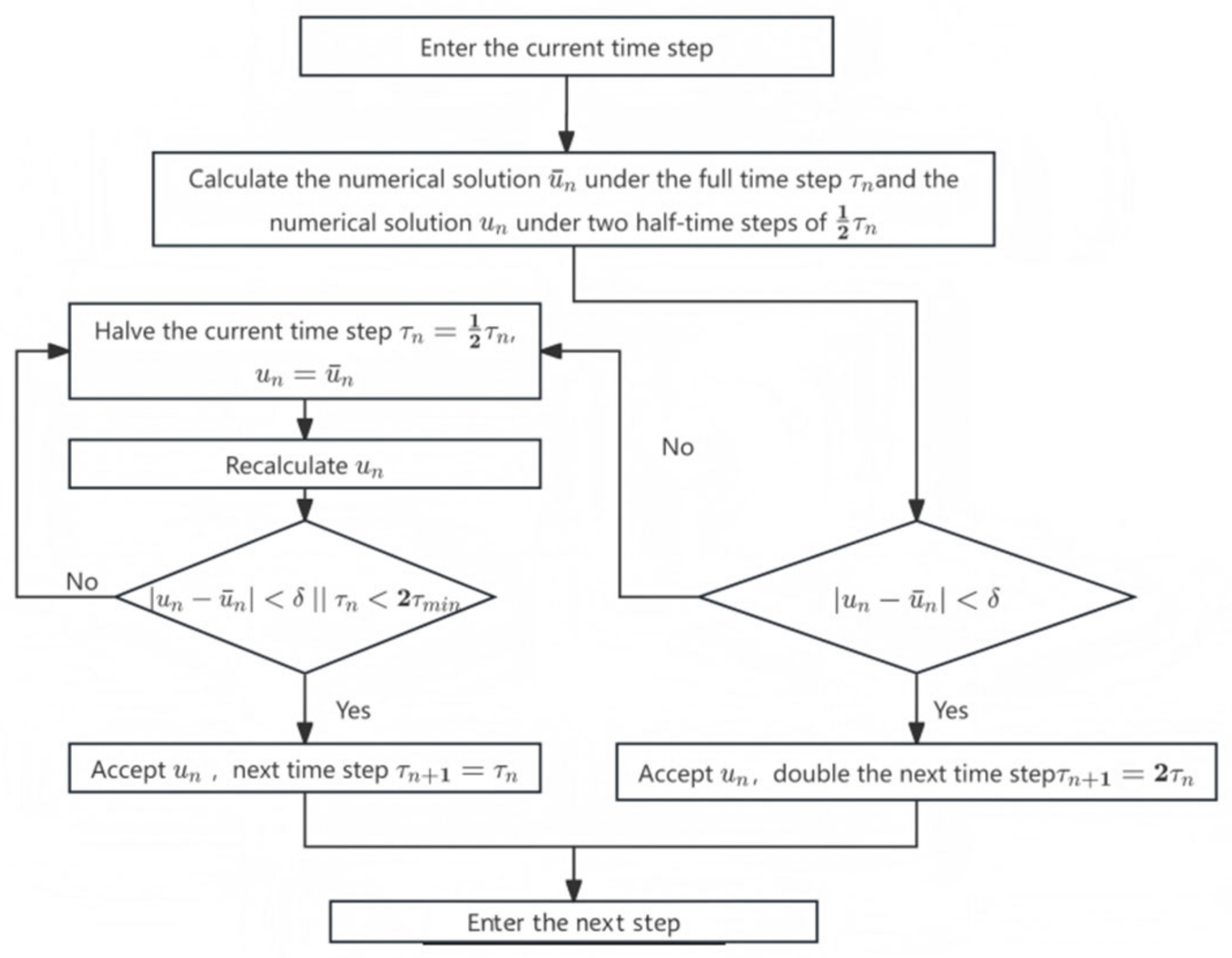
The trial and error (T&E) technique determines the step size through the following methodologies. The T&E algorithm achieves intelligent step-size selection by iteration: at time tn, the numerical solution is computed twice, once with the full step and once with half the step, utilizing the difference between them as the approximate absolute error against the tolerance δ. If the error exceeds δ, we halve the step and repeat until the error is within tolerance. If the initial error is within tolerance, double the next initial step; otherwise, keep it unaltered [9].
The step size selection procedure in this paper is illustrated in Figure 1 and Table 1. We incorporate the T&E technique while imposing a constraint on the minimum step length. Specifically, when the half-time step size reaches the predefined minimum τmin, we proceed with the computation using τmin for the subsequent step. In fact, since the discrepancy between the two solutions is less than the tolerance, the choice of solution does not exert a decisive influence on the computational results.

3. Numerical Experiments

In this section, we evaluate the capability of the SOE-T&E method in tackling fractional diffusion equations via three numerical tests. All numerical experiments are implemented in MATLAB R2021a with a laptop (Hasee God of War Z8D6 SF1QNLX506) with the following configuration: 12th Gen Intel(R) Core (TM) i7-12650H 2.30 GHz. In this paper, CPU time is the computational cost under the mentioned computer configuration.

3.1. One Dimensional Time Fractional Order Derivative Diffusion Equation

Here we consider the time fractional order derivative diffusion equation as follows
D t α 0 C u ( x , t ) = K 2 u ( x , t ) x 2 x ( 0 , L ) , t > 0 u ( x = 0 , t ) = u ( x = L , t ) = 0 u ( x , 0 ) = sin ( π x L )
The exact solution is expressed as
u ( x , t ) = E α ( K ( π L ) 2 t α ) sin ( π x L )
where E α ( z ) = k = 0 z k Γ ( α k + 1 ) is the Mittag-Leffler function, α = { 0.9 , 0.8 , 0.6 , 0.3 } , k = 0.005, T = 100, and L = K π .
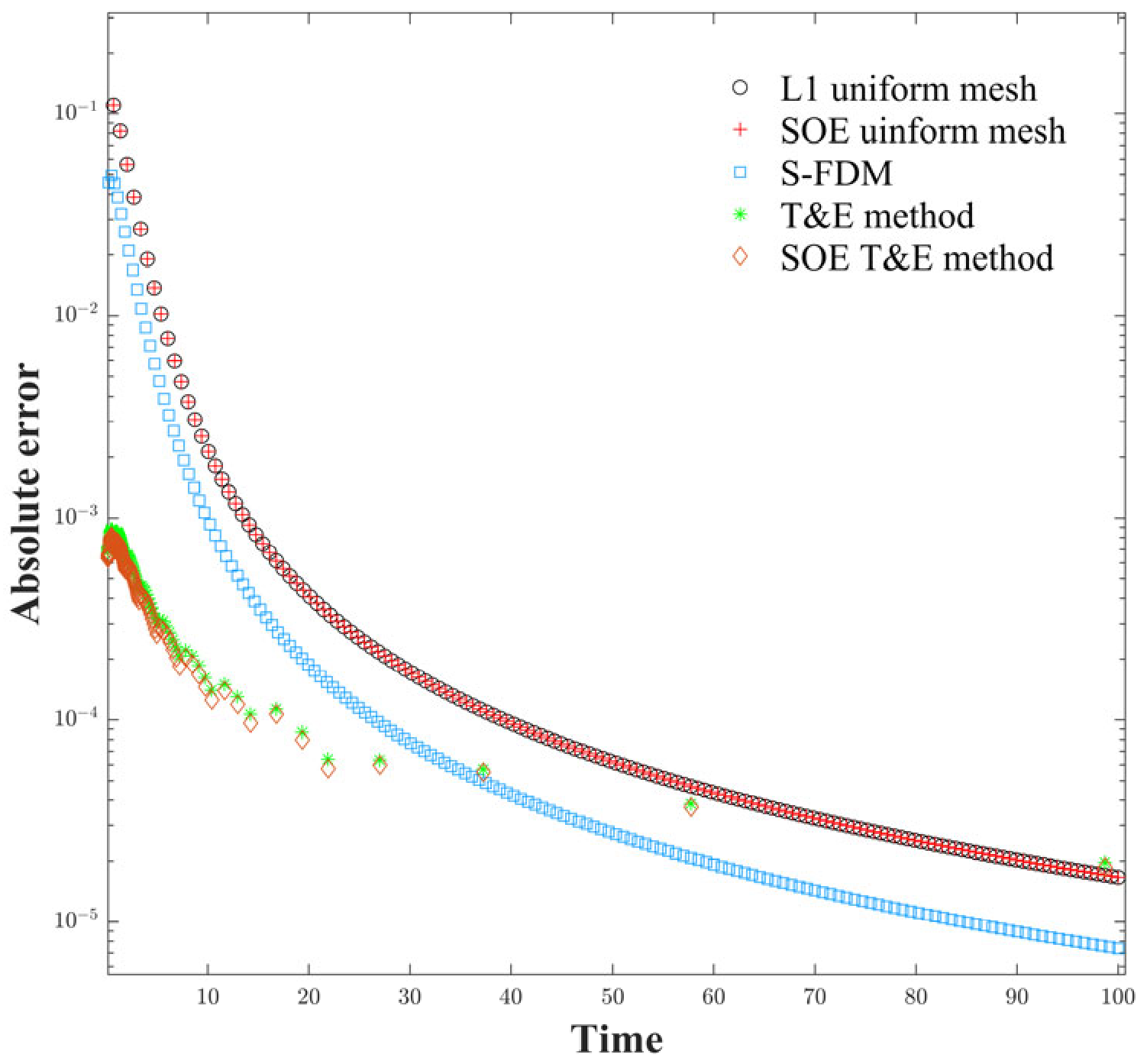
A comparison of the absolute error in a comparable number of time steps is provided in Figure 2 and Table 2. The numerical methods include the uniform mesh with L1 formula [20], the uniform mesh of the sum-of-exponentials approximation [28], the S-FDM [17], T&E method with a tolerance of δ = 10−4 [29], and SOE-T&E method with tolerance δ = 10−4, minimal time step τmin = 10−11, absolute error ε = δ/103. All of the fixed mesh methods take 150 time steps, with the length of the spatial mesh Δ x = π / 100 . In general, the results demonstrate that the uniform-grid approach produces larger errors than the other four methods. For example, for α = 0.8, the maximum absolute error (MAE) of S-FDM is 4.97 × 10⁻², while the T&E method and SOE-T&E method achieve MAEs of 8.82 × 10⁻⁴ and 8.11 × 10⁻⁴, respectively, demonstrating better performance in reducing initial errors. In contrast, the uniform mesh method yields inaccurate results at the initial stage, due to the singularity of fractional derivative. The adaptive methods, especially the SOE-T&E method, provide an error tolerance that is more than one order of magnitude better than that of the fixed-grid method. This demonstrates significant advantage in error control.
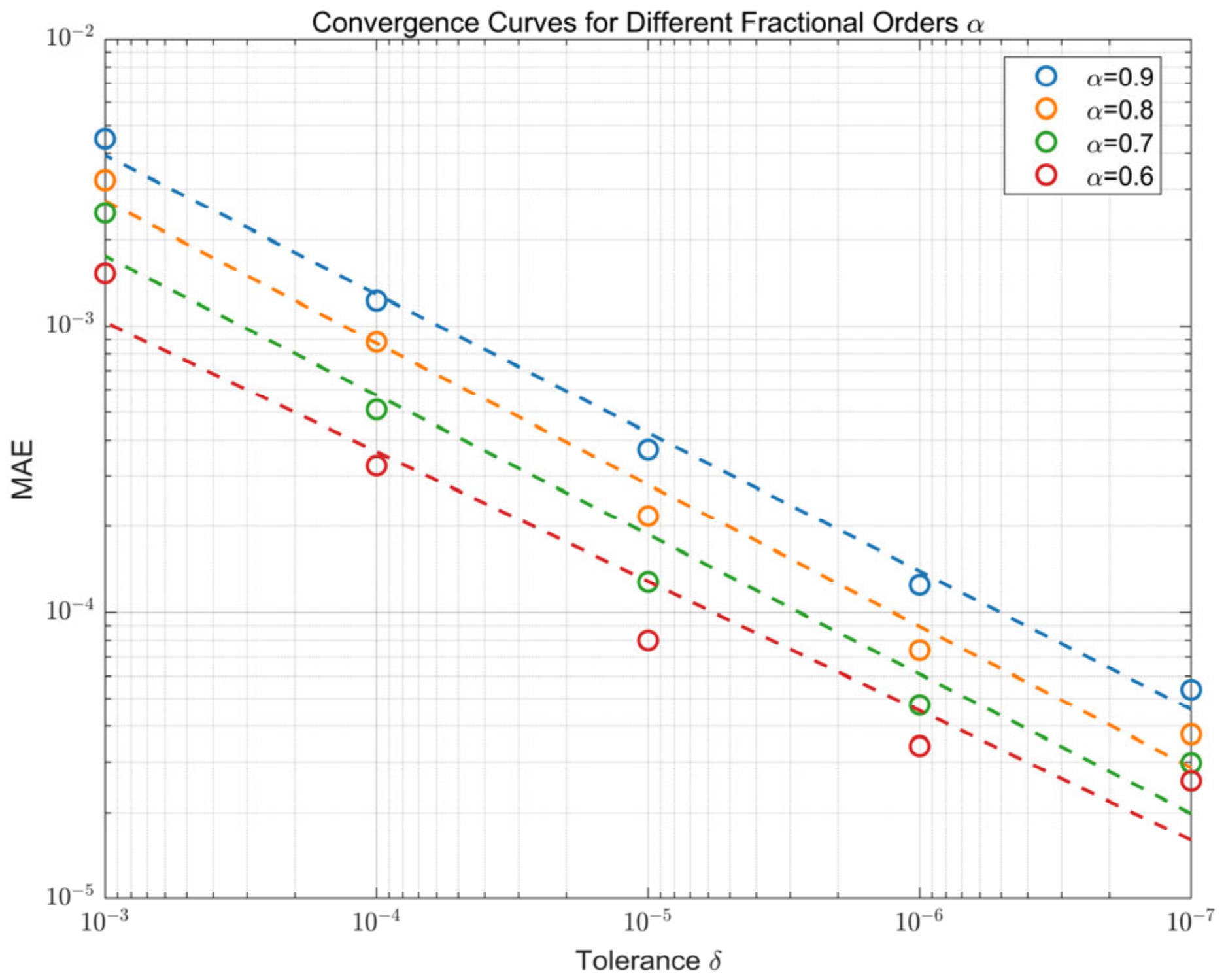
The convergence performance of the proposed numerical scheme under different fractional-order parameters is systematically investigated by varying the tolerance parameter δ . When α = { 0.9 , 0.8 , 0.6 , 0.3 } , the mean absolute errors (MAE) of scheme (20) under different tolerance values are listed in Table 3. The numerical error MAE decreases monotonically as δ reduces for all tested α values, and all estimated convergence orders remain positive, as the Figure 3 and Table 4 shown. In terms of global convergence characteristics, the overall convergence orders corresponding to different α values range approximately from 0.45 to 0.5, indicating a half-order convergence rate of O ( δ 0.5 ) .
In addition, the local convergence order exhibits a declining trend with the decrease of tolerance δ . In the relatively coarse tolerance range of δ [ 10 3 , 10 5 ] , the local convergence order remains between 0.4 and 0.7, as the Table 5 shown. However, when δ is smaller than 10 5 , the convergence speed degrades significantly. Specifically, the local convergence order drops to only 0.121 for the case of α = 0.6 in the finest tolerance interval.
Further parametric analysis demonstrates that the variation of α has a negligible influence on the global convergence order, with the overall fluctuation less than 0.05. Nevertheless, the deterioration of local convergence at small tolerances is highly sensitive to the fractional-order parameter. A smaller α leads to a more severe decay of the local convergence order under fine tolerance conditions. In the interval δ [ 10 6 , 10 7 ] , the convergence order for α = 0.6 is approximately one-third of that for α = 0.9 , as the Table 5 shown. This phenomenon can be explained by the stronger singularity of the solution associated with lower fractional derivative orders. The degradation of convergence speed under extremely small tolerances can be attributed to three main factors. First, floating-point round-off errors dominate the total numerical error when δ is extremely small, masking the inherent convergence trend of the numerical method. Second, typical numerical methods for fractional differential equations, such as the finite difference method, inherently produce lower theoretical convergence orders for singular solutions compared with smooth cases, and this limitation becomes more prominent under ultra-fine tolerance conditions. Third, regarding the iterative termination criterion, when the residual tolerance falls below a critical threshold, the effective iterative updates are submerged by round-off errors, resulting in stagnation of numerical convergence.

3.2. Time Fractional Order Derivative Diffusion Equation with Steep Source Terms

A fractional diffusion equation with a steep source term [9]
D t α 0 C u ( x , t ) = K 2 u ( x , t ) x 2 + f ( x , t ) x ( 0 , π ) , t > 0 u ( x , t ) = 0 x = 0 , x = π u ( x , 0 ) = sin x
where
f ( x , t ) = a [ 1 + Γ ( 1 + p ) t α Γ ( 1 + p α ) ]   t p sin x
The analytical solution of (22) is
u ( x , t ) = [ E α ( t α ) + a t p ] sin x
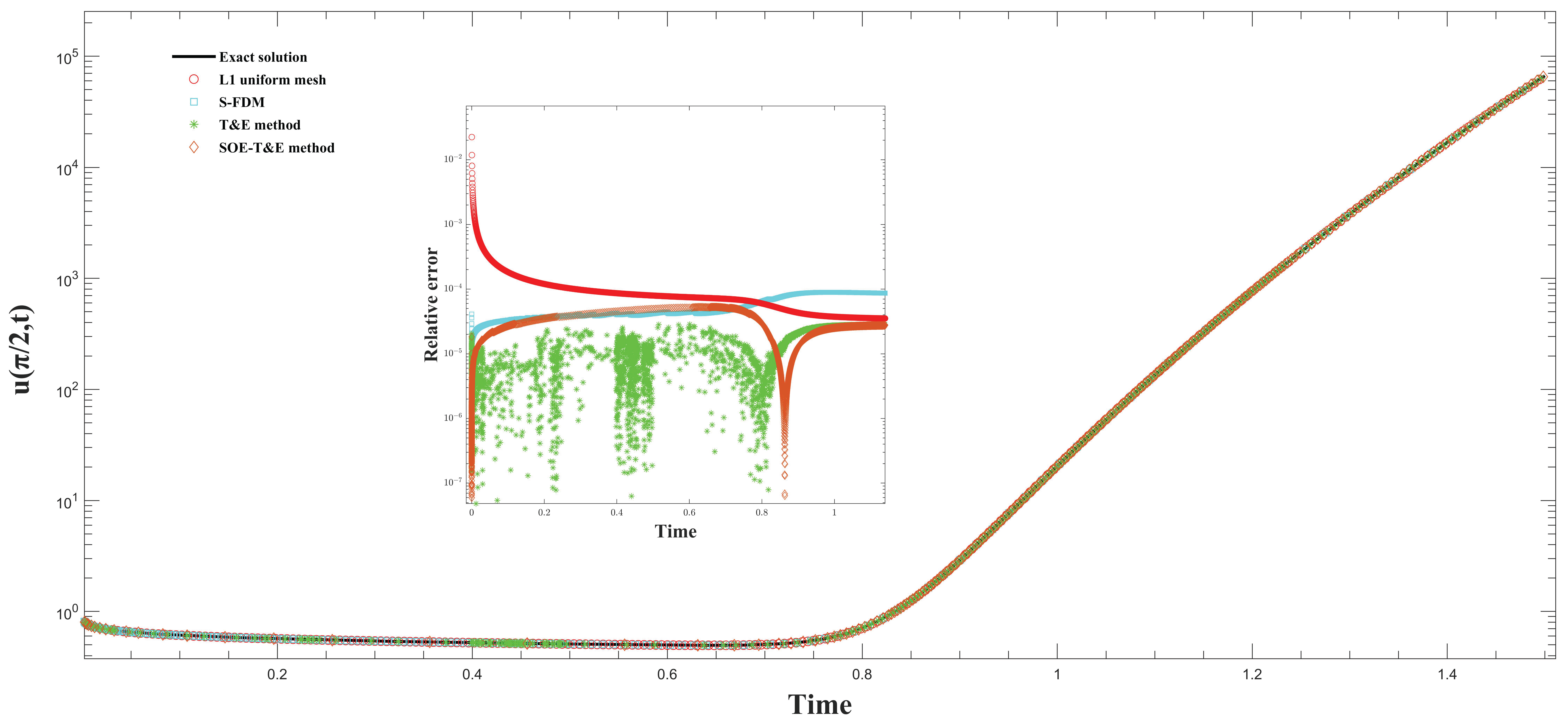
The analytical solution in x = π / 2 with a = p = 20, α = 0.25, T = 1.5 and K = 1 is shown in Figure 4. It can be divided into three stages. In the initial stage, the solution undergoes dramatic change. Then the intermediate stage features a relatively flat transition, and it experiences a sharp increase (approaching 6.6511 × 10⁴ at t = 1.5) in the third stage. We adopt this example as a benchmark to assess the efficiency of adaptive approaches, for the solution variation grows prominent near t = 1. In response to the observation that the solution varies over five orders of magnitude, we revise the adaptive algorithm to employ the mixed tolerance criterion (25) and report the maximum relative error (MRE) in this example.
| u j n | = | u ( x j , t n ) | max ( δ , δ × | u ¯ j n | ) ,
where u ¯ j n denotes the numerical solution computed at the full time step in tn.
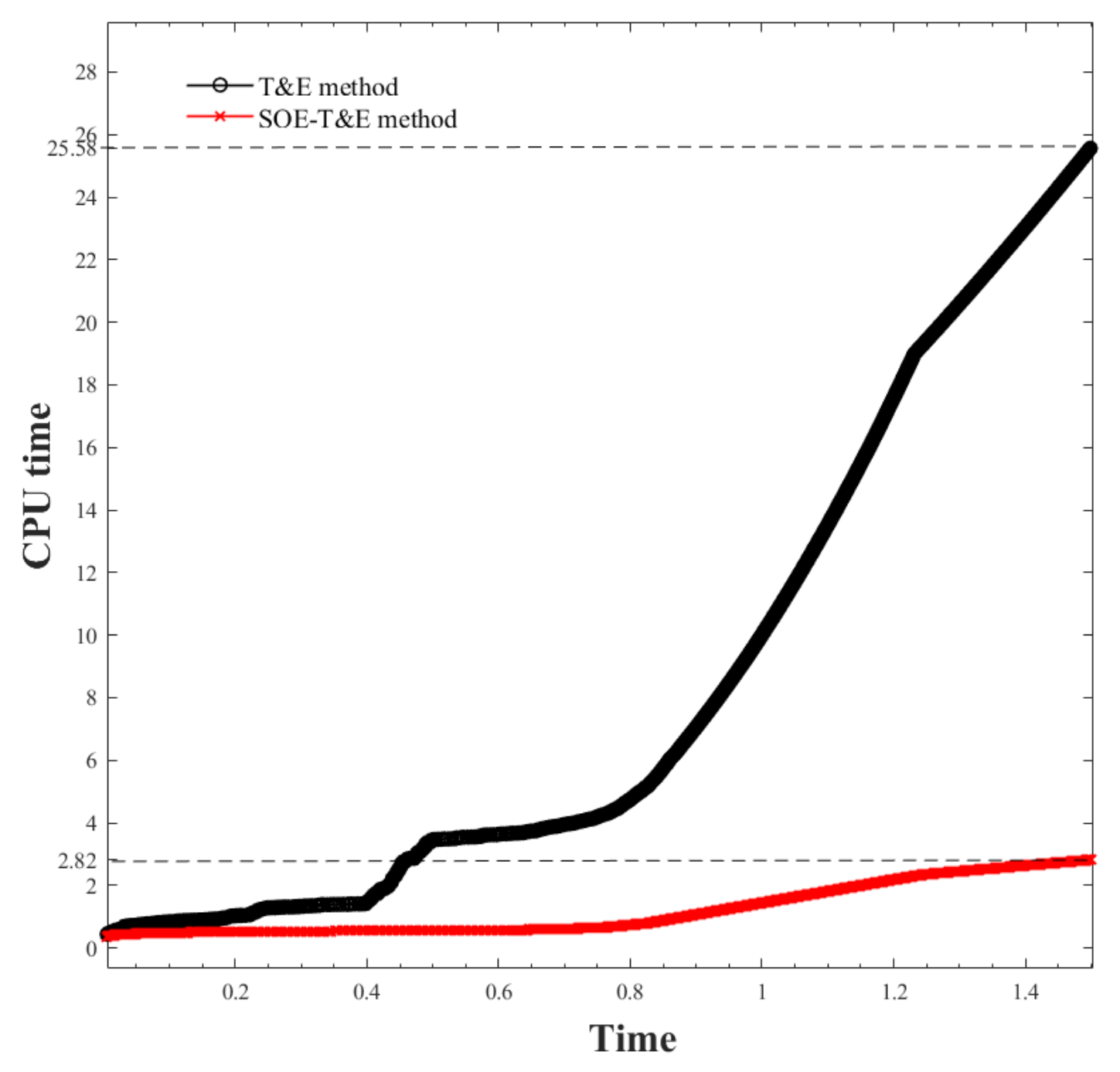
We compare the MRE of four numerical methods for the steep source term problem over t [ 0 , 1.5 ] , as presented in Figure 4 and Table 6. The L1 formula gives a MRE of 2.24 × 10⁻². S-FDM has smaller absolute errors at the early stage compared with the uniform mesh method. However, the absolute error in (22) increases during the third stage, attributed to the enlarging step size of the S-FDM. The MRE recorded is 8.07 × 10⁻⁵. In the third stage, the T&E method exhibits a lower relative error than the uniform grid. Additionally, the T&E approach can control the absolute errors in the first and second stages within the tolerance threshold. Because the first-stage T&E method reaches the predefined minimum step size, the SOE-T&E method exhibits performance comparable to S-FDM in the first stage. Meanwhile, the absolute errors in the second and third stages for the SOE-T&E method maintain the same order of magnitude as those exhibited by the T&E method. In the second stage, the relative error of T&E and the step size fluctuate drastically. Such sharp variations fail to reduce the overall relative error in this stage. Meanwhile, the frequently changing step size leads to repeated calculations at each individual time step, which causes a rapid increase in CPU time during the second stage, as illustrated in Figure 5.
The SOE-T&E method reduces the computation time by 88.98%, specifically recording a computational time of 2.82 s, compared to 25.58 s for the T&E method.

3.3. 2D Nonhomogeneous Time Fractional Order Derivative Diffusion Equation

To evaluate the performance of our proposed adaptive algorithm in higher-dimensional scenarios, we analyze a two-dimensional case [30]
D t α 0 C u ( X , t ) = Δ u + f ( X , t )  
with
f ( X , t ) = 3 4 t 3 [ ( x 3 / 2 x ) y 1 / 2 + x 1 / 2 ( y 3 / 2 y ) ] + 6 Γ ( 4 α ) t ( 3 α ) ( x 3 / 2 x ) ( y 3 / 2 y )
With X [ 0 , 1 ] × [ 0 , 1 ] and T [ 0 , t ] and the initial conditions and boundary conditions are
u ( X , 0 ) = 0 X Ω u ( X , t ) = 0 X Ω  
The analytical solution of (26) is expressed as
u ( X , t ) = t 3 ( x 3 / 2 x ) ( y 3 / 2 y )
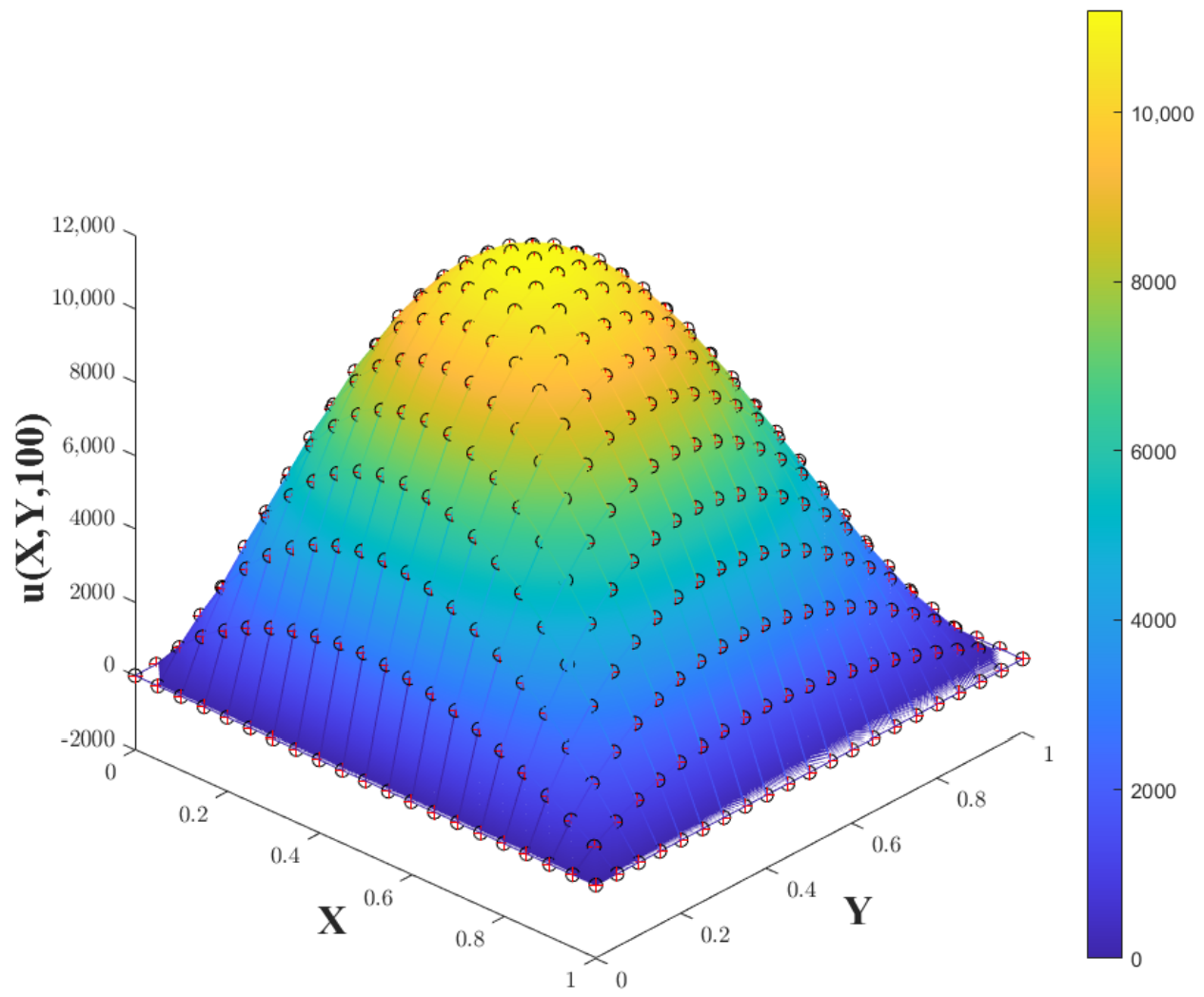
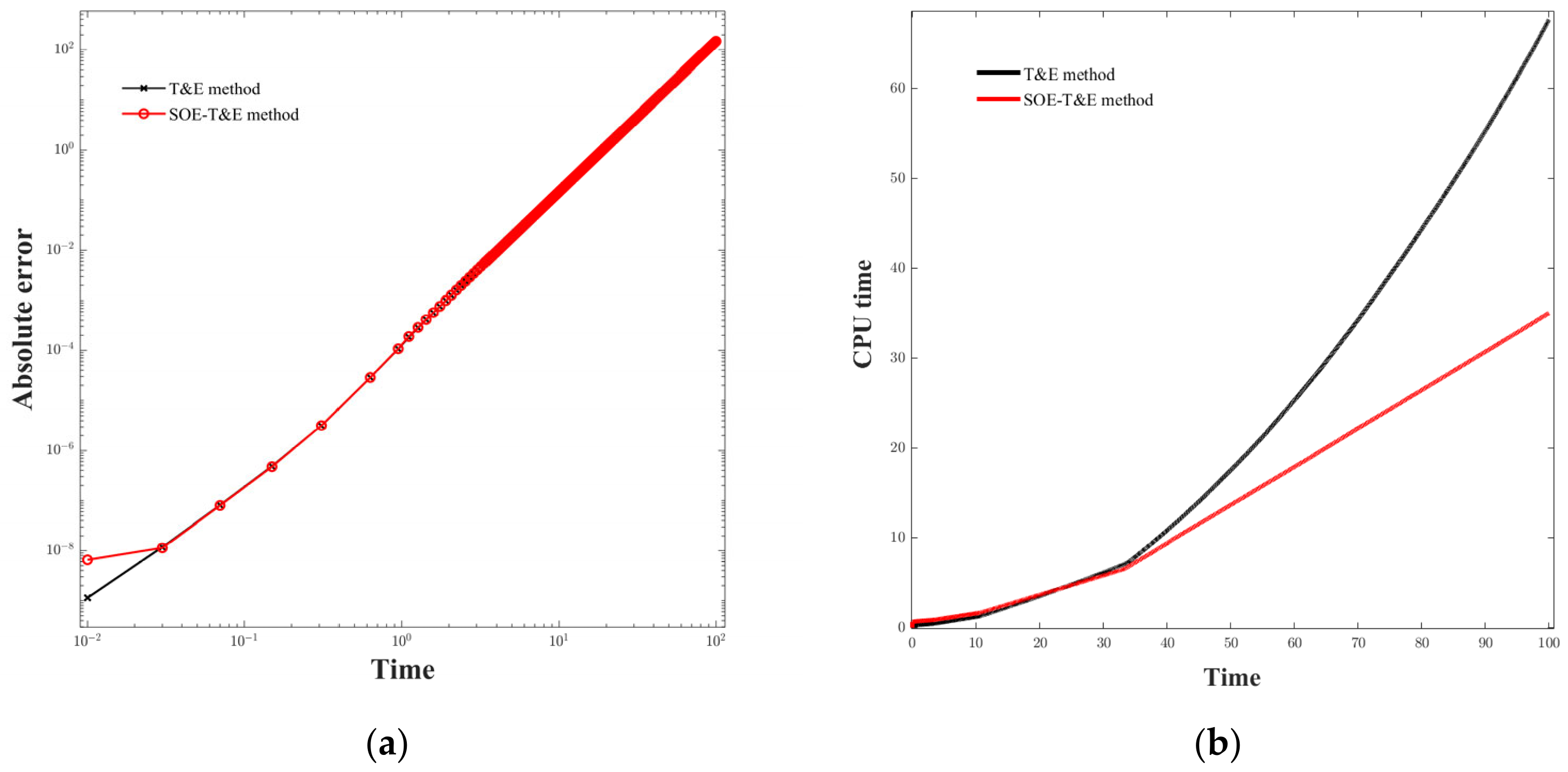
The concentration profile shown in Figure 6 illustrates that the numerical solution by the SOE-T&E method agrees well with the analytical solution of (26). The computational error of the SOE-T&E method is marginally smaller than the T&E method, as shown in Figure 7a, where k = 1, α = 0.4 and the spatial mesh length ∆x = ∆y = 0.05.
The T&E method and the SOE-T&E method are compared in terms of computational time across iterations, as documented in Figure 7b. The T&E method requires a CPU time of 67.64 s, while the SOE-T&E method requires 35.04 s, to obtain the numerical result at t = 100 s with the tolerance δ = 10−4 and the absolute error ε = δ/103. Notably, the CPU time of the T&E method increases dramatically with the number of steps, and the calculation time per time step is O(n). In contrast, the CPU time of the SOE-T&E method increases linearly with time, and the calculation time per time step is O(1). This indicates that the SOE-T&E method incurs a lower computational cost at each stage due to the use of the exponential sum approximation. In fact, when the time step length is uniform and T >> 1, the approximation of fractional derivative by the SOE approach requires an overall computational cost O(NT log NT), but the T&E method requires O(NT2), where NT is the number of computing nodes [28].

4. Discussion

The SOE-T&E method exhibits superior performance compared to the previous four methods. In Section 3.1, the SOE-T&E method effectively mitigates the error amplification caused by initial weak singularity in the initial stage under the tolerance we preset, while it reduces the maximum absolute error to 1.4–2.1% of that of the S-FDM; the convergence rate of the SOE-T&E method is O ( δ 0.5 ) . By choosing a proper minimum step size, the proposed method cuts down computational time while keeping the relative error at the same order of magnitude as the T&E method. In particular, for problems with rapidly growing solutions.
The SOE-T&E method can preserve control over the accuracy of the numerical solution while minimizing the decrease in computation rate brought on by the sharp increase in solution values. In fact, when the step size is uniform, the SOE-T&E method reduces to the SOE method under a uniform grid. In this case, the computational complexity is O(NTlogNT), while the computational complexity of the T&E method is O( N T 2 ) [28]. It also elucidates why the computational cost of the SOE-T&E approach diminishes relative to the T&E method when addressing two-dimensional problems, particularly as the number of computations increases.
However, when the computational time for solving a single time step is excessively long, the SOE-T&E method does not show obvious advantages compared with the T&E method. We illustrate this conclusion through the following numerical example [27]. To guarantee robust computational stability, the Newton iteration method is employed to solve this nonlinear fPDE.
D t α 0 C u ( x , t ) = u ( x , t ) Δ u + f ( t )  
with f ( t ) = Γ ( 2 ) Γ ( 2 α ) t 1 α .
The initial conditions and boundary conditions are
u ( 0 , t ) = t t [ 0 , T ] u ( 1 , t ) = 1 + t t [ 0 , T ] u ( x , 0 ) = x x [ 0 , 1 ]
Thus, the exact solution to (29) is u ( x , t ) = x + t .
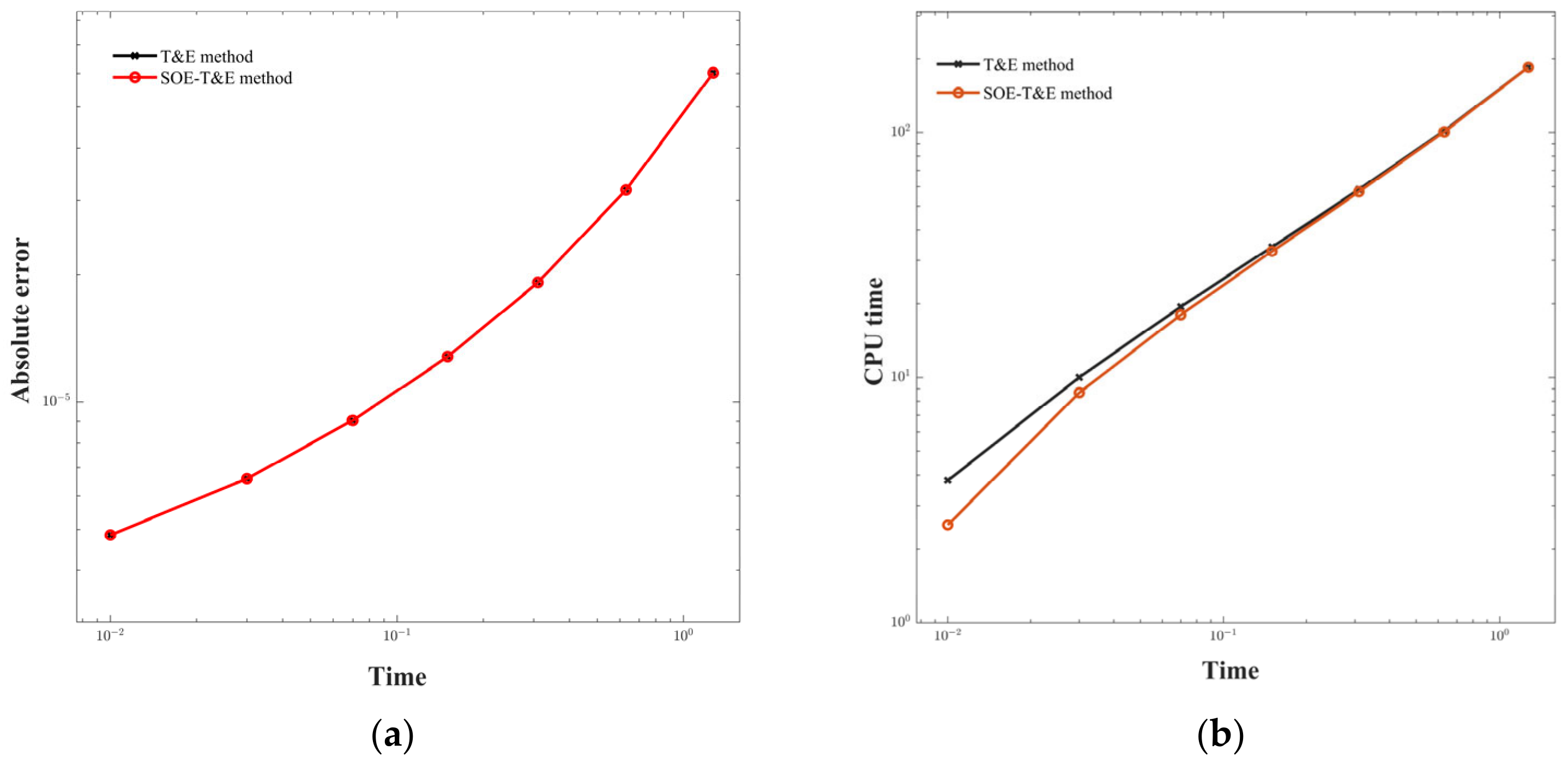
It is clear that there is no significant difference (especially for long time periods) in the CPU time between the SOE-T&E method and T&E method (SOE-T&E: 184.63 s, T&E: 184.78 s), with the same absolute error level as shown in Figure 8 (MAE = 6.018 × 10⁻⁵ for SOE-T&E and 6.021 × 10⁻⁵ for T&E). This is mainly because solving each step requires repeated Newton iterations, and the time spent on this step is much longer than that required for calculating the fractional derivative.

5. Conclusions

This study proposes an adaptive SOE-T&E method to address the trade-off between computational efficiency and accuracy in the long-time numerical solution of temporal fractional diffusion equations (tFDEs). The core innovation of the proposed method lies in its dynamic adjustment of time steps based on solution characteristics, which enables it to balance error control and computational cost effectively. Numerical results confirm its superior performance compared with the traditional T&E method. From a practical perspective, the proposed method provides an efficient new tool for fields requiring long-time fractional diffusion modeling (e.g., anomalous transport in porous media, biological diffusion processes). It should be noted that the current method still faces challenges such as excessive computational time in single-time-step Newton iterations, which require future investigation.

Author Contributions

Methodology, writing—original draft preparation: Z.W.; Conceptualization, writing—review and editing: H.S.; Supervision, investigation: Y.G. All authors have read and agreed to the published version of the manuscript.

Funding

This research was funded by the National Natural Science Foundation of China (Grant Nos. U2267218, 12422207, and 12372199). The findings of this study do not necessarily reflect the views of the funding agencies.

Data Availability Statement

Data are contained within the article.

Conflicts of Interest

The authors declare no conflicts of interest.

Abbreviations

The following abbreviations are used in this manuscript:
SOESum-of-exponentials
T&ETrial-and-error method
FDEFractional order derivative diffusion equation
fPDEFractional order derivative Partial Differential Equation
FDMfinite difference method
S-FDMScale-dependent finite difference method
tFDEsTime fractional order derivative diffusion equations
MAEMaximum absolute error

References

  1. Nyoumea, J.A.; Tjock-Mbaga, T.; Zarma, A.; Ema’a Ema’a, J.M.; Abiama, P.E.; Ben-Bolie, G.H. A Temporally Relaxed Theory of Nonequilibrium Solute Transport in Porous Media with Spatial Dispersivity Involving Flexible Boundary. Transp. Porous Media 2025, 152, 25. [Google Scholar] [CrossRef]
  2. Lin, Y.; Huang, J.; Carr, E.J.; Hsieh, T.-C.; Zhan, H.B.; Yu, H.-L. A temporally relaxed theory of physically or chemically non-equilibrium solute transport in heterogeneous porous media. J. Hydrol. 2023, 620, 129432. [Google Scholar] [CrossRef] [PubMed]
  3. Ollivier-Triquet, E.; Braconnier, B.; Gervais-Couplet, V.; Youssef, S.; Talon, L.; Bauer, D. Flow and transport in the vadose zone: On the impact of partial saturation and Peclet number on non-Fickian, pre-asymptotic dispersion. Adv. Water Resour. 2024, 191, 104774. [Google Scholar] [CrossRef]
  4. Zhou, D.; Zhang, Y.; Sun, H.; Reeves, D.M. Vertical matrix advection dominates transient anomalous diffusion within fracture-matrix systems using a modified diffusion model. Int. J. Heat Mass Transf. 2024, 231, 125854. [Google Scholar] [CrossRef]
  5. Zhang, Y.; Sun, Z.; Liao, H. Finite difference methods for the time fractional diffusion equation on non-uniform meshes. J. Comput. Phys. 2014, 265, 195–210. [Google Scholar] [CrossRef]
  6. Kumari, S.; Singh, A.K.; Mehandiratta, V.; Mehra, M. High-Order Approximation to Caputo Derivative on Graded Mesh and Time-Fractional Diffusion Equation for Nonsmooth Solutions. J. Comput. Nonlinear Dyn. 2024, 19, 101001. [Google Scholar] [CrossRef]
  7. Anh, N.T.V.; Yen, B.T.H. Parameter identification in anomalous diffusion equations with nonlocal conditions and weak-valued nonlinearities. Fract. Calc. Appl. Anal. 2024, 27, 2688–2717. [Google Scholar] [CrossRef]
  8. Li, D.; Qin, H.; Zhang, J.W. Sharp Pointwise-in-Time Error Estimate of L1 Scheme for Nonlinear Subdiffusion Equations. J. Comput. Math. 2024, 42, 662–678. [Google Scholar] [CrossRef]
  9. Yuste, S.B.; Quintana-Murillo, J. Fast, accurate and robust adaptive finite difference methods for fractional diffusion equations. Numer. Algorithms 2016, 71, 207–228. [Google Scholar] [CrossRef]
  10. Otárola, E. An adaptive finite element method for the sparse optimal control of fractional diffusion. Numer. Methods Partial. Differ. Equ. 2020, 36, 302–328. [Google Scholar] [CrossRef]
  11. Margenov, S.; Slavchev, D. Performance Analysis and Parallel Scalability of Numerical Methods for Fractional-in-Space Diffusion Problems with Adaptive Time Stepping. Algorithms 2024, 17, 453. [Google Scholar] [CrossRef]
  12. Maurya, R.K.; Singh, V.K. A high-order adaptive numerical algorithm for fractional diffusion wave equation on non-uniform meshes. Numer. Algorithms 2023, 92, 1905–1950. [Google Scholar] [CrossRef]
  13. Roul, P.; Sundar, S. Novel numerical methods based on graded, adaptive and uniform meshes for a time-fractional advection-diffusion equation subjected to weakly singular solution. Numer. Algorithms 2025, 98, 531–561. [Google Scholar] [CrossRef]
  14. Yue, X.; Liu, M.; Shu, S.; Bu, W.; Xu, Y. Space-time finite element adaptive AMG for multi-term time fractional advection diffusion equations. Math. Method Appl. Sci. 2021, 44, 2769–2789. [Google Scholar] [CrossRef]
  15. Yuste, S.B. Weighted average finite difference methods for fractional diffusion equations. J. Comput. Phys. 2006, 216, 264–274. [Google Scholar] [CrossRef]
  16. Cui, M. Compact finite difference method for the fractional diffusion equation. J. Comput. Phys. 2009, 228, 7792–7804. [Google Scholar] [CrossRef]
  17. Liu, X.; Sun, H.G.; Zhang, Y.; Fu, Z. A scale-dependent finite difference approximation for time fractional differential equation. Comput. Mech. 2019, 63, 429–442. [Google Scholar] [CrossRef]
  18. Jiang, Y.; Chen, H.; Sun, T.; Huang, C. Efficient L1-ADI finite difference method for the two-dimensional nonlinear time-fractional diffusion equation. Appl. Math. Comput. 2024, 471, 128609. [Google Scholar] [CrossRef]
  19. Wang, Y.; Chen, H. Pointwise error estimate of an alternating direction implicit difference scheme for two-dimensional time-fractional diffusion equation. Comput. Math. Appl. 2021, 99, 155–161. [Google Scholar] [CrossRef]
  20. Oldham, K.B.; Spanier, J. The Fractional Calculus: Theory and Applications of Differentiation and Integration to Arbitrary Order; Dover Publications: Mineola, NY, USA, 1974. [Google Scholar] [CrossRef]
  21. Liao, H.; McLean, W.; Zhang, J. A discrete Grönwall inequality with application to numerical schemes for subdiffusion problems. SIAM J. Numer. Anal. 2019, 57, 218–237. [Google Scholar] [CrossRef]
  22. Liao, H.; Yan, Y.; Zhang, J. Unconditional Convergence of a Fast Two-Level Linearized Algorithm for Semilinear Subdiffusion Equations. J. Sci. Comput. 2019, 80, 1–25. [Google Scholar] [CrossRef]
  23. Wang, Z.; Sun, H.; Gu, Y.; Zhang, C.Z. A scale-dependent hybrid algorithm for multi-dimensional time fractional differential equations. Fract. Calc. Appl. Anal. 2022, 25, 2062–2089. [Google Scholar] [CrossRef]
  24. Quintana-Murillo, J.; Yuste, S.B. An Adaptive Difference Method for Variable-Order Diffusion Equations. Mediterr. J. Math. 2024, 21, 145. [Google Scholar] [CrossRef]
  25. Freitas, A.A.; Alfaro Vigo, D.G.; Teixeira, M.G.; Vasconcellos, C.A.B.D. Horizontal water flow in unsaturated porous media using a fractional integral method with an adaptive time step. Appl. Math. Model. 2017, 48, 584–592. [Google Scholar] [CrossRef]
  26. Jannelli, A. A novel adaptive procedure for solving fractional differential equations. J. Comput. Sci. 2020, 47, 101220. [Google Scholar] [CrossRef]
  27. Jannelli, A. Adaptive numerical solutions of time-fractional advection–diffusion–reaction equations. Commun. Nonlinear Sci. 2022, 105, 106073. [Google Scholar] [CrossRef]
  28. Jiang, S.D.; Zhang, J.W.; Zhang, Q.; Zhang, Z.M. Fast Evaluation of the Caputo Fractional Derivative and its Applications to Fractional Diffusion Equations. Commun. Comput. Phys. 2017, 21, 650–678. [Google Scholar] [CrossRef]
  29. Yuste, S.B.; Quintana-Murillo, J. A finite difference method with non-uniform timesteps for fractional diffusion equations. Comput. Phys. Commun. 2012, 183, 2594–2600. [Google Scholar] [CrossRef]
  30. Luo, M.; Xu, D.; Pan, X.M. Sinc-Galerkin method and a higher-order method for a 1D and 2D time-fractional diffusion equations. Bound. Value Probl. 2024, 2024, 106. [Google Scholar] [CrossRef]
Figure 1. The procedure of the SOE-T&E method.
Fractalfract 10 00419 g001
Figure 2. MAE profiles of five numerical methods for (20). The SOE method with uniform step 150 nodes, the S-FDM employs 150 nodes, the T&E method employs δ = 10−4, and the SOE-T&E method with δ = 10−4, τmin = 10−11, ϵ = 10−7. In all cases, spatial mesh size ∆x = π/100.
Fractalfract 10 00419 g002
Figure 3. Convergence curves for different fractional derivative order α.
Fractalfract 10 00419 g003
Figure 4. The solution profiles and relative errors of four approaches for (22). The T&E method with δ = 10−6 (5913 time steps); the SOE-T&E method with δ = 10−6, τmin = 10−15 (4687 time steps), and ε = δ/103; the uniform mesh with 5000 nodes; and the S-FDM with 5000 nodes. A spatial mesh size of ∆x = π/100 is adopted across all scenarios.
Fractalfract 10 00419 g004
Figure 5. CPU time for (22) are obtained using the SOE-T&E technique with δ = 10−6 τmin = 9 × 10⁻¹⁵, ε = δ/103, and the T&E method with δ = 10−6. In all cases, the spatial mesh length ∆x = π/100. Dashed lines denotes the ultimate time cost of T&E method (upper) and SOE&T&E method (suber).
Fractalfract 10 00419 g005
Figure 6. The analytical solution and numerical solutions obtained by the T&E method (circles) and the SOE-T&E method (pluses) for (26) at t = 100, α = 0.4, k = 1.
Fractalfract 10 00419 g006
Figure 7. The absolute error (a) and CPU time (b) for (26) obtained using the T&E method with δ = 10−4 and the SOE-T&E method with δ = 10−4, τmin = 10−7, ε = δ/103 are shown. Spatial mesh size ∆x = ∆y = 0.05 in both cases.
Fractalfract 10 00419 g007
Figure 8. The absolute error (a) and CPU time (b) for (30) with α = 0.4 are obtained using the T&E method with δ = 10−4 and the SOE-T&E method with δ = 10−4, τmin = 10−7, ε = δ/103. The spatial mesh size is ∆x = 0.01 in both cases.
Fractalfract 10 00419 g008
Table 1. Pseudocode of SOE-T&E method.
SOE-T&E Method
Input:Previous solution u j n 1 , history arrays H l n 1 for m = 1. N ϵ , tolerance δ,
tolerance of the sum-of-exponentials approximation ε minimum step τ m i n , Current step size τ n , initial time step τ 0 .
Output:Current solution u j n , updated history H l n , Current time tn;
1:Compute SOE coefficients ω l , s l by ε
2:Enter current step
3:Compute the H ¯ l n with full step τ n by (15);
4:Compute the numerical solution u ¯ j n with full step τ n by (18); let initial error between e r r o r = u j n u ¯ j n = 2 δ to start the iteration loop; i = 0
5:While error > δ, and half time step τ n / 2 > τ min  do
6:Compute the H l n + 1 / 2 with half step τ n / 2 by (15);
7:Compute the numerical solution u j n + 1 / 2 with half step τ n / 2 by (18);
8:Compute the H l n + 1 with half step τ n / 2 by (15);
9:Compute the numerical solution u j n + 1 with half step τ n / 2 by (18);
10:Compute the e r r o r = u j n + 1 u ¯ j n + 1 ; i = i + 1;
11:If  e r r o r > δ
12:Return line 5;
13:Else
14:enter next step;
15:End if
16: u ¯ j n + 1 = u j n + 1 / 2 ,   H ¯ l n + 1 = H l n + 1 / 2 ,   τ n = τ n / 2 ;
17:If i > 1
18 τ n + 1 = τ n ;
19else
20 τ n + 1 = 2 τ n ;
21End if
22: t n + 1 = t n + τ n
23:n = n + 1;
24:End while
25:Enter next step
Table 2. MAE of five numerical methods for (20). The S-FDM with 150 time steps, the uniform mesh and SOE method with 150 nodes, the T&E method employs δ = 10−4 (116–147 time steps), and the SOE-T&E method with δ = 10−4, τmin =10−11, ε = δ/103 (116–147 time steps).
UniformSOES-FDMT&ESOE-T&E
α = 0.91.03 × 10−11.03 × 10−16.97 × 10−21.28 × 10−31.23 × 10−3
α = 0.81.10 × 10−11.10 × 10−14.97 × 10−28.82 × 10−48.11 × 10−4
α = 0.61.07 × 10−11.07 × 10−12.32 × 10−24.00 × 10−43.26 × 10−4
α = 0.36.61 × 10−26.61 × 10−25.29 × 10−31.49 × 10−41.09 × 10−4
Table 3. Maximum absolute errors (MAE) of (20) under different tolerances when α = { 0.9 , 0.8 , 0.6 , 0.3 } .
1 × 10−31 × 10−41 × 10−51 × 10−61 × 10−7
α = 0.94.49 × 10−31.2 × 10−33.71 × 10−41.25 × 10−45.38 × 10−5
α = 0.83.22 × 10−38.82 × 10−42.17 × 10−47.39 × 10−53.75 × 10−5
α = 0.72.47 × 10−35.10 × 10−41.28 × 10−44.75 × 10−52.98 × 10−5
α = 0.61.53 × 10−33.26 × 10−48.00 × 10−53.41 × 10−52.58 × 10−5
Table 4. Convergence order p, Coefficient of determination R2 and fitting results for different α.
αpR2Fitting Equation
0.90.4840.994ln(MAE) = −2.19 + 0.484ln(δ)
0.80.4950.992ln(MAE) = −2.46 + 0.495ln(δ)
0.70.4870.989ln(MAE) = −2.71 + 0.487ln(δ)
0.60.4520.981ln(MAE) = −3.02 + 0.452ln(δ)
Table 5. Local convergence rates of the numerical scheme for different fractional derivative orders α with the tolerance δ of SOE-T&E method.
αδ = 10−3 → 10−4δ = 10−4 → 10−5δ = 10−5 → 10−6δ = 10−6 → 10−7
0.90.5620.5210.4730.366
0.80.5620.6090.4680.294
0.70.6850.6000.4300.202
0.60.6710.6100.3700.121
Table 6. The S-FDM employswith 5000 nodes; the L1 uniform mesh with 5000 nodes; the T&E method with δ = 10−6; the parameter settings for the SOE-T&E method with δ = 10−6, τmin = 10−15, ε = δ/103, are employed to solve (22). The MRE and CPU time are provided here.
MethodsMRECPU Time(s)
L1 uniform mesh2.24 × 10−23.84
S-FDM8.07 × 10−518.27
T&E method3.15 × 10−525.58
SOE-T&E method (τmin = 10−7)5.28 × 10−52.82
Disclaimer/Publisher’s Note: The statements, opinions and data contained in all publications are solely those of the individual author(s) and contributor(s) and not of MDPI and/or the editor(s). MDPI and/or the editor(s) disclaim responsibility for any injury to people or property resulting from any ideas, methods, instructions or products referred to in the content.