Article

Fractional Optimization-Based Two-Stage Refinement Framework for Human Motion Prediction

1
Shenzhen Institute for Advanced Study, University of Electronic Science and Technology of China, Shenzhen 610097, China
2
School of Computer Science and Technology, Harbin Institute of Technology, Shenzhen, Shenzhen 518055, China
3
College of Computer Science and Cyber Security, Chengdu University of Technology, Chengdu 610059, China
*
Author to whom correspondence should be addressed.
Fractal Fract. 2026, 10(6), 420; https://doi.org/10.3390/fractalfract10060420
Submission received: 3 May 2026 / Revised: 15 June 2026 / Accepted: 18 June 2026 / Published: 21 June 2026
(This article belongs to the Section Optimization, Big Data, and AI/ML)

Abstract

Traditional human motion prediction methods attempt to discover the relationship between observed and future motion sequences. However, due to the dynamic complexity of human motion, existing methods cannot fully capture the interrelationships among motion sequences, and their performance remains unsatisfactory. In this work, we propose a novel Two-stage Refinement (TSR) framework for human motion prediction. It consists of two branches: (i) a traditional motion prediction branch for preliminary prediction, and (ii) an auxiliary refinement branch designed to estimate and compensate for the preliminary prediction errors. In this way, we can obtain better prediction performance than with traditional one-stage methods. To further bridge the gap between predicted results and groundtruth, we introduce a novel fractional-order differential loss function in this work. Existing methods use only integer-order differences to capture instantaneous state changes, often failing to account for the long-range temporal dependencies in human motion. By contrast, the inherent memory effect of the fractional-order differential loss function can account for long-term dependencies and enable precise tuning of high-order trajectory derivatives, thus yielding more physically realistic motion sequences with minimal error accumulation. Comparative experiments demonstrate that our proposed Fractional Optimization-based Two-stage Refinement Framework (FOTSR) outperforms most existing works on three benchmarks (including Human3.6M, CMU-Mocap, and 3DPW).

1. Introduction

Human motion prediction is a critical component in many smart systems, such as self-driving [1,2], human tracking [3], and human–robot interaction [4,5] models. It aims to learn motion patterns from a historical sequence and predict a future sequence based on the learned patterns. Early human motion prediction methods used statistical models [6,7] to learn the human motion patterns. However, these statistical models cannot handle complex scenarios and thus fail in difficult motion cases.
Recent works use deep learning networks to realize human motion prediction and demonstrate their superiority over early statistical approaches [8,9,10,11,12,13,14,15,16,17,18,19]. Recurrent Neural Network (RNN)-based works [8,9,20,21] adopt the frame-by-frame prediction strategy to generate a future human pose from the previous one, yet this causes error accumulation. Generative Adversarial Network (GAN)-based methods [22,23,24,25,26] can generate vivid human poses, yet tend to introduce noise in their adversarial training procedure [14]. Graph Convolutional Network (GCN)-based approaches [16,27,28] treat the human skeleton as a graph and capture its interrelationships during motion. However, these GCN-based methods are very sensitive to the design of the adjacency relations in the human skeleton graph. Many recent methods demonstrate that Multi-Layer Perceptrons (MLPs) can be both simple and computationally efficient in human motion prediction [29,30]. Though existing methods can learn human motion patterns from historical sequences and predict future sequences, the prediction performance remains unsatisfactory.
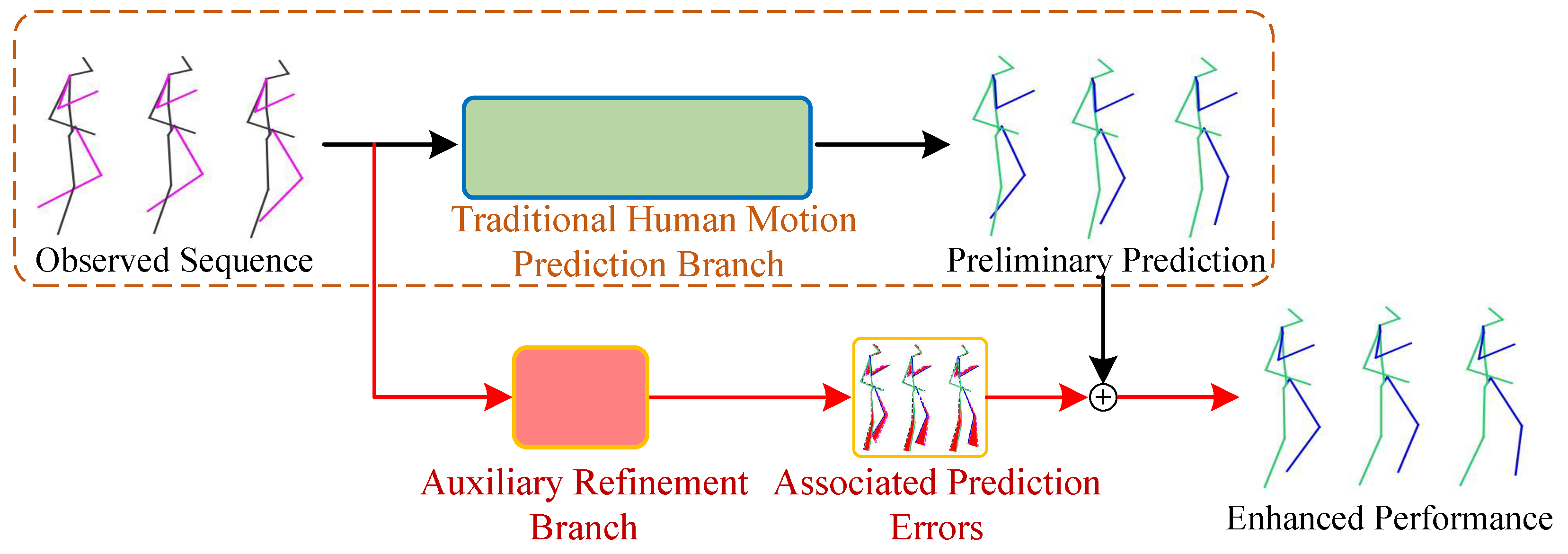
A human motion prediction model may have errors in its prediction results. However, we can enhance its performance as long as the prediction error can be estimated. This can be easily achieved by integrating the preliminary prediction results from the traditional prediction branch and the associated estimated error from an auxiliary refinement branch. Given the preliminary prediction results, we treat their associated prediction error as the target of the auxiliary refinement branch. As shown in Figure 1, we propose a Two-stage Refinement (TSR) framework to conduct error estimation and compensation: (1) the first stage generates preliminary prediction poses and estimates the associated prediction error; (2) the second stage (combining the traditional and the auxiliary refinement branch) learns to compensate for the associated prediction error. In this way, by combining the preliminary results from the traditional prediction branch with the estimated error from the auxiliary refinement branch, we can achieve better prediction performance than the traditional one-stage framework. Furthermore, to capture the long temporal dependencies and subtle motion variations in human motion, we incorporate fractional-order calculus into the optimization process. Unlike integer-order derivatives, which consider only instantaneous state changes, fractional-order differentials can leverage their unique memory and hereditary properties to capture inherent long-term dependencies, leading to more realistic human poses. Thus, we propose the fractional-order differential loss in this work to enforce stricter constraints on the motion trajectories, thereby significantly reducing the discrepancy between predicted results and groundtruth.
In this work, we use two training strategies (separation learning and fusion learning) to guide our two-stage training process. In the separation learning (corresponding to the first stage), we use groundtruth to supervise the traditional prediction procedure and maximize the similarity between the auxiliary refinement branch output and the prediction error. In the fusion learning (corresponding to the second stage), we add the auxiliary refinement branch output and preliminary prediction results to obtain enhanced prediction results, and minimize the difference between these enhanced prediction results and the groundtruth. We alternate between using these two training strategies above and enable the auxiliary refinement branch to estimate more accurate prediction errors. The experiments demonstrate that our proposed Fractional Optimization-based Two-stage Refinement Framework (FOTSR) outperforms most existing works across three benchmarks (Human3.6M, CMU-Mocap, and 3DPW) and that an alternate training strategy can further improve the accuracy of final predictions.
The main contributions of this work are listed as follows:
  • We propose a Two-stage Refinement (TSR) framework for human motion prediction. This architecture consists of a primary prediction branch that generates preliminary motion sequences and a subsequent refinement branch that explicitly estimates and compensates for prediction errors. By using an alternating training strategy (i.e., separation learning and fusion learning), the TSR framework can achieve better predictive performance than traditional methods.
  • We propose a fractional-order differential loss function to minimize the discrepancy between the predicted motion poses and groundtruth. By leveraging the non-local properties and memory effects of the fractional-order operator, this loss function can capture high-order temporal dynamics and long-range dependencies that are often overlooked by traditional integer-order losses, thereby yielding more physically plausible and temporally smooth predictions.
  • The experiments demonstrate that our FOTSR framework is effective not only for our method but also for the other works, such as Traj-GCN [10] and HisRepItself [11].
  • Extensive evaluations on three large-scale benchmarks (including Human3.6M, CMU-Mocap, and 3DPW) demonstrate that our method, consisting of the Two-stage Refinement and fractional-order constraints, achieves state-of-the-art (SOTA) performance in both short-term and long-term human motion prediction.

2. Related Works

2.1. Human Motion Prediction

Research on human motion prediction has undergone several foundational shifts. Initially, the field was dominated by Recurrent Neural Networks (RNNs) [8,9,20,21], which aimed to model the temporal evolution of joints through hidden states. While RNNs, particularly LSTMs and GRUs, are adept at capturing short-range sequential patterns, they inherently suffer from error accumulation and representation collapse during long-term prediction [10]. To mitigate these issues, Convolutional Neural Networks (CNNs) [13,31,32,33] were introduced to treat motion as a pseudo-image, extracting multi-scale spatial–temporal features to realize human motion prediction. However, CNN-based methods cannot model the interrelationships among the human skeleton joints, resulting in limited improvement in prediction performance.
Furthermore, Graph Convolutional Networks (GCNs) [12,14,15,16,17,19,34] have demonstrated superior performance by representing the human skeleton as a non-Euclidean graph, thereby explicitly modeling the biomechanical constraints and hierarchical dependencies of human skeleton joints. However, GCN-based methods are sensitive to the design of the adjacency relations in the human skeleton graph. Multi-Layer Perceptrons (MLPs) also perform well in balancing computational efficiency and model complexity in human motion prediction [18,29,30,35]. However, a critical research niche in human motion prediction that remains vacant is the fact that these existing prediction structures operate within an open-loop, one-stage framework. They attempt to model highly stochastic human dynamics using single forward networks, which are always complex, nonlinear, and long-term. Such open-loop backbones lack an explicit mechanism for self-correction and compensation for spatial–temporal trajectory drift. Our FOTSR framework directly addresses this structure gap by coupling foundational prediction with a specialized closed-loop Two-stage Refinement branch.

2.2. Two-Stage Refinement Framework

A persistent challenge in human motion prediction is the divergence between predicted motion poses and the groundtruth. While most existing works focus on improving the encoder–decoder backbone in the one-stage framework, our work shifts the emphasis toward a two-stage iterative refinement and error-compensation strategy. This refinement–error-compensation strategy has shown remarkable success in 3D Human Pose Estimation [36,37,38,39], where initial joint detections are rectified through feedback loops or auxiliary correction branches.
Following this intuition, we propose a Two-stage Refinement (TSR) framework. Unlike conventional “one-shot” methods, our TSR divides human motion prediction into two branches: (1) a preliminary prediction branch generates an initial coarse sequence; (2) a specialized refinement branch focuses on estimating and compensating for the associated prediction errors. This two-branch architecture decouples the global motion trend learning from the local precision adjustment. By explicitly modeling the “prediction–correction” cycle, our framework can enhance the model’s ability to rectify “prediction drift”, thereby improving long-term performance in complex scenarios.

2.3. Fractional-Order Difference

The application of fractional-order difference in deep learning traditionally centers around standard signal enhancement or system control [40,41,42,43,44]. However, its integration into human motion prediction is guided by a profound, domain-specific kinematic justification rather than empirical adaptation. Standard Newtonian kinematics relies strictly on integer-order derivatives (e.g., first-order for velocity, second-order for acceleration). However, these classical integer-order operators are strictly localized and instantaneous, because they compute state changes over an infinitesimally small interval ( d t 0 ), i.e., assuming the current state transition depends solely on the immediate previous frame. This instantaneous formulation fundamentally conflicts with the underlying biophysics of human motion. Human motion dynamics exhibit non-local temporal properties, including skeletal muscle memory retention and continuous momentum decay. Fractional-order difference possesses a power-law, non-local convolution kernel. This unique mathematical definition endows the model with an inherent hereditary memory feature, enabling it to continuously track the historical evolution of motion states over long time scales.
By formulating a novel fractional-order differential loss function, we introduce a powerful, physics-informed mathematical prior to the network. Instead of forcing the refinement branch to empirically guess smooth trajectories via unconstrained MLPs, our fractional-order regularization explicitly constrains higher-order trajectory derivatives across a continuous historical spectrum. Consequently, the generated motion poses are not merely mathematically smooth, but strictly comply with the continuous, long-range momentum and non-local acceleration dynamics characteristic of genuine biological movement. Based on the above observation, we introduce a fractional-order differential loss for regularizing human motion prediction, achieving better performance than existing methods.

3. The Proposed Method

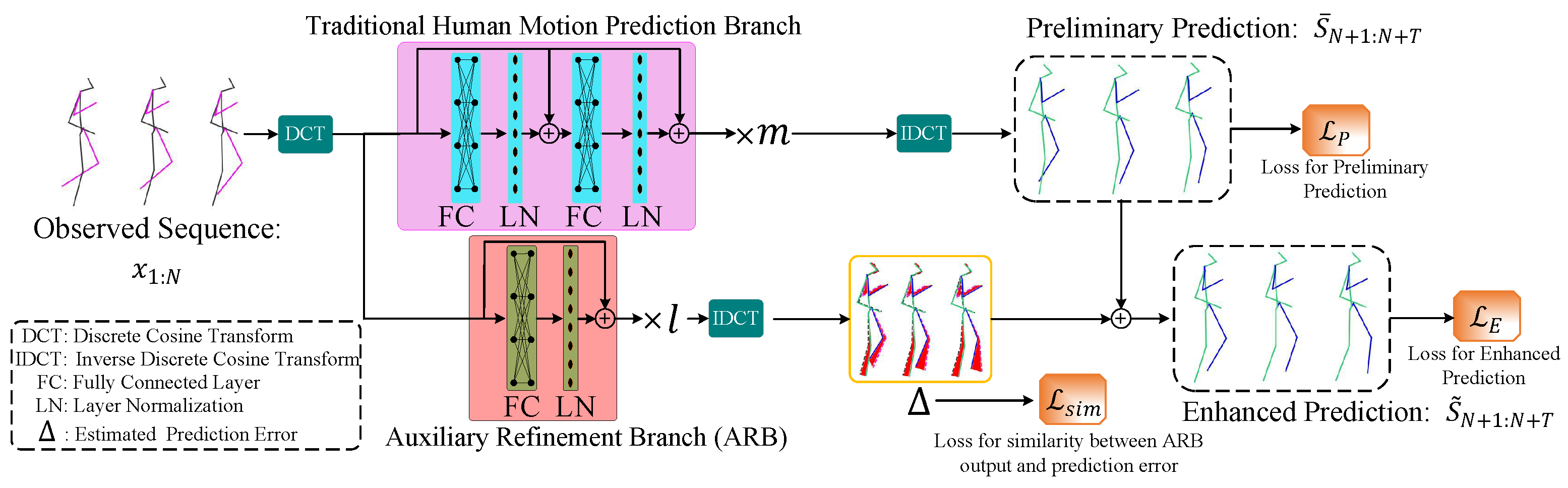
In this work, we propose a novel Fractional Optimization-based Two-stage Refinement (FOTSR) framework for human motion prediction. As illustrated in Figure 2, the FOTSR framework consists of two main components: (i) a traditional human motion prediction branch that generates preliminary motion poses; (ii) an auxiliary refinement branch specifically designed to estimate and compensate for the associated prediction errors of the traditional prediction branch. Let N observed poses S 1 : N = [ S 1 , S 2 , , S N ] be the historical human motion poses, and S N + 1 : N + T = [ S N + 1 , S N + 2 , , S N + T ] be the future T poses, where S i R K is the ith ( 1 i N + T ) human pose with K dimensions. The traditional human motion prediction branch predicts the preliminary prediction results S ¯ N + 1 : N + T , and the auxiliary refinement branch produces the associated prediction error Δ . The training of our FOTSR framework aims to let S ¯ N + 1 : N + T approach S N + 1 : N + T in the separation learning procedure and S ¯ N + 1 : N + T + Δ approach S N + 1 : N + T in the fusion learning procedure, which are optimized iteratively in this work. Furthermore, we use fractional-order differentials to optimize our model in the fusion learning procedure to capture long-term dependencies.

3.1. Network Structure

The proposed FOTSR framework is built upon the observation that traditional single-stage models often struggle to capture the complex dynamic interrelationships between the historical sequence and the future sequence in human motion prediction. Thus, in this work, we use a two-stage framework for human motion prediction, in which the first stage performs only preliminary prediction, while the second stage contains both the traditional prediction and auxiliary refinement. We utilize Discrete Cosine Transform (DCT) and Inverse Discrete Cosine Transform (IDCT) to fuse trajectory features. Following the efficiency of MLP-based architectures [29], we adopt MLPs to implement this work. Specifically, we feed the observed sequence S 1 : N into: (1) the traditional prediction branch (comprising m two-layer MLPs) to obtain the preliminary prediction S ¯ N + 1 : N + T ; (2) the auxiliary refinement branch (comprising l single-layer MLPs) to estimate the associated prediction error Δ . Then, by combining the preliminary prediction S ¯ N + 1 : N + T and the associated estimated prediction error Δ , we can obtain the enhanced prediction performance. We use separation learning and fusion learning to train our FOTSR iteratively. In the separation learning stage (i.e., the first stage), we minimize the difference between the preliminary prediction results S ¯ N + 1 : N + T and the groundtruth S N + 1 : N + T (corresponding to L P in Figure 2), and maximize the similarity between Δ and the prediction error S N + 1 : N + T S ¯ N + 1 : N + T (corresponding to L s i m in Figure 2). While in the fusion learning stage (i.e., the second stage), we add the preliminary prediction results S ¯ N + 1 : N + T and the auxiliary refinement result Δ to obtain enhanced prediction results S ˜ N + 1 : N + T , and then we minimize the difference between the groundtruth S N + 1 : N + T and S ˜ N + 1 : N + T (corresponding to L E in Figure 2).
We can formulate the traditional prediction process in this work as
Y = f M L P 2 m ( S ) ,
where S R N K is the observed human motion sequence, f M L P 2 m ( · ) is a network that concatenates m two-layer MLPs in the traditional human motion branch, and Y R N K is the predicted results. The first T rows of Y yield S ¯ N + 1 : N + T . Similarly, we can formulate the auxiliary refinement branch in the FOTSR as:
Z = f M L P 1 l ( S ) ,
where S R N K represents the observed human motion sequence, f M L P 1 l ( · ) represents the l one-layer MLPs, and Z R N K is the auxiliary refinement branch output. The first T rows of Z define the estimated error compensation Δ . In this way, we can obtain the enhanced poses via additive fusion: S ˜ N + 1 : N + T = S ¯ N + 1 : N + T + Δ R T K .

3.2. Fractional-Order Differential for Motion Dynamics

We introduce a fractional-order differential in human motion prediction to address the limitations of integer-order calculus in describing human motion. Integer-order derivative loss (e.g., velocity) is a local operator that accounts only for instantaneous changes. However, human movement is a continuous process governed by biomechanical constraints and biological “memory”—where current joint states are intrinsically linked to the entire historical motion trajectory. In this study, we employ the Caputo fractional derivative [45] to capture long-term dependencies in human motion, which is well-suited for neural network optimization. For a continuous function f ( t ) , the Caputo derivative of order α ( 0 < α < 1 ) is defined as
D t α a C f ( t ) = 1 Γ ( 1 α ) a t ( t τ ) α f ( τ ) d τ ,
where Γ ( · ) is the Gamma function and ( t τ ) α is the power-law kernel. Mathematically, this kernel assigns higher weights to recent states while decaying the influence of past states, effectively capturing the “memory effect” and non-local dependencies in motion. By applying this operator to joint coordinates in human motion prediction, we can constrain the model to maintain the long-term dependency properties of human limbs, thereby significantly reducing the gap between the predicted results and the physical groundtruth.

3.3. Loss Function

To train the proposed TSR framework effectively, we use a two-stage multi-component loss function to optimize the training procedure. In the first stage, we use a separation learning strategy to optimize training; in the second stage, we use a fusion learning strategy to optimize training further. We use separation and fusion learning to train the proposed FOTSR iteratively.
Fractional-order differential loss: The primary motivation for introducing a fractional-order differential is to capture the long-range temporal dependencies and the “memory effect” inherent in human motion, which traditional integer-order derivatives (e.g., velocity) fail to represent. Based on the discrete implementation of the Grünwald–Letnikov definition, the fractional derivative of order α for a human motion sequence S at time t is formulated as
D t α S t = k = 0 W 1 w k S t k ,
where W is the truncation window size and w k are the coefficients computed recursively as w 0 = 1 and w k = w k 1 k α 1 k . We define the fractional-order differential loss ( L f r a c ) to penalize the discrepancy between the dynamics of the enhanced prediction results S ˜ N + 1 : N + T and the groundtruth S N + 1 : N + T as
L f r a c = 1 ( T W + 1 ) · K t = N + W N + T j = 1 K | D t α S t , j D t α S ˜ t , j | 2 .
Loss for separation learning: The first stage adopts a separation learning strategy, ensuring that the traditional branch provides a preliminary prediction while the auxiliary branch accurately estimates the associated prediction error. The total loss for this stage is
L t o t a l S L = L P + β L s i m = L P : J + L P : V + β L s i m ,
where L P = L P : J + L P : V denotes the difference between the preliminary prediction results and the groundtruth at the separation learning, L P : J = 1 T K t = N + 1 N + T j = 1 K | S ¯ t , j S t , j | 2 denotes the mean joint position difference between the preliminary prediction sequence S ¯ N + 1 : N + T and the groundtruth S N + 1 : N + T , L P : V = 1 ( T 1 ) K t = N + 1 N + T 1 j = 1 K | V ¯ t , j V t , j | 2 denotes the mean joint velocity difference between the velocity of the predicted sequence V ¯ N + 1 : N + T 1 and the groundtruth V N + 1 : N + T 1 , and L s i m aligns the auxiliary branch output Δ with the actual prediction error ( S S ¯ ) . β controls the contribution of similarity calculation ( L s i m ) in this separation learning.
Loss for fusion learning: In the second stage, we use a fusion learning strategy to optimize our FOTSR. In this stage, we add the auxiliary refinement branch outputs Δ and the preliminary prediction results S ¯ N + 1 : N + T to obtain the enhanced prediction results S ˜ N + 1 : N + T . Following common practice, we first use the L 2 difference between S ˜ N + 1 : N + T and the groundtruth S N + 1 : N + T to supervise this training stage. Furthermore, to ensure the refined human motion poses follow physically plausible trajectories and maintain long-term dependencies, we integrate the fractional-order constraint into this supervision process. The loss function of this fusion learning strategy is formulated as
L t o t a l F L = L E = L E : J + L E : V + γ · L f r a c ,
where L E = L E : J + L E : V denotes the difference between the enhanced prediction results S ˜ N + 1 : N + T and the corresponding groundtruth S N + 1 : N + T in the fusion learning, L E : J = 1 T K t = N + 1 N + T j = 1 K | | S t , j S ˜ t , j | | 2 denotes the mean joint position difference between the enhanced sequence S ˜ N + 1 : N + T and the groundtruth S N + 1 : N + T , L E : V = 1 ( T 1 ) K t = N + 1 N + T 1 j = 1 K | | V ˜ t , j V t , j | | 2 denotes the velocity difference between the enhanced prediction results V ˜ N + 1 : N + T 1 and the groundtruth, and V N + 1 : N + T 1 . γ is a hyperparameter to control the fractional-order dynamic constraint.
We iteratively use the above two loss functions to supervise the whole training, i.e., L t o t a l S L supervision L t o t a l F L supervision → … → L t o t a l S L supervision L t o t a l F L supervisiontest. In this work, we use the enhanced prediction results, not the preliminary ones, to verify the final prediction performance.

4. Experiments and Results

In this section, we present extensive comparative experiments on three benchmarks (including Human3.6M [46], CMU-Mocap [47], and 3DPW [48]) to evaluate the performance of our FOTSR and existing methods. We employ the Mean Per-Joint Position Error (MPJPE) [46] to evaluate performance in both short-term ( 0 t 400 ms ) and long-term ( 400 < t 1000 ms ) human motion prediction.

4.1. Datasets, Implementation Details, and Comparison Methods

4.1.1. Datasets

Human3.6M [46] is the largest-scale dataset in the field, consisting of 15 distinct human activities performed by seven professional actors. Following the evaluation protocol established in [10,14], we used subjects S 1 , S 6 , S 7 , S 8 , and S 9 for training, S 11 for validation, and S 5 for the final testing phase. While the original poses contain 32 joints, following the common practice, we focused our analysis on a subset of 22 joints by omitting global rotations and redundant points to ensure a fair comparison with existing works.
CMU-Mocap [47] is another standard benchmark that uses 38 joints to represent human skeleton poses. Adopting the data processing strategy from [13,49], we simplified the skeleton model to 25 key joints, and the prediction performance was averaged across eight representative motion categories.
3DPW [48] is another challenging dataset that captures 51,000 frames of human motion in diverse real-world settings (including both indoor and outdoor scenarios). We used the official training, validation, and test splits to train our work. Following established practices, we employed a selection of 23 joints to describe human poses within the motion sequences, discarding the redundant points.

4.1.2. Implementation Details

Our proposed FOTSR framework uses 48 two-layer MLPs to conduct traditional human motion prediction. For Human3.6M, the auxiliary refinement branch consists of 12 single-layer MLPs, while for CMU-Mocap and 3DPW, the auxiliary refinement branch consists of 6 single-layer MLPs. For Human3.6M, the iteration number is 40 K, in which the first 30 K iterations use a learning rate of 0.0003 , and the last 10 K iterations use a learning rate of 0.00001 . For CMU-Mocap and 3DPW, the iteration count is 10 K, with the first 5 K using a learning rate of 0.0003 and the last 5 K using a learning rate of 0.00001 . To ensure absolute transparency and guarantee full reproducibility, we present a complete algorithmic description in Algorithm 1.
Furthermore, to ensure reproducibility, we provide the full architectural configurations and resource metrics of our FOTSR (evaluated under a batch size of 128) in Table 1. Our backbone contains no explicit nonlinear activation functions. This is enabled by the frequency-domain-transformed formulation: input joint trajectories are transformed via Discrete Cosine Transform (DCT) over N = 50 frames. Human motion is smooth and low-frequency-dominated, which simplifies prediction to linear modulation of frequency coefficients rather than nonlinear spatial curve-fitting. While each layer is linear, stacking 48 residual-connected layers in the main branch and 12 layers in the refinement branch produces higher-order polynomial mappings, providing sufficient learning capacity for natural motion. The intermediate-layer normalization blocks stabilize gradient propagation without introducing nonlinearity. This design naturally preserves joint velocity and momentum continuity while avoiding activation saturation.
Algorithm 1: Two-stage alternating optimization paradigm of FOTSR
  Input: Training dataset D , Total iterations T m a x , Learning rate η t , hyperparameters α , β , and γ .
  Output: Optimized model parameters Θ .
Fractalfract 10 00420 i001

4.1.3. Comparison Methods and Metrics

We benchmarked our FOTSR against six competitive methods (including Traj-GCN [10], HisRepItself [11], CGHMP [16], DSTD-GCN [27], CIST-GCN [28], and Guidance-Reg [50]) across quantitative and qualitative analyses. While Mean Angle Error (MAE) and Mean Per-Joint Position Error (MPJPE) are common metrics, MAE often suffers from representation ambiguity, where different joint angles can map to the same spatial pose [10]. Thus, we adopted MPJPE as our primary metric to quantify prediction accuracy in 3D Euclidean space.
MPJPE can measure the average Euclidean distance between the predicted human pose joint coordinates and the corresponding groundtruth across all joints and time steps. It is defined as
M P J P E = 1 T × J t = 1 T j = 1 J | S ˜ t , j S t , j | 2 ,
where S ˜ t , j R 3 and S t , j R 3 denote the predicted and groundtruth 3D coordinates of the j-th joint at time t, respectively. Here, T and J represent the prediction horizon and the number of joints. Lower MPJPE values signify superior human motion prediction accuracy.

4.2. Comparative Experiments Results

Results on Human3.6M: Human3.6M is the largest benchmark dataset in human motion prediction. We provide the short-term prediction performance on Human3.6M in Table 2 and the long-term prediction performance in Table 3. To be clear, we bold the best prediction result and underline the second-best result at each timestamp in these tables. As shown, our proposed FOTSR achieves the best performance in 44 out of 60 cases for short-term prediction and 15 out of 30 for long-term prediction. Even though in some motion scenarios our FOTSR does not achieve the best performance, it still achieves a competitive prediction accuracy. In the average prediction performance, our FOTSR surpasses the best existing method (Guidance-Reg [50]) by 8.22 % , 4.61 % , 1.48 % , 1.17 % , 1.17 % , and 0.18 % at 80 ms, 160 ms, 320 ms, 400 ms, 560 ms, and 1000 ms, respectively. Our FOTSR performs better in “walking” than in “posing”, perhaps because the future motion poses in “walking” are more closely related to historical poses. Thus, our fractional-order differential loss can capture these long-term dependencies, achieving better performance than in a scenario with no strong history dependencies (e.g., “posing”). The prediction results in Table 2 and Table 3 demonstrate that our FOTSR obtains the highest prediction accuracy on this benchmark.
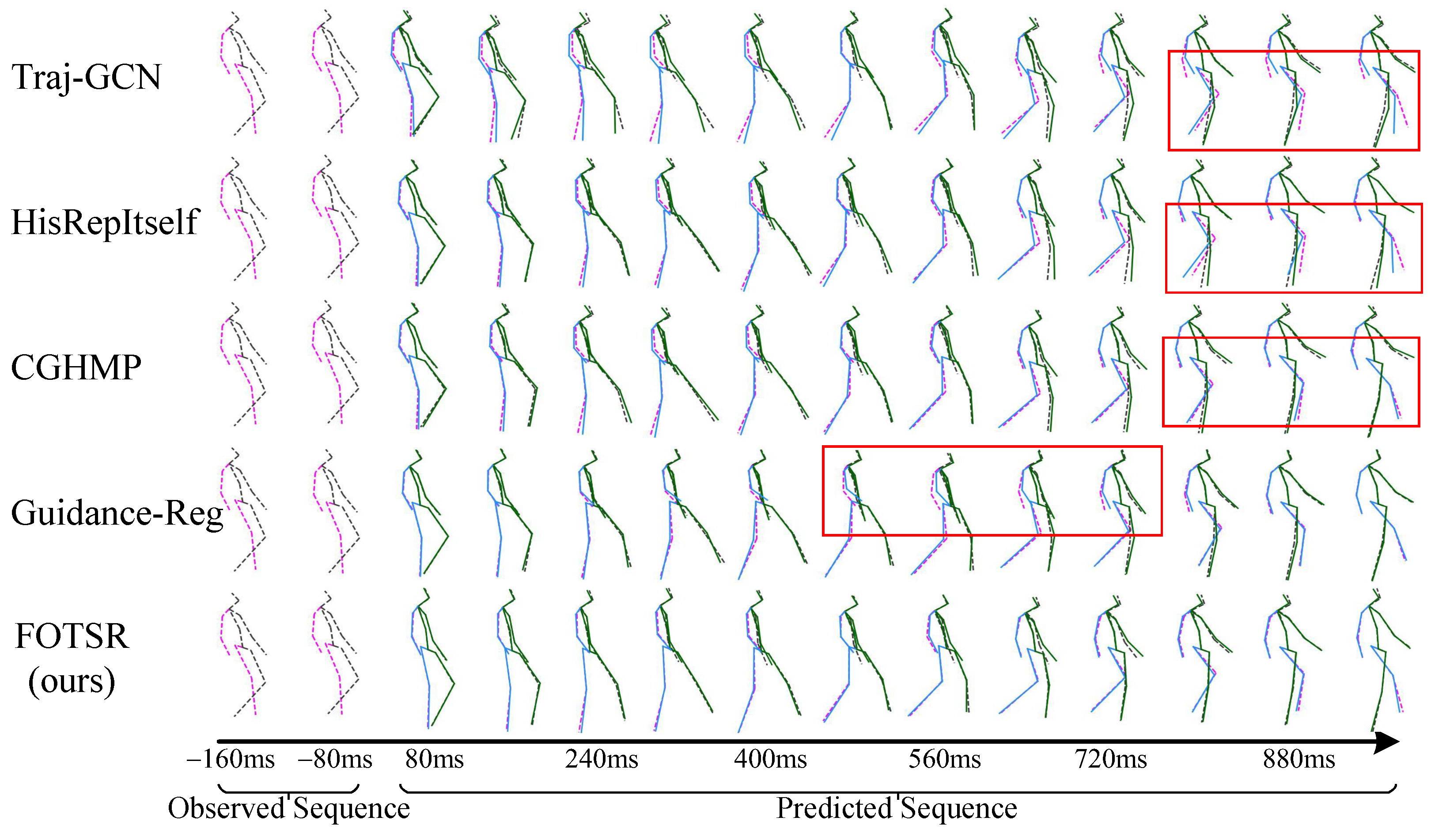
To provide a more intuitive understanding of our model’s performance, we conduct a visual comparison between FOTSR and several representative works (including Traj-GCN [10], HisRepItself [11], CGHMP [16], and Guidance-Reg [50]) in the “walking” scenario of the Human3.6M dataset. As illustrated in Figure 3, we visualize both the observed sequences (dashed purple–black lines) and the predicted future poses (solid blue–green lines) across a 1000 ms horizon. The red rectangles highlight significant prediction errors in the comparative methods. It is evident that as the prediction interval increases, the existing works begin to exhibit noticeable prediction deviations, such as joint drift and unnatural foot placement. For instance, in the late-stage predictions (720 ms–880 ms), methods like Guidance-Reg and CGHMP fail to maintain the correct stride amplitude, leading to a mismatch between the predicted swing leg and the groundtruth. In contrast, our FOTSR generates motion sequences that remain highly consistent with the groundtruth even in the long-term horizon. This superiority is particularly evident in the preservation of human skeleton structure and motion rhythm. These advantages are derived from: (1) incorporating the fractional-order differential loss, which means our framework effectively constrains the high-order derivatives of joint motions, preventing the “mean pose” problem, which is often seen in integer-order models; (2) the TSR architecture ensuring that the refinement branch can rectify subtle posture misalignments. Thus, our FOTSR achieves competitive performance on Human3.6M, as evidenced by both quantitative results and qualitative comparisons.
To verify that the performance gains of FOTSR are structurally driven rather than artifacts of stochastic fluctuations, we conducted statistical significance and stability analyses across 10 independent runs with distinct random seeds. The detailed MPJPE tracking for the baseline and FOTSR on the Human3.6M dataset is documented in Table 4 and Table 5, respectively. To provide a clearer comparative overview, Table 6 summarizes the overall average performance and standard deviations (±STD) derived from these 10 independent validation trials. As reported, FOTSR consistently lowers the average error from 64.8 to 64.0 . Crucially, FOTSR substantially compresses the standard deviation from 0.32 to 0.07 , mathematically demonstrating its superior resilience against random seed initialization. Furthermore, the empirical error distributions exhibit no overlap, as the absolute minimum error of the baseline ( 64.4 ) still exceeds the absolute maximum error achieved by FOTSR ( 64.1 ), confirming the statistical robustness of our framework.
To establish the statistical validity of this improvement, we performed a two-tailed paired t-test and a Wilcoxon signed-rank test on the 10 paired experimental samples. The calculated p-value from the paired t-test is 1.11 × 10 5 , which sits several orders of magnitude below the standard highly significant threshold ( α = 0.01 ). This compelling statistical evidence conclusively rejects the null hypothesis, demonstrating that FOTSR’s performance is highly reproducible and statistically robust. The empirical consistency across all time horizons validates that integrating the Two-stage Refinement framework with the fractional-order differential loss function effectively suppresses joint trajectory drift while stabilizing motion sequence synthesis.
Results on CMU-Mocap: To further evaluate the generalization ability of our proposed FOTSR framework, we conduct extensive experiments on the CMU-Mocap dataset. Following the standard evaluation protocol, we adopt MPJPE as the metric to quantify the prediction accuracy across short-term ( 0 t 400 ms ) and long-term ( 400 < t 1000 ms ) horizons. As illustrated in Table 7, our FOTSR consistently outperforms most existing works across nearly all time steps. Specifically, in the short-term phase (e.g., 80–560 ms), FOTSR achieves the lowest MPJPE. This superiority stems from our Two-stage Refinement architecture and fractional-order differential loss function, which together effectively compensate for the initial estimation errors inherent in traditional prediction methods and capture long-range temporal dependencies. Even in long-term prediction (i.e., 1000 ms), our proposed FOTSR achieves competitive performance. In summary, the comparative results on CMU-Mocap demonstrate that by integrating error compensation with fractional-order optimization, FOTSR sets a new performance benchmark.
To further provide a substantive understanding of the model behaviors, we conduct a fine-grained, category-wise evaluation of the CMU-Mocap dataset’s individual motion categories, as detailed in Table 8. An empirical comparison between the initial baseline and the full FOTSR model reveals that the geometric error reduction is non-uniformly distributed across different movement categories. On the one hand, our framework exhibits the greatest benefits in continuous, highly periodic motion patterns such as running and walking. Specifically, for the walking sequence, FOTSR significantly compresses the long-term predictive error from 71.3 to 38.6, a substantial improvement of 45.9% at 1000 ms. For running, the best improvement reaches 48.6% at 640 ms (from 96.5 to 50.0). This remarkable improvement validates that the non-local memory effect embedded in our fractional-order loss can successfully memorize the inherent kinematic momentum and cyclic trajectory rhythms. On the other hand, the model encounters certain performance bottlenecks in highly stochastic or non-periodic tasks. For example, basketball obtains minor improvements at 1000 ms, only reducing from 128.1 to 116.5, a modest 9.1% improvement. Because these stochastic categories are dominated by sudden, fast-velocity variations and localized joint acceleration transitions, the historical kinematic dependencies are easily disrupted, which restricts the error compensation of the refinement branch.
Results on 3DPW: Compared to controlled laboratory environments, the 3DPW dataset presents more challenging scenarios with complex outdoor movements. To verify the robustness of our framework, we evaluate the prediction performance on 3DPW at time horizons ranging from 200 ms to 1000 ms. The experimental results in Table 9 underscore the superior prediction capability of FOTSR on 3DPW. Specifically, our method consistently surpasses all existing works at every evaluation timestamp. Notably, compared to the strongest method (DSTD-GCN), our FOTSR achieves substantial relative error reductions of 1.66 % , 1.22 % , 0.72 % , 0.71 % , and 1.05 % at 200 ms, 400 ms, 600 ms, 800 ms, and 1000 ms, respectively. The consistent performance gain on 3DPW can be attributed to the synergy between our Two-stage Refinement strategy and the fractional-order differential loss. While integer-order methods struggle to maintain human pose dependencies during rapid motion transitions, the fractional-order memory effect enables FOTSR to capture the underlying motion rhythm effectively. This function also ensures that the refinement branch can accurately compensate for preliminary errors of the traditional prediction framework, even in highly dynamic outdoor environments.
Across all three major benchmarks (i.e., Human3.6M, CMU-Mocap, and 3DPW), FOTSR achieves competitive performance. The comprehensive qualitative and quantitative experimental results demonstrate that our fractional optimization-based two-stage framework is not only numerically superior but also exhibits excellent generalization across diverse motion scenarios and environmental settings.

5. Discussion

In this section, we provide a comprehensive empirical discussion of our framework. First, we conduct ablation studies to verify the efficacy of individual components. Second, we perform detailed parametric sweeps to evaluate core architectural hyperparameters and fractional-order differential parameters. Finally, we execute cross-dataset evaluations to systematically demonstrate the robustness and generalization capability of our model.
Ablation Studies: To systematically verify the contribution of each proposed component, we conducted a comprehensive ablation study on the Human3.6M dataset. As shown in Table 10, we evaluated six different configurations by progressively integrating the Two-stage Refinement (TSR), the fractional-order differential loss (FDL), and the iterative training (IT) strategy to verify their performance.
The baseline model (Row 1) yields an average MPJPE of 64.8. By independently introducing the TSR (Row 2) and FDL (Row 3), the average error decreases to 64.5 and 64.3, respectively. This confirms the efficacy of our TSR architecture and FDL supervision innovations. Notably, FDL provides a more substantial gain in long-term horizons (e.g., at 1000 ms), demonstrating its unique capability to suppress long-term error accumulation by leveraging the “memory effect” of fractional calculus.
A key observation from the ablation results is the role of the iterative training strategy. When comparing Row 5 (TSR + IT) with Row 2 (TSR only), the average error drops from 64.5 to 64.2. This improvement underscores that iterative optimization enables the refinement branch to progressively learn error patterns from the preliminary prediction branch, resulting in more precise motion adjustments.
In summary, the best performance is achieved by the full FOTSR model (last row), which integrates all three components to reach the lowest average MPJPE of 64.0. The synergy between the Two-stage Refinement and fractional optimization, facilitated by iterative training, ensures a consistent performance lead across all evaluation timestamps. Specifically, the reduction in error at 880 ms and 1000 ms highlights the robustness of our framework in maintaining physical realism over long-term prediction.
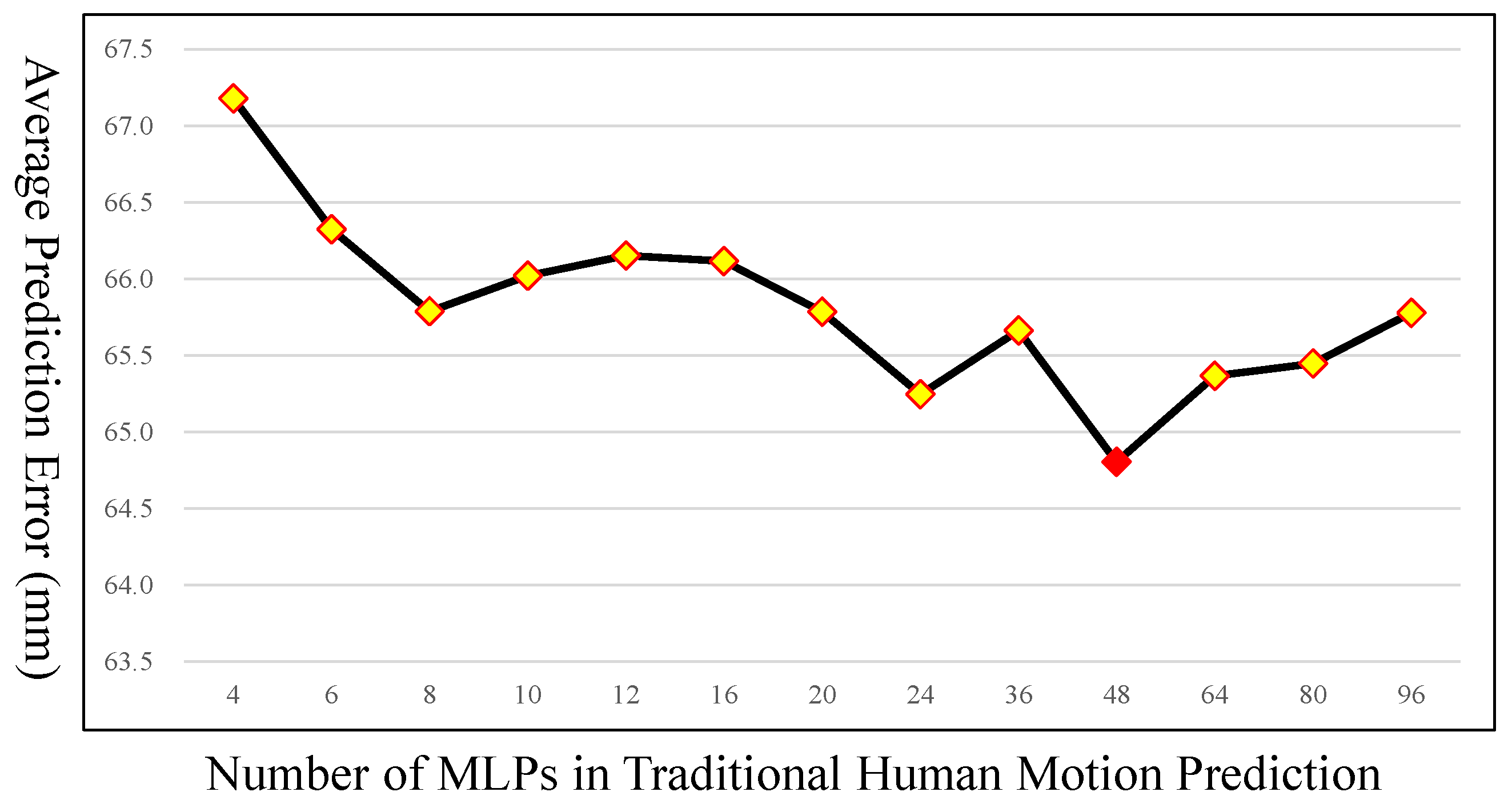
Robustness Experiments about m in Figure 2 and Equation (1): We conducted robustness experiments on Human3.6M to find the number of MLPs in the traditional prediction branch that can achieve the lowest prediction error. The results in Figure 4 show that the traditional human motion prediction branch achieves the best performance when it uses 48 two-layer MLPs (i.e., m = 48 in Figure 2 and Equation (1)).
Robustness Experiments about β in Equation (6) and l in Equation (2): Based on the above network setting, we conducted robustness experiments on Human3.6M to determine the optimal weight β in Equation (6) and the best number of single-layer MLPs in the auxiliary refinement branch for our FOTSR. Table 11 shows that our FOTSR obtains the best prediction performance when β = 0.1 and there are 12 single-layer MLPs (i.e., l = 12 in Figure 2 and Equation (2)) in the auxiliary refinement branch.
Robustness Experiments about γ in Equation (7) and α in Equation (3): The above section demonstrates that our FOTSR can obtain the best prediction performance when it consists of 48 two-layer MLPs in the traditional prediction branch and 12 single-layer MLPs in the auxiliary refinement branch. With iterative training, our FOTSR can further enhance prediction performance. In this section, we further conduct robustness experiments on Human3.6M to determine the optimal weight and order for the fractional-order loss. Table 12 shows that our FOTSR obtains the best prediction performance when α = 0.5 and γ = 0.1, which means that our FOTSR achieves the best performance when the fractional order is 0.5, and the weight of the fractional-order loss function is 0.1 in this work.
To validate the necessity of fractional-order constraints, we implemented a conventional temporal regularization baseline by setting the fractional order to α = 1.0 (corresponding to the first-order velocity-smoothness penalty). As reported in the rightmost columns of Table 12, this standard integer-order regularization yields systematically higher MPJPE compared to our fractional configurations. Crucially, the network achieves its optimal performance when α = 0.5 . This result shows that the traditional standard integer-order ( α = 1.0 ) is memoryless and fails to capture non-local kinematic constraints. In contrast, the continuous past-state dependency inherent in the half-order derivative ( α = 0.5 ) effectively captures long-term dependencies and stabilizes trajectory evolution.
We conducted robustness experiments on the proposed fractional-order loss to determine the optimal fractional weight and order. Table 7 shows that our FOTSR achieves the best prediction performance when α = 0.5 and γ = 0.1, i.e., the fractional-order is 0.5, and the fractional-order loss weights are 0.1.
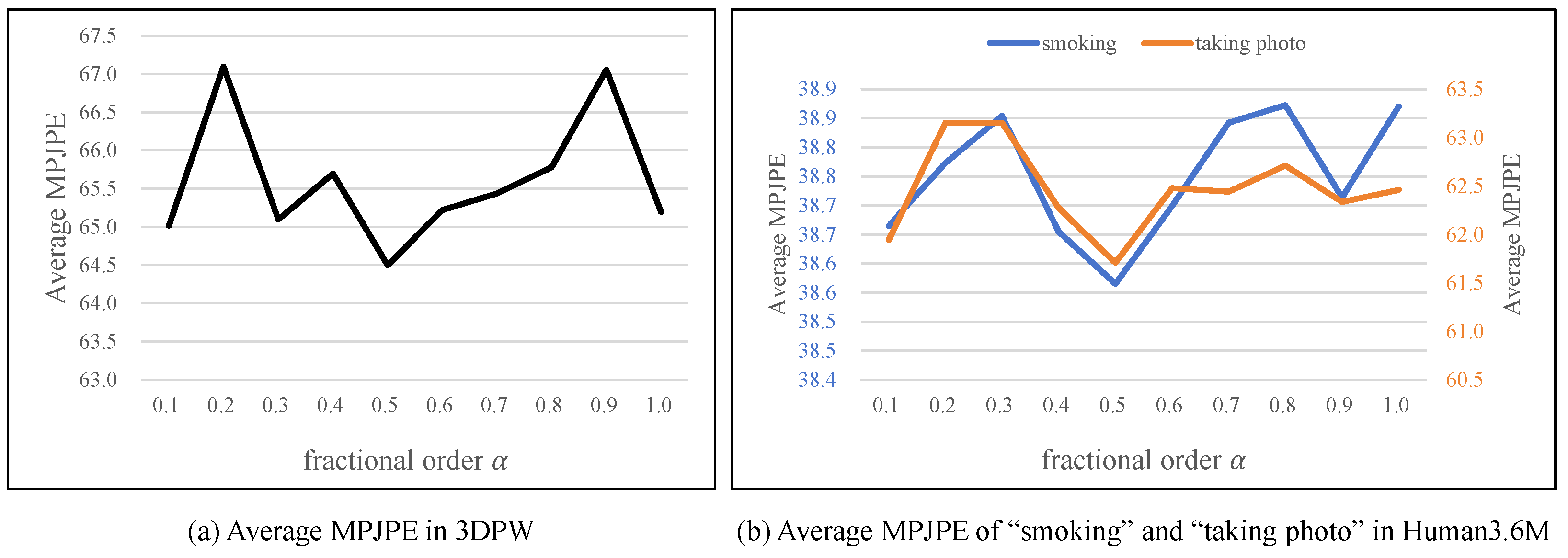
Sensitivity of Fractional Order α : To evaluate the sensitivity of the fractional order α in our proposed framework, we extended the parameter sweep of fractional order α [ 0.1 , 1.0 ] to broader evaluation benchmarks. Specifically, beyond the overall metrics of the Human3.6M dataset, we evaluated its performance across distinct movement categories (“smoking” and “taking photo”), as well as an entirely independent out-of-domain benchmark (the 3DPW dataset). Figure 5 shows the sensitivity analysis of the fractional order α across the 3DPW dataset, “smoking” on the Human3.6M dataset, and “taking a photo” on the Human3.6M dataset. The results demonstrate that across all evaluated datasets and diverse motion categories, the network consistently achieves its optimal predictive performance (lowest MPJPE) at α = 0.5 . Additionally, Figure 5b shows that both the “smoking” and “taking photo" splits of the Human3.6M dataset exhibit a consistent trend in the sensitivity of alpha, first declining and then increasing. These experiments establish that the half-order fractional differential constraint possesses an intrinsic physical universality. Rather than being an independent hyperparameter of a specific data distribution, α = 0.5 reveals the underlying, non-local hereditary momentum shared by various biological human motion patterns. In this way, it can effectively regularize temporal trajectories against long-term drift under diverse complex scenarios.
In summary, our FOTSR achieves its best prediction performance when it includes a traditional prediction branch (consisting of 48 two-layer MLPs) and an auxiliary refinement prediction branch (consisting of 12 single-layer MLPs). We use iterative training strategies to train our Two-stage Refinement framework. In the separation training (corresponding to the first stage), we use L P : J + L P : V + β L s i m ( β = 0.1) to train our FOTSR. In the fusion training (corresponding to the second stage), we use L E : J + L E : V + γ · L f r a c ( γ is 0.1) to supervise the enhanced prediction.
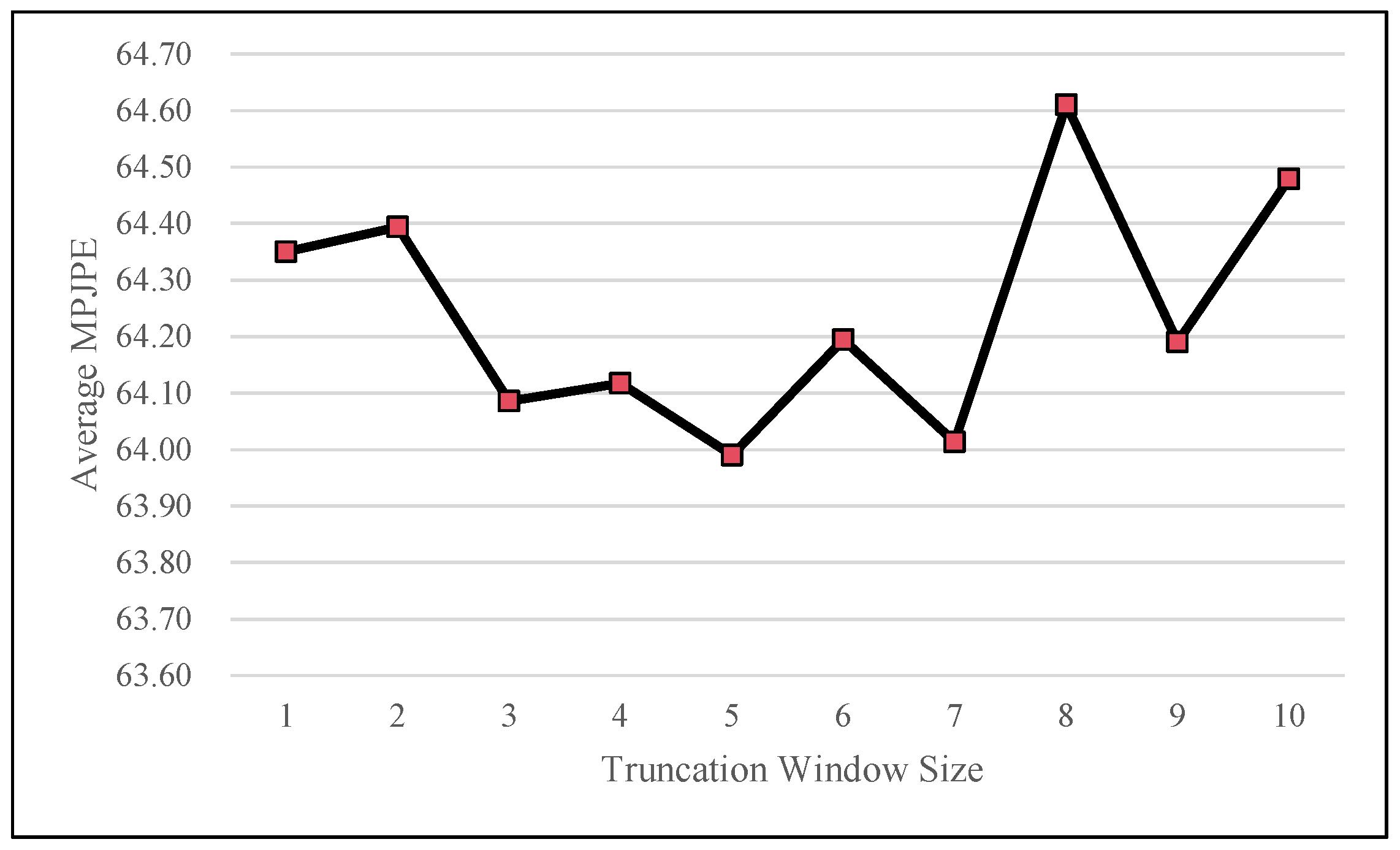
Sensitivity Analysis of Truncation Window Size W : In practical discrete implementations, calculating the fractional-order differential loss relies on the classical Grünwald–Letnikov (G-L) definition, which inherently requires a short-memory truncation technique to balance historical dependency with computational tractability. To thoroughly investigate the sensitivity of our framework to the memory window length, we conducted an empirical parameter sweeping for the truncation window size W [ 1 , 10 ] on the Human3.6M dataset. As illustrated in Figure 6, the network achieves its optimal predictive performance (lowest average MPJPE) when the window size is set to W = 5 . Physically, a lower window size (e.g., W 2 ) curtails the necessary long-range kinematic inheritance, transforming the constraint into a quasi-integer derivative that fails to govern temporal drift. Conversely, an overly large window size (e.g., W 8 ) introduces excessive cumulative historical noise and distant redundant joint states, which degrade the trajectory rectification precision. Therefore, W = 5 serves as the optimal temporal horizon to capture meaningful non-local velocity variations for human motion forecasting.
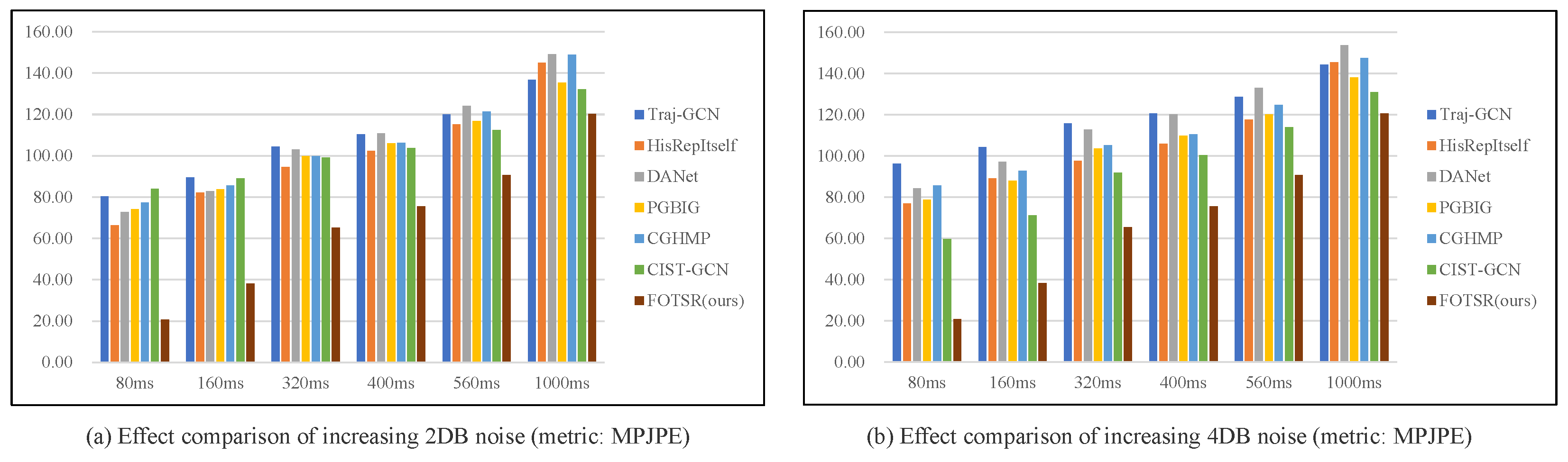
Robustness Analysis Against Input Trajectory Noise: In real-world tracking deployments, input joint trajectories frequently suffer from sensory measurement errors and stochastic noise. To evaluate the robustness of our framework, we conduct disturbance experiments by injecting different levels of Gaussian white noise (SNR = 2 dB and 4 dB) into the historical observed human poses on the Human3.6M dataset. The quantitative comparison with existing methods under these noisy conditions is illustrated in Figure 7. Evidently, our FOTSR consistently maintains a substantially lower MPJPE across all forecasting time horizons (80 ms to 1000 ms) compared to existing works. For instance, under the 4 dB noise perturbation, while traditional frameworks like Traj-GCN [10] and DANet [51] experience catastrophic error propagation at long-term boundaries (1000 ms), our FOTSR demonstrates graceful degradation. This superior noise mitigation capability can be credited to the inherent properties of our design: (1) the non-local memory tracking of the fractional-order derivative loss effectively smooths out high-frequency frame-wise measurement anomalies, and (2) the two-stage auxiliary refinement branch possesses a high error-compensation capacity that actively rectifies disrupted spatial–temporal joint configurations.
Computational Cost: To further evaluate the practical applicability of the proposed framework, this section provides a detailed quantitative analysis of its computational complexity. To visually demonstrate this trade-off, we comprehensively evaluate and compare the training time (per batch), inference testing time (per batch), and total parameters (model size) of our approach against several existing works. As reported in Table 13, while existing works often suffer from a heavy parameter burden or high latency, our framework scales exceptionally well, achieving an optimal balance between predictive accuracy and computational cost. It shows that although our FOTSR introduces an auxiliary refinement branch and an iterative training policy to rectify prediction trajectories, it maintains a remarkably high computational efficiency and a lightweight architecture.
The Generalization of the Refinement Branch: To evaluate whether the auxiliary refinement branch encapsulates universal kinematic principles or merely overfits to dataset-specific residual artifacts, we conducted cross-dataset evaluations. Specifically, we conducted an ablation study comparing our initial baseline and FOTSR across distinct data distributions: the 3DPW and CMU-Mocap datasets. As summarized in Table 14, integrating the refinement branch results in continuous performance improvements across all time horizons on both datasets. For instance, on the outdoor 3DPW benchmark, the full framework reduces the long-term (1000 ms) MPJPE from 98.3 to 95.3 . Similarly, on the CMU-Mocap dataset, the error drops from 91.8 to 86.9 at 1000 ms. These consistent improvements across out-of-domain samples show that the refinement branch perhaps successfully captures underlying physics-correlated trajectory-correction patterns, rather than overfitting to dataset-dependent characteristics.
The Generality of the FOTSR Framework: To verify the generality of our proposed framework, we selected several existing works (including Traj-GCN [10] and HisRepItself [11]) and added the FOTSR framework to evaluate their performance on Human3.6M. Table 15 shows that each baseline +FOTSR configuration achieves significantly higher prediction accuracy than the original method. This demonstrates that our proposed FOTSR framework contributes not only to our method but also to other baselines.


6. Conclusions

In this paper, we present a novel Fractional Optimization-based Two-stage Refinement (FOTSR) framework for human motion prediction. By addressing the limitations of traditional one-stage prediction methods, which cannot meet the needs of human motion prediction and struggle to capture long-range temporal dependencies, our approach introduces a Two-stage Refinement (TSR) architecture coupled with a fractional-order differential loss function to achieve accurate human motion prediction. The TSR framework effectively decomposes the prediction task into a preliminary estimation stage and an error-compensation stage, enabling the model to estimate and correct prediction errors. More importantly, by leveraging the inherent “memory effect” of fractional calculus, the proposed fractional-order loss function can capture long-term dependencies and enforce higher-order trajectory smoothness. Extensive experiments across three large-scale benchmarks (including Human3.6M, CMU-Mocap, and 3DPW) demonstrate that our FOTSR consistently achieves state-of-the-art performance on quantitative metrics and qualitative visualizations. To the best of our knowledge, this work is the first to introduce fractional-order differences into human motion prediction, demonstrating that high-order supervision is beneficial for human motion analysis. This work employs a wide range of research methods for human motion analysis (i.e., fractional-order differences), enabling the model to better understand human motion dynamics. Thus, we believe that integrating fractional-order optimization with Two-stage Refinement offers a promising approach to improving motion law modeling, thereby expanding its potential applications in autonomous driving, human–robot interaction, and computer animation.

Author Contributions

Conceptualization, Z.G. and J.L.; methodology, Z.G.; software, Z.G., J.T. and J.Z.; validation, J.T., H.D. and L.W.; formal analysis, Z.G.; investigation, Z.G.; resources, J.Z.; data curation, J.L.; writing—original draft preparation, Z.G.; writing—review and editing, J.T. and J.L.; visualization, H.D.; supervision, J.L.; project administration, L.W.; funding acquisition, Z.G. and J.L. All authors have read and agreed to the published version of the manuscript.

Funding

This work was supported by the General Program Sponsored by Shenzhen Natural Science Foundation in Basic Research Fund under Grant No. JCYJ20250604180405008, and in part by the Key Field Projects of Ordinary Universities in Guangdong Province (No. 2025ZDZX3050).

Institutional Review Board Statement

Ethical review and approval were waived for this study because the data used in the research were obtained from three publicly available datasets, which do not contain any personally identifiable information and are widely recognized as ethical for use in research.

Data Availability Statement

The datasets used or analyzed during the current study are available from the corresponding author upon reasonable request.

Conflicts of Interest

All authors declare that they have no known competing financial interests or personal relationships that could have appeared to influence the work reported in this paper.

Abbreviations

The following abbreviations are used in this manuscript:
TSRTwo-stage Refinement
FOTSRFractional Optimization-based Two-stage Refinement Framework
SOTAState-of-the-art
RNNsRecurrent Neural Networks
GANsGenerative Adversarial Networks
GCNsGraph Convolutional Networks
MLPsMulti-Layer Perceptrons
CNNsConvolutional Neural Networks
LSTMLong short-term memory
GRUGated recurrent unit
DCTDiscrete Cosine Transform
IDCTInverse Discrete Cosine Transform
MAEMean Angle Error
MPJPEMean Per-Joint Position Error
FELFractional-order differential loss
ITIterative training

References

  1. Alahi, A.; Goel, K.; Ramanathan, V.; Robicquet, A.; Fei-Fei, L.; Savarese, S. Social lstm: Human trajectory prediction in crowded spaces. In Proceedings of the IEEE Conference on Computer Vision and Pattern Recognition, Las Vegas, NV, USA, 27–30 June 2016; pp. 961–971. [Google Scholar]
  2. Bhattacharyya, A.; Fritz, M.; Schiele, B. Long-term on-board prediction of people in traffic scenes under uncertainty. In Proceedings of the IEEE Conference on Computer Vision and Pattern Recognition, Salt Lake City, UT, USA, 18–22 June 2018; pp. 4194–4202. [Google Scholar]
  3. Li, M.; Chen, S.; Zhao, Y.; Zhang, Y.; Wang, Y.; Tian, Q. Multiscale spatio-temporal graph neural networks for 3d skeleton-based motion prediction. IEEE Trans. Image Process. 2021, 30, 7760–7775. [Google Scholar] [PubMed]
  4. Irfan, B.; Ramachandran, A.; Spaulding, S.; Glas, D.F.; Leite, I.; Koay, K.L. Personalization in long-term human-robot interaction. In Proceedings of the 2019 14th ACM/IEEE International Conference on Human-Robot Interaction (HRI); IEEE: Daegu, Republic of Korea, 2019; pp. 685–686. [Google Scholar]
  5. Lim, J.; Baskaran, V.M.; Lim, J.M.Y.; Wong, K.; See, J.; Tistarelli, M. Ernet: An efficient and reliable human-object interaction detection network. IEEE Trans. Image Process. 2023, 32, 964–979. [Google Scholar] [CrossRef] [PubMed]
  6. Brand, M.; Hertzmann, A. Style machines. In Proceedings of the 27th Annual Conference on Computer Graphics and Interactive Techniques, New Orleans, LA, USA, 23–28 July 2000; pp. 183–192. [Google Scholar]
  7. Pavlovic, V.; Rehg, J.M.; MacCormick, J. Learning switching linear models of human motion. In Proceedings of the NIPS; Curran Associates, Inc.: Red Hook, NY, USA, 2000; Volume 2, p. 4. [Google Scholar]
  8. Fragkiadaki, K.; Levine, S.; Felsen, P.; Malik, J. Recurrent network models for human dynamics. In Proceedings of the IEEE International Conference on Computer Vision, Santiago, Chile, 7–13 December 2015; pp. 4346–4354. [Google Scholar]
  9. Martinez, J.; Black, M.J.; Romero, J. On human motion prediction using recurrent neural networks. In Proceedings of the IEEE Conference on Computer Vision and Pattern Recognition, Honolulu, HI, USA, 22–25 July 2017; pp. 2891–2900. [Google Scholar]
  10. Mao, W.; Liu, M.; Salzmann, M.; Li, H. Learning trajectory dependencies for human motion prediction. In Proceedings of the IEEE/CVF International Conference on Computer Vision, Seoul, Republic of Korea, 27–28 October 2019; pp. 9489–9497. [Google Scholar]
  11. Mao, W.; Liu, M.; Salzmann, M. History repeats itself: Human motion prediction via motion attention. In Proceedings of the European Conference on Computer Vision; Springer: Glasgow, UK, 2020; pp. 474–489. [Google Scholar]
  12. Li, M.; Chen, S.; Zhao, Y.; Zhang, Y.; Wang, Y.; Tian, Q. Dynamic multiscale graph neural networks for 3d skeleton based human motion prediction. In Proceedings of the IEEE/CVF Conference on Computer Vision and Pattern Recognition, Seattle, WA, USA, 13–19 June 2020; pp. 214–223. [Google Scholar]
  13. Liu, X.; Yin, J.; Liu, J.; Ding, P.; Liu, J.; Liub, H. TrajectoryCNN: A new spatio-temporal feature learning network for human motion prediction. IEEE Trans. Circuits Syst. Video Technol. 2020, 31, 2133–2146. [Google Scholar]
  14. Dang, L.; Nie, Y.; Long, C.; Zhang, Q.; Li, G. MSR-GCN: Multi-Scale Residual Graph Convolution Networks for Human Motion Prediction. In Proceedings of the IEEE/CVF International Conference on Computer Vision, Montreal, BC, Canada, 11–17 October 2021; pp. 11467–11476. [Google Scholar]
  15. Ma, T.; Nie, Y.; Long, C.; Zhang, Q.; Li, G. Progressively Generating Better Initial Guesses Towards Next Stages for High-Quality Human Motion Prediction. In Proceedings of the IEEE/CVF Conference on Computer Vision and Pattern Recognition, New Orleans, LA, USA, 18–24 June 2022; pp. 6437–6446. [Google Scholar]
  16. Li, J.; Pan, H.; Wu, L.; Huang, C.; Luo, X.; Xu, Y. Class-guided human motion prediction via multi-spatial-temporal supervision. Neural Comput. Appl. 2023, 35, 9463–9479. [Google Scholar]
  17. Li, J.; Wang, J.; Kuang, C.; Wu, L.; Wang, X.; Xu, Y. A human-like action learning process: Progressive pose generation for motion prediction. Knowl.-Based Syst. 2023, 280, 110948. [Google Scholar] [CrossRef]
  18. Sun, X.; Sun, H.; Li, B.; Wei, D.; Li, W.; Lu, J. DeFeeNet: Consecutive 3D Human Motion Prediction with Deviation Feedback. In Proceedings of the IEEE/CVF Conference on Computer Vision and Pattern Recognition, Vancouver, BC, Canada, 18–22 June 2023; pp. 5527–5536. [Google Scholar]
  19. Li, J.; Wang, J.; Wu, L.; Wang, X.; Luo, X.; Xu, Y. AMHGCN: Adaptive multi-level hypergraph convolution network for human motion prediction. Neural Netw. 2024, 172, 106153. [Google Scholar] [CrossRef] [PubMed]
  20. Jain, A.; Zamir, A.R.; Savarese, S.; Saxena, A. Structural-RNN: Deep Learning on Spatio-Temporal Graphs. In Proceedings of the 2016 IEEE Conference on Computer Vision and Pattern Recognition (CVPR), Las Vegas, NV, USA, 27–30 June 2016; pp. 5308–5317. [Google Scholar]
  21. Sang, H.F.; Chen, Z.Z.; He, D.K. Human Motion prediction based on attention mechanism. Multimed. Tools Appl. 2020, 79, 5529–5544. [Google Scholar]
  22. Gui, L.Y.; Wang, Y.X.; Liang, X.; Moura, J.M. Adversarial geometry-aware human motion prediction. In Proceedings of the European Conference on Computer Vision (ECCV), Munich, Germany, 8–14 September 2018; pp. 786–803. [Google Scholar]
  23. Cui, Q.; Sun, H.; Kong, Y.; Zhang, X.; Li, Y. Efficient human motion prediction using temporal convolutional generative adversarial network. Inf. Sci. 2021, 545, 427–447. [Google Scholar] [CrossRef]
  24. Kundu, J.N.; Gor, M.; Babu, R.V. Bihmp-gan: Bidirectional 3d human motion prediction gan. In Proceedings of the AAAI Conference on Artificial Intelligence; AAAI Press: Washington, DC, USA, 2019; Volume 33, pp. 8553–8560. [Google Scholar]
  25. Zhao, R.; Su, H.; Ji, Q. Bayesian Adversarial Human Motion Synthesis. In Proceedings of the 2020 IEEE/CVF Conference on Computer Vision and Pattern Recognition (CVPR), Seattle, WA, USA, 13–19 June 2020; pp. 6224–6233. [Google Scholar]
  26. Li, M.; Chen, S.; Chen, X.; Zhang, Y.; Wang, Y.; Tian, Q. Symbiotic Graph Neural Networks for 3D Skeleton-based Human Action Recognition and Motion Prediction. IEEE Trans. Pattern Anal. Mach. Intell. 2021, 44, 3316–3333. [Google Scholar] [CrossRef]
  27. Fu, J.; Yang, F.; Dang, Y.; Liu, X.; Yin, J. Learning constrained dynamic correlations in spatiotemporal graphs for motion prediction. IEEE Trans. Neural Netw. Learn. Syst. 2023, 35, 14273–14287. [Google Scholar] [CrossRef]
  28. Medina, E.; Loh, L.; Gurung, N.; Oh, K.H.; Heller, N. Context-based Interpretable Spatio-Temporal Graph Convolutional Network for Human Motion Forecasting. In Proceedings of the IEEE/CVF Winter Conference on Applications of Computer Vision, Waikoloa, HI, USA, 1–6 January 2024; pp. 3232–3241. [Google Scholar]
  29. Bouazizi, A.; Holzbock, A.; Kressel, U.; Dietmayer, K.; Belagiannis, V. MotionMixer: MLP-based 3D Human Body Pose Forecasting. In Proceedings of the Thirty-First International Joint Conference on Artificial Intelligence, IJCAI-22; International Joint Conferences on Artificial Intelligence Organization: Marina Del Rey, CA, USA, 2022; pp. 791–798. [Google Scholar]
  30. Guo, W.; Du, Y.; Shen, X.; Lepetit, V.; Alameda-Pineda, X.; Moreno-Noguer, F. Back to mlp: A simple baseline for human motion prediction. In Proceedings of the IEEE/CVF Winter Conference on Applications of Computer Vision, Waikoloa, HI, USA, 3–7 January 2023; pp. 4809–4819. [Google Scholar]
  31. Yang, H.; Yuan, C.; Zhang, L.; Sun, Y.; Hu, W.; Maybank, S.J. STA-CNN: Convolutional spatial-temporal attention learning for action recognition. IEEE Trans. Image Process. 2020, 29, 5783–5793. [Google Scholar]
  32. Li, C.; Zhang, Z.; Lee, W.S.; Lee, G.H. Convolutional sequence to sequence model for human dynamics. In Proceedings of the IEEE Conference on Computer Vision and Pattern Recognition, Salt Lake City, UT, USA, 18–23 June 2018; pp. 5226–5234. [Google Scholar]
  33. Bütepage, J.; Black, M.J.; Kragic, D.; Kjellström, H. Deep Representation Learning for Human Motion Prediction and Classification. In Proceedings of the 2017 IEEE Conference on Computer Vision and Pattern Recognition (CVPR), Honolulu, HI, USA, 21–26 July 2017; pp. 1591–1599. [Google Scholar]
  34. Zhao, M.; Tang, H.; Xie, P.; Dai, S.; Sebe, N.; Wang, W. Bidirectional Transformer GAN for Long-Term Human Motion Prediction. ACM Trans. Multimed. Comput. Commun. Appl. 2023, 19, 163. [Google Scholar] [CrossRef]
  35. Li, J.; Wang, J.; Wang, X.; Yan, L.; Luo, X.; Xu, Y. Adaptive self-correction network for human motion prediction. Appl. Soft Comput. 2025, 184, 113676. [Google Scholar] [CrossRef]
  36. Wang, K.; Lin, L.; Jiang, C.; Qian, C.; Wei, P. 3D human pose machines with self-supervised learning. IEEE Trans. Pattern Anal. Mach. Intell. 2019, 42, 1069–1082. [Google Scholar] [PubMed]
  37. Zhao, L.; Peng, X.; Tian, Y.; Kapadia, M.; Metaxas, D.N. Semantic graph convolutional networks for 3d human pose regression. In Proceedings of the IEEE/CVF Conference on Computer Vision and Pattern Recognition, Long Beach, CA, USA, 16–17 June 2019; pp. 3425–3435. [Google Scholar]
  38. Xu, T.; Takano, W. Graph stacked hourglass networks for 3d human pose estimation. In Proceedings of the IEEE/CVF Conference on Computer Vision and Pattern Recognition, Nashville, TN, USA, 19–25 June 2021; pp. 16105–16114. [Google Scholar]
  39. Kan, Z.; Chen, S.; Zhang, C.; Tang, Y.; He, Z. Self-correctable and adaptable inference for generalizable human pose estimation. In Proceedings of the IEEE/CVF Conference on Computer Vision and Pattern Recognition, Vancouver, BC, Canada, 17–24 June 2023; pp. 5537–5546. [Google Scholar]
  40. Pu, Y.F.; Zhou, J.L.; Yuan, X. Fractional differential mask: A fractional differential-based approach for multiscale texture enhancement. IEEE Trans. Image Process. 2009, 19, 491–511. [Google Scholar] [CrossRef] [PubMed]
  41. Cherstvy, A.G.; Vinod, D.; Aghion, E.; Chechkin, A.V.; Metzler, R. Time averaging, ageing and delay analysis of financial time series. New J. Phys. 2017, 19, 063045. [Google Scholar] [CrossRef]
  42. Cherstvy, A.G.; Vinod, D.; Aghion, E.; Sokolov, I.M.; Metzler, R. Scaled geometric Brownian motion features sub-or superexponential ensemble-averaged, but linear time-averaged mean-squared displacements. Phys. Rev. E 2021, 103, 062127. [Google Scholar] [PubMed]
  43. Jiang, J.; Xu, X.; Zhao, K.; Guirao, J.L.; Saeed, T.; Chen, H. The tracking control of the variable-order fractional differential systems by time-varying sliding-mode control approach. Fractal Fract. 2022, 6, 231. [Google Scholar]
  44. Wang, L.; Li, J.; Pu, Y.F.; Yin, H.; Liu, P. DGGNets: Deep gradient-guidance networks for speckle noise reduction. Fractal Fract. 2024, 8, 666. [Google Scholar] [CrossRef]
  45. Jiang, S.; Zhang, J.; Zhang, Q.; Zhang, Z. Fast evaluation of the Caputo fractional derivative and its applications to fractional diffusion equations. Commun. Comput. Phys. 2017, 21, 650–678. [Google Scholar] [CrossRef]
  46. Ionescu, C.; Papava, D.; Olaru, V.; Sminchisescu, C. Human3. 6m: Large scale datasets and predictive methods for 3d human sensing in natural environments. IEEE Trans. Pattern Anal. Mach. Intell. 2013, 36, 1325–1339. [Google Scholar]
  47. CMU Graphics Lab Motion Capture Database. Available online: http://mocap.cs.cmu.edu/ (accessed on 14 March 2026).
  48. Von Marcard, T.; Henschel, R.; Black, M.J.; Rosenhahn, B.; Pons-Moll, G. Recovering accurate 3d human pose in the wild using imus and a moving camera. In Proceedings of the European Conference on Computer Vision (ECCV), Munich, Germany, 8–14 September 2018; pp. 601–617. [Google Scholar]
  49. Tang, J.; Zhang, J.; Ding, R.; Gu, B.; Yin, J. Collaborative Multi-dynamic Pattern Modeling for Human Motion Prediction. IEEE Trans. Circuits Syst. Video Technol. 2023, 33, 3689–3700. [Google Scholar] [CrossRef]
  50. Du, Y.; Wang, Z.; Li, Y.; Yang, X.; Wu, C.; Wang, Z. Forecasting Distillation: Enhancing 3D Human Motion Prediction with Guidance Regularization. In Proceedings of the 2024 International Joint Conference on Neural Networks (IJCNN); IEEE: Piscataway, NJ, USA, 2024; pp. 1–8. [Google Scholar]
  51. Cao, W.; Li, S.; Zhong, J. A dual attention model based on probabilistically mask for 3D human motion prediction. Neurocomputing 2022, 493, 106–118. [Google Scholar] [CrossRef]
Figure 1. Traditional human motion prediction receives the observed sequence and predicts the future sequence. We propose to use an auxiliary refinement branch to estimate the associated prediction error of the traditional human motion prediction. In this way, we can obtain enhanced performance by combining the preliminary prediction results from the traditional prediction branch and the associated prediction error from the auxiliary refinement branch.
Fractalfract 10 00420 g001
Figure 2. The proposed Two-stage Refinement (TSR) framework for human motion prediction. This framework consists of a traditional human motion prediction branch and an auxiliary refinement branch. Both branches are implemented using Multi-Layer Perceptrons (MLPs). We use separation learning and fusion learning to train the whole framework iteratively. In the separation learning, we minimize the difference between the preliminary prediction results S ¯ N + 1 : N + T and groundtruth S N + 1 : N + T (i.e., L P ), and maximize the similarity between the auxiliary refinement branch output Δ and the prediction error S N + 1 : N + T S ¯ N + 1 : N + T (i.e., L s i m ). In the fusion learning, the estimated error Δ is added to the preliminary results S ¯ N + 1 : N + T to produce the enhanced prediction results S ˜ N + 1 : N + T , which are then supervised by the final objective loss L E .
Fractalfract 10 00420 g002
Figure 3. Visual comparisons between our proposed FOTSR and the baselines (including Traj-CNN [10], HisRepItself [11], CGHMP [16], and Guidance-Reg [50]) in the scenario “walking”. The dashed purple–black lines represent the groundtruth, and a solid blue–green lines represent the predicted poses. We provide the groundtruth at the location of each prediction pose. Thus, the greater the difference between the groundtruth and the prediction, the greater the prediction error. The red rectangles in this figure demonstrate that all existing works perform worse than our FOTSR.
Fractalfract 10 00420 g003
Figure 4. The traditional prediction branch achieves the best prediction performance when it consists of 48 two-layer MLPs (i.e., m = 48 in Figure 2 and Equation (1)).
Fractalfract 10 00420 g004
Figure 5. Sensitivity analysis of the fractional order α across different evaluation benchmarks, demonstrating that the network consistently achieves optimal performance at α = 0.5 for various datasets and motion categories.
Fractalfract 10 00420 g005
Figure 6. Sensitivity analysis of the truncation window size W within the fractional-order differential loss function, evaluated on the Human3.6M dataset.
Fractalfract 10 00420 g006
Figure 7. Results of robustness experiments on adding 2DB noise to historical human poses and adding 4DB noise to historical human poses.
Fractalfract 10 00420 g007
Table 1. Detailed specifications of the FOTSR architecture, hyperparameter configurations, and computational resource metrics for reproducibility.
CategoryComponent/HyperparameterSpecification/Value
Input Sequence Length (N)50 frames
Prediction Sequence Length (T)25 frames
Feature Embedding Size50
Network ArchitectureHidden Layer Dimensions (MLP)50
MLP Layers for Traditional Prediction Branch48
MLP Layers for Refinement Branch12
Activation FunctionsNone (Purely Linear)
Weight of Fractional-Order Loss ( γ )0.1
Fractional-Order ( α )0.5
Weight of Similar Calculation ( β )0.1
HyperparametersTruncation Window Size (W)5
Batch Size128
Initial Learning Rate 3 × 10 4
Total Trainable Parameters (Model Size)0.33 M
Resource MetricsPeak GPU Memory Usage (Training)≈2.45 GB
Peak GPU Memory Usage (Inference)≈0.45 GB
Table 2. The short-term prediction results on Human3.6M.
ScenariosWalkingEating
Milliseconds80 ms160 ms320 ms400 ms80 ms160 ms320 ms400 ms
Traj-GCN [10]12.323.039.846.18.416.933.240.7
HisRepItself [11]9.818.733.239.16.714.529.836.9
CGHMP [16]9.718.631.837.06.614.429.436.2
DSTD-GCN [27]11.122.438.845.27.015.531.739.2
CIST-GCN [28]11.823.440.546.56.714.829.836.8
Guidance-Reg [50]10.119.333.238.67.415.230.637.8
FOTSR (ours)9.618.131.536.76.313.728.735.5
ScenariosSmokingDiscussion
Milliseconds80 ms160 ms320 ms400 ms80 ms160 ms320 ms400 ms
Traj-GCN [10]7.916.231.938.912.527.458.571.7
HisRepItself [11]6.614.028.334.910.324.556.470.1
CGHMP [16]6.514.028.334.810.124.355.368.8
DSTD-GCN [27]6.614.829.836.710.024.454.567.4
CIST-GCN [28]7.315.631.038.010.223.752.365.3
Guidance-Reg [50]6.914.128.234.710.324.053.666.5
FOTSR (ours)6.113.427.533.99.523.353.766.9
ScenariosDirectionsGreeting
Milliseconds80 ms160 ms320 ms400 ms80 ms160 ms320 ms400 ms
Traj-GCN [10]9.019.943.453.718.738.777.793.4
HisRepItself [11]7.117.541.752.613.734.776.293.4
CGHMP [16]6.917.140.150.614.833.872.488.6
DSTD-GCN [27]6.917.441.051.714.333.572.287.3
CIST-GCN [28]7.318.143.655.313.731.065.779.9
Guidance-Reg [50]7.617.940.851.215.835.172.187.4
FOTSR (ours)6.416.439.750.513.432.070.386.0
ScenariosPhoningPosing
Milliseconds80 ms160 ms320 ms400 ms80 ms160 ms320 ms400 ms
Traj-GCN [10]10.221.042.552.313.729.966.684.1
HisRepItself [11]8.719.040.049.711.127.166.585.4
CGHMP [16]8.518.839.649.110.726.363.982.1
DSTD-GCN [27]8.519.240.349.910.125.460.677.3
CIST-GCN [28]8.618.539.349.69.623.757.775.0
Guidance-Reg [50]8.618.338.548.110.825.960.176.7
FOTSR (ours)8.118.138.447.79.724.660.577.8
ScenariosPurchasesSitting
Milliseconds80 ms160 ms320 ms400 ms80 ms160 ms320 ms400 ms
Traj-GCN [10]15.632.865.779.310.621.946.357.9
HisRepItself [11]12.729.163.577.89.219.944.856.8
CGHMP [16]12.328.461.375.09.019.643.855.5
DSTD-GCN [27]12.729.762.375.88.819.342.954.3
CIST-GCN [28]13.330.263.077.38.919.442.353.6
Guidance-Reg [50]12.829.060.473.58.819.042.153.6
FOTSR (ours)11.627.458.972.18.518.942.754.4
ScenariosSittingdownTakingphoto
Milliseconds80 ms160 ms320 ms400 ms80 ms160 ms320 ms400 ms
Traj-GCN [10]16.131.161.575.59.920.945.056.6
HisRepItself [11]14.428.760.175.08.719.444.356.5
CGHMP [16]14.228.458.773.18.619.343.355.0
DSTD-GCN [27]14.128.057.371.28.418.842.053.5
CIST-GCN [28]14.129.857.369.88.218.440.651.8
Guidance-Reg [50]13.827.856.770.78.618.841.853.1
FOTSR (ours)13.326.755.569.38.118.240.851.8
ScenariosWaitingWalkingdog
Milliseconds80 ms160 ms320 ms400 ms80 ms160 ms320 ms400 ms
Traj-GCN [10]11.424.050.161.523.446.283.596.0
HisRepItself [11]9.020.545.957.519.541.279.192.7
CGHMP [16]8.920.144.455.418.840.076.189.2
DSTD-GCN [27]8.720.244.355.319.641.877.690.2
CIST-GCN [28]8.619.443.554.820.041.473.785.1
Guidance-Reg [50]9.120.343.754.319.139.674.287.1
FOTSR (ours)8.319.243.154.118.139.175.288.5
ScenariosWalkingtogetherAverage
Milliseconds80 ms160 ms320 ms400 ms80 ms160 ms320 ms400 ms
Traj-GCN [10]10.521.038.545.212.726.152.363.5
HisRepItself [11]8.818.635.041.810.423.249.761.4
CGHMP [16]8.818.433.239.010.322.848.159.3
DSTD-GCN [27]9.119.836.342.710.423.348.859.8
CIST-GCN [28]9.620.338.245.610.523.247.959.0
Guidance-Reg [50]8.818.434.641.210.622.847.458.3
FOTSR (ours)8.417.933.439.29.721.846.757.6
Table 3. The long-term prediction results on Human3.6M.
ScenariosWalkingEatingSmokingDiscussion
Milliseconds560 ms1000 ms560 ms1000 ms560 ms1000 ms560 ms1000 ms
Traj-GCN [10]54.159.853.477.850.772.691.6121.5
HisRepItself [11]46.656.349.273.648.669.290.6123.1
CGHMP [16]44.953.748.472.646.268.689.4120.6
DSTD-GCN [27]52.759.851.976.248.171.287.0116.3
CIST-GCN [28]54.161.349.874.749.470.786.1115.9
Guidance-Reg [50]46.354.850.174.446.468.486.7117.3
FOTSR (ours)43.652.647.372.044.767.287.2119.2
ScenariosDirectionsGreetingPhoningPosing
Milliseconds560 ms1000 ms560 ms1000 ms560 ms1000 ms560 ms1000 ms
Traj-GCN [10]71.0101.8115.4148.869.2103.1114.5173.0
HisRepItself [11]70.4103.2117.6152.566.6102.6116.3174.7
CGHMP [16]68.6100.7112.4147.966.2101.8113.8173.4
DSTD-GCN [27]69.199.1108.7142.366.7102.2106.5163.3
CIST-GCN [28]72.8105.5101.4135.767.4103.5105.8168.7
Guidance-Reg [50]69.2100.5109.7142.265.7101.6106.5164.5
FOTSR (ours)68.2100.6109.8146.864.099.6107.8167.2
ScenariosPurchasesSittingSittingdownTakingphoto
Milliseconds560 ms1000 ms560 ms1000 ms560 ms1000 ms560 ms1000 ms
Traj-GCN [10]102.0143.578.3119.7100.0150.277.4119.8
HisRepItself [11]99.6139.878.0123.7100.6155.278.0123.2
CGHMP [16]97.4135.876.3119.398.6152.576.4122.2
DSTD-GCN [27]97.5137.874.9117.896.1147.374.5117.9
CIST-GCN [28]97.7134.873.9113.094.3140.273.0116.6
Guidance-Reg [50]95.5133.574.4116.296.1147.273.9116.8
FOTSR (ours)94.2135.274.8117.094.0146.571.3112.9
ScenariosWaitingWalkingdogWalkingtogetherAverage
Milliseconds560 ms1000 ms560 ms1000 ms560 ms1000 ms560 ms1000 ms
Traj-GCN [10]79.4108.1111.9148.955.065.681.6114.3
HisRepItself [11]76.7111.0111.8147.552.467.980.2114.9
CGHMP [16]73.7107.0108.1142.348.761.477.9112.0
DSTD-GCN [27]73.2105.7109.8147.750.561.277.8111.0
CIST-GCN [28]73.6105.4103.8143.255.464.677.2110.3
Guidance-Reg [50]71.9103.3105.9142.351.361.276.6109.6
FOTSR (ours)72.6104.8108.7139.147.960.575.7109.4
Table 4. The repetitive prediction results of our baseline on Human3.6M.
Baseline80 ms160 ms320 ms400 ms560 ms720 ms880 ms1000 msAverage
Test 110.022.547.458.376.790.9102.8110.764.9
Test 210.322.948.059.077.291.2102.9110.765.3
Test 39.721.846.757.676.190.6102.6110.764.5
Test 49.721.946.857.876.390.5102.5110.864.6
Test 510.022.547.859.177.391.7103.5111.065.4
Test 69.822.047.158.276.690.8102.9111.064.8
Test 710.022.447.358.276.690.7102.6110.764.8
Test 89.721.946.957.876.290.4102.2110.564.4
Test 99.922.147.058.176.590.5102.7110.864.7
Test 109.822.147.258.376.891.0103.2111.465.0
Table 5. The repetitive prediction results of our proposed FOTSR on Human3.6M.
FOTSR80 ms160 ms320 ms400 ms560 ms720 ms880 ms1000 msAverage
Test 19.721.846.457.375.589.8101.6109.663.9
Test 29.821.946.857.875.789.7101.5109.464.1
Test 39.721.846.757.675.789.7101.4109.464.0
Test 49.821.946.757.575.589.7101.6109.264.0
Test 59.721.846.557.375.489.5101.3109.363.9
Test 69.821.946.557.475.789.7101.6109.664.0
Test 79.721.946.757.675.889.7101.5109.564.0
Test 89.721.846.457.375.589.7101.6109.664.0
Test 99.721.946.957.775.789.9101.7109.664.1
Test 109.821.846.357.275.589.6101.6109.763.9
Table 6. The statistical significance between our baseline and our proposed FOTSR.
Test Id12345678910Average
Baseline (ours)64.965.364.564.665.464.864.864.464.765.064.8 ± 0.32
FOTSR (ours)63.964.164.064.063.964.064.064.064.163.964.0 ± 0.07
Table 7. The average prediction errors on CMU-Mocap.
Milliseconds80 ms160 ms320 ms400 ms560 ms1000 ms
Traj-GCN [10]9.317.133.040.955.886.2
HisRepItself [11]6.813.17.836.052.488.2
CGHMP [16]6.613.028.937.754.891.9
PPGMP [17]6.011.725.733.850.387.2
DSTD-GCN [27]7.313.928.435.950.180.0
Guidance-Reg [50]8.415.730.537.050.174.5
FOTSR (ours)5.911.525.633.549.686.9
Note: Bold indicates the best result and underline indicates the second-best result at each time step.
Table 8. Detailed category-wise human motion prediction errors (MPJPE) of the initial baseline and our full FOTSR framework on the CMU-Mocap dataset.
Motion CategoryMethod80 ms160 ms320 ms400 ms560 ms640 ms800 ms1000 ms
Baseline6.912.524.830.943.454.764.571.3
walkingFOTSR6.310.617.921.929.734.337.338.6
Improvement↓0.6 (8.7%)↓1.9 (15.2%)↓6.9 (27.8%)↓9.0 (29.1%)↓13.7 (31.6%)↓20.4 (37.3%)↓27.2 (42.2%)↓32.7 (45.9%)
Baseline18.232.053.865.183.196.5111.0119.9
runningFOTSR16.627.935.636.442.750.067.084.1
Improvement↓1.6 (8.8%)↓4.1 (12.8%)↓18.2 (33.8%)↓28.7 (44.1%)↓40.4 (48.6%)↓46.5 (48.2%)↓44.0 (39.6%)↓35.8 (29.9%)
Baseline10.620.444.357.882.8102.7118.3128.1
basketballFOTSR10.519.741.353.676.094.1108.2116.5
Improvement↓0.1 (0.9%)↓0.7 (3.4%)↓3.0 (6.8%)↓4.2 (7.3%)↓6.8 (8.2%)↓8.6 (8.4%)↓10.1 (8.5%)↓11.6 (9.1%)
Note: Bold = results of FOTSR; ↓ = reduction in MPJPE compared to the baseline.
Table 9. The average prediction errors on 3DPW.
Milliseconds200 ms400 ms600 ms800 ms1000 ms
Traj-GCN [10]35.667.890.6106.9117.8
HisRepItself [11]28.056.878.993.7104.1
PPGMP [17]26.955.377.893.6103.7
DSTD-GCN [27]24.549.969.985.296.3
Guidance-Reg [50]25.952.974.089.6100.5
FOTSR (ours)24.149.369.484.595.3
Note: Bold indicates the best result and underline indicates the second-best result at each time step.
Table 10. Ablation study of the architecture.
Two-Stage
Refinement
Fractional-Order
Differential Loss
Iterative
Training
80 ms160 ms320 ms400 ms560 ms720 ms880 ms1000 msAverage
10.022.447.358.276.690.7102.6110.764.8
9.822.147.058.076.490.4102.1110.164.5
9.822.046.857.776.090.1102.1110.064.3
9.721.946.657.675.990.1101.9109.964.2
9.821.946.857.875.889.9102.0109.964.2
9.721.846.757.675.789.7101.4109.464.0
Note: ✔ indicates that the corresponding component is enabled; Bold indicates the best performance achieved by the full model (all components enabled).
Table 11. Results of the robustness experiments on β in Equation (6) and l in Equation (2).
Average Prediction
Error (mm)
β in Equation (6)
Number of MLPs in Auxiliary Branch
(l in Figure 2 and Equation (2))
6810121620
064.464.364.564.364.564.3
0.0564.364.364.464.464.664.7
0.164.364.464.564.264.464.6
0.264.564.864.564.564.864.6
0.365.164.665.065.165.164.8
0.466.366.366.366.166.266.0
0.667.367.468.267.768.468.5
0.868.668.267.667.668.168.2
1.068.868.168.169.567.867.9
Note: Bold indicates the optimal configuration with the minimum prediction error.
Table 12. Results of the robustness experiments about γ in Equation (7) and α in Equation (3).
Average MPJPE
γ in Equation (7)
α in Equation (4)
0.10.20.30.40.50.60.70.80.91.0
0.0564.664.164.364.364.164.264.364.164.364.3
0.164.564.264.364.264.064.264.164.364.364.2
0.264.564.264.364.164.164.164.564.264.464.3
0.364.664.464.664.364.364.464.364.564.564.3
0.464.364.464.564.364.464.564.664.664.564.4
0.664.664.464.464.464.564.764.865.264.564.5
0.864.664.565.064.564.664.764.865.165.064.6
1.064.565.164.764.464.664.864.864.764.664.7
Note: Bold indicates the optimal configuration with the minimum prediction error.
Table 13. Time and mode size comparisons.
MethodTrain (Per Batch)Test (Per Batch)Model Size
Traj-GCN [10]114 ms30 ms2.55 M
DMGNN [12]473 ms85 ms46.90 M
HisRepItself [11]130 ms36 ms3.43 M
msR-GCN [14]191 ms57 ms6.30 M
PGBIG [15]145 ms43 ms1.74 M
DANet [51]45 ms44 ms2.87 M
CGHMP [16]23 ms48 ms6.66 M
Baseline (ours)20 ms16 ms0.24 M
Baseline+Refinement (ours)43 ms18 ms0.33 M
Baseline+Refinement+Iterative Training (ours)92 ms18 ms0.33 M
Table 14. Generalization of the refinement branch on 3DPW and CMU-Mocap datasets.
3DPWCMU-Mocap
Millisecond (ms)2004006008001000Millisecond (ms)801603204005601000
Baseline (w/o refinement branch)25.353.473.788.398.3Baseline (w/o refinement branch)6.112.027.035.452.591.8
FOTSR (w refinement branch)24.149.369.484.695.3FOTSR (w refinement branch)5.911.525.633.549.686.9
Note: Bold indicates the best performance achieved by the full FOTSR model (with refinement branch).
Table 15. The generality of the FOTSR framework; ↓ denotes error reduction.
Millisecond80 ms160 ms320 ms400 ms560 ms1000 ms
Traj-GCN12.726.152.363.581.6114.3
Traj-GCN +FOTSR12.5 ↓25.7 ↓51.8 ↓62.9 ↓81.1 ↓113.3 ↓
HisRepItself10.423.249.761.480.2114.9
HisRepItself +FOTSR10.423.0 ↓49.5 ↓61.1 ↓79.7 ↓114.0 ↓
Disclaimer/Publisher’s Note: The statements, opinions and data contained in all publications are solely those of the individual author(s) and contributor(s) and not of MDPI and/or the editor(s). MDPI and/or the editor(s) disclaim responsibility for any injury to people or property resulting from any ideas, methods, instructions or products referred to in the content.