Article

Space–Time Discretization of a Wave Equation with Fractional Kelvin–Voigt Damping

1
School of Mathematics and Statistics, Linyi University, Linyi 276005, China
2
School of Artificial Intelligence, Taizhou University, Taizhou 318000, China
3
School of Mechanical and Electrical Engineering, Chengdu University of Technology, Chengdu 610059, China
*
Author to whom correspondence should be addressed.
Fractal Fract. 2026, 10(6), 381; https://doi.org/10.3390/fractalfract10060381
Submission received: 1 May 2026 / Revised: 26 May 2026 / Accepted: 28 May 2026 / Published: 31 May 2026

Abstract

This work is concerned with the numerical treatment of a wave equation with fractional Kelvin–Voigt damping, where the viscoelastic contribution is described by a Caputo derivative in time acting on the elliptic part of the model. Such models are of interest because memory effects produce hereditary damping and reduced regularity near the initial time, which makes both the analysis and the numerical discretization more delicate than in the classical wave equation. We study the problem on a bounded convex domain under homogeneous Dirichlet boundary conditions and derive a solution representation that is suitable for regularity analysis. Based on this representation, we establish stability and smoothing estimates for both homogeneous data and forcing terms, with particular attention to the influence of nonsmooth initial data. For the spatial discretization, we employ a continuous Galerkin finite element method with piecewise linear elements and prove error estimates that are explicit in the regularity of the initial displacement, initial velocity, and source term. We show that the fully discrete approximation inherits the regularity-dependent behavior of the continuous problem and achieves optimal convergence in space together with second-order accuracy in time under appropriate assumptions on the data. Several numerical experiments are presented to illustrate the theoretical findings and to confirm the predicted convergence rates, thereby supporting the effectiveness of the proposed space–time discretization.

1. Introduction

Fractional wave equations with viscoelastic damping have received considerable attention because they provide effective models for hereditary attenuation and dispersion in complex media. In this setting, the Kelvin–Voigt mechanism describes damping through a constitutive law attached to the elastic response, while the Caputo fractional derivative incorporates memory effects in time [1]. Such models are also relevant from the numerical point of view, since the combination of wave propagation, memory, and nonsmooth initial behavior leads to analytical and discretization issues that are not present in the classical wave equation [2]. To formulate the model precisely, let T > 0 be fixed. For ϑ ( 0 , 1 ) , the Caputo fractional derivative of order ϑ is defined by
D t ϑ C ϕ ( t ) : = 1 Γ ( 1 ϑ ) 0 t ( t s ) ϑ ϕ ( s ) d s , t > 0 ,
whenever the right-hand side is meaningful. Here and below, Γ ( · ) denotes the Gamma function, defined by
Γ ( α ) = 0 s α 1 e s d s , α > 0 .
In particular, it is sufficient to assume that ϕ is locally absolutely continuous on [ 0 , T ] , so that ϕ L loc 1 ( 0 , T ) .
We consider a bounded convex polygonal or polyhedral domain G R d , d = 1 , 2 , 3 , with boundary G , and study the initial-boundary value problem
t 2 u Δ u κ D t ϑ C Δ u = f in G × ( 0 , T ] ,
u ( · , 0 ) = u 0 , t u ( · , 0 ) = u 1 in G ,
u = 0 on G × ( 0 , T ] ,
where κ > 0 is a material parameter, and u 0 , u 1 , and f are prescribed data. If B : = Δ denotes the Dirichlet Laplacian, then (2)–(4) can be written in the following abstract form on the Hilbert space L 2 ( G ) :
t 2 u + B u + κ D t ϑ C B u = f , t > 0 , u ( 0 ) = u 0 , t u ( 0 ) = u 1 .
The term κ D t ϑ C B u describes a fractional Kelvin–Voigt memory acting on the elastic part of the wave motion. This structure is consistent with the Kelvin–Voigt constitutive mechanism, in which the hereditary effect is attached to the stress–strain relation and therefore acts on the elastic operator B = Δ , rather than directly on the displacement u. In the limiting regime ϑ 1 , the model formally approaches the classical Kelvin–Voigt wave equation, whereas smaller values of ϑ correspond to a longer hereditary response and a weaker instantaneous damping effect. For these reasons, the fractional Kelvin–Voigt wave equation provides a natural model for studying how viscoelastic memory influences both the continuous wave dynamics and the accuracy of space–time discretization. From the computational point of view, discretization is needed to approximate the continuous model by a system that can be solved effectively in practice. The goal is to preserve the regularity-dependent stability and damping behavior of the continuous problem at the discrete level while enabling reliable numerical simulation.
Fractional constitutive laws entered viscoelastic modeling through the observation that hereditary stress–strain relations can be represented efficiently by non-integer derivatives, without resorting to large rheological networks [3]. This viewpoint was developed further in the fractional Kelvin–Voigt setting, where the constitutive response was shown to reproduce broadband memory effects with a compact set of parameters [4]. In wave propagation, such laws are especially attractive because they naturally generate frequency-dependent attenuation and dispersion. This feature has been used in biological media governed by a fractional Kelvin–Voigt relation [5]. Related power-law attenuation mechanisms have been studied in viscoelastic solids through formulations involving the fractional Laplacian [6]. Further developments related to fractional and nonlocal operators may be found in [7,8,9]. Wave attenuation in structured media has also been examined for acoustic waveguides with flexural boundaries [10]. At a more general level, the fractional Zener family provides a broader constitutive framework that includes Kelvin–Voigt-type behavior as a distinguished subclass [11].
These constitutive ideas have been explored in a wide range of applications. Fractional viscoelastic laws have been used in three-dimensional simulations of cerebral arteries and aneurysms, where memory effects influence both transient and long-time mechanical response [12]. In computational mechanics, finite element implementation of three-dimensional fractional viscoelastic constitutive models has clarified how fading memory can be incorporated into large-scale simulations [13]. Surface and guided waves provide another important setting in which Kelvin–Voigt-type damping plays a central role. Rayleigh surface waves in viscoelastic functionally graded half-spaces have been analyzed under a fractional Kelvin–Voigt law [14]. Circumferential guided waves in viscoelastic hollow cylinders have also been studied within the same constitutive class [15]. Beyond solid-wave propagation, variable fractional-order viscoelastic models have been applied to fluid-conveying pipes and related transport structures [16]. In elastography and soft-tissue mechanics, fractional rheological models have been advocated as an effective description of broadband dissipation [17]. The same perspective has been employed in tissue-wave modeling connected with transluminal procedures [18].
The analytical development of the fractional Kelvin–Voigt/Zener family has progressed in parallel with these applications. Fractional constitutive laws have been extended to finite deformations, which shows that the modeling framework is not limited to the small-strain regime [19]. For heterogeneous viscoelastic materials, well-posedness of the fractional Zener wave equation has been established in a rigorous functional-analytic setting [20]. Variational principles for fractional Kelvin–Voigt systems have also been developed through mixed convolved action formulations [21]. On the qualitative side, microlocal properties and propagation features of the fractional Zener wave equation have been investigated in detail [22]. A subordination principle for generalized fractional Zener models was later derived, providing additional structural insight into the relation between memory kernels and evolution operators [23]. Energy balance laws for fractional anti-Zener and Zener models have likewise been analyzed in terms of relaxation and creep functions [24].
At the computational level, the literature is already broad, but its emphasis is often different from the one pursued here. Efficient transient constitutive models based on fractional time derivatives have been proposed for viscoelastic systems [25]. Time-domain simulation procedures for viscoelastically damped systems have also been developed from improved fractional derivative laws [26]. Finite element formulations with fractional damping have been constructed for free-layer damping plates [27]. More general discussions of fractional viscoelastic finite element implementations can be found in recent comparative studies of common rheological models [28]. Inverse and data-driven directions are also active. Fractional Kelvin–Voigt and spring-pot biomarkers of healthy human skin have been reconstructed from torsional wave elastography measurements [29]. Thermoviscoelastic behavior of skin tissue has been examined through the coupling of fractional viscoelasticity and fractional bioheat transfer [30]. Recent numerical studies include radial-basis finite difference methods for irregular domains [31] and fast fully discrete finite element algorithms for fractional viscoelastic wave propagation [32]. Other current directions include Love-type waves in fractional poro-viscoelastic layers [33], optimized quality factors for generalized Zener models [34], variable-order dynamics of viscoelastic pipes [35], and beam vibrations governed by fractional Kelvin–Voigt laws [36].
Although the model family is well established, the numerical-analysis framework needed for regularity-sensitive error estimates comes from a different line of research. For damped hyperbolic problems, finite element analysis for strongly damped wave equations provides a useful deterministic template in which the damping acts through an elliptic operator [37]. The projection theory and semigroup-oriented finite element tools used in such arguments are standard consequences of the abstract framework developed for parabolic problems [38]. For time discretization, convolution quadrature offers a natural way to handle Laplace-domain operator kernels without destroying the underlying resolvent structure [39]. This framework was later refined in a form especially suitable for multistep-based discretizations [40]. Fully discrete finite element schemes with nonsmooth-data error estimates were later developed for fractional diffusion and diffusion-wave problems [41], as well as for the time-fractional Cahn–Hilliard equation [42]. Adaptive energy-dissipative time discretisations for Caputo-type fractional evolution systems were also investigated in [43]. For wave propagation with power-law attenuation, finite element analysis combined with convolution-based time-stepping has also been carried out in a genuinely hyperbolic context [44]. Recent developments in nonlinear fractional systems, vibration analysis, and fluid–structure interaction further demonstrate the growing importance of advanced mathematical and computational techniques in complex dynamical systems [45,46,47]. Compared with the finite element implementation of fractional viscoelastic constitutive laws in [13], the present work focuses on rigorous error analysis for a fractional Kelvin–Voigt wave equation rather than on general three-dimensional constitutive modeling. In contrast to the well-posedness study for the fractional Zener wave equation in [20], our aim is to analyze the discretization error for a different viscoelastic wave model. Relative to the numerical analysis of fractional diffusion and diffusion-wave problems in [41], we treat a Kelvin–Voigt damping mechanism acting on the elliptic part and derive semidiscrete and fully discrete estimates that depend explicitly on the regularity of the initial displacement, initial velocity, and source term. These estimates also show that the solution remains bounded in the natural norm determined by the initial displacement, initial velocity, and forcing term.
The preceding discussion indicates a clear separation in the existing literature. On one side, the fractional Kelvin–Voigt/Zener class has been studied extensively from the viewpoints of constitutive modeling, wave propagation, analysis, and simulation. On the other side, finite element and convolution quadrature techniques for fractional evolution equations have reached a level where nonsmooth-data analysis can be carried out with high precision. What has not yet been fully developed, to the best of our knowledge, is a regularity-sensitive space–time discretization theory for the wave equation, Equation (5), in which a fractional Kelvin–Voigt term acts directly on the elliptic part. The aim of this paper is therefore to construct and analyze a numerical framework for (2)–(4) that combines operator-based regularity theory, a continuous piecewise linear Galerkin approximation in space, and a convolution quadrature generated by the second-order backward difference formula in time. Our goal is to derive error estimates that reflect the regularity of the initial displacement, the initial velocity, and the forcing term, and to verify these rates numerically.
The rest of the paper is organized as follows. In Section 2, we introduce the notation and derive the representation formula and regularity properties of the continuous solution. Section 3 is devoted to the semidiscrete finite element scheme and its error analysis. In Section 4, we construct the fully discrete method based on second-order convolution quadrature and prove the corresponding convergence results. Finally, numerical experiments are presented in Section 5. Throughout the paper, c and C denote generic positive constants that are independent of the mesh size h and the time step size τ .

2. Spectral Framework, Representation Formula, and Regularity Bounds

In this section we introduce the notation used in the sequel and derive a representation formula for the solution of the fractional Kelvin–Voigt wave problem. The resulting operator family will be the basis of both the continuous regularity theory and the error analysis for the numerical schemes developed later. To avoid notational overlap with closely related papers, we write G for the spatial domain introduced in Section 1, and we denote by
B : = Δ , D ( B ) = H 2 ( G ) H 0 1 ( G ) ,
the Dirichlet Laplacian on G.

2.1. Spectral Setting

Let { ( μ j , χ j ) } j = 1 be the eigenpairs of B, arranged in nondecreasing order, that is,
B χ j = μ j χ j , 0 < μ 1 μ 2 , μ j ,
and let { χ j } j = 1 be an orthonormal basis of L 2 ( G ) . For σ 0 , we define
X σ ( G ) : = v L 2 ( G ) : j = 1 μ j σ ( v , χ j ) 2 < ,
equipped with the norm
v X σ ( G ) : = j = 1 μ j σ ( v , χ j ) 2 1 / 2 .
In particular,
v X 0 ( G ) = v L 2 ( G ) , v X 1 ( G ) v L 2 ( G ) , v X 2 ( G ) B v L 2 ( G ) .
These are standard consequences of the spectral theory of the Dirichlet Laplacian; see [38].
Since B is selfadjoint and strictly positive on L 2 ( G ) , its resolvent satisfies
( ξ I + B ) 1 M φ | ξ | 1 , ξ Λ φ ,
for every fixed φ ( π / 2 , π ) , where M φ > 0 depends only on φ and is independent of ξ . Here,
Λ φ : = { ξ C { 0 } : | arg ξ | < φ } .
Throughout the paper, ξ ϑ denotes the principal branch of the complex power.

2.2. Laplace-Domain Representation

We consider the abstract problem
t 2 u + B u + κ D t ϑ C B u = f , t > 0 , u ( 0 ) = u 0 , t u ( 0 ) = u 1 ,
where κ > 0 and ϑ ( 0 , 1 ) . The memory term acts on the elliptic part of the equation, and this feature changes the Laplace-domain symbol in a substantial way when compared with models in which the fractional derivative acts directly on the displacement.
We first record a lower bound for the scalar symbol that appears after diagonalization with respect to the eigenbasis of B.
Lemma 1.
Choose an angle
ϕ π 2 ϑ , π ,
and let
Γ ϕ , ϱ : = { ρ e ± i ϕ : ρ ϱ } { ϱ e i ψ : | ψ | ϕ } , ϱ > 0 ,
oriented with increasing imaginary part. Then there exists a constant c ϕ > 0 such that
ξ 2 + ( 1 + κ ξ ϑ ) λ c ϕ | ξ | 2 + ( 1 + | ξ | ϑ ) λ
for all ξ Γ ϕ , ϱ and all λ 0 .
Proof. 
Write
a : = ξ 2 , b : = ( 1 + κ ξ ϑ ) λ .
If λ = 0 , then b = 0 , and therefore,
| a + b | = | a | = | ξ | 2 .
Hence, (8) is immediate in this case. In the remainder of the proof, we assume that λ > 0 . Let ξ = | ξ | e i ψ with | ψ | ϕ . Since
| arg ( 1 + κ ξ ϑ ) | ϑ | ψ | ,
the angular separation between a and b is bounded by
δ ( ψ ) : = min { ( 2 ϑ ) | ψ | , 2 π ( 2 ϑ ) | ψ | } .
Hence,
δ ( ψ ) π ϑ π 2 < π .
Therefore, by the elementary geometric inequality for two complex numbers whose angle does not exceed δ ( ψ ) ,
| a + b | cos δ ( ψ ) 2 ( | a | + | b | ) c 1 | ξ | 2 + λ | 1 + κ ξ ϑ | .
Next, set w = κ ξ ϑ . Since | arg w | ϑ ϕ < π , we have
| 1 + w | 2 = 1 + | w | 2 + 2 | w | cos ( arg w ) 1 + | w | 2 + 2 | w | cos ( ϑ ϕ ) .
Using
2 | w | ( 1 + | w | ) 2 2 ,
we obtain
| 1 + w | 2 1 + cos ( ϑ ϕ ) 2 ( 1 + | w | ) 2 .
Hence,
| 1 + κ ξ ϑ | c 2 ( 1 + κ | ξ | ϑ ) c 3 ( 1 + | ξ | ϑ ) .
Combining the last two estimates yields
| ξ 2 + ( 1 + κ ξ ϑ ) λ | c | ξ | 2 + ( 1 + | ξ | ϑ ) λ ,
which is exactly (8). □
We now derive the operator representation of the solution. Applying the Laplace transform to (7), we obtain
ξ 2 u ^ ξ u 0 u 1 + B u ^ + κ ξ ϑ B u ^ ξ ϑ 1 B u 0 = f ^ ( ξ ) .
After rearrangement,
u ^ ( ξ ) = Q ( ξ ) ξ I + κ ξ ϑ 1 B u 0 + Q ( ξ ) u 1 + Q ( ξ ) f ^ ( ξ ) ,
where
Q ( ξ ) : = ξ 2 I + ( 1 + κ ξ ϑ ) B 1 .
Since ξ Γ ϕ , ϱ and ϑ ϕ < π , the number ξ ϑ stays in a sector that does not meet the negative real axis at the point 1 / κ . Hence, 1 + κ ξ ϑ 0 on the integration contour, and the definition of Q ( ξ ) is well posed. Motivated by (9), we introduce the operator families. Since the contour Γ ϕ , ϱ is chosen with ϱ > 0 , it stays away from ξ = 0 , and therefore, the factor ξ ϑ 1 is well defined in (11).
S 0 ( t ) : = 1 2 π i Γ ϕ , ϱ e ξ t Q ( ξ ) ξ I + κ ξ ϑ 1 B d ξ , t > 0 ,
and
S 1 ( t ) : = 1 2 π i Γ ϕ , ϱ e ξ t Q ( ξ ) d ξ , t > 0 .
Proposition 1.
Let u 0 , u 1 L 2 ( G ) and let f L 1 ( 0 , T ; L 2 ( G ) ) . Then the solution u of (7) satisfies, for every t > 0 ,
u ( t ) = S 0 ( t ) u 0 + S 1 ( t ) u 1 + 0 t S 1 ( t s ) f ( s ) d s ,
where the integral is understood in the Bochner sense in L 2 ( G ) .
Proof. 
From (9), we have
u ^ ( ξ ) = Q ( ξ ) ξ I + κ ξ ϑ 1 B u 0 + Q ( ξ ) u 1 + Q ( ξ ) f ^ ( ξ ) .
By (11) and (12),
L 1 Q ( ξ ) ξ I + κ ξ ϑ 1 B u 0 ( t ) = S 0 ( t ) u 0 ,
and
L 1 Q ( ξ ) u 1 ( t ) = S 1 ( t ) u 1 .
Moreover,
L 1 Q ( ξ ) f ^ ( ξ ) ( t ) = 0 t S 1 ( t s ) f ( s ) d s
by the convolution theorem. Therefore,
u ( t ) = S 0 ( t ) u 0 + S 1 ( t ) u 1 + 0 t S 1 ( t s ) f ( s ) d s .
This proves (13). □

2.3. Auxiliary Contour Estimate

The next bound will be used repeatedly. It is standard in convolution quadrature analysis; see [40].
Lemma 2.
Let α R . Then there exists a constant c = c ( α , ϕ ) such that
Γ ϕ , t 1 e t ξ | ξ | α | d ξ | c t 1 α , t > 0 .
Proof. 
On the rays ξ = ρ e ± i ϕ , one has ξ = ρ cos ϕ < 0 , and hence,
t 1 e t ρ cos ϕ ρ α d ρ = t 1 α 1 e s cos ϕ s α d s c t 1 α .
On the circular arc | ξ | = t 1 , its length is bounded by 2 ϕ t 1 , while
| ξ | α = t α , e t ξ e cos ϕ .
Therefore the arc contribution is also bounded by c t 1 α . Summing the two parts gives (14). □

2.4. Resolvent Estimates

We next derive operator bounds for Q ( ξ ) .
Lemma 3.
For every σ [ 0 , 1 ] and every ξ Γ ϕ , ϱ , the operator Q ( ξ ) satisfies
B σ Q ( ξ ) c | ξ | 2 σ 2 ( 1 + | ξ | ϑ ) σ .
Moreover,
Q ( ξ ) ( ξ I + κ ξ ϑ 1 B ) c | ξ | 1 .
Proof. 
By the spectral theorem,
B σ Q ( ξ ) = sup λ 0 λ σ | ξ 2 + ( 1 + κ ξ ϑ ) λ | .
Using Lemma 1, we obtain
B σ Q ( ξ ) c sup λ 0 λ σ | ξ | 2 + ( 1 + | ξ | ϑ ) λ .
Since σ [ 0 , 1 ] , the elementary inequality
λ σ ( 1 + | ξ | ϑ ) σ ( | ξ | 2 + ( 1 + | ξ | ϑ ) λ ) σ
gives
λ σ | ξ | 2 + ( 1 + | ξ | ϑ ) λ ( 1 + | ξ | ϑ ) σ ( | ξ | 2 + ( 1 + | ξ | ϑ ) λ ) σ 1 .
Because σ 1 0 , the last factor is bounded above by | ξ | 2 σ 2 . This proves (15). When σ = 1 , the factor | ξ | 2 σ 2 becomes | ξ | 0 = 1 , and (15) reduces to
B Q ( ξ ) c ( 1 + | ξ | ϑ ) 1 ,
which is the expected decay rate.
For (16), we again use the spectral theorem:
Q ( ξ ) ( ξ I + κ ξ ϑ 1 B ) = sup λ 0 | ξ + κ ξ ϑ 1 λ | | ξ 2 + ( 1 + κ ξ ϑ ) λ | .
By Lemma 1,
| ξ + κ ξ ϑ 1 λ | | ξ 2 + ( 1 + κ ξ ϑ ) λ | c | ξ | + | ξ | ϑ 1 λ | ξ | 2 + ( 1 + | ξ | ϑ ) λ .
We split the right-hand side into two parts:
| ξ | + | ξ | ϑ 1 λ | ξ | 2 + ( 1 + | ξ | ϑ ) λ = | ξ | | ξ | 2 + ( 1 + | ξ | ϑ ) λ + | ξ | ϑ 1 λ | ξ | 2 + ( 1 + | ξ | ϑ ) λ .
For the first term,
| ξ | | ξ | 2 + ( 1 + | ξ | ϑ ) λ | ξ | | ξ | 2 = | ξ | 1 .
For the second term, we use
| ξ | ϑ 1 λ = | ξ | 1 | ξ | ϑ λ | ξ | 1 ( 1 + | ξ | ϑ ) λ ,
and therefore,
| ξ | ϑ 1 λ | ξ | 2 + ( 1 + | ξ | ϑ ) λ | ξ | 1 ( 1 + | ξ | ϑ ) λ | ξ | 2 + ( 1 + | ξ | ϑ ) λ | ξ | 1 .
Hence,
| ξ | + | ξ | ϑ 1 λ | ξ | 2 + ( 1 + | ξ | ϑ ) λ 2 | ξ | 1 ,
which yields (16). □

2.5. Regularity Estimates for the Solution Operators

We first estimate the contribution generated by the initial displacement.
Lemma 4.
Let r [ 0 , 2 ] and let u 0 X r ( G ) . Then, for all t ( 0 , T ] ,
S 0 ( t ) u 0 X r ( G ) c u 0 X r ( G ) ,
and
t S 0 ( t ) u 0 X r ( G ) c t 1 u 0 X r ( G ) .
Proof. 
Since S 0 ( t ) is defined through a function of B, it commutes with B r / 2 . Therefore, by (11),
S 0 ( t ) u 0 X r ( G ) = B r / 2 S 0 ( t ) u 0 L 2 ( G ) 1 2 π Γ ϕ , t 1 e t ξ Q ( ξ ) ( ξ I + κ ξ ϑ 1 B ) | d ξ | u 0 X r ( G ) .
Using (16) and Lemma 2 with α = 1 , we get
S 0 ( t ) u 0 X r ( G ) c Γ ϕ , t 1 e t ξ | ξ | 1 | d ξ | u 0 X r ( G ) c u 0 X r ( G ) .
This proves (17).
For the time derivative, we differentiate under the contour integral:
t S 0 ( t ) u 0 = 1 2 π i Γ ϕ , t 1 e ξ t ξ Q ( ξ ) ( ξ I + κ ξ ϑ 1 B ) u 0 d ξ .
Hence, by (16) and Lemma 2 with α = 0 ,
t S 0 ( t ) u 0 X r ( G ) c Γ ϕ , t 1 e t ξ | d ξ | u 0 X r ( G ) c t 1 u 0 X r ( G ) .
The proof is complete. □
The contribution generated by the initial velocity enjoys a smoothing property. For convenience, we introduce
ρ ϑ : = 1 ϑ 2 .
Lemma 5.
Let 0 q p 2 , and let u 1 X q ( G ) . Then, for m = 0 , 1 and all t ( 0 , T ] ,
t m S 1 ( t ) u 1 X p ( G ) c t 1 m ρ ϑ ( p q ) u 1 X q ( G ) .
Proof. 
Set
σ : = p q 2 [ 0 , 1 ] .
Using the commutativity of Q ( ξ ) and B, together with (12), we have
t m S 1 ( t ) u 1 = 1 2 π i Γ ϕ , t 1 e ξ t ξ m Q ( ξ ) u 1 d ξ ,
and therefore,
t m S 1 ( t ) u 1 X p ( G ) = B p / 2 t m S 1 ( t ) u 1 L 2 ( G ) c Γ ϕ , t 1 e t ξ | ξ | m B σ Q ( ξ ) | d ξ | u 1 X q ( G ) .
Invoking (15), we get
t m S 1 ( t ) u 1 X p ( G ) c Γ ϕ , t 1 e t ξ | ξ | m + 2 σ 2 ( 1 + | ξ | ϑ ) σ | d ξ | u 1 X q ( G ) .
Next, we use
( 1 + | ξ | ϑ ) σ | ξ | ϑ σ for | ξ | 1 .
Since the contour radius is t 1 and t ( 0 , T ] , this yields the uniform bound
| ξ | m + 2 σ 2 ( 1 + | ξ | ϑ ) σ c | ξ | m + ( 2 ϑ ) σ 2 .
Applying Lemma 2 with
α = m + ( 2 ϑ ) σ 2 > 1
gives
t m S 1 ( t ) u 1 X p ( G ) c t 1 α u 1 X q ( G ) = c t 1 m ( 2 ϑ ) σ u 1 X q ( G ) .
Recalling that ( 2 ϑ ) σ = ρ ϑ ( p q ) , we obtain (19). When m = 1 and p > q , the exponent 1 m ρ ϑ ( p q ) = ρ ϑ ( p q ) is negative. Thus the estimate allows a singular behavior as t 0 + for t S 1 ( t ) u 1 , which is consistent with the limited short-time regularity of the fractional evolution. The argument is the same contour-scaling mechanism used in fractional evolution problems; see [2,41]. □
The source term can now be handled by convolution in time.
Corollary 1.
Let 0 q p 2 , and let f L ( 0 , T ; X q ( G ) ) . Then, for all t ( 0 , T ] ,
0 t S 1 ( t s ) f ( s ) d s X p ( G ) c t 2 ρ ϑ ( p q ) f L ( 0 , T ; X q ( G ) ) ,
and
t 0 t S 1 ( t s ) f ( s ) d s X p ( G ) c t 1 ρ ϑ ( p q ) f L ( 0 , T ; X q ( G ) ) .
Proof. 
By Lemma 5,
0 t S 1 ( t s ) f ( s ) d s X p ( G ) 0 t S 1 ( t s ) f ( s ) X p ( G ) d s c 0 t ( t s ) 1 ρ ϑ ( p q ) f ( s ) X q ( G ) d s .
Taking the essential supremum in time yields (20). The proof of (21) is identical, using the case m = 1 in (19). □
When p = q , one has ρ ϑ ( p q ) = 0 , and therefore, (20) becomes
0 t S 1 ( t s ) f ( s ) d s X p ( G ) c t 2 f L ( 0 , T ; X p ( G ) ) .
This agrees with the standard Duhamel scaling for the wave equation in the equal-regularity case. The preceding bounds show that the displacement part generated by u 0 remains stable in the natural scale X r ( G ) , whereas the velocity part and the forcing term gain spatial regularity for positive times. This distinction is a structural feature of the fractional Kelvin–Voigt model and will reappear in the discrete error estimates established below.

3. Semidiscrete Finite Element Approximation

We first study a semidiscrete finite element approximation in order to isolate the effect of the spatial discretization while keeping the time variable continuous. This intermediate step is useful because it allows the regularity-dependent spatial error to be analyzed separately and also provides the natural starting point for the fully discrete scheme introduced later. To discretize (2)–(4) in space, let { T h } 0 < h < 1 be a shape-regular and quasi-uniform family of triangulations of G ¯ into simplices, and let
h : = max τ T h h τ ,
where h τ denotes the diameter of τ . We define the finite element space
Y h : = ζ h C ( G ¯ ) : ζ h | τ is affine for every τ T h , ζ h | G = 0 .
For v L 2 ( G ) , let J h v Y h be the L 2 ( G ) -projection determined by
( J h v , χ h ) = ( v , χ h ) , χ h Y h ,
and for v H 0 1 ( G ) , let R h v Y h be the Ritz map defined by
( R h v , χ h ) = ( v , χ h ) , χ h Y h .
The discrete elliptic operator B h : Y h Y h is introduced by
( B h η h , χ h ) = ( η h , χ h ) , η h , χ h Y h .
Then,
J h B = B h R h on D ( B ) .
We shall use the following approximation properties.
Lemma 6.
There exists a constant c > 0 , independent of h, such that
J h v v + h ( J h v v ) c h m v X m ( G ) , v X m ( G ) , m = 1 , 2 ,
and
R h v v + h ( R h v v ) c h m v X m ( G ) , v X m ( G ) , m = 1 , 2 .
Proof. 
These are standard projection estimates on quasi-uniform meshes; see [38]. □
The semidiscrete problem reads as follows: find u h ( t ) Y h such that
( t 2 u h , χ h ) + ( u h , χ h ) + κ D t ϑ C u h , χ h = ( f , χ h ) , χ h Y h ,
for t > 0 , with initial data
u h ( 0 ) = R h u 0 , t u h ( 0 ) = J h u 1 .
Since B h : Y h Y h is defined by
( B h ψ h , χ h ) = ( ψ h , χ h ) , ψ h , χ h Y h ,
the elliptic term in (24) can be written as
( u h , χ h ) = ( B h u h , χ h ) , χ h Y h .
Similarly,
D t ϑ C u h , χ h = D t ϑ C B h u h , χ h , χ h Y h .
Equivalently,
t 2 u h + B h u h + κ D t ϑ C B h u h = J h f , t > 0 , u h ( 0 ) = R h u 0 , t u h ( 0 ) = J h u 1 .
The choice of J h f on the right-hand side is dictated by the weak formulation in (24), where the source term appears through the L 2 ( G ) pairing ( f , χ h ) . Thus J h is the natural projection in the operator form, whereas the Ritz projection R h is tied to the elliptic bilinear form and is used for the initial displacement.

3.1. Discrete Operator Families

Define
Q h ( ξ ) : = ξ 2 I + ( 1 + κ ξ ϑ ) B h 1 , ξ Γ ϕ , ϱ .
Taking Laplace transforms in (26), we obtain
u ^ h ( ξ ) = Q h ( ξ ) ξ I + κ ξ ϑ 1 B h R h u 0 + Q h ( ξ ) J h u 1 + Q h ( ξ ) J h f ^ ( ξ ) .
Accordingly, we introduce
S 0 , h ( t ) : = 1 2 π i Γ ϕ , ϱ e ξ t Q h ( ξ ) ξ I + κ ξ ϑ 1 B h d ξ ,
and
S 1 , h ( t ) : = 1 2 π i Γ ϕ , ϱ e ξ t Q h ( ξ ) d ξ .
Then,
u h ( t ) = S 0 , h ( t ) R h u 0 + S 1 , h ( t ) J h u 1 + 0 t S 1 , h ( t s ) J h f ( s ) d s .
To compare the continuous and semidiscrete solution operators, we define
G h ( ξ ) : = Q h ( ξ ) J h Q ( ξ ) .
The next estimate is the basic resolvent error bound.
Lemma 7.
Let ν [ 0 , 2 ] . Then, for every ξ Γ ϕ , ϱ and every v X ν ( G ) ,
G h ( ξ ) v + h G h ( ξ ) v c h 2 | ξ | ϑ ρ ϑ ν v X ν ( G ) ,
where
ρ ϑ = 1 ϑ 2 .
Proof. 
We split
G h ( ξ ) = Q h ( ξ ) J h J h Q ( ξ ) + J h I Q ( ξ ) = : G h , 1 ( ξ ) + G h , 2 ( ξ ) .
Using J h B = B h R h , we obtain
G h , 1 ( ξ ) = Q h ( ξ ) J h ξ 2 I + ( 1 + κ ξ ϑ ) B ξ 2 I + ( 1 + κ ξ ϑ ) B h J h Q ( ξ ) = ( 1 + κ ξ ϑ ) Q h ( ξ ) B h ( R h J h ) Q ( ξ ) .
Since
B h Q h ( ξ ) c ( 1 + | ξ | ϑ ) 1 c | ξ | ϑ ,
Lemma 6 and Lemma 3 give, for v L 2 ( G ) ,
G h , 1 ( ξ ) v c ( R h J h ) Q ( ξ ) v c h 2 Q ( ξ ) v X 2 ( G ) c h 2 | ξ | ϑ v .
Likewise,
G h , 2 ( ξ ) v c h 2 Q ( ξ ) v X 2 ( G ) c h 2 | ξ | ϑ v .
Hence,
G h ( ξ ) v c h 2 | ξ | ϑ v , v L 2 ( G ) .
For v X 2 ( G ) , we use the same decomposition together with the bound
Q ( ξ ) v X 2 ( G ) Q ( ξ ) v X 2 ( G ) c | ξ | 2 v X 2 ( G ) .
Therefore,
G h , 1 ( ξ ) v + G h , 2 ( ξ ) v c h 2 | ξ | 2 v X 2 ( G ) ,
that is,
G h ( ξ ) v c h 2 | ξ | 2 v X 2 ( G ) , v X 2 ( G ) .
Interpolating between (33) and (34) yields the L 2 ( G ) -part of (32). The gradient estimate is obtained in exactly the same way, replacing (22) and (23) by their H 1 -seminorm versions. This proves the lemma. □
We further define
F 1 , h ( t ) : = S 1 , h ( t ) J h S 1 ( t ) .
Lemma 8.
Let ν [ 0 , 2 ] . Then, for every v X ν ( G ) and every t ( 0 , T ] ,
F 1 , h ( t ) v + h F 1 , h ( t ) v c h 2 t ϑ 1 + ρ ϑ ν v X ν ( G ) .
Proof. 
By (12), (29) and (31),
F 1 , h ( t ) v = 1 2 π i Γ ϕ , t 1 e ξ t G h ( ξ ) v d ξ .
Hence, by Lemma 7 and Lemma 2, with α = ϑ ρ ϑ ν , we obtain
F 1 , h ( t ) v + h F 1 , h ( t ) v c h 2 Γ ϕ , t 1 e t ξ | ξ | ϑ ρ ϑ ν | d ξ | v X ν ( G )   c h 2 t ϑ 1 + ρ ϑ ν v X ν ( G ) .
This proves (36). □
The factor t ϑ 1 + ρ ϑ ν may be singular near t = 0 when the data are rough. This reflects the expected initial layer of the fractional evolution and only affects the very first time levels; for every fixed t > 0 , the bound in (36) is finite.
For the initial displacement term, we set
F 0 , h ( t ) : = S 0 , h ( t ) R h S 0 ( t ) .
Lemma 9.
Let u 0 X 2 ( G ) . Then, for every t ( 0 , T ] ,
F 0 , h ( t ) u 0 + h F 0 , h ( t ) u 0 c h 2 u 0 X 2 ( G ) .
Proof. 
From (11) and (28),
F 0 , h ( t ) u 0 = 1 2 π i Γ ϕ , t 1 e ξ t Ξ h ( ξ ) u 0 d ξ ,
where
Ξ h ( ξ ) : = Q h ( ξ ) ξ I + κ ξ ϑ 1 B h R h Q ( ξ ) ξ I + κ ξ ϑ 1 B .
Since B h R h = J h B , we can rewrite
Ξ h ( ξ ) = ξ Q h ( ξ ) ( R h J h ) + ξ G h ( ξ ) + κ ξ ϑ 1 G h ( ξ ) B .
Hence,
Ξ h ( ξ ) u 0 | ξ | Q h ( ξ ) ( R h J h ) u 0 + | ξ | G h ( ξ ) u 0 + κ | ξ | ϑ 1 G h ( ξ ) B u 0 .
By (23), (22) and (32) and the bound Q h ( ξ ) c | ξ | 2 , we obtain
Ξ h ( ξ ) u 0 c h 2 | ξ | 1 u 0 X 2 ( G ) .
The same estimate holds for the gradient part:
h Ξ h ( ξ ) u 0 c h 2 | ξ | 1 u 0 X 2 ( G ) .
Therefore,
F 0 , h ( t ) u 0 + h F 0 , h ( t ) u 0 c h 2 Γ ϕ , t 1 e t ξ | ξ | 1 | d ξ | u 0 X 2 ( G ) .
Applying Lemma 2 with α = 1 gives (38). □

3.2. Semidiscrete Error Estimate

We now estimate the error
ε h ( t ) : = u h ( t ) u ( t ) .
Since both (13) and (30) depend linearly on the data u 0 , u 1 , and f, the error decomposition follows by direct subtraction. No nonlinear terms arise in this step. Subtracting (13) from (30), we find
ε h ( t ) = F 0 , h ( t ) u 0 + F 1 , h ( t ) u 1 + 0 t F 1 , h ( t s ) f ( s ) d s .
Theorem 1.
Let u 0 X 2 ( G ) and u 1 X q ( G ) with q [ 0 , 2 ] . Let u and u h be the solutions of (13) and (30), respectively.
(i)
If f L ( 0 , T ; X w ( G ) ) with w [ 0 , 2 ] , then for every t ( 0 , T ] ,
ε h ( t ) + h ε h ( t ) c h 2 u 0 X 2 ( G ) + c h 2 t ϑ 1 + ρ ϑ q u 1 X q ( G ) + c h 2 t ϑ + ρ ϑ w f L ( 0 , T ; X w ( G ) ) .
(ii)
If f L p ( 0 , T ; X w ( G ) ) with w [ 0 , 2 ] and
p > 1 ϑ + ρ ϑ w ,
then for every t ( 0 , T ] ,
ε h ( t ) + h ε h ( t ) c h 2 u 0 X 2 ( G ) + c h 2 t ϑ 1 + ρ ϑ q u 1 X q ( G ) + c h 2 t ϑ + ρ ϑ w 1 p f L p ( 0 , T ; X w ( G ) ) .
Proof. 
From (39),
ε h ( t ) + h ε h ( t ) F 0 , h ( t ) u 0 + h F 0 , h ( t ) u 0 + F 1 , h ( t ) u 1 + h F 1 , h ( t ) u 1 + J ( t ) ,
where
J ( t ) : = 0 t F 1 , h ( t s ) f ( s ) d s + h 0 t F 1 , h ( t s ) f ( s ) d s .
The first two terms are estimated by Lemma 9 and Lemma 8. Hence it remains to treat J ( t ) .
If f L ( 0 , T ; X w ( G ) ) , then Lemma 8 gives
J ( t ) c h 2 0 t ( t s ) ϑ 1 + ρ ϑ w f ( s ) X w ( G ) d s c h 2 f L ( 0 , T ; X w ( G ) ) 0 t ( t s ) ϑ 1 + ρ ϑ w d s .
Since ϑ 1 + ρ ϑ w > 1 , the last integral equals c t ϑ + ρ ϑ w . This proves (40).
Now assume f L p ( 0 , T ; X w ( G ) ) . By Hölder’s inequality,
J ( t ) c h 2 0 t ( t s ) ( ϑ 1 + ρ ϑ w ) p d s 1 / p f L p ( 0 , T ; X w ( G ) ) ,
where p = p / ( p 1 ) . The condition
( ϑ 1 + ρ ϑ w ) p > 1
is equivalent to
p > 1 ϑ + ρ ϑ w .
Under this assumption,
0 t ( t s ) ( ϑ 1 + ρ ϑ w ) p d s 1 / p c t ϑ + ρ ϑ w 1 p .
Combining the preceding bounds yields (41). The proof is complete. □
Remark 1.
The forcing term in (40) does not involve a logarithmic correction. The reason is that the kernel in Lemma 8 behaves like ( t s ) ϑ 1 + ρ ϑ w , which remains integrable near s = t for every ϑ ( 0 , 1 ) and every w [ 0 , 2 ] . When q = 0 , the factor t ϑ 1 + ρ ϑ q = t ϑ 1 in (40) and (41) may be singular as t 0 + because ϑ < 1 . This is expected for rough initial velocity data and reflects the limited short-time regularity of the fractional wave evolution; for every fixed t > 0 , the estimate remains finite.

4. Fully Discrete Approximation in Time

In this section we discretize the semidiscrete problem (26) in time by convolution quadrature generated by the second-order backward-differentiation formula. We keep the spatial discretization fixed and write
t n : = n τ , n = 0 , 1 , , N , τ : = T / N .

4.1. Convolution Quadrature

Section 3 treated the semidiscrete finite element approximation obtained by discretizing only in space. We now complement that analysis by discretizing the time variable as well, which leads to the fully discrete scheme studied in this section.
Let K be an analytic operator-valued function in a sector containing the contour used in Section 2. For a sufficiently regular scalar or vector-valued function φ , the continuous convolution operator K ( t ) φ is defined through Laplace transformation. Its convolution quadrature approximation generated by BDF2 is denoted by K ( ¯ τ ) φ and is given by
K ( ¯ τ ) φ ( t n ) = j = 0 n ω n j ( K ) φ ( t j ) ,
where the weights { ω j ( K ) } j 0 are determined by the generating series
j = 0 ω j ( K ) ζ j = K δ ( ζ ) τ , | ζ | < 1 ,
and
δ ( ζ ) = 3 2 2 ζ + 1 2 ζ 2 .
The basic associativity property of convolution quadrature will be used repeatedly:
K 1 ( ¯ τ ) K 2 ( ¯ τ ) = ( K 1 K 2 ) ( ¯ τ ) .
For the proof of (45) and related properties, we refer to [39,40]. From the computational point of view, the present fully discrete scheme has the standard cost of a direct convolution quadrature implementation: at each time level one solves a linear finite element system of the same type and evaluates a history term involving the previous time steps. Thus, without further acceleration, the overall cost grows quadratically in the number of time steps, as in other direct convolution quadrature methods for fractional evolution equations. The advantage of the present approach is not a reduction of this basic complexity, but the combination of second-order temporal accuracy with a regularity-sensitive error analysis for the fractional Kelvin–Voigt wave model.
The following standard estimate is the main tool for the temporal error analysis.
Lemma 10.
Let K be analytic in a sector Λ φ and suppose that
K ( ξ ) M | ξ | μ , ξ Λ φ ,
for some real number μ. Let φ ( t ) = c t ν 1 with ν > 0 . Then the BDF2 convolution quadrature satisfies
K ( t ) φ ( t n ) K ( ¯ τ ) φ ( t n ) c t n μ + ν 3 τ 2 , ν 2 , c t n μ 1 τ ν , 0 < ν 2 ,
where the constant c is independent of n and τ.
Proof. 
This is a standard consequence of the BDF2 convolution quadrature error analysis; see [Theorem 4.1] [39] and [Theorem 2.2] [40]. □

4.2. A Corrected Representation of the Semidiscrete Solution

For the temporal discretization, it is convenient to rewrite the semidiscrete solution in a form in which all time-dependent factors vanish at t = 0 with sufficient order. To this end, define
M 0 , h ( ξ ) : = ξ 2 Q h ( ξ ) ξ I + κ ξ ϑ 1 B h ,
and
M 1 , h ( ξ ) : = ξ 2 Q h ( ξ ) .
We decompose the projected source term as
J h f ( t ) = J h f ( 0 ) + t J h f ( 0 ) + 0 t ( t s ) J h f ( s ) d s ,
and introduce
g h ( t ) : = 0 t ( t s ) 3 6 J h f ( s ) d s .
Since the Laplace transforms of t, t 2 / 2 , and t 3 / 6 are ξ 2 , ξ 3 , and ξ 4 , respectively, Formula (30) may be rewritten as follows.
Proposition 2.
The semidiscrete solution satisfies
u h ( t ) = M 0 , h ( t ) t R h u 0 + M 1 , h ( t ) t J h u 1 + M 1 , h ( t ) t 2 2 J h f ( 0 ) + M 1 , h ( t ) t 3 6 J h f ( 0 ) + M 1 , h ( t ) g h ( t ) .
Proof. 
From (30), the Laplace transform of u h is
u ^ h ( ξ ) = Q h ( ξ ) ξ I + κ ξ ϑ 1 B h R h u 0 + Q h ( ξ ) J h u 1 + Q h ( ξ ) J h f ^ ( ξ ) .
By (50),
J h f ^ ( ξ ) = ξ 1 J h f ( 0 ) + ξ 2 J h f ( 0 ) + ξ 2 J h f ^ ( ξ ) .
Hence,
u ^ h ( ξ ) = M 0 , h ( ξ ) ξ 2 R h u 0 + M 1 , h ( ξ ) ξ 2 J h u 1 + M 1 , h ( ξ ) ξ 3 J h f ( 0 ) + M 1 , h ( ξ ) ξ 4 J h f ( 0 ) + M 1 , h ( ξ ) ξ 4 J h f ^ ( ξ ) .
Since g ^ h ( ξ ) = ξ 4 J h f ^ ( ξ ) , the inverse Laplace transformation gives (52). □

4.3. The Fully Discrete Scheme

We now define the fully discrete approximation by replacing t with the BDF2 convolution quadrature operator ¯ τ in (52). More precisely, for n = 0 , 1 , , N , we set
U h n : = M 0 , h ( ¯ τ ) t R h u 0 ( t n ) + M 1 , h ( ¯ τ ) t J h u 1 ( t n ) + M 1 , h ( ¯ τ ) t 2 2 J h f ( 0 ) ( t n ) + M 1 , h ( ¯ τ ) t 3 6 J h f ( 0 ) ( t n ) + M 1 , h ( ¯ τ ) g h ( t n ) .
This is the corrected BDF2 convolution quadrature approximation of the semidiscrete solution. It is equivalent to the corresponding time-stepping scheme generated by the weights of the two operator kernels M 0 , h and M 1 , h , but the Representation (53) is more convenient for the regularity-sensitive analysis below.
The following operator bounds are immediate from (27).
Lemma 11.
For all ξ Γ ϕ , ϱ ,
M 0 , h ( ξ ) c | ξ | ,
and
M 1 , h ( ξ ) c .
Proof. 
By the discrete analogue of (16),
Q h ( ξ ) ( ξ I + κ ξ ϑ 1 B h ) c | ξ | 1 ,
and therefore,
M 0 , h ( ξ ) = | ξ | 2 Q h ( ξ ) ( ξ I + κ ξ ϑ 1 B h ) c | ξ | .
Also,
Q h ( ξ ) c | ξ | 2 ,
so
M 1 , h ( ξ ) = | ξ | 2 Q h ( ξ ) c .

4.4. Temporal Error Estimate

We first compare the fully discrete solution with the semidiscrete one.
Theorem 2.
Assume that
u 0 X 2 ( G ) , u 1 L 2 ( G ) , f W 2 , 1 ( 0 , T ; L 2 ( G ) ) .
Let u h ( t n ) and U h n be given by (52) and (53), respectively. Then, for every n 1 ,
U h n u h ( t n ) c τ 2 t n 2 u 0 X 2 ( G ) + c τ 2 t n 1 u 1 + c τ 2 f ( 0 ) + c τ 2 t n f ( 0 ) + c τ 2 0 t n ( t n s ) f ( s ) d s .
Proof. 
Subtracting (52) from (53), we obtain
U h n u h ( t n ) = Θ 0 n + Θ 1 n + Θ 2 n + Θ 3 n + Θ 4 n ,
where
Θ 0 n = M 0 , h ( ¯ τ ) M 0 , h ( t ) t R h u 0 ( t n ) ,
Θ 1 n = M 1 , h ( ¯ τ ) M 1 , h ( t ) t J h u 1 ( t n ) ,
Θ 2 n = M 1 , h ( ¯ τ ) M 1 , h ( t ) t 2 2 J h f ( 0 ) ( t n ) ,
Θ 3 n = M 1 , h ( ¯ τ ) M 1 , h ( t ) t 3 6 J h f ( 0 ) ( t n ) ,
and
Θ 4 n = M 1 , h ( ¯ τ ) M 1 , h ( t ) g h ( t n ) .
For Θ 0 n , we use (54) together with Lemma 10 for μ = 1 and ν = 2 :
Θ 0 n c τ 2 t n 2 R h u 0 c τ 2 t n 2 u 0 X 2 ( G ) .
For Θ 1 n , (55) and Lemma 10 with μ = 0 and ν = 2 yield
Θ 1 n c τ 2 t n 1 J h u 1 c τ 2 t n 1 u 1 .
For Θ 2 n , we use (55) with μ = 0 and ν = 3 :
Θ 2 n c τ 2 J h f ( 0 ) c τ 2 f ( 0 ) .
For Θ 3 n , the same lemma with μ = 0 and ν = 4 gives
Θ 3 n c τ 2 t n J h f ( 0 ) c τ 2 t n f ( 0 ) .
Finally, using (45) and (51),
Θ 4 n = 0 t n M 1 , h ( ¯ τ ) M 1 , h ( t ) ( t s ) 3 6 ( t n ) J h f ( s ) d s .
Hence, by Lemma 10 with μ = 0 and ν = 4 ,
Θ 4 n c τ 2 0 t n ( t n s ) J h f ( s ) d s c τ 2 0 t n ( t n s ) f ( s ) d s .
Summing the bounds for Θ 0 n , , Θ 4 n proves (56). □
Combining Theorem 2 with Theorem 1, we arrive at the error estimate for the fully discrete approximation of the exact solution.
Corollary 2.
Assume that
u 0 X 2 ( G ) , u 1 X q ( G ) , q [ 0 , 2 ] ,
and
f L ( 0 , T ; X w ( G ) ) W 2 , 1 ( 0 , T ; L 2 ( G ) ) , w [ 0 , 2 ] .
Let u ( t n ) and U h n be the exact and fully discrete solutions, respectively. Then, for every n 1 ,
U h n u ( t n ) c h 2 u 0 X 2 ( G ) + c h 2 t n ϑ 1 + ρ ϑ q u 1 X q ( G ) + c h 2 t n ϑ + ρ ϑ w f L ( 0 , T ; X w ( G ) ) + c τ 2 t n 2 u 0 X 2 ( G ) + c τ 2 t n 1 u 1 + c τ 2 f ( 0 ) + c τ 2 t n f ( 0 ) + c τ 2 0 t n ( t n s ) f ( s ) d s ,
where ρ ϑ = 1 ϑ / 2 .
Proof. 
By the triangle inequality,
U h n u ( t n ) U h n u h ( t n ) + u h ( t n ) u ( t n ) .
The first term is bounded by Theorem 2, and the second by Theorem 1. □
The factor τ 2 t n 2 in (57) reflects the usual start-up layer of the corrected second-order convolution quadrature. Since t n = n τ , one has
τ 2 t n 2 = n 2 ,
so this contribution remains bounded at the first time levels and decays as n increases. For every fixed t n > 0 , it is of order O ( τ 2 ) as τ 0 .

5. Numerical Experiments

In this section we present several numerical tests for the fractional Kelvin–Voigt wave model. The examples considered below are benchmark test problems, including manufactured solutions and model-based initial data, chosen to validate the theoretical error estimates and to illustrate representative qualitative behavior of the scheme. The first group of experiments is designed to confirm the convergence theory derived in Section 3 and Section 4. The second group examines the behavior of the time discretization when the three components of the solution representation are activated separately. The last part is devoted to qualitative plots that illustrate the influence of the fractional order, the damping parameter, and the spatial frequency, and may also be viewed as a sensitivity study with respect to these parameters.

5.1. Manufactured-Solution Test

We begin with a smooth exact solution on
G = ( 0 , 1 ) 2 , T = 1 .
Let
u ( x , y , t ) = ( 1 + t 2 ) sin ( π x ) sin ( π y ) .
Then,
u 0 ( x , y ) = sin ( π x ) sin ( π y ) , u 1 ( x , y ) = 0 ,
and the forcing term is determined from
t 2 u Δ u κ D t ϑ C ( Δ u ) = f .
Since
Δ sin ( π x ) sin ( π y ) = 2 π 2 sin ( π x ) sin ( π y )
and
D t ϑ C ( t 2 ) = Γ ( 3 ) Γ ( 3 ϑ ) t 2 ϑ ,
we obtain
f ( x , y , t ) = 2 + 2 π 2 ( 1 + t 2 ) + κ 2 π 2 Γ ( 3 ) Γ ( 3 ϑ ) t 2 ϑ sin ( π x ) sin ( π y ) .
To study the temporal accuracy, we fix a sufficiently fine mesh and measure the L 2 ( G ) -error at the final time. The results are listed in Table 1. For ϑ = 0.75 , the second-order behavior is already visible on moderately fine grids. For ϑ = 0.25 , the pre-asymptotic regime lasts longer, but the computed rates approach two as the time step is refined. This is consistent with the corrected BDF2 convolution quadrature analysis in Section 4. On the coarser temporal grids, especially for smaller values of ϑ , the solution still exhibits a visible pre-asymptotic behavior near t = 0 . Once the time step is sufficiently small, the expected second-order convergence becomes clear.
For the spatial discretization, we use a very fine time step and refine the mesh. Table 2 reports the L 2 ( G ) -error, whereas Table 3 displays the H 1 ( G ) -seminorm error. The L 2 ( G ) -rates are essentially second order, while the H 1 ( G ) -rates are first order. Both observations agree with the estimates proved for the continuous piecewise linear approximation.

5.2. Temporal Tests for Separated Data Components

We next examine the temporal behavior of the fully discrete approximation in three settings that separately emphasize the source term, the initial velocity, and the initial displacement. In these tests, the spatial variable is represented by a sufficiently rich sine expansion so that the reported error is dominated by the time discretization. The reference solution is computed on a much finer temporal grid, and the error is again measured in L 2 ( G ) at T = 1 .
We consider
( a ) u 0 = 0 , u 1 = 0 , f ( x , y , t ) = ( 1 + t 2 ) χ ( 0 , 1 / 2 ) × ( 0 , 1 ) ( x , y ) ,
( b ) u 0 = 0 , u 1 ( x , y ) = x ( 1 x ) y ( 1 y ) , f = 0 ,
( c ) u 0 ( x , y ) = x ( 1 x ) y ( 1 y ) , u 1 = 0 , f = 0 .
Case (60) isolates the contribution of the source term. The results in Table 4 show that the computed rates approach two for both values of ϑ . The transition to the asymptotic regime is again slower for the smaller fractional order.
Case (61) activates only the initial-velocity component. Table 5 indicates a robust second-order temporal behavior for both fractional orders. This agrees well with the structure of the corrected representation, in which the initial velocity enters through the operator family associated with S 1 .
Case (62) isolates the part generated by the initial displacement. Table 6 shows a visible pre-asymptotic stage on coarse time grids, followed by a clear approach toward second-order convergence. This behavior is consistent with the sharper singular structure of the displacement term in the representation formula.
Taken together, Table 4, Table 5 and Table 6 show that the corrected BDF2 convolution quadrature remains effective across the three principal data channels of the fractional Kelvin–Voigt evolution. The source-driven and initial-velocity cases enter the asymptotic regime rapidly, whereas the initial-displacement case needs a finer time step before the second-order behavior becomes fully visible.

5.3. Qualitative Behavior of the Fractional Kelvin–Voigt Dynamics

We now present several figures that illustrate the effect of the fractional order, the damping parameter, and the spatial frequency. For this part of the study we work on
G = [ 1 , 1 ] 2
and use sufficiently accurate modal computations in order to isolate the intrinsic behavior of the model.

5.3.1. Evolution of a Localized Pulse

We begin with the boundary-compatible initial profile
u 0 ( x , y ) = exp x 2 + y 2 2 σ 2 ( 1 x 2 ) ( 1 y 2 ) , u 1 = 0 , f = 0 ,
where
σ = 0.18 .
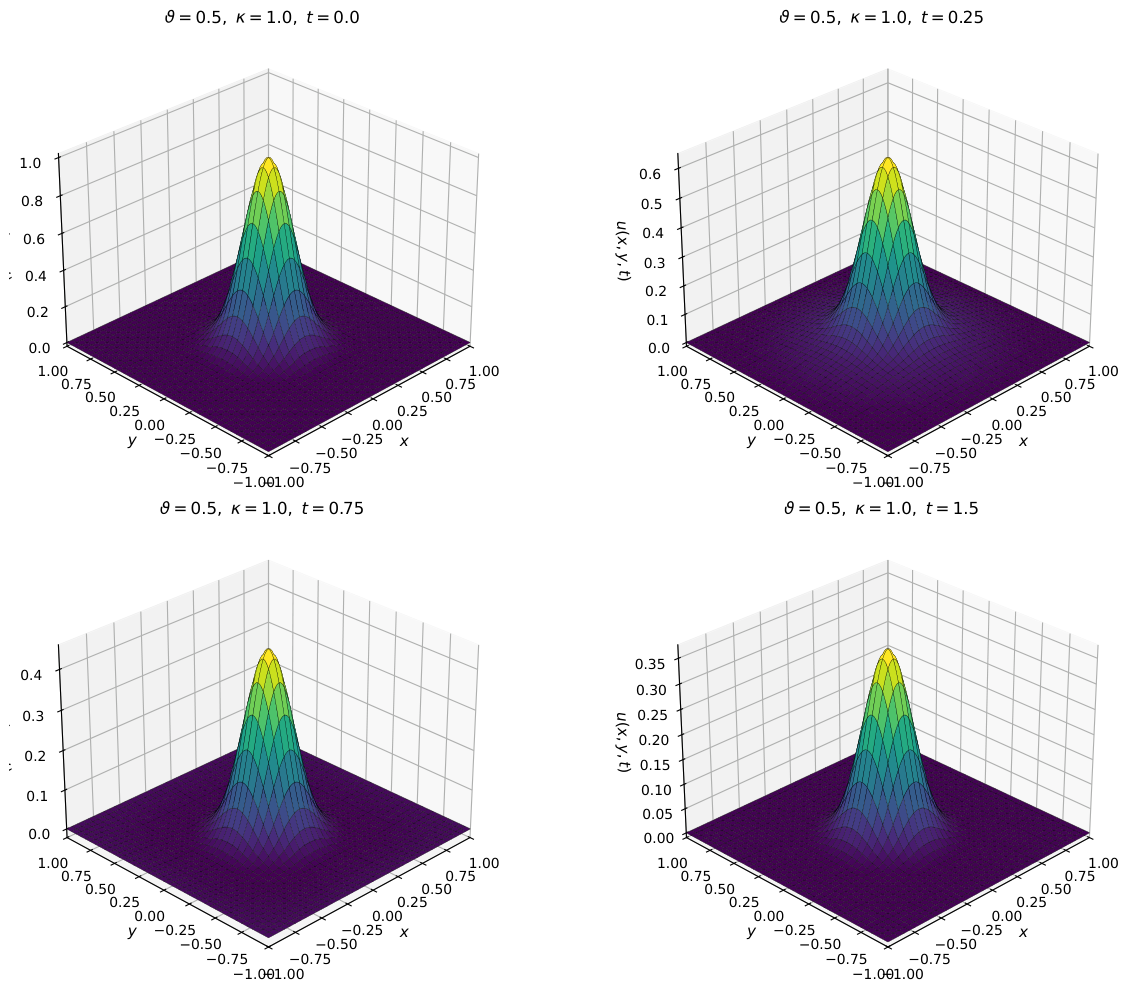
Figure 1 shows four snapshots of the solution for
ϑ = 0.5 , κ = 1 .
The initially concentrated peak gradually decreases while the profile widens and remains symmetric. More precisely, the sequence of snapshots shows that the central peak decreases from panel to panel, while the support of the pulse spreads spatially as time evolves. This confirms that the fractional Kelvin–Voigt term produces a clear damping effect without suppressing the wave nature of the motion.

5.3.2. Influence of the Fractional Order

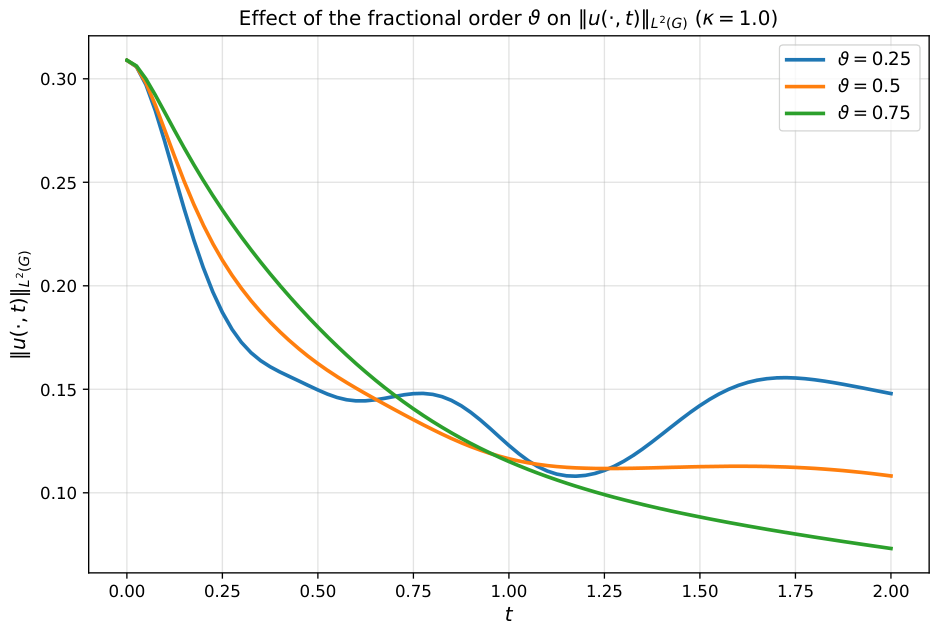
Next we keep κ = 1 fixed and vary the fractional order. Figure 2 displays
t u ( · , t ) L 2 ( G )
for
ϑ = 0.25 , ϑ = 0.5 , ϑ = 0.75 .
The curves start from the same initial norm and then separate clearly. In this experiment, larger values of ϑ lead to a smaller L 2 ( G ) -norm at later times. The curves are not monotone, which is natural for a damped wave equation, but the long-time reduction becomes more pronounced as the order increases. Figure 2 illustrates how the fractional order affects the overall decay pattern of the solution norm.

5.3.3. Influence of the Damping Parameter

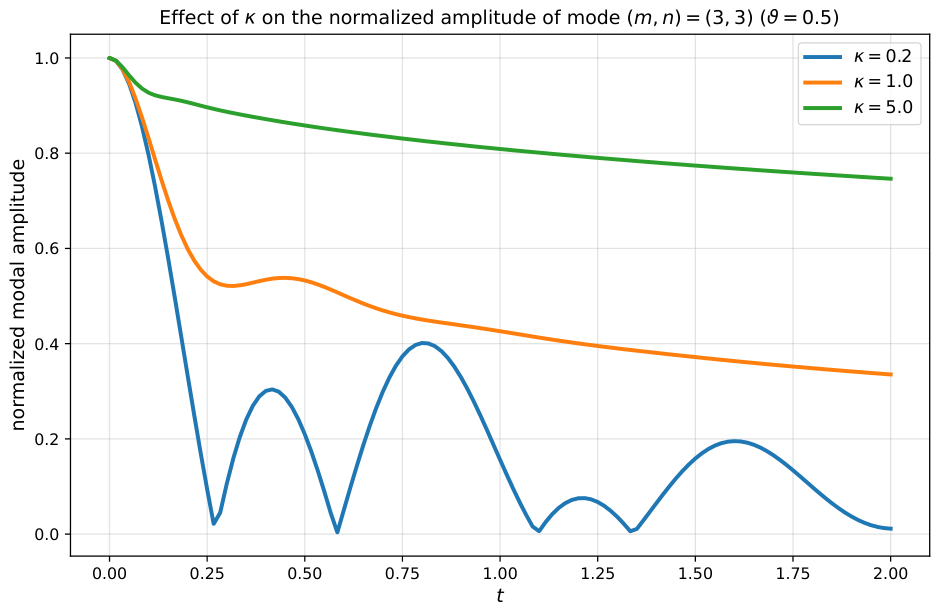
To isolate the effect of the coefficient κ , it is more informative to track a single higher spatial mode than to monitor a global norm. Let
ϕ m n ( x , y ) = sin m π ( x + 1 ) 2 sin n π ( y + 1 ) 2 , ( x , y ) [ 1 , 1 ] 2 .
In Figure 3, the initial displacement is chosen as the mode ϕ 33 , while u 1 = 0 and f = 0 . The figure plots the normalized modal amplitude for three values of κ . For κ = 0.2 , the normalized absolute modal amplitude exhibits pronounced oscillatory modulation, whereas for κ = 1 and κ = 5 the response becomes progressively more flattened. Thus, the damping parameter changes not only the magnitude of the response but also its temporal profile. In other words, Figure 3 shows that increasing κ suppresses the oscillatory response of the chosen mode more strongly.

5.3.4. Comparison of Low and High Frequencies

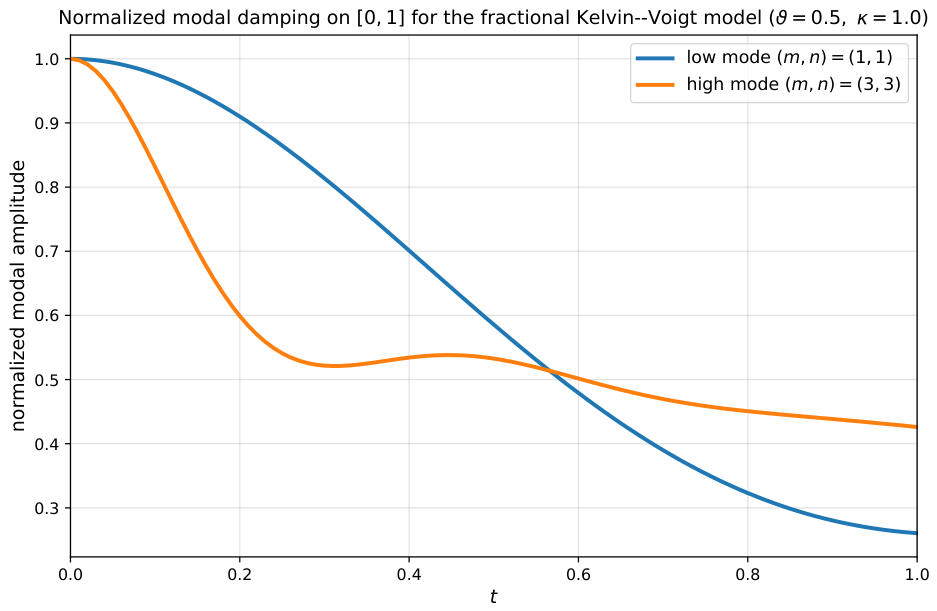
Finally, Figure 4 compares the normalized responses of a low-frequency mode and a higher-frequency mode on the interval [ 0 , 1 ] . The parameters are again
ϑ = 0.5 , κ = 1 ,
and the initial velocity is zero. The high-frequency mode undergoes a substantially faster initial decrease than the mode ( 1 , 1 ) . This behavior reflects the fact that the Kelvin–Voigt memory acts through the elliptic operator and therefore affects higher spatial frequencies more strongly. At later times the oscillatory nature of the wave equation remains visible, but the early-time contrast between the two modes is already pronounced. Hence Figure 4 gives a direct visual comparison between low- and high-frequency damping in the fractional Kelvin–Voigt setting.
The numerical tests and qualitative plots together provide a consistent picture of the proposed method and of the model itself. The convergence tables support the regularity-sensitive error analysis established earlier, while the figures show that the fractional order, the damping coefficient, and the spatial frequency all have a visible impact on the wave dynamics. In particular, the fractional Kelvin–Voigt mechanism combines hereditary damping with persistent oscillatory behavior, and this interplay becomes especially transparent when one compares low- and high-frequency modes.

6. Conclusions

We studied a wave equation with fractional Kelvin–Voigt damping and analyzed its space–time discretization on bounded convex domains with homogeneous Dirichlet boundary conditions. For the continuous problem, we derived a representation formula and established stability and smoothing estimates that make the dependence on the regularity of the initial displacement, initial velocity, and source term explicit.
For the numerical approximation, we first considered a semidiscrete finite element scheme in space and then a fully discrete method based on corrected second-order convolution quadrature in time. The corresponding error estimates show that the discrete solutions inherit the regularity-dependent behavior of the continuous model. In particular, the semidiscrete scheme achieves the expected spatial accuracy, while the fully discrete approximation attains second-order convergence in time under suitable assumptions on the data.
The numerical experiments support the theoretical analysis and also illustrate the influence of the fractional order, the damping parameter, and the spatial frequency on the wave dynamics. The proposed model and discretization framework are relevant to the numerical study of viscoelastic and acoustic wave propagation in media with memory, especially in settings where attenuation and dispersion effects must be resolved accurately. These results indicate that the proposed framework provides an effective and mathematically consistent approach for the numerical treatment of fractional Kelvin–Voigt wave models.

Author Contributions

Conceptualization, Y.W. and M.Z.A.; formal analysis, Y.W. and A.D.; funding acquisition, A.D.; investigation, Y.W. and A.D.; methodology, Y.W. and M.Z.A.; resources, A.D.; software, Y.W. and M.Z.A.; validation, M.Z.A. and A.D.; visualization, M.Z.A. and A.D.; writing—original draft, Y.W. and M.Z.A.; writing—review and editing, M.Z.A. and A.D. All authors have read and agreed to the published version of the manuscript.

Funding

This work was supported by the Research Startup Fund of Chengdu University of Technology (Grant No. 10912-KYQD2025-11350).

Institutional Review Board Statement

Not applicable.

Informed Consent Statement

Not applicable.

Data Availability Statement

No data was used for the research described in the article.

Conflicts of Interest

The authors declare no conflicts of interest.

References

  1. Holm, S.; Näsholm, S.P.; Prieur, F.; Sinkus, R. Deriving fractional acoustic wave equations from mechanical and thermal constitutive equations. Comput. Math. Appl. 2013, 66, 621–629. [Google Scholar] [CrossRef]
  2. Cuesta, E.; Lubich, C.; Palencia, C. Convolution quadrature time discretization of fractional diffusion-wave equations. Math. Comput. 2006, 75, 673–696. [Google Scholar] [CrossRef]
  3. Bagley, R.L.; Torvik, P.J. A theoretical basis for the application of fractional calculus to viscoelasticity. J. Rheol. 1983, 27, 201–210. [Google Scholar] [CrossRef]
  4. Bagley, R.L.; Torvik, P.J. On the fractional calculus model of viscoelastic behavior. J. Rheol. 1986, 30, 133–155. [Google Scholar] [CrossRef]
  5. Caputo, M.; Carcione, J.M.; Cavallini, F. Wave simulation in biologic media based on the Kelvin–Voigt fractional-derivative stress-strain relation. Ultrasound Med. Biol. 2011, 37, 996–1004. [Google Scholar] [CrossRef]
  6. Treeby, B.E.; Cox, B.T. Modeling power law absorption and dispersion in viscoelastic solids using a split-field and the fractional Laplacian. J. Acoust. Soc. Am. 2014, 136, 1499–1510. [Google Scholar] [CrossRef]
  7. BenSalah, M.; Tatar, S. Identification of the initial value in a space-time fractional diffusion equation. Filomat 2025, 39, 10799–10822. [Google Scholar] [CrossRef]
  8. Guliyev, V.S.; Guliyev, R.V.; Omarova, M.N.; Ragusa, M.A. Schrödinger type operators on local generalized Morrey spaces related to certain nonnegative potentials. Discret. Contin. Dyn. Syst.-Ser. B 2020, 25, 671–690. [Google Scholar] [CrossRef]
  9. Yao, W.; Zhang, H. New results for p-Laplacian fractional instantaneous and noninstantaneous impulsive differential equations. J. Funct. Spaces 2024, 2024, 5858291. [Google Scholar] [CrossRef]
  10. Afsar, H.; Peiwei, G.; Wu, N.; Alam, M.M. A study on attenuation patterns of acoustic waves in waveguide structures with flexural boundaries. J. Vib. Control 2024, 31, 2797–2810. [Google Scholar] [CrossRef]
  11. Atanacković, T.M.; Janev, M.; Oparnica, L.; Pilipović, S.; Zorica, D. Space–time fractional Zener wave equation. Proc. R. Soc. A 2015, 471, 20140614. [Google Scholar] [CrossRef] [PubMed]
  12. Yu, Y.; Perdikaris, P.; Karniadakis, G.E. Fractional modeling of viscoelasticity in 3D cerebral arteries and aneurysms. J. Comput. Phys. 2016, 323, 219–242. [Google Scholar] [CrossRef]
  13. Alotta, G.; Barrera, O.; Cocks, A.; Di Paola, M. The finite element implementation of 3D fractional viscoelastic constitutive models. Finite Elem. Anal. Des. 2018, 146, 28–41. [Google Scholar] [CrossRef]
  14. Ren, D.; Shen, X.; Li, C.; Cao, X. The fractional Kelvin–Voigt model for Rayleigh surface waves in viscoelastic FGM infinite half space. Mech. Res. Commun. 2018, 87, 53–58. [Google Scholar] [CrossRef]
  15. Zhang, X.; Li, Z.; Wang, X.; Yu, J. The fractional Kelvin–Voigt model for circumferential guided waves in a viscoelastic FGM hollow cylinder. Appl. Math. Model. 2021, 89, 299–313. [Google Scholar] [CrossRef]
  16. Wang, Y.; Chen, Y. Dynamic analysis of the viscoelastic pipeline conveying fluid with an improved variable fractional order model based on shifted Legendre polynomials. Fractal Fract. 2019, 3, 52. [Google Scholar] [CrossRef]
  17. Parker, K.J.; Szabo, T.L.; Holm, S. Towards a consensus on rheological models for elastography in soft tissues. Phys. Med. Biol. 2019, 64, 215012. [Google Scholar] [CrossRef]
  18. Gomez, A.; Rus, G.; Saffari, N. Wave propagation in a fractional viscoelastic tissue model: Application to transluminal procedures. Sensors 2021, 21, 2778. [Google Scholar] [CrossRef]
  19. Shen, L.-J. Fractional derivative models for viscoelastic materials at finite deformations. Int. J. Solids Struct. 2020, 190, 226–237. [Google Scholar] [CrossRef]
  20. Oparnica, L.; Süli, E. Well-posedness of the fractional Zener wave equation for heterogeneous viscoelastic materials. Fract. Calc. Appl. Anal. 2020, 23, 126–166. [Google Scholar] [CrossRef]
  21. Kim, J. Mixed convolved action for the fractional derivative Kelvin–Voigt model. Acta Mech. 2021, 232, 661–684. [Google Scholar] [CrossRef]
  22. Broucke, F.; Oparnica, L. Micro-local and qualitative analysis of the fractional Zener wave equation. J. Differ. Equations 2022, 321, 217–257. [Google Scholar] [CrossRef]
  23. Bazhlekova, E.; Bazhlekov, I. Subordination principle for generalized fractional Zener models. Fractal Fract. 2023, 7, 298. [Google Scholar] [CrossRef]
  24. Jelić, S.; Zorica, D. Energy balance for fractional anti-Zener and Zener models in terms of relaxation modulus and creep compliance. Appl. Math. Model. 2023, 123, 688–728. [Google Scholar] [CrossRef]
  25. Cunha-Filho, A.G.; Briend, Y.; de Lima, A.M.G.; Donadon, M.V. A new and efficient constitutive model based on fractional time derivatives for transient analyses of viscoelastic systems. Mech. Syst. Signal Process. 2021, 146, 107042. [Google Scholar] [CrossRef]
  26. Nunes, E.P.; de Lima, A.M.G.; Cunha-Filho, A.G. An efficient method to model the time-domain behavior of viscoelastically damped systems based on an improved fractional derivative model. J. Mech. Sci. Technol. 2022, 36, 1645–1653. [Google Scholar] [CrossRef]
  27. Cortés, F.; Brun, M.; Elejabarrieta, M.J. A finite element formulation for the transient response of free layer damping plates including fractional derivatives. Comput. Struct. 2023, 282, 107039. [Google Scholar] [CrossRef]
  28. Zheng, G.; Zhang, N.; Lv, S. The application of fractional derivative viscoelastic models in the finite element method: Taking several common models as examples. Fractal Fract. 2024, 8, 103. [Google Scholar] [CrossRef]
  29. Almashakbeh, Y.; Shamimi, H.; Faris, I.H.; Cortés, J.M.; Callejas, A.; Rus, G. Healthy human skin Kelvin–Voigt fractional and spring-pot biomarkers reconstruction using torsional wave elastography. Phys. Eng. Sci. Med. 2024, 47, 575–587. [Google Scholar] [CrossRef]
  30. Tian, M.-L.; Zhang, X.-Y.; Li, X.-F. Thermoviscoelastic response of skin tissue via fractional Pennes bioheat and fractional viscoelasticity. J. Therm. Stress. 2024, 47, 959–976. [Google Scholar] [CrossRef]
  31. Wang, F.; Zhu, Y.; Jia, S.; Guo, X. The RBF–FD method for solving the time-fractional viscoelastic wave propagation in irregular domains. Eng. Anal. Bound. Elem. 2025, 173, 106121. [Google Scholar] [CrossRef]
  32. Yuan, H.; Xie, X. Analysis of a fast fully discrete finite element method for fractional viscoelastic wave propagation. Commun. Nonlinear Sci. Numer. Simul. 2026, 152, 109361. [Google Scholar] [CrossRef]
  33. Sarkar, S.; Kundu, S. Modeling of Love-type wave propagation in a fractional poro-viscoelastic layer over a viscoelastic-to-elastic half-space, induced by a Gaussian source. Appl. Math. Model. 2025, 151, 116441. [Google Scholar] [CrossRef]
  34. Ichou, M.A.; Ezziani, A. A new optimized quality factor Q for a general class of the Zener viscoelastic model. J. Appl. Geophys. 2025, 243, 105980. [Google Scholar] [CrossRef]
  35. Li, Z.; Qu, J.; Chen, Y.; Cui, Y.; Yang, A.; Yan, D. Variable fractional order dynamic analysis of viscoelastic pipes using shifted Bernstein polynomial-based numerical algorithm. Fractal Fract. 2025, 9, 747. [Google Scholar] [CrossRef]
  36. Łabędzki, P. Fractional Kelvin–Voigt model for beam vibrations: Numerical simulations and approximation using a classical model. Electronics 2025, 14, 1918. [Google Scholar] [CrossRef]
  37. Larsson, S.; Thomée, V.; Wahlbin, L.B. Finite-element methods for a strongly damped wave equation. IMA J. Numer. Anal. 1991, 11, 115–142. [Google Scholar] [CrossRef]
  38. Thomée, V. Galerkin Finite Element Methods for Parabolic Problems, 2nd ed.; Springer Series in Computational Mathematics; Springer: Berlin/Heidelberg, Germany, 2006; Volume 25. [Google Scholar] [CrossRef]
  39. Lubich, C. Convolution quadrature and discretized operational calculus. I. Numer. Math. 1988, 52, 129–145. [Google Scholar] [CrossRef]
  40. Lubich, C. Convolution quadrature revisited. BIT Numer. Math. 2004, 44, 503–514. [Google Scholar] [CrossRef]
  41. Jin, B.; Lazarov, R.; Zhou, Z. Two fully discrete schemes for fractional diffusion and diffusion-wave equations with nonsmooth data. Siam J. Sci. Comput. 2016, 38, A146–A170. [Google Scholar] [CrossRef]
  42. Al-Maskari, M.; Karaa, S. The time-fractional Cahn–Hilliard equation: Analysis and approximation. IMA J. Numer. Anal. 2022, 42, 1831–1865. [Google Scholar] [CrossRef]
  43. Abidin, M.Z. Energy-dissipative adaptive-step L1 discretisation for the Caputo time-fractional incompressible magnetohydrodynamic system. Sci. Rep. 2026, 16, 13093. [Google Scholar] [CrossRef]
  44. Baker, K.; Banjai, L. Numerical analysis of a wave equation for lossy media obeying a frequency power law. IMA J. Numer. Anal. 2022, 42, 2083–2117. [Google Scholar] [CrossRef]
  45. Pu, J.; Shi, Q. Blowup for the fractional KGS system with nongauge nonlinearities. Electron. Res. Arch. 2026, 34, 160–172. [Google Scholar] [CrossRef]
  46. Liu, Q.; Liu, Q.; Zhou, Y.; Liu, J.; Dai, Y.; Chen, S.; Lai, T. Identifying vibration characteristics of hemispherical resonators with mass defects. Int. J. Mech. Sci. 2025, 306, 110856. [Google Scholar] [CrossRef]
  47. Yang, Q.; Teng, W.; Guo, K.; Wang, T.; Zhao, L.; Hui, Y.; Liu, M. Large Eddy Simulation of self-excited forces in forced-vibration square prisms: Lock-In regime dynamics and vortex shedding modulation. J. Wind Eng. Ind. Aerodyn. 2026, 270, 106338. [Google Scholar] [CrossRef]
Figure 1. Snapshots of the numerical solution for the fractional Kelvin–Voigt wave model with ϑ = 0.5 and κ = 1 , generated from the localized initial pulse (63) with σ = 0.18 , zero initial velocity, and zero source term. The panels are arranged in increasing time order and show the gradual decay and spatial spreading of the initial pulse.
Fractalfract 10 00381 g001
Figure 2. Time evolution of the L 2 ( G ) -norm of the solution for different values of the fractional order ϑ , with fixed damping parameter κ = 1 , zero source term, zero initial velocity, and initial pulse (63).
Fractalfract 10 00381 g002
Figure 3. Effect of the damping parameter κ on the normalized absolute amplitude of the fixed mode ( m , n ) = ( 3 , 3 ) for the fractional Kelvin–Voigt wave model with ϑ = 0.5 . The initial displacement is the single mode ϕ 33 , while the initial velocity and source term are zero.
Fractalfract 10 00381 g003
Figure 4. Normalized absolute amplitudes of the modes ( m , n ) = ( 1 , 1 ) and ( m , n ) = ( 3 , 3 ) on the time interval [ 0 , 1 ] for the fractional Kelvin–Voigt wave model with ϑ = 0.5 and κ = 1 . Both modes start from unit amplitude and zero initial velocity.
Fractalfract 10 00381 g004
Table 1. L 2 ( G ) -errors for the temporal discretization of the manufactured-solution test with h = 1 / 512 . Here * indicates that no convergence rate is reported for the first row, since there is no previous refinement level for comparison.
N ϑ = 0.25 ErrorRate ϑ = 0.75 ErrorRate
4 2.656194 × 10 2 * 2.887189 × 10 2 *
8 1.386516 × 10 2 0.94 8.497470 × 10 3 1.76
16 5.217049 × 10 3 1.41 2.123883 × 10 3 2.00
32 1.296483 × 10 3 2.01 5.291028 × 10 4 2.01
64 3.051544 × 10 4 2.09 1.325153 × 10 4 2.00
Table 2. L 2 ( G ) -errors for the spatial discretization of the manufactured-solution test with N = 4096 . Here * indicates that no convergence rate is reported for the first row, since there is no previous refinement level for comparison.
M ϑ = 0.25 ErrorRate ϑ = 0.75 ErrorRate
4 1.576412 × 10 1 * 1.569383 × 10 1 *
8 4.261885 × 10 2 1.89 4.230712 × 10 2 1.89
16 1.089401 × 10 2 1.97 1.080643 × 10 2 1.97
32 2.739389 × 10 3 1.99 2.716859 × 10 3 1.99
64 6.858989 × 10 4 2.00 6.802040 × 10 4 2.00
Table 3. H 1 ( G ) -seminorm errors for the spatial discretization of the manufactured-solution test with N = 4096 . Here * indicates that no convergence rate is reported for the first row, since there is no previous refinement level for comparison.
M ϑ = 0.25 ErrorRate ϑ = 0.75 ErrorRate
4 1.679085 × 10 0 * 1.679122 × 10 0 *
8 8.641515 × 10 1 0.96 8.641596 × 10 1 0.96
16 4.351588 × 10 1 0.99 4.351600 × 10 1 0.99
32 2.179622 × 10 1 1.00 2.179624 × 10 1 1.00
64 1.090289 × 10 1 1.00 1.090289 × 10 1 1.00
Table 4. L 2 ( G ) -errors in time for the source-driven case (60). Here * indicates that no convergence rate is reported for the first row, since there is no previous refinement level for comparison.
N ϑ = 0.25 ErrorRate ϑ = 0.75 ErrorRate
16 9.874208 × 10 4 * 5.111415 × 10 5 *
32 3.783291 × 10 4 1.38 1.212632 × 10 5 2.08
64 9.929812 × 10 5 1.93 2.970733 × 10 6 2.03
128 2.379582 × 10 5 2.06 7.068468 × 10 7 2.07
Table 5. L 2 ( G ) -errors in time for the initial-velocity case (61). Here * indicates that no convergence rate is reported for the first row, since there is no previous refinement level for comparison.
N ϑ = 0.25 ErrorRate ϑ = 0.75 ErrorRate
16 6.695323 × 10 4 * 2.101826 × 10 6 *
32 1.615347 × 10 4 2.05 5.122065 × 10 7 2.04
64 3.659433 × 10 5 2.14 1.020029 × 10 7 2.33
128 8.249369 × 10 6 2.15 2.247031 × 10 8 2.18
Table 6. L 2 ( G ) -errors in time for the initial-displacement case (62). Here * indicates that no convergence rate is reported for the first row, since there is no previous refinement level for comparison.
N ϑ = 0.25 ErrorRate ϑ = 0.75 ErrorRate
16 7.091407 × 10 4 * 1.496991 × 10 6 *
32 3.458286 × 10 4 1.04 7.740465 × 10 7 0.95
64 1.047208 × 10 4 1.72 2.778746 × 10 7 1.48
128 2.668144 × 10 5 1.97 7.251536 × 10 8 1.94
Disclaimer/Publisher’s Note: The statements, opinions and data contained in all publications are solely those of the individual author(s) and contributor(s) and not of MDPI and/or the editor(s). MDPI and/or the editor(s) disclaim responsibility for any injury to people or property resulting from any ideas, methods, instructions or products referred to in the content.