Article

NMR and Multifractal Characterization of Pore Heterogeneity in Transitional-Marine Shales: A Case Study from the Longtan Formation, Sichuan Basin


1
School of Engineering Science, University of Chinese Academy of Sciences, Beijing 100049, China
2
Institute of Porous Flow and Fluid Mechanics, Chinese Academy of Sciences, Langfang 065007, China
3
Research Institute of Petroleum Exploration and Development, PetroChina, Beijing 100083, China
4
National Energy Shale Gas R&D Experimental Center, Langfang 065007, China
5
PetroChina Hangzhou Research Institute of Geology, Hangzhou 310023, China
6
School of Energy Resource, China University of Geosciences, Beijing 100083, China
*
Authors to whom correspondence should be addressed.
Fractal Fract. 2026, 10(6), 417; https://doi.org/10.3390/fractalfract10060417
Submission received: 13 March 2026 / Revised: 11 June 2026 / Accepted: 13 June 2026 / Published: 18 June 2026

Abstract

Transitional marine–continental shale reservoirs are typified by intricate pore architectures and pronounced heterogeneity; accurate characterization of their pore network and fluid mobility underpins reservoir appraisal and sweet-spot forecasting. Focusing on the Longtan Formation transitional shales in the Sichuan Basin, this study integrates NMR T2 spectrometry, geochemical–mineralogical assays and multifractal analysis to elucidate multi-scale heterogeneity of the pore framework and its governing mechanisms. Results reveal that the investigated shales are characterized by low porosity (0.46–7.43%) and high bound fluid saturation (66.77–97.28%). Multifractal spectral width (Δα) and degree of multifractality (ΔD) serve as robust metrics of pore heterogeneity, correlating closely with rock composition (e.g., TOC and clay content). By combining multifractal indices, mineralogical assemblage and fluid movability, the samples are classified into three reservoir archetypes, with Type I (weakly heterogeneous—high quality) identified as the prospective developmental sweet spot. This work provides a theoretical and methodological backbone for quality assessment and play-ranking of transitional marine–continental shale reservoirs.

1. Introduction

Shales serve as both prime hydrocarbon kitchens and tight reservoirs for unconventional resources [1,2,3,4], whose extreme lithological heterogeneity and ultra-low permeability exert spatio-temporal controls on hydrocarbon storage and migration [5,6]. Efficient exploitation therefore hinges upon a quantitative appraisal of the intricate pore architecture and associated fluid mobility [7,8].
With the continuous refinement of pore-characterization technologies [9,10,11,12], multi-dimensional datasets of shale pore architectures are increasingly unveiled, offering critical insights into pore evolution and hydrocarbon storage mechanisms [13,14]. Numerous researchers have embedded fractal theory into shale pore investigations [15,16,17,18,19], leveraging nitrogen-adsorption, NMR and small-angle neutron-scattering data to quantify heterogeneity across various length scales. Conventional monofractal models, however, exhibit pronounced limitations in capturing the intense heterogeneity inherent to shales [20,21,22,23]. Consequently, multi-scale fractal theory—encompassing multifractal formalism—has been imported to portray pore-texture heterogeneity with higher fidelity [24,25,26], and has evolved into a pivotal tool for dissecting pore complexity in coals, tight sandstones and shales across disparate observational resolutions [27,28,29].
The Sichuan Basin, situated in central-western China, constitutes the country’s premier petroliferous province [30,31,32,33], hosting several tens of hydrocarbon-bearing stratigraphic units that command high scientific and commercial value [34,35,36,37,38]. From the Palaeozoic through the Mesozoic to the Cenozoic, marine, continental and transitional marine–continental successions are all well developed [39,40]. Multiple marine shale packages within this stack have already achieved commercial hydrocarbon production [41,42,43,44]. At present, the Upper Palaeozoic Permian Longtan Formation mudstone–shale sequence has emerged as a focal target for hydrocarbon researchers [31,45,46]; these transitional shales are endowed with substantial resource potential and are considered ripe for large-scale exploration and development, earmarked as a critical play for future shale-gas reserve growth and production increase in China [39,47,48]. Previous workers have conducted preliminary investigations into favourable lithofacies, organic-matter enrichment and pore development. Enze Wang et al. [48] examined the Permian Longtan Formation transitional marine shales in the Lintanchang area, the southeastern margin of the Sichuan Basin, through petrological and geochemical analyses, identifying four lithofacies: organic-lean calcareous shale, organic-lean mixed shale, organic-lean clayey shale and organic-rich clayey shale. They found that clay-mineral-associated pores constitute the dominant pore type, with clay-mineral content being the principal control on shale petrophysical properties, and TOC the foremost factor governing gas content; among these, organic-rich clayey shale deposited in tidal-flat–lagoon systems represents the most favourable lithofacies. Kai Yang et al. [39] performed geochemical analyses on the Permian Longtan Formation transitional marine shales in well F5 of the Sichuan Basin, finding a mean TOC of 3.04% and a mean thermal maturity of 2.46%, deposited under humid–hot climate, high terrigenous input, oxidising conditions and high sedimentation rates in open-water settings; terrigenous plant debris served as the primary organic-matter source, with terrigenous influx, redox conditions and sedimentation rate being the principal controls on organic-matter enrichment. Jizhen Zhang et al. [49] investigated coal-bearing transitional marine shales of the Longtan Formation in southern Sichuan, employing nitrogen adsorption–desorption experiments and conventional monofractal theory to reveal pore-structure characteristics and heterogeneity; they found that smaller pores developed larger specific surface areas, yielding high fractal dimensions (2.564–2.677). Nevertheless, criteria for sweet-spot selection within this succession remain sparse, and a pivotal challenge lies in evaluating the complexity of pore architecture and fluid mobility within these mudstones.
This study aims to integrate nuclear magnetic resonance (NMR) core measurements, geochemical–mineralogical assays and multifractal formalism, to quantify pore-texture complexity, fluid movability and rock-matrix heterogeneity in Longtan Formation (LTF) shale cores, and to elucidate the governing mechanisms. The resultant database and interpretative framework will underpin the future effective development of this marine–continental transitional shale succession.

2. Materials and Methods

2.1. Sample Description

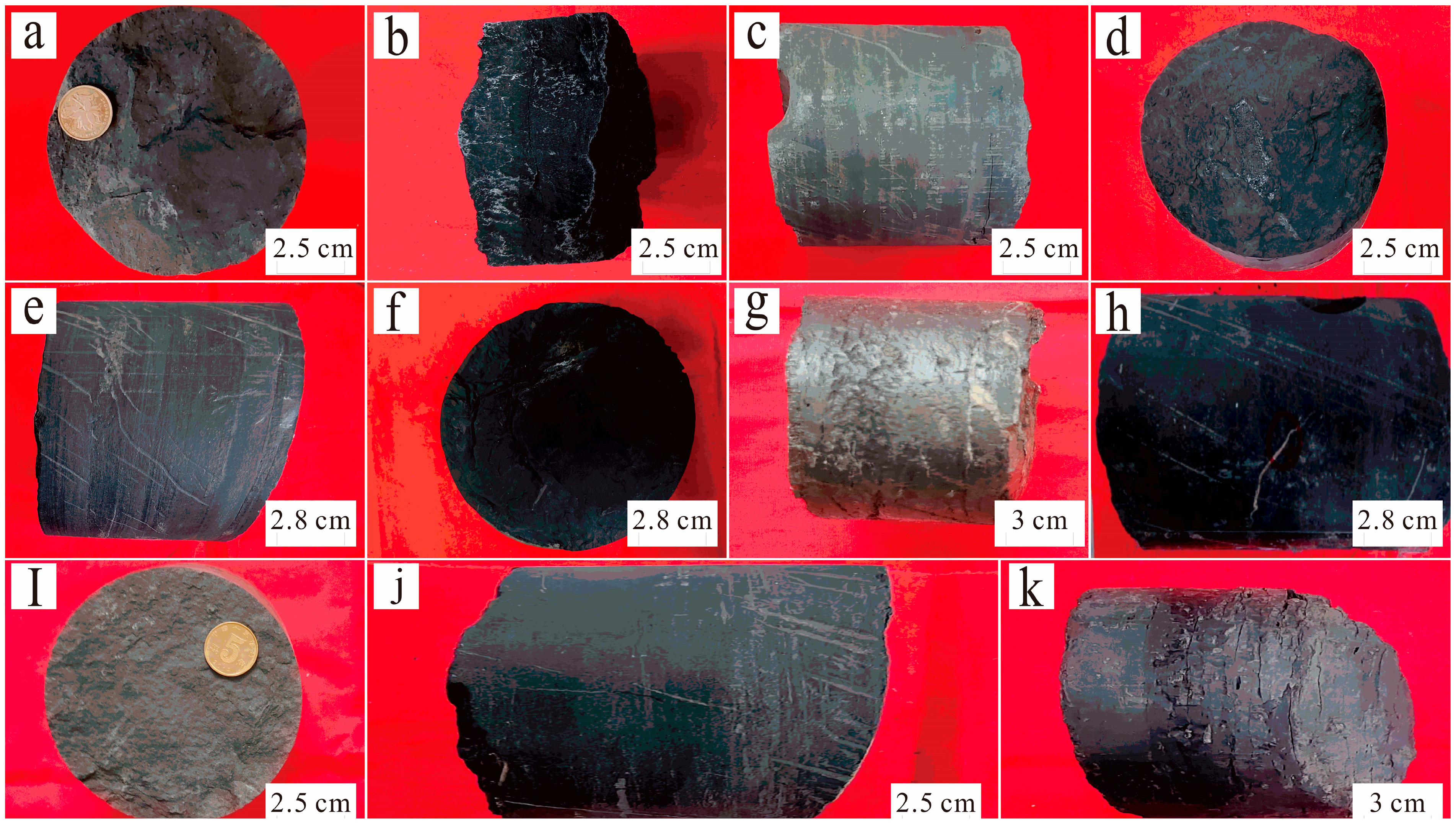
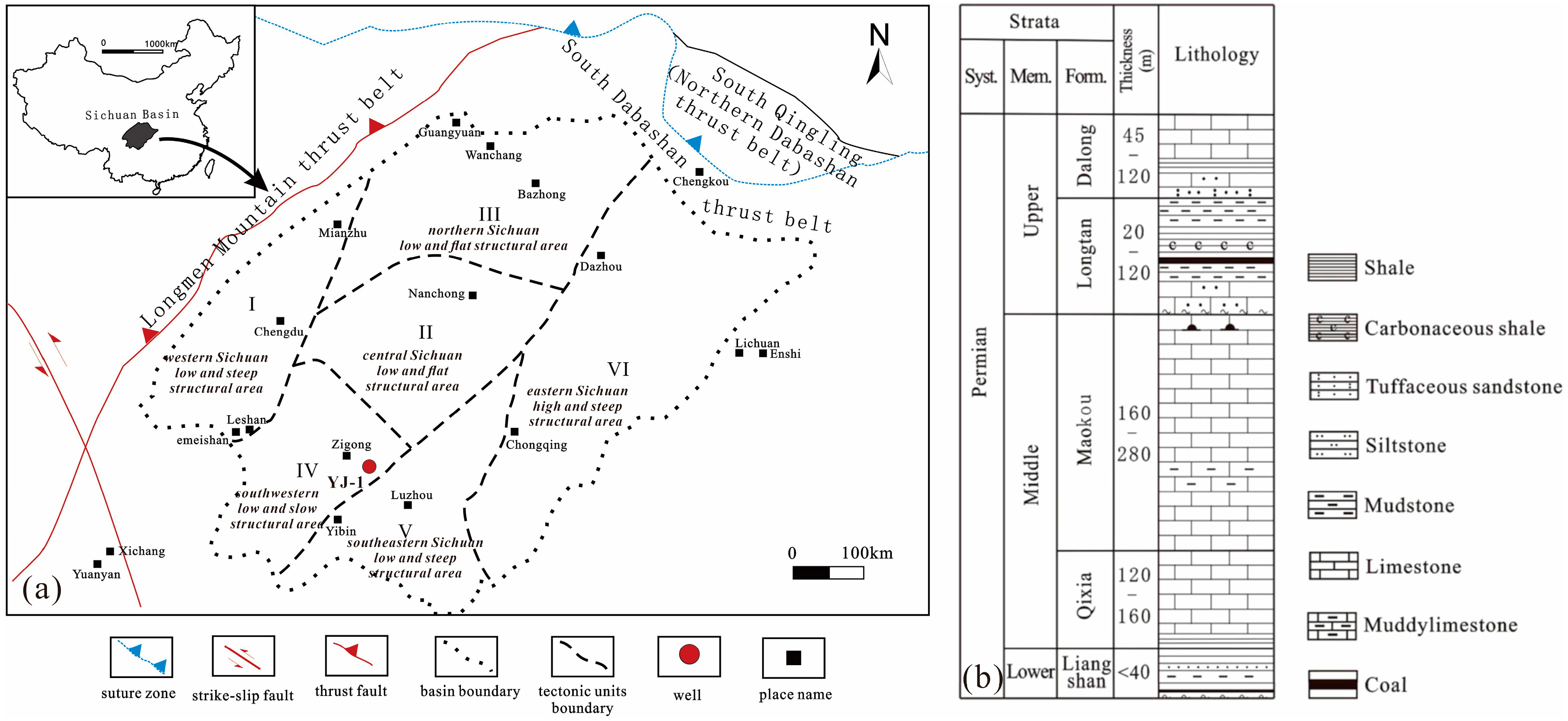
The Upper Palaeozoic Permian Longtan Formation mudstone–shale package is extensively developed across central and southern sectors of the Sichuan Basin [46,48], with stratigraphic thicknesses generally ranging from 80 to 120 m. The succession is subdivided, in ascending order, into Tan-1, Tan-2 and Tan-3 sub-members [50,51], each corresponding to a third-order eustatic cycle of the late Permian. For this investigation, eleven full-diameter shale cores were retrieved from the Tan-3 sub-member of well YJ-1 in the southern basin, spanning 3021.44–3057.15 m true vertical depth. The samples display elevated thermal maturity [52] and have experienced intense hydrocarbon generation. Well location is shown in Figure 1a; lithology and corresponding depths are listed in Figure 1. The sample photos can be seen in Figure 2a–k.

2.2. NMR Experiment Procedures

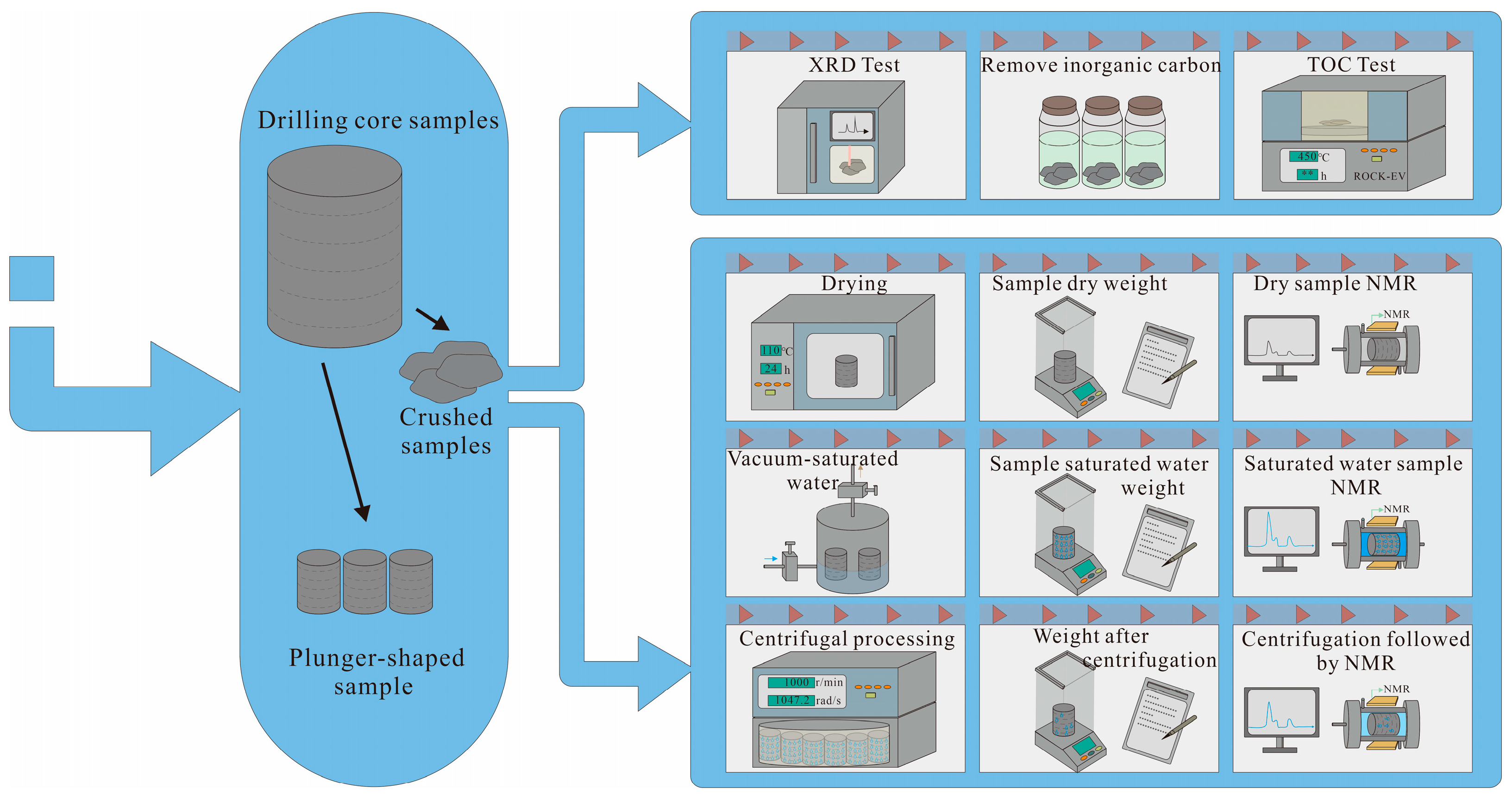
All experiments were performed on a Numag MR Cores-XX high-precision bench-top NMR unconventional core analyser coupled with a TG20.5 high-speed centrifuge, with the temperature maintained constant at 25 °C (ambient). NMR core analyses strictly followed China National Petroleum and Natural Gas Industry Standard SY/T 6490-2014 “Laboratory Specifications for NMR Parameter Measurements on Rock Samples”. The principal workflow comprised: (i) oven-drying samples at 110 °C for 24 h [54], weighing and acquiring an initial NMR signal to establish the baseline; (ii) placing the dried plugs in a vacuum-pressure saturation vessel, saturating with deionised water under vacuum for 24 h, and recording the fully saturated T2 spectrum; (iii) determining bulk volume by the buoyancy method and recording the saturated (wet) mass on an analytical balance; (iv) centrifuging the saturated cores for 6 h at predetermined speeds, with the rpm–g conversion listed in Table 1; (v) acquiring the post-centrifuge T2 spectrum and recording the corresponding mass. A total of 11 plugs were successfully measured; sample JY1-6 was damaged during preparation and excluded from all analyses.

2.3. Geochemistry and Mineralogy Analysis

Whole-rock mineralogy was quantified by X-ray diffraction (XRD) analysis, with the diffractometer operated at 40 kV and 40 mA. Fresh shale chips were selected and pretreated prior to measurement; the entire scan was performed at ambient temperature. The procedure strictly followed China Petroleum Industry Standard SY/T 5163—2018 “XRD Analytical Method for Clay and Common Non-Clay Minerals in Sedimentary Rocks”.
Total organic carbon (TOC) was determined with a carbon analyser. Prior to analysis, samples were ultrasonically cleaned, pulverised, acid-washed and low-temperature dried. The measurement complied with Chinese National Standard GB/T 19145—2003 “Determination of Total Organic Carbon in Sedimentary Rocks”.
The analytical workflow is summarised in Figure 3.

2.4. Multifractal Theory

Multifractal theory [18,32,55,56,57]—an extension of fractal geometry—employs the continuous generalised-dimension spectrum (Dq) and the singularity spectrum (α–f(α)) to capture local irregularities and global heterogeneity within complex systems. Compared with a monofractal dimension, its principal merit lies in resolving scale-dependent probability distributions, thereby quantifying both the intensity and frequency of local singularities. In shale-gas research, this formalism has been deployed to characterise pore-framework heterogeneity and pore-size distribution. Here, NMR T2 spectra are used to compute D0 (capacity dimension), D1 (information dimension), D2 (correlation dimension) and spectral width Δα, thereby revealing the intricacy of pore development. The workflow proceeds as follows.

2.4.1. Data Pre-Processing

The raw NMR T2 distribution must first be transformed by converting the relaxation-time axis to a logarithmic scale across the measurement window, yielding 100 dimensionless bins of equal logarithmic width △I (Equation (1)) [28,29,55].
β k = log ( γ k γ 1 ) , k = 1 ,   2 ,   3 ,   ,   99 ,   100
Here, γk denotes the measured value, γ1 the minimum detection limit, and βk the dimensionless value after converting the PSD detection range.

2.4.2. Sub-Interval Partitioning and Probability Density Calculation

Within △I, the PSD interval is subdivided into K(η) = 2t sub-intervals of length η. An interpolation scheme is applied to guarantee that every sub-interval contains at least one measurement. The probability density (percentage) of measurements within each sub-interval, Kk(η), is then computed, and a family of partition functions Nk(η) is constructed (Equation (2)) [58,59]. The q-value ranges: from −10 to +10 with step 1 (21 points in total, or 41 points if including half-steps; we used step 1 for clarity). Number of sub-intervals: K(η) = 210 = 1024. Smoothing: No additional smoothing filter was applied to the raw NMR T2 spectra; instead, the probability density was interpolated using a cubic spline to ensure each sub-interval contains at least one measurement point.
v k ( q , η ) = K k ( η ) k 1 N ( η ) K k ( η )
Here, vk(q,η) denotes the q-order probability within the k-th sub-interval of the PSD data, and ∑k-1N(η)Kk(η) represents the sum of q-order probabilities across all sub-intervals.

2.4.3. Calculation of the Multifractal Generalised-Dimension Spectrum Dq

Equation (3) gives the multifractal generalised-dimension spectrum Dq [24,60,61,62].
D q = 1 q 1 l i m η 0 l o g K q ( η ) l o g ( η ) , q 1 l i m η 0 k 1 K ( η ) { P k ( η ) l n [ P k ( η ) ] } l i n ( η ) , q = 1
For q = 0, 1 and 2, the resulting D0, D1 and D2 correspond to the capacity, information-entropy and correlation dimensions, respectively. For a partition of size η, the comparison between the mass probability within a given cell and the sum over all cells is quantified by v k ( q , η ) = P k ( η ) q K q ( η ) .

2.4.4. Multifractal Singularity Exponent α(q) and Spectrum Function f[α(q)]

Equation (4) gives the multifractal singularity exponent α(q) [25,63,64].
α ( q ) = l i m η 0 k 1 N ( η ) v k ( q , η ) l o g P K ( η ) l i n ( η )
For the PSD particle-size distribution of α(q), the multifractal spectrum function f[α(q)] is expressed as Equation (5) [25,63,64].
f [ α ( q ) ] = l i m η 0 k 1 N ( η ) v k ( q , η ) l i n ( η )
From these computations, two complementary parameter sets, the generalised-dimension spectrum q–Dq and the singularity spectrum α–f(α), are derived, to characterise the fractal attributes of the shale pore network and to quantify both the degree of heterogeneity and the complexity of pore development within the shale.

3. Results and Discussion

3.1. Rock Composition Characteristics

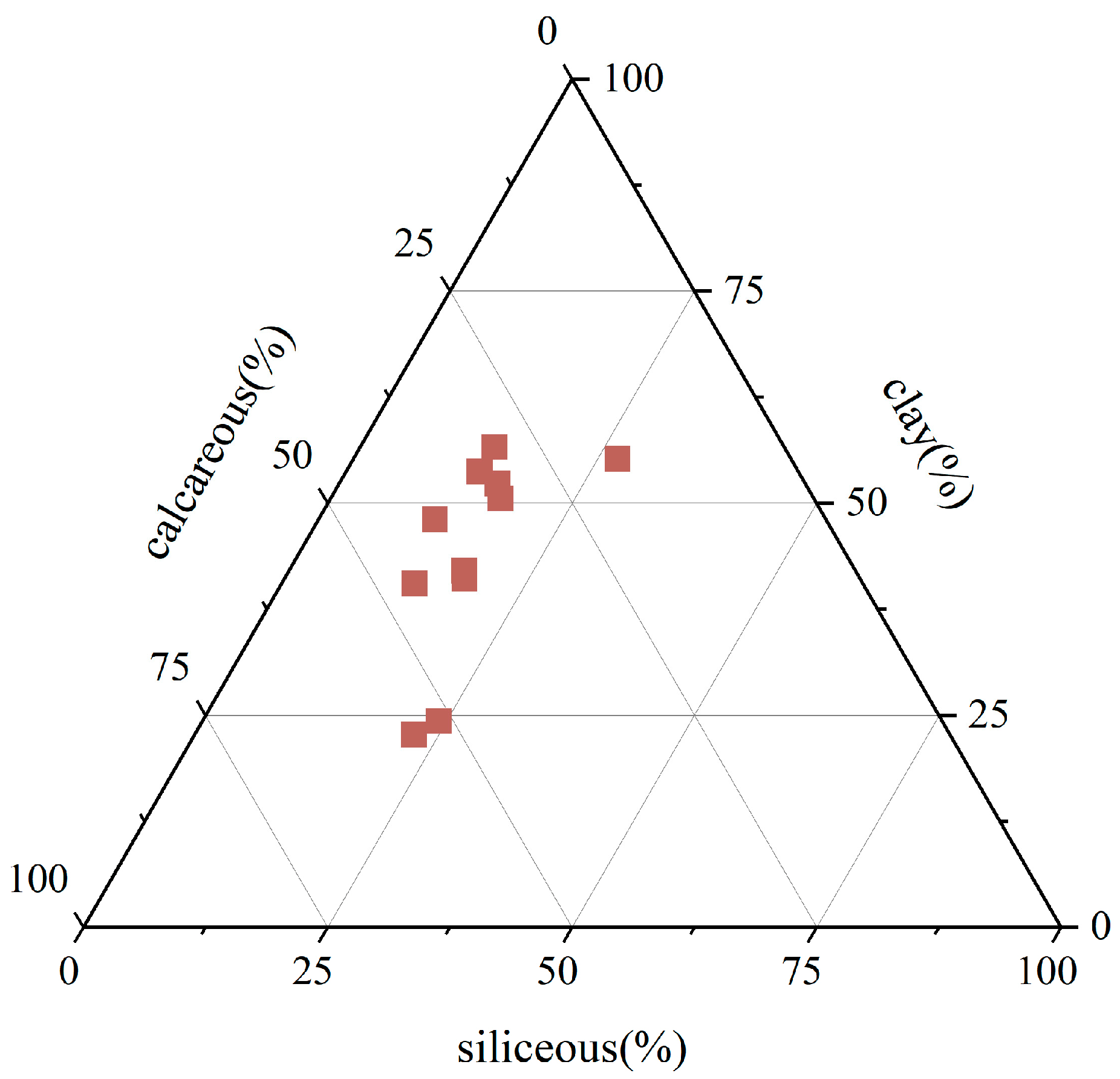
XRD analyses reveal that the Tan-3 member of the Longtan Formation (LTF) is mineralogically complex, comprising clay minerals, quartz, feldspar, calcite, dolomite and minor pyrite. No phosphate or Fe-Ti oxide minerals were detected above the XRD quantification limit (~1–2 wt%), though trace amounts may be present. The assemblage is dominated by clay and carbonate phases. Carbonate minerals exhibit the widest variability, ranging from 15.2% to 51.9% (average 35.5%, n = 11), whereas clay content is more tightly clustered between 21.0% and 51.2% (average 40.9%, n = 11) and constitutes the largest volumetric fraction. Quartz-rich phases are comparatively subordinate, varying from 11.1% to 23.8% (average 16.6%, n = 11) (Figure 4). Relative to marine shales, the quartz content is markedly lower [36,65], while the carbonate fraction is elevated compared with intra-formational counterparts [6], presumably reflecting enhanced marine influence during the late Longtan stage [51].
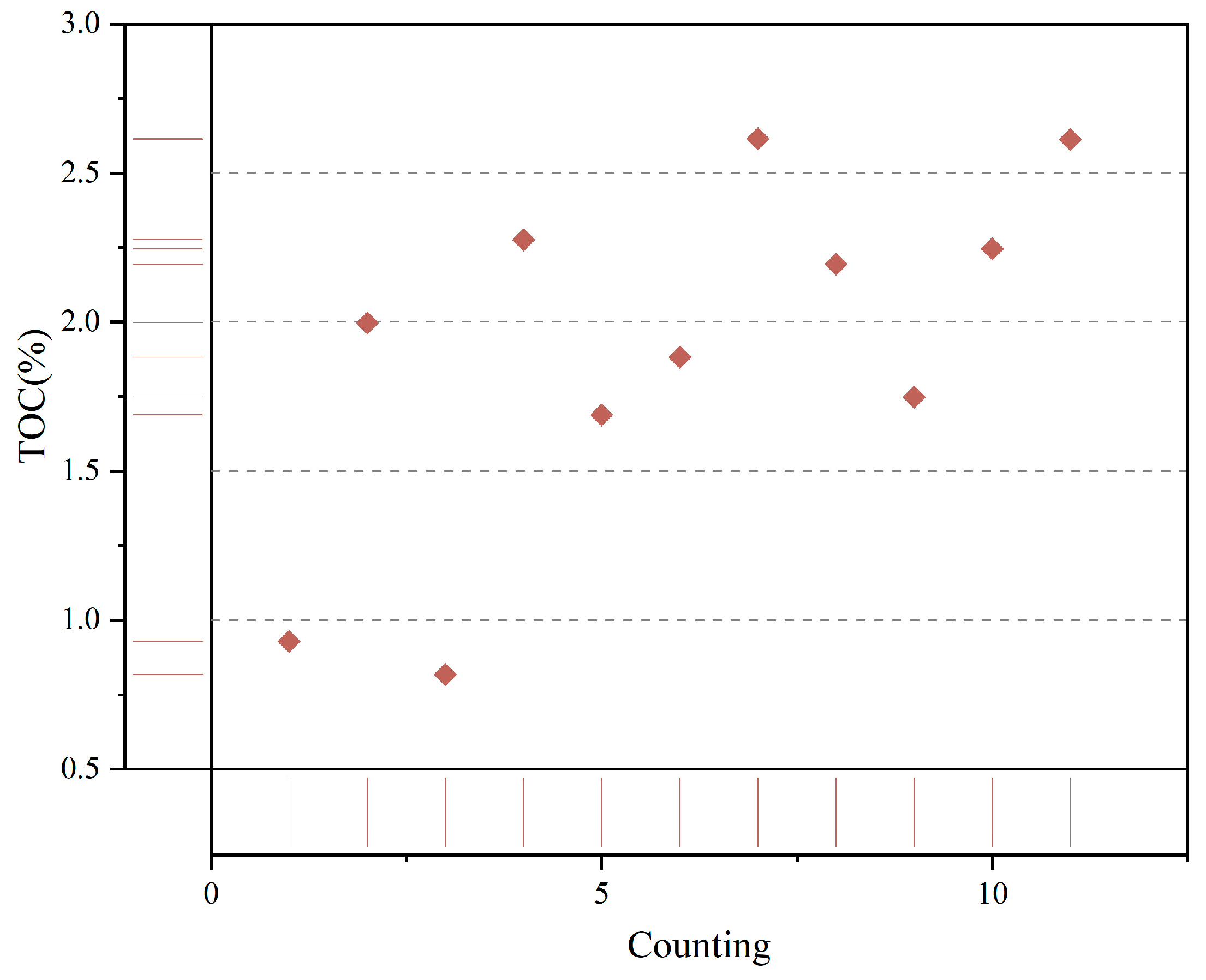
Organic carbon constitutes a critical component of shale, and the Longtan succession in the southern Sichuan Basin is generally characterised by elevated TOC. In this dataset, TOC ranges from 0.82% to 2.75% (n = 11) with a mean of 2.01% and a large variance. Samples “YJ1#-1” and “YJ#1-3” exhibit depressed TOC (<1.0%), whereas all remaining plugs record values > 1.5% (Figure 5), placing them at a moderate level within the formation [46,66].

3.2. Pore Structure and Fluid Mobility from NMR

NMR porosity is quantified via the response of hydrogen nuclei [14,67]; hydrogen-bearing phases native to the core contribute a finite background signal. The T2 spectrum acquired on the oven-dried plug (Figure 6) is therefore taken as the baseline, enabling subsequent signal stripping of both the water-saturated and post-centrifuge T2 distributions through baseline annihilation.
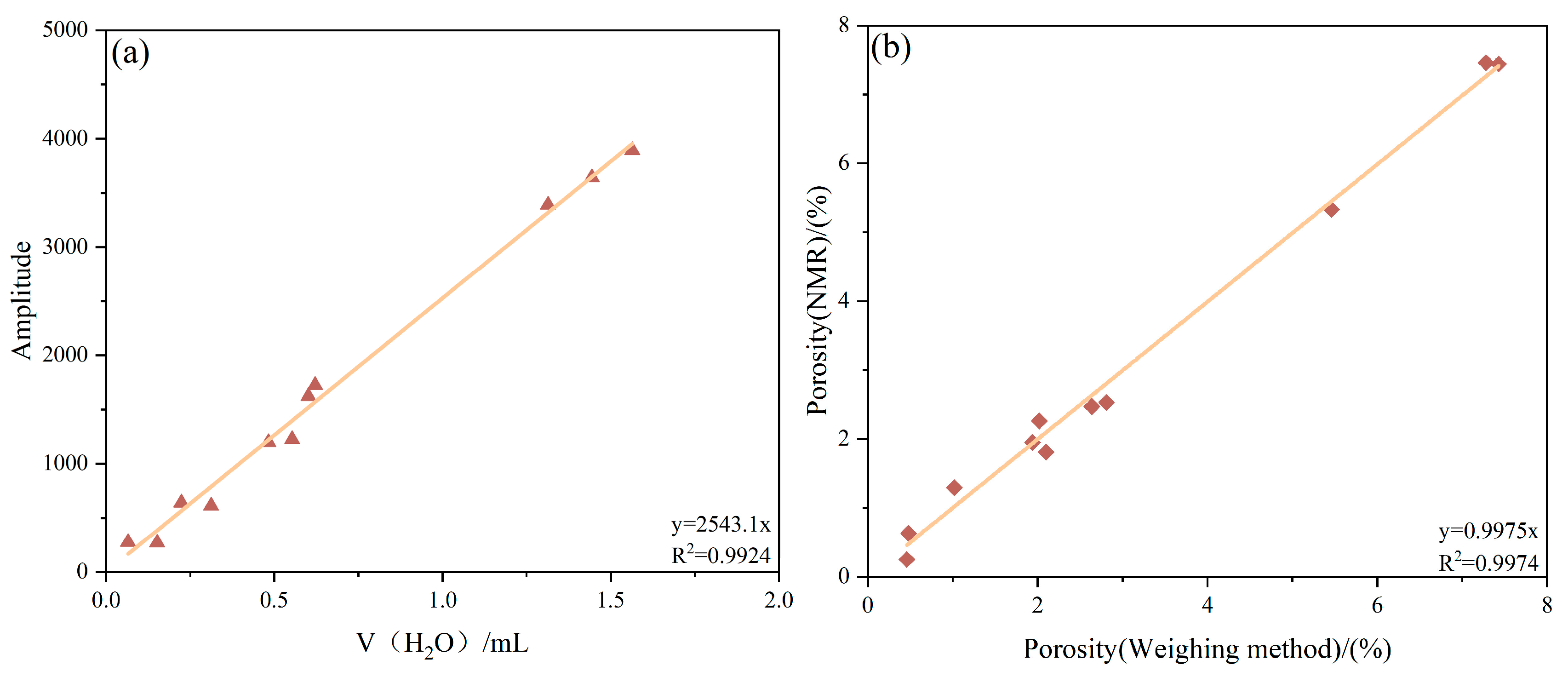
Porosity is calculated by comparing the signal intensity of each rock plug with that of calibrated porosity standards [68]. A calibration sequence was run concurrently to verify spectrometer performance. As shown in Figure 7a, water volume and signal amplitude exhibit a strong positive linear correlation (R2 = 0.99), confirming optimum system status. Sample masses in the dry, water-saturated and post-centrifuge states, together with the derived porosities, are listed in Table 2. NMR-derived porosities are essentially identical to those obtained gravimetrically (Figure 7b), validating the reliability of the NMR approach for porosity quantification.
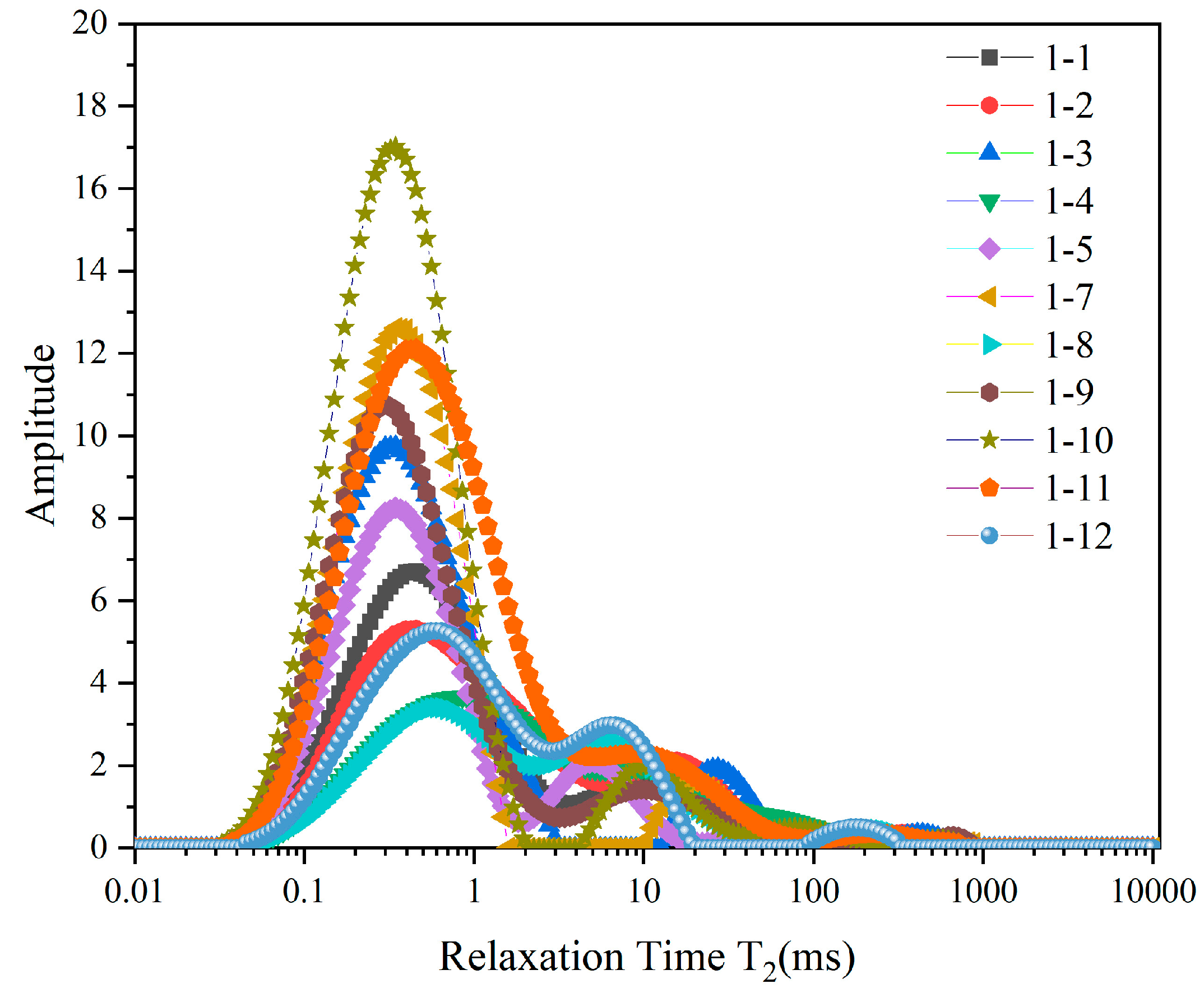
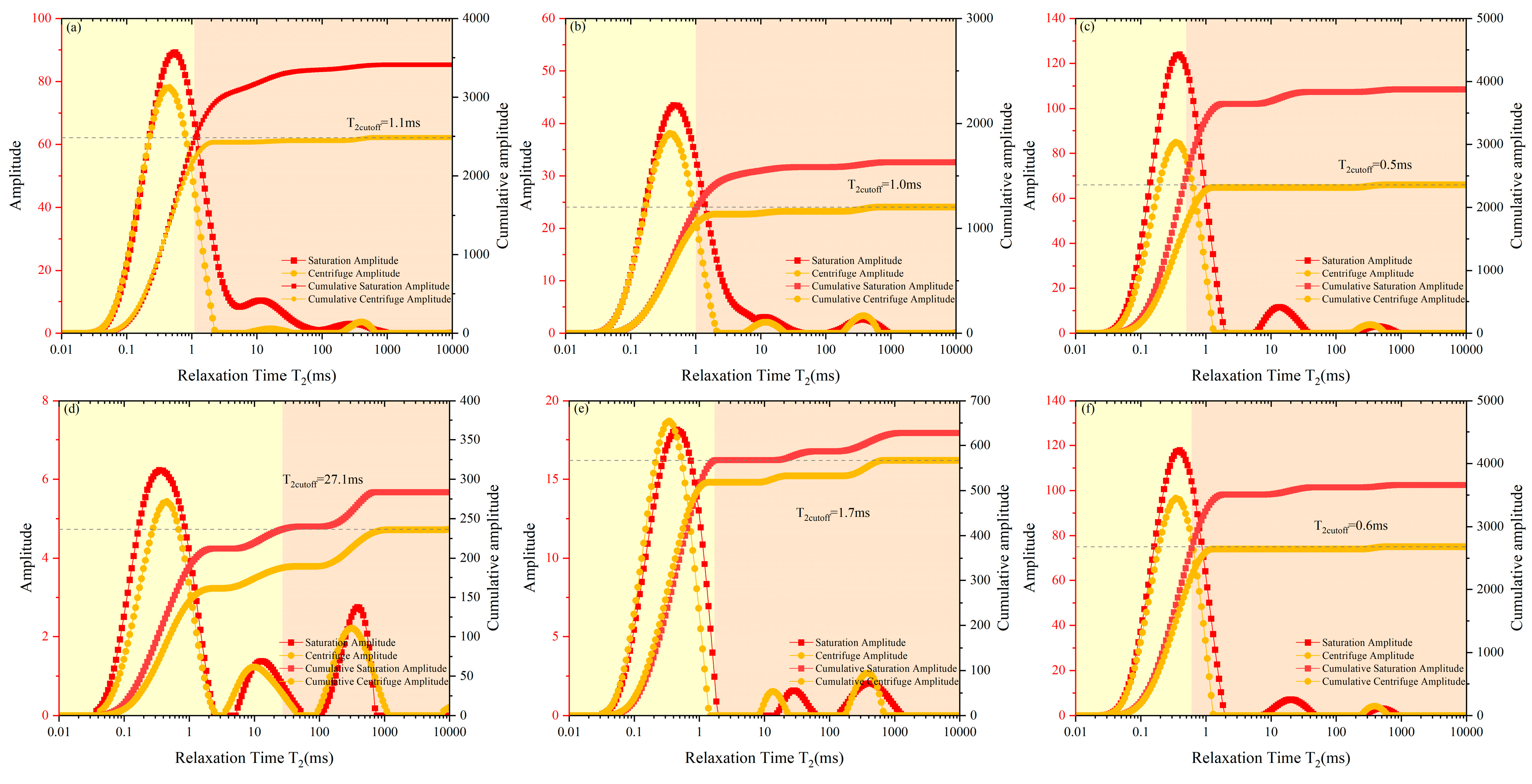
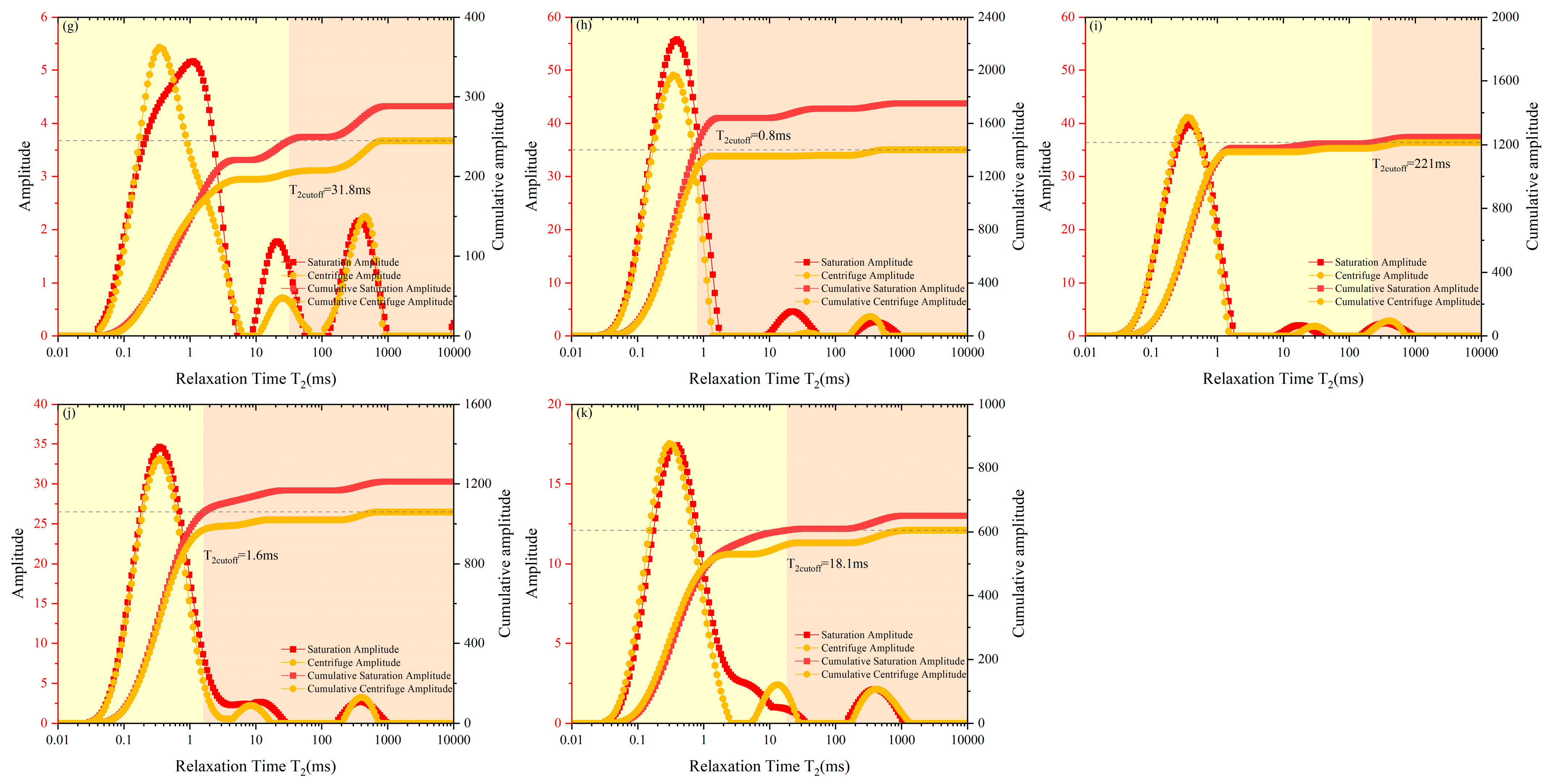
Figure 8a–k present the T2 spectra of the eleven shale plugs in the fully saturated and post-centrifuge states. All spectra exhibit a tripartite-peak architecture, evidencing the coexistence of micropores, mesopores and macropores [69,70] and attesting to a broad pore-throat size distribution. The left-most peak dominates the signal, spanning relaxation times of 0.1–10 ms and reflecting the overwhelming contribution of micropores. The intermediate peak—commonly a shoulder of the first—centres at 10–100 ms and corresponds to mesopore populations. The right-most, relatively isolated peak (100–1000 ms) signifies limited yet discernible macropore development within the Longtan shale.
Comparative analysis of multi-state T2 spectra acquired by NMR enables quantitative characterisation of core pore structure and derivation of key petrophysical parameters, i.e., total porosity, flexible fluid saturation (FFN) and bound fluid saturation (BFN). Signal contrast between dry and fully saturated plugs yields LTF shale porosities of 0.46–7.43% (Table 3), mean 3.06%. The T2 cutoff is a critical NMR parameter [28,70]; an orthogonal optimisation applied to the spectral difference between saturated and centrifuged plugs gives T2 cutoffs of 0.5–221 ms, average 27.6 ms (Table 3). The T2 cutoff varies from 0.5 to 221 ms, consistent with the strong pore-structure heterogeneity documented by multifractal parameters. BFN is uniformly high (60.77–97.28%, average 81.57%), evidencing poor pore connectivity.

3.3. Multifractal Characteristics of the Pore Structure

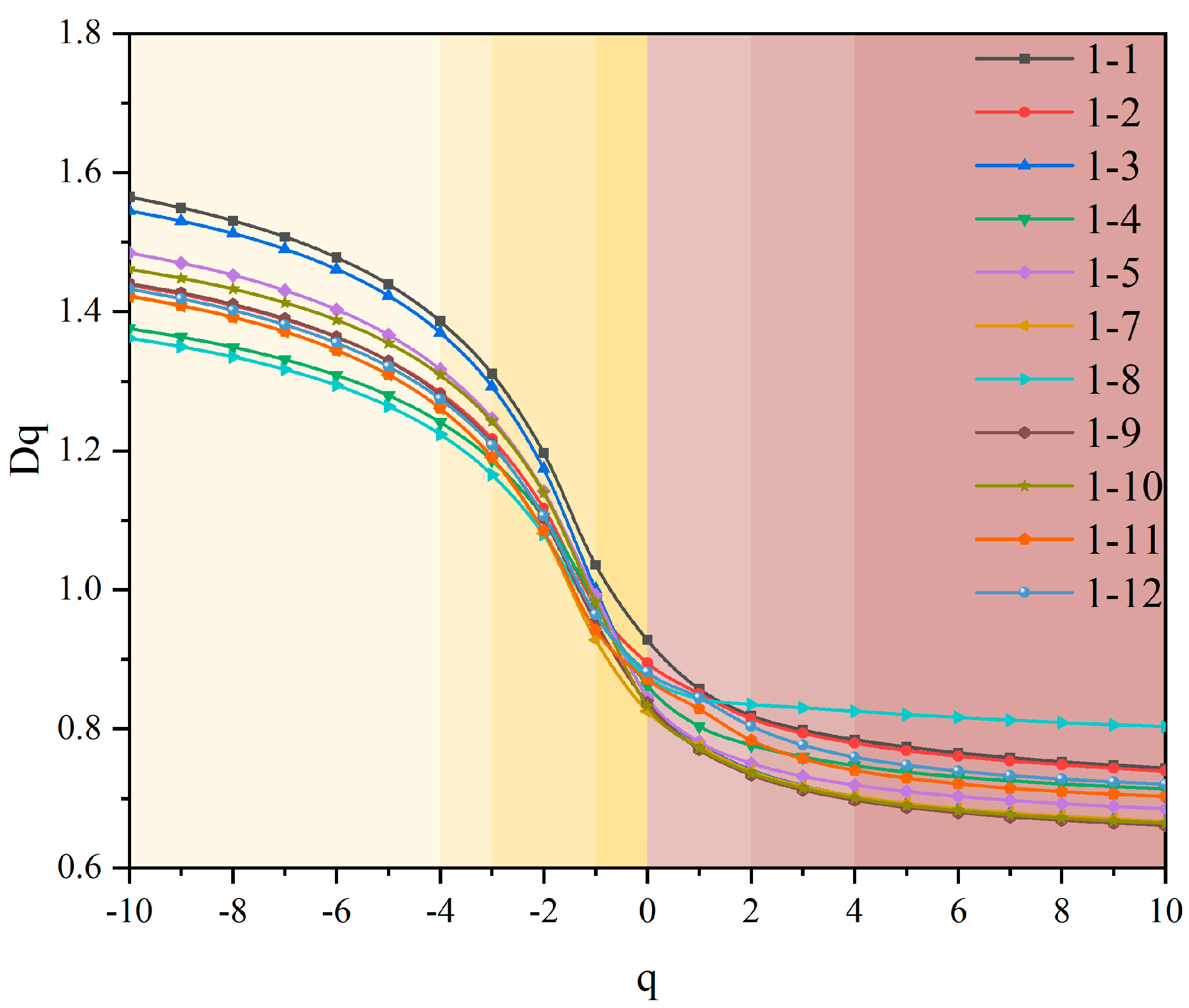
Multifractal analysis is a mathematical framework tailored for quantifying the heterogeneity of complex systems and is especially suited to characterising shale pore architecture, fracture networks and mineral distributions. Table 4 shows that all shale and siltstone samples satisfy the hierarchy D0 > D1 > D2, confirming that the LTF shale pore structure exhibits multifractal characteristics and rendering multifractal parameters more appropriate for capturing scale-dependent heterogeneous pore textures. Table 4 further lists Dmin (approximated as D−10), Dmax (approximated as D10) and ΔD (approximated as D−10 − D10), representing the generalised dimensions at extreme q-values and the overall heterogeneity degree across the measured pore-size interval. In this study, Dq decreases monotonically with increasing q for all samples (Figure 9), exhibiting a mirror-image “S”-shaped decay curve diagnostic of multifractal systems and signalling pronounced heterogeneity in pore or fracture distributions. The curve can be subdivided into seven segments: −10 ≤ q ≤ −4: corresponds to low-probability domains such as macropores and fractures; gentle Dq decline indicates relatively uniform distribution and weak heterogeneity, implying consistent sizes and spatial arrangement of large pores or fractures. −4 ≤ q ≤ −3: accelerated Dq drop caused by negative-order weighting reveals minor clustering of large pores or fractures, probably induced by local mineralogy or diagenetic overprint. −3 ≤ q ≤ −1: steepest Dq decline marks the transition from low- to high-probability regions with growing heterogeneity, representing the shift from mesopores to micropores where pore populations become increasingly non-uniform. −1 ≤ q ≤ 0: decelerating Dq descent as q approaches zero; D0 (q = 0), the capacity dimension, gauges overall geometric complexity and indicates moderate connectivity and high self-similarity of the pore network at large scale (Despite a relatively high D0 (≈0.9) indicating good spatial coverage of the pore network over the measurement scale, the pore-throat connectivity is poor, as evidenced by bound fluid saturations exceeding 70%. This apparent contrast reflects the fundamental difference between geometric space-filling (captured by D0) and hydraulic connectivity (captured by fluid mobility parameters).). 0 ≤ q ≤ 2: continued deceleration of Dq drop reflects highly uneven, strongly heterogeneous regions where small-pore sizes and spatial arrangements are extremely variable, controlled by organic matter, clay minerals and micro-fractures. 2 ≤ q ≤ 4: extremely slow Dq decline indicates stabilising weights on high-probability regions; small-pore distributions remain heterogeneous, yet their rate of change diminishes, suggesting local clustering or incipient ordering. 4 ≤ q ≤ 10: Dq approaches convergence, yet significant heterogeneity persists in extreme high-probability (nanometre-scale) regions, corresponding to sparse or intrinsically complex structures such as intra-organic pores or inter-clay micropores.
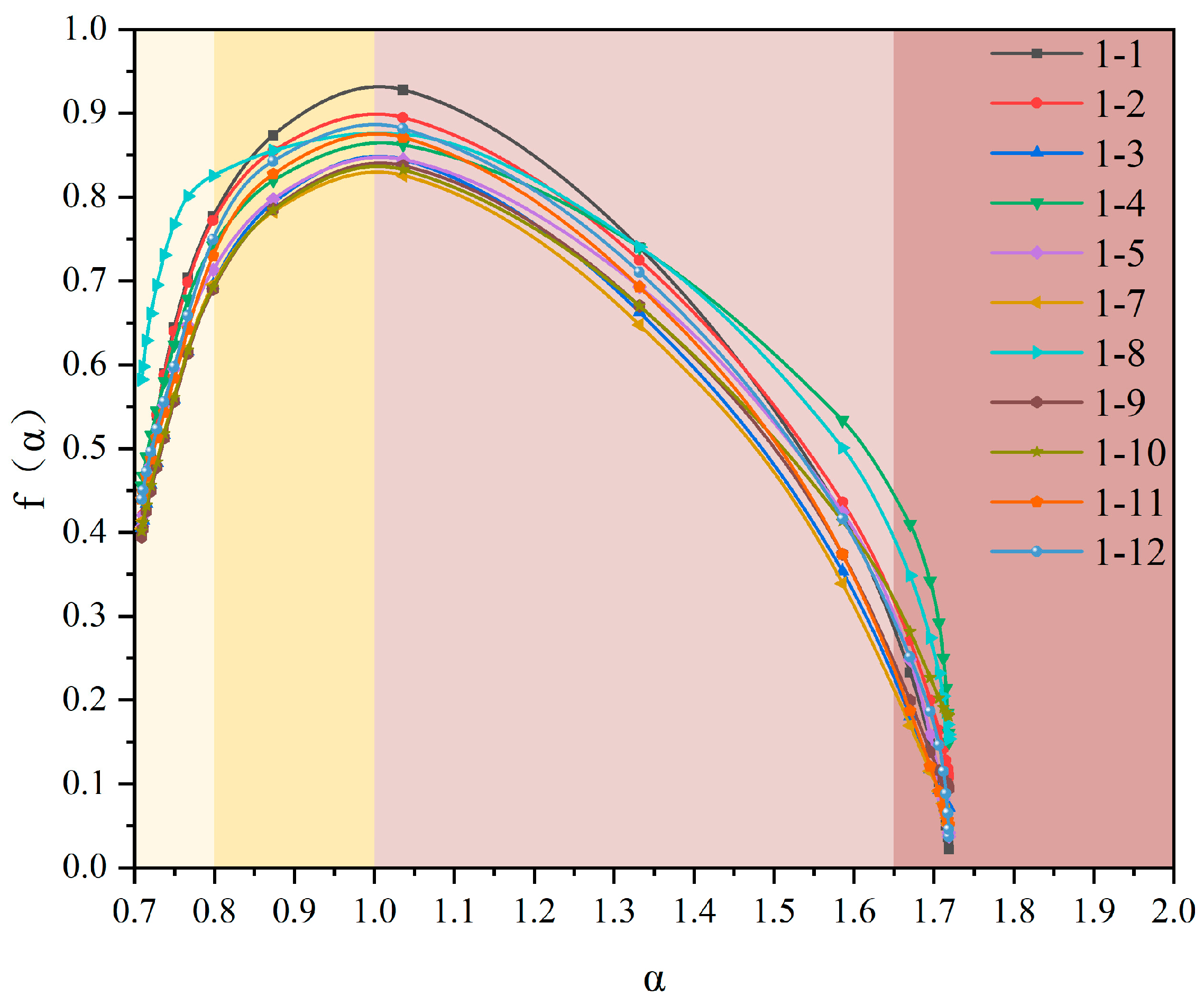
The singularity exponent α quantifies the intensity of local probabilistic heterogeneity within the system: low α corresponds to high-probability, highly fluctuating domains (e.g., pore-dense or mineral-rich “hot spots”), whereas high α reflects low-probability, smoothly varying regions such as sparse macropores or fractures. f(α), the singularity spectrum, denotes the fractal dimension of the subset characterised by a given α and is interpreted as its abundance within the overall fractal architecture. Table 5 shows that the total spectral width Δα (αmax − αmin) is comparatively low, indicating moderate heterogeneity despite appreciable pore-size spread. The consistently sub-unity f(α)max (~0.9) implies suboptimal pore-network development, while f(α)min mirrors the spatial configuration of the densest pore clusters—lower values indicate discrete point-like “hot spots”, whereas higher values suggest extended architectures appearing at the right-hand side of the spectrum (Figure 10). The f(α)–α curves exhibit an approximately inverted-bell shape whose variation is systematically divided into four segments (Figure 10): Steep rising limb (α ≈ 0.70–0.80)—f(α) increases sharply, documenting the continuous population of small-scale pores; the broad interval signals high complexity within the microporous matrix that forms the skeletal background of the shale pore network. Gentle rising limb (α ≈ 0.80–1.00)—gradual increase constitutes the dominant signature; f(α)max ≈ D0 indicates good space-filling capacity and connectivity, evidencing a well-developed, uniformly distributed micro- to mesopore system. Gentle falling limb (α ≈ 1.00–1.65)—declining f(α) marks the departure toward more singular, sparser structures such as larger pores, incipient micro-fractures or inter-particle boundaries. Steep falling limb (α ≈ 1.65–1.72)—rapid descent produces a “plunging” tail reflecting extremely sparse, high-α domains—isolated macropores, open micro-fracture networks and multi-scale fissures. Although volumetrically minor, these features are critical for macro-scale gas migration and hydraulic-fracture stimulability; the width and slope of the tail directly quantify the development degree of large-scale heterogeneity.

3.4. Discussion

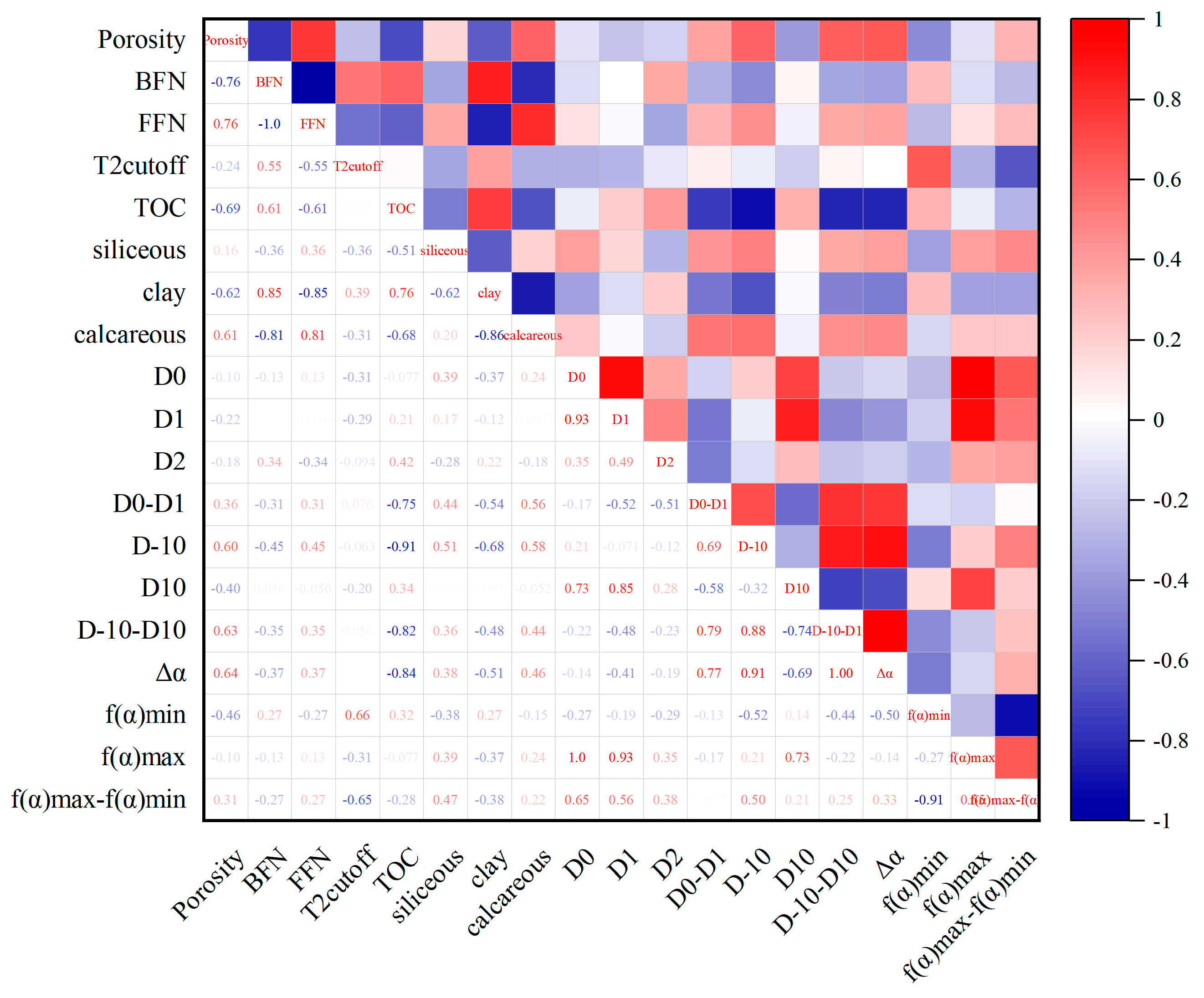
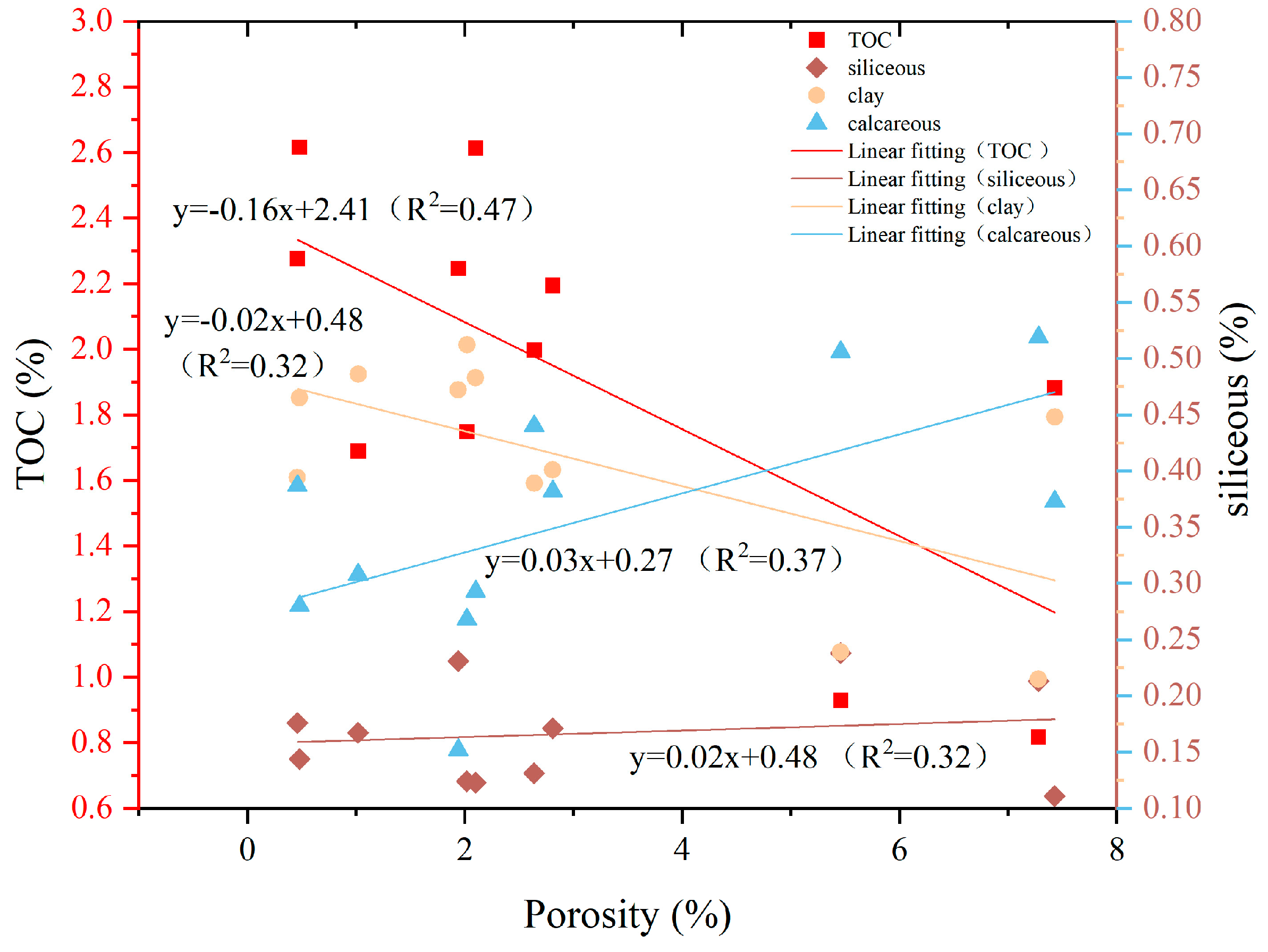
Rock composition is the fundamental control on pore architecture (Figure 11). In marine shales, samples with elevated TOC/clay contents commonly exhibit higher NMR porosity and a dominant short-relaxation component in the T2 spectrum. By contrast, the present LTF transitional marine shales show no significant correlation between TOC/clay content and NMR porosity (Figure 12), chiefly because the organic fraction is dominated by Type III kerogen that generates limited organic porosity. Additionally, the succession experienced deep burial followed by uplift [71] and was affected by regional thermal events during deposition [72], imposing a complex diagenetic overprint that obscures the expected porosity–composition trend. Nevertheless, these compositional end-members act as carriers of contrasting primary pore systems, amplifying local amplitude fluctuations and enhancing overall heterogeneity: (i) Compaction: the Longtan Formation experienced deep burial followed by tectonic uplift, leading to mechanical and chemical compaction that reduced primary intergranular porosity. (ii) Cementation: carbonate cement occludes pore throats, as evidenced by the high bound fluid saturation. (iii) Dissolution: limited dissolution of feldspar and carbonate grains is observed in published SEM studies of the same formation [6]. The weak positive correlation observed between carbonate minerals and NMR porosity is probably linked to sub-micron fractures nucleating along cleavage planes [42,73].
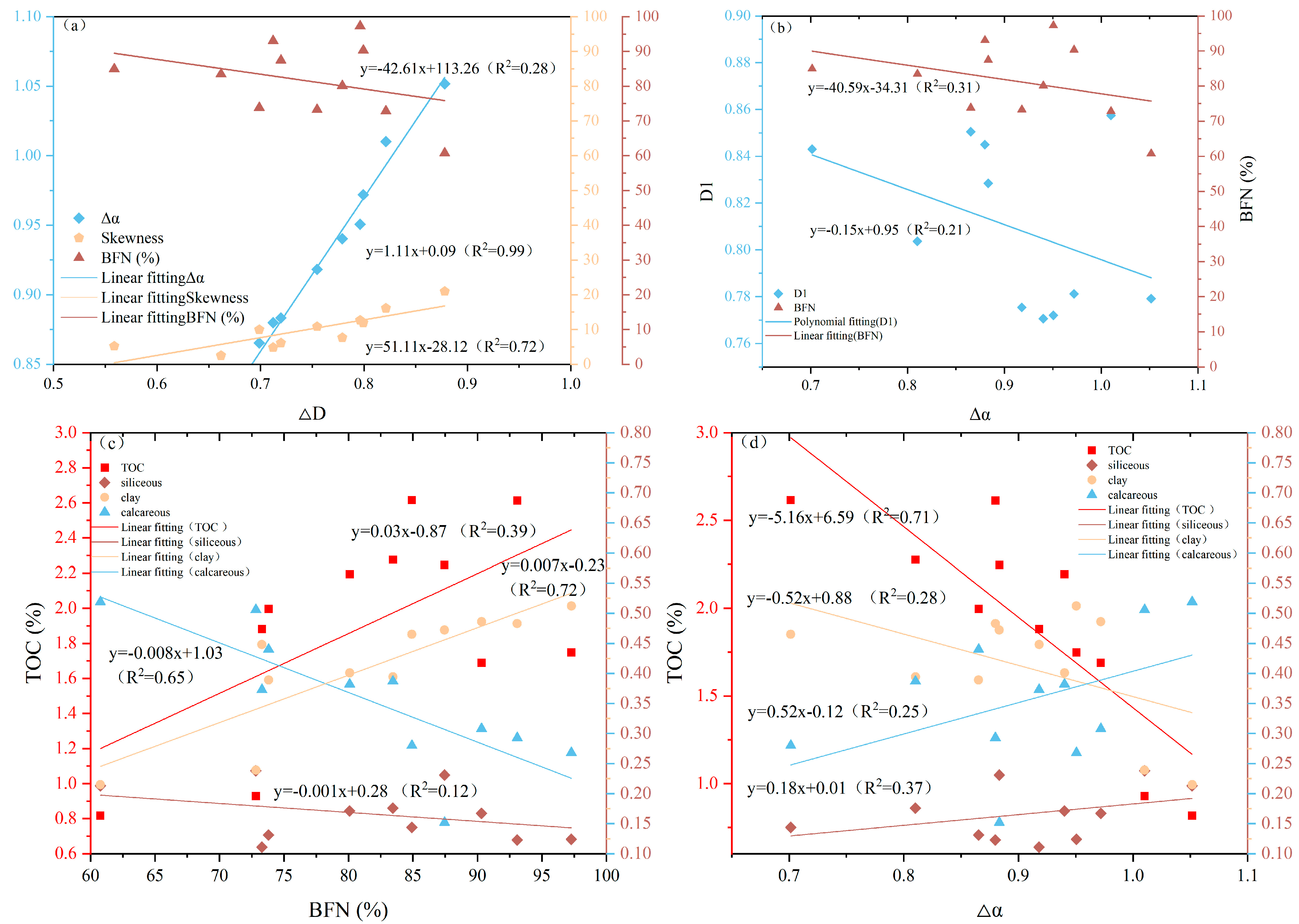
Fluid mobility is universally low and governed by pore architecture. All plugs exhibit high bound fluid saturation (BFN > 70%), diagnostic of a tight reservoir matrix. Flexible fluid saturation (FFN) is tightly linked to T2 spectral shape (Figure 8): samples whose dominant peak is shifted toward longer relaxation (larger pores), e.g., YJ#1-3 with FFN = 39.23%, possess elevated flexible fluid saturation. Multifractal theory provides a robust metric for pore heterogeneity; singularity width, Δα, correlates positively with multifractal span, ΔD (Figure 13a), confirming multifractal intensity consistency [60,64]. Figure 13a further reveals a good correlation between Δα and T2 skewness, evidencing the efficacy of Δα in quantifying heterogeneity. Multifractal spectral width (Δα) and information dimension (D1) serve as key indicators. Across the sample set (Figure 13b), D1 and BFS follow the same trend with increasing Δα, indicating that greater pore-size irregularity and stronger heterogeneity result in higher BFS. TOC/clay contents display a robust positive correlation with BFS (Figure 13c), indicating that a fraction of bound water is controlled by adsorption onto organic matter and clay surfaces [15,54]. Employed as a heterogeneity index, Δα correlates well with both BFS and TOC/mineral contents (Figure 13b,d), furnishing compelling evidence that water is immobilised within a heterogeneous pore network. Intense heterogeneity implies poor pore connectivity; fluids (especially the flexible fraction) encounter numerous bottlenecks while migrating from micro- to macropores and are consequently trapped. In summary, rock composition influences fluid mobility both directly and indirectly by imposing heterogeneity-controlled connectivity on the pore structure.
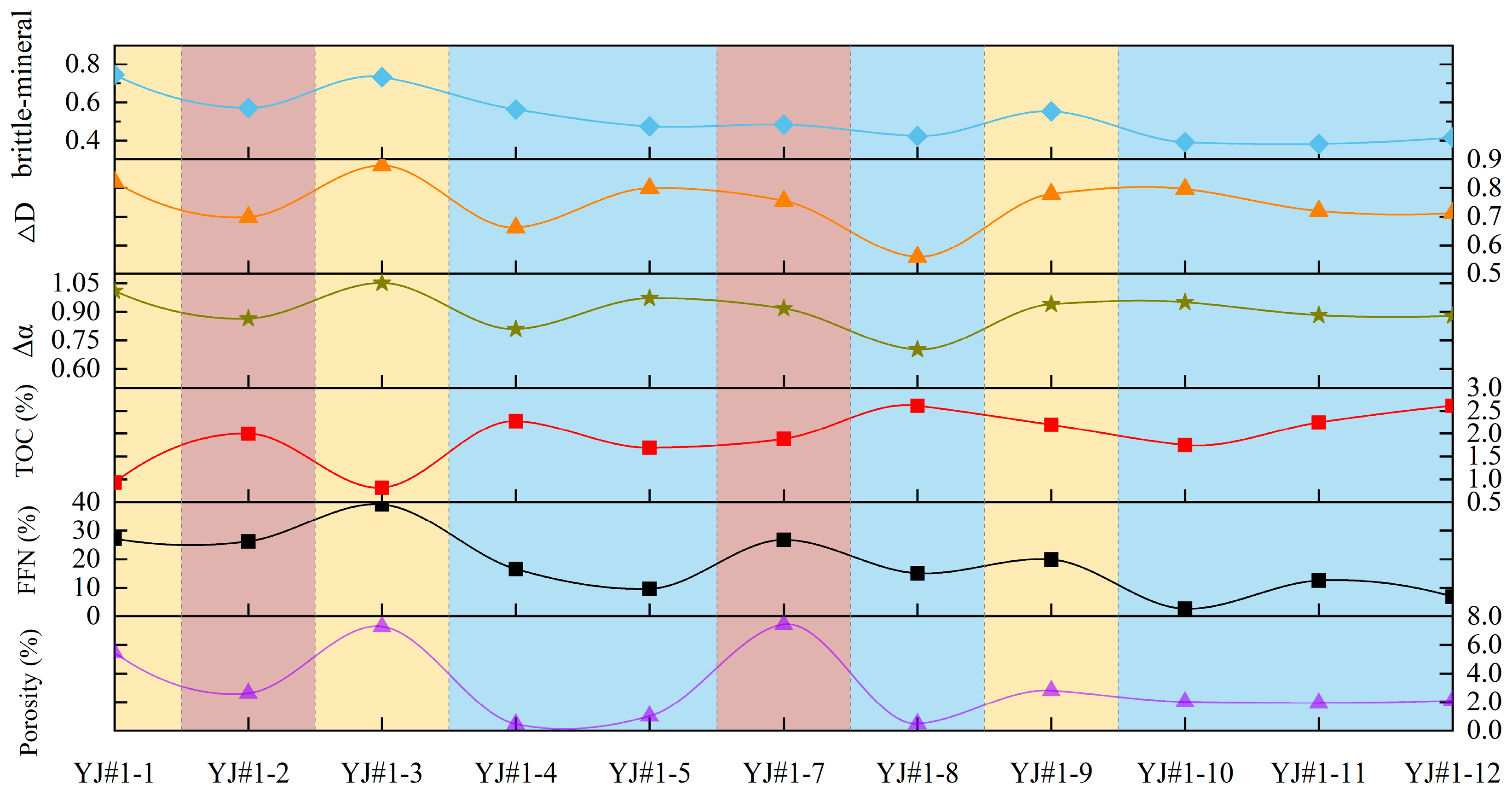
Integrating multifractal metrics, rock composition and petrophysical attributes, the twelve plugs are classified into three reservoir types (Table 6, Figure 14): Type I: weakly heterogeneous—high quality: exhibits comparatively homogeneous pore structure and good connectivity, constituting the prospective sweet spot; Type II: moderately heterogeneous—effective: possesses fair storage and flow capacity; Type III: strongly heterogeneous—ineffective: displays extremely uneven pore structure with abundant yet poorly connected nanopores, rendering gas production impractical; however, their high TOC may serve as a hydrocarbon source for adjacent reservoir facies [74].
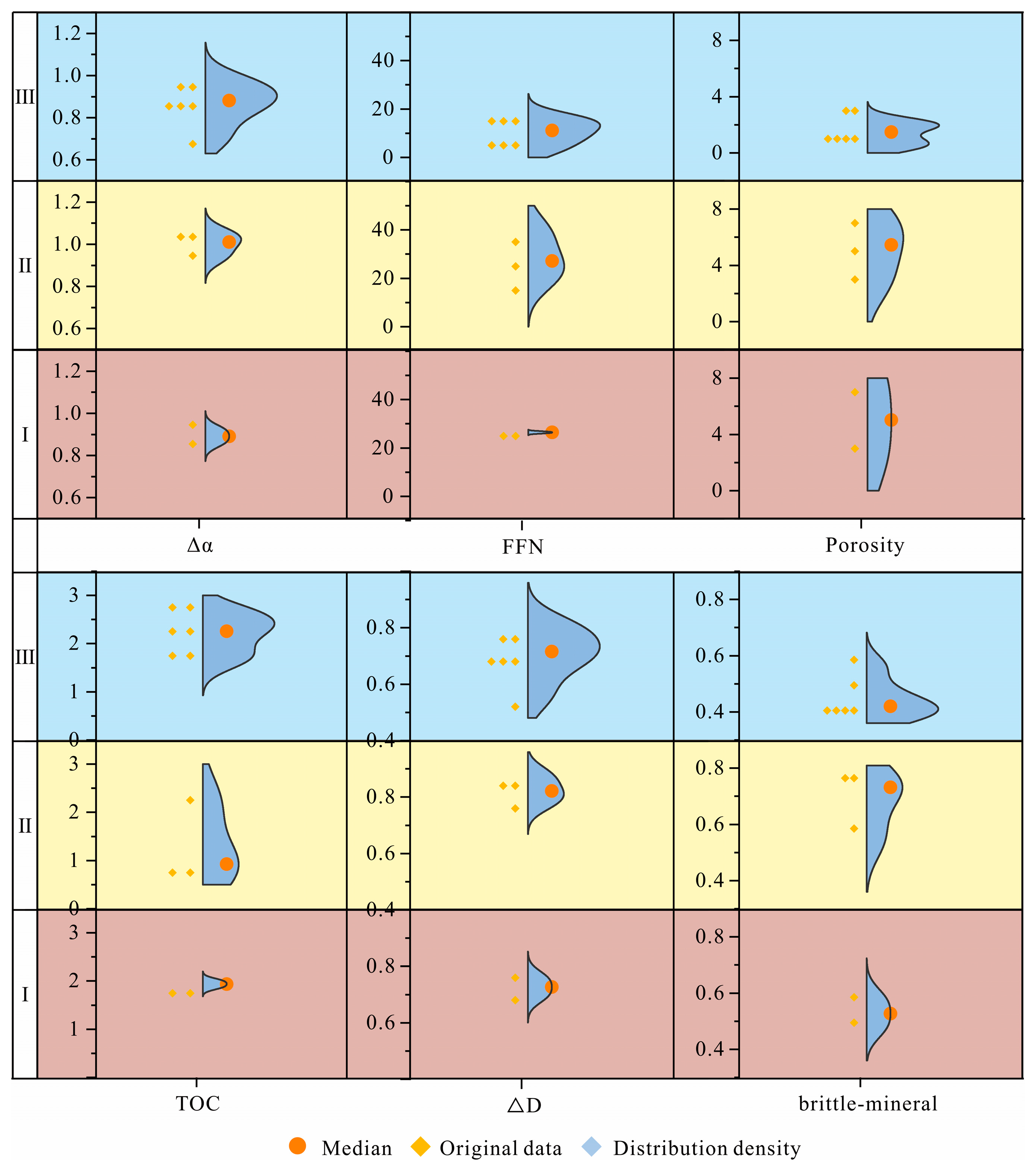
The measured data are non-normally distributed, permitting application of the Kruskal–Wallis test [75,76]. Δα, FFN, porosity, TOC, ΔD and brittle minerals were selected for the test; for all six metrics the median of at least one class differs from the others (Figure 15). Upon testing, the six parameters returned H = 1.02, 6.49, 7.50, 2.86, 3.02, 6.01 and p = 0.599, 0.039, 0.024, 0.213, 0.221, 0.049, respectively. FFN, porosity and brittle minerals yield p < 0.05, signifying significant inter-class differences. Excluding Δα, the remaining two parameters (TOC and ΔD) record p > 0.05 yet lie close to the 0.2 threshold, satisfying the classification criterion and indicating noticeable differences. The elevated p-value for Δα likely stems from spectral splitting in certain samples. Post hoc Kruskal–Wallis tests confirm that the reservoir-type classification based on intrinsic sample characteristics is statistically robust. Given the limited sample size (n = 11), the proposed three-type classification should be considered exploratory. The Kruskal–Wallis test shows that FFN, porosity and brittle mineral content differ significantly among the three groups (p < 0.05), whereas Δα does not reach statistical significance. This suggests that, while the classification captures major differences in fluid mobility and storage capacity, the heterogeneity index Δα alone does not uniquely separate the groups. Future work with a larger sample set is required to validate and refine the classification thresholds.
The integrated assessment furnishes a robust basis for sweet-spot forecasting. Compared with static geological-parameter approaches, the combined use of NMR, geochemical and multifractal analyses more profoundly elucidates the intrinsic controls on reservoir quality. Multifractal parameters condense intricate pore-structure information into concise quantitative indices and can be coupled with log or seismic data in forthcoming exploration and development campaigns to identify high-quality reservoirs at the regional scale.

4. Conclusions

(1)
NMR analyses confirm that the Longtan shale cores exhibit low porosity and high irreducible-water saturation, with pronounced disparities in fluid mobility and strong matrix heterogeneity.
(2)
Multifractal analysis successfully quantifies pore-structure heterogeneity; the generalised-dimension spectrum q–Dq and the singularity spectrum α–f(α) deliver insights beyond the reach of traditional monofractal metrics. Spectral width Δα and degree of multifractality ΔD emerge as the pivotal indices for appraising heterogeneity.
(3)
Rock composition constitutes the fundamental control on pore heterogeneity. TOC and clay-mineral contents display significant positive correlations with multifractal heterogeneity indicators (Δα), acting as the primary heterogeneity drivers. While composition directly influences fluid mobility, it concurrently modulates pore-network connectivity—thereby exerting an additional, heterogeneity-mediated control on movable fluid volumes.
(4)
Integrating rock composition, NMR-derived pore-structure parameters, multifractal metrics and fluid-mobility data furnishes a robust theoretical framework and a practical workflow for accurately evaluating transitional shale reservoirs and for predicting developmental sweet spots. This integration is essential because rock composition dictates the intrinsic pore-forming potential and heterogeneity sources; NMR quantifies porosity and fluid mobility; multifractal indices capture scale-dependent pore irregularity. Only by combining these can one distinguish direct compositional effects from heterogeneity-mediated controls on fluid flow, enabling reliable sweet-spot forecasting.

Author Contributions

Conceptualization, L.W.; methodology, L.W. and Y.W.; software, S.H. and L.J.; validation, Y.C. (Ya’na Chen) and W.Y.; formal analysis, Y.C. (Yuchuan Chen) and Z.H.; investigation, L.W. and S.H.; resources, X.L. and Y.C. (Yuchuan Chen); data curation, L.W. and N.Q.; writing—original draft preparation, L.W.; writing—review and editing, L.W.; visualization, L.W.; supervision, Y.C. (Ya’na Chen); project administration, X.L.; funding acquisition, X.L. All authors have read and agreed to the published version of the manuscript.

Funding

This work was supported in part by the “In-Depth Study on the Development Potential of the Permian Longtan Formation Coal-Shale System in the Sichuan Basin” (No. 2024-N/G-46602).

Data Availability Statement

The raw data supporting the findings of this study are provided within the article. Requests for additional data access can be directed to the corresponding author and will be considered on a case-by-case basis.

Acknowledgments

The authors are sincerely grateful to all the colleagues at the Sichuan Basin Research Center, PetroChina Research Institute of Petroleum Exploration and Development, for their guidance, support, and valuable suggestions throughout this study. The editorial office is gratefully acknowledged for their efficient handling and professional efforts in the publication process. The authors also extend their sincere appreciation to the anonymous reviewers for their constructive comments and meticulous review, which significantly improved the quality and presentation of this manuscript.

Conflicts of Interest

Authors Longyi Wang, Xizhe Li, Ya’na Chen, Yuce Wang, Zan Hang, Nijun Qi and Wenxuan Yu were employed by the company PetroChina. The remaining authors declare that the research was conducted in the absence of any commercial or financial relationships that could be construed as a potential conflict of interest.

Abbreviations

The following abbreviations are used in this manuscript:
NMRNuclear Magnetic Resonance
XRDX-Ray Diffraction
TOCTotal Organic Carbon
LTFLongTan Formation
BFNBound Fluid Saturation
FFNFlexible Fluid Saturation

References

  1. Adeyilola, A.; Zakharova, N.; Liu, K.; Gentzis, T.; Carvajal-Ortiz, H.; Ocubalidet, S.; Harrison, W.B. Hydrocarbon potential and Organofacies of the Devonian Antrim Shale, Michigan Basin. Int. J. Coal Geol. 2022, 249, 103905. [Google Scholar] [CrossRef]
  2. Qiu, Z.; Zou, C. Controlling factors on the formation and distribution of “sweet-spot areas” of marine gas shales in South China and a preliminary discussion on unconventional petroleum sedimentology. J. Asian Earth Sci. 2020, 194, 103989. [Google Scholar] [CrossRef]
  3. Li, X.; Guo, Z.; Hu, Y.; Luo, R.; Su, Y.; Sun, H.; Liu, X.; Wan, Y.; Zhang, Y.; Li, L. Efficient development strategies for large ultra-deep structural gas fields in China. Pet. Explor. Dev. Online 2018, 45, 118–126. [Google Scholar] [CrossRef]
  4. Li, G.; Zhang, B.; Wu, K.; Wu, S.; Wang, X.; Zhang, J.; Qi, X.; Zhang, N.; Xing, H.; Xian, C.; et al. Low organic matter abundance and highly efficient hydrocarbon generation of saline source rock in the Qaidam Basin, NW China. Pet. Explor. Dev. 2023, 50, 1030–1044. [Google Scholar] [CrossRef]
  5. Zhang, J.; Lin, W.; Li, M.; Wang, J.; Xiao, X.; Li, Y.; Zhang, X. Evolution Mechanism of Microscopic Pore System in Coal-Bearing Marine–Continental Transitional Shale with Increasing Maturation. Minerals 2023, 13, 1482. [Google Scholar] [CrossRef]
  6. Yu, Y.; Deng, X.; Deng, Y. Diagenesis of marine-continental transitional shale from the Upper Permian Longtan Formation in southern Sichuan Basin, China. Open Geosci. 2024, 16, 0696. [Google Scholar] [CrossRef]
  7. Zhang, J.; Li, X.; Wei, Q.; Sun, K.; Zhang, G.; Wang, F. Characterization of Full-Sized Pore Structure and Fractal Characteristics of Marine–Continental Transitional Longtan Formation Shale of Sichuan Basin, South China. Energy Fuels 2017, 31, 10490–10504. [Google Scholar] [CrossRef]
  8. Fang, X.; Cai, Y.; Hu, Q.; Gao, P.; Liu, D.; Qian, Y. Effect of Formation Pressure on Pore Structure Evolution and Hydrocarbon Expulsion in Organic-Rich Marine Shale. Processes 2023, 11, 1007. [Google Scholar] [CrossRef]
  9. Hazra, B.; Vishal, V.; Singh, D.P. Applicability of Low-Pressure CO2 and N2 Adsorption in Determining Pore Attributes of Organic-Rich Shales and Coals. Energy Fuels 2020, 35, 456–464. [Google Scholar] [CrossRef]
  10. He, J.; Ding, W.; Li, A.; Sun, Y.; Dai, P.; Yin, S.; Chen, E.; Gu, Y. Quantitative microporosity evaluation using mercury injection and digital image analysis in tight carbonate rocks: A case study from the Ordovician in the Tazhong Palaeouplift, Tarim Basin, NW China. J. Nat. Gas Sci. Eng. 2016, 34, 627–644. [Google Scholar] [CrossRef]
  11. Liu, Y.; Yao, Y.; Liu, D.; Zheng, S.; Sun, G.; Chang, Y. Shale pore size classification: An NMR fluid typing method. Mar. Pet. Geol. 2018, 96, 591–601. [Google Scholar] [CrossRef]
  12. Zhao, J.; Sun, M.; Pan, Z.; Liu, B.; Ostadhassan, M.; Hu, Q. Effects of pore connectivity and water saturation on matrix permeability of deep gas shale. Adv. Geo-Energy Res. 2022, 6, 54–68. [Google Scholar] [CrossRef]
  13. Liu, K.; Ostadhassan, M.; Sun, L.; Zou, J.; Yuan, Y.; Gentzis, T.; Zhang, Y.; Carvajal-Ortiz, H.; Rezaee, R. A comprehensive pore structure study of the Bakken Shale with SANS, N2 adsorption and mercury intrusion. Fuel 2019, 245, 274–285. [Google Scholar] [CrossRef]
  14. Zhang, P.-F.; Lu, S.-F.; Wang, J.-J.; Li, W.-B.; Yin, Y.-J.; Chen, G.-H.; Zhou, N.-W.; Wu, H. Microscopic occurrence and distribution of oil and water in situ shale: Evidence from nuclear magnetic resonance. Pet. Sci. 2024, 21, 3675–3691. [Google Scholar] [CrossRef]
  15. Chang, J.; Fan, X.; Jiang, Z.; Wang, X.; Chen, L.; Li, J.; Zhu, L.; Wan, C.; Chen, Z. Differential impact of clay minerals and organic matter on pore structure and its fractal characteristics of marine and continental shales in China. Appl. Clay Sci. 2022, 216, 106334. [Google Scholar] [CrossRef]
  16. Wang, Y.; Cheng, H.; Hu, Q.; Liu, L.; Jia, L.; Gao, S.; Wang, Y. Pore structure heterogeneity of Wufeng-Longmaxi shale, Sichuan Basin, China: Evidence from gas physisorption and multifractal geometries. J. Pet. Sci. Eng. 2022, 208, 109313. [Google Scholar] [CrossRef]
  17. Liu, B.; Yao, L.; Fu, X.; He, B.; Bai, L. Application of the Fractal Method to the Characterization of Organic Heterogeneities in Shales and Exploration Evaluation of Shale Oil. J. Mar. Sci. Eng. 2019, 7, 88. [Google Scholar] [CrossRef]
  18. Daigle, H.; Johnson, A.; Thomas, B. Determining fractal dimension from nuclear magnetic resonance data in rocks with internal magnetic field gradients. Geophysics 2014, 79, D425–D431. [Google Scholar] [CrossRef]
  19. Fellah, Z.E.A.; Fellah, M.; Roncen, R.; Ongwen, N.O.; Ogam, E.; Depollier, C. Transient Propagation of Spherical Waves in Porous Material: Application of Fractional Calculus. Symmetry 2022, 14, 233. [Google Scholar] [CrossRef]
  20. Guan, W.; Cai, W.; Li, Z.; Lu, H. Microscopic Characterization and Fractal Analysis of Pore Systems for Unconventional Reservoirs. J. Mar. Sci. Eng. 2024, 12, 908. [Google Scholar] [CrossRef]
  21. Zheng, S.; Yao, Y.; Liu, D.; Cai, Y.; Liu, Y.; Li, X. Nuclear magnetic resonance T2 cutoffs of coals: A novel method by multifractal analysis theory. Fuel 2019, 241, 715–724. [Google Scholar] [CrossRef]
  22. Sun, Y.; Zhai, C.; Zhao, Y.; Xu, J.; Cong, Y.; Zheng, Y.; Tang, W. Multifractal Analysis and Neural Network Prediction of Pore Structures in Coal Reservoirs Based on NMR T2 Spectra. Energy Fuels 2021, 35, 11306–11318. [Google Scholar] [CrossRef]
  23. Guan, Q.; Lü, X.; Dong, D.; Cai, X. Origin and significance of organic-matter pores in Upper Ordovician Wufeng-Lower Silurian Longmaxi mudstones, Sichuan Basin. J. Pet. Sci. Eng. 2019, 176, 554–561. [Google Scholar] [CrossRef]
  24. Wang, J.; Shao, H.; Zhang, Y.; Jiang, Z.; Gao, B.; Li, L.; Pan, H.; Wang, H.; Lu, X.; Qiu, H.; et al. Multifractal characteristics of pore structure in the terrestrial shale reservoirs of the Lianggaoshan formation in northeast sichuan basin and its geological significance. Front. Earth Sci. 2025, 13, 1505090. [Google Scholar] [CrossRef]
  25. Wu, W.; Liang, Z.; Xu, L.; Liu, Y.; Li, Y.; Tang, X.; Yin, Y.; Chen, Y. The Effect of Thermal Maturity on the Pore Structure Heterogeneity of Xiamaling Shale by Multifractal Analysis Theory: A Case from Pyrolysis Simulation Experiments. Minerals 2023, 13, 1340. [Google Scholar] [CrossRef]
  26. Bouchendouka, A.; Fellah, Z.; Larbi, Z.; Ongwen, N.; Ogam, E.; Fellah, M.; Depollier, C. A Generalization of Poiseuille’s Law for the Flow of a Self-Similar (Fractal) Fluid through a Tube Having a Fractal Rough Surface. Fractal Fract. 2023, 7, 61. [Google Scholar] [CrossRef]
  27. Hou, X.; Zhu, Y.; Chen, S.; Wang, Y.; Liu, Y. Investigation on pore structure and multifractal of tight sandstone reservoirs in coal bearing strata using LF-NMR measurements. J. Pet. Sci. Eng. 2020, 187, 106757. [Google Scholar] [CrossRef]
  28. Zhao, Y.; Lin, B.; Liu, T.; Zheng, Y.; Sun, Y.; Zhang, G.; Li, Q. Multifractal analysis of coal pore structure based on NMR experiment: A new method for predicting T2 cutoff value. Fuel 2021, 283, 119338. [Google Scholar] [CrossRef]
  29. Shi, X.; Pan, J.; Hou, Q.; Jin, Y.; Wang, Z.; Niu, Q.; Li, M. Micrometer-scale fractures in coal related to coal rank based on micro-CT scanning and fractal theory. Fuel 2018, 212, 162–172. [Google Scholar] [CrossRef]
  30. Zhang, J.; Liao, Y.; Lu, P.; Li, W.; Zhu, K.; Li, Z.; Tian, T.; Wu, J.; Sun, W.; Liu, S.; et al. Three-stage hydrocarbon accumulations in the Middle Permian in the Central Sichuan Basin. Front. Earth Sci. 2024, 12, 1369986. [Google Scholar] [CrossRef]
  31. Yang, H.; Lin, L.; Chen, L.; Yu, Y.; Li, D.; Tian, J.; Zhou, W.; He, J. Characteristics of Mineralogy, Lithofacies of Fine-Grained Sediments and Their Relationship with Sedimentary Environment: Example from the Upper Permian Longtan Formation in the Sichuan Basin. Energies 2021, 14, 3662. [Google Scholar] [CrossRef]
  32. Guo, J.; Luo, G.; Wang, H.; Zhang, L. Pore Structure and Multifractal Characteristics of the Upper Lianggaoshan Formation in the Northeastern Sichuan Basin, China. Fractal Fract. 2025, 9, 430. [Google Scholar] [CrossRef]
  33. Guan, Q.; Dong, D.; Wang, S.; Huang, J.; Wang, Y.; Lu, H.; Zhang, C. Preliminary study on shale gas microreservoir characteristics of the Lower Silurian Longmaxi Formation in the southern Sichuan Basin, China. J. Nat. Gas Sci. Eng. 2016, 31, 382–395. [Google Scholar] [CrossRef]
  34. Xiao, X.; Chen, H.; Li, C.; Liu, X.; Wang, Z.; Jiang, H.; Wang, Z. Fluid Inclusion Evidence for Oil Charge and Cracking in the Cambrian Longwangmiao Dolomite Reservoirs of the Central Sichuan Basin, China. Geofluids 2022, 2022, 3019100. [Google Scholar] [CrossRef]
  35. Chen, M.; Yang, J.; Lu, Z.; Ming, Y.; Wang, H.; Chen, S.; Zhang, W. Comparison of geological conditions and prospects of exploration potential of shale gas in upper permian Wujiaping formation and Longtan Formation, Sichuan Basin. Front. Earth Sci. 2025, 13, 1557328. [Google Scholar] [CrossRef]
  36. Yin, X.; Jiang, Y.; Li, Y.; Shi, X.; Fu, X.; Gu, Y. Pore, fracture characteristics and diagenetic evolution of medium-maturity marine shales from the Silurian Longmaxi Formation, NE Sichuan Basin, China. Open Geosci. 2025, 17, 20250797. [Google Scholar] [CrossRef]
  37. Luo, T.; Guo, X.; He, Z.; Yun, N.; Tao, Z.; Wang, F. Determination of multistage oil charge processes in the Ediacaran Dengying gas reservoirs of the southwestern Sichuan basin, SW China. Mar. Pet. Geol. 2024, 164, 106853. [Google Scholar] [CrossRef]
  38. Zhu, C.; Hu, S.; Qiu, N.; Rao, S.; Yuan, Y. The thermal history of the Sichuan Basin, SW China: Evidence from the deep boreholes. Sci. China Earth Sci. 2015, 59, 70–82. [Google Scholar] [CrossRef]
  39. Yang, K.; Zhang, B.; Yao, Y.; Yang, H.; Zhang, H.; Xiao, W.; Wang, Y. Organic matter accumulation mechanism and characteristics in marine-continental transitional shale: A case study of the upper Permian Longtan Formation from the Well F5 in Sichuan Basin, China. J. Pet. Sci. Eng. 2022, 208, 109604. [Google Scholar] [CrossRef]
  40. Wei, H.; Yu, H.; Wang, J.; Qiu, Z.; Xiang, L.; Shi, G. Carbon isotopic shift and its cause at the Wuchiapingian–Changhsingian boundary in the Upper Permian at the Zhaojiaba section, South China: Evidences from multiple geochemical proxies. J. Asian Earth Sci. 2015, 105, 270–285. [Google Scholar] [CrossRef]
  41. Xu, H.; Shen, J.; Yang, F.; Hu, Q.; Yu, Y.; Xiong, L.; Zhang, T.; Deng, H.; He, J. Provenance, sedimentary paleoenvironment and organic matter accumulation mechanisms in shales from the Lower Cambrian Qiongzhusi Formation, SW Yangtze Block, China. Mar. Pet. Geol. 2025, 181, 107520. [Google Scholar] [CrossRef]
  42. Zhang, B.; Yang, K.; Cao, G.; Deng, J.; Xu, Z.; Yao, Y.; Chen, N.; Jiao, Y. The influence of different diagenesis on the elastic properties of different shale lithofacies: A case study of the upper Permian Wujiaping formation in East Sichuan Basin, China. Geomech. Geophys. Geo-Energy Geo-Resour. 2024, 10, 136. [Google Scholar] [CrossRef]
  43. Cao, T.; Deng, M.; Xiao, J.; Liu, H.; Pan, A.; Cao, Q. Reservoir characteristics of marine–continental transitional shale and gas-bearing mechanism:Understanding based on comparison with marine shale reservoir. J. Nat. Gas Geosci. 2023, 8, 169–185. [Google Scholar] [CrossRef]
  44. Xu, H.; Zhou, W.; Zhang, R.; Liu, S.; Zhou, Q. Characterizations of pore, mineral and petrographic properties of marine shale using multiple techniques and their implications on gas storage capability for Sichuan Longmaxi gas shale field in China. Fuel 2019, 241, 360–371. [Google Scholar] [CrossRef]
  45. Chen, Y.; Shi, X.; Xu, H.; Cao, Q.; Pei, X.; Wu, W.; Wang, L.; Yang, X. Study on the Sedimentary Environments and Its Implications of Shale Reservoirs for Permian Longtan Formation in the Southeast Sichuan Basin. Minerals 2023, 13, 689. [Google Scholar] [CrossRef]
  46. Wang, L.; Li, X.; Chen, Y.n.; Zhan, H.; Pei, X.; Chen, Y.; Qi, N.; He, W.; Yu, W.; Lin, Y.; et al. Reservoir heterogeneity in deep marine-continental transitional shales: The role of lithofacies and quality in the coal-bearing longtan formation, central Sichuan basin. Front. Earth Sci. 2025, 13, 1650521. [Google Scholar] [CrossRef]
  47. Zhang, J.; Zuo, Y.; Yang, M.; Huang, W.; Xu, L.; Zheng, Z.; Zeng, J. Hydrocarbon Generation and Expulsion Histories of the Upper Permian Longtan Formation in the Eastern Sichuan Basin, Southwest China. ACS Omega 2023, 8, 19329–19340. [Google Scholar] [CrossRef] [PubMed]
  48. Wang, E.; Guo, T.; Liu, B.; Li, M.; Xiong, L.; Dong, X.; Zhang, N.; Wang, T. Lithofacies and pore features of marine-continental transitional shale and gas enrichment conditions of favorable lithofacies: A case study of Permian Longtan Formation in the Lintanchang area, southeast of Sichuan Basin, SW China. Pet. Explor. Dev. 2022, 49, 1310–1322. [Google Scholar] [CrossRef]
  49. Zhang, J.; Lin, W.; Li, M.; Wang, J.; Xiao, X.; Chen, Y. Pore Structure and Heterogeneity Characteristics of Coal-Bearing Marine–Continental Transitional Shales from the Longtan Formation in the South Sichuan Basin, China. Minerals 2024, 14, 588. [Google Scholar] [CrossRef]
  50. Deng, M.; Zhao, G.; Lin, X.; Chen, C.; Li, L.; Liang, Q. Sedimentary Facies, Paleogeography, and Depositional Models of the Middle–Late Permian in the Sichuan Basin, Southwest China. Minerals 2023, 13, 1406. [Google Scholar] [CrossRef]
  51. Lin, L.; Yu, Y.; Zhai, C.; Li, Y.; Wang, Y.; Liu, G.; Guo, Y.; Gao, J. Paleogeography and shale development characteristics of the Late Permian Longtan Formation in southeastern Sichuan Basin, China. Mar. Pet. Geol. 2018, 95, 67–81. [Google Scholar] [CrossRef]
  52. Zhang, B.; Wen, S.; Yang, K.; Ma, K.; Wang, P.; Xu, C.; Cao, G. Diagenetic Evolution Sequence and Pore Evolution Characteristics: Study on Marine-Continental Transitional Facies Shale in Southeastern Sichuan Basin. Minerals 2023, 13, 1451. [Google Scholar] [CrossRef]
  53. Chen, Y.; Pei, X.; Zhang, J.; Wang, N.; Han, D.; Wang, J.; Xiao, X.; Wang, J. Geochemical and gas bearing characteristics of the marine-continental transitional Longtan shales in southern Sichuan, China. Front. Earth Sci. 2023, 11, 1202005. [Google Scholar] [CrossRef]
  54. Li, P.; Zhang, J.; Rezaee, R.; Dang, W.; Tang, X.; Nie, H.; Chen, S. Effect of adsorbed moisture on the pore size distribution of marine-continental transitional shales: Insights from lithofacies differences and clay swelling. Appl. Clay Sci. 2021, 201, 105926. [Google Scholar] [CrossRef]
  55. Liu, H.; Zhang, J.; Zhou, N.; Guo, Y.; Li, B.; Yan, H.; Deng, X. Investigation of spatial stratified heterogeneity of cemented paste backfill characteristics in construction demolition waste recycled aggregates. J. Clean. Prod. 2020, 249, 119332. [Google Scholar] [CrossRef]
  56. Cattani, C.; Spigler, R. Fractional Dynamics. Fractal Fract. 2018, 2, 19. [Google Scholar] [CrossRef]
  57. Khalili Golmankhaneh, A.; Cattani, C.; Kalita, H.; Furuichi, S.; Jørgensen, P.E.T. Fractal green function theory. Commun. Nonlinear Sci. Numer. Simul. 2026, 152, 109402. [Google Scholar] [CrossRef]
  58. Liu, K.; Ostadhassan, M.; Zou, J.; Gentzis, T.; Rezaee, R.; Bubach, B.; Carvajal-Ortiz, H. Multifractal analysis of gas adsorption isotherms for pore structure characterization of the Bakken Shale. Fuel 2018, 219, 296–311. [Google Scholar] [CrossRef]
  59. Liang, X.; Hu, Q.; Wang, Q.; Li, W.; Zhang, T.; Yang, S.; Sun, M.; Bleuel, M.; Yao, G. Changes in Nanoscale Pore Structures and Mesopore Connectivity as a Result of Artificial Maturation of a Source Rock from the Shanxi Formation, Ordos Basin. Energy Fuels 2022, 36, 9967–9981. [Google Scholar] [CrossRef]
  60. Grassberger, P. Generalized dimensions of strange attractors. Phys. Lett. A 1983, 97, 227–230. [Google Scholar] [CrossRef]
  61. Bird, N.; Díaz, M.C.; Saa, A.; Tarquis, A.M. Fractal and multifractal analysis of pore-scale images of soil. J. Hydrol. 2006, 322, 211–219. [Google Scholar] [CrossRef]
  62. Zhao, P.; Wang, Z.; Sun, Z.; Cai, J.; Wang, L. Investigation on the pore structure and multifractal characteristics of tight oil reservoirs using NMR measurements: Permian Lucaogou Formation in Jimusaer Sag, Junggar Basin. Mar. Pet. Geol. 2017, 86, 1067–1081. [Google Scholar] [CrossRef]
  63. Chhabra, A.B.; Meneveau, C.; Jensen, R.V.; Sreenivasan, K.R. Direct determination of the f (α) singularity spectrum and its application to fully-developed turbulence. Phys. Rev. A 1989, 40, 5284–5294. [Google Scholar] [CrossRef] [PubMed]
  64. Halsey, T.C.; Jensen, M.H.; Kadanoff, L.P.; Procaccia, I.; Shraiman, B.I. Fractal measures and their singularities—The characterization of strange sets. Phys. Rev. A 1986, 33, 1141–1151. [Google Scholar] [CrossRef] [PubMed]
  65. Zhang, X.; Yan, J.; Liao, M.; Qiu, X.; Yang, Y.; Guo, W.; Zheng, M.; Hu, Q. Lithofacies Classification and Sweet Spot Development Model for Marine Shale in the Lower Cambrian Qiongzhusi Formation, Sichuan Basin. Energy Fuels 2025, 39, 18802–18820. [Google Scholar] [CrossRef]
  66. Wang, L.; Li, X.; Chen, Y.n.; Guo, W.; Pei, X.; Luo, C.; Tian, C.; Zhang, J.; Qi, N.; He, W.; et al. Identification and Application of Favorable Lithofacies Associations in the Transitional Facies of the Permian Longtan Formation in Central and Southern Sichuan Basin. Minerals 2025, 15, 198. [Google Scholar] [CrossRef]
  67. Adeyilola, A.; Nordeng, S.; Onwumelu, C.; Nwachukwu, F.; Gentzis, T. Geochemical, petrographic and petrophysical characterization of the Lower Bakken Shale, Divide County, North Dakota. Int. J. Coal Geol. 2020, 224, 103477. [Google Scholar] [CrossRef]
  68. Gu, M.; Xie, R.; Jin, G. A new quantitative evaluation method for fluid constituents with NMR T1-T2 spectra in shale reservoirs. J. Nat. Gas. Sci. Eng. 2022, 99, 104412. [Google Scholar] [CrossRef]
  69. Thommes, M.; Kaneko, K.; Neimark, A.V.; Olivier, J.P.; Rodriguez-Reinoso, F.; Rouquerol, J.; Sing, K.S.W. Physisorption of gases, with special reference to the evaluation of surface area and pore size distribution (IUPAC Technical Report). Pure Appl. Chem. 2015, 87, 1051–1069. [Google Scholar] [CrossRef]
  70. Yu, X.; Xu, H.; Zhai, C.; Regenauer-Lieb, K.; Sang, S.; Sun, Y.; Jing, Y. Characterization of water migration behavior during spontaneous imbibition in coal: From the perspective of fractal theory and NMR. Fuel 2024, 355, 129499. [Google Scholar] [CrossRef]
  71. Liu, S.; Yang, Y.; Deng, B.; Zhong, Y.; Wen, L.; Sun, W.; Li, Z.; Jansa, L.; Li, J.; Song, J.; et al. Tectonic evolution of the Sichuan Basin, Southwest China. Earth Sci. Rev. 2021, 213, 103470. [Google Scholar] [CrossRef]
  72. Qianqian, F.; Nansheng, Q.; Xiaodong, F.; Wenzheng, L.; Xin, L.; Ruiyun, J. Maturity evolution of Permian source rocks in the Sichuan Basin, southwestern China: The role of the Emeishan mantle plume. J. Asian Earth Sci. 2022, 229, 105180. [Google Scholar] [CrossRef]
  73. Hazra, B.; Vishal, V.; Sethi, C.; Chandra, D. Impact of Supercritical CO2 on Shale Reservoirs and Its Implication for CO2 Sequestration. Energy Fuels 2022, 36, 9882–9903. [Google Scholar] [CrossRef]
  74. Adegoke, A.K.; Abdullah, W.H.; Hakimi, M.H. Geochemical and petrographic characterisation of organic matter from the Upper Cretaceous Fika shale succession in the Chad (Bornu) Basin, northeastern Nigeria: Origin and hydrocarbon generation potential. Mar. Pet. Geol. 2015, 61, 95–110. [Google Scholar] [CrossRef]
  75. Bargagliotti, A.E.; Greenwell, R.N. Combinatorics and Statistical Issues Related to the Kruskal–Wallis Statistic. Commun. Stat.-Simul. Comput. 2014, 44, 533–550. [Google Scholar] [CrossRef][Green Version]
  76. Jamil, M.A.; Khanam, S. Influence of One-Way ANOVA and Kruskal-Wallis Based Feature Ranking on the Performance of ML Classifiers for Bearing Fault Diagnosis. J. Vib. Eng. Technol. 2024, 12, 3101–3132. [Google Scholar] [CrossRef]
Figure 1. (a) Location map of the Sichuan Basin and the sampled well (modified from [50]). (b) Stratigraphic column of the study area (after [7,53]).
Fractalfract 10 00417 g001
Figure 2. Photo of rock sample. (a) JY1#-1, 3021.44 m, dark grey shale; (b) JY1#-2, 3022.72 m, black shale rock; (c) JY1#-3, 3022.72 m, black shale rock; (d) JY1#-4, 3024.56 m, black shale rock; (e) JY1#-5, 3025.08 m, black shale rock; (f) JY1#-7, 3025.32 m, black shale rock; (g) JY1#-8, 3025.85 m, black shale rock; (h) JY1#-9, 3028.55 m, black shale rock; (i) JY1#-10, 3029.04 m, greyish-black shale; (j) JY1#-11, 3025.32 m, black shale rock; (k) JY1#-12, 3056.80 m, black shale rock.
Fractalfract 10 00417 g002
Figure 3. Experimental procedure and diagram of experimental instruments.
Fractalfract 10 00417 g003
Figure 4. Ternary diagram of LTF shale mineralogy (XRD, n = 11).
Fractalfract 10 00417 g004
Figure 5. TOC distribution of LTF shale (n = 11).
Fractalfract 10 00417 g005
Figure 6. NMR T2 distribution of oven-dried shale (baseline signal).
Fractalfract 10 00417 g006
Figure 7. (a) Correlation between water volume and NMR signal intensity; (b) cross-plot of NMR porosity versus gravimetric porosity.
Fractalfract 10 00417 g007
Figure 8. The NMR T2 spectra of each sample. (a) YJ1-1; (b) YJ1-2; (c) YJ1-3; (d) YJ1-4; (e) YJ1-5; (f) YJ1-7; (g) YJ1-8; (h) YJ1-9; (i) YJ1-10; (j) YJ1-11; (k) YJ1-12.
Fractalfract 10 00417 g008aFractalfract 10 00417 g008b
Figure 9. Generalised fractal dimension spectrum q–Dq of LTF shale.
Fractalfract 10 00417 g009
Figure 10. Multifractal singularity spectrum α–f(α) of LTF shale.
Fractalfract 10 00417 g010
Figure 11. Heat map comparing different parameters of the LTF shale.
Fractalfract 10 00417 g011
Figure 12. TOC/mineral content and correlation analysis diagram with NMR porosity.
Fractalfract 10 00417 g012
Figure 13. (a) Cross-plot of singularity width Δα, skewness, BFN and multifractal span ΔD; (b) correlation among fractal spectral width Δα, BFN and information dimension D1; (c) TOC/clay ratio versus BFN; (d) TOC/mineral content versus singularity width Δα.
Fractalfract 10 00417 g013
Figure 14. Sample characteristic parameters and their classification indicators.
Fractalfract 10 00417 g014
Figure 15. The violin plots of Δα, FFN, porosity, TOC, ΔD and brittle minerals.
Fractalfract 10 00417 g015
Table 1. Centrifugal force parameters of samples.
NumberSpeed
(r/min)
Length
(cm)
Angular Velocity
(rad/s)
Centrifugal Force
(MPa)
PSI
JY1#-110,0004.871047.26.16893.21
JY1#-210,0004.871047.26.15892.06
JY1#-310,0004.191047.25.46791.40
JY1#-410,0004.901047.26.19897.11
JY1#-510,0004.861047.26.14890.75
JY1#-710,0003.881047.25.11741.36
JY1#-810,0004.781047.26.06879.26
JY1#-910,0004.921047.26.21900.13
JY1#-1010,0004.891047.26.18895.81
JY1#-1110,0004.921047.26.21900.13
JY1#-1210,0002.481047.23.46502.15
Note: # Weight measurement method.
Table 2. Parameters of shale samples under different conditions (dry, water saturated, post-centrifuge).
NumberSample Volume
(cm3)
Drying
Sample Quality
(g)
Saturation
Sample Mass
(g)
Centrifugal
Mass
(g)
Saturated
Water Mass (g)
Water Volume #
cm3
Porosity #
(%)
NMR Porosity (%)
JY1#-124.5664.4365.7465.381.311.315.335.46
JY1#-224.2565.4766.0765.910.600.602.472.64
JY1#-320.9256.5858.1457.531.561.567.467.28
JY1#-424.3469.1469.2069.190.060.060.250.46
JY1#-524.1268.3268.6368.600.310.311.291.02
JY1#-719.3750.6352.0751.693.881.447.447.43
JY1#-823.7767.3167.4667.444.780.150.630.48
JY1#-924.4768.5169.1369.014.920.622.532.81
JY1#-1024.3266.7367.2867.274.890.552.262.02
JY1#-1124.5866.6167.0967.034.920.481.951.94
JY1-1212.1432.833.0233.002.480.222.11.81
Note: # Weight measurement method.
Table 3. Sample BFN and FFN.
NumberT2cutoff (ms)Bound Fluid Saturation (%)Flexible Fluid Saturation (%)
JY1#-11.172.8227.18
JY1#-2173.8126.19
JY1#-30.560.7739.23
JY1#-427.183.4516.55
JY1#-51.790.329.68
JY1#-70.673.2926.71
JY1#-831.884.9215.08
JY1#-90.880.119.9
JY1#-1022197.282.72
JY1#-111.687.4512.55
JY1#-1218.193.086.92
Note: # Weight measurement method.
Table 4. Generalised-dimension characteristic parameters of LTF shale samples.
NumberD0D1D2D0-D1DmaxDmin△D
JY1#-10.92770.85750.81920.07031.56460.74320.8213
JY1#-20.89480.85050.81470.04431.43810.73920.6989
JY1#-30.84470.77920.74100.06551.54480.66670.8781
JY1#-40.86210.80370.77670.05851.37560.71370.6619
JY1#-50.84470.78120.75040.06351.48420.68480.7994
JY1#-70.82560.77540.73940.05021.42180.66700.7548
JY1#-80.87500.84300.83490.03201.36160.80310.5586
JY1#-90.83730.77060.73370.06661.44020.66120.7791
JY1#-100.83250.77200.73610.06051.46060.66430.7963
JY1#-110.87100.82850.78340.04251.42230.70250.7198
JY1#-120.88150.84500.80370.03651.43240.72010.7123
Note: # Weight measurement method.
Table 5. Singularity-spectrum characteristic parameters of LTF shale samples.
NumberΔαf(α)minf(α)maxf(α)max − f(α)min
JY1#-11.01010.02170.92770.9060
JY1#-20.86530.10790.89480.7869
JY1#-31.05160.07180.84470.7729
JY1#-40.81030.14970.86210.7124
JY1#-50.97190.03740.84470.8072
JY1#-70.91820.05070.82560.7749
JY1#-80.70140.15370.87500.7213
JY1#-90.94020.09480.83730.7424
JY1#-100.95060.18050.83250.6520
JY1#-110.88330.04960.87100.8213
JY1#-120.87990.03670.88150.8448
Note: # Weight measurement method.
Table 6. Sample characteristics and classification.
CategoryNumberMultifractal CharacteristicsRock Composition CharacteristicsPhysical Property Characteristics
Type I: weakly heterogeneous—high quality1-2, 1-7ΔD and Δα are small,
and the spectrum is symmetrical.
High brittle-mineral content, moderate TOCHigh porosity, high FFN
Type II: moderately heterogeneous—effective1-1, 1-3,1-9ΔD and Δα are small;
the spectrum is slightly shifted to the right.
Elevated brittle-mineral contentModerate porosity and flexible FFN
Type III: strongly heterogeneous—ineffective1-4, 1-5,
1-8, 1-10,
1-11, 1-12
When ΔD and Δα are large,
the spectrum is significantly skewed to the right.
High TOC, high clay contentLow porosity, extremely low FFN
Disclaimer/Publisher’s Note: The statements, opinions and data contained in all publications are solely those of the individual author(s) and contributor(s) and not of MDPI and/or the editor(s). MDPI and/or the editor(s) disclaim responsibility for any injury to people or property resulting from any ideas, methods, instructions or products referred to in the content.