Article

X-Ray Computed Tomography-Based Three-Dimensional Fractal Characterization of Bedding-Fracture-Controlled Porosity and Permeability Anisotropy in LGS Shale Oil Cores

by
Ben Li
* and
Hui Li
State Key Laboratory of Petroleum Resources and Engineering, China University of Petroleum (Beijing), Bejing 102249, China
*
Author to whom correspondence should be addressed.
Fractal Fract. 2026, 10(6), 388; https://doi.org/10.3390/fractalfract10060388 (registering DOI)
Submission received: 8 May 2026 / Revised: 24 May 2026 / Accepted: 25 May 2026 / Published: 5 June 2026
(This article belongs to the Special Issue Analysis of Geological Pore Structure Based on Fractal Theory)

Abstract

Bedding fractures strongly influence pore structure and anisotropic flow capacity in laminated shale oil reservoirs, but conventional porosity–permeability relationships cannot adequately explain permeability differences caused by bedding orientation and fracture connectivity. This problem represents an important gap in shale oil reservoir evaluation because cores with similar porosity may exhibit markedly different permeability when bedding-fracture connectivity and flow direction differ. The main question addressed in this study is how bedding-fracture structures in paired horizontal and vertical LGS shale oil cores selected from the same depth intervals influence porosity, permeability, and permeability anisotropy. To answer this question, this study establishes a quantitative framework linking X-ray computed tomography-derived bedding-fracture structure, three-dimensional fractal dimension, and stress-sensitive permeability anisotropy in LGS shale oil cores. Paired horizontal and vertical cores from the same depth intervals were tested under confining pressures of 10–50 MPa. X-ray computed tomography reconstruction was used to extract bedding-fracture volume fraction V f , fracture number N b , fracture density ρ b , connectivity index C b , and three-dimensional box-counting fractal dimension D 3 . The H-series cores exhibit much higher bedding-parallel permeability than the V-series cores, although their porosity ranges partly overlap. At 10 MPa, the average permeability of the H-series is 0.24402 mD, approximately 21.7 times that of the V-series 0.01127 mD. As confining pressure increases from 10 to 50 MPa, the average permeability decreases by approximately 97.1% for the H-series and 96.5% for the V-series, indicating strong stress sensitivity of bedding-fracture-controlled flow channels. The D 3 values range from 2.16 to 2.63 for the H-series and from 2.12 to 2.56 for the V-series. Higher D 3 , V f , and C b enhance permeability when bedding fractures are aligned with the flow direction, whereas complex but discontinuous bedding structures may still result in low bedding-normal permeability. A fractal-corrected porosity–permeability model incorporating φ V f , C b , and D 3 is proposed to improve permeability interpretation beyond porosity alone. This study demonstrates that permeability anisotropy in LGS shale oil cores is controlled by the combined effects of pore–fracture volume, directional connectivity, fractal complexity, and stress-induced fracture closure.

1. Introduction

Shale oil reservoirs are commonly characterized by low porosity, low permeability, strong heterogeneity, and pronounced bedding-controlled anisotropy. In such reservoirs, storage and flow capacity are not governed only by matrix pores, but are also strongly affected by bedding-parallel fractures, lamination-related microfractures, and connected pore–fracture networks. These structures may provide preferential seepage pathways and local storage space, especially when their orientation is favorable to the principal flow direction. Backeberg et al. [1] used X-ray tomography-based models to quantify anisotropy and tortuosity in clay-rich mudstones and showed that permeable pathways are strongly affected by pores, laminae, and microfractures. Tan et al. [2] experimentally investigated shale-fracture permeability supported with proppant and demonstrated the strong directional dependence of fracture-controlled flow. Gu [3] further emphasized that lamination- and natural-fracture-induced anisotropy can influence reservoir development and operational design. Therefore, quantitative characterization of bedding-fracture structures is essential for understanding porosity–permeability relationships and anisotropic flow behavior in shale oil reservoirs.
Bedding fractures are important structural discontinuities in laminated shale formations. They may originate from sedimentary lamination, diagenetic shrinkage, tectonic reactivation, or stress-induced opening along weak bedding interfaces. Compared with randomly distributed matrix pores, bedding fractures usually show stronger directionality and greater sensitivity to mechanical closure. Their contribution to reservoir quality is therefore controlled not only by their volume, but also by their density, spatial continuity, connectivity, and orientation relative to the flow direction. Jiang et al. [4] reviewed the formation mechanisms and geological significance of bedding-parallel fractures in shale systems and highlighted their implications for hydrocarbon accumulation and flow capacity. Li et al. [5] showed that bedding orientation significantly affects fracture toughness and failure patterns in anisotropic shale. Zhang et al. [6] experimentally investigated the combined effects of bedding anisotropy and matrix heterogeneity on hydraulic fracturing behavior in shale. Liu et al. [7] further demonstrated that bedding anisotropy influences hydraulic-fracture initiation and propagation. Lin et al. [8] used real-time computed tomography to examine failure and fractal characteristics of anisotropic oil shale, whereas Huang et al. [9] analyzed anisotropic crack evolution and fractal failure mechanisms in shale under compression. These studies indicate that bedding-related pore–fracture structures are critical components of shale oil reservoirs. However, conventional porosity-based evaluation methods often cannot fully explain the large permeability differences observed among cores with similar porosity, especially when bedding-fracture connectivity differs significantly.
The comparison between horizontal and vertical coring directions provides a direct way to evaluate bedding-controlled permeability anisotropy. In horizontally cored samples, the core axis is generally parallel to the bedding plane, and the measured permeability mainly reflects flow along bedding-parallel pore–fracture pathways. In vertically cored samples, the core axis is perpendicular to bedding, and the measured permeability is more strongly affected by cross-bedding connectivity, bedding-interface sealing, and discontinuous fracture intersections. As a result, permeability parallel to bedding may differ markedly from permeability perpendicular to bedding, even when the difference in bulk porosity is limited. Rose [10] recognized the role of sedimentary bedding in causing permeability anisotropy in petroleum reservoirs. Takada [11] further demonstrated that bedding planes can affect permeability and diffusivity anisotropies in porous rocks. More recently, Gu [3] showed that shale lamination and natural fractures can affect reservoir development strategies and operational design, while Liu et al. [12] reported that fracture propagation in structurally complex shale zones is closely related to bedding-plane characteristics. In addition, Teklu et al. [13] experimentally investigated permeability and porosity hysteresis in tight formations, and Hashemi and Zoback [14] showed that fracture permeability in shale evolves strongly under stress and fluid–rock interaction. These observations suggest that permeability anisotropy in shale oil cores should be interpreted from the coupled perspective of bedding-fracture geometry, connectivity, coring direction, and stress sensitivity.
With the development of digital rock physics and high-resolution imaging techniques, X-ray computed tomography has become an effective tool for reconstructing pore–fracture structures in three dimensions. Compared with two-dimensional thin-section or surface observations, CT reconstruction can reveal the internal distribution, geometry, and connectivity of fractures without destroying the core. Qi et al. [15] used three-dimensional imaging to characterize microfractures in shale reservoir rocks. Zhang et al. [16] combined in situ micro-CT and digital volume correlation to investigate the effect of bedding orientation on shale damage evolution. Jiang et al. [17] reconstructed shale hydraulic-fracture geometry using CT scanning and quantified fracture propagation characteristics. Hou et al. [18] developed a multiscale reconstruction method for fractured shale and analyzed the influence of fracture morphology on shale gas flow. Wu et al. [19] integrated CT scanning and box-counting analysis to reconstruct three-dimensional fracture networks and quantify their fractal characteristics. Wang et al. [20] applied μ-CT imaging and multifractal analysis to characterize explosion-induced fractures in bedding shale. Beyond shale, You et al. [21] used three-dimensional CT reconstruction to study the distribution and evolution of pore–fracture systems in deep sandstone. Zhao et al. [22] examined pore–fracture structure and permeability evolution in oil shale. Sun et al. [23] investigated pore and fracture evolution in coal using CT-based three-dimensional reconstruction. Wang et al. [24] combined X-ray CT imaging and fractal theory to model macro-pore structures in coal. These studies demonstrate that CT imaging provides a reliable basis for identifying connected pore–fracture structures. Nevertheless, for laminated shale oil cores, the direct linkage among CT-identified bedding fractures, horizontal/vertical coring direction, porosity, stress-sensitive permeability, and permeability anisotropy remains insufficiently quantified.
Fractal theory provides a useful mathematical framework for describing irregular pore–fracture structures that cannot be fully represented by Euclidean geometric parameters alone. The fractal dimension reflects the space-filling ability, morphological complexity, and multiscale heterogeneity of a pore or fracture network. Yu and Cheng [25] developed a fractal permeability model for bi-dispersed porous media and demonstrated that permeability is affected by pore-size distribution and pore-space geometry. Yu and Liu [26] further established a fractal analysis framework for permeability in porous media, showing that tortuosity and pore structure are essential controls on flow. In shale and tight reservoirs, Zhou and Zhao [27] evaluated nanoscale shale pore fractal dimensions and discussed their implications for permeability. Zhang et al. [28] analyzed pore-type-dependent fractal features of shale and showed that different pore types contribute differently to permeability. Jiang et al. [29] investigated the fractal dimension of marine shale pore structures in the Niutitang Formation and linked fractal characteristics with pore heterogeneity. Li et al. [30] integrated nitrogen adsorption, mercury intrusion, and deep learning-assisted FIB–SEM reconstruction to characterize lacustrine shale pore structures and fractal features. Zhang et al. [31] examined pore-throat structure and fractal characteristics of tight sandstone and applied them to permeability prediction. Wang et al. [32] studied shale pore structure fractal characteristics and their influence on seepage flow. Zhao and Zhang [33] compared NMR- and SEM-derived fractal dimensions to explore shale pore structure in the Ordos Basin. Xu et al. [34] investigated fractal characteristics of different shale lithofacies in the Dalong Formation. Hu et al. [35] analyzed marine shale pore structures in the Sichuan Basin and showed that fractal descriptors can reflect pore complexity and heterogeneity. These studies confirm that fractal analysis is useful for characterizing pore-scale complexity, but most of them focus on matrix pores, nanopores, or pore-throat systems rather than CT-resolvable bedding-fracture networks.
Fractal theory has also been extended to fracture-dominated and dual-porosity media. Zong et al. [36] proposed a fractal fracture-permeability model considering fracture morphology and spatial distribution. Hu et al. [37] developed a fractal permeability model for dual-porosity media containing rough tree-like fracture networks. Yang et al. [38] established a fractal gas–water relative permeability model for inorganic shale considering water occurrence state. Yang et al. [39] proposed a fractal permeability model for Newtonian fluids in rough fractured dual-porous media. Xia et al. [40] developed a fractal model for complex tortuous fracture networks and emphasized the effects of tortuosity and fracture-network complexity. Hu et al. [41] proposed a porous-media permeability model based on fractal theory and idealized pore-space geometry. Ge et al. [42] incorporated effective stress into a fractal pore-permeability model, highlighting the importance of stress-dependent pore deformation. Xia et al. [43] developed a fractal-theory-based permeability model for coal fracture networks. Zhang et al. [44] investigated three-dimensional fracture evolution induced by CO2 phase-transition fracturing and quantified its fractal characteristics. Wang et al. [45] investigated hydration, shrinkage, pore structure, and fractal dimension of silica-fume-modified low-heat Portland cement-based materials and showed that fractal dimension can effectively describe pore-structure complexity and material heterogeneity. These studies demonstrate that incorporating fractal descriptors into permeability models can improve the interpretation of flow behavior in heterogeneous porous and fractured media. However, most existing fractal permeability models are not specifically established for paired horizontal and vertical shale oil cores in which bedding-fracture orientation, CT-resolvable connectivity, and stress-sensitive anisotropic permeability are considered simultaneously.
Despite these advances, several limitations remain. First, many existing studies focus on nanopore structure, two-dimensional pore images, or isolated fracture morphology, whereas fewer studies quantitatively characterize bedding-fracture networks in three-dimensional shale oil cores. Second, the influence of horizontal and vertical coring directions is often discussed qualitatively, but the relationships among bedding-fracture density, pore–fracture volume fraction, connectivity, and permeability anisotropy are not fully established. Third, conventional porosity–permeability relationships cannot adequately explain permeability differences caused by bedding orientation and fracture connectivity, especially when cores from comparable depth intervals have similar porosity but different directional flow capacities. Fourth, although fractal dimension has been widely used to describe pore complexity, its role in linking CT-derived bedding-fracture structure with porosity, stress-sensitive permeability, and anisotropic flow remains unclear. Consequently, a systematic framework is needed to integrate CT reconstruction, bedding-fracture identification, three-dimensional fractal characterization, and porosity–permeability modeling for paired horizontal and vertical shale oil cores.
Unlike studies based on unpaired cores, single coring directions, or isolated pore/fracture descriptors, this study used paired horizontal and vertical LGS shale oil cores selected from the same depth intervals to address the key question of how bedding-fracture structures influence porosity, permeability, and permeability anisotropy. This paired-core design reduces the influence of lithologic and burial-depth differences and allows the directional effect of bedding-fracture connectivity to be evaluated more directly. Porosity and stress-sensitive permeability were measured under multiple confining pressures, and CT scanning was used to reconstruct the three-dimensional pore–fracture structure of each core. Bedding fractures were identified from the reconstructed volumes, and quantitative parameters, including fracture number, fracture density, pore–fracture volume fraction, connectivity, and three-dimensional box-counting fractal dimension D3, were extracted. Based on these parameters, the relationships among bedding-fracture structure, porosity, permeability, and stress sensitivity were analyzed. Finally, a fractal-corrected porosity–permeability model was proposed by incorporating CT-derived structural parameters and D3.
Compared with previous studies that mainly focused on nanopore-scale fractal characteristics, isolated fracture morphology, unpaired samples, or qualitative bedding-controlled anisotropy, the originality of the present study lies in the paired-core design and the integrated evaluation of CT-derived bedding-fracture structure, three-dimensional fractal dimension, and stress-sensitive permeability anisotropy. The present study has three specific differences. First, paired horizontal and vertical LGS shale oil cores from the same depth intervals were used to isolate the influence of bedding-fracture orientation and directional connectivity on porosity, permeability, and permeability anisotropy. This design minimizes the effects of lithologic variation and burial-depth differences, making the comparison between bedding-parallel and bedding-normal flow more direct. Second, CT-derived bedding-fracture parameters, including V f , N b , ρ b , C b , and D 3 , were jointly analyzed with stress-sensitive permeability measured under 10–50 MPa confining pressures. Third, a fractal-corrected porosity–permeability model was developed by integrating porosity, CT-resolvable fracture volume, connectivity, and three-dimensional fractal dimension. Therefore, this study does not use fractal dimension only as a geometric descriptor, but further evaluates its hydraulic significance under different bedding-related flow directions.

2. Samples and Experimental Methods

2.1. Shale Oil Core Samples

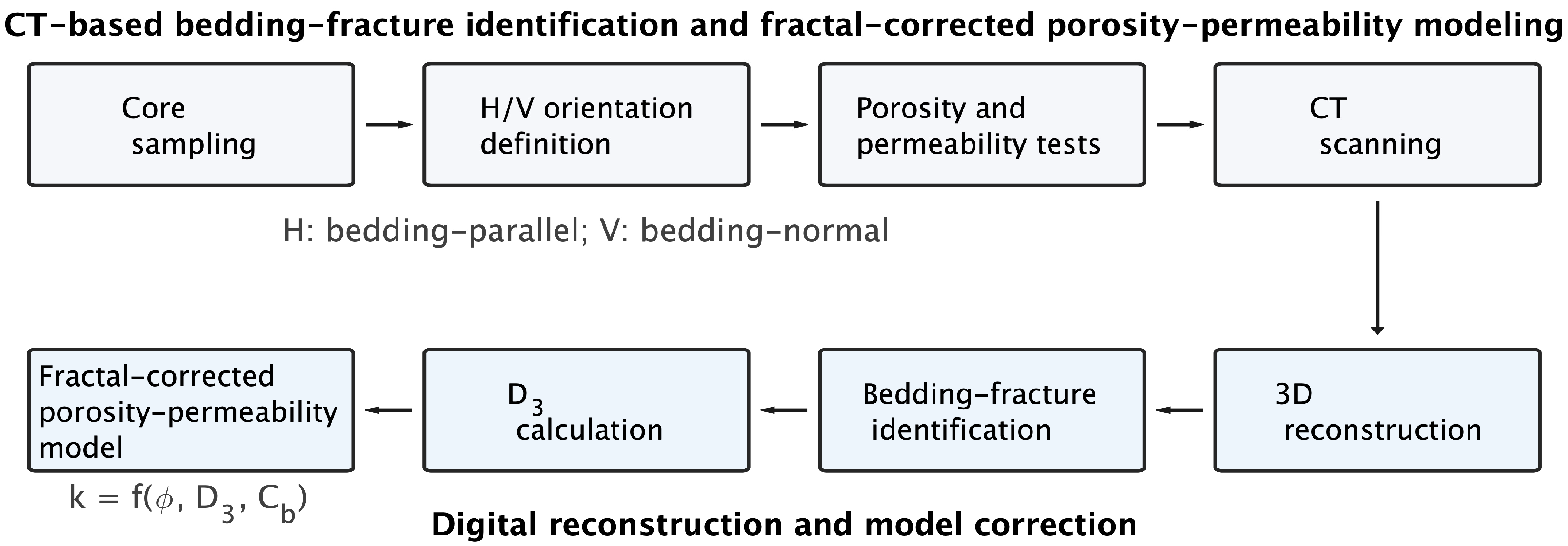
The paired sampling strategy was designed to answer the main research question of whether, and to what extent, bedding-fracture structures in cores from the same depth intervals produce different porosity–permeability responses in bedding-parallel and bedding-normal directions. Representative shale oil cores from the LGS Formation were selected to investigate the influence of bedding-fracture structure on porosity, permeability, and permeability anisotropy. The LGS shale is characterized by well-developed lamination, bedding-related weak interfaces, and heterogeneous pore–fracture systems. These features make it suitable for evaluating the role of bedding-controlled pore–fracture structures in shale oil storage and flow. The overall workflow of this study is shown in Figure 1. The workflow includes shale oil core sampling, definition of horizontal and vertical coring directions, porosity and permeability measurements, CT scanning, three-dimensional reconstruction, bedding-fracture identification, three-dimensional fractal-dimension calculation, and fractal-corrected porosity–permeability modeling.
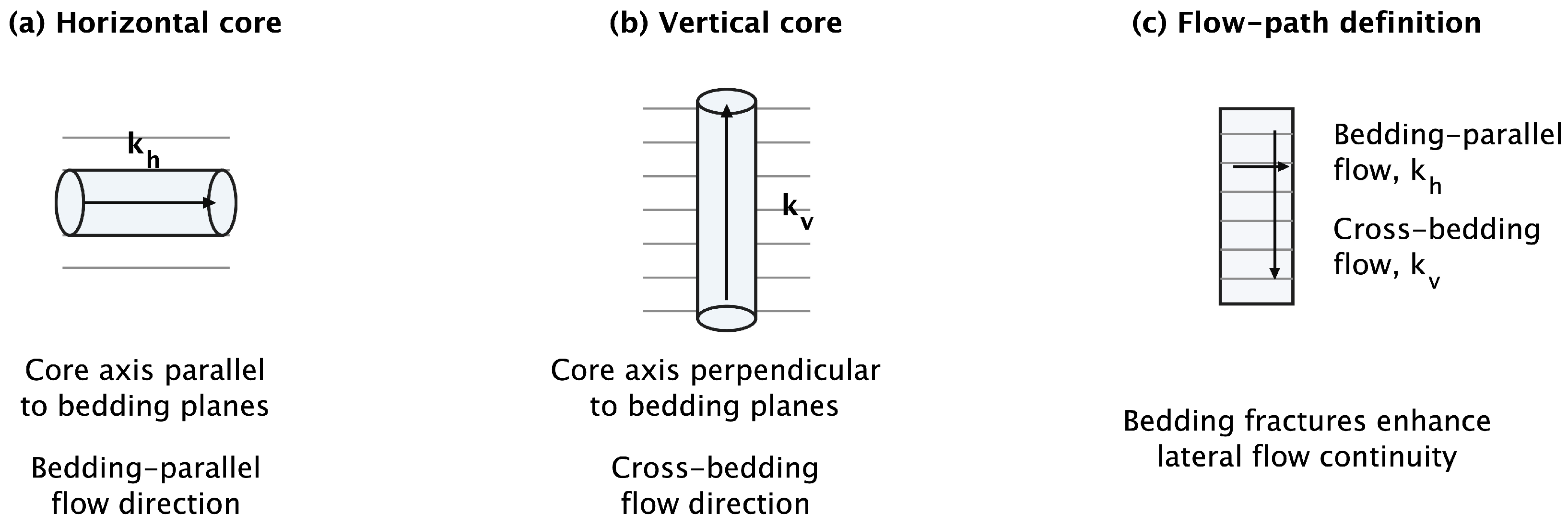
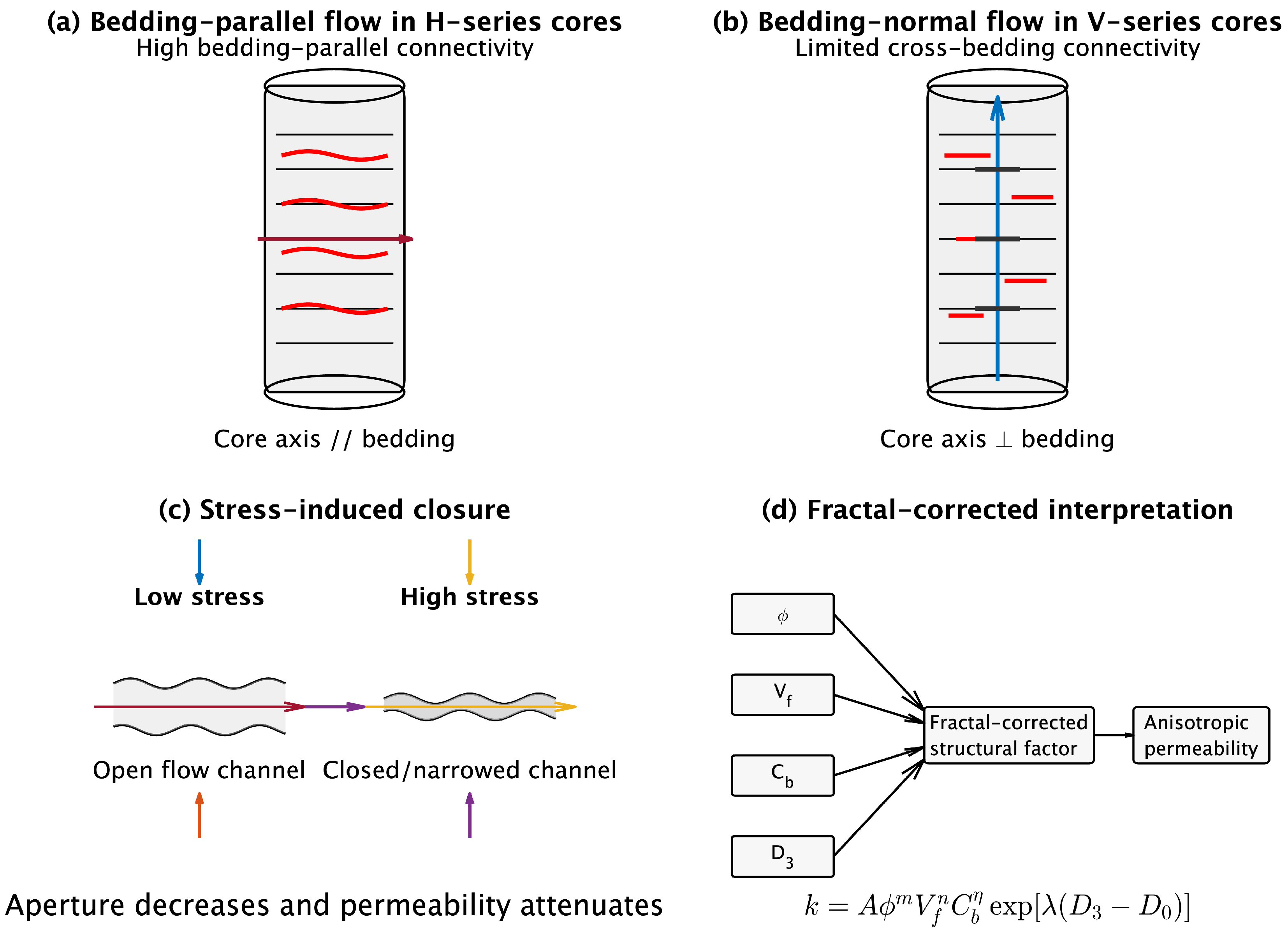
To examine the effect of bedding orientation, the samples were divided into two groups according to the coring direction relative to the bedding plane. The first group consisted of horizontally cored samples, denoted as the H-series, in which the core axis was approximately parallel to the bedding plane. The second group consisted of vertically cored samples, denoted as the V-series, in which the core axis was approximately perpendicular to the bedding plane. The relationship between coring direction, bedding orientation, and flow direction is illustrated in Figure 2. In this study, the permeability measured from the H-series cores is regarded as the bedding-parallel permeability, kh, whereas the permeability measured from the V-series cores is regarded as the bedding-normal permeability, kv. This sampling design allows the anisotropic effect of bedding-fracture structures on flow capacity to be evaluated directly.
A total of 24 cylindrical shale oil cores were used, including 12 H-series samples and 12 V-series samples. Each sample was subjected to porosity measurement, stress-sensitive permeability testing, and X-ray CT scanning. The same sample-numbering system was used throughout the experimental and image-analysis workflow to ensure consistency among physical properties, CT-derived structural parameters, and fractal dimensions.
Before testing, the core surfaces were cleaned, and loose particles were removed. The macroscopic bedding orientation and visible fractures were recorded. The samples were then dried under controlled conditions to minimize the influence of movable fluids on porosity and CT image segmentation. Basic sample information, including sample ID, coring direction, diameter, length, and bedding orientation, is summarized in Table 1.

2.2. Porosity and Permeability Measurements

Porosity and permeability measurements were performed to quantify the storage and flow capacity of the LGS shale oil cores. Porosity was measured before permeability testing and was used as the basic volumetric parameter for evaluating the pore–fracture storage capacity. Because shale oil cores commonly contain both matrix pores and bedding-related microfractures, the measured porosity represents the combined contribution of the matrix pore system and CT-resolvable bedding-fracture structures. To ensure the comparability between bedding-parallel and bedding-normal flow measurements, the H- and V-series samples were prepared as paired cores from the same depth intervals. The sample size in this study was determined by the availability of paired horizontal and vertical cores with complete porosity, stress-sensitive permeability, X-ray computed tomography reconstruction, and fractal-dimension data. The 24 samples include 12 H-series cores and 12 V-series cores, corresponding to 12 paired depth intervals. Although a larger sample size would further improve statistical robustness, the paired-core design was selected to minimize lithologic and burial-depth differences and to isolate the influence of bedding orientation and bedding-fracture connectivity on permeability anisotropy. Therefore, the present dataset provides a controlled basis for evaluating bedding-fracture-controlled anisotropic flow, while future studies should include more paired cores from additional depth intervals to further validate the proposed model. For example, H-1 and V-1 were drilled from the same depth interval of the same downhole core, and the same pairing principle was applied to the remaining numbered samples. In each pair, the H-series core was drilled approximately parallel to the bedding plane, whereas the corresponding V-series core was drilled approximately perpendicular to the bedding plane. This paired sampling design minimizes the influence of lithologic variation, mineral composition, burial depth, and diagenetic heterogeneity, allowing the observed differences in porosity, permeability, and CT-derived bedding-fracture structure to be attributed primarily to bedding orientation and anisotropic pore–fracture connectivity. Permeability was measured under multiple confining pressures to evaluate stress-sensitive flow behavior. The confining pressure was increased stepwise, and permeability was measured after the flow response reached a stable state at each pressure level. The tested pressure levels included 10, 20, 30, 40, and 50 MPa. These pressure stages were selected to capture the progressive closure of bedding fractures and microfractures under increasing effective stress. For each sample, the permeability measured at low confining pressure reflects the initial connected flow capacity, whereas the permeability measured at higher pressure reflects the residual flow capacity after stress-induced fracture closure. For the H-series samples, the flow direction was approximately parallel to the bedding plane. Therefore, the measured permeability mainly reflects bedding-parallel flow through lamination-related pore–fracture pathways. For the V-series samples, the flow direction was approximately perpendicular to bedding. In this case, the measured permeability is controlled by cross-bedding pore connectivity, fracture intersections, and the sealing effect of bedding interfaces. This distinction provides the basis for evaluating permeability anisotropy between kh and kv. The porosity and stress-sensitive permeability data of the paired H- and V-series LGS shale oil cores are listed in Table 2.
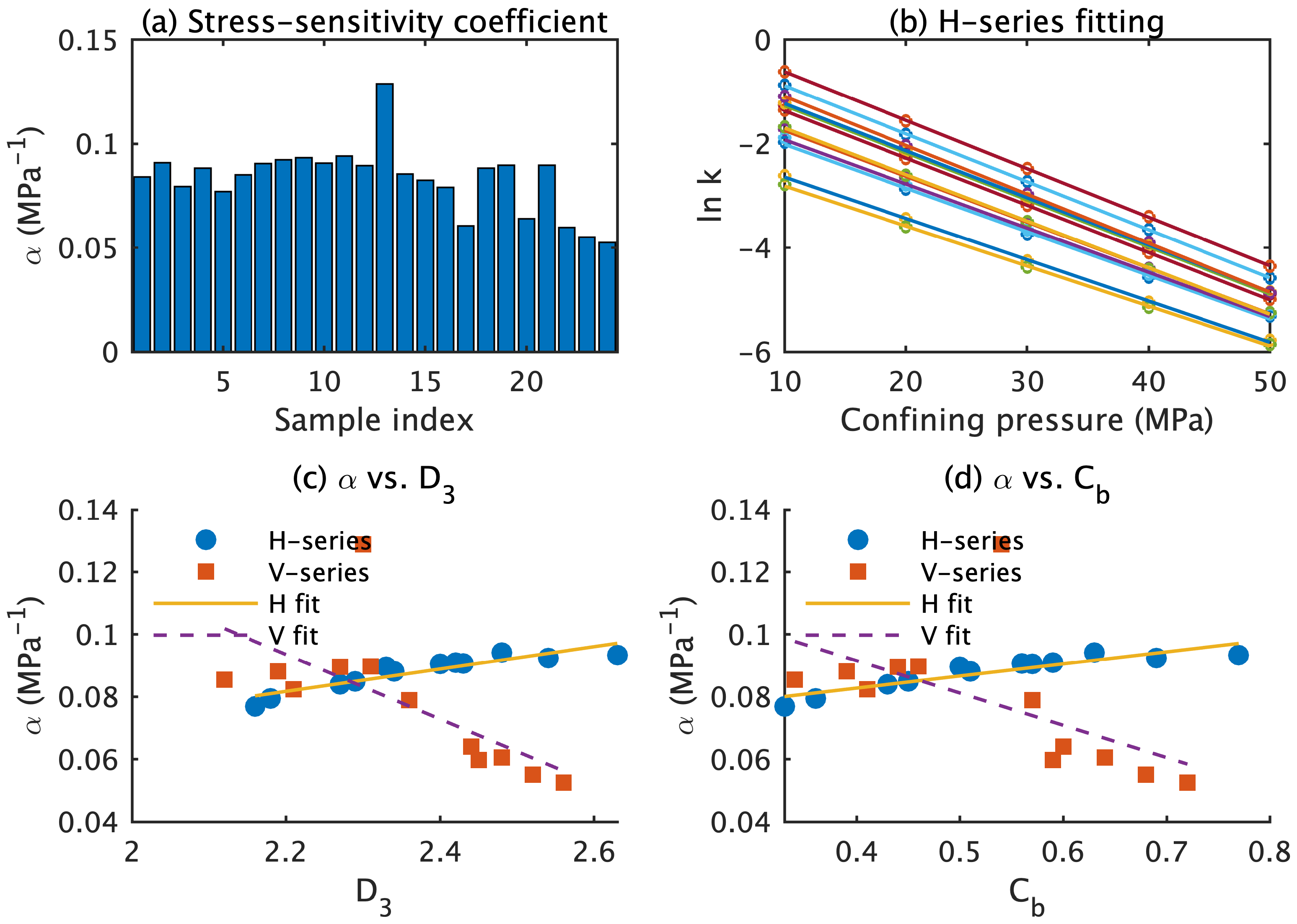
The stress sensitivity of permeability was described using an exponential attenuation model:
k ( σ ) = k 0 e x p ( α σ )
where k ( σ ) is the permeability under confining pressure or effective stress, k 0 is the extrapolated initial permeability, and α is the stress-sensitivity coefficient. Taking the natural logarithm gives
l n   k = l n   k 0 α σ
A larger α indicates stronger stress sensitivity and more significant closure of bedding-fracture-controlled flow channels. Similar stress-dependent permeability behavior has been observed in tight formations and shale fractures, where permeability evolution is strongly influenced by microfracture closure and pore–fracture deformation under increasing stress [13,14].

2.3. CT Scanning and Three-Dimensional Reconstruction

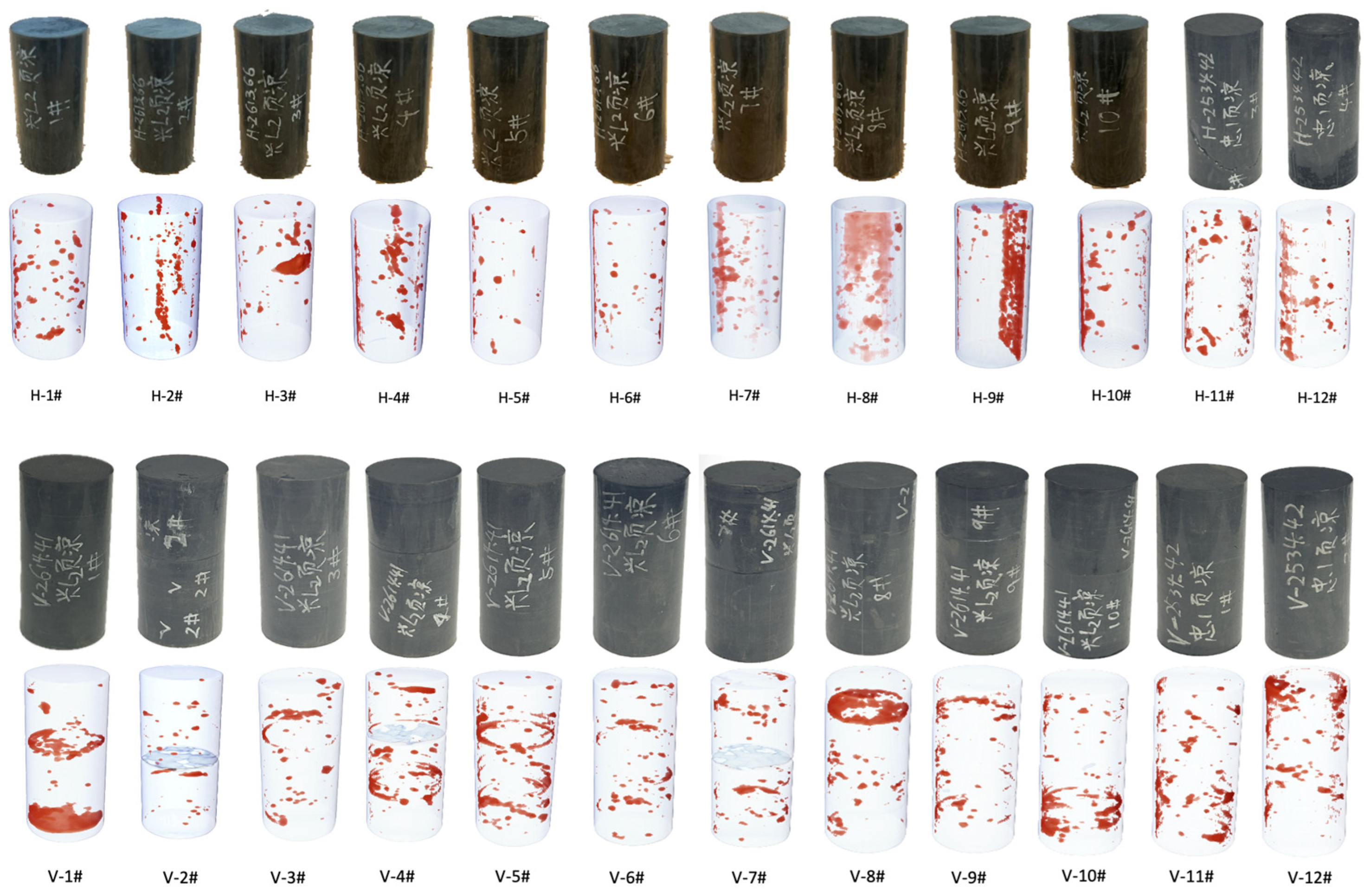
X-ray computed tomography scanning was performed to characterize the internal bedding-related structures of the LGS shale oil cores. CT imaging provides a non-destructive method for observing the three-dimensional distribution of bedding planes, bedding fractures, lamination-related microfractures, and connected voids inside the core. Because this study focuses on the influence of bedding on porosity and permeability anisotropy, the CT interpretation mainly emphasized the identification and reconstruction of bedding-related fracture structures rather than isolated matrix pores. Compared with two-dimensional surface observations, CT reconstruction allows the spatial continuity, orientation, and connectivity of bedding-controlled structures to be evaluated in three dimensions, which is essential for interpreting anisotropic flow behavior in laminated shale. Each cylindrical core was scanned along its axial direction using an X-ray computed tomography system. For shale plugs with a diameter of approximately 25 mm and a length of approximately 50 mm, representative scanning parameters were selected to balance image resolution, penetration capability, and signal-to-noise ratio. The scanning voltage, current, exposure time, voxel size, and image resolution were approximately 160 kV, 100 μA, 500 ms, 25 μm, and 2000 × 2000 pixels, respectively. The scan was conducted over 360°, with approximately 1440 projections collected for each core. The slice interval was set equal to the voxel size, and a metal filter was used to reduce beam-hardening artifacts. The CT slices were reconstructed using a filtered back-projection algorithm. The obtained grayscale CT slices were first inspected to identify bedding planes, bedding-related low-density bands, lamination-parallel fractures, high-density mineral components, and local microfracture zones. Image preprocessing was then performed to reduce noise and improve the contrast between the shale matrix and the CT-resolvable bedding-fracture space. The reconstructed grayscale slices were corrected for grayscale drift and filtered to reduce random noise. A threshold-based segmentation method was used to extract low-density bedding-related pore–fracture features from the shale matrix. Manual correction was applied where necessary to remove high-density mineral artifacts, edge artifacts, and isolated noise voxels. Connected-component analysis was then performed to identify bedding-fracture clusters and calculate the volume of the largest connected component. The photographs and CT-reconstructed pore–fracture structures of all H- and V-series LGS shale oil cores are shown in Figure 3.

2.4. Bedding-Fracture Identification and Structural Parameters

Bedding fractures were identified from the CT-reconstructed pore–fracture volumes based on their morphology, orientation, continuity, and spatial relationship with lamination. In laminated shale cores, bedding fractures generally appear as elongated, planar, or band-like low-density features distributed along or near bedding interfaces. Compared with isolated pores, bedding fractures show stronger directionality and larger aspect ratios. Compared with randomly distributed microcracks, bedding fractures are more closely associated with lamination-parallel or lamination-controlled structures.
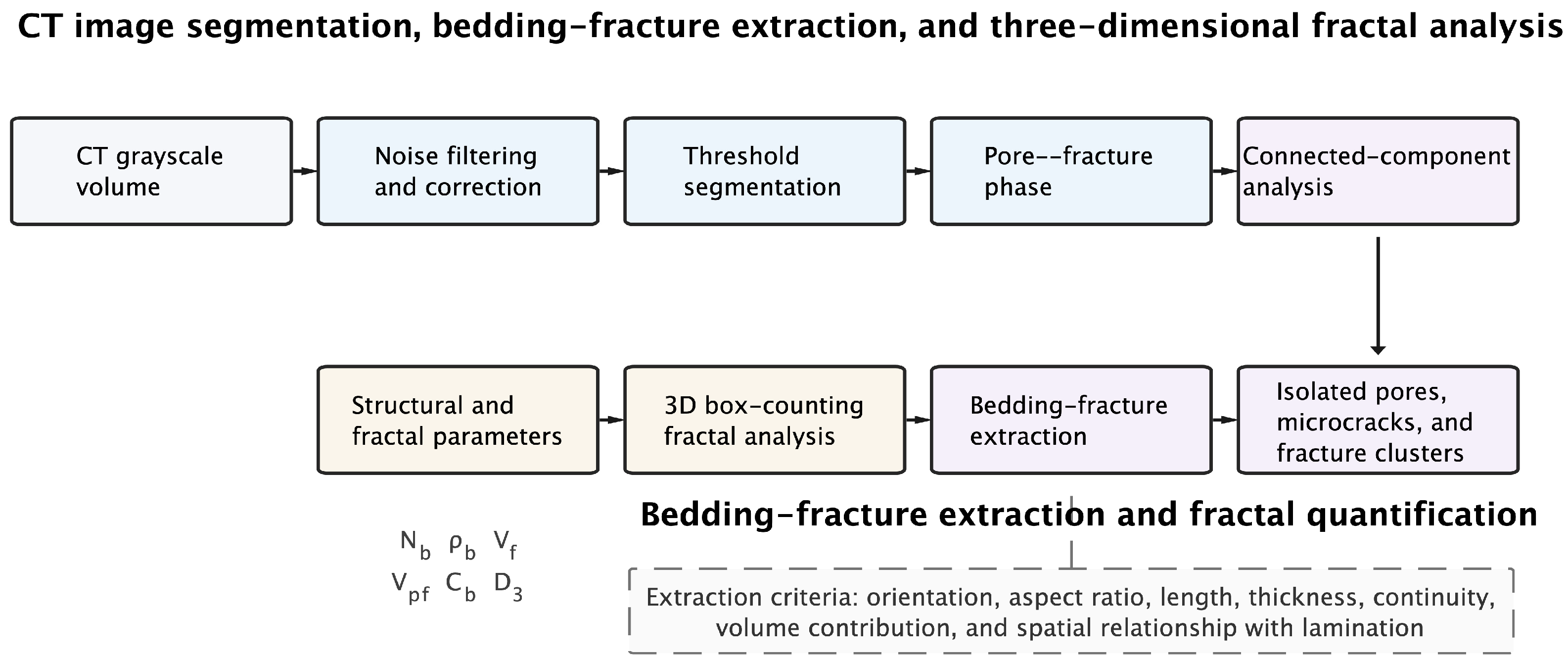
The identification process consisted of three steps. First, the CT-resolvable pore–fracture phase was segmented from the grayscale volume. Second, connected-component analysis was used to distinguish isolated pores, small microcracks, and larger connected bedding-fracture clusters. Third, bedding-fracture components were extracted based on geometric criteria, such as orientation, length, thickness, continuity, and volume contribution. The extracted bedding-fracture network was then used for quantitative structural analysis.
The procedure for CT image segmentation, bedding-fracture extraction, and three-dimensional box-counting fractal analysis is shown in Figure 4. This procedure provides a consistent workflow for transforming grayscale CT images into quantitative structural and fractal parameters.
The following CT-derived parameters were defined.
The pore–fracture volume fraction, V f was calculated as
V f = V p f V c o r e
where V p f is the volume of the segmented pore–fracture phase and V c o r e is the total analyzed core volume. This parameter reflects the volumetric contribution of CT-resolvable pore–fracture space.
The bedding-fracture number, N b , was defined as the number of identifiable bedding-fracture bands or connected bedding-fracture components within the analyzed core volume. The bedding-fracture density, ρ b , was calculated as
ρ b = N b L
where L is the core length or the length of the analyzed volume along the core axis. This parameter normalizes fracture abundance by sample length and allows comparison among different samples.
The connectivity index, C b , was defined as
C b = V m a x V p f
where V m a x is the volume of the largest connected pore–fracture cluster. A larger C b indicates that a greater proportion of the pore–fracture space belongs to a connected network, which is expected to contribute more strongly to permeability.
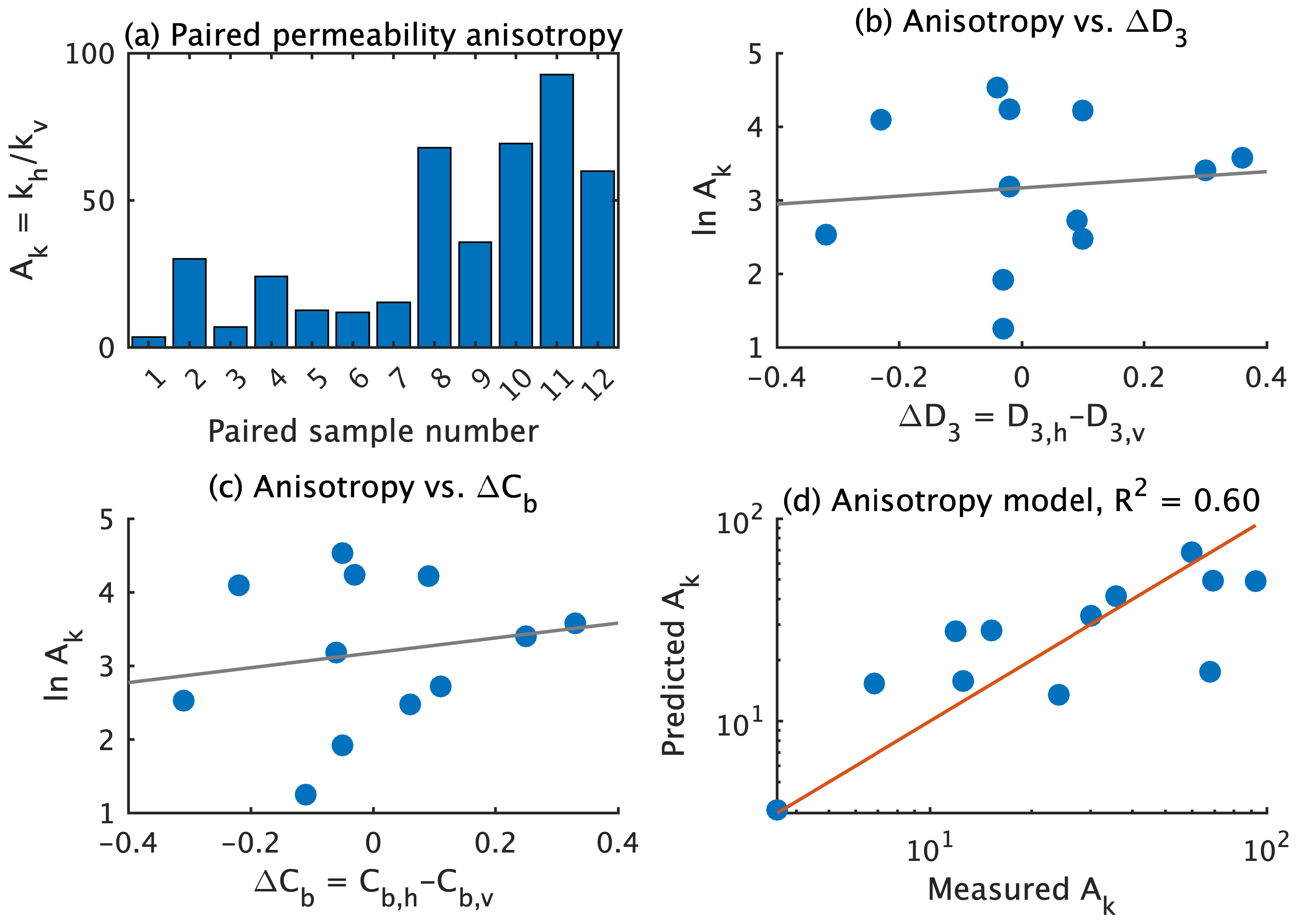
The permeability anisotropy coefficient, A k , was defined as
A k = k h k v
where k h is the bedding-parallel permeability measured from H-series cores and k v is the bedding-normal permeability measured from V-series cores. When direct one-to-one pairing between H- and V-series samples is not available, the anisotropy coefficient can be evaluated using grouped statistical averages or samples from comparable lithologic intervals.
These structural parameters provide quantitative descriptors of bedding-fracture abundance, storage contribution, and flow connectivity. They are used in later sections to examine the relationships among CT-derived pore–fracture structure, porosity, permeability, and fractal dimension. The CT-derived bedding-fracture parameters of the H- and V-series LGS shale oil cores are listed in Table 3.

2.5. Three-Dimensional Box-Counting Fractal Dimension

The geometry of bedding-fracture networks in shale is highly irregular and cannot be fully described by simple Euclidean parameters, such as fracture number or volume fraction. Therefore, three-dimensional box-counting fractal analysis was used to quantify the spatial complexity and space-filling ability of CT-resolvable pore–fracture networks.
The box-counting method was applied to the binarized three-dimensional pore–fracture volume obtained from the CT image-processing workflow shown in Figure 4. The analyzed domain was covered by cubic boxes with side length ε . For each box size, the number of boxes containing at least one pore–fracture voxel was counted and denoted as N ( ε ) . If the pore–fracture network exhibits fractal scaling within the selected scale range, N ( ε ) follows:
N ( ε ) ε D 3
where D3 is the three-dimensional box-counting fractal dimension. Taking the logarithm of both sides gives
l o g N ε = D 3 l o g 1 ε + C
where C is a constant. Therefore, D3 can be obtained from the slope of the linear fitting relationship between l o g N ε and l o g 1 ε .
For each core, a series of box sizes was selected according to the voxel resolution and the size of the analyzed volume. Very small box sizes that were strongly affected by image noise and very large box sizes that contained insufficient statistical information were excluded from the fitting range. The coefficient of determination, R2, was used to evaluate the reliability of the fractal fitting. A higher R2 indicates that the CT-derived pore–fracture structure follows a clearer fractal scaling relationship within the selected scale range. In a three-dimensional system, the theoretical range of D3 is between 0 and 3. For bedding-fracture networks in shale, a higher D3 generally indicates a more complex, more spatially distributed, and more space-filling pore–fracture structure. However, D3 should not be interpreted as a direct substitute for porosity or connectivity. Porosity mainly reflects the volume of pore–fracture space, whereas connectivity controls whether the pore–fracture space contributes to effective flow. The fractal dimension provides complementary information by describing the spatial complexity and multiscale distribution of the network. Three-dimensional fractal analysis based on CT reconstruction has been used to quantify fracture networks, pore structures, and damage evolution in rocks [19,20,24]. In this study, D3 was combined with CT-derived structural parameters, porosity, and permeability to establish a fractal-corrected porosity–permeability model for LGS shale oil cores. The three-dimensional fractal dimension of the CT-derived pore–fracture networks is also summarized in Table 3.

3. Results Analysis

3.1. Porosity and Permeability Characteristics

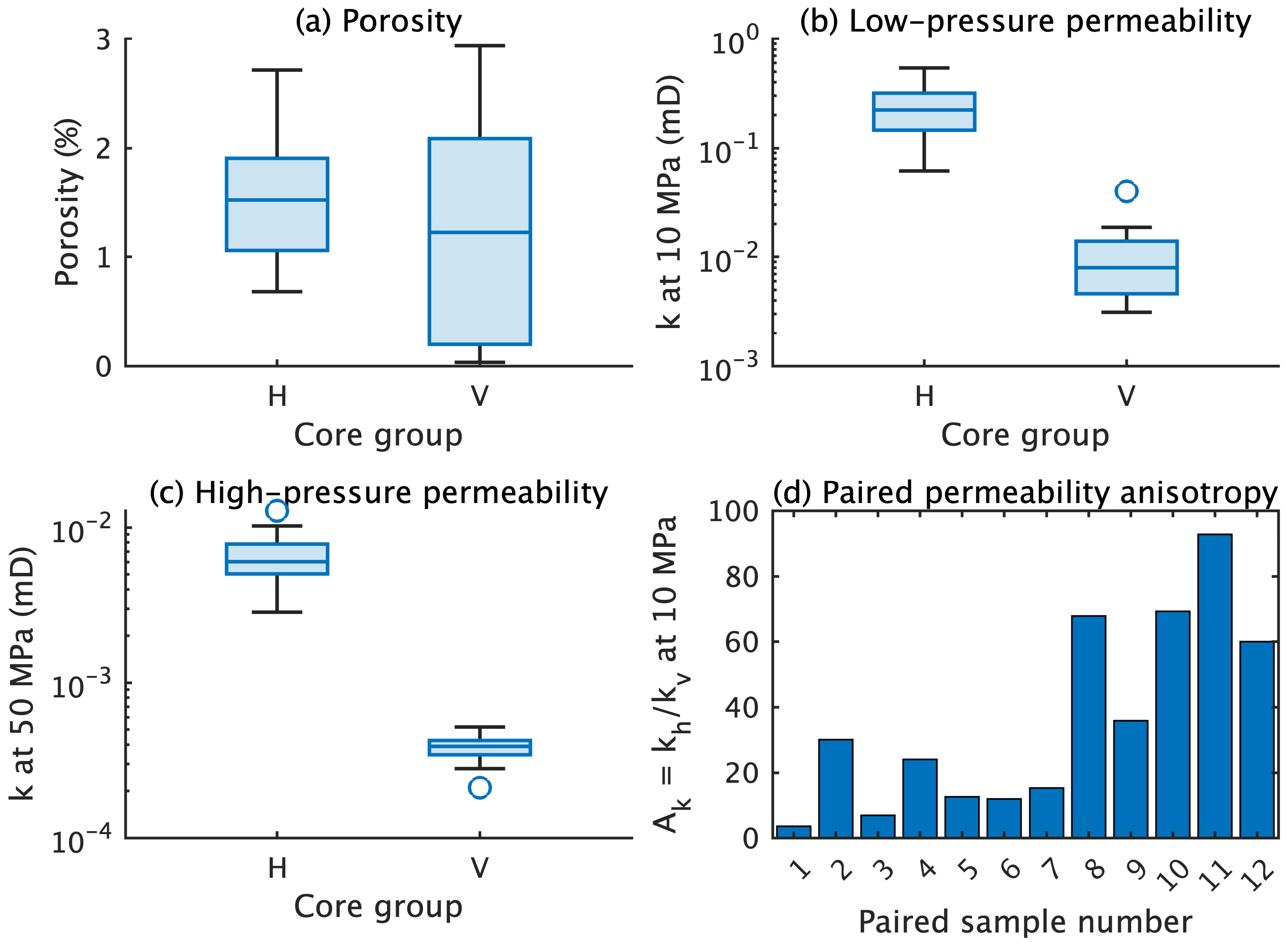
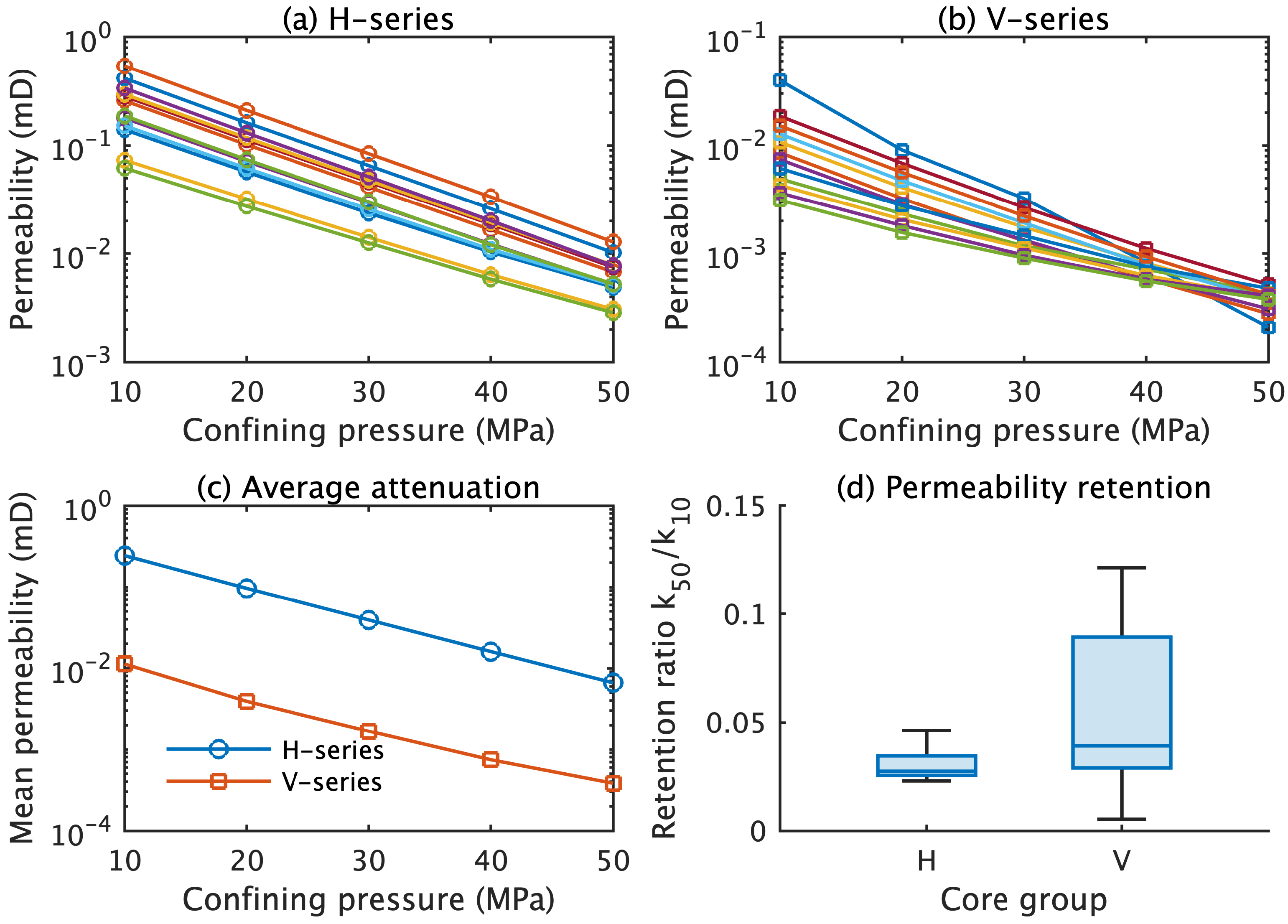
The porosity and stress-sensitive permeability of the H- and V-series LGS shale oil cores are listed in Table 2. The H-series samples show porosity values ranging from 0.6845% to 2.7124%, with an average value of 1.5451%. The V-series samples show a wider porosity range, from 0.0311% to 2.9349%, with an average value of 1.2165%. Although the average porosity of the H-series is slightly higher than that of the V-series, the two groups exhibit overlapping porosity ranges, indicating that porosity alone cannot fully distinguish the storage characteristics of the two coring directions. In contrast, permeability shows a much stronger directional difference. At 10 MPa confining pressure, the permeability of the H-series samples ranges from 0.06173 to 0.54269 mD, with an average value of 0.24402 mD. The V-series samples show significantly lower permeability, ranging from 0.00313 to 0.03982 mD, with an average value of 0.01127 mD. This contrast indicates that bedding-parallel flow is much more favorable than bedding-normal flow in the LGS shale oil cores. The paired comparison between corresponding H- and V-series samples further confirms this anisotropic behavior. The permeability anisotropy coefficient Ak at 10 MPa varies among sample pairs but is consistently greater than unity, demonstrating the dominant contribution of bedding-parallel pore–fracture pathways to flow capacity.
As confining pressure increases from 10 to 50 MPa, permeability decreases continuously for both H- and V-series samples. For the H-series, the average permeability decreases from 0.24402 mD at 10 MPa to 0.00696 mD at 50 MPa. For the V-series, the average permeability decreases from 0.01127 mD at 10 MPa to 0.00040 mD at 50 MPa. The continuous permeability reduction reflects progressive closure of bedding fractures, lamination-related microfractures, and connected pore–fracture pathways under increasing confining pressure. However, the H-series samples maintain higher absolute permeability than the V-series samples at all pressure levels, suggesting that bedding-parallel flow paths retain higher residual flow capacity even after stress-induced closure. Figure 5 shows the porosity and permeability characteristics of the H- and V-series samples. Figure 6 further illustrates the stress-sensitive permeability evolution under increasing confining pressure.

3.2. CT Reconstruction of Bedding-Fracture Structures

CT reconstruction was used to visualize the internal bedding-related structures of all H- and V-series LGS shale oil cores. As shown in Figure 3, the red phase represents the segmented bedding-related structural features, including bedding planes, bedding fractures, lamination-related microfractures, and connected voids along bedding interfaces, whereas the uncolored or transparent region represents the shale matrix. Clear differences can be observed between the two coring directions. In the H-series cores, the bedding-related red phase is mainly distributed along or subparallel to the core axis, indicating relatively continuous bedding-parallel structural features. In contrast, the V-series cores show more segmented lamination bands, bedding-normal intersections, and discontinuous layered features. These CT observations provide a direct structural basis for distinguishing bedding-parallel permeability kh from bedding-normal permeability kv. The hydraulic implication of these structural differences is further discussed in Section 5.

3.3. Quantitative Bedding-Fracture Parameters

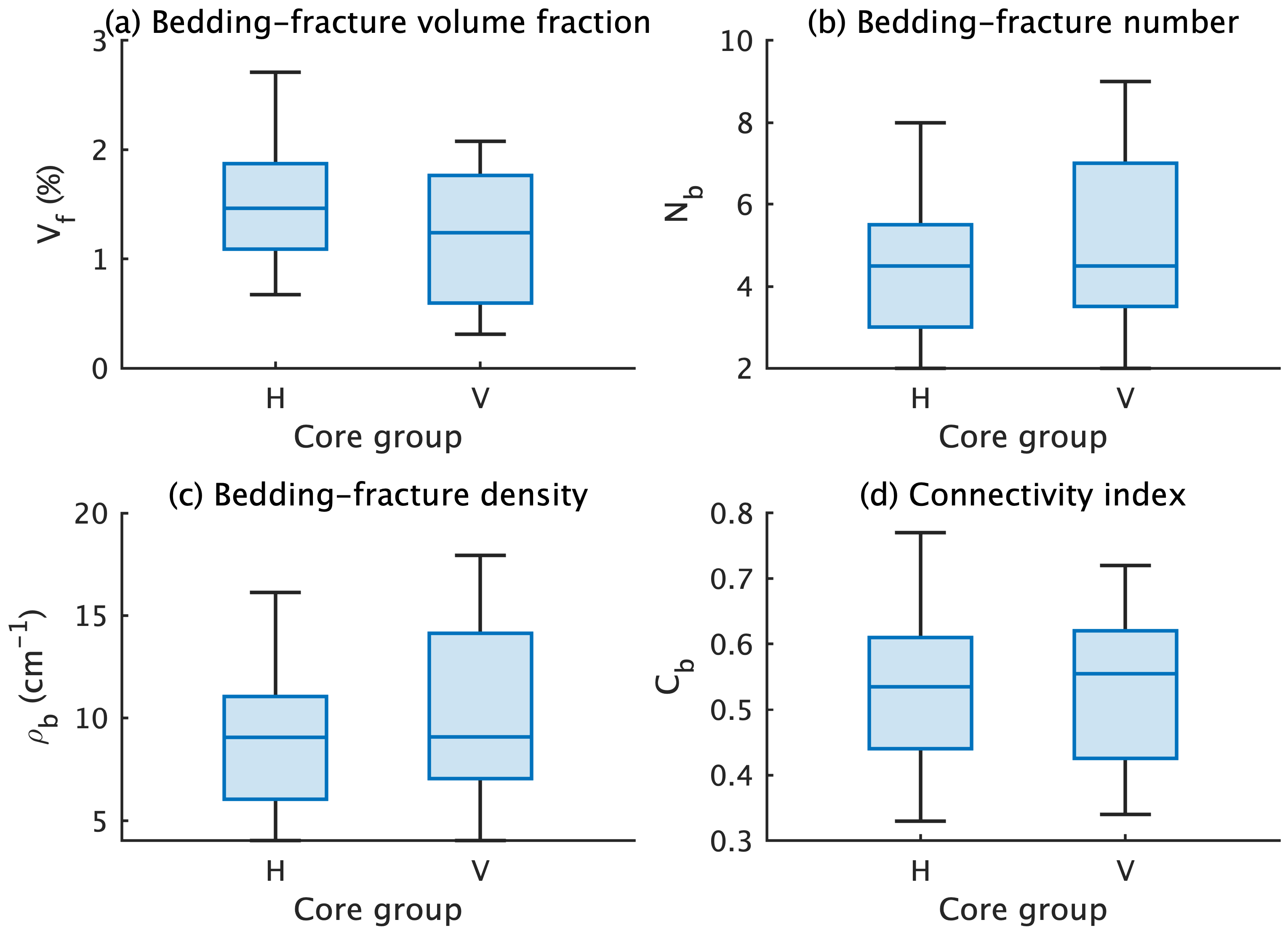
The CT-derived bedding-fracture parameters are listed in Table 3. These parameters include bedding-fracture volume fraction Vf, bedding-fracture number Nb, bedding-fracture density ρ b , connectivity index Cb, and three-dimensional fractal dimension D3. For the H-series samples, Vf ranges from 0.67% to 2.71%, with an average value of 1.5233%. The bedding-fracture number varies from 2 to 8, and the bedding-fracture density ranges from 4.03 to 16.11 cm−1. The connectivity index ranges from 0.33 to 0.77, indicating variable degrees of connected bedding-fracture development among the H-series samples. H-8 and H-9 exhibit relatively high Vf, ρ b , and Cb, consistent with their high permeability values. For the V-series samples, Vf ranges from 0.31% to 2.08%, with an average value of 1.2100%. The bedding-fracture number varies from 2 to 9, and the bedding-fracture density ranges from 4.04 to 17.95 cm−1. The connectivity index ranges from 0.34 to 0.72. Some V-series samples, such as V-11 and V-12, show relatively high bedding-fracture density and connectivity index, but their measured permeability remains low. This indicates that the CT-derived abundance and connectivity of bedding-related structures must be interpreted together with the flow direction. For vertically cored samples, bedding-related structures may be well developed but may not form effective continuous pathways along the bedding-normal flow direction. Figure 7 summarizes the CT-derived bedding-fracture parameters of the H- and V-series samples. These results indicate that both groups contain CT-resolvable bedding-related structures, but the effect of these structures on permeability depends strongly on their orientation and flow-direction connectivity.

3.4. Three-Dimensional Fractal Dimension

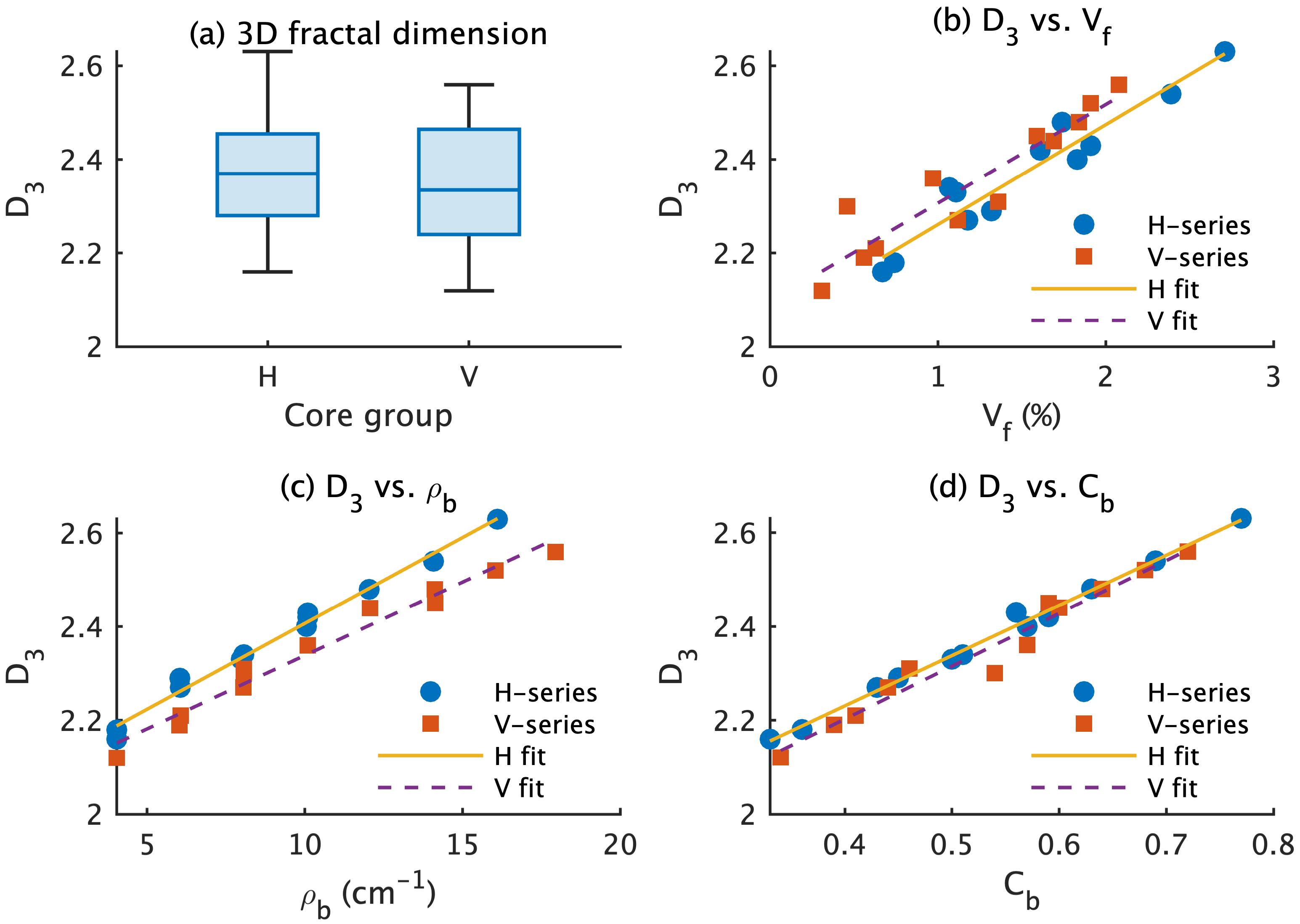
The three-dimensional box-counting fractal dimension D3 was calculated from the CT-derived bedding-fracture structures. As shown in Table 3, the D3 values of the H-series samples range from 2.16 to 2.63, with an average value of 2.3725. The D3 values of the V-series samples range from 2.12 to 2.56, with an average value of 2.3508. The similar average values indicate that both coring directions contain spatially complex bedding-related structures. For the H-series samples, relatively high D3 values are generally associated with higher Vf, ρb, and Cb. For example, H-8 and H-9 have high D3 values of 2.54 and 2.63, respectively, corresponding to well-developed bedding-fracture volume fraction, density, and connectivity. For the V-series samples, some cores such as V-11 and V-12 also show relatively high D3 values, but their permeability remains low. This contrast indicates that D3 should be interpreted together with flow direction and connectivity. Figure 8 shows the distribution of D3 and its relationships with CT-derived bedding-fracture parameters.

3.5. Relationship Between Fractal Dimension and Porosity

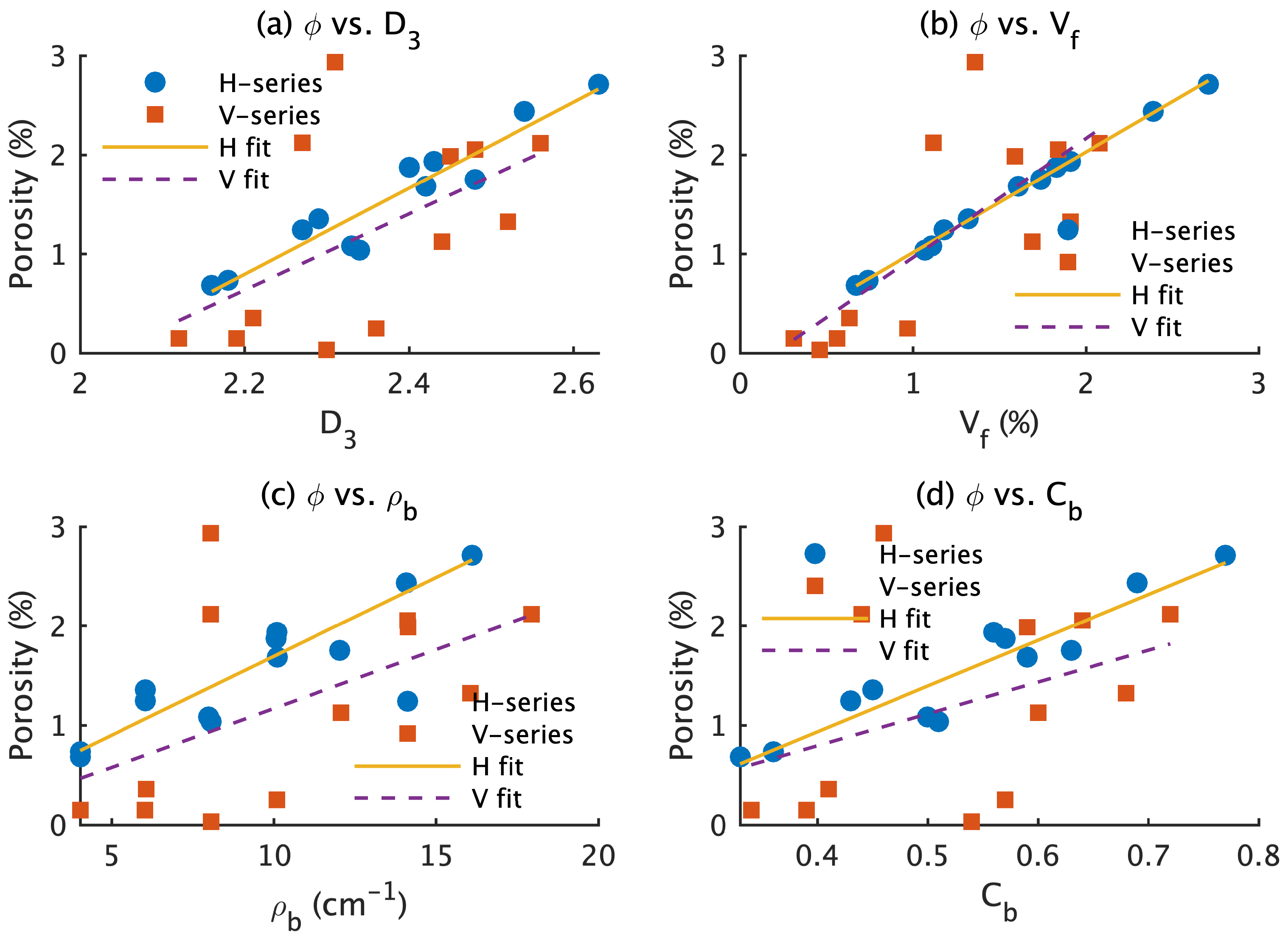
The relationship between porosity and CT-derived bedding-fracture parameters was analyzed to evaluate the storage contribution of bedding-related structures. As shown in Figure 9, porosity generally increases with increasing Vf, ρb, Cb, and D3 in the H-series samples. Samples with higher D3, such as H-8 and H-9, also show higher porosity values, indicating that CT-resolvable bedding-fracture development contributes to measurable pore volume. For the V-series samples, the relationship between porosity and CT-derived parameters is more scattered. Some V-series samples show relatively high porosity but low permeability, suggesting that pore–fracture volume does not necessarily correspond to effective bedding-normal flow capacity. These results indicate that porosity primarily reflects volumetric storage contribution, whereas permeability requires further evaluation of directional connectivity and bedding-fracture orientation.

3.6. Relationship Between Fractal Dimension and Permeability

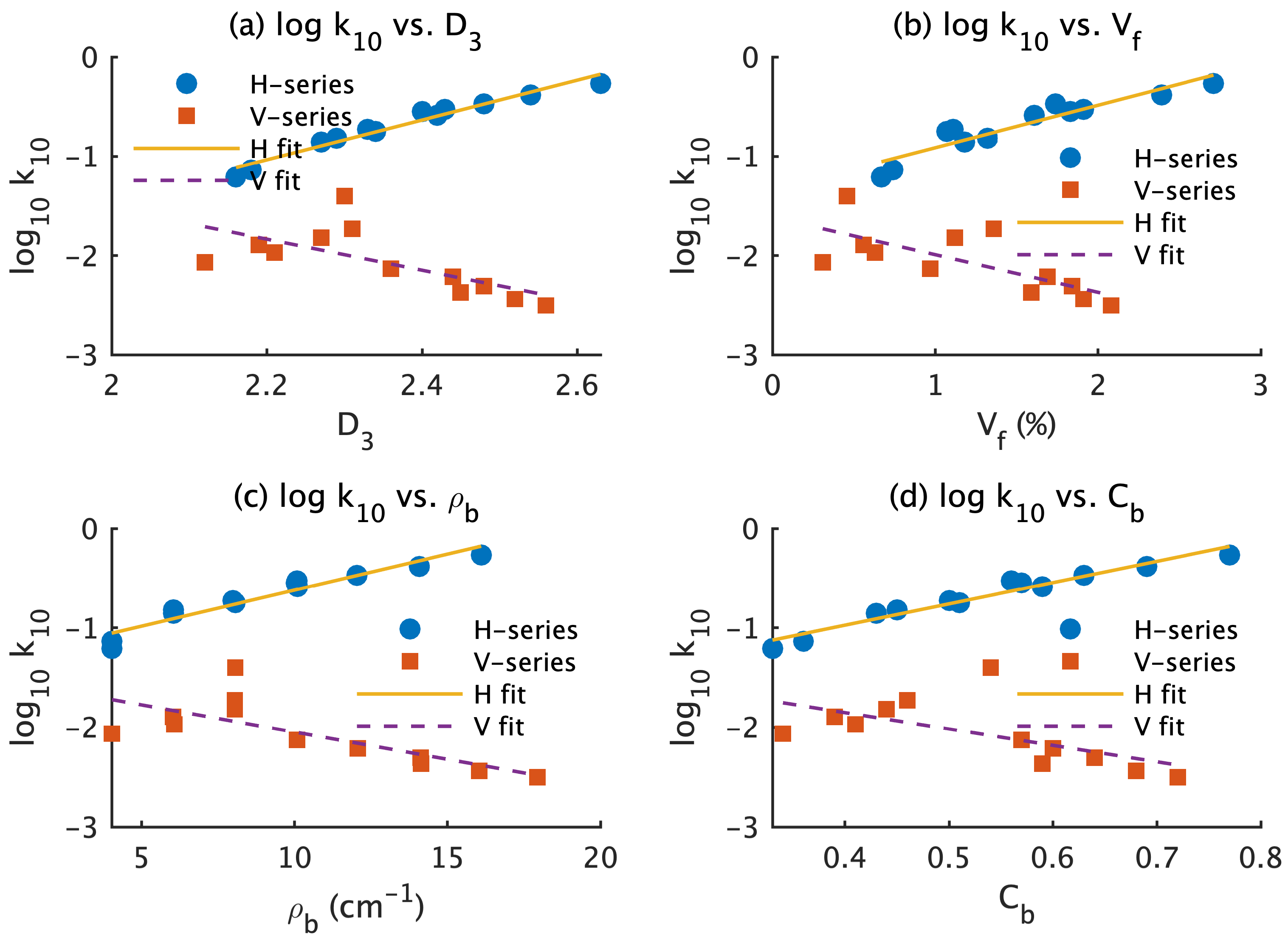
The relationship between CT-derived parameters and permeability was evaluated using the permeability measured at 10 MPa as the representative low-stress flow capacity. Because permeability varies over a wide range, logarithmic permeability was used for correlation analysis and visualization. As shown in Figure 10 and Table 4, the H-series samples show strong positive correlations between logk10 and CT-derived structural parameters. The correlation coefficients between logk10 and ρb, Vf, Cb, and D3 are 0.9331, 0.9386, 0.9760, and 0.9794, respectively. These results indicate that bedding-fracture abundance, connectivity, and fractal complexity are closely related to bedding-parallel permeability. In contrast, the V-series samples show negative or weak correlations between logk10 and these parameters. The correlation coefficients between logk10 and Vf, Cb, and D3 are −0.7220, −0.6214, and −0.6739, respectively. This indicates that high bedding-fracture abundance or complexity does not necessarily enhance bedding-normal permeability. Therefore, the hydraulic significance of Vf, Cb, and D3 depends strongly on flow direction. The model comparison in Table 4 further shows that the fractal-corrected model improves permeability prediction relative to the conventional porosity-only model. For all samples, the model R2 increases from 0.0623 to 0.8804, while RMSE decreases from 1.6721 to 0.5971 in logarithmic space.
To further support the observed trends, Pearson correlation coefficients and model-evaluation metrics were calculated in logarithmic permeability space. The results are summarized in Table 4. The statistical results confirm that CT-derived bedding-fracture parameters have different hydraulic significance in the two coring directions. They are strongly positively correlated with bedding-parallel permeability in the H-series, but they do not show the same positive relationship with bedding-normal permeability in the V-series.

3.7. Stress Sensitivity of Bedding-Fracture-Controlled Permeability

Permeability decreases continuously with increasing confining pressure for both H- and V-series samples. For the H-series, the average permeability decreases from 0.24402 mD at 10 MPa to 0.00696 mD at 50 MPa, corresponding to a reduction of approximately 97.1%. For the V-series, the average permeability decreases from 0.01127 mD to 0.00040 mD, corresponding to a reduction of approximately 96.5%. These results indicate strong stress sensitivity of bedding-fracture-controlled flow channels. Although the H-series cores have higher initial permeability, they also experience substantial permeability attenuation under increasing confining pressure. The V-series cores maintain much lower absolute permeability throughout the tested pressure range. The fitted stress-sensitivity coefficients and their relationships with CT-derived parameters are shown in Figure 11. The physical mechanism of stress-sensitive anisotropic flow is discussed in Section 5.3.

4. Fractal-Corrected Porosity–Permeability Model

4.1. Conventional Porosity–Permeability Relationship

Porosity is commonly used as the primary parameter for evaluating reservoir storage capacity and predicting permeability. For conventional porous media, permeability is often expressed as a power-law function of porosity:
k = A ϕ m
where k is permeability, ϕ is porosity, and A and m are empirical fitting parameters. Taking the logarithm gives
l n   k = l n   A + m l n   ϕ
This relationship assumes that an increase in pore volume generally enhances flow capacity. However, for laminated shale oil cores, permeability is not controlled only by the total pore volume. Bedding fractures, lamination-related microfractures, pore–fracture connectivity, and flow direction relative to bedding can strongly affect the effective seepage pathway. Therefore, samples with similar porosity may exhibit significantly different permeability. In this study, the conventional porosity–permeability relationship was first fitted using the permeability measured at 10 MPa, k10, as the representative low-stress permeability. The results show that porosity alone can partially describe permeability variation but cannot adequately capture the large difference between the H- and V-series samples. The H-series samples generally show much higher permeability than the V-series samples, even when their porosity ranges overlap. This indicates that porosity mainly represents storage capacity, whereas permeability is more sensitive to bedding-fracture orientation and connectivity. The limitation of the conventional porosity–permeability relationship is especially evident for V-series samples. Some V-series cores have relatively high porosity but low permeability, suggesting that their pore–fracture space does not form effective continuous pathways in the bedding-normal direction. Therefore, additional structural descriptors derived from CT reconstruction and fractal analysis are required to improve permeability prediction.

4.2. Fractal Correction Factor

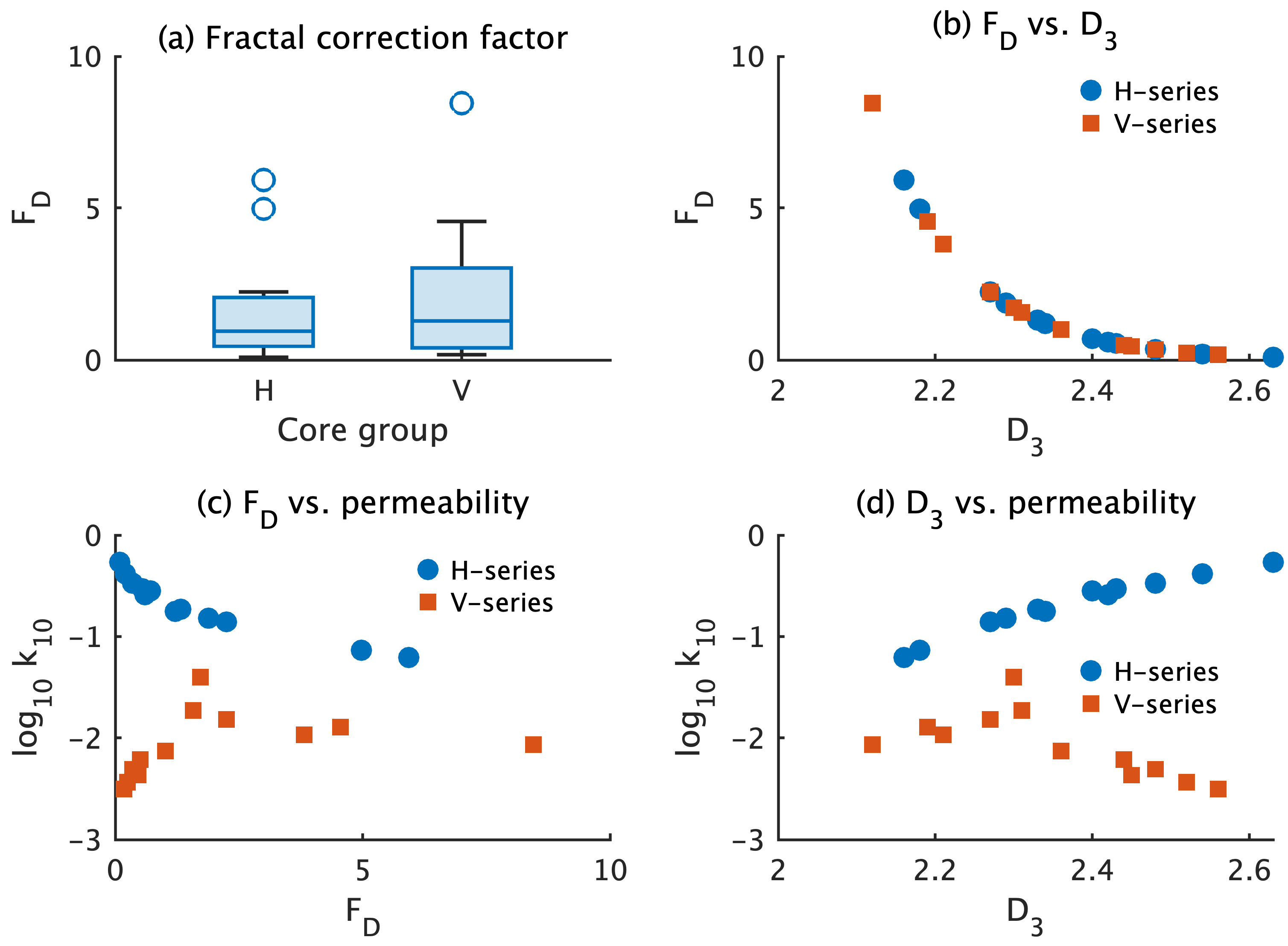
To incorporate the influence of bedding-fracture complexity into permeability prediction, a fractal correction factor was introduced. The three-dimensional box-counting fractal dimension D3 quantifies the spatial complexity and space-filling ability of the CT-resolvable bedding-fracture network. However, D3 alone does not directly represent permeability because flow capacity also depends on pore–fracture volume and connectivity. Therefore, the fractal correction should be combined with CT-derived structural parameters. The fractal correction factor is defined as
F D = e x p [ λ ( D 3 D 0 ) ]
where D0 is a reference fractal dimension and λ is the fractal sensitivity coefficient. A larger FD indicates stronger contribution of spatially complex bedding-fracture structures to the effective flow system. In this study, D0 can be taken as the mean D3 value of all samples or treated as a regression reference value.
Because bedding-fracture-controlled permeability is also affected by volume fraction and connectivity, a combined structural correction factor can be written as
F b = V f n C b η e x p [ λ ( D 3 D 0 ) ]
where Vf is the CT-derived bedding-fracture volume fraction, Cb is the connectivity index, and n, η , and λ are fitting parameters. This formulation links the volumetric contribution, connected-network contribution, and fractal complexity of bedding-related structures.
Physically, Vf describes the amount of CT-resolvable bedding-fracture space, Cb describes the proportion of the connected pore–fracture network, and D3 describes the spatial complexity of that network. Therefore, the correction factor provides a more comprehensive structural descriptor than porosity alone. Figure 12 shows the distribution of FD and its relationships with D3 and permeability.

4.3. Fractal-Corrected Permeability Model

Based on the conventional porosity–permeability relationship and the fractal correction factor, the permeability of LGS shale oil cores can be expressed as
k = A ϕ m V f n C b η e x p [ λ ( D 3 D 0 ) ]
where A, m, n, η , and λ are regression coefficients. Taking the logarithm gives the linearized form:
l n   k = l n   A + m l n   ϕ + n l n   V f + η l n   C b + λ ( D 3 D 0 )
This model explicitly incorporates porosity, CT-derived bedding-fracture volume fraction, connectivity, and fractal dimension. Compared with the conventional model, the fractal-corrected model can better reflect the fact that permeability is controlled by both pore volume and effective flow-channel geometry.
For the H-series samples, the bedding-fracture network is generally aligned with the flow direction. Therefore, higher Vf, Cb, and D3 tend to increase permeability. In this case, the fractal-corrected model can be interpreted as a bedding-parallel flow-enhancement model. For the V-series samples, bedding-fracture structures may be abundant and geometrically complex, but they are not necessarily connected in the bedding-normal direction. Therefore, high D3 or high Vf does not always correspond to high vertical permeability. This suggests that the model coefficients may differ between bedding-parallel and bedding-normal flow directions. Accordingly, the model can be fitted separately for the H- and V-series samples, or a group indicator can be introduced to represent the effect of flow direction. A practical direction-dependent form can be written as
l n   k i = l n   A i + m i l n   ϕ + n i l n   V f + η i l n   C b + λ i ( D 3 D 0 )
where the subscript i represents either the H-series or V-series group. This formulation allows the same structural parameters to have different hydraulic significance depending on bedding orientation.

4.4. Permeability Anisotropy Model

The paired sampling design allows permeability anisotropy to be evaluated using corresponding H- and V-series samples drilled from the same depth intervals. The permeability anisotropy coefficient is defined as Equation (6). Because paired H–V samples were taken from the same depth interval, the difference in Ak mainly reflects the influence of bedding orientation and directional connectivity rather than lithologic or burial-depth variation. The anisotropy coefficient can be linked to paired differences in CT-derived parameters:
Δ D 3 = D 3 , h D 3 , v
Δ C b = C b , h C b , v
Δ V f = V f , h V f , v
A permeability anisotropy model can then be expressed as
l n   A k = b 0 + b 1 Δ D 3 + b 2 Δ V f + b 3 Δ C b
where b0, b1, b2, and b3 are fitted coefficients. This model reflects the concept that permeability anisotropy is controlled by the contrast in bedding-fracture complexity, volume contribution, and connectivity between bedding-parallel and bedding-normal flow systems.
When the H-series core has a more connected and spatially complex bedding-fracture structure than its paired V-series core, Ak is expected to increase. However, if the V-series core contains abundant bedding-related structures that are not connected in the vertical flow direction, its high D3 may not reduce anisotropy effectively. Therefore, D3 should be interpreted together with Cb, Vf, and the flow direction. The paired permeability anisotropy model and its relationship with CT-derived structural differences are shown in Figure 13.

4.5. Model Evaluation

The performance of the conventional and fractal-corrected permeability models was evaluated using measured versus predicted permeability, coefficient of determination R2, root-mean-square error (RMSE), and mean absolute error (MAE). Because permeability spans several orders of magnitude, model fitting and error evaluation were performed in logarithmic space. This approach avoids excessive weighting of high-permeability samples and provides a more balanced assessment of prediction accuracy for both H- and V-series cores. The conventional model used only porosity as the predictor and followed the commonly used porosity–permeability power-law relationship. This type of model assumes that permeability is mainly controlled by pore volume and has been widely used as a first-order empirical description of porous-media flow. However, in laminated shale oil cores, pore volume alone cannot fully represent effective flow capacity because permeability is also controlled by bedding-fracture orientation, connected pore–fracture pathways, and stress-sensitive fracture aperture. Therefore, the conventional model was used as the baseline model to evaluate whether additional CT-derived structural parameters can improve permeability prediction. The fractal-corrected model incorporates porosity ϕ , bedding-fracture volume fraction Vf, connectivity index Cb, and three-dimensional fractal dimension D3. This model is conceptually consistent with previous fractal permeability models, which have shown that permeability is affected not only by porosity but also by pore-size distribution, tortuosity, fracture-network geometry, and pore–fracture complexity. Compared with these existing models, the present model is specifically designed for CT-resolvable bedding-fracture systems in paired horizontal and vertical shale oil cores. Thus, it extends the conventional porosity–permeability framework by explicitly considering bedding-fracture abundance, connected-network contribution, and three-dimensional spatial complexity. The comparison between the two models is important because the present data show that samples with similar porosity can have markedly different permeability depending on bedding orientation. For example, some V-series cores have relatively high porosity or high CT-derived structural abundance, but their bedding-normal permeability remains low because the pore–fracture network is not effectively connected along the flow direction. In contrast, H-series cores generally show higher permeability when bedding fractures are aligned with the flow direction. Therefore, model reliability should be evaluated not only by statistical fitting metrics, such as R2, RMSE, and MAE, but also by whether the model can explain the physical mechanism of bedding-controlled anisotropic flow.
A lower prediction error and higher R2 for the fractal-corrected model indicate that CT-derived bedding-fracture structure and fractal complexity provide essential information beyond porosity. In particular, Vf reflects the volumetric contribution of CT-resolvable bedding-fracture space, Cb represents the connected-network contribution, and D3 characterizes the spatial complexity and space-filling ability of the pore–fracture network. When these parameters are combined with porosity, the model provides a more physically meaningful interpretation of permeability variation in laminated shale oil cores than the porosity-only model. The model-evaluation results are summarized in Table 4. The conventional porosity-only model shows limited predictive ability when all samples are considered together, with an R2 of only 0.0623 in logarithmic permeability space. This low value reflects the inability of porosity alone to explain the large permeability contrast between bedding-parallel and bedding-normal flow. After incorporating Vf, Cb, D3, and the bedding-related flow-direction effect, the fractal-corrected model improves the all-sample R2 to 0.8804 and reduces RMSE from 1.6721 to 0.5971.
It should also be noted that the proposed fractal-corrected model is a core-scale semi-empirical model. Its applicability is strongest for laminated shale oil cores in which CT-resolvable bedding fractures and lamination-related microfractures exert significant control on flow capacity. For samples dominated by sub-resolution nanopores, clay-bound pores, or matrix diffusion, additional nanoscale characterization methods, such as NMR, mercury intrusion, gas adsorption, or FIB–SEM, may be required. Therefore, the model should be recalibrated before being applied to other shale formations, different CT resolutions, different stress conditions, or multiphase-flow systems.
This interpretation is also consistent with studies on other porous materials, where permeability and transport properties are shown to depend not only on total porosity but also on pore-structure evolution, connectivity, and fractal characteristics. For example, Wang et al. [45] showed that silica fume modifies the pore structure and fractal dimension of low-heat Portland cement-based materials, supporting the use of fractal dimension to describe pore-structure complexity. Yu et al. [46] modeled the permeability and thermal conductivity of low-heat Portland cement using thermodynamics and fractal theory, showing that hydration-induced pore-structure evolution strongly affects transport properties. Li et al. [47] further demonstrated that water-to-cement ratio, curing temperature, and MgO admixture can modify the pore structure and porosity of low-heat Portland cement pastes, thereby influencing their transport-related properties. Although these studies focus on cement-based materials rather than shale, they support the broader porous-media concept that porosity alone is insufficient to determine transport behavior.

5. Discussion

5.1. Physical Meaning of D3

The three-dimensional fractal dimension D3 provides a quantitative measure of the spatial complexity and space-filling ability of CT-resolvable bedding-fracture structures. A higher D3 indicates that the bedding-related pore–fracture network occupies the three-dimensional space in a more complex and distributed manner. However, D3 should not be interpreted as a direct equivalent of porosity or permeability. Porosity is a volumetric parameter, whereas permeability is a directional transport property controlled by connectivity, aperture, tortuosity, and stress state. This distinction is evident in the V-series samples, where several cores show relatively high D3 but low permeability. Therefore, D3 should be regarded as a complementary structural descriptor. Its hydraulic significance becomes meaningful only when it is interpreted together with Vf, Cb, bedding orientation, and flow direction.

5.2. Bedding-Fracture Control on Pore–Fracture Structure

The hydraulic contribution of bedding fractures differs between storage and flow. Bedding-related structures can increase pore–fracture volume and thus contribute to porosity, but their contribution to permeability depends on whether they form continuous pathways along the flow direction. Mechanistically, this difference is controlled by the directional arrangement of bedding fractures relative to the imposed flow direction. In the H-series cores, the core axis is approximately parallel to the bedding plane. Therefore, bedding fractures, lamination-related microfractures, and connected voids are more likely to form continuous or semi-continuous flow channels along the axial direction. These connected bedding-parallel pathways reduce flow resistance and explain the relatively high permeability of the H-series cores. In contrast, in the V-series cores, the flow direction is approximately perpendicular to bedding. Fluid flow must pass across bedding interfaces and depends on limited cross-bedding connections among discontinuous fractures, matrix pores, and local fracture intersections. As a result, bedding-related structures may contribute to pore–fracture volume and structural complexity but may not form effective bedding-normal flow pathways. In H-series cores, bedding fractures are favorably aligned with the flow direction, so bedding-parallel connectivity enhances permeability. In V-series cores, bedding interfaces are intersected by the flow direction, and effective flow requires cross-bedding connection among discontinuous fractures and matrix pores. This explains why some V-series cores have relatively high porosity, Vf, or D3, but still exhibit low bedding-normal permeability. Therefore, bedding-fracture evaluation should distinguish between storage-related parameters, such as porosity and Vf, and flow-related parameters, such as directional connectivity and permeability anisotropy.

5.3. Stress Sensitivity and Anisotropic Flow Mechanism

The stress-sensitive permeability behavior can be attributed to progressive closure of bedding fractures, reduction in effective fracture aperture, and weakening of connected pore–fracture pathways. The mechanism of stress sensitivity is related to the mechanical compliance of bedding-related fractures. At low confining pressure, bedding-parallel fractures in the H-series cores retain relatively large effective apertures and provide preferential flow channels. With increasing confining pressure, fracture surfaces are progressively pressed into contact, the effective hydraulic aperture decreases, and narrow flow channels are compressed or partially closed. This process causes strong permeability attenuation even in samples with high initial permeability. For the V-series cores, bedding-normal flow is already restricted by poor cross-bedding connectivity at low confining pressure. Increasing confining pressure further compresses the limited cross-bedding connections, leading to very low residual permeability. Therefore, the observed permeability reduction is caused not only by pore-volume change, but also by directional loss of connected flow pathways. Bedding-parallel flow paths in H-series cores provide high initial permeability but remain sensitive to closure under increasing confining pressure. Bedding-normal flow paths in V-series cores are limited even at low confining pressure because vertical flow requires cross-bedding connectivity. The permeability reductions of approximately 97.1% for the H-series and 96.5% for the V-series from 10 to 50 MPa confirm that both bedding-parallel and bedding-normal flow systems are strongly stress-sensitive. However, the absolute permeability of the H-series remains higher throughout the tested pressure range. Therefore, the anisotropic flow mechanism can be summarized as directional enhancement by bedding-parallel connectivity and stress-sensitive attenuation by fracture closure.

5.4. Implications for Shale Oil Reservoir Evaluation

The practical significance of the proposed approach lies in its ability to distinguish storage-related pore–fracture volume from flow-effective pore–fracture connectivity. In the present dataset, the H- and V-series cores have partly overlapping porosity ranges, but the average permeability of the H-series at 10 MPa is approximately 21.7 times that of the V-series. This large difference cannot be explained by porosity alone. By incorporating Vf, Cb, and D3, the proposed approach provides additional structural information for identifying whether CT-resolvable bedding-fracture space contributes to effective flow. This is useful for interpreting core permeability data, evaluating bedding-controlled permeability anisotropy, selecting representative permeability inputs for reservoir simulation, and improving the assessment of shale oil sweet spots where bedding-parallel flow pathways are well developed.
The results have important implications for shale oil reservoir evaluation. First, porosity alone is insufficient for predicting permeability in laminated shale oil cores. The average permeability of the H-series at 10 MPa is approximately 21.7 times that of the V-series, although the porosity ranges of the two groups partly overlap. This indicates that reservoir quality evaluation should incorporate bedding orientation and CT-derived structural parameters. Second, three-dimensional fractal analysis provides a useful method for quantifying bedding-fracture complexity. When D3 is combined with Vf and Cb, the resulting structural description can help distinguish whether CT-resolvable bedding-fracture space contributes to storage only or to effective flow. Third, permeability anisotropy should be considered in shale oil development. Bedding-parallel flow pathways may enhance lateral seepage capacity, whereas bedding-normal flow may remain restricted by discontinuous cross-bedding connectivity. These findings are relevant for core-scale permeability interpretation, sweet-spot evaluation, hydraulic-fracturing design, and permeability input selection for reservoir simulation.
Overall, the findings can be explained by a coupled mechanism of bedding-fracture orientation, directional connectivity, and stress-induced aperture closure. Bedding-parallel permeability is enhanced when lamination-related fractures and connected voids are aligned with the flow direction. Bedding-normal permeability is restricted when bedding-related structures are laterally developed but vertically discontinuous. Increasing confining pressure reduces effective fracture aperture in both directions, resulting in stress-sensitive permeability attenuation. This mechanism is schematically summarized in Figure 14.

5.5. Limitations

Several limitations should be noted. First, CT resolution controls the minimum detectable pore–fracture size. Nanopores and sub-resolution microfractures may not be fully captured by the reconstructed bedding-fracture phase. Therefore, the CT-derived parameters mainly represent resolvable bedding-related pore–fracture structures rather than the complete multiscale pore system. Second, threshold segmentation may influence the calculated Vf, Cb, and D3. Although manual correction was applied to reduce misclassification, segmentation uncertainty remains an inherent limitation of CT-based analysis. Third, the permeability model was established at the core scale. Upscaling from core-scale bedding-fracture networks to reservoir-scale flow systems requires additional constraints, such as in situ stress state, natural fracture distribution, mineral composition, and hydraulic-fracture connectivity. Fourth, the current model mainly focuses on dry or laboratory-measured permeability. In actual shale oil reservoirs, fluid saturation, wettability, capillary pressure, clay swelling, and multiphase flow may further affect permeability. Future work should combine CT reconstruction with NMR, mercury intrusion, FIB–SEM, and multiphase-flow experiments to establish a more complete multiscale pore–fracture flow model.
The proposed CT-fractal permeability interpretation is not intended to be universally applicable to all shale or tight rocks. It is most suitable for laminated shale oil cores in which bedding-related fractures, lamination-parallel microfractures, and connected voids can be resolved by CT imaging and have a measurable influence on permeability. The method is less applicable to matrix-dominated samples, where permeability is controlled mainly by nanopores below the CT resolution, to samples with severe beam-hardening or mineral-density artifacts, and to rocks in which fracture connectivity is controlled by large-scale natural fractures beyond the core scale. In addition, the model coefficients are core-scale empirical parameters and should be recalibrated before being applied to other formations, different CT resolutions, different stress states, or multiphase-flow conditions.
The sample size is another limitation of this study. The present dataset includes 24 samples, consisting of 12 paired H–V core sets from the same depth intervals. This paired design improves the comparability between bedding-parallel and bedding-normal flow measurements, but the number of samples is still limited for broad statistical generalization. Future work should expand the dataset to include more paired cores from additional depth intervals and lithofacies, which would further improve the robustness, uncertainty evaluation, and transferability of the CT-fractal permeability model.

6. Conclusions

This study addressed the question of how bedding-fracture structures in paired horizontal and vertical LGS shale oil cores selected from the same depth intervals influence porosity, permeability, permeability anisotropy, and stress sensitivity. By integrating X-ray computed tomography reconstruction, three-dimensional box-counting fractal analysis, stress-sensitive permeability testing, and porosity–permeability modeling, this work establishes a quantitative framework for evaluating bedding-fracture-controlled anisotropic flow in laminated shale oil cores. The originality of this study lies in using paired H- and V-series cores from comparable depth intervals to reduce lithologic and burial-depth effects and to isolate the directional influence of bedding-fracture connectivity. The engineering relevance is that the proposed CT-fractal evaluation approach helps explain permeability differences that cannot be captured by conventional porosity–permeability relationships alone. The main conclusions are as follows:
(1). The H- and V-series LGS shale oil cores show partly overlapping porosity ranges but significantly different permeability. At 10 MPa, the average permeability of the H-series is 0.24402 mD, approximately 21.7 times that of the V-series 0.01127 mD. This indicates that bedding-parallel pore–fracture pathways provide much more favorable flow channels than bedding-normal pathways, and porosity alone cannot explain permeability anisotropy in laminated shale oil cores.
(2). CT reconstruction reveals clear bedding-related structural differences between the two coring directions. In H-series cores, bedding fractures and lamination-related microfractures are commonly distributed along or subparallel to the flow direction, which favors bedding-parallel flow. In V-series cores, bedding-related structures are more segmented and discontinuous in the bedding-normal direction. This confirms that bedding-fracture orientation and directional continuity are key controls on permeability anisotropy.
(3). The CT-derived parameters Vf, Nb, ρ b , and Cb provide quantitative descriptors of bedding-fracture abundance, density, and connectivity. For the H-series samples, Vf ranges from 0.67% to 2.71%, and Cb ranges from 0.33 to 0.77. For the V-series samples, Vf ranges from 0.31% to 2.08%, and Cb ranges from 0.34 to 0.72. These parameters help distinguish storage-related pore–fracture volume from flow-effective directional connectivity.
(4). The three-dimensional fractal dimension D3 quantifies the spatial complexity and space-filling ability of CT-resolvable bedding-fracture structures. The D3 values range from 2.16 to 2.63 for the H-series, and from 2.12 to 2.56 for the V-series. However, D3 should be regarded as a complementary structural descriptor rather than a direct permeability predictor. Its hydraulic significance depends on its coupling with Vf, Cb, bedding orientation, and flow direction.
(5). Permeability decreases continuously with increasing confining pressure for both H- and V-series samples, indicating strong stress sensitivity of bedding-fracture-controlled flow channels. From 10 to 50 MPa, the average permeability decreases by approximately 97.1% for the H-series and 96.5% for the V-series. Although bedding-parallel flow paths provide higher initial permeability, they remain sensitive to stress-induced fracture closure.
(6). The fractal-corrected porosity–permeability model incorporating φ, Vf, Cb, and D3 provides a more physically meaningful framework than the conventional porosity-only model. For all samples, the model R2 increases from 0.0623 for the conventional model to 0.8804 for the fractal-corrected model, while RMSE decreases from 1.6721 to 0.5971 in logarithmic permeability space. This demonstrates that CT-derived bedding-fracture structure and fractal complexity provide essential information beyond porosity.
(7). From an engineering perspective, the proposed CT-fractal evaluation approach can support core-scale permeability anisotropy interpretation, reservoir quality classification, shale oil sweet-spot evaluation, hydraulic-fracturing design, and permeability-parameter selection for reservoir simulation. The method is most suitable for laminated shale oil cores where CT-resolvable bedding fractures and lamination-related microfractures exert significant control on flow capacity.

Author Contributions

Conceptualization, B.L.; methodology, B.L.; validation, B.L. and H.L.; formal analysis, B.L. and H.L.; investigation, B.L. and H.L.; resources, H.L.; data curation, H.L.; writing—original draft, H.L.; writing—review and editing, B.L. and H.L.; visualization, H.L.; supervision, B.L.; funding acquisition, B.L. All authors have read and agreed to the published version of the manuscript.

Funding

This work was supported by the National Natural Science Foundation of China under Grant Nos. 52004308 and U23B2084.

Data Availability Statement

The original contributions presented in this study are included in the article. Further inquiries can be directed to the corresponding author.

Conflicts of Interest

The authors declare no conflict of interest.

Nomenclature

SymbolMeaningUnit
φPorosity%
kPermeabilitymD
khBedding-parallel permeability of H-series coresmD
kvBedding-normal permeability of V-series coresmD
k10Permeability measured at 10 MPa mD
k50Permeability measured at 50 MPa mD
AkPermeability anisotropy coefficientdimensionless
VfCT-derived pore–fracture volume fraction%
VpfVolume of segmented pore–fracture phasecm3
VcoreTotal analyzed core volumecm3
NbNumber of bedding fracturesdimensionless
ρbBedding-fracture densitycm−1
CbConnectivity indexdimensionless
VmaxVolume of the largest connected pore–fracturescm3
D3Three-dimensional fractal dimensiondimensionless
ε Box side length in box-counting analysisvoxel or mm
N ( ε ) Number of pore–fracture voxelsdimensionless
σConfining pressure or effective stressMPa
αStress-sensitivity coefficientMPa−1
FDFractal correction factordimensionless
FbCombined bedding-fracture structural correction factordimensionless

References

  1. Backeberg, N.R.; Iacoviello, F.; Rittner, M.; Mitchell, T.M.; Jones, A.P.; Day, R.; Wheeler, J.; Shearing, P.R.; Vermeesch, P.; Striolo, A. Quantifying the anisotropy and tortuosity of permeable pathways in clay-rich mudstones using models based on X-ray tomography. Sci. Rep. 2017, 7, 14838. [Google Scholar] [CrossRef]
  2. Tan, Y.; Pan, Z.; Liu, J.; Wu, Y.; Haque, A.; Connell, L.D. Experimental study of permeability and its anisotropy for shale fracture supported with proppant. J. Nat. Gas Sci. Eng. 2017, 44, 250–264. [Google Scholar] [CrossRef]
  3. Gu, M. Impact of anisotropy induced by shale lamination and natural fractures on reservoir development and operational designs. SPE Reserv. Eval. Eng. 2018, 21, 850–862. [Google Scholar] [CrossRef]
  4. Jiang, S.; Sun, H.; Fang, J.; Bao, H.; Shu, Z.; Li, J.; Ju, Y. Bedding-parallel fractures in shale: Formation mechanisms, geological significance, and implications for hydrocarbon accumulation—A review. Earth-Sci. Rev. 2026, 277, 105447. [Google Scholar] [CrossRef]
  5. Li, Y.; Hu, Y.; Zheng, H. Influence of bedding on fracture toughness and failure patterns of anisotropic shale. Eng. Geol. 2024, 341, 107730. [Google Scholar] [CrossRef]
  6. Zhang, Y.; Zhao, Y.; Long, A.; Wang, C.; Bi, J. Combined effects of bedding anisotropy and matrix heterogeneity on hydraulic fracturing of shales from Changning and Lushan, South China: An experimental investigation. J. Asian Earth Sci. 2024, 259, 105908. [Google Scholar] [CrossRef]
  7. Liu, Q.; Liang, B.; Sun, W.; Zhao, H.; Hao, J.; Hou, M. Experimental study on hydraulic fracturing of bedding shale considering anisotropy effects. ACS Omega 2022, 7, 22698–22713. [Google Scholar] [CrossRef]
  8. Lin, C.; Jia, X.; Chen, X.; Liu, W.; Mao, J.; Yang, X.; Zhang, Y.; He, J. Failure and fractal characteristics of anisotropic oil shale using real-time CT technology. Powder Technol. 2025, 466, 121522. [Google Scholar] [CrossRef]
  9. Huang, H.; Zhou, Y.; Zhang, Y.; Wang, C.; Bi, J. Anisotropic crack evolution and fractal failure mechanism of Lushan shale under compression: Insights from acoustic emission. Sci. Rep. 2025, 15, 14396. [Google Scholar] [CrossRef] [PubMed]
  10. Rose, W. A note on the role played by sediment bedding in causing permeability anisotropy. J. Pet. Technol. 1983, 35, 330–332. [Google Scholar] [CrossRef]
  11. Takada, N. Effect of bedding planes on the permeability and diffusivity anisotropies of Berea sandstone. Transp. Porous Media 2018, 127, 587–603. [Google Scholar] [CrossRef]
  12. Liu, X.; Zhao, L.; Li, S.; Bian, X.; Zhong, G.; Yang, H.; Du, X.; Li, Y. Fracture propagation characteristics in shale bedding planes within structurally complex zones. Sci. Rep. 2026, 16, 7593. [Google Scholar] [CrossRef] [PubMed]
  13. Teklu, T.W.; Li, X.; Zhou, Z.; Abass, H. Experimental investigation on permeability and porosity hysteresis of tight formations. SPE J. 2018, 23, 672–690. [Google Scholar] [CrossRef]
  14. Hashemi, S.S.; Zoback, M.D. Permeability evolution of fractures in shale in the presence of supercritical CO2. J. Geophys. Res. Solid Earth 2021, 126, e2021JB022266. [Google Scholar] [CrossRef]
  15. Qi, C.; Wang, X.; Wang, W.; Liu, J.; Tuo, J.; Liu, K. Three-dimensional characterization of micro-fractures in shale reservoir rocks. Pet. Res. 2018, 3, 259–268. [Google Scholar] [CrossRef]
  16. Zhang, L.; Li, Y.; Yang, L.; Liu, S.; Liu, D.; Wang, B. Influence of bedding orientation on shale damage evolution: A combined in-situ micro-CT and digital volume correlation investigation. Rock Mech. Bull. 2026, 5, 100225. [Google Scholar] [CrossRef]
  17. Jiang, C.; Niu, B.; Yin, G.; Zhang, D.; Yu, T.; Wang, P. CT-based 3D reconstruction of the geometry and propagation of hydraulic fracturing in shale. J. Pet. Sci. Eng. 2019, 179, 899–911. [Google Scholar] [CrossRef]
  18. Hou, P.; Liang, X.; Zhang, Y.; He, J.; Gao, F.; Liu, J. 3D multi-scale reconstruction of fractured shale and influence of fracture morphology on shale gas flow. Nat. Resour. Res. 2021, 30, 2463–2481. [Google Scholar] [CrossRef]
  19. Wu, H.; Kong, X.; Chen, X.; Guan, D. 3-D fracture network reconstruction and quantitative fractal analysis of subsurface rock fractures via integrated CT scanning and box-counting dimension methodology. Results Eng. 2025, 26, 105614. [Google Scholar] [CrossRef]
  20. Wang, Y.; Zhai, C.; Liu, T.; Sun, Y.; Tang, W.; Wang, J.; Xu, H.; Huang, T. 3D multifractal analysis of explosion-induced fractures in bedding shale using μ-CT imaging. Eng. Fract. Mech. 2025, 324, 111268. [Google Scholar] [CrossRef]
  21. You, S.; Feng, Q.; Elmo, D.; Geng, Q.; Wang, Y.; Gao, Y. Distribution and evolution mechanisms of deep sandstone pore-fracture system by using 3D CT reconstruction. Geoenergy Sci. Eng. 2026, 258, 214354. [Google Scholar] [CrossRef]
  22. Zhao, J.; He, X.; Zhang, X.; Kang, Z.; Zhang, R. Insight into pore-fracture structure and permeability of oil shale: Significance of water vapor temperature. Case Stud. Therm. Eng. 2025, 73, 106475. [Google Scholar] [CrossRef]
  23. Sun, L.; Zhang, C.; Wang, G.; Huang, Q.; Shi, Q. Research on the evolution of pore and fracture structures during spontaneous combustion of coal based on CT 3D reconstruction. Energy 2022, 260, 125033. [Google Scholar] [CrossRef]
  24. Wang, G.; Shen, J.; Liu, S.; Jiang, C.; Qin, X. Three-dimensional modeling and analysis of macro-pore structure of coal using combined X-ray CT imaging and fractal theory. Int. J. Rock Mech. Min. Sci. 2019, 123, 104082. [Google Scholar] [CrossRef]
  25. Yu, B.; Cheng, P. A fractal permeability model for bi-dispersed porous media. Int. J. Heat Mass Transf. 2002, 45, 2983–2993. [Google Scholar] [CrossRef]
  26. Yu, B.; Liu, W. Fractal analysis of permeabilities for porous media. AIChE J. 2004, 50, 46–57. [Google Scholar] [CrossRef]
  27. Zhou, X.-P.; Zhao, Z. Digital evaluation of nanoscale-pore shale fractal dimension with microstructural insights into shale permeability. J. Nat. Gas Sci. Eng. 2020, 75, 103137. [Google Scholar] [CrossRef]
  28. Zhang, Q.; Dong, Y.; Tong, S. Pore-type-dependent fractal features of shales and implications on permeability. Fractal Fract. 2023, 7, 803. [Google Scholar] [CrossRef]
  29. Jiang, W.; Zhang, Y.; Ma, T.; Chen, S.; Hu, Y.; Wei, Q.; Zhuang, D. Pore structure and its fractal dimension: A case study of the marine shales of the Niutitang Formation in Northwest Hunan, South China. Fractal Fract. 2025, 9, 49. [Google Scholar] [CrossRef]
  30. Li, G.; Xin, B.; Li, Z. Pore structure characterization and fractal analysis of lacustrine shales: Integrating N2 adsorption, mercury intrusion, and deep learning-assisted FIB–SEM 3D pore surface point cloud reconstruction. Fractal Fract. 2026, 10, 179. [Google Scholar] [CrossRef]
  31. Zhang, H.; Guo, L.; Wu, Z.; Ma, J. Pore-throat structure, fractal characteristics and permeability prediction of tight sandstone: The Yanchang Formation, Southeast Ordos Basin. Sci. Rep. 2024, 14, 27913. [Google Scholar] [CrossRef]
  32. Wang, S.; Li, X.; Xue, H.; Shen, Z.; Chen, L. Fractal characteristics of shale pore structure and its influence on seepage flow. R. Soc. Open Sci. 2021, 8, 202271. [Google Scholar] [CrossRef]
  33. Zhao, K.; Zhang, Z. NMR and SEM fractal dimensions explore shale pore structure taking the Upper Paleozoic shale in Ordos Basin as an example. PLoS ONE 2025, 20, e0323968. [Google Scholar] [CrossRef]
  34. Xu, L.; Zhang, J.; Ding, J.; Liu, T.; Shi, G.; Li, X.; Dang, W.; Cheng, Y.; Guo, R. Pore structure and fractal characteristics of different shale lithofacies in the Dalong Formation in the western area of the Lower Yangtze Platform. Minerals 2020, 10, 72. [Google Scholar] [CrossRef]
  35. Hu, K.; Wang, Z.; Wang, F.; Pang, Y.; Lin, L.; Chen, Z.; Shi, J. Fractal analysis of the pore structure of marine shale in the Sichuan Basin. Energy Fuels 2025, 39, 14572–14588. [Google Scholar] [CrossRef]
  36. Zong, P.; Xu, H.; Tang, D.; Chen, Z.; Huo, F. A fractal model of fracture permeability considering morphology and spatial distribution. SPE J. 2024, 29, 4974–4987. [Google Scholar] [CrossRef]
  37. Hu, B.; Mi, X.; Feng, X.; Yu, L.; Su, H.; Qiu, S.; Shi, M.; Zhang, T.; Li, W.; Xue, K. A new fractal permeability model for the dual-porous medium with a bundle of rough tree-like fracture networks. Phys. Fluids 2024, 36, 126612. [Google Scholar] [CrossRef]
  38. Yang, R.; Ma, T.; Kang, Y.; Du, H.; Xie, S.; Ma, D. A fractal model for gas-water relative permeability in inorganic shale considering water occurrence state. Fuel 2025, 381, 133664. [Google Scholar] [CrossRef]
  39. Yang, S.; Wang, M.; Zheng, S.; Zeng, S.; Gao, L. Fractal permeability model of Newtonian fluids in rough fractured dual porous media. Materials 2022, 15, 4662. [Google Scholar] [CrossRef]
  40. Xia, B.; Luo, Y.; Hu, H.; Wu, M. Fractal permeability model for a complex tortuous fracture network. Phys. Fluids 2021, 33, 096605. [Google Scholar] [CrossRef]
  41. Hu, Y.; Wang, Q.; Zhao, J.; Xie, S.; Jiang, H. A novel porous media permeability model based on fractal theory and ideal particle pore-space geometry assumption. Energies 2020, 13, 510. [Google Scholar] [CrossRef]
  42. Ge, Z.; Zhang, H.; Zhou, Z.; Hou, Y.; Ye, M.; Li, C. Pore permeability model based on fractal geometry theory and effective stress. J. Energy Resour. Technol. 2023, 145, 081701. [Google Scholar] [CrossRef]
  43. Xia, B.; Liao, C.; Luo, Y.; Ji, K. Fractal theory-based permeability model of fracture networks in coals. Coal Geol. Explor. 2023, 51, 13. [Google Scholar] [CrossRef]
  44. Zhang, Z.; Liu, G.; Lin, J.; Barakos, G.; Chang, P. Fractal evolution characteristics on the three-dimensional fractures in coal induced by CO2 phase transition fracturing. Fractal Fract. 2024, 8, 273. [Google Scholar] [CrossRef]
  45. Wang, L.; Jin, M.; Wu, Y.; Zhou, Y.; Tang, S. Hydration, shrinkage, pore structure and fractal dimension of silica fume modified low heat Portland cement-based materials. Constr. Build. Mater. 2021, 272, 121952. [Google Scholar] [CrossRef]
  46. Yu, W.; Zhou, Y.; Zhao, Z.; Li, Y.; Long, Y.; Tang, S. Simulation of low-heat Portland cement permeability and thermal conductivity using thermodynamics. Proc. Inst. Civ. Eng. Transp. 2025, 178, 404–417. [Google Scholar] [CrossRef]
  47. Li, W.; Zhou, Y.; Yin, J.; Peng, Y.; Wang, Y.; Tang, S.; Shi, Y.; Wang, Y.; Wang, L. Thermodynamics-based simulations of the hydration of low-heat Portland cement and the compensatory effect of magnesium oxide admixtures. J. Zhejiang Univ. Sci. A 2025, 26, 305–319. [Google Scholar] [CrossRef]
Figure 1. Workflow of CT-based bedding-fracture identification and fractal-corrected porosity–permeability modeling. Workflow includes paired sampling of horizontal and vertical LGS shale oil cores, porosity and stress-sensitive permeability measurements, X-ray computed tomography scanning, three-dimensional reconstruction of bedding-related pore–fracture structures, extraction of CT-derived parameters, box-counting calculation of three-dimensional fractal dimension D3, and development of fractal-corrected porosity–permeability model.
Fractalfract 10 00388 g001
Figure 2. Schematic diagram of horizontal and vertical coring directions relative to bedding planes. H-series cores were drilled approximately parallel to bedding and used to characterize bedding-parallel permeability kh, whereas V-series cores were drilled approximately perpendicular to bedding and used to characterize bedding-normal permeability kv. The schematic illustrates how bedding orientation controls flow-path continuity and permeability anisotropy. Arrows indicate the coring directions and/or flow directions.
Fractalfract 10 00388 g002
Figure 3. Photographs and CT-reconstructed pore–fracture structures of all H- and V-series LGS shale oil cores. The red phase represents CT-segmented bedding-related structural features, including bedding planes, bedding fractures, lamination-related microfractures, and connected voids along bedding interfaces. The uncolored or transparent region represents the shale matrix. The comparison highlights the different spatial distributions and directional continuity of bedding-related structures in horizontally and vertically cored samples. The handwritten marks visible on some original core photographs represent original sample information recorded before testing and are not used for quantitative interpretation in this study.
Fractalfract 10 00388 g003
Figure 4. Procedure for CT image segmentation, bedding-fracture extraction, and three-dimensional box-counting fractal analysis. The workflow includes grayscale correction, noise reduction, threshold segmentation of low-density pore–fracture features, manual removal of mineral and boundary artifacts, connected-component analysis, three-dimensional reconstruction, and calculation of CT-derived structural parameters and D3. This procedure ensures that the same image-processing criteria are applied to all samples.
Fractalfract 10 00388 g004
Figure 5. Porosity and permeability characteristics of H- and V-series LGS shale oil cores. The plot compares porosity and permeability measured at 10 MPa confining pressure for paired horizontal and vertical cores. Although the porosity ranges of the two groups partly overlap, the H-series cores show much higher permeability than the V-series cores, indicating that bedding-parallel pore–fracture connectivity exerts stronger control on flow capacity than porosity alone. The open circles in panels (b,c) represent outliers in the box plots.
Fractalfract 10 00388 g005
Figure 6. Stress-sensitive permeability evolution of H- and V-series LGS shale oil cores. Permeability was measured under confining pressures of 10, 20, 30, 40, and 50 MPa. Both groups show continuous permeability reduction with increasing confining pressure, reflecting progressive closure of bedding fractures and lamination-related microfractures. The H-series cores retain higher absolute permeability than the V-series cores throughout the tested pressure range. Lines of different colors represent different samples in the H- and V-series.
Fractalfract 10 00388 g006
Figure 7. CT-derived bedding-fracture parameters of H- and V-series LGS shale oil cores. The plotted parameters include bedding-fracture volume fraction Vf, bedding-fracture number Nb, bedding-fracture density ρb, connectivity index Cb, and three-dimensional fractal dimension D3. These parameters quantify the abundance, density, connected-network contribution, and spatial complexity of CT-resolvable bedding-related pore–fracture structures.
Fractalfract 10 00388 g007
Figure 8. The three-dimensional fractal dimension of CT-derived bedding-fracture structures. The D3 values were calculated using the three-dimensional box-counting method from the segmented pore–fracture volumes. Higher D3 values indicate stronger space-filling ability and more complex spatial distribution of bedding-related pore–fracture structures. The comparison between H- and V-series cores shows that similar fractal complexity may have different hydraulic significance depending on flow direction.
Fractalfract 10 00388 g008
Figure 9. Relationships between porosity and CT-derived bedding-fracture parameters in LGS shale oil cores. The plotted relationships include porosity versus D3, Vf, ρb, and Cb. These correlations evaluate whether CT-resolvable bedding-fracture complexity and abundance contribute to measurable pore volume. The results indicate that porosity mainly reflects volumetric pore–fracture contribution, whereas its relationship with flow capacity requires further consideration of directional connectivity.
Fractalfract 10 00388 g009
Figure 10. Relationships between logarithmic permeability and CT-derived bedding-fracture parameters in LGS shale oil cores. Permeability measured at 10 MPa was plotted in logarithmic form against D3, Vf, ρb, and Cb. The H-series data represent bedding-parallel flow, whereas the V-series data represent bedding-normal flow. The contrasting trends show that bedding-fracture complexity and connectivity enhance permeability mainly when the pore–fracture network is aligned with the flow direction.
Fractalfract 10 00388 g010
Figure 11. Stress-sensitivity coefficient of bedding-fracture-controlled permeability. The stress-sensitivity coefficient α was obtained by fitting permeability data at 10–50 MPa using the exponential attenuation model. Larger α values indicate stronger permeability reduction with increasing confining pressure. The relationship between α and CT-derived parameters reflects the influence of bedding-fracture abundance, connectivity, and closure sensitivity on stress-dependent permeability evolution. Lines of different colors in (b) represent different samples in the H-series.
Fractalfract 10 00388 g011
Figure 12. The fractal correction factor and its relationship with permeability. The correction factor FD was introduced to describe the contribution of three-dimensional bedding-fracture complexity to permeability prediction. When combined with Vf and Cb, the fractal correction factor links pore–fracture volume, connected-network contribution, and spatial complexity to effective flow capacity.
Fractalfract 10 00388 g012
Figure 13. Permeability anisotropy model based on paired H–V samples. The anisotropy coefficient Ak was evaluated using paired horizontal and vertical cores from the same depth intervals. Differences in CT-derived parameters, including ΔD3, ΔVf, and ΔCb, were used to explain the contrast between bedding-parallel and bedding-normal permeability. The model illustrates how directional bedding-fracture connectivity controls permeability anisotropy. The gray lines in panels (b,c) represent linear regression trends, and the orange line in panel (d) represents the 1:1 reference line between measured and predicted Ak.
Fractalfract 10 00388 g013
Figure 14. Conceptual model of bedding-fracture-controlled anisotropic flow in LGS shale oil cores. Bedding-parallel flow in H-series cores is enhanced by lamination-parallel bedding fractures and connected microfractures, resulting in higher kh. Bedding-normal flow in V-series cores is restricted by discontinuous cross-bedding connectivity, resulting in lower kv. Increasing confining pressure reduces effective fracture aperture and weakens connected flow pathways, causing stress-sensitive permeability attenuation in both directions. Black horizontal lines represent bedding planes or lamination interfaces, red lines represent bedding-related fractures or connected microfractures, blue arrows indicate bedding-normal flow or low-stress loading, yellow/orange arrows indicate high-stress loading, and horizontal arrows indicate flow-path evolution from open to narrowed/closed channels.
Fractalfract 10 00388 g014
Table 1. Basic information of H- and V-series LGS shale oil cores.
Sample IDCoring DirectionBedding Orientation Relative to Core AxisDiameter (cm)Length (cm)
H-1#HorizontalParallel to bedding2.53 4.96
H-2#HorizontalParallel to bedding2.53 4.97
H-3#HorizontalParallel to bedding2.52 4.95
H-4#HorizontalParallel to bedding2.53 4.97
H-5#HorizontalParallel to bedding2.53 4.96
H-6#HorizontalParallel to bedding2.52 4.97
H-7#HorizontalParallel to bedding2.54 4.97
H-8#HorizontalParallel to bedding2.54 4.98
H-9#HorizontalParallel to bedding2.53 4.96
H-10#HorizontalParallel to bedding2.53 4.96
H-11#HorizontalParallel to bedding2.52 4.99
H-12#HorizontalParallel to bedding2.52 5.01
V-1#VerticalPerpendicular to bedding2.52 4.96
V-2#VerticalPerpendicular to bedding2.52 4.95
V-3#VerticalPerpendicular to bedding2.52 4.94
V-4#VerticalPerpendicular to bedding2.54 4.96
V-5#VerticalPerpendicular to bedding2.53 4.96
V-6#VerticalPerpendicular to bedding2.53 4.97
V-7#VerticalPerpendicular to bedding2.54 4.97
V-8#VerticalPerpendicular to bedding2.54 4.97
V-9#VerticalPerpendicular to bedding2.54 4.97
V-10#VerticalPerpendicular to bedding2.53 4.95
V-11#VerticalPerpendicular to bedding2.52 4.99
V-12#VerticalPerpendicular to bedding2.52 5.01
Table 2. Porosity and stress-sensitive permeability of H- and V-series LGS shale oil cores.
Sample IDPorosity (%)k at 10 MPa (mD)k at 20 MPa (mD)k at 30 MPa (mD)k at 40 MPa (mD)k at 50 MPa (mD)
H-1#1.24560.139630.056820.023740.010370.00491
H-2#1.68420.258370.101590.041280.016640.00679
H-3#0.73580.073180.031920.014170.006420.00308
H-4#1.03870.178520.071160.029630.012270.00523
H-5#0.68450.061730.027460.012590.005830.00286
H-6#1.35690.151840.061470.025820.010960.00514
H-7#1.87450.283910.112680.046130.018760.00752
H-8#2.43680.416840.161530.065170.026080.01024
H-9#2.71240.542690.210370.083940.033410.01283
H-10#1.93620.296470.117340.047620.019380.00786
H-11#1.75260.337610.130240.051370.020230.00774
H-12#1.08350.187430.073860.030190.012080.00527
V-1#0.03110.039820.009070.003240.000830.00021
V-2#0.14570.008580.003230.001310.000590.00028
V-3#0.35520.010730.004080.001760.000820.00039
V-4#0.25130.007410.002860.001340.000610.00031
V-5#2.05550.004920.002340.001180.000720.00043
V-6#0.14650.012760.004720.001930.000790.00038
V-7#2.93490.018630.006840.002680.001120.00052
V-8#1.12640.006140.002790.001470.000760.00048
V-9#2.12140.015170.005630.002240.000940.00042
V-10#1.98660.004280.002070.001130.000630.00039
V-11#1.32480.003640.001820.000970.000580.00041
V-12#2.11890.003130.001570.000910.000560.00038
Table 3. CT-derived bedding-fracture parameters of H- and V-series LGS shale oil cores.
Sample IDVf
(%)
Nb ρ b
(cm−1)
CbD3
H-1#1.1836.050.432.27
H-2#1.61510.10.592.42
H-3#0.7424.040.362.18
H-4#1.0748.070.512.34
H-5#0.6724.030.332.16
H-6#1.3236.040.452.29
H-7#1.83510.060.572.40
H-8#2.39714.080.692.54
H-9#2.71816.110.772.63
H-10#1.91510.090.562.43
H-11#1.74612.040.632.48
H-12#1.1147.990.52.33
V-1#0.4648.070.542.30
V-2#0.3124.040.342.12
V-3#0.6336.070.412.21
V-4#0.97510.090.572.36
V-5#1.84714.120.642.48
V-6#0.5636.030.392.19
V-7#1.3648.060.462.31
V-8#1.69612.070.62.44
V-9#1.1248.050.442.27
V-10#1.59714.130.592.45
V-11#1.91816.050.682.52
V-12#2.08917.950.722.56
Table 4. Statistical evaluation of relationships between permeability and CT-derived parameters.
Model or ParameterH-SeriesV-SeriesAll Samples
Correlation between log k10 and ρb0.9331 −0.2905 0.2380
Correlation between log k10 and Vf0.9386 −0.7220 0.2558
Correlation between log k10 and Cb0.9760 −0.6214 0.0618
Correlation between log k10 and D30.9794 −0.6739 0.1120
Conventional model R20.9231 0.3216 0.0623
Fractal-corrected model R20.9945 0.7016 0.8804
RMSE of conventional model0.1746 0.5904 1.6721
RMSE of fractal-corrected model0.0465 0.3916 0.5971
MAE of conventional model0.1441 0.4793 1.5415
MAE of fractal-corrected model0.0414 0.2754 0.5155
Disclaimer/Publisher’s Note: The statements, opinions and data contained in all publications are solely those of the individual author(s) and contributor(s) and not of MDPI and/or the editor(s). MDPI and/or the editor(s) disclaim responsibility for any injury to people or property resulting from any ideas, methods, instructions or products referred to in the content.