Article

Analytical Study of a Fractional Smoking Epidemic Model: A Comparative Study via Yang–Abdel–Cattani and Atangana–Baleanu Derivative with Sumudu Transform


by
Ghaliah Alhamzi
1,
Riya Singh
2,
Ravi Shanker Dubey
2 and
Manvendra Narayan Mishra
3,*
1
Department of Mathematics and Statistics, College of Science, Imam Mohammad Ibn Saud Islamic University (IMSIU), Riyadh 11564, Saudi Arabia
2
Amity School of Applied Sciences, Amity University Rajasthan, Jaipur 303002, India
3
Department of Mathematics, JECRC Foundation, Jaipur 302022, India
*
Author to whom correspondence should be addressed.
Fractal Fract. 2026, 10(6), 385; https://doi.org/10.3390/fractalfract10060385
Submission received: 27 March 2026 / Revised: 29 May 2026 / Accepted: 29 May 2026 / Published: 2 June 2026

Abstract

This study presents an analytical method based on the Sumudu transform decomposition method to find an approximate solution for a fractional smoking epidemic model. In this work, fractional derivatives have been taken in the sense of the Yang–Abdel–Cattani operator along with the Atangana–Baleanu derivative in the Caputo sense. A model is developed to explain smoking behavior among adults, which is still a serious health problem worldwide. A nonlinear system is used to study how smoking habit changes with time and how it affects populations. Existence and uniquessness are also derived to show the validity of the approach used. The method applied is simple, stable, and efficient for solving nonlinear fractional epidemic models. Results of the model show that the current model describes the problem in the best possible way and how smoking impacts the population.

1. Overview

Mathematical biology has become an important area for understanding many real-world problems, especially those related to human health. In this field, researchers try to represent biological systems and disease spread using mathematical equations. These models help to explain how a disease or habit grows, spreads, and changes with time. Brownlee introduced the idea of studying epidemic processes using probability concepts around 1909 [1]. Later, in 1912, he discussed some basic laws of disease spread [2]. A major contribution was made by Kermack together with McKendrick during 1927, where they developed a classical epidemic system which is still widely used [3]. After that, many researchers continued this work and proposed different models for various diseases [4,5,6].
Mathematical models are not only limited to infectious diseases, but also used to study social behaviors and habits [7,8,9]. Among these, smoking has become a serious concern because of its harmful effects on human health. It affects different parts of the body and leads to several diseases [10,11]. Studies show that smoking increases risk of heart attack and lung disease by a large amount compared to non-smokers. Passive smoking is also dangerous and can cause serious health issues. Short-term effects include coughing, breathing problems, and an increase in blood pressure. Long-term effects are more severe, such as cancer, heart problems, and damage to lungs [10]. Also, the life expectancy of a smoker is significantly lower than a non-smoker. Hence, it becomes necessary to study smoking behavior using mathematical models.
To understand dynamics of smoking habit, researchers have developed different compartmental models. In such models, the population is split into different groups according to smoking status [12,13]. Many analytical as well as numerical methods have been used for solving such systems [14,15]. Some commonly used approaches include decomposition methods, perturbation methods, and transform techniques [16,17,18]. These methods provide approximate or exact solutions and help to understand behavior of nonlinear systems.
In the last few years, fractional calculus has been attracting more attention for modeling complex models. Fractional calculus is an extension of classical calculus where derivatives as well as integrals can have non-integer order [19,20]. This approach is useful because many real-world systems show memory along with past effect, but cannot be properly described by integer-order systems [21,22]. Fractional differential equations overcome this problem by including past history of the system in their formulation [23,24,25]. Due to this advantage, several researchers have used fractional models for analyzing epidemic problems and other biological processes.
Different types of fractional derivatives are developed in the literature [26]. Each derivative has its own properties and advantages. In this work, Yang–Abdel–Cattani and Atangana–Baleanu derivative is used to model smoking epidemic systems. These derivatives are useful because they provides a simple way to describe memory effect without using complicated kernel functions [27].
Sumudu transform has gained popularity due to its simplicity and efficiency [17,28,29]. It converts differential equations into algebraic form, which makes them easier to solve. One important advantage of Sumudu transform is that it preserves the original form of functions and avoids unnecessary scaling [16,30]. In addition to transform methods, decomposition techniques are also commonly used for solving nonlinear equations. These techniques provide a solution as an infinite series that comes close to an exact solution under suitable conditions [16,31,32,33,34,35].
In previous studies, the smoking epidemic model has been analyzed by considering key factors such as the interaction between potential smokers and smokers, transition from occasional to habitual smokers, relapse of temporary quitters, and quitting rates. The works of K. Pavani and K. Raghavendar showed that using fractional derivatives like Caputo, Caputo–Fabrizio, and Atangana–Baleanu improves the modeling of memory effects and provides more realistic dynamics compared to integer-order models. However, in the present study, by applying the Yang–Abdel–Cattani fractional derivative, a more generalized memory effect is captured. As a result, the model shows improved adaptability in representing smoking dynamics and can provide more accurate insights into the evolution of different population groups.
The primary goal of this study is to analyze the behavior of the fractional smoking system as well as studying its dynamics using the proposed method. It provides good convergence and helps to reduce computational effort. Results obtained from this method help us to understand how smoking habit changes over time and its impact on the population.
The organization of the paper is as follows: This work is divided into nine sections. Section 1 presents the introduction along with a brief literature review related to the smoking epidemic model. Section 2 provides basic definitions and preliminary results. Section 3 describes the mathematical formulation of fractional smoking systems using both Yang–Abdel–Cattani and Atanga–Baleanu fractional derivatives. Section 4 discusses positivity and boundedness of solutions. Section 5 establishes the existence as well as uniqueness of results applying fixed point theory. Section 6 presents an analytical solution of the model using the Sumudu transform decomposition method. Section 7 gives numerical simulations and graphical discussion of results. Section 8 presents a discussion about the findings of the analysis. Finally, Section 9 concludes the study and summarizes the main findings, followed by the references.

2. Preliminaries

2.1. Yang–Abdel–Cattani (YAC) Differential Coefficient

Assume ψ L ( 0 , ) , where n I + , and then the YAC fractional operator of ψ with parameters ( μ , χ , n ) , μ 0 , χ > 0 is given as [27,36]:
D t n μ 0             Y A C ψ ( t ) = 0 t R μ [ χ ( t ζ ) μ ] ψ ( n ) ( ζ ) d ζ ; t > 0 ,
here R μ serves as that non-local kernel function. It acts as a mathematically rigorous “weighting” mechanism that determines how much influence past states ( ζ ) have on the current state (t). The Rabotnov function is a specialized transcendental function closely related to the Mittag–Leffler function. It is defined analytically via the following infinite series:
R μ ( z ) = k = 0 z k Γ ( ( k + 1 ) μ + 1 )
where Γ is the standard Gamma function. In your specific equation, the argument passed into the function is z = χ ( t ζ ) μ .

2.2. Yang–Abdel–Cattani (YAC) Integral Operator

The Yang–Abdel–Cattani integral coefficient for exponential term ξ is given as [27,36]
I 0 ξ a             Y A C h ( t ) = 0 t ϕ ξ [ χ ( t ϖ ) ξ ] h ( ϖ ) d ϖ ,
here, ϕ ξ represents the specific non-local kernel function (associated with the YAC formulation) that weights past states. ϕ ξ is typically expressed as a generalized special function, most commonly a Rabotnov-type fraction function or a specialized Mittag–Leffler function.

2.3. Atangan–Baleanu Fractional Derivative (ABC) [37]

Consider f ( t ) as a continuous function defined on interval [ 0 , T ] with fractional order 0 < α < 1 . ABC can be written as
0 A B C D t μ f ( t ) = B ( μ ) 1 μ 0 t E μ μ 1 μ ( t λ ) μ f ( λ ) d λ ,
here B ( μ ) > 0 is the normalizing function,
B ( μ ) = 1 μ + μ Γ ( μ ) .
It has removable singularity at μ = 0 , which is consistent with lim μ 0 B ( μ ) = B ( 1 ) = 1 .

2.4. Integral Form of Atangan–Baleanu Derivative [37]

The corresponding integral form is given by
y ( t ) = y ( 0 ) + 1 μ B ( μ ) z ( t , y ( t ) ) + μ B ( μ ) Γ ( μ ) 0 t ( t τ ) μ 1 z ( τ , y ( τ ) ) d τ

2.5. Sumudu Transform ( ST )

ST is defined for functions [16,29]
A = f C ( R ) M , τ 1 , τ 2 0 , + : t R : f ( t ) < M exp t / τ 1 , i f t 0 M exp t / τ 2 , i f t < 0
where C(R) is the space of all functions continuous on R, and it can be written as
f ¯ ( u ) = S [ f ( t ) ] = 0 f ( u t ) e t d t , u ( τ 1 , τ 2 ) .

2.5.1. The Sumudu Transform of Yang–Abdel–Cattani (YAC) Differential Coefficient

Consider Y H 1 ( a , b ) , b > a , μ [ 0 , 1 ] ; then, ST   for the YAC derivative is [36]
S D t n μ Y A C Y ( t ) = u μ 1 + χ u μ + 1 × S { Y ( t ) } k = 0 n 1 u k Y k ( 0 )

2.5.2. The Sumudu Transform of Atangan–Baleanu Fractional Derivative [38]

The Sumudu transform of the Atangan–Baleanu Caputo fractional operator for 0 < μ < 1 can be written as
S { D t μ A B C Y ( t ) } ( u ) = B ( μ ) 1 μ + μ u μ [ S ( u ( τ ) ) Y ( 0 ) ]
where B ( μ ) denotes a normalization term with B ( 0 ) = 1 , B ( 1 ) = 1 .
In this work, the Sumudu transform is combined with a decomposition method to obtain an approximate solution of the proposed model due to its computational simplicity and efficiency. Although several analytical techniques such as ADM, VIM, HAM, MDN and the Laplace transform method are available, many of them involve additional steps like repeated integrations, construction of Lagrange multipliers, or use of convergence control parameters. In contrast, the Sumudu transform converts governing equations into a simpler algebraic form, which reduces computational effort and avoids complicated integral operations. It also provides rapidly converging series solutions with fewer iterations.

3. Mathematical Model of Smoking

Smoking is becoming a serious issue to study because it spreads rapidly in populations and affects public health as well as social and economic conditions [10,11]. Many researchers are trying to understand how smoking behavior evolves in communities by using mathematical models [12,13]. Earlier studies mainly used integer-order differential equations to describe dynamics of smoking [39,40]. However, these models are not able to fully capture memory and hereditary effects which are important in real systems [23,24].
Recently, fractional calculus has been widely used in modeling because it provides a more realistic description of system dynamics over time [14,15]. Motivated by these studies, the present work considers a fractional smoking epidemic model [41]. The total population is divided into five groups: potential smokers P(t), occasional smokers O(t), regular smokers S(t), temporary quitters T(t) and permanent quitters Q(t) at time t. Smoking leads to serious health problems and reduces life quality, so control strategies like awareness and quitting programs are very important. Consider the following model [42]:
d P d t = α ε P S ϑ P , d O d t = ε P S β 1 O ϑ O , d S d t = β 1 O + β 2 S T ( ϑ + ρ ) S , d T d t = β 2 S T ϑ T + ρ ( 1 σ ) S , d Q d t = σ ρ S ϑ Q ,
where the meanings of every parameter is explained below:
  • α : Recruitment rate into potential smokers (P);
  • ε : Interaction rate between smokers (S) and potential smokers (P);
  • ϑ : Mortality rate;
  • ρ : Smoking quitting rate;
  • σ : Proportion of smokers who quit successfully;
  • β 1 : Rate at which occasional smokers become habitual smokers;
  • β 2 : Rate at which smokers interact with temporary quitters who return to smoking.
Thus, the total population is defined as
N ( t ) = P ( t ) + O ( t ) + S ( t ) + T ( t ) + Q ( t )
To include memory effect present in behavioral dynamics, the classical derivative becomes the fractional-order derivative 0 < μ < 1 . Thus, the system is written using both Yang–Abdel–Cattani and Atangana–Baleanu fractional derivatives as follows:
D t μ Y A C P ( t ) = α ε P S ϑ P , D t μ Y A C O ( t ) = ε P S β 1 O ϑ O , D t μ Y A C S ( t ) = β 1 O + β 2 S T ( ϑ + ρ ) S , D t μ Y A C T ( t ) = β 2 S T ϑ T + ρ ( 1 σ ) S , D t μ Y A C Q ( t ) = σ ρ S ϑ Q ,
Similarly, the model can also be obtained in Atangana–Baleanu (Caputo-sense) fractional form:
D t μ A B C P ( t ) = α ε P S ϑ P , D t μ A B C O ( t ) = ε P S β 1 O ϑ O , D t μ A B C S ( t ) = β 1 O + β 2 S T ( ϑ + ρ ) S , D t μ A B C T ( t ) = β 2 S T ϑ T + ρ ( 1 σ ) S , D t μ A B C Q ( t ) = σ ρ S ϑ Q ,
Initial conditions are
P ( 0 ) = P 0 , O ( 0 ) = O 0 , S ( 0 ) = S 0 , T ( 0 ) = T 0 , Q ( 0 ) = Q 0
This model describes interactions between different groups in the population and helps to analyse the spread and control of smoking habits. The Sumudu transform decomposition method is used to find an approximate analytical result for the system [16]. Results provide useful understanding of smoking dynamics and effectiveness of control strategies.

4. Validity of Solution

The arguments used for positivity and boundedness are primarily based on the non-local integral representation of the fractional system, the non-negativity of the model parameters, and the structure of the compartmental equations. These arguments are not restricted to the classical Caputo derivative and can be extended to both the YAC and ABC formulations under the same biological assumptions and initial conditions. Theorems 1 and 2 are applicable to both fractional versions of the smoking model presented in systems (9) and (10).
Theorem 1
(Positivity of Solutions). Assume that initial conditions satisfy
P ( 0 ) 0 , O ( 0 ) 0 , S ( 0 ) 0 , T ( 0 ) 0 , Q ( 0 ) 0 .
Then solution
P ( t ) , O ( t ) , S ( t ) , T ( t ) , Q ( t )
remains non-negative for all t 0 . That is,
P ( t ) 0 , O ( t ) 0 , S ( t ) 0 , T ( t ) 0 , Q ( t ) 0 .
Hence, the model is biologically meaningful [43].
Theorem 2
(Boundedness of Solutions). Let
N ( t ) = P ( t ) + O ( t ) + S ( t ) + T ( t ) + Q ( t )
be the total population. Then the result remains bounded such that
0 N ( t ) Λ μ , t 0 .
Thus, region
Ω = ( P , O , S , T , Q ) R + 5 : 0 N ( t ) Λ μ
is positively invariant [43].

5. Existence and Uniqueness of Result

Next, we check the validity of our new approach in investigating the smoking epidemic model. In this process, we have used fixed point theory and the Lipschitz condition to reach our objective [44,45]. Consider the fractional equations [42]
D t μ Y A C P ( t ) = α ε P S ϑ P , D t μ Y A C O ( t ) = ε P S β 1 O ϑ O , D t μ Y A C S ( t ) = β 1 O + β 2 S T ( ϑ + ρ ) S , D t μ Y A C T ( t ) = β 2 S T ϑ T + ρ ( 1 σ ) S , D t μ Y A C Q ( t ) = σ ρ S ϑ Q ,
with initial condition
P ( 0 ) = P 0 , O ( 0 ) = O 0 , S ( 0 ) = S 0 , T ( 0 ) = T 0 , Q ( 0 ) = Q 0
Assuming
F P = α ε P S ϑ P , F O = ε P S β 1 O ϑ O , F S = β 1 O + β 2 S T ( ϑ + ρ ) S , F T = β 2 S T ϑ T + ρ ( 1 σ ) S , F Q = σ ρ S ϑ Q ,
is continuous on a bounded interval, [ 0 , H ] .
Applying the Sumudu transform to the given equation and taking inverse transform, we obtain [16,17]
P ( t ) = P ( 0 ) + χ t F P ( t ) + 0 t ( t τ ) μ Γ ( 1 μ ) F P ( P ( τ ) ) d τ O ( t ) = O ( 0 ) + χ t F O ( t ) + 0 t ( t τ ) μ Γ ( 1 μ ) F O ( O ( τ ) ) d τ S ( t ) = S ( 0 ) + χ t F S ( t ) + 0 t ( t τ ) μ Γ ( 1 μ ) F S ( S ( τ ) ) d τ T ( t ) = T ( 0 ) + χ t F T ( t ) + 0 t ( t τ ) μ Γ ( 1 μ ) F T ( T ( τ ) ) d τ Q ( t ) = Q ( 0 ) + χ t F Q ( t ) + 0 t ( t τ ) μ Γ ( 1 μ ) F Q ( Q ( τ ) ) d τ
Now, let
F P ( P 1 ) = α ε P 1 S ϑ P 1 F P ( P 2 ) = α ε P 2 S ϑ P 2
Using Lipschitz condition,
F P ( P 1 ) F P ( P 2 ) = ε S ( P 1 P 2 ) ϑ ( P 1 P 2 )
Taking absolute value,
F P ( P 1 ) F P ( P 2 ) ε S ϑ P 1 P 2
Since the solutions are bounded, there exists J > 0 such that 0 S ( t ) J on [ 0 , H ] . Hence,
F P ( P 1 ) F P ( P 2 ) ε J + ϑ P 1 P 2
Thus, the Lipschitz constant for F ( P ) is
L 1 = ε J + ϑ
By applying the same argument to the remaining components, we obtain
F O ( O 1 ) F O ( O 2 ) β 1 + ϑ O 1 O 2 F S ( S 1 ) F S ( S 2 ) β 2 J + ϑ + ρ S 1 S 2 F T ( T 1 ) F T ( T 2 ) β 2 J + ϑ T 1 T 2 F Q ( Q 1 ) F Q ( Q 2 ) ϑ Q 1 Q 2
Thus, we obtain the Lipschitz constants L 2 , L 3 , L 4 , and L 5 .

5.1. Existence of Result

Theorem 3.
There exists a solution for the fractional-order smoking epidemic model corresponding to both Yang–Abdel–Cattani and Atangana–Baleanu fractional derivatives if
K ( t ) L i < 1 , for i = 1 , 2 , 3 , 4 , 5 .
where K(t) represents the kernel-dependent coefficient for each operator and L i represents Lipschitz constants.
Proof. 
Using the system (13), and with the operator H such that
( H P P ) ( t ) = P 0 + χ t F P ( P ( t ) ) + 0 t ( t τ ) μ Γ ( 1 μ ) F P ( P ( τ ) ) d τ
Let P 1 and P 2 be two functions in C [ 0 , H ] . Then using the Lipschitz condition and applying the norm, we obtain
H P P 1 H P P 2 χ t + t μ Γ ( μ + 1 ) L 1 P 1 P 2
Thus, the operator H is a contraction if
χ t + t μ Γ ( μ + 1 ) L i < 1 , i = 1 , 2 , 3 , 4 , 5 .
Hence, by Banach fixed point theorem, solution exists for the YAC case. Similarly, we can also verify the existence of a solution for the model with the Atangana–Baleanu operator.

5.2. Uniqueness of Result

Theorem 4.
The fractional smoking epidemic system has a unique solution for both Yang–Abdel–Cattani and Atangana–Baleanu derivatives if contraction conditions are satisfied.
Proof. 
Suppose that there are two solutions P 1 ( t ) along with P 2 ( t ) such that
Now,
P 1 ( t ) P 2 ( t ) = χ t F P ( P 1 ( t ) ) F P ( P 2 ( t ) ) + t μ Γ ( μ + 1 ) F P ( P 1 ( t ) ) F P ( P 2 ( t ) )
By the Lipschitz condition, we obtain
P 1 P 2 χ t + t μ Γ ( μ + 1 ) L 1 P 1 P 2
If the condition holds, then
χ t L 1 + t μ Γ ( μ + 1 ) L 1 < 1 ,
then it follows that
P 1 P 2 = 0 P 1 = P 2 .
Similarly,
O 1 = O 2 , S 1 = S 2 , T 1 = T 2 , Q 1 = Q 2 .
Therefore, the smoking epidemic model has a unique solution. □
Similarly, for the Atangana–Baleanu derivative in the Caputo sense, the system can be rewritten in equivalent integral form, and by applying the Lipschitz condition, the associated operator satisfies contraction property. Hence, the existence as well as uniqueness of results for case 2 is proved using Banach fixed point theorem.

6. Results of Model by Applying Sumudu Transform

Here, we obtain approximate result for fractional smoking epidemic model using the Sumudu transform decomposition method [16,17]. For this purpose, an iterative technique is applied. The reduced system is written as follows [42]:
D t μ Y A C P ( t ) = α ε P S ϑ P , D t μ Y A C O ( t ) = ε P S β 1 O ϑ O , D t μ Y A C S ( t ) = β 1 O + β 2 S T ( ϑ + ρ ) S , D t μ Y A C T ( t ) = β 2 S T ϑ T + ρ ( 1 σ ) S , D t μ Y A C Q ( t ) = σ ρ S ϑ Q ,
Applying Sumudu Transform both sides of the first Equation (16) of the model. We get
S ( D t μ Y A C P ( t ) ) = S ( α ε P S ϑ P )
P ( t ) = P ( 0 ) + S 1 1 u μ + χ u μ + 1 u μ S ( α ε P S ϑ P )
P ( t ) = P ( 0 ) + S 1 1 u μ + χ u S ( α ε P S ϑ P )
Now, let
F ( t ) = α ε P S ϑ P
and it follows that
P ( t ) = P ( 0 ) + S 1 ( χ u ) S ( F ( t ) ) + 1 u μ S ( F ( t ) )
Now, we get the recurrence relation as
P n + 1 ( t ) = P ( 0 ) + χ t F ( P n ) + t μ Γ ( 1 + μ ) F ( P n )
In the same way, we get other expressions of the equations of the system:
O n + 1 ( t ) = O ( 0 ) + χ t F ( O n ) + t μ Γ ( 1 + μ ) F ( O n ) S n + 1 ( t ) = S ( 0 ) + χ t F ( S n ) + t μ Γ ( 1 + μ ) F ( S n ) T n + 1 ( t ) = T ( 0 ) + χ t F ( T n ) + t μ Γ ( 1 + μ ) F ( T n ) Q n + 1 ( t ) = Q ( 0 ) + χ t F ( Q n ) + t μ Γ ( 1 + μ ) F ( Q n )
Now, putting n = 0 , 1 , 2 , 3 , and so on, we get iterative terms. We get the final results from the following:
P ( t ) = lim n P n ( t ) ,
O ( t ) = lim n O n ( t ) ,
S ( t ) = lim n S n ( t ) .
T ( t ) = lim n T n ( t ) .
Q ( t ) = lim n Q n ( t ) .
Similarly, the smoking model can also be solved using the Atangana–Baleanu derivative in the Caputo sense.
Here, the iterative technique was used to obtain the numerical and approximate analytical solutions of the fractional-order system through the Sumudu transform approach. The recurrence relations P n + 1 , O n + 1 , S n + 1 , T n + 1 , Q n + 1 were generated iteratively from the initial approximations. For numerical computations, the iterations were continued until the difference between two consecutive approximations became sufficiently small. The stopping criterion used was
m a x X n + 1 ( t ) X n ( t ) 10 6
where X n ( t ) represents the solution components P n , O n , S n , T n , Q n . In practice, convergence was achieved after a few iterations.

7. Numerical and Graphical Representations

The parameter values used in the model were selected based on previously published epidemiological studies on smoking and related fractional epidemic models [42]. These parameters represent biologically meaningful quantities such as interaction rate between smokers and potential smokers, mortality rate, smoking quitting rates, etc. The selected values ensure that the model remains biologically feasible and reflects realistic disease dynamics observed during outbreaks. In addition, the parameters were chosen within admissible ranges reported in the literature so that the numerical simulations could clearly demonstrate the effects of fractional order on disease transmission and control. A detailed parameter table with interpretations and corresponding references has been included in the manuscript.
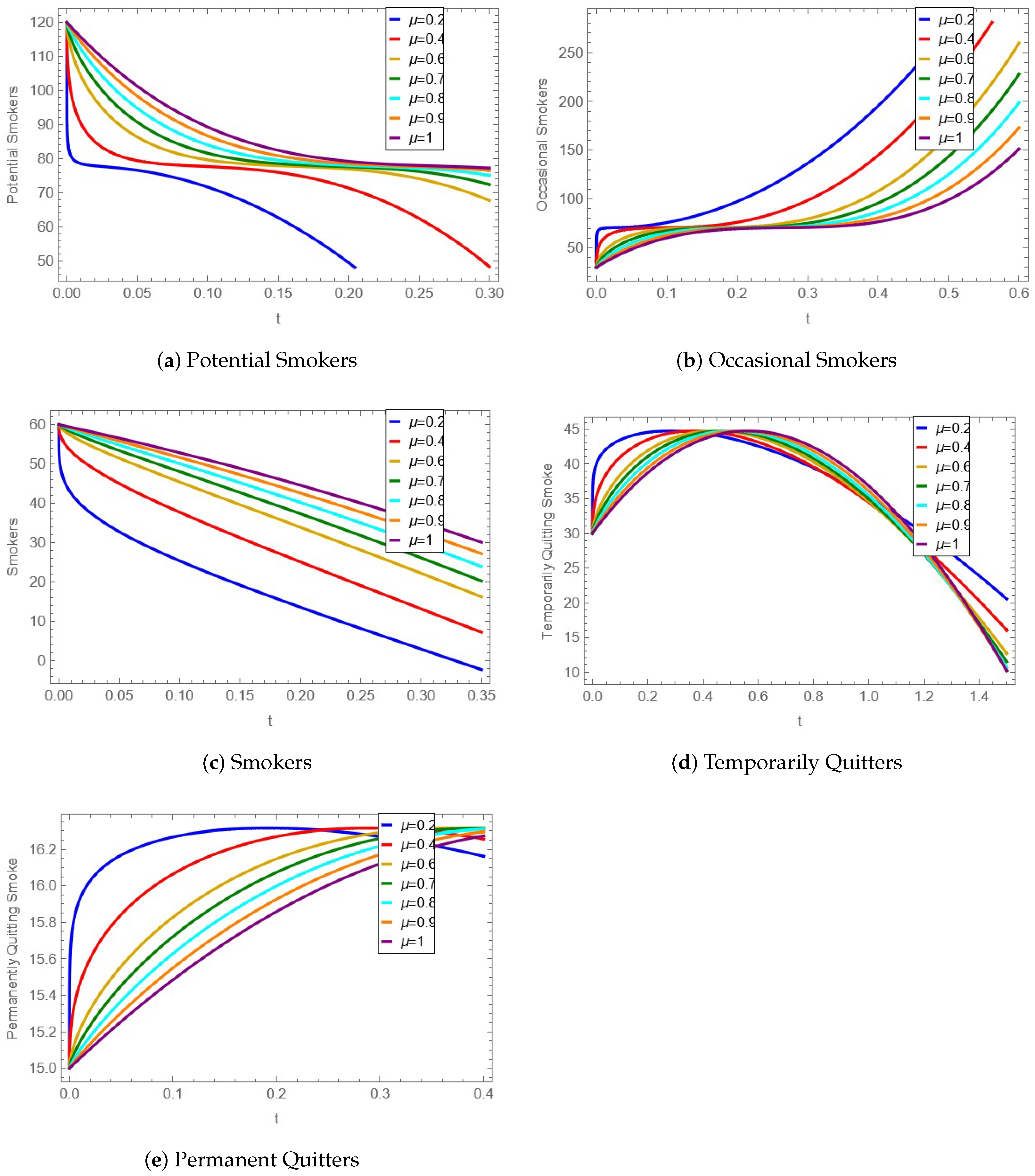
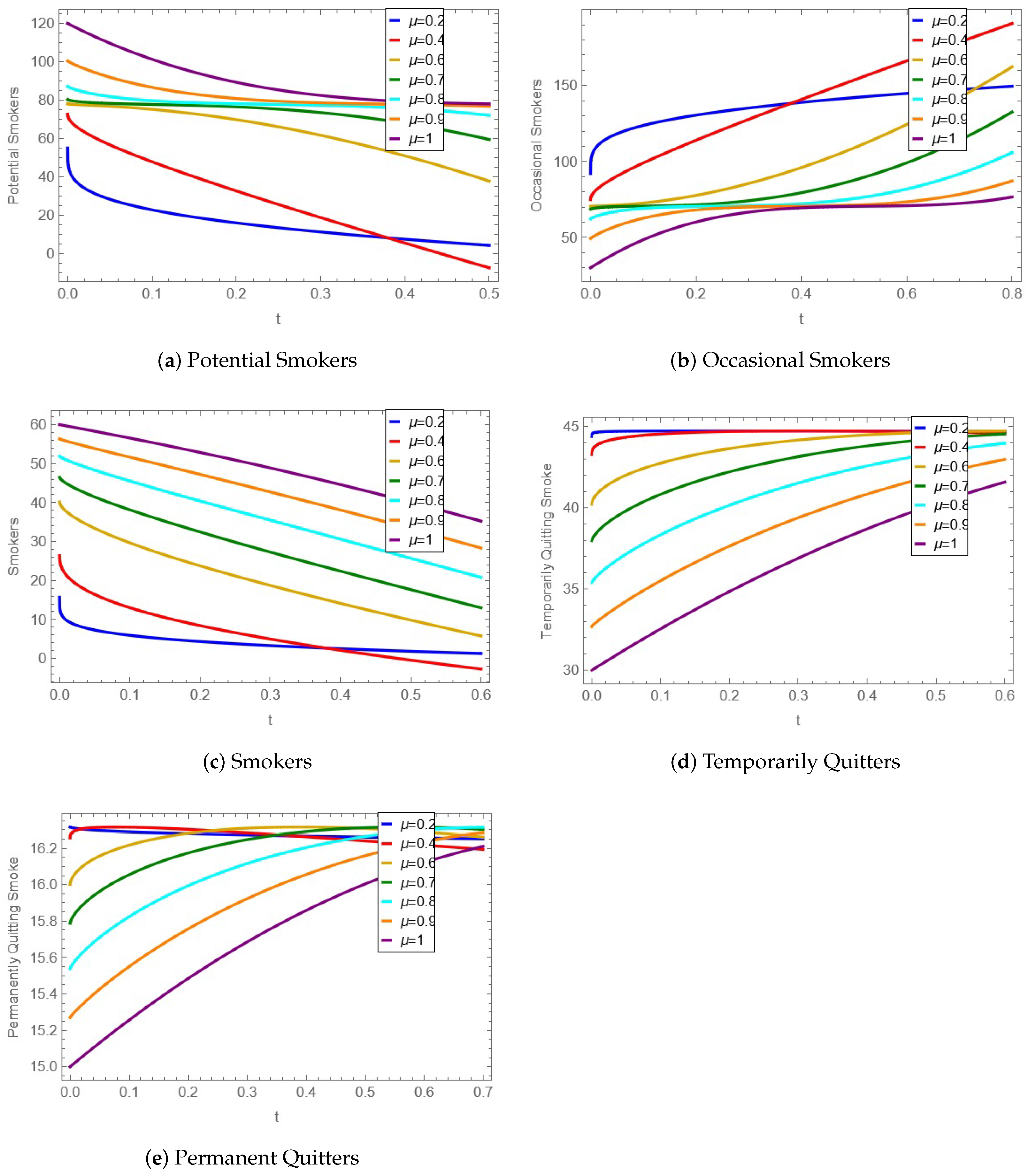
For a numerical solution, the parameter values are used. These values are described and listed in the Table 1 [42]. Initial conditions are P 0 = 40 , O 0 = 10 , S 0 = 20 , T 0 = 10 , Q 0 = 5 . After using selected parameter values, graphical results are obtained and shown in the later part of the paper. Different fractional orders 0 < μ < 1 are taken and compared with the classical case μ = 1 . From Figure 1a and Figure 2a, it is seen that potential smoker population decreases in both cases, but for fractional order, decrease is slower than in the integer case. The occasional smoker group (Figure 1b and Figure 2b) shows increasing behavior with time in both models. This increase is more smooth and gradual in the fractional case. On the other side, Figure 1c and Figure 2c show that the regular smoker population decreases with time, which shows that individuals are moving away from the regular smoking class. Fractional order again gives smoother change compared to the classical case. Temporary quitter (Figure 1d and Figure 2d) and permanent quitter groups (Figure 1e and Figure 2e) both show an increasing trend. Growth in these classes is more stable and realistic in the fractional model than the integer case.
From the graphs of both Yang–Abdel–Cattani and Atangana–Baleanu cases, it is observed that the fractional-order model gives more smooth, stable, and realistic behavior compared to the classical integer-order system. These results show that the fractional smoking model solved using the Sumudu transform decomposition method is effective for studying real-life problems (Table 1).

8. Discussion

In this section, results obtained from both Yang–Abdel–Cattani (YAC) and Atangana–Baleanu (AB) fractional operators are discussed and compared with the classical integer-order model. From the graphical results, it is observed that the potential smoker population decreases with time in all cases. However, in fractional-order models (both YAC and AB), this decrease is slower and smoother, which indicates more realistic behavior as compared to the rapid decline in the integer-order system. The occasional smoker population shows an increasing trend over time in both integer and fractional models. This increase is more gradual and stable in YAC and AB cases, which suggests that transition into this class occurs in a more natural way. In contrast, the integer-order model shows comparatively sharper variation. The regular smoker population decreases in all cases, indicating that individuals are leaving a regular smoking habit. Again, fractional models provide smoother transition, while the integer case shows a sudden drop. This highlights the advantage of the fractional approach in capturing the memory effect present in real-life systems. Further, temporary quitter and permanent quitter populations both increase with time. Growth in these classes is more stable in YAC and AB models, reflecting realistic quitting behavior. The integer-order model, on the other side, shows fewer smooth dynamics. A comparison between YAC and AB operators shows that both produce similar qualitative behavior, but slight variation in smoothness and rate of change can be observed. Overall, both fractional operators perform better than the classical model in representing system dynamics. These observations are in agreement with previous studies on fractional epidemic and behavioral models, where fractional-order systems are known to provide more accurate and realistic results due to inclusion of memory effects. Hence, it can be concluded that the fractional smoking model solved using the Sumudu transform decomposition method is effective and reliable for analyzing real-life smoking dynamics.
The fractional-order framework for smoking habit dynamics highlights how derivatives capture memory and non-local effects, meaning current behavior is shaped by past smoking exposure, addiction history, relapse tendencies, peer influence, and recovery experience. Unlike classical integer-order models that only reflect the present state, this approach produces smoother, more realistic transitions between stages—non-smoker, occasional smoker, habitual smoker, quitting, and relapse—by incorporating delayed responses, persistent cravings, and gradual recovery.

9. Final Remarks

This study examines a fractional-order mathematical system for smoking dynamics in a population. Fractional formulation is used to capture memory effects present in real behavioral systems. The Sumudu transform decomposition method is used to get approximate analytical as well as graphical results for the proposed model. The existence as well as uniqueness of results are proven by applying fixed point theory to show validity of approach. Graphical results show that the potential smoker population decreases with time in both cases. The occasional smoker group shows increasing behavior, while the regular smoker population decreases over time in both Yang–Abdel–Cattani and Atangana–Baleanu models. This indicates that individuals are not moving strongly into the regular smoking class but remain more in the occasional stage. The temporary quitter and permanent quitter groups both show an increasing trend, which reflects improvement in quitting behavior. The fractional case gives more smooth and stable curves compared to the integer case. From both sets of graphs, it is clear that fractional models (Yang–Abdel–Cattani and Atangana–Baleanu) provide more realistic and gradual behavior than the classical integer-order model. Overall, results suggest that an increase in quitting rate and controlling interaction can help to reduce smoking levels in populations. For future work, other fractional operators or different kernels can be used to study the model in more detail and compare behavior under different conditions.
For future work, the model can be extended by using other fractional operators or different kernel functions to study their effect on system behavior. Also, real data can be included for parameter estimation to make the model more practical. Effects of control strategies such as awareness programs, treatment policies, and social influence can be added for deeper analysis. Further, numerical techniques and stability study under different conditions may also be explored for a better understanding of smoking dynamics.

Author Contributions

The study was directed by M.N.M., who also carried out all the mathematical computations. R.S.D. constructed the study map and summarized the data into tables. G.A. drew the figures/graphs. R.S. formatted the final paper. Writing—original draft, M.N.M.; Writing—review & editing, R.S. The draft was read, corrected, and polished by all the authors. All authors have read and agreed to the published version of the manuscript.

Funding

This work was supported and funded by the Deanship of Scientific Research at Imam Mohammad Ibn Saud Islamic University (IMSIU) with grant number IMSIU-DDRSP2601.

Data Availability Statement

The original contributions presented in this study are included in the article. Further inquiries can be directed to the corresponding author.

Conflicts of Interest

Researchers confirm that there are no conflicts of interest in this study.

References

  1. Brownlee, J. Certain considerations on the causation and course of epidemics. Proc. R. Soc. Med. 1909, 2, 243–258. [Google Scholar] [CrossRef]
  2. Brownlee, J. XIV.—The Mathematical Theory of Random Migration and Epidemic Distribution. Proc. R. Soc. Edinb. 1912, 31, 262–289. [Google Scholar] [CrossRef]
  3. Kermack, W.O.; McKendrick, A.G. A contribution to the mathematical theory of epidemics. Proc. R. Soc. Lond. Ser. A Contain. Pap. Math. Phys. Character 1927, 115, 700–721. [Google Scholar] [CrossRef]
  4. Wang, K.; Wang, W.; Song, S. Dynamics of an HBV model with diffusion and delay. J. Theor. Biol. 2008, 253, 36–44. [Google Scholar] [CrossRef] [PubMed]
  5. McCluskey, C.C. Complete global stability for an SIR epidemic model with delay—Distributed or discrete. Nonlinear Anal. Real. World Appl. 2010, 11, 55–59. [Google Scholar] [CrossRef]
  6. Xu, R.; Ma, Z. Stability of a delayed SIRS epidemic model with a nonlinear incidence rate. Chaos Solitons Fractals 2009, 41, 2319–2325. [Google Scholar] [CrossRef]
  7. Santonja, F.J.; Sánchez, E.; Rubio, M.; Morera, J.L. Alcohol consumption in Spain and its economic cost: A mathematical modeling approach. Math. Comput. Model. 2010, 52, 999–1003. [Google Scholar] [CrossRef]
  8. Santonja, F.J.; Villanueva, R.J.; Jódar, L.; González-Parra, G. Mathematical modelling of social obesity epidemic in the region of Valencia, Spain. Math. Comput. Model. Dyn. Syst. 2010, 16, 23–34. [Google Scholar] [CrossRef]
  9. Sánchez, E.; Villanueva, R.J.; Santonja, F.J.; Rubio, M. Predicting cocaine consumption in Spain: A mathematical modelling approach. Drugs Educ. Prev. Policy 2011, 18, 108–115. [Google Scholar] [CrossRef][Green Version]
  10. Guerrero, F.; Santonja, F.J.; Villanueva, R.J. Analysing the Spanish smoke-free legislation of 2006: A new method to quantify its impact using a dynamic model. Int. J. Drug Policy 2011, 22, 247–251. [Google Scholar] [CrossRef]
  11. Handelsman, D.J.; Conway, A.J.; Boylan, L.M.; Turtle, J.R. Testicular function in potential sperm donors: Normal ranges and the effects of smoking and varicocele. Int. J. Androl. 1984, 7, 369–382. [Google Scholar] [CrossRef]
  12. Sharomi, O.; Gumel, A.B. Curtailing smoking dynamics: A mathematical modeling approach. Appl. Math. Comput. 2008, 195, 475–499. [Google Scholar] [CrossRef]
  13. Ullah, R.; Khan, M.; Zaman, G.; Islam, S.; Khan, M.A.; Jan, S.; Gul, T. Dynamical features of a mathematical model on smoking. J. Appl. Environ. Biol. Sci. 2016, 6, 92–96. [Google Scholar]
  14. Zeb, A.; Chohan, I.; Zaman, G. The homotopy analysis method for approximating of giving up smoking model in fractional order. Appl. Math. 2012, 3, 914–919. [Google Scholar] [CrossRef]
  15. Veeresha, P.; Prakasha, D.G.; Baskonus, H.M. Solving smoking epidemic model of fractional order using a modified homotopy analysis transform method. Math. Sci. 2019, 13, 115–128. [Google Scholar] [CrossRef]
  16. Singh, J.; Kumar, D.; Sushila, D. Homotopy perturbation Sumudu transform method for nonlinear equations. Adv. Theor. Appl. Mech. 2011, 4, 165–175. [Google Scholar]
  17. Shah, K.; Junaid, M.; Ali, N. Extraction of Laplace, Sumudu, Fourier and Mellin transform from the natural transform. J. Appl. Environ. Biol. Sci. 2015, 5, 108–115. [Google Scholar]
  18. Manjare, N.B.; Dinde, H.T. Sumudu decomposition method for solving fractional Bratu-type differential equations. J. Sci. Res. 2020, 12, 585–605. [Google Scholar] [CrossRef]
  19. Alshammari, M.; Iqbal, N.; Mohammed, W.W.; Botmart, T. The solution of fractional-order system of KdV equations with exponential-decay kernel. Results Phys. 2022, 38, 105615. [Google Scholar] [CrossRef]
  20. Lu, J.; Sun, Y. Numerical approaches to time fractional boussinesq–burgers equations. Fractals 2021, 29, 2150244. [Google Scholar] [CrossRef]
  21. Jan, R.; Qureshi, S.; Boulaaras, S.; Pham, V.T.; Hincal, E.; Guefaifia, R. Optimization of the fractional-order parameter with the error analysis for human immunodeficiency virus under Caputo operator. Discret. Contin. Dyn. Syst. S 2023, 16, 2118–2140. [Google Scholar] [CrossRef]
  22. Ahmad, A.; Farman, M.; Ghafar, A.; Inc, M.; Ahmad, M.O.; Sene, N. Analysis and simulation of fractional order smoking epidemic model. Comput. Math. Methods Med. 2022, 2022, 9683187. [Google Scholar] [CrossRef]
  23. Anjam, Y.N.; Shafqat, R.; Sarris, I.E.; ur Rahman, M.; Touseef, S.; Arshad, M. A fractional order investigation of smoking model using Caputo-Fabrizio differential operator. Fractal Fract. 2022, 6, 623. [Google Scholar] [CrossRef]
  24. Mahdy, A.M.S.; Mohamed, M.S.; Gepreel, K.A.; Al-Amiri, A.; Higazy, M. Dynamical characteristics and signal flow graph of nonlinear fractional smoking mathematical model. Chaos Solitons Fractals 2020, 141, 110308. [Google Scholar] [CrossRef]
  25. Ullah, A.; Abdeljawad, T.; Ahmad, S.; Shah, K. Study of a Fractional-Order Epidemic Model of Childhood Diseases. J. Funct. Spaces 2020, 2020, 5895310. [Google Scholar] [CrossRef]
  26. Losada, J.; Nieto, J.J. Properties of a new fractional derivative without singular kernel. Prog. Fract. Differ. Appl. 2015, 1, 87–92. [Google Scholar]
  27. Atangana, A. Blind in a commutative world: Simple illustrations with functions and chaotic attractors. Chaos Solitons Fractals 2018, 114, 347–363. [Google Scholar] [CrossRef]
  28. Shah, K.; Khalil, H.; Khan, R.A. Analytical solutions of fractional order diffusion equations by natural transform method. Iran. J. Sci. Technol. Trans. A Sci. 2018, 42, 1479–1490. [Google Scholar] [CrossRef]
  29. Watugala, G.K. Sumudu transform: A new integral transform to solve differential equations and control engineering problems. Integr. Educ. 1993, 24, 35–43. [Google Scholar] [CrossRef]
  30. Sharma, D.; Samra, G.S.; Singh, P. Approximate solution for fractional attractor one-dimensional Keller-Segel equations using homotopy perturbation Sumudu transform method. Nonlinear Eng. 2020, 9, 370–381. [Google Scholar] [CrossRef]
  31. Koppala, P.; Kondooru, R. An efficient technique to solve time-fractional Kawahara and modified Kawahara equations. Symmetry 2022, 14, 1777. [Google Scholar] [CrossRef]
  32. Alhazmi, S.E.; Abdelmohsen, S.A.; Alyami, M.A.; Ali, A.; Asamoah, J.K.K. A Novel Analysis of Generalized Perturbed Zakharov–Kuznetsov Equation of Fractional-Order Arising in Dusty Plasma by Natural Transform Decomposition Method. J. Nanomater. 2022, 2022, 7036825. [Google Scholar] [CrossRef]
  33. Veeresha, P.; Prakasha, D.G.; Ravichandran, C.; Akinyemi, L.; Nisar, K.S. Numerical approach to generalized coupled fractional Ramani equations. Int. J. Mod. Phys. B 2022, 36, 2250047. [Google Scholar] [CrossRef]
  34. Pavani, K.; Raghavendar, K. Approximate solutions of time-fractional Swift–Hohenberg equation via natural transform decomposition method. Int. J. Appl. Comput. Math. 2023, 9, 29. [Google Scholar] [CrossRef]
  35. Ahmed, S.A.; Elzaki, T.M. A comparative study of Sumudu decomposition method and Sumudu projected differential transform method. World Appl. Sci. J. 2014, 31, 1704–1709. [Google Scholar]
  36. Areshi, M.; Goswami, P.; Mishra, M.N. Comparative study of blood sugar–insulin model using fractional derivatives. J. Taibah Univ. Sci. 2024, 18, 2339009. [Google Scholar] [CrossRef]
  37. Agbata, B.C.; Cenaj, E.; Dervishi, R.; Danjuma, Y.J.; Shior, M.M.A.; Abah, E.; Onuche, J.S.; Emadifar, H. Fractional-order mathematical model for Monkeypox transmission dynamics using the Atangana-Baleanu Caputo operator. BMC Infect. Dis. 2025, 25, 1000. [Google Scholar] [CrossRef]
  38. Mtawal, A. Application of the Sumudu Variational Iteration Method with Atangana-Baleanu-Caputo Operator for Solving Fractional-Order Heat-Like Equations with Initial Conditions. J. Pure Appl. Sci. 2024, 23, 50–60. [Google Scholar]
  39. Berir, M. A fractional study for solving the smoking model and the chaotic engineering model. In 2023 2nd International Engineering Conference on Electrical, Energy, and Artificial Intelligence (EICEEAI); IEEE: Piscataway, NJ, USA, 2023; pp. 1–6. [Google Scholar]
  40. Abdullah, M.; Ahmad, A.; Raza, N.; Farman, M.; Ahmad, M. Approximate solution and analysis of smoking epidemic model with Caputo fractional derivatives. Int. J. Appl. Comput. Math. 2018, 4, 112. [Google Scholar] [CrossRef]
  41. Günerhan, H.; Rezazadeh, H.; Adel, W.; Hatami, M.; Sagayam, K.M.; Emadifar, H.; Asjad, M.I.; Hamasalh, F.K.; Hamoud, A.A. Analytical approximate solution of fractional order smoking epidemic model. Adv. Mech. Eng. 2022, 14, 16878132221123888. [Google Scholar] [CrossRef]
  42. Pavani, K.; Raghavendar, K. A novel technique to study the solutions of time fractional nonlinear smoking epidemic model. Sci. Rep. 2024, 14, 4159. [Google Scholar] [CrossRef] [PubMed]
  43. Iqbal, Z.; Ahmed, N.; Ali, A.; Raza, A.; Rafiq, M.; Khan, I. Numerical modelling and stability analysis of fractional smoking model. Comput. Methods Programs Biomed. Update 2025, 8, 100201. [Google Scholar] [CrossRef]
  44. Kilbas, A.A.; Srivastava, H.M.; Trujillo, J.J. Theory and Applications of Fractional Differential Equations; Elsevier: Amsterdam, The Netherlands, 2006; Volume 204. [Google Scholar]
  45. Podlubny, I. Fractional Differential Equations: An Introduction to Fractional Derivatives, Fractional Differential Equations, to Methods of Their Solution and Some of Their Applications; Elsevier: Amsterdam, The Netherlands, 1998; Volume 198. [Google Scholar]
Figure 1. Changes in different factors over time in the YAC case.
Fractalfract 10 00385 g001
Figure 2. Changes in different factors over time in the ABC case.
Fractalfract 10 00385 g002
Table 1. Description and values of model parameters.
ParameterInterpretationValues
α Recruitment rate into potential smokers1
ε Interaction rate among smokers and potential smokers0.14
ϑ Mortality rate0.05
ρ Smoking quitting rate0.8
σ Fraction of smokers who quit successfully0.1
β 1 Rate of occasional smokers becoming habitual smokers0.002
β 2 Rate with interim quitters who return to smoking0.0025
Disclaimer/Publisher’s Note: The statements, opinions and data contained in all publications are solely those of the individual author(s) and contributor(s) and not of MDPI and/or the editor(s). MDPI and/or the editor(s) disclaim responsibility for any injury to people or property resulting from any ideas, methods, instructions or products referred to in the content.