
Hybrid Lyapunov–Vision Framework for Chaos Identification in Fractional-Order Nonlinear Dynamics


Abstract
1. Introduction
- A unified physics-informed framework combining Lyapunov analysis, Continuous Wavelet Transform (CWT), and transformer-based deep learning is proposed for chaos identification in fractional-order nonlinear systems.
- The proposed approach transforms nonlinear time-series signals into wavelet scalogram images, reformulating chaos detection as an image classification problem.
- A Lyapunov exponent-based labeled scalogram dataset is constructed to ensure consistency between classical nonlinear dynamics and learning-based representations.
- A comparative evaluation using ViT, SVM, RF, and KNN classifiers is performed to analyze the effectiveness of deep learning and conventional machine learning methods for chaos classification.
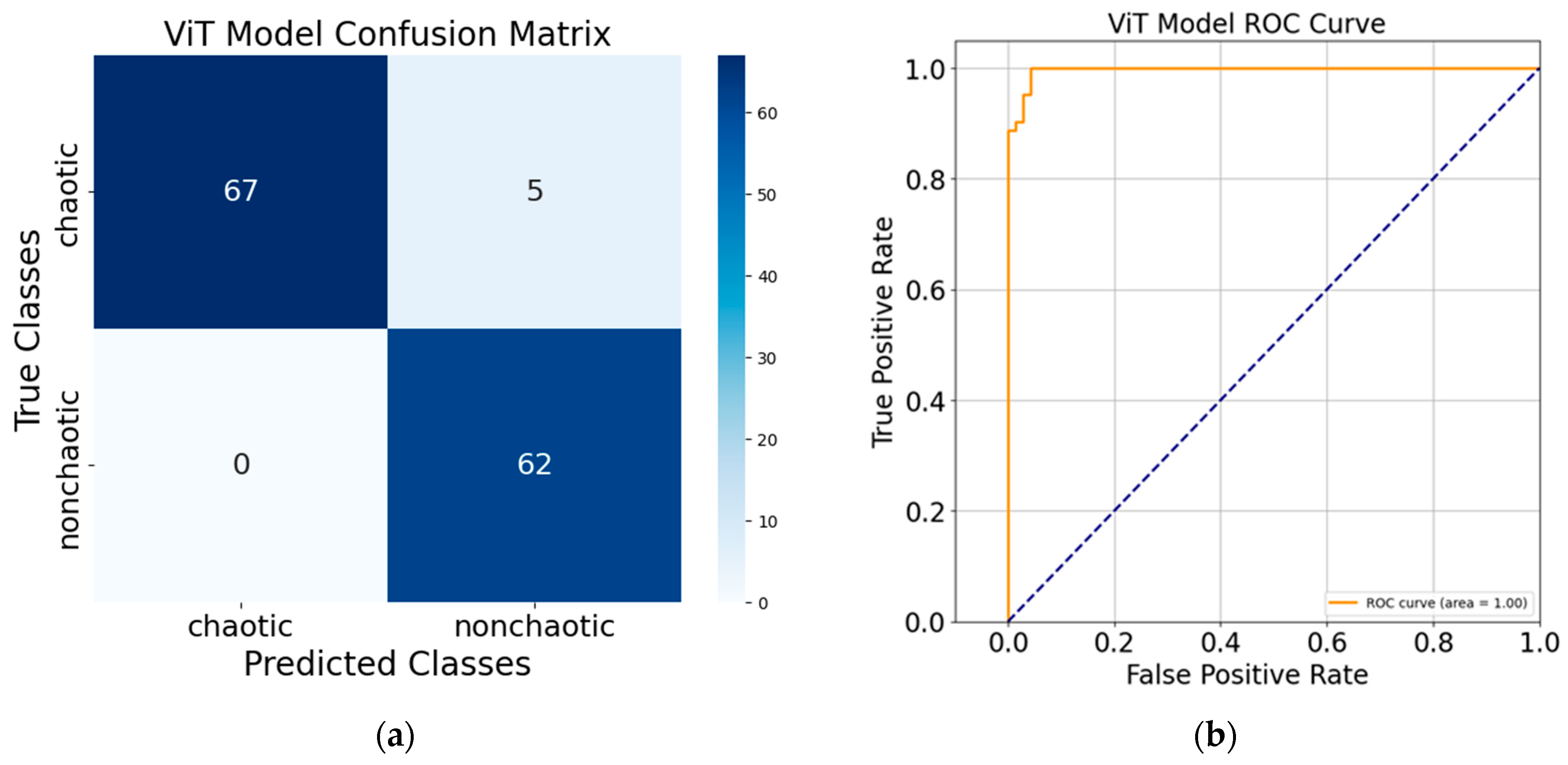
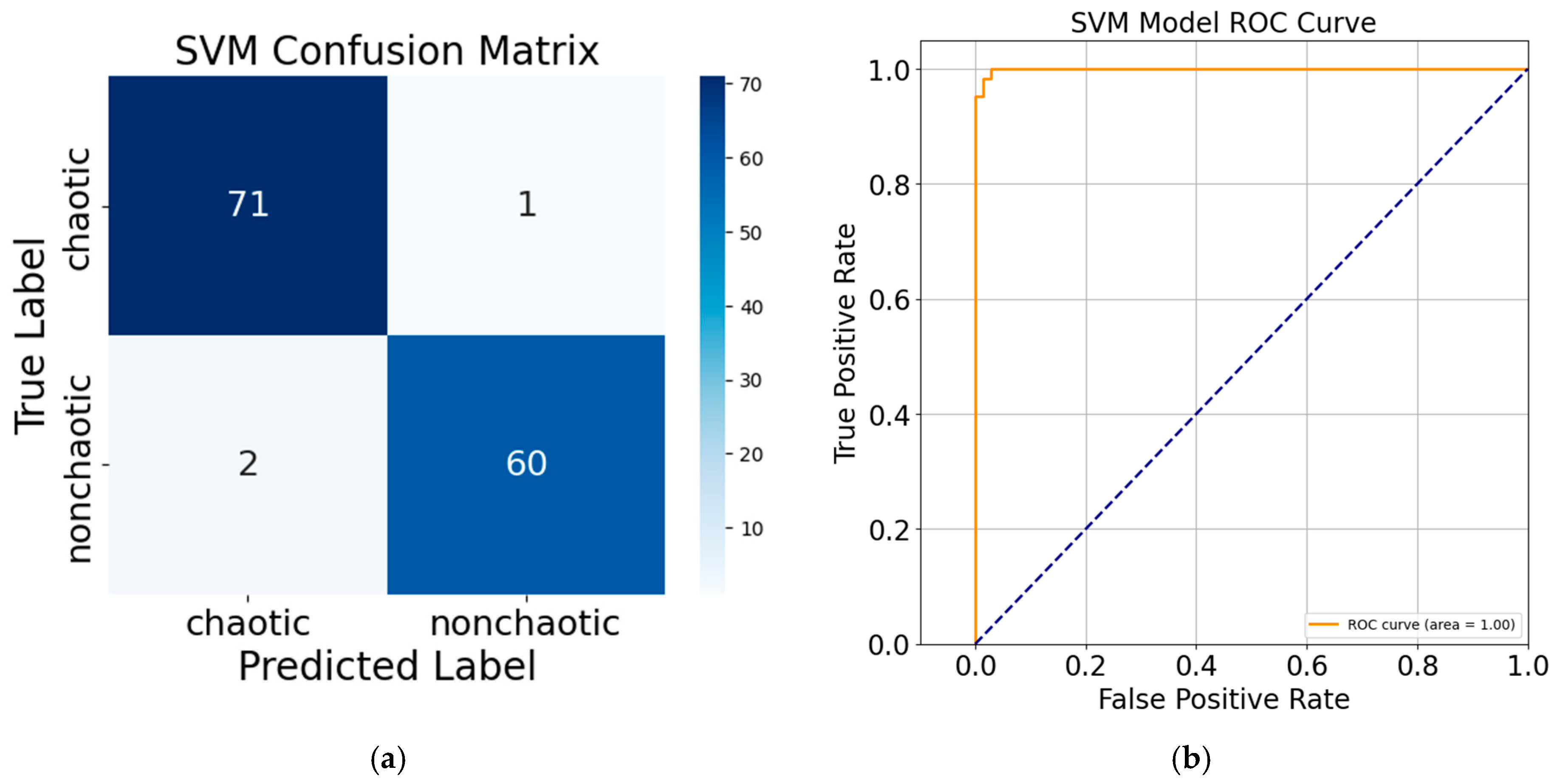
- The proposed hybrid ViT–SVM framework achieves highly discriminative performance with near-perfect separability between chaotic and non-chaotic regimes.
- The proposed methodology provides a scalable and generalizable framework for analyzing memory-dependent chaotic behavior in fractional-order systems with potential applications in nonlinear control, signal processing, and secure communications.
2. Materials and Methods
2.1. Chaotic Systems and the Concept of Lyapunov Exponents
2.2. The Importance of Fractional-Order Differential Equations
2.3. Fundamental Properties of the Lorenz System
2.4. Dataset Creation
3. Results
3.1. Vision Transformer (ViT) Model Architecture
3.2. Feature Extraction and SVM Classification Process
4. Discussion
5. Conclusions
Funding
Data Availability Statement
Acknowledgments
Conflicts of Interest
Abbreviations
| ABM | Adams–Bashforth–Moulton |
| AUC | Area Under the Curve |
| BiLSTM | Bidirectional Long Short-Term Memory |
| CNN | Convolutional Neural Network |
| CWT | Continuous Wavelet Transform |
| ECG | Electrocardiogram |
| EEG | Electroencephalogram |
| FFN | Feed-Forward Network |
| FODE | Fractional-Order Differential Equation |
| GL | Grünwald–Letnikov |
| HCI | Human–Computer Interaction |
| KNN | K-Nearest Neighbors |
| LE | Lyapunov Exponent |
| LLM | Large Language Model |
| LS-MHA | Large-Scale Multi-Head Attention |
| MCC | Matthews Correlation Coefficient |
| MHSA | Multi-Head Self-Attention |
| ML | Machine Learning |
| MMG | Mechanomyography |
| NLP | Natural Language Processing |
| RF | Random Forest |
| ROC | Receiver Operating Characteristic |
| RVT | Residual Vision Transformer |
| SHP | Single-Head Performance |
| SNR | Signal-to-Noise Ratio |
| SVM | Support Vector Machine |
| TPE | Tool Performance Evaluation |
| ViT | Vision Transformer |
References
- Sahin, M.E.; Demirkol, A.S.; Guler, H.; Hamamci, S.E. Design of a Hyperchaotic Memristive Circuit Based on Wien Bridge Oscillator. Comput. Electr. Eng. 2020, 88, 106826. [Google Scholar] [CrossRef]
- Yang, M.; Dong, C.; Pan, H. Generating Multi-Directional Hyperchaotic Attractors: A Novel Multi-Scroll System Based on Julia Fractal. Phys. A Stat. Mech. Its Appl. 2024, 637, 129586. [Google Scholar] [CrossRef]
- de la Vega, D.S.; Félix-Beltrán, O.G.; Munoz-Pacheco, J.M. Identifying Chaotic Dynamics in Nonuniformly Dissipative and Conservative Dynamical Systems from the Varying Divergence. Results Phys. 2025, 74, 108259. [Google Scholar] [CrossRef]
- Kuate, P.D.K.; Tchendjeu, A.E.T.; Fotsin, H. A Modified Rössler Prototype-4 System Based on Chua’s Diode Nonlinearity: Dynamics, Multistability, Multiscroll Generation and FPGA Implementation. Chaos Solitons Fractals 2020, 140, 110213. [Google Scholar] [CrossRef]
- Lin, H.; Deng, X.; Zhang, S.; Chen, X.; Min, G.; Xue, K. Securing Image Privacy in the Internet of Vehicles with a Multiwing Hyperchaotic Memristive Neural Network. IEEE Internet Things J. 2025, 12, 55269–55282. [Google Scholar] [CrossRef]
- Lin, H.; Deng, X.; Yu, F.; Sun, Y. Grid Multibutterfly Memristive Neural Network with Three Memristive Systems: Modeling, Dynamic Analysis, and Application in Police IoT. IEEE Internet Things J. 2024, 11, 29878–29889. [Google Scholar] [CrossRef]
- da Costa, D.R.; Fujita, A.; Batista, A.M.; Sales, M.R.; Szezech, J.D. Conservative Generalized Bifurcation Diagrams and Phase Space Properties for Oval-like Billiards. Chaos Solitons Fractals 2022, 155, 111707. [Google Scholar] [CrossRef]
- Kartal, S. A Discrete Fractional Order Cournot Duopoly Game Model with Relative Profit Delegation: Stability, Bifurcation, Chaos, 0-1 Testing and Control. J. Comput. Appl. Math. 2025, 457, 116284. [Google Scholar] [CrossRef]
- Nabil, H.; Tayeb, H. Fractional-Order Supply Chain Finance System with Conformable Derivative: Chaotic Dynamics, Complexity Analysis, and RGB Color Image Encryption. J. Comput. Appl. Math. 2026, 476, 117105. [Google Scholar] [CrossRef]
- Xu, C. Washout Filter Control Technique for a Fractional-Order Chaotic Finance Model. Ain Shams Eng. J. 2022, 13, 101644. [Google Scholar] [CrossRef]
- Kavuran, G. When Machine Learning Meets Fractional-Order Chaotic Signals: Detecting Dynamical Variations. Chaos Solitons Fractals 2022, 157, 111908. [Google Scholar] [CrossRef]
- Liu, Y.; Wang, T.; Chu, F. Knowledge Embedded Lightweight Vision Transformer for Machine Condition Monitoring. Measurement 2023, 221, 113402. [Google Scholar] [CrossRef]
- Gross, R.D.; Halevi, T.; Koresh, E.; Tzach, Y.; Kanter, I. Low-Latency Vision Transformers via Large-Scale Multi-Head Attention. Phys. A Stat. Mech. Its Appl. 2025, 675, 130835. [Google Scholar] [CrossRef]
- Jia, J.; Zheng, X.; Wang, Y.; Chen, Y.; Karjalainen, M.; Dong, S.; Lu, R.; Wang, J.; Hyyppä, J. The Effect of Artificial Intelligence Evolving on Hyperspectral Imagery with Different Signal-to-Noise Ratio, Spectral and Spatial Resolutions. Remote Sens. Environ. 2024, 311, 114291. [Google Scholar] [CrossRef]
- Ren, B.; Luo, Y.; Zhou, N.; Wang, Q. Fault Location in High-Voltage Direct-Current Grids Based on Panoramic Voltage Features and Vision Transformers. Int. J. Electr. Power Energy Syst. 2024, 158, 109958. [Google Scholar] [CrossRef]
- Noh, B.; Park, M.; Han, Y.; Kim, J. A Multi-Modal Approach for Detecting Drivers’ Distraction Using Bio-Signal and Vision Sensor Fusion in Driver Monitoring Systems. Eng. Appl. Artif. Intell. 2025, 161, 112265. [Google Scholar] [CrossRef]
- Zhang, H.; Yang, K.; Cao, G.; Xia, C. ViT-LLMR: Vision Transformer-Based Lower Limb Motion Recognition from Fusion Signals of MMG and IMU. Biomed. Signal Process. Control 2023, 82, 104508. [Google Scholar] [CrossRef]
- Leibnitz, G.W. Letter from Hanover, Germany, September 30, 1695 to GA L’hospital. In Leibnizen Mathematische Schriften; Olms Verlag: Hidesheim, Germany, 1962. [Google Scholar]
- Caputo, M. Linear Models of Dissipation Whose Q Is Almost Frequency Independent--II. Geophys. J. Int. 1967, 13, 529–539. [Google Scholar] [CrossRef]
- Petras, I. Fractional-Order Nonlinear Systems: Modeling, Analysis and Simulation; Springer Press: Berlin/Heidelberg, Germany, 2011. [Google Scholar]
- Chen, Y.Q.; Petras, I.; Xue, D. Fractional Order Control—A Tutorial. In Proceedings of the 2009 American Control Conference, St. Louis, MO, USA, 10–12 June 2009; IEEE: New York, NY, USA, 2009; pp. 1397–1411. [Google Scholar]
- Kavuran, G. Utilization of Fractional Order Differentiation in Nonlinear Control Methods and Signal Processing Techniques. Ph.D. Thesis, Inonu University, Malatya, Türkiye, 2017. [Google Scholar]
- Kavuran, G.; Yeroglu, C. Investigation of Periodic Modes in Nonlinear Systems with Fractional Order Integrator. In Proceedings of the Signal Processing and Communications Applications Conference (SIU), Malatya, Türkiye, 23 May 2015; pp. 519–522. [Google Scholar]
- Yeroğlu, C.; Kavuran, G. Sliding Mode Controller Design with Fractional Order Differentiation: Applications for Unstable Time Delay Systems. Turk. J. Electr. Eng. Comput. Sci. 2014, 22, 1270–1286. [Google Scholar] [CrossRef]
- Kavuran, G.; Gurgenç, T.; Özkaynak, F. On the Modeling of the Multi-Segment Capacitance: A Fractional-Order Model and Ag-Doped SnO2 Electrode Fabrication. J. Mater. Sci. 2022, 57, 2775–2793. [Google Scholar] [CrossRef]
- Ates, A.; Alagoz, B.B.; Kavuran, G.; Yeroglu, C. Implementation of Fractional Order Filters Discretized by Modified Fractional Order Darwinian Particle Swarm Optimization. Measurement 2017, 107, 153–164. [Google Scholar] [CrossRef]
- Lorenz, E.N. Deterministic Nonperiodic Flow. J. Atmos. Sci. 1963, 20, 130–141. [Google Scholar] [CrossRef]
- Stewart, I. The Lorenz Attractor Exists. Nature 2000, 406, 948–949. [Google Scholar] [CrossRef]
- Wu, X.; Luo, Y. Chaotic Behavior of a New Fractional-Order Lorenz-like System. Nonlinear Dyn. 2012, 69, 451–458. [Google Scholar]
- Hartley, T.T.; Lorenzo, C.F. Dynamics and Control of Initialized Fractional-Order Systems. Nonlinear Dyn. 2002, 29, 201–233. [Google Scholar] [CrossRef]
- Yu, Y.; Li, H.X.; Wang, S.; Yu, J. Dynamic Analysis of a Fractional-Order Lorenz Chaotic System. Chaos Solitons Fractals 2009, 42, 1181–1189. [Google Scholar] [CrossRef]
- Sun, K.; Wang, X.; Sprott, J.C. Bifurcations and Chaos in Fractional-Order Simplified Lorenz System. Int. J. Bifurc. Chaos 2010, 20, 1209–1219. [Google Scholar] [CrossRef]
- Grigorenko, I.; Grigorenko, E. Chaotic Dynamics of the Fractional Lorenz System. Phys. Rev. Lett. 2003, 91, 034101. [Google Scholar] [CrossRef] [PubMed]
- Qiao, W. Chaos Control in the Fractional-Order Lorenz System with Random Parameter. Appl. Mech. Mater. 2013, 278–280, 1423–1426. [Google Scholar] [CrossRef]
- Wang, X.Y.; Song, J.M. Synchronization of the Fractional Order Hyperchaos Lorenz Systems with Activation Feedback Control. Commun. Nonlinear Sci. Numer. Simul. 2009, 14, 3351–3357. [Google Scholar] [CrossRef]
- Deng, W.; Lü, J. Generating Multi-Directional Multi-Scroll Chaotic Attractors via a Fractional Differential Hysteresis System. Phys. Lett. Sect. A Gen. At. Solid State Phys. 2007, 369, 438–443. [Google Scholar] [CrossRef]
- Diethelm, K.; Ford, N.J.; Freed, A.D. A Predictor-Corrector Approach for the Numerical Solution of Fractional Differential Equations. Nonlinear Dyn. 2002, 29, 3–22. [Google Scholar] [CrossRef]
- Muñoz-Pacheco, J.M.; Zambrano-Serrano, E.; Félix-Beltrán, O.; Gómez-Pavón, L.C.; Luis-Ramos, A. Synchronization of PWL Function-Based 2D and 3D Multi-Scroll Chaotic Systems. Nonlinear Dyn. 2012, 70, 1633–1643. [Google Scholar] [CrossRef]
- Ford, N.J.; Simpson, A.C. The Numerical Solution of Fractional Differential Equations: Speed versus Accuracy. Numer. Algorithms 2001, 26, 333–346. [Google Scholar] [CrossRef]
- Podlubny, I. Fractional Differential Equations: An Introduction to Fractional Derivatives, Fractional Differential Equations, to Methods of Their Solution and Some of Their Applications; Academic Press: New York, NY, USA, 1999. [Google Scholar]
- Dosovitskiy, A.; Beyer, L.; Kolesnikov, A.; Weissenborn, D.; Zhai, X.; Unterthiner, T.; Dehghani, M.; Minderer, M.; Heigold, G.; Gelly, S.; et al. An Image Is Worth 16x16 Words: Transformers for Image Recognition at Scale. In Proceedings of the ICLR 2021—9th International Conference on Learning Representations, Vienna, Austria, 4 May 2021. [Google Scholar]
- Kodba, S.; Perc, M.; Marhl, M. Detecting Chaos from a Time Series. Eur. J. Phys. 2005, 26, 205–215. [Google Scholar] [CrossRef]
- Narváez, D.; Mesa, F.; Alzate, P. Lyapunov Exponents Analysis and Phase Space Reconstruction to Chua’s Circuit. Contemp. Eng. Sci. 2018, 11, 2465–2473. [Google Scholar] [CrossRef]
- Ellner, S.; Turchin, P. Chaos in a Noisy World: New Methods and Evidence from Time-Series Analysis. Am. Nat. 1995, 145, 343–375. [Google Scholar] [CrossRef]
- Barahona, M.; Poon, C. Detection of Nonlinear Dynamics in Short, Noisy Time Series. Nature 1996, 381, 215–217. [Google Scholar] [CrossRef]
- Wolf, A.; Swift, J.; Swinney, H.; Vastano, J. Determining Lyapunov Exponents from a Time Series. Phys. D 1985, 16, 285–317. [Google Scholar] [CrossRef]
- Awrejcewicz, J.; Krysko, A.; Erofeev, N.; Dobriyan, V.; Barulina, M.; Krysko, V. Quantifying Chaos by Various Computational Methods. Part 1: Simple Systems. Entropy 2018, 20, 175. [Google Scholar] [CrossRef]
- Li, K.; Xue, H.; Liu, T. Chaotic Characteristics Analysis on Aerostat RCS via Phase Space Reconstruction and Largest Lyapunov Exponent. In Proceedings of the 2022 IEEE 6th Advanced Information Technology, Electronic and Automation Control Conference (IAEAC), Beijing, China, 3–5 October 2022; pp. 144–149. [Google Scholar]
- Sandubete, J.E.; Escot, L. DChaos: An R Package for Chaotic Time Series Analysis. R J. 2021, 13, 232–252. [Google Scholar] [CrossRef]
- Muthu, J.; Murali, P. Review of Chaos Detection Techniques Performed on Chaotic Maps and Systems in Image Encryption. SN Comput. Sci. 2021, 2, 392. [Google Scholar] [CrossRef]
- Haykin, S.; Li, X. Detection of Signals in Chaos. Proc. IEEE 1995, 83, 95–122. [Google Scholar] [CrossRef]
- Abarbanel, H.; Brown, R.; SIDorowich, J.; Tsimring, L. The Analysis of Observed Chaotic Data in Physical Systems. Rev. Mod. Phys. 1993, 65, 1331–1392. [Google Scholar] [CrossRef]
- Khatibi, R.; Sivakumar, B.; Ghorbani, M.; Kisi, O.; Koçak, K.; Zadeh, D. Investigating Chaos in River Stage and Discharge Time Series. J. Hydrol. 2012, 414, 108–117. [Google Scholar] [CrossRef]
- Lin, L.; Wu, Y.; Zhong, X. Applications of Nonlinear Methods to Signal Detection of Time Series. In Proceedings of the 2013 Fifth International Conference on Measuring Technology and Mechatronics Automation, Washington, DC, USA, 16–17 January 2013; pp. 306–309. [Google Scholar]
- Lang, S.; Hua, Z.; Sun, G.; Jiang, Y.; Wei, C. A Study on Methods for Determining Phase Space Reconstruction Parameters. J. Comput. Nonlinear Dyn. 2021, 17, 011006. [Google Scholar] [CrossRef]
- Schreiber, T. Interdisciplinary Application of Nonlinear Time Series Methods. Phys. Rep. 1998, 308, 1–64. [Google Scholar] [CrossRef]
- Tempelman, J.; Khasawneh, F. A Look into Chaos Detection through Topological Data Analysis. Phys. D 2019, 406, 132446. [Google Scholar] [CrossRef]
- Giuseppi, A.; Menegatti, D.; Pietrabissa, A. Identifying Chaotic Dynamics in Noisy Time Series through Multimodal Deep Neural Networks. Mach. Learn. Sci. Technol. 2024, 5, 035059. [Google Scholar] [CrossRef]
- Nam, J.; Kang, J. Classification of Chaotic Signals of the Recurrence Matrix Using a Convolutional Neural Network and Verification through the Lyapunov Exponent. Appl. Sci. 2020, 11, 77. [Google Scholar] [CrossRef]







| Precision | Recall | F1-Score | |
|---|---|---|---|
| Chaotic | 1.000 | 0.9305 | 0.964 |
| Nonchaotic | 0.925 | 1.000 | 0.961 |
| Macro Avg | 0.9625 | 0.9653 | 0.9625 |
| Micro Avg | 1.000 | 0.9627 | 0.9810 |
| Accuracy | Cohen’s Kappa | MCC |
|---|---|---|
| 0.9627 | 0.920 | 0.949 |
| Method | Class | Precision | Recall | F1-Score |
|---|---|---|---|---|
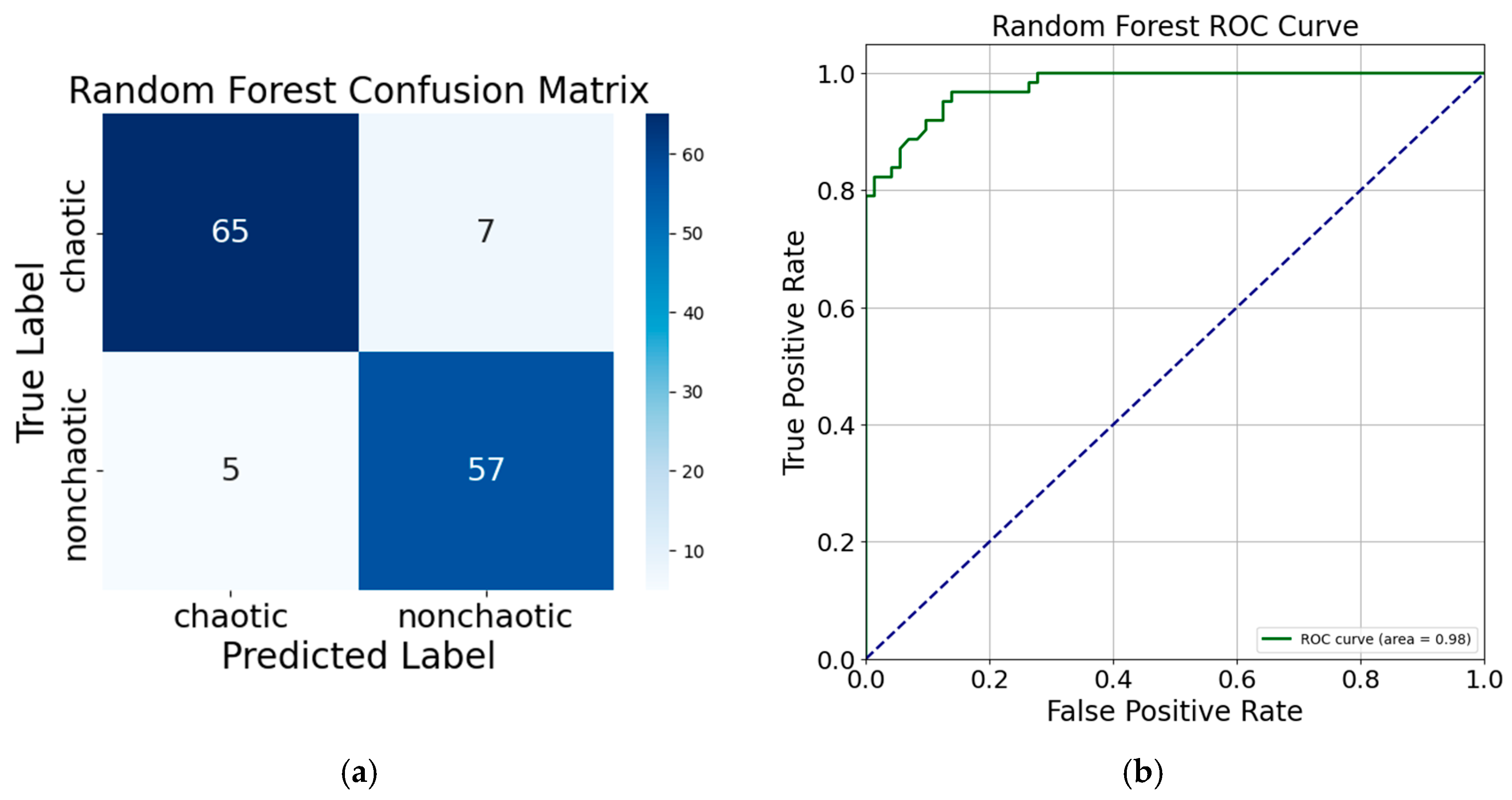
| Random Forest | Chaotic | 1.000 | 0.931 | 0.964 |
| Non-chaotic | 0.925 | 1.000 | 0.961 | |
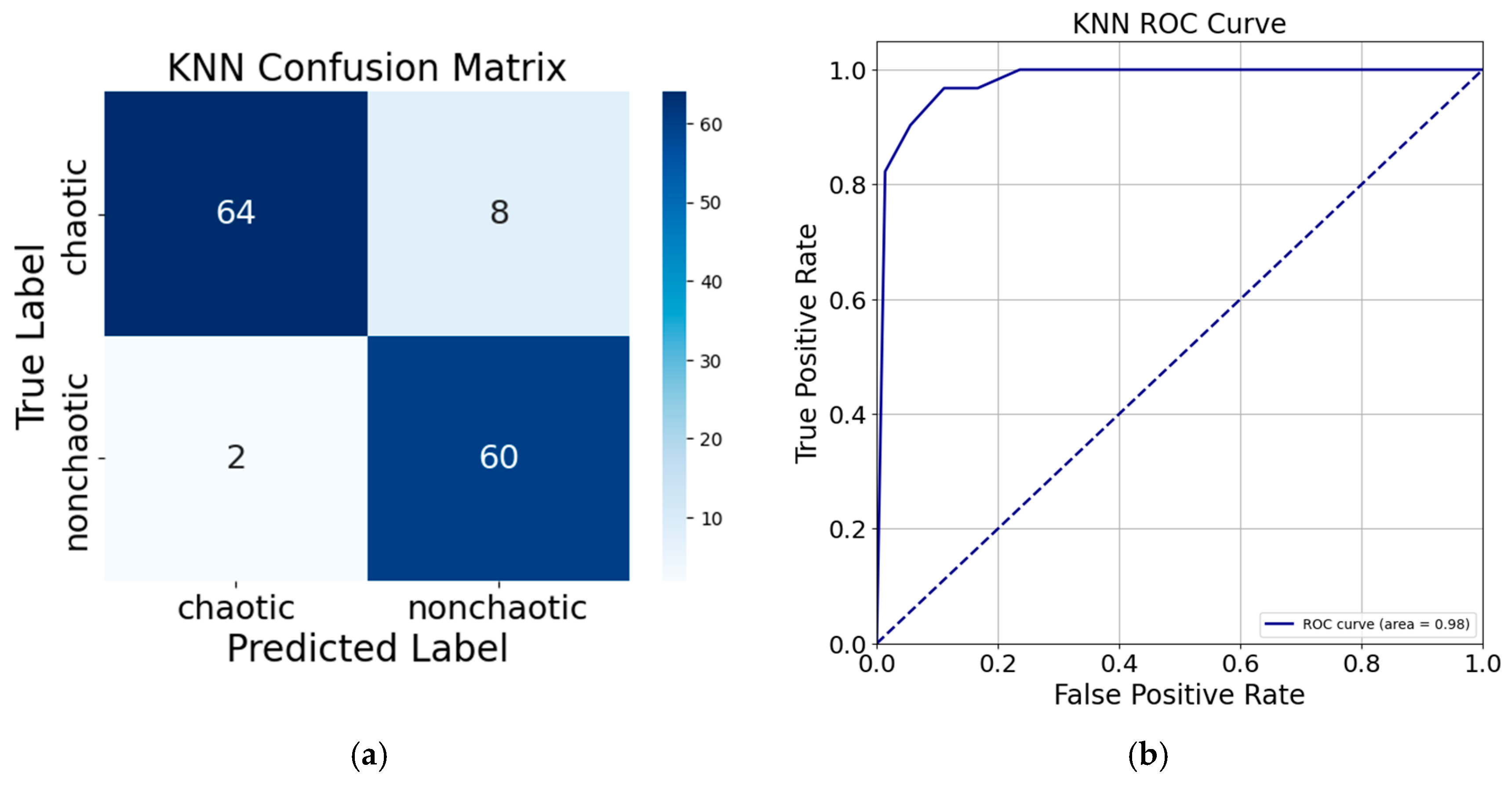
| KNN | Chaotic | 0.970 | 0.889 | 0.928 |
| Non-chaotic | 0.882 | 0.968 | 0.923 | |
| SVM | Chaotic | 0.973 | 0.986 | 0.979 |
| Non-chaotic | 0.984 | 0.968 | 0.976 |
| Method | Accuracy | Cohen’s Kappa | MCC | AUC |
|---|---|---|---|---|
| Random Forest | 0.963 | 0.920 | 0.949 | 0.98 |
| KNN | 0.925 | 0.850 | 0.856 | 0.98 |
| SVM | 0.978 | 0.955 | 0.955 | 1.00 |
| Tool/Test | Purpose | Typical Application | References |
|---|---|---|---|
| Largest Lyapunov exponent | Is chaos present or absent? | Physics, ecology, engineering | [42,44,45,46,47,48,49,52,53] |
| Bifurcation diagram | Chaotic/periodic parameter regions | Maps, encryption maps | [47,50] |
| Phase portrait/phase space | Visualizing the attractor | Continuous dynamical systems, RCS | [43,48,50,52,53] |
| 0–1 chaos test | Binary (chaotic/ordered) classification | Noisy/moderately noisy series | [50,57,58] |
Disclaimer/Publisher’s Note: The statements, opinions and data contained in all publications are solely those of the individual author(s) and contributor(s) and not of MDPI and/or the editor(s). MDPI and/or the editor(s) disclaim responsibility for any injury to people or property resulting from any ideas, methods, instructions or products referred to in the content. |
© 2026 by the author. Licensee MDPI, Basel, Switzerland. This article is an open access article distributed under the terms and conditions of the Creative Commons Attribution (CC BY) license.
Share and Cite
Kavuran, G. Hybrid Lyapunov–Vision Framework for Chaos Identification in Fractional-Order Nonlinear Dynamics. Fractal Fract. 2026, 10, 386. https://doi.org/10.3390/fractalfract10060386
Kavuran G. Hybrid Lyapunov–Vision Framework for Chaos Identification in Fractional-Order Nonlinear Dynamics. Fractal and Fractional. 2026; 10(6):386. https://doi.org/10.3390/fractalfract10060386
Chicago/Turabian StyleKavuran, Gürkan. 2026. "Hybrid Lyapunov–Vision Framework for Chaos Identification in Fractional-Order Nonlinear Dynamics" Fractal and Fractional 10, no. 6: 386. https://doi.org/10.3390/fractalfract10060386
APA StyleKavuran, G. (2026). Hybrid Lyapunov–Vision Framework for Chaos Identification in Fractional-Order Nonlinear Dynamics. Fractal and Fractional, 10(6), 386. https://doi.org/10.3390/fractalfract10060386