Article

Heteroclinic Orbits Seized from Caputo Fractional-Order Lorenz System with Memristor

1
School of Artificial Intelligence, Taizhou University, Taizhou 318001, China
2
School of Science, Zhejiang University of Science and Technology, Hangzhou 310023, China
3
School of Information, Zhejiang Guangsha Vocational and Technical University of Construction, Dongyang 322100, China
*
Author to whom correspondence should be addressed.
Fractal Fract. 2026, 10(5), 311; https://doi.org/10.3390/fractalfract10050311
Submission received: 31 March 2026 / Revised: 29 April 2026 / Accepted: 30 April 2026 / Published: 1 May 2026
(This article belongs to the Section Mathematical Physics)

Abstract

By constructing two distinct Lyapunov-like functions and employing concepts of α -/ ω -limit sets, this article reinvestigates the Caputo fractional-order ( 0 < α 1 ) memristor-based Lorenz system, and rigorously proves that there exists a pair of heteroclinic orbits. The analytical findings are validated via numerical simulations, and as far as we know, these results have not been previously reported, thereby extending the relevant research outcomes in this field.

1. Introduction

In 2008, Strukov et al. first introduced a physical model of a memristor, marking a landmark breakthrough in both theoretical research and engineering applications of this device [1,2]. Along with capacitance, resistance, and inductance, memristors exhibit tremendous application potential not only in power electronics and artificial intelligence, but also in a wide range of research areas including nonlinear dynamical systems [3], neural networks [4,5], nonvolatile storage [6], and logic circuit design [7].
It is well established that embedding a memristor into chaotic dynamical systems readily gives rise to rich and complex dynamical behaviors, i.e., coexisting multiple attractors, which include equilibrium points, periodic orbits, almost-periodic orbits, chaos, quasi-periodicity, and hyperchaos. For instance, Ruan et al. introduced a memristor-based hyperchaotic Lorenz system and demonstrated the existence of infinitely many equilibrium points in the model [8]. Jiang et al. developed a 3D memristive Lorenz system and revealed chaotic attractors coexisting with periodic cycles [9]. Recently, by the translation transformation y y a + x , Huang and Chen converted the Lorenz system:
x ˙ = a ( y x ) , y ˙ = c x y x z , z ˙ = b z + x y ,
into the resulting one:
x ˙ = y , y ˙ = ( c 1 ) a x ( 1 + a ) y a x z , z ˙ = b z + x y a + x 2 .
Then, by virtue of the method [10] and introducing the flux, the electric charge q, and the memductance:
q ( x ) = ρ ( r x + m x 3 ) , w ( x ) = d q ( x ) d x = ρ ( r + 3 m x 2 ) ,
Huang and Chen established an integer-order Lorenz-type chaotic system with a memristor:
x ˙ = y , y ˙ = ( c 1 ) a x ( 1 + a + ρ r ) y a x z 3 ρ m x 2 y , z ˙ = b z + x y a + x 2 ,
where a 0 , ρ > 0 , b , c , r , m R . They conducted an in-depth analysis of its pitchfork bifurcation, Hopf bifurcation, zero-Hopf bifurcation, double-zero bifurcation, as well as dynamical behaviors at infinity [11,12]. Nevertheless, the global bifurcation of system (1), particularly its heteroclinic orbits, remain largely unexplored. In contrast, heteroclinic orbits have been extensively investigated in various Lorenz-family chaotic systems, including symmetric and asymmetric Chen systems [13,14,15], symmetric and asymmetric Yang systems [16,17,18,19], symmetric T and Lü systems [20], 3D extended Lorenz-like systems with sine functions [21,22], and 3D and 4D Lorenz-type families [23,24]. In 2014, Aguila-Camacho et al. introduced a useful lemma for the Caputo fractional derivatives when 0 < α < 1 [25], which was widely applied to determine the global stability and boundedness of many fractional-order Lorenz-like chaotic systems with the help of the fractional-order extension of Lyapunov direct method, as shown in [26,27,28,29] and the references therein. Notably, Ke et al. simultaneously proved that there exist six pairs of symmetrical heteroclinic orbits in the Caputo fractional-order coupled Lorenz systems, using an approach that integrates the concepts of α -/ ω -limit sets and Lyapunov-like functions [30].
Owing to its unique memory hereditary property, the Caputo fractional calculus has found widespread applications across scientific and engineering fields, including ecology [31], biochemistry [32], diffusion Equations [33,34,35], and optimization [36]. Meanwhile, heteroclinic orbits play a critical role in numerous research domains, such as space exploration [37,38,39], and biomathematics [40,41].
Given the facts above, a natural question arises: whether the Caputo fractional system (1) possesses heteroclinic orbits similar to those of the aforementioned coupled Lorenz systems [30]. To the best of the authors’ knowledge, even for the integer-order Lorenz system with a memristor (1), its heteroclinic orbits have not been considered at all, let alone those of its Caputo fractional-order counterpart. In this effort, we address the question of the existence of a pair of heteroclinic orbits in the Caputo fractional-order system (1), which aligns with the second principle of Sprott [42] and thus constitutes the main contribution of this paper.
What we do in this work not only exhibits the existence of heteroclinic orbits of a 3D memristor-based Caputo fractional-order Lorenz system, but also offers insight into the ones of other Lorenz-like systems, such as coupled memristor-based Lorenz systems, and hyperchaotic memristor-based Lorenz systems.
The remainder of this paper is structured as follows. Section 2 introduces the unified memristor-based Lorenz-type system, which encompasses Caputo fractional-order forms as special cases, along with our main theoretical result. In Section 3, we provide the detailed proof of heteroclinic orbits for the proposed theorem. Finally, Section 4 summarizes the main conclusions of this work and discusses future work.

2. The Model and the Primary Result

In this section, we first formulate a unified Caputo fractional-order memristor-based Lorenz system, given by
D t α t 0 C x = y , D t α t 0 C y = ( c 1 ) a x ( 1 + a + ρ r ) y a x z 3 ρ m x 2 y , D t α t 0 C z = b z + x y a + x 2 ,
where a 0 , ρ > 0 , b , c , r , m R , the α -order Caputo differential operator D t α t 0 C is denoted as follows:
D t α t 0 C f ( t ) = 1 Γ ( n α ) t 0 t ( t τ ) n α 1 f ( n ) ( τ ) d τ , n = min { k N | k > α } ,
and we present the main result as the following theorem.
Theorem 1.
For 0 2 a b , c > 1 , ρ m > 0 , a + 1 + ρ r > 0 , and 0 < α 1 , system (2) has a pair of symmetrical orbits heteroclinic to E 0 = ( 0 , 0 , 0 ) and E 1 , 2 = ( ± b ( c 1 ) , 0 , c 1 ) , but no orbits homoclinic to E 0 , or E 1 , 2 , or heteroclinic to E 1 and E 2 .
Remark 1.
In contrast, we must emphasize that system (2) is not topologically equivalent to the existing systems, especially the coupled Lorenz systems [30]. Indeed, the degree and dimension of the former are both three, while the ones of the latter are two and six, respectively. The numbers of equilibria and heteroclinic orbits of the former are three and two, which the ones of latter are nine and twelve. From the point of system formulation, the former is a memristor-based Lorenz system, while the latter is only a linear coupling of two 3D Lorenz systems. Although the method adopted in the present work and reference [30] is the same, i.e., the combination of Lyapunov function and α-/ω-limit sets, how to construct a Lyapunov function is unique. Further, to the best of our knowledge, other researchers may never consider the Lyapunov function of system (2) before. Therefore, the study of heteroclinic orbits of the fractional-order memristor-based system (2) is of theoretical and practical significance in its own right.
Remark 2.
From [11] (p. 861), the eigenvalues of E 0 are λ 1 = b and λ 2 , 3 = 1 2 ( ( 1 + a + ρ r ) ± ( 1 + a + ρ r ) 2 + 4 ( c 1 ) a ) . Therefore, the fact λ 2 > 0 holds when 0 2 a b , c > 1 , ρ m > 0 , a + 1 + ρ r > 0 , and 0 < α 1 . As a result, for 0 < α 1 , E 0 is unstable on the basis of the Routh–Hurwitz stability criterion [26,43].

3. Proof of Theorem 1 and Heteroclinic Orbits to E 0 and E 1 , 2

In this section, following the analytical framework used for 3D Lorenz-like systems [13,17,18,19,22] and 6D coupled Lorenz systems [30], we formulate a rigorous proof of a pair of symmetrical orbits heteroclinic to E 0 and E 1 , 2 when b 2 a > 0 , c > 1 , ρ m > 0 , a + 1 + ρ r > 0 , and 0 < α 1 . For the convenience of subsequent derivation, we first introduce the symbols below:
(1)
X ( t ; X 0 ) = ( x ( t ; x 0 ) , y ( t ; y 0 ) , z ( t ; z 0 ) ) : a solution of system (2) starting from initial value X 0 = ( x 0 , y 0 , z 0 ) .
(2)
W ± u : positive and negative branches of W u ( E 0 ) with x + > 0 and x + < 0 as t .
(3)
γ ± = { X ± ( t ; X 0 ) | X ± ( t ; X 0 ) = ( ± x + ( t ; x 0 ) , ± y + ( t ; y 0 ) , z ( t ; z 0 ) ) W ± u , t R } .
First, we construct Lyapunov function
V 1 ( X ( t ; X 0 ) ) = 1 2 { 2 a b 2 a ( b z + x 2 ) 2 + [ b ( c 1 ) + x 2 ] 2 + 2 b a y 2 }
for 0 < 2 a < b , and
V 2 ( X ( t ; X 0 ) ) = 1 2 { [ 2 a ( c 1 ) + x 2 ] 2 + 4 y 2 }
for 0 < 2 a = b and 2 a z = x 2 , with the fractional derivatives D t α t 0 C V 1 , 2 :
D t α t 0 C V 1 ( X ( t ; X 0 ) ) | ( 2 ) 2 a b 2 a ( b z + x 2 ) ( b D t α t 0 C z + 2 x D t α t 0 C x ) + [ b ( c 1 ) + x 2 ] ( 2 x D t α t 0 C x )   + 2 b a y ( D t α t 0 C y ) = 2 a b 2 a ( b z + x 2 ) [ b ( b z + x y a + x 2 ) + 2 x y ] + [ b ( c 1 ) + x 2 ] ( 2 x y )   + 2 b a y [ ( c 1 ) a x ( 1 + a + ρ r ) y a x z 3 ρ m x 2 y ] = 2 a b 2 a ( b z + x 2 ) [ b ( b z + x 2 ) + ( 2 + b a ) x y ] 2 b ( c 1 ) x y + 2 x 3 y   + 2 b ( c 1 ) x y 2 b ( a + 1 + ρ r ) a y 2 2 b x y z 6 b ρ m a x 2 y 2 = 2 a b b 2 a ( b z + x 2 ) 2 2 b ( a + 1 + ρ r ) a y 2 6 b ρ m a x 2 y 2 0 ,
and
D t α t 0 C V 2 ( X ( t ; X 0 ) ) | ( 2 ) [ 2 a ( c 1 ) + x 2 ] ( 2 x D t α t 0 C x ) + 4 y ( D t α t 0 C y ) = [ 2 a ( c 1 ) + x 2 ] ( 2 x y ) + 4 y [ ( c 1 ) a x ( 1 + a + ρ r ) y a x z 3 ρ m x 2 y ] = 4 a ( c 1 ) x y + 2 x 3 y + 4 a ( c 1 ) x y 4 ( a + 1 + ρ r ) y 2 2 x 3 y 12 ρ m x 2 y 2 = 4 ( a + 1 + ρ r ) y 2 2 x 3 y 12 ρ m x 2 y 2 0 .
Herein, we only discuss the scenario of 0 < 2 a < b of Theorem 1, and the case of b = 2 a > 0 is similar and thus omitted. We first establish the following results.
Lemma 1.
For 0 < 2 a < b , c > 1 , ρ m > 0 , a + 1 + ρ r > 0 , and 0 < α 1 , the following conclusions hold.
(i) 
If t 1 , 2 , t 1 < t 2 and V 1 ( X ( t 1 ; X 0 ) ) = V 1 ( X ( t 2 ; X 0 ) ) , then X 0 { E 0 , E 1 , 2 } , i.e., D t α t 0 C V 1 = 0 .
(ii) 
If t 3 R , t , X ( t ; X 0 ) E 0 and x ( t 3 ; x 0 ) > 0 , then V 1 ( X ( t ; X 0 ) ) < V 1 ( E 0 ) and x ( t ; x 0 ) > 0 , for all t R . Namely, X 0 γ + .
Proof. 
(i) If 0 < 2 a < b , c > 1 , ρ m > 0 , a + 1 + ρ r > 0 , and 0 < α 1 , then it follows from D t α t 0 C V 1 ( X ( t ; X 0 ) ) 0 in Equation (3) that D t α t 0 C V 1 ( X ( t ; X 0 ) ) = 0 , for all t ( t 1 , t 2 ) , and consequently X 0 { E 0 , E 1 , 2 } , i.e.,
D t α t 0 C x ( t ; x 0 ) 0 , D t α t 0 C y ( t ; y 0 ) 0 , D t α t 0 C z ( t ; z 0 ) 0 .
More precisely, D t α t 0 C x ( t ; x 0 ) = y = 0 implies x ( t ; x 0 ) = x 0 , and D t α t 0 C y ( t ; y 0 ) = 0 , for all t R . Consequently, X 0 { E 0 , E 1 , 2 } .
(ii) Let us first demonstrate V 1 ( E 0 ) > V 1 ( X ( t ; X 0 ) ) , t R . Otherwise, t * R , the statement 0 < V 1 ( E 0 ) V 1 ( X ( t * ; X 0 ) ) holds. Since lim t X ( t ; X 0 ) = E 0 and V 1 is continuous in t, there exists a sequence { t n } and an integer n 1 > 0 with lim n t n = , and we arrive at | V 1 ( X ( t n ; X 0 ) ) V 1 ( E 0 ) |   < ε , ε > 0 when n > n 1 . Due to lim n t n = and t * R , one can easily find an integer n 2 > 0 with t n < t * , for all n > max { n 1 , n 2 } . Take max { n 1 , n 2 } = n 0 and ε = 1 2 [ V 1 ( X ( t * ; X 0 ) ) V 1 ( E 0 ) ] > 0 . We derive V 1 ( X ( t n ; X 0 ) ) V 1 ( X ( t * ; X 0 ) ) = V 1 ( X ( t n ; X 0 ) ) V 1 ( E 0 ) + V 1 ( E 0 ) V 1 ( X ( t * ; X 0 ) ) < ε + V 1 ( E 0 ) V 1 ( X ( t * ; X 0 ) ) = ε 0 . On the other side, D t α t 0 C V 1 ( X ( t ; X 0 ) ) | ( 2 ) 0 in Equation (3) results in V 1 ( X ( t n ; X 0 ) ) V 1 ( X ( t * ; X 0 ) ) , t n < t * , n > n 0 . In summary, the fact V 1 ( X ( t n ; X 0 ) ) = V 1 ( X ( t * ; X 0 ) ) together with the first assertion (i) result in X 0 { E 0 , E ± } . The hypothesis lim t X ( t ; X 0 ) = E 0 yields X 0 E 0 and x ( t , x 0 ) 0 , t R , contradicting the hypothesis x ( t , x 0 ) > 0 for some t. Hence, V 1 ( X ( t ; X 0 ) ) < V 1 ( E 0 ) , for all t R .
Next, we prove x ( t ; x 0 ) > 0 , for all t R . Otherwise, t 4 R , such that x ( t 4 ; x 0 ) 0 . Since x ( t 3 ; x 0 ) > 0 , t 3 R , we obtain x ( t 5 ; x 0 ) = 0 , t 5 R . Since V 1 ( X ( t ; X 0 ) ) < V 1 ( E 0 ) for all t R , we arrive at X ( t 5 ; X 0 ) X ( t ; X 0 ) | V 1 ( E 0 ) > V 1 ( X ( t ; X 0 ) ) X ( t ; X 0 ) | x = 0 = ( 0 , y , z ) | a b 2 z 2 b 2 a + b a y 2 + 1 2 b 2 ( c 1 ) 2 < 1 2 b 2 ( c 1 ) 2 = , which leads to a contradiction and thus the fact x ( t ; x 0 ) > 0 , t R . The proof is finished. □
Utilizing Lemma 1, we arrive at Theorem 1’s proof below.
Proof. 
(1) Firstly, for 0 < 2 a < b , c > 1 , ρ m > 0 , a + 1 + ρ r > 0 , and 0 < α 1 , let us show that orbits homoclinic to E 1 , 2 , or E 0 , or heteroclinic to E 1 and E 2 do not exist.
Assume, to the contrary, that X ( t ) = ( x , y , z ) is a homoclinic orbit to E 0 , or E 1 , 2 , or a heteroclinic orbit to E 1 and E 2 , i.e., lim t X ( t ) = s , where s = s + { E 1 , E 0 , E 2 } or { s , s + } = { E 1 , E 2 } . From Equation (3), we get
V 1 ( s + ) V 1 ( X ( t ) ) V 1 ( s ) ,
from which we arrive at V 1 ( s ) = V 1 ( s + ) and thus V 1 ( X ( t ) ) V 1 ( s + ) . Based on Lemma 1 (i), X ( t ) { E 0 , E 1 , 2 } . Namely, the orbits homoclinic to E 0 , or E 1 , 2 , or heteroclinic to E 1 and E 2 do not exist.
Next, we demonstrate that γ + is indeed an orbit heteroclinic to E 0 and E 1 , that is lim t + X + ( t ; X 0 ) = E 1 . Based on Lemma 1 (ii) and the concept of γ + , we obtain the fact x + ( t ) > 0 , t R , i.e., lim t + X + ( t ; X 0 ) E 2 , E 0 . Therefore, lim t + X + ( t ; X 0 ) = E 1 .
Finally, we establish the uniqueness of γ + . Otherwise, suppose X 1 ( t ; X 0 ) were another orbit heteroclinic to E 0 and E 1 , i.e., lim t X 1 ( t ; X 0 ) = s 1 , where { s 1 , s 1 + } = { E 0 , E 1 } . Like Equation (6), for all t R , we also obtain V 1 ( s 1 ) V 1 ( X 1 ( t ; X 0 ) ) V 1 ( s 1 + ) based on Equation (5).
Since V 1 ( E 1 ) < V 1 ( E 0 ) , we only derive s 1 = E 0 , and s 1 + = E 1 , i.e.,
lim t X 1 ( t ; X 0 ) = E 0 , lim t + X 1 ( t ; X 0 ) = E 1 .
Based on Lemma 1 (ii), we conclude that X 1 ( t ; X 0 ) γ + . Due to the symmetry of system (2), γ is another orbit heteroclinic to E 0 and E 2 . The proof is finished. □
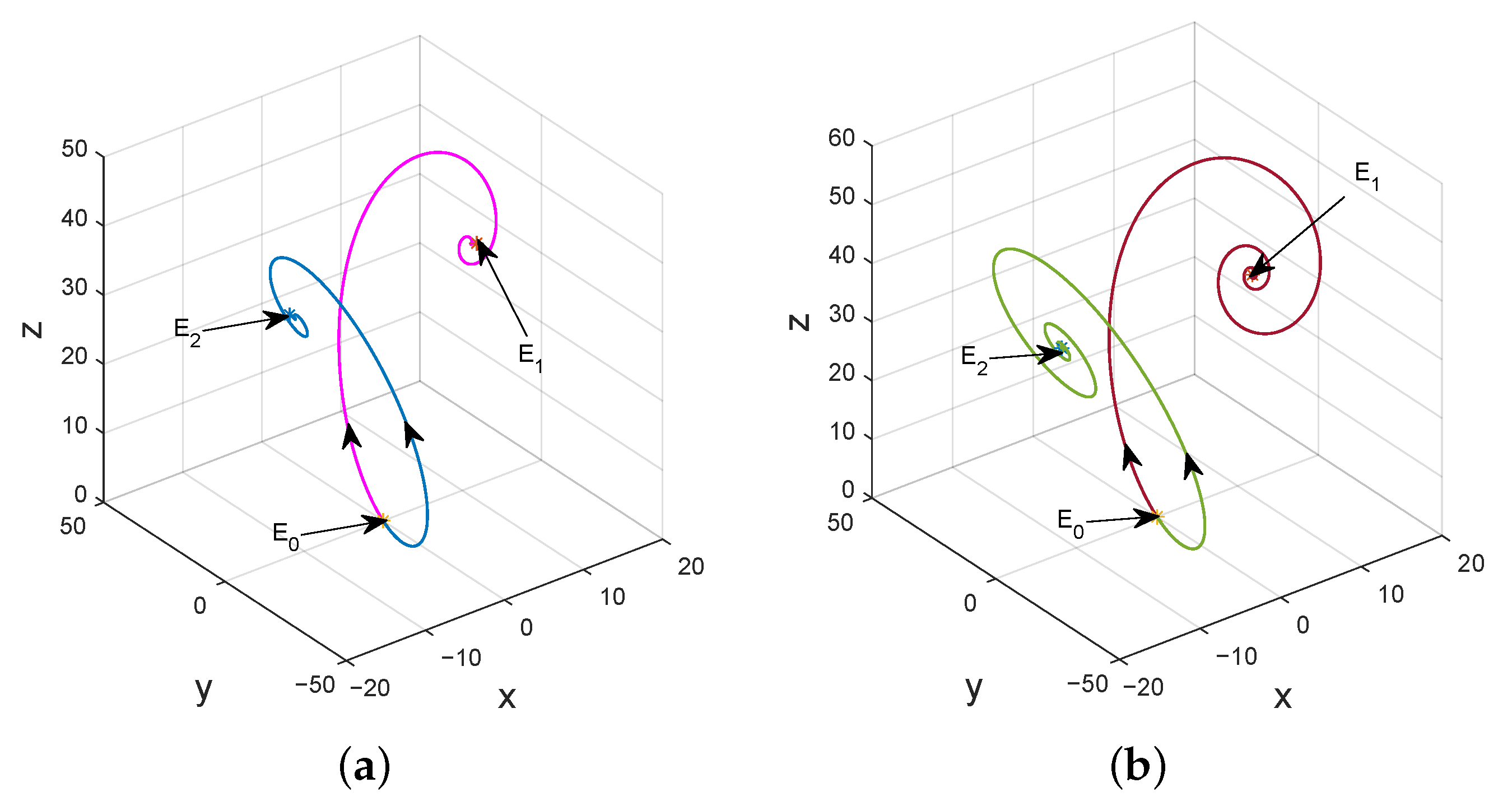
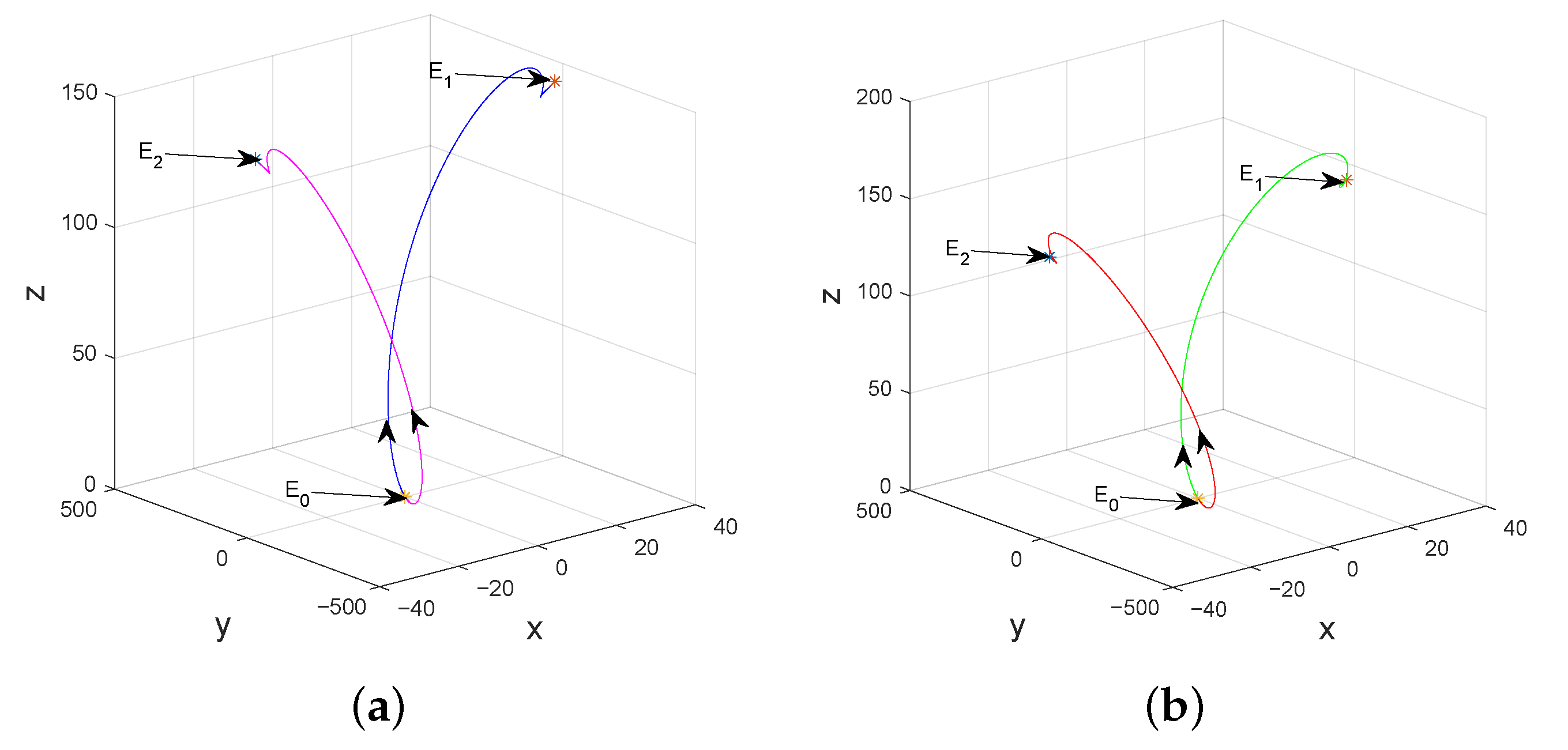
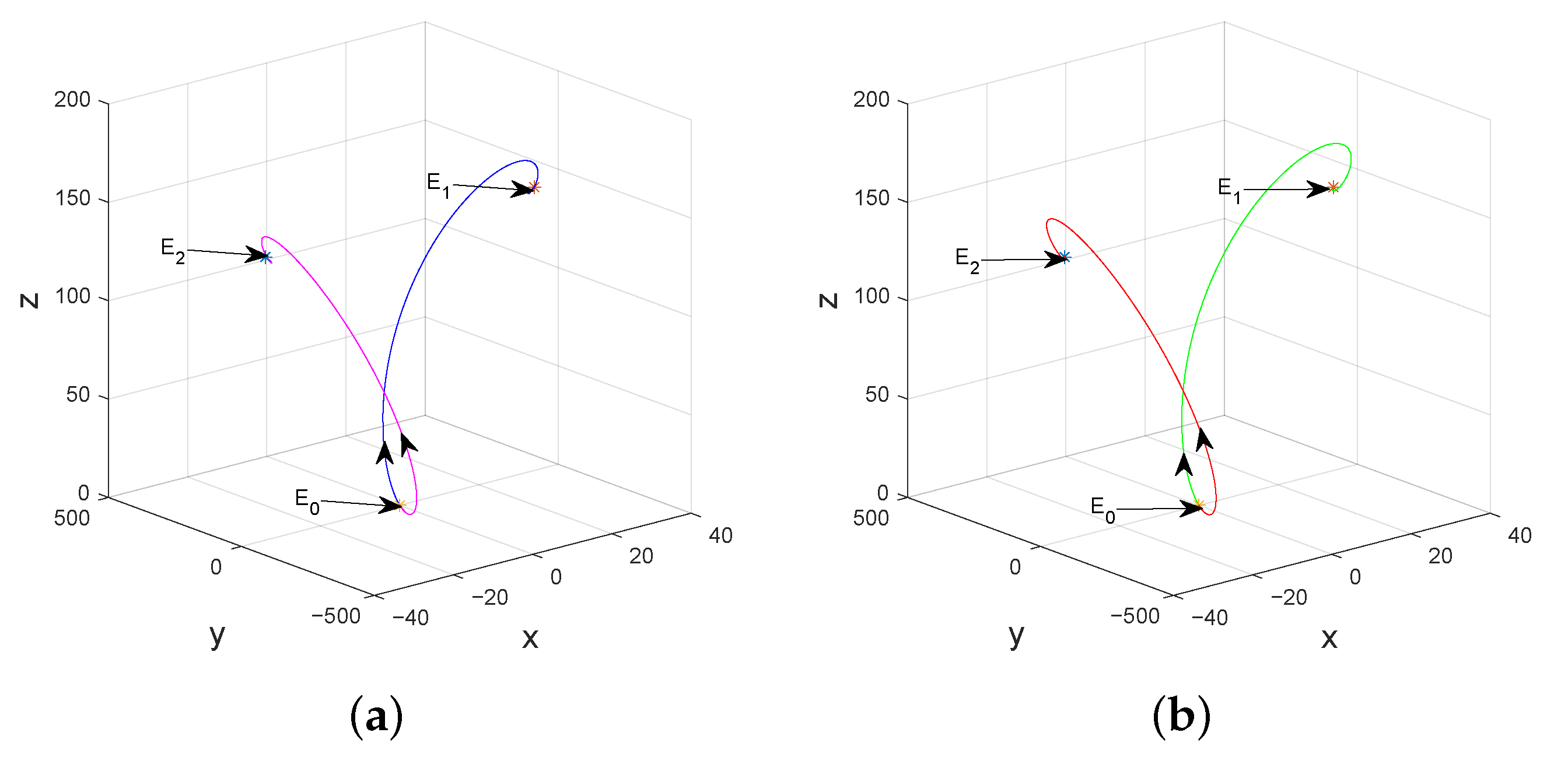
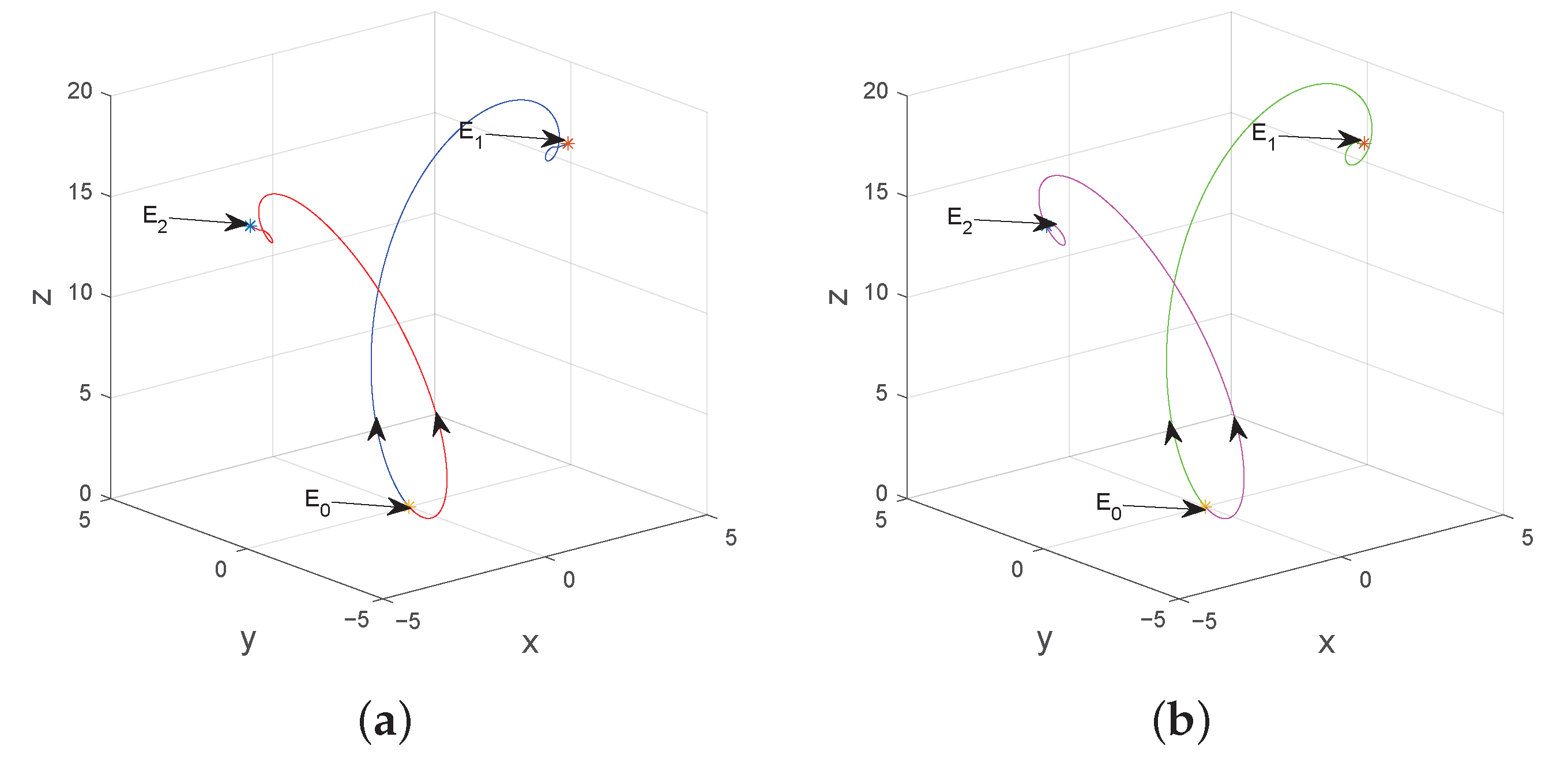
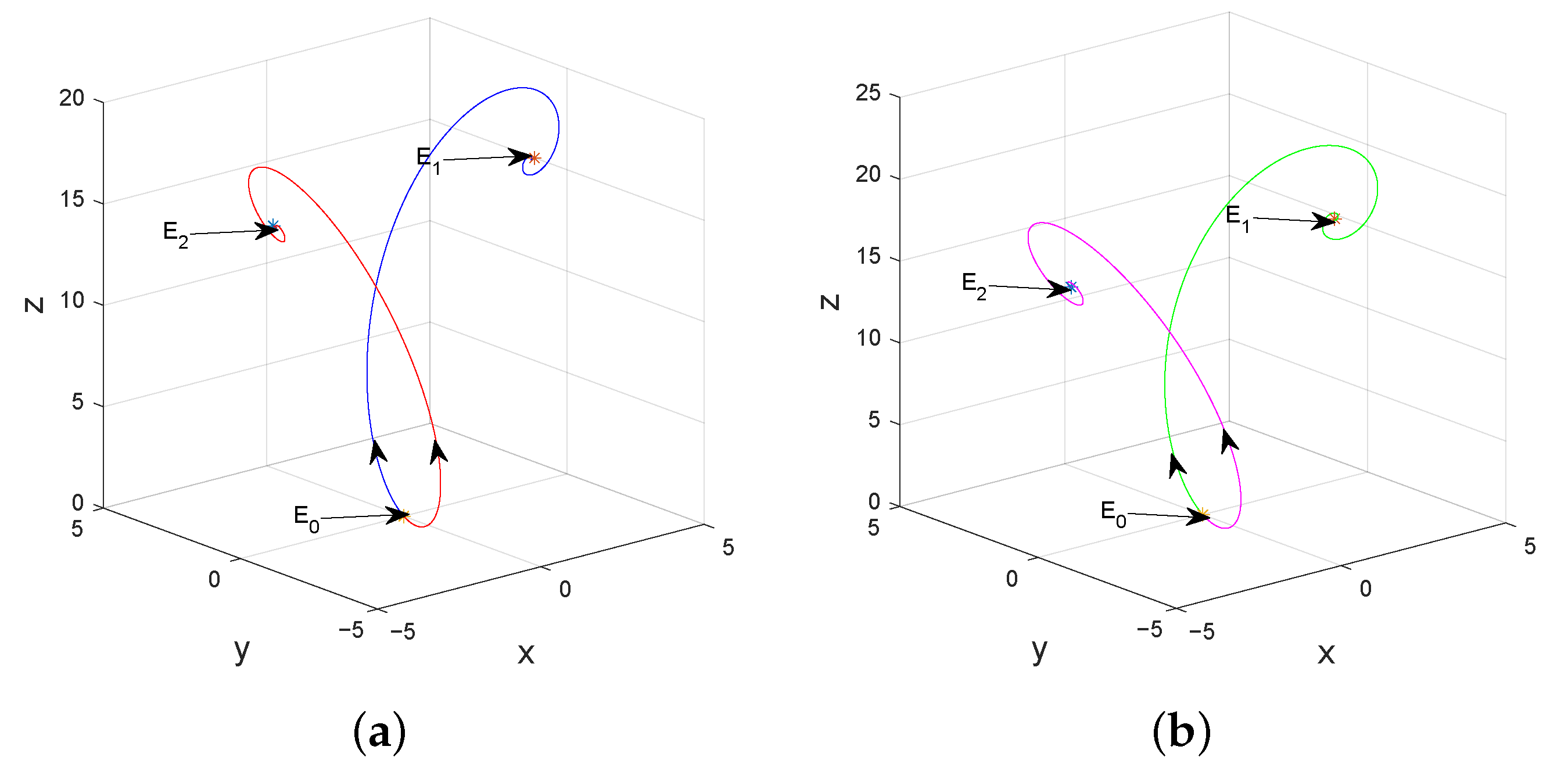
Using the software package nlfode_vec in the FOTF Toolbox of Matlab R2016b [44] (p. 283), and choosing the termination time t n = 200 , different parameter values, initial conditions, step sizes, and memory durations, Figure 1, Figure 2, Figure 3, Figure 4, Figure 5 and Figure 6 verify Theorem 1, i.e., the existence of a pair of orbits heteroclinic to E 0 and E 1 , 2 .
Corollary 1.
It should be emphasized that the above proof also yields a pair of symmetrical orbits heteroclinic to E 1 , 2 and E 0 in the integer-order counterpart, i.e., system (1), as depicted in Figure 1, Figure 2, Figure 3, Figure 4, Figure 5 and Figure 6.
Remark 3.
Theorem 1 and paper [30] indicate a fact: if we construct Lyapunov-like functions to show heteroclinic orbits in the integer-order Lorenz-like systems, then the corresponding Caputo fractional-order counterparts of them have the same heteroclinic orbits.
Remark 4.
Generally speaking, constructing a suitable Lyapunov function for proving the existence of heteroclinic orbits in the Lorenz chaotic family is unique. However, there are still rules to follow. As indicated in [13,14,15,16,17,18,19,20,21,22,23,24,30] and as demonstrated by the Lyapunov functions V 1 , 2 with their corresponding fractional derivatives D t α t 0 C V 1 , 2 , one observes that V ( X ( t ; X 0 ) ) = D t α t 0 C V ( X ( t ; X 0 ) ) = 0 whenever X ( t ; X 0 ) is an equilibrium point. Guided by this principle and by trial and error, one may find the targeted Lyapunov function if it exists.

4. Conclusions

Several fundamental open questions remain in the study of memristor-based Lorenz-type chaotic systems: do they have heteroclinic orbits? If so, how can their existence be rigorously proven? Can we adopt the method of Lyapunov-like functions and α -/ ω -limit sets, and if so, how can we find suitable Lyapunov-like functions? To date, researchers have paid little attention to these questions. In this effort, we address these gaps by investigating a 3D Caputo fractional-order Lorenz-type chaotic system with a flux-controlled memristor. By constructing two suitable Lyapunov-like functions, we rigorously prove that there is a pair of heteroclinic orbits in the Caputo fractional-order forms of the system. The theoretical results are further validated through numerical simulations, which show excellent agreement with the analytical findings.
For future work, we will extend our analysis to explore heteroclinic orbits in a more general class of memristive Lorenz-type systems given by
D t α t 0 C x = y , D t α t 0 C y = a x c y d x z e x 2 y i z 2 y k x 2 + h , D t α t 0 C z = b z + f x y + g x 2 ,
where a , c , d , e , i , k , h , b , f , g R , 0 < α 1 . In fact, motivated by the results [13,17] and the work of this paper, we manage to construct the Lyapunov function V = 1 2 { y 2 + d b ( b f 2 g ) ( b z + g x 2 ) 2 + 2 b k + 3 g d l 1 6 b l 1 ( l 1 2 + x 2 ) 2 + h l 1 ( l 1 + x ) 2 k 3 l 1 ( l 1 x + x 2 ) 2 } , and the corresponding fractional derivative D t α t 0 C V = ( c + e x 2 + i z 2 ) y 2 d b f 2 g ( b z + g x 2 ) 2 , when b > 0 , c > 0 , i > 0 , d > 0 , b f 2 g > 0 , h l 1 > 0 , k l 1 < 0 , l 1 ( 2 b k + 3 g d l 1 ) > 0 , g d l 1 3 + b k l 1 2 a b l 1 b h = 0 . Furthermore, we will investigate other fundamental dynamical properties of these systems, including homoclinic orbits, integrability, and potential engineering applications of the derived results.

Author Contributions

Conceptualization, C.W.; methodology, C.W. and H.W.; software, J.P. and G.K.; validation, J.P.; investigation, H.W.; writing—original draft preparation, C.W.; writing—review and editing, J.P.; visualization, J.P. and G.K. All authors have read and agreed to the published version of the manuscript.

Funding

This work was supported in part by the National Natural Science Foundation of China under Grant No.12501622, and in part by the Natural Science Foundation of Zhejiang Guangsha Vocational and Technical University of Construction under Grant 2022KYQD-KGY.

Data Availability Statement

There is no data because the results obtained in this paper can be reproduced based on the information given in this paper.

Conflicts of Interest

The authors declare that they have no known competing financial interests or personal relationships that could have appeared to influence the work reported in this paper.

References

  1. Strukov, D.B.; Snider, G.S.; Stewart, D.R.; Williams, R.S. The missing memristor found. Nature 2008, 453, 80–83. [Google Scholar] [CrossRef]
  2. Chua, L. Memristor-the missing circuit element. IEEE Trans. Circuit Theory 1971, 18, 507–519. [Google Scholar] [CrossRef]
  3. Li, Y.; Huang, X.; Song, Y.; Lin, J. A new fourth-order memristive chaotic system and its generation. Int. J. Bifurc. Chaos 2015, 25, 1550151. [Google Scholar] [CrossRef]
  4. Querlioz, D.; Bichler, O.; Dollfus, P.; Gamrat, C. Immunity to device variations in a spiking neural network with memristive nanodevices. IEEE Trans. Nanotechnol. 2013, 12, 288–295. [Google Scholar] [CrossRef]
  5. Wang, L.; Zou, H. A new emotion model of associative memory neural network based on memristor. Neurocomputing 2020, 410, 83–92. [Google Scholar] [CrossRef]
  6. Lehtonen, E.; Poikonen, J.H.; Laiho, M.; Kanerva, P. Large-scale memristive associative memories. IEEE Trans. Very Large Scale Integr. Syst. 2013, 22, 562–574. [Google Scholar] [CrossRef]
  7. Maan, A.K.; Jayadevi, D.A.; James, A.P. A survey of memristive threshold logic circuits. IEEE Trans. Neural Netw. Learn. Syst. 2016, 28, 1734–1746. [Google Scholar] [CrossRef]
  8. Ruan, Y.; Sun, K.; Mou, M. Memristor-based Lorenz hyper-chaotic system and its circuit implementation. Acta Phys. Sin. 2016, 65, 190502. [Google Scholar] [CrossRef]
  9. Jiang, Y.; Li, C.; Liu, Z.; Lei, T.; Chen, G. Simplified memristive Lorenz oscillator. IEEE Trans. Circuits Syst. II Express Briefs 2022, 69, 3344–3348. [Google Scholar] [CrossRef]
  10. Zhang, B.; Deng, F. Double-compound synchronization of six memristor-based Lorenz systems. Nonlinear Dyn. 2014, 77, 1519–1530. [Google Scholar] [CrossRef]
  11. Huang, J.; Chen, Y. Stability and co-dimension one bifurcation analysis of class of Lorenz-type chaotic system with memristor. Adv. Appl. Math. 2019, 8, 858–867. [Google Scholar] [CrossRef]
  12. Huang, J.; Chen, Y. Codimension-2 bifurcation dynamics and infinity analysis of a class of Lorenz chaos systems with memristors. Appl. Math. Mech. 2020, 41, 1275–1283. [Google Scholar]
  13. Pan, J.; Wang, H.; Hu, F. Revealing asymmetric homoclinic and heteroclinic orbits. Electron. Res. Arch. 2025, 33, 1337–1350. [Google Scholar] [CrossRef]
  14. Li, T.; Chen, G.; Chen, G. On homoclinic and heteroclinic orbits of the Chen’s system. Int. J. Bifurc. Chaos 2006, 16, 3035–3041. [Google Scholar] [CrossRef]
  15. Tigan, G.; Llibre, J. Heteroclinic, homoclinic and closed orbits in the Chen system. Int. J. Bifurc. Chaos 2016, 26, 1650072. [Google Scholar] [CrossRef]
  16. Liu, Y.; Yang, Q. Dynamics of a new Lorenz-like chaotic system. Nonlinear Anal. RWA 2010, 11, 2563–2572. [Google Scholar] [CrossRef]
  17. Wang, H.; Pan, J.; Hu, F.; Ke, G. Asymmetric singularly degenerate heteroclinic cycles. Int. J. Bifurc. Chaos 2025, 35, 2550072. [Google Scholar] [CrossRef]
  18. Pan, J.; Wang, H.; Ke, G.; Hu, F. Creation of single-wing Lorenz-like attractors via a ten-ninths-degree term. Open Phys. 2025, 23, 20250165. [Google Scholar] [CrossRef]
  19. Pan, J.; Wang, H.; Hu, F. Creation of hidden n-scroll Lorenz-like attractors. Electron. Res. Arch. 2025, 33, 4167–4183. [Google Scholar] [CrossRef]
  20. Tigan, G.; Constantinescu, D. Heteroclinic orbits in the T Lü System. Chaos Solitons Fractals 2009, 42, 20–23. [Google Scholar] [CrossRef]
  21. Wang, H.; Ke, G.; Pan, J.; Su, Q. Conjoined Lorenz-like attractors coined. Miskolc Math. Notes 2025, 26, 527–546. [Google Scholar] [CrossRef]
  22. Pan, J.; Wang, H.; Ke, G.; Hu, F. A novel Lorenz-like attractor and stability and equilibrium analysis. Axioms 2025, 14, 264. [Google Scholar] [CrossRef]
  23. Liu, Y.; Pang, W. Dynamics of the general Lorenz family. Nonlinear Dyn. 2012, 67, 1595–1611. [Google Scholar] [CrossRef]
  24. Chen, Y.; Yang, Q. Dynamics of a hyperchaotic Lorenz-type system. Nonlinear Dyn. 2014, 77, 569–581. [Google Scholar] [CrossRef]
  25. Aguila-Camacho, N.; Duarte-Mermoud, M.A.; Gallegos, J.A. Lyapunov functions for fractional order systems. Commun. Nonlinear Sci. Numer. Simul. 2014, 19, 2951–2957. [Google Scholar] [CrossRef]
  26. Ren, L.; Muhsen, S.; Shateyi, S.; Saberi-Nik, H. Dynamical behaviour, control, and boundedness of a fractional-order chaotic system. Fractal Fract. 2023, 7, 492. [Google Scholar] [CrossRef]
  27. Hou, Y.; Lin, A.; Huang, B.; Chen, C.; Lin, M.; Saberi-Nik, M. On the dynamical behaviors in fractional-order complex PMSM system and Hamilton energy control. Nonlinear Dyn. 2024, 112, 1861–1881. [Google Scholar] [CrossRef]
  28. Huang, M.; Lu, S.; Shateyi, S.; Saberi-Nik, H. Ultimate boundedness and finite time stability for a high dimensional fractional-order Lorenz model. Fractal Fract. 2022, 6, 630. [Google Scholar] [CrossRef]
  29. Liu, P.; Zhang, Y.; Mohammed, K.J.; Lopes, A.M.; Saberi-Nik, H. The global dynamics of a new fractional-order chaotic system. Chaos Solitons Fractals 2023, 175, 114006. [Google Scholar] [CrossRef]
  30. Ke, G.; Pan, J.; Hu, F.; Wang, H. Existence of heteroclinic orbits in fractional-order and integer-order coupled Lorenz systems. Fractal Fract. 2026, 10, 36. [Google Scholar] [CrossRef]
  31. Liu, J.; Li, R.; Huang, D. Stability, bifurcation and characteristics of chaos in a new commensurate and incommensurate fractional-order ecological system. Math. Comput. Simul. 2025, 236, 248–269. [Google Scholar] [CrossRef]
  32. Ghafoor, A.; Fiaz, M.; Afraites, L.; Ullah, A.; Ismai, E.A.A.; Awwad, F.A. Dynamics of the time-fractional reaction–diffusion coupled equations in biological and chemical processes. Sci. Rep. 2024, 14, 7549. [Google Scholar] [CrossRef]
  33. Srati, M.; Oulmelk, A.; Afraites, L.; Srati, M.; Hadri, A.; Zaky, M.A.; Aldraiweesh, A.; Hendy, A.S. An inverse problem of determining the parameters in diffusion equations by using fractional physics-informed neural networks. Appl. Numer. Math. 2025, 208, 189–213. [Google Scholar] [CrossRef]
  34. Long, L.D.; Zaky, M.A.; Moghaddam, B.P.; Gürefe, Y. Inverse source problem for time-fractional diffusion equation: Norm-constrained regularization and error estimation under a priori boundedness assumptions. Z. Angew. Math. Phys. 2025, 76, 153. [Google Scholar] [CrossRef]
  35. Brociek, R.; Goik, M.; Miarka, J.; Napoli, C.; Pleszczyński, M. Solution of inverse problem for diffusion equation with fractional derivatives using metaheuristic optimization algorithm. Informatica 2024, 35, 453–481. [Google Scholar] [CrossRef]
  36. Mbasso, W.F.; Harrison, A.; Dagal, I.; Jangir, P.; Kumar, R.; Liu, Z. Fractional calculus-inspired metaheuristic algorithm for solving high-dimensional constrained optimization problems. Evol. Intell. 2026, 19, 2. [Google Scholar] [CrossRef]
  37. Koon, W.S.; Lo, M.W.; Marsden, J.E.; Ross, S.D. Heteroclinic connections between periodic orbits and resonance transitions in celestial mechanics. Chaos 2000, 10, 427–469. [Google Scholar] [CrossRef] [PubMed]
  38. Wilczak, D.; Zgliczyński, P. Heteroclinic connections between periodic orbits in planar restricted circular three body problem—A computer assisted proof. Commun. Math. Phys. 2003, 234, 37–75. [Google Scholar] [CrossRef][Green Version]
  39. Wilczak, D.; Zgliczyński, P. Heteroclinic connections between periodic orbits in planar restricted circular three body problem. part II. Commun. Math. Phys. 2005, 259, 561–576. [Google Scholar] [CrossRef][Green Version]
  40. May, R.M.; Leonard, W. Nonlinear aspect of competition between three species. SIAM J. Appl. Math. 1975, 29, 243–253. [Google Scholar] [CrossRef]
  41. Feng, B.Y. The heteroclinic cycle in the model of competition between n species and its stability. Acta Math. Appl. Sin. 1998, 14, 404–413. [Google Scholar]
  42. Sprott, J.C. A proposed standard for the publication of new chaotic systems. Int. J. Bifurc. Chaos 2011, 21, 2391–2394. [Google Scholar] [CrossRef]
  43. Ahmed, E.; El-Sayed, A.M.A.; El-Saka, H.A.A. On some Routh-Hurwitz conditions for fractional order differential equations and their applications in Lorenz, Rössler, Chua and Chen systems. Phys. Lett. A 2006, 358, 1–4. [Google Scholar] [CrossRef]
  44. Xue, D.; Bai, L. Fractional Calculus High-Precision Algorithms and Numerical Implementations; Springer: Singapore, 2024. [Google Scholar]
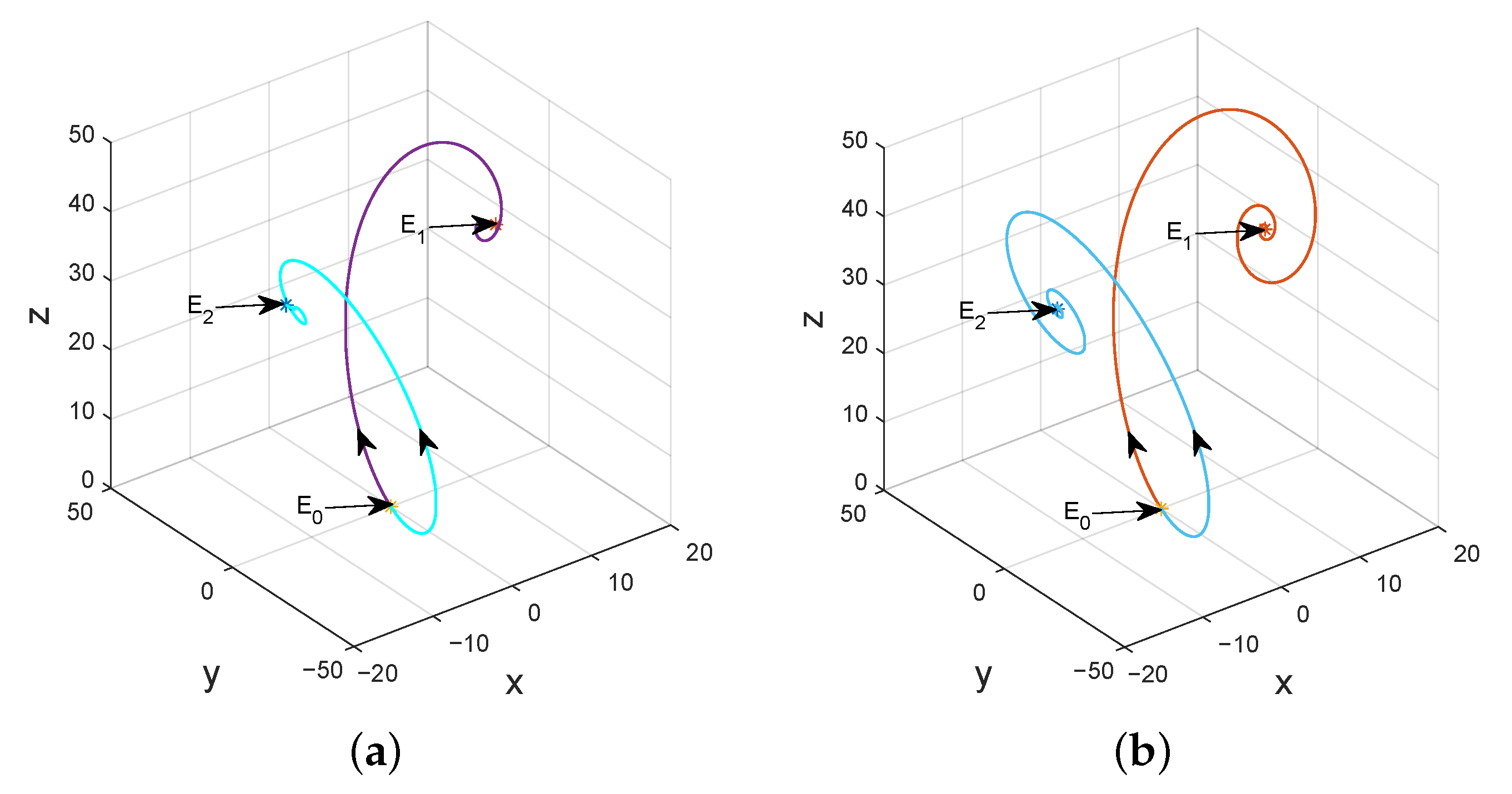
Figure 1. For ( c , a , ρ , r , m , b ) = ( 36 , 2 , 0.05 , 0.2 , 0.1 , 5 ) , step size h = 0.001 , the memory duration L 0 = 10,000, (a) α = 0.9 , ( x 0 1 , 2 , y 0 1 , 2 , z 0 1 ) = ( ± 1.618 , ± 1.314 , 1.236 ) × 10 6 (colored in magenta and cyan), (b) α = 1 , ( x 0 1 , 2 , y 0 1 , 2 , z 0 1 ) = ( ± 1.618 , ± 1.314 , 1.236 ) × 10 6 (colored in orange and blue), a pair of symmetrical orbits heteroclinic to E 0 and E 1 , 2 .
Fractalfract 10 00311 g001
Figure 2. For ( c , a , ρ , r , m , b ) = ( 36 , 2 , 0.05 , 0.2 , 0.1 , 4 ) , step size h = 0.001 , the memory duration L 0 = 10,000, (a) α = 0.9 , ( x 0 1 , 2 , y 0 1 , 2 , z 0 1 ) = ( ± 1.618 , ± 1.314 , 1.236 ) × 10 6 (colored in magenta and blue), (b) α = 1 , ( x 0 1 , 2 , y 0 1 , 2 , z 0 1 ) = ( ± 1.618 , ± 1.314 , 1.236 ) × 10 6 (colored in brown and green), a pair of symmetrical orbits heteroclinic to E 0 and E 1 , 2 .
Fractalfract 10 00311 g002
Figure 3. For ( c , a , ρ , r , m , b ) = ( 145 , 4 , 0.05 , 0.5 , 0.2 , 10 ) , step size h = 0.002 , the memory duration L 0 = 12,000, (a) α = 0.95 , ( x 0 3 , 4 , y 0 3 , 4 , z 0 2 ) = ( ± 1.236 , ± 1.618 , 1.314 ) × 10 5 (colored in blue and magenta), (b) α = 1 , ( x 0 3 , 4 , y 0 3 , 4 , z 0 2 ) = ( ± 1.236 , ± 1.618 , 1.314 ) × 10 5 (colored in green and red), a pair of symmetrical orbits heteroclinic to E 0 and E 1 , 2 .
Fractalfract 10 00311 g003
Figure 4. For ( c , a , ρ , r , m , b ) = ( 145 , 4 , 0.05 , 0.5 , 0.2 , 8 ) , step size h = 0.002 , the memory duration L 0 = 12,000, (a) α = 0.95 , ( x 0 3 , 4 , y 0 3 , 4 , z 0 2 ) = ( ± 1.618 , ± 1.314 , 1.236 ) × 10 6 (colored in blue and magenta), (b) α = 1 , ( x 0 3 , 4 , y 0 3 , 4 , z 0 2 ) = ( ± 1.618 , ± 1.314 , 1.236 ) × 10 6 (colored in green and red), a pair of symmetrical orbits heteroclinic to E 0 and E 1 , 2 .
Fractalfract 10 00311 g004
Figure 5. For ( c , a , ρ , r , m , b ) = ( 17 , 0.5 , 0.1 , 0.5 , 0.3 , 1.5 ) , step size h = 0.0015 , the memory duration L 0 = 9800 , (a) α = 0.96 , ( x 0 5 , 6 , y 0 5 , 6 , z 0 3 ) = ( ± 1.314 , ± 1.236 , 1.618 ) × 10 7 (colored in blue and red), (b) α = 1 , ( x 0 5 , 6 , y 0 5 , 6 , z 0 3 ) = ( ± 1.314 , ± 1.236 , 1.618 ) × 10 7 (colored in green and magenta), a pair of symmetrical orbits heteroclinic to E 0 and E 1 , 2 .
Fractalfract 10 00311 g005
Figure 6. For ( c , a , ρ , r , m , b ) = ( 17 , 0.5 , 0.1 , 0.5 , 0.3 , 1 ) , step size h = 0.0015 , the memory duration L 0 = 9800 , (a) α = 0.96 , ( x 0 5 , 6 , y 0 5 , 6 , z 0 3 ) = ( ± 1.314 , ± 1.236 , 1.618 ) × 10 7 (colored in blue and red), (b) α = 1 , ( x 0 5 , 6 , y 0 5 , 6 , z 0 3 ) = ( ± 1.314 , ± 1.236 , 1.618 ) × 10 7 (colored in green and magenta), a pair of symmetrical orbits heteroclinic to E 0 and E 1 , 2 .
Fractalfract 10 00311 g006
Disclaimer/Publisher’s Note: The statements, opinions and data contained in all publications are solely those of the individual author(s) and contributor(s) and not of MDPI and/or the editor(s). MDPI and/or the editor(s) disclaim responsibility for any injury to people or property resulting from any ideas, methods, instructions or products referred to in the content.