
Article

Exploring Fixed-Time Synchronization of Fractional-Order Fuzzy Cellular Neural Networks with Information Interactions and Time-Varying Delays via Adaptive Multi-Module Control

1
College of Computer, Chengdu University, Chengdu 610106, China
2
Fujian Key Laboratory of Financial Information Processing, Putian University, Putian 351100, China
3
School of Electronic Information and Electrical Engineering, Chengdu University, Chengdu 610106, China
*
Author to whom correspondence should be addressed.
Fractal Fract. 2026, 10(4), 253; https://doi.org/10.3390/fractalfract10040253
Submission received: 6 March 2026 / Revised: 5 April 2026 / Accepted: 8 April 2026 / Published: 13 April 2026
(This article belongs to the Special Issue Advances in Fractional-Order Control for Nonlinear Systems)

Abstract

This article focuses on the fixed-time synchronization problem for fractional-order fuzzy cellular neural networks (FOFCNNs) with information interactions and time-varying delays. To capture the complex dynamics of practical networks, nonlinear activation functions along with fuzzy AND and OR operators are incorporated into the master–slave systems. To achieve fixed-time synchronization despite these complexities, a novel adaptive multi-module controller is proposed. This controller integrates three functionally distinct components to accelerate the convergence rate, eliminate the effects of delays, and introduce negative feedback during communication, respectively. By employing fractional calculus tools, inequality techniques, and the proposed control law, sufficient criteria for the synchronization of the considered systems are rigorously established. Compared with existing synchronization works, this paper has significant advantages in model generality and controller design. Additionally, an explicit settling-time estimate is derived, which depends solely on control parameters and is independent of the initial conditions.

1. Introduction

The rapid advancement of artificial intelligence and deep learning has attracted widespread academic attention to neural networks (NNs). Composed of neurons organized in hierarchical layers, these networks exhibit exceptional capabilities in nonlinear approximation, adaptive learning, and parallel information processing [1]. Through activation functions, artificial neurons simulate the excitatory and inhibitory states of their biological counterparts, while the layered architecture mimics the brain’s hierarchical information processing. Extensive achievements have demonstrated the applications of NNs, such as algorithmic processing [2,3], nonlinear system analysis [4,5], intelligent control [6,7], and system stability [8,9,10]. Synchronization, a crucial collective behavior within NNs, has emerged as a focal point of research [11]. The relationship among network synchronization, control schemes, and multi-link architectures was explored in [12,13], respectively. This has led to extensive investigations into different synchronization modes, including bipartite synchronization [14], finite-time synchronization [15], quasi-synchronization [16], and fixed-time synchronization [17,18].
Particular classes of NNs can achieve synchronization among neurons through internal coupling mechanisms [19]. For instance, in oscillator networks with specific dynamics, synchronization can emerge spontaneously from a non-uniform state without external control, solely through the application of phase-difference weight update rules. However, many practical networks need external control inputs to achieve synchronization due to their complexity or specific application requirements. Kong et al. [20] employed information feedback control to investigate sufficient synchronization conditions for fuzzy inertial NNs. Hu et al. [21] examined synchronization in nonlinear fuzzy NNs with discontinuous activation functions using intermittent control strategies. Based on Lyapunov stability theory and nonlinear delayed controllers, Sharma et al. [22] developed a quaternion BAM neural network model and derived synchronization criteria ensuring system convergence within a predetermined time. Abdurahman et al. [23] improved the fixed-time stability results for nonlinear impulsive systems and subsequently applied them to investigate fixed-time synchronization in a class of nonlinear NNs with mixed impulses. Further studies on fixed-time synchronization, particularly concerning collaborative control in NNs, were reported in [24,25].
The aforementioned results on neural network synchronization have predominantly addressed models of integer order. However, such models are inherently incapable of capturing historical dependencies and thus fail to account for memory effects [26]. Unlike integer-order derivatives that only characterize the behavior of the system at the current moment, fractional-order derivatives inherently contain a weighted history of past states, with weights decaying into a power law. This characteristic can more accurately describe the long-term memory and genetic effects observed in biological and physical networks [27]. Capitalizing on this property, researchers have begun to investigate various dynamic behaviors in fractional-order network systems [28]. For instance, Mei et al. [29] considered the fixed-time synchronization of fractional-order Hopfield NNs using communication feedback controllers and fractional calculus theory. Employing a sliding mode control scheme, reference [30] addressed the synchronization problem of fractional-order impulsive networks and discussed the influence of order on the synchronization process. To extend the model to the complex domain, Ding et al. [31] investigated the sufficient synchronization conditions for complex-valued NNs via fractional-order nonlinear controllers and nonsmooth analysis. By developing a linear finite-time inequality to a nonlinear form, Du et al. [32] provided a novel instrument for studying the synchronization of fuzzy cellular NNs. Furthermore, a fractional-order stability lemma was given in [33] as an effective tool for analyzing the settling time of network synchronization.
Limited signal propagation speed and network channel congestion inevitably induce time delays. Incorporating time delays in neural network models provides a more accurate description of real-world physical and biological neural systems [34]. Time delays in networks often complicate synchronization and can destabilize the associated dynamical systems. To mitigate their impact, Li et al. [35] developed two hybrid controllers for exponential synchronization in fractional-order fuzzy NNs with time delays. Du et al. [36] formulated a network model featuring a constant delay and studied adaptive control methods for system synchronization. Fan et al. [37] incorporated a fixed delay into the fuzzy template items and derived finite-time synchronization conditions for delayed NNs with uncertainties. The study in [38] accounted for both internal and distributed delays, employing the Lyapunov method to derive synchronization criteria for fractional-order non-autonomous NNs. Beyond constant delays, time-varying delays more faithfully capture the dynamic behavioral changes in NNs. Leveraging the properties of Caputo fractional derivatives, Li et al. [39] derived a new fractional inequality to investigate the quasi-synchronization of fractional memristive NNs with time-varying delays. Liu et al. [40] explored the fixed-time synchronization problem for fractional memristive NNs with time-varying delays, deriving a settling time formula using a fractional nonlinear controller.
Beyond the consideration of time delays, accurate neural network modeling should also incorporate various forms of information interactions among neurons. To depict the communication states, Ma et al. [41] constructed a pair of fuzzy cellular NNs with distinct information interaction structures between the master and slave systems. Yang et al. [42] introduced higher-order interactions into fractional nonlinear NNs, thereby enriching both the network architectures and the scope of synchronization results. Furthermore, employing event-triggered techniques, the same research group refined the control strategy to address the projection synchronization problem for fractional-order switching NNs with complex interactions [43]. For a more realistic simulation of complex environments, Liu et al. [44] integrated both information interaction mechanisms and constant delays into fuzzy neural network models and derived the corresponding synchronization conditions. To date, fixed-time synchronization of FOFCNNs that jointly exhibit information interactions and time-varying delays has received relatively little attention, representing a significant research gap. In particular, the design of adaptive multi-module control schemes for such complex nonlinear systems remains an open challenge. This gap motivates the present work.
Inspired by the research gap identified in the above analysis, this paper investigates the fixed-time synchronization problem for FOFCNNs with information interactions and time-varying delays. From a control perspective, a key objective of this article is to design an adaptive controller to mitigate the effects of time-varying delays and interactions on network stability. Table 1 presents a comparison between this work and several existing studies with respect to time-varying delays, information interactions, controllers with adaptive techniques, and setting-time independence. The core contributions of this study are threefold and can be outlined as follows.
(I) This work integrates multiple practical considerations into fractional-order nonlinear network models, including two types of fuzzy operators, time-varying delays, and diverse interaction structures. Our model better reflects the complexities of real-world NNs compared to those found in the existing literature [40,41].
(II) We design an adaptive multi-module feedback controller endowed with three key functions: accelerating the convergence rate, eliminating the effects of time-varying delays, and introducing negative feedback into the communication process. The proposed controller distinguishes itself from conventional designs [32,33], ref. [37] primarily through the adaptive mechanisms. These mechanisms prevent the control function from becoming unbounded as synchronization errors tend toward zero, improving its suitability for real circumstances.
(III) Based on fractional stability theory and inequality techniques, new synchronization criteria for the concerned FOFCNNs are derived under the adaptive multi-module controller. Additionally, a closed-form expression for the settling time is established, determined entirely by the control parameters and independent of the starting states.

2. Preliminaries and Fractional-Order Models

This section first presents the fundamental concepts of fractional calculus. Based on this groundwork, we construct two fractional fuzzy cellular network models that incorporate information interactions and time-varying delays
Definition 1
([27]). The Caputo derivative of Q ( t ) is expressed as
D t ϑ 0 c Q ( t ) = 1 Γ ( ϖ ϑ ) 0 t ( t ς ) ϖ ϑ 1 Q ( ϖ ) ( ς ) d ς ,
where ϖ is an integer satisfying 0 ϖ 1 < ϑ < ϖ . It is simplified as D t ϑ 0 c Q ( t ) = 1 Γ ( 1 ϑ ) 0 t ( t ς ) ϑ Q ( ς ) d ς for 0 < ϑ < 1 .
Definition 2
([27]). The fractional integral of Q ( t ) is expressed as
I t ϑ 0 Q ( t ) = 1 Γ ( ϑ ) 0 t ( t ς ) ϑ 1 Q ( ς ) d ς ,
where ϑ > 0 , and Γ ( ϑ ) = 0 + ς ϑ 1 e ς d ς .
Remark 1.
From a mathematical perspective, the Caputo derivative allows for the use of integer-order initial conditions, which are intuitively interpretable. From a physical perspective, it naturally captures the intrinsic dependency behavior of real-world systems, making it more suitable for engineering applications than the Riemann–Liouville definition. Consequently, the Caputo derivative has found extensive application in constructing network models. For convenience, the Caputo derivative D t ϑ 0 c Q ( t ) in this article is represented as D ϑ Q ( t ) .
Consider a pair of FOFCNNs with information interactions and time-varying delays, which can be described by
D ϑ w p ( t ) = γ p w p ( t ) + k = 1 δ β p k f k ( w k ( t ) ) + k = 1 δ α p k f k ( w k ( t η ( t ) ) ) + k = 1 δ ρ p k h k ( w k ( t η ( t ) ) ) + k = 1 δ ϱ p k h k ( w k ( t η ( t ) ) ) + ϵ k = 1 δ σ p k ϕ k ( v k ( t ) ) + I p , w p ( t ) = W p ( t ) , t [ η ˜ , 0 ] ,
and
D ϑ v p ( t ) = γ p v p ( t ) + k = 1 δ β p k f k ( v k ( t ) ) + k = 1 δ α p k f k ( v k ( t η ( t ) ) ) + k = 1 δ ρ p k h k ( v k ( t η ( t ) ) ) + k = 1 δ ϱ p k h k ( v k ( t η ( t ) ) ) + ϵ k = 1 δ σ ¯ p k ϕ k ( w k ( t ) ) + I p + d p ( t ) , v p ( t ) = V p ( t ) , t [ η ˜ , 0 ] .
Network models (3) and (4) represent the master and slave systems, respectively, where 0 < ϑ < 1 , and p N 1 δ = { 1 , 2 , , δ } . γ p > 0 is the decay rate of the pth neuron. w p ( t ) and v p ( t ) denote the pth state variable of master-slave systems. f k ( · ) and h k ( · ) characterize the nonlinear activation behaviors. 0 η ( t ) η ˜ represents the time-varying delay, where η ˜ is the positive upper bound. ⋀ and ⋁ represent the fuzzy AND and OR operators, respectively. β p k and α p k signify the elements of the feedback templates. ρ p k and ϱ p k signify the elements of the fuzzy feedback MIN and MAX templates. ϵ signifies the strength of the outer interactions, and the structures of information interactions are denoted by σ p k and σ ¯ p k . ϕ k ( · ) represents the nonlinear interaction function satisfying | ϕ k ( · ) | Φ ¯ k . I p represents the bias and d p ( t ) represents the adaptive control input to be designed.
Let the synchronization error be u p ( t ) = v p ( t ) w p ( t ) . It follows from master-slave systems (3) and (4) that
D ϑ u p ( t ) = γ p u p ( t ) + k = 1 δ β p k f k ( v k ( t ) ) f k ( w k ( t ) ) + k = 1 δ α p k [ f k ( v k ( t η ( t ) ) ) f k ( w k ( t η ( t ) ) ) ] + k = 1 δ ρ p k h k ( v k ( t η ( t ) ) ) k = 1 δ ρ p k h k ( w k ( t η ( t ) ) ) + k = 1 δ ϱ p k h k ( v k ( t η ( t ) ) ) k = 1 δ ϱ p k h k ( w k ( t η ( t ) ) ) + ϵ k = 1 δ σ ¯ p k ϕ k ( w k ( t ) ) ϵ k = 1 δ σ p k ϕ k ( v k ( t ) ) + d p ( t ) ,
where 0 < ϑ < 1 , and p N 1 δ . The fixed-time synchronization between systems (3) and (4) is accomplished by designing a multi-module controller equipped with adaptive update laws.
Remark 2.
This paper examines fractional-order nonlinear NNs that incorporate fuzzy operators, time-varying delays, and information interactions. As a generalized dynamic system model, it demonstrates broad applicability in practical scenarios. For instance, in a fleet of autonomous vehicles executing transportation tasks within dynamically uncertain environments, individual perception exhibits fuzzy characteristics, inter-vehicle information experiences time-varying delays, and communication interactions are essential for enabling collaborative decision-making.
For the sake of simplicity, let u ( t ) = ( u 1 ( t ) , u 2 ( t ) , , u δ ( t ) ) T .
Definition 3.
Fractional-order NNs (3) and (4) are said to achieve fixed-time synchronization if a fixed-time T f > 0 exists, which relies on network or control parameters but independent of initial conditions, and the settling time function T ( u ( 0 ) ) 0 meets lim t T ( u ( s ) ) u ( t ) = 0 as well as u ( t ) = 0 for all t T ( u ( s ) ) , and T ( u ( s ) ) T f for any u ( s ) , s [ η ˜ , 0 ] .
Lemma 1
([32]). Let v k and w k represent two states of master–slave systems (3) and (4). Then we can obtain
| k = 1 δ ρ p k h k ( v k ( t η ( t ) ) ) k = 1 δ ρ p k h k ( w k ( t η ( t ) ) ) | k = 1 δ | ρ p k | | h k ( v k ( t η ( t ) ) ) h k ( w k ( t η ( t ) ) ) | ,
and
| k = 1 δ ϱ p k h k ( v k ( t η ( t ) ) ) k = 1 δ ϱ p k h k ( w k ( t η ( t ) ) ) | k = 1 δ | ϱ p k | | h k ( v k ( t η ( t ) ) ) h k ( w k ( t η ( t ) ) ) | ,
where p , k N 1 δ .
Assumption 1.
There exist positive constants F k , H k , and Φ k for the nonlinear functions f k ( · ) , h k ( · ) , and ϕ k ( · ) such that
| f k ( v ) f k ( w ) | F k | v w | , | h k ( v ) h k ( w ) | H k | v w | , | ϕ k ( v ) ϕ k ( w ) | Φ k | v w | ,
where k N 1 δ , v , w R .
Lemma 2
([28]). Let Q ( t ) C 1 ( [ 0 , + ) , R ) . Then one can get
D ϑ | Q ( t ) | s i g n ( Q ( t ) ) D ϑ Q ( t ) ,
where 0 < ϑ < 1 .
Lemma 3
([24]). Let u ( t ) H n { 0 } and V ( u ( t ) ) is radially unbounded and positive definite, if
V ˙ ( u ( t ) ) μ 1 V τ 1 ( u ( t ) ) μ 2 V τ 2 ( u ( t ) ) + μ 3 V ( u ( t ) ) ,
where μ 1 , μ 2 > 0 , 0 < τ 1 < 1 < τ 2 , μ 3 R and μ 3 < m i n { μ 1 , μ 2 } , then system (5) is fixed-time stable within T f , which can be estimated as
T f = 1 ( 1 τ 1 ) ( μ 1 μ 3 ) + 1 ( τ 2 1 ) ( μ 2 μ 3 ) .

3. Novel Synchronization Results of FOFCNNs

In this section, adaptive multi-module control schemes are employed to achieve the fixed-time synchronization of master–slave systems (3) and (4). Figure 1 illustrates the core design concept and implementation process. The multi-module controller can be described as
d p ( t ) = c p ( t ) u p ( t ) sign ( u p ( t ) ) [ ϕ p + a p | u p ( t η ( t ) ) |   +   b 1 ( D ϑ 1 | u p ( t ) | ) m + 1 2 +   b 2 ( D ϑ 1 | u p ( t ) | ) n + 1 2 b 3 D ϑ 1 | u p ( t ) | ] .
The adaptive law for dynamically updating the control gains is described by
c ˙ p ( t ) = 1 2 u p ( t ) 1 2 sign c p ( t ) c 0 b 1 | c p ( t ) c 0 | m + b 2 | c p ( t ) c 0 | n b 3 | c p ( t ) c 0 | ,
where b 1 , b 2 > 0 , b 3 R , 0 < m < 1 < n , ϕ p > 0 , a p > 0 , and c 0 represents a constant to be determined.
Remark 3.
Figure 1 illustrates the adaptive multi-module control flowchart for fractional-order master–slave systems (3) and (4). If the error norm is not zero, the controller is applied to the response system to drive the synchronization error between the master and slave systems toward zero, as specified in Definition 3. It integrates three primary parts, each with its own responsibilities. The first part accelerates the convergence rate. The second part eliminates the effects of time-varying delays, while the third introduces negative feedback through an adaptive update law during communication. The collaboration of these parts can enable the entire system to realize fixed-time synchronization in complex environments.
Theorem 1.
Under Assumption 1, if the following conditions hold,
( i ) γ p + c 0 k = 1 δ | β k p | F p ϵ k = 1 δ σ k p * Φ p 0 , ( ii ) a p k = 1 δ ( | α k p | F p + | ρ k p | H p + | ϱ k p | H p ) 0 , ( iii ) ϕ p ϵ k = 1 δ | σ ¯ p k σ p k | Φ ¯ k 0 , ( iv ) b 3 < m i n b 1 , b 2 ( 2 δ ) 1 n 2 ,
where p N 1 δ , then the fixed-time synchronization of systems (3) and (4) can be achieved through multi-module controller (12) and update law (13). Moreover, the settling time is predicted as
T f = 2 ( 1 m ) ( b 1 b 3 ) + 2 ( n 1 ) b 2 ( 2 δ ) 1 n 2 b 3 .
Proof. 
Let the Lyapunov function as
V ( u ( t ) ) = p = 1 δ D ϑ 1 | u p ( t ) | + c p ( t ) c 0 2 .
In view of Lemma 2, one can get
V ˙ ( u ( t ) ) = p = 1 δ D ϑ | u p ( t ) | + 2 c p ( t ) c 0 c ˙ p ( t ) p = 1 δ sign ( u p ( t ) ) D ϑ u p ( t ) + 2 c p ( t ) c 0 c ˙ p ( t ) .
Replacing D ϑ u p ( t ) with equation (5), we have
V ˙ ( u ( t ) ) p = 1 δ ( γ p + c 0 ) | u p ( t ) | + p = 1 δ sign ( u p ( t ) ) { k = 1 δ β p k f k ( v k ( t ) ) f k ( w k ( t ) ) + k = 1 δ α p k f k ( v k ( t η ( t ) ) ) f k ( w k ( t η ( t ) ) ) + k = 1 δ ρ p k h k ( v k ( t η ( t ) ) ) k = 1 δ ρ p k h k ( w k ( t η ( t ) ) ) + k = 1 δ ϱ p k h k ( v k ( t η ( t ) ) ) k = 1 δ ϱ p k h k ( w k ( t η ( t ) ) ) + ϵ k = 1 δ σ ¯ p k ϕ k ( w k ( t ) ) ϵ k = 1 δ σ p k ϕ k ( v k ( t ) ) } p = 1 δ [ ϕ p + b 1 ( D ϑ 1 | u p ( t ) | ) m + 1 2 + b 2 ( D ϑ 1 | u p ( t ) | ) n + 1 2 b 3 D ϑ 1 | u p ( t ) | + a p | u p ( t η ( t ) ) | ] p = 1 δ c p ( t ) c 0 | u p ( t ) | 2 c p ( t ) c 0 c ˙ p ( t ) .
By Assumption 1, we have
p = 1 δ sign ( u p ( t ) ) k = 1 δ β p k f k ( v k ( t ) ) f k ( w k ( t ) ) p = 1 δ k = 1 δ | β p k | | f k ( v k ( t ) ) f k ( w k ( t ) ) | p = 1 δ k = 1 δ | β p k | F k | u k ( t ) | .
and
p = 1 δ sign ( u p ( t ) ) k = 1 δ α p k f k ( v k ( t η ( t ) ) ) f k ( w k ( t η ( t ) ) ) p = 1 δ k = 1 δ | α p k | | f k ( v k ( t η ( t ) ) ) f k ( w k ( t η ( t ) ) ) | p = 1 δ k = 1 δ | α p k | F k | u k ( t η ( t ) ) | .
Using Lemma 1 and Assumption 1, we can derive
p = 1 δ sign ( u p ( t ) ) k = 1 δ ρ p k h k ( v k ( t η ( t ) ) ) k = 1 δ ρ p k h k ( w k ( t η ( t ) ) ) p = 1 δ | k = 1 δ ρ p k h k ( v k ( t η ( t ) ) ) k = 1 δ ρ p k h k ( w k ( t η ( t ) ) ) | p = 1 δ k = 1 δ | ρ p k | | h k ( v k ( t η ( t ) ) ) h k ( w k ( t η ( t ) ) ) | p = 1 δ k = 1 δ | ρ p k | H k | u k ( t η ( t ) ) | ,
and
p = 1 δ sign ( u p ( t ) ) k = 1 δ ϱ p k h k ( v k ( t η ( t ) ) ) k = 1 δ ϱ p k h k ( w k ( t η ( t ) ) ) p = 1 δ | k = 1 δ ϱ p k h k ( v k ( t η ( t ) ) ) k = 1 δ ϱ p k h k ( w k ( t η ( t ) ) ) | p = 1 δ k = 1 δ | ϱ p k | | h k ( v k ( t η ( t ) ) ) h k ( w k ( t η ( t ) ) ) | p = 1 δ k = 1 δ | ϱ p k | H k | u k ( t η ( t ) ) | .
By virtue of trigonometric inequality | a b | | a | + | b | , the Lipschitz condition | ϕ k ( v ) ϕ k ( w ) | Φ k | v w | , together with | ϕ k ( · ) | Φ ¯ k , we can infer
ϵ p = 1 δ sign ( u p ( t ) ) k = 1 δ σ ¯ p k ϕ k ( w k ( t ) ) σ p k ϕ k ( v k ( t ) ) ϵ p = 1 δ k = 1 δ σ ¯ p k ϕ k ( w k ( t ) ) σ ¯ p k ϕ k ( v k ( t ) ) + σ ¯ p k ϕ k ( v k ( t ) ) σ p k ϕ k ( v k ( t ) ) ϵ p = 1 δ k = 1 δ σ ¯ p k Φ k u k ( t ) + σ ¯ p k σ p k Φ ¯ k .
Alternatively, we can infer
ϵ p = 1 δ sign ( u p ( t ) ) k = 1 δ σ ¯ p k ϕ k ( w k ( t ) ) σ p k ϕ k ( v k ( t ) ) ϵ p = 1 δ k = 1 δ σ ¯ p k ϕ k ( w k ( t ) ) σ p k ϕ k ( w k ( t ) ) + σ p k ϕ k ( w k ( t ) ) σ p k ϕ k ( v k ( t ) ) ϵ p = 1 δ k = 1 δ σ ¯ p k σ p k Φ ¯ k + σ p k Φ k | u k ( t ) | .
It follows from inequalities (22) and (23) that
ϵ p = 1 δ sign ( u p ( t ) ) k = 1 δ σ ¯ p k ϕ k ( w k ( t ) ) σ p k ϕ k ( v k ( t ) ) ϵ p = 1 δ k = 1 δ σ ¯ p k σ p k Φ ¯ k + σ p k * Φ k | u k ( t ) | ,
where σ p k * = min { σ p k , σ ¯ p k } .
Substituting inequalities (18)–(21) and (24) into (17) gives
V ˙ ( u ( t ) ) p = 1 δ γ p + c 0 k = 1 δ | β k p | F p ϵ k = 1 δ σ k p * Φ p | u p ( t ) | p = 1 δ a p k = 1 δ ( | α k p | F p + | ρ k p | H p + | ϱ k p | H p ) | u p ( t η ( t ) ) | p = 1 δ ϕ p ϵ k = 1 δ | σ ¯ p k σ p k | Φ ¯ k p = 1 δ [ b 1 ( D ϑ 1 | u p ( t ) | ) m + 1 2 + b 2 ( D ϑ 1 | u p ( t ) | ) n + 1 2 b 3 D ϑ 1 | u p ( t ) | ] p = 1 δ c p ( t ) c 0 | u p ( t ) | 2 c p ( t ) c 0 c ˙ p ( t ) .
Leveraging conditions (i)–(iv) alongside the adaptive update Equation (13), one can derive
V ˙ ( u ( t ) ) p = 1 δ b 1 ( D ϑ 1 | u p ( t ) | ) m + 1 2 + b 2 ( D ϑ 1 | u p ( t ) | ) n + 1 2 b 3 D ϑ 1 | u p ( t ) | p = 1 δ c p ( t ) c 0 | u p ( t ) | 2 c p ( t ) c 0 c ˙ p ( t ) = p = 1 δ b 1 ( D ϑ 1 | u p ( t ) | ) m + 1 2 + | c p ( t ) c 0 | m + 1 p = 1 δ b 2 ( D ϑ 1 | u p ( t ) | ) n + 1 2 + | c p ( t ) c 0 | n + 1 + p = 1 δ b 3 D ϑ 1 | u p ( t ) | + ( c p ( t ) c 0 ) 2 .
By using Jensen’s inequality, it is not difficult to get
p = 1 δ ( D ϑ 1 | u p ( t ) | ) m + 1 2 + | c p ( t ) c 0 | m + 1 p = 1 δ D ϑ 1 | u p ( t ) | + | c p ( t ) c 0 | 2 m + 1 2 p = 1 δ D ϑ 1 | u p ( t ) | + ( c p ( t ) c 0 ) 2 m + 1 2 .
Similarly, by using the Minkowski inequality, one can easily yield that
p = 1 δ ( D ϑ 1 | u p ( t ) | ) n + 1 2 + | c p ( t ) c 0 | n + 1 ( 2 δ ) 1 n 2 p = 1 δ D ϑ 1 | u p ( t ) | + ( c p ( t ) c 0 ) 2 n + 1 2 .
Then placing inequalities (27)–(28) into (26) gives
V ˙ ( u ( t ) ) b 1 p = 1 δ D ϑ 1 | u p ( t ) | + ( c p ( t ) c 0 ) 2 m + 1 2 b 2 ( 2 δ ) 1 n 2 p = 1 δ D ϑ 1 | u p ( t ) | + ( c p ( t ) c 0 ) 2 n + 1 2 + b 3 p = 1 δ D ϑ 1 | u p ( t ) | + ( c p ( t ) c 0 ) 2 = b 1 V m + 1 2 ( u ( t ) ) b 2 ( 2 δ ) 1 n 2 V n + 1 2 ( u ( t ) ) + b 3 V ( u ( t ) ) .
By Lemma 3, the synchronization task of fuzzy master–slave systems (3)–(4) can be finished through adaptive multi-module controller (12) within the settling time
T f = 2 ( 1 m ) ( b 1 b 3 ) + 2 ( n 1 ) b 2 ( 2 δ ) 1 n 2 b 3 .
Remark 4.
Extensive investigations reported in [20,25] have addressed the fixed-time synchronization problem across a wide variety of network architectures, including inertial NNs, impulsive systems, BAM networks, and cellular NNs. However, these existing results rely on integer-order models and control methodologies. The fundamental distinctions in both the mathematical definitions and the dynamical properties between integer and fractional calculus render these conventional control techniques inapplicable to FOFCNNs in the current work. This gap constitutes the primary impetus for the investigation presented herein.
Remark 5.
The fixed-time synchronization of fractional-order NNs has been explored in prior works, such as [30] for Hopfield NNs and [45] for general fractional-order NNs, both employing sliding mode control strategies. In contrast, the present study considers a more complex system incorporating fuzziness, information interactions, and time-varying delays. These features can give rise to high-frequency, low-amplitude chattering near the sliding manifold, necessitating a more robust control design. While sliding mode control offers robustness, its performance degrades under such oscillations. This article attempts to combine submodules with different functions and adaptive techniques to achieve the synchronization task.
Remark 6.
In [32,33], Du et al. investigated the synchronization of fractional cellular NNs by error feedback controllers and stability lemmas. The authors in [37] have designed multi-module controllers with a simple adaptive law for synchronizing fractional-order cellular NNs. Unlike existing control schemes in [32,33,37], the adaptive multi-module controller in this study prevents the control function from becoming unbounded as synchronization errors tend toward zero, improving its suitability for real circumstances.
Remark 7.
In existing studies [26,40], the Lyapunov stability theory was applied to address the synchronization problem of fractional-order NNs. Specifically, the Lyapunov functions were constructed as V ( u ( t ) ) = p = 1 δ | u p ( t ) | and V ( u ( t ) ) = p = 1 δ D ϑ 1 | u p ( t ) | , respectively. In contrast to these auxiliary functions, this paper constructs a Lyapunov function as V ( u ( t ) ) = p = 1 δ D ϑ 1 | u p ( t ) | + c p ( t ) c 0 2 , where 1 < ϑ 1 < 0 is a negative fractional order. The increased complexity of the constructed function means greater difficulty in the theoretical derivation and proof.
To simplify the problem, the fuzzy master–slave systems do not consider information interactions, allowing the networks to be described as
D ϑ w p ( t ) = γ p w p ( t ) + k = 1 δ β p k f k ( w k ( t ) ) + k = 1 δ α p k f k ( w k ( t η ( t ) ) ) + k = 1 δ ρ p k h k ( w k ( t η ( t ) ) ) + k = 1 δ ϱ p k h k ( w k ( t η ( t ) ) ) + I p , w p ( t ) = W p ( t ) , t [ η ˜ , 0 ] ,
and
D ϑ v p ( t ) = γ p v p ( t ) + k = 1 δ β p k f k ( v k ( t ) ) + k = 1 δ α p k f k ( v k ( t η ( t ) ) ) + k = 1 δ ρ p k h k ( v k ( t η ( t ) ) ) + k = 1 δ ϱ p k h k ( v k ( t η ( t ) ) ) + I p + d p ( t ) , v p ( t ) = V p ( t ) , t [ η ˜ , 0 ] .
where 0 < ϑ < 1 , and p N 1 δ . In view of the proof approach of Theorem 1, one can derive the following corollary.
Corollary 1.
Under adaptive multi-module controller (12) and Assumption 1, master system (31) is fixed-time synchronized with slave system (32) if the following inequalities hold:
( I ) γ p + c 0 k = 1 δ | β k p | F p 0 , ( II ) a p k = 1 δ ( | α k p | F p + | ρ k p | H p + | ϱ k p | H p ) 0 , ( III ) b 3 < m i n b 1 , b 2 ( 2 δ ) 1 n 2 ,
where p N 1 δ . Furthermore, the settling time is predicted as
T f = 2 ( 1 m ) ( b 1 b 3 ) + 2 ( n 1 ) b 2 ( 2 δ ) 1 n 2 b 3 .
Remark 8.
Unlike the synchronization results in [25], which focused on integer-order fuzzy NNs, Corollary 1 derives synchronization criteria for fractional-order fuzzy NNs. Consequently, Corollary 1 can be regarded as a generalization of the theoretical results in [25].

4. Experimental Verification

This section provides two numerical examples to validate the theoretical achievements in Theorem 1 and Corollary 1, thereby confirming the practicality of the derived synchronization conditions.
Example 1.
Consider a set of nonlinear NNs with information interactions and time delays, described as follows:
D 0.95 w p ( t ) = γ p w p ( t ) + k = 1 2 β p k f k ( w k ( t ) ) + k = 1 2 α p k f k ( w k ( t η ( t ) ) ) + k = 1 2 ρ p k h k ( w k ( t η ( t ) ) ) + k = 1 2 ϱ p k h k ( w k ( t η ( t ) ) ) + ϵ k = 1 2 σ p k ϕ k ( v k ( t ) ) + I p , w p ( t ) = W p ( t ) , t [ η ˜ , 0 ] ,
and
D 0.95 v p ( t ) = γ p v p ( t ) + k = 1 2 β p k f k ( v k ( t ) ) + k = 1 2 α p k f k ( v k ( t η ( t ) ) ) + k = 1 2 ρ p k h k ( v k ( t η ( t ) ) ) + k = 1 2 ϱ p k h k ( v k ( t η ( t ) ) ) + ϵ k = 1 2 σ ¯ p k ϕ k ( w k ( t ) ) + I p + d p ( t ) , v p ( t ) = V p ( t ) , t [ η ˜ , 0 ] ,
where γ 1 = 2 ,   γ 2 = 1 ,   ϵ = 1 , ( β p k ) 2 × 2 = 0.5 0.3 0.6 0.4 , ( α p k ) 2 × 2 = 0.2 0.1 0.1 0.3 , ( ρ p k ) 2 × 2 = 0.6 0.4 0.5 0.2 , ( ϱ p k ) 2 × 2 = 0.1 0.3 0.5 0.3 , ( σ p k ) 2 × 2 = 1 2 2 1 , ( σ ¯ p k ) 2 × 2 = 1 1 1 1 , η ( t ) = 0.1 , I 1 = 1 , and I 2 = 1 .
Taking functions f k ( · ) = h k ( · ) = ϕ k ( · ) = tanh ( · ) , Assumption 1 holds for F k = 1 , H k = 1 and Φ k = 1 . Let control parameters ϕ 1 = 1 ,   ϕ 2 = 1 ,   a 1 = 2 ,   a 2 = 1.8 ,   b 1 = 2 ,   b 2 = 2 ,   b 3 = 3 ,   m = 0.2 ,   n = 1.8 , and c 0 = 1.8 . Simple calculation yields that
γ 1 + c 0 k = 1 2 | β k 1 | F 1 ϵ k = 1 2 σ k 1 * Φ 1 = 0.7 > 0 , γ 2 + c 0 k = 1 2 | β k 2 | F 2 ϵ k = 1 2 σ k 2 * Φ 2 = 0.1 > 0 , a 1 k = 1 2 ( | α k 1 | F 1 + | ρ k 1 | H 1 + | ϱ k 1 | H 1 ) = 0 , a 2 k = 1 2 ( | α k 2 | F 2 + | ρ k 2 | H 2 + | ϱ k 2 | H 2 ) = 0.2 > 0 , ϕ 1 ϵ k = 1 δ | σ ¯ 1 k σ 1 k | Φ ¯ k = 0 , ϕ 2 ϵ k = 1 δ | σ ¯ 2 k σ 2 k | Φ ¯ k = 0 .
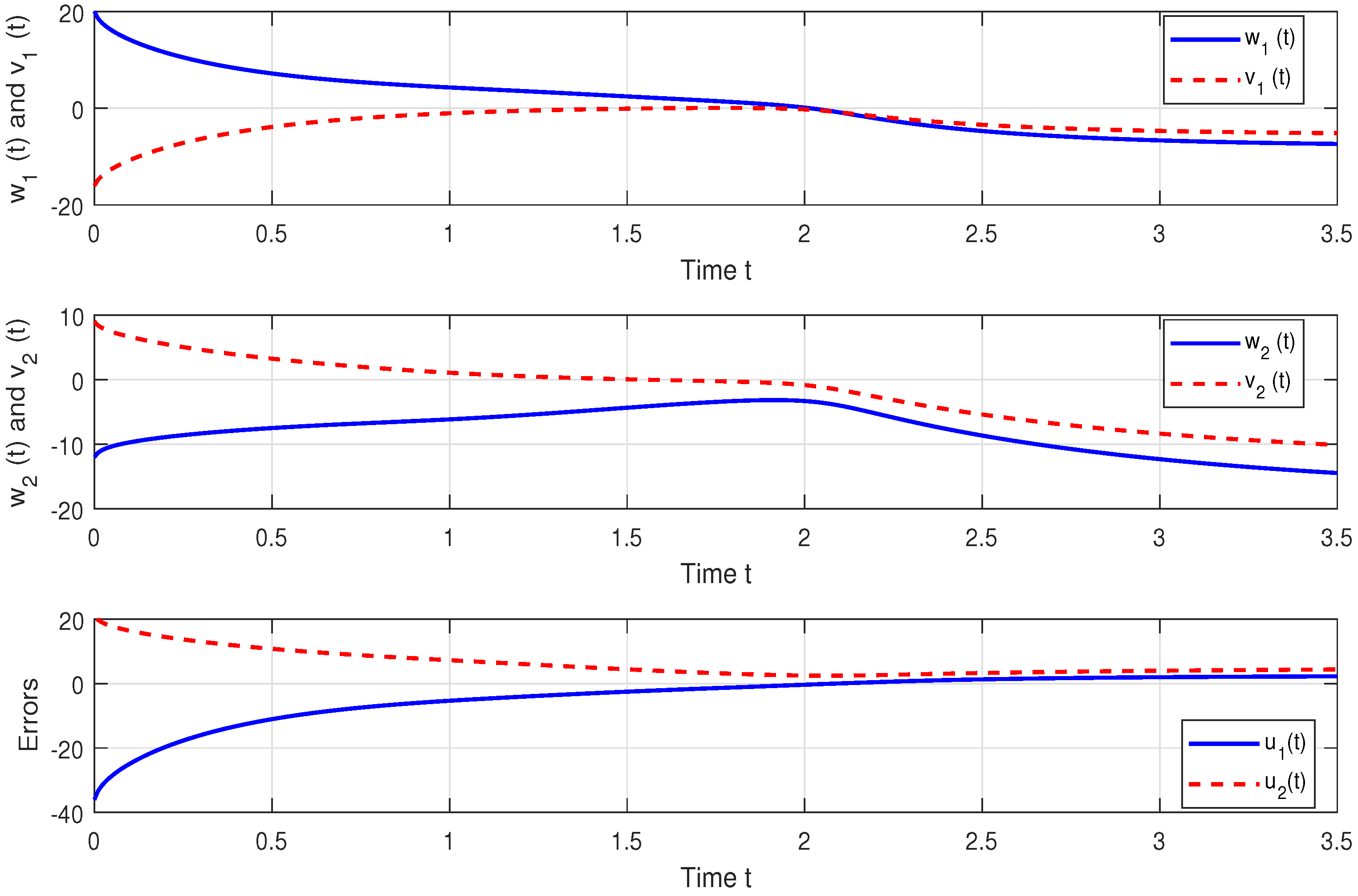
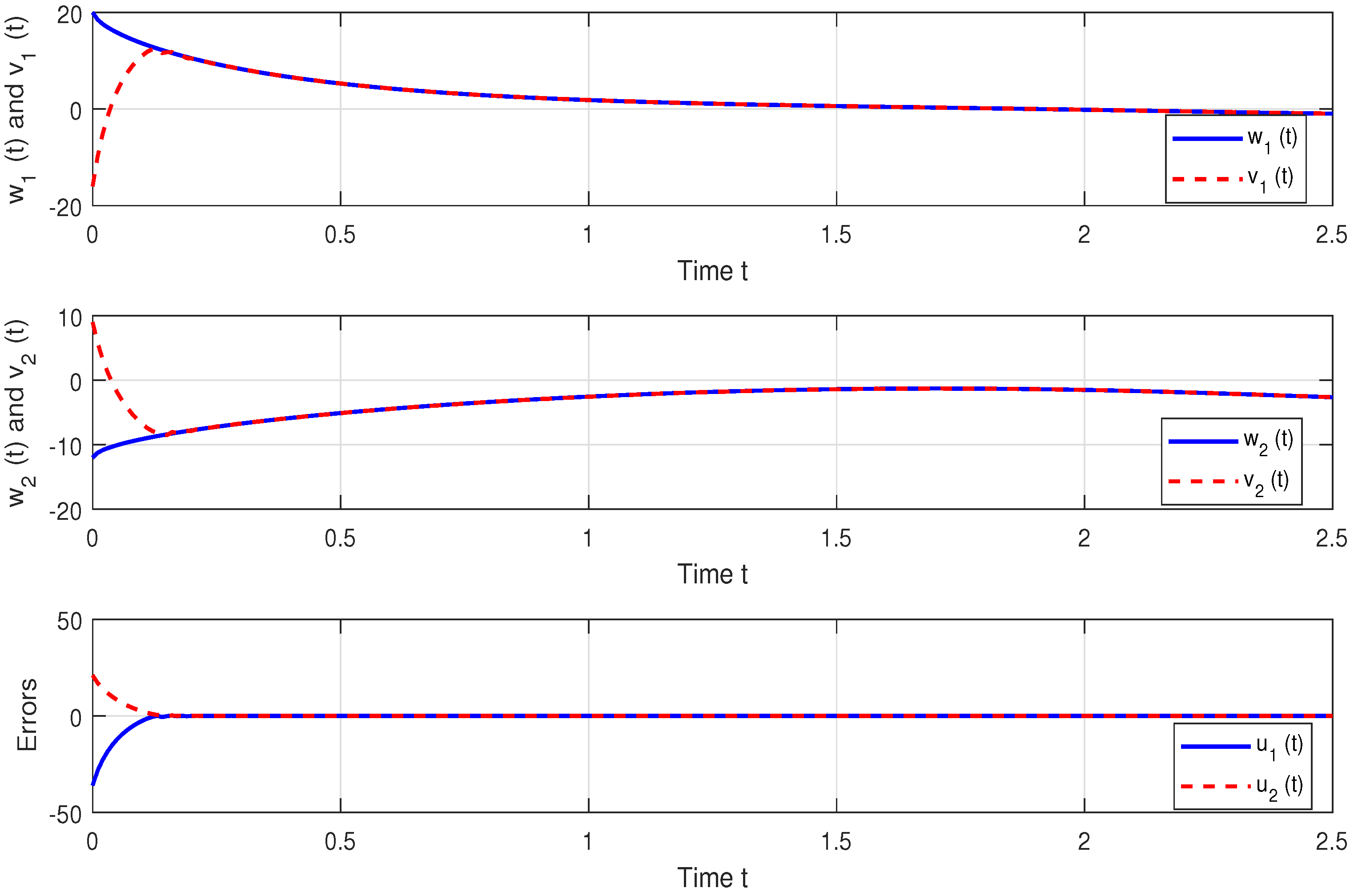
It is straightforward to verify that conditions (i)-(iv) are satisfied. Hence, according to Theorem 1, the fixed-time synchronization between systems (34) and (35) can be achieved under controller (12) with T f = 1.1026 . Select initial conditions w 1 ( t ) = 20 , w 2 ( t ) = 12 , v 1 ( t ) = 16 , v 2 ( t ) = 9 . Figure 2 depicts the trajectories of systems (34) and (35) without external control, where it is evident that synchronization fails to occur. In contrast, Figure 3 shows the trajectories of systems (34) and (35) under adaptive controller (12), confirming that the synchronization of the controlled systems is achieved.
Example 2.
Consider a set of nonlinear NNs with time delays but no external information interactions, as described below:
D 0.95 w p ( t ) = γ p w p ( t ) + k = 1 2 β p k f k ( w k ( t ) ) + k = 1 2 α p k f k ( w k ( t η ( t ) ) ) + k = 1 2 ρ p k h k ( w k ( t η ( t ) ) ) + k = 1 2 ϱ p k h k ( w k ( t η ( t ) ) ) + I p , w p ( t ) = W p ( t ) , t [ η ˜ , 0 ] ,
and
D 0.95 v p ( t ) = γ p v p ( t ) + k = 1 2 β p k f k ( v k ( t ) ) + k = 1 2 α p k f k ( v k ( t η ( t ) ) ) + k = 1 2 ρ p k h k ( v k ( t η ( t ) ) ) + k = 1 2 ϱ p k h k ( v k ( t η ( t ) ) ) + I p + d p ( t ) , v p ( t ) = V p ( t ) , t [ η ˜ , 0 ] ,
where γ 1 = 0.2 ,   γ 2 = 0.1 ,   I 1 = 0.5 ,   I 2 = 0.5 , ( β p k ) 2 × 2 = 0.6 0.4 0.7 0.5 , ( α p k ) 2 × 2 = 0.3 0.2 0.2 0.4 , ( ρ p k ) 2 × 2 = 0.7 0.5 0.6 0.3 , ( ϱ p k ) 2 × 2 = 0.2 0.4 0.6 0.4 , and η ( t ) = 0.2 e t .
Choose f k ( · ) = h k ( · ) = ϕ k ( · ) = tanh ( · ) with F k = 1 , H k = 1 and Φ k = 1 , making Assumption 1 hold. Let control parameters ϕ 1 = 0.5 ,   ϕ 2 = 0.5 ,   a 1 = 2.8 ,   a 2 = 2.4 ,   b 1 = 2 , b 2 = 2 , b 3 = 3 , m = 0.2 ,   n = 2.1 , and c 0 = 1.2 . Through calculation, one obtains
γ 1 + c 0 k = 1 2 | β k 1 | F 1 = 0.1 > 0 , γ 2 + c 0 k = 1 2 | β k 2 | F 2 = 0.4 > 0 , a 1 k = 1 2 ( | α k 1 | F 1 + | ρ k 1 | H 1 + | ϱ k 1 | H 1 ) = 0.2 > 0 , a 2 k = 1 2 ( | α k 2 | F 2 + | ρ k 2 | H 2 + | ϱ k 2 | H 2 ) = 0.2 > 0 .
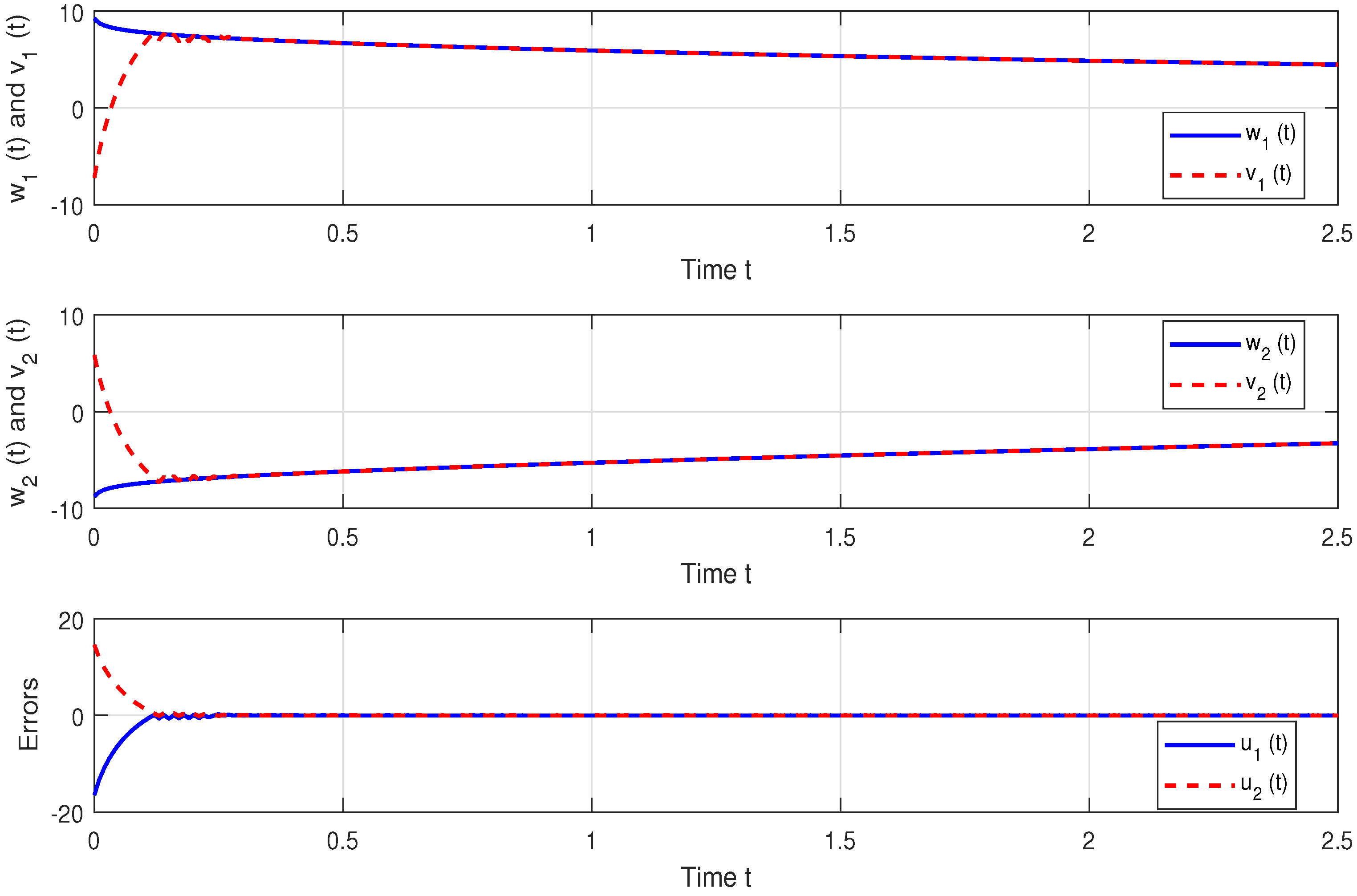
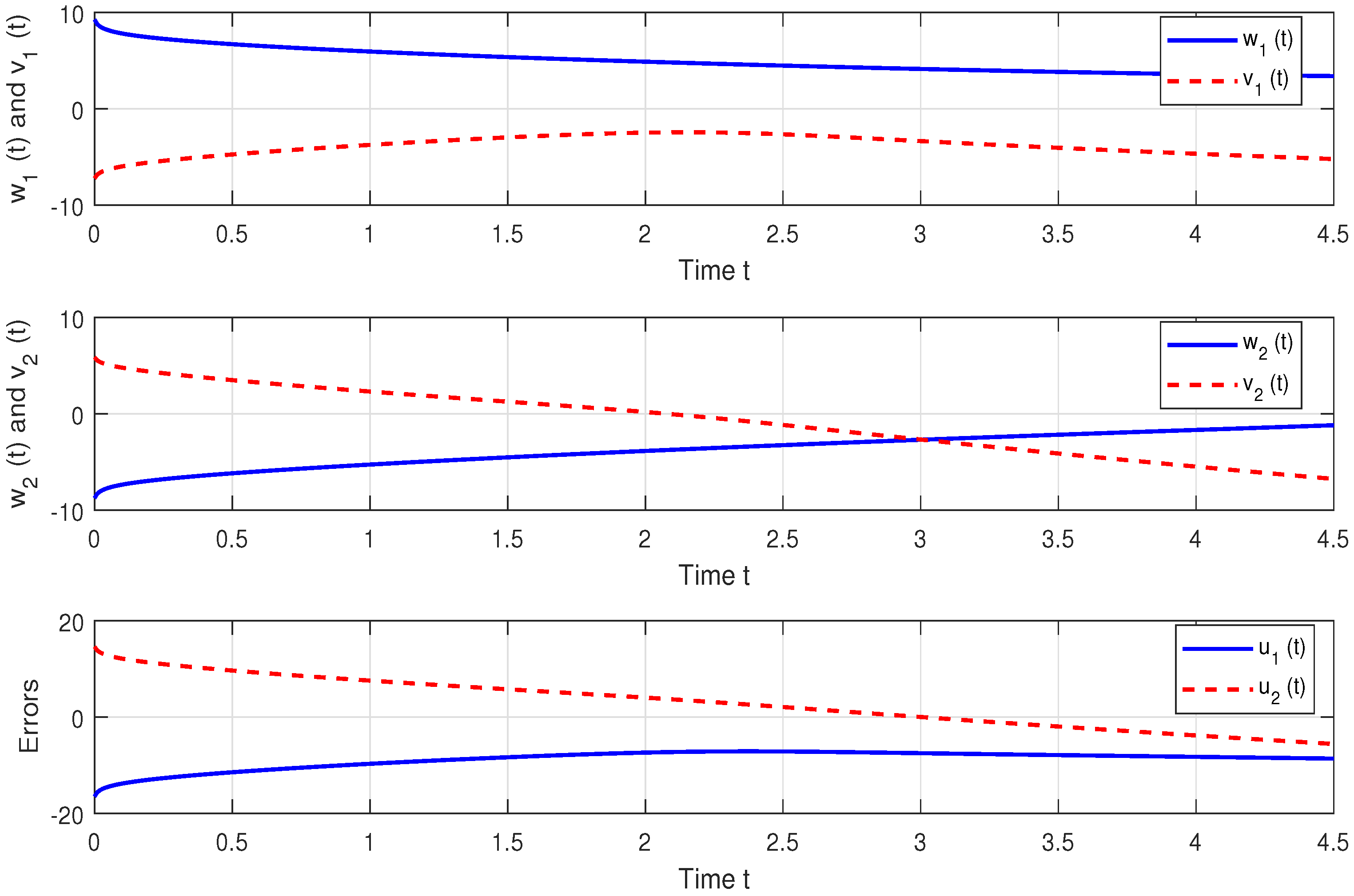
Clearly, conditions (I)–(III) are all satisfied. Therefore, based on Corollary 1, fixed-time synchronization between systems (37) and (38) can be realized under the adaptive controller (12), with the settling time estimated as T f = 0.9623 . To examine the influence of initial conditions on the synchronization performance, we randomly select initial values from the range [ 10 , 10 ] . In the absence of control, the state trajectories of systems (37) and (38) are plotted in Figure 4. The results clearly indicate that synchronization fails to emerge under this case. In contrast, Figure 5 presents the states and error trajectories of the considered systems when adaptive controller (12) is applied. The results demonstrate that fixed-time synchronization is successfully achieved under the proposed control scheme.
Example 3.
To verify the robustness of the theoretical results, we increase the system dimension, change the activation functions, and enlarge the time delay. Consider three-dimensional FOFCNNs with time delays as below:
D 0.90 w p ( t ) = γ p w p ( t ) + k = 1 3 β p k f k ( w k ( t ) ) + k = 1 3 α p k f k ( w k ( t η ( t ) ) ) + k = 1 3 ρ p k h k ( w k ( t η ( t ) ) ) + k = 1 3 ϱ p k h k ( w k ( t η ( t ) ) ) + I p , w p ( t ) = W p ( t ) , t [ η ˜ , 0 ] ,
and
D 0.90 v p ( t ) = γ p v p ( t ) + k = 1 3 β p k f k ( v k ( t ) ) + k = 1 3 α p k f k ( v k ( t η ( t ) ) ) + k = 1 3 ρ p k h k ( v k ( t η ( t ) ) ) + k = 1 3 ϱ p k h k ( v k ( t η ( t ) ) ) + I p + d p ( t ) , v p ( t ) = V p ( t ) , t [ η ˜ , 0 ] ,
where ( β p k ) 3 × 3 = 0.8 0.2 0.15 1.0 0.4 1.4 0.5 0.11 1.5 , ( α p k ) 3 × 3 = 0.6 0.2 0.2 1.0 0.4 1.3 0.4 0.2 1.4 , ( ρ p k ) 3 × 3 = 0.65 0.62 0.2 0.5 2 0.1 0.5 0.25 1 , ( ϱ p k ) 3 × 3 = 0.1 0.3 0.3 0.3 0.4 0.1 0.2 0.2 0.5 , γ 1 = γ 2 = γ 3 = 0.5 , I 1 = 0.1 , I 2 = 0.3 , I 3 = 0.5 , and η ( t ) = 0.5 .
Set activation functions f k ( x ) = h k ( x ) = 1 1 + e x and ϕ k ( x ) = tanh ( x ) . When F k = 1 4 , H k = 1 4 and Φ k = 1 , Assumption 1 holds. Let control parameters ϕ 1 = 0.5 , ϕ 2 = ϕ 3 = 0 , a 1 = 1.7 , a 2 = 1.5 , a 3 = 1.9 , b 1 = 1 , b 2 = 2 , b 3 = 3 , m = 0.2 , n = 1.8 , and c 0 = 0.4 . By calculation, we have
γ 1 + c 0 k = 1 3 | β k 1 | F 1 = 0.3250 > 0 , γ 2 + c 0 k = 1 3 | β k 2 | F 2 = 0.7225 > 0 , γ 3 + c 0 k = 1 3 | β k 3 | F 3 = 0.1375 > 0 , a 1 k = 1 3 ( | α k 1 | F 1 + | ρ k 1 | H 1 + | ϱ k 1 | H 1 ) = 0.6375 > 0 , a 2 k = 1 3 ( | α k 2 | F 2 + | ρ k 2 | H 2 + | ϱ k 2 | H 2 ) = 0.3575 > 0 , a 3 k = 1 3 ( | α k 3 | F 3 + | ρ k 3 | H 3 + | ϱ k 3 | H 3 ) = 0.6250 > 0 .
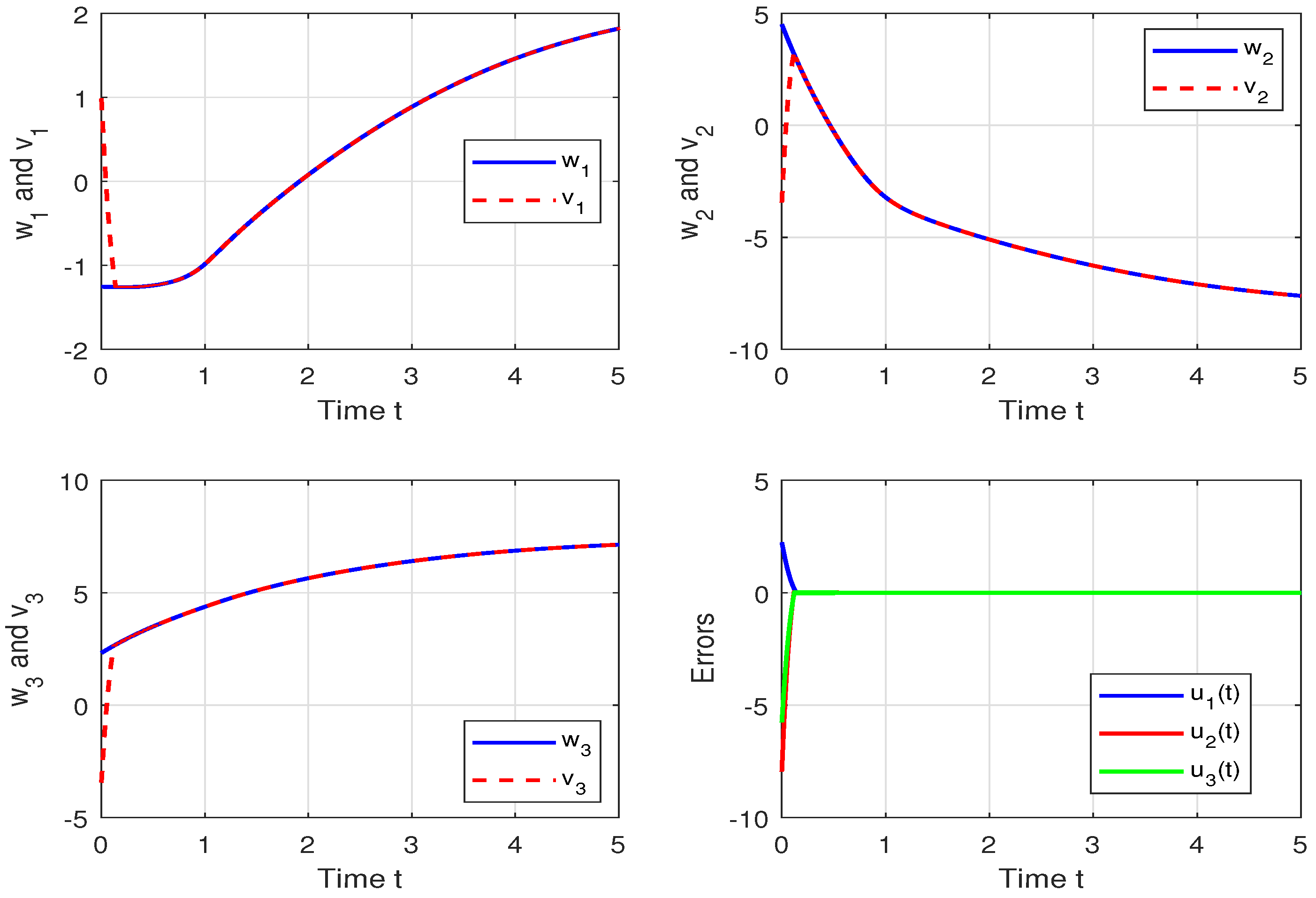
It is evident that conditions (I)–(III) hold. Consequently, by virtue of Corollary 1, fixed-time synchronization between systems (40) and (41) can be attained using the adaptive controller (12), with an estimated settling time of T f = 1.2537 . We randomly choose initial values within the interval [ 5 , 5 ] . Figure 6 illustrates the state trajectories and synchronization errors of the systems when controlled by (12). These results confirm that fixed-time synchronization is successfully realized via the proposed control strategy.
To examine how control parameters influence the settling time, we begin by varying b 1 in steps of 0.2 while holding the other parameters constant. Table 2 shows that increasing b 1 can reduce the settling time. Applying the same step size to b 2 and b 3 yields the observations in Table 3 and Table 4. Specifically, larger values of b 2 lead to shorter settling times, whereas increasing b 3 prolongs the settling time. Next, the parameter m is raised from 0.30 to 0.55 in increments of 0.05. Table 5 provides the comparisons of synchronization instant and predicted time T f for different m. Finally, Table 6 shows the comparisons of synchronization instant and predicted time T f for different n. The actual synchronization instant is less than the conservative settling time. Together, these results provide guidance for selecting control parameters to obtain a short settling time and synchronization instant.

5. Conclusions

This paper investigates fixed-time synchronization for FOFCNNs with time-varying delays and complex information interactions. A key contribution of this work is the development of a novel adaptive multi-module controller that uniquely integrates accelerated convergence, delay compensation, and negative feedback mechanisms. This controller prevents the control function from becoming unbounded, thereby enhancing its practical applicability. By leveraging fractional calculus and rigorous inequality techniques, we establish sufficient criteria to guarantee the fixed-time synchronization between master and slave systems. Numerical examples validate the validity of the theoretical results presented in this paper.
The potential applications of the proposed fixed-time adaptive control scheme include communication networks, robot collaboration, and distributed control systems. Future research will extend this work by investigating more complex network topologies, such as high-order neural network models, which can capture richer dynamic behaviors and synaptic interactions. Additionally, to improve communication efficiency and reduce the controller update frequency, event-triggered control strategies will be incorporated into synchronization control for fractional-order systems. This approach aims to develop more resource-efficient synchronization protocols while rigorously excluding Zeno behavior, thereby advancing the practical applicability of the theoretical findings.

Author Contributions

Conceptualization, F.M., L.J. and K.S.; Methodology, H.F., K.S. and L.J.; Software, A.Z. and H.F.; Writing—original draft, H.F., K.S. and A.Z.; Writing—review and editing, H.F., F.M. and L.J. All authors have read and agreed to the published version of the manuscript.

Funding

The first author was partially supported by Open Research Fund of Fujian Key Laboratory of Financial Information Processing, Putian University (JXJS202505). The second author was partially supported by the Sichuan Science and Technology Program (25NSFSC2581, 2024NSFSC2056).

Data Availability Statement

Data is contained within the article.

Conflicts of Interest

The authors declare no conflicts of interest.

References

  1. Xiao, J.Y.; Li, Y.T. Deep analysis on MLSY for fractional-order higher-dimension-valued neural networks under the action of free quadratic coefficients. Expert Syst. Appl. 2026, 298, 129586. [Google Scholar] [CrossRef]
  2. Xiao, J.Y.; Wen, S.P.; Guo, X.; Li, Y.T. New amplified inequalities and their application on mittag-leffler synchronization problem of fractional-order fuzzy bidirectional associative memory neural networks in octonion-valued field by using a genetic algorithm. Inf. Sci. 2026, 727, 122747. [Google Scholar] [CrossRef]
  3. Zhao, C.; Chen, Y.P.; Shi, K.B.; Zhang, L.; Nie, Y.J. A relaxed Lyapunov function lemma and genetic algorithm applying to time-delay systems. Chaos Solitons Fractals 2025, 199, 116687. [Google Scholar] [CrossRef]
  4. Luo, R.F.; Ren, J.J.; Shi, K.B. Stability analysis of delayed T-S fuzzy power system via a cubic function negative determination lemma. Nonlinear Dyn. 2025, 113, 5439–5456. [Google Scholar] [CrossRef]
  5. Han, T.Y.; Liang, Y.; Fan, W.J. Dynamics and soliton solutions of the perturbed Schrodinger-Hirota equation with cubic-quintic-septic nonlinearity in dispersive media. AIMS Math. 2025, 10, 754–776. [Google Scholar] [CrossRef]
  6. Cai, J.Y.; Yi, C.B.; Luo, X.; Xiao, C.R. Output feedback tracking consensus of switched stochastic uncertain multiagent systems via event-triggered control. IEEE Syst. J. 2025, 19, 130–141. [Google Scholar] [CrossRef]
  7. Ruan, X.L.; Xu, F.; Xiang, Y.; Pan, X. Dynamic event-triggered consensus control of multiagent systems under DoS attacks with intermittent communication. Asian J. Control 2025, early access. [Google Scholar] [CrossRef]
  8. Ruan, X.L.; Du, Z.W.; Tang, Z.; Feng, J.W.; Wang, J.Y. Bipartite consensus for multi-agent systems under distributed sequential scaling attacks: An edge-based event-triggered scheme. Appl. Math. Comput. 2026, 523, 108678. [Google Scholar] [CrossRef]
  9. Fan, H.G.; Chen, X.J.; Shi, K.B.; Wen, H. Distributed delayed impulsive control for μ-synchronization of multi-link structure networks with bounded uncertainties and time-varying delays of unmeasured bounds: A novel Halanay impulsive inequality approach. Chaos Solitons Fractals 2024, 186, 115226. [Google Scholar] [CrossRef]
  10. Ding, D.; Tang, Z.; Park, J.H.; Wang, Y.; Ji, Z.C. Dynamic self-triggered impulsive synchronization of complex networks with mismatched parameters and distributed delay. IEEE Trans. Cybern. 2023, 53, 887–899. [Google Scholar] [CrossRef] [PubMed]
  11. Wang, H.; Yang, X.S.; Xiang, Z.R.; Tang, R.Q.; Ning, Q. Synchronization of switched neural networks via attacked mode-dependent event-triggered control and its application in image encryption. IEEE Trans. Cybern. 2023, 53, 5994–6003. [Google Scholar] [CrossRef]
  12. Zhou, A.R.; Fan, H.G. Novel adaptive synchronization criteria of fractional-order fuzzy neural networks with parameter uncertainties and information interactions. AIMS Math. 2026, 11, 9166–9190. [Google Scholar] [CrossRef]
  13. Hua, W.T.; Wang, Y.T.; Liu, C.Y. New method for global exponential synchronization of multi-link memristive neural networks with three kinds of time-varying delays. Appl. Math. Comput. 2024, 471, 128593. [Google Scholar] [CrossRef]
  14. Ding, D.; Tang, Z.; Wen, C.B.; Ji, Z.C. Bipartite synchronization for coupled memristive neural networks: Memory-based dynamic updating law. Knowl.-Based Syst. 2024, 299, 112102. [Google Scholar] [CrossRef]
  15. Li, X.F.; Zhang, W.B.; Fang, J.A.; Li, H.Y. Finite-time synchronization of memristive neural networks with discontinuous activation functions and mixed time-varying delays. Neurocomputing 2019, 340, 99–109. [Google Scholar] [CrossRef]
  16. Ding, D.; Tang, Z.; Park, J.H.; Ji, Z.C. Quasi-bipartite synchronization of derivatively coupled complex dynamic networks: Memory-based self-triggered approach. IEEE Trans. Syst. Man Cybern. Syst. 2024, 54, 1611–1621. [Google Scholar] [CrossRef]
  17. Liu, J.; Shu, L.; Chen, Q.; Zhong, S.M. Fixed-time synchronization criteria of fuzzy inertial neural networks via Lyapunov functions with indefinite derivatives and its application to image encryption. Fuzzy Sets Syst. 2023, 459, 22–42. [Google Scholar] [CrossRef]
  18. Wang, M.X.; Zhu, S.; Luo, W.W.; Zhang, Z. Finite-/fixed-time synchronization of coupled memristive neural networks with actuator nonlinearity and applications in secure communication. IEEE Trans. Circuits Syst. I Regul. Pap. 2025, 72, 4334–4345. [Google Scholar] [CrossRef]
  19. Ding, K.; Zhu, Q.X. A note on sampled-data synchronization of memristor networks subject to actuator failures and two different activations. IEEE Trans. Circuits Syst. II Express Briefs 2021, 68, 2097–2101. [Google Scholar] [CrossRef]
  20. Kong, F.C.; Zhu, Q.X.; Huang, T.W. New fixed-time stability lemmas and applications to the discontinuous fuzzy inertial neural networks. IEEE Trans. Fuzzy Syst. 2021, 29, 3711–3722. [Google Scholar] [CrossRef]
  21. Hu, J.H.; Zhang, G.D.; Li, Y.; Wang, T.Q. Fixed-time stabilization and synchronization of fuzzy inertial neural networks via aperiodically semi-intermittent control. Neurocomputing 2025, 631, 129720. [Google Scholar] [CrossRef]
  22. Sharma, A.; Ghosh, S.; Ali, J.; Baluni, S.; Yadav, V.K. Fixed-time synchronization of time-varying delayed BAM neural networks in quaternion variable. Phys. Scr. 2025, 100, 075244. [Google Scholar] [CrossRef]
  23. Abdurahman, A.; Tohti, R.; Li, C.C. New results on fixed-time synchronization of impulsive neural networks via optimized fixed-time stability. J. Appl. Math. Comput. 2024, 70, 2809–2826. [Google Scholar] [CrossRef]
  24. Zhang, J.S.; Ma, X.L.; Li, Y.K.; Gan, Q.T.; Wang, C.L. Synchronization in fixed/preassigned-time of delayed fully quaternion-valued memristive neural networks via non-separation method. Commun. Nonlinear Sci. Numer. Simul. 2022, 113, 106581. [Google Scholar] [CrossRef]
  25. Kong, F.C.; Zhu, Q.X.; Sakthivel, R.; Mohammadzadeh, A. Fixed-time synchronization analysis for discontinuous fuzzy inertial neural networks with parameter uncertainties. Neurocomputing 2021, 422, 295–313. [Google Scholar] [CrossRef]
  26. Fan, H.G.; Wen, H.; Shi, K.B.; Xiao, J.Y. New fixed-time synchronization criteria for fractional-order fuzzy cellular neural networks with bounded uncertainties and transmission delays via multi-module control schemes. Fractal Fract. 2026, 10, 91. [Google Scholar] [CrossRef]
  27. Podlubny, I. Fractional Differential Equations; Academic Press: New York, NY, USA, 1999. [Google Scholar]
  28. Chen, B.S.; Chen, J.J. Global asymptotical ω-periodicity of a fractional-order non-autonomous neural networks. Neural Netw. 2015, 68, 78–88. [Google Scholar] [CrossRef] [PubMed]
  29. Mei, X.; Ding, Y.C. Fixed-time synchronization of fractional-order Hopfield neural networks. Int. J. Control. Autom. Syst. 2022, 20, 3584–3591. [Google Scholar] [CrossRef]
  30. Cheng, Y.L.; Yang, W.Y.; Xu, W.B.; Zhong, S.M. Impulsive effects on delayed fractional-order neural networks: Sliding mode control-based fixed-time synchronization analysis. Nonlinear Dyn. 2025, 113, 16571–16592. [Google Scholar] [CrossRef]
  31. Ding, Z.X.; Wang, J.H.; Li, S.; Yang, L.; Wang, L.H. Fixed-time synchronization of fractional-order complex-valued delayed neural networks with discontinuous activation functions. Neural Comput. Appl. 2024, 36, 15947–15959. [Google Scholar] [CrossRef]
  32. Du, F.F.; Lu, J.G. Finite-time synchronization of fractional-order delayed fuzzy cellular neural networks with parameter uncertainties. IEEE Trans. Fuzzy Syst. 2023, 31, 1769–1779. [Google Scholar] [CrossRef]
  33. Du, F.F.; Lu, J.G.; Zhang, Q.H. Practical finite-time synchronization of delayed fuzzy cellular neural networks with fractional-order. Inf. Sci. 2024, 667, 120457. [Google Scholar] [CrossRef]
  34. Kumar, P.; Assali, E.A. Fixed-time synchronization of fractional-order Hopfield neural networks with proportional delays. Math. Comput. Simul. 2026, 240, 367–380. [Google Scholar] [CrossRef]
  35. Li, J.H.; Yin, Z.P.; Li, Q.; Liu, Q.; Din, A. Global exponential lag projective synchronization of fractional-order fuzzy neural networks with time delays. J. Appl. Math. Comput. 2026, 72, 79. [Google Scholar] [CrossRef]
  36. Du, F.F.; Lu, J.G. Adaptive finite-time synchronization of fractional-order delayed fuzzy cellular neural networks. Fuzzy Sets Syst. 2023, 466, 108480. [Google Scholar] [CrossRef]
  37. Fan, H.G.; Shi, K.B.; Guo, Z.Z.; Zhou, A.R.; Cai, J.Y. Finite-time synchronization and Mittag-Leffler synchronization for uncertain fractional-order delayed cellular neural networks with fuzzy operators via nonlinear adaptive control. Fractal Fract. 2025, 9, 634. [Google Scholar] [CrossRef]
  38. Tan, X.W.; Wang, Y.; Li, T.Z.; Wang, Q.K. Novel synchronization analysis of fractional-order nonautonomous neural networks with mixed delays. Discret. Dyn. Nat. Soc. 2026, 2026, 8827095. [Google Scholar] [CrossRef]
  39. Li, H.N.; Li, H.L.; Huang, T.W.; Liu, X.Z.; Cao, J.D. Quasi-synchronization of Caputo-Hadamard fractional-order memristive neural networks with time-varying delays. Neural Netw. 2025, 192, 107900. [Google Scholar] [CrossRef]
  40. Liu, Y.H.; Sun, Y.G. Finite-time adaptive synchronization and fixed-time synchronization of fractional-order memristive cellular neural networks with time-varying delays. Mathematics 2024, 12, 1108. [Google Scholar] [CrossRef]
  41. Ma, W.Y.; Li, C.P.; Wu, Y.J.; Wu, Y.Q. Synchronization of fractional fuzzy cellular neural networks with interactions. Chaos 2017, 27, 103106. [Google Scholar] [CrossRef]
  42. Yang, D.S.; Wang, H.; Ren, G.J.; Yu, Y.G.; Zhang, X.L. Synchronization of short memory fractional coupled neural networks with higher-order interactions via novel intermittent control. Appl. Math. Comput. 2025, 497, 129363. [Google Scholar] [CrossRef]
  43. Yang, D.S.; Wang, H.; Ren, G.J.; Yu, Y.G.; Zhang, X.L. Event-triggered control for projective synchronization fractional-order switched coupled neural networks with higher-order interactions. Neurocomputing 2025, 623, 129407. [Google Scholar] [CrossRef]
  44. Liu, J.; Deng, W.J.; Sun, S.Q.; Shi, K.B. Novel fixed-time synchronization results of fractional-order fuzzy cellular neural networks with delays and interactions. AIMS Math. 2024, 9, 13245–13264. [Google Scholar] [CrossRef]
  45. Wang, W.P.; Jia, X.; Wang, Z.; Luo, X.; Kurths, J.; Yuan, M.M. Fixed-time synchronization of fractional order memristive MAM neural networks by sliding mode control. Neurocomputing 2020, 401, 364–376. [Google Scholar] [CrossRef]
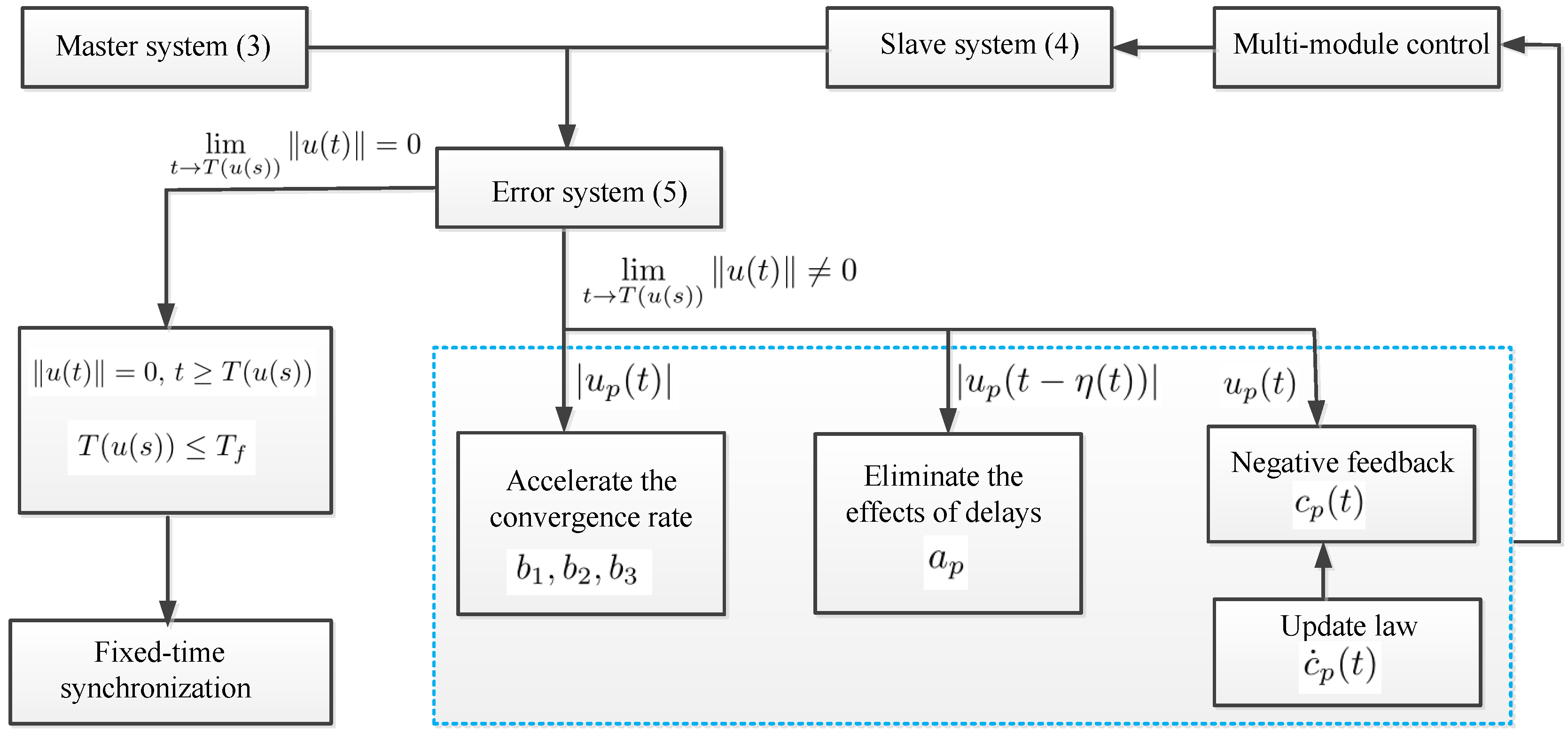
Figure 1. The adaptive multi-module control flowchart for master–slave systems (3) and (4). The controller integrates three functional modules to accelerate the convergence rate, eliminate delay effects, and introduce negative feedback.
Fractalfract 10 00253 g001
Figure 2. Evolution trajectories of systems (34) and (35) without external control.
Fractalfract 10 00253 g002
Figure 3. Evolution trajectories of systems (34) and (35) under adaptive controller (12).
Fractalfract 10 00253 g003
Figure 4. Evolution trajectories of systems (37) and (38) without external control.
Fractalfract 10 00253 g004
Figure 5. Evolution trajectories of systems (37) and (38) under adaptive controller (12).
Fractalfract 10 00253 g005
Figure 6. Evolution trajectories of systems (40) and (41) under controller (12).
Fractalfract 10 00253 g006
Table 1. Fundamental comparative analysis with existing synchronization works.
Catalogues [26] [36] [40] [41]Current Article
Time-varying delays×××
Information interactions×××
Settling time independent starting states××
Controllers with adaptive techniques××
Table 2. The sensitive impact of parameter b 1 for the settling time T f .
Parameter b 1 1.21.41.61.82.02.2
Settling time T f 1.22391.19681.17211.14951.12871.1094
Table 3. The sensitive impact of parameter b 2 for the settling time T f .
Parameter b 2 1.61.82.02.22.42.6
Settling time T f 1.28611.26951.25371.23871.22431.2106
Table 4. The sensitive impact of parameter b 3 for the settling time T f .
Parameter b 3 −3.2−3.4−3.6−3.8−4.0−4.2
Settling time T f 1.19381.13941.08971.04421.00230.9637
Table 5. Comparisons of synchronization instant and predicted time T f for different power m.
Parameter m0.300.350.400.450.500.55
Synchronization instant0.12310.12450.12640.12830.13010.1319
Settling time T f 1.34291.39791.46201.53771.62871.7398
Table 6. Comparisons of synchronization instant and predicted time T f for different power n.
Parameter n1.92.02.12.22.32.4
Synchronization instant0.13560.13780.14160.14320.14540.1469
Settling time T f 1.19581.14901.11031.07761.04951.0251
Disclaimer/Publisher’s Note: The statements, opinions and data contained in all publications are solely those of the individual author(s) and contributor(s) and not of MDPI and/or the editor(s). MDPI and/or the editor(s) disclaim responsibility for any injury to people or property resulting from any ideas, methods, instructions or products referred to in the content.