
Article

Dynamical Analysis and Soliton Solutions of the Truncated M-Fractional FitzHugh–Nagumo Equation
by
Beenish
1 and
Abdulaziz Khalid Alsharidi
2,*
1
Department of Mathematics, Quaid-i-Azam University, Islamabad 45320, Pakistan
2
Department of Mathematics and Statistics, College of Science, King Faisal University, Al Ahsa 31982, Saudi Arabia
*
Author to whom correspondence should be addressed.
Fractal Fract. 2026, 10(4), 213; https://doi.org/10.3390/fractalfract10040213
Submission received: 2 March 2026 / Revised: 17 March 2026 / Accepted: 24 March 2026 / Published: 25 March 2026

Abstract

In this paper, we investigate the (1 + 1)-dimensional nonlinear truncated M-fractional FitzHugh–Nagumo model. The main objective is to analyze the dynamical behavior and obtain exact solutions for the model. First, a fractional transformation is applied to convert the governing partial differential equation into an ordinary differential equation. Subsequently, a Galilean transformation is employed to reduce the resulting equation to a dynamical system. The bifurcation structure and chaotic dynamics of the model are then examined. The presence of chaos is further confirmed through the phase portrait, basin of attraction, return map, Lyapunov exponent, permutation entropy, Poincaré map, power spectrum, attractor, fractal dimension, multistability, time analysis, and recurrence plot. In addition, the sensitivity of the system to the initial conditions is analyzed. Finally, exact solutions for the model are constructed using the unified Riccati equation expansion method. The obtained results are illustrated using two-dimensional, three-dimensional, and contour plots.

1. Introduction

This section provides the background and a review of previous research, highlights the study’s contributions, identifies gaps in the literature, and outlines the paper’s framework.

1.1. Context of the Study

The behavior of complex physical systems with interacting elements is represented by nonlinear partial differential equations (PDEs), which are difficult to analyze because of their nonlinearity. Numerous disciplines, including physics, engineering, biology, and finance, use these equations [1,2]. Various analytical and numerical techniques have been developed for this purpose. Analytical methods include the Adomian decomposition technique [3], the unified Riccati equation expansion method (UREEM) [3], the exp-function method [4], the unified Riccati equation expansion method [5], the Lie symmetry method [6], the tanh scheme [7,8], the simplified Hirota technique [9], and the new general extended direct algebraic method [10]. Ismael [11] discusses various numerical methods, including Runge–Kutta methods, multistep methods, and Euler’s method, for obtaining numerical solutions. Jhangeer et al. [12] employ the power series method to derive an analytical solution. Asif et al. [13] apply fixed point theory to study stability and economic growth through fractional differential equations. Kalies et al. [14] explain that asymptotic global dynamics can be interpreted through an order structure using a Priestley space of attractors, where the chain recurrent set provides the classical representation, and Priestley duality leads to the Hausdorff compactification of the recurrent set. Khan et al. [15] focus on the dynamical analysis of a fractional disease model.
The chaotic behavior described in this work has important applications in nonlinear physics and engineering systems, where complex and sensitive dynamics occur. It can be applied in nonlinear wave propagation [16,17], plasma physics, and soliton interactions, as well as in secure communication systems through chaos-based encryption. Moreover, it is useful in modeling stability transitions, signal processing, and neural network dynamics and in understanding irregular phenomena in biological and climate systems.

1.2. Preliminaries

Definition 1.
The truncated Mittag-Leffler function with a single parameter is given by [18]
E α i ( z ) = k = 0 i z k Γ ( α k + 1 )
for α 0 and z C , using the conventional nonfuzzy definition presented below.
Definition 2.
Assume that Ω : [ 0 , ) R and α ( 0 , 1 ) . We define the M-truncated derivative of Ω with order α as [18]
D M γ , α i Ω ( t ϕ ) = lim τ 0 0 Ω t ϕ E α i ( τ 0 ( t ϕ ) γ ) Ω ( t ϕ ) τ 0
for t > 0 and E α i , α > 0 .
Theorem 1.
Assuming that γ ( 0 , 1 ] , α > 0 , and g , h are differentiable of order γ at t ϕ > 0 , the following apply [18].
1.
D M γ , α i ( p g + q h ) ( t ϕ ) = p D M γ , α i g ( t ϕ ) + q D M γ , α i h ( t ϕ ) , p , q R .
2.
D M γ , α i ( g h ) ( t ϕ ) = g ( t ϕ ) D M γ , α i ( h ( t ϕ ) ) + h ( t ϕ ) D M γ , α i ( g ( t ϕ ) ) .
3.
D M γ , α i g h ( t ϕ ) = h ( t ϕ ) D M γ , α i ( g ( t ϕ ) ) g ( t ϕ ) D M γ , α i ( h ( t ϕ ) ) ( h ( t ϕ ) ) 2 .
4.
D M γ , α i ( C ) = 0 , C is constant.
5.
D M γ , α i f ( t ϕ ) = ( t ϕ ) 1 γ Γ ( α + 1 ) d f d t ϕ .

1.3. Analytical Investigation of the Mathematical Model

Consider the (1 + 1)-dimensional nonlinear truncated M-fractional FitzHugh–Nagumo model, which is given by [19]
D M , t ϕ γ , α Ω = D M , x ϕ 2 γ , α Ω + Ω ( 1 Ω ) ( Ω Δ ) , t ϕ > 0 , 0 < γ 1 .
The variable Ω = Ω ( x ϕ , t ϕ ) indicates the wave profile, where x ϕ and t ϕ are the spatial and temporal variables, respectively.
  • This equation combines diffusion and nonlinearity with the nonlinearity characterized by Ω ( 1 Ω ) ( Ω Δ ) .
  • Equation (3) generates the actual fractional Newell–Whitehead equation with Δ = 1 and the fractional Zeldovich equation with Δ = 0 .
  • Of note, the transmission of nerve impulses is frequently examined using this fairly common nonlinear reaction–diffusion equation.

1.4. Survey of the Literature

Huang et al. [19] studied analytical wave solutions to Equation (3) using the Sinh-Gordon equation expansion method and the e x p a function. Cevikel et al. [20] investigated analytical wave solutions for Equation (3) using the extended tanh–coth method.

1.5. Identified Research Gaps

In the literature, authors have primarily focused on soliton solutions. In this study, our main emphasis is on the dynamical behavior of the system, followed by finding analytical solutions using the unified Riccati equation expansion method. Moreover, the dynamical behavior of Equation (3), illustrated through phase portraits, has not been examined in the existing literature. Similarly, the chaos characteristics and sensitivity of Equation (3) remain unexplored.

1.6. Aim and Contributions of the Study

This study aims to achieve its objectives through the following key points. First, it examines the dynamical behavior of the unperturbed system. The analysis of the unperturbed system is carried out using bifurcation analysis, the Hamiltonian function, and sensitivity analysis. Secondly, the dynamical behavior of the perturbed system is investigated. The analysis of the perturbed system is performed through chaos analysis, where quasi-periodic and chaotic behavior dynamics are detected using various analytical tools.
  • Two-dimensional phase portrait: A 2D phase portrait is a graphical representation of a dynamical system, showing the relationship between two state variables in phase space. It helps to visualize system trajectories, equilibrium points, and the qualitative behavior of the system.
  • Basin of attraction: The set of initial conditions in a dynamical system that evolve toward a particular attractor, illustrating how different starting points lead to different long-term behaviors, including chaotic attractors.
  • Return map: A return map describes the relationship between successive values of a dynamical variable at discrete time intervals. It is used to analyze periodicity, stability, and chaotic behavior in nonlinear systems.
  • Lyapunov exponents: Lyapunov exponents measure the average rate at which nearby trajectories diverge or converge in phase space. A positive Lyapunov exponent indicates a sensitive dependence on the initial conditions and chaotic dynamics.
  • Permutation entropy: Permutation entropy is a complexity measure used to quantify the randomness and irregularity of a time series. Higher values indicate more complex or chaotic dynamics.
  • Poincaré map: A Poincaré map is a tool that reduces a continuous dynamical system to a discrete map by observing intersections with a specific section. It simplifies the analysis of periodic and chaotic motions.
  • Power spectrum: The power spectrum represents the distribution of signal energy over different frequencies. It is commonly used to distinguish periodic, quasi-periodic, and chaotic signals.
  • Attractor: An attractor is a set of states toward which a dynamical system evolves over time. It can be a fixed point, limit cycle, torus, or chaotic attractor.
  • Fractal dimension: The fractal dimension quantifies the geometric complexity of a structure or attractor. It measures how detail in a pattern changes with scale and is often noninteger for chaotic systems.
  • Multistability: Multistability refers to the coexistence of two or more stable states or attractors in a dynamical system. The final state of the system depends on its initial conditions.
  • Three-dimensional phase portrait: A 3D phase portrait visualizes the trajectories of a dynamical system in three-dimensional space, revealing complex dynamics like chaotic attractors and spatial structures.
  • Time analysis: Time analysis studies the variation in system variables with respect to time. It helps to identify periodic, quasi-periodic, or chaotic temporal behaviors of the system.
  • Recurrence plot: A recurrence plot is a graphical tool used to visualize the times at which a system revisits similar states in phase space.
Finally, we work on the soliton solution using the unified Riccati equation expansion method. We also plot the results in 3D and contour diagrams to study the effects of the wave speed and wave number.

1.7. Comparison with Existing Work

A detailed comparison with the existing literature is presented in Table 1.

1.8. Paper’s Structure

The paper is divided into five subtopics. Section 2 deals with the mathematical formulation of the model. Section 3 explains the dynamical analysis of the considered model. Section 4 outlines the procedure of the unified Riccati equation expansion method, the analytical solutions, and their physical explanations, along with illustrations. The study’s findings and recommendations are presented in Section 5.

2. Mathematical Framework of Equation (3)

We evaluate the transformation of the travelling wave as
Ω ( x ϕ , t ϕ ) = ω ( ϵ ) , ϵ = Γ ( 1 + α ) ( τ 0 x ϕ γ Θ t ϕ γ ) γ .
In this context, ω and Θ describe the properties of the travelling wave, including its shape and velocity. Meanwhile, τ 0 acts as the wave number. Using the properties of the truncated M-fractional derivative, we obtain
D M , t ϕ γ , α Ω = Θ ω , D M , x ϕ 2 γ , α Ω = τ 0 2 ω .
By substituting the expression from Equation (5) into Equation (3), we derive the resulting equation
Θ ω + τ 0 2 ω + ω ( 1 ω ) ( ω Δ ) = 0 .
By balancing ω and ω 3 utilizing the homogeneous balancing methodology, we acquire
ω Q + 2 , ω 3 3 Q ,
3 Q = Q + 2 Q = 1 .

3. Dynamical Analysis

This section provides a detailed unperturbed and perturbed system analysis.

3.1. Unperturbed System Analysis

In this part, we present an unperturbed system analysis using bifurcation analysis, Hamiltonian dynamics, and sensitivity analysis for the model under consideration.

3.1.1. Bifurcation Analysis

The first-order differential equations for the planar dynamical model, derived from Equation (6), are given by
d ω d ϵ = G , d G d ϵ = ω 3 τ 0 2 + ω Δ τ 0 2 ( 1 + Δ ) ω 2 τ 0 2 G Θ τ 0 2 , τ 0 0 .
The Jacobian of system (7) is
Q ( ω , G ) = 0     1 3 ω 2 τ 0 2 + Δ τ 0 2 2 ( 1 + Δ ) ω τ 0 2 0
Q ( ω , G ) = 1 3 ω 2 τ 0 2 + Δ τ 0 2 2 ( 1 + Δ ) ω τ 0 2 , τ 0 0 Q ( ω , G ) = 2 ( 1 + Δ ) ω τ 0 2 3 ω 2 τ 0 2 Δ τ 0 2 , τ 0 0
The trace of system (7) is
A ( ω , G ) = 0
Proposition 1.
The dynamical system exhibits different fixed points ( ω 0 , G 0 ) , and their behavior depends on the Jacobian determinant Q and trace A according to the following conditions.
  • If Q ( ω 0 , G 0 ) > 0 and A ( ω 0 , G 0 ) = 0 , the equilibrium point behaves as a center.
  • If Q ( ω 0 , G 0 ) < 0 and A ( ω 0 , G 0 ) = 0 , the equilibrium point is classified as a saddle point.
  • If Q ( ω 0 , G 0 ) > 0 and ( A ( ω 0 , G 0 ) ) 2 4 Q ( ω 0 , G 0 ) > 0 , the equilibrium point corresponds to a cusp.
Proposition 2.
The following notation is used in this study to represent various types of solution paths:
1.
PSP: Periodic solution path
2.
HSP: Homoclinic solution path
3.
SNPSP: Super nonlinear periodic solution path
4.
HCSP: Heteroclinic solution path
5.
SNHSP: Super nonlinear homoclinic solution path

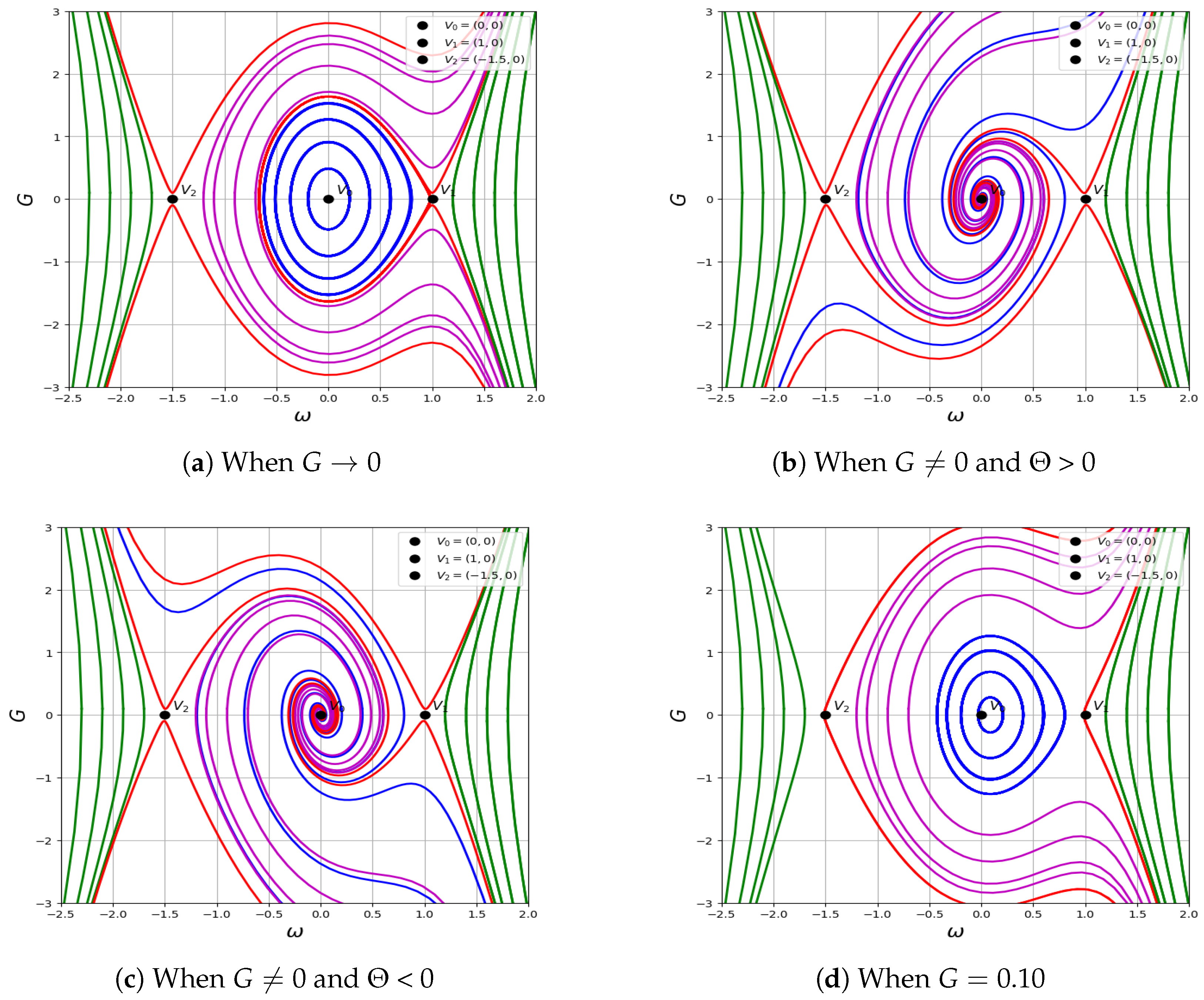
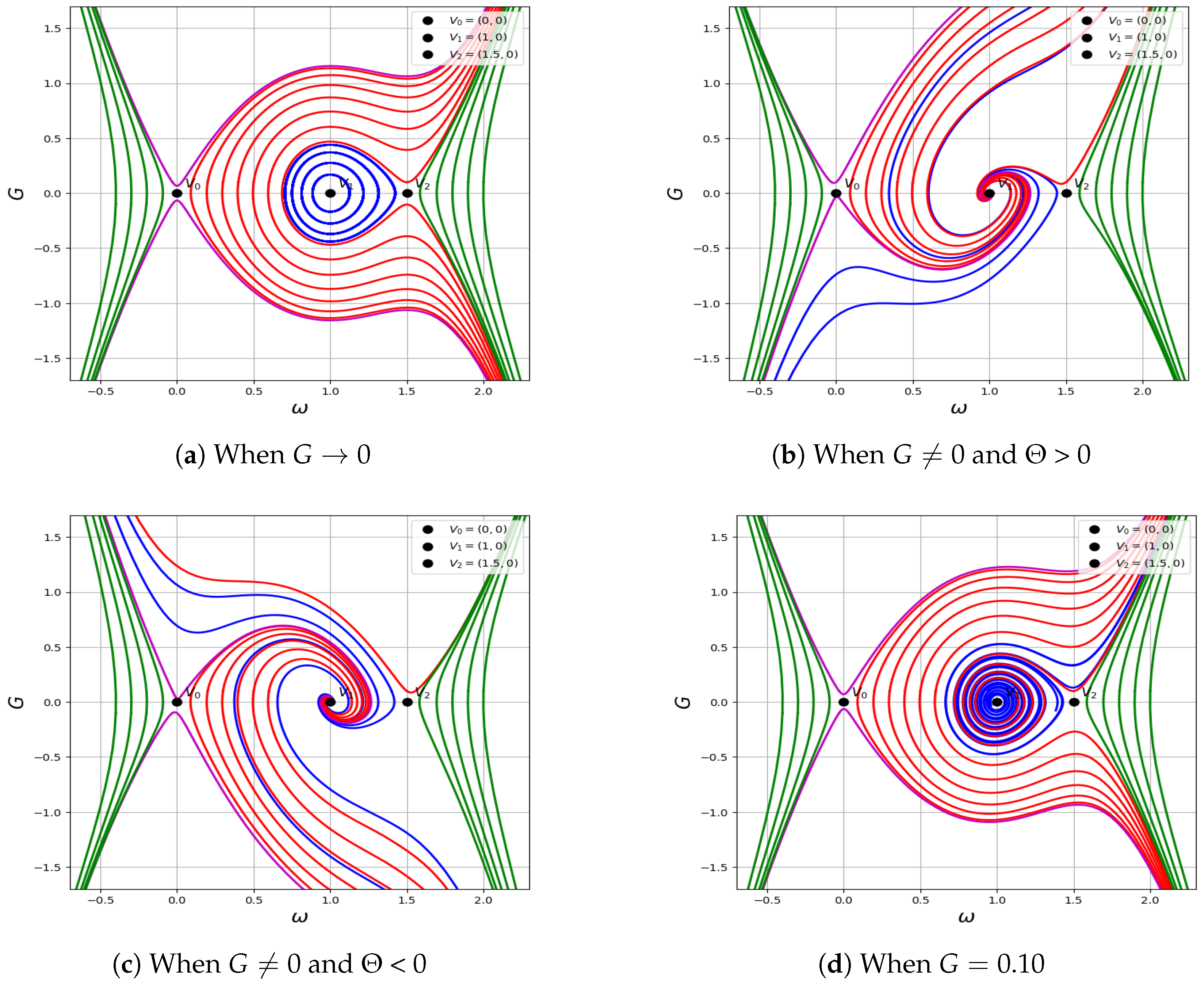
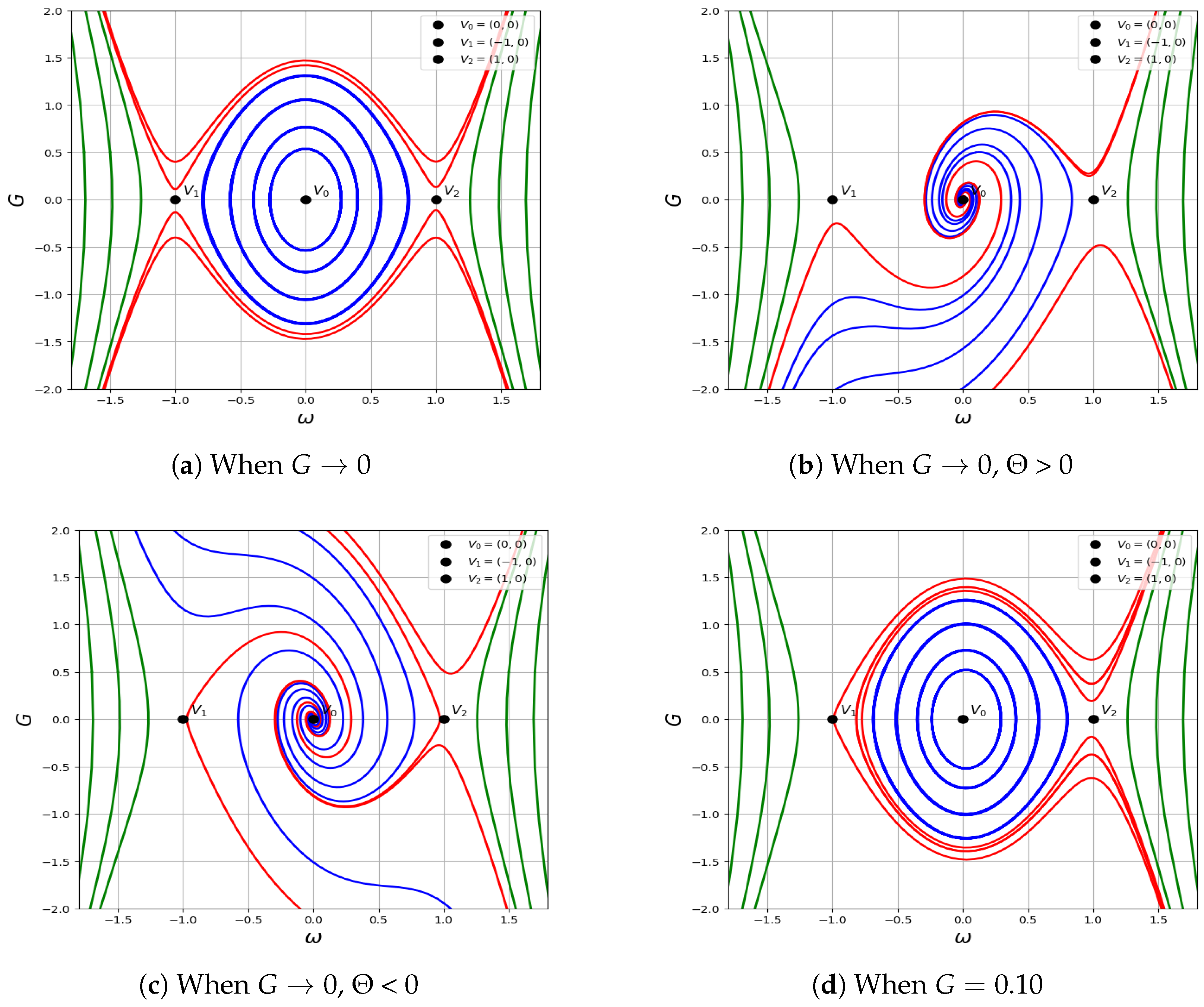
The equilibrium points and trajectory analysis are classified as summarized in Table 2 and Table 3.
Table 2. Bifurcation analysis of system (7).
FigureEquilibrium PointsParametersBehavior
Figure 1a–d V 0 = ( 0 , 0 ) , V 1 = ( 1 , 0 ) , V 2 = ( 1.5 , 0 ) Δ = 1.5 , τ 0 = 0.5 Q ( V 2 ) > 0 , Q ( V 0 ) < 0 , Q ( V 1 ) < 0
Figure 2a–d V 0 = ( 0 , 0 ) , V 1 = ( 1 , 0 ) , V 2 = ( 1.5 , 0 ) Δ = 1.5 , τ 0 = 0.5 Q ( V 0 ) > 0 , Q ( V 2 ) < 0 , Q ( V 1 ) < 0
Figure 3a–d V 0 = ( 0 , 0 ) , V 1 = ( 1 , 0 ) , V 2 = ( 1 , 0 ) Δ = 1 , τ 0 = 0.5 Q ( V 0 ) > 0 , Q ( V 2 ) < 0 , Q ( V 1 ) < 0
Table 3. Trajectory analysis of system (7).
FigureBlue TrajectoryRed TrajectoryPink Trajectory
Figure 1aPSP--
Figure 1b---
Figure 1c---
Figure 1dPSP--
Figure 2aPSPHCSP-
Figure 2b---
Figure 2c---
Figure 2dPSP--
Figure 3aPSPHCSP-
Figure 3b---
Figure 3c---
Figure 3dPSP--
Figure 1. Phase plane analysis of system (7) for Δ = 1.5 and τ 0 = 0.5 .
Fractalfract 10 00213 g001
Figure 2. Phase plane analysis of system (7) for Δ = 1.5 and τ 0 = 0.5 .
Fractalfract 10 00213 g002
Figure 3. Phase plane analysis of system (7) for Δ = 1 and τ 0 = 0.5 .
Fractalfract 10 00213 g003

3.1.2. Hamiltonian Function

The Hamiltonian conditions are expressed as follows:
P G = d ω d ϵ , d G d ϵ = P ω .
Using Equation (10) together with the first equation of system (7), the Hamiltonian H ( ω , G ) is obtained in the following form:
P G = G ·
Integrating Equation (11) with respect to G yields
P ( ω , G ) = G 2 2 + Z ( ω ) .
In this expression, Z ( ω ) represents an arbitrary function of ω that must be determined. The second equation of system (7) can be written as
d G d ϵ = ω 3 τ 0 2 + ω Δ τ 0 2 ( 1 + Δ ) ω 2 τ 0 2 G Θ τ 0 2 , τ 0 0 .
Taking the partial derivative of Equation (12) with respect to ω , we obtain
P ω = Z ( ω ) ·
By substituting Equations (13) and (14) into the second condition of Equation (10), we arrive at
Z ( ω ) = ω 3 τ 0 2 + ω Δ τ 0 2 ( 1 + Δ ) ω 2 τ 0 2 G Θ τ 0 2 , τ 0 0 .
Integrating the resulting equation with respect to ω , the potential energy is obtained as
Z ( ω ) = ω 4 4 τ 0 2 ω 2 Δ 2 τ 0 2 + ( 1 + Δ ) ω 3 3 τ 0 2 + G Θ ω τ 0 2 , τ 0 0 .
Putting the value of Z ( ω ) into Equation (12), the Hamiltonian of the system is obtained as
P ( ω , G ) = G 2 2 ω 4 4 τ 0 2 ω 2 Δ 2 τ 0 2 + ( 1 + Δ ) ω 3 3 τ 0 2 + G Θ ω τ 0 2 , τ 0 0 .

3.1.3. Sensitivity Analysis

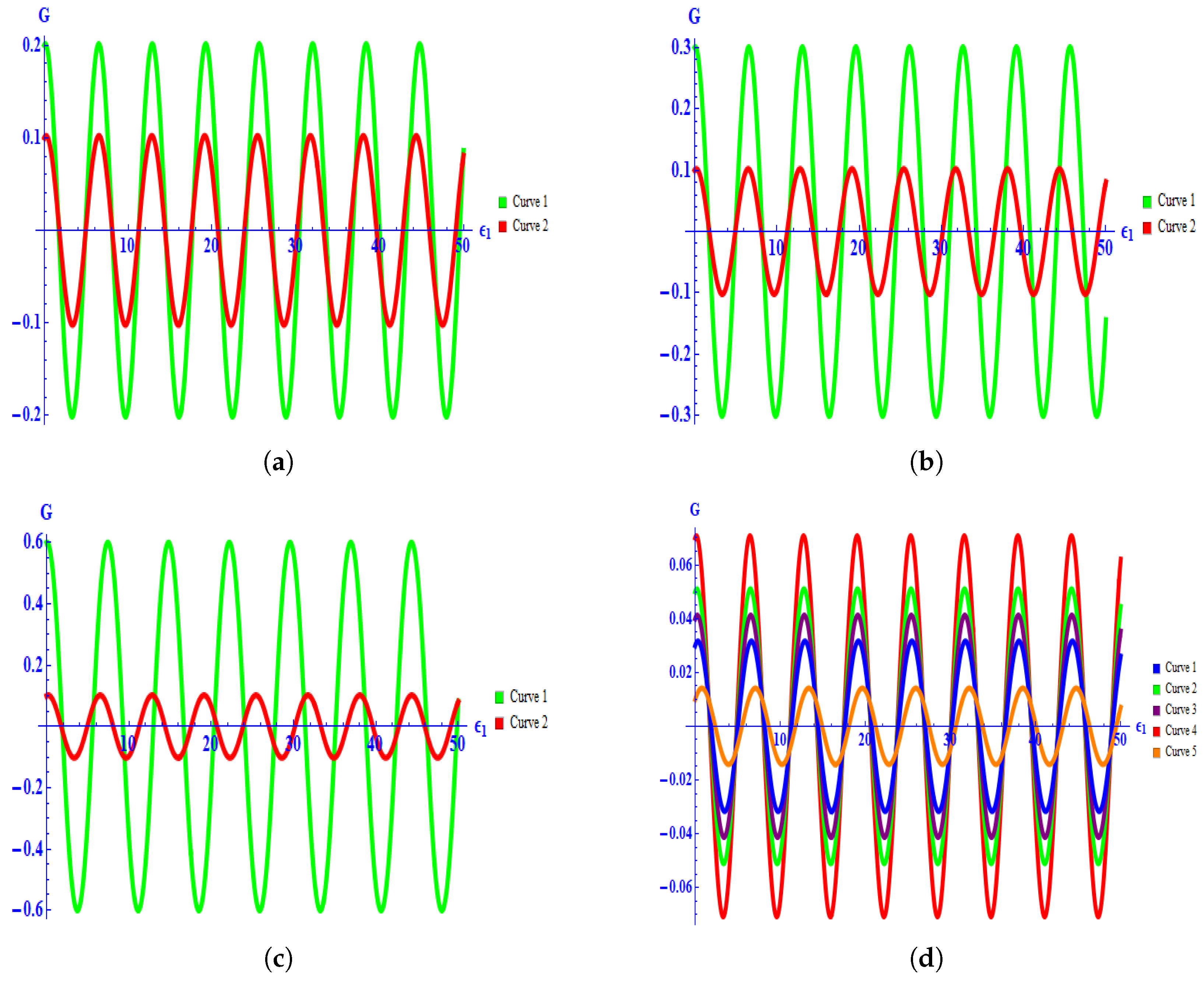
In this subsection, the main goal is to assess the sensitivity [21] of the system described by a nonlinear system (7). To do this, we consider three different initial conditions. We plot the following points: ( ω , G ) = (0.20, 0.02) in the green line and ( ω , G ) = (0.10, 0.02) in the red line in Figure 4a. Figure 4b displays two solutions. It is noted that the green line corresponds to the point ( ω , G ) = (0.30, 0.02) and the dashed red line to ( ω , G ) = (0.10, 0.02). Figure 4c presents two solutions. We plot ( ω , G ) = (0.60, 0.02) in green and ( ω , G ) = (0.10, 0.02) in red. In Figure 4d, we compare the following five different initial values: ( 0.70 ,   0.02 ) , ( 0.50 ,   0.02 ) , ( 0.40 ,   0.02 ) , ( 0.30 ,   0.02 ) , and ( 0.10 , 0.02 ) . It can be concluded that the model is sensitive to the initial values and that small changes in the initial values lead to significantly different end results.

3.2. Perturbed System Analysis

In this part, we present the perturbed system analysis using chaos analysis for the model under consideration. To investigate the chaotic behavior induced by periodic disturbances, we introduce a disturbance factor in the form α c o s ( β ϵ ) in Equation (7), where α denotes the amplitude and β denotes the frequency. Subsequently, we can utilize the following system of equations to represent the planar dynamical system [22,23]:
d ω d ϵ = G , d G d ϵ = ω 3 τ 0 2 + ω Δ τ 0 2 ( 1 + Δ ) ω 2 τ 0 2 + α c o s ( β ϵ ) , τ 0 0 .
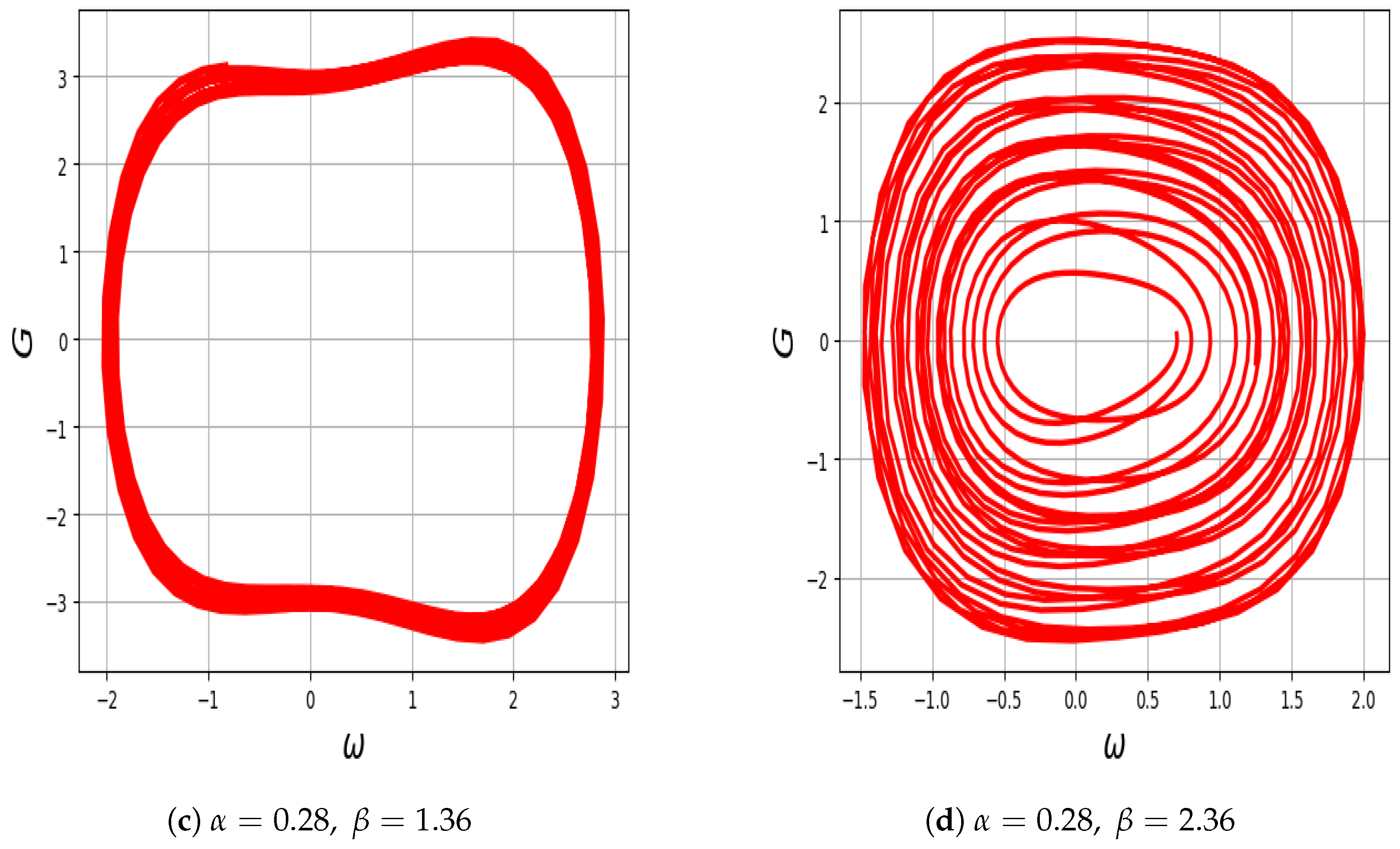
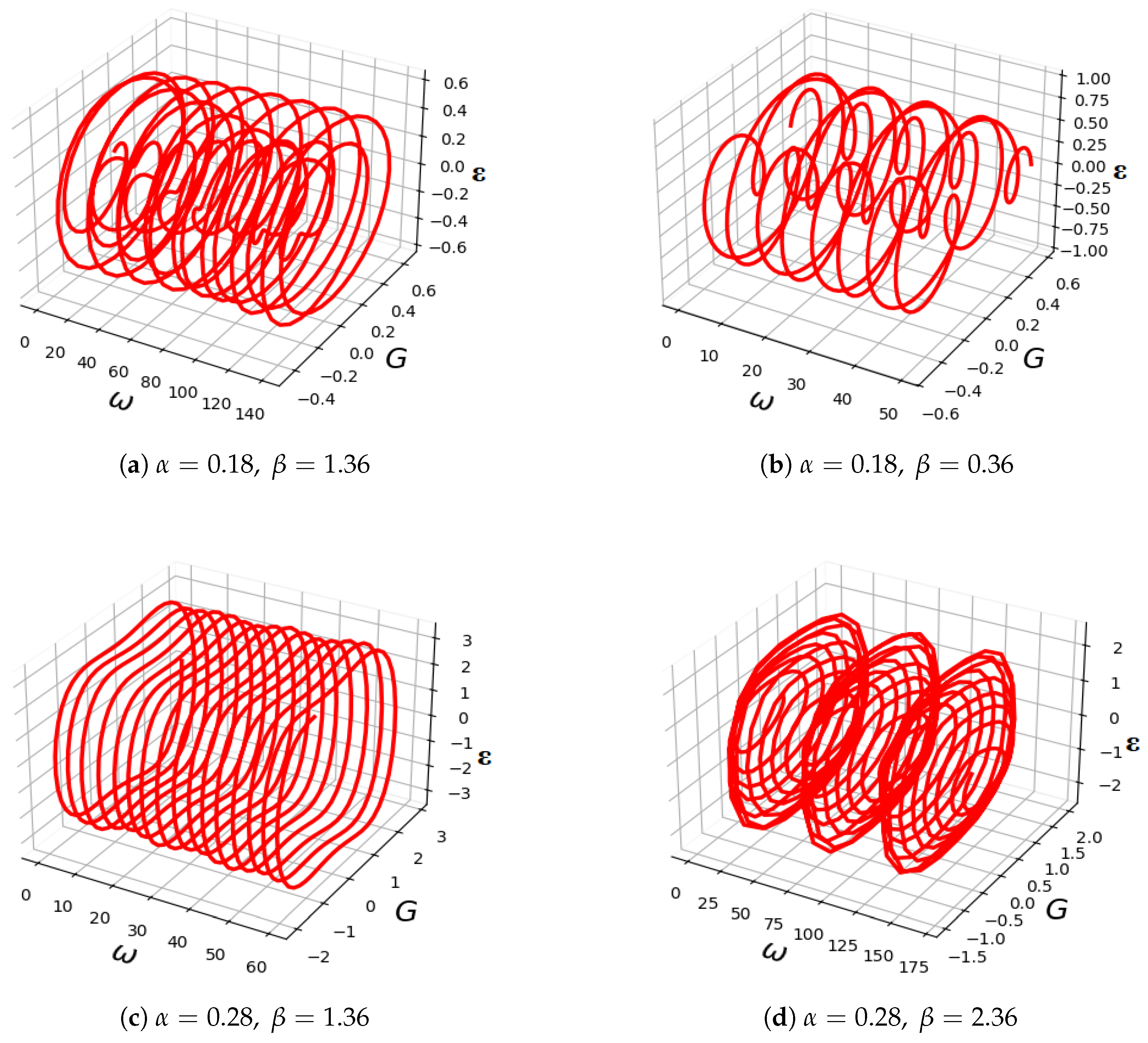
This section utilizes several techniques to analyze the quasi-periodic and chaotic dynamics of the perturbed system. Firstly, we take the values τ 0 = 1.23 and Δ = 0.56 , and, using different frequency and amplitude values, we examine the quasi-periodic and chaotic behavior using the 3D phase portrait, as shown in Figure 5.
In Figure 5a, the trajectory shows quasi-periodic motion with moderate nonlinear oscillations. In Figure 5b, the lower frequency β = 0.36 produces smoother oscillations, indicating weakly chaotic dynamics. In Figure 5c, an increasing disturbance amplitude α = 0.28 enhances nonlinear interactions and irregular motion. In Figure 5d, a higher frequency β = 2.36 generates a more complex trajectory, indicating strong chaotic behavior.
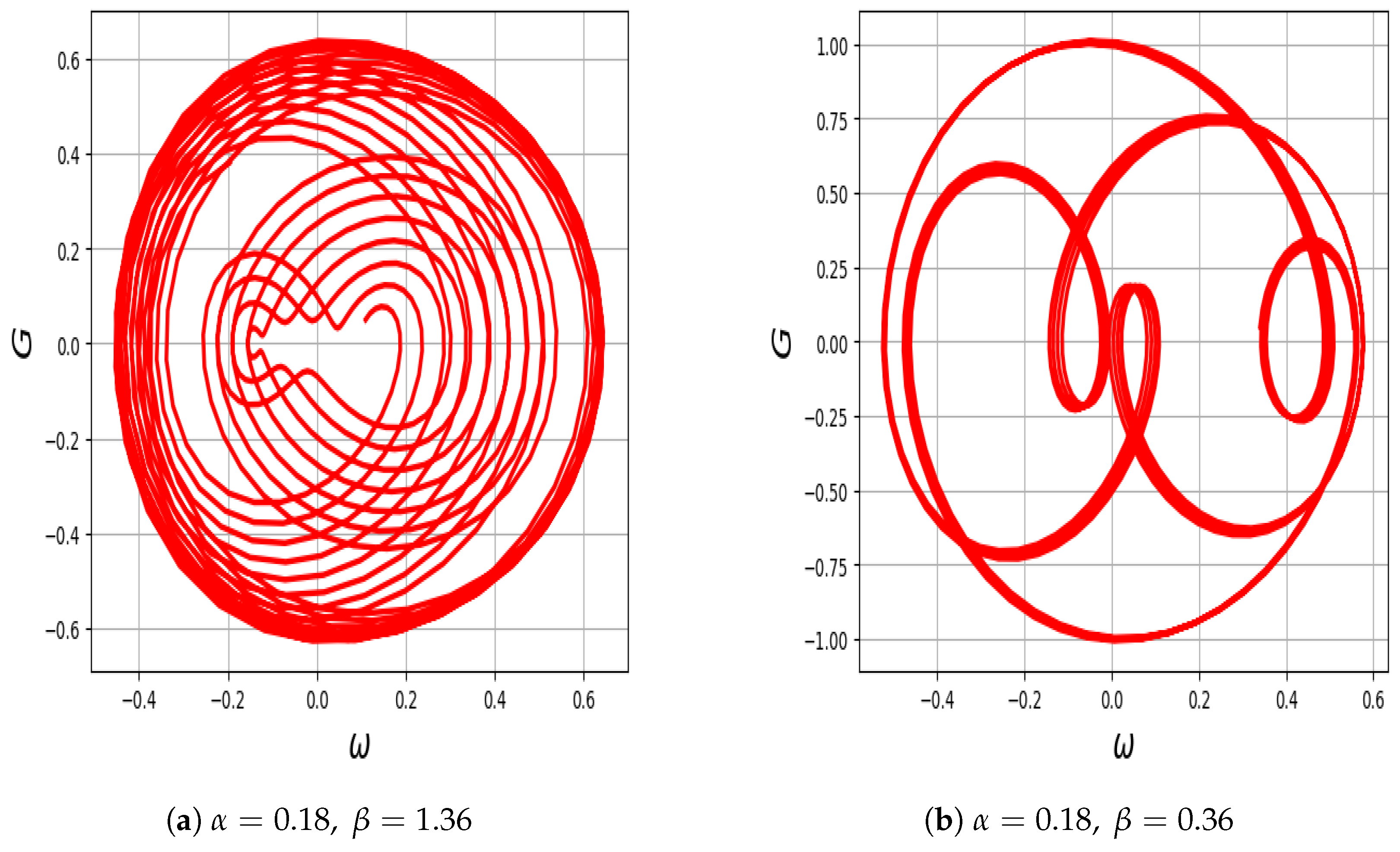
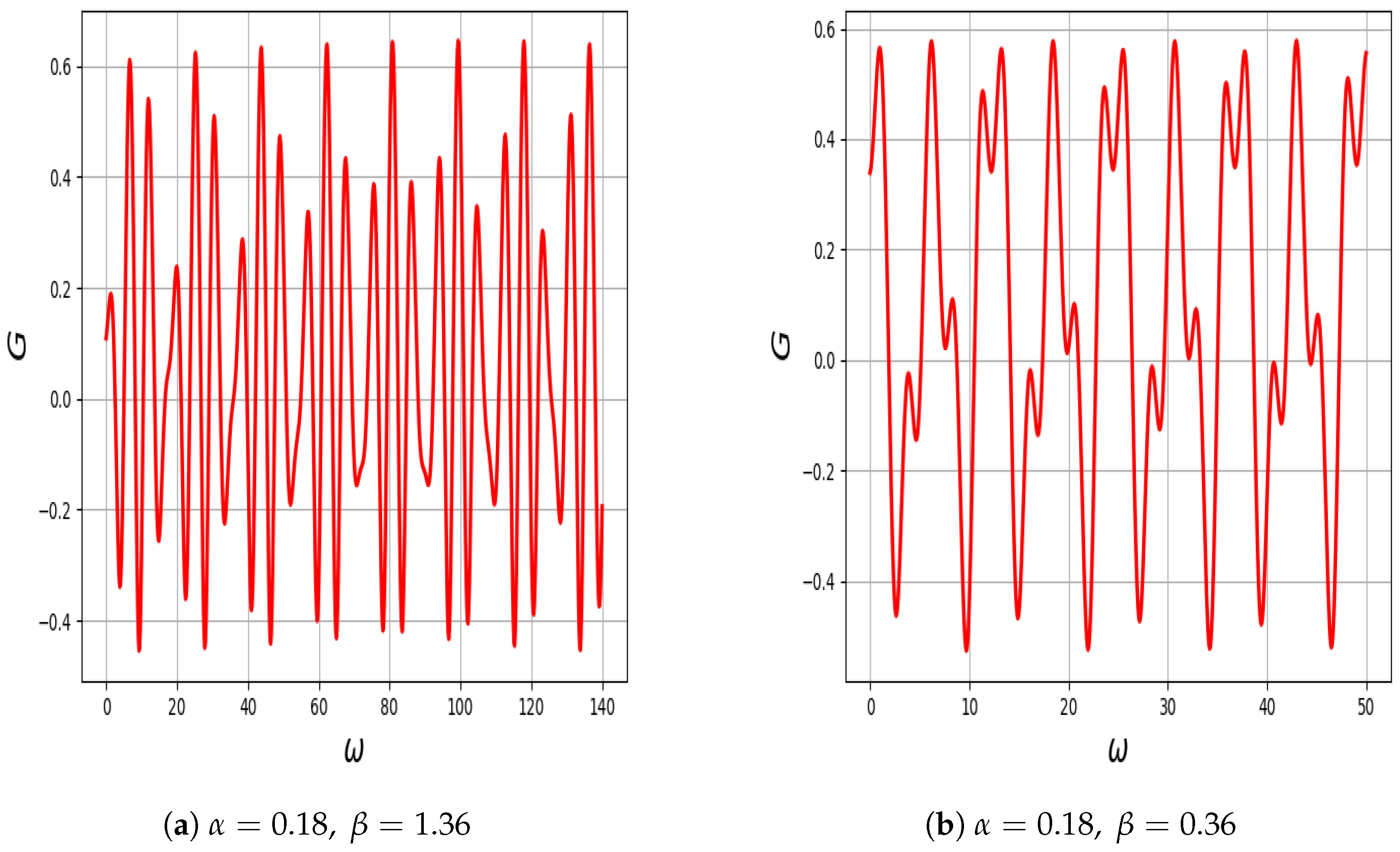
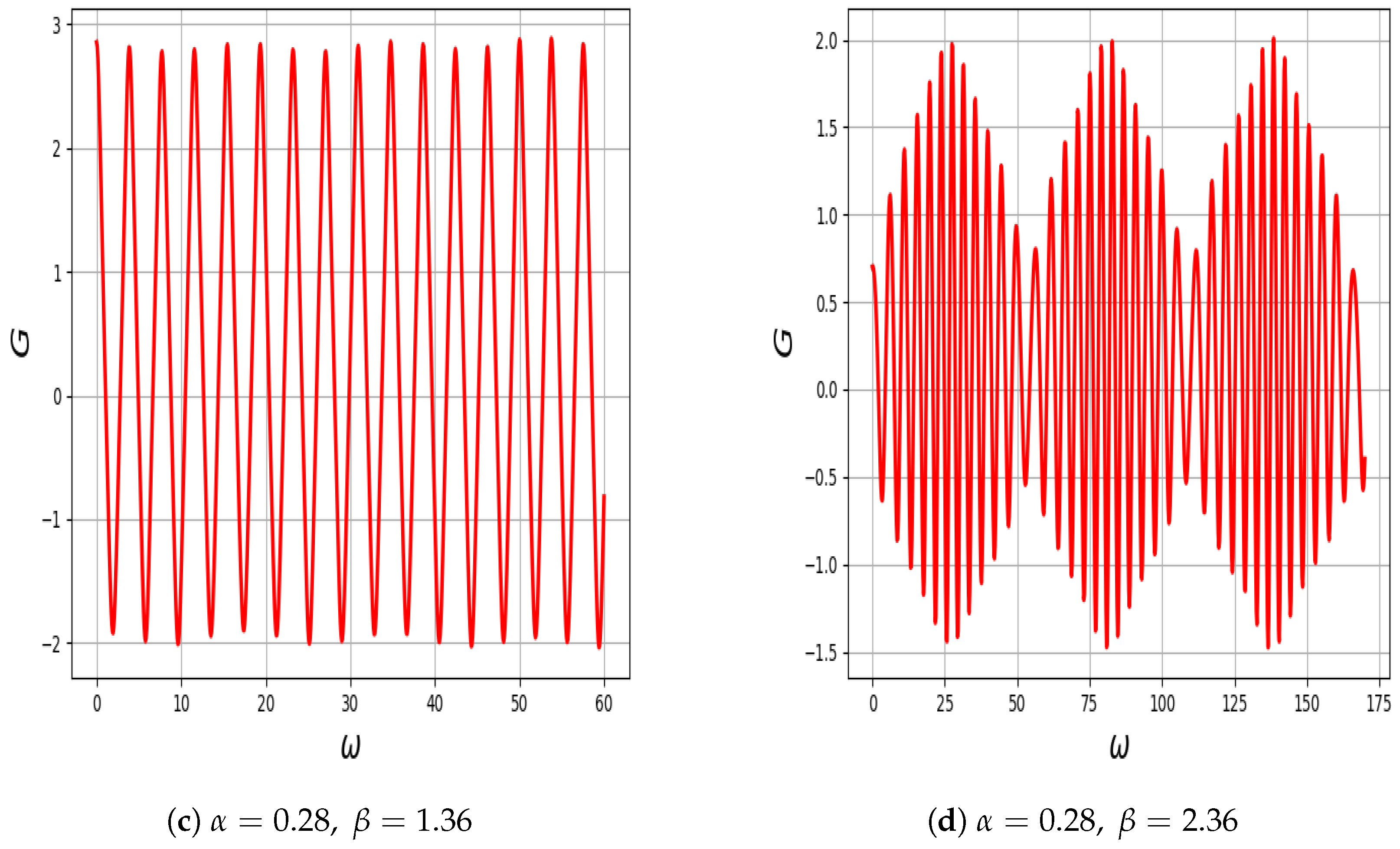
Next, with the same values τ 0 = 1.23 and Δ = 0.56 and varying frequencies and amplitudes, we examine the quasi-periodic and chaotic behavior using the 2D phase portrait, as shown in Figure 6. Figure 6a shows closed phase curves, which indicate the quasi-periodic oscillatory dynamics of the system. In Figure 6b, a reduced frequency leads to wider periodic loops, indicating stable oscillations. In Figure 6c, a larger amplitude causes the deformation of the phase curves, indicating a transition toward chaos. In Figure 6d, the irregular phase structure confirms the strong nonlinear chaotic dynamics. Then, using τ 0 = 1.23 and Δ = 0.56 with different frequency and amplitude values, the quasi-periodic and chaotic behavior is observed in the time series, as shown in Figure 7.
In Figure 7a, the time evolution shows bounded oscillations, representing quasi-periodic behavior. In Figure 7b, a lower frequency produces smoother and more regular temporal oscillations. In Figure 7c, an increasing disturbance amplitude results in irregular fluctuations over time. In Figure 7d, rapid oscillatory variation reflects chaotic temporal dynamics.
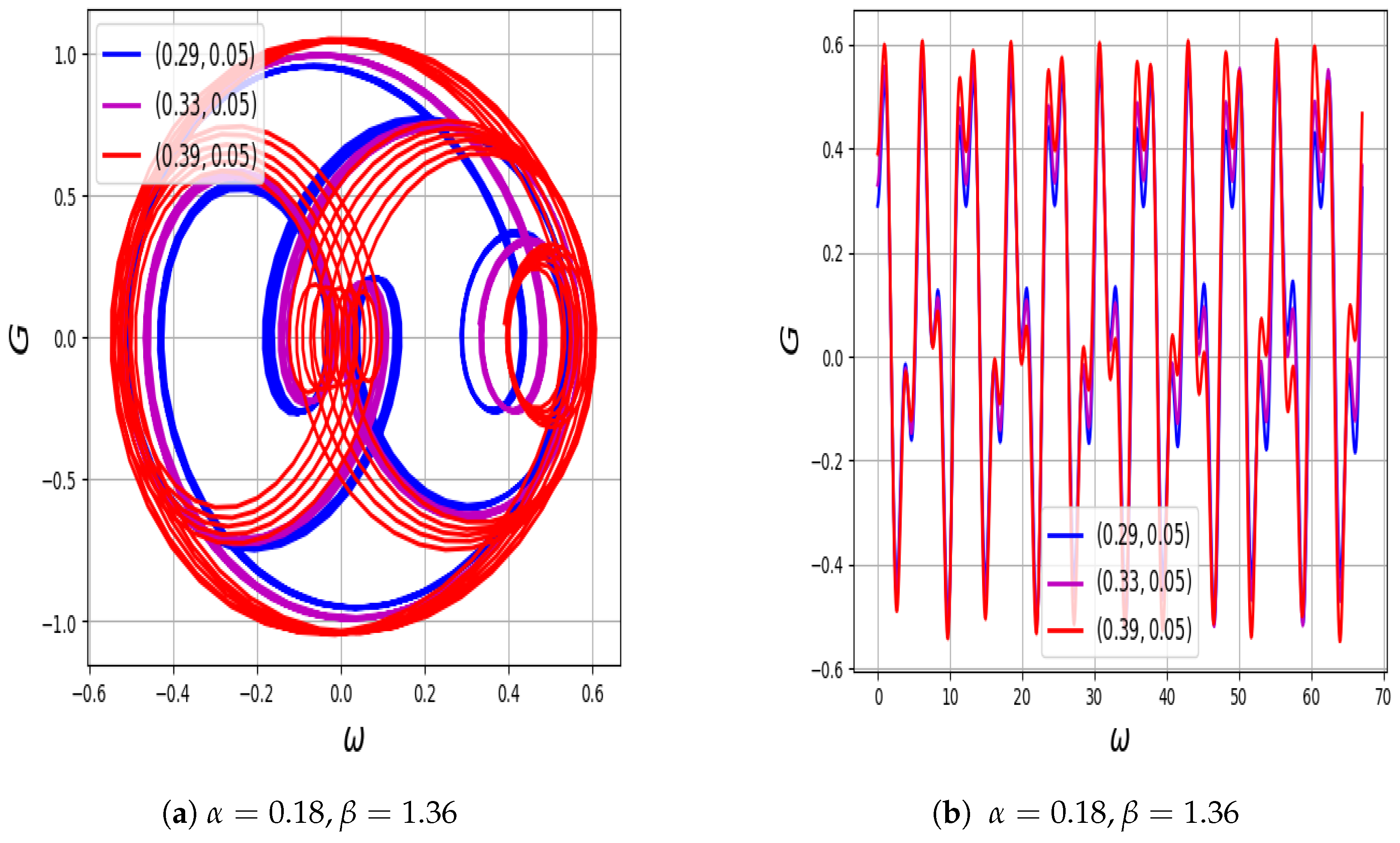
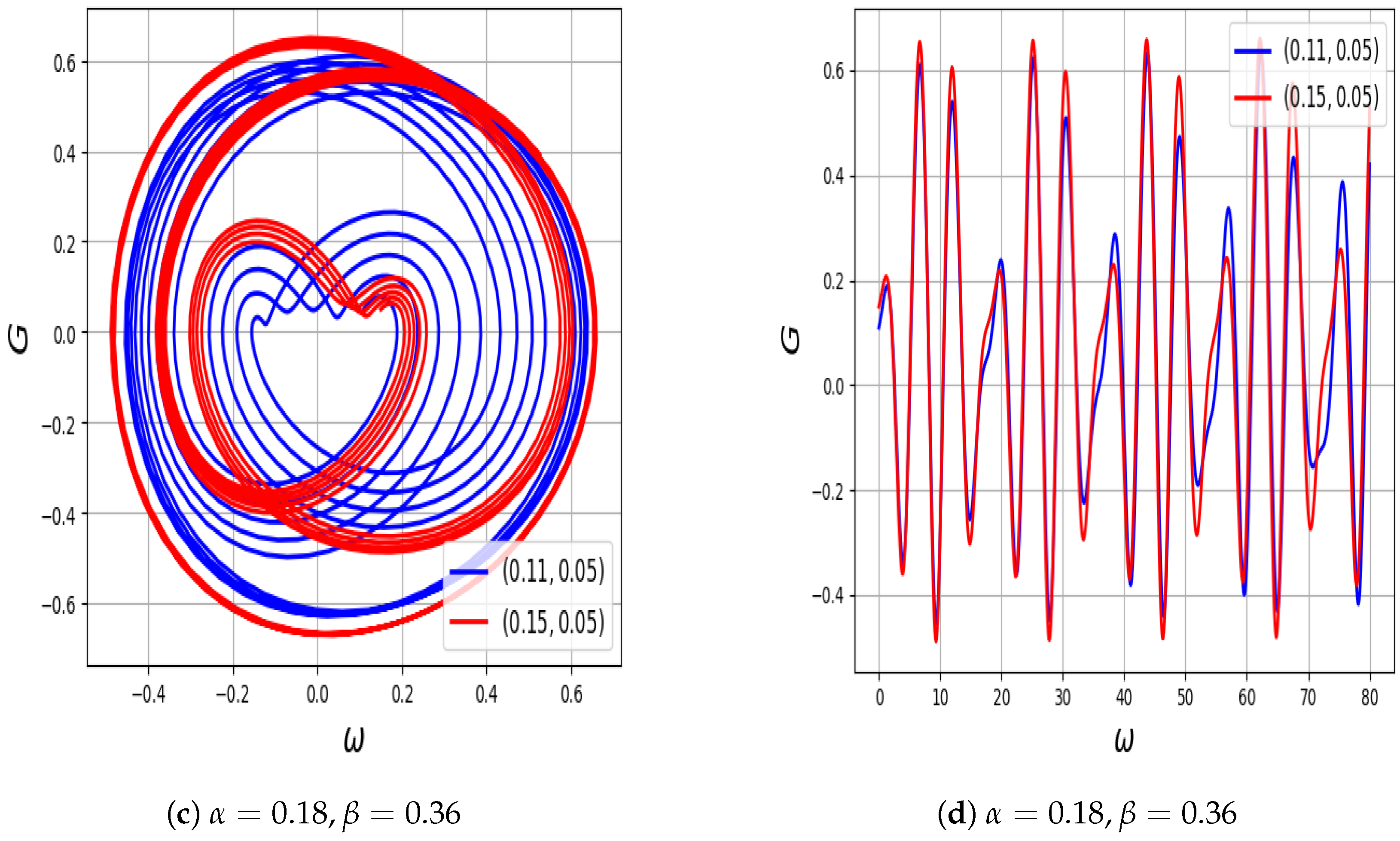
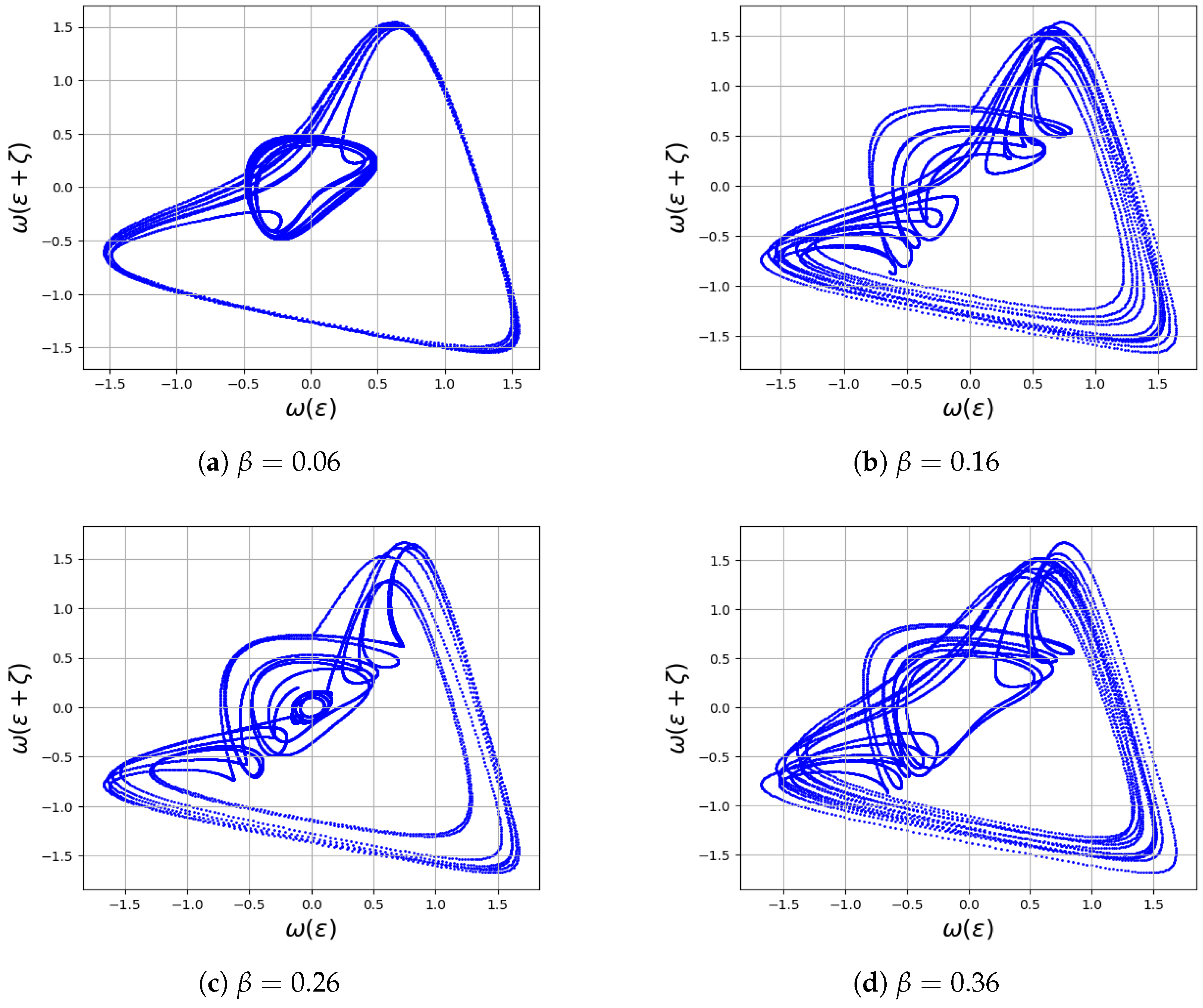
Next, for τ 0 = 1.23 and Δ = 0.56 with different initial conditions, quasi-periodic behavior is detected using multistability analysis, as shown in Figure 8. The multistability shown in Figure 8 indicates that the system can settle into multiple stable states for the same parameter values, depending on the initial conditions. This is important because it reveals the possibility of switching between different dynamic regimes, which is useful for stability control, signal processing, and memory or switching applications in nonlinear systems. Then, with τ 0 = 1.23 , Δ = 0.56 , and α = 0.45 , and with varying values of β , the quasi-periodic behavior is analyzed using the return map, as shown in Figure 9.
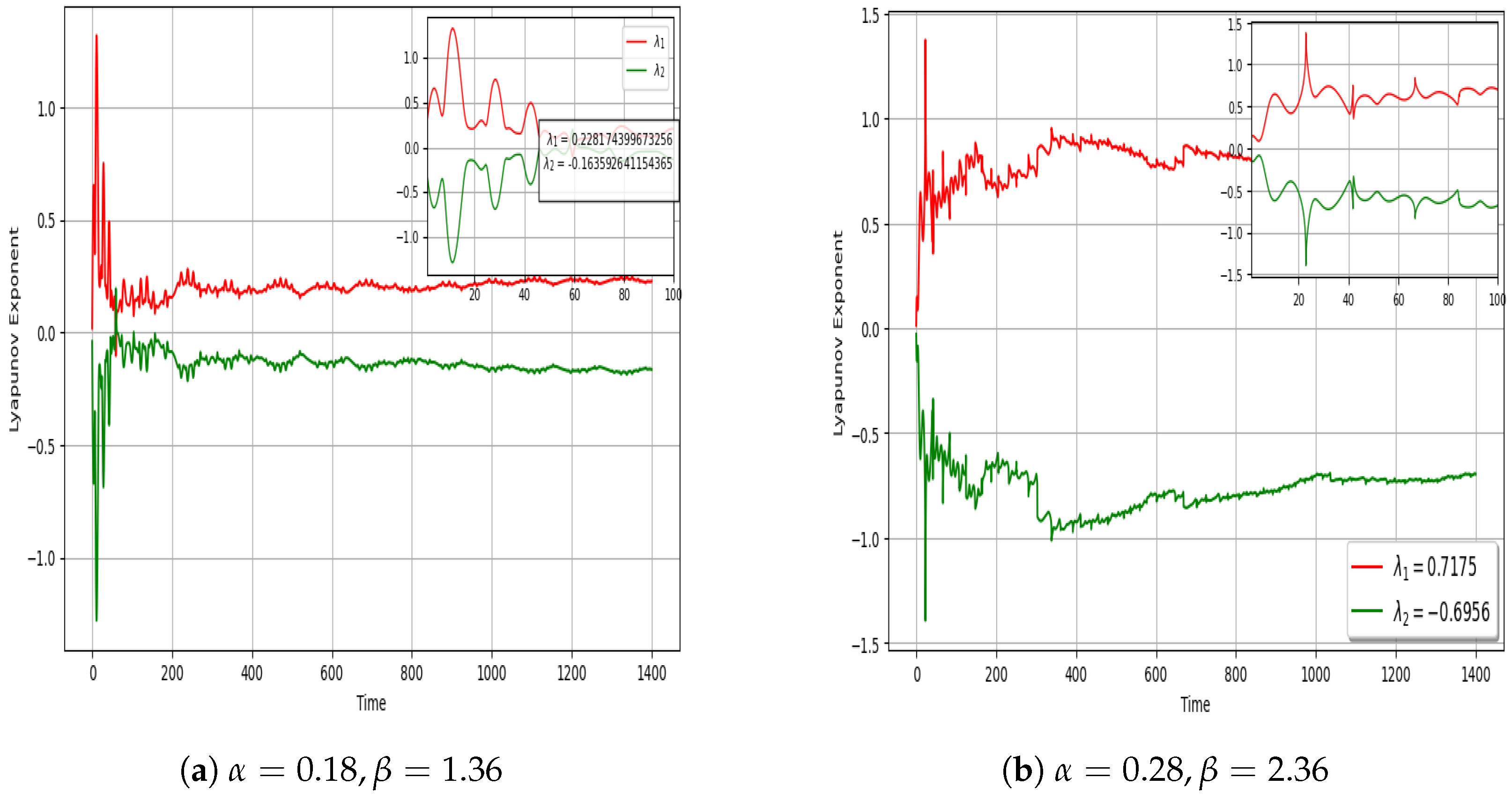
In Figure 9a, for β = 0.06 , the points cluster near the curve, indicating quasi-periodic motion. In Figure 9b, increasing β spreads the return points, showing stronger nonlinear interactions. In Figure 9c, the map becomes more scattered, indicating a transition toward chaotic dynamics. In Figure 9d, the dense irregular point distribution confirms the complex nonlinear behavior. Finally, taking τ 0 = 1.23 and Δ = 0.56 with different frequency and amplitude values, the quasi-periodic and chaotic behavior is analyzed using Lyapunov exponents, as shown in Figure 10.
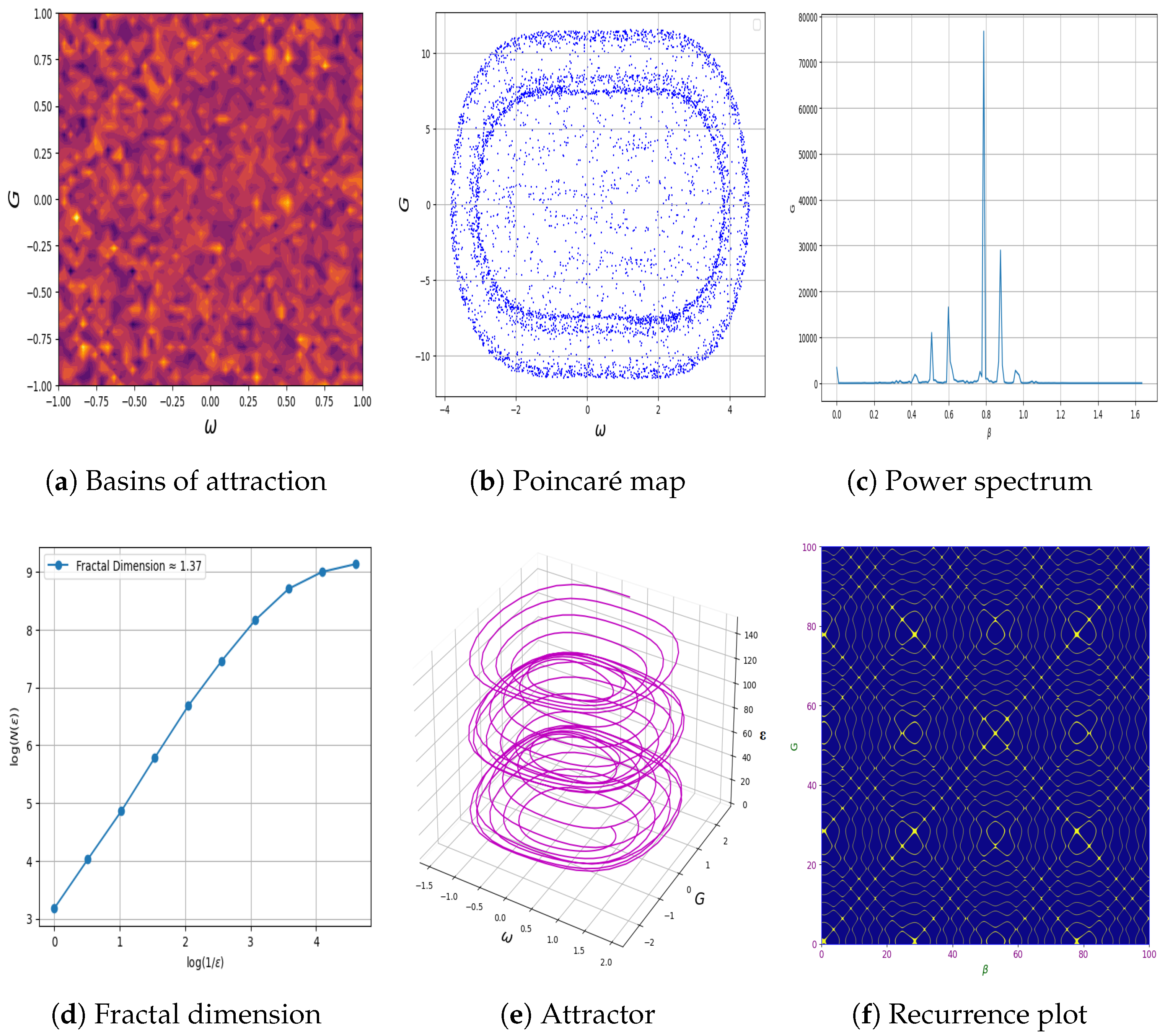
In Figure 10a, the negative Lyapunov exponent indicates stable quasi-periodic dynamics. In Figure 10b, the positive Lyapunov exponent confirms the presence of chaotic behavior. Next, the detection of the quasi-periodic behavior of the system (18) is achieved using different tools for the parameter values τ 0 = 1.23 , α = 0.45 , β = 1.36 , and Δ = 0.56 , as shown in Figure 11.
In Figure 11a, different-colored regions indicate the presence of multiple stable attractors in the system. In Figure 11b, the discrete points form a structured pattern, confirming the quasi-periodic behavior of the system. In Figure 11c, the clear spectral peaks indicate the dominant oscillation frequencies in the system dynamics. In Figure 11d, the noninteger fractal dimension reflects the complex nonlinear nature of the system. In Figure 11e, the attractor structure shows bounded trajectories, corresponding to quasi-periodic motion. In Figure 11f, the diagonal recurrence structures indicate deterministic and repeating dynamical patterns. Next, with the values τ 0 = 1.23 and Δ = 0.56 , and with varying frequency and amplitude values, we examine the quasi-periodic and chaotic behavior using permutation entropy, and the results are shown in Table 4.

4. Soliton Solutions of (3) Using UREEM

In this section, we discuss the unified Riccati equation expansion method and apply it to Equation (6) to obtain the solution for Equation (3).

4.1. Overview of UREEM

The UREEM is concisely outlined in [3] as follows.
Step 1: Consider the NPDE
B ( Ω , Ω x ϕ , Ω t ϕ , Ω x ϕ x ϕ , Ω t ϕ t ϕ , Ω x ϕ t ϕ , ) = 0 ·
Step 2: Consider the wave transformation given by
Ω ( x ϕ , t ϕ ) = ω ( ϵ ) , ϵ = Γ ( 1 + α ) ( τ 0 x ϕ γ Θ t ϕ γ ) γ .
Step 3: Substituting the wave transformation from Equation (20) into Equation (19), we obtain the corresponding nonlinear ordinary differential equation
F ( ω , ω , ω , ω , ω , ) = 0 ·
According to the UREEM, we can propose the solution in the following form:
ω ( ϵ ) = f = 0 Q V f K f ( ϵ ) , V Q 0 .
V f consists of arbitrary parameters that will be evaluated later. Additionally, K f ( ϵ ) satisfies the following ODE [3]:
d K d ϵ = W 0 + W 1 K ( ϵ ) + W 2 K 2 ( ϵ ) .
Equation (23) has the following types of solutions.
Family 1: When η > 0 ,
K 1 ( ϵ ) = W 1 2 W 2 η 2 W 2 t a n h ( η ϵ 2 ) , K 2 ( ϵ ) = W 1 2 W 2 η 2 W 2 c o t h ( η ϵ 2 ) .
Family 2: When η < 0 ,
K 3 ( ϵ ) = W 1 2 W 2 η 2 W 2 t a n ( η ϵ 2 ) , K 4 ( ϵ ) = W 1 2 W 2 η 2 W 2 c o t ( η ϵ 2 ) .
Family 3: When η = 0 ,
K 5 ( ϵ ) = W 1 2 W 2 1 W 2 ϵ + l 8 ,
where η = W 1 2 4 W 0 W 2 and l 8 is an arbitrary constant.

4.2. Implementation of UREEM in Equation (6)

In this part, we implement the UREEM in Equation (6) to obtain the soliton solution for Equation (3). By substituting Equation (22), considering Equation (23), into Equation (6) and then collecting the coefficients of different powers of K ( ϵ ) , we equate each coefficient of K ( ϵ ) to zero. This yields a system of algebraic equations, which can be solved using computational tools like Mathematica to obtain the following result:
τ 0 = V 1 2 W 2 , Δ = 2 Θ W 2 V 1 2 V 1 , V 0 = V 1 W 1 + W 2 2 W 2 , W 0 = V 1 2 W 1 2 W 2 2 4 V 1 2 W 2 , W 2 = W 2 , V 1 = V 1 , Θ = Θ , W 1 = W 1 .
By substituting Equation (27) within the context of Equations (22)–(26), the solutions to Equation (3) are obtained as follows.
Family 1: When η > 0 ,
Ω 1 ( x ϕ , t ϕ ) = V 1 W 1 + W 2 2 W 2 V 1 W 1 2 W 2 V 1 η 2 W 2 t a n h ( η ϵ 2 ) , Ω 2 ( x ϕ , t ϕ ) = V 1 W 1 + W 2 2 W 2 V 1 W 1 2 W 2 V 1 η 2 W 2 c o t h ( η ϵ 2 ) , ϵ = Γ ( 1 + α ) ( τ 0 x ϕ γ Θ t ϕ γ ) γ .
Family 2: When η < 0 ,
Ω 3 ( x ϕ , t ϕ ) = V 1 W 1 + W 2 2 W 2 V 1 W 1 2 W 2 V 1 η 2 W 2 t a n ( η ϵ 2 ) , Ω 4 ( x ϕ , t ϕ ) = V 1 W 1 + W 2 2 W 2 V 1 W 1 2 W 2 V 1 η 2 W 2 c o t ( η ϵ 2 ) , ϵ = Γ ( 1 + α ) ( τ 0 x ϕ γ Θ t ϕ γ ) γ .
Family 3: When η = 0 ,
Ω 5 ( x ϕ , t ϕ ) = V 1 W 1 + W 2 2 W 2 V 1 W 1 2 W 2 V 1 W 2 ϵ + l 8 , ϵ = Γ ( 1 + α ) ( τ 0 x ϕ γ Θ t ϕ γ ) γ .

4.3. Visualizing and Analyzing Symmetric Wave Patterns

This work reveals the physical significance of the model by using three-dimensional and contour diagrams that reflect the outcomes of numerical simulations. These diagrams depict different types of solitons; furthermore, in each figure, we include lists of mode parameters, chosen carefully for accuracy.
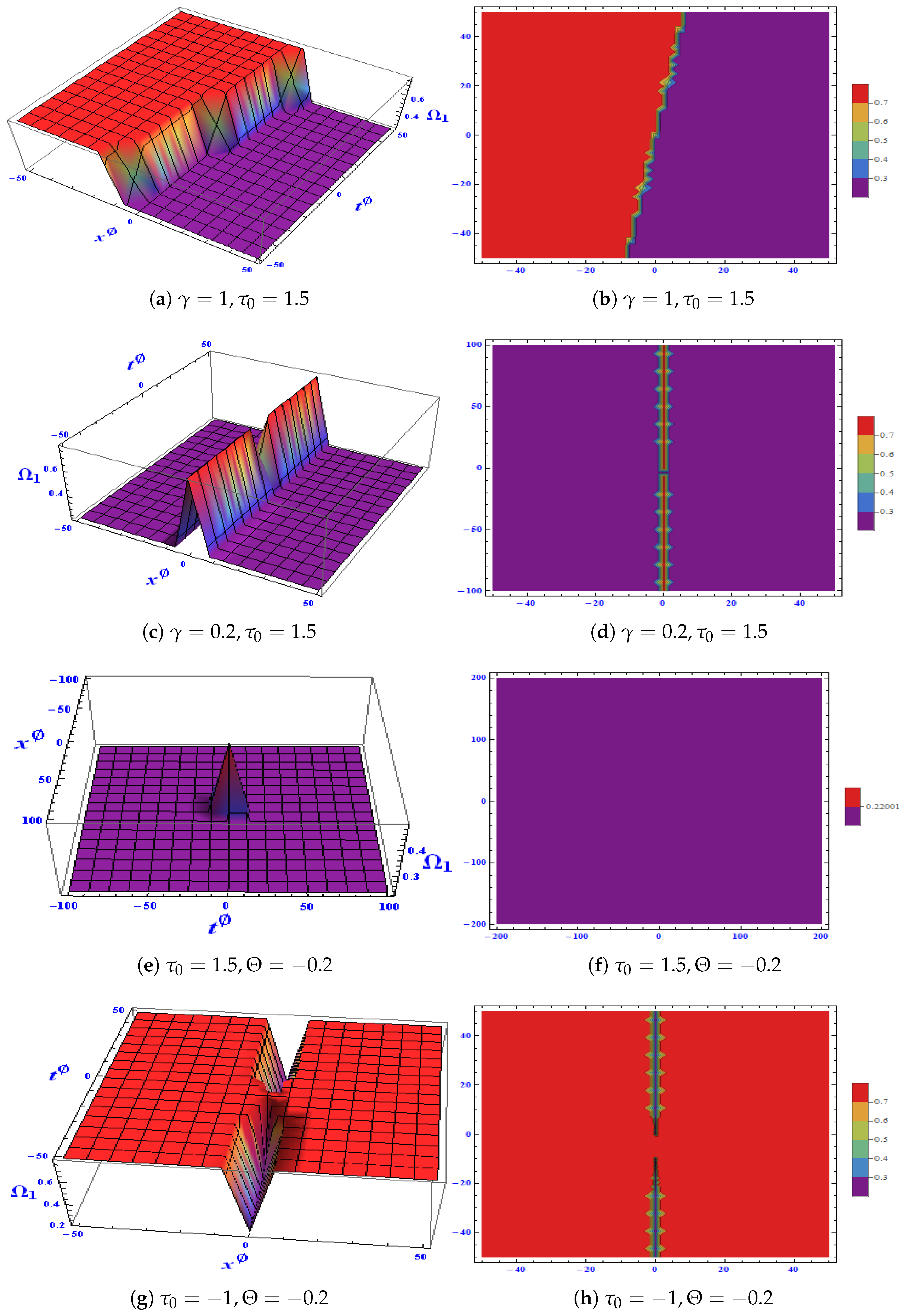
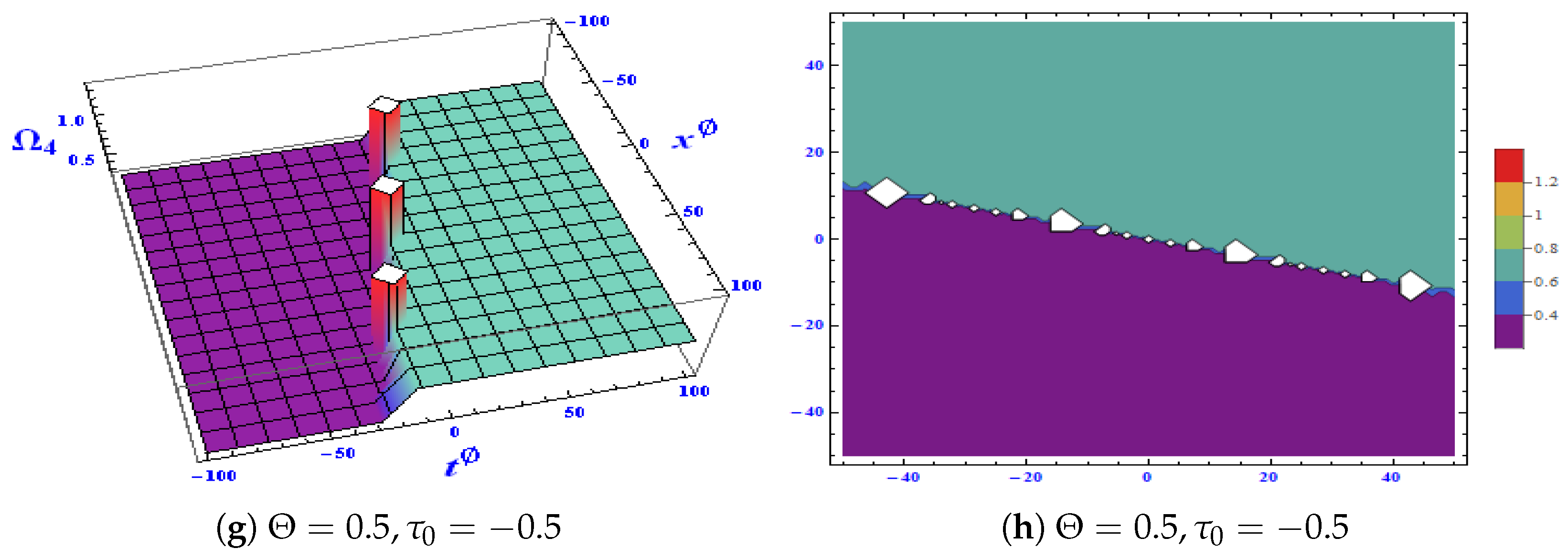
Figure 12a–h vividly illustrate the behavior of Ω 1 across the domains x ϕ and t ϕ within [−50, 50] for the parameter values W 0 = 0.25 , W 1 = 1.5 , V 1 = 0.5 , and W 2 = 1 . These plots reveal how variations in the parameter γ influence the solution of Ω 1 . Regarding Figure 12a,b, when γ is within (0.6, 1) and both Θ and τ 0 are positive, the system exhibits a kink soliton, showcasing a distinctive localized disturbance with a sharp transition in the solution. Regarding Figure 12c,d, in the scenario whereby γ ranges within ( 0 ,   0.5 ) and with Θ and τ 0 both being positive, the solution presents a singular soliton. This configuration highlights a unique, single-peaked wave structure with a prominent central spike. Regarding Figure 12e,f, for γ within (0, 0.5), where Θ is negative and τ 0 is positive, the system reveals a trampled bright one-soliton over the expanded domain of x ϕ and t ϕ across [−100, 100]. This pattern features a bright soliton that exhibits a complex, intricate shape due to the negative Θ . Regarding Figure 12g,h, when γ is within (0, 0.5) and both Θ and τ 0 are negative, the resulting W-shaped soliton is observed over the domain [−50, 50]. This configuration displays a multi-peak structure with characteristic oscillations indicative of the negative values of Θ and τ 0 . These figures collectively capture the intricate effects of varying parameters on the soliton patterns, providing clear visualization of the ways in which different parameter regimes shape the solution Ω 1 .
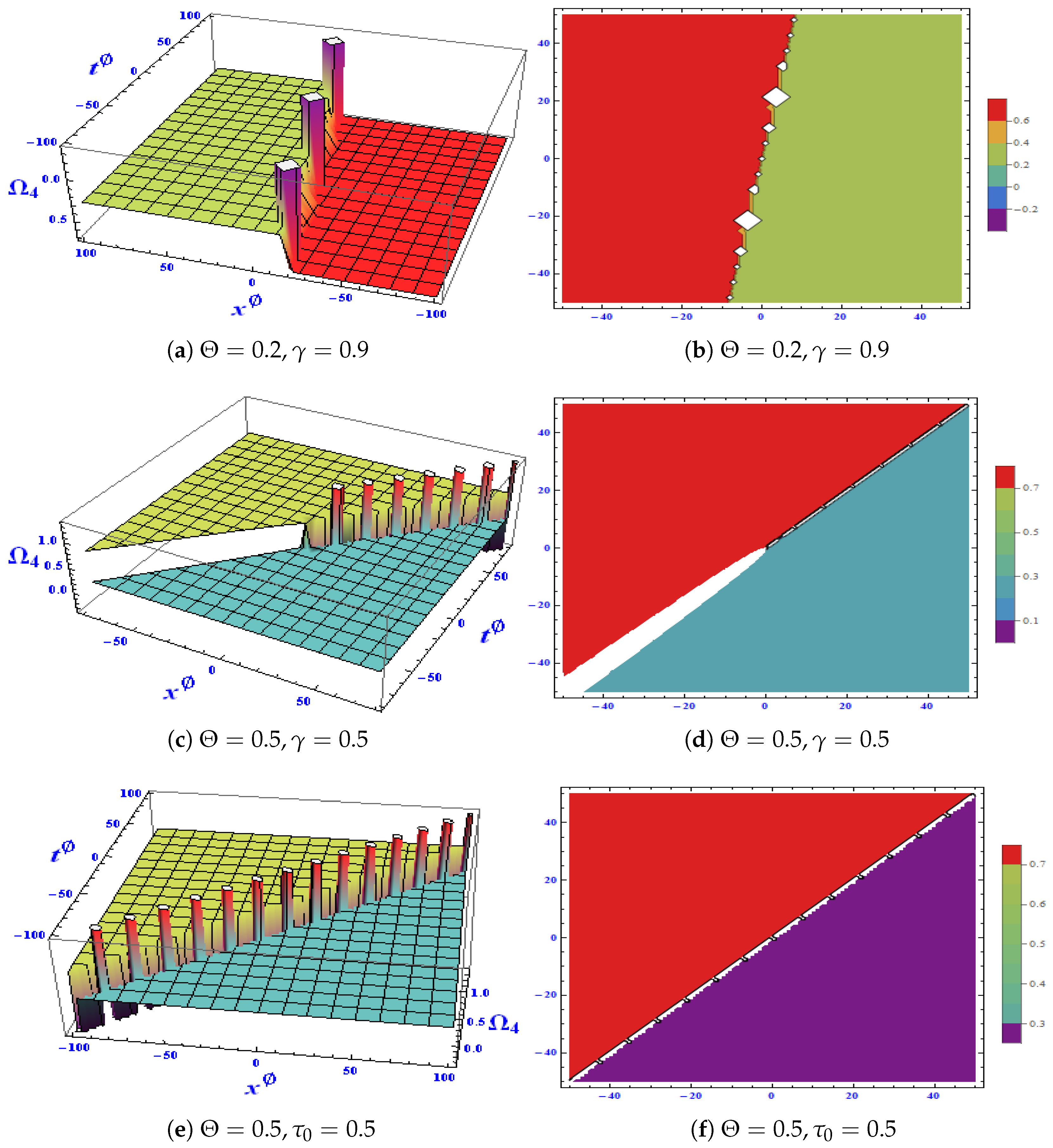
In Figure 13a–h the graphical behavior of Ω 2 at W 0 = 0.25 , W 1 = 1.5 , V 1 = 0.5 , and W 2 = 1 within the domain of x ϕ and t ϕ at ( 50 ,   50 ) reflects the different impacts of the parameter on the solution of Ω 4 . As shown in Figure 13a,b, if we take the domain of γ (0.6, 1], both Θ , τ 0 exert positive effects on the solution. This plot shows a 3D surface with a prominent vertical spike toward one side, likely representing a singularity or a localized peak in the solution. For Figure 13c,d, if we take the domain of γ (0.1, 0.5] and Θ , τ 0 are both positive, the effects on the solution are evident. This plot features a series of smaller peaks forming a diagonal pattern across the surface, indicating a regular wave or soliton structure. Regarding Figure 13e,f, if we take the domain of γ (0, 0.5) and Θ , τ 0 are both positive, the effects on the solution are again evident. In Figure 13g,h, if we take the domain of γ (0, 0.5), and Θ is positive while is τ 0 negative, both take negative values, which reveals their effects on the solution within the domain of x ϕ and t ϕ at [ 100 ,   100 ] .

5. Conclusions

A nonlinear truncated M-fractional FitzHugh–Nagumo model is an essential tool that helps to explain how impulses are transmitted through nerves. Our investigation of this equation has explored its solution via several approaches, such as soliton dynamics, bifurcation analysis, multistability, Lyapunov exponents, chaotic behaviors, and sensitivity analysis.
First, we analyzed the influence of the bifurcation parameter G upon each value of Δ and τ 0 . To achieve this, we analyzed the qualitative behavior of quasi-periodic nonlinear waves and chaotic behaviors within the dynamical system and generated phase portraits of the results, as presented in Figure 1, Figure 2 and Figure 3. This analysis has proven that the model can provide all solutions, including nonlinear and super-nonlinear periodic waves. Bifurcation analysis explains how small changes in system parameters can cause qualitative transitions in dynamical behavior. The sensitivity analysis was conducted using different initial conditions, as shown in Figure 4. Then, a perturbation term was added to the unperturbed system to conduct a chaos analysis. The quasi-periodic and chaotic dynamics were also detected and confirmed using the phase portrait, basin of attraction, return map, Lyapunov exponent, permutation entropy, Poincaré map, power spectrum, attractor, fractal dimension, multistability, time analysis, and recurrence plot, as shown in Figure 5, Figure 6, Figure 7, Figure 8, Figure 9, Figure 10 and Figure 11.
Furthermore, we used the UREEM to obtain the travelling wave solutions of the model and found soliton solutions, which are illustrated in Figure 12a–h and Figure 13a–h. These solutions are kink solitons, single-peaked waves, and trampled bright one-solitons. To our knowledge, these solutions are new and have not been reported in prior works in the literature. A comparative analysis of the presented material proves that this paper offers new solutions not discussed in recent studies. These are novel findings that advance our knowledge of soliton theory and chaotic behavior in fractional-order nonlinear systems. Our work also provides a basis for improvements in the methods of conducting such research. This work opens up opportunities for future work in studying the dynamics of nonlinear systems, encouraging further research into different nonlinear issues.

Author Contributions

Conceptualization, B.; Methodology, B.; Software, B.; Validation, B.; Formal analysis, B. and A.K.A.; Investigation, B.; Writing—original draft preparation, B.; Writing—review & editing, B. and A.K.A.; Visualization, B.; Supervision, B.; Project administration, A.K.A.; Funding acquisition, A.K.A. All authors have read and agreed to the published version of the manuscript.

Funding

This work was supported by the Deanship of Scientific Research, Vice-Presidency for Graduate Studies and Scientific Research, King Faisal University, Saudi Arabia [Grant No. KFU261356].

Data Availability Statement

All data generated or analyzed during this study are included in this published article.

Conflicts of Interest

The authors declare no conflicts of interest.

References

  1. Alquran, M.; Yousef, F.; Alquran, F.; Sulaiman, T.A.; Yusuf, A. Dual-wave solutions for the quadratic-cubic conformable-Caputo time-fractional Klein-Fock-Gordon equation. Math. Comput. Simul. 2021, 185, 62–76. [Google Scholar]
  2. Alquran, M.; Ali, M.; Jaradat, I.; Al-Ali, N. Changes in the physical structures for new versions of the Degasperis-Procesi-Camassa-Holm model. Chin. J. Phys. 2021, 71, 85–94. [Google Scholar] [CrossRef]
  3. Wazwaz, A.M. Partial Differential Equations and Solitary Waves Theory; Springer Science & Business Media: Berlin/Heidelberg, Germany, 2010. [Google Scholar]
  4. Rafiq, M.H.; Jhangeer, A.; Raza, N. Symmetry and complexity: A Lie symmetry approach to bifurcation, chaos, stability and travelling wave solutions of the (3 + 1)-dimensional Kadomtsev-Petviashvili equation. Phys. Scr. 2023, 98, 115239. [Google Scholar] [CrossRef]
  5. Ma, W.X.; Lee, J.H. A transformed rational function method and exact solutions to the (3 + 1)-dimensional Jimbo-Miwa equation. Chaos Solitons Fractals 2009, 42, 1356–1363. [Google Scholar] [CrossRef]
  6. Yasin, S.; Alshammari, F.S.; Khan, A. Quasi-periodic dynamics and wave solutions of the Ivancevic option pricing model using multi-solution techniques. Symmetry 2025, 17, 1137. [Google Scholar] [CrossRef]
  7. Samreen, M.; Alshammari, F.S. Exploring solitary wave solutions of the generalized integrable Kadomtsev-Petviashvili equation via Lie symmetry and Hirota’s bilinear method. Symmetry 2025, 17, 710. [Google Scholar]
  8. Malfliet, W.; Hereman, W. The tanh method: I. Exact solutions of nonlinear evolution and wave equations. Phys. Scr. 1996, 54, 563. [Google Scholar] [CrossRef]
  9. Ismael, H.F.; Seadawy, A.; Bulut, H. Multiple soliton, fusion, breather, lump, mixed kink-lump and periodic solutions to the extended shallow water wave model in (2 + 1)-dimensions. Mod. Phys. Lett. B 2021, 35, 2150138. [Google Scholar] [CrossRef]
  10. Medhit, S.; Alshammari, F.S.; Bukhar, I. Modeling of soliton behavior in nonlinear transmission line systems. Mathematics 2025, 13, 2997. [Google Scholar] [CrossRef]
  11. Iserles, A. A First Course in the Numerical Analysis of Differential Equations; Cambridge University Press: Cambridge, UK, 2009. [Google Scholar]
  12. Jhangeer, A.; Beenish. Dynamics and wave analysis in longitudinal motion of elastic bars or fluids. Ain Shams Eng. J. 2024, 15, 102907. [Google Scholar] [CrossRef]
  13. Asif, M.; Shah, N.A.; Din, M.; Anwar, R. A new perspective on order-theoretic contractive mappings with applications in financial markets and economic growth via fractional differential equations. Bound. Value Probl. 2025, 2025, 175. [Google Scholar] [CrossRef]
  14. Kalies, W.; Vandervorst, R. Priestley duality and representations of global dynamics. Qual. Theory Dyn. Syst. 2025, 24, 186. [Google Scholar] [CrossRef]
  15. Khan, Z.U.; ur Rehman, M. Dynamical analysis of a fractional Maize Streak Disease model with enhanced predictive capabilities. Comput. Biol. Chem. 2025, 120, 108758. [Google Scholar] [CrossRef]
  16. Ma, W.X.; Fuchssteiner, B. Explicit and exact solutions to a Kolmogorov-Petrovskii-Piskunov equation. Int. J.-Non-Linear Mech. 1996, 31, 329–338. [Google Scholar]
  17. Cheng, L.; Ma, W.X. Soliton and lump solutions to a fourth-order nonlinear wave equation in (2 + 1)-dimensions. Qual. Theory Dyn. Syst. 2025, 24, 237. [Google Scholar] [CrossRef]
  18. Sousa, J.V.D.C.; de Oliveira, E.C. A new truncated M-fractional derivative type unifying some fractional derivative types with classical properties. arXiv 2017, arXiv:1704.08187. [Google Scholar]
  19. Huang, Q.; Zafar, A.; Raheel, M.; Bekir, A. Analytical wave solutions of an electronically and biologically important model via two efficient schemes. Chin. Phys. B 2023, 32, 110201. [Google Scholar] [CrossRef]
  20. Cevikel, A.C.; Bekir, A.; Abu Arqub, O.; Abukhaled, M. Solitary wave solutions of FitzHugh-Nagumo-type equations with conformable derivatives. Front. Phys. 2022, 10, 1028668. [Google Scholar]
  21. Cacuci, D.G.; Weber, C.F.; Oblow, E.M.; Marable, J.H. Sensitivity theory for general systems of nonlinear equations. Nucl. Sci. Eng. 1980, 75, 88–110. [Google Scholar] [CrossRef]
  22. Jhangeer, A.; Ibraheem, F.; Jamal, T.; Abdul Rahimzai, A.; Khan, I. Investigating pseudo-parabolic dynamics through phase portraits, sensitivity, chaos and soliton behaviour. Sci. Rep. 2024, 14, 15224. [Google Scholar] [PubMed]
  23. Li, Z.; Hussain, E. Qualitative analysis and optical solitons for the (1 + 1)-dimensional Biswas-Milovic equation with parabolic law and nonlocal nonlinearity. Results Phys. 2024, 56, 107304. [Google Scholar] [CrossRef]
Figure 4. Sensitivity analysis of the nonlinear system (7) for Δ > 0 and τ 0 > 0 . (a) ( 0.20 ,   0.02 ) and ( 0.10 ,   0.02 ) . (b) ( 0.30 ,   0.02 ) and ( 0.10 ,   0.02 ) . (c) ( 0.60 ,   0.02 ) and ( 0.10 ,   0.02 ) . (d) ( 0.70 ,   0.02 ) , ( 0.50 ,   0.02 ) , ( 0.40 ,   0.02 ) , ( 0.30 ,   0.02 ) , and ( 0.10 ,   0.02 ) .
Fractalfract 10 00213 g004
Figure 5. Detection of the quasi-periodic and chaotic behavior of the system (18) using the 3D phase portrait for the parameter values τ 0 = 1.23 and Δ = 0.56 .
Fractalfract 10 00213 g005
Figure 6. Detection of the quasi-periodic and chaotic behavior of the system (18) using the 2D phase portrait for the parameter values τ 0 = 1.23 and Δ = 0.56 .
Fractalfract 10 00213 g006aFractalfract 10 00213 g006b
Figure 7. Detection of the quasi-periodic and chaotic behavior of the system (18) using time analysis for the parameter values τ 0 = 1.23 and Δ = 0.56 .
Fractalfract 10 00213 g007aFractalfract 10 00213 g007b
Figure 8. Detection of the quasi-periodic of the system (18) using multistability analysis for the parameter values τ 0 = 1.23 and Δ = 0.56 .
Fractalfract 10 00213 g008aFractalfract 10 00213 g008b
Figure 9. Detection of the quasi-periodic of the system (18) using return map analysis for the parameter values τ 0 = 1.23 , α = 0.45 , and Δ = 0.56 .
Fractalfract 10 00213 g009
Figure 10. Detection of the quasi-periodic and chaotic behavior of the system (18) using Lyapunov exponent analysis for the parameter values τ 0 = 1.23 and Δ = 0.56 .
Fractalfract 10 00213 g010
Figure 11. Detection of quasi-periodic behavior of the system (18) using different tools for the parameter values τ 0 = 1.23 , α = 0.45 , β = 1.36 , and Δ = 0.56 .
Fractalfract 10 00213 g011
Figure 12. The dynamic behavior of the studied velocity on the solution Ω 1 is illustrated through three-dimensional wave evolution plots and contour diagrams, given the model parameters W 0 = 0.25 , W 1 = 1.5 , V 1 = 0.5 , and W 2 = 1 .
Fractalfract 10 00213 g012
Figure 13. The dynamic behavior of the studied velocity on the solution Ω 4 is illustrated through three-dimensional wave evolution plots and contour diagrams, given the model parameters W 0 = 0.25 , W 1 = 1.5 , V 1 = 0.5 , and W 2 = 1 .
Fractalfract 10 00213 g013aFractalfract 10 00213 g013b
Table 1. Literature-based comparative analysis.
ReferenceChaosBifurcationDerivativeMethodologyLimitation
[19]M-fractional derivativeSinh-Gordon equation expansion method and e x p a functionApplicable mainly to specific nonlinear forms
[20]Conformable derivativeExtended tanh–coth methodProduces restricted wave structures for complex models
Present studyM-fractional derivativeUnified Riccati equation expansion methodNone
Table 4. Detection of chaos analysis of the system (18) using permutation entropy.
FigureFrequency and AmplitudePermutation Entropy Value
Figure 5a α = 0.18 , β = 1.36 0.2646947
Figure 5b α = 0.18 , β = 0.36 0.290605
Figure 5c α = 0.28 , β = 1.36 0.242264
Figure 5d α = 0.28 , β = 0.36 0.252999
Disclaimer/Publisher’s Note: The statements, opinions and data contained in all publications are solely those of the individual author(s) and contributor(s) and not of MDPI and/or the editor(s). MDPI and/or the editor(s) disclaim responsibility for any injury to people or property resulting from any ideas, methods, instructions or products referred to in the content.