Dynamical Analysis and Soliton Solutions of the Truncated M-Fractional FitzHugh–Nagumo Equation

Abstract
1. Introduction
1.1. Context of the Study
1.2. Preliminaries
- 1.
- .
- 2.
- .
- 3.
- .
- 4.
- is constant.
- 5.
- .
1.3. Analytical Investigation of the Mathematical Model
- This equation combines diffusion and nonlinearity with the nonlinearity characterized by .
- Equation (3) generates the actual fractional Newell–Whitehead equation with and the fractional Zeldovich equation with .
- Of note, the transmission of nerve impulses is frequently examined using this fairly common nonlinear reaction–diffusion equation.
1.4. Survey of the Literature
1.5. Identified Research Gaps
1.6. Aim and Contributions of the Study
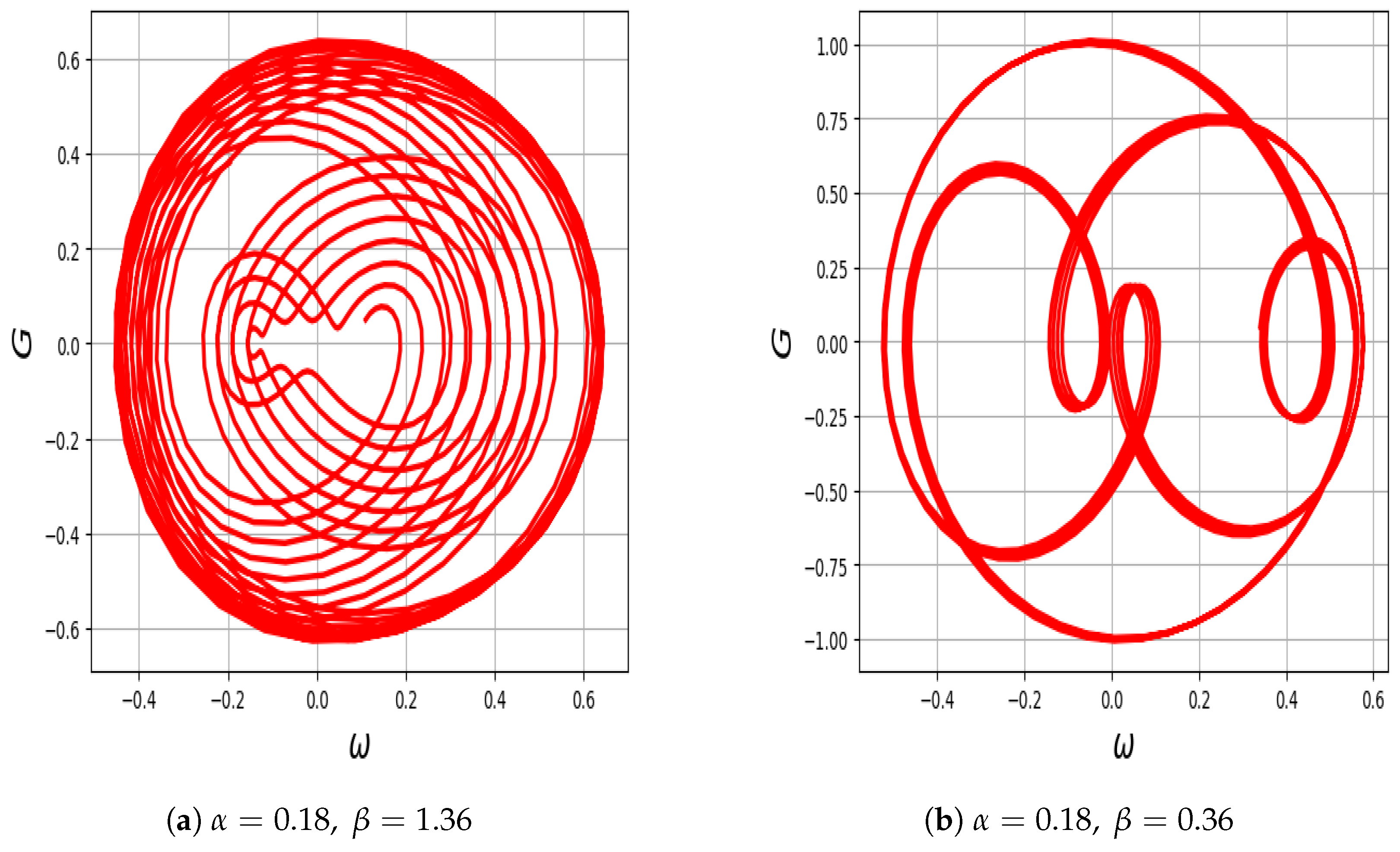
- Two-dimensional phase portrait: A 2D phase portrait is a graphical representation of a dynamical system, showing the relationship between two state variables in phase space. It helps to visualize system trajectories, equilibrium points, and the qualitative behavior of the system.
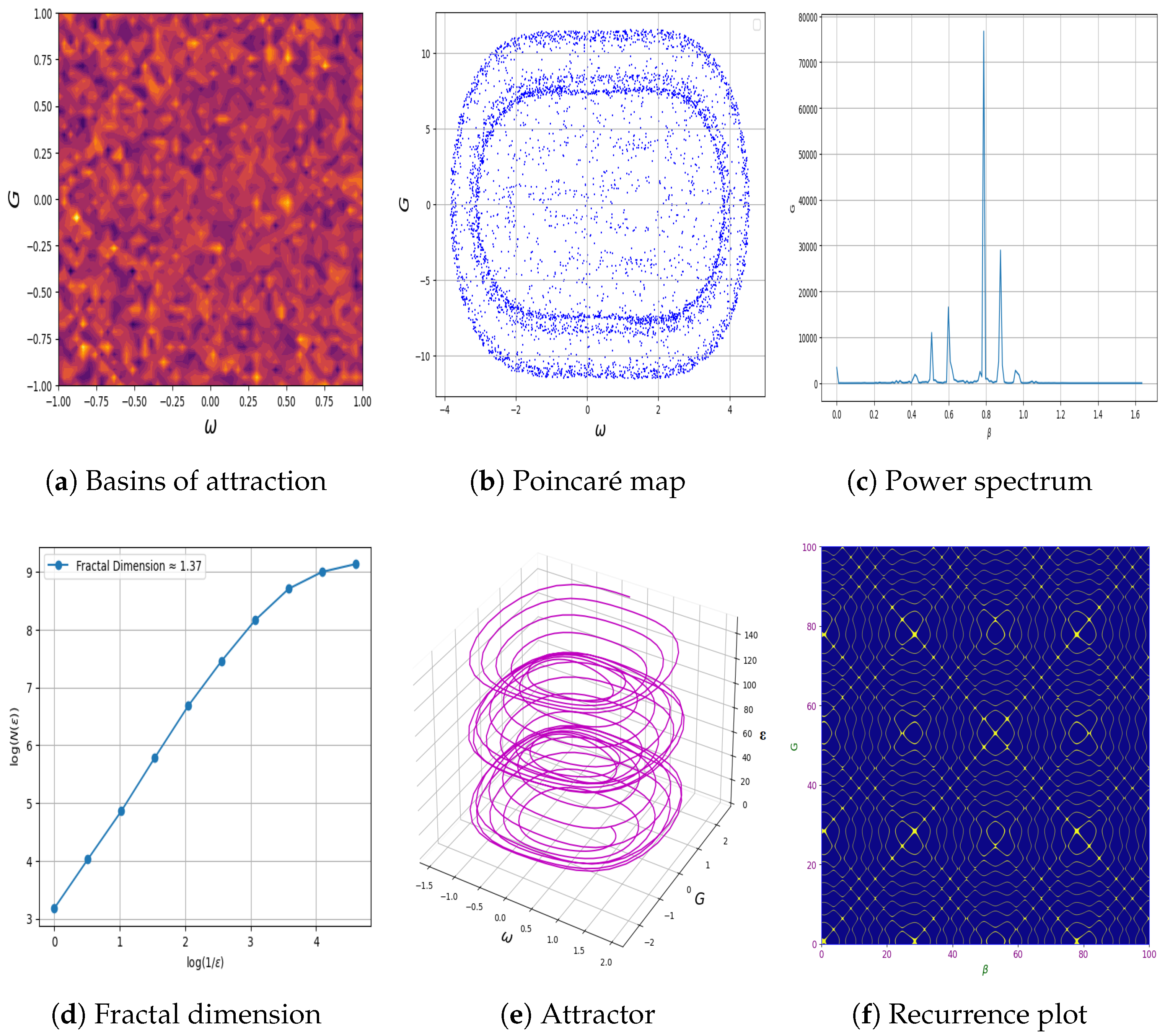
- Basin of attraction: The set of initial conditions in a dynamical system that evolve toward a particular attractor, illustrating how different starting points lead to different long-term behaviors, including chaotic attractors.
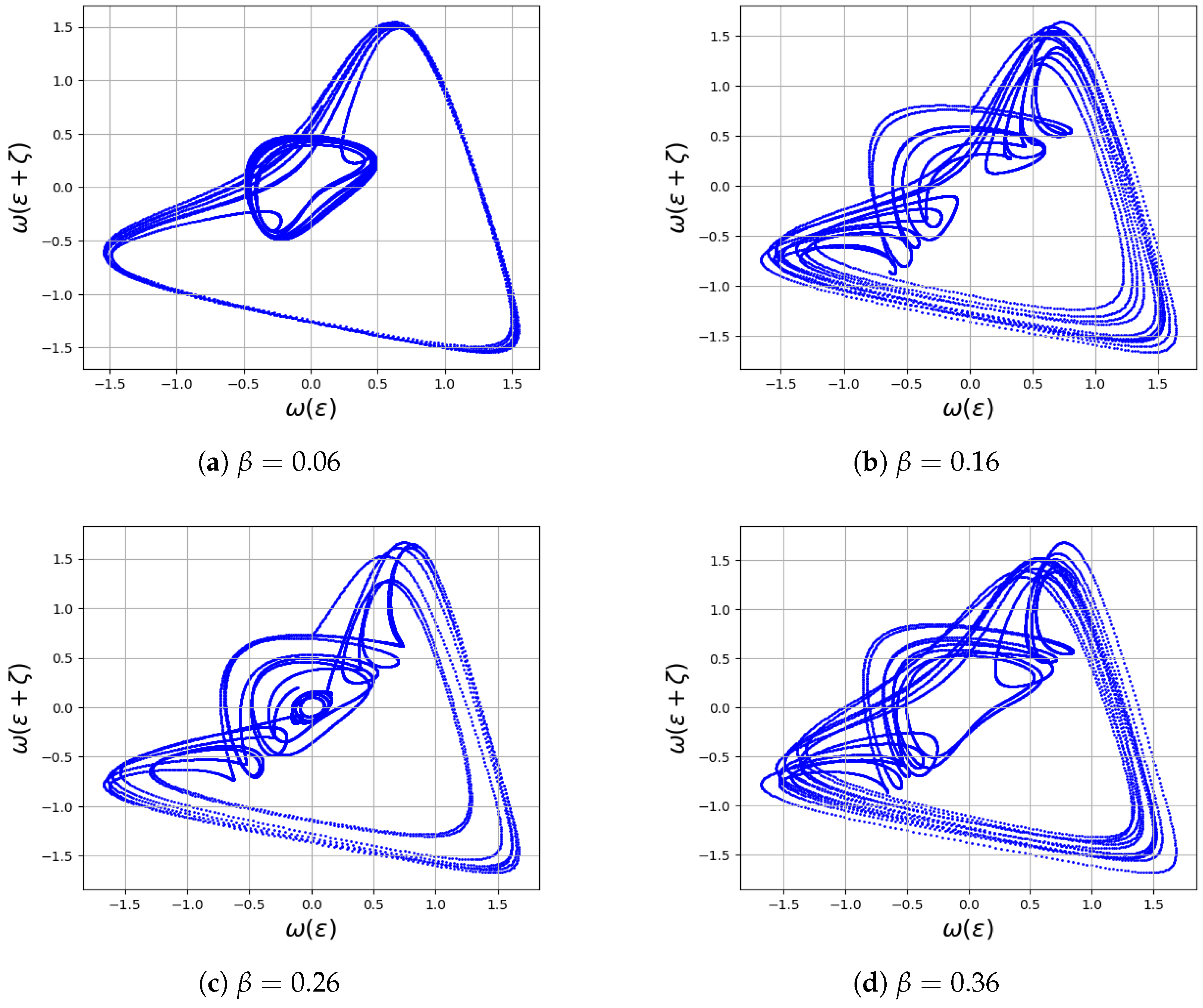
- Return map: A return map describes the relationship between successive values of a dynamical variable at discrete time intervals. It is used to analyze periodicity, stability, and chaotic behavior in nonlinear systems.
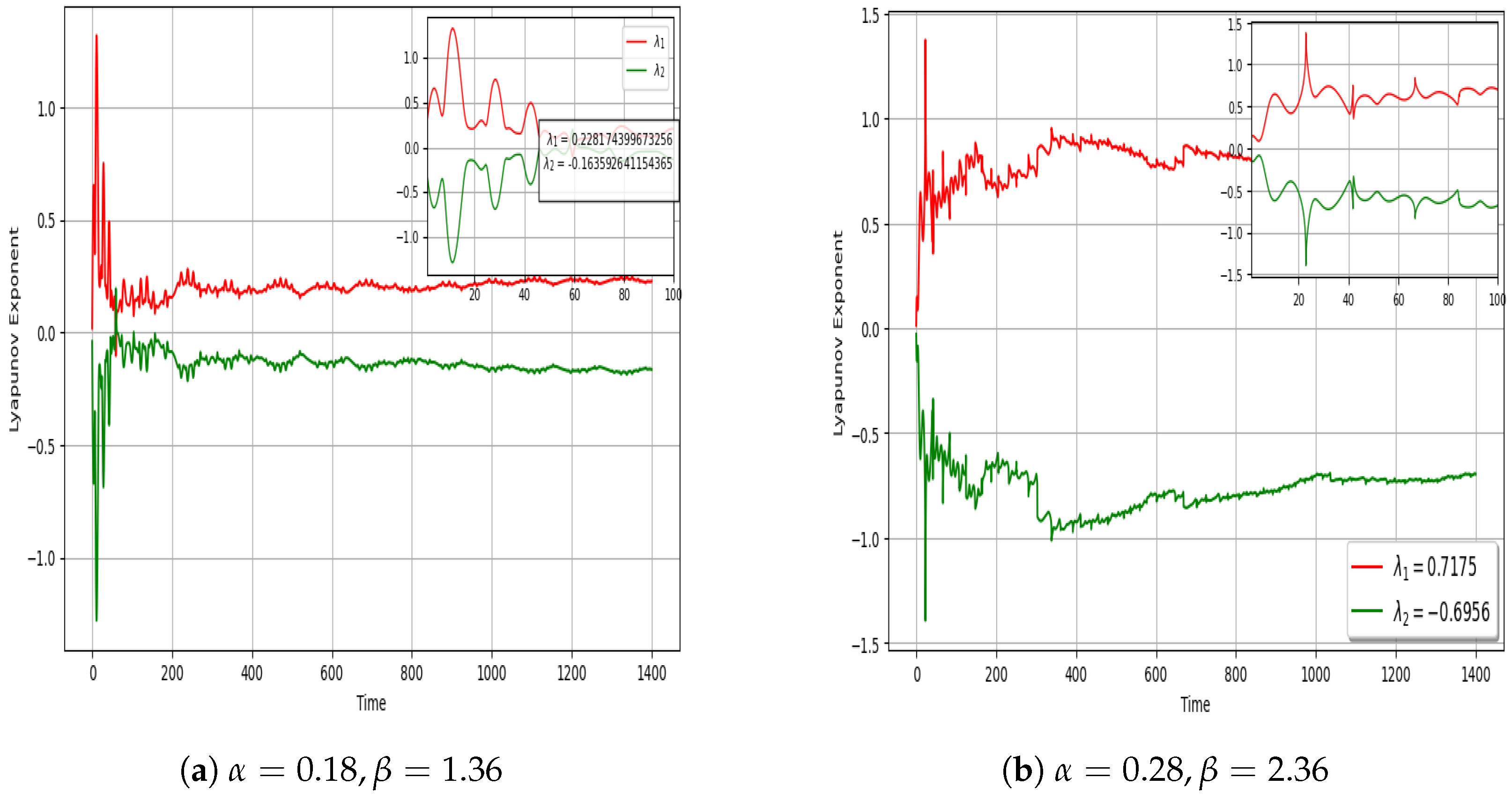
- Lyapunov exponents: Lyapunov exponents measure the average rate at which nearby trajectories diverge or converge in phase space. A positive Lyapunov exponent indicates a sensitive dependence on the initial conditions and chaotic dynamics.
- Permutation entropy: Permutation entropy is a complexity measure used to quantify the randomness and irregularity of a time series. Higher values indicate more complex or chaotic dynamics.
- Poincaré map: A Poincaré map is a tool that reduces a continuous dynamical system to a discrete map by observing intersections with a specific section. It simplifies the analysis of periodic and chaotic motions.
- Power spectrum: The power spectrum represents the distribution of signal energy over different frequencies. It is commonly used to distinguish periodic, quasi-periodic, and chaotic signals.
- Attractor: An attractor is a set of states toward which a dynamical system evolves over time. It can be a fixed point, limit cycle, torus, or chaotic attractor.
- Fractal dimension: The fractal dimension quantifies the geometric complexity of a structure or attractor. It measures how detail in a pattern changes with scale and is often noninteger for chaotic systems.
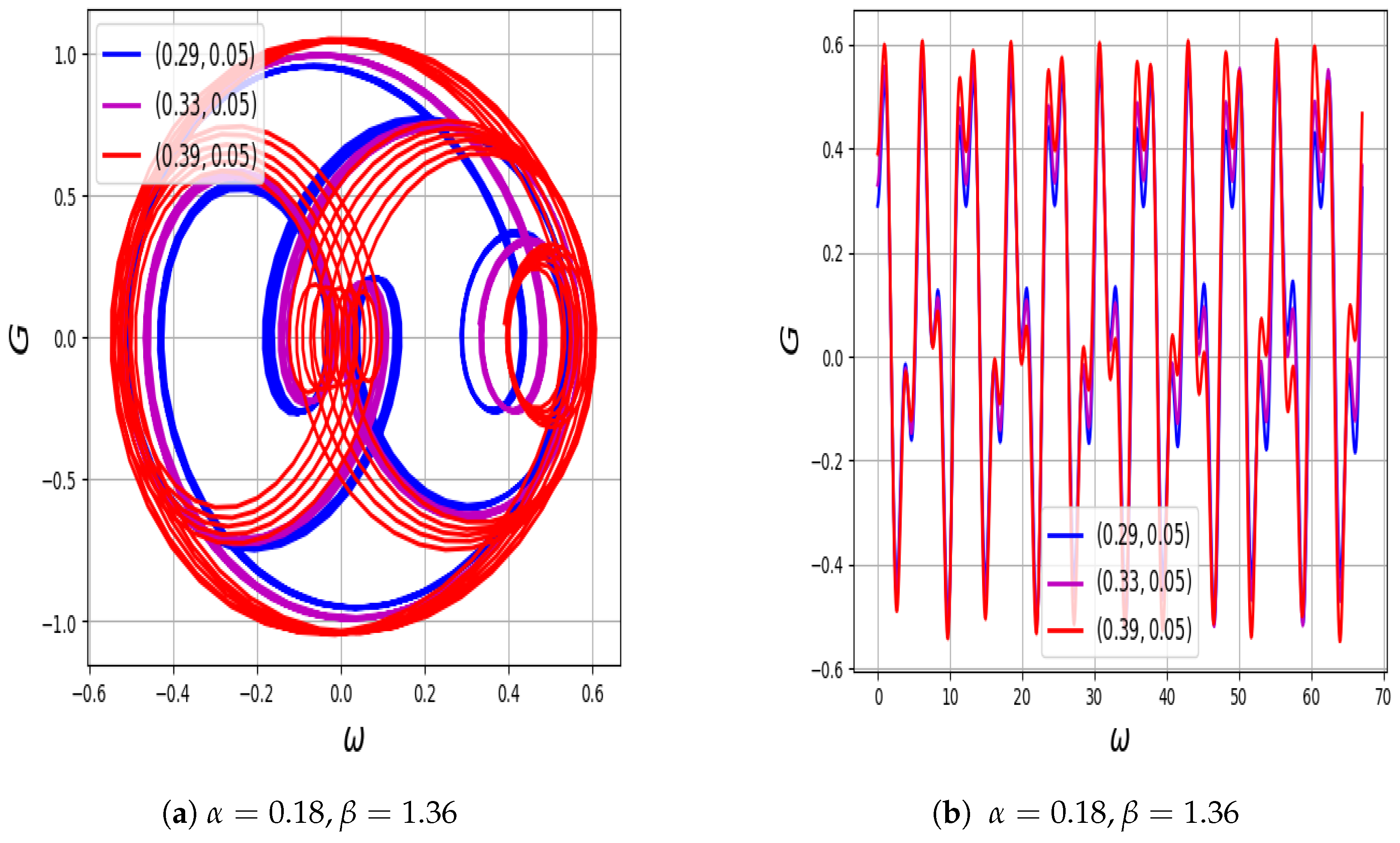
- Multistability: Multistability refers to the coexistence of two or more stable states or attractors in a dynamical system. The final state of the system depends on its initial conditions.
- Three-dimensional phase portrait: A 3D phase portrait visualizes the trajectories of a dynamical system in three-dimensional space, revealing complex dynamics like chaotic attractors and spatial structures.
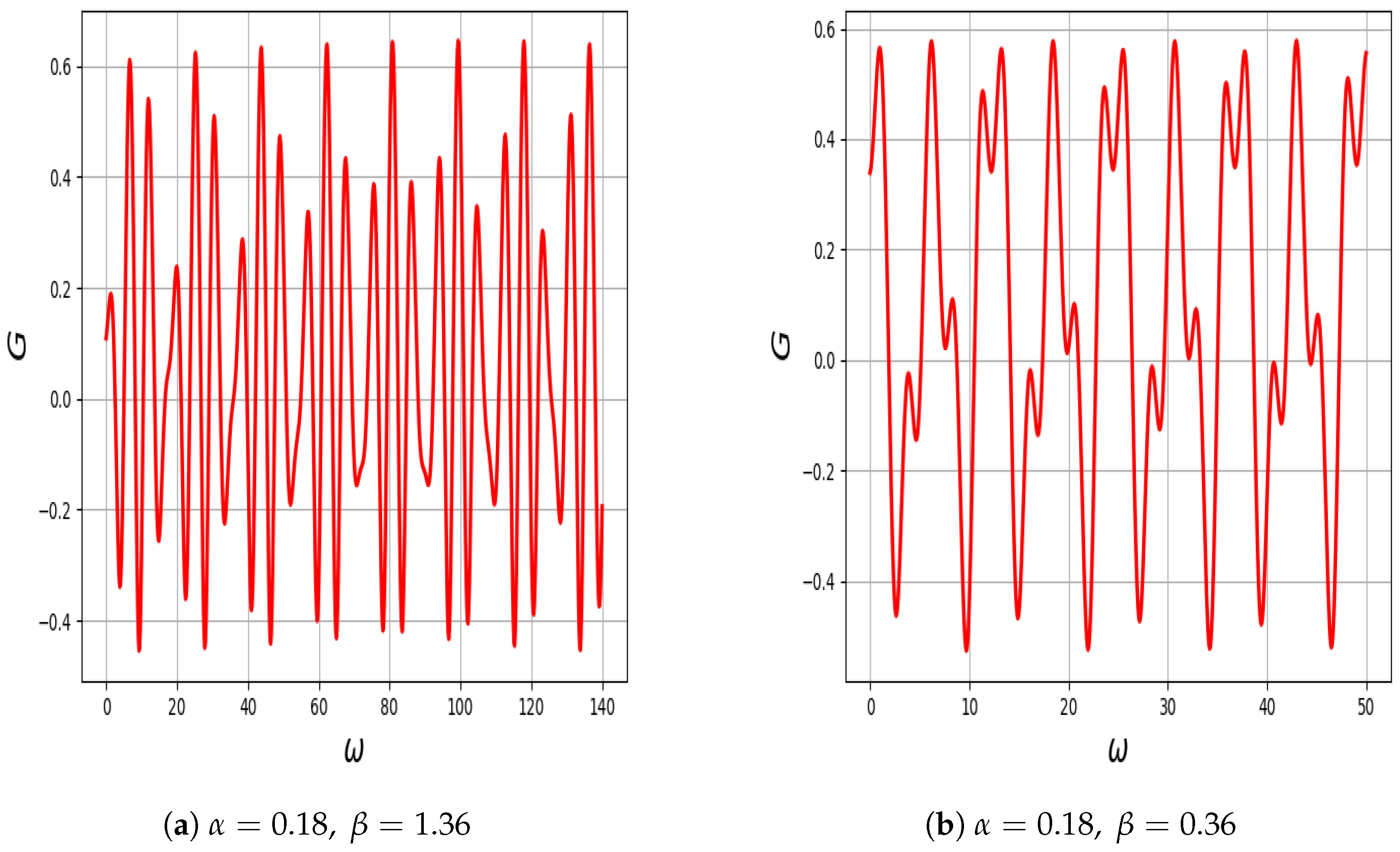
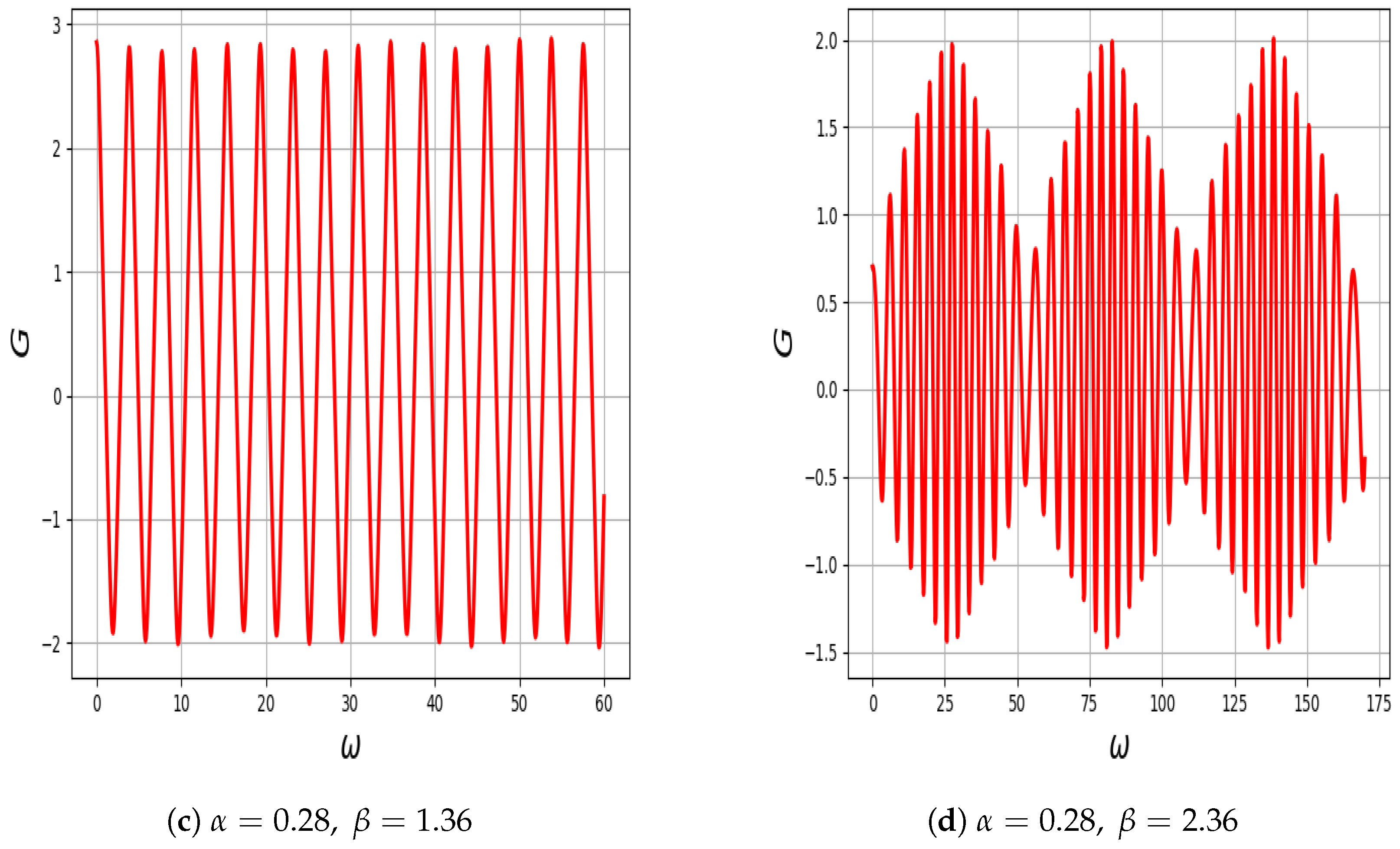
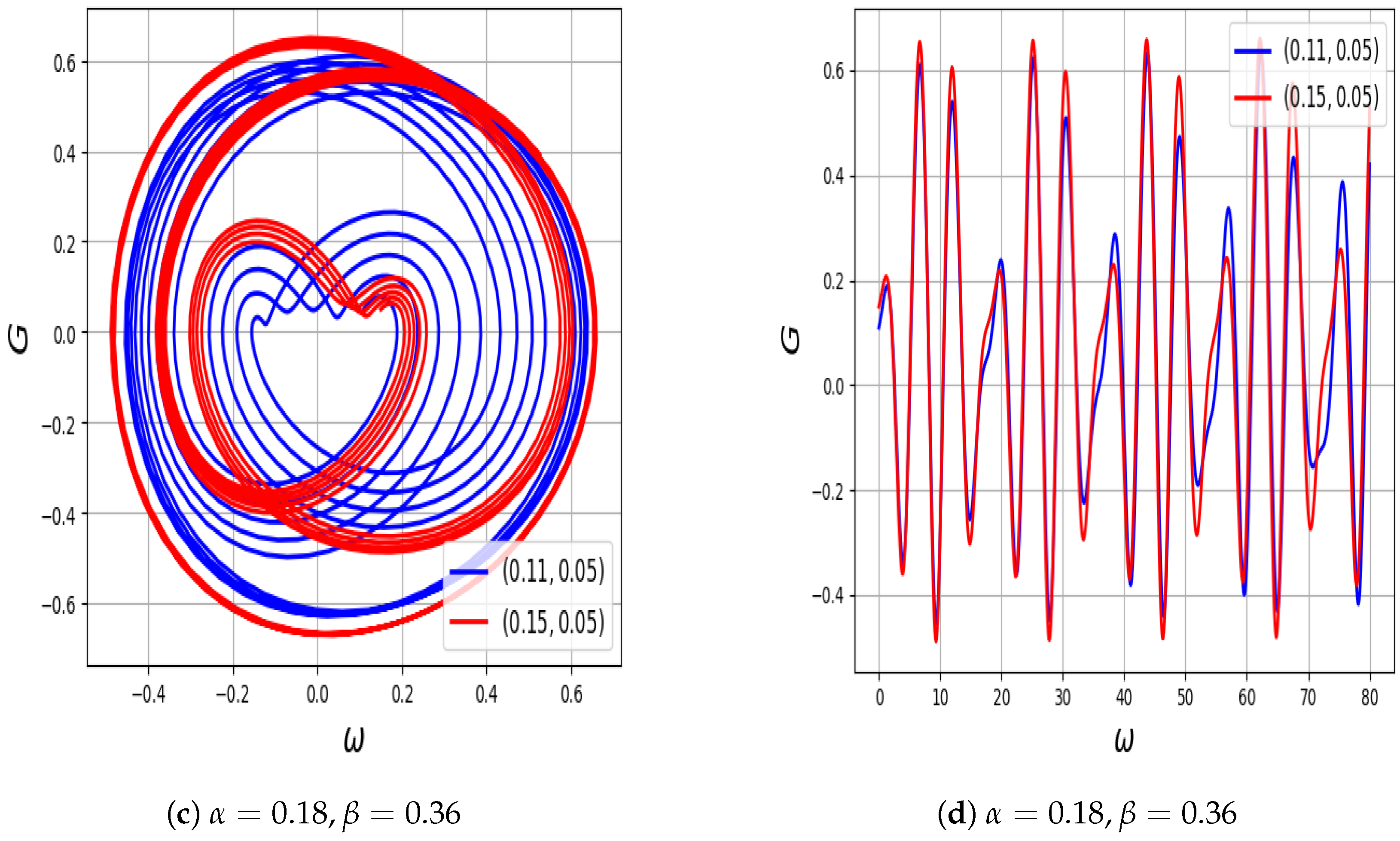
- Time analysis: Time analysis studies the variation in system variables with respect to time. It helps to identify periodic, quasi-periodic, or chaotic temporal behaviors of the system.
- Recurrence plot: A recurrence plot is a graphical tool used to visualize the times at which a system revisits similar states in phase space.
1.7. Comparison with Existing Work
1.8. Paper’s Structure
2. Mathematical Framework of Equation (3)
3. Dynamical Analysis
3.1. Unperturbed System Analysis
3.1.1. Bifurcation Analysis
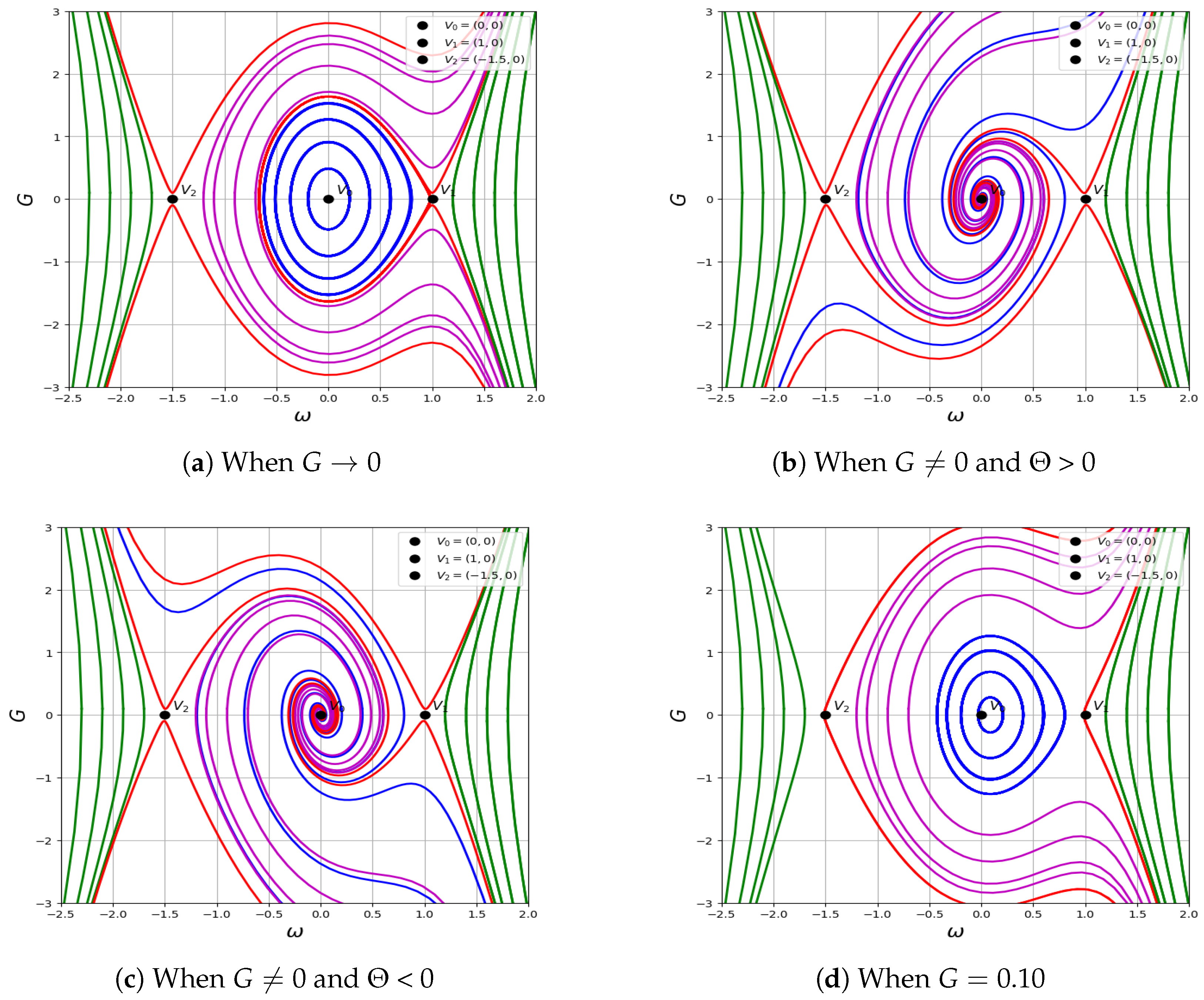
- If and , the equilibrium point behaves as a center.
- If and , the equilibrium point is classified as a saddle point.
- If and , the equilibrium point corresponds to a cusp.
- 1.
- PSP: Periodic solution path
- 2.
- HSP: Homoclinic solution path
- 3.
- SNPSP: Super nonlinear periodic solution path
- 4.
- HCSP: Heteroclinic solution path
- 5.
- SNHSP: Super nonlinear homoclinic solution path

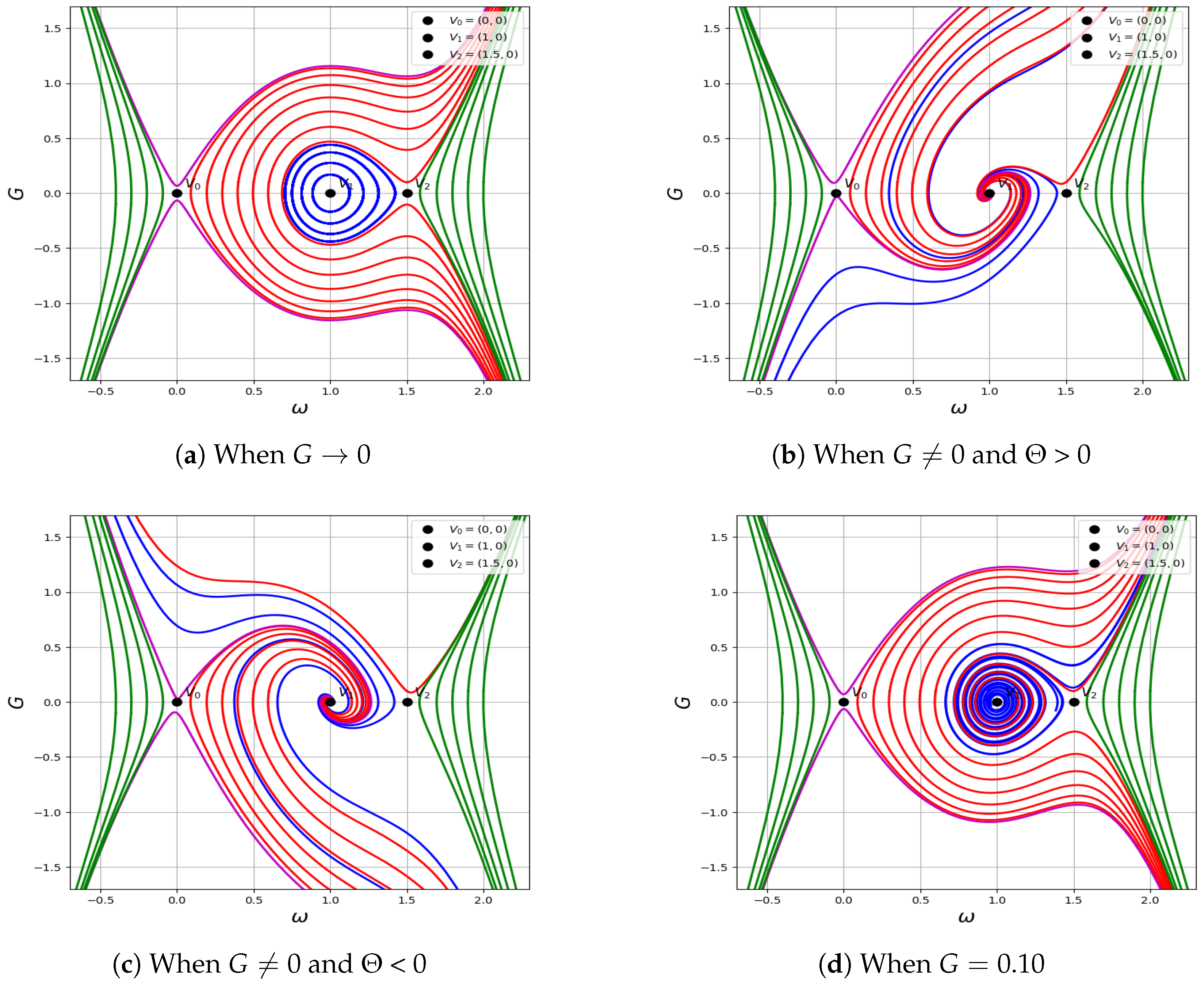
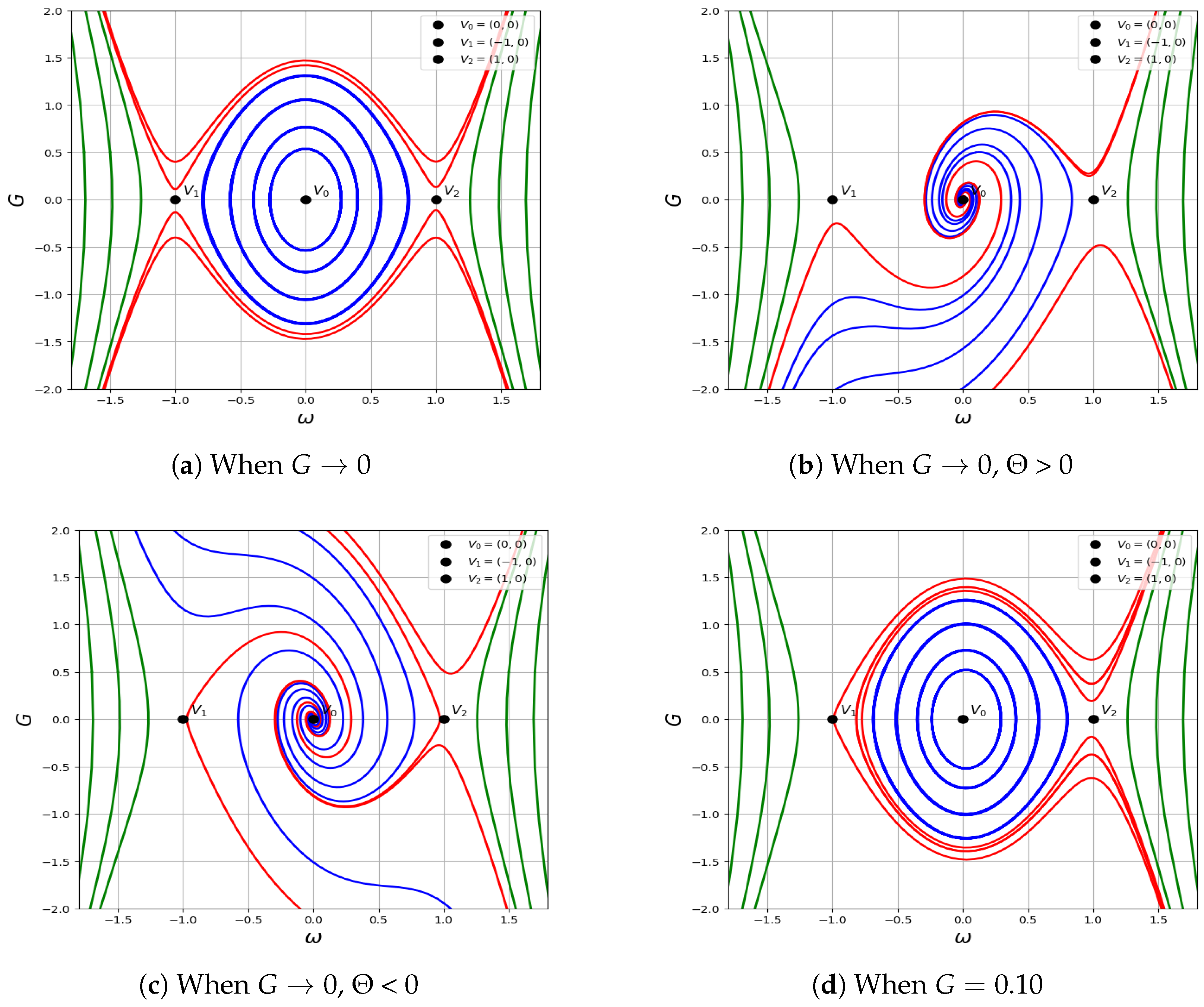
| Figure | Equilibrium Points | Parameters | Behavior |
|---|---|---|---|
| Figure 1a–d | , , | ||
| Figure 2a–d | , , | ||
| Figure 3a–d | , , |
| Figure | Blue Trajectory | Red Trajectory | Pink Trajectory |
|---|---|---|---|
| Figure 1a | PSP | - | - |
| Figure 1b | - | - | - |
| Figure 1c | - | - | - |
| Figure 1d | PSP | - | - |
| Figure 2a | PSP | HCSP | - |
| Figure 2b | - | - | - |
| Figure 2c | - | - | - |
| Figure 2d | PSP | - | - |
| Figure 3a | PSP | HCSP | - |
| Figure 3b | - | - | - |
| Figure 3c | - | - | - |
| Figure 3d | PSP | - | - |


3.1.2. Hamiltonian Function
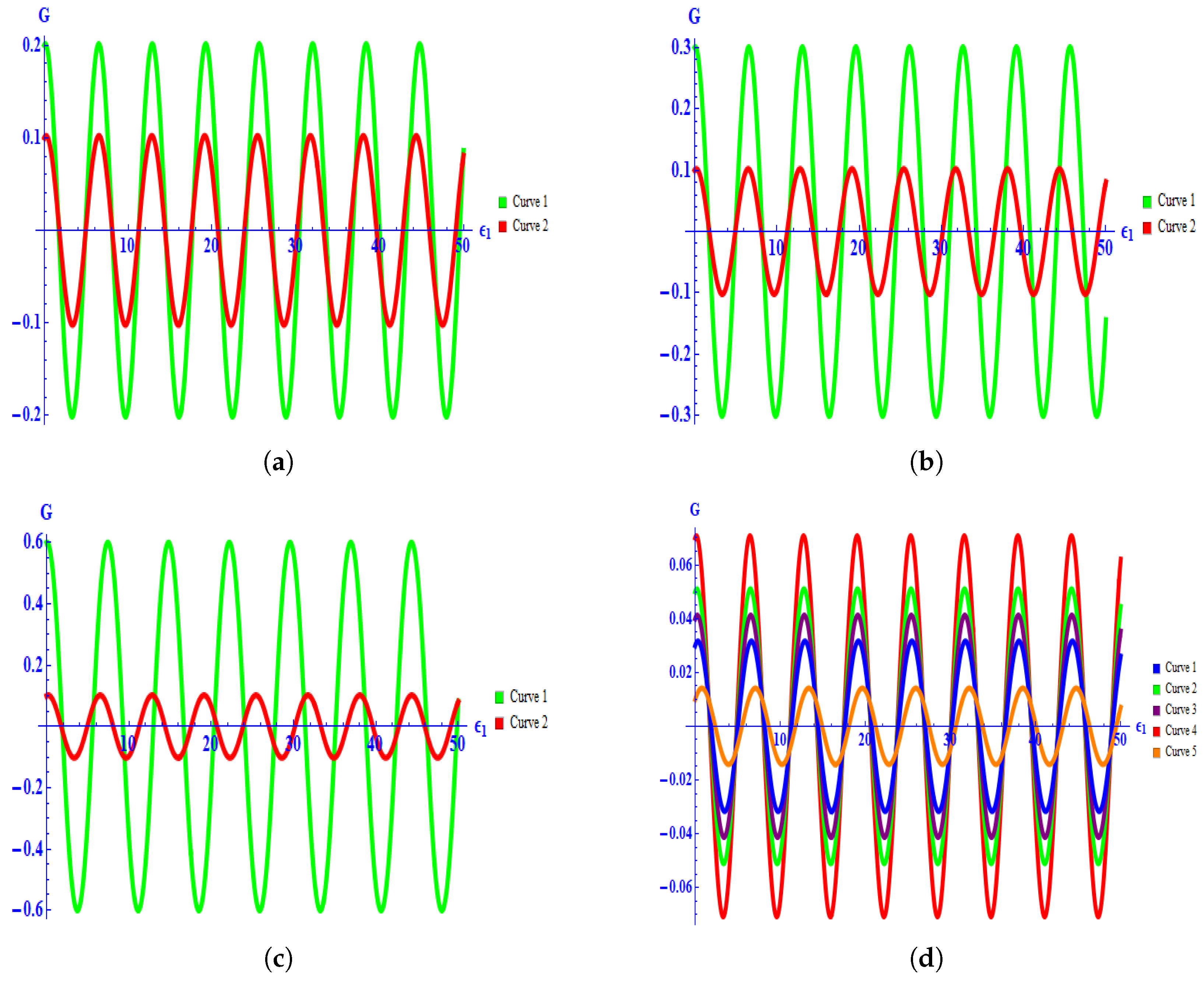
3.1.3. Sensitivity Analysis
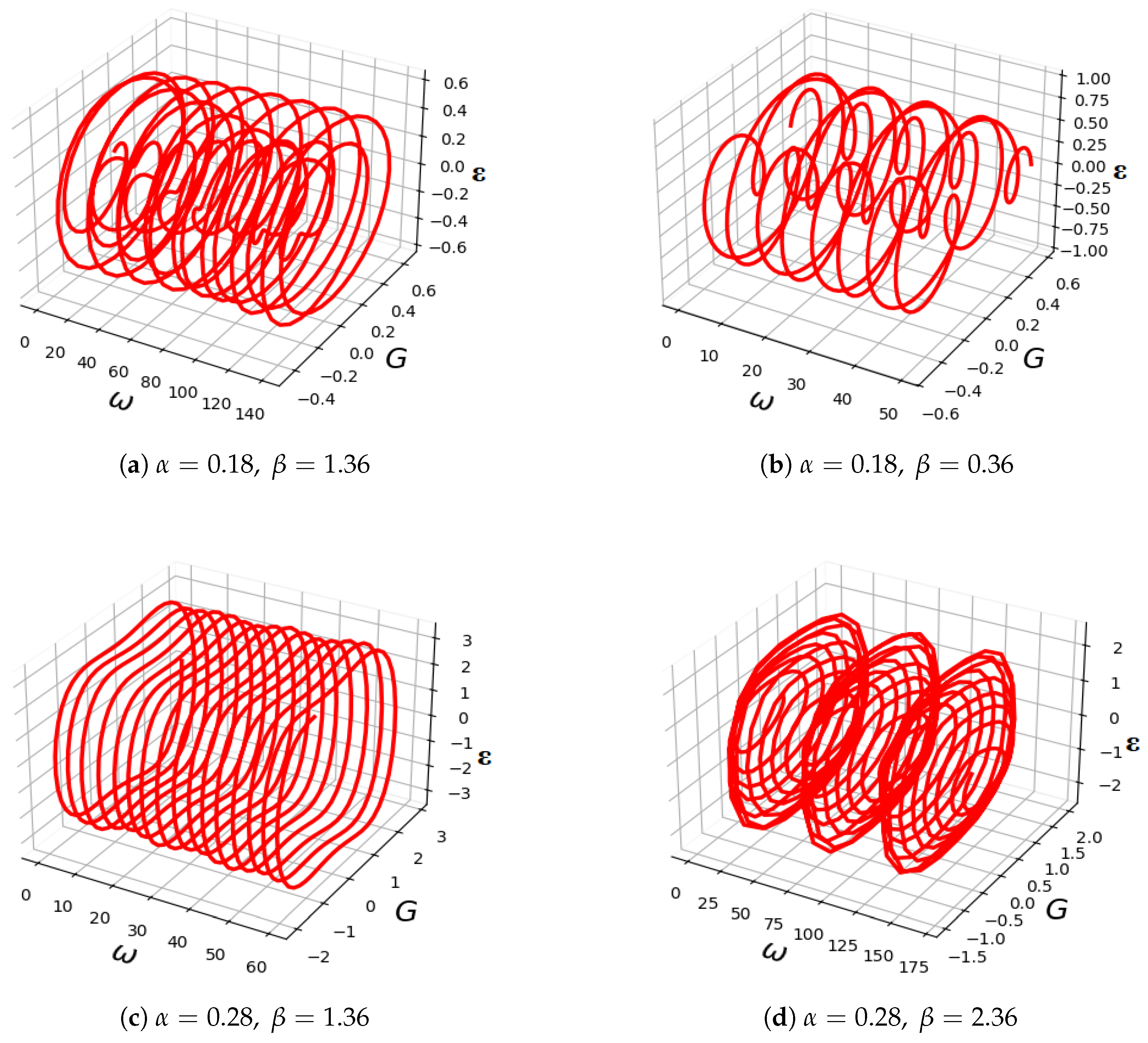
3.2. Perturbed System Analysis
4. Soliton Solutions of (3) Using UREEM
4.1. Overview of UREEM
4.2. Implementation of UREEM in Equation (6)
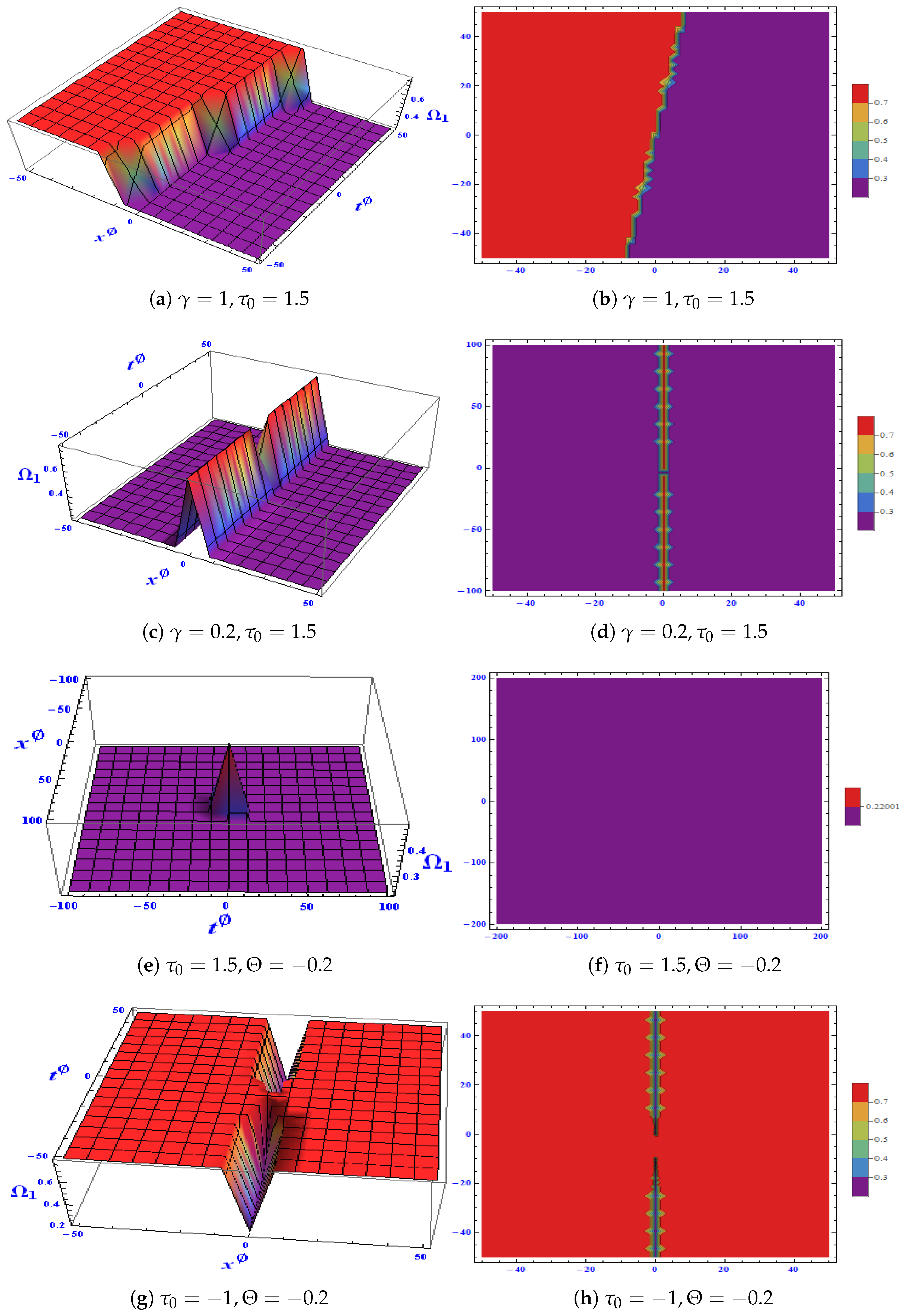
4.3. Visualizing and Analyzing Symmetric Wave Patterns
5. Conclusions
Author Contributions
Funding
Data Availability Statement
Conflicts of Interest
References
- Alquran, M.; Yousef, F.; Alquran, F.; Sulaiman, T.A.; Yusuf, A. Dual-wave solutions for the quadratic-cubic conformable-Caputo time-fractional Klein-Fock-Gordon equation. Math. Comput. Simul. 2021, 185, 62–76. [Google Scholar]
- Alquran, M.; Ali, M.; Jaradat, I.; Al-Ali, N. Changes in the physical structures for new versions of the Degasperis-Procesi-Camassa-Holm model. Chin. J. Phys. 2021, 71, 85–94. [Google Scholar] [CrossRef]
- Wazwaz, A.M. Partial Differential Equations and Solitary Waves Theory; Springer Science & Business Media: Berlin/Heidelberg, Germany, 2010. [Google Scholar]
- Rafiq, M.H.; Jhangeer, A.; Raza, N. Symmetry and complexity: A Lie symmetry approach to bifurcation, chaos, stability and travelling wave solutions of the (3 + 1)-dimensional Kadomtsev-Petviashvili equation. Phys. Scr. 2023, 98, 115239. [Google Scholar] [CrossRef]
- Ma, W.X.; Lee, J.H. A transformed rational function method and exact solutions to the (3 + 1)-dimensional Jimbo-Miwa equation. Chaos Solitons Fractals 2009, 42, 1356–1363. [Google Scholar] [CrossRef]
- Yasin, S.; Alshammari, F.S.; Khan, A. Quasi-periodic dynamics and wave solutions of the Ivancevic option pricing model using multi-solution techniques. Symmetry 2025, 17, 1137. [Google Scholar] [CrossRef]
- Samreen, M.; Alshammari, F.S. Exploring solitary wave solutions of the generalized integrable Kadomtsev-Petviashvili equation via Lie symmetry and Hirota’s bilinear method. Symmetry 2025, 17, 710. [Google Scholar]
- Malfliet, W.; Hereman, W. The tanh method: I. Exact solutions of nonlinear evolution and wave equations. Phys. Scr. 1996, 54, 563. [Google Scholar] [CrossRef]
- Ismael, H.F.; Seadawy, A.; Bulut, H. Multiple soliton, fusion, breather, lump, mixed kink-lump and periodic solutions to the extended shallow water wave model in (2 + 1)-dimensions. Mod. Phys. Lett. B 2021, 35, 2150138. [Google Scholar] [CrossRef]
- Medhit, S.; Alshammari, F.S.; Bukhar, I. Modeling of soliton behavior in nonlinear transmission line systems. Mathematics 2025, 13, 2997. [Google Scholar] [CrossRef]
- Iserles, A. A First Course in the Numerical Analysis of Differential Equations; Cambridge University Press: Cambridge, UK, 2009. [Google Scholar]
- Jhangeer, A.; Beenish. Dynamics and wave analysis in longitudinal motion of elastic bars or fluids. Ain Shams Eng. J. 2024, 15, 102907. [Google Scholar] [CrossRef]
- Asif, M.; Shah, N.A.; Din, M.; Anwar, R. A new perspective on order-theoretic contractive mappings with applications in financial markets and economic growth via fractional differential equations. Bound. Value Probl. 2025, 2025, 175. [Google Scholar] [CrossRef]
- Kalies, W.; Vandervorst, R. Priestley duality and representations of global dynamics. Qual. Theory Dyn. Syst. 2025, 24, 186. [Google Scholar] [CrossRef]
- Khan, Z.U.; ur Rehman, M. Dynamical analysis of a fractional Maize Streak Disease model with enhanced predictive capabilities. Comput. Biol. Chem. 2025, 120, 108758. [Google Scholar] [CrossRef]
- Ma, W.X.; Fuchssteiner, B. Explicit and exact solutions to a Kolmogorov-Petrovskii-Piskunov equation. Int. J.-Non-Linear Mech. 1996, 31, 329–338. [Google Scholar]
- Cheng, L.; Ma, W.X. Soliton and lump solutions to a fourth-order nonlinear wave equation in (2 + 1)-dimensions. Qual. Theory Dyn. Syst. 2025, 24, 237. [Google Scholar] [CrossRef]
- Sousa, J.V.D.C.; de Oliveira, E.C. A new truncated M-fractional derivative type unifying some fractional derivative types with classical properties. arXiv 2017, arXiv:1704.08187. [Google Scholar]
- Huang, Q.; Zafar, A.; Raheel, M.; Bekir, A. Analytical wave solutions of an electronically and biologically important model via two efficient schemes. Chin. Phys. B 2023, 32, 110201. [Google Scholar] [CrossRef]
- Cevikel, A.C.; Bekir, A.; Abu Arqub, O.; Abukhaled, M. Solitary wave solutions of FitzHugh-Nagumo-type equations with conformable derivatives. Front. Phys. 2022, 10, 1028668. [Google Scholar]
- Cacuci, D.G.; Weber, C.F.; Oblow, E.M.; Marable, J.H. Sensitivity theory for general systems of nonlinear equations. Nucl. Sci. Eng. 1980, 75, 88–110. [Google Scholar] [CrossRef]
- Jhangeer, A.; Ibraheem, F.; Jamal, T.; Abdul Rahimzai, A.; Khan, I. Investigating pseudo-parabolic dynamics through phase portraits, sensitivity, chaos and soliton behaviour. Sci. Rep. 2024, 14, 15224. [Google Scholar] [PubMed]
- Li, Z.; Hussain, E. Qualitative analysis and optical solitons for the (1 + 1)-dimensional Biswas-Milovic equation with parabolic law and nonlocal nonlinearity. Results Phys. 2024, 56, 107304. [Google Scholar] [CrossRef]






| Reference | Chaos | Bifurcation | Derivative | Methodology | Limitation |
|---|---|---|---|---|---|
| [19] | ✗ | ✗ | M-fractional derivative | Sinh-Gordon equation expansion method and function | Applicable mainly to specific nonlinear forms |
| [20] | ✗ | ✗ | Conformable derivative | Extended tanh–coth method | Produces restricted wave structures for complex models |
| Present study | ✓ | ✓ | M-fractional derivative | Unified Riccati equation expansion method | None |
Disclaimer/Publisher’s Note: The statements, opinions and data contained in all publications are solely those of the individual author(s) and contributor(s) and not of MDPI and/or the editor(s). MDPI and/or the editor(s) disclaim responsibility for any injury to people or property resulting from any ideas, methods, instructions or products referred to in the content. |
© 2026 by the authors. Licensee MDPI, Basel, Switzerland. This article is an open access article distributed under the terms and conditions of the Creative Commons Attribution (CC BY) license.
Share and Cite
Beenish; Alsharidi, A.K. Dynamical Analysis and Soliton Solutions of the Truncated M-Fractional FitzHugh–Nagumo Equation. Fractal Fract. 2026, 10, 213. https://doi.org/10.3390/fractalfract10040213
Beenish, Alsharidi AK. Dynamical Analysis and Soliton Solutions of the Truncated M-Fractional FitzHugh–Nagumo Equation. Fractal and Fractional. 2026; 10(4):213. https://doi.org/10.3390/fractalfract10040213
Chicago/Turabian StyleBeenish, and Abdulaziz Khalid Alsharidi. 2026. "Dynamical Analysis and Soliton Solutions of the Truncated M-Fractional FitzHugh–Nagumo Equation" Fractal and Fractional 10, no. 4: 213. https://doi.org/10.3390/fractalfract10040213
APA StyleBeenish, & Alsharidi, A. K. (2026). Dynamical Analysis and Soliton Solutions of the Truncated M-Fractional FitzHugh–Nagumo Equation. Fractal and Fractional, 10(4), 213. https://doi.org/10.3390/fractalfract10040213