Article

On the Predictability of Green Finance Markets: An Assessment Based on Fractal and Shannon Entropy

Department of Supply Chain and Business Technology Management, John Molson School of Business, Concordia University, Montreal, QC H3H 01A, Canada
*
Author to whom correspondence should be addressed.
Fractal Fract. 2026, 10(3), 205; https://doi.org/10.3390/fractalfract10030205
Submission received: 5 February 2026 / Revised: 14 March 2026 / Accepted: 20 March 2026 / Published: 22 March 2026
(This article belongs to the Special Issue Fractal Approaches and Machine Learning in Financial Markets)

Abstract

Econophysics is an interdisciplinary field that applies physics concepts to economic and financial systems. By utilizing tools such as statistical physics, including fractal analysis and entropy measures, econophysics helps model the complex and non-linear dynamics of equity markets. This paper examines the intrinsic dynamics and regularity in information content in green finance markets (carbon, clean energy, and sustainability markets) by means of range scale analysis (R/S), detrended fluctuation analysis (DFA), fractionally integrated generalized auto-regressive conditionally heteroskedastic (FIGARCH) process, and Shannon entropy (SE). The empirical results can be summarized as follows. First, prices in all markets are persistent; however, returns are likely random as estimated Hurst exponents are close to 0.5. Second, the FIGARCH process shows that volatility series in carbon and sustainability markets are persistent, whilst volatility in clean energy is anti-persistent. Third, in carbon and sustainability markets, entropy is high in prices compared to returns and volatility series. On the contrary, the clean energy market shows lower entropy for prices than for returns and volatility. In sum, it is concluded that price and volatility series are predictable, whilst return series are not. Finally, based on a rolling window framework, it is concluded that the COVID-19 pandemic and the Russia–Ukraine war have altered long memory and randomness in all three green finance markets.

1. Introduction

The predictability of financial assets is a hot topic in quantitative finance. In this regard, the efficient market hypothesis (EMH) [1] states that, in an efficient market, all valuable information is fully and quickly reflected in stock prices. In this regard, stock price efficiency is the speed and accuracy with which the market encompasses all accessible information into security prices [2]. Nonetheless, in real-world financial markets, informational imperfections may cause a delay in adjustment of price to new information [3]. The concept of self-similarity or long memory [4,5] refers to the repetition of featured traits in the data; as a result, self-similarity plays a fundamental role in showing significant patterns in the underlying data. In this regard, numerous studies have been conducted to study EMH in equity and financial markets based on estimation of the Hurst exponent [6] to evaluate self-similarity.
For instance, based on fractal market theory, previous studies evaluated market efficiency in Hong Kong Real Estate Investment Trusts (REITs) [7], family business stocks listed on the Casablanca stock exchange [8], Latin American stock markets [9], Middle East and North African (MENA) stock markets [10], Thai stock markets [11], Shenzhen Component Index (SZSE) on intra-day-basis prices [12], and the Russian stock market [13]. It was concluded that the Hong Kong (HK) REITs market has long memory [7], short (long) fluctuations in family business stock returns are less (more) persistent (anti-persistent) than short fluctuations in market indices [8], Latin America stock markets are not efficient [9], in the MENA region, the least inefficient market is Turkey, followed by Israel, while the most inefficient markets are Iran, Tunisia, and United Arab Emirates [10], Thai markets are becoming more efficient [11], and there is evidence of long-range correlations in the Shenzhen Component Index [12] and in the Russian market [13].
Other studies examined the effect of the 2008 financial crisis on the dynamics of the Hurst exponent in the Asian stock markets returns [14], in Eurozone stock markets [15], in trend and short variation in international stock market prices and returns [16], and in the KOPSI market [17]. It was found that the 2008 financial crisis influenced the Hurst exponents of Asian stock returns; specifically, the correlation between local Hurst exponents of the U.S. market returns and those of the Asian market returns increased from calm to a crisis period [14], and has negatively influenced stock price efficiency in most of the Eurozone capital markets, causing a significant mean-reverting behavior in stock price movements [15], during, and after 2008 financial crisis. It was also found that price and return trends in international markets are persistent, whilst their short variations are anti-persistent [16], and the international financial crisis yielded to a significant change in the Hurst exponent during the market crisis [17].
Further, other works documented how long memory in equity and commodity markets was impacted by the COVID-19 pandemic and the Russia–Ukraine military conflict [18,19,20,21,22,23,24,25,26,27,28,29]. The empirical results showed evidence of a pronounced increase in the price persistence of energy commodities during the height of the COVID-19 pandemic, with a subsequent decrease during the Russia–Ukraine conflict [18], the strong impact of the pandemic on US indices, a lesser one on the Asian and Australian markets [19], a slight effect on the long memory of cryptocurrency returns [20], an average return in sectors in US stock markets show persistent features during the pandemic [21], and persistent memory across all sectors in the Russian stock exchange between the COVID-19 pandemic and the Russia–Ukraine military conflict [22]. The authors in [23] found that, before the pandemic, in the Islamic market, the healthcare sector was the most efficient in the short term, and the financial sector was the most efficient in the long term. In addition, during the pandemic, in the traditional market, the financial sector was the most efficient in the short term, and the utility sector was the most efficient in the long term. In [24], the empirical results showed evidence that both the COVID-19 pandemic and the Russia–Ukraine war significantly affected long memory in short and long movements of Brent and West Texas Intermediate (WTI) prices. Specifically, prices of Brent and WTI showed significant raises in persistence in long movements during the COVID-19 pandemic and the Russia–Ukraine war. Also, they exhibited an important expansion in anti-persistence in short movements during the pandemic and a considerable shrink in anti-persistence during the Russia–Ukraine war. The study in [25] showed that, during the COVID-19 pandemic, there were high levels of fractal in Brent, WTI, and gasoline markets, and a significant decrease in fractal in the heating oil market.
In recent years, the academic literature has been receiving a growing interest in studying green and sustainable financial markets as they provide new funding support for green economic development and investment. The latest works have focused on forecasting price, returns, and volatility [26,27,28,29], and the analysis of market efficiency from a fractal market hypothesis (FMH) perspective [30,31,32,33,34,35]. With respect to FMH, in [30], the authors studied the market efficiency of China’s clean energy stock indices and found that upward and downward trends of the clean energy markets all have significant multifractal characteristics. In addition, it was found that the clean energy stock market is far from efficient, regardless of whether the fluctuations are small or large. The authors in [31] investigated the multifractal scaling behavior and efficiency of green finance markets, conventional equity indices and crude oil. The empirical results showed that green finance market indices exhibit significant multifractality and considerable asymmetry. In addition, green finance markets are far from being efficient. In [32], the authors compared the asymmetric efficiency of dirty and clean energy markets before and during the COVID-19 pandemic. They found evidence of asymmetric multifractality in clean and dirty energy markets. In addition, the empirical results showed the superior efficiency of clean energy markets compared to conventional energies. Furthermore, the COVID-19 pandemic significantly influenced market efficiencies in both energy markets. In [33], the study examined the effect of the COVID-19 pandemic on the multifractality and efficiency of six clean energy markets. The empirical results revealed that clean energy markets exhibited multifractal behavior. In addition, the results showed a significant impact on the efficiency and intensified presence of multifractality during the COVID-19 period. In [34], the skewed multifractal cross-correlations between price and volumes on the carbon emissions trading markets in China and Europe were examined under the effect of the COVID-19 pandemic. The empirical findings showed that the multifractality of cross-correlations in both markets underwent significant changes before and after the pandemic, indicating skewed multifractality. In addition, in both markets, the price–volume linkage displayed expanded anti-persistence, greater multifractal risks, and diminished market efficiency after the outbreak of the pandemic. The authors in [35] documented the non-linear dynamics in green and conventional bond indices. They found that both bond indices exhibit multifractal characteristics. Finally, the authors in [36] investigated the multifractal characteristics and non-linear cross-correlations between carbon credit global financial assets, including the Euro/US Dollar exchange rate, Dow Jones Industrial Average (DJIA), gold, WTI, and Bitcoin. They found evidence of multifractality in all asset pairs, with stronger multifractal spectra detected in pairs linked to Bitcoin and WTI prices. Also, the results indicated higher persistence for small fluctuations and anti-persistence for large fluctuations, particularly in pairs involving the S&P Global Carbon Index. Furthermore, asymmetric cross-correlation multifractality was identified in the pair involving S&P Global Carbon Index and DJIA.
The main purpose of this study is to examine the predictability in green finance markets; for instance, we examine the efficiency in green finance markets based on an estimation of the Hurst exponent to evaluate long memory (self-similarity) in prices, returns, and volatility. A particular emerging strand of literature considers randomness to draw implications regarding the information regularity in financial and commodity markets [37,38,39,40,41,42]. In this regard, to further contribute to the econophysics of green finance, we seek to assess information regularity/irregularity based on Shannon entropy [43,44].
The present study contributes to the existing literature on the predictability of green finance markets [30,31,32,33,34,35,36] in the following ways. Firstly, we estimate long memory in green finance markets based on an estimation of the Hurst exponent following two different methods, namely, range/scale (R/S) analysis [45] and the detrended fractal analysis (DFA). Hence, we can compare these two popular methods for Hurst exponent estimation widely used in engineering and science [46,47,48,49,50,51,52] and in econophysics [53,54,55]. Secondly, as Shannon entropy [43,44] was found to be effective in various applications [42,56,57,58], it is used in this study to quantify randomness in price and returns in green finance markets; hence, it is used to assess stability. Thirdly, we examine long memory in the volatility of green finance markets by using the well-known FIGARCH process [59,60,61]. In this regard, we seek to verify the degree of persistence in volatility which is important for portfolio risk management. Finally, to the best of our knowledge, this study is the first attempt to analyze efficiency and information regularity in the prices, returns, and volatilities of green finance markets.
This paper is structured as follows. Section 2 briefly presents the R/S analysis, DFA, and Shannon entropy. Section 3 describes the data and provides the empirical results. Finally, in Section 4, we discuss the results and conclude the paper.

2. Materials and Methods

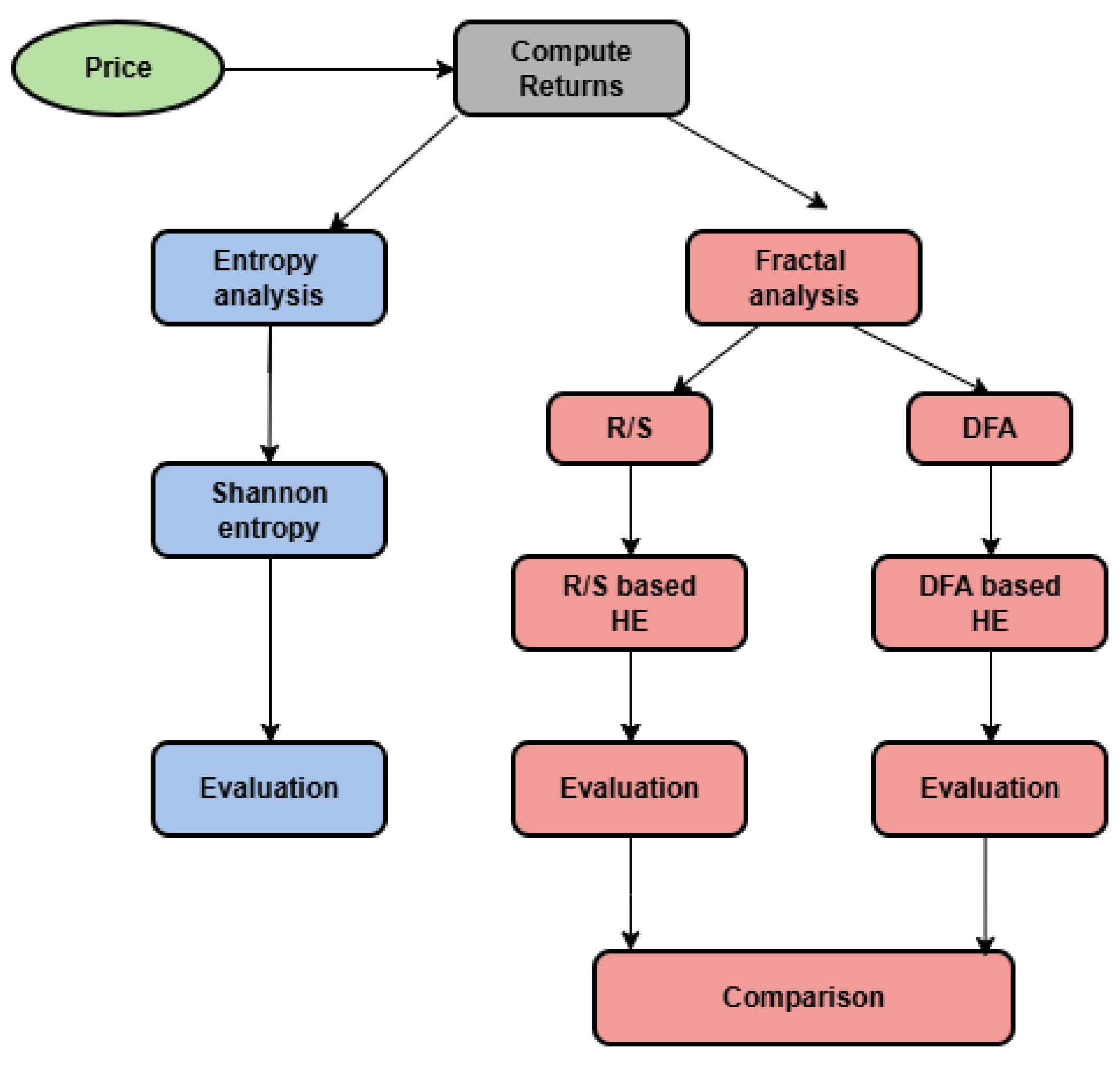
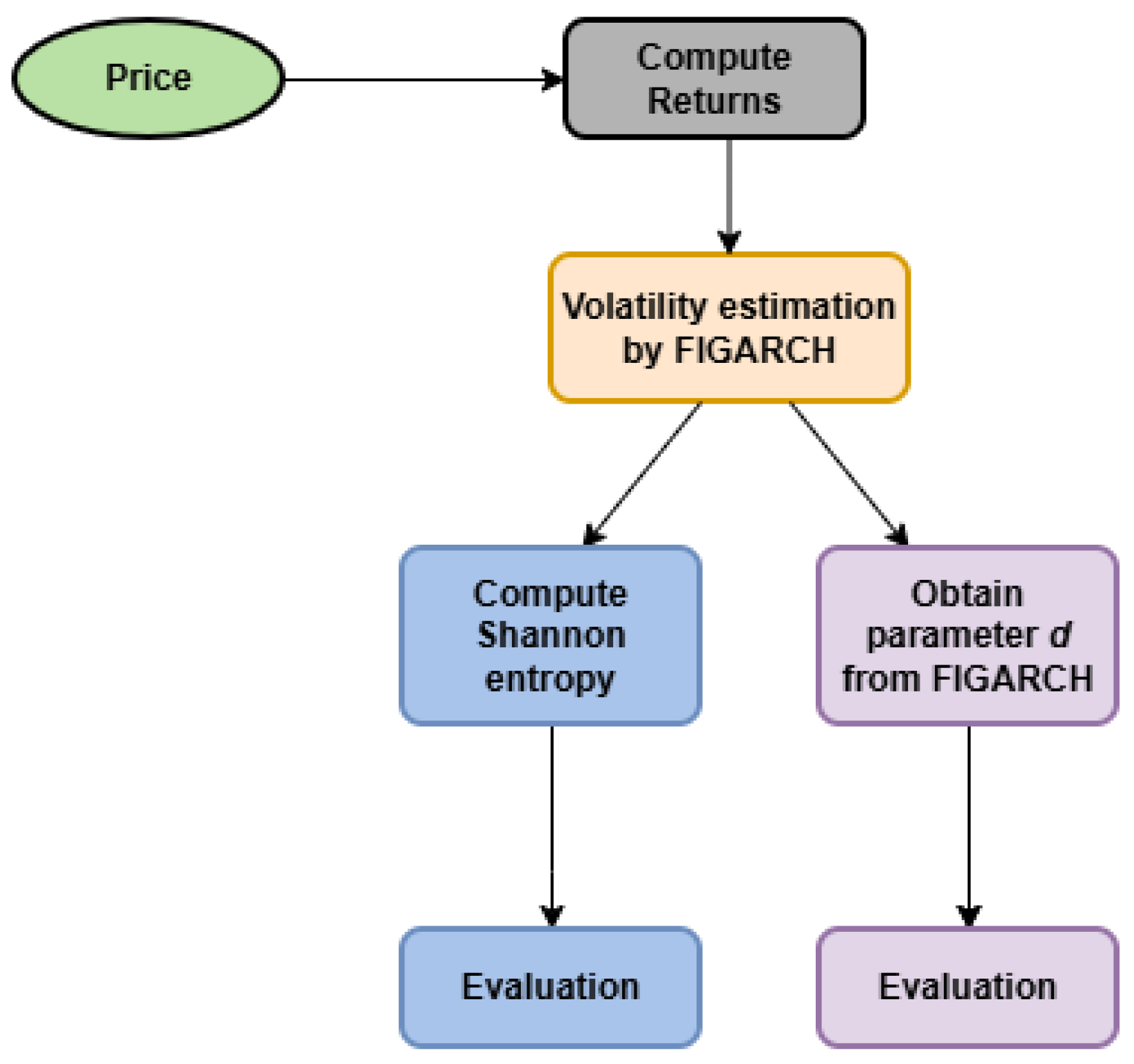
To illustrate the sequential procedures utilized to achieve our study objectives, three comprehensive flowcharts are presented next. The first two detail the examination of long-range dependence and the degree of stochasticity present within our price levels (Figure 1) and within the returns (Figure 2) for each green market. The returns, computed as the natural logarithm of the ratio between consecutive price levels, serve as the input for a fractionally integrated GARCH (FIGARCH) model to generate estimated volatility series. The subsequent procedures for conducting entropy and fractal analysis on these volatility series across the three green markets are illustrated in Figure 3.
The R/S, DFA, FIGARCH process, and Shannon entropy are described next. R/S and DFA are used to capture long-range memory in prices and returns, the FIGARCH process is used to quantify long-range memory in volatility series, and Shannon entropy is employed to assess randomness in prices, returns, and volatilities.

2.1. R/S Analysis

The R/S analysis [45] is suitable to estimate the degree of self-similarity in time series. For instance, at a given scale n, the mean value of the signal X is computed as follows:
u ¯ n t = 1 n X = 1 n u x
The total accumulative deviation is expressed as follows:
u X , n = X = 1 n u x u ¯ n
The extreme difference R(n) is calculated as follows:
R n = max 1 X < n u X , n min 1 X < n u X , n
The standard deviation is given by the following:
S n = 1 n X = 1 n u x u ¯ n 2
Finally, based on the relationship R n / S n n H , the Hurst exponent H can be calculated by fitting a linear regression of log(n) on log(R(n)/S(n)).
If the signal X is characterized by long-range correlation features, then it is not random. For instance, when 0 < H < 0.5, X is anti-persistent; so, a large (small) variation is more likely to be followed by a small (large) variation. When 0.5 < H < 1, X is persistent, a large (small) variation is more likely to be followed by a large (small) variation. Lastly, when H = 0.5, the dynamics of X follow a random walk and X is difficult to predict. Recall that, when H ≥ 1, the autocorrelation exists and ceases to be a power law form.

2.2. DFA

Similar to the R/S method, the DFA measures the power law scaling of a signal; however, it involves a detrending step based on a local polynomial fit to identify and remove trends [45]. In this regard, DFA quantifies the power law scaling of a non-stationary signal while evading incorrect detection of long-range dependence. Specifically, the DFA computes the average fluctuations of a signal x(i) (where i = 1, …, M) after removing the trend obtained by linear fitting. For instance, the algorithm of the DFA is based on the following steps:
(a)
Integrating the original signal x(i) to obtain a new signal y(j):
y j = i = 1 j x i x
where
x = 1 M j = 1 M x j
(b)
The integrated signal y(j) is divided into boxes of equal length, n. For each box, a linear regression line is fitted to the data samples of y(j) to find the local trend within that box. In this work, we performed a second-order linear detrending. The integrated signal y(j) is detrended by subtracting the local trend y n j   from the data in each box.
(c)
The root-mean-square fluctuation of y(j) is computed as follows:
F n = 1 M j = 1 M y j y n j 2
Actually, the F(n) is computed for different values of n and is plotted as a function of n on a log–log plot.
(d)
The empirical relationship between F(n) and the box length n is given by the following:
F n , M n H
(e)
Finally, the scaling exponent (or Hurst exponent) H used to capture long-range dependence (self-similarity) is estimated by performing an ordinary least-squares regression of log(F(n, M)) on log(n).
The computational architecture of the R/S and DFA frameworks, specifically designed to capture the dynamic scaling properties of green market series, is detailed in the next two paragraphs.
In the DFA framework, we use a second-order DFA (DFA-2) to quantify the long-range autocorrelations and scaling behavior of the price and returns series. To measure market fluctuations across different time horizons, the fluctuation function, F n , as stated in Equation (7), is computed using a rolling window approach. Within each rolling interval, F n is calculated across a spectrum of time scales, where n represents the window size needed for detrending. We define the scaling boundaries as n m i n = 16 and an n m a x = N 4 where N is the length of the series, or of a segment of the series under analysis. The minimum scale of 16 was selected to ensure sufficient data points for a stable quadratic detrending, while the maximum scale is capped at N 4 to maintain statistical reliability by ensuring at least four windows are averaged for each calculation. These boundaries define a logarithmically distributed interval of 12 evenly spaced scales, providing a robust basis for the log–log regression used to derive the Hurst exponent. Subsequently, the specific window sizes, n , adapt to the time-dependent scope of the data. That is, the Hurst exponent can capture immediate micro-dynamics by using shorter segments with a localized scale set ranging from 16 to 62 data points used. In contrast, it can capture long-term dependencies by using longer segments, whereby the scale set expands, ranging from 16 to over 630 data points, depending on the series under analysis. To ensure maximum data utilization and statistical stability within these windows, each interval is partitioned using a forward and backward scanning process. Indeed, for every scale n , the series is divided into both forward and backward non-overlapping segments, doubling the number of sub-windows available for analysis. A quadratic trend is then removed from each individual sub-window to isolate the local fluctuations. The global fluctuation value, F ( n ) , is subsequently derived as the root-mean-square of the variances across all M resulting segments.
In the R/S framework, the series are partitioned into non-overlapping sub-periods of length n , representing the time scale. For each scale, we calculate the extreme difference in cumulative deviations, R ( n ) , and the local standard deviations, S ( n ) , as defined in Equations (3) and (4). To derive the rescaled range ( R / S ) n for a given scale, the ratios calculated across all sub-periods of length n are averaged out. We use a spectrum of 10 logarithmically distributed scales, ranging from a minimum of n = 10 to a maximum of n = N , with N being the length of the series, allowing for correlations to be captured across the entire temporal scope of the data. Much like the DFA-2 approach, the R/S method yields Hurst exponents that can capture immediate micro-dynamics by using shorter segments with a localized scale set ranging from 10 to 249 data points used and long-term dependencies via expanded sets reaching over 2500 data points, depending on the series analyzed. The final Hurst exponent is obtained as the slope of the linear regression between l o g ( n ) and l o g ( R / S ) n .

2.3. FIGARCH

Assume that the conditional variance of a given time series (for instance, price returns) obeys the following classical generalized auto-regressive conditional heteroskedasticity (GARCH) model [60]:
σ t 2 = ω + α L ϵ t 2 + β L σ t 2
where εt= yt − Et−1 [yt] is the prediction error of the time series y, E[·] is the expectation operator, σ is the conditional variance, ω > 0, α ≥ 0, β ≥ 0, L is the lag operator, and:
α L α 1 L + α 2 L 2 + + α q L q
β L β 1 L + β 2 L 2 + + β p L p
Although the GARCH (p, q) model is suitable to describe short memory in the volatility of time series, the FIGARCH (p, d, q) model [61] was introduced to estimate long memory in volatility. Specifically, the FIGARCH (p, d, q) model is expressed as follows:
ϕ L 1 L d ε t 2 ω + 1 β L υ t
υ t = ε t 2 σ t 2
Here, 0 < d < 1 is the fractional difference parameter used to capture long memory in volatility series. In this work, the FIGARCH (p, d, q) model is estimated by using the quasi-maximum likelihood method, as proposed in [61]. When d > 0.5, the process is persistent and has long memory. When d < 0.5, the process is anti-persistent. Finally, when d = 0.5, the process is a standard Brownian motion.

2.4. Shannon Entropy

Shannon entropy (SE) [43,44] is a well-known measure of randomness. In this regard, it quantifies the degree of regularity/irregularity in a given signal. Let consider a signal x(i) (where i = 1, …, M); the Shannon entropy (SE) is computed as follows:
S E   x = x = 1 M p i l o g p i
where pi is a discrete probability such that i p i = 1 . The Shannon entropy reaches its maximum when all values of the signal are equally probable. In addition, it reaches the minimum when a single x(i) is certain to occur: Prob(x(i)) = 1.
To quantify market stochasticity, the price and return series were discretized into bins using the Freedman–Diaconis rule. This non-parametric approach utilizes the interquartile range and sample size to determine optimal bin widths, ensuring a robust estimation of the underlying probability distribution, while minimizing noise. By standardizing the analysis to 20 bins for both series, we establish a theoretical maximum entropy of 4.32 bits. This value serves as the benchmark for a perfectly uniform distribution, hence representing a state of complete unpredictability.

3. Results

We consider fractal analysis and entropy measure to investigate the non-linear dynamics of three prominent green finance indices over the decade spanning 2013 to 2023 including carbon, clean energy, and sustainability markets. A primary objective is to quantify the structural shifts in market uncertainty and informational efficiency. Our analytical framework integrates three complementary metrics: (1) the Hurst exponent, H , utilizing both R/S and DFA methods to characterize the long-range dependence and persistence in price and returns trajectories; (2) the fractional integration parameter, d , derived from a FIGARCH model, to assess the hyperbolic decay and long-memory properties of conditional volatility; and (3) Shannon entropy, applied across price, returns, and volatility series to quantify the degree of randomness and information density. Together, these metrics provide a comprehensive assessment of market stability and the evolution of the efficient market hypothesis (EMH) within the green finance ecosystem.
Price indices of three distinct green markets are sourced directly from S&P’s official platform, https://www.spglobal.com/en (Accessed on 9 April 2024). With each index representing a different aspect of green finance, together they provide complementary insights and contribute to a better understanding of the sector’s volatility dynamics. The first one comes from S&P Dow Jones Indices: S&P Carbon Efficient Index (CEI), the second is taken from S&P Global Clean Energy Index (GCEI), and the third one is sourced from S&P Dow Jones Sustainability Europe Index (DJSEI). The index values provide about 10 years of daily weekday data per series, spanning the period from 28 June 2013 to 18 July 2023.

3.1. Hurst Exponent (H)

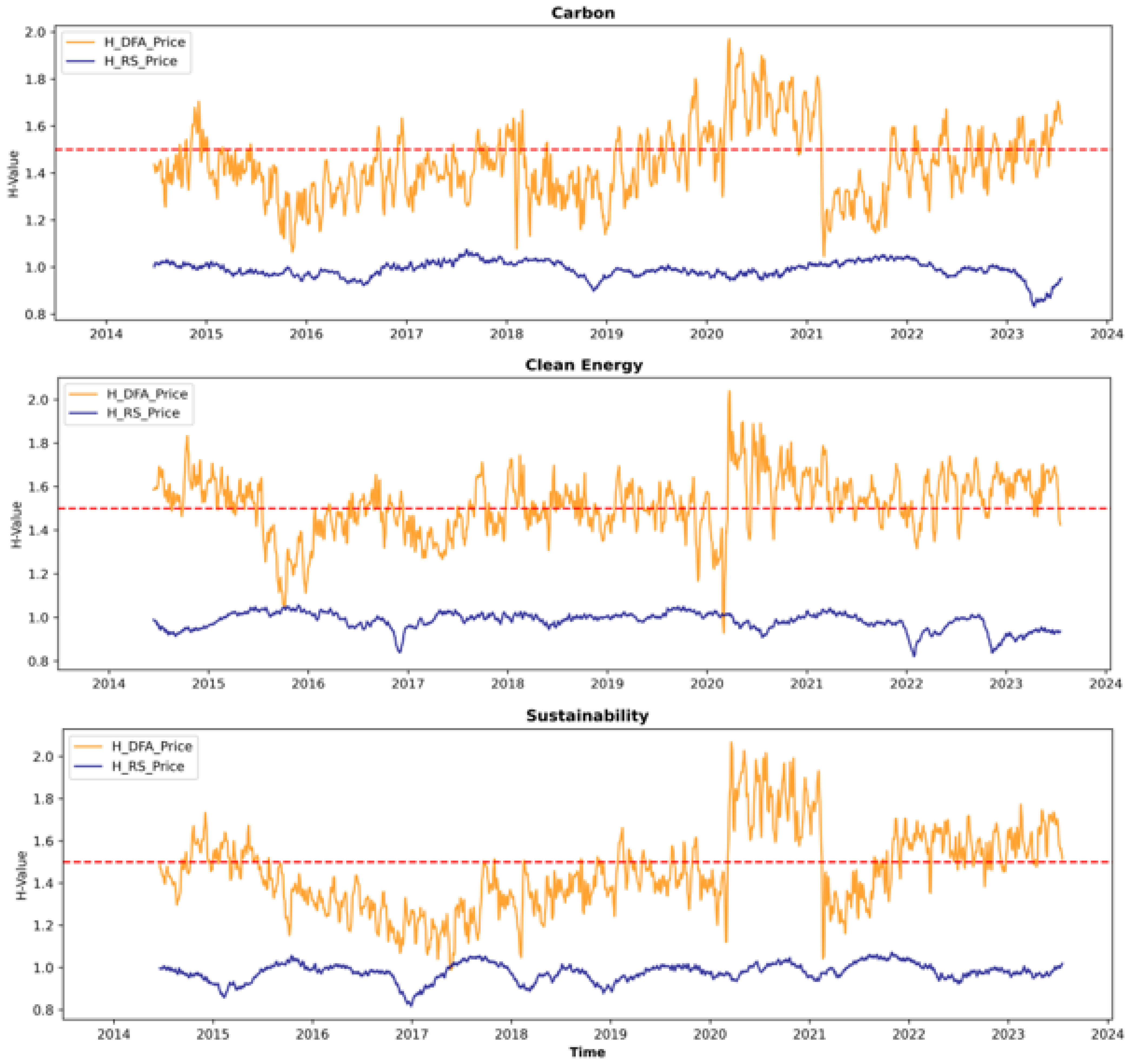
In Figure 4 and Figure 5, the Hurst exponent is calculated by using a rolling window of t = 250 consecutive observations, roughly equivalent to one trading year, to shift from one H value to the next. While it quantifies the long-range correlation in each of the price and returns series, the dual approach of R/S exponents (blue series) and DFA exponents (orange series) is applied in each market to ensure robustness of our results and for comparison.
While returns are treated as a stationary white noise process, yielding a DFA exponent of around H   =   0.5 , its integrated counterpart of price series scales at H = 1.5 . Consequently, when utilizing quadratic detrending, DFA-2, we adopt H   =   1.5 specifically as the benchmark for a random walk in the DFA price series, as seen by the dashed red line in Figure 4. Values exceeding 1.5 indicate super-persistent trending behavior, whereas values below 1.5 signify mean-reverting tendencies. In contrast, the R/S Hurst results for the same price series are evaluated against a standard random walk baseline of H = 1.0 . Hence, a temporal evolution of market efficiency and the shifting fractal nature of the price path for each market can be monitored by measuring the proximity of the empirical exponent to the benchmark line. In all three markets, we noticeably observe in the DFA plots a price path that is especially super-persistent in the beginning of the COVID-19 period (March 2020–February 2021). The price plots exhibit atypical deterministic behavior during this period, suggesting that the market was driven by strong external factors, such as the news and lockdowns, creating heightened trends. This is most acutely observed in the clean energy market exhibiting a “super-persitent” regime when the DFA Hurst exponent peaked at 2.04 in late March 2020. As the DFA displays a strong climbing trend, the R/S exponent actually dropped, illustrating a fractal divergence as the two approaches moved in opposite directions during this time.
Given the presence of fractal divergence during phases of market shifts, using both methods is essential to see the full picture of market stabiltiy. The opposing patterns are observed whenever an increasing DFA-based Hurst exponent occurs, indicating a strengthening persistence, and often mirrored by a contraction in the R/S value. This inverse correlation is intrinsic to their mathematical formulas. Indeed, DFA effectively isolates trend-driven behavior via polynomial filtering, whereas the R/S metric normalizes the range by the standard deviation. It means that, in strongly volatile yet trending periods, such as at the onset of COVID-19, the sudden and pronounced directional moves driven by trend are being handled as high-variance noise, causing a drop in the exponent. This can be verified with the R/S formula, which takes the ratio of range, R(n), to the standard deviation, S(n) [45]. Furthermore, while the DFA-based Hurst exponent continues to climb, exhibiting persistent behavior throughout the first year of COVID-19, the R/S based Hurst exponent eventually stabilizes near its 1.0 maximum limit to account for such a strong trend. We consistently observe this behavior in all three markets.
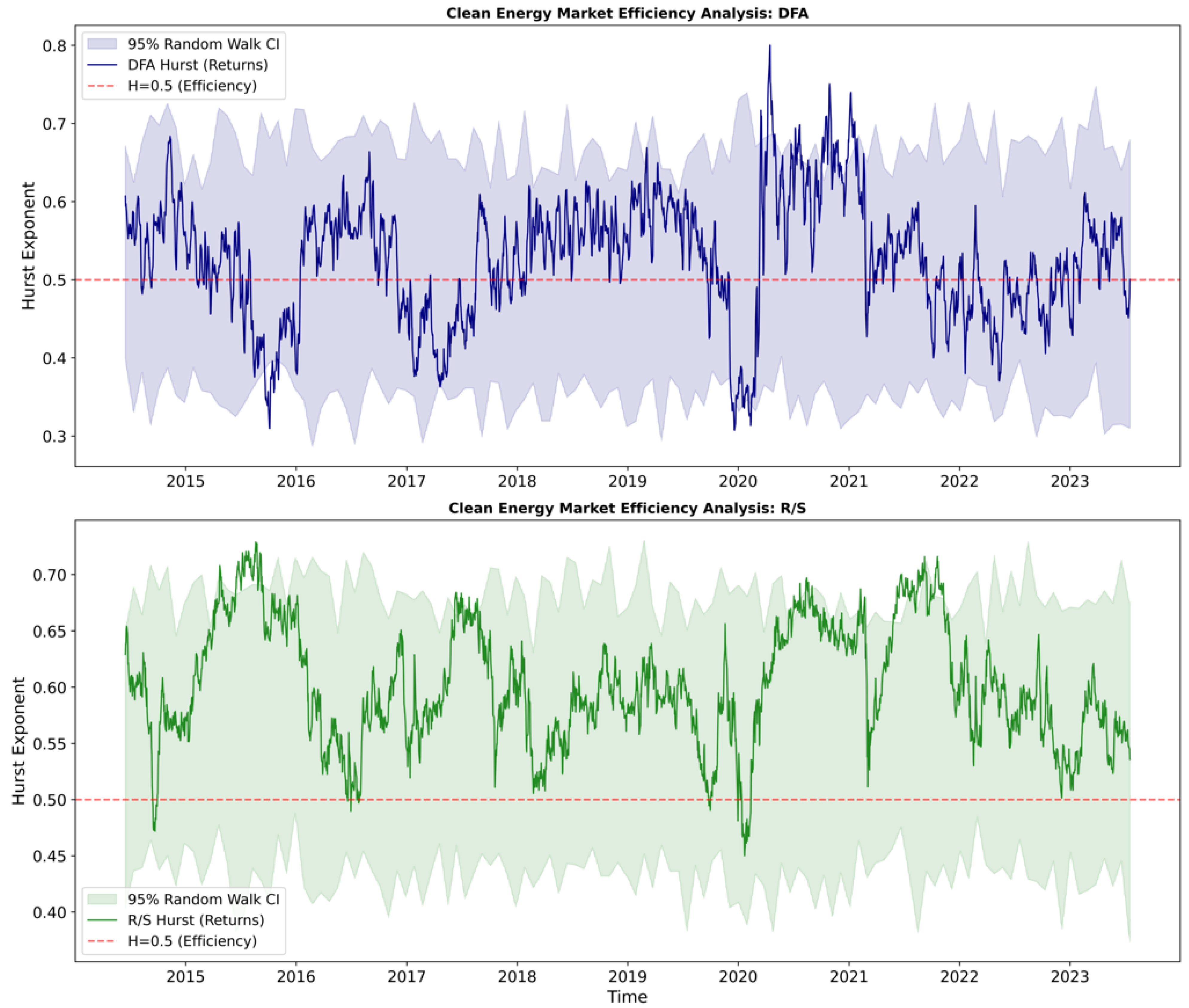
Table 1 summarizes the ten-year average Hurst exponents for the dual methods employed in this study on both the price and returns series. While these results do not deviate too much from the EMH on a global scale, the clean energy returns averages of 0.5825 for R/S Hurst, and 0.5367 for DFA Hurst, are notable departures from efficiency relative to the two other markets. These average numbers may indicate a sustained bias towards persistence, as seen in Figure 6, during the COVID-19 period, where clean energy returns plunged into anti-persistence mode in February 2020, with the DFA Hurst exponent falling to 0.31, before subsequently surging to high persistence, with DFA Hurst = 0.80. Indeed, a rolling significance analysis conducted on the returns series in Figure 5, Figure 6 and Figure 7 reveals a different picture for each market, highlighting localized inefficiency within a broader context of global efficiency.
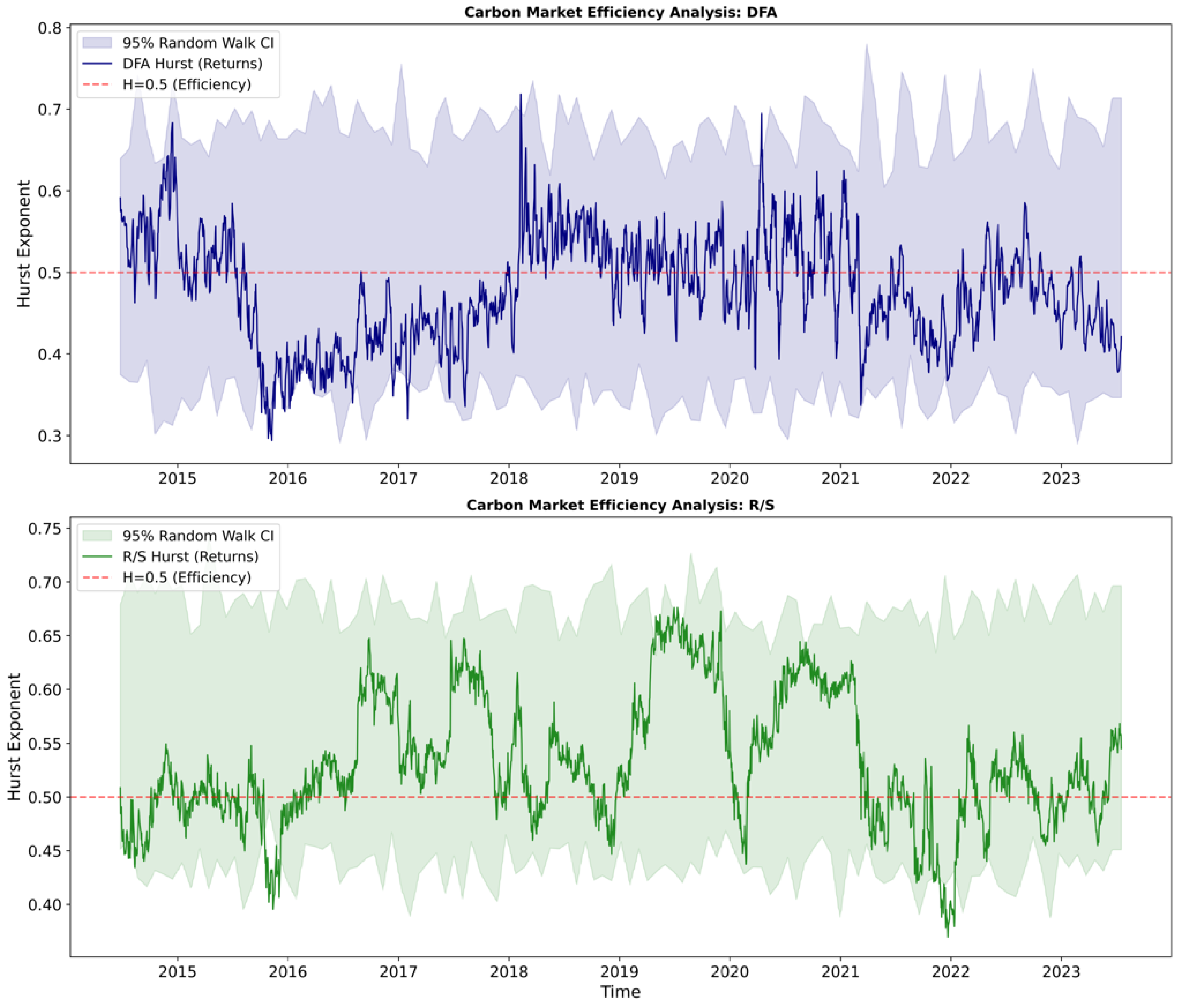
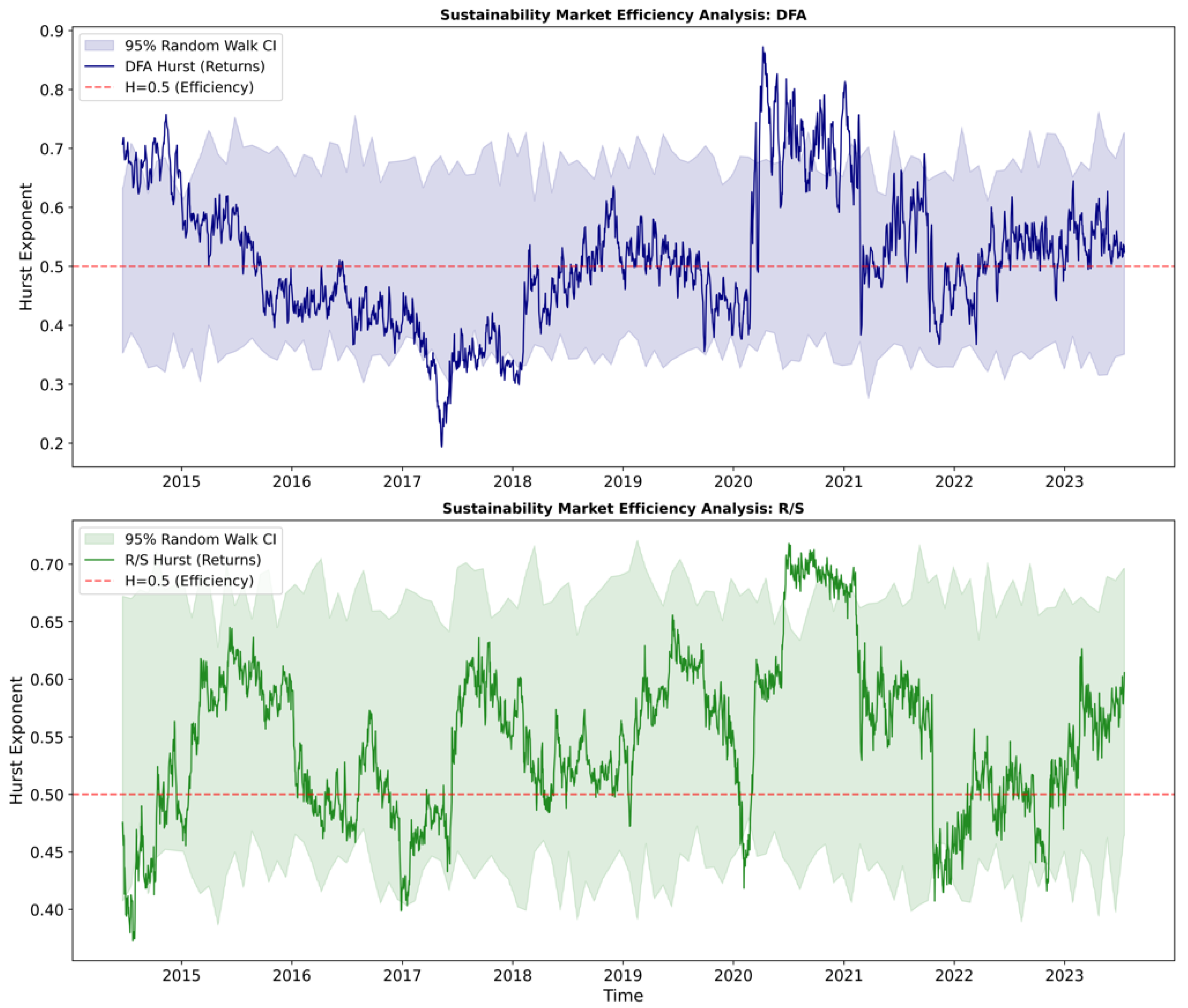
Alongside the rolling DFA and R/S Hurst estimates presented in Figure 5, Figure 6 and Figure 7 is a two-staged statistical validation. First, we used shuffle-testing to construct 95% confidence intervals, defining the random walk band where H   =   0.5 . This ensures that any observed trending or mean-reverting behavior is statistically significant. Second, to handle the high-frequency nature of the data, we implemented a subsampled permutation framework. This computational window-stepping approach calculates significance at fixed intervals and uses linear interpolation to bridge the gaps. The result is a smooth, time-varying “efficiency band” that accurately tracks a market’s changing volatility while significantly reducing the execution time.
The rolling DFA and R/S Hurst values estimated from the returns are identified by the solid lines hovering near the 0.5 efficiency threshold (see the dashed red line) in Figure 5, Figure 6 and Figure 7. Since the carbon and clean energy markets show Hurst estimates that are mostly contained within the shaded regions of the graphs representing the 95% random walk confidence intervals, this supports the idea that such markets are a random walk the majority of the time. In contrast, the sustainability market exhibits a more fragmented efficiency profile, characterized by frequent and statistically significant departures from the random walk benchmark. With approximately 15% of its DFA estimates piercing the confidence boundaries, this market demonstrates periodic episodes of both persistence and anti-persistence. Therefore, while it may appear efficient on average, the sustainability market has underlying dynamics that are prone to transient bursts of non-random behavior. Ultimately, the combined findings for all three return series indicate that price movements across these green sectors are predominantly stochastic.

3.2. Fractional Integration Factor, D

The FIGARCH model provides the fractional integrated parameter, d , as reported in Table 2. It serves to quantify the long-range memory in volatility series. A result of d > 0.5 indicates non-stationarity and super-persistence, describing the carbon ( d   =   0.6099 ) and sustainability ( d   =   0.5947 ) markets. In contrast, clean energy identifies a stationary market, with a result of d   =   0.3937 . It is a market that is most efficient over the long range, with short-lived bursts of violent fractal shifts, as measured in the Hurst analysis during the COVID-19 period. All values demonstrate strong statistical significance with p-values inferior to 0.0001.

3.3. Entropy Analysis

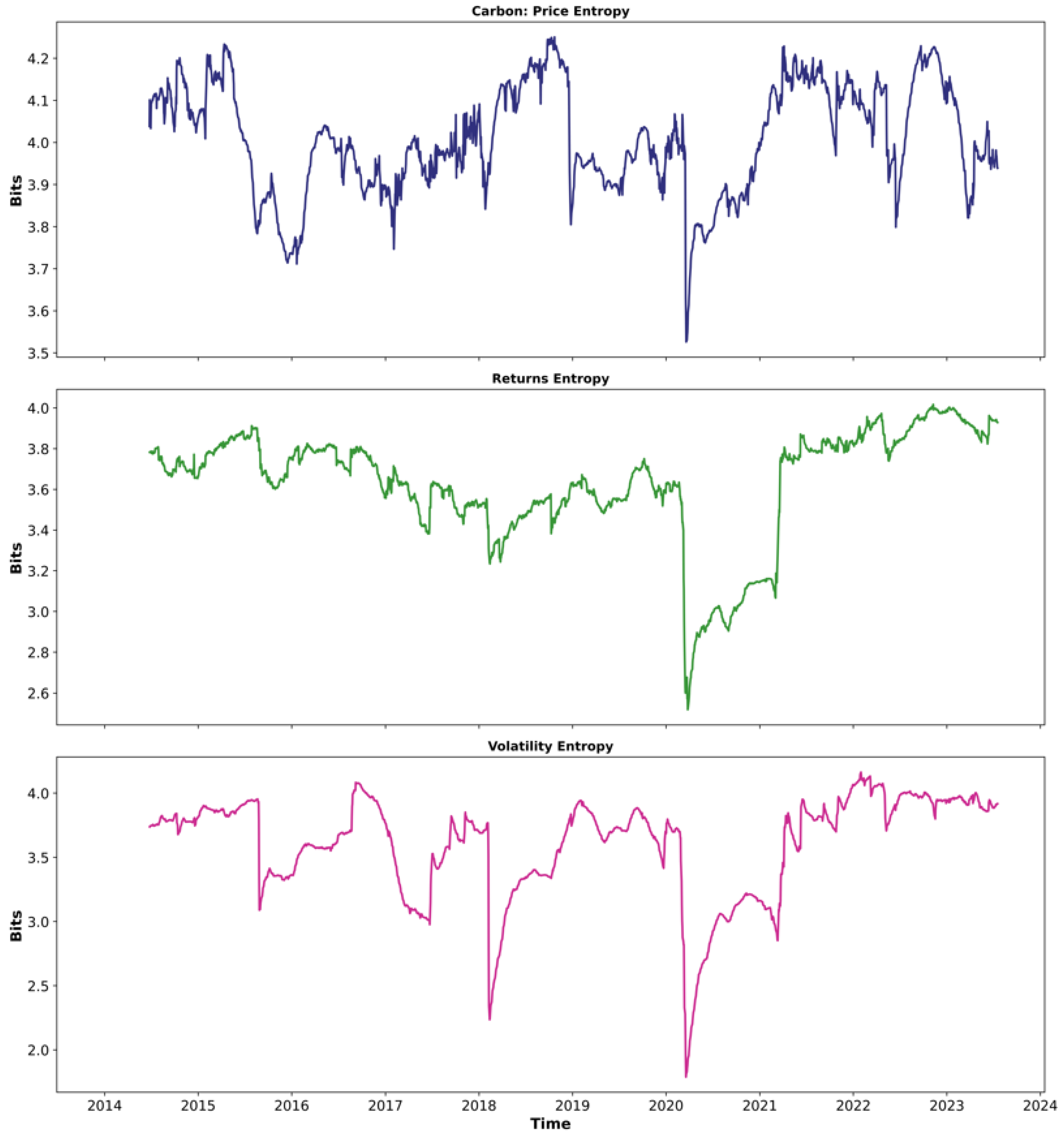
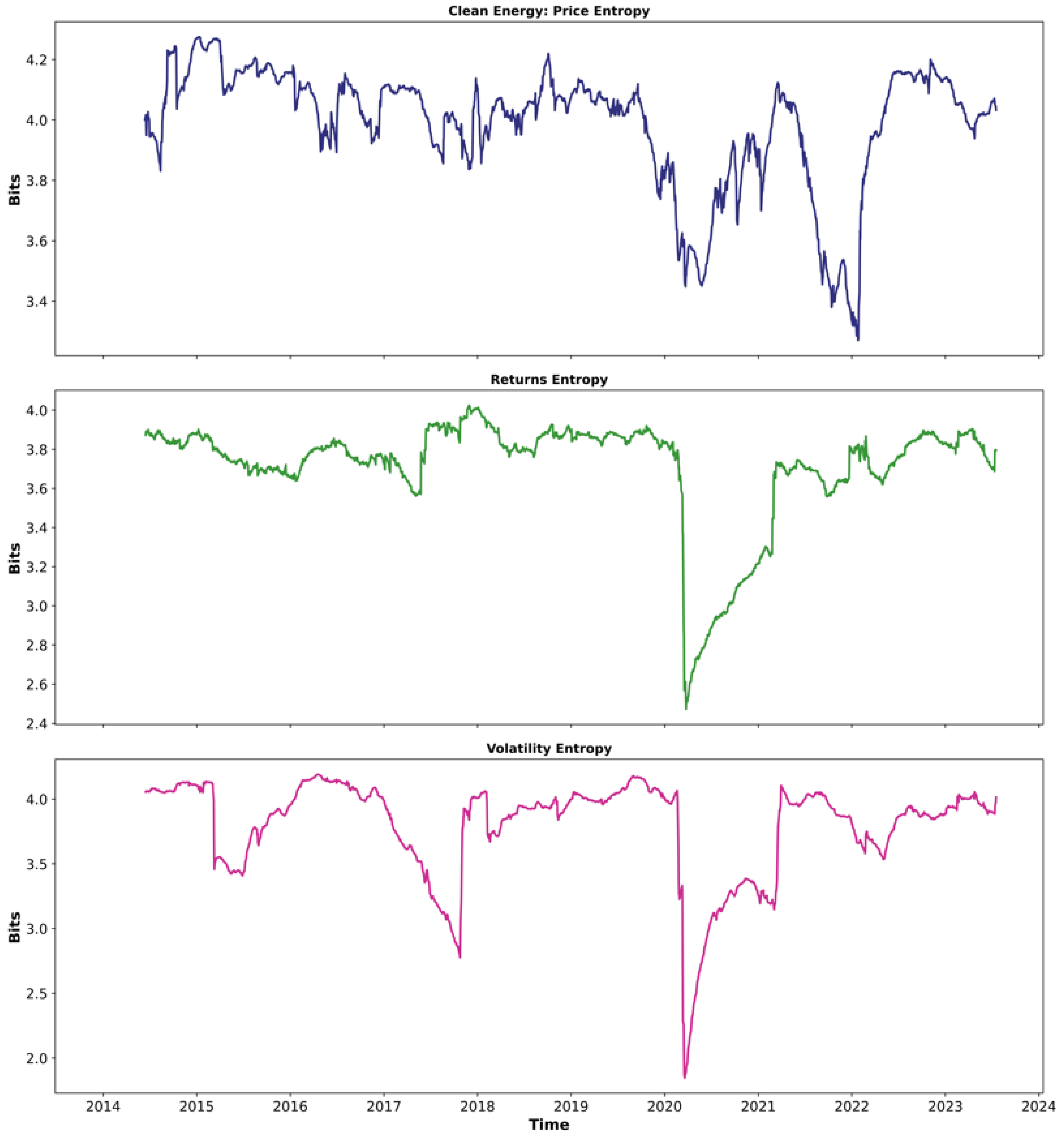
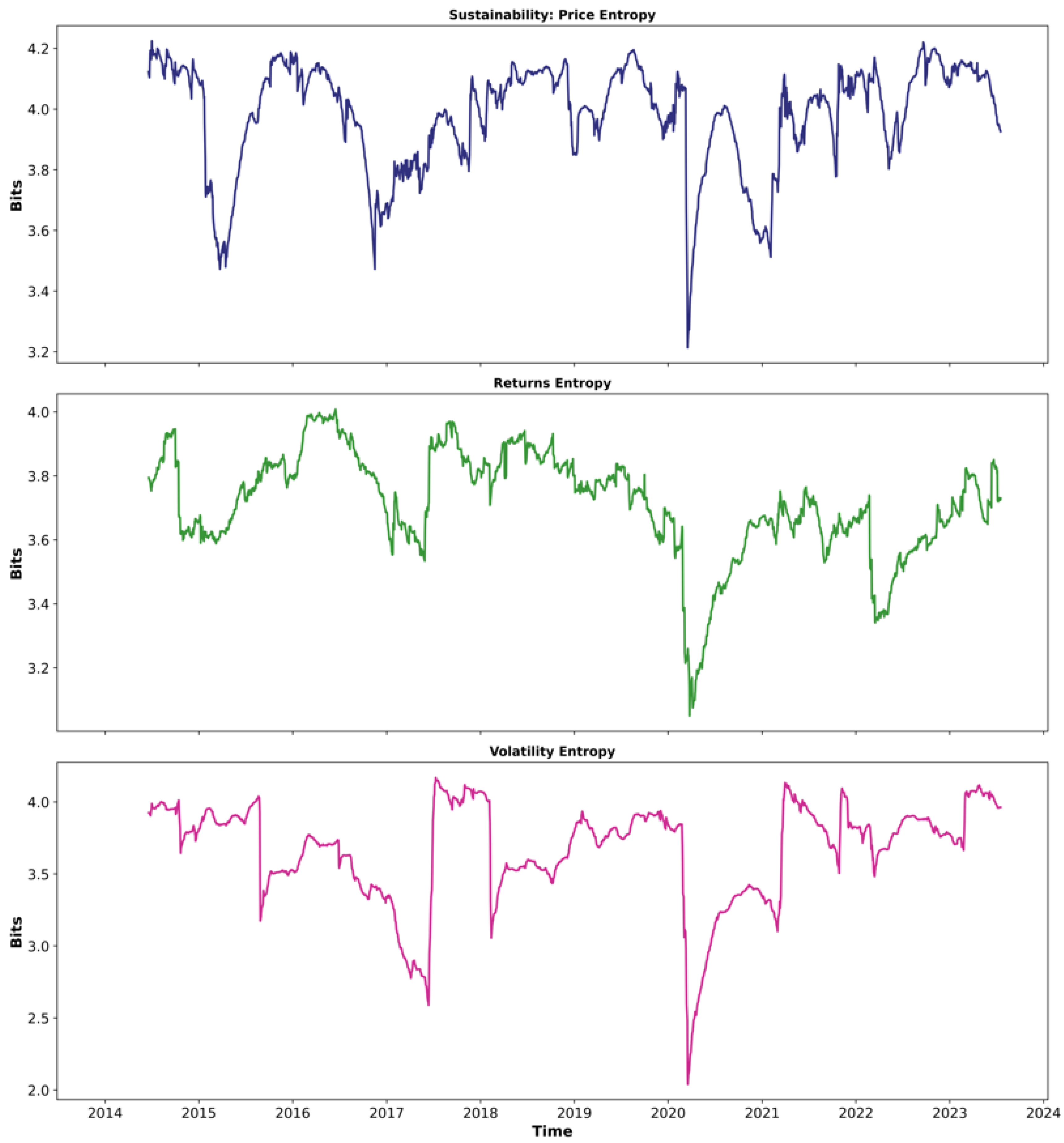
Our analysis reveals that price series across two of the three sectors consistently approached this limit, suggesting a highly efficient market characterized by near-efficent market behavior. Indeed, as cited in Table 3, the decade-long average entropy of carbon (SE = 4.0692) and sustainability (SE = 4.1075) indices displayed higher average price efficiency than clean energy (SE = 3.2790). These time-varying dynamics, visualized in Figure 8, Figure 9 and Figure 10 (see price series), were computed using a rolling window of 250 observations.
Conversely, the returns and volatility series (Figure 8, Figure 9 and Figure 10, see returns and volatility graphs) consistently yield lower entropy. This suggests that these series are less random and possess more “structure,” making them more conducive to modeling and forecasting. Curiously, the clean energy market deviates from the two markets, with its returns entropy of 3.5832 exceeding its price entropy, implying that price levels are more structured and less random for this market than they are for daily returns and volatility. This phenomemon is likely rooted in the sector’s strong relaince on long-term regulatory policies.
Knowing that green finance is heavily influenced by regulatory shifts, entropy values are vital for tracking market stability following policy implementations. A drop in entropy during such periods may signal a transition from a random walk state to a deterministic one, where policy-driven trends dominate price discovery.

4. Discussion and Conclusions

The efficient market hypothesis assumes prices instantly reflect all information collected. However, real-world stochastic noise and other informational inefficiencies create latency. We measure these lagged responses using the Hurst exponent to measure “self-similarity” and to check if the market is persistent (or anti-persistent). We also measure the information regularity by the Shannon entropy to quantify the level of randomness (or structure in information content). A high-entropy market reflects a state of randomness, or informational efficiency. Low entropy, on the other hand, suggests stability in the market, and the potential for predictability.
This study fills an important gap by being the first to provide a comprehensive analytical assessment of market efficiency and stability of green finance on prices, returns and volatility dynamics. Three methods for fractal analysis were implemented to achieve this assessment. The main findings follow. First, price levels in all markets are persistent; however, returns are likely random, as estimated Hurst exponents are close to 0.5. Second, the empirical results of the FIGARCH process show that volatility series in carbon and sustainability series are persistent, whilst volatility in clean energy is anti-persistent. Third, the empirical results from estimated SE show that, for carbon and sustainability markets, entropy is high in prices compared to returns and volatility series.
Overall, while returns across the three sectors largely approximate a random walk, volatility and raw price levels exhibit significantly higher persistence. This long memory provides important information for environmental, social and governance (ESG)-oriented investors, offering a more predictable basis for risk management and portfolio stability than return alone. Finally, the rolling window analysis confirms that exogenous global shocks, most notably the COVID-19 pandemic, acted as a catalyst that fundamentally altered the long-memory dynamics and stochastic properties of all three green finance markets.
It is worth noting that a 250-day rolling window approach, equivalent to approximately one trading year, was used in this study for valid reasons: first, to ensure sufficient data points are used for the Hurst estimation, and secondly, because, in contrast to minute-by-minute data, using daily frequency data allows us to focus on “big-picture” trends that are relevant to long-term ESG investors. Furthermore, although entropy is not a standalone metric for market efficiency, it remains an essential measure in the context of green finance for tracking the transition from white noise to deterministic, policy-driven trends.
The Hurst exponent, intended to measure the long-range dependence and persistence of the data, was used with a dual-method approach by comparing the R/S Hurst results to the DFA ones. While preliminary estimates suggested a maturing carbon market, our rigorous testing of the returns series against 95% confidence intervals, derived from a subsampled permutation framework, reveals a more intricate perspective on the EMH. Indeed, our findings suggest that the sustainability market is the least stable sector, with our rolling analysis showing that 10% to 15% of the observations lie beyond the efficiency boundaries, representing significant transient bursts of both persistence and anti-persistence. In contrast, while the clean energy market maintains a higher Hurst exponent, its fluctuations remain largely contained within the random walk significance bands, suggesting its dynamics are more consistent with white noise. Conversely, the clean energy sector presented a different form of inefficiency. The price levels in this market were masked by extreme volatility, yet both R/S and DFA successfully captured the underlying memory of the return shocks, ultimately characterizing this sector as the most sentiment-driven and least efficient of the three markets.
The FIGARCH analysis provides a good idea of how each market processes risk and long-term shocks, based on the value of the parameter d of the fractional integration parameter. The values of d for carbon and sustainabiltiy highlight non-stationarity and super-persistence in these markets and explain why the price series remained inefficient throughout the 10-year span of this study. The volatility shocks displayed strong persistence throughout this entire time. In contrast, clean energy was the only market to have a d < 0.5 , identifying it as a stationary market. Not dismissing the idea that long-range memory is still present in the price series for clean energy, the value of d suggests that the volatility shocks are short and not permanent, making this market dynamically more sensitve to times of crisis, as observed with a violent fractal shift during COVID-19. It remains that clean energy is structurally more efficient in the long-term.
The Shannon entropy is used to shed light on the degree of randomness (or irregularity) in each market across its price, returns, and volatility. In our study, we found different results across the three markets. For instance, carbon and sustainability markets show high entropy values for price levels, suggesting random trajectories. The entropy computed from their estimated volatility is low, which indicates that these daily fluctuations possess less irregularity. Conversely, the clean energy market shows low entropy for prices than for returns and volatility. For the clean energy market, this finding suggests that the information content in price levels is less irregular than that contained in returns and volatilities. Global energy policies may be a contributing factor for this observed phenomenon. In addition, the low entropy in volatiltiy observed in all three markets confirms that shocks in green finance are never fully random.
By integrating the Hurst exponent, fractional integration with the parameter d , and Shannon entropy, this study offers a non-linear analysis of green finance markets and concludes that such markets do not evolve following a random walk. Indeed, they rather move as complex fractal systems. Indeed, the dual Hurst method approach successfully separated the true market memory from the noise. In addition, the FIGARCH model correctly identified the stationary and non-stationary markets, explaining why some markets can reset after a time of crisis, while others do not. Finally, the Shannon entropy confirmed that the three green markets are never truly efficient, as they possess an underlying fractality in their volatility series.
Given the evolving nature of global green market policies, this leaves possibilities for future research. For example, it was found that the low entropy and high fractional integration parameter values are conducive to predictability. Integrating these fractal metrics into machine learning models could eventually improve the forecasting accuracy of green market volatility. Finally, acknowledging that low-frequency daily data may dismiss high-frequency microstructural noise found in intra-day trading, it would be interesting to explore varied rolling window sizes to see if shorter windows capture more immediate market reactions or if longer windows provide a clearer view of the market’s true structural trends.

Author Contributions

S.B.: Conceptualization, methodology, data curation, writing—review and editing. S.L.: Conceptualization, methodology, review. All authors have read and agreed to the published version of the manuscript.

Funding

This research received no external funding.

Data Availability Statement

Data are sourced from the following sites: S&P 500 Carbon Efficient Index |S&P Dow Jones Indices (spglobal.com), S&P Global Clean Energy Index|S&P Dow Jones Indices (spglobal.com), Dow Jones Sustainability Europe Index|S&P Dow Jones Indices (spglobal.com).

Conflicts of Interest

The authors declare no conflicts of interest.

Abbreviations

The following abbreviations are used in this manuscript:
EMHEfficient market hypothesis
DFADetrended fluctuation analysis
FIGARCHFractionally integrated generalized auto-regressive conditionally heteroskedastic
HHurst exponent
R/SRange scale analysis
SEShannon entropy

References

  1. Fama, E. Efficient Capital Markets: A Review of Theory and Empirical Work. J. Financ. 1970, 25, 383–417. [Google Scholar] [CrossRef]
  2. Griffin, P.J.M.; Kelly, P.J.; Nardari, F. Do Market Efficiency Measures Yield Correct Inferences? A Comparison of Developed and Emerging Markets. Rev. Financ. Stud. 2010, 23, 3225–3277. [Google Scholar] [CrossRef]
  3. Hou, K.; Moskowitz, T.J. Market Frictions, Price Delay, and the Cross-Section of Expected Returns. Rev. Financ. Stud. 2005, 18, 981–1020. [Google Scholar] [CrossRef]
  4. Mandelbrot, B.B. The Fractal Geometry of Nature; Freeman: San Francisco, CA, USA, 1982. [Google Scholar]
  5. Mandelbrot, B. How long is the coast of Britain? Statistical self-similarity and fractional dimension. Science 1967, 156, 636–638. [Google Scholar] [CrossRef] [PubMed]
  6. Hurst, H.E. Long-term storage capacity of reservoirs. Trans. Am. Soc. Civ. Eng. 1951, 116, 770–799. [Google Scholar] [CrossRef]
  7. Liu, J.; Cheng, C.; Yang, X.; Yan, L.; Lai, Y. Analysis of the efficiency of Hong Kong REITs market based on Hurst exponent. Phys. A 2019, 534, 122035. [Google Scholar] [CrossRef]
  8. Lahmiri, S. Multifractal analysis of Moroccan family business stock returns. Phys. A 2017, 486, 183–191. [Google Scholar] [CrossRef]
  9. Sánchez-Granero, M.A.; Balladares, K.A.; Ramos-Requena, J.P.; Trinidad-Segovia, J.E. Testing the efficient market hypothesis in Latin American stock markets. Phys. A 2020, 540, 123082. [Google Scholar] [CrossRef]
  10. Sensoy, A. Generalized Hurst exponent approach to efficiency in MENA markets. Phys. A 2013, 392, 5019–5026. [Google Scholar] [CrossRef]
  11. Sukpitak, J.; Hengpunya, V. Efficiency of Thai stock markets: Detrended fluctuation analysis. Phys. A 2016, 458, 204–209. [Google Scholar] [CrossRef]
  12. Gu, D.; Huang, J. Multifractal detrended fluctuation analysis on high-frequency SZSE in Chinese stock market. Phys. A 2019, 521, 225–235. [Google Scholar] [CrossRef]
  13. Ikeda, T. Multifractal structures for the Russian stock market. Phys. A 2018, 492, 2123–2128. [Google Scholar] [CrossRef]
  14. Jin, X. The impact of 2008 financial crisis on the efficiency and contagion of Asian stock markets: A Hurst exponent approach. Financ. Res. Lett. 2016, 17, 167–175. [Google Scholar] [CrossRef]
  15. Anagnostidis, P.; Varsakelis, C.; Emmanouilides, C.J. Has the 2008 financial crisis affected stock market efficiency? The case of Eurozone. Phys. A 2016, 447, 116–128. [Google Scholar] [CrossRef]
  16. Lahmiri, S. Long memory in international financial markets trends and short movements during 2008 financial crisis based on variational mode decomposition and detrended fluctuation analysis. Phys. A 2015, 437, 130–138. [Google Scholar] [CrossRef]
  17. Yim, K.; Oh, G.; Kim, S. An analysis of the financial crisis in the KOSPI market using Hurst exponents. Phys. A 2014, 410, 327–334. [Google Scholar] [CrossRef]
  18. Inacio, C.M.C.; Kristoufek, L.; David, S.A. Dynamic price interactions in energy commodities benchmarks: Insights from multifractal analysis during crisis periods. Phys. A 2025, 659, 130314. [Google Scholar] [CrossRef]
  19. Ammy-Driss, A.; Garcin, M. Efficiency of the financial markets during the COVID-19 crisis: Time-varying parameters of fractional stable dynamics. Phys. A 2023, 609, 128335. [Google Scholar] [CrossRef]
  20. Arouxet, M.B.; Bariviera, A.F.; Pastor, V.E.; Vampa, V. Covid-19 impact on cryptocurrencies: Evidence from a wavelet-based Hurst exponent. Phys. A 2022, 596, 127170. [Google Scholar] [CrossRef]
  21. Choi, S.-Y. Analysis of stock market efficiency during crisis periods in the US stock market: Differences between the global financial crisis and COVID-19 pandemic. Phys. A 2021, 574, 125988. [Google Scholar] [CrossRef]
  22. Rehan, M.; Alvi, J.; Lakhani, U. Comparative analysis of aggregate and sectoral time-varying market efficiency in the Russian stock market during the COVID-19 outbreak and the Russia–Ukraine conflict (RUC). Int. J. Emerg. Mark. 2024, 20, 4575–4596. [Google Scholar] [CrossRef]
  23. Raza, S.A.; Shah, N.; Suleman, M.T. A multifractal detrended fluctuation analysis of Islamic and conventional financial markets efficiency during the COVID-19 pandemic. Int. Econ. 2024, 177, 100463. [Google Scholar] [CrossRef]
  24. Lahmiri, S. Analysis of Self-Similarity in Short and Long Movements of Crude Oil Prices by Combination of Stationary Wavelet Transform and Range-Scale Analysis: Effects of the COVID-19 Pandemic and Russia-Ukraine War. Fractal Fract. 2025, 9, 176. [Google Scholar] [CrossRef]
  25. Lahmiri, S. Multifractals and multiscale entropy patterns in energy markets under the effect of the COVID-19 pandemic. Decis. Anal. J. 2023, 7, 100247. [Google Scholar] [CrossRef]
  26. Benghiat, S.; Lahmiri, S. Evaluating Predictive Models for Three Green Finance Markets: Insights from Statistical vs. Machine Learning Approaches. Computation 2025, 13, 76. [Google Scholar] [CrossRef]
  27. Zhang, Z.; Li, Q.; Li, R. Leveraging Deep Learning for Carbon Market Price Forecasting and Risk Evaluation in Green Finance Under Climate Change. J. Organ. End User Comput. 2025, 37, 1–27. [Google Scholar] [CrossRef]
  28. Wang, L.; Wang, Y.; Wang, J.; Yu, L. Forecasting nonlinear green bond yields in China: Deep learning for improved accuracy and policy awareness. Financ. Res. Lett. 2025, 85, 107889. [Google Scholar] [CrossRef]
  29. Benghiat, S.; Lahmiri, S. Tuning for Precision Forecasting of Green Market Volatility Time Series. Stats 2026, 9, 12. [Google Scholar] [CrossRef]
  30. Yao, C.-Z.; Mo, Y.-N.; Zhang, Z.-K. A study of the efficiency of the Chinese clean energy stock market and its correlation with the crude oil market based on an asymmetric multifractal scaling behavior analysis. N. Am. J. Econ. Financ. 2021, 58, 101520. [Google Scholar] [CrossRef]
  31. Zhuang, X.; Wei, D. Asymmetric multifractality, comparative efficiency analysis of green finance markets: A dynamic study by index-based model. Phys. A 2022, 604, 127949. [Google Scholar] [CrossRef]
  32. Naeem, M.A.; Karim, S.; Farid, S.; Tiwari, A.K. Comparing the asymmetric efficiency of dirty and clean energy markets pre and during COVID-19. Econ. Anal. Policy 2022, 75, 548–562. [Google Scholar] [CrossRef] [PubMed]
  33. Memon, B.A.; Aslam, F.; Asadova, S.; Ferreira, P. Are clean energy markets efficient? A multifractal scaling and herding behavior analysis of clean and renewable energy markets before and during the COVID19 pandemic. Heliyon 2023, 9, e22694. [Google Scholar] [CrossRef] [PubMed]
  34. Li, Z.; Tian, Y. Skewed multifractal cross-correlation between price and volume during the COVID-19 pandemic: Evidence from China and European carbon markets. Appl. Energy 2024, 371, 123716. [Google Scholar] [CrossRef]
  35. Vogl, M.; Kojić, M.; Mitić, P. Dynamics of green and conventional bond markets: Evidence from the generalized chaos analysis. Phys. A 2024, 633, 129397. [Google Scholar] [CrossRef]
  36. Kristjanpoller, W.; Minutolo, M.C. Exploring the Dynamic Interplay: Carbon Credit Markets and Asymmetric Multifractal Cross-Correlations with Financial Assets. Fractal Fract. 2025, 9, 638. [Google Scholar] [CrossRef]
  37. Lahmiri, S.; Bekiros, S. Renyi entropy and mutual information measurement of market expectations and investor fear during the COVID-19 pandemic. Chaos Solitons Fractals 2020, 139, 110084. [Google Scholar] [CrossRef]
  38. Lahmiri, S.; Bekiros, S. Randomness, Informational Entropy, and Volatility Interdependencies among the Major World Markets: The Role of the COVID-19 Pandemic. Entropy 2020, 22, 833. [Google Scholar] [CrossRef]
  39. Lahmiri, S.; Bekiros, S. The impact of COVID-19 pandemic upon stability and sequential irregularity of equity and cryptocurrency markets. Chaos Solitons Fractals 2020, 138, 109936. [Google Scholar] [CrossRef]
  40. Lahmiri, S. Wavelet Entropy for Efficiency Assessment of Price, Return, and Volatility of Brent and WTI During Extreme Events. Commodities 2025, 4, 4. [Google Scholar] [CrossRef]
  41. Lahmiri, S. Price disorder and information content in energy and gold markets: The effect of the COVID-19 pandemic. Energy Nexus 2024, 16, 100343. [Google Scholar] [CrossRef]
  42. Lahmiri, S. Assessing efficiency in prices and trading volumes of cryptocurrencies before and during the COVID-19 pandemic with fractal, chaos, and randomness: Evidence from a large dataset. Financ. Innov. 2024, 10, 82. [Google Scholar] [CrossRef]
  43. Shannon, C.E. A Mathematical Theory of Communication. Bell Syst. Tech. J. 1948, 27, 379–423. [Google Scholar] [CrossRef]
  44. Shannon, C.E.; Weaver, W. The Mathematical Theory of Communication; University of Illinois Press: Champaign, IL, USA, 1949. [Google Scholar]
  45. Peng, C.K.; Buldyrev, S.V.; Havlin, S.; Simons, M.; Stanley, H.E.; Goldberger, A.L. Mosaic organization of DNA nucleotides. Phys. Rev. E 1994, 49, 1685–1689. [Google Scholar] [CrossRef]
  46. Zagretdinov, A.; Ziganshin, S.; Izmailova, E.; Vankov, Y.; Klyukin, I.; Alexandrov, R. Monitoring Pipeline Leaks Using Fractal Analysis of Acoustic Signals. Fractal Fract. 2025, 9, 178. [Google Scholar] [CrossRef]
  47. Gospodinova, E.; Lebamovski, P.; Georgieva-Tsaneva, G.; Negreva, M. Evaluation of the Methods for Nonlinear Analysis of Heart Rate Variability. Fractal Fract. 2023, 7, 388. [Google Scholar] [CrossRef]
  48. Aydin, A.; Yildirim, A.; Kara, O.; Mwenda, Z. Mixed-Frequency rTMS Rapidly Modulates Multiscale EEG Biomarkers of Excitation–Inhibition Balance in Autism Spectrum Disorder: A Single-Case Report. Brain Sci. 2025, 15, 1269. [Google Scholar] [CrossRef]
  49. Georgieva-Tsaneva, G.; Lebamovski, P.; Tsanev, Y.-A. Impact of Prolonged High-Intensity Training on Autonomic Regulation and Fatigue in Track and Field Athletes Assessed via Heart Rate Variability. Appl. Sci. 2025, 15, 10547. [Google Scholar] [CrossRef]
  50. Castiglioni, P.; Zaza, A.; Merati, G.; Faini, A. On the Autonomic Control of Heart Rate Variability: How the Mean Heart Rate Affects Spectral and Complexity Analysis and a Way to Mitigate Its Influence. Mathematics 2025, 13, 2955. [Google Scholar] [CrossRef]
  51. Georgieva-Tsaneva, G.; Cheshmedzhiev, K.; Tsanev, Y.-A.; Dechev, M. Physiological State Recognition via HRV and Fractal Analysis Using AI and Unsupervised Clustering. Information 2025, 16, 718. [Google Scholar] [CrossRef]
  52. Boya, C.M. Time-Varying Efficiency and Economic Shocks: A Rolling DFA Test in Western European Stock Markets. Int. J. Financ. Stud. 2025, 13, 157. [Google Scholar] [CrossRef]
  53. Bildirici, M.; Ucan, Y.; Tekercioglu, R. A Hybrid Approach Combining the Lie Method and Long Short-Term Memory (LSTM) Network for Predicting the Bitcoin Return. Fractal Fract. 2024, 8, 413. [Google Scholar] [CrossRef]
  54. Popovska, E.; Georgieva-Tsaneva, G. Fractal-Based Robotic Trading Strategies Using Detrended Fluctuation Analysis and Fractional Derivatives: A Case Study in the Energy Market. Fractal Fract. 2025, 9, 5. [Google Scholar] [CrossRef]
  55. Lu, K.-C.; Chen, K.-S. Uncovering Information Linkages between Bitcoin, Sustainable Finance and the Impact of COVID-19: Fractal and Entropy Analysis. Fractal Fract. 2023, 7, 424. [Google Scholar] [CrossRef]
  56. Albalawi, H.; Muhammad, Y.; Wadood, A.; Khan, B.S.; Zainab, S.T.; Alatwi, A.M. Leveraging the Performance of Integrated Power Systems with Wind Uncertainty Using Fractional Computing-Based Hybrid Method. Fractal Fract. 2024, 8, 532. [Google Scholar] [CrossRef]
  57. Telesca, L.; Abate, N.; Faridani, F.; Lovallo, M.; Lasaponara, R. Discerning Xylella fastidiosa-Infected Olive Orchards in the Time Series of MODIS Terra Satellite Evapotranspiration Data by Using the Fisher–Shannon Analysis and the Multifractal Detrended Fluctuation Analysis. Fractal Fract. 2023, 7, 466. [Google Scholar] [CrossRef]
  58. Alexan, W.; Alexan, N.; Gabr, M. Multiple-Layer Image Encryption Utilizing Fractional-Order Chen Hyperchaotic Map and Cryptographically Secure PRNGs. Fractal Fract. 2023, 7, 287. [Google Scholar] [CrossRef]
  59. Bollerslev, T. Generalized autoregressive conditional heteroskedasticity. J. Econ. 1986, 31, 307–327. [Google Scholar] [CrossRef]
  60. Baillie, R.T.; Bollerslev, T.; Mikkelsen, H.O. Fractionally integrated generalized autoregressive conditional heteroskedasticity. J. Econ. 1996, 74, 3–30. [Google Scholar] [CrossRef]
  61. Bollerslev, T.; Wooldridge, J.M. Quasi-maximum likelihood estimation of dynamic models with time varying covariances. Econ. Rev. 1992, 1, 143–172. [Google Scholar] [CrossRef]
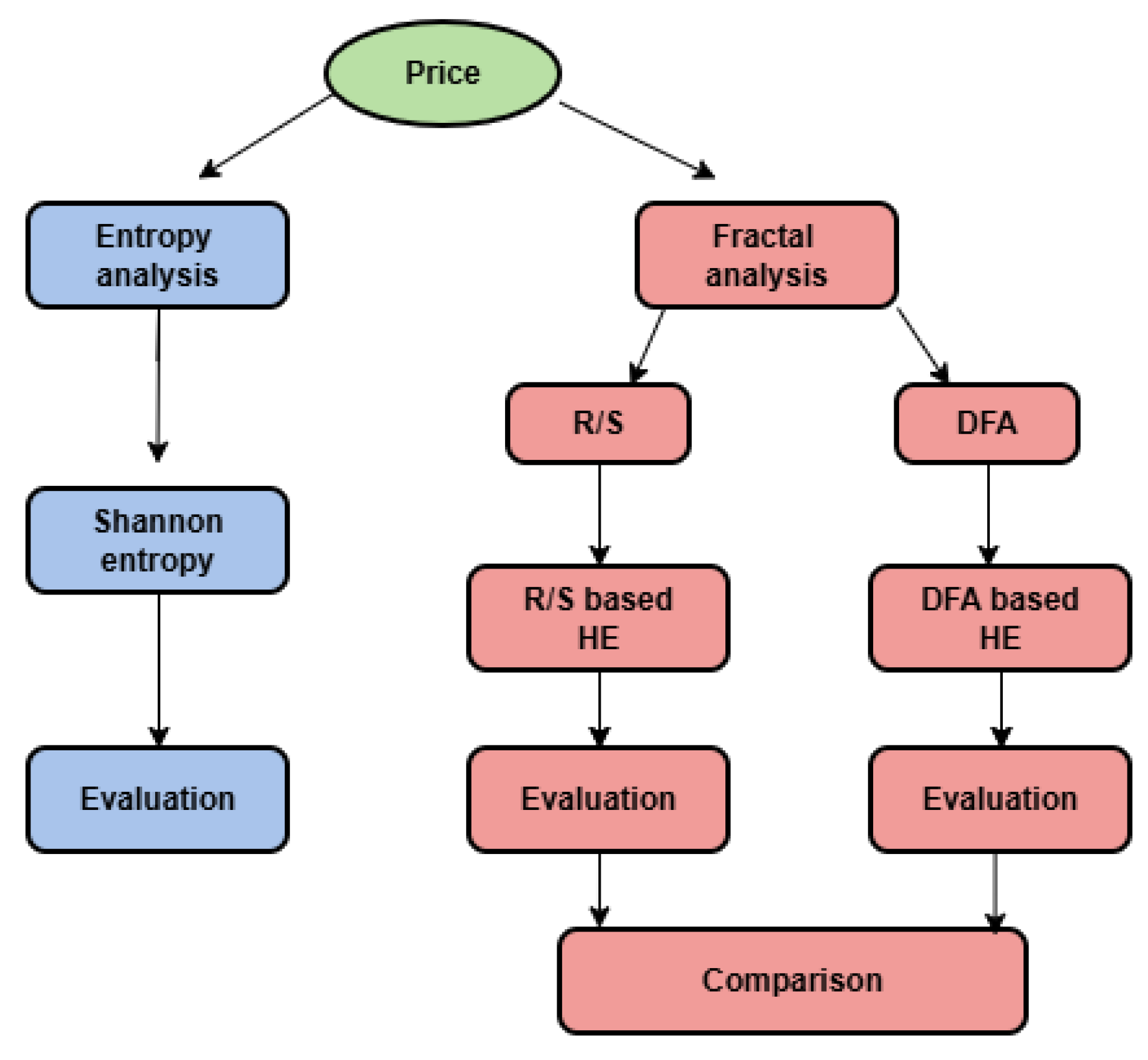
Figure 1. Methodological framework for the evaluation of stochasticity and long-range dependence in price levels.
Fractalfract 10 00205 g001
Figure 2. Methodological framework for the evaluation of stochasticity and long-range dependence in returns.
Fractalfract 10 00205 g002
Figure 3. Methodological framework for quantifying structural complexity and long-range dependence in estimated market volatility.
Fractalfract 10 00205 g003
Figure 4. Rolling Hurst exponents on price series across three green markets, using R/S and DFA approaches.
Fractalfract 10 00205 g004
Figure 5. Rolling Hurst exponent analysis of carbon returns relative to 95% confidence intervals derived from a subsampled permutation framework.
Fractalfract 10 00205 g005
Figure 6. Rolling Hurst exponent analysis of clean energy returns relative to 95% confidence intervals derived from a subsampled permutation framework.
Fractalfract 10 00205 g006
Figure 7. Rolling Hurst exponent analysis of sustainability returns relative to 95% confidence intervals derived from a subsampled permutation framework.
Fractalfract 10 00205 g007
Figure 8. Rolling Shannon entropy for carbon on price levels, returns, and estimated volatility.
Fractalfract 10 00205 g008
Figure 9. Rolling Shannon entropy for clean energy on price, returns, and estimated volatility, returns, and estimated volatility.
Fractalfract 10 00205 g009
Figure 10. Rolling Shannon entropy for sustainability on price levels, returns, and estimated volatility.
Fractalfract 10 00205 g010
Table 1. Hurst exponent mean values over 2013–2023 period for three green markets.
R/S HurstDFA Hurst
MarketPriceReturnsPriceReturns
Carbon1.01650.51081.40890.4626
Clean energy1.00380.58251.49140.5367
Sustainability0.97460.52441.44400.4713
Table 2. Estimated fractional integration coefficient of FIGARCH model.
MarketCoefficient, d *
Carbon0.6099
Clean energy0.3937
Sustainability0.5947
* p-values < 0.0001.
Table 3. Shannon entropy mean value over 2013–2023 period, per market and per series.
Series
MarketPriceReturnsVolatility
Carbon4.06923.54363.3292
Clean energy3.27903.58323.5585
Sustainability4.10753.52863.3046
Disclaimer/Publisher’s Note: The statements, opinions and data contained in all publications are solely those of the individual author(s) and contributor(s) and not of MDPI and/or the editor(s). MDPI and/or the editor(s) disclaim responsibility for any injury to people or property resulting from any ideas, methods, instructions or products referred to in the content.