
Review of SMC and FOSMC Strategies for Rotary Wing UAVs




Abstract
1. Introduction
- Fractional-order derivative definitions are explained.
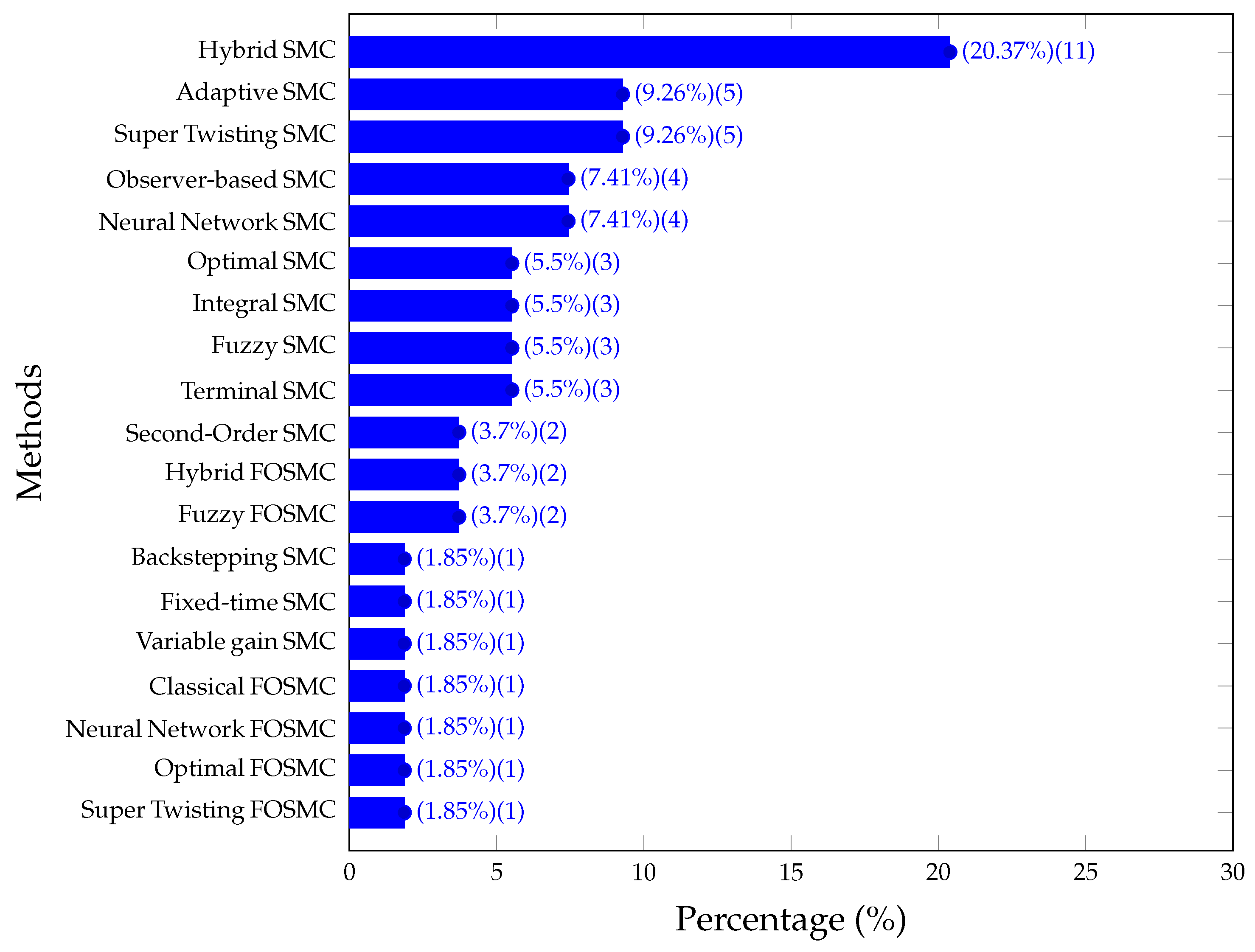
- An examination of advanced methods such as Hybrid SMC, Adaptive SMC, and Terminal SMC for quadrotor systems and their fractional-order versions; and for helicopter systems, an examination of developed controller structures such as Adaptive SMC, Super Twisting SMC, Hybrid FOSMC, and Fuzzy FOSMC is presented.
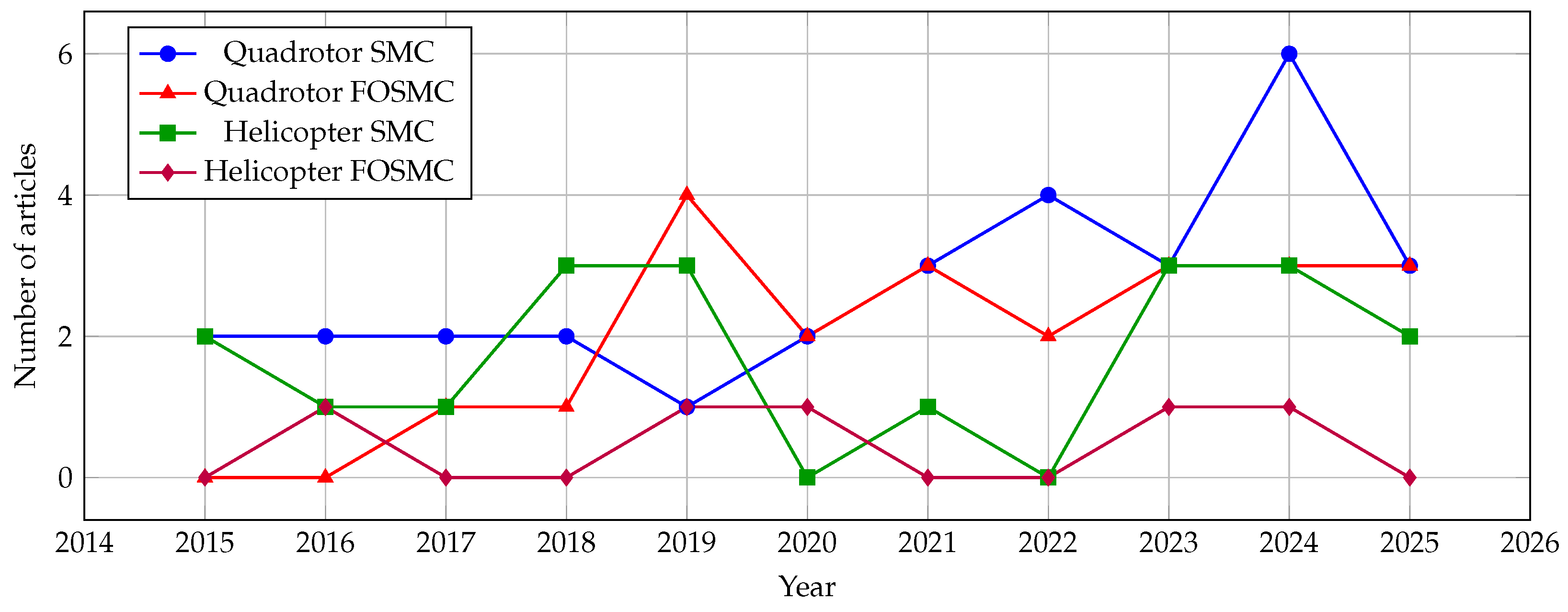
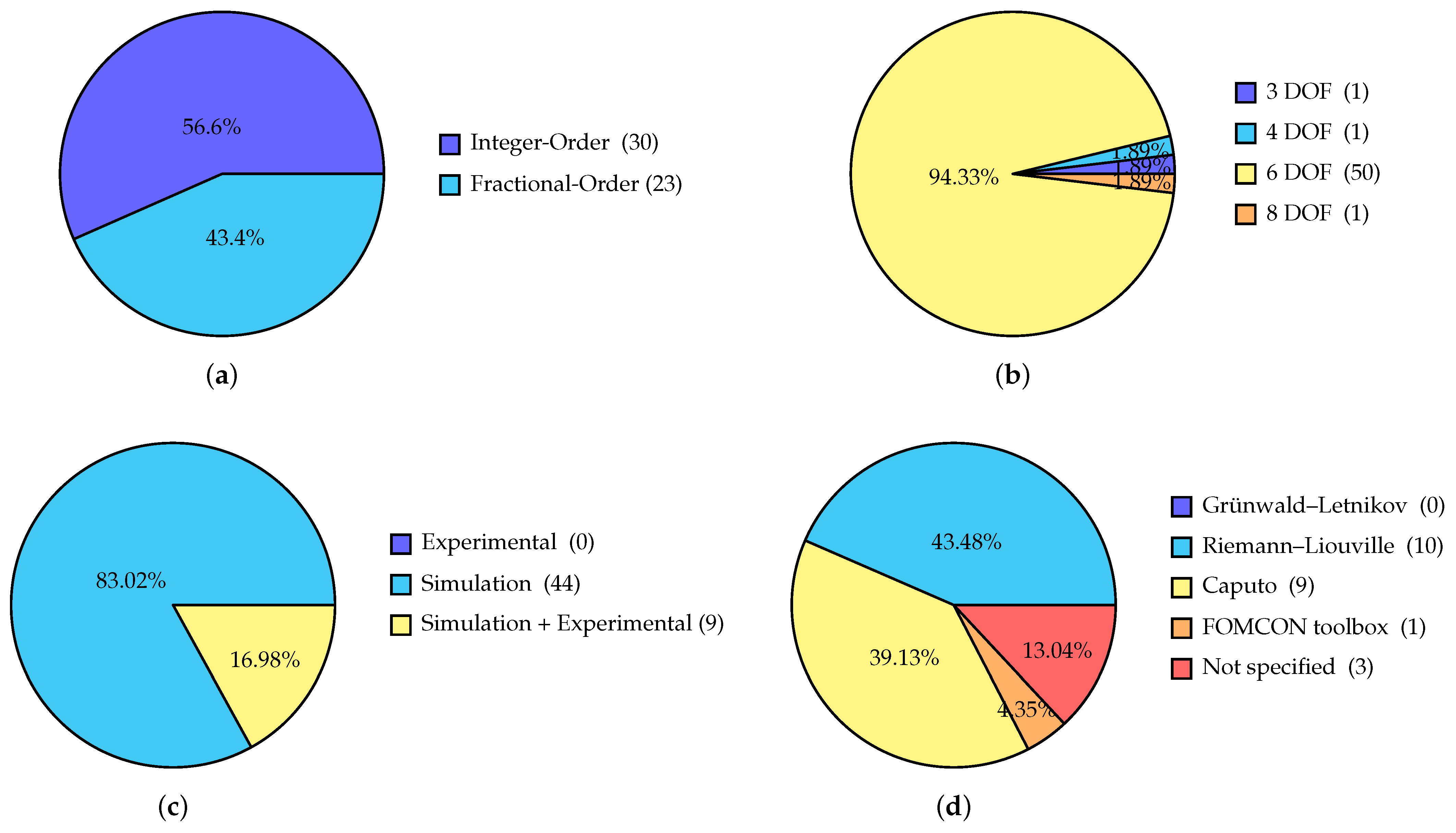
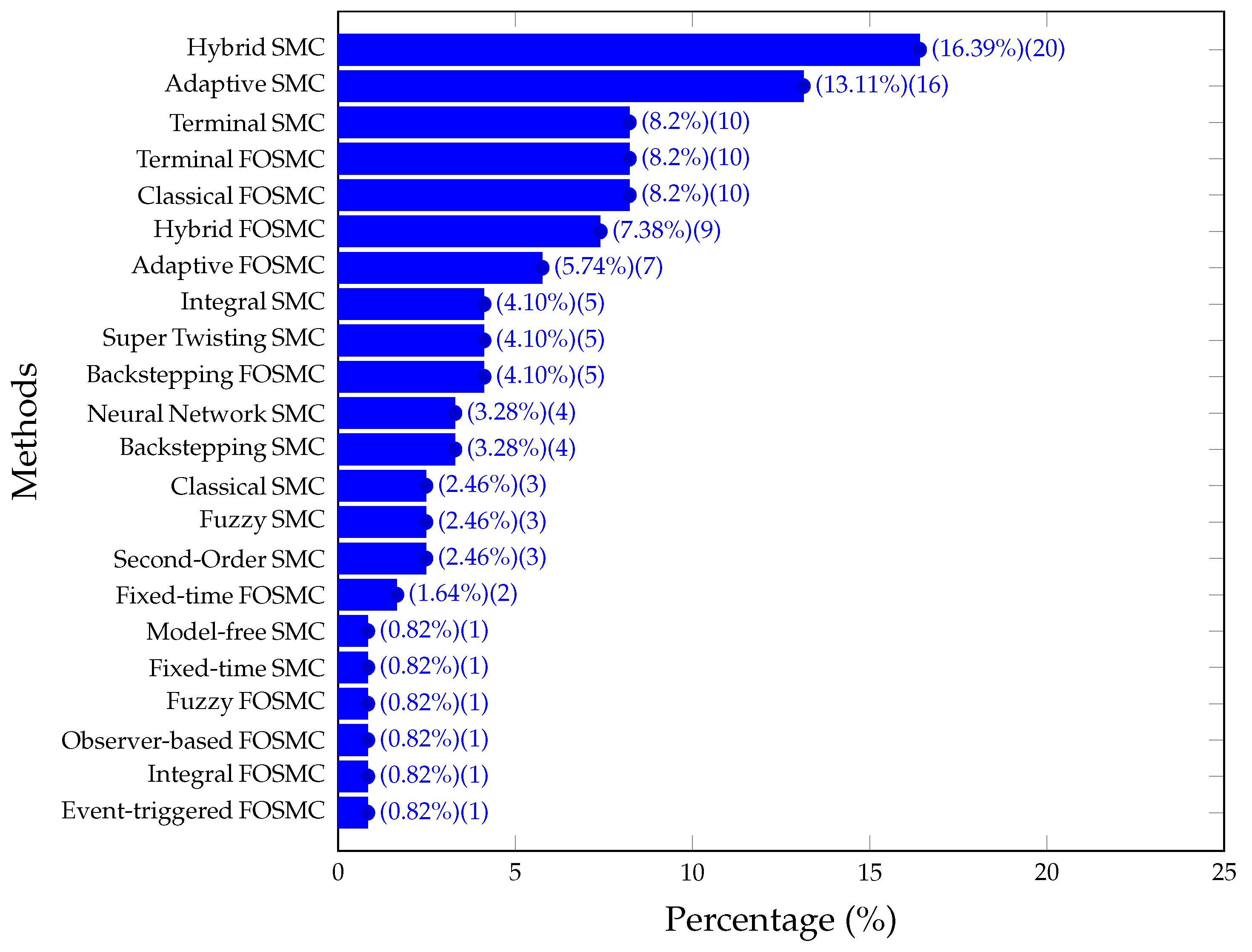
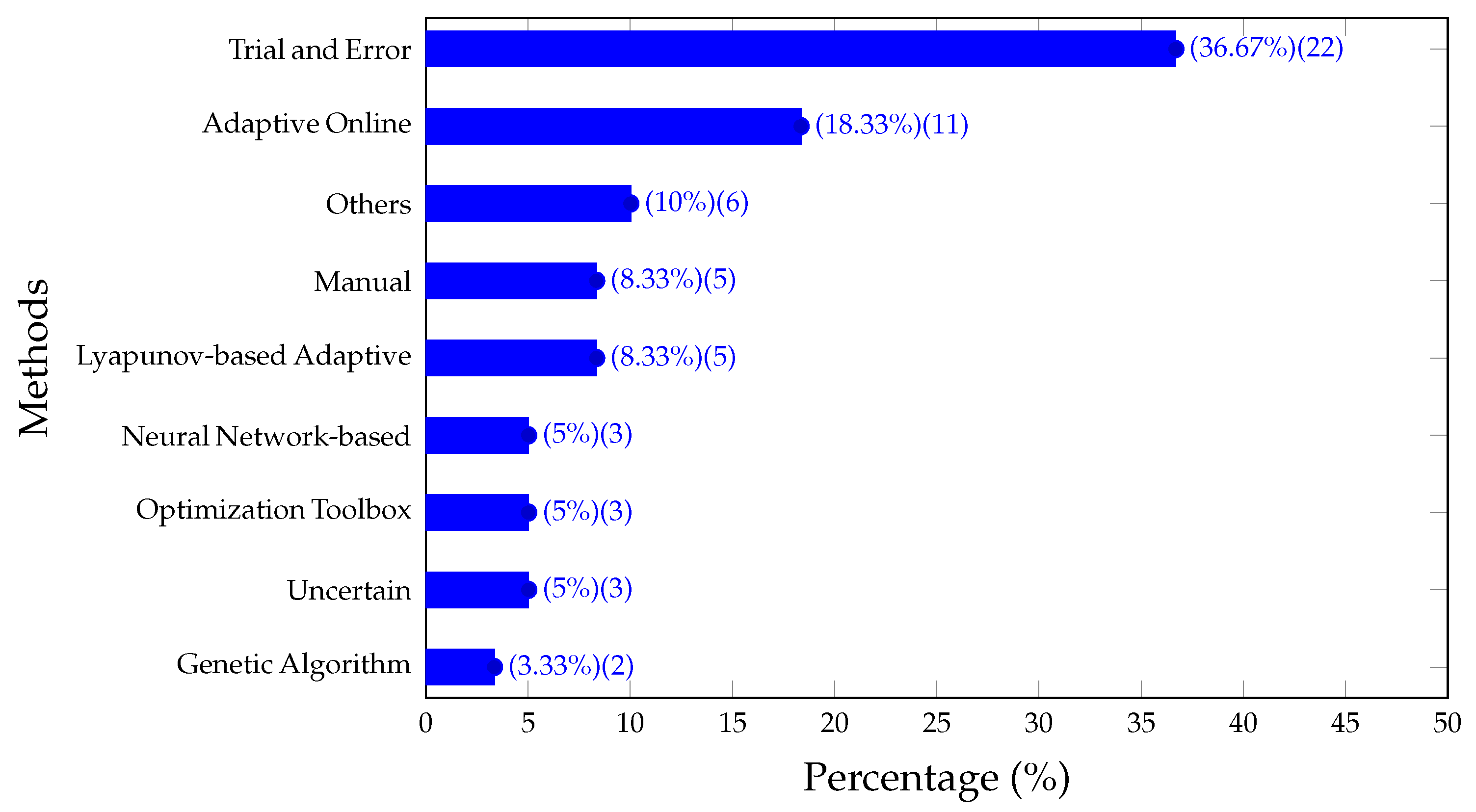
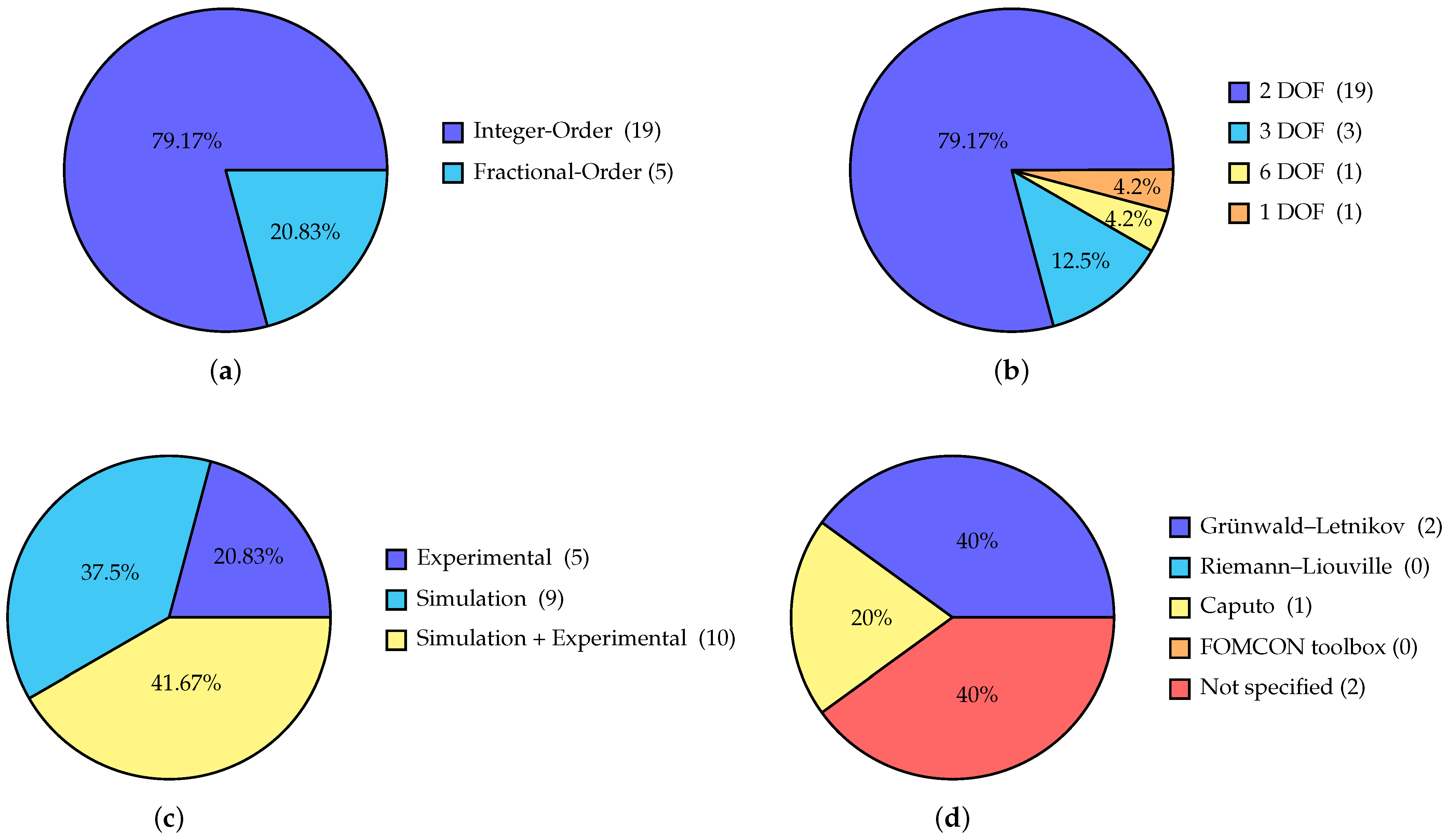
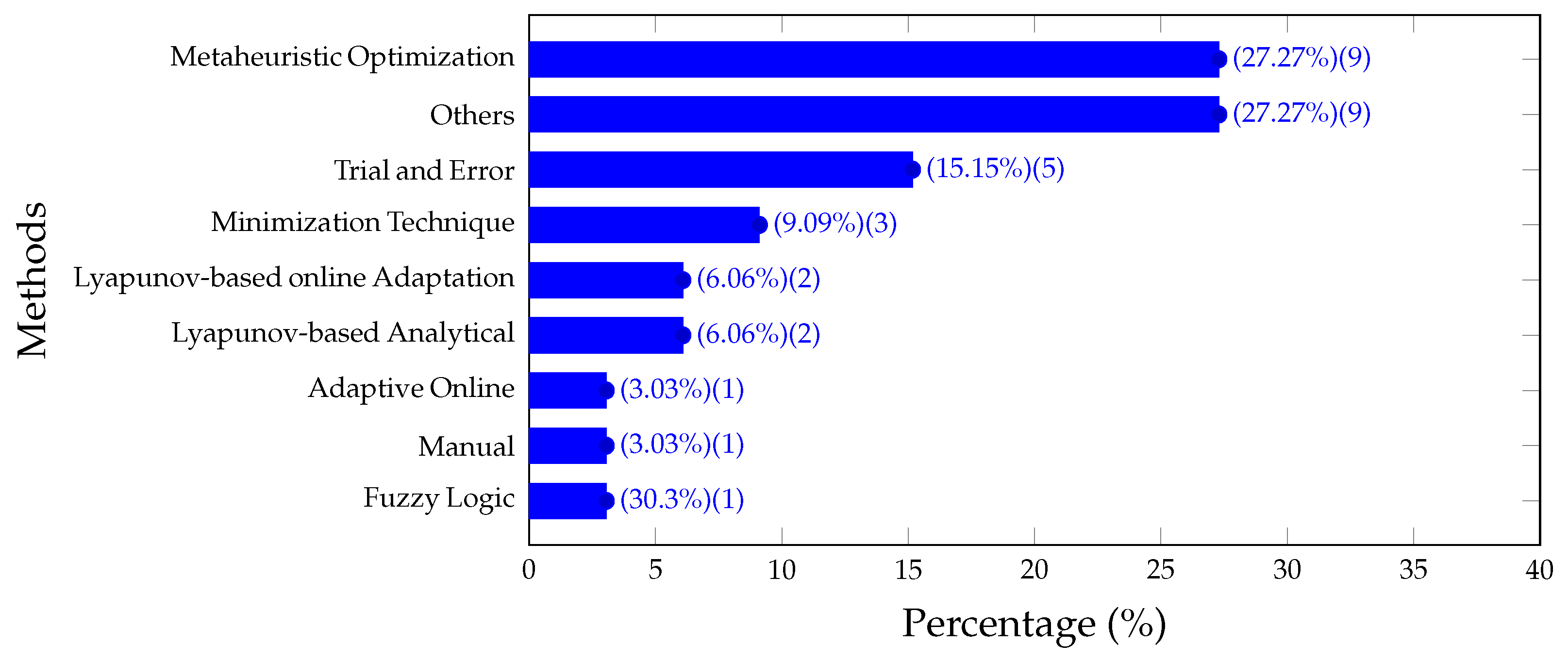
- Research trends in the literature are presented in graphs.
- The strengths and weaknesses of existing studies are discussed, and recommendations for future research directions are presented.
2. Preliminaries of Fractional Calculus
3. Survey with Trend Analysis
4. Modeling of Rotary-Wing UAV Systems
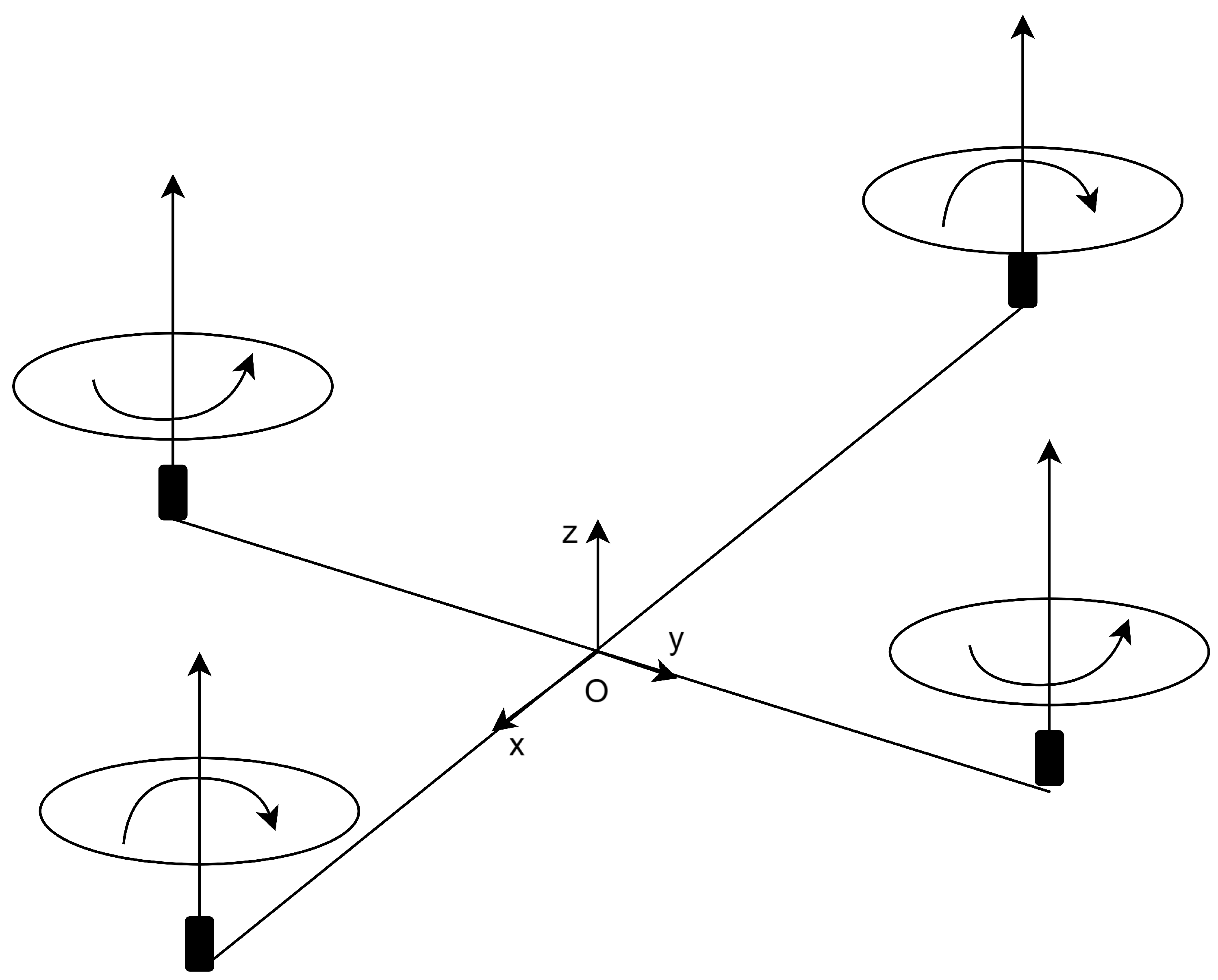
4.1. Quadrotor Model

Impact of Quadrotor Dynamics on Control Design
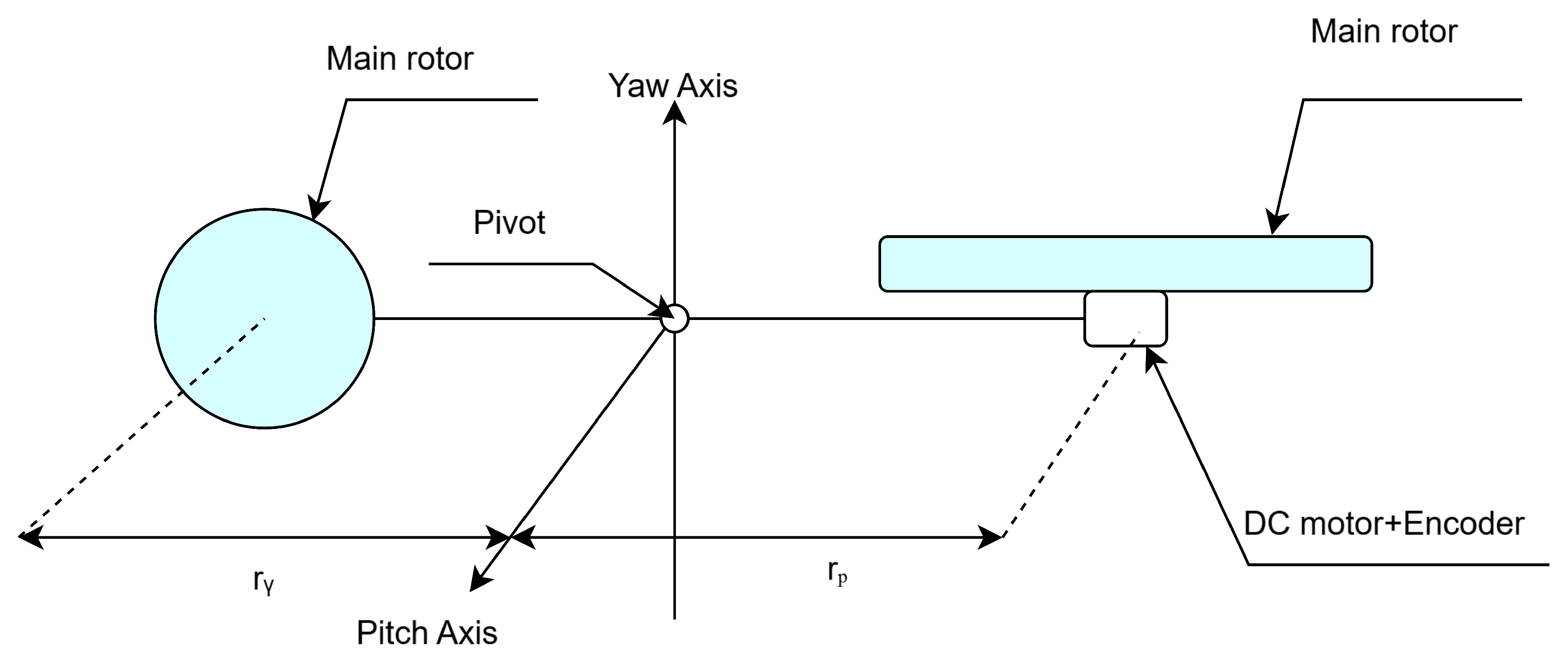
4.2. Helicopter Model

Impact of Helicopter Dynamics on Control Design
5. Review, Categorization, and Comparative Analysis of SMC and FOSMC Approaches
5.1. Hybrid SMC Approaches for Quadrotor Systems
5.2. Adaptive SMC Approaches for Quadrotor Systems
5.3. Terminal SMC Approaches for Quadrotor Systems
5.4. Terminal FOSMC Approaches for Quadrotor Systems
5.5. Classical FOSMC Approaches for Quadrotor Systems
5.6. Hybrid FOSMC Approaches for Quadrotor Systems
5.7. Hybrid SMC Approaches for Helicopter Systems
5.8. Adaptive SMC Approaches for Helicopter Systems
5.9. Super Twisting SMC Approaches for Helicopter Systems
5.10. Hybrid FOSMC Approaches for Helicopter Systems
5.11. Fuzzy FOSMC Approaches for Helicopter Systems
5.12. Implementation Challenges and Computational Complexity
6. Conclusions
6.1. Findings
6.2. Future Perspectives
- Quadrotor Systems
- The fact that a very high proportion () of the reviewed quadrotor studies remain solely in simulation environments is considered to stem from the heavy computational load created by the infinite memory effect of FOSMC algorithms on real-time embedded hardware. This makes the development of efficient approximation algorithms that minimize processing load while maintaining hardware precision the most prioritized technical need in the literature.
- Given that Trial-and-Error methods are used at a rate of in determining controller parameters, and considering the limitations of current metaheuristic optimization techniques; the integration of Deep Reinforcement Learning-based structures capable of instantly updating parameters and sliding manifold coefficients according to changing flight conditions into FOSMC is a significant research focus for increasing adaptation capability in challenging scenarios.
- Future research should move beyond the rigid-body assumption and focus on high-fidelity modeling approaches that fill theoretical gaps by incorporating flexible body dynamics and nonlinear aerodynamic ground effects into FOSMC structures.
- According to the literature review conducted within the scope of this study, the Caputo–Fabrizio (CF) definition has not been encountered in fractional-order controller applications. This offers an original research opportunity to investigate the effects of the non-singular kernel property of the CF definition on chattering suppression and control accuracy in UAV systems.
- While the integration of Super Twisting FOSMC offers a significant opportunity for chattering suppression, the development of mathematical methods capable of handling non-smooth disturbances with unlimited rates of change and automatically adjusting controller parameters remains a significant theoretical deficiency.
- Helicopter Systems
- The fact that of helicopter studies are limited to 2-DOF models constitutes a fundamental research focus for advanced MIMO-FOSMC architectures capable of managing complex cross-couplings and disturbance torque interactions between the main and tail rotors.
- Considering the high parameter sensitivity and nonlinear structure of helicopters; supporting FOSMC with hybrid intelligent algorithms, such as metaheuristic optimization or artificial neural networks, in online parameter tuning processes is a critical area of study for ensuring performance stability.
- The failure to specify the fractional operator type in of the reviewed articles creates uncertainty regarding optimal performance in different flight regimes. Establishing theoretical selection criteria for these systems will provide a significant contribution to the literature.
- In helicopter systems prone to failures due to mechanical complexity, the development of FOSMC-based Fault-Tolerant Control strategies and the theoretical guarantee of system stability in critical scenarios is a prioritized need.
Author Contributions
Funding
Institutional Review Board Statement
Informed Consent Statement
Data Availability Statement
Conflicts of Interest
References
- Shakhatreh, H.; Sawalmeh, A.H.; Al-Fuqaha, A.; Dou, Z.; Almaita, E.; Khalil, I.; Othman, N.S.; Khreishah, A.; Guizani, M. Unmanned aerial vehicles (UAVs): A survey on civil applications and key research challenges. IEEE Access 2019, 7, 48572–48634. [Google Scholar] [CrossRef]
- Laghari, A.A.; Jumani, A.K.; Laghari, R.A.; Li, H.; Karim, S.; Khan, A.A. Unmanned aerial vehicles advances in object detection and communication security review. Cogn. Robot. 2024, 4, 128–141. [Google Scholar] [CrossRef]
- Nguyen, H.T.; Quyen, T.V.; Nguyen, C.V.; Le, A.M.; Tran, H.T.; Nguyen, M.T. Control algorithms for UAVs: A comprehensive survey. EAI Endorsed Trans. Ind. Netw. Intell. Syst. 2020, 7, e5. [Google Scholar] [CrossRef]
- Moshiri, B.; Jalili-Kharaajoo, M.; Besharati, F. Application of fuzzy sliding mode based on genetic algorithms to control of robotic manipulators. In Proceedings of the 2003 IEEE Conference on Emerging Technologies and Factory Automation (EFTA), Lisbon, Portugal, 16–19 September 2003; Volume 2, pp. 169–172. [Google Scholar] [CrossRef]
- Utkin, V.I.; Poznyak, A.S. Adaptive sliding mode control. In Advances in Sliding Mode Control: Concept, Theory and Implementation; Bandyopadhyay, B., Janardhanan, S., Spurgeon, S.K., Eds.; Springer: Berlin/Heidelberg, Germany, 2013; pp. 21–53. [Google Scholar] [CrossRef]
- Yu, X.; Feng, Y.; Man, Z. Terminal sliding mode control—An overview. IEEE Open J. Ind. Electron. Soc. 2021, 2, 36–52. [Google Scholar] [CrossRef]
- Zargham, F.; Mazinan, A. Super-twisting sliding mode control approach with its application to wind turbine systems. Energy Syst. 2019, 10, 211–229. [Google Scholar] [CrossRef]
- Qi, W.; Zong, G. Fuzzy sliding mode control. In Control Synthesis for Semi-Markovian Switching Systems; Springer Nature: Singapore, 2023; pp. 143–162. [Google Scholar] [CrossRef]
- Dhakad, O.V.; Kumar, V. Fractional order sliding-mode controller for quadcopter. In Advances in Interdisciplinary Engineering; Kumar, M., Pandey, R.K., Kumar, V., Eds.; Springer: Singapore, 2019; pp. 381–392. [Google Scholar] [CrossRef]
- Bao, C.; Guo, Y.; Luo, L.; Su, G. Design of a fixed-wing UAV controller based on adaptive backstepping sliding mode control method. IEEE Access 2021, 9, 157825–157841. [Google Scholar] [CrossRef]
- Farbakhsh, H.; Tavakoli-Kakhki, M.; Taghirad, H.D.; Azarmi, R.; Padula, F. Fractional order fast terminal sliding mode controller design with finite-time convergence: Application to quadrotor UAV. In Proceedings of the 2021 26th IEEE International Conference on Emerging Technologies and Factory Automation (ETFA), Vasteras, Sweden, 7–10 September 2021; pp. 1–8. [Google Scholar] [CrossRef]
- Podlubny, I. Fractional Differential Equations: An Introduction to Fractional Derivatives, Fractional Differential Equations, to Methods of Their Solution and Some of Their Applications; Elsevier: Amsterdam, The Netherlands, 1999; Volume 198. [Google Scholar]
- Caputo, M.; Fabrizio, M. A new definition of fractional derivative without singular kernel. Prog. Fract. Differ. Appl. 2015, 1, 73–85. [Google Scholar]
- Efe, M.Ö. Sliding mode control for unmanned aerial vehicles research. In Recent Advances in Sliding Modes: From Control to Intelligent Mechatronics; Springer: Cham, Switzerland, 2015; pp. 239–255. [Google Scholar] [CrossRef]
- Zhao, B.; Xian, B.; Zhang, Y.; Zhang, X. Nonlinear robust sliding mode control of a quadrotor unmanned aerial vehicle based on immersion and invariance method. Int. J. Robust Nonlinear Control 2015, 25, 3714–3731. [Google Scholar] [CrossRef]
- Li, S.; Wang, Y.; Tan, J.; Zheng, Y. Adaptive RBFNNs/integral sliding mode control for a quadrotor aircraft. Neurocomputing 2016, 216, 126–134. [Google Scholar] [CrossRef]
- Chen, F.; Jiang, R.; Zhang, K.; Jiang, B.; Tao, G. Robust backstepping sliding-mode control and observer-based fault estimation for a quadrotor UAV. IEEE Trans. Ind. Electron. 2016, 63, 5044–5056. [Google Scholar] [CrossRef]
- Xiong, J.J.; Zhang, G.B. Global fast dynamic terminal sliding mode control for a quadrotor UAV. ISA Trans. 2017, 66, 233–240. [Google Scholar] [CrossRef] [PubMed]
- Xiong, J.J.; Zheng, E.H. Position and attitude tracking control for a quadrotor UAV. ISA Trans. 2014, 53, 725–731. [Google Scholar] [CrossRef] [PubMed]
- Jia, Z.; Yu, J.; Mei, Y.; Chen, Y.; Shen, Y.; Ai, X. Integral backstepping sliding mode control for quadrotor helicopter under external uncertain disturbances. Aerosp. Sci. Technol. 2017, 68, 299–307. [Google Scholar] [CrossRef]
- Mofid, O.; Mobayen, S. Adaptive sliding mode control for finite-time stability of quad-rotor UAVs with parametric uncertainties. ISA Trans. 2018, 72, 1–14. [Google Scholar] [CrossRef]
- Tiwari, P.M.; Janardhanan, S.; un Nabi, M. Rigid spacecraft attitude control using adaptive integral second order sliding mode. Aerosp. Sci. Technol. 2015, 42, 50–57. [Google Scholar] [CrossRef]
- Thanh, H.L.N.N.; Hong, S.K. Quadcopter robust adaptive second order sliding mode control based on PID sliding surface. IEEE Access 2018, 6, 66850–66860. [Google Scholar] [CrossRef]
- Nadda, S.; Swarup, A. On adaptive sliding mode control for improved quadrotor tracking. J. Vib. Control 2018, 24, 3219–3230. [Google Scholar] [CrossRef]
- Muñoz, F.; González-Hernández, I.; Salazar, S.; Espinoza, E.S.; Lozano, R. Second order sliding mode controllers for altitude control of a quadrotor UAS: Real-time implementation in outdoor environments. Neurocomputing 2017, 233, 61–71. [Google Scholar] [CrossRef]
- Akbar, R.; Uchiyama, N. Adaptive modified super-twisting control for a quadrotor helicopter with a nonlinear sliding surface. In Proceedings of the 2017 SICE International Symposium on Control Systems (SICE ISCS), Okayama, Japan, 6–9 March 2017; pp. 1–6. [Google Scholar]
- Labbadi, M.; Cherkaoui, M. Robust adaptive backstepping fast terminal sliding mode controller for uncertain quadrotor UAV. Aerosp. Sci. Technol. 2019, 93, 105306. [Google Scholar] [CrossRef]
- Bouabdallah, S.; Siegwart, R. Full control of a quadrotor. In Proceedings of the 2007 IEEE/RSJ International Conference on Intelligent Robots and Systems, San Diego, CA, USA, 29 October–2 November 2007; pp. 153–158. [Google Scholar] [CrossRef]
- Zheng, E.H.; Xiong, J.J.; Luo, J.L. Second order sliding mode control for a quadrotor UAV. ISA Trans. 2014, 53, 1350–1356. [Google Scholar] [CrossRef]
- Labbadi, M.; Cherkaoui, M. Robust adaptive nonsingular fast terminal sliding-mode tracking control for an uncertain quadrotor UAV subjected to disturbances. ISA Trans. 2020, 99, 290–304. [Google Scholar] [CrossRef]
- Basri, M.A.M. Design and application of an adaptive backstepping sliding mode controller for a six-DOF quadrotor aerial robot. Robotica 2018, 36, 1701–1727. [Google Scholar] [CrossRef]
- Voos, H. Nonlinear control of a quadrotor micro-UAV using feedback-linearization. In Proceedings of the 2009 IEEE International Conference on Mechatronics, Malaga, Spain, 14–17 April 2009; pp. 1–6. [Google Scholar] [CrossRef]
- Matouk, D.; Abdessemed, F.; Gherouat, O.; Terchi, Y. Second-order sliding mode for position and attitude tracking control of quadcopter UAV: Super-twisting algorithm. Int. J. Innov. Comput. Inf. Control. 2020, 16, 29–43. [Google Scholar] [CrossRef]
- Ghadiri, H.; Emami, M.; Khodadadi, H. Adaptive super-twisting non-singular terminal sliding mode control for tracking of quadrotor with bounded disturbances. Aerosp. Sci. Technol. 2021, 112, 106616. [Google Scholar] [CrossRef]
- Hua, C.C.; Wang, K.; Chen, J.N.; You, X. Tracking differentiator and extended state observer-based nonsingular fast terminal sliding mode attitude control for a quadrotor. Nonlinear Dyn. 2018, 94, 343–354. [Google Scholar] [CrossRef]
- Nguyen, N.P.; Mung, N.X.; Thanh, H.L.N.N.; Huynh, T.T.; Lam, N.T.; Hong, S.K. Adaptive sliding mode control for attitude and altitude system of a quadcopter UAV via neural network. IEEE Access 2021, 9, 40076–40085. [Google Scholar] [CrossRef]
- Nekoukar, V.; Dehkordi, N.M. Robust path tracking of a quadrotor using adaptive fuzzy terminal sliding mode control. Control Eng. Pract. 2021, 110, 104763. [Google Scholar] [CrossRef]
- Ullah, S.; Khan, Q.; Mehmood, A.; Kirmani, S.A.M.; Mechali, O. Neuro-adaptive fast integral terminal sliding mode control design with variable gain robust exact differentiator for under-actuated quadcopter UAV. ISA Trans. 2022, 120, 293–304. [Google Scholar] [CrossRef]
- Efe, M.Ö. Integral sliding mode control of a quadrotor with fractional order reaching dynamics. Trans. Inst. Meas. Control 2011, 33, 985–1003. [Google Scholar] [CrossRef]
- Zhao, Z.; Jin, X. Adaptive neural network-based sliding mode tracking control for agricultural quadrotor with variable payload. Comput. Electr. Eng. 2022, 103, 108336. [Google Scholar] [CrossRef]
- Herrera, M.; Chamorro, W.; Gómez, A.P.; Camacho, O. Sliding mode control: An approach to control a quadrotor. In Proceedings of the 2015 Asia-Pacific Conference on Computer Aided System Engineering, Quito, Ecuador, 14–16 July 2015; pp. 314–319. [Google Scholar] [CrossRef]
- Eltayeb, A.; Rahmat, M.F.; Basri, M.A.M.; Eltoum, M.M.; Mahmoud, M.S. Integral adaptive sliding mode control for quadcopter UAV under variable payload and disturbance. IEEE Access 2022, 10, 94754–94764. [Google Scholar] [CrossRef]
- Zare, M.; Pazooki, F.; Haghighi, S.E. Quadrotor UAV Position and Altitude Tracking Using an Optimized Fuzzy-Sliding Mode Control. IETE J. Res. 2022, 68, 4406–4420. [Google Scholar] [CrossRef]
- Kim, H.; Ahn, H.; Chung, Y.; You, K. Quadrotor position and attitude tracking using advanced second-order sliding mode control for disturbance. Mathematics 2023, 11, 4786. [Google Scholar] [CrossRef]
- Ahn, H.; Hu, M.; Chung, Y.; You, K. Sliding-mode control for flight stability of quadrotor drone using adaptive super-twisting reaching law. Drones 2023, 7, 522. [Google Scholar] [CrossRef]
- Serrano, F.; Castillo, O.; Alassafi, M.; Alsaadi, F.; Ahmad, A. Terminal sliding mode attitude-position quaternion based control of quadrotor unmanned aerial vehicle. Adv. Space Res. 2023, 71, 3855–3867. [Google Scholar] [CrossRef]
- Chandra, A.; Lal, P.P. Higher order sliding mode controller for a quadrotor UAV with a suspended load. IFAC-PapersOnLine 2022, 55, 610–615. [Google Scholar] [CrossRef]
- Kuang, J.; Chen, M. Adaptive Sliding Mode Control for Trajectory Tracking of Quadrotor Unmanned Aerial Vehicles Under Input Saturation and Disturbances. Drones 2024, 8, 614. [Google Scholar] [CrossRef]
- Gedefaw, E.A.; Abdissa, C.M.; Lemma, L.N. An improved trajectory tracking control of quadcopter using a novel Sliding Mode Control with Fuzzy PID Surface. PLoS ONE 2024, 19, e0308997. [Google Scholar] [CrossRef]
- Yongjun, D.; Jianhong, W.; Jinlong, Z.; Xi, L. Design of quadcopter attitude controller based on data-driven model-free adaptive sliding mode control. Int. J. Dyn. Control 2024, 12, 1404–1414. [Google Scholar] [CrossRef]
- Nguyen, N.P.; Pitakwachara, P. Integral terminal sliding mode fault tolerant control of quadcopter UAV systems. Sci. Rep. 2024, 14, 10786. [Google Scholar] [CrossRef]
- Mofid, O.; Mobayen, S.; Fekih, A. Adaptive integral-type terminal sliding mode control for unmanned aerial vehicle under model uncertainties and external disturbances. IEEE Access 2021, 9, 53255–53265. [Google Scholar] [CrossRef]
- Khodaverdian, M.; Hajshirmohamadi, S.; Hakobyan, A.; Ijaz, S. Predictor-based constrained fixed-time sliding mode control of multi-UAV formation flight. Aerosp. Sci. Technol. 2024, 148, 109113. [Google Scholar] [CrossRef]
- Wang, Q.; Wang, W.; Suzuki, S. UAV trajectory tracking under wind disturbance based on novel antidisturbance sliding mode control. Aerosp. Sci. Technol. 2024, 149, 109138. [Google Scholar] [CrossRef]
- Zhang, Y.; Fu, Y.; Han, Z.; Wang, J. Super-Twisting Algorithm Backstepping Adaptive Terminal Sliding-Mode Tracking Control of Quadrotor Drones Subjected to Faults and Disturbances. Drones 2025, 9, 82. [Google Scholar] [CrossRef]
- Jiao, S.; Wang, J.; Hua, Y.; Zhuang, Y.; Yu, X. Trajectory-tracking control for quadrotors using an adaptive integral terminal sliding mode under external disturbances. Drones 2024, 8, 67. [Google Scholar] [CrossRef]
- Zhu, J.; Long, X.; Yuan, Q. Adaptive Terminal Sliding Mode Control for a Quadrotor System with Barrier Function Switching Law. Mathematics 2025, 13, 1344. [Google Scholar] [CrossRef]
- Fatemi, M.M.; Akbarimajd, A. Adaptive Sliding Mode Control for Quadrotor UAVs Under Disturbances Using Multi-Layer Perceptron. IEEE Access 2025, 13, 45518–45526. [Google Scholar] [CrossRef]
- Mughees, A.; Jadoon, A.N.; Ahmad, I.; Hasan, A. Enhanced Nonlinear Control for Trajectory Tracking Control of a Quad-Copter System Using Redfox Algorithm. IEEE Access 2024, 12, 86618–86630. [Google Scholar] [CrossRef]
- Cheng, Z.; Ma, Z.; Sun, G.; Dong, H. Fractional order sliding mode control for attitude and altitude stabilization of a quadrotor UAV. In Proceedings of the 2017 Chinese Automation Congress (CAC), Jinan, China, 20–22 October 2017; pp. 2651–2656. [Google Scholar] [CrossRef]
- Guo, Y.; Deng, Z.; Zu, L.; Lv, Y. Trajectory tracking control of a quad-rotor using fractional-order sliding mode. In Proceedings of the 2017 36th Chinese Control Conference (CCC), Dalian, China, 26–28 July 2017; pp. 6414–6419. [Google Scholar] [CrossRef]
- Mallavalli, S.; Fekih, A. A Fractional Order Sliding Mode-based Fault Tolerant Tracking Approach for a Quadrotor UAV. In Proceedings of the 2018 IEEE Conference on Control Technology and Applications (CCTA), Copenhagen, Denmark, 21–24 August 2018; pp. 1718–1723. [Google Scholar] [CrossRef]
- Vahdanipour, M.; Khodabandeh, M. Adaptive fractional order sliding mode control for a quadrotor with a varying load. Aerosp. Sci. Technol. 2019, 86, 737–747. [Google Scholar] [CrossRef]
- Shi, X.; Cheng, Y.; Yin, C.; Dadras, S.; Huang, X. Design of Fractional-Order Backstepping Sliding Mode Control for Quadrotor UAV. Asian J. Control. 2019, 21, 156–171. [Google Scholar] [CrossRef]
- Hua, C.; Chen, J.; Guan, X. Fractional-order sliding mode control of uncertain QUAVs with time-varying state constraints. Nonlinear Dyn. 2019, 95, 1347–1360. [Google Scholar] [CrossRef]
- Labbadi, M.; Nassiri, S.; Bousselamti, L.; Bahij, M.; Cherkaoui, M. Fractional-order Fast Terminal Sliding Mode Control of Uncertain Quadrotor UAV with Time-varying Disturbances. In Proceedings of the 2019 8th International Conference on Systems and Control (ICSC), Marrakesh, Morocco, 23–25 October 2019; pp. 417–422. [Google Scholar] [CrossRef]
- Shi, X.; Cheng, Y.; Yin, C.; Zhong, S.; Huang, X.; Chen, K.; Qiu, G. Adaptive Fractional-Order SMC Controller Design for Unmanned Quadrotor Helicopter Under Actuator Fault and Disturbances. IEEE Access 2020, 8, 103792–103802. [Google Scholar] [CrossRef]
- Labbadi, M.; Boukal, Y.; Taleb, M.; Cherkaoui, M. Fractional order sliding mode control for the tracking problem of Quadrotor UAV under external disturbances. In Proceedings of the 2020 European Control Conference (ECC), St. Petersburg, Russia, 12–15 May 2020; pp. 1595–1600. [Google Scholar] [CrossRef]
- Labbadi, M.; Cherkaoui, M. Adaptive Fractional-Order Nonsingular Fast Terminal Sliding Mode Based Robust Tracking Control of Quadrotor UAV with Gaussian Random Disturbances and Uncertainties. IEEE Trans. Aerosp. Electron. Syst. 2021, 57, 2265–2277. [Google Scholar] [CrossRef]
- Labbadi, M.; Moussaoui, H.E. An improved adaptive fractional-order fast integral terminal sliding mode control for distributed quadrotor. Math. Comput. Simul. 2021, 188, 120–134. [Google Scholar] [CrossRef]
- Labbadi, M.; Boukal, Y.; Cherkaoui, M.; Djemai, M. Fractional-order global sliding mode controller for an uncertain quadrotor UAVs subjected to external disturbances. J. Frankl. Inst. 2021, 358, 4822–4847. [Google Scholar] [CrossRef]
- Pouzesh, M.; Mobayen, S. Event-triggered fractional-order sliding mode control technique for stabilization of disturbed quadrotor unmanned aerial vehicles. Aerosp. Sci. Technol. 2022, 121, 107337. [Google Scholar] [CrossRef]
- Labbadi, M.; Muñoz-Vázquez, A.J.; Djemai, M.; Boukal, Y.; Zerrougui, M.; Cherkaoui, M. Fractional-order nonsingular terminal sliding mode controller for a quadrotor with disturbances. Appl. Math. Model. 2022, 111, 753–776. [Google Scholar] [CrossRef]
- Benaddy, A.; Labbadi, M.; Elyaalaoui, K.; Bouzi, M. Fixed-Time Fractional-Order Sliding Mode Control for UAVs under External Disturbances. Fractal Fract. 2023, 7, 775. [Google Scholar] [CrossRef]
- Saif, A.W.A.; Gaufan, K.B.; El-Ferik, S.; Al-Dhaifallah, M. Fractional Order Sliding Mode Control of Quadrotor Based on Fractional Order Model. IEEE Access 2023, 11, 79823–79837. [Google Scholar] [CrossRef]
- Al-Dhaifallah, M.; Al-Qahtani, F.M.; Elferik, S.; Saif, A.W.A. Quadrotor Robust Fractional-Order Sliding Mode Control in Unmanned Aerial Vehicles for Eliminating External Disturbances. Aerospace 2023, 10, 665. [Google Scholar] [CrossRef]
- Liu, B.; Wang, Y.; Mofid, O.; Mobayen, S.; Khooban, M.H. Barrier Function-Based Backstepping Fractional-Order Sliding Mode Control for Quad-Rotor Unmanned Aerial Vehicle Under External Disturbances. IEEE Trans. Aerosp. Electron. Syst. 2024, 60, 716–728. [Google Scholar] [CrossRef]
- Yang, Q.; Zhang, Y.; Sun, Y.; Huang, P. Prescribed performance control using an adaptive super-twisting sliding mode method for quad-rotor UAV under the disturbance from variable-length gimbal. In Proceedings of the 2022 IEEE International Conference on Robotics and Biomimetics (ROBIO), Jinghong, China, 5–9 December 2022; pp. 1–6. [Google Scholar] [CrossRef]
- Alabsari, N.; Saif, A.W.A.; El-Ferik, S.; Duffuaa, S.; Derbel, N. Fractional Order Sliding Mode Control with GA Tuning for a UAV Quadrotor. IEEE Access 2024, 12, 179204–179218. [Google Scholar] [CrossRef]
- Zhou, Z.; Cui, R.; Yu, H.; Ge, J.; Zhou, N. Fractional-order fast terminal sliding mode trajectory tracking control of quadrotor UAV based on finite time disturbance observer. Asian J. Control. 2024, 27, 1668–1679. [Google Scholar] [CrossRef]
- Li, F.; Liu, Z.; Jiang, B. Adaptive Finite-Time Fuzzy Fractional Sliding Mode Control for Uncertain QUAV with Actuator Faults and Slung Load. IEEE Trans. Aerosp. Electron. Syst. 2025, 61, 3046–3058. [Google Scholar] [CrossRef]
- Ferik, S.E.; Al-Qahtani, F.M.; Saif, A.W.A.; Al-Dhaifallah, M. Robust FOSMC of quadrotor in the presence of slung load. ISA Trans. 2023, 139, 106–121. [Google Scholar] [CrossRef]
- Xu, G.; Xia, Y.; Zhai, D.H.; Ma, D. Adaptive prescribed performance terminal sliding mode attitude control for quadrotor under input saturation. IET Control. Theory Appl. 2020, 14, 2473–2480. [Google Scholar] [CrossRef]
- Zhang, Z.; Zhang, H. Fractional-Order Sliding Mode with Active Disturbance Rejection Control for UAVs. Appl. Sci. 2025, 15, 556. [Google Scholar] [CrossRef]
- Al-Qahtani, F.M.; Aldhaifallah, M.; El Ferik, S.; Saif, A.W.A. Robust FOSMC of a Quadrotor in the Presence of Parameter Uncertainty. Drones 2025, 9, 303. [Google Scholar] [CrossRef]
- Lisy, E.R.; Nandakumar, M.; Anasraj, R. Design of an optimal sliding surface for 2-DOF Twin Rotor MIMO system. In Proceedings of the 2015 10th Asian Control Conference (ASCC), Kota Kinabalu, Malaysia, 31 May–3 June 2015; pp. 1–6. [Google Scholar] [CrossRef]
- Butt, S.S.; Aschemann, H. Multi-variable integral sliding mode control of a two degrees of freedom helicopter. IFAC-PapersOnLine 2015, 48, 802–807. [Google Scholar] [CrossRef]
- Castañeda, H.; Plestan, F.; Chriette, A.; de León-Morales, J. Continuous differentiator based on adaptive second-order sliding-mode control for a 3-DOF helicopter. IEEE Trans. Ind. Electron. 2016, 63, 5786–5793. [Google Scholar] [CrossRef]
- Zeghlache, S.; Benslimane, T.; Amardjia, N.; Bouguerra, A. Interval type-2 fuzzy sliding mode controller based on nonlinear observer for a 3-DOF helicopter with uncertainties. Int. J. Fuzzy Syst. 2017, 19, 1444–1463. [Google Scholar] [CrossRef]
- Sadala, S.; Patre, B. A new continuous sliding mode control approach with actuator saturation for control of 2-DOF helicopter system. ISA Trans. 2018, 74, 165–174. [Google Scholar] [CrossRef] [PubMed]
- Zeghlache, S.; Amardjia, N. Real time implementation of non linear observer-based fuzzy sliding mode controller for a twin rotor multi-input multi-output system (TRMS). Optik 2018, 156, 391–407. [Google Scholar] [CrossRef]
- Vargas, A.N.; Montezuma, M.A.; Liu, X.; Xu, L.; Yu, X. Sliding-mode control for stabilizing high-order stochastic systems: Application to one-degree-of-freedom aerial device. IEEE Trans. Syst. Man Cybern. Syst. 2018, 50, 4318–4325. [Google Scholar] [CrossRef]
- Humaidi, A.J.; Hasan, A.F. Particle swarm optimization–based adaptive super-twisting sliding mode control design for 2-degree-of-freedom helicopter. Meas. Control 2019, 52, 1403–1419. [Google Scholar] [CrossRef]
- Rojas-Cubides, H.; Cortés-Romero, J.; Coral-Enriquez, H.; Rojas-Cubides, H. Sliding mode control assisted by GPI observers for tracking tasks of a nonlinear multivariable Twin-Rotor aerodynamical system. Control. Eng. Pract. 2019, 88, 1–15. [Google Scholar] [CrossRef]
- Lisy, E.R.; Nandakumar, M.; Anasraj, R. Design and real time implementation of nonlinear sliding surface with the application of super-twisting algorithm in nonlinear sliding mode control for twin rotor MIMO system. J. Vibroeng. 2019, 21, 2159–2179. [Google Scholar] [CrossRef]
- Ghellab, M.Z.; Zeghlache, S.; Djerioui, A.; Benyettou, L. Experimental validation of adaptive RBFNN global fast dynamic terminal sliding mode control for twin rotor MIMO system against wind effects. Measurement 2021, 168, 108472. [Google Scholar] [CrossRef]
- Jouirou, R.; Boukadida, W.; Benamor, A. Optimal Second Order Sliding Control for the Robust Tracking of a 2-Degree-of-Freedom Helicopter System based on Metaheuristics and Artificial Neural Networks. Stud. Inform. Control 2023, 8, 71–80. [Google Scholar] [CrossRef]
- Zou, T.; Wu, H.; Sun, W.; Zhao, Z. Adaptive neural network sliding mode control of a nonlinear two-degrees-of-freedom helicopter system. Asian J. Control 2023, 25, 2085–2094. [Google Scholar] [CrossRef]
- Wan, M.; Chen, M.; Lungu, M. Integral backstepping sliding mode control for unmanned autonomous helicopters based on neural networks. Drones 2023, 7, 154. [Google Scholar] [CrossRef]
- Rezoug, A.; Messah, A.; Messaoud, W.A.; Baizid, K.; Iqbal, J. Adaptive-optimal MIMO nonsingular terminal sliding mode control of twin-rotor helicopter system: Meta-heuristics and super-twisting based control approach. J. Braz. Soc. Mech. Sci. Eng. 2024, 46, 162. [Google Scholar] [CrossRef]
- Ozer, H.O.; Hacioglu, Y.; Yagiz, N. Fuzzy Logic Enhanced Second-Order Sliding Mode Controller Design for an Experimental Twin Rotor System Under External Disturbances. J. Vib. Eng. Technol. 2024, 12, 1103–1117. [Google Scholar] [CrossRef]
- Palepogu, K.R.; Mahapatra, S. Synchronous Pitch and Yaw Orientation Control of a Twin Rotor MIMO System Using State Varying Gain Sliding Mode Control. Arab. J. Sci. Eng. 2024, 49, 16169–16182. [Google Scholar] [CrossRef]
- Makki, O.T.; Moosapour, S.S.; Mobayen, S.; Nobari, J.H. Observer-Based Fixed Time Sliding Mode Control for Trajectory Tracking of 3-DOF Helicopter with Uncertainties and Input Saturations. Iran. J. Sci. Technol. Trans. Electr. Eng. 2025, 49, 521–544. [Google Scholar] [CrossRef]
- Rabiee, H.; Ataei, M.; Ekramian, M. Continuous nonsingular terminal sliding mode control based on adaptive sliding mode disturbance observer for uncertain nonlinear systems. Automatica 2019, 109, 108515. [Google Scholar] [CrossRef]
- Sajjad Moosapour, S.; Mehdipour, H.; Keramatzadeh, M. Sliding Mode Disturbance Observer-Based Control of a Laboratory Twin Rotor Multi Input-Multi Output System. IEEE Access 2025, 13, 394–406. [Google Scholar] [CrossRef]
- Khakshour, A.J.; Khanesar, M.A. Model reference fractional order control using type-2 fuzzy neural networks structure: Implementation on a 2-DOF helicopter. Neurocomputing 2016, 193, 268–279. [Google Scholar] [CrossRef]
- Mishra, C.; Swain, S.K.; Kumar Mishra, S.; Yadav, S.K. Fractional Order Sliding Mode Controller for the Twin Rotor MIMO System. In Proceedings of the 2019 International Conference on Intelligent Computing and Control Systems (ICCS), Madurai, India, 15–17 May 2019; pp. 662–667. [Google Scholar] [CrossRef]
- Labdai, S.; Chrifi-Alaoui, L.; Drid, S.; Delahoche, L.; Bussy, P. Real-Time Implementation of an Optimized Fractional Sliding mode Controller on the Quanser-Aero helicopter. In Proceedings of the 2020 International Conference on Control, Automation and Diagnosis (ICCAD), Paris, France, 7–9 October 2020; pp. 1–6. [Google Scholar] [CrossRef]
- Abukan, Y.; Almalı, M.N. Control of 2-DOF TRMS MIMO system using FOPID & FOSTSMC method. J. Fac. Eng. Archit. Gazi Univ. 2023, 38, 605–615. [Google Scholar] [CrossRef]
- Mahmoud, T.A.; El-Hossainy, M.; Abo-Zalam, B.; Shalaby, R. Fractional-order fuzzy sliding mode control of uncertain nonlinear MIMO systems using fractional-order reinforcement learning. Complex Intell. Syst. 2024, 10, 3057–3085. [Google Scholar] [CrossRef]
- Ren, H.P.; Jiao, S.S.; Wang, X.; Kaynak, O. Fractional Order Integral Sliding Mode Controller Based on Neural Network: Theory and Electro-Hydraulic Benchmark Test. IEEE/ASME Trans. Mechatron. 2022, 27, 1457–1466. [Google Scholar] [CrossRef]



| Fractional Derivative Definition | Math Expression | Advantages | Disadvantages |
|---|---|---|---|
| Riemann–Liouville (RL) [12] |
|
| |
| Grünwald–Letnikov (GL) [12] |
|
| |
| Caputo (C) [12] |
|
| |
| Caputo–Fabrizio (CF) [13] |
|
|
| Ref. | Year | DOF | Proposed Methods | Tuning/Manual | Compared with | E, S or Both? | Remarks |
|---|---|---|---|---|---|---|---|
| [14] | 2015 | 6 | SMC | Trial and error | Simulation | The study presents an SMC-based control architecture that maintains high tracking performance despite model uncertainties and measurement noise. Furthermore, the simplicity and implementability of the proposed design support its integration into mini UAV platforms. | |
| [15] | 2015 | 6 | Immersion and Invariance-based Adaptive Control (for position) SMC (for attitude) | Adaptive online | Experimental and Simulation | This study proposes a hybrid control strategy that ensures high tracking performance under uncertainties and external disturbances by retaining the signum function in real-time experimental implementation, thereby demonstrating both theoretical stability and practical applicability. | |
| [16] | 2016 | 6 | Adaptive RBF Neural Networks Control (for position) Integral SMC (for attitude) | Trial and error (for constant parameters) and Lyapunov-based Adaptive (online for RBFNN weights) | PD-Integral SMC, Backstepping-Nonlinear | Simulation | This study presents a hybrid control strategy that ensures accurate trajectory tracking and high robustness under parametric uncertainties and external disturbances (including Gaussian noise). Comparative analyses demonstrate that the proposed method outperforms existing approaches in terms of tracking accuracy, fast convergence, and stable control signals. |
| [17] | 2016 | 6 | Backstepping SMC (for position) SMC (for attitude) | Trial and error | Standart Backstepping Control | Simulation | This study applies the proposed hybrid control method to a non-simplified quadrotor model in order to achieve position and attitude tracking performance under external disturbances, while an observer-based fault estimation module designed for the takeoff phase enhances system reliability. |
| [18] | 2017 | 6 | Global fast dynamic Terminal SMC | Analytical tuning via Hurwitz stability criterion | Terminal SMC and SMC in [19] | Simulation | The proposed control method exhibits smoother control signals and improved tracking performance compared to the reference controller in simulations conducted under external disturbances such as wind and air drag. |
| [20] | 2017 | 6 | Integral Backstepping SMC | Trial and error | PID, LQR, Backstepping, Integral-Backstepping | Simulation | The study integrates integral backstepping and SMC on a non-simplified quadrotor model for position and attitude tracking under external disturbances, and demonstrates improved performance in terms of tracking accuracy and control signal smoothness. |
| [21] | 2018 | 6 | Adaptive SMC | Adaptive online | Adaptive Integral Second-Order SMC in [22] | Simulation | The study proposes an adaptive sliding mode control approach incorporating PI sliding surfaces to ensure finite-time stability under parametric uncertainties, and demonstrates meaningful improvements in tracking convergence rate and control signal smoothness through comparative analysis. |
| [23] | 2018 | 6 | Robust Adaptive Second-Order SMC (for altitude and attidude) | Lyapunov-based online adaptation | Standart Adaptive SMC in [24], Super Twisting SMC in [25], Modified Super Twisting SMC in [25], Nonsingular Terminal SMC in [26] | Simulation | The adaptive second-order SMC method developed based on a PID sliding surface exhibits successful performance outcomes in terms of recovery time, oscillation level, and chattering effect under disturbances and model uncertainties; and delivers comparable or superior results compared to previously used methods in comparative analyses. |
| [27] | 2019 | 6 | Adaptive Backstepping Control (for position) Adaptive Backstepping Fast Terminal SMC (for attitude) | Lyapunov-based online adaptation | Integral Backstepping SMC in [28], Second-Order SMC in [29] | Simulation | The control architecture based on backstepping and fast terminal sliding mode techniques, structured through adaptive laws, has demonstrated stable performance under disturbances and uncertainties in terms of chattering reduction, fast convergence, and tracking accuracy, as confirmed by comparative analyses with classical and advanced methods. |
| [30] | 2020 | 6 | Robust Adaptive Nonsingular Fast Terminal SMC | Online Adaptive gain | Backstepping SMC in [17,31], Integral Backstepping SMC in [20], Feedback Linearization technique in [32] | Simulation | This study proposes an adaptive terminal SMC approach that effectively suppresses the chattering effect and ensures finite-time stability, providing high tracking accuracy and strong robustness for underactuated quadrotor systems subjected to external disturbances and model uncertainties. |
| [33] | 2020 | 6 | Super Twisting Second-Order SMC | Manual | SMC, Type 2 Fuzzy Logic-based controller | Simulation | This study proposes an effective control strategy based on a second-order sliding mode with super twisting algorithm, minimizing chattering while ensuring high-accuracy position and attitude tracking in a dual-loop quadrotor control architecture. |
| [34] | 2021 | 3 | Adaptive Super Twisting Nonsingular Terminal SMC | Adaptive online based on regulation strategy | Adaptive Nonsingular Terminal SMC, Nonsingular Fast Terminal SMC in [35] | Simulation | The proposed method combines the finite-time convergence and singularity avoidance features of the Adaptive Nonsingular Terminal SMC structure for attitude and altitude control, with the chattering reduction capability of the Adaptive Super Twisting SMC algorithm. This framework is applied to a quadrotor system subject to bounded disturbances, and the simulation results indicate that the method yields favorable outcomes in terms of control signal smoothness, tracking performance, and disturbance rejection when compared to other approaches. |
| [36] | 2021 | 6 | Neural Network-based Adaptive SMC | Neural Network + Backpropagation Adaptive online | Adaptive SMC in [24] | Simulation | In this study, a control structure incorporating a time-varying sliding surface, neural network-based online gain adaptation (via backpropagation rule), and disturbance observer integration achieves notable improvements in tracking accuracy and resilience against external disturbances, compared to the method used for comparison. |
| [37] | 2021 | 6 | Adaptive Fuzzy Terminal SMC | Online adaptive via Mamdani-type fuzzy logic | PID | Experimental and Simulation | The proposed method provides real-time adaptation capability, finite-time convergence, and robustness against model uncertainties and external disturbances, without requiring prior knowledge of system parameters. This framework has been applied to a quadrotor system subject to bounded disturbances; simulation and experimental data indicate that it yields more consistent tracking performance with lower error metrics in terms of control signal smoothness, tracking accuracy, and disturbance rejection compared to the referenced method. |
| [38] | 2022 | 6 | Neuro-Adaptive Fast Integral Terminal SMC | Feed-Forward Neural Network-based online adaptation | Second-Order SMC in [29], Integral SMC in [39] | Experimental and Simulation | The proposed control scheme integrates Terminal SMC, a robust exact differentiator, and a feed-forward neural network-based estimation structure to deliver a flexible strategy that operates online without requiring prior knowledge of the system model, exhibiting real-time learning capability and strong resilience against external uncertainties—thereby offering a noteworthy contribution to the literature. |
| [40] | 2022 | 6 | Adaptive RBF Neural Network SMC | RBFNN-based online adaptation | SMC in [41] | Simulation | The study integrates a classical SMC scheme with an RBF-based neural estimator to deliver a resilient and online adaptive control strategy that operates without requiring prior knowledge in the presence of varying payloads and model uncertainties. |
| [42] | 2022 | 6 | Integral Adaptive SMC | Adaptive online | Benchmark Integral Adaptive SMC | Simulation | The study presents a robust and effective control strategy that integrates an integral SMC approach with online adaptive gain tuning and a hyperbolic tangent-based chattering mitigation technique, ensuring reliable performance under variable payloads and model uncertainties without requiring prior system knowledge. |
| [43] | 2022 | 6 | Fuzzy SMC | Trial and error Genetic Algorithm | SMC | Simulation | This study presents a robust solution that integrates an optimized Fuzzy SMC structure to mitigate the drawbacks of SMC, thereby introducing an innovative control approach that enhances both tracking performance and robustness against external disturbances in quadrotor systems. |
| [44] | 2023 | 6 | Advanced Second-Order SMC | Manual | SMC, Second-Order SMC | Simulation | The study enhances the classical Second-Order SMC structure with an advanced reaching law and strict Lyapunov stability, and applies the resulting proposed algorithm to the Parrot Mambo quadrotor model. The proposed approach achieves superior simulation-based control performance in position and attitude tracking by providing lower tracking error and smoother control signals compared to the benchmarked methods. |
| [45] | 2023 | 6 | Adaptive Super Twisting Reaching Law SMC | Manual | SMC, Traditional Super Twisting Algorithm | Experimental and Simulation | The study integrates the proposed algorithm—based on an exponential adaptive law—into the classical SMC structure, and applies it to the Parrot Mambo quadrotor model. Compared to other benchmark methods, the proposed approach demonstrates superior control performance by yielding lower tracking error and smoother control inputs, as validated through both simulation and real-time hovering experiments. |
| [46] | 2023 | 6 | Terminal SMC | Manual | SMC in [47] | Simulation | The study integrates a terminal sliding surface, a quaternion-based compact structure, and a feedforward neural network compensator into the classical SMC framework, demonstrating superior control performance with lower tracking error and smoother control signals in comparative analyses. |
| [48] | 2024 | 6 | Adaptive SMC | Adaptive online | - | Simulation | The study proposes an advanced SMC-based control structure that achieves stable tracking despite parameter uncertainties, input saturation, and external disturbances, by incorporating adaptive laws and a disturbance observer. |
| [49] | 2024 | 6 | Fuzzy Super Twisting SMC | Adaptive online | SMC, Fuzzy SMC, Fuzzy Super Twisting SMC | Simulation | The study proposes the integration of a fuzzy-based PID surface with a super twisting SMC structure to achieve superior tracking performance, offering lower tracking error and smoother control signals even in the presence of parameter uncertainties and external disturbances. |
| [50] | 2024 | 6 | Model-free Adaptive SMC | Model-free online adaptation | Genetic Algorithm, Particle Swarm Optimization-RBF, PID | Simulation | The study proposes a data-driven attitude control strategy based on a proposed structure, which operates solely on input–output data without relying on the quadrotor’s dynamic model, and combines chattering reduction with disturbance rejection to achieve high tracking accuracy and system stability. |
| [51] | 2024 | 6 | Fault Tolerant-Integral Terminal SMC | Trial and error | Integral Terminal SMC in [52] | Simulation | This study presents an integral terminal sliding mode-based fault-tolerant control design for quadcopter systems, which enhances flight safety by providing high robustness against actuator faults and achieving low tracking error. |
| [53] | 2024 | 6 | Predictor-based constrained fixed-time SMC | Predictive-optimal | Sliding Mode Predictive Control, Fixed-Time SMC | Experimental and Simulation | The study employs a predictor-based optimization approach incorporating fixed-time convergence and input-position constraints to achieve both high tracking performance and practical applicability in multi-UAV systems; furthermore, the algorithm’s real-time implementability is demonstrated through a Hardware-in-the-Loop test using Raspberry Pi 4. |
| [54] | 2024 | 6 | Antidisturbance SMC | Manual | Active Disturbance Rejection Control | Experimental and Simulation | This study proposes a novel reference model-based SMC approach, supported by a State Compensation Function Observer for state and disturbance estimation, to achieve accurate trajectory tracking under wind disturbances by compensating both the disturbance and its variation. The proposed method significantly improves control accuracy and system responsiveness. |
| [55] | 2025 | 6 | Super Twisting Algorithm Backstepping Adaptive Terminal SMC | Trial and error | Terminal SMC, Backstepping Terminal SMC, Adaptive Backstepping Fast Nonsingular Integral Terminal SMC in [56] | Simulation | This study demonstrates that the proposed approach, incorporating a super twisting algorithm for chattering suppression and an adaptive parameter structure to enhance control accuracy and system stability, provides significant performance advantages over existing methods in tracking tasks under rotor faults, model uncertainties, and external disturbances. |
| [57] | 2025 | 6 | Adaptive Neural Barrier-Based Terminal SMC | Adaptive online (for (RBF), Trial and error (for fixed parameters) | PID, SMC | Simulation | The proposed control approach, incorporating a BLF-based adaptive gain structure and online RBFNN compensation, achieves notable improvements in tracking accuracy and system stability under rotor faults and external disturbances, outperforming conventional methods. |
| [58] | 2025 | 6 | MLP-based Adaptive SMC | Adaptive online | SMC NN in [36], Conditioned Adaptive Barrier Function Integral Terminal SMC-Redfox in [59] Conditioned Adaptive Barrier Function Integral Terminal SMC-QPSO in [59] | Simulation | The control method developed with real-time MLP-based parameter adaptation demonstrates effective results in terms of recovery time, tracking accuracy, and energy efficiency, as evidenced by comparative scenarios involving both classical and optimization-based SMC approaches. |
| Ref. | Year | DOF | FO | Proposed Methods | Tuning/Manual | Compared with | E, S or Both? | Remarks |
|---|---|---|---|---|---|---|---|---|
| [60] | 2017 | 4 | RL | Fractional-Order SMC | Trial and error | Simulation | This study effectively demonstrates, through simulations, the potential of the fractional-order sliding mode control strategy to achieve fast convergence and stable performance in quadrotor systems under input saturation constraints. | |
| [61] | 2017 | 6 | Caputo | Fractional-Order SMC | Trial and error | SMC | Simulation | The proposed method applied to the quadrotor adopts a double closed-loop structure comprising a fractional-order sliding mode controller in the inner loop and a PD-based controller in the outer loop, enabling simplification of complex dynamics while providing more accurate tracking and faster dynamic response compared to the referenced method. |
| [62] | 2018 | 6 | — | Fractional-Order Sliding Mode Observer-based Adaptive Fractional-Order Terminal SMC | Adaptive online | SMC | Simulation | The proposed method applied to the quadrotor, utilizing a two-layered control structure with proposed control in the inner loop and a PD controller in the outer loop, provides significantly improved tracking performance and chattering suppression compared to the benchmark method, even under partial actuator fault conditions. |
| [63] | 2019 | 6 | — | Adaptive Fractional-Order Sliding Mode-based Backstepping Controller | Lyapunov-based online adaptation | Sliding Mode-based Backstepping, Adaptive Sliding Mode-based Backstepping | Simulation | In this study, a control scheme enhanced with an adaptive correction coefficient and fractional-order sliding surfaces is proposed to improve the trajectory tracking performance of a quadrotor under mass and inertia uncertainties caused by varying payloads and wind disturbances. Simulation results indicate that, compared to benchmark control structures, the proposed method significantly reduces oscillations in position, attitude, and rotor speed, thereby increasing system robustness and improving tracking accuracy. |
| [64] | 2019 | 6 | RL | Fractional-Order Backstepping SMC | Simulation | The control approach presented in the study has been evaluated in simulation-based scenarios involving both translational and rotational dynamics under wind disturbances. The obtained findings indicate an effective tracking performance characterized by low tracking error, fast transient response, and high dynamic precision. | ||
| [65] | 2019 | 6 | RL | Nonsingular Terminal Fractional-Order SMC | Trial and Error | Classical terminal sliding surface (), Linear sliding surface () | Experimental and Simulation | In this study, a FOSMC scheme incorporating a fractional-order, nonsingular terminal sliding surface is proposed for quadrotor UAVs under time-varying position constraints. A Lyapunov-based constrained controller is employed in the outer loop, while the inner loop uses the fractional-order strategy. The method is validated through simulations with sinusoidal disturbances—compared against and sliding surfaces—and real-time quad-directional experiments conducted on the Quanser QBall 2 platform. Results demonstrate that the FOSMC approach yields lower tracking error and faster convergence. |
| [66] | 2019 | 6 | Caputo | Fractional-Order SMC (for position) Fractional-Order Fast Terminal SMC (for attitude) | Trial and error | Simulation | In this study, a fractional-order finite-time hybrid control strategy is proposed for a quadrotor subject to uncertainties and external disturbances, aiming to track a complex flight trajectory. The proposed method is evaluated under nominal and parameter variations, where the use of a hyperbolic tangent function reduces the chattering effect, and simulation results demonstrate a rapid convergence behavior toward the sliding surfaces. | |
| [67] | 2020 | 6 | RL | Adaptive Fractional-Order SMC | Trial and error | SMC | Simulation | Although the fundamental control strategy is common to both subsystems, the proposed control architecture regulates the position and attitude dynamics through distinct subcontrollers tailored to their respective physical characteristics. Under actuator faults and external disturbances, the tracking performance of the system is preserved; the finite-time convergence of all state variables has been established through Lyapunov-based analysis and corroborated by simulation results. |
| [68] | 2020 | 6 | RL | Fractional-Order SMC | Trial and error | Fractional-Order Fast Terminal SMC in [66] | Simulation | The proposed method is implemented in the same control form for both the position and attitude subsystems within a dual-loop control architecture; this structure enables the quadrotor to robustly track the reference trajectory under disturbances. Simulation results demonstrate that, compared to the referenced method, the proposed approach achieves lower tracking error, faster convergence, and smoother control signals. |
| [69] | 2021 | 6 | Caputo | Adaptive Fractional-Order Nonsingular Fast Terminal SMC | MATLAB Optimization Toolbox | Feedback Linearization in [32],
Backstepping SMC in [17,31], Fractional-Order Backstepping SMC in [64], Nonsingular Fast Terminal SMC in [30] | Simulation | The proposed control structure, which simultaneously considers both translational and rotational dynamics of the mini quadrotor UAV, achieves high-precision tracking performance under random disturbances through the integration of fractional-order sliding surfaces and adaptive control laws with chatter-free control inputs. Simulation results demonstrate the superiority of the method over compared approaches in terms of shorter settling time, lower tracking error, and enhanced stability. |
| [70] | 2021 | 6 | Caputo | Improved Adaptive Fractional-Order Fast Integral Terminal Sliding Mode Control | Trial and error | Backstepping Sliding Mode Control in [17], Feedback Linearization in [32] | Simulation | The proposed method is independently applied to both the outer and inner control loops to ensure high robustness against external disturbances in quadrotor UAV systems. Simulation results demonstrate that, compared to existing control approaches, the method exhibits superior tracking performance with faster convergence, lower tracking error, reduced chattering effect, and smoother control signals. |
| [71] | 2021 | 6 | RL | Fractional-Order Global SMC | Simulink Optimization Toolbox | Fractional-Order Backstepping SMC in [64], İntegral Backstepping SMC in [20], Backstepping SMC in [17,31] | Simulation | For quadrotor systems operating under uncertainties and external disturbances, the proposed control approach provides superior control performance compared to benchmark methods by achieving fast convergence, high tracking accuracy, and reduced chattering effect. |
| [72] | 2022 | 6 | RL | Event-triggered Fractional-Order SMC | Lyapunov-based online adaptation (for gain parameters) Trial and error (for constant parameters) | Global Fast dynamic Terminal SMC in [18] | Simulation | The proposed controller guarantees system stability under external disturbances with low computational cost while avoiding Zeno behavior. Simulation results demonstrate that the system states converge to the sliding surface in finite time. |
| [73] | 2022 | 6 | RL | Fractional-Order Backstepping Fast Terminal SMC (for translational) Fractional-Order Fast Terminal SMC (for attitude) | Simulink Optimization Toolbox | Fractional-Order Backstepping SMC in [64], Integral Backstepping SMC in [20] | Simulation | This study is applied to a quadrotor system under external disturbances and parametric uncertainties, and proposes a fractional-order hybrid finite-time control structure. The conducted simulations demonstrate that the proposed method offers superior tracking accuracy and control performance compared to the referenced methods under the examined scenarios. |
| [74] | 2023 | 6 | Caputo | Fixed-Time Fractional-Order SMC | Trial and error | FOSMC, Backstepping SMC | Simulation | The proposed control structure offers a significant performance advantage over the compared methods in quadrotor trajectory tracking scenarios conducted under external disturbances, by ensuring fast convergence, low tracking error, and smooth control signals. |
| [75] | 2023 | 6 | Caputo | Fractional-Order SMC (for fractional model) | Trial and error | SMC (for integer model), FOSMC (for integer model), SMC (for fractional model) | Simulation | In this study, the rotational subsystem in all control configurations was governed using the classical SMC method. In contrast, the translational subsystem was explored under different configurations in terms of both modeling approach (integer-/fractional-order) and control technique (SMC/FOSMC). Simulation results demonstrate that the hybrid control approach based on the fractional-order translational model exhibited the highest performance among the compared methods in terms of tracking accuracy, chattering suppression, and response time. |
| [76] | 2023 | 6 | Fractional-Order SMC | Trial and error | Simulation | The direct coupling of the load dynamics into the quadrotor system enhances the applicability of the proposed control structure under practical conditions; simulation results indicate that the method is effective in suppressing chattering effects and improving the smoothness of control inputs. | ||
| [77] | 2024 | 6 | RL | Adaptive Barrier Function-based Backstepping Fractional-Order SMC | Trial and error | Adaptive Super Twisting SMC in [78] | Experimental and Simulation | This study proposes a backstepping-based fractional-order sliding mode control method integrated with an adaptive fractional-order barrier function for attitude and position tracking of quadrotor systems under external disturbances. The finite-time convergence capability of the proposed approach is validated through both MATLAB/Simulink simulations and real-time implementation on the Speedgoat platform. |
| [79] | 2024 | 6 | FOMCON toolbox | Fractional-Order SMC | Trial and error Genetic Algorithm | SMC | Simulation | The proposed method, tested under both GA-optimized and non-optimized configurations, demonstrated lower tracking error and more stable dynamic responses compared to the benchmark method in terms of tracking accuracy, transient behavior, and robustness against external disturbances. |
| [80] | 2024 | 6 | RL | Fractional-Order Fast Terminal Backstepping SMC (for inner loop) Fractional-Order Fast Terminal SMC (for outer loop) | Simulation | When the proposed dual-loop control structure is used together with a finite-time disturbance observer, simulation results show that the system can track the target trajectory within a 2% error margin under both constant and time-varying disturbances, and that disturbance effects are compensated in a short time. | ||
| [81] | 2025 | 8 | Caputo | Adaptive Finite-Time Fuzzy Fractional-Order Nonsingular Terminal SMC | FLS-based online adaptive parameter estimation | SMC, FOSMC in [82], Terminal SMC in [83] | Simulation | The fuzzy logic-based fractional-order adaptive sliding mode control strategy integrates antiswing architecture, adaptive tolerance against actuator faults, and slung load swing suppression within a unified framework, and demonstrates strong performance in terms of high tracking accuracy and stable control behavior in quadrotor UAV systems based on simulation results. |
| [84] | 2025 | 6 | Caputo | Fractional-Order SMC (for outer loop) | Trial and error | SMC, FOSMC, PID | Simulation | The propesed approach, which integrates fractional-order sliding mode control with active disturbance rejection in an inner loop structure, demonstrates notable improvement over existing methods in the literature by exhibiting high control accuracy and stability under severe disturbance conditions. |
| [85] | 2025 | 6 | Caputo | Fractional-Order SMC | Feedback Linearization | Experimental and Simulation | The proposed method enhances stability and robustness against external disturbances by explicitly incorporating uncertainty bounds into the system dynamics; thereby, it provides meaningful performance gains in quadrotor systems compared to the benchmark controller under real-world operating conditions. |
| Ref. | Year | DOF | Proposed Methods | Tuning/Manual | Compared with | E, S or Both? | Remarks |
|---|---|---|---|---|---|---|---|
| [86] | 2015 | 2 | Optimal SMC | Quadratic Minimization technique | Simulation | The proposed approach, structured through quadratic optimization-based surface design and state-dependent feedback linearization, demonstrates high tracking performance and strong robustness against external disturbances on the TRMS. | |
| [87] | 2015 | 2 | Integral SMC | Nonlinear least-squares Minimization | Experimental and Simulation | The experimentally validated multi-variable proposed approach, supported by extended Kalman Filter-based state and disturbance estimation, achieves high tracking performance and remarkable robustness against external disturbances on the TRAS platform. | |
| [88] | 2016 | 3 | Adaptive Super Twisting SMC | Adaptive online | Experimental and Simulation | The experimentally validated proposed control approach, supported by a continuous differentiator, exhibits high tracking performance, remarkable robustness, and low control effort on a helicopter platform. | |
| [89] | 2017 | 3 | Interval Type-2 Fuzzy SMC | Lyapunov-based analytical (for Observer gains), Literature-based Heuristic (for Fuzzy parameters) | Type-1 Fuzzy Logic Controller, Type-1 Fuzzy SMC, Interval Type-2 Fuzzy Logic Controller | Simulation | The proposed approach, supported by a nonlinear observer, demonstrates reduced chattering effects while exhibiting high tracking accuracy and strong robustness against model uncertainties in the helicopter system. |
| [90] | 2018 | 2 | Continuous Integral SMC-based CNF-STC | Lyapunov-based analytical (for CNF parameters), Literature-based Heuristic (for STC parameters) | Discontinuous Integral Sliding Mode-based CNF Control | Experimental and Simulation | The proposed structure, which integrates Composite Nonlinear Feedback (CNF) and Super Twisting Control (STC) methods within an Integral SMC framework, reduces chattering effects while providing high robustness against actuator saturation and fast, overshoot-free tracking performance in the helicopter system. |
| [91] | 2018 | 2 | Nonlinear Observer-based Fuzzy SMC | Manual | Experimental and Simulation | The proposed approach is structured to ensure stability in strongly coupled systems such as TRMS; designed to reduce control signal chattering, the method has been implemented in real-time on the TRMS platform using MATLAB Real-Time Toolbox and the Advantech PCI1711 data acquisition card, demonstrating its validity on the physical system. | |
| [92] | 2018 | 1 | Terminal SMC | Approach based on Real-Time Data from 50 Experiments | Experimental | Distinguished by its ability to ensure stability without requiring the Brownian effect to vanish on the sliding surface, this original control approach has demonstrated effective performance on high-order stochastic systems despite its simple control law; experimental implementation through 50 trials on the actual system has verified that the system behavior remained reliably bounded under random perturbations. | |
| [93] | 2019 | 2 | Adaptive Super Twisting SMC | Particle Swarm Optimization | Super Twisting SMC | Simulation | The proposed approach has been demonstrated through simulation-based results to provide successful tracking performance in multi-input aerodynamic systems, even under conditions with parameter uncertainties and external disturbances. |
| [94] | 2019 | 2 | SMC assisted by GPI Observer | Pole Placement via Characteristic Polynomial Assignment | Linear GPI Observer-based active disturbance rejection control | Experimental | The effectiveness of the proposed approach in providing successful tracking performance for multi-input aerodynamic systems has been experimentally validated, even under conditions involving parameter uncertainties and external disturbances. |
| [95] | 2019 | 2 | Super Twisting-based Nonlinear SMC | Quadratic performance index minimization (for linear surface gains) | PID | Experimental and Simulation | The controller, designed with a nonlinear sliding surface based on the variable damping ratio principle and employing the super twisting algorithm, achieves stable and low-chattering tracking performance in a multi-input aerodynamic system under simultaneous disturbances and structural uncertainties. |
| [96] | 2021 | 2 | Adaptive RBFNN Global Fast Dynamic Terminal SMC | Trial and error | Global Fast Dynamic Terminal SMC, SMC, PID | Experimental | The control approach, validated in real-time, demonstrates high tracking accuracy under external disturbances and wind effects, enabling stable and precise control of the TRMS without requiring prior knowledge of its dynamic model. Compared to other methods, it reveals distinct structural advantages in terms of disturbance robustness and ease of implementation. |
| [97] | 2023 | 2 | Optimal Second-Order SMC based on Metaheuristics and Artificial Neural Networks | Genetic Algorithm Deep Learning-Based Optimization | Second-Order Discrete SMC | Simulation | This study proposes a hybrid and innovative control approach that enhances tracking accuracy and system stability by introducing a novel sliding surface design based on the Sylvester equation, optimizing the LQR weighting matrices using GAs, and generalizing these solutions through an artificial neural network. |
| [98] | 2023 | 2 | Adaptive Neural Network SMC | Lyapunov-based online adaptation | PD, SMC | Experimental and Simulation | This study presents a hybrid sliding mode control approach that suppresses uncertainties through the integration of a RBF neural network and a saturation function, performs online parameter adaptation via an adaptive learning mechanism, and is validated through experimental implementation. |
| [99] | 2023 | 6 | Integral Backstepping SMC combined with Neural Network | Trial and error | Backstepping SMC, Integral Backstepping SMC without Neural Network | Simulation | The proposed control scheme applied to a medium-class unmanned autonomous helicopter exhibited robust tracking performance under input saturation, external disturbances, and system uncertainties; comparative simulation results demonstrated favorable tracking behavior with fast response time and limited oscillation. |
| [100] | 2024 | 2 | Adaptive Optimized Nonsingular Terminal Sliding Mode Super Twisting Control | Grey Wolf Optimizer, Whale Optimization Algorithm, Salp Swarm Algorithm, Ant Lion Optimizer | Optimized Nonsingular Terminal Sliding Mode Super Twisting Control | Simulation | The Nonsingular Terminal SMC-based hybrid control structure developed for the Quanser aerial simulator helicopter was designed as proposed control through the integration of metaheuristic optimization and adaptive super twisting techniques. The comparative simulation results revealed that among the employed metaheuristic algorithms, GWO provided the most effective optimization outcome. In the subsequent stage, comparative simulations supported by tests conducted in the ROS-Gazebo environment validated that the proposed structure is the most effective approach in terms of performance and robustness. |
| [101] | 2024 | 2 | Fuzzy logic enhanced Second-Order Sliding Mode Control | Multi-Objective Genetic Algorithm (for gain parameters), Fuzzy Logic (for sliding surface parameters) | SMC, Second-Order SMC | Experimental | The proposed control structure based on the Super Twisting Algorithm effectively suppresses chattering through fuzzy logic-based online parameter updating and demonstrates superior tracking performance compared to conventional methods in real-time experiments conducted on the TRMS. |
| [102] | 2024 | 2 | Variable Gain SMC | Trial and error | Traditional Twisting Algorithm-based SMC | Simulation | To evaluate the robustness of the proposed control structure for the TRMS, Gaussian white noise was incorporated into the model. By dynamically adjusting the gains, the control signal overestimation caused by model uncertainties is mitigated, and the control effort is minimized. The effectiveness of the controller was validated through simulations conducted in the MATLAB/Simulink environment. |
| [103] | 2025 | 3 | Observer-based Fixed-Time SMC | Genetic Algorithm, Nelder-Mead optimization, SSE algorithm | Continuous Nonsingular Terminal SMC in [104] | Experimental | The proposed approach was developed to achieve accurate trajectory tracking of the experimental helicopter platform and was integrated with a fixed-time extended state observer to enhance robustness against uncertainties and external disturbances. The effectiveness of the method was validated through comprehensive experimental tests and comparative analysis with an existing method in the literature. |
| [105] | 2025 | 2 | Sliding Mode Finite-time Disturbance Observer-Based Control | Gradient Descent algorithm | PID | Experimental and Simulation | In this study, a novel laboratory-scale TRMS system was developed; based on experimental data, a disturbance observer-based control structure with finite-time convergence was proposed, and the effectiveness of the proposed approach was thoroughly validated through both simulation and experimental scenarios. |
| Ref. | Year | DOF | FO | Proposed Methods | Tuning/Manual | Compared with | E, S or Both? | Remarks |
|---|---|---|---|---|---|---|---|---|
| [106] | 2016 | 2 | — | Type-2 Fuzzy Neural Networks Fractional-Order SMC with | Lyapunov-based online adaptation | , Type-2 Fuzzy Neural Networks with PD | Experimental and Simulation | The type-2 fuzzy controller structured with a FOSMC-based adaptive learning algorithm featuring a defined fractional sliding surface demonstrates superior tracking performance in the trajectory tracking task of a chaotic spacecraft; furthermore, its practical applicability is validated through real-time implementation on a helicopter using the Tustin approximation within a low-cost embedded system. |
| [107] | 2019 | 2 | GL | Fractional-Order SMC | Trial and error | SMC | Simulation | A fractional-order sliding surface for the TRMS is defined, and the control input is derived through system decoupling. Simulation results demonstrate that the chattering effect is significantly suppressed compared to the classical SMC. |
| [108] | 2020 | 2 | Caputo | Optimized Fractional-Order SMC | Genetic Algorithm | Experimental and Simulation | The proposed control structure was implemented on a Quanser AERO helicopter testbed; the fractional order of the sliding surface and the controller parameters were determined based on a cost function that minimizes chattering and tracking errors. Numerical and experimental results confirm the controller’s effectiveness in tracking the reference trajectories. | |
| [109] | 2023 | 2 | — | Fractional-Order PID (for main rotor)+Fractional-Order Super Twisting SMC (for tail rotor) | Trial and error | PID, Fractional-Order PID, SMC, Super Twisting SMC, Fractional-Order Super Twisting SMC | Experimental and Simulation | In this study, for the first time, a hybrid control strategy tailored to the rotor dynamics of a TRMS system was developed by simultaneously applying two different fractional-order controllers within the same system, and this approach was shown to provide a significant and experimentally validated improvement in system performance compared to other methods. |
| [110] | 2024 | 2 | GL | Fractional-Order Fuzzy SMC using FRL | Fractional-Order Levenberg-Marquardt learning method | Fractional-Order Fuzzy SMC using IRL, Fractional-Order Fuzzy SMC using NE in [111] | Simulation | The proposed control structure adopts a tripartite architecture comprising the TSK-Fractional-Order Fuzzy SMC and TSK-Fractional-Order Fuzzy Equivalent Control actors, which respectively approximate the switching and equivalent control signals, along with the TSK-Fractional-Order Fuzzy Critic Network that estimates the value function. This controller was applied to a helicopter system, and the simulation results demonstrate its superiority over the compared methods in terms of error performance metrics (ISE and IAE). |
| Control Approach | Key Advantages | Key Disadvantages | Computational Cost | Tuning Complexity | Simulation Prevalence | Experimental Implementation |
|---|---|---|---|---|---|---|
| 5.1. Hybrid SMC for Quadrotor | Maximum robustness and fault tolerance | Over-complicated design | High | High | High | Moderate |
| 5.2. Adaptive SMC for Quadrotor | Full adaptation to payload variations | Risk of parameter drift | Moderate | Moderate | High | High |
| 5.3. Terminal SMC for Quadrotor | Rapid finite-time convergence | Singularity risks near zero | Low | Moderate | High | Moderate |
| 5.4. Terminal FOSMC for Quadrotor | High precision and finite-time convergence | Design complexity and parameter sensitivity | High | High | High | Low |
| 5.5. Classical FOSMC for Quadrotor | Superior noise suppression capability | Memory effect and buffer overhead | Moderate | Moderate | Moderate | Moderate |
| 5.6. Hybrid FOSMC for Quadrotor | Maximum tracking precision | Real-time coding difficulties | High | High | Moderate | Low |
| 5.7. Hybrid SMC for Helicopter | Decoupling of inter-axis interactions | Synchronization of sub-controllers | High | High | Moderate | Moderate |
| 5.8. Adaptive SMC for Helicopter | Online compensation of uncertainties | Transient regime instability risk | Moderate | Moderate | Moderate | Moderate |
| 5.9. Super Twisting for Helicopter | Chattering-free control with reduced actuator wear | Difficulty in defining gain limits | Moderate | Low | High | High |
| 5.10. Hybrid FOSMC for Helicopter | Optimal adaptation to non-linear structures | Latency at the application layer | High | High | Moderate | Low |
| 5.11. Fuzzy FOSMC for Helicopter | Intelligent chattering suppression and disturbance adaptation | Maximum processor load occurs due to the dual-layer structure | High | Moderate | Moderate | Moderate |
Disclaimer/Publisher’s Note: The statements, opinions and data contained in all publications are solely those of the individual author(s) and contributor(s) and not of MDPI and/or the editor(s). MDPI and/or the editor(s) disclaim responsibility for any injury to people or property resulting from any ideas, methods, instructions or products referred to in the content. |
© 2026 by the authors. Licensee MDPI, Basel, Switzerland. This article is an open access article distributed under the terms and conditions of the Creative Commons Attribution (CC BY) license.
Share and Cite
Yaşkıran, B.; Öztürk, M.; Gökçe, B. Review of SMC and FOSMC Strategies for Rotary Wing UAVs. Fractal Fract. 2026, 10, 200. https://doi.org/10.3390/fractalfract10030200
Yaşkıran B, Öztürk M, Gökçe B. Review of SMC and FOSMC Strategies for Rotary Wing UAVs. Fractal and Fractional. 2026; 10(3):200. https://doi.org/10.3390/fractalfract10030200
Chicago/Turabian StyleYaşkıran, Burcu, Muhammet Öztürk, and Barış Gökçe. 2026. "Review of SMC and FOSMC Strategies for Rotary Wing UAVs" Fractal and Fractional 10, no. 3: 200. https://doi.org/10.3390/fractalfract10030200
APA StyleYaşkıran, B., Öztürk, M., & Gökçe, B. (2026). Review of SMC and FOSMC Strategies for Rotary Wing UAVs. Fractal and Fractional, 10(3), 200. https://doi.org/10.3390/fractalfract10030200