1. Introduction
The Lomax distribution (LD) is a heavy-tailed probability distribution widely used in fields such as actuarial science, reliability, and income distribution. For more information about the LD and its applications, see [
1,
2,
3].
While the LD is useful for modeling heavy tailed data, it has several limitations that led researchers to proposed extended and generalized versions to increase flexibility and provide a better fit to real-world phenomena, such as the Lomax generator and the transmuted generalized LD, among others. One key limitation is its relative inflexibility in modeling the shape of the peak and tail of the probability density function, which can restrict its ability to fit diverse real-world phenomena. Moreover, the classical LD may show limited failure rate shapes, which newer models address by allowing for more complex hazard rate patterns; see [
4] for a recent overview of these efforts.
The extension of the LD through fractional calculus incorporates a fractional-order parameter that captures the memory effects and non-local characteristics, thereby providing a richer and more flexible modeling framework compared with the classical parametric generalizations; see [
5]. A significant contribution in this direction is addressed in [
6], where the conformable fractional LD was proposed and its basic statistical properties were established.
Following this, the UD fractional operator was introduced in [
7], in which the authors studied the UD derivative as a mathematically defined operator independent of any physical interpretation. They established its main analytic properties and showed how it can be applied by solving problems showing its capacity to extend ordinary cases. Later, in [
8], the theory was extended by introducing the UD derivative through a classical limit approach. In this approach, the fractional derivative is defined as a convex combination of the original function and its ordinary derivative. In this context, the fractional parameter
controls the relative contribution of each component. Numerical examples were presented to compare the UD fractional with other fractional definitions.
Unlike some fractional derivatives derived from physical phenomena, the UD operator is defined in a purely mathematical manner, allowing for broad applicability and easier analytical treatment. Consequently, the purpose of applying the UD fractional derivative lies in its ability to extend classical probability distributions into fractional forms that offer greater flexibility and adaptability in modeling complex data, which opens up an additional discussion on flexible lifetime models.
The UD fractional definition is still relatively new, so the amount of research devoted to it in the existing literature remains limited. For example, new classes of continuous probability distributions were generated using the UD fractional framework in [
9], including the UD fractional Lomax, Pareto, Levy, and exponential distributions, and their performance was shown to improve upon classical models in real-world applications. Similarly, several UD fractional probability distributions such as power function, gamma, arcsine, and beta distributions were derived in [
10], and the practical advantage of the UD fractional beta distribution was demonstrated using real-world data, where greater flexibility and improved adaptability relative to the classical beta distribution were highlighted.
As the UD fractional extension of the LD has not been explored in the existing literature, this work proposes the UD fractional LD and derives its main probability and reliability functions. The primary contribution of this paper is characterized by the development of a more flexible and comprehensive probabilistic framework that can model complex behaviors that the classical LD cannot model.
Although the UD fractional Lomax probability density function was initially introduced in [
9], the literature has not provided a complete statistical analysis of this model. The major contributions arise from the systematic derivation of its statistical, reliability, and information theoretic properties, including fractional moments, entropy measures, and order statistics, which have not been previously reported. Furthermore, a comprehensive real-data application is conducted along with a comparison with several Lomax-type generalizations, highlighting the practical relevance and superior flexibility of the proposed model.
The remainder of this paper is organized as follows.
Section 2 presents the development of the probability and reliability functions of the UD fractional LD.
Section 3 establishes its principal statistical measures, including of the UD fractional LD, the mode and the expectation. In
Section 4, the UD fractional Shannon and Tsallis entropy measures are investigated. Next, the UD fractional-order statistics are discussed in
Section 5. The practical performance of the proposed distribution is examined in
Section 6 using real data.
Section 7 concludes the paper and briefly discusses possible directions for future research.
2. Probability and Reliability Functions of the UD Fractional Lomax Distribution
This section derives the main probability functions and the reliability functions of the UD fractional LD, UD q-LD, which are the basis for statistical modeling and reliability analysis.
2.1. The Probability Density Function Under the UD Fractional Framework
Let
Y be a random variable such that it follows the classical LD, with the probability density function (PDF) and cumulative distribution function (CDF) given by
and
Differentiating (
1) yields
Accordingly, the pdf solves the linear ODE:
Since the UD fractional derivative of order
q for a differentiable function
g is defined as (see [
8])
the classical derivative in (
3) is replaced by the UD derivative in (
4), leading to the UD fractional differential equation:
Equation (
5) is a first-order linear ODE with an integrating factor given by
Solving the ODE yields the unnormalized UD fractional Lomax density as follows:
where
C is the normalizing constant. To determine
C, we impose
. After the substitution
, the integral can be written as
Evaluating Equation (
7) in terms of the upper incomplete gamma function,
, yields the normalizing constant and leads to the closed form of UDF Lomax PDF (UDF-PDF) as follows:
Remark 1. The normalizing constant in (8) involves the upper incomplete Gamma function . For and , the second argument of the Gamma function is strictly positive; in addition, the first argument may take any real value and therefore no additional restriction on the parameters of the UDF q-LD is required. For more details about the incomplete gamma function, see [11]. Proposition 1. As the fractional parameter , the UDF-PDF reduces to the classical LD: Proof. We can equivalently write
where
C is the normalizing constant ensuring
. Thus,
taking the limit as
gives the following:
and, consequently,
□
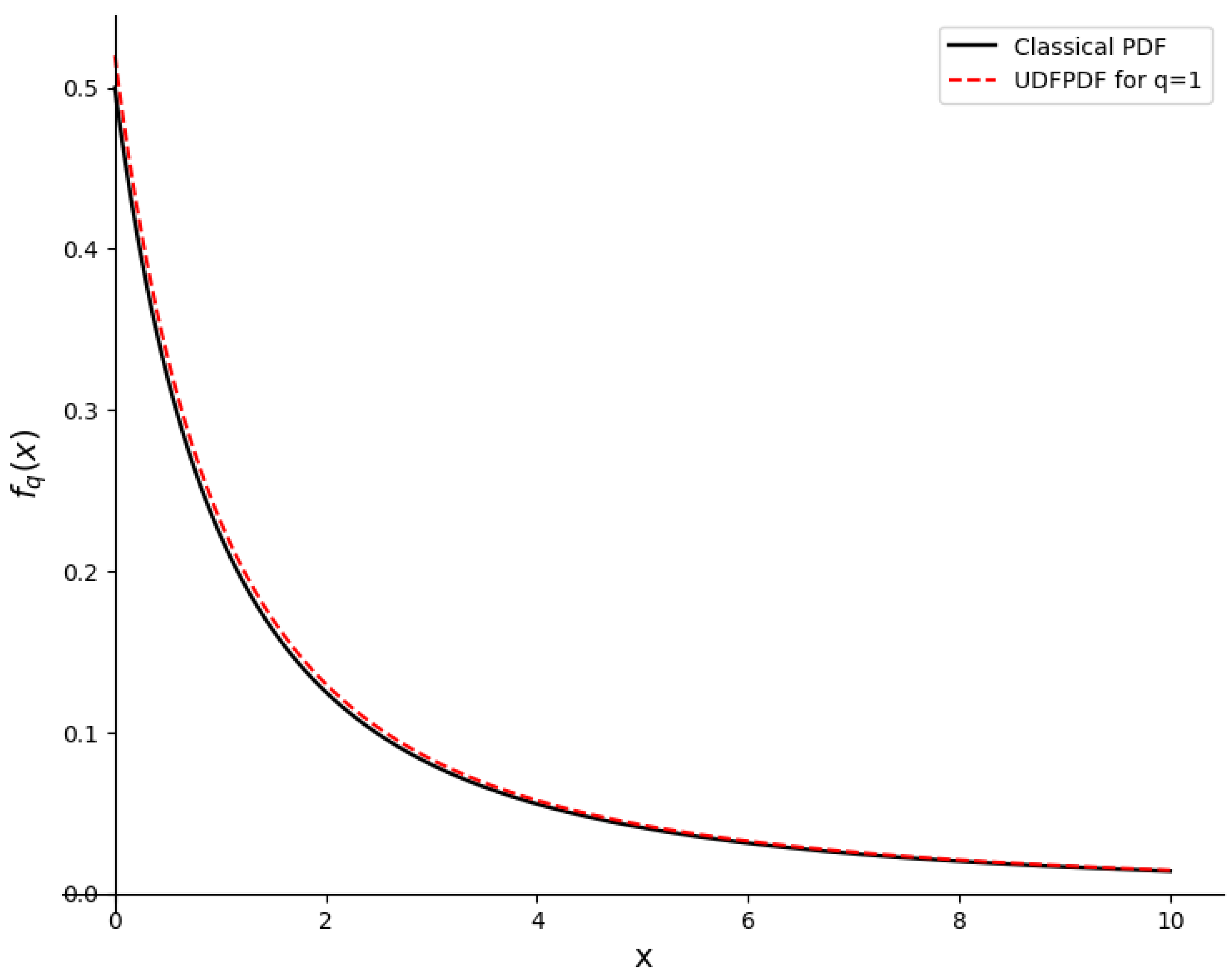
Figure 1 illustrates this result by comparing the classical PDF of the LD and the UDF-PDF of the
q-LD at
with arbitrary chosen
and
. Moreover,
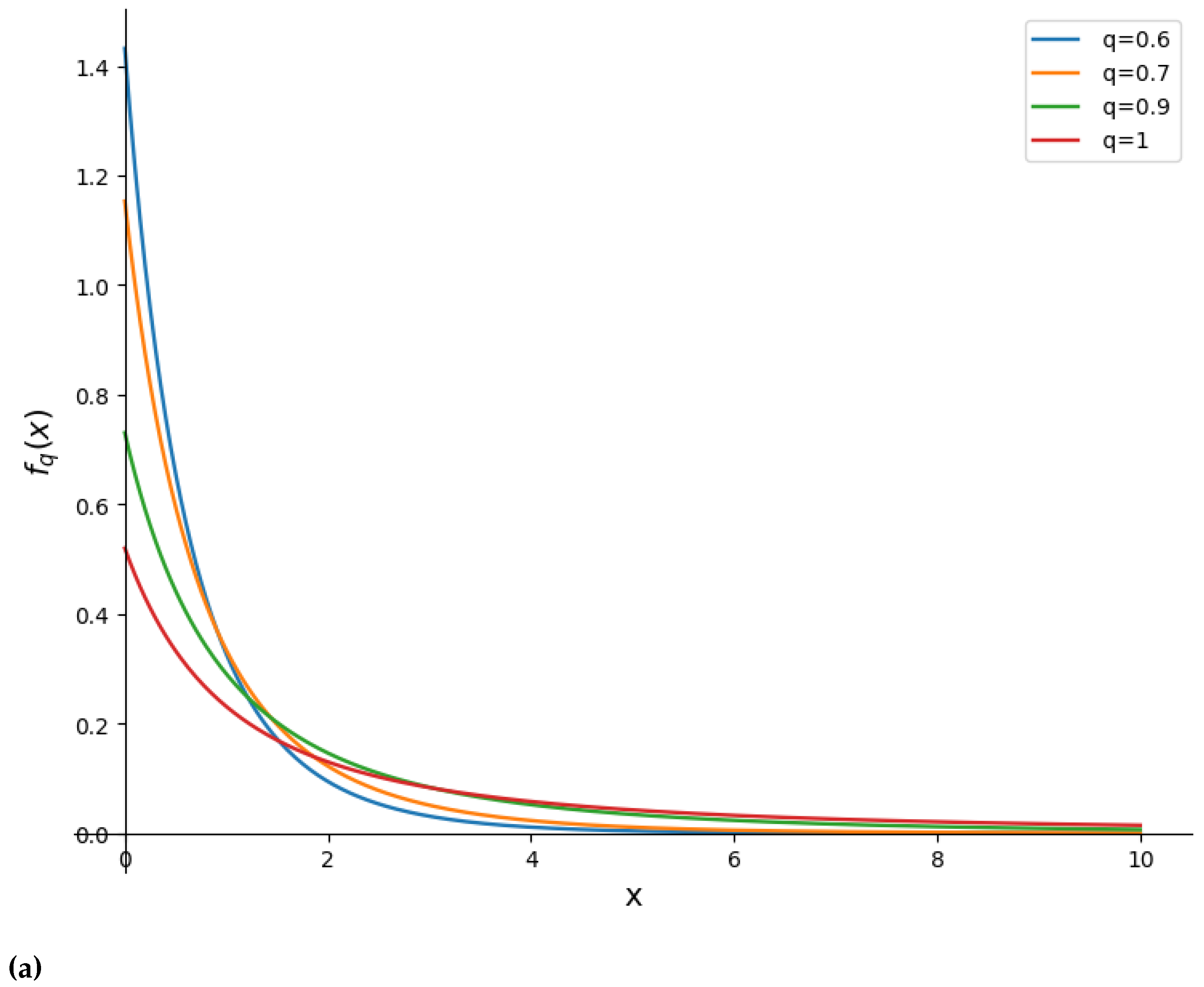
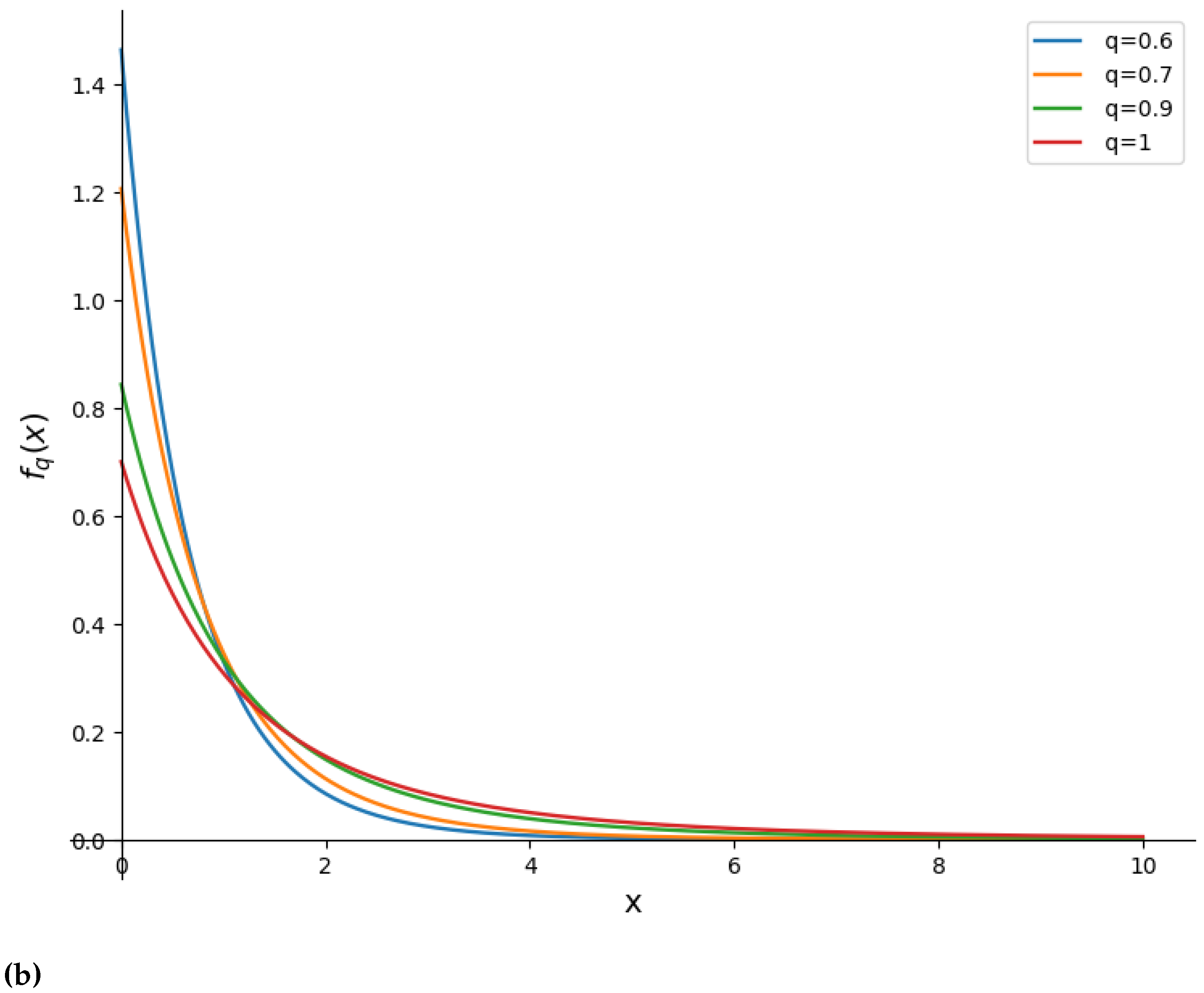
Figure 2 presents the UDF-PDF of
q-LD for multiple values of
q under two arbitrary chosen parameter settings, (
,
) and (
,
), clearly illustrating the combined influence of the shape, scale, and fractional parameters on the distribution’s behavior. When
, the UDF-PDF for the
q-LD converges to the classical PDF of the LD. In addition, increasing
leads to an increase in the decay rate, while increasing
increases the spread of the distribution.
2.2. The Influence of the Fractional Parameter on the Behavior of the LD
The UD fractional modifies the classical Lomax model by forming a convex combination of the density function and its first derivative through a single fractional parameter
q. In this setting, a particular form of memory arises, since the current shape of the distribution depends not only on its present value but also on its local rate of change. From a reliability analysis, this feature affects the behavior of the distribution tail and the corresponding hazard rate and should be interpreted as a structural effect rather than one based on accumulated past information [
7].
The fractional parameter controls the strength of this structural effect. When q is small, the UD fractional LD is mainly influenced by the density component in the UD operator, resulting in lighter tails and a faster tail decay compared with the classical LD. In practical applications, cases are reflected in which the probability mass is accumulated more rapidly, thereby reducing the likelihood of extreme values. As q increases, a stronger influence from the derivative term is exerted, resulting in a progressive transformation of the distribution’s shape. For Intermediate values of q, a continuous transition between the fractional and the classical behaviors is achieved.
In contrast to classical fractional operators, such as Caputo, Riemann–Liouville, and distributed-order derivatives, in which hereditary memory is encoded via convolution kernels spanning the whole past, so the derivative at time
t depends on all previous values,
. Power-law or multi-scale memory effects are thereby generated and are widely employed in the modeling viscoelasticity, anomalous diffusion, tumor growth, and various other systems. Conformable derivatives provide a local formulation that eliminates the need for history integrals. Although analytical simplicity is achieved through this approach, only the rate of change is primarily affected, while the structure of the underlying model is not directly modified [
12].
In contrast, time locality is preserved by the UD operator, as only
and
are utilized, and no integral over history values are involved. Therefore, memory is described as structural rather than temporal, since the baseline distribution continues to shape the model through a differential relationship between the density and its derivative. A transitions from the classical model, at
, to a derivative controlled deformation, at
, is achieved through the single parameter
q. This is essentially different from the integral-kernel memory approach [
8].
Finally, when , the UD fractional LD coincides with the classical Lomax model. In this case, the fractional effect disappears and the standard model is fully recovered in terms of its tail behavior and reliability characteristics. At the same time, for values of , the model incorporates structural memory-like behavior through a single, clearly interpretable parameter, providing additional flexibility for modeling lifetime and reliability data.
2.3. The Cumulative Distribution Function Under the UD Fractional Framework
The UD fractional cumulative distribution function (UDF-CDF) generalizes the classical Lomax CDF by incorporating the fractional parameter
q, and it is defined as
where
is the upper incomplete gamma function. This is justified as described below. Starting from the definition of the CDF, we have
Applying the substitution
transforms the integral into
This integral can be expressed using the upper incomplete gamma function, yielding the closed-form expression of the UDF-CDF as given in Equation (
9).
It is worth noting that, as
in Equation (
9), then the UDF-CDF reduces to the classical CDF of the LD:
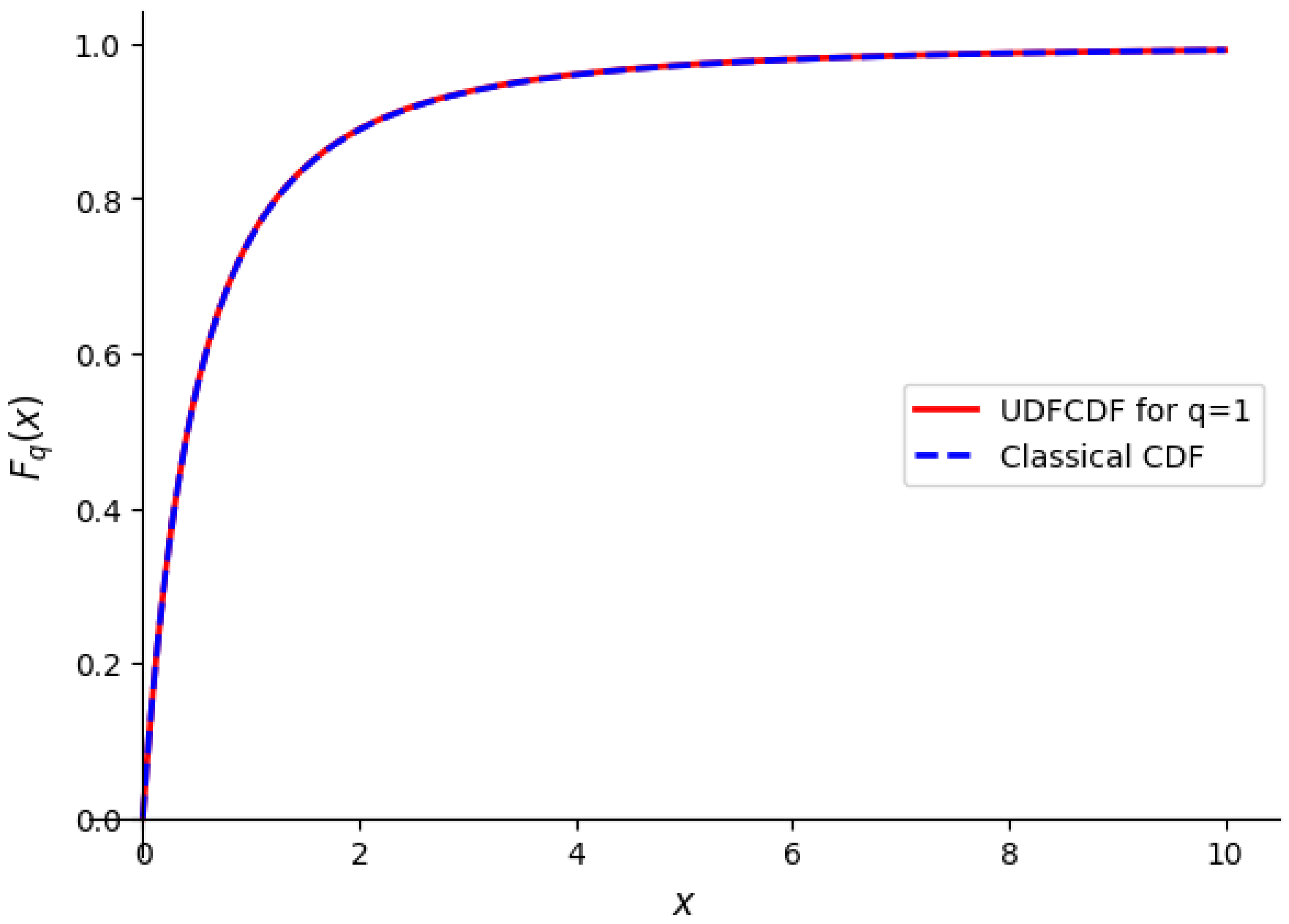
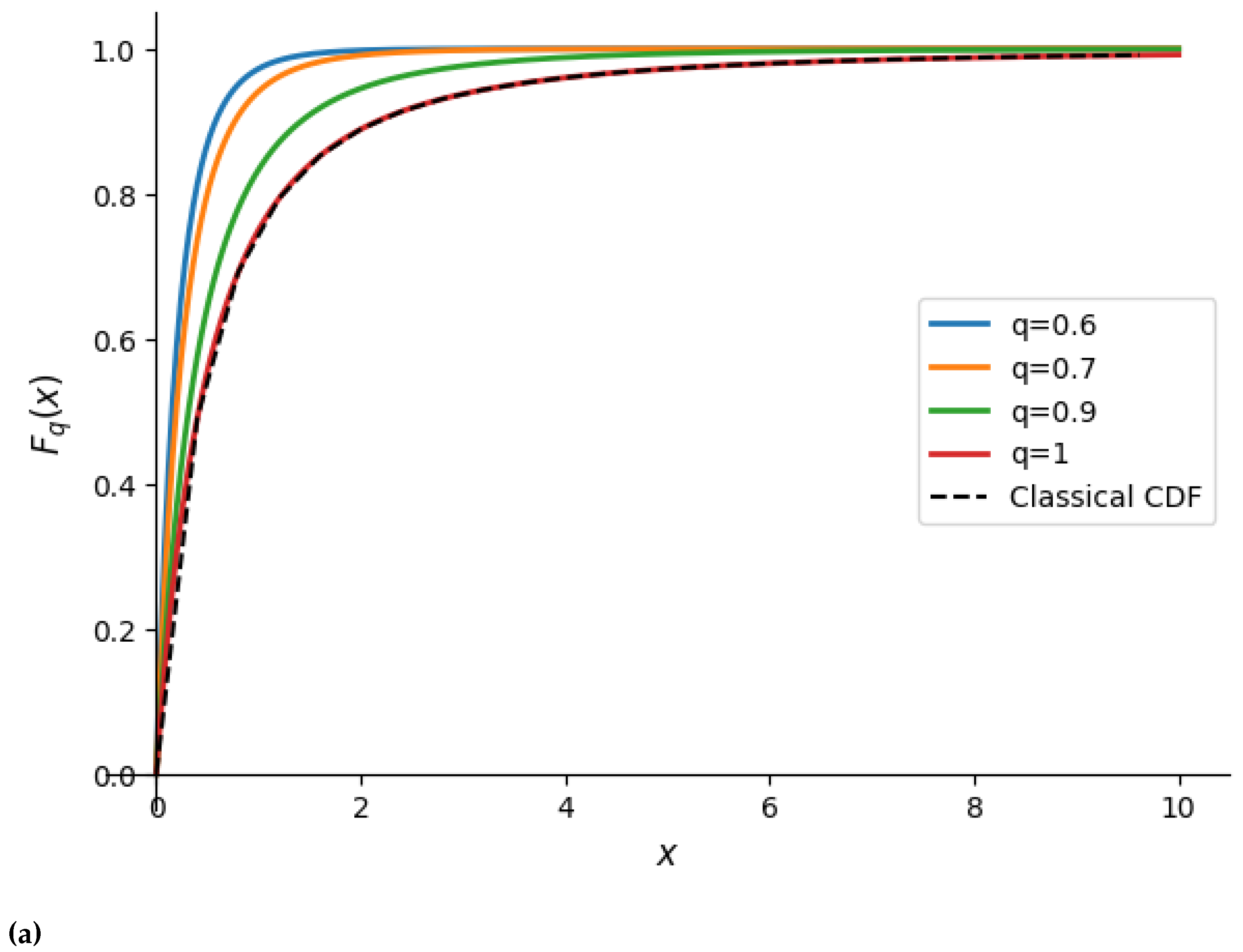
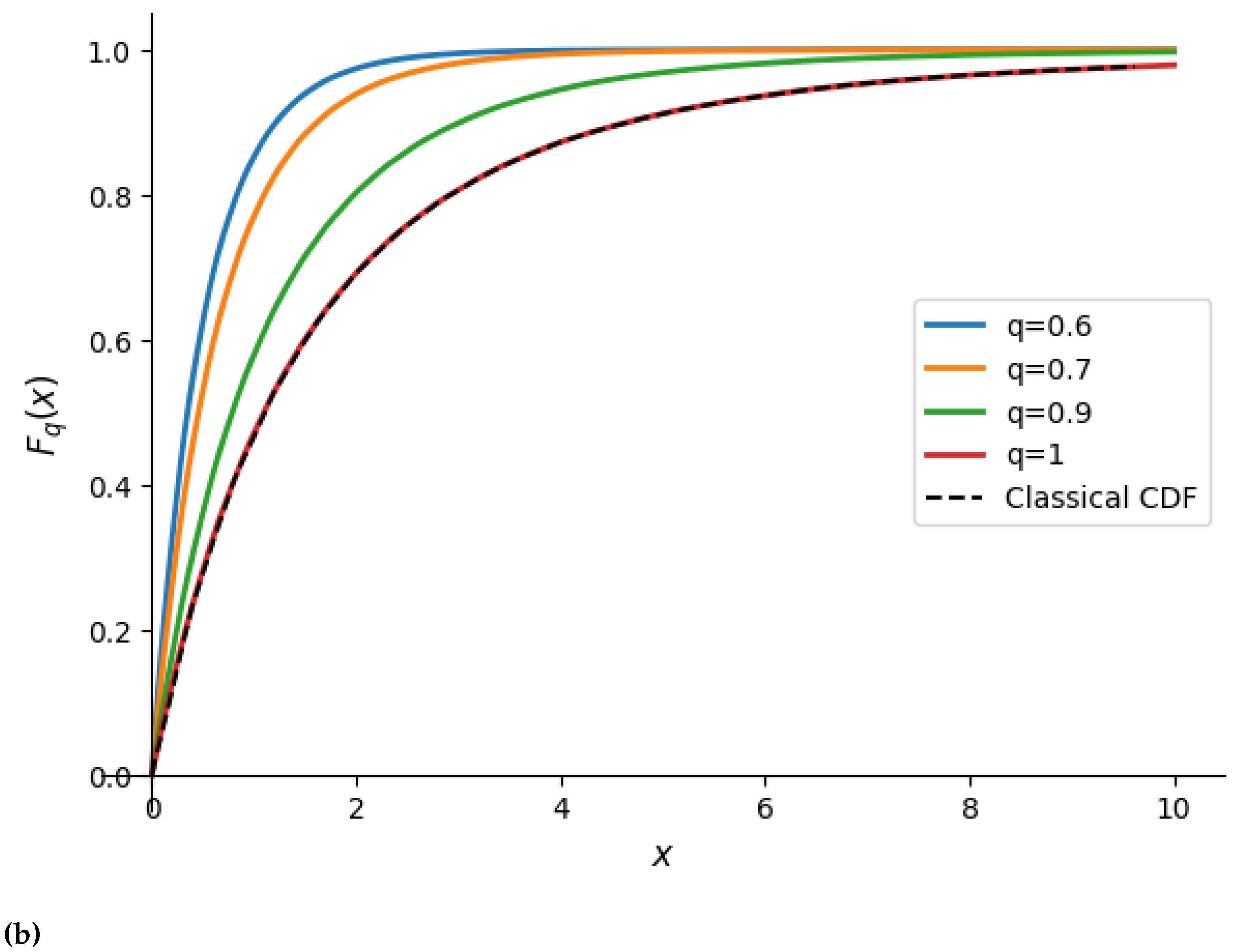
Figure 3 presents a comparison between the UDF-CDF and the classical LD at
, with
and
. The UDF-CDF reduces to the classical CDF, validating that the proposed UDF-CDF is an extension of the classical LD.
Figure 4 is used to display the UDF-CDF curves of the
-LD alongside the classical LD, through which the effects of the parameters
q,
, and
are illustrated and showing how they jointly control the shape and spread of the cumulative probability. As expected, all the curves are monotonically increasing, starting from zero and approaching one. Notably, for
, the UDF-CDF curves lie above the classical CDF, indicating that the probability mass accumulates more quickly compared to the classical case.
2.4. The Survival Function Under the UD Fractional Framework
The survival function describes the probability of an event continuing without failure up to a certain value. In the fractional framework, the parameter q modifies this reliability behavior.
For the
, the UD fractional survival distribution function (UDF-SF) of the random variable
Y is obtained from its UDF-CDF in (
9) as follows:
Taking the limit in (
10) yields
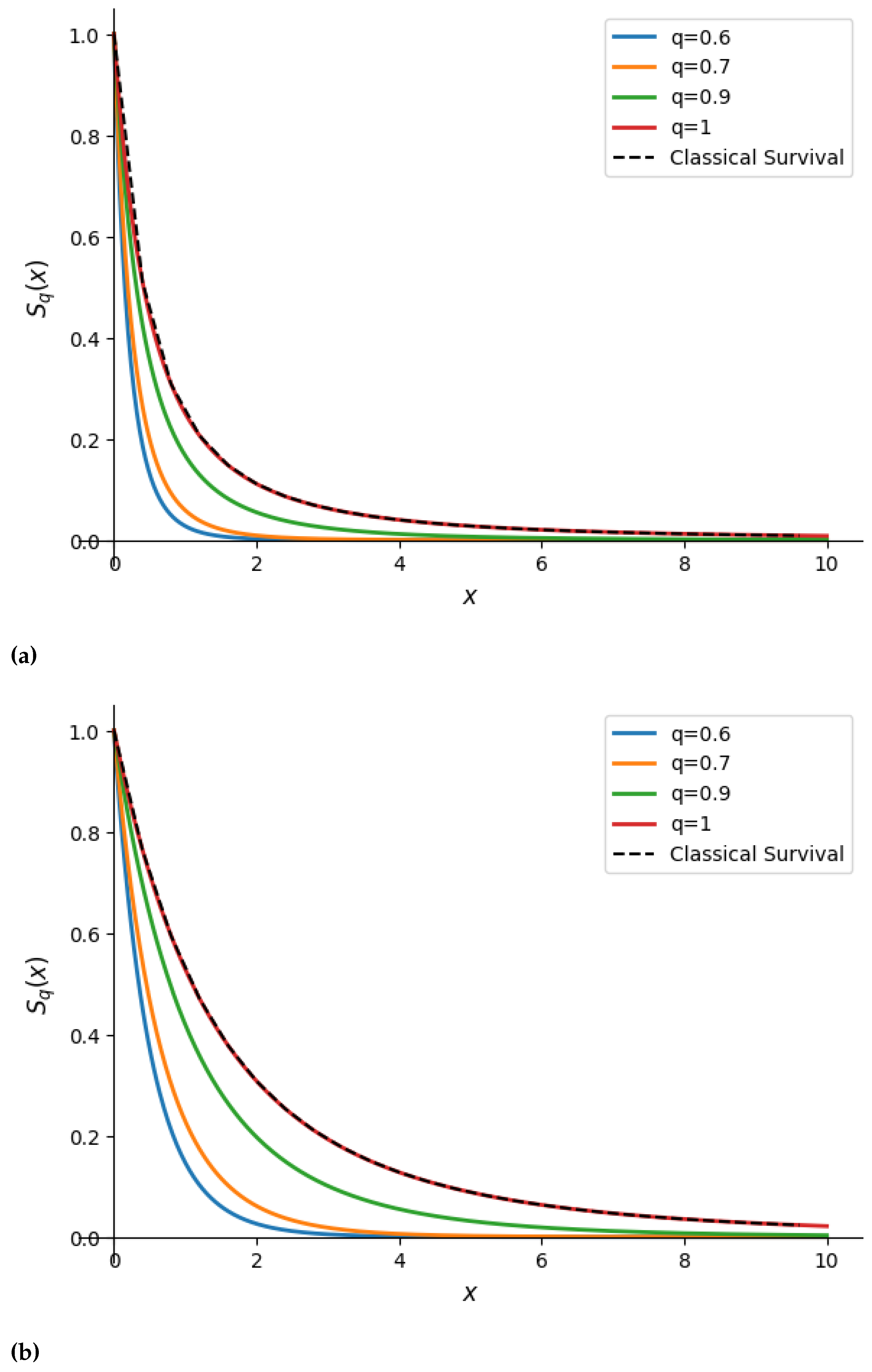
Figure 5 illustrates how the UDF-SF changes for different values of
q, gradually converging to the classical Lomax survival (
) as
q increases.
Figure 5b further confirms this convergence. It can be seen that all the UDF-SF curves start at 1 when
, indicating the certainty of survival at the initial time, and are observed to decrease monotonically, converging to zero as
. Also, it is clearly shown that the rate of decay is controlled by the fractional parameter, such that the UDF-SF curves lie below the
curve when
, indicating the probability mass accumulates more quickly in the corresponding UDF-CDF, which results in lighter tails and a reduced likelihood of extreme values.
2.5. The Hazard Function Under the UD Fractional Framework
This section introduces the UD fractional hazard function (UDF-HF) and highlights how the fractional parameter q adds an additional degree of flexibility to the model.
The UDF-HF of the random variable
Y is obtained by
One can observe that
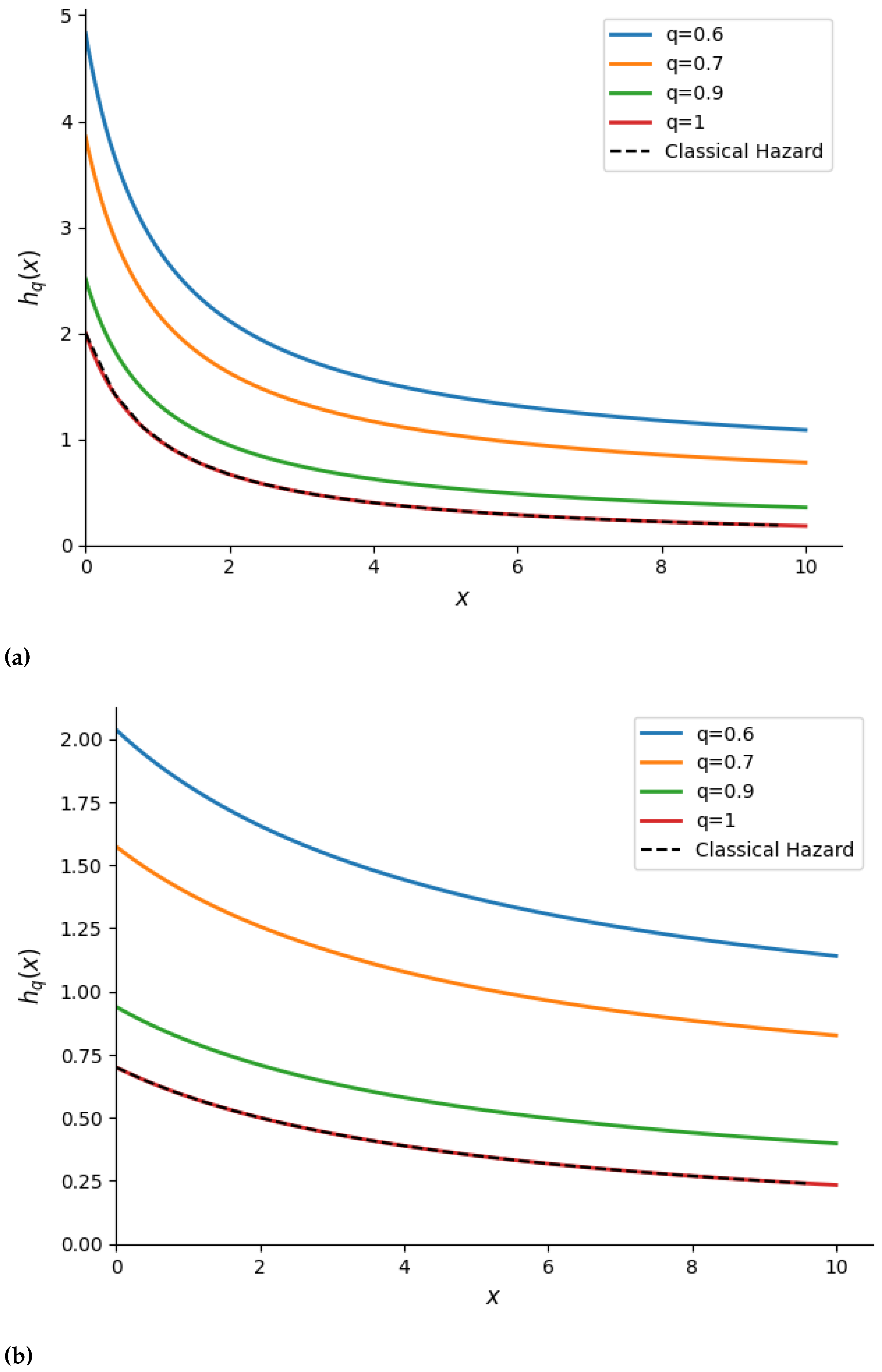
Figure 6 presents a comparative analysis of the UDF-HF for various
q values alongside the classical Lomax hazard function under two different parameter settings. We can see that the hazard rate functions remain strictly decreasing in
y. In the fractional cases with
, the curves decrease more slowly. Additionally, as
q approaches to
, the UDF-HF curves are observed to approach the classical Lomax hazard, showing how the UD-fractional model tends to the classical LD.
3. The Statistical Measures of the UD Fractional Lomax Distribution
Key statistical measures of the UD q-LD, including its fractional mode, the -order expected values, and the corresponding variance, are presented in this section.
3.1. The UD Fractional Mode for the Fractional Lomax Distribution
Determining the mode is considered crucial for identifying the concentration of probability in a distribution. Although the classical LD is known to attain its mode at zero, it must be investigated whether this property is preserved in the UD fractional setting.
The logarithm of the density
given in Equation (
8) can be written as
where
.
Differentiate the
with respect to
y:
which is strictly negative for all
. Thus,
and, consequently,
are strictly decreasing on
. Hence, the density reaches its maximum at the boundary, and therefore the mode is
3.2. The UD Fractional Expectation
In this subsection, the classical expectation is extended to the UD fractional framework. In the following, we derive the UD fractional moment of order r for the UD q-LD, capturing the memory effect introduced by the fractional parameter q:
The
UD fractional moment, denoted by
, of the random variable
Y with UDF-PDF
is defined as
using the substitution
and using the binomial theorem
, then the integral becomes
hence, using the incomplete gamma function, the
UD fractional moment is given by
Remark 2. The existence of the UD fractional moment in (17) requireswhich guarantees the convergence of the defining integral in (16). In the limiting case as , condition (18) reduces to the classical Lomax requirement , thereby ensuring consistency with the classical LD. Moreover,
Setting
in Equation (
17), the UD fractional expectation
is obtained as follows:
For
, the UD fractional second moment
is given by
Hence, for the
q-LD, the UD fractional variance of
Y, denoted as
, is expressed as
Consequently, the UD fractional standard deviation of
Y, denoted as
, is defined as the square root of
, and it is given by
Table 1 presents the numerical values of the mean, variance, skewness, and kurtosis of the
q-LD together with the corresponding classical LD for selected parameter values. For fixed
, all measures increase as the fractional parameter
q increases, indicating that
q controls tail behavior and the variability of the distribution. As
q approaches 1, consistency with classical LD is confirmed.
Regarding the selected values, the shape parameter is fixed at , as a representative value, to ensure the existence of all classical moments, since the classical moment exists only when . Furthermore, the parameter combinations are chosen to represent different relative scale regimens, providing a comprehensive assessment.
4. The UD Fractional Entropy Measures
Information theoretic measures like Shannon and Tsallis entropy are commonly used to describe uncertainty in a distribution. The uncertainty is highly influenced by the tail heaviness and concentration of distributions, which are determined by model parameters.
Shannon entropy is the classical additive measure of the average uncertainty associated with the information content of a probability distribution. Its value depends mainly on shape parameters that control variability and tail behavior. Distributions with heavier tails or greater variability produce higher Shannon entropy, reflecting more uncertainty. In contrast, when the probability mass is more concentrated, Shannon entropy decreases, indicating lower uncertainty. For more details, see [
13].
In addition, Tsallis entropy can be seen as a non-additive generalization of Shannon entropy, making it suitable for non-extensive systems, where factors like correlations, long-range interactions, or heavy tailed distributions make the additive property of Shannon entropy insufficient. For example, in image processing, Tsallis entropy-based thresholding has been shown to outperform Shannon entropy in segmenting image classes with non-additive information content [
14]. Similarly, in inverse problems and geophysics, seismic inversion with non-Gaussian noise has employed Tsallis-based
-Gaussian likelihoods to achieve more robust parameter estimation [
15]. The tunable parameter
in Tsallis entropy adjusts the weight assigned to tail events, making it well suited to distributions with strong outliers or quasi-power-law tails.
4.1. Shannon Entropy Under the UD Fractional Framework
Let
Y be a random variable that follows the UD
q-LD; then for
,
, and
, the UD fractional Shannon entropy
is given by
This expression in (
22) is evaluated by expanding the logarithm of the UDF-PDF and computing the resulting integrals term by term. Accordingly, taking the logarithm of
in Equation (
8) and rearranging terms, we obtain
Consequently,
each term in Equation (
23) corresponds to an expectation with respect to the UDF-PDF and can be evaluated using known integral identities, as follows:
where
and
.
Thus, substituting the simplified integrals into the expression (
23) gives
where
.
It can be observed that
converges to the classical Shannon entropy of the LD as
. Formally,
4.2. Tsallis Entropy Under the UD Fractional Framework
Tsallis entropy is widely used when Shannon entropy fails to describe systems with correlations, memory, or heavy tails, and this supported across physics, reliability, and public finance. For the continuous random variable
Y, the UD fractional Tsallis entropy of the
-LD, denoted by
, is defined as
First, the integral
is evaluated using (
8) and can be expressed as
using a change of variables and the upper incomplete gamma function, we obtain
Hence, after simplification, the
is given by
Remark 3. The exists for , , , and , provided thatIn the limiting case of , this condition reduces to the classical Lomax constraint, which is , ensuring consistency with the classical Tsallis entropy of the LD. It is worth noting that, as
, the
converges to
:
Moreover, by examining the influence of the fractional parameter, it can be seen that, as
, the
smoothly converges to its classical Tsallis entropy of the LD,
provided that
5. The UD Fractional-Order Statistics
This section explores the order statistics of the UD q-LD, deriving an explicit expression for the UDF-PDF of the -order statistic, , providing a powerful tool for detailed probabilistic analysis.
Definition 1. Consider a random sample , , …, of size n drawn from the UD fractional distribution with UDF-PDF, , and its UDF-CDF, . Let , , …, represent the corresponding order statistics of this sample. The PDF of the -order statistic , , is given byand upon applying the binomial expansion to , we immediately obtain the equivalent series representation:
If a random sample
,
, …,
of size
n is drawn from the UD
q-LD, then by substituting Equations (
8) and (
9) into Equation (
29), the corresponding UDF-PDF of the
-order statistic
is given by
Consequentially, the UDF-PDF for the special cases corresponding to the minimum-order statistics,
, and the maximum-order statistics,
, are given by
and
Notably, as
, the UD fractional-order statistics PDF,
, converges to the classical
-order statistics PDF of the LD:
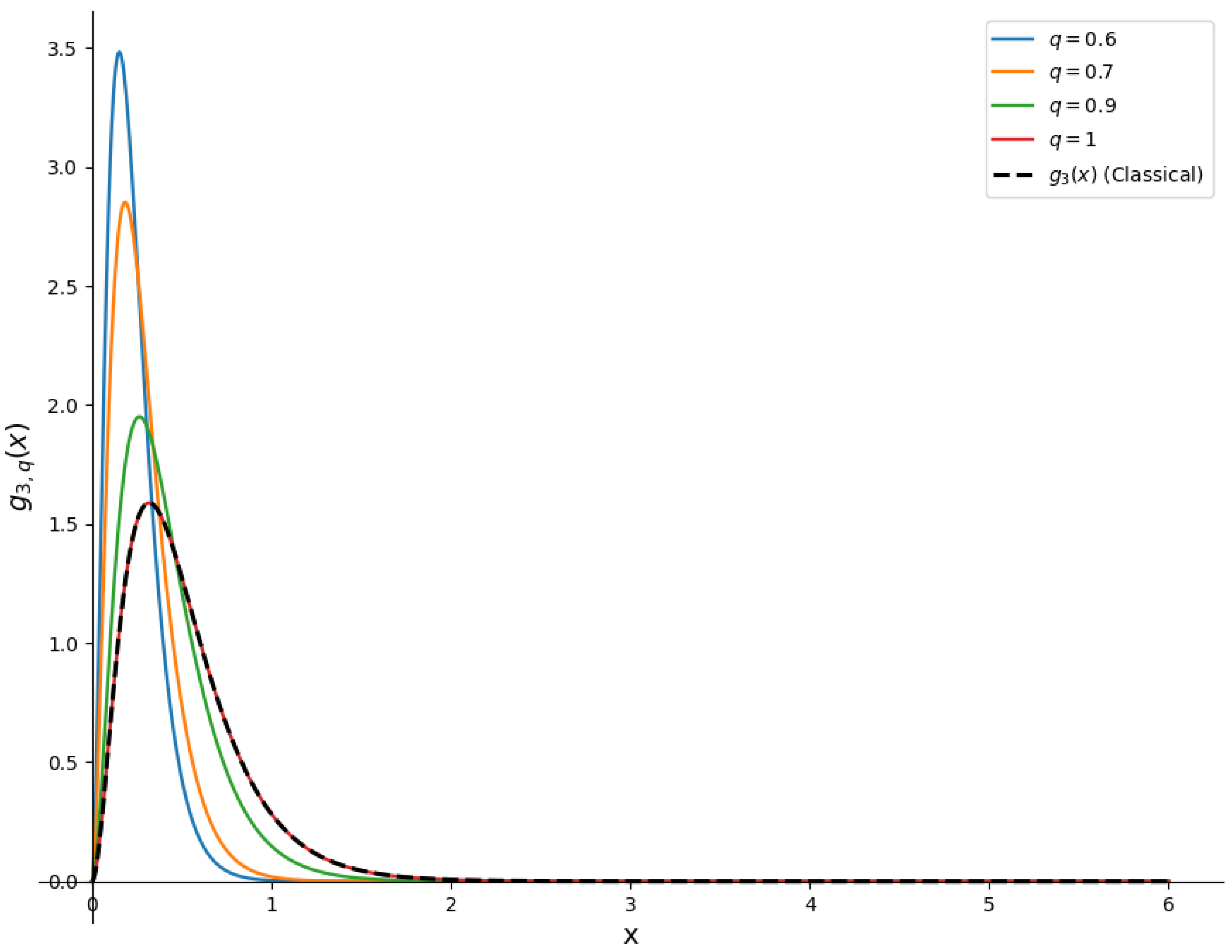
Figure 7 shows that as the fractional parameter
q decreases, the density
becomes more skewed and develops a heavier right tail, indicating greater variability in the third-order statistic, while as
, the curve converges to the classical third-Lomax-order statistic density, confirming the coherence of the fractional extension.
Theorem 1. The joint UDF-PDF of the - and -, , order statistics from the UD q-LD is given by Proof. For
, the general joint UDF-PDF of
- and
-order statistics is given by
By applying the binomial expansion to the two terms
and
in Equation (
34), we obtain the following representation:
Substituting the UDF-PDF (
8) and the UDF-CDF (
9) into (
35) and performing some algebraic simplifications yields the desired expression. □
Remark 4. Since and for all , it follows from (34) that, for each ,where is the joint PDF of the - and -order statistics from the classical LD. 6. Real Application
In this section, the flexibility of the
q-LD is assessed using real-world data, and its goodness of fit is compared against eight Lomax-generated families: Power Lomax (PLD), Weibull Lomax (WLD), Gompertz Lomax (GO-LD), Beta Lomax (BLD), Kumaraswamy Lomax (KLD), McDonald Lomax (MC-LD), Gamma Lomax (GLD), and Exponentiated Lomax (EX-LD). For further details of these distributions and the corresponding formulas, the reader is referred to [
16].
The model selection is performed using several statistical criteria to identify the distribution that provides the best fit. These include the negative twice log-likelihood statistics
, the Akaike information criterion (AIC), the Bayesian information criterion (BIC), the value of the Kolmogorov–Smirnov (KS) statistic, and its corresponding
p-value; see [
17,
18]. The formulas used to compute these measures are given as follows:
,
,
,
where L is the likelihood function, p is the number of parameters, n is the sample size, is the empirical distribution function, and is the theoretical CDF of the fitted model.
The following dataset represents the breakdown times (in hours) of an insulating fluid placed between electrodes subjected to 34 kV of voltage:
| 0.19 | 0.78 | 0.96 | 1.31 | 2.78 | 3.16 | 4.15 |
| 4.67 | 4.85 | 6.5 | 7.35 | 8.01 | 8.27 | 12.06 |
| 31.75 | 32.52 | 33.91 | 36.71 | 72.89 | | |
This dataset, originally reported in [
19], contains time to failure observations of 19 test devices under controlled electrical stress conditions. It is commonly used in reliability analysis and serves as a benchmark example for studying the breakdown behavior of insulating materials under electrical stress.
For clarity, the parameters of all competing models were estimated using the maximum likelihood method, where the log-likelihood function is given by
where
is the UDFPDF in Equation (
8). Since (
8) involves the upper incomplete gamma function, closed-form solutions are unavailable. Therefore, the maximization of the log-likelihood was carried out numerically using a constrained quasi-Newton L-BFGS-B optimization algorithm (see [
20]). The numerical optimization was initialized at
,
, and
. Convergence was assessed using the standard stopping criteria of the algorithm, based on the norm of the projected gradient and the stability of the log-likelihood value across successive iterations. All computations were performed using the R version 4.2.2 (2022).
The goodness of fit criteria are reported in
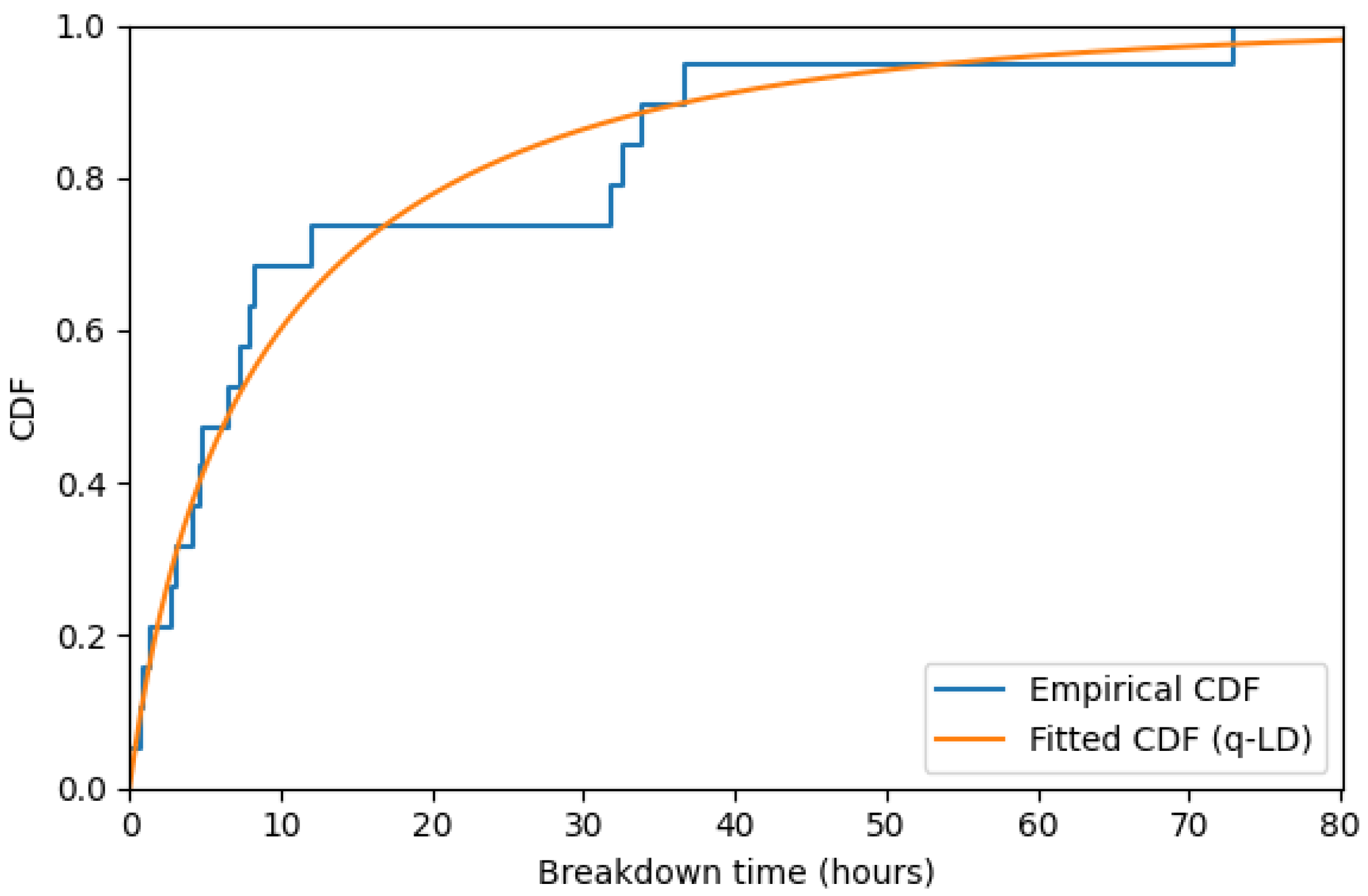
Table 2. Across all criteria, the
q-LD provides the best overall fit: it attains the smallest
, AIC, and BIC, and the lowest KS statistic with the largest
p-value, outperforming all Lomax-generated competitors. The fitted
aligns closely with the empirical CDF of the breakdown-time data over the full support, especially in the upper tail, indicating an excellent fit; see
Figure 8. Consequently,
q-LD is the most adequate model for this dataset and is recommended as a default baseline for similar reliability data.
It is worth noting that several of the Lomax-generated models considered in this comparison, such as the BLD, MC-LD, and GLD, achieve additional flexibility by introducing more parameters. Although this may lead to an improvement in the likelihood, it also increases model complexity and may result in overfitting, especially for small datasets. Information criteria such as the AIC and BIC are designed to account for this trade-off by penalizing models with a larger number of parameters. As shown in
Table 2, the proposed UD
q-LD attains the smallest AIC and BIC values among all competing models, despite its simpler structure. This shows that the better fit is not attributed to the inclusion of additional parameters, but instead to the effective influence of the fractional parameter
q, which enhances flexibility while maintaining model simplicity.
As seen in
Table 3, the UD
q-LD achieves greater flexibility through the fractional parameter
q, which simultaneously controls tail behavior and introduces non-local memory effects. These features offer clear advantages over the classical LD extensions when modeling heavy-tailed behavior with complex reliability patterns and long memory dependence.
7. Conclusions
This study developed the statistical theory of the UD fractional extension of the LD. We adopted the UDF-PDF of the LD from [
9] as our starting point and, using it, derived the UDF-CDF, UDF-SF, and UDF-HF of the
q-LD. Several fractional statistical measures were established, including the mode, UD fractional
moments, variance and standard deviation, and the UD fractional entropy measures, namely Shannon and Tsallis entropy measures. Finally, the UD fractional PDF of the
-order statistic is also obtained.
The results indicate that the UD fractional parameter q offers an additional robust and flexible tool, allowing the distribution to capture a wider range of tail behaviors than the classical LD. Furthermore, when , all the UD fractional functions and the statistical measures converge to their classical forms, creating a bridge between classical and UD fractional probabilistic models. In addition, the graphical representations clearly confirm how the fractional parameter, together with the shape and scale parameters, controls the behavior of the distribution. Along with this, the data analysis shows that the q-LD provides a better fit than all Lomax-generated families based on goodness-of-fit test criteria.
The UD fractional framework serves as a natural bridge between classical probability distributions and their fractional extensions. The fractional parameter q facilitates a smooth transition from classical LD to its fractional form, demonstrating how fractional calculus expands traditional reliability and risk modeling by introducing memory and scaling effects.
For future work, several directions may be pursued such as the investigation of parameter estimation methods and the extension of the UD fractional framework to the multivariate LD.





 ,
,