
Validation of Finite Element-Based Crack-Tip Driving Force Solutions Using Fractal Analysis of Crack-Path Microfeatures




Abstract
1. Introduction
2. Theoretical Background
3. Materials and Methodology
3.1. Material and Bell Crank Geometry
3.2. Fatigue Crack Growth Test of Bell Crank Structure
3.3. FE Simulation of Bell Crack Structure for Crack-Tip Driving Force,
3.4. Fractal Dimensions Determination of Fatigue Crack in Bell Crank Structure
4. Results and Discussion
4.1. Fatigue Crack Growth Response of Bell Crank Structure
4.2. FE Analysis Results of the Bell Crank Structure
4.3. Fractal Fracture Response of the Bell Crank Structure
4.4. Validation of FE-Calculated Crack-Tip Driving Force Using Fractal Measurements
5. Conclusions
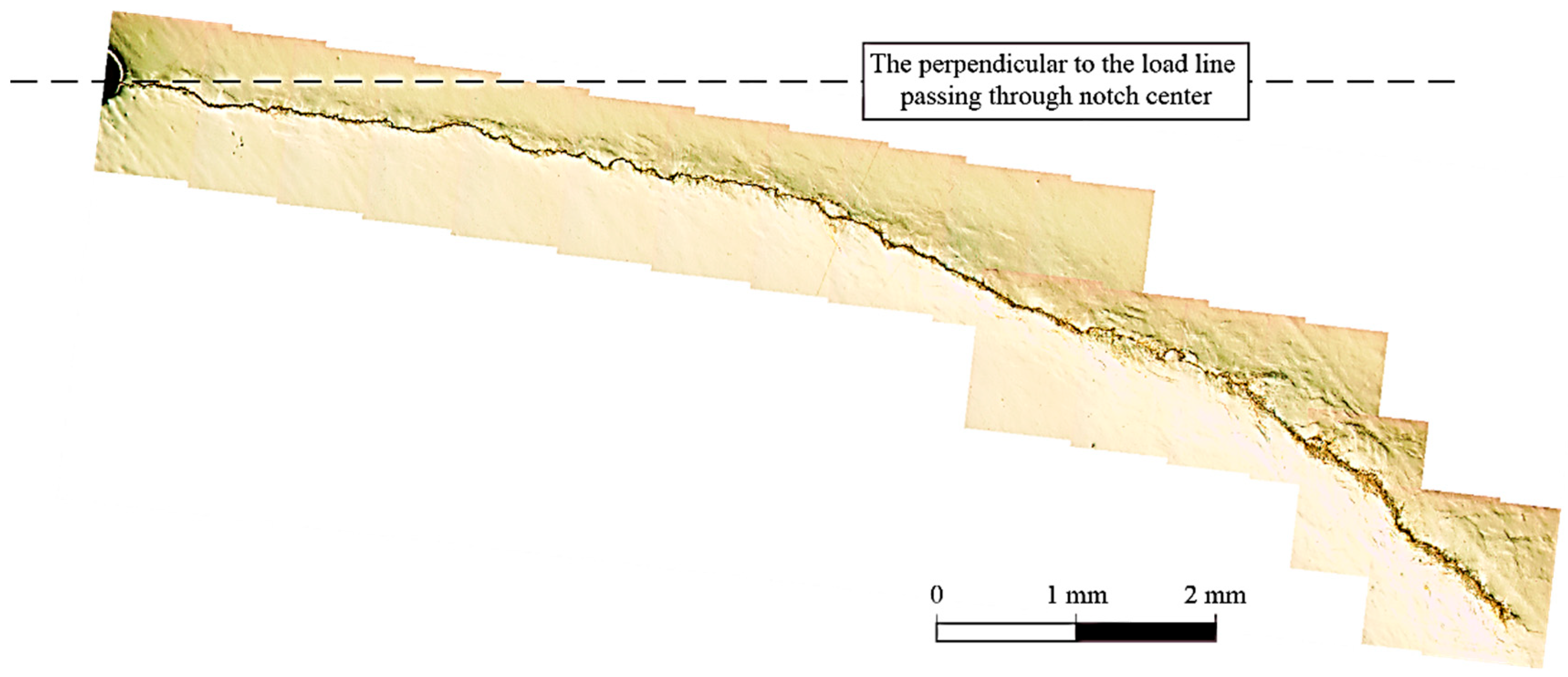
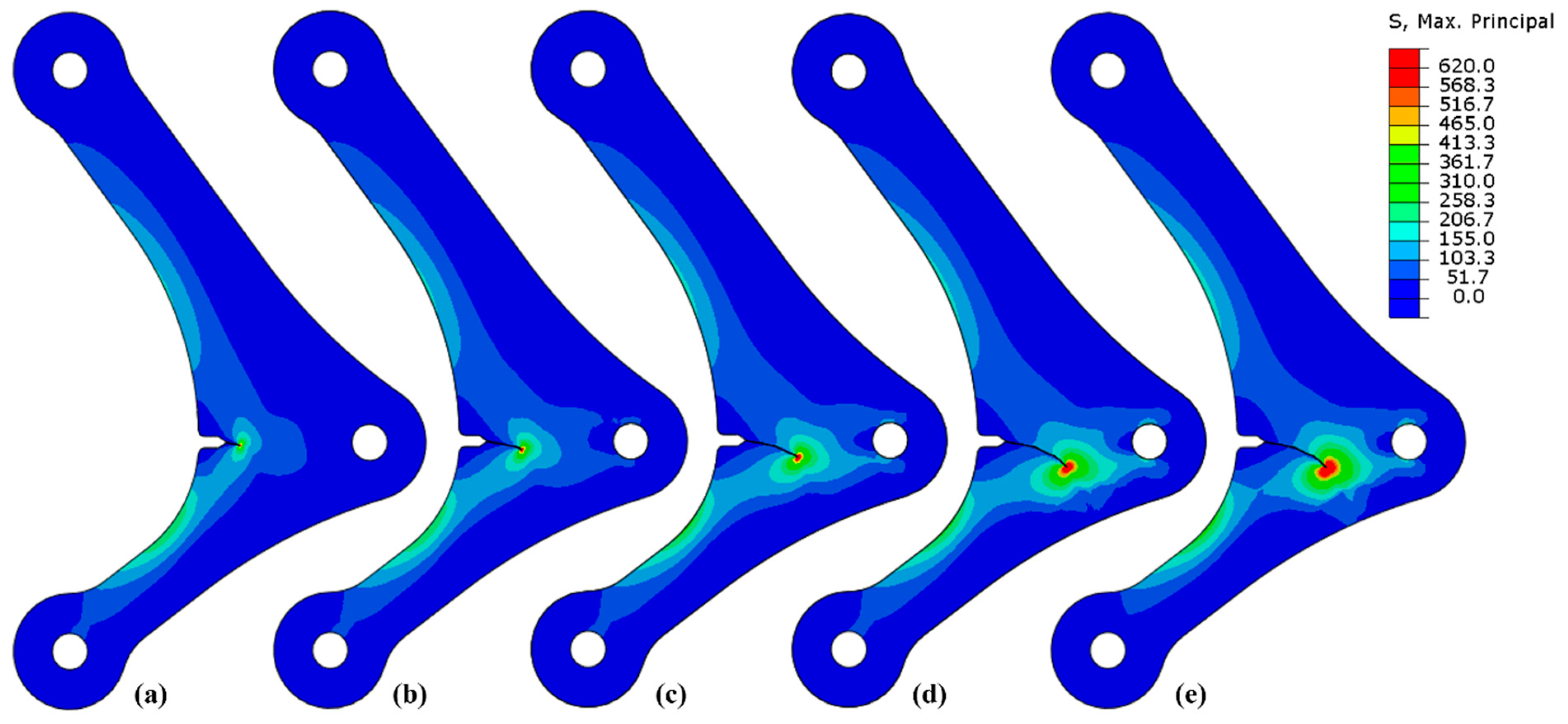
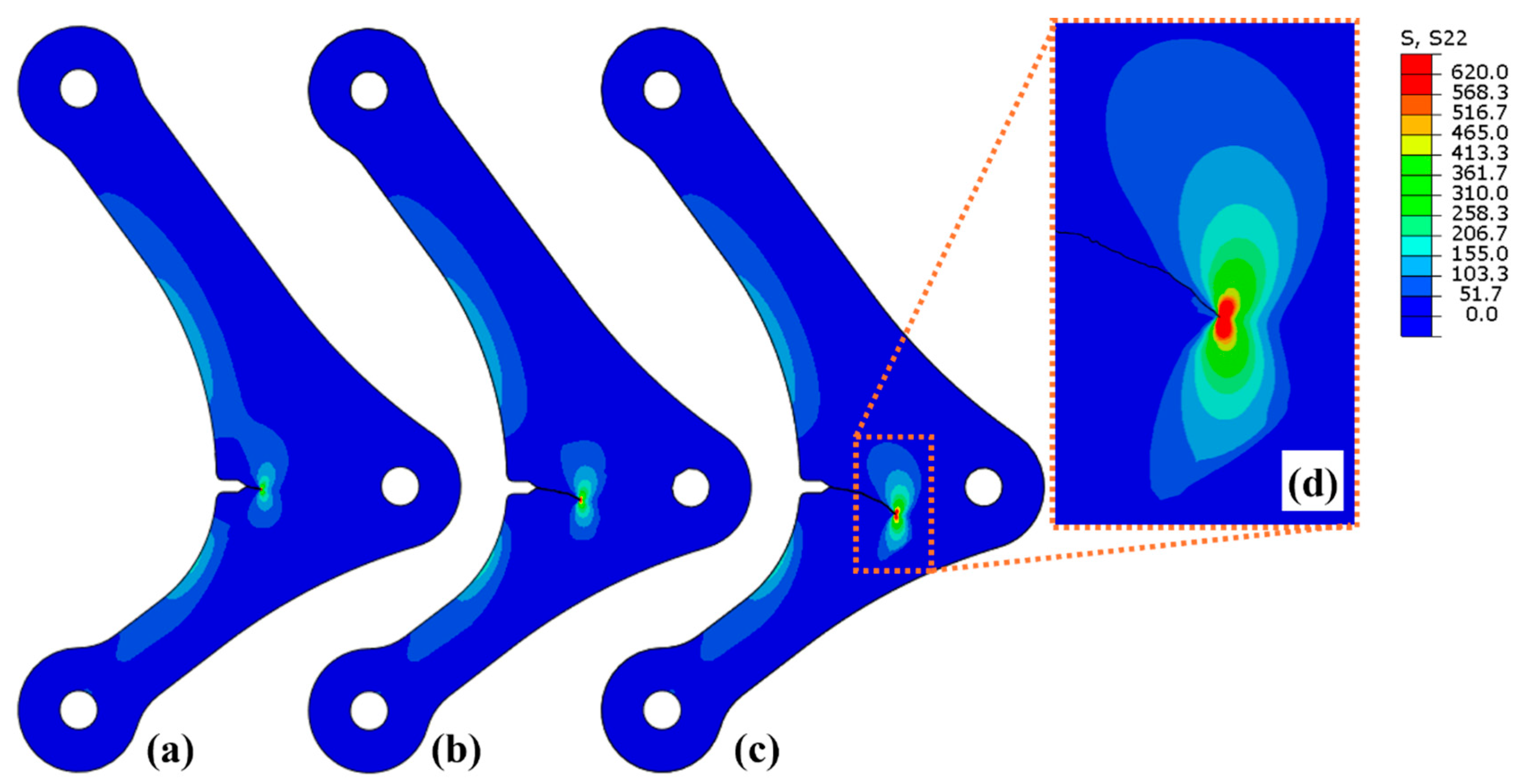
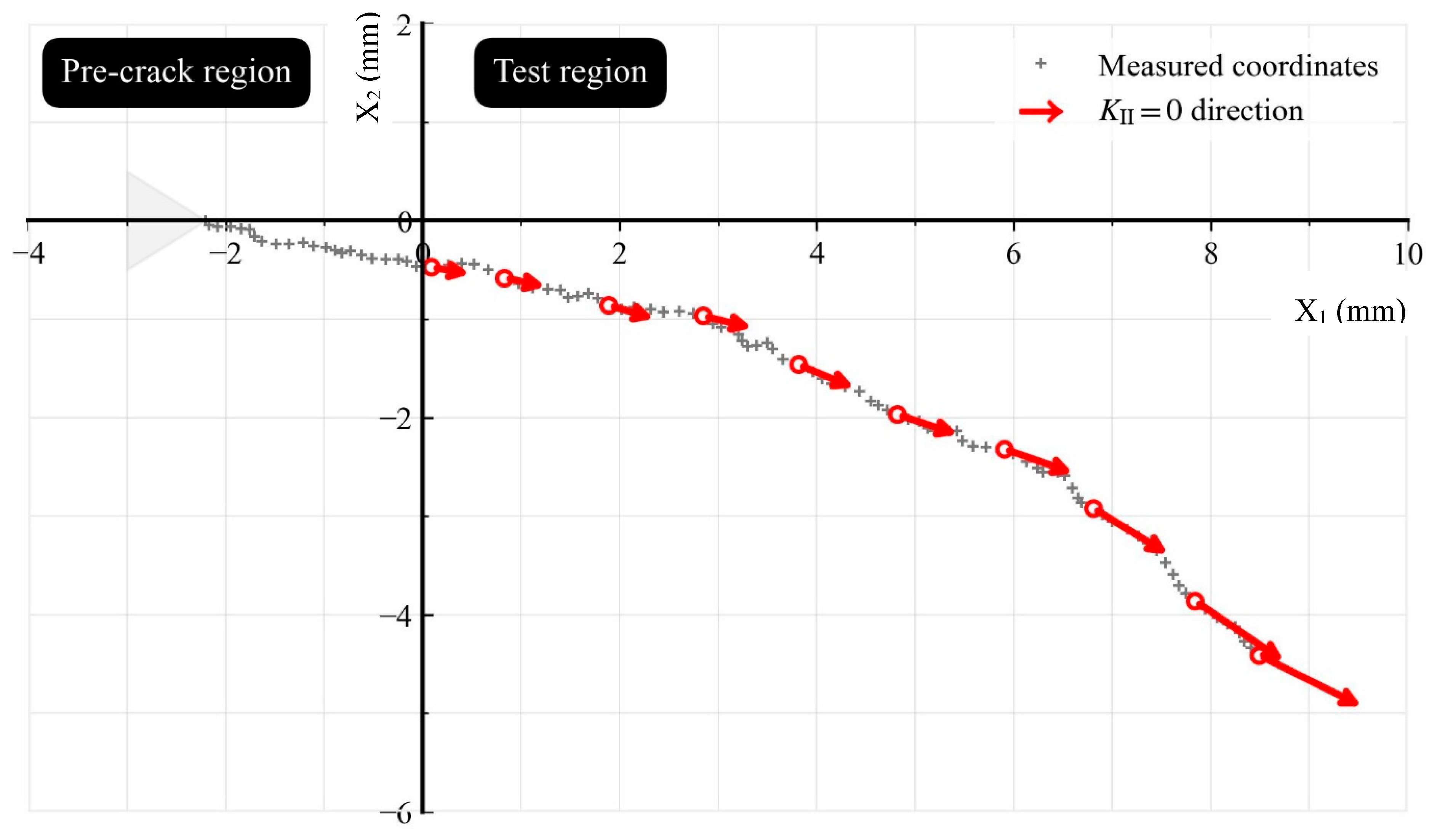
- The fatigue crack in the bell crank structure is driven by a combined Mode-I (opening) and Mode-II (shearing) crack-tip loading along a curved crack-path trajectory, as dictated by the asymmetric stress distribution.
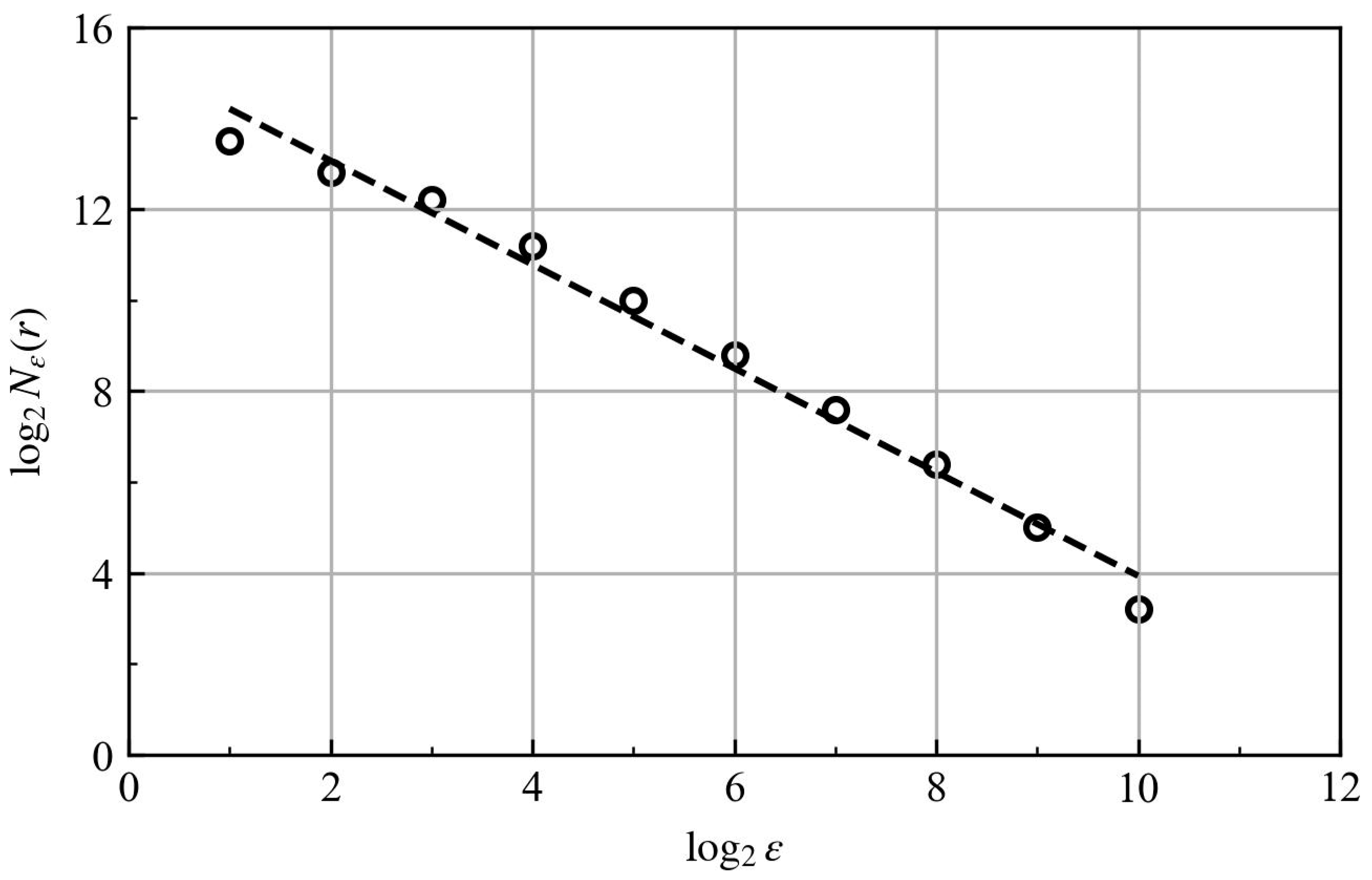
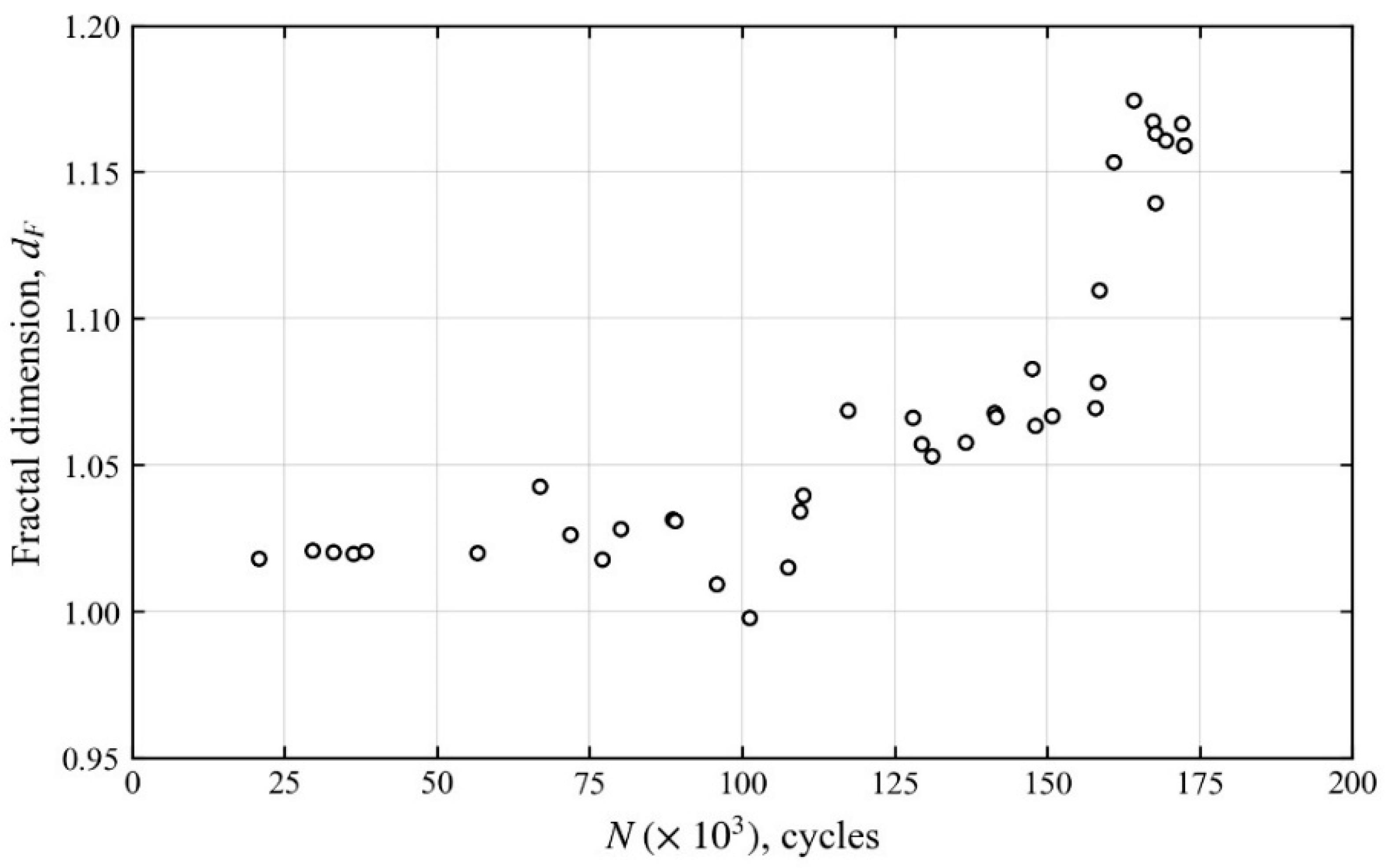
- The fatigue crack edge exhibits fractality with fractal dimensions ranging from 1.00 (Euclidean) to 1.18 along the crack length, up to 9.947 mm.
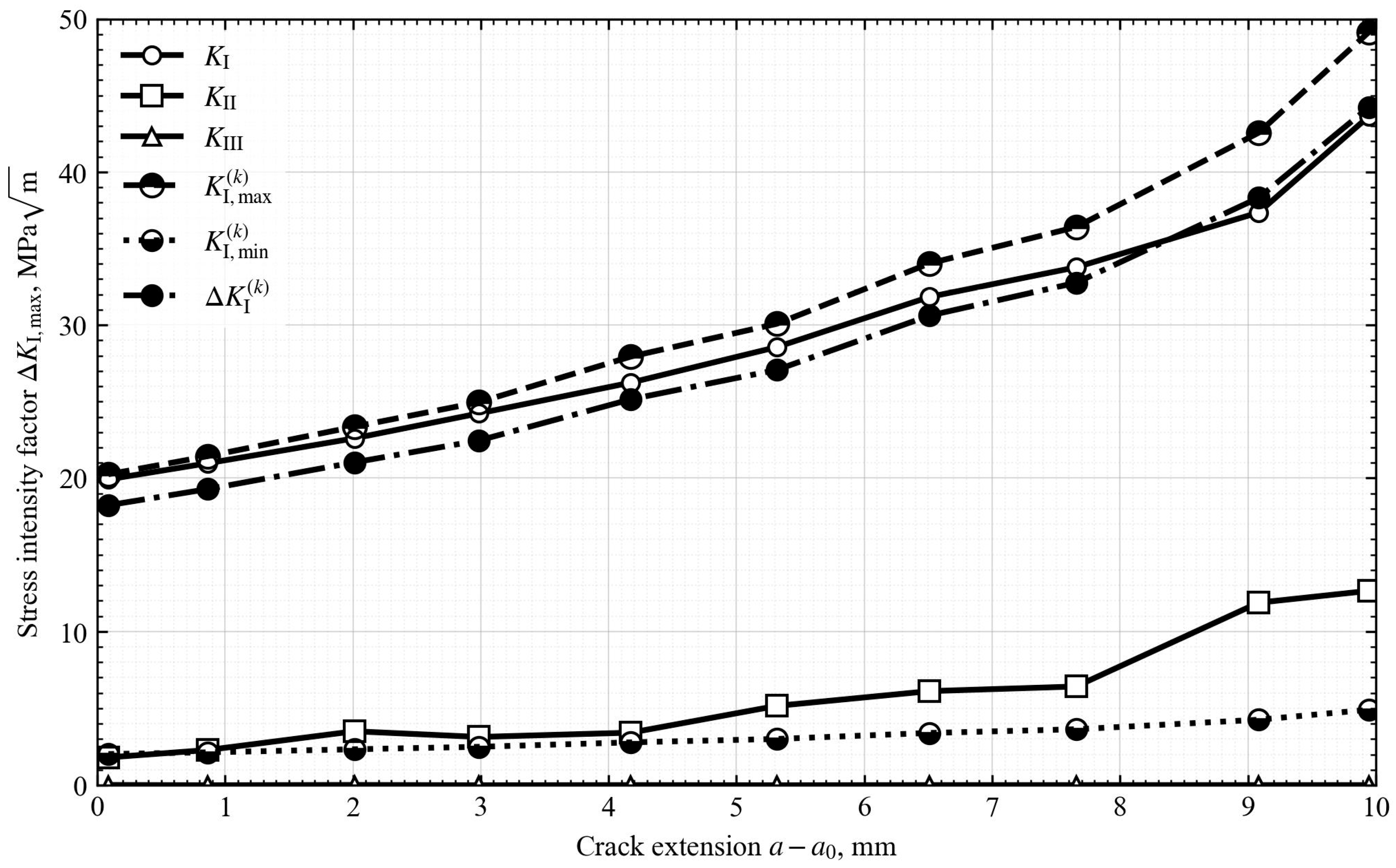
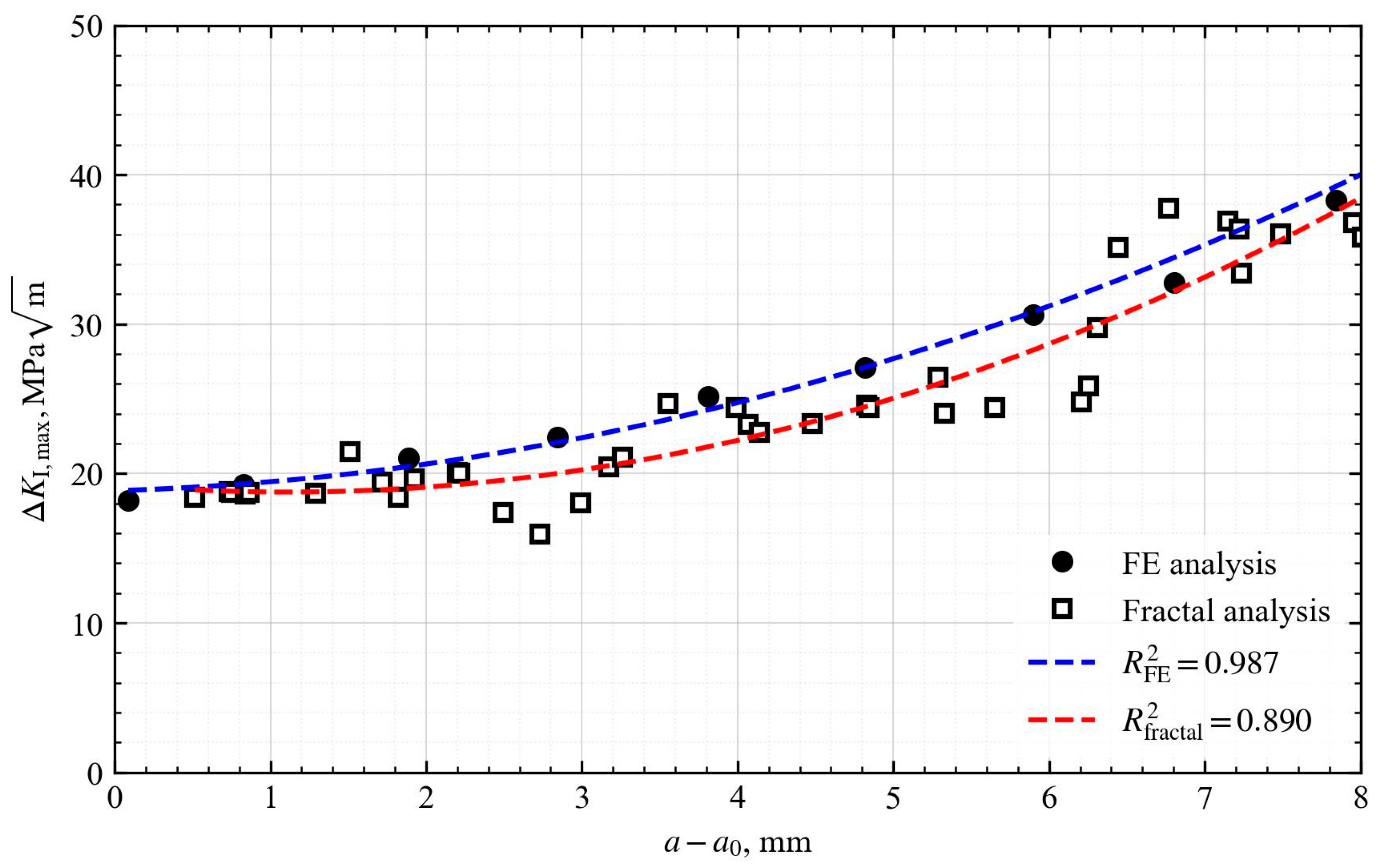
- The FE-calculated crack-tip driving forces of the bell crank structure compare well with those computed based on the corrected crack edge fractal dimensions, thus validating the simulation outcomes.
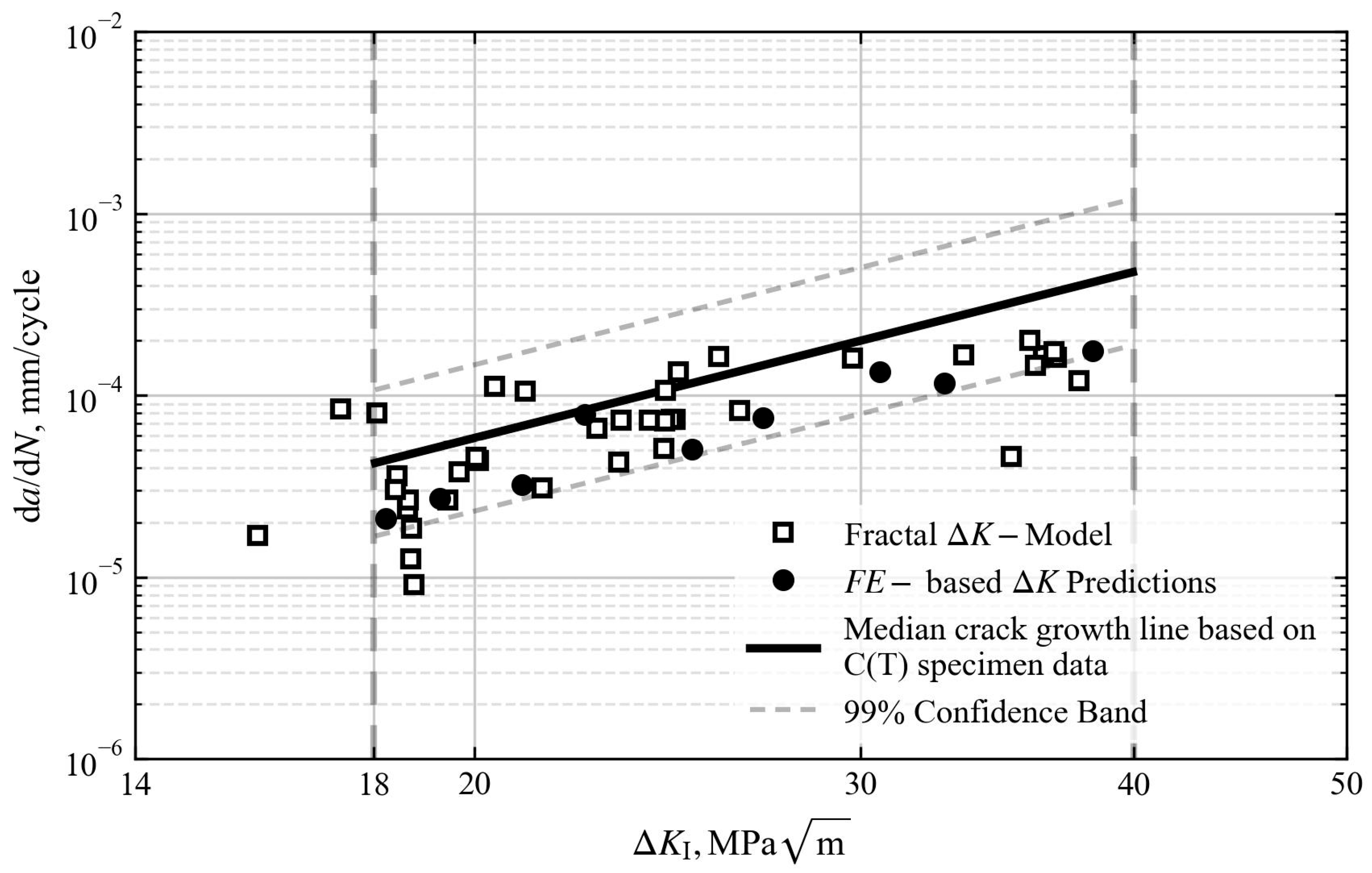
- Fatigue crack growth rates determined from crack-tip driving forces based on the validated FE-computed contour integrals are comparable to those obtained through ASTM standard tests.
Author Contributions
Funding
Data Availability Statement
Conflicts of Interest
Nomenclature
| Crack length (mm) | |
| Initial crack length (mm) | |
| Paris law coefficient | |
| Coefficient of fractality (material-specific) | |
| C(T) | Compact tension specimen |
| Fatigue crack growth rate (mm/cycle) | |
| Fractal dimension of crack path (dF = 1 for Euclidean crack) | |
| Loading frequency (Hz) | |
| FE | Finite element |
| J-integral (energy release rate per unit crack extension) | |
| Stress intensity factor vector [KI KII KIII]T | |
| Mode-I stress intensity factor (opening mode) | |
| Maximum Mode-I stress intensity factor | |
| Minimum Mode-I stress intensity factor | |
| Mode-I stress intensity factor in kinked crack direction | |
| Mode-II stress intensity factor (sliding/shearing mode) | |
| Mode-III stress intensity factor (tearing mode) | |
| Material’s fracture toughness | |
| Plane-strain fracture toughness | |
| LEFM | Linear elastic fracture mechanics |
| LCS | Local coordinate system |
| Number of fatigue load cycles | |
| Paris law exponent | |
| Maximum level of the applied load cycle | |
| Minimum level of the applied load cycle | |
| Stress intensity factor range | |
| Range of Mode-I stress intensity factor | |
| Maximum range of Mode-I stress intensity factor | |
| Threshold stress intensity factor range | |
| Load ratio | |
| SHM | Structural health monitoring |
| Cauchy stress tensor | |
| Normal stress perpendicular to the crack plane (opening stress) | |
| Yield stress of the material | |
| Crack kink angle (predicted propagation direction) | |
| Displacement vector | |
| Elastic strain energy density | |
| Virtual contour enclosing the crack tip | |
| Box size in the box-counting algorithm | |
| Number of boxes intersecting the crack path at scale |
References
- Díaz, F.A.; Vasco-Olmo, J.M.; López-Alba, E.; Felipe-Sesé, L.; Molina-Viedma, A.J.; Nowell, D. Experimental evaluation of effective stress intensity factor using thermoelastic stress analysis and digital image correlation. Int. J. Fatigue 2020, 135, 105567. [Google Scholar] [CrossRef] [Scilit]
- Wang, S.; Zhou, S.; Yang, B.; Xiao, S.; Yang, G.; Zhu, T. Effective stress intensity factor range for fatigue cracks propagating in mixed mode I-II loading. Eng. Fract. Mech. 2024, 312, 110641. [Google Scholar] [CrossRef] [Scilit]
- De Oliveira Miranda, A.C.; Antunes, M.A.; Guamán Alarcón, M.V.; Meggiolaro, M.A.; Pinho De Castro, J.T. Use of the stress gradient factor to estimate fatigue stress concentration factors K. Eng. Fract. Mech. 2019, 206, 250–266. [Google Scholar] [CrossRef] [Scilit]
- Anderson, T.L. Fracture Mechanics: Fundamentals and Applications, 3rd ed.; CRC Press: Boca Raton, FL, USA, 2017. [Google Scholar]
- Tada, H.; Paris, P.C.; Irwin, G.R. The Stress Analysis of Cracks Handbook, 3rd ed.; ASME Press: New York, NY, USA, 2000. [Google Scholar]
- Kobayashi, A.S. STRESS INTENSITY FACTORS HANDBOOK, Y. Murakami, (Editor in Chief), M.T. Hasebe, Y. Itoh, K. Kishimoto, H. Miyata, N. Miyazaki, H. Terada, K. Tohgo and R. Yuuki, Co-editor. Exp. Tech. 1994, 18, 46. [Google Scholar] [CrossRef] [Scilit]
- Rooke, D.P.; Cartwright, D.J. The Compendium of Stress Intensity Factors; Pendragon House, Inc.: Palo Alto, CA, USA, 1976; Volume 14, p. R143. [Google Scholar] [CrossRef] [Scilit]
- Kriaa, Y.; Hersi, Y.; Ammar, A.; Zouari, B. Quasi-Static and Dynamic Crack Propagation by Phase Field Modeling: Comparison with Previous Results and Experimental Validation. Appl. Sci. 2024, 14, 4000. [Google Scholar] [CrossRef] [Scilit]
- Chen, Z.; Dai, Y.; Liu, Y. Structural fatigue crack propagation simulation and life prediction based on improved XFEM-VCCT. Eng. Fract. Mech. 2024, 310, 110519. [Google Scholar] [CrossRef] [Scilit]
- Xin, H.; Liu, J.; Correia, J.A.F.O.; Berto, F.; Veljkovic, M.; Qian, G. Mixed-mode fatigue crack propagation simulation by means of G eq and walker models of the structural steel S355. Theor. Appl. Fract. Mech. 2023, 123, 103717. [Google Scholar] [CrossRef] [Scilit]
- Li, P.; Li, W.; Li, B.; Yang, S.; Shen, Y.; Wang, Q.; Zhou, K. A review on phase field models for fracture and fatigue. Eng. Fract. Mech. 2023, 289, 109419. [Google Scholar] [CrossRef] [Scilit]
- Bui, T.Q.; Hu, X. A review of phase-field models, fundamentals and their applications to composite laminates. Eng. Fract. Mech. 2021, 248, 107705. [Google Scholar] [CrossRef] [Scilit]
- Zhang, W.; Su, Y.; Jiang, Y.; Hu, Z.; Bi, J.; He, W. Data-driven fatigue crack propagation and life prediction of tubular T-joint: A fracture mechanics based machine learning surrogate model. Eng. Fract. Mech. 2024, 311, 110556. [Google Scholar] [CrossRef] [Scilit]
- Zhang, X.; Zhao, T.; Liu, Y.; Chen, Q.; Wang, Z.; Wang, Z. A data-driven model for predicting the mixed-mode stress intensity factors of a crack in composites. Eng. Fract. Mech. 2023, 288, 109385. [Google Scholar] [CrossRef]
- Wang, H.; Li, B.; Gong, J.; Xuan, F.-Z. Machine learning-based fatigue life prediction of metal materials: Perspectives of physics-informed and data-driven hybrid methods. Eng. Fract. Mech. 2023, 284, 109242. [Google Scholar] [CrossRef] [Scilit]
- Liang, Z.; Wang, X.; Cui, Y.; Xu, W.; Zhang, Y.; He, Y. A new data-driven probabilistic fatigue life prediction framework informed by experiments and multiscale simulation. Int. J. Fatigue 2023, 174, 107731. [Google Scholar] [CrossRef] [Scilit]
- Fang, X.; Liu, G.; Wang, H.; Tian, X. A digital twin modeling method based on multi-source crack growth prediction data fusion. Eng. Fail. Anal. 2023, 154, 107645. [Google Scholar] [CrossRef] [Scilit]
- Tasdemir, B. Determınatıon of stress intensity factor using digital image correlation method. Matter 2015, 2, 20–24. [Google Scholar]
- Torabi, A.R.; Bahrami, B.; Ayatollahi, M.R. Experimental determination of the notch stress intensity factor for sharp V-notched specimens by using the digital image correlation method. Theor. Appl. Fract. Mech. 2019, 103, 102244. [Google Scholar] [CrossRef] [Scilit]
- Singh, J.J.; Davis, W.T.; Crews, J., Jr. The Application of Acoustic Emission Technique to Fatigue Crack Measurement; The National Aeronautics and Space Administration: Washington, DC, USA, 1974.
- Roberts, T.M.; Talebzadeh, M. Acoustic emission monitoring of fatigue crack propagation. J. Constr. Steel Res. 2003, 59, 695–712. [Google Scholar] [CrossRef] [Scilit]
- Zanganeh, M.; Tomlinson, R.A.; Yates, J.R. T-stress determination using thermoelastic stress analysis. J. Strain Anal. Eng. Des. 2008, 43, 529–537. [Google Scholar] [CrossRef] [Scilit]
- Farahani, B.V.; Tavares, P.J.; Moreira, P.M.G.P.; Belinha, J. Stress intensity factor calculation through thermoelastic stress analysis, finite element and RPIM meshless method. Eng. Fract. Mech. 2017, 183, 66–78. [Google Scholar] [CrossRef] [Scilit]
- Hashmi, M.H.; Koloor, S.S.R.; Abdul-Hamid, M.F.; Tamin, M.N. Exploiting fractal features to determine fatigue crack growth rates of metallic materials. Eng. Fract. Mech. 2022, 270, 108589. [Google Scholar] [CrossRef] [Scilit]
- Hashmi, M.H.; Abdul-Hamid, M.F.; Abdul-Latif, A.; Tamin, M.N.; Khattak, M.A. Fractal Dimensions of a Propagating Fatigue Crack in Metallic Materials. J. Fail. Anal. Prev. 2021, 21, 1644–1651. [Google Scholar] [CrossRef] [Scilit]
- Rice, J.R. A Path Independent Integral and the Approximate Analysis of Strain Concentration by Notches and Cracks. J. Appl. Mech. 1968, 35, 379–386. [Google Scholar] [CrossRef] [Scilit]
- Erdogan, F.; Sih, G.C. On the Crack Extension in Plates Under Plane Loading and Transverse Shear. J. Basic. Eng. 1963, 85, 519–525. [Google Scholar] [CrossRef] [Scilit]
- Cotterell, B.; Rice, J.R. Slightly curved or kinked cracks. Int. J. Fract. 1980, 16, 155–169. [Google Scholar] [CrossRef] [Scilit]
- Hussain, M.; Pu, S.; Underwood, J. Strain Energy Release Rate for a Crack Under Combined Mode I and Mode II. In National Symposium on Fracture Mechanics; Irwin, G., Ed.; ASTM International: West Conshohocken, PA, USA, 1974; pp. 1–27. [Google Scholar] [CrossRef] [Scilit]
- Palaniswamy, K.; Knauss, W.G. On the Problem of Crack Extension in Brittle Solids Under General Loading. In Mechanics Today; Elsevier: Amsterdam, The Netherlands, 1978; pp. 87–148. [Google Scholar] [CrossRef] [Scilit]
- Maiti, S.K.; Smith, R.A. Comparison of the criteria for mixed mode brittle fracture based on the preinstability stress-strain field Part I: Slit and elliptical cracks under uniaxial tensile loading. Int. J. Fract. 1983, 23, 281–295. [Google Scholar] [CrossRef] [Scilit]
- Theocaris, P.S. A higher-order approximation for the T-criterion of fracture in biaxial fields. Eng. Fract. Mech. 1984, 19, 975–991. [Google Scholar] [CrossRef] [Scilit]
- Sih, G.C. Strain-energy-density factor applied to mixed mode crack problems. Int. J. Fract. 1974, 10, 305–321. [Google Scholar] [CrossRef] [Scilit]
- Hashmi, M.H.; Koloor, S.S.R.; Abdul-Hamid, M.F.; Tamin, M.N. Fractal Analysis for Fatigue Crack Growth Rate Response of Engineering Structures with Complex Geometry. Fractal Fract. 2022, 6, 635. [Google Scholar] [CrossRef] [Scilit]
- Hashmi, M.H.; Abdul-Hamid, M.F.; Tamin, M.N. A robust probabilistic fatigue crack growth model based on walker’s crack growth rate equation for metallic materials. Probabilistic Eng. Mech. 2023, 72, 103445. [Google Scholar] [CrossRef] [Scilit]



| Properties and Parameters | Values |
|---|---|
| 657 MPa | |
| 620 MPa | |
| Young’s | 200 GPa |
| Poisson’s ratio, ν | 0.29 |
| 268 | |
| Paris crack growth law | mm/cycle |
| 2.50 |
Disclaimer/Publisher’s Note: The statements, opinions and data contained in all publications are solely those of the individual author(s) and contributor(s) and not of MDPI and/or the editor(s). MDPI and/or the editor(s) disclaim responsibility for any injury to people or property resulting from any ideas, methods, instructions or products referred to in the content. |
© 2026 by the authors. Licensee MDPI, Basel, Switzerland. This article is an open access article distributed under the terms and conditions of the Creative Commons Attribution (CC BY) license.
Share and Cite
Hashmi, M.H.; Koloor, S.S.R.; Tamin, M.N. Validation of Finite Element-Based Crack-Tip Driving Force Solutions Using Fractal Analysis of Crack-Path Microfeatures. Fractal Fract. 2026, 10, 146. https://doi.org/10.3390/fractalfract10030146
Hashmi MH, Koloor SSR, Tamin MN. Validation of Finite Element-Based Crack-Tip Driving Force Solutions Using Fractal Analysis of Crack-Path Microfeatures. Fractal and Fractional. 2026; 10(3):146. https://doi.org/10.3390/fractalfract10030146
Chicago/Turabian StyleHashmi, Mudassar Hussain, Seyed Saeid Rahimian Koloor, and Mohd Nasir Tamin. 2026. "Validation of Finite Element-Based Crack-Tip Driving Force Solutions Using Fractal Analysis of Crack-Path Microfeatures" Fractal and Fractional 10, no. 3: 146. https://doi.org/10.3390/fractalfract10030146
APA StyleHashmi, M. H., Koloor, S. S. R., & Tamin, M. N. (2026). Validation of Finite Element-Based Crack-Tip Driving Force Solutions Using Fractal Analysis of Crack-Path Microfeatures. Fractal and Fractional, 10(3), 146. https://doi.org/10.3390/fractalfract10030146