1. Introduction
Nonlinear elliptic partial differential equations play a fundamental role in the mathematical modeling of complex phenomena arising in biomedical engineering [
1,
2], including bioheat transfer, drug diffusion in biological tissues, tumor growth dynamics, neural signal propagation, and cardiac electrophysiology. In many of these applications, nonlinear reaction–diffusion and convection–diffusion equations are employed to describe transport mechanisms coupled with nonlinear biological reactions, for which classical linear models are often inadequate. Indeed, linear formulations are generally unable to capture essential physiological behaviors such as saturation effects, activation thresholds, and nonlinear feedback mechanisms.
In this work, we consider the following class of nonlinear spatial elliptic partial differential equations (EPDEs):
subject to the following boundary conditions:
where
denotes the unknown scalar field defined on the spatial domain
, and
(
) are given coefficient functions describing spatially varying medium properties. In particular,
and
represent the diffusion coefficients in the
x- and
y-directions, respectively;
is a first-order transport (advection) coefficient; and
denotes a linear reaction or attenuation parameter. The nonlinear operator
models local reaction dynamics and is assumed to be sufficiently smooth (e.g., locally Lipschitz continuous) to guarantee well-posedness of the problem. The function
represents a prescribed source term. Throughout this work, all coefficient functions are assumed to belong to appropriate regularity classes, and
in
to ensure the ellipticity of the governing operator.
Accurate numerical simulation of such biomedical processes often requires the incorporation of both strong nonlinearities and complex coupling mechanisms that reflect heterogeneous and multiscale behavior. Nonlinear elliptic PDEs provide a realistic description of phenomena such as anomalous transport processes [
3], viscoelastic tissue behavior [
4], and long-range cellular interactions [
5], where classical linear models are inadequate. For instance, in tumor growth modeling diffusion is coupled with nonlinear reaction kinetics; in cardiac electrophysiology nonlinear ionic currents interact with spatial diffusion; and in bioheat transfer temperature-dependent conductivity induces nonlinear coupling [
6].
Classical analytical techniques, such as separation of variables [
7], integral transforms [
8], perturbation methods [
9], and variational approaches [
10], are generally applicable only to highly simplified models. In most cases, these methods require linear governing equations, constant coefficients, and regular geometries, which severely limits their applicability to realistic biomedical problems. Even semi-analytical techniques, including the Adomian decomposition method [
11], homotopy perturbation methods, and variational iteration approaches [
12], encounter substantial difficulties when applied to strongly nonlinear and spatially heterogeneous elliptic PDEs arising in biomedical engineering.
Despite extensive research, several gaps remain in the current literature:
Existing analytical and semi-analytical methods often struggle to handle strongly nonlinear and spatially heterogeneous elliptic PDEs arising in biomedical applications.
Many numerical schemes lack systematic strategies for tuning algorithmic parameters, which may lead to unpredictable convergence behavior or oscillatory dynamics.
Fractional-inspired or scaling-based modifications at the algorithmic level have been only limitedly explored as a means to enhance convergence robustness for nonlinear systems.
Parallel iterative frameworks for large-scale nonlinear systems remain comparatively underexplored in the context of biomedical elliptic PDEs, particularly when coupled with integrated dynamical analysis for parameter selection.
These limitations motivate the present study, which combines parallel iterative schemes, fractional-inspired Jacobian scaling, and nonlinear dynamical systems analysis to develop a robust computational framework for nonlinear biomedical elliptic PDEs.
In particular, such approaches typically suffer from the following:
- -
Slow or uncertain convergence in the presence of strong nonlinearities;
- -
Reliance on small parameters or artificial embedding techniques;
- -
Limited capability to treat complex geometries and realistic boundary conditions;
- -
Reduced effectiveness in multi-dimensional biomedical domains.
As a consequence, purely analytical and semi-analytical approaches are rarely sufficient for practical biomedical applications, and robust numerical methods remain indispensable.
Among numerical techniques, wavelet-based and wavelet collocation methods provide multi-resolution approximations capable of capturing localized phenomena such as sharp gradients and boundary layers [
13,
14]. However, when applied to nonlinear operators, these methods often lead to dense algebraic systems and high computational cost. Galerkin-type approaches, including finite element [
15] and spectral Galerkin methods [
16], are widely adopted due to their flexibility in handling irregular geometries and complex boundary conditions; nevertheless, for nonlinear PDEs they typically generate large-scale nonlinear systems that require repeated Jacobian evaluations and iterative solution strategies, thereby increasing computational burden. Similarly, least-squares formulations and spline-based collocation schemes [
17] can achieve smooth and high-order accurate approximations, yet they frequently suffer from ill-conditioning and limited scalability, particularly in higher-dimensional settings or in the presence of strong nonlinear effects.
Parallel iterative root-finding schemes inspired by the Weierstrass and Durand–Kerner frameworks [
18,
19] address several limitations of classical sequential methods by enabling the simultaneous correction of multiple approximations. Such approaches often reduced sensitivity to initial guesses, improved numerical robustness, and a natural suitability for modern parallel computing architectures. Their parallel structure makes them particularly attractive for large-scale nonlinear systems arising from the discretization of elliptic PDEs.
Nevertheless, the convergence behavior of parallel iterative schemes strongly depends on the choice of algorithmic parameters, whose improper selection may lead to slow convergence, oscillations, or even chaotic dynamics. To address this issue, the present work adopts a dynamical-systems-based tuning strategy based on bifurcation diagrams and Lyapunov exponents [
20]. These tools provide quantitative insight into the stability properties of the underlying iterative map and allow the systematic identification of parameter regions associated with fast and stable convergence.
Within this framework, concepts inspired by fractional calculus are employed at the algorithmic level through a fractional-type scaling of the Jacobian matrix, introducing additional degrees of freedom that can be exploited to enhance convergence behavior and robustness, while preserving a classical finite-difference discretization of the underlying elliptic PDE.
This combined approach enables an informed and automated selection of algorithmic parameters, a feature that is rarely incorporated into existing numerical solvers for nonlinear biomedical elliptic PDEs.
The main contributions of this work can be summarized as follows:
Development of a parallel two-stage iterative scheme with fractional-inspired Jacobian scaling for solving nonlinear systems arising from elliptic PDE discretizations, exhibiting enhanced local convergence properties under suitable accuracy assumptions;
Integration of nonlinear dynamical systems analysis tools (bifurcation diagrams and Lyapunov spectra) for systematic parameter tuning;
Application of the proposed methodology to nonlinear biomedical elliptic PDE models characterized by spatial heterogeneity and strong nonlinearities;
Comprehensive numerical validation assessing convergence behavior, stability properties, accuracy, and computational efficiency.
The novelty of the proposed approach lies in the unified combination of parallel iterative solution strategies, fractional-inspired algorithmic scaling, and nonlinear dynamical systems analysis for parameter selection in the context of biomedical elliptic PDEs, a combination that has received limited attention in the existing literature.
After spatial discretization, such elliptic PDEs give rise to large-scale nonlinear algebraic systems, whose efficient and robust solution represents the main computational challenge addressed in this work.
Remark on fractional parameters. We emphasize that, unless explicitly stated otherwise, the fractional parameter appearing in the proposed algorithms refers to a solver-level fractional scaling of the Jacobian, and not to a fractional differential operator in the underlying PDE model.
The remainder of this paper is organized as follows.
Section 2 introduces the mathematical formulation of the nonlinear elliptic PDE models under consideration and their finite-difference discretization.
Section 3 presents the proposed two-step fractional iterative framework and analyzes the local convergence properties of the resulting parallel scheme under explicitly stated assumptions.
Section 4 discusses the construction of the fractional Jacobian scaling and the associated algorithmic components.
Section 5 introduces the parallel interaction mechanism and its theoretical properties.
Section 6 is devoted to the dynamical-systems-based analysis of the iterative map, including bifurcation diagrams and Lyapunov exponent evaluations for parameter tuning.
Section 7 reports extensive numerical experiments on representative biomedical benchmark problems, assessing convergence behavior, stability, and computational efficiency. Finally,
Section 8 concludes the paper and outlines directions for future research.
6. Bifurcation Diagrams and Lyapunov Spectrum Analysis of SBVM*
To investigate the dynamical behavior of the proposed two-step fractional iterative scheme SBVM*, we perform a combined bifurcation and Lyapunov spectrum analysis. These tools, commonly employed in the study of nonlinear iterative maps, allow us to examine how the long-term behavior of the method varies with respect to the control parameter and the fractional order .
In particular, this analysis provides valuable insight into the stability properties of the iterative process, the onset of periodic oscillations, and the emergence of chaotic dynamics. Such information is essential for identifying admissible parameter ranges that ensure reliable convergence of the solver and for understanding potential instability mechanisms that may arise when the scheme is applied to nonlinear systems originating from the discretization of elliptic partial differential equations.
6.1. Bifurcation Analysis
Bifurcation analysis [
36] is a classical tool for investigating the asymptotic behavior of nonlinear dynamical systems as a control parameter varies. In the context of iterative numerical schemes, it provides a qualitative description of how the long-term dynamics of the iteration evolve when algorithmic parameters are modified. From this perspective, iterative solvers can be interpreted as discrete dynamical systems, whose stability, periodicity, and transition to chaotic behavior can be systematically analyzed.
This dynamical viewpoint has proven particularly effective for the design and tuning of high-order and parallel iterative methods, including fractional-type schemes, where stability regions can be identified and undesirable chaotic parameter regimes can be systematically avoided [
37,
38].
In this study, for each selected value of the control parameter
, the iterative map associated with the proposed fractional scheme SBVM
* is applied in the form
where the fractional parameter
is fixed and
is varied. Starting from a prescribed initial condition
, the iteration is performed for a total of
N steps, and an initial transient phase of length
T is discarded in order to eliminate the influence of the starting guess. The remaining iterates are recorded to capture the asymptotic behavior of the scheme.
For each value of
, the points
are plotted to construct the bifurcation diagram. In the case of low-dimensional systems, all state components are represented on the same diagram using distinct colors or marker intensities. Periodic dynamics appear as a finite number of isolated branches, while chaotic behavior is characterized by a dense and irregular distribution of points. In this way, the bifurcation diagram provides a clear numerical visualization of transitions between stable, periodic, and chaotic regimes of the iterative process.
To complement the bifurcation analysis, the Lyapunov spectrum [
39] is employed to quantitatively assess the sensitivity of the scheme to perturbations in the initial conditions. In particular, the largest Lyapunov exponent
is computed through a finite-difference perturbation approach,
where
and
denote the perturbed and unperturbed trajectories at iteration
, respectively,
is a sufficiently small perturbation, and
K is the number of iterations used to approximate the long-term average. In the numerical computation of
, the perturbation vector is re-normalized at each iteration in order to avoid numerical overflow or underflow, following standard practice in Lyapunov exponent estimation.
A positive value of the largest Lyapunov exponent () indicates exponential divergence of nearby trajectories and therefore chaotic dynamics, whereas a negative exponent () corresponds to asymptotic convergence and stable behavior. The combined use of bifurcation diagrams and Lyapunov exponents thus enables a comprehensive numerical characterization of the dynamical properties of the proposed fractional iterative scheme.
6.2. Implementation and Metrics
In the present study, both the bifurcation diagrams and the Lyapunov spectrum are computed over a prescribed range of the control parameter , while keeping the fractional parameter and the initial condition fixed. This choice allows a consistent comparison of the asymptotic behavior of the proposed scheme SBVM* as the tuning parameter varies.
For each value of , the iterative process is executed for a maximum number of iterations N. An initial transient phase of length T is discarded in order to ensure that only the long-term dynamics of the iteration are captured. The remaining iterates are then used to construct the bifurcation diagrams and to approximate the Lyapunov exponents.
The numerical implementation monitors the following key computational parameters and diagnostic metrics:
The maximum number of iterations N used for each simulation;
The transient cutoff length T employed to remove initialization effects;
The perturbation magnitude h adopted in the finite-difference computation of the Lyapunov exponent;
The stability regions identified as
The statistical distribution of parameter values yielding minimal asymptotic residual error.
The combined use of bifurcation diagrams and Lyapunov spectra provides a detailed and complementary numerical characterization of the dynamical behavior of the proposed fractional iterative scheme. In particular, these tools enable the identification of parameter regions associated with stable convergence, periodic oscillations, and chaotic dynamics, thereby offering a principled basis for parameter selection and tuning in practical numerical applications.
6.3. Parameter Tuning Strategy
Remark 5. The following tuning strategy is heuristic and numerically motivated, and is intended to complement—rather than replace—the theoretical convergence analysis developed in the previous sections.
An efficient and reliable tuning of the control parameter is essential for ensuring fast convergence, numerical stability, and robustness of the proposed fractional iterative scheme SBVM*. Motivated by the bifurcation and Lyapunov analyses presented in the previous subsections, we design a statistically guided parameter tuning strategy that combines dynamical stability indicators with convergence-based performance measures.
For a fixed fractional order
, we consider representative scalar test problems (or decoupled components of higher-dimensional systems) and generate a set of independent random initial guesses
where
denotes the uniform distribution on the interval
, and
is the total number of random samples. This procedure allows us to investigate the sensitivity of the SBVM
* scheme to the choice of initial conditions.
Such a scalar setting is commonly adopted in the dynamical analysis of high-dimensional or parallel iterative schemes, as it provides a clear and computationally efficient characterization of stability, bifurcation, and chaotic regimes. The resulting sampling strategy therefore enables an effective assessment of the method’s robustness over a representative set of starting points.
For each initial value
, the optimal control parameter
is determined by minimizing the asymptotic residual error after a prescribed number of iterations
K, namely
where
denotes the
K-th iterate of the proposed scheme SBVM
*. The admissible parameter set
is selected as a bounded interval inferred from the stability regions identified through the bifurcation diagrams and Lyapunov spectrum analysis.
The proposed tuning strategy is illustrated through the dynamical analysis of the fractional parallel scheme SBVM
* applied to the benchmark nonlinear system
with
. This test problem possesses multiple distinct solutions and is widely used in the literature for evaluating the performance and robustness of iterative solvers for nonlinear systems.
In the dynamical analysis, a representative component of the iterate vector (e.g., ) is monitored to construct the bifurcation diagrams and Lyapunov spectrum. This approach is standard in the analysis of high-dimensional iterative schemes and provides clear insight into the global stability properties of the associated iteration map.
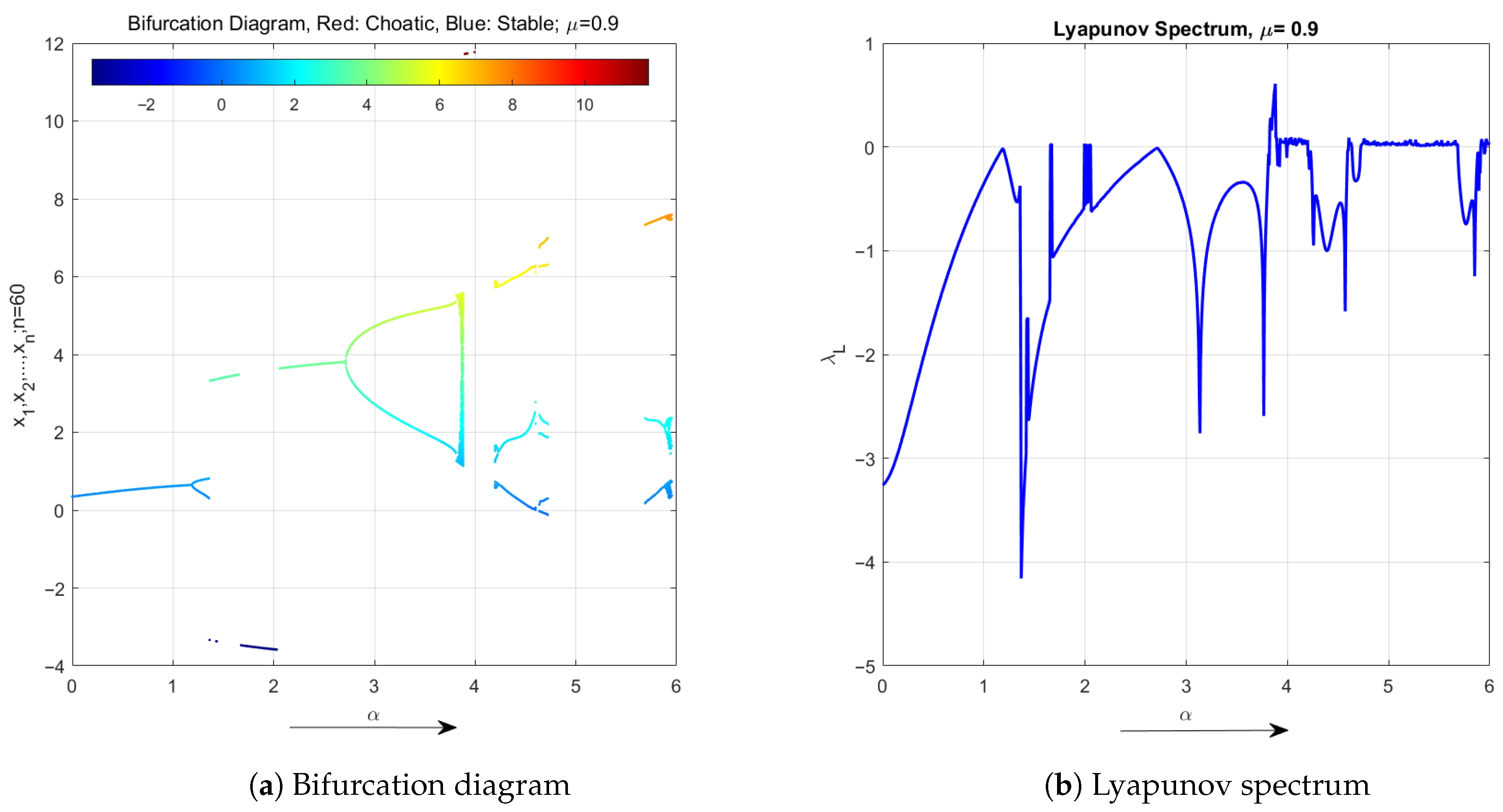
The bifurcation diagram and Lyapunov spectrum provide a global perspective on the stability and chaotic properties of the proposed fractional scheme SBVM* with respect to the control parameter and the fractional order .
In
Figure 1a,b, the parameter
is varied continuously over a prescribed interval while all other parameters are kept fixed, in order to analyze the bifurcation structure and stability transitions of the proposed method.
Figure 1a displays the bifurcation diagram of the fractional two-step scheme SBVM
* for
as
varies over the interval
. For sufficiently small values of
, the trajectories of the iterates associated with system (
51) converge to a single fixed point, indicating asymptotically stable behavior of the iterative map. Similar bifurcation and stability transition patterns were observed for other fractional orders, including
and
; therefore, only a representative case is shown for clarity. This parameter range corresponds to the effective convergence region of the fractional Jacobian-based method, in which the fractional scaling remains moderate and beneficial for the numerical process.
As increases beyond approximately , the system undergoes a sequence of bifurcations characterized by the splitting of solution branches and the emergence of periodic orbits. This behavior indicates a gradual loss of stability of the fixed point of the iterative map and reflects the nonlinear interaction between the fractional Jacobian scaling and the corrective terms of the two-step scheme.
For
, the bifurcation structure becomes increasingly dense and irregular, revealing a transition toward chaotic dynamics. In this regime, the iterates generated while solving (
51) exhibit pronounced sensitivity to initial conditions, which may adversely affect robustness and predictability of the solver in finite-precision numerical computations.
To quantitatively support these observations,
Figure 1b depicts the largest Lyapunov exponent
as a function of
for the same values of
. For
, the exponent remains strictly negative, confirming the asymptotic stability of the iterative map associated with system (
51). Near
,
approaches zero, indicating the onset of bifurcation and marginal stability. For
,
becomes positive, thereby validating the chaotic behavior observed in the corresponding bifurcation diagram.
Moreover, the presence of narrow negative spikes within the chaotic region corresponds to periodic windows embedded in chaos, a well-known feature of nonlinear iterative maps. The strong agreement between the bifurcation patterns and the Lyapunov spectrum confirms the consistency of the dynamical analysis and supports the reliability of the proposed fractional two-step scheme SBVM* within its stable operating regime.
Overall, the numerical investigation indicates that the stable operational region of SBVM
* for system (
51) is approximately
while chaotic dynamics dominate for
These findings provide practical guidelines for selecting suitable control parameters when applying the proposed scheme SBVM
* to nonlinear systems arising from differential equations and related applications.
7. Numerical Experiments and Implementation
This section presents a comprehensive set of numerical experiments designed to assess the effectiveness, robustness, and computational efficiency of the proposed fractional parallel scheme SBVM* for the simultaneous computation of multiple solutions of nonlinear systems arising from the discretization of elliptic partial differential equations motivated by biomedical engineering models.
The objectives of these experiments are twofold. First, we investigate the convergence behavior and numerical stability of the proposed method when applied to large-scale nonlinear algebraic systems obtained after spatial discretization of nonlinear elliptic PDEs. Second, we compare its performance with that of existing parallel solvers, including Newton–Krylov methods [
40] (abbreviated as NKSM
*), ELVM
*, and ACVM
*, with particular emphasis on robustness in the presence of multiple or closely spaced solutions. Unlike these methods, SBVM
* employs a diagonally scaled fractional Jacobian and a two-stage correction mechanism that avoids repeated Jacobian factorizations, thereby reducing computational cost while preserving the observed high-order convergence behavior and parallel efficiency.
All numerical experiments were carried out in
MATLAB R2023b using double-precision arithmetic on an Intel Core i7 workstation equipped with 16 GB of RAM. Computational times were measured using the built-in
tic–toc commands. A summary of all parameters and their roles is provided in
Appendix A.
For a fair and consistent comparison among the competing methods, the following stopping criteria were adopted:
where the tolerance was fixed at
.
The numerical performance of each method is evaluated according to the following indicators:
- (i)
The number of iterations required to achieve convergence;
- (ii)
The total CPU time;
- (iii)
The ability to approximate all distinct, multiple, or clustered solutions simultaneously;
- (iv)
The parallel performance of the proposed two-stage iterative scheme (
39), assessed by measuring CPU time over multiple independent runs. In this setting, each approximation
is updated concurrently across computational cores, exploiting the independence of the interaction operators
for
;
- (v)
The parallel efficiency, evaluated through the CPU times
and
, with speedup defined as
where
and
denote the parallel (
parfor) and serial executions, respectively. The
parfor implementation preserves the accuracy and stability of the serial code while reducing the computational time.
For completeness, Algorithm 1 summarizes the main computational steps of the proposed two-step fractional parallel scheme SBVM
* applied to nonlinear algebraic systems arising from the spatial discretization of elliptic partial differential equations motivated by biomedical engineering models.
| Algorithm 1 Two-step fractional parallel scheme (SBVM*) based on (39) and (40) |
- Require:
Nonlinear system (from PDE discretization); initial approximations (mutually distinct); fractional order ; control parameter ; tolerance ; maximum iterations . - Ensure:
Approximations of distinct solutions. - 1:
for to do - 2:
Compute (or assemble) the classical Jacobians for all j. - 3:
Compute the fractional Jacobians for all j. - Stage 1:
auxiliary fractional two-step corrections (40) - 4:
for to d do - 5:
- 6:
- 7:
- 8:
end for - Stage 2:
WDK-type parallel interaction update (39) - 9:
for to d do - 10:
Form the interaction (deflation) operator - 11:
- 12:
- 13:
end for - 14:
if for all k then - 15:
break - 16:
end if - 17:
end for - 18:
return .
|
7.1. Biomedical Benchmarks for Elliptic PDEs (Fractional Scaling at Solver Level)
In many biomedical and biomechanical systems, classical integer-order mathematical models are often insufficient to accurately describe the heterogeneous structure, anomalous diffusion, and long-range interactions observed in real biological tissues. Such phenomena naturally arise in complex media such as porous biological materials, neural tissue, vascular networks, and diffusive transport processes in heterogeneous organs, where local differential operators fail to capture multiscale spatial effects.
Elliptic partial differential equations incorporating fractional or nonlocal mechanisms provide a powerful mathematical framework for modeling memory effects, spatial heterogeneity, and anomalous transport dynamics in these settings. The accurate numerical approximation and qualitative analysis of the resulting elliptic partial differential equations (EPDEs) are therefore essential for understanding underlying physiological mechanisms, predicting system responses under pathological conditions, and supporting the development of reliable diagnostic and therapeutic strategies.
From a computational perspective, these biomedical models typically give rise to large-scale, strongly nonlinear, and highly coupled algebraic systems after spatial discretization. Consequently, advanced numerical solvers capable of handling nonlinearity, stiffness, and potential solution multiplicity are required in order to ensure robustness, numerical stability, and computational efficiency.
Motivated by these considerations, we consider the following generalized elliptic partial differential equation as a prototype model encompassing a broad class of biomedical and biomechanical applications:
subject to the following boundary conditions:
Such generalized EPDE models arise naturally in a wide range of biomedical applications, including tissue diffusion processes, transport in heterogeneous biological media, and spatially distributed reaction–diffusion systems, where nonlocal interactions and memory effects play a fundamental role.
7.1.1. Example 1: Electrophysiology Model in Cardiac Tissue [41]
Electrical signal propagation in cardiac tissue is governed by the spatial diffusion of the transmembrane potential coupled with ionic current mechanisms at the cellular level. In simplified steady-state regimes, such processes can be effectively modeled by elliptic reaction–diffusion equations, which describe the spatial distribution of electrical potentials along myocardial fibers.
These mathematical models play a central role in the analysis of cardiac conduction patterns and are widely employed to investigate phenomena such as electrical heterogeneity, conduction block, and the onset of arrhythmias. From a numerical perspective, they also provide representative benchmark problems for assessing the accuracy, robustness, and efficiency of iterative solvers applied to nonlinear elliptic partial differential equations arising in biomedical engineering. Cardiac tissue electrophysiology is commonly described by reaction–diffusion formulations such as the monodomain and bidomain equations [
42,
43].
Motivated by these frameworks, we construct a simplified steady-state elliptic reaction–diffusion model as a controlled benchmark for numerical validation. Within this setting, the example is used to assess the performance of the proposed fractional parallel iterative scheme SBVM*, in which the fractional character is introduced at the solver level rather than in the governing equation. Accordingly, a two-dimensional steady-state model with isotropic diffusion and linearized ionic current effects is considered.
The governing elliptic reaction–diffusion equation is given by
where
denotes the transmembrane electrical potential,
represent isotropic conductivity coefficients, and
models a linearized ionic current response.
To enable quantitative error assessment, an analytical solution is prescribed in the form
which corresponds to a smooth and physiologically plausible spatial potential distribution.
Substituting (
57) into (
56), the associated source term is obtained as
thereby ensuring exact consistency between the governing equation and the prescribed analytical solution.
The problem is completed by homogeneous Dirichlet boundary conditions,
which represent electrically insulated or grounded tissue boundaries commonly adopted in simplified electrophysiological modeling.
7.1.2. Numerical Discretization and Algebraic System Formulation
To apply the proposed fractional parallel scheme SBVM
* to the electrophysiology model introduced above, the governing elliptic partial differential equation (
56) is discretized in space, yielding a large-scale algebraic system. Although the present example leads to a linear discrete problem, it provides a meaningful testbed for validating the accuracy, stability, and computational behavior of the proposed solver prior to its application to fully nonlinear biomedical models.
Let the computational domain be discretized using a uniform Cartesian grid,
with step sizes
and
.
At each interior grid node
, the second-order spatial derivatives are approximated by standard central finite differences,
Substituting these approximations into (
56), the discrete form of the model reads
for all interior grid points, while the Dirichlet boundary conditions (
59) are imposed directly at the boundary nodes.
Collecting the interior unknowns into the vector
the resulting discrete system can be written compactly as
where
denotes the discrete Laplacian matrix arising from the finite-difference approximation, and
collects the source terms together with the contributions from the prescribed boundary conditions.
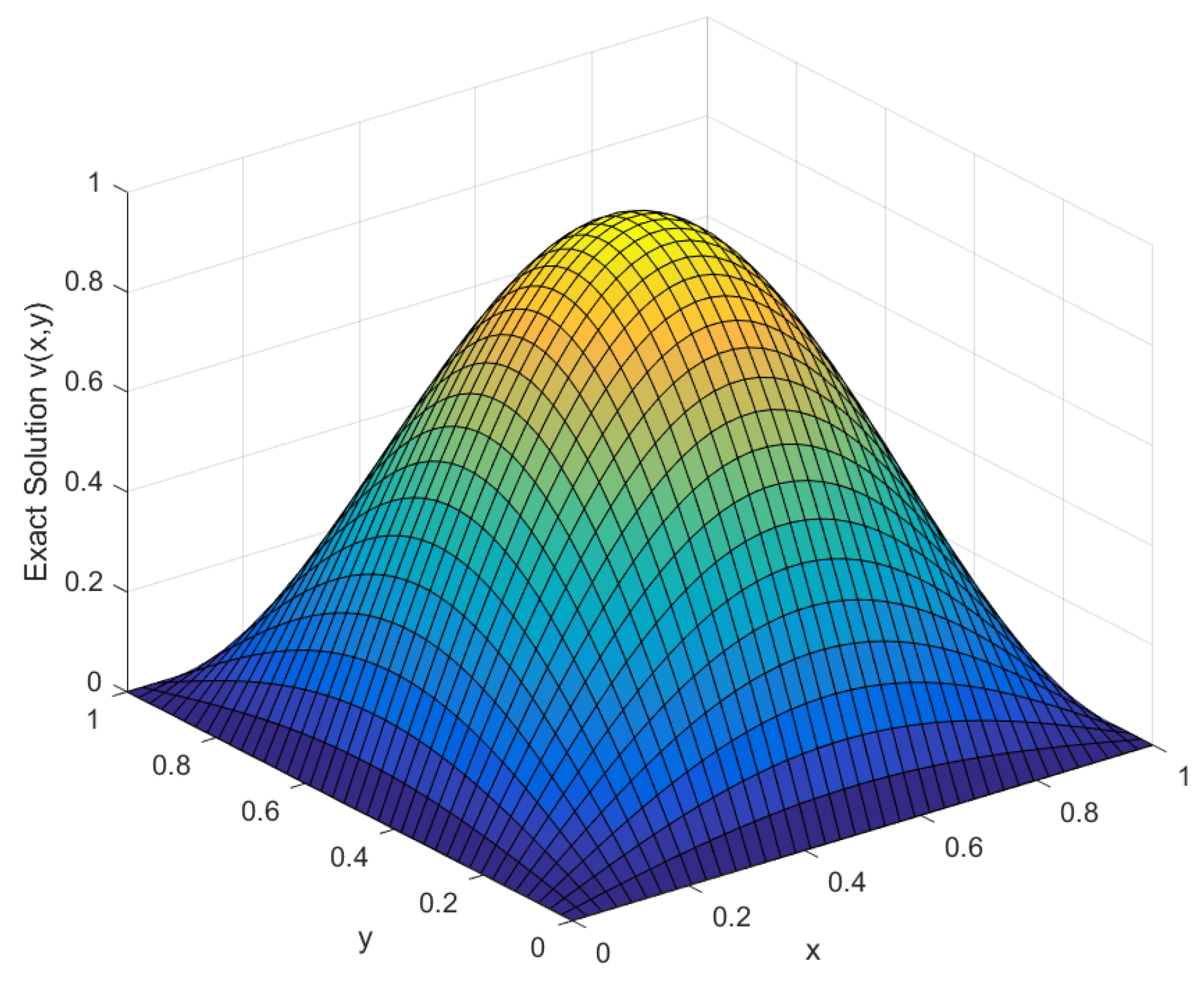
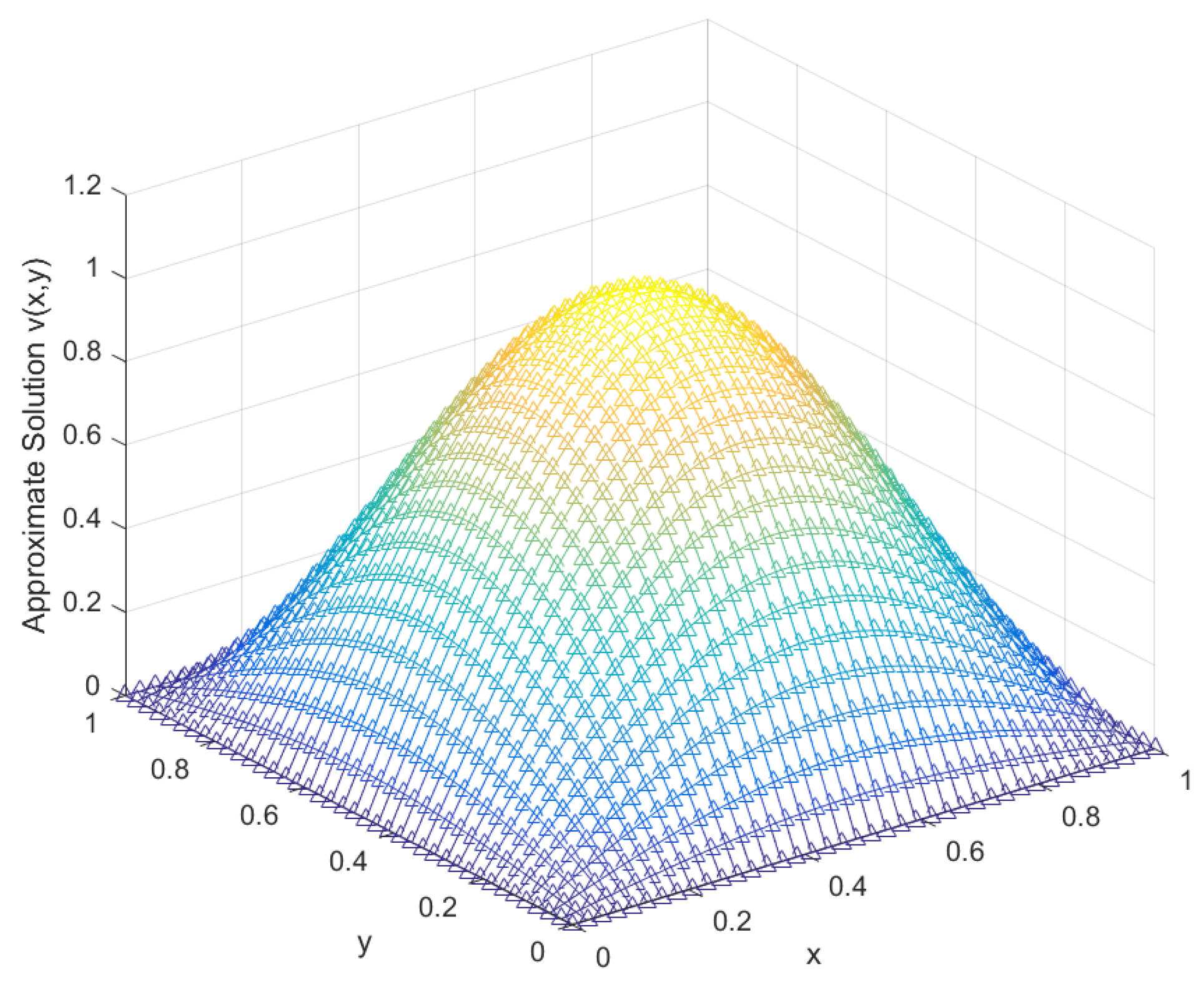
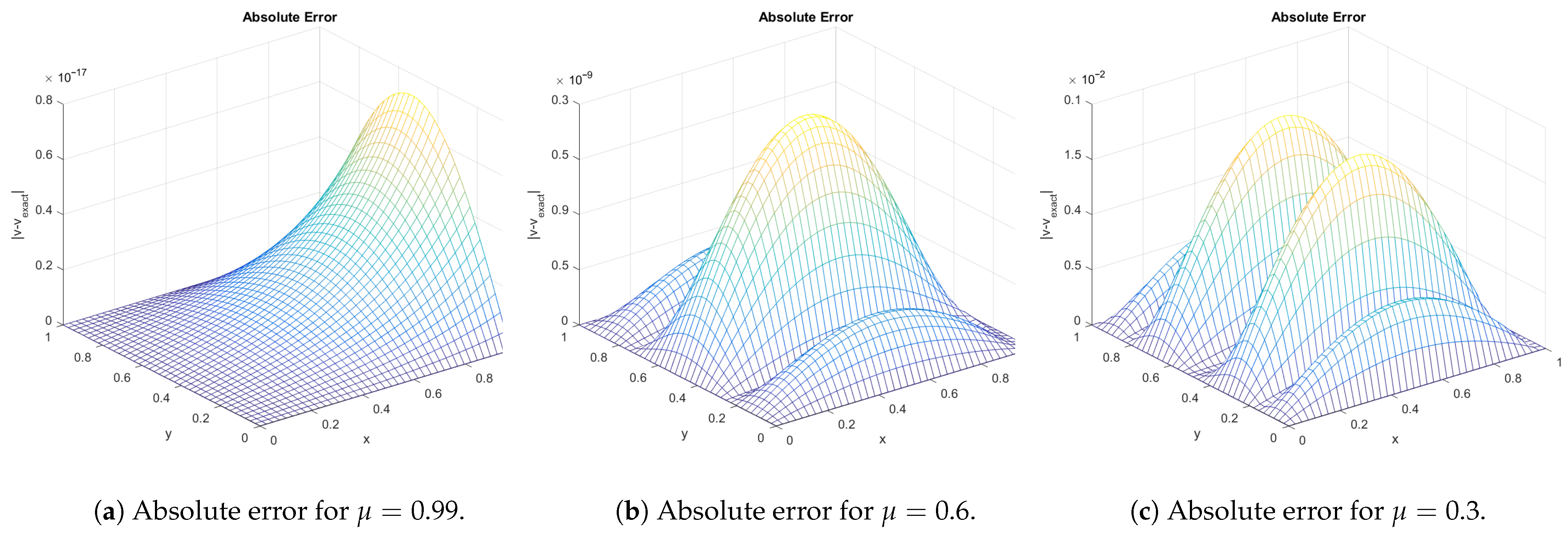
Figure 2,
Figure 3 and
Figure 4 illustrate representative numerical results obtained for the biomedical benchmark problem introduced in
Section 7.1.1.
Figure 2 reports the exact analytical solution of the elliptic model, while
Figure 3 displays the numerical approximation computed by applying the proposed fractional parallel scheme SBVM
* to the nonlinear algebraic system arising from the spatial discretization of (
56). The corresponding absolute error distributions are shown in
Figure 4 for different values of the fractional scaling parameter
. These results highlight the accuracy, stability, and robustness of the method under variations of the fractional parameter governing the Jacobian scaling.
The numerical results and the comparison between the exact and approximate solutions are summarized in
Table 1 and illustrated in
Figure 2 and
Figure 3. In addition,
Figure 4a–c depict the absolute error distributions of the proposed fractional parallel scheme SBVM
* for different values of the fractional scaling parameter
, computed on a uniform grid with
.
Table 1 clearly shows that increasing the fractional order
significantly enhances the numerical accuracy of the proposed method. In particular, the residual norms decrease by several orders of magnitude as
approaches one, while the computational cost remains nearly unchanged. This behavior highlights the stabilizing effect of the fractional Jacobian correction within the SBVM
* framework.
Table 2 confirms the strong correlation between the dynamical properties of the iterative map and the numerical performance of the solver. When the control parameter
is selected from the stable region identified through the bifurcation and Lyapunov analyses (
), the proposed method exhibits rapid convergence, low residual norms, and a clear high-order convergence behavior in practice.
As
approaches the transition region, convergence becomes slower and more sensitive to perturbations, while for values of
within the chaotic regime the numerical performance deteriorates significantly, as reflected by larger residuals, increased iteration counts, and higher computational cost. These results provide further numerical evidence that the stability regions identified through dynamical analysis are directly linked to the effectiveness and reliability of the SBVM
* scheme.
Table 3 compares the comparative performance analysis of SBVM
* with ELVM
* and ACVM
* for solving system (
62).
Remark 6. The proposed fractional parallel scheme SBVM* demonstrates improved performance relative to the NKSM*, ELVM*, and ACVM* methods in terms of accuracy, convergence speed, computational efficiency, and memory usage for the tested problem. The diagonalized correction strategy contributes to rapid and robust convergence in practice while reducing computational overhead, particularly for large-scale biomedical problems involving clustered or multiple solutions.
In contrast, parameter values located in the transition and chaotic regimes lead to a substantial increase in the number of iterations, deterioration of accuracy, and higher computational cost. These results clearly validate the necessity of a preliminary dynamical analysis for the robust and reliable implementation of the SBVM* scheme.
Table 4 reports the numerical performance of the parallel two-stage fractional iterative scheme for selected stable values of
identified from the bifurcation diagram (
Figure 1). The corresponding stable states are listed for each value of
. The CPU time decreases as the number of cores increases, and the resulting speedup ratios confirm the efficiency of the parallel implementation. The maximum error remains essentially unchanged across cores, indicating that the accuracy of the method is preserved.
7.2. Discussion of Results
Table 3 presents a comparative performance analysis of the proposed parallel fractional scheme SBVM
* and the existing ELVM
* and ACVM
* methods for the solution of the nonlinear system (
62). The results reveal clear differences in terms of numerical accuracy, convergence efficiency, and computational cost.
From the accuracy perspective, SBVM* attains the smallest iterate-difference and residual norms, reaching values below . This behavior reflects a highly stable numerical convergence and illustrates the beneficial role of the fractional Jacobian scaling and two-stage correction mechanism in reducing error propagation during the iteration, particularly in the presence of multiple or closely spaced solutions.
Regarding computational efficiency, SBVM* requires significantly fewer iterations to meet the prescribed stopping criteria compared with ELVM* and ACVM*. This reduction directly translates into lower CPU times, with SBVM* exhibiting approximately half the computational cost of ELVM* and a substantially lower cost than ACVM*. These gains are primarily attributable to the diagonalized correction structure and the parallel update strategy, which avoid repeated Jacobian factorizations and limit unnecessary inter-component coupling.
In addition, SBVM
* demonstrates reduced memory consumption and a smaller number of arithmetic operations, features that are particularly relevant for large-scale nonlinear systems arising from fine spatial discretizations of biomedical and biomechanical models.
Table 4 further indicates that the parallel implementation of the proposed scheme preserves accuracy across different stable parameter regimes when executed on multiple cores.
Finally, the high convergence success rate () indicates strong robustness with respect to the choice of initial approximations. This confirms that the proposed fractional parallel framework provides a reliable and scalable alternative to existing multi-solution solvers, combining numerical stability, efficiency, and practical applicability within a unified computational approach.
7.2.1. Physical Behaviour of the Solution
The computed solution
represents the steady-state spatial distribution of the transmembrane electrical potential within cardiac tissue as described by the simplified elliptic electrophysiology model introduced in
Section 4. In this formulation, the diffusion terms model the passive spread of electrical signals through myocardial fibers, while the linear reaction term accounts for damping effects associated with ionic current leakage.
The resulting sinusoidal spatial pattern reflects a balanced interaction between diffusion and electrical decay mechanisms, yielding smooth and regular potential profiles throughout the computational domain. From a numerical standpoint, this behavior confirms that the discretized model and the proposed iterative solver preserve the qualitative structure of the underlying continuous problem without introducing spurious oscillations or artificial instabilities.
Although the model considered here is intentionally simplified, it provides a meaningful and controlled benchmark for assessing the accuracy, stability, and robustness of iterative solvers designed for nonlinear elliptic problems in biomedical engineering. In particular, it establishes a reliable baseline for future extensions involving anisotropic conductivity, nonlinear ionic dynamics, or fractional and nonlocal effects, which are known to play an important role in more realistic cardiac electrophysiology models.
7.2.2. A Nonlinear Elliptic Benchmark Problem from Biomedical Engineering [44]
Nonlinear elliptic equations arise naturally in biomedical engineering, particularly in steady-state models of bioheat transfer, nonlinear diffusion in biological tissues, membrane electrostatics, and reaction–diffusion processes governing metabolic and cellular dynamics [
44]. Motivated by these applications, we consider a simplified nonlinear elliptic benchmark problem with an analytical solution, providing a controlled and rigorous framework for numerical validation. In such models, diffusion and reaction mechanisms are often nonlinear with respect to the state variable, reflecting effects such as temperature-dependent conductivity, nonlinear biochemical kinetics, and ionic transport phenomena.
Representative applications of this class of nonlinear elliptic models include:
Thermal regulation and heat transport in perfused tissues;
Drug diffusion in heterogeneous biological media;
Electrochemical potential distribution in neural and excitable tissues;
Steady-state tumor growth models with nonlinear nutrient uptake.
These examples illustrate the relevance of nonlinear elliptic PDEs as mathematically consistent and physically meaningful test problems for the validation of numerical solvers in biomedical engineering contexts. In order to assess the accuracy, robustness, and convergence properties of the proposed fractional parallel scheme, we introduce a nonlinear elliptic benchmark problem that admits a closed-form analytical solution.
Although simplified, this benchmark provides a controlled and rigorous environment for quantitative validation, allowing both pointwise and global error analysis. Such a setting is particularly suitable for isolating the numerical behavior of the proposed method and for objectively comparing its performance against existing parallel solvers.
The nonlinear biomedical benchmark problem is cast in the generalized elliptic form (
54) as
where
denotes a biological state variable such as temperature, concentration, or electrical potential, and
is a source term constructed so as to be consistent with a prescribed exact solution.
Within the general elliptic framework introduced in (
54), the coefficients of (
63) are given by
and the nonlinear reaction term is
The exact analytical solution is selected as
which combines polynomial, trigonometric, and exponential components. This choice introduces strong nonlinearity and spatial variability, thereby providing a nontrivial benchmark for assessing solver robustness and accuracy.
Substituting (
64) into (
63), the corresponding source term is obtained explicitly as
The Dirichlet boundary conditions are derived directly from the exact solution (
64) and read
This nonlinear benchmark problem provides a challenging yet controlled test environment for evaluating the performance of the proposed fractional parallel solver. In particular, it allows a clear assessment of convergence behavior, numerical accuracy, and stability in the presence of strong nonlinear reaction terms, while retaining a known reference solution for quantitative validation.
7.2.3. Numerical Discretization and Nonlinear System Formulation
We consider the nonlinear elliptic reaction–diffusion equation
subject to Dirichlet boundary conditions prescribed directly from the exact solution (
64). This formulation represents a prototypical nonlinear steady-state model arising in biomedical engineering applications involving diffusion coupled with nonlinear reaction mechanisms.
The spatial domain is discretized using a uniform Cartesian grid defined by
with grid spacings
Let
denote the numerical approximation of
, and restrict attention to the interior grid points
Using standard second-order central finite difference schemes, the Laplacian operator is approximated at each interior node
as
Substituting these approximations into (
67) yields, for each interior grid point, the following discrete nonlinear equation:
where
.
Collecting all interior unknowns
into a single vector
, the discrete system (
69) can be written compactly as a nonlinear algebraic system
which constitutes the computational problem addressed by the proposed fractional parallel scheme SBVM
*.
Boundary values are imposed directly from the exact solution (
64),
and are substituted into (
69) for grid nodes adjacent to the boundary. This procedure eliminates the boundary unknowns and yields a closed nonlinear system involving only the interior degrees of freedom.
The interior nodal values are ordered lexicographically into the vector
The resulting nonlinear algebraic system can be written compactly as
where:
denotes the discrete Laplacian matrix associated with the second-order finite difference approximation;
represents the componentwise (Hadamard) square of the vector ;
collects the source term values evaluated at the interior grid points;
accounts for contributions induced by the imposed Dirichlet boundary conditions.
The discrete Laplacian matrix
admits the standard Kronecker product representation
where
denotes the identity matrix of size
k and
The numerical results and the comparison between the exact and approximate solutions are summarized in
Table 5 and
Figure 5,
Figure 6 and
Figure 7. All experiments were conducted on a uniform grid with
.
Table 5 reports the maximum iterate-difference norms, residual norms, and CPU times obtained by the proposed fractional parallel scheme SBVM
* for the nonlinear benchmark problem (
71) on a fixed spatial grid with
. A clear and monotonic improvement in numerical accuracy is observed as the fractional order
increases from
to
.
Specifically, the iterate-difference norm decreases from to , while the corresponding residual norm is reduced from to . This behavior is consistent with the role of the fractional Jacobian scaling in enhancing the local correction mechanism of the two-step scheme, as predicted by the theoretical convergence analysis.
At the same time, the CPU time remains nearly constant across all tested values of , indicating that the improved accuracy is achieved without a significant increase in computational cost. This confirms the practical effectiveness and numerical robustness of the SBVM* framework for strongly nonlinear elliptic systems arising from biomedical engineering applications.
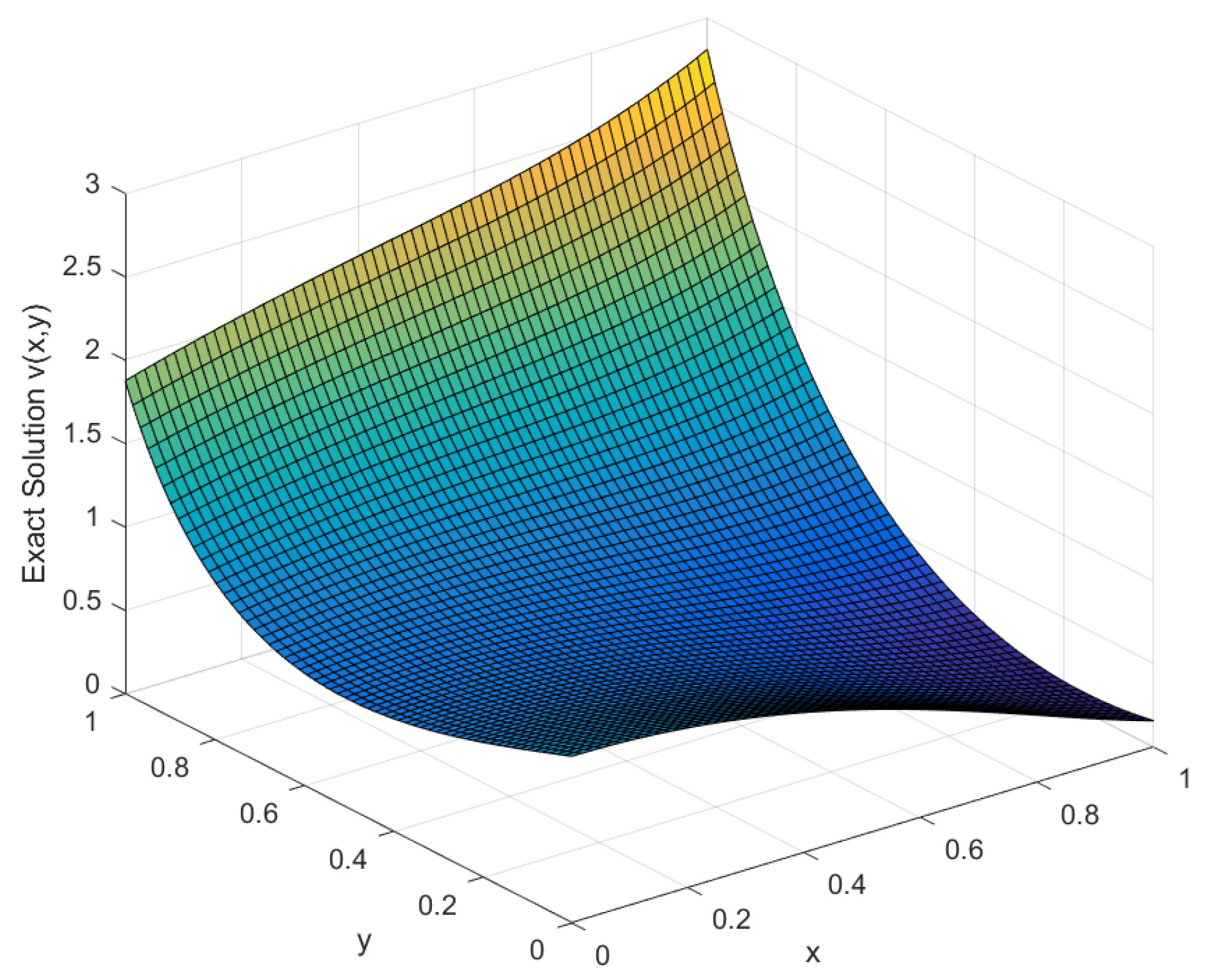
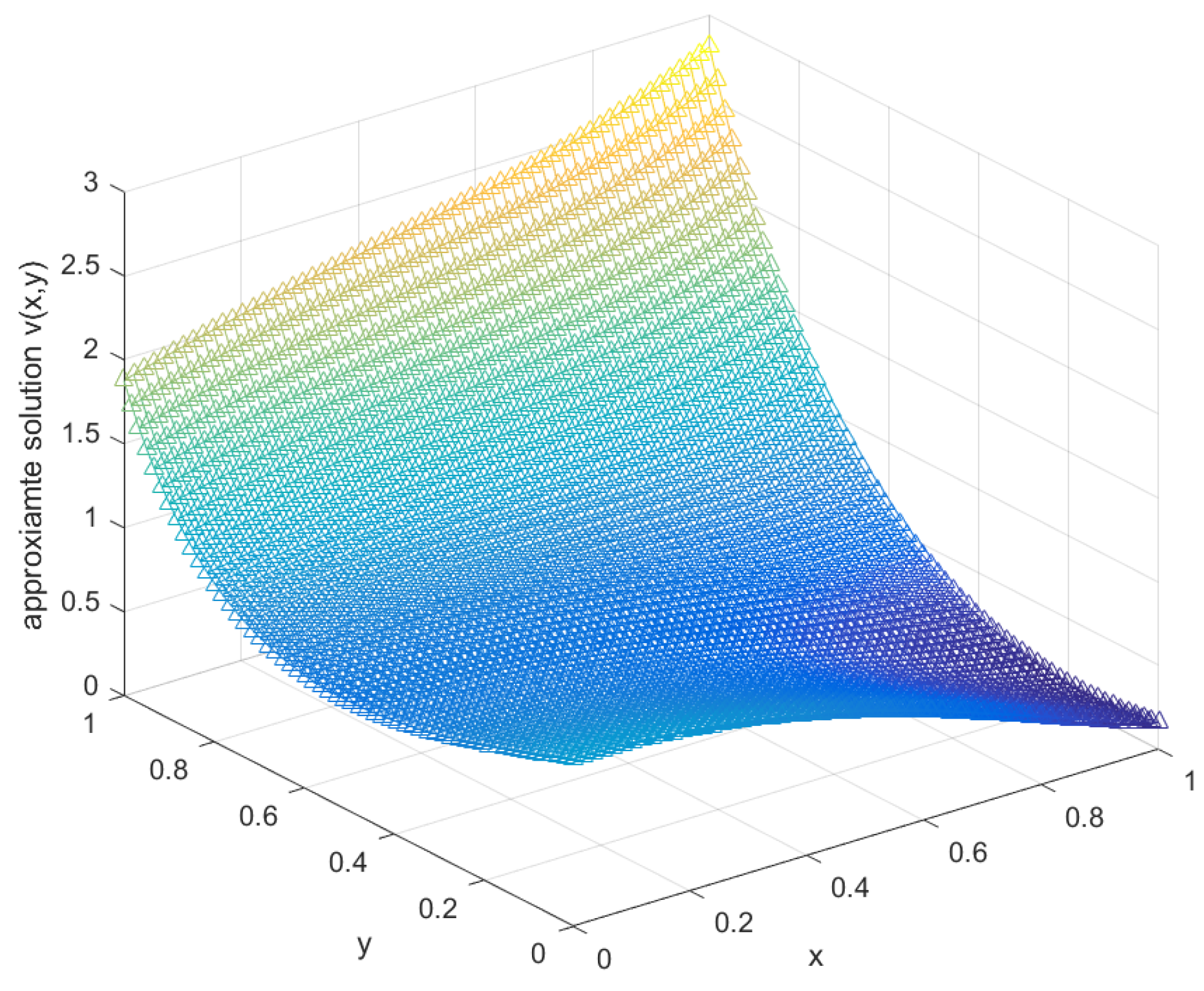
Figure 5 and
Figure 6 compare the exact analytical solution and the numerical approximation obtained with the proposed parallel fractional scheme SBVM
* for the nonlinear biomedical benchmark problem (
63). The numerical solution accurately reproduces the global spatial structure and smoothness of the exact solution, confirming the effectiveness of the proposed solver in handling strong nonlinearities arising from reaction–diffusion mechanisms.
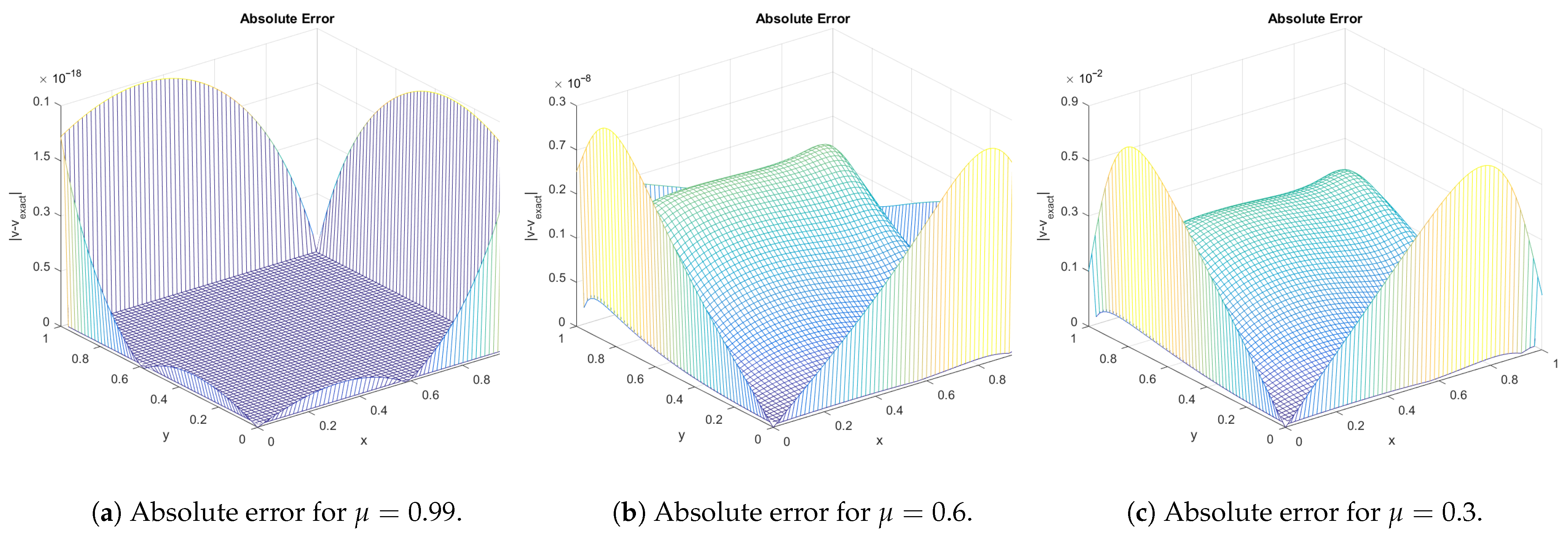
The corresponding absolute error distributions, reported in
Figure 7a–c, illustrate the influence of the fractional scaling parameter
on numerical accuracy, while the control parameter
is kept fixed. As
decreases, an increase in the error magnitude is observed, reflecting the reduced effectiveness of the fractional Jacobian scaling in the local correction mechanism. Nevertheless, even for smaller values of
, the error remains well controlled and does not exhibit spurious oscillations or instability, indicating robust numerical behavior of the proposed method across different fractional scaling regimes.
Overall, these results demonstrate that the SBVM* scheme is capable of delivering accurate and stable approximations for nonlinear elliptic biomedical models, while preserving robustness with respect to variations in the fractional parameters.
Table 6 confirms that the numerical behavior of the proposed parallel fractional scheme SBVM
* is strongly correlated with the dynamical regime induced by the control parameter
, in full agreement with the bifurcation and Lyapunov analyses presented in
Section 4.
When is selected within the stable region, the method exhibits rapid convergence, low residual norms, and fifth-order accuracy, with only a small number of iterations required. As the fractional order increases, a systematic improvement in numerical accuracy is observed, while the computational cost remains nearly unchanged, highlighting the stabilizing effect of the fractional Jacobian correction.
In the transition regime, convergence is still achieved but requires a significantly larger number of iterations, reflecting the proximity to bifurcation points where the iterative map loses strong contractivity. Finally, for values of belonging to chaotic regions, the convergence behavior deteriorates substantially, with large residuals, increased iteration counts, and higher computational cost.
These results provide further numerical evidence that a preliminary dynamical analysis is essential for the reliable and efficient application of SBVM*. When combined with the proposed parameter tuning strategy, the method offers a robust and scalable solver for strongly nonlinear elliptic systems arising in biomedical engineering applications.
To further assess the robustness of the proposed approach, an additional numerical experiment is carried out using a different fractional order and grid configuration. The results reported in
Table 7 confirm the consistency of the stability–transition–chaos behavior observed in the previous tests and demonstrate the reliability of the proposed solver under varying computational settings.
Remark 7. Consistent with the previous experiments, the proposed parallel fractional scheme SBVM* demonstrates improved numerical accuracy, faster convergence, and reduced computational cost relative to the NKSM*, ELVM*, and ACVM* methods for the tested configuration. These results support the robustness of the proposed approach across different fractional orders and discretization settings.
Table 8 reports the performance for an alternative set of stable values of
. Compared with
Table 4, these
values correspond to slightly higher equilibrium states, resulting in small variations in CPU time due to differences in convergence behavior. The speedup ratios remain nearly unchanged, and the maximum error stays consistently low, indicating that the parallel implementation preserves accuracy across different stable parameter regimes.
Discussion
While
Table 6 highlights the intrinsic relationship between the dynamical regime induced by the control parameter
and the convergence behavior of SBVM
*,
Table 6 and
Table 7 together allow a direct comparison with existing parallel schemes.
In all tested configurations, the proposed parallel fractional scheme SBVM* consistently outperforms the ELVM* and ACVM* methods in terms of numerical accuracy and convergence efficiency. In particular, SBVM* attains markedly smaller iterate-difference and residual norms, indicating enhanced stability and improved convergence behavior.
Moreover, the parallel structure and diagonalized correction strategy of SBVM
* lead to a substantial reduction in computational cost, as reflected by lower CPU times, reduced memory usage, and fewer iterations required to reach convergence. The consistently higher convergence percentages further highlight the robustness of the proposed method with respect to both fractional order selection and discretization parameters.
Table 8 further indicates that the parallel implementation of the proposed scheme preserves accuracy across different stable parameter regimes when executed on multiple cores.
Overall, these results confirm that SBVM* provides a stable, efficient, and scalable numerical solver for large-scale nonlinear elliptic systems, particularly when combined with the dynamical parameter selection strategy introduced earlier.
7.3. Physical Interpretation and Solution Behaviour
The computed steady-state solution admits a clear physical interpretation within the context of biomedical engineering models and provides additional insight into the qualitative behavior of the numerical scheme.
- -
The diffusion term represents the spatial spreading of a biological quantity, such as heat, electrical potential, or molecular concentration within heterogeneous tissue.
- -
The nonlinear reaction term models saturating or consumptive mechanisms, including metabolic uptake, biochemical depletion, or nonlinear feedback effects commonly observed in biological systems.
- -
The source term accounts for spatially distributed production or forcing and is constructed consistently with the prescribed analytical solution, ensuring a controlled validation setting.
- -
Dirichlet boundary conditions regulate inflow and outflow at the domain boundaries, influencing the internal solution profile through diffusion–reaction coupling.
- -
The resulting equilibrium configuration reflects a balanced interaction between diffusion, nonlinear reaction, and external forcing, leading to smooth and physically meaningful solution profiles.
From a numerical standpoint, the smoothness and stability of the computed solutions confirm the ability of the proposed SBVM* scheme to accurately resolve nonlinear diffusion–reaction dynamics without introducing spurious oscillations or numerical artifacts. This behavior further supports the suitability of the method for steady-state biomedical models characterized by strong nonlinearity and spatial coupling.
8. Conclusions
In this study, we developed and analyzed an efficient fractional Jacobian–based parallel iterative framework, denoted by SBVM*, for the numerical solution of nonlinear systems arising from the finite-difference discretization of linear and nonlinear elliptic partial differential equations. By combining a two-stage correction strategy with a structured parallel interaction mechanism, the proposed approach yields sparse and well-organized Jacobian representations, enabling stable, accurate, and scalable numerical implementations.
The proposed SBVM
* scheme exhibits strong stability properties, favorable convergence behavior, and competitive computational efficiency, owing to its diagonalized correction structure and intrinsic parallel formulation. Extensive numerical experiments, reported in
Table 1,
Table 2,
Table 3,
Table 4,
Table 5,
Table 6 and
Table 7 and
Figure 2,
Figure 3,
Figure 4,
Figure 5,
Figure 6 and
Figure 7, including error norm evaluations and dynamical stability investigations based on bifurcation diagrams and Lyapunov exponents (
Figure 1), confirm the robustness and accuracy of the method across a wide range of fractional parameters and model configurations. The results further demonstrate a clear improvement over existing parallel solvers such as ELVM
* and ACVM
* in terms of convergence behavior, numerical stability, and computational cost.
A distinctive feature of the proposed framework is the systematic integration of nonlinear dynamical systems analysis for parameter selection. The bifurcation- and Lyapunov-based tuning strategy provides a principled mechanism for identifying stable operating regions of the iterative map, thereby enhancing reliability and preventing convergence degradation due to chaotic dynamics.
Despite the promising theoretical and numerical performance of the proposed strategy, several limitations should be acknowledged:
The convergence analysis is established under local assumptions; therefore, global convergence properties and the behavior far from the solution are not theoretically guaranteed.
The proposed strategy introduces fractional-order corrections at the solver level, while the governing models remain classical (integer-order), which may limit the direct physical interpretation of fractional effects.
Jacobian evaluations may increase the computational cost for large-scale systems.
The interaction mechanism may depend on the availability of suitable initial approximations.
The selection of the fractional-order parameter may influence convergence behavior and currently relies on empirical tuning.
Validation is limited to controlled benchmark problems with analytical solutions.
The current formulation assumes sufficient smoothness of the nonlinear operators, which may restrict direct applicability to problems involving strong discontinuities or nonsmooth nonlinearities.
Future research will focus on extending the present framework to coupled and multi-dimensional nonlinear systems, including elliptic and parabolic fractional partial differential equations. Additional directions include the incorporation of adaptive spatial discretization strategies, space–time refinement techniques, and learning-based predictors—such as neural networks or physics-informed neural networks (PINNs)—to improve initial guesses and further accelerate convergence. Finally, the exploration of hybrid parallel implementations and accelerator-based computing platforms, together with detailed strong and weak scaling studies, represents a promising direction for addressing large-scale biomedical and engineering applications governed by complex nonlinear and fractional dynamics.