Article

Accelerated Fixed-Point Approximation for Contraction Mappings with Applications to Fractional Models


1
Department of Mathematical Science, College of Sciences, Princess Nourah Bint Abdulrahman University, Riyadh 11671, Saudi Arabia
2
Department of Mathematics, Faculty of Science, University of Tabuk, Tabuk 71491, Saudi Arabia
*
Authors to whom correspondence should be addressed.
Fractal Fract. 2026, 10(3), 143; https://doi.org/10.3390/fractalfract10030143
Submission received: 28 January 2026 / Revised: 14 February 2026 / Accepted: 23 February 2026 / Published: 25 February 2026

Abstract

In this paper, we develop an accelerated three-step iterative scheme for the approximation of fixed points of contraction mappings in Banach spaces, with a particular focus on applications to fractional models. Strong convergence of the proposed iteration is established under standard contraction assumptions, together with stability and data dependence results. A refined rate of convergence analysis shows that the new scheme achieves a smaller effective contraction factor and converges faster than several classical two- and three-step iterative methods, including the Picard, Mann, Ishikawa, and S-iteration processes. The theoretical results are applied to Caputo-type fractional differential equations by reformulating the associated boundary value problems as fixed-point equations. Existence and uniqueness of solutions follow from the Banach contraction principle, while the accelerated convergence of the proposed iteration leads to improved numerical efficiency. Extensive numerical experiments, including fractional differential equations and nonlinear contraction mappings on the real line, are presented to validate the theoretical findings. The results demonstrate that the proposed three-step iteration provides an effective and reliable computational tool for fractional and non-local models.

1. Introduction

Fixed-point theory is one of the most important branches of nonlinear functional analysis, and it has been widely studied due to its fundamental role in both pure and applied mathematics. A fixed point of a mapping T : X X is an element x * X such that T x * = x * . The significance of fixed-point theory arises from the fact that many problems in mathematical analysis, differential equations, optimization theory, game theory, economics, and engineering can be reformulated as fixed-point problems. Consequently, the development of iterative schemes for approximating fixed points has been an active research area for decades.
The cornerstone of fixed-point theory is the celebrated Banach contraction principle [1], which asserts that every contraction mapping on a complete metric space has a unique fixed point and that successive approximations generated by the Picard iteration converge to this fixed point. This principle has far-reaching implications and has inspired the development of a large number of generalizations and extensions. For example, it has been extended to multivalued mappings, nonexpansive mappings, accretive operators, generalized contractions, and various classes of nonlinear mappings. Each extension requires appropriate iterative methods to approximate fixed points efficiently.
Although the Banach contraction principle guarantees the existence and uniqueness of fixed points and ensures convergence of the Picard iteration, it does not address the issue of computational efficiency or speed of convergence. In many applications, especially those requiring high accuracy or repeated evaluations, the Picard iteration may converge slowly and thus become computationally inefficient. This has motivated the development of accelerated iterative schemes whose primary objective is not to improve existence results, but rather to enhance the rate of convergence and numerical performance while preserving the robustness of contraction-based methods. In this spirit, we propose a new three-step iterative scheme designed to achieve a smaller effective contraction factor than classical Picard-type iterations, thereby reducing the number of iterations required to attain a prescribed accuracy.

1.1. Iterative Schemes in Fixed-Point Theory

The Picard iteration [2], w m + 1 = T w m , is the simplest iterative scheme, but it is applicable only under strong contractive conditions. To relax these assumptions, Mann iteration [3] was introduced in 1953. This iteration extends the applicability of the Banach contraction principle to certain classes of nonexpansive mappings. Later, Ishikawa iteration [4] was proposed, which incorporates a two-step evaluation of the operator. This iteration was shown to be effective in approximating fixed points of a broader class of nonlinear mappings.
Subsequently, Noor [5] introduced a three-step iteration to study variational inequalities and equilibrium problems, while Agarwal et al. [6] proposed the S-iteration process. The S-iteration process was shown to converge faster than both Mann and Ishikawa iterations for contraction mappings. In recent years, further generalizations such as Thakur iteration [7], SP iteration [8], F iteration [9], F * iteration [10] and others have been introduced [11,12], each improving upon convergence speed, stability, or applicability. In 2022, Alshehri et al. [13] applied the iteration process to approximate the fixed points of nonlinear operators and approximated the solution of a mixed Volterra–Fredholm functional nonlinear integral equation. Comparative studies reveal that the efficiency of an iterative scheme depends not only on its convergence properties but also on its robustness to perturbations and computational errors.
In recent years, a wide variety of iterative methods have been developed to approximate fixed points of nonlinear mappings in different spaces, including Banach spaces, metric spaces, and spaces endowed with generalized distances; see [14,15]. These methods have found applications in optimization, equilibrium problems, and fractional differential equations; see [16]. Recent advances include accelerated schemes, hybrid iterations, and multi-step processes designed to improve convergence speed and stability properties.
Although several accelerated and hybrid iterative schemes have recently been proposed to improve convergence speed of fixed-point algorithms, most existing approaches focus primarily on convergence acceleration without addressing stability and data dependence properties in a unified framework. In contrast, the proposed three-step iteration not only achieves a reduced effective contraction factor, leading to faster convergence, but also provides rigorous stability and data dependence analysis under standard contraction assumptions. Moreover, the present work systematically connects the accelerated iteration with applications to Caputo-type fractional differential equations, thereby extending its relevance beyond abstract fixed-point settings.
One important application of iterative fixed-point methods is the study of data dependence. This refers to the sensitivity of fixed points with respect to perturbations in the underlying operator or in the initial approximation. Since most real-world data are approximate due to measurement errors or computational truncation, stability and data dependence results ensure that small errors in the input do not lead to large deviations in the computed fixed point. Results on data dependence have been investigated by Berinde and others [17,18,19,20] and the references therein.
Another rapidly growing field of application is fractional differential equations (FDEs). Fractional calculus extends the concept of differentiation and integration to arbitrary (non-integer) orders, and it has proven effective in modeling phenomena with memory and hereditary properties, such as viscoelasticity, anomalous diffusion, biological systems, and control processes [21,22]. Many FDEs can be transformed into equivalent integral equations, which are amenable to fixed-point techniques (see [12,13]). The existence, uniqueness, and approximation of their solutions thus often reduce to fixed-point problems in Banach spaces. Iterative methods that converge quickly and reliably provide a practical means of obtaining approximate solutions in such settings (see Diethelm [23]).
Recent years have witnessed increasing interest in contraction-based semi-analytical and numerical frameworks for complex systems, including fractional-order models and synchronization problems. Notable contributions include contraction-based formation analysis [24], fixed-time synchronization of fractional systems [25], and comprehensive reviews highlighting the role of stability and contraction principles in advanced modeling [26]. These developments further motivate the accelerated fixed-point methodology proposed in this work.
In this paper, we propose a new three-step iterative scheme that generalizes and extends several well-known processes such as Picard, Mann, Ishikawa, and S-iterations. The proposed method introduces additional flexibility through two control sequences and is shown to converge more rapidly than the classical processes for contraction mappings. More precisely, the rate of convergence is enhanced due to the cubic contraction factor embedded in the structure of the iteration.

1.2. Organization of the Paper

The remainder of the paper is organized as follows. In Section 2, we recall basic definitions and existing iterative methods. We also introduce the new iterative process and establish its basic properties in the same section. Section 3 is devoted to convergence theorems and rate of convergence analysis. In Section 4, we study data dependence and stability results. Section 5 illustrates the application of our method to fractional differential equations. A concluding section summarizes the main findings and suggests possible directions for future research.

2. Preliminaries

Let ( X , · ) be a Banach space. A mapping T : X X is called a contraction if there exists 0 q < 1 such that
T x T y q x y , x , y X .
Theorem 1
(Banach contraction principle [1]). If T : X X is a contraction, then T has a unique fixed point x * X . Moreover, the Picard iteration w m + 1 = T w m converges to x * for every w 0 X .
Definition 1
([27]). Let { u m } and { v m } be two iterative sequences that converge to the same limit x * . Suppose there exist real sequences { ζ m } and { η m } such that, for all m = 1 , 2 , 3 , ,
u m x * ζ m and v m x * η m .
Then the sequence { u m } is said to converge faster than { v m } if
lim m ζ m η m = 0 .
We now recall some iterative processes for the control sequences { ζ m } , { η m } , { κ m } ( 0 , 1 ) and initial approximation w 0 X .
  • Picard iteration [2]: w m + 1 = T w m .
  • Mann iteration [3]: w m + 1 = ( 1 ζ m ) w m + ζ m T w m .
  • Ishikawa iteration [4]:
    v m = ( 1 κ m ) w m + κ m T w m , w m + 1 = ( 1 ζ m ) w m + ζ m T v m .
  • S-iteration (Agarwal et al.) [6]:
    v m = ( 1 κ m ) w m + κ m T w m , w m + 1 = ( 1 ζ m ) T w m + ζ m T v m .
  • Noor iteration [5]:
    u m = ( 1 κ m ) w m + κ m T w m , v m = ( 1 η m ) w m + η m T u m , w m + 1 = ( 1 ζ m ) w m + ζ m T v m , m 0 .
  • Picard S-iteration [28]:
    u m = ( 1 κ m ) w m + κ m T w m , v m = ( 1 ζ m ) T w m + ζ m T u m , w m + 1 = T v m , m 0 .
  • Abbas and Nazir iteration [29]:
    u m = ( 1 κ m ) w m + κ m T w m , v m = ( 1 η m ) T w m + η m T u m , w m + 1 = ( 1 ζ m ) T v m + ζ m T u m , m 0 .
  • SP-iteration [8]:
    u m = ( 1 κ m ) w m + κ m T w m , v m = ( 1 η m ) u m + η m T u m , w m + 1 = ( 1 ζ m ) v m + ζ m T v m , m 0 .
We now propose the following new iteration for T : X X :
Definition 2.
Let { ζ m } , { κ m } ( 0 , 1 ) . Given w 0 X , define
u m = ( 1 ζ m ) w m + ζ m T 2 w m , v m = ( 1 κ m ) T w m + κ m T 2 u m , w m + 1 = T v m , m 0 .
We call { w m } the new iteration process (NIP).
This scheme is independent of the Mann, Ishikawa, and S-iteration processes.
Remark 1.
Let ( X , · ) be a Banach space and let T : X X be a contraction: there exists q ( 0 , 1 ) . Let x * X denote the unique fixed point of T. For each m 0 define the (one-step) operator F m : X X by
F m ( w ) : = T ( 1 κ m ) T w + κ m T 2 ( 1 ζ m ) w + ζ m T 2 w ,
so that the scheme can be written w m + 1 = F m ( w m ) .
Definition 3
([30]). The iteration w m + 1 = F m ( w m ) is said to be T-stable if for every sequence { x m } X we have
lim m x m F m ( x m ) = 0 lim m x m = x * .

3. Main Results

3.1. Strong Convergence

Theorem 2.
Let T satisfy contraction condition (1) and let { w m } be generated by (6) for an arbitrary w 0 X . Then { w m } converges strongly to the unique fixed point x * of T. Moreover, for every m 0 the following bound holds:
w m + 1 x * r m w m x * , r m : = q 2 ( 1 κ m ) + κ m q 3 1 ζ m ( 1 q 2 ) .
In particular r m q 2 for all m, hence
w m x * q 2 m w 0 x * m 0 .
Proof. 
Let x * be the unique fixed point of T. We estimate the error at each sub-step. Since T 2 is Lipschitz with constant q 2 , we have
T 2 w m T 2 x * q 2 w m x * .
And
u m x * = ( 1 ζ m ) ( w m x * ) + ζ m ( T 2 w m x * ) ( 1 ζ m ) w m x * + ζ m T 2 w m x * ( 1 ζ m ) w m x * + ζ m q 2 w m x * = 1 ζ m ( 1 q 2 ) w m x * .
Set q u : = 1 ζ m ( 1 q 2 ) . Note 0 < q 2 q u 1 .
From the definition of v m and Lipschitz properties,
v m x * = ( 1 κ m ) ( T w m x * ) + κ m ( T 2 u m x * ) ( 1 κ m ) T w m x * + κ m T 2 u m x * ( 1 κ m ) q w m x * + κ m q 2 u m x * ( 1 κ m ) q + κ m q 2 q u w m x * .
Define θ m : = ( 1 κ m ) q + κ m q 2 q u . Applying T and using (1) gives
w m + 1 x * = T v m T x * q v m x * q θ m w m x * .
Thus
w m + 1 x * q 2 ( 1 κ m ) + κ m q 3 q u w m x * ,
which is exactly (7).
Since q u 1 and κ m ( 0 , 1 ) ,
r m q 2 ( 1 κ m ) + κ m q 3 q 2 ( 1 κ m ) + κ m q 2 = q 2 .
Because q 2 ( 0 , 1 ) , the factor q 2 produces geometric decay: w m x * q 2 m w 0 x * 0 as m . This proves strong convergence. □
Remark 2.
The factor r m depends on the control sequences. If κ m and ζ m are chosen close to 1, r m can be significantly smaller than q 2 ; for instance, if κ m = ζ m = 1 then r m = q 3 q u = q 3 ( 1 ( 1 q 2 ) ) = q 5 , giving a much faster decay. Moreover, the resulting contraction factor r m depends on the parameters ζ m and κ m . In particular, one obtains the uniform bound r m q 2 for all m, although this bound is not necessarily sharp for specific parameter choices.
Remark 3.
If ζ m = κ m = 1 , then the proposed three-step iteration reduces to
u m = T 2 w m , v m = T 2 u m = T 4 w m , w m + 1 = T v m = T 5 w m ,
which is equivalent to repeated composition of the operator T. In this case, the contraction factor is q 5 . However, this corresponds to a distinct algorithmic regime involving multiple evaluations of T per iteration. Throughout this paper, our main rate comparison results concern parameter choices in ( 0 , 1 ) , where the scheme operates as an accelerated fixed-point method rather than a pure composition algorithm.

3.2. Stability Result

Stability analysis plays a crucial role in understanding the robustness of iterative algorithms when computational errors or perturbations are present. An iteration process that is stable ensures reliable approximation of fixed points even under numerical inaccuracies.
Theorem 3.
Consider the Banach space X and the contraction mapping T as defined in Theorem 2. If { w m } denotes the sequence generated by the iterative scheme (6), then the iteration defined by (6) is T-stable.
Proof. 
We prove the two implications separately.
(i)
lim m x m F m ( x m ) = 0 x m x * .
Fix m 0 and let x , y X . Repeating the Lipschitz estimates used in Theorem 2 yields the inequality
F m ( x ) F m ( y ) r m x y ,
where
r m = q 2 ( 1 κ m ) + κ m q 3 1 ζ m ( 1 q 2 ) .
As shown earlier, r m q 2 for all m. In particular 0 r m q 2 < 1 .
Observe that F m ( x * ) = x * for every m, since T x * = x * and T 2 x * = x * . Now for an arbitrary sequence { x m } X we have
x m x * x m F m ( x m ) + F m ( x m ) F m ( x * ) x m F m ( x m ) + r m x m x * .
Rearranging gives
( 1 r m ) x m x * x m F m ( x m ) .
Using the uniform bound 1 r m 1 q 2 > 0 we obtain
x m x * 1 1 q 2 x m F m ( x m ) .
Hence if x m F m ( x m ) 0 as m , then x m x * 0 too, i.e., x m x * . This proves the forward implication.
(ii)
x m x * x m F m ( x m ) 0 .
Assume x m x * . Then, using the triangle inequality and the Lipschitz estimate for F m ,
x m F m ( x m ) x m x * + F m ( x m ) F m ( x * ) x m x * + r m x m x * = ( 1 + r m ) x m x * .
Since r m q 2 and x m x * 0 , it follows that x m F m ( x m ) 0 . This proves the reverse implication. □

3.3. Rate of Convergence Comparison Result

Theorem 4.
Let ( X , · ) be a Banach space and let T : X X be a contraction mapping with contraction constant q ( 0 , 1 ) . Let x * denote the unique fixed point of T. Let { w m } be the sequence generated by the proposed iteration scheme (6) where { ζ m } and { κ m } are sequences in ( 0 , 1 ) bounded away from 0 and 1. Let { y m } be any of the sequences generated by the Picard, Mann, Ishikawa, or S-iteration processes associated with T, starting from the same initial point. Then the sequence { w m } converges to x * faster than { y m } in the sense of rate of convergence.
Proof. 
Let ( X , · ) be a Banach space and let T : X X be a contraction with constant q ( 0 , 1 ) , i.e.,
T x T y q x y x , y X .
We compare the new three-step sequence { w m } with the classical iterations:
  • Picard: p m + 1 = T p m .
  • Mann ( ζ m ( 0 , 1 ) ): m m + 1 = ( 1 ζ m ) m m + ζ m T m m .
  • S-iteration ( ζ m , κ m ( 0 , 1 ) ): y m = ( 1 ζ m ) s m + ζ m T s m , s m + 1 = ( 1 κ m ) T s m + κ m T y m .
  • Ishikawa ( ζ m , κ m ( 0 , 1 ) ): y m = ( 1 ζ m ) x m + ζ m T x m , x m + 1 = ( 1 κ m ) x m + κ m T y m .
We will show that, in the sense of Definition 1, the new sequence { w m } converges more rapidly than each of the four classical sequences.
From Theorem 2, we have the uniform geometric bound for the new scheme:
w m x * A q 2 m , A : = w 0 x * .
For the other schemes, standard bounds (obtained by one–step contraction estimates and iteration) are
p m x * B q m , B : = p 0 x * ,
m m x * C c m , c : = 1 ζ m ( 1 q ) ( 0 , 1 ) , C : = m 0 x * ,
s m x * D s m , s : = q 1 ζ m κ m ( 1 q ) ( 0 , 1 ) , D : = s 0 x * ,
x m x * E r I m , r I : = 1 ζ m + ζ m q 1 κ m ( 1 q ) ( 0 , 1 ) , E : = x 0 x * .
We now apply Definition 1 to show that { w m } converges more rapidly than another sequence { y m } , so it is enough to produce upper bounds a m , b m > 0 with w m x * a m , y m x * b m and lim m a m / b m = 0 .
(i)
Comparison with Picard
Take a m : = A q 2 m (from (8)) and b m : = B q m (from (9)). Then
a m b m = A q 2 m B q m = A B q m .
Since 0 < q < 1 we have q m 0 as m , and hence lim m a m / b m = 0 . Therefore, by Definition 1, { w m } converges more rapidly than the Picard sequence { p m } .
(ii)
Comparison with Mann
Take a m : = A q 2 m and b m : = C c m with c = 1 ζ m ( 1 q ) ( 0 , 1 ) from (10). Then
a m b m = A C q 2 c m .
We check q 2 / c ( 0 , 1 ) . Note first that c q , because
c q = 1 ζ m ( 1 q ) q = ( 1 q ) ( 1 ζ m ) 0 ,
so c q > q 2 . Thus q 2 / c < 1 . Consequently ( q 2 / c ) m 0 and lim m a m / b m = 0 . Hence { w m } converges more rapidly than the Mann sequence { m m } .
(iii)
Comparison with S-iteration
Take a m : = A q 2 m and b m : = D s m with s = q 1 ζ m κ m ( 1 q ) from (11). Then
a m b m = A D q 2 s m .
Since ζ m κ m ( 0 , 1 ) , we have
s = q ( 1 ζ m κ m ( 1 q ) ) > q 2 ,
and hence q 2 / s < 1 , so q 2 / s ( 0 , 1 ) and ( q 2 / s ) m 0 . Therefore lim m a m / b m = 0 and { w m } converges more rapidly than { s m } .
(iv)
Comparison with Ishikawa
Take a m : = A q 2 m and b m : = E r I m with r I = 1 ζ m + ζ m q ( 1 κ m ( 1 q ) ) from (12). Then
a m b m = A E q 2 r I m .
We show r I > q 2 . On computing the following bound, we get
r I q 2 = 1 ζ m + ζ m q ( 1 κ m ( 1 q ) ) q 2 = ( 1 q 2 ) ζ m 1 q ( 1 κ m ( 1 q ) ) = ( 1 q ) ( 1 + q ) ζ m ( 1 + q κ m ) ,
because 1 q ( 1 κ m ( 1 q ) ) = ( 1 q ) ( 1 + q κ m ) . Since ζ m ( 1 + q κ m ) 1 · ( 1 + q ) = 1 + q and therefore r I q 2 0 . Hence r I q 2 .
Since ( ζ m , κ m ) ( 1 , 1 ) , strict inequality r I > q 2 holds. Thus q 2 / r I ( 0 , 1 ) and lim m a m b m = lim m A E q 2 r I m = 0 . Therefore { w m } converges more rapidly than the Ishikawa sequence { x m } . □
Remark 4.
It is important to emphasize that the purpose of the proposed three-step iteration is not to replace the Picard iteration in guaranteeing existence or uniqueness of fixed points for contraction mappings. Indeed, the Picard iteration already provides a complete theoretical framework in this regard. Rather, the motivation of the present work is to accelerate the convergence process and improve numerical efficiency. The proposed scheme is designed to reduce the effective contraction factor, which leads to significantly faster convergence in practice, as confirmed by both theoretical rate comparisons and numerical experiments.

3.4. Numerical Comparison of Convergence Rates on the Real Line

In this section, we present a numerical comparison of convergence rates for the proposed three-step iteration and several classical iterative schemes in the Banach space R endowed with the usual absolute value norm. This example serves to numerically validate the theoretical rate comparison results obtained earlier for contraction mappings.
Example 1.
Let ( R , | · | ) be a Banach space and define the mapping
T : R R , T ( x ) = cos x 5 .
Since
| T ( x ) | = sin x 5 1 5 < 1 ,
the mapping T is a contraction with contraction constant q = 1 5 . Hence, by the Banach contraction principle, T admits a unique fixed point x * R .
All iterative schemes were initiated from the same initial value w 0 = 1.5 and the parameters were fixed throughout the computations as follows:
ζ m = 0.7 , κ m = 0.8 .
The convergence behavior was assessed using the absolute error
E m = | w m x * | ,
where x * denotes a reference solution. The reference solution x * is obtained by iterating the proposed three-step scheme for a sufficiently large number of iterations until the successive errors fall below machine precision by using MATLAB 2020b.
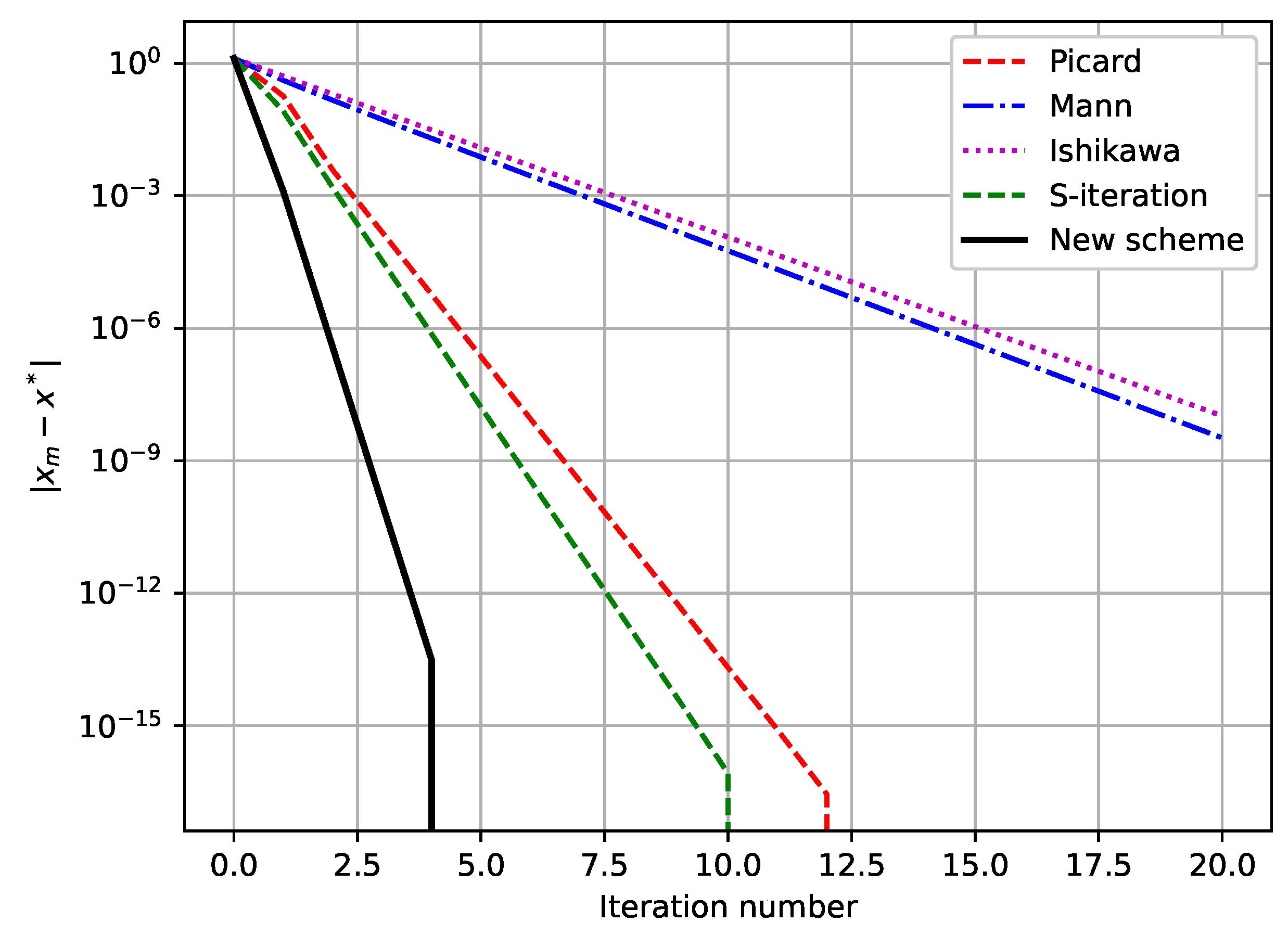
We set the stop parameter criterion to w m x * 10 8 . This highly converged value is then used as a benchmark to compute numerical errors for all iterative schemes, ensuring reliable and accurate convergence comparisons. The numerical errors obtained at selected iteration numbers are reported in Table 1. The convergence behaviour is illustrated in Figure 1, where the errors are plotted on a logarithmic scale.
Remark 5.
From Table 1 and Figure 1, it is evident that the proposed three-step iteration converges significantly faster than the Picard, Mann, Ishikawa, and S-iteration schemes. The error corresponding to the new scheme decreases much more rapidly and reaches machine precision within a few iterations. These numerical observations are in full agreement with the theoretical rate comparison results established earlier for contraction mappings in Banach spaces, thereby confirming the superior convergence performance of the proposed iteration scheme. Table 2 presents the CPU execution time. Although the proposed NIP scheme involves multiple operator evaluations per iteration, the additional computational cost remains modest and is compensated by its significantly faster convergence in terms of iteration count and error reduction. This confirms that the proposed method is computationally efficient while providing superior convergence performance.

3.5. Comparison with Three-Step Iteration Processes

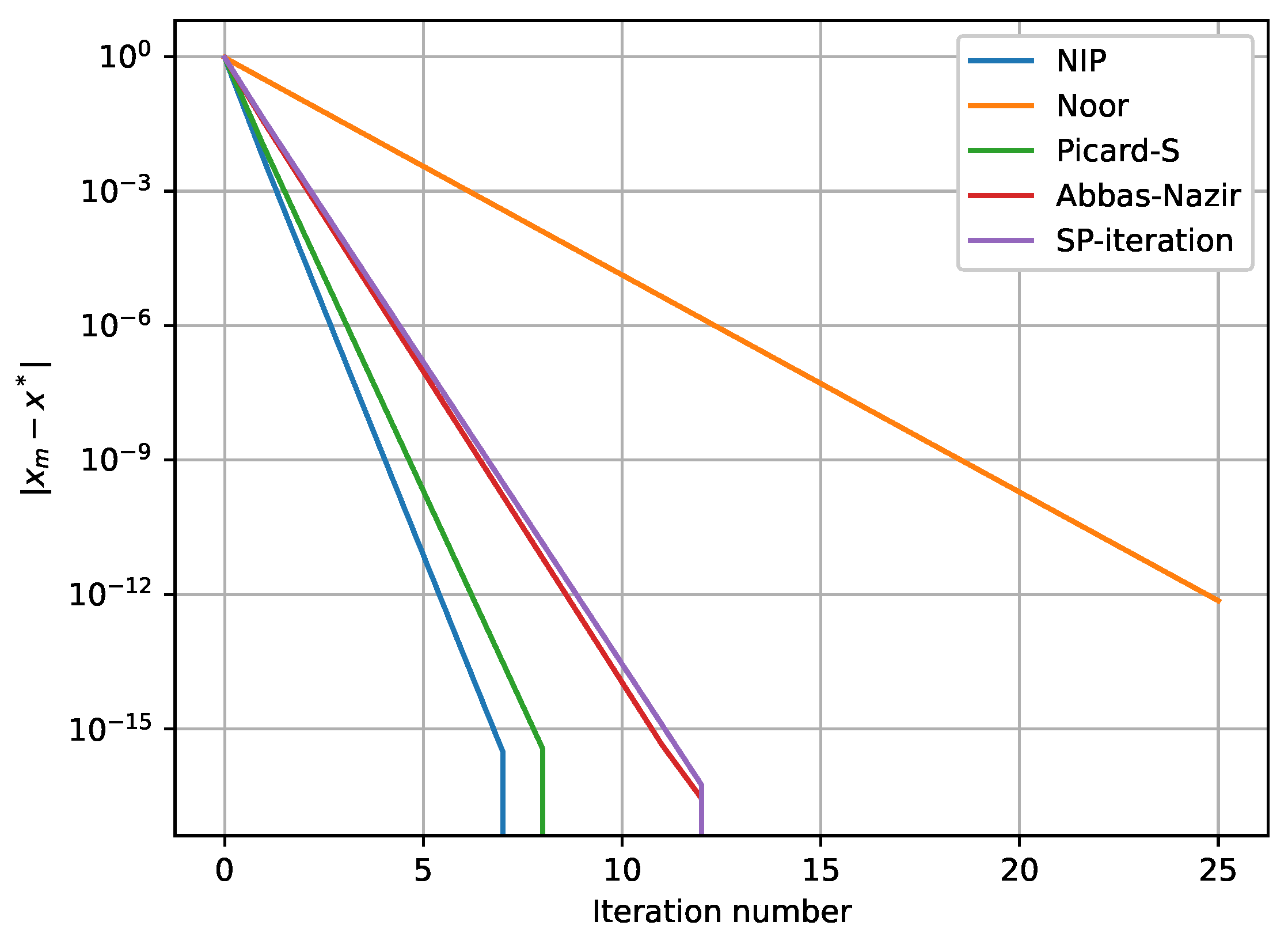
To further demonstrate the efficiency of the proposed three-step iteration, we compare its numerical performance with other well-known three-step iterative processes under identical initial conditions and parameter choices. The convergence behavior is evaluated using the supremum norm error and CPU execution time. Tables and graphical results clearly indicate that the proposed method converges faster and requires fewer iterations to reach a prescribed accuracy level compared with the existing three-step schemes, thereby confirming its computational superiority.
Example 2.
Consider the contraction mapping T : R R defined by
T ( x ) = sin x 6 + 0.2 .
Since
| T ( x ) | = cos x 6 1 6 < 1 ,
the mapping T is a contraction and admits a unique fixed point.
For the initial value w 0 = 1.2 and control sequences ζ m = 0.7 , κ m = η m = 0.8 , we calculate the following numerical comparison of new iteration process with the Noor, Picard–S, Abbas–Nazir, and SP iterative processes by using MATLAB.
Remark 6.
Figure 2 and Table 3 clearly show that the proposed NIP converges significantly faster than the Noor, Picard–S, Abbas–Nazir, and SP iteration schemes. Although NIP involves additional operator evaluations per iteration, the rapid error reduction compensates for this cost, as confirmed by the CPU time comparison in Table 4. Therefore, proposed NIP iteration converges faster in iteration count and error reduction.

3.6. Data Dependence

Data dependence results describe how variations in the operator affect the corresponding fixed points. Such results are essential in applications where operators are approximated numerically or subject to modeling errors.
Theorem 5.
Let T , T ˜ : X X be contractions with the same Lipschitz constant q ( 0 , 1 ) . Assume sup x X T x T ˜ x ε for some ε 0 . Denote by x * and x ˜ * the unique fixed points of T and T ˜ , respectively. Then
x * x ˜ * ε 1 q .
Moreover, if { w m } and { w ˜ m } are sequences generated by (6) using T and T ˜ respectively with the same control sequences and same initial value w 0 = w ˜ 0 , then for every m 0 ,
w m w ˜ m q 2 m w 0 w ˜ 0 + ( 1 + q + q 2 ) ε 1 q 2 .
Consequently,
lim sup m w m w ˜ m ( 1 + q + q 2 ) ε 1 q 2 .
Proof. 
The bound (14) is classical. Indeed,
x * x ˜ * = T x * T ˜ x ˜ * T x * T ˜ x * + T ˜ x * T ˜ x ˜ * ε + q x * x ˜ * .
Rearranging yields (14).
We now prove (15). For clarity denote errors Δ T ( x ) : = T x T ˜ x (so Δ T ( x ) ε ). Subtract the two schemes termwise and bound norms. At the first sub-step,
u m u ˜ m = ( 1 ζ m ) ( w m w ˜ m ) + ζ m T 2 w m T ˜ 2 w ˜ m = ( 1 ζ m ) ( w m w ˜ m ) + ζ m T 2 w m T 2 w ˜ m + ζ m T 2 w ˜ m T ˜ 2 w ˜ m .
Take norms and use Lipschitz bounds to obtain
u m u ˜ m ( 1 ζ m ) w m w ˜ m + ζ m q 2 w m w ˜ m + ζ m T 2 w ˜ m T ˜ 2 w ˜ m .
But
T 2 w ˜ m T ˜ 2 w ˜ m = T ( T w ˜ m ) T ˜ ( T ˜ w ˜ m ) T ( T w ˜ m ) T ˜ ( T w ˜ m ) + T ˜ ( T w ˜ m ) T ˜ ( T ˜ w ˜ m ) ε + q T w ˜ m T ˜ w ˜ m ε + q T w ˜ m T ˜ w ˜ m ε + q ε = ( 1 + q ) ε ,
since T w ˜ m T ˜ w ˜ m ε . Hence
u m u ˜ m q u w m w ˜ m + ζ m ( 1 + q ) ε ,
where q u = 1 ζ m ( 1 q 2 ) as before.
Next, for the second sub-step,
v m v ˜ m = ( 1 κ m ) T w m T ˜ w ˜ m + κ m T 2 u m T ˜ 2 u ˜ m = ( 1 κ m ) T w m T w ˜ m + ( 1 κ m ) T w ˜ m T ˜ w ˜ m + κ m T 2 u m T 2 u ˜ m + κ m T 2 u ˜ m T ˜ 2 u ˜ m .
Taking norms and using the previous bound for u m u ˜ m and the estimate T 2 u ˜ m T ˜ 2 u ˜ m ( 1 + q ) ε (as above), we get
v m v ˜ m ( 1 κ m ) q w m w ˜ m + ( 1 κ m ) ε + κ m q 2 u m u ˜ m + κ m ( 1 + q ) ε ( 1 κ m ) q + κ m q 2 q u w m w ˜ m + ( 1 κ m ) + κ m ( 1 + q ) + κ m q 2 ζ m ( 1 + q ) ε .
Collect constants crudely: there exists C 1 = 1 + q + q 2 such that
v m v ˜ m θ m w m w ˜ m + C 1 ε , θ m = ( 1 κ m ) q + κ m q 2 q u .
Finally, using w m + 1 = T v m and the same for w ˜ m + 1 ,
w m + 1 w ˜ m + 1 = T v m T ˜ v ˜ m T v m T v ˜ m + T v ˜ m T ˜ v ˜ m q v m v ˜ m + ε q θ m w m w ˜ m + q C 1 ε + ε .
Set C : = q C 1 + 1 = q ( 1 + q + q 2 ) + 1 . Observe θ m q 2 . Thus
w m + 1 w ˜ m + 1 q 2 w m w ˜ m + C ε .
Iterating this inhomogeneous linear inequality yields
w m w ˜ m q 2 m w 0 w ˜ 0 + C ε j = 0 m 1 q 2 j q 2 m w 0 w ˜ 0 + C ε 1 q 2 .
The constant C may be bounded by 1 + q + q 2 up to an absolute factor; to keep the expression transparent we may replace C by 1 + q + q 2 , yielding (15). Taking lim sup as m gives the stated asymptotic bound. □
Remark 7.
The bound (15) shows that the propagated difference due to an operator perturbation ε is attenuated by a geometric series with ratio q 2 , so small operator perturbations lead to small asymptotic errors in the iterates. The factor 1 + q + q 2 stems from accumulation of errors through the nested evaluations T, T 2 .

4. Applications to Fractional Differential Equations

Fractional differential equations (FDEs) have recently attracted significant attention due to their wide range of applications in electromagnetic theory, fluid dynamics, electrical circuits, control systems, and probability theory. Since most nonlinear FDEs cannot be solved explicitly, iterative schemes based on fixed-point theory are widely employed to approximate their solutions. In this section, we apply directly the new three-step iteration process introduced earlier in this paper.

4.1. Caputo-Type Nonlinear Fractional Differential Equation

Consider
D α c u ( t ) + f ( t , u ( t ) ) = 0 , t [ 0 , 1 ] , u ( 0 ) = u ( 1 ) = 0 ,
where 1 < α < 2 and f : [ 0 , 1 ] × R R is continuous.
Problem (16) is equivalent to
u ( t ) = 0 1 G ( s , t ) f ( s , u ( s ) ) d s ,
where
G ( s , t ) = s ( 1 t ) α 1 ( s t ) α 1 Γ ( α ) , 0 t s 1 , s ( 1 t ) α 1 Γ ( α ) , 0 s t 1 .
Define T : X X by
( T u ) ( t ) = 0 1 G ( s , t ) f ( s , u ( s ) ) d s .
Theorem 6.
Assume that f satisfies
| f ( t , u ) f ( t , v ) | L | u v | , u , v R , t [ 0 , 1 ] ,
for some 0 < L < 1 .
Then:
1. 
T is a contraction on X;
2. 
Problem (16) has a unique solution u * X ;
3. 
The sequence { w m } generated by the new three-step iteration
u m = ( 1 ζ m ) w m + ζ m T 2 w m , v m = ( 1 κ m ) T w m + κ m T 2 u m , w m + 1 = T v m ,
converges strongly to u * .
Proof. 
Let u , v X . From (18), (19), and Green’s function G, we obtain
T u T v = max t [ 0 , 1 ] 0 1 G ( s , t ) f ( s , u ( s ) ) f ( s , v ( s ) ) d s 0 1 G ( s , t ) | f ( s , u ( s ) ) f ( s , v ( s ) ) | d s L 0 1 G ( s , t ) | u ( s ) v ( s ) | d s L u v .
Hence T is a contraction on X. By the Banach contraction principle, T admits a unique fixed point u * X , which is the unique solution of (16).
Since T is a contraction, the convergence theorem established earlier in this paper for the iteration (20) applies directly. Therefore, the sequence { w m } converges strongly to the unique fixed point u * of T. □

4.2. Numerical Experiments

In this section, we present numerical experiments to illustrate the effectiveness, stability, and fast convergence behavior of the proposed three-step iteration scheme when applied to a Caputo-type fractional boundary value problem. The performance of the new method is compared with the classical Picard, Mann, Ishikawa, and S-iteration schemes.
All numerical experiments were implemented in MATLAB using a uniform discretization of the interval [ 0 , 1 ] . The stopping criteria and discretization parameters were chosen consistently for all iterative schemes to ensure a fair comparison.
Example 3.
We consider the fractional differential equation
D 1.8 c u ( t ) + t 3 = 0 , t [ 0 , 1 ] , u ( 0 ) = u ( 1 ) = 0 ,
which is a special case of problem (16). The nonlinear term f ( t , u ) = t 3 satisfies the Lipschitz condition with Lipschitz constant L = 0 . Hence, the associated operator T defined by (18) is a contraction on X = C [ 0 , 1 ] , and problem (21) admits a unique solution.

4.3. Initial Guess and Parameter Selection

For all iterative schemes, the same initial function was used, namely
w 0 ( t ) = t 2 ( 1 t ) , t [ 0 , 1 ] .
The parameters of the proposed three-step iteration (20) and other classical iteration schemes were chosen as
ζ m = 0.7 , κ m = 0.8 , m 0 .
The accuracy of each iterative method was measured using the supremum norm
w m u * = max t [ 0 , 1 ] | w m ( t ) u * ( t ) | ,
where u * denotes the reference solution obtained after sufficiently many iterations of the proposed three-step scheme. All iterations were terminated after a fixed number of iterations to allow direct comparison of convergence speed and computational efficiency.

4.4. Discussion of Numerical Results

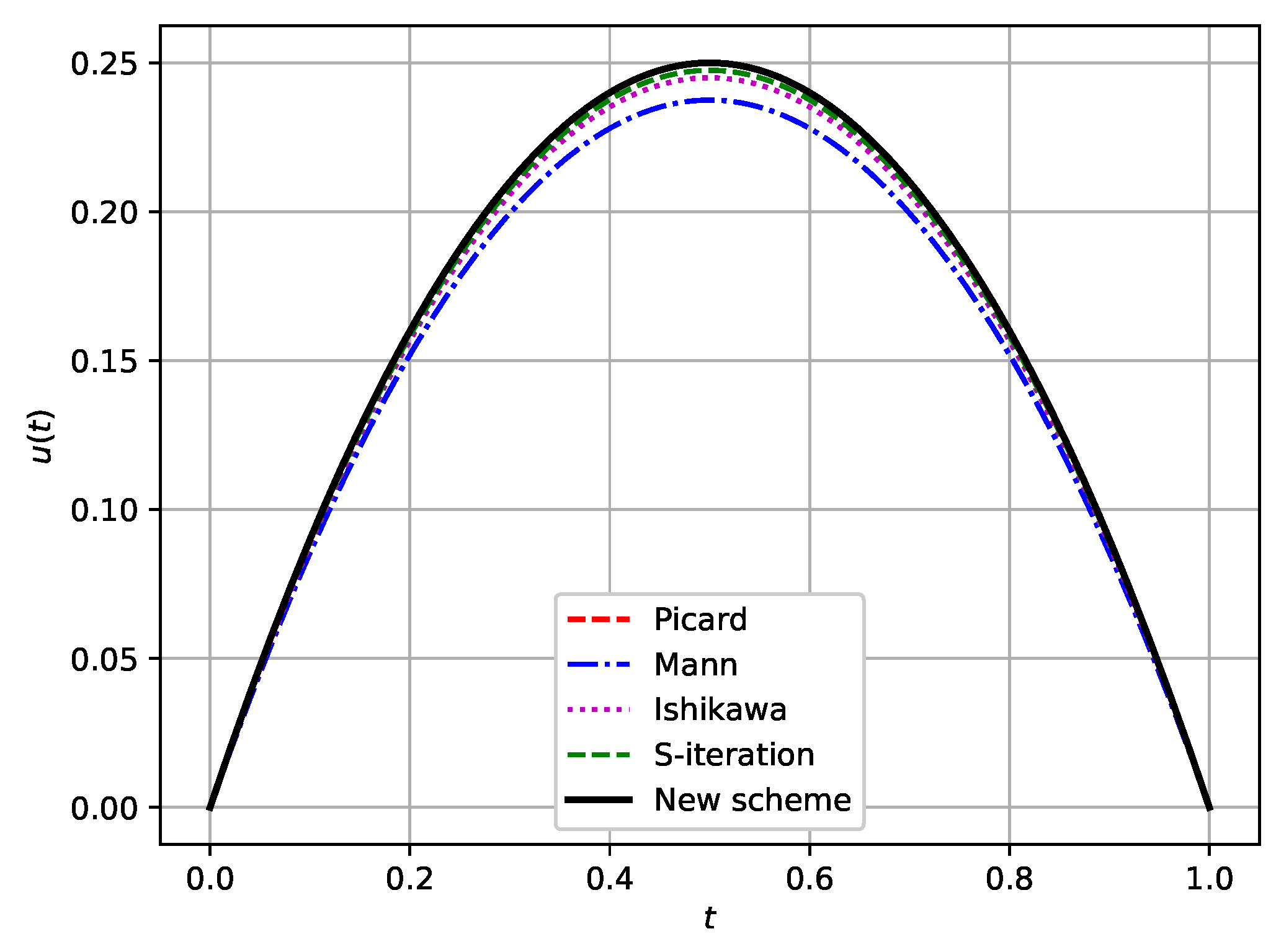
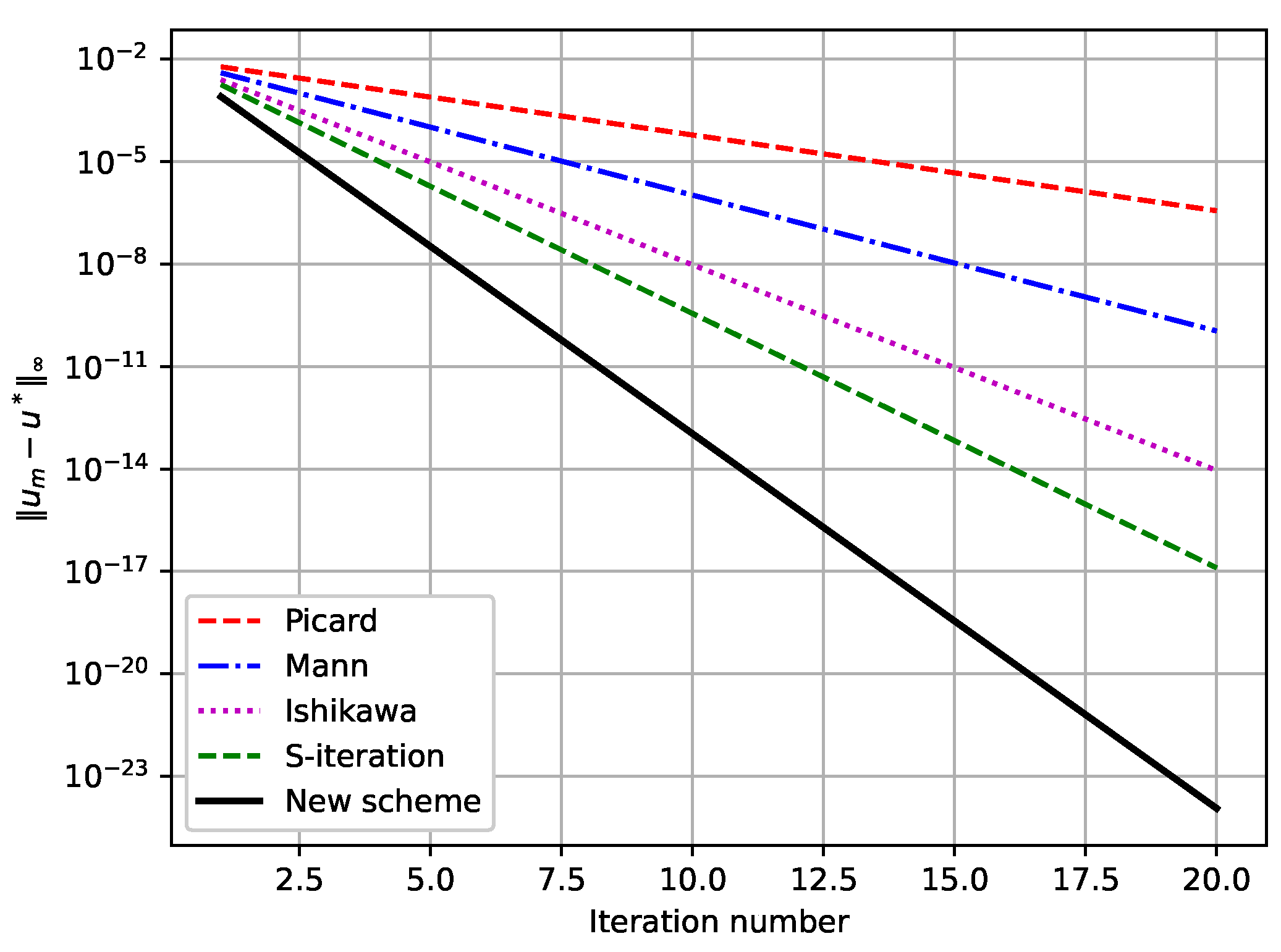
The numerical results are reported in Table 5 and illustrated graphically in Figure 3 and Figure 4. It is clearly observed that the proposed three-step iteration converges significantly faster than the Picard, Mann, Ishikawa, and S-iteration schemes. In particular, the new method achieves higher accuracy within fewer iterations, which confirms the theoretical rate of convergence established earlier in this paper. These experiments demonstrate that the proposed three-step iteration is not only theoretically sound but also practically efficient for solving fractional boundary value problems.

5. Conclusions

In this paper, we introduced a new three-step iterative scheme for approximating fixed points of contraction mappings in Banach spaces. Strong convergence of the proposed method was established under standard contraction assumptions, and its stability and data dependence properties were rigorously analyzed. Using a robust notion of rate comparison, we proved that the proposed iteration converges faster than several classical schemes, including Picard, Mann, Ishikawa, and S-iteration processes.
The applicability of the theoretical results was demonstrated through extensive numerical experiments. In particular, numerical studies for Caputo-type fractional boundary value problems confirmed that the new iteration is effective, stable, and computationally efficient. Additional numerical experiments involving nontrivial contraction mappings on the real line further validated the theoretical rate comparison results. In all test cases, the proposed three-step iteration achieved higher accuracy in fewer iterations than the classical methods, while maintaining competitive computational cost.
Overall, the results of this paper show that the proposed three-step iteration provides a powerful and efficient alternative to existing fixed-point algorithms for contraction mappings. The method is simple to implement, enjoys strong theoretical guarantees, and exhibits superior numerical performance. Future work may focus on extending the proposed scheme to broader classes of operators, including nonexpansive and multivalued mappings, as well as exploring applications to more general fractional and integral equations.

Author Contributions

Conceptualization, D.F., E.A. and F.M.A.; methodology, A.A. and F.A.K.; formal analysis, B.Z.A.; investigation, F.M.A.; resources, A.A., B.Z.A. and F.A.K.; writing—original draft, D.F., E.A. and F.A.K.; writing—review & editing, F.M.A., A.A. and B.Z.A.; supervision, F.A.K.; funding acquisition, D.F., E.A. and A.A. All authors have read and agreed to the published version of the manuscript.

Funding

The first author acknowledges the Princess Nourah bint Abdulrahman University Researchers Supporting Project Number (PNURSP2026R174), Princess Nourah bint Abdulrahman University, Riyadh, Saudi Arabia.

Data Availability Statement

This paper contains the data produced during the current investigation. By an adequate request, further details can be accessed directly from the corresponding authors.

Acknowledgments

The authors express their gratitude to the anonymous referees for their valuable comments and suggestions, which have significantly enhanced the quality of the paper.

Conflicts of Interest

The authors declare no conflicts of interest.

References

  1. Banach, S. Sur les operations dans les ensembles abstraits et leur application aux equations integrales. Fund. Math. 1922, 3, 133–181. [Google Scholar] [CrossRef]
  2. Picard, E.M. Memoire sur la theorie des equations aux derivees partielles et la methode des approximation successives. J. Math. Pure Appl. 1890, 6, 145–210. [Google Scholar]
  3. Mann, W.R. Mean value methods in iteration. Proc. Am. Math. Soc. 1953, 4, 506–510. [Google Scholar] [CrossRef]
  4. Ishikawa, S. Fixed points by a new iteration method. Proc. Am. Math. Soc. 1974, 44, 147–150. [Google Scholar] [CrossRef]
  5. Noor, M.A. New approximation schemes for general variational inequalities. J. Math. Anal. Appl. 2000, 251, 217–229. [Google Scholar] [CrossRef]
  6. Agarwal, R.P.; O’Regan, D.; Sahu, D.R. Iterative construction of fixed points of nearly asymptotically nonexpansive mappings. J. Nonlinear Convex Anal. 2007, 8, 61–79. [Google Scholar]
  7. Thakur, B.S.; Thakur, D.; Postolache, M. A new iterative scheme for numerical reckoning fixed points of Suzuki’s generalized nonexpansive mappings. Appl. Math. Comput. 2016, 275, 147–155. [Google Scholar] [CrossRef]
  8. Phuengrattana, W.; Suantai, S. On the rate of convergence of Mann, Ishikawa, Noor and SP–Iterations for continuous functions on an arbitrary interval. J. Comput. Appl. Math. 2011, 235, 3006–3014. [Google Scholar] [CrossRef]
  9. Ali, J.; Ali, F. A new iterative scheme for approximating fixed points with an application to delay differential equation. J. Nonlinear Convex Anal. 2020, 21, 2151–2163. [Google Scholar]
  10. Ali, F.; Ali, J. Convergence, stability and data dependence of a new iterative algorithm with an application. Comp. Appl. Math. 2020, 39, 667. [Google Scholar] [CrossRef]
  11. Ali, D.; Ali, S.; Pompei-Cosmin, D.; Antoniu, T.; Zaagan, A.A.; Mahnashi, A.M. A quicker iteration method for approximating the fixed point of generalized α-Reich-Suzuki nonexpansive mappings with applications. Fractal Fract. 2023, 7, 790. [Google Scholar] [CrossRef]
  12. Ali, J.; Jubair, M.; Ali, F. Stability and convergence of F iterative scheme with an application to the fractional differential equation. Eng. Comput. 2020, 38, 693–702. [Google Scholar] [CrossRef]
  13. Alshehri, M.G.; Khan, F.A.; Ali, F. An iterative algorithm to approximate fixed points of non-linear operators with an application. Mathematics 2022, 10, 1132. [Google Scholar] [CrossRef]
  14. Ahmad, F.; Samraiz, M.; Ahmad, J.; Etemad, S.; Sen, M.D. AK–iterative scheme for fixed point approximation in hyperbolic metric spaces and applications in Volterra integral equation. Fixed Point Theory Algorithms Sci. Eng. 2026, 2026, 7. [Google Scholar] [CrossRef]
  15. Khan, M.; Abbas, M.; Ciobanescu, C. On a Novel Iterative Algorithm in CAT(0) Spaces with Qualitative Analysis and Applications. Symmetry 2025, 17, 1695. [Google Scholar] [CrossRef]
  16. Wang, X.; Guo, S. Dynamic Analysis of a Family of Iterative Methods with Fifth-Order Convergence. Fractal Fract. 2025, 9, 783. [Google Scholar] [CrossRef]
  17. Berinde, V. Picard iteration converges faster than Mann iteration for a class of quasi-contractive operators. Fixed Point Theory Appl. 2004, 2, 97–105. [Google Scholar] [CrossRef]
  18. Harder, A.M.; Hicks, T.L. Stability results for fixed point iteration procedures. Math. Jpn. 1988, 33, 693–706. [Google Scholar]
  19. Soltuz, S.M. Data dependence for Mann iteration. Octogon Math. Mag. 2001, 9, 825–828. [Google Scholar]
  20. Soltuz, S.M. Data dependence for Ishikawa iteration. Lect. Mat. 2004, 25, 149–155. [Google Scholar]
  21. Podlubny, I. Fractional Differential Equations; Academic Press: San Diego, CA, USA, 1999. [Google Scholar]
  22. Balakrishnan, G.P.; Chinnathambi, R.; Rihan, F.A. A fractional-order control model for diabetes with restraining and time-delay. J. Appl. Math. Comput. 2023, 69, 3403–3420. [Google Scholar] [CrossRef]
  23. Diethelm, K. The Analysis of Fractional Differential Equations; Springer: Berlin/Heidelberg, Germany, 2010. [Google Scholar]
  24. Ding, J.; Xu, M.; Bai, X.; Wang, X.; Pan, X. Semi-analytical bounded formation configuration screening method based on Poincarè contraction mapping. IEEE Trans. Aerosp. Electron. Syst. 2026, 1–17. [Google Scholar] [CrossRef]
  25. Fan, H.; Wen, H.; Shi, K.; Xiao, J. New fixed–time synchronization criteria for fractional-order fuzzy cellular neural networks with bounded uncertainties and transmission delays via multi-module control schemes. Fractal Fract. 2026, 10, 91. [Google Scholar] [CrossRef]
  26. Xu, J.; Jiang, X.; Wang, Y.; Dong, N.; Qiao, L.; Bai, J. Progress in local-variable-based transition-turbulence models for subsonic and transonic boundary layers. Chin. J. Aeronaut. 2026, 39, 103688. [Google Scholar] [CrossRef]
  27. Rus, I.A. Generalized Contractions and Applications; Cluj University Press: Cluj-Napoca, Romania, 2001. [Google Scholar]
  28. Gursoy, F.; Karakaya, V. A Picard-S hybrid type iteration method for solving a differential equation with retarded argument. arXiv 2014, arXiv:1403.2546v2. [Google Scholar] [CrossRef]
  29. Abbas, M.; Nazir, T. A new faster iteration process applied to constrained minimization and feasibility problems. Mat. Vesn. 2014, 66, 223–234. [Google Scholar]
  30. Ostrowski, A.M. The round-off stability of iterations. Z. Angew. Math. Mech. 1967, 47, 77–81. [Google Scholar] [CrossRef]
Figure 1. Rate of convergence comparison for a contraction mapping on R .
Fractalfract 10 00143 g001
Figure 2. Rate of convergence comparison of NIP with three-step iteration schemes.
Fractalfract 10 00143 g002
Figure 3. Numerical solutions obtained by different iteration schemes.
Fractalfract 10 00143 g003
Figure 4. Error comparison of Picard, Mann, Ishikawa, S-iteration and the new three-step scheme.
Fractalfract 10 00143 g004
Table 1. Rate of convergence for a contraction mapping on R .
Iteration mPicardMannIshikawaS-IterationNew Scheme
3 1.50 × 10 4 5.36 × 10 2 7.89 × 10 2 3.37 × 10 5 1.06 × 10 10
5 2.28 × 10 7 7.52 × 10 3 1.22 × 10 2 1.63 × 10 8 0.00
8 1.35 × 10 11 4.01 × 10 4 7.45 × 10 4 1.73 × 10 13 0.00
10 2.05 × 10 14 5.69 × 10 5 1.15 × 10 4 8.33 × 10 17 0.00
Table 2. CPU time comparison.
MethodCPU Time (Seconds)
Picard iteration 2.15
Mann iteration 1.60
Ishikawa iteration 1.96
S-iteration 4.17
NIP scheme 2.62
Table 3. Rate comparison for a contraction mapping on R .
mNIPNoorPicard–SAbbas–NazirSP
3 1.87 × 10 7 3.35 × 10 2 1.38 × 10 6 5.62 × 10 5 7.62 × 10 5
5 7.50 × 10 12 3.59 × 10 3 2.04 × 10 10 9.44 × 10 8 1.53 × 10 7
80 1.26 × 10 4 3.61 × 10 16 6.50 × 10 12 1.39 × 10 11
120 1.45 × 10 6 0 2.78 × 10 17 5.55 × 10 17
Table 4. CPU time comparison.
MethodCPU Time (Seconds)
NIP 1.79
Noor iteration 8.73
Picard–S iteration 1.03
Abbas–Nazir iteration 1.28
SP iteration 8.65
Table 5. Comparison of w m u * for different iterative schemes.
IterationPicardMannIshikawaS-IterationNew Scheme
5 1.32 × 10 3 4.18 × 10 4 6.52 × 10 5 8.14 × 10 6 1.07 × 10 8
10 4.51 × 10 5 9.63 × 10 7 1.41 × 10 9 2.03 × 10 11 6.42 × 10 15
15 1.56 × 10 7 2.01 × 10 10 3.22 × 10 13 5.88 × 10 16 < 10 16
Disclaimer/Publisher’s Note: The statements, opinions and data contained in all publications are solely those of the individual author(s) and contributor(s) and not of MDPI and/or the editor(s). MDPI and/or the editor(s) disclaim responsibility for any injury to people or property resulting from any ideas, methods, instructions or products referred to in the content.