Article

Event-Based State Estimator Design for Fractional-Order Memristive Neural Networks with Random Gain Fluctuations

1
School of Physics and Telecommunication Engineering, Zhoukou Normal University, Zhoukou 466001, China
2
School of Mechanical and Electrical Engineering, Zhoukou Normal University, Zhoukou 466001, China
3
School of Automation, Nanjing University of Science and Technology, Nanjing 210094, China
*
Author to whom correspondence should be addressed.
Fractal Fract. 2026, 10(2), 81; https://doi.org/10.3390/fractalfract10020081
Submission received: 13 November 2025 / Revised: 20 January 2026 / Accepted: 22 January 2026 / Published: 24 January 2026
(This article belongs to the Special Issue Analysis and Modeling of Fractional-Order Dynamical Networks)

Abstract

This study addresses the issue of nonfragile state estimation for fractional-order memristive neural networks with time-varying delays under an adaptive event-triggered mechanism. Possible gain perturbations of the estimator are considered. A Bernoulli-distributed random variable is introduced to model the stochastic nature of gain fluctuations. The primary objective is to develop a nonfragile estimator that accurately estimates the network states. By means of Lyapunov functionals and fractional-order Lyapunov methods, two delay and order-dependent sufficient criteria are established to guarantee the mean-square stability of the augmented system. Finally, the effectiveness of the proposed estimation scheme is demonstrated through two simulation examples.

1. Introduction

Fractional-order (FO) calculus, a generalization of classical integer-order calculus, overcomes the “locality” limitation inherent in integer-order operators. Different from the integer-order derivative, which reflects only the instantaneous rate of change at a single point, the fractional-order derivative incorporates information from the initial moment up to the current state. This inherently embodies non-locality and memory—two key properties that correspond to the dynamic characteristics of biological neural systems and complex engineering processes. Over the past decades, FO calculus has been widely applied in physics, biology, finance, and engineering [1,2,3,4]. It is well known that FO calculus can describe real phenomena more accurately than integer-order calculus due to its properties of infinite memory and hereditary effects. In recent years, research on fractional-order systems has attracted significant interest from many scholars. Numerous novel results have been reported in areas such as stability, pinning control, and synchronization [5,6,7,8].
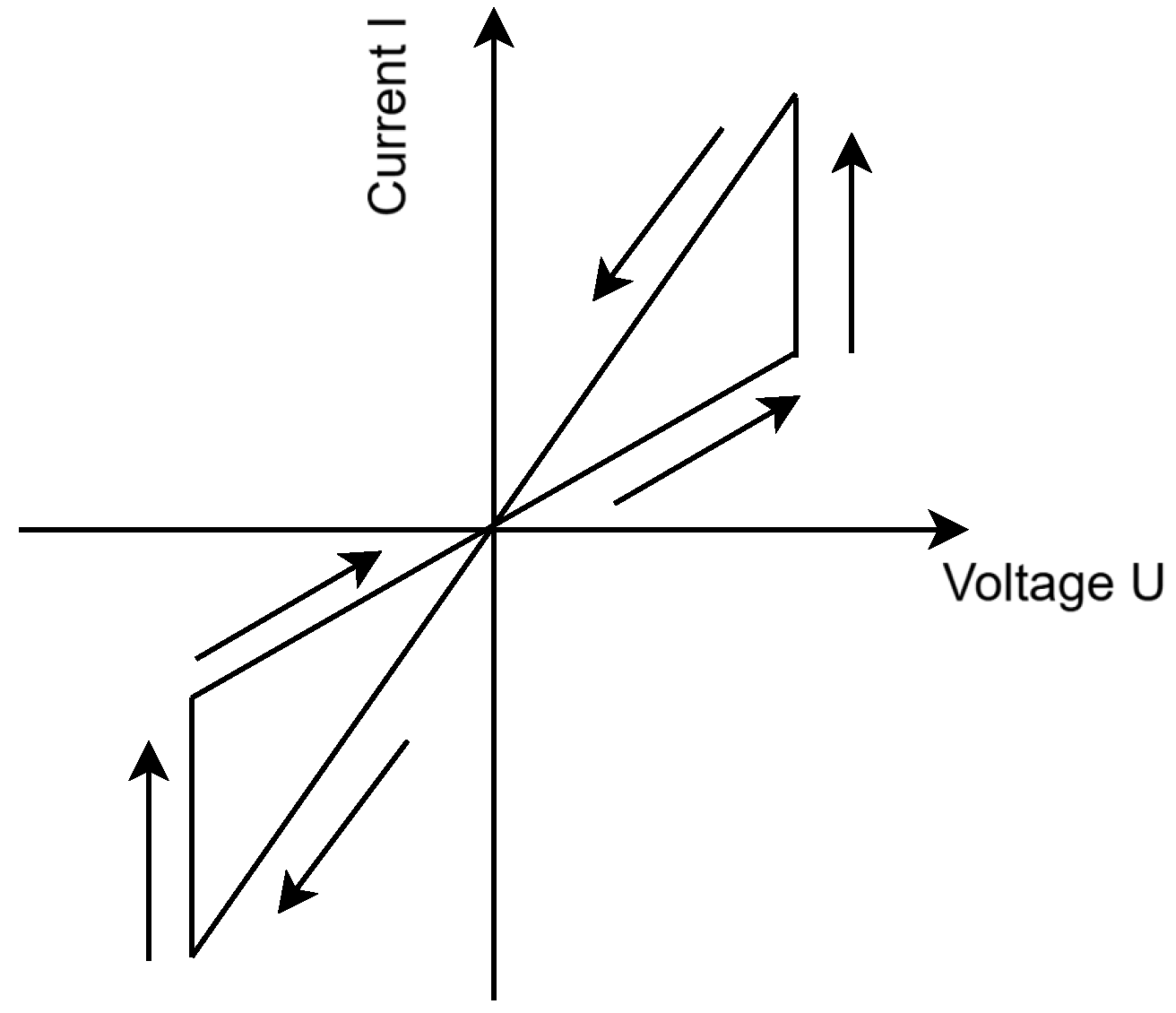
Memristors were theoretically predicted by Chua in 1971 and experimentally verified by Hewlett-Packard Laboratories in 2008. According to [9], the core characteristics of memristors closely resemble the synaptic plasticity of biological neurons. The memristance depends on the amount of charge that passes through the memristor in a specific direction. The current-voltage characteristic is depicted as a pinched hysteresis loop in Figure 1. This biomimetic feature makes memristors ideal candidates for simulating biological synapses in hardware neural networks, enabling the development of compact, low-power, and high-density neural computing architectures. In recent decades, neural networks (NNs) have been a prominent research topic due to their wide range of applications [10,11,12]. In the era of the Fourth Industrial Revolution, the demand for intelligent systems characterized by high efficiency, low power consumption, and biomimetic features has driven unprecedented innovations in neural network technologies. Despite remarkable success in image recognition, natural language processing, and control engineering, traditional neural networks face inherent limitations. Specifically, their lack of memory characteristics hinders the modeling of time-dependent dynamic processes, and the use of integer-order differential operators fails to capture the non-local and long-range correlation behaviors prevalent in both natural and engineered systems. In response to these challenges, the integration of memristors and fractional-order (FO) calculus into neural network systems has emerged as a novel research frontier [6,7,13,14]. This integration not only addresses the shortcomings of conventional neural networks but also paves the way for developing next-generation intelligent systems with biomimetic intelligence and ultra-high performance.
Accurately acquiring the internal states of neural networks is essential for their reliable application in practical scenarios, as these states directly reflect the operational status, information processing mechanisms, and dynamic evolution trends. Consequently, state estimation (SE) of neural networks has become a central research focus, attracting extensive attention from scholars worldwide [6,13,16,17]. For example, the SE problem for discrete neural networks with partial neurons was investigated in [18], where randomly occurring time delays were taken into consideration. It is important to note that most existing results on SE of neural network systems overlook the fact that the expert estimator may be affected by perturbations in complex and variable environments, which can compromise the robustness of the designed estimator. As a result, nonfragile techniques have garnered significant research interest for various dynamic systems to mitigate the effects of estimator gain perturbations, as discussed in [19,20,21,22].
With the rapid advancement of networked control in industrial applications, reducing communication bandwidth between actuators and controllers while enhancing signal transmission efficiency remains a key research focus in control systems. Given the limitations of traditional sampling methods, some scholars have proposed event-triggered mechanisms [22,23,24]. This control approach updates control signals through variable-period sampling, meaning that signal transmission occurs only when a specified system state exceeds a predefined threshold. To date, the event-based SE issue for integer-order systems has attracted significant scholarly interest. However, there are few available results concerning fractional-order systems. Recently, the static event-triggered scheme (SETS) has often been employed in fractional-order systems to effectively conserve bandwidth resources [25,26]. Nevertheless, this method imposes a conservative minimum inter-event time interval. Consequently, a dynamic triggering rule has been proposed for various integer-order systems [27,28,29,30]. In [31], the authors addressed the consensus problem of multi-agent systems by proposing a novel event-triggered scheme to avoid the waste of network resources. This adaptive event-triggered approach guarantees a longer inter-event time interval compared to SETS. So far, the application of adaptive event-triggered mechanisms (AETMs) for fractional-order memristive neural networks (FOMNNs) has received little attention, which motivates the present work.
Inspired by the reasons outlined above, our aim is to address the nonfragile SE problem for fractional-order memristive neural networks with time-varying delays under an adaptive event-triggered mechanism. The main contributions of our study are summarized as follows:
(i) This paper discusses the SE issue for FOMNNs by taking the random gain perturbations and time-varying delay into account.
(ii) A new delay-dependent and order-dependent criterion in the form of LMIs is established to ensure the asymptotic stability in the mean square sense of the augmented system.
(iii) Considering the network burden, a nonfragile estimator for a class of delayed FOMNNs under the AETM is designed. Different from the static event-triggered scheme, a novel adaptive event-triggered mechanism is employed, which is constructed by a dynamic threshold σ ( t ) and the Mittag–Leffler function.
(iv) To illustrate the effectiveness of the proposed estimation algorithm for FOMNNs with time-varying delays, two numerical examples are presented.
Notation: For a matrix N, N T denotes the transpose of matrix N and the symbol ★ in it is the symmetric term. For a vector y, y represents the Euclidean norm in R n . The symbols I / 0 represent the identity/zero matrix with appropriate dimensions. The set R n denotes the n-dimensional Euclidean space, and the symbol Pr { · } stands for the occurrence probability of the event ‘·’.

2. Problem Formulation and Preliminaries

Definition 1
([32]). For the function v ( t ) , the fractional integral operator is defined as
I β v ( t ) = 1 Γ ( β ) a 0 t ( t ζ ) β 1 v ( ζ ) d ζ , β R +
in which t a 0 and the Gamma function Γ ( z ) = a e t t z 1 d t .
Definition 2
([32]). Caputo’s derivative for function v ( t ) is
D t β a 0 C v ( t ) = 1 Γ ( k β ) a 0 t ( t ζ ) k β 1 v ( k ) ( ζ ) d ζ ,
where t a 0 , and β ( k 1 , k ) , v ( t ) C k ( [ a 0 , ) , R ) .
Consider the following FOMNNs with time-varying delay:
D α q i ( t ) = c i q i ( t ) + j = 1 n a i j ( q j ( t ) ) g j ( q j ( t ) ) + j = 1 n b i j ( q j ( t ) ) g j ( q j ( t d ( t ) ) ) ,
where c i > 0 is state feedback coefficient, q i ( t ) is the state of the ith neuron, a i j ( q j ( t ) ) , b i j ( q j ( t ) ) represent the memristor connection weights, the time-varying delay d ( t ) satisfies 0 d ( t ) d , the nonlinear function g ( · ) stands for the activation function.
Assumption 1.
For q 1 R , q 2 R and q 1 q 2 , the activation function g j ( · ) in (1) satisfies
μ j g j ( q 1 ) g j ( q 2 ) q 1 q 2 μ j + , ( j = 1 , 2 , , n )
where the scalars μ j + , μ j are known, and g ( 0 ) = 0 .
Remark 1.
The scalars μ j + , μ j in Assumption 1 can be positive, negative, or zero. In other words, the nonlinear function g ( · ) in system (1) can choose among the sigmoid, tanh and ReLU functions, compared to the Lipschitz conditions and monotonic non-decreasing functions employed in [33,34]. Therefore, Assumption 1 has broader applicability.
Based on the physical properties of memristors and the characteristics of the current-voltage hysteresis curves, the state-dependent memristor weights a i j ( q j ( t ) ) , b i j ( q j ( t ) ) can be defined as
a i j ( q i ( t ) ) = a i j , | q i ( t ) | T i , a i j , | q i ( t ) | > T i , b i j ( q i ( t ) ) = b i j , | q i ( t ) | T i , b i j , | q i ( t ) | > T i ,
From the above analysis, it is evident that FOMNNs (1) can be regarded as a class of nonlinear dynamical systems with right-end discontinuities. Based on set-valued mapping and differential inclusion theory, the Filippov solution q ( t ) = q 1 ( t ) , q 2 ( t ) , , q n ( t ) T of FOMNNs (1) is absolutely continuous on [ 0 , T ] and satisfies
D α q i ( t ) c i q i ( t ) + j = 1 n c o { a i j , a i j } g j ( q j ( t ) ) + j = 1 n c o { b i j , b i j } g j ( q j ( t d ( t ) ) ) ,
where
c o a i j , a i j = a ̲ i j , a ¯ i j , a ̲ i j = min a i j , a i j , a ¯ i j = max a i j , a i j , c o b i j , b i j = b ̲ i j , b ¯ i j , b ̲ i j = min b i j , b i j , b ¯ i j = max b i j , b i j .
For convenience, we define
C = diag c 1 , c 2 , , c n , A ̲ , A ¯ = a ̲ i j , a ¯ i j n × n , B ̲ , B ¯ = b ̲ i j , b ¯ i j n × n , g ( q ( t ) ) g 1 ( q 1 ( t ) ) , g 2 ( q 2 ( t ) ) , , g n ( q n ( t ) ) T , g ( q ( t d ( t ) ) ) g 1 ( q 1 ( t d ( t ) ) ) , g 2 ( q 2 ( t d ( t ) ) ) , , g n ( q n ( t d ( t ) ) ) T .
Thus, the compact form of Equation (3) can be described as
D α q ( t ) C q ( t ) + [ A ̲ , A ¯ ] g ( q ( t ) ) + [ B ̲ , B ¯ ] g ( q ( t d ( t ) ) ) .
Moreover, there exist two measurable functions A ( q ( t ) ) [ A ̲ , A ¯ ] , B ( q ( t ) ) [ B ̲ , B ¯ ] such that (4) can be expressed as
D α q ( t ) C q ( t ) + A ( q ( t ) ) g ( q ( t ) ) + B ( q ( t ) ) g ( q ( t d ( t ) ) ) .
For the convenience of analysis, we define
A A ¯ + A ̲ 2 = a ¯ i j + a ̲ i j 2 n × n , B B ¯ + B ̲ 2 = b ¯ i j + b ̲ i j 2 n × n .
Next, the memristive connection weights A ( q ( t ) ) , B ( q ( t ) ) can be rewritten as
A ( q ( t ) ) = A + Δ A ( t ) , B ( q ( t ) ) = B + Δ B ( t ) ,
in which Δ A ( t ) = i , j = 1 n i ϖ i j a ( t ) j T , Δ B ( t ) = i , j = 1 n i ϖ i j b ( t ) j T , i R , the ith element is equal to 1, and the others are equal to 0; this implies that ϖ i j a ( t ) , ϖ i j b ( t ) are unknown and satisfy | ϖ i j a ( t ) | a ˜ i j , | ϖ i j b ( t ) | b ˜ i j , a ˜ i j = a ¯ i j a ̲ i j 2 , b ˜ i j = b ¯ i j b ̲ i j 2 , .
According to the above analysis, the matrices Δ A ( t ) , Δ B ( t ) can be descried as
Δ A ( t ) , Δ B ( t ) = H F ( t ) N ,
where H = H , H , N = diag N a , N b , F ( t ) = diag F a ( t ) , F b ( t ) , and
H = H 1 , H 2 , , H n , H i = i , i , , i n , N a = N a 1 T , N a 2 T , , N a n T T , N b = N b 1 T , N b 2 T , , N b n T T , N a j = a ˜ j 1 1 T , a ˜ j 2 2 T , , a ˜ j n n T , N b j = b ˜ j 1 1 T , b ˜ j 2 2 T , , b ˜ j n n T , N e j = e ˜ j 1 1 T , e ˜ j 2 2 T , , e ˜ j n n T , F a ( t ) = diag F a 1 ( t ) , F a 2 ( t ) , , F a n ( t ) , F b ( t ) = diag F b 1 ( t ) , F b 2 ( t ) , , F b n ( t ) , F a j ( t ) = diag ϖ j 1 a ( t ) a ˜ j 1 1 , ϖ j 2 a ( t ) a ˜ j 2 1 , , ϖ j n a ( t ) a ˜ j n 1 , F b j ( t ) = diag ϖ j 1 b ( t ) b ˜ j 1 1 , ϖ j 2 b ( t ) b ˜ j 2 1 , , ϖ j n b ( t ) b ˜ j n 1 .
Then, system (5) can be rewritten as
D α q ( t ) C q ( t ) + ( A + Δ A ) g ( q ( t ) ) + ( B + Δ B ) g ( q ( t d ( t ) ) ) .
Remark 2.
It is noteworthy that FOMNNs are state-dependent systems, with parameters that change as the states evolve. Considering the boundedness and switching characteristics of memristors, we can transform the original memristive neural network (1) into an uncertain system (7). Based on this transformation, the SE problem of FOMNNs can be addressed using the robust analysis method proposed in [35].
In this paper, the network measurement output y ( t ) is considered as
y ( t ) = D 1 q ( t ) + D 2 q ( t d ( t ) ) ,
where D 1 , D 2 are real matrices with appropriate dimensions, and d ( t ) is a time- varying delay.
In order to avoid the waste of network resources caused by data transmission, an event-triggered scheme is adopted behind the sensor. To accurately estimate the neuron state q ( t ) in system (1), a full-order fractional-order nonfragile state estimator of the following form is constructed:
D α q ^ ( t ) = C q ^ ( t ) + A g ( q ^ ( t ) ) + B g ( q ^ ( t d ( t ) ) ) + ( K + β ( t ) Δ K ) ( y ( t p ) y ^ ( t ) ) , y ^ ( t ) = D 1 q ^ ( t ) + D 2 q ^ ( t d ( t ) ) ,
where q ^ ( · ) and y ^ ( t ) denote the estimates of q ( t ) and y ( t ) ; y ( t p ) is the network measurements at time t p ; β ( t ) is a random variable that describes the phenomenon of random gain fluctuations; the matrix K R n × m represents the estimator gain matrix, and Δ K signifies the change in the estimator gain, which satisfies the following additive norm bound:
Δ K = H k F k ( t ) N k ,
where H k , N k are real matrices of known appropriate dimensions, and F k ( t ) is an unknown matrix satisfying F k T ( t ) F k I . The stochastic variable β ( t ) 0 , 1 is described by the Bernoulli-distributed white sequences as follows:
β ( t ) = 1 , if gain fluctuation occurs , 0 , if gain fluctuation disappears
and satisfies Pr β ( t ) = 1 = β ¯ , Pr β ( t ) = 0 = 1 β ¯ , in which β ¯ [ 0 , 1 ] is a known scalar.
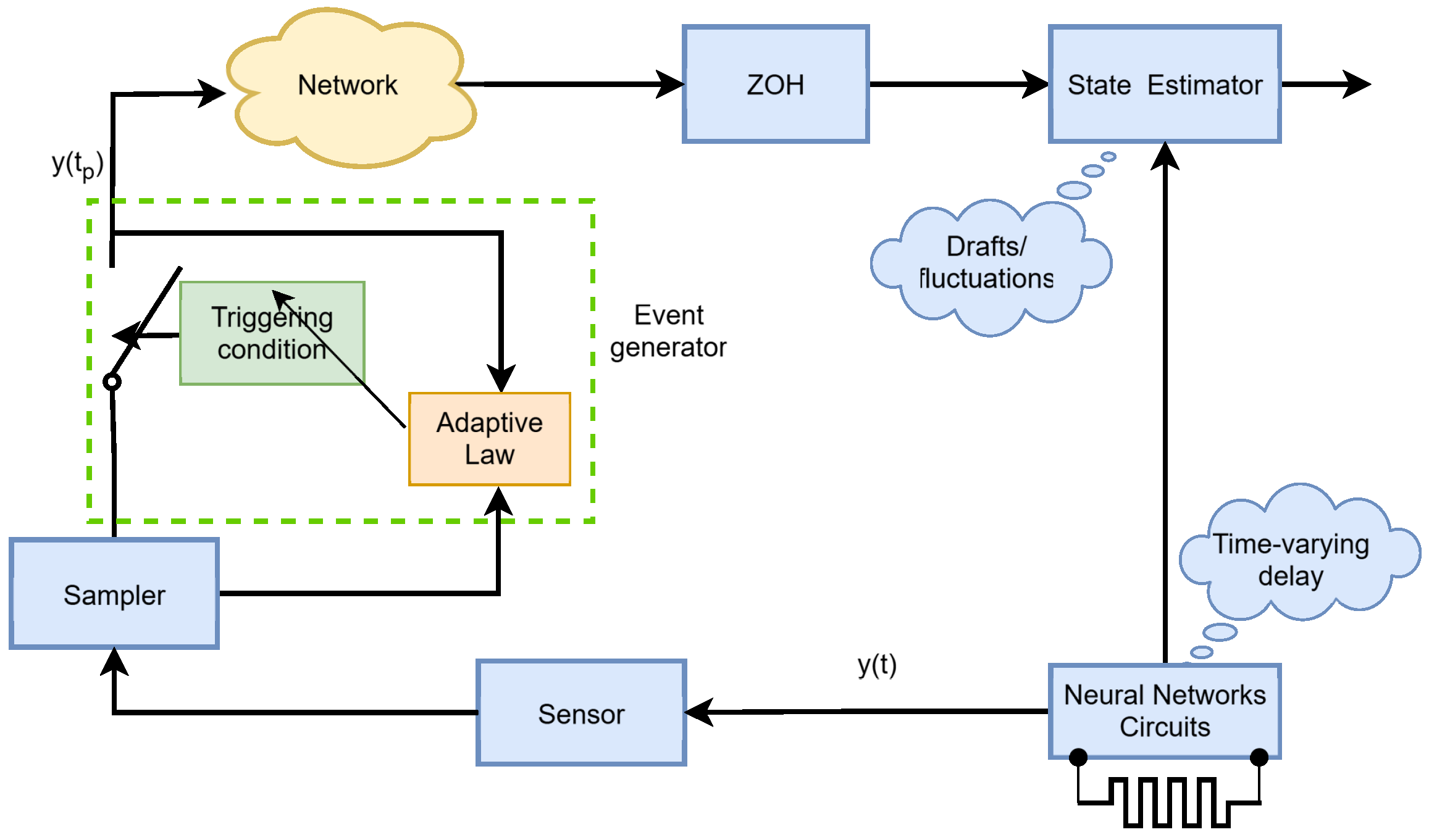
Considering network pressure and data transmission efficiency, this paper employs a novel triggering method—the Mittag–Leffler adaptive event-triggered mechanism—to determine whether output signals require transmission to the estimator. Based on this protocol, the state estimation structure diagram of FOMNNs is shown in Figure 2, and the triggering protocol is as follows:
y ( t p ) y ( t )   σ ( t ) · t α 1 E α , α ( λ t α ) 1 2 , λ > 0
where 0 < α < 1 , y ( t p ) represents the latest released output signals, t p ( p N ) denotes the release time of the event trigger, in which σ ( t ) is the adaptive threshold parameter satisfying σ ( t ) = σ 0 σ 1 1 + y ( t p ) y ( t ) 2 y ( t p ) y ( t ) > 0 . The parameters σ 0 and σ 1 are known constants.
For the sake of convenience, we define e s ( t ) y ( t p ) y ( t ) . According to the triggering protocol (11), the next release time can be described as
t p + 1 = inf t > t p , e s ( t ) > σ ( t ) · t α 1 E α , α ( λ t α ) 1 2 .
Based on the above analysis, the actual input to the expected estimator is
y ( t p ) = D 1 q ( t ) + D 2 q ( t d ( t ) ) + e s ( t ) .
Remark 3.
To conserve network resources, the static event-triggered method has frequently been applied to fractional-order systems [20,36,37,38]. In recent years, the dynamic event-triggered mechanism has garnered significant attention from researchers, leading to numerous important find-ings [28,29,39,40]. However, the existing dynamic event-triggered schemes are applicable only to integer-order systems and cannot be directly extended to fractional-order systems.
Remark 4.
In this paper, the AETM is employed, in which a dynamically varying threshold is introduced. In contrast to the triggering protocol mentioned in [31,34,41], the Mittag–Leffler function is utilized instead of the exponential function e t , which is more general in this paper.
Define r ( t ) q ( t ) q ^ ( t ) , g ˜ ( r ( t ) ) g ( q ( t ) ) g ( q ^ ( t ) ) , g ˜ ( r ( t d ( t ) ) ) g ( q ( t d ( t ) ) ) g ( q ^ ( t d ( t ) ) ) . Combining (7) and (9), the error dynamics can be obtained as:
D α r ( t ) = ( C + K ˜ D 1 ) r ( t ) K ˜ D 2 r ( t d ( t ) ) + A g ˜ ( r ( t ) ) K ˜ e s ( t ) + B g ˜ ( e ( t d ( t ) ) ) + Δ B g ( q ( t d ( t ) ) ) + Δ A g ( q ( t ) ) + ϑ ( t ) ,
where K ˜ = K + β ¯ Δ K , ϑ ( t ) = β ˜ ( t ) Δ K ( D 1 r ( t ) + D 2 r ( t d ( t ) ) ) , β ˜ ( t ) = β ¯ β ( t ) .
Let ν ( t ) col q ( t ) , r ( t ) , φ g ( t ) col g ( q ( t ) ) , g ˜ ( r ( t ) ) , φ g ( t d ( t ) ) col g ( q ( t d ( t ) ) ) , g ˜ ( r ( t d ( t ) ) ) . Combining (7) and (14), the augmented system can be obtained:
D α ν ( t ) = C ˜ ν ( t ) K ˜ d ν ( t d ( t ) ) + A ˜ φ g ( t ) + B ˜ φ g ( t d ( t ) ) I ˜ K ˜ e s ( t ) + ϑ ˜ ( t ) ,
where
C ˜ = C 0 0 C + K ˜ D 1 , A ˜ = A + Δ A 0 Δ A A , B ˜ = B + Δ B 0 Δ B B , K ˜ d = 0 0 0 K ˜ D 2 , ϑ ˜ ( t ) = β ˜ ( t ) I ˜ K ˜ D ¯ 1 ν ( t ) + D ¯ 2 ν ( t d ( t ) ) , D ¯ 1 = [ 0 D 1 ] , D ¯ 2 = [ 0 D 2 ] , I ˜ = 0 I T T .
Lemma 1
([42]). If a vector ξ ( t ) is continuous and differential, there exists a positive matrix P satisfying
1 2 D α ξ T ( t ) P ξ ( t ) ξ T ( t ) P D α ξ ( t ) , α ( 0 , 1 )
Lemma 2
([32]). There exist scalars a > 0 , b > 0 , c R such that the following equation holds for all n N :
0 t E a , b ( c θ a ) θ b 1 d θ = t b E a , b + 1 ( c t a ) .
Lemma 3
([32]). Consider a class of FO differential equations: D α ν ( t ) = a ν ( t ) + ( t ) . Then, the solution can be expressed as
ν ( t ) = ν ( t 0 ) E α ( a ( t t 0 ) α ) + α t 0 t ( t θ ) α 1 E α , α ( a ( t θ ) α ) ( θ ) d θ ,
In particular, the function ( · ) is continuous, and a R .
Definition 3.
If the following equation holds true:
lim t + ν ( t ) 2 = 0
Then, the augmented system (15) is asymptotically stable in the mean-square sense.

3. Main Results

In this section, we address the stability problem of the augmented system (15). By employing the fractional-order Lyapunov direct method and linear matrix inequality techniques, we derive a delay and order-dependent sufficient condition that guarantees the augmented system (15) is asymptotically stable in the mean square sense.
Theorem 1.
Assume that the estimator gain matrix K and Δ K are given and the Assumption 1 holds. For the given scalars d > 0 , the augmented system (15) is asymptotically stable if there exist positive definite matrices P R 2 n × 2 n and W = W 1 W 2 W 3 R 4 n × 4 n , any matrices Υ R 8 n × 8 n , Π R n × n , diagonal matrices Θ 1 > 0 , Θ 2 > 0 . Θ 1 > 0 , Θ 2 > 0 such that
Ω ^ = Ω ˜ + Υ < 0 ,
Υ Π > 0 ,
where
Ω ˜ = F 1 F 2 F 3 , F 1 = Ω ˜ 1 , 1 Ω ˜ 1 , 2 Ω ˜ 2 , 2 , F 2 = Ω ˜ 1 , 3 P B ˜ 0 Ω ˜ 2 , 4 , F 3 = Θ 2 , 2 0 Θ ˜ 2 , 2 , Θ 1 , 1 = Θ 1 L 0 0 Θ 2 L , Θ ˜ 1 , 1 = Θ 1 L 0 0 Θ 2 L , Θ 1 , 2 = Θ 1 L + 0 0 Θ 2 L + , Θ 2 , 2 = Θ 1 0 0 Θ 2 , Θ ˜ 1 , 2 = Θ 1 L + 0 0 Θ 2 L + , Θ ˜ 2 , 2 = Θ 1 0 0 Θ 2 , Ω ˜ 1 , 1 = P C ˜ C ˜ T P + d α α 1 W 1 Θ 1 , 1 + P , Ω ˜ 1 , 2 = d α α 1 W 2 T P K ˜ d , Ω ˜ 2 , 2 = P Θ ˜ 1 , 1 + d α α 1 W 3 , Ω ˜ 2 , 4 = Θ ˜ 1 , 2 , Ω ˜ 1 , 3 = P A ˜ Θ 1 , 2 , L = diag μ 1 + μ 1 , μ 2 + μ 2 , , μ n + μ n , L + = diag μ 1 + + μ 1 2 , μ 2 + + μ 2 2 , , μ n + + μ n 2 .
Proof. 
Construct a Lyapunov function of the following form:
V ( t ) = ν T ( t ) P ν ( t )
According to Lemma 1, we have
D α V ( t ) E ν T ( t ) P D α ν ( t ) + ( D α ν ( t ) ) T P ν ( t ) = 2 E { ν T ( t ) P [ C ˜ ν ( t ) K ˜ d ν ( t d ( t ) ) + A ˜ φ g ( t ) + B ˜ φ g ( t d ( t ) ) I ˜ K ˜ e s ( t ) + ϑ ˜ ( t ) ] }
For any matrix W R 4 n × 4 n 0 , the following equation holds:
t d t ( t τ ) α 1 ς T ( t ) W ς ( t ) d τ t d ( t ) t ( t τ ) α 1 ς T ( t ) W ς ( t ) d τ = d α α 1 ς T ( t ) W ς ( t ) + ς T ( t ) W ς ( t ) ( t τ ) α α | τ = t d ( t ) τ = t = d α α 1 ς T ( t ) W ς ( t ) d α ( t ) α 1 ς T ( t ) W ς ( t ) 0 ,
where ς ( t ) ν T ( t ) ν T ( t d ( t ) ) T .
From Assumption 1, there exist diagonal matrices Θ 1 > 0 , Θ 2 > 0 , Θ 1 > 0 , Θ 2 > 0 such that the following inequality holds:
q ( t ) g ( q ( t ) ) T Θ 1 L Θ 1 L + Θ 1 q ( t ) g ( q ( t ) ) 0 ,
r ( t ) g ˜ ( r ( t ) ) T Θ 2 L Θ 2 L + Θ 2 r ( t ) g ˜ ( r ( t ) ) 0 ,
q ( t d ( t ) ) g ( q ( t d ( t ) ) ) T Θ 1 L Θ 1 L + Θ 1 q ( t d ( t ) ) g ( q ( t d ( t ) ) ) 0 ,
r ( t d ( t ) ) g ˜ ( r ( t d ( t ) ) ) T Θ 2 L Θ 2 L + Θ 2 r ( t d ( t ) ) g ˜ ( r ( t d ( t ) ) ) 0 .
then,
ν ( t ) φ g ( t ) T Θ 1 , 1 Θ 1 , 2 Θ 2 , 2 ν ( t ) φ g ( t ) 0 ,
ν ( t d ( t ) ) φ g ( t d ( t ) ) T Θ ˜ 1 , 1 Θ ˜ 1 , 2 Θ ˜ 2 , 2 ν ( t d ( t ) ) φ g ( t d ( t ) ) 0 .
According to [43], there exists a scalar q > 1 satisfying
V ( t + μ , ν ( t + μ ) ) < q V ( t , ν ( t ) ) , μ [ d , 0 ]
Based on the definition of V ( t , ν ( t ) ) , one gets
q ν T ( t ) P ν ( t ) ν T ( t d ( t ) ) P ν ( t d ( t ) ) 0 , β 0
From (19)–(27), when q 1 + , we have
D α V ( t ) E { ν T ( t ) ( P P C ˜ C ˜ T P + d α α 1 W 1 Θ 1 , 1 ) ν ( t ) + ν T ( t ) ( d α α 1 W 2 P K ˜ d ) ν ( t d ( t ) ) φ g T ( t ) Θ 2 , 2 φ g ( t ) + ν T ( t d ( t ) ) ( d α α 1 W 2 T K ˜ d T P ) ν ( t ) ν T ( t ) P I ˜ K ˜ e s ( t ) + ν T ( t ) ( P A ˜ Θ 1 , 2 ) φ g ( t ) + φ g T ( t ) ( A ˜ T P Θ 1 , 2 T ) ν ( t ) + ν T ( t ) P B ˜ φ g ( t d ( t ) ) + φ g T ( t d ( t ) ) B ˜ T P ν ( t ) e s T ( t ) K ˜ T I ˜ T P ν ( t ) φ g T ( t d ( t ) ) Θ ˜ 2 , 2 φ g ( t d ( t ) ) ν T ( t d ( t ) ) ( P + Θ ˜ 1 , 1 ) ν ( t d ( t ) ) φ g T ( t d ( t ) ) Θ ˜ 1 , 2 T ν ( t d ( t ) ) ν T ( t d ( t ) ) Θ ˜ 1 , 2 φ g ( t d ( t ) ) t d ( t ) t ( t τ ) α 1 ς T ( t ) W ς ( t ) d τ } η ˜ ( t ) Ω ˜ η ˜ ( t ) ν T ( t ) P I ˜ K ˜ e s ( t ) e s T ( t ) K ˜ T I ˜ T P ν ( t ) ,
where η ˜ ( t ) ν T ( t ) , ν T ( t d ( t ) ) , φ g T ( t ) , φ g T ( t d ( t ) ) T .
Furthermore, there exist positive definite matrices Υ R 8 n × 8 n , Π R n × n satisfying
Υ Π > 0 ,
where = P , 0 , 0 , 0 T . Combining Equation (28) with the adaptive event trigger condition (11), we can further derive
D α V ( t ) η ˜ T ( t ) [ Ω ˜ + Υ ] η ˜ ( t ) + e s T ( t ) K ˜ T I ˜ T Π I ˜ K ˜ e s ( t ) η ˜ T ( t ) Ω ^ η ˜ ( t ) + λ max { K ˜ T I ˜ T Π I ˜ K ˜ } · t α 1 E α , α ( λ t α ) ,
where Ω ^ = Ω ˜ + Υ .
Assuming the positive definite matrix P has eigenvalues p i > 0 , we obtain ν T ( t ) P ν ( t ) λ max ( P ) ν T ( t ) ν ( t ) . When Ω ^ < 0 ,
D α V ( t ) λ max ( Ω ^ ) a V ( t ) + λ max { K ˜ T I ˜ T Π I ˜ K ˜ } · t α 1 E α , α ( λ t α ) = b V ( t ) + a σ 2 ( t ) t α 1 E α , α ( λ t α ) ,
where a = λ max ( Ω ^ ) e , b = λ max { K ˜ T I ˜ T Π I ˜ K ˜ } , e = λ max ( P ) .
Based on Lemma 3, one has
V ( t ) V ( 0 ) E α ( b t α ) + ( t ) ,
where ( t ) = 0 t ( t θ ) α 1 E α , α ( b ( t θ ) α ) ϱ σ 2 ( θ ) θ α 1 E α , α ( λ θ α ) d θ .
From Equation (11), we further derive that
( t ) ϱ σ ¯ 0 t Φ 1 ( t θ ) Φ 2 ( θ ) d θ ,
where Φ 1 ( t ) = t α 1 E α , α ( b t α ) , Φ 2 ( t ) = t α E α , α ( λ t α ) .
From the definition of the functions Φ 1 ( t ) and Φ 2 ( t ) , it follows that
lim t + Φ 1 ( t ) = 0 , lim t + Φ 2 ( t ) = 0 .
By the definition of the limit, for any constant k > 0 , there exists a constant T 0 > 0 such that when t > T 0 , Φ 1 ( t ) < k / 2 . It follows that
( t ) ϱ σ ¯ 0 T 0 Φ 1 ( t θ ) Φ 2 ( θ ) d θ + T 0 t Φ 1 ( t θ ) Φ 2 ( θ ) d θ .
then,
0 T 0 Φ 1 ( t θ ) Φ 2 ( θ ) d θ Φ 1 ( t T 0 ) 0 T 0 θ α 1 E α , α ( λ θ α ) d θ = Φ 1 ( t T 0 ) T 0 α E α , α + 1 ( λ T 0 α ) .
Similarly, for a constant k of the same magnitude, there exists T 1 > T 0 such that Φ 1 ( t T 0 ) k / 2 . Consequently, we have
0 T 0 Φ 1 ( t θ ) Φ 2 ( θ ) d θ k 2 T 0 α E α , α + 1 ( λ T 0 α ) , t > T 1
and
T 0 t Φ 1 ( t θ ) Φ 2 ( θ ) d θ = 0 t T 0 Φ 1 ( τ ) Φ 2 ( t τ ) d τ Φ 2 ( T 0 ) 0 t Φ 1 ( τ ) d τ Φ 2 ( T 0 ) t T 0 t Φ 1 ( τ ) d τ κ t α E α , α + 1 ( b t α ) .
Furthermore, there exist constants ϑ and T 2 > 0 such that t α E α , α + 1 ( λ t α ) ϑ , satisfying:
T 2 t Φ 1 ( t θ ) Φ 2 ( θ ) d θ ϵ ϑ , t > T 2
Combining (33) and (37), one gets
0 t Φ 1 ( t θ ) Φ 2 ( θ ) d θ ϵ ( T 0 α E α , α + 1 ( b T 0 α ) + ϑ ) ,
where t > T = max T 1 , T 2 .
Then, we have
lim t + 0 t Φ 1 ( t θ ) Φ 2 ( θ ) d θ = 0 ,
and
lim t + V ( 0 ) E α ( λ t α ) = 0 .
Combining Equations (38) and (39), we obtain lim t + V ( t ) = 0 . It is not difficult to conclude that
lim t + ν ( t ) 2 = 0 .
By the Definition 3, the augmented system (15) is asymptotically stable in the mean square sense.
Based on the conclusion given by Theorem 1, we proceed to design a fractional-order nonfragile estimator for system (1).
Theorem 2.
Assume that the Assumption 1 holds. For the given scalars d > 0 , the augmented system (15) is asymptotically stable if there exist positive definite matrices P = d i a g P 1 , P 2 R 2 n × 2 n and W = W 1 W 2 W 3 R 4 n × 4 n , any matrices Υ R 8 n × 8 n , Π R n × n , diagonal matrices Θ 1 > 0 , Θ 2 > 0 . Θ 1 > 0 , Θ 2 > 0 , and a constant u 1 > 0 , u 2 > 0 satisfying the following linear matrix inequality:
Ω ¯ u 1 Y 1 T X 1 u 2 Y 2 T X 2 u 1 I 0 0 0 u 1 I 0 0 u 2 I 0 u 2 I < 0 ,
Υ Π > 0 ,
where
Ω = Ξ 1 Ξ 2 Ξ 3 , Ξ 1 = Ω ¯ 1 , 1 Ω ¯ 1 , 2 Ω ¯ 2 , 2 , Ξ 2 = Ω ¯ 1 , 3 P B ¯ 0 Ω ¯ 2 , 4 , Ξ 3 = Θ 2 , 2 0 Θ ˜ 2 , 2 , A ¯ = A 0 0 A , B ¯ = B 0 0 B , X ¯ d = 0 0 0 X D 2 , X ¯ c = P 1 C 0 0 P 2 C + X D 1 , N ¯ b = N b 0 ; N b 0 , X 1 = H ¯ k T P 0 0 0 T , X 2 = H ¯ d T P 0 0 0 H ¯ d T P 0 0 0 T , Y 1 = N ¯ k 1 N ¯ k 2 0 0 , Y 2 = 0 0 N ¯ a 0 0 0 0 N ¯ b , Ω ¯ 1 , 1 = P X ¯ c X ¯ c T + d α α 1 W 1 Θ 1 , 1 , Ω ¯ 1 , 2 = X ¯ d + d α α 1 W 2 , Ω ¯ 1 , 3 = P A ¯ Θ 1 , 2 , Ω ¯ 2 , 2 = P Θ ˜ 1 , 1 , Ω ¯ 2 , 4 = Θ ˜ 1 , 2 .
Besides the matrices Θ 1 , 1 , Θ 1 , 2 , Θ 2 , 2 , Θ ˜ 1 , 1 , Θ ˜ 1 , 2 , Θ ˜ 2 , 2 , Υ , Π , have been defined in Theorem 1 and the estimator gain matrix K in (9) can be designed as:
K = P 2 1 X
Proof. 
First, Equation (16) in Theorem 1 can be rewritten as follows:
Ω ^ = Ω ¯ + Δ Ω ,
where
Ω = Ω ¯ 1 Ω ¯ 2 Ω ¯ 3 , Ω ¯ 1 = Ω ¯ 1 , 1 Ω ¯ 1 , 2 Ω ¯ 2 , 2 , Ω ¯ 2 = Ω ¯ 1 , 3 P B ¯ 0 Ω ¯ 2 , 4 , Ω ¯ 3 = Θ 2 , 2 0 Θ ˜ 2 , 2 , Δ Ω k = P Δ C d P Δ K d 0 0 0 0 0 0 0 0 0 0 0 0 0 0 , Δ Ω d = P Δ C 0 P Δ A P Δ B 0 0 0 0 0 0 0 0 0 0 0 0 , Ω ¯ 1 , 1 = P P ¯ C ¯ T P + d α α 1 W 1 Θ 1 , 1 + P , Ω ¯ 1 , 2 = P K ¯ d + d α α 1 W 2 , Ω ¯ 1 , 3 = P A ¯ Θ 1 , 2 , Ω ¯ 2 , 2 = P Θ ˜ 1 , 1 + d α α 1 W 3 , Ω ¯ 2 , 4 = Θ ˜ 1 , 2 .
Replacing the uncertain terms Δ A , Δ B with
Δ Ω k = P H ¯ k 0 0 0 Δ ¯ k N ¯ k 1 N ¯ k 2 0 0 = X 1 Δ ¯ k Y 1 ,
Δ Ω d = P H ¯ d P H ¯ d 0 0 0 0 0 0 Δ ¯ d 0 0 N ¯ a 0 0 0 0 N ¯ b = X 2 Δ ¯ d Y 2 ,
where
Δ ¯ k = 0 0 0 F k ( t ) , N ¯ k 1 = 0 0 0 β ¯ N k D 1 , Δ ¯ d = Δ ¯ a 0 Δ ¯ b , Δ ¯ a = F a ( t ) 0 0 F a ( t ) , Δ ¯ b = F b ( t ) 0 0 F b ( t ) , N ¯ k 2 = 0 0 0 β ¯ N k D 2 , H ¯ d = 0 0 0 H , H ¯ k = 0 0 0 H k , N ¯ a = N a 0 N a 0 , N ¯ b = N b 0 N b 0 .
By the S-produce lemma, if Ω ^ < 0 holds, then there exists two scalars u 1 > 0 , u 2 > 0 such that the following inequality holds:
Ω ^ = Ω ¯ + X 1 Δ ¯ k Y 1 + X 2 Δ ¯ d Y 2 + Y 1 T Δ ¯ k T X 1 T + Y 2 T Δ ¯ d T X 2 T Ω ¯ + u 1 T X 1 X 1 T + u 1 Y 1 T Y 1 + u 2 T X 2 X 2 2 T + u 2 Y 2 T Y 2 < 0 .
Define X = P 2 K . When (41) and (42) holds, by the Schur complement, we obtain (47) holds. Furthermore, it can be easily derived that the augmented system (15) is asymptotically stable in the mean square sense.

4. Numerical Examples

In this section, we will validate the effectiveness of the proposed event-based fractional-order nonfragile state estimator through two numerical simulation cases.
Example 1.
Consider the following 2-D FOMNNs models:
D α q 1 ( t ) = c 1 q 1 ( t ) + a 11 ( q 1 ( t ) ) g 1 ( q 1 ( t ) ) + a 12 ( q 1 ( t ) ) g 2 ( q 2 ( t ) ) + b 11 ( q 1 ( t ) ) g 1 ( q 1 ( t d ( t ) ) ) + b 12 ( q 1 ( t ) ) g 2 ( q 2 ( t d ( t ) ) ) , D α q 2 ( t ) = c 2 q 2 ( t ) + a 21 ( q 2 ( t ) ) g 1 ( q 1 ( t ) ) + a 22 ( q 2 ( t ) ) g 2 ( q 2 ( t ) ) + b 21 ( q 2 ( t ) ) g 1 ( q 1 ( t d ( t ) ) ) + b 22 ( q 2 ( t ) ) g 2 ( q 2 ( t d ( t ) ) ) ,
where
a 11 ( q 1 ( · ) ) = 0.50 , | q 1 ( · ) | 1 , 0.60 , | q 1 ( · ) | > 1 , a 12 ( q 1 ( · ) ) = 0.40 , | q 1 ( · ) | 1 , 0.10 , | q 1 ( · ) | > 1 , a 21 ( q 2 ( · ) ) = 0.20 , | q 2 ( · ) | 1 , 0.30 , | q 2 ( · ) | > 1 , a 22 ( q 2 ( · ) ) = 0.80 , | q 2 ( · ) | 1 , 1.20 , | q 2 ( · ) | > 1 , b 11 ( q 1 ( · ) ) = 0.60 , | q 1 ( · ) | 1 , 0.40 , | q 1 ( · ) | > 1 , b 12 ( q 1 ( · ) ) = 0.25 , | q 1 ( · ) | 1 , 0.15 , | q 1 ( · ) | > 1 , b 21 ( q 2 ( · ) ) = 0.30 , | q 2 ( · ) | 1 , 0.50 , | q 2 ( · ) | > 1 , b 22 ( q 2 ( · ) ) = 0.70 , | q 2 ( · ) | 1 , 0.35 , | q 2 ( · ) | > 1 ,
From the parameters given above, we obtain
A = 0.55 0.15 0.25 0.5 , B = 0.5 0.05 0.4 0.525 ,
In addition, we choose
C = 0.8 0 0 0.7 , D 1 = 0.03 0.1 0.2 0.5 , D 2 = 0.3 0.5 0 0.2 ,
H k = 0.5 0.5 T , N k = 0.2 0.2 , α = 0.98 , β ¯ = 0.5 . And the nonlinear function g ( q ( t ) ) = tanh ( 0.8 q 1 ( t ) ) , tanh ( q 2 ( t ) ) T , the time-varying delay d ( t ) = e t 1 + e t .
Using the LMI Toolbox in MATLAB (R2022b) to solve the linear matrix inequalities (41) and (42) yields the following partial feasible solutions:
P 1 = 0.7588 0.3966 0.3966 1.2902 , P 2 = 0.4330 0.1933 0.1933 0.6585 , X = 0.6530 1.7885 1.3407 4.2474 , Π = 1.9158 0.0118 0.0118 1.1090 , Θ 1 = 5.1543 0 0 2.7491 , Θ 2 = 2.1024 0 0 1.9785 , Θ 1 = 9.4025 0 0 6.8484 , Θ 2 = 2.6514 0 0 1.8391 .
and u 1 = 0.5758 , u 2 = 0.2535 . Then, the estimation gain K can be calculated as
K = 1.0014 0.8087 0.9087 3.3360 .
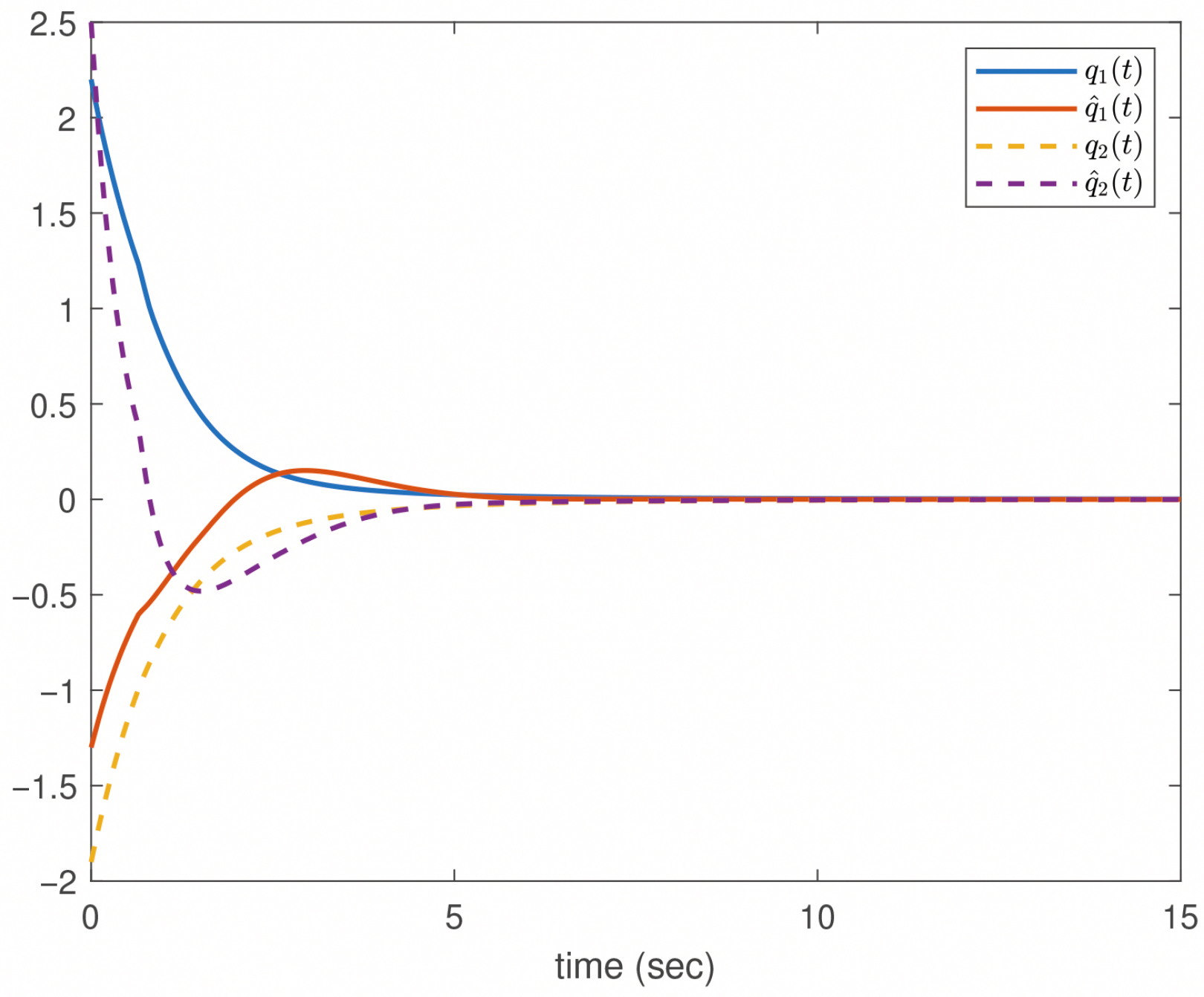
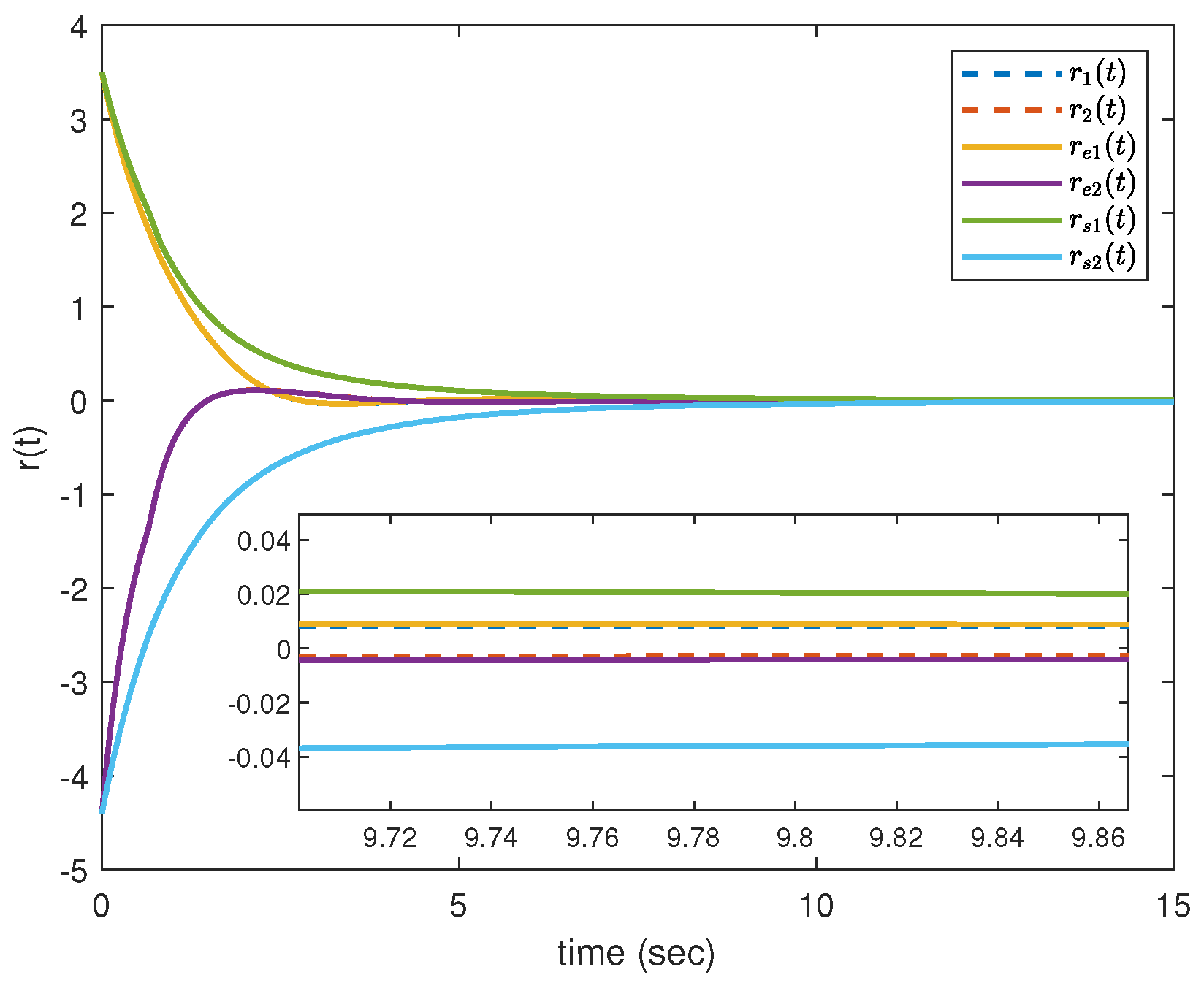
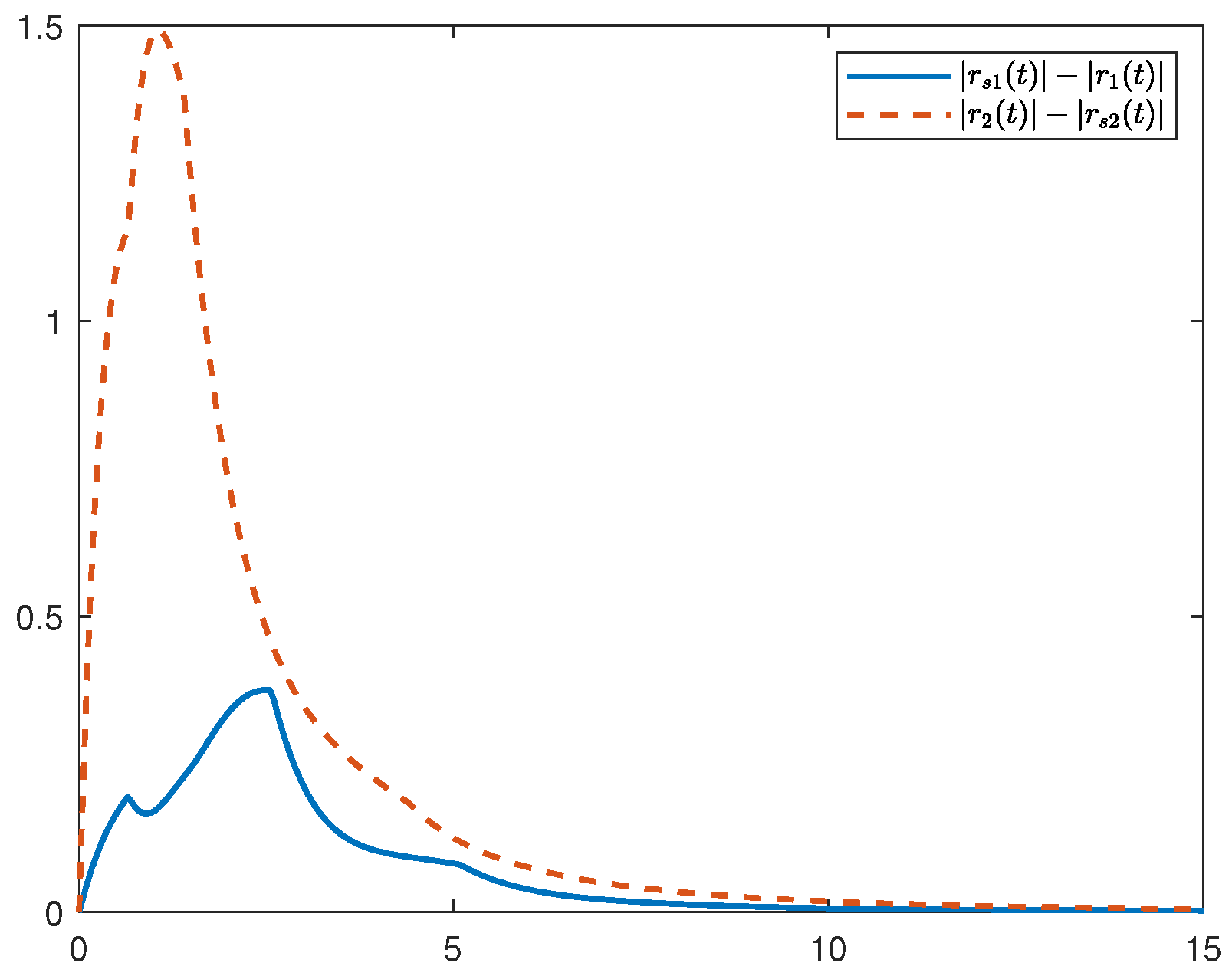
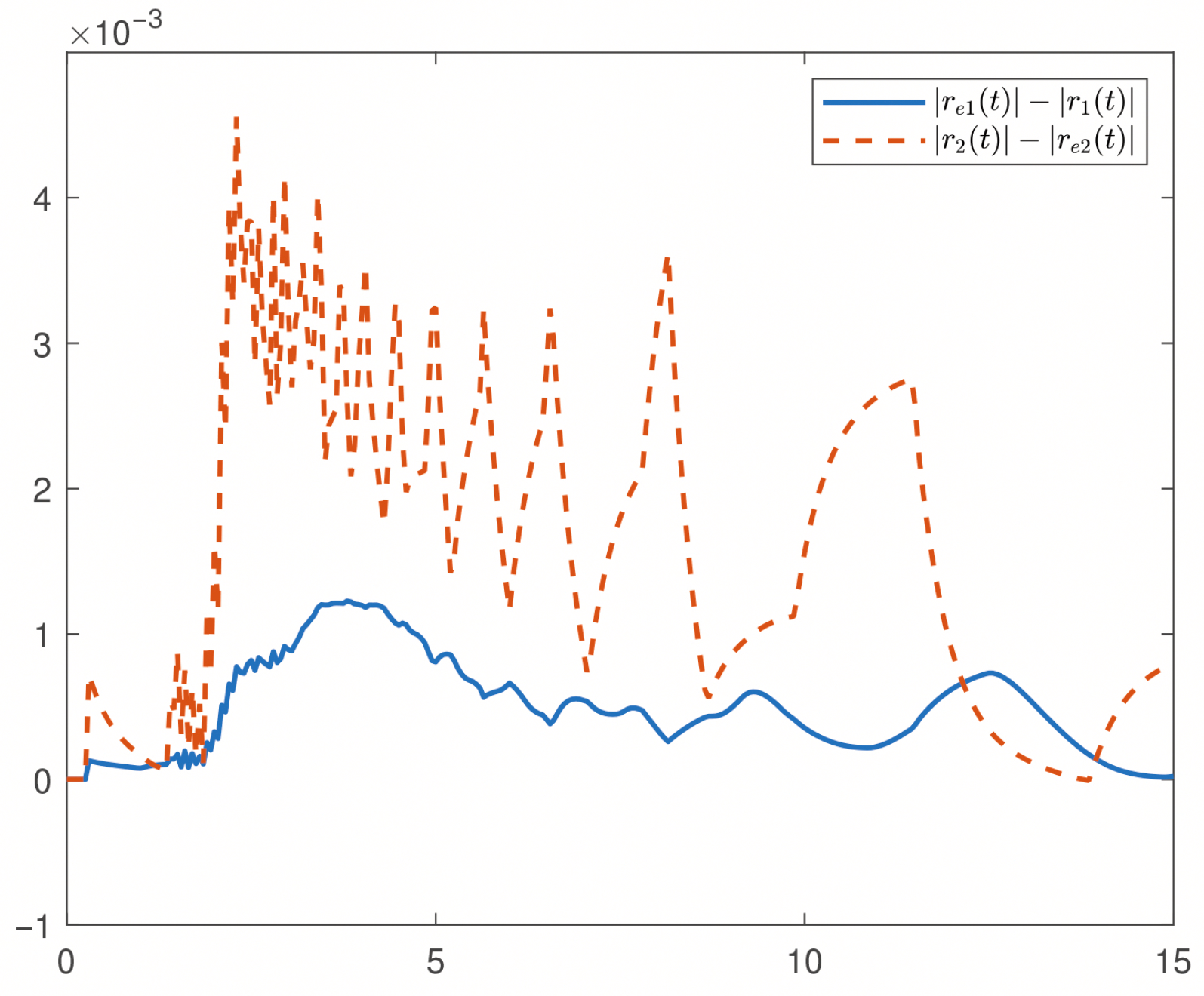
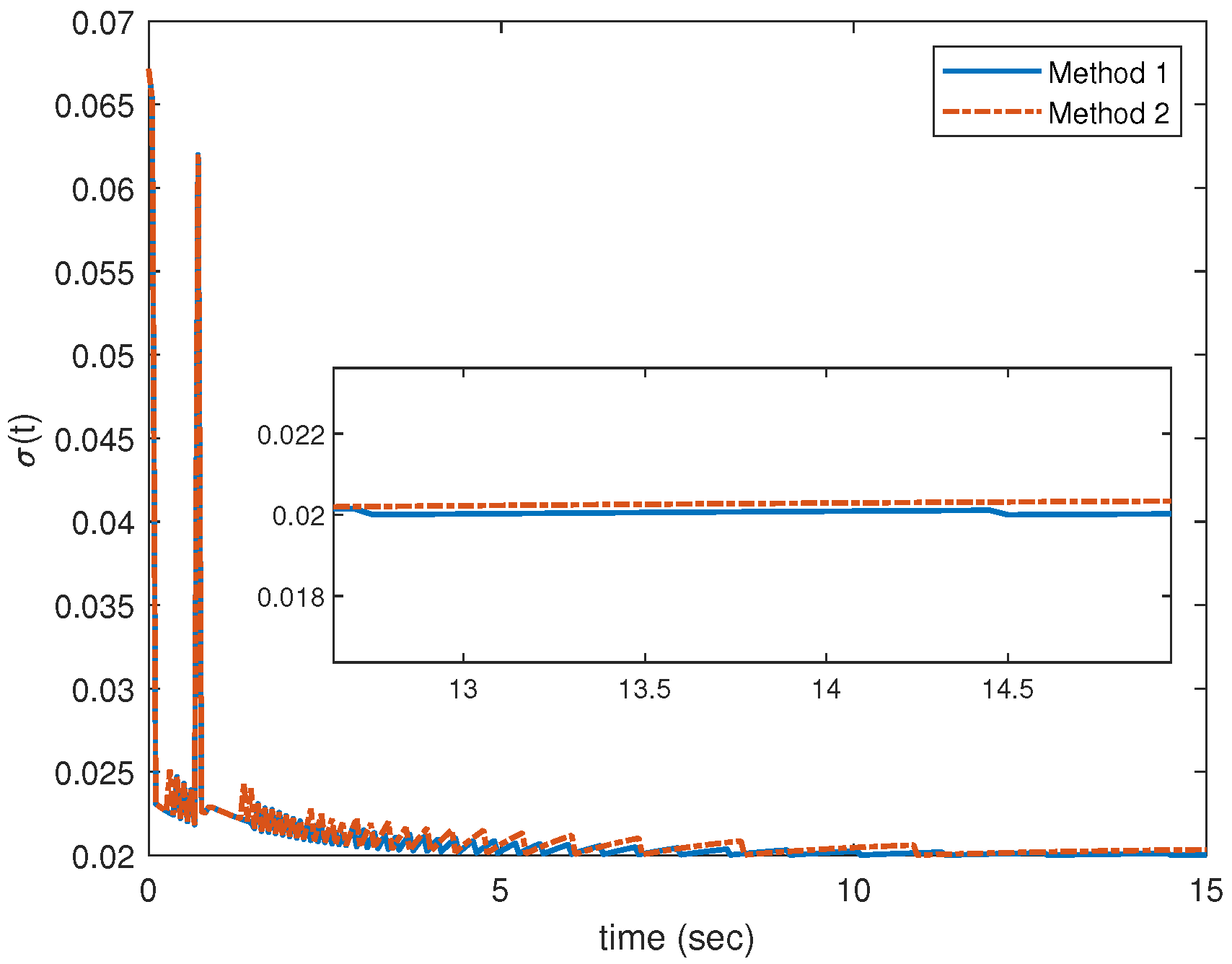
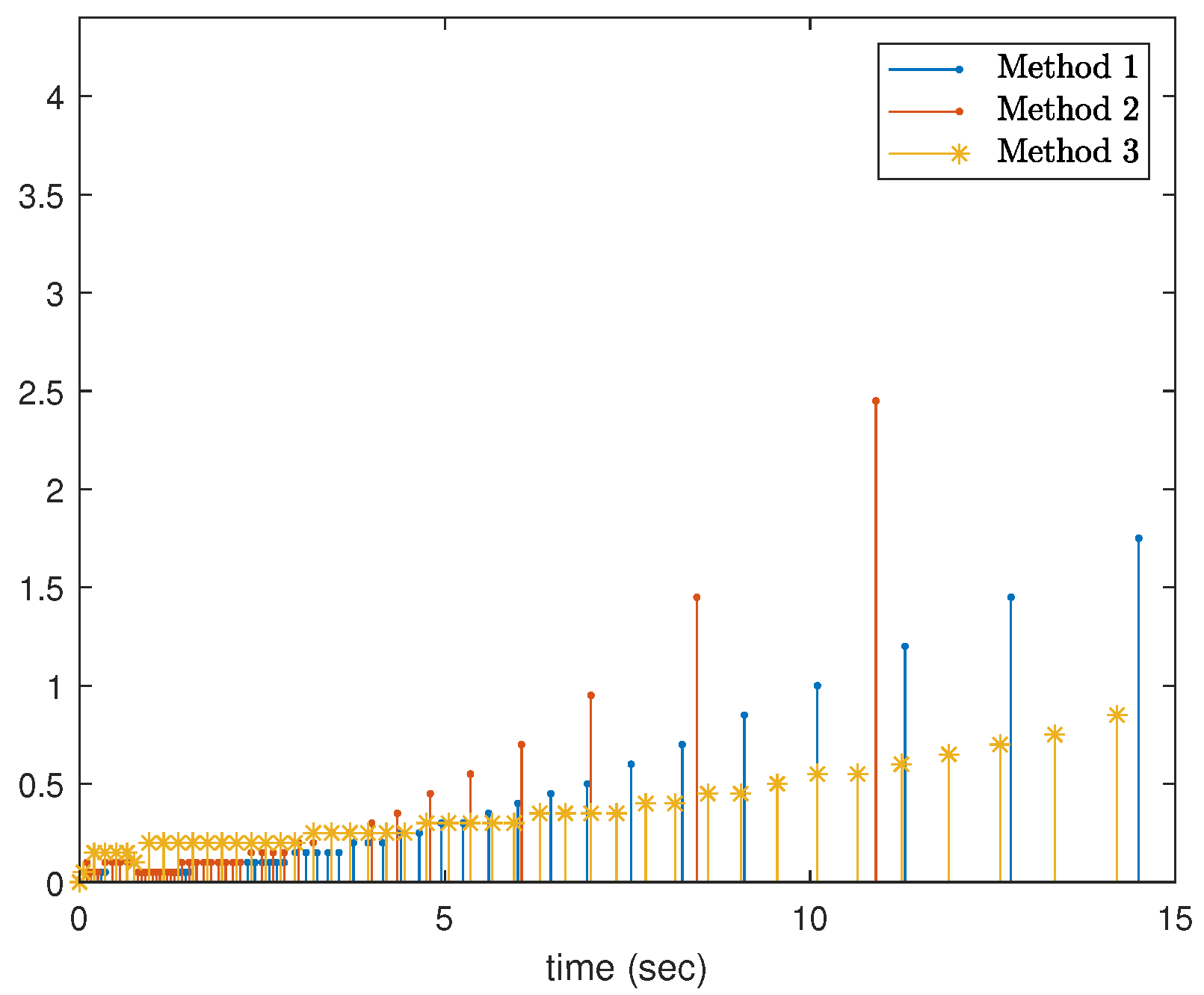
To validate the effectiveness of the estimation algorithm, select the initial values: q ( 0 ) = 2.2 , 1.9 T , q ^ ( 0 ) = 1.3 , 2.5 T . All the simulation results are shown in Figure 3, Figure 4, Figure 5, Figure 6, Figure 7 and Figure 8. It is noted that Figure 3 depicts the response curves of q 1 ( t ) and q 2 ( t ) and their estimated values q ^ 1 ( t ) , q ^ 2 ( t ) , respectively. Figure 4 depicts the error response curve between the state q i ( t ) and its corresponding estimated value q ^ i ( t ) ( i = 1 , 2 ) under the different triggering schemes employed in (11), [22,31], respectively. Figure 5 and Figure 6 show the curves of the absolute estimation errors for different methods. It is clear that the AETM in this paper demonstrates better estimation performance than the SETS and the event-triggered scheme proposed in [31], in which r e ( t ) and r s ( t ) stand for the estimation error based on the triggering scheme in [22,31]. Figure 7 illustrates the dynamic curve of the adaptive law σ ( t ) based on the methods in (11) and [31], respectively. The adaptive law evolves from an initial value of 0.06 to eventually stabilize around 0.02 . Figure 8 shows the release instant and trigger intervals of measured data under the different mechanisms maintained in (11), [22,31]. Under the AETM, 60 sampled data points are transmitted to the expected estimator, accounting for 20 % of the total sampled data. In contrast, under the SETS, 50 sampled data points are transmitted, representing 16.67 % of the total. While SETS conserves network resources more effectively, blindly reducing the number of triggers can lead to underutilization of system information, thereby diminishing estimation accuracy. Therefore, The AETM employed in this paper achieves a better balance between network resource usage and system performance. Table 1 shows the release number under the AETM with different α. The simulation data and corresponding response curves above demonstrate that the estimation method presented in Theorem 2 is valid.
Example 2.
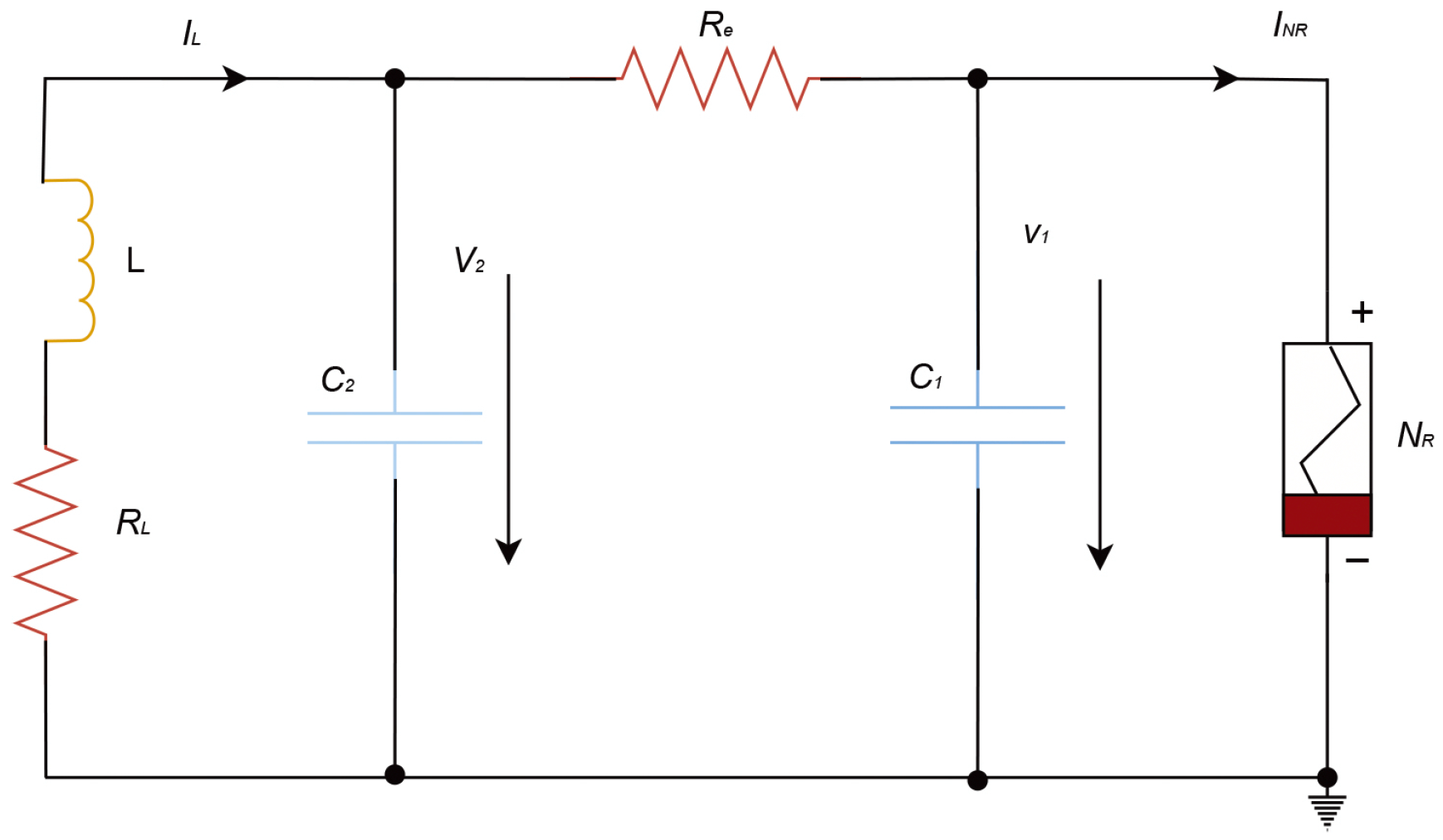
To demonstrate the validity and practicality of the estimation method proposed in this paper, consider the following Chua’s circuit system depicted in Figure 9. Based on the Kirchhoff’s laws, the circuit system can be described as
D α 1 V 1 ( t ) = 1 C 1 R e V 2 ( t ) V 1 ( t ) ψ ( V 1 ( t ) ) C 1 , D α 2 V 2 ( t ) = 1 C 2 R e V 1 ( t ) V 2 ( t ) + I L ( t ) C 2 , D α 3 I L ( t ) = 1 L V 2 ( t ) R L I L ( t ) ,
where V i ( · ) represents the voltages across capacitors C i , I L ( · ) denotes the current flowing through inductor L. Additionally, R L and R e are linear resistors. The nonlinear function ψ ( V 1 ( · ) ) describes the piecewise characteristics of the Zener diode. The current flowing through it can be described as follows.
Analogous to the approach in [44], system (49) can be rewritten as
D α 1 q 1 ( t ) = 1 C 1 R e + k 2 C 1 q 1 ( t ) + 1 C 1 R e q 2 ( t ) + k 1 k 2 C 1 g ( q 1 ( t ) ) , D α 2 q 2 ( t ) = 1 C 2 R e q 2 ( t ) 1 C 2 R e q 2 ( t ) + 1 C 2 q 3 ( t ) , D α 3 q 3 ( t ) = 1 L q 2 ( t ) R L L q 3 ( t ) ,
where g ( q 1 ( t ) ) = 1 2 ( | q 1 ( t ) + U p |     | q 1 ( t ) U p | ) , q 1 ( t ) = V 1 ( t ) , q 2 ( t ) = V 2 ( t ) , q 3 ( t ) = I ( t ) .
Choose the following parameter: α 1 = 0.98 , α 2 = 0.92 , α 3 = 0.9 , 1 C 1 = 10 , 1 C 2 = 1.0 , 1 L = 6 , 1 R e = 0.6 , k 1 = 1 7 , k 2 = 2 7 , U p = 1 . Then, the relevant parameters can be defined as
C = 1 C 1 R e + k 2 C 1 1 C 1 R e 0 1 C 2 R e 1 C 2 R e 1 C 2 0 1 L R L L , A = k 1 k 2 C 1 0 0 0 0 0 0 0 0 , B = 0 3 × 3 , H k = [ 0.1 , 0.1 , 0.1 ] T , N k = [ 0.2 0.2 ] , d = 1 , D 1 = 0.13 0.1 0.2 0.2 0.5 0.15 , D 2 = 0.3 0.1 0.1 0.15 0.2 0.05 .
Using the LMI Toolbox in MATLAB to solve the inequations (41) and (42) yields the following partial feasible solutions:
P 1 = 0.1685 0.0518 0.1304 0.0518 1.7900 0.1682 0.1304 0.1682 0.3523 , P 2 = 0.2414 0.0205 0.1048 0.0205 1.0255 0.1413 0.1048 0.1413 0.1740 , X = 1.0632 0.9561 0.0030 0.0983 1.0093 0.9909 , Π = 0.7163 0.3484 0.1250 0.3484 2.1275 0.2569 0.1250 0.2569 0.8638 ,
and u 1 = 0.5341 . The gain of the estimator can then be obtained as
K = 2.1688 1.6713 0.6513 0.5814 5.0219 5.1595 .
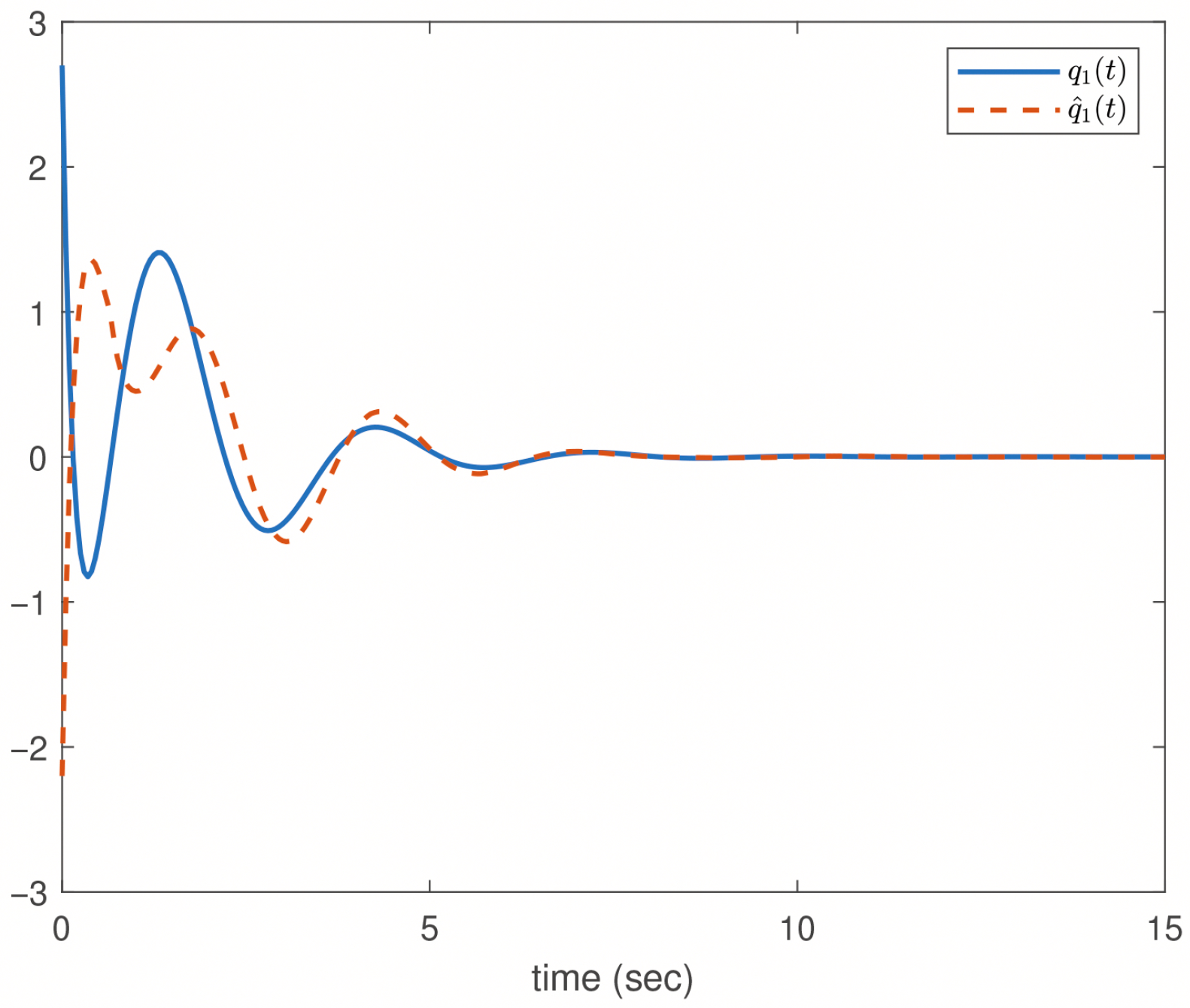
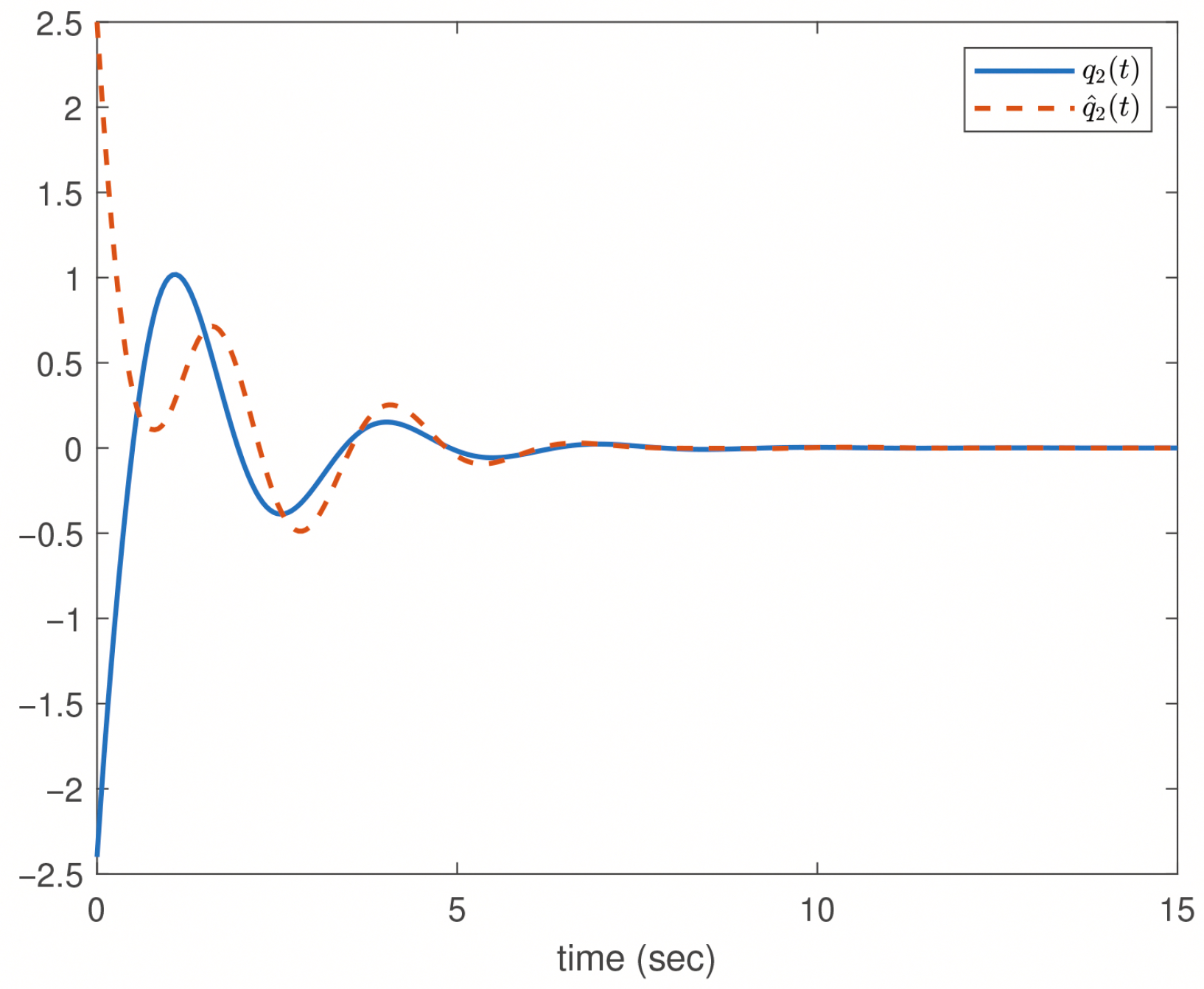
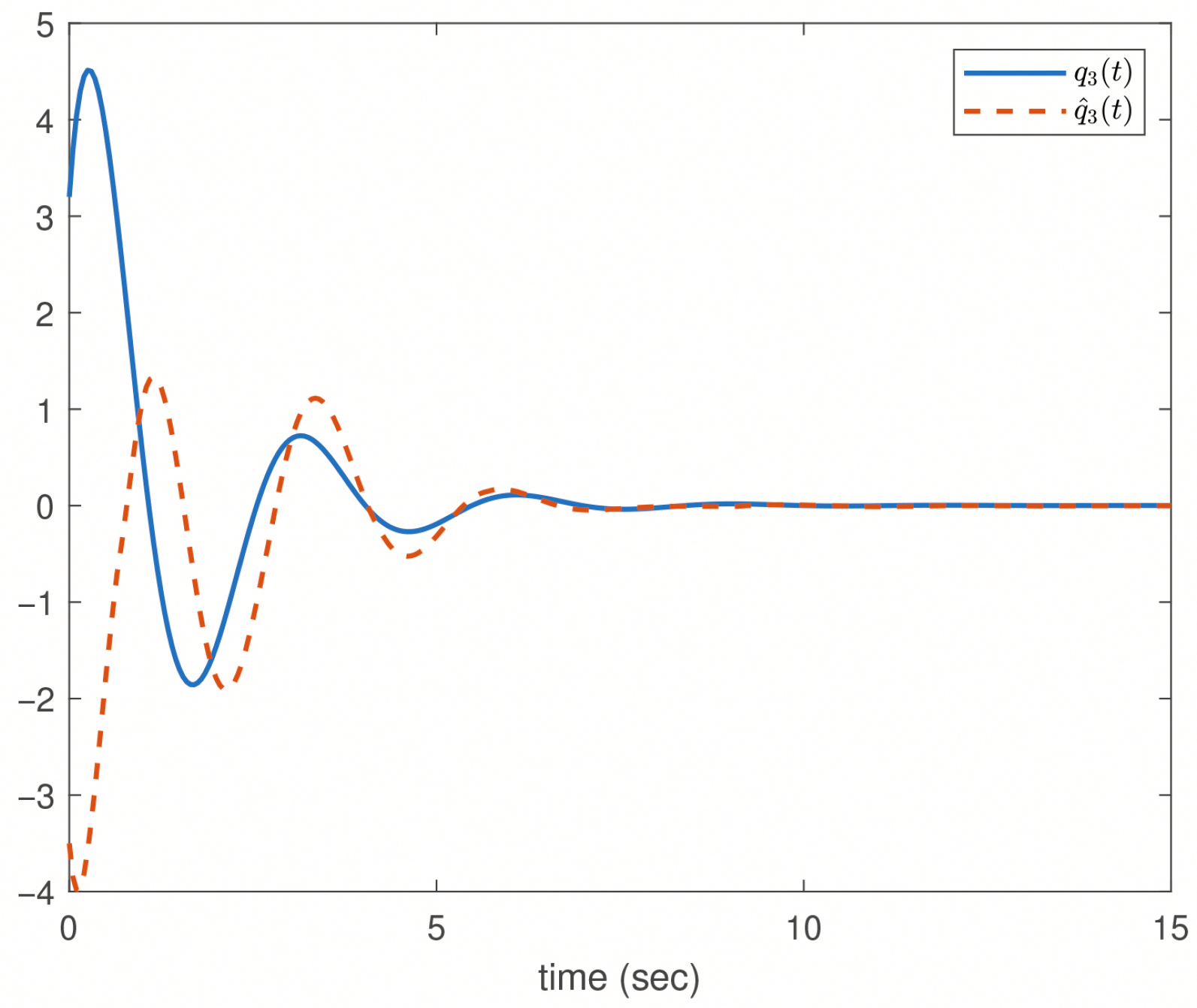
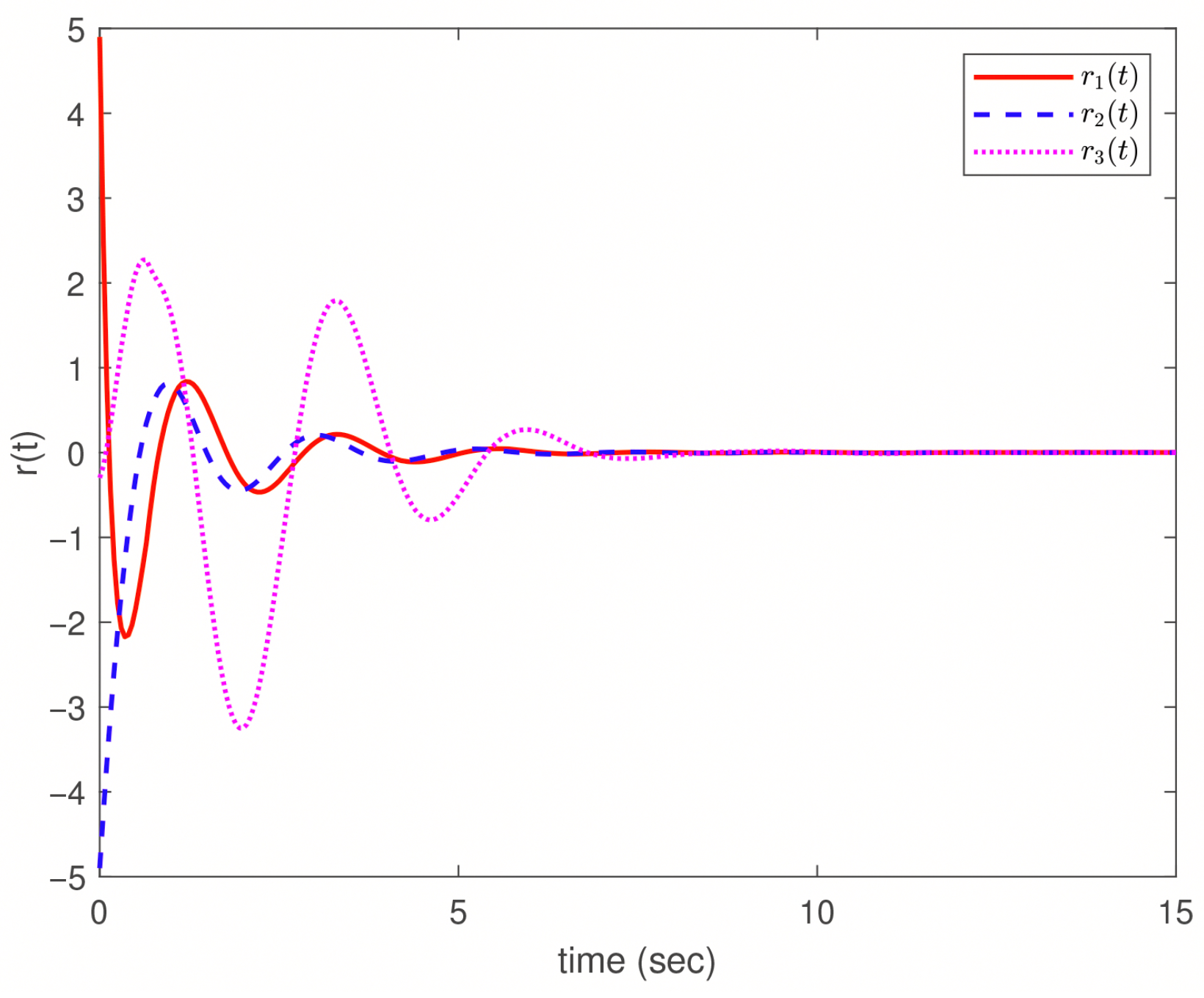
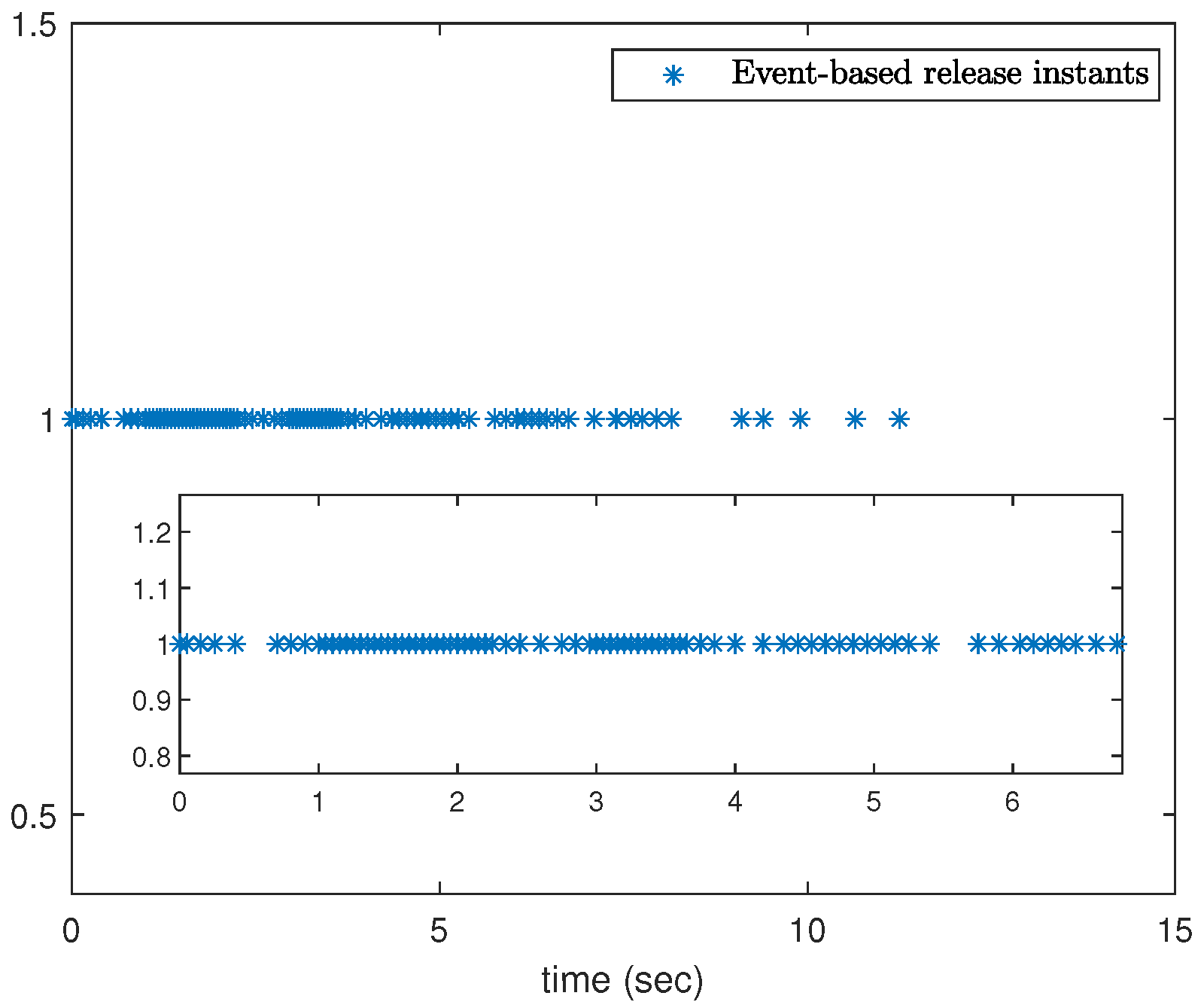
To validate the effectiveness of the designed expectation estimator, the initial values are chosen as q ( 0 ) = 2.7 , 2.4 , 3.2 T , q ^ ( 0 ) = [ 2.2 , 2.5 , 3.5 ] T , with a sampling period = 0.05 . The simulation results are shown in Figure 10, Figure 11, Figure 12, Figure 13 and Figure 14. Figure 10, Figure 11 and Figure 12, respectively, depict the trajectories of q i ( t ) and q ^ i ( t ) ( i = 1 , 2 , 3 ) . Figure 13 depicts the error response. Figure 14 shows the triggering instants. As can be seen from Figure 14, 89 events are transmitted to the estimator by the AETM method, which implies a data transmission rate of 29.67 % . Compared with the time sampling method, the amount of transmitted data has been reduced by 70.33 % . Therefore, the estimation method proposed in Theorem 2 is valid.

5. Conclusions

This paper investigates the SE problem for FOMNNs with random gain fluctuations using the LMI method. According to the available output measurements, a nonfragile state estimator has been proposed to estimate the neuron states of FOMNNs. Considering the signal transmission burden in network communication, an event-triggered method is utilized. For the complex condition, the AETM has been employed instead of the static event-triggered scheme to develop a nonfragile fractional-order state estimator. Subsequently, two delay and order-dependent conditions are derived to ensure the stability of the augmented system via an LMI approach. Finally, the proposed estimation method is applied to Chua’s circuit, which verifies its effectiveness and practicality. In future work, we will apply this approach to fractional-order systems with parameter uncertainties or other complex networks. Additionally, as a networked system, the phenomenon of cyber-attacks may be addressed in the next work.

Author Contributions

Conceptualization, Y.L.; Methodology, Q.N., X.S. and J.Z.; Software, X.S., Y.Z. and J.Z.; Investigation, X.S.; Writing—original draft, Q.N.; Writing—review & editing, Y.L., C.Z. and Y.Z.; Funding acquisition, Q.N. All authors have read and agreed to the published version of the manuscript.

Funding

This work was supported in part by the Natural Science Foundation of Henan under Grant 242300420398, by the High Level Talents Research and Startup Foundation Projects for Doctors of Zhoukou Normal University under Grant ZKNUC23012.

Data Availability Statement

Data are contained within the article. Data sharing is not applicable to this article.

Conflicts of Interest

The authors declare no conflict of interest.

References

  1. Ni, X.; Goodwine, B. Damage modeling and detection for a tree network using fractional-order calculus. Nonlinear Dyn. 2020, 101, 875–891. [Google Scholar] [CrossRef]
  2. Riaz, M.; Khan, Z.A.; Ahmad, S.; Ateya, A.A. Fractional-order dynamics in epidemic disease modeling with advanced perspectives of fractional calculus. Fractal Fract. 2024, 8, 291. [Google Scholar] [CrossRef]
  3. Xia, H.; Ke, Y.; Liao, R.; Sun, Y. Fractional order calculus enhanced dung beetle optimizer for function global optimization and multilevel threshold medical image segmentation. J. Supercomput. 2025, 81, 90–151. [Google Scholar] [CrossRef]
  4. Farman, M.; Akgül, A.; Saleem, M.U.; Imtiaz, S.; Ahmad, A. Dynamical behaviour of fractional-order finance system. Pramana 2020, 94, 164. [Google Scholar] [CrossRef]
  5. Liu, P.; Kong, M.; Zeng, Z. Projective Synchronization Analysis of Fractional-Order Neural Networks with Mixed Time Delays. IEEE Trans. Cybern. 2020, 52, 6798–6808. [Google Scholar] [CrossRef] [PubMed]
  6. Shao, X.; Lu, Y.; Zhang, J.; Lyu, M.; Yang, Y. Quantized Nonfragile State Estimation of Memristor-Based Fractional-Order Neural Networks with Hybrid Time Delays Subject to Sensor Saturations. Fractal Fract. 2024, 8, 343. [Google Scholar] [CrossRef]
  7. Shen, Y.; Zhu, S.; Liu, X.; Wen, S. Multiple Mittag-Leffler Stability of Fractional-Order Complex-Valued Memristive Neural Networks with Delays. IEEE Trans. Cybern. 2023, 53, 5815–5825. [Google Scholar] [CrossRef]
  8. Huang, W.; Song, Q.; Zhao, Z.; Liu, Y.; Alsaadi, F.E. Robust stability for a class of fractional-order complex-valued projective neural networks with neutral-type delays and uncertain parameters. Neurocomputing 2021, 450, 399–410. [Google Scholar] [CrossRef]
  9. Strukov, D.B.; Snider, G.S.; Stewart, D.R.; Williams, R.S. The missing memristor found. Nature 2008, 453, 80–83. [Google Scholar] [CrossRef]
  10. Durtschi, B.D.; Chrysler, A.M. Overview of RFID Applications Utilizing Neural Networks. IEEE J. Radio Freq. Identif. 2024, 8, 801–810. [Google Scholar] [CrossRef]
  11. Lin, J.; Li, X.; Ren, B.; Hao, X.; Wang, Q.; Yao, Y. Lightweight Reparameterizable Integral Neural Networks for Mobile Applications. In IEEE Transactions on Neural Networks and Learning Systems; IEEE: New York City, NY, USA, 2025; p. 13. [Google Scholar]
  12. Loganathan, A.; Kaliyaperumal, G. An adaptive HVS based video watermarking scheme for multiple watermarks using BAM neural networks and fuzzy inference system. Expert Syst. Appl. 2016, 63, 412–434. [Google Scholar] [CrossRef]
  13. Li, R.; Gao, X.; Cao, J. Non-fragile state estimation for delayed fractional-order memristive neural networks. Appl. Math. Comput. 2019, 340, 221–233. [Google Scholar]
  14. Fan, Y.; Huang, X.; Wang, Z.; Xia, J.; Shen, H. Quantized Control for Synchronization of Delayed Fractional-Order Memristive Neural Networks. Neural Process. Lett. 2020, 52, 403–419. [Google Scholar] [CrossRef]
  15. Li, L.; Xu, R.; Lin, J. Mean-square Stability in Lagrange Sense for Stochastic Memristive Neural Networks with Leakage Delay. Int. J. Control Autom. Syst. 2019, 17, 2145–2158. [Google Scholar] [CrossRef]
  16. Syed Ali, M.; Gunasekaran, N.; Joo, Y.H. Sampled-Data State Estimation of Neutral Type Neural Networks with Mixed Time-Varying Delays. Neural Process. Lett. 2019, 50, 357–378. [Google Scholar] [CrossRef]
  17. Cheng, J.; Liang, L.; Yan, H.; Cao, J.; Tang, S.; Shi, K. Proportional-Integral Observer-Based State Estimation for Markov Memristive Neural Networks with Sensor Saturations. IEEE Trans. Neural Netw. Learn. Syst. 2022, 35, 405–416. [Google Scholar]
  18. Li, J.; Dong, H.; Wang, Z.; Bu, X. Partial-Neurons-Based Passivity-Guaranteed State Estimation for Neural Networks with Randomly Occurring Time Delays. IEEE Trans. Neural Netw. Learn. Syst. 2020, 31, 3747–3753. [Google Scholar] [PubMed]
  19. Mäkilä, P.M.; Paattilammi, J. Non-fragile Robust Controller Design. In Digital Controller Implementation and Fragility: A Modern Perspective; Springer: London, UK, 2001; pp. 161–181. [Google Scholar]
  20. Shao, X.; Lyu, M.; Zhang, J. Nonfragile estimator design for fractional-order neural networks under event-triggered mechanism. Discret. Dyn. Nat. Soc. 2021, 2021, 6695353. [Google Scholar] [CrossRef]
  21. Tan, Y.; Xiong, M.; Zhang, B.; Fei, S. Adaptive Event-Triggered Nonfragile State Estimation for Fractional-Order Complex Networked Systems with Cyber Attacks. IEEE Trans. Syst. Man Cybern. Syst. 2022, 52, 2121–2133. [Google Scholar] [CrossRef]
  22. Zha, L.; Fang, J.-A.; Liu, J.; Tian, E. Event-triggered non-fragile state estimation for delayed neural networks with randomly occurring sensor nonlinearity. Neurocomputing 2018, 273, 1–8. [Google Scholar] [CrossRef]
  23. Zhang, R.; Zeng, D.; Zhong, S.; Yu, Y. Event-triggered sampling control for stability and stabilization of memristive neural networks with communication delays. Appl. Math. Comput. 2017, 310, 57–74. [Google Scholar] [CrossRef]
  24. Shao, X.G.; Zhang, J.; Lu, Y.J. Event-based nonfragile state estimation for memristive recurrent neural networks with stochastic cyber-attacks and sensor saturations. Chin. Phys. B 2024, 33, 125–135. [Google Scholar] [CrossRef]
  25. Xu, B.; Li, B. Event-Triggered State Estimation for Fractional-Order Neural Networks. Mathematics 2022, 10, 325. [Google Scholar] [CrossRef]
  26. Yu, N.; Zhu, W. Event-triggered impulsive chaotic synchronization of fractional-order differential systems. Appl. Math. Comput. 2021, 388, 125554. [Google Scholar] [CrossRef]
  27. Li, Q.; Wang, Z.; Sheng, W.; Alsaadi, F.E.; Alsaadi, F.E. Dynamic event-triggered mechanism for H non-fragile state estimation of complex networks under randomly occurring sensor saturations. Inf. Sci. 2020, 509, 304–316. [Google Scholar] [CrossRef]
  28. Cheng, J.; Liang, L.; Park, J.H.; Yan, H.; Li, K. A Dynamic Event-Triggered Approach to State Estimation for Switched Memristive Neural Networks with Nonhomogeneous Sojourn Probabilities. IEEE Trans. Circuits Syst. I Regul. Pap. 2021, 68, 4924–4934. [Google Scholar] [CrossRef]
  29. Lu, H.; Xu, Y.; Song, X.; Zhou, W. Adaptive event-triggered H state estimation of semi-Markovian jump neural networks with randomly occurred sensor nonlinearity. Int. J. Robust Nonlinear Control 2022, 32, 6623–6646. [Google Scholar] [CrossRef]
  30. Shao, X.G.; Zhang, J.; Lu, Y.J. Event-based nonfragile state estimation for memristive neural networks with multiple time-delays and sensor saturations. Int. J. Syst. Sci. 2024, 33, 618–637. [Google Scholar] [CrossRef]
  31. Wang, F.; Yang, Y. Leader-following consensus of nonlinear fractional-order multi-agent systems via event-triggered control. Int. J. Syst. Sci. 2017, 48, 571–577. [Google Scholar] [CrossRef]
  32. Podlubny, I. Fractional Differential Equations: An Introduction to Fractional Derivatives, Fractional Differential Equations, to Methods of Their Solution and Some of Their Applications; Academic Press Inc.: San Diego, CA, USA, 1998; Volume 198. [Google Scholar]
  33. Wang, F.; Yang, Y.; Hu, M.; Xu, X. State estimation for fractional-order neural networks. Optik 2015, 126, 4083–4086. [Google Scholar] [CrossRef]
  34. Tri, V.V.; Huong, D.C.; Diep, P.N.N. State estimation problem for fractional-order neural networks using event-triggered state observers. Proc. Inst. Mech. Eng. Part I J. Syst. Control Eng. 2022, 237, 1078–1086. [Google Scholar] [CrossRef]
  35. Arik, S. Global robust stability of delayed neural networks. IEEE Trans. Circuits Syst. I Fundam. Theory Appl. 2003, 50, 156–160. [Google Scholar] [CrossRef]
  36. Xiong, M.; Tan, Y.; Du, D.; Zhang, B.; Fei, S. Observer-based event-triggered output feedback control for fractional-order cyber–physical systems subject to stochastic network attacks. ISA Trans. 2020, 104, 15–25. [Google Scholar] [CrossRef] [PubMed]
  37. Feng, T.; Wang, Y.E.; Liu, L.; Wu, B. Observer-based event-triggered control for uncertain fractional-order systems. J. Frankl. Inst. 2020, 357, 9423–9441. [Google Scholar] [CrossRef]
  38. Liu, J.; Xia, J.; Cao, J.; Tian, E. Quantized state estimation for neural networks with cyber attacks and hybrid triggered communication scheme. Neurocomputing 2018, 291, 35–49. [Google Scholar] [CrossRef]
  39. Zhang, H.; Zhu, J.; Lu, J.; Wei, Y.; Chu, Y. Adaptive event-triggered control of discrete-time networked systems against randomly occurring infinite distributed delays, random packet losses and sensor saturation. Int. J. Syst. Sci. 2019, 50, 2200–2215. [Google Scholar] [CrossRef]
  40. Ning, Z.; Wang, T.; Song, X.; Yu, J. Fault detection of nonlinear stochastic systems via a dynamic event-triggered strategy. Signal Process. 2020, 167, 107283. [Google Scholar] [CrossRef]
  41. Xiong, M.; Ju, G.; Tan, Y. Robust state estimation for fractional-order nonlinear uncertain systems via adaptive event-triggered communication scheme. IEEE Access 2019, 7, 115002–115009. [Google Scholar] [CrossRef]
  42. Aguila-Camacho, N.; Duarte-Mermoud, M.A.; Gallegos, J.A. Lyapunov functions for fractional order systems. Commun. Nonlinear Sci. Numer. Simul. 2014, 19, 2951–2957. [Google Scholar] [CrossRef]
  43. Yang, D.; Hu, C.; Wang, Z.; Liang, X. New global stability criteria of neural networks with time delays. In Proceedings of the 2008 7th World Congress on Intelligent Control and Automation, Chongqing, China, 25–27 June 2008; pp. 5317–5320. [Google Scholar]
  44. Xu, Y.; Yang, C.; Zhou, L.; Ma, L.; Zhu, S. Adaptive event-triggered synchronization of neural networks under stochastic cyber-attacks with application to Chua’s circuit. Neural Netw. 2023, 166, 11–21. [Google Scholar] [CrossRef]
Figure 1. The current-voltage characteristic of a memristor [15].
Fractalfract 10 00081 g001
Figure 2. Diagram of event-triggered FOMNNs.
Fractalfract 10 00081 g002
Figure 3. Trajectories of state q ( t ) and q ^ ( t ) .
Fractalfract 10 00081 g003
Figure 4. Estimation error r i ( t ) ( i = 1 , 2 ) with different methods.
Fractalfract 10 00081 g004
Figure 5. Trajectories of absolute value subtraction of r ( t ) and r s ( t ) .
Fractalfract 10 00081 g005
Figure 6. Trajectories of absolute value subtraction of r ( t ) and r e ( t ) .
Fractalfract 10 00081 g006
Figure 7. The trajectories of different adaptive laws σ ( t ) .
Fractalfract 10 00081 g007
Figure 8. Release instants and intervals under different mechanisms.
Fractalfract 10 00081 g008
Figure 9. Chua’s circuit.
Fractalfract 10 00081 g009
Figure 10. Trajectories of state q 1 ( t ) and q ^ 1 ( t ) .
Fractalfract 10 00081 g010
Figure 11. Trajectories of state q 2 ( t ) and q ^ 2 ( t ) .
Fractalfract 10 00081 g011
Figure 12. Trajectories of state q 3 ( t ) and q ^ 3 ( t ) .
Fractalfract 10 00081 g012
Figure 13. Estimation errors r i ( t ) ( i = 1 , 2 , 3 ) .
Fractalfract 10 00081 g013
Figure 14. The triggering instants under AETM.
Fractalfract 10 00081 g014
Table 1. The trigger information with different system orders α   ( β ¯ = 0.5 ) .
α 0.980.960.920.90.80.70.60.30.1
N max 606264656563614842
Disclaimer/Publisher’s Note: The statements, opinions and data contained in all publications are solely those of the individual author(s) and contributor(s) and not of MDPI and/or the editor(s). MDPI and/or the editor(s) disclaim responsibility for any injury to people or property resulting from any ideas, methods, instructions or products referred to in the content.