Article

Novel Criterion on Finite-Time Stability of Fractional-Order Time Delay Human Balancing Systems

by
Mihailo P. Lazarević
1,* and
Darko Radojević
2
1
Faculty of Mechanical Engineering, University of Belgrade, Kraljice Marije 16, 11120 Belgrade, Serbia
2
SC Center Pinki, Gradski Park, 11000 Belgrade, Serbia
*
Author to whom correspondence should be addressed.
Fractal Fract. 2026, 10(2), 130; https://doi.org/10.3390/fractalfract10020130

Submission received: 15 January 2026 / Revised: 10 February 2026 / Accepted: 18 February 2026 / Published: 20 February 2026

Abstract

This paper studies the issues of human balancing and stability in the sagittal plane using fractional and integer order time delay feedback control. The neural-mechanical model of human balance is represented as an inverted pendulum controlled by torque. We present a finite-time stability (FTS) analysis for closed-loop neutral time delay systems (NFOTDSs) with fractional order 1 < β < α 2 . By employing a generalized Gronwall inequality, we derive new FTS criteria for these systems in terms of the Mittag-Leffler function. Finally, a suitable numerical example is presented to show the effectiveness of the proposed method.

1. Introduction

In the biomechanics of humans, it is well known that human balance is essential for daily activities and human mobility. Balance is a complex process that involves multiple biomechanical mechanisms, allowing the human body to maintain an upright position [1]. Conversely, issues with human balance and stability involve challenges in maintaining an upright posture. The upright position is inherently unstable, as even the slightest deviation from a perfectly upright position accelerates the body towards the ground under the influence of the force of gravity. Stabilizing unstable nonlinear systems is a highly important task in engineering and science. Especially, it is observed that it is more efficient to start quick movements from an unstable position in any desired direction than from a stable one [2]. Typically, the inverted pendulum biomechanical model serves as a starting point for discussions on how humans maintain balance during standing and locomotion [3]. Furthermore, it has been observed that it is necessary to apply control continuously in order to achieve stabilization of the upright position, i.e., stabilization of unstable equilibria using feedback control is an important task [4]. It is also detected that the existing human reaction time allows for the consideration of time delay effects in a control problem. In general, time delays can induce system instabilities, bifurcations, and chaotic motion [5].
Conversely, when used appropriately, for example stabilizing an inverted pendulum [6], time delays can enhance system stability, suppress oscillations, and reduce unstable behavior in time delay feedback control (TDFC) [7]. Namely, the delayed signal in the delay feedback control provides a quality prediction of the current acceleration, velocity and position, based on their delayed values [8]. Recently, in solving the stabilization of vertical posture of humans in the sagittal plane, time delay feedback control a P D D 2 ) type is applied taking into account its position, speed, and acceleration [8,9].
Fractional calculus (FC) has received much attention in recent times. FC (or more precisely calculus of general order β R ) generalizes integer-order differentiation and integration to non-integer (fractional, real or complex) orders [10,11]. Over the last few decades, fractional-order dynamical systems (FODSs) have seen a surge in research [12]. They provide scientists with an improved modeling method to analyze systems with memory effects and long-range dependencies as well as hereditary properties. In the area of control engineering, fractional order controllers offer significant advantages over traditional integer-order controllers (like standard PID) due to extra tunable parameters (fractional integration/differentiation orders), leading to enhanced robustness, better disturbance rejection and improved performance [13]. Hence, compared to traditional PD-type TDFC, fractional-order TDFC (FOTDFC) increases the controllable parameters of the system and offers advantages in robustness and control accuracy, thereby enhancing the stability of the control system [14]. Recently, authors in [15] studied the interaction between fractional properties and time delays in physiological systems with special focus on application to the human neuromechanical homeostasis system, where time delays represent the response time of the nervous system and fractional properties play a role in modeling memory and history in motor control. Neutral fractional order time delay systems (NFOTDSs) enhance the modeling of biological systems by incorporating memory effects and transmission delays, providing more precise, non-local dynamics than integer-order models [16]. NFOTDSs specifically model systems in which the derivative of the state at the current time depends on the derivatives of the state at previous times, a characteristic commonly found in complex biological systems, such as in neural modeling. Unlike traditional models, fractional-order systems take into account the entire history of the process, making them ideal for systems with aftereffects, such as physiological processes.
Here, it is of interest to solve human balancing by applying fractional-order TDFC, which includes proportional-fractional order derivative-acceleration terms, i.e., P D β D 2 -type. Particularly, the stability of FOTDs is a complex field of study where stability criteria differ from integer-order systems [17]. Moreover, finite-time stability (FTS) in human balancing refers to the neuromuscular system’s ability to stabilize postural sway within a specific, limited duration, rather than over infinite time. It models postural control as a fast-converging, often nonlinear switched system that manages sway by utilizing proprioceptive feedback from muscles to maintain a stable, narrow range of motion. Specifically, FTS analysis of closed-loop neutral fractional order time delay systems (NFOTDSs) has been done as one of the important issues. Finally, a new FTS criterion for these systems is established by virtue of the generalized Gronwall inequality and the Mittag-Leffler function, respectively.
This paper is arranged as follows: Section 2 provides basic definitions, notations, and lemmas related to FC. The main results are developed in Section 3; using the generalized Gronwall inequality, we derive two sufficient conditions that ensure the finite-time stability (FTS) of closed NFOTDS. Section 4 presents a numerical example to validate the feasibility of the proposed stability criteria. Finally, Section 5 summarizes this contribution.

2. Preliminaries and Problem Statement

2.1. Preliminaries

This section is devoted to recalling some basic definitions of fractional calculus theory. In this paper, we use the norm that denotes any vector norm, i.e., 1 , 2 , or , the corresponding matrix norm induced by the equivalent vector norm, i.e., 1 ,   2 , or norm, respectively. Let C 0 , T , R n be the Banach space of vector-valued continuous functions from 0 , T to R n endowed with the infinity norm x C = sup t 0 , T x t for a norm . on R n .
Definition 1
([12]). The left Caputo fractional derivative of order  α , ( n 1 α < n + of the function  f t  is:
D t 0 , t α c f t = 1 Γ n α t 0 t t τ n α 1 f n τ d τ ,
where  f ( n ) ( τ ) = d n f ( τ ) / d τ n .
Definition 2
([18]). The Mittag-Leffler function with one parameter is given as:
E α h = k = 0 h k / Γ k α + 1 , α = 1 , E 1 h = e h , α > 0 , h C
Lemma 1
([18]).
I t α 0 D 0 α c f t = f t k = 0 n 1 t k k ! f k 0 , n 1 < α < n , t > 0
 when  1 < α < 2 , it yields
I t α 0 D 0 α c f t = f t f 0 t f 0 , t > 0
Lemma 2.
Let  α > β > 0 , n 1 < β < n  and  f t A C n a , b  . Then
I t α 0 D 0 β c f t = I t α β 0 f t k = 0 n 1 t k + α β Γ α β + k + 1 f k 0 .
Remark 1.
Assume that  1 < β < α < 2  ; then, we have:
I t α 0 D 0 β c f t = I t α β 0 f t f 0 t α β Γ α β + 1 f ( 1 ) 0 t α β + 1 Γ α β + 2 , t 0
Lemma 3
([19]). (Generalized Gronwall Inequality) Suppose  α > 0   w ( t ) , v ( t )  are nonnegative and locally integrable on  0 t < T , T +  and  g ( t )  is a nonnegative, nondecreasing continuous function defined on  0 t < T , g ( t ) M = c o n s t ,  α > 0  with
w ( t ) v ( t ) + g ( t ) 0 t t s α 1 w ( s ) d s
on this interval. Then
w ( t ) v ( t ) + 0 t n = 1 g ( t ) Γ α n Γ n α t s n α 1 v ( s ) d s , 0 t < T
Corollary 1.
Under the hypothesis of Lemma 3, let  v ( t )  be a nondecreasing function on  0 , T . Then it holds:
w t v ( t ) E α g ( t ) Γ α t α
 where  E α  is the Mittag-Leffler function.
Proof. 
The hypotheses imply
w ( t ) v ( t ) 1 + 0 t n = 1 g ( t ) Γ α n Γ n α t s n α 1 d s = v ( t ) n = 0 g ( t ) Γ α t α n Γ n α + 1 = v ( t ) E α g ( t ) Γ α t α .
Lemma 4
(an extended form of the GGI [20]). Suppose non-integer orders  α > 0 , β > 0 ,  and  v t  is a nonnegative function locally integrable on  0 , T ,  g 1 t  and  g 2 t  are nonnegative, nondecreasing, continuous functions defined on  0 , T ,  g 1 t N 1 ,   g 2 t N 2 , ( N 1 , N 2 = c o n s t ) . Suppose  w t  is nonnegative and locally integrable on  0 , T  with
w t v t + g 1 t 0 t t s α 1 w s d s + g 2 t 0 t t s β 1 w s d s , t 0 , T
It follows
w t v t + 0 t n = 1 g t n k = 0 n C n k Γ α n k Γ β k Γ n k α + k β t s n k α + k β 1 v s d s , t 0 , T
 where  g t = g 1 t + g 2 t  and  C n k = n n 1 n 2 n k + 1 / k ! .
Corollary 2.
Under the hypothesis of Lemma 4, let  v t  be a nondecreasing function on  0 , T . Then
w t v t E ϖ g t Γ α t α + Γ β t β ,   ϖ = m i n α , β

2.2. Dynamics of Neural-Mechanical Model of Human Balancing in the Sagittal Plane

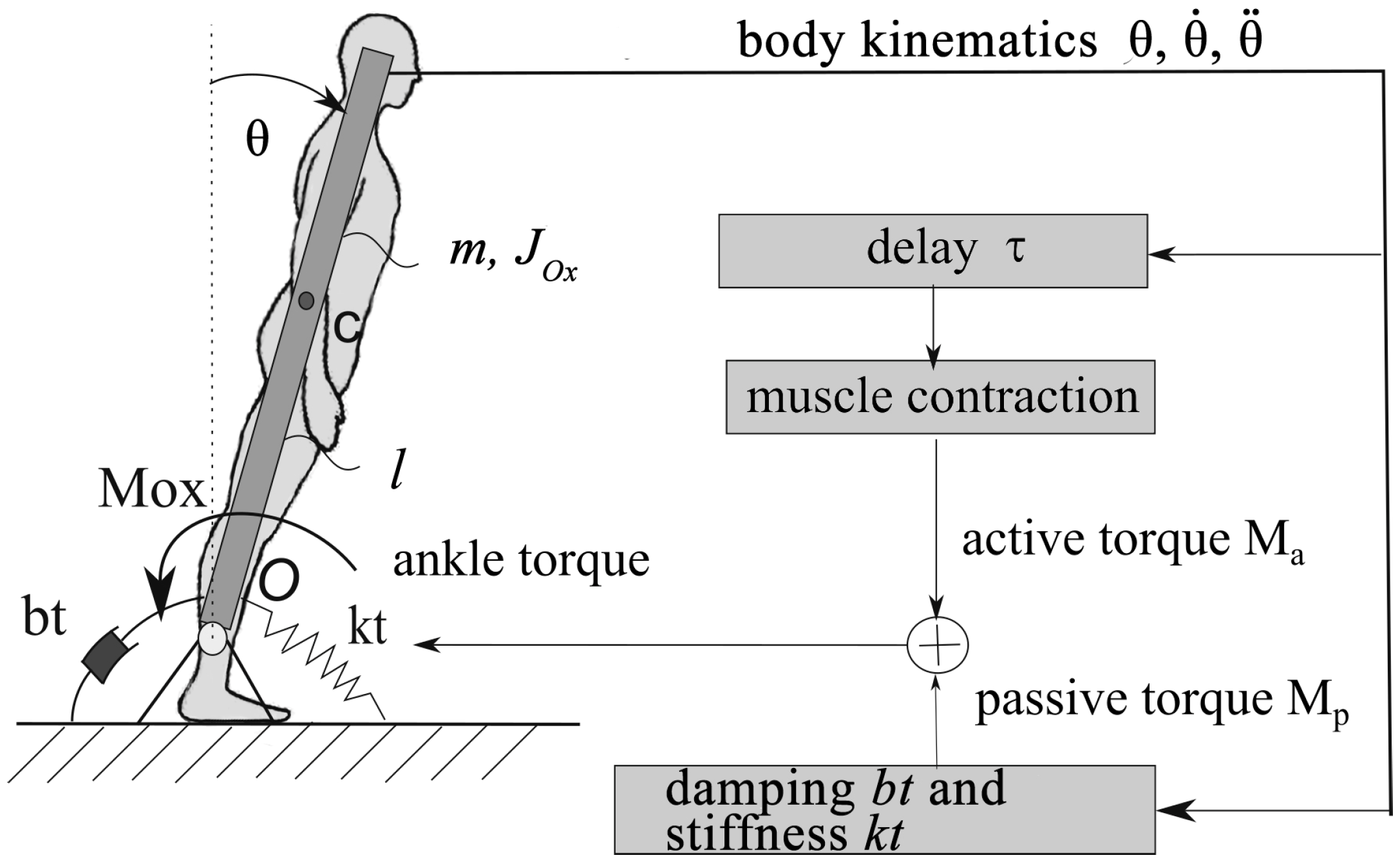
In biomechanics of the human locomotor system, balancing the human body in the sagittal plane is a complex biomechanical challenge to keep the body’s center of mass over its base of support. Figure 1 shows a corresponding neural-mechanical model of human balancing in the sagittal plane as an inverted pendulum with mass m and l representing the distance between the center of gravity C and the stationary point O, while J 0 x is the axial moment of inertia to the horizontal axis passing through the pivot point O [8,9]. The human body is controlled by torque M o x t , which consists of passive torque M p t and active torque M a t . The passive torque M p t depends on the ankle joints’ stiffness k t t and damping b t t of a torsional spring. According to [21], the authors concluded that the Achilles tendon, aponeurosis, and foot provide the ankle joint stiffness k t t and are not large enough to maintain balance against the moment due to the forces of gravity. Moreover, here it is assumed that the coefficients k t t , b t t = c o n s t are constants, and M p t can be presented as:
M p t = k t θ t + b t θ ˙ t
Hence, balancing the human body in the sagittal plane during quiet standing, it is necessary to add active control torque M a t . It is generated by the contractile elements of the ankle joint muscles [22] and controlled by the central nervous system based on sensory signals about the angle of rotation θ , angular velocity θ ˙ , and angular acceleration θ ¨ of the human body around the longitudinal horizontal axis.
The linear part of the saturated active torque [8] is given as follows:
M a t = k p θ t τ + k d θ ˙ t τ + k a θ ¨ t τ
where kp, kd and ka denote proportional gain, speed gain and acceleration gain, respectively. Time-delayed signals of θ , θ ˙ are provided by the vestibular system and proprioceptors, whereas Newton’s Second Law [21] states that the θ ¨ is related to information coming from mechanoreceptors.
Applying the theorem of angular momentum for the system about a fixed axis, we get the differential equation of motion as:
J o x θ ¨ t = m g l sin θ M p t M a t
Here, we study a more general case of balancing a human body in the sagittal plane, where the linearized active torque M a t includes a term with a derivative of fractional order β as follows:
M a t = k p θ t τ + k d D t β c θ t τ + k a θ ¨ t τ
for 0 < β < 2 and D t β c θ , denote Caputo’s derivative of the fractional order β [12].
Therefore, we study the linearized system Equation (16) assuming that s i n θ θ , b t 0 , and it can be represented as a fractional order neutral time delay differential equation (FNTDDE), because there is the highest derivative of the state variable a in delayed form:
θ ¨ m g l k t J o x θ = k p J o x θ t τ k d J o x D t β c θ t τ k a J o x θ ¨ t τ
or
x ¨ t c 4 x ¨ t τ = c 1 x t + c 2 x t τ + c 3 D t β c x t τ
where
x t = θ t , c 1 = m g l k t / J o x , c 2 = k p / J o x , c 3 = k d / J o x , c 4 = k a / J o x ,
One may observe that the desired equilibrium state of the human body standing in the sagittal plane presents trivial solution θ = 0 of the linearized Equation (19).

3. Main Results

3.1. FTS Analysis of Problem of Human Postural Balance in Sagittal Plane-Fractional Order Case

In this section, we study the finite-time stability (FTS) of a fractional order time delay dynamical system in closed-loop form Equation (19) with the associated continuous functions of the initial state x t as well as the first derivative of x ˙ t :
x t = ψ x t , x ˙ t = φ x t , t τ , 0 ,
Definition 3
([23,24]). The FNTDDE  1 < β < α 2 ,   delay system with state time delays given by nonhomogeneous state Equation (19) satisfying initial conditions Equation (21) is finite-time stable w.r.t.  δ , ε , t 0 , J , ,   0 < δ < ε ,   if and only if:
ρ < δ , t J x t < ε , t J = 0 , T , T > 0
 where  ρ = max ψ C , φ C  and  δ , ε  are positive constants.
Theorem 1.
The FNTDDE  1 < β < 2 , α = 2  time delay system given by the closed-loop state Equation (19) satisfying initial conditions Equation (21) is finite-time stable w.r.t.  δ , ε , t 0 , J , ,   0 < δ < ε ,   if the following condition holds:
1 1 c 4 1 + t 1 + c 4 + c 3 t 2 β Γ 3 β E β g t Γ 2 β t 2 β + Γ 2 t 2 < ε δ
where  g t = c 3 / Γ 2 β + c Σ 1 c 4 ,  c Σ = c 1 + c 2  and  c 4 < 1 .
Proof of Theorem 1.
Using Lemmas 1 and 2, we can obtain a solution of Equation (19) in the form of an equivalent Volterra integral equation, where t 0 = 0 :
x ( t ) = x 0 + x ˙ 0 t + c 4 x t τ c 4 ψ x τ c 4 t φ x τ c 3 ψ x τ t 2 β Γ 3 β + c 3 Γ 2 β 0 t t s 1 β x s τ d s + 0 t t s c 1 x s + c 2 x s τ d s
Applying the norm . and previous assumptions to the Equation (24), we obtain
x t x 0 + x ˙ 0 t + c 4 x t τ + c 4 ψ x τ + c 4 t φ x τ + c 3 ψ x τ t 2 β Γ 3 β + c 3 Γ 2 β 0 t t s 1 β x s τ d s + 0 t t s c 1 x s + c 2 x s τ d s
Taking into account that:
c 1 x t + c 2 x t τ c 1 x t + c 2 x t τ = c 1 x t + c 2 x t τ , it follows:
x t ψ x C 1 + c 4 + c 3 t 2 β Γ 3 β + φ x C t 1 + c 4 + c 4 x t τ + c 3 Γ 2 β 0 t t s 1 β x s τ d s + 0 t t s c 1 x s + c 2 x s τ d s
Hence, the nondecreasing function is introduced y t = sup ζ τ , t x ζ , t 0 , T , where, for t · 0 , t , the following conditions satisfy
x t * y t * , x t * τ y t *
From the above, using previously obtained inequalities, the expression Equation (26) can be reorganized as follows:
x t ψ x C 1 + c 4 + c 3 t 2 β Γ 3 β + φ x C t 1 + c 4 + c 4 y t + c 3 Γ 2 β 0 t t s 1 β y s d s + c Σ 0 t t s y s d s
where is c Σ = c 1 + c 2 . Also, for ν 0 , t we have
x ν ψ x C 1 + c 4 + c 3 ν 2 β Γ 3 β + φ x C ν 1 + c 4 + c 4 y ν + c 3 Γ 2 β 0 ν s 1 β y ν s d s + c Σ 0 ν s y ν s d s
Taking into account that a nonnegative function y t is increasing, then the functions 0 t s α β 1 y t s d s , 0 t s y t s d s , α = 2 , α > β > 0 , α β > 0 ,   are increasing with respect to t 0 . Also, 2 β > 0 ,   ν β t β , ν 2 β t 2 β it yields
0 ν s 1 β y ν s d s 0 t s 1 β y t s d s , 0 ν s 1 y ν s d s 0 t s 1 y t s d s ,
Further, based on the properties of the function y t , it follows that
y t = sup ν τ , t x ν max sup ν τ , 0 x ν , sup ν 0 , t x ν , max ψ x C , ψ x C 1 + c 4 + c 3 t 2 β Γ 3 β + φ x C t 1 + c 4 + c 4 y t + c 3 Γ 2 β 0 t t s 1 β y s d s + c Σ 0 t t s y s d s
= ψ x C 1 + c 4 + c 3 t 2 β Γ 3 β + φ x C t 1 + c 4 + c 4 y t + c 3 Γ 2 β 0 t t s 1 β y s d s + c Σ 0 t t s y s d s
or
y t 1 1 c 4 ψ x C 1 + c 4 + c 3 t 2 β Γ 3 β + φ x C t 1 + c 4 + c 3 Γ 2 β 0 t t s 1 β y s d s + c Σ 0 t t s y s d s
where it is assumed that condition 1 a 4 > 0 is fulfilled. Now, if we introduce ρ = max ψ C , φ C we can get
y t 1 1 c 4 ρ ω t + c 3 Γ 2 β 0 t t s 1 β y s d s + c Σ 0 t t s y s d s
where a nondecreasing function ω t = 1 + t 1 + c 4 + c 3 t 2 β / Γ 3 β , J 0 = 0 , T is introduced. Based on Lemma 4 for α = 2 > 0 , β > 0 , κ = m i n 2 , β = β , we obtain:
x t y t ρ ω t 1 c 4 E β g t Γ 2 β t 2 β + Γ 2 t 2
where g t = g 1 t + g 2 t = c 3 / Γ 2 β + c Σ 1 c 4 . According to Definition 3 we have
x t δ 1 1 c 4 1 + t 1 + c 4 + c 3 t 2 β Γ 3 β E β g t Γ 2 β t 2 β + Γ 2 t 2
Finally, using the basic condition of Theorem 1, we can obtain the required FTS condition:
x t < ε , t J .

3.2. FTS Analysis of Problem of Human Postural Balance in Sagittal Plane-Integer Order Case

In this subsection, we consider the case of the integer order β = 1 , where we have a closed integer order neutral time delay system (INTDS) that includes the integer order derivatives and in the form:
x ¨ t = c 1 x t + c 2 x t τ + c 3 x ˙ t τ + c 4 x ¨ t τ
with the associated continuous functions of the initial state x t as well as of the first derivative of x ˙ t :
x t = ψ x t , t τ , 0 ,   x   t = φ x t , t τ , 0
We give a new criterion for FTS of Equation (36) with the help of generalized Gronwall inequality.
Theorem 2.
The INTDS time delay system given by the closed-loop state Equation (37) satisfying initial conditions Equation (38) is finite-time stable w.r.t.  δ , ε , t 0 , J , ,   0 < δ < ε ,   if the following condition holds:
1 1 c 4 1 + c 4 1 + t + c 3 t e c Σ + c 3 t + t 2 / 1 c 4 < ε δ
 where are  c Σ = c 1 + c 2  and  c 4 < 1 .
Proof of Theorem 2.
Using Lemmas 1 and 2 (integer case), we can obtain a solution of Equation (36) in the form of an equivalent integral equation, where t 0 = 0 :
x t = x 0 + x ˙ 0 t + c 4 x t τ c 4 ψ x τ c 4 t φ x τ c 3 ψ x τ t + c 3 0 t x s τ d s + 0 t t s c 1 x s + c 2 x s τ d s
After applying the norm from the previous expression one can get:
x t x 0 + x ˙ 0 t + c 4 x t τ + c 4 ψ x τ + c 4 t φ x τ + c 3 ψ x τ t + c 3 0 t x s τ d s + 0 t t s c 1 x s + c 2 x s τ d s
Taking into account that a 1 x t + a 2 x t τ a 1 x t + a 2 x t τ it yields:
x t ψ x C 1 + c 4 + c 3 t + φ x C t 1 + c 4 + c 4 x t τ + c 3 0 t x s τ d s + 0 t t s c 1 x s + c 2 x s τ d s
Hence, nondecreasing function is introduced, y t = sup ζ τ , t x ζ , t 0 , T , where, for t · 0 , t , the following conditions satisfy Equation (27) and applying on Equation (42) we get
x t ψ x C 1 + c 4 + c 3 t + φ x C t 1 + c 4 + c 4 y t + c 3 0 t y s d s + c Σ 0 t t s y s d s
Following the steps of the proof from the previous Theorem 1, it follows
y t 1 1 c 4 ψ x C 1 + c 4 + c 3 t + φ x C 1 + c 4 t + c 3 1 c 4 0 t y s d s + c Σ 1 c 4 0 t t s y s d s
Introducing a function ω t Equation (45) that is nondecreasing as well as ρ = max ψ C , φ C we can get
ω t = ρ 1 c 4 1 + c 4 1 + t + c 3 t , c 4 < 1
and Equation (44) may be written as
y t ω t + c 3 1 c 4 0 t y s d s + c Σ 1 c 4 0 t t s y s d s .
Based on the generalized Gronwall inequality Lemma 4 for α = 2 > 0 , β = 1 > 0 , κ = m i n 2 , 1 = 1 we obtain
x t y t ω t E 1 g t t + t 2
ρ 1 c 4 1 + c 4 1 + t + c 3 t e c Σ + c 3 t + t 2 / 1 a 4
where is g t = c Σ + c 3 / 1 a 4 . Combining Equation (39) with Equation (47), we get x t < ε , t J . Hence, the proof is complete. □
Remark 2.
It is easy to show that the stability condition of Theorem 2 is a special case of the stability condition of Theorem 1 for the case  β = 1 .
Remark 3.
The FTS criteria obtained are delay-independent.

4. Numerical Example

Let us consider the human body in the balancing task in the sagittal plane. The following numerical values of the human body’s physical parameters are used in the balancing task: m g = 600 [ k g m / s 2 ] , J 0 x = 60 [ k g m 2 ] ,   k t = 471 , l = 1 [ m ] [9] and time delay τ = 0.1 [ s ] .
In particular, the interval values for the proportional, speed and acceleration gain parameters are known in advance: k p 0 , 3000 , k d 0 , 600 , k a 12 , 48 . Furthermore, one can calculate the value intervals for the coefficients as follows:
c 1 = 2.15 , c 2 = k p / J 0 0 , 50 , c 3 = k d / J 0 0 , 10 , c 4 = k a / J 0 0.2 , 0.8 ,
so that, for the adopted values k a = 12 , k d = 180 , k p = 780 , we have:
c 1 = c 1 = 2.15 , c 2 = c 2 = 13 , c 3 = c 3 = 3 , c 4 = c 4 = 0.167 .
Here, we test the first criterion from Theorem 1 where it is assumed that β = 1.7 with initial functions ψ x t = 0.01 , t 0.1 , 0 ; φ x t = 0.01 , t 0.1 , 0 , that is, ψ x C = 0.01 φ x C = 0.01 and ρ = max ψ C , φ C = 0.01 < δ = 0.02 where . norm is used. Let us choose δ = 0.02 and ε = 80 ; then, from inequality Equation (22), we can calculate that the estimated time of FTS is T e 0.122   s .
Remark 4.
The calculated time T e  is of the order of magnitude for the fastest human reaction time, which is approximately (0.1–0.12) s.
Sensitivity analysis was performed for the changes in Te, considering variations in the fractional order β and the control parameters ka for fixed kp, kd, and ε , δ (see Table 1). The highest value of Te is observed when β = 1.3 is used, with K a = 1 .

5. Conclusions

In this work, we applied a suitable fractional-order FOTDFC to address the human postural balance problem. The proposed TDFC, whether of fractional or integer order, P D β D 2 -type is equivalent to a predictive controller that utilizes delayed angular position, velocity, and acceleration to predict the actual state. FOTDFC controllers provide more tunable parameters, improving stability and robustness. Also, the suggested FOTDFC may enhance humanoid robot balancing by more effectively addressing memory effects and reaction delays than integer-order systems. Specifically, we analyzed the FTS of the considered closed-loop system by applying the generalized Gronwall inequality. Our findings present new sufficient conditions expressed as inequalities involving the Mittag-Leffler function, which ensure the FTS of the system, particularly for both fractional and integer orders. The two FTS criteria obtained are delay-independent, and future work will focus on exploring less conservative FTS criteria that are delay-dependent. Finally, we will provide a numerical example to illustrate the effectiveness and applicability of the proposed theoretical results. Future research will focus on fractional-order control and the stability of biological systems, such as epidemic models, which can be represented as NFOTDSs.

Author Contributions

Conceptualization, methodology, M.P.L.; formal analysis, software, M.P.L. and D.R.; investigation, writing the original draft, validation, D.R.; writing—review and editing, M.P.L.; supervision, M.P.L. All authors have read and agreed to the published version of the manuscript.

Funding

The research by M.P.M was supported in part by the Serbian Ministry of Science, Technological Development, and Innovations, according to Contract 451-03-34/2026-03/200105 from 5 February 2026.

Data Availability Statement

The original contributions presented in this study are included in the article. Further inquiries can be directed to the corresponding author.

Conflicts of Interest

Author Darko Radojević was employed by the SC Center Pinki, Zemun. The remaining authors declare that the research was conducted in the absence of any commercial or financial relationships that could be construed as a potential conflict of interest.

References

  1. Beretta, V.S.; Santos, P.C.R.; Orcioli-Silva, D.; Barbieri, F.A. Biomechanics of balance. In Gait, Balance, and Mobility Analysis, Theoretical, Technical, and Clinical Applications, 1st ed.; Stuart, S., Morris, R., Eds.; Academic Press: Cambridge, MA, USA, 2025; pp. 155–170. [Google Scholar]
  2. Yang, H.; Jiang, B.; Cocquempot, V. Stabilization of Switched Nonlinear Systems with Unstable Modes, 1st ed.; Springer: Cham, Switzerland, 2014. [Google Scholar] [CrossRef]
  3. Mergner, T.; Peterka, R.J. Human Sense of Balance. In Humanoid Robotics: A Reference, 1st ed.; Goswami, A., Vadakkepat, P., Eds.; Springer: Dordrecht, The Netherlands, 2017; pp. 1–38. [Google Scholar] [CrossRef]
  4. Sontag, E.D. Stability and Feedback Stabilization. In Encyclopedia of Complexity and Systems Science, 1st ed.; Meyers, R., Ed.; Springer: New York, NY, USA, 2009. [Google Scholar] [CrossRef]
  5. Zavarei, M.; Jamshidi, M. Time-Delay Systems: Analysis, Optimization and Applications, 1st ed.; North-Holland: Amsterdam, The Netherlands, 1987. [Google Scholar]
  6. Landry, M.; Campbell, S.A.; Morris, K.; Aguilar, C.O. Dynamics of an inverted pendulum with delayed feedback control. SIAM J. Appl. Dyn. Syst. 2005, 4, 333–351. [Google Scholar] [CrossRef]
  7. Munoa, J.; Beudaert, X.; Erkorkmaz, K.; Iglesias, A.; Barrios, A.; Zatarain, M. Active suppression of structural chatter vibrations using machine drives and accelerometers. CIRP Ann. 2015, 64, 385–388. [Google Scholar] [CrossRef]
  8. Zhang, L.; Stepan, G.; Insperger, T. Saturation limits the contribution of acceleration feedback to balancing against reaction delay. J. R. Soc. Interface 2018, 15, 20170771. [Google Scholar] [CrossRef] [PubMed]
  9. Domoshnitsky, A.; Levi, S.; Kappel, R.H.; Litsyn, E.; Yavich, R. Stability of neutral delay differential equations with applications in a model of human balancing. Math. Model. Nat. Phenom. 2021, 16, 21. [Google Scholar] [CrossRef]
  10. Kochubei, A.; Luchko, Y. (Eds.) Handbook of Fractional Calculus with Applications; Volume 1: Basic Theory; Walter de Gruyter GmbH: Berlin/Heidelberg, Germany; Boston, MA, USA, 2019; Volume 1. [Google Scholar]
  11. Lazarević, M.; Rapaić, M.R.; Šekara, T.B. Introduction to Fractional Calculus with Brief Historical Background. In Advanced Topics on Applications of Fractional Calculus on Control Problems, System Stability And Modeling, 1st ed.; ID 9028, ch.1; Mladenov, V., Mastorakis, N., Eds.; WSEAS: Athens, Greece, 2014; pp. 3–15. ISBN 978-960-474-348-3. [Google Scholar]
  12. Podlubny, I. Fractional Differential Equations, 1st ed.; Academic Press: New York, NY, USA, 1999. [Google Scholar]
  13. Monje, C.A.; Chen, Y.Q.; Vinagre, B.M.; Xue, D.; Feliu, V. Fractional Order Systems and Controls–Fundamentals and Applications, 1st ed.; Springer: Berlin/Heidelberg, Germany, 2010. [Google Scholar]
  14. Yan, H.; Ma, Q.; Wang, J.; Huang, H. Fractional-order time-delay feedback control for nonlinear dynamics in giant magnetostrictive actuators. Nonlinear Dyn. 2024, 112, 3055–3079. [Google Scholar] [CrossRef]
  15. Balegh, M.; GhezaL, A. Theoretical analysis and applications of fixed-point theorems in delay fractional differential equations. J. Appl. Math. Comput. 2025, 71, 867–881. [Google Scholar] [CrossRef]
  16. Aydin, M. Explicit solution to the neutral fractional and ordinary difference delayed systems with noncommutative coefficient matrices. Chaos Solitons Fractals 2026, 205, 117872. [Google Scholar] [CrossRef]
  17. Vivek, D.; Sunmitha, S.; Elsayed, E.M. Studies on convergence and stability of iterative learning control in impulsive fractional systems with Hilfer fractional derivative. Calcolo 2026, 63, 2. [Google Scholar] [CrossRef]
  18. Kilbas, A.; Srivastava, H.; Trujillo, J. Theory and Applications of Fractional Differential Equations, 2nd ed.; Elsevier: Amsterdam, The Netherlands, 2006. [Google Scholar]
  19. Gao, Y.J.; Ding, Y. A generalized Gronwall inequality and its application to a fractional differential equation. J. Math. Anal. Appl. 2007, 328, 1075–1081. [Google Scholar] [CrossRef]
  20. Sheng, J.; Jiang, W. Existence and uniqueness of the solution of fractional damped dynamical systems. Adv. Differ. Equ. 2017, 2017, 16. [Google Scholar] [CrossRef]
  21. Insperger, T.; Milton, J.; Stepan, G. Acceleration feedback improves balancing against reflex delay. J. R. Soc. Interface 2013, 10, 20120763. [Google Scholar] [CrossRef] [PubMed]
  22. Vette, A.H.; Masani, K.; Nakazawa, K.; Popovic, M.R. Neural-mechanical feedback control scheme generates physiological ankle torque fluctuation during quiet stance. IEEE Trans. Neural. Syst. Rehabil. Eng. 2010, 18, 86–95. [Google Scholar] [CrossRef] [PubMed]
  23. Lazarević, M.; Spasić, A. Finite-Time Stability Analysis of Fractional Order Time Delay Systems: Gronwall’s Approach. Math. Comput. Model. 2009, 49, 475–481. [Google Scholar] [CrossRef]
  24. Liang, C.; Wei, W.; Wang, J. Stability of delay differential equations via delayed matrix sine and cosine of polynomial degrees. Adv. Differ. Equ. 2017, 2017, 131. [Google Scholar] [CrossRef]
Figure 1. A neural-mechanical model of balancing in the sagittal plane.
Fractalfract 10 00130 g001
Table 1. T e for ε = 80 ,   δ = 0.02 , k d = 180 , k p = 780 , in a numerical example.
β K a = 1 K a = 10 K a = 20 K a = 30
1.30.3600.2920.2160.143
1.50.3550.2650.1720.094
1.70.2100.1220.0520.019
Disclaimer/Publisher’s Note: The statements, opinions and data contained in all publications are solely those of the individual author(s) and contributor(s) and not of MDPI and/or the editor(s). MDPI and/or the editor(s) disclaim responsibility for any injury to people or property resulting from any ideas, methods, instructions or products referred to in the content.