1. Introduction
In recent decades, the rapid development of nano- and micro-technologies has enabled the fabrication of structural components with characteristic dimensions comparable to intrinsic material length scales. At these scales, experimental observations have consistently shown that classical continuum beam theories, such as the Euler–Bernoulli model, are no longer sufficient to accurately predict mechanical responses, as they neglect size effects, material memory, and long-range interactions [
1,
2,
3]. These deficiencies have motivated the development of nonlocal and scale-dependent theories capable of capturing the mechanical behavior of micro- and nano-scale beams more realistically.
Among the proposed frameworks, fractional calculus has emerged as a powerful and flexible mathematical tool for modeling nonlocal phenomena. By introducing derivatives of non-integer order, fractional models allow nonlocality and material memory to be embedded directly into the governing equations through long-range power-law interactions, rather than predefined kernels [
4,
5,
6]. This feature enables a more realistic representation of microstructural effects such as grain size, viscoelastic behavior, and material heterogeneity [
7,
8,
9].
A substantial body of research has been devoted to the development of fractional Euler–Bernoulli and Timoshenko beam models for small-scale applications. Space-fractional beam theories, including the space-Fractional Euler–Bernoulli beam (s-FEBB) and space-Fractional Timoshenko beam (s-FTB), have demonstrated strong capability in capturing size-dependent bending behavior while accounting for shear deformation when required [
1,
4,
10]. Dynamic extensions of these models have further shown that fractional parameters can be related to intrinsic material properties and remain independent of geometry, boundary conditions, and inertial effects [
4].
Within the fractional framework, the Riesz–Caputo derivative has attracted particular attention due to its symmetric formulation, which ensures a physically consistent description of bidirectional nonlocal interactions along the beam axis. Numerical approximation strategies for Riesz–Caputo derivatives with space-dependent order have been proposed and rigorously analyzed, providing convergence estimates and error bounds while demonstrating applicability to continuum mechanics problems [
5]. However, despite these advances, most beam formulations employing fractional derivatives assume constant nonlocal parameters, which limits their ability to represent spatially varying microstructural features.
The role of fractional parameters—particularly the derivative order and characteristic length—has been extensively investigated. Studies have shown that these parameters govern stiffness variation, deformation patterns, and scale sensitivity in fractional beams [
6,
11,
12]. More recently, models incorporating variable length scale parameters have been introduced to describe material heterogeneity and nanoparticle agglomeration effects in nanocomposites, demonstrating improved agreement with experimental and molecular dynamics results [
8,
13]. Nevertheless, in many existing studies, the spatial variation of the characteristic length is introduced in a phenomenological manner or treated independently of the numerical discretization, restricting its full integration into computational algorithms.
Beyond static bending, fractional beam models have been extended to thermo-mechanical and viscoelastic problems. Fractional nonlocal thermoelasticity formulations have successfully captured the coupled influence of thermal relaxation, viscoelasticity, and nonlocal effects in micro- and nanobeams under transient thermal loading [
14,
15]. Similarly, fractional-order models have been employed to study hybrid nanocomposite beams reinforced with carbon nanotubes and graphene platelets, providing improved predictions of thermoelastic wave propagation and size-dependent responses [
14]. Despite their effectiveness, these studies are often tailored to specific material systems or loading scenarios, limiting their general applicability.
From a dynamic standpoint, fractional derivatives have been applied to free and forced vibration analyses of micro- and nano-scale beams. Analytical approaches based on Green’s functions [
11], as well as numerical schemes using Chebyshev polynomials, cardinal functions, Galerkin methods, and differential quadrature techniques, have demonstrated that fractional models outperform classical theories in predicting vibration characteristics [
16,
17,
18,
19]. However, most of these methods are developed for specific boundary or loading conditions, and their extension to a unified framework capable of handling multiple load–boundary combinations remains limited.
Fractional formulations have also been applied to stability and buckling analyses of nanobeams. Studies employing Caputo-type or conformable fractional derivatives have reported improved accuracy in predicting critical buckling loads under various boundary conditions [
20]. While these results confirm the effectiveness of fractional theory, they typically focus on isolated stability problems and do not address the broader coupling between nonlocal effects, spatial heterogeneity, and diverse loading conditions.
Experimental validation has played a crucial role in establishing the credibility of fractional beam theories. Bending experiments on SU-8 polymer microbeams [
1], silver nanobeams [
3,
10], and piezoelectric composite nanobeams [
17] have confirmed that fractional models can capture real structural responses more accurately than classical formulations. These studies further indicate that fractional parameters, such as the characteristic length and derivative order, are closely linked to microstructural attributes including grain size, nanoparticle distribution, and local stiffness variations [
4,
13].
In parallel with fractional approaches, extensive research has been conducted on classical nonlocal beam theories based on Eringen’s integral and differential formulations. While integral nonlocal models have been shown to resolve paradoxes associated with differential formulations and accurately predict softening behavior under various boundary and loading conditions [
21,
22,
23], their mathematical complexity often limits their practical applicability. Gradient and stress-driven nonlocal models have also been proposed to address issues related to non-smooth fields and constitutive consistency [
24,
25]. Compared to these approaches, fractional beam models provide an alternative mathematical framework in which nonlocality is inherently embedded through fractional operators, offering complementary physical insight rather than replacing existing nonlocal theories.
Despite the extensive literature summarized above, several challenges remain. In particular, the development of numerical frameworks that can systematically incorporate spatially varying characteristic lengths directly into the discretization of Riesz–Caputo fractional derivatives remains limited. Moreover, comprehensive numerical investigations addressing the coupled influence of fractional order, spatially varying nonlocal parameters, boundary conditions, and diverse loading types within a unified framework are still scarce.
To address these gaps, the present study develops a fractional finite difference algorithm for the Euler–Bernoulli beam based on the Riesz–Caputo derivative, in which the characteristic length is treated explicitly as a spatially varying function along the beam axis. The proposed framework enables a unified and systematic analysis of bending behavior under multiple boundary conditions and loading configurations, while providing deeper insight into the coupled role of fractional parameters in nonlocal beam mechanics. As such, this work extends the applicability of existing fractional beam models and contributes to the ongoing advancement of nonlocal theories for micro- and nanoscale structural analysis.
The remainder of this paper is organized as follows.
Section 2 presents the mathematical formulation of the fractional Euler–Bernoulli beam model, including the Riesz–Caputo fractional derivatives and the governing equations with a spatially varying characteristic length.
Section 3 describes the finite difference-based numerical solution procedure.
Section 4 provides validation of the proposed model through comparison with available experimental results. In
Section 5, numerical examples are presented to examine the effects of boundary conditions, loading types, fractional order, and characteristic length on beam deflection.
Section 6 discusses the convergence behavior and computational efficiency of the proposed method. Finally,
Section 7 summarizes the main findings and outlines directions for future research.
2. Mathematical Background
To accurately model the bending behavior of beams at small scales especially in micro- and nano-structured systems classical models are often insufficient. One effective approach for incorporating nonlocal effects and scale-dependence is the use of fractional calculus, in which derivatives have non-integer orders. In this study, the Riesz–Caputo fractional derivative is employed. This derivative is symmetrically defined and combines the left- and right-sided Caputo derivatives. Due to its symmetric nature and mathematical properties, the Riesz–Caputo derivative has found widespread application in mechanical problems, particularly in the analysis of nonlocal structures.
Hereafter, the notation
denotes the Riesz–Caputo fractional derivative of order
, which is defined as follows:
The left and right Caputo fractional derivatives appearing in the previous equation are defined as follows:
where
denotes the Euler gamma function, and
. This symmetric definition allows the model to account for the influence of neighboring points on both sides of the beam, thereby enhancing its physical accuracy. A key feature in fractional beam modeling is the inclusion of a length scale function, denoted by
. This function plays a critical role in determining the extent to which surrounding points influence the mechanical behavior at a specific location along the beam. In other words,
governs the spatial range of the fractional effects at each point.
In this work,
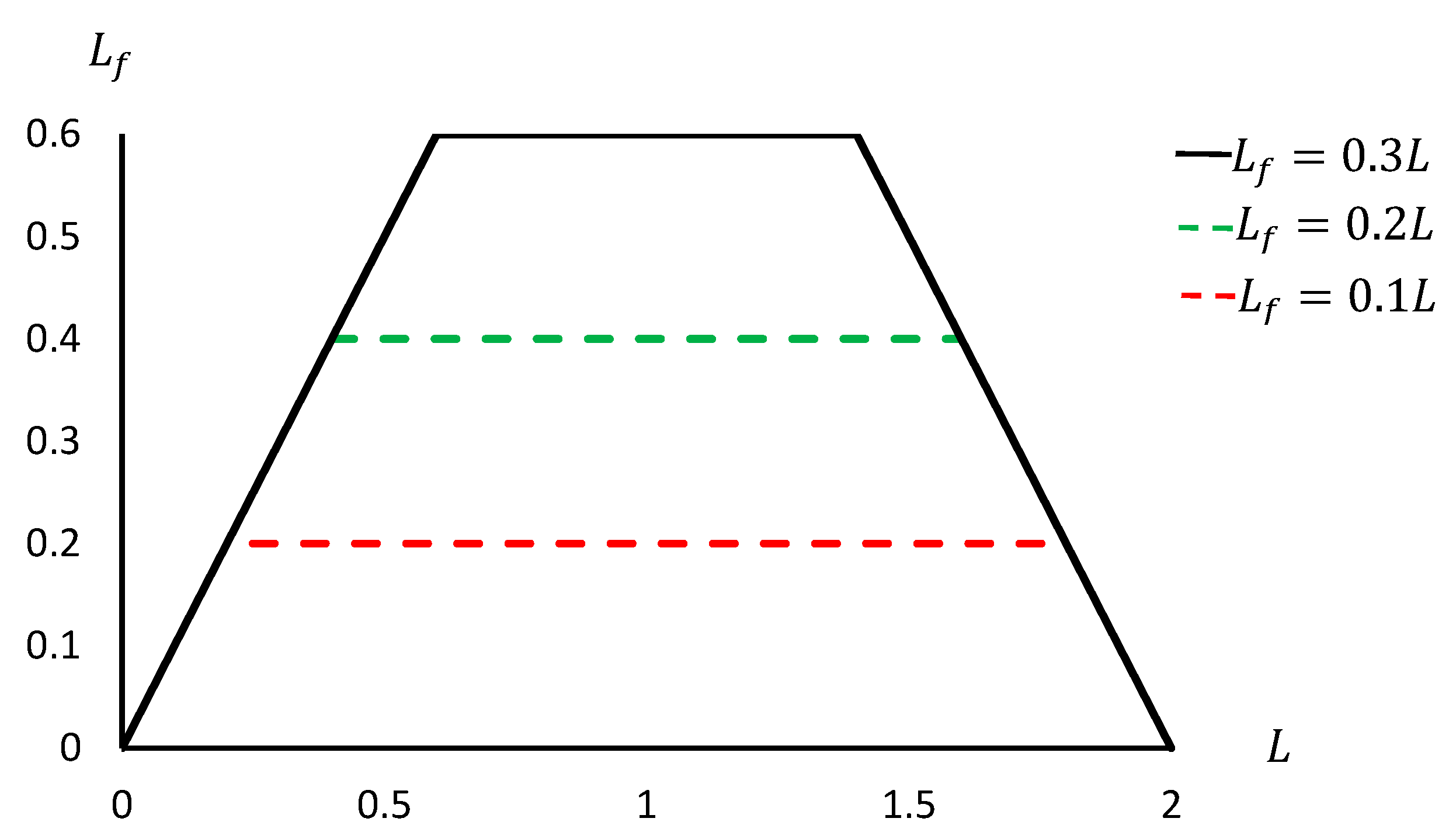
is treated as a spatially varying function along the beam in order to capture material variations, boundary effects, and potential heterogeneities. It can be defined in linear, symmetric, or asymmetric forms, depending on the boundary conditions and material properties. It should be noted that in this work it is defined linearly, and its equation is as follows. Its distribution can also be seen in
Figure 1.
In the proposed model, the function is implicitly embedded within the definition of the Riesz–Caputo derivative and is taken into account during the entire numerical discretization process. This formulation enables a more realistic simulation of nonlocal effects in microscale structures and leads to a bending response that is more sensitive to spatial variations and loading types.
The governing equation for the Euler–Bernoulli beam in the classical case is defined as follows:
where
is Young’s modulus,
is the moment of inertia,
is the displacement, and
is the external load. Also, the moment, shear, and rotation relationships of the beam section are as follows:
where
,
and
are the moment, shear and rotation of the beam section, respectively.
In this study, the equation governing the bending behavior of the fractional beam based on the Euler–Bernoulli theory and considering the Reisz–Caputo derivatives has been used. This equation is derived from the basic principles of fractional elasticity and assumes linear and homogeneous behavior. To derive this relationship, the connection between stress, strain, and deformation in non-local environments is used.
The equation for the flexural equilibrium of a fractional beam is expressed as follows:
In this equation, the Riesz–Caputo operator is defined symmetrically and models non-local and memory effects along the beam. Also, Equations (8)–(10) are written in fractional space as follows:
Full details of the process of deriving these equations are provided in [
10].
3. Numerical Solution
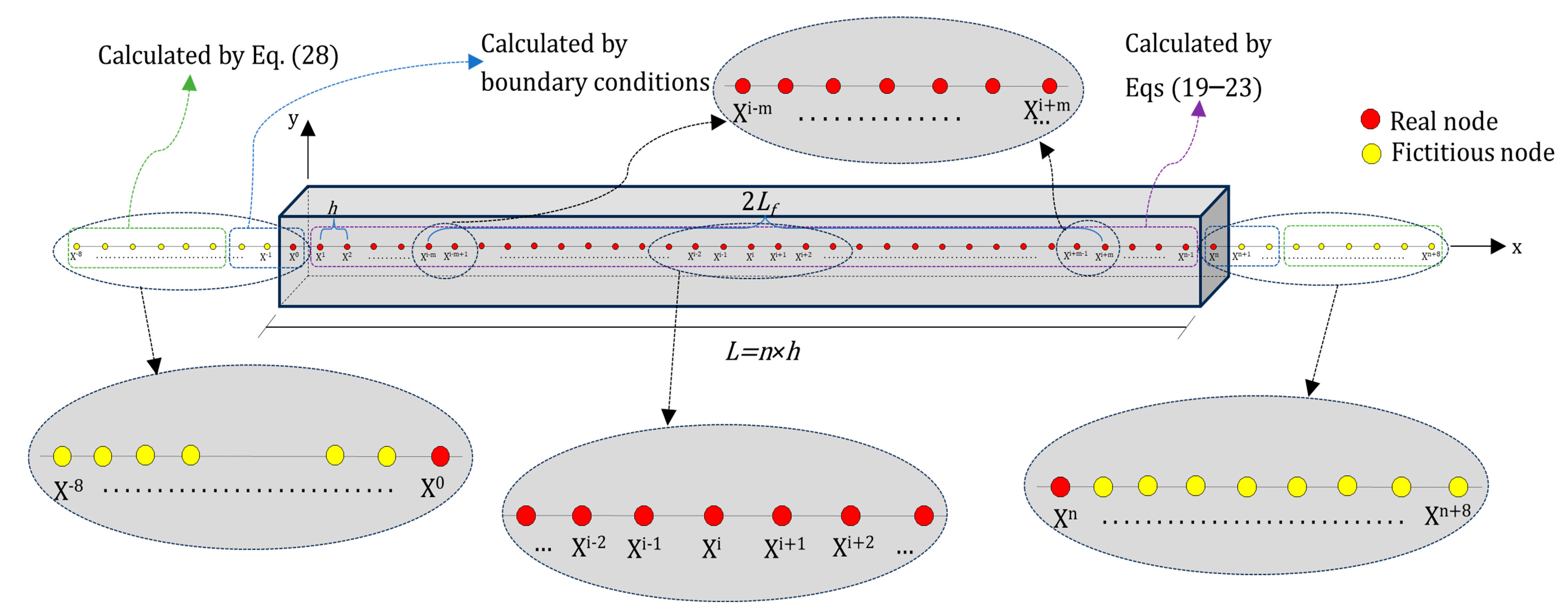
Since the governing equation of the fractional Euler–Bernoulli beam model does not admit an explicit analytical solution, a numerical approach is adopted to obtain the response. To this end, the beam’s longitudinal axis is uniformly discretized with a step size
, as illustrated in
Figure 2. A nodal grid is constructed, consisting of real interior points along with 8 fictitious nodes added beyond the physical boundaries of the beam on both the left and right sides.
These fictitious nodes are essential for accurately incorporating the nonlocal effects arising from the fractional derivatives. They extend the domain of computation to ensure that the influence of points outside the physical domain an inherent feature of fractional calculus, is properly captured during the numerical evaluation of the Riesz–Caputo derivatives.
In order to approximate the fractional derivatives of the Riesz–Caputo type, a combination of the trapezoidal rule [
26] and the finite difference method [
10] has been used. In this method, the fractional derivatives are calculated as a combination of the first-order derivatives at adjacent nodes, which are scaled by specific weighting factors. The numerical approximation of the fractional derivative at node i is expressed as follows:
where
According to the above equation, Equations (11)–(14) are rewritten in discrete space as follows:
where
The first derivative
in Equations (20)–(23) is defined as follows:
It should be noted that for
, the equations are transformed into the classical state, which is presented below.
The number of virtual nodes depends on the parameter , which is defined as ; therefore, the effective number of local nodes is implicitly related to the mesh size . However, since = 0 at the boundaries and the minimum value of is set to 2, the number of fictitious nodes on each side of the beam is fixed at eight in the present study. The unknown displacements at these nodes are determined using boundary conditions for two nodes on each side, while the remaining six nodes are computed from Equation (29).
It should be emphasized that the introduction of fictitious nodes is necessitated by the nonlocal character of the Riesz–Caputo fractional derivative, which requires information from additional neighboring points to accurately represent long-range interactions near the boundaries. These fictitious nodes allow for a consistent and stable implementation of the fractional finite difference scheme in the boundary regions by avoiding artificial truncation of nonlocal effects and ensuring proper information transfer from the interior domain. Consequently, the proposed formulation preserves numerical stability and accuracy without introducing extra degrees of freedom or increasing computational complexity.
4. Validation
Validation is an essential prerequisite for ensuring the accuracy and reliability of analytical and numerical analysis results. Validation can be performed using experimental methods or by comparison with analytical–numerical results reported in well-established studies. However, as reported in many previous studies on fractional beam models, access to reliable experimental data at the nanoscale is inherently limited due to fabrication challenges, measurement precision, and reproducibility issues. Consequently, only a limited number of experimentally characterized nanobeam configurations are currently available in the literature. In this study, the experimental validation considered is based on silver nanobeams, for which reliable experimental data are available in the literature [
3]. This nanobeam has the characteristics of
,
,
and
. It also has a circular cross-section with a diameter
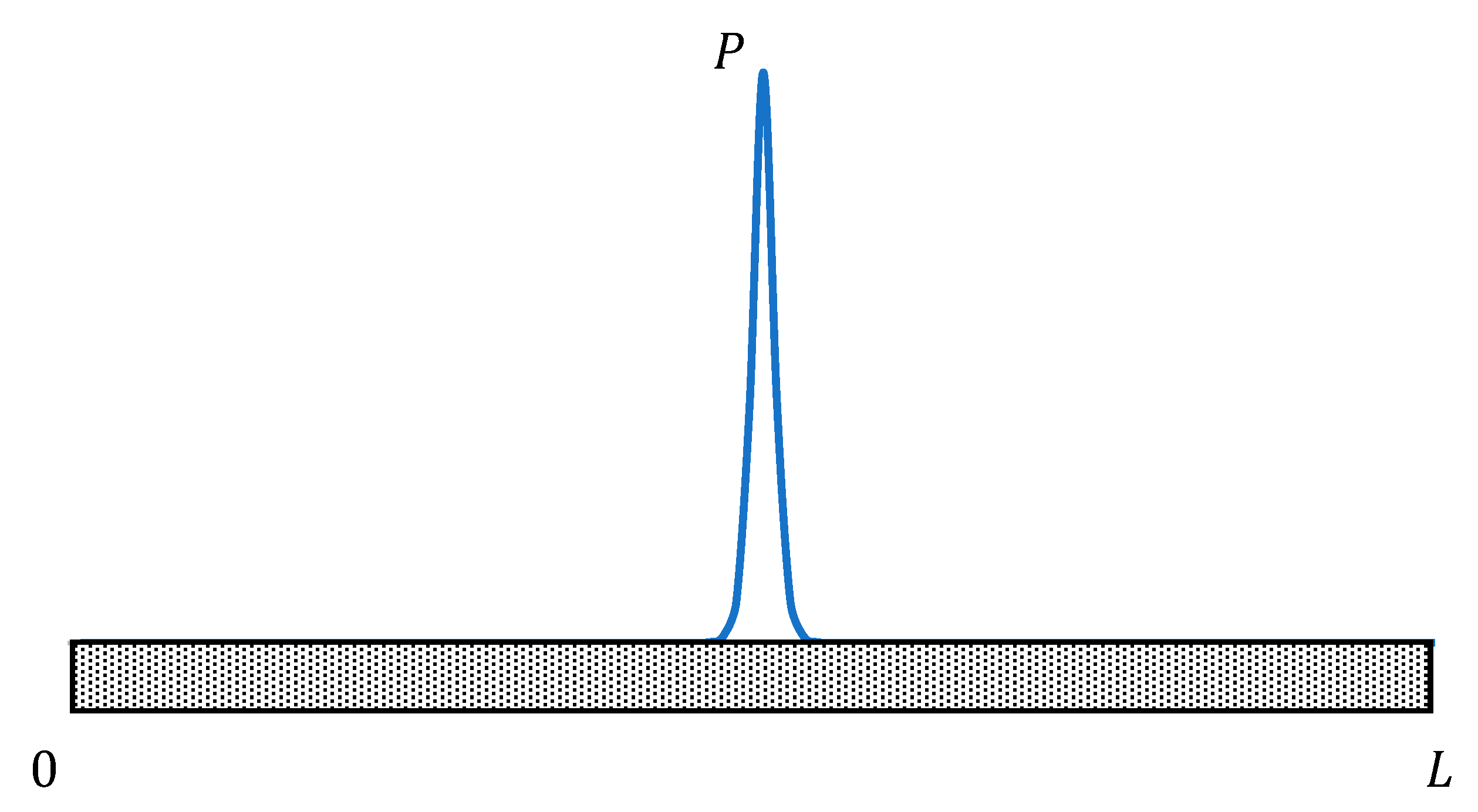
and a point loading in the middle of the beam. The schematic of this loading is presented in
Figure 3.
The load presented in
Figure 3 is a pseudo-concentrated load and its mathematical function is as follows:
where
,
for
∈ (0,0.5) and
for
∈ (0.5,1) and both are dimensionless. Also,
,
and
.
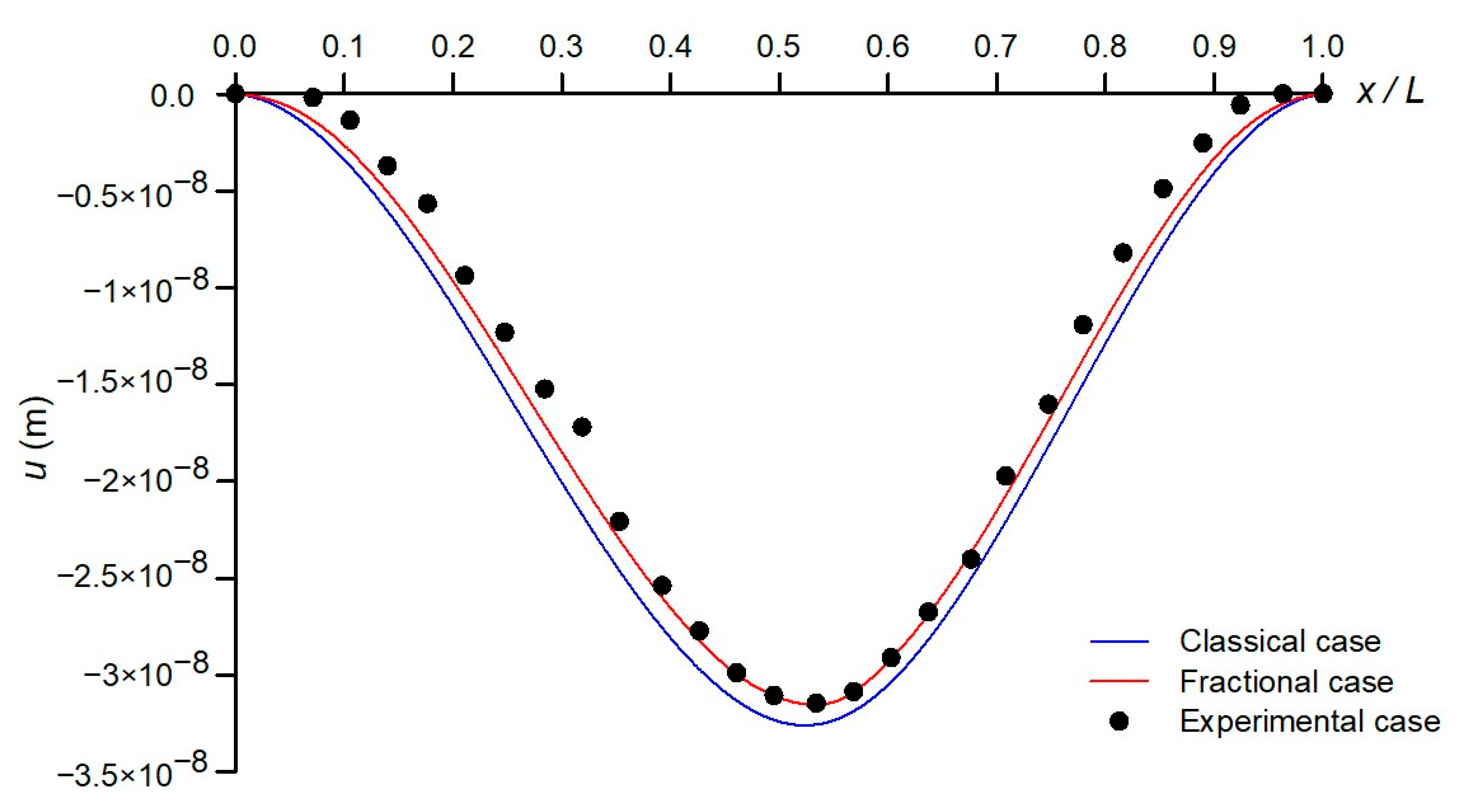
Figure 4 shows a comparison of the deformation between the classical, fractional, and experimental cases for the mentioned nano-beam. It can be seen that the presented model can show better performance compared to the classical mode. Although very close results are seen in the boundary regions, in the intermediate regions where in this example the load is point and the stress concentration is in the middle of the beam, a much better performance is seen than the classical mode. Analysis of these results indicates that the developed method can provide higher accuracy than the classical mode.
Moreover, the proposed model incorporates an intrinsic validation mechanism. Specifically, as the fractional derivative order approaches unity (), while the formulation remains within the fractional framework, the numerical results smoothly and consistently converge to the classical Euler–Bernoulli beam response. This continuous and physically consistent transition demonstrates that the proposed formulation correctly recovers the classical local behavior as a limiting case, which is widely recognized as a fundamental form of theoretical validation in fractional and nonlocal mechanics.
5. Examples
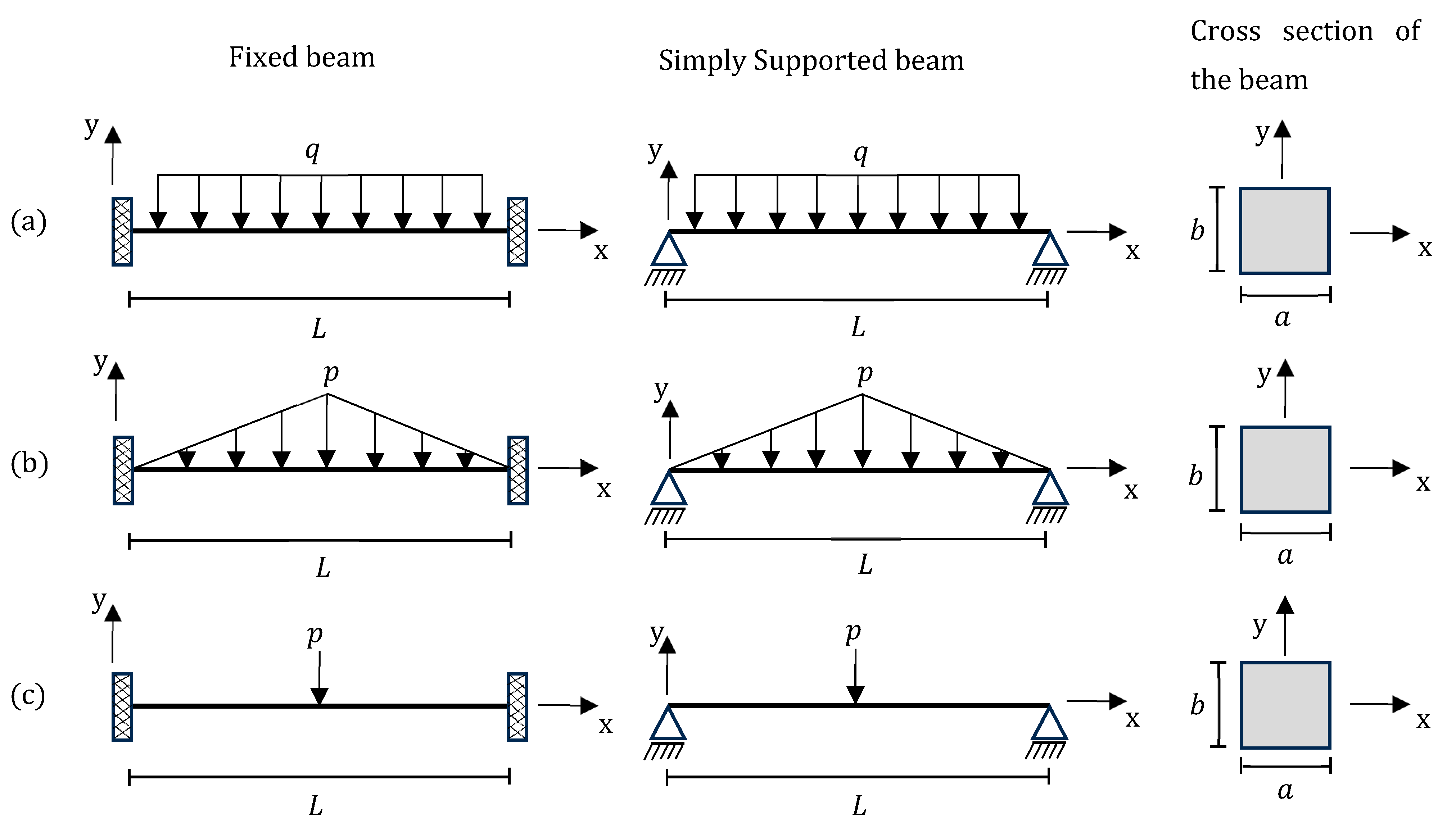
In this section, to validate the presented model for the Euler–Bernoulli beam in fractional space, several numerical examples based on different boundary conditions and loading, presented in
Figure 5, have been analyzed. These examples not only illustrate the model’s capability in analyzing microscale beams, but also quantitatively demonstrate the role of key parameters such as the fractional derivative order
and the length scale function
. In particular, the bending response of beams under distributed, triangular, and point loadings in two support modes (two-end fixed and two-end simple) is investigated.
It should be noted that in all examples, the beam specifications are as follows.
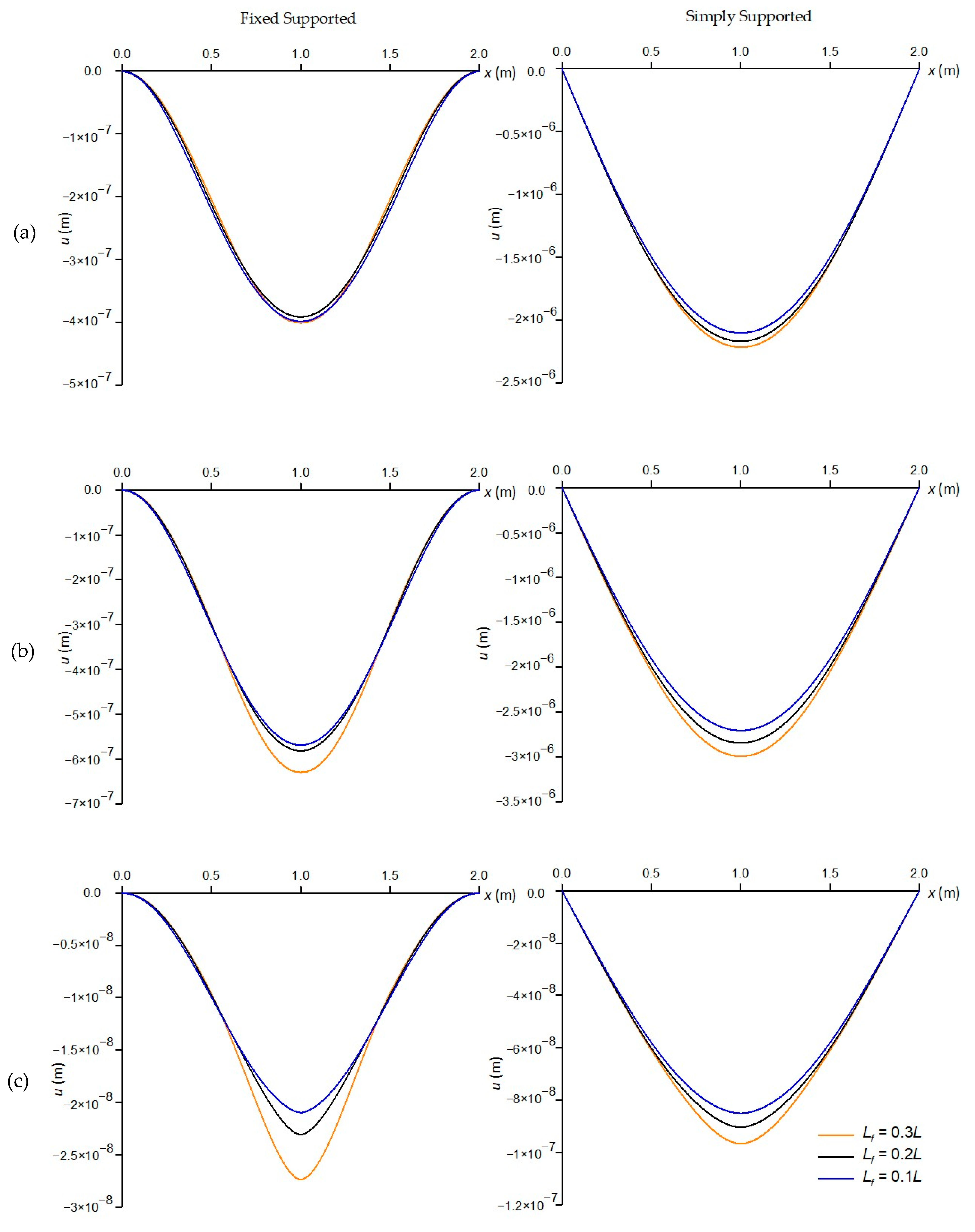
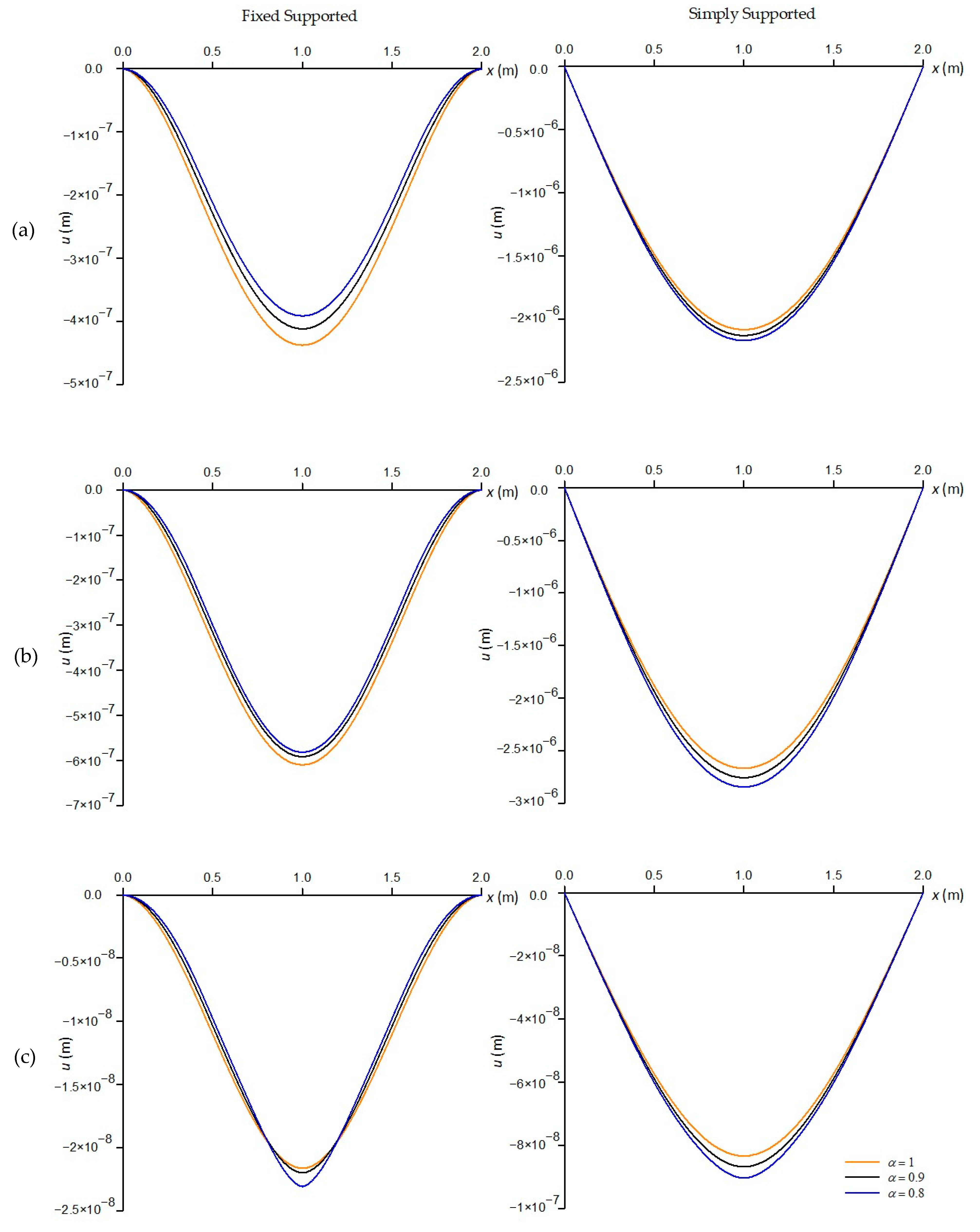
The results for
and
are presented in
Figure 6 and
Figure 7.
The ranges of the fractional order and characteristic length are chosen to ensure physical consistency and alignment with space-fractional and nonlocal beam literature. The fractional order governs the intensity of nonlocal interactions and reflects the degree of microstructural heterogeneity and long-range material memory. Values of close to unity correspond to classical local behavior, while lower values represent increasingly pronounced nonlocal effects commonly reported in nanoscale structures.
Similarly, the characteristic length represents the effective interaction distance between material points and is directly related to intrinsic length scales such as grain size, lattice spacing, or the characteristic dimensions of the beam cross-section. The adopted range of is consistent with experimental and numerical studies on micro- and nanoscale beams, where the interaction length is typically a small but non-negligible fraction of the structural length.
It should be emphasized that the parametric study is intended to reveal systematic trends and sensitivities of the structural response rather than to calibrate material parameters for a specific specimen.
Figure 6 and
Figure 7 collectively illustrate the response of fractional Euler–Bernoulli beams under uniform, triangular, and concentrated point loadings for both clamped–clamped and simply supported boundary conditions. In all cases, the location of maximum deflection remains at the mid-span of the beam, which is consistent with classical beam theory. However, the influence of the fractional order
and the characteristic length
on the magnitude of deflection is strongly dependent on both the loading type and the imposed boundary conditions.
For uniformly distributed loading, decreasing the fractional order leads to opposite trends depending on the boundary condition. In clamped–clamped beams, a reduction in results in smaller deflections, indicating an effective stiffening behavior. This response can be attributed to the strong kinematic constraints at both ends, which restrict rotational and translational degrees of freedom and suppress the development of nonlocal deformation modes. As a result, the enhanced nonlocal interactions associated with lower values redistribute strain energy in a manner that increases the effective bending stiffness. In contrast, for simply supported beams, the same reduction in produces larger deflections. The greater boundary flexibility allows nonlocal effects to manifest as a softening mechanism, leading to increased displacement under identical loading conditions.
A similar boundary-condition-dependent behavior is observed for triangular loading, where stress concentration is intensified near the mid-span. Although the maximum deflection again occurs at the beam center, the interaction between nonlocal effects and boundary constraints becomes more pronounced. For clamped–clamped beams, rigid end conditions limit the spatial spread of nonlocal interactions, resulting in reduced deflections as decreases. Conversely, in simply supported beams, the combination of localized loading and unconstrained rotations promotes nonlocal deformation, yielding increased deflections for lower fractional orders. These observations highlight that the mechanical role of the fractional order is not universal but is intrinsically linked to boundary-induced stiffness characteristics.
For concentrated point loading, a different trend is observed. In this case, decreasing leads to increased deflections for both clamped–clamped and simply supported beams, indicating an overall softening response relative to the classical model. This behavior can be explained by the highly localized nature of the load, which amplifies nonlocal interactions in the vicinity of the loading point. Under such conditions, the fractional operator promotes long-range strain redistribution that dominates over boundary constraints, resulting in reduced effective stiffness regardless of support type.
The influence of the characteristic length is consistent across all loading and boundary conditions. A decrease in leads to reduced deflections, reflecting the contraction of the nonlocal interaction domain and the corresponding increase in effective stiffness. Notably, the sensitivity of the beam response to variations in is significantly higher for triangular and point loadings than for uniformly distributed loading. This enhanced sensitivity arises from the localization of stresses and strains, where the material interaction length plays a dominant role in governing the bending response.
6. Convergence and Computational Efficiency Analysis
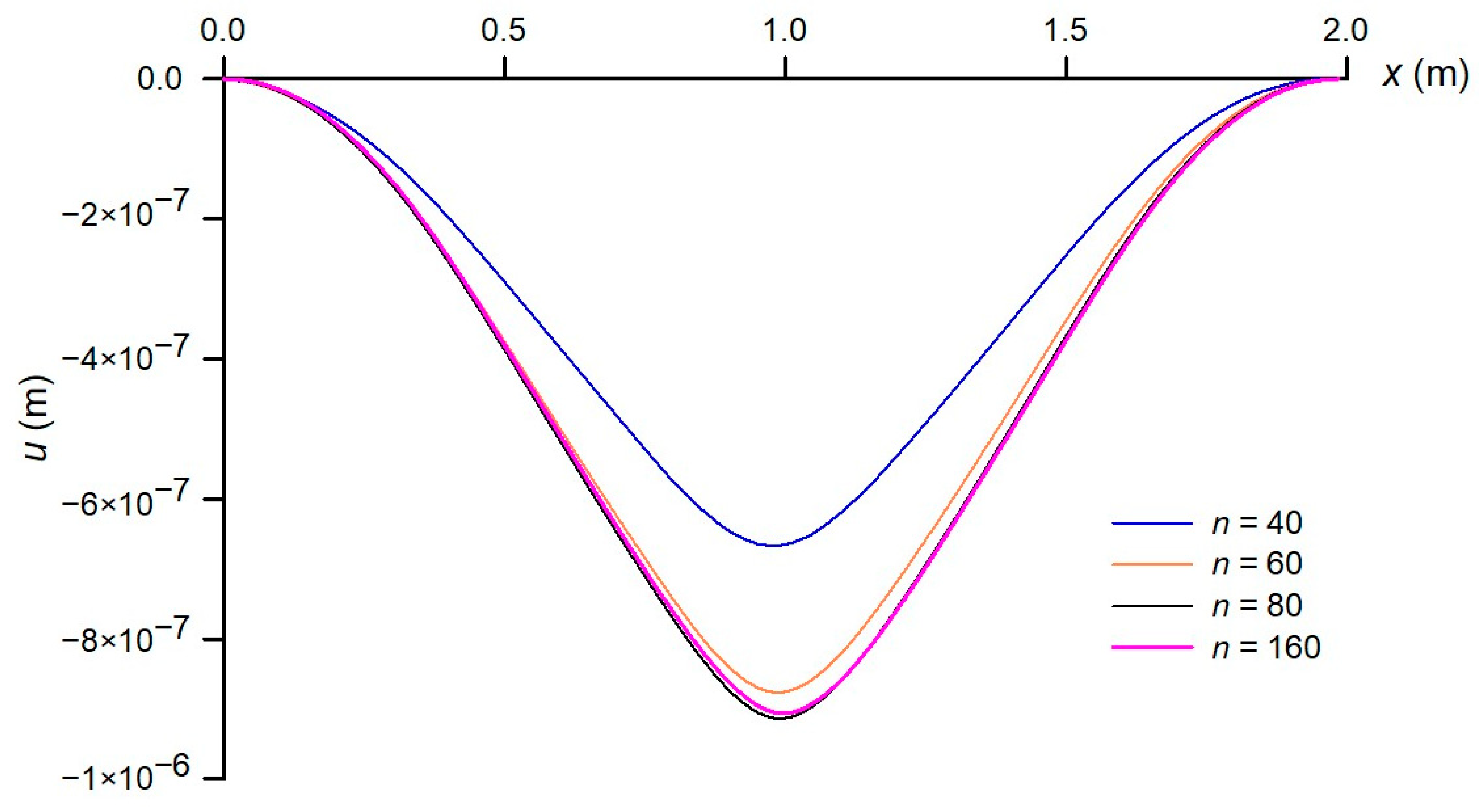
In this section, the numerical convergence and computational efficiency of the proposed fractional finite difference method for Euler–Bernoulli beam analysis in fractional space are examined, with particular emphasis on the effects of mesh refinement on solution accuracy. An Euler–Bernoulli beam with the geometric and material properties given in Equation (31), subjected to the loading condition in Equation (30), is considered. The analyses are carried out for fixed values of the fractional order and the nonlocal characteristic length , while the number of spatial subdivisions is systematically varied, with the total number of grid points taken as 40, 60, 80, and 160.
Figure 8 illustrates the beam deflection responses obtained for different mesh numbers. As the number of mesh points increases, the numerical solution exhibits smooth and stable convergence, with progressively smaller differences observed between deflection curves corresponding to finer meshes. This behavior confirms the numerical stability and convergence of the proposed finite difference scheme within the framework of fractional Riesz–Caputo derivatives.
On the other hand, mesh refinement inevitably leads to an increase in computational time, which is a well-known characteristic of nonlocal and fractional-order formulations. The computational time associated with each mesh configuration is reported in
Table 1. As expected, the total analysis time increases with the number of mesh elements.
All numerical simulations presented in this study were implemented using Python (Version 3.13). Although the proposed fractional formulation requires greater computational effort compared to the classical Euler–Bernoulli beam model, the solution times corresponding to the adopted mesh densities remain within a practical and acceptable range. Overall, these results demonstrate that the proposed fractional numerical framework achieves a favorable balance between accuracy and computational efficiency, supporting its applicability to practical engineering analyses of micro- and nanoscale beams.
7. Conclusions
This study developed a numerical framework for the analysis of Euler–Bernoulli beams using fractional calculus based on Riesz–Caputo derivatives to capture nonlocal and size-dependent effects. A finite difference scheme was formulated in which both the fractional derivative order and a spatially varying characteristic length were explicitly incorporated into the discretization. The formulation preserves numerical stability and consistently recovers the classical Euler–Bernoulli response as the fractional order approaches unity.
The numerical results show that the fractional parameters play distinct roles in the response of Euler–Bernoulli beam. The fractional order governs the intensity of nonlocal interactions and exhibits dependence on boundary conditions and loading types, leading to either effective stiffening or softening relative to the classical model. In contrast, the characteristic length controls the spatial extent of nonlocal effects in a consistent manner, with smaller values reducing deflections and increasing effective stiffness, particularly under localized loading. These results emphasize the importance of jointly considering both parameters in nonlocal beam modeling.
Comparison with experimental measurements from silver nanobeam bending tests demonstrates improved agreement of the proposed fractional model relative to the classical formulation, especially in regions of stress concentration. Although the experimental validation is limited to a representative case, the results confirm the ability of the model to capture mechanical responses that cannot be described adequately by local continuum theories.
Several limitations should be noted. The formulation is restricted to static bending within the Euler–Bernoulli framework and therefore neglects shear deformation and rotary inertia effects. While the characteristic length is allowed to vary spatially, its distribution is prescribed rather than identified through experimental calibration. In addition, experimental validation remains limited in scope. The nonlocal nature of the fractional operators also increases computational cost, although the reported solution times remain practical for engineering analysis.
Future work will extend the framework to dynamic problems, including vibration and stability analyses, and incorporate shear deformation effects through fractional Timoshenko beam theory. Further developments will address thermo-mechanical and viscoelastic coupling, improve computational efficiency, and focus on experimental calibration of fractional parameters. These extensions will enhance the applicability of the proposed model to micro- and nanoscale beam-like structures such as MEMS components, nanowires, and micro-sensors.



 ,
,