Quasi-Consensus of Fractional-Order Multi-Agent Systems with Mixed Delays and External Disturbance via Impulsive Pinning Control


Abstract
1. Introduction
- Existing studies on delayed FROMASs primarily focus on systems with a single type of time delay [26,35] and often disregard external disturbances [36,37]. In contrast, this paper proposes a FROMASs that simultaneously incorporates mixed delays and external disturbances. This unified modeling framework overcomes the limitations of existing research, which tends to address a single delay in isolation or neglect disturbances.
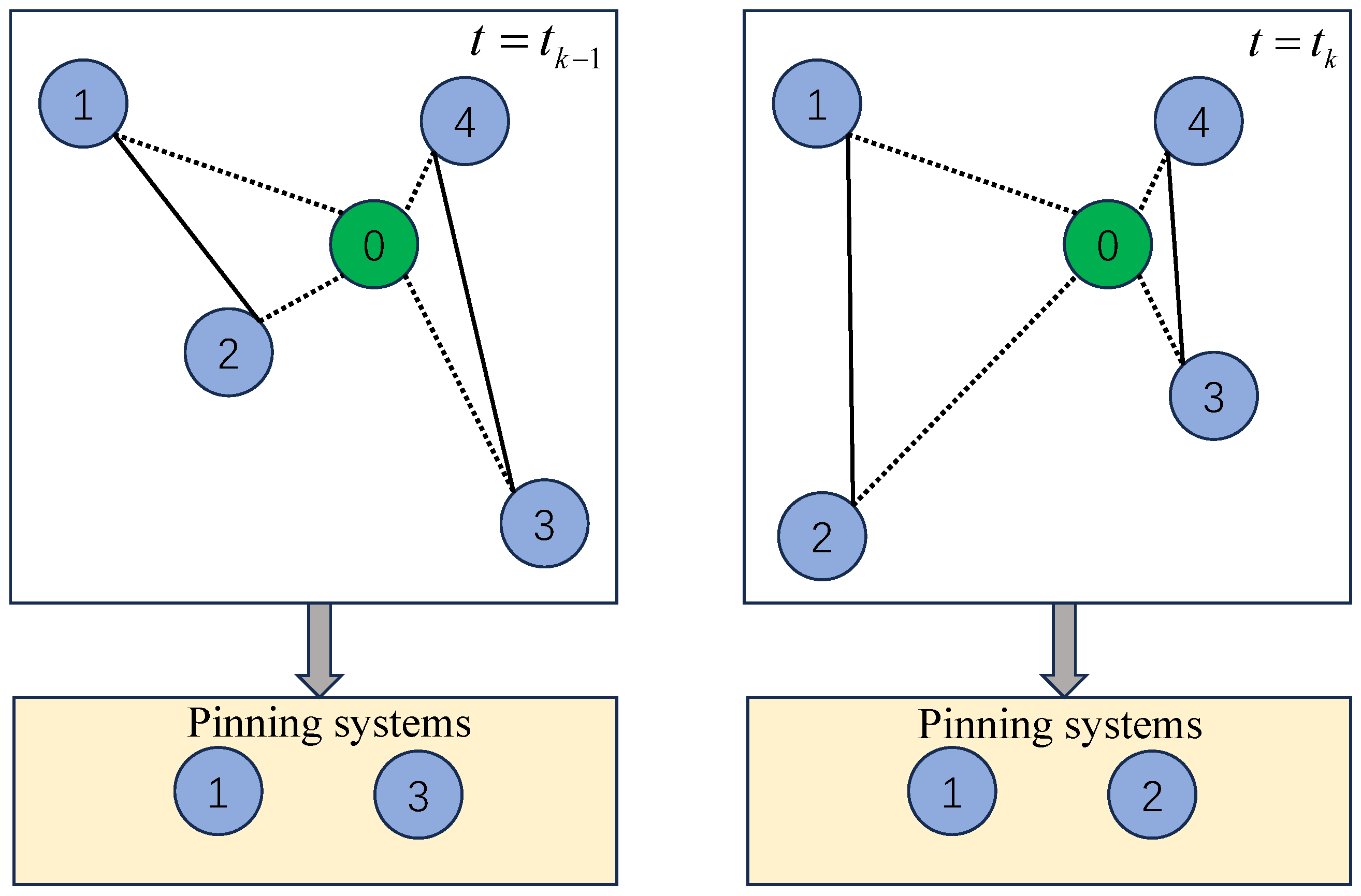
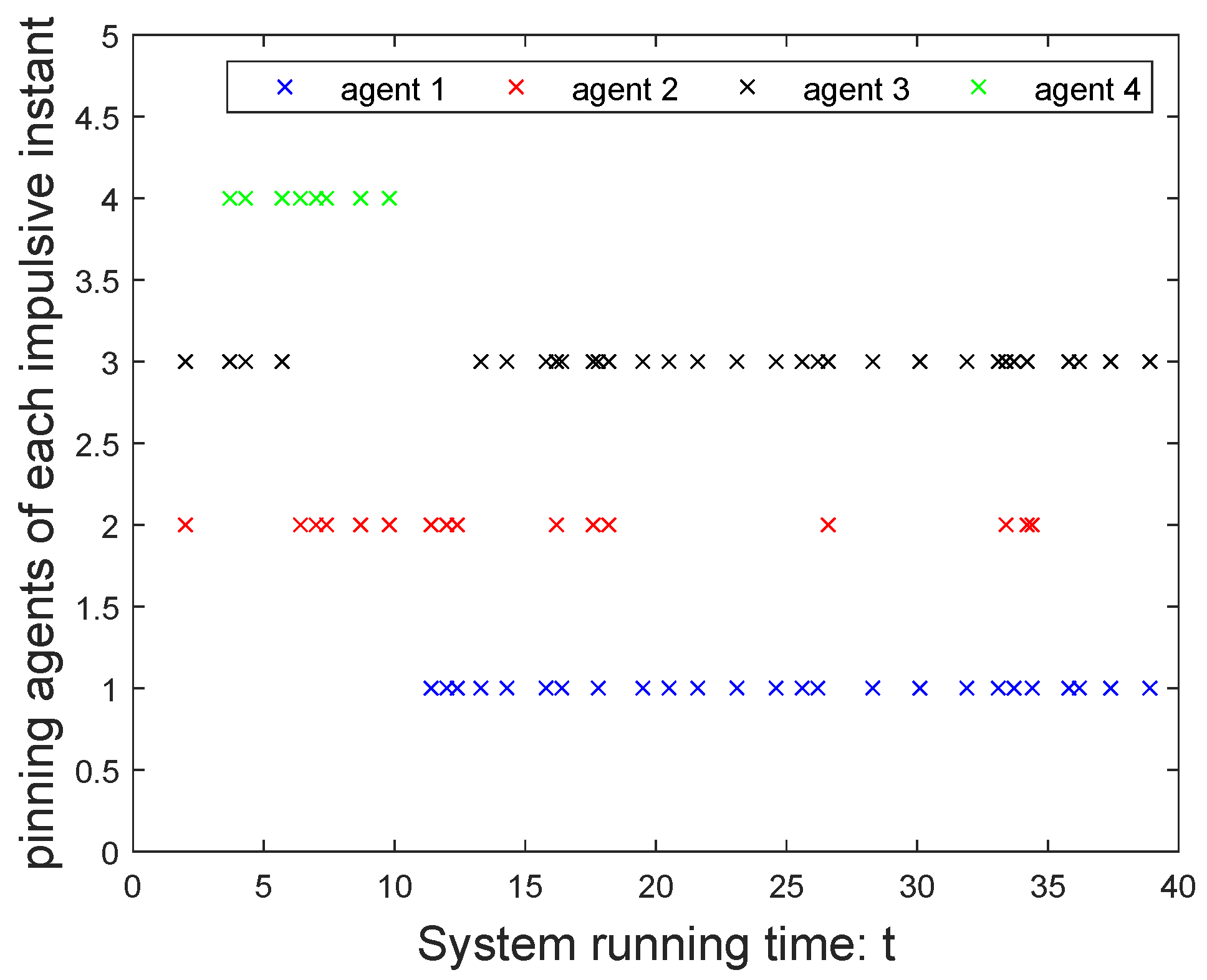
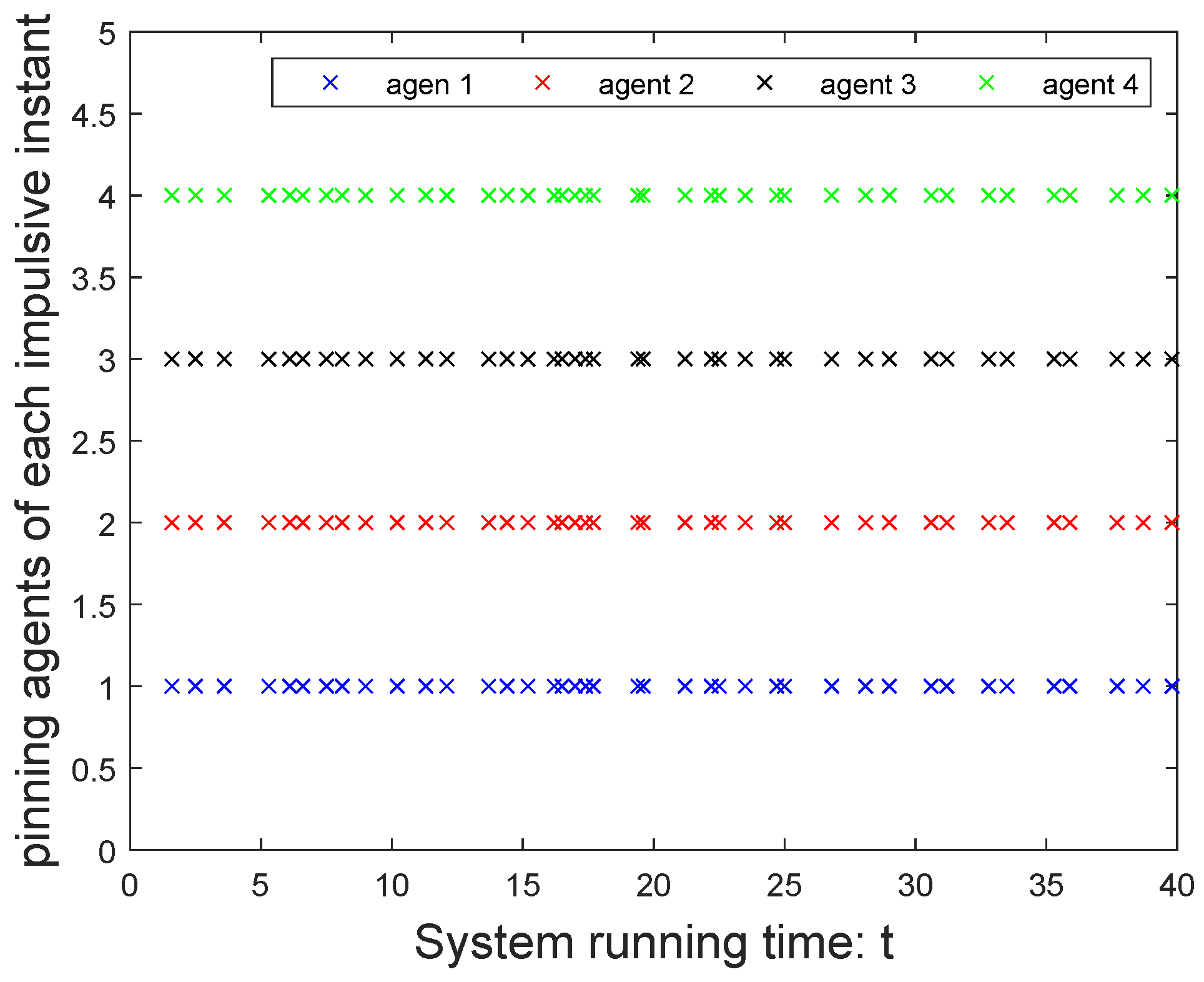
- Different from the static pinning schemes commonly adopted in existing literature for FROMASs [38,39,40], a novel IPC protocol is designed to achieve quasi-consensus. The proposed scheme incorporates a dynamic pinning rule, where the set of pinned nodes is adaptively adjusted based on the distance of real-time synchronization errors.
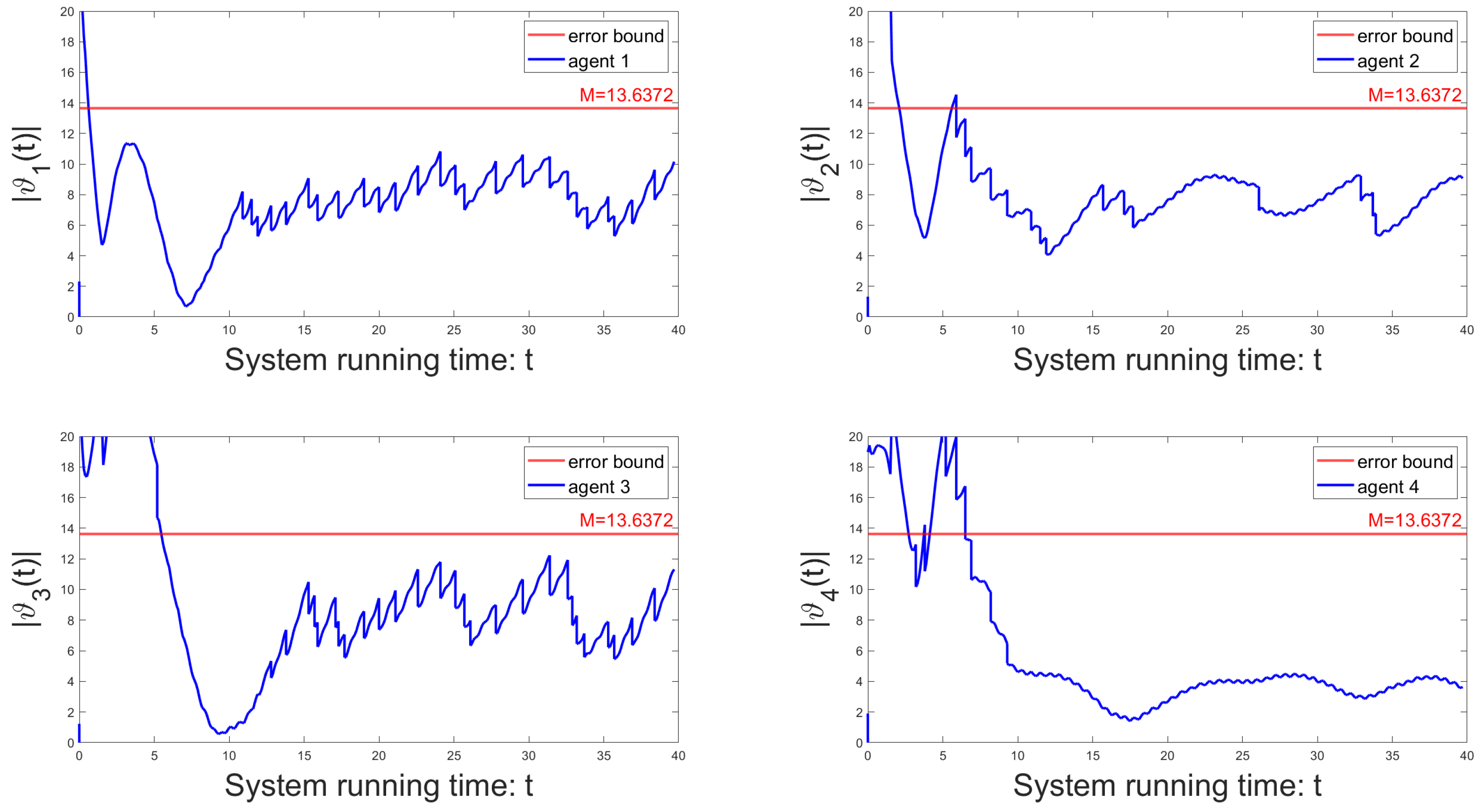
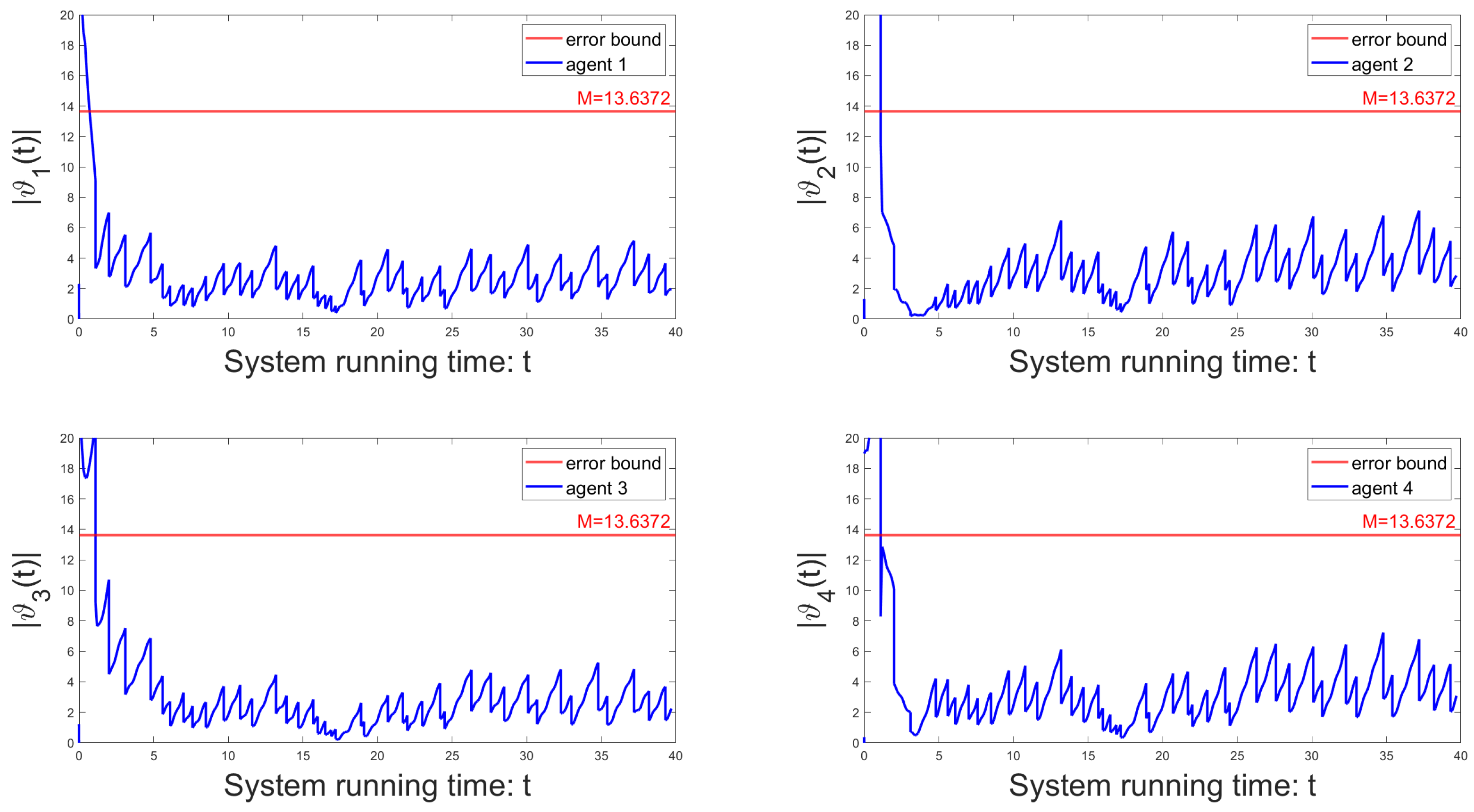
- Based on the Razumikhin condition, this paper establishes a comparison system framework for the analysis of FRO impulsive systems. This framework effectively unifies the handling of analytical challenges arising from the interplay of impulsive actions, FRO dynamics, and external disturbances. Consequently, it leads to sufficient conditions for achieving quasi-consensus and provides a quantitative estimate for the convergence bound of errors.
2. Preliminaries
2.1. Graph Theory
2.2. Caputo Fractional Derivative and Mittag–Leffler Function
2.3. Model Description
| Algorithm 1 Dynamic Pinning Rule |
Require:
|
3. Quasi-Consensus of FROMASs
4. Numerical Simulation
5. Conclusions
Author Contributions
Funding
Data Availability Statement
Conflicts of Interest
References
- Olfati-Saber, R.; Fax, J.A.; Murray, R.M. Consensus and cooperation in networked multi-agent systems. Proc. IEEE 2007, 95, 215–233. [Google Scholar] [CrossRef]
- Li, Z.; Duan, Z. Cooperative Control of Multi-Agent Systems: A Consensus Region Approach; CRC Press: Boca Raton, FL, USA, 2017. [Google Scholar]
- Amirkhani, A.; Barshooi, A.H. Consensus in multi-agent systems: A review. Artif. Intell. Rev. 2022, 55, 3897–3935. [Google Scholar] [CrossRef]
- Acha, S.; Yi, S. Cooperative Intelligent Control of Multi-Agent Systems (MAS) Through Communication, Trust, and Reliability. Control Syst. Optim. Lett. 2025, 3, 53–67. [Google Scholar] [CrossRef]
- Griparic, K.; Polic, M.; Krizmancic, M.; Bogdan, S. Consensus-based distributed connectivity control in multi-agent systems. IEEE Trans. Netw. Sci. Eng. 2022, 9, 1264–1281. [Google Scholar] [CrossRef]
- Ju, Y.; Ding, D.; He, X.; Han, Q.L.; Wei, G. Consensus control of multi-agent systems using fault-estimation-in-the-loop: Dynamic event-triggered case. IEEE/CAA J. Autom. Sin. 2021, 9, 1440–1451. [Google Scholar] [CrossRef]
- Yu, P.; Hu, Y.; Wang, Y.; Jia, R.; Guo, J. Optimal consensus control strategy for multi-agent systems under cyber attacks via a stackelberg game approach. IEEE Trans. Autom. Sci. Eng. 2025, 22, 18875–18888. [Google Scholar] [CrossRef]
- West, B.J.; Culbreth, G.; Dunbar, R.I.; Grigolini, P. Fractal structure of human and primate social networks optimizes information flow. Proc. R. Soc. A 2023, 479, 20230028. [Google Scholar] [CrossRef]
- Roberto, G.F.; Lumini, A.; Neves, L.A.; do Nascimento, M.Z. Fractal neural network: A new ensemble of fractal geometry and convolutional neural networks for the classification of histology images. Expert Syst. Appl. 2021, 166, 114103. [Google Scholar] [CrossRef]
- Jahanmiri, F.; Parker, D.C. An overview of fractal geometry applied to urban planning. Land 2022, 11, 475. [Google Scholar] [CrossRef]
- Deppman, A.; Megías, E.; Pasechnik, R. Fractal derivatives, fractional derivatives and q-deformed calculus. Entropy 2023, 25, 1008. [Google Scholar] [CrossRef]
- Cao, Y.; Li, Y.; Ren, W.; Chen, Y. Distributed coordination of networked fractional-order systems. IEEE Trans. Syst. Man Cybern. Part B (Cybern.) 2009, 40, 362–370. [Google Scholar]
- Gong, P.; Lan, W. Adaptive robust tracking control for multiple unknown fractional-order nonlinear systems. IEEE Trans. Cybern. 2018, 49, 1365–1376. [Google Scholar] [CrossRef] [PubMed]
- Liu, J.J.; Lam, J.; Kwok, K.W. Necessary and sufficient conditions on consensus of general fractional-order multi-agent systems over directed networks. IEEE Trans. Netw. Sci. Eng. 2023, 11, 485–493. [Google Scholar] [CrossRef]
- Hao, Y.; Fang, Z.; Cao, J.; Liu, H. Consensus control of nonlinear fractional-order multi-agent systems with input saturation: A TS fuzzy method. IEEE Trans. Fuzzy Syst. 2024, 32, 6754–6766. [Google Scholar] [CrossRef]
- Zhang, X.; Zheng, S.; Ahn, C.K.; Xie, Y. Adaptive neural consensus for fractional-order multi-agent systems with faults and delays. IEEE Trans. Neural Netw. Learn. Syst. 2022, 34, 7873–7886. [Google Scholar] [CrossRef]
- Wu, J.; Yu, Y.; Ren, G. Leader-following formation control for discrete-time fractional stochastic multi-agent systems by event-triggered strategy. Fractal Fract. 2024, 8, 246. [Google Scholar] [CrossRef]
- Yan, X.; Li, K.; Yang, C.; Zhuang, J.; Cao, J. Consensus of fractional-order multi-agent systems via observer-based boundary control. IEEE Trans. Netw. Sci. Eng. 2024, 11, 3370–3382. [Google Scholar] [CrossRef]
- Yu, N.; Zhu, W. Exponential stabilization of fractional-order continuous-time dynamic systems via event-triggered impulsive control. Nonlinear Anal. Model. Control 2022, 27, 592–608. [Google Scholar] [CrossRef]
- Yang, J.; Fečkan, M.; Wang, J. Consensus of linear conformable fractional order multi-agent systems with impulsive control protocols. Asian J. Control 2023, 25, 314–324. [Google Scholar] [CrossRef]
- Agarwal, R.P.; Hristova, S.; O’Regan, D. Impulsive control of variable fractional-order multi-agent systems. Fractal Fract. 2024, 8, 259. [Google Scholar] [CrossRef]
- Jiang, X.; You, L.; Zhang, N.; Chi, M.; Yan, H. Impulsive formation tracking of nonlinear fuzzy multi-agent systems with input saturation constraints. IEEE Trans. Fuzzy Syst. 2024, 32, 5728–5736. [Google Scholar] [CrossRef]
- Ren, H.; Deng, F.; Peng, Y.; Zhang, B.; Zhang, C. Exponential consensus of non-linear stochastic multi-agent systems with ROUs and RONs via impulsive pinning control. IET Control Theory Appl. 2017, 11, 225–236. [Google Scholar] [CrossRef]
- Ren, H.; Peng, Y.; Deng, F.; Zhang, C. Impulsive pinning control algorithm of stochastic multi-agent systems with unbounded distributed delays. Nonlinear Dyn. 2018, 92, 1453–1467. [Google Scholar] [CrossRef]
- Wang, K.P.; Ding, D.; Tang, Z.; Feng, J. Leader-following consensus of nonlinear multi-agent systems with hybrid delays: Distributed impulsive pinning strategy. Appl. Math. Comput. 2022, 424, 127031. [Google Scholar] [CrossRef]
- Cao, L.; Pan, Y.; Liang, H.; Huang, T. Observer-based dynamic event-triggered control for multiagent systems with time-varying delay. IEEE Trans. Cybern. 2022, 53, 3376–3387. [Google Scholar] [CrossRef]
- Liu, Y.; Sun, Y.; Zhou, H. Bipartite synchronization of stochastic coupled systems with hybrid time-varying delays via asynchronous impulsive control. IEEE Trans. Autom. Sci. Eng. 2025, 22, 15778–15791. [Google Scholar] [CrossRef]
- Fan, H.; Rao, Y.; Shi, K.; Wen, H. Time-varying function matrix projection synchronization of Caputo fractional-order uncertain memristive neural networks with multiple delays via mixed open loop feedback control and impulsive control. Fractal Fract. 2024, 8, 301. [Google Scholar] [CrossRef]
- Wu, Y.; Liu, L. Distributed average tracking for linear heterogeneous multi-agent systems with external disturbances. IEEE Trans. Netw. Sci. Eng. 2021, 8, 3491–3500. [Google Scholar] [CrossRef]
- Jiang, B.; Lu, J.; Li, X.; Qiu, J. Event-triggered impulsive stabilization of systems with external disturbances. IEEE Trans. Autom. Control 2021, 67, 2116–2122. [Google Scholar] [CrossRef]
- Derakhshannia, M.; Moosapour, S.S. Adaptive arbitrary time synchronisation control for fractional order chaotic systems with external disturbances. Int. J. Syst. Sci. 2025, 56, 1540–1560. [Google Scholar] [CrossRef]
- Wang, L.; Sousa, J.; Luo, D. Leader-following consensus of nonlinear fractional-order multi-agent systems with external disturbance. Comput. Appl. Math. 2025, 44, 224. [Google Scholar] [CrossRef]
- Chen, T.; Peng, S.; Fu, Z. Razumikhin-type Theorem on Finite-time Stability of Impulsive Stochastic Delayed Systems and Applications to Multi-agent Systems. Int. J. Control Autom. Syst. 2025, 23, 1105–1117. [Google Scholar] [CrossRef]
- Lin, W.; Peng, S.; Fu, Z.; Chen, T.; Gu, Z. Consensus of fractional-order multi-agent systems via event-triggered pinning impulsive control. Neurocomputing 2022, 494, 409–417. [Google Scholar] [CrossRef]
- Yang, Y.; Hu, W. Containment Control of Double-Integrator Multi-Agent Systems With Time-Varying Delays. IEEE Trans. Netw. Sci. Eng. 2022, 9, 457–466. [Google Scholar] [CrossRef]
- Yang, S.; Hu, C.; Yu, J.; Jiang, H. Exponential stability of fractional-order impulsive control systems with applications in synchronization. IEEE Trans. Cybern. 2019, 50, 3157–3168. [Google Scholar] [CrossRef]
- Zhang, W.; Zhu, H.; Wen, S.; Huang, T. Finite-time bipartite tracking consensus of fractional-order multi-layer signed networks by aperiodically intermittent control. IEEE Trans. Circuits Syst. II Express Briefs 2024, 71, 3061–3065. [Google Scholar] [CrossRef]
- Yu, Z.; Jiang, H.; Hu, C.; Yu, J. Leader-following consensus of fractional-order multi-agent systems via adaptive pinning control. Int. J. Control 2015, 88, 1746–1756. [Google Scholar] [CrossRef]
- Hymavathi, M.; Ibrahim, T.F.; Ali, M.S.; Stamov, G.; Stamova, I.; Younis, B.; Osman, K.I. Synchronization of fractional-order neural networks with time delays and reaction-diffusion terms via pinning control. Mathematics 2022, 10, 3916. [Google Scholar] [CrossRef]
- Yu, J.; Yao, R.; Hu, C. Cluster synchronization of fractional-order coupled genetic regulatory networks via pinning control. Neurocomputing 2024, 607, 128363. [Google Scholar] [CrossRef]
- Plastino, A.; Tsallis, C.; Wedemann, R. A family of nonlinear diffusion equations related to the q-error function. Phys. A Stat. Mech. Its Appl. 2024, 635, 129475. [Google Scholar] [CrossRef]
- Plastino, A.; Plastino, A. Non-extensive statistical mechanics and generalized Fokker–Planck equation. Phys. A Stat. Mech. Its Appl. 1995, 222, 347–354. [Google Scholar] [CrossRef]
- Wedemann, R.; Plastino, A.; Tsallis, C. Curl forces and the nonlinear Fokker–Planck equation. Phys. Rev. E 2016, 94, 062105. [Google Scholar] [CrossRef] [PubMed]
- Podlubny, I. Fractional Differential Equations: An Introduction to Fractional Derivatives, Fractional Differential Equations, to Methods of Their Solution and Some of Their Applications; Elsevier: Amsterdam, The Netherlands, 1998. [Google Scholar]
- Wang, J.L.; Huang, L.; Ren, S.Y.; Huang, T. Passivity-Based Formation Control for Fractional-Order Multiagent Systems With and Without Communication Delay. IEEE Trans. Emerg. Top. Comput. Intell. 2024, 8, 4143–4154. [Google Scholar] [CrossRef]
- Pang, D.; Liu, S.; Zhao, X.W. Containment control analysis of delayed nonlinear fractional-order multi-agent systems. Math. Methods Appl. Sci. 2025, 48, 8462–8479. [Google Scholar] [CrossRef]
- Duarte-Mermoud, M.A.; Aguila-Camacho, N.; Gallegos, J.A.; Castro-Linares, R. Using general quadratic Lyapunov functions to prove Lyapunov uniform stability for fractional order systems. Commun. Nonlinear Sci. Numer. Simul. 2015, 22, 650–659. [Google Scholar] [CrossRef]
- Yu, N.; Zhu, W. Event-triggered impulsive chaotic synchronization of fractional-order differential systems. Appl. Math. Comput. 2021, 388, 125554. [Google Scholar] [CrossRef]
- Peng, D.; Li, X. Leader-following synchronization of complex dynamic networks via event-triggered impulsive control. Neurocomputing 2020, 412, 1–10. [Google Scholar] [CrossRef]
- Zhou, B.; Egorov, A.V. Razumikhin and Krasovskii stability theorems for time-varying time-delay systems. Automatica 2016, 71, 281–291. [Google Scholar] [CrossRef]
- Yan, Y.; Zhang, H.; Sun, J.; Wang, Y. Sliding mode control based on reinforcement learning for TS fuzzy fractional-order multiagent system with time-varying delays. IEEE Trans. Neural Netw. Learn. Syst. 2023, 35, 10368–10379. [Google Scholar] [CrossRef]
- Lang, Q.; Xu, J.; Zhang, H.; Wang, Z. Pinning group consensus of multi-agent systems under DoS attacks. Neural Process. Lett. 2024, 56, 171. [Google Scholar] [CrossRef]
- Yuan, M.; Li, Y.; Zheng, M. Novel intermittent pinning control beyond the semigroup framework for fractional-order delayed inertial memristive neural networks. Chaos Solitons Fractals 2026, 202, 117568. [Google Scholar] [CrossRef]
- Hu, W.; Wen, G.; Rahmani, A.; Yu, Y. Distributed consensus tracking of unknown nonlinear chaotic delayed fractional-order multi-agent systems with external disturbances based on ABC algorithm. Commun. Nonlinear Sci. Numer. Simul. 2019, 71, 101–117. [Google Scholar] [CrossRef]
- Li, X.; He, J.; Wen, C.; Liu, X.K. Backstepping-based adaptive control of a class of uncertain incommensurate fractional-order nonlinear systems with external disturbance. IEEE Trans. Ind. Electron. 2021, 69, 4087–4095. [Google Scholar] [CrossRef]
- You, X.; Shi, M.; Guo, B.; Zhu, Y.; Lai, W.; Dian, S.; Liu, K. Event-triggered adaptive fuzzy tracking control for a class of fractional-order uncertain nonlinear systems with external disturbance. Chaos Solitons Fractals 2022, 161, 112393. [Google Scholar] [CrossRef]



| Symbol | Meaning |
|---|---|
| Set of positive integers | |
| and | Set of real numbers and set of positive real numbers |
| and | The n-dimensional real space and the set of real matrices |
| Euclidean norm | |
| The upper right-hand Dini derivative | |
| Largest eigenvalue of matrix A | |
| Diagonal matrix | |
| ⊗ | Kronecker product |
Disclaimer/Publisher’s Note: The statements, opinions and data contained in all publications are solely those of the individual author(s) and contributor(s) and not of MDPI and/or the editor(s). MDPI and/or the editor(s) disclaim responsibility for any injury to people or property resulting from any ideas, methods, instructions or products referred to in the content. |
© 2026 by the authors. Licensee MDPI, Basel, Switzerland. This article is an open access article distributed under the terms and conditions of the Creative Commons Attribution (CC BY) license.
Share and Cite
Chen, T.; Fu, Z.; Su, C.; Chen, N.; Lin, W. Quasi-Consensus of Fractional-Order Multi-Agent Systems with Mixed Delays and External Disturbance via Impulsive Pinning Control. Fractal Fract. 2026, 10, 48. https://doi.org/10.3390/fractalfract10010048
Chen T, Fu Z, Su C, Chen N, Lin W. Quasi-Consensus of Fractional-Order Multi-Agent Systems with Mixed Delays and External Disturbance via Impulsive Pinning Control. Fractal and Fractional. 2026; 10(1):48. https://doi.org/10.3390/fractalfract10010048
Chicago/Turabian StyleChen, Tao, Zhiwen Fu, Caimao Su, Ning Chen, and Wanli Lin. 2026. "Quasi-Consensus of Fractional-Order Multi-Agent Systems with Mixed Delays and External Disturbance via Impulsive Pinning Control" Fractal and Fractional 10, no. 1: 48. https://doi.org/10.3390/fractalfract10010048
APA StyleChen, T., Fu, Z., Su, C., Chen, N., & Lin, W. (2026). Quasi-Consensus of Fractional-Order Multi-Agent Systems with Mixed Delays and External Disturbance via Impulsive Pinning Control. Fractal and Fractional, 10(1), 48. https://doi.org/10.3390/fractalfract10010048