


Abstract
This work introduces the development and performance analysis of a hybrid fractal antenna combining a Koch snowflake outer geometry with a center slot patterned as a Sierpinski rectangular carpet. The antenna is fabricated on an FR4 board (, ) with dimensions mm3. Electromagnetic simulations are performed using Ansys HFSS v15, revealing seven distinct resonances at 2.11, 3.06, 5.78, 6.94, 8.48, 9.23, and 9.56 GHz. The corresponding impedance bandwidths are 90, 37, 67, 100, 90, 130, and 220 MHz, with return losses of −14, −12, −16, −10, −30, −16, and −17 dB, and VSWR values ranging from 1.06 to 1.80. The gains at these resonances are 3.92, 8.24, 6.90, 11.66, 19.38, 16.76, and 12.06 dBi. Frequency allocation analysis indicates compatibility with UMTS/LTE (2.11 GHz), S-band 5G and radar (3.06 GHz), ISM/UNII-3 Wi-Fi and ITS (5.78 GHz), C-band satellite uplink (6.94 GHz), and X-band radar/satellite downlink (8.48–9.56 GHz). The proposed geometry demonstrates wide multi-band coverage, making it a strong candidate for integration into multi-standard communication and radar platforms requiring compact, broadband, and high-directivity performance.
1. Introduction
Fractal geometries have gained significant attention in antenna design because of their inherent properties of self-similarity, space-filling, and scalability. A fractal is generated through an iterative process in which a base shape is recursively subdivided or modified, producing structures that exhibit complexity across multiple scales. Well-known examples include the Koch curve and the Sierpinski triangle, which demonstrate how electrical path lengths can be greatly increased within a compact area.
These structural characteristics directly influence electromagnetic behavior. The space-filling property enables antenna miniaturization without loss of resonance. The self-similar property leads to multiband or wideband operation, since different fractal iterations correspond to resonant paths at different frequencies. Furthermore, the recursive distribution of current paths often improves impedance bandwidth and radiation efficiency compared to traditional geometries.
Because of these advantages, fractal antennas have been widely investigated for wireless communications, UWB systems, and biomedical applications. Puente-Baliarda et al. [1] demonstrated that the Sierpinski fractal’s multiband response originates from its geometry, while Romeu and Soler [2] generalized it using Pascal-based structures with log-periodic behavior. Best [3] showed that the Koch monopole’s response depends mainly on resonance rather than shape, and Borja and Romeu [4] achieved miniaturization with Koch island patches supporting localized modes.
Anguera et al. [5] realized dual-band operation with parasitic elements, whereas Kikkawa et al. [6] demonstrated UWB Sierpinski carpet antennas on silicon. Bao et al. [7] employed a fractal EBG for a compact circularly polarized GPS antenna. Rmili et al. [8] introduced a 3D fractal-tree monopole offering improved bandwidth, and Chen et al. [9] combined Koch and Sierpinski slots for size reduction. Zainud-Deen et al. [10] optimized a fractal UHF RFID tag with stable read range, and Hong et al. [11] achieved dual-band performance using a quasi-fractal ground.
Azari [12] proposed an octagonal fractal antenna with super wideband operation, while Levy et al. [13] designed a fractal-based UWB antenna for 3D IC and medical imaging. Kushwaha and Kumar [14] integrated a Swastika-shaped EBG with a circular fractal patch for a 8.2 GHz bandwidth. Susila et al. [15] presented a compact UWB Smiley fractal antenna with high efficiency and omnidirectional radiation. Recent advances in constrained helical antennas [16], time-reversal theory [17], and adaptive multiband designs [18] have expanded modern antenna capabilities.
Kumar and Singh [19,20] proposed hybrid Koch–Minkowski and modified Sierpinski–Meander antennas, achieving multiband and heptaband operations for GPS, WLAN, and 4G/LTE. Kaur et al. [21] optimized PSI(W) fractals using ANN and GA for improved multiband response. Bangi and Sivia [22] compared Hilbert–Minkowski and Minkowski–Hilbert hybrids, highlighting gain–bandwidth trade-offs. Kaur and Sivia [23] achieved dual-band ISM operation with a Minkowski–Peano–Koch hybrid optimized via ANN and PSO. Finally, Sran and Sivia [24] developed a wearable hybrid fractal antenna with defected ground using ANN and IFS, exhibiting high gain and multiband performance for ISM, Bluetooth, and RFID systems.
Koch-based designs have been reported for multiband snowflake structures [25], compact monopole configurations for ultra-wideband (UWB) [26], further refinements of Koch geometries have been applied using metamaterial integration for WiMAX [27] and hybrid geometries combining Koch and hexagonal patches for 5G systems [28,29], and reconfigurable structures for Wi-Fi [30].
Sierpinski-based geometries are equally popular, with compact triangular and carpet structures enabling multiband operation [31,32,33,34]. Modified Sierpinski designs have been demonstrated for mm-wave femtocell use [35] and for size reduction in patch antennas [36]. Sierpinski carpet and hexagonal layouts have been applied to wideband wireless systems and wearable antennas [37,38], while defected ground and other adaptations have shown enhanced performance [39].
Hybrid fractal layouts and advanced implementations extend these capabilities further. Minkowski–Sierpinski combinations have been proposed for compact arrays [40,41], while Koch variants and slot-based fractals have been studied for chipless RFID and enhanced encoding. MIMO and UWB designs using fractal slots and resonators demonstrate strong frequency selectivity and suppression features [42,43]. Other recent efforts include biomedical sensing and imaging antennas that leverage fractal characteristics [44], as well as CSRR and multiband fractal patches for microwave systems [45,46].
Despite the extensive body of work on fractal antennas employing Koch snowflake and Sierpinski geometries individually, there remains limited exploration into hybrid designs that exploit the complementary electromagnetic properties of both structures within a single radiating element. Prior studies have demonstrated either enhanced bandwidth, miniaturization, or multiband operation; however, few have systematically addressed achieving simultaneous broad multi-band coverage, and compact footprint suitable for integration into modern wireless systems. Furthermore, most existing implementations have been optimized for a narrow subset of frequency bands, leaving a gap in designs that can efficiently serve disparate services spanning UMTS/LTE, 5G, ISM, satellite, and radar applications.
Building on these principles, This work addresses this gap by presenting a novel hybrid geometry that combines the perimeter complexity of the Koch snowflake with the space-filling characteristics of the Sierpinski rectangular carpet slot. The proposed configuration is implemented on a compact FR4 substrate, optimized using HFSS v15, and demonstrates seven well-defined resonances across S, C, and X bands with competitive impedance matching, and application relevance to both commercial and defense communication systems. This integrated approach offers a scalable design pathway for future multi-standard, multi-mission antenna platforms.
The organization of this work is as follows: Section 2 outlines the formulation and implementation of the proposed hybrid Sierpinski–Koch fractal antenna geometry. Section 3 presents the simulated performance for successive design iterations, complemented by measurement data and experimental verification of the fabricated prototype. In conclusion, Section 4 presents a synthesis of the principal results and provides final observations.
2. Antenna Design
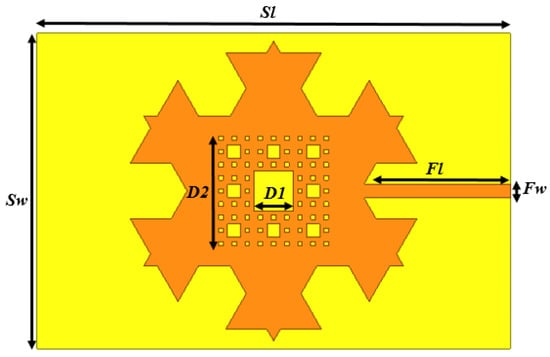
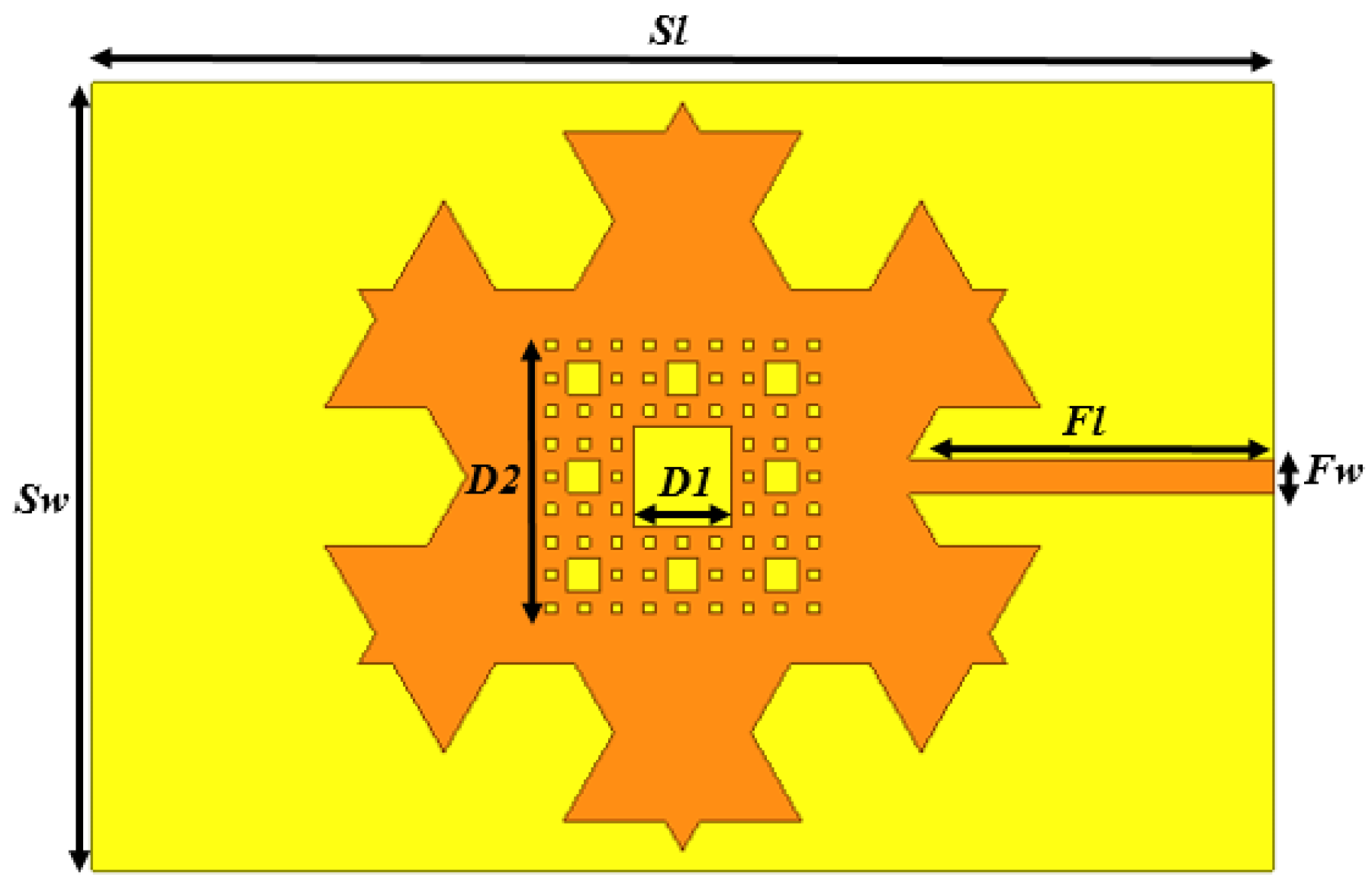
The antenna under consideration employs a radiating patch that merges two distinct fractal configurations namely, the Sierpinski carpet and the Koch snowflake. Excitation is achieved through a microstrip line feeding arrangement. Throughout the iterative design phase, the Koch snowflake motif was strategically altered to optimize electromagnetic performance. In the resulting configuration, the snowflake’s edges are extended radially outward from the patch’s center, while the Sierpinski rectangular is embedded at the core region of the radiator. In order to determine the optimal geometry, successive fractal iterations were analyzed with respect to their resonant behavior and return-loss performance. The first iteration produced only two resonant frequencies, both with above dB. The second iteration improved the response to three resonant frequencies with above dB. The third iteration generated five resonant frequencies; however, only two of these achieved better than dB, limiting its practical usefulness. By contrast, the fourth iteration yielded seven distinct resonant frequencies, five of which exhibited below dB, indicating substantially improved impedance matching and stable multiband operation. Higher-order iterations were examined but did not provide further improvement in return loss or usable bandwidth; instead, they increased geometric complexity and posed greater fabrication sensitivity. Based on this quantitative trade-off between multiband capability, impedance matching, and manufacturability, the fourth iteration was selected as the optimal geometry for the proposed antenna. The optimal parameters of the designed antenna are summarized in the caption of Figure 1.
Figure 1.
Top view of the proposed antenna. The geometric parameters are as follows: mm, mm, mm, mm, mm, and mm.
Figure 1 illustrates the geometry of the suggested Koch–Sierpinski fractal antenna. The radiating patch follows a Sierpinski fractal configuration, while excitation is provided through a microstrip feed line of size , designed to maintain a input impedance. The prototype was realized on FR-4 board of , with a thickness of and a relative permittivity of .
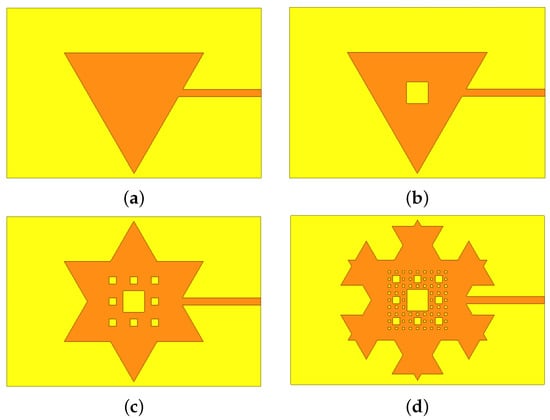
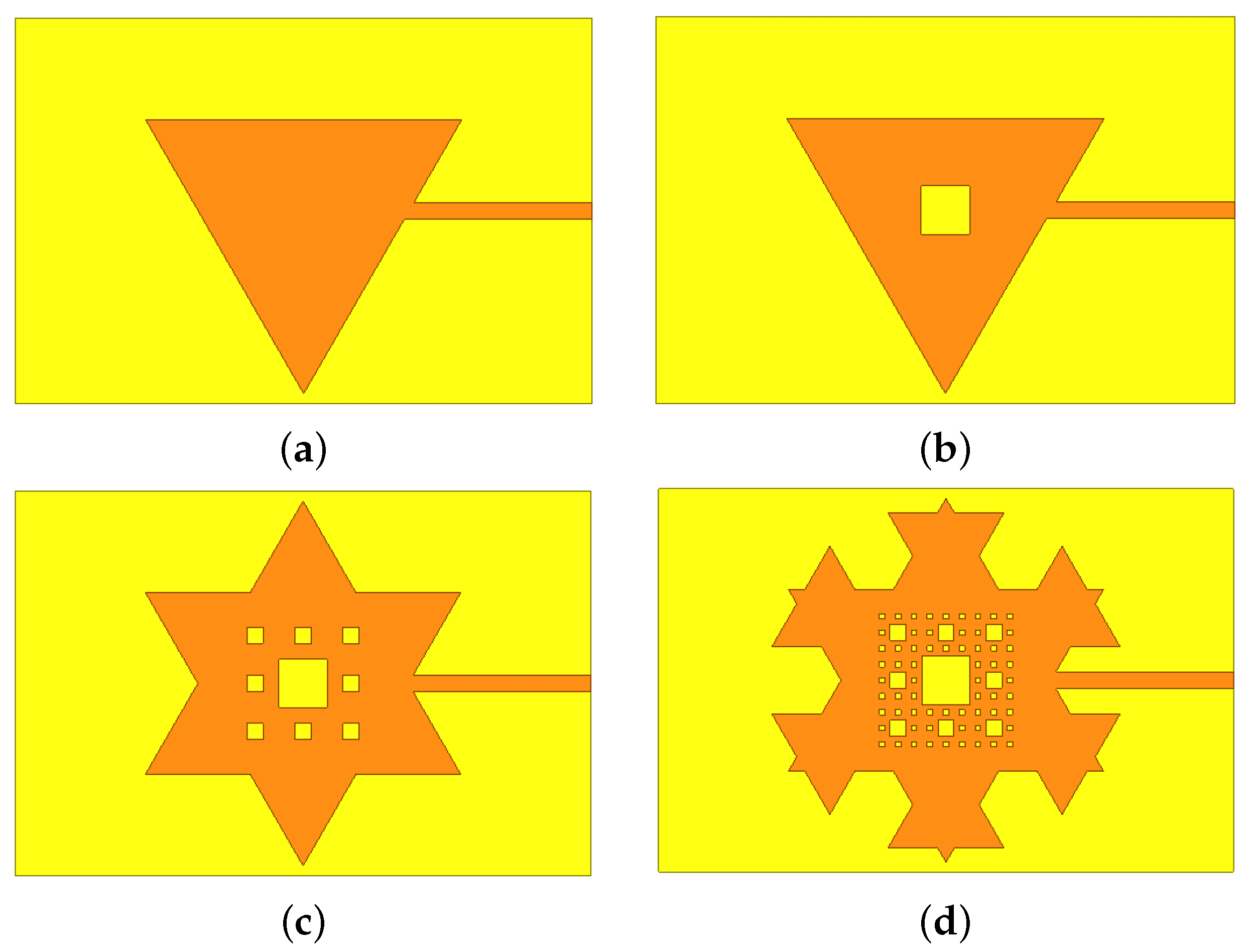
Figure 2 presents the four-stage evolution of the radiating element geometry. In the first iteration, shown in Figure 2a, the process starts by superimposing two equilateral triangles at the patch center, oriented in opposite directions. This configuration establishes the base geometry for subsequent modifications. The starting equilateral triangle’s side length is determined by
where a is how long the original equilateral triangle’s side is.
Figure 2.
Antenna development iterations: (a) first iteration, (b) second iteration, (c) third iteration, and (d) fourth iteration.
Following n iterations, the triangle’s side length is determined by
The total length of the perimeter after n iterations can be calculated by
Following n iterations, the Koch snowflake’s area is determined by
where is the original equilateral triangle’s area.
The Koch snowflake’s fractal dimension D can be computed as
In the second iteration, depicted in Figure 2b, the geometry is refined by appending smaller equilateral triangles to the sides of each triangle generated in the initial stage. This transformation produces a second-order Koch snowflake, thereby increasing the fractal complexity of the patch.
In the third iteration, illustrated in Figure 2c, a Sierpinski carpet configuration is embedded at the center of the radiating element. This modification introduces additional resonant modes, thereby enhancing the antenna’s multiband performance. The Sierpinski rectangular geometry follows a fractal scheme involving the recursive subdivision of the initial rectangular patch. The iteration order, denoted as n, serves as a key parameter governing the number of successive fractal subdivisions applied to the base structure:
where
- denotes the rectangle’s original length;
- indicates the rectangle’s length following n successive iterations;
- S represents the scale ratio controlling the size reduction at each stage.
Furthermore, following n repetitions, the fractal structure’s entire length is determined by
The overall length reduces to the following for an infinite number of iterations:
The antenna’s capacity to sustain a wide range of resonant modes is facilitated by its cumulative length.
The effective area of the antenna decreases with each iteration due to the removal of sections in the fractal process:
where
- is the first rectangle’s area;
- n is the level of iteration.
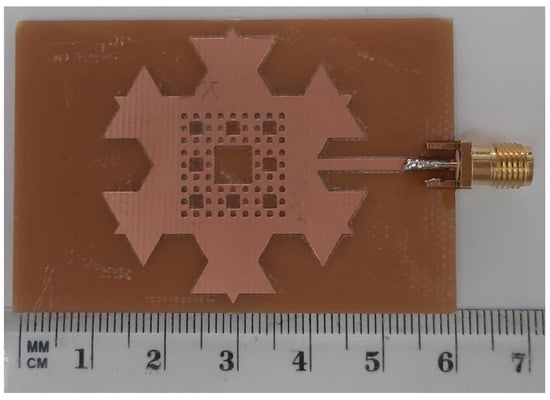
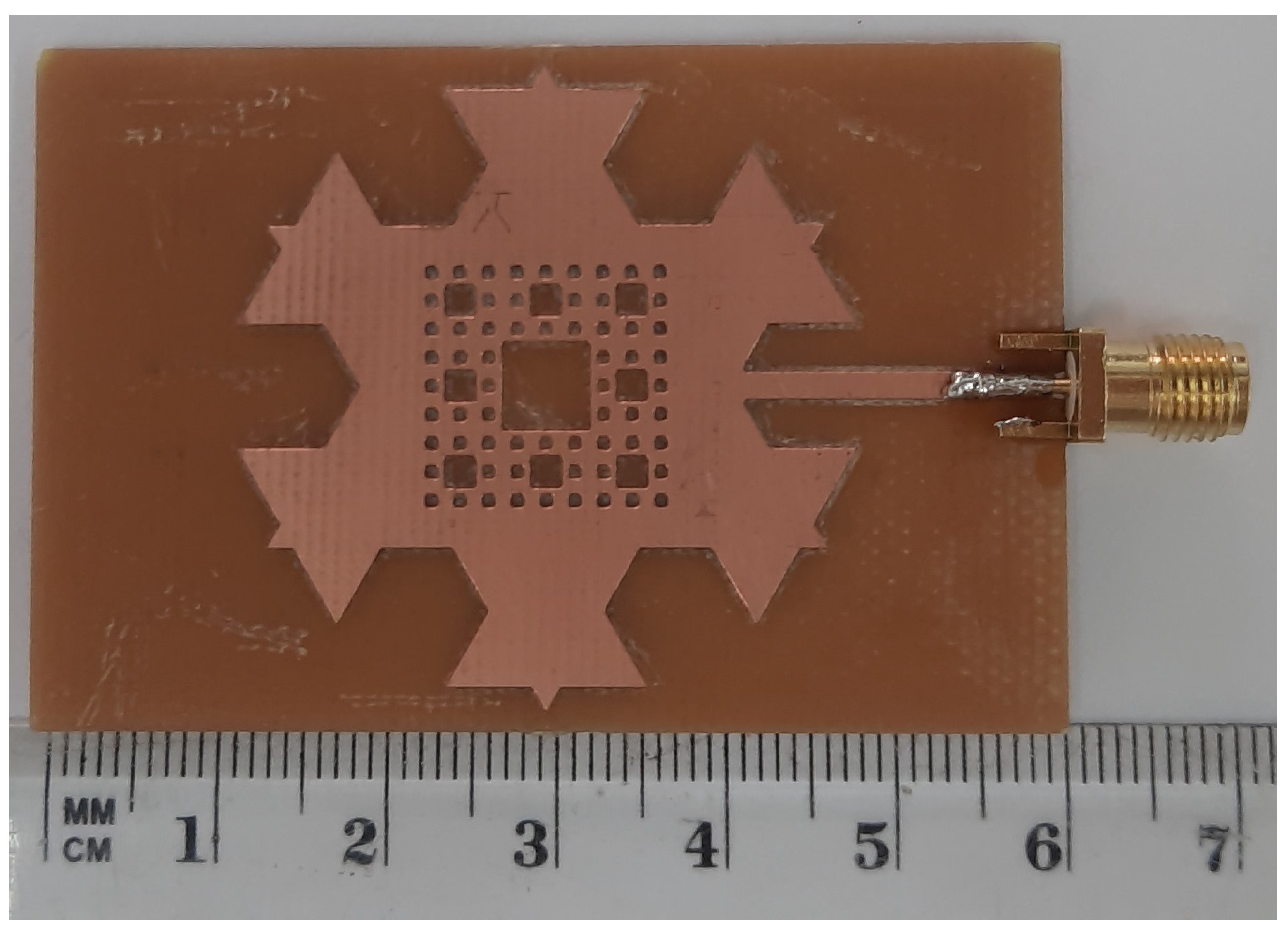
Finally, in the fourth iteration as shown in Figure 2d, the edges of the Koch snowflake are shifted outwards, further optimizing the antenna’s performance by adjusting the geometry for improved resonance and radiation characteristics. Each stage, as shown in Figure 2, builds upon the previous one, leading to a sophisticated and highly functional fractal antenna design. The performance of the proposed Koch–Sierpinski shaped fractal antenna was evaluated using HFSS (High-Frequency Structure Simulator) version 15. Additionally, as shown in Figure 3, the antenna was fabricated and its characteristics were validated through testing with a Vector Network Analyzer (VNA).
Figure 3.
Top view of the fabricated antenna.
Multi-Band Design Principle
The multi-band response of the proposed antenna is achieved through the combination of Koch snowflake and Sierpinski fractal geometries, which systematically introduce multiple current paths of different effective lengths. Each fractal iteration adds scaled features that behave as additional resonant structures, thereby enabling operation across several frequency bands. In particular, the fundamental radiator dimensions support the lower resonances around 2.11–3.06 GHz, which are relevant for UMTS/LTE applications, while higher-order fractal segments introduce additional resonances in the 5–10 GHz range. These correspond to frequency allocations such as ISM/WiFi, 5G mid-band, and C/X-band communication services. By adjusting parameters such as iteration level, arm length, and slot width, the resonances can be systematically tuned to align with specified frequency bands. This fractal-based scaling approach provides a unified strategy for achieving multi-frequency performance without relying on multiple independent resonators.
3. Results and Discussion
3.1. Return Loss
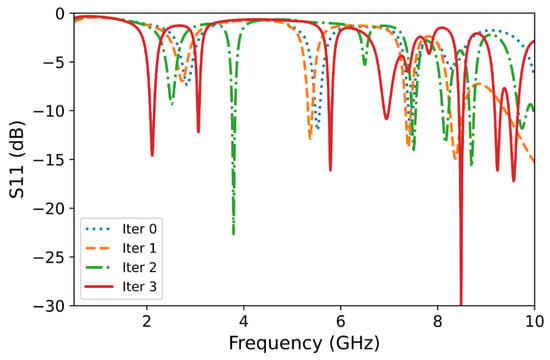
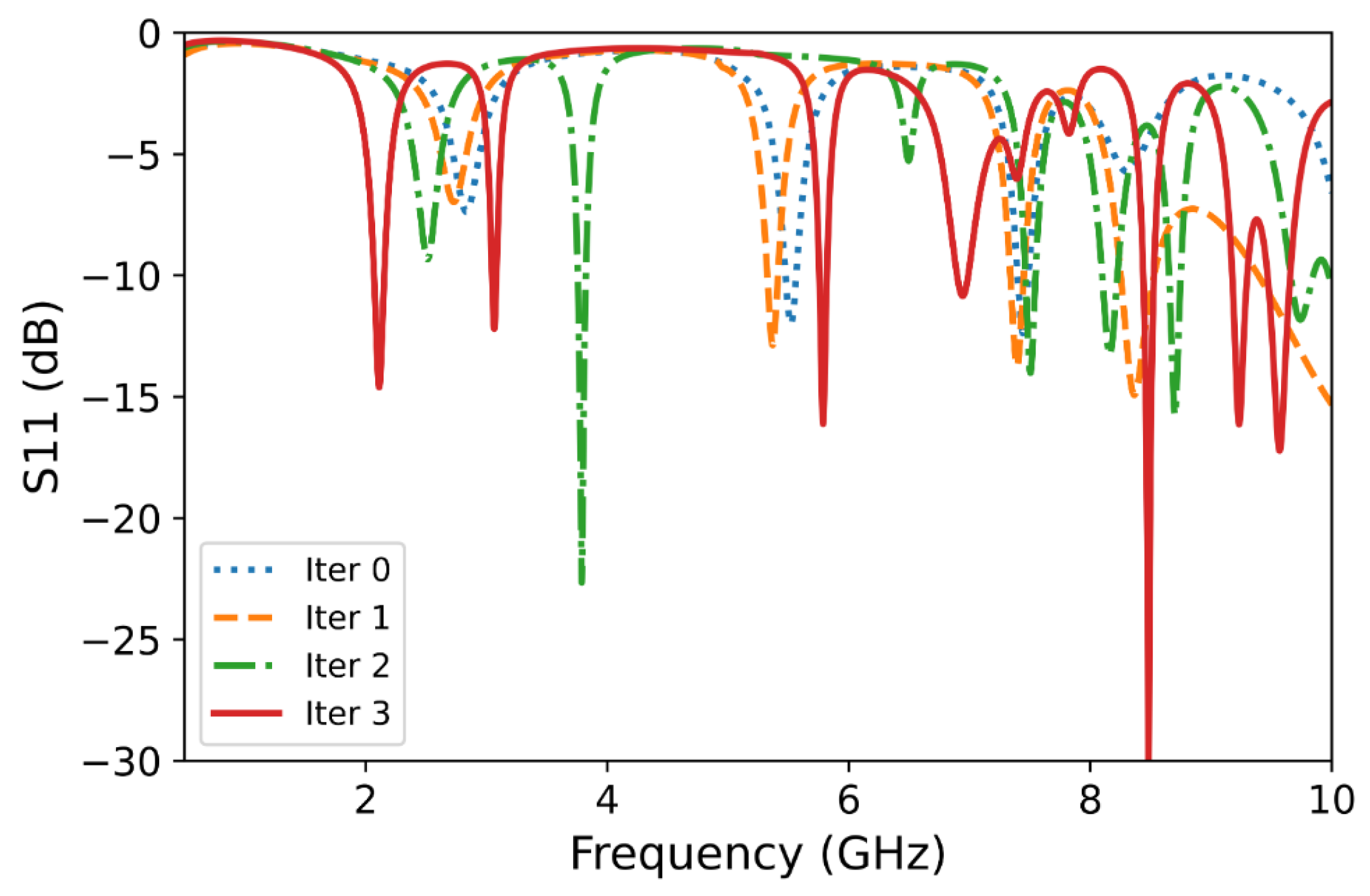
The return loss characteristics of the proposed antenna, depicted in Figure 4, highlight the effectiveness of the iterative design process. As the antenna evolves through each iteration, the final design demonstrates significant improvements in resonating frequencies and return loss, indicating enhanced performance across multiple bands. The final iteration achieves resonating frequencies at 2.11, 3.06, 5.78, 6.94, 8.48, 9.23, and 9.56 GHz, with corresponding return loss values of −14, −12, −16, −10, −30, −16, and −17 dB, respectively. These values reflect the antenna’s ability to efficiently radiate at these frequencies, minimizing the reflected power and maximizing energy transfer. Notably, the antenna exhibits exceptionally low return loss at the 8.48 GHz band, with a value of –30 dB, indicating near-optimal impedance matching at this frequency.
Figure 4.
Return Loss versus frequency: comparison of each iteration performance.
The reflection coefficient () can be obtained as follows:
where
- is the load impedance (impedance of the antenna);
- is the characteristic impedance of the transmission line (usually 50 ohms).
Then the return loss can be deduced as follows:
- is the reflection coefficient as defined in Equation (10).
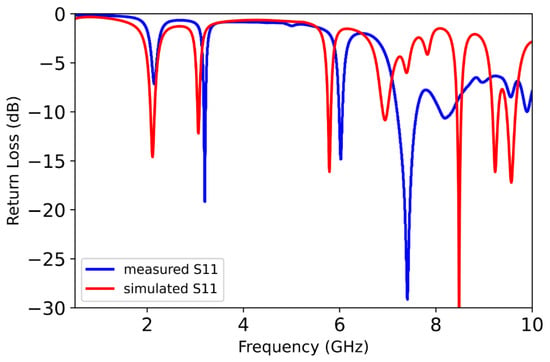
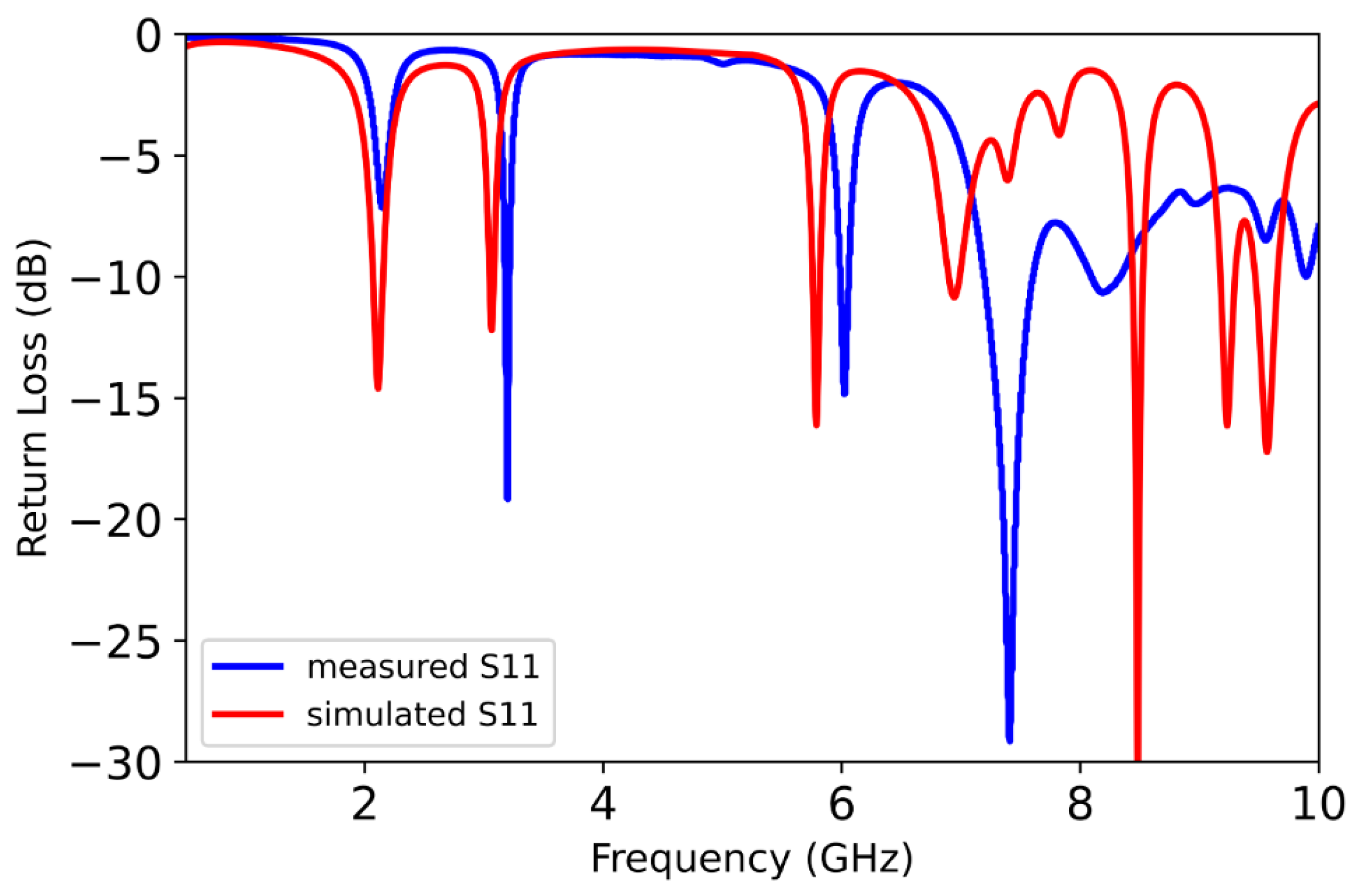
Additionally, Figure 5 presents a comparative analysis of the simulated and measured return loss versus frequency. The close agreement between these two plots underscores the reliability of the simulation results, confirming the accuracy of the design process. The antenna’s bandwidths at the identified resonating frequencies are 90, 37, 67, 100, 90, 130, and 220 MHz, respectively. These bandwidths ensure that the antenna can effectively operate over a wide range of frequencies, making it suitable for various communication applications. The broad bandwidth at the highest resonating frequency of 9.56 GHz, with a 220 MHz span, further emphasizes the antenna’s capability for wideband applications, offering flexibility in high-frequency operations.
Figure 5.
Return loss versus frequency of the measured and simulated results of the antenna.
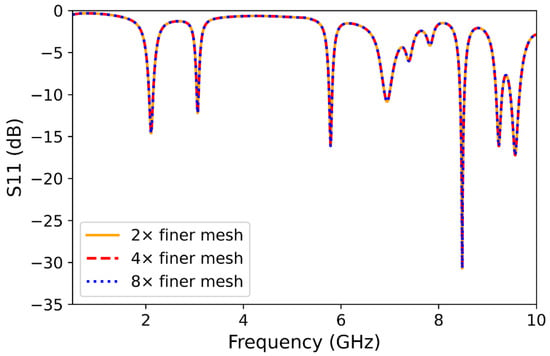
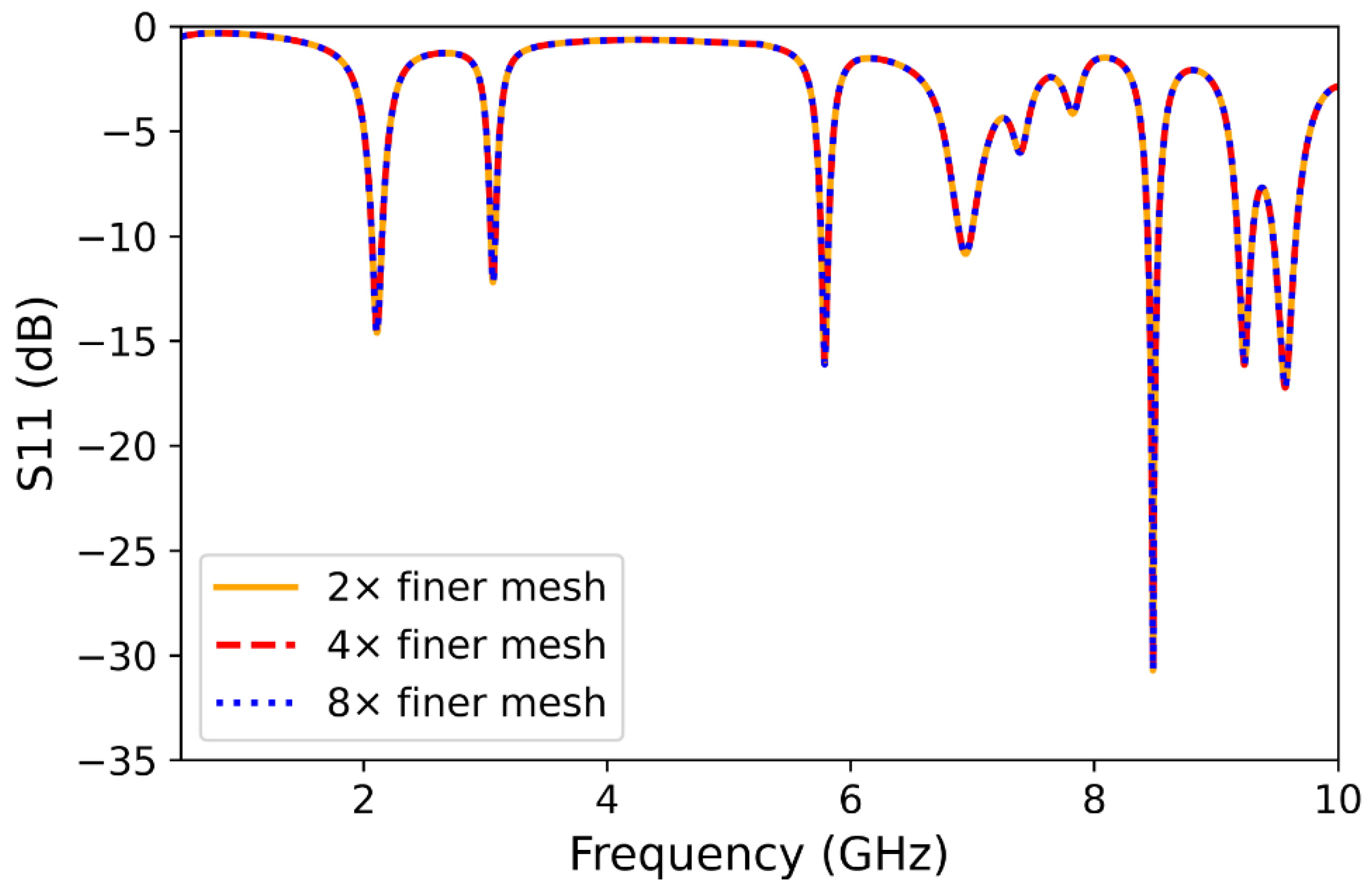
Figure 6 presents the simulated return loss of the proposed antenna using three different mesh refinements: 2× finer (0.005 mm), 4× finer (0.0025 mm), and 8× finer (0.00125 mm). The curves are completely identical across all refinement levels, which confirms that the simulation results are fully mesh-converged. This stability demonstrates that both the lower- and higher-frequency resonances are intrinsic characteristics of the antenna design rather than artifacts of meshing resolution.
Figure 6.
Return loss of the proposed antenna under different mesh refinements: 2× finer mesh (0.005 mm), 4× finer mesh (0.0025 mm), and 8× finer mesh (0.00125 mm).
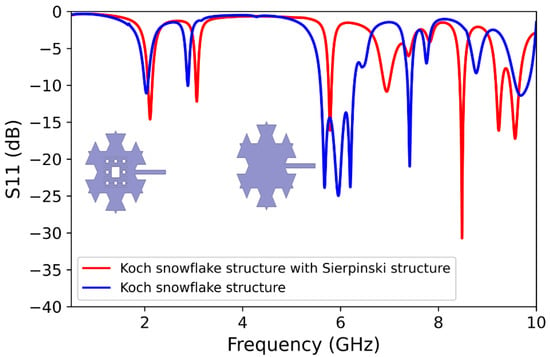
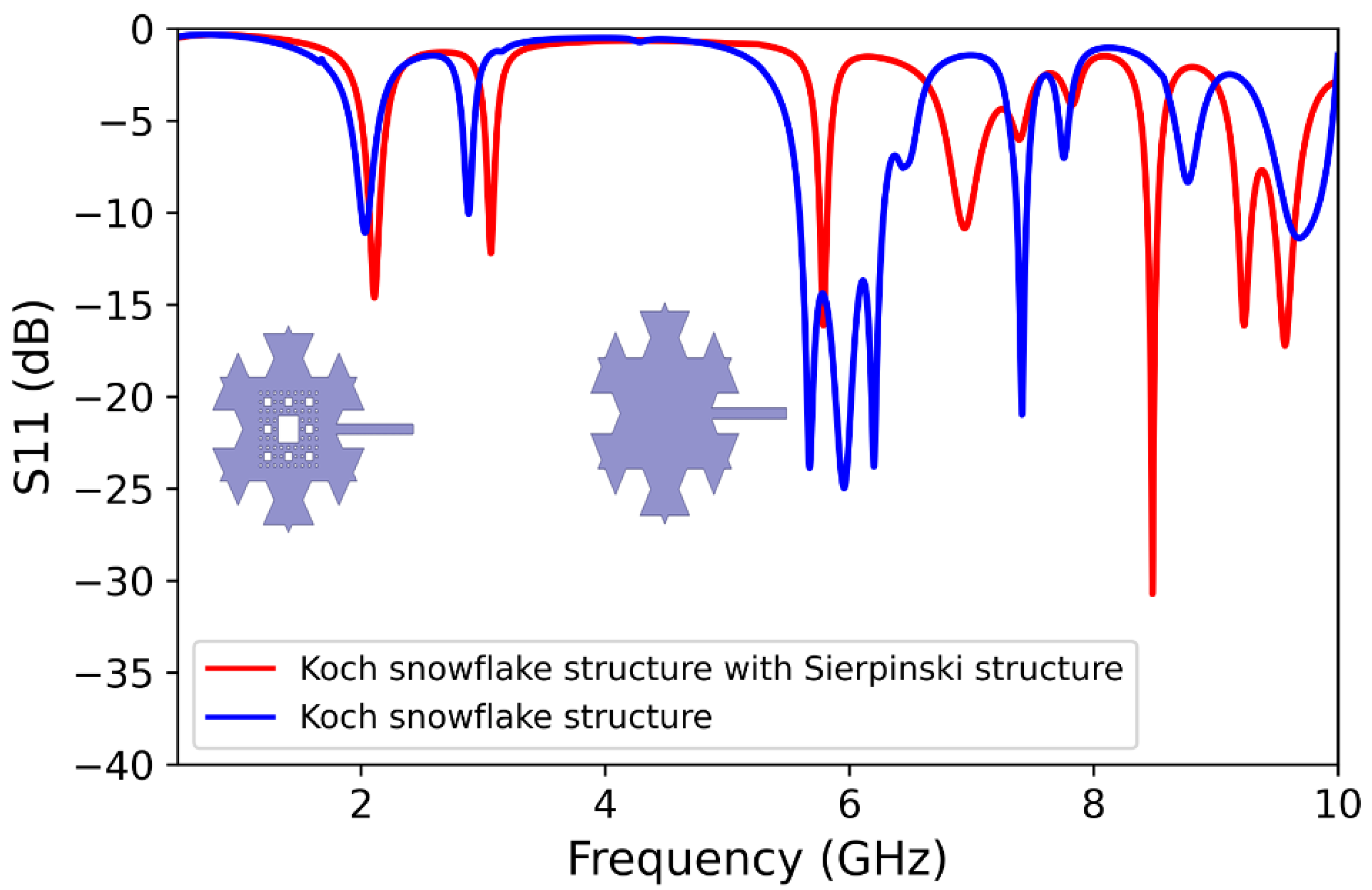
The return loss characteristics of the Koch snowflake structure without the Sierpinski modification are shown in Figure 7. Resonances are observed at 2.0 and 2.9 GHz with about dB return loss. In the mid-band, three closely spaced resonances at 5.8, 6.0, and 6.2 GHz merge into a wideband response of nearly 1000 MHz with return loss better than dB. Additional resonances appear at 7.2 GHz (<−20 dB) and 9.7 GHz ( dB, 700 MHz bandwidth).
Figure 7.
Return loss characteristics of structures of Koch snowflake with and without Sierpinski structure.
3.2. VSWR
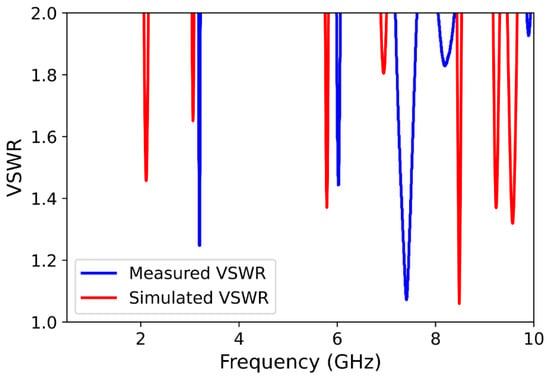
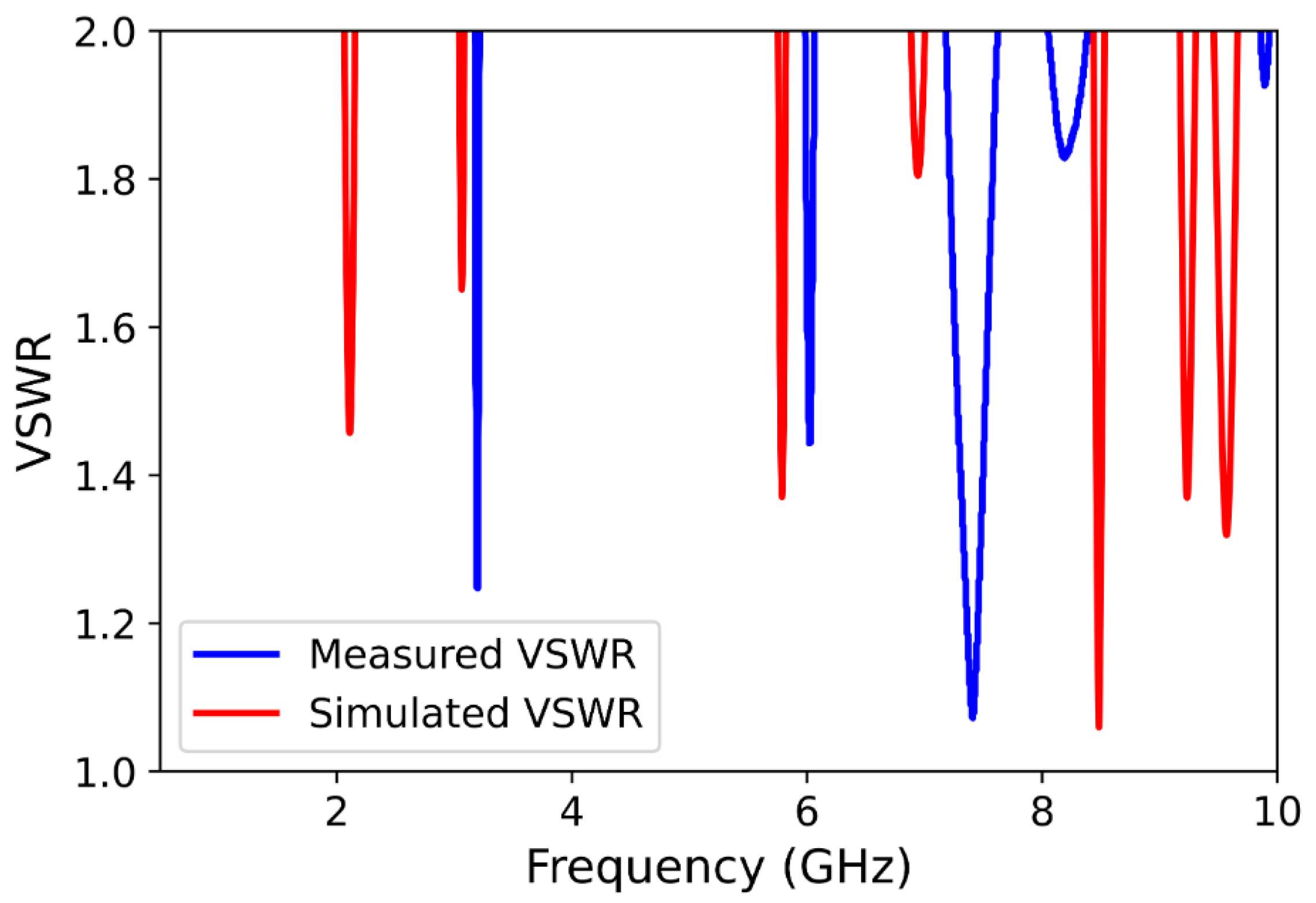
The Voltage Standing Wave Ratio (VSWR) values for the proposed antenna, shown in Figure 8, and corresponding to the resonating frequencies of 2.11, 3.06, 5.78, 6.94, 8.48, 9.23, and 9.56 GHz, are 1.45, 1.65, 1.37, 1.80, 1.06, 1.37, and 1.31, respectively. These values indicate excellent impedance matching, particularly at 8.48 GHz where the VSWR is 1.06, signifying minimal signal reflection.
where
Figure 8.
Voltage Standing Wave Ratio (VSWR) of the proposed antenna.
- is the reflection coefficient as defined in Equation (10).
Although the VSWR slightly increases at higher frequencies, the values remain within acceptable limits, ensuring efficient power transfer and stable antenna performance across the operating bands.
3.3. Radiation Pattern
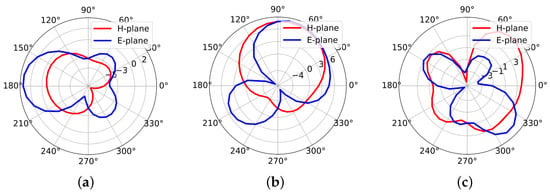
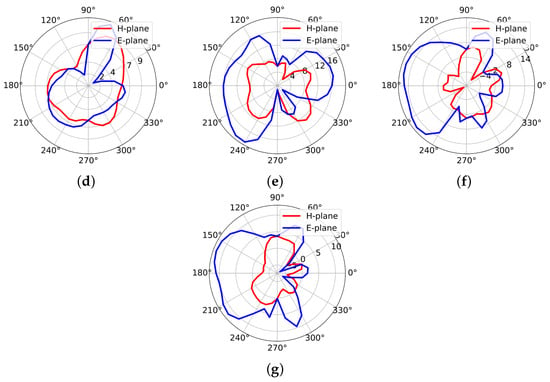
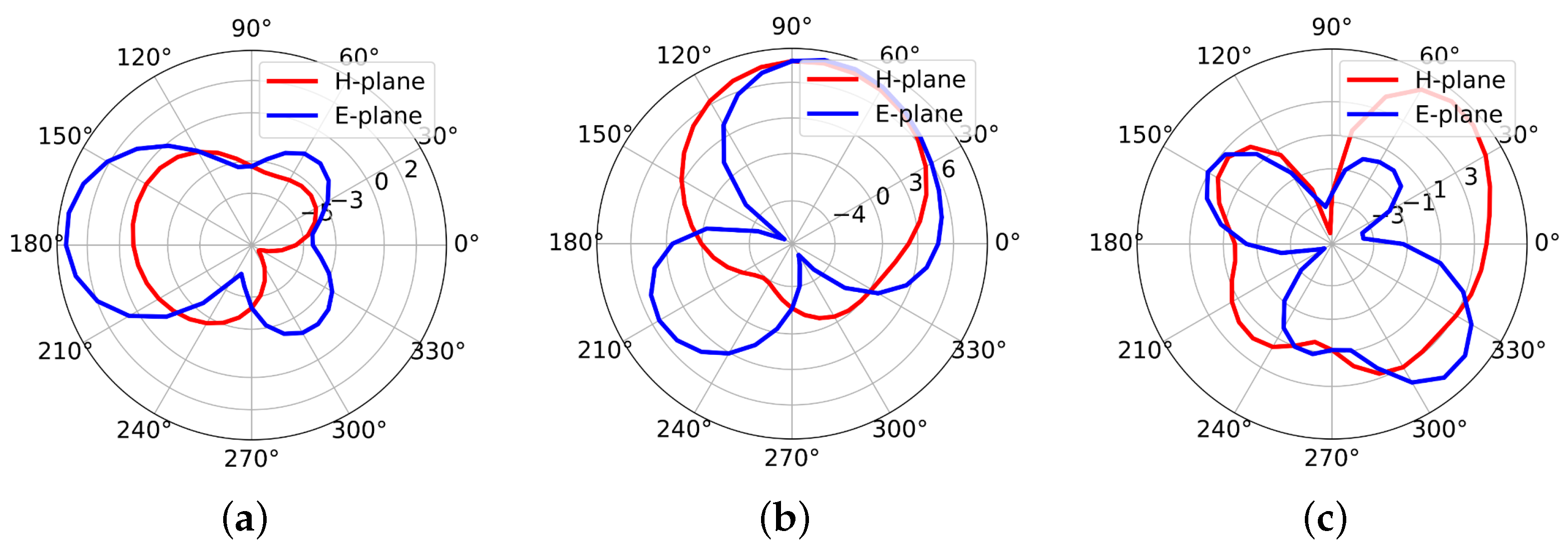
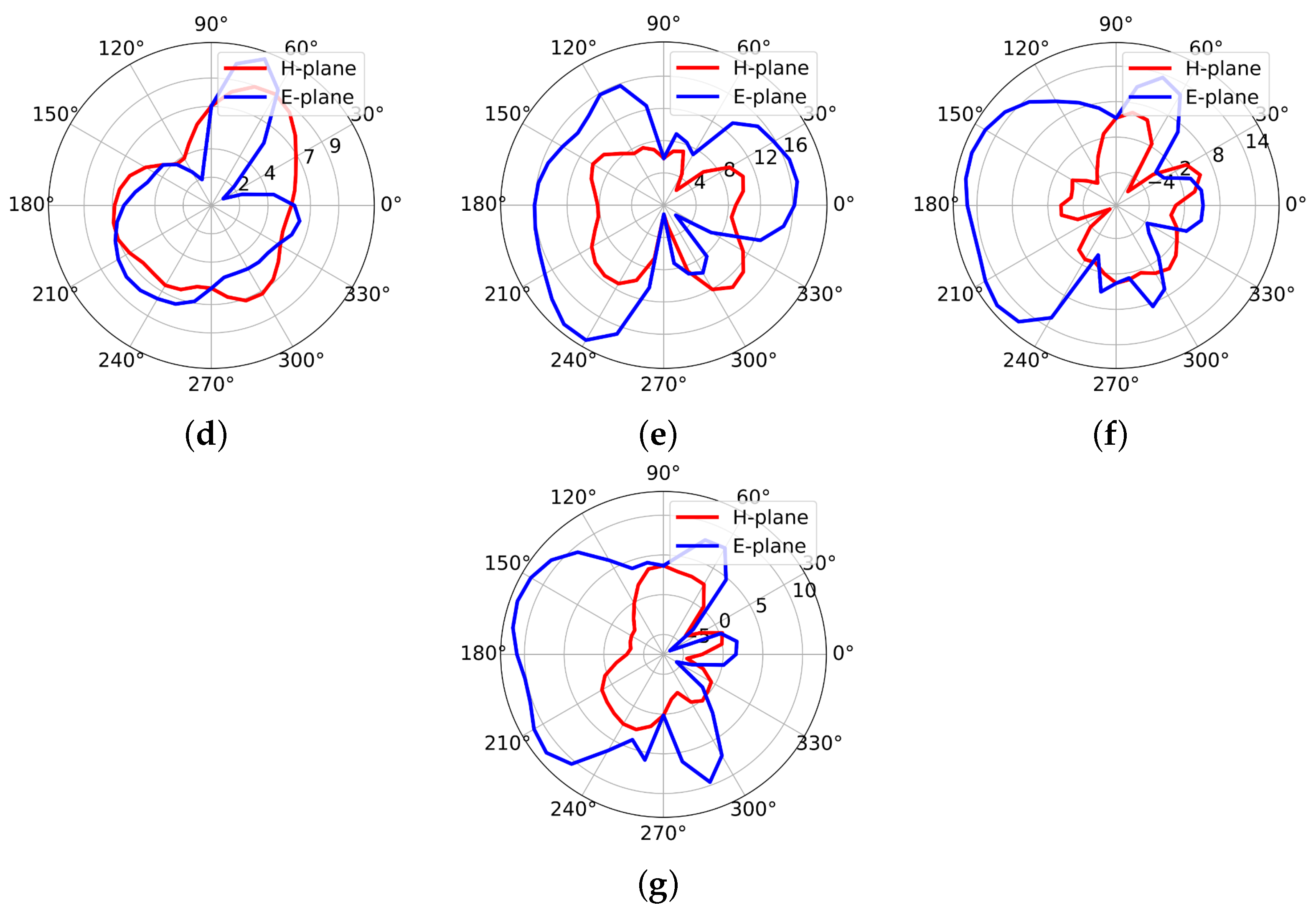
The radiation patterns of the proposed antenna, as illustrated in the plots in Figure 9, provide valuable insights into its directional characteristics at the resonating frequencies of 2.11, 3.06, 5.78, 6.94, 8.48, 9.23, and 9.56 GHz. In these plots, the blue line represents the radiation pattern when the elevation angle () is 0 degrees, while the red line represents .
Figure 9.
Radiation patterns at the following resonating frequencies: (a) 2.11 GHz, (b) 3.06 GHz, (c) 5.78 GHz, (d) 6.94 GHz, (e) 8.48 GHz, (f) 9.23 GHz, (g) 9.56 GHz.
At the key resonating frequency of 8.48 GHz, where the antenna achieves its maximum gain of 19.38 dBi, the radiation pattern exhibits strong directivity, particularly along the main lobe. This directivity indicates that the antenna effectively concentrates the radiated energy in a specific direction, which is advantageous for applications requiring focused signal strength.
The patterns at other resonating frequencies show similar good directivity, though with variations in the main lobe’s shape and orientation. The consistent performance across both and suggests that the antenna maintains robust radiation characteristics across different planes, thereby contributing to its versatility in various wireless communication scenarios.
3.4. Gain
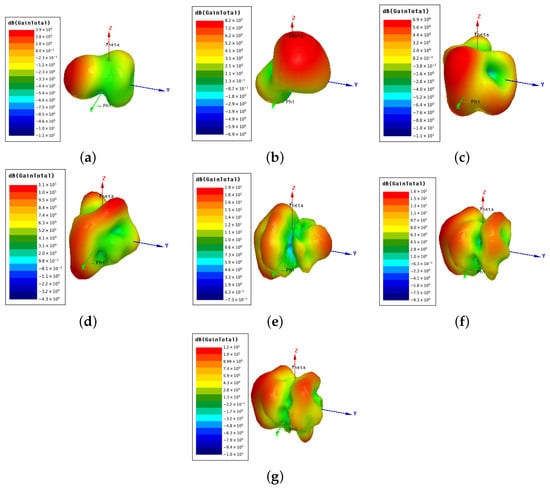
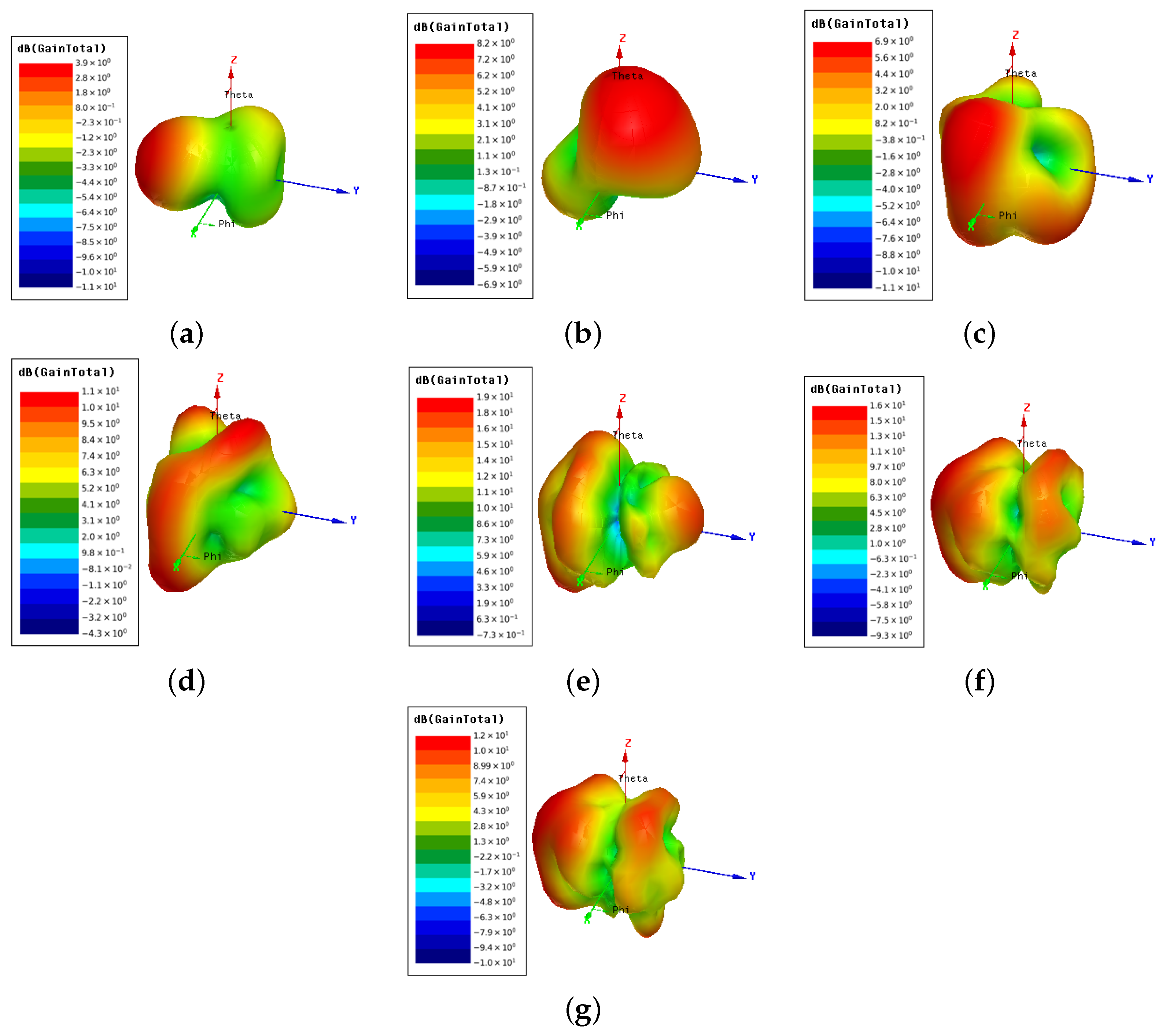
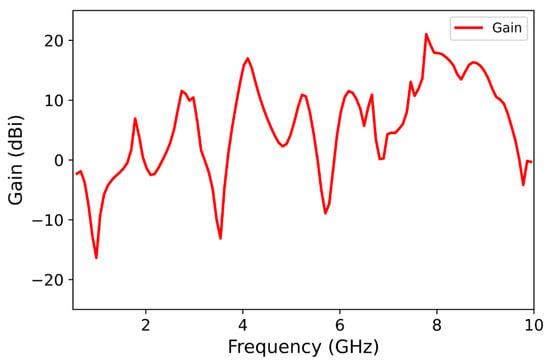
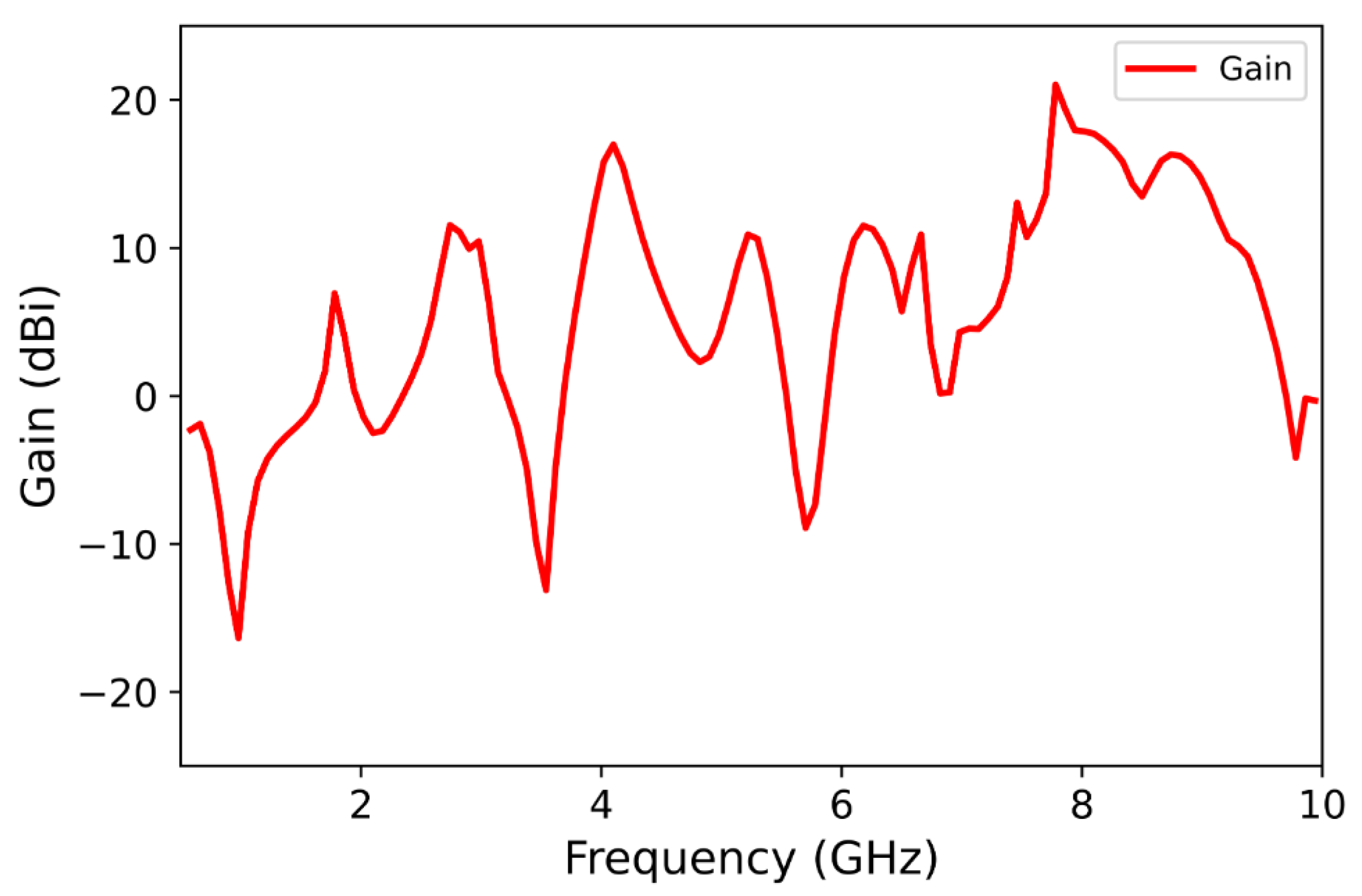
The gain characteristics of the proposed antenna, shown in Figure 10, were analyzed across the resonating frequencies of 2.11, 3.06, 5.78, 6.94, 8.48, 9.23, and 9.56 GHz. The corresponding simulated gain values are 3.92, 8.24, 6.90, 11.66, 19.38, 16.76, and 12.06 dBi, respectively. Good agreement is observed for the first four resonances up to 6.94 GHz, which confirms reliable performance with directional characteristics. At higher frequencies, the antenna continues to exhibit additional resonances, demonstrating its capability for wide multiband operation; however, the corresponding gain values are reported only as simulation outcomes without experimental validation. This ensures a balanced and accurate representation of the antenna’s performance across the full operating range, as shown in Figure 11.
Figure 10.
Gain (a) 2.11 GHz, (b) 3.06 GHz, (c) 5.78 GHz, (d) 6.94 GHz, (e) 8.48 GHz, (f) 9.23 GHz, (g) 9.56 GHz.
Figure 11.
Gain versus frequency.
The following formula provides an antenna’s gain :
where
- is the antenna’s gain in that direction. ;
- is the antenna’s efficiency;
- is the antenna’s directivity in the direction .
3.5. Current Distribution
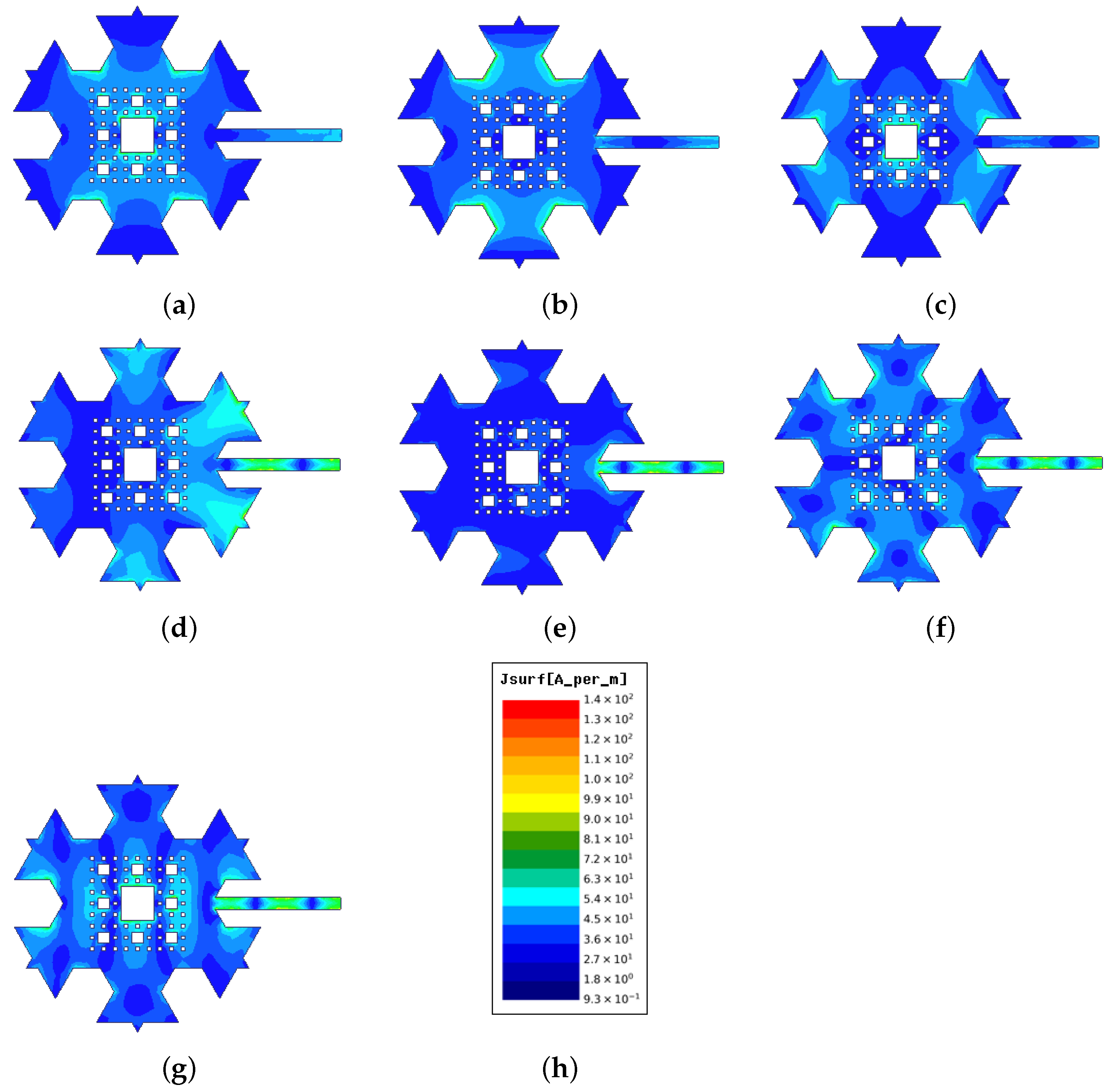
The current distribution of the proposed antenna shown in Figure 12 is concentrated along the edges of the fractal geometries, particularly around the resonating elements at each frequency. Notably, significant current is also observed in the feed width and at the center of the patch where the Sierpinski carpet is located. At lower frequencies, the current is more evenly distributed, contributing to stable radiation patterns. The current gets more intense as the frequency rises, concentrated in these critical areas, enhancing the antenna’s multiband performance and overall radiation efficiency.
Figure 12.
Surface current distribution at the following resonating frequencies: (a) 2.11 GHz, (b) 3.06 GHz, (c) 5.78 GHz, (d) 6.94 GHz, (e) 8.48 GHz, (f) 9.23 GHz, (g) 9.56 GHz, (h) Color legend.
The comparison presented in Table 1 highlights a noteworthy advancement of the proposed antenna over prior work. The first striking observation is the exceptionally gain that substantially exceeds the typical range reported in the literature (2.75–8.11 dBi, e.g., [46]). Achieving this level of gain in a compact 40 × 60 mm2 footprint while still operating on an FR4 substrate is significant, since FR4 is known for its higher dielectric loss compared to high-performance substrates such as Rogers RO4350B.
Table 1.
Comparison with other published work.
Moreover, the antenna sustains seven distinct operating bands, which positions it as highly versatile for multistandard wireless platforms, outperforming references that either operate in fewer bands ([38,47]) or trade off compactness for band coverage ([25]). The main trade-off evident from the comparison lies in the impedance bandwidth, where the proposed antenna offers 220 MHz, narrower than the 600–750 MHz range achieved in some references; however, this limitation appears justified in light of the dramatic gain enhancement and multi-band support. Importantly, the use of FR4 ensures cost-effectiveness and ease of fabrication, which further strengthens the practical impact of the design.
4. Conclusions
A compact hybrid fractal antenna combining Koch snowflake and Sierpinski rectangular carpet geometries was presented, designed on an FR4 substrate ( mm3) and optimized using Ansys HFSS v15. The proposed radiator exhibits seven clear resonances at 2.11, 3.06, 5.78, 6.94, 8.48, 9.23, and 9.56 GHz with impedance bandwidths of 37–220 MHz, return losses below –10 dB, VSWR ≤ 1.8, and realized gains reaching 19.38 dBi. These performance metrics demonstrate the antenna’s suitability for a broad range of applications including UMTS/LTE, sub-6 GHz 5G, ISM/Wi-Fi, C-band satellite uplinks, and X-band radar/satellite communications. The hybridization of Koch and Sierpinski fractal features achieves a favorable trade-off between compact footprint, multiband coverage, and high directivity, making the design attractive for multi-standard and multi-mission platforms.
Author Contributions
Formal analysis, M.M.N.; funding acquisition, M.E.M.; software, M.C.; writing—original draft, A.A.; writing—review & editing, R.B. All authors have read and agreed to the published version of the manuscript.
Funding
This work was supported by the research grants [SEED-2023-CE-143]; Prince Sultan University; Saudi Arabia [grant number SEED-2023-CE-143].
Data Availability Statement
Data are contained within the article.
Acknowledgments
The authors would like to acknowledge the support of Prince Sultan University for paying the Article Processing Charges of this publication. This article is derived from a research grant funded by the Research, Development, and Innovation Authority (RDIA)-Kingdom of Saudi Arabia-with grant number (13292-psu-2023-PSNU-R-3-1-EF-).
Conflicts of Interest
The authors declare no conflicts of interest.
References
- Puente-Baliarda, C.; Borja, C.; Navarro, M.; Romeu, J. An iterative model for fractal antennas: Application to the Sierpinski gasket antenna. IEEE Trans. Antennas Propag. 2000, 48, 713–719. [Google Scholar] [CrossRef] [Scilit]
- Romeu, J.; Soler, J. Generalized Sierpinski fractal multiband antenna. IEEE Trans. Antennas Propag. 2002, 49, 1237–1239. [Google Scholar] [CrossRef]
- Best, S.R. On the resonant properties of the Koch fractal and other wire monopole antennas. IEEE Antennas Wirel. Propag. Lett. 2005, 1, 74–76. [Google Scholar] [CrossRef] [Scilit]
- Borja, C.; Romeu, J. On the behavior of Koch island fractal boundary microstrip patch antenna. IEEE Trans. Antennas Propag. 2003, 51, 1281–1291. [Google Scholar] [CrossRef] [Scilit]
- Anguera, J.; Martínez, E.; Puente, C.; Borja, C.; Soler, J. Broad-band dual-frequency microstrip patch antenna with modified Sierpinski fractal geometry. IEEE Trans. Antennas Propag. 2004, 52, 66–73. [Google Scholar] [CrossRef] [Scilit]
- Kikkawa, T.; Kimoto, K.; Watanabe, S. Ultrawideband characteristics of fractal dipole antennas integrated on Si for ULSI wireless interconnects. IEEE Electron Device Lett. 2005, 26, 767–769. [Google Scholar] [CrossRef] [Scilit]
- Bao, X.L.; Ruvio, G.; Ammann, M.J.; John, M. A novel GPS patch antenna on a fractal high-impedance surface substrate. IEEE Antennas Wirel. Propag. Lett. 2006, 5, 323–326. [Google Scholar] [CrossRef] [Scilit]
- Rmili, H.; El Mrabet, O.; Floc’h, J.-M.; Miane, J.-L. Study of an electrochemically-deposited 3-D random fractal tree-monopole antenna. IEEE Trans. Antennas Propag. 2007, 55, 1045–1050. [Google Scholar] [CrossRef] [Scilit]
- Chen, W.-L.; Wang, G.-M.; Zhang, C.-X. Small-size microstrip patch antennas combining Koch and Sierpinski fractal shapes. IEEE Antennas Wireless Propag. Lett. 2008, 7, 738–741. [Google Scholar] [CrossRef] [Scilit]
- Zainud-Deen, S.; Malhat, H.A.E.; Awadalla, K. Fractal antenna for passive UHF RFID applications. Prog. Electromagn. Res. B 2009, 16, 209–228. [Google Scholar] [CrossRef] [Scilit]
- Hong, T.; Gong, S.-X.; Liu, Y.; Jiang, W. Monopole antenna with quasi-fractal slotted ground plane for dual-band applications. IEEE Antennas Wirel. Propag. Lett. 2010, 9, 595–598. [Google Scholar] [CrossRef] [Scilit]
- Azari, A. A new super wideband fractal microstrip antenna. IEEE Trans. Antennas Propag. 2011, 59, 1724–1727. [Google Scholar] [CrossRef] [Scilit]
- Levy, M.; Bose, S.; Van Dinh, A.; Kumar, D.S. A novelistic fractal antenna for ultra wideband (UWB) applications. Prog. Electromagn. Res. B 2012, 45, 369–393. [Google Scholar] [CrossRef] [Scilit]
- Kushwaha, N.; Kumar, R. An UWB fractal antenna with defected ground structure and swastika shape electromagnetic band gap. Prog. Electromagn. Res. B 2013, 52, 383–403. [Google Scholar] [CrossRef] [Scilit]
- Susila, M.; Rao, T.R.; Gupta, A. A novel smiley fractal antenna (SFA) design and development for UWB wireless applications. Prog. Electromagn. Res. C 2014, 54, 171–178. [Google Scholar] [CrossRef] [Scilit]
- Dyab, W.M.G.; Ibrahim, M.S.; Sakr, A.A.; Wu, K. The resonant electrical length of helical antennas placed between metallic parallel plates. In Proceedings of the 2022 16th European Conference on Antennas and Propagation (EuCAP), Madrid, Spain, 27 March–1 April 2022; pp. 1–3. [Google Scholar]
- Dyab, W.M.; Sarkar, T.K.; Salazar-Palma, M. Antenna reciprocity and the theory of electromagnetic time reversal. In Proceedings of the 2012 IEEE International Symposium on Antennas and Propagation, Chicago, IL, USA, 8–14 July 2012; pp. 1–2. [Google Scholar]
- Dyab, W.; Salama, D.; Sarkar, T.K.; Salazar-Palma, M. Multiple-frequency adaptive antenna processing over imperfect ground planes. In Proceedings of the 2014 IEEE Antennas and Propagation Society International Symposium (APSURSI), Memphis, TN, USA, 6–11 July 2014; pp. 1796–1797. [Google Scholar]
- Kumar, Y.; Singh, S. A compact multiband hybrid fractal antenna for multistandard mobile wireless applications. Wirel. Pers. Commun. 2015, 84, 57–67. [Google Scholar] [CrossRef] [Scilit]
- Kumar, Y.; Singh, S. Performance analysis of coaxial probe fed modified Sierpinski–Meander hybrid fractal heptaband antenna for future wireless communication networks. Wirel. Pers. Commun. 2017, 94, 3251–3263. [Google Scholar] [CrossRef] [Scilit]
- Kaur, G.; Rattan, M.; Jain, C. Design and optimization of psi (ψ) slotted fractal antenna using ANN and GA for multiband applications. Wirel. Pers. Commun. 2017, 97, 4573–4585. [Google Scholar] [CrossRef] [Scilit]
- Bangi, I.S.; Sivia, J.S. Minkowski and Hilbert curves based hybrid fractal antenna for wireless applications. AEU-Int. J. Electron. Commun. 2018, 85, 159–168. [Google Scholar] [CrossRef] [Scilit]
- Kaur, M.; Sivia, J.S. Minkowski, Giuseppe Peano and Koch curves based design of compact hybrid fractal antenna for biomedical applications using ANN and PSO. AEU-Int. J. Electron. Commun. 2019, 99, 14–24. [Google Scholar] [CrossRef] [Scilit]
- Sran, S.S.; Sivia, J.S. ANN and IFS based wearable hybrid fractal antenna with DGS for S, C and X band application. AEU–Int. J. Electron. Commun. 2020, 127, 153425. [Google Scholar] [CrossRef] [Scilit]
- Aouthu, S.; Anantha, B.; Gosula, R.S.R.; Swaraja, K.; Chaitanya, D.M.K.; Lakshmi, N.D. Sustainable design and analysis of a quasi snowflake fractal antenna for multiband applications. In Proceedings of the 2024 IEEE Wireless Antenna and Microwave Symposium (WAMS), Visakhapatnam, India, 29 February–3 March 2024; pp. 1–5. [Google Scholar]
- Srikanth, G.; Reddy, A.S.; Sravanthi, J.; Naik, K.H.M.; Kota, P.R. Low profile super wideband Koch snowflake fractal based monopole antenna with enhanced bandwidth and notching characteristics. In Proceedings of the 2024 2nd International Conference on Computer, Communication and Control (IC4), Indore, India, 8–10 February 2024; pp. 1–6. [Google Scholar]
- Samayoa, D.; Mollinedo, H.; Jiménez-Bernal, J.A.; Gutiérrez-Torres, C.C. Effects of Hausdorff dimension on the static and free vibration response of beams with Koch snowflake-like cross section. Fractal Fract. 2023, 7, 153. [Google Scholar] [CrossRef] [Scilit]
- Aravindraj, E.; Nagarajan, G.; Ramanathan, P. A compact Sierpinski gasket fractal antenna for S, C, X, and Ku band applications. Prog. Electromagn. Res. C 2024, 141, 33–40. [Google Scholar] [CrossRef] [Scilit]
- Ezhumalai, A.; Nagarajan, G.; Ramanathan, P. Koch snowflake fractal embedded octagonal patch antenna with hexagonal split ring for ultra-wide band and 5G applications. Prog. Electromagn. Res. C 2023, 135, 95–106. [Google Scholar] [CrossRef] [Scilit]
- Krishnan, T. A modified Sierpinski carpet antenna structure for multiband wireless applications. Sci. Temper 2023, 14, 398–404. [Google Scholar]
- Benkhadda, O.; Saih, M.; Ahmad, S.; Al-Gburi, A.J.A.; Zakaria, Z.; Chaji, K.; Reha, A. A miniaturized tri-wideband Sierpinski hexagonal-shaped fractal antenna for wireless communication applications. Fractal Fract. 2023, 7, 115. [Google Scholar] [CrossRef] [Scilit]
- Vallappil, A.K.; Khawaja, B.A.; Rahim, M.K.A.; Uzair, M.; Jamil, M.; Awais, Q. Minkowski–Sierpinski fractal structure-inspired 2×2 antenna array for use in next-generation wireless systems. Fractal Fract. 2023, 7, 158. [Google Scholar] [CrossRef] [Scilit]
- Azzouz, A.; Bouhmidi, R.; Chetioui, M.; Berber, R.; Al-Gburi, A.J.A. Performance optimization of crossed bowties of inverted Sierpinski fractal antenna for multiband wireless communication applications. Telemat. Inform. Rep. 2025, 19, 100231. [Google Scholar] [CrossRef] [Scilit]
- Remya, V.; Gajalakshmi, M.; Jayashree, S.; Kanthimathi, M. Low profile Sierpinski fractal patch antenna. In Proceedings of the 2022 International Conference on Communication, Computing and Internet of Things (IC3IoT), Chennai, India, 10–11 March 2022; pp. 1–5. [Google Scholar]
- Rao, N. Modified Sierpinski and its use in fractal patch antenna for miniaturization and multiband behavior. In Proceedings of the 2022 IEEE Microwaves, Antennas, and Propagation Conference (MAPCON), Bangalore, India, 12–16 December 2022; pp. 1804–1809. [Google Scholar]
- Kumar, O.P.; Kumar, P.; Ali, T.; Kumar, P.; Subhash, B.K. A quadruple notch UWB antenna with decagonal radiator and Sierpinski square fractal slots. J. Sens. Actuator Netw. 2023, 12, 24. [Google Scholar] [CrossRef] [Scilit]
- Kalaiyarasan, R.; Nagarajan, G.; Kumaran, R.S. Design and implementation of an efficient Sierpinski carpet fractal antenna for 2.45 GHz applications. SN Comput. Sci. 2023, 4, 728. [Google Scholar] [CrossRef] [Scilit]
- Yazid, M.Y.I.; Baharuddin, M.H.; Islam, M.S.; Islam, M.T.; Almutairi, A.F. A Sierpinski arrowhead curve slot Vivaldi antenna for microwave head imaging system. IEEE Access 2023, 11, 32335–32347. [Google Scholar] [CrossRef] [Scilit]
- Porcu, I.; Maccio, C.; Muntoni, G.; Fanti, A. Design of a Sierpinski fractal antenna for breast tumors diagnosis. In Proceedings of the 2023 Photonics & Electromagnetics Research Symposium (PIERS), Prague, Czech Republic, 3–6 July 2023; pp. 1698–1704. [Google Scholar]
- Annou, A.; Berhab, S.; Chebbara, F. Koch snowflake fractal patch antenna with new ENG metamaterial loads for WiMAX and Wi-Fi. In Proceedings of the 2022 7th International Conference on Image and Signal Processing and their Applications (ISPA), Mostaganem, Algeria, 8–9 May 2022; pp. 1–5. [Google Scholar]
- Harini, V.; Sairam, M.V.S.; Madhu, R. Performance analysis of an extended Sierpinski gasket fractal antenna for mmWave femtocells applications. Wirel. Pers. Commun. 2022, 119, 1437–1468. [Google Scholar] [CrossRef] [Scilit]
- Azzouz, A.; Bouhmidi, R.; Munir, M.E.; Nasralla, M.M.; Chetioui, M. Performance analysis of a high-gain multi-band wheel-shaped fractal antenna using Sierpinski carpet and Koch snowflake geometries. Results Eng. 2025, 26, 105328. [Google Scholar] [CrossRef] [Scilit]
- Abraham, J.; Kannadhasan, S. Design and analysis of single layer proximity fed Sierpinski fractal 2x1 array antenna embedded on hexagon shaped patch with defected ground structure. J. Commun. 2022, 17, 878–889. [Google Scholar] [CrossRef] [Scilit]
- Vera-Reveles, G.; González-Fernández, J.V.; Castillo-León, J.F.; González, F.J.; Díaz de León-Zapata, R.; De La Rosa-Zapata, A.B.; Orocio-Castro, N.; Simón, J. Tuning bolometric parameters of Sierpinski fractal antenna-coupled SWCNT films by thermoelectric characterization at UHF frequencies. Electronics 2022, 11, 1665. [Google Scholar] [CrossRef] [Scilit]
- Kaur, G.; Kaur, A. Monostatic radar-based microwave imaging of breast tumor using an ultra-wideband dielectric resonator antenna (DRA) with a Sierpinski fractal defected ground structure. Mapan 2022, 37, 917–928. [Google Scholar] [CrossRef] [Scilit]
- Mollah, M.R.; Rahman, M.A.; Shohan, M.S.R. Design of a multi-band Sierpinski carpet fractal antenna with modified ground plane. In Proceedings of the 2022 International Conference on Advancement in Electrical and Electronic Engineering (ICAEEE), Gazipur, Bangladesh, 24–26 February 2022; pp. 1–5. [Google Scholar]
- Apon, R.I.; Hossen, M.Z.; Das, I.; Chakraborty, S. Design and performance analysis of a CSRR based snowflake fractal antenna for multiband applications. In Proceedings of the 2021 5th International Conference on Electrical Information and Communication Technology (EICT), Khulna, Bangladesh, 17–19 December 2021; pp. 1–5. [Google Scholar]

Disclaimer/Publisher’s Note: The statements, opinions and data contained in all publications are solely those of the individual author(s) and contributor(s) and not of MDPI and/or the editor(s). MDPI and/or the editor(s) disclaim responsibility for any injury to people or property resulting from any ideas, methods, instructions or products referred to in the content. |
© 2026 by the authors. Licensee MDPI, Basel, Switzerland. This article is an open access article distributed under the terms and conditions of the Creative Commons Attribution (CC BY) license.