Article

Existence of Heteroclinic Orbits in Fractional-Order and Integer-Order Coupled Lorenz Systems

1
School of Information, Zhejiang Guangsha Vocational and Technical University of Construction, Dongyang 322100, China
2
School of Science, Zhejiang University of Science and Technology, Hangzhou 310023, China
3
College of Sustainability and Tourism, Ritsumeikan Asia Pacific University, Beppu 874-8577, Japan
4
Institute of Applied Mathematics, School of Artificial Intelligence, Taizhou University, Taizhou 318000, China
*
Authors to whom correspondence should be addressed.
Fractal Fract. 2026, 10(1), 36; https://doi.org/10.3390/fractalfract10010036
Submission received: 28 November 2025 / Revised: 29 December 2025 / Accepted: 4 January 2026 / Published: 7 January 2026

Abstract

Applying two Lyapunov functions and the concepts of α -/ ω -limit sets, this paper reexamines fractional-order and integer-order coupled Lorenz systems and simultaneously proves the existence of twelve heteroclinic orbits, i.e., four ones to S 0 and S 5 , 6 , 7 , 8 , four pairs of ones to S 1 and S 5 , 7 , S 3 and S 5 , 6 , S 2 and S 6 , 8 , S 4 and S 7 , 8 when r 1 > 0 , b 2 σ > 0 and a c < 0 . These orbits have not been reported in existing studies on coupled Lorenz-type systems and are verified via numerical simulations. The findings not only uncover new dynamics of the Lorenz system family and expand the application scope of Lyapunov-based methods but also provide insights into heteroclinic orbits of other fractional-order and integer-order Lorenz-like counterparts.

1. Introduction

In this paper, one restudies the fractional-order coupled two Lorenz systems [1]:
D t α t 0 C x 1 = σ ( x 1 y 1 ) , D t α t 0 C y 1 = r x 1 y 1 x 1 z 1 + a ( x 2 y 2 ) , D t α t 0 C z 1 = x 1 y 1 b z 1 , σ 0 , r , a , b , c R , D t α t 0 C x 2 = σ ( x 2 y 2 ) , D t α t 0 C y 2 = r x 2 y 2 x 2 z 2 + c ( x 1 y 1 ) , D t α t 0 C z 2 = x 2 y 2 b z 2 ,
and its integer-order counterpart for α = 1 [2], where D t α t 0 C is α -order Caputo differential operator, i.e.,
D t α t 0 C f ( t ) = 1 Γ ( n α ) t 0 t ( t τ ) n α 1 f ( n ) ( τ ) d τ , n = min { k N | k > α } .
Except for the Lorenz chaotic family, the Caputo fractional derivative and fractional calculus have been intensively studied in many other fields of engineering and physics. For example, Liu et al. proposed a new incommensurate fractional-order ecological system describing the interaction between permafrost melting, vegetation degradation, and temperature, and explored its dynamical behavior, i.e., stability, bifurcation, and characteristics of chaos [3]. Ghafoor et al. introduced a numerical strategy for time Caputo fractional reaction-diffusion models in biological and chemical processes via finite difference formulations [4]. Srati et al. applied a deep neural network to deal with an inverse problem in nonlinear time-based Caputo fractional diffusion equations [5]. Utilizing a novel methodology integrating a modified quasi-boundary value regularization approach and a logarithmic reconstruction technique, Long et al. addressed the inverse source problem for a time–space fractional diffusion equation with the Caputo–Hadamard derivative [6]. Brociek et al. applied a metaheuristic optimization algorithm to address the inverse problem for a diffusion equation with fractional derivatives [7]. Recently, Mbasso et al. also added Caputo fractional derivatives to the mutation and update equations of standard Differential Evolution to formulate a new Fractional-Order Differential Evolution (FCDE) technique, and used this in solving high-dimensional constrained optimization problems [8].
System (1) and its integer-order counterpart exhibit multi-wing attractors, prompting scholars to conduct extensive studies on their dynamics: computing series solutions via the Adomian decomposition method, detecting chaos in fractional four-wing attractors using the “0-1 test” [1], analyzing equilibria [2], identifying four-wing hyperchaotic attractors [9], estimating ultimate bounded sets [10], uncovering periodic/quasiperiodic/chaotic/hyperchaotic behaviors via bi-parameter ( a , c ) bifurcation diagrams [11], approximating the LEs values through Deep Learning technique [12], and so on. Although researchers performed the qualitative and quantitative analysis on the fractional-order and integer-order coupled Lorenz systems, three fundamental problems remain unaddressed:
(i) Do heteroclinic orbits exist in system (1) and its integer-order counterpart, as in other chaotic/hyperchaotic Lorenz systems?
(ii) If they exist, can Lyapunov functions and α -/ ω -limit set theory (powerful tools for single systems) be extended to coupled systems?
(iii) How can one construct Lyapunov functions adapted to the parameter-dependent stability of coupled systems?
As defined in [13,14], a heteroclinic orbit is a type of orbit doubly asymptotic to two different equilibrium points or closed orbits when t ± . Shilnikov et al. classified chaos occurring in some high-dimensional quadratic autonomous differential systems as the Shilnikov heteroclinic orbit type [13]. Leonov devised the fishing principle to coin the heteroclinic orbits of Lorenz-type systems and thus solved the Tricomi problem [15,16]. Wiggins, Feng, and Hu detected chaos in the sense of Smale horseshoes through the bifurcation of heteroclinic orbits [14,17]. In terms of application, the heteroclinic orbit also involves spaceflight, cell signalling, biomathematics, etc. [18,19,20,21,22]. Overall, studying heteroclinic orbits has a certain theoretical and practical significance.
In recent decades, the method of Lyapunov function, using definitions of the α -/ ω -limit set, has been used extensively to study the existence of heteroclinic orbits of the Lorenz system family. As in the fishing principle [15], its advantage in comparison with other methods of proving the existence of heteroclinic orbits is that one does not need to consider a mutual disposition of stable and unstable manifolds of saddle equilibria. Specifically, the Chen [23,24], T, Lü [25], Yang [26] systems have a pair of axis-symmetric heteroclinic orbits. The authors also proved the existence of a pair of axis-symmetric heteroclinic orbits in the four-dimensional Lorenz-type system [27]. An infinite set of heteroclinic orbits of the origin and an infinite number of pairs of nontrivial equilibria were proved to exist in two 3D periodically forced extended Lorenz-like systems [28,29]. The quadratic Lorenz-like systems have a single heteroclinic orbit [30,31,32]. However, Wang et al. proved that a pair of asymmetric heteroclinic orbits exists [33]. The sub-quadratic orbits [34,35] also have a pair of axis-symmetric and centro-symmetric heteroclinic orbits. However, for 6D fractional-order and integer-order coupled Lorenz systems, the existence, number, and distribution of heteroclinic orbits remain unstudied.
To fill these gaps, in this study, we not only simultaneously rigorously prove the existence of twelve heteroclinic orbits in the fractional-order coupled Lorenz systems (1) and its integer-order counterpart by virtue of two different Lyapunov functions, but also may offer a reference for the existence of heteroclinic orbits of other Caputo fractional-order Lorenz systems, such as the fractional-order Chen [23,24], T, Lü [25], Yang [26], 4D Lorenz-like [27,36], 3D periodically forced extended Lorenz-like [28,29], 3D Lorenz-like [30,37,38,39] systems, which are also the main contributions of this paper, and thus satisfy Sprott’s second criterion [40].
The rest of this study’s content is presented below. The main results and numerical examples are presented in Section 2. The existence of twelve heteroclinic orbits of system (1) and its integer-order counterparts is proved in Section 3. Finally, we provide a summary of our research and propose the next step of the work in Section 4.

2. The Main Results

2.1. Equilibria and Stability

Remark 1.
Referring to [1] (pp. 3334–3335), [2] (p. 285) and [9] (p. 2090), the first and second subsystems of system (1) have the same equilibria S 0 I = S 0 I I = ( 0 , 0 , 0 ) and S 1 , 2 I = S 1 , 2 I I = ( ± b ( r 1 ) , ± b ( r 1 ) , r 1 ) when b ( r 1 ) > 0 and σ 0 . Therefore, system (1) has nine equilibria: S 0 = ( S 0 I , S 0 I I ) , S 1 = ( S 0 I , S 1 I I ) , S 2 = ( S 0 I , S 2 I I ) , S 3 = ( S 1 I , S 0 I I ) , S 4 = ( S 2 I , S 0 I I ) , S 5 = ( S 1 I , S 1 I I ) , S 6 = ( S 1 I , S 2 I I ) , S 7 = ( S 2 I , S 1 I I ) , S 8 = ( S 2 I , S 2 I I ) .
Remark 2.
Performing a simple linear analysis, S 0 and S 1 , 2 , 3 , 4 are unstable, and S 5 , 6 , 7 , 8 are stable when r 1 > 0 , b 2 σ > 0 and a c < 0 for α = 1 .

2.2. Existence of Heteroclinic Orbits

Theorem 1.
When r 1 > 0 , b 2 σ > 0 , a c < 0 , and α Ω = { α | | a r g ( λ ( σ , r , a , b , c ) ) | < α π 2 } ( λ ( σ , r , a , b , c ) is any one of eigenvalues of S 0 , 1 , 2 , 3 , 4 ), the following two assertions hold:
(i)
System (1) has no closed trajectories, i.e., each of the ω-limit of any orbits of it is one of S i , i = 0 , 1 , , 8 .
(ii)
There are four heteroclinic orbits to S 0 and S 5 , 6 , 7 , 8 , and four pairs of ones to S 1 and S 5 , 7 , S 3 and S 5 , 6 , S 2 and S 6 , 8 , and S 4 and S 7 , 8 .

2.3. Numerical Simulation and Stability Analysis

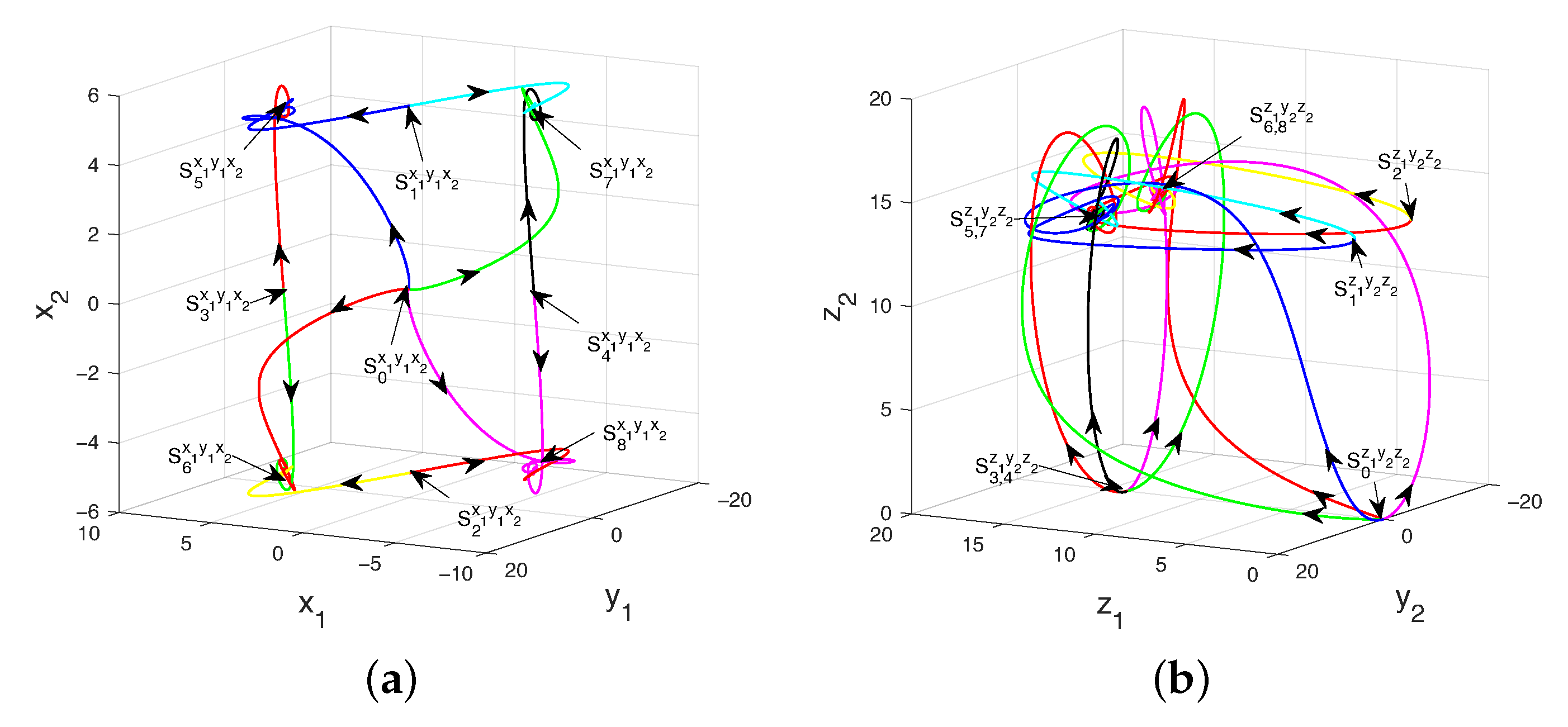
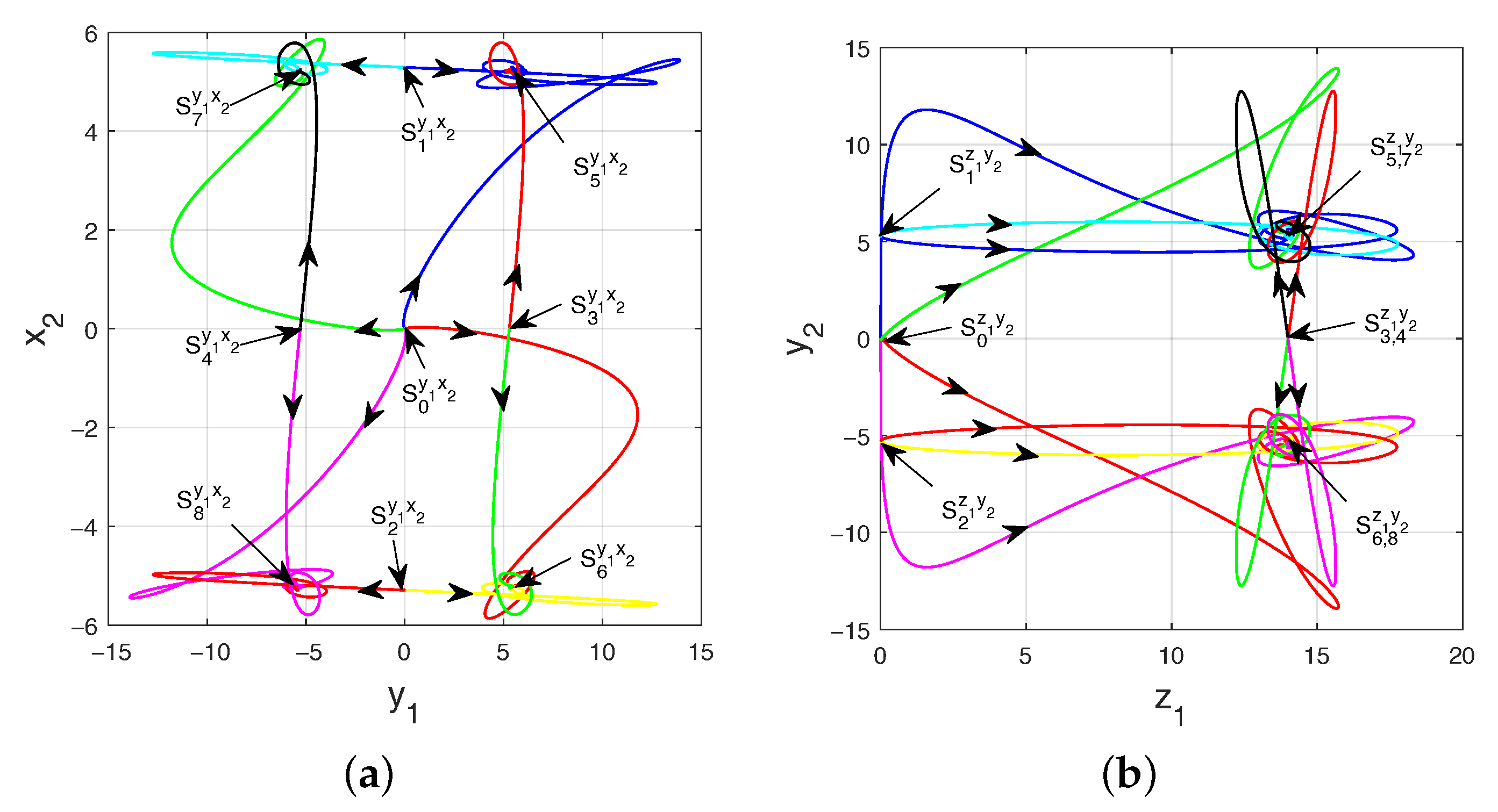
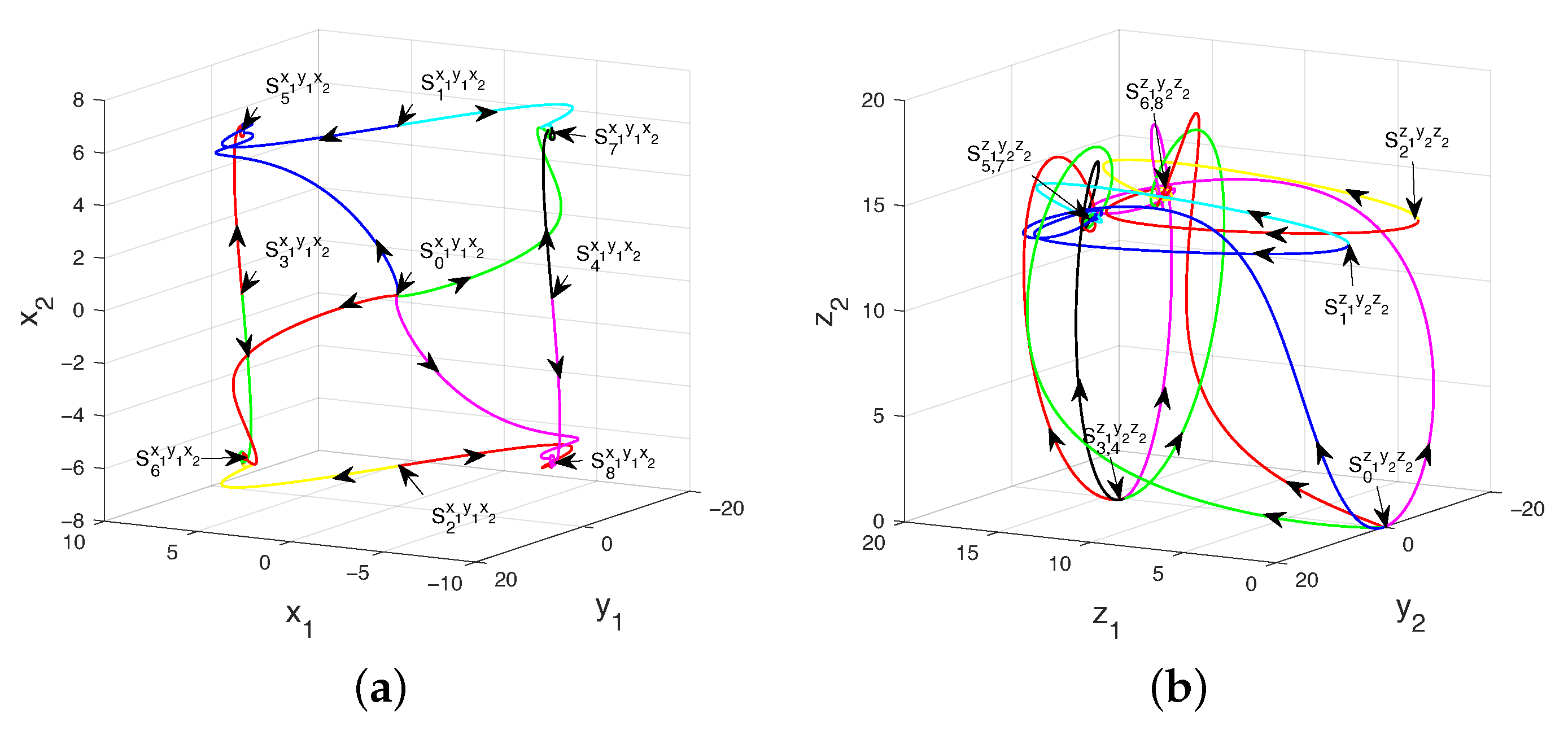
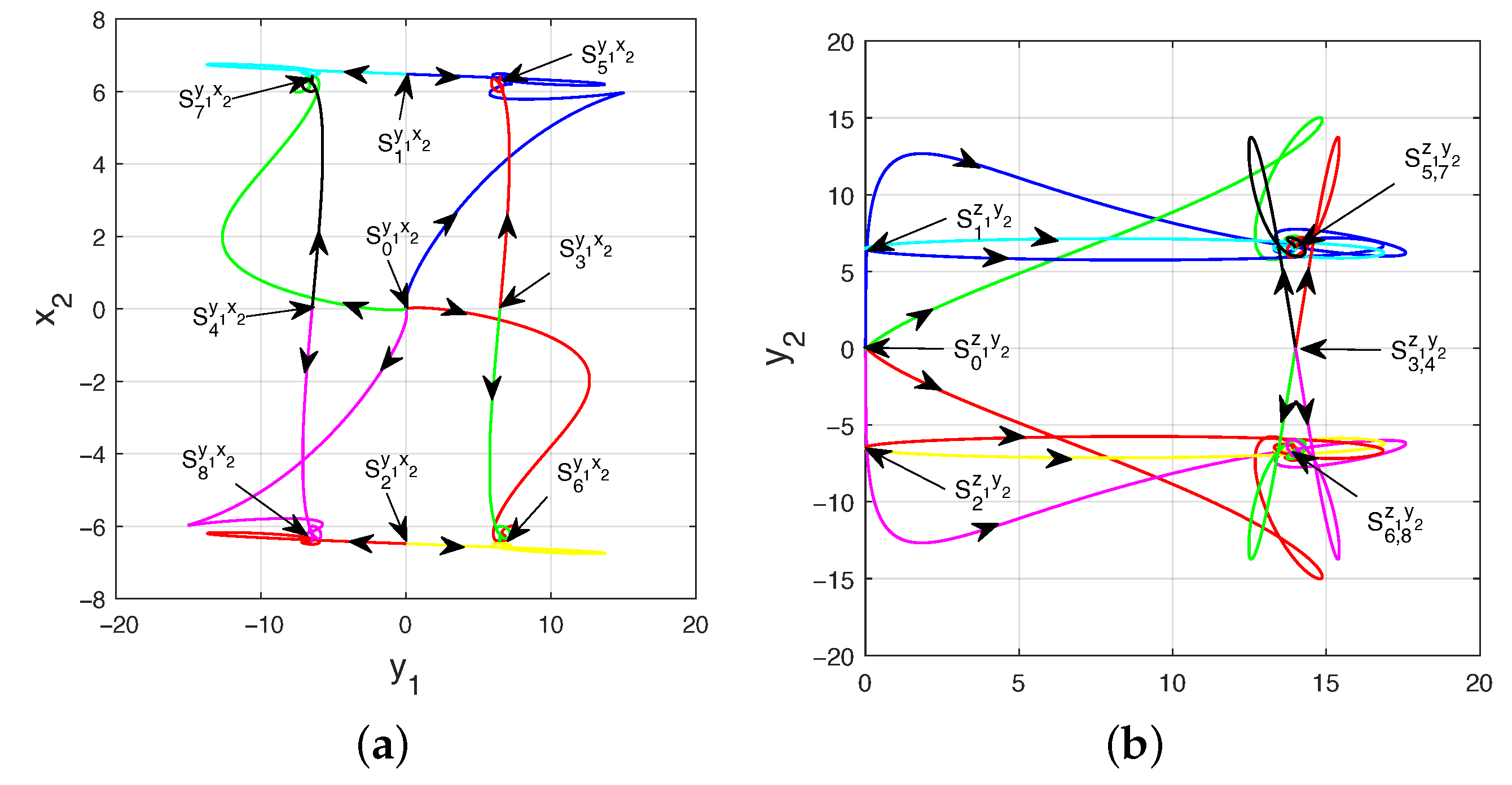
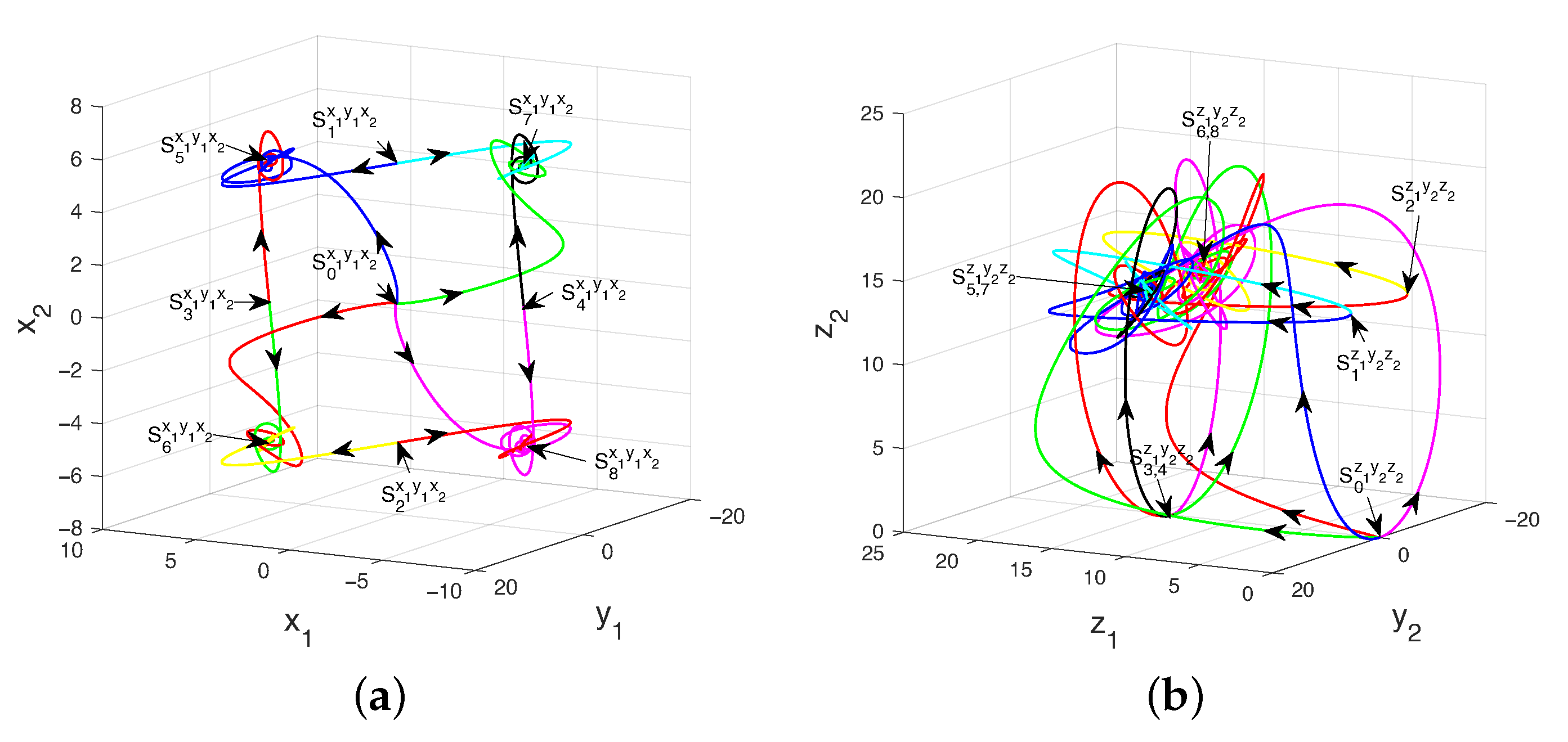
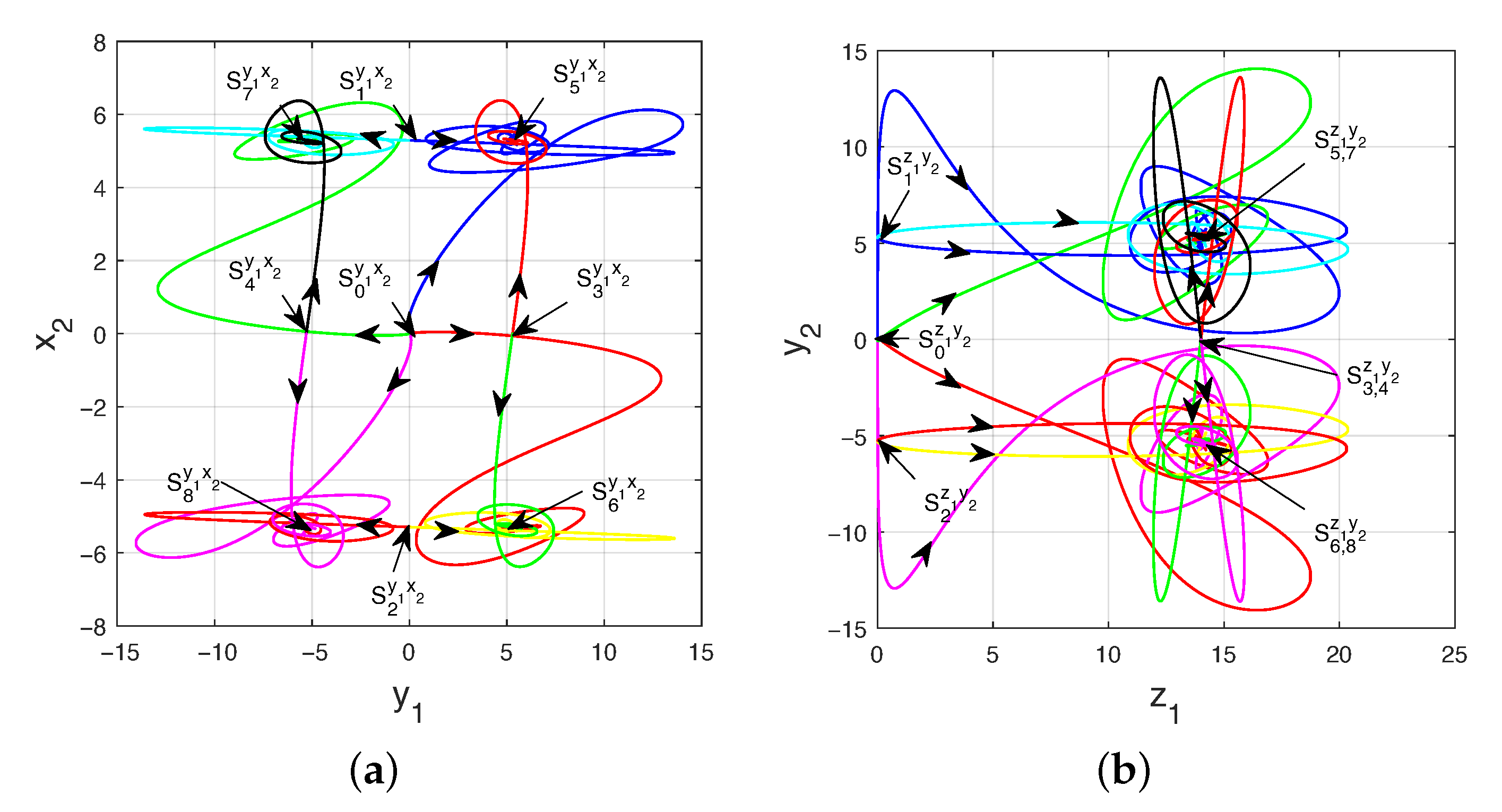
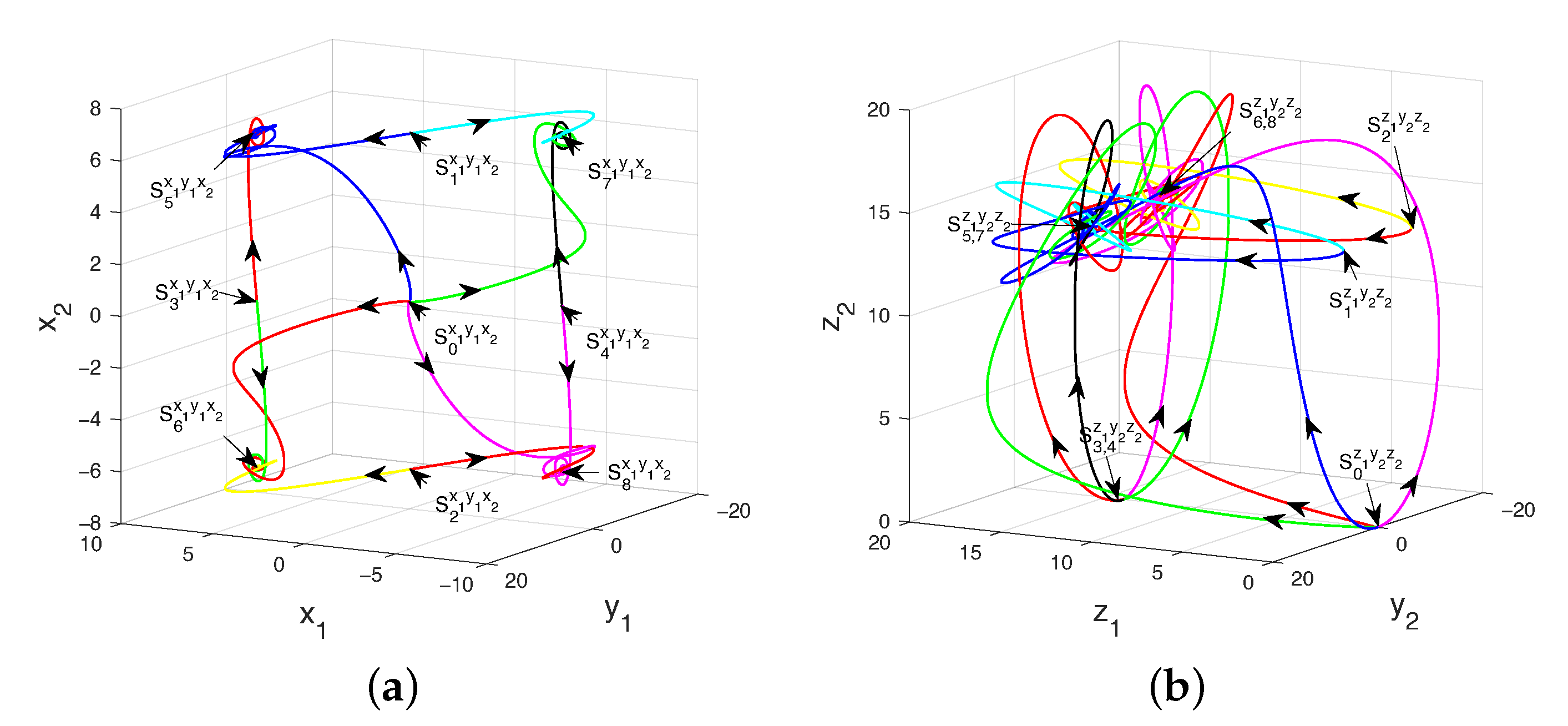
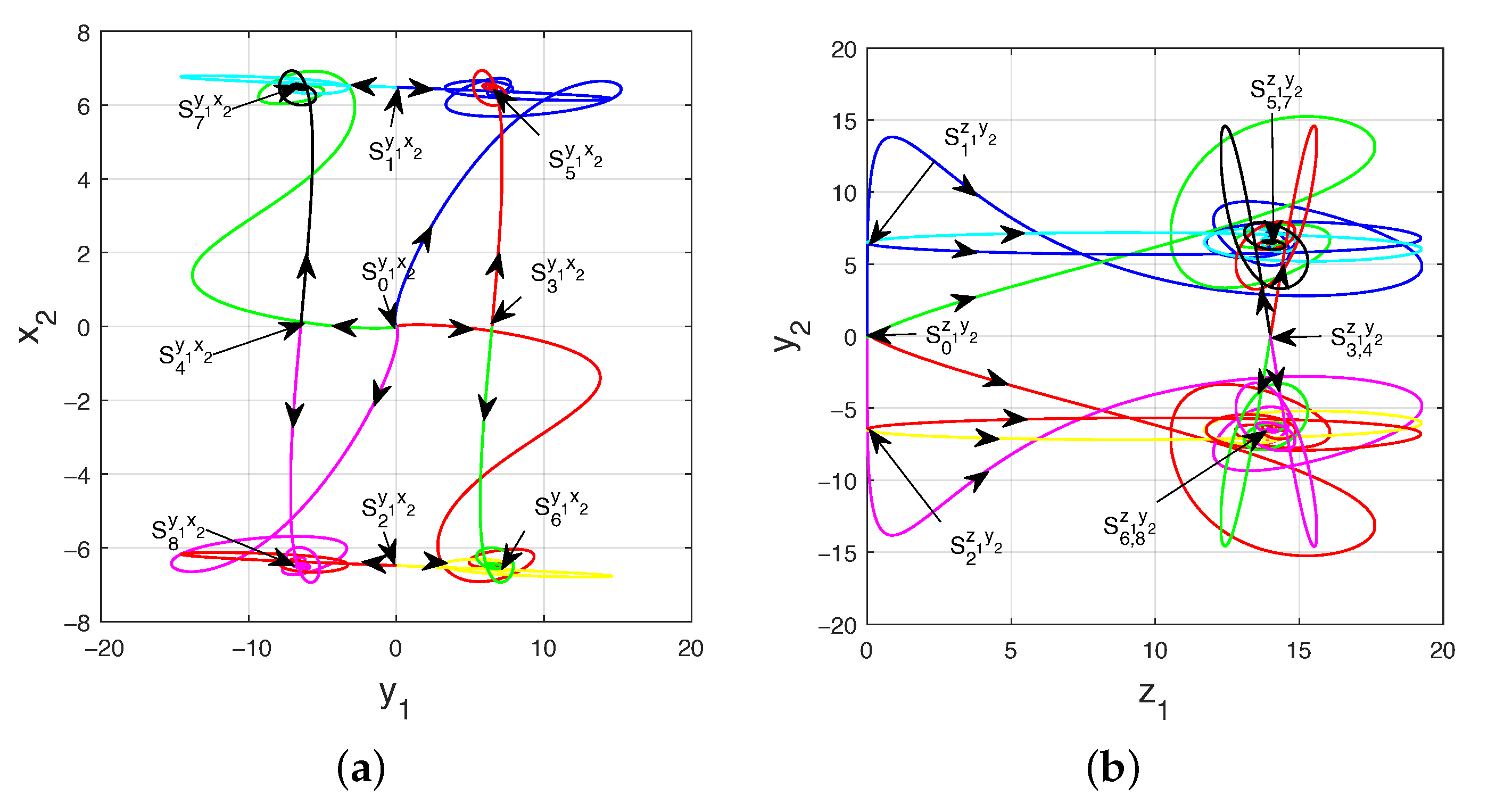
Using the software package nlfode-vec in FOTF Toolbox of Matlab [41] (p. 283), choosing the step size h = 0.001 , the memory duration L 0 = 10 , 000 , the termination time t n = 50 , parameter values ( σ , r , a , c ) = ( 1 , 15 , 1 , 1 ) , b = 2 , 3 , α = 0.9 , 1 , and initial values ( x 1 0 , y 1 0 , z 1 0 , x 2 0 , y 2 0 , z 2 0 ) = : (i) ( ± 1.314 , ± 1.618 , 1.618 , 1.314 , 1.618 , 1.618 ) × 10 3 , (ii) ( ± 1.314 , ± 1.618 , 1.618 , 1.314 , 1.618 , 1.618 ) × 10 3 , ( x 1 1 , y 1 1 , z 1 1 , x 2 1 , y 2 1 , z 2 1 ) = : (a1) ( ± 1.314 × 10 3 , ± 1.618 × 10 3 , 1.618 × 10 3 , 5.2947 , 5.3033 , 14.0167 ) , (a2) ( ± 1.314 × 10 3 , ± 1.618 × 10 3 , 1.618 × 10 3 , 5.2947 , 5.3033 , 14.0167 ) , (a3) ( 5.2947 , 5.3033 , 14.0167 , ± 1.314 × 10 3 , ± 1.618 × 10 3 , 1.618 × 10 3 ) , (a4) ( 5.2947 , 5.3033 , 14.0167 , ± 1.314 × 10 3 , ± 1.618 × 10 3 , 1.618 × 10 3 ) , ( x 1 2 , y 1 2 , z 1 2 , x 2 2 , y 2 2 , z 2 2 ) = : (b1) ( ± 1.314 × 10 3 , ± 1.618 × 10 3 , 1.618 × 10 3 , 6.4823 , 6.4833 , 14.0101 ) , (b2) ( ± 1.314 × 10 3 , ± 1.618 × 10 3 , 1.618 × 10 3 , 6.4823 , 6.4833 , 14.0101 ) , (b3) ( 6.4823 , 6.4833 , 14.0101 , ± 1.314 × 10 3 , ± 1.618 × 10 3 , 1.618 × 10 3 ) , (b4) ( 6.4823 , 6.4833 , 14.0101 , ± 1.314 × 10 3 , ± 1.618 × 10 3 , 1.618 × 10 3 ) . The numerical examples are shown in Figure 1, Figure 2, Figure 3, Figure 4, Figure 5, Figure 6, Figure 7 and Figure 8, where the projections onto the spaces x 1 - y 1 - x 2 , z 1 - y 2 - z 2 , and planes y 1 - x 2 , z 1 - y 2 of the equilibria S i are S i x 1 y 1 x 2 , S i z 1 y 2 z 2 , S i y 1 x 2 , and S i z 1 y 2 , i = 0 , 1 , , 8 . The eigenvalues of S i are listed in Table 1, from which, for 0 < α 1 , S 1 , 2 , 3 , 4 are all unstable, S 5 , 6 , 7 , 8 are all asymptotically stable, and S 0 is asymptotically stable (resp. unstable) when 0 < α < 0.0824 (resp. 0.0824 < α 1 ) based on the Routh–Hurwitz stability conditions [36,42].
In the next section, one proves Theorem 1, as shown in Figure 1, Figure 2, Figure 3 and Figure 4.
For the purposes of discussions, define
p ( t ; p 0 ) = ( x 1 ( t ; x 1 0 ) , y 1 ( t ; y 1 0 ) , z 1 ( t ; z 1 0 ) , x 2 ( t ; x 2 0 ) , y 2 ( t ; y 2 0 ) , z 2 ( t ; z 2 0 ) )
as any one orbit of system (1) with the initial value p 0 = ( x 1 0 , y 1 0 , z 1 0 , x 2 0 , y 2 0 , z 2 0 ) R 6 . Denote γ 0 = { p ( t ; p 0 ) | t R } and γ i ± = { p ( t ; p 0 ) | t R } to be of W u ( S 0 ) and W u ( S i ) , i = 1 , 2 , 3 , 4 .
For r 1 > 0 and a c < 0 , put both Lyapunov functions
V 1 ( p ( t ; p 0 ) ) = 1 2 { b ( b 2 σ ) ( y 1 x 1 ) 2 + ( b z 1 + x 1 2 ) 2 + b 2 σ 2 σ ( b ( r 1 ) + x 1 2 ) 2 a c [ b ( b 2 σ ) ( y 2 x 2 ) 2 + ( b z 2 + x 2 2 ) 2 + b 2 σ 2 σ ( b ( r 1 ) + x 2 2 ) 2 ] }
with b > 2 σ > 0 , and
V 2 ( p ( t ; p 0 ) ) = 1 2 { 4 σ 2 ( y 1 x 1 ) 2 + ( 2 σ ( r 1 ) + x 1 2 ) 2 a c [ 4 σ 2 ( y 2 x 2 ) 2 + ( 2 σ ( r 1 ) + x 2 2 ) 2 ] }
with b = 2 σ > 0 , x i 2 ( t ; x i 0 ) 2 σ z i ( t ; z i 0 ) , i = 1 , 2 .

3. Heteroclinic Orbits and the Proof of Theorem 1

Firstly, the following lemma is used [43]:
Lemma 1.
Let x ( t ) R be a continuous and derivable function. Then, for any time instant t t 0 :
1 2 D t α t 0 C x 2 ( t ) x ( t ) t 0 C D t α x ( t ) , α ( 0 , 1 ) .
Computing the fractional derivatives of V 1 , 2 along p ( t ; p 0 ) leads to
D t α t 0 C V 1 ( p ( t ; p 0 ) ) b ( b 2 σ ) ( σ + 1 ) [ ( y 1 x 1 ) 2 a c ( y 2 x 2 ) 2 ] b [ ( b z 1 + x 1 2 ) 2 a c ( b z 2 + x 2 2 ) 2 ] ,
and
D t α t 0 C V 2 ( p ( t ; p 0 ) ) 4 σ 2 ( σ + 1 ) [ ( y 1 x 1 ) 2 a c ( y 2 x 2 ) 2 ] .
Next, we first prove the existence of four heteroclinic orbits to S 0 and S 5 , 6 , 7 , 8 , and then consider four pairs of ones to S 1 and S 5 , 7 , S 3 and S 5 , 6 , S 2 and S 6 , 8 , and S 4 and S 7 , 8 . To achieve this goal, we have to formulate the following theorem.
Theorem 2.
Assume r 1 > 0 , b 2 σ > 0 , a c < 0 and α Ω = { α | | a r g ( λ ( σ , r , a , b , c ) ) | < α π 2 } ( λ ( σ , r , a , b , c ) is any one of eigenvalues of S 0 , 1 , 2 , 3 , 4 ), one derives the following three assertions:
(i)
If t 1 , 2 , t 1 < t 2 and V 1 , 2 ( p ( t 1 ; p 0 ) ) = V 1 , 2 ( p ( t 2 ; p 0 ) ) , then p 0 { S i } , i = 0 , 1 , , 7 , 8 .
(ii)
If lim p ( t ; p 0 ) t = S 0 and p 0 S 0 , then V 1 , 2 ( S 0 ) V 1 , 2 ( p ( t ; p 0 ) ) > 0 , p 0 γ 0 .
(iii)
If lim p ( t ; p 0 ) t = S 1 , 2 (resp. S 3 , 4 ) and x 1 ( t 3 1 , 2 ; x 1 0 ) < 0 (resp. x 2 ( t 3 1 , 2 ; x 2 0 ) < 0 ), t 3 i R , then we arrive at V 1 , 2 ( S 1 , 2 ) > V 1 , 2 ( p ( t ; p 0 ) ) (resp. V 1 , 2 ( S 3 , 4 ) > V 1 , 2 ( p ( t ; p 0 ) ) ) and x 1 ( t ; x 1 0 ) < 0 (resp. x 2 ( t ; x 2 0 ) < 0 ), t R . Namely, p 0 γ i , i = 1 , 2 , 3 , 4 .
Proof. 
(i) When r 1 > 0 , b 2 σ > 0 , a c < 0 and α Ω = { α | | a r g ( λ ( σ , r , a , b , c ) ) | < α π 2 } ( λ ( σ , r , a , b , c ) is any one of eigenvalues of S 0 , 1 , 2 , 3 , 4 ), the fact D t α t 0 C V 1 , 2 ( p ( t ; p 0 ) ) 0 follows from Equations (2) and (3). Based on the first hypothesis (i), we arrive at D t α t 0 C V 1 , 2 ( p ( t ; p 0 ) ) = 0 , t ( t 1 , t 2 ) , which thus leads to the conclusion p 0 { S i } , i = 0 , 1 , , 7 , 8 , i.e.,
D t α t 0 C x i ( t ; x i 0 ) D t α t 0 C y i ( t ; y i 0 ) D t α t 0 C z i ( t ; z i 0 ) ) 0 , i = 1 , 2 .
In fact, D t α t 0 C x i ( t ; x i 0 ) = σ ( y i x i ) = 0 implies x i ( t ) = x i 0 and D t α t 0 C y i ( t ; y i 0 ) = 0 , y i ( t ) = y i 0 , t R , i = 1 , 2 .
When b = 2 σ , we easily derive x i 2 ( t ; x i 0 ) = 2 σ z i ( t ; z i 0 ) , i = 1 , 2 , i.e., the invariant algebraic surfaces with the same cofactor 2 σ . In addition, p ( t ; p 0 ) y i x i = 0 results in Equation (4), i = 1 , 2 .
(ii) Let us prove that V 1 , 2 ( p ( t ; p 0 ) ) < V 1 , 2 ( S 0 ) , t R . Otherwise, t R , V 1 , 2 ( p ( t ; p 0 ) ) V 1 , 2 ( S 0 ) holds. But the first result (i) suggests the fact p 0 { S i } , i = 0 , 1 , , 7 , 8 , which contradicts the fact that lim t p ( t ; p 0 ) = S 0 . Therefore, for t R , one arrives at V 1 , 2 ( p ( t ; p 0 ) ) < V 1 , 2 ( S 0 ) and p 0 γ 0 .
(iii) Here, we only consider the case of the heteroclinic orbits to S 1 and S 5 , 7 , and the other cases are similar and omitted.
On the one hand, t R , one proves V 1 , 2 ( S 1 ) > V 1 , 2 ( p ( t ; p 0 ) ) . If not, t 0 R , such that 0 < V 1 , 2 ( S 1 ) V 1 , 2 ( p ( t ; p 0 ) ) , which yields p 0 = S 1 and x 1 ( t ; x 1 0 ) = 0 , t R and thus contradicts the assertion (i). As a result, V 1 , 2 ( S 1 ) > V 1 , 2 ( p ( t ; p 0 ) ) , t R .
On the other hand, let us show x 1 ( t , x 1 0 ) < 0 , t R . Or else t R , such that x 1 ( t , x 1 0 ) 0 . Based on the first hypothesis (i), τ R , such that x 1 ( τ , x 1 0 ) = 0 . As V 1 , 2 ( S 1 ) > V 1 , 2 ( p ( t ; p 0 ) ) , t R , the facts show that p τ ( p 0 ) { p ( t ; p 0 ) : V 1 ( S 1 ) > V 1 ( p ( t ; p 0 ) ) } { ( 0 , y 1 , z 1 , x 2 , y 2 , z 2 ) } = { p ( t ; p 0 ) : 1 2 { b ( b 2 σ ) y 1 2 + ( b z 1 ) 2 + b 2 σ 2 σ ( b ( r 1 ) ) 2 a c [ b ( b 2 σ ) ( y 2 x 2 ) 2 + ( b z 2 + x 2 2 ) 2 + b 2 σ 2 σ ( b ( r 1 ) + x 2 2 ) 2 ] } < b 2 σ 4 σ ( b ( r 1 ) ) 2 } = , and p τ ( p 0 ) { p ( t ; p 0 ) : V 2 ( S 1 ) > V 2 ( p ( t ; p 0 ) ) } { ( 0 , y 1 , z 1 , x 2 , y 2 , z 2 ) } = { p ( t ; p 0 ) : 1 2 { 4 σ 2 y 1 2 + ( 2 σ ( r 1 ) ) 2 a c [ 4 σ 2 ( y 2 x 2 ) 2 + ( 2 σ ( r 1 ) + x 2 2 ) 2 ] } < ( 2 σ ( r 1 ) ) 2 2 } = lead to a paradox, which results in x 1 ( t , x 1 0 ) < 0 , t R . The proof is over. □
Finally, based on Theorem 2, one can present the proof of Theorem 1 as follows.
Proof. 
(i) If r 1 > 0 , b 2 σ > 0 , a c < 0 and α Ω = { α | | a r g ( λ ( σ , r , a , b , c ) ) | < α π 2 } ( λ ( σ , r , a , b , c ) is any one of eigenvalues of S 0 , 1 , 2 , 3 , 4 ), then neither homoclinic orbits to S i , i = 0 , 1 , 2 , , 8 nor heteroclinic orbits to any two ones of S 5 , 6 , 7 , 8 exist in system (1). If not, suppose q ( t ) = ( x 1 , y 1 , z 1 , x 2 , y 2 , z 2 ) is a homoclinic orbit to any one of S i , or heteroclinic orbit to any two ones of S 0 , 1 , 2 , 3 , 4 , or S 5 , 6 , 7 , 8 , i.e., lim t q ( t ) = e , where e = e + { S i } or { e , e + } { S i } , i = 0 , 1 , 2 , 3 , 4 , or i = 5 , 6 , 7 , 8 .
Based on D t α t 0 C V 1 , 2 ( p ( t ; p 0 ) ) 0 , we deduce V 1 , 2 ( e ) V 1 , 2 ( q ( t ) ) V 1 , 2 ( e + ) . Whatever the case, V 1 , 2 ( e + ) is identically equal to V 1 , 2 ( e ) , which also yields V 1 , 2 ( q ( t ) ) V 1 , 2 ( e + ) . On the basis of Theorem 2 (i), we obtain q ( t ) { S i } , i = 0 , 1 , 2 , , 8 . Namely, homoclinic orbits to any one of S i , or heteroclinic orbits to any two ones of S 1 , 2 , 3 , 4 , or S 5 , 6 , 7 , 8 are nonexistent, i = 0 , 1 , 2 , , 8 .
(ii) Firstly, we demonstrate that q ( t ) is any one heteroclinic orbit connecting S 0 and any one of S 5 , 6 , 7 , 8 , i.e., S 8 , lim t + q ( t ) = S 8 . From Theorem 2 (ii) and the definition of q ( t ) , we arrive at V 1 , 2 ( q ( t ) ) < V 1 , 2 ( S 0 ) and lim t q ( t ) = S 0 , i.e., lim t + q ( t ) = S 8 .
Secondly, let us prove the uniqueness of q ( t ) . Otherwise, suppose lim t q + * ( t ) = e 1 , where q + * ( t ) = ( x 1 * , y 1 * , z 1 * , x 2 * , y 2 * , z 2 * ) is any one orbit of system (1) and { e 1 ± } = { S 0 , S 8 } .
Since D t α t 0 C V 1 , 2 ( p ( t ; p 0 ) ) 0 , t R , V 1 , 2 ( e 1 + ) V 1 , 2 ( q + * ( t ) ) V 1 , 2 ( e 1 ) holds. Because of V 1 , 2 ( S 0 ) > V 1 , 2 ( S 8 ) , we arrive at e 1 + = S 8 and e 1 = S 0 , i.e.
lim t q + * ( t ) = S 0 , lim t + q + * ( t ) = S 8 ,
suggesting q + * ( t ) γ 0 from Theorem 2 (ii). The scenarios of S 5 , 6 , 7 are the same as that of S 8 . Therefore, another three heteroclinic orbits to S 0 and S 5 , 6 , 7 exist in system (1).
Thirdly, one shows that there is a heteroclinic orbit joining S 1 and S 7 in system (1), lim t + p ( t ) = S 7 , lim t p ( t ) = S 1 , where p ( t ) is any one solution of system (1). In light of Theorem 2 (iii) and the definition of p ( t ) , one deduces V 1 , 2 ( S 1 ) > V 1 , 2 ( p ( t ) ) and lim t + p ( t ) S 1 , i.e., lim t + p ( t ) = S 7 .
Finally, let us show the uniqueness of p ( t ) . In fact, assume lim t p * ( t ) = e 1 , where p * ( t ) = ( x 1 * , y 1 * , z 1 * , x 2 * , y 2 * , z 2 * ) is an orbit of system (1) and { e 1 } = { S 1 , S 7 } .
Obviously, Equations (2) and (3) lead to V 1 , 2 ( e 1 + ) V 1 , 2 ( p * ( t ) ) V 1 , 2 ( e 1 ) . In addition, V 1 , 2 ( S 1 ) > V 1 , 2 ( S 7 ) yields e 1 + = S 7 and e 1 = S 1 , i.e.,
lim t p * ( t ) = S 1 , lim t + p * ( t ) = S 7 ,
suggesting p * ( t ) γ 1 according to Theorem 2 (ii). Due to the symmetry of the system (1), there is a pair of heteroclinic orbits to S 1 to S 5 , 7 . The scenarios of S 2 , 3 , 4 are the same as that of S 1 . Therefore, another three pairs of heteroclinic orbits to S 3 and S 5 , 6 , S 2 and S 6 , 8 , and S 4 and S 7 , 8 exist in system (1), as depicted in Figure 1, Figure 2, Figure 3 and Figure 4. The proof is over. □
Remark 3.
For the integer-order Lorenz system [2,9,10,11], the existence of twelve heteroclinic orbits is also derived via V 1 , 2 , as shown in Figure 5, Figure 6, Figure 7 and Figure 8.
In terms of the number and type of heteroclinic orbits, and the order of the differential operator, we compare the representative existing studies with our results, as shown in Table 2. On the one hand, the coupled ones have more heteroclinic orbits than any one of the subsystems. On the other hand, the obtained results also may provide insights into the heteroclinic orbits of Caputo fractional-order Lorenz-like systems, such as the Chen [23,24], T, Lü [25], Yang [26], 4D Lorenz-like [27,36], 3D periodically forced extended Lorenz-like [28,29], 3D Lorenz-like [30,37,38,39] systemsand the coupled systems among them.

4. Conclusions

Although the powerful tool-combining Lyapunov function and concepts of α -/ ω -limit sets have been widely used in the Lorenz system family to reveal the existence of a single/a pair of/two pairs of/infinitely many pairs heteroclinic orbits, scholars seldom consider the scenario of coupled ones. One cannot help asking whether or not the method is applicable to coupled Lorenz systems with heteroclinic orbits. In this regard, this paper restudied fractional-order and integer-order coupled Lorenz systems [1,2,9,10,11] and proved that they have twelve heteroclinic orbits when r 1 > 0 , b 2 σ > 0 , a c < 0 , and α Ω = { α | | a r g ( λ ( σ , r , a , b , c ) ) | < α π 2 } ( λ ( σ , r , a , b , c ) is any one of the eigenvalues of S 0 , 1 , 2 , 3 , 4 ), which are greater than those of the first and second subsystems and are depicted in Figure 1, Figure 2, Figure 3, Figure 4, Figure 5, Figure 6, Figure 7 and Figure 8.
In future, further studies should be carried out on the homoclinic orbit, integrability, the formation mechanism of the multi-wing Lorenz-like attractor, and other fundamental dynamical properties. Additionally, we will try to apply this method to other linear couplings of two, three, four, and more chaotic/hyperchaotic Lorenz-like systems. Precisely speaking, using different Lyapunov functions, the coupled Lorenz and Chen system
x ˙ 1 = σ ( x 1 y 1 ) , y ˙ 1 = r x 1 y 1 x 1 z 1 + a ( x 2 y 2 ) , z ˙ 1 = x 1 y 1 b z 1 , σ 0 , r , a , b , c R , x ˙ 2 = σ ( x 2 y 2 ) , y ˙ 2 = ( r σ ) x 2 + r y 2 x 2 z 2 + c ( x 1 y 1 ) , z ˙ 2 = x 2 y 2 b z 2 ,
the coupled Lorenz and cubic Lorenz-like systems
x ˙ 1 = σ ( x 1 y 1 ) , y ˙ 1 = r x 1 y 1 x 1 z 1 + a ( x 2 y 2 ) , z ˙ 1 = x 1 y 1 b z 1 , σ 0 , r , a , b , c R , x ˙ 2 = σ ( x 2 y 2 ) , y ˙ 2 = r x 2 2 x 2 2 z 2 + c ( x 1 y 1 ) , z ˙ 2 = x 2 2 y 2 b z 2 ,
the coupled sub-quadratic Lorenz and Lü systems
x ˙ 1 = σ ( x 1 y 1 ) , y ˙ 1 = r x 1 3 x 1 3 z 1 + a ( x 2 y 2 ) , z ˙ 1 = x 1 3 y 1 b z 1 , σ 0 , r , a , b , c R , x ˙ 2 = σ ( x 2 y 2 ) , y ˙ 2 = r y 2 x 2 z 2 + c ( x 1 y 1 ) , z ˙ 2 = x 2 y 2 b z 2 ,
the coupled two same sub-quadratic Lorenz-like systems
x ˙ 1 = σ ( x 1 y 1 ) , y ˙ 1 = r x 1 3 x 1 3 z 1 + a ( x 2 y 2 ) , z ˙ 1 = x 1 3 y 1 b z 1 , σ 0 , r , a , b , c R , x ˙ 2 = σ ( x 2 y 2 ) , y ˙ 2 = r x 2 3 x 2 3 z 2 + c ( x 1 y 1 ) , z ˙ 2 = x 2 3 y 2 b z 2 ,
the coupled two different sub-quadratic Lorenz-like systems
x ˙ 1 = σ ( x 1 y 1 ) , y ˙ 1 = r x 1 3 x 1 3 z 1 + a ( x 2 y 2 ) , z ˙ 1 = x 1 3 y 1 b z 1 , σ 0 , r , a , b , c R , x ˙ 2 = σ ( x 2 y 2 ) , y ˙ 2 = r x 2 2 3 x 2 2 3 z 2 + c ( x 1 y 1 ) , z ˙ 2 = x 2 2 3 y 2 b z 2 ,
the coupled three Lorenz systems
x ˙ 1 = σ ( x 1 y 1 ) , y ˙ 1 = r x 1 y 1 x 1 z 1 + a 1 ( x 2 y 2 ) + a 2 ( x 3 y 3 ) , z ˙ 1 = x 1 y 1 b z 1 , σ 0 , r , a i , c i , b , e i R , i = 1 , 2 , x ˙ 2 = σ ( x 2 y 2 ) , y ˙ 2 = r x 2 y 2 x 2 z 2 + c 1 ( x 1 y 1 ) + c 2 ( x 3 y 3 ) , z ˙ 2 = x 2 y 2 b z 2 , x ˙ 3 = σ ( x 3 y 3 ) , y ˙ 3 = r x 3 y 3 x 3 z 3 + e 1 ( x 1 y 1 ) + e 2 ( x 2 y 2 ) , z ˙ 3 = x 3 y 3 b z 3 ,
the coupled classic Lorenz, sub-quadratic Lorenz-like and cubic Lorenz-like systems
x ˙ 1 = σ ( x 1 y 1 ) , y ˙ 1 = r x 1 y 1 x 1 z 1 + a 1 ( x 2 y 2 ) + a 2 ( x 3 y 3 ) , z ˙ 1 = x 1 y 1 b z 1 , σ 0 , r , a i , c i , b , e i R , i = 1 , 2 , x ˙ 2 = σ ( x 2 y 2 ) , y ˙ 2 = r x 2 3 x 2 3 z 2 + c 1 ( x 1 y 1 ) + c 2 ( x 3 y 3 ) , z ˙ 2 = x 2 3 y 2 b z 2 , x ˙ 3 = σ ( x 3 y 3 ) , y ˙ 3 = r x 3 2 x 3 2 z 3 + e 1 ( x 1 y 1 ) + e 2 ( x 2 y 2 ) , z ˙ 3 = x 3 2 y 3 b z 3 ,
and the fractional-order Lorenz system family, such as the Chen [23,24], T, Lü [25], Yang [26], 4D Lorenz-like [27,36], 3D periodically forced extended Lorenz-like [28,29], 3D Lorenz-like [30,37,38,39] systems may exhibit multitudinous heteroclinic orbits, as in system (1), which also be conjectured as being present in the coupled four- and higher-dimensional Lorenz systems. In the field of data-driven science and engineering, the existence of heteroclinic orbits for α ( 0 , 1 ] may complicate the issue of identifying governing systems. Moreover, we also expect this study to provide a reference for some traditional applications, e.g., cell signalling, biomathematics, and spaceflight.

Author Contributions

Conceptualization, G.K. and J.P.; Methodology, H.W.; Software, J.P. and F.H.; Validation, H.W. and G.K.; Visualization, G.K. and F.H.; Writing—original draft, J.P.; Writing—review and editing, G.K. All authors have read and agreed to the published version of the manuscript.

Funding

This work is supported in part Natural Science Foundation of Zhejiang Guangsha Vocational and Technical University of Construction under Grant 2022KYQD-KGY, in part Zhejiang Public Welfare Technology Application Research Project of China under Grant LGN21F020003, in part Natural Science Foundation of Taizhou University under Grant T20210906033, in part National Natural Science Foundation of China under Grant 12001489.

Data Availability Statement

There is no data because the results obtained in this paper can be reproduced based on the information given in this paper.

Acknowledgments

The authors wish to express their sincere thanks to the anonymous editors and reviewers for their conscientious reading and numerous valuable comments which extremely improve the presentation of this paper.

Conflicts of Interest

The authors declare that they have no known competing financial interests or personal relationships that could have appeared to influence the work reported in this paper.

References

  1. Cafagna, D.; Grassi, G. Fractional-order chaos: A novel four-wing attractor in coupled Lorenz systems. Int. J. Bifurc. Chaos 2009, 19, 3329–3338. [Google Scholar] [CrossRef]
  2. Grassi, G.; Severance, F.L.; Mashev, E.D.; Bazuin, B.J.; Miller, D.A. Generation of a four-wing chaotic attractor by two weakly-coupled Lorenz systems. Int. J. Bifurc. Chaos 2008, 18, 2089–2094. [Google Scholar] [CrossRef]
  3. Liu, J.; Li, R.; Huang, D. Stability, bifurcation and characteristics of chaos in a new commensurate and incommensurate fractional-order ecological system. Math. Comput. Simul. 2025, 236, 248–269. [Google Scholar] [CrossRef]
  4. Ghafoor, A.; Fiaz, M.; Afraites, L.; Ullah, A.; Ismai, E.A.A.; Awwad, F.A. Dynamics of the time-fractional reaction-diffusion coupled equations in biological and chemical processes. Sci. Rep. 2025, 14, 7549. [Google Scholar] [CrossRef]
  5. Srati, M.; Oulmelk, A.; Afraites, L.; Srati, M.; Hadri, A.; Zaky, M.A.; Aldraiweesh, A.; Hendy, A.S. An inverse problem of determining the parameters in diffusion equations by using fractional physics-informed neural networks. Appl. Numer. Math. 2025, 208, 189–213. [Google Scholar] [CrossRef]
  6. Long, L.D.; Zaky, M.A.; Moghaddam, B.P.; Gürefey, Y. Inverse source problem for time-fractional diffusion equation: Norm-constrained regularization and error estimation under a priori boundedness assumptions. Z. Angew. Math. Phys. 2025, 76, 153. [Google Scholar] [CrossRef]
  7. Brociek, R.; Goik, M.; Miarka, J.; Napoli, C.; Pleszczyński, M. Solution of inverse problem for diffusion equation with fractional derivatives using metaheuristic optimization algorithm. Informatica 2024, 35, 453–481. [Google Scholar] [CrossRef]
  8. Mbasso, W.F.; Harrison, A.; Dagal, I.; Jangir, P.; Kumar, R.; Liu, Z. Fractional calculus-inspired metaheuristic algorithm for solving high-dimensional constrained optimization problems. Evol. Intel. 2026, 19, 2. [Google Scholar] [CrossRef]
  9. Grassi, G.; Severance, F.L.; Miller, D.A. Multi-wing hyperchaotic attractors from coupled Lorenz systems. Chaos Soliton Fract. 2009, 41, 284–291. [Google Scholar] [CrossRef]
  10. Wang, P.; Li, D.; Wu, X.; Lü, J.; Yu, X. Ultimate bound estimation of a class of high dimensional quadratic autonomous dynamical systems. Int. J. Bifurc. Chaos 2011, 21, 2679–2694. [Google Scholar] [CrossRef]
  11. Rech, R.C. Complex dynamics of a linear coupling of two chaotic Lorenz systems. Braz. J. Phys. 2024, 54, 15. [Google Scholar] [CrossRef]
  12. Mayora-Cebollero, C.; Mayora-Cebollero, A.; Lozano, Á.; Barrio, R. Full Lyapunov exponents spectrum with Deep Learning from single-variable time series. Phys. D 2025, 472, 134510. [Google Scholar] [CrossRef]
  13. Shilnikov, L.P.; Shilnikov, A.L.; Turaev, D.V.; Chua, L.O. Methods of Qualitative Theory in Nonlinear Dynamics. Part II, 2nd ed.; World Scientific: Singapore, 2001. [Google Scholar]
  14. Wiggins, S. Introduction to Applied Nonlinear Dynamical System and Chaos, 2nd ed.; Springer: New York, NY, USA, 2003. [Google Scholar]
  15. Leonov, G.A. Fishing principle for homoclinic and heteroclinic trajectories. Nonlinear Dyn. 2014, 78, 2751–2758. [Google Scholar] [CrossRef]
  16. Tricomi, T. Integrazione di un’equazione differenziale presentatasi in electrotechnica. Ann. Sc. Norm. Super. Pisa-Sci. Fis. Mat. 1933, 2, 1–20. [Google Scholar]
  17. Feng, B.; Hu, R. A survey on homoclinic and heteroclinic orbits. Appl. Math. E-Notes 2003, 3, 16–37. [Google Scholar]
  18. Koon, W.S.; Lo, M.W.; Marsden, J.E.; Ross, S.D. Heteroclinic connections between periodic orbits and resonance transitions in celestial mechanics. Chaos 2000, 10, 427–469. [Google Scholar] [CrossRef]
  19. Wilczak, D.; Zgliczyński, P. Heteroclinic connections between periodic orbits in planar restricted circular three body problem-A computer assisted proof. Commun. Math. Phys. 2003, 234, 37–75. [Google Scholar] [CrossRef][Green Version]
  20. Wilczak, D.; Zgliczyński, P. Heteroclinic connections between periodic orbits in planar restricted circular three body problem. part II. Commun. Math. Phys. 2005, 259, 561–576. [Google Scholar] [CrossRef][Green Version]
  21. Hunt, G.W.; Peletier, M.A.; Champneys, A.R.; Woods, P.D.; Ahmerwaddee, M.; Budd, C.J.; Lord, G.J. Cellular buckling in long structures. Nonlinear Dyn. 2000, 21, 3–29. [Google Scholar] [CrossRef]
  22. May, R.M.; Leonard, W. Nonlinear aspect of competition between three species. SIAM J. Appl. Math. 1975, 29, 243–253. [Google Scholar] [CrossRef]
  23. Li, T.; Chen, G.; Chen, G. On homoclinic and heteroclinic orbits of the Chen’s system. Int. J. Bifurc. Chaos 2006, 16, 3035–3041. [Google Scholar] [CrossRef]
  24. Tigan, G.; Llibre, J. Heteroclinic, homoclinic and closed orbits in the Chen system. Int. J. Bifurc. Chaos 2016, 26, 1650072. [Google Scholar] [CrossRef]
  25. Tigan, G.; Constantinescu, D. Heteroclinic orbits in the T and the Lü system. Chaos Soliton Fract. 2009, 42, 20–23. [Google Scholar] [CrossRef]
  26. Liu, Y.; Yang, Q. Dynamics of a new Lorenz-like chaotic system. Nonlinear Anal. RWA 2010, 11, 2563–2572. [Google Scholar] [CrossRef]
  27. Chen, Y.; Yang, Q. Dynamics of a hyperchaotic Lorenz-type system. Nonlinear Dyn. 2014, 77, 569–581. [Google Scholar] [CrossRef]
  28. Wang, H.; Ke, G.; Pan, J.; Su, Q. Conjoined Lorenz-like attractors coined. Miskolc Math. Notes 2025, 26, 527–546. [Google Scholar] [CrossRef]
  29. Pan, J.; Wang, H.; Ke, G.; Hu, F. A novel Lorenz-like attractor and stability and equilibrium analysis. Axioms 2025, 14, 264. [Google Scholar] [CrossRef]
  30. Pan, J.; Wang, H.; Hu, F. Revealing asymmetric homoclinic and heteroclinic orbits. Electron. Res. Arch. 2025, 33, 1337–1350. [Google Scholar] [CrossRef]
  31. Pan, J.; Wang, H.; Ke, G.; Hu, F. Creation of single-wing Lorenz-like attractors via a ten-ninths-degree term. Open Phys. 2025, 23, 20250165. [Google Scholar] [CrossRef]
  32. Pan, J.; Wang, H.; Hu, F. Creation of hidden n-scroll Lorenz-like attractors. Electron. Res. Arch. 2025, 33, 4167–4183. [Google Scholar] [CrossRef]
  33. Wang, H.; Pan, J.; Hu, F.; Ke, G. Asymmetric singularly degenerate heteroclinic cycles. Int. J. Bifurc. Chaos 2025, 35, 2550072. [Google Scholar] [CrossRef]
  34. Wang, H.; Pan, J.; Ke, G. Revealing more hidden attractors from a new sub-quadratic Lorenz-like system of degree 65. Int. J. Bifurc. Chaos 2024, 34, 2450071. [Google Scholar] [CrossRef]
  35. Wang, H.; Pan, J.; Ke, G.; Hu, F. A pair of centro-symmetric heteroclinic orbits coined. Adv. Contin. Discret. Model 2024, 2024, 14. [Google Scholar]
  36. Ren, L.; Muhsen, S.; Shateyi, S.; Saberi-Nik, H. Dynamical behaviour, control, and boundedness of a fractional-order chaotic system. Fractal Fract. 2023, 7, 492. [Google Scholar] [CrossRef]
  37. Li, X.; Ou, Q. Dynamical properties and simulation of a new Lorenz-like chaotic system. Nonlinear Dyn. 2011, 65, 255–270. [Google Scholar] [CrossRef]
  38. Li, X.; Wang, P. Hopf bifurcation and heteroclinic orbit in a 3D autonomous chaotic system. Nonlinear Dyn. 2013, 73, 621–632. [Google Scholar] [CrossRef]
  39. Liu, Y.; Pang, W. Dynamics of the general Lorenz family. Nonlinear Dyn. 2012, 67, 1595–1611. [Google Scholar] [CrossRef]
  40. Sprott, J.C. A proposed standard for the publication of new chaotic systems. Int. J. Bifurc. Chaos 2011, 21, 2391–2394. [Google Scholar] [CrossRef]
  41. Xue, D.; Bai, L. Fractional Calculus High-Precision Algorithms and Numerical Implementations, 1st ed.; Springer: Singapore, 2024. [Google Scholar]
  42. Ahmed, E.; El-Sayed, A.M.A.; El-Saka, H.A.A. On some Routh-Hurwitz conditions for fractional order differential equations and their applications in Lorenz, Rössler, Chua and Chen systems. Phys. Lett. A 2006, 358, 1–4. [Google Scholar] [CrossRef]
  43. Aguila-Camacho, N.; Duarte-Mermoud, M.A.; Gallegos, J.A. Lyapunov functions for fractional order systems. Commun. Nonlinear Sci. Numer. Simul. 2014, 19, 2951–2957. [Google Scholar] [CrossRef]
Figure 1. When ( σ , r , a , b , c ) = ( 1 , 15 , 1 , 2 , 1 ) , α = 0.9 , ( x 1 0 , y 1 0 , z 1 0 , x 2 0 , y 2 0 , z 2 0 ) = : (i) ( ± 1.314 , ± 1.618 , 1.618 , 1.314 , 1.618 , 1.618 ) × 10 3 (colored in red and blue), (ii) ( ± 1.314 , ± 1.618 , 1.618 , 1.314 , 1.618 , 1.618 ) × 10 3 (colored in magenta and green), ( x 1 1 , y 1 1 , z 1 1 , x 2 1 , y 2 1 , z 2 1 ) = : (a1) ( ± 1.314 × 10 3 , ± 1.618 × 10 3 , 1.618 × 10 3 , 5.2947 , 5.3033 , 14.0167 ) (colored in blue and cyan), (a2) ( ± 1.314 × 10 3 , ± 1.618 × 10 3 , 1.618 × 10 3 , 5.2947 , 5.3033 , 14.0167 ) (colored in yellow and red), (a3) ( 5.2947 , 5.3033 , 14.0167 , ± 1.314 × 10 3 , ± 1.618 × 10 3 , 1.618 × 10 3 ) (colored in red and green), (a4) ( 5.2947 , 5.3033 , 14.0167 , ± 1.314 × 10 3 , ± 1.618 × 10 3 , 1.618 × 10 3 ) (colored in black and magenta), four heteroclinic orbits to S 0 and S 5 , 6 , 7 , 8 , and four pairs of ones to S 1 and S 5 , 7 , S 3 and S 5 , 6 , S 2 and S 6 , 8 , S 4 and S 7 , 8 of the fractional-order system (1) in the projection spaces (a) x 1 - y 1 - x 2 , and (b) z 1 - y 2 - z 2 .
Fractalfract 10 00036 g001
Figure 2. Twelve heteroclinic orbits depicted in Figure 1 in the projection planes (a) y 1 - x 2 , (b) z 1 - y 2 , where initial values ( x 1 0 , y 1 0 , z 1 0 , x 2 0 , y 2 0 , z 2 0 ) = : (i) ( ± 1.314 , ± 1.618 , 1.618 , 1.314 , 1.618 , 1.618 ) × 10 3 (colored in red and blue), (ii) ( ± 1.314 , ± 1.618 , 1.618 , 1.314 , 1.618 , 1.618 ) × 10 3 (colored in magenta and green), ( x 1 1 , y 1 1 , z 1 1 , x 2 1 , y 2 1 , z 2 1 ) = : (a1) ( ± 1.314 × 10 3 , ± 1.618 × 10 3 , 1.618 × 10 3 , 5.2947 , 5.3033 , 14.0167 ) (colored in blue and cyan), (a2) ( ± 1.314 × 10 3 , ± 1.618 × 10 3 , 1.618 × 10 3 , 5.2947 , 5.3033 , 14.0167 ) (colored in yellow and red), (a3) ( 5.2947 , 5.3033 , 14.0167 , ± 1.314 × 10 3 , ± 1.618 × 10 3 , 1.618 × 10 3 ) (colored in red and green), (a4) ( 5.2947 , 5.3033 , 14.0167 , ± 1.314 × 10 3 , ± 1.618 × 10 3 , 1.618 × 10 3 ) (colored in black and magenta).
Fractalfract 10 00036 g002
Figure 3. When ( σ , r , a , b , c ) = ( 1 , 15 , 1 , 3 , 1 ) , α = 0.9 , ( x 1 0 , y 1 0 , z 1 0 , x 2 0 , y 2 0 , z 2 0 ) = : (i) ( ± 1.314 , ± 1.618 , 1.618 , 1.314 , 1.618 , 1.618 ) × 10 3 (colored in red and blue), (ii) ( ± 1.314 , ± 1.618 , 1.618 , 1.314 , 1.618 , 1.618 ) × 10 3 (colored in magenta and green), ( x 1 2 , y 1 2 , z 1 2 , x 2 2 , y 2 2 , z 2 2 ) = : (b1) ( ± 1.314 × 10 3 , ± 1.618 × 10 3 , 1.618 × 10 3 , 6.4823 , 6.4833 , 14.0101 ) (colored in blue and cyan), (b2) ( ± 1.314 × 10 3 , ± 1.618 × 10 3 , 1.618 × 10 3 , 6.4823 , 6.4833 , 14.0101 ) (colored in yellow and red), (b3) ( 6.4823 , 6.4833 , 14.0101 , ± 1.314 × 10 3 , ± 1.618 × 10 3 , 1.618 × 10 3 ) (colored in red and green), (b4) ( 6.4823 , 6.4833 , 14.0101 , ± 1.314 × 10 3 , ± 1.618 × 10 3 , 1.618 × 10 3 ) (colored in black and magenta), four heteroclinic orbits to S 0 and S 5 , 6 , 7 , 8 , and four pairs of ones to S 1 and S 5 , 7 , S 3 and S 5 , 6 , S 2 and S 6 , 8 , and S 4 and S 7 , 8 of the fractional-order system (1) in the projection spaces (a) x 1 - y 1 - x 2 , and (b) z 1 - y 2 - z 2 .
Fractalfract 10 00036 g003
Figure 4. Twelve heteroclinic orbits depicted in Figure 3 in the projection planes (a) y 1 - x 2 and (b) z 1 - y 2 , where initial values ( x 1 0 , y 1 0 , z 1 0 , x 2 0 , y 2 0 , z 2 0 ) = : (i) ( ± 1.314 , ± 1.618 , 1.618 , 1.314 , 1.618 , 1.618 ) × 10 3 (colored in red and blue), (ii) ( ± 1.314 , ± 1.618 , 1.618 , 1.314 , 1.618 , 1.618 ) × 10 3 (colored in magenta and green), ( x 1 2 , y 1 2 , z 1 2 , x 2 2 , y 2 2 , z 2 2 ) = : (b1) ( ± 1.314 × 10 3 , ± 1.618 × 10 3 , 1.618 × 10 3 , 6.4823 , 6.4833 , 14.0101 ) (colored in blue and cyan), (b2) ( ± 1.314 × 10 3 , ± 1.618 × 10 3 , 1.618 × 10 3 , 6.4823 , 6.4833 , 14.0101 ) (colored in yellow and red), (b3) ( 6.4823 , 6.4833 , 14.0101 , ± 1.314 × 10 3 , ± 1.618 × 10 3 , 1.618 × 10 3 ) (colored in red and green), (b4) ( 6.4823 , 6.4833 , 14.0101 , ± 1.314 × 10 3 , ± 1.618 × 10 3 , 1.618 × 10 3 ) (colored in black and magenta).
Fractalfract 10 00036 g004
Figure 5. When ( σ , r , a , b , c ) = ( 1 , 15 , 1 , 2 , 1 ) , α = 1 , ( x 1 0 , y 1 0 , z 1 0 , x 2 0 , y 2 0 , z 2 0 ) = : (i) ( ± 1.314 , ± 1.618 , 1.618 , 1.314 , 1.618 , 1.618 ) × 10 3 (colored in red and blue), (ii) ( ± 1.314 , ± 1.618 , 1.618 , 1.314 , 1.618 , 1.618 ) × 10 3 (colored in magenta and green), ( x 1 1 , y 1 1 , z 1 1 , x 2 1 , y 2 1 , z 2 1 ) = : (a1) ( ± 1.314 × 10 3 , ± 1.618 × 10 3 , 1.618 × 10 3 , 5.2947 , 5.3033 , 14.0167 ) (colored in blue and cyan), (a2) ( ± 1.314 × 10 3 , ± 1.618 × 10 3 , 1.618 × 10 3 , 5.2947 , 5.3033 , 14.0167 ) (colored in yellow and red), (a3) ( 5.2947 , 5.3033 , 14.0167 , ± 1.314 × 10 3 , ± 1.618 × 10 3 , 1.618 × 10 3 ) (colored in red and green), (a4) ( 5.2947 , 5.3033 , 14.0167 , ± 1.314 × 10 3 , ± 1.618 × 10 3 , 1.618 × 10 3 ) (colored in black and magenta), four heteroclinic orbits to S 0 and S 5 , 6 , 7 , 8 , and four pairs of ones to S 1 and S 5 , 7 , S 3 and S 5 , 6 , S 2 and S 6 , 8 , and S 4 and S 7 , 8 of the integer order one of system (1) in the projection spaces (a) x 1 - y 1 - x 2 , and (b) z 1 - y 2 - z 2 .
Fractalfract 10 00036 g005
Figure 6. Twelve heteroclinic orbits depicted in Figure 5 in the projection planes (a) y 1 - x 2 and (b) z 1 - y 2 , where initial values ( x 1 0 , y 1 0 , z 1 0 , x 2 0 , y 2 0 , z 2 0 ) = : (i) ( ± 1.314 , ± 1.618 , 1.618 , 1.314 , 1.618 , 1.618 ) × 10 3 (colored in red and blue), (ii) ( ± 1.314 , ± 1.618 , 1.618 , 1.314 , 1.618 , 1.618 ) × 10 3 (colored in magenta and green), ( x 1 1 , y 1 1 , z 1 1 , x 2 1 , y 2 1 , z 2 1 ) = : (a1) ( ± 1.314 × 10 3 , ± 1.618 × 10 3 , 1.618 × 10 3 , 5.2947 , 5.3033 , 14.0167 ) (colored in blue and cyan), (a2) ( ± 1.314 × 10 3 , ± 1.618 × 10 3 , 1.618 × 10 3 , 5.2947 , 5.3033 , 14.0167 ) (colored in yellow and red), (a3) ( 5.2947 , 5.3033 , 14.0167 , ± 1.314 × 10 3 , ± 1.618 × 10 3 , 1.618 × 10 3 ) (colored in red and green), (a4) ( 5.2947 , 5.3033 , 14.0167 , ± 1.314 × 10 3 , ± 1.618 × 10 3 , 1.618 × 10 3 ) (colored in black and magenta).
Fractalfract 10 00036 g006
Figure 7. When ( σ , r , a , b , c ) = ( 1 , 15 , 1 , 3 , 1 ) , α = 1 , ( x 1 0 , y 1 0 , z 1 0 , x 2 0 , y 2 0 , z 2 0 ) = : (i) ( ± 1.314 , ± 1.618 , 1.618 , 1.314 , 1.618 , 1.618 ) × 10 3 (colored in red and blue), (ii) ( ± 1.314 , ± 1.618 , 1.618 , 1.314 , 1.618 , 1.618 ) × 10 3 (colored in magenta and green), ( x 1 2 , y 1 2 , z 1 2 , x 2 2 , y 2 2 , z 2 2 ) = : (b1) ( ± 1.314 × 10 3 , ± 1.618 × 10 3 , 1.618 × 10 3 , 6.4823 , 6.4833 , 14.0101 ) (colored in blue and cyan), (b2) ( ± 1.314 × 10 3 , ± 1.618 × 10 3 , 1.618 × 10 3 , 6.4823 , 6.4833 , 14.0101 ) (colored in yellow and red), (b3) ( 6.4823 , 6.4833 , 14.0101 , ± 1.314 × 10 3 , ± 1.618 × 10 3 , 1.618 × 10 3 ) (colored in red and green), (b4) ( 6.4823 , 6.4833 , 14.0101 , ± 1.314 × 10 3 , ± 1.618 × 10 3 , 1.618 × 10 3 ) (colored in black and magenta), four heteroclinic orbits to S 0 and S 5 , 6 , 7 , 8 , and four pairs of ones to S 1 and S 5 , 7 , S 3 and S 5 , 6 , S 2 and S 6 , 8 , and S 4 and S 7 , 8 of the integer order one of system (1) in the projection spaces (a) x 1 - y 1 - x 2 , and (b) z 1 - y 2 - z 2 .
Fractalfract 10 00036 g007
Figure 8. Twelve heteroclinic orbits depicted in Figure 7 in the projection planes (a) y 1 - x 2 and (b) z 1 - y 2 , where initial values ( x 1 0 , y 1 0 , z 1 0 , x 2 0 , y 2 0 , z 2 0 ) = : (i) ( ± 1.314 , ± 1.618 , 1.618 , 1.314 , 1.618 , 1.618 ) × 10 3 (colored in red and blue), (ii) ( ± 1.314 , ± 1.618 , 1.618 , 1.314 , 1.618 , 1.618 ) × 10 3 (colored in magenta and green), ( x 1 2 , y 1 2 , z 1 2 , x 2 2 , y 2 2 , z 2 2 ) = : (b1) ( ± 1.314 × 10 3 , ± 1.618 × 10 3 , 1.618 × 10 3 , 6.4823 , 6.4833 , 14.0101 ) (colored in blue and cyan), (b2) ( ± 1.314 × 10 3 , ± 1.618 × 10 3 , 1.618 × 10 3 , 6.4823 , 6.4833 , 14.0101 ) (colored in yellow and red), (b3) ( 6.4823 , 6.4833 , 14.0101 , ± 1.314 × 10 3 , ± 1.618 × 10 3 , 1.618 × 10 3 ) (colored in red and green), (b4) ( 6.4823 , 6.4833 , 14.0101 , ± 1.314 × 10 3 , ± 1.618 × 10 3 , 1.618 × 10 3 ) (colored in black and magenta).
Fractalfract 10 00036 g008
Table 1. Eigenvalues of S i for ( σ , r , a , c ) = ( 1 , 15 , 1 , 1 ) , b = 2 , 3 , i = 0 , 1 , , 8 .
S i Eigenvalues for Case of b = 2 Eigenvalues for Case of b = 3
S 0 ( 4.8428 ± 0.6301 i , 2.8428 ± 0.3699 i , 2 , 2 ) ( 4.8428 ± 0.6301 i , 2.8428 ± 0.3699 i , 3 , 3 )
S 1 , 2 ( 2.8479 , 4.8005 , 1.0237 ± 5.256 i , 2 , 2 ) ( 2.8514 , 1.512 ± 6.3658 i , 4.8344 , 1.9929 , 3 )
S 3 , 4 ( 1.0237 ± 5.256 i , 4.8005 , 2 , 2.8479 , 2 ) ( 1.512 ± 6.3658 i , 2.8514 , 1.9929 , 4.8344 , 3 )
S 5 , 6 , 7 , 8 ( 1.0958 ± 5.721 i , 0.9042 ± 4.721 i , 2 , 2 ) ( 1.5409 ± 6.8476 i , 1.4578 ± 5.7976 i , 2.0013 ± 0.05 i )
Table 2. Comparison of heteroclinic orbit research across different Lorenz-like systems.
Study ObjectNumber of Heteroclinic
Orbits
TypeOrder of Differential
Operator
The Chen, T, the Lü system and other Lorenz-like systems [23,24,26,27,37,38,39]A pairAxisymmetricInteger-order
Periodically forced Lorenz-like systems [28,29]Infinitely many pairsAxisymmetricInteger-order
Asymmetric Chen system [30]A pair and a singleAxisymmetricInteger-order
Lorenz-like systems [31,32]A singleAxisymmetricInteger-order
Lorenz-like system [33]A pairAsymmetricInteger-order
Sub-quadratic Lorenz-like system [34]A pairAsymmetricInteger-order
Sub-quadratic Lorenz-like system [35]A pairCentro-symmetricInteger-order
Two coupled Lorenz systems (1)TwelveAsymmetricCaputo fractional- and integer-order
Disclaimer/Publisher’s Note: The statements, opinions and data contained in all publications are solely those of the individual author(s) and contributor(s) and not of MDPI and/or the editor(s). MDPI and/or the editor(s) disclaim responsibility for any injury to people or property resulting from any ideas, methods, instructions or products referred to in the content.