

Next Article in Journal
Composite Fractal Index for Assessing Voltage Resilience in RES-Dominated Smart Distribution Networks
Previous Article in Journal
Influence of Initial Stress on Wave Propagation in Microelongated Thermo-Elastic Media Under the Refined Fractional Dual Phase Lag Model
Previous Article in Special Issue
Generalized Fractional Integral Inequalities Derived from Convexity Properties of Twice-Differentiable Functions
error_outline You can access the new MDPI.com website here. Explore and share your feedback with us.
 
 
Article

Robust Parameter Interval Identification for a Logistic-Type Fractional Difference System

School of Mathematics and Statistics, Xidian University, Xi’an 710071, China
*
Author to whom correspondence should be addressed.
Fractal Fract. 2026, 10(1), 29; https://doi.org/10.3390/fractalfract10010029
Submission received: 29 November 2025 / Revised: 30 December 2025 / Accepted: 2 January 2026 / Published: 4 January 2026
(This article belongs to the Special Issue New Trends on Generalized Fractional Calculus, 2nd Edition)

Abstract

Classical integer-order chaotic maps usually exhibit chaotic degradation under prolonged iterations or finite-precision computation, which may compromise the reliability of chaos-based algorithms. Fractional difference chaotic systems with memory effects offer a promising alternative; however, existing studies rarely provide a systematic and quantitative understanding of how the nonlinear gain parameter, memory strength, and initial condition collectively influence the emergence and robustness of complex dynamics under finite-time iterations. It should be noted that memory effects do not inherently guarantee robust chaotic behavior under finite-precision computation, and appropriate parameter and initial-condition selection remains essential. In this paper, we conduct a systematic numerical dynamical analysis of a logistic-type fractional difference system with power-law memory by leveraging bifurcation diagrams and Lyapunov exponent mappings. Rather than aiming to select optimal parameter points, we propose a quantitative composite chaos evaluation (CCE) framework to identify admissible parameter intervals within which robust finite-time chaotic dynamics can be consistently sustained. Numerical results demonstrate the effectiveness and reliability of the proposed framework, which may facilitate future applications in chaos-enhanced optimization, nonlinear control, and secure communication.

1. Introduction

Chaotic systems have long attracted extensive attention due to their nonlinear complexity, sensitivity to initial conditions, and pseudo-random behavior [1]. Among them, classical integer-order chaotic maps, such as the logistic map, tent map, and sine map, have played a fundamental role in the development of chaos theory and have been extensively studied as prototypical low-dimensional nonlinear systems for both theoretical analysis and algorithmic applications [2,3,4]. Building upon these foundational studies, the intrinsic properties of chaotic systems have enabled successful applications across diverse fields, including secure communication [5], image encryption [6], control theory [7], and intelligent optimization [8], where chaotic maps are often incorporated to enhance population initialization and search diversification [9,10,11]. Nevertheless, the practical effectiveness of such applications critically depends on the ergodicity and unpredictability of chaos.
Notably, recent studies have revealed that many classical integer-order chaotic maps may suffer from chaotic degradation under prolonged iterations or finite-precision computation [12]. In such cases, chaotic trajectories gradually lose ergodicity and unpredictability, eventually exhibiting quasi-periodic or even regular behavior, which severely compromises their applicability in scenarios requiring strong stochastic dynamics. To address these issues, hyperchaotic systems [13], characterized by multiple positive Lyapunov exponents, have been proposed. However, hyperchaos typically arises in high-dimensional differential systems or complex circuit implementations, which significantly increases implementation cost and limits analytical and numericaltractability.
Motivated by the inherent long-term memory and nonlocal characteristics of fractional operators, fractional difference chaotic systems have emerged as a promising alternative for generating enriched chaotic dynamics. Such systems have been increasingly explored in intelligent control [14], machine learning [15], autonomous systems [16], and secure communication [17]. The introduction of memory effects enables more flexible modulation of chaotic behaviors and often yields richer finite-time dynamical patterns than their integer-order counterparts [18,19].
Among various fractional difference formulations, logistic-type fractional difference systems with power-law memory [20] are often adopted as representative low-dimensional models for investigating the influence of memory effects on chaotic dynamical behaviors. Existing studies have explored the numerical dynamics of such systems from different perspectives, including bifurcation structures, trajectory evolution, and asymptotic behaviors [21]. Recent works have further examined how key factors, such as the nonlinear gain (control parameter), memory-related order, and initial condition, jointly influence the emergence and robustness of chaotic behavior in fractional-order and fractional-difference dynamical systems [22,23,24].
However, most existing studies primarily focus on the analysis of dynamical phenomena themselves and lack a systematic and quantitative parameter-selection criterion from an application-oriented perspective. In practical application domains such as intelligent optimization algorithms, fractional chaotic mechanisms are often employed directly, while the selection of key parameters (e.g., nonlinear gain, memory strength, and initial condition) is largely based on empirical settings, without a clear assessment of their rationality and robustness [25,26]. This limitation becomes particularly critical under finite-time iterations and numerical perturbations, where inappropriate parameter choices may lead to chaotic degradation or unstable algorithmic performance. To clarify the conceptual distinction between commonly adopted practices and the robustness-oriented objective considered in this study, Table 1 provides a concise comparison between representative existing parameter-selection approaches and the proposed interval-based evaluation perspective. Motivated by this practical demand, this paper proposes a composite chaos evaluation (CCE) framework, which aims to identify admissible parameter intervals, rather than isolated parameter points, that can reliably sustain robust finite-time chaotic dynamics through systematic numerical analysis.
The main contributions of this work are summarized as follows:
  • Systematic Finite-Time Dynamical Characterization. We provide a systematic finite-time analysis of the individual and coupled effects of the nonlinear gain parameter, memory strength, and initial condition on the emergence, persistence, and robustness of chaotic dynamics in a logistic-type fractional difference system.
  • Development of a Composite Chaos Evaluation (CCE) Framework. A quantitative chaos evaluation framework is developed to identify admissible parameter intervals, rather than isolated parameter points, that can reliably sustain robust chaotic dynamics under finite iteration and parameter perturbations.
  • Identification and Conservative Validation of Robust Parameter Intervals. The identified parameter intervals are conservatively validated using Lyapunov exponent-based criteria, demonstrating the reliability, robustness, and reproducibility of the proposed framework for practical applications.
The remainder of the paper is organized as follows. Section 2 introduces the formulation of the investigated logistic-type fractional difference system with power-law memory. Section 3 presents a detailed finite-time numerical analysis of the governing parameters. Section 4 develops a robustness-oriented composite chaos evaluation framework for parameter interval identification and provides Lyapunov-exponent-based numerical validation of the obtained results. Finally, Section 5 concludes the paper and discusses the main findings, limitations, and future research directions.

2. A Logistic-Type Fractional Difference Map with Power-Law Memory

In this section, we introduce the discrete dynamical system investigated in this work and outline the formulation adopted here. Rather than aiming to establish a rigorous fractional generalization of the classical logistic map, we consider a logistic-type fractional difference map with power-law memory, which serves as a representative example of generalized fractional difference systems (see, e.g., [21]).
The discrete iteration is given by
x ( n ) = x ( 0 ) + p Γ ( q ) i = 1 n Γ ( n i + q ) Γ ( n i + 1 ) x ( i 1 ) 1 x ( i 1 ) ,
where x ( n ) is treated as a real-valued numerical sequence generated under finite-precision arithmetic, p denotes the nonlinear gain parameter, q ( 0 , 1 ] controls the strength of memory, x 0 is the initial condition, and Γ ( · ) is the Gamma function. The state variable x ( n ) is treated as a real-valued numerical sequence generated under finite-precision arithmetic. The ratio Γ ( n i + q ) / Γ ( n i + 1 ) introduces a power-law memory effect, which asymptotically behaves as ( n i ) q 1 and assigns long-range weights to past states. It should be emphasized that the system in Equation (1) is treated here as a fractional difference system with memory, rather than as a strict fractional generalization of the classical logistic map, as discussed in [27,28,29].
Recent studies have shown that different formulations of fractional or fractional-difference logistic-type systems may exhibit substantially different limiting behaviors and stability properties, and particular care is required when interpreting limiting cases or asymptotic bifurcation structures [30,31,32]. Accordingly, this work does not require the model in Equation (1) to reduce to the classical logistic map in any limiting sense. The power-law memory introduces long transient dynamics and enhances the dependence of the numerical behavior on both parameters and initial conditions. As a result, the present study adopts a finite-time numerical perspective, focusing on reproducible dynamical patterns observed under prescribed iteration lengths rather than on asymptotic invariant properties.
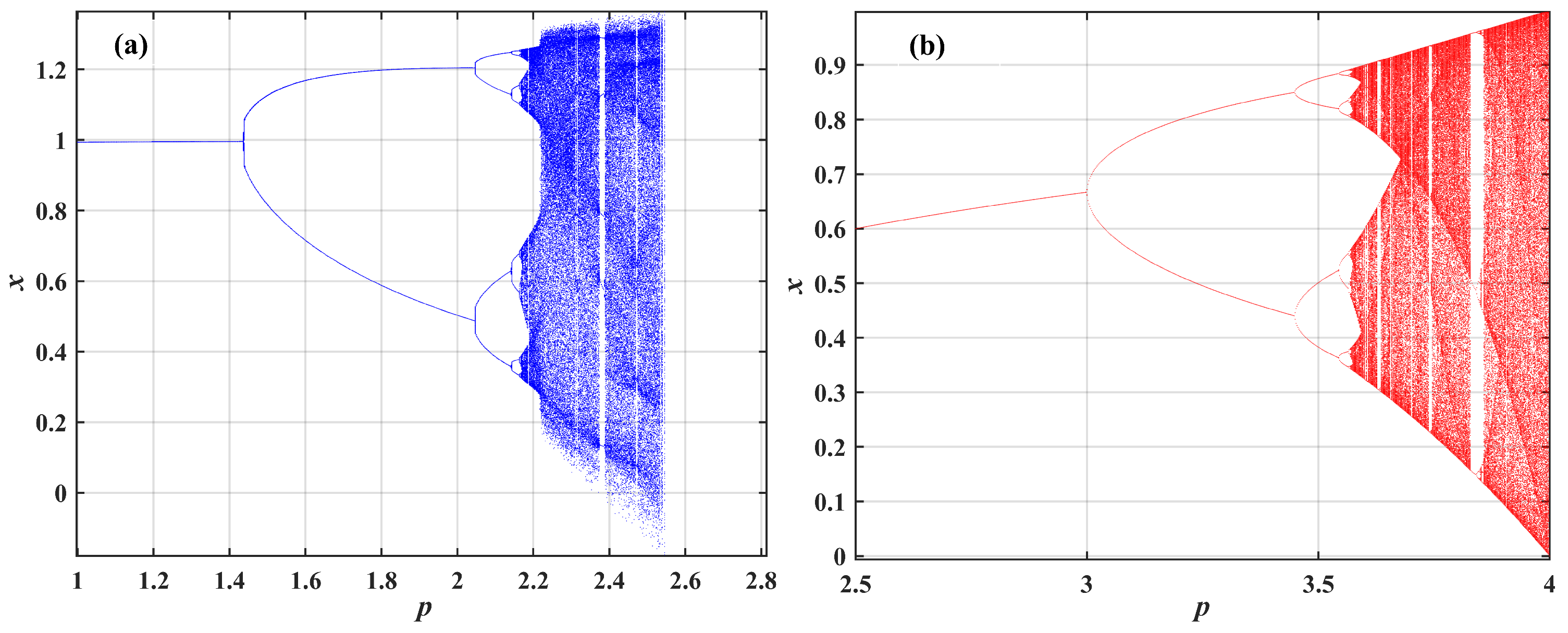
To illustrate the qualitative impact of fractional memory, Figure 1 compares representative finite-time bifurcation patterns of the considered fractional difference system with those of the classical integer-order logistic map. This comparison is intended solely to highlight behavioral differences induced by memory effects, such as shifts in the effective parameter range and the expansion of the state-space domain, rather than to imply a strict limiting or degeneracy relationship between the two systems. As shown in Figure 1, the introduction of power-law memory significantly alters the numerical dynamical behavior, including the effective parameter ranges over which complex trajectories persist and the extent of the accessible state space. These observations motivate a systematic investigation of how the parameters p, q, and x 0 jointly influence the persistence and robustness of complex dynamics under finite iteration, which is the main focus of the subsequent sections.

3. Dynamic Characterization of the FOLM

In this section, we investigate how finite-time numerical dynamical patterns in the logistic-type fractional difference system with power-law memory vary as the three governing parameters change, considering both the individual and coupled influences. For each parameter configuration, the system is iterated for a total of 2600 steps, of which the first 1800 iterations are discarded as transients, and the remaining 800 iterations are retained for analysis and visualization.

3.1. Individual Influence on Chaos Onset

3.1.1. Effect of q at Fixed x 0

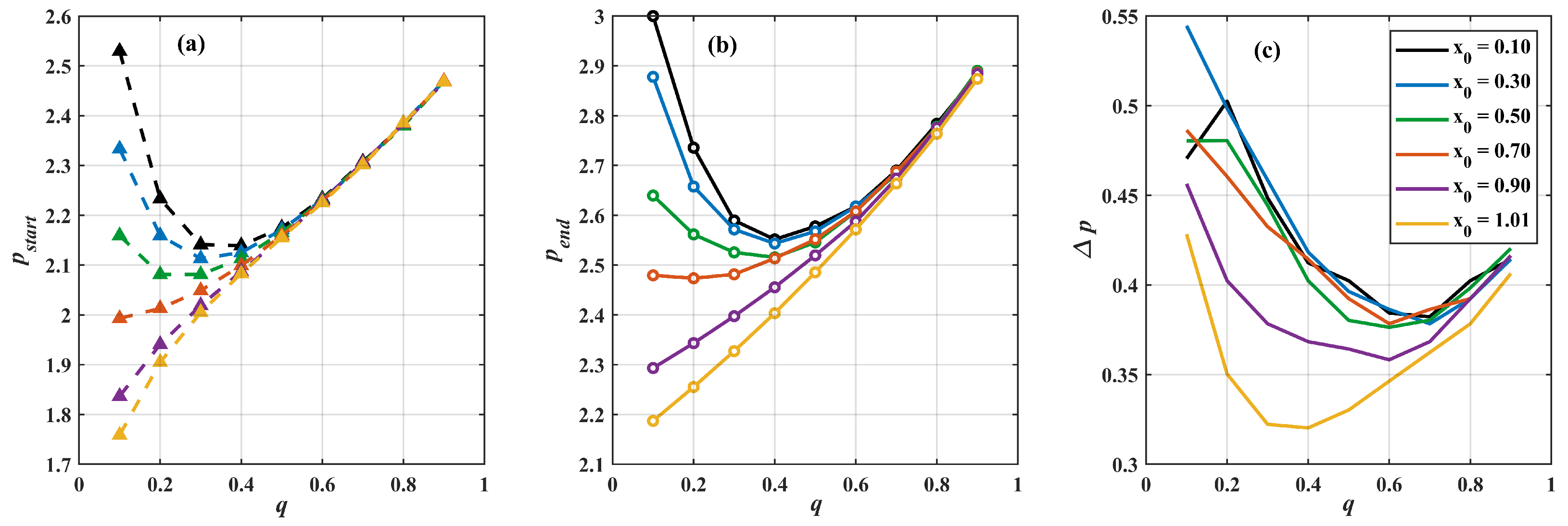
To assess the effect of the memory order q on the emergence of chaos, we compute the onset and termination thresholds p start and p end for each fixed initial condition x 0 . Here, p start and p end denote the smallest and largest values of p for which chaotic behavior is numerically observed within a finite iteration, and should be interpreted as operational indicators rather than asymptotic bifurcation thresholds. Their difference, defined as Δ p = p end p start , does not represent a chaotic interval in the strict dynamical sense, but rather a finite-time numerical span of control parameters over which chaotic behavior is observed. Figure 2 shows how p start , p end , and  Δ p vary with q.
As shown in Figure 2, First, for moderate values ( x 0 [ 0.10 ,   0.50 ] ), both p start and p end decrease and then increase as q grows, showing that the entire chaos-supporting range shifts leftward when q 0.3 0.5 . Second, for larger initial conditions ( x 0 0.70 ), both thresholds increase almost monotonically, indicating that stronger memory postpones the numerical appearance of chaotic behavior and shifts the chaos-supporting range to larger p. Third, although Δ p in Figure 2c also follows a decrease–increase pattern, it remains consistently small for x 0 > 0.9 . For other initial conditions, Δ p is larger when q [ 0.1 ,   0.4 ] , but this interval still contains periodic windows. Thus, Δ p cannot capture the continuity of chaotic behavior, motivating the introduction of the effective chaotic coverage defined as L eff = Δ p W , where W denotes the total width of all periodic windows.
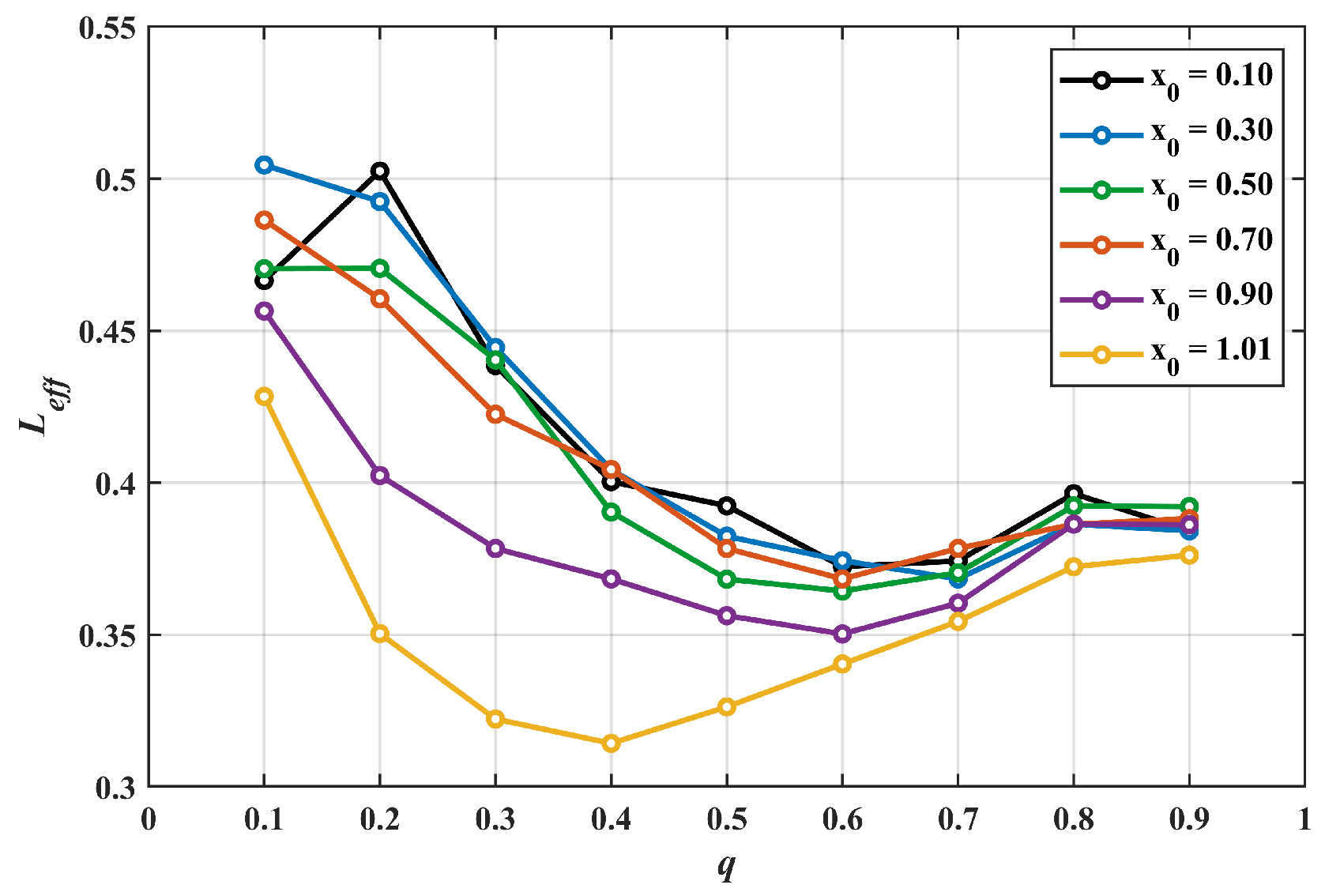
Figure 3 shows that effective chaotic coverage L eff ( q ) decreases as q increases, and then gradually rises for larger values of q. The initial decline indicates that low–moderate memory levels reintroduce periodic windows that interrupt chaotic behavior, whereas the subsequent recovery demonstrates that stronger memory helps suppress these windows. For large initial conditions ( x 0 0.9 ), the curves become consistently lower and much flatter, meaning that high initial states significantly reduce the uninterrupted chaos-supporting range and also weaken its sensitivity to q. Together with the trends in Δ p , these results show that low–moderate memory orders broaden the effective chaos-supporting range, while large initial states sharply diminish it.
These phenomena arise from the inherent memory effect of the fractional difference system. The memory order q regulates the memory weight assigned to past states: smaller values of q amplify the contribution of early trajectories, increasing initial-condition sensitivity and enabling the reappearance of periodic windows; larger values of q suppress this historical influence, thereby stabilizing the numerically observed chaos-supporting range and partially restoring the continuity of chaotic behavior. Hence, the observed variations in p start , p end , Δ p , and L eff reflect how the memory weighting of past states shapes the numerical dynamical patterns as q changes.

3.1.2. Effect of x 0 at Fixed q

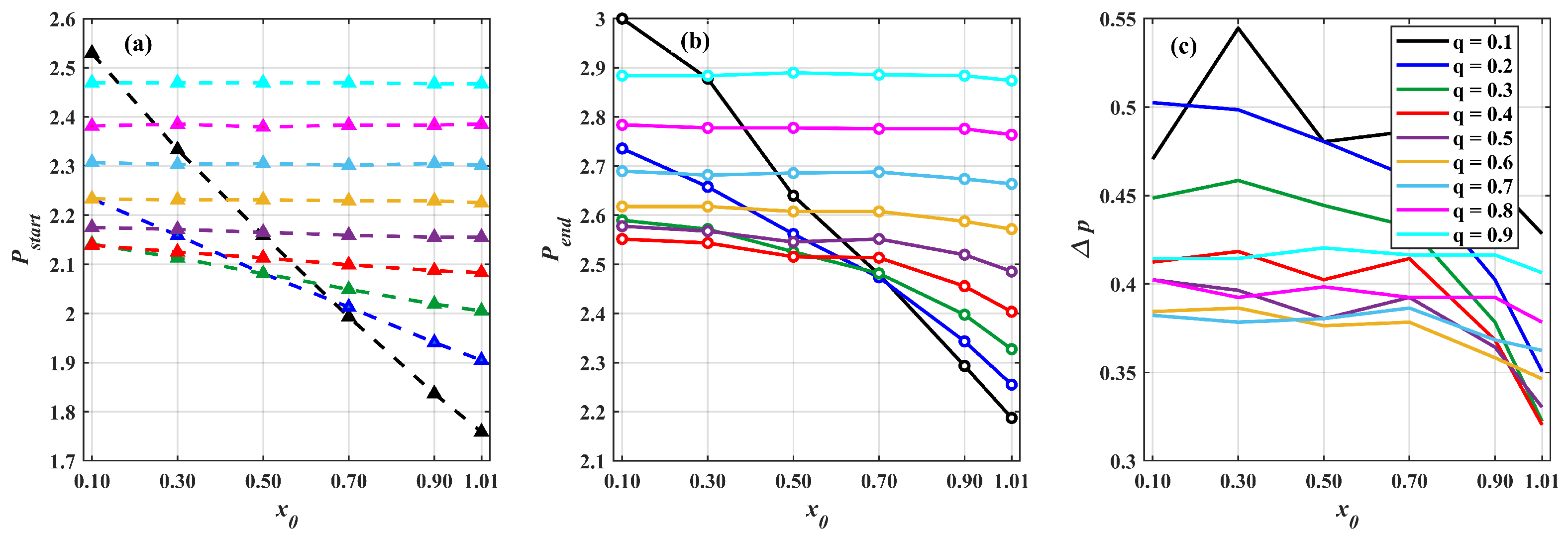
Figure 4 illustrates how the chaotic thresholds vary with x 0 for different q. At small memory levels ( q = 0.1 0.3 ), both p start and p end decrease markedly as x 0 increases, indicating that larger initial states shift the numerical appearance and disappearance of chaotic behavior toward smaller values of p, thereby moving the chaos-supporting range to lower control-parameter values. As q increases to q 0.4 , this sensitivity gradually diminishes, and for q 0.7 , the thresholds become almost independent of x 0 . The span Δ p in Figure 4c further shows that for q 0.8 , Δ p remains nearly unchanged across different x 0 , whereas for smaller q it consistently shrinks as x 0 increases, indicating that excessively large initial states substantially reduce the system’s ability to maintain chaos-supporting dynamics. However, since Δ p still cannot capture the continuity of chaotic behavior, the effective chaotic coverage L eff is employed for further assessment.
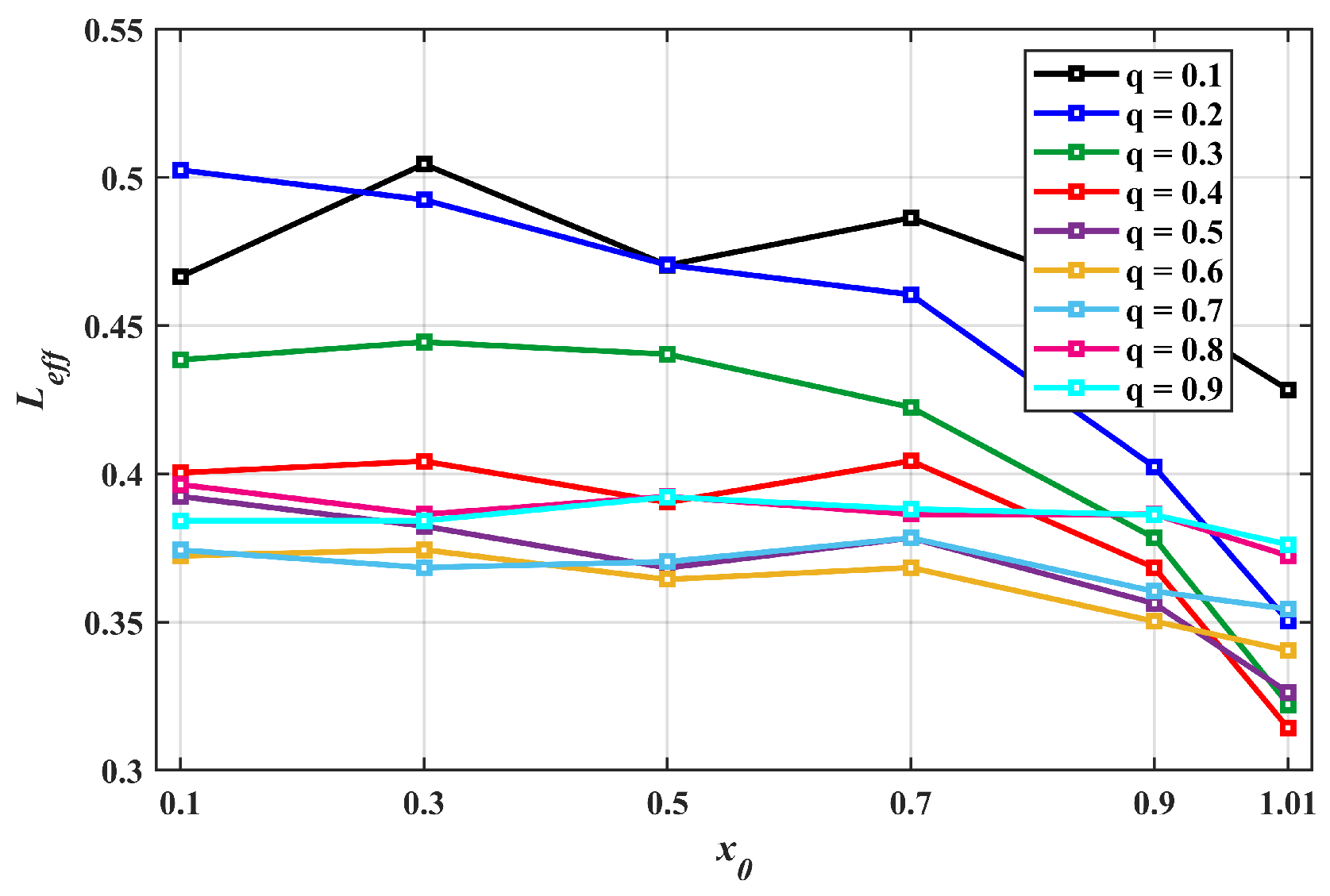
Figure 5 shows that L eff generally decreases as the initial condition x 0 increases: the decline is steep for small q ( q 0.3 ), considerably milder for intermediate q, and almost negligible when the memory is strong ( q 0.9 ). All curves reach their minimum near x 0 = 1.01 , indicating that large initial conditions substantially suppress the chaos-supporting range. Taken together with the results of p start , p end , and  Δ p , these observations further confirm that the chaotic behavior of the system is strongly influenced by the choice of initial condition.
These patterns arise from the interaction between the initial condition x 0 and the memory structure of the fractional difference system. For small q, early states carry strong memory weights, so different initial conditions produce distinct accumulated trajectories that shift the numerically observed transitions between chaotic and periodic behaviors. For larger q, the influence of early states weakens, reducing sensitivity to x 0 and stabilizing the numerically observed chaotic thresholds.

3.1.3. Stable-Core Consistency Across Initial Conditions

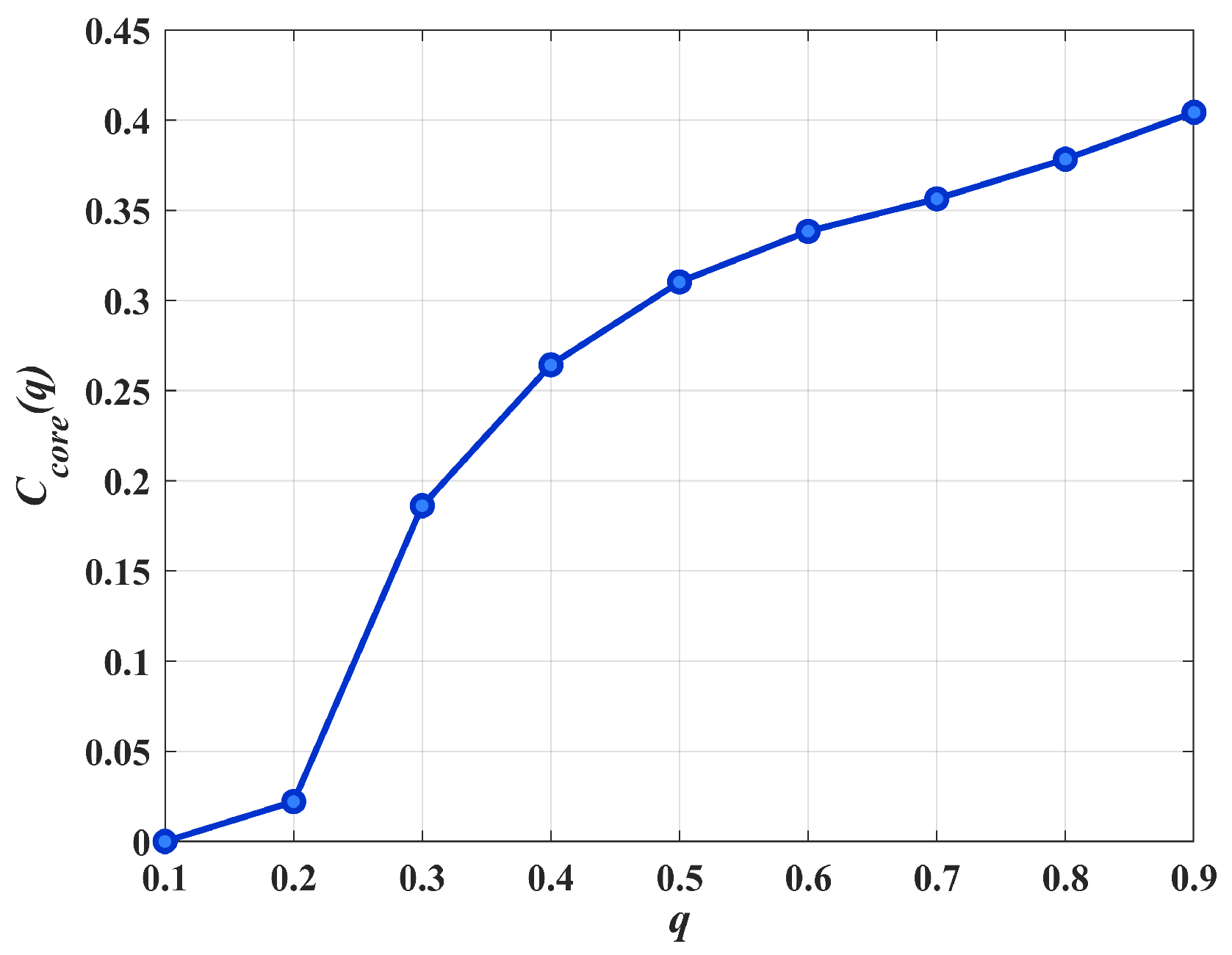
To quantify how consistently chaotic behavior persists across different initial states, we introduce the stable-core width C core ( q ) , defined as
C core ( q ) = width x 0 X p start ( q , x 0 ) , p end ( q , x 0 ) ,
which measures the portion of the control-parameter domain over which chaotic behavior is numerically observed for all initial conditions in the prescribed set  X . A nonzero value of C core ( q ) indicates the existence of a robust chaos-supporting range that is insensitive to variations in x 0 .
Figure 6 shows the resulting distribution of C core ( q ) , which increases monotonically with q. This trend indicates that larger values of q produce chaos-supporting ranges that are more uniform across different initial conditions, even though their absolute widths are not necessarily maximal. Taken together, the results of Section 3.1.1, Section 3.1.2 and Section 3.1.3 suggest that the robustness of chaotic behavior cannot be inferred from any single parameter in isolation. This motivates a transition to coupled investigations, as presented in Section 3.2, to examine how parameter pairs jointly influence the persistence of chaos.

3.2. Coupled Effects and Stability Evaluation

The results in Section 3.1 demonstrate that the influence of each governing parameter on chaotic behavior is strongly modulated by the others, indicating that a purely individual-parameter analysis is insufficient to fully characterize the robustness of chaos. Accordingly, this section investigates how joint variations of parameter pairs affect the persistence and stability of numerically observed chaotic behavior in the logistic-type fractional difference system.

3.2.1. Coupled Influence of ( q , x 0 )

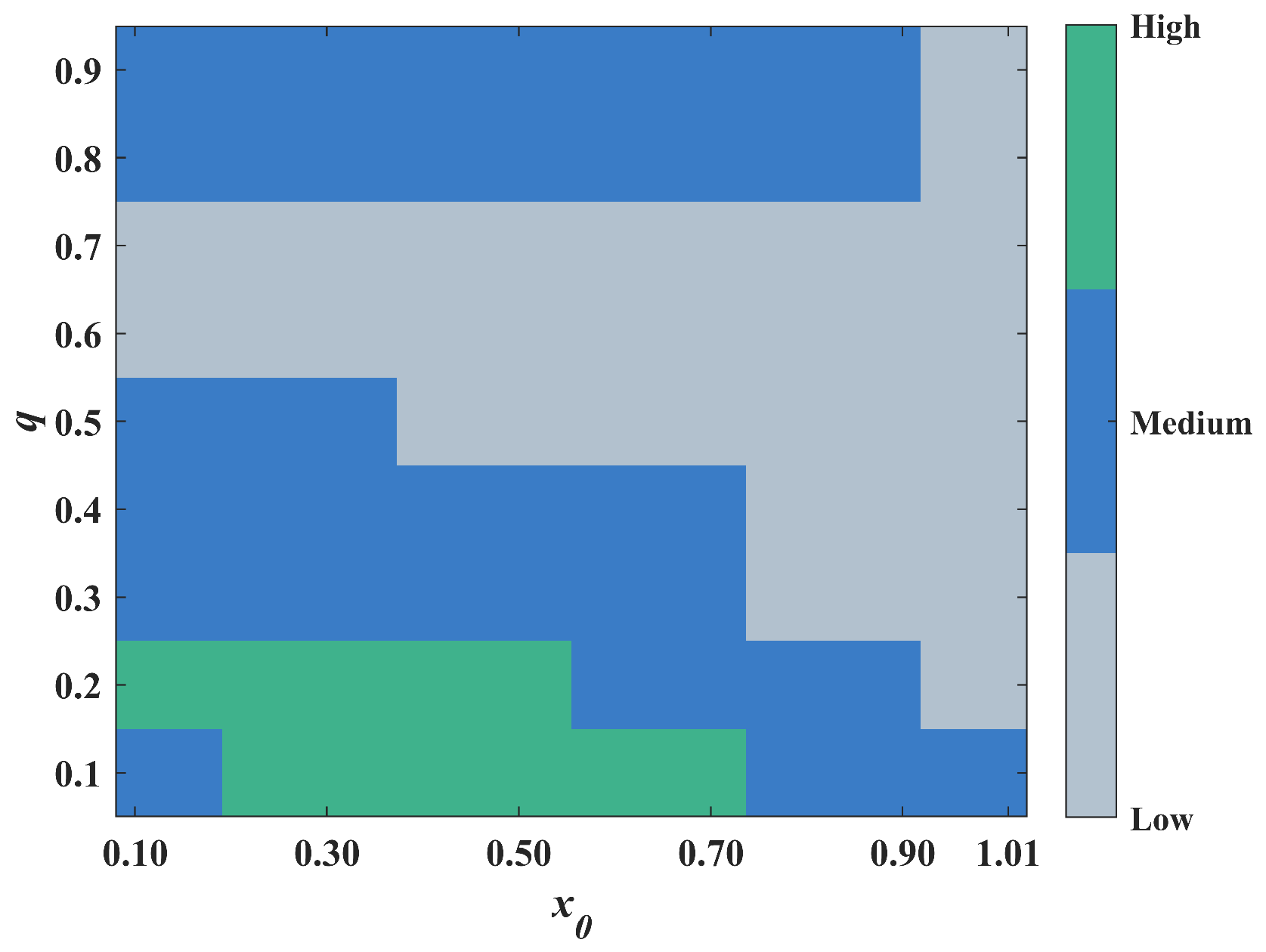
To analyze how the memory parameter q and the initial condition jointly shape the chaotic parameter region, we compute the effective chaotic coverage L eff ( q , x 0 ) over the ( q , x 0 ) plane. The resulting distribution is shown in Figure 7.
Figure 7 displays the two-dimensional distribution of L eff ( q , x 0 ) . Along the q-axis, small to moderate values of q yield relatively high chaotic coverage, whereas intermediate values ( q 0.6 0.8 ) produce a pronounced degradation band, followed by partial recovery at larger q. Along the x 0 -axis, the coverage generally decreases as the initial condition increases, with low-coverage states becoming more frequent toward the right side of the plane. Together, these trends demonstrate that wide and continuously sustained chaotic parameter regions are obtained only when q and x 0 fall jointly within favorable ranges.

3.2.2. Coupled Influence of ( p , x 0 )

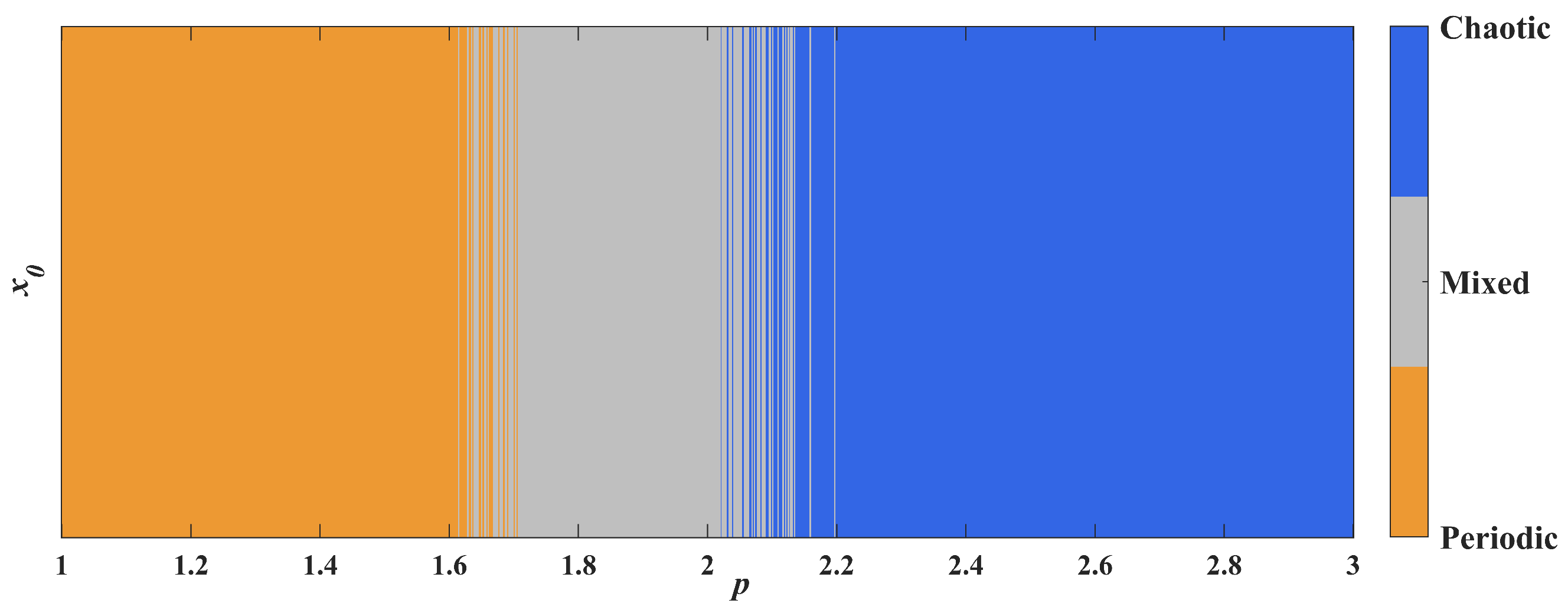
To examine how the nonlinear gain interacts with the initial condition, the finite-time numerical Lyapunov exponent [33,34] is evaluated for each sampled pair ( p , x 0 ) , and the resulting trajectories are operationally classified as periodic, chaotic, or mixed. For each fixed p, the results over all initial conditions are aggregated into a single label: the system is periodic if λ ( p , x 0 ) < 0 for all x 0 , chaotic if λ ( p , x 0 ) > 0 for all x 0 , and mixed otherwise. The resulting aggregated classification is shown in Figure 8.
A clear transition structure emerges. For p 1.7 , all initial conditions produce negative Lyapunov exponents, and the system remains uniformly periodic. In the intermediate range 1.7 p 2.0 , periodic and chaotic trajectories coexist across different x 0 , forming a pronounced mixed-sensitivity region. For p 2.0 , all initial conditions yield positive Lyapunov exponents, indicating a numerically consistent chaotic regime across the sampled initial states. Therefore, this joint classification highlights the dominant role of p in shaping the consistency of chaos with respect to initial conditions, and the most reliable chaotic sub-intervals will be further identified in Section 4 using the stability score.

3.2.3. Coupled Influence of ( p , q )

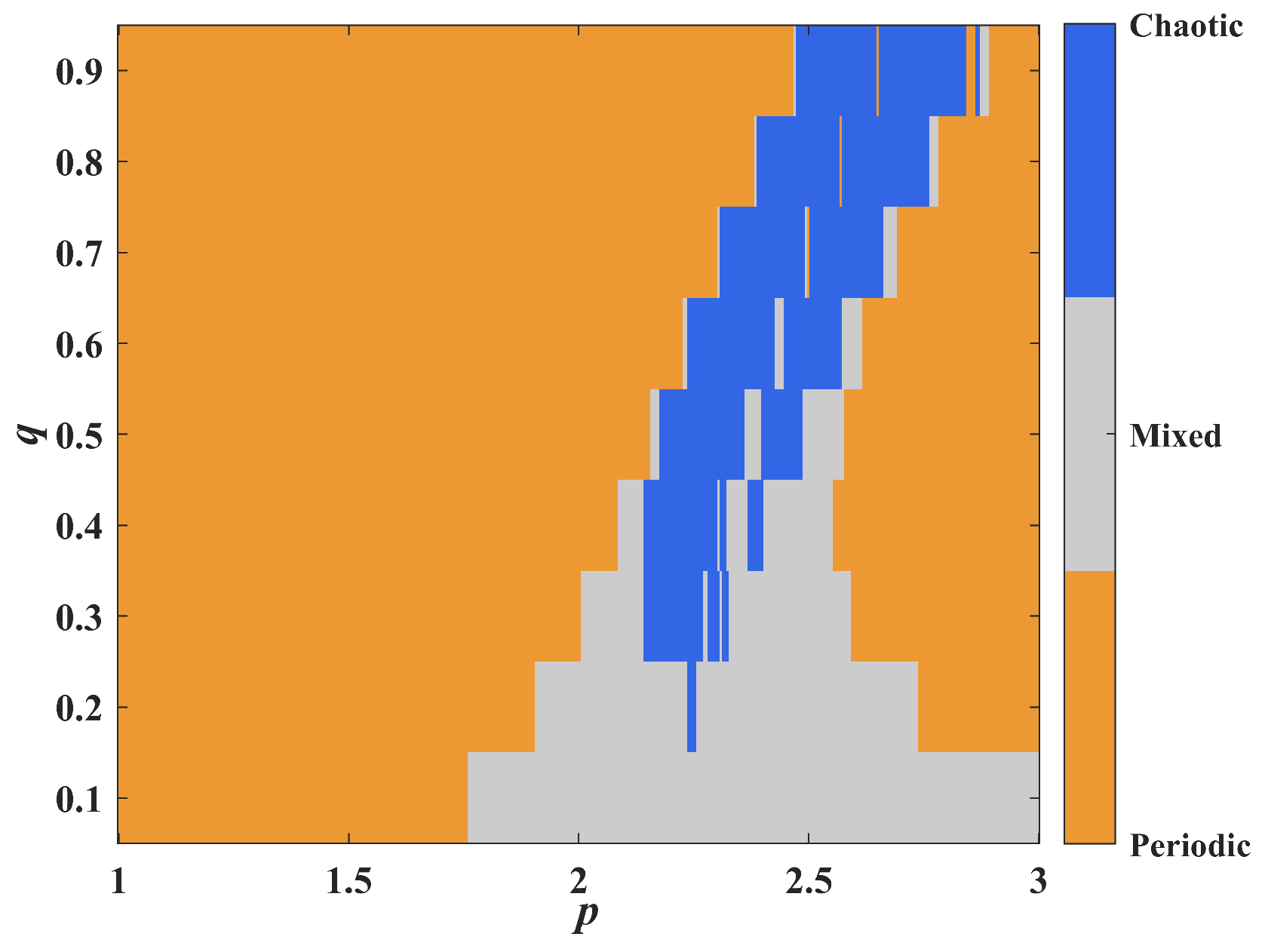
This subsection examines how the parameter pair ( p , q ) jointly shapes the numerical dynamical behavior across the parameter plane. Using the LE-based classification introduced in Section 3.2.2, each parameter pair ( p , q ) is evaluated over all initial conditions in the prescribed set X and assigned a periodic, mixed, or chaotic label based on the consistency of the Lyapunov exponent signs. The resulting phase diagram is shown in Figure 9.
As shown in Figure 9, no chaotic behavior occurs for p < 2.0 at any value of q, indicating that a sufficiently strong nonlinear gain is required for chaos to occur. Increasing q shifts the transition between periodic and chaotic regimes toward larger p, demonstrating that stronger fractional memory delays the emergence of chaotic responses. A mixed-sensitivity band appears for 2.0 p 2.3 , where periodic and chaotic responses coexist across different initial conditions. For p > 2.3 and q [ 0.3 , 0.8 ] , all tested initial states yield positive Lyapunov exponents, forming a broad and consistent chaotic plateau that identifies the most reliable combinations of ( p , q ) . Taken together, these structures delineate how the ( p , q ) parameter plane organizes the transition from periodicity to consistently chaotic behavior, complementing the individual influences of Section 3.1 and the coupled analyses of Section 3.2.1 and Section 3.2.2.
Across the individual and coupled analyses, the investigated logistic-type fractional difference system exhibits consistent finite-time numerical dynamical patterns. Chaos is promoted by moderate fractional orders and small initial conditions, whereas strong memory effects and large initial states tend to shrink the continuously chaotic parameter region. The two-dimensional maps reveal a numerically robust chaotic parameter region in the ( p , q ) plane and illustrate how memory strength and the nonlinear gain parameter jointly govern chaotic stability across initial conditions. Building on these insights, Section 4 develops a quantitative framework for selecting reliable parameter configurations based on multiple stability-oriented indicators.

4. Robust Parameter Interval Identification via Composite Chaos Evaluation

In this section, we develop a Composite Chaos Evaluation (CCE) framework to identify numerically admissible parameter intervals that reliably sustain chaotic dynamics, based on the finite-time numerical results of Section 3. Through the combined analysis of multiple stability-oriented indicators, this framework determines robust intervals for the three governing parameters, rather than targeting a single optimal parameter point. Importantly, the proposed CCE framework integrates interval identification with a final Lyapunov-exponent-based numerical validation step to verify the effectiveness of the obtained parameter intervals.

4.1. Global Evaluation of the Control Parameter p

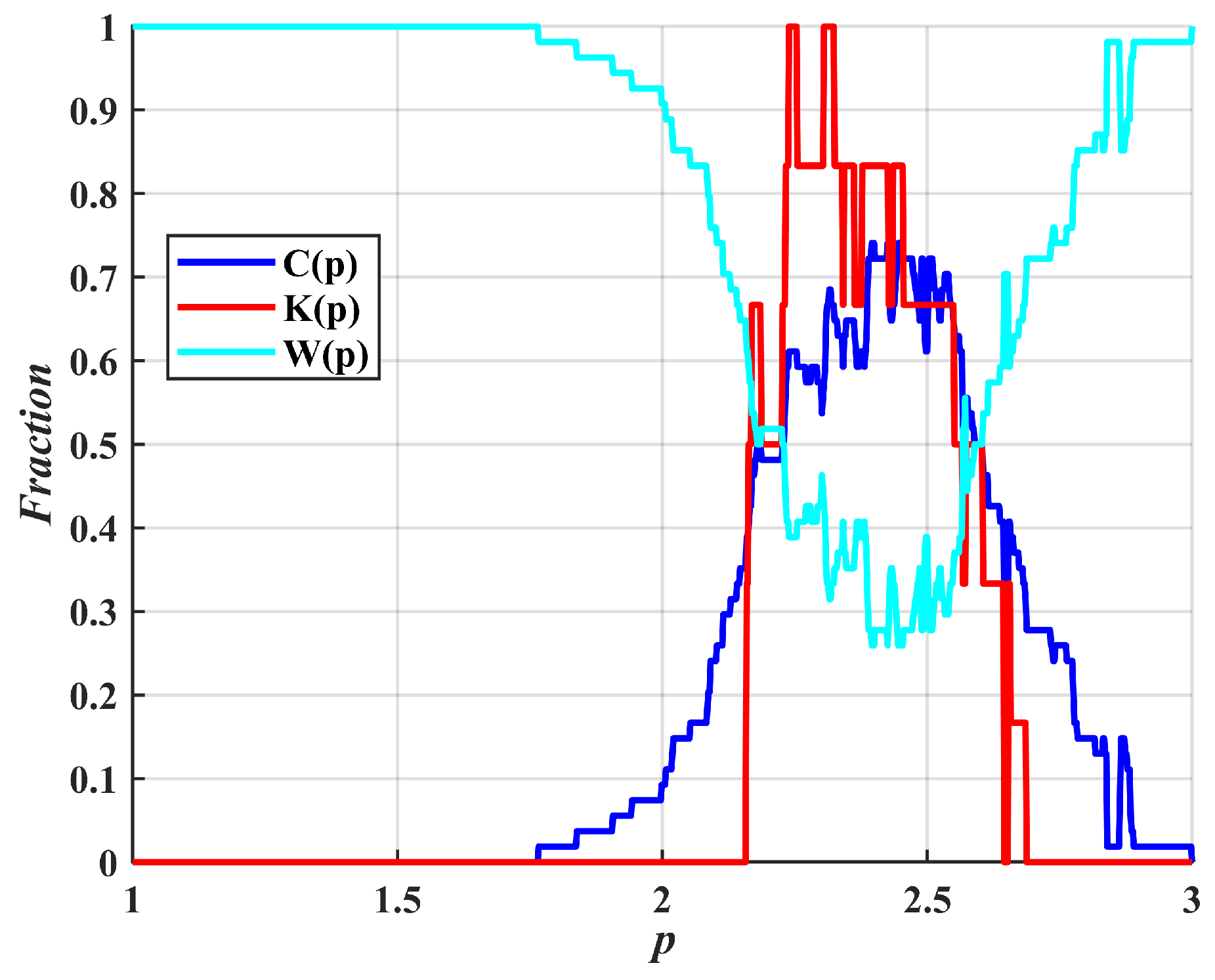
Building upon the Lyapunov-based dynamical analysis of Section 3, we now assess the overall numerical influence of the control parameter p across all sampled fractional orders q and initial conditions x 0 . This subsection introduces three stability-oriented statistical indicators that quantify the overall extent, consistency, and interruption of chaos as p varies: the chaotic coverage C ( p ) , the inter–initial-condition consensus K ( p ) , and the periodic-window density W ( p ) .
The indicators are defined as
C ( p ) = 1 N x 0 N q i = 1 N x 0 j = 1 N q I λ ( p , x 0 , i , q j ) > 0 ,
K ( p ) = 1 N x 0 i = 1 N x 0 I j = 1 N q I λ ( p , x 0 , i , q j ) > 0 k q ,
W ( p ) = 1 C ( p ) .
where λ ( p , x 0 , i , q j ) denotes the finite-time numerical maximum Lyapunov exponent corresponding to the parameter configuration ( p , x 0 , i , q j ) . The symbol I [ · ] represents the indicator function, which equals 1 if the enclosed condition is satisfied and 0 otherwise. N x 0 and N q denote the total numbers of tested initial conditions and fractional orders, respectively. The parameter k q [ 0 , N q ] is an integer threshold. Accordingly, C ( p ) measures the overall proportion of parameter combinations ( x 0 , q ) that exhibit chaotic behavior, K ( p ) quantifies the fraction of initial conditions that sustain chaos across multiple fractional orders, and W ( p ) = 1 C ( p ) reflects the complementary proportion of non-chaotic (primarily periodic-window-dominated) regions.
As illustrated in Figure 10, both C ( p ) and K ( p ) remain near zero for p < 1.8 , indicating predominantly periodic behavior across the sampled parameter space. Chaos becomes numerically apparent around p 2.1 , after which C ( p ) rises to its peak value (around 0.7), and K ( p ) remains high, demonstrating both the prevalence and consistency of chaotic dynamics. For p > 2.4 , both indicators decline due to the reappearance of periodic windows, as reflected by the increase in W ( p ) . These patterns jointly identify P * [ 2.3 , 2.4 ] as the most reliable numerically chaotic interval for the control parameter p, which forms the foundation for the determination of the corresponding intervals Q * and X * in Section 4.2 and Section 4.3.

4.2. Numerical Robustness Evaluation of the Fractional Order q

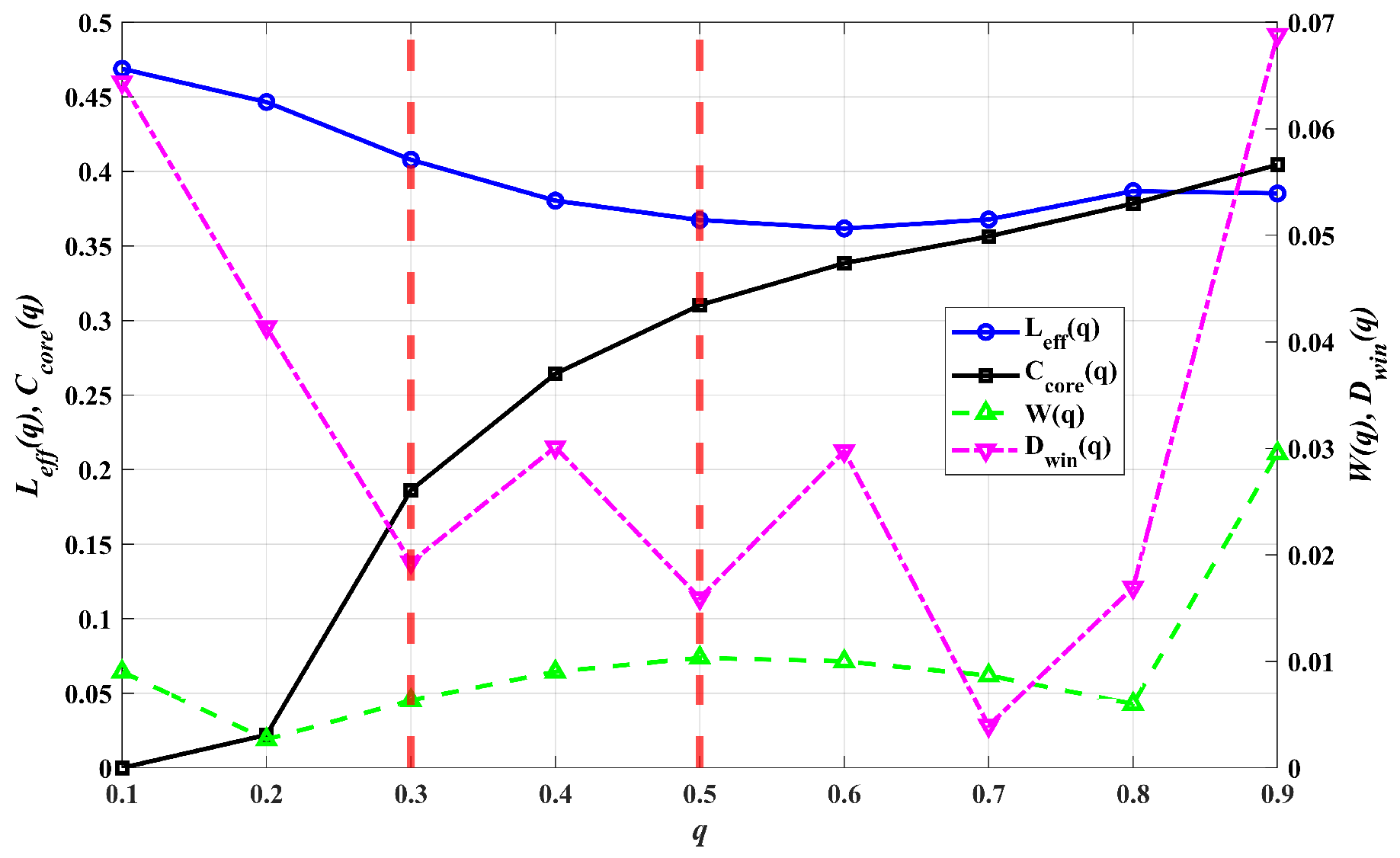
Based on the coupled ( q , x 0 ) and ( p , q ) analyses in Section 3, the fractional order is first restricted to the candidate interval 0.30 q 0.55 , where the chaotic region remains wide and no significant degradation occurs. Within this range, robustness is assessed using the stability indicators introduced in Section 3 and Section 4.1, namely L eff ( q ) , C core ( q ) , and  W ( q ) , together with the newly defined safety-distance metric D win ( q ) :
D win ( q ) = min [ a k , b k ] min | q a k | , | q b k | ,
where the intervals [ a k , b k ] denote the embedded periodic-window segments. Larger values of D win ( q ) indicate that q lies farther from the onset of intermittent periodicity.
To combine heterogeneous indicators without prescribing weights, a nonparametric rank-aggregation scheme is adopted. For each sampled value of q, L eff ( q ) , C core ( q ) , and  D win ( q ) are ranked in descending order, whereas W ( q ) is ranked in ascending order. The overall robustness score is then defined as
R ( q ) = R L ( q ) + R C ( q ) + R D ( q ) + R W ( q ) ,
so that smaller values correspond to simultaneously favorable performance across all metrics. Figure 11 summarizes the variation of these indicators within the candidate interval.
The resulting profiles indicate a clear numerically robust region over q [ 0.30 , 0.50 ] , where all indicators maintain desirable levels without cross-window degradation. This interval is therefore selected as the recommended range for the fractional order and is denoted by Q * = [ 0.30 , 0.50 ] .

4.3. Numerical Determination of the Initial-Condition Region

With the robust parameter intervals P * = [ 2.30 , 2.40 ] and Q * = [ 0.30 , 0.50 ] established in Section 4.1 and Section 4.2, the remaining task is to determine the initial-condition region that can consistently exhibit chaotic behavior under all admissible combinations of ( p , q ) P * × Q * . Since the one- and two-parameter analyses in Section 3 provide only partial information, a full evaluation across the entire robust parameter domain is required.
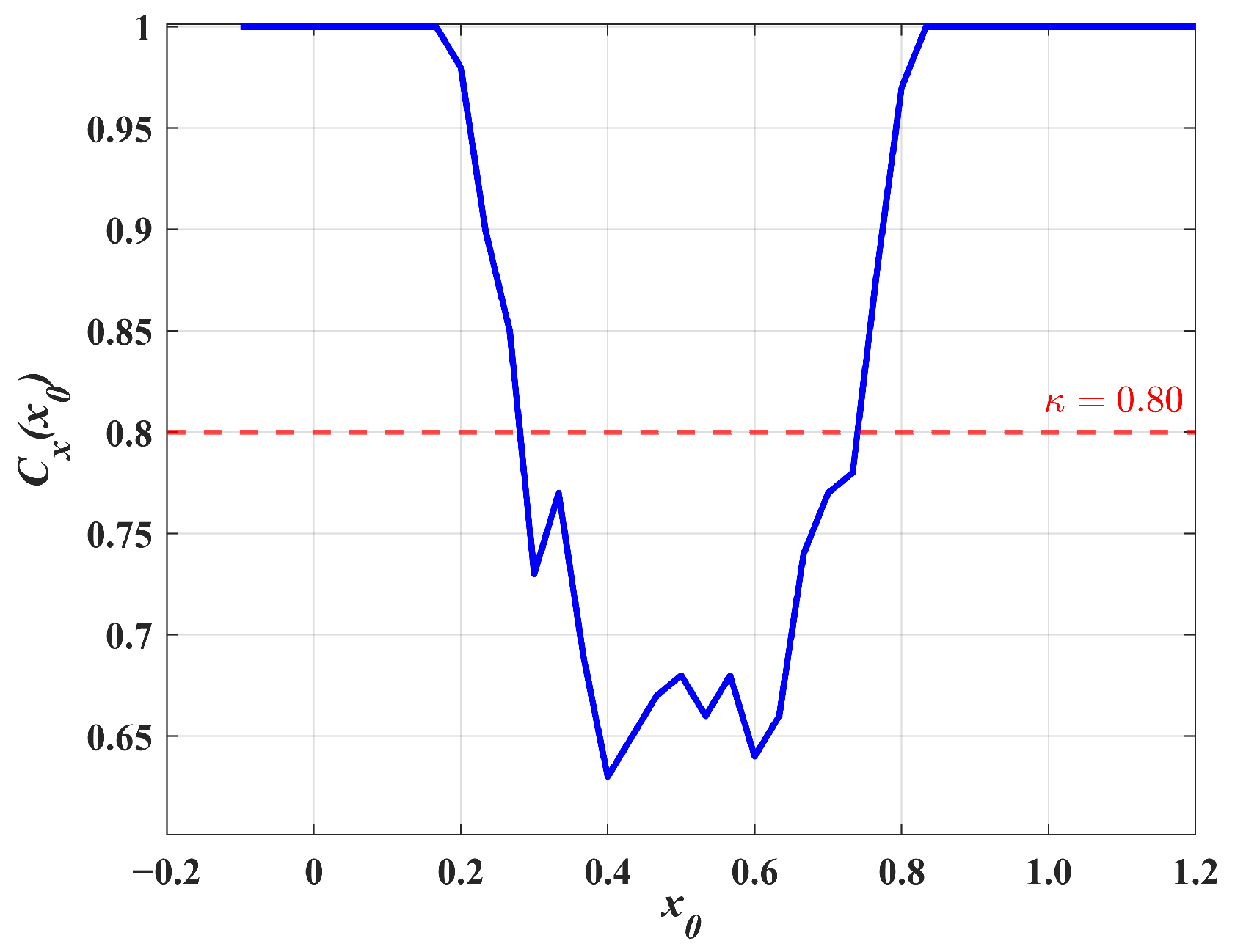
To measure the global reliability of chaos for each initial condition, we define the chaotic reliability index
C x ( x 0 ) = 1 N p N q i = 1 N p j = 1 N q I λ ( p i , q j , x 0 ) > 0 ,
which quantifies the fraction of admissible parameter pairs ( p i , q j ) P * × Q * that yield positive Lyapunov exponents when initialized at x 0 .
As shown in Figure 12, C x ( x 0 ) exhibits a clear U-shaped profile: chaotic reliability remains high near the two ends of the interval and drops markedly for intermediate initial conditions, indicating enhanced sensitivity to initial-state perturbations in this region. Using the reliability threshold κ = 0.80 , the initial-condition set is determined as
X * = [ 0.10 , 0.27 ] [ 0.77 , 1.20 ] ,
corresponding to the values of x 0 that preserve chaotic behavior for at least 80 % of the admissible parameter combinations. This completes the CCE-based determination of the three recommended parameter regions, and Section 4.4 further validates their effectiveness.

4.4. Validation of the Parameter Intervals

In this section, we independently validate the three recommended chaotic intervals identified in Section 4, namely P * = [ 2.30 , 2.40 ] , Q * = [ 0.30 , 0.50 ] , and X * = [ 0.10 , 0.27 ] [ 0.77 , 1.20 ] . To obtain an independent and conservative confirmation of these regions, we evaluate the finite-time numerical minimum of the maximal Lyapunov exponent for each parameter dimension [35,36], while allowing all admissible variations of the remaining parameters:
λ min ( p ) = min q Q * , x 0 X * λ max ( p , q , x 0 ) ,
λ min ( q ) = min p P * , x 0 X * λ max ( p , q , x 0 ) ,
λ min ( x 0 ) = min p P * , q Q * λ max ( p , q , x 0 ) .
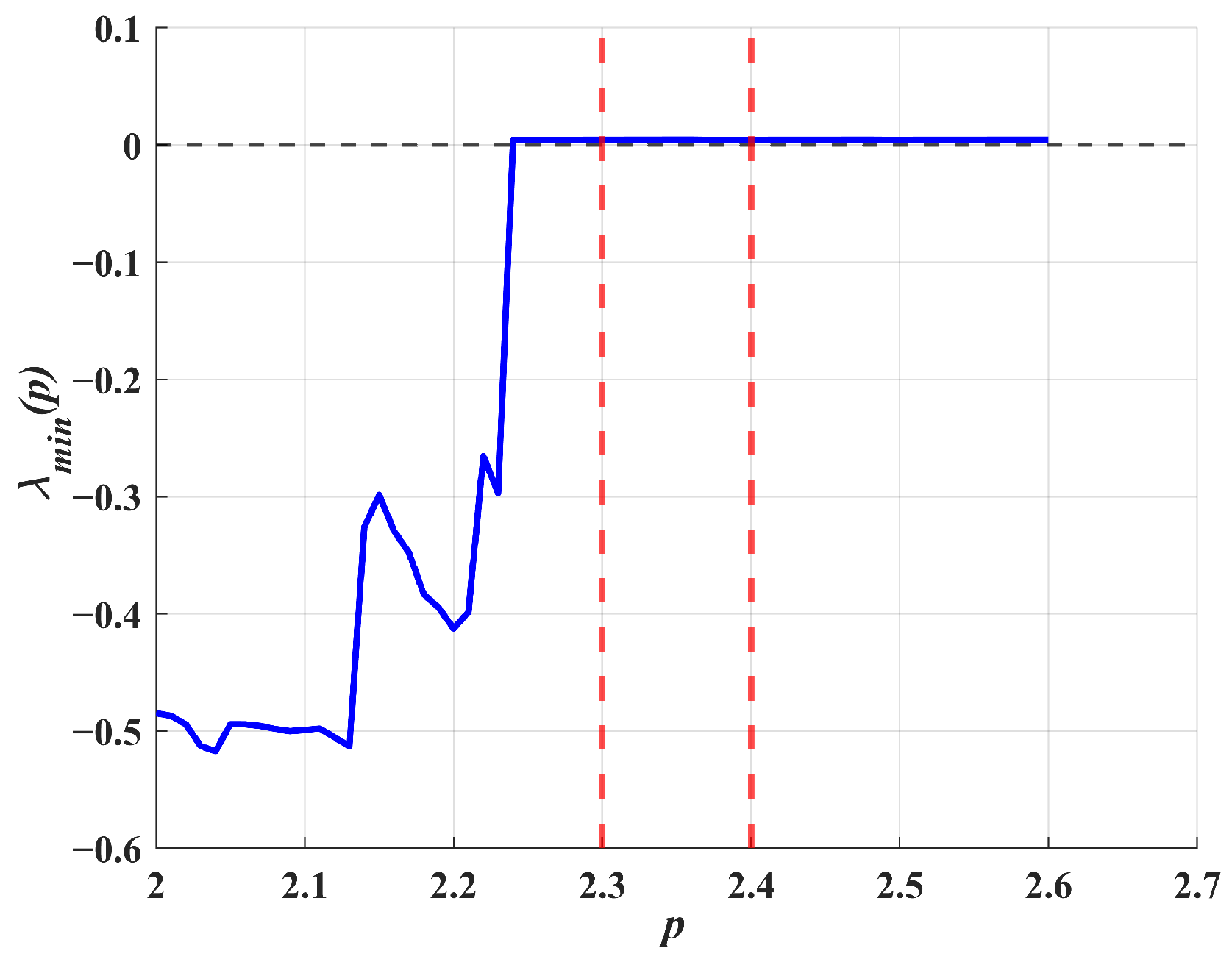
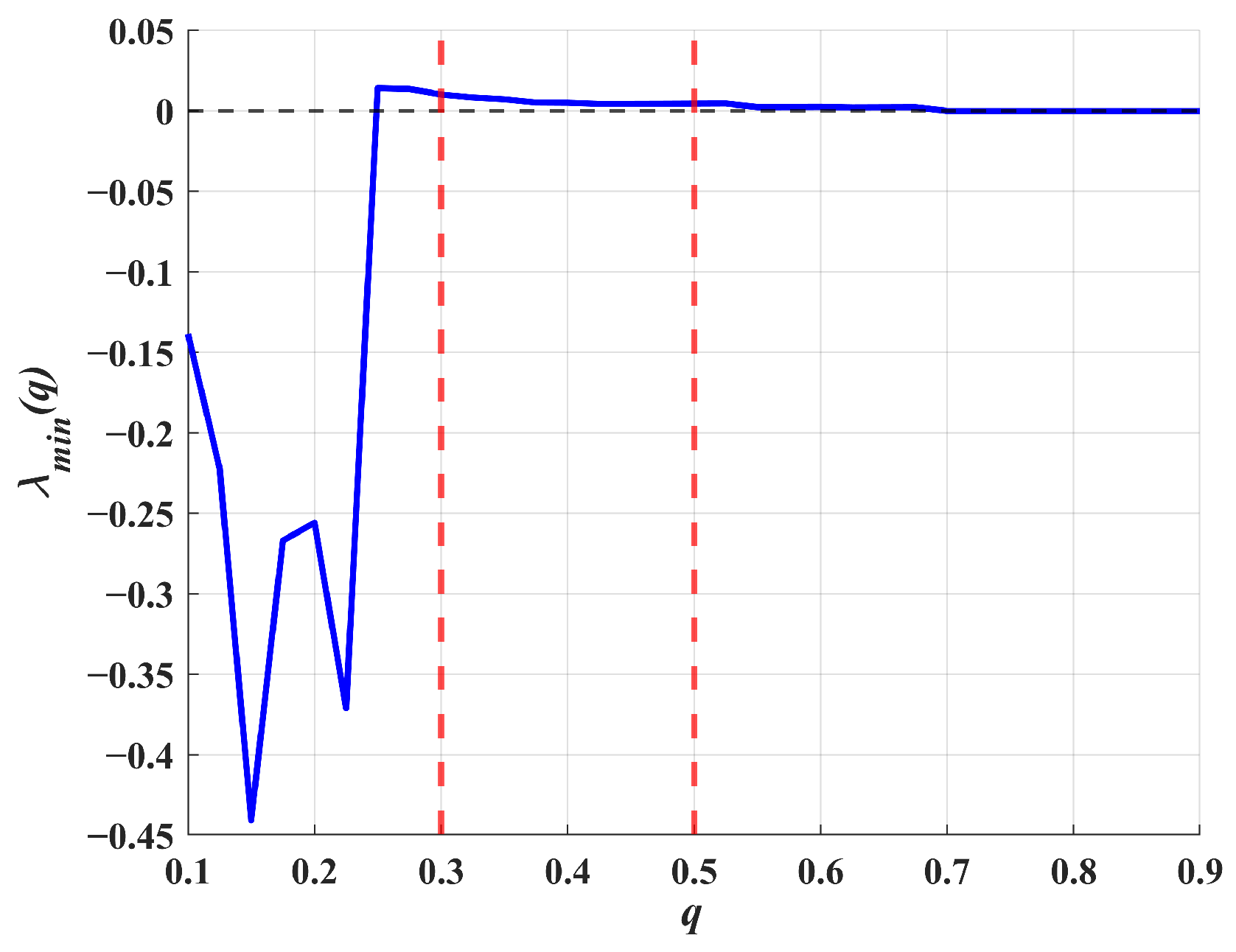
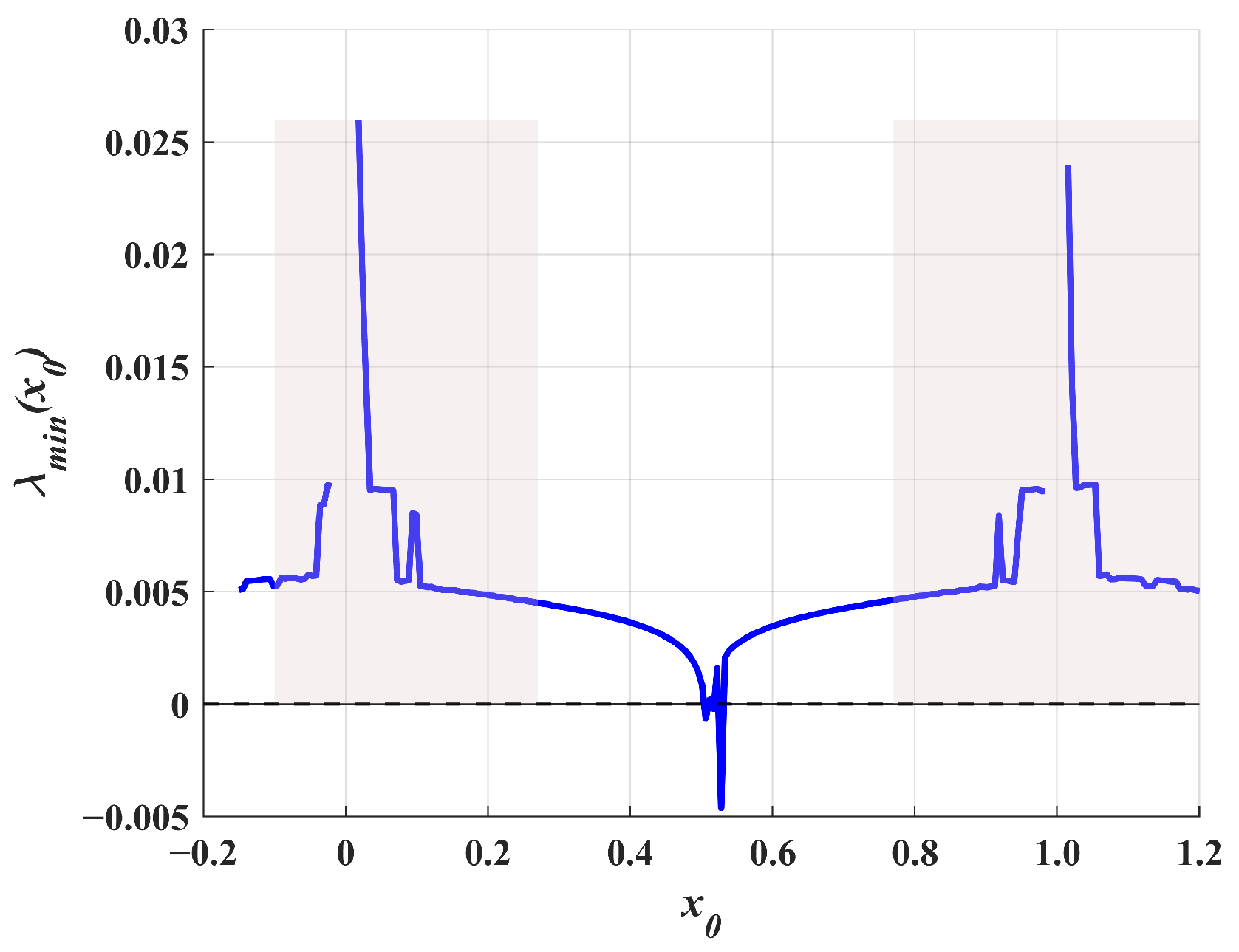
These quantities represent the weakest chaotic response within each recommended interval. If λ min ( · ) 0 , then the maximal Lyapunov exponent remains positive for all admissible parameter configurations within the corresponding interval. Thus, the minimum–maximal LE provides a strict and conservative numerical validation of both the reliability of the obtained intervals and the effectiveness of the proposed CCE framework.

4.4.1. Validation of the Interval P *

Figure 13 shows λ min ( p ) , the minimum of the maximal Lyapunov exponent evaluated via (9) over all ( q , x 0 ) Q * × X * . The value of λ min ( p ) becomes non-negative throughout p [ 2.30 , 2.40 ] , indicating that all admissible ( q , x 0 ) combinations exhibit consistently positive finite-time Lyapunov exponents in this region. For p < 2.25 , the quantity becomes numerically negative, implying that certain ( q , x 0 ) pairs produce periodic or weakly stable trajectories, whereas for p > 2.40 it approaches zero again, consistent with the reappearance of periodic windows observed in the bifurcation analysis. These observations confirm that P * = [ 2.30 , 2.40 ] is a numerically reliable and conservatively validated interval for the control parameter p.

4.4.2. Validation of the Interval Q *

Figure 14 presents λ min ( q ) , the minimum of the maximal Lyapunov exponent obtained via (10) by minimizing over all ( p , x 0 ) P * × X * for each fixed q. The quantity remains non-negative throughout q [ 0.30 , 0.50 ] , indicating that every admissible ( p , x 0 ) combination sustains chaotic behavior within this range. For q < 0.25 , λ min ( q ) becomes negative, indicating that at least one admissible ( p , x 0 ) combination fails to produce a positive Lyapunov exponent. For q > 0.50 , the minimum–maximal Lyapunov exponent gradually decreases, reflecting weakened chaotic intensity and the emergence of periodic windows for certain admissible parameter combinations. These observations confirm that Q * = [ 0.30 , 0.50 ] constitutes a robust and conservatively validated chaotic region for the fractional order q.

4.4.3. Validation of the Interval X *

Figure 15 displays λ min ( x 0 ) , the minimum of the maximal Lyapunov exponent computed via (11) over all ( p , q ) P * × Q * for each initial condition x 0 . The quantity is non-negative precisely over the proposed basins X * = [ 0.10 , 0.27 ] [ 0.77 , 1.20 ] , indicating that every admissible ( p , q ) pair sustains a positive maximal Lyapunov exponent throughout these intervals. It should be noted that neighborhoods near x 0 = 0 and x 0 = 1 exhibit pronounced numerical sensitivity, as the initial states approach boundary regions of the system state space. This sensitivity leads to large fluctuations in the estimated Lyapunov exponents, which are numerical artifacts rather than indicators of intrinsic dynamical behavior, and are therefore excluded from consideration. Outside these unstable neighborhoods, λ min ( x 0 ) remains smooth and strictly positive across X * , confirming the robustness of chaotic behavior in the most conservative sense for all admissible ( p , q ) combinations.
Taken together, the minimum of the maximal Lyapunov validation across the three parameter dimensions shows that the intervals { P * , Q * , X * } jointly define a coherent and robust region in which consistently positive maximal Lyapunov exponents are maintained across all admissible parameter combinations, ensuring chaotic dynamics that are insensitive to initial conditions.
For clarity and reproducibility, Algorithm 1 provides a concise algorithmic summary of the complete CCE framework, highlighting how different robustness-oriented indicators are combined to identify the final parameter intervals.
Algorithm 1: Composite Chaos Evaluation (CCE) procedure
Input: Finite-time numerical results from Section 3
Output: Robust parameter intervals P * , Q * , X *
Step 1: Identification of the control-parameter interval.;
Evaluate C ( p ) , K ( p ) , and  W ( p ) to determine the numerically reliable interval P *
   (Section 4.1);
Step 2: Identification of the fractional-order interval.;
Within P * , aggregate L eff ( q ) , C core ( q ) , D win ( q ) , and  W ( q ) to obtain the robust
   interval Q * (Section 4.2);
Step 3: Identification of the admissible initial-condition region.;
Within P * × Q * , evaluate the chaotic reliability index C x ( x 0 ) and apply a
   consistency threshold to determine X * (Section 4.3);
Step 4: Conservative validation.;
Assess the effectiveness of ( P * , Q * , X * ) using the minimum of the maximal
   Lyapunov exponent analysis (Section 4.4);

4.5. Computational Cost and Scalability

The computational cost of the proposed numerical procedure is determined by the number of sampled values in each parameter dimension and the iteration length used for transient removal and finite-time Lyapunov exponent estimation. Let N p , N q , and N x 0 denote the numbers of sampled values for the control parameter, fractional order, and initial condition, respectively. Then the total number of evaluated parameter configurations is N p N q N x 0 , and the overall computational complexity scales as
O N p N q N x 0 ( T tr + T ) ,
where T tr and T denote the transient length and the retained iteration length, respectively.

5. Conclusions and Discussion

In this paper, we perform a detailed numerical dynamical investigation of a logistic-type fractional difference system with power-law memory, elucidating how the nonlinear gain parameter, memory strength, and initial condition shape the extent and robustness of chaotic behavior under finite-time iteration. Through bifurcation analysis, Lyapunov-exponent mapping, and multiple stability-oriented indicators, we reveal both the individual and coupled influences of these parameters on the overall finite-time dynamical characteristics of the system. First, these results provide a systematic finite-time dynamical characterization of the considered fractional difference system, clarifying the roles of the three governing parameters and their coupled effects. Second, based on these observations, a Composite Chaos Evaluation (CCE) framework is developed to identify numerically reliable chaotic regions, yielding robust parameter intervals that consistently support wide and uninterrupted chaotic dynamics finite-time numerical iteration. Finally, the minimum of the maximal Lyapunov exponents further provides a conservative numerical validation, showing that all admissible parameter combinations within these regions yield consistently positive maximal Lyapunov exponents.
The proposed parameter-interval identification framework is based on finite-time numerical experiments, and the reported results should therefore be interpreted within the adopted numerical settings rather than as asymptotic theoretical conclusions. Moreover, stochastic perturbations, external noise, and alternative fractional-difference formulations are not explicitly considered and may influence the numerical behavior encountered in practical implementations. While the framework is computationally feasible for low-dimensional systems, its extension to higher-dimensional settings will require more computationally efficient exploration strategies. Future work may therefore integrate metaheuristic or adaptive search strategies with the proposed CCE framework to improve exploration efficiency, and extend the analysis to uncertainty-aware scenarios, other memory-based chaotic systems, and broader application contexts.

Author Contributions

Conceptualization, Y.L.; methodology, Y.L.; software, Y.L. and W.S.; validation, Y.L. and Z.A.-Z.; investigation, Y.L.; writing—review and editing, Y.L., Z.A.-Z. and W.S.; visualization, Y.L.; supervision, Z.A.-Z. and S.L.; funding acquisition, Z.A.-Z. and S.L. All authors have read and agreed to the published version of the manuscript.

Funding

This work was supported by National Natural Science Foundations of China (Nos. 12301405, 12271419), Shaanxi Fundamental Science Research Project for Mathematics and Physics (No. 23JSZ010) and Fundamental Research Funds for Central Universities of China (No. ZYTS25201).

Data Availability Statement

The data and code that support the findings of this study are available from the corresponding author upon request.

Conflicts of Interest

The authors declare that they have no known competing financial interests or personal relationships that could have appeared to influence the work reported in this paper.

References

  1. Hsieh, D.A. Chaos and nonlinear dynamics: Application to financial markets. J. Financ. 1991, 46, 1839–1877. [Google Scholar] [CrossRef]
  2. May, R.M. Simple mathematical models with very complicated dynamics. Nature 1976, 261, 459–467. [Google Scholar] [CrossRef] [PubMed]
  3. Alligood, K.T.; Sauer, T.D.; Yorke, J.A. Chaos: An Introduction to Dynamical Systems; Springer: New York, NY, USA, 1997. [Google Scholar]
  4. Strogatz, S.H. Nonlinear Dynamics and Chaos: With Applications to Physics, Biology, Chemistry, and Engineering, 2nd ed.; Chapman and Hall/CRC: Boca Raton, FL, USA, 2024. [Google Scholar]
  5. Iqbal, S.; Wang, J. A novel fractional-order 3-D chaotic system and its application to secure communication based on chaos synchronization. Phys. Scr. 2025, 100, 025243. [Google Scholar] [CrossRef]
  6. Zhang, B.; Liu, L. Chaos-based image encryption: Review, application, and challenges. Mathematics 2023, 11, 2585. [Google Scholar] [CrossRef]
  7. Azar, A.T.; Vaidyanathan, S. Advances in Chaos Theory and Intelligent Control; Springer: Cham, Switzerland, 2016; Volume 337. [Google Scholar]
  8. Jiao, C.; Yu, K.; Zhou, Q. An opposition-based learning adaptive chaotic particle swarm optimization algorithm. J. Bionic Eng. 2024, 21, 3076–3097. [Google Scholar] [CrossRef]
  9. Wang, B.; Zhang, Z.; Siarry, P.; Liu, X.; Królczyk, G.; Hua, D.; Brumercik, F.; Li, Z. A nonlinear African vulture optimization algorithm combining Henon chaotic mapping theory and reverse learning competition strategy. Expert Syst. Appl. 2024, 236, 121413. [Google Scholar] [CrossRef]
  10. Yang, J.; Yan, F.; Zhang, J.; Peng, C. Hybrid chaos game and grey wolf optimization algorithms for UAV path planning. Appl. Math. Model. 2025, 142, 115979. [Google Scholar] [CrossRef]
  11. Dong, Y.; Zhang, S.; Zhang, H.; Zhou, X.; Jiang, J. Chaotic evolution optimization: A novel metaheuristic algorithm inspired by chaotic dynamics. Chaos Solitons Fractals 2025, 192, 116049. [Google Scholar] [CrossRef]
  12. Li, S.; Chen, G.; Mou, X. On the dynamical degradation of digital piecewise linear chaotic maps. Int. J. Bifurc. Chaos 2005, 15, 3119–3151. [Google Scholar] [CrossRef]
  13. Bao, H.; Hua, Z.; Li, H.; Chen, M.; Bao, B. Discrete memristor hyperchaotic maps. IEEE Trans. Circuits Syst. I Regul. Pap. 2021, 68, 4534–4544. [Google Scholar] [CrossRef]
  14. Zhang, J.-X.; Zhang, X.; Boutat, D.; Liu, D.-Y. Fractional-order complex systems: Advanced control, intelligent estimation and reinforcement learning image-processing algorithms. Fractal Fract. 2025, 9, 67. [Google Scholar] [CrossRef]
  15. Calgan, H.; Gokyildirim, A.; Ilten, E.; Demirtas, M. Classification of fractional-order chaotic systems using deep learning methods. Eur. Phys. J. Spec. Top. 2025, 234, 4879–4897. [Google Scholar] [CrossRef]
  16. Boulaaras, S.; Sriramulu, S.; Arunachalam, S.; Allahem, A.; Alharbi, A.; Radwan, T. Chaos and stability analysis of the nonlinear fractional-order autonomous system. Alex. Eng. J. 2025, 118, 278–291. [Google Scholar] [CrossRef]
  17. Nail, B.; Atoussi, M.A.; Saadi, S.; Tibermacine, I.E.; Napoli, C. Real-time synchronisation of multiple fractional-order chaotic systems: An application study in secure communication. Fractal Fract. 2024, 8, 104. [Google Scholar] [CrossRef]
  18. Edelman, M.; Helman, A.B.; Smidtaite, R. Bifurcations and transition to chaos in generalized fractional maps of the orders 0 < α < 1. Chaos 2023, 33, 063123. [Google Scholar] [CrossRef]
  19. Edelman, M. Asymptotically periodic and bifurcation points in fractional difference maps. Fractal Fract. 2025, 9, 231. [Google Scholar] [CrossRef]
  20. Wu, G.-C.; Wu, Z.-Q.; Zhu, W. Data-driven discrete fractional chaotic systems, new numerical schemes and deep learning. Chaos 2024, 34, 093144. [Google Scholar] [CrossRef]
  21. Danca, M.-F. Fractional order logistic map: Numerical approach. Chaos Solitons Fractals 2022, 157, 111851. [Google Scholar] [CrossRef]
  22. Lin, M.; Zhang, X.; Qiu, H. Adaptive backstepping fuzzy synchronization control of fractional-order chaotic systems with input saturation and external disturbances. AIP Adv. 2023, 13, 085206. [Google Scholar] [CrossRef]
  23. Al-Raeei, M. Applying fractional quantum mechanics to systems with electrical screening effects. Chaos Solitons Fractals 2021, 150, 111209. [Google Scholar] [CrossRef]
  24. Medina, K.G.; Estevez-Rams, E.; Kunka, D. Non-linear oscillators with Kuramoto-like local coupling: Complexity analysis and spatiotemporal pattern generation. Chaos Solitons Fractals 2023, 175, 114056. [Google Scholar] [CrossRef]
  25. Ates, A. Enhanced equilibrium optimization method with fractional-order chaos and application to engineering problems. Neural Comput. Appl. 2021, 33, 9849–9876. [Google Scholar] [CrossRef]
  26. Abd Elaziz, M.; Yousri, D.; Mirjalili, S. A hybrid Harris hawks–moth flame optimization algorithm including fractional-order chaotic maps and evolutionary population dynamics. Adv. Eng. Softw. 2021, 154, 102973. [Google Scholar] [CrossRef]
  27. Edelman, M. Dynamics of nonlinear systems with power-law memory. In Handbook of Fractional Calculus with Applications: Applications in Physics; Tarasov, V.E., Ed.; De Gruyter: Berlin, Germany, 2019; Volume 4, pp. 103–132. [Google Scholar]
  28. Wu, G.-C.; Baleanu, D. Discrete fractional logistic map and its chaos. Nonlinear Dyn. 2014, 75, 283–287. [Google Scholar] [CrossRef]
  29. Peng, Y.; Sun, K.; He, S.; Wang, L. Comments on “Discrete fractional logistic map and its chaos” [Nonlinear Dyn. 75, 283–287 (2014)]. Nonlinear Dyn. 2019, 97, 897–901. [Google Scholar] [CrossRef]
  30. Edelman, M. Maps with power-law memory: Direct introduction and Eulerian numbers, fractional maps, and fractional difference maps. In Handbook of Fractional Calculus with Applications: Theory; Kochubei, A., Luchko, Y., Eds.; De Gruyter: Berlin, Germany, 2019; Volume 2, pp. 47–64. [Google Scholar]
  31. Petkevičiūtė-Gerlach, D.; Šmidtaitė, R.; Ragulskis, M. Intermittent bursting in the fractional difference logistic map of matrices. Int. J. Bifurc. Chaos 2022, 32, 2230002. [Google Scholar] [CrossRef]
  32. Kanso, A.; Smaoui, N. Logistic chaotic maps for binary numbers generations. Chaos Solitons Fractals 2009, 40, 2557–2568. [Google Scholar] [CrossRef]
  33. Wolf, A.; Swift, J.B.; Swinney, H.L.; Vastano, J.A. Determining Lyapunov exponents from a time series. Phys. D 1985, 16, 285–317. [Google Scholar] [CrossRef]
  34. Geist, K.; Parlitz, U.; Lauterborn, W. Comparison of different methods for computing Lyapunov exponents. Prog. Theor. Phys. 1990, 83, 875–893. [Google Scholar] [CrossRef]
  35. Barreira, L.; Pesin, Y.B. Lyapunov Exponents and Smooth Ergodic Theory; American Mathematical Society: Providence, RI, USA, 2002; pp. 61–74. [Google Scholar]
  36. Pollicott, M.; Vytnova, P. Accurate bounds on Lyapunov exponents for expanding maps of the interval. Commun. Math. Phys. 2023, 397, 485–502. [Google Scholar] [CrossRef]
Figure 1. Finite-time bifurcation patterns of (a) the logistic-type fractional difference system with q = 0.5 (blue) and (b) the classical integer-order logistic map with q = 1.0 (red), both initialized at x 0 = 0.5 .
Fractalfract 10 00029 g001
Figure 2. Finite-time numerical chaotic parameter thresholds versus q. (a) p start . (b) p end . (c) Δ p . A uniform color scheme for x 0 is used across all subplots, with the legend shown only in panel (c). Different marker shapes are used in panels (a) and (b) to distinguish p start and p end , respectively.
Fractalfract 10 00029 g002
Figure 3. Effective chaotic coverage L eff versus q.
Fractalfract 10 00029 g003
Figure 4. Chaotic parameter thresholds versus x 0 . (a) p start . (b) p end . (c) Δ p . Different marker shapes are used in panels (a) and (b) to distinguish p start and p end , respectively, while colors indicate different values of q.
Fractalfract 10 00029 g004
Figure 5. Effective chaotic coverage L eff versus initial condition x 0 for different q.
Fractalfract 10 00029 g005
Figure 6. Stable-core width C core ( q ) as a function of q. Circles represent discrete numerical results, and the solid line is drawn to guide the eye.
Fractalfract 10 00029 g006
Figure 7. Effective chaotic coverage L eff ( q , x 0 ) in the ( q , x 0 ) parameter plane.
Fractalfract 10 00029 g007
Figure 8. Lyapunov-based joint dynamical classification in the ( p , x 0 ) plane at q = 0.5 .
Fractalfract 10 00029 g008
Figure 9. Lyapunov-based dynamical classification map in the ( p , q ) parameter plane.
Fractalfract 10 00029 g009
Figure 10. Evolution of chaotic characteristics with respect to the control parameter p.
Fractalfract 10 00029 g010
Figure 11. Evolution of the four stability indicators with respect to the fractional order q. The red dashed vertical lines indicate the selected robust interval Q * = [ 0.30 , 0.50 ] .
Fractalfract 10 00029 g011
Figure 12. Chaotic reliability C x ( x 0 ) over the robust parameter domain P * × Q * .
Fractalfract 10 00029 g012
Figure 13. λ min ( p ) evaluated over all ( q , x 0 ) Q * × X * . The blue curve represents λ min ( p ) , while the red dashed vertical lines indicate the validated robust interval P * = [ 2.30 , 2.40 ] for the control parameter p.
Fractalfract 10 00029 g013
Figure 14. λ min ( q ) evaluated over all ( p , x 0 ) P * × X * . The blue curve represents λ min ( q ) , while the red dashed vertical lines indicate the validated robust interval Q * = [ 0.30 , 0.50 ] for the fractional order q.
Fractalfract 10 00029 g014
Figure 15. λ min ( x 0 ) evaluated over all ( p , q ) P * × Q * . The shaded regions indicate the two disjoint recommended chaotic intervals, [ 0.10 , 0.27 ] and [ 0.77 , 1.20 ] , where λ min ( x 0 ) remains positive.
Fractalfract 10 00029 g015
Table 1. Conceptual comparison between representative parameter-selection practices in chaos-based applications and the interval-based evaluation objective of this study.
AspectCommon Practices in Chaos-Based ApplicationsInterval-Based Evaluation Objective (This Study)
Parameter selection formSingle parameter point, often selected empirically or tuned for a specific taskAdmissible parameter intervals identified to ensure robustness under finite-time iterations
Initial-condition treatmentFixed or randomly chosen initial conditionExplicit evaluation across admissible ranges of initial conditions
Handling of periodic windowsOften ignored or avoided heuristicallyExplicit distance-based exclusion with safety margins from periodic windows
Robustness criterionPerformance at the selected parameter pointWorst-case behavior within the admissible parameter interval
Validation strategyVisual inspection or task-dependent numerical metricsConservative finite-time Lyapunov-exponent-based validation
Application scopePerformance tuning or heuristic enhancementRobust parameter interval identification for practical applications
Disclaimer/Publisher’s Note: The statements, opinions and data contained in all publications are solely those of the individual author(s) and contributor(s) and not of MDPI and/or the editor(s). MDPI and/or the editor(s) disclaim responsibility for any injury to people or property resulting from any ideas, methods, instructions or products referred to in the content.