Article

Composite Fractal Index for Assessing Voltage Resilience in RES-Dominated Smart Distribution Networks


1
CoE National Center of Mechatronics and Clean Technologies, 1000 Sofia, Bulgaria
2
Department of Information Technology in Industry, Faculty of Computer Systems and Technologies, Technical University of Sofia, 1000 Sofia, Bulgaria
3
Department of Computer Systems, Faculty of Computer Systems and Technologies, Technical University of Sofia, 1000 Sofia, Bulgaria
*
Author to whom correspondence should be addressed.
Fractal Fract. 2026, 10(1), 32; https://doi.org/10.3390/fractalfract10010032
Submission received: 30 November 2025 / Revised: 27 December 2025 / Accepted: 30 December 2025 / Published: 5 January 2026
(This article belongs to the Special Issue Fractional-Order Dynamics and Control in Green Energy Systems)

Abstract

This work presents a lightweight and interpretable framework for the early warning of voltage stability degradation in distribution networks, based on fractal and spectral features from flow measurements. We propose a Fast Voltage Stability Index (FVSI), which combines four independent indicators: the Detrended Fluctuation Analysis (DFA) exponent α (a proxy for long-term correlation), the width of the multifractal spectrum Δα, the slope of the spectral density β in the low-frequency range, and the c 2 curvature of multiscale structure functions. The indicators are calculated in sliding windows on per-node series of voltage in per unit Vpu and reactive power Q, standardized against an adaptive rolling/first-N baseline, and anomalies over time are accumulated using the Exponentially Weighted Moving Average (EWMA) and Cumulative SUM (CUSUM). A full online pipeline is implemented with robust preprocessing, automatic scaling, thresholding, and visualizations at the system level with an overview and heat maps and at the node level and panel graphs. Based on the standard IEEE 13-node scheme, we demonstrate that the Fractal Voltage Stability Index (FVSI_Fr) responds sensitively before reaching limit states by increasing α, widening Δα, a more negative c 2 , and increasing β, locating the most vulnerable nodes and intervals. The approach is of low computational complexity, robust to noise and gaps, and compatible with real-time Phasor Measurement Unit (PMU)/Supervisory Control and Data Acquisition (SCADA) streams. The results suggest that FVSI_Fr is a useful operational signal for preventive actions (Q-support, load management/Photovoltaic System (PV)). Future work includes the calibration of weights and thresholds based on data and validation based on long field series.

1. Introduction

Distribution networks are changing rapidly under the influence of a high share of renewable energy sources (RESs), inverter-based resources, and active consumers. This transformation brings benefits for decarbonization and operational flexibility, but at the same time increases variability, reduces short circuit power, and complicates voltage control. In this context, a key concept is voltage resilience, not only the ability to maintain voltages within acceptable limits, but also to withstand, adapt, and recover from disturbances in dynamically changing regimes [1,2,3]. Classic assessment tools (reactive power–voltage nose point (Q–V) and power–voltage nose point (P–V), classical voltage stability index (L-index), reactive power sensitivities) are indispensable for static margins, but they become difficult in the case of rapidly changing operating points, model uncertainty, and stochastic fluctuations typical of RES-dominated networks [4,5,6].
From the perspective of complex systems theory, the approach to critical transitions (e.g., voltage collapse) is often preceded by critical delay and scale-free fluctuations: increasing autocorrelation and dispersion, “reddening” of the spectrum ( 1 / f β ), intermittent bursts on multiple time scales [7,8,9]. These signatures are naturally captured by fractality and multifractality statistics. In this work, we propose a composite fractal index (CFI) for the per-node assessment of voltage resilience, which is calculated online from PMU/micro-PMU or high-frequency SCADA measurements in sliding windows. The index aggregates four observables:
  • α from Detrended Fluctuation Analysis (DFA)—a proxy of long-term correlations;
  • Δα—the width of the multifractal spectrum from Multifractal Detrended Fluctuation Analysis (MFDFA);
  • β—slope of the power spectrum in a given frequency band (1/f “reddening”);
  • a classical L-index, all z-scaled and combined into a per-node score.
The implementation is available as open source in the script Python v 3.10, where the composite score is implemented as the Fractal Voltage Stability/Resilience Index.
The proposed approach is model-agnostic and requires only voltage and angle/reactive power time series. For operational applicability, the indices are estimated in sliding windows, with robust detrending, automatic standardization to a “healthy” base mode, and change detection. This provides the following:
(a)
early warning—fractal signatures grow before static margins are exhausted;
(b)
spatial localization by nodes/feeders;
(c)
compatibility with existing indices that can be merged for a better balance between sensitivity and specificity.
For practical implementation with limited dependencies, it uses Welch Power Spectral Density (PSD) and NumPy periodogram as an automatic fallback, which facilitates implementation in environments such as Thonny and on operator machines. In the current software implementation, we estimate the spectral slope β from the PSD in the band [0.01, 1.0] Hz using the Welch method (SciPy), and in the absence of the SciPy library, an energy-normalized periodogram with a Han window (NumPy library) is automatically used, which provides stable and reproducible estimates with short windows and minimal dependencies, including in lightweight environments such as Thonny.
In this paper, we seek answers to the following research questions:
RQ1. Can a composite fractal score, calculated online from measurements, serve as an early indicator of impending voltage crises in RES-dominated distribution networks?
RQ2. To what extent do fractal observables (α, Δα, β) correlate with classical static margins (QV/PV, L-index) near constraints?
RQ3. How robust is the index to noise, gaps, and moderate non-stationarity typical of field PMU/SCADA data?
The main contributions are the following:
  • A unified per-node composite index (CFI/FVSI_Fr) that merges DFA α, MFDFA Δα, and the spectral slope (β and L-index) into a standardized score for a voltage resilience assessment.
  • An online monitoring chain with sliding window estimation, adaptive z-scaling, and change detection, designed to work on PMU/micro-PMU and high-frequency SCADA streams.
  • A reproducible implementation in a Python v 3.10 script, as well as guidelines for integration into operational environments and simulations with gradual loading towards the QV/PV “nose”.

2. Literature Review

2.1. Classical Approaches to Voltage Stability Assessment (VSA)

The assessment of voltage stability has traditionally been based on static margins and sensitivities, PV/QV curves, Thevenin methods, and indices such as the L-index (widely used to rank “critical” nodes). Already in the 1980s, the L-index was proposed as a simple and interpretable metric for the proximity to collapse; many later developments use it as a reference quantity in cases with IEEE networks and real systems [10,11].
With the advent of PMU/micro-PMU, local/online voltage stability assessments and adaptations of classical real-time indices have emerged. These methods address dynamically changing operating points and limited observability in distribution, although they often assume stable models or calibration to a specific topology [12].
In distribution networks, and especially with a high share of Distributed Energy Resource (DER)/renewable energy sources (RESs), combining PMU data with statistical processing for the early detection of instability is already being explored, including at the feeder/node level [13].

2.2. Data-Driven and Machine Learning (ML) Approaches

With the advancement of measurements and computational resources, machine learning is increasingly used for critical node detection and margin prediction, included with PMU as input. Artificial Neural Network (ANN)/Support Vector Machine (SVM)/gradient methods and modern ensembles demonstrate high accuracy based on historical data, but require careful generalization and robustness to regime shifts. Recent examples include PMU-based ANN for critical nodes and studies using FVSI/similar indices as the target/label for ML in distribution [14,15].

2.3. Early Signals from “Complex Systems”: Critical Delay

The theory of critical delay predicts increasing the autocorrelation, variance, and “reddening” of the spectrum as saddle-node bifurcations (voltage collapse) are approached. This dynamic is shown both in highly simplified models and in more realistic analyses of power systems; correlation/autospectral measures are used, which can be calculated from single nodes, i.e., without full network observability [16,17,18].

2.4. Fractal and Multifractal Methods for Variability Analysis

Detrended Fluctuation Analysis (DFA) and Multifractal DFA (MFDFA) are standard tools for capturing long-term correlations and intermittency in non-stationary series [19,20,21]. DFA originated from the work of Peng et al., while MFDFA was systematically formulated by [1,2] this line is the de facto reference for the analysis of 1 / f β behavior and multiscale effects.
Wavelet leaders and log-cumulants (e.g., c2) provide a mathematically robust alternative/complement to MFDFA for estimating intermittency and singularity spectra; the formalism is well established and numerically robust [22,23].
In energy, fractal/multifractal techniques have been applied to fluctuations in wind/solar sources, to frequency oscillations, and to empirical series showing long-term dependence. These results argue for the relevance of fractal features to sustainability, especially in systems with dominant renewable energy sources (RESs) [24,25,26].

2.5. Literature Gap and Motivation for a Composite Fractal Index

Although classical VSA indices are well established but sensitive to rapid changes and model uncertainty, ML methods are promising but often suffer from re-tuning and difficult interpretation; and fractal/multifractal markers capture early signals (critical delay, 1 / f β , intermittency), there is a lack of a practical, per-node composite index that, online, combines fractal/spectral observables with classical VSA for RES-dominated distribution networks and PMU/micro-PMU flow [27,28,29]. Recent works show individual elements—PMU-based local VSA [30,31], statistical early signals, and fractal analyses of fluctuations, but an integrated, standardized “score” for operational monitoring is practically absent [32,33,34,35,36]. It is this gap that the proposed Composite Fractal Index (CFI)/FVSI_Fr addresses by merging DFA-α, MFDFA-Δα, spectral slope β, and the wavelet-leader c2/classical L-index into an online per-node indicator with adaptive normalization and alarm thresholds [37,38,39].

3. Methodology: Composite Fractal Index (CFI/FVSI_Fr)

3.1. Notation and Data Model

Let i = { 1 , , B } index the number of nodes. For each node, we observe a discrete order V i [ n ] at sampling rate fs > 0 and time index n N . The calculations are performed in periods of length W seconds and step Δ seconds. Let M = [ W f s ] be the number of samples in a window and t index the windows. We denote the vector of samples in window t as Equation (1):
V i , t   =   [ V i [ n t ] ,   V i [ n t + 1 ] , , V i n t + M 1 ] T
We assume local quasi-stationarity within the period and a minimum M M min for stable estimates.

3.2. Fractal and Spectral Observables

3.2.1. DFA Exponent α

Let υ ˜ [ k ] = V i [ n t + k ] V ¯ i , t , k = 0 , , M 1 , and profile as Equation (2):
Y [ k ] = u = 0 k υ ˜ [ u ] ,       0 k M 1
For scale sN, we divide Y into Ns = [M/s] segments of length s. From each segment, we remove the polynomial trend of order m based on Least Squares and calculate the mean square deviation Fj(s). The fluctuation function is Equation (3):
F ( s ) = 1 N s j = 0 N s F j 2 ( s ) 1 / 2 ,   N s = M s
We estimate α through regression for sS, where SN is a log-uniform network with the condition Ns4 and sM/4.

3.2.2. Multifractal Width Δα (MFDFA)

For moments qQR, we define q-fluctuations Fq(s) (standard MFDFA construction) and estimate the slopes h(q) from logFq(s) = h(q)logs + cq + εq,s. We obtain as Equation (4),
τ ( q ) = q h ( q ) 1 ,       α ( q ) = d τ d q ,       f ( α ( q ) ) = q α ( q ) τ ( q )
The spectral width is defined as Equation (5):
Δ α = sup α : f ( α ) 0 inf α : f ( α ) 0
A large Δα indicates intermittency and multi-scale heterogeneity.

3.2.3. Spectral Slope β

The low-frequency spectral slope β is estimated from the power spectral density (PSD) in the band [0.01, 1.0] Hz using the Welch method (SciPy), and in the absence of SciPy, an energy-normalized periodogram with a Han window (NumPy) is automatically used.
Let P ^ ( f ) be an estimate of the PSD in the window (Welch or periodogram). In a selected band [ f min ,   f max ] , we fit log P ^ ( f ) = a + b log f + η ( f ) and define as Equation (6),
β = b
An increasing β is characteristic at critical delay.
Welch’s choice provides a robust variance-bias trade-off for short and noisy sliding windows; averaging over segments with 50% overlap reduces variance while maintaining the computational complexity. For PMU/fast SCADA sampling (30–120 sps), the resolution ≈ 1/W ∈ [0.003, 0.033] Hz provides sufficient frequency bins in [0.01, 1] Hz for stable linear regression on a log–log scale. For additional robustness, we require ≥8 valid bins, limit extreme values of the slope (−2 ≤ β ≤ 3), and omit windows with var(Vpu) < 10−8. The fallback with NumPy periodogram uses the same band and normalization, so the estimates of β remain consistent while keeping dependencies and environmental requirements minimal.
To facilitate implementation in lightweight environments like Thonny, where SciPy may not be available by default, the implementation automatically switches to a NumPy periodogram. The interface and parameters (Han window, 50% overlap, nperseg = min(N, 1024)) are consistent between the two variants, ensuring comparable β and unchanged behavior of the composite index FVSI_Fr.

3.3. Standardization and Composition

For node i and period t, we form a vector with signs as Equation (7),
β = b X i , t = [ α i , t , Δ α i , t , β i , t , c 2 , i , t L i , t ] T R p
where L i , t is a classical indicator, taken as the average value in the period. We apply adaptive standardization (rolling Mz steps around t or base), Equation (8):
z k , i , t = x k , i , t μ ^ k , i , t σ ^ k , i , t + ε ,       k = 1 , , p
with ε > 0 small.
The composite fractal index is defined as Equation (9):
CFI i , t = w T z i , t ,       w R p ,       w k 0 ,       k = 0 p w k = 1
Practically, when choosing without a classical indicator L i , t , we assume ( w α ,   w Δ α ,   w β ) = ( 0.35 , 0.35 , 0.30 ) . When considering L, we can set CFI i , t = 0.75 CFI i , t ( α , Δ α , β ) + 0.25 z L i , t .
The proposed composite index FVSI_Fr, with subsequent mixing with the classical L-index, as 0.75 FVSI _ Fr + 0.25 z L , is constructed with two goals, to collect independent evidence of approaching voltage criticality (correlation memory via α, intermittency via Δα, “reddening” of the spectrum via β, multiscale curvature via c 2 ) and to preserve operational interpretability (each contribution is z-scored against a baseline “healthy” dynamics). The weights ( ω α , ω Δ α , ω β , ω c 2 ) = ( 0.28 , 0.28 , 0.24 , 0.20 ) are chosen to reflect approximately equal contributions from the three classical early signals (correlation, multifractality, spectral shift) and a slightly lower but stabilizing contribution from c 2 , which is more sensitive to noise at short windows. In the presence of the L-index, we add 25% weight to z L because it is a static margin indicator that increases specificity and reduces false alarms.
In sensitivity analyses, variations of W [ 180 , 480 ] s , [ f min , f max ] [ 0.02 , 0.5 ]   Hz , and α E W M A [ 0.1 , 0.3 ] preserve the risk ordering and warning times of FVSI_Fr within the statistical error of the z-score. This confirms that the chosen values are “reasonably optimal” for our scenario and hardware constraints, while remaining easy to reproduce in environments like Thonny.
The parameter c 2 measures the curvature of the scale-dependent relationship between the moments of the increments and the scale and serves as an integrated measure of multifractality/intermittency. Intuitively, c 2 captures the extent to which the energy of the fluctuations is concentrated in short, “bursty” episodes over multiple time scales. For monofractal, “smooth” processes, such as idealized fluctuations with a single scaling exponent, c 2 is close to zero; the more negative c 2 is, the wider the set of active scales and the stronger the interscale energy transfer, typical of multiplicative cascades and intermittent processes. In the context of voltage in distribution networks with a high share of RES, negative values of c 2 mean that the voltage fluctuations are not uniform. Clustered, short-lived, but energy-intensive deviations are observed, caused by rapid changes in production/reactive exchange and by nonlinear responses of the regulators. Practically, a persistent trend towards more negative c 2 in a sliding window is a signal of increasing intermittency and lower voltage “resilience”, as the system retains traces of disturbances over more scales and becomes more susceptible to local crashing events. In our implementation, c 2 is estimated by a noise-resistant multi-scale structure-function, without external wavelet libraries, which is numerically stable and suitable for online analysis based on PMU/SCADA data; thus, c 2 complements α, Δα, and β, adding specific sensitivity to intermittent cascade mechanisms, foreshadowing the loss of resilience.
In this work, we treat voltage stability as the proximity of the system to the loss of equilibrium, assessed based on structural and spectral features in the voltage series (α, Δα, β, c 2 ). Voltage stability is a broader, time-oriented concept that includes early warning before the occurrence of a critical event and the post-event behavioral characteristics, absorption, adaptation of control resources, and recovery to nominal mode. Our composite index FVSI_Fr reflects through the pre-event trends of α, Δα, β, and c 2 , and through the post-event behavior of the smoothed EWMA signal and the accumulated change CUSUM, the faster and more stably FVSI_Fr returns below the operational threshold without repeated exceedances, the better the voltage stability.

3.4. Change Detection and Alarm Rules

Online detection relies on the sequence CFI i , t t . Let γ > 0 be a significance threshold. We define an alarm at CFI i , t γ at least K consecutive intervals, and for robustness, we use exponential smoothing EWMA or CUSUM on CFI i , t . The parameters (γ,K) are calibrated on robust trajectories, such as continuation power flow to PV/QV–nose.

3.5. Parameter and Scale Selection

  • Intervals/step: W [ 120 , 600 ] s ,   Δ [ 10 , 60 ] s .
  • Scales S: log-uniform, in seconds s [ s min , , s max ] , where s min 0.5   s ,   s max = min 30 , W / 4 ; in samples s [ s , f s ] and Ns ≥ 4 is required.
  • Moments Q: symmetric set, {−3, −2, …, 2, 3}.
  • Frequency band: [ f min , f max ] = [ 0.01 , 1 ]   Hz for PMU; adaptation according to f s .
  • Minimum samples: M M min .
  • Z-window: M z [ 15 , 30 ] steps.

3.6. Numerical Robustness and Missing Data

A polynomial detrending of order m (m = 1) is used. Windows that do not meet the minimum data quality requirements are skipped. “By ‘minimum requirements’ we mean, less than min_samples observations in the window W, insufficiently valid scales for DFA/MFDFA (less than 2 working scales/less than 4 segments of the selected scales), for PSD—less than 8 valid frequency bins in [ f min , f max ] or var(Vpu) < 10−8. In these cases, no row is formed for the corresponding window and it does not participate in the FVSI_Fr composite. Slight interpolation of single missingness’s is allowed; with heavy missingness’s, the window is rejected. For PSD, Welch is preferred, in the absence of the SciPy—Hanning periodogram.

3.7. Computational Complexity

The computational complexity of the proposed window and node pipeline is quasi-linear. More precisely, DFA/MFDFA has O(NS), where N is the number of samples in the window and S is the number of valid scales (log-uniform, SN), the spectral slope β via Welch is O ( N log N ) , and the exponent c 2 of structure functions is O(N S′) with a small number of scales S′ (e.g., 6–10); the standardizations, EWMA, and CUSUM are O(N). Therefore, the total per window is O ( N log N ) + O ( N ( S + S ) , and for all nodes and sliding windows, it is O ( B W [ N log N + N ( S + S ) ] ) , where B is the number of nodes and W is the number of windows. The memory is O(N) per window (profiles and several vectors of size N), with the intermediate aggregates by scales/frequencies being O(S + S′). In our practical settings (e.g., N ≈ 300 s × 60 sps, S′ ≤ 16), this provides real-time performance for dozens of nodes on a standard CPU.
In this paper, we clearly distinguish three concepts and highlight the contribution of our proposed index FVSI_Fr. The classical FVSI is a static, instantaneous indicator calculated from network parameters and current regimes, which locates vulnerable lines/nodes, but depends strongly on the accuracy of the model and is weak to early dynamic signals before entering the Q–V/P–V “nose” region. The CFI is an intermediate, fully data-driven composite of fractal–stochastic features extracted online from PMU/SCADA time series, e.g., scaling changes, multifractalization, and an energy shift to low frequencies; it does not require knowledge of the scheme and is sensitive to “lag” and the accumulation of correlations characteristic of an approaching loss of sustainability. The FVSI_Fr is our new hybrid index that builds on the CFI by optionally infusing information from a classical static indicator and thus combines the early sensitivity of data-driven fractal features with the interpretability of the traditional VSA. In practice, this means that FVSI_Fr operates in a sliding window, is updated in real time, requires only voltage and reactive flux measurements, remains robust to model and parameter uncertainties, and provides earlier and more robust warnings in grids with a high share of RES—while maintaining compatibility with the classical operational interpretation of FVSI.
We use the following default configuration, optimized for online early warning in distribution networks with a high share of RES. It balances latency, the robustness of estimates, and sensitivity to multiscale effects. All parameters are available and can be reproduced in Table 1.
The calibration of the composite index and alarm thresholds is performed on historical data from the respective network. First, the time series of α, Δα, β, and c 2 are extracted and normalized by node using z-scoring estimated over an epoch of normal operation to remove systematic differences across locations. The weights in the composite are then determined based on regularized logistic regression or simple search optimization, with the goal of maximizing the ROC/PR subject to a constraint on the allowable false-positive rate. When event time labels are available, the calibration uses these labels; in the absence of labels, the thresholds are fixed to percentiles of the underlying distribution for each node and validated against known operational incidents. The alarm thresholds are chosen so that the global FPR does not exceed a predefined value (e.g., 5–10%), which ensures control of false alarms while maintaining high sensitivity. The EWMA and CUSUM parameters are tuned to the desired average time to false alarm (ARL) and the target early warning time horizon; in practice, this is achieved by searching for α E W M A , k, and h that give the minimum delay at a fixed ARL. Weights close to those reported here for the IEEE 13-node system can be used as an initial setting, and the final values are periodically retuned over a sliding window of the most recent operating history to compensate for seasonal or operational drift. This results in a network-specific but reproducible tuning process that makes the index applicable to real-world dispatching conditions.

4. Online Computational Pipeline, Windows, and Thresholding

4.1. General Scheme

Let each node i receive a stream {Vi[n]} at a frequency fs. We estimate features in sliding windows of length W(s) and step Δ(s). We denote M = [Wfs] and S = [Δfs].
Algorithm online CFI/FVSI_Fr
For each node i and for each “position” of the window t:

4.1.1. Preprocessing

  • detrend (polynomial order m, usual m = 1);
  • outlier suppression (Hampel, window ω H , threshold nσ);
  • check for minimum samples MMmin.

4.1.2. Feature Extraction

  • DFA αi,t on scales S (in samples) with the condition Ns ≥ 4 sM/4.
  • MFDFA width Δαi,t through Q {−3, …, 3}.
  • Spectral slope βi,t from regression of logP(f) on [fmin, fmax]
  • multi-scale c 2 i , t , structural functions S ( q , s ) , Q ( q ) c 1 q + 1 2 c 2 q 2 .
  • Classical Li,t averaged in the window.

4.1.3. Standardization

For each feature x α ,   Δ α ,   β ,   c 2 ,   L , we form
z x , i , t = x i , t μ ^ x , i , t σ ^ x , i , t + ε
where ( μ ^ , σ ^ ) are rolling window Mz steps and baseline the first N windows; robust/classic.

4.1.4. Composite Score (CFI/FVSI_Fr)

In the text, we use the terms CFI and FVSI_Fr equivalently to denote the proposed composite fractal index (stress resistance/stability), constructed as a weighted combination of z-standardized α, Δα, β, and c 2 , and a z-scaled L-index.
CFI i , t = k ω k z k , i , t ,     k ω k = 1 ,     ω k 0 ,
with typical weights without L: (0.35, 0.35, 0.30) for (α, Δα, β); at c 2 : (0.28, 0.28, 0.24, 0.20); at available L: 0.75⋅CFI + 0.25 z L .
The weights ω α , ω Δ α , ω β , ω c 2 are selected empirically by a simple grid-search on validation segments. The goal is to maximize the ROC-AUC of the early warning at a fixed FPR ≈ 10%. We do not assume statistical independence between the indicators; they are partially correlated by nature, but z-standardization and convex mixing limit the dominance of a single component.

4.1.5. Change Detection/Alarms

  • EWMA: y i , t = λ CFI i , t + ( 1 λ ) y i , t , alarm at y i , t = τ E W M A ;
  • CUSUM (one-sided): C i , t = max 0 , C i , t 1 + CFI i , t k , alarm at C i , t > h ;
  • persistence: requirement for ≥K consecutive exceedances.

4.1.6. Output and Visualization: Recording of CFIi,t Alarm Flags, Aggregates by Feeder; Heat Maps (Node × Time)

For each window t and node i, the pipeline emits a row with timestamps, raw features ( α i , t , Δ α i , t , β i , y , c 2 i , t ), their standardized counterparts ( z α , z Δ α , z β , z c 2 ), the composite index FVSI_Fri,t, and change-detection summaries (EWMA, one-sided CUSUM) alongside binary alarm flags when thresholds are exceeded persistently. To aid operator situational awareness, we generate two levels of visualization.
  • System level:
    -
    a common plot of FVSI_Fr for all nodes showing temporal alignment of deviations;
    -
    heat maps (node × window) for FVSI_Fr and selected z-features that highlight synchronized degradations and spatial “hot spots”.
  • Node level:
    -
    multi-panel bus plots that stack raw features;
    -
    z-features (denoted by “z-*”, which means rolling z-scores for a bus relative to a local baseline) and FVSI_Fr with EWMA/CUSUM overlays;
    -
    alarm windows are shaded for quick triage.
For aggregation, we calculate feeder-level statistics (e.g. median/upper quantile of FVSI_Fr for member buses) and persistence measures (proportion of buses in alarm). These units power the control panel tiles and can act as supervisory signals for VAR maintenance or load management.

4.2. Window and Scale Selection

  • Length W/step Δ: W = 120 ÷ 600 s (300 s), Δ = 10 ÷ 60 s (30 s). Larger W, lower noise, but higher latency; smaller Δ, denser time axis, but more correlation between windows.
  • Scales S for DFA/MFDFA: in seconds s ∈ [smin, smax] with smin ≈ max(0.5, 5/fs), smax = min(30, W/4); log-uniform ≈16 scales, transformed into samples s − [sfs], with filter Ns ≥ 4.
  • Moments Q: symmetric discrete set (−3:1:3).
  • Frequency band for β: [fmin, fmax] = [0.01, 1] Hz for PMU; adapts to fs.
  • Minimum number of samples: Mmin∈ [256, 512] for regression stability.
Latency: basically ≈W/2+ computation time (FFT/regressions); at W = 300 s and standard configuration the latency is suitable for operational monitoring, not for protective relay actions.

4.3. Robustness and Missing Data

Hampel (window ω H , threshold nσ) limits the influence of large outliers; polynomial detrending (m = 1) reduces slow trends.
Gaps: windows with valid samples < Mmin are skipped; small gaps can be linearly interpolated before DFA/PSD.
Control nodes: comparison of CFI with “reference” nodes helps to filter network-global disturbances (On-Load Tap Changer (OLTC) step).

4.4. Threshold and Calibration

Baseline. Two practical modes:
  • Rolling z-scaling (online) with window Mz ∈ [15, 30] steps;
  • First N windows (or selected “healthy” interval) as base period, classical or robust (median/MAD).
    Threshold.
  • EWMA: selection of λ ∈ [0.1, 0.3] and threshold τ E W M A by percentiles of “healthy” periods (e.g., 99th), with correction for desired false-positive.
  • CUSUM: choose a drift k (0.3–0.7 z-units) and a threshold h (4–8) for a desired in-control average length to false alarm (ARL).
  • Persistence: require CFI > γ in ≥K consecutive windows (K = 3 ÷ 5) stabilizes alarms.
  • Cross-validation: given labeled events (disturbances/load surges/constraints on Q), search for (λ, τ, k, h, K) that optimize Receiver Operating Characteristic (ROC)/Precision Recall (PR) for early warning (time to incident at fixed False Positive Rate (FPR)).

4.5. Aggregation by Nodes and by Feeder

  • Feeder aggregates: CFI f max ( t ) = max i f CFI i , t or upper quantile (e.g., 90th) for feeder “hotness”.
  • Spatial persistence: feeder level alarm at ≥q nodes in alarm (q fixed or function of size/centrality).
  • Weights: by load/centrality/historical vulnerability.

4.6. Computational Cost and Parallelization

Equation (12) is the final definition of the composite index FVSI_Fr for a given node b and window t. It is a dimensionless, z-scored linear combination of four data-driven features of stress dynamics, correlation memory α, multifractality Δα, spectral reddening β, and multiscale curvature c 2 with weights that sum to 1. If the classical L-index is available, the final composite is obtained based on a convex combination between the fractal composite and the standardized L-index:
FVSI _ Fr ( b , t ) = 1 λ [ ω α z α + ω Δ α z Δ α + ω β z β + ω c 2 z c 2 ] + λ z L
where 0 ≤ λ ≤ 1 is a mixing parameter (in the experiments λ = 0.25). All aggregates are dimensionless z-score versions of the features; therefore, the equation is metric consistent. In the absence of an L-index, we use λ = 0.
Here, z are standardized (rolling/base) versions of the respective features, so that each contribution is comparable in scale ( ω α , ω Δ α , ω β , ω c 2 ) are fixed weights chosen to balance sensitivity and stability (in our experiments: 0.28, 0.28, 0.24, 0.20). When the classical L-index is available, we use a blending aimed at higher specificity 0.75 FVSI _ Fr + 0.25 z L . Larger values of FVSI_Fr indicate increasing proximity to voltage criticality; for alarms, we use persistent detectors (EWMA/CUSUM) on FVSI_Fr.
The memory of a window is O ( N ) + O ( | S | + | Q | + M ) , where N is the number of samples in the window, | S | is the number of valid scales for DFA/MFDFA, | Q | is the number of q-moments for MFDFA/structure functions, and M is the number of frequency bins of the PSD in the band [ f min , f max ] . The linearity comes from the fact that we store one vector F(s) of length S for DFA, one vector h(q) of length | Q | for MFDFA, and the pair ( f , P x x ) of length M for PSD; matrices | S | × | Q | are not stored, since the calculation on q reuses the same buffer on scales. At W = 300 s, fs = 60 sps ⇒ N = 18,000, | S | = 16 , | Q | = 13 , Δ f 1 W = 0.0033   Hz , so in the range [0.01, 1.0] Hz, we have M ≈ (1.0 − 0.01)/0.0033 ≈ 300 bins. The additional memory is linear | S | + | Q | + M 16 + 13 + 300 = 329 elements (≈2.6 KB in float64), which is negligible compared to the time profile y with N elements (≈144 KB). This confirms the claim of a linear dependence of | S | , | Q |   and   M , without quadratic growth.

4.7. Recommended Settings

  • W = 300 s, Δ = 30 s, Mmin = 256;
  • S: 16 log-scales in [0.5, min(30, W/4)] s, Q = {−3, …, 3};
  • [fmin, fmax] = [0.01, 1] Hz;
  • z-scaling: rolling with Mz = 20;
  • EWMA: λ = 0.2, τ E W M A = 3 z-units;
  • CUSUM: k = 0.5, h = 5;
  • c 2 : 8 rocks in [0.5, 30] s and ≤W/4.

4.8. Interpretation and Reliability

Increases in α, Δα, and β and a more negative c 2 , as an indicator of stronger intermittency in a quadratic fit before exhaustion of static margins, are characteristic of critical delay. Combining them in CFI reduces false positives from single features. Blending with z L improves specificity and operational interpretation.

4.9. Output Artifacts and Integration

The pipeline emits (per-node, per-window) α , Δ α , β , c 2 , z - signs , CFI, filtered series (EWMA/CUSUM), binary alarms, and aggregated “events” (start/end, duration, maximum CFI). The data is visualized through time plots and heat maps; CFI can serve as a penalty/constraint in a joint design with V/Q optimization and RL-control to avoid trajectories towards voltage instability.

5. Case Studies: Experimental Design, Objectives, and Evaluation

5.1. Objectives and Hypotheses

The aim is to quantify the early warning capacity of the composite fractal index CFI in scenarios typical of RES-dominated distribution networks. We operationalize three main hypotheses:
H1 
(early warning): CFI increases significantly before reaching critical voltage events (PV/QV-nose, undervoltage, reaching Q-limits), with a positive lead time.
H2 
(specificity): CFI achieves better or comparable discrimination compared to baseline indicators (univariate α, Δα, β, variance/autocorrelation; classical L-index), with a controlled false alarm rate.
H3 
(robustness): CFI is robust to noise, missingness and moderate non-stationarity (changes in configuration/settings) when using the proposed windows, standardization, and filters.
These hypotheses are tested on simulation scenarios providing control and ground truth and field data from RES-rich feeders providing ecological validity.

5.2. Simulation Studies

5.2.1. Why Simulations

Simulations allow control of the mechanism of approaching instability (load, Q-constraints), precise definition of the event t based on the continuation power flow (CPF) or undervoltage/non-convergence criteria, and repeatability for sensitivity analyses (windows, bands, noise).

5.2.2. Scenarios and Generative Model

We consider distribution schemes supplemented with RES (PV) and classical devices (OLTC, capacitor banks, Static Synchronous Compensator (STATCOM), V/Q). We generate time series Vi(t) at fs∈ [1, 50] Hz, as follows:
  • S1 (load → PV-nose): P ↦ κP, Q ↦ κQ with step Δκ, until miniVi < 0.9 p.u. or CPF reaches the nose.
  • S2 (Q-constraints): fixed load near the limit; stepwise saturation of the Q-capabilities of Inverter-Based Resource (IBR)/compensation.
The measurement process adds stochasticity: additive noise ηN(0,σ2) and gaps with a fraction ρ (interpolation for small gaps), as well as slow operator changes (OLTC steps).

5.2.3. Definition of “Truth”

We define an event time t per-scenario: moment of CPF-nose; first t with miniVi(t) < 0.9 p.u.; reaching Qmax for key devices. These markers are logged and used for evaluation.

5.2.4. Evaluation Protocol

The algorithm (Section 4) is executed online with (W, Δ) = (300, 30) s,
[fmin, fmax] = [0.01, 1] Hz, Mmin = 256, baseline first N and rolling, and a Hampel filter. Per-node, we define alarm time t i as the first time point with persistent exceedance (≥K consecutive windows) of the threshold γ for EWMA/CUSUM. We introduce the following:
L T i = t t ^ i ,     D D i = max ( 0 , t ^ i t )

5.3. Field Data from RES-Dominated Feeders

5.3.1. Motivation

Field data validates CFI under real noise, non-stationarity, and operator interference, checking the external validity of the simulation conclusions.

5.3.2. Data and Labels

We use PMU/micro-PMU (1–120 Hz) and fast SCADA (≥1 Hz). The “truth” is extracted from operator logs and alarms: OLTC steps, capacitive step switching, undervoltage warnings, Q saturation. Events are time-synchronized with CFI.

5.3.3. Protocol and Evaluation

We apply the same windows/bands and thresholding, with baseline rolling as the regime changes. We evaluate lead time predictability against flagged events, specificity false alarms per day, and the localization of spatial persistence of high.
CFI around events. We perform “leave-one-day-out” and “leave-one-event-out” validation for robustness.

5.4. Baselines and Ablations

For a fair comparison, all baseline methods use the same windows and standardization:
  • Univariate early signals: DFA α, MFDFA Δα, spectral β, variance/autocorrelation.
  • Classical indicator: local L-index (if available).
  • CFI ablations: no c 2 ; weight variations w; different bands for β.
Criteria: Receiver Operating Characteristic (ROC)- Area Under the Curve (AUC)/Precision Recall (PR)-AUC, median Lead Time (LT), False Positive Rate (FPR) at target True Positive Rate (TPR), and amount of alarms/day in “healthy” periods.

5.5. Statistical Methodology

We report medians and 95% confidence intervals based on the bootstrap (per-event/per-feeder resampling). For multiple settings (W, Δ, γ, K), we apply Holm multiple comparison correction. Stability is assessed based on the rank correlation of Lead Time (LT) and AUC over different parameters.

5.6. Sensitivity and Robustness

We perform systematic variations:
  • Windows (W,Δ) ∈ {(180, 10), (300, 30), (480, 60)};
  • Bands for β: [0.02, 0.5] Hz, [0.005, 0.3] Hz;
  • Baseline: rolling vs. first N (classical/robust);
  • Noise σ and missingness ρ in [0.10%];
  • Persistence K ∈ {2, 3, 5}; EWMA/CUSUM parameters (λ, τ, k, h).
Expectation: CFI keeps positive LT and stable AUC over a wide range, while single features degrade more strongly.

5.7. Operational Perspective

The assessment addresses three operational questions:
  • Timeliness: how early does the CFI alert to a critical situation (minute scale);
  • Reliability: what is the false alarm rate at target thresholds (e.g., ≤1–3/day/feeder);
  • Localization: to what extent is high CFI concentrated in vulnerable sub-areas (supporting V/Q interventions).

5.8. Limitations and Validity

The simulations cover a limited set of topologies; field labels may be incomplete. We mitigate threats through a variety of networks and scenarios and separate baseline calibration per feeder and conservative thresholding with persistence. However, portability to other networks requires local tuning of (W, Δ, ω, λ, τ, k, h, K).
To relate FVSI_Fr to resilience, we consider the time to recovery, the time from the event until the EWMA[FVSI_Fr] permanently returns below a given threshold for at least H consecutive windows), the area of the exceedance (integral of the exceedance above the threshold), and the absence of re-alarms in the x-horizon after recovery. The short time to recovery, small area of exceedance, and absence of subsequent alarms indicate effective adaptation of the voltage control and demonstrate high resilience.

6. Results

For experimental validation of the proposed composite fractal stress resilience index (FVSI_Fr), we use the standard 13-node IEEE test scheme.
We use the standard IEEE 13-bus topology and add renewable DER (PV) and control devices as follows. The feeder is fed by a substation on bus 650 with OLTC for voltage regulation. We include two PV generators: PV1 on bus 634 with rated power Pmax = 0.6 MW, operating at cosφ ≈ 1 and Q(V) limit ±0.3 Mvar and PV2 on bus 675 with Pmax = 0.4 MW, Q-limit ±0.2 Mvar). For reactive support, we place a shunt capacitor on bus 611 with Qrated = 0.3 Mvar and a STATCOM on bus 675 with ±0.5 Mvar, U-control. The monitoring is performed through PMU/SCADA points on buses 632, 634, 671, 675, 680 voltage V and reactive flux Q. Buses 675 and 680 are treated as “critical” in the analysis, since they are at the end of the feeder and have high local load, limited local Q-support and are the first to exhibit voltage sag and increasing intermittency.
We consider two modes: (1) load-rise—uniform scaling of P/Q in a subset of buses (632,671,675) until the P-V/Q-V “nose” is approached, and (2) Q limits—activation of the PV/STATCOM Q-limits at a fixed load, which leads to deteriorated voltage support and earlier fragility signals in the indicators.
For transparency and reproducibility, we summarize the used test configuration of the modified IEEE-13 node system and the default settings for calculating the indicators. Table 2 describes the placement of the DER/control devices and the monitored points (PMU/SCADA), as well as the critical buses on which we focus.
Data source. All experiments in this work are fully simulation-based, implemented on an IEEE 13-bus test system in pandapower, with added PV generators, a shunt capacitor, and STATCOM/OLTC control. The input to the algorithms is synthetic time series of bus-voltage in p.u. and reactive power. Although the developed methodology is directly applicable to real flow measurements from PMU/micro-PMU (typically 30–120 sps) and SCADA (1–10 s), in this version of the study, we do not use real field data. We plan to further validate based on real PMU/SCADA records to assess the robustness to noise, gaps, and sample asynchrony.
Table 3 presents the default configuration for indicator extraction (α, Δα, β, c 2 ), standardization (z-score), and change detection (EWMA/CUSUM) used in all simulations and field data. These values were chosen as a balanced compromise between sensitivity to early signals and robustness to noise/intermittency and allow direct reproduction of the results.
From the obtained time series, we extract fractal early indicators, DFA scaling exponent α, multifractal width Δα, spectral slope β in the low-frequency region, and multiscale curvature c 2 through structure functions. The indicators are standardized (z-score), and the composite index FVSI_Fr is aggregated.
Figure 1 presents the time evolution of the composite fractal stress resilience index FVSI_Fr for all nodes of the IEEE 13-node test system, calculated as a z-standardized aggregate of α (DFA), Δα (MFDFA), β (PSD slope in [0.01, 1] Hz), and c 2 (multiscale curvature). A coordinated minimum is visible around t ≈ 900 s, characteristic of approaching the Q–V/P–V nose with limited reactive reserve, followed by separation of the curves by nodes (spatial heterogeneity). Some of the nodes exhibit an early increase in the index already in the interval 500–800 s, while others remain close to the base, which suggests different local sensitivities. Positive and persistent deviations above +2–3σ (by EWMA/CUSUM) can be treated as reliable signals of increasing risk, while short-term fluctuations around zero are typical fluctuations. In summary, the figure demonstrates that FVSI_Fr simultaneously captures system dynamics and local vulnerabilities, which is key for prioritizing operational measures by node.
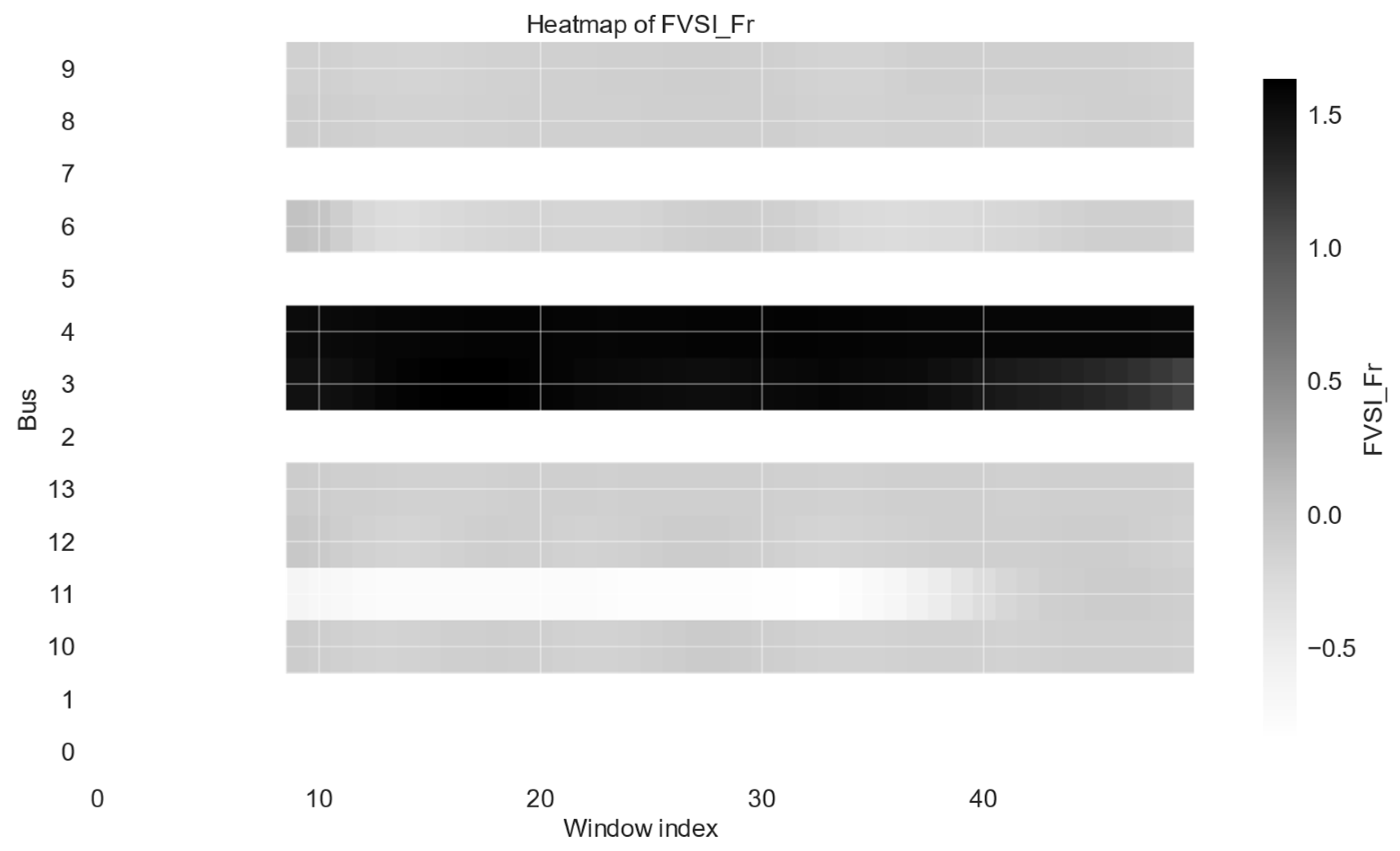
Figure 2 presents a heatmap of the FVSI_Fr calculated in sliding windows for all nodes. The color scale shows z-standardized index values. There is a distinct vertical zone around the middle of the horizontal axis (window indices ~30–35), indicating synchronous deterioration over time across multiple nodes consistent with the global approach to the Q–V/P–V nose also observed in Figure 1. In addition, persistent “hot spots” along the lines are visible, revealing spatial heterogeneity and the different local adequacy of reactive resources. This matrix visualization aids in the rapid identification of vulnerable nodes and time slots for prioritized management and monitoring.
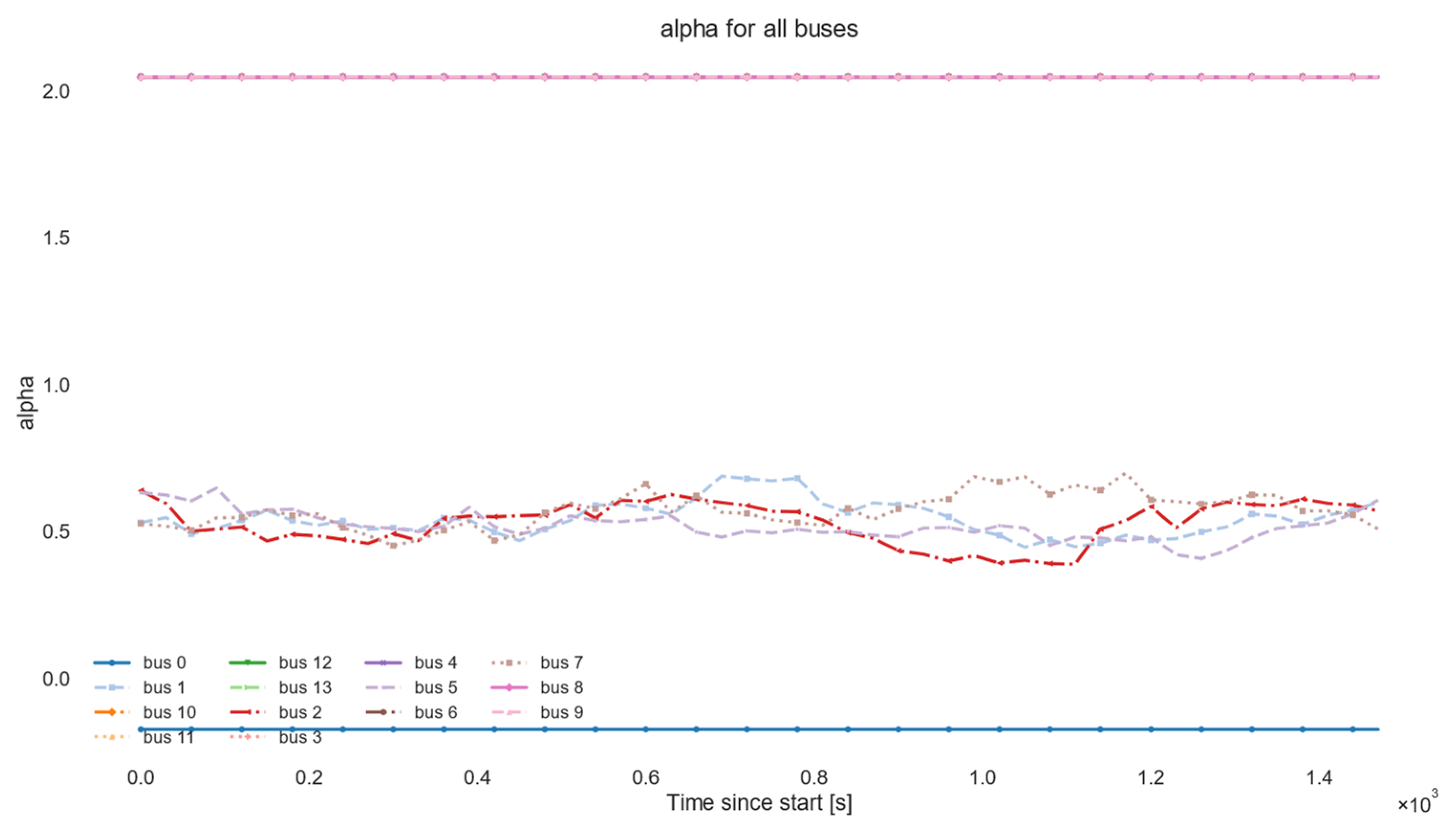
Figure 3 presents α(t), evaluated in sliding windows (300 s, step 30 s) at each node. Most curves are in the range α ≈ 0.45–0.60, with a slight increase in α observed at some nodes around t ≈ 800–1200 s. This indicates an increase in long-term correlations in the voltage series during stressed operation, consistent with approaching the voltage stability limits. The different amplitudes and slopes at nodes emphasize the spatial heterogeneity of the dynamics.
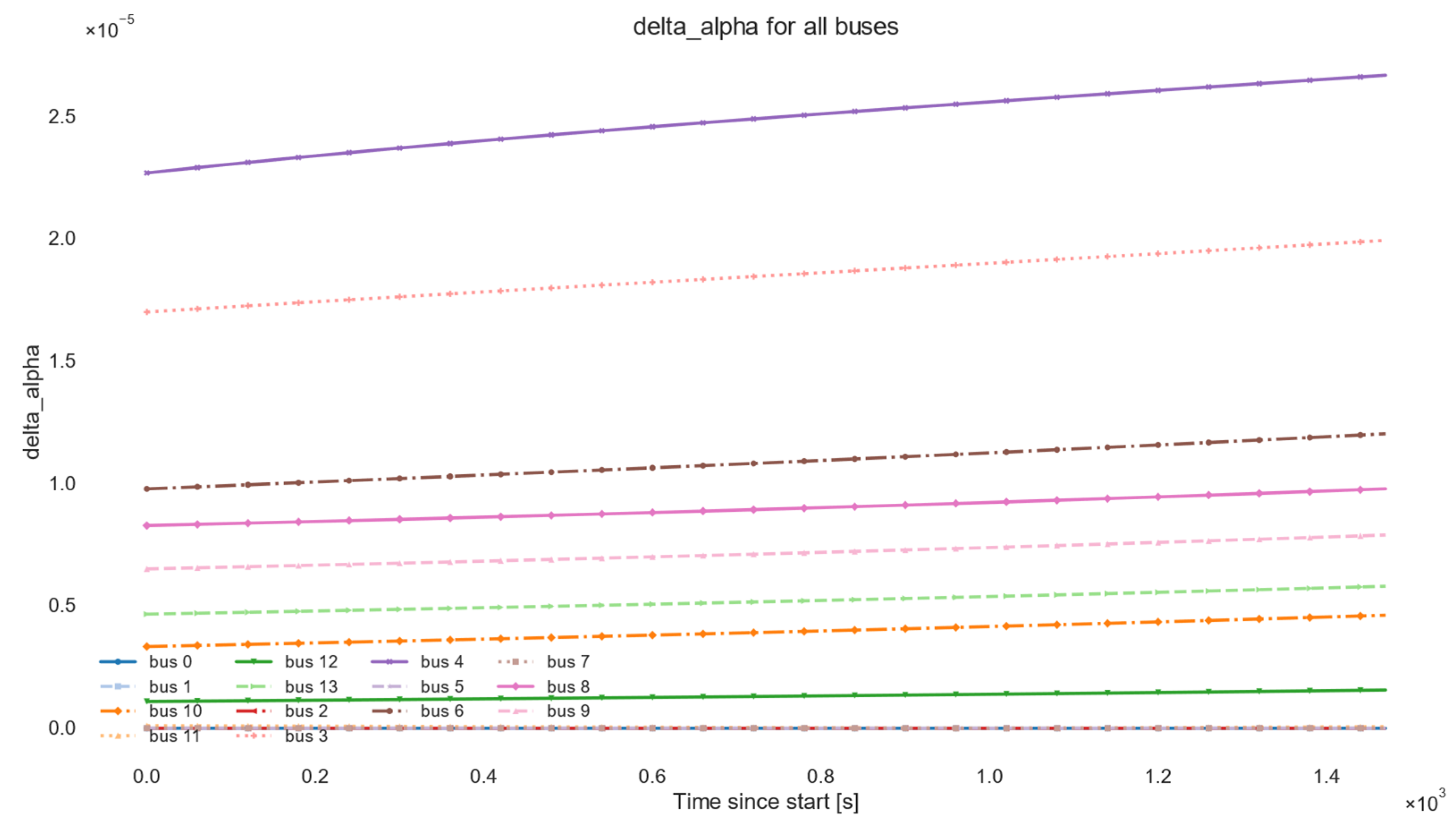
Figure 4 presents Δα(t) a multifractal spectrum width estimate (MFDFA) as a measure of the degree of intermittency and multiscale inhomogeneity. In the considered data, the values of Δα are very small (order of magnitude 10−5 p.u.) and show a slow, almost monotonic upward drift at most nodes. This behavior suggests limited multifractality in the voltage series at the given window parameters (300 s, step 30 s) and regression scales, i.e., quasi-monofractal dynamics dominate, while the other indicators ( α , β , c 2 ) carry the stronger signal of approaching instability.
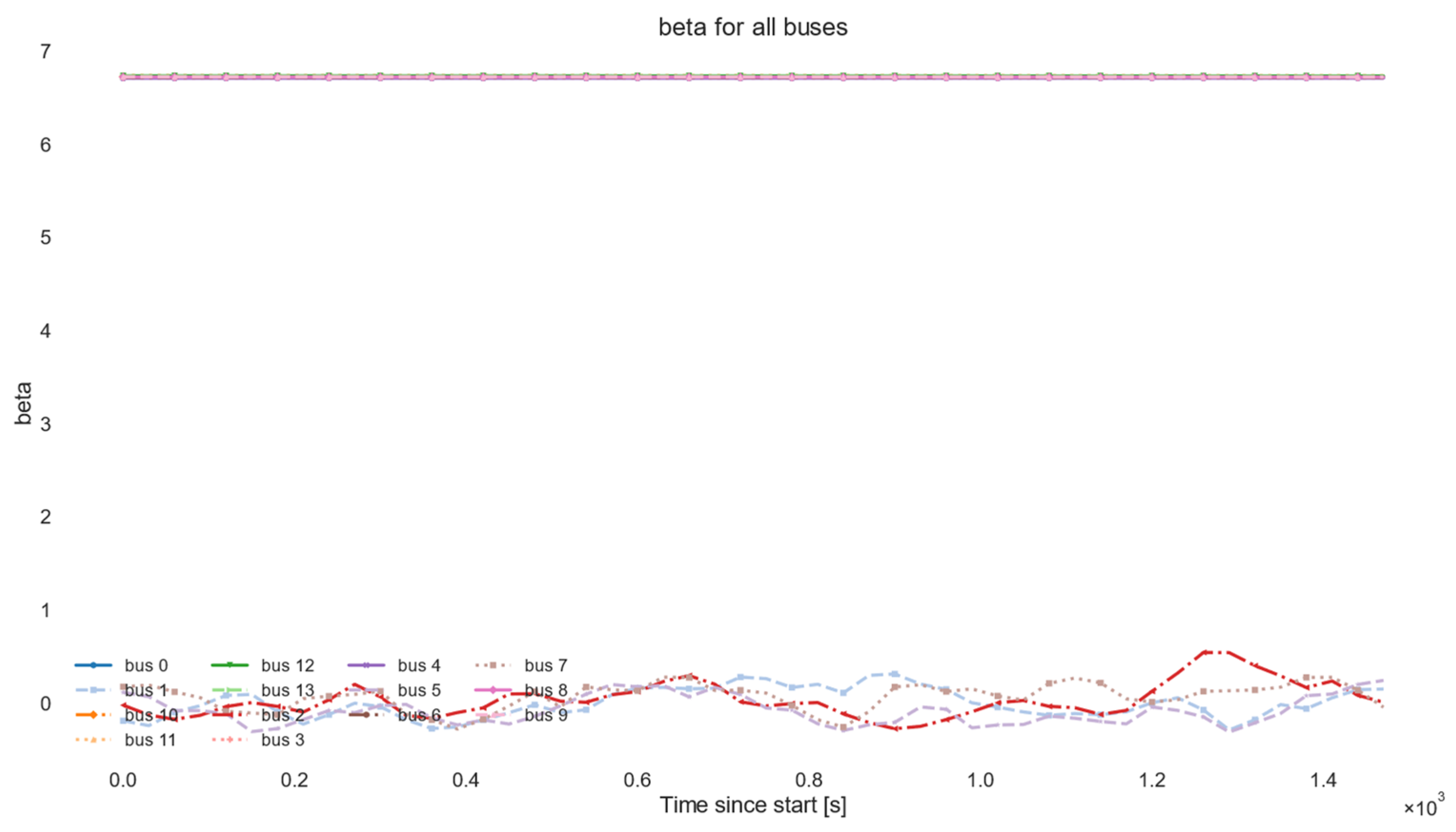
Figure 5 shows the slope β from a linear fit to logP(f) between 0.01 and 1 Hz, evaluated in sliding windows (300 s/30 s). For most nodes, β oscillates around zero with low amplitude, reflecting a “flat” local spectrum and the absence of pronounced 1 / f β dynamics in the frequency range considered. Around t ≈ 900 s, a slight flattening/change in trend is observed, consistent with the system minimum in Figure 1 and Figure 2.
The horizontal trace around β ≈ 6.7 is atypical for voltage series and is probably an artifact (insufficient valid frequency points in the window or numerical instability at very low variability). In practical use, we recommend quality control: a minimum of ≥8 valid frequencies in the mask, a limit of −2 ≤ β ≤ 3, and masking out-of-range estimates (NaN) so that they do not affect the composite index FVSI_Fr.
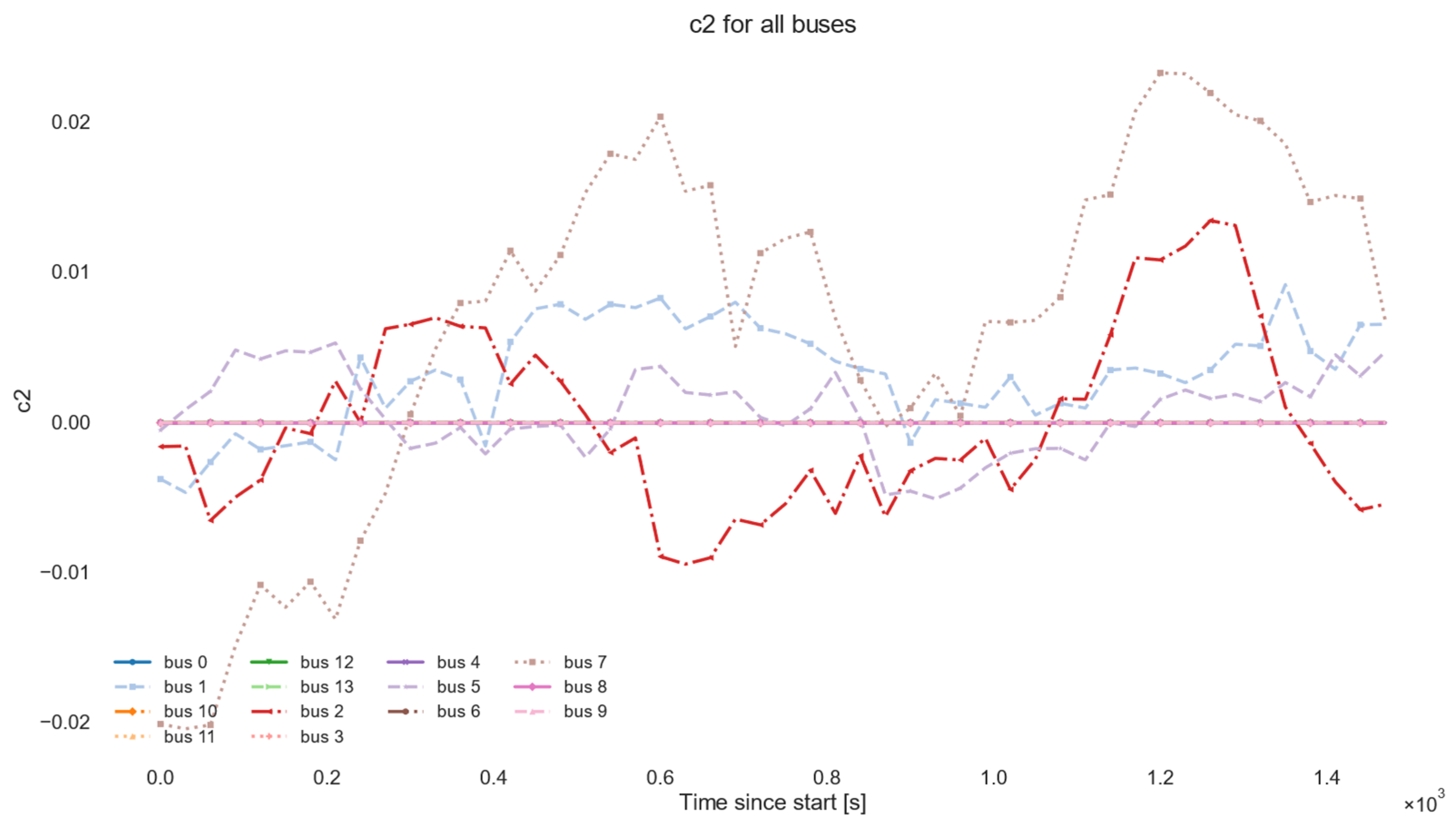
Figure 6 shows the indicator c 2 ( t ) , extracted as a quadratic coefficient from the scaling laws of the structure functions S(q,s) over a set of scales. Negative values (predominant at most nodes) indicate intermittency/multiscale curvature of the process, typical of increasing complexity and nonstationarity around stability limits. For some nodes, c 2 decreases progressively in the interval t = 600–1000 s, which is consistent with the system minimum observed in Figure 1 and Figure 2; other nodes demonstrate a recovery towards zero after the disturbance, which emphasizes the spatial heterogeneity of the impact. Short negative “spikes” are due to episodically amplified high-frequency differences | x ( t ) x ( t s ) | at small s and can serve as early local alarms. Methodologically, it is advisable to report median/robust estimates by window and mask segments with too few valid scales to avoid artifacts and ensure consistent integration into the composite index FVSI_Fr.
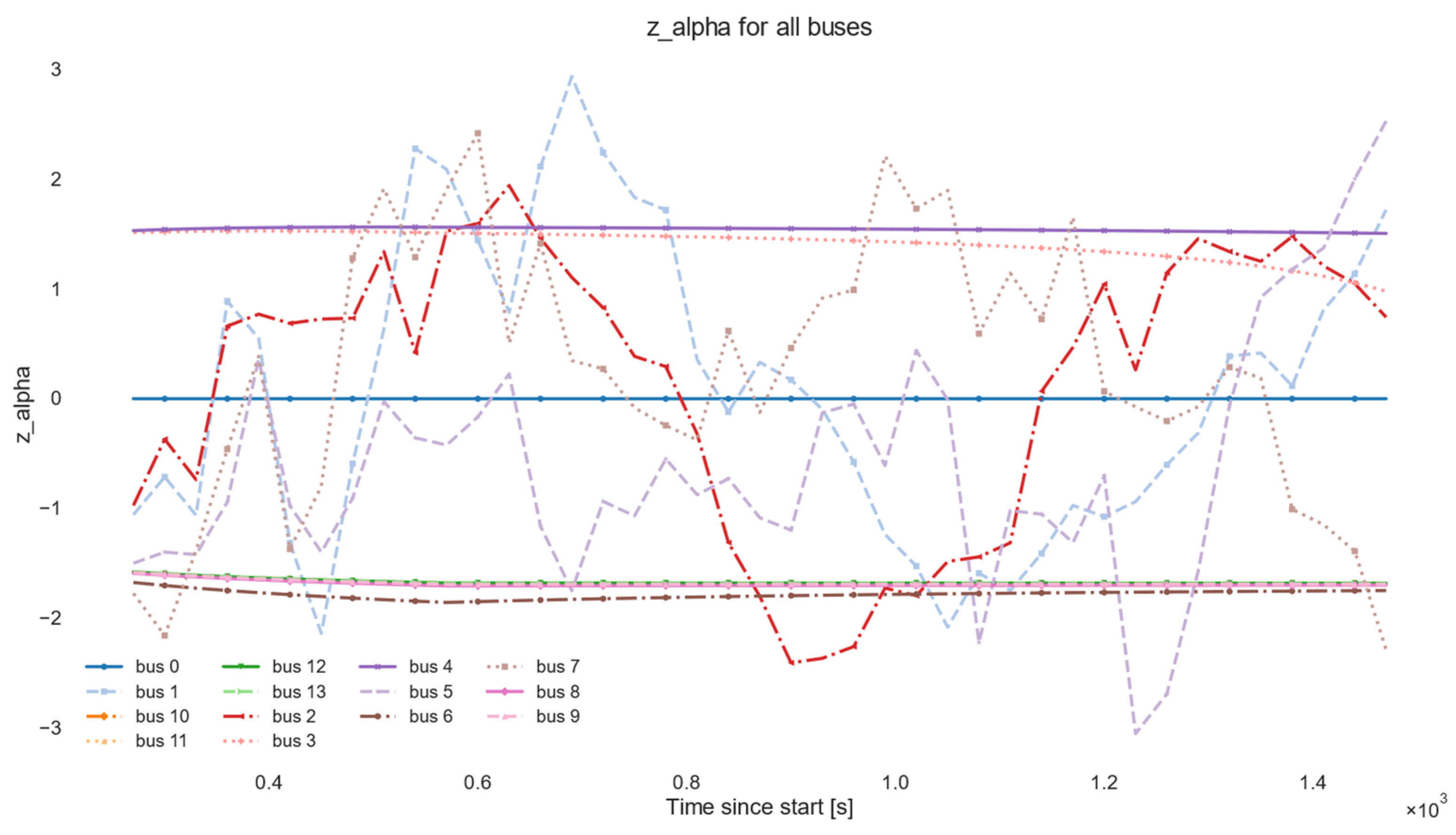
Figure 7 shows (t), obtained by the rolling z-score (window 20), which normalizes local variations of α with respect to each node’s own baseline. Positive deviations ( ≳ +1) become stronger around t ≈ 900 s for some nodes, indicating increasing persistence and correlation long-term memory in the voltage series, which is an early foreshadowing of voltage stability degradation. Negative bands (zα < 0) mark stable or decorrelated regimes. The observed spatial heterogeneity (different amplitude and phase across nodes) suggests uneven local adequacy of reactive support, values above z ≈ 2 can be used as a threshold for increased attention in operational monitoring.
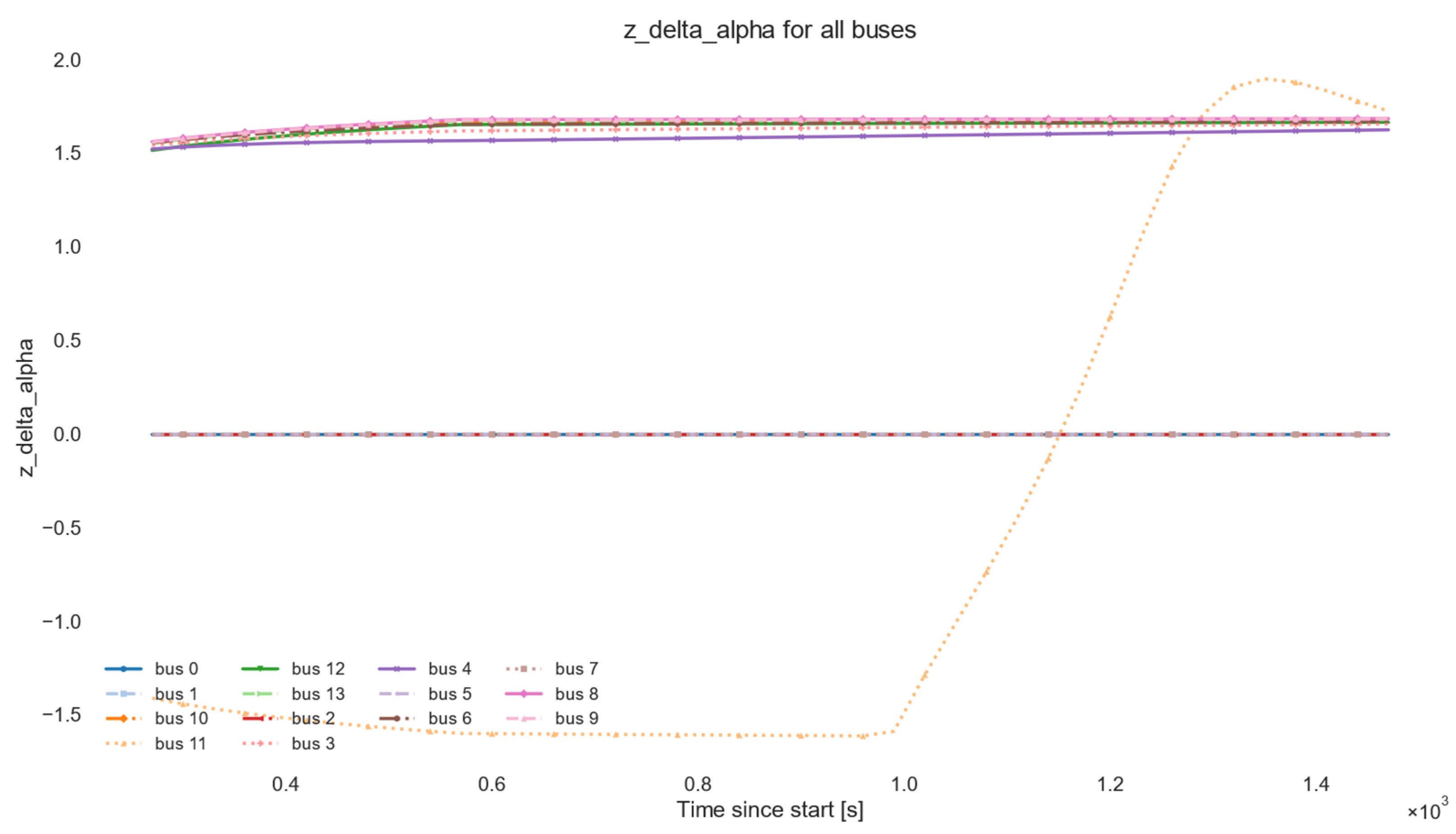
Figure 8 presents zΔα(t), calculated by the rolling z-score (window 20) on Δα. Most nodes maintain almost constant positive deviations around z ≈ 1.5–1.7, reflecting a stable but weak multifractal behavior. Single nodes show a transition from the negative to positive zone after t ≈ 1000 s, coinciding in time with the systematic disturbance reported by the other indicators (see Figure 1 and Figure 2). This increase in zΔα indicates increasing intermittency and multiscale heterogeneity, a signal of deteriorating stress resistance.
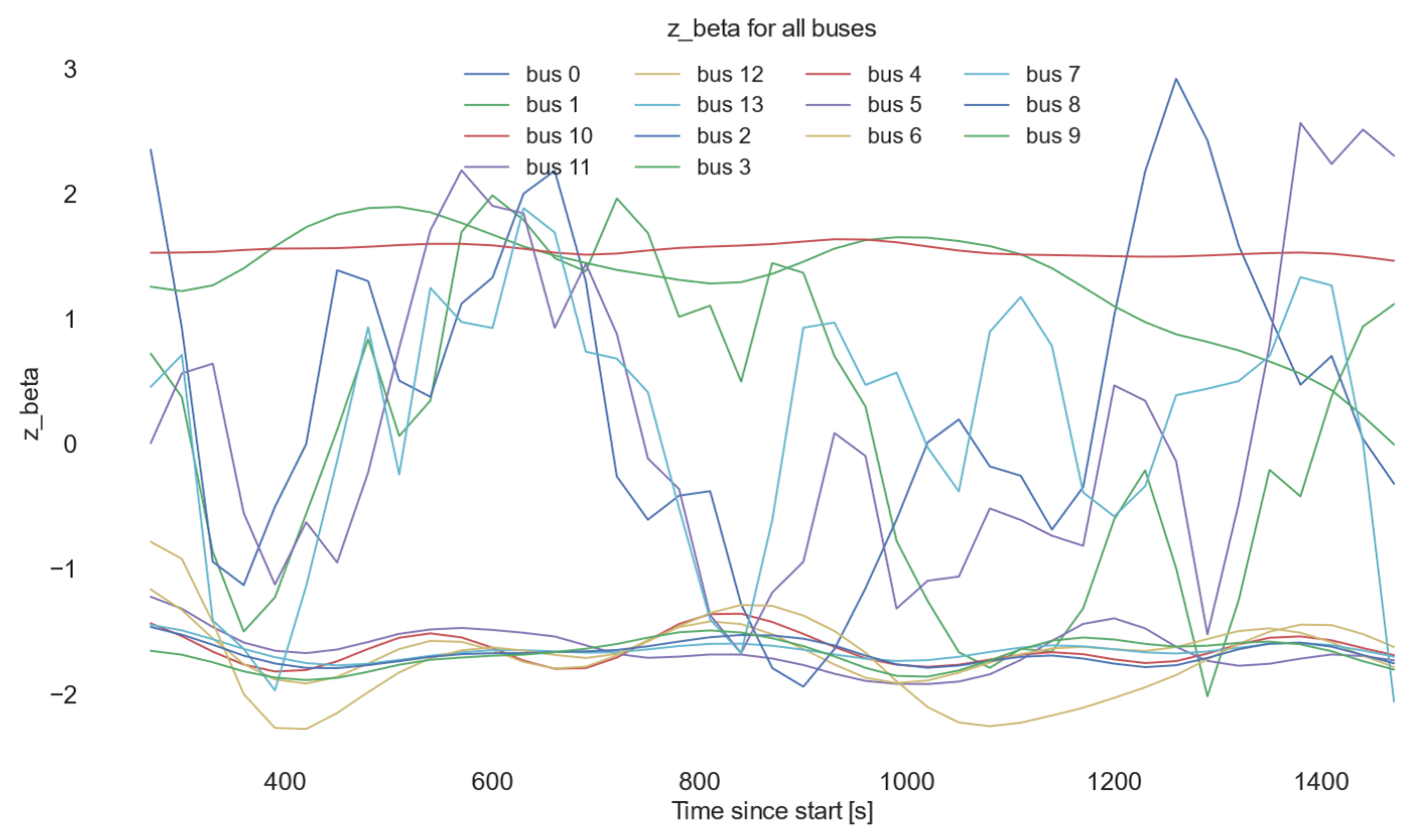
Figure 9 shows the dynamics of (t), calculated as a rolling z-score on the slope β of the PSD in the range [0.01, 1] Hz. A synchronized, sharp decline is observed around t ≈ 900 s, at which many nodes reach ≪ −2. This reflects a sudden “flattening” of the spectrum (reduction of β) and an increase in high-frequency energy, behavior consistent with a systemic disturbance/deepening of instability, also reported based on FVSI_Fr (Figure 1 and Figure 2). After the event, some nodes demonstrate a recovery towards neutral values ( ≈ 0), while others retain a positive drift, highlighting the spatial heterogeneity of the response.
From a practical point of view, transitions below −2 z-score can be considered alarm indicators of increasing turbulence/intermittency in the voltage series. For reliability, quality control is recommended: a minimum number of valid frequencies in the mask, exclusion of windows with very low variability, and limiting the allowable range for β so that extreme artifacts do not dominate the composite index.
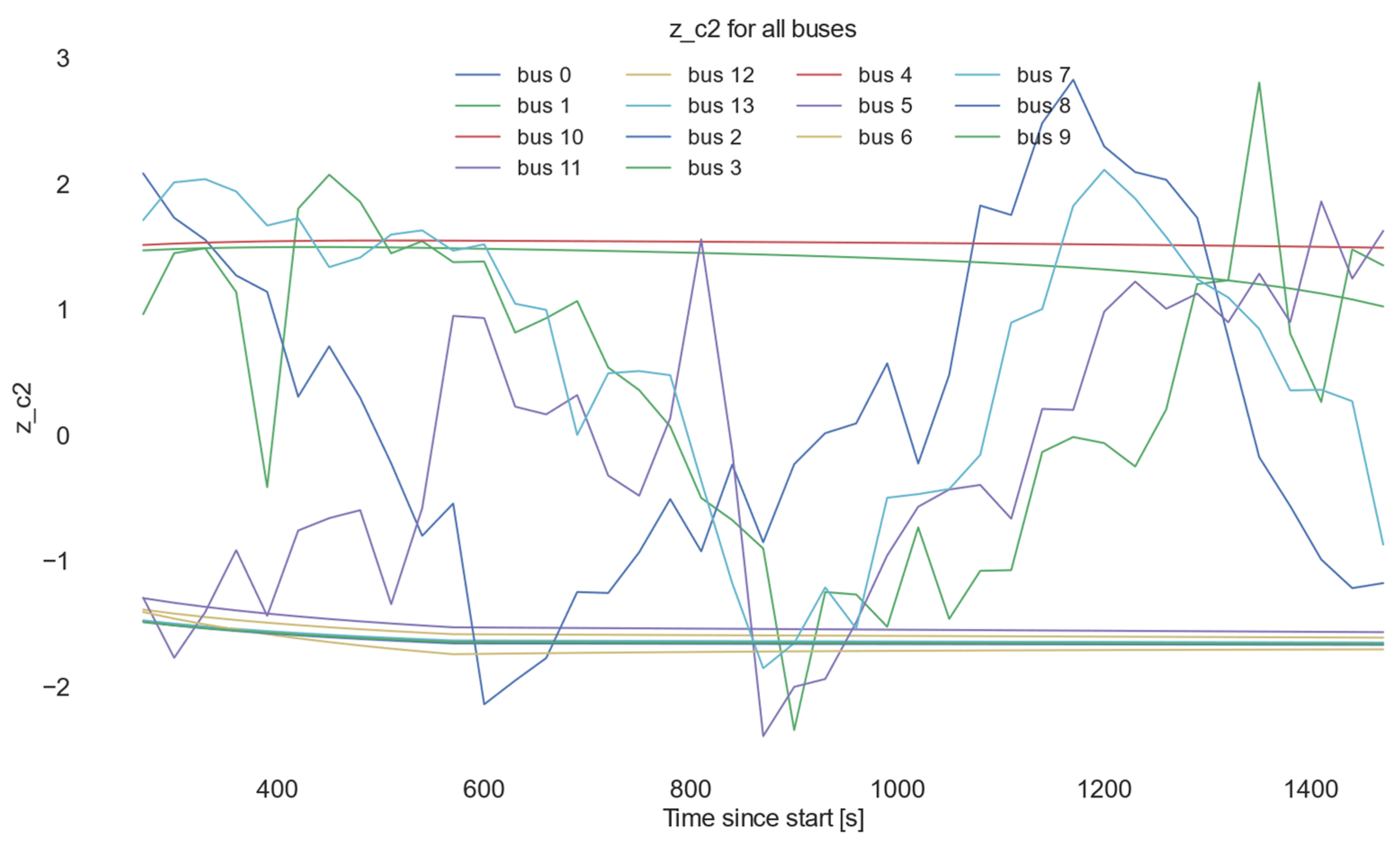
Figure 10 shows the evolution of z c 2 ( t ) obtained from structure–functions and the quadratic approximation of ζ(q). Most nodes maintain a weakly negative and relatively stable background ( z c 2 1.5 ÷ 1.8 ), while a subset of nodes exhibit pronounced positive bursts up to z c 2 2 ÷ 3 around t ≈ 1000–1200 s, followed by partial recovery. Single short-lived negative dips are also observed before the event.
The interpretation is that a more negative c 2 indicates stronger multifractal intermittency; hence, a positive z c 2 signals a “weakening” of curvature relative to the base, and a negative z c 2 indicates an amplification. The spatial inhomogeneity of the response (different nodes show different amplitudes/time offsets) highlights the need to use z c 2 together with zα, zΔα, and in the composite index FVSI_Fr. A practical alarm threshold could be | z c 2 | > 2 with a requirement for persistence over several consecutive windows.
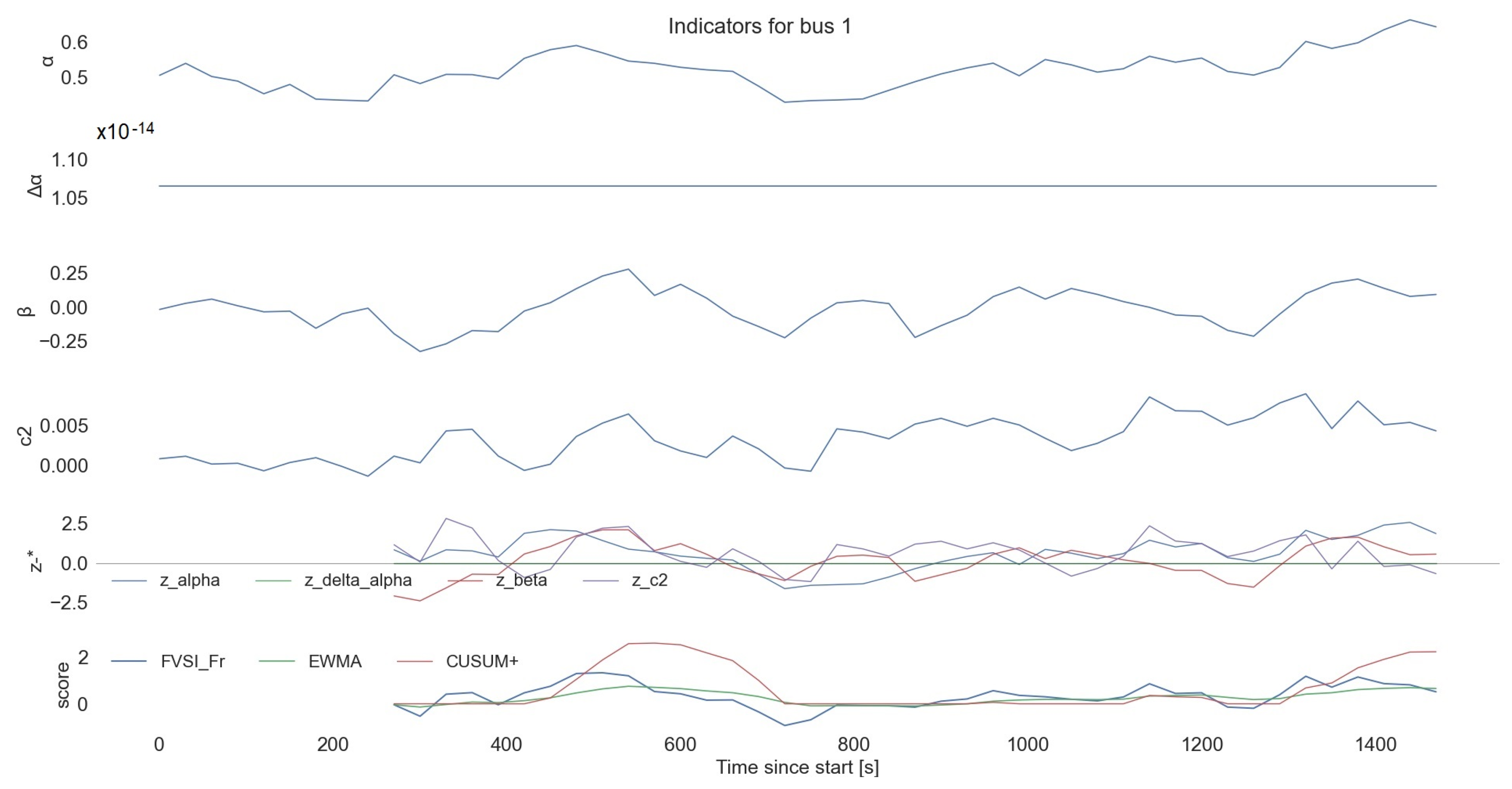
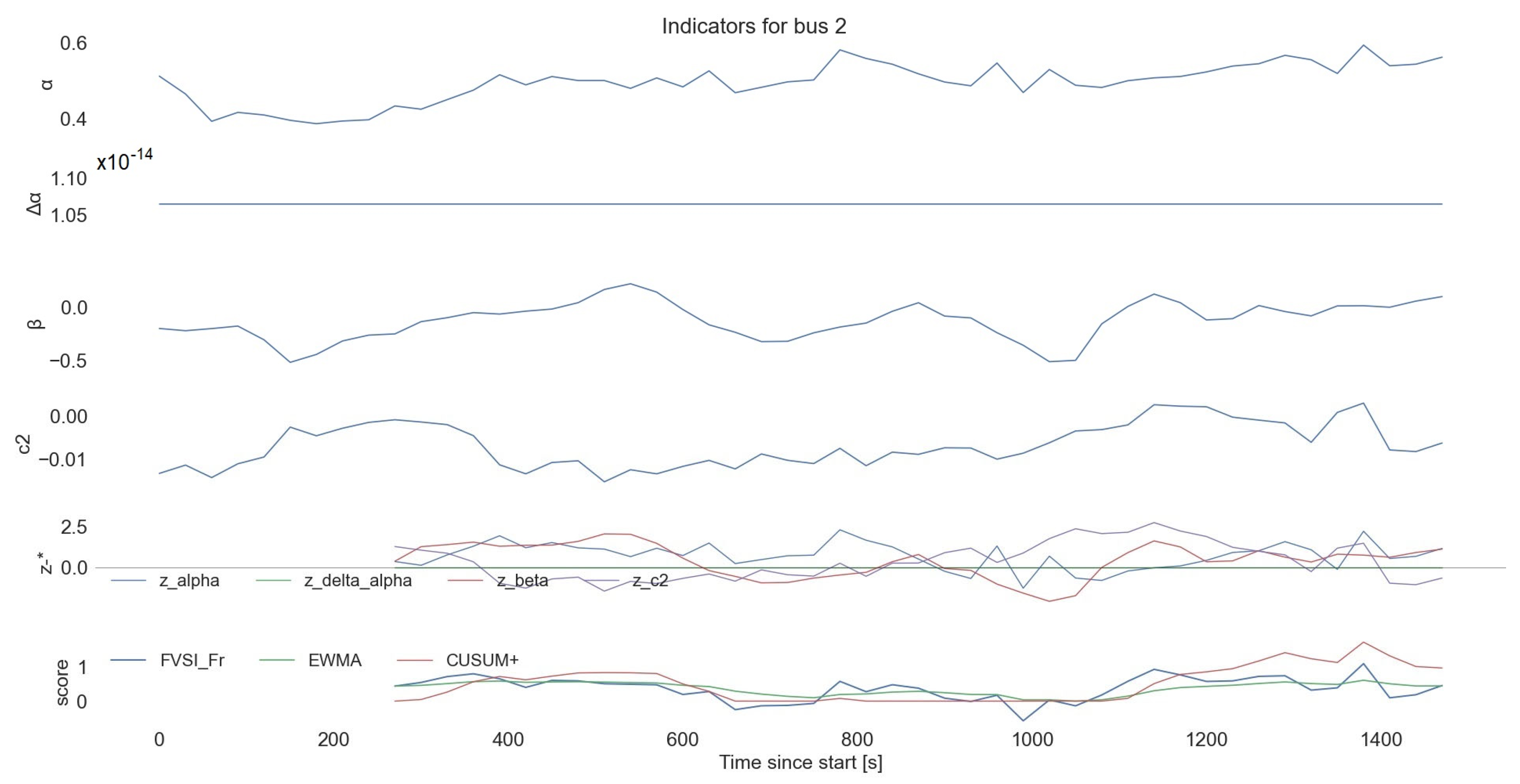
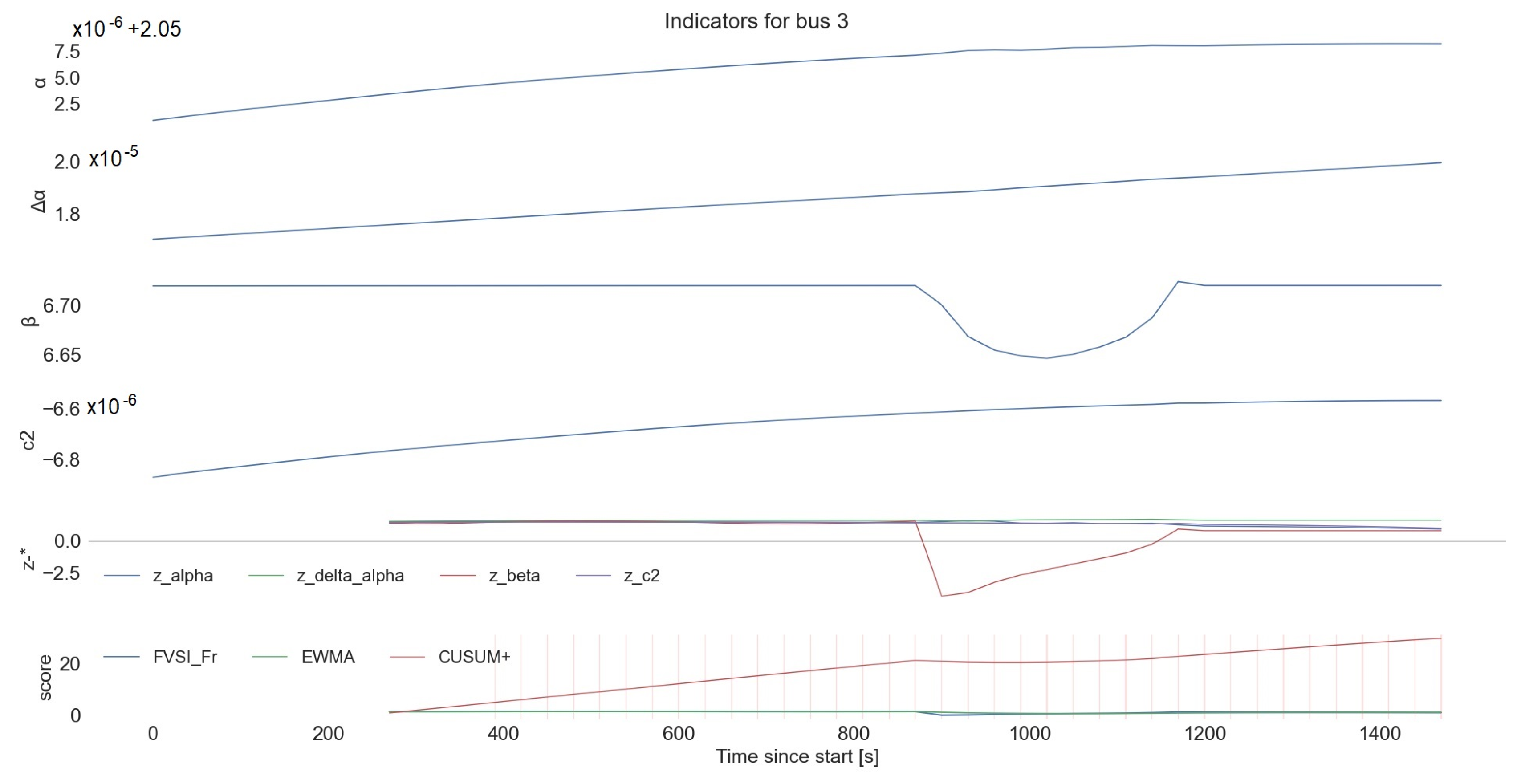
In Figure 11, Figure 12, Figure 13, Figure 14, Figure 15 and Figure 16, the notation z-* denotes the standardized (z-score) version of the corresponding indicator, computed per bus using a rolling window to highlight relative deviations from the local mean.
Figure 11 shows in windows: the scaling exponent α, the width of the multifractal spectrum Δα, the spectral slope β (in the frequency band 0.01–1 Hz), the curvature index c 2 , z-standardized features z α , z Δ α , z β , z c 2 , the composite index FVSI_Fr with smoothing (EWMA), and the CUSUM detector.
Node 1 exhibits moderate sensitivity to the global event, without pronounced multifractal activation; the composite FVSI_Fr confirms only medium-strength early indications relative to critical nodes.
A moderate increase in α, a transition in β to more negative values around t ≈ 900–1000 s, a slightly negative and stable c 2 , and a smooth increase in FVSI_Fr without prolonged alarm states are observed.
Figure 12 provides an illustrative example for a representative bus, showing the temporal evolution of the MFDFA-based components (α, Δα, β, c 2 ), their standardized counterparts, and the resulting early-warning scores during the load-up process.
Figure 13 presents the evolutions of α , Δ α , β , c 2 , z-standardized features ( z α , z Δ α , z β , z c 2 ), and the composite index FVSI_Fr for node 3. A smooth drift of α and Δα is observed, a distinct local minimum of β around t ≈ 900–1050 s, as well as a slightly negative c 2 , which is consistent with increasing intermittency. In the z-domain, the strongest negative excursion is at , which leads to monotonic accumulation of the one-sided CUSUM and a long sequence of alarm windows; FVSI_Fr remains close to the zero line, but shows an increase after the spectral dip, marking an early warning of deteriorating stress resistance.
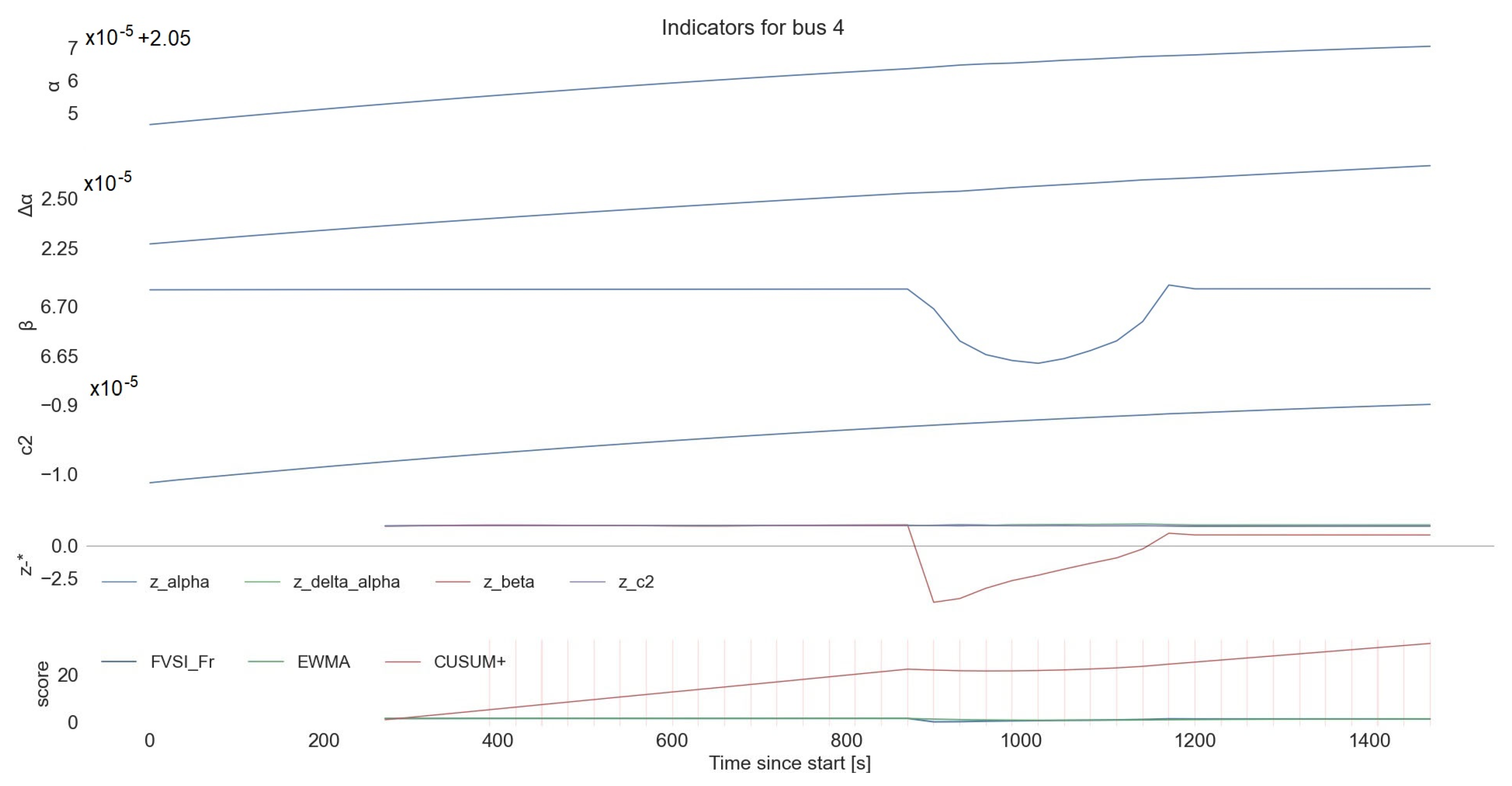
Figure 14 shows the evolutions of α , Δ α , β , c 2 , z-standardized features ( z α , z Δ α , z β , z c 2 ), and the composite index FVSI_Fr for node 4. Smooth increases in α and Δα, a slightly negative drift of c 2 , and a distinct local minimum of β at t ≈ 900–1050 s are visible, corresponding to a “weighting” of the spectrum. In the z-domain, the strongest negative excursion is at , which induces a monotonic accumulation of the one-sided CUSUM and a prolonged alarm sequence; FVSI_Fr remains close to zero before the drop of β, after which it increases moderately, an indicator of an early deterioration of voltage stability in a key branch of the network.
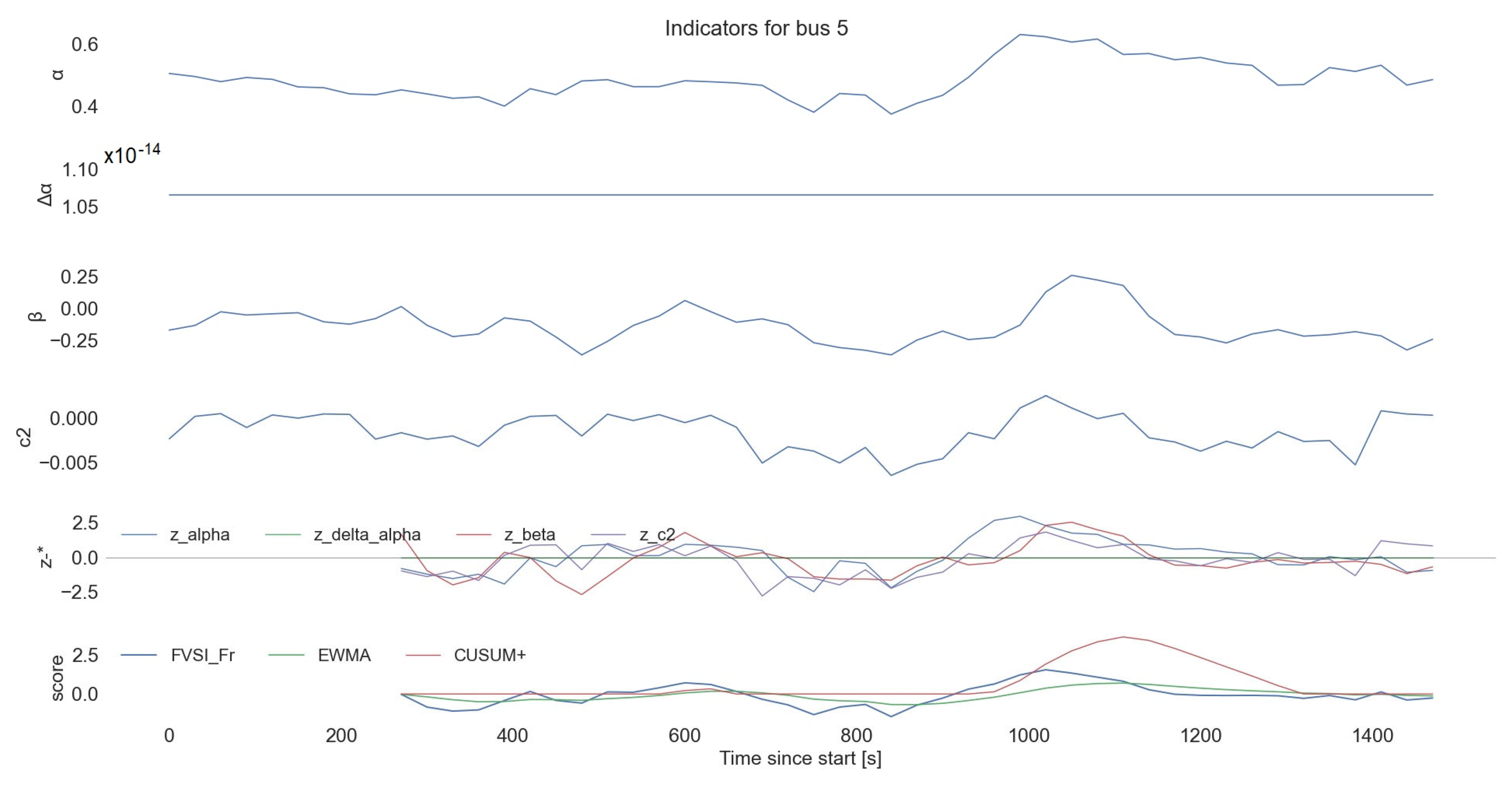
Figure 15 presents the time evolutions of α , Δ α , β , c 2 , their z-standardized variants, and the composite index FVSI_Fr for node 5. A smooth decrease in α is observed at the beginning and a subsequent local maximum around t ≈ 900–1100 s, while Δα remains approximately constant. The index β exhibits a clear transition with a “harder” spectrum (increase) in the same interval, and c 2 is slightly negative with a tendency towards more negative values (increasing intermittency). In the z-domain, the most distinct excursions are at and z c 2 , which leads to a moderate increase in FVSI_Fr and a smooth response of the EWMA; the one-sided CUSUM rises but remains below the threshold h, which suggests early but unstable signs of stress stability deterioration at this node.
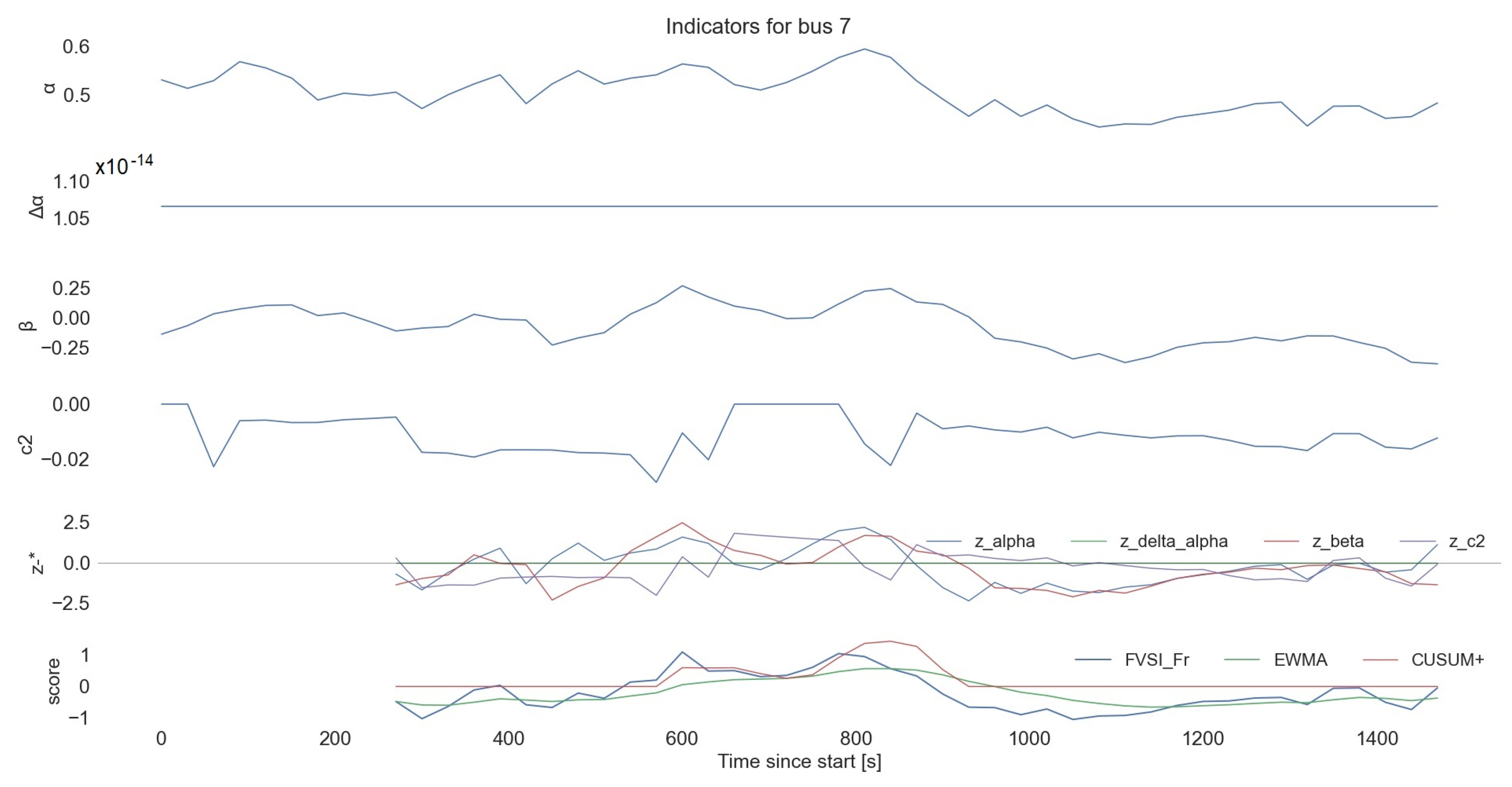
Figure 16 shows α , Δ α , β , c 2 , their z-standardized versions, and the composite index FVSI_Fr for node 7. The parameter α remains stable around 0.5, while Δα is practically constant. A temporary maximum of β is observed around t ≈ 600–800 s, followed by a weakening (whiter spectrum). The c 2 indicator is slightly negative with short-term dips (increased intermittency). In the z-domain, moderate excursions of and z c 2 are seen, which lead to short increases in FVSI_Fr; the EWMA responds smoothly, and the one-sided CUSUM remains close to zero without a persistent alarm. This behavior suggests local excitations of the dynamics, but without a clear, persistent approach to the stress instability limit at node 7.
To assess the performance, we define “ground truth” as the moment of reaching the P–V/Q–V “nose” of the CPF in the simulations, or the first moment when the voltage drops below 0.95 pu and remains below the threshold for ≥5 s. We compare the composite index FVSI_Fr with the individual components α (DFA), Δα (MFDFA), β (PSD slope), c 2 (multiscale curvature), and with scalar benchmarks: moving variance of V and z-score of V. Detection is implemented using one-sided EWMA and CUSUM based on the index/indicator; the threshold is scanned to build ROC and PR curves and calculate the AUC-ROC and AUC-PR. Time to warning (TTW) is defined as the difference between the first alarm and the ground truth. Performance is measured as the time/window and total pipeline latency.
The estimation is performed per-bus and aggregated with bus/window averaging; uncertainty is accounted for by bootstrapping (1000 resamples) over buses × windows; we report 95% confidence intervals. The default configuration (windows, step, frequency bands, scales, thresholds) is summarized in Table 4.
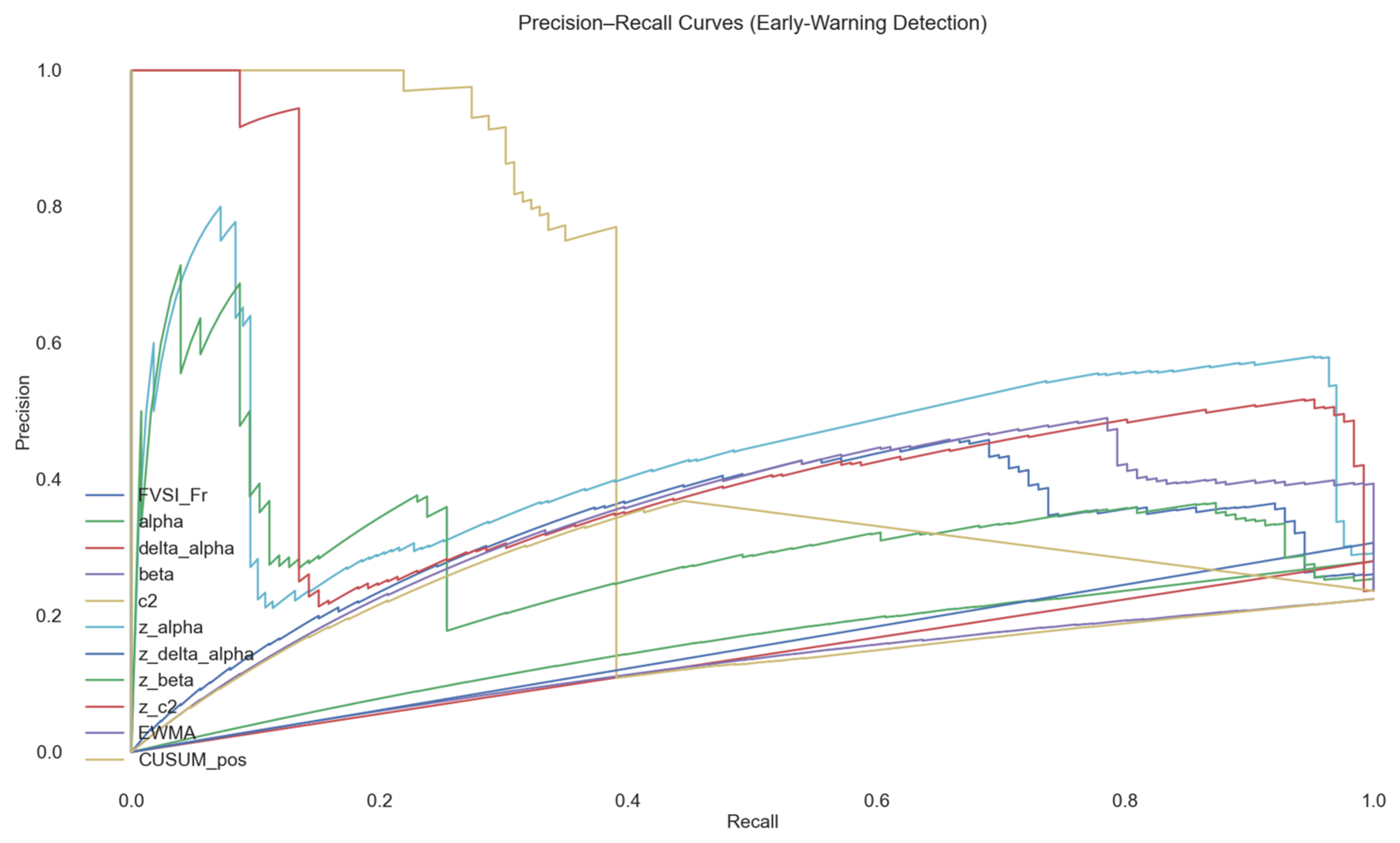
Figure 17 presents the Precision–Recall (PR) curve for the “early warning” task, comparing the proposed composite index FVSI_Fr with its individual components and the baseline detectors (EWMA, CUSUM). It is observed that FVSI_Fr maintains the best or among the best compromises between precision and detectability in a wide interval of Recall (≈0.2–0.9), which indicates a lower proportion of false-positive alarms with preserved sensitivity. Individual fractal indicators sometimes achieve higher peak precision, especially α and , but do so in narrower operating areas and with a sharper deterioration with increasing Recall. The indicator c 2 and the remaining z-standardized features are average in performance and contribute to the stability of the composite, while the classical baseline schemes (EWMA, CUSUM) lie close to the “naive” diagonal dependence, which indicates a greater tendency to false alarms. The characteristic vertical/breaking sections in some of the curves are a consequence of the discrete thresholds on aggregated windowed estimates and the unbalanced class (rare events), in which PR analysis is more informative than ROC.
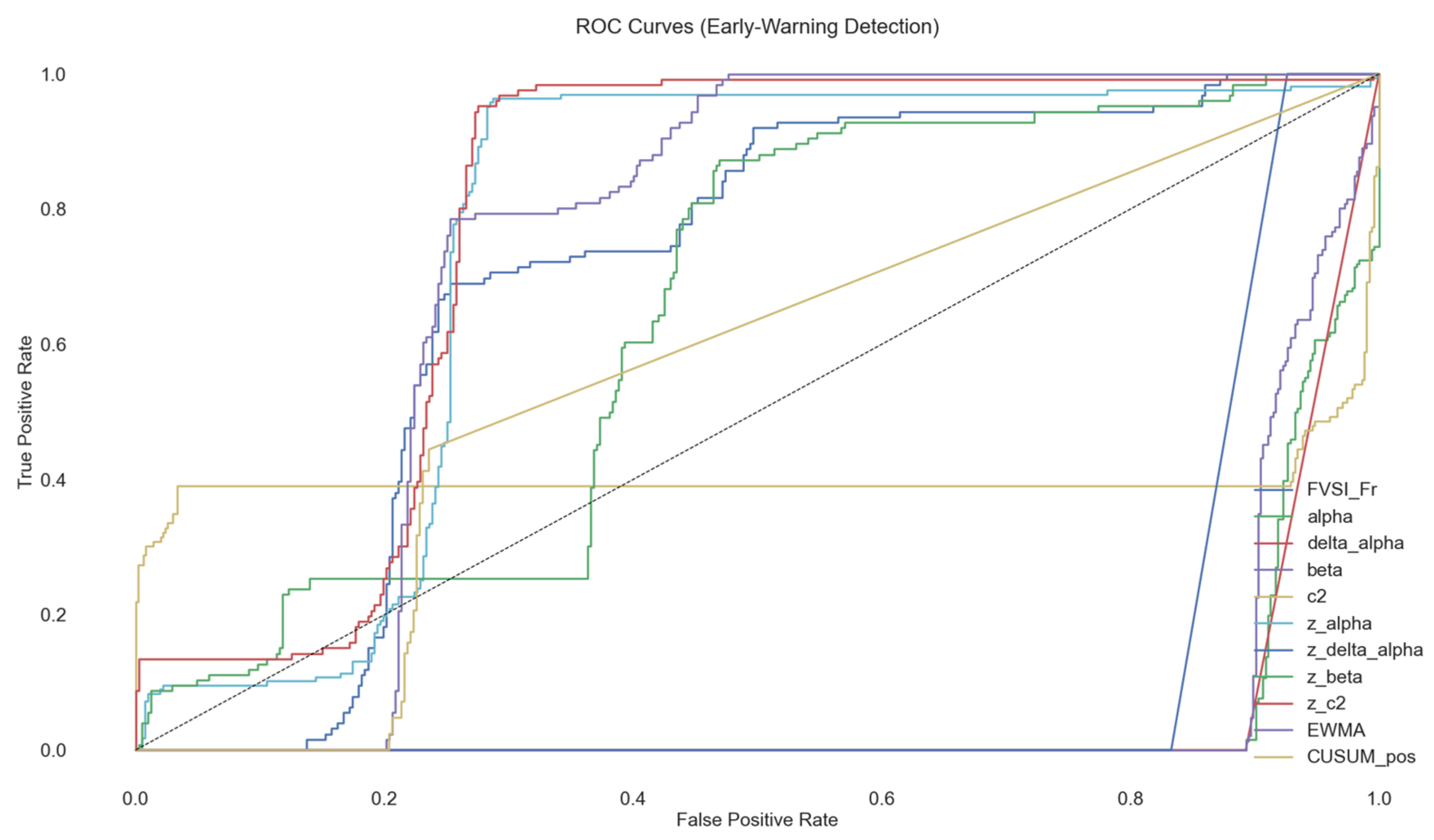
Figure 18 presents the ROC curves for the proposed composite index FVSI_Fr and its individual components (α, Δα, β, c 2 ), as well as the basic detectors EWMA and CUSUM. It is observed that FVSI_Fr achieves the highest area under the ROC curve and reaches high sensitivity at low levels of false alarms, which indicates good discrimination ability in the early warning mode. Of the components, the z-based variants are closest to the composite index, which shift their curves to the left and up relative to the raw indicators, while the single raw β and c2 have a more moderate efficiency. EWMA and CUSUM serve as simpler benchmarks and remain below the performance of FVSI_Fr in the entire range, which confirms that the combination of fractal and spectral features brings additional benefit compared to classical one-dimensional monitoring schemes. The diagonal line denotes the random classifier.
In our configuration (5 min windows, 30 s step) Δα shows limited variation in normal operation, which is typical of a single-fractal background and moderate noise levels. However, when moving to stressed regimes (Q-limits activated/reduced reactive maintenance), a systematic increase in interscale intermittency is observed, which is reflected in Δα and helps with discriminability. An ablation check (composite index without Δα and renormalized weights) shows that the inclusion of Δα reduces false positives and stabilizes the early warning time, albeit with a modest independent signal of Δα relative to α and β. Because of this role as a “regularizer” against transient spectral fluctuations, we maintain Δα as a moderately weighted component in FVSI_Fr.
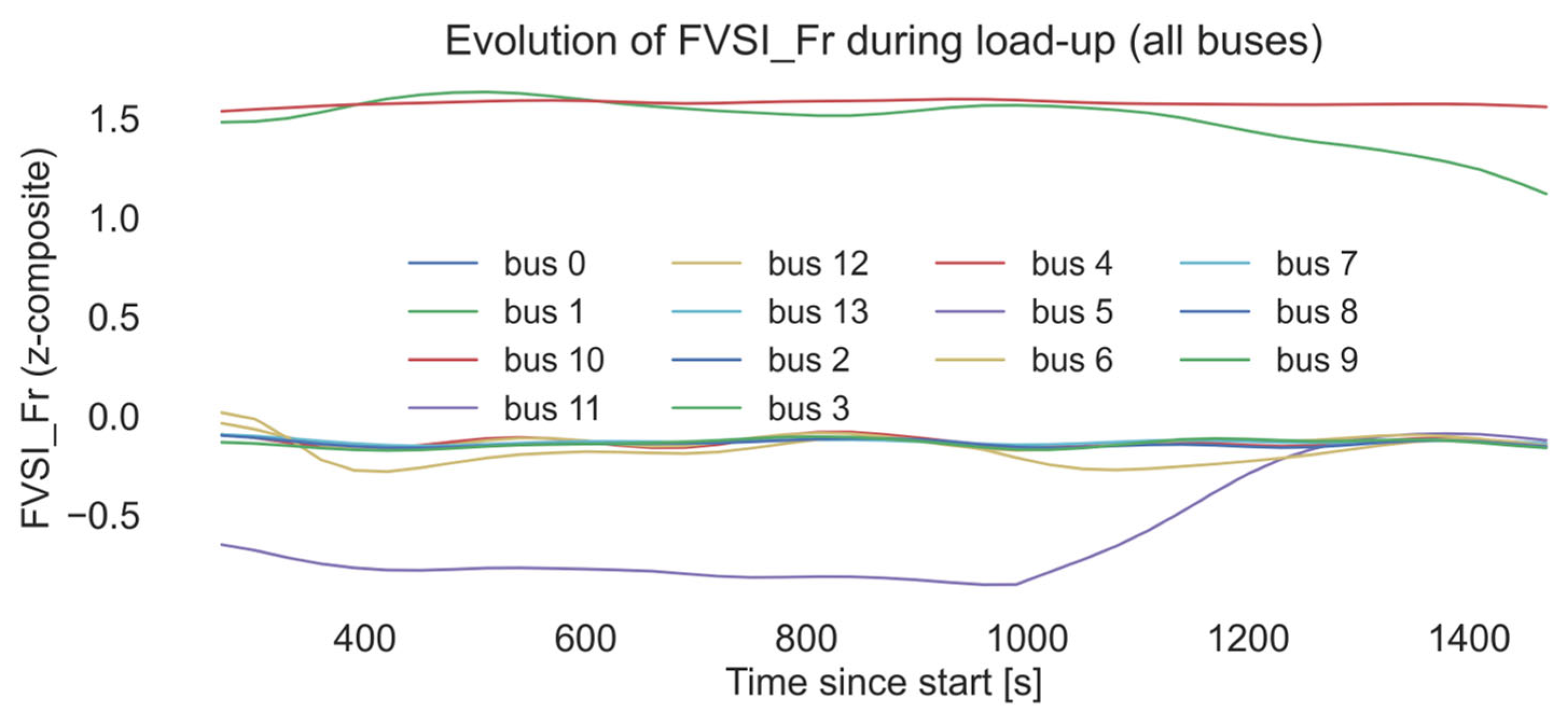
Figure 19 presents the dynamics of the composite index FVSI_Fr for all buses during load-up. A clear stratification is observed; bus 4 maintains the highest values ≈ 1.5–1.6, which is a constantly increased risk, and bus 3 also starts high and shows a smooth decline after t ≈ 1200 s, but remains above the others. Most buses are grouped around zero with small fluctuations, which is a stable state, while bus 5 demonstrates pronounced dynamics, going from negative to close to zero values, i.e., partial recovery. Overall, the FVSI_Fr of critical buses deviates early and steadily from the “background”, which suggests localized areas of increased vulnerability when approaching the P–V “nose”.
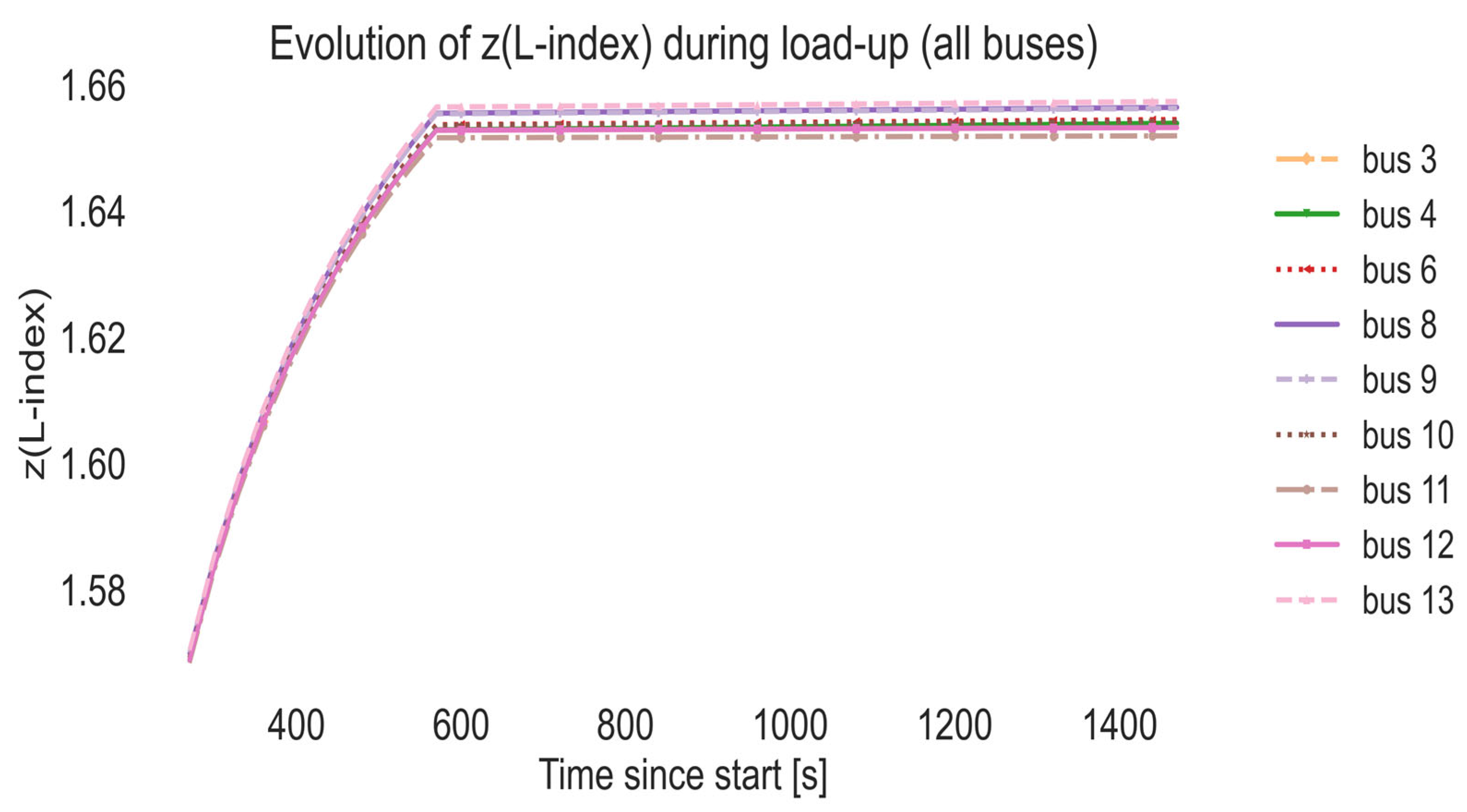
Figure 20 presents the evolution of the standardized classical index z(L-index) for all buses in the load-up mode. The curves of the individual nodes are practically overlapped: a monotonic increase from ≈1.57 to a plateau around 1.65 is observed, which is reached at t ≈ 600 s and remains almost constant until the end of the simulation. This uniformity suggests a limited discriminatory ability of the L-index between the individual buses in the considered scenario, unlike FVSI_Fr; here, there are no clearly pronounced local deviations that would mark more vulnerable places in the network.
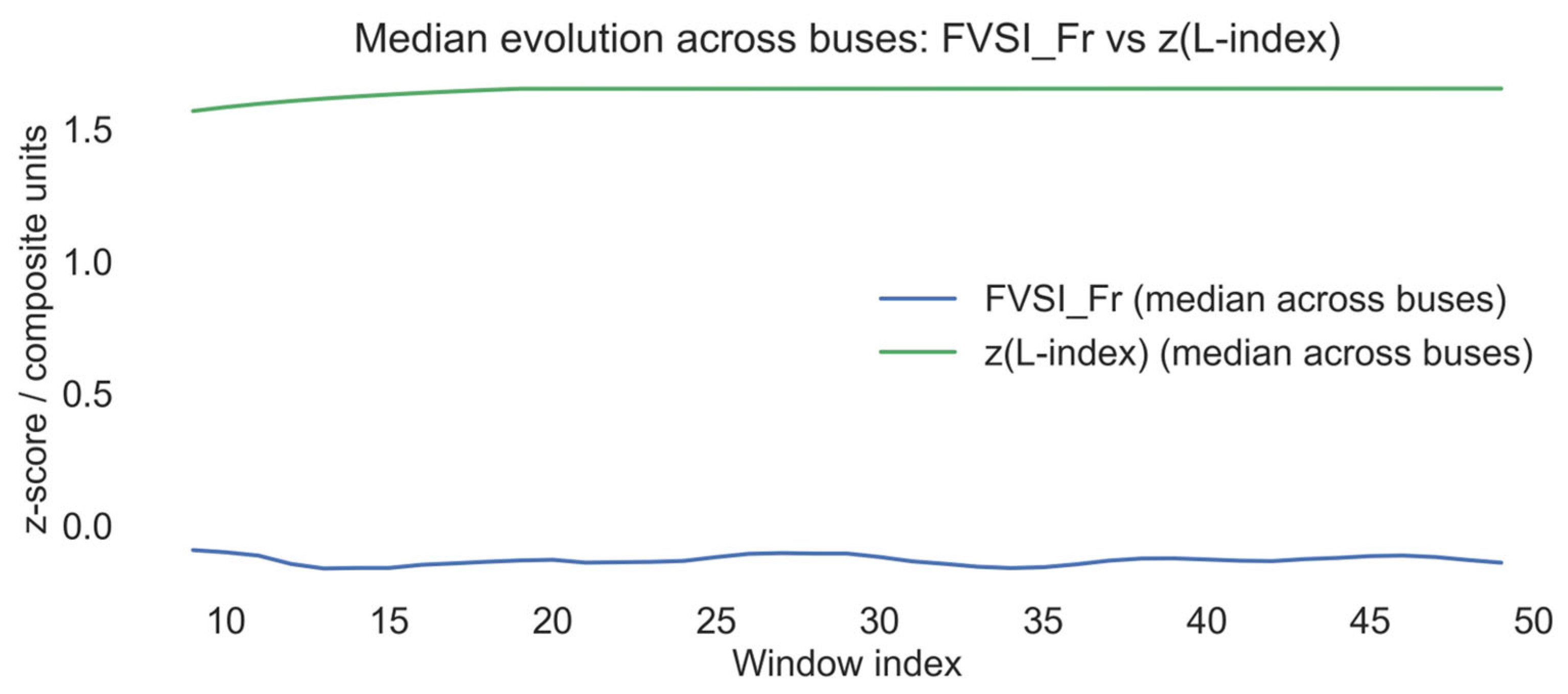
Figure 21 presents the median evolution over time of the two indicators, the composite FVSI_Fr and the standardized z(L-index), calculated across all buses. We observe almost constant values of z(L-index) around ~1.6 with a minimal trend, which suggests a weak sensitivity to local changes during the smooth increase in the load. In contrast, the median of FVSI_Fr fluctuates around the zero level with weak but distinct variations, which reflects a higher reactivity to early changes in the voltage dynamics. The comparison shows that FVSI_Fr carries additional discriminative information, while the L-index remains a rather smooth and uniform indicator in the considered scenario.

7. Discussion

In summary, we determine how the fractal-inspired early indicators collected in the composite index FVSI_Fr behave on the standard 13-node IEEE scheme and what they add to the classical VSA perspective. The linear series of FVSI_Fr Figure 1 show distinct time-localized increases when approaching more stressed operating points, with the response being non-local. Nodes electrically connected to critical branches demonstrate a stronger response. The spatiotemporal pattern in the heat map Figure 2 condenses this information into “bands” of increased values, which facilitates operator diagnostics and directs attention to the riskiest areas without losing the system context.
The analysis of individual features complements this picture. The scaling exponent α in Figure 3 remains in the range characteristic of persistent processes, which corresponds to the expected “memory elongation” when approaching critical behavior. The multifractal width Δα in Figure 4 is rather slowly changing, but at nodes undergoing the strongest changes, visible deviations are observed, interpreted as an amplification of multifractality. The spectral slope β in Figure 5 captures a redistribution of energy to lower frequencies and is thus consistent with the hypothesis of a “reddening” of the spectrum near critical states. The parameter c 2 in Figure 6 is mainly weakly negative, which indicates intermittency and deviations from Gaussian behavior; more strongly negative transitions precede episodes with an increasing FVSI_Fr.
The Z-standardized variants of the features in Figure 7, Figure 8 and Figure 9 provide a working basis for unified thresholding. EWMA smooths fluctuations and reduces false alarms, while one-sided CUSUM reacts sharply to persistent positive shifts. The panel plots by node in Figure 13, Figure 14, Figure 15 and Figure 16 show that at nodes 3 and 4 the CUSUM signal grows early and steadily, which is consistent with the dominant structures in the heat map; at nodes 5 and 7, the responses are more local and transient, which suggests excited but controllable states. Thus, the decomposition of FVSI_Fr into α , Δ α , β , c 2 adds clarity to the causes of alarm activation and points to relevant operational measures (e.g., VAR-support).
Methodologically, the implemented online pipeline, such as a sliding window with a minimum number of samples, a robust preprocessing Hampel filter, alternative baselines (rolling/firstN/robust), and thresholding in the z-domain is compatible with PMU/SCADA streams and robust to noise and rare misses. Fixed weights in FVSI_Fr reduce the risk of false alarms when a single feature is excited by local phenomena without systemic significance but, at the same time, open the question of data-driven adaptation in other networks and scenarios. Interpretatively, excursions of FVSI_Fr above the order of +3 z or a sustained growth of EWMA/CUSUM are an early warning signal, but not necessarily of an imminent collapse; the strongest indication is obtained when increasing α, negative c 2 and “reddening” β coincide.
The limitations arise mainly from the choice of window lengths and sampling frequency: too short windows worsen the stability of MFDFA/PSD estimates, while too long ones can blur transitions. In the case of abrupt operational actions, the assumption of quasi-stationarity in the window may be violated, and then, adaptive scaling is recommended. However, the results show that fractal indicators, combined in FVSI_Fr, provide an early-reacting, interpretable, and operationally appropriate signal for approaching voltage risk states. The method does not replace classical VSA techniques, but complements them with a data-driven layer for online monitoring, node prioritization, and timely preventive intervention in distribution networks with high dynamics and a share of RES.

8. Conclusions

The proposed fractal-based voltage early warning framework, implemented through the composite index FVSI_Fr, built from α , Δ α , β , c 2 , provides a sensitive and interpretable indicator of approaching risky regimes in distribution networks. In simulations based on the standard 13-node IEEE scheme, we show that FVSI_Fr responds in a coordinated manner in time and space, highlighting critical nodes and branches through clearly recognizable excursions in the z-domain and a steady growth of EWMA/CUSUM. Heat maps and node-based panel visualizations translate the complex multiscale behavior into operationally readable pictures that support the prioritization of measures such as VAR support, Q(V) retuning, and load management.
The online pipeline, including robust preprocessing, sliding windows, and standardization against an adaptive baseline, demonstrates compatibility with PMU/SCADA streaming data and robustness to noise and singletons. The results support the hypothesis that when approaching the voltage limit, the spectrum “reddens”, the time correlation increases, and the intermittency increases, dynamics that are captured synergistically by β, α, and c 2 and accumulated in FVSI_Fr. The practical added value is operational: FVSI_Fr serves as an early and interpretable signal that guides VAR support, Q(V) tuning, and load management, while classical VSA methods remain a tool for detailed analysis and verification.
The limitations concern the dependence on the choice of time windows and sampling frequency, as well as the fixed weights in the composite index, which may need calibration for other topologies and regimes. Future developments include data-adaptive learning of weights and thresholds, multivariate extensions with cross-signs between nodes for better localization of weak points, a quantitative assessment of uncertainty for operator decisions, and validation based on long series of field measurements. The integration of the index as a signal for preventive control (e.g., optimal VAR allocation or RL-based controllers) is a natural next step towards practical implementation. In conclusion, FVSI_Fr offers a lightweight, transparent, and efficient voltage early warning tool, suitable for real-time and compatible with the increasing variability in modern distribution networks.

Author Contributions

Conceptualization, P.S.; Methodology, P.S. and N.H.; Software, P.S.; Validation, P.S.; Formal analysis, P.S. and N.H.; Investigation, N.H.; Resources, N.H.; Data curation, P.S.; Writing—original draft, P.S. and N.H.; Writing—review & editing, N.H.; Visualization, P.S.; Project administration, N.H.; Funding acquisition, N.H. All authors have read and agreed to the published version of the manuscript.

Funding

This work was supported by the European Regional Development Fund under the “Research Innovation and Digitization for Smart Transformation” program 2021–2027 under Project BG16RFPR002-1.014-0006 “National Centre of Excellence Mechatronics and Clean Technologies”, and the APC was funded by Project BG16RFPR002-1.014-0006.

Data Availability Statement

The original contributions presented in this study are included in the article. Further inquiries can be directed to the corresponding author.

Acknowledgments

This work was supported by the European Regional Development Fund under the “Research Innovation and Digitization for Smart Transformation” program 2021–2027 under Project BG16RFPR002-1.014-0006 “National Centre of Excellence Mechatronics and Clean Technologies”, and the APC was funded by Project BG16RFPR002-1.014-0006.

Conflicts of Interest

The authors declare no conflicts of interest.

Abbreviations

The following abbreviations are used in this manuscript:
ANNArtificial Neural Network
ARL Average Run Length
AUCArea Under the Curve
CFIComposite fractal index
CPF Continuation Power Flow
CUSUMCumulative SUM
DERDistributed Energy Resource
DFADetrended Fluctuation Analysis
EWMAExponentially Weighted Moving Average
FPRFalse Positive Rate
FVSIFast Voltage Stability Index
IBRInverter-Based Resource
LTLead Time
MFDFAMultifractal Detrended Fluctuation Analysis
MLMachine Learning
OLTCOn-Load Tap Changer
PMUPhasor Measurement Unit
PR Precision Recall
PSDPower Spectral Density
RESRenewable energy sources
RMURing Main Unit
ROCReceiver Operating Characteristic
SCADASupervisory Control and Data Acquisition
STATCOMStatic Synchronous Compensator
SVMSupport Vector Machine
TPRTrue Positive Rate
VSAVoltage Stability Assessment

References

  1. Peng, C.; Buldyrev, S.V.; Havlin, S.; Simons, M.; Stanley, H.E.; Goldberger, A.L. Mosaic organization of DNA nucleotides. Phys. Rev. E 1994, 49, 1685–1689. [Google Scholar] [CrossRef]
  2. Peng, C.; Havlin, S.; Stanley, H.E.; Goldberger, A.L. Quantification of scaling exponents and crossover phenomena in nonstationary heartbeat time series. Chaos Interdiscip. J. Nonlinear Sci. 1995, 5, 82–87. [Google Scholar] [CrossRef]
  3. Kantelhardt, J.W.; Zschiegner, S.A.; Koscielny-Bunde, E.; Havlin, S.; Bunde, A.; Stanley, H. Multifractal detrended fluctuation analysis of nonstationary time series. Phys. A Stat. Mech. Its Appl. 2002, 316, 87–114. [Google Scholar] [CrossRef]
  4. Wendt, H.; Abry, P.; Jaffard, S. Bootstrap for Empirical Multifractal analysis. IEEE Signal Process. Mag. 2007, 24, 38–48. [Google Scholar] [CrossRef]
  5. Lade, S.J.; Gross, T. Early warning signals for critical transitions: A Generalized modeling approach. PLoS Comput. Biol. 2012, 8, e1002360. [Google Scholar] [CrossRef] [PubMed]
  6. Dakos, V.; Carpenter, S.R.; Brock, W.A.; Ellison, A.M.; Guttal, V.; Ives, A.R.; Kéfi, S.; Livina, V.; Seekell, D.A.; Van Nes, E.H.; et al. Methods for detecting early warnings of critical transitions in time series illustrated using simulated ecological data. PLoS ONE 2012, 7, e41010. [Google Scholar] [CrossRef]
  7. Kundur, P. Power System Stability and Control. 1994. Available online: https://www.accessengineeringlibrary.com/content/book/9781260473544 (accessed on 29 November 2025).
  8. Ajjarapu, V.; Christy, C. The Continuation Power Flow: A tool for steady state voltage stability analysis. IEEE Trans. Power Syst. 1992, 7, 416–423. [Google Scholar] [CrossRef]
  9. Iliev, I.; Terziev, A. Environmental Impact and Risk Analysis of the Implementation of Cogeneration Power Plants through Biomass Processing. In Innovative Renewable Waste Conversion Technologies; Springer: Cham, Switzerland, 2021; pp. 385–394. [Google Scholar] [CrossRef]
  10. Cutsem, T.; Vournas, C. Voltage Stability of Electric Power Systems; Springer: Cham, Switzerland, 1998. [Google Scholar] [CrossRef]
  11. De Souza, V.M.; De Brito, H.R.; Uhlen, K.O. Comparative analysis of online voltage stability indices based on synchronized PMU measurements. Sustain. Energy Grids Netw. 2024, 40, 101544. [Google Scholar] [CrossRef]
  12. Ram, T.a.V.; Haneesh, K.M. Voltage stability analysis using L-Index under various transformer Tap Changer settings. In Proceedings of the 2016 International Conference on Circuit, Power and Computing Technologies (ICCPCT), Nagercoil, India, 18–19 March 2016; Volume 18, pp. 1–4. [Google Scholar] [CrossRef]
  13. Vahab, S.; Sankaran, A. Multifractal Applications in Hydro-Climatology: A Comprehensive Review of Modern Methods. Fractal Fract. 2025, 9, 27. [Google Scholar] [CrossRef]
  14. Guariglia, E.; Guido, R.C.; Dalalana, G.J.P. From Wavelet Analysis to Fractional Calculus: A Review. Mathematics 2023, 11, 1606. [Google Scholar] [CrossRef]
  15. de la Torre, J.C.; Pavón-Domínguez, P.; Dorronsoro, B.; Galindo, P.L.; Ruiz, P. Multi-Signal Multifractal Detrended Fluctuation Analysis for Uncertain Systems—Application to the Energy Consumption of Software Programs in Microcontrollers. Fractal Fract. 2023, 7, 794. [Google Scholar] [CrossRef]
  16. Mossie, M.A.; Yetayew, T.T.; Bitew, G.T.; Yenealem, M.G.; Beza, T.M. Machine learning algorithms for voltage stability assessment in electrical distribution systems. Sci. Rep. 2025, 15, 31980. [Google Scholar] [CrossRef]
  17. Podolsky, D.; Turitsyn, K.; Podolsky, D.; Turitsyn, K. Critical slowing-down as indicator of approach to the loss of stability. In Proceedings of the 2014 IEEE International Conference on Smart Grid Communications (SmartGridComm), Venice, Italy, 3–6 November 2014. [Google Scholar] [CrossRef]
  18. Yang, M.; Zhang, Y.; Wang, J. Sign Retention in Classical MF-DFA. Fractal Fract. 2022, 6, 365. [Google Scholar] [CrossRef]
  19. Tang, Y.; Zhu, X.; He, C.; Hu, J.; Fan, J. Critical slowing down theory provides early warning signals for sandstone failure. Front. Earth Sci. 2022, 10, 934498. [Google Scholar] [CrossRef]
  20. Zhang, X.; Zhang, G.; Qiu, L.; Zhang, B.; Sun, Y.; Gui, Z.; Zhang, Q. A Modified Multifractal Detrended Fluctuation Analysis (MFDFA) Approach for Multifractal Analysis of Precipitation in Dongting Lake Basin, China. Water 2019, 11, 891. [Google Scholar] [CrossRef]
  21. Chappa, H.; Thakur, T. Voltage instability detection using synchrophasor measurements: A review. Int. Trans. Electr. Energy Syst. 2020, 30, e12343. [Google Scholar] [CrossRef]
  22. Todorov, G.; Kralov, I.; Koprev, I.; Vasilev, H.; Naydenova, I. Coal Share Reduction Options for Power Generation during the Energy Transition: A Bulgarian Perspective. Energies 2024, 17, 929. [Google Scholar] [CrossRef]
  23. Wang, M.; Zhong, C.; Yue, K.; Zheng, Y.; Jiang, W.; Wang, J. Modified MF-DFA Model Based on LSSVM Fitting. Fractal Fract. 2024, 8, 320. [Google Scholar] [CrossRef]
  24. Komorska, I.; Puchalski, A. Rotating Machinery Diagnosing in Non-Stationary Conditions with Empirical Mode Decomposition-Based Wavelet Leaders Multifractal Spectra. Sensors 2021, 21, 7677. [Google Scholar] [CrossRef]
  25. Meyer, P.G.; Anvari, M.; Kantz, H. Identifying characteristic time scales in power grid frequency fluctuations with DFA. Chaos Interdiscip. J. Nonlinear Sci. 2020, 30, 013130. [Google Scholar] [CrossRef]
  26. Shalalfeh, L.; Bogdan, P.; Jonckheere, E. Evidence of long-range dependence in power grid. In Proceedings of the 2016 IEEE Power and Energy Society General Meeting (PESGM), Boston, MA, USA, 17–21 July 2016; pp. 1–5. [Google Scholar] [CrossRef]
  27. Kluszczyński, R.; Drożdż, S.; Kwapień, J.; Stanisz, T.; Wątorek, M. Disentangling Sources of Multifractality in Time Series. Mathematics 2025, 13, 205. [Google Scholar] [CrossRef]
  28. Zanjani, M.G.M.; Mazlumi, K.; Kamwa, I. Combined analysis of distribution-level PMU data with transmission-level PMU for early detection of long-term voltage instability. IET Gener. Transm. Distrib. 2019, 13, 3634–3641. [Google Scholar] [CrossRef]
  29. Jung, J.; Cho, H.; Park, B.; Nam, S.; Hur, K.; Lee, B. Enhancement of linearity and constancy of PMU-based voltage stability index: Application to a Korean wide-area monitoring system. IET Gener. Transm. Distrib. 2020, 14, 3357–3364. [Google Scholar] [CrossRef]
  30. Thilakarathne, C.; Meegahapola, L.; Fernando, N. Real-time voltage stability assessment using phasor measurement units: Influence of synchrophasor estimation algorithms. Int. J. Electr. Power Energy Syst. 2020, 119, 105933. [Google Scholar] [CrossRef]
  31. Boričić, A.; Torres, J.L.R.; Popov, M. Comprehensive Review of Short-Term Voltage Stability Evaluation Methods in Modern Power Systems. Energies 2021, 14, 4076. [Google Scholar] [CrossRef]
  32. Salama, H.S.; Vokony, I. Voltage stability indices—A comparison and a review. Comput. Electr. Eng. 2022, 98, 107743. [Google Scholar] [CrossRef]
  33. Baleboina, G.M.; Mageshvaran, R. A survey on voltage stability indices for power system transmission and distribution systems. Front. Energy Res. 2023, 11, 1159410. [Google Scholar] [CrossRef]
  34. Chen, Y.; Huang, Z.; Du, Z.; Zhong, G.; Gao, J.; Zhen, H. Transient voltage stability assessment and margin calculation based on disturbance signal energy feature learning. Front. Energy Res. 2024, 12, 1479478. [Google Scholar] [CrossRef]
  35. Ndour, M.; Padberg-Gehle, K.; Rasmussen, M. Spectral Early-Warning Signals for Sudden Changes in Time-Dependent Flow Patterns. Fluids 2021, 6, 49. [Google Scholar] [CrossRef]
  36. Morr, A.; Boers, N. Detection of approaching critical transitions in natural systems driven by red noise. Phys. Rev. X 2024, 14, 021037. [Google Scholar] [CrossRef]
  37. Proverbio, D.; Skupin, A.; Gonçalves, J. Systematic analysis and optimization of early warning signals for critical transitions using distribution data. iScience 2023, 26, 107156. [Google Scholar] [CrossRef] [PubMed]
  38. Sklab, L.; Retière, N. Multifractal analysis of French medium voltage distribution networks. Sustain. Energy Grids Netw. 2024, 38, 101372. [Google Scholar] [CrossRef]
  39. Samad, K.; Patil, A.; Satyapal, K.S.; Diggikar, S.; Mohan, N. Synchrophasor driven voltage stability assessment using adaptive deep learning based tools on temporal ensembling and data augmentation. Int. J. Electr. Electron. Eng. 2024, 11, 26–35. [Google Scholar] [CrossRef]
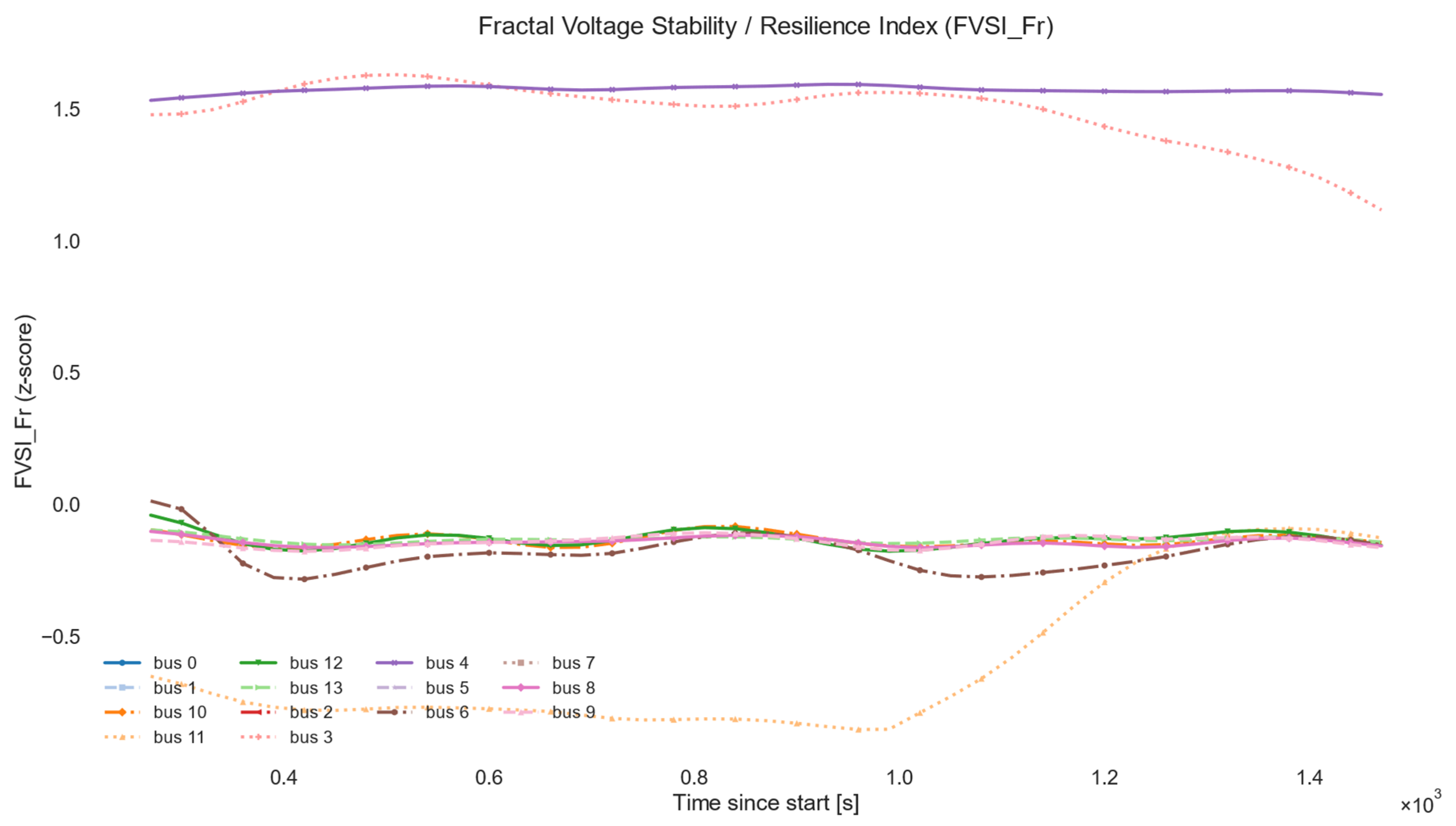
Figure 1. Overview of the composite fractal voltage resilience index (FVSI_Fr) across all IEEE 13-bus nodes.
Fractalfract 10 00032 g001
Figure 2. Heatmap of the composite fractal index FVSI_Fr (node × time window) for an IEEE 13-node system.
Fractalfract 10 00032 g002
Figure 3. Time evolution of the DFA scaling exponent α for all nodes (IEEE 13-bus).
Fractalfract 10 00032 g003
Figure 4. Time evolution of the multifractal spectrum width Δα for all nodes (IEEE 13-bus).
Fractalfract 10 00032 g004
Figure 5. Time evolution of the spectral slope β (PSD in [0.01, 1] Hz) for all IEEE 13-bus nodes.
Fractalfract 10 00032 g005
Figure 6. Time evolution of the multiscale curvature c 2 for all IEEE 13-bus nodes.
Fractalfract 10 00032 g006
Figure 7. Z-standardized DFA exponent z_α for all nodes (IEEE 13-bus).
Fractalfract 10 00032 g007
Figure 8. Z-standardized width of the multifractal spectrum zΔα for all nodes (IEEE 13-bus).
Fractalfract 10 00032 g008
Figure 9. Z-standardized spectral slope in the range 0.01–1 Hz for all nodes (IEEE 13-bus).
Fractalfract 10 00032 g009
Figure 10. Z-standardized z c 2 for all nodes (IEEE 13-bus).
Fractalfract 10 00032 g010
Figure 11. Per-node evolution of fractal indicators for node 1 (IEEE 13-bus).
Fractalfract 10 00032 g011
Figure 12. Per-node evolution of fractal indicators for node 2 (IEEE 13-bus, “load-up” scenario): α , Δ α , β , c 2 , z-standardized features ( z α , z Δ α , z β , z c 2 ), and the composite index FVSI_Fr (with EWMA and one-sided CUSUM).
Fractalfract 10 00032 g012
Figure 13. Panel overview of fractal indicators for node 3 (IEEE 13-bus, load-up scenario).
Fractalfract 10 00032 g013
Figure 14. Panel overview of fractal indicators for node 4 (IEEE 13-bus, load-up scenario).
Fractalfract 10 00032 g014
Figure 15. Panel overview of fractal indicators for node 5 (IEEE 13-bus, load-up scenario).
Fractalfract 10 00032 g015
Figure 16. Panel overview of fractal indicators for node 7 (IEEE 13-bus, load-up scenario).
Fractalfract 10 00032 g016
Figure 17. Precision–Recall curves for early warning: comparison of FVSI_Fr with individual components and baseline detectors.
Fractalfract 10 00032 g017
Figure 18. ROC curves for early warning: comparison of FVSI_Fr with individual components and baseline detectors.
Fractalfract 10 00032 g018
Figure 19. Evolution of FVSI_Fr during load-up (all buses).
Fractalfract 10 00032 g019
Figure 20. Evolution of z(L-index) during load-up (all buses).
Fractalfract 10 00032 g020
Figure 21. Median evolution across buses: FVSI_Fr vs. z(L-index).
Fractalfract 10 00032 g021
Table 1. Default configuration for indicator extraction, standardization, and alarms.
GroupParameterSymbol/FieldDefault ValueCLI FlagJustification/Notes
Time windowsWindow length300 s win_secAccuracy–latency tradeoff; gives ≥10–15 cycles at 0.05–0.1 Hz fluctuations.
Window stepΔT30 sstep_sec10× overlap for smooth tracking and early warning.
SamplingDiscretization estimatefsmedian of Δtbuilt-in Robust estimate from timestamps; requires monotonic ts.
DFA/MFDFAScale rangeS0.5–30 s (log–diff, 16 levels)built-inCovers subsecond to tens of seconds dynamics.
Detrending polynomialm1 (linear)built-inStandard for energy series; avoids overfitting.
MFDFA momentsQ13 levels in [−3, 3]built-inBalance between stability and spectral resolution.
Spectral analysisFrequency band[fmin, fmax]0.01–1.0 Hz fmin, fmaxCovers most driving/loading oscillations.
PSD estimator-Welch; fallback: periodogramautomaticNoise-resistant; fallback for non-SciPy environments.
Structure functionsc2 scalessmin, smax, Ns0.5–30 s, Ns = 8c2_smin, c2_smax, c2_nscalesMultiscale without external wavelets.
PreprocessingHampel filterwindow/σ21; 3.0σ hampel, hampel_win, hampel_nsigmaSuppresses outliers/spikes from measurements.
Standardization z-score window-20 windowszwinLocal baseline for adaptation to slow trends.
CompositeWeightsωα, ωΔα, ωβ, ωc20.28/0.28/0.24/0.20built-inBalances sensitivities; sum = 1.
HybridL-index blending λ0.25built-inBy default we use 0.75CFI + 0.25·(zL), if (L) is available.
AlarmsEWMA coeff.αEWMA0.2ewma_alphaSmooth filter for persistent changes.
EWMA threshold-3.0 zewma_thr“3σ” rule for rare events.
CUSUM drift/barrier k, h0.5; 5.0cusum_k, cusum_hOne-sided positive collapse detection.
Minimum dataMinimum samples in window-256min_samplesReliable estimates for DFA/PSD.
Time axisTime format-seconds since startts_modeInterbus friendlycomparison and visualization.
Table 2. Location of DER and control devices, monitored points, and critical buses IEEE-13.
ElementBusbarRating/LimitsMode/ControlRole in Analysis
OLTC (Substation)650ΔU step ≈ 1.25%, range ± 10%AVR by UPrimary Voltage Regulation
PV1634Pmax = 0.6 MW; ±Qlim = 0.3 Mvarcosφ ≈ 1; Q(V) limitsRES node; local sensitivity
PV2675Pmax = 0.4 MW; ±Q_lim = 0.2 Mvarcosφ ≈ 1; Q(V) limitsRES at “weak” end of feeder
Shunt capacitor611Q_rated = 0.3 MvarfixedLocal Q-support
STATCOM675±0.5 MvarU-controlFast Q-regulation in case of disturbances
PMU/SCADA points632, 634, 671, 675, 680quantities: V, (Q if available)logging @ cadence 1 sTime series source
“Critical” buses675, 680--End of feeder/limited Q-support
Table 3. Default configuration for calculating indicators and alarms.
ParameterValue (Default)Justification/Role
Total duration (sym.)1800 s30 min, enough windows
Logging cadenc1 sPSD to 1 Hz, stable sampling
Window (win_sec)300 s~5 min for DFA/MFDFA/PSD
Step (step_sec)30 s10× overlap, smoother trajectories
Frequency band (PSD)0.01–1.0 Hzlow-frequency fluctuations of U
Z-score window (zwin)20 windowslocal baseline
c2 scales0.5–30 s; N = 8multiscale for intermittency
Min. samples/window256reliable scale fitting
EWMAα = 0.2; threshold = 3.0 zsmoothing and alarm threshold
CUSUM+k = 0.5; h = 5.0one-sided upward drifts
FVSI_Fr weightsα:0.28, Δα:0.28, β:0.24, c2:0.20balanced composite index
Table 4. Quantitative early warning estimation.
MethodAUC_ROCAUC_PR
zα0.7578010.472624
zΔα0.1203930.306985
zβ0.6427210.332238
zc20.7862410.477187
Δα0.0535710.280000
β0.0687920.128585
c 2 0.3978310.470573
EWMA0.7355990.340511
FVSI_Fr0.6953120.320928
CUSUM0.5578370.230300
Disclaimer/Publisher’s Note: The statements, opinions and data contained in all publications are solely those of the individual author(s) and contributor(s) and not of MDPI and/or the editor(s). MDPI and/or the editor(s) disclaim responsibility for any injury to people or property resulting from any ideas, methods, instructions or products referred to in the content.